Situating Agency – Assemblages of Place, Material
and Maker
James Taylor
Submitted to Hereford College of Arts
In partial fulfilment of the requirements
For the degree of BA (hons) Artist Blacksmithing
Module Code: HEAB6020
Validated by the University of Wales Trinity St David
Edited Word Count: 5248
Full Word Count: 7132
Preface
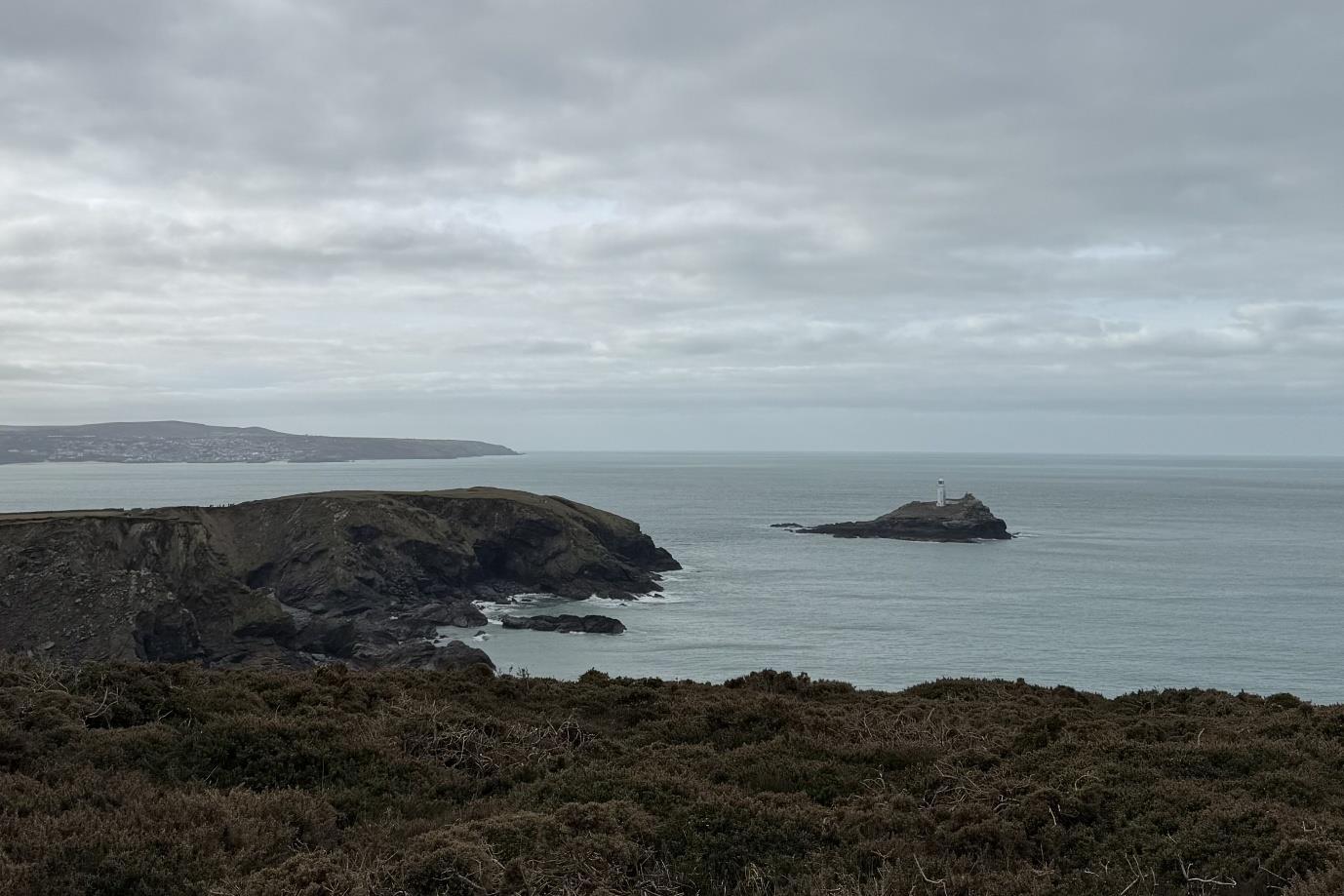
Godrevy Head in Cornwall (Figure 1) is a headland formed from Devonian Mudstone on the eastern end of St Ives Bay, roughly three miles northeast of the town of Hayle. It marks the termination of a roughly three-mile stretch of sandy beach and is frequented by a native grey seal population. Around three hundred meters offshore lies Godrevy island and its Victorian-era lighthouse.
Consider a mother and child standing on this headland at sunset. Perhaps the child is excited that they are up past their bedtime, perhaps intrigued by the seals in the cove below. The mother may take photographs, may watch the child run around, innately aware of the significance of this moment. As they walk, talk, inhabit that space, a place is created. Not a physical place, not tangible, but a place nonetheless.
But what if they return there? Perhaps they may stand in the same spot, wear the same clothes; it may be the same time of day, the same day of the year; they may even have the same conversations. But it will be a different place. For they have both changed, they will perceive and interact with the space, with each other, in different ways. That nostalgic childhood place can never be returned to, save in the memories of that mother and child.
Introduction
It can be said that the process of making is a manifestation of agency, a coalescence of agents and their interactions. An agent is, in its simplest form, “a being with the capacity to act” (Schlosser, 2019), and agency “the exercise or manifestation of this capacity” (ibid.). The number of agents which may influence any given object is immense, but perhaps three of the most influential are the maker of the object, the material(s) it is made of, and the place(s) the object is situated in, references and is inspired by. The links between maker, material and place are both recursive and diverse, and are not fixed to any singular moment in time, evolving and developing alongside the object. This may lead an observer to question where the ultimate site of agency of an object lies within the assemblage of maker, material and place, and if this site can be static or instead fluctuates as time progresses.
When viewing an artwork or craft object it can be easy to assume that it is the result of some linear, repeatable process, fully dictated and directed by the maker. This is known as hylomorphism, popularised by renaissance artists and the Christian ideal of a ‘divine creator’, and it speaks of “artistic creation that puts mind before matter” (Lehmann, 2012, p10), that is to say that material wholly bends to the whim of the maker, having no effect on the outcome, effectively rendering its agency null and void. In recent times however, there has been a questioning of whether this is can be the case, with the increasing understanding of a morphogenetic manner of working where there is no predetermined form and material becomes an active participant in the process. This has led to discussions around material agency and vitalism, with metal, or more specifically steel, named as “the exemplar of a vital materiality” (Bennet, 2010, p55), and the rise of the popularity of contemporary forged metalwork in recent years serving only to cement its status.
There is more to any assemblage, however, than simply maker and material. In modern times many artists are “trying to capture the appearance or feeling of places they remember” or “convey the cultural and emotional qualities of a certain kind of place” (Robertson & McDaniel, 2005, p193). This has led to a great importance and significance being vested into the role of ‘place’ within art, not only where it serves as an influence or reference, but also exploring the locations in which an object is situated and the agency generated as a result of this.
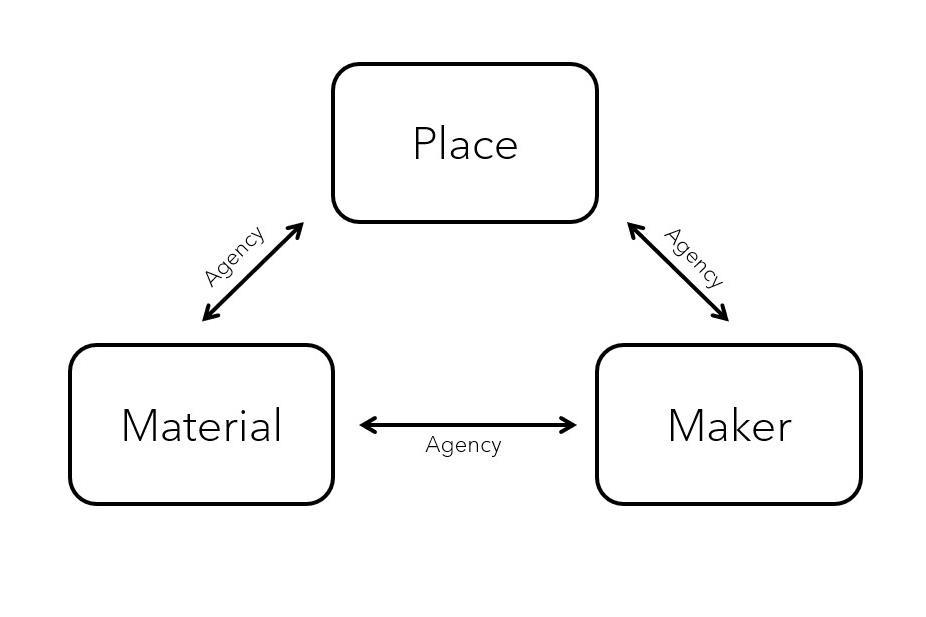
As an artist works with material, as they explore the properties or role of place, agency flows between the three (Figure 2). An assemblage is created between maker, material and place, the properties of which define the object which is created. The ultimate site of agency within this diagram will vary between objects, sometimes more closely aligned with the maker, sometimes an equal balance between the three factors, but this diagram serves to show that none of these factors can be fully discounted when agentically analysing an object.
The combination of place, material and maker is one which has been explored by many artists, in many mediums, but the three examples detailed below (Figures 3-5), show various different sites of agency within this diagram and how the three agents can have differing impacts on the objects which they create.
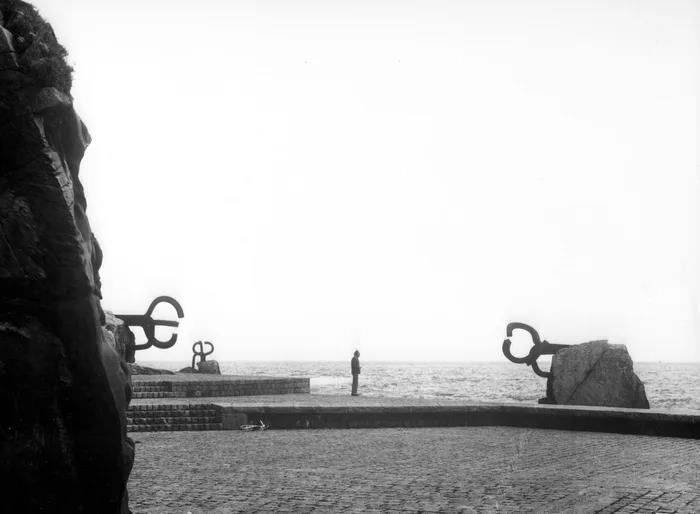
‘Peine del Viento’ or ‘Comb of the Wind’ (Figure 3) is a series of three monumental steel sculptures, embedded within the rocks on the western edge of San Sebastián, on the Basque coast. The location held special significance for the maker, Chillida, as he was a frequent visitor who would go to contemplate the sea, and watch the waves.
The three sculptures are reaching out to each other, creating connections between the rocks which have been separated by millennia of erosion. They also reach out towards the horizon, speaking of what is yet to come and has not yet happened. They serve to enhance the viewer’s perception and experience of the place, giving prominence to what is already there. For Chillida “the main aspect should not be the sculptures but the sea, the air, the wind, the waves, the rocks” (Chillida, 2010) The sculptures were not intended to impose on the site, but rather create a focal point where people can enjoy and appreciate the landscape in a place where they otherwise may not.
These sculptures were created in collaboration with an industrial forging company, with Chillida overseeing the process. He would encourage the workers to push the limits of what they felt was possible, hoping for the material to behave in some unexpected way, so that it “surprises us with its reaction” (ibid). This speaks to a ‘living’ or ‘vital’ material, a concept that would not be fully explored for over half a century by writers such as Bennet and DeLanda.
Chillida’s ‘Wind Combs’ lie roughly within the centre of the above diagram (Figure 2). They showcase a relatively equal interaction between the agency of the makers (Chillida and the industrial blacksmiths), the material (the steel and the stone it is embedded in), and the place the sculptures are situated in (the Basque coast).
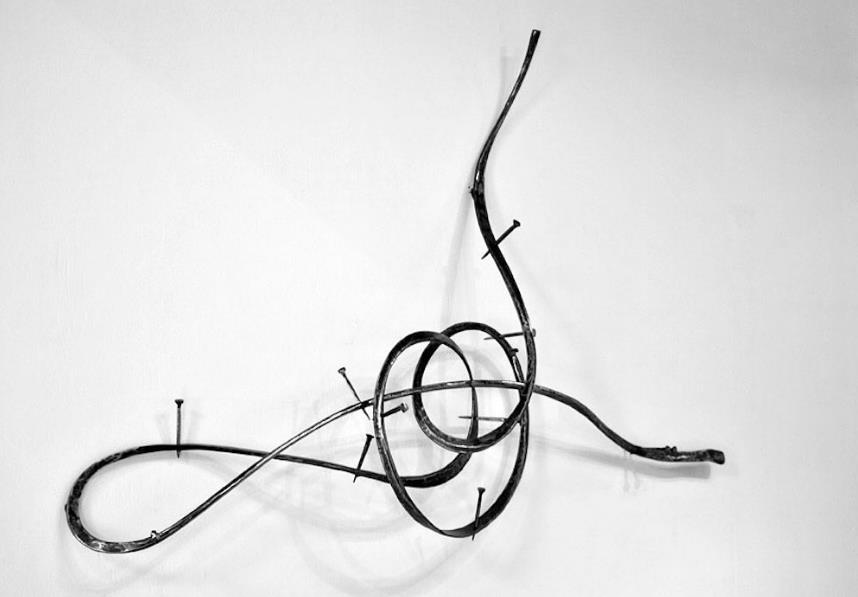
4 – Lifeline, Melissa Cole, 2009
‘Lifeline’ (Figure 4) is the first in a series of works by Wiltshire based blacksmith Melissa Cole exploring her journeys within a landscape. It is an accurate, scaled map of landmarks close to her home, with the nails marking places of significance for her. Other works in this series expand on this concept of a ‘journey within landscape’, exploring paths she has
walked, reactions to topography and landmarks and parallels from this which can be drawn to her own life.
The material is not extensively forged, mostly bent and bevelled in a manner which accentuates the curves and lines of the piece. This is more so a hylomorphic manner of working with the material being formed to a shape pre-determined by the artist, in this case defined by her experiences within a landscape. This can be said to be a reduction in the material’s agency, with Cole imposing her own form onto it. In the above diagram (Figure 2), ‘Lifeline’ would be situated more to the right, with Cole and her experiences and memories within a place providing much of the agency in the assemblage. The material is not wholly redundant however, as there will always be some amount of agency it provides, subtly influencing the form of the final outcome.
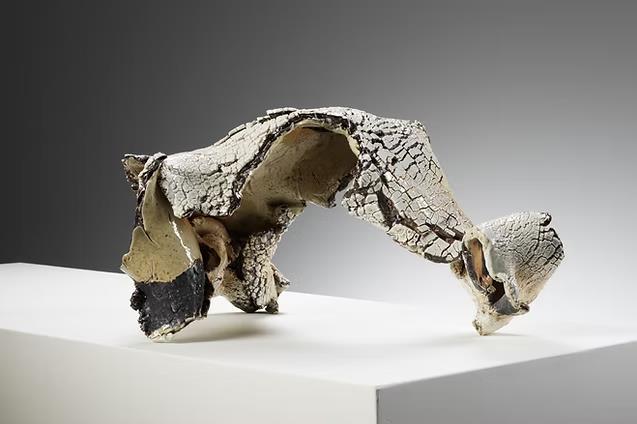
‘Mujo - Impermanence’ (Figure 5) is a work in porcelain and stoneware which has been formed around rocks on a north Devon beach and left overnight so that the tide can interact and exert its agency on the clay, forming it to this amorphous shape It is then removed from the beach, dried and fired in a wood kiln. By allowing the tide and the waves to dictate the form, the agency of the artist is minimised, “it is about surrendering and letting go of the human” (Hellman, 2023).
By adopting this hands-off approach Hellman is able to greater explore the role and agency of place and material in her work. Photographic and video documentation seeks to showcase the ephemeral nature of the process and allows for reflection and contemplation at a later date. In terms of the above diagram (Figure 2), ‘Impermanence’
would be located more to the left, as Hellman has removed a large portion of her agency as a maker by allowing the tides and the waves to shape and form the clay.
The examples detailed above are all made in, or based on, areas which have a strong sense of identity. Whether this be the west-country of England or the Basque region of Spain, it seems imperative that a strong, ingrained sense of place be a driving factor for the creation of meaningful artwork.
Place
It is perhaps trivial to state that many people feel a strong sense of attachment to the areas in which they live or have lived in. Indeed, “profound attachment to the homeland appears to be a worldwide phenomenon” (Tuan,1977, p154). This is likely at least in part due to an accumulation of agentic interactions between the people and the places we call home, causing an ingrained sense of familiarity. A lifetime of lived experiences can blur the lines between person and place so that “place and self are thoroughly enmeshed, without, however, being fused with each other in a single monolithic whole” (Casey, 2001, p684).
But how do we define ‘place’? In its simplest terms place is: “a particular position, point, or area in space” (Oxford English Dictionary). In a geographical sense however, it is more nuanced than this, with the fact “place is distinguished from space” (Agnew, 2011, p2) being crucial to the understanding of the world. Space then, can be thought of as a quantifiable, physical location, merely a property of the natural world, whereas “places are created as humans respond to, interpret, and manipulate their environs” (Larsen & Johnson, 2012, p636). That is to say that places are not necessarily physical, rather drawn from the experiences and interactions people have with spaces.
Within the context of this essay, ‘space’ can be understood to be a location that humans inhabit, i.e. a town, a street, a house, a sports club, an internet forum. ‘Place’ can be defined as the human agency and interaction that is exerted on these spaces. Places are therefore tied to a singular space-time location and even if the spatial qualities of a given place are replicated exactly at a different time, it will be a new, albeit similar, place which is created
The importance of place is perhaps difficult to understate. Places are continually created as we go about our day-to-day lives, capturing the conversations you may have, the path you take as you walk across a field, the specific arrangement of coffee mugs you leave on your desk. A place may be shared with another person or people, but each will have their own subjective experience and interpretation of it, shaped by their own past experiences and places. This accumulation of places will in turn begin to influence your future places as they are created.
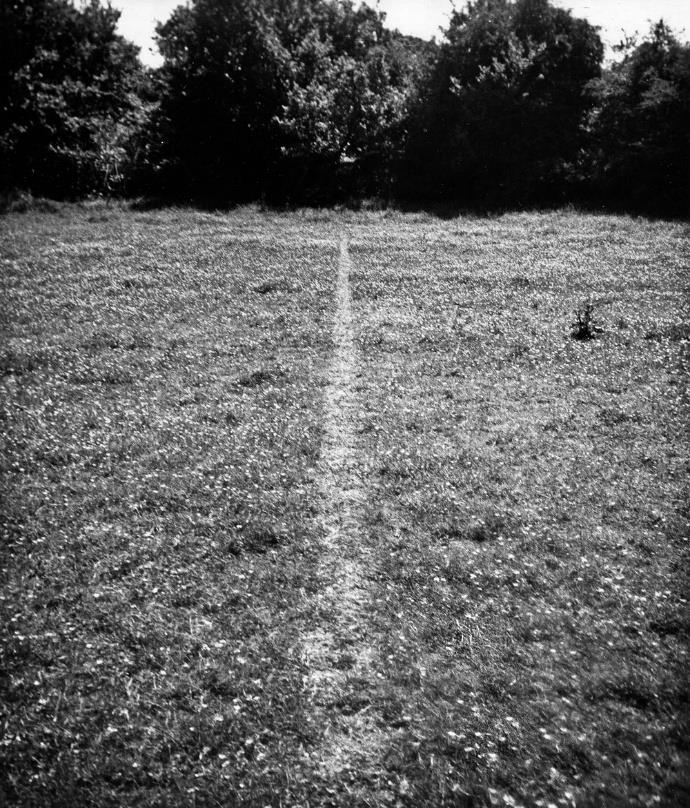
It is perhaps only natural then that many artists have turned to place as an influence to their creative practice. Place is “the geographical component of the psychological need to belong somewhere” (Lippard, 1997, p7), thus art can be a visual or emotional response to this need to belong. This need can be realised in many ways, in many mediums, but what remains constant across them all is a desire to share this need, this belonging, to create a tangible representation of this intrinsically human emotion. In 1967, on one of his journeys from his home in Bristol to St Martins, Richard Long stopped in a field and begun walking back and forth in a straight line. When this had sufficiently worn the grass for the line to be visible, Long photographed it (Figure 6). From this began a long-standing body of work where Long would create lines or circles in a landscape, serving as visual representations of his journey through a space. These works varied from simple depressions in the turf, to collections of stones, sticks or leaves. These works, while being a representation of human effort and endeavour, are also a representation of the agency exerted by the place on the artist. The works are made to be ephemeral, to be reclaimed by the landscape, to leave minimal impact. They are not made in any special location, just selected by chance, in some anonymous field, the process and exertion being the true artwork.
As people inhabit a place, there will always be some amount of reciprocity in their actions and agency. The place is not simply a passive entity but an active reciprocator, that is “there is encroachment, infringement … between the touched and the touching” (Merleau-Ponty, 1968, p134). This reciprocity can take many forms, a specific place may influence you to act in a certain way, it may elicit an emotional response, it may resist attempts to modify or change its properties. This reciprocity creates an assemblage, “ a becoming that brings elements together” (Wise in Stivale, 2011, p91) between person and place. This assemblage has emergent properties which are greater and more diverse than the properties of the individual agents which comprise it. The assemblage is therefore no longer reducible to its constituents and indeed their individual properties are rendered extraneous, “we do not know what an assemblage is until we find out what it can do” (ibid. p92). The emergent properties of the assemblage are of significant importance, especially when discussing art objects, and are what ultimately determine the functions and results of the assemblage. In the case of a person in a place (or vice-versa) these properties define the experience in the place and will have influence on the future decisions or actions of the agent.
Places are by their very nature multisensory objects. They exist in a different sense to physical objects, say a book which you may pick up and read, hear the rustle of the pages, smell the paper, even take a bite out of if you were so inclined Places encompass all of these senses whilst also accounting for thoughts, feelings and emotions, both conscious and unconscious which occur within a space. A place then, must include your reactions, your responses to the whole environment, and also to the book you are reading (or possibly eating).
While it is possible to reside in a milieu of simultaneous, coexisting places, the majority of these will be ephemeral, will dissipate as you exit them. Some places, however, will have additional impact, and will remain in your mind or memories. These places are often those which have significant emotional weight or impact, and over time these places may become an idealised version, a pastiche, of the actual, subjective happenings. Nevertheless, it is these memories of places that have the most impact on creative practice. As they are returned to in the minds-eye of the maker, an assemblage is reformed, the flow of agency between person and place reestablished, and place once again asserts its influence and agency over the maker’s practice.
Places are not limited to solely having influence on a maker during the process of making an object. The place in which an object is situated has significant impact on how the viewer perceives it. Take for example the rockweed vessels made by Jeannet Leendertse as part of her ‘Native’ series (Figures 7 & 8). Both of these vessels are made of the same material, use the same processes and broadly serve the same function. However, when situated in a ‘white-cube’ gallery setting they read very differently to when they are situated on a shoreline, in the location where the rockweed they are made from is gathered. In the gallery setting, the vessel loses some of its connection to the landscape, to the uninformed observer it may not be evident it is made of rockweed, or why this is significant, its purpose will shift towards the aesthetic. When it is situated on the shore however, the connection to the environment becomes much more evident, and the agency of the place on the maker, and the maker on the place is greatly amplified. This is an example of the agency of this assemblage being able to shift and fluctuate towards
one or the other in different situations, strengthening and waning as the object is moved and experienced by other observers.
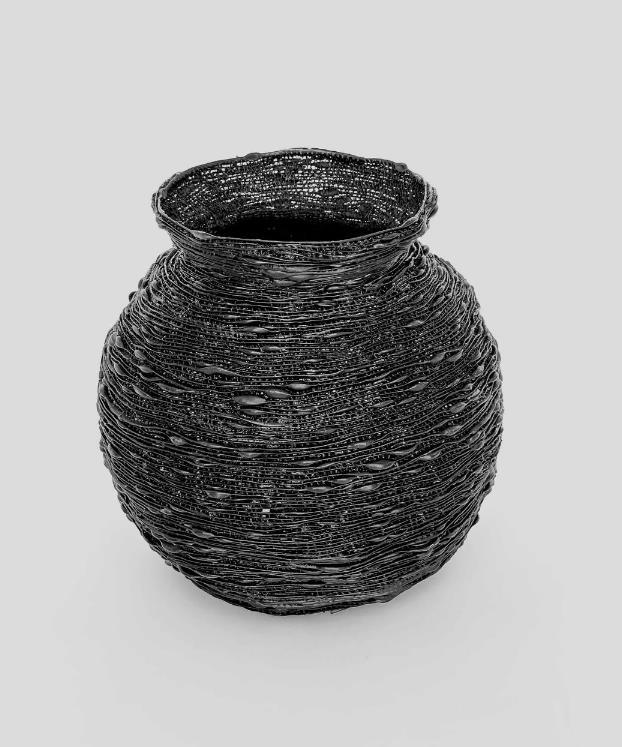
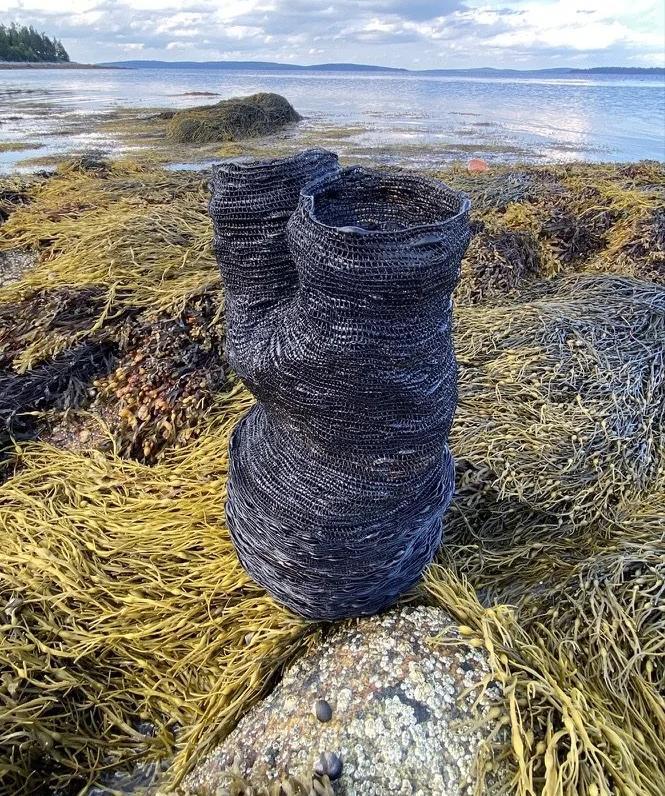
7 & 8 – Rockweed Vessels, ‘Native’ Series, Jeannet
Material
Since the 1980’s there has been considerable research into not only the agentic properties of people and places, but also material. This has led to the new materialist view that “some matter is simply alive” (Frost, 2010, p160). Gilles Deleuze, the notes French philosopher, speaks of material being “a molecularized matter which must accordingly harness forces … a material of capture” (Deleuze & Guattari, 1987, p398). Thinking of material as a medium to capture forces allows for a parallel to be drawn between say, an artist painting a landscape, and the paint arresting the natural forces of said landscape, both exerting their own agency. The assemblage of the artist, the paint and the landscape, acts both separately and together to produce an outcome which is more than simply paint applied to canvas, but one which distils the very essence of a place.
As touched upon previously, when maker and material undergo the process of creating they are not separate entities, rather an assemblage is formed as one acts on the other. This is not a one-directional, transactional relationship, with the maker having dominion over the material as described by the hylomorphic artists of the past, where “matter … was that which was imposed upon” (Ingold, 2010, p2). But rather a conversation where the artist “must 'surrender' to the [material], rather than attempting to impose a form upon it” (Marks, 2006, p5). This conversation speaks to a “material vitality” (Bennet, 2010, p61), a ‘life’ within the material which endeavours to actualise itself during the making process. The material vitality described by Bennet is also defined as the machinic phylum by Deleuze.
The machinic phylum is “materiality, natural or artificial … it is matter in movement, in flux, in variation” (Deleuze & Guattari, 1978, p476). In other words, it is the “flow of matter”
(ibid. p477) which is then followed and exploited by the maker. The machinic phylum assumes a living, morphogenetic material, which self-arranges itself into spontaneous forms. These forms are created by “immanent capabilities of the flows of matter-energyinformation and not any transcendent factor” (DeLanda, 1997, p5). This “transcendent factor” is simply to say that matter is not organised into forms by any external force, whether this be some higher power, or simply an artist creating their work. Matter must assume its own forms, regardless of any external influence or agency.
It is the maker, the artist who then follows this vitality, this life. Through intimate knowledge they are able to develop a dialogue with the material, they are able to nurture and grow its incipient qualities and forms This is not a one-off event, through continued investigation and material intimacy they are able to recursively actualise this vitality, often to an extent whereby it defines their practice. In traditional crafts this dialogue is often talked about through the lens of a tacit knowledge of material, in other words, an intuitive knowledge of how the material will move or behave. The way an artist “follow[s] the flow of matter … is intuition in action” (Deleuze & Guattari, 1978, p477).
It can perhaps be said that metal is a paragon of a vital materiality. Its “quivering effervescence”, its “vibratory vitality” (Bennet, 2010, p55), alongside its “complex, continuously variable behaviour” and “inherent morphogenetic potential” (DeLanda, 1995, p6) are evident to any who have worked with it. This may be in part due to the ways in which metal can be worked, as unlike many other materials it can be forged, plastically deforming the once rigid crystalline structure, instantaneously assuming a new form. The result of each hammer blow is not predetermined, even the most experienced metalworker cannot fully know what will occur. The temperature, and thus plasticity of the metal, alongside its pre-existing physical form will undoubtedly have an impact on the outcome of each hammer blow, but its intrinsic qualities, its alloying elements, its direction of grain flow, the dislocations within its crystalline structure will manifest themselves on both a micro and macro scale. The reciprocative nature and impact of this vitality is not to be understated, “human metalworkers are themselves emergent effects of the vital materiality they work” (Bennet, 2010, p60), their actions and processes of working developed from their intimate material knowledge.
The structure of metals has long been an established convention dating certainly to preindustrial times with “knowledge developed on a purely empirical basis through direct interaction” (DeLanda, 1995, p1) dating back several millennia prior. It is not until the first half of the 20th century that significant discoveries on the crystalline structure of metals were made. Individual grains form within the metal as it cools, the crystalline lattice of each forming in a different direction to its neighbours. The ductility of the metal is defined by dislocations in this lattice, deformations at the atomic level As force is applied to the metal these dislocations (or cracks) propagate, allowing it to plastically deform and assume new forms
When discussing the vitality of metals, it is important to define them as either homogeneous or heterogeneous. A heterogeneous material is one which “consist[s] of domains with dramatic strength differences” (Xiaolei & Yuntian, 2017, p1), it is non-uniform with the constituent domains (or grains) having notably different qualities. The difference between homogeneity and heterogeneity can be understood by considering a soup before and after it is blended. In the non-blended soup, the chunks of vegetable are able to move around each other, to collide and slide past in a random motion. Once the soup
is blended and emulsified however, it will act uniformly, its movement predictable and able to be easily approximated.
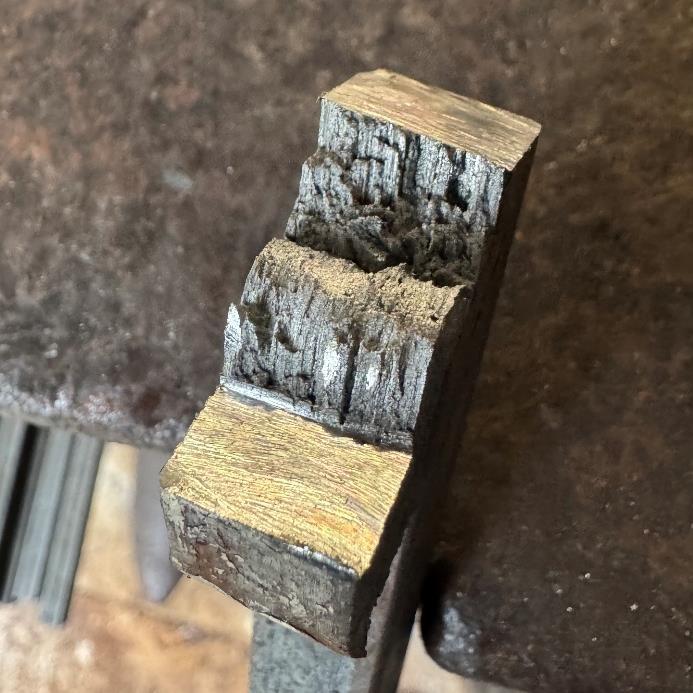
This ‘blending of the soup’ happened in metallurgy in the latter half of the 19th century. Inventions such as the Bessmer process led to a much more uniform and consistent quality of steel, and subsequent inventions only furthered “an intense process of uniformation and homogenisation in [steel’s] chemical composition and physical structure” (DeLanda, 1995, p5). These discoveries ultimately created the modern, industrial grades of steel used today, approximated by engineers and scientists to be wholly homogeneous. This was not always able to be the case however, wrought iron (Figure 9), the predecessor to modern steel “is not homogeneous” (Smith, 1960, p163) and displays an “extreme lack of uniformity” (ibid, p183) in its crystalline structure. It can be said then that wrought iron is a much more heterogeneous material than modern steels, which have become so uniform and homogeneous that much industrial design and manufacturing has been reduced to routine. Indeed, some writers have stated that “steel
… might euphemistically be described as a material that facilitates the dilution of skills” (Gordon in DeLanda, 1995, p5).
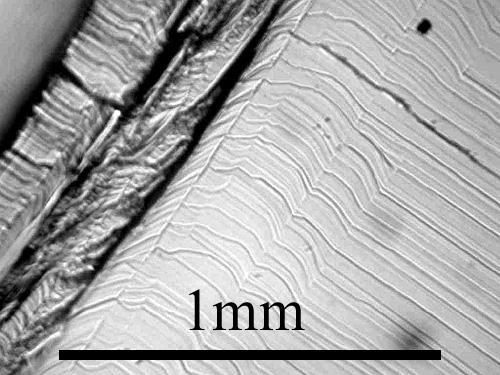
I would not go so far as to say that working with steel requires little or no skill, or even dilutes preexisting ones, as even modern day merchant bar stock has cracks and coldshuts which mean on the macro-scale at least, the bar cannot be fully homogeneous. When discussing the homogeneity of the crystalline structure of a metal, it is important to define the scale at which it is observed. This is because at a quantum or atomic level, there will always be an amount of randomness and disorder within the material. In almost all practical applications however, these imperfections are extraneous and can be disregarded. The dislocations (Figure 10) mentioned earlier however, alongside differences in chemical composition, and grain growth attributed to heating and cooling cycles, means that for the practical metalworker or blacksmith, at least, steel is understood to be a heterogeneous material with innate vitality and incipient qualities which endeavour to make themselves known.
Through the process of forging, the blacksmith is able to become intimately acquainted with the material, to learn how it responds to different processes, can discover its innate heterogeneity, vitality and agency Whether this agency is known as material vitality, the machinic phylum or something else entirely, is secondary to the maker’s knowledge and understanding of the material and the ways in which they work with it. The assemblage of maker and material is one which is dynamic and recursive, with both agents seeking to exert their agency over the other. It is often the case that the material’s agency can be lost within the intent of the maker, but if care is taken, and attention is paid to the vitality which
seeks to express itself, a much more dialogic and expressive object can ultimately be brought into being.
Maker
‘Wave Form Three’ (Figure 11) is a work by the author which seeks to embody and distil a sense of place in the medium of forged metal It is a reaction to an amalgamation of experiences, the sum total of a childhood spent on beaches and in the sea. The crashing, tumbling turmoil of being thrown about by the waves, the swirling vortices you are able to see only from beneath the surface, the sea spray whipping around your face as you gaze out over the bay.
It is part of a series of work which started as a collection of sketches that were done at various points on the Cornish coast, not necessarily focusing on the physical landscape but on the memories they evoked. These memories and sketches were then translated into forged steel. By starting with bundles of metal bars which were forged into each other, then bent into rough arcs, a fragmented, striated effect was achieved. Several of these bundles were then arranged and welded together to create the assemblage seen here.
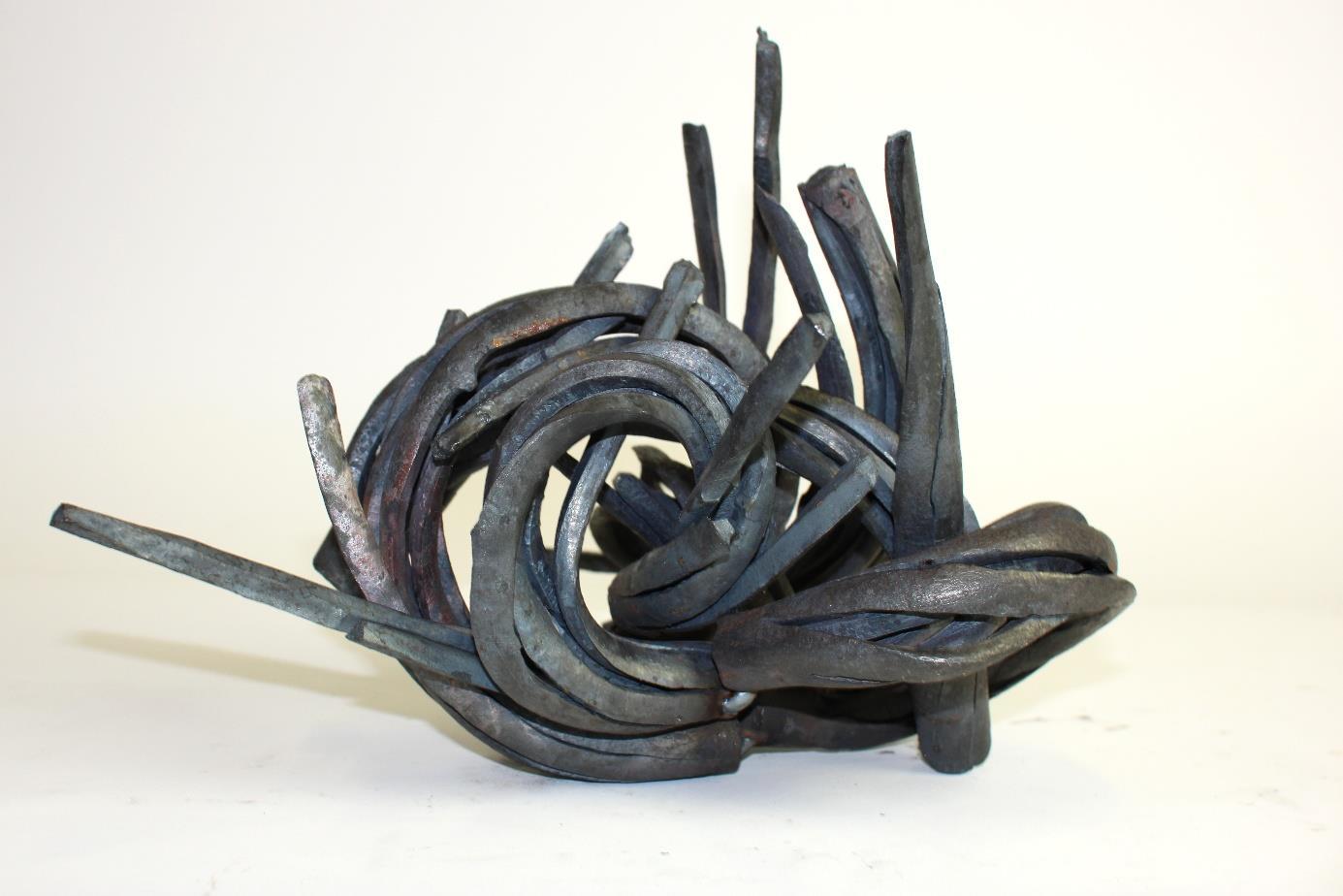
The process of making this piece was a continuous, reciprocative dance of agency between the maker, the material, and the places which inspired it. The agency the maker has over the process is perhaps the most evident within the piece. It is the maker who cuts and welds the bars, it is the maker who lights the fire and shapes the metal, it is the maker who ultimately dictates the form of the piece. And for many people, in many cases, this would be the sole location where they may see agency existing. But I would suggest there
is more to the process than this. For why did the maker choose the Cornish coast as the inspiration for this piece? It was not due to any cosmic fluke or mere happenstance, rather the maker being continually agentically influenced by places from their past.
This agential influence may take the form of both conscious and unconscious thoughts. In the conscious mind a maker may choose to make work inspired by a place which they find visually stimulating, or a place that holds particular emotional weight to them. They may have a particular memory which they may seek to embody, and in the process of making they will consciously refer back to the place in which it occurred, remembering the various sensual dimensions, people and conversations. On an unconscious level, details which have been lost to the conscious mind may resurface, whether it be a particular feeling the place elicited, or some trivial detail that may have been discounted at the time. These unconscious agential influences are “habits and preferences that are inaccessible to conscious recollection, but … influence our current behaviour and mental life” (Squire & Dede, 2015, p3). Whether consciously or not, this influence is ultimately derived from intimate familiarity with a place. It is what gives the work its haecceity, its unique qualities that make the object what it is and are unable to be replicated by an external body.
The material agency within the piece begins with the heterogeneity of the steel it is made from. In this case, the bundling and forming of the bars has led to a different heterogeneity being visible on a macro scale, instantly making evident to the viewer the tenuous connections between the individual components. The deliberate creation of this non-uniform material had a two-fold purpose, the first being that it serves as an excellent representor for the fluid nature of the waves and sea-spray, but it also serves to amplify the agency of the material. In a plain bar of steel, dislocations or variations in the grain structure may exist on a scale of micrometres, whereas in the bundles these inconsistences are happening over millimetres and centimetres. Dislocations and material variations will still have some impact on the piece, but at a much smaller level than is found in the bundles. This means that as the bars are bent into arcs, the material is able to fray and unravel, thus dictating the final form it will take. By forming the bars in this way, the maker is able to diminish their own agency, allowing the material and the places which inspired it to express themselves more strongly.
Conclusion
It can be seen, through the examples detailed in this essay and elsewhere, that the agency of an assemblage is distributed between its constituent parts. The individual agents interact with each other in a myriad of ways, resulting in an agency which is fluid and dynamic. This dynamic agency is not restricted solely to the human agent, and will change as the assemblage evolves. Within the assemblage of maker, material and place, the resultant object is a manifestation of this agency. The object serves as a tangible representation of the effort of the maker, the influence of the place and the qualities of the material. It is “a congealed residue of performance and agency” (Gell, 1988, p68), which can be examined and explored by an outside observer to better understand the assemblage which produced it.
As discussed previously, for any object there will be an ultimate site of agency within the assemblage of maker, material and place. This location will vary as the resultant object goes through different stages of creation, influence and perception by agents outside the assemblage. During the object’s creation, the site of agency may lie closer to its maker,
whose influence at this stage will undoubtedly be significant. Once the object is situated in a location where it can be viewed by others, whether this be in a gallery setting, a home, or perhaps in a place which influenced its maker, this site of agency will shift. This new place may amplify or diminish existing qualities of the object, causing the site of agency to move towards or away from the place(s) in the assemblage. As the object ages, the material will undergo changes. These changes may be subtle, such as wear marks where the object is used or touched, they may also drastically change the appearance of the object, for example the verdigris found on copper as it oxidises. Changes such as these can be solely a result of the material continuing to exert its own agency, or can be act in conjunction with other agents such as users of the object or simply oxygen in the air. Even if no intentional alterations or interactions are made to the object or its conditions, changes will undoubtedly take place, and with them a shifting, mercurial site of agency.
Whether consciously or not, a maker is continuously conversing with their materials, is forever influenced by their past actions and places, and the assemblage formed from the three is one which evolves and develops alongside the objects it produces. The agency within this assemblage cannot be ascribed to a static point, and instead fluctuates, forever varying alongside the object.
References:
Schlosser, M. (2019). "Agency”, The Stanford Encyclopaedia of Philosophy. https://plato.stanford.edu/entries/agency/ (Accessed 06.02.26)
ibid.
Lehmann, A, S. (2012). How materials make meaning. Page 10
Bennet, J. (2010). Vibrant Matter, A Political Ecology of Things. Page 55
Robertson, J., & McDaniel, C. (2005). Themes of Contemporary Art – Visual Art after 1980. Page 193
Chillida, L. (2010). Interview with Iker Gil. https://mascontext.com/issues/public/el-peinedel-viento (Accessed 27.01.26)
ibid.
Hellman, H. (2023). Interview with Rita Trindade. https://throughobjects.com/blog/narratives-of-time-impressions-of-the-atlantic-coast-by-harriet-hellman/ (Accessed 27.01.26)
Tuan, Y. (1977). Space and Place, The Perspective of Experience. Page 154
Casey, E. S. (2001). Between Geography and Philosophy: What Does It Mean to Be in the Place-World?. Page 684
Agnew, J. (2011). Space and Place. Handbook of Geographical Knowledge. Page 2
Oxford University Press. (n.d.). Place, n.¹. In Oxford English dictionary. https://doi.org/10.1093/OED/4189563071 (Accessed 09.11.25)
Larsen, S. C., & Johnson, J. T. (2012). Toward an Open Sense of Place: Phenomenology, Affinity, and the Question of Being. Page 636
Lippard, L. (1997). The Lure of the Local, Sense of Place in a Multicentred Society. Page 7
Merleau-Ponty, M. (1968). The Visible and the Invisible. Lingis, A (tr.). Page 134
Wise, J, M. in Stivale, C. (2011). Gilles Deleuze: Key Concepts Page 91
ibid. Page 92
Frost, S. (2010). Fear and the Illusion of Autonomy, New Materialisms: Ontology, Agency and Politics. Page 160
Deleuze, G., Guattari, F. (1978). A Thousand Plateaus: Capitalism and Schizophrenia. Massumi, B. (tr. 2013). Page 398
Ingold, T. (2010). Bringing Things to Life: Creative Entanglements in a World of Materials. Page 2
Marks, J. (2006). Introduction, Deleuze and Science, July. Page 5
Bennet, J. (2010). Vibrant Matter, A Political Ecology of Things. Page 61
Deleuze, G., Guattari, F. (1978). A Thousand Plateaus: Capitalism and Schizophrenia. Massumi, B. (tr. 2013). Page 476
ibid. Page 477
DeLanda, M. (1997). The Machinic Phylum. Page 5
Deleuze, G., Guattari, F. (1978). A Thousand Plateaus: Capitalism and Schizophrenia. Massumi, B. (tr. 2013). Page 477
Bennet, J. (2010). Vibrant Matter, A Political Ecology of Things. Page 55
DeLanda, M. (1995). Uniformity and Variability Page 6
Bennet, J. (2010). Vibrant Matter, A Political Ecology of Things. Page 60
DeLanda, M. (1995). Uniformity and Variability Page 1
Xiaolei, W & Yuntian, Z. (2017). Heterogeneous materials: a new class of materials with unprecedented mechanical properties. Page 1
DeLanda, M. (1995). Uniformity and Variability. Page 5
Smith, C, S. (1960). A History of Metallography, The Development of Ideas on the Structure of Metals Before 1890. Page 163
ibid Page 183
Gordon, J, E. (1988). in DeLanda, M. (1995). Uniformity and Variability Page 5
Squire, L,R Dede, A,J. (2015) Conscious and unconscious memory systems. Page 3
Gell, A. (1988). Art and Agency, An Anthropological Theory. Page 68