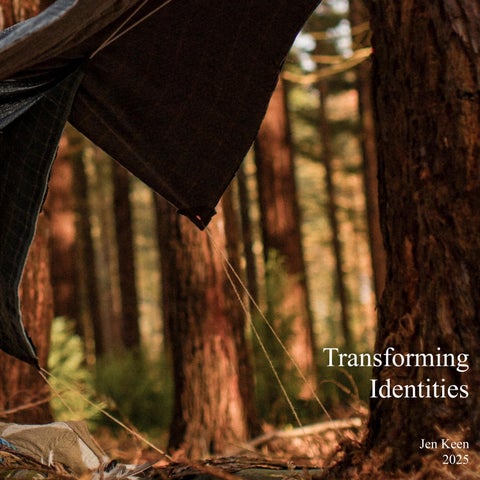
Transforming Identities "The only person you are destined to become is the person you decide to be." Ralph Waldo Emerson
A Reflective Critical Report submitted in partial fulfilment of the requirements for the degree of Masters in Contemporary Crafts at Hereford College of Arts
Jen Keen 27th November 2025
st of Contents:
tle page
st of Contents
st of Figures
cknowledgements
bstract
troduction
hapter 1: - Transforming and Constructing Identity through Stories
Chapter 2: - Transforming Identity through Symbols and their Meaning
Chapter 3: - Transforming Identity through Materials and their Meaning
Chapter 4: - Transforming Identity through creating Home and Heirloom
Conclusion
Bibliography
Appendix
List of Figures Figure 1 (Cover): J.Keen, 'Home' 2025, Bin Bags, welsh wool blankets, foraged natural materials. Photographed by: Amy Hewitt, 2025. Figure 2: J.Keen, 'Cloth Mother' 2025, hand dyed linen, gimp braid remnant, thread, dried lavender. Photographed by: Amy Hewitt. 2025. Figure 3: J.Keen, 'Fairy Godmother', 2025, wood and feathers. Photographed by Matt Davies, 2025. Figure 4: Traditional Welsh Blankets. Photographed by: J.Keen 2025. Figure 5: j.Keen, Quilted Heirloom detail, 2025, bin bags, Welsh wool blanket, foraged natural materials, hand dyed yarn, thread. Photographed by: Amy Hewitt, 2025. Figure 6: J.Keen, ‘Hatching’, 2025, scanned pen and ink illustration, My Story. Figure 7: J.Keen, ‘Sorrowful Magpie’, 2025, scanned pen and ink illustration, My Story. Figure 8: Quilt on a traditional frame – The Welsh Quilt Centre, Lampeter. Photographed by: J.Keen, 2025 Figures 9, 10 & 11: J.Keen, Quilted Symbols detail, 2025, bin bags, natural materials, welsh blankets, hand dyed wool, thread. Photographed by: Matt Davies, 2025. Figure 12: J.Keen, Quilted Heirloom detail, 2025, bin bags, Welsh wool blanket, foraged natural materials, thread Photographed by: Amy Hewitt, 2025. Figure 13: J. Keen, Quilted Bin Bag 2025, bin bags, Welsh wool blanket, thread. Photographed by: Matt Davies, 2025. Figure 14: J.Keen, Quilted Bin Bag detail, 2025, bin bags, thread. Photographed by: Matt Davies, 2025. Figure 15: J.Keen, Quilted Heirloom detail, 2025, bin bags, Welsh wool blanket, foraged natural materials, thread Photographed by: Amy Hewitt, 2025. Figure 16: J.Keen, Cloth Mother, Quilted Heirloom, 2025, hand dyed linen, thread, dried lavender, bin bags, Welsh wool blanket, foraged natural materials, thread. Photographed by: Amy Hewitt. 2025. Figures 17, 18, 19 & 20: J. Keen, 'Making Home' bin bags, Welsh wool blanket, ramie, thread. Photographed by: A my Hewitt, 2025. Figure 21: J. Keen, 'Home', 2025, bin bags, Welsh wool blankets, foraged natural materials, thread. Photographed by: Amy Hewitt, 2025. Figure 22: J. Keen, Quilted Heirloom, 2025, bin bags, Welsh wool blanket, foraged natural materials, thread Photographed by: Amy Hewitt, 2025. Figure 23: J.Keen, Cacoon, 2025, bin bags, Welsh wool blanket, thread. Photographed by Maddie Dalziel, 2025. Figure 24: Barbed Wire in Tree Heart with Threads, 2025. Photographed by: J.Keen, 2025. * All Figures in Appendix: My Story by J.Keen, scanned pen and ink illustrations
gratitude to Del Done (MBE) and Lisa Porch for unwavering guidance, wisdom, insight, and for promising not to hand me my bin bags.
m Hallett for holding space for all the emotions and always managing to talk me round; and for insisting I’m not sh*t, just wired differently.
oby Mackay for putting up with our tiny house always being brimful of random treasures, feathers and pebbles; and for all the support emotionally and financially to pursue another one of my ‘madcap schemes’.
Maddie Dalziel for always having my best interest, and for uttering the most magical of naming ceremonies in referring to me as her ‘artist friend’.
Drawing on my own Welsh heritage, and my experiences of journeying through the local authority care system, I illustrate how we can rewrite our own stories using found, made, and altered materials gathered and stitched into stories that can aid in the re-construction of the self. The presentation of these materials mimics a childhood den, and encourages examination of the child’s understanding of comfort, security and belonging. In this project I explore the potential for transforming identity through threads, words, examining literary and material symbols, transforming materials, and creating heirloom objects of value. I have transformed reclaimed Welsh blankets and bin bags into three large symbolic quilts that form the architecture of ‘home’, along with a decorative heirloom quilt that incorporates gathered natural objects. Accompanied by an illustrated tale, My Story, these objects make visible a journey of transformation, for myself, and for others who seek to reclaim their own narratives.
he hidden heart of the parcel, in the middle, beneath all the enfolded layers, there’s ret treasure: the story of identity and belonging, the myth of home…” (Warner,
core my project is about constructing and transforming identities through the ve transformation of materials, with ‘materials’ in my study consisting of words and s, symbols and visual language as well as the material language of stitch, textiles raging. It is about finding, acknowledging and exploring the multiple versions of the bout altering preconceptions composed internally, and those imposed externally by . It’s about reimagining these into new stories that allow space and support for all ts of ourselves. It’s about feeling like an outsider and looking for a way ‘in’ to an wn fictitious place or space, but not knowing how. It’s about wanting to belong to e, to a culture, to an inheritance, and to have a sense of heritage – an allotted n of being. It’s about claiming the creative power to weave new possibilities. Cloths have long symbolised the creator figure; as cloth can be woven, and unravelled, -constructed, so can identities, and personal narratives.
Care Experienced artist, my lens is focused predominantly on the challenges of these transformations with the additional displacement of having been through the authority care system, and how narrative materials and their metaphors can help us and question, presumptions we make about our self, and that others may make on ehalf. But I hope, like all good stories do, that it is also relevant to a wider nce, and that it helps to challenge assumptions about anyone who is different and through empathy and understanding. It’s for everyone who has felt alone, or ged, or struggled with their own sense of identity and belonging. That whatever ackground, your upbringing, your circumstances, that you have the opportunity, the the courage, the power, and the absolute right to reconstruct your own story, in wn way, to whatever you want, and need, that to be.
egin by examining how stories can be a supportive tool to help us understand who e and our place in the world, and to rescript these stories in a way that is ngful. I will then explore the symbolic language that makes visible my story, and ve translated these narrative metaphors with the materials I’ve chosen to embody a of belonging. Finally, I will show how the act of making with intention, and how I e to present, can transform materials into objects of comfort, safety and value.
“…at the hidden heart of the parcel, in the middle, beneath all the enfolded layers, there’s a secret treasure: the story of identity and belonging, the myth of home…” (Warner, 1994) At its core my project is about constructing and transforming identities through the creative transformation of materials, with ‘materials’ in my study consisting of words and stories, symbols and visual language as well as the material language of stitch, textiles and foraging. It is about finding, acknowledging and exploring the multiple versions of the self, about altering preconceptions composed internally, and those imposed externally by others. It’s about reimagining these into new stories that allow space and support for all aspects of ourselves. It’s about feeling like an outsider and looking for a way ‘in’ to an unknown fictitious place or space, but not knowing how. It’s about wanting to belong to a place, to a culture, to an inheritance, and to have a sense of heritage – an allotted portion of being. It’s about claiming the creative power to weave new possibilities. Clothmakers have long symbolised the creator figure; as cloth can be woven, and unravelled, and re-constructed, so can identities, and personal narratives. As a Care Experienced artist, my lens is focused predominantly on the challenges of facing these transformations with the additional displacement of having been through the local authority care system, and how narrative materials and their metaphors can help us face, and question, presumptions we make about our self, and that others may make on our behalf. But I hope, like all good stories do, that it is also relevant to a wider audience, and that it helps to challenge assumptions about anyone who is different and ‘other’ through empathy and understanding. It’s for everyone who has felt alone, or dislodged, or struggled with their own sense of identity and belonging. That whatever your background, your upbringing, your circumstances, that you have the opportunity, the ability, the courage, the power, and the absolute right to reconstruct your own story, in your own way, to whatever you want, and need, that to be. I will begin by examining how stories can be a supportive tool to help us understand who we are and our place in the world, and to rescript these stories in a way that is meaningful. I will then explore the symbolic language that makes visible my story, and how I’ve translated these narrative metaphors with the materials I’ve chosen to embody a sense of belonging. Finally, I will show how the act of making with intention, and how I choose to present, can transform materials into objects of comfort, safety and value.
n, and falls asleep. The girl sleeps for a hundred years.”
Transforming and “…myths are not eternal verities, but historical compounds, which successfully conceal their own Constructing contingency, changes and transitoriness so that the story they tell looks as if it cannot be told otherwise, that things always were like that, and always shall be” (Warner, 1994) Identity This proposition is strengthened by Brooks’ assertion that “the concept of narrative is useful for through theorizing transformative learning…we learn by constructing and reconstructing narratives to make meaning of information and events” (Brooks, 2001) Stories support our own transformations. Warner reminds us that stories are not fact, and whilst they may present themselves as truths, they are generative. We can use them to create new personal narratives, construct different patterns of behaviour and cultivate new understandings of the self.
My project is quilted together with stories, they act as the golden thread that holds together my ideas, materials, intentions and identity – starting with my own story: My Story (Appendix). It tells us how we can all use our collections of found, made and altered stories that we’ve gathered through our lives to help us understand who we are and where we belong. Stories, and materials can be retold, restitched, and reinterpreted; they offer space for continual rewriting and reimagining. “Hungry, she bolts every plot on the way the to the top, stories stuffed in. Tales and myths and fables with a desperate craving to find the right one.” (Appendix) With My Story, I explore how the metaphorical expedition through the landscape of my childhood, up Mountain, through Forest, alongside River, generates transformations, and allows for different perspectives to be reached. These significant milestones along my journey are rich in symbolic literary meaning which is reinforced using the symbolic language of Welsh blankets, which I will discuss further in later chapters. The Mountain’s vast geometric landscape takes us on a pilgrimage in search of a vantage point for revelation. In the Forest we get lost as it encloses for a journey within, sometimes dark and fearful, sometimes full of enchantment and a place of refuge. The River’s winding path reminds us that our journey continues on, and that we are in a constant state of transformation, always the same, yet always changing. Wagoner supports these opportunities that symbolism offers: “Symbolic mediation has opened up a world of culture… and possibility for human beings. With symbols humans have progressively innovated new ways of interpreting and acting on the world and them-selves” (Wagoner, 2023) I wanted to create a story, both literally, and through my chosen materials, that spoke to my childhood self, and also to other people who have been part of the care system. I want to give voice to those who have no story of their own, or who may have had their stories overwritten or redacted by others.
workers, through court hearings, through care homes or agpie, calling out his stolen stories behind carers, and even through the broader society’s him” standing of what is means to be a ‘looked after child’. This
s that it is often a story that focuses on the traumas and erpetrators.
gh an autoethnographic approach, I re-examine and remy experiences, illustrating how my narrative and use of ming and metaphor in my written story and textile art ce can be tools of repossession and reimagination to rt me to rescript these stories as my own.
en are placed into the care system predominantly due to mstances beyond their control having experienced traumatic s – commonly abuse, neglect, abandonment or other forms ma (NSPCC.org, 2025).
stories and stitched materials rich in metaphor, I want to that these dark dense forests of traumatic events can be ated, and that within these stories, we find hope for all the ns and lost boys, the abandoned and unwanted. There is a to believe that the monsters can be defeated, outrun, n from, escaped, or even, as in the case of My Story, simply n out. They are more than stories – they are survival gies: “Fairy tales and fantasy have often been positioned as ist. But they are less a way out than a way in, an escape erils and possibilities. Moving in the optative mode, they tell w things might be, should be, could be, or ought to be.” on and Tater, pg. 23)
experienced kids are adept at surviving – at carrying s, these difficult stories woven with shame. Febos admits verything she has written “started with a secret”. She es that “stories have the power to transform the world…We riting the history we could not find in any other book. We ling the stories that no one else can tell, and we are giving oof of our survival to each other” (Febos, 2022, pg 27)
Transforming In this chapter I will explore how the influences that traditional storytelling medium of Identity through wholecloth Welsh quilting and it’s symbology, and the rural countryside of my childhood are embedded in My Story, my illustrations, and my stitched designs. Symbols and their Traditional Welsh wholecloth quilting motifs draw heavily on the Welsh landscape as Meaning. we see recurring symbols repeated to give these heritage objects a clear Welsh identity. Leaves feature heavily echoing the rural surroundings, as do triangles and fans geometrically connecting with the mountainous horizon, and the labyrinthine spiral with its Celtic connotations of long life. By appropriating this rich heritage and interpreting motifs that are recognisably Welsh, I can align my designs with this history, and so connect my materials, and myself firmly to this important facet of my identity which is connected to growing up, to place and to memory. “Symbolic mediation has opened up a world of culture… and possibility for human beings. With symbols humans have progressively innovated new ways of interpreting and acting on the world and themselves.” (Wagoner, 2023)
cape. ankets. Identifying my ‘Welshness’ permitted a substitute sense of ging, and a feeling of being a part of something outside of myself. Allen (2021) highlights we are hardwired with “A need to belong – to connect y with other people and secure places, to align with one’s cultural and ltural identities, and to feel like one is a part of the systems around (Allen, K et al, 2021)
somewhat ferally and in isolation from any sense of community with contact with others, it was a neighbourhood of nature that welcomed without judgement or expectation. Local trees, pathways, mountains streams became my friendship group, my play dates, my social ctions. My journey is represented through travelling up Mountain, h Forest, alongside River, the North Wales landscape became my safe , my understanding of ‘home’. In the Genesis Exhibition: Walk the e (2025) Do Ho Suh asks the question “What do we carry with us when ove around the world?”
idea of being ‘haunted’ by the symbols of previous homes or spaces is ful, the idea that we carry these traces with us as echoes of past s. For me this was an exciting realisation. That my ‘home’, that is, my nment may change, but it carries traces of all the other trees and ms I have seen, and I can still feel comforted by the familiar components make up my natural environment and be reassured and regulated by it. eaf I have found is every leaf, this mountain I climb is every mountain.
of this visual language is echoed in My Story, both in words and its tions. We journey up mountains, through forests and alongside rivers quest to understand our transformation. The traces of the threads, only sible on the Welsh blankets, reiterate the traces of the places I call They’re symbols of the Welsh landscape; Forest, Mountain and River presented by the leaves, triangles and spirals of the Welsh quilts.
ch I construct and make tangible my identity in this project through the ols used in my Welsh culture, and in fairy tales, appropriating and using o represent my sense of belonging, home and identity derived from my Welsh landscape. By using my textile arts practice to make physical symbols, I structure my “world through forms as well as language…a g through making as there is a naming through saying”. (Prown, 1982,
Transforming Identity through Materials and their Meaning.
bin bag that holds such a negative connotation for the care experienced and to translate these indexical beliefs into objects that offer hope through its relationship with the Welsh blanket. Igoe discusses the makers role in visual language transformation: “the textile designer creates a communicative cloth – this semantic surface. Textile designers respond, translate, interpret and tidy images, words, stories, feelings, memories and objects” (Igoe, 2021, pg 47) Materials carry stories, and the materials I’ve chosen contain stories both relevant to me, and have a wider cultural story recognised by others. My project aims to explore how materials associated with disposability can be transformed with symbolic stitch to signal care, belonging and value.
nh left object on the of comfort side of the and road, of value, the impenetrable and to challenge outer black the mptions e concealing we make its about unsightly bin bags, contents andand therefore making to sure also sider g spills preconceptions out and contaminates…its of children in care.narrative is quite t. belongings, your history, and everything you think of as r everything the care experienced that has come - these fromstories the only arehome amplified, you may and nknown, in withthe stories very fabric of shame, of your of whole worthlessness, identity, is of tied loss up and in a hItbag, becomes it’s nota surprising narrative ofthat negation: children itbegin negates to assume what’s ,ey negates too must being be seen, objectsbeing of little valued, value,being not worth cared nurturing for. It is aking st an object, care of. but Shame an indicator becomes of neglect embedded and disregard. in these bin and they become the carriers, literally and figuratively, of and 22,of the worthlessness. National Youth Advocacy Service (NYAS) cted a research programme with young people, local ntrast, ities and blankets professionals are connected who work to aacross sensethe of the care domestic, system, mth vealed andthat: comfort, of home and belonging. Blankets hold e connoted meanings –they lend themselves to be ed and to be wrapped up in, covered, swaddled – they They can be used for shelter and protection, for warmth, e under or to sit on.
oosing Welsh blankets for my project, I can also draw on ditional layer of significance for myself, born in Trefriw in Wales, home of a significant Welsh woollen mill, and the legacy of Welsh textiles. Cranney-Francis captures this al relationship when she reminds us that “we all know this excitement, where the touch of an object from the past – us to our culture or society, or even just to our own family y – links or connects us to that past”. (Cranney-Francis, This “deployment of touch reveals the nature of both died subjects and the society and cultures in which they nd in this sense is seme-ful – multiply significant, ally, emotionally, intellectually, spiritually, politically.” ney-Francis, 2011, pg 14) This tactile form of connection e absent from our family heritage, especially for children ave moved through the care system, but we can weave a nship with the genealogy of our natural surroundings.
into an left rubbish object on the of comfort side of the and road, of value, the impenetrable and to challenge outer black the surface concealing assumptions we make its about unsightly bin bags, contents andand therefore making to sure also nothing spills reconsider preconceptions out and contaminates…its of children in care.narrative is quite explicit. If your belongings, your history, and everything you think of as But for everything home, the care experienced that has come - these fromstories the only arehome amplified, you may and wovenknown, have in withthe stories very fabric of shame, of your of whole worthlessness, identity, is of tied loss up and in a grief. Itbag, rubbish becomes it’s nota surprising narrative ofthat negation: children itbegin negates to assume what’s inside, that they negates too must being be seen, objectsbeing of little valued, value,being not worth cared nurturing for. It is not just and taking an object, care of. but Shame an indicator becomes of neglect embedded and disregard. in these bin bags, and they become the carriers, literally and figuratively, of In 2022, loss, and of the worthlessness. National Youth Advocacy Service (NYAS) conducted a research programme with young people, local authorities By contrast,and blankets professionals are connected who work to aacross sensethe of the care domestic, system, andwarmth of revealed andthat: comfort, of home and belonging. Blankets hold multiple connoted meanings –they lend themselves to be touched and to be wrapped up in, covered, swaddled – they ‘hold’. They can be used for shelter and protection, for warmth, to hide under or to sit on. By choosing Welsh blankets for my project, I can also draw on an additional layer of significance for myself, born in Trefriw in North Wales, home of a significant Welsh woollen mill, and the wider legacy of Welsh textiles. Cranney-Francis captures this special relationship when she reminds us that “we all know this same excitement, where the touch of an object from the past – precious to our culture or society, or even just to our own family history – links or connects us to that past”. (Cranney-Francis, 2011) This “deployment of touch reveals the nature of both embodied subjects and the society and cultures in which they live and in this sense is seme-ful – multiply significant, physically, emotionally, intellectually, spiritually, politically.” (Cranney-Francis, 2011, pg 14) This tactile form of connection may be absent from our family heritage, especially for children who have moved through the care system, but we can weave a relationship with the genealogy of our natural surroundings.
he loftier arena of collectable objects. We are interested in their story, their resilience. We want a nship with their histories and their signs of wear and tear, hinting at stories of past love and care only ses our connections with them. Traces of darning implicate that others have taken the time and care to and repair. It increases its worthiness and sends us a message to do the same and to keep its story We are excited by the indexical traces of history, of heritage, imagining other hands mending, other s warmed and comforted, this is confirmation that this item is not a disposable item.
nnecting the bin bag and the blanket together, by quilting them and creating a new material, I am sting that the bin bag can ‘become’ an object of comfort, of history, and that it can, in conversation with anket, take on all the symbolic meaning of a quilt. “Quilts stimulate memories of warmth, security and rt: their layers concealing both personal and collective narratives. Many quilts travel down through ations undocumented, but some may be accompanied by individual histories, passed down by word of ” (Selvedge, 2010: 53).
a transmission of their assumed hierarchies of value, durability and care. I am rewriting the narrative of the bin bag and giving it the potential to become more, giving it permission to aspire for a greater sense of worth and value. The bin bag now affords a sense of substance, in its size and stature, and in its use to warm, cover, protect, comfort, shield. It can elicit an emotional connection, and has agency to challenge its connoted meanings, and can adopt merit, value, resilience – a whole new set of desirable associations. “the ‘social life of things’ (or material culture)…is studied to discover the beliefs – the values, ideas, attitudes and assumptions of a particular community or society at a given time…The underlying premise is that human-made objects reflect, consciously or unconsciously, directly or indirectly, the beliefs of the individuals who commissioned, fabricated, purchased or used them, and by extension, the beliefs of the larger society to which these individuals belonged”. (Prown, 1982) It’s also offered up as a gift to a wider audience to examine their own cultural assumptions, and to re-consider whether the accepted signifiers of objects always tell the truth – are bin bags always worthless? And so are children in care always worthless? This transformation of materials can offer a sense of home and belonging, can have potential to become items of value and care. These objects can become heirlooms - gifts created for my childhood self, to be cared for and cherished. They also become gifts for the care experienced to understand that they too can create their own inheritance: “objects provide us ‘artificially with what nature has neglected to bestow on us’…the designed object is a gift-like recognition of each other’s base and complex needs and desires” (citing Dilnot, 1995, Igoe, 2021, pg 51)
ed and heritage value, can be constructed symbolically to create a sense of home and belonging and become heirlooms for my ansforming Identity ood self, and for an ongoing future self. rough creating g foraged for stories and words to understand my experiences as a child in care, for symbols and materials that connect with my heritage, and my landscape, I am now ready to transform these gathered items yet further. ome and Heirloom.
lecting natural objects and connecting them to pieces of my blanket and bin bag quilts, it renovates these items again, and I this final quilt to illustrate my own transformation into someone of value. Igoe talks about collecting ‘stuff’, and the impact this n textile design. She discusses the seemingly mundane or worthless everyday items, the ‘paraphernalia’ we gather around us, and al foraged items are natural, found objects collected when I’m out walking in nature. They are the objects that resonate with me, uggest home, or comfort, a familiarity, and inform the shapes and designs I create. “The act of foraging originates from a need to with immediate needs, but also to cater for future needs and minimize the potential for deprivation” (Igoe, 2021 pg 129)
e foraged materials are embroidered, couched, and woven onto fragments of hand dyed Welsh blankets, and remnants of Welsh n cloth into a series of symbolic pieces, that like my collected words and symbols, are gathering all the components of my journey, My Story. Like children in care who gather fragments of stories of what ‘family’ and ‘belonging’ might be, they are loosely stitched er to create a whole, a final significant blanket, in an attempt at understanding these influences on identity.
eirloom blanket will sit sheltered beneath a canopy, or den ocf my Mountain, Forest and River quilts. In my exhibition, I invite my nce to enter the ‘dark forest’ and take their own journey of transformation. To suspend their belief that a bin bag means rubbish, s disposable. To allow the possibility that the ‘fabric architecture’, the ‘walls’, unbreathable and foreboding, can also become s of comfort and security.
transported into the small secret space of a child, and a little awkward and conspicuous, ‘out of place’. These feelings will remind the audience how it feels to ‘not fit’, like the child in care. In the centre is the final blanket, my blanket, my heirloom, a patchwork of patterns and designs and embellished with my collected wild things. In returning to a childhood state to reconnect to the child within us, it would be fair to suggest that whilst we are there, we can use our ‘evocative objects’ - our props, or ‘bricolage’, that speak of our identities, to reassure, heal, and suggest alternatives to our childhood selves, as “companions [s] in life experience” (Turkle, 2007). These familiar things, in my case my stitched blankets and foraged embellishments, that help us to remember and try to make sense of transitional times in our childhood experiences are full of a symbolic language that is ours alone, a secret language full of personal metaphor and meaning. By combining the physical, the emotional and the social transformations, and assembling a ‘home’ embellished with the things that I value, an heirloom worth preserving, I am acknowledging to myself, and my audience, my own sense of worth and value; it represents a “reciprocal act of improvement” (Barnaby in Amos & Binkley, 2020) where the process of making impacts both the materials and the maker. In turn this offers the possibility to other care experienced individuals, and a wider society, that we can all explore “who we were, who we are, and [most importantly] who we might be.” (Gray & Stuart, 2012.)
gh my project, I have shown how I have used materials I have collected, materials that have significance to me, ng words, Welsh blankets and bin bags, symbols, items from my natural environment, and indeed the cape itself, and have transformed these items into objects of comfort, of shelter, and of value. In engaging with ocess of transformation, I have also transformed myself, and have allowed myself to acknowledge my own my own value, and that these objects that have helped inform my identity have also been able to be ormed to offer me a sense of belonging and a sense of home.
project has supported me “through agency and intention, and in particular through a consideration of how s plied the needle… to position the self differently – to fashion the self as an artist, educator, individual, t…to forge new social ties…or to recall identities lost or left dormant through processes of dramatic personal e or displacement” (Amos & Binkley, 2020). Through this process of making, I have reclaimed authorship over arrative. The practice of stitching, characterised by repetition, sustained attention, and intentionality has oned as a methodological means through which disparate elements of my identity could be brought into ation, unified and reconstructed. Through applying various textile techniques to non-conventional materials ll outside the traditional textile framework, the bin bags and foraged items, and affiliating them with materials of rt and endowing them with symbolic embellishment, I have reconfigured them into ‘textilic’ materials of cance and value. Similarly, by gathering the words and literary symbols from a lifetime of stories and tioning them into my own newly constructed story, I have granted myself the sovereignty to rewrite my own y, and to open the space for the possibilities of future chapters, and future identities yet to emerge.
king visible the potential for identity to be reformatted, both in how we see ourselves and in how others may to see us my intention within this project, and beyond it, is to encourage and reassure others, those with lived ences similar to my own within the care system, and a wider audience, that these acts of metamorphosis are ly possible, but repeatable, and shareable. This material transformation “can give rise to newly told stories, can nd weave and knit different patterns into the social fabric and that this is a continuous enterprise for everyone to art in” (Warner, 1994)
N, K-A, & KERN, M, & ROZEK, C, & MCINERNEY, D, & SLAVICH, G. (2021). Belonging: A Review of Conceptual Issues, an Integrative work, and Directions for Future Research. Australian Journal of Psychology. 73. 1-16. 10.1080/00049530.2021.1883409. https:// w w .r e s e a r c h g a t e .n e t /p u b l i c a t i o n / 4730_Belonging_A_Review_of_Conceptual_Issues_an_Integrative_Framework_and_Directions_for_Future_Research [accessed Oct 30
, J. & BINKLEY, L. (eds) (2020) Stitching the Self – Identity and the Needle Arts. London. Bloomsbury.
ELHEIM, B. (1976) The Uses of Enchantment: The Meaning and Importance of Fairy Tales. London. Penguin.
KS, A. & CLARK, C. (2001) Narrative Dimensions of Transformative Learning’. airepress.org/aerc/2001/papers/12 [accessed 5th Nov, 25]
Adult Education Research Conference.
https://
SON, H, (2023) Pockets: An Intimate History of How We Keep Things Close. North Carolina. Algonquin Books of Chapel Hill
DLER, D. (2002) Semiotics - The Basics. Routledge. London and New York
NY-FRANCIS, A. (2011) ‘Semefulness: A Social Semiotics of Touch’, Social Semiotics 21 pg 463-481. [accessed 5th Nov, 2025]
S, M. (2022) The Radical Power of Personal Narrative. Manchester. Manchester University Press
T. and STUART, K. (2012). The Power of Storytelling in Adventure Education. Proceedings of the Fifth International Adventure Therapy ence Edinburgh. Czech Republic: European Science and Art Publishing. Pp. 221-235. [Accessed 4.4.25.]
E. (2021) Textile Design – Theory in the Making. Bloomsbury Visual Arts. London.
S, C.C and SCHWABE, C (Editors), (2016) New Approaches to Teaching Folk and Fairy Tales. Utah State University Press. Colorado.
ON, T.M (2015) The Power of the Quest Narrative: Metaphors, Modernity, and Transformation in DANIELS, P.J The Power of the Word, The d and the Profane Newcastle upon Tyne. Cambridge Scholars Publishing
ER, K.S. (2008) Clues and Cloth: Seeking ourselves in ‘The Fabric of Myth’ ed. Harrison, A and Young, J. Compton Verney. Warwickshire.
CHARD, S. (2010). Untold Stories. Selvedge. 33, pp. 52–54. Accessed 8.10.25
N, J.D. (1982) ‘Mind in Matter: An Introduction to Material Culture, Theory and Method’ in Winterthur Portfolio, vol 17, No. 1 (Spring 1982) 9.
ONER, B. (2023) The Palgrave Encyclopedia of the Possible: Symbols. Department of Communication and Psychology, Centre for Cultural ology, Aalborg University, Aalborg, Denmark https://www.researchgate.net/publication/367440268_Symbols [accessed Oct 30 2025].
ER, M. (1994) Six Myths of Our Time – The 1994 Reith Lectures. London. Vintage.
ER, M. (2002) Fantastic Metamorphoses, Other Worlds: Ways of Telling the Self. Oxford: Oxford University Press.
She cries. She checks her limbs, eager for signs and symbols to give her direction. The girl’s arms and legs are bare of connections. There are no answers there to guide her fate. Scared, she leans against the jagged rocks. She bends into the slate, and she carves her way up the mountain – following the lonely caw caw of the Sorrowful Magpie, calling out his stolen stories behind him. Hungry, she bolts every plot on the way to the top, stories stuffed in. Tales and myths and fables with a desperate craving to find the right one.
tain Goat speaks to the girl. He says inally makes it, stopping to scan her struggle up unfurling below. “Your journey doesn’t end here.” on top of the world.
girl will surely see the way now. But the mists drift soft and heavy and suspend the mit in the clouds. The view is closed, so frustrated she throws the stones, her er’s bones, behind her, and waits for them to take shape.
The Mountain Goat disappears, the girl picks up the bowl and strolls uncertain around the summit of y mynydd. She peers over the edge and the mountaintop rejoins its base. The mists clear to reveal a trickle of a track. The girl runs fast, following a pack of snow-white hounds, ears flaming, howling and hurling their way, headlong towards the trees. She drops to all fours and runs wilder, eager to mimic and join in the cry. She follows the beasts deep into the forest, where they lay down to rest and feed. The girl thought the hounds would help her know who to be, but they bare their teeth, and they coil inward, leaving no gap to creep in.
, soft and cushioned beneath her feet. The trees rise higher, strong and protective around her.
plucks hazelnuts, ripe and sweet, from laden branches, and fills her belly. She crushes swollen berries and s wine to quench her thirst. She gathers her treasures, her pebbles and feathers.
s and sews leaves and petals, weaves grasses and fronds into a warm cocoon, curls in, and falls asleep. girl sleeps for a hundred years.
“Make haste, make haste. It’s time to go” And without further ado, the Brown Hare scurries off through the trees. The girl rips, and tears and wrenches at the thorny vines growing in her side, and crawls on her knees. As she scrabbles in circles through the undergrowth, her arms and legs are scraped and etched and marked and scratched with sigils, scrolls and spirals, and all manner of marks to map her way. The girl stops at the end of y goedwig.
“Can you help me back to the river?”
girl shivers and shakes. She is fearful of the river. She can’t see where it goes. It is vast and wide, he’s afraid it will open its mighty jaws and swallow her whole before she gets to where she needs to
he Great Silver Fish tells the girl that the river will always keep moving. It will swirl and flow, surge wirl, dance and trickle, but it will keep pushing its way to the sea.
Great Silver Fish tells the girl she can follow the river for as long as she needs.
She can dip her toes in, cold and calm on a sunny morning, drawing circles turning in and turning out. She can hold fast to the Grey Heron’s back and swoop and soar…and maybe stand stock still for a time. She can roar with powerful force, throwing her voice, strong and echoing down the valley. She can follow every turn until all of the stories became one story, found, made, altered, and hers. And so the girl stows her bowl, her treasures, her pebbles and feathers into her pockets. She glances back at her mountain, at her forest. She takes the Great Silver Fish to the edge of the water and she sets him free. She bathes her marked feet and hands. She drinks, deep and cool, and sets off, alongside yr afon…
Jen Keen 2025