Entangled Forging
An Agential Realist Approach to Artist Blacksmithing.
Dylan Kirk
Submitted to Hereford College of Arts
In partial fulfilment of the requirements
For the degree of BA (hons) Artist Blacksmithing
Module Code: HEAB6020
Validated by the University of Wales Trinity St David
Edited Word Count: 4847
Full Word Count: 6232
Table Of Contents
Introduction and Thesis - 4
Theoretical Framework - 4
Heidegger against Cartesian Dualism - 4
Morphogenesis - 5
Agential Realism - 5
Maker-Tool-Material - 7
Richard Serra Through a Posthuman Lens - 7
‘Verb List’ - 8
‘Belts’ - 9
‘Splashing’ - 11
‘De-centred Cubic’ Masterclass - 12
Construction of the sculpture - 13
Ongoing Material Becoming - 14
My Own Entangled Forging Practice - 15
Enacted Material Becoming - 16
Conclusion - 18
References - 20
Image References - 21
Bibliography - 22
Appendix - 24
Glossary - 24
AI Declaration - 24
Figure List
Figure 1 – Richard Serra, ‘Verb List’, 1967
Figure 2 – Richard Serra, ‘Belts’, 1966-67
Figure 3 – Richard Serra, ‘Splashing’, 1968
Figure 4 – Will Maguire, ‘De-centred Cubic’ Brief, 2025
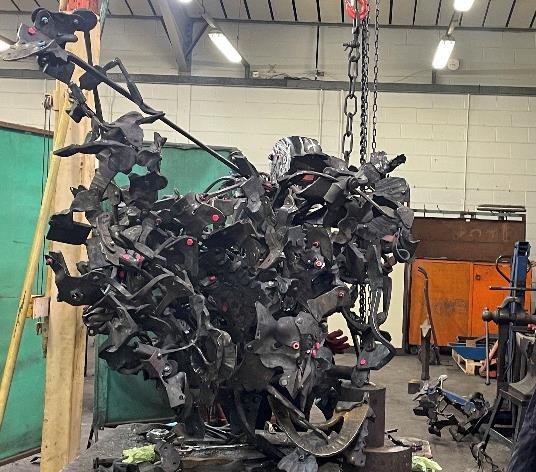
Figure 5 –‘De-centred Cubic’, During Construction
Figure 6 – An Example ‘Node’, During Forging
Figure 7 – ‘De-centred Cubic’ In-Situ, Rusted
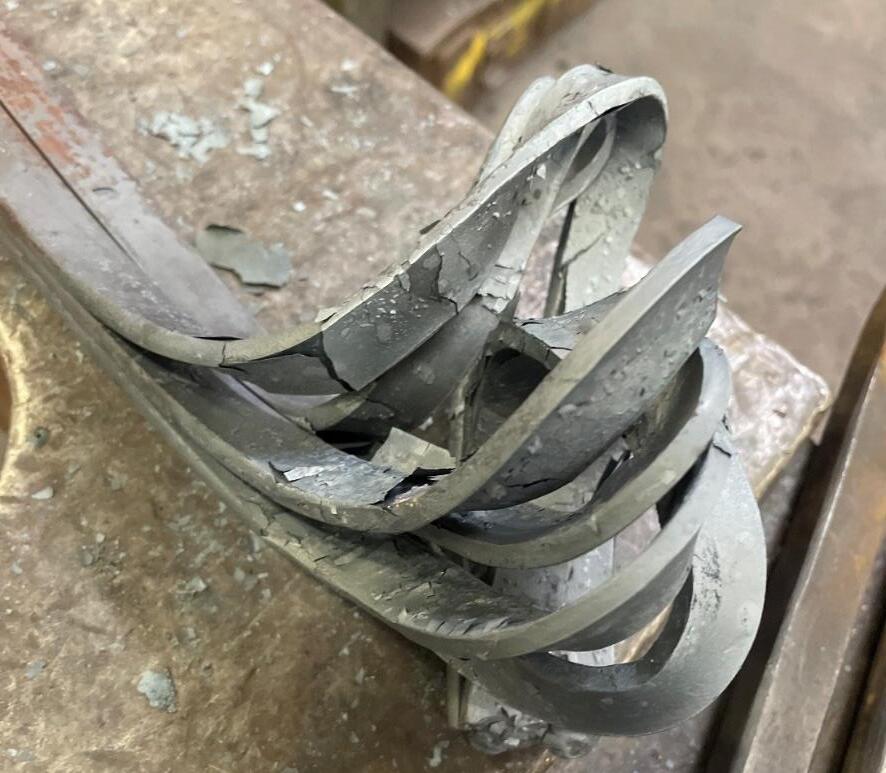
Figure 8 – Dylan Kirk, Untitled, 2025, Cooling After Forging
Figure 9 – Dylan Kirk, Untitled, 2025, During Forging
Introduction and Thesis
This essay proposes a posthuman approach to the dynamics of artist blacksmithing, particularly the key process of hot metal forging. It seeks to explicate the differential relationships of becoming (Barad, 2007) through which form and meaning emerge within this process. Using Karen Barad’s agential realist framework as an analytical tool, the essay situates hot metal forging and artist blacksmithing as a site of ongoing relational becoming through agential intra-actions. The works of sculptor Richard Serra, along with those of contemporary artist Will Maguire and my ongoing forging practice, will be analysed for their intentions, processes, and outcomes to understand how these agential relations manifest in process-driven art. A particular focus of the essay will be how human-led artistic intention can be balanced with the agency of materials and forces within blacksmithing relations.
The essay argues that artist blacksmithing operates - and can be productively understood – as a posthuman practice in which form and meaning emerge through coconstitutive agential intra-actions between human and non-human agents.
Theoretical Framework
Heidegger Against Cartesian Dualism
Cartesian dualism, proposed by René Descartes in ‘Meditations on First Philosophy,’ is a philosophical theory which posits that human beings consist of two distinct components: the immaterial ‘Mind’ and the material ‘Body.’ (René Descartes, Cottingham and Williams, 2017) This mind-body dualism underpins a broader subjectobject dualism, in which the mind/subject is a distinct, thinking entity that observes an external world of objects, including the body. This theoretical framework shaped much of the philosophical, scientific, and cultural development of Western society, and continues to influence contemporary attitudes to the environment and material practices. However, a dualistic view of human-material relations proves inadequate for understanding the complexities of material-focused practices such as blacksmithing, where matter, humans, energy, and information are entangled in continuous relationships of becoming.
This separation between the human subject and the objective world was challenged by the philosopher Martin Heidegger with his concept of ‘Being-In-The-World,’ in which human existence (Dasein) is situated as fundamentally in the world, experiencing it through our relationships with encountered phenomena. (Heidegger and David Farrell Krell, 1993) Heidegger elaborated on the nature of existence by drawing a distinction between ‘ready-to-hand’ and ‘present-at-hand’ experiences. A ready-to-hand experience of phenomena or equipment is one where our direct awareness of the ‘thing’ in front of us fades away, and we cease to be a subject observing an object and instead become an integrated constituent of a process. In contrast, a present-at-hand
experience is one in which Dasein becomes detached from the experience of an object, usually through some resistance or breakdown of usual functions. In this case, we begin to view the object analytically as a separate entity composed of discrete components.
For Heidegger, the ready-to-hand engagement with the world is ‘ontologically prior,’ whereas the present-at-hand experience emerges contingently when something has gone wrong. This framework offers a much more productive approach to understanding the world, especially within craft practices such as artist blacksmithing, where objects and our relationships to them are fundamental aspects. While this effectively challenges Cartesian dualism, focus remains on human-centred relationships to objects in the world, limiting understanding of non-human forces and matter in the continuous becoming of things.
Morphogenesis
Building on Heidegger’s emphasis on embodied engagement in the world, Tim Ingold develops an anti-dualistic view of making practices through his account of ‘morphogenesis’, which contrasts with the ‘hylomorphic’ approach commonly taken in design and craft pedagogies. Where hylomorphism revolves around imposing a predetermined design on inert materials by a skilled maker, morphogenesis emphasises active correspondence between humans and materials, with form emerging through an ongoing interplay between applied forces and material responsiveness. (Ingold, 2013)
The human maker remains at the centre of this framework, reflecting Ingold’s background as an anthropologist engaged in investigating human activities through the lens of philosophy. (Ingold, 2018) However, the concept of morphogenesis locates agency no longer exclusively in human intention, ceding input to the evolving relations between matter, tools, environment and forces during making processes. While this opens space for materially engaged practices to be understood through a non-dualistic lens, it could be argued that an unproductive focus is placed on the human agent as a central creative force This limitation is addressed by the agential realist framework of Karen Barad, which more strongly decenters the human from all material relations
Karen Barad’s Agential Realism
“It is through specific agential intra-actions that the boundaries and properties of the components of phenomena become determinate and that particular concepts (that is, particular material articulations of the world) become meaningful” (Barad, 2007, p. 140)
This epigraph concisely articulates the basis of physicist and feminist philosopher Karen Barad’s agential realist framework. Agential realism draws heavily from Barad’s
background as a quantum physicist, particularly through their interpretation of Niels Bohr’s ‘Copenhagen interpretation’ of quantum mechanics, which states that quantum systems exist in a superposition of all possible states until measured (13 Interpretations of Quantum Physics 13.1 Copenhagen Interpretation, n.d.) Drawing from their interpretations of quantum mechanics, Barad developed agential realism as an ‘ethicoonto-epistemology’, emphasising the inseparability of ethics, ontology and epistemology in our engagement with matter (Geerts, 2016) This emphasis informs not only how we should understand material relations, but also why we should approach them within this framework.
Barad elaborates on the non-dualist approaches posited by Heidegger and Ingold, moving towards a posthuman ontology of matter which reconfigures our understanding of the agency of matter and forces in the differential becoming of the universe. (Barad, 2007) Like Ingold, Barad recognises the agency of non-human matter in generative processes; “crucially, an agential realist elaboration of performativity allows matter its due as an active participant in the world’s becoming, in its ongoing intra-activity.”
(Barad, 2007, p. 136) This acknowledgement of the agency of matter provides a useful foundation for a productive understanding of material-discursive practices, in this case, forged metal arts.
Agential realism emphasises that “the primary ontological unit is not independent objects with inherent boundaries and properties but rather phenomena,” which Barad defines as “the ontological inseparability/entanglement of intra-acting “agencies”.” (Barad, 2007, p.139) The term ‘intra-action’ differs from the more common term ‘interaction’ in that it does not assume the existence of independent entities prior to their relations with other distinct entities. Rather, intra-action is the process through which these boundaries and distinctions come about: “intra-actions enact agential separability.” (Barad, 2007, p.140)
Agential cuts in Barad’s framework are temporary stabilisations in which matter differentiates through its intra-actions. This term challenges the traditional notion of ‘objective’, independent observers such as humans, by assigning them responsibility in the ongoing becoming of matter. Agential cuts are not simply moments of differentiation observed by humans, but rather are the enacted defining of boundaries through our intra-actions with matter. The notion of ‘agential cuts’ allows specific phenomena to be understood distinctly, providing an “alternative ontological condition for the possibility of objectivity.” (Barad, 2007, p.140)
A key point to note about Barad’s posthuman account of the world is that it “refuse[s] the anthropocentrisms of humanism and antihumanism” (Barad, 2007, p.136), meaning that human agency is neither entirely central nor entirely removed from the equation of intra-actions. Rather, focus is shifted to “taking issue with human exceptionalism while being accountable for the role we play in the differential constitution and differential
positioning of the human” (Barad, 2007, p.136) This clarification allows us to understand art through a posthumanist lens without encountering any logical inconsistencies, with art-making situated as a “purely human domain” (Harman, 2020) within the broader entanglement of material, energy and discursive practices.
While Barad’s agential realism is used as the primary framework for this essay, the intention is not to propose it as an all-encompassing theory of all making practices, but rather to apply it as a productive lens through which artist blacksmithing can be rethought and approached.
Maker-Tool-Material
Within this agential realist framework, artist blacksmithing, specifically hot metal forging, can be understood as a material-discursive practice in which meaning and material transformation emerge from ongoing intra-actions between material, tools, the human maker, fundamental forces and other agential factors These co-constitutive agents -or rather, categories of agent- are themselves emergent through the ongoing differential relationships of becoming between them. Their distinctions are not ontologically prior but rather are enacted by agential cuts produced through their intraactions with one another.
For analytical purposes, the emergent categories of tool, material and maker will be foregrounded in the examination of the blacksmithing process in this essay. Although these categories are not the exclusive agents engaged in forging relations, they provide a productive structure for examining the “entangled flows of matter, energy and information [through which] things emerge” (Hodder, 2013)
Richard Serra Through a Posthuman Lens
Richard Serra was a New York-based sculptor whose work focused around ideas of space, gravity, process and material (Serra and Foster, 2018) Although perhaps most well-known for large scale public works and installations, such as the ‘Torqued Ellipse’ Series and ‘The Matter of Time,’ Serra’s earlier work of the late 1960s reveals a more process and material-driven practice than might be initially interpreted from his later work. ‘Belts’, 1966-67, Splashing’, 1968, and ‘Verb List’, 1967, all clearly demonstrate Serra’s deep awareness of the process and materiality involved in the production of his artworks.
While Serra’s work predates agential realism, it still exemplifies how process-driven art can operate within a posthuman framework. By focusing on specific processes as the catalyst for the development of an artwork, Serra reframed the creative process from a
human-focused to an agency-focused approach, emphasising the agency of all materials and forces involved.
Although Serra was not an artist blacksmith and only occasionally utilised forged steel in his sculptural works, his materially engaged practice often involved steel and other materials with similar gravitational and structural capacities, such as lead and vulcanised rubber, which may be viewed as analogous to forging-temperature steel (around 1100°C) His making process can therefore provide a useful starting point to understanding how meaning can emerge from process in forged metal arts.
For Serra, although his own human intention was present before, during, and after production of a work, he did not consider it to be the most significant factor when compared to the process itself: “the significance of the work is in its effort, not in its intention. And that effort is a state of mind, an activity, an interaction with the world.” (Serra, 1973) Serra’s ability to carry intention throughout a particular project without allowing it to take precedence over process or material intra-actions offers a productive lens through which to view the balance of human and non-human agency within artbased material-discursive practices.
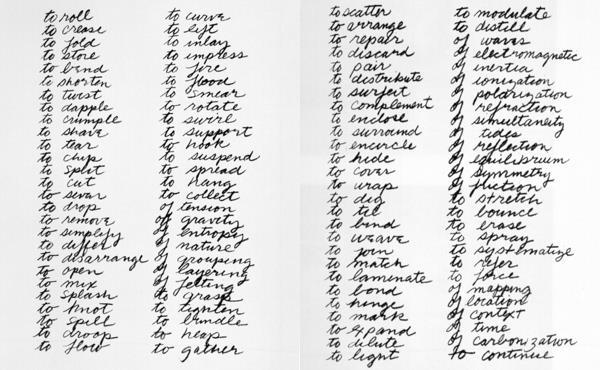
‘Verb List’
‘Verb List’ (1967) was a series of process verbs written down by Serra with the purpose of prompting processes around which future artworks could be generated. (Serra, 2018, p.23) This early work defined a turning point in Serra’s career, acting as the commencement of his process-driven practice. When challenged on the potential categorisation of ‘Verb List’ as a piece of concept art, perhaps “too reliant on language” (Foster, 2018, p.23), Serra argued that “Those words don’t give definition to a work; they give definition to a process… They lead to actions, not concepts or statements, and
those actions bring in the properties of the material.” (Serra, 2018, p.25) This demonstrates Serra’s commitment to materiality and process as the primary sites of meaning in his artworks, against the “enormous limitation” of “intention being a work of art.” Serra goes on to elaborate that “there’s intention in art, but as an artist and a viewer I want to interpret my experience, not anybody else’s intention.” (Serra, 1973) This further clarifies the seemingly paradoxical idea that an artist can have a particular intention while making an artwork but that this human intention does not have to be the central focal point for either artist making the work or audience decoding the work.
There is a direct continuity between verbs listed in ‘Verb List’ and works later produced by Serra: works such as ‘Splashing’(1968), ‘Slow Roll: For Philip Glass’(1968), and ‘Tearing Lead’(1968) each have their parallel written catalysts in ‘to splash,’‘to roll’ and ‘to tear.’ This approach synthesises human inclination to categorisation and articulation with materially engaged practices such as artist blacksmithing where meaning and form emerge through the intra-action of forces, matter and information.
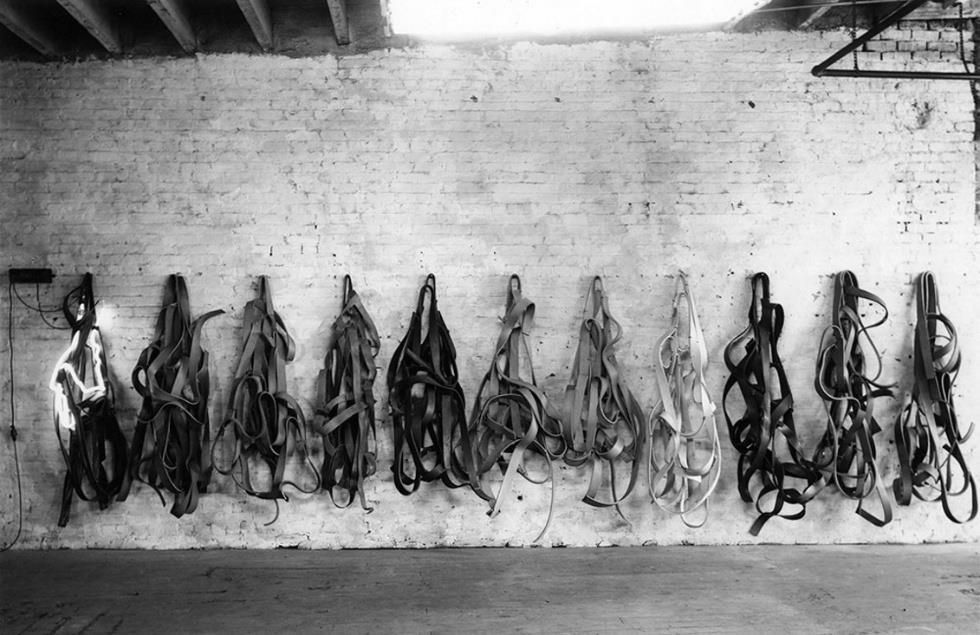
‘Belts’
‘Belts’ (1966-67) exemplifies an artwork where the Artist’s role has been repositioned from one of a central, form-imposing creative agent to more of a facilitatory ‘curating’ force. The piece consists of a series of hooks over which multiple strips of vulcanised rubber have been draped. The belts on each hook entangle one another, forming an interesting visual and physical form, co-constituted by many intra-acting components.
Inspired by Jackson Pollock’s painting ‘Mural’ (1943), Belts utilises “gravity as a force, as a forming device” (Serra, 2018, p.19). Serra’s insistence on fundamental forces such as gravity being active, generative agents within his work mirrors, or perhaps anticipates, the development of the agential realist framework where the fundamental principle is the acknowledgement of the productive activity of these non-human forces. Serra viewed his role in the making process as one in which he defined the parameters or conditions through which material and process would interact: “I have chosen certain conditions (rules that I have made up) that reveal themselves in the logic of the procedure” (Serra, 1970) This is evident in Belts, where he enacts the conditions through which the individual belts come into contact with one another- i.e. angle, rotation, relational positioning- from which follows form emerging through the intraactions between components. The placement of each belt, its settling into a position of equilibrium and the following placement of another belt upon it can each be understood as agential cuts, where a new ‘distinction’ arises in physical form and visual information.
For Serra, although an artwork may visually appear to be in stasis through a reached state of apparent equilibrium, there is always visual and actual potential for continued form-making by the intertwining of forces with matter; “… potential for disorder, for movement, endows the structure with a quality outside of its physical or relational definition.” (Serra, 1970) This potential for further change through movement is comparable to Barad’s conception of all matter as being “produced and productive, generated and generative” (Barad, 2007, p.137). However, agential realism would go further to say that a particular arrangement of matter not only has potential to differentiate in form, but is always actively doing so, with agential cuts being simply particular moments through which we can understand an ongoing process of becoming.
In the context of artist blacksmithing relations, Belts provides a valuable example of a productive approach to form development through finding balance between artistic intent and the agential capacities of the matter and forces involved in a process. Serra shows that by emphasising the generative nature of matter and allowing it to take precedence over the imposition of fixed human intention, meaning can emerge through an alternative, posthuman avenue. A sense of artistic control is not lost by this approach but rather repositioned to the setting of parameters such as tooling, section sizes, application of force and temperature, while actively adapting to the material’s responsiveness as it deforms, resists and settles.
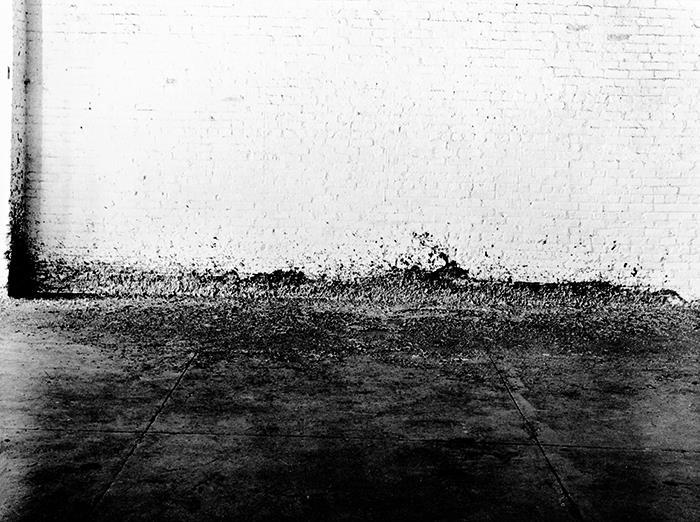
‘Splashing’
While ‘Belts’ emphasises gravity as a non-human creative agent, ‘Splashing’ (1968) further extends generative agency to a broader entanglement of forces including momentum, inertia, time and fluidity. In doing so, Serra’s own creative agency is to a greater extent displaced from the process, moving further into the role of a catalyst through which material-energy intra-actions take place.
Splashing was produced over the course of 8 hours by repeatedly laying ladles of molten lead along the junction between a wall and the floor in the Castelli Warehouse. (Serra, 2018, p.52) The key process development here from Belts and other earlier works is the added dimension of state change from solid to liquid and return to solid. Each shift constitutes an agential cut, enacted by the application and subsequent dissipation of heat, through which temporary distinctions are stabilised.
A direct conceptual parallel can be drawn between the use of thermal phase change in Splashing and the way heat is applied in hot metal forging. In both cases, heat is not simply a neutral tool applied to matter to facilitate a predetermined aim, but is rather an active, generative force which reconfigures the internal structure of the material, altering its capacity for deformation in relation to other forces and forms of matter.
‘De-centred Cubic’ Masterclass
I was first introduced to the concept of agential realism and how it can be applied in an artist blacksmithing context through a masterclass I took part in, led by Australian artist blacksmith Will Maguire. This initial glimpse into an alternative way of viewing and approaching blacksmithing significantly changed my practice. The ‘De-centered Cubic’ masterclass was a collaborative effort between around 60 artist blacksmithing students, including myself, under the guidance of Maguire, who had designed the project and developed the parameters around which the final sculpture would emerge. The project extends the logic of human-decentered making present in Serra’s early works into a collective, forging-specific pedagogy.
Inspiration for the project was derived from the innate structure and historicity of iron itself; the title ‘De-centred Cubic’ is a play on the ‘body-centred cubic’ and ‘facecentred cubic’ structures that steel adopts throughout heating cycles. The five potential forms presented at the start of the masterclass were emphasised to be only indicative of the general structure and scale of the developing sculpture form. We were not chasing after the realisation of an exact form predetermined by Maguire but rather organically constructing a dynamic mass in space within directed material and processbased parameters.
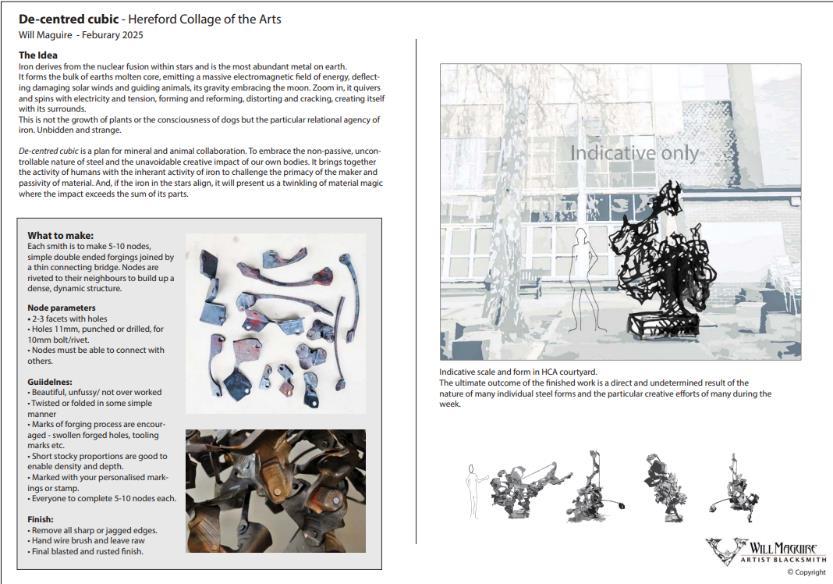
The structure of the masterclass encouraged participants to consider their role in the sculpture’s process of becoming; “it brings together the activity of humans with the inherent activity of iron to challenge the primacy of the maker and passivity of material.” (Maguire, 2025) The conjunction of human and non-human agency is key to all artistic endeavors, and this masterclass sought to heighten each participant’s awareness of that fact both within the construction of this sculpture and in their developing forging practices.
Construction of The Sculpture
The sculpture was constructed from a vast number of ‘nodes’ forged by each student, amounting to roughly three hundred nodes total, or five per participant on average. The process for forging these nodes was encouraged to be very simple, dynamic and fluid, using a set range of tooling and processes to allow the agency of the iron to emerge in the form of each node.
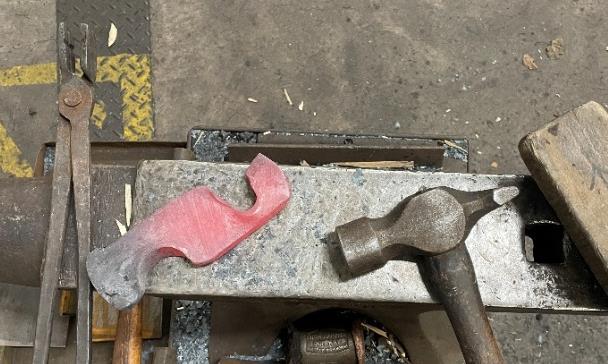
For example, the node in Figure 6 was made by simply creating indents into opposite sides of the starting section of steel with two different sizes of fuller (20mm and 40mm round bar) Following this operation, each node could then be either left in this state or be subjected to further processes such as twisting or drawing out under a power hammer.
The simplicity of operations was a crucial aspect of this making process. By minimising technical complexity, material agency in response to processes carried out with it is foregrounded. Swelling, for example, can be seen in the node in Figure 6, visually demonstrating both the fullering action and the materials reaction to this compressive force in the localised sectional change Such visual details exemplify what Barad refers to as differential becoming; a new, emergent form arising through the specific conjunction of material capacities and applied forces. While the swelling could have been forged down, as might be encouraged within traditional blacksmithing approaches where a set human-led design idea is being pursued, there is an aesthetic and ‘ethicoonto-epistemological’ (Barad, 2007, p.185) lesson to be learned here from de-centering human creative intentions from the equation. By resisting the compulsion to impose a corrective human force, the resultant form de-centers human creative agency and emphasises matter and forces as active participants in the sculpture’s becoming. In doing so, viewers and participants are prompted to reflect on their situated role within material intra-actions, challenging conventional notions of creative intention and authorship of form.
Ongoing Becoming of the Sculpture
The material becoming of this sculpture did not end at the point when each component had been riveted together and attached to the base. Rather, this point simply constitutes an agential cut in the ongoing becoming of a particular arrangement of matter, when the blacksmiths involved ceased to actively engage with its construction. At this point, the generative intra-actions of the sculpture unfolded beyond direct human influence, incorporating new agential factors such as environment and nonhuman animals.
A key factor in the continued development of matter was the influence of rain and atmospheric moisture in causing rusting (iron-hydroxide) across the surface of the sculpture. This capacity of iron in relation to water was afforded further potential by sand-blasting the entire sculpture prior to installation. This additional finishing process removed the layers of scale (iron oxide) which naturally accumulated on the steel surface during the heating cycles. Here, human intention and applied processes negotiate the manner of becoming which arrangements of matter will take in the future. If the forge scale had been left on the surface, the material and visual arrangement of the sculpture would have retained stronger traces of the previous processes which produced it. However, with the forge scale removed, rusting occurred more rapidly and
evenly across the surfaces, revealing more about the current, ongoing becoming of the matter than of its previous intra-actions.
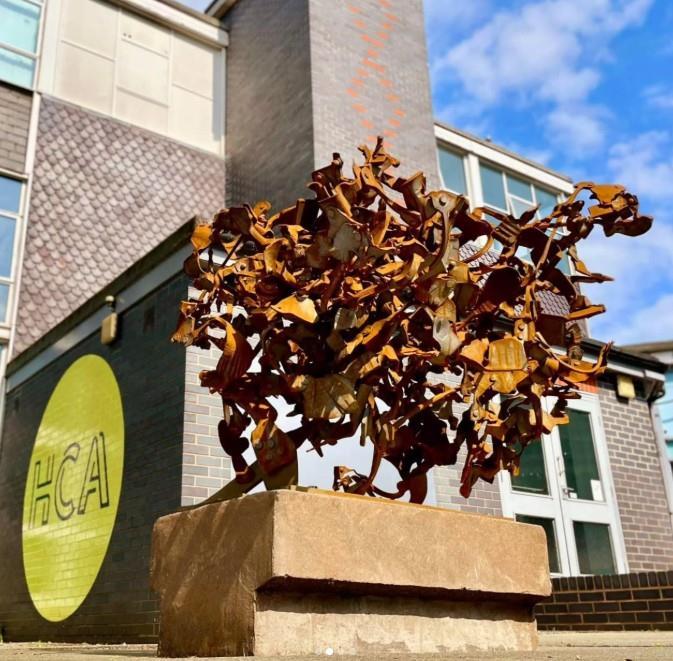
Although the sculpture was no longer in an active phase of construction, human factors are by no means removed from its ongoing becoming: each instance of touch, leaning against, movement around, or other intra-action with the sculpture constitutes an agential cut, leading to a temporarily differentiated material and spatial configuration Human intra-action remains a key agential factor to the generative development of the artwork, neither entirely excluded nor at the creative center.
My Own Entangled Forging Practice
While the De-centred Cubic project engaged with forging steel at a relatively large, collaborative scale, the agency-focused approach at the centre of the masterclass remains central to my own individual forging practice. The project broadened my awareness of how form does not emerge solely from human aesthetic intentions imposed upon material, but rather through negotiated intra-actions between differentiated forms of matter and energy.
Carrying this awareness through my artistic practice since the masterclass, I have become increasingly attentive to each stage of the making process in which I am involved. As opposed to my previous design-based approach of developing an exact idea of form and procedure before ever starting to forge, I now set out at the start of the project to understand the parameters to set which will enable form to unravel through innate inclinations and capacities.
Questions of artistic intent and outcome continue to be actively negotiated throughout the course of each project. Rather than abandoning intent or pursuit of meaning entirely, I now approach projects with a broad inclination or theme in mind, which is then guided through a responsive relationship with material and process, leading to the ongoing becoming not only of the matter and energy I engage with, but also of myself, both physically and intellectually. Through this negotiated relationship, I have been able to develop my understanding of making in ways that thinking on a purely theoretical level would not afford. This highlights how taking an agential realist approach to artist blacksmithing can act not only as an ontological framework but also as an epistemological method of understanding relations in the world.
I do not view outcomes as an inert, fixed, final ‘thing’, but rather as “generated and generative” (Barad, 2007, p.137) arrangements of matter occupying positions in space and time. An outcome is therefore not the end point of a creative process, but rather a differentiated and active stage in the ongoing material becoming of things.
In my current work, I explore themes of fundamental forces, quantum interactions, chaos theory, cosmic-scale interactions, and ultimately engage with questions of determinism in material processes. The visual manifestations of these phenomena share notable parallels in their fluid dynamism, which may be interrupted by chaotic moments of entropy which cause radical change in direction, form and entanglement. The themes of entanglement, causality and determinism present in my practice are not simply conceptual inspirations but are physically enacted in my process Through forging, I seek to understand how material intra-actions produce emergent forms through agential cuts, situating my work as being concerned with the same fundamental questions of this essay.
Enacted Material Becoming
Figure 8 presents an example of the above theoretical and epistemological approach being carried forward into my forging practice. The untitled work, made in 2025, occupies a space of around 200x150x150mm. The piece consists of six sections of 16x5mm mild steel flat bar, which have been welded at each end to form a continuous entangled mass of steel, simultaneously connected and disconnected.
Rather than setting out to create a pre-determined form, I produced this work by first defining parameters within which an entangled form could emerge, following the idea of causality between components. These parameters remained relatively simple, including the starting material length, section size, types and positions of forces applied, and method of joining.
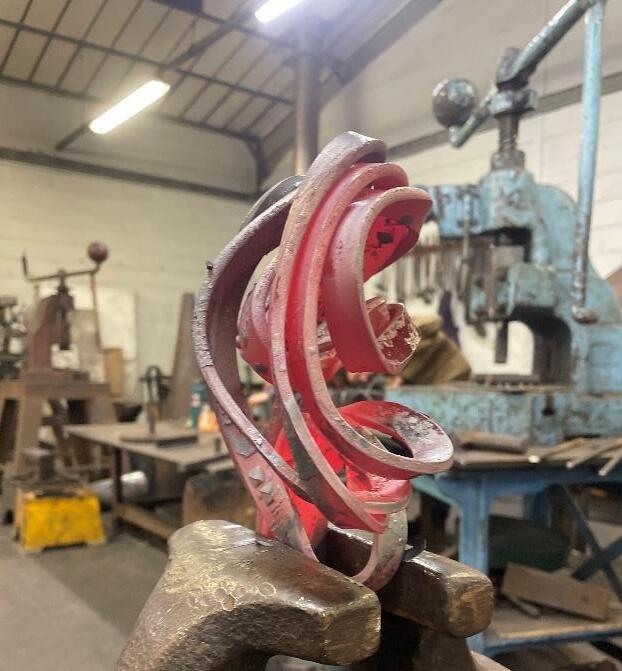
To explore entanglement as a material condition rather than a visual metaphor, the individual components were solidly joined by electric welding, and a gas forge was used during each heating cycle to achieve an even temperature across the entire assemblage. This enabled the structure to act as a contiguous whole, with the form of each component remaining causally dependent upon those surrounding it in response to applied forces.
By constraining the process through this parameter, the work emphasises contingency within the sculpture, rather than assembling individual components after the fact to simply simulate continuity. The overall form of this work emerged through intra-action with agency negotiated between each joined component, applied forces, heat and my own intentional engagement with the process.
Another key parameter I put in place within this process was the way forces were applied to the material. Avoiding precise technical details, the original welded assemblage was heated to a workable temperature before a very tight bend was applied at the centre. Following this, several ensuing heat cycles were taken in which the bent structure was twisted, sometimes in one direction for a half turn and then back in the other direction by a full turn. This sequence of processes not only forced causal material intra-actions between components, but also introduced entropy to the structure, with it having been pushed to a point at which it could no longer return to its original state.
By understanding blacksmithing through the frame of agential realism, the notion of skill is repositioned as not simply the application of technical ability in achieving a preconceived form, but as the capacity to “constantly attune… movements to perturbations in the perceived environment without ever interrupting the flow of action, since that action is itself a process of attention” (Ingold, 2000, p. 415) This alternative understanding of blacksmithing skill has significant pedagogical implications for the teaching of blacksmithing; through this lens, skill development must be approached as an education of situational attention to material inclinations, applied forces, resistance, deformation, and emergent changes in form.
Conclusion
This essay has argued that artist blacksmithing and the material-discursive practices surrounding it are more productively understood through the posthuman lens of agential realism than through traditional frameworks, which emphasise the use of technical skill to impose form onto material. By focusing on the negotiated agency of intra-actions through which form and meaning emerge, human artistic intention is not erased but rather displaced, allowing material, energy, and process to be understood as active participants in hot metal forging operations.
Through an analysis of Richard Serra’s process-driven work, the De-centred Cubic masterclass and my own ongoing forging practice through an agential realist lens, this essay has demonstrated how intention and human influence are not abandoned in a posthuman approach, but rather repositioned. In these examples, intention is realised
through the setting of parameters such as heat, force applied, tooling, and material conditions, allowing matter and energy to exert active influence on the becoming of form and meaning in artworks. This aligns with Barad’s assertion that matter is not inert, but rather an active participant in the ongoing becoming of phenomena. Understood through this framework, outcomes can be viewed not as fixed end points of a formimposing process, but as temporary agential cuts within a continuous process of material differentiation.
The structure for understanding artist blacksmithing explored throughout this essay does not aim to serve as a universal explanation of all material-discursive practices, but rather as a productive lens through which hot metal forging can be rethought. This understanding functions as both an ontological condition of forging as well as a productive epistemological method through which knowledge of forging relations can emerge.
Ultimately, the framework proposed in this essay challenges traditional anthropocentric notions of human primacy and authorship of form within making, moving towards a posthuman understanding of material becoming, grounded in intra-actions of matter and energy.
References
In order of Appearance
Barad, K. (2007). Meeting the universe halfway: quantum physics and the entanglement of matter and meaning. Durham, N.C., Chesham: Duke University Press.
René Descartes, Cottingham, J. and Williams, B. (2017). Meditations on first philosophy: with selections from the Objections and replies. Cambridge, United Kingdom; New York: Cambridge University Press.
Heidegger, M. (1962). Being and Time. Translated by J. Macquarrie. and Translated by E. Robinson. Oxford: Blackwell.
Ingold, T. (2013). Making : anthropology, archaeology, art and architecture. London: Routledge.
Ingold, T. (2018). Anthropology : why it matters. Cambridge, UK: Polity Press.
13 Interpretations of Quantum Physics 13.1 Copenhagen Interpretation. (n.d.). Available at: https://www.southampton.ac.uk/~doug/quantum_physics/interpretation.pdf.
Geerts, E. (2016). New Materialism. [online] newmaterialism.eu. Available at: https://newmaterialism.eu/almanac/e/ethico-onto-epistem-ology.html.
POSTHUMANISM IN ART AND SCIENCE : a reader. (2020). Columbia University Press.
Hodder, I. and Wiley, J. (2013). Entangled : an archaeology of the relationships between humans and things. Malden: Wiley-Blackwell.
Serra, R. and Foster, H. (2018). Conversations about sculpture. New Haven Etc.: Yale University,
Serra, R. (1973). Document: Spin Out ’72-'73. Avalanche Newspaper.
Serra, R. (1970). Play it Again, Sam. Arts Magazine. Feb.
Maguire, W. (2025). De-centred Cubic Brief Hereford College of Arts
Ingold, T. (2000). The Perception of the Environment : Essays on Livelihood, Dwelling and Skill. London ; New York: Routledge, Taylor & Francis Group.
Image References
Figure 1: Serra, R. (1967). Verb List, 1967. MoMA. Available at: https://www.moma.org/collection/works/152793 [Accessed 6 Feb. 2026].
Figure 2: Moore, P. (2017). Richard Serra, Belts, 1966-67. David Zwirner. Available at: https://www.davidzwirner.com/artworks/richard-serra-belts-1ebe4 [Accessed 6 Feb. 2026].
Figure 3: Moore, P. (2018). Richard Serra, Splashing, 1968. ARTFORUM. Available at: https://www.artforum.com/features/due-process-richard-serras-early-splash-castworks-226187/ [Accessed 6 Feb. 2026].
Figure 4: Maguire, W. (2025). De-centred Cubic Brief. Hereford College of Arts.
Figure 5: Kirk, D. (2025). ‘De-centred Cubic’ during Construction. [Photograph].
Figure 6: Kirk, D. (2025). An Example ‘Node’ during Forging. [Photograph].
Figure 7: Kirk, D. (2025). ‘De-centred Cubic’ In-situ, Rusted. [Photograph].
Figure 8: Kirk, D. (2025). Dylan Kirk, Untitled, 2025, Cooling after Forging. [Photograph].
Figure 9: Kirk, D. (2025). Dylan Kirk, Untitled, 2025, during Forging. [Photograph].