Deepest thanks to the following, to my family and community for stitching their stories. To Eve Eunson for a research and introduction into Fair Isle straw back chair making. To Lois Walpole for her book that came at the 11th hour. To Heritage Craft Association for their dedication and assistance. To my masters lectures Delyth Done and Lisa Porch for their care and pruning. To my sister Lydia for her work, sore hands and her company. And to Sam, my husband, for his collaboration and the hours of making alongside me.
wledgements
1
illustration
3
act
4
uction
6
er One : What is Human Flourishing?
8
er Two : Human Flourishing Through the Tool of Craft.
16
usion
36
graphy
38
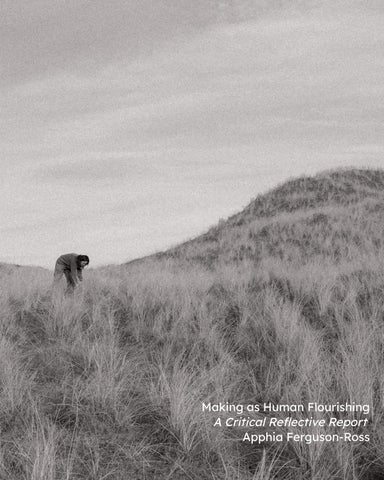
Cover Image: Apphia Ferguson-Ross Youth at The End of Her Tether, 2025. Photograph by Sam Ferguson-Ross.
Figure 1 : Apphia Ferguson-Ross, Collecting Docken, 2024. Film shot by Sam Ferguson-Ross.
Figure 2 : Desmet and Polhemeyer, Positive Design for Subjective Well-Being Framework, 2013.
Figure 3 : Apphia Ferguson-Ross, Manifesto for Making, 2025.
Figure 4 : Apphia Ferguson-Ross, The Kishie: A Tool for Carrying, 2025. Photo by Oliver Cameron-Swan.
Figure 5 : Apphia Ferguson-Ross, The Island Chair: A Tool for Rest. 2023-2025. Photo by Oliver Cameron-Swan.
Figure 6 : The Tablecloth: A Tool for Connection. 2025-2026. Photo by Oliver Cameron-Swan.
Figure 7 : Apphia Ferguson-Ross, List of Virtues, Research findings, 2025.
Figure 8 : Apphia Ferguson-Ross, Quote from James Fox, 2025.
Figure 9 : Apphia Ferguson-Ross, Collecting Marram, 2024. Film shot by Sam Ferguson-Ross.
Figure 10 : Apphia Ferguson-Ross, Quote from James Fox, 2025.
This report documents the undertaking of my Masters final project, a vernacular built body of work which explores the role that craft can awaken and realise in humans flourishing; both through the act of a craft practise and through use of craft objects themselves. The aim is to ascertain what constitutes human flourishing and the pathway to it, so as to punctuate the values into my own practice and craftworks.
Two of these craftworks are made by using endangered heritage craft processes. The Kishie and Island Chair will be woven with Northern Isles Back Basket making and Strawchair back making, knowledge gleaned from personal exploration, Heritage Crafts Organisation, Lois Walpole, Eve Eunson, Kevin Gauld and the Scottish Highland Archives. Alongside is the third outcome, a community engagement piece, the Tablecloth. All three craftworks carry and encompass the found elements that are needed for human flourishing according to Desmet and Pohlmeyer’s Positive Design Framework.
imary aim of this report's discourse is to determine if human flourishing
e actuated by craft. It intends to explore the role that craft and a craft
s life can awaken and realise in human flourishing. Both through the act of practise and through use of craft objects themselves. I intend to underpin flourishing values and mark them in my own practice through three
te craftworks. The study is underpinned by the concept of ‘enoughism’ (a
nked to the hardiness of British Isles Island culture) and ‘making from lack’
-coined phrase). I identify that islanders' values and knowledge of place have observed are consistent with Aristotelian’s values for Human
hing, a custodian mindset and the Toolness of Things. I incorporate these
gs into a manifesto for making, to be applied to my craft practice. I
e to examine the work of Desmet and Pohlmeyer, (2013) and draw on their
work of findings to support my report and to answer the question, as a
at the end of my tether, is there a possibility to flourish through the
yment and use of craft. This research gives an insight into, and echoes the
ance of community, the vital significance of belonging, giving and
ng pleasure, fulfilling needs and gaining agency over your life for
sation of Human Flourishing.
makes us flourish and is there a pathway to this? The pursuit of wholeness
appiness is as old as humanity itself. The term Human Flourishing was by and rooted in Aristotelian ethics. It is the state of thriving and reaching
full potential across all aspects of life, involving a balance of positive
ological, social, and physical well-being. It is the drive to live a holistic and
life. In The Nicomachean Ethics of Aristotle, or the “self help book” of the
al period of Ancient Greece, Aristotle states 5 salient requirements for the
f human flourishing.
st is Virtue, to be taught and live in accordance with virtues such as
ge, honesty, and generosity. In particular with the central virtue, phronesis
ng practical wisdom, which allows you to make sound judgments in various
ons. Virtues are not just innate; they are cultivated through practice and
These virtues keep one in the midpoint or golden mean between two vices, and deficiency.
cond is happiness or pleasure, “A rational activity of the soul according
rtue.” While not the ultimate goal, Aristotle believed that, pleasure was an
ant component to flourish in life. Through experiencing the natural world
often intertwined by living virtuously.
rd is friendship. Aristotle considered it “most necessary with a view to life”.
arates the types into three, friendship of pleasure, friendship of utility and
mplete friendship, philosophical friendship or friendship of virtue being the friendship. All these are essential for a flourishing life, as they provide
ess, companionship, support, correcting and shared history, which all lead
nse of belonging and self.
able to engage with the world. As well as the ability to adequately meet the needs for safety, food, shelter and living with ample leisure time. Yet not enough that one would become idle and lose purpose in the world.
And lastly contemplation, The highest form of life according to Aristotle. The ability to engage in the act of steadily considering with attention and purpose to enlarge one's understanding. With the end result of growth and a sense of belonging and agency in the world.
The philosophy for human flourishing did not stop in the golden age; theorists throughout the modern period have continued these ideas of a whole life by elaborating, modifying or discarding for new theories. American psychologist Abraham Maslow expressed his motivational theory as the Hierarchy of Needs (1943, 1954). And more recently, in 2013, professor Pieter Desmet and Dr Anna Pohlmeyer considered this idea in the context of design theory and practices, (figure 1.) This framework for Positive Design for Subjective Well-Being poses the
cance. The use of this framework is to result in “People who [...] who live to
ullest potential. They are functioning optimally, developing as individuals
ting in the best interests of society.” (Desmet and Pohlmeyer, 2013, p.15)
esign framework is significant to this report as it will be the foundational
tone that is applied to a new sector, specially a craft practice. Exploring
aft practises and the objects themselves can play a role in human
hing.
t and Pohlmeyer framework is heavily influenced by Aristotelian tradition.
se the term subjective well-being in place of human flourishing as they're
that not every human's well-being looks the same. They also used the term
ive Well-Being in exchange for Aristotle's external goods. As well as
orning friendship into design for pleasure and contemplation into design
ue. Other than these adaptations and language changes to fit our modern
ciety, the core values remain.
ree corner-triangles depict the ingredients for human flourishing; design
ue, design for pleasure and design for personal significance. Desmet and
eyer (2013, p.8) express that “each ingredient independently stimulates
tive well-being; positive design sits in the “sweet spot” where all three
ents intersect. This intersection is where people flourish.”
eased comfort, joy in using or reducing negative e ects such as lessening
discomfort and sadness. The design itself can also be a direct source of
re from their active employment. Such as receiving joy from a carved knot
Island chair arm as it fits perfectly into one's palm, or in the use of a a grass back basket drawing pleasure from craft heritage and unique
and form. Receiving pleasure from the use of an object can also draw
on towards it.
for Personal Significance:
cond corner-triangle handles the happiness that spouts from a sense of
al meaning or belonging. Its focus is not based on short term pleasure but
g term goals and desires, such as achieving an aspiration, building
hing new, gaining a degree or growing a community. Just as an aim of this has been to seek, build and become part of the heritage craft community
will assist to grow my craft practise as well as reciprocate skills and
dge. Personal significance can also be a memorandum from past
ements. The design and resources that facilitate the attainment of these Such as the first Kishie made to grasp and comprehend, the
tanding of a nearly lost method.
for Virtue:
st triangle reaches back into Aristotle's proposal for contemplation,
ve thinking being paramount to understand virtue. The framework asserts
appiness is the derivation of virtuous behaviour. Asking the designer “in
ving this am I behaving honourably?” This question implies a distinction
en what is good and what is bad and that there is a line to be tread and
ht to be taken on our “ideal mode of behaviour”, to move
as through the use of material. By facilitating the use of by-products from harvested natural material such as the stems of the black oat used to make the woven back of Island chairs. Or by fabricating products that require unsustainable overproduction and end in pollution. The intent of the design can also be seen as virtuous, such as a positive tool to connect people to their community, past and local landscape such as a table cloth depicted with stories of connection.
The rules for this framework are as follows, positive design at its core, places an explicit focus on design that enables human flourishing. Each of the three triangles individually contribute to a person’s subjective wellbeing, yet all need to be in dynamic interaction to enable a person to flourish. It encompasses a self-focused personal development as well as other focused virtuous living, with the best interests of society and the planet at heart. Following Aristotle's consideration for a balanced life and the words of Diener and Biswas-Diener (2008, p. 8), flourishing is a “balanced portfolio.” We cannot only pursue pleasure to the exclusion of all else or we shall be hedonists and without true wellbeing. Furthermore, if we only focus on our goals and aspirations, we will miss the beauty and pleasure that it's at our fingertips in the present and will become miserable if the goal is never achieved.
text to my three craftworks - The Kishie, a Tool for Carrying, An Island
a Tool for Rest and A Tablecloth, A Tool for Connection. To conclude, I have
n a manifesto for making (figure 2.) which aligns itself with the Positive Framework. I acknowledge that underpinning my making of the Kishie,
and chair and the Tablecloth is a desire to generate human flourishing
h personal significance, pleasure and virtue. I use my manifesto to keep accountable to this goal.
ext chapter will aim to impart the use of the above Positive Design Framework
anifesto, situating and implementing them within a craft context, specifically
n craft practice and the production and use of the Kishie, the Island Chair and
blecloth. Each craftwork is a tool for something; a tool for carrying, a tool for and a tool for connection. Tools are instruments of everyday practice, used
ared for so that they outlast their user. We as users are simply current
ians. As such these craftworks or tools are an expression of care which is
ded in the core of human flourishing. Subtitled by the framework, each section
chapter will explore one ingredient for flourishing (virtue, pleasure and personal
cance), examining how each craftwork either accomplishes, quickens or acts as
to invoke human flourishing. It will draw on craft theorists and other relevant
s in the field.
illustrate carrying belonging and heritage.
on of the surrounding landscape, such as maelstrom driftwood and
raw. My Island Chair is also vernacular made from found ash,
med oak and marram grass from my surrounding landscape. It is
as a tool for pause and rest.
s from my direct community. The embroidery depicts participant responses prompt: what makes you connect? The stitchers respond either through
on or conversation while stitching. The Tablecloth was made as a tool to
te the need for community and connection. Craft practices often need a
unity for the completion of a craftwork. So much so that a common proverb
orn from one of the most necessary craft forms. One would; “bare his own
to thatch his neighbour’s." (Fox, J., 2025 p.47) This warmhearted network is
he Tablecloth depicts.
is shown in many ways (see Figure 7) in all three craftworks, through the
on of materials, process of making, and the use of the craftworks
elves.
was woven into the Kishie (figure 4.) in its design and choice of materials.
ng the same making pattern as many have done before me, the heritage
ack basket is made from whatever resources are at hand; for me that is
m grass. Working harmoniously with it, with the mindset of a current
ian of the land: we pass on but the land stays and we have an obligation
erstand and work with and for the natural world. I harvested by taking
amounts of marram from bountiful colonies, which helps the grass to by stopping root rot, and only taking as much as is needed. The
ting of this marram also brought me in close contact with knowledge of
d, I gleaned an understanding of dunes and habitat that has encouraged
work with the environment and not against it.
damaging to other glasses. Natural twine was the second material choice that was
to me from a gardener who had no use for it. The full makeup of the Kishie is
radable, it could either be burnt or support soil nutrients if composted- showing
tue of ethics material use.
chniques used to make Kishie’s or Northern Isles baskets are critically endangered
ge craft (Heritage craft, 2025). This Heritage Craft Association is virtuous in
ting the extinction of all such crafts in the United Kingdom. They consider these
as “not just beautiful traditions, but living skills that contribute to local economies,
l identity, and [majorly influence] sustainable futures.” In the wish to join the
vation of the Kishies and pull it out from the critically endangered status, I
usly taught myself the process. I watched and rewatched a black and white, silent
a Makkin O’ a Keshie (1932)” via The National Library of Scotland's Moving Image
e to test and mimic the process of making and gain technical understanding. I had
slate Shetlandic and Orcadian texts that were sourced online that referred to the
g of Kishies. I accumulated further research of various back baskets by visiting
es and undertaking object-based analysis. Thankfully in the 11th hour, Lois
le published her book on Kishies and Cuddies a Guide to the Traditional Basketry
tland (2025). This detailed in full the missing gaps in my knowledge. Several virtues
emonstrated here, in the perseverance of learning this skill, commitment and
mination to the craft, preservation of the craft, creativity and wonder in testing and
sm that it could be learn’t even with insu
cient knowledge at first.
wants.” (Papanek, 1972, p.198). In this text he proposes that design needs to address genuine human and societal needs rather than focus on consumer wants, planned obsolescence, and commercial profit. The Kishie, as well as meeting the practicalneed of carrying also acts as a seed of agency, promoting self-su
ciency
achieved through craft and making things that are made to last and produced ethically. Indeed James Fox (2025, p.15) highlights that craft “[…] evolves
organically from the human needs of a particular region”. The Kishie hopes to inspire users to gain agency in adopting these virtues, to craft what is needed and an appetite for knowledge of the land and sea.
ck is made up of collected self-shawn sheep's wool (roo’ed wool) for plugging
ps and flax twine, purchased for its waxy coating and natural fibre. The wood chair frame was found when on a walk, felled due to ash dieback, then dried
ocessed by my husband and myself. The chair frame was made, employing
tools, the found ash and two reclaimed oak pieces from an old kitchen
ard. The full life cycle of the design The full life cycle of the design has been
nto consideration.
the land when the wool biodegrades. The woven back can be easily repaired or remade by cutting o
the old back, composting and making a new one in its place.
The brass screws were also used in areas that may require replacing first. The material choices showed gentleness, harmony and care for landscape, ethics, integrity in design and patience in sourcing.
Virtue is shown also through the process of making The Island Chair. The method used is a critically endangered Heritage Craft- Fair Isle Straw Back Chair Making and Orkney Chair Making being on the Heritage Craft red list (Heritage craft, 2025). In educating and employing this technique it becomes less endangered, demonstrating the virtue of preservation. The production of this chair also exercises the virtue of purposefulness. It is made to fulfil a lack, from whatever resources are available and used in my drafty studio.
re in the landscape. As such the chair reflects Oliver Heath’s concept of biophilic
; a “design ethos that seeks to reconnect us with the natural world." The Island
brings nature indoors (Heath,,O., 2025) through its use of natural materials and
…] the wellbeing of people and planet at the centre” (Heath, ,O., 2019). The tied
s of shells and stones also strengthen biophilia through a sense of place through
ation of smell, touch. This quickened the virtues of play, joy and memories of being
ure. Through The Island Chair’s use, the virtues of purposeful beauty and a place
onnection to nature and peace are enlivened as it invites the ritual of sitting
h a tool of rest.
st craft work is The Tablecloth (figure 6.) Virtue is shown through its selection of
als. These are made up of organic calico, purchased and used for my wedding,
ut and hemmed for this project. For continuity and for its curious versatility of
ool and material, marram grass was used. With the pointed tip it was used for both and thread conjoined. The last selected material was a thread from my
mother's embroidery archive, chosen for its similarity in colour to the marram.
material choices show virtue through ethics and sustainability.
blecloth’s virtues are shown through making; embroidering was given over to my
unity. The virtues of generosity and gratitude were expressed from both parties.
y giving up time and sharing their stories and the other by giving an opportunity
age. The brief for the Tablecloth asks the participation to use their imagination
reativity. They experience the joy of making which leads to the virtue of
ulness and unity.
from ordinary work, this ordinary act of laying a table becomes a special ritual which draws out the beauty of communing together. This cloth has already been used for celebrating a wedding and now that same community that ate around it is physically marking and elevating the cloth with stories of connection. Virtue is at play through celebration and honouring others as well as creating connection. The virtue of connection is alive in both the process of making and the act of gathering in friendship with others to nurture unity, care and belonging.
Pleasure Pleasure is woven into the Kishie through its making by the joy it brings to feel purposeful in saving a critically endangered craft and the act of making itself. The Kishie’s simmens (woven rope) was often made by many, so that the arduous task was shared. I also shared the making of the Kishie with my husband which made us relish the time. Pleasure is gained from the employment of the Kishie through its visual and tactile aesthetics, the smell of the marram grass and the excitement and joy in the novelty of wearing a unique heritage craftwork. The element of making special also comes into play through making, material choice and use. The Kishie elevates the common experience of carrying, giving a sensation of uniqueness. The choice of materials draws out a connection to the land, past communities and past ways of existing.
unk to the chair. Pleasure is also apparent in the use of the chair. The chair makes
, by elevating rest and reconnection with land through its materiality, its earthy
of wood, wool, marram and flax. This leads into a pleasurable connection and a
of belonging to a land, knowledge of land and past ways of making.
re was formed through the making of The Tablecloth by the connecting of my
unity as we stitched together around kitchen tables. The joining of old friends,
ng up and telling stories automatically created shared belonging. Passing the
s, thread and thickest needle to create pilot holes for the marram also added to
oup's engagement with each other. The time of year and festive seasonality,
and making in the dark evenings added to the pleasure of play and contentment
nging.
oice of materials created pleasure through harvesting the green marram grass,
nds joined me they gained knowledge and formed a connection to land that had
en experienced before.
e of The Tablecloth also brings a ritualistic pleasure, though laying it on the table
arking an event through its use or to making special by celebrating. It also has
bodied pleasure as a symbol of my closest community. The stitched stories of
ction invokes many pleasurable responses in me, of deep personal belonging,
nd gratitude for my community.
Personal significance is ignited in the Kishie through the decision to save a dying craft. This is achieved by being part of something bigger than myself, giving me worth and purpose in my practice. The material choice gave me a deeper knowledge of the land around me. The process of crafting forged my own wellbeing, through a settling repetitive action of weaving.
Agency was produced by making what I need from self-gleaned resources. This has acted as a catalyst, seeping into all aspects of my life as a new lens of opportunity, making me perceive myself as a more whole human. The making of the Kishie added to my understanding of self. Making special, by marking and elevating the mundane in my life has been an innate reaction in me since childhood. Discovering this is an explored art theory brought a new layer of understanding and a
rmation, resulting in
the crafting of self. “It is a process of reciprocity. [...] As we craft nature, we then craft ourselves – we co-craft each other in what is becoming.” (Haukeland and Sæterhaug, 2020, p.59)
The purpose for the Kishie is to act as a tool for carrying belonging. The use of the Kishie increases my sense of self by anchoring and joining me to past makers and ways of living that I can make active in my own life. It also increased my sense of belonging through discovering other craftspeople with the same zest for life.
als connect me and other users to a particular landscape. As Haukeland and
haugp (2020, p.59) suggest “ecology generates respect for nature and its
als.” Crafting by hand and working sustainably [1] in a “friluftsliv” (free-air-life)
r added to my wellbeing and personal agency, to be able to make what is
d for my future. (Haukeland and Sæterhaugp, 2020, p.49)
g with my husband, a fit for purpose chair to use in our first house, having
plished every stage together, from raw material to fruition gave a great sense
rth. It has and will, as art historian James Fox says, “[crafted] objects
elves, can improve our lives immeasurably” (Fox, J., Vintage Books, 2025) The
Chair is a tool for rest. Its purpose, through its sensory e ects, is to ‘place’ the
o the vernacular the chair was made from. Personal significance is achieved as
air places me, the maker, into the landscape. This ‘placing’ is the most enriched
member each landscape every material was gleaned from.
blecloth implements personal significance connecting me to my community,
increased my sense of self and belonging. The Tablecloth is made as a tool for
ction, for sharing agency and knowledge. A greater sense of worth and purpose craft was achieved as the tablecloth facilitated this communication. I was
g for something to symbolise the laying of a table. Yet connection started as
s we gathered around the cloth. My purpose had already been achieved and will
ieved each time the cloth is laid out and people are gathering around it.
achieved through the making of a body of craftwork. It earned me my Master’s degree while giving me an understanding and framework for flourishing that I can employ for the rest of my craft practice and personal life.
port aimed to ascertain what constitutes human flourishing and how it can
rnessed. This was achieved in Chapter one and the findings were
orated into a manifesto for making. Chapter two answered the question:
uman flourishing be actuated through a craft practice and the use of the
s themselves?” This was tested through the employment of the manifesto
ctuation of virtue, pleasure and personal significance in all aspects of
, process and use, in the making of three craftworks. My first key finding is
aft can beautifully support human flourishing. The framework and way of
g can pour into all aspects of life. As McCormack and Titchen (2014, p.19) states, “Human flourishing has no beginning and no end, but instead it is a state of ‘becoming’.” My second key finding is that craft mostly
ated out of necessity “to fulfil the most basic and essential human needs."
., 2025 p.42) It is interesting to highlight that fulfilling the most basic needs
h craft can perpetuate flourishing.
survival. The simple act of slow making with one’s own hands and the making something useful and beautiful in its use, can aid both human and environmental flourishing; “The crafts of the past may in fact o er us a blueprint for the future.” (Fox, J., 2025 p.18) I will end with a quote (figure 9.) that summarises this report better than I could.
KKIN O' A KESHIE (1932) directed by Jenny Brown [Film]. Shetland Isles. ble at: https://movingimage.nls.uk/film/1127 Accessed: 19 November 2025.
ET, P. M. A., & POHLMEYER, A. E. (2013). Positive design: An introduction to for subjective well-being. International Journal of Design.
R, E., & BISWAS-DIENER, R. (2008). Happiness: Unlocking the mysteries of ological wealth. Malden, MA: Blackwell Publishing.
NAYAKE, E. (2004) ‘The Art Of Ritual and the Ritual of Art’ in MCLAUGHLIN, d) The Nature of Craft and the Penland Experience. English, Larks ations Co.
, (2025) Craftland: A Journey Through Britain's Lost Arts and Vanishing . e : London.
ELAND, P. I., & SÆTERHAUG, S. (2020). Crafting Nature, Crafting Self: An losophy of Friluftsliv, Craftmaking and Sustainability. University of South n Norway.
, O., (2025) Oliver Heath on biophilic design. Material Matters with Grant 20 August 2024.
, O., (2019). Q&A: The importance of green spaces x Oliver Heath https:// omra eld.com/blogs/blog/q-a-the-importance-of-green-spaces-x-oliver-
=AfmBOopg1JNTT45fwpzDwHCdZ9ja9HRXGJN4Ti_SjjYoAIuZhTTwHBY5 ed: 12 November 2025
AGE CRAFTS ASSOCIATION, Fair Isle Straw Back Chair Making. /www.heritagecrafts.org.uk/craft/fair-isle-straw-back-chair-making (2025) ed: 19 November 2025
AGE CRAFTS ASSOCIATION, Northern Isles Basket Making. https:// eritagecrafts.org.uk/craft/northern-isles-basket-making (2025) Accessed: ember 2025
AGE CRAFTS ASSOCIATION, Orkney Chair Making. https:// eritagecrafts.org.uk/craft/orkney-chair-making (2025) Accessed: 19 mber 2025
PAPANEK, V., (1972). Design for the Real World. Bantam Books: London.
VINTAGE BOOKS, (2025) Craftland: A journey Through Britain’s Lost Arts and Vanishing Trades [Video]. Available at: https://www.youtube.com/watch? v=Bv97yakCVJoAccessed: 25 November 2025.
WALPOLE, L. (2025) Kishies and Cuddies a guide to the traditional Basketry of Shetland. Lois Walpole: Shetland.
a Ferguson-Ross is a Wales based craftswoman photographer, whose works documents her t in the island cultures of the British Isles. Her craft practices encompass a background in metalsmithing, place based jewellery and ling, analog photography, writing and for the ears, grasswork.