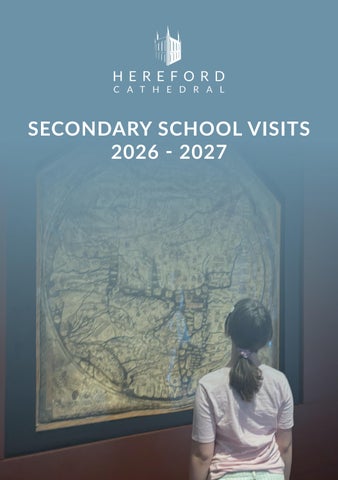
SECONDARY SCHOOL VISITS 2026 - 2027
VISITING HEREFORD CATHEDRAL See the historic Mappa Mundi! Explore the cloisters and the crypt! Pray at the medieval shrine of St Thomas Cantilupe. We offer a range of activities, trails and workshops looking at how Hereford Cathedral has changed over the centuries, and how it works now. While many trips have a focus on history or Religious Education, we can cater for many other areas of the curriculum.
Cathedral Barn
Some of our workshops take place in the Cathedral barn. Behind the Elgar statue, it is one of the oldest buildings in Hereford, with some of the timber dating back to the 13th Century. It is now used by the education team as our schools’ base.
College Hall
Larger groups will often use College Hall in the cloisters. This hall was once used by the Vicars Choral as a dining room and concert hall. It is now used for talks, functions and events.
Contacting the Education Team William Talbot-Ponsonby | Head of Schools and Family Learning education@herefordcathedral.org | 01432 374 256 We are holders of the LOtC Quality Badge - the only national award that recognises both learning and safety for learning outside the classroom providers and is endorsed by the Department of Education.
TIMINGS
While all visits are bespoke to fit your needs, these times are fairly typical:
Full Day Half Day 10.00 Arrive & Introduction 10.00 Arrive & Introduction 10.20 Tour 10.15 Tour/workshop 11.20 Break 11.00 Break 11.30 Workshop 11.15 Tour/workshop 12.30 Lunch 12.00 Depart or stay to eat 1.00 Workshop lunch in barn 2.00 Depart
PRICE SUMMARY
Without Workshop
With Workshop
Standard or Architecture Tour
£3.50
£4.50
Rooftop Tour
£3.00
£4.00
Historical Visit
£3.50
£4.50
Mappa Mundi Visit
£3.50
£5.00
TOURS Standard Tour
Tour of the cathedral, looking at the shrines of King Ethelbert and St Thomas Cantilupe, the Audley Chapel and Traherne Windows, the Cathedra and King Stephen’s Chair, the three-legged knight and other highlights.
Architecture Tour
Carry out a tour of the cathedral, paying particular attention to the different styles of architecture, and how different shapes of arch support walls. This can have a historical focus, to see how the design changes through time, or from an engineering perspective. This can be combined with the rooftop tour.
Rooftop Tour
Carry out a tour of the vaulted roof space, the external lower rooves and the tower. See how the cathedral has been built from above and what materials have been used in its construction. This tour is weather dependent and has limited capacity, so will usually be carried out in conjunction with other activities as part of a carousel.
DRAMA VISITS Carry out a workshop or series of workshops acting out stories from the Bible. Pupils will consider the characters involved, their emotions and motivations, and how best to transmit this through drama. Depending on time, this can be a stand-alone workshop looking at an individual story from either the Old or New Testament, or else a longer day where the pupils will end by performing together a more substantial play.
RE VISITS Sacraments
Carry out a workshop looking at the Baptism service or Holy Communion. Explore what the sacraments are and how the services are carried out, led by a member of clergy from the Cathedral.
Meet a Canon
An opportunity to meet one of the priests at the Cathedral, find out what they do, and then ask them challenging questions about their faith!
SCIENCE VISITS God and the Big Bang
Carry out a workshop using materials provided by God and the Big Bang, a Christian organisation that help children to discover and discuss the compatibility of science and faith. There are five possible titles: 1. Can science help us to believe in God? 2. Can science answer all our questions? 3. Can faith be based on evidence? 4. Does science make it hard to believe in God? 5. Does science solve all our problems? These sessions are available to be delivered by a member of clergy who is also a trained science teacher!
Exploring the Heating in the Cathedral
Taught by a secondary science teacher, pupils will explore the way in which the cathedral is heated and how heat is lost to the outside world. This will be tailored to the understanding of different age groups. The pupils will have an opportunity to use an infra-red camera to see where the heat escapes and make recommendations as to how we can improve the and energy efficiency of the building. This workshop ties in with the KS3 Science Curriculum and GCSE Science. It is best carried out in the winter months when the heating is operational.
HISTORICAL VISITS The Canterbury Pilgrims
In the 1390s Geoffrey Chaucer, often known as the Father of English Literature, wrote The Canterbury Tales, a collection of very different stories supposedly told by very different pilgrims as they took part in a pilgrimage from London to Canterbury to visit the tomb of Thomas Becket. In the 14th century Hereford was also growing rich from pilgrims to the shrine of the newly canonised Thomas Cantilupe. This workshop will introduce the pupils to the rise of English as a language in the late 14th century, explore the original Canterbury Tales using the original text from the General Prologue and then encourage creative writing as they observe and create their own pilgrim characters.
Hereford in the Civil War
Pupils consider the historical evidence about the siege of Hereford, and plan how they would attack Hereford. They look at the Civil War Window and the Dean Croft Pulpit, and create publicity / propaganda material on behalf of either the citizens of Hereford or the Scottish Army.
Life in the Middle Ages
Learning about the medieval inhabitants of the cathedral. Pupils dress in replica robes, learn some Latin and discover the daily challenges of the cathedral community in the Middle Ages.
Magna Carta
Pupils carry out an interactive workshop to learn about the Magna Carta, its significance and place in history. They have the opportunity to look at the 1217 Magna Carta and 1215 King John’s Writ, or the facsimiles of these documents if the originals are in storage.
Pilgrimage History
Pupils learn about pilgrimages in the medieval period, and Saint Thomas of Hereford. Pupils will dress in traditional pilgrim costumes, visit the shrine of St Thomas and see the secret ‘Booth Porch Chapel’
Plagues and the Black Death
Pupils look at archive material showing how plagues in history have affected Hereford Cathedral, dress in replica robes and take part in a mock funeral procession around the cloisters.
EXHIBITION VISIT The Hereford Mappa Mundi is the largest medieval world map to survive. An outstanding treasure, it records how scholars interpreted the world over 700 years ago. Sitting alongside the Mappa Mundi is the Chained Library, a spectacular collection holding over 1,500 rare books, including 229 medieval manuscripts. Pupils explore the myths and mysteries of Hereford’s map of the Middle Ages. This can be self-guided, or with an additional talk looking at close-up pictures and a facsimile of the map. This provides an opportunity to look at the medieval world view, as well as highlighting Jerusalem as the centre of the Christian world. It also provides an opportunity to create their own artwork based on the different pictures in the map. This can be combined with an extra workshop or cathedral tour.
DID YOU KNOW?
You can further explore the Mappa Mundi from your classroom by visiting: www.themappamundi.co.uk/mappa-mundi
ADDITIONAL WORKSHOPS
These can be stand-alone workshops, or combined with a tour as part of a longer visit. They cost £2.50 each, or £1 if added to a trail or additional activity.
Brass Rubbing Children are shown interesting memorial brasses around the cathedral and encouraged to discuss the historical information that can be learned from the clothing, the design and the decorations of these brasses. After that, the children use traditional brass rubbing wax to make their own rubbings to take back to school. We have a large selection of brasses to chose from including a number of images of famous Tudors. This workshop makes a good practical session for any visit to the cathedral, but particularly a Tudor themed visit.
Blanket Dig Archaeology In this workshop, pupils delve through a series of blankets to simulate digging through layers of the ground. In the process they discover how archaeology works, consider the nature of treasure, and find out about 1,000 years of cathedral history!
Calligraphy Amongst our archives we have documents with genuine signatures of Henry VIII and Elizabeth I. Children are able to look at copies of these and other examples of historical documents. They are introduced to the art and tools of writing in late medieval/Tudor England and given an opportunity to experiment for themselves, to design their own ‘Tudor’ signature, and, if time permits, to produce a longer piece of writing using calligraphy pens. This workshop makes a good practical session for a Tudorthemed visit or for a visit to the Mappa Mundi and Chained Library Exhibition.
Cathedral Corbels In this workshop children explore the outside of the cathedral looking for stone carved gargoyles, grotesques and corbels. Whenever possible they also visit our stone masons to watch them at work and learn about how they carve the stone faces and decorations. After that, the children make their own corbels out of clay.
Illuminated Letters This workshop gives children the opportunity to look at examples of unique hand decorated illuminated initials taken from some of our own 12th century manuscripts, and to learn a little bit about the history and art of illuminating letters. They then have the opportunity to design and colour their own initials. The workshop makes a good practical session to accompany a visit to the Mappa Mundi and Chained Library Exhibition.
Investigating the Traherne Windows In this workshop children explore the Christian symbolism and imagery in the stained glass of the Audley Chapel. The glass was designed by stained glass artist Tom Denny, who took his inspiration from the works of the 17th-century poet and mystic Thomas Traherne. Some of the images of the city of Hereford itself and of the flora and fauna of the Herefordshire countryside might be known to local children. Pupils will enjoy recognising landmarks, as well as interpreting the Christian message of the windows. This can be extended by considering the processes needed to create stained glass windows, as well as the chemicals needed to produce different coloured glass.
Music Workshop Pupils are given an introduction to Christian music, from ancient plainsong, traditional choral music, the sound of an organ and bells, to modern songs. They will have an opportunity to sing old and new songs, visit the choir stalls and have a go with handbells.
Praying with Beads This workshop offers pupils a contemplative, spiritual experience. It is not specifically Christian, and we welcome both members of all religious denominations and those of no particular commitment. The workshop takes place in the crypt, in candlelight and against a background of atmospheric music. As they make their prayer bead chains, children are encouraged to think about and remember people, times, places, events and global issues that are special or important to them.
Stained Glass Window The stained glass windows of Hereford Cathedral convey colourful images of many Christian stories and symbols. In this workshop children look at some of the windows and then design and colour a window of their own to suit the theme and objectives of their visit. We use different, age-appropriate materials for each Key Stage.
Walking the Labyrinth This is a spiritual and contemplative workshop. Children will look at Psalm 23 and consider the links between the words and their life; what they have to be grateful for and who in their lives they are worried about. They will slowly carry a stone into the middle of the labyrinth and retrace their steps.
WE COME TO YOU
As the cost of transport and the time away from school might make a visit to the cathedral difficult, we are able to come to schools anywhere in the diocese. We are willing to offer almost all of the usual workshops from our booklet; in particular we have two particular workshops ready for schools.
1 - MAPPA MUNDI WORKSHOP The Hereford Mappa Mundi is the largest medieval world map to survive. An outstanding treasure in Hereford Cathedral, it records how scholars interpreted the world over 700 years ago. While a visit to the Mappa Mundi is an unforgettable experience, for schools a long distance away from the cathedral the travel costs can be prohibitive. Instead, a member of the cathedral education team can visit any school in the diocese, bringing a life-sized facsimile of the original map. The facsimile is one of a limited number made by the prestigious Folio Society in London in 2010; it shows the map as it probably would have looked when it was first made, with vibrant colours and beautiful illustrations. In the workshop, pupils explore the myths and mysteries of Hereford’s map of the Middle Ages using detailed photography alongside the facsimile. It provides an opportunity to understand the medieval world view, as well as highlighting Jerusalem as the centre of the Christian world. The workshop can be customised depending on the wishes of the school and the age of the pupils; for example, pupils can also create their own artwork based on the different pictures in the map or use this as a springboard for creating their own world view.
WE COME TO YOU 2 - STORYTELLING THROUGH DRAMA Hereford Cathedral is currently in the midst of a Year of Storytelling. This includes performances of the Nativity, the Passion and the Mysteries, all written and directed by Canon James Pacey and performed in Hereford Cathedral using words, music and action to bring these stories to life. We are offering schools the opportunity to engage with these productions. Canon James and the cathedral education officer William Talbot-Ponsonby are able to visit schools to deliver a drama workshop with creative response. This usually lasts between 60-90 minutes per class. We will publish dates for these visits in early September, for which there is no charge. They are available to any school in the Diocese on a first come, first served basis.
FAQs Can the Cathedral help towards school travel costs? Yes! We are lucky to receive some funding which is ring-fenced to support schools visiting the cathedral. Depending on demand, this is unlikely to cover the entire cost but is spread among the schools applying. If you are interested in this funding, please indicate in the initial request. Where will we be based? Depending on the size of the group, schools are based either in the Cathedral Barn or in College Hall What toilet facilities are there? There are public toilets in the Chapter House Garden by the café, as well as a smaller number of private toilets available in the cloisters. Can we visit ahead of time? Yes, and we would encourage this. You will be met by a member of the cathedral team and see the various locations and facilities. We can also arrange a phone call or conversation via zoom or teams if this is helpful.
Do you provide a risk assessment? We provide a risk assessment for each activity which we encourage schools to adapt for their own visit. Can we do a self-guided visit? Yes you can. Schools can visit the Cathedral free of charge and the exhibition for the standard entry rate. Materials are available on request for schools to use (email education@herefordcathedral. org for more details). We do, however, ask you to book in the usual way to avoid clashes. Do I need to book? All school visits need to be booked. We recommend a halfterm’s notice, although sometimes we can accommodate schools with a two week notice period. Please email education@herefordcathedral.org for the booking form. How do we pay for the visit? We send an invoice to the school after the visit for the agreed price based on the number of pupils who attend. What SEND provision do you have? We work with each school to ensure that we meet the needs of all pupils. Adapted materials and resources are available. What are the parking arrangements? Coaches usually drop school groups off at the corner of the Cathedral Close at the end of Broad Street. Smaller groups sometimes come by minibus, and with enough notice we can reserve a parking space in the Staff Car Park for these.
Images by Gordon Taylor & Caroline Potter