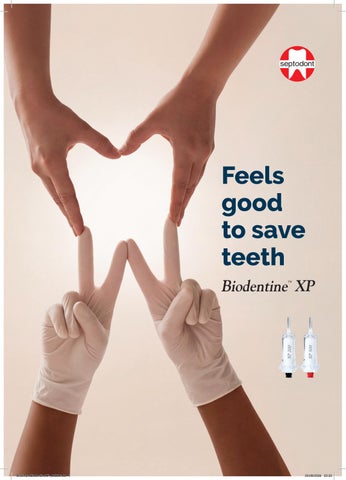
Feels good to save teeth
BrochureBiodentineXP_2026.indd 1
05/08/2026 23:22
Predictable outcomes Durable restorations
FEE
GOO
TO SA TEET
Simple workflow
BrochureBiodentineXP_2026.indd 2
05/08/2026 23:22
ELS
OOD
SAVE ETH
BrochureBiodentineXP_2026.indd 3
Patient comfort Adapted to all deep caries cases
05/08/2026 23:22
PREDICTABLE OUTCOMES
Trust in the success of your vital pulp therapy. Eliminate retreatments. Protect your practice reputation.
Clinical excellence
>94%
in 3 VPT indications
Clinical success
Systematic review and meta-analysis of Randomized Controlled Trials in VPT (2025)1
CLINICAL SUCCESS RATE
96%
2
Direct pulp capping
04
95.4%
3
Pulpotomy
96%
4
Indirect pulp capping
CE for Biodentine™ XP was obtained on the basis of equivalence with Biodentine™
BrochureBiodentineXP_2026.indd 4
05/08/2026 23:22
Biodentine™ XP is a calcium silicate material designed for Vital Pulp Therapy procedures, as recommended by ESE and AAE Guidelines
Proven biological properties SUPERIOR BIOACTIVITY
5-8
Favorable interaction with pulp cells
Remineralization of damaged dentin
Dense dentinal bridge formation to protect pulp
EXCELLENT BIOCOMPATIBILITY
9-11
0
0 RESIN
EXTRA-PURE C3S
CELL DEATH
ANTIBACTERIAL PROPERTIES
12-13
11+
pH
At release maintained for 28 days
Unfavorable environment for bacteria responsible for pain and secondary caries
05 BrochureBiodentineXP_2026.indd 5
05/08/2026 23:22
DURABLE RESTORATIONS
Gain the total reassurance that comes with longlasting restorations, satisfied patients, and a stellar reputation.
Tight marginal seal under composite 8,14-17
0
µm 35
BIODENTINE
TM
30 25 20 15 10
DENTIN
GIC
5
BIODENTINETM
Photopolymerization shrinkage
0
Deep penetration within dentin tubes
Less microleakage than GIC
Unlike resin-based materials
Strong mechanical properties
18-20
Compressive Strength MPa (24 hours)
Vickers Micro Hardness HVN (24 hours)
350
100
250
BIODENTINE TM
60
200 GIC
150 100
40 20
50
0
0 Days
80
1
7
Dentin-like resistance to mastication forces
BIODENTINETM
SOUND DENTIN
DENTIN
300
28
Dentin-like stress absorption
06 BrochureBiodentineXP_2026.indd 6
05/08/2026 23:22
High resistance to fracture21 N 1500
0
BIODENTINETM BIO-BULK FILL
500
INTACT TEETH
1000
Biodentine™ in 6mm increment provides: • Fracture resistance comparable to intact teeth • Tight hermetic seal
Resistance to fracture
Enhanced restorative material Resin composite Bio-Bulk Fill: Biodentine™ placed in a single block > 4mm
Biodentine™ combines BIOLOGICAL & RESTORATIVE properties for durable restorations
07 BrochureBiodentineXP_2026.indd 7
05/08/2026 23:22
SIMPLE WORKFLOW
Streamline your workflow with one material that combines biological & restorative functions in one.
All-in-one: Biological & Restorative properties ONE MATERIAL
MULTIPLE MATERIALS
Resin composite Bio-Bulk Fill: Biodentine™ placed in a single block > 4mm
Resin composite Filling Liner
Streamlined Bio-Bulk Fill procedure 22,23
Final enamel restoration to be performed:
Fill the entire cavity with only Biodentine™ XP from the pulp to the tooth surface.
In the same session Or In a second session, between 2 weeks and 6 months later24
08 BrochureBiodentineXP_2026.indd 8
05/08/2026 23:22
Only one material to fill the entire cavity • Fewer materials, streamlined workflow • Direct placement in the tooth • Same technique for all VPT procedures (IPC, DPC, pulpotomy) • Adapted to all caries removal techniques • Final enamel restoration in 1 or 2 sessions
Simplified Bio-Bulk Fill protocol 1
2
3
4
5
Isolate the tooth with a rubber dam
Remove remaining caries
Fill the cavity with Biodentine™ XP in Bio-Bulk Fill
Leave 2mm space and wait for setting
Apply a universal adhesive containing 10-MDP for optimal bonding
6
Place a resin composite
‘There’s no need for multiple layers or thin increments—I can simply fill the tooth with a single material and place the composite directly over Biodentine™. This streamlines the process, reduces the risk of errors, and saves valuable clinical time.’ – Dr. Patel (UK).
09 BrochureBiodentineXP_2026.indd 9
05/08/2026 23:22
SIMPLE WORKFLOW
Detailed Bio-Bulk Fill Protocol CAVITY PREPARATION
1 2 3
Aligned with ESE and AAE Vital Pulp Therapy Guidelines
Assess the pulp status
Isolate the tooth with a rubber dam
Perform caries excavation (use your preferred technique)
If haemostasis cannot be achieved within 5 minutes, further pulp tissue should be removed (perform partial or full pulpotomy)
In the event of a pulp exposure, achieve haemostasis by compression (1-6% NaOCL)
BIO-BULK FILL
4 5 6
Activate and mix the Biodentine™ XP cartridge with the Biodentine™ XP Mixer Using the Biodentine™ XP Gun, place the tip at the cavity base and slowly inject Biodentine™ XP to fill the cavity on > 4mm (Bio-Bulk Fill)2 Ensure a good marginal adaptation, and limit occlusal shaping and pressure while Biodentine™ XP sets
FINAL RESTORATION
FINAL RESTORATION
in the same session
7 8
(2 weeks to 6 months after the 1st session) Leave 2 mm of occlusal space, and wait until Biodentine™ XP has set (~12 min) Apply a self-etch adhesive system (selective etch or self-etch mode) over Biodentine™ XP and the tooth structure ideally a universal adhesive containing 10-MDP for optimal bonding
9 10
Place a resin composite
10
in a 2nd session
Patient recall according to current recommendations
7 8 9
At 2nd session, assess the pulp vitality status Cut Biodentine™ XP back sufficiently � (average of 2 mm) Apply the adhesive system: total etch (etch&rinse) or self-etch over Biodentine™ XP and the tooth structure - ideally a universal adhesive containing � 10-MDP for optimal bonding
10 11
Place a resin composite Patient recall according to current recommendations
(1) Procedure extracted from international dental practitioners experts board (Position statement. September 2023). (2) Possible technique in the context of a coronal restoration. *Fill the entire cavity with only Biodentine™ XP from the pulp to the tooth surface. Final enamel restoration to be performed in the same session on in the second session which can be performed between 2 weeks and 6 months later.
BrochureBiodentineXP_2026.indd 10
05/08/2026 23:22
CAVITY PREPARATION
1. Assess the pulp status
2. Isolate the tooth with a rubber dam
3. Perform caries excavation (use your preferred technique)
BIO-BULK FILL
4. Activate and mix the Biodentine™ XP cartridge with the Biodentine™ XP Mixer
5. Using the Biodentine™ XP Gun, place the tip at the cavity base and slowly inject Biodentine™ XP to fill the cavity on > 4mm (Bio-Bulk Fill)2
In the event of a pulp exposure, achieve haemostasis by compression (1-6 % NaOCL)
6. Ensure a good marginal adaptation, and limit occlusal shaping and pressure while Biodentine™ XP sets
FINAL RESTORATION in the same session
7. Leave 2 mm of occlusal space, and wait until Biodentine™ XP has set (~12 min)
8. Apply a self-etch adhesive system (selective etch or self-etch mode) over Biodentine™ XP and the tooth structure
9. Place a resin composite
10. Patient recall according to current recommendations
FINAL RESTORATION
in a 2nd session - 2 weeks to 6 months after the 1st session)
7. At 2nd session, assess the pulp vitality status
8. Cut Biodentine™ XP back sufficiently (average of 2 mm)
9. Apply the adhesive system: total etch (etch&rinse) or self-etch over Biodentine™ XP and the tooth structure
10. Place a resin composite
11. Patient recall according to current recommendations
11 BrochureBiodentineXP_2026.indd 11
05/08/2026 23:22
PATIENT COMFORT
Aiming for a pain-free patient means fewer disruptions, fewer emergency calls, and fewer return visits. Put their comfort first.
Patient comfort3,25 DURING THE VITAL PULP THERAPY PROCEDURE
Compared to Root Canal Treatment:
• Less invasive • Less time spent • Fewer materials used • Fewer manipulations in the mouth • Lower cost
“Maintaining pulp vitality is cost-effective and preferable to root canal treatment. Saving the pulp is not only clinically valid, it’s also economically valid.” Prof. Dr. Schwendicke, LMU Munich Discover the full article here
12 BrochureBiodentineXP_2026.indd 12
05/08/2026 23:22
AFTER THE VITAL PULP THERAPY PROCEDURE
6 MONTHS, 1 YEAR, 3 YEARS AND BEYOND
• No thermal sensitivity • 0 discomfort during mastication • 0 spontaneous pain Clinical follow-up on 10 patients (at 6, 12, 36 months) 1
Pain-relieving procedure
93%
felt no postoperative pain after using Biodentine in direct pulp capping (114 patients)26
“The evidence from clinical studies supports a pain-relieving effect for Biodentine™ in asymptomatic and symptomatic pulpitis, which is in line with its in vitro anti-inflammatory action.“ Prof. About 13
13 BrochureBiodentineXP_2026.indd 13
05/08/2026 23:22
ADAPTED TO ALL DEEP CARIES CASES
Doubts and uncertainties in indirect pulp treatment
PULP CONCERNS • CLOSE PROXIMITY TO THE PULP? • BACTERIA? • INFLAMMATION?
DENTIN CONCERNS • DEMINERALIZED DENTIN? • RESISTANCE? • SEALING?
Caries removal techniques SCR
selective caries removal
NSCR
non-selective caries removal
14 BrochureBiodentineXP_2026.indd 14
05/08/2026 23:22
Whatever your technique in indirect pulp treatment, you can rise to the challenge with confidence and deliver predictable results.
200 100 50 0
DENTIN
150
BIODENTINETM
250
Compressive Strength MPa (24 hours)
Resists
18-21
Fracture resistance comparable to intact teeth thanks to dentinlike mechanical properties.
Remineralizes Mineral deposits forming after storage with Biodentine™
BIODENTINETM
Creates conditions for mineral deposition in demineralized dentin unlike GIC.
Seals
DENTIN
5
8, 11, 14-17, 21
• Penetrates dentin tubules • Dimensional stability • 0 microleakage
Indirect pulp treatment:
Preserves
Clinical Success4
Heals
5, 8, 12, 13
Limits proliferation of bacteria and creates a dentinal bridge.
96%
Dense dentinal bridge formation
5-11
Heals the pulp thanks to superior bioactivity, biocompatibility and anti-inflammatory effect.
15 BrochureBiodentineXP_2026.indd 15
05/08/2026 23:22
What is the true value of saving natural teeth?
Biodentine™ XP 200 Box of 10 cartridges
Biodentine™ XP Mixer
Biodentine™ XP 500 Box of 10 cartridges
Biodentine™ XP Gun
1.
Lingjiao Lu, Weiying Zheng. Evaluation of vital pulp therapy with Biodentine in young permanent teeth: a systematic review and meta-analysis. Journal of Clinical Pediatric Dentistry. 2025. 49(3);9-20. URL: https://www.jocpd.com/ articles/10.22514/jocpd.2025.045
2.
Zanini, M., Balice, G., K Rour Dan, O., L Z, C., Gueyffier, F., Maucort-Boulch, D., Nony, P., Grosgogeat, B., & Pradelle-Plasse, N. (2025). Outcomes of Direct Pulp Capping After Carious Excavation of Deep Caries on Permanent Mature Teeth: An Ancillary Study Derived From A Randomised Clinical Trial. European endodontic journal, 10(6), 514–524. https://doi.org/10.14744/eej.2025.38870
3.
Baranwal, H. C., Mittal, N., Yadav, J., Rani, P., & Naveen Kumar, P. G. (2022). Outcome of partial pulpotomy verses full pulpotomy using biodentine in vital mature permanent molar with clinical symptoms indicative of irreversible pulpitis: A randomized clinical trial. Journal of conservative dentistry : JCD, 25(3), 317–323. https://doi.org/10.4103/jcd.jcd_118_22
4.
Chhabra, N., Chhabra, A., Mehta, R., Bains, S., & Mauli, G. (2025). Clinical and Radiographic Evaluation of Biodentine and Mineral Trioxide Aggregate as Indirect Pulp Capping Agents in Primary Molars: A Randomized Controlled Trial with 18-month Follow-up. Annals of African medicine, 24(4), 852–857. https://doi.org/10.4103/aam.aam_280_24
5.
Nowicka A et al. Tomographic Evaluation of Reparative Dentin Formation after Direct Pulp Capping with Ca(OH)2, MTA, Biodentine™, and Dentin Bonding System in Human Teeth. JOE. 2015.
6.
Gong V et al. Nanoscale chemical surface characterization of four different types of dental pulp-capping materials. JOD. 2017.
7.
Elbanna A et al. In vitro bioactivity of newly introduced dual-cured resinmodified calcium silicate cement. DRJ. 2022.
8.
Bakhtiar H et al. Human Pulp Responses to Partial Pulpotomy Treatment with TheraCal as Compared with Biodentine™ and ProRoot MTA: A Clinical Trial. JOE. 2017.
9.
Poggio C et al. In vitro cytotoxicity evaluation of different pulp capping materials: a comparative study. Archives of Industrial Hygiene and Toxicology. 2015.
10.
Internal R&D data.
11.
Internal data: Biodentine™ XP Scientific file. 2022.
12.
Kaur M., Singh H., Dhillon J.S., Batra M., Saini M. MTA versus Biodentine™: Review of Literature with a Comparative Analysis. J. Clin. Diagn. Res. 2017.
13.
About, I. (2022) Biodentine: Properties and Clinical Applications. Switzerland: Springer.31-50 URL: https://link.springer.com/book/10.1007/978-3-03080932-4
14.
Atmeh et al. Dentin-cement interfacial interaction: calcium silicates and polyalkenoates. JOD. 2012.
15.
Niranjan et al. A comparative microleakage evaluation of three different base materials in Class I cavity in deciduous molars in sandwich technique using dye penetration and dentin surface interface by scanning electron microscope. Journal of Indian Society of Pedodontics and Preventive Dentistry. 2016.
16.
Aguilar AEA, Manosalvas MSP, Valverde Haro HP. Repair of furcal perforations using different calcium silicate cements: An in vitro study. J Conserv Dent Endod. 2025 Oct;28(10):1007-1012.
17.
Aksel H, Küçükkaya Eren S, Askerbeyli Õrs S, Karaismailoğlu E. Surface and vertical dimensional changes of mineral trioxide aggregate and biodentine in different environmental conditions. J Appl Oral Sci. 2018 Dec 10;27:e20180093. doi: 10.1590/1678-7757-2018-0093.
18.
Aldegheishem, Alhanouf S et al. Fracture Resistance of Root-Canal Treated Premolars Restored with Dentin Replacement Materials: An In-vitro Study. Oral health & preventive dentistry vol. 20 271-278. 28 Jun. 2022.
19.
Topçuoğlu Gamze, Topçuoğlu HS. Fracture resistance of primary molars after pulpotomy procedure using mineral trioxide aggregate or Biodentine. The Journ of Clin Ped Dent. 2023, Volume 47(5): 133-137.
20.
Panjwani, Pankaj et al. The effect of varying thicknesses of mineral trioxide aggregate (MTA) and Biodentine as apical plugs on the fracture resistance of teeth with simulated open apices: a comparative in vitro study. PeerJ vol. 12 e18691. 18 Dec. 2024.
21.
Taha NA et al. Investigating a calcium silicate-based cement as a dentine replacement material in permanent mandibular molars treated with full pulpotomy: A laboratory study of fracture strength and microleakage. J Dent. 2026;169:106642.
22.
Internal R&D document RDRADEVPA00DM_283 - Biodentine™ Bio-Bulk Fill statement. 2022.
23.
Internal Septodont’s document provided from Biodentine Expert Board – 11th September 2023
24.
Koubi et al. Clinical evaluation of the performance and safety of a new dentine substitute, Biodentine™, in the restoration of posterior teeth – a prospective study. Clin Oral Investig. 2013.
25.
Tosco V, Monterubbianesi R, Montagna P, Orilisi G, Vitiello F, Song H, Putignano A, De Santis D, Orsini G. Vital Pulp Therapy: A Three-Year Clinical Case Series on Regenerative Potential and Adhesive Restoration Strategies. Regenesis Repair Rehabilitation, (2026).https://pmc.ncbi.nlm.nih.gov/articles/PMC9274703/
26.
Pervez J, Rana MA, Ahmad M, Shahid U, Saif S, Hussain Z. Bioceramics based pulp capping; evaluation of Post operative pain in teeth diagnosed with reversible pulpitis. J Pak Med Assoc. 2026 Mar;76(3):327-329. doi: 10.47391/ JPMA.21592. PMID: 42017710.
Brochure Biodentine XP - June 2026
REFERENCES
Septodont 58 rue du Pont de Créteil 94100 Saint-Maur-des-Fossés | France septodont.com
BrochureBiodentineXP_2026.indd 16
05/08/2026 23:22