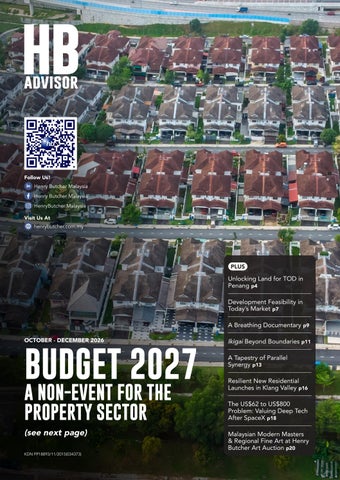
Follow Us! Henry Butcher Malaysia Henry Butcher Malaysia HenryButcher.Malaysia Visit Us At henrybutcher.com.my
PLUS
Unlocking Land for TOD in Penang p4 Development Feasibility in Today’s Market p7 A Breathing Documentary p9 OCTOBER - DECEMBER 2026
BUDGET 2027 A NON-EVENT FOR THE PROPERTY SECTOR (see next page) KDN PP18893/11/2015(034373)
Ikigai Beyond Boundaries p11 A Tapestry of Parallel Synergy p13 Resilient New Residential Launches in Klang Valley p16 The US$62 to US$800 Problem: Valuing Deep Tech After SpaceX p18 Malaysian Modern Masters & Regional Fine Art at Henry Butcher Art Auction p20
October - December 2026
BUDGET 2027 - A NON-EVENT FOR THE PROPERTY SECTOR
BUDGET 2027 - A NON-EVENT FOR THE PROPERTY SECTOR
T
he allocation of RM459.84 billion under Budget 2027 is the biggest so far for the country and represents a 9.6% increase over the RM419.2 billion under Budget 2026. As with the budgets of recent years, the government has understandably and rightfully, continued to prioritise the education, health and defence sectors. The property sector however did not receive the same level of priority and was pretty much a non-event. The following are the key measures in the budget which will have an impact on the construction and property sector: a) Continued Positive Economic Growth Despite the negative impact to the global economy resultant from the yet to be resolved conflict in Ukraine and the possible expansion of the war in the Middle East, the Malaysian Government still expects the country’s economy to be relatively sheltered and grow by between 4.8 to 5.3% in 2026, before moderating slightly to between 4.2 to 5.2% in 2027.
The continued positive economic growth will lead to a stable and conducive environment for the country and this augurs well for and will help to support the property sector.
Existing (up to YA 2026)
b) Increase in Minimum Wage The government has proposed to raise the minimum wage from RM1,700 to RM2,000 a month from June 2027. Nevertheless, to alleviate the burden on MSMEs, those with annual sales below RM50 million will be exempted to allow them time to adjust their business models. The new rate is expected to cover more than four million workers. The government will also introduce a minimum salary of RM2,500 a month for semi-skilled workers and graduates as part of reforms to address mismatches between workers’ wages and qualifications, and will complement the minimum wage increase.
by Henry Butcher Malaysia
Publisher Henry Butcher Malaysia Sdn Bhd 25, Jalan Yap Ah Shak, 50300 Kuala Lumpur. T 603-2694 2212 E admin@henrybutcher.com.my W www.henrybutcher.com.my OUR SERVICES Valuation T 603-2694 2212 F 603-2694 3484 E hbmalaysia@henrybutcher.com.my
The increase in minimum wage will put more disposable income in the hands of those who are targeted to benefit from this move and hopefully, this will filter down at least to the retail sector.
Project Marketing T 603-2694 2212 F 603-2692 5771 E tang.cm@henrybutcher.com.my
c) Review of Income Tax Band & Rates Budget 2027 has proposed that the individual tax rates will be restructured as per the table below. In addition, the personal relief will be increased from the current RM9,000 to RM12,000.
Market Research & Development Consultancy T 603-4270 2072 F 603-4270 2082 E hbampang@henrybutcher.com.my
The restructuring of the income tax rate for individuals as well as increase in personal relief will put more disposable income in the hands of the groups involved and this could provide a boost to the retail sector in the form of increased consumer spending.
Facilities & Asset Management T 603-6205 3330 E admin.assetmgmt@henrybutchermk.com
Proposed (effective from YA 2027)
Art Consultancy T 603-2691 3089 F 603-2602 1523 E info@hbart.com.my
Chargeable Income (RM)
Tax (RM)
% on Excess
Chargeable Income (RM)
Tax (RM)
% on Excess
5,000
0
1
5,000
0
1
20,000
150
3
20,000
150
3
35,000
600
6
35,000
600
6
50,000
1,500
11
50,000
1,500
11
70,000
3,700
19
70,000
3,700
18
100,000
9,400
25
100,000
9,100
24
400,000
84,400
26
150,000
21,100
25
600,000
136,400
28
400,000
83,600
26
2,000,000
528,400
30
600,000
135,600
28
1,000,000
247,600
30 Source: LHDN, PwC
Real Estate Agency T 603-2694 2212 F 603-2694 1261 E hbre@henrybutcher.com.my
Retail Consultancy T 603-9130 5550 F 603-9130 4003 E tanhaihsin@yahoo.com
Plant & Machinery Consultancy T 603-2694 2212 F 603-2694 3484 E hbmalaysia_pnm@henrybutcher.com.my Auctions & Tender Sales T 603-2694 2212 F 603-2694 1292 E auctions@henrybutcher.com.my
OUR OFFICES KLANG VALLEY | Mont Kiara • Subang Jaya | KEDAH | Alor Setar • Kulim | PENANG | Penang Island • Seberang Perai | PERAK | Ipoh | NEGERI SEMBILAN | Seremban | MALACCA | Melaka | JOHOR | Johor Bahru • Muar • Kluang • Pontian | PAHANG | Kuantan | TERENGGANU | Kuala Terengganu | KELANTAN I Kota Bharu | SABAH | Kota Kinabalu • Tawau • Sandakan | SARAWAK | Kuching • Miri Publishing Agency Rightwiz Sdn Bhd Printer Percetakan CL Wong Sdn Bhd AS-84, Jalan Hang Tuah 4, Taman Salak Selatan, Cheras, 57100 Kuala Lumpur.
BUDGET 2027 - A NON-EVENT FOR THE PROPERTY SECTOR
MSME Income Tax Rates (Effective from YA 2027) Chargeable Income Band
Current Rate
Proposed Rate
Maximum Tax Savings (RM)
First RM150,000
15%
14%
1,500
RM150,001 to RM600,000
17%
16%
4,500
Exceeding RM600,000
24%
24%
-
Total
6,000
Lumpur for affordable housing. The development is part of a 50-acre site gazetted as Malay Reserve Land.
This measure, together with others targeted at the affordable homes segment, will assist the B40 and M40 groups to buy and own their first home and thus stimulate demand for this segment of the market.
d) Reduction of Tax Rate for MSMEs It has been proposed in Budget 2027 that the tax rates for micro and small business enterprises (MSMEs) be lowered (see MSME Income Tax Rates (Effective from YA 2027) table).
first home. This measure will continue to drive demand and support the affordable homes segment and help those who do not yet own a home to purchase their first home.
The restructuring of the tax rates for MSMEs although not very significant, will nevertheless be helpful to MSMEs and help them tide over the current period of economic uncertainty arising from a possible global economic slowdown. This will help stabilise the industrial property sector.
The stamp duty exemption on instruments related to abandoned housing schemes will also encourage the participation of contractors/developers in reviving abandoned housing projects and this will then alleviate the financial hardships of house buyers caught in the dilemma of having invested in abandoned housing projects.
h) Infrastructural Improvements & Special Development Zones It was revealed that the JohorSingapore Special Economic Zone (JS-SEZ) has managed to attract recorded investments of RM132 billion for the period 2025 to June 2026. Its master plan and blueprint are due to be launched jointly by the prime ministers of Malaysia and Singapore at the end of 2026. Nexus Sedenak will become a new industrial hub in the northern part of the zone, with potential investments of RM12 billion and the creation of 45,000 jobs. The road from the Sedenak interchange will be upgraded, followed by facilities connecting it to major ports and regional trade networks.
f) Allocation to the SJKP A sum of RM20 billion will be allocated under the Housing Credit Guarantee Scheme (SJKP) to support housing financing and this is expected to benefit 80,000 first time home buyers. This is the same as the amount allocated under last year’s budget.
Penang has been designated the country’s financial technology hub and in this regard, it was announced that Khazanah Nasional Bhd and InvestPenang will jointly establish a RM100 million Strategic Investment Fund to support earlystage semiconductor and advanced manufacturing companies.
This measure, together with others targeted at the affordable homes segment, will assist the B40 and M40 groups to buy and own their first home and thus stimulate demand for this segment of the market.
The government has proposed to speed up the development of Lumut Maritime Industrial City (LuMIC) in Perak. At the same time, the Automotive Hi-Tech Valley in Tanjong Malim will be developed as a regional automotive hub. Fully locally owned automotive vendors relocating there will be eligible for tax deductions of up to RM5 million on qualifying relocation costs incurred between 1 January 2027 and 31 December 2030.
Source: LHDN, PwC
e) Extension of Stamp Duty Exemption for First Time Home Buyers and Reintroduction of 100% Stamp Duty Exemption for Revival of Abandoned Housing Schemes The government has proposed to extend the current full stamp duty exemption on transfer instruments and loan agreements for the purchase of homes by first time home buyers for houses priced up to RM500,000 from 31 December 2027 to 31 December 2030. In addition, for homes priced up to RM750,000, the first RM500,000 will be eligible for full stamp duty exemption whilst there will be a 50% exemption on the remaining amount. The government has also proposed the reintroduction of a 100% stamp duty exemption on loan agreements and instruments of transfer executed between the original purchasers and the contractors or developers undertaking the rescue and revival of abandoned housing schemes which have been certified by the Ministry of Housing & Local Government (KPKT). The exemption will apply to qualifying instruments signed between 1 January 2027 and 31 December 2030.
This is a boon to those in the low to middle income groups who will be able to reduce their financial outlay when they purchase their
g) Affordable Homes Programmes Nearly RM1 billion has been allocated for the construction of affordable housing projects under various programmes including Rumah Mesra Rakyat and Program Residensi Rakyat. Four new housing projects will be implemented in Kulai, Johor; Nilai, Negeri Sembilan; Paya Rumput, Melaka; and Lembah Pertang, Terengganu. The government has also announced that Bandar Madani Bukit Jalil will be developed as a residential township with facilities including vertical schools. At the same time, it was announced that Petronas has begun developing the first 10 acres of land in Kuala
The government will be undertaking the development of 22 infrastructure projects in the Chuping Valley Development Area and the Northern Corridor Economic Region Agribio Economic Zone in Perlis which will lead to the creation of more jobs and business opportunities. Prasarana will be investing more than RM3.4 billion as part of its comprehensive overhaul of rail services in the country. In this regard, the government will acquire 42 new OCTOBER - DECEMBER 2026 | HB ADVISOR
1
BUDGET 2027 - A NON-EVENT FOR THE PROPERTY SECTOR
Not much to shout about but tourism is looking positive in 2027.
train sets for ETS and KTM Komuter to improve its service levels and minimise disruptions. A total allocation of RM2.5 billion will be provided to maintain federal roads whilst state roads will receive RM5.7 billion through the Malaysian Road Records Information System (MARRIS). At the same time, the government has increased the allocation for rural road projects to RM2.3 billion. Meanwhile, a total of RM3.3 billion has been allocated for rural basic infrastructure improvements, including village streetlights, community facilities, clean water and electricity. DBKL will build a 22km covered pedestrian walkway linking landmarks such as the National Mosque, Dataran Merdeka and Central Market. This will encourage pedestrian cross traffic between these popular tourist destinations. The government has agreed to implement the elevated Autonomous Rapid Transit (e-ART) system as the main solution to solve the traffic congestion problem in Johor Bahru. To provide a catalyst to boost economic growth in strategic areas of Pahang, the government will support development activities along the East Coast Rail Link (ECRL) alignment, including heavy industry in Bentong and housing near the KotaSAS station.
2
HB ADVISOR | OCTOBER - DECEMBER 2026
All those areas which will witness improvements in road and rail connectivity as well as those areas which are earmarked for major industrial and commercial development are expected to benefit from the enhancement in accessibility and economic activities and this will lead to stronger interest in the local property market and in turn, attract property developers to undertake new housing, commercial or industrial developments as dictated by local demand and deemed appropriate for the area. i) Boost for Tourism The government has extended the Visit Malaysia Year campaign to 2027, with a sum of RM935 million allocated for tourism and culture, including incentive grants for industry players to promote and organise tourism events. For the duty-free islands of Langkawi and Labuan, the duty-free purchase limit for visitors and tourists will be raised to RM10,000, subject to a minimum stay of 48 hours. The government has also proposed to upgrade key tourism products in Terengganu, including Setiu Wetlands, Tasik Kenyir, Pulau Tenggol and Pulau Bidong.
These measures will help to boost business and occupancy rates for hotels as well as shopping malls and commercial retail centres in the main tourist destinations in the country.
Final Observations Although Budget 2027 did not provide the goodies wished for by the key stakeholders in the property industry and may be considered a non-event for the property sector, the sector is still expected to benefit and grow positively as a result of the spin-offs and boosts provided by all the indirect measures in the budget including the stable economic growth projected by the government and the increased spending power arising from the lowering of the tax rates and increase in tax reliefs. First time home buyers as well as those in the B40 and bottom half of the M40 groups will be the main beneficiaries of the various property related measures announced in the budget. The affordable homes segment of the residential market is expected to continue to receive favourable support from the market. The various rail and road infrastructure and development projects announced in the Budget will benefit residents in the surrounding areas and contribute to enhancing demand and property values in these areas. The extension of Visit Malaysia Year 2026 into 2027 will attract more international tourists in the coming year as well as boost domestic tourism. This will then help raise hotel room occupancies and rates as well as enhance the values of hotels and tourism related properties. Shopping malls and commercial centres will also benefit from the anticipated increase in tourist arrivals and spending and this will help to boost occupancy and rental rates and ultimately, property values.
HENRY BUTCHER
ART AUCTION 22 NOVEMBER 2026, 1PM Menara KEN TTDI Level M, Hall 1-3 37, Jalan Burhanuddin Helmi, Taman Tun Dr Ismail, 60000 Kuala Lumpur
Viewing 14 – 21 November 2026 10am – 6pm daily Menara KEN TTDI, Level M, Hall 1-3
www.hbart.com.my IBRAHIM HUSSEIN, DATUK Untitled, 1996, acrylic on canvas, 40 x 45cm, estimate RM82,000 - 120,000
SHARIFAH FATIMAH SYED ZUBIR, DATO Mindscape - The Link, 1993, acrylic on canvas, 121 x 121cm estimate RM65,000 - 100,000
Contact
Sim Polenn 016 273 3628 info@hbart.com.my
AWANG DAMIT AHMAD Marista Sisa Semusim II, 1996, mixed media on canvas, 99 x 92cm estimate RM65,000 - 110,000
Elizabeth Wong 013 355 6578
Sion Chang 017 777 0035
OCTOBER - DECEMBER 2026 | HB ADVISOR
3
UNLOCKING LAND FOR TOD IN PENANG
UNLOCKING LAND FOR TOD IN PENANG Zoning, land release, value capture and implementation in the Mutiara Line era. - By Henry Butcher Malaysia Penang
P
enang’s first metro rail system will do more than change how people move. It will alter the geography of accessibility, development rights and land value. The central question is therefore not simply how much can be built around stations but how the value created by transit should be converted into a better, more inclusive and more investable Penang. A transport investment becomes a land question Imagine owning a parcel of land in Penang today. Tomorrow, a new LRT station is confirmed beside it. The land has not moved, yet its economic potential may change. That simple thought experiment goes to the heart of transit-oriented development (TOD): who created the uplift, who should capture it, and how should the benefits be shared among landowners, developers, investors, government and the wider community? This is becoming an immediate rather than theoretical question. The revised Mutiara Line railway scheme covers 29.67km and is designed to connect major destinations including Penang International Airport, the Bayan Lepas Free Industrial Zone, George Town and Penang Sentral. MRT Corp’s February 2026 public-inspection notice described 20 planned stations plus two provisional stations, with rail services expected to begin in December 2031.1
4
HB ADVISOR | OCTOBER - DECEMBER 2026
The project therefore creates a new development geography across the island and, through Penang Sentral, a stronger relationship with the mainland. The key point for the property market is timing. The railway may open in 2031 but the land-development cycle begins much earlier. Expectations about accessibility can influence land prices, planning applications and investor positioning well before trains begin operating. The investment window is therefore front-loaded: land strategy, planning rights, infrastructure coordination and station-area positioning need to be addressed before the transit premium is fully capitalised. Why TOD - and why Penang needs its own model TOD is widely discussed in planning theory and practised across Asia, but it is not simply a formula for putting high-rise buildings beside railway stations. The World Bank defines TOD as compact, mixed-use, pedestrian- and bicycle-friendly development closely integrated with mass transit, clustering jobs, housing, services and amenities around public transport stations.2 The important word is integration: transport, land use, urban design, real-estate economics and public outcomes have to reinforce one another.
Penang can learn from Hong Kong, Singapore, Tokyo and other Asian cities but it should not copy them mechanically. Penang Island has finite land, established neighbourhoods, fragmented ownership in some areas, a globally significant heritage core and environmental constraints. Its station areas will also differ materially in market depth and economic function. The objective should therefore be the right density, in the right place, supported by the right infrastructure - not maximum density everywhere. A useful discipline is the World Bank’s 3V framework: node value, place value and market-potential value.2 Node value measures a station’s connectivity and importance within the transport network. Place value assesses the quality and attractiveness of the surrounding urban environment, including walkability, amenities and mixed use. Market potential asks whether there is sufficient demand, developable land and economic momentum to support additional development. The framework explicitly cautions against applying the same TOD intensity across an entire network. For Penang, this means differentiating station roles. Some locations may justify major mixed-use cores; others may be employment-led growth centres; some may be regeneration precincts; and others may remain primarily neighbourhood stations with modest intensification. Density should follow evidence. A station with excellent connectivity but weak market depth is not automatically ready for high-density development, just as inexpensive land is not necessarily an attractive investment if access, approvals or demand are weak. This is also why Penang’s opportunity is broader than residential towers. Bayan Lepas is an employment and industrial ecosystem generating jobs, daily travel and rental demand. George Town and other mature areas already support housing, retail, offices, hospitality and services. The airport and Penang Sentral are gateways with different visitor, logistics, office and interchange functions. The development programme should follow the economic role and occupier demand of each catchment.
UNLOCKING LAND FOR TOD IN PENANG
bank, planning and design codes, investment prospectuses, a parcel pipeline and a KPI dashboard. Different investors see the same station differently For developers, the strategic advantage of early TOD positioning is optionality. They want land control, density certainty, phasing flexibility and visibility over sales, leasing or exit. The disciplined strategy is to secure land and planning optionality early while committing major construction expenditure only after approvals, infrastructure milestones and market demand are sufficiently clear. The danger is paying today for density that may never materialise tomorrow. Penang’s Mutiara LRT Line will connect to Penang Sentral on the mainland in Butterworth.
Four levers: zoning, land release, value capture and implementation The first lever is zoning. Transit accessibility creates potential but investors and lenders need credible development rights. They need to know what can be built, at what plot ratio, with what mix of uses, subject to which access, parking, infrastructure and public-realm requirements, and on what approval timetable. A TOD label without a clear planning framework has limited underwriting value. Clear and independently verifiable rights can turn planning certainty into an investable asset; uncertainty leaves investors pricing planning risk rather than development opportunity. The second lever is land release. Land control is one of the first underwriting milestones. Station catchments need to be mapped for ownership, title, physical constraints, access and infrastructure. Fragmented parcels may need acquisition, pooling, readjustment or other assembly mechanisms. Public land, where available, should be released when it is sufficiently development-ready, not merely because it exists. A phased release can use anchor parcels to establish footfall and place quality, with later parcels released as infrastructure and absorption strengthen. The objective should be long-term precinct value rather than the highest headline land price on day one. The third lever is value capture. Transit investment, zoning changes, public-realm improvements and land assembly can all contribute to landvalue uplift. The World Bank describes
development-based land value capture as a family of mechanisms through which part of transit-related propertyvalue increases can be captured and recycled into infrastructure or inclusive development.3 Mechanisms include land sale or lease, development or air rights and land readjustment, among others. The principle is not to capture every ringgit of uplift - private capital still requires an appropriate return - but to recognise that some value is created by public infrastructure and planning decisions, and can reasonably support wider public outcomes. For Penang, simplicity and transparency should come first. Complex fiscal mechanisms are less useful if the legal framework, valuation basis or collection process is unclear. A practical early approach is to identify the source of uplift, specify the public contribution expected in return for additional rights, and preserve sufficient residual economics for projects to proceed. Public benefits might include first- and last-mile infrastructure, better public spaces, affordable or diverse housing, community facilities and other stationarea improvements. The fourth lever is implementation. TOD cuts across planning, land administration, transport, infrastructure, investment and community interests. Fragmented decision-making can undermine even a strong site. A dedicated programme-management function - whether called a Penang TOD Investment Office or structured differently - could provide one front door for investors and one coordinated process for the government. Its outputs could include a station hierarchy, land
Banks view the same opportunity through a credit lens. They should not lend against the phrase ‘TOD potential’; they lend against evidence. Is the title controlled? Are development rights approved? Is demand credible? Are costs realistic? Is there a clear repayment or stabilisation path? The LRT may strengthen the location but it does not replace sponsor quality, presales or leasing evidence, construction discipline and an achievable exit. Institutional investors usually have a longer horizon. Their interest may be strongest once early development risks have been reduced and station precincts can offer durable income through rental residential, retail, offices, industrial or logistics assets. Over time, the opportunity may shift from single parcels to diversified stationarea portfolios or platforms, spreading risk across locations, uses and delivery phases. Government has a different objective again. Its role is not to maximise private return but to maximise public value while maintaining a credible market framework. This means balancing growth with inclusion, development value with affordability and commercial intensity with quality of place. Additional development rights can be linked to measurable public outcomes so that private investment becomes more valuable when it also delivers public value.
OCTOBER - DECEMBER 2026 | HB ADVISOR
5
UNLOCKING LAND FOR TOD IN PENANG
Penang’s real estate is set to enter into a new era with Mutiara LRT Line’s inspiring new and exciting transit-oriented developments along its rail network.
Pilot precincts rather than a one-sizefits-all rollout Penang does not need to develop every station simultaneously. A more credible strategy is to begin with visible, catalytic locations where public objectives and private economics overlap. Penang Sentral offers a gateway and interchange proposition. George Town and Komtar offer urbancore and regeneration opportunities. Bayan Lepas has strong employmentled demand. The airport and southern corridor combine gateway, employment and growth functions. Sungai Nibong presents a different community and redevelopment context. These are distinct investment propositions, not interchangeable station templates. Pilot projects matter because they reveal whether the planning rules, land mechanisms, infrastructure obligations and market assumptions actually work. They can also create benchmarks for land value, design quality and publicbenefit delivery. Successful pilots can establish confidence and improve the quality of later phases; poorly sequenced pilots can instead inflate land expectations before the underlying station environment is ready. The public-value test: what will TOD mean for Penangites? The most important test of TOD is not the number of towers, the gross development value or the increase in land prices. It is the everyday experience created around the railway. Can residents reach work, school, healthcare and daily services more
6
HB ADVISOR | OCTOBER - DECEMBER 2026
easily? Can people walk safely and comfortably to stations? Will tenants gain more housing choice or simply face higher rents? Will local businesses gain customers and access to workers? Will neighbourhoods become better places to live? The promises are significant: better accessibility, less dependence on private cars, stronger station environments and new centres of activity. The potentials include unlocking under-used land, supporting jobs and services and creating a more productive urban structure. But the perils are real: speculation, affordability pressure, displacement and excessive or poor-quality density. The World Bank notes that TOD can raise realestate values and create gentrification pressures, which is why inclusive housing and public-benefit measures need to be part of the development framework rather than an afterthought.2 Successful TOD therefore requires a compact between public investment and private development. The LRT creates the infrastructure catalyst. Zoning determines what can be built. Land policy determines what can be unlocked. The market determines what is commercially viable. Valuecapture policy influences how uplift is shared. Implementation determines what Penangites actually experience. Transport alone cannot create successful TOD and property development alone cannot create it either. The programme should be front-loaded before 2031. The early years should establish station priorities, audit land,
identify zoning gaps and coordinate infrastructure. The next phase should unlock and package sites, followed by market release and scaling. By the time rail services begin, Penang should ideally have more than completed tracks and stations: it should have a pipeline of investment-ready precincts, clear planning rules and visible examples of high-quality, inclusive station-area development. Ultimately, the most important question is not simply: how much value can TOD create? It is: what kind of Penang do we want that value to create?
Source: MRT Corp, Revised Railway Scheme Public Inspection for Penang Light Rail Transit (LRT) Mutiara Line Project, February 2026. 2 World Bank, Transforming the Urban Space Through Transit-Oriented Development: The 3V Approach. 3 Suzuki, H., Murakami, J., Hong, Y.-H. & Tamayose, B., Financing Transit-Oriented Development with Land Values: Adapting Land Value Capture in Developing Countries, World Bank, 2015. 4 World Bank, Transit-Oriented Development Implementation Resources and Tools. 1
DEVELOPMENT FEASIBILITY IN TODAY’S MARKET
DEVELOPMENT FEASIBILITY IN TODAY’S MARKET
Penang Residential Transaction Momentum
Navigating costs, demand and market risks within Penang, Malaysia. By Henry Butcher Malaysia Penang
P
enang remains investable, but the feasibility equation has changed. A viable scheme now has to clear four gates at the same time: market depth, affordability, cost-and-delivery discipline and riskadjusted returns.
Source: NAPIC / Henry Butcher Malaysia Penang
From “can it be built?” to “should it be built now?”
Penang’s demand story is strong — but uneven
For much of the last property cycle, development feasibility was often approached as a relatively linear exercise: secure land, establish allowable density, estimate construction cost, apply a selling price and calculate a margin. That framework is no longer sufficient. Penang’s current market rewards projects that are tightly matched to real buyers and occupiers, while punishing schemes that rely on optimistic absorption, future catalysts or headline price growth.
Penang continues to benefit from an unusually diversified economic base: advanced manufacturing, semiconductor and E&E supply chains, tourism, healthcare, education, heritage, logistics and an increasingly sophisticated waterfront and mixed-use development market.
The market evidence is mixed rather than uniformly weak. Penang’s residential transaction volume and value softened in 2025 and again in the first quarter of 2026, yet the house-price signal in the source presentation remained comparatively resilient. This is precisely why feasibility must distinguish price from liquidity. A market can hold prices while transactions slow, particularly in established and land-constrained locations. For developers and lenders, the critical question is therefore not simply whether a comparable sale supports a price, but how many units can be absorbed at that price and over what period. The same selectivity is visible nationally. NAPIC recorded 30,471 completed unsold residential units worth RM17.73 billion in 2025, up materially from 2024. Penang accounted for about RM2 billion of completed residential overhang by value. The implication is not that development should stop. It is that product-market fit, unit sizing, absolute ticket price, tenure, location and launch phasing have become central underwriting variables.1
In 2025, InvestPenang reported RM22.4 billion of approved manufacturing investment and estimated 24,633 jobs from 232 projects. In the first half of 2025 alone, foreign direct investment represented 84% of approved manufacturing investment.2 This is a powerful demand engine, but its property effects differ by sub-sector. Residential: absolute price before RM psf Residential feasibility should begin with the buyer’s monthly repayment capacity and target cheque size, not with a density target. Penang Island’s scarcity can support premium pricing in established locations, but higher density does not automatically create affordability. Smaller units can lower the absolute entry price, while Seberang Perai and the mainland growth corridors offer a different equation: lower land basis, larger sites and closer proximity to new industrial employment. The correct product may therefore vary sharply between the northeast, the southern island corridor and Batu Kawan. Industrial: foreign occupiers buy operating capability Industrial demand is structurally different. MNCs and high-spec manufacturers do not buy generic square feet; they buy power capacity and redundancy,
water reliability, logistics access, talent, expansion options, ESG performance and speed to operation. Penang’s industrial ecosystem gives the state a major advantage, but it also raises the technical threshold for developers. Before fixing land value, the target occupier specification should be tested against utility capacity, building adaptability, lease structure and the investment horizon of the likely tenant. Commercial and foreign demand: evidence, not branding Foreign demand is often discussed as though it were a single pool of capital. In practice, it reaches Penang real estate through different channels. In industrial property, it is mainly occupier-led: MNC expansion, semiconductor and E&E supply chains, and supplier ecosystems. In commercial property, the spillover is more selective — professional services, corporate travel, hotels, serviced apartments, F&B and retail around employment and visitor nodes. In residential property, expatriate managers, engineers, long-stay residents, MM2H participants, international-school families, medical visitors and lifestyle buyers can support selected projects and rental markets. The underwriting discipline is to keep foreign demand as a separate layer until there is evidence of conversion. Expressions of interest should not be treated as signed leases or SPAs. Currency movements, ownership rules, financing access, visa conditions and corporate approval processes can all reduce conversion. A project should therefore move from a broad addressable market to qualified demand, active prospects, finance-ready buyers or lease-ready occupiers and, finally, realistic absorption. OCTOBER - DECEMBER 2026 | HB ADVISOR
7
DEVELOPMENT FEASIBILITY IN TODAY’S MARKET
Infrastructure can change feasibility — but timing matters The Mutiara LRT adds another important layer. Transit can expand catchments, improve accessibility and support higher-intensity mixed-use development, particularly around locations such as Sungai Nibong and the southern corridor. Yet a future station should not be capitalised at full value on day one. Feasibility should separate today’s accessibility from post-LRT accessibility and phase the potential uplift as planning certainty, construction progress, station integration and pedestrian connectivity become real. This is where projects such as The Light Waterfront and Andaman are useful strategic references. They demonstrate how large-scale Penang developments can combine residential, commercial, hospitality, retail, public realm and lifestyle components over long delivery periods. The lesson is not to copy their density or product. It is to recognise that successful mixed-use development requires each component to have its own market logic while also strengthening the wider destination. Cost is no longer a single number The cost side of feasibility has become equally demanding. Land, construction, M&E, professional and authority fees, infrastructure, utilities, marketing, finance, tax, compliance and time all interact. A development can remain profitable on paper while becoming cash-flow fragile if approvals slip, tender prices move or absorption slows. DOSM’s July 2026 building-material release illustrates the continuing need for live cost monitoring. The national average price of steel was RM3,499.50 per metric tonne and Ordinary Portland cement averaged RM25.70 per 50kg bag. More importantly for northern projects, the sand price index for Pulau Pinang, Kedah and Perlis rose 2.8% month-onmonth in July, while the cement index for the same region increased 0.2%. Year-onyear cement indices across Malaysia were still up between 0.9% and 7.5%.3 Use BCISM as a benchmark layer, not a substitute for a QS The BCISM Costbook 2025 is designed as a current Malaysian constructioncost reference for tenders, estimates and project planning.4 Its most useful role in development feasibility is as a
8
HB ADVISOR | OCTOBER - DECEMBER 2026
reasonableness check: compare the measured QS cost plan with current benchmark rates, stress-test the structural frame, façade, M&E and preliminaries, then update the budget again before tender and award. The project should not rely on one headline RM psf rate when different trade packages are moving at different speeds. Time is a cost — and land value should be residual Programme risk should sit inside the financial model. Land due diligence, planning, approvals, tender, construction, launch and handover each consume time and capital. Delay increases finance and holding cost, can expose the project to another material-price cycle and may push delivery into a weaker demand window. For that reason, the maximum supportable land value should be treated as a residual: realistic GDV less all development costs, finance and time costs, and the required risk-adjusted return. If that residual is below the asking land price, the answer is to redesign, phase, renegotiate or walk away — not to force GDV upward. The decision framework: go, redesign, wait — or no-go The final stage of feasibility is not a single base-case profit margin. It is a decision under uncertainty. The project should be stress-tested for price, absorption, construction cost, programme delay, financing and foreign-demand conversion. For residential schemes, price and absorption normally dominate. For industrial schemes, construction, utilities and occupier specifications can dominate. For mixed-use projects, the risk is often sequencing: one weak component can delay or dilute the performance of the rest. Five Rules for Penang Development Feasibility 1. Start with the buyer or occupier — not the land. Demand evidence should determine product, density and phasing. 2. Underwrite absorption more conservatively than price. A slower sales or leasing curve can destroy an otherwise attractive IRR. 3. Treat cost escalation and delay as scenarios, not footnotes. QS budgets, BCISM benchmarks and live tender evidence should be reconciled throughout the project.
4. Use industrial employment, infrastructure and foreign demand as evidence — not speculation. Catalysts only matter when they convert into occupiers, buyers, tenants and spending. 5. Preserve optionality. A project that can be phased, redesigned or delayed is more resilient than one that requires every assumption to be right on day one. Penang remains a compelling development market because its fundamentals are broader than property alone: manufacturing, exports, infrastructure, tourism, healthcare, education and a strong sense of place all support long-term demand. But those strengths do not eliminate feasibility risk. They make disciplined feasibility more important. The objective is not to prove that a project can work; it is to identify the conditions under which it should work — and to recognise early when those conditions are not yet present. The most useful conclusion is therefore not simply GO or NO-GO. It is to know when to GO, when to REDESIGN, when to WAIT OR PHASE, and when to preserve capital for a better opportunity. Source: NAPIC, Malaysia Property Market Report / Property Market Status 2025: 30,471 completed unsold residential units valued at RM17.73 billion; Penang about RM2.0 billion by value. 2 InvestPenang, 2025 investment statistics and 1H2025 manufacturing investment release. 3 Department of Statistics Malaysia, Special Release 2 - Building and Structural Works, July 2026. 4 BCISM Costbook 2025, Building Cost Information Services Malaysia. 5 Henry Butcher Malaysia Penang, Development Feasibility in Today’s Market - Navigating Costs, Demand and Market Risks within Penang, Malaysia, 30-slide presentation, September 2026. 6 Format reference: Henry Butcher Malaysia Penang, Unlocking Land for TOD in Penang, 5-page publication draft, August 2026. 1
A BREATHING DOCUMENTARY
A BREATHING DOCUMENTARY
T
o watch a documentary or read history is to appreciate a simple truth. It’s akin to when reality is meticulously researched, it becomes more compelling than works of fiction. For Sr Lim Chow Wah, Director of Henry Butcher Malaysia (Melaka) Sdn Bhd, an interest in documentaries and reading has not merely been shelved as a pastime but a window into a cognitive make-up that triggers one’s inherent curiosity that underpins a lifelong breathing rhythm in valuation practice. Like a documentarian, a valuer must look past superficial assumptions and search for unvarnished facts, examine ground-level evidence, strip away speculative noise and present an objective, highly defensible record of reality. Across four decades of public and private service, Sr Lim has operated with this exact documentarian repertoire, establishing himself as the bedrock of our presence in the historical state of Melaka. Like some of his contemporaries, Sr Lim’s journey into the industry was initiated not by deliberate design but by pure serendipity. Born and bred in Johor Bahru, he was a young graduate in the late 1970s standing at life’s crossroads, with no clear inkling of what property valuation actually entailed. “I started my career in the valuation of real estate completely by chance,” thanking his luck for being offered the job of a Property Assessment Officer in the local authority of Majlis Perbandaran Batu Pahat, Johor. At Batu Pahat, the young lad received a thorough introduction to the physical and regulatory anatomy of urban property. Working on municipal rating assessments, he spent his days calculating rateable values, and learnt that a property is never just a static structure but a living asset bound tightly to local municipal bylaws and infrastructure. Seeking to broaden his professional scope, he then transitioned to the Department of Valuation and Property Services (JPPH) under the Ministry of Finance, Malaysia, back in his hometown of Johor Bahru. His tenure at JPPH proved to be his ultimate training ground, immersing in the machinery of statutory valuation, stamp duty assessments, real property gains taxation (RPGT) and compulsory
land acquisitions. It was here that he absorbed the defining lessons where a valuation report is not just a negotiable opinion but an exercise in objective truth that must be backed by market evidence. While managing his daily job at JPPH and also understanding that modern practice required a robust academic foundation, he chose the challenging route by pursuing a Bachelor’s Degree in Urban Land Economics by the University of British Columbia (UBC) in Canada via distance learning. This was long before the era of digital classrooms and online lectures that we see today. Balancing civil service duties with the academic curriculum of the Canadian university equipped him better for the future but one that would uproot him again from the comfort of his birthplace. Uprooting It was around the mid-1990s when Sr Lim was already a valuer with over two decades of public service mileage under his belt. Coinciding this with Malaysia’s economic boom, his professional destiny led him to the private sector, joining Henry Butcher Malaysia (Melaka) Sdn Bhd in 1996 as the Branch Manager. A year after establishing himself in Melaka, Sr Lim organised a historic meeting in Kuala Lumpur for Sr Haw Chin and Sr Tn. Hj. Sukiman Bin Kasmin, both of whom he developed deep professional friendships with in the surveying circles in Johor, to meet with Henry Butcher Malaysia’s Founding Director Sr Long Tian Chek. This meeting multiplied the company’s footprint into new territories with Sr Haw Chin joining the Melaka office first before heading the Muar office as Director in year 2000, and Sr Sukiman setting up the Kluang office (read Our Vanguard in Johor, HB Advisor 4Q 2025 edition). Back in Melaka, Sr Lim faced a conservative market operating on its own distinct, traditional pace, defined by cultural heritage, historical shophouses, agricultural holdings, among others. It was against this backdrop that Sr Lim established the Henry Butcher Malaysia brand as a trusted house of valuation and property consultancy in the state and by late 1999, he helmed the office as Director, a position he holds until today. Under his stewardship, services offered by the Melaka office include valuation,
Sr Lim Chow Wah, Director, Henry Butcher Malaysia (Malacca) Sdn Bhd
Henry Butcher Malaysia (Malacca) Sdn Bhd Add: No. 324 A & B, Jalan Melaka Raya 1, Taman Melaka Raya, 75000 Melaka. Tel: +606 - 281 2188 Fax: +606 - 281 2189 Email: hbmalacca@henrybutcher.com.my / malacca@henrybutcher.com.my / hbmalacca@yahoo.com
estate agency, market research and project marketing. The business of valuation and estate agency however remain as the absolute anchors of their daily practice. The practice of valuation alone has been sought after by financial institutions, corporate companies and private individuals for purposes such as the sale & purchase of properties, auctions, RPGT, stamp duty, government compulsory acquisition of property and various corporate exercises such as corporate mergers & acquisitions, demergers & disposals, insurance valuations, Initial Public Offerings, submissions to Securities Commission, asset audits, and more. Sr Lim has also been appointed as an Independent High Court Assessor. “Over the years, the Melaka market has experienced significant growth in property values and transactions, with the price uptrend reaching its historic peak around 2015 and 2016,” Sr Lim explains of Melaka’s market movement. “However, with Covid-19 and the current geopolitical tensions caused by the Russia/Ukraine and US/Iran wars, property values in general have dropped by about 10% to 30% depending on location and property type.”
OCTOBER - DECEMBER 2026 | HB ADVISOR
9
A BREATHING DOCUMENTARY
Taking in details of the surroundings is very much part of the real estate profession.
Owing to this, high-rise properties such as condominiums and service apartments as well as commercial properties in inferior locations have weathered through more severe price drops. “Generally, landed residential properties have experienced the least drop in value.” With the current property market condition looking to have softened, resulting in lesser number of property transactions, “Valuers have to exercise more caution and prudent professional judgement to reflect a fair and well supported opinion of the market value.” Well-Substantiated Despite the growth, and in an industry where property valuation firms are often under commercial pressure to stretch comparables to meet aggressive mortgage demands or corporate requirements, Sr Lim’s stance remains steadily uncompromising. “Because our main focus is on property valuation for collateral and security, we must exercise extra caution and professionalism to ensure that our estimate of market value is completely unbiased, neutral and reflective of true fair market value.” “We are extremely cautious so as not to jeopardise any party’s interest and our valuations must always be well-substantiated by actual market evidence.” For Sr Lim, a valuation report is a covenant of trust and a representation
10 HB ADVISOR | OCTOBER - DECEMBER 2026
of professional valuation philosophy. This rigorous adherence to ethical boundaries is why the Melaka branch has maintained its status as a panel valuer for the major financial institutions and trusted by regulatory bodies as well as private individuals alike.
practitioner in Melaka. This proves that while serendipity may open the door in one dimension today, it may well continue to revolve like an entertaining documentary or an epic read.
While collateral valuations form the steady foundation of the Melaka office’s business, Sr Lim’s most memorable assignments are forged in the arena of government compulsory land acquisitions, which can be a deeply distressing ordeal for landowners who face losing homes or commercial premises if not advised by a qualified valuer.
Q: What motivates or drives you at work? A: When clients are happy with our services and when they extend thanks & appreciation personally to us because I was able to apply my knowledge and experience on all aspects of property valuation and property investment. From there, I am able to offer my clients realistic and reliable opinions to help them make important decisions.
“Doing valuation jobs for landowners whose land has been compulsorily acquired is incredibly memorable. This is especially true in cases where we negotiate successfully with the State Authority, securing significantly higher and fairer compensation rates for our clients.”
Q: What do you enjoy outside of work? A: I enjoy reading and watching documentary films of all genres during my free time. I developed the habit of brisk walking as I got older.
It is from this vast experience that he reckons the challenges facing young valuers today are many and it wouldn’t be easy for one to grow in the profession without proper guidance. To that he opines that one “should only accept assignments that can be completed to a satisfactory level, especially in terms of the time frame and the level of accuracy our market estimates can achieve. This is important so that our clients can rely on them for their decision making.” Looking back, what started as an accidental turn of fate has gone on to shape Sr Lim’s career from a young man serving in the public sector in Batu Pahat and Johor Bahru to a private
Q: If not as a valuer, what would you have done professionally? A: Probably a small food trading business because a relative was then also in the same business.
IKIGAI BEYOND BOUNDARIES
IKIGAI BEYOND BOUNDARIES
A
chef needs the right ingredients and judgement. A farmer needs patience and an understanding of the land. A teacher needs to communicate knowledge clearly. In 2003, before integrated property exhibitions became a staple of Malaysia’s real estate calendar, a pioneering concept was brought to life in Penang. Through a strategic collaboration between The Star newspaper and Henry Butcher Malaysia (Penang) Sdn Bhd, the inaugural STAR Property Fair was launched. Designed to unite property developers, financial institutions, buyers and investors under a single roof, the event reimagined how real estate was marketed, understood and acquired in Penang. Four years later in 2007, another groundbreaking initiative was spearheaded. This time, collaborating with Malaysia Airlines (MAS Golden Holidays), together they launched the Property Investment / 2nd Home (PI2H) programme, choosing Penang as its national pilot destination. By pairing international travel and tourism directly with property investment and secondhome opportunities, PI2H introduced Penang’s real estate to a global audience. For Sr Dr. Teoh Poh Huat, Managing Director of Henry Butcher Malaysia’s Penang office or more affectionately known to colleagues, clients and industry peers as Jason, these two events represent far more than successful corporate projects, “For me, these initiatives demonstrated that our role as property professionals can extend beyond conventional professional services. “We can contribute ideas, create platforms, connect stakeholders and help position Penang and Malaysia to a wider investment audience.” Ikigai This willingness to think beyond traditional frameworks is rooted in Sr Jason’s personal philosophy of Ikigai, which is the pursuit of a life based on meaning and purpose. It’s the reason why after nearly four decades in private practice, he is no longer driven by the volume of reports or appraisals but by untangling complex real estate puzzles that contribute to strategic market intelligence and actively nurturing the next generation of property professionals. Much like his most recent participation as a speaker at Malaysian Institute of
Planners Northern Branch’s seminar on Transit-Oriented Development held in Penang, imparting his findings and thoughts on the subject coincides directly with the state’s first light rail transit project - Mutiara Line LRT. This holistic mindset, complete with patience, analytical rigour and clear communication, underpins his grasp of Penang’s ever evolving property landscape. To the uninitiated, Penang occupies a rather unique position in Southeast Asia. Celebrated globally for its heritage architecture, vibrant culture and worldfamous street food, the state also simultaneously functions as a high-tech manufacturing powerhouse, like how it was thrust under the spotlight when the global semiconductor supply chain was under pressure. Yet, operating in a territory defined by geographical constraints and land scarcity, the professional practice of real estate in Penang requires more than just yesterday’s comparables, “One challenge is that no two properties are exactly alike.” As such, the practice demands a sophisticated, panoramic understanding of economics, urban planning and to a large and relevant extent, human behaviour. Fortunately for Sr Jason, his journey into the field began with a strong statutory foundation in the public sector, serving in the Valuation and Property Services Department (JPPH) under the Ministry of Finance. This institutional grounding provided him with a deep technical training and understanding of property from a regulatory perspective before making his foray into the private sector in 1989 with Henry Butcher Malaysia to head the Penang office as a Director. “Moving subsequently into private practice exposed me to a much wider commercial environment and allowed me to apply that foundation to different types of property, clients and business situations.” It is from these tried and tested experiences that also led him to serve as a Northern Branch Committee Member of MICCI (Malaysian International Chamber of Commerce and Industry) since 2020 and more recently, elected as the Chairman of FIABCI Malaysia’s Penang Branch for the 2026–2028 term, and simultaneously as the Vice President of FIABCI Malaysia. Like MICCI, Sr Jason’s presence at FIABCI Malaysia has also been a long drawn affair, underscoring his commitment for the real estate industry. Metamorphosis Over the past 37 years, Sr Jason has watched Penang undergo a profound metamorphosis, from a property market largely operating within the confines
Sr Dr. Jason Teoh Poh Huat, Henry Butcher Malaysia (Penang) Sdn Bhd
Henry Butcher Malaysia (Penang) Sdn Bhd Add: No. 142 M, Jalan Burma, 10050 Penang. Tel: +604 - 229 8999 Fax: +604 - 229 8666 Email: hbpenang@henrybutcher.com.my / hbpenang@hbmpg.com
of localised economics to one that has gained international attention. Likened to the north star of Peninsular Malaysia’s real estate market, Penang has played witnessed to a series of transformation that contributed to its rise as a sophisticated, highly sought-after investment destination, driven no less by industrial expansion, new residential and commercial centres, development of Seberang Perai, increasing international interest in Penang and major improvements in infrastructure and connectivity to cope with the growing population. “The property industry has changed tremendously since then, not only in terms of values and development patterns but also technology, client expectations, regulations and the increasing sophistication of the market,” Sr Jason notes. “What has remained constant is the importance of professional integrity, sound judgement and understanding the needs of our clients.” Central to Sr Jason’s approach is also the conviction that property valuation must never be reduced to a sterile mathematical exercise. He believes that property valuation is fundamentally a humancentric discipline rather than a detached exercise of number crunching. In an era where data analytics and automated models proliferate, he constantly reminds practitioners that every physical asset carries a deeper human story. “Property valuation appealed to me because it combines analytical thinking with an understanding of property, OCTOBER - DECEMBER 2026 | HB ADVISOR 11
IKIGAI BEYOND BOUNDARIES
“Go out and see properties. Walk the neighbourhood. Talk to people. Understand why one location succeeds while another does not. “Read beyond valuation; read about economics, business, planning, architecture and society. A qualification may make you a valuer but experience, curiosity and integrity are what eventually make you a good valuer.”
From Penang City Hall, overlooking the straits that separates Penang Island from the mainland.
economics, business and most importantly people,” he asserts. “A valuer does not work purely with numbers. Behind every property is a purpose, whether it is a home, an investment, a business, a development or a public asset.” This holistic advisory lens is particularly critical in Penang due to geographical constraints and scarcity, which translates to every real estate decision carries with it long-term economic implications. Under Sr Jason’s guidance, the Penang office offers a broad spectrum of property consultancy services extending beyond just producing a valuation figure. Clients rely on his team to decipher the micro nuances, heritage conservation policies, planning parameters including underlying investment behaviours. Professional assignments and client relationships also extend beyond Penang, providing advice and facilitating connections in relation to inbound and outbound foreign investment. For him, true professional satisfaction stems not from a single landmark assignment but from the cumulative impact of helping stakeholders navigate complex choices to make sound, wellinformed decisions. The collective appreciation of the market’s influencing actors has also led his office to support the needs and demands of the corporate clients, financial institutions and private investors alike. Interpreting market data and what they signify in real-world terms have thus become an art form rather than just routine assignments for the sake of compliance. “Our core strength lies in combining strict professional standards and deep market knowledge with practical commercial insight,” Sr Jason emphasises about the Henry Butcher Malaysia quality. 12 HB ADVISOR | OCTOBER - DECEMBER 2026
“A valuation report shouldn’t merely state a number; clients need complete confidence in the professional judgement and reasoning behind it.” This approach leverages Henry Butcher Malaysia’s broad cross-regional market intelligence while preserving strong local expertise on the ground. It’s hence easy to see why Sr Jason views his journey as a continuous accumulation of wisdom. “The satisfaction comes from knowing that our professional opinion has helped someone make a better-informed decision. The accumulation of many different assignments and the lessons learnt from each of them is what makes a career in valuation memorable.” Next Looking towards 2027 and as Penang enters an exciting new phase of growth driven by major infrastructure upgrades, industrial park expansions and modern urban master plans, this Penang chief is focused on elevating the firm’s integrated advisory role while actively training young talent. The good news is, as Penang undergoes this transformative growth, this real estate firm’s aim to expand beyond traditional valuation to provide strategic advisory while actively mentoring the next generation of property professionals to form the bedrock of the firm’s future seems to be heading in the right direction. His advice to young professionals entering the field today is both pragmatic and inspiring. Acknowledging that modern technology and artificial intelligence are powerful tools for data collection and analysis, “a valuer must ultimately understand what the data is telling us, and sometimes, more importantly, what it is not telling us.
Above all, never shy away from daunting challenges. It is precisely through the most demanding assignments that true expertise is forged, transforming obstacles into the defining milestones of an impactful career. In the same vein, he emphasises that technology can never replace human curiosity, ethical integrity and professional judgement. Q: What motivates or drives you at work? A: It comes down to the Japanese concept of Ikigai — having a reason and purpose for what you do. After many years in the profession, motivation is no longer simply about completing another valuation assignment. What keeps the work meaningful is being able to solve problems, contribute experience, share knowledge, and help younger professionals develop. I also enjoy the fact that property is never static; every assignment brings a different set of circumstances and learning opportunities. Q: What do you enjoy outside of work? A: Good food, music, travelling and reading. Food and travel in particular are wonderful ways of understanding people and cultures. Wherever I travel, I enjoy experiencing the local food rather than simply visiting tourist attractions. Music gives me a way to relax while reading allows me to explore new ideas and maintain an active sense of curiosity. Q: If not as a valuer, what would you have done professionally? A: I can imagine three possibilities: a chef or cook, a farmer, or a teacher. A chef because I enjoy good food and appreciate the creativity and discipline involved in preparing it; a farmer because there is something very fundamental and satisfying about working with the land, nurturing something and eventually seeing the result; and a teacher because I enjoy sharing knowledge and experience, particularly with younger people. A good valuer needs a little bit of all three!
A TAPESTRY OF PARALLEL SYNERGY
A TAPESTRY OF PARALLEL SYNERGY
T
he story of Henry Butcher Malaysia’s office in Selangor is not a typical corporate narrative of clinical metrics. It is a tapestry woven from professional independence, deep-seated values and an unyielding commitment to relationships. Under one roof in Subang Jaya, the firm’s low-key husband and wife duo, Directors Datuk Sr Desmond Tew and Datin Sr Grace Goh, run two completely separate operations with the former steering the Valuation arm and Estate Agency, and the latter pioneered the Facilities & Property Management business and Pre-Development Consultancy at the Selangor office. For over two decades they have kept their professional worlds strictly separate and independent from each other, and for good reason. “For commercial purposes and to preserve the professional integrity of both divisions, we have always operated independently.” This parallel journey, where two distinct professional stars orbit the same gravitational centre of trust and mutual respect has built more than just a real estate practice. It has created a corporate family that boasts loyal staff retention rates. Their collective enterprise has also built a reputation for realistic, defensible valuation, and management and consultancy that stands as a beacon among her loyal clientele. Chemistry To understand how this partnership was forged, one must go back in time to when both were about to make their choices in their tertiary studies. Interestingly, neither had planned for the same course. For the young lad, graduating from secondary school in Jasin, Melaka, in 1986, his true passion lay in the artistic and structural realm of edifices. “My first choice was architecture. I have always loved buildings and space. But the university did not offer me architecture,” instead, he was extended a place in Valuation & Property Management at Universiti Teknologi Malaysia (UTM) in Skudai, Johor.
Coming from northern Peninsular Malaysia, Grace’s path to Skudai was even more different from her original plan. Born and bred in Alor Setar, Kedah, her teenage ambition was anchored firmly in the halls of justice, “I wanted to be a lawyer and my ultimate aim was to study law at the University of Malaya after Form 6.” However, after completing her Form 5 examinations, her friends rallied her to join them to apply for university. Being clueless about property management, she consulted her cousin, who was a teacher, as to what the course entailed knowing full well that she’s more accustomed to being indoors. Presumably, he thought the word “management” meant handling work matters from the comfort of an office, far from being under the open sky outdoors. Convinced and without a shadow of a doubt, she listed it as her top choice in the application and never thought much of it after that and proceeded to begin Form 6. When the university’s reply came, “I was in a massive dilemma and wanted to reject the offer so I could pursue law but my dad said, ‘Just go and get the degree first because you may never get the same opportunity again if you reject the offer.” “And you may not have been my wife,” jokes Sr Desmond. At university, these two budding individuals met, studied in the same lecture halls, and not unlike any other romcom, had their hearts tied to one another. Even the lecturers openly teased about his pursuit for her hand. Upon graduation and with her earning a First Class Honours, the lovebirds however forged completely different paths. For him, it was back to serving in the family’s premium gift business before quitting two years later out of pure boredom, “Because I like property and I am a property person. Sourcing for products in places like Hong Kong just didn’t click with me.” He then went on to join his former lecturer at a valuation firm and began his journey as a real estate professional. For her, always pining to serve her hometown, she found a valuation job right in Alor Setar. After one year of practice, an advertisement in the newspaper caught her attention, it was for a Master’s Degree in Land Economy at the University of Cambridge in the UK. She applied, was accepted and even secured a scholarship from the
Datuk Sr Desmond Tew, Director
Q: What motivates or drives you at work? A: Happy and just enjoy going to the office. Q: What do you enjoy outside of work? A: Travelling, admiring nice buildings and gardening, especially bonsai. Q: If not as a valuer, what would you have done professionally? A: For the love of buildings, probably an architect.
Cambridge Commonwealth Trust to fund this postgraduate course. Owing to her good performance at work, the company granted her a one-year study leave instead of letting her go completely. But like all level headed individuals, she weighed her options and decided to defer from going by one year to accommodate the demands at work and in life. When she finally took off to the UK, she spent about 18 months there before returning to Malaysia. Landed on home soil, she went back to the same firm but this time it was in Kuala Lumpur, closer to Sr Desmond who by then had already started his career at Henry Butcher Malaysia as an Assistant Manager beginning 1995, also in the Kuala Lumpur office. Traffic With Federal Highway being the only thoroughfare and in chock-a-block at peak hours, they would both escape the traffic crawls from their home in Subang Jaya by arriving at the office as early at 7am and leaving late after 8pm. This sacrifice gave room to more time
OCTOBER - DECEMBER 2026 | HB ADVISOR 13
A TAPESTRY OF PARALLEL SYNERGY
at the office and they made full use of it to peruse the news dailies in the morning before real work begins. “This was how I learnt about the profile of every location in Klang Valley and it gave me a good understanding of the market and pricing,” Sr Desmond shares. The longer hours also allowed him to raise his productivity, to the delight of his superiors. Over time, their escapism elevated them through the ranks, to a point when they were both at the bargaining table chasing after the same clients. “We constantly found ourselves bidding for the same jobs and would bump into each other on-site or at client interviews. Our bosses were not happy and they would ask us to bring our spouse over so we could work in the same firm,” Sr Grace recalls. But they knew that to sustain the marriage and with already an eldest son at home, it would be imperative to continue operating from different offices. This separation worked beautifully for several years and by 1999, Sr Desmond’s expanding influence saw him starting the Henry Butcher Malaysia Selangor office after receiving his licence as a valuer. By then, his fairer half had also gotten her licence and was minted as the Associate Director to head up the Valuation Department at her office. Enterprising During the early years, business was challenging and Sr Desmond had to dig deep to win over the bank’s confidence by accepting every assignment there was in the market. But even through the grueling exercise, he never wavered from professional conservatism and realistic valuations, “I am very honest with my clients. If a client wants me to base a valuation on assumptions that I know the banks will reject, I will tell them so. “Some clients walked away but those who stayed do so because they know our signature means credibility.” The strategy worked and business grew but it reached a point where the last thing Sr Desmond saw before calling it a day at midnight every night were nothing but the valuation reports. The long and arduous marathon of scrutinising line by line lasted up to six years but it all paid off handsomely because in its own way, it contributed to the Group’s overall reputation in the market as a Grade A valuation firm.
14 HB ADVISOR | OCTOBER - DECEMBER 2026
While Sr Desmond’s enterprising streak gained momentum, Sr Grace’s job in the city was getting intricately complex, no thanks to the same career vertical both husband and wife were pursuing, which led to whispers in the corporate corridors about conflicting interests. Perhaps divine, perhaps destined, a plausible vacancy emerged before her just when things were heating up, and coincidentally too after discovering she was going to have a pair of twins. The said opportunity came in the form of a position made vacant by the retiring director of the property management division. “As an Associate Director, it meant I could just volunteer for the job. Thankfully for me, the management accepted it.” Whether in heels, on flats or the trimester she was in, Sr Grace wasted no time in reining in her new world from the deep end of the practice. Instead of being indoors only, she also travelled frequently to meet clients and colleagues around Malaysia as well as learning from her more experienced peers in Singapore. Labouring through the hectic schedule had unfortunately become an enormous burden, even clients volunteering to visit her at her office in KL could not ease the stress factor. All hell then broke loose when she was tasked to train her colleagues around Malaysia at eight months pregnant. This was when Sr Desmond stepped in protectively and sternly to advise her superiors that there is only one conclusion under such delicate circumstances. She handed in her resignation and closed the chapter to welcome her newborns. Pivot Following the birth of their twin daughters, she joined her husband in 2001 as a fellow Director and established the Facilities Management division in the Selangor office with the blessings of the founding directors in Kuala Lumpur. The company then expanded the scope of the business to include property management in 2004 and has since secured some of the more important institutional mandates in the Klang Valley in the last 25 years ranging from residential schemes, commercial premises, office towers to purpose-built premises such as medical centres and learning institutions. She further adds that “because we focused entirely on personalised
Datin Sr Grace Goh, Director
Q: What motivates or drives you at work? A: What else if not work? Of course I enjoy the weekends too. Q: What do you enjoy outside of work? A: Mostly indoor activities like music and reading. Q: If not as a valuer, what would you have done professionally? A: Lawyer.
service, we have been able to retain our property management clients for decades through sheer dedication. Some have even become our friends.” But it wasn’t always smooth sailing as challenges could stem from examples like the reliance on Strata Title Act instead of a Common Property Act as the only guide post, “We had to process the handover of the properties for the developers that way without proper regulatory law or Act in place.” Another issue plaguing the industry these days is technology, “Although things like social media can bring us closer to the clients, it also poses a different kind of problem like the expectations of instant response.” To circumvent that, Sr Grace feels upholding the principles and going the extra mile for the clients should continue in the business as that has always been the hallmark of their service. “That’s right. With the valuation business facing increasing competition due to the new players in the market, the name Henry Butcher Malaysia is still recognised for our accurate and discerning valuation,” shares Sr Desmond about the strength of the brand.
A TAPESTRY OF PARALLEL SYNERGY
Marvel at the architecture by stepping back in time, admiring the historic spires and sweeping rooflines of Cambridge University.
Visionary With adversities come also memorable moments and after clocking in 27 years in business, Sr Desmond regards a trip to Brunei with a prominent corporate client as one of his most meaningful endeavours, “The client wanted an expert opinion on a property acquisition and I was flown there with him to examine the exquisite items and the magnificent architecture of the estate.” On another occasion, he was invited to Shanghai, China, to conduct market studies and valuations for a jointventure commercial development with the Chinese Government. Yet, deep ingrained into his soul remains the inspection of some of Malaysia’s most luxurious private properties. “I recently valued a gorgeous estate where the living room was built directly around a massive, natural granite rock formation preserved from the hillside. “Seeing property owners put so much artistic thought into constructing these spaces is what makes this job endlessly fascinating to me.” Equally fascinating is how he has also coordinated with the directors of the Group on the expansion of the Henry Butcher Malaysia brand across Malaysia. Leveraging his network from university, eligible alumni were identified and proposed to head certain predetermined locations. Once greenlit, he would pitch for them to raise the corporate banner in the new address such as Negeri Sembilan, Perak, Pahang, Kelantan and Terengganu.
The visionary model is also felt closer to home where instead of just prioritising the bottomlines, the Selangor office has a profound focus on its people. Impressively, over 50% of the staff have been with the firm for more than 15 years with some over 20 years of continuous service.
For Sr Desmond, he minces no words about the future and puts it bluntly across for all to see, “With AI transforming every industry all around the world, be ready for everything to change, and I do mean absolutely anything and everything to change.”
“This to us is a proud achievement,” the head honchos admit warmly. “When our people are happy and motivated, the entire business thrives.”
Henry Butcher Malaysia (Sel) Sdn Bhd Henry Butcher Malaysia Facilities Management (Sel) Sdn Bhd Henry Butcher Malaysia Property Management (Sel) Sdn Bhd
They also take pride in seeing “young graduates at the office grow into moms and dads with families of their own. This is better than any recognition we could ever win.” This staff-centric culture is further exemplified by the all-expense-paid annual company trips and such an inclusive environment has created an incredibly loyal workforce, to which Sr Grace fondly recounts the story of a first-class graduate who left their office to take up a coveted government position, “Within a single month, she resigned and came back to join us. She has been with us for 16 years now.”
Add: 36-1, 2 & 3, Jalan SS15/4D, Subang Jaya, 47500 Selangor. Tel: +603 - 5631 5555 Fax: +603 - 5632 7155 Email: hbselangor@henrybutcher.com.my / selangor@henrybutcher.com.my / hbmpmsel@henrybutcher.com.my
The secret to this longevity may go beyond just the normal spreadsheets, valuations or service charge collections but to sustain in the dynamic world we live and work in today, Sr Grace offers that the young ones entering the field should come ready with the passion for the profession and the resilience to withstand the competitive pressure, not only from the evolving marketplace but also from sophisticated property and asset owners of the 21st century.
OCTOBER - DECEMBER 2026 | HB ADVISOR 15
RESILIENT NEW RESIDENTIAL LAUNCHES IN KLANG VALLEY
RESILIENT NEW RESIDENTIAL LAUNCHES IN KLANG VALLEY
Kuala Lumpur 1) Bukit Damansara = 1 Project High-rise = RM1,250 - RM1,350psf 2) Bukit Jalil = 1 Project High-rise = RM850 - RM950psf
Performance in the first nine months of 2026 compared to the same period in 2025. • Klang Valley’s new residential launches in the first nine months of 2026 declined by 4 projects or 6.7% compared to the same period in 2025. • By units, the market saw an increase of 283 units or 1.0% in the period under review. • While Selangor held steady with 42 projects launched in the same period across both years, Kuala Lumpur experienced a drop of 4 projects or 22.2% to arrive at 14 new launches in 2026. The reduction also eroded Kuala Lumpur’s contribution to the market share in Klang Valley, from 30% in 2025 to 25% in 2026. • The fewer new launches in Kuala Lumpur in 2026 induced a lower contribution of units into the market in 2026 with 5,593 units or 35.7% less compared to 2025. By market share in Klang Valley, Kuala Lumpur dropped from contributing 55% (15,676 units) in 2025 to 35% (10,083 units) in 2026. • Selangor meanwhile experienced a more robust growth, increasing 5,876 units or 46.8% of inventory into the market and at the same time, raised its market share from 45% (12,570 units) in 2025 to 65% (18,446 units) in 2026. • Our data shows that on a month-onmonth basis, the market witnessed a moderate growth in 2026 with a slight increase of new launches to 8 projects each in June, August and September, compared to the rest of the months with 6 or less projects in each month. These upper bracket numbers are nevertheless lesser than the 10, 11 and 12 projects launched in July, April and August 2025 respectively. • By property type, the Serviced Residence/Serviced Apartment Total Projects Launched Projects
2025
2026
60
56
Total Units Launched Units
2025
2026
28,246
28,529
16 HB ADVISOR | OCTOBER - DECEMBER 2026
3) Cheras = 2 Projects High-rise = RM500 - RM1,400psf 4) Kampung Baru = 1 Project High-rise = RM1,500 - RM1,800psf 5) Kepong = 1 Project High-rise = RM500 - RM550psf
Kuala Lumpur
6) KL Sentral = 1 Project High-rise = RM1,500 - RM1,600psf 7) KLCC = 2 Projects High-rise = RM1,400 - RM3,000psf 8) Mont Kiara = 2 Projects High-rise = RM1,000 - RM1,700psf 9) Pantai = 1 Project High-rise = RM750 - RM1,300psf 10) Seputeh = 1 Project High-rise = RM1,000 - RM1,100psf 11) Sungai Besi = 1 Project High-rise = RM550 - RM600psf
category continued its dominance with 19 projects in the period under observation in both 2026 and 2025. Rounding off the top performance in 2026 are 12 condominiums and 11 Terrace/Super Link projects (compared to 17 Terrace / Super Link and 8 condominiums in 2025). • The first nine months of 2026 saw an increase of 4 high-rise projects to 39 new launches compared to the same period in 2025 and this adds 1,247 units or 4.9% of the inventory to the market. • Landed projects had 19 projects in 2026 or 10 less from 2025, translating to a more pronounced drop of stock at 964 units or 36.0% less. • In terms of built-up, the 801 to 1,000 sq ft was most popular in 2026 with 45% or 25 projects in the market selling homes of such configuration. This was followed by the 1,001 to 1,200 sq ft and above 2,000 sq ft configurations with 19 projects each. In 2025, the
most popular was the above 2,000 sq ft with 52% or 31 of the projects in the market spotting such built-ups. • By price, the RM601,000 to RM800,000 price bracket is the most popular in 2026 with 52% or 29 projects in the market featuring such selling prices. This is followed closely by the above RM1 million with 50% or 28 projects in the market selling homes at such prices. In 2025, units priced above RM1 million were the most prominent with 62% or 37 projects in the market offering units at this top tier pricing. • By price per sq ft, the trend did not differ from the two periods with the RM501 to RM750 and below RM500 per sq ft continuing as the most popular pricing tiers in 2026 with 46% (26 projects) and 32% (18 projects) respectively. Statistically, the two price segments had 47% (28 projects) and 42% (25 projects) respectively.
Types of Projects
RESILIENT NEW RESIDENTIAL LAUNCHES IN KLANG VALLEY
• Petaling Jaya welcomed 6 new projects, the most in 2026 followed by Sepang, Shah Alam and Puchong with 5 projects each. In 2025 Shah Alam led the market with 8 projects followed by Cheras and Cyberjaya with 5 projects each.
UNIT SIZES BY PROJECTS
2025
Selangor
Selangor
2026
15%
Below 600sf
25%
27%
601sf - 800sf
32%
37%
801sf - 1,000sf
45%
32% 1,001sf - 1,200sf 34%
1) Ampang = 1 Project Landed = RM700 - RM800psf 2) Bangi = 1 Project High-rise = RM250 - RM300psf
35% 1,201sf - 1,500sf 30%
3) Cyberjaya = 1 Project Landed = RM500 - RM600psf
20% 1,501sf - 1,800sf 16%
4) Kajang = 1 Project High-rise = RM450 - RM550psf
15% 1,801sf - 2,000sf 13%
5) Klang = 4 Projects High-rise = RM300 - RM350psf Landed = RM400psf - RM500psf
52%
6) Petaling Jaya = 6 Projects High-rise = RM500 - RM1,100psf
Above 2,000sf
34%
PRICING BY PROJECTS
2025
7) Puchong = 5 Projects High-rise = RM550 - RM700psf Landed = RM750 - RM850psf 8) Rawang = 4 Projects High-rise = RM250 - RM300psf Landed = RM350 - RM600psf
11) Shah Alam = 6 Projects High-rise = RM250 - RM850psf Landed = RM500 - RM700psf
9) Semenyih = 1 Project Landed = RM500 - RM650psf
12) Subang Jaya = 4 Projects High-rise = RM450 - RM850psf
10) Sepang = 5 Projects High-rise = RM350 - RM450psf Landed = RM350 - RM500psf
13) Sungai Buloh = 3 Projects High-rise = RM500 - RM750psf Landed = RM500 - RM600psf
2026
18%
Below RM400,000
21%
32%
RM401,000 RM600,000
36%
50%
RM601,000 RM800,000
52%
45%
RM801,000 RM1,000,000
46%
62%
Above RM1,000,000
50%
Location PRICE PER SQUARE FEET (PSF)
2025
42%
2026 Below RM500
32%
47% RM501 - RM750 46% 27% RM751 - RM1,000 21% 3% RM1,001 - RM1,500 9% 3% Location
Above RM1,500
11%
NB: The percentages shown in the table are based on our analysis of the projects that we surveyed but they are not computed based on the number of units within those projects. The way to read this table is as follows eg. based on the projects that we analysed, 56% of them included units of above 2,000 sq ft in size. It however does not mean that 56% of all the units are above 2,000 sq ft. Each project will probably only have very few units of above 2,000 sq ft in size.
OCTOBER - DECEMBER 2026 | HB ADVISOR 17
THE US$62 TO US$800 PROBLEM: VALUING DEEP TECH AFTER SPACEX
THE US$62 TO US$800 PROBLEM: VALUING DEEP TECH AFTER SPACEX
AI segment booked US$3.2 billion of revenue against an operating loss of US$6.4 billion.
- By Garima Prajapati & Dr. Adie Gupta hc
These are three different businesses with three different risk profiles and a single enterprise multiple applied across the consolidated entity conveys very little. One is a subscription utility with recurring revenue and improving margins. One is capital-intensive infrastructure carrying development costs it may never fully recover through third-party launches. One is an option on a technology whose unit economics are still being discovered. In a valuation of this kind, a sum-of-the-parts approach is not a refinement. It is the minimum acceptable work to be able to provide any meaningful analysis.
SPCX: Selected Reported Price Point, June to August 2026
Contracted is not the same as committed Selected reported price points for SPCX between its Nasdaq debut and 18 August 2026. Markers show individual reported prices rather than a daily series.
T
wenty-eight analysts publish a 12-month price target on Space Exploration Technologies Corp (SpaceX). The lowest US$62 and the highest US$800. Both figures were produced by professionals working from the same prospectus, the same segment disclosures and the same second-quarter results. In most listed-company work, a thirteen-fold range between the bull and the bear would make you suspect somebody had dropped a decimal. That gap between the asset and the assumption is the whole of deep tech valuation, and it deserves closer examination than being written off as market noise. What the accounts actually say SpaceX listed on the Nasdaq on 12 June 2026 at US$135 a share and raised US$75 billion, the largest initial public offering ever completed. Saudi Aramco’s 2019 record of roughly US$29 billion was not close. The stock closed its first session at US$160.95, ran to about US$225 intraday by 16 June and for a few days the company was worth more than Microsoft. Then it went the other way. By 28 July it had traded a fifth below its offer price, with Bloomberg putting the fall from the June high at more than US$1.2 trillion. It has since climbed back to around US$146. Nothing broke in between. No launch failed. No material contract was cancelled, and no 18 HB ADVISOR | OCTOBER - DECEMBER 2026
restatement was filed. Ten weeks, no real news, and the market revised its view by more than a trillion dollars. The S-1 landed on 20 May and, for anyone who had spent a decade guessing SpaceX’s economics, it made for a good afternoon. Consolidated revenue of US$18.7 billion for 2025, up from about US$14.1 billion. A loss from operations of US$2.6 billion. Adjusted EBITDA of US$6.6 billion, net loss of US$4.9 billion, accumulated deficit of US$41.3 billion and long-term debt of roughly US$29 billion. Put the offer price against that. US$1.75 trillion of implied equity on US$18.7 billion of revenue works out at about 94 times sales; at the June high it was nearer 139 times. Mature listed satellite and launch businesses generally trade in the low single digits on the same measure. 94x is not a price for the company that filed those accounts. It is a price for a company somebody expects to exist in the 2030s. Three businesses reported as one The segment disclosure is where the valuation question actually sits. In 2025 the Connectivity segment, essentially Starlink, produced revenue of US$11.4 billion, about 61% of the group, and operating income of US$4.4 billion. The Space segment, covering the launch business, generated US$4.1 billion of revenue and an operating loss of US$657 million after absorbing around US$3.0 billion of Starship research. The
One disclosure is worth reading twice. Ahead of the listing, SpaceX disclosed that Anthropic would pay approximately US$1.25 billion a month through to May 2029 for capacity across its Colossus data centres. Annualised, that is close to US$15 billion, set against an AI segment that earned US$3.2 billion in the whole of 2025. Fine print - either party can terminate on 90 days’ notice after an initial three-month period. The pattern turns up in far smaller valuations: a headline contract value in the information memorandum, the termination clause three schedules further back, and a forecast built on the first without any reference to the second. Both figures are true. One of them is a commitment that renews quarterly. A model that treats them as the same input has an error in it, not a view. The same question applies to Starlink. Subscribers have quadrupled since 2023 while average revenue per user has fallen over that period. A volume story and a pricing story running in opposite directions, and only one of them usually survives into the terminal value. What the dispersion is telling us Which returns us to US$62 and US$800. Consensus sits around US$227. Morgan Stanley published US$300. UBS reiterated a Buy at US$210. Morningstar had called the stock overvalued before it was listed, on the view that earnings would need decades to grow into the price. By 18 August the shares were near US$146 and the market value a little above US$1.9
THE US$62 TO US$800 PROBLEM: VALUING DEEP TECH AFTER SPACEX
Post-IPO Trading in SPCX, June to August 2026 Date
Milestone
Share Price
Approx. Market Value
12 Jun’26
Nasdaq debut; US$75 billion raised
US$135 offer; US$160.95 close
~US$1.75 trillion at the offer price
16 Jun’26
Post-listing high
~US$225 intraday
~US$2.6 trillion
15 Jul’26
First close below the offer price
~US$134
~US$1.75 trillion
28 Jul’26
Traded around 20% below the offer price intraday
US$116.49 close
~US$1.2 trillion below the June high
Early Aug’26
All-time closing low following Q2 results
US$108.27
—
18 Aug’26
Recovery after earnings and first lock-up expiry
~US$146
~US$1.9 trillion
trillion, helped by second-quarter revenue of US$7.8 billion that beat expectations. None of those analysts is being careless. They are disagreeing about a decade none of them can observe. Once the bulk of present value sits beyond the explicit forecast, a discounted cash flow has quietly stopped being a forecast and become an argument about the 2030s with a cash flow schedule attached. Investors are entitled to hear that in those words, before they are shown the figures. Why any of this matter in SEA Nobody in this region is pricing a trillion-dollar listing. We are, however, building the same category of asset, and the valuation problem does not scale down with the deal size. DealStreetAsia’s “Southeast Asia Deep Tech Review: 2025” counted 109 deep tech venture deals across the region last year, down from 117. The sector’s share of total venture-backed deal volume moved the other way, rising to 23.6% from 18.5%. Early-stage rounds accounted for 94.5% of that volume. Late-stage activity remains limited at six deals worth US$343 million, roughly a third of all deep tech capital raised. Across the wider regional market, startups took US$5.37 billion across 461 equity deals. Fewer cheques, larger cheques, and far more scrutiny attached to each one. Malaysia’s semiconductor and advanced packaging base, and the China+1 reallocation sitting behind it, is producing precisely the kind of company this article is about: scienceled, capital-hungry, no clean listed comparable, no earnings history to anchor a valuation multiple. Those valuations are being agreed in private rounds right now, and every one of them will eventually be tested at exit. SpaceX received its verdict in
ten weeks. A founder in Penang may wait seven years for the verdict, which makes the discipline easier to defer. Working practice A few things hold up across these valuations. Value the scenarios rather than the plan, and where a technical or regulatory milestone is genuinely binary, weigh it and show the weights; a probability-weighted expected return is easier to defend than a single optimistic case discounted at a rate chosen to make the answer feel prudent. Separate the funded plan from the ambition, and admit only capital you can provide evidence for. State the proportion of your discounted cash flow that sits in the terminal value, and if it is 92%, write 92%. Read the constitution as closely as the accounts. Elon Musk holds about 85% of the voting power through Class B shares, and concentrated control of that order is a value factor. Where a minority interest is being valued it warrants a discount, not in a caveat at the back of the report. Run a market approach even when the comparables are not ideal, and write down why they are not ideal. A weak/not ideal comparable, honestly labelled, is worth more to a reader than no comparable at all. Conclusion The difficulty with deep technology is not that the figures are uncertain. Every valuation is uncertain. It is that the uncertainty concentrates in exactly the spot where a discounted cash flow is weakest, and the temptation at that point is to stop doing deeper and robust analysis and try to price the story and hype.
SpaceX’s first ten weeks are an expensive demonstration of what that costs. For boards here preparing to raise, list or sell something science-led, the work is unglamorous: evidence a third party can test, and an honest range stated at the front rather than discovered at the back. The range exists whether or not you publish it. Better that it turns up in your disclosure than in your share price. Source: 1. Space Exploration Technologies Corp., Form S-1 Registration Statement, filed with the US Securities and Exchange Commission, 20 May 2026. 2. “SpaceX’s IPO Filing Gives First Look Into Company’s Financials”, Via Satellite, 20 May 2026. 3. SpaceX company profile (revenue, valuation and funding), Sacra, accessed August 2026. 4. SPCX share price, analyst estimates and price targets, Investing.com and Robinhood, accessed 18 August 2026. 5. Southeast Asia Deep Tech Review: 2025, DealStreetAsia DATA VANTAGE, June 2026. 7. Southeast Asia Startup Funding Report: Full Year 2025, DealStreetAsia and Kickstart Ventures, February 2026. 8. “Deep tech takes larger share of SE Asia venture market despite wider funding crunch”, DealStreetAsia, 18 June 2026.
This article is written by Ms. Garima Prajapati, Senior Analyst, and Dr. Adie Gupta hc, Managing Director, of Spring Galaxy, an Associate of Henry Butcher Malaysia. Spring Galaxy is a valuation and deal advisory firm delivering commercially focused, defensible outcomes backed by global expertise. For more information, please visit www.springgalaxy.com.
OCTOBER - DECEMBER 2026 | HB ADVISOR 19
MALAYSIAN MODERN MASTERS & REGIONAL FINE ART AT HENRY BUTCHER ART AUCTION
MALAYSIAN MODERN MASTERS & REGIONAL FINE ART AT HENRY BUTCHER ART AUCTION
H
enry Butcher Art Auction will be taking place on 22 November 2026 at 1pm at Menara Ken TTDI. This auction will present artworks by Malaysia’s modern masters including Abdul Latiff Mohidin, Datuk Ibrahim Hussein, Dato’ Yusof Ghani, Awang Damit Ahmad, Jolly Koh, Cheong Laitong, Dato’ Sharifah Fatimah and Dato’ Tajuddin Ismail etc. Offering more than 150 Lots, the auction includes a diverse selection of Malaysian modern masters, mid-career artists, established contemporary artists and accomplished Southeast Asian artists.
Auction Day: Sunday, 22 November 2026 1PM Preview Day: 14 - 21 November 2026, 10AM - 6PM daily. Free admission.
For more information on the auction, kindly contact Sim Polenn at 016-2733628 or visit www.hbart.com.my for the E-catalogue, which will be available for browsing in early November.
Among the auction highlights, one prominent Lot would be Abdul Latiff Mohidin’s 1990s Untitled (estimate RM250,000 – RM450,000) which evokes a contemplative journey of introspection, while celebrating a renewed connection with the land and its water resources. The artist challenged himself through varied and vigorous brushwork, drawing inspiration from the interconnectedness of nature and humanity. For those yearning to own a Datuk Ibrahim Hussein artwork, there will be a small canvas artwork dated 1996, on offer with an attractive starting bid of RM82,000 (estimate RM82,000 – RM120,000). All eyes are on Dato’ Yusof Ghani’s Siri Tari since the record-breaking RM560,000 was achieved in the last August edition Henry Butcher Art Auction. Art collectors will have the chance to bid for two mesmerising Siri Tari, rare masterpieces of absolute quality, with a tempting starting bid of RM200,000 and RM180,000, respectively. Prices may soar high as an intense bidding war is anticipated, with participation from the floor bidders, phone bidders, absentee bidders and online bidders. Siri Tari series places a strong emphasis on culture, conveyed through the dynamic and expressive language of dance. The iconic series is distinguished by its dynamic sense of movement, structured forms, intuitive lines and bold, expressive colours. Dato’ Yusof Ghani has electrified the local art scene with numerous series including Tari, Topeng, Wayang, Hijau, Segerak, Biring, Wajah, Ombak, Kuda
20 HB ADVISOR | OCTOBER - DECEMBER 2026
Venue: Menara Ken TTDI, Level M, Hall 1-3 37, Jalan Burhanuddin Helmi, Taman Tun Dr Ismail, 60000 Kuala Lumpur.
Abdul Latiff Mohidin Untitled, 1990s Oil on canvas, 91 x 91cm Estimate RM250,000 - RM450,000
Ruben Pang Building The Triad, 2014 Oil, alkyd and retouching varnish on aluminum composite panel, 192 x 140cm
MALAYSIAN MODERN MASTERS & REGIONAL FINE ART AT HENRY BUTCHER ART AUCTION
and Cenderawasih. Siri Tari is the most sought-after series by collectors. One of the key highlights of the sale is an early Essence Of Culture (E.O.C.) masterpiece by Awang Damit Ahmad dated 1986 (estimate RM120,000 – RM200,000). Influenced by his childhood in Sabah, where he experienced farming and fishing as essential ways of life and survival, the artist created the Essence Of Culture series, with a simple key message: Mankind, through hard work, diligence, persistence, fervent and steely determination, overcome challenges in life, making an honest living. Bold brushwork and vibrant colours were interwoven in a distinct manner to reflect the resilience, nature and cultural heritage of his upbringing. E.O.C. series is well sought-after by the market and is expected to fetch good prices. Today, Awang Damit Ahmad is undoubtedly one of the most important living artists in Malaysia. He remains humble despite his success, truly a man with noble character and generous heart (participation in numerous charity art auctions). The auction also includes Dato’ Sharifah Fatimah’s exceptional masterpiece titled Mindscape - The Link, 1993 (estimate RM65,000 – RM100,000). An increased demand has been observed for her artworks in recent months.
Jolly Koh Abstract, 1969 Acrylic on canvas, 126 x 152cm
Dzulkifli Buyong Cat In Green Garden, 1996 Oil on canvas, 63 x 63cm Chuah Thean Teng, Dato’ Happy Moments, 1980 Batik dye on cloth, 90 x 68cm
The art scene has unfortunately lost a great talented artist Khoo Sui Hoe with his passing in the middle of this year. A tribute to Khoo Sui Hoe, with a special writeup by Ooi Kok Chuen, is incorporated in the auction book to honour the artist. Few of his topquality early works of various styles and expressions are included. The Southeast Asian category is led by Building The Triad, a masterpiece by contemporary Singaporean artist Ruben Pang (estimate RM130,000 – RM230,000). The work belongs to his Vertical Paintings series, produced in 2014. Also featured in the sale is Indonesian artist Nasirun’s artwork titled Buroq (estimate RM20,000 – RM35,000). The international art scene has unfortunately lost this prominent talent with the passing of Nasirun in August 2026.
Khoo Sui Hoe Untitled, 1973 Oil on canvas, 86 x 86cm
Khoo Sui Hoe A Face Reflection, 1976 Oil on canvas, 76 x 89cm
Sharifah Fatimah Syed Zubir, Dato’ Jingga Sakti I, 1999 Acrylic on canvas, 63 x 56cm
Khoo Sui Hoe Front Garden, 2011 Oil on canvas, 100 x 120cm
HENRY BUTCHER ART AUCTION 22 NOVEMBER 2026, 1PM Menara KEN TTDI, Level M, Hall 1-3 37, Jalan Burhanuddin Helmi, Taman Tun Dr Ismail, 60000 Kuala Lumpur
YUSOF GHANI, DATO' Siri Tari 5, 1994 oil on canvas, 122 x 122cm, estimate RM200,000 - 300,000
Contact Sim Polenn Elizabeth Wong Sion Chang
016 273 3628 013 355 6578 017 777 0035
info@hbart.com.my
Auction Preview
14 – 21 November 2026 10am – 6pm daily Menara KEN TTDI, Level M, Hall 1-3
www.hbart.com.my