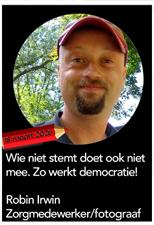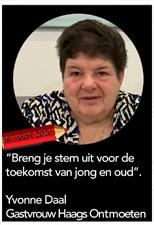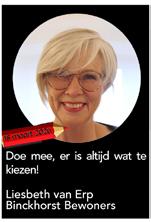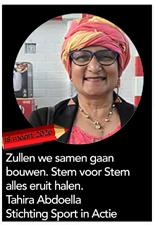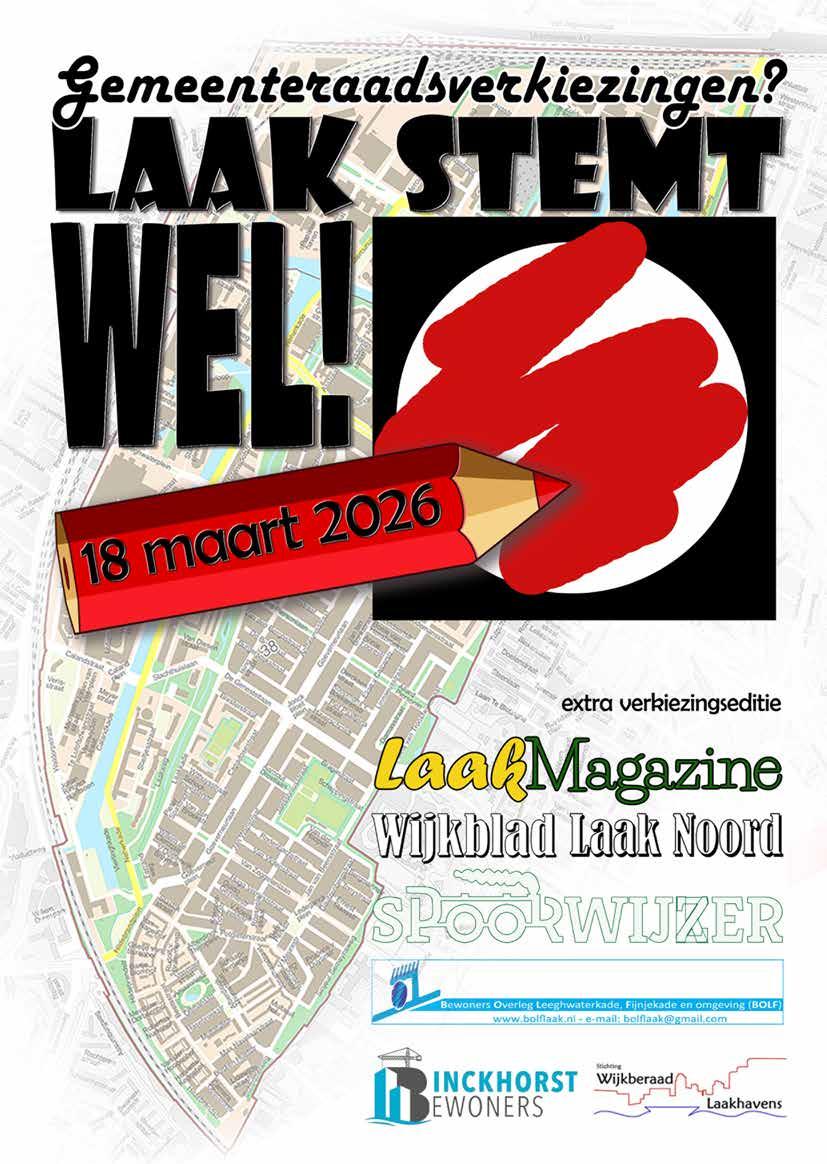


During the last municipal elections, the voter turnout in the Laak district was extremely low; it was, in fact, the lowest turnout in the entire Netherlands. Barely 22.5%. This is worrying because our district is the one that faces the most problems. Problems for which the city council should be finding solutions.
The turnout in neighborhoods like Benoordenhout, Vogelwijk, and Kijkduin was much higher, at over 74%. It is no wonder, then, that the interests of those neighborhoods receive more attention than those of our district, even though the problems here are much greater.
A few figures:
In 2022, 34,325 people in the Laak district were eligible to vote. Only 7,804 of them actually cast a vote, of which 86 were invalid and 21 were blank. That is a turnout of only 22.5%.
This means that a staggering 26,414 people did not use their right to vote, or did not use it correctly. You read that right: more than twenty-six thousand people. With an electoral quota of almost 4,000 votes per seat, this number represents no fewer than six seats on the city council. Six out of 45 seats! That is a decisive factor in almost every vote.
Of course, this can and must be much better.
A major cause of the low turnout is that many eligible voters in Laak do not know that they are allowed to vote, how to vote, and for whom. This is particularly true for residents who have come here from abroad, either temporarily or permanently, to work or build a new life. The residents’ organizations in Laak, in collaboration with the Polish and Bulgarian associations among others, want to change this. That is why we have also translated the texts in this extra edition and placed them on our website.
Furthermore, research shows that many women of non-Dutch origin did not make use of their right to vote. We can only guess at the cause, but we want to emphasize just how important their vote is. After all, they are often the heart of the family and are directly affected by the issues the city council decides on. Through initiatives like the Women’s Neighborhood Lab, we want to bring extra attention to this.


Go vote


Colophon
This publication is brought to you by the residents’ organizations of Laak and was compiled on their behalf by bull57 Creative Solutions.
Images: Katalin Linda Kelemen
The copyrights for these are held by Bull57 Creative Solutions via Vecteezy.com.
This magazine was printed in a circulation of 25,000 copies and delivered door-to-door throughout the entire Laak district in The Hague.
The texts from the political parties were provided by them and published unchanged. Only in a few cases were they slightly shortened without altering the content. Neither the residents’ organizations, nor the printer/publisher of this magazine, are in any way responsible for the content of the texts, with the exception of the editorial pieces and additions.
Photos and logos accompanying the pieces from the political parties were provided by the parties themselves or used with their permission..
The order of the political parties in this magazine is not based on a political preference. The ranking is based on the results of the previous municipal elections and the presumed resulting list numbers.
At the time of printing this magazine, the final list numbers for the upcoming election were not yet known. For this reason, new parties participating in the elections have not been included in this printed overview. They will, however, be invited to the debate on the upcoming January 31st.
Hart voor Den Haag
D66
VVD
GROENLINKS/PVDA
Partij voor de Dieren
CDA
DENK
Haagse Stadspartij
SP (Socialist Party)
PVV (Party for Freedom)
ChristenUnie-SGP
Forum voor Democratie
50PLUS
VOLT
Only the Haagse Stadspartij (HSP), despite repeated requests, did not submit an entry.
Wednesday, March 18, 2026, it’s that time again:
the four-yearly highlight of local democracy.
The Netherlands is a democracy. This means that the country’s citizens have the say and elect a group of representatives to look after their interests: the government.
In municipal politics, it’s actually the same. All eligible residents of the city get the chance to cast a vote for the person or party of their choice and be represented by them in the administration of their city or municipality: the city council.
Dutch citizen to vote, but only a resident of the city. After all, it is also your city, your home, your street, even if it’s only temporary. Whether you are a migrant worker, a new Dutch citizen, a student, or an expat: if you are registered as a resident in the municipality, you will be invited to cast your vote on March 18, 2026, to help decide on matters that directly affect you. Use that opportunity, vote!

The municipal election is actually even more important than the national election. You elect the council members for four years and cannot send them home in the meantime. But above all, they decide on matters that directly concern you. They are about your city, your neighborhood, your street, your home!
For example, think about safety in your city, traffic, housing construction, the preservation of a nearby hospital, your parking spot, the lamppost in front of your door, where your dog is or isn’t allowed to run off-leash, the range of shops, public transport, a new school, the accessibility of your home by car, permits, the reception of asylum seekers, garbage collection, youth services, the Participation Act (Participatiewet), the construction and maintenance of roads, subsidies for, for example, a swimming pool or the library, zoning plans, and municipal taxes. In short, all sorts of matters that directly affect you and your family. In that case, you’ll naturally want to be represented by someone who also stands up for the things you find important. That might sound a bit selfish, but elections are about your vote, and you are allowed to think of yourself! To do that, of course, you have to use your right to vote.
Unlike with national elections, you don’t have to be a
To be eligible to vote for the city council, you must:
· be 18 years of age or older;
· be registered in the municipality’s Personal Records Database (BRP);
· have the nationality of an EU country, OR have lived legally and continuously in the Netherlands for at least five years if you are from outside the EU.
“That’s all well and good,” you might think, “but who do I vote for? I know nothing about politics, and certainly not about local politics...”
And that is precisely what this magazine is about.
The joint residents’ organizations from the Laak district have asked all political parties participating in the municipal election to explain their plans for the Laak district. Specifically for the neighborhoods of Laakhavens, Schipperskwartier, Molenwijk, Spoorwijk, De Binckhorst, and Laak Centraal. So, no vague language about how good they are and how they have the best interests of The Hague’s citizens at heart, or how beautifully they want to paint the Pier, for example, but clear language about what they intend to do with our Laak district. This way, we as residents can choose the party that best stands up for our interests.
Democracy is like my love life: it’s not everything I want, but it’s all I have. But if democracy were a dish, what would be the ingredients? That’s the beauty of the Laak district: all the flavors are present for a delicious democratic meal. I dare say, without exaggeration, that Laak has the best mix for a successful society. Many young people, many nationalities, a lot of energy, and bursting with dynamism. Close to just about all the amenities The Hague has to offer. Shops, public transport, schools, culture, nightlife. All within walking distance. The Puntpark provides greenery, as does the renovated walking path along the small river Laak. Laak is the smallest district with the greatest potential. A melting pot of cultures and contrasts. Like a The Hague version of an international student house: lively, chaotic—and with a high turnover of residents. This neighborhood has everything it needs to rise to great heights.
Not everything is positive, of course. That’s to be expected. Laak experiences big-city tensions. You find those everywhere. Not unique, but annoying. But there is a glimmer of hope in well-thought-out solutions. The Laak Action Plan, which tackles ten major pain points simultaneously, is bearing fruit. This joint approach with residents, entrepreneurs, and the police will continue in 2026. We in The Hague get annoyed about all sorts of things, for sure. But do something useful with it. Annoyance is more than an emotion: it’s a fuel.

On March 18, 2026, you, in the kitchen of democracy, get to put on the apron. Your vote contributes to the flavor of Laak. By voting, residents of our city, like you and me, can influence the decisions that affect our daily lives. Laak deserves renewal, not decay. So don’t be fooled. Vote for parties and council members who prioritize your neighborhood. For safe streets, affordable homes, healthy residents. Not a bland dish—but a vital meal. Those who participate, count. I would therefore find it absolutely wonderful if you not only vote yourself but also encourage someone else to do so. Together, we determine the flavor of Laak.
See you at the Laak Debate at The Hague University of Applied Sciences on Saturday, January 31st.
Or otherwise, at the polling station on Wednesday, March 18th!
Sjaak Bral











Laak is a beautiful district with hardworking residents, entrepreneurs, and families who want to move forward. But anyone who is honest can see that Laak has been under immense pressure for far too long. Hart voor Den Haag can be found in the neighborhood almost daily. We speak with residents, walk through the streets, and see with our own eyes what is going wrong. And it’s quite a lot.
A few years ago, the left-wing city council in The Hague presented the Laak Action Plan with much fanfare. Big words, beautiful promises. But today, the reality is harsh: the problems have not become smaller, but larger. Too much is being asked of Laak, and residents are paying the price. That is unacceptable!
Temporary labor migration out of the neighborhood
Laak houses by far the most labor migrants in The Hague. Officially over 8,000, but everyone knows the actual number is much higher. Overcrowding is a daily occurrence. Homes where ten, twelve, or even more people are crammed together. This causes nuisance, tension, and unsafe situations – especially for the labor migrants themselves.
Hart voor Den Haag wants a firm crackdown. Many more inspections, structural deployment of the ‘Pandbrigade’ (Housing Squad), and strict enforcement. Labor migrants should not be housed en masse in residential neighborhoods, but on the outskirts of the city or – even better – in the municipalities where they work, such as the Westland. Especially when it comes to labor migrants who are here temporarily.
No extra asylum reception!
Laak has reached its limit. There is a severe shortage of housing, healthcare, and parking spaces. Schools are overcrowded and the pressure on livability is immense. That is why we say clearly: no more new asylum reception in The Hague, and certainly not in Laak. We only make an exception for Ukrainian women and children.
Tackle the waste chaos
Too many streets in Laak regularly turn into garbage dumps. Dumped mattresses, broken furniture, and garbage bags left lying around for days. That is bad for the streetscape and for the sense of safety. The solution is simple: much more enforcement and harsh fines for polluters. Anyone who pollutes the
neighborhood must be made to feel that it is not accepted.
More parking spaces
The parking pressure in Laak is insanely high. Residents drive around endlessly looking for a spot. This cannot go on. Hart voor Den Haag wants thousands of extra parking spaces in the city, including many in Laak. More parking garages and an end to bullying drivers away.
Poverty and safety
Laak is one of the poorest districts of The Hague. Many people do not know what they are entitled to or are afraid to ask for help. The municipality must be visible and active in the neighborhood, together with schools, doctors, and community organizations.
Safety also requires action. Explosions, crime, intimidation on the street, and women who feel unsafe at night: it must stop. We want better lighting, more cameras, and at least twice as many enforcers on the street. We are freeing up millions for this.
Time for real choices
Laak has had enough of empty talk and plans that disappear into a drawer. Residents deserve visible improvement on the streets. On March 18, they can make the difference. Laak deserves better. Much better.
Party Chairman and lead candidate
Hart voor Den Haag
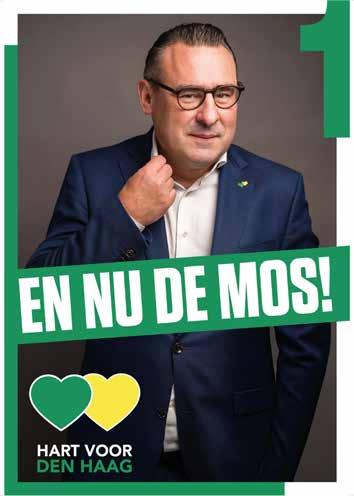
The Laak district has visibly changed in recent years. A few years ago, after some unpleasant incidents, courageous residents sent an urgent letter to the municipality. Their message was clear: they wanted a safe, clean, and livable Laak. That signal was heard, and we, as D66, want to continue with that.
In 2023, a plan was made together with residents, entrepreneurs, and organizations to tackle the problems. Residents indicate that the atmosphere is improving and that the neighborhood is moving forward step by step. But we are not there yet. The plan runs until the end of 2026. D66 wants this effort to be continued and not to disappear into a drawer. This requires clear choices and sustained investment.
if some people continue to ignore the rules. D66 wants the municipality to clean effectively and smartly and to address reports quickly. In addition, rules about waste must be clear and genuinely enforced. Anyone who repeatedly leaves garbage next to the container can expect a fine. Residents will receive information about waste rules in multiple languages and through neighborhood organizations. Entrepreneurs must also have a waste contract for their own waste collection and are not allowed to use the underground containers meant for residents. D66 believes this must be strictly enforced.
Laak also deserves more green. Trees, public gardens, and small parks make the neighborhood more beautiful and healthier. In recent years, new trees have already been planted and extra greenery has been added. D66 wants to continue this trend. In pavedover streets, we want more plant beds, facade gardens, and sidewalks with space for greenery. In larger projects in the neighborhood, green spaces must be included by default, so that children can play in a pleasant environment and the elderly have a nice place to sit outside.
For D66, a good life in Laak begins with a good home. Laak should be a district where you can live comfortably, whether you are a student, a starter, a family, or an older person. That is why we want there to be enough affordable housing and for the existing houses to be better maintained. In too many streets, homes are still old, damp, and poorly insulated. This is bad for health and leads to high energy bills. The municipality is already helping residents and owners to insulate and renovate their homes. D66 wants more residents to be able to make use of this, so that the improvement of homes becomes noticeable in more and more apartment buildings.
Anyone who grows up in Laak and wants to stay here should be able to move to a smaller or larger home within their own neighborhood. This requires a good mix of social housing, mid-range rentals, and owner-occupied homes. D66 wants affordable homes to remain protected from being bought up by investors and wants strict action against slumlords and overcrowding. The Hague’s ‘Pandbrigade’ (Housing Squad) plays an important role in this. These inspections must continue, so that honest landlords are given space and residents like labor migrants are not exploited.
Safety is a second pillar. Many residents feel that Laak is becoming safer, but still experience nuisance. D66 wants everyone to feel safe when they leave their homes. This means a visible presence of police, enforcers, and neighborhood prevention teams. The joint inspections show that crime and abuses can be reduced. We want this approach to continue and for residents to be able to easily report unsafe situations.
For young people, it is especially important that there are opportunities for good development. Many young adults live here, and many children grow up in low-income families. That is why D66 opts for continued investment in youth work, girls’ work, and sports. The Gymboxxen, boxing lessons, and other activities show that young people are eager to get active when there is a safe place for them to go. Reducing youth nuisance and creating more prospects for young people go hand in hand, and that is the direction we want to continue in.
The living environment in Laak also demands attention. Many residents are annoyed by trash on the street. Extra cleaning helps, but it doesn’t solve the problem
An important point is the shopping area around the Goeverneurlaan. Residents want this area to be clean, safe, and pleasant. This requires tackling entrepreneurs who break the rules and supporting the many entrepreneurs who work hard for a neat and customer-friendly business. With better lighting, more greenery, extra cleaning, and a strong business association, the shopping area can grow into a place where residents enjoy shopping and meeting each other.
The core of D66’s commitment is simple. Residents once sent an urgent letter to force change. Now is the time to persevere. No temporary projects that fizzle out after a few years, but a long-term commitment to housing, safety, and a green, clean neighborhood. Together with everyone who is committed to Laak, we want to build a district where residents see their future. It is possible.
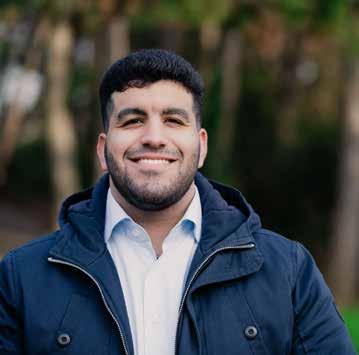
Yousef Assad is the lead candidate for D66 The Hague in the 2026 municipal elections.
Renewing your passport, putting out the trash can, or complaining about a loose paving stone: we all deal with it daily. Welcome to the world of the municipality, the layer of government closest to us, the citizens. But what exactly does a municipality do, and how is the system structured?
Simply put, the municipality is the smallest, but perhaps the most important, level of government in the Netherlands. It’s the government you literally find around the corner. While national politics in The Hague decides on major themes, it is the municipality that ensures your neighborhood remains livable. Think of tasks like collecting waste, maintaining parks and streets, and granting building permits. But larger responsibilities, such as youth care and arranging housing construction, are also on the municipality’s plate.
At the helm is the municipal council, the highest body that we as residents elect ourselves during the municipal elections. The daily administration is formed by the college of Mayor and Aldermen (B&W). The aldermen are chosen by the municipal council, but the mayor follows a unique path: they apply for the position! The King’s Commissioner makes an initial selection, after which the municipal council ultimately makes the final decision.t.
The Netherlands currently has 342 municipalities, a number that is slowly decreasing due to mergers. At the beginning of the last century, there were 1120. Within this group, there are enormous differences. For example, Súdwest-Fryslân is the undisputed giant in terms of area, while Amsterdam has the most inhabitants. At the other end of the spectrum, we find Schiermonnikoog, the municipality with the fewest inhabitants. However, the title of the most densely populated municipality does not go to Amsterdam, but to The Hague.
The size of a municipality also determines the size of the municipal council. This varies from just 9 seats in the very smallest municipalities (fewer than 3,000 inhabitants) to 45 seats in the largest cities with more than 200,000 inhabitants. The number is always odd to prevent tied votes. In total, nearly 9,000 council members across the country represent the interests of their local community.
Precisely because the municipal council makes decisions about your immediate living environment – from safety on the street to the construction of a new sports field – your vote is of great importance. During the municipal elections, you determine who gets on the council and thus what direction the municipality takes. It is the most direct way to influence your own neighborhood, district, and city.
So, the next time you put your grey container on the street or see a new residential area being built, remember: this is the work of the municipality. A complex but indispensable system that keeps our daily lives on track, and on which you have a direct influence with your vote.
Figures: nl.wikipedia.org/wiki/Lijst_van_Nederlandse_gemeenten
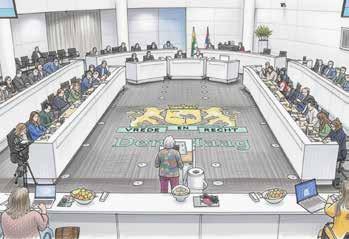
The Hague’s municipal council usually meets every three weeks on Thursdays from 1:30 PM. The meetings are held in the council chamber of the city hall and are public: anyone can attend. At the beginning of the meeting, residents, entrepreneurs, interest groups, or other stakeholders can speak on a topic that is on the agenda.

Would you like to send a message to the municipal council? You can find the contact details here.
Address and phone number
Phone number: (070) 353 31 31
Email: griffie@denhaag.nl.
Send mail for the municipal council to: Gemeente Den Haag/Griffie
The Hague is a beautiful city, but not every part of it is in equally good shape. Laak is a district full of energy and history, but behind that vibrancy lies another story. Many residents are concerned about trash, overcrowding causing nuisance, and a sense of insecurity that makes you feel unsafe on the street, especially as a woman. Solutions are being worked on, but the problems are not being tackled at their core. For many people in Laak, the limit has been reached. Additionally, the Binckhorst and Laakhavens, areas with great potential, are not yet taking off properly. Things have to change.
Party Chairman Lotte van Basten Batenburg:
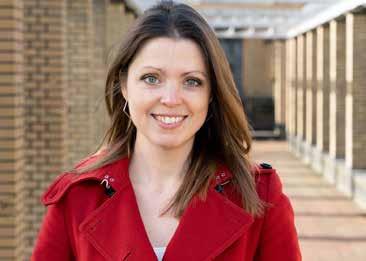
“Laak has a future, if it’s up to the VVD. This part of the city is fantastically located, close to the center and the highway. The Hague University of Applied Sciences, the ROC Mondriaan, business activity, and the harbors make it one of the nicest districts in The Hague. To achieve that, we must tackle the problems with real solutions that work. The basics must be in order: clean, safe, and a solution for overcrowding. I want to dedicate myself to this in the coming years.”
Everyone Safe in Laak Safety is priority one. We want you to be able to walk the streets without worry, as a woman alone, or hand in hand with whomever you want. That’s why we are investing in more police and special enforcement officers (boa’s), plus extra cameras to prevent incidents and track down perpetrators. We want better lighting in dark spots. This is how we make Laak safer for everyone.
Laak must be clean
If you dispose of your own waste neatly, nothing is more frustrating than seeing piles of household goods and garbage next to containers. In Laak, this seems to be a normal sight. The Hague VVD wants a new normal: Laak must be clean. We are tackling this with more and better collection points and extra collection days for bulky waste. We will enforce stricter rules on dumping and increase the chance of getting caught to reduce litter. We must win the fight against waste.
Many hardworking labor migrants live in Laak. Too often, they are placed by rogue employment agencies into small apartments with too many people. This overcrowding is unsafe and causes serious nuisance. That is unacceptable. Therefore, the VVD wants to expand the Hague Housing Squad (Pandbrigade) for more inspections, where signals from the neighborhood are always followed up on. Property owners who break the rules will receive hefty fines. This way, we protect both labor migrants and the neighborhood.
In the Laakhavens, near Hollands Spoor, 9,000 homes and businesses are being built. The VVD wants to turn it into a bustling district with nightlife, cultural events, and concerts on the water. A district that fits with The Hague University of Applied Sciences and the ROC, where you can learn, work, and live, while preserving its industrial character, for example, by beautifully illuminating the cranes.
Binckhorst more accessible
The Binckhorst also has all the potential to become a beautiful, affordable neighborhood for starters and young families. However, accessibility is a major problem. There is no public transport yet, and parking costs thousands of euros per year. Our plans: more customized public transport with small buses and a simple parking garage at the current Fokker Terminal parking lot. This would allow residents to park their cars at normal prices.
Do you have an idea for Laak? Send us a message at vvd@denhaag.nl. We would be happy to contact you.
Want to know more? View our plans for Laak at www.vvddenhaag.nl/verkiezingsprogramma. Samen maken we Laak beter

GroenLinks-PvdA believes in a Laak where people are proud of their neighborhood, neighbors look out for each other, and living is pleasant and affordable. Thanks to us, the municipality has invested millions of euros in improving the district in recent years. However, we are not there yet: livability is under pressure, many residents struggle with bills, and homes are in need of renovation. In the coming years, we will do everything we can to continue on this upward path.
Mariëlle Vavier: your district alderman and lead candidate

Mariëlle Vavier, lead candidate for GroenLinksPvdA, knows Laak through and through. As district alderman, she can be found in the neighborhood weekly. Together with the community, she created the Laak action plan, through which the municipality is committed to improvement.
Vavier: “When people talk about Laak, it’s often about problems, and they certainly exist. But that is only part of the story. Laak has more volunteers than any other district. Thanks to initiatives like the Vrouwenbuurtlab and the Vadercentrum, countless fellow residents do something for others. That is unique, something the rest of the city can learn from, and something we can be prouder of. I want to help residents in every way possible: not only through the municipality, but especially by supporting all those loving initiatives from the community.”
In recent years, GroenLinks-PvdA has brought more attention to Laak. The municipality is investing millions in decent and affordable housing, a course we want to continue.
We are investing in a neighborhood where people look out for each other
The strength of Laak is that people are there for one another. We are investing further in that. For instance, Vavier helped set up the Logeerhuis Laak, where volunteers care for neighbors who have just been released from the hospital. We also opened a women’s legal advice center for free legal advice at the VrouwenBuurtLab. With such initiatives, GroenLinks-PvdA is building a strong community.
Comfortable living and a lower energy bill thanks to insulation
Thanks to us, the municipality is investing millions extra specifically in insulation in Laak. With practical help and subsidies, we help renovate homes for more comfort and lower heating costs. Every homeowner in Laak can receive a €2300 discount, with an additional amount for holders of the ‘Ooievaar’ pass. We will continue to invest and accelerate so that everyone can benefit.
Too often, tenants in Laak, such as students or migrant workers, face misconduct from landlords. Tampering with the rent, intimidation, or damp and mold: such practices do not belong in our city. GroenLinks-PvdA wants to further expand the enforcement capacity against misconduct and strengthen tenant protection.
GroenLinks-PvdA is fully committed to tackling waste nuisance. Thanks to alderman Arjen Kapteijns, more people are being deployed to collect waste, and we are addressing improperly dumped waste more quickly. We also offer multilingual information to promote a clean neighborhood.
We will continue to invest in a bright future for Laak
With all these plans, we have set Laak on an upward path in recent years. But we are far from finished. In the coming years, we will continue to focus attention on Laak and invest in a livable, affordable, and caring future for the district.
Vavier: “We demonstrate how we can advance Laak not just with words, but above all with deeds. By investing, offering help, and standing alongside residents. We want to continue with that, until everyone feels the progress. A vote for GroenLinksPvdA is the best guarantee for that.”
Saturday, January 31, 2026, from 2:30 PM to 5:30 PM
De Haagse Hogeschool Program:
2:00 PM: Doors open with coffee and tea
2:30 PM to 2:45 PM: Introduction and opening by Sjaak Bral
2:45 PM to 4:30 PM: Debate moderated by Astrid Feiter
4:30 PM: Opportunity to chat one-on-one with the politicians over snacks and drinks.
Surrounding the debate, there will be a political market in the main square of De Haagse Hogeschool where you can

This special edition of the Laak district newsletters serves as a voter guide for the city council elections on March 18, 2026. With this information, you can also prepare for the “Grote Laakdebat” (The Great Laak Debate) to be held on January 31. Lead candidates or high-ranking representatives from The Hague’s municipal political parties will be present at this debate. Almost all parties have now registered and have pledged to send their representatives; only the Haagse Stadspartij (HSP) has not yet confirmed its participation.
We expect a large turnout, and although the hall can accommodate about 450 people, we ask that you register in advance using the QR code at the bottom of this page. This will place you on a priority list.
After 2:15 PM, the doors will also open for unregistered visitors. Once the hall is full, the doors will close, and you will only be able to exit. Expressing emotions is permitted, but troublemakers will be removed from the hall for your safety and ours!
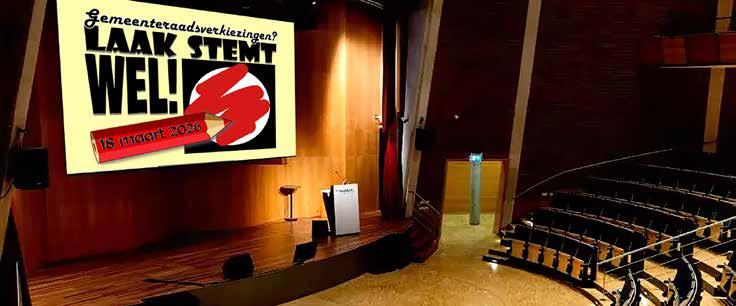

The debate will be held in the auditorium of De Haagse Hogeschool and will be led by professional moderator Astrid Feiter, whom you have seen in the district before. She knows Laak and is skilled at expertly managing lively debates. Our own The Hague ‘word artist’ Sjaak Bral will introduce and open the debate.

On the registration form, which you can access via the QR code, you can also submit your question(s) for the politicians in advance, allowing the moderation team to make a pre-selection. The organization wishes to emphasize again that this debate is intended to encourage you to vote and in no way seeks to influence your choice.
Will we see you on Saturday, January 31?
Address: De Haagse Hogeschool
Johanna Westerdijkplein 75
2521 EN Den Haag


The Partij voor de Dieren (Party for the Animals) is committed to a greener and more livable Laak for people and animals. At the moment, Laak is heavily paved and suffers from pollution and overdue maintenance. We are tackling this. We are focusing on a greener, healthier, and more sustainable Laak. A place where people can live pleasantly and affordably.
Less stone, more green
In Laak, you see few trees and green spaces, and the trees that are there often look miserable. Partly thanks to the Partij voor de Dieren, hundreds of new trees have been planted in the past year, but more is needed. The heavily paved environment in Laak causes heat stress during hot summers and major flooding during heavy rainfall. We want to make these paved streets greener with an eye to the future. In the coming period, we aim to green the Van Musschenbroekstraat, Oudemansstraat, Stuwstraat, and the Slachthuisplein. The new Laakhavens area and the area around HS and the Megastores must also become much greener. Wherever we build, green spaces and amenities must also be included. We will green the area tree by tree, street by street. We are also tackling outdated children’s playgrounds and ensuring a separate off-leash dog area in Laak. In this way, we create a more pleasant public space for people and animals.
In Laak, the car is dominant. This leaves little room for children to play, for planting trees, or for walking or cycling. We are committed to reducing public space purely intended for cars. The Oudemansstraat, Van Musschenbroekstraat, and De Genestetlaan will be redesigned, and we will reduce the speed limit to 30 km/h. This increases safety for cyclists and also creates space because the road can be narrowed. In other areas as well, we are looking for more space for cyclists, pedestrians, and greenery. We will provide wider and, where possible, separated bike paths. Additionally, parked cars take up a lot of space. We encourage the use of other forms of mobility so that, in the long run, parking spaces can be removed. This way, we make room for greenery, bicycle parking, and children’s playgrounds.
The differences between neighborhoods in The Hague are too great. Residents of Laak live, on average, eight years shorter than other residents of
The Hague. This is partly due to what we eat, but also to the air we breathe. The air quality in Laak is very poor. We are committed to cleaner air by banning the most polluting cars. For instance, we will introduce a low-emission zone. We will also ensure that no new fast-food establishments are added, and that more healthy food options become available. More plant-based food and less meat and sugar have a major positive effect on health. There must also be enough general practitioners. This means that with more residents, more facilities must be added. The development of Binckhorst is an example of how not to do it: building homes with few amenities. This must be different in Laakhavens and near HS!
In many parts of Laak, there is overcrowding. Migrant workers and other residents live in houses that are far too small and poorly insulated, for an exorbitant price. We are tackling this. We will use the rental permit and the property enforcement team to deal with shady landlords. Too many homes have been bought up for commercial interests and are being rented out at high prices. Living conditions must be improved by addressing overcrowding and overdue maintenance. Existing homes must be insulated and made more sustainable. New-build homes must be affordable and fit into the existing environment. New homes will only be built if they improve the neighborhood and there are sufficient amenities. Furthermore, a major frustration for many people is the litter on the streets. A lot of waste is dumped on the street. We will tackle this with information campaigns and enforcement. This is how we ensure it is more pleasant to live here.
The Partij voor de Dieren has been working for a green, more sustainable, and livable city for 15 years. And will, of course, continue to be committed to this in Laak for years to come.

Laak is het kleinste s Laak is the smallest district of Den Haag, with various neighborhoods full of enterprising and involved residents. At the same time, we hear from many, especially older residents, that they no longer recognize their neighborhood. We understand that feeling well. The city is changing rapidly, and Laak is changing with it. But change doesn’t have to be wrong, as long as we hold on to what has always made Laak strong: the sense of community.
Den Haag, met verschillende wijken vol ondernemende en betrokken bewoners. Tegelijk horen we van veel, vooral oudere bewoners, dat ze hun buurt niet meer herkennen. Dat gevoel begrijpen we goed. De stad verandert snel en Laak verandert mee. Maar verandering hoeft niet verkeerd te zijn, zolang we vasthouden aan wat Laak altijd sterk heeft gemaakt: het gevoel van saamhorigheid.
Juist dat gevoel moeten we terugbrengen. Want een wijk leeft pas echt als mensen er willen blijven. Wie ergens echt thuis is, voelt zich verantwoordelijk voor de buurt. Blijvers zorgen voor hun straat, kennen hun buren en bouwen mee aan een gemeenschap. Passanten trekken verder, blijvers bouwen op. Als je van plan bent te blijven, gooi je geen afval op straat, parkeer je netjes, zeg je de buurman gedag, help je de oudere buurvrouw met haar boodschappen en houd je een oogje in het zeil als de kinderen buiten spelen. Dat zijn de wijken waar mensen zich thuis voelen en waar het CDA samen met bewoners aan wil bouwen.
en de Binckhorst, en voor ouderen met initiatieven die ontmoeting en meedoen stimuleren. Zo groeit een Laak waar generaties elkaar versterken en samen een blijvende gemeenschap vormen.
Het CDA wil dat de veranderingen in Laak leiden tot een stadsdeel waar saamhorigheid en betrokkenheid weer centraal staan, een plek waar bewoners zich thuis voelen en trots op zijn.
Bereikbaarheid Binckhorst moet op orde zijn
De Binckhorst ontwikkelt zich snel. Dat biedt kansen voor woningbouw, maar het vraagt ook om goede bereikbaarheid. Bewoners en ondernemers moeten de wijk kunnen bereiken ook met de auto.

Wanneer mensen zich verbonden voelen met hun wijk, groeit de aandacht voor elkaar vanzelf. Dat zie je terug in kleine dingen: een praatje bij het buurthuis, kinderen die samen spelen op het plein of een groepje ouderen dat ’s ochtends samen wandelt. Zulke ontmoetingen maken Laak sterker en hechter. Daarom willen we investeren in een stadsdeel waar jong en oud elkaar kennen, elkaar helpen en zich samen verantwoordelijk voelen voor hun buurt.
Dat vraagt keuzes. We bouwen minder studio’s en kleine appartementen en juist meer gezins- en koopwoningen, zodat mensen kunnen wortelen in hun wijk. We creëren meer kansen voor jongeren met sportvelden, leerwerktrajecten en banen bij bedrijven in de Laakhavens
We believe that Den Haag should not go overboard with low-traffic policies as long as the alternatives are not yet good enough. With the motion ‘Don’t go overboard with low-traffic thinking’, we are calling for sufficient parking spaces and an evaluation of the current parking standards. If not enough parking spaces are added to meet the needs of residents and entrepreneurs, the municipality must be honest and adjust the building program.
aak. For years, the forgotten district of Den Haag. If you, as a visitor, were to ever take a trip from the Binckhorst to Spoorwijk, you would never guess that it is one and the same district..
Laak consists of different neighborhoods. Each neighborhood is different and has its own unique characteristics. That diversity is a strength and deserves the necessary attention. Binckhorst, Laakhavens, Molenwijk, Spoorwijk, Schipperskwartier, and Laak Centraal: all powerful, diverse, and resilient neighborhoods. But unfortunately, also neighborhoods with vulnerable residents, a public space that is not always in order, and facilities that are not up to standard.
In recent years, residents, entrepreneurs, and organizations have repeatedly found their way to DENK Den Haag. Whether it was about a terrace permit in Laakhavens, waste problems in Laak Centraal, mobility issues in Spoorwijk, the unjust closure of the Schoeplaan in the Molenwijk, or the expansion of paid parking in Laak.
Our faction has held multiple neighborhood inspections and meetings in Laak, listened to the problems in the neighborhoods, and achieved results in the local political arena. DENK has actively involved residents’ organizations and neighborhood initiatives in the political process and decision-making, in order to restore trust in local politics.
But we are not stopping here. To represent Laak as well as possible in the city council, we can proudly announce that we have no fewer than eight candidates from Laak on our list. Our candidates are involved people. People who live here, work here, and see what can be improved daily. They are not talkers, but doers who know how it feels when policy passes you by.
We have achieved great things, but we are far from finished. More needs to happen in Laak:
Housing security: no slumlords, no overdue maintenance, but affordable and safe homes.
A clean and safe neighborhood: good lighting, traffic safety, and streets that are not forgotten. The waste management approach will be intensified.
Opportunities for youth: investing in education, internships, and meeting spaces in the neighborhood. Neighborhood coaches and district teams will be expanded and will have permanent professionals.
An accessible government: a municipality that
listens and communicates understandably with all residents.
DENK stands with the residents of Laak, but we need each other. Make yourself heard, join in, speak out, and help build a district that gets what it deserves.
Laak is not an afterthought. Laak IS Den Haag.
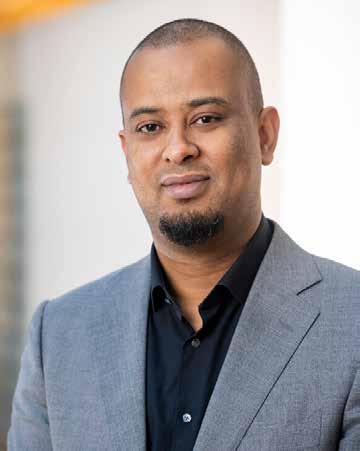
Party leader Nur Icar is leading DENK Den Haag to the 2026 municipal elections. Under his leadership, in the party’s words, “a team is ready that stands for justice, equal opportunities, and a visibly stronger city.”
Laak as a district has changed a lot over time. Some residents still remember how it used to be, while for many others it has become a new home. It is a proud neighborhood with a lot of willpower! Yet Laak is often forgotten or ignored by politics. As a result, for example, many homes have been sold off to private landlords, and illegal housing by employment agencies causes complex problems in the neighborhoods. The SP has been calling for more attention for Laak for years and supports residents in organizing themselves. For instance, there was fierce campaigning at the student housing De Pionier, and tenants, together with the SP, wrote a black book about problems in their rental complex. In addition, residents’ initiatives such as the Logeerhuis Laak provide new encouragement. The SP will continue to be fully committed in the coming period.
When it comes to the future of the Megastores, the SP finds it important that affordable housing is built, of which at least 40% is social housing. There will still be room for a real neighborhood shopping center where new residents can do their daily shopping. A green lung in the form of a city park is also not an unnecessary luxury. Regarding the temporary situation, vacancy must be prevented. Local entrepreneurs are a driving force here to breathe new life into the area – the current vintage shop is a great start! The SP also advocates for giving space to a mix of cultural and social initiatives as long as demolition and construction have not yet started.
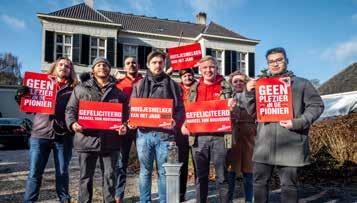
In the area of housing, there is still much to be done. The situation at the student flat De Pionier is still ongoing: students are suffering under an intimidating slumlord who charges illegal administration fees and lets mold grow on the walls. Inspired by these problems, the SP has managed to establish a legal costs fund to reimburse tenants in lawsuits against bad landlords. In addition, it is crucial that the introduction of the rental permit is extended to all neighborhoods in Laak as soon as possible, so that people in poor living situations are extra protected and illegal renting is tackled. As for young people, the SP believes that there should be no focus on private rental at all, but that housing corporations should build decent student housing. This way, young people who have just come to Den Haag do not become dependent on landlords who are out for large profits, but can live nicely and affordably.
Furthermore, the issue of vans, for example from employment agencies, has been a huge problem for years. Parking pressure and double parking put the livability of the neighborhood under strain, where

illegally parked vans on green verges or sidewalks create difficult situations for pedestrians and cyclists. Time and again, the SP has insisted that a special parking facility should be created for vans, for example on business parks that could be used for this purpose outside of working hours. Unfortunately, this has not yet been achieved under the current city council, and we will continue to increase the pressure.
Another issue that is strongly felt in the neighborhoods is the matter of waste. In many places such as the Slachthuisplein, Jonckbloetplein, and the Isingstraat, there is often nuisance from dumped waste and food scraps. The SP has been calling for years for neighborhood janitors who, as familiar faces, can engage with people in an accessible way about waste, keep the public space clean, and make reports. It is important that these people receive a full salary and feel part of the neighborhood. Moreover, there must be more opportunities to tackle illegally dumped waste and bulky waste. For example, we want extra collection days and a trial should be conducted with permanent bulky waste drop-off points in the neighborhood. The municipality has made extra money available until 2026 for tackling waste nuisance. As far as the SP is concerned, we will invest more money in this for neighborhoods like Laak!
With the arrival of the Waterfrontpark, there is beautiful future music in the area of greenery. It is good that Den Haag wants to invest heavily in a city park on the Binckhorst, but the SP believes that the Molenwijk side should be designed just as beautifully. The old houses on this side are going to be demolished, but there is no plan yet for the outdoor space. This should be worked out with attention and love at the same time, so that no difference in quality arises between the Binckhorst and Laak-Noord.
Finally: now that the fireworks ban will take effect from 2026, the SP finds it extra important that local traditions such as the bonfires can continue. This past year, the SP made a proposal to grant the permit for the bonfire in Laak again, and we will ensure that this cultural festivity is allowed to keep burning in the coming years.
Anyone who regularly walks or drives through the Laakkwartier knows there is plenty of room for improvement. It is a neighborhood with character, but also a neighborhood with problems that have been lingering for years: cars that have nowhere to park, litter on the streets, and a growing sense of insecurity. The Partij voor de Vrijheid (PVV) sees that residents are worried—and rightly so. That is why the The Hague PVV wants to work hard in the coming council period for a clean, safe, and livable Laakkwartier.
In almost every conversation with residents, it comes up: the parking problem. Too many permits, too few spaces, too high costs. People driving around endlessly after work to find a spot for their car— that cannot be the intention. The PVV says: enough is enough.
The solution starts with common sense. The municipality must stop cutting back on parking spaces and introducing increasingly expensive permits. The PVV wants more parking spaces in the neighborhood, not parking experiments that further increase costs for residents. Where possible, existing parking lots should be expanded, for example, near apartment complexes and shopping locations. There must also be more enforcement against illegal parking by people who do not live in the neighborhood. Parking is not a luxury, but a basic necessity.
support of a municipality that does its job.
A clean Laakkwartier is important, but without safety, livability remains an empty concept. Many residents indicate that they do not always feel comfortable on the street in the evenings. Nuisance from youths, drug use, intimidation, and burglaries occur too often. The PVV believes that Den Haag must better protect its residents.
Therefore, the PVV advocates for more police in the neighborhood—visible, approachable, and decisive. More patrols on the street prevent nuisance and also address the feeling of insecurity. In addition, the PVV wants the municipality to act more firmly against criminal or nuisance-causing property owners. Anyone who structurally causes trouble in the neighborhood should no longer receive a permit, but a hefty fine or a closure order.

Furthermore, the PVV wants camera surveillance to be expanded in strategic locations in the Laakkwartier, so that misconduct is detected and punished more quickly. Safety is not a subject for endless studies, but something you notice every day on your own street.
A second point that annoys many residents of Laak is the pollution. Overflowing containers, garbage bags on the sidewalk, broken bicycles, and mattresses left for days—it blemishes the neighborhood and attracts pests. The PVV believes the municipality must take its responsibility here.
Under a PVV administration, there will be a tough approach to waste nuisance. Containers must be emptied more often, especially on weekends and holidays. Enforcement officers will be given more authority to immediately fine people who dispose of their waste incorrectly. Additionally, the municipality must invest more in cleaning crews that do visible work in the neighborhood daily. A clean street not only fosters more pride but also a greater sense of security.
Furthermore, the PVV wants residents to have more say in the management of their neighborhood. Through neighborhood budgets, residents’ organizations can have a greater say in practical improvements, such as new trash cans or renovating playgrounds. This way, we keep the neighborhood tidy together, but with the
The Laakkwartier deserves better—and the PVV is determined to deliver it. Less bureaucracy, more courage. Less talk, more action. With a strong focus on parking space, a clean living environment, and real safety, the PVV wants to make the Laakkwartier a neighborhood

that residents are proud of and where children can grow up safely again.
Text by Chris Faddegon on behalf of the PVV. Chris is also the one who will be present at the debate.On March 18, 2026, it is possible. Then you can choose a party that does listen, does act, and does stand up for ordinary residents of Den Haag. Vote local. Vote for a cleaner, safer, better Laakkwartier.
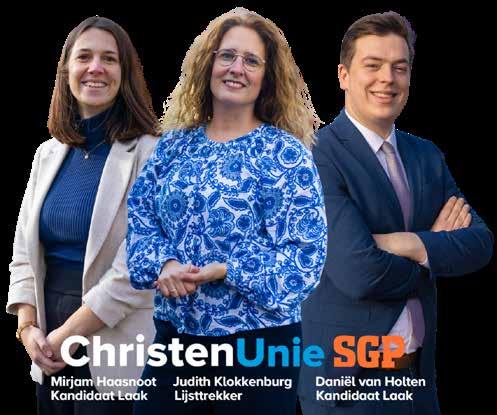
The ChristenUnie/SGP believes in a livable Laak, where both young and old want to—and can—live for a long time. There is a lot of energy and involvement in the neighborhood. There are wonderful initiatives like Wijkcentrum De Rank, stichting Schets, and thanks to residents, neighborhood organizations, and entrepreneurs, the Actieplan Laak was created. And steps have been taken to improve livability. Yet, there are still many challenges. People who have lived in Laakkwartier, Spoorwijk, Molenwijk, or Laakhavens for a long time have seen their neighborhood change significantly and experience daily problems from, among other things, overcrowding by migrant workers, waste on the street, and high parking pressure. The ChristenUnie/ SGP believes that we must and can tackle these challenges. In the council, we therefore make concrete proposals, such as security cameras at Lipa I and II: seniors who live here can once again safely park their mobility scooters and are not bothered at their doors.
The ChristenUnie/SGP is committed to:
A livable Laak for everyone: We will take a firm stance against rogue employment agencies, introduce a permit requirement for landlords, expand the The Hague building brigade, and advocate for humane housing, so that overcrowding, particularly by migrant workers, disappears. There will be stricter rules for landlords regarding home insulation and sustainability, so that energy poverty disappears and there are good homes. Additionally, a permit requirement for shops will be introduced: this way, we can deter entrepreneurs with bad intentions.
and sufficient general practitioners, shops, and sports facilities: building homes is not just stacking bricks, but building communities.
An accessible Laak: In large parts of Laak, there are parking problems. We do not solve these by expanding paid parking everywhere. If the parking pressure is higher than 90%, we will introduce a permit cap. Company vans will be parked outside the neighborhood, for example at the Megastores. We are also committed to better public transport and better traffic flow: those who depend on their car should not be stuck in traffic every day on, for example, the Neherkade.
A healthy Laak and an end to poverty: We ensure that every child can get a free introduction to sports clubs, involve volunteer organizations in tackling debt, give young people a course on managing finances at school, and place a financial supporter at the general practitioner’s office.
A clean Laak: Waste on the street remains a visible problem. The ChristenUnie/SGP therefore wants to free up money for more frequent waste collection, stricter enforcement on illegal dumping, and more and multilingual communication about the proper disposal of household and bulky waste.
A Laak for young and old: A lot is being built in Laakhavens and the Binckhorst. The ChristenUnie/ SGP wants these not only to be small studios, but also homes for families. When homes in Laak become available, we believe current residents should be given priority: 25% of rental homes will be allocated to residents from the neighborhood, so that people can continue to live in their neighborhood for a long time. We also ensure more places where people can meet,
If we put our shoulders to the wheel together, Laak will become an increasingly pleasant neighborhood to live in. The ChristenUnie/SGP believes in a livable Laak
The Laakkwartier is a neighborhood with major challenges. Illiteracy, parking problems, overpopulation, crime, and unemployment. Under the administration of D66, GroenLinks, Denk, PvdA, CDA, and Partij voor de Dieren, Laak has been burdened with even more of the council’s out-of-touch plans. An AZC has been placed, accessibility has decreased, and traffic congestion has increased. In a neighborhood under such pressure, there is no room for leftwing wishful thinking; instead, concrete and tough choices must be made. Therefore, FVD has the following plans for the Laakkwartier.
Closure of AZC Calandstraat.
The recently opened AZC places an even greater burden on police, law enforcement, and other agencies in a neighborhood already suffering from crime and illiteracy. The municipality of Den Haag, just like the Westland, must refuse to implement the asylum dispersal act and close this AZC. Only in this way can priority be given to the well-being of its own residents.
Space for the motorist.
This is unacceptable; FVD wants to crack down on housing fraud and limit labor migration.
Encouraging remigration.
Countless people live in the Netherlands who are not integrated, do not feel at home, and do not speak the language. Their only connection to the Netherlands is the welfare state. This burdens our social fabric, our infrastructure, and our welfare state. FVD wants to deport criminal immigrants and make a remigration scheme available for residents who do not feel at home. By means of a grant and with the help of a remigration coach, they can build a new life in their country of origin.

The current council wants to reduce car ownership; they do this by harassing motorists. Fewer parking spaces, paid parking, road narrowing, and one-way streets. The result is that all of Den Haag is stuck in traffic jams. It can sometimes take over an hour to travel through the city by car. This is unacceptable. Residents need cars to get to work and to get around. In many cases, public transport is not a viable alternative. The traffic restrictions of recent years must be reversed, and underground parking garages must be built.
Stricter enforcement against crime.
Den Haag struggles with (youth) crime, drill rap gangs, explosions, and drug violence. Young teenagers are being recruited for serious criminal jobs. This undermines the safety in the neighborhoods, the mutual trust among citizens, and the future of our schoolchildren. FVD is committed to tough enforcement and severe punishments for young criminals. Because crime should never pay, not even when you are 14.
Tackling overpopulation.
All of Laak’s problems are worsened by overpopulation. In some homes, large numbers of migrant workers reside, often illegally. They work for lower wages but can claim Dutch social services. As a result, Dutch people are unnecessarily disadvantaged. There are also people who illegally sublet their social housing.
Appropriate education in Laak.
Education in Laak is under great pressure due to illiteracy, crime, lateral-entry students, and special educational needs. However, there is currently no school for special education in Laak, forcing students to travel unnecessarily far or remain in a regular school. This is a great burden on the student, their class, and their teachers. FVD wants the municipality to commit to establishing a school for special education in the Laakkwartier.
With these plans, the residents of Laak will get some breathing room again. This way, Laak can become a neighborhood where people want to grow up, work, and live.

Good morning, neighbor. In Laak, people always looked out for each other. You knew your neighbors, greeted each other, and felt responsible for the street. A good neighbor is better than a distant friend.
Laak has changed. The neighborhood has become busier and more diverse. This requires something not only from residents but also from the municipality.
Living together in a neighborhood does not happen automatically; it requires policy, attention, and direction.
50PLUS believes that the municipality must take its responsibility in this. Concretely, this means the municipality:
Structurally invests in social cohesion in Laak, with a fixed neighborhood budget for gatherings, safety, and involvement.
Provides clear information and guidance for new residents, so everyone knows what it means to live together in the neighborhood: greeting each other, being considerate of one another, and respecting public space.

Actively and continuously involves residents in decisions about their neighborhood, not just through consultation afterward, but by collaborating from the beginning.
Organizes joint neighborhood inspections, where elderly residents, disabled residents, community police officers, and other partners walk through the neighborhood with the municipality to identify problems and solutions.
Appoints one fixed contact person per neighborhood, so residents know where they can go and issues are not left unaddressed.
You are a true Laker with heart and soul. You say good morning, look out for each other, and feel a collective responsibility for Laak.
50PLUS stands for a Laak where the municipality is visibly present, takes residents seriously, and connection is the foundation of its policy.
Written by:
Sofia Tsitsouashvili Party leader 50PLUS Den Haag
Laak is a lively neighborhood with a big heart. People look after each other, volunteers dedicate themselves every day, and the neighborhood is bustling with energy and cultures. At the same time, everyone who lives here knows that life in Laak can sometimes be quite complicated. It is busy, homes are crowded, and help is not always easy to find.
Volt wants to commit to solutions that truly work for Laak, together with the residents .
Politics that comes to Laak
The turnout for elections in Laak is low. We understand that: politics often feels distant. And many people feel unheard. Volt wants to do things differently. We believe that people should be actively involved in politics. And that politics should come to you. That is why Volt wants to come to Laak regularly to listen and engage in conversation. Because good plans are not made about the neighborhood, but with the neighborhood.
and dentists. Many people get stuck due to complicated rules or language problems. That must change. Volt wants the municipality to ensure that more healthcare providers can establish a practice in Laak. Information about care must also be clear and available in multiple languages. Good care starts with understandable explanations.
Many residents will recognize “mattress day”: on some days, the streets are full of discarded mattresses and other waste. That is not only messy but also frustrating as neighbors. Volt wants to tackle this at the source. We actively inform people about waste collection and disposal points. Much more often than now and in multiple languages, so that everyone is well-informed. This way, we prevent pollution instead of constantly cleaning it up afterward.
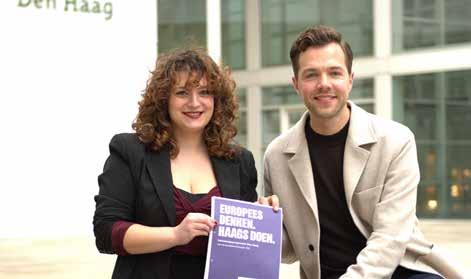
Around De Spoorzoeker primary school, we see parents who prefer not to let their children cycle alone because the street is confusing and unsafe. That should not be normal in a residential area. Volt therefore wants an “eight-year-old test”: we look at streets as if an eight-year-old child should be able to walk and cycle there on their own. Is it safe, clear, and quiet? If not, the street must be better designed. Think of wider sidewalks, clear pedestrian crossings, and tackling illegal parking.
Volt wants everyone to have easy access to help. As far as we’re concerned, you should only have to go to one place, with one form and one care provider for all the help you need. Whether it’s about home care, debt counseling, or housing assistance. In other cities in Europe, such as Mechelen, this works well. That is why we also want this in Den Haag. We call it the Haags Sociaal Huis and want one in every district, including in Laak.
In Laak, there is a shortage of general practitioners
Too often, migrant workers live with too many people in one house. That is inhumane and causes nuisance. The ‘pandbrigade’ (building brigade) does important work but has insufficient capacity. Volt therefore wants more money and resources to go to the pandbrigade, so that there can also be more attention for Laak. Also, a lot of living space is still unused. Volt therefore wants owners of vacant buildings to pay an extra tax as long as the property is not used.
As far as we are concerned, it can be much greener! Laak is heavily paved over. You notice this on hot days and during heavy rain. More green provides cooling, less flooding, and a more pleasant neighborhood. Volt wants greening projects to receive extra attention in Laak. We want to tackle these projects together with the residents and volunteers in the neighborhood. Because you yourself know best where green is needed and pleasant, and should be able to co-decide on it.