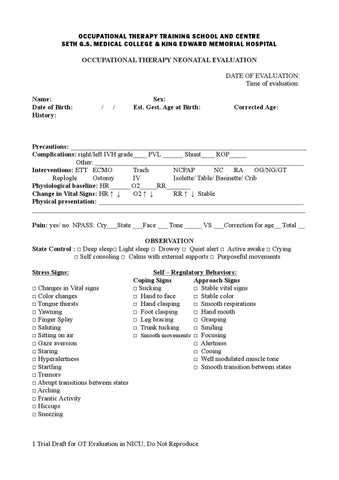
OCCUPATIONAL THERAPY TRAINING SCHOOL AND CENTRE SETH G.S. MEDICAL COLLEGE & KING EDWARD MEMORIAL HOSPITAL OCCUPATIONAL THERAPY NEONATAL EVALUATION DATE OF EVALUATION: Time of evaluation: Name: Date of Birth: History:
/
/
Sex: Est. Gest. Age at Birth:
Corrected Age:
Precautions: _____________________________________________________________________ Complications: right/left IVH grade____ PVL ______ Shunt____ ROP_____ Other: _____________________________________________________________ Interventions: ETT ECMO Trach NCPAP NC RA OG/NG/GT Replogle Ostomy IV Isolette/ Table/ Basinette/ Crib Physiological baseline: HR______ O2_____RR_______ Change in Vital Signs: HR ↑ ↓ O2 ↑ ↓ RR ↑ ↓ Stable Physical presentation: ____________________________________________________________ ________________________________________________________________________________ Pain: yes/ no NPASS: Cry___State ___Face ___ Tone _____ VS ___Correction for age__ Total __ OBSERVATION State Control : □ Deep sleep□ Light sleep □ Drowsy □ Quiet alert □ Active awake □ Crying □ Self consoling □ Calms with external supports □ Purposeful movements Stress Signs: □ Changes in Vital signs □ Color changes □ Tongue thursts □ Yawning □ Finger Splay □ Saluting □ Sitting on air □ Gaze aversion □ Staring □ Hyperalertness □ Startling □ Tremors □ Abrupt transitions between states □ Arching □ Frantic Activity □ Hiccups □ Sneezing
Self – Regulatory Behaviors: Coping Signs Approach Signs □ Sucking □ Stable vital signs □ Hand to face □ Stable color □ Hand clasping □ Smooth respirations □ Foot clasping □ Hand mouth □ Leg bracing □ Grasping □ Trunk tucking □ Smiling □ Smooth movements □ Focusing □ Alertness □ Cooing □ Well modulated muscle tone □ Smooth transition between states
1 Trial Draft for OT Evaluation in NICU, Do Not Reproduce
OCCUPATIONAL THERAPY TRAINING SCHOOL AND CENTRE SETH G.S. MEDICAL COLLEGE & KING EDWARD MEMORIAL HOSPITAL Comments: Sensory Processing: Vision : Eyes open/ closed Reacts to change in light intensity Congugate/discongugate gaze Visually explores environment makes/ avoids eye contact focuses on face/ toy Tracks horizontally from midline Tracks vertically Auditory: Behavioural response to sound: Alerts
Stress Signs
No Response
Vestibular Processing: Transitions in/ out of crib calms Stress Signs Response to rocking Calms Stress Signs Tactile processing:
Response to touch: Response to deep pressure
Calms Stress Signs Calms Sress Signs
Comments: Motor Control/ Movement Patterns
Left upper/lower extremity
Right upper/ lower extremity
UE Tone □ Normal □ Hypotonic □ Hypertonic □ Mixed □ Rigid □ Dystonic
□ Normal □ Hypotonic □ Hypertonic □ Mixed □ Rigid □ Dystonic
LE Tone □ Normal □ Hypotonic □ Hypertonic □ Mixed □ Rigid □ Dystonic
□ Normal □ Hypotonic □ Hypertonic □ Mixed □ Rigid □ Dystonic
UE ROM
□ WNL □ Limited Neck/Shoulder/Elbow/Wrist/Fingers
□ WNL □ Limited
LE ROM
□ WNL □ Limited Hip/ knee/ankle □ Excessive Hip/ knee/ankle
□ WNL □ Limited Hip/ knee/ankle □ Excessive Hip/ knee/ankle
Neck/Shoulder/Elbow/Wrist/Fingers □ Excessive Neck/Shoulder/Elbow/Wrist/Fingers □ Excessive Neck/Shoulder/Elbow/Wrist/Fingers
Strength Upper Extremity Moves Spontaneously Partial ROM Full ROM No active movement
Lower Extremity Moves Spontaneously Partial ROM Full ROM No active movement
Motor □ WNL □ Ataxia □ Athetoid □ Synergy pattern Control □ Reflexive □ Tremor _______
Upper Extremity Moves Spontaneously
Lower Extremity Moves Spontaneously
Partial ROM Full ROM No active movement
Partial ROM Full ROM No active movement
□ WNL □ Ataxia □ Athetoid □ Synergy pattern □ Reflexive □ Tremor _______
Upper Extremity Position: Shoulders externally rotated and retracted
Flexed elbows Extended at elbows Hands fisted Hands open Fine Motor Skills:Hand to face Hand to mouth Midline fingering Isolated finger movement Grasps finger Grasps small toy placed in hand Supported Sitting: Head righting with difficulty Head righting but unable to sustain Hands to midline Brings hips/knees into flexion Supine skills: Turns head to either side Maintain head in midline Heads to face/mouth Hands to midline Brings hips/knees to flexion/extension Prone Skills: Clears face Turns head to right/left Flexes at elbows Brings hips knee into flexion Sidelying Skills: Neck flexion/extension Trunk flexion Upper Arm to Midline Comments:
2 Trial Draft for OT Evaluation in NICU, Do Not Reproduce
OCCUPATIONAL THERAPY TRAINING SCHOOL AND CENTRE SETH G.S. MEDICAL COLLEGE & KING EDWARD MEMORIAL HOSPITAL Oral feeding Practice Stage • •
Non-oral stages Pre-oral Stimulation Stage Non-nutritive Sucking Stage
• • •
Nutritive Sucking Stages Stage I: Minimal oral intake (<10% oral) Stage II: Moderate oral intake (10 to <80% oral) Stage III: Full oral intake (> 80% oral)
1. 2. 3. 4. 5. 6. 7.
Sucking Pattern Normal sucking pattern Arrythmical sucking pattern Arrythmical + unable to sustain sucking pattern Arrythmical + unable to sustain + inccordination sucking pattern Arrythmical + inccordination sucking pattern Difficulty initiating movements Dysfunctional sucking pattern Immature Sucking Patterns
• • •
Prolonged Sucking Pattern Short Sucking Bursts Disorganised Sucking
Comments: ASSESSMENT Identified changes in structure and function: State Management: Sensory Processing: Motor control/Movement Pattern: Suck/ Swallow/Breathing Coordination: Patient Education: Family caregiver present/ not present for session Patient/ Family (not) ready /willing to learn. Patient / family (not) participating with plan of care. Topic: __________________________________________________________________________________ _______________________________________________________________________________________ _______________________________________________________________________________________
3 Trial Draft for OT Evaluation in NICU, Do Not Reproduce
OCCUPATIONAL THERAPY TRAINING SCHOOL AND CENTRE SETH G.S. MEDICAL COLLEGE & KING EDWARD MEMORIAL HOSPITAL Taught: □ Patient □ Family/ other______________________________ Method: □ Demonstration □ Explanation □ Handout □ Video □ Interpretor/ Cyracom Learning Barriers: □ None □ Cognitive □ Educational/ Literacy □ Emotional/ Poor Motivation □ Language/ cultural □ Sensory □ Other Response: □ Understands □ Demonstrates □ Needs review/ Reinforcement □ No evidence of learning Treatment/ Equipment provided during session: _______________________________________________________________________________________ _______________________________________________________________________________________ _______________________________________________________________________________________ _______________________________________________________________________________________
PLAN □ Patient has no acute OT needs. Orders will be completed. □ Patient's acute OT needs have been addressed during this session. Orders will be completed. □ Patient will be seen by OT 1-3*/ 2-4*/3-5* a week for the following plan: Family goals/ concerns: ____________________________________________________________________ Goals were/ were not discussed with family. Short Term Goals: See Goal Sheet on next page. Long Term Goals: Discharge plan: □ Follow up in NICU clinic □ KCRC □ Early Intervention program □ Other:________________________________________________________________________________ Recommended Consults: □ Physical Therapy □ Speech Therapy Signature: ______________________________________________________________________________
Start Date/ Signature
SHORT TERM GOAL LIST Goals
4 Trial Draft for OT Evaluation in NICU, Do Not Reproduce
Review Date Comments/ Signature
OCCUPATIONAL THERAPY TRAINING SCHOOL AND CENTRE SETH G.S. MEDICAL COLLEGE & KING EDWARD MEMORIAL HOSPITAL Abbreviations 1. IVH – intraventricular hemorrhage 2. ECMO – extracorporeal membrane oxygentation 3. PVL – priventricular leukomalasia 4. ROP – retinopathy of prematurity (grade I – IV); formarly called retrolental fibroplasia, RLF 5. NCPAP – nasal continuous positive airway posture 6. NC – nasal canula 7. ETT 8. OG – oral gastric 9. NG – nasal gastric 10. RA 11. GT – gastrotomy tube 12. IV – intra venous 13. HR – heart rate 14. RR – respiratory rate 15. O2 – oxygen saturation 16. NPASS – neonatal, pain, agitation & sedation scale 17. VS – vital signs 18. WNL – within normal limits 19. ROM – range of motion 20. NICU – neonatal intensive care unit 21. OT – occupational therapy 22. Self – regulation – Infant's efforts to achieve, maintain, or regain balance & self organization in each subsystem ( autonomic, motor, state, attention- interaction) as needed. Examples include motor strategies (e.g., foot clasp, leg & foot bracing, finger folding, hand clasping, hand to mouth, grasping, tucking, sucking, postural changes); state strategies (e.g., lowers state of arousal or releases energy with rhythmic, robust crying) and attention and orientation strategies such as visual locking. The succcess of various strategies may vary among infants. 23. KCRC – kangaroo care rehabilitation center 24. SSB – suck/ swallow/ breathe 25. ↑ - increases 26. ↓ - decreases 27. Ostomy - An ostomy refers to the surgically created opening in the body for the discharge of body wastes. A stoma is the actual end of the ureter or small or large bowel that can be seen protruding through the abdominal wall. 28. Replogle - Replogle tubes are used for gastric decompression in infants with intrabdominal
issues. Use an 8F Replogle tube for infants < 1500g and a 10F Replogle tube for infants > 1500g. During the acute phase of illness, Replogle tubes are usually connected to intermittent low wall suction.The vented (colored) port or sump prevents the suction from becoming attached to the stomach mucosa. This vented port of the tube should be flushed with 1 ml of air every shift to maintain patency. This port must remain empty for it to be effective. If drainage or liquid of any type appears in the vented port, the Replogle tube should be removed and irrigated with 1 ml saline followed by 1-2 ml of air to clear it. The clear port should be irrigated as ordered with 1-5 ml saline to maintain patency. If the tube stops draining, consider repositioning it or irrigating it. Thick gastric secretions can obstruct the tubing. If the clear tube becomes obstructed, remove the Replogle tube from the infant and flush until the obstruction is cleared and then replace tube in infant. All gastric secretions should be measured and recorded at the end of the shift. The volume of irrigant administered should be subtracted from the total drainage out. Observe for signs of GI 5 Trial Draft for OT Evaluation in NICU, Do Not Reproduce
OCCUPATIONAL THERAPY TRAINING SCHOOL AND CENTRE SETH G.S. MEDICAL COLLEGE & KING EDWARD MEMORIAL HOSPITAL irritation, i.e. bloody mucous. 29. Isolette -used for an incubator for premature infants that provides controlled temperature and humidity and an oxygen supply. Isolette" is actually a brand name for a particular company's incubator product. You'll see many varieties of incubators in NICUs but whether they are flashy or plain, colorful or austere, they all do basically the same job. 30. A bassinet or bassinette is a bed specifically for babies from birth to about four months, and small enough to provide a "cocoon" that small babies find comforting. In some parts of the more developed world, such as Australia, a bassinet is also the term for a baby bouncing device used to relax a baby when it is going to sleep. In a hospital environment, a special form of sealed bassinet is used in a neonatal intensive care unit. On many domestic and nearly all long distance flights, most airlines provide a bassinet (which is attached to a bulkhead) to adults travelling with an infant, i.e. a child under the age of two. The use of the bassinet is restricted by the infant's size and weight. Treatment options • • • • • • • • • • • • • • • •
Nesting Oral motor stimulation Splinting Cortical strap Environmental modification Positioning Reference to other department Discussion with neonatologist Handling technique Activities of Daily Living Feeding intervention neuro behavioral assessment and interventions detail assessemnt by INFANIB, Griffiths, NBAS coordination with nurse sensory stimulation parent education and counselling
Instructions for Examiner 1. Before evaluation follow the six hand washing steps 2. Take help of the nurse or other staff, if you are not confident about the handling 3. 4. birth weight, diagnosis, shape of the skull, primitive reflex, 5.
6 Trial Draft for OT Evaluation in NICU, Do Not Reproduce
OCCUPATIONAL THERAPY TRAINING SCHOOL AND CENTRE SETH G.S. MEDICAL COLLEGE & KING EDWARD MEMORIAL HOSPITAL NPASS
Crying / Irritability -2 No response to painful stimuli ¬ No cry with needle sticks ¬
No reaction to ETT or nares suctioning
¬
No response to care giving
-1 Moans, sighs, or cries (audible or silent) minimally to painful stimuli, e.g. needle sticks, ETT or nares suctioning, care giving - 0 No sedation signs or No pain/agitation signs +1 Infant is irritable/crying at intervals – but can be consoled ¬ If intubated – intermittent silent cry +2 Any of the following: ¬ Cry is high-pitched ¬
Infant cries inconsolably
¬
If intubated – silent continuous cry
7 Trial Draft for OT Evaluation in NICU, Do Not Reproduce
OCCUPATIONAL THERAPY TRAINING SCHOOL AND CENTRE SETH G.S. MEDICAL COLLEGE & KING EDWARD MEMORIAL HOSPITAL Behavior / State -2 Does not arouse or react to any stimuli: ¬
Eyes continually shut or open
¬
No spontaneous movement
-1 Little spontaneous movement, arouses briefly and/or minimally to any stimuli: ¬
Opens eyes briefly
¬
Reacts to suctioning
¬
Withdraws to pain
0 No sedation signs or No pain/agitation signs +1 Any of the following: ¬ ¬
Restless, squirming Awakens frequently/easily with minimal or no stimuli
+2 Any of the following: ¬
Kicking
¬
Arching
¬
Constantly awake
¬
No movement or minimal arousal with stimulation (not sedated, inappropriate for gestational age or clinical situation)
Facial Expression
8 Trial Draft for OT Evaluation in NICU, Do Not Reproduce
OCCUPATIONAL THERAPY TRAINING SCHOOL AND CENTRE SETH G.S. MEDICAL COLLEGE & KING EDWARD MEMORIAL HOSPITAL -2 Any of the following: ¬
Mouth is lax
¬
Drooling
¬
No facial expression at rest or with stimuli
-1 Minimal facial expression with stimuli 0 No sedation signs or No pain/agitation signs +1 Any pain face expression observed intermittently +2 Any pain face expression is continual Extremities / Tone -2 Any of the following: ¬
No palmar or planter grasp can be elicited
¬
Flaccid tone
-1 Any of the following: ¬
Weak palmar or planter grasp can be elicited
¬
Decreased tone
0 No sedation signs or No pain/agitation signs +1 Intermittent (<30 seconds duration) observation of toes and/or hands as clenched or fingers splayed ¬
Body is not tense
+2 Any of the following: ¬ ¬
Frequent (≥30 seconds duration) observation of toes and/or hands as clenched, or fingers splayed Body is tense/stiff
Vital Signs: HR, BP, RR, & O2 Saturations -2 Any of the following: ¬
No variability in vital signs with stimuli
9 Trial Draft for OT Evaluation in NICU, Do Not Reproduce
OCCUPATIONAL THERAPY TRAINING SCHOOL AND CENTRE SETH G.S. MEDICAL COLLEGE & KING EDWARD MEMORIAL HOSPITAL ¬
Hypoventilation
¬
Apnea
¬
Ventilated infant – no spontaneous respiratory effort
-1 Vital signs show little variability with stimuli – less than 10% from baseline 0 No sedation signs or No pain/agitation signs +1 Any of the following: ¬ ¬
HR, RR, and/or BP are 10-20% above baseline With care/stimuli infant desaturates minimally to moderately (SaO 2 76-85%) and recovers quickly (within 2 minutes)
+2 Any of the following: ¬
HR, RR, and/or BP are > 20% above baseline
¬
With care/stimuli infant desaturates severely (SaO 2 < 75%) and recovers slowly (> 2 minutes)
¬
Out of sync/fighting ventilator
ASSESSMENT GUIDELINES Assessment of Sedation Sedation is scored in addition to pain for each behavioral and physiological criteria to assess the infant’s response to stimuli Sedation does not need to be assessed/scored with every pain assessment/score Sedation is scored from 0-2 for each behavioral and physiological criteria, then summed and noted as a negative score (0-10) ¬ A score of 0 is given if the infant has no signs of sedation, does not under-react. Desired levels of sedation vary according to the situation ¬ “Deep sedation” goal score of -10 to -5 ¬ “Light sedation” goal score of -5 to –2 ¬ Deep sedation is not recommended unless an infant is receiving ventilatory support, related to the high potential for hypoventilation and apnea. A negative score without the administration of opioids/ sedatives may indicate: ¬ The premature infant’s response to prolonged or persistent pain/stress ¬ Neurologic depression, sepsis, or other pathology Assessment of Pain/Agitation Pain assessment is the fifth vital sign – assessment for pain should be included in every vital sign assessment Pain is scored from 0 +2 for each behavioral and physiological criteria, then summed ¬ Points are added to the premature infant’s pain score based on their gestational age to compensate for
10 Trial Draft for OT Evaluation in NICU, Do Not Reproduce
OCCUPATIONAL THERAPY TRAINING SCHOOL AND CENTRE SETH G.S. MEDICAL COLLEGE & KING EDWARD MEMORIAL HOSPITAL their limited ability to behaviorally communicate pain ¬ Total pain score is documented as a positive number (0 +11) Treatment/interventions are suggested for scores > 3 ¬ Interventions for known pain/painful stimuli are indicated before the score reaches 3 The goal of pain treatment/intervention is a score £ 3 More frequent pain assessment indications: ¬ Indwelling tubes or lines which may cause pain, especially with movement (e.g. chest tubes) at least every 2-4 hours ¬ Receiving analgesics and/or sedatives at least every 2-4 hours ¬ 30-60 minutes after an analgesic is given for pain behaviors to assess response to medication ¬ Post-operative at least every 2 hours for 24-48 hours, then every 4 hours until off medications Paralysis / Neuromuscular blockade It is impossible to behaviorally evaluate a paralyzed infant for pain Increases in heart rate and blood pressure at rest or with stimulation may be the only indicator of a need for more analgesia Analgesics should be administered continuously by drip or around-the-clock dosing ¬ Higher, more frequent doses may be required if the infant is post-op, has a chest tube, or other pathology (such as NEC) that would normally cause pain
11 Trial Draft for OT Evaluation in NICU, Do Not Reproduce