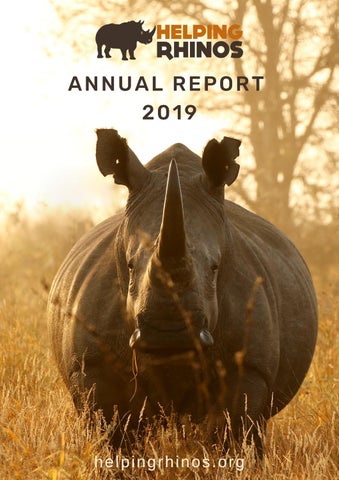
ANNUAL REPORT 2019
helpingrhinos.org
PROTECTING RHINO IN THEIR NATURAL HABITAT The rhinoceros is a keystone species, a giant herbivore whose everyday actions help to maintain a biodiversity that is critical to the survival of thousands of other wildlife species who share the same environment. Without this 'ecosystem engineer' the habitat would be irrevocably altered by overgrown or invasive wild flora. Rhino have existed on this planet for 50 million years and yet these icons of the plains now face their biggest challenge – man. Restricting their natural habitat and killing them for their horn, they have become symbolic of the constant struggle between man and the natural world. Helping Rhinos has a vision for a safe and reproductive future for rhino. Working predominantly in Africa our goal is to protect the species in its wild habitat and expand its range for future generations to enjoy in the next 50 million years!
A LETTER FROM THE CEO
Man is degrading and restricting the rhinos' natural habitat and killing them for their horn. We have pushed the rhino, a gentle giant who has roamed this planet for more than 50 million years, to the very brink of extinction. When I launched Helping Rhinos in 2012, I understood the challenges the rhino and other iconic wildlife species were facing and never doubted for a moment that it was mission impossible. In the last eight years I have had the privilege of working with some of the most passionate and talented individuals around the world, especially at the projects we are partnered with. The dedication and commitment of the teams striving to protect the rhino for future generations is inspiring and gives me hope for the natural world, despite the additional challenges brought about by the pandemic we are currently all living with. I’d like to pay special tribute to the rangers and everyone who is working so hard to keep safe the rhino in its natural habitat and I’d also like to thank the generosity of our supporters for their ongoing support. Only with you is this mission possible.
Simon Jones Founder and CEO
"The dedication and commitment of the teams striving to protect the rhino for future generations is inspiring."
RHINOS IN CRISIS POACHING On average, two rhinos are killed every day by poachers in Africa. Shockingly, less than 28,000 wild rhino survive in the world today. Just two northern white rhino are still alive today (both females) with IVF now the only hope for the survival of this subspecies. 90% of the black rhino population has been lost in the last 40 years. Rhino horn is worth $25,000/kg on the black market, creating an insatiable demand. More than 1,000 African Wildlife Rangers have been killed in the line of duty in the last 10 years. The graph below shows poaching in South Africa, home to 80% of Africa's rhino, continues on a downward trend. However, 595 rhinos still lost their lives to poachers in 2019, a number too high to sustain reproductive rhino populations.
HABITAT LOSS Safeguarding wild landscapes and protecting iconic wildlife species has never been more challenging. The planet’s natural resources are being plundered at an alarming rate and fragile ecosystems are disintegrating. More than half the human population increase between now and 2100 will occur in Africa (source: United Nations). As industrial and agricultural developments encroach further into pristine wild spaces it is little wonder Africa’s rate of deforestation is one of the highest in the world and wildlife is suffering as a result. The economic transformation of Africa is having a direct and negative impact on its wildlife. Mining, major construction, such as roads and railways running through national parks, illegal hunting and intrusive farming practices are all taking their toll. The work Helping Rhinos can carry out now to secure precious habitat and demonstrate the positive impact wildlife reserves can have on local and national economies, such as tourism, is critical for the survival of Africa’s most iconic species.
COVID-19 As the global COVID-19 pandemic continues, the impact on the rhino could be catastrophic. Conservation projects, including our work in the field, rely heavily on tourism income to continue operating, but with international flights cancelled to key conservation destinations and domestic travel restrictions imposed, the loss of revenue has been devastating. All non-critical conservation work has been halted. Staff have been laid off with no immediate income, laying bare the risks to critical conservation work. Cutbacks on anti-poaching operations, due to lack of funding, is taking place and for the rhino, it is of extreme concern.
HELPING RHINOS A POSITIVE IMPACT CREATING RHINO STRONGHOLDS Viable rhino populations that have the freedom to roam in their natural habitat, under the strain of global climate change and when the pressures on land and natural resources are increasing at such a rapid rate, is a constant challenge. At Helping Rhinos we recognise the need to restore habitats back to their natural state while simultaneously providing for the local communities. Helping Rhinos invests in critical projects that have the greatest potential to protect the black and white rhino in Africa. We support partners in the field that not only demonstrate a commitment to rhino conservation; their protection and reproduction in their natural habitat, but who also recognise the importance of local community involvement - employment opportunities, business creation opportunities and education in local schools. It’s true, a little can go a long way and money spent wisely can have a tremendous lasting impact. Together with our partners and the generous support of our donors, we are able to continue the critical care and protection the rhino needs to thrive.
photo: Justin Mott
PROTECT Despite the downward trend of the rhino poaching statistics in South Africa, there are still on average two rhino killed every day. Helping Rhinos aims to ensure the protection of all rhino and will continue to support initiatives that deter the poacher and make their illegal activity too high-risk and unprofitable. Helping Rhinos funds Ranger training, anti-poaching dog unit deployment, drone and aircraft surveillance; all projects that are having a positive impact in the ongoing protection of rhino. Helping Rhinos will also continue to influence and advocate on a diverse range of conservation solutions presented by the latest science and technology and innovative management protocols that are proving critical to the survival of rhino species and its natural habitat.
ORPHANAGE EXPANSION The Zululand Rhino Orphanage was born out of necessity following the tragic attack on a regional rhino orphanage in which two young rhinos were slaughtered for their horn. Helping Rhinos commitment to the newly relocated facility has been unflinching; supporting a dedicated staff, helping to build a secure facility and ensuring the baby rhinos in their care are given the very best possible chance to develop and grow, after such a traumatic start in life. Helping Rhinos’ participation has already facilitated the release of two black rhino orphans back to a life in the wild, demonstrating an ability to successfully nurture and rehabilitate traumatised and sick orphans back to full health. In the midst of such a poaching crisis, every rhino life matters. Successful rehabilitation back into the wild is likely to result in not just the saving of one individual, but the birth of calves to the once orphaned rhinos. The expansion work funded by Helping Rhinos has doubled the capacity of the orphanage facility ensuring more orphaned babies will have the best possible chance of survival and a return to the wild.
EYES IN THE SKY The African Rhino Conservation Collaboration (ARCC) works to combine the efforts and facilities of projects and organisations within the Eastern Cape of South Africa to maximise their impact for the protection and conservation of rhino. Helping Rhinos' support is helping to strengthen ARCC’s anti-poaching effort for a number of rhinoholding reserves.‘Eyes in the Sky’ with radio communication and on-the-ground backup offers a significant deterrent to possible criminal activity as it makes detection and detention much more likely. Aerial surveillance also improves conservation patrols, rhino monitoring and enables faster incident response. Helping Rhinos fully endorses and supports ARCC’s holistic approach to conservation which is bringing together protection, awareness, wildlife management, community participation and law enforcement in a coordinated collaboration of individuals, rural communities, organisations and government to ensure a future for rhino and other wildlife in the wild.
SUSTAIN Human encroachment and incompatible land use is having an increasingly devastating effect on wildlife habitats and fragile ecosystems are disintegrating. The consequences of losing wildlife habitat will have a profound impact on the future for large mammals and predators. Helping Rhinos recognises that rhino conservation is not about a ‘one size fits all’ approach, but about appraising, adapting and promoting sustainable conservation models. We shall continue to influence and advocate on a diverse range of conservation solutions driven by the latest science, technology and innovative management protocols. Helping Rhinos is working in the field to maximise land availability with the goal of increasing rhino populations and, where carrying capacity has been reached, supporting land expansion opportunities.
EAST AFRICA'S LARGEST BLACK RHINO POPULATION Ol Pejeta Conservancy, located in the Laikipia county of Kenya, is home to the largest population of black rhino in East and Central Africa; a record of success that can boast 135 black rhino where 40 years ago there were only four. Interestingly, Ol Pejeta also has one of highest densities of predator species and at the same time manages a successful livestock programme. Helping Rhinos has been supporting this groundbreaking conservation model (now replicated by other conservancies) for many years, playing a key role in rhino protection and creating additional habitat for the black rhino programme. We have also funded a mobile veterinary unit to support the treatment of wildlife in the region as well as domestic animals in the local communities. Helping Rhinos fully supports the innovation that Ol Pejeta brings to wildlife conservation; their attempts, with a global team of scientists, to save the last northern white rhino from extinction, their anti-poaching dog unit, the ultimate poaching deterrent capable of search, track and attack and, their work with the local community that is proof-positive of the effectiveness of empowerment, our future wildlife guardians.
ORPHAN RELEASE The goal for every rhino that we raise at the Zululand Rhino Orphanage is to care for them until they are old enough and strong enough to be released back into the wild. Black rhino Storm was rescued in December 2015 and it soon became very apparent that he had some serious health conditions, which nearly cost him his life on three separate occasions. But Storm showed his amazing fighting spirit and pulled through. By 2019 he was strong enough to begin his journey back to the life of a wild rhino. Wildlife rehab is tough and emotional work. There are many highs and lows for the carers who dedicate their lives to raising animals like Storm, but seeing Storm thrive as a strong and independent rhino back in the wild make the many sacrifices all worthwhile.
INSPIRE Helping Rhinos is proud to support initiatives that use the skills and abilities of community members. Encouraging leadership, strategic thinking, problem solving skills, with added mentoring and financial support, is creating self-satisfaction and community pride. By providing and empowering community-centered programmes, we not only help to achieve a greater understanding and support for rhino conservation, but we also create a positive impact in the local communities. Investing in education and local partnerships is key; the route to changing the lives of the vibrant energised younger generation who really want to live in a greener, more compassionate planet. Each collaborative community project implemented to provide empowerment and community engagement is creating a legacy for a sustainable future for the rhino.
BLACK MAMBAS The Black Mambas have been reborn. Women without weapons – it is easy to understand why there would be sceptics, in a male dominated world and yet, time and again the Black Mambas prove the point. They are highly trained and, with radio back-up, they are unafraid to confront anyone suspected of illegal activity within the parameters of the Balule Reserve in the Greater Kruger National Park. More than that, they are the perfect role model in local communities where it is commonplace for women to be disregarded by their male counterparts and where young children’s attitude to wildlife, to their heritage, can so easily be misconceived by the influence of others. In all these areas the Black Mambas more than prove their worth.
EDUCATION Education programmes are an important part of Helping Rhinos' strategic approach to raising awareness of the plight of the rhino and helping local communities to appreciate the fragility of their wildlife heritage. Helping Rhinos will continue to fund educational programmes that our project partners have developed in liaison with their local schools. We will also continue to develop our international education programme, #BeMoreRhino, an interactive fun and informative programme of activities available to download from our website for anyone to learn more about the rhino and rhino conservation. We take our #BeMoreRhino programme out to schools around the world, bringing rhino conservation to life through a series of presentations and interactive engagements.
VOICES FROM THE FRONT LINE
LEITAH MKHABELA BLACK MAMBA
The Black Mambas, South Africa’s first all-female antipoaching unit, are once again getting the global recognition they deserve. 36 young women who patrol 50,000 hectares of the Balule Nature Reserve, part of the Greater Kruger National Park, are an incredible group of women, dedicated and passionate wildlife warriors. They provide boots on the ground and voices in the community, to bring a fresh perspective to a traditionally male dominated world. On behalf of all the BMs, Leitah was recently awarded Ranger of the Year by the Paradise Foundation.
“When I put on my uniform each morning it makes me feel proud, as a woman, to know we are changing so many things in the world. We are risking our lives to protect wild animals but we stand proud to fight for them. For us as Black Mambas to get global recognition, we grow wings. To know that the whole world knows about our efforts as women makes us very happy. We stand brave, it gives us potential and helps the community realise we are the best people to protect wildlife and the future of the next generation.”
19
DR WILLIAM FOWLDS WILDLIFE VETERINARIAN
Dr William Fowlds is a veterinary phenomenon in the Eastern Cape of South Africa, having attended thousands of rhino procedures in an effort to safeguard the rhino in its natural habitat. Sadly, Will has also attended crime scenes, 52 altogether, all victims of illegal poaching and most of them resulted in postmortems. It’s extremely difficult for a wildlife vet to attend such incidents but vital in assisting the forensic teams to link the atrocity to a criminal.
“The rhino is such a vital species for us in our quest to save wild spaces and habitats. We’ve lost that connection with wildlife in our environment and it’s that connection that makes us so complacent as human beings.”
Will has been instrumental in creating the African Rhino Conservation Collaboration (ARCC), linking private reserves together in a common purpose, to protect the Eastern Cape’s rhinos. Helping Rhinos is very proud to support this work.
VOICES FROM THE FRONT LINE 19
JAMES MWENDA
OL PEJETA CONSERVANCY
Rhino Ranger, James Mwenda is a remarkable conservationist. He joined the team at the Ol Pejeta Conservancy in 2015 and cared for Sudan, the last male northern white rhino, until he sadly passed away at the ripe old rhino age of 45. Since then James has made sure the story of Sudan, his legacy as the last of his kind, brought about by human greed and indifference, is told over and over around the world.
“I made a promise to Sudan and wherever I go I will share the story of my friend. I hope the story of the northern white rhino will inspire people to do more and realise that we do not have much time left. The time is now to save endangered species and ensure their future is granted through our actions and commitment.� James now cares for the last two female northern white rhino, Najin and her daughter, Fatu and is very pleased that through them, with assistance from southern white rhinos and the incredible IVF scientific research developments, the species may be saved.
MEGAN LATEGAN ZULULAND RHINO ORPHANAGE
The Zululand Rhino Orphanage is the only dedicated rhino orphanage in Kwazulu-Natal and is operated by a devoted team, headed up by Meg Lategan. Together they provide 24-hour care to the rhino and hippo orphans in their care. Funded by Helping Rhinos, the expansion of the orphanage has provided new facilities to take in and care for a greater number of orphaned rhino calves. With a new boma (enclosure), vital security fencing, provision of milk and medication for new arrivals, enrichment for the orphans and shaded areas and water holes, the Zululand Rhino Orphanage really can offer the best quality care to their baby rhinos.
“It may look like the best job in the world but being ‘mum’ to a baby rhino is no easy task. The trauma we witness when we find a baby rhino left alone or by its slaughtered mother is heart-breaking. A baby rhino needs milk every two hours, 24 hours a day, so sleep is definitely hard to come by in the early stages. But only with that nourishment and commitment can steady progress be made.”
HOW WE RAISE OUR FUNDS EVENTS Helping Rhinos' annual Spring Talks are the ‘talk of the town’. Lively, entertaining, informative, bringing together experts in their conservational field to discuss edifying and enlightening topics to an interested and appreciative audience. In 2019 the Spring Talk at the Royal Geographical Society raised a mighty £63,000. Our talk for 2020 was booked and then COVID-19 happened. Undeterred, Helping Rhinos has gone online and to date has presented three hugely successful events across our social media platforms; an in-depth and immersive live dehorning procedure with vet Will Fowlds on Kariega Game Reserve, a parade demonstration and discussion with the amazing Black Mambas and an anti-poaching dog demonstration at Ol Pejeta Conservancy with James Mwenda and the team.
ADOPTIONS Helping Rhinos' Adoption Programme continues to go from strength to strength. With regular updates, exclusive videos and reports, we create a close connection for our adoptees with their chosen adoption and give them a real sense of inclusion in the development of their rhino, antipoaching dog and/or Black Mamba. In 2019 we were delighted to introduce Mthetho, the third miracle calf of poaching survivor Thandi, into the Adoption Programme and also Ol Pejeta’s new recruit, Drum, a springer Spaniel and ace detection dog. Helping Rhinos Adoption Programme forms part of a comprehensive fundraising programme that is helping to deliver critical funds to our project partners on the front line.
CHALLENGE EVENTS Helping Rhinos is enormously grateful to every individual who has taken up a challenge in aid of rhino conservation. From running the Royal Parks Half Marathon, climbing Mount Kenya to cycling across a continent or a simple challenge much closer to home, we are indebted to your commitment and determination. Every year Helping Rhinos gets involved in, and presents a host of Challenge events. Whilst COVID-19 has restricted large group gatherings, we have been so inspired by the solo efforts of our Supporters. We shall continue to present new ideas, fun and challenging ways in which our supporters around the world can get involved.
ARTWORK The artwork donated to Helping Rhinos by some of world’s most talented wildlife artists has helped us raise significant funds for our projects. We cannot thank the artists enough for their contribution to conservation. Their works allow us to conduct exciting auctions as well as offer our supporters superb rhino related merchandise. We would like to thank all the artists who have donated work to Helping Rhinos, including: Karen Laurence-Rowe, Ami Vitale, Nicola Davies, Crimson Medici, Sara Wilson, Margot Raggett, Tom Middleton, Ben Wallace, Bowes Brothers, Darren Baker, Patrick George, Gary Hodges, Ocean Sole, William Sudding, Dave Sharp, Henry Fraser, Pip McGarry, Robin Moore, Dimitri Sirenko
HORNi COFFEE Our three premium HORNi coffees taste as good as the good they do. In 2019 Helping Rhinos launched HORNi Coffee with two clear aims - protecting Africa’s endangered rhinos, and bringing you really good coffee. Every pack of HORNi coffee has been ethically and sustainably produced, to help support wildlife, the environment and local communities. Switch to HORNi today at horni.org.uk
FINANCIALS 2019 UK
USA
HOW WE RAISE OUR FUNDS Merchandise Unrestricted Donations
2%
Restricted Donations
21%
£324,535 31%
Unrestricted Donations
72%
28%
$177,928
46%
Event Income
Restricted Donations
HOW WE SPEND YOUR DONATIONS Operating Costs Cost of Raising Funds
20%
£326,794 5% 10% Charitable Donations
65%
IT and Admin
Charitable Event Costs
1%
$144,255 99% Charitable Donations
HELPING RHINOS UK REVENUE - MORE THAN £1,000,000 RAISED IN THE LAST 5 YEARS £400,000
£342,215*
£350,000
£324,535
£300,000
£254,678 £250,000 £200,000 £150,000
£108,190 £100,000 £50,000
£42,770
£0 2015
2016
2017
2018
2019
*includes a one time legacy payment of £52,000
HOW YOU CAN HELP DONATE
ADOPT
FUNDRAISE
LEAVE A LEGACY
JOIN OUR EVENTS
BUY HORNi COFFEE
visit helpingrhinos.org/get-involved for more details
PATRONS AND AMBASSADORS
HELPING RHINOS UK BOARD OF TRUSTEES
Phil Liggett MBE, Giles Clark, Peter Egan, Hannah Russell, Karen Laurence-Rowe, Cara Frew, Hannah Russell, Sara Wilson, Fiona Sanderson, Trish Liggett
Duncan Finch, Cherique Pohl, Stuart Clarke, Lisa Philpott, Simon Jones
HELPING RHINOS USA BOARD MEMBERS Susan Swigor, Jeff Harrison, Cheryl Laite, Simon Jones
A SPECIAL THANK YOU We are extremely grateful to everyone who has made a donation and taken out an adoption or sponsorship in 2019. We could not have achieved all that we have done without you. Below is everyone who has donated £50 / $50 or more to support our work protecting rhino in their natural habitat. A-Sisterhood Ana Alcalde Patricia Andrews Alan Apted Susan Armstrong Asilia Africa Marcin Baga Dan Bailey-Taylor Bede's School Bedford School Alexandra Bernardino Thomas C Bishop Charitable-Foundation Libby Blakey Catherine Bocquet Natasha Boyd Mikhail Boylan Ian Brown Michael Brown Kim Budge Linda Bulk Nicholas Burge Ernie Burgess Alec Burns Robin Busby Dominic Butler Louisa Caine Robert Canham Jayne Cardew Tristam Carrington-Windo Stuart Clarke Philippa Classey Sarah Cobden-Ramsay Claire Coleman John Coleman Marjorie Coote Animal-Charity Trust Christopher Concannon Cornflake JW Couch Country Matters Linda Crawford M J Day Andrew Dean Derby College Antonia Dewhurst Mirae Dixon Alison Duff Sandra Duncan Sarah Dyer Marilyn Eland Clare Elliott Ethical Addictions Eton College Solomon Ets-Hokin Louise Foulkes Fairfax Duncan Finch Kristian Forsberg Catherine Fox Sandra Freiberger-Rupp
Melody French Mark Fretwell Dominic Gallelo Parag Gandesha Ken and Rebecca Gart Filippo Gérard Jane Gilliard GR Teamwear Alison Graham Lauren Graham John Griffiths Katharina Haidenthaler Gary Hodges Judy Hofflund Hiliary Holder Anneli Howard Darren Hunter Penny Hyatt Interactive Transaction Solutions Jun Li Jiang Gail Johnson Kirstin Johnson Amy Jones Derek Jones Mark Jones Phillip Jones Sunil Kapur Sarah Kennedy Ernest Kleinwort-Charitable Trust Joe and Kathleen Larakers Lassen Karen Laurence-Rowe Lynda Leonard John Lias Phil Liggett Trish Liggett Chris Livemore Living Desert Zoo Charles Lutyens Ian McFadyen Bruce and Eleanor McLear Raymond McNaughton Kathleen MacKinnon Jennifer Maddocks Catherine Magnifico Vicky Martin Louise Matter Alfonso Medina Irina Melkonyan Lynda Merican Casey Michel Gerald O’Connell Liselle Mulcaire Karin Mussnich Karl Millward Stephane Monaghan Stifel Nicolus Noah's Ark Zoo Nuix Peter Nulty
Ronald O'Hanley Sarah Orman-Wheeler Sera Orzel Gaeta Scott Palmer Julie Partsch Jay Patel Roberta Patel Pedaling Against Poaching Pennicott Foundation Gary Plein Beatrice Potter Aron Prosch Richard Boynton Fitz Randolph Ash Rawal Peter Rawcliffe Anne Rickatson Reed Foundation Rhino Hub Ann Robins Tina Root Michael Rose Craig Ross Ruislip High School Rushmoor School Hannah Russell Michael Russell Jean Sainsbury Animal-Welfare Trust Alex Sams Fiona Sanderson Savanna Schupp Family Charles Schwab Foundation Yanai Shepher Daniel Shepherd Victoria Sibley Liz Simmonds Andrew Simpson Briony Smith Sway Soturi Holly Stevens Kicko Stiber Jeremy Stream Susan Swigor Yin Tan Peter Taylor Tracey Taylor Chiril Teterea Gina Thompson-Smith Threat Quotient Darren Turnbull Tracey van der Meijden Grant van Rooyen Ann Verhaert Claire Virge Kornelia von Broembsen Angela Wainwright Helen Wallage Drorit Wertheim Georgina Wiltshire Woburn Safari Park