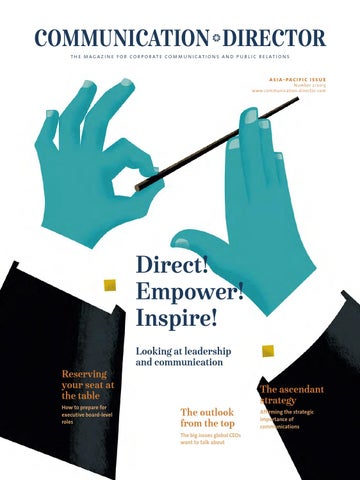
COMMUNICATION DIRECTOR the magazine for corporate communications and public relations
asia-paci fic issu e
Number 2/2015 www.communication-director.com
Direct! Empower! Inspire! Reserving your seat at the table How to prepare for executive board-level roles
Looking at leadership and communication
The outlook from the top The big issues global CEOs want to talk about
The ascendant strategy Affirming the strategic importance of communications
K
EYNOTE
ANDREW DEMARIA Vice President, Managing Editor International & Executive Producer
ANTICIPATING THE FUTURE: THE CHANGING MEDIA LANDSCAPE AND HOW IT anag ations M mmunic m EFFECTS COMMUNICATIONS ce in Co l o n c ie S Sc M f E ro leve next Maste to the n career Executive unicatio
na ernatio nced int a / Experie academic rese ls / Bridging eer learning na s sio th es -p k reer prof m over 21 mon / Peer-to networ ca ni idm m alu d for progra / Strong / Designe nal part-time tio es me ac / Interna tial sessions e as it giv benefi Angeles en ly rspectiv / 9 resid ingapore-Los Asian pe ns are extreme ncem -S an m no / Luga ecially fro and implicatio the career enha d t esp ram ys an om prog . The takeawa el of success in zations Sc ni ga EM e or es “I like th arkets’ practic rsue another lev s value to the mpan m pu rshey Co nication A at He matured the PR field to commu R AEME in and CS g strategic ications leaders gin un in mm Co to in br rporate Co or, to turn ect m
ur com
Take yo
Sharon
Tang /
Regiona
l Dir
00
69 ffi 13 / seppe Bu h i.c / via Giu italiana scom.us Svizzera .ch / www.em à della usi I Universit / emscom@ US / EMScom 1 58 666 46 02 +4 phone
BENEFIT FROM OUR EARLY BIRD & REGISTER BY
18 SEPTEMBER 2015
WWW.COMMUNICATIONS - SUMMIT.ASIA
THE COMMUNICATOR AS
1
2
3
4
LISA WONG
CELIN HUSEBY
MA. YOLANDA C. CRISANTO
MARTY BROUGHTON
Director of Communications, Public Affairs & Sustainable Development
Head of Corporate and Government Affairs
Senior Vice President for Corporate Communications and Spokesperson
Director of Communications
ANDREW PICKUP
RAJESH MANIK
GRACE LI
MOUSHUMI DUTT
Senior Director Communications
Executive Vice President & Head of Human Resources & Communications
Director of Communications
Head, Corporate Communications
CHIEF REPUTATION OFFICER
TRUSTED PARTNER
CONTENT CAPTAIN
DIALOGUE SPECIALIST
FIN D AL L S PE AK E R S AT W W W.COM M U N I CAT I ON S - S U M M I T.A S I A/S P E A KE R S
COMMUNICATION DIRECTOR the magazine for corporate communications and public relations
Say hello to the key players in Asia-Pacific communications A joint program
ECTOR ION DIR DIRECTOR MUNICAT ICATION COM COMMUN
with
A joint program
In cooperation
with
the magazine
for corporate
the magazine
with
In cooperation
communica
for corporate
public relations tions and public relations issu e fic tions and asia-paci
2/2015 Number m e fic issu ation-director.co 2/2015 asia-paci www.communic Number m
communica
www.communic
with
ation-director.co
Management nications Management EMScom m of Science in Commu nications level in Commu e Master EMSco to the next Executiv al faculty of Science practice internation ation career level business e Master to faculty to the next/ Experienced research al Executiv your communic
Partner of the APACD
practice academic internation ation career ls to business / Bridging communicprofessiona / Experienced r learning research months Take your academic over 21 ls / Peer-to-pee for mid-career / Bridging / Designed al part-time program alumni network professiona r learning months/ Strong from other / Peer-to-pee for mid-careerprogram over 21 / Internation / Designedsessions alumnimenetwork access to learnexperiencedother al part-time / Strong Angeles / 9 residential as it gives for us learn from / Internation gapore-Los beneficial perspective sessions dimension access tonew / Lugano-Sin Angeles from an Asian are extremely it gives me t. It is afor us experienced / 9 residentialgapore-Losespecially asenhancemen in.” we aredimension beneficial perspective and implications program Asian in the career / Lugano-Sin to the business EMScom t. It is a new are extremely from an The takeaways s and success “I like the especiallylevel ofand enhancemen business we are in.” implications practices. program another markets’ to the organization in the career to the / China EMScom to pursue The takeaways matured the PR s and tions value field practices. Company of success atorganization “I like communica in the markets’ another levelandvalue to the Hershey leaders strategic CSR AEMEA / China to pursue matured ns tions to in bringing Hershey Company the PR field Corporate communica Communicatio to turn AEMEA at leaders in Director,strategic ns and CSR Regional in bringing Communicatio turn /to to Tang Sharon Corporate
leading PR professionals in Asia-Pacific
Director,
Issue
Asia-Pacific
Asia-Pacific
No 2 · 2015
No 2 · 2015
DIRECTOR
ect! Dir ect!er! Dirpow Em power! Emire! Insp Inspire!ip
DIRECTOR
/ Regional
COMMUNICATION
Sharon Tang
COMMUNICATION
Target group
Issue
Take
Reserving at seat ng your Reservi tableseat at theyour for prepare table How to the
board-level executive to prepare for How roles board-level executive roles
/ Switzerland 6900 Lugano Buffi 13 / / Switzerland via Giuseppe italiana / m.usi.ch 6900 Lugano Buffi 13 / della Svizzera ch / www.emsco via Giuseppe / USI Università italiana / m.usi.ch 02 / emscom@usi. EMScom della Svizzera ch / www.emsco 58 666 46 phone +41 / USI Università 02 / emscom@usi. EMScom 58 666 46 phone +41
the new network for in-house communicators
Interested in advertising? Please contact:
leadersh ip Looking at ication at leadersh commun andLooking ication and commun
nt The ascenda nt strategy The ascenda the strategic Affirming strategy of importance the strategic Affirmingns The outlook communicatio of top importance the outlook ns from The communicatio top issues global theCEOs The big from CEOs to talk about want
global The big issues about want to talk
Print run 10,000 copies, 4 issues a year
Communication Director Magazine • Helge Schlüter • +852 58010913 • helge.schlueter@communication-director.com www.communication-director.com
EDITORIAL
Welcome, Roughly what per cent of your working week is spent deleting round-robin emails containing “inspirational” quotes from great leaders? You know the ones: a tired cliché imposed over a stock-photo sunset and attributed to a universally-acknowledged genius (who, more likely than not, never even thought the words, let alone set them down in a pithy sentence). Here at Communication Director, these emails go straight into the recycling bin. However, the ubiquity of these annoying emails does inadvertently point to an important truth: we are obsessed with the words of leaders, as if their success can be boiled down to a handful of easy-to-memorise bulleting points. Communications professionals know that the reality is a little more complicated. Leaders aren’t always great communicators, and communicators often need guidance when it comes to leading their team. This issue of Communication Director has a triple purpose. In our cover theme section, we’ve invited a range of experts from around the world to help you hone your leadership skills as a communications professional, as well as to reflect on how communications help leaders achieve their goals. We also look at how the communications function can establish its role of helping lead an organisation. Also in this issue are our regular range of articles that explore themes most important in the communication and public relations sphere – from brand and reputation, to internal communications and strategy: just a few of the responsibilities that communicators are ideally-placed to lead on.
DAFYDD PHILLIPS
Photo Laurin Schmid
Editor in Chief
COMMUNICATION DIRECTOR 2/2015
5
60
A strategy for the communicator Why communication leaders must create a strategy for their function
2/15 72
ISSUE FOCUS
Leadership & Communication
The lingo of leadership Studying CEO’s choice of words can reveal important issues, as well as signs of hubris.
64
Claiming your place at the top 68
Working in sync Heading up more than one department requires versatility and synergy – not to mention boundless reserves of energy
Covering the pole positions The issues, developments, hopes and fears keeping today’s CEOs on their toes.
8 • AGENDA SETTER
18 • CONTENT
Standing out with stunts
Revising in plain sight Why Wikipedia presents a challenge to communications professionals
Cut through the noise by making a public relations splash
22 • INTERNATIONAL
12 • BRAND
Building brand trust
Communicating for multinationals
Inspiring trust helps link brands to business
A communications case study of multinationals from emerging markets
6
COMMUNICATION DIRECTOR 2/2015
Photo Private
How should communication directors prepare for boardlevel roles?
76
CONTENT
32 • STRATEGY
Mother of reinvention 80
Looking at the bigger picture Thought leadership is more than a buzzword: here’s how companies give shape to it.
Why the chief communications officer is set to disrupt the C-suite
34 • HR
Symptom or disease? Why it’s time to talk about bullying in the workplace
84
Be yourself; everybody else is already taken How coaching can help develop leadership skills
38 • COACHING
Why assertiveness matters in business Assertive team leaders are valuable influencers with smart content
42 • INTERNAL
Why is the office sacred? Flexible work styles are the new normal
46 • MANAGEMENT
The crucial first 100 days The do’s and don’ts of surviving your first few months as a manager
50 • THEORY
Feeling lucky? 54 • INTERVIEW
86
The view from the top
Frederik G. Pferdt Google’s head of innovation and creativity on leadership and trust
Female talent is on the rise in Asia-Pacific corporate communications
How to help your organisation handle risk and uncertainty
90 • COMMUNICATION READER
Books A selection of recent and forthcoming titles
Photo DB AG / Philipp von Recklinghausen / lux-fotografen.de
26 • STUDY 92 •ASSOCIATION
Understanding millennials
APACD
What the new generation expect from work
The latest developments in the Asia-Pacific Association of Communication Directors
28 • INTERPERSONAL 98 • Q & A
Learning from intuitive hits and misses
Questions to...
The vital role played by gut feelings in all aspects of work
Getting to know Asia-Pacific communicators
COMMUNICATION DIRECTOR 2/2015
7
AGENDA SETTER
Standing out with stunts Well-crafted stunts can catapult your cause into the media. But how to pull them off with measurable impact? BY ANNA GARDINER
8
COMMUNICATION DIRECTOR 2/2015
AGENDA SETTER
and Facebook posts forced Starbucks to abandon the stunt and left the organisation with a poorer reputation than before the campaign. So how can you avoid such negative sentiment and ensure your stunt is a help and not a hindrance? To gain a better insight into how to get it right, Communication Director asked two communicators behind successful stunts to share their processes.
“We wanted to do something that got our message across effectively but also started to reposition ANZ in the minds of people”
Photo Keren Dobia
W
What’s pink, glittery and accepts all major credit cards?
ith new technological developments and the associated viral culture, the creative possibilities for public relations activities and the impact they can achieve are growing exponentially. This brings new potential for organisations to champion their messages by matching their communications to an accompanying eye-catching stunt to have real impact on their audience. By going viral, stunts now have the power to both increase awareness of your organisation’s brand and to change your audience’s attitude towards it. You only need to consider the ALS Ice Bucket Challenge to see the global reach and social impact campaigns can create by combining strong content with a striking stunt. When celebrities like Mark Zuckerberg and Bill Gates posted videos of themselves pouring ice cold water over their heads, it helped spark a viral sensation which saw the ALS Association gain a 3,500 per cent increase in donations, receiving money from more than three million people around the world. As powerful as a stunt can be in helping a campaign reach a global audience, the search for the superlative stunt is a serious challenge. Not only do they require a lot of research and often a lot of resources, when things go wrong it can quickly escalate on social media. Only last month, Starbucks received an angry backlash when their baristas wrote ‘race together’ on coffee cups as part of an anti-racism campaign. Thousands of angry tweets
In 2014, Australia and New Zealand Banking Group, or ANZ for short, transformed 10 ordinary ATMs into sequin studded, fur covered GAYTMs to celebrate and promote ANZ becoming the principle partner of the Sydney Gay and Lesbian Mardi Gras. The surprise reveal of these GAYTMs caused a global stir on social media, bringing the bank over 62 million media impressions and thousands of new customers. Off the back of this success, the GAYTMs returned in February this year, with a new feature, ‘the only GAYTM in the village’, where over 20,000 Australians voted for a rural town to have one of the creative cash machines installed. We spoke to ANZ’s head of marketing, Carolyn Bendall, to better understand how they created such success. “When looking to do these big and impactful things”, Carolyn recommends, “it’s always important to stay commercial as well. Be very clear about what it is that you’re trying to achieve and build a business case to do these great things that you know are going to work for the organisation and have the return your organisation is looking for”. Carolyn also stresses that when planning a stunt it’s essential to ensure that it is authentic to your brand. When talking about the GAYTMs she says, “I honestly believe it worked for us not only because of the great ideas and great execution but also because it’s true to our brand.” While ANZ only became the principle partner of the Sydney Gay and Lesbian Mardi Gras in 2014, it had been a major sponsor of the event for the seven years prior to the GAYTM campaign. During this time, it had extensively communicated the bank’s belief in diversity, inclusion and respect. Because these messages had already been made public by ANZ, Carolyn believes that, when the time came to create the GAYTM campaign, “we had the right to.” She comments further that, “I see some brands, when things fail on social media or fail overall, it’s because they don’t really have the right to be in that space in the first place”. A great example of this is the already-mentioned Starbucks ‘race together’ campaign. With no prior strong anti-racism ties to the Starbucks brand, the campaign was not perceived as authentic by their audiences who were consequently critical of the organisation.
COMMUNICATION DIRECTOR 2/2015
9
BRAND
Building brand trust Communicators need to work towards more than just brand recall: inspiring trust and linking brand to business results are what counts. B Y S U M E E T C H AT T E R J E E
12
COMMUNICATION DIRECTOR 2/2015
BRAND
W
hether we are chasing revenues as a profit-centre head in an agency or building reputation as the head of communications for a corporate house, there is one commonality for every professional in the corporate communications space – brand. It is the single most valuable asset of an organisation. The relationship journey between an organisation and its multiple stakeholders – including customers, partners, shareholders, financial markets, employees and media - begins with the brand. But when developing brand strategy for an organisation or a product, is the management sufficiently obsessed with building and retaining trust at every step? I think a lot more needs to be done. Over the years as a counsel to some of the finest brands, I have witnessed organisations spending a disproportionate amount of time and financial investment in advertising vis-à-vis events, public relations and communications. What could be the reason? Brand building is a long-term, continuous task. It is the sum of customer experience and engagement. Advertising is one part of the brand building process – the effectiveness of a campaign can be measured immediately by tracking sales or brand recall scores while the measurement and impact of an event, public relations campaign or communications is felt over a longer term and the industry opinion is divided on measurement tools and efficacy. It is also subject to personal interpretation. If I were to ask how many extra cans of Red Bull were sold during or after Felix Baumgartner’s epic space jump, or what was the increase in market share of Emirates after taking up the multi-million dollar naming rights for Arsenal's new ground at Ashburton Grove in London, I would
“Forwardthinking organisations see the role of communications as ambassadors of goodwill, a management role and not merely a support function.”
receive no easy answers. But I credit the custodians of these great brands for their strategic thinking and for putting huge investments behind these initiatives to create brand affinity and recall. The long-term positive impact of these associations through word-of-mouth communication and mentions in media is the return on investment for these brands. These brands have etched themselves in public memory.
The business of brand World over, only a few brands have managed to create an intimate relationship with their customers and stakeholders. Google is synonymous with search. The Red Cross is associated with medicine and saving lives. The Apple brand values permeate through user experience, product design, packaging and retail stores. I believe these brands have a lucid understanding of their purpose, their raison d'être. There are numerous examples of large brands spending millions of dollars on advertising every year however, I am not sure if that helps beyond brand recall
COMMUNICATION DIRECTOR 2/2015
or the ability to charge a premium. Unfortunately, most brands do not put enough rigour into defining their purpose, having the conviction of staying true to their ideology or completely re-defining a new purpose. I was fortunate to be part of a team at Lowe that worked on brand strategy for Bajaj Auto, a top two-wheeler manufacturer in India specialising in scooters. In the early 2000s, the Bajaj brand was facing stiff competition from Hero Honda and other Japanese motorcycle manufacturers. Even though Bajaj Auto had collaborated with Kawasaki, because of the rising preference among the youth for motorcycles over scooters, the Bajaj brand was being perceived as dated. Despite award-winning campaigns and huge media spends, as a category scooters were losing appeal and market share. We were a worried lot in the agency, given that this was our only 2-wheeler account in the automotive space. It was then that we decided to present a multi-media umbrella brand campaign with a caveat – no scooters will be shown in the advertisement; the advertising will showcase only motorcycles. For a manufacturer synonymous with scooters, this was a big decision. Not only did Rajiv Bajaj, the managing director of the company display the conviction to accept feedback about the existing brand perception, he eventually stopped manufacturing scooters, the mainstay of the company, a strategic decision he had been considering for some time. Today, Bajaj Auto is a youthful brand, a leading motorcycle player in India, a global manufacturing base for Kawasaki and the company holds a 48 per cent stake in the Austrian motorcycle maker KTM. To my mind, this exemplifies a bold and well thought-through brand strategy that is way beyond advertising, logo re-design, communications and public relations. It is intrinsically linked to business.
13
CONTENT
Revising in plain sight Your company’s Wikipedia page will be evaluated by the media to determine if anyone using a company computer made edits. The key is transparency. B Y M A R C I A W. D I STA S O
18
COMMUNICATION DIRECTOR 2/2015
CONTENT
O
f all the information sources available on the internet, one of the most widely used is Wikipedia. Since its founding in 2001 by Jimmy Wales and Larry Sanger, Wikipedia is currently the seventh most popular website in the world following Facebook, Google, YouTube, Yahoo!, Amazon.com, and Baidu.com. This online free-content encyclopedia is based on an openly edited model. This means that Wikipedia is written collaboratively by the public along with select anonymous unpaid volunteers known as “wikipedians.” According to Wikipedia, anyone with internet access can write and make changes to Wikipedia articles, except those deemed to have a conflict of interest. Jimmy Wales describes the conflict of interest issue this way: “There is a very simple ‘bright line’ rule that constitutes best practice: do not edit Wikipedia directly if you are a paid advocate.” His comment refers to the Wikipedia conflict of interest policy that prohibits public relations or communications professionals who work for an organisation from directly contributing to their Wikipedia content. This also applies to those working for a public relations agency or Wikipedia firm hired by an organisation. This leaves communications professionals with a conundrum. How should Wikipedia be handled? Unfortunately, the answer is not simple.
Illustration Wikipedia
Why Wikipedia matters Wikipedia is used across the globe in 288 languages with over 36 million articles. It has had approximately 470 million unique visitors with 77,000 active visitors. With so much activity, Wikipedia was recently credited as being better for break-
ing news than Twitter. Search engines give Wikipedia articles high prominence and while most newspapers have policies against using Wikipedia as a source in articles, Reuters Handbook of Journalism encourages journalists to use Wikipedia as a “good starting point.” Little wonder then that so many people use Wikipedia. A 2010 Pew study found that 53 per cent of Americans who are online use Wikipedia and a 2011 study found that 60 per cent of European doctors use Wikipedia for professional use. While once criticised for its accuracy, a 2005 study in the scientific journal Nature found Wikipedia articles were about as accurate as Encyclopedia Britannica for the natural science articles analysed. My research has found that the content in Wikipedia is much more detailed than Encyclopedia Britannica. It also contains more content about corporate social responsibility and legal and ethical issues. In another study, my co-author and I found that being considered one of the best companies in the US does not exempt companies from negativity on Wikipedia, and no matter how good a company’s reputation there is more negative content than positive. In 2013, I conducted a survey with 1,123 public relations and communications professionals and found that only 25 per cent of respondents were familiar with the rules. The survey also found that 59 per cent of respondents who were familiar with the Wikipedia article for their company or recent client indicated it had factual errors. In fact, 28 per cent said that their Wikipedia article had a “potentially reputation-damaging error”. Indeed, the relationship with Wikipedia is a strained one. While both communications professionals and Wikipedia want accurate articles, accomplishing this can be difficult. My survey found that 23 per cent of respondents said making changes
to articles was near impossible and 22 per cent indicated that their efforts were never productive. Using the Talk pages is not as easy as it may seem, since 13 per cent of respondents indicated that they never received a response and 10 per cent said it took weeks to hear anything.
Tread carefully Current challenges with Wikipedia have come from a long history of media attention. Editing wars in politics have been fairly common where those involved in campaigns are found to be editing their own along with their opponent’s articles. Most claim not to know the rules, such as when Joe DeSantis, adviser to Newt Gingrich, was criticised in a 2012 CNN article for disclosing his affiliation but making direct edits to Newt Gingrich’s page. In December 2010, the UK public relations firm Bell Pottinger was caught editing Wikipedia articles for its clients. While they contend that they only added true content, Wales was quite vocal in his disagreement of how the editing was handled, stating, “I’ve never seen a case like this. In general when I speak to public relations firms, they have ethical guidelines that would prevent this kind of conduct.” While the bright line rule indicates that the appropriate way for communication professionals to make requests is through the Talk pages, following this does not exempt you from scrutiny, as was seen in March 2013 when a BP spokesperson was criticised in the media for rewriting nearly half of their Wikipedia page. Arturo Silva, a member of BP’s corporate communications department, clearly identified himself as a BP employee and made all his Wikipedia requests through the Talk pages. While he was commended by Wales for following the
“How should Wikipedia be handled?”
COMMUNICATION DIRECTOR 2/2015
19
INTERNATIONAL
The very model of a modern multinational: Huawei’s employee workplaces include (clockwise from top left) up in the air, down an Indian mountain, outside in wintery China and inside African villages.
22
COMMUNICATION DIRECTOR 2/2015
INTERNATIONAL
“What are the biggest communication challenges that emerging market multinationals face today? As Roland Sladek explains, the story of Huawei is representative of so many other multinational corporations from emerging markets.
Photos Huawei
INTERVIEW BY DAFYDD PHILLIPS
DA F Y D D P H I L L I P S What are the biggest communication challenges that multinational corporations from emerging markets face today? RO L A N D S L A D E K Having lived for almost four years in China, and having shaped the global image of one of its most successful international technology leaders, I believe that the main challenge for multinational corporations from emerging countries is linked to the high speed of their development. Companies in
COMMUNICATION DIRECTOR 2/2015
countries such as the United Arab Emirates and China develop at a pace that is unheard of in many parts of the world. Western audiences, for example, do not always perceive the tremendous progress in quality, innovation and labour practice and this often leads to misperception and misrepresentation. As a communication leader, my challenge is therefore to constantly explain to our audiences the progress that we have made, what we stand for and why their past image of the company might not match today’s reality. Communication leaders must take a strategic approach, which focuses on progressively building the reputation of the company. Huawei’s engagement with the World Economic Forum, both in Davos and around the globe, is a good example of this evolution. Over the last three years, our presence evolved from initial con-
23
INTERPERSONAL
Learning from intuitive hits and misses It is important to acknowledge the vital role played by your gut feelings in all aspects of work. BY EUGEN E SADLER-SMITH
28
COMMUNICATION DIRECTOR 2/2015
INTERPERSONAL
W
ether we like it or not, we have all experienced intuition. It is often in in situations where we are faced with a complex and potentially-life changing decision for ourselves, our employees or our business. It can be a hard-to-pin-down vibe given off by a candidate in a selection interview, a knee-jerk reaction to a pitch from a public relations agency, a hunch about a risky new project tabled at a board meeting or in any number of complex decision-making or problem-solving situations. We don’t invite intuitions in, they gatecrash our experience. We don’t know where they come from, seemingly arising out of the blue. They tend to be sticky, nagging away at us until we give them our attention. They are pervasive, and can be very persuasive, in professional and personal life, ubiquitous across situations and cultures, and potentially powerful and perilous in equal measure. For these reasons it is vital that managers acknowledge and understand intuition, are able to interpret their own and other peoples’ intuitions, and can use intuition in discerning and discriminating ways rather than being beguiled or hindered by their gut feelings.
Photo www.thinkstock.com
Acknowledging intuition Surveys and studies of intuition in use reveal that managers find intuition to be a viable decision making tool: (1) in sensing potential problems, for example when someone’s story doesn’t ‘add up’
or there is an ethical dilemma; (2) when they need to perform well-learned behaviour patterns rapidly; (3) if expectations are violated, for example when we expect a situation to go a certain way but it doesn’t - this can set off the intuitive alarm bell; (4) in synthesising the bigger picture - when faced with multiple isolated bits of data and information, harnessing intuition lets managers stand back, avoid ‘analysis paralysis’, and
“The informed and skilful deployment of well-honed intuition and analysis will be the key to successful decision making in the fast-paced, dynamic and uncertain business environment of the 21st century.”
sense how the pieces might fit together in a coherent and convincing way; (5) in checking-out the results of rational analytics with a sense for whether the data stacks up or not -– intuition can be deployed when the hard data, or our analysis of it, doesn’t feel quite right. This can prompt us to seek-out more or better data, or to take a new or different look at the data we have and the way it has been analysed. Senior managers tend to make greater use of intuition than middle or junior managers and use
COMMUNICATION DIRECTOR 2/2015
of intuition is related to job type: for example it is used more commonly in marketing and human resources than in finance and accounting (incidentally, there is no strong evidence for the stereotype of female intuition). These findings recur in multiple types of organisations large and small. That said there are organisational cultures where it may not be acceptable to acknowledge or use intuition. But given that intuitions are rapid, involuntary and pervasive this situation is potentially problematic. It can force managers to rely on intuitions covertly and make-up rational reasons for a decision when they may actually be acting on their gut feelings. A further danger is that this can impede managers in learning from their intuitive successes and failures and prevent them from developing better intuitive judgement.
Understanding intuition Researchers tend to agree that intuition is a manifestation of expertise and some even refer to it as ‘expert intuition’ or ‘intuitive expertise’. One way to think of intuitive expertise is as “analyses frozen into habit and the capacity for rapid response through recognition” (Nobel laureate Herbert Simon’s definition of intuition). Experienced managers can report knowing what to do in complex, fast-moving situations where they have to process multiple cues simultaneously and take a decision or solve a problem under time pressure with limited information. Curiously though, if asked to explain their reasoning such intuitive experts may end-up being perplexed because they cannot unpack their intuition into an analytical explanation. It is possible to know without knowing how or why we know.
29
HUMAN RESOURCES
SYMPTOM OR DISEASE?
34
COMMUNICATION DIRECTOR 2/2015
HUMAN RESOURCES
Grappling with bullying in the workplace means taking a long hard look at the areas of organisational functioning that enable bullying to occur – especially the interface between managers and employees. BY MICHELLE TUCKEY
I
once read an article that named bullying the cancer of the workplace. I used to agree with this belief. Like cancer, the most severe consequence of bullying for its victims can be death or other devastating health effects – through suicide or by creating strain and vulnerability to mental and physical illness. Like cancer, bullying will affect a majority of employees during their working life, as victim, witness or perhaps as alleged bully. In my homeland of Australia, the prevalence of workers exposed to bullying at work is about seven per cent based on the Australian Workplace Barometer. According to the first Korean Working Conditions Survey the estimate is around five per cent and close to four per cent in Japan as reported to the Japanese Institute for Labor Policy and Training in 2013. Yet at any one time up to 70 per cent of employees report being bullied on a less frequent or less intense basis. And like cancer, there is no silver bullet to cure bullying; it is considered by many as being an intractable problem. To illustrate, well over 200 studies have been published on the neg-
COMMUNICATION DIRECTOR 2/2015
ative effects of bullying and the potential causes but just 12 published studies have evaluated methods to tackle it. Approaches to bullying prevention within organisations highlight aggressive behaviour as the problem that needs to be treated. The rationale of existing prevention programmes is to increase employees’ self-confidence and skills in managing negative workplace interactions. Priority has also been given to anti-bullying policies that clearly define bullying and emphasise management commitment to zero tolerance. While such policies are a key ingredient in addressing inappropriate behaviour at work, they do not prevent bullying or shape organisational responses to it. The ultimate effect of anti-bullying policies and training programmes is to place responsibility on individual employees to regulate their own behaviour, rather than on eliminating the underlying processes that allow bullying to occur. So is bullying the cancer of the workplace? During the last 10 years researching this topic I’ve come to understand one fundamental point of difference: unlike cancer, bullying is not the disease. Rather, bullying is a symptom of poor organisational functioning. Treating the symptom – focussing only, or even primarily, on the bullying behaviour itself – will not stop the underlying illness. To prevent bullying and to resolve issues connected to harmful behaviour, managers at all levels need to make changes to restore to full health certain vital aspects of organisational functioning.
Unanswered questions What underscores my view of bullying as just one of a range of undesirable symptoms of underlying organisational ill health? For a long time, academics have known that the balance of evidence highlights organisational rather than individual factors as the primary contributors to workplace bullying. Across the
35
COACHING
Why assertiveness matters in business In tough times, organisations are looking for well-balanced assertive leaders. How do you measure up? BY LAURA BACCI
A
ssertiveness by itself will not get you a promotion, nor the respect of your peers and bosses. But failing to stand your ground effectively, and – conversely – being too controlling and aggressive, can halt your advancement up the corporate ladder. So why are organisations seeking out assertive leaders and where do you fit on the assertiveness barometer? Assertiveness is a way of describing how people defend their interests. Assertive leaders can create a compelling vision, communicate strategy and clearly define objectives and service quality standards. They inspire their people, gather support, and create alignment within a team so
38
COMMUNICATION DIRECTOR 2/2015
that everyone moves in the same direction. They avoid the confusion and disorientation caused when team members are trying to second guess what they’re supposed to be doing and why. Assertive leaders exude confidence. They are prepared to stand their ground when they walk down the corridor to deal with the human resources or finance departments. They create a safe space for team members to voice concerns and discontent, avoiding the trap of toxic communications cycles. They can even encourage the most soft-spoken people to share their thoughts and ideas with the wider team; ideas that might turn out to be star dust further down the line. Until now, organisations have viewed assertiveness as a trait that relates exclusively to the personality of the individual. Either you are assertive or you are not. But it is now time for companies to start looking at assertiveness as an institutional issue. That is because the structure and function of every organisation has a direct impact on whether the next generation of leaders are capable of rallying their people in the right direction. Organisations also have a responsibility to ensure that their current crop of leaders has the right environment in which to be assertive. They cannot expect team leaders to act assertively if those leaders don’t have a clear mandate from management, or if their jobs are constantly being put on the line. The organisation as a whole has to create the right environment for assertiveness to flourish.
Why should you be an assertive team leader? Being assertive is a fantastic trait whether you are managing relationships upwards, downwards or horizontally within an organisation. It comes in very
COACHING
Table 1: Characteristics of different types of assertive behaviour (adapted from Ames and Flynn, 2007)
Type of assertiveness
Photo www.thinkstock.com
handy when you are negotiating resources for your team, trying to get budgets approved, securing full-time employee positions or backing your key performance indicators in front of the big boss during the annual review process. If you are servicing other departments you need to be able to say what needs to be said in a constructive manner. In doing so, you will establish your team’s reason for existing and defend their expertise. In the process you are also likely to challenge misconceptions, push-back unrealistic deadlines, create a productive dialogue and develop trusting relationships with your peers. With the external eco-system a little assertiveness is also of great value. Whether you are doing business with contractors, managing complex campaigns with multiple stakeholders, or negotiating deals on behalf of your company, assertiveness will bring dividends.
The assertiveness tightrope Research published by the American Psychological Association shows that individuals who come across as too low or too high in assertiveness tend to be rated
Typical characteristics
High or over-assertive
Dominance, aggressiveness, lack of deference, hostility, pursues goals in a hostile and offensive manner.
Low or under-assertive
Self-sacrifice, cooperativeness and consideration, passivity and submissiveness, failure to take charge in situations that require initiative or conviction.
Staying in balance
as ineffective leaders by their colleagues (see Table 1). Highly assertive individuals do get the tasks done and achieve shortterm goals. However, they often dampen relationships and are likely to undermine team spirit over the longer term. While low levels of assertiveness might make you popular, it often goes hand-in-hand with underperformance. Being assertive is a little like walking a tightrope which is suspended 10 metres above the ground. What is likely to make you fall and what will keep you balanced? There is no straightforward answer to this question. This is because balance comes from aligning your own personal values, strengths and sense of purpose with the needs of the outside world. Assertiveness involves taking charge from the inside out. Know who you are and what you have to offer and listen carefully to what is going on around you. That will help you to apply the right degree of assertiveness to the right group at the right time.
COMMUNICATION DIRECTOR 2/2015
So how can you keep your assertiveness in balance, and what cues should you look for to recognise when you are out of balance? The answers depend on a number of factors which are, quite often, out of your control. Factors such as the direction of the organisation, the nature of your team and the individuals who are part of it.
Where is your company heading? You need to pick your leadership style (and with that, the right amount of assertiveness) depending on your organisation. What is the overall strategic business, and what are its financial and organisational objectives? The leadership style you choose is not necessarily your own personal working style. For example, you cannot suddenly decide to be an authoritative leader so you can take your team through a restructuring phase – but then fail to make yourself heard by displaying low assertiveness skills. You will not get the
39
INTERNAL
Why is the office sacred? As the first generation of network collaborators enters the labour market, flexible work styles are becoming the norm. BY JON FRODA
Photo www.thinkstock.com
F
rederik Wilmslow Taylor, the so-called father of management consulting, may also be worthy of a less illustrious epithet – father of the modern office. In the same way his principles of scientific management came to define how business is conducted, they have also shaped the places where it was conducted. As anyone who’s ever toiled day in, day out in a soulless cube farm will tell you, this is not a good thing. In this article, I would like to question the perceived value of the office and articulate the benefits - and challenges - of alternative ways of working.
As Marshall McLuhan wrote, first we shape our tools and then our tools shape us. As I see it, we are now shaped by our offices. And not for the better. Thankfully, our concept of the workplace is being transformed, especially by technology. Digital tools are empowering ordinary workers to rethink their approach to work and, specifically, where it takes place.
An enlightened vision However the pace of change is slow and, currently, limited to the knowledge economy. I believe this transformation will gather pace, though, and that the next 10 years will see a gradual return to more flexible and location-independent work environments. (I say ‘return’ because the
COMMUNICATION DIRECTOR 2/2015
office as commonly understood is little more than a quirk of the industrial revolution. Prior to that, work was never a place you went, it was what you did.) First, a more detailed look at the forces driving the change. As with most things in business, the biggest driver is the bottom line. The economic conditions of the past few years have also spawned a growing dependence on freelancers. There are also environmental advantages associated with a reduction in commuting and facilities; and, as already mentioned, networked-based technology and tools that enable efficient remote collaboration are having a profound impact on work styles. I often work from cafes. The other day I sat next to two people. They had been crunching away for an hour on their laptops when one of them took off his head-
43
MANAGEMENT
1 2 3 4 5 6 7 8 9 10 11 12 13 14 15 16 17 18 19 20 21 22 23 24 25 26 27 28 29 30 31 32 33 34 35 36 37 38 39 40 41 42 43 44 45 46 47 48 49 50 51 52 53 54 55 56 57 58 59 60 61 62 63 64 65 66 67 68 69 70 71 72 73 74 75 76 77 78 79 80 81 82 83 84 85 86 87 88 89 90 91 92 93 94 95 96 97 98 99 The crucial first 100 days 46
COMMUNICATION DIRECTOR 2/2015
MANAGEMENT
When communication managers take on new leadership roles it can be a tricky situation for the company as well as for the manager. How to succeed in the new position? New research offers some insights. BY ALEXANDER GUTZMER
On
January 10, 1999, television history was made. The first episode of the ground-breaking series “The Sopranos” aired for the very first time. Viewers were shocked, not only because of the frequent bursts of violence but also because the violence clashed with the family orientation that was also part of the show. Both elements were embodied by the lead character, Tony Soprano. The show established Tony as a complex character, but also as one who is very conscious about the way he represents himself in his professional environment. Tony is a mobster and his major career move is to take over the New Jersey branch of the New York mafia. In the first episode, he positions himself for this role through a display of pure (in his case, criminal) energy. He chases a man who owns him money, and eventually runs him over with his car. The poor man then gets a beating, together with a great deal of “Where’s my money!” being shouted.
This display of violence has three target groups: a) the victim, b) Tony’s nephew Christopher, who will spread the word among the other New Jersey mafiosi, and c) the general public, represented by a couple of bystanders witnessing Tony’s performance. If we subtract from the scene all the elements of criminality and mafia-style misbehaviour, what remains is an example of very conscious – and also quite smart – career management. Tony knows he will soon take over New Jersey so he establishes himself as a strong leader, a man who knows what he wants and who is clear in his actions if he does not get it. Tony symbolically creates a sense of respect (externally towards the bystanders) and belonging (internally towards his nephew, with whom he bonds throughout the scene). And he signals: “Once I reign, the rules of what we do will be rewritten.” Obviously, Tony has a clear plan. The management situation Tony finds himself in (preparing to take over New Jersey) is by no means untypical. Each day, new leaders take on power somewhere, especially in change-prone environments such as internationally operating firms. It is clear (and we know this from business literature as much as from reporting on politics, business or sport) that the first 100 days are crucial to succeed in a new job, not only for new chief executive officers but also on lower hierarchical levels. Whenever someone takes on a new job that involves leadership elements, the question of how to prepare for the new role must be answered. Do you have to bring an elaborate strategy with you? How distinctly are you supposed to position yourself beforehand? And, once in the new office, how much change makes sense in the first few days? How do you communicate the change?
COMMUNICATION DIRECTOR 2/2015
And what to do with employees who hinder the implementation of the change processes? These questions are particularly nagging for someone taking over a leadership position in communications. In order to answer some of these questions, I conducted a survey among communication professionals who recently took on new jobs that included leadership responsibilities. We used a public relations newsletter and sent a questionnaire to candidates whose change to a new position had been reported in the newsletter. My first question was simply: “When taking on the new job, did you have an elaborate plan about the strategic measures to be taken?” Only 14 per cent of all interviewees definitely had such a plan. Apparently, a clear strategy on what to do once in the new job can by no means be seen as standard. Now, this can be read either as conscious flexibility or as lack of preparation. Whatever the reason, the call for careful strategic preparation found in several management books can by no means be seen as fulfilled.
Questions, plans and strategies Interestingly, most of those interviewees who had a plan had agreed about it explicitly with top management (80 per cent) and they usually managed to execute their plan successfully (70 per cent). This indicates that a clear written plan can reduce the inherent insecurity of what to tackle first within the initial 100 days on the new job . But what about those managers without a plan? Should they have formulated one? Only 15 per cent felt that this was
47
THEORY
Feeling lucky? Organisations faced with difficult decisions can use different forms and functions of organisational communication to reduce elements of risk and uncertainty. BY STEFFEN BLASCH KE
50
COMMUNICATION DIRECTOR 2/2015
THEORY
S
problem. Decisions are not only bound by the cognitive capacity of individuals to process information; rather, interpretations of information become more important than providing facts and figures. Companies can use the idea of an organisation’s communicative constitution to reduce risk and uncertainty in decision making by means of communication rather than overcoming the limits of individual consciousness.
ome decisions are risky. Others are uncertain. In either case, companies traditionally strive to provide their employees with up-todate, precise and elaborate information in order to reduce the risk and uncertainty of decision making. However, decisions made by individuals are irrelevant to organisations. Just consider a manager who decides to increase investment in research and development after reading a newspaper at the breakfast table. The decision is her own. It does not affect the company she works for until other employees take note. Indeed, her individual decision may not lead to an organisational decision if others in the company reject the investment. We rarely distinguish between decisions made by individuals and decisions made by organisations. But analysing the distinction between the two allows us to focus on what we can manage. Individual decisions are products of consciousness, whereas organisational decisions are products of communication. Thoughts cannot be managed by someone other than the individual who has the thoughts, but communication may be controlled or influenced by participation. The idea of the communicative constitution of an organisation sees decision making as primarily a communicative
Risk and uncertainty The difference between risk and uncertainty boils down to the available information about the probability of the decision’s outcome. Buying a lottery ticket is a risky decision but the probability of winning is known. However, developing a new corporate strategy is an uncertain decision and the probability of success is unknown. Decisions taken under risk are made on the basis of information about probabilities of future states, information that reduces the risk of decision making. Information, however, does not reduce the uncertainty of decisions. Companies deal with uncertainty by labelling it risk. They estimate the probability of, for example, the success of a new corporate strategy based on historical data or future scenarios. This is how companies are capable of action despite the uncertainty of decisions. Up-to-date and extensive information provides answers to explicit or known questions. Dealing with uncertainty in terms of risk requires companies to seek answers to implicit or unknown questions. Companies must treat the development of a new corporate strategy like buying a lottery ticket: they must at least pretend that they know the odds.
Photo: www.thinkstock.com
“Companies deal with uncertainty by labelling it risk.”
COMMUNICATION DIRECTOR 2/2015
The classic perspective: individual decisions Over 50 years ago, Nobel laureate Herbert Simon argued that humans possess a “bounded rationality”. They try to be rational in their decision making yet their capacity to seek and process information is limited and they must make decisions on the basis of satisfactory information. Reducing uncertainty is one of the mechanisms by which they deal with their own bounded rationality. In addition, individuals are prone to a number of cognitive biases. An investment decision with a likely loss at 20 per cent may look attractive in the light of no alternatives. Individuals regularly display overconfidence in their own competences and skills and tend to take riskier decisions in maintaining the status quo than in changing it. After all, losses hurt more than wins bring pleasure, as Daniel Kahneman, another Nobel laureate, demonstrated in several experiments. Risk and uncertainty are prone to systematic misjudgement on account of bounded rationality and cognitive biases. Yet companies attribute decision making to particular individuals. Whether it is the company-wide agency of a chief executive officer, the project responsibility of a middle manager, or the decision of an expert, it all boils down to individuals who make decisions on behalf of their company.
An alternative perspective: organisation as communication Communication constitutes organisation. This alternative perspective breaks with the idea that people make up a company. Instead, organisations are seen as interlocking networks of communication events and episodes.
51
INTERVIEW
“What’s the link between innovation, leadership and trust?” Frederik G. Pferdt, head of innovation and creativity programs at Google, shares his insights into the values and practices that reinforce the company’s thriving culture of experimentation. INTERVIEW BY DAFYDD PHILLIPS
54
COMMUNICATION DIRECTOR 2/2015
INTERVIEW
Frederik G. Pferdt inspires the crowd at a Google Creative Skills for Innovation Lab event
Photo DB AG / Philipp von Recklinghausen / lux-fotografen.de
How important is a culture of innovation to successful leadership? Innovation is crucial to leadership, but I would encourage people to look at in reverse: it takes successful leadership to be able to foster a culture of innovation. You’ve created design experiences for various groups, from kindergarteners and teachers to CEOs. What attitudes to design and creativity have you found among the CEOs you’ve worked with? I feel lucky to engage with two to three organisations and their CEOs per week, including NGOs, governments, start-ups and corporates. We explore the importance of creativity and how they can nurture a culture of innovation. Also, getting inspiration from children is important for me, because they remind me about the power of playfulness and a beginner’s mind. For a lot of executives this concept sometimes seems hard to grasp. But once they explore playfulness, they love it and consider it something that helps them dream up big ideas while finding fun in the question: what if? Everybody walks away with a deeper understanding of what creativity and ‘design’, as a verb, can do in their organisation. I deeply believe that there’s no single model of innovation and you can’t force it. But as an organisation you can facilitate it by providing the cultural norms and infrastructure so that it can be allowed. So ask yourself: how can you create an environment where you’re empowering employees with information and the freedom to take risks, giving them the time and the passion to pursue their dreams, and activating these moments of synergy where innovation simply happens? Projects like CSI: Lab and The Garage represent a leap of faith by Google in the effectiveness and resourcefulness of their people. What is it about Google’s leadership that makes it willing to put so much trust in their employees that they gift them with so much ‘play’ time?
COMMUNICATION DIRECTOR 2/2015
55
ISSUE FOCUS
58
COMMUNICATION DIRECTOR 2/2015
ISSUE FOCUS
ISSUE FOCUS
Leadership & Communication 60
A strategy for the communicator A new strategy for the communications function is needed if it is to lead the organisation By Pierre Goad
64
Claiming your place at the top The issues, developments, hopes and fears keeping today’s CEOs on their toes By Emma Dale
68
Working in sync Heading up more than one department requires discipline, delimitation and delegation By Andrew Seah
82 72
The lingo of leadership A provocative look at what leaders’ choice of words reveals about them By Russell Craig, Joel Amernic and Dennis Tourish
76
Covering the pole positions The issues, developments, hopes and fears keeping today’s CEOs on their toes By Mike Davies
Be yourself; everybody else is already taken How external coaching develops leadership skills By Sunita Sehmi
86
The view from the top Female talent is on the rise in Asia-Pacific corporate communications By Katrina Andrews
80
Looking at the bigger picture Why thought leadership is a strategic issue By Mignon van Halderen and Kym Kettler-Paddock
COMMUNICATION DIRECTOR 2/2015
59
ISSUE FOCUS
A strategy for the communicator Communication leaders are adept at writing out strategies for other people: they should also write a strategy for communications. BY PIERRE GOAD
60
COMMUNICATION DIRECTOR 2/2015
ISSUE FOCUS
C
ommunications is at a crossroads. The profession – and it has become a profession – needs to evolve. Communications started as an artisanal activity, became quite technical and now should grow up and become a much more strategic function. We can all write a communications strategy for somebody else. What we need to do is write a strategy for communications. In the early days a communications director was like a potter. He or she could create a bit of magic by turning a shapeless blob of clay into something shiny and lovely using a creaky old wheel, a bit of glaze and a kiln. This was skilled work, but very local, and repeating the output on a consistent basis was difficult. We might imagine there was a Mad Men era for communications, as there was for advertising. Perhaps Mad Press Agents is already in development at a US cable television network. If it gets made it will show communications as an artisanal activity, but with martinis. After the age of the artisan and crafting by hand, communications entered the age of the technician. We became professional and technical. We provided media
COMMUNICATION DIRECTOR 2/2015
training according to a best-practice formula. We developed models for leader-led internal communications. We spawned channel managers and the channels for them to manage. It worked quite well for a few years. But the age of the technician is coming to an end because all the audiences communicators need to engage have become both too sophisticated and too hard to reach. The old technical tricks are losing their effectiveness.
The essence of strategy We are not the only ones who can spot media training on the 10 o’clock news: “That is a interesting question, but what is really important is this key message I practiced for an hour before coming on your show that I’m going to repeat endlessly no matter what question you ask.” ‘Cascadism’, a word I invented to describe overreliance on manager cascades, is dead. Nobody has time to read the same quarterly earnings message sent by nine different managers. It is quite possible that cascadism never worked. The appeal certainly faded as email volumes exploded. Channel managers might have made sense when intranets and other channels were held together with sticky tape and paperclips and run from single servers stuck in coat cupboards. But it never made sense to have the same message channel-managed into multiple, ever so slightly different messages so each channel could maintain the fiction that it was different from all the others. If communications needs to become more strategic the obvious place to start is by asking: what is strategy? And, if I don’t have a strategy how do I get one? Luckily, somebody has already answered the question. Clear thinking on strategy is in short supply. In fact, the supply of concise writing on strategy is so constrained that one of the best short guides to strategy remains a 1996 paper by Michael Porter, the well-known Harvard University professor. He asked the right question
61