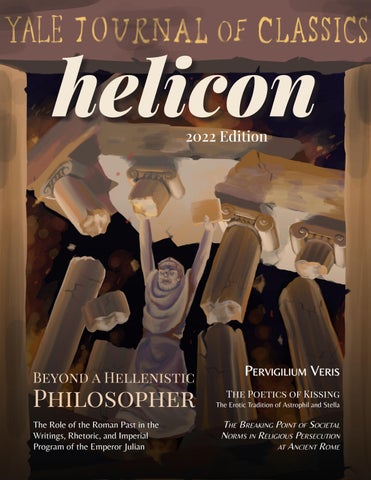
helicon 2022 Edition
Beyond a Hellenistic
Philosopher The Role of the Roman Past in the Writings, Rhetoric, and Imperial Program of the Emperor Julian
Pervigilium Veris The Poetics of Kissing The Erotic Tradition of Astrophil and Stella
The Breaking Point of Societal Norms in Religious Persecution at Ancient Rome
helicon | 2022 edition
thank you to everyone who helped: Editor in Chief Alisia Pan
A rewriting of Hor. Odes 1.9, composed magna cum hilaritate by the editors
Managing Editors Katie Painter Esther Reichek
Do you see how Harkness Tower stands
Outreach Editor Charnice Hoegnifioh
how the toiling students can hardly bear
Publication and Design Editor Ann-Marie Abunyewa
how Farmington Canal is frozen
Treasurer Grace MacDonald Editorial Board Grace Blaxill Robert Crystal Yaz Liow Elizabeth Raab Claire Saint-Amour Jake Watson Faculty Advisor Prof. Andrew Johnston
2 | yalehelicon.squarespace.com
bright in the height of snowfall
their book-weight
with piercing ice? Thaw off this cold throwing logs on the hearth warmly generously draw out four-seasoned essays (a year in the making) – Helicon: The Yale Undergraduate Journal of Classics!
FROM THE EDITORS
from the editors alvete! χαίρετε! It is our distinct pleasure to announce the re-launch of Helicon in Spring 2022. Veterans of the Yale Classics department might find the name familiar; there was a Helicon before, and, judging from its website, this Helicon also had a forebear of the same name. So, here we are, the vital third of our little Helicon can(y)on. Guided by a commitment to both academic excellence and inclusivity, this journal showcases outstanding student work that engages with the languages and literatures, histories, philosophies, and cultures of the ancient Mediterranean world. We seek to provide content of any genre for readers of all backgrounds and perspectives in order to bridge perceived gaps between Classics and contemporary discussions.We also aim to establish a network of support and a sense of community among undergraduate, graduate students, and faculty in the Classics. Compiled during the days of the COVID-19 pandemic, this issue celebrates the theme of “Renewal.” It is a testimony to the resilient spirit that has enabled collaborative intellectual efforts to flourish on university campuses around the world during this time of enforced physical distance. Each of our nine authors offers new ways of bringing the classical world to life in the present, resurrecting the voices of the past and contributing their own perspectives on ancient characters, texts, and ideas. In like spirit does our own journal celebrate its return from the Lethe. We would like to extend special thanks to all of our contributing authors for their patience and grace: Zhenglin Liu, University of Toronto; Abigail Yadegar, Yale University; Asher Courtmanche, University of Wisconsin - Madison; Daniel Blatt, Yale University; Ilia Curto Pelle, Princeton University; Catherine Xu, Yale University; Zoe Smith, University of TennesseeKnoxville; Lucia Garber, University of Wisconsin - Madison; and Charnice Hoegnifioh, Yale University. Special thanks goes to Eunice Kiang, Yale University, for her beautiful and inspired cover art. Finally, we would like to thank the Yale Department of Classics, whose support made this publication possible. So settle down, enjoy the warmth of the new ideas explored within these pages – they promise change, transformation, perhaps even a green spring. Felix sit annus novus et cura ut valeas! Katie Painter & Esther Reichek Managing Editors
yalehelicon.squarespace.com | 3
ps
6
la tt
an
iel
ion
Be
shi
49 an ojan d H For 56 om tific Th eC er ati a ic ons He hara c Ac Zo Epic hill ro A ter i eS es c Ca in I ro zatio mi th n th n t s im er ate s Ti s of ine me Re Xu lat
oh
y
ifi
Ph ond a Th ilo Hell e and Rol en Im e of s ist per the o ial D p ic Pro Rom h an g r a B m Pas er of t the in th e E
fo rg the b ot lo s t 68 Ch en somin n ar ut g of nic eH tr a oe ee gn
20
on ce
mp Wr ero itin r Ju gs, lian Rhe to
ric,
helicon | 2022 edition
Pe r Zh vig en
gl
in
ili
Liu
um
Tr
8 Pa n st W do Ab om ra Fir
rb
er
4 | yalehelicon.squarespace.com
il
13
an Yad or Firs tP eg aw ar n
36
Th
el
le
T tr Mar he t ad d ō ra iti Ma ns on rd fo to fro rm a l m ati o a i Ilia terarPers n of y T ian Cu op rt os o P
S Pe ocie The rs ec tal Bre ut No ak io rm in na s g 60 t A in R Poi nc el nt ien igi of o Luc t Ro us me ia Ga
iga
Kise Poeti si cs o Th e As Ero ng f
tr ti As ophil a c Trad he i r C nd S tion tel of ou la r te
ma
nc
he
Ve
ris
FROM THE EDITORS
Eunice Kiang Yale University Berkeley, Class of 2024 “The cover depicts Emperor Julian, who is the statue in the middle, as author Daniel Blatt (’21) evaluates his legacy. Each of the four pillars represents a philosopher whom he revered: Julius Caesar, Romulus, Numa, and Cato the Elder. They are the foundation for Julian’s beliefs and way of governing Ancient Rome. However, his vision of a GrecoRoman empire failed to match Ancient Rome’s development of Christianity and Constantinople at the time. So, the buildings crumble while Julian’s statue fruitlessly attempts to keep holding them up. The composition is framed in a nearby building’s window to symbolize the analyses of writers in the journal while the name of the magazine is written in the style of Ancient Roman inscriptions.”
yalehelicon.squarespace.com | 5
Veris Pervigilium
After Zhang Ruoxu in remembrance of a dear friend and colleague.
...littera venit, vix bene barbarica Graeca notata manu. (Ov. Her. 3. 1-2)
Aequa mari statuit vernalis in amnibus unda, Luna simul nitido nascitur amne super. Undarum sequitur Latonia milia multa, Lucida non aliquo amne carenda micans. Erranti fragrans praecingitur insula ab lympha, Myrtea sub luna silva nivosa nitet. Flamina per volitans non sensa est alba pruina, Nec se spectari candida harena sinit. Inter aquas caelumque albescenti similem amni Lustrabat praestans lumine sola dea. Nunc posco, hac ripa, quo primo visa sit luna, Fulserit aut quando prima hominique et aquae. Per tantos aevos hominum gens, A, remanebat, Talibus inque annis Diva perennis erat. Nescia quem exspectent Phoebeque undaeque manentes Perpetuo specto flumine abire mare. Claro cum nubis vanescat in aethere solus A curis vincor litore propter acer. Intendam tibi ubi, thalamo astris argentato? Quemque phaselon apud nunc requiete jaces? Luna serena vagat circum aedes turre superbas, Heu! cui lucenda strata relicta patent. Lux cujus quamquam velante occlusa smaragdo Iam lautas tabulas mulcet et haeret loco. Quam lucem spectans non exaudis mihi questus: Mutata in radios nunc volo tute sequi. Has noctes nil attenuat, non fluminis ales Carmine discedens, nec mare pisce tremens. Stagnorum in somnis flores vidi cecidisse Sed semper sine te, sponse remote miser!
Latin translation by Zhenglin Liu Mechanical Engineering and Economics, University of Toronto Class of 2020
Tempora cum fluctu veris fugiunt moriendo, Inclinatque ad lacum Cynthia marmoreum Inter et umentes declivis labitur aestus. Lydos ad montes est via longa Pharo! Sint quot reventuri serae cum lumine? quaero Dum riparum implet luna dolore nemus.
春江花月夜
Spring, River, Flowers, Moon, Night
作者:張若虛
English translation by David Lattimore
Spring river tidal water
春江潮水連海平,海上明月共潮生。
on the sea the bright moon rolling tossing
灩灩隨波千萬里,何處春江無月明?
running level with the sea rising with the tide
down its waves a million miles
where spring river
do you lack for moonlight
The river flows twists turns
江流宛轉遶芳甸,月照花林皆似霰。 空裏流霜不覺飛,汀上白沙看不見。 江天一色無纖塵,皎皎空中孤月輪。 江畔何人初見月,江月何年初照人? 人生代代無窮已,江月年年祇相似。 不知江月待何人?但見長江送流水。 白雲一片去悠悠,青楓浦上不勝愁。 誰家今夜扁舟子,何處相思明月樓? 可憐樓上月徘徊,應照離人妝鏡臺。
around the scented park lands
moonlight sleeting everywhere
on blooming groves
through the void flowing frost white sand of the islets River sky one color
flies unseen
indistinguishable.
without a spot of dust
glittering amid the void
the bright moon’s wheel
on these banks what people river moon in what year Life of man age on age
first saw the moon
did you first shine on men. unexhausted
river moon year by year
looking at each other
who knows what person
the moon in the river waits for
all you see the long stream
ushering its waters.
White cloud a single swath
bound far away
maples green upon the bank
unquenched sorrow
Tonight where is the household What place does she think of Piteously above the lodge
of the man in the little boat in the moonlit lodge
the moon wavers wanders
shining back on the lonely one
玉戶簾中卷不去,擣衣砧上拂還來。
blinds of the jade door
此時相望不相聞,願逐月華流照君。
This is the hour to gaze afar
鴻雁長飛光不度,魚龍潛躍水成文。
wild geese far flying
昨夜閒潭夢落花,可非春半不還家。
Last night by the idle pool
the make-up mirror-stand
she twists but does not go
wash-pounding on the stone
though brushed away returns hearing nothing
wishing to follow the moon-glow
cannot go beyond the light
fish dragons churning
the depths ripple the surface she dreamt of falling flowers
she grieves for him at mid-spring
江水流春去欲盡,江潭落月復西斜。
river waters wash away
不知乘月幾人歸,落月搖情滿江樹。
Slant moon deep deep
who does not come home
what’s left of spring
river pool the falling moon
斜月沉沉藏海霧,碣石瀟湘無限路。
to flow—to shine on you
slanting westward
in sea-mist hidden
from Jieshi to Xiaoxiang
a boundless road
who knows what people
come home by moonlight
the moonset shakes our feelings
as it fills the river trees.
Pandora
helicon | 2022 edition
First Woman or First Pawn
Abigail Yadegar History of Art and Certificate in Italian, Yale University Jonathan Edwards, Class of 2024
P
andora, the first mortal woman in Greek mythology, is central to the origin and development of humanity and civilization, exemplified by the myth of Pandora’s pithos, or jar, which has lived on through centuries of literary, philosophical, and artistic commentary. While she is an integral part of today’s discussions of antiquity, very few explorations of her character consider her limited agency in Hesiod’s works. This essay investigates the impact of Hesiod’s male gaze on Pandora’s literary and mythological presence, as well as the ripple effects these works have on our understanding of both ancient Greek civilization and Western society today. The essay compares Hesiod’s written account of Pandora’s creation and pithos with French symbolist Redon’s 1914 oil painting, Pandora, examining the cultural and religious frameworks of each rendition and how each piece treats and comments on Pandora and her offspring (women). The essay then explores the role of beauty and the different modes of storytelling employed for each account, comparing the two time periods to emphasize mythology’s ability to transcend both time and space and shape art history.
Figure 1. Odilon Redon’s Pandora (c.a. 1914), oil on canvas, 56 1/2 x 24 1/2 in. (143.5 x 62.2 cm)
8 | yalehelicon.squarespace.com
Courtesy of the Metropolitan Museum of Art
I
n Greek mythology, Pandora is the first mortal woman, used in Hesiod’s myths from the seventh century B.C.E. to explain the difficulties of the human experience. In Works and Days, Pandora accidentally releases all the world’s evils and challenges upon human beings, thus expelling mankind from an idyllic “Golden Age” and fulfilling Zeus’ vendetta against Prometheus, who stole fire to bestow it upon humanity. In his 1914 oil painting Pandora, French symbolist Odilon Redon reveals his familiarity with the ancient texts, but chooses to embed the figure within the more contemporary framework of the female nude. Illustrating her in a lush, colorful setting symbolizing the Garden of Eden, Redon employs Pandora’s image as a vehicle for rising anxieties surrounding the onset of World War I. In both sources, Pandora is exploited as a part of someone else’s agenda, either that of Zeus or Redon himself; however, while Hesiod’s Works and Days and Theogony preserve the traditional function of myth-telling (to explain parts of the human experience and glorify the gods), Redon reinvents Pandora and Hesiod’s myths to embody concerns surrounding World War I and contemporary ideas, appealing directly to a modern audience. In both Hesiod’s Works and Days and Redon’s painting, Pandora is used as a means to achieve individual goals; for Zeus, this encompasses revenge, and for Redon, this involves connecting with the audience by communicating shared anxieties about World War I. In Works and Days, Zeus orders Hephaistos to fashion the first mortal woman from clay as he plots against Prometheus, who stole Zeus’ fire to give it to mankind. In line 103, Pandora, or the “irresistible bait,” is given to Prometheus’ brother, Epimetheus;1 she later discovers a pithos, or jar, which she inquisitively opens: “But the woman took the lid off the big jar with her hands / And scattered all the miseries that spell sorrow for men.”2 This myth not only functions as an explanation of life’s difficulties, but it also establishes an uneven distri1 2 3 4 5
PANDORA bution of power between mortals and immortals. By equating Pandora with bait, Hesiod emphasizes that she and her descendants are bound by the almighty gods’ plans, deprived of any free will. Even though Zeus is the mastermind behind this scheme, his power and position of privilege rids him of all accountability and thus Pandora, who is defenseless, is held responsible. Even her unparalleled gifts are binding, as they only further solidify Zeus’ control over her. In Pandora, Redon revolutionizes Pandora’s image by painting her in the nude and using symbolism, the most contemporary mode of representation at the time, to evoke an idyllic, serene world. Redon caters toward the contemporary audience’s cultural exposure, drawing them in with familiar artistic styles. Further, by choosing to depict the moment just before Pandora opens the jar, Redon strengthens this connection to the audience; viewers anticipate imminent destruction and subsequently associate this with their collective anxieties about the onset of World War I. Such topical concerns were very relevant to Redon, as his son, Arï, had just been drafted.3 By means of Pandora’s image, Redon generates a communal experience, uniting producer and consumer. Beauty also drives Zeus’ and Redon’s plots; Pandora’s alluring appearance fulfills Zeus’ vendetta against Prometheus, and Redon’s aesthetic decisions invite viewers to ponder the work’s message. Zeus demands that Pandora’s beauty should resemble that of the gods, instructing Aphrodite to “spill grace on her head / And painful desire and knee-weakening anguish.”4 Theogony reveals the impact of such beauty: “And they were stunned/ Immortal gods and mortal men, when they saw / The sheer deception, irresistible to men.”5 Pandora’s beauty provides a powerful ethos, blinding even Epimetheus to Zeus’ trickery and thereby guaranteeing the plan’s success. Even though Zeus exploits Pandora’s beauty to recover authority, further widening the power gap between
Hesiod, “Works and Days,” trans. Stanley Lombardo in Anthology of Classical Myth: Primary Sources in Translation (Indianapolis, IN: Hackett Publishing Company, Inc., 2016), line 103. Ibid., 115-116. Museum of Modern Art, Odilon Redon, Gustave Moreau, Rodolphe Bresdin (New York, NY: Museum of Modern Art and the Art Institute of Chicago, 1961). Hesiod, “Works and Days,” 84-85. Hesiod, “Theogony,” trans. by Stanley Lombardo in Anthology of Classical Myth: Primary Sources in Translation (Indianapolis, IN: Hackett Publishing Company, Inc., 2016), lines 591-593.
yalehelicon.squarespace.com | 9
helicon | 2022 edition the two figures, Pandora’s beauty also benefits her, as with it she can bewitch even immortals. Redon also frequently harnessed beauty’s power in his pieces by experimenting with color and symbolism to elicit viewers’ dreams, indulge their fantasies,6 and create a space for reflection. In Pandora, he uses complementary color combinations to create a heavenly, harmonious scene: the red-orange leaves balance out the blue-green sky, the sapphire petals by Pandora’s feet accentuate the gold soil, the emerald plants and ruby flowers in the bottom right complete each other, and so on. Since the painting is nearly life-sized, the audience is immersed in these color relationships; viewers trace these colors around the canvas and begin to daydream or imagine themselves in this wild, natural setting. The floral motifs then direct the eye toward Pandora’s youthful, idealized form, the painting’s focus. Redon’s beautiful symbols function as the bridge to peaceful self-reflection, subsequently redirecting the viewers’ attention toward the actual moment that the piece represents and its charged message; beauty ensures that Redon’s concern with contemporary anxieties is successfully communicated. Whereas Hesiod’s myths embrace polytheistic ideology, Redon recontextualizes Pandora within the Christian belief system to foster a collective consciousness with his audience and add new meaning to the stories. Theogony and Works and Days both fall under the category of myths that explain the world,7 but Hesiod’s works also originally possessed religious significance as testaments to the greatness of the gods. Both Theogony and Works and Days establish Zeus as an invincible and omnipotent ruler. In Theogony, Zeus is credited with his children’s creation of women, confirming his dominance over mortals: “That’s just how Zeus, the high lord of thunder, / Made women as a curse for mortal men.”8 His victory against Prometheus indicates his omniscience and authority over immortals: “There’s no way to get around the 6 7 8 9 10
mind of Zeus.”9 For Hesiod’s audience in seventh century B.C.E, such a myth would likely be recognized as divine truth, consequently moving citizens to fervently revere the gods and enrich Greece’s collective religious life. Redon also produces a communal experience, but he relocates Pandora to a Christian framework, equating her with Eve. This is indicated both by Pandora’s nudity (since European depictions of Eve from the Middle Ages onward are almost always nude), and the setting; the tree represents the forbidden tree, the flora signifies Eden’s plentifulness, and Pandora’s pithos can be likened to the forbidden fruit. By superimposing the pre-Christian Greek mythos on Christian ideology, Redon acts as a contemporary myth-teller; he inherits an ancient tale and infuses it with new meaning to reflect a collective consciousness and maintain its relevance. Moreover, as Eve’s actions are supposedly not predetermined by God, she chooses to eat the forbidden fruit; by illustrating Pandora without any male figure present, such as Zeus or an Adam-equivalent, Redon gives her the same freedom of choice. Redon’s overlap in ideology awards women power where they previously had none, reminding viewers that they too can choose how they respond to an unraveling crisis. While Hesiod preserved thousands of years of oral tradition, Redon adapted myth-telling to twentieth-century art and altered preconceived notions of Pandora. According to Richard Buxton’s Complete World of Greek Mythology, although Hesiod provides some of the earliest written mythological accounts, myth-telling traditions “undoubtedly go back far beyond that date,” originating with oral tradition.10 While his detailed transcriptions of myths are likely not exact replicas of the original versions, Hesiod’s works preserved the tales and expanded the horizons of myth-telling. While Hesiod focused on recording these stories as fully as possible, Redon intentionally omitted many details in favor of generating a new interpre-
Louise Gebhard Gann, “The Metaphor of Redon,” essay in International Studio, Volume 78, Issues 320-325 (New York City, NY: New York Offices of the International Studio, 1923), 101-108. R. G. A. Buxton, “Introduction: Myths in Context,” essay in The Complete World of Greek Mythology (London: Thames & Hudson, 2016), 6-13. Hesiod, “Theogony,” 604-605. Ibid., 616. R. G. A. Buxton, “General Characteristics of Myth,” essay in The Complete World of Greek Mythology (London: Thames & Hudson, 2016), 16.
10 | yalehelicon.squarespace.com
PANDORA tation. Symbolists believed that art should exhibit thoughts or emotions instead of the detailed realist representations of the natural world. Therefore, Pandora features very few references to Hesiod’s myths besides its title, Pandora herself, and the pithos, magnifying the piece’s ideas instead of the narrative’s particulars. Retaliating against Hesiod’s Theogony, which calls women the “deadly race,” an “infestation among mortal men,” and “a curse for mortal men,”11 Redon emancipates women from such confining ideas. He liberates Pandora from male control, placing her in a paradise removed from Hesiod’s universe in which women only exist to plague men. The flowers that run wild all over the canvas symbolize this newfound freedom. Further, through his color scheme, Redon blends Pandora with her beautiful surroundings, discounting Hesiod’s idea that all women are deceptive by nature and suggesting that they are instead internally beautiful and thus also make the world around them beautiful (indicated by the flowers blossoming all around Pandora). Moreover, since Redon’s image does not actually reveal whether Pandora will open the pithos, the viewer is left wondering whether she would have caused such affliction had she been given the right to choose and tyrannical men had been removed from the equation. Pandora’s name may be translated as “all-gifted” or “all-giving”; Hesiod’s myths define Pandora by the gods’ gifts, specifically those from Zeus, but Redon illuminates Pandora’s individual contributions to the rest of humanity. In Theogony, Hephaistos shapes Pandora from clay and Athena dresses her in “silvery clothes,” adorning her with “a wreath of luscious springtime flowers” and a golden tiara.12 Works and Days elaborates on the gods’ contributions: Athena taught Pandora embroidery and weaving, Aphrodite gifted her with grace and allure, and Hermes granted her “a bitchy mind and a cheating heart.”13 With regard to Pandora’s purpose, Hesiod includes that Zeus “made women as a curse for mortal men.”14 Hesiod’s Pandora is indeed all-gifted, but her character and the way in which 11 12 13 14 15
she relates to the world is predetermined upon her birth, thus stripping her of the opportunity to find and define herself. Even the goddesses’ gifts, which are more favorable than those of the gods, confine Pandora to domestic work and, in the case of Aphrodite’s contribution of desirability, subject her to the male gaze against her will. Such details reflect ancient cultural values, as women were not allowed to participate in Greece’s democracy and were instead limited to domestic activities. On the other hand, Redon’s Pandora is all-giving. By associating her with beauty, growth, and fertility (the Garden of Eden setting), Redon acknowledges Pandora’s most significant contribution to the world: life. Instead of shaming and cursing women by attributing all affliction to their gender, as Hesiod does, Redon celebrates them, placing the mother of mankind at the center of paradise and rendering her a symbol of the Golden Age. By choosing to paint her nude, Redon represents Pandora as a blank slate; her nakedness is symbolic of her ability to become anyone she wants to be, inviting twentieth-century women to discover a new sense of purpose as World War I unfolded. Further, the painting itself is all-giving, as it foreshadows the war’s devastation, providing important insight into the years ahead, and offers a heavenly, reflective, and inspiring space to escape heightening anxieties. In Hesiod’s accounts, Pandora may be compared to the pithos, or jar, from which she unintentionally releases all the world’s evils, an objectifying concept that Redon disputes by realizing Pandora in her full human form, somewhat removed from the male gaze. In Theogony, Hephaistos forms Pandora from clay, the same material as the jar, to please Zeus: “The famous lame God plastered up some clay / to look like a shy virgin, just like Zeus wanted.”15 After Pandora accidentally releases all the pithos’ contents besides “hope,” the myth notes that every woman after her would also tarnish mankind: “The deadly race and population of women, / A great infestation among mortal men…Zeus, the high lord of thunder, / Made women as a curse for mortal men, / Evil
Hesiod, “Theogony,” 595-605. Ibid., 576-580. Hesiod, “Works and Days,” 87. Hesiod, “Theogony,” 605. Ibid., 573-574.
yalehelicon.squarespace.com | 11
helicon | 2022 edition conspirators.”16 In attributing all the world’s injustices to a single woman, Hesiod fails to mention that Zeus predetermined Pandora’s course of action and Prometheus catalyzed the entire conflict, freeing men of any responsibility. By comparing women to objects, Hesiod dehumanizes and undermines them, suggesting that they exist only to be seen and exploited by men like a pithos is to be displayed and used for storage. He also promotes the restricting and belittling of women to other men, a particularly dangerous message considering how widely Hesiod’s writing has been circulated and his ideas immortalized. Redon restores some of Pandora’s humanity, illustrating her in the barest human form: the nude. Her body’s curves and stance suggest a fluidity of movement that would not be possible in any kind of object, particularly a fired clay pithos, but her skin tone does resemble clay’s earthy color. Redon also illustrates her as very shy and innocent, effectively rebuking Hesiod’s portrayal of women as conniving monsters. Even though Redon’s painting restores some of Pandora’s dignity, however, she is still filtered through the male gaze, a product of Redon’s personal vision. The viewers still experience Pandora not as an individual entity, but as a facet of the male imagination. After Pandora inadvertently launches all evil into the world, only “hope” remains; Hesiod does not address the positive implications of this choice, continuing to blame Pandora for all existing problems, whereas Redon uses his painting to embody hope itself. The Anthology of Classical Myth translates the Greek word “elpis” as hope, but it has also been translated as deceptive expectation.17 If elpis is interpreted as deceptive expectation, or false hope, its existence among the other evils is justified, as misleading hope leads to a miserable life. If this is
the case, then Pandora’s decision to withhold it saves mankind from additional torture. If elpis is translated as a positive hope, then Pandora successfully conserves the one remedy to despair, preserving access to it for all of mankind. Either way, Pandora proves she is “all-giving,” protecting human beings from the world’s unrestrained agonies. However, Hesiod does not elaborate on elpis’ function, relevance, or meaning, disregarding the opportunity to redeem Pandora and her offspring, but remaining consistent with his derogatory depiction of women. In contrast, by producing a vibrant, reflective painting, Redon effectively accesses Pandora’s supply of elpis; he creates a safe haven for viewers who share his distress about the war, reinvents the mode and purpose of myth-telling, and builds an empowering space for women that challenges social expectations. Like its namesake, the painting is a vessel of hope, continuing to inspire contemplation and conversation among viewers all over the world today, a testament to a myth’s ability to transcend the boundaries of time and space. Hesiod’s myths and Redon’s painting communicate stories. Whereas Hesiod’s concerns revolved around preserving tradition, namely transcribing orally passed myths to ensure their survival, Redon reinvented myth-telling by expanding it to twentieth century art. With Hesiod’s reverence for the past came restrictive, damaging expectations of women, but with Redon’s modern work arose the challenge of effectively communicating with the audience by the means of an image’s symbols and ideas. Regardless of differences in time period, religion, artistic style, and cultural values, both Hesiod and Redon have contributed to our current understanding of Pandora and are tributes to the timeless power of myth-telling. ■
16 Ibid., 595-606. 17 W. J. Verdenius, “Commentary,” essay in A Commentary on Hesiod: Works and Days (Leiden: Brill, 1985), 66–67.
12 | yalehelicon.squarespace.com
The Poetics of
Kissing
THE POETICS OF KISSING
Figure 1. Catullus and Lesbia, with her sparrow. Lesbia’s sparrow becomes a trope in love poetry and creates a connection to the early eroticism of Catullus. Courtesy of Wikimedia Commons
The Erotic Tradition of Astrophil and Stella
Asher Courtemanche English, Latin, and Classical Humanities, University of Wisconsin — Madison Class of 2021
C
lassical themes and references to antiquity are present throughout European Renaissance literature, but there has been a continuous historical oversight regarding the influence of erotic Latin poetry. The erotic tradition has been purified by past scholars, erasing all the erotica from the erotic; but it exists in themes, attitudes, and a long, long lineage reaching from antiquity to 16th century England. Through intertextuality, the traditions of erotic Latin poetry, as seen in Catullus, are displayed in Sir Philip Sidney’s Astrophil and Stella in formula, presentation, and a history of language, allowing readers to see how the erotic prevailed and adapted in the European Renaissance. yalehelicon.squarespace.com | 13
helicon | 2022 edition
S
ir Philip Sidney invokes a traceable lineage between his poetry and that of the classical world in Astrophil and Stella. The plot that weaves the sonnets together, the classical themes in individual sonnets, and images recalling mythological figures all work together to imitate and expand on ancient Greek and Roman cultures. Sidney’s work provides one major example of the “rebirth” of classical literature for which the Renaissance is known. Yet Astrophil and Stella offers more than just an example of Classical rebirth by continuing the tradition of erotica through kiss poetry. Pablo Maruette eloquently describes this phenomenon as “replacing the old with the ancient. Only this time, in doing so, it produced a wonderful novelty, a sub-genre of lyrical poetry autochthonous to the period.”1 The erotic elements in Sidney’s work, specifically the recurring basia, or kisses, lead to a necessary re-examination of how erotic poetry, like the lyric love poetry of ancient Roman authors such as Catullus, were received in the sixteenth century. Sidney’s use of an erotic tradition that includes basia, fluctuating attitudes, and Neo-Catullan tropes elevates the romantic and Figure 2. A portrait of the young Sir Philip Sidney. erotic flame still burning from Courtesy of Wikimedia Commons. antiquity, but re-ignited by the Renaissance. 1
It is fairly easy to find elements of the classical world in Astrophil and Stella. These classical allusions begin with Sidney’s invocation to the “sisters nine” at the beginning of Sonnet 3, a reference to the nine muses and a common trope for Greek epic poetry.2 Sidney’s imitation of classical literature continues to the end in both passing references—“Orpheus’ voice” in the Third Song, “Argus’ eyes” in Sonnet 104, “Phoebus’ gold” in Sonnet 108, and so on—and in longer engagements, like Sonnet 8, in which he re-invents a story for Love to highlight the unrequitedness of his love for Stella. The poem follows Love, who leaves Greece and “At length perched himself in Stella’s joyful face,” at whose coldness made him “take his flight. To my close heart, where… He burnt unawares his wings, and cannot fly away.”3 Although a “joyful face,” Stella is far too cold to foster a prosperous environment for Love. Yet Astrophil burns far too passionately in his love for Stella so that, once Love has flown into Astrophil’s heart, he cannot escape. Sidney takes the god Love and re-invents his myth in order to express the unrequited love felt by Astrophil. This elevates his expression of classical themes by creating his own myth for Love. With the foundation of classical influence established, there grows still the most telling branch of descent from antiquity, that being Sidney’s implementation of erotic poetry and the affectation of basia poetry. The history of scholarship on the erotic in Astrophil and Stella often avoids discussing the influence of Roman love poetry on sixteenthcentury poets. Elizabeth Hull argues for her perspective on the scholarship of erotic desire. Scholars have wrestled with the erotic tones of Astrophil and Stella to remove erotic intent from erotic elements; Hull agrees that in past scholarship “the analogies for sexual desire drive out sexual desire, and the erotic is made to take the name of what it is not.”4 The precedent of erasure, or purification, of Sidney’s sonnet sequence fails
Pablo Maurette, “Shakespeare’s Venus and Adonis and Sixteenth-Century Kiss Poetry,” English Literary Renaissance 47, No. 3 (2017): 357. 2 Philip Sidney, “Astrophil and Stella” in Sir Philip Sidney: The Major Works, ed. Katherine Duncan-Jones (Oxford UP, 2002), 153. 3 Ibid., 155-156, 8.1-2, 8, 12-14. 4 Elizabeth M. Hull, “All My Deed but Copying Is: The Erotics of Identity in Astrophil and Stella,” Texas Studies in Literature and Language 38, no. 2 (1996): 183.
14 | yalehelicon.squarespace.com
THE POETICS OF KISSING to recognize the erotic influence on Astrophil and Stella. This lacuna is something A.T. Wong tries to correct with his own scholarship, acknowledging the lack of understanding of Neo-Latin tradition in the field of early modern English literature, as the erotic leaning toward sexual desire is not something that wholly fits within the canonized interpretations of sixteenth-century poetry.5 The simple act of a kiss can elicit the ambiguity of eroticism and lead the reader to question the motivation of such inclusion. Attending to a tradition of eroticism traced back to antiquity, the framing of Astrophil and Stella’s plot unlocks similarities to the events of Catullus’ and Lesbia’s love affair, scattered throughout his corpus. Catullus plays a major role in tracing a line of eroticism back to antiquity from the Renaissance. A.T. Wong analyzes the history of basia and the ever-present use of “Neo-Catullan” elements, observing that the elements of Neo-Catullanism not only relate to themes such as stolen kisses, irony, and submission, but are prevalent in the poetic style itself (as seen in catalogues of words like dulcis, basia mille and in uses of specific meter).6 Although other Roman poets share many of the same details of Neo-Catullanism, Catullus became a central influence at the outset of his rediscovery in the fourteenth century and his later popularization in fifteenth-century Italy.7 What makes Catullus unique amongst his Renaissance readers is that he was discovered “without any critical baggage from the past… Thus, they had to confront Catullus directly, explaining his poetry either from the confusing and corrupt text itself or from clues scattered here and there in other ancient authors.”8 He was wholly new and ready to be imitated and studied as he spread. His works passed through many circles before reaching the English language, with prominent
figures in Neo-Catullan traditions being Martial, Janus Secundus, Giovanni Gioviano Pontano, and Janus Dousa, an acquaintance of Sidney.9 Sidney himself shows acquaintance with Catullus, as he is one of the first individuals to translate Catullus into English, fitting him into a larger scale of English readers indulging in the ancient poet.10 The precedent for Sidney’s implementation of erotic poetry exists, but these erotic elements of Catullus exist in his work in a different manner. Rather than only referencing older texts or alluding to his predecessors, Sidney evolves them in his own myth and his own narrative. What Wong makes clear is that the Catullan leap into English is less about literary style, but “more about themes, tropes, and attitudes.”11 Each of these elements tie Astrophil and Stella to erotic Latin poetry, starting with an overarching, formulaic theme. Astrophil and Stella’s plot movement, at its most prominent points, follows a plot common in erotic poetry and formulaic to Catullus’ own Complete Poems. Although Catullus’ poems aren’t necessarily meant to be read as a cohesive unit in the same way that Astrophil and Stella’s are, his turbulent relationship with Lesbia frames the series of poems and highlights their erotic nature. Poem 5 epitomizes Catullus’ love for Lesbia: not only is this love as limitless as the amount of kisses the two lovers share, but it is mysterious, for they remain uncounted, “lest some villain overlook us / Knowing the total of our kisses (ne quis malus invidere possit cum tantum sciat esse basiorum)”12 The number of kisses and the circumstance hyperbolize their infatuation for each other, but it is only a matter of time before the cycle of Catullus’ erotic poetry comes to the fore with the handful of sprinkled break-up/ rough-patch poems. Of these, the most significant is the comparison to Sidney’s sonnet sequence is
5 A.T. Wong, “Sir Philip Sidney and the Humanist Poetry of Kissing,” Sidney Journal 31, no. 2 (2013): 1. 6 A.T. Wong, The Poetry of Kissing in Early Modern Europe: From the Catullan Revival to Secundus, Shakespeare, and the English Cavaliers, vol. 34 (Cambridge: D.S. Brewer, 2017), 22-24, 26, 203. 7 Ibid., 3, 24. 8 Julia Haig Gaisser, Catullus and His Renaissance Readers (Oxford: Clarendon Press, 1993), 66. 9 Ibid., 40, 201. 10 Linda Grant, “‘Ovid Was There, and with Him Were Catullus, Propertius and Tibullus’: Catullus and the Shaping of Early Tudor Love Poetry,” Textual Practice 33, no. 8 (August 9, 2019), 1292. 11 Wong, The Poetry of Kissing, 40. 12 Gaius Valerius Catullus, The Complete Poems, ed. Guy Lee (Oxford University Press, 2008), 7, 5.12-3.
yalehelicon.squarespace.com | 15
helicon | 2022 edition Poem 83. In this poem, Catullus reveals that his beloved Lesbia is married. Their adulterous love is bold, for “In husband’s presence Lesbia keeps abusing me (mala plurima dicit).”13 The framework for Catullus’ relationship with Lesbia is tumultuous and centers on Catullus’ love, rather than on the relationship itself. Poem 8 highlights this self-centeredness, in which Catullus and Lesbia have broken up. He addresses himself in the vocative and speaks in the second person: “Wretched Catullus (Miser Catulle), you should stop fooling / And what you know you’ve lost admit losing (desinas ineptire / et quod vides perisse perditum ducas).”14 The grammar places an importance on Catullus by addressing him in this way; since it is an emotional poem, he is brought to the forefront. He reminisces about their good times together, “Which you wanted nor did the girl not want (quae tu volebas nec puella nolebat).”15 Catullus uses a pleonastic negative (nec… nolebat) when referring to the girl’s emotions of the affairs. He is unable to fully know her wishes and places her emotions a distance grammatically, making her participation displaced from the speaker, Catullus. Thus his writing and emotional weight becomes focused on his end of the relationship. Like Catullus’ relationship with Lesbia, Astrophil’s relationship with Stella revolves around his own selfish motives. It is hard to perceive Stella’s thoughts since the speaker of the sonnets is almost always Astrophil, but the reader can still gain from him the same turbulent attitude of Catullus. He ends Sonnet 47 angry at Stella, saying, “I love you not—: O me, that eye / Doth make my heart give to my tongue the lie.”16 In the heat of the moment, he jumps between hating Stella and loving her, acknowledging that it would be a lie if he said he did not love her. She marries another man, but that does not stop Astrophil’s pursuit, or her apparent love for him; with her 13 14 15 16 17 18 19 20 21
Ibid., 131, 83.1. Ibid., 8-9, 1-2. Ibid., 7. Sidney, Astrophil and Stella, 171, 47.13-14. Ibid., 181, 13. Ibid., 210, 106.1. Maurette, “Shakespeare’s Venus and Adonis,” 366. Wong, The Poetry of Kissing, 37. Sidney, Astrophil and Stella, 182, “Second Song” ll. 3-4.
16 | yalehelicon.squarespace.com
is to be in a “paradise of joy” as he professes in Sonnet 68.17 Yet the Second Song and his secret kiss lead to the downfall of their romance, and like Catullus, he ends up heartbroken, because at last “Stella is not here.”18 Though a simplification of the sonnet sequence, the major plot points key into the formulaic example of Catullus. Maurette explains that, although Astrophil is filled with love, “A heavy sense of yearning and dissatisfaction runs through the sonnets, which are dedicated to a woman whom the poet could never have.”19 Both men long for a married woman and seek out a relationship destined to fail. Neither man can obtain the hand of their lover in marriage, yet both persist in their kisses. Whereas Catullus succeeds in having a sexual and romantic relationship with Lesbia, Astrophil’s only attempt at reaching the same level of intimacy as Catullus is through his stolen kiss in his Second Song, that being a common trope in Latin erotic poetry of the Renaissance.20 Since Sidney does not push Astrophil and Stella into that final act of consummation or infidelity, he instead seeks to fit the Latin erotic tradition into the confines of his own time period, making it difficult for scholars to embrace the study of erotica in a time period with little tolerance for the subject. The most objective marker of the erotic tradition is the implementation of a “stolen kiss” in the Second Song. This song emphasizes the growing desire of Astrophil as Stella refuses his advances, marking a turn toward erotic desire. His attitude shifts from the preceding sonnets, saying, “Now will I teach her that she, / When she wakes, is too too cruel.”21 The rejection Astrophil has thus far received manifests itself in a vindictive attitude that leads up to his stolen kiss. This attitude is a close mirroring of Catullus’ reactions to a rejecting Lesbia in Poem 42. In response to Lesbia taking his writing tablets, he becomes enraged, calling her a
THE POETICS OF KISSING “dirty adulteress” (putida moecha), with a “bitch’s face” (canis ore).22 Both men become vindictive and enraged at the cuckolding of their desire and threaten to retaliate against their lovers. Catullus changes his tone at the end of the poem in order to receive what he wants, but Astrophil takes it a step further and acts psychically against Stella to fulfill his unmet desires. The erotic tradition continues with Astrophil stealing a kiss from Stella, both deepening and complicating the undertone of erotic desire. Astrophil’s bitter attitude continues in Sidney’s Second Song when he decides to “attempt to know / What ‘no’ her tongue sleeping useth.”23 A modern reader might see these lines in a perspective concerning the consent of Stella, even though it is just a kiss. Her hand “grants a free resort,” and he moves to “invade the fort.”24 Modestly, the fort may refer to her mouth, but the potential for this song to carry connotations of sexual assault is not out of the question, which only fuels the intensity of Astrophil’s desire. The argument for this being a scene about sexual assault is textually supported by the later line: “Who will read, must first learn spelling,” with the implication that the lover would first venture in kissing before sex, as one would need knowledge of spelling in order to read properly.25 The language, combined with the persistent, vindictive attitude of a spurned Astrophil gives the impression of a deeper sexual desire. It is as if “He wishes to blur the distinctions between ‘pure’ love and desire so that she will not be able to maintain a separation of these categories… Each defense she proposes against his desire melts, in his poetry, in the desire her image excites.”26 Hull refers to previous rejections of Astrophil’s persistence, where she must defend herself in order to sift out immodest desires. Like her “hand which, waking, guardeth,” she must physically and verbally defend herself from his advances.27 Asleep, she leaves herself defenseless against Astrophil’s advances, blurring the 22 23 24 25 26 27
Catullus, The Complete Poems, 42, 42.17-20. Ibid., 183, ll. 11-12. Ibid., ll. 13-15. Ibid., ll. 24. Hull, “All My Deed,” 186. Sidney, Astrophil and Stella, 183, “Second Song,” ll. 13.
Figure 3. A painting of Venus and Cupid. The idea of eroticism lived through the various different art forms of the Renaissance and was a well-known topic. Courtesy of Wikimedia Commons.
yalehelicon.squarespace.com | 17
helicon | 2022 edition distinction between love and desire. Before the kiss even happens, Sidney sets up the action of the stolen kiss as having an undertone of sexual desire run through it, making the act of a stolen kiss melt into the erotic tradition. The actual stealing of the kiss comes by way of temptation for Astrophil, for “those lips so sweetly swelling / Do invite a stealing kiss.”28 Astrophil makes Stella, still and defenseless, an active part of the stolen kiss, as he claims that her beauty invites him to take it. As she wakes and literally becomes active, he flees, chastising himself: “Fool, more fool, for no more taking.”29 Although Astrophil’s desire has built up considerably, it is quickly spent with this last line. Sonnet 73, the proceeding piece, adds to the anger he fears Stella would have once she found out about the stolen kiss, but his desire once again climaxes at the end, where her anger makes him feel the need to kiss her once again.30 Desire becomes entwined with both the kiss and sex, where “The imagerial usefulness of the kiss has to do largely with its ambiguous position in relation to the act of sex: euphemistic or innuendoish in the tropical realm, preludial or substitutionary in the actual.”31 Although the implication of sexual assault appears in the Second Song, and in the necessity to stay away from the description of “obscene,” Sidney uses the kiss, in conjunction with the iconography of mythic Love (Eros or Cupid), to mark Astrophil’s consummatory desire. The erotic tradition, continued by Sidney, brings together the common kiss and sexual desire, but mingles in the idea of “pure” or romantic love that was not part of the Roman concept of love, making Astrophil’s stolen kiss tailored to Sidney’s contemporary constrictions and views of the relationship between love and desire.32 This, too, is not the first instance of a stolen kiss. There is one in Catullus’ corpus, but it does 28 29 30 31 32 33 34 35
not involve a sleeping Lesbia—or a girl at all. Poem 99 is a worthwhile comparison , since it deals with the attitudes of Catullus and Juventius, the kissed lover. Juventius acts disgusted with the act, and rather than getting enraged, Catullus becomes despondent. The poem starts with “I stole (surripui) from you / a sweeter kiss than sweet ambrosia,” ending with the same verb with a different tense, in “I will never steal (surripiam) a kiss again.”33 The poem forms a ring composition around the act of stealing a kiss, ending with him vowing to never steal another one. With similar form, both Sidney’s Second Song and Catullus’ Poem 99 end “with cowardly flight and self-reproach,” which “is typical of the ironization of masculine posturing.”34 It is not an exact copy of Catullus, but the actions are alike in different situations by the controlling subjects of the poems. Sidney plays with the attitudes and formulae set up by Catullus and later erotic poets, even expanding the image with a sleeping lover. But even that exists in the erotic tradition earlier than Sidney. As for an explicit account of a kiss stolen while sleeping, there is one that exists in erotic Latin poetry. Though it is not directly traced to Catullus, Wong cites the Latin poetry of Nicolas Bourbon as predecessor for Sidney’s Astrophil. Bourbon mentions a kiss stolen while his loved Rubella was sleeping (dum dormis).35 Bourbon’s poem, like Sidney’s, includes the connection between the kiss and the speaker’s state of mind: O male me sanum qui, quod me torquet et urit, Id dicam dulci nectare dulce magis. O how crazed am I, who say that what tortures and burns me, is sweeter than sweet nectar (trans. Wong).36 Urit, from urere, which Wong translates as “burns,” implies the same relationship between a kiss and erotic desire as Sidney’s. It is also the
Ibid., ll. 21-22. Ibid., ll. 28. Wong, “Sir Philip Sidney,” 9. Wong, “Sir Philip Sidney,” 9. Wong, The Poetry of Kissing, 82-84. Catullus, The Complete Poems, 138-139, 99.1-2, 16. Wong, The Poetry of Kissing, 115. Nicolas Bourbon, Nugae—Bagatelles, 1533, ed. Sylvie Laignau-Fontaine (Geneva: Droz, 2006), 240, as quoted in Wong, “Sir Philip Sidney,” 9. 36 Wong, “Sir Philip Sidney,” 9.
18 | yalehelicon.squarespace.com
THE POETICS OF KISSING same verb used by Catullus in poem 83 mentioned before. He is male sanum, crazed, and considers the kiss—the very object that burns him—to be dulcis, sweet. The sweetness is intensified by the repetition of dulcis in two different cases and within a comparative construction. The intensity of sweetness only heightens the flames of desire within the speaker. What makes this compelling to the overarching argument for the transference of knowledge from antiquity to Sidney’s works is the precedent of the erotic tradition not inherently influencing Sidney, but having the additional link of Nicolas Bourbon’s Latin poetry between the two authors. Rather than Sidney wholly imitating Catullus, Bourbon is evidence for there being other writers with the same subject origin or genre. Much like the translatio studii et imperii where multiple people or nations fight for the title of descendant, here multiple threads extend from Catullus and other Classical Latin poets in ways that are already showing evolution from the primary sources. Bourbon’s addition of a sleeping stolen kiss, for Sidney to imitate in Astrophil and Stella, is much like a crown being passed down from one person to the next.
By now, the influence of classical literature in Astrophil and Stella should be clear. The sixteenthcentury and the fluid title of “Renaissance” are known for the revitalization of classicism, and by no means does Sidney hold back from joining this tradition. If the Renaissance is the origin of basia poetry found in English writers of the sixteenth-century, surely the classical world is the tree from which the acorn fell. Sidney, even Bourbon, is doing something different with the erotic tradition of antiquity that produces a new relationship between love and desire tailored to their time period’s conceptions. For Catullus, the erotica of his poetry was appreciated for its erotica, but for Philip Sidney, the erotica in Astrophil and Stella was appreciated for everything but erotica— which is the one motivating factor behind the plot and his manifested desires. The discussion of Sidney is nothing like the discussion of Catullus, Propertius, Ovid, and other classical authors, but there is much room and much need for this exploration. Tracing the lineage of erotic kiss poetry is not the conclusion to the study of classical influences on Sir Philip Sidney, but a contribution to a topic still waiting to be explored. ■
yalehelicon.squarespace.com | 19
Figure 1. Julian, marble statue, Musée de Cluny. Courtesy of Wikimedia Commons
Beyond
a
Hellenistic
Philosopher The Role of the Roman Past in the Writings, Rhetoric, and Imperial Program of the Emperor Julian
P
Daniel Blatt History and Classical Civilization, Yale University Silliman, Class of 2021
resented here are two chapters from Daniel Blatt’s classical civilization thesis on the Roman emperor Julian (361-363 AD). Blatt argues that, contrary to common scholarly belief, Julian did not just turn to Hellenistic history and philosophy in the creation of his identity and imperial ambitions, but also had significant Roman influence, especially from the Regal and Republican Periods. These chapters look at how Julian learned Roman history from Plutarch and why the emperor was so drawn to the biographer; three early Romans who Julian learned about from Plutarch and constructed his identity off of (Romulus, Numa, and Cato the Younger); and Julius Caesar’s influence on Julian, as Julian was a reader of Caesar and may have drawn inspiration for his Letter to the Athenians from Caesar’s Gallic Wars. Overall, Blatt’s essay portrays Julian in a radical new light as drawing significant influence from the Roman — in addition to Greek — world.
helicon | 2022 edition
A
mere 18 months into his reign, in June 363 AD, the Roman emperor Julian perished on a desert battlefield while campaigning in the heart of Persia. Despite the brevity of his life – Julian died in his early 30s – his reign is one of the most idiosyncratic, well-documented, and controversial episodes of classical antiquity. “The deadly spirit of fanaticism” energized Julian, according to the British historian Edward Gibbon, which “perverted the heart and understanding of a virtuous prince.”1 As Gibbon reflected, Julian most frequently is remembered – and reviled – for his zealous paganism and fervent efforts to smother the spread of Christianity. But Julian also was an enigmatic philosopher and assiduous student of history. Educated in the Greek East, he is best known for seeking to revitalize traditional Hellenistic culture in a world dominated by Christianity. While that portrayal undoubtedly is accurate, it also is incomplete. This essay examines another significant influence on Julian – his abiding interest in Roman history and writers – a subject that most historians have not widely considered. Following Constantine the Great’s victory at the Milvian Bridge in 312 and his conversion to Christianity, Christianity became the imperial creed, even if Constantine himself sometimes appropriated pagan imagery. The state targeted and persecuted traditional pagans as Christianity rapidly spread. Constantine’s successor and Julian’s cousin, Constantius II, 1 2 3
4
5
6
also was a devout Christian. In the power struggle after Constantine’s death, Constantius II murdered Julian’s father and eight of his relatives. Julian and his half-brother Gallus were the only family members spared, likely because of their youth. As an orphan, Julian lived at the mercy of the Christian emperor, Constantius, who had murdered Julian’s entire family. The cruelties perpetrated by Julian’s Christian cousin helped fuel his fervent opposition to Christianity.2 While most historians focus on Julian’s Hellenism, scholars pay scant attention to the ubiquity of Rome’s republican history in Julian’s writing and self-fashioning. Historians have examined several components of Roman influence on Julian, but limited systematic, comprehensive study exists. Eric Varner explored Julian’s incorporation of Roman ideology into his portraiture, but he did not investigate Julian’s writing or rhetoric.3 Josef Lossl suggested connections between Julian and Cicero, but he focused on only one of the late antique emperor’s works.4 Julian’s biographers barely, if at all, mention his Roman influences, making passing reference to his knowledge of Roman history.5 One author, Polymnia Athanassiadi, even observed that scholars have overlooked the significance of Rome on Julian.6 Glen Warren Bowersock, Julian’s preeminent biographer, captured the prevalent view of the marginal influence of Rome on Julian, stating that “in the domain of Roman history, [ Julian] reveals
Edward Gibbon, The History of the Decline and Fall of the Roman Empire: Abridged Edition (New York, NY: Penguin Books, 2005), 273. For background on the empire and Julian’s life and career, see Glen Warren Bowersock, Julian the Apostate (Boston, MA: Harvard University Press, 1978). Eric R. Varner, “Roman Authority, Imperial Authoriality, and Julian’s Artistic Program,” in Emperor and Author: The Writings of Julian the Apostate, ed. Nicholas Baker-Brian and Shaun Tougher (Swansea, United Kingdom: The Classical Press of Wales, 2012). Varner concluded that “Because he [Julian] was born in Constantinople, wrote only in Greek, and was said to have had only passable Latin, Julian is often characterized exclusively in terms of his nostalgic Hellenism, but he ultimately authored his own highly inventive and individual identity.” Julian’s conception of himself was based not only on Hellenism, “but also on the unassailable authority of Roman tradition.” Varner, “Roman Authority,” 204. My thesis will expand on Varner’s work and explore Julian’s writing and rhetoric as well. Josef Lossl, “Julian’s Consolation to Himself Upon the Departure of the Excellent Salutius: Rhetoric and Philosophy in the Fourth Century,” in Emperor and Author. Lossl concluded, “Generally, I would not categorically rule out the possibility that Julian was influenced by Latin literature, although as a self-respecting Greek he would never have admitted to it or made it explicit.” Lossl, “Julian’s Consolation,” 66. My thesis will argue that Lossl underestimated the influence of Latin literature on Julian. For brief references to Julian’s reading of Caesar, see Bowersock, Julian, 36, 40; Adrian Murdoch, The Last Pagan: Julian the Apostate and the Death of the Ancient World (Sutton Publishing: Thrupp, United Kingdom, 2003), 46, 64. Browning lacks any references to the Roman figures I discuss. Robert Browning, The Emperor Julian (London, United Kingdom: Weidenfeld and Nicolson, 1975). Bowersock and Murdoch do not mention Julian’s relationship to any other Romans that I will explore. Polymnia Athanassiadi-Fowden, Julian and Hellenism: An Intellectual Biography (Oxford, United Kingdom: Clarendon Press, 1981), 84. Athanassiadi argued that Julian envisioned Rome and Athens as twin cities, rather than Rome and Constantinople. My essay will elaborate on Athanassiadi’s argument that Julian saw Rome as a bulwark against the new Christian capital.
22 | yalehelicon.squarespace.com
BEYOND A HELLENISTIC PHILOSOPHER an intellectual isolation from his contemporaries, especially those writing in Latin, that is reminiscent of his general lack of interest in Rome and Italy.”7 Julian’s propaganda and presentation, however, reveal a significant debt to earlier Roman history. He learned about the figures of the regal and republican eras through Plutarch, the second-century AD imperial biographer. Julian highlighted in his writings and imperial program three of Plutarch’s subjects, Romulus, Numa, and Cato the Younger. Julian also was a meticulous reader of Julius Caesar, associated Caesar’s career with his own, and appears to have modeled many of his writings and propaganda on Caesar. Despite Julian’s traditional reputation as a Hellenophile, his rhetoric and propaganda demonstrate his keen attention to early Roman history and offer important insight into his identity and imperial project.
Part I: Plutarch and Julian
M
ost of Julian’s knowledge of the Roman Republic stemmed from his reading of the early imperial biographer Plutarch.8 In numerous writings, Julian cited a wide range of episodes from Plutarch’s Parallel Lives. Invoking such details as Alexander the Great’s tendency to sleep with Homer’s poems under his pillow, the wart on Cicero’s nose, and myriad other minutiae, Julian displayed an intimate knowledge of the Lives.9 Plutarch likely appealed to Julian for at least two reasons. First, Plutarch’s exploration of proper living and leadership through biographical writing dovetailed with Julian’s interpretation of history as a source of instruction. And second, Plutarch’s view
of Greek and Roman convergence despite Rome’s imperial domination would have resonated with Julian’s restoration of Hellenism to promote GrecoRoman unity and combat Christianity. Plutarch’s writings on statesmanship and virtue resounded with the late antique emperor and appealed to his search for virtue through reading history. Preparing portraits of individuals rather than a connected and continuous historical narrative, Plutarch examined the virtues and vices of his subjects and analyzed their moral choices.10 Plutarch also composed an assortment of tracts on virtue, philosophy, and general life lessons, classified as his Moralia.11 Julian may have read Plutarch’s Moralia, although scholars debate this notion.12 Julian extolled Plutarch for the moral instruction provided by his writings. In his Oration to the Uneducated Cynics, Julian implored the errant Cynic philosophers to imitate Crates, a third-century BC Cynic from Thebes. Julian maintained, “But if you will read Plutarch of Chaeronea, who wrote his Life, there will be no need for you to learn his character superficially from me.”13 Referring to Plutarch’s Life of Crates, which no longer survives, Julian expressed his admiration for Plutarch as an instructive lens for viewing the past. The character and virtues of Plutarch’s subjects, as well as their moral failings, appealed to Julian as he built his own career and character.14 Julian demonstrated respect for Plutarch in his Oration to the Cynic Heracleios. Criticizing Heracleios for re-telling an old myth and applauding Plutarch’s ability to write fresh tales, Julian maintained: “And if the mythical tales of Plutarch had ever fallen into your hands, you would not have failed to observe what a difference there is between inventing a myth from the beginning and
7 Glen Warren Bowersock, “The Emperor Julian on His Predecessors,” Later Greek Literature (1982): 172, https://doi. org/10.1017/CBO9780511972928.006. 8 On Julian’s debt to Plutarch, see Athanassiadi-Fowden, Julian and Hellenism, 55; Bowersock, Julian, 36; Bowersock, “The Emperor Julian,” 171; Lea Niccolai, “Julian, Plutarch, and the Dangers of Self-Praise,” Greek, Roman, and Byzantine Studies 57 (2017): 1061, https://doi.org/10.17863/CAM.44306; Rowland Smith, Julian’s Gods: Religion and Philosophy in the Thought and Action of Julian the Apostate (New York, NY: Routledge, 1995), 13; Varner, “Roman Authority,” 196. 9 There are numerous other examples of Julian’s debt to Plutarch, many of which this essay will highlight. 10 Philip A. Statder, Plutarch and His Roman Readers (Oxford, United Kingdom: Oxford University Press, 2015), 215-16. 11 For a compendium of Plutarch’s Moralia, see D.A. Russell, Plutarch (London, United Kingdom: Gerald Duckworth & Co. Ltd, 2001), 164-72. 12 Niccolai argued that “Julian employed Plutarch’s De se ipsum citra invidiam laudando as a source of inspiration for morally and socially acceptable self-praise.” Niccolai, “Julian, Plutarch,” 1083. For scholarly debate see 1061. 13 Julian, Oration to the Uneducated Cynics, 200A. 14 Julian’s use of Plutarch for moral instruction accords with contemporary scholarly interpretation of Plutarch as a source of proper conduct and examples for imitation. C.P. Jones, Plutarch and Rome (Oxford, United Kingdom: Oxford Universi ty Press, 1971), 103.
yalehelicon.squarespace.com | 23
helicon | 2022 edition adapting to one’s own purpose a myth that already exists.”15 Julian elevated Plutarch’s biographies to “myth[ical]” importance, esteeming the biographer and his subjects. Julian proceeded to invent his own myth, in which he described his own journey from imprisoned child to emperor and his divine mandate to restore the empire to its former glory and gods.16 Adopting the same purpose as he attributed to Plutarch by telling new myths, Julian elevated his own autobiography to the stature of Plutarch’s subjects. Both he and Plutarch, Julian maintained, wrote stories that offered valuable instruction, and he associated himself with Plutarch to boost the prominence of his own life story. Julian perpetuated his admiration for Plutarch even in his sarcastic Misopogon. On the surface, Julian in Figure 2. Julian, solidus reverse, Antioch, 361-363, the Misopogon derided RIC 8.195. The soldier on the reverse of this coin is Plutarch as “belong[ing] to described as tropaiophoros (“trophy-bearer”), which was reminiscent of common depictions of Romulus that worthless class of men who are called by impostors with the spolia opima. philosophers, - I myself never Courtesy of the Metropolitan Museum of Art attained to that class though in my ignorance I claimed to be a member of it and to have a part in it.”17 Given the Misopogon’s overwrought satire and its praise for the corrupt Antiochenes,
Julian’s superficial denigration of Plutarch in fact was a tribute.18 To Julian, Plutarch was the opposite of “worthless.” As a student of history who studied the lives of past generals, statesmen, and philosophers and immersed himself in all three careers, the late antique emperor beseeched his readers to study Plutarch as a fountainhead of moral lessons. The charm Plutarch held for Julian also may have stemmed from Plutarch’s parallel presentation of the lives of Roman statesmen and their Greek counterparts. Plutarch’s demonstration of the partnership of Greece and Rome would have appealed to Julian’s desire to restore Hellenism and promote GrecoRoman unity in the face of Christianity. Writing during the Second Sophistic that revived classical Greek learning, Plutarch vaunted Greece’s past greatness to argue that Greece was no cultural backwater, but rather, was vital to Rome’s imperial project.19 For Plutarch, who lived at the time of Rome’s first Greek consuls, Greco-Roman accord was a tangible reality.20 Julian likely drew meaningful parallels between Plutarch’s response to waning Greek political relevance and his own attempts to restore an enervated Hellenic past to curb Christian domination, such as through his Edict on Teachers, patronage of non-Christian religions, and attempts to revitalize Hellenistic learning and cities.21 Julian reflected on the significance of Rome’s Greek, rather than Christian, heritage in his Hymn to King Helios, declaring that: the Romans themselves not only belong to the Greek race, but also the sacred ordinances and the pious belief in the gods which they have established and maintain are, from beginning to end, Greek…For which reason I myself recognise that our city is Greek, both in descent and as to its constitution.22
15 Julian, Oration to the Cynic Heracleios, 227B. 16 Heinz-Gunther Nesselrath, “Julian’s Philosophical Writings,” in A Companion to Julian the Apostate, eds. Stefan Rebenich and Hans-Ulrich Wiemer (Boston, MA: Brill, 2020), 46. 17 Julian, Misopogon, 359A. 18 For a similar interpretation, see Niccolai, “Julian, Plutarch,” 1063. 19 Russell, Plutarch, 9, 31. Jones minimized Plutarch’s “diplomatic” mission and argued that Plutarch reflected the fusion of Greek and Roman culture of his age. Jones, Plutarch and Rome, 109. 20 Russell, Plutarch, 9. 21 Bowersock, Julian, 81. 22 Julian, Hymn to King Helios, 152D-153A.
24 | yalehelicon.squarespace.com
BEYOND A HELLENISTIC PHILOSOPHER In a passage Plutarch could have written, Julian articulated the ethnic, religious, and political commonality of the Greek and Roman peoples.23 Centuries after its heyday, Greece continued to maintain its role as the progenitor of all aspects of Roman life. Conspicuously absent from Julian’s characterization of Rome, however, was a Christian heritage. Given that Christianity had come to dominate the religion, politics, and culture of the Roman empire by the middle of the fourth century, Plutarch’s elevation of Greek history would have been an enticing read for Julian’s nostalgic Hellenistic project and resurrection of Greco-Roman unity.24 Julian also may have politicized Plutarch’s biographies to counterbalance the rise of hagiography, which would have appealed to the emperor’s reactionary paganism. Hagiography, which presented a romanticized account of a saint’s life and martyrdom, had become an important Christian literary genre by late antiquity; Eusebius, the fourth-century Church historian and Bishop of Caesarea, for example, wrote a Martyrs of Palestine that depicted the lives of Christians who had suffered from persecution under the Roman emperor Diocletian.25 Plutarchan biography offered Julian a polemical retreat from the Christianization of that genre. Julian’s unique characterization of Plutarch’s Lives as “myths” suggests that view, as the emperor idealized Plutarch’s subjects just as hagiography venerated the lives of saints. In an attempt to combat Christianity, Plutarch’s biographical methodology would have appealed to Julian as a response to Christian hagiography. Julian interpreted Plutarch as both a teacher, exalting the biographer as a wellspring of moral instruction, and as an intellectual progenitor, given Plutarch’s similar view on Greek history and influence in the empire. In particular, Plutarch’s
biographies of Romulus, Numa Pompilius, and Cato the Younger garnered Julian’s attention. Aspects of their lives appealed to Julian’s identity and self-fashioning, and he incorporated their careers and image into his rhetoric. Further, the life of Cato the Elder likely resonated with Julian, although the emperor – possibly consciously – avoided any references to this statesman.
Plutarch and Julian I: Romulus, Julian, and a Refoundation of Rome The life of Romulus, one of Rome’s two legendary founders, keenly interested Julian, even if it is difficult to show that the Life of Romulus interested the emperor. An avid student of Plutarch, Julian may have read the biographer’s account of Romulus, although the emperor’s characterization of the first Roman king also reflects the influence of the Roman Antiquities of Dionysius of Halicarnassus, a first-century BC Greek historian.26 Regardless of the source of Julian’s knowledge, Romulus’ military prowess and founding of Rome likely appealed to Julian, who portrayed himself as a modern-day Romulus to bolster his legitimacy and style himself as the second founder of the empire committed to stemming the spread of Christianity. Julian associated himself with Romulus on his coinage to reflect his legitimacy as sovereign. Julian minted coin reverses with a trophy-carrying soldier, which alluded to well-known depictions of Romulus holding the spolia opima, battle paraphernalia stripped from an opposing commander and Rome’s greatest military honor (Figure 2).27 The “trophy-bearer” held the spolia in his left hand, was moving right, looking left, and slightly crouched, all of which paralleled common representations of Romulus.28 These numis-
23
The first-century BC Greek historian Dionysius of Halicarnassus similarly viewed Rome’s Greek origins: “I shall in this Book show who the founders of the city where…I engage to prove that they were Greeks and came together from nations not the smallest nor least considerable.” Roman Antiquities 1.5. Dionysius and Julian’s common conception of Rome’s Greek origins demonstrates how Julian’s ideas were reminiscent of an earlier understanding of Roman history. 24 Athanassiadi-Fowden, Julian and Hellenism, 85. Frend likened the relics of paganism in the empire in 360 to “a number of sand castles – some big, some small – but all facing erosion and destruction by the advancing tide.” W.H.C. Frend, The Rise of Christianity (London, United Kingdom: Darton, Longman, and Todd, 1984), 600. 25 For more on Christian martyrdom, see Christian Martyrdom in Late Antiquity (300-450 AD), eds. Peter Gemeinhardt and Johan Leemans (Boston, MA: Walter De Gruyter GmbH & Co. KG, 2012). 26 Varner, “Roman Authority,” 199. 27 Ibid., 199-200. 28 Varner 199. Varner neglected to mention that the figures above and below Julian on this coin also alluded to representations of Aeneas with his father and son while fleeing Troy. This multifaceted reference to two of Rome’s progenitors demonstrates Julian’s identification with Rome’s founders to portray his legitimacy.
yalehelicon.squarespace.com | 25
helicon | 2022 edition matic associations linked Julian with Romulus and portrayed Julian as Romulus’ rightful successor. These coins also bolstered Julian’s authority by emphasizing his military glory, as Romans viewed victory on the battlefield as a harbinger of divine support and justification for an emperor’s sovereignty.29 By showcasing in his coinage his connection to Romulus and invoking military glory, Julian proclaimed his right to rule. Julian further asserted his connection to Romulus throughout his writings. In his Hymn to King Helios, Julian declared that “we, the sons of Romulus and Aeneas, are in every way and in all respects connected with him,” the supreme god Helios.30 Julian proclaimed a direct lineage from Helios to Rome’s founders to himself in order to buttress his legitimacy. This link between Romulus and Helios was both convoluted and innovative. Julian alleged that “men call the period of a year ‘lycabas,’ which is derived from ‘wolf’” (it was not).31 Julian’s etymological gymnastics demonstrate his desire to portray himself as the successor to both Helios and Romulus, as he inserted the first Roman king into his hymn to establish this lineage. Minimizing traditional depictions of Romulus as the son of Mars, Julian reinvented basic Roman ideology to augment his own legitimacy.32 This clever incorporation of Romulus into his oration reflects the importance of Rome’s first king to Julian’s identity and expression of authority. Romulus similarly played a pivotal role in Julian’s satirical Caesars; the first king, Julian wrote, “gave a banquet, and invited not only all the gods, but the Emperors as well.”33 By convening the gathering, Romulus provided a vehicle for Julian then to lampoon his predecessors, as Julian invoked Rome’s first king as the prime mover in his satirical commentary on prior emperors; Romulus’ dinner 29 30 31
brought Julian’s predecessors together just as Julian did in his writing.34 Seeking to enhance his legitimacy, Julian linked himself to Romulus to portray himself as both military hero and divinely inspired leader. By identifying with Romulus in his coinage and rhetoric, Julian presented himself as the second founder of Rome, returning the empire to its pagan past and distancing it from Christian Constantinople. Unlike most Hellenistic cities, Constantinople was a Christian city, built and sponsored by a Christian emperor and lacking pagan religious sites.35 Instead of characterizing Rome and Constantinople as a pair, which was the prevalent view in the late fourth century, Julian saw Rome as an alternative to the Christian capital.36 In his first panegyric to Constantius, Julian mundanely described Constantinople as “the city on the Bosporus which is named after the family of the Constantii,” but venerated Rome as “the city that rules them all.”37 Constantine, Julian noted, “founded and gave his name to a city that far surpasses all others as it is itself inferior to Rome.”38 Julian belittled the new imperial center, which he argued paled in comparison to the traditional Roman capital.39 In a panegyric meant to praise Constantius, his family, and their namesake city, Julian proclaimed Rome as the world’s greatest metropolis. This maneuver reflected Julian’s derision of Christianity and strong affinity for pagan Rome, reorienting the empire away from its new capital and returning it to the status quo ante. Julian likewise slighted Constantinople’s authority during his takeover of power. In a letter to the Roman Senate, Julian similarly offered aid to Rome and accused Constantius of ignoring the city.40 As imperial aspirant, Julian sought legitimacy through his support of Rome, reflecting his desire to return the empire ideolog-
Ibid.; Peter Heather, “The Gallic Wars of Julian Caesar,” in A Companion to Julian the Apostate, 91. Julian, Hymn to King Helios, 153D. Ibid., 154B. The Greek word for wolf was lykos. It was an “impossible etymology,” according to Wilmer Cave Wright, that the name for the sun’s orbit could come from “path of the wolf” (I, 423, n1). 32 As discussed in the following section, Julian’s description of Romulus and his divine backing also was a response to Christian theories of kingship. 33 Julian, The Caesars, 307B. 34 Varner, “Roman Authority,” 199. 35 Browning, The Emperor Julian, 27. 36 J.M.C. Toynbee, “Roma and Constantinopolis in the late antique art from 312 to 365” (1947). Cited in Athanassia diFowden, Julian and Hellenism, 84. 37 Julian, First Panegyric in Honour of the Emperor Constantius, 5D, 5C. 38 Ibid., 8C. 39 Athanassiadi-Fowden, Julian and Hellenism, 84. By Julian’s day, Constantinople was a much larger metropolis. 40 Ammianus Marcellinus, 21.10.17.
26 | yalehelicon.squarespace.com
BEYOND A HELLENISTIC PHILOSOPHER ically to the non-Christian West. The Roman Senate was one of the last powerful bastions of paganism in the empire. By presenting himself as the Senate’s patron, Julian sought legitimacy through approval by the pagan Roman state.41 Julian also portrayed himself as a second founder of the Senate by associating himself with Romulus, as Romulus had created that institution. Invoking Romulus to support his legitimacy and presenting himself as a second founder of the city and the Senate, Julian engaged in a temporal and spatial refashioning of the empire from Christian Constantinople to the original Rome. Julian extensively drew on earlier Roman history, beginning with its founding, to advance his imperial agenda and propaganda.
Plutarch and Julian II: Numa and Julian’s New Philosopher-Priest-King If Julian associated himself with Romulus to convey his legitimacy and military prowess, the career of Numa Pompilius, the second Roman king, provided Julian with an intellectual and religious counterpart.42 Numa interested the late antique emperor as a king, philosopher, and priest, and Julian modeled himself on Numa in his portraiture and writing to promote his political, intellectual, and religious program. Julian’s identification with the second Roman king reflected an effort to portray himself as a pious, pagan philosopher and further orient the empire away from Christianity. Julian’s reliance on Numa demonstrated the significance of Roman history to Julian’s self-fashioning and imperial program. 41 42 43 44 45
Julian’s praise of Numa’s intellect and religiosity reflected Julian’s conception of a new model of leadership grounded in philosophy and pagan traditions. Recounting the foundation of Rome in his Against the Galileans, Julian related that “Zeus set over her [Rome] the great philosopher Numa. This then was the excellent and upright Numa who dwelt in the deserted Figure 3. Numa Pompilius, denarius, Rome, RRC 446. This coin, minted in the late Republic, illustrates Rome's second king. Later depictions of Julian reflected Numa's hair, beard, and crown. Courtesy of Numismatics
groves and ever communed with the gods in the pure thoughts of his own heart.”43 Numa’s intellect, solitude, and piety resonated with Julian, as Julian was interested in Neoplatonic philosophy, austerity, and religiosity. In his Hymn to King Helios, Julian praised Numa for introducing to Rome the divine guardians of the Roman state, the Vestal Virgins.44 Julian asked, “Do you wish me to mention yet another proof of this, I mean the work of King Numa? In Rome maiden priestesses guard the undying flame of the sun at different hours in turn; they guard the fire that is produced on earth by the agency of a god.”45 Numa’s introduction of these priestesses appealed to Julian, who saw himself, like Numa, as a leader who would restore proper religious
Frend, The Rise of Christianity, 600. Varner, “Roman Authority,” 199. Julian, Against the Galileans, 193C-194B. Athanassiadi-Fowden, Julian and Hellenism, 178. Julian, Hymn to King Helios, 155A.
yalehelicon.squarespace.com | 27
helicon | 2022 edition practices to the empire. Julian lauded Numa for creating the calendar, “which is the work of that most divine king himself. The months are reckoned from the moon by, one may say, all other peoples; but we and the Egyptians alone reckon the days of every year according to the movements of the sun.”46 Crediting Numa with restructuring time, Julian sought a similar reordering of Roman life. Numa’s combination of king, philosopher, and priest drew Julian’s attention, as Julian sought to resurrect these roles nearly a millennium later.47 Julian expressed his interest in Numa in both coins and statues, copying Numa’s portraiture to portray himself like the legendary king. On several coins and statues, Julian was depicted with numerous telltale features of Numa; Julian’s beard, long, curving locks of hair, and diadem echoed late republican portraits of Numa (Appendix, Figures 3-5).48 These numismatic evocations of the mythical king reflected Julian’s aim to portray himself not just as political sovereign, but the empire’s preeminent philosopher and priest. Showing himself with a beard was critical to Julian’s identity and a central aspect of his presentation; Julian began his satirical Misopogon by commenting on the Antiochenes’ criticism of the philosopher’s beard.49 Numa’s beard thus resonated with Julian, who viewed this predecessor as a symbol for his piety and philosophy. Julian’s multimedia association with Numa reveals the ways in which the late antique emperor invoked Roman history to construct his image of himself and incorporated that history into his imperial program to create a new version of imperial leadership. Julian’s invocation of Numa likely responded to the Christianization of the empire under Constantine and Constantius. Eusebius, the Bishop of Caesarea, articulated a Christian political theology that ordained the emperor as God’s representative on earth. In a panegyric to Constantine in 336, Eusebius
declared that “[o]ur emperor…acting as interpreter to the Word of God, aims at recalling the whole human race to the knowledge of God.”50 Raised in a Christian milieu, Julian likely learned this theory of Christian kingship and embraced Numa’s reign as a retort. Just as Numa introduced the Vestal Virgins to Rome for divine protection of the city, so too would Julian restore the empire’s grounding in the pagan gods. Divine backing was at the core of Julian’s beliefs, and his veneration of Numa turned the empire from its new Christian political theology back to its original pagan mooring. Julian’s association with Romulus similarly reflected this theme. By declaring in his Hymn to King Helios that “we, the sons of Romulus and Aeneas, are in every way and in all respects connected with” Helios, Julian affirmed that he would restore divine protection to Rome, since he, like Romulus and Numa, was the progeny of the pagan gods.51 Julian turned to Numa to anchor his new style of Roman leadership, distance the empire from Christianity, and return to its pagan roots. Julian’s admiration of Numa illustrates the importance of Roman history to Julian’s personality and agenda.
Plutarch and Julian III: Cato the Younger and Julian’s Cultural Critique of the Antiochenes Fascinated by Plutarch’s Life of Cato the Younger, Julian displayed particular kinship with this Republican hero as a result of their shared antipathy for Antioch. In the Misopogon, Julian recounted a story, told by Plutarch, in which Cato vented his disgust that the Antiochenes had staged a greeting party for him because they thought the Roman general Pompey the Great was arriving. Cato’s displeasure was reminiscent of Julian’s experience 400 years later in Antioch, where Julian found the people profligate and impious. Julian compared himself to Cato the Younger in order
46 Ibid., 155B. 47 Each detail about Numa’s life that Julian mentioned also appeared in Plutarch’s biography: Numa’s austere manner of living (3.6); solitary lifestyle (4.1); interest in philosophy (8); construction of the temple of the Vestal Virgins (11.1); and introduction of the Roman calendar (18.1). Plutarch, Life of Numa. The likeness of Julian’s descriptions of Numa and Plutarch’s biographical details additionally demonstrates Julian’s use of Plutarch as a font of knowledge about the Roman past. 48 Varner, “Roman Authority,” 193-94. These depictions were likely based on a third-century BC statue of Numa on the Capitoline Hill. 49 Julian, Misopogon, 338B-C. 50 Eusebius, “Oration in Praise of Constantine,” 2.4. https://www.newadvent.org/fathers/2504.html. 51 Julian, Hymn to King Helios, 153D.
28 | yalehelicon.squarespace.com
BEYOND A HELLENISTIC PHILOSOPHER to defend his asceticism and to contrast the Antiochenes’ denigration with Roman and Gallic virtue. Julian’s affinity for Cato the Younger demonstrates a multifaceted identity that displayed an important Roman and Gallic influence and extended beyond his Hellenistic upbringing. In his Misopogon, Julian included Plutarch’s presentation of Cato the Younger to justify his disgust of the city of Antioch, an instance which underscores how Julian turned to Roman history to undergird his rhetoric. Julian asserted that Cato the Younger “deserves to be praised in comparison with anyone of those who pride themselves on their temperance and nobility of soul and on their courage above all, - he, I say, once visited this populous and luxurious and wealthy city.”52 Though steeped in Greek history, Julian invoked a Roman example to defend his criticism of the Antiochenes’ luxury. Drawing on Plutarch, Julian described how Cato saw “youths in the suburbs drawn up in full array, and with them the magistrates, as though for some military display,” thought they appeared to honor him, but then became “embarrassed and blushing.”53 Cato learned that the parade was not for him, but for the general Pompey, and Cato “answered not with a word, but only cried aloud like a man stricken with madness and out of his senses, ‘Alas for this ill-fated city!’ and took himself off.”54 Shunning decadent display, Cato’s behavior appealed to Julian’s repudiation of luxury. Julian ignored the irony in this parallel – Julian was enraged at the Antiochenes for disrespecting their emperor, while Cato bemoaned the Antiochenes for ingratiating themselves with the powerful Pompey. This vignette, however, still appealed to Julian given his unpopularity with the boisterous Antiochene crowds. Earlier in the Misopogon, Julian, imitating the Antiochenes, condemned himself for “mak[ing] harangues to the crowd and with harsh words rebuk[ing] those who shout.”55 Borrowing episodes
from Roman history that evoked his character and advanced his agenda, Julian negotiated between both Greek and Roman history in his rhetoric. This interplay with Plutarch’s Cato also demonstrates Julian’s identification as an amalgam of cultures, as he used the story to contrast the depravity of the Antiochenes with the simplicity of the inhabitants of Rome and Gaul. Julian declared: Therefore do not be surprised if I now feel towards you as I do, for I am more uncivilized than he [Cato the Younger], and more fierce and headstrong in proportion as the Celts are more so than the Romans. He was born in Rome and was nurtured among the Romans citizens till he was on the threshold of old age. But as for me, I had to do with Celts and Germans and the Hercynian forest.56 Julian portrayed himself as a cultural blend, identifying not just as a bearded Hellenistic philosopher, but also with the rustic Celts. Rome served as a useful point of contrast with Antioch; while Julian respected Cato’s upbringing in the refined center of the empire, Julian distanced himself from the luxury and moral turpitude of Antioch by placing Rome in between Gaul and Antioch.57 The emperor did not identify solely as a Greek philosopher but rather integrated Roman history and Gallic stereotypes into his self-fashioning. Julian conveyed this idiosyncratic auto-ethnography elsewhere in his rhetoric. In his Consolation to Himself upon the Departure of the Excellent Sallust, for example, which he wrote about a Gallic friend and advisor, Julian remarked, “on your account I now rank myself among the Celts.”58 Julian’s tribute demonstrates his unabashed association with the Gauls. This multifaceted identity also arose in a note Julian sent to two Athenian students, Eumenius and Pharianus, where he declared, “As for my own progress, if I can still so much as speak Greek it is surprising, such a barbarian I have become because of the places
52 53 54 55 56 57
Ibid., Misopogon, 358A. Ibid., 358B. Ibid., 359A. This story is drawn from Plutarch’s Life of Cato the Younger (13) or Life of Pompey (40). Ibid., 344C. Ibid., 359A-B. Athanassiadi described Julian’s views of the Antiochenes’ depravity as “racial hallmarks.” Athanassiadi-Fowden, Julian and Hellenism, 212. 58 Julian, Consolation to Himself Upon the Departure of Excellent Sallust, 252A.
yalehelicon.squarespace.com | 29
helicon | 2022 edition I have lived.”59 Employing for his Greek audience ethnographic tropes of the Gauls, Julian expressed a genuine appreciation for his evolving identity during his Caesarship in Gaul. In a note to Alypius, a fourthcentury geographer, Julian concluded, “Thus does my Gallic and barbarian Muse jest for your benefit.”60 Julian playfully embraced his rustic, Gallic identity. The emperor’s association with Rome through Cato the Younger and declaration of his Gallic character reflected a unique, multilayered identity. Julian was highly conscious of this mixture, and his invocations of his non-Greek character – both by associating with earlier Roman statesmen and highlighting his Gallic past – were a central component of his manifold identities beyond a mere Hellenistic philosopher.
Part II: Caesar and Julian
J
ulian also was a meticulous reader of Julius Caesar. Although reared and educated as a Greek speaker, Julian likely honed his Latin while in Gaul and was nearly fluent by the time of his death.61 Julian repeatedly cited Caesar’s campaigns in Gaul, was clearly interested in Plutarch’s depiction of Caesar’s assumption of power, and possibly emulated Caesar’s Gallic Wars in his own Letter to the Senate and People of Athens. These commonalities between Julian and Caesar underscore Julian’s grounding in Rome’s republican history and depiction of himself in the image of earlier Romans.
Caesar and Julian I: Julian as a Reader of the Gallic Wars Julian’s multiple, direct references to Caesar’s writings and observations in Gaul prove that Julian extensively read Caesar both before and during
his campaigns in the region. In his panegyric to Constantius’ wife, Eusebia, Julian recounted: She made Galatia and the country of the Celts resemble a Greek temple of the Muses. And to these gifts I applied myself incessantly whenever I had leisure…Yes, even when I take the field one thing above all else goes with me as a necessary provision for the campaign, some one narrative of a campaign composed long ago by an eye-witness.62 While Julian does not specify which author he studied, he almost certainly was referring to Caesar, whose Gallic Wars fit this description.63 Julian studied Caesar’s Gallic Wars before he embarked on his campaign in Gaul, viewing his predecessor’s narrative as revealing important information about Gaul just as the Muses provide insight into the written and spoken word. Julian emphasized his rigorous study, as he “applied [himself] incessantly” to Caesar’s text and brought it with him “as a necessary provision” “above all else.” Julian continued, “there is in such books a means of liberal education for the character, supposing that one understands how, like a craftsman, setting before himself as patterns the noblest men and words and deeds, to mold his own character to match them, and make his words resemble theirs.”64 By studying history, Julian sought to imitate his predecessors in character, words, and deeds. This philosophy underscores why Julian turned to Caesar as a source of inspiration for his actions and rhetoric. Julian’s writings are replete with references to the geography of Gaul and Caesar’s campaigns that prove his close reading of Caesar’s narrative. Three intertexts in particular – mentions of the town of Vesontio, the Hercynian Forest, and Caesar’s arrival in Britannia – reveal Julian’s intimate knowledge of the Gallic Wars. In a letter to Maximus the philosopher, Julian
59 Julian, “To Eumenius and Pharianus,” 441C. 60 Ibid., “To Alypius, brother of Caesarius,” 403B. 61 Tougher, Julian, 46. Julian’s aside in his note to two Athenian students – “if I can still so much as speak Greek it is surprising, such a barbarian I have become because of the places I have lived” – reflects his likely use of Latin in Gaul. Julian, “To Eumenius and Pharianus,” 441C. Julian’s contemporaries disagreed on his grasp of Latin. The historian Ammianus Marcellinus reported that Julian “had at his command adequate fluency also in Latin conversation.” Ammianus, 16.5.7; Libanius, a Greek rhetorician, characterized the emperor as “excel[ling] poets…by your perfect Latinity.” Libanius, “An Address to the Emperor Julian as Consul” (Oration 12), 92. Libanius, however, may have exaggerated Julian’s skill in this panegyrical speech, as Julian’s knowledge of Latin and its literature was “by no means comparable to his knowledge in Greek.” Eutropius, Breviarium. Cited in Tougher, Julian, 132. 62 Julian, Panegyric in Honour of the Empress Eusebia, 123D. 63 Many scholars agree on this point. See Bowersock, Julian, 36; Frend, The Rise of Early Christianity, 599; Murdoch, The Last Pagan, 46. No alternative has been proposed. 64 Julian, Panegyric in Honour of the Empress Eusebia, 124C.
30 | yalehelicon.squarespace.com
BEYOND A HELLENISTIC PHILOSOPHER described the Gallic town of Vesontio in language similar to Caesar’s depiction of the same town, which suggests Julian’s close reading of Caesar’s narrative. Julian related to Maximus that Vesontio “is a little town that has lately been restored, but in ancient times it was a large city adorned with costly temples, and was fortified by a strong wall and further by the nature of the place; for it is encircled by the river Doubis.”65 Caesar offered a similar sketch: “[T]he town contained an abundance of the resources necessary for warfare. It was also protected by its natural site in such a way as to provide a strong position for conducting a campaign – especially since the river Doubs practically surrounds the entire town.”66 Both authors began by commenting on the town’s resources, praised its natural defenses (“fortified…by the nature of the place” and “protected by its natural site”), and then described the positioning of the river around the town. Julian also alluded to Vesontio “in ancient times,” likely referring to the description of the town that he had read in the Gallic Wars. The similitude of language and content suggests that Julian bore Caesar’s experiences in mind while he was in Gaul. Julian also echoed Caesar’s awe and fear of Germany’s Hercynian forest, which further establishes the connection between the two leaders. Caesar found that “no one in this part of Germany can claim to have reached its furthest edge – despite journey for sixty days – or to have heard where it begins. It is agreed that many species of wild animal live there which are not found anywhere else,” and proceeded to describe an “ox shaped like a stag,” “elks,” and “wild ox.”67 Caesar’s trepidation at the sheer expanse and unknown beasts of the forest likely intimidated Julian, who evinced similar apprehension of the foreign woods. The late antique emperor recounted, “we hastened to the Hercynian forest and it was a strange and monstrous thing that I beheld. At any rate I do not hesitate to engage that nothing of the sort has 65 66 67 68 69 70 71 72
ever been seen in the Roman Empire, at least as far as we know.”68 Caesar and Julian’s similar reactions to the Hercynian forest further demonstrate Julian’s attention to his predecessor’s career. While the imposing environment of the Hercynian forest may have elicited alike responses by the two conquerors, the similarities between their writings suggest that Caesar’s account, at least in part, informed Julian’s experience. Julian also appropriated a unique detail for his rendition of Caesar in The Caesars that likely originated in the Gallic Wars. As reported in Caesar’s narrative, when his armada arrived at the shores of Britannia, the enemy repulsed it.69 But when one man “flung himself away from the ship and began to carry the Eagle towards the enemy,” Caesar’s army followed and established a Roman foothold on the island.70 Julian wove this achievement into his own Caesars, as his Caesar boasted that he “leapt ashore from my ship before all the others.”71 While Julian altered this episode for the purpose of his satire to emphasize Caesar’s unrestrained ambition, Julian still likely appropriated this scene from the Gallic War.72 Julian’s allusions to Caesar’s descriptions and narrative while in Gaul indicate that Julian was keenly aware of Caesar’s campaigns while fighting in the same region and knew Caesar so well that he could recall these precise details.
Caesar and Julian II: Caesar in The Caesars Julian’s extensive discussion of Julius Caesar in The Caesars demonstrates that Caesar interested Julian; the late antique emperor studied Caesar’s accomplishments, recognized his ambition, and understood the trajectory of Caesar’s career. The particulars of Caesar’s life that Julian crafted into his character of Caesar confirm that the earlier leader’s ambitions and career resonated with Julian.
Ibid., “To Maximus, The Philosopher,” 414C. Julius Caesar, Gallic Wars, 1.38. Ibid., 6.25-27. Julian, Fragment 2. Caesar, Gallic Wars, 4.24-25. Ibid., 4.25. Julian, The Caesars, 321A. This episode is absent from Plutarch’s Life of Caesar, Julian’s other source of Caesar’s campaigns.
yalehelicon.squarespace.com | 31
helicon | 2022 edition The inclusion of numerous details of Caesar’s wars in Julian’s Caesars, despite the piece’s satirical tone and lack of historical grounding, underscore the extent to which Julian studied his predecessor’s accomplishments. Julian omitted historical details for most of the sovereigns who appear in the parade in The Caesars.73 Yet the section on Caesar is rife with antecedent sections that reflect Julian’s appreciation of Caesar’s campaigns.74 Julian’s rendition of Caesar bragged that he “conquered more than three hundred cities and no less than two million men,” and “with[stood] the onset of one hundred and fifty thousand men” when conquering Rome during the civil wars.75 Invoking numbers that likely originated in Plutarch, Julian’s recitation of Caesar’s victories demonstrates his awareness of Caesar’s career and suggests his aspiration to outdo his predecessor.76 In another description closely paralleling Plutarch, Julian’s rendition of Caesar boasted, “I was humane towards the Helvetians…I restored the cities that had been burned by their inhabitants.”77 Julian’s recollection reveals his close reading of Caesar’s achievements. More consistent with the irreverent tone of The Caesars, Julian’s Caesar joked that he conquered Egypt “while [he] was arranging drinking-parties.”78 Julian echoed detail from Plutarch that, while seemingly facetious, reflected Julian’s intimacy with Caesar’s past and examination of his wars from multiple sources.79 Despite the acerbic mockery in The Caesars, Julian’s 73
reference to numerous facets of Caesar indicates a fascination with his predecessor. Julian proffered a sympathetic view of Caesar’s takeover of power: Caesar’s ambitions would have appealed to Julian’s own aspirations, and Julian admired Caesar’s ascendance as a prototype for his own rise. During his rebuttal speech to Caesar’s exploits in The Caesars, Julian’s Alexander the Great taunted Caesar, “Nay, Caesar, you ought to have remembered those tears you shed on hearing of the monuments that had been consecrated to my glorious deeds.”80 This allusion to a specific moment from Plutarch’s Life of Caesar exhibited the Roman general’s untrammeled ambition.81 Julian’s awareness of this episode exposes his own grandiose aspirations; just as Caesar turned to Alexander the Great as the consummate conqueror, Julian envisioned both men as models for his own exploits. Julian’s knowledge of Caesar’s legendary ambitions likely made this predecessor an ideal standard to emulate. Julian also offered a sympathetic interpretation of Caesar’s seizure of imperial power in The Caesars, which reflected Julian’s identification with Caesar: each general used his military victories to gain power. Julian’s Caesar boasted, “Are you pleased to inquire which of us showed more clemency after victory. I forgave my enemies, and for what I suffered in consequence at their hands Justice has taken vengeance.”82 Referring to Caesar’s pardon of his republican
Bowersock, “The Emperor Julian,” 170. This exclusion is striking given that Julian’s contemporary, the imperial historian Aurelius Victor, wrote a series of biographies of the emperors from Augustus to Constantius II. 74 The abundance of details concerning Caesar’s life also reflects Julian’s extensive knowledge of Plutarch, as the episodes Julian mentioned are found in Plutarch’s Life of Caesar. Indeed, the only parts of The Caesars full of historical allusions are the descriptions of Alexander the Great, Caesar, and Augustus, all of whom Plutarch depicted in his Lives. Julian’s renditions of Trajan, Marcus Aurelius, and Constantine contain comparatively fewer historical references, further reflecting Julian’s use of Plutarch, as the biographer lived before these emperors. Ibid., 171. 75 Julian, The Caesars, 321A, 321D. 76 Plutarch reported that Caesar had “subdued three hundred nations, and fought pitched battles at different times with three million men” and overcame “one hundred and fifty thousand men” in Rome during civil wars. Plutarch, Life of Caesar, 15.5. 77 Julian, The Caesars, 321D. According to Plutarch, after beating the Helvetians, Caesar “settl[ed] those of the Barbarians who had escaped alive from the battle…and compel[led] them to resume the territory which they had abandoned and the cities which they had destroyed.” Plutarch, Life of Caesar, 18.5. 78 Julian, The Caesars, 321C. 79 Caesar “passed whole nights at drinking parties” while in Egypt, Plutarch reported. Plutarch, Life of Caesar, 48.6. 80 Julian, The Caesars, 322C. 81 Plutarch recounted that, in Spain, Caesar “was at leisure and reading from the history of Alexander he was lost in thought for a long time, and then burst into tears. His friends were astonished, and asked the reason for his tears. ‘Do you not think,’ said he, ‘it is matter for sorrow that while Alexander at my age, was already king of so many peoples, I have yet achieved no brilliant success. Plutarch, Life of Caesar, 11.5-6. 82 Julian, The Caesars, 321C.
32 | yalehelicon.squarespace.com
BEYOND A HELLENISTIC PHILOSOPHER enemies, their betrayal of Caesar, and their subsequent demise at Philippi, Julian portrayed Caesar as a merciful, wronged victim rather than a destroyer of the republic. Given Julian’s own seizure of imperial power, he presented Caesar in a forgiving tone and minimized Caesar’s instigation of civil war in order to cast his own actions favorably. Heavenly “Justice” backed Caesar, Julian declared, just as the gods ordained Julian’s own elevation to Augustus, further connecting the two men in Julian’s mind.83 While much of The Caesars was sarcastic satire and Julian could have been parodying Caesar’s coup, Julian’s general lack of criticism of Caesar’s usurpation reflects Julian’s complaisance with this deed. Although Julian’s Alexander the Great belittled many of Caesar’s other accomplishments, Alexander only briefly criticized Caesar’s assumption of one-man rule. Alexander declared that, while Caesar “subdued the Germans and Gauls,” he was “preparing to fight against [his] fatherland. What could be worse or more infamous?”84 Julian, who was guilty of the same deed, had Alexander dwell on this critique for only one line, despite Alexander’s more extensive, other retorts to Caesar’s triumphs. Julian’s Alexander further suggested that civil war could be justified, adding, “when I made war on the Greeks it was not because I wished to injure Greece, but only to chastise those who tried to prevent me from marching through and from calling the Persians to account.”85 Julian’s lenient treatment of Caesar’s assumption of power reflects his approval of and identification with Caesar’s appropriation of imperial authority.
Caesar and Julian III: Caesar as a Potential Inspiration for Julian’s Letter to the Senate and People of Athens Julian’s intimate knowledge of and association with Julius Caesar raise the question: did Caesar’s Commentaries on the Gallic and Civil Wars influence Julian’s Letter to the Senate and People of Athens? Writing under like circumstances and aware of Caesar’s career, Julian may have looked to Caesar as a model. The shared rhetorical strategies of Caesar and Julian’s texts, as well as Julian’s lost autobiography of his campaigns, reflect that Julian likely studied Caesar’s autobiographies as a blueprint for his own claims to legitimacy. In these works, each writer sought to justify his ascendence and instigation of civil war. Caesar wrote his autobiography to validate his war against Pompey; marching south to Rome, Caesar sought the Roman people’s admiration and allegiance.86 Julian similarly wrote his Letter to the Senate and People of Athens to justify his confrontation with Constantius.87 Advancing east to challenge the emperor, Julian feared that Constantius’ subjects would remain loyal, as Constantius already had vanquished several usurpers.88 Echoing Caesar’s Commentaries, Julian penned letters to major cities in Italy, Greece, Macedonia, and Illyricum.89 Both Caesar and Julian marshalled rhetorical forces to justify their takeover of power. In their polemical wars, Caesar and Julian employed similar rhetorical tropes. Both generals superficially
83 Bowersock, Julian, 51. 84 Julian, The Caesars, 323D. 85 Ibid. 86 For Caesar’s rhetorical aims, see Christopher Krebs, “More than Words: The Commentarii in their Propagandistic Context,” 30, in Writings of Julius Caesar, eds. Luca Grillo and Christopher B. Krebs (Cambridge, United Kingdom: Cambridge University Press, 2018). 87 Mark Humphries, “The Tyrant’s Mask? Images of Good and Bad Rule in Julian’s Letter to the Athenians,” 75, in Emperor and Author. 88 Athanassiadi-Fowden, Julian and Hellenism, 86. 89 Bowersock, Julian, 60. Only one such letter, to Athens, survives.
yalehelicon.squarespace.com | 33
helicon | 2022 edition professed intense devotion to the status quo: Caesar to the Senate and Roman constitution, and Julian to the emperor Constantius.90 The imperial aspirants excused themselves of any escalation of violence and deferred agency to their opponents. In contrast to Caesar, who was a diplomatic, law-abiding general, Pompey was portrayed as intransigent and the impetus behind increased tension, as he refused any attempt at compromise.91 Julian likewise renounced any culpability for his acclamation as emperor, instead blaming Constantius for requisitioning Julian’s troops for the East and thus provoking a spontaneous military revolt.92 Echoing Caesar’s stated willingness for conciliation, Julian professed an affinity for peace and blamed Constantius for war.93 The key to both authors’ rhetorical maneuvers was their revision of history to proclaim their innocence.94 Caesar neglected to mention his crossing the Rubicon, which initiated war since he was prohibited from bringing his army into Italy.95 Caesar returned to Rome not to submit to Senatorial decree, but to secure unbridled power. Julian similarly misrepresented past events to absolve himself of wrongdoing, as he omitted his triumph over the Alamanni at the Battle of Strasbourg in 357.96 This resounding victory had catalyzed Julian’s imperial ambitions by bolstering his popularity among his troops and giving him the practical authority and symbolic capital to seek higher office.97 Julian’s ambitions likely increased after Stras90
bourg, and Constantius’ troop levy provided an ideal opportunity to defer blame to the military.98 Caesar and Julian both distorted history to underscore their innocence and deflect blame for civil war. Caesar and Julian’s common rhetorical gambits – their loyalty to the status quo, professed aversion to war, and historical slanting – suggest that the late antique emperor found a blueprint in Caesar. While their shared strategies may have resulted from circumstance rather than intentionality, Julian’s extensive references to Caesar elsewhere in his writings, including in his panegyric to Eusebia, his letters, and The Caesars, indicate that Julian perceived Caesar as an exemplary statesman and likely studied Caesar’s rhetoric to justify his own usurpation of power. Julian’s lost autobiography of his Gallic campaigns also suggests an intellectual intimacy with Caesar. Akin to Caesar’s Gallic Wars, Julian composed a narrative of his campaigns, as the Greek historian Eunapius attests.99 Viewing Caesar as a paradigm in this endeavor would have been all but inescapable for Julian, as Caesar was the template on which numerous Roman commanders had prepared accounts of their military exploits.100 With the added similarity of fighting in Gaul, Julian inevitably would have associated himself with Caesar while writing this narrative. Julian’s contemporary, the historian Ammianus Marcellinus, also likely read Caesar as
For instance, Caesar could not “be induced to take any action against a resolution of the Senate.” Caesar, Gallic Wars, 8.52. See also Gallic Wars, 8.55; Civil Wars 1.5, 1.9. Julian likewise “call[ed] Zeus and all the gods…to bear witness as to my behavior towards Constantius and my loyalty to him…I have paid him more honour than any Caesar has paid to any Emperor in the past.” Julian, Letter, 279D-280A. See also 274B, 284D-285A. 91 Caesar, for example, related how a tribune, Caius Curio, introduced a resolution for both Pompey and Caesar to lay down arms, but “the consuls and Pompey’s friends prevented this from happening. By delaying the matter they ensured its failure.” Caesar, Gallic Wars, 8.52. See also Civil Wars, 1.9, 1.11. 92 While Constantius demanded one-half to two-thirds of Julian’s army, this request was not unusual, since Julian had secured Gaul and Constantius faced major threats in the East. Bowersock, Julian, 46-7. 93 Julian repeatedly contrasted his disposition towards peace with Constantius’ unreasonable demands. See Julian, Letter, 285D-287A. 94 A German word for such historical misrepresentation for propagandistic purposes is geschichtsklitterung. 95 Julius Caesar, Gallic Wars, 8.55; Civil Wars, 1.1. 96 Bowersock, Julian, 40. 97 Julian’s overwhelming success heralded his divine backing and validated his imperial legitimacy. Heather, “The Gallic Wars,” 91. 98 Ibid., 95; Bowersock, Julian, 51. Julian neglected to mention his meeting with the commanders of the Petulantes, an elite regiment that Constantius demanded for the East, which could have been an ideal forum for planning a coup and seizing upon the anonymous letter. Heather, “The Gallic Wars,” 90. 99 Eunapius, Fragment 17. Cited in Ross, Ammianius’ Julian, 15. 100 The Roman emperor Trajan, for example, wrote an account of his Dacian campaigns which was reminiscent of Caesar’s autobiographies. See, for example, Elizabeth Wolfram Thill, “Civilization under Construction: Depictions of Architecture on the Column of Trajan,” in American Journal of Archaeology 114, no. 1 (2010), 43.
34 | yalehelicon.squarespace.com
BEYOND A HELLENISTIC PHILOSOPHER inspiration for his own narrative of Roman history and chapter on the ethnography of Gaul.101 This renewed interest in Latin narrative historiography in the late fourth century suggests that Caesar’s works were well known at Julian’s time, and Julian likely used them as an archetype for his own writing. The potential connections between Caesar and Julian’s writings raise important questions concerning Julian in Gaul. While Julian did not intend to seize power when Constantius appointed him Caesar in 355, his ambition increased with his military successes and he used these victories as a springboard to political power.102 Given Julian’s extensive study of Caesar, did Julian’s knowledge of Caesar’s usurpation from Gaul help fuel Julian’s own imperial ambitions? Would Julian’s knowledge of and respect for Caesar’s career have contributed to Julian’s desire to progress from Caesar to Augustus? While it is difficult to distinguish intentionality from shared circumstance and establish linguistic parallels between Latin and Greek, Julian’s extensive knowledge of Caesar, identification with his predecessor, and rhetorical similarities reveal that Caesar may have contributed to Julian’s mounting ambitions and eventual usurpation of imperial power.
Conclusion
W
hile scholars focus on Julian’s Hellenistic revival, the late antique emperor also repeatedly turned to Roman history in his writings, speeches, and coinage. Previous Romans, including Romulus, Numa, Cato the Elder, and Caesar were featured or embedded in Julian’s public presentation to promote his imperial program. Julian’s extensive use of Roman history elucidates three aspects of his idiosyncratic reign. First, Julian’s intimate knowledge of Roman history illustrates that his nostalgic vision for the empire was fundamentally Greco-Roman, a synthesis of both Greek and Roman history and tradition. While Julian sought to revitalize traditional Hellenistic culture and religious practices, he did not simply seek a return to classical Greece with a dormant Rome. Instead, the
significance to Julian of Rome and its history reveals that he sought an equilibrium between Athens and Rome which, significantly, excluded Constantinople. Understanding Julian’s use of Roman history is critical to appreciating the contours of his vision for an empire that incorporated both Greek and Roman antiquity. Second, Julian relied on Roman imperial ideology in his political opposition to Christianity and to support his legitimacy as emperor. While Julian patronized any non-Christian religion, his propaganda couched his response to Christian kingship in Roman terms. Julian returned to the Roman conception of an emperor who derived power from military success and divine backing, an ideology that helped counter the notion that the emperor’s authority originated from a Christian God. This political theology was critical to Julian’s ascent to power; he used traditional Roman conceptions of imperial legitimacy to validate his own authority. Third, Julian’s emphasis on Roman history provides insight into why his imperial program floundered. His vision of Greco-Roman cooperation and marginalization of Constantinople was out of touch with the changing tides of late antiquity. “Rome” had become a Christian empire centered on the Bosporus Strait, and the cities of Rome and Athens cultural and political backwaters. Gregory of Nazianzus, the late fourthcentury archbishop of Constantinople, explained Julian’s failure in similar terms: “now that the Word of Salvation was spread abroad, and prevailed the most in our parts of the world, the attempt to change or upset the status of the Christians was no other than to toss about the Roman empire, and endanger the whole commonwealth.”103 By Julian’s day, Christianity and Constantinople had become the political, cultural, and religious basis of the empire, replacing the more dated Greece and Rome as the new heart of the realm. While Julian’s untimely death in the Persian desert doomed his agenda, his program likely would have collapsed regardless, as it was too antiquated and out-of-step with the modernity of his day to withstand the growing domination of Christianity and Constantinople. ■
101
Timothy David Barnes, Ammianus Marcellinus and the Representation of Historical Reality (Ithaca, New York: Cornell University Press, 1998), 98. 102 Bowersock, Julian, 44. 103 Gregory of Nazianzus, “Julian the Emperor,” Oration 4, 74, http://www.tertullian.org/fathers/gregory_nazianzen_2_oration4.html.
yalehelicon.squarespace.com | 35
Figure 1. Rock relief depicting the victory of the Persian King of Kings Shapur I over the Roman Emperor Valerian at Naqsh-e Rostam. Courtesy of Wikimedia Commons
The Transformation of
Mard ō Mard Persian Tradition to a Literary Topos
from a
I
Ilia Curto Pelle Classics, Princeton University Class of 2022
n his survey of literary topoi in the early Arabic historical tradition, Albrecht Noth argued that, in using Arabic sources for the reconstruction of the Arab conquests of the 7th century, “we must take an all-encompassing view of the forms and the biases of early Islamic tradition as a whole…”.1 One of the elements of the early Arabic conquests that he labels a literary topos is the use of duels at the onset of battles between the Sasanians and Arabs.2 However, we are aware of the existence of a Sasanian military tradition of single combat – mard ō mard (man to man). In this essay, Curto Pelle argues that duels in the Arabic historical tradition had their historical basis in the tradition of mard ō mard, that the diverse descriptions of these duels in the first battles of the conquest of Iraq can make us fairly confident of their historicity, and that the internal controversies among our sources for the battle of al-Qadisiyyah testify to the transformation of this military tradition into a literary topos. 1
Albrecht Noth, The Early Arabic Historical Tradition. A Source-Critical Study (Princeton: The Darwin Press, Inc., 1994), 18-19. 2 Noth, Early Arabic Historical Tradition, 168-169.
helicon | 2022 edition
A
lbrecht Noth’s seminal book The Early Arabic Historical Tradition: A Source-Critical Study remains, a quarter century on, one of the most important and useful studies of literary topoi in the Arabic historical tradition of the 9th and 10th centuries.1 In one of the most important passages of his book, Noth argues that, in using Arabic sources for the reconstruction of the Arab conquests of the 7th century, “we must take an all-encompassing view of the forms and the biases of early Islamic tradition as a whole, in order to assess accurately even one occurrence.”2 He dedicates a large part of his book to studying the different literary schemata and topoi in Arabic futūḥ (conquest) narratives: their transferability from one event to another and the complications for the reconstruction of early Arabic history when this “[s]ystematization and schematization” prevails “over purposeful description of actual events…”3 One of the elements of the early Arabic conquests that he labels as a literary topos is the use of duels at the onset of battles between the Sasanians and Arabs.4 While he concedes that “single combat was beyond any doubt a custom of the early period, especially since this usage has its roots in pre-Islamic times,” his discussion of these duels is quite brief — only about a page in length.5 But the implications of this labeling of duels as topoi are huge. These are similar to those of his discussion of Persian commanders’ names, which Parvaneh Pourshariati argues contributed to a “skewed reconstruction of Iranian history,”6 which forces us to “reckon with this period of Iranian history in a vacuum that has been occasioned by our own lack of research.”7 This is even more so the case because we know of a Sasanian military tradition of single combat — mard 1 2 3 4 5 6 7 8 9 10 11
ō mard (man to man). Therefore, we must investigate what this tradition and its usage in the Arabic historical tradition tell us about the battles of the early conquest of Iraq. In this essay, I will argue that these duels had their historical basis in the tradition of mard ō mard, that the diverse descriptions of these duels in the first battles of the conquest of Iraq can make us fairly confident of their historicity, and that the internal controversies among our sources in the battle of al-Qadisiyyah testify to the transformation of this Sasanian military tradition into a literary topos.
Key terms
B
efore discussing the transformation of mard ō mard into a literary topos, it is first necessary to provide the reader with a brief discussion of the key terms in this essay and with a short reconstruction of the historical events of the early Arab conquest of Iraq. The first central definition of this essay is mard ō mard, the name given to the Persian custom of single combat in the scholarly literature. The term is translated from Middle Persian as “man-to-man” and was modeled after the cry that a Persian general would shout out to his opponents if they refused to submit to the rule of the Shahanshah and the Zoroastrian religion.8 This tradition seems to have preceded the Sasanian period, but it was under the House of Sasan that it became “a firm law code,”9 governed by strict regulations, and endowed with high ethical standards.10 For the Sasanian kings, military prowess was an important tool for dynastic legitimation, which led them to present their successes as victories of the king in decisive single combat.11 Some examples include the battle relief at Firuzabad, the rock-relief
Albrecht Noth, The Early Arabic Historical Tradition. A Source-Critical Study (Princeton: The Darwin Press, Inc., 1994) Noth, The Early Arabic Historical Tradition, 18-19. Noth, Early Arabic Historical Tradition, 12. Noth, Early Arabic Historical Tradition, 168-169. Noth, Early Arabic Historical Tradition, 168. Parvaneh Pourshariati, Decline and fall of the Sasanian empire: the Sasanian-Parthian confederacy and the Arab conquest of Iran (London; New York: I.B. Tauris & Co. Ltd, 2008), 164. Pourshariati, Decline and fall of the Sasanian empire, 162. Arthur Christensen, L’Iran sous les Sassanides (Copenhagen: E. Munksgaard,1944), 216; David Nicolle, Sassanian armies: the Iranian empire early 3rd to mid-7th centuries AD (Stockport: Montvert, 1996), 19. Afsaneh Sh Shahbazi, “ARMY i. Pre-Islamic Iran,” in Encyclopaedia Iranica, II/5, 489-499, last updated August 12, 2011. http://www.iranicaonline.org/articles/army-i. Josef Wiesehöfer, Ancient Persia from 550 BC to 650 AD, trans. Azizeh Azodi (London; New York: I.B. Tauris, 1996), 198199. Wiesehöfer, Ancient Persia, 199.
38 | yalehelicon.squarespace.com
THE TRANSFORMATION OF MARD Ō MARD at the necropolis of Naqsh-e Rostam, seen in Figure 1, the Paris cameo of the capture of Valerian, as seen in figure 2, and the Picture Book of Sasanian Kings.12 In pre-Islamic literary works, there are two instances in which mard ō mard are recorded. The first appears in Procopius.13 During the first day of the battle of Dara, a Persian cavalryman issued a challenge to the Byzantine soldiers and was subsequently defeated by the Byzantine Andreas. This horrified the Persians, who sent a second soldier to face him and who was also defeated. While the story of the individual Andreas and his duel might be a purely literary device, as Whately asserts, John Malalas, whose history seems to have been “based on official documents,” did make mention of duels at another stage of the same battle.14 Therefore, although Andreas himself might have been mythical, the idea of a duel, initiated by the Sasanians, is not. We can find corroboration of this principle in an alternative description of such a duel. Malalas records that during the Roman-Sasanian War of 421-422, Bahram V offered a duel between his champion Ardazanes and a Roman champion to decide who the victor of the war would be.15 The Roman champion, the Gothic foederatus (a non-Roman mercenary) Areobindus, was victorious and Bahram allegedly negotiated a peaceful settlement to the conflict. Though the notion that a Sasanian shah would let an entire war hinge on a single duel appears spurious, Areobindus’s duel is attested again in the Ecclesiastical History of Socrates
Scholasticus: “Areobindus… killed the bravest of the Persians in single combat”.16 Shahbazi and Charles both seem to accept the historicity of this duel, even if it did not lead to the end of the war; especially given that Charles identifies that Malalas correctly designated Ardazanes, a member of the Immortals, as a horseman and recorded the duel as occurring on horseback.17 Therefore, even if we choose to not trust the two narratives verbatim, we cannot simply dismiss the Persian tradition of mard ō mard as a literary
Figure 2. Cameo depicting the victory of the Persian King of Kings Shapur I over the Roman Emperor Valerian. Courtesy of Wikimedia Commons.
12 Wiesehöfer, Ancient Persia, 198-199; Shahbazi „ARMY i.” 13 Procopius of Caesarea, The wars of Justinian, trans. H.B. Dewing (Indianapolis: Hackett Publishing Company, Inc., 2014), 32-33. 14 Connor Whately, Battles and Generals: Combat, Culture, and Didacticism in Procopius’ wars (Leiden; Boston: Brill, 2016), 75. 15 Shahbazi „ARMY I,” 498; Michael B Charles, “The Sassanian Immortals,” Iranica Antiqua 46 (2011): 299. 16 Rev. Andrew C. Zenos, “The Ecclesiastical History of Socrates Scholasticus,” in A Select Library of Nicene and PostNicene Father of the Christian Church Second Seris. Volume 2. Socrates, Sozomenus: Church Histories, ed. Philip Schaff and Henry Wace (New York: The Christian Literature Company, 1890), 162. HathiTrust. 17` Shahbazi „ARMY I,” 498; Michael B Charles, “The Sassanian Immortals,” Iranica Antiqua 46 (2011): 299-300.
yalehelicon.squarespace.com | 39
helicon | 2022 edition invention. While the exact historical parameters of ceremonial dueling in the Sasanian Empire are lost to time, the concordance of all these sources may give us reasonable ground establishing the existence of such a phenomenon. Until more evidence is discovered that can decisively confirm the exact ceremonial procedures and frequency of these ceremonial duels, we have to rely and interpret this tradition from the above-mentioned Byzantine written accounts, Sasanian rock reliefs, and, as we will see, the Arabic historical tradition. Now let us briefly turn to the second important term in this essay – the literary topos. Here, we can readily accept Noth’s definition of a topos as “a narrative motif which has as its primary function the specification of content, and aims to elaborate matters of fact… and it is normally bound to description of a
assume that they eat pizza for breakfast and lunch. Some might even choose to deploy this stereotype in descriptions of their friend to emphasize their love of pizza. In the same way, what happened in one battle could be transferred to another. This transferability of topoi can lead to cases where entire battles can be completely made up of literary topoi, at which point they turn into what Noth calls “undifferentiated reports” — events whose very historicity becomes dubious because of the lack of specific information about them.20 If we know that a particular event is described simply as a sequence of literary topoi, we will be forced to question whether that same event would have happened in the way the author describes it.21 Usually, historians approach primary historical sources in order to acquire information about an event, character, or some other aspect of
BATTLE OF THE CHAINS
BATTLE OF WALAJA
Figure 3: Timelapse of First Phase of Conqu BATTLE OF THE RIVER
specific situation, definition of a brief moment, or characterization of a person.”18 Given that topoi are narrative motifs by their very definition, they can become transferable from descriptions of one event to other events and this transferability can turn the essence of passages from “the reporting of history” into “the deployment of literary stereotypes.”19 To use an analogy, if a person knows that Italians love pizza, then they might assume their one Italian friend ate pizza for dinner yesterday, even if they really had a burger. Similarly, if that Italian friend once ate pizza for dinner with his friends, someone might 18 19 20 21
Noth, Early Arabic Historical Tradition, 109. Noth, Early Arabic Historical Tradition, 19. Noth, Early Arabic Historical Tradition, 204-218. Noth, Early Arabic Historical Tradition, 19.
40 | yalehelicon.squarespace.com
BATTLE OF ULLAYS
a particular state or society. Given the lack of Arabic sources written during or shortly after the events of the conquest of Iraq, we are completely dependent on non-Arabic writers for acquiring contemporaneous interpretations of the rise of Islam. In trying to understand the viewpoint of the Muslim conquerors, we are dependent on compilations of later historians and compilers from the 8th, 9th, and 10th centuries. Therefore, it becomes important to understand how faithfully these sources reconstructed the history of the Arab conquest of Iraq. Given the chronological gap between the start of the 7th century, when Iraq
THE TRANSFORMATION OF MARD Ō MARD was conquered, and the first descriptions of the event, it becomes necessary for historians to, as Noth proposes, “establish reliable criteria [author’s emphasis] according to which individual traditions or groups of traditions can be assessed — not only for their “historicity”, but in other ways as well.”22 Therefore, whether mard ō mard is used as a literary topos can determine how useful the Arabic historical tradition as a whole is as a source for this particular part of Sasanian military culture.
Historical reconstruction of the Arab conquest of Iraq
N
ext, we need to review the narrative of the Arabic conquest by focusing more precisely on the battles between the invasion of Iraq
BATTLE OF ‘AYN AL-TAMR
be offered due to the renewed disagreement in the field as prompted by Pourshariati’s early chronology for the conquest of Iraq.24 For the reader’s orientation, the events here would have occurred between A.D. 628 and 638. The first phase of the campaign, shown on figure 3 (the blue color indicates the presence of duels in descriptions of a battle) and mapped in figure 4, was led by the “Sword of Allah”: Khālid ibn al-Walīd. After subjugating al-Yamāmah in the Ridda Wars (“Wars of Apostasy”), Khālid marched on Ubulla, allegedly with the approval of the first caliph Abu Bakr.25 Khālid confronted a Sasanian army under Hormozd at the Battle of the Chains. Hormozd came forward and shouted: “Man to Man! Where is Khalid?”26 The duel that followed was won by Khālid and another Arab soldier despite the intervention of two other Persian soldiers on Hormozd’s
BATTLE OF HUSAYD
uest of Iraq under Khālid ibn al-Walīd THREE NIGHT BATTLES
and the battle of al-Qadisiyyah, which included duels. In doing so, we will follow the most widely accepted sequence of events,23 but no exact dates will
BATTLE OF FIRAZ behalf.27 The retreating Persian forces were incorporated into another army, which encountered Khālid at the Battle of the River.28 According to al-Tabari,
22 Noth, Early Arabic Historical Tradition, 24-25. 23 For a reconstruction of the events in the Arab conquest of Iraq, based on al-Tabari and other sources, see Michael Morony, “ARAB ii. Arab conquest of Iran,” Encyclopaedia Iranica II/2, 203-210, last updated August 10, 2011, http://www.iranicaonline.org/articles/arab-ii, Fred McGraw Donner, The Early Islamic Conquests (Princeton: Princeton University Press, 1981), Abd Al-Husain Zarrīnkūb, “The Arab Conquest of Iran and Its Aftermath,” in The Cambridge history of Iran. Volume 4: The Period from the Arab Invasions to the Saljuqs, ed. Richard N. Frye (Cambridge: Cambridge University Press, 1975), 1-56, and Agha Ibrahim Akram, The sword of Allah: Khalid bin al-Waleed, his life and campaigns (Karachi: National Pub. House, 1969), https://web.archive.org/web/20160825202140/http://www.grandestrategy.com/2007/12/sword-of-allahkhalid-bin-al-waleed.html. 24 Pourshariati, Decline and fall of the Sasanian empire, 161-286. 25 Pourshariati, Decline and fall of the Sasanian empire, 283. 26 Akram, The Sword of Allah, chap. 19, 4; Zarrīnkūb, “The Arab Conquest of Iran,” 7. 27 Muhammad ibn Jarir al-Tabari, The History of al-Tabari volume XI, trans. Khalid Yahya Blankinship (New York: The State University of New York Press, 1993), 13. 28 Akram, The Sword of Allah, chap. 20, 2.
yalehelicon.squarespace.com | 41
helicon | 2022 edition
Figure 4. Khalid’s invasion of Iraq. Courtesy of Mohammad Adil. three duels happened on that day and all three of the Persian generals lost their lives in battle.29 The victory at the Battle of the River prompted another army to confront Khālid at Walaja.30 The battle began with Khālid facing in single combat a “Persian who was equal to a thousand men.”31 The victory at Walaja was followed by similar success at Ullays, where Khālid defeated one of the chieftains of the Christian Arabs – Mālik ibn Qays, in single combat.32 After successful sieges at al-Hira and al-Anbar, Khālid charged surprisingly the Arab auxiliary force at ‘Ayn al-Tamr, capturing its general before his lines were arranged.33 At that point, Khālid left Iraq to assist the Muslim forces besieging the town of Dumat al-Jandal 29
but was forced to return and confront several small Christian Arab and Persian armies with night attacks at Muzayyah, Zumeil, and Sanyy.34 In the meantime, al-Qāqā ibn ‘Amr ibn Mālik al-Tamimī confronted one part of the Persian army at Huṣayd, where he and another Arab defeated their Persian opponents in two duels.35 There is no duel recorded at the final battle of Khālid’s campaign against a united Byzantine-Sasanian force at Firaz.36 Khālid was then ordered to assist the Arab forces in Syria and began his famous march through the Syrian Desert. The second stage of the conflict, sketched out in figure 5, was led by al-Muthanna ibn Haritha and by Abū ‘Ubayd al-Thaqafī. However, the narratives
Al-Tabari, History vol. XI, 17. Zarrīnkūb, “The Arab Conquest of Iran,” 7; Akram, The Sword of Allah, chap. 21, 3. 31 Al-Tabari, History vol. XI, 20. 32 Al-Tabari, History vol. XI, 23. Akram, The Sword of Allah, chap 22, 3, identifies the chieftain as Abdul-Aswad, probably by mistake in the translation from Arabic. 33 Al-Tabari, History vol. XI, 54. 34 Akram, The Sword of Allah, chap. 26, 3. 35 Al-Tabari, History vol. XI, 62; Akram The Sword of Allah, chap. 26, 2. 36 Akram, The Sword of Allah, chap. 26, 4. 30
42 | yalehelicon.squarespace.com
THE TRANSFORMATION OF MARD Ō MARD of the engagements at Babil, al-Namariq, al-Saqatiyyah, the climactic engagement at the Battle of the Bridge, and even the Battle of Buwayb – which probably never even occurred as described in the sources37 – all conspicuously lack any occurrences of mard ō mard. The only instance of something resembling a duel is the fatal confrontation of Abū ‘Ubayd with the elephant at the Battle of the Bridge, whose “firm relation to reality” has been well-established by its attestation in almost all of the Arabic narratives of the battle.38 The third stage of the Arabic conquest of Iraq is a direct result of the defeat at the Battle of the Bridge and the death of Abū ‘Ubayd. Sa‘d ibn Abī Waqqās now headed the Arab army, which would encounter the Persian imperial army under Rustam at the climactic battle of al-Qadisiyyah. The battle was recorded in great detail by the Arabic histories. However, there is a lot of uncertainty among Arabic historians concerning the course of the battle, which also translates into the quantity of the duels and the people who fought in them. According to Mas’udi, there were duels on the first day of the battle, resulting in two victories for the Arabs.39 Sayf ibn Umar al-Tamimi puts forward two different estimates of the quantity of the duels depending on his sources, both of which are collected in al-Tabari: Muḥammad, Ṭalḥah, and Ziyād point to two duels, followed by a Persian coming forward and shouting “mard ō mard” upon the start of the engagement,40 while Ismā‘īl ibn Abī Khālid points to a single confrontation between ‘Amr ibn Ma‘dīkarib and a Persian archer, who failed to kill ‘Amr before
being chased and killed.41 The situation is even more complicated on the second day. On that day, Qāqā bin ‘Amr arrived with reinforcements from Syria and, according to Mas’udi, Sayf based on Muḥammad and Ṭalḥah, and the father of al-Qāsim ibn Sulaym ibn ‘Abd al-Raḥmān al-Sa‘dī, immediately came forward and defeated two Persians in two duels.42 However, Sayf also reports, on the authority of the father of al-Qāsim ibn Sulaym and al-‘Alā’ ibn Ziyād, that these two duels were instead fought by Al-A‘raf bin al-A‘lam al-‘Uqaylī.43 There is even more confusion concerning whether there was another duel happening at the same time as or after Qāqā’s second duel. Mas’udi talks about a duel between al-Awar bin Kutbah and the shahriar of Sédjestân (Sistan), which ended with the death of both participants.44 A similar tale is told in rather gory detail concerning the martyrdom of ‘Ilbā ibn Jaḥsh al-‘Ijlī ; this version comes from the father of al-Qāsim ibn Sulaym and al-‘Alā’ ibn Ziyād.45 Finally, Sayf mentions a version by Muḥammad and Ṭalḥah, which recounts that, while Qāqā was busy fighting the Persian al-Bayruzān, al-Ḥārith bin Ẓabyān bin al-Ḥārith was fighting another Persian called Binduwān.46 Thankfully, Muḥammad, Ṭalḥah, and Ziyād only relay Hāshim bin Utbah’s statement on the third day that “[t]he beginning of the battle is individual combat, and then the shooting of arrows.”47 The only other more precise piece of information concerning a duel on that day comes from Sayf on the authority of ‘Abdallāh bin al-Mughīrah al-‘Abdī, who relayed what he heard from al-Aswad bin Qays, who had heard from their elders, who had fought at
37 For the uncertainty around the historicity of the Battle of Buwayb, see Donner, The Early Islamic Conquests, 199. 38 Noth, Early Arabic Historical Tradition, 133, based on, among others Matthew S. Gordon, Chase F. Robinson, Everett K. Rowson, and Michael Fishbein, ed, The Works of Ibn Wāḍiḥ al-Yaʻqūbı̄ : an English translation (Leiden; Boston: Brill, 2018), 769, Aḥmad ibn Yaḥyá Balādhurī, The origins of the Islamic state: being a translation from the Arabic, accompanied with annotations, geographic and historic notes of the Kitâb futûḥ al-buldân of al-Imâm Abu-l ʻAbbâs ibn-Jâbir al-Balâdhuri. Vol. I, trans. Philip K. Hitti (New York: AMS Press, 1968), 404, Masʿūdī, Les Prairies d’Or: Tome Quatrième, ed. Charles Pellat (Paris: Imprimerie Impériale, 1865), 200, HathiTrust, Al-Tabari, History vol. XI, 188 and 192, as well as Ibn Ishaq’s fragments included in Al-Tabari, History vol. XI 194. 39 Mas’udi, Les Prairies d’Or, 208-209. 40 Muhammad ibn Jarir al-Tabari, The History of al-Tabari volume XII, trans. Yohanan Friedmann (New York: The State University of New York Press, 1992), 91-92. 41 Al-Tabari, History vol. XII, 92 and 140. 42 Mas’udi, Les Prairies d’Or, 211-212, al-Tabari, History vol. XII, 98 and 100. 43 Al-Tabari, History vol. XII, 101. 44 Mas’udi, Les Prairies d’Or, 212-213. 45 Al-Tabari, History vol. XII, 101. 46 Al-Tabari, History vol. XII, 98. 47 Al-Tabari, History vol. XII, 109
yalehelicon.squarespace.com | 43
helicon | 2022 edition the battle, that Shabr bin ‘Alqamah, who was “short, slender and ugly,” had fought a duel with a Persian.48 We know that early on the fourth day Rustam was killed (though the killer is debated)49 and that the battle ended with victory for the Arabs.50 After the battle, the Arab cavalry pursued the remnants of the Persian army under Jalinus, who would die in battle in personal combat with either Zuhrah bin al-Ḥawiyyah (according to three of Sayf’s sources) or Kathîr ibn-Shihâb al-Ḥârithi (according to Balādhurī).51 The only other duel that is mentioned between the victory at al-Qadisiyyah and the capture of Ctesiphon is at the small battle at Kūthā, where Zuhrah tricked the enemy general Shahriyār into fighting Abū Nubātah Nā‘il ibn Ju‘shum al-A‘rajī, a Tamīmī, by pretending that he was a slave and thus angering Shahriyār.52
This can easily lead scholars to dismiss the duels in the early battles of the conquest of Iraq as a case of what Noth calls “systematization and schematization…over purposeful description of actual events.”53 We can clearly see how often a battle begins with a duel and how similar the structure of the narrative is: a battle starts, the commanders fight, and then the Arabs are victorious. In the case of the battle of al-Qadisiyyah, we even see new duels every day on the battlefields as if individual battles were starting each day. This should clearly make us suspicious if the author chose to, as Noth asserts, cast “actors of the early period of Islam in heroic roles”54 by painting them as victors in numerous duels. However, I would like to put forward three counter-arguments for why the events of the Battle of the Chains, the Battle of the River, Ullays, and ‘Ayn
ARRIVAL OF SA’D IBN ABI WAQQAS
BATTLE OF THE BRIDGE
Figure 5: Timelapse of the Second and Third Phases o BATTLE OF BUWAYB
Mard ō Mard in the Arabic historical tradition: A topos or a historical event?
A
s we can see from the historical summary, the repetitive descriptions of duels between different individuals at the start of battles permeate the historical records of Arabic historians, particularly in the case of the battle of al-Qadisiyyah. 48 49 50 51 52
al-Tamr cannot be considered solely as instances of the use of mard ō mard as a literary topos. First, the duels in these battles do not fulfill Noth’s criteria for describing duels as a literary topos. Second, Sayf ibn Umar, who is the largest source of stories concerning these duels in al-Tabari, has been shown to actually be a more reliable source than previously assumed concerning Persian politics and customs. Finally,
Al-Tabari, History vol XII, 112. Noth, Early Arabic Historical Tradition, 115-116. Al-Tabari, History vol. XII, 124 and 130. Al-Tabari, History vol. XII, 126 and 128 or Balādhurī, The origins of the Islamic state, 416. Muhammad ibn Jarir al-Tabari, The History of al-Tabari volume XIII, trans. Gautier H.A. Juynboll (New York: The State University of New York Press, 1989), 5. 53 Noth, Early Arabic Historical Tradition, 12. 54 Noth, Early Arabic Historical Tradition, 168-169.
44 | yalehelicon.squarespace.com
THE TRANSFORMATION OF MARD Ō MARD if we do accept that the duels were only topoi, then we are left with the question of why no duels are mentioned at all during the second stage of the Iraqi campaign, including at the probably ahistorical battles of Firaz and Buwayb. Noth’s argument concerning duels as a literary topos is mostly speculative, despite his concession that single combat was “a custom of the early period, especially since this usage has its roots in pre-Islamic times”.55 He claims that victory in single combat could be “counted as a badge of honor...”56 Therefore, he equates single combat with another topos — the recitation of names of participants in a battle.57 The claim that victory in a single combat can be a source of prestige is unobjectionable and, in fact, was the whole point of the ritual for the Sasanians, as shown in the discussion of mard ō mard above. But a closer look at
While the formula ikhtalafā ḍarbatayn (“they exchanged two blows”)58 is indeed used, the contest does not end, as Noth would expect, but continues with the pre-planned intervention of Hormuzd’s bodyguards.59 Had Qāqā bin Amr not intervened, Khālid might have died. So, this is more a glorification of Qāqā than it is of the dueling Khālid. Compared with this quite detailed account, the duel at Walaja is presented with only one sentence: “On the day of al-Walajah Khālid fought in single combat a Persian who was equal to a thousand men and slew him.”60 Here, the glorification of Khālid is clear, especially given the subsequent anecdote of him having a meal over the dead Persian’s body. Also, the topos of the “thousand man” has been identified and discussed already by Noth.61 And while the latter clearly is an example of single combat as a topos, it lacks the formula “they exchanged two blows” that
BATTLE OF KUTHA
of Conquest of Iraq under Khālid ibn al-Walīd BATTLE OF AL-QASDISIYYAH
the different descriptions of the duels at the Battle of the Chains and the Battle of Walaja can reveal that the possibility of using a duel as a topos does not mean that all these duels must be topoi. First of all, Khālid fought Hormuzd at the Battle of the Chains in single combat. 55 56 57 58 59 60 61 62 63 64 65
CAPTURE OF CTESIPHON
Noth uses as an argument for the formulaic nature of duels in the historical accounts.62 This formula is also not present in the detailed description of the duel at the Battle of the River,63 Ullays (where Khālid fought an Arab, not a Persian),64 or ‘Ayn al-Tamr.65 Noth’s
Noth, Early Arabic Historical Tradition, 168. Noth, Early Arabic Historical Tradition, 168. Noth, Early Arabic Historical Tradition, 169. Noth, Early Arabic Historical Tradition, 169. Al-Tabari, History vol. XI, 13. Al-Tabari, History vol. XI, 20. Noth, Early Arabic Historical Tradition, 169. Noth, Early Arabic Historical Tradition, 169. Al-Tabari, History vol. XI, 17. Al-Tabari, History vol. XI, 23. Al-Tabari, History vol. XI, 54.
yalehelicon.squarespace.com | 45
helicon | 2022 edition argument concerning the use of rhyming names has already been addressed by Pourshariati since the “rhyming” of the names of Persian commanders can be explained by the Middle Persian suffixes required for forming names.66 Moreover, Sayf ibn Umar has often been judged as an imperfect source due to the internal contradictions concerning descriptions of particular events and characters within his collections, some of which have been seen in the above discussion of the battle of al-Qadisiyyah. Indeed, Noth claims that “Sayf could not possibly have had a unified conception of history”, which meant he could not possibly be assigned to a school of Islamic history.67 However, Pourshariati has shown in her book that Sayf indeed has a coherent internal logic and that the details he presents are “so detailed that it is incredible that scholarship has dismissed them for as long as it did.”68 Noth himself concedes that “a great many of the ‘Persian traditions’ have thoroughly individual traits and cannot be explained away as constructions out of Islamic futūḥ.”69 Therefore, it is quite surprising that the individuality of the descriptions of duels in the early part of Sayf’s narrative has not been taken into consideration in his discussion of duels as a literary topos. This does not mean that Sayf is a perfect source and that everything he recounts is true. For example, the outsized role of Qāqā bin Amr both at al-Qadisiyyah and Nihāwand has been largely, if not fully, fabricated.70 However, if we keep in mind the biases inherent in his narrative, such as his desire to extoll the deeds of his predecessor Qāqā bin Amr, and that the reports that Tabari has collected have not passed down to us “in unadulterated form” and so must be even more carefully scrutinized,71 as we might do with every other written
source, then Sayf can be the source of more useful information than he previously was given credit for, including for the early conquests of Iraq and the role of mard ō mard in them. Finally, if, as Noth asserts, we accept the use of duels in all of these battles as literary topoi, then we are left with an important question: why do we not find any reports on duels at the battles between ‘Ayn al-Tamr and al-Qadisiyyah? Even more strikingly, we do not find any duels at two battles whose historicity is quite dubious: Firaz and Buwayb.72 Indeed, if Buwayb was entirely concocted to serve as Muthanna ibn Haritha’s swan song, as Donner has shown,73 one might expect to see the wounded general prevailing in single combat against his enemies or at least some duels appearing in the smaller skirmishes before the Battle of the Bridge. After all, we do see instances of duels in the first battles of the invasion of Iraq, which would have been comparable in scale. Yet Sayf and other sources of Al-Tabari remain silent. Perhaps Pourshariati’s point that the Arabs seem to have adopted a strategy by al-Qadisiyyah of targeting Persian nobles to weaken the Sasanids might explain the absence of duels in these battles.74 This might also explain why, after the death of Qārin at the Battle of the River, “the Muslims did not fight anyone whose nobility had lapsed among the Persians.”75 After losing two important nobles (Hormozd and Qārin) in battle, the Persians would avoid participating in a mard ō mard against the Arabs. Indeed, the duel at ‘Ayn al-Tamr would be fought against an unprepared Arab commander, while the “thousandman” topos at Walaja would have been concocted to glorify Khālid. This can also explain the absence of duels in the second phase of the campaign. And it might show
66 In her study, Pourshariati argued against an argument that some, including Noth, have dismisses the historicity of Persian characters in the Arabic historical tradition on the basis that their names rhyme with each other. Pourshariati has argued that the reason for this rhyming pattern between names of Sasanian characters in Arabic histories may be due to the similar suffixes that are used to form names in Pahlavi. Cf. Pourshariati, Decline and fall of the Sasanian empire, 163-164. 67 Noth, Early Arabic Historical Tradition, 8. 68 See Pourshariati, Decline and fall of the Sasanian empire, 171, 200, and 282. 69 Noth, Early Arabic Historical Tradition, 39. 70 Pourshariati, Decline and fall of the Sasanian empire, 233-234. 71 Noth, Early Arabic Historical Tradition, 6-7. 72 Noth, Early Arabic Historical Tradition, 205-206 and Pourshariati, Decline and fall of the Sasanian empire, 218-219. 73 Donner, The Early Islamic Conquests, 199. 74 Pourshariati, Decline and fall of the Sasanian empire, 233. 75 Al-Tabari, History vol. XI, 17.
46 | yalehelicon.squarespace.com
THE TRANSFORMATION OF MARD Ō MARD us how, in the narrative of al-Qadisiyyah, mard ō mard came to be transformed into a literary topos. So, let us turn to the battle of al-Qadisiyyah. Tabari and Mas’udi are the only two authors who mention duels during the battle. These duels are not present in other Arabic and non-Arabic sources, such as the Armenian historian Sebeos, 76 the Syriac Khuzistan Chronicle,77 and the Arabic historians al-Balādhurī78 and Al-Ya’qubi,79 while Ibn Ishaq’s version of the battle of al-Qadisiyyah includes only the confrontation between ‘Amr ibn Ma‘dīkarib and the Persian archer.80 This should make us suspicious concerning the different duels described on that day. Indeed, Noth describes the battles of al-Qadisiyyah, Yarmouk, and Nihāwand “as a group which consists essentially of topoi and anecdotes strung together.”81 Al-Qadisiyyah was a pivotal battle in Islamic history, so much so that the Caliph Umar allegedly united all Arabs who fought in that battle under the common denominator of ahl al-Qādisiyyah (people of al-Qadisiyyah) and assigned to all of them two thousand dirhams.82 In doing this, he did not take into consideration whether these men had converted to Islam while the Prophet was alive or had converted later, whether they had remained on Abu Bakr’s side in the “Wars of Apostasy” or had been part of the “ahl al-riddah” (people of apostasy) and so had rebelled against Abu Bakr. Regardless of the motivation of such change being attributed to Umar or not, participation at the Battle of al-Qadisiyyah became a marker of status for the descendants of the Arabs who fought in it. Indeed, those who had joined Islam after the battles of al-Qadisiyyah and Yarmouk received half of the ahl al-Qādisiyyah — only 1000 dirhams.83 This can explain Sayf’s fabrications of the role of Qāqā ibn ‘Amr, as both were members of the Banū Tamīm and
so Sayf would have had ulterior motives to glorify a member of his tribe.84 Thus, he used the platform that the writing of history provided him with the opportunity to play up the role that his ancestor played in the narrative of this pivotal battle of Islamic history and so enhance his own and his clan’s social prestige. In this sense, dueling became connected in the battle of al-Qādisiyyah with the killing/capturing topos, described by Noth: “There can be no further doubt that the killing/capturing motif… was used by various groups, especially genealogical ones, which sought to claim glorious deeds of the past for themselves.”85 The difference between the two topoi is that it does not matter whom an ancestor engaged with in a duel. The only thing that would matter for the descendants of that figure would be that their ancestor fought and distinguished himself in the battle of al-Qādisiyyah, which would have large implications for their status in Muslim society, as we have seen. The reason why today we have no objective criteria to prove or disprove the historicity of specific duels, as Donner and Noth note,86 is that many of Sayf’s sources and he himself would have attempted to play up the importance of their respective tribes, families, and ancestors by linking themselves to a figure such as Qāqā ibn ‘Amr or Al-A‘raf bin al-A‘lam al-‘Uqaylī. That some, if not all, of the duels at al-Qādisiyyah have been invented is increasingly likely, especially if we accept that Persian nobles would have avoided engaging the Arabs in mard ō mard after the numerous defeats and the many scions of noble houses who had lost their lives in battle with the Arabs. Indeed, Rustam never challenged Sa‘d ibn Abī Waqqās to a duel and never sent a proposal of a mard ō mard in the way that Bahram V did in Malalas’s account. Similar
76 Sebeos, Sebēos’ history, trans. Robert Bedrosian (New York: Sources of Armenian Tradition, 1985), 127. 77 Nasir Al-Ka’bi, trans., A Short Chronicle on the End of the Sassanian Empire and Early Islam. 590-660 A.D. (Piscataway, NJ: Gorgias Press, 2016), 79-80. 78 Al-Balādhurī, The origins of the Islamic state, 409-416. 79 Gordon, Robinson, Rowson, and Fishbein, The Works of Ibn Wāḍiḥ al-Yaʻqūbı̄, 771-772. 80 Al-Tabari, History vol XII, 140. 81 Noth, Early Arabic Historical Tradition, 12. 82 Al-Tabari, History vol. XII, 201. 83 Al-Tabari, History vol. XII, 201. 84 Pourshariati, Decline and fall of the Sasanian empire, 233-234. 85 Noth, Early Arabic Historical Tradition, 116-117. 86 Donner, The Early Islamic Conquests, 204 and Noth, Early Arabic Historical Tradition, 168.
yalehelicon.squarespace.com | 47
helicon | 2022 edition concerns would govern other pivotal battles, such as Yarmouk and Nihāwand, and thus explain why a duel is present in Al-Tabari’s account of the battle of Yarmouk.87 Once dueling became transferable, dislocated from its basis in the Persian ritual of mard ō mard, it started behaving as a topos. In a way similar to other topoi, even if duels were once anchored in eye-witness recollections of the battles, once they came to be used in the Arabic historical tradition, they became transferable and could be used by the author in contexts completely different from those particular to the tradition of mard ō mard.88 Just as elephants were part of Sasanian military tradition, but were transformed into a literary topos (one example of which is their marginal descriptions at the battle of al-Qadisiyyah),89 thus also duels, which were initially instances of Sasanian generals performing the tradition of mard ō mard before the start of battles, became a stereotype of the expected behavior of Persian forces and so would be deployed in other contexts as a topos. The two duels that Al-Aḥnaf won during the conquest of Khurasan, deemed by Noth an undifferentiated report, provide one example of dueling as a topos.90
Conclusion
T
his essay has attempted to problematize Noth’s brief labeling of duels as a literary topos in the Arabic narratives of the conquest of Iraq by introducing the Persian custom of mard ō mard in the conversation. This novel connection then traces the transformation of personal combat from a custom into a literary topos. After a discussion of the historicity of mard ō mard, literary topoi, and the historical narrative, the essay turned to evaluate the descriptions of duels in the early conquest by evaluating the assumptions made by Noth in his monograph, reemphasizing the credibility of Sayf ibn Umar as a source of factual information, and creating possible explanations for the unexplained lacunae in reports of duels between the battles of ‘Ayn al-Tamr 87 Al-Tabari, History vol. XI, 100. 88 Noth, Early Arabic Historical Tradition, 109. 89 Noth, Early Arabic Historical Tradition, 133-134. 90 Noth, Early Arabic Historical Tradition, 214. 91 Noth, Early Arabic Historical Tradition, 21. 92 Pourshariati, Decline and fall of the Sasanian empire, 164.
48 | yalehelicon.squarespace.com
and al-Qadisiyyah. In the process, the essay emphasizes the individual character of the different duels in the narratives of the early battles in the conquest of Iraq. Finally, the essay provides an explanation for the internal contradictions within the narratives of the battle of al-Qadisiyyah — that later collectors of Arabic histories stumbled upon or created embellished narratives emphasizing the participation of an individual or tribe at al-Qadisiyyah to acquire social and possibly economic benefits as descendants of these figures. We wrapped up our analysis with a discussion of the usage of single combat as a literary topos, its relationship to other topoi, such as elephants and the capture/killing of famous people, and the opportunities for future research on this topic. In conclusion, while Noth’s discussion of dueling as a historical topos has its merits, historians cannot simply dismiss any and all duels in the Arabic historical tradition as invented. Instead, a more complicated position must be taken, which takes into account similarities and differences between descriptions of duels, the historical context of the battles which we have from other sources, and the importance of these descriptions for Arabic conceptions of the past more broadly. Investigating the similarities and differences in descriptions of duels between events which are spatially, temporally, and contextually completely different (such as the battles of Ṣiffīn, Nihāwand, and al-Qadisiyyah) would enrich our perspective on the use of duels as a literary topos in the Arabic historical tradition.91 Such studies would help us identify variations of the dueling topos and, hopefully, develop objective criteria for determining the historicity of such accounts. Since we generally agree with Pourshariati’s assertion that “the victors have managed to write the Iranian history of late antiquity,”92 including existing and possibly newly discovered Persian primary sources and secondary interpretations becomes not only a luxury but a necessity for any future discussion of this topic. ■
THE CHARACTERIZATIONS OF A HERO ACROSS TIME
The Characterizations of a Hero Across Time
s p i h s n tio a l e R te
a m i t n I es in
Achill Figure 1. Sosias-Maler, Achilles Binding for Patroclus, ca. 500 BCE. Clay, 1032 cm. Courtesy of Berlin-Mitte, Altes Museum
T
Catherine Xu Yale University Pauli Murray, Class of 2024
he figure of Achilles has been reimagined and reinterpreted by both ancient and modern artists drawing from Homer’s Iliad. In fact, instead of picturing Achilles as valiant and skillful in battle scenes, artists often characterize him with an interesting emphasis on his intimate relationship with a second figure in their artworks. In this essay, Xu compares two concrete items that fall under this category: a kylix drinking cup from Greek antiquity portraying Achilles’ male comradeship with Patroclus, and a brief movie clip from the contemporary production Troy highlighting Achilles’ heterosexual romance with Briseis. By giving detailed visual analysis and comparisons of the two, this essay presents the expressive qualities of each artwork while exploring the vastly different ways in which Achilles the hero has been viewed throughout time due to the artists’ and film producers’ divergent visions and motives. yalehelicon.squarespace.com | 49
helicon | 2022 edition
A
chilles is one of the most notable heroes, warriors, and demigods in ancient Greek mythology. The storyline of this heroic character centers around the mythical Trojan war, which Homer narrates in the Iliad. While classical literature depicts a nuanced picture of Achilles as having both strengths and flaws, the resulting impression of the hero that extends to today falls more on the physical features: his glorious feats and his fatal weakness known as Achilles’ heel. Nevertheless, audiences get to encounter the hero as a more sentimental and even romanticized character in works of art and media. This paper will compare and contrast the portrayal of Achilles’ close bond with Patroclus on a kylix drinking cup created by Sosias c. 500 BCE with his romantic love for Briseis in the 2004 historical war movie Troy. Both artistic productions focus on featuring the emotional aspect of Achilles under the same historical context, yet they differ in how they present their respective embodiments of Achilles in intimate relationships of different pathos, or their respective emotional tone and appeal. The differences between the two representations cause Achilles to undergo a sexual metamorphosis across time, leaving viewers to untangle the complicated web of the hero’s sexual identity for themselves. The artists’ divergent motivations to engage with target audiences play a pivotal role in generating these differences, which then associates with the medium and contextual factors of each artistic item. To begin, while Homer makes no explicit suggestions or references to Achilles and Patroclus as a homosexual pair in the Iliad, the red-figure kylix drinking cup (Fig. 1) made by Sosias of ca. 500 BCE features the strong bond between these two on a more explicit and physical level, as it depicts a scene of Achilles bandaging the wounds of Patroclus. This vessel is relatively small in size—with a height and width of 10 cm. and 32 cm., respectively—and the painting is framed in a circle in the middle of the vessel, which accounts for less than half of the flat surface on the interior. Yet despite the small scale of this image, the figural representations demonstrate exquisite details, as the artist used nearly the entirety of the circled space in portraying the close interactions between Achilles and Patroclus.
This structural feature reveals the artist’s intention to illustrate the significance and intimacy of the two’s relationship while paving the way for introducing the tenderness and nurturing qualities of Achilles that are rare for viewers to encounter in the Iliad. This depiction of Achilles bandaging Patroclus is a post-battle scene of the Trojan war imagined by the artist, for there is no description of such a moment in the Iliad. In Book 1, “The Rage of Achilles,” Homer informs the readers that Achilles outrageously quit the battlefield after his bitter dispute with Agamemnon, the commander-in-chief of the Achaean army.1 Even though Agamemnon sent off the embassy in a gesture of reconciliation and persuaded Achilles to rejoin the Achaean lines—as Book 9 records—the latter impulsively rejected Agamemnon’s advances, holding his grudges still. In fact, by the time the hero returned to the battlefield, he planned to take revenge on his rival Hector, who mistakenly recognized Patroclus as Achilles and killed him. This is a plot at the near-end of the poem which most strongly reflects Achilles’ grief over Patroclus’ death as well as his deep emotions for his comrade.2 The vessel portrays Achilles dressed in his full armor with his breastplate and helmet on, suggesting that he was still in battle with Patroclus at this time. Since Achilles was mostly in his tent after quitting the fight, I speculate that it would be illogical for him to be in his full military costume when not at war. Thus, it is reasonable to infer that the scene fits in the timeline before the tension between Achilles and Agamemnon; so here, Achilles and Patroclus should be just returning from the battle front of the Trojan war together, which falls out of the scope of Homer’s narration and thus, it serves an imaginary characterization of Achilles created based on the painter’s individual artistic understandings and pursuits. The artist delineates Achilles as an affectionate nurturer and caregiver on the vase, whereas Patroclus is portrayed as a wounded soldier. As mentioned above, Achilles is wearing his full armor and displays a concentrated facial expression; he kneels down on his left knee to wrap the wounded arm of Patroclus, which is a posture that embodies his attentiveness and loyalty. It is plausible that Achilles might be capa-
1 Homer, Iliad (trans. Robert Fagles; New York: Penguin Classics, 1990). 2 Ibid.
50 | yalehelicon.squarespace.com
THE CHARACTERIZATIONS OF A HERO ACROSS TIME
Figure 2. Achilles killing the Achaean soldier to save Briseis. Image taken from Troy (2004). ble of providing medical care, as he learned it from his instructor Chiron,3 who was widely respected for his knowledge in medicine. Unlike Achilles, Patroclus is shown with a beard, which is an indication of old age in Greek art. Thus, this contrast aligns with Homer’s depiction of Patroclus as the elder friend, and Achilles’ tender attention towards the elderly here showcases the soft and often neglected side of his personality. Juxtaposing Achilles’ full armor, Patroclus has his helmet off and his breastplate unfastened, so that his physical discomfort is already implied by the painter. Moreover, Patroclus is sitting on his shield, and the tilted arrow in the front hints at the cause of his injury. He curls up his right leg, while stretching his left leg all the way to reach the boundary of this painting, as if trying to seek balance and support of his aching body. This gesture, along with his gritted teeth marked in white, and his head that is turned away, indicates the suffering that he endures. Achilles, tenderly binding the wounded arm of Patroclus, serves as the focal point of this image. This detail discloses the cruel and violent nature of the Trojan war, but most significantly, it highlights the two warriors’ close affinity, as the bandage can be seen as a symbol
that not only ties up the physical wounds but also their hearts and emotions. What’s more, the undefended physical distance between them further implies their trust and faith in one another, which allows viewers to perceive their closeness on the spiritual plane. As a result, the compelling characterization of Achilles on this vessel differs from those heroic and combative portrayals in the Iliad. Interestingly, however, the intimacy between Achilles and Patroclus shown on this kylix transfers to a different nature if we incorporate scholarly arguments which indicate that Homer refrains from explicitly revealing the two as homosexual lovers.4 In particular, the scholar Kenneth Dover not only includes Achilles and Patroclus in his book Greek Homosexuality as an illustrated pair from antiquity,5 but he also expresses how he perceives the pictorial record of the kylix as containing hidden details about the homosexual aspect of their relationship (Fig. 1). On one hand, according to Dover, the skirts of both warriors are diaphanous, thus Patroclus’ posture of sitting with his thighs spread exposes his genitals, which rest on the upper surface of his right foot.6 Dover explains this in the manner “as if the painter was under a powerful
3
Christos Baltas and Alexia Balanika. “Achilles and Patroclus: Lesser known Physicians of. Homer’s Iliad.” Journal of musculoskeletal & neuronal interactions 19, no. 2 (2019): 245. 4 Andreas Krass, “Over His Dead Body: Male Friendship in Homer’s Iliad and Wolfgang Petersen’s Troy (2004).” Ancient Worlds in Film and Television: Gender and Politics, Leyde, Brill (2013): 153-173. 5 Kenneth Dover, Greek Homosexuality: With Forewords by Stephen Halliwell, Mark Masterson and James Robson (Bloomsbury Publishing, 2016), 130. 6 Ibid.
yalehelicon.squarespace.com | 51
helicon | 2022 edition constraint not to conceal the genitals.”7 Achilles, on the other hand, kneels down just between those revealed legs and genitals of Patroclus, which in a way alludes to the two warriors’ extreme intimacy in homosexual terms. These observations supply critical insight into understanding how the artist potentially ascribes this implicit physical dimension to the intimate relationship between Achilles and Patroclus. While the kylix paints the picture of Achilles in a faithful male comradeship or homosexual relationship, the 2004 movie Troy utterly ‘converts’ his potential sexual orientation, specifically in a brief clip from the latter that shows the hero at his death.8 This movie production directed by Wolfgang Peterson is a modern adaptation again featuring the historical background of the Trojan war, though it is only loosely based on Homer’s Iliad. Specifically, the ending falls out of scope of the Iliad’s narration and instead gives another romanticized characterization of the hero that has much less literary evidence in comparison to his intimate relationship with Patroclus. In fact, Troy presents a completely new dimension of intimacy for Achilles: his heterosexual romance with Briseis. Briseis is the war prize of Achilles whose brief appearances only serve as a framing function in the Iliad, and who “remains a rather shadowy figure in comparison with Patroclus.”9 As mentioned above, the poem opens with Achilles’ rage, and the triggering factor is Agamemnon’s abduction of Briseis; his rage does not necessarily reveal much about Briseis’s importance to Achilles though—as Agamemnon’s insult and injustice were mostly relevant in this case—thus she essentially “represents a unit of currency in the Homeric economy of honor,”10 meaning that she is valuable to him as a war prize and more importantly, as a token of his glorious victory. In the movie, director Peterson designates Briseis as the cousin of Hector and Paris and as a priestess who dares to fight back when captured. These roles characterize her as noble-born, brave, and dignified, which also makes her appeal to Achilles more plausible. Thus, Peterson’s plot design is made
7 8 9 10 11
Figure 3. Achilles shot in the heel while holding Briseis. Image taken from Troy (2004). clear to the audiences as he paves the way for Achilles’ heterosexual romance with Briseis. Troy then extends Achilles’ image as a heavily dramatized and romanticized warrior further when he dies to save Briseis near the end of the movie. Unlike in the Iliad, the hero saves and falls in love with his booty after her spiteful abduction by Agamemnon. The ending scene, which also features the sack of Troy, depicts Achilles rushing to rescue Briseis from the bloodstained hands of the triumphant Greek army. The camera shot displays Achilles killing two Achaean soldiers without hesitation,11 which showcases his strong masculine power portrayed by actor Brad Pitt. As he lifts Briseis from the ground and softly tells her to come with him, the spotlight quickly turns to Paris, who has spotted the chance to
Ibid. Troy, directed by Wolfgang Peterson (2004; Warner Bros. Pictures), Digital. Macro Fantuzzi, Achilles in Love: Intertextual Studies (OUP Oxford, 2012), 99. Macro Fantuzzi, Achilles in Love: Intertextual Studies (OUP Oxford, 2012), 102. Troy, directed by Wolfgang Peterson (2004; Warner Bros. Pictures), Digital.
52 | yalehelicon.squarespace.com
THE CHARACTERIZATIONS OF A HERO ACROSS TIME
avenge his dead brother.12 With Briseis’ exclamations in despair, the hero—with his back facing Paris defenselessly—has no time to avoid the deadly arrow that shoots through his vulnerable heel (see Fig. 3), and the next camera angle then magnifies him instantly leaning back, gasping in tremendous pain. Although the movie here emphasizes Achilles’ sentimentality like the scene on the kylix, it does not totally exclude itself from depicting his heroic spirit while romanticizing him further. Peterson shows how Achilles’ combative nature allows him to still stand up and walk over to Paris with his shaking body, and to attempt fighting back with his raised spear. However, three consecutive arrows from Paris shoot into his chest, and, eventually, the defeated hero uncontrollably kneels down to the ground with tears in his eyes (see Fig. 4),13 which sharply contrasts with
him voluntarily kneeling down in Figure 1 to care for Patroclus. The heavily romanticized characterization then continues as Achilles bids his loving farewell to Briseis: “You gave me peace, in a lifetime of war.” This romanticizing effect extends further as he affectionately holds her face in his hands and kisses her gently in slow motion (see Fig. 6)14. He then repeatedly talks the heartbroken girl into leaving with Paris as “Troy is falling,” and so the latter most reluctantly flees away. Achilles’ life ends subsequently, and the camera shot frames him lying down lifelessly with that deadly arrow piercing through his heel (see Fig. 5). Interestingly, while the destructive arrow serves as a common element that injures Patroclus in the first item and kills Achilles in the second, and they both connect to the humanized aspects of Achilles, these two depicted scenes convey a vastly different pathos, meaning their emotional tones and appeal. Compared to the tender scene of Achilles caring for Patroclus, the second scene here portrays how the hero dies in a tragic romance for Briseis, which is substantially dramatized and romanticized using contemporary filming techniques. The rest of this paper then concerns the two items’ respective purposes as well as the artists’ motivations, which explain their different expressive qualities and lead to audience groups with divergent interpretations of Achilles. Firstly, in terms of usage, the kylix shown in Figure 1 is a two-handled wine-drinking cup popular for contexts like the symposia or drinking banquets in Greek antiquity. Kylix vases were also vehicles for images, according to François Lissarrague.15 If symposium participants were drinking wine using this cup back then, what would be their thoughts after looking into the shallow bottom of the interior surface that features Achilles’ compelling intimacy with Patroclus? Or why would hosts of the symposium order this specific artistic portrayal from potters and vessel painters? Since symposia are private social gatherings, we may expect to find a participant drinking together with an intimate someone, let it be a friend or homosexual lover in this case. Depending on their different indi-
12 Ibid. 13 Troy, directed by Wolfgang Peterson (2004; Warner Bros. Pictures), Digital. 14 Ibid. 15 François Lissarrague, The Aesthetics of the Greek Banquet: Images of Wine and Ritual (Princeton University Press, 2014).
yalehelicon.squarespace.com | 53
helicon | 2022 edition
Figure 4. Achilles kneeling down after being shot by three arrows in the chest. Image taken from Troy (2004). vidual identities and experiences, the pair may either interpret the close bond between the two mythological heroes as friendship or love, through which they may delightfully find similarity and resonance with them. This along with the element of drinking may add to their feelings of liberation and happiness.16 Thus, hosts could maintain an enjoyable atmosphere for their symposia by potentially enhancing the intimacy between those drinking pairs as they observe, interpret, and bond over the hosts’ well-chosen artistic vessel. What’s more, the imaginary nature of the painted scene reflects that the artist is comfortable with taking a degree of license largely on grounds of the usage and contextual details of the kylix. That gives the viewers reason to anticipate a different perspective on Achilles than they might otherwise encounter. The movie Troy, on the other hand, embodies Peterson’s motivations to merge an eye-catching love story into the movie’s overall historical war narrative to entertain his potential audience. Although Troy is a commercial adaptation based on the Iliad, its chief storyline does not fail to emphasize the chronicles of the Trojan war and the fates of the heros involved. This also means that this Hollywood blockbuster at least 16 François Lissarrague, The Aesthetics of the Greek Banquet: Images of Wine and Ritual (Princeton University Press, 2014), 10.
54 | yalehelicon.squarespace.com
partially succeeds in bringing the Homeric traditions again back into the sights of the public through its own medium. Consequently, the romance between Achilles and Briseis serves more as a deliberately designed sideline of the story that intends to add emotional layers to the central narrative while taking a break from the heavy tone of the war setting. In addition, as the societal context in 2004 is not welcoming enough to embrace a homosexual couple, it is clear that Peterson wants Troy to stay in line with mainstream and traditional aesthetics in contemporary cinematic productions as well as popular culture. This means that leaving Achilles and Patroclus as homosexually intimate would definitely divert attention from the central story plot while also risking having fewer target audience groups. Peterson does strive to still showcase Achilles’ affinity with Patroclus in the adapted form of kinship, yet it is not emotionally strong enough due to the need for romantic ties on the dramatical level. As a result, directly assigning Achilles in an appealing heterosexual relationship with Briseis appears to be the director’s plausible artistic pursuit in Troy. Nonetheless, Peterson here risks generating different levels of reception among scholars, critics, and certain audience groups as he intends to please the general audience pool with a rather conventional romantic narrative. The central debate is undoubtedly how truthful contemporary movie productions like Troy should be to their original accounts, in this case the Iliad. Essentially this is an open-ended question, but it is a bit surprising to find many scholars in the classics field actually view Peterson’s movie as a piece of cinema and recreation of old legends that should be understood on its own terms by laying aside pre-
Figure 6. Achilles is shot in the heel while holding Briseis. Image taken from Troy (2004).
THE CHARACTERIZATIONS OF A HERO ACROSS TIME conceptions.17 Some critics maintain that the Troy filmmaking team does not do Homer enough justice though, as they are bothered by the significant departures between the movie scripts and the Homeric texts. Others, however, acknowledge the fact that there was no historical advisor for the movie, but since Homer was not a historian himself, the interests of the contemporary audiences naturally lie in the story presented to them. Moreover, as Peterson and his team are in essence ‘inspired by’ the Iliad, their final product “has no duty to be evangelically accurate to its original source.” Then what about the experiences of different audience groups? In particular, how would they view the characterization of Achilles? For those who believe Homer forbears to tell the readers that Achilles and Patroclus are lovers and see no hint of romance between the two in Troy, they may sensitively detect how the movie taboos homosexual love by heterosexualizing their hero. Thus, from the standpoints of those audiences, Achilles undergoes an unjustified sexual metamorphosis across time. For those who don’t have much prior knowledge of the field though, they may regard Achilles as a celebrity they admire or wish to encounter in the contemporary world—someone who is significantly human yet still distant from ordinary. This is because Peterson dramatized and romanticized him “after modern standards to please his modern viewers,” and I think this approach of negotiating audience expectations also risks leading those viewers to make deviated or even wrong impressions on the hero. In consequence, comprehending the image of Achilles can be vastly different for viewers in antiquity versus modernity due to the artists’ and film producers’ divergent motives and artistic concerns.
Figure 5. Achilles kissing Briseis goodbye before his death. Image taken from Troy (2004). In conclusion, this paper compares and contrasts the characterization of Achilles together with Patroclus on a kylix drinking cup in Greek antiquity to Achilles together with Briseis in a clip from the contemporary film production Troy. Both items are also compared to Homer’s Iliad in terms of content, as both scene depictions are set against the Trojan war, and they all portray Achilles in intimate relationships, whether or not supported by textual evidence. However, as the two are showcased using vastly different mediums, red-figure painting versus movie clip, and presented in vastly different original contexts, ancient symposia versus modern cinemas, the painter and film producers differ in their visions and motives to engage with the audiences correspondingly. Furthermore, the pathos of their respective characterizations also differs, as the kylix portrays him in a tender post-battle scene while the movie sentimentalizes him at the scene of his death. Hence, depending on which item, one should be ready to encounter Achilles either in male comradeship or heterosexual romance, both of which invite viewers to walk into the inner emotional world of this epic mythological hero. ■ 17 Karelisa Hartigan. “Troy: From Homer’s Iliad to Hollywood’s Epic.” International Journal of. the Classical Tradition Vol. 14, no. 3/4 (2007): 619.
yalehelicon.squarespace.com | 55
helicon | 2022 edition
Epic
Trojan Fortifications
and
Homeric
Zoe Smith Classics, University of Tennessee, Knoxville Class of 2022
T
he mystery surrounding the Trojan War has engrossed some of the most prominent scholars within Classical Academia. With all of the fantastical depictions presented in the Homeric epic, it is easy to dismiss the actuality of such a war. However, there are still some specific similarities between the text and the archaeological remains of Troy VI. The goal of this essay is to examine the Trojan fortifications in both the text and in the archaeological record. In looking at the walls of Troy, one will find definite similarities between the textual description and the remains. These similarities therefore suggest that the authors of the Homeric tradition had some type of contact with the site of Troy itself, and thus the oral stories of the Late Bronze Age might hold more factual truth than is currently commonly accepted by scholars.
56 | yalehelicon.squarespace.com
Figure 1. Walls of Troy. Hisarlik, Turkey. Image courtesy of Wikimedia Commons
T
he reality versus the fantasy of the famed Troy will forever remain indistinguishable to the modern scholar. However, that does not mean that all elements surrounding the city’s epic tale are untrue. In fact, many elements of the story hold true. More specifically, attributes found in the epics that are also found in the archaeological record provide authenticity to the reality of the text. If certain obscure details are included in the text and these elements are found in Late Bronze Age Troy, then it is likely that the authors of this story must have had some type of experience with the city. Considering the similarities of Troy’s fortification walls in the Homeric Tradition and the archaeological evidence found in Bronze Age Troy VI, one can argue that the original authors of Homeric Epics had direct experience or at least firsthand knowledge of the fortification walls at Troy VI, thus proving that the epic was composed within living memory of the Late Bronze Age. It is first important to note that for the purpose of this paper, Homer is not considered the original author of the Iliad and the Odyssey. Rather, it will be assumed that the epics come from a long line of oral tradition that originated in the Bronze Age, and that were later written down in the Archaic period. In other words, it is not argued that Homer himself had been to Troy and observed the fortifications, but it is argued that the original creators had to have had some type of firsthand knowledge of Troy VI. Since there are authentic details of Trojan fortifications found in the text, the creators of the epic tradition must have lived in or near the period of Troy VI in order to include this information in the epic. The angled construction of Troy VI’s fortification walls is perhaps the most discernible feature that is mentioned in the Iliad. The archaeological remains of these walls show that they were made of squared limestone blocks that encircled the citadel. Mudbrick breastwork
THE CHARACTERIZATIONS OF A HERO ACROSS TIME was thought to be added on top of these limestone blocks, creating walls close to nine meters high. 1 Besides the impressive height, the angled slope at which the walls were constructed add to the uniqueness of these structures. During this period, larger fortified settlements in Greece, like Tiryns, Mycenae, and Glas, favored the Mycenaean style of Cyclopean Masonry. 2 This type of stonework used large limestone boulders stacked closely together to form straight walls perpendicular to the ground (Fig. 1). The angled walls at Troy resemble walls seen throughout Anatolia, like the Yerkapi rampart in Hattusa. These walls are built at such an angle that individuals could easily scale up the limestone bases (Fig. 2). Homer mentions that “three times Patroclus climbed up the angle of the lofty wall.” 3 Logically, Patroclus could easily scale up the angled limestone bases of the fortifications, especially if he had the momentum of a victorious warrior running towards the final enemy in battle. However, the mudbrick superstructure would prove much more difficult and might have led to his continual failure in reaching the top. Carl Blegen notes that there were stones that “were not close fitting” that allowed for his workmen to easily climb up the walls of the citadel. 4 The gaps in the stone socle of Troy’s wall would have made it incredibly easy for Patroclus to climb until reaching the mudbrick superstructure, but the straight angled walls found in Greece would have proved impossible to even attempt to climb. The authors of the Homeric Tradition therefore had to have had some type of knowledge or insight into Eastern fortification constructions during this period. Scaling Cyclopean walls would have been near impossible, for the clearance between stones was minimal and gaps were filled with smaller stones. If the authors of the Iliad were only familiar with this type of fortification style, then the inclusion of Patroclus’s ascent would have looked a lot different. At this point in the narrative,
1 Bryce, 53. 2 Wood 1985, 146. 3 Hom. Id. 16.702. 4 Blegen 1963, 142.
yalehelicon.squarespace.com | 57
helicon | 2022 edition Patroclus has no divine help. He has just killed Sarpedon, thus incurring the wrath of Zeus. He is also continually pushed down by Apollo in his attempts to climb the fortifications. He is not a semi-divine being, nor does he have help from any god. These factors imply that Patroclus had to climb the walls with only a mortal ability. Climbing the Cyclopean style walls found in Greece would have been near impossible, but the angled walls found in Troy would have been much more feasible. While the angled design of the walls can be attributed to the Anatolian region, the weak points noted in the Iliad relate solely to the fortifications at Troy. In Andromache’s plea to Hector, she mentions this weak section of wall as “where the city is most open to attack and where the wall may be mounted.” 5 In 1893, German archaeologist, Wilhelm Dorpfeld, uncovered the three hundred yards of walls belonging to Troy VI. He found that the circuit walls of the city had been modernized by builders except in one inferior section of construction located on the westen side. 6 This detail found in the archaeological remains matches almost perfectly to the description found in the text. The presence of this description proves that the creators of the Homeric tradition were associated with the remains of Troy VI. This instance does not prove that the Trojan War did in fact occur; rather, it proves that some aspects of the myth were in fact true. This epic could not have originated a long time after the fall of the Bronze Age for these small details noted in the text would not have been known by the later Greek world. Instead, the creators of the oral tradition must have had direct insight into the weakness of Troy’s fortification walls either from firsthand experience or via description by a certain individual with a comprehensive knowledge of the fortification walls. Another noteworthy attribute of the fortifications of Troy VI is the south gate. There were five gateways that provided access into 5 6 7 8
Hom. Id. 6.434. Wood 1985, 143. Ibid 143; Bryce 2006, 58. Hom. Id. 6.386.
58 | yalehelicon.squarespace.com
the citadel, the most prominent of which is the south gate. This gate is considered to be the main gate of the Late Bronze age period. It was 3.3 meters wide and protected by a large tower. 7 Similarly, the “great tower of Ilios” was a large tower protecting the southern Scaean gate. 8 This gate provided access to the citadel from the battlefield and vice versa. The tower of Ilios overlooked the southern plains of Troy and created a platform of which the inhabitants of the citadel could observe the fighting. This is the place where Andromache escapes in order to find Hector, and where Priam and Helen overlook the Greek warriors. The position of the gate and tower found in the archaeological remains of Troy VI would provide this inland view of the fighting. The modern day northeastern plain at Troy would have actually been a bay with surrounding marshy areas during the Late Bronze Age. The northern bay, which was closer to the Aegean, would not have been the optimal place to anchor the Greek ships, for the fighting between the Greeks and the Trojans would have taken place in the marshy lowlands north of the citadel. Instead each side would attempt to remain on higher dry ground, south of the fortifications. The Greek ships would then anchor in the southern region of the bay, which was located south of Troy next to drier plains. Due to the citadel’s high position, it would be easy to see the Greek encampments which would have been positioned towards the dry land that lays before the southern gate of Troy (Fig. 3). Again, the knowledge that the main gate and protecting tower overlooked the majority of the fighting suggests that the authors of the Homeric tradition had insight into a firsthand account of a siege description from Troy VI. Although the epic does not detail the position of Troy in relation to the bay, it is still worth noting that the Scaean gate and tower oversaw the action below. The archaeological features of the south gate and tower match the description found in Homer, while the relation
THE CHARACTERIZATIONS OF A HERO ACROSS TIME
Figure 2. Walls of Troy. Hisarlik, Turkey. Image courtesy of Wikimedia Commons
of the southern gate to the battlefield matches the topography observed at Troy. The inclusion of such specific attributes suggest that the authors of the tradition had some insight into the siege and fortification descriptions about Troy VI. More broadly, the inclusion of such attributes would mean that the authors lived within living memory of Troy VI, for details this specific would not be included in the narrative if Troy VI had been long buried. The inclusion of the angled walls suggests that the authors had to have some idea of how Late Bronze Age Anatolian fortifications were constructed. More specifically, they have to know that there were weak points in the fortifications
and where they were located. The creators also had to understand where the fighting and action took place in relation to the main gate, watchtower, and citadel. These similarities could not have occurred by mere coincidence. There had to be some type of firsthand knowledge used in order to incorporate these points; thus, the authors of the text had to have lived during this period. Any information this specific would have been easily forgotten if not related shortly after the destruction of Troy. These few features prove that at least some aspects of the Iliad ring true. Only further excavations will tell what other aspects of Homeric Epic also prove correct. ■
yalehelicon.squarespace.com | 59
The Breaking Point of Societal Norms in Religious Persecution at Ancient Rome helicon | 2022 edition
Lucia Garber Economics, Political Science, and Classical Humanities, University of Wisconsin — Madison Class of 2023
60 | yalehelicon.squarespace.com
T
his essay discusses the importance of social norms and religious persecution in multiple events during the periods of the late Roman Republic and the early Empire. Religion was harnessed to profess hate and discord in the societies of the Ancient Mediterranean and throughout history. The persecution events discussed in this essay
THE BREAKING POINT OF SOCIETAL NORMS IN RELIGIOUS PERSECUTION AT ANCIENT ROME
Figure 1. The Christian Martyrs’ Last Prayer, painted by Jean-Léon Gérôme in 1883. This painting shows one of the more gruesome execution methods employed by the Romans in which the Christians would be placed in the middle of the Colosseum and wild animals would be set upon them. Courtesy of Wikimedia Commons
compare the ways in which different religions were targeted by Roman officials by examining the experiences of the early Christians, members of the Bacchanalian mystery cult, and Jews in Rome. This essay finds social norms to be the breaking point for Roman toleration of disparate religious practices. Throughout history, minority religions have seen a higher probability of being tolerated if their social
norms align with those of the dominant society, and this is also observable in the modern world. The danger that groups face is also heavily determined by the perception of how well they correspond with dominant social expectations. This essay examines the ways in which societies are threatened by groups that operate differently, and the lengths they will go to in order to extinguish that threat. yalehelicon.squarespace.com | 61
helicon | 2022 edition
T
hroughout their history, the Romans considered their civic religion to be integral to their polity’s survival, first as a kingdom, then as a republic, and finally as an empire. The Romans cultivated a close relationship with divinity stemming from their civilization’s origins. Romulus, the founder and first king of Rome, and his twin brother Remus, were fabled to be the sons of Mars, the god of war.1 In the two centuries after Romulus, proper observance of religion in Rome became akin to a civic duty, not unlike paying taxes or serving in the military. The Romans viewed their great military success and wealth as a direct result of worshipping the gods.2 The deification of rulers after Romulus likely reinforced the idea that the Romans’ lives were intertwined with those of the Roman gods. This civic religion largely revolved around the pantheon of gods and goddesses and was led by the pontifex maximus, or “high priest.” In 12 A.D., Augustus further connected the Roman government and religion by unifying the positions of pontifex maximus and princeps.3 The role of women in Roman religion was highly regulated by the male priests; while women were permitted to become Vestal Virgins, who held important religious responsibilities, they were also subject to extreme punishment should they betray their vows of chastity.4 When new religious ideas appeared that challenged not just Roman religious practices, but also their social norms, particularly those surrounding gender and sexuality, the consuls and heads of state viewed it as a threat to their status as a military power. However, the Romans did hold a certain amount of clemency for ideas and cultural practices different from their own, on the condition that loyalty to Roman law and the Roman polity would never be compromised. Given that the Romans held loyalty to the gods, the state, and the family as essential values, when a collective of people 1
2 3 4 5
6 7
brought in new ideas which challenged traditional customs integral to Roman society, the tolerance of the Roman officials waned. The Cult of Bacchus and the rise of Christianity are two instances in Roman history when the challenges to Roman values instigated the persecution of religious dissidents. In 186 B.C., the Bacchanalian Affair appeared to threaten the state of Roman religion, and therefore, threaten the Republic. Livy reports that the Cult of Bacchus arrived in Italy in the form of a “nameless Greek… priest of secret rites performed by night.”5 Cult worship was already a vital aspect of Roman state polytheism, but the Cult of Bacchus was viewed as sexually violent and morally corrupt. The Cult of Bacchus was said to have first gained popularity and followers in Etruria before spreading to Rome by means of the aforementioned priest who was said to have been knowledgeable not in the venerated traditions of Greek intellectualism and scholarship, but rather in subjects that were looked down upon in Rome, such as prophecy.6 Rumors of its increasingly strange and dangerous initiation rites, including ritualized sexual exploitation and alcohol consumption, spread until they gained the attention of the Consul, Spurius Postumius Albinus. In response, he gave an address to the public about the cult’s corruption of society. Livy reported the consul to have said, “the conspiracy thus far has no strength, but it has an immense source of strength in that they grow more numerous day by day.”7 Postumius implies here that the Cult of Bacchus would become increasingly threatening as more of the Roman population became indoctrinated into the organization. The Bacchanalian Affair became an issue that merited the attention of a consul because many of the worshipping practices were so incongruent with the societal norms of Rome surrounding gender and
Romulus and Remus were said to have been born of Rhea Silvia and the god, Mars during her imprisonment. Titus Livius, The History of Rome books 1-2, ed. Evan T. Sage, trans. William Heinemann (Cambridge: Harvard University Press, 1919), in the Perseus Digital Library. http://www.perseus.tufts.edu/hopper/text?doc=Perseus:text:1999.02.0151 (accessed May 22, 2021), Book 1. John Scheid, The Gods, the State, and the Individual (Philadelphia: University of Pennsylvania Press 2016), 55. Gaius Cornelius Tactitus, Annals, trans. J.C. Yardley (Oxford: Oxford University Press, 2008), Book 1. Mary Beard, John North, and Simon Price, A History. Vol. I of Religions of Rome (Cambridge: Cambridge University Press, 1998), 51. Titus Livius, Ab Urbe Condita books 38-39, ed. Evan T. Sage, trans. William Heinemann (Cambridge: Harvard University Press, 1936), in the Perseus Digital Library. http://www.perseus.tufts.edu/hopper/text?doc=Perseus:text:1999.02.0166 (accessed May 22, 2021), 39.8.3. Livy, 39.8.3. Livy, 39.15.10.
62 | yalehelicon.squarespace.com
THE BREAKING POINT OF SOCIETAL NORMS IN RELIGIOUS PERSECUTION AT ANCIENT ROME sexuality that it was seen as a threat to their way of life and the stability of the Republic. Livy’s account offers many details of the cult’s purported acts of depravity and how they violated the ideals of decency and social norms in the Roman Republic. Livy writes: There were initiatory rites which at first were imparted to a few, then began to be generally known among men and women. To the religious element in them were added the delights of wine and feasts, that the minds of a larger number might be attracted. [6] When wine had inflamed their minds, and night and the mingling of males with females, youth with age, had destroyed every sentiment of modesty, all varieties of corruption first began to be practised, since each one had at hand the pleasure answering to that to which his nature was more inclined. [7]8 In the Cult of Bacchus, a large number of young men were engaging in the passive role in sex, which carried a significant stigma in ancient Rome. In his address about the conspiracy of the Cult of Bacchus, Postumius said, “Romans, can you think youths initiated under such oaths as theirs, are fit to be made soldiers?”9 Postumius was trying to explain to his citizens that men who have been sexually violated were not fit to serve in the military, and thus, these customs not only endangered the Roman way of life but put the entire military and physical safety of the state in peril.10 He spoke of it as a danger to the core of Roman society, initiating the arrest of many cult members. The Cult of Bacchus also challenged the notions of Roman societal and gender norms. In the Roman state religion, the highest position a woman could hold was as a Vestal Virgin, though only six women from patrician families were permitted to hold this position at any one time. The Vestal Virgins were highly regulated in their actions due to their vows of celibacy and were subject to the rule of the male pon-
Figure 2. The Arch of Titus was built in 81 AD to commemorate the Roman victories in Judaea by the emperors Vespasian and Titus. The interior of the arch has friezes that show the triumphal parades in Rome where soldiers brought enslaved persons and objects pillaged from the Temple of Jerusalem through the streets of the city. Courtesy of Wikimedia Commons. tifices.11 However, in the Cult of Bacchus, “a great part of [cult officials] [were] women, and they [were] the source of this mischief.”12 The women in this cult were not only awarded social power via positions of leadership, but also sexual power and ownership over their bodies. The fact that the main priestess who initiated sexual acts with and between other cult worshippers was female deeply conflicted with the organization of Roman society and gender hierarchy. This new Cult was viewed as a threat to Roman society because it challenged fundamental ideas about how the Romans viewed sexual relationships between men and traditional gender hierarchies, thus posing a risk to Rome’s military might. As a result of the inquiry into the Cult
8 Livy, 39.13. 9 Livy, 39.15. 10 Sexuality was viewed very differently in Roman society and the emphasis was placed on which party was the “penetrator.” Richlin, The Garden of Priapus: Sexuality and Aggression in Roman Humor, (New York City: Oxford University Press, 1992), 220. 11 Vestal Virgins were priestesses associated with the Cult of Vesta and would tend the everlasting hearth and enjoyed a special status in Roman society due to their perceived relationship with the goddess, Vesta. Beard, North, Price, Religions of Rome, 52-3. 12 Livy, Ab Urbe Condita, 39.15.9.
yalehelicon.squarespace.com | 63
helicon | 2022 edition of Bacchus, Livy’s account reported that thousands of men and women were arrested and executed for their participation in the organization. The trend of repressing groups with threatening new religious ideas continued over two hundred years later with the emergence of Christianity in the Roman Empire. The crucifixion of Jesus Christ by the order of Pontius Pilate in 30-33 A.D. was an indication of the relationship that the Romans would eventually have with the early Christians. Over the next two centuries, as the Roman Empire continued to expand with fervor, domestic discord grew steadily between these two very different religions.13 One of the earlier examples of anti-Christian sentiment within the Roman Empire was in 64 AD when the Emperor Nero blamed the Great Fire of Rome on the Christians and punished them accordingly.14 Tacitus’s Annals included perhaps some of the first mentions of Christians in the Roman Empire by a Roman author.15 He wrote that the religion “had been temporarily suppressed, but it was starting to break out again, not just in Judaea, the starting point of that curse, but in Rome…”16 The purges of Christians from the city continued sporadically until their peak under the reigns of Decius in 249 A.D. and Diocletian in 275 A.D.17 Apart from the theological incongruence of Christian beliefs with those of the Roman civic religion, gender and social norms also clashed with the ancient practices of the Romans. A main issue that presented itself in the relationship between the Romans and early Christians was how the latter approached the role of gender in hierarchical organizations of the early church. Pliny the Younger, governor of Bithynia and Pontus from 111-113 A.D., wrote a letter to the emperor Trajan describing his attempts to deal with followers of the Christian faith, writing that “the contagion of this superstition has spread not only to the cities, but also to the villages and farms.”18 The fear of the religion spreading across
Figure 3. The Feast of Venus, painted by Peter Paul Rubens in 1636-37. T tions. The imagery and symbolism found throughout the painting shows Courtesy of Wikimedia Commons. the Empire, similar to those fears about the Cult of Bacchus, made it clear that the Romans believed these religious ideas could set dangerous precedents for other citizens. Pliny also made it clear that women could hold leadership roles in the emerging Christian church, which was not in accordance with typical Roman customs. Pliny reported to Trajan that in order to gain information about the religion, he had “tortur[ed] two female slaves who were called deaconesses.”19 Pliny’s writing thus reveals that two enslaved women were allowed to become religious officials in this organization, which would not have been gener-
13 Ralph Novak, Christianity and the Roman Empire: Background Texts (Harrisburg: Trinity Press International, 2001), 43. 14 Publius Cornelius Tacitus, The Annals: The Reigns of Tiberius, Claudius, and Nero, trans. J.C. Yardley (Oxford: Oxford University Press), 15.44,45. 15 Tacitus was Roman historian who primarily wrote about events just prior and during his lifetime in the first century A.D. Tacitus, Annals, Introduction. 16 Tacitus, 15.44. 17 Diocletian led a particularly brutal purge of the Christians in 303 A.D. shortly before Constantine eventually converted to Christianity in 312 A.D. Beard, North, Price, Religions of Rome Vol.I, 365-6. 18 Gaius Plinius Caecilius Secundus, The Letters of the Younger Pliny, trans. Betty Radice (London: Penguin Books, 1969), 10.97. 19 Pliny, 10.96.
64 | yalehelicon.squarespace.com
THE BREAKING POINT OF SOCIETAL NORMS IN RELIGIOUS PERSECUTION AT ANCIENT ROME
This is a Renaissance-era depiction of ancient Roman religious tradithe polytheistic civic religion of the Romans.
ally allowed in Roman civic society.20 Amongst other restrictions on their freedoms, Roman women were not allowed to hold public office or vote, though they were permitted to own wealth and land under certain conditions. Roman hierarchical institutions placed nearly all women below the men to whom they were bound either by marriage or by blood. Because the women in Pliny’s account were enslaved, this further complicated the affront to Roman ideals of gender; the Roman system of chattel slavery viewed enslaved people as possessions to be owned, not individuals with legal and social rights.21 Pliny and Trajan likely viewed the inclusion of women, especially those enslaved, into positions of power as dangerous because it set a precedent that was very different from their own hierarchical structure. Thus, Pliny contin-
ued the campaign to arrest Christians who admitted to worshipping Christ.22 The Roman perception of female virtue can be illustrated by the legacy of Agrippina the Elder, the celebrated wife of Germanicus, who lived in the first century A.D. She was revered as a wife and a mother who successfully raised many children while living with her husband on the frontlines of battles in Germany. Her story was retold by Tacitus, who described her as highly loyal to both her husband and to the Roman empire.23 Tacitus discusses her flaws as well as her attributes by writing, “Agrippina herself was somewhat irascible, but by her virtue and love for her husband she could turn her indomitable spirit to good effect.”24 Agrippina was held as an example of how women ought to behave in Rome; they were meant to listen to their husbands and raise their children to serve the Roman empire. Such an example is highly contradictory to the type of women that were given power in early Christianity. Roman leaders feared that if Christianity were to spread throughout the empire, they would lose the type of loyal women who served Rome in the style of Agrippina, thus putting the empire at risk. The events that occurred as a result of the Cult of Bacchus and early Christianity reveals the type of new religious notions that the Romans found threatening. The perceived danger of new religious ideas which simultaneously challenged Roman social and gender norms, triggered violent arrests and executions in a display of the limited tolerance of ideas opposing those of the Romans. For the Romans, female empowerment was viewed as highly dangerous because it could threaten the patriarchal social order. Both the Cult of Bacchus and the Christian faith permitted females to hold roles as high priestesses, creating tension with Roman society. Men engaging in the passive role in sex as in the Cult of Bacchus were also viewed as a threat to society. The Romans viewed these actions to be debasing oneself, thus limiting the power of potential soldiers and even the entire military.
20 As mentioned earlier, the only women allowed to hold leadership positions in the Roman civic religion were Vestal Virgins, but they had to be freed-born women from elite patrician families. Beard, North, Price, Religions of Rome Vol.I, 51. 21 Bradley, Slavery and Society at Rome (Cambridge: Cambridge University Press, 1994), 25. 22 Pliny the Younger, The Letters of the Younger Pliny, 10.96. 23 Tacitus, Annals, 1.69. 24 Tacitus, 1.33.
yalehelicon.squarespace.com | 65
helicon | 2022 edition
Figure 4. Bacchanal Before a Statue of Pan, painted by Nicolas Poussin in 1633. This painting displays the perceived lack of inhibition found in the Cult of Bacchus. On the right side of the painting, there is a faun clutching a woman; fauns symbolized lust and sexual appetite to the Romans and were closely associated with Bacchus, the patron god of this cult. Courtesy of Wikimedia Commons. While these new religious ideas spurred a violent reaction from Roman institutions, there were other cases where this did not happen. Jewish people were continually a target of persecution and antisemitism in Ancient Mediterranean civilizations, but there were actually very few documented cases of violence against Jews in ancient Rome.25 There are multiple accounts of Jewish populations in Rome gathering together to protest policies that they believed to be unfair and included such issues as excessive taxation of Jews in Asia Minor as well as redirecting funds sent by Roman Jews for the upkeep of the Temple of Jerusalem, which were policies made by the former governor of Roman Asia, L. Valerius Flaccus in 59 B.C.26 The phenomenon of Roman Jews being permitted to express their thoughts about unfair policies made by Roman lead25
ers shows the level of freedom of expression awarded to the Jews of Rome. Many scholars argue about the true degree of acceptance Jewish peoples acquired in Rome, but accounts like these protests appear to support at least a small level of tolerance held for Jews by Roman officials. Writers such as Flavius Josephus documented the wars in Judaea as well as Jewish life in Rome.27 The Romans did not view the Jewish religion as a domestic threat, and they also did not believe that they would be overtaken by the Jewish soldiers in Judaea, where the Romans were fighting. Flavius Josephus wrote about the Emperor Nero’s reaction to a Roman loss during the first Judaean War: When Nero was informed of the Romans’ ill success in Judea, a concealed consternation and terror, as is usual in such cases, fell upon him;
There are some references to expulsions of Jews from Rome by authors such as Valerius Maximus, but evidence points to the idea that these decrees of expulsion were neither common nor seriously enforced. Gruen, Diaspora: Jews Amidst Greeks and Romans (Cambridge: Harvard University Press), 15-6. 26 Gruen, Diaspora, 20. 27 Flavius Josephus, The Wars of the Jews, trans. William Whiston (N.p.: Auburn and Buffalo, 1895), in the Perseus Digital Library. http://www.perseus.tufts.edu/hopper/text?doc=Perseus:text:1999.01.0148 (accessed May 22, 2021), Book 1.
66 | yalehelicon.squarespace.com
THE BREAKING POINT OF SOCIETAL NORMS IN RELIGIOUS PERSECUTION AT ANCIENT ROME although he openly looked very big, and was very angry, and said that what had happened was rather owing to the negligence of the commander, than to any valor of the enemy28 The wars in Judaea were largely motivated by military expansion rather than religious subjugation. The documentation about Jews in Rome typically describes them as a group whose beliefs were different, but who did not push them onto others, nor did they outwardly challenge Roman social norms; they also upheld the civic duties required of them as citizens. The dynamic between the Romans and the Jews was clearly oppositional to the reactions towards the Cult of Bacchus and Christianity. The Romans were relatively tolerant towards new religious institutions unless they challenged their own. The relationship that the Romans maintained with the Jewish population living in Rome was one of acceptance, but not embrace. Both the early Christians and followers of the Cult of Bacchus held the goal of converting others to their beliefs. In Christianity, this is known as proselytism or evangelism and is an integral aspect of the religion. There are many passages in the Bible instructing followers to attempt to convert those they meet or go out and seek people for the sole purpose of converting them to Christianity. Romans 3:9 reads, “Jews and Gentiles alike are all under the power of sin.”29 This passage reveals a sentiment held by followers of certain Christian sects: followers of other religions are going to Hell and must be saved. This is the root of proselytism, and was also a major factor in the intent to expunge Rome of Christians in the first three centuries, A.D. The Cult of Bacchus held similar aims to increase their numbers and introduce more members to their organization; at the height of their impact in Rome, the high priestess of the Cult of Bacchus “[…] held the rites by night and not by day, and instead of a mere three days a year she had established five days of initiation in every month.”30 The Romans viewed loyalty to the state-sponsored religion as a virtue and so the concept of attempted conversions of their citizens to either a new type of religious cult that engaged in harmful behaviors or an entirely new religion was
incredibly threatening and worrisome to Roman officials. In contrast, there is a far less important tradition of proselytism in Judaism. The Jews were viewed as a non-threatening group in part because of their reputation to remain self-contained and not venture into the Roman population for the purpose of finding potential converts.31 It is evident that the Roman consuls, senators, and emperors perceived growing organizations like the Christian Church and the Cult of Bacchus as morally corruptive for Roman citizens. These leaders viewed their own roles as crucial to halting the threat of abandoning traditional religious values. To desert the mos maiorum, or custom of the ancestors would be akin to renouncing one’s identity as a Roman citizen; therefore, the Romans carried out executions, expulsions, and persecutions for the sole purpose of preserving what they believed to be the only religion the gods favored, and thus save the military might and political standing of the Empire. The Roman empire was a dominant power in the Ancient Mediterranean during a period of time in which religions and religious factions sprung up in that region, which instigated conflict. It is clear that the Romans tolerated religions, such as Judaism, that were different from their own until they perceived it as a potential threat, as they did the Christians and the Bacchanalians. There is clearly a point at which Roman tolerance waned and the response to new religious ideas became violent and oppressive. In the case of the Romans, the social norms of gender and sexuality appear to be such a breaking point. When male members of the Cult of Bacchus engaged in acts of sexual passivity, Roman leaders viewed this as them playing the role of females in sex and thus not being fit for military service. Likewise, the transgression of traditional gender roles in the same cult as in early Christianity was construed by the Romans as allowing women to take on roles that would eventually replace the idyllic female place in society, which was personified by women like Agrippina the Elder. These factors of societal indiscretion as perceived by the Romans contributed to the persecution and execution of these new types of worshippers. ■
28 Flavius Josephus, Book 3.1. 29 Rom. 3:9. 30 Titus Livius, Ab Urbe Condita, 39.13.8-9. 31 There are some mentions of acts of proselytism done by the Jewish populations in Rome, but there are not affirmative, and scholars disagree on the extent of those claims. Schäfer, Judeophobia: Attitudes toward the Jews in the Ancient World (Cambridge: Harvard University Press, 1997), 107.
yalehelicon.squarespace.com | 67
helicon | 2022 edition
the blossoming of
a once forgotten nut tree The Roman poet Ovid wrote the Heroides, a collection of letters written from the personas of several women featured in Greco-Roman mythology. The second letter in this series, Heroides II: Phyllis Demophoonti, is sent from Phyllis to her lover Demophon. Phyllis marries Demophon when he stops on her island; however, he soon leaves to help his father but promises to return to her. According to a version of the myth, Phyllis commits suicide out of grief after realizing that Demophon has abandoned her, and upon her grave an almond or hazelnut tree grows that remains barren. Many years later, Demophon returns to Phyllis only to find the tree, which flowers only at his touch. “the blossoming of a once forgotten nut tree (the plot of love between phyllis & demophon)” is an original poem written by Charnice Hoegnifioh from the perspective of the tree as it contemplates its own life as it blossoms for the first time and reflects upon the memories of a young girl who lived out the rest of her life with her lover always at the front of her mind. This pseudepigraphic retelling of a Classical myth draws inspiration from Heroides II as the value of life is weighed against the burdens of remembering traumatic, neglected love. Carried and nurtured by the spirit of the tree, Phyllis’ story is given voice to once again thousands of years later.
never could i have forgotten you i could never forget the memories of You sweeping me off my feet into Your arms, oh Your arms neglected my soil yet They embrace me now and how i blossom for You, only for You, Demophon why have you come back now? have you now come back? oh, how i waited for You, patient penelope persistently awaiting Your ships, an ideal wife, a queen with power over nothing least of all over Your return waiting for You, my odysseus, You surely are a Man of twists and turns You twisted my heart and turned my insides around turned Yourself around too late far too late for me to do anything but Bloom and how i blossom for you! only for You, Demophon gently flowering for an unworthy king who chose his root over his seed i had forgotten you 68i wish | yalehelicon.squarespace.com
THE BREAKING POINT OF SOCIETAL NORMS IN RELIGIOUS PERSECUTION AT ANCIENT ROME
so many seasons have passed i do not know how many seasons have passed i do not know what time of year it is i do not even know what year it is i do not know anything at all but faintly in/from another life there are memories of how you kissed me in the fall how you embraced me through it all can you even recall how you held me above the snow and then in the spring how you let me go can you recall a time from long ago when you made me believe in whispered promises of nothingness and woe for this is all i truly know because you have planted these wounds so and through the lies i have grown in spite of the pain you have sown i could never have forgotten He how could you possibly have forgotten She i sprouted into a majestic tree until you [reverse] deflowered me and how far does the sweet almond fall from the tree and how long must i wait until my innocence comes back to me and how I will bloom for you! i am filled with the regrets of remembering but i could have never forgotten how the filbert yearned for you tied and bound to the fruits of your laborious past so distant and yet just within our grasp; (i never could have forgotten you) (i wish i had forgotten you) in remembering you i have forgotten me as a futile reminder of all we could be because of you, this is all that remains of me and because of me, now this is all you can see and because of us, now I blossom for you and how she bloomed for you, How I Blossomed, only for you, demophon rather than for the remnants of a love impossibly if only i bloom for Me
Poem by Charnice Hoegnifioh Classical Civilization and Molecular Biophysics & Biochemistry, Yale University yalehelicon.squarespace.com | 69 Benjamin Franklin, Class of 2024
helicon | 2022 edition
Complete Bibliography Pandora: First Woman or First Pawn Buxton, R. G. A. “Introduction: Myths in Context.” Essay. In The Complete World of Greek Mythology, 6–13. London: Thames & Hudson, 2016. ______. “General Characteristics of Greek Myths.” Essay. In The Complete World of Greek Mythology, 14-27. London: Thames & Hudson, 2016. Eisenman, Stephen F. “Symbolism and the Dialectics of Retreat.” Essay. In Nineteenth Century Art: A Critical History, 304–36. London, UK: Thames and Hudson, 1994. Gebhard Gann, Louise. “The Metaphor of Redon.” Essay. In International Studio, Volume 78, Issues 320-325, 101–8. New York City, NY: New York Offices of the International Studio, 1923. Hesiod. “Theogony.” Translated by Stanley Lombardo. In Anthology of Classical Myth: Primary Sources in Translation, 129–59. Indianapolis, IN: Hackett Publishing Company, Inc., 2016. ______. “Works and Days.” Translated by Stanley Lombardo. In Anthology of Classical Myth: Primary Sources in Translation, 160–67. Indianapolis, IN: Hackett Publishing Company, Inc., 2016. Hickey, Dave. “Enter the Dragon: On the Vernacular of Beauty.” Essay. In Beauty, edited by Dave Beech, 22–27. Cambridge, MA: The MIT Press, 2009. Museum of Modern Art. Odilon Redon, Gustave Moreau, Rodolphe Bresdin. New York, NY: Museum of Modern Art and the Art Institute of Chicago, 1961. Myers, Nicole. “Symbolism.” Metropolitan Museum of Art, August 2007. https://www.metmuseum.org/ toah/hd/symb/hd_symb.htm. Pach, Walter. Odilon Redon. New York City, NY: Association of American Painters and Sculptors, 1913. Redon, Odilon. “Pandora.” Metropolitan Museum of Art, 1914. Metropolitan Museum of Art. New York City, New York. Seaford, Richard. “Dionysos.” Essay. In Gods and Heroes of the Ancient World, edited by Susan Deacy, 86–104. London, UK: Routledge, 2008. Tintetrow, Gary. Metropolitan Museum of Art: Modern Europe. 8. Vol. 8. New York City, NY: Museum of the Metropolitan Art, 1987. Verdenius, W.J. “Commentary.” Essay. In A Commentary on Hesiod: Works and Days, 66–67. Leiden: Brill, 1985.
The Poetics of Kissing: The Erotic Tradition of Astrophil and Stella Catullus, Gaius Valerius. The Complete Poems. Edited by Guy Lee. Oxford University Press, 2008. Gaisser, Julia Haig. Catullus and His Renaissance Readers. Oxford: Clarendon Press, 1993. Grant, Linda. “‘Ovid Was There, and with Him Were Catullus, Propertius and Tibullus’: Catullus and the Shaping of Early Tudor Love Poetry.” Textual Practice, 33, no. 8,August 9, 2019): 1277–95. https://doi.org/ https://doi.org/10.1080/095023 6X.2019.1648090. Hull, Elizabeth M. “All My Deed but Copying Is: The Erotics of Identity in Astrophil and Stella.” Texas Studies in Literature and Language 38, no. 2 (1996): 175–90. www.jstor.org/stable/40755096. Maurette, Pablo. “Shakespeare’s Venus and Adonis and Sixteenth-Century Kiss Poetry.” English Literary Renaissance 47, no. 3 (2017): 355–79. https://wwwjournals-uchicago-edu.ezproxy.library.wisc.edu/ doi/10.1086/694647.
70 | yalehelicon.squarespace.com
Sidney, Philip. “Astrophil and Stella.” In Sir Philip Sidney: The Major Works, edited by Katherine Duncan-Jones. Oxford UP, 2002. Wong, A.T. “Sir Philip Sidney and the Humanist Poetry of Kissing.” Sidney Journal 31, no. 2 (2013): 1–30. https://link.gale.com/ apps/doc/A360994692/LitRC?u=wisc_ madison&sid=LitRC&xid=c946babe. Wong, A.T. The Poetry of Kissing in Early Modern Europe: From the Catullan Revival to Secundus, Shakespeare, and the English Cavaliers. Vol. 34. Studies in Renaissance Literature. Cambridge: D.S. Brewer, 2017.
Beyond a Hellenistic Philosopher: The Role of the Roman Past in the Writings, Rhetoric, and Imperial Program of the Emperor Julian Primary Sources Ammianus Marcellinus. The History. Translated by J.C. Rolfe. LacusCurtius, https://penelope.uchicago. edu/Thayer/E/Roman/Texts/Ammian/home.html. Caesar. Civil War. Edited and translated by Cynthia Damon. Loeb Classical Library 39. Cambridge, MA: Harvard University Press, 2016. ______. The Gallic War. Translated by H. J. Edwards. Loeb Classical Library 72. Cambridge, MA: Harvard University Press, 1917. Cicero. On Old Age. On Friendship. On Divination. Translated by W. A. Falconer. Loeb Classical Library 154. Cambridge, MA: Harvard University Press, 1923. Dionysius of Halicarnassus. Roman Antiquities. Translated by Earnest Cary. LacusCurtius, https:// bit.ly/DioHal. Early Church Fathers. Edited by Roger Pearse. Tertullian, http://www.tertullian.org/fathers/index. htm. Isocrates. Isocrates with an English Translation in three volumes, by George Norlin. Cambridge, MA, Harvard University Press; London, William Heinemann Ltd. 1980. Julian. Letters. Epigrams. Against the Galilaeans. Fragments. Translated by Wilmer C. Wright. Loeb Classical Library 157. Cambridge, MA: Harvard University Press, 1923. ______. Orations 1-5. Translated by Wilmer C. Wright. Loeb Classical Library 13. Cambridge, MA: Harvard University Press, 1913. _____. Orations 6-8. Letters to Themistius, To the Senate and People of Athens, To a Priest. The Caesars. Misopogon. Translated by Wilmer C. Wright. Loeb Classical Library 29. Cambridge, MA: Harvard University Press, 1913. Libanius. Selected Orations, Volume I: Julianic Orations. Edited and translated by A. F. Norman. Loeb Classical Library 451. Cambridge, MA: Harvard University Press, 1969 Plutarch, The Parallel Lives. Translated by Bernadotte Perrin. LacusCurtius, https://bit.ly/PlutarchLives. The Fathers of the Church, New Advent, https://www. newadvent.org/fathers/. Secondary Sources Athanassiadi-Fowden, Polymnia. Julian and Hellenism: An Intellectual Biography. Oxford, United Kingdom: Clarendon Press, 1981. Barnes, Timothy David. Ammianus Marcellinus and the Representation of Historical Reality. Ithaca, New York: Cornell University Press, 1998. Bowersock, Glen Warren. Julian the Apostate. Boston, MA: Harvard University Press, 1978.
______. “The Emperor Julian on His Predecessors.” Chapter. In Later Greek Literature, 159–72. Yale Classical Studies. Cambridge: Cambridge University Press, 1982. doi:10.1017/ CBO9780511972928.006. Browning, Robert. The Emperor Julian. London, United Kingdom: Weidenfeld and Nicolson, 1975. Drake, Hal. “‘But I Digress…’: Rhetoric and Propaganda in Julian’s Second Oration to Constantius.” In Baker-Brian, Nicholas, Tougher, Shaun, eds. Emperor and Author: The Writings of Julian the Apostate. Swansea, United Kingdom: The Classical Press of Wales, 2012. Frend, W.H.C. The Rise of Christianity. London, United Kingdom: Darton, Longman, and Todd, 1984. Gemeinhardt, Peter and Leemans, Johan, eds. Christian Martyrdom in Late Antiquity (300-450 AD). Boston, MA: Walter De Gruyter GmbH & Co. KG, 2012. Gibbon, Edward. The History of the Decline and Fall of the Roman Empire: Abridged Edition. New York, NY: Penguin Books, 2005. Heather, Peter. “The Gallic Wars of Julian Caesar.” In Rebenich, Stefan, Wiemer, Hans-Ulrich, eds. A Companion to Julian the Apostate. Boston, MA: Brill, 2020. Humphries, Mark. “The Tyrant’s Mask? Images of Good and Bad Rule in Julian’s Letter to the Athenians.” In Baker-Brian, Nicholas, Tougher, Shaun, eds. Emperor and Author: The Writings of Julian the Apostate. Swansea, United Kingdom: The Classical Press of Wales, 2012. Jones, C.P. Plutarch and Rome. Oxford, United Kingdom: Oxford University Press, 1971. Krebs, Christopher. “More than Words: The Commentarii in their Propagandistic Context.” In Grillo, Luca and Krebs, Christopher B., eds. Writings of Julius Caesar. Cambridge, United Kingdom: Cambridge University Press, 2018. Lossl, Josef. “Julian’s Consolation to Himself Upon the Departure of the Excellent Salutius: Rhetoric and Philosophy in the Fourth Century.” In Baker-Brian, Nicholas, Tougher, Shaun, eds. Emperor and Author: The Writings of Julian the Apostate. Swansea, United Kingdom: The Classical Press of Wales, 2012. Nesselrath, Heinz-Gunther. “Julian’s Philosophical Writings.” In Rebenich, Stefan, Wiemer, HansUlrich, eds. A Companion to Julian the Apostate. Boston, MA: Brill, 2020. Niccolai, Lea. “Julian, Plutarch, and the Dangers of Self-Praise.” In Greek, Roman, and Byzantine Studies 57 (2017) 1058-1084, https://doi.org/10.17863/ CAM.44306. Murdoch, Adrian. The Last Pagan: Julian the Apostate and the Death of the Ancient World. Sutton Publishing: Thrupp, United Kingdom, 2003. Ross, Alan J. Ammianus’ Julian. Oxford, United Kingdom: Oxford University Press, 2016. Russell, D.A. Plutarch, Second ed. London, United Kingdom: Gerald Duckworth & Co. Ltd, 2001. Smith, Rowland. Julian’s Gods: Religion and Philosophy in the Thought and Action of Julian the Apostate. New York, NY: Routledge, 1995. Stadter, Philip A. Plutarch and his Roman Readers. Oxford, United Kingdom: Oxford University Press, 2015. Tougher, Shaun. Julian the Apostate. Edinburgh, Scotland: Edinburgh University Press, 2007. _______. “Reading Between the Lines: Julian’s First Panegyric on Constantius II.” In Baker-Brian, Nicholas, Tougher, Shaun, eds. Emperor and Author: The Writings of Julian the Apostate. Swansea, United Kingdom: The Classical Press of Wales, 2012.
COMPLETE BIBLIOGRAPHY Varner, Eric R. “Roman Authority, Imperial Authoriality, and Julian’s Artistic Program.” In Baker-Brian, Nicholas, Tougher, Shaun, eds. Emperor and Author: The Writings of Julian the Apostate. Swansea, United Kingdom: The Classical Press of Wales, 2012. Thill, Elizabeth Wolfram. “Civilization under Construction: Depictions of Architecture on the Column of Trajan.” American Journal of Archaeology 114, no. 1 (2010): 27-43. Accessed December 14, 2020. http://www.jstor.org/ stable/20627642.
The Transformation of Mard ō Mard from a Persian Tradition to a Literary Topos Al-Ka’bi, Nasir, trans. A Short Chronicle on the End of the Sassanian Empire and Early Islam. 590-660 A.D. Piscataway, NJ: Gorgias Press, 2016. Al-Tabari, Muhammad ibn Jarir. The History of alTabari volume XI. Translated by Khalid Yahya Blankinship. New York: The State University of New York Press, 1993. Al-Tabari, Muhammad ibn Jarir. The History of al-Tabari volume XII. Translated by Yohanan Friedmann. New York: The State University of New York Press, 1992. Al-Tabari, Muhammad ibn Jarir. The History of alTabari volume XIII. Translated by Gautier H.A. Juynboll. New York: The State University of New York Press, 1989. Akram, Agha Ibrahim. The sword of Allah: Khalid bin al-Waleed, his life and campaigns. Birmingham: Maktabah Publications, 2007. https://web. archive.org/web/20160825202140/http://www. grandestrategy.com/2007/12/sword-of-allahkhalid-bin-al-waleed.html. Balādhurī, Aḥmad ibn Yaḥyá. The origins of the Islamic state: being a translation from the Arabic, accompanied with annotations, geographic and historic notes of the Kitâb futûḥ al-buldân of alImâm Abu-l ʻAbbâs ibn-Jâbir al-Balâdhuri. Vol. I. Translated by Philip K. Hitti. New York: AMS Press, 1968. Charles, Michael B. “The Sassanian Immortals.” Iranica Antiqua 46 (2011): 289-313. Christensen, Arthur. L’Iran sous les Sassanides. Copenhagen: E. Munksgaard, 1944. Donner, Fred McGraw. The Early Islamic Conquests. Princeton: Princeton University Press, 1981. Farrokh, Kaveh. Shadows in the Desert: Ancient Persia at war. Oxford: Osprey Publishing, 2007. Gordon, Matthew S., Chase F. Robinson, Everett K. Rowson, and Michael Fishbein, ed. The Works of Ibn Wāḍiḥ al-Yaḥqūbı̄: an English translation. Leiden; Boston: Brill, 2018. Hassanein, Hamada and Jens Scheiner, trans. The early Muslim conquest of Syria : an English translation of al-Azdī›s Futūḥ al-Shām. Abingdon; New York: Routledge, Taylor & Francis Group, 2020. Hoyland, Robert. In God’s Path. The Arab Conquests and the Creation of an Islamic Empire. Oxford: Oxford University Press, 2015. Masʿūdī. Les Prairies d’Or: Tome Quatrième. Edited by Charles Pellat. Paris: Imprimerie Impériale, 1865. HathiTrust Morony, Michael. “ʿARAB ii. Arab conquest of Iran.” Encyclopaedia Iranica, II/2, 203-210. Last updated August 10, 2011. http://www.iranicaonline.org/ articles/arab-ii. Nicolle, David. Sassanian armies: the Iranian empire early 3rd to mid-7th centuries AD. Stockport: Montvert, 1996. Noth, Albrecht. The Early Arabic Historical Tradition. A Source-Critical Study. Princeton: The Darwin Press, Inc., 1994. Pourshariati, Parvaneh. Decline and fall of the Sasanian empire : the Sasanian-Parthian confederacy and the Arab conquest of Iran. London; New York: I.B. Tauris & Co. Ltd, 2008.
Procopius of Caesarea. The wars of Justinian. Translated by H.B. Dewing. Indianapolis: Hackett Publishing Company, Inc., 2014. Sebeos. Sebēos’ history. Translated by Robert Bedrosian. New York: Sources of Armenian Tradition, 1985. HathiTrust Library. Shahbazi, Afsaneh Sh. “ARMY i. Pre-Islamic Iran.” In Encyclopaedia Iranica, II/5, 489-499. Last updated August 12, 2011. http://www.iranicaonline.org/ articles/army-i Wiesehöfer, Josef. Ancient Persia from 550 BC to 650 AD. Translated by Azizeh Azodi. London; New York: I.B. Tauris, 1996. Whately, Connor. Battles and Generals: Combat, Culture, and Didacticism in Procopius’ wars. Leiden; Boston: Brill, 2016. Zarrīnkūb, Abd Al-Husain. “The Arab Conquest of Iran and Its Aftermath.” In The Cambridge history of Iran. Volume 4: The Period from the Arab Invasions to the Saljuqs, edited by Richard N. Frye, 1-56. Cambridge: Cambridge University Press, 1975 Zenos, Rev. Andrew C. “The Ecclesiastical History of Socrates Scholasticus” In A Select Library of Nicene and Post-Nicene Father of the Christian Church Second Seris. Volume 2. Socrates, Sozomenus: Church Histories, edited by Philip Schaff and Henry Wace, 1-178. New York: The Christian Literature Company, 1890. HathiTrust Digital Library.
The Characterizations of a Hero Across Time: Achilles in Intimate Relationships Baltas, Christos S., and Alexia P. Balanika. “Achilles and Patroclus: Lesser known Physicians of. Homer’s Iliad.” Journal of musculoskeletal & neuronal interactions 19, no. 2 (2019): 245. Dover, Kenneth James. Greek Homosexuality: With Forewords by Stephen Halliwell, Mark Masterson and James Robson. London: Bloomsbury Publishing, 2016. Fantuzzi, Marco. Achilles in love: Intertextual studies. OUP Oxford, 2012. Fitton, J. Lesley. “Troy and the Role of the Historical Advisor.” In Troy: From Homer’s Iliad to Hollywood Epic, 99-106. Malden, Oxford, and Carlton: Blackwell Publishing, 2007. Hartigan, Karelisa. “Troy: From Homer’s Iliad to Hollywood’s Epic.” International Journal of. the Classical Tradition Vol. 14, no. 3/4 (2007): 619-623. Homer, Iliad. trans. Robert Fagles; New York: Penguin Classics, 1990. Kisieliute, Ieva. “This war will never be forgotten: A study of intertextual relations between Homer’s Iliad and Wolfgang Petersen’s Troy.” Bachelor’s thesis, Södertörns University, 2009. Krass, Andreas. “Over His Dead Body: Male Friendship in Homer’s Iliad and Wolfgang Petersen’s Troy (2004).” Ancient Worlds in Film and Television: Gender and Politics, Leyde, Brill (2013): 153-173. Lissarrague, François. The aesthetics of the Greek banquet: images of wine and ritual. Princeton: Princeton University Press, 2014. Peterson, Wolfgang, dir. Troy. 2004; Fort Ricasoli: Warner Bros. Pictures, 2005. DVD.
Trojan Fortifications and Homeric Epic Blegen, C. W. Troy and the Trojans. New York, NY: Praeger, 1963. Bryce, T. The Trojans and their Neighbours. Londra: Routledge, 2010. Dörpfeld, W. Troja und Ilion. Athens, 1902. Shelmerdine, C. W. The Cambridge Companion to the Aegean Bronze Age. New York: Cambridge University Press, 2008. Thomas, C. G., & Conant, C. Citadel to city-state: The transformation of Greece, 1200-700 B.C.E. Bloomington, IN: Indiana University Press, 2006. Thomas, C. G., & Conant, C. The Trojan War. Westport, CT: Greenwood Press, 2007. Wood, M. In search of the Trojan War. New York : Facts of File Publications: Ill., maps, 1985.
Homer, & Wilson, E. R. The Odyssey. New York: W. W. Norton & Company, 2020.
The Breaking Point of Societal Norms in Religious Persecution at Ancient Rome Beard, Mary, John North, and Simon Price. A History. Vol. I of Religions of Rome. Cambridge: Cambridge University Press, 1998. Bradley, Keith. Slavery and Society at Rome. Cambridge: Cambridge University Press, 1994. Flower, Harriet I., ed. The Cambridge Companion to the Roman Republic. 2nd ed. New York City: Cambridge University Press, 2014. Gaius Plinius Caecilius Secundus, The Letters of the Younger Pliny, Translated by Betty Radice. London: Penguin Books, 1969. Gruen, Erich S. Diaspora: Jews amidst Greeks and Romans. Cambridge: Harvard University Press, 2002. Josephus, Flavius. The Wars of the Jews. Translated by William Whiston. N.p.: Auburn and Buffalo, 1895), Perseus Digital Library. http://www.perseus.tufts. edu/hopper/text?doc=Perseus:text:1999.01.0148 (accessed May 22, 2021). Livius, Titus. Ab Urbe Condita, books 1-2, Edited by Benjamin Oliver Foster, Ph.D. Translated by William Heinemann. Cambridge: Harvard University Press, 1919. Perseus Digital Library. http://www.perseus.tufts.edu/hopper/ text?doc=Perseus:text:1999.02.0151 (accessed May 22, 2021). Livius, Titus. Ab Urbe Condita, books 38-39. Edited by Evan T. Sage, Ph.D. Translated by William Heinemann. Cambridge: Harvard University Press, 1936. Perseus Digital Library. http://www.perseus.tufts.edu/hopper/ text?doc=Perseus:text:1999.02.0166 (accessed May 22, 2021). Novak, Ralph Martin, Jr. Christianity and the Roman Empire: Background Texts. Harrisburg: Trinity Press International, 2001. Oliver, J. Eric, and Thomas J. Wood. “Conspiracy Theories and the Paranoid Style(s) of Mass Opinion.” American Journal of Political Science 58, no. 4 (October 2014): 952-66. Oliver J. Thatcher, ed., The Library of Original Sources (Milwaukee: University Research Extension Co., 1907), Vol. III: The Roman World, pp. 65-77. Pagan, Victoria Emma. Conspiracy Narratives in Roman History. N.p.: University of Texas Press, 2005. Pagels, Elaine. The Gnostic Gospels. New York, New York/USA: Random House, 1989. Richlin, Amy. The Garden of Priapus: Sexuality and Aggression in Roman Humor. New York City: Oxford University Press, 1992. Romans 3:9. English Standard Version. Schäfer, Peter. Judeophobia: Attitudes toward the Jews in the Ancient World. Cambridge: Harvard University Press, 1997. Scheid, John. The Gods, the State, and the Individual: Reflections on Civic Religion in Rome. Translated by Clifford Ando. Philadelphia: University of Pennsylvania Press, 2016. Tacitus, Publius Cornelius. The Annals: The Reigns of Tiberius, Claudius, and Nero. Translated by J.C. Yardley. Oxford: Oxford University Press, 2008.
yalehelicon.squarespace.com | 71
helicon [/ˈheləˌkän, ˈheləˌkən/] noun 1. a large spiral bass tuba 2. a mountain that contained the site of two sacred springs and home of the Muses, the nine goddesses who inspire the arts, literature, & sciences (in Greek mythology) 3. Yale’s Undergraduate Journal of Classics
Helicon: The Yale Undergraduate Journal of Classics encourages contribution from students at Yale University and peer institutions on a variety of topics including history, art, philosophy, and literature. Each paper is reviewed by at least two editors, who then work extensively and individually with the authors to improve the quality of the submissions. Questions and essay submissions may be directed to: helicon.publication@gmail.com.