This is how legends road trip.
Nissan’s lineup rolled out to welcome the newest member of the Nissan Heisman House.
MONDAY, JANUARY 19
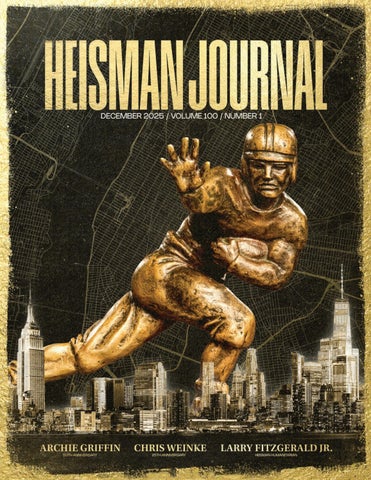
HEISMAN JOURNAL DECEMBER 2025 / VOLUME 100 / NUMBER 1
Heisman Trophy Trust TRUSTEES Michael J. Comerford, Chair James E. Corcoran William J. Dockery Anne F. Donahue N. Richard Kalikow Brian D. Obergfell Carol A. Pisano Daniel W. Reed Marva A. Smalls Sanford Wurmfeld Vasili Krishnamurti Trustee Emeritus Honorable John E. Sprizzo 1934–2008 HEISMAN STAFF Jeffrey Price Incoming Chief Executive Officer Timothy Henning Vice President Brendan Bumgardner Operations and Events Associate
Page 8
Page 16
Hunter Carroll Branding and Partnerships Associate HEISMAN CONSULTANTS Angela Vallott Trust Consultant Paul Goldberg Heisman.com Editor-In-Chief Donna Koppinger, Matthew Powers Event Consultants Bob Garguilo VIP Guest Liaison Brianna Klinger Journal Coordinator Rich O’Sullivan, Neal Surrena Travel Consultants Chris Huston Heisman Podcast 2025 STUDENT INTERNS
CONTENTS 5 7 8 12 16 24 33 38 46 49 52
Heisman Trophy Trust Board of Trustees Message from the Chair 50th Anniversary Honoree 25th Anniversary Honoree 2025 Heisman Humanitarian Heisman Charities Heisman History 2024 Heisman Weekend in Review 2025 Heisman Hopefuls 2025 Heisman Trophy Winner 2025 Heisman Voting Results
Abbey Tubridy, Matthew Walsh HEISMAN WEEKEND SUPPORT STAFF Megan Austin, Ryan Boyle, Christian Boyle, Patrick Comer, Aaron Cruz, Olivia Danosky, Brian Dombrowski, Lori Evon, Anna Fiordilino, Jason Fridge, Jeff Gandolfo, Mark Gandolfo, Taft Gantt, Mike Garcia, Dante Giraldi, Dillon Henning, Kelly Henning, Brittany Judson, Aidan Koppinger, Matthew McGuinness, Max Nager, AJ Pegno, Stephanie Pryor, Kali Reed, Anna Ruth Riggins, Rachel Robins, Robbin Seipold, Eamon Shaffer, Jimmy Slattery, Kimberly Terranella, Aria Torretta, Mike Wieneke, Liam Whalen, Robbie Whalen HEISMAN WEEKEND PHOTOGRAPHERS Aaron Cruz, Catherine Kiernan, Todd Van Emst
HEISMAN OFFICE 111 Broadway, Suite 100 New York, NY 10006 P (212) 425-7000 | F (212) 269-4547 www.Heisman.com The Heisman Journal is published annually, printed by GHP Media. Design and production by Natalie Wedeking and Tim Laun. Cover art designed by Hunter Carroll. Journal Advertising Sales coordinated by Brianna Klinger and Tim Henning Subscription price $50.00 per year
Page 24
Page 12
Legacies Are Built for Forever Celebrating College Football's Finest
axiatime.com © 2025 AXIA Time LLC
The Heisman Trophy Trust’s mission is to grow the legacy and preserve the integrity of the Heisman Memorial Trophy, which is annually awarded to the outstanding college football player in the United States whose performance epitomizes great ability combined with diligence, perseverance, and hard work. Beyond awarding the trophy, the Trust has a charitable mission to support and fund both youth development programs in underserved communities and the Heisman High School Scholarship program which recognizes community-minded scholar athletes. Additionally, the Trust annually presents the Heisman Humanitarian Award to outstanding individuals in the sports world who further the Heisman vision. Our goal is to harness the power of the Heisman Trophy’s legacy of athletic excellence to positively impact our nation’s youth and provide more equitable opportunities for underserved communities.
HEISMAN TROPHY TRUST - BOARD OF TRUSTEES
Michael J. Comerford Chair
James E. Corcoran
William J. Dockery
Anne F. Donahue
N. Richard Kalikow
Vasili Krishnamurti Trustee Emeritus
Brian D. Obergfell
Carol A. Pisano
Daniel W. Reed
Marva A. Smalls
Sanford Wurmfeld
Honorable John E. Sprizzo 1934–2008
HEISMAN TRUST STAFF
Jeffrey Price Incoming Chief Executive Officer
Tim Henning Vice President
Brendan Bumgardner Operations & Events Associate
Hunter Carroll Branding & Partnerships Associate
2025 HEISMAN JOURNAL
5
Welcome to the 2025 Heisman Legends Brunch
For more than nine decades, the Heisman Trophy has represented the pinnacle of college football excellence, honoring athletes whose talent and leadership have forever shaped the game. As we recognize this year’s Heisman Trophy winner, we also pay tribute to the remarkable fraternity of Heisman Winners, each a symbol of determination, inspiration, and lasting legacy. We are especially proud to honor our 2025 Heisman Humanitarian, Larry Fitzgerald Jr. A model of excellence both on and off the field, Fitzgerald enjoyed a legendary football career at University of Pittsburgh and the Arizona Cardinals. Through The Larry Fitzgerald Foundation, founded in 2005, he has championed youth education and breast cancer awareness, providing scholarships, literacy programs, and technology access to underserved communities while leading international service efforts and health initiatives such as the “Breast Believe” campaign. The Heisman Trust also celebrates another successful year of impact. In 2025, our charitable contributions surpassed $2.5 million, bringing total donations to more than $30 million in support of youth development programs nationwide. We expanded our reach in the South through a new partnership with the Community Foundation for Northeast Florida, extending our footprint from New York City, Long Island, Westchester and Newark to Los Angeles, Atlanta and Dallas. Our work continues to promote teamwork, sportsmanship, and academic excellence for young people across the country. We are deeply grateful to our partners: Nissan, ESPN, IMG, Axia Time, Jostens, and Deloitte whose continued support makes this mission possible. This year also marked a leadership transition. Following 32 years of dedicated and exemplary service, Executive Director Rob Whalen retired in July. We extend our heartfelt gratitude to him for his decades of leadership, and unwavering commitment to the Heisman’s mission. We are excited to welcome Jeff Price as our new Chief Executive Officer. A visionary leader known for building transformative partnerships and advancing youth opportunities through sports, Jeff is poised to guide the Trust into its next chapter of growth and innovation. He joins a talented team led by Tim Henning, newly promoted to Vice President, along with Brendan Bumgardner and Hunter Carroll, who continue to strengthen our operations, events, and digital presence. I thank them and the entire Heisman Weekend team who make this annual celebration possible. Finally, I am excited that Trustee Dan Reed will be stepping into my role as Chair of the Heisman Trust. I am very confident that Dan and the new leadership team will very ably guide the growth and impact of the Trust for years to come. My heartfelt thanks to all our Trustees for their steadfast guidance, dedication, and unwavering commitment to our mission. On behalf of the Heisman Trophy Trust, I wish you a joyful holiday season and a healthy, prosperous New Year. Here’s to many more years of celebrating Heisman Legends and uplifting communities nationwide. Enjoy the brunch and the program ahead.
Michael J. Comerford Chair, Heisman Trophy Trust
2025 HEISMAN JOURNAL
7
ARCHIE GRIFFIN HEISMAN 50TH ANNIVERSARY HONOREE
New York City sports pages in the mid 1970s were full of larger-thanlife heroes—Catfish Hunter, Joe Namath, Tom Seaver, Phil Esposito and Walt Frazier. Archie Griffin is a son of Ohio, but became an honorary Big Apple sports icon with December feats as special as any that went down at Madison Square Garden or Flushing Meadows. In a city famous for its premieres, Griffin’s 1974 Heisman Trophy victory was a triumph with big headlines in all the tabloids. Five stars, no notes. A year later, Griffin returned to Gotham for one of the most memorable repeat performances in American sports history, becoming the first—and still only—two-time winner of the Heisman Trophy. It was a sequel worthy of front pages and red carpets. But we’re talking The Ohio State; make it a scarlet carpet. Griffin has returned to New York many times in the ensuing decades, including last year when the Heisman Fraternity celebrated the 50th anniversary of his 1974 Heisman. He’s back in Times Square, making history again, the first Heisman winner to celebrate two 50-year anniversaries. Archie Griffin was born in the shadow of Ohio Stadium on August 21, 1954, about a mile away—or some 1,700 yards—from the Buckeyes’ 50-yard line. That’s about as many yards as Griffin ran en route to his first Heisman, a standard he set out to match in 1975. One of eight children with six brothers and a sister, Griffin came from a big a family with West Virginia roots which moved to Columbus not long before Archie was born. His parents both worked multiple jobs to support the large household, setting a work ethic for the family that all the children followed. Griffin was born between three older brothers and three younger ones—all of whom starred in football at various levels—and also had a baby sister who also became an athlete. All eight Griffin children became college graduates. Griffin attended Eastmoor High and helped the Warriors to a pair of Columbus City League championships. Recruited heavily across the country, Archie strongly considered a scholarship offer from Northwestern, but his parents were already putting heavy miles on the family car to watch his older brothers play in Louisville, Muskingum and Akron. Perhaps a bit of a guilty conscious about his parents’ gasoline bill—coupled with a heavy dose of the hard sell from Ohio State’s legendary coach Woody Hayes—turned him into a Buckeye. The NCAA began permitting true freshmen to participate in 1972, allowing Griffin to play immediately. He instantly proved he was ready for the collegiate game, breaking Ohio State’s single game rushing
record with 239 yards against North Carolina in his second career outing. That was a big chunk of his 867 yards gained as a freshman, as he helped the Buckeyes to the first of four straight Big Ten titles and Rose Bowl appearances. In 1973, Griffin became the first Buckeye sophomore to rush for over 1,000 yards, gaining 1,577 yards while earning AllAmerican first team honors, finishing fifth in the Heisman voting. Ohio State, ranked first most of the season, pounded USC in the Rose Bowl and finished 10-0-1. But a 10-10 tie to Michigan in the earlier Big Ten finale cost them a national title. Then came 1974. Not to state the obvious—or maybe to accentuate the obvious—but you can’t become the only Heisman winner to win the trophy twice without breaking through the first time. And Griffin didn’t just break through, he shattered all expectations. He finished the 1974 regular season with 1,620 yards and 12 touchdowns on 236 carries, averaging 6.86 per rush while leading Ohio State to its third straight Rose Bowl. He became the Heisman’s 40th winner and Ohio State’s fourth recipient in a runaway, finishing with 1,920 points (including 483 first-place votes), more than twice that of USC’s second-place Anthony Davis (819). Archie Griffin was the fifth junior to win the award and the first since Navy quarterback Roger Staubach 11 years earlier. Staubach went on to an admirable stint in the Navy ahead of an NFL Hall of Fame career, but his 1964 follow-up season to his Heisman win was modest and he did not finish in the top 8 of voting. Among the previous four juniors to win the award, Doak Walker came the closest to winning again, albeit a distant third. Griffin’s foundation for a repeat run was robust, returning to a loaded Buckeye team that saw half of its starting lineup boasting All-Big Ten first team honors. However, Archie had a target on his back—and his torso, and his legs and toes and anywhere else an opposing tackler might try to grab to stop the returning Heisman winner from gaining another yard. In a 1975 New York Times article, Griffin detailed the challenges of playing his senior season while carrying around the weight of the trophy, saying: “Being tagged the Heisman winner, naturally guys on other teams were after me more this year. They all tackled me clean but hard. They might say a few things like. ‘Get up Heisman Trophy winner.’” But get up he did, hundreds of times, en route to history. Griffin entered 1975 with a streak of 21 straight regular-season games with at least 100 yards rushing and began his quest for history with the season-opener at Michigan State. The Buckeyes disposed of the
by Paul Goldberg
8
2025 HEISMAN JOURNAL
50th
The People. The Tradition. The Excellence.
The Ohio State University salutes Archie Griffin on the 50th Anniversary of his second Heisman Trophy and celebrates all the finalists for the 2025 award.
underdog Spartans, 21-0, avenging an upset loss the previous season. Griffin gained 111 yards on 29 carries. A week later, Ohio State hosted No. 10 Penn State in the first meeting between OSU’s Hayes and Penn State’s Joe Paterno. Griffin led the Buckeyes’ to a 17-9 win, gaining 128 yards on 24 carries to go with one 23-yard reception. Griffin and OSU stayed home the next week, hosting North Carolina and treating the Tar Heels to a 32-7 thrashing. The Tar Heels— already the Griffin’s 1972 record-breaking footnote—still couldn’t stop him three years later. Griffin ran for 157 yards on 22 carries, his second-highest rushing total of the season. The effort also helped him break Ohio State’s career total offense record on the same day as the Buckeyes recorded their 500th win in program history. All of that on a day in which his mighty fullback Pete Johnson rushed for a schoolrecord five touchdowns. Ohio State headed to Los Angeles a week later on October 4, taking on UCLA at the L.A. Memorial Coliseum, which it then shared with USC. Archie went California dreaming against the No. 5 Bruins, posting a season-best 160 yards on 21 carries while reaching the end zone for the first time of the season. He also posted a season-best 204 all-purpose yards. The Buckeyes coasted for the rest of the month. On October 11, Griffin ran for 120 yards on 21 carries as newly No. 1 Ohio State shut out Iowa, 49-0. Not much but the opponent changed a week later as the Buckeyes romped over Wisconsin, 56-0, Griffin gaining another 107 yards on 15 carries while scoring his second TD of the season. Purdue ended OSU’s shutout streak, but not much more, as the Boilermakers fell to the Buckeyes, 35-6 on October 25. Griffin gained another 130 yards, including 94 in the second half, on 20 carries, breaking the NCAA rushing record that day on a 23-yard fourth-quarter carry, his last of the day. The Lee Corso-led Hoosiers provided top-ranked Ohio State its first test since September in a November 1 game in Columbus. The Buckeyes eked out a 24-14 win and survived a second-half Hoosier rally while Griffin finished with 150 yards on 28 carries. The Buckeyes cruised to a drama-free win the next week with a 40-3 triumph at Illinois, Griffin rushing for 127 yards for his 30th straight 100-yard game in the regular season. He also broke 5,000 career rushing yards in regular-season action, an NCAA first. Griffin gained another 124 yards and scored once in Ohio State’s 38-6 win over Minnesota the following week in his final game at Ohio Stadium. The victory clinched either a fourth straight trip to the Rose Bowl or a trip to the Orange Bowl as a consolation prize, depending on how the game against Michigan played out a week later. Spoiler alert, it came out smelling like roses for Ohio State, although it didn’t start out that way. A record crowd of 105,543 at the Big House
GRIFFIN
50th
was in attendance to watch the No. 8 Wolverines try to upset Archie and the Buckeyes on November 22. Michigan took a 14-7 lead after three quarters, but Ohio State rallied with two fourth-quarter scores for a 21-14 win to lock up another trip to Pasadena. Griffin’s record streak of 31 straight regular-season 100-yard rushing efforts came to a halt with just 46 yards on 19 carries. But as Hayes aptly put it after the game, “If you know Arch, he’ll trade all his records for a victory, like this one.” Two weeks later, the voting was in and Griffin was a decisive winner of his second consecutive Heisman Trophy, garnering 454 firstplace votes en route to 1800 total points. California running back Chuck Muncie was second (730) while USC tailback Ricky Bell was third (708). Pittsburgh junior running back Tony Dorsett was fourth, a year away from making his own Heisman history. Griffin’s final regular-season totals of 1,357 yards and four touchdowns were more modest than his junior season efforts. But considering he was the focus of every opponent’s defensive game-plan—which helped propel Johnson, his fullback, to his own record-breaking season—Griffin’s efforts in Ohio State’s unbeaten regular season were remarkable. Excluding bowl games, Griffin rushed for a then-NCAA-record 5,177 yards on 845 carries. Including the four Rose Bowls, he rushed for 5,589 yards and 26 scores. That included his final game as a Buckeye, when No. 1 Ohio State fell in the Rose Bowl to revenge-minded No. 5 UCLA, 23-10. Griffin, who again earned All-American first-team honors, graduated a quarter early from Ohio State with a degree in industrial relations, received the NCAA’s prestigious Top Five Award for combined excellence in athletics, academics and leadership. It is the highest award the NCAA can bestow. In addition to repeating as the Heisman winner, he received his second straight Walter Camp and UPI Player of the Year honors and also won the 1975 Maxwell and The Sporting News Man of the Year awards. Griffin became a first-round pick of Cincinnati in 1976, kicking off a seven-year career with the Bengals, which included reaching the 1981 Super Bowl. He joined the staff at Ohio State following his pro career and worked in the Athletic Department for two decades; he was also president of the Ohio State University alumni association for 11 years. Griffin was inducted into the College Football Hall of Fame in 1986 and into the Rose Bowl Hall of Fame in 1990. He saw his No. 45 officially retired by Ohio State in 1999 on the quarter-century anniversary of his first Heisman. Congratulations to Archie Griffin, the Heisman Trophy’s first backto-back 50th Anniversary winner. We’ll have to wait at least 51 years before we get a chance to say that again!
2025 HEISMAN JOURNAL
11
25th
CHRIS WEINKE HEISMAN 25TH ANNIVERSARY HONOREE
There’s a universe out there where Florida State’s first two Heisman winners, Charlie Ward and Chris Weinke, were Seminole teammates and perhaps won the Heisman Trophy in back-to-back years. Ward was a Seminole freshman in 1989 and Weinke signed his National of Letter of Intent to attend Florida State in February of 1990. But just as Ward was a gifted multi-sport star, so was Weinke, and a shot at baseball postponed Weinke’s Seminole career and prevented the two QBs from sharing more than just a few days on campus. Ward went on to win the 1993 Heisman. Weinke, following a six-year career in the Toronto Blue Jays minor league system, followed Ward to Tallahassee. Like Ward, he led the Seminoles to a national title and brought a Heisman Trophy to Florida State, which we are celebrating this year on the 25th Heisman anniversary of the award. Chris Weinke was a prodigy at baseball and football as a youth. But he also grew up in Minnesota where, rumor has it, all kids are assigned a pair of hockey skates at birth. Forget two sports, Weinke was a threesport star whose slap shot was as good as his pocket presence and ability to drill a fastball. He attended Cretin-Derham Hall High and thrived as a student-athlete. He was the captain of the Raiders’ hockey team and, as a junior, scored the winning goal that sent the school to its first state tournament. Also as a junior, Weinke led the Raiders’ football team to the state championship game. He became a Parade All-American firstteamer and the Minnesota Prep Player of the Year as a senior and was the top-ranked quarterback in the country, passing for 3,956 yards and 24 touchdowns. Meanwhile, he was holding down first base for the Raiders’ baseball team and led Cretin-Derham to a pair of Class AA championships, earning Rawlings All-American first-team honors twice. Weinke had 70 scholarship offers to play quarterback, including one from Florida State, which was in the midst of an incredible run in which it did not lose more than twice in a season between 1987 and 2000. The 1990 signing period opened on Valentine’s Day and Weinke made it official—he would become a Seminole. But fate threw him a curveball, or was it a four-seamed fastball or maybe a slider? Come June, the Toronto Blue Jays—three years shy of winning back-to-back World Series titles— selected Weinke in the second round of the Major League Baseball draft, picking him 62nd overall. He was taken 42 picks after future Hall of Famer Mike Mussina, three rounds ahead of current Yankee manager Bret Boone, and some 20 rounds ahead of future Yankee battery mates Andy Pettitte and Jorge Posada. He was also in good company among the prep football stars who signed in his class, which included Jerome Bettis, Aaron Taylor, Drew Bledsoe, Willie McGinest and one future Hurricane and movie star, Dwayne Johnson.
Weinke was living the first chapter of a real-life Choose-Your-OwnAdventure book and the 18-year-old suddenly was eyeing to very different paths. But how do you negotiate these two amazing choices? He spent most of the summer planning to play football, declining Toronto’s repeated contract offers. The Seminoles opened camp in August and Weinke was there, fully intending to begin classes in days. But Toronto made a last-ditch run at Weinke and increased its signing bonus offer to $375,000, then the fourth-largest sum of all-time; it was a deal Weinke could not refuse. FSU Coach Bobby Bowden replied with a generous proposal of his own—more of an open-ended promise that Weinke would always have a football scholarship waiting for him in Tallahassee. Chris put that in his back pocket and became a professional baseball player. It took some six years, but Weinke eventually cashed in Bowden’s offer. Weinke played six seasons in the Toronto Blue Jays farm system, collecting 620 hits, 69 home runs, 402 RBI and a posting a career average of .248. His journey started in Ontario with the St. Catharines Blue Jays in A Ball in 1991, followed by an A season in Myrtle Beach (1992), and a 1993 season with the Advanced A Dunedin (Fla.) Blue Jays where he posted a career-best .284 average. He played for the Double-A Knoxville Smokies in 1994 followed by most of two seasons with the Triple-A Syracuse Chiefs (1995–96), and a couple final months back in Knoxville to finish the 1996 season. Future Hall of Famer Fred McGriff played first base for Toronto when Weinke was drafted and John Olerud held it down every year Weinke was in the minors, including in the Jays’ two World Series seasons. There just wasn’t much of an opportunity for a major league call-up. But there was still time for a call, up to Tallahassee, where Weinke reached Bowden to ask if his offer was still good. Bowden honored his word and Weinke enrolled in time for the 1996 fall semester and became part of the Seminoles 1997 signing class. Weinke, a 25-year-old freshman, shed his rust as a backup QB behind Thad Busby in 1997, appearing briefly in mop-up roles. He earned the starting job as a 1998 sophomore after expected starter Dan Kendra suffered a season-ending knee injury in the spring. Having waited the better part of a decade to play QB, Weinke took full advantage of the opportunity. He passed for 2,017 yards and 17 touchdowns, leading Florida State to a 9-1 start and a No. 2 national ranking before a neck injury ended his year just short of bowl season. Chris came back healthy for his 1999 junior season and cemented himself as one of the best quarterbacks in the nation, leading the Seminoles to a 12-0 record and a win over Virginia Tech in the BCS championship game. He passed for 3,103 yards and 25 scores, helping
by Paul Goldberg
2025 HEISMAN JOURNAL
13
FSU win its first national title since Ward. Weinke did not crack the top 10 of the 1999 Heisman balloting, but was a clear contender as a 2000 senior, along with two returning quarterbacks who finished in the top 4,—Virginia Tech’s Michael Vick and Purdue’s Drew Brees. Florida State kicked off its title defense ranked second and traveled east to play BYU in the Pigskin Classic in Jacksonville, defeating the Cougars, 29-3. Chris completed 32-of-50 passes for 318 yards and two TDs as he eased into his pursuit of the Heisman. After a week off, the Seminoles traveled to No. 17 Georgia Tech and Weinke led FSU to a come-from-behind 26-21 win over the Yellow Jackets. He threw for a career-best 443 yards on just 25 completions, tossing another two scores. He also passed Danny Kannell to become Florida State’s all-time leading passer. The Seminoles blew out North Carolina, 63-14, the following week in FSU’s home opener, Weinke throwing four TD passes to go along with 262 yards passing, leaving the game well before its end. Florida State kept the pedal down the following two weeks, beating Louisville 31-0 and Maryland, 59-7, on a Thursday night. Weinke continued to guide a dominant offense, although he was forced out of the game against the Terrapins in the third quarter with an ankle injury. Though it was a sprain, it was still a bad break for Weinke and the newly No. 1-ranked Seminoles, who were set to face rival Miami the following Saturday. He spent much of game week in a boot, but played in what
turned out to be a game for the ages. The No. 2 Hurricanes dominated the first half, taking a 17-0 lead into the locker room. Weinke rallied the Seminoles in the second half, throwing three TD passes, the last giving FSU a 24-20 lead with 1:37 left to play. The Ken Dorsey-led Hurricanes regained the lead with a touchdown with 46 seconds left. Weinke somehow drove the Seminoles close enough for a game-tying field goal attempt, but it sailed wide right. Chris finished with a career-high 496 yards on a career-high 58 attempts, playing with a heavily wrapped left ankle. But he was not perfect and two red-zone interceptions were a pair of throws he surely wanted back. Chris did not let his left ankle or anything else get in his or the Seminoles’ way the rest of the regular season, including the following week when No. 7 FSU throttled winless Duke, 63-14. Weinke re-set his school record with 536 passing yards, going 37-of-47, with five touchdowns. He passed for 446 yards by halftime. Florida State followed with another blowout at North Carolina State on October 28, Weinke letting the Seminoles ground game do most of the damage while contributing 185 passing yards and his nation-leading 23rd TD pass.
14
2025 HEISMAN JOURNAL
WEINKE
25th
No. 4 FSU opened November by hosting No. 16 Clemson and Bowden again turned Weinke’s arm loose, the senior throwing for 521 yards and two scores in a 54-7 win as the Seminoles clinched their ninth straight ACC title. Weinke broke the school record for passing yards in a season in the win, reaching 3,490. He threw for 324 yards and five touchdowns the following week in a 35-6 win at Wake Forest. The win moved FSU to 10-1 as it vied for a top 2 spot in the BCS rankings. FSU and Weinke had their final opportunity to make a statement regarding its respective BCS and Heisman hopes with the regular-season finale against No. 4 Florida on November 18. Chris fought off the flu and the Gators defense to throw for 353 yards and three touchdowns in a lopsided 30-7 victory. He became the ACC’s career passing leader in the win, reaching 9,789 career yards. The performance was enough to move FSU into the No. 2 spot in the BCS rankings while Weinke’s efforts strengthened his Heisman resume. Two weeks later, the ballots were in and Chris Weinke, at 28 years old, became the Heisman’s oldest winner. He finished with 1,628 points, while Oklahoma quarterback Josh Huepel was second with 1,552 in one of the closest races in the trophy’s history. Chris was named first on 369 of 922 ballots, closing the season with 4,167 passing yards and 33 touchdowns, and capturing the Seminoles second Heisman. He also won the Davey O’Brien and Johnny Unitas Awards as the nation’s top
signal caller. Weinke threw for another 274 yards in his career finale, but Huepel and unbeaten Oklahoma were too much for the Seminoles as the Sooners won the BCS title game, 13-2. The following April, Chris became the oldest player ever selected in the NFL Draft, taken in the fourth round by the Carolina Panthers. Weinke started for the Panthers as a 2001 rookie and passed for 2,931 yards and 11 TDs and ran for six more scores. He spent the next three seasons in Carolina as a back-up and closed his NFL career in 2007 with San Francisco. Weinke is currently the assistant head coach, co-offensive coordinator and quarterbacks coach at Georgia Tech and has been instrumental in the development of current Yellow Jackets QB Haynes King, a leading 2025 Heisman candidate. Weinke is in his fourth year at Georgia Tech, which followed three seasons as an assistant at Tennessee, a season at Alabama as well as two seasons as the QB coach for the St. Louis/L.A. Rams. He began his coaching career with five seasons as IMG Football Academy, including two as its head coach. Congratulations to Chris Weinke our Heisman Trophy 25th Anniversary winner!
FLORIDA STATE UNIVERSITY Celebrates The 25th Anniversary OF CHRIS WEINKE’S HEISMAN TROPHY SEASON
2024 HEISMAN JOURNAL
15
16
2025 HEISMAN JOURNAL
2025 Heisman Humanitarian
Larry Fitzgerald Jr. Larry Fitzgerald Jr. has built a decorated career as one of the most dominant wide receivers in football history, but it may be his work through the Larry Fitzgerald Foundation that will have had the greatest impact to communities around the country and world. Through his efforts, Fitzgerald Jr. and his foundation have worked to provide equitable access and new pathways for success for underrepresented communities both nationally and internationally. In recognition of his unwavering commitment to service and improving the lives of others, Larry Fitzgerald, Jr. has been named the 2025 Heisman Humanitarian Award recipient. During his college career at the University of Pittsburgh, he was the runner-up in the 2003 Heisman Trophy race with 161 receptions for 2,677 yards and a school record 34 touchdowns. Following his successful collegiate career, he was selected third overall by the Arizona Cardinals in the 2004 NFL Draft, beginning an exceptional professional career that extended for 17 seasons. Fitzgerald Jr. ranks second in NFL history in receiving yards (17,492) and receptions (1,432), earning 11 Pro Bowl selections before being named to the NFL 100 All-Time Team. He was subsequently honored with the Art Rooney Sportsmanship Award in 2015 and the Walter Payton NFL Man of the Year Award in 2016, recognizing his commitment to service and his many philanthropic contributions. For his philanthropic efforts, Fitzgerald Jr. received the NFL Players Association Georgetown Lombardi Award in 2013. This award recognizes a leader in the sports industry whose life and family have been affected by cancer, and who promotes cancer research, prevention, and treatment through advocacy and philanthropy. Throughout his career, Larry made significant contributions to various organizations every October, with the donations tied to his receptions and touchdowns for that month. He emerged as a leading advocate for the NFL’s October Breast Cancer Awareness initiatives, becoming one of the league’s most prominent voices in its annual efforts. After losing his mother, Carol, to breast cancer in 2003, Larry Fitzgerald Jr. made it his mission to continue her legacy. In 2005, he established The Larry Fitzgerald Foundation in her honor, creating educational opportunities for underrepresented communities worldLarry’s mother, Carol wide. The Larry Fitzgerald Foundation
strives to support youth education while also raising awareness for breast cancer. Highlighting the importance of education, The Larry Fitzgerald Foundation advocates for organizations and nonprofits that focus on reading comprehension, after-school programs, scholarships, technology access, sports camps, and helping to empower underserved students. The foundation emphasizes this commitment through grants awarded in the range of $1,000 to $5,000, ensuring that all organizations have an opportunity to access and effectively utilize funding to further serve their communities. Through the Foundation, Fitzgerald Jr. has also led international service trips to Africa to build classrooms and strengthen educational infrastructure in rural communities. In just the past five years, the Foundation has awarded $2.3 million to organizations worldwide that align with its mission. Fitzgerald Jr. continues to stay personally involved to ensure the foundation’s efforts create a lasting impact in the communities it serves. In addition to supporting youth education, The Larry Fitzgerald Foundation is an advocate for breast cancer awareness. In remembrance of his late mother, the Foundation’s Carol Fitzgerald Memorial Fund supports what Larry Fitzgerald Jr.’s mother held close to her heart—educating urban youth on and providing support for families affected by breast cancer. This fund provides grants to hospitals, research teams, organizations, and family support centers that prioritize breast cancer awareness. In the fall of 2022, The Larry Fitzgerald Foundation began leading a campaign called “Breast Believe.” This campaign strives to educate communities about diagnosis, preventive measures, symptoms, treatment options, support resources, and accessibility of care related to breast cancer. With the passing of his mother, Larry worked intentionally to provide for men, women, and families who are impacted by breast cancer. Breast Believe is dedicated to equipping organizations and nonprofits with essential resources, particularly in underserved communities. The Heisman Trophy Trust is honored to present Larry Fitzgerald Jr. with the 2025 Heisman Humanitarian Award, recognizing his outstanding contributions to supporting youth education and breast cancer awareness. His influence extends far beyond the game itself, marked by a commitment to service that inspires, empowers, and uplifts communities around the globe—truly embodying the spirit of the Heisman Humanitarian Award.
by Abbey Tubridy & Matthew Walsh
2025 HEISMAN JOURNAL
17
The Heisman Humanitarian Award was established in 2006 to honor outstanding professionals in the sporting world who make tremendous contributions to their communities and uphold the values and principles of the Heisman Trophy Trust.
2024 MISTY COPELAND
Misty Copeland was the first African American female principal dancer at American Ballet Theatre. Her passions also lie in giving back: mentoring young people from underserved backgrounds and working with various charitable organizations to promote social justice and inclusion in the arts. In 2014, President Obama appointed Copeland to the President’s Council on Fitness, Sports, and Nutrition. In 2021, she created the Misty Copeland Foundation to pursue social justice initiatives through the arts, advance diversity, equity, and inclusion in ballet, and provide opportunities for children in under-resourced communities to learn through dance. In 2022, the Foundation launched the BE BOLD (Ballet Explorations, Ballet Offers Leadership Development) program to further its mission. This comprehensive after school program for children ages 6–12, empowers disadvantaged youth to experience the joy of dance and the fundamentals of ballet, focusing on movement, technique, vocabulary, and etiquette while emphasizing social and emotional skill development. The majority of instructors reported increased self-awareness, emotional understanding, engagement with ballet terminology, body expressiveness, and enhanced social and emotional skills such as decision-making and teamwork. Misty Copeland was named one of TIME’s 100 most influential people, received the Dance Magazine Award, the 2018 Arthur Ashe Courage Award at the ESPY Awards, the Princess Grace Award, and an NAACP Image Award. www.mistycopelandfoundation.org
2023 SOLOMON THOMAS
Dallas Cowboys defensive lineman Solomon Thomas founded The Defensive Line (TDL) with his parents, Chris and Martha, in honor of his older sister Ella who passed by suicide. TDL focuses on promoting communication and connection around suicide prevention through a variety of means: educating adults about youth suicide, increasing language and conversation skills, creating safe spaces for honest and vulnerable conversations, and improving systemic approaches within schools. TDL offers training and support to schools and other organizations in their efforts to prevent suicide and support mental health, teaching adults about the urgency of the national suicide crisis, warning signs and risk factors, and how to apply that knowledge in their everyday interactions with young people. TDL also bridges the gap between existing mental health resources and individuals in crisis, helping adults become better equipped to have difficult conversations and connect to resources. Data from TDL’s suicide prevention workshops show significant increases in teachers’ comfort levels, participants’ willingness to have mental health conversations and preparedness for suicide intervention. By focusing on adults in schools and other settings, TDL aims to build connections between young people and the adults who serve them, ultimately seeking to end the epidemic of youth suicide and create a safer, more supportive environment for young people of color. www.thedefensiveline.org
2025 HEISMAN JOURNAL
19
2022 MIKE KRZYZEWSKI
Mike Krzyzewski, better known as Coach K, has been an icon of college basketball for over forty years. As head coach of Duke, he was the winningest coach in NCAA Division I history. He also coached the US men’s national basketball team in the 2008, 2012, and 2016 Olympics, winning gold in each. He is a member of the Naismith Memorial Basketball, College Basketball, United States Olympic, and FIBA Halls of Fame. In 2006, Coach K founded the Emily K Center in Durham, NC, naming it after his mother. Initially the Center had only one program, Pioneer Scholars, serving 38 students. The Center grew its enrollment-based programs, adding the high school-focused Scholars to College program in 2008 and a college-focused Scholars on Campus program in 2012. By 2015, the Center was serving more than 200 students annually. Today, the Center is proud to serve more than 2,000 Durham students annually. In addition to academic programs, the Center also works with approximately 50 facility partners each year who utilize the Center as a space for their own important programming and events. Founder Coach K has also been involved with many other charitable groups including the Duke Children’s Hospital, the V Foundation for Cancer Research, the Children’s Miracle Network, and the American Cancer Society’s Coaches vs. Cancer initiative. www.emilyk.org
2021 CURTIS GRANDERSON
MLB star Curtis Granderson continues to be an ambassador for the sport in his retirement. He serves as President of the Players Alliance, a player-led organization that aims to create an inclusive culture within baseball. He received the 2016 Roberto Clemente Award, presented to a player who best represents baseball through extraordinary character, community involvement, philanthropy and positive contributions, both on and off the field. Curtis is also a supporter of the Jackie Robinson Foundation, one of the nation’s premier scholarship and leadership development programs for minority college students. And he made a $5 million donation to the MLB academy in Chicago—the single biggest donation ever made by a Major League player. Curtis created the Grand Kids Foundation in 2007 to foster positive youth development through education, physical fitness and nutrition. Grand Kids has helped over two million kids live more active lives. In 2013, Granderson expanded the reach of his foundation to address food insecurity in the communities they were serving. Grand Giving, a monthlong program, hosted each November, raises funds and awareness surrounding the food insecurity that prevents many children from reaching their true potential. Grand Giving has provided millions of meals to children and families in need. www.grandgiving.org
2019 KRISTI YAMAGUCHI
Kristi Yamaguchi is known for her hard work and dedication throughout her figure skating career. In 1986, she won her first U.S. Championship title with doubles partner Rudy Galindo, another World Juniors Championship two years later, and back-to-back seniors titles in 1989 and 1990. Yamaguchi then focused on singles skating and won the World Championship in 1991 and 1992 and a gold medal in the 1992 Winter Olympics. She was inducted into the U.S. Figure Skating Hall of Fame in 1998, the World Figure Skating Hall of Fame in 1999, and the U.S. Olympic Hall of Fame in 2005. In 1996, Kristi founded Always Dream to support underprivileged and disabled children through summer camps, after-school programs and financial support for back-to-school supplies. As a mother and a children’s book author herself, Yamaguchi understands the crucial role that books play in children’s literacy development, so she shifted the focus of Always Dream to improving early childhood literacy. Always Dream provides high-quality books, digital tablets and a book coach to support parent engagement and foster children’s love for reading. In the 2024–25 school year, Always Dream partnered with 36 schools across Northern California and Hawaiʻi, reaching more than 4,700 children and caregivers. www.alwaysdream.org
2018 MARK TEIXEIRA
Mark Teixeira played 14 seasons with Major League Baseball for the Rangers, Braves, Angels, and Yankees. He was a three-time All-Star and a 2009 World Series Champion. He finished his career with 409 home runs and finished second in the 2009 MVP race. Teixeira has long been serious about giving back to the communities in which he has lived and played. After signing his first MLB contract, he endowed a scholarship at his high school in honor of a friend who had been killed in a car accident, and set up a charitable fund supporting six scholarships at Dallas-Fort Worth area high schools. He serves on the board of The Emerald Corridor Foundation, which works to restore safe green spaces and waterways in Northwest Atlanta and strengthen the community via education, job training, and employment opportunities. Since his days with the Yankees, Teixeira has been a supporter of DREAM, an organization that uses the power of teams to inspire inner-city youth to recognize their potential and realize their dreams through its school, afterschool, and summer programs. DREAM has also been supported by the Heisman Trophy Trust. In 2020, Teixeira partnered with Depend and the Prostate Cancer Foundation for the Stand Strong for Men’s Health campaign, helping to destigmatize male incontinence and raise awareness and money for prostate cancer research. www.wearedream.org 20
2025 HEISMAN JOURNAL
2017 ERNIE ELS
Ernie Els is one of the most accomplished golfers in the world, with 72 career victories, including four major championships. He is also a seven-time winner of the World Match Play Championship, and was elected to the World Golf Hall of Fame in 2010. Inspired by their son’s 2009 autism diagnosis, Ernie Els and his wife, Liezl created the Els for Autism Foundation which offers innovative, evidence-based programs for families and individuals across the life-span, in six focus areas: Education, Research, Global Support, Recreation Services, Adult Services and Therapy Services. The Els for Autism Foundation serves families around the world, and also offers in-person programs and services at The Els Center of Excellence in Jupiter, Florida. “When my wife Liezl and I started the Foundation back in 2009, our son Ben had just been diagnosed with autism spectrum disorder,” Els explains. “From the beginning, our goal has been to create The Center of Excellence as an example of what can be available to individuals on the spectrum. The Center has all the essential components on one campus, which makes it easier for families. It’s a game changer for the local and international autism community.” www.elsforautism.org
2016 ALAN PAGE
Alan Page was a star defensive lineman for Notre Dame when they won the 1966 national title. He led the Minnesota Vikings to four Super Bowls, and was the first defensive player to win the NFL’s MVP award. While playing for the Vikings Page earned his law degree and, after his retirement from football, he joined the state attorney general’s office before becoming the Assistant Attorney General. In 1992 he was elected an associate justice of the Minnesota Supreme Court—the first African-American to hold a statewide elected office in Minnesota. He was re-elected three times before retiring in 2015. In 2018, Justice Page received the Presidential Medal of Freedom. In 2019 he was chosen as a member of the NFL’s 100th Anniversary All-Time Team. The Page Education Foundation was founded in 1988 by Alan and his wife Diane to financially support college students’ academic goals while fostering positive mentor relationships and encouraging role models for children. In return for their scholarship, recipients provide fifty hours of volunteer mentoring and tutoring to children in grades K–8. Since its inception, the Foundation has awarded over $17 million in grants to more than 8,500 Page Scholars who have volunteered 550,000 hours, working with 55,000 children across Minnesota. Diane Page passed away in 2018; to recognize her critical role in starting and growing the Foundation, it has been formally renamed The Page Education Foundation Founded by Diane and Alan Page. www.page-ed.org
2015 BOOMER ESIASON
Former NFL quarterback Boomer Esiason is the most visible national figure in the fight against cystic fibrosis, a life-threatening genetic disease that affects the lungs and digestive systems of 30,000 children and adults in the United States. Throughout his career in professional sports and the media, Esiason has been a committed and active participant in many charitable causes, but he began focusing on cystic fibrosis in 1993 when his son, Gunnar, was diagnosed with the disease. In 1994, Esiason launched the Boomer Esiason Foundation, a dynamic partnership of leaders in the medical and business communities joining with a committed core of volunteers to heighten awareness, education and quality of life for those affected by cystic fibrosis, while providing financial support to research aimed at finding a cure. The Boomer Esiason Foundation has raised millions to support research toward a cure for CF, as well as programs directly benefiting the CF community. The Foundation has touched many lives by providing hospital grants, transplant grants, scholarships, education, and awareness of CF. Because of their and others’ tireless commitment, the median age of CF patients has risen to nearly forty years old. www.esiason.org
2014 JOE TORRE
Joe Torre has become one of the most recognizable faces of baseball over the course of more than a half-century in the game. Despite a successful fifteen-year playing career that included several All-Star selections and the 1971 MVP, Torre is best remembered as one of the most successful managers of all-time. Torre won four World Series rings in five years with the New York Yankees in the late 1990s, and the team reached the playoffs in each of his twelve seasons in the Bronx. In 2002, Torre and his wife Ali founded the Safe at Home Foundation, dedicated to ending the cycle of domestic violence. Inspired by Torre’s own childhood spent living in an abusive home, Safe at Home has launched national awareness campaigns and established in-school initiatives—called Margaret’s Place, in honor of Torre’s mother—that provide children with a safe space and a professional counselor trained in domestic violence intervention. Safe At Home has 30 Margaret’s Place program sites serving K-12 students across the country. Since their inception Safe at Home has directly served over 275,000 young people, their families, schools, and communities. www.joetorre.org
2025 HEISMAN JOURNAL
21
2013 DAVID ROBINSON
David Robinson’s charitable efforts are just as admirable as his achievements on the court. Beginning at the Gates Elementary School in San Antonio in 1991, he offered a $2,000 scholarship to every fifth grader who finished high school and attended college. He kept his pledge, and in 1998, even quadrupled his donation, awarding $8,000 to each student who received a diploma. Soon after his initial commitment to the Gates Elementary students, David and his wife Valerie founded the David Robinson Foundation. In 2000, the foundation raised $9 million to create the Carver Academy, an independent pre-K through eighth grade school for the underserved population of East San Antonio. Robinson received the Patriot Award, the highest award given by the Congressional Medal of Honor Society, which in 2000, was presented to professional athletes to recognize the important role that sport plays in military morale. Robinson also encourages other celebrities to utilize their respective platforms for the greater good. He cofounded the Admiral Capital Group in 2007, and in 2008 he created The Admiral Center, which helps celebrities find the right cause to support, using their influence to bring attention and action. In 2012, the Robinsons partnered with IDEA charter schools to include Carver Academy in the IDEA charter network. www.admiralcapitalgroup.com
2012 JEFF GORDON
Jeff Gordon is a four-time NASCAR Cup Series champion and one of the world’s most recognizable drivers. He began racing at the age of five and had won 35 main events by age six. With 86 career wins, he ranks third on the all-time wins list. Inspired by his crew chief’s son’s battle with leukemia, Jeff established the Jeff Gordon Children’s Foundation in 1999, to aid in the fight against pediatric cancer. In 2007 he founded the Jeff Gordon Children’s Hospital in Concord, NC, serving children in the community with a high level of primary and specialty pediatric care, regardless of their ability to pay. What started as a small project driven by one special child has grown into an organization that has raised many millions of dollars for children’s health organizations. In 2011, Jeff Gordon Children’s Foundation extended its efforts, bringing pediatric cancer care to Rwanda, Africa. With the Foundation’s support, organizations are able to improve patients’ quality of life, provide essential treatments, and conduct medical research. The Jeff Gordon Children’s Foundation has contributed over $16 million to support children battling cancer. www.jeffgordonchildrensfoundation.org
2011 MARTY LYONS
Marty Lyons was selected by the New York Jets in the first round of the 1979 NFL draft, following a successful career as an All-American defensive tackle at the University of Alabama, where he helped lead the team to a National Championship in 1978. Lyons played eleven memorable seasons with the Jets as a member of the famed “New York Sack Exchange,” one of the top defensive lines in NFL history. While still active as a player, he established The Marty Lyons Foundation to fulfill the special wishes of children diagnosed with a terminal or life-threatening illness. Since 1982, The Marty Lyons Foundation has brought much-needed joy to children and families nationwide, with 11 chapters granting wishes in 14 states. To date they have granted more than 8,700 wishes and raised over $44 million. www.martylyonsfoundation.org
2010 WARRICK DUNN
Warrick Dunn was drafted by the Tampa Bay Buccaneers 12th overall in the 1997 NFL draft. He was named AP NFL Offensive Rookie of the Year in 1997 and earned three Pro Bowl selections in his career. He played for the Atlanta Falcons 2002–2007 between stints in Tampa Bay. After his NFL career, Dunn took a stake in the Falcons’ ownership group led by Arthur Blank and is a minority owner of the team. Warrick founded Homes for the Holidays (HFTH) in 1997 to honor his late mother’s dream of homeownership. The program partners with local community organizations to reduce the burden on new, single parent homeowners by fully furnishing their new house, providing down payment assistance checks, and stocking the pantry with food. Today, Warrick Dunn Charities has expanded from HFTH into four additional programs: Betty’s Hope, Count on Your Future, SCULPT, and Hearts for Community Service Scholarships. Together, the programs are dedicated to strengthening and transforming communities by combating poverty, hunger, and improving the quality of lives for families academically, socially, and economically. www.wdc.org
22
2025 HEISMAN JOURNAL
2009 MIA HAMM
Mia Hamm, widely regarded as one of the best female soccer players of all time, became the youngest woman to play with the U.S. National Team at age fifteen. An Olympic gold and silver medalist, she won two FIFA World Cups, and four NCAA National Championships with the University of North Carolina. She was a founding member of the Women’s United Soccer Association and led the Washington Freedom to the Founder’s Cup. Hamm won ESPN’s ESPY Awards for Female Athlete of the Year and Soccer Player of the Year, and is a part owner of both LAFC and Angel City FC, a National Women’s Soccer League expansion team. Mia established the Mia Hamm Foundation after her brother Garrett passed away due to complications of aplastic anemia. The foundation focuses on raising funds and awareness for families in need of marrow or cord blood transplants, and expanding opportunities for young women in sports. www.miafoundation.org
2008 PAT LAFONTAINE
Hockey legend Pat LaFontaine founded Companions in Courage in 1997. CiC raises funds to build interactive playrooms in hospitals throughout North America. Through innovative communication tools, these playrooms replace the isolation of a hospital with a connection to family, friends, and even celebrities. CiC aims to give courage, friendship, compassion, and support to children and families who are overcoming life-threatening illness, by providing a space to play and connect. During the pandemic, CiC pivoted to provide desperately needed Google Chromebooks to hospitals across North America. Due to isolation protocols, pediatric patients could not receive visits from family members and were restricted from accessing school work; the tablets ensured a connection to classrooms, family and friends. CiC also created “The Mane Event,” a podcast filled with inspirational stories to help motivate the children (and their families) during these difficult times. Through the generosity of “companions,” innovative communications tools introduce technology to the healing process and improve the hospital experience for all patients by giving them “courage.” The Companions in Courage Foundation partners with some of the best and brightest technology firms to provide resources that benefit pediatric patients and their families. By introducing technology to the healing process, CiC impacts more than 50,000 pediatric patients per year. www.CiC16.org
2007 GEORGE MARTIN
George Martin anchored the New York Giants defense as a defensive end from 1975–88. He served as co-captain of the Giants Super Bowl championship team in 1986, and as president of the National Football League Players Association. Following his football career, Martin became a successful business executive. Martin lost several friends in the attacks of 9/11 and, in the aftermath, learned of the thousands of rescue and recovery workers suffering health-related illnesses resulting from their service at Ground Zero. In response he founded A Journey for 9/11, a nonprofit initiative to raise awareness and funds for their medical treatment. In September 2007 Martin began a charitable cross-country walk from New York City to San Diego, finishing on June 21, 2008. In total, Martin walked 3,003 miles through 13 states and Washington, D.C., wearing out 27 pairs of sneakers and 413 sets of socks, losing 41 pounds, and gaining countless friends and much support for his initiative. He raised the equivalent of several million dollars in funds and medical monitoring and treatment. Hackensack University Medical Center, North Shore-Long Island Jewish Health Systems, and Mount Sinai Medical Center in New York City matched the financial donations in medical services. Though Martin’s walk is over, his advocacy for the ailing heroes still continues.
2006 JOEY CHEEK
Joey Cheek, Olympic gold medalist and active philanthropist, was the first recipient of the Heisman Humanitarian Award. In 2006, after winning the Olympic gold medal in the men’s 500 speed skating, Cheek donated his $25,000 medal bonus to Right to Play, an international humanitarian organization that uses sports to empower children in underprivileged countries. Right To Play programs are implemented in 15 countries throughout the world, using sports to teach children about teamwork, fair play, conflict resolution, self-esteem, communication, commitment, respect, and integrity. Right To Play is committed to improving the lives of children and strengthening their communities by translating the best practices of sport and play into opportunities to promote development, health, and peace. “Elite sport is great, it’s a luxury,” Cheek says. “But play is a necessity. Right To Play teaches children, they’re necessary for us to have the world we want to live in.” Cheek also co-founded Team Darfur, with UCLA water polo player Brad Greiner. Team Darfur was an international coalition of athletes committed to raising awareness about the crisis in Darfur, Sudan, which attracted much attention leading up to the 2008 Beijing Olympics.
2025 HEISMAN JOURNAL
23
Ice Hockey in Harlem
“The Heisman Trophy Trust is the single largest funder of youth development organizations in the Tri-State area.” Roderick Jenkins, Senior Program Director at The New York Community Trust Boys & Girls Club of Northeast Texas PeacePlayers Brooklyn
New York Junior Tennis and Learning
Bronx Lacrosse
The L.I.mitless Foundation
Access Youth Academy
HEISMAN CHARITIES 2025 According to Roderick Jenkins, Senior Program Director at The New York Community Trust, which is the largest community foundation in New York City and a central philanthropic partner in stewarding these investments, “the Heisman Trophy Trust is the single largest funder of youth development organizations in the Tri-State area.” In recent years the Heisman Trust has expanded its reach into Dallas, Atlanta and Los Angeles area communities. In 2025 we expanded into Northeast Florida. Jenkins proudly believes the Heisman Trust is quite possibly the largest funder of youth development across all the regions it supports, and among the leaders across the entire country. It is a remarkable distinction, and one that speaks not only to the scale of the Trust’s commitment, but to the intentional, strategic approach behind our giving.
Protential Foundation Police Athletic League of Jacksonville
The Heisman Memorial Trophy has long celebrated the remarkable athletes who elevate the sport. Today, that same spirit of excellence is creating an impact as enduring as the legends who have lifted the famous trophy. For more than two decades, the Trust has invested in strengthening communities and expanding opportunity for young people by supporting academic achievement, leadership development, and athletic participation through the Heisman Trophy Youth Development Fund. Over the last 25 years alone, the Trust has donated more than $30 million in furtherance of this mission. Today, that work has grown into one of the most significant youth-focused philanthropic efforts in the nation.
A Model Built on Partnership and Purpose Through The New York Community Trust and affiliated regional partners, the Heisman Trophy Trust directs funding to organizations that uplift young people academically, athletically, socially, and emotionally. The focus goes far beyond simply supporting sports programs. Rather, the
Dallas Leadership Foundation
2025 HEISMAN JOURNAL
25
CHA RIT Y
NEWS
2 02 5
Mercy Street
Atlanta Youth Tennis & Education Foundation First Tee Metro Atlanta
MaliVai Washington Youth Foundation
Atlanta Track Club Foundation
26
2025 HEISMAN JOURNAL
CHAR IT Y
Trust invests in comprehensive youth development programming that uses athletics as a catalyst for academic success, healthy lifestyles, mentorship, and long-term stability. One powerful example is PeacePlayers Brooklyn, which provides young people in Brownsville and surrounding neighborhoods with safe, supportive spaces to grow. Through high-quality basketball programming, PeacePlayers creates opportunities for youth to connect, build trusting relationships, and develop as leaders and advocates for their communities. In addition to athletics, PeacePlayers integrates an educational component that helps students strengthen academic skills, build confidence in the classroom, and engage in leadership and conflict-resolution training. This blend of academic support and sport-based youth development aligns seamlessly with the Heisman Trophy Trust’s values. In San Diego, Access Youth Academy embodies the blend of athletics and academic enrichment that sits at the heart of the Heisman mission. Their belief that every child deserves opportunities, support, and guidance is brought to life through squash and pickleball programs integrated with tutoring, leadership development, and wellness initiatives. It is the kind of holistic programming the Heisman Trophy Youth Development Fund was built to uplift. In Texas, the Boys & Girls Club of Northeast Texas continues its longstanding role as a lifeline for students who need support the most. With a mission of helping young people reach their full potential as productive, caring, responsible citizens, the organization offers everything from homework help and mentoring to athletic programming and character-building workshops. The Trust’s support helps ensure that every club member is on track to graduate high school with a plan for the future, a goal that aligns seamlessly with Heisman values. The Trust’s commitment to relationship-centered youth development is also evident in its support for the Dallas based non-profit Mercy Street, which works to cultivate transformational relationships between caring adults and innercity youth through mentorship. By pairing academic guidance with structured sports and community engagement, Mercy Street gives students the tools to thrive physically, intellectually, and spiritually. Building Trust, Community, and Leadership Similarly, the Atlanta Youth Tennis & Education Foundation brings to life the Trust’s belief in sport as a vehicle for educational equity. What began as free tennis and academic support in underserved neighborhoods has grown into a year-round hub for tennis, tutoring, and life-skills development at Fair Oaks Tennis Center in Marietta. Even during the pandemic, AYTEF adapted and expanded—demonstrating the resilience and purposeful innovation the Heisman Trophy Trust looks for in its partners. As The Trust expanded into Northeast Florida this year, two cornerstone organizations funded by the Heisman Trophy Trust demonstrate the depth of the Trust’s community-first approach. The Police Athletic League of Jacksonville creates positive connections between law enforcement and local youth through education, athletics, outreach, and leadership
NEWS
2 02 5
programs - efforts that foster safety, understanding, and mutual respect. Meanwhile, the MaliVai Washington Youth Foundation continues to “develop champions” both on the tennis court and in the classroom. Students receive tutoring, life-skills training, and the resources needed to become confident, contributing members of society. A National Legacy With Local Impact From New York City to the West Coast, the organizations supported by the Heisman Trophy Trust share a common thread: they meet young people where they are and provide the tools to reach where they aspire to be. Whether through sports, mentorship, education, or leadership training, these programs build confidence, connection, and opportunity. As Jenkins notes, the Trust’s scale of impact is unmatched in the youth development landscape. Yet the true measure of its work isn’t found in numbers alone, but in transformed lives, strengthened communities, and the rising generation of young people who are discovering their own potential. In that way, the Heisman Trophy Trust’s mission extends far beyond champion athletes. It is helping to build champion citizens: one community, one partnership, and one young person at a time.
Wesley Rankin Community Center
Epworth Children’s Home
The Heisman Trophy Trust has proudly supported the following organizations and their charitable missions:
52nd Street Project A Journey for 9/11 Achilles International Adaptive Sports Program of Ohio Alan Ameche Foundation All Stars Helping Kids Allies in Service ALS Therapy Development Institute Always Dream Foundation America Scores New York American Cancer Society – Elizabeth, NJ American Express American Legion Post #138 American Red Cross American Red Cross – South Florida Region American Softball An Claidheamh Soluis, Inc. Annapolis Maritime Museum Inc. Ara Parseghian Foundation Archie and Bonita Griffin Scholarship Fund Army Ranger Lead The Way Fund Athletes & Entertainers for Kids Athlife Foundation, Inc. – Irvington High School Believe in Kids Foundation Beth Israel Medical Center Big Brothers Big Sisters of Central Minnesota Big Brothers Big Sisters of Northwest Florida Big Brothers Big Sisters of NYC Big Brothers Big Sisters of the Desert BIG Vision Foundation Billy Sims Foundation Bloomingdale Family Program Bob Woodruff Foundation Boomer Esiason Foundation Boy Scouts of America – Greenwich Council, CT Boy Scout Troop 1084 Boys & Girls Club of Alachua County Boys & Girls Club of America Boys & Girls Club of Brazos Valley Boys & Girls Club of Greater Lowell, Inc Boys & Girls Club of Newark Boys & Girls Club of Northern Westchester
28
2025 HEISMAN JOURNAL
Boys and Girls Club of Paterson and Passaic Boys & Girls Club of South Central Kansas Boys and Girls Club of St. Joseph Boys Club of New York Breakthrough Miami, Inc. Bridge Builders Community Partnership Broadway Cares Brooklyn Boatworks Brooklyn Community Services Brooklyn Heights Association Brooklyn Jesuit Prep Brooklyn Youth Sports Club Brothers in Arms C2 Mission Caleb Cares Foundation Camden Schools Foundation Camp Rainbow Gold Cardinal Shehan Center Catholic Charities, Archdiocese of NY (CYO) Catholic Charities Maine – St. Louis Child Development Center Cavett Kids Foundation Center for Children and Families, Inc. Center for the Homeless Center for Therapeutic Riding of the East End Cerebral Palsy of Westchester Cesar & Ilusión Millan Foundation Charlie and Tonja Ward Family Foundation Chess in the Schools Child Abuse Prevention Program Child and Family Services of Newport County Children’s Cancer Center Childrens Hospital of New Jersey City Care City Harvest, Inc. City Meals-On-Wheels City University of New York Coastal Community Foundation Columbia University Medical Center Committee for SHARC Common Ground Montgomery Community Foundation of Atlanta
Community Foundation of Middle Tennessee, Inc. Community Foundation of Texas Community Funds, Inc Community Preparatory School Community Rowing, Inc Companions in Courage Foundation Concussion Legacy Foundation (formerly Sports Legacy Institute) Cooke Center for Learning & Development Cookies for Kids’ Cancer CoSIDA / CSC College Sports Communicators Creative Arts Alliance Cristo Rey New York High School Curtis Granderson Foundation Dallas Area Habitat for Humanity Dancing Classrooms NYC Dave Thomas Foundation for Adoption David Robinson Foundation Dawkins Family Foundation Desire Street Ministries Diabetes Research Institute Foundation Dickinson ISD Education Foundation Disabled and Limbless Veterans, Inc. Disabled Sports USA Doc Wayne Youth Services DOMUS Domus Pacis Family Respite Donors Choose Doug Flutie Jr. Foundation for Autism DREAM (formerly Harlem RBI) Driven Foundation Dr John E. Upledger Foundation, Inc. Dynamite Youth Center Foundation, Inc. East Harlem Tutorial Program East Hartford Public Schools East Texas Communities Foundation Economic Opportunity Program Elevate New York Elkhorn Athletic Association Els for Autism Emerging Scholars Program Emily K Center
Bridge Lacrosse
Puede Network
Westchester Untouchables Youth Sports Plus
Empire Dragon Boat Team - Breast Cancer Survivors Epworth Children’s Home Ernie Els Foundation Escambia County Public Schools Foundation Ethos Education Group Faith & Family Foundation at Wheatland Farms Family Farms of NE Fla. - The Parent Help Center FCS Urban Ministries Feeding America Fellowship of Christian Athletes, N. Central Fla Figure Skating in Harlem First Descents First Tee of Metro NY Friends of Glastonbury Sports. Inc. Friends of Grace Church School Friends of the Children FSU Foundation, Inc. Fund for Israel’s Tomorrow Future Foundations Family Center Gary Sinise Foundation G.B. Charities George Rogers Foundation of the Carolinas Give and Learn Give Me A Chance Foundation Grants-Milan Rotary Foundation Inc. Green Beret Foundation Guiding Eyes for the Blind Habitat for Humanity International HALOS Hand in Hand Harlem Lacrosse and Leadership HBC Foundation Inc Heroes’ Movement Herschel’s 34 & Johnson County Class of 1980 Inc. Hillsborough High School JROTC Program Holtz Charitable Foundation Hope Street Kids Horace Mann Horizons at the Rumson Country Day School Hospice Brazos Valley Hudson County Child Abuse Prevention Center
Hudson River Community Sailing Hunter College Foundation, Inc. IMG Student-Athlete Foundation Independent Group Home Living Program, Inc. International Rescue Committee InterVarsity Christian Fellowship Island Harvest Israel Community Service Program, Inc. Jameis Winston’s Dream Forever Foundation JDRF Minnesota & Dakotas Jeff Gordon Children’s Foundation JFCS of the Suncoast, Inc Joe Burrow Hunger Relief Fund Joe Torre Safe at Home Foundation Johnny Rodgers Youth Foundation Jonathan’s Place Jordan-Jackson Group Homes Journey to New Life, Inc. Joy + Us Foundation JSerra Catholic High School Jubilee Park & Community Center Judeo Christian Health Clinic Juvenile Diabetes Research Foundation Kaleidoscope KIDS, Inc. Kingston City School District Koinonia Foster Homes & Family Services Last Prisoner Project Leake & Watts Services, Inc. Lighthouse Tabernacle of 7th Day Adventists – Happy Hearts Summer Day Camp Loyola High School LUCY Outreach LUNGevity Foundation Lupus Foundation of America Madison4Kids, Inc. Madison Square Boys & Girls Club Maine Adaptive Sports & Recreation Maine-Niles Association of Special Recreation Manchester Public Schools Manhattan Youth Recreation & Resources March of Dimes, Oklahoma Chapter
Marine Corps Scholarship Foundation Mark E Beban Foundation Mark Ingram Foundation Marquis Studios Marty Lyons Foundation Massachusetts Interscholastic Athletic Association Mater Dei High School Matt Leinart Foundation Maumee City Schools McGuire Memorial Foundation Melanoma Research Foundation Memorial Sloan Kettering Mercy Center of the Bronx Mia Hamm Foundation Miami Public Schools Mike Rozier Cancer Foundation Millard North High School Minnie’s Food Pantry Minority Athletes Network Etc., Inc. Misericordia Home Molloy College Monmouth Medical Center Foundation Monsignor Bonner High School Motiv8 Foundation Inc. Mount Sinai Medical Center Mr Robbins Neighborhood Muscular Dystrophy Association of LA Mustang Booster Club National College Football Awards Association National Football Foundation National MS Society/Pro Player Foundation National Theatre Workshop of the Handicapped NC Governor’s School Foundation NC School of Science and Math Foundation Nebraska Greats Foundation New Alternatives for Children, Inc. New Haven Gridiron Club New Heights Youth New York City Mission Society New York Community Trust New York Foundling
2025 HEISMAN JOURNAL
29
HEISMAN
New York Legal Assistance Group New York-Presbyterian Hospital North Mianus Bulldogs NYU Lutheran Medical Center Ocean Drive Presbyterian Church Ohio State Alumni Association Opportunity Knocks Orange Bowl Committee Foundation Orange Duffel Bag Initiative Our Kids of Miami-Dade/Monroe Inc. Pacific Islands Athletic Alliance Packer Collegiate Institute PALS Program Pathways Home Health & Hospice Paul Bear Bryant Scholarship Fund Peter Westbrook Foundation P.I.L.O.T. Services Playgrounds For All Kids, Inc. Point Lookout Little League Power Play NYC Prep For Prep Prestonwood Christian Academy Inc. Project City Kids Promote Altruism PS 130 The Parkside School Quality Life Center of Southwest Florida Inc. Recreation Unlimited Red Hook Initiative Richard Sowinski Inner City Youth & Kids Foundation Regional Food Bank of Oklahoma Right To Play Robert Packard Center for ALS Research at Johns Hopkins Robert Griffin III Foundation Rogosin Institute Ronald McDonald House of Tulsa, Inc. Roosevelt Union Free School District Row New York Roy Hill Driven Foundation Rusty Staub Foundation Saco Food Pantry, Inc. Sacred Heart Academy Saint Andre Home Saint Anthony’s High School Saint Camillus School Salisbury Family Services Salt Lake Education Foundation Samford University Athletic Foundation Satellite Athletic Association Saving Mothers Say Yes to Education Scholarship America, Inc. Scholarship Fund of MOAA Schools That Can Sea Haven Sean Dawkins Memorial Fund
30
2025 HEISMAN JOURNAL
C H ARIT IE S
Seton Foundation for Learning Shelter for the Homeless, Inc. Shepherds Inc. Sister Visitor Foundation Sistercare, Inc. Smilow Cancer Hospital – Yale New Haven Health Snack & Friends Soccer Without Borders Solo Foundation South Bronx United South Carolina Coalition Against Domestic Violence and Sexual Assault Southern Youth Sports Association Special Friends Foundation, Inc. Special Olympics Colorado Special Olympics Connecticut Special Olympics South Carolina Special Olympics Texas Spin Enterprises Sports Authority Foundation Sports Legacy Institute Stanford Buck Cardinal Club St. Aedan’s Church, Connecticut St. Joseph High School St. Jude Children’s Research Hospital St. Laurence Church St. Patrick’s School St. Raymond School St. Rose of Lima St. Vincent de Paul Society Standing Tall Charitable Foundation Steve Owens Foundation Stonehill College – Tim Coughlin Fund Strang Cancer Prevention Center Strang Cancer Research Laboratory StreetSquash, Inc. Summer on the Hill Program Summerhill Community Ministries Support for People with Oral and Head Cancers Synergy Alternative High School Tallahassee Community College Foundation Tamassee DAR School Taylor Haugen Foundation, Inc. Team Steady Buckets TeamMates Mentoring Program Texas A&M University 12th Man Foundation Texas Christian University The Black & Missing Foundation The Braxton Miller Foundation The Defensive Line The Eileen Fund, Corp. The Louisville Urban League Inc The Misty Copeland Foundation Inc. The Page Education Foundation Founded by Diane and Alan Page The Tamara & Edward George Legacy Fund Thunderbird Clubhouse – Oklahoma
Tim Brown Foundation Tim Tebow Foundation Torretta Foundation Travis Mannion Foundation Trenton Kappa Foundation TriArts Sharon Playhouse Tri-Town Youth Services Troy Smith Foundation Trustees University of Pennsylvania Tuesday’s Children Tyler Bernstein Memorial Foundation UAB Comprehensive Cancer Center United Cerebral Palsy of Greater Hartford (Camp Harkness) United Cerebral Palsy of New York City United Negro College Fund United States Olympic Museum United Way of Central and Northeastern Connecticut United Way of Miami-Dade Counties United Way of the Capital Area, CT United Ways of Alabama (Bo Jackson’s Bike for Bama) Unleashed Uplifting Athletes Urban Promise Trenton U.S. Naval Academy Foundation USO Vail Veterans Program V Foundation for Cancer Research VFW Post 4321 Visitation Catholic School Visitation Parish – St. Vincent de Paul Society Vista Center Walter Camp Football Foundation Inc. Warrick Dunn Family Foundation Washington HS Quarterback Club Waterside School Weill Cornell Medical Center Wellness in the Schools Wendy Hilliard Foundation Westbury Christian School Western DuPage Special Recreation Foundation Winchester Sports Foundation Winterkids Inc. Wolf Run Village, Inc. Wounded EOD Warrior Foundation Wounded Warriors Family Support Write On Sports WUCD Education Fund Wuerffel Foundation Wuerffel Trophy Inc. Xavier High School YIVO Institute for Jewish Research YMCA of Greater NY Yonkers Partners in Education Youth Sailing Foundation of Indian River County
HEISMAN
The New York Community Trust was proud to support the following organizations via the Heisman Trophy Fund for Youth Development Achilles International After-School All-Stars America Scores New York American Youth Table Tennis Organization AthLife Foundation Beat The Streets Blazin Youth Academy Boys and Girls Club of Metro Queens Boys & Girls Club of Mount Vernon Boys & Girls Club of Newark Boys and Girls Club of Northern Westchester Boys and Girls Club of the Bellport Area Bridge Golf Foundation Bronx Lacrosse Brooklyn Boatworks Brooklyn Youth Sports Club Chess in the Schools CityLax
C H AR IT IE S
CitySquash City of White Plains Youth Bureau DREAM (formerly Harlem RBI) East Harlem Tutorial Program Economic Opportunity Council of Suffolk County Eluminate Evans Scholars Foundation Figure Skating in Harlem First Tee New York Girls on the Run Long Island Girls on the Run NYC Grenville Baker Boys and Girls Club Harlem Lacrosse and Leadership Hit the Books Hudson River Community Sailing Ice Hockey in Harlem I Challenge Myself Inspirational Triathlon Racing International Jewish Community Center of Staten Island KING Kids United Kings County Tennis League Kips Bay Boys and Girls Club Long Beach Martin Luther King Center Madison Square Boys & Girls Club Mission Society of New York City New Flexhoops
Communities Foundation of Texas has supported the following organizations via the Heisman Trophy Fund for Youth Development Behind Every Door Beyond the Ball Bridge Lacrosse Boys & Girls Club of Greater Dallas Boys & Girls Club of Northeast Texas Commerce Sports League Buckner Children and Family Services Dallas Leadership Foundation Dallas Tennis Association Diamond Hill Northside Youth Athletic Association Distinctly His Ministries Elevate Your Game Summer Camp Fierce Beauties Football League Girls on the Run DFW Metroplex Kernow Storm Futbol Club MetroSoccer Program launch Mercy Street Puede Network Rae’s Hope Southside Hornets Athletic Association Wesley Rankin Community Center
New Heights Youth New Rochelle Basketball Association New York Edge New York Junior Tennis and Learning Peace Players International Peter Westbrook Foundation Play Rugby USA Playworks Education Energized Prescod Institute for Sport, Teamwork, and Education Riverside Hawks, Hope, Healthy, and Hoops Rocking the Boat Row New York South Bronx United Special Olympics New York Sports Empowerment Leadership Academy St. Christopher’s Street Squash STEER Student Athletes Team First, Inc. The L.I.mitless Foundation Trident Swim Foundation Urban Dove Vita Sports Partners Westchester Untouchables Youth Sports Plus Write on Sports YMCA of Long Island
California Community Foundation has supported the following organizations via the Heisman Trophy Fund for Youth Development
The Community Foundation for Northeast Florida has supported the following organizations via the Heisman Trophy Fund for Youth Development
Access Youth Academy Boys and Girls Club of Whittier Proyecto Pastoral Sloane Stephens Foundation Team Prime Time
Game Face 4:13 Training Academy MaliVAi Washington Youth Foundation Police Athletic League of Jacksonville Protential Foundation
Community Foundation for Greater Atlanta has supported the following organizations via the Heisman Trophy Fund for Youth Development Atlanta Community Tennis Foundation Atlanta Track Club Foundation Carrie Steele Pits Home
East Atlanta Kids Club Favor House Field of Dreams First Tee Metro Atlanta Fugees Family Inc. Girls on the Run Atlanta L.E.A.D. Inc. Los Ninos Primero Soccer in the Streets YMCA of Metro Atlanta
2025 HEISMAN JOURNAL
31
JOHN W. HEISMAN Innovator of the Game As the tradition of the Heisman Memorial Trophy grows with each passing year, the life of the man memorialized by the award fades into the annals of history. No one more thoroughly studied the dynamics of football or witnessed more closely the game’s evolution. No one personally knew more immortals of the gridiron or effected more change in the game’s development, than John W. Heisman. Born in Cleveland, Ohio on October 23, 1869, John William Heisman grew up on the oil fields of northwest Pennsylvania, in the town of Titusville. Heisman’s first football games were a hodgepodge of soccer and rugby. In 1887, at age seventeen, he left Titusville for Brown University where he played a form of club football with his classmates. In the fall of 1889, after two years at Brown, he transferred to The University of Pennsylvania to pursue a law degree. Though outsized at 5-foot-8 and 158 pounds, he played varsity football for three years as guard, center, tackle, and sometimes end.
A COACHING CAREER Debilitated after a flash of lightning nearly cost him his eyesight, Heisman took his final exams orally and graduated with his law degree in the spring of 1892. Immediately after college, he got his first coaching job at Oberlin College, leading the team to win all of its seven games in only the second year of the football program. Heisman’s career was launched. Heisman’s career as a coach developed with stints at Auburn, Clemson, University of Pennsylvania, Washington & Jefferson and Rice. His most impressive coaching reign was with Georgia Tech (1904–1919), where his Golden Tornadoes were a scoring powerhouse with an astounding thirty-three straight wins. Coach Heisman left Georgia Tech after the 1919 season to return as head coach at his alma mater, University of Pennsylvania. After three years he bought out his contract and spent one year at Washington & Jefferson before moving west to Texas and Rice Institute. His coaching career ultimately spanned more than three decades, and in 1927 at age sixty-two, John W. Heisman retired from coaching the game he loved and developed.
“RETIREMENT” In New York, Heisman found more time to write as well as to serve in advisory positions. His articles appeared in publications such as American Liberty and Colliers Magazine, and he also served as football editor for the professional publication Sporting Goods Journal. This prodigious outpouring did not go unnoticed. On May 23, 1930, John W. Heisman was named the first Athletic Director of the Downtown Athletic Club of New York City (DAC). Serving in this capacity, Heisman founded and organized the Touchdown Club of New York, and later the National Football Coaches Association. At the insistence of the DAC officers, Heisman devised and set in motion the structure and voting system to determine the best collegiate football player in the country. Though initially opposed to pointing out an individual over a team, he ultimately felt it a consummate team accomplishment to have such recognition. The first Downtown Athletic Club Award was given in 1935 to Chicago’s Jay Berwanger. On October 3, 1936, before the second award was bestowed, John W. Heisman succumbed to pneumonia. The officers of the DAC unanimously voted to rename the DAC Award the Heisman Memorial Trophy that year.
A LIFE ACHIEVEMENT During his coaching career, John W. Heisman changed the face of the game that became America’s passion. What he considered his greatest contribution, the forward pass, was legalized in 1906, after three years of writing and pestering Walter Camp and the rules committee. Much of the official rule book of the day adopted Heisman’s suggestions word for word. Men who respected and called John W. Heisman friend included coaches Robert C. Zuppke of Illinois, Fielding Yost of Michigan, Amos A. Stagg of Chicago, Dr. J.W. Wilce of the Ohio State University, D.X. Bible of Texas A&M, legendary sportswriter Grantland Rice, golf’s first Grand Slam winner Robert Jones Jr., and former teammate and Honorable Mayor of Philadelphia Harry A. Mackey. As did his life touch many, the spirit of his character continues to inspire the best in those who would receive his Memorial. From the book, Heisman, the Man Behind the Trophy by John M. Heisman and Mark Schlabach, published by Howard Books a division of Simon & Schuster (2013). It is used by permission of the author, and is not for copy, reproduction or republication except by expressed written consent of the author, John M. Heisman.
32
2025 HEISMAN JOURNAL
Heisman History Nearly a century ago, college football established that it was here to stay. As fanfare increased around the sport and its popularity spread, the Downtown Athletic Club (DAC), renowned for its devotion to sports, decided that it was time to honor outstanding college football players. The DAC appointed a Club Trophy Committee to present the first annual award at the end of the 1935 football season in the Club’s headquarters in southern Manhattan. That first award—initially named the DAC Trophy—was presented on December 9, 1935 to Jay Berwanger, a triple-threat cyclone and legendary “one-man-gang” in the University of Chicago’s backfield. With the creation of the trophy, the DAC recognized the promise and enormous legacy of college football, and had the foresight to institute one of the first, and now most sought-after, awards in American sports. In 1936, following the death of legendary player and coach John W. Heisman, the trophy was renamed in appreciation of his inventiveness and contribution to football strategy. Recognizing the role a school plays in a player’s success, the Heisman Trophy Committee voted to award two trophies each year—one presented to the college football player, and the second awarded to his school. In the decades since it was created, the Heisman Memorial Trophy has become more than an award: its bestowal is a defining moment in the career of a college football player, when he is invited to join the ranks of the elite fraternity of Heisman Trophy winners. To this day, the Trophy remains a national symbol of collegiate football experience, prowess, and competitiveness, awarded annually to an athlete designated as the Outstanding College Football Player in the United States. THE DESIGN OF THE HEISMAN TROPHY Before the now-famous stiff-arm design, the Club Trophy Committee agreed that the traditional cup or bowl seemed too commonplace, lacking in distinction, and not emblematic of the athletic talent that was to be celebrated. It was decided instead that the trophy should be the bronze embodiment of a muscular footballer driving for yardage. To create the trophy, the DAC commissioned Frank Eliscu, a well-known sculptor and National Academy of Design Prize winner. Eliscu chose Ed Smith, a leading player on the 1934 New York University football team as his primary model. He prepared a rough clay
study that was sanctioned by the DAC Committee, and sent it uptown for approval by the head football coach at Fordham University, Jim Crowley, one of the legendary Four Horsemen of Notre Dame. The prototype was set up on a field, and Crowley’s players were asked to assume various positions to illustrate and verify the sidestep, the forward drive, and a strong right-arm thrust. Eliscu closely observed these actions and modified his clay prototype. The result was a truly lifelike simulation of a player in action, which was then duplicated in plaster—a preliminary step towards its ultimate production in bronze. A final inspection of the cast was made after dinner at the McAlpin Hotel on November 16, 1935. The dinner was attended by Coach Elmer Layden (another member of the Four Horsemen) and the Notre Dame football team who had just played in a memorable 6–6 tie game with Army in front of 78,114 fans. Layden and the Fighting Irish squad were impressed by the animated realism of Eliscu’s model—especially noted by Wally Fromhart, Don Elser, and Wayne Millner—and that evening the team put its seal of approval on the new trophy. HEISMAN BALLOTING—HOW IT WORKS The task of designating the most outstanding college football player is a daunting one, so a crucial decision was made early on to determine the best group of individuals to make that choice. It was decided that sports journalists were the most logical group for this task. As informed, competent and impartial observers, they comprise the vast majority of the electors. Sectional Representatives were instrumental in shaping the Heisman Trophy’s voting process. They oversaw ballot distribution across broad geographic regions, helped establish fair representation across the country, and laid the foundation for the award’s status as college football’s most prestigious individual honor. Today, the role of Sectional Representative is largely honorary. The Heisman Trophy Trust continues to recognize the lasting contributions these individuals made assisting with the voting system for the trophy: Chuck Benedict, Glendale News Press, Former Far West Representative*; Dave Campbell, Waco-Tribune Herald, Former Southwest Representative*; Beano Cook, ESPN, Former Mid Atlantic Representative*; Lee Corso, ESPN,
2025 HEISMAN JOURNAL
33
HEISMAN
South Representative; Don Criqui, CBS Sports, Northeast Representative; Pat Haden, NBC Sports, Former Far West Representative; Bob Hammel, The Herald Times, Former Mid West Representative*; Bob Hammond, Laramie Boomerang, Former Far West Representative; Tom Harmon, Football Today, Far West Representative*; Pat Livingston, Pittsburgh Press, Former Mid Atlantic Representative*; Jimmie McDowell, Mississippi Sports, Former South Representative*; Fred Russell, Nashville Banner, Former South Representative*; Dick Weiss, New York Daily News, Mid Atlantic Representative; Maury White, Des Moines Register and Tribune, Former Mid West Representative* (* indicates deceased) State Representatives are essential to the Heisman voting process, serving a critical role in managing the electorate within their states. They are responsible for selecting the voters in each state, ensuring that those casting ballots represent an informed and knowledgeable cross-section of college football media. Their expertise, judgment, and careful oversight help maintain the fairness and credibility of the Heisman voting process. The number of votes allotted to each state reflects both its size and the number of media outlets covering college football, so larger states like California and Texas naturally receive more votes than smaller states such as Vermont and Delaware.
34
2025 HEISMAN JOURNAL
H ISTORY
The states are divided into the six sections accordingly: Far West: AZ, CA, HI, ID, MT, ND, NV, OR, SD, UT, WA, WY; Mid Atlantic: DC, DE, MD, NC, NJ, PA, SC, VA, WV; Midwest: IA, IL, IN, MI, MN, OH, WI; Northeast: CT, MA, ME, NH, NYC, NY, RI, VT; South: AL, FL, GA, KY, LA, MS, TN; Southwest: AR, CO, KS, MO, NE, NM, OK, TX. Each Section within the United States has 145 media votes, totaling 870 media votes across the country. Additionally every former Heisman winner, 59 presently, has a vote as well. In 1999, The Heisman Trophy agreed to develop a special program to allow the public at large to become part of the balloting process by permitting one
HEISMAN
2025 STATE REPRESENTATIVES ALABAMA Creg Stephenson - Alabama Media Group/AL.com ARIZONA Greg Hansen - Arizona Daily Star ARKANSAS Matt Jones - wholehogsports.com CALIFORNIA Jon Wilner - San Jose Mercury News COLORADO Randy Holtz - Freelance Writer CONNECTICUT Sean Barker - Hearst Connecticut Media DELAWARE Kevin Tresolini - Wilmington News Journal DISTRICT OF COLUMBIA Christine Brennan - USA Today FLORIDA Mike Bianchi - Orlando Sentinel GEORGIA Marc Weiszer - Athens Banner-Herald HAWAII Paul Arnett - Honolulu Star-Advertiser IDAHO Dave Tester - Tester Broadcasting ILLINOIS Bob Asmussen - Champaign News-Gazette INDIANA Eric Hansen - Blue & Gold Illustrated IOWA Travis Hines - Des Moines Register KANSAS Kellis Robinett - Wichita Eagle KENTUCKY Pat Forde - Sports Illustrated LOUISIANA Scott Rabalais - The Advocate MAINE Dave Eid - WGME CBS 13 MARYLAND Heather Dinich - ESPN.com MASSACHUSETTS / RHODE ISLAND Rich Thompson - MassLive MICHIGAN Jack Ebling - WSYM-TV MINNESOTA Chip Scoggins - Minneapolis Star Tribune MISSISSIPPI Neal McCready - Rivals247.com/247Sports.com MISSOURI Brendan Wiese - KTRS 550AM MONTANA Greg Rachac - MontanaSports.com NEBRASKA Mike Babcock - Hurrdat Sports/Hail Varsity NEVADA Ed Graney - Las Vegas Review-Journal NEW HAMPSHIRE Roger Brown - Union Leader/Field Level Media NEW JERSEY Brian Fronseca - NJ Advanced Media / Star-Ledger NEW MEXICO Van Tate - KRQE TV-13 NEW YORK CITY Kelly Whiteside - USA Today NEW YORK STATE Nate Mink - Syracuse.com NORTH CAROLINA Luke DeCock - Raleigh News & Observer NORTH DAKOTA Abe Winter - The Bismarck Tribune OHIO Jeff Gilbert - PressProsMagazine.com OKLAHOMA John Hoover - Sooners On SI OREGON Gary Horowitz - KBZY Radio PENNSYLVANIA Bob Flounders - Harrisburg Patriot - News/PennLive.com SOUTH CAROLINA David Cloninger - The Post and Courier SOUTH DAKOTA James Cimburek - Yankton Press & Dakotan TENNESSEE Jimmy Hyams - WNML Radio Knoxville TEXAS Robert Cessna - The Eagle UTAH Wesley Ruff - KTVX - Channel 4 VERMONT Alex Abrami - Burlington Free Press VIRGINIA David Teel - Daily Press WASHINGTON Dave Mahler - KJR Radio WEST VIRGINIA Mike Casazza - Paramount/247 Sports WISCONSIN Jim Polzin - Wisconsin State Journal WYOMING Alex Taylor - Laramie Boomerang
H ISTORY
(1) fan vote eligible in the overall tabulation, bringing the total number of voters for the 2025 Heisman race to 930. The actual ballots include a space for electors to designate three individuals for the Heisman Trophy. The first choice on an elector’s ballot receives three points in the overall voting tabulation, the second choice receives two points and the third choice receives one point. A first, second and third choice must be indicated on each ballot. The Heisman Committee created the point system in an effort to eliminate any sectional favoritism. Ballots are void unless confirmed electronically by the elector. The ballots state that “In order that there will be no misunderstanding regarding the eligibility of a candidate, the recipient of the award MUST be a bona fide student of an accredited college or university including the United States Academies. The recipients must be in compliance with the bylaws defining an NCAA student athlete.” Independent accounting firm Deloitte is responsible for distributing the ballots and voting instructions, and tabulating the results. Since 2002, electors have been able to securely submit their ballots to Deloitte online. Deloitte tallies the votes according to the point system outlined above and the individual with the most overall points receives the Heisman Trophy. WHAT MAKES A FINALIST? A Heisman finalist is an active college football player who receives an invitation to attend the annual Heisman ceremony held in New York City each December. The finalists are announced on the Monday before the televised Heisman Trophy Ceremony. Prior to 1982, only the winner of the Heisman was invited to New York, so there were no ‘Heisman finalists.’ Beginning in 1982, multiple candidates were invited to take part in the live television show that accompanied the announcement of the winner. Herschel Walker, John Elway and Eric Dickerson were the first Heisman finalists, though Elway did not attend that year’s event. Beginning in 2021, the Heisman Trophy Trust officially invites four finalists to New York City for the Heisman Trophy Weekend. In years prior, the number of finalists varied. There were always at least three finalists invited in a given year and the total rose to as high as eight in 1989 (though only four actually attended). Since 1982, the most common total to have been invited was five (11 times), followed by four (10 times) and three (nine times). In 1994 and 2013, there were six finalists invited to the ceremony and there has never been more than six finalists to actually attend a ceremony.
2025 HEISMAN JOURNAL
35
A HISTORIC OF LEGENDS As the exclusive manufacturer and supplier of the Heisman Trophy and Heisman Ring, Jostens is honored to partner with the Heisman Trophy Trust for the 91st celebration of this iconic award. CONGRATULATIONS TO THE NEWEST MEMBER OF THE HEISMAN FRATERNITY!
JOSTENS.COM/COLLEGESPORTS ©2025 Jostens, Inc. 252778
THE STO R YTE L L E R O F CHA M PI O N S ™
HEISMAN
As of 2021, the four invited Heisman finalists are determined as the four individuals that receive the most votes. Prior to 2021, the determination of the finalists were one of the most misunderstood parts of the Heisman process. One might hear media or fans complain that a certain player was snubbed by not being invited to the Heisman ceremony, but the finalists were not determined arbitrarily. Starting from the understanding that there was always a minimum of three finalists, the invitation of more finalists was determined by how close the succeeding points totals were to each other. A large gap in points would trigger a cutoff. For instance, in the 2008 Heisman vote, Florida’s Tim Tebow finished third with 1,575 points. In fourth place, Graham Harrell of Texas Tech totaled only 213 points and, because of the huge gap between those totals, he was not invited to the ceremony. In 2010, Kellen Moore’s fourth place finish of 635 points brought him much closer to LaMichael James’ thirdplace finish of 916, so Moore was included as one of the four finalists. The fifth-place finisher, Justin Blackmon of Oklahoma State, had just 105 points. There was a clear demarcation of support between him and Moore, so the 2010 finalists were capped at four. THE CEREMONY—PAST AND PRESENT From 1935 through 1976, early each December, the winning player was brought to New York City, along with his coach and dignitaries from his university. There, in a special convocation of past and current football luminaries, and with press, radio, and TV coverage, the player was crowned as the Heisman Trophy winner. A week or so later the winner was further honored at a large, formal dinner in New York to which all former Heisman winners were invited. At this gala banquet, replete with renowned personalities in sports, entertainment, and politics, the actual award was presented, with appropriate remarks from the winner and his coach. Until 1973, this gala dinner was held at the Downtown Athletic Club. By 1973, the event’s popularity outgrew the DAC facilities, and it was moved to the Grand Ballroom of the New York Hilton, where it remained until 1986. But even the Grand Ballroom of the New York Hilton was unable to accommodate the many fans that regarded the Heisman Trophy as the most prestigious and coveted individual collegiate athletic award in America. A Heisman winner instantly becomes a hero to millions of football devotees. Until 1976, the Heisman Trophy had been a local New York affair that was only modestly publicized. In response to hundreds of letters and strong urging by the DAC members, the Officers and Governors of the
H ISTORY
Downtown Athletic Club, together with the Trophy Committee, decided that the Heisman Award was indeed an event of great interest to many people outside the Club. They decided the ceremony deserved a far wider audience and in 1977, the President of the DAC and the Heisman Committee decided to present the award as part of an hour-long, primetime television spectacular. The program was designed to enhance the prestige of the Downtown Athletic Club and the Heisman Trophy, while bringing an exciting new sports television special to viewers. The Heisman Trophy winner was announced at the dinner, along with six other outstanding players meriting special DAC Awards that recognized the vital importance of linemen and defensive units. These winners received a distinctive, modern crystal sculpture created for the DAC by Tiffany & Co. The following year, the DAC returned to the traditional format of announcing and presenting the Heisman winner. At that time, Pannell Kerr Forster tallied the balloting for the awards. The DAC was notified of the Heisman results on November 28, and the media was informed of the winner at a press conference that day. In order to maintain some element of suspense, the winners of the other six DAC Awards were revealed at the Heisman Dinner and Presentation that was held on December 7. They would be the last group so honored; in 1979 the Heisman Committee decided to discontinue the six special DAC Awards and only give out the Heisman Memorial Trophy. Since 1980, the winner of the Heisman Trophy has traditionally been announced on the second Saturday in December, with the Presentation Dinner Gala being held the following Monday evening. The award was announced annually through 2000 at the Downtown Athletic Club. Following the tragic events of September 11, 2001, the presentation was moved to the New York Marriott Marquis in 2001, and then to the Yale Club of NYC in 2002–03. In 2004, the announcement was held at the New York Hilton and in 2005 it was moved to the Nokia Theatre in the center of the Broadway Theater district in Times Square. The theater was renamed from the Nokia Theatre, to the Best Buy Theater and ultimately to the PlayStation Theater, during the Heisman’s tenure there until 2019. Due to the impact of COVID-19, there were no in-person events in 2020. Instead, the 2020 Heisman Memorial Trophy announcement was broadcast live on ESPN from the ESPN Studios in Bristol, Connecticut, with each of the finalists participating via satellite from their respective schools. Beginning in 2021, the Heisman Trophy announcement returned in-person at an exciting new NYC venue, Jazz at Lincoln Center.
2025 HEISMAN JOURNAL
37
2024
WEEKEND IN REVIEW
1 1. 2024 Heisman Finalists (L to R) Dillon Gabriel, Travis Hunter, Ashton Jeanty, and Cam Ward pose with the Heisman Trophy on the NY Marriott Marquis balcony overlooking Times Square. 2. 2024 Heisman Finalists filming a segment for the televised Heisman ceremony with ESPN’s Holly Rowe. 3. The finalists explore New York City, taking a walk through Times Square on the first day of Heisman Weekend. 4. On the left: George Rogers (1980) and Mike Rozier (1983) with their wives Brenda and Rochelle. 5. The finalists receive their plaques from Mike Comerford, Chair of the Heisman Trophy Trust, and Allyson Witherspoon, Chief Marketing Officer of Nissan. 6. Many Heisman Winners gather with the 2024 Heisman Finalists for a group photo at the Friday evening “Welcome to New York” reception. 7. Gary Beban (1967) and Steve Spurrier (1966) at the Heisman welcome reception.
2 38
2025 HEISMAN JOURNAL
3
4
5
7 6
2025 HEISMAN JOURNAL
39
1
2
3 4
40
2025 HEISMAN JOURNAL
2024 WEEKEND IN REVIEW
5 6
1. 2024 Heisman Finalists (L to R) Dillon Gabriel, Travis Hunter, Ashton Jeanty, and Cam Ward pose with the Heisman Trophy at the press conference ahead of the announcement. 2. 25th Anniversary Winner Ron Dayne (1999) and 50th Anniversary Winner Archie Griffin (1974 & 1975) together at the ceremony. 3. The 2024 Heisman Trophy announcement at Jazz at Lincoln Center, where the finalists are joined on stage with the Heisman Winners in attendance and ceremony host, Chris Fowler of ESPN. 4. Guests gather for the pre-ceremony reception at Jazz at Lincoln Center. 5. Heisman Winners Johnny Rodgers (1972) and George Rogers (1980) with Heisman Trustees Marva Smalls and Jim Corcoran at the Heisman Trophy Ceremony. 6. Hunter lifts the Heisman Trophy for the first time. 7. Hunter embraces Coach Deion Sanders, following the 2024 Heisman announcement. 8. Hunter takes his Trophy out to Times Square.
7
8 2025 HEISMAN JOURNAL
41
1
2024 WEEKEND IN REVIEW
2
3
4 1. 1999 Winner Ron Dayne speaks at the Heisman Legends Lunch as he celebrates his 25th anniversary. 2. Travis Hunter formally receives his Heisman Trophy Award from Heisman Trophy Trust Chair, Michael J. Comerford. 3. Travis Hunter poses with the Heisman Trustees ahead of the Heisman Legends Brunch. 4. Misty Copeland receives the 2024 Heisman Humanitarian Award from Heisman Trophy Trustee, Carol A. Pisano. 5. Heisman Winners pose with The Ohio State University mascot, Brutus, and the University of Wisconsin mascot, Bucky.
5
The Heisman… More than a Trophy
For 91 years, the Heisman Memorial Trophy has been awarded to the outstanding college football player in the United States. Today, through the charitable mission of the Heisman Trophy Trust, the Heisman Trophy stands for so much more. Harnessing the power of the Trophy’s legacy of excellence, the Trust positively impacts our nation’s youth and provides equitable opportunities to underserved communities, made possible through the financial support of our sponsors, Nissan and ESPN.
Inaugurated in 2001, the Heisman Charitable Giving Program has impacted more than cv480 charities around the country, donating over $30 million dollars to date.
The Heisman Humanitarian Award honors individuals from the world of sports who provide opportunities to those less fortunate in their communities.
The Trophy inspires. The Trust makes an impact. Together, they change lives.
Heisman Hopefuls
2025 QB
CARSON
QB
BECK
CARR
MIAMI
RB
AHMAD
NOTRE DAME
QB
HARDY MAKAI
NAVY
RB
LEMON KANSEI
NOTRE DAME
QB
MATSUZAWA DIEGO
INDIANA
QB
PAVIA TY
SIMPSON ALABAMA
MARCEL
REED
VANDERBILT
QB
FERNANDO
MENDOZA
HAWAI’I
QB
JEREMIYAH
LOVE
USC
PK
BLAKE
HORVATH
MISSOURI
WR
CJ
TEXAS A&M
WR
JEREMIAH
SMITH
OHIO STATE
QB
LUKE
LB
ALTMYER
BAILEY
ILLINOIS
QB
TRINIDAD
TEXAS TECH
QB
CHAMBLISS EMMETT
UCONN
QB
JOHNSON JAYDEN
GEORGIA TECH
QB
MAIAVA DREW
OKLAHOMA
QB
MESTEMAKER JACOB
RODRIGUEZ TEXAS TECH
QB
DANTE
MOORE
NORTH TEXAS
LB
JOHN
MATEER
USC
QB
HAYNES
KING
NEBRASKA
QB
JOE
FAGNANO
OLE MISS
RB
DAVID
OREGON
QB
JULIAN
SAYIN
OHIO STATE
GUNNER
STOCKTON GEORGIA
2025 HEISMAN JOURNAL
47
Heisman Legends BRUNCH 2025 WELCOME Chris Fowler, Award-Winning ABC/ESPN Broadcaster NATIONAL ANTHEM Performed by Sidney DuPont REFLECTION HEISMAN POSITION PLAYERS Video & Panel Discussion Holly Rowe and Heisman Trophy winners HEISMAN HUMANITARIAN AWARD Introduction by Carol Pisano, Heisman Trophy Trustee Larry Fitzgerald Jr. 2025 Heisman Humanitarian Award Recipient Dan Reed Incoming Heisman Trust Chair Jeff Price Incoming Heisman Trust CEO HEISMAN QUARTERBACKS Video & Panel Discussion Holly Rowe and Heisman Trophy winners Chris Weinke: 25th Anniversary 2000 Heisman Trophy Winner HEISMAN RUNNING BACKS Video & Panel Discussion Holly Rowe and Heisman Trophy winners Archie Griffin: 50th Anniversary 1975 Heisman Trophy Winner Dignitaries on behalf of Indiana University Presentation of the 91st Annual Heisman Memorial Trophy Michael J. Comerford - Chair, Heisman Trophy Trust Fernando Mendoza 2025 Heisman Memorial Trophy Winner
Photographs courtesy of Indiana University Athletics and Heisman Trophy Trust
Fernando Mendoza INDIANA QUARTERBACK 2025 HEISMAN TROPHY WINNER
2025
“He’s a tremendous person. He will do everything he can to be the best he can be. It means a lot to him. He wants to be great” CURT CIGNETTI
MENDOZA
Indiana Quarterback
FERNANDO MENDOZA 2025 HE IS MA N TRO PHY WI N N E R Throughout the 2025 college football season, Fernando Mendoza was the definition of great. In being named the 2025 Heisman Trophy Winner, Mendoza will forever be remembered as being outstanding, as since 1935, the Trophy has been awarded to the most outstanding collegiate football player. Each winner has carved their own path leading up to the announcement of their win and certainly after, but no winner has traveled a longer road than the 2025 Heisman Trophy Winner Fernando Mendoza. 5270 miles, to be exact, are the number of miles Mendoza traveled from his hometown of Miami, Florida to UC Berkeley (Cal), where he started his collegiate career and earned a degree in Business Administration, and then finally to Bloomington, Indiana; home of Indiana University (IU) where he is enrolled in their MBA program. It is at IU where Mendoza and his teammates not only won the school’s first Big Ten championship in nearly 60 years, but will be competing for the national championship as the number one ranked team in the College Football Playoff. Mendoza gives much credit to those teammates and his coaching staff as he became Indiana’s first Heisman winner and the Big Ten conference’s first winner since Troy Smith in 2006. In passing for 2,980 yards & 33 touchdowns to go along with and rushing for 240 yards & 6 touchdowns, Mendoza has also become the 4th consecutive transfer to win the Heisman.
by Brian Dombrowski
2025 HEISMAN JOURNAL
51
FERNANDO MENDOZA 2 0 2 5 H E I S M A N T RO P H Y W IN N E R Mendoza’s true inspiration comes from his mother Elsa, who was diagnosed with muscular sclerosis in 2014. Fernando shared earlier this season that “at this point, she has a tough time moving around and stuff like that, but her happiness, her joy and her determination is what inspires me every single day and that’s what pushes me. You know, if I’m in a workout and I’m feeling tired, you know, a little thought in my mind goes, ‘Maybe you should skip out on this set’ or something like that, I’ll be like, my mom is out here every single day putting a ton of work, a ton of dedication and still with a great attitude, a great positive attitude in everything she does.” It was that same determination and attitude that helped Mendoza throughout the season. He led three game winning drives against Iowa, Oregon, and Penn State, and there are also a few specific plays that will be associated with Mendoza’s historic season and will be replayed in Bloomington for years to come. While trailing Penn State in the fourth quarter, Mendoza and the Indiana offense were facing 2nd & 17 with less than two minutes in the game when he connected with receiver Omar Cooper Jr for 22 yards. Eight plays later, Mendoza connected with Cooper Jr. again for the game winning touchdown. In the Big Ten Championship against Ohio State, Mendoza took a hard hit that he described as being ‘hit by a freight train with no brakes.’ After taking a quick single-snap rest, he took that determination passed on from his mother, and as what Coach Cignetti called ‘the heart of a champion,’ to stay in the game. In the third quarter, Mendoza connected with receiver Elijah Sarratt for Indiana’s only touchdown of the game, but it ended up being the game winner and cemented the team’s place in history as it completed Indiana’s undefeated season.
THE FINAL TABULATION OF THE 2025 HEISMAN MEMORIAL TROPHY AWARD BALLOTING AS RECEIVED AND TABULATED BY DELOITTE & TOUCHE LLP
Name
1. 2. 3. 4. 5. 6. 7. 8. 9. 10.
School
Fernando Mendoza
Indiana
Diego Pavia Jeremiyah Love Julian Sayin Jacob Rodriguez Jeremiah Smith Gunner Stockton Trinidad Chambliss Caleb Downs Haynes King
Vanderbilt Notre Dame Ohio State Texas Tech Ohio State Georgia Ole Miss Ohio State Georgia Tech
1st
Total Votes 2nd
3rd
Total Points
643
191
51
2,362
189 46 8 17 4 3 2 2 2
352 157 118 56 18 6 5 3 1
164 267 172 132 36 22 7 10 10
1,435 719 432 295 84 43 23 22 18
Following the win and in a culmination of all the miles traveled, teammates played with, coaches played for and family he’s inspired by, Mendoza reflected on the win and championship, calling it ‘a beautiful moment.’
The number of points by region and position within each are as follows for the four finalists: Northeast Pts. Pos.
Mid-Atlantic Pts. Pos.
South Pts. Pos.
1. Fernando Mendoza
368
1
369
1
396
1
409
2. Diego Pavia 3. Jeremiyah Love 4. Julian Sayin
216 132 71
2 3 4
228 122 59
2 3 4
321 113 50
2 3 4
257 114 62
Name
52
2025 HEISMAN JOURNAL
Southwest Pts. Pos.
Midwest Pts. Pos.
Far West Pts. Pos.
1
406
1
414
1
2 3 5
183 127 109
2 3 4
230 111 81
2 3 4
In raising the Heisman Trophy as the 91st winner and joining an exclusive fraternity of legends of the game, those same teammates, coaches, and family were all witness to Fernando Mendoza’s own beautiful moment, a moment that Mendoza acknowledged that chasing your dreams is worth it.
Grassi is proud to support the
Heisman Trophy Trust and celebrate the Heisman’s
91st Anniversary
David M. Rottkamp, CPA
Partner, Nonprofit Services Leader
Bryan Fryer, CPA Partner
grassiadvisors.com
91 YEARS OF THE HEISMAN TROPHY 1935
Jay Berwanger CHICAGO RUNNING BACK
In twenty-three games for the Maroons, Chicago’s “one-man gang” gained more than a mile from scrimmage—a net yardage of 1,839, or an average of 4.2 for 439 attempts. Jay completed 50 of 146 passes for 921 yards, scored 22 touchdowns, and booted 20 extra points for a total of 152 points. He averaged 46.3 yards on 34 kickoffs and 38 yards on 233 punts. After graduation, Jay went into sales for a sponge rubber manufacturer in Chicago. Enlisting in the Navy Air in 1942, he spent most of the war teaching instrument flying. In September 1945, he started his own manufacturing business and split his time between Oak Brook, Illinois, and Manzanillo, Mexico. He passed away on June 26, 2002. Jay Berwanger was elected to the National Football Foundation and College Hall of Fame in 1954. 1 2 3 4
Jay Berwanger, Chicago Monk Meyer, Army William Shakespeare, Notre Dame Pepper Constable, Princeton
1936
Larry Kelley YALE END Against the Bulldogs’ traditional rivals, Harvard and Princeton, Larry scored at least once in every game. The first tight end to win the Heisman, his sensational pass-catching accounted for 15 Yale touchdowns, and he was a defensive giant. In his sophomore year, the rangy 6-foot-1 end brought Princeton’s long string of victories to a close when he caught a pass on the tips of his fingers and defeated the Tigers, 7–0. After Yale, Larry went into education, teaching and coaching until World War II. After the war, he tried his hand at the “cold, tough, business world,”
54
2025 HEISMAN JOURNAL
and did well. The field of secondary education beckoned again and he joined the faculty of the Peddie School in New Jersey as a teacher, coach, and administrator. He passed away on June 27, 2000. Larry Kelley was elected to the National Football Foundation and College Hall of Fame in 1969. 1 2 3 4 5
Larry Kelley, Yale Sam Francis, Nebraska Ray Buivid, Marquette Sammy Baugh, Texas Christian Clinton Frank, Yale
1937
Clinton Frank YALE RUNNING BACK Clint was the Bulldogs’ No. 1 hero for three years, along with Larry Kelley, and was “the best back Yale ever had,” according to veteran coach Earl “Greasy” Neale. Twice All-American and Yale’s captain, he gained a mile and a quarter on the gridiron for the team in rushing and passing. As a ball carrier, his power and 10-second, 100-yard-dash speed combined to make him a constant threat. After college, armed with a degree in economics, Clint tackled the expanding field of advertising, joining Blackett-Sample-Hummert in Chicago. He then served for five years in the Air Force under General Doolittle, fighting in bomber groups in Italy, Africa, and England. In 1949 he formed his own advertising agency, which was sold in 1976 to Interpublic in New York. Clint became Chairman of Bridlewood Corporation, a private holding corporation in Chicago, and was Vice Chairman of the Board of Trustees of the Brain Research Foundation of Chicago, and Trustee of the Schepens Eye Research Institute of Boston. He passed away in July of 1992. Clinton Frank was elected to the National Football Foundation and College Hall of Fame in 1955 and was the National Football Hall of Fame’s 1988 Gold Medal Recipient. 1 2 3 4 5
Clinton Frank, Yale Byron White, Colorado Marshall Goldberg, Pittsburgh Alex Wojciechowicz, Fordham Joe Kilgrow, Alabama
1935 Berwanger
1938
Davey O’Brien TEXAS CHRISTIAN QUARTERBACK
1937 Frank
This 5-foot-7, 151-pounder sparked Texas Christian to an undefeated season his senior year. Davey threw 166 passes, completed 93 for 1,509 yards, 19 touchdowns and only four interceptions. One of the gridiron greats, he holds the all-time college record—at 400—for most rushing and passing plays in one season. A good runner and punter, he was an outstanding selector of plays and was the first Heisman winner to emerge from the Southwest Conference. After a brilliant 15–7 Sugar Bowl victory over Carnegie Tech, in which he kicked a field goal and threw a touchdown pass, the Philadelphia Eagles recruited him with a $12,000 bonus and a two-year contract. In his first season, Davey passed for 1,324 yards, breaking Sammy Baugh’s record. In his second season, he completed a still unchallenged record of 33 out of 60 passes against the Redskins. Davey retired to become an FBI agent and following that stint in the early ’50s, changed course to become a business executive. He passed away on November 18, 1977. Davey O’Brien was elected to the National Football Foundation and College Hall of Fame in 1955. 1 2 3 4 5
Davey O’Brien, Texas Christian Marshall Goldberg, Pittsburgh Sid Luckman, Columbia Bob MacLeod, Dartmouth Vic Bottari, California
1939
Nile Kinnick
1936 Kelley
IOWA RUNNING BACK 1939 Kinnick
1938 O’Brien
The Hawkeyes’ greatest player, Nile gained 1,674 yards in his football career. In his senior year, he completed 31 passes for 638 yards, 11 for touchdowns. His 106 rushes netted 374 yards, and his 71 punts over three years were good for 2,834 yards—an average of 39.9 yards per kick. His return of kickoffs and punts totalled 604 yards, and he made 11 of his 17 drop kick attempts. In his acceptance speech at the Heisman dinner, Nile reflected the prevailing isolationist mood of the country, saying “I thank God I was warring on the gridirons of the Midwest and not on the battlefields of Europe. I can speak confidently and positively that the players of this country would much more, much rather struggle and fight to win a Heisman award than a Croix de Guerre.” During World War II, Nile was a pilot attached to an aircraft carrier in the Caribbean. On June 2, 1943, he was killed in action after crashing his fighter in the ocean. Nile Kinnick was elected to the National Football Foundation and College Hall of Fame in 1951. 1 2 3 4 5
Nile Kinnick, Iowa Tom Harmon, Michigan Paul Christman, Missouri George Cafego, Tennessee John Kimbrough, Texas A&M
2025 HEISMAN JOURNAL
55
91
Y EA RS
O F
T H E
1940
Tom Harmon MICHIGAN RUNNING BACK
In his three seasons, “Old Ninety-Eight” scored 33 touchdowns, kicked two field goals, kicked 33 extra points for 237 points, and threw 16 touchdown passes. He gained 3,438 yards rushing and passing, and played almost every minute of his three-year career. A solid 193 pounds, Tom was a power runner noted for his cut-backs through tackle—often seen on the field with his jersey ripped by tacklers unable to take him down. He was arguably the finest ball carrier in the country in his time. After a four-year stint as a pilot during World War II (for which he earned a Silver Star and the Purple Heart), he married actress Elyse Knox and played for the Los Angeles Rams from 1947–48. Tom’s subsequent career in broadcasting proved as successful, if not more, than his time spent on the field. In 1949, after two posts as Sports Director of WJR in Detroit and commentator on KIEV in Glendale, he became Sports Director of the Columbia Pacific Network, managing daily radio and television shows. Tom reported live on major sporting events from the Olympics to the Rose Bowl for CBS, ABC, and NBC, to name just a fraction of his 10,000 plus broadcasts. Until Tom’s passing on March 15, 1990, he was broadcasting the Los Angeles Raiders football games. Tom Harmon was elected to the National Football Foundation and College Hall of Fame in 1954. 1 2 3 4 5
Tom Harmon, Michigan John Kimbrough, Texas A&M George Franck, Minnesota Frankie Albert, Stanford Paul Christman, Missouri
1941
Bruce Smith MINNESOTA RUNNING BACK Bruce received his Heisman two days after the bombing of Pearl Harbor. The marquee triple-threat tailback of his era, Smith epitomized the single-wing offense and could seemingly do it all. Although well over 200 pounds, he was one of the Big Ten Conference’s fastest men. In 1941, he led the Gophers to their second consecutive undefeated season and national championship. After graduation, the All-American halfback earned MVP honors in the College All-Star game against the Chicago Bears. The next year, before going off to fight in WWII, Smith went to Hollywood and starred in the movie Smith of
56
2025 HEISMAN JOURNAL
HEISMAN
T RO P H Y
Minnesota, about a small-town family whose son becomes an All-American halfback. Smith went on to become a Navy fighter pilot, and also played service football for the Great Lake Navy team. Returning home in 1945, he signed with the Green Bay Packers and later the Los Angeles Rams. He played in the NFL for four years but injuries prevented him from performing up to his collegiate standards. In 1947, he nearly died when he ruptured a kidney during a Chicago Bears game. He retired at the young age of 29, moving back to his hometown to raise a family. Sadly, Smith was diagnosed with cancer in the spring of 1967 and died of the disease later that year. Bruce Smith was elected to the National Football Foundation and College Hall of Fame in 1972 and, in 1977, became the first Minnesota player to have his number (54) retired. 1 2 3 4 5
Bruce Smith, Minnesota Angelo Bertelli, Notre Dame Frankie Albert, Stanford Frank Sinkwich, Georgia Bill Dudley, Virginia
1942
Frank Sinkwich GEORGIA RUNNING BACK Sinkwich is the first Georgia Bulldog to win the Heisman Trophy and the first Heisman winner to be born outside of the United States. Born in Croatia, Frank came to Georgia and led the team of 1939 to an unbeaten season as a freshman. He passed for 2,331 yards during his college career, and still holds the Orange Bowl total offense record—382 yards rushing and passing. His 13 passes for 243 yards and three touchdowns, and 139 rushing yards including a 43-yard TD run, totaling 382 yards, is still regarded as the greatest performance in any Orange Bowl Classic. Frank was in a Marine uniform when he accepted his Heisman Trophy. He played several seasons of professional football, and coached at the University of Tampa in Florida for the 1950–51 seasons. He then entered the wholesale beer distribution business in Asheville, North Carolina, Athens and Gainesville, Georgia, and was elected President of the Georgia Beer Wholesalers in 1977. Frank was a member of the University of Georgia President’s Club, Outstanding Alumni, and a member of the Athens Country Club and Chamber of Commerce. He passed away on October 22, 1990. Frank Sinkwich was elected to the National Football Foundation and College Hall of Fame in 1954. 1 2 3 4 5
Frank Sinkwich, Georgia Paul Governali, Columbia Clint Castleberry, Georgia Mike Holovak, Boston College Bill Hillenbrand, Indiana
1943
Angelo Bertelli NOTRE DAME QUARTERBACK
1940 Harmon
1941 Smith
As the first Heisman Trophy winner from Notre Dame, Angelo made the T-Formation click for the Fighting Irish until his entry into the Marine Corps in 1943. He completed 169 of 324 passes in twenty-six games, accounting for 2,582 yards; 29 of those completions were for touchdowns. In his senior year, his team averaged more than 40 points a game. His legerdemain with the football and capacity for the big play gripped the attention of football fans and sportswriters alike. Grantland Rice called Angelo a great passer and a T-Formation magician. Frank Leahy, in his book The T-Formation, called Angelo “The man around whom we built all our hopes and dreams when we shifted into the T in 1942. He more than lived up to our highest expectations as he led Notre Dame to their many successful years with the T.” Angelo saw action as a Marine officer in Iwo Jima and Guam. He and his wife, Jill, have four children and five grandchildren. He passed away on June 26, 1999. Angelo Bertelli was elected to the National Football Foundation and College Hall of Fame in 1972. 1 2 3 4 5
Angelo Bertelli, Notre Dame Bob Odell, Pennsylvania Otto Graham, Northwestern Creighton Miller, Notre Dame Eddie Prokop, Georgia Tech
1944
Leslie Horvath OHIO STATE QUARTERBACK
1942 Sinkwich
Les hit his peak in his senior year at Ohio State, gaining 924 yards on 163 carries for 5.7 yards per carry. He scored 12 touchdowns in 1944, and completed 14 of 32 passes for 344 yards—three of the 14 pass completions were for touchdowns. He set a new Big Ten rushing record and played in all of his team’s nine games. One of the more versatile backs seen on any football team, he kicked, passed, blocked, tackled, and carried Ohio through a perfect season, all of which won him the title of “The Playing Coach.” Les was no slouch in the classroom either, graduating in June 1945 with a degree in dentistry. He entered the Navy in 1945 as a double threat: dental officer in the morning and assistant football coach to Paul Brown in the afternoon. Les continued coaching when he was transferred to Hawaii, and won the service championship. After a three-year fling with the pros (Rams and Browns), Dr. Horvath established a practice in Los Angeles. His hobby was golf and from 1970–72, he coached Bantam Football, winning the League Title for Glendale. He passed away in November of 1995. Leslie Horvath was elected to the National Football Foundation and College Hall of Fame in 1969.
1943 Bertelli
1944 Horvath
1 2 3 4 5
Leslie Horvath, Ohio State Glenn Davis, Army Felix Blanchard, Army Don Whitmire, Navy Buddy Young, Illinois
2025 HEISMAN JOURNAL
57
1945
Felix ‘Doc’ Blanchard
ARMY FULLBACK An All-American for three years, the 6-foot, 205-pound “Mr. Inside” scored 38 touchdowns and gained 1,908 yards on three powerhouse West Point teams that were unbeatable during the World War II years. The pulverizing fullback ran the 100 yards in 10 seconds flat. In his very first game against North Carolina, Felix averaged 58 yards on kickoffs, punted once for 40 yards, and carried the ball four times for a 4.5 yard average, although he played for only 17 minutes. Felix was the first junior to win the Heisman Trophy. After graduation he spent his entire working career with the Army Air Force, retiring with the rank of Colonel. After retirement, “Doc” enjoyed relaxing and life in Texas where he could fish and hunt to his heart’s content. He passed away on April 19, 2009. Felix Blanchard was elected to the National Football Foundation and College Hall of Fame in 1959. 1 2 3 4 5
1945 Blanchard
1946 Davis
1947 Lujack
Felix Blanchard, Army Glenn Davis, Army Bob Fenimore, Oklahoma A&M Herman Wedemeyer, St. Mary’s Harry Gilmer, Alabama
1946
Glenn Davis ARMY RUNNING BACK Glenn was the “Mr. Outside” of the famed Davis-Blanchard duo. He scored 59 touchdowns in his career and gained an amazing 4,129 yards from rushing and passing for the Black Knights. He holds the major college record for most yards gained per play in one season, and ranks as one of the most versatile players in college football history. He averaged 58 minutes a game against a tough schedule. No major collegian ever approached his remarkable career average of almost one touchdown every nine plays. Serving in the Army in Korea until 1950, Glenn resigned his commission to join the Los Angeles Rams and played on two championship teams. Injuries cut his career short, however, and he turned to public relations and promotions for the Los Angeles Times special events department, with the primary goal of raising money for youth activities. On July 12, 1996, Glenn married Yvonne Ameche, Alan Ameche’s widow. He passed away March 9, 2005. Glenn Davis was elected to the National Football Foundation and College Hall of Fame in 1961. 1 2 3 4 5
58
Glenn Davis, Army Charles Trippi, Georgia John Lujack, Notre Dame Felix Blanchard, Army Herman Wedemeyer, St. Mary’s
2025 HEISMAN JOURNAL
1948 Walker
1949 Hart
91
Y EA RS
O F
T H E
1947
John Lujack NOTRE DAME QUARTERBACK John is considered one of the greatest T-formation collegiate quarterbacks of all time. Filling in for Angelo Bertelli, who was in the Marines in 1943, he quarterbacked a 26–0 victory over the previously unbeaten Army Cadets. John gained 2,080 yards in three years, and achieved a marvelous passing record of 144 completions out of 282 throws. His accurate arm accounted for many of Notre Dame’s 24 victories in the Golden Dome. In his three seasons at Notre Dame (1943, and after military service, 1946–47) the Fighting Irish were National Champions. In 1947, he received the Athlete of the Year award. After graduation, John played four years with the Chicago Bears and was named All-Pro on defense in 1948 and All-Pro on offense in 1950. In 1949 he established a new NFL passing record of 468 yards and six touchdowns in one game against the Chicago Cardinals. From 1952–53 he served as Notre Dame’s backfield coach under Frank Leahy, coaching John Lattner, the 1953 Heisman winner. In 1954, John became a Chevrolet dealer. He resided in Davenport, Iowa in the summers and Indian Wells, California during the winters, enjoying his hobby of golf. He passed away on July 25, 2023. John Lujack was elected to the National Football Foundation and College Hall of Fame in 1960. 1 2 3 4 5
John Lujack, Notre Dame Bob Chappius, Michigan Doak Walker, SMU Charles Conerly, Pennsylvania Harry Gilmer, Alabama
1948
Doak Walker SMU RUNNING BACK The greatest player to come out of the Southwest Conference, Doak was the second junior to win a Heisman Trophy. For three years he was an All-American at Southern Methodist, where, in 35 games, he scored 303 points on 40 touchdowns, 60 extra points after touchdowns, and one field goal. Doak gained over 3,500 yards running and passing, and established several other Southwest Conference records that still stand. He led the Mustangs to the Cotton Bowl in 1948 and 1949. Doak was signed by the Detroit Lions, where he played for six seasons,
HEISMAN
T RO P H Y
leading the league in rushing in his best year. After retiring from football, he formed his own firm, Walker Chemical Co., which he subsequently sold, and then served as Vice President of Fischbach & Moore Electric Group. Doak was married to former Olympic skier Gladys “Skeeter” Werner. He passed away on September 27, 1998. Doak Walker was elected to the National Football Foundation and College Hall of Fame in 1959 and the Pro Football Hall of Fame in 1986. 1 2 3 4 5
Doak Walker, SMU Charlie Justice, North Carolina Chuck Bednarik, Pennsylvania Jackie Jensen, California Stanley Heath, Nevada
1949 Leon Hart
NOTRE DAME END Leon was the second end to win the Heisman Trophy and the third player from Notre Dame to win the award. He co-captained Notre Dame’s 1949 National Championship team, and was considered by some experts to be the all-time All-American at his position. Leon played both offense and defense; a savage blocker and tackler, running the end-around play from fullback with devastating effect. He was voted on All-American teams three of his four years, during which Notre Dame never lost a game. He received every major football award in 1949, including Athlete of the Year by the Associated Press. Leon received a Bachelor of Science degree in Mechanical Engineering. He was Bonus Choice of the Detroit Lions in 1950, and in 1951 was voted All-Pro on offense and defense. During Leon’s eight seasons with Detroit they won four divisional titles and three world championships. He and his beloved late wife, Lois, are survived by five sons, one daughter, and fourteen grandchildren. He passed away September 24, 2002. Leon Hart was elected to the National Football Foundation and College Hall of Fame in 1973. 1 2 3 4 5
Leon Hart, Notre Dame Charlie Justice, North Carolina Doak Walker, SMU Arnold Galiffa, Army Bob Williams, Notre Dame
2025 HEISMAN JOURNAL
59
91
Y EA RS
O F
T H E
1950
Victor Janowicz OHIO STATE RUNNING BACK Invaluable as a defensive player, Vic was the key factor in the Buckeyes’ success in 1950, and the third junior to win the Heisman Trophy. The late Woody Hayes, venerable Ohio State coach, had this to say about Vic: “He was not only a great runner, but also passed, was a place kicker and punter, played safety in defense and was an outstanding blocker. Vic epitomized the triple-threat football player.” After a stint in the service, Vic signed with the Pittsburgh Pirates as a catcher for 1953–54. Returning to football, he played defensive back for the Redskins and, in 1955, led the NFL in scoring until the final day of the season when Doak Walker beat him out. In 1956, a near fatal automobile accident ended his football career. Vic rebounded as a broadcaster of Ohio State Buckeye football games. In 1986 he was appointed an administrative assistant to Jim Petro, the Auditor of the State of Ohio. He was a member of the OSU, Elyris, and the Polish American Hall of Fame. In 1991, the Columbus Downtown Quarterback Club honored him as “the greatest OSU athlete in the past fifty years.” Vic passed away on February 27, 1996. Victor Janowicz was elected to the National Football Foundation and College Hall of Fame in 1976. 1 2 3 4 5
Victor Janowicz, Ohio State Kyle Rote, SMU Red Bagnell, Pennsylvania Babe Parilli, Kentucky Bobby Reynolds, Nebraska
1951
Richard Kazmaier PRINCETON RUNNING BACK Dick Kazmaier won Princeton’s only Heisman Trophy while leading his team to a 9–0 record and a No. 6 final ranking. He is the last single-wing player to win the Heisman and the last to come from any Ivy League school. Dick’s team was the best in the East in 1951; the Tigers completed that season with a 22-game winning streak and back-to-back undefeated teams. Dick was the nation’s total offense leader in 1951, the most accurate passer in the country, and voted the Athlete of the
60
2025 HEISMAN JOURNAL
HEISMAN
T RO P H Y
Year by the Associated Press. After college, Dick was Chairman of Kazmaier Associates, Inc., a family investment company, a Trustee of Princeton University, and Chairman of the President’s Council on Physical Fitness and Sports under Ronald Reagan. The National Football Foundation honored Dick with the Distinguished American Award for 1993. He passed away on August 1, 2013, survived by his wife of sixty years, Patricia, five of his six daughters, and many grandchildren. Richard Kazmaier was elected to the National Football Foundation and College Hall of Fame in 1966. 1 2 3 4 5
Richard Kazmaier, Princeton Hank Lauricella, Tennessee Babe Parilli, Kentucky Bill McColl, Stanford John Bright, Drake
1952
Billy Vessels OKLAHOMA RUNNING BACK Billy Vessels won Oklahoma’s first Heisman while rushing for over 1,000 yards; the first player to win the trophy while topping that yardage mark. A great star on a star-studded Sooner team, Billy scored 18 touchdowns, gained over 1,000 yards rushing, and caught eight passes for 200 yards. In his senior year, he threw 18 passes and completed 7 for 209 yards and three touchdowns. A fierce competitor, he is best remembered for his running savagery against Notre Dame, scoring three touchdowns and surging 195 yards rushing on 17 carries, for an average of 11.5 yards per carry. In 1953, Billy turned pro for the Edmonton Eskimos and won the Schenley Award as the top player in Canada, before serving as an officer in the US Army. Selected with the No. 1 overall pick, he spent 1956 with the Baltimore Colts and, in 1957, moved to Florida as assistant to the president of the Mackle Company, a major real estate developer. Active in fundraising and alumni association work, he served on President John F. Kennedy’s Physical Fitness Program. He passed away on November 17, 2001. Billy Vessels was elected to the National Football Foundation and College Hall of Fame in 1974. 1 2 3 4 5
Billy Vessels, Oklahoma Jack Scarbath, Maryland Paul Giel, Minnesota Donn Moomaw, UCLA John Lattner, Notre Dame
1951 Kazmaier
1953
John Lattner NOTRE DAME RUNNING BACK
1950 Janowicz 1952 Vessels
John scored 20 TDs and 120 points for the Fighting Irish, gained 1,726 yards from scrimmage and caught 39 passes for 479 yards. He advanced the ball 3,095 yards by running, catching passes, returning punts and kickoffs, and intercepting passes. The 195-pound, smack-over halfback turned in fine performances in showcase games against top caliber teams: Oklahoma, Purdue, Southern Cal, and Iowa. During his time at Notre Dame, the team lost only three times in three years. Lattner claimed the Heisman Trophy during his senior year in the second-closest Heisman balloting in history. He played for the Pittsburgh Steelers, served for two years in the Air Force (1955–57), then took up coaching at St. Joseph High School and later Denver University. In 1962, he opened Lattner’s Steak House in Chicago—where his Heisman Trophy was always proudly on display—as well as a second restaurant, Marina City. John was VP of sales for PAL Graphics, was active in fundraising for many charities, and served on the Physical Fitness Committee of the State of Illinois. He passed away on February 13, 2016. John Lattner was elected to the National Football Foundation and College Hall of Fame in 1979. 1 2 3 4 5
John Lattner, Notre Dame Paul Giel, Minnesota Paul Cameron, UCLA Bernie Faloney, Maryland Bob Garrett, Stanford
1954
Alan Ameche WISCONSIN FULLBACK 1953 Lattner
1954 Ameche
This stampeding fullback played in 37 games over four years, scored 25 touchdowns, gained 3,345 scrimmage yards, and was largely responsible for 26 Badger victories between 1951–54. With the ability to play 55 or more minutes per game, he earned the nickname “The Iron Horse.” Upon graduation, Alan held all rushing records for single game and season performances at Wisconsin, scoring more points and touchdowns than any player in the school’s history; he was Wisconsin’s greatest grid star. Alan played as a fullback with the Baltimore Colts for six seasons (1955– 60). He then founded Gino’s, Inc., a chain of successful restaurants, and served as its Corporate Secretary and a member of the Board. Alan was awarded a Doctor of Humane Letters from St. Joseph’s College, was Director of the Philadelphia Orchestra, Director of the Multiple Sclerosis Society, a Trustee of Malvern Prep, and was Corporations Chairman for the United Negro College Fund. He passed away on August 8, 1988. Alan Ameche was elected to the National Football Foundation and College Hall of Fame in 1975. 1 2 3 4 5
Alan Ameche, Wisconsin Kurt Burris, Oklahoma Howard Cassady, Ohio State Ralph Gugliemi, Notre Dame Paul Larson, California
2025 HEISMAN JOURNAL
61
91
Y EA RS
O F
T H E
1955
Howard Cassady OHIO STATE RUNNING BACK “Hopalong” was one of Ohio State’s best ever, scoring 37 touchdowns in thirty-six games for 222 points. He gained 2,466 yards rushing for an average of 5.6 per try. A player’s player, his 964 yards with a total of 15 touchdowns his senior season led the team, as Ohio State repeated as Big Ten champions. Often overlooked were his sparkling defensive plays; Howard never had a pass completed over him in four years of Big Ten competition. He held the Buckeyes’ yardage-gained record for many years and was voted All-American 1954–55. He also played baseball for Ohio State for four years and was named Athlete of the Year by the Associated Press in 1955. Howard played eight years with the Detroit Lions, one with the Philadelphia Eagles, and one with the Cleveland Browns. After football, he founded his own concrete pipe manufacturing company, sold steel with Hopalong Cassady Associates and later worked for American Shipbuilding in Tampa. He was a scout for the New York Yankees and a first base coach for the Columbus Clippers, a Yankees affiliate team. He was inducted into the Columbus Clippers Hall of Fame in August 2005. Howard and his wife, Barbara have three children and four grandchildren. He passed away on September 20, 2019. Howard Cassady was elected to the National Football Foundation and College Hall of Fame in 1979. 1 2 3 4 5
Howard Cassady, Ohio State Jim Swink, Texas Christian George Welsh, Navy Earl Morrall, Michigan State Paul Hornung, Notre Dame
1956
Paul Hornung NOTRE DAME QUARTERBACK Despite a mediocre Notre Dame team, the blond, 220-pound “Golden Boy” carried the ball 94 times his senior year for 420 yards for an average of 4.5 per try. He completed 59 of 111 passes for 917 yards, three touchdowns, and a .532 completion percentage, giving him a total offensive figure of 1,337 yards. The jack-of-all-trades could run, pass, block, and tackle. Paul was probably the greatest all-around player in Notre Dame’s history and is the only Heisman winner to have received the award while playing on a losing team, as the Fighting Irish were 2–8 in 1956. As almost every football fan knows, Paul went to the
62
2025 HEISMAN JOURNAL
HEISMAN
T RO P H Y
Green Bay Packers, leading the NFL in scoring for three straight years, and was voted MVP in 1960 and 1961. He accomplished his records despite injuries and military obligations, and it is no wonder that his coach, Vince Lombardi, called him “the most versatile man who ever played the game.” He was President of Paul Hornung Sports Showcase and Paul Hornung Enterprises, Inc., Vice President of Real Estate and Investment Co. and a member of the National High School Hall of Fame. He passed away on November 13, 2020. Paul Hornung was elected to the National Football Foundation and College Hall of Fame in 1985 and the Pro Football Hall of Fame in 1986. 1 2 3 4 5
Paul Hornung, Notre Dame John Majors, Tennessee Tom McDonald, Oklahoma Jerry Tubbs, Oklahoma Jimmy Brown, Syracuse
1957
John David Crow TEXAS A&M RUNNING BACK Despite suffering some early season injuries in 1957, during his senior campaign, John David carried the ball 129 times for 562 yards, scored six touchdowns, passed for five more, and added five interceptions. He was a scholastic All-American his senior year and was named to Who’s Who in American Colleges and Universities. John David had a memorable professional career with the Cardinals and 49ers, playing eleven years and setting rushing and touchdown records, some of which still stand. He rushed for 5,000 yards and gained over 3,000 yards on pass receptions. Returning to college ball in 1968, he worked as offensive backfield coach under his old A&M mentor, Bear Bryant, in Alabama. He worked for the Cleveland Browns and San Diego Chargers in a similar capacity and was named Athletic Director and Head Football Coach at Northeast Louisiana State University in 1975, a position he held until 1980. John David served Texas A&M as Associate AD, AD, and as Director of Development for Athletics until his retirement in 2001 and was named a distinguished alumnus of Texas A&M. He also served on the Board of Directors of Gulf Greyhound Partners, Ltd. and The Green Group, Inc. John David and his wife Carolyn have three children (one deceased), seven grandchildren, and five great granddaughters. He passed away on June 17, 2015. John David Crow was elected to the Texas and Louisiana Sports Hall of Fame, and the National Football Foundation and College Hall of Fame 1976. 1 2 3 4 5
John David Crow, Texas A&M Alex Karras, Iowa Walt Kowalczyk, Michigan State Lou Michaels, Kentucky Tom Forrestal, Navy
1958
Pete Dawkins ARMY RUNNING BACK
1955 Cassady
1956 Hornung
1957 Crow
As a child, Pete Dawkins contracted polio and underwent successful treatment at age 11. He became not only an exceptional athlete, but also a fine student. He was accepted to Yale University but instead chose to play football at West Point. As the 69th football captain at Army, Dawkins posed a double threat as a runner and a left-handed passer. In three years, he rushed for 1,123 yards, threw 16 passes, seven for TDs, caught 27 passes for 716 yards and scored 158 points, leading the Cadets to an undefeated season. Class President and Cadet First Captain, Pete then attended Oxford University as a Rhodes Scholar, playing on the rugby team for three years. He also attended Princeton, receiving an MPA and PhD. His military career was equally impressive, and he rose to the rank of Brigadier General with commands in both the 82nd and 101st Airborne Divisions, retiring after 24 years of service. After several years on Wall Street, he ran for a seat in the US Senate, and then served for over 20 years in executive positions in Primerica Corporation, Travelers, and Citigroup. Pete is Senior Advisor at Vitu Financial, the largest non-bank liquidity provider in the global markets. He was elected to the National Football Foundation and College Hall of Fame in 1975 and, along with Roger Staubach, received the Hall of Fame’s Gold Medal Award in 2007. 1 2 3 4 5
Pete Dawkins, Army Randy Duncan, Iowa Billy Cannon, Louisiana State Bob White, Ohio State Joe Kapp, California
1959
Billy Cannon LOUISIANA STATE RUNNING BACK At LSU, Billy gained 598 yards rushing, an average of 4.3 yards, completed two passes for 20 yards, caught 15 punts and ran them back for 221 yards, returned eight kickoffs for 191 yards, scored seven touchdowns and punted 44 times for an average of 40.3 yards. The shifty, slashing 6-foot-1, 210-pound “Atomic Cannon” was clocked in the hundred at 9.4, and was the scourge of LSU’s Southeastern Conference opponents for three years. Billy went on to a distinguished pro career with the Houston Oilers, Oakland Raiders, and the Kansas City Chiefs. He was named All-Pro halfback with Houston and All-Pro tight end with Oakland. During his pro years, Billy also went to dental school at the University of Tennessee, graduating in 1968 with a DDS. He continued his studies at a graduate program in orthodontia at Loyola in Chicago, earning two additional degrees. Billy and his wife, Dorothy, had five children and resided in Baton Rouge, Louisiana, where he was an orthodontist. He passed away on May 20, 2018. Billy Cannon was elected to the National Football Foundation and College Hall of Fame in 2008.
1958 Dawkins
1959 Cannon
1 2 3 4 5
Billy Cannon, Louisiana State Richie Lucas, Penn State Don Meredith, SMU Bill Burrell, Illinois Charles Flowers, Mississippi
2025 HEISMAN JOURNAL
63
1960 Bellino
1961 Davis
1960
Joseph Bellino NAVY RUNNING BACK At 5-feet-9 and 181 pounds, Joe gained 834 yards, over half of his team’s total 1,650 yards, in Navy’s 1960 season (9–1). He completed five of 14 passes, two for touchdowns, caught 15 passes for 264 yards and three touchdowns. His quick kicks averaged 47.1 yards, and he returned five punts for 97 yards and 11 kickoffs for 240 yards. He was Navy’s chief scorer in 1960 with 18 touchdowns for 110 points and played safety on defense, averaging over 40 minutes per game. After a four-year stint in the Navy, Joe was signed by the (then) Boston Patriots and played for three seasons. In 1968, he was drafted by the Cincinnati Bengals, but preferred to retire from football rather than move his family. Joe worked in the automobile industry, specializing in the wholesale auto auction and consumer leasing business. He was Director of National Accounts for ADESA Boston, Director of the Northern Bank and Trust Company, and was active in many charities in the New England area. He served over 28 years in the US Navy and Naval Reserve and held the rank of Captain, USNR, Retired. Joe passed away on March 28, 2019, survived by his wife, Ann, and two children, Therese and John. Joseph Bellino was elected to the National Football Foundation and College Hall of Fame in 1977. 1 2 3 4 5
Joseph Bellino, Navy Tom Brown, Minnesota Jake Gibbs, Mississippi Ed Dyas, Auburn Bill Kilmer, UCLA
1961
Ernest Davis
1962 Baker
SYRACUSE RUNNING BACK Ernie, a big, rugged 6-foot-2, 211-pounder, played left halfback and was his team’s leading rusher for three seasons. He completed the 1961 season with 823 yards on 150 carries, averaging 5.5 yards. He scored 15 touchdowns and totaled 94 points, leading Syracuse in receiving with 16 catches for 157 yards. He broke Jim Brown’s career records in rushing (2,386 yards), yards gained all ways (3,414), scoring (220 points), and touchdowns (35). Ernie was the first African American to win the Heisman Trophy. After graduating from college, he was signed by the Cleveland Browns for the (then) astronomical sum of $80,000. Shortly after signing, and before he suited up for his first pro game, Ernie was tragically struck down by leukemia. He died on May 18, 1963, after a sixteen-month battle for survival. Ernest Davis was elected to the National Football Foundation and College Hall of Fame in 1979. 1 2 3 4 5
66
Ernest Davis, Syracuse Bob Ferguson, Ohio State Jimmy Saxton, Texas Sandy Stephens, Minnesota Pat Trammel, Alabama
2025 HEISMAN JOURNAL
1963 Staubach
1964 Huarte
91
Y EA RS
O F
T H E
1962
Terry Baker OREGON STATE QUARTERBACK The West Coast’s first Heisman winner established an amazing record in total offense, running and passing for 4,980 yards at Oregon State. In 1962, Terry completed 111 passes out of 202 attempts for 1,723 yards, including 15 touchdown passes. He led his team in net yards gained rushing, averaging 4.5 yards per carry, and kicked 33 of his team’s 42 punts, averaging 37.4 yards per punt. A fine all-around athlete, he is the only Heisman winner to also play in an NCAA Final Four. Terry graduated with a degree in Mechanical Engineering in 1963, then played pro ball with the Los Angeles Rams and the Edmonton Eskimos. He attended law school at USC, received his Juris Doctorate in 1968, and was admitted to the Oregon State Bar that year. Terry served on the staff of the President’s Commission on Campus Unrest and Kent State Task Force in 1970. He practiced law in Portland, Oregon, as a partner in the law firm Tonkon Torp LLP until retiring in 2012. He received the NCAA Silver Anniversary Award in 1988 and was elected to the GTE Academic All-American Hall of Fame in 1991. Terry Baker was elected to the National Football Foundation and College Hall of Fame in 1982. To this day, Baker’s No.11 is the only jersey retired at Oregon State. 1 2 3 4 5
Terry Baker, Oregon State Jerry Stovall, Louisiana State Bob Bell, Minnesota Lee Roy Jordan, Alabama George Mira, Miami
1963
Roger Staubach NAVY QUARTERBACK Roger was hailed by Navy coach Wayne Hardin as “the greatest quarterback Navy ever had.” In 1963, he completed more than 115 passes, nine for touchdowns, and as a sophomore completed 67 of 98 pass attempts as the leading percentage passer in the nation. In the Michigan-Navy game of 1963, he connected on 14 passes for 237 yards, and against West Virginia, he completed 17 passes. He was the fourth junior to win the Heisman Trophy. Of
HEISMAN
T RO P H Y
Roger’s subsequent professional career with the Dallas Cowboys, not much needs to be said other than that he proved himself to be one of the finest quarterbacks in history in terms of both performance and team leadership. Roger joined the Cowboys in 1969, following four years of service in the Navy, with one year in Vietnam. He was voted MVP in Super Bowl VI. Roger was the Executive Chairman of Americas of Jones Lang LaSalle, an international diversified commercial real estate company headquartered in Chicago. Roger Staubach was elected to the National Football Foundation and College Hall of Fame in 1981 and the Pro Football Hall of Fame in 1985—the first year he became eligible for this honor. 1 2 3 4 5
Roger Staubach, Navy Billy Lothridge, Georgia Tech Sherman Lewis, Michigan State Don Trull, Baylor Scott Appleton, Texas
1964
John Huarte NOTRE DAME QUARTERBACK The grim-jawed passer led Notre Dame to a brilliant season of nine victories in ten games. Although he played only five minutes as a sophomore and 45 as a junior, he established nine Notre Dame records and tied another. He completed 114 of 205 passes for 2,062 yards and 16 touchdowns for an average of 18.1 per completion in his senior year. He was the sixth Notre Dame player to win the Heisman Trophy. After graduation, John played ten years of pro football, eight in the NFL, and two in the WFL playing for Memphis. He is the owner and president of Arizona Tile, a group of twenty-five granite tile centers located throughout California, Arizona, Nevada, New Mexico, Colorado, Utah, and Texas, and is the No. 1 distributor of these products in North America. He is married to the former Eileen Devine of New York City, and they have five children and eleven grandchildren. John Huarte was elected to the National Football Foundation and College Hall of Fame in 2005. 1 2 3 4 5
John Huarte, Notre Dame Jerry Rhome, Tulsa Dick Butkus, Illinois Bob Timberlake, Michgan Jack Snow, Notre Dame
2025 HEISMAN JOURNAL
67
1965
Mike Garrett USC RUNNING BACK In three years with the Trojans, Mike gained 4,876 yards in rushing, passing, receiving, punt returns, and kickoff returns. His 1,440 rushing yards led the nation in 1965, and his 3,221 career yards on the ground was among the best in NCAA history. The 5-foot-9, 189-pound halfback broke nearly all his college’s football offensive records and many of the AAWU Conference on the West Coast. After college, Mike played four years with the Kansas City Chiefs—winning a Super Bowl in 1970—and four more years with the San Diego Chargers. In San Diego, Mike founded a community-based educational program for underprivileged children. He returned to his alma mater as Associate Athletic Director and was then named Athletic Director in 1993. He has remained actively involved in youth programs in Los Angeles, starting East Los Angeles Youth Activities to deal with gang youth, and has been a motivating force behind several charity sports programs. Mike and his wife, Suzanne, have four children, Sara, Daniel, and twins, Michael William and John Sherman. Mike Garrett was elected to the National Football Foundation and College Hall of Fame in 1985. 1 2 3 4 5
1965 Garrett
1966 Spurrier
1967 Beban
1968 Simpson
Mike Garrett, USC Howard Twilley, Tulsa Jim Grabowski, Illinois Don Anderson, Texas Tech Floyd Little, Syracuse
1966
Steve Spurrier FLORIDA QUARTERBACK “Super Steve” broke many Florida and Southeastern Conference records in a 31-game career. He completed 392 passes out of 692 attempts for 4,848 yards, including 37 TDs and 442 yards rushing. As the third overall pick in the 1967 NFL Draft by the San Francisco 49ers, he played for nine years, spelling John Brodie as quarterback in 1972 and leading the 49ers to a third consecutive NFC West Title. A collegiate head coach for 29 years, he was 20–13–1 at Duke and won the ACC title in 1989. He was the winningest coach in Florida history with a record of 122–27–1 for 12 years; his team won the SEC title in ‘90–91, ‘93–96, 2000 and the National Championship in 1996. As the winningest football coach at the University of South Carolina, his teams qualified for a Bowl game all nine years, with a 2010 Eastern Division title. In 2011 he led them to their best record, 11–2. Steve won nine Conference Coach of the Year awards and the Davey O’Brien Legends Award. Married to the former Jerri Starr; they have four children and fourteen grandchildren. Steve Spurrier is one of four people to be elected to the National Football Foundation and College Football Hall of Fame as both a player (1986) and a coach (2017). 1 2 3 4 5
68
Steve Spurrier, Florida Bob Griese, Purdue Nick Eddy, Notre Dame Gary Beban, UCLA Floyd Little, Syracuse
2025 HEISMAN JOURNAL
1969 Owens
91
Y EA RS
O F
T H E
1967
Gary Beban UCLA QUARTERBACK Gary quarterbacked UCLA to twenty-three victories against five losses and two ties in his three-year reign with the Bruins. He completed 240 of 454 passes for a total of 4,070 yards, while rushing for 1,280 yards, crossing the goal line 35 times, and running for a pair of two-point conversions. Against USC in his senior year, Gary completed 16 out of 24 passes for 301 yards and two touchdown strikes of 53 and 20 yards. After college, Gary played for the Washington Redskins until 1970. He then joined CB Commercial, the nation’s leading full-service real estate organization. After serving as an industrial property specialist and holding various management positions, Gary served as the President of CB Richard Ellis (CBRE) from 1987 to 1998 and co-chaired the Global Account Management Group until his retirement in 2008. Still active with CBRE as an advisor and client account manager, he also serves as a Director of the Hubbell Realty Company. Gary Beban was elected to the National Football Foundation and College Hall of Fame in 1998. 1 2 3 4 5
Gary Beban, UCLA O.J. Simpson, USC Leroy Keyes, Purdue Larry Csonka, Syracuse Kim Hammond, Florida State
1968
O.J. Simpson USC RUNNING BACK The second Heisman Trophy winner from USC, O.J. piled up a monumental record in two seasons at USC. In eighteen games he gained 3,187 yards, scoring 21 touchdowns in 1968 and 13 in 1967. His 40 carries in the UCLA game his senior year gave him an NCAA record of 334 for one season. His 205 yards in that same game swelled his season total to 1,654 for another NCAA record. After graduation, O.J. became not only a legendary rusher in the NFL, but an actor, and an advertising pitchman. He closed out a great football career in 1979 with the 49ers and went on to be seen on television and movie screens regularly. He was a sports broadcaster for NBC and ABC. He owned and was CEO of two companies, Orenthal Productions and O.J. Simpson
HEISMAN
T RO P H Y
Enterprises. He passed away on April 10, 2024 after a battle with prostate cancer. O.J. Simpson was elected to the National Football Foundation and College Hall of Fame and the Pro Football Hall of Fame in 1985. 1 2 3 4 5
O.J. Simpson, USC Leroy Keyes, Purdue Terry Hanratty, Notre Dame Ted Kwallick, Penn State Ted Hendricks, Miami
1969
Steve Owens OKLAHOMA FULLBACK Steve was named to the All-Big Eight Conference team in 1967–69; received Big 8 Player of the Year in 1968–69; was a Consensus All-American in 1968–69 and was selected by his teammates as co-captain of the 1969 Sooners. He was drafted in the 1st round by the Detroit Lions, was the first Lion to gain over 1,000 yards in a season, and was an All-Pro selection in 1971. After six years with Detroit, Owens retired with a serious knee injury. In 1991, he was named to The Oklahoma Sports Hall of Fame, and was the Walter Camp Foundation Alumnus of the Year; he was inducted into the Orange Bowl Hall of Honor in 1992. Steve is CEO of Steve Owens Associates and Steve Owens Insurance Group, offering a full range of insurance and service-related products, located in Norman, Oklahoma. Steve keeps strong ties to the University of Oklahoma, serving as AD from 1996–98. He is the founding member of the Norman Public School Foundation and Miami (OK) Public School Foundation. He has been a spokesman for the Ronald McDonald House and played a key role in raising funds to bring the House to Oklahoma City. Steve has given his time to the Make-A-Wish Foundation, the Cystic Fibrosis Foundation, the Child Welfare Citizens Advisory Board, the Oklahoma Chapter of the National Football Foundation, and the Advisory Board for the Norman Family YMCA. He is on the Board of Directors of Arvest Bank and serves on the Selection Committees for the Doak Walker and the Danny Wuerffel Awards. Steve resides in Norman with his wife, Barbara. They have two sons, their beloved Blake, and Mike, his wife Lindsay and children Quincy, Austin, Madden and Campbell. Steve Owens was elected to the National Football Foundation and College Hall of Fame in 1991. 1 2 3 4 5
Steve Owens, Oklahoma Mike Phipps, Purdue Rex Kern, Ohio State Archie Manning, Mississippi Mike Reid, Penn State
2025 HEISMAN JOURNAL
69
UCLA salutes 1967 Heisman Trophy winner Gary Beban on his honor and offers congratulations to this year’s winner of the Heisman Memorial Trophy.
91
Y EA RS
O F
T H E
1970
Jim Plunkett STANFORD QUARTERBACK In three seasons with the Indians, Jim’s total offense records included most pass attempts (962), most pass completions (530), most net yards passing (7,544), most touchdown passes (52), most plays total offense (1,174), and most yards total offense (7,887). His net yards passing and most yards total offense were NCAA records at the time. When he connected for 22 of 36 passes for 268 yards against Washington, he broke the career passing mark of 7,076 yards held by Steve Ramsey of North Carolina. After Rose Bowl heroics (leading Stanford over Ohio State in 1971, 27–17), Jim went on to the New England Patriots—as a No. 1 draft choice—where he compiled a brilliant rookie record as starting quarterback, passing for 2,158 yards, and winning Rookie of the Year honors. He played in every Patriots game until injuries sidelined him in 1975. He was traded in 1976 to the 49ers, and in 1980, joined the Oakland Raiders and quarterbacked them to two Super Bowl wins: 1980 (in which he was named MVP) and 1983. Jim retired after a stellar seventeen-season pro-football career then worked as an analyst for the Oakland Raiders pre-season television and co-host of a weekly Oakland Raiders highlight television show. He was named the First Recipient of the Leukemia Society of America’s Ernie Davis Award. Jim Plunkett was elected to the National Football Foundation and College Hall of Fame in 1990. 1 2 3 4 5
Jim Plunkett, Stanford Joe Theismann, Notre Dame Archie Manning, Mississippi Steve Worster, Texas Rex Kern, Ohio State
1971
Pat Sullivan AUBURN QUARTERBACK A three-season starter, Pat led Auburn to 25 victories in 30 games. The Tigers averaged well over 34.4 points and 425.8 yards a game and Pat accounted for 73 touchdowns (18 running and 55 passing) to equal the all-time NCAA mark. He received the Sammy Baugh Award (1970), the Walter Camp Player of the Year Award (1971) and was the 1972 MVP of the College All-Star Game. After graduation, Pat played for the Atlanta Falcons. In 1976, he was traded to the Washington Redskins and then to
72
2025 HEISMAN JOURNAL
HEISMAN
T RO P H Y
the San Francisco 49ers in 1977. Following his pro career, Pat was successful as an insurance and tire company executive in his hometown of Birmingham, Alabama. For five years, he served as the color analyst on Auburn’s radio broadcast, and in 1986 he returned to Auburn as QB coach. In 1992 he became the Head Football Coach at Texas Christian University and was named Southwest Conference Coach of the Year in 1994. Pat was the Offensive Coordinator and QB Coach at The University of Alabama at Birmingham from 1999–2005, and the Assistant Head Coach in 2006. In 2007 he was named Head Football Coach at Samford University in Birmingham and led them to a 2013 SO-CON championship. Pat retired from coaching in 2014 and worked for the President of Samford University in Campus and Community Development. He also volunteered for the UAB Head and Neck Cancer Survivor Care Program. He passed away on December 1, 2019. Pat Sullivan was a member of the Gator Bowl, Sugar Bowl, and Senior Bowl Halls of Fame. In 1981, he was inducted into the Alabama Sports Hall of Fame, in 1991, the National Football Foundation and College Hall of Fame, and in 2012, the National High School Hall of Fame. 1 2 3 4 5
Pat Sullivan, Auburn Ed Marinaro, Cornell Gregg Pruitt, Oklahoma John Musso, Alabama Lydell Mitchell, Penn State
1972
Johnny Rodgers NEBRASKA WIDE RECEIVER The first wide receiver to win the Heisman Trophy, Johnny was one of the most versatile players in Cornhusker history. Operating as a punt and kickoff returner, he broke both offensive and punt return records by the dozen. In his three-year career he racked up 5,586 all-purpose yards for an NCAA record. Johnny sits among Orange Bowl royalty, winning three straight Orange Bowls and two National Championships, concluding his Heisman-winning season with a five-touchdown performance against Notre Dame. He rushed for three touchdowns, caught a 50-yard touchdown and even threw a 52-yard touchdown on a halfback pass play. His 24 points scored in 1973 and 30 career points scored in Orange Bowl games are both tied for first all-time. Johnny chose to go to the CFL and played for the Montreal Alouettes where he was named Rookie of the Year in 1973 and All-Pro from 1974–76. He also had a career with the San Diego Chargers. Johnny is “The Huskers Player of the Century” and “Most Valuable Player in the History of the Big Eight Conference.” In 2011 he authored his second book 10 Minutes of Insanity, The Johnny Rodgers Story, a must read for anyone who wants our youth to know that just one bad decision can
have lifelong consequences. All readers will find this book interesting, informative, and inspiring. In 2011, he established the Johnny “The Jet” Rodgers National College Football Return Specialist Award and the Jet Legacy Award to honor return specialists from the past. The Johnny Rodgers Career and Technical Education Scholarships at Metropolitan Community College Foundation assists low-income and first-generation students entering the career and technical trades programs at Metropolitan Community College, a comprehensive, public community college that offers two-year associate degrees and apprenticeship training programs. Johnny Rodgers was elected to the National Football Foundation and College Hall of Fame in 2000. 1970 Plunkett 1971 Sullivan
1 2 3 4 5
Johnny Rodgers, Nebraska Greg Pruitt, Oklahoma Rich Glover, Nebraska Bert Jones, Louisiana State Terry Davis, Alabama
1972 Rodgers
1973
John Cappelletti PENN STATE RUNNING BACK In 1972, John had the third best year in Penn State history when he gained 1,117 yards rushing. In 1973, he had the second best year in Penn State history, rushing for 1,522 yards. In his two-year career, he gained 100 yards in thirteen games and had a career total of 2,639 yards and 29 touchdowns for an average of 120 yards per game and 5.1 yards per carry. John’s statistics cover two years as running back as he played defensive back in 1971. He was named to virtually every All-American team, including the Kodak All-American team. John’s acceptance speech at the Heisman Dinner (with Vice President Gerald Ford next to him on the dais) was considered the most moving speech ever given at these ceremonies, as he honored his brother, Joey, a victim of leukemia. John was a first-round draft choice of the Los Angeles Rams and spent two years grinding out short yardage. In 1976, he was promoted to starting duties and rushed for 688 yards on 177 carries. Placed on the injured reserve list in 1979, he was traded to the San Diego Chargers in 1980 and retired after the 1983 season. John was previously a partner in Family Classic Cars in San Juan Capistrano, California. He and his wife, Betty, have four sons, John Jr., Thomas, Joseph, and Nicholas, who, with his wife Elizabeth, had the Cappelletti’s first granddaughter, Elianna. John and Betty reside in Laguna Niguel, California. John Cappelletti was elected to the National Football Foundation and College Hall of Fame in 1993. 1 2 3 4 5
John Cappelletti, Penn State John Hicks, Ohio State Roosevelt Leaks, Texas David Jaynes, Kansas Archie Griffin, Ohio State
1973 Cappelletti
2025 HEISMAN JOURNAL
73
91
Y EA RS
O F
T H E
1974/75 Archie Griffin
OHIO STATE RUNNING BACK As a junior, Archie Griffin was named to every All-American team and was called “the greatest football player I’ve ever coached” by Woody Hayes. Combining power, speed, and an uncanny ability to break four or five tackles on a single play, he smashed the all-time record for running backs in the Big Ten, amassing 4,064 yards. As a senior, Archie extended his record of consecutive 100-plus yard games to 31, and his overall yardage to 5,176. Archie was exceptional in many ways: he was magnificently consistent, grinding out 100-plus yards week in and week out, and he was a leader on the field and off, despite his modesty. Archie Griffin is the only player ever to win the Heisman twice: 1974 and 1975. But most of all, Archie reflected the high standards of the Griffin family, which exemplified hard work, devotion to excellence, and resilience. After graduating early from Ohio State with an excellent scholastic record, Archie was signed by the Cincinnati Bengals and played seven seasons. He retired in June of 2017 after thirty-three years of service in the Ohio State Department of Athletics (Associate Director), Alumni Association (President and CEO), and Advancement (Senior Advisor). Archie Griffin was elected to the National Football Foundation and College Hall of Fame in 1986.
1974
1975
1 2 3 4 5
1 2 3 4 5
Archie Griffin, Ohio State Chuck Muncie, California Ricky Bell, USC Tony Dorsett, Pittsburgh Joe Washington, Oklahoma
Tony Dorsett PITTSBURGH RUNNING BACK In his fantastic four-year career at Pittsburgh, Tony established so many NCAA records that he deserves his own record book. Just to skim the surface, he had most yards gained; most seasons gaining 1,000 yards; most seasons gaining 1,500 yards; most rushes; most yards rushing; most yards gained in a season; as well as many freshman records. As a freshman, Tony weighed only 155 pounds, but a strenuous weightlifting program
2025 HEISMAN JOURNAL
T RO P H Y
brought him up to 192 pounds. Even as a “lightweight” he was a star, finishing thirteenth in Heisman voting as a freshman. The 1976 season saw Tony eclipse several important marks—the most important being his 1,948 yards rushing which gave him a four-year total of 6,082. He equalled the record for most games rushing for 100 yards or more (11 for a season, 33 for his career). In winning the Heisman Trophy, Tony beat Ricky Bell, his only serious competition, by an overwhelming 701–73 margin in first place votes. After playing in the collegiate National Championship in 1976, Tony went to the Dallas Cowboys for the 1977 season, starting in the backfield under the 1963 winner, Roger Staubach. He was named NFL Rookie of the Year in 1977 and played in the Super Bowl. Tony retired from the NFL in 1990 and is owner of Touchdown Productions. Tony Dorsett was elected to the National Football Foundation and College Hall of Fame and the Pro Football Hall of Fame in 1994. 1 2 3 4 5
Tony Dorsett, Pittsburgh Ricky Bell, USC Rob Lytle, Michigan Terry Miller, Oklahoma State Tom Kramer, Rice
1977
Earl Campbell
Archie Griffin, Ohio State Anthony Davis, USC Joe Washington, Oklahoma Tom Clements, Notre Dame Dave Humm, Nebraska
1976
74
HEISMAN
TEXAS RUNNING BACK Earl has an affinity for the number 4: four times he was All-Southwest running back—the first time in that conference’s history one man earned such an honor; his college career in rushing is 4,444 yards; and in his fourth year of college, he captured both the Heisman Trophy and consensus All-American. Earl’s top game was in 1977, where he gained 222 yards rushing against Texas A&M. His incredible talent for rushing brought him eighteen games in which he gained 100 yards or more. After graduating with a degree in speech communications from the University of Texas, Earl was the first overall pick in the 1978 NFL Draft, taken by the Houston Oilers. With the Oilers, he showed definite record-breaking tendencies, becoming one of the few rookies in their first season to go over 1,000 yards rushing, and breaking the single season rushing record for a rookie. Earl set the Oilers team record for most touchdowns in a single season and tied the record for touchdowns in a single game. Retired from the NFL, Earl is Special Assistant to the Athletic Director at the University of Texas, He is also the President of Earl Campbell Foods, Inc. Earl Campbell was elected to the National Football Foundation and College Hall of Fame in 1990 and the Pro Football Hall of Fame in 1991. 1 2 3 4 5
Earl Campbell, Texas Terry Miller, Oklahoma State Ken MacAfee, Notre Dame Doug Williams, Grambling College Ross Browner, Notre Dame
1978
Billy Sims
OKLAHOMA RUNNING BACK
1974–75 Griffin
Billy became the sixth junior to win the Heisman and was the nation’s leading rusher and scorer for 1978, averaging 160.1 yards and 10.9 points. He set the Big Eight Conference single season rushing record of 1,762 on 231 carries for a phenomenal average of 7.6 yards every time he touched the ball. Billy was the only back in the nation’s top 50 to average 7.0 per carry, and became the first player in Big Eight’s history to rush for more than 200 yards in three straight games. In 1978, Billy was elected College Player of the Year by both the Associated Press and the United Press, and was Sports Magazine’s Player of the Year. He finished as the Heisman runner up to Charles White in 1979, then went on to become the NFL’s Rookie of the Year for Detroit in 1980. In 1990, he was inducted into the Michigan Hall of Fame and, in 1994, the Oklahoma Hall of Fame. In 2004 Sims co-founded Billy Sims BBQ and he continues to be actively involved in the day to day running of the company. He spends his days off with his kids and grandchildren. Billy Sims was elected to the National Football Foundation and College Hall of Fame in 1995. 1 2 3 4 5
Billy Sims, Oklahoma Chuck Fusina, Penn State Rick Leach, Michigan Charles White, USC Charles Alexander, Louisiana State
1979
Charles White
1977 Campbell
1976 Dorsett
USC RUNNING BACK Coach John Robinson stated, “Charlie is simply the most competitive athlete I’ve ever seen.” As USC’s all-purpose back, Charlie averaged an incredible 30 to 40 carries per game. Against Notre Dame, he scored four touchdowns, carrying 44 times and rushing for 261 yards. In his regular season career, he rushed for 5,598 yards, and including Bowl Games, 6,245 yards. Charlie had a lifetime average of 5.4 yards per carry, caught 59 passes for 541 yards, and scored 53 touchdowns—a Pac-10 record. He set a total of 22 records in the NCAA, Pac-10, and USC. In his senior year, he led the nation with an average of 194.1 yards per game and in the last ten games of that year, he averaged 201 rushing yards per game. Charlie graduated with a degree in speech communications. Drafted by the Cleveland Browns in 1980, he then went on to play for the Los Angeles Rams in 1985 and led the NFL in rushing in 1987. Charlie passed away on January 11, 2023, survived by five children, Nicole, Julian, Ashton, Tara, and Sophia, and one granddaughter, Giovanna Lee Hemmen. Charles White was elected to the National Football Foundation and College Hall of Fame in 1996.
1978 Sims
1979 White
1 2 3 4 5
Charles White, USC Billy Sims, Oklahoma Marc Wilson, Brigham Young Art Schlichter, Ohio State Vagas Ferguson, Notre Dame
2025 HEISMAN JOURNAL
75
SALUTES ITS THREE HEISMAN TROPHY WINNERS
JOHNNY RODGERS (1972)
MIKE ROZIER (1983)
ERIC CROUCH (2001)
#HUSKERS
HeismanAd8.75x5.75.indd 1
11/7/2024 4:43:33 PM
91
Y EA RS
O F
T H E
1980
George Rogers SOUTH CAROLINA RUNNING BACK Ball carriers can get pigeonholed as “musclers” or “runabouts,” but not George. South Carolina backfield coach Bob Brown called him “the ideal mix of bigness and quickness.” New Orleans Saints coach Bum Phillips, who made George the top choice of the 1981 NFL Draft, also noted his double edge—he could dodge a defender or run over him. As tailback for the SC Gamecocks, George rolled up 21 consecutive 100-yard games, including every game in his senior year, when he led the nation in rushing with 1,781 yards and tied for third in touchdowns with 14. When the 1980 college season opened, he was a Heisman long shot, but when the voting was over, he led decisively, beating out Hugh Green of Pittsburgh. In his first NFL season with the Saints, he was one of the league’s leading ground-gainers. In 1987 he won a Super Bowl with the Washington Redskins, and retired from football in 1988 due to injury. George started the George Rogers Foundation of the Carolinas, Inc. which provides financial assistance to first-generation college students and support to community-based youth development nonprofit organizations. His foundation partnered with the University of South Carolina to provide scholarships to former athletes returning to college to complete their degrees. George is the first in his family to attend and graduate from college and wishes others to have the same opportunity that was available to him. George Rogers was elected to the National Football Foundation and College Hall of Fame in 1997, the Georgia Sports Hall of Fame in 2004, and the South Carolina Football Hall of Fame in 2013. 1 2 3 4 5
George Rogers, South Carolina Hugh Green, Pittsburgh Herschel Walker, Georgia Mark Herrmann, Purdue Jim McMahon, Brigham Young
1981
Marcus Allen USC RUNNING BACK USC’s Marcus Allen is the only player in the history of football to win a college National Championship, a Heisman Trophy, an NFL MVP award, a Super Bowl title, and a Super Bowl MVP award. The fourth tailback from the University of Southern California to win the Heisman Trophy, Marcus achieved this honor by being the first rusher to cover more than 2,000 yards in one season. He had eight 200-yard plus games, including the season’s first five in a row, becoming the first player to have five-straight 200-yard games. He finished his senior year with 2,342 yards. In addition to the Heisman, Allen won the Maxwell and Walter Camp Player of the Year awards. On October 31, 1982, in USC’s 41–17 win over Washington
78
2025 HEISMAN JOURNAL
HEISMAN
T RO P H Y
State, Marcus totalled 289 yards on 44 carries and scored four touchdowns. Marcus was drafted in the first round by the Los Angeles Raiders and remains the all-time leading rusher in Raiders history. He played professionally until 1997 when he retired from the Kansas City Chiefs. Marcus Allen was elected to the National Football Foundation and College Hall of Fame in 2000 and the Pro Football Hall of Fame in 2003. 1
2 3 4 5
Marcus Allen, USC
Herschel Walker, Georgia Jim McMahon, Brigham Young Dan Marino, Pittsburgh Art Schlichter, Ohio State
1982
Herschel Walker GEORGIA RUNNING BACK The seventh junior to win the Heisman Trophy, 6-foot-1, 222-pound Herschel amassed an unbelievable 5,097 yards rushing (an NCAA record for yards rushing in three seasons). He exploded for 50 touchdowns in just 32 games, averaging 159.3 yards per game and a whopping 5.3 yards per carry. Herschel led the Bulldogs to a National Championship as a freshman and an amazing three-year record of 32 wins and only two losses. Following his junior season, Walker decided to go pro. The NFL still didn’t take underclassmen, but the newly-formed USFL did. He signed with the New Jersey Generals and became the marquee player in that league. In his three-year USFL career, Walker rushed for 5,562 yards. Then, in a fourteen-year career in the NFL, he played for the Dallas Cowboys, Minnesota Vikings, Philadelphia Eagles, and New York Giants. He returned to the Cowboys for the last year of his career, and retired in 1997. Herschel Walker was elected to the National Football Foundation and College Hall of Fame in 1999. 1 2 3 4 5
Herschel Walker, Georgia John Elway, Stanford Eric Dickerson, SMU Anthony Carter, Michigan Dave Rimington, Nebraska
1983
Mike Rozier NEBRASKA RUNNING BACK Mike owns the Nebraska all-time rushing and scoring records, yet he might never have gone west to Lincoln had Nebraska Assistant Coach Frank Solich not been such a keen observer of game film. While studying footage of another player in Mike’s hometown of
1981 Allen
Camden, New Jersey “Mike kept sticking out on the film,” Solich remembers. Mike was a wishbone fullback in high school, yet still managed to gain 300 yards in a single game. During his Heisman year he averaged nearly eight yards per carry, was also the recipient of the Timmie and Maxwell Awards and was Walter Camp’s Player of the Year. Rozier was a No. 1 USFL draft pick by the Pittsburgh Maulers and then played for the Jacksonville Bulls. He was taken in the supplemental draft by the Houston Oilers in 1984, where he then played for seven years. He finished his NFL career with the Atlanta Falcons in 1991. In 2005 Mike was inducted into the Camden County Sports Hall of Fame and the New Jersey Sports Hall of Fame. Besides charity events sponsored by the HWA and the Heisman Trust, Mike started his own foundation, the Michael T. Rozier Cancer Foundation, a 501(c)(3) charity, which assists cancer patients and their families with unexpected ancillary expenses—concerns like food, transportation to and from treatment, parking and lodging. Mike also supports the Beacon Schools, Rotary Club of Winslow Township, and the foundations of many other Heisman winners. Mike Rozier was elected to the National Football Foundation and College Hall of Fame in 2006.
1980 Rogers 1983 Rozier
1 2 3 4 5
Mike Rozier, Nebraska Steve Young, Brigham Young Doug Flutie, Boston College Turner Gill, Nebraska Terry Hoage, Georgia
1984
Doug Flutie BOSTON COLLEGE QUARTERBACK
1982 Walker
1984 Flutie
Doug set the NCAA all-time passing yardage record while winning BC’s first Heisman Trophy in 1984. The first major college football passer to surpass 10,000 career yards (10,579), Flutie was a surefire combination of derring-do, charisma, and dazzling football skills. He had a remarkable senior year, throwing for 3,454 yards and 27 touchdowns as the Eagles finished 9–2, ranking eighth in the polls. Of course, everyone remembers his dramatic last-second bomb to Gerard Phelan that led BC over Miami, 47–45. From 1985–88 he played for the USFL New Jersey Generals. After a brief stint in the NFL, Doug went to the Canadian Football League from 1991–97 and was a six-time CFL Outstanding Player of the Year, three-time Grey Cup MVP, and the first CFL player to throw for 6,000 yards in a season. Doug returned to the NFL in 1998 and he played three seasons with the Buffalo Bills. He was the NFL’s Comeback Player of the Year in 1998 and was selected to the Pro Bowl. In 1999, Doug led the Bills to the playoffs and was a Pro Bowl alternate. Doug played for the San Diego Chargers from 2001–04, and for the New England Patriots in 2005 before retiring. He is a broadcast analyst for NBC Sports, covering Notre Dame football. In 1998, he established the Doug Flutie, Jr. Foundation for Autism in honor of his son who was diagnosed with the disability. To date, the foundation has raised over $10 million for children with autism. A member of the Flutie Brothers Band, he won “Monday Night at the Mic” on ABC’s Monday Night Football. Doug and his wife, Laurie, have two children, Alexa and Dougie Jr. Doug Flutie was elected to the National Football Foundation and College Hall of Fame in 2007. 1 2 3 4 5
Doug Flutie, Boston College Keith Byars, Ohio State Robbie Bosco, Brigham Young Bernie Kosar, Miami Ken Davis, Texas Christian
2025 HEISMAN JOURNAL
79
91
Y EA RS
O F
T H E
1985
Vincent ‘Bo’ Jackson AUBURN RUNNING BACK Bo Jackson, Auburn’s great running back and second Heisman winner, is such a remarkable all-around athlete that if there were any Heisman awards in baseball or track and field, he would almost certainly have won them too. As the nation’s premier ball-carrier, Bo was the spearhead of Auburn’s return to football prominence. Under the direction of Coach Pat Dye, the school produced the best teams since the National Championship days of 1957, when the Reverend Ralph “Shug” Jordan coached the Tigers to first place in the Associated Press poll. In his freshman year, Bo averaged 6.4 yards per rush, sprinted a 6.18 second sixty-yard dash for the track team, and hit .279 as the starting centerfielder in baseball. In 1985, he led the nation in all four main categories of ball-carrying— total rushing yardage, average per carry, touchdowns scored, and yards per game—as late as the eighth week of the season. Jackson was drafted by the Tampa Bay Bucaneers but opted instead to play baseball for the Kansas City Royals, the defending World Series champions, who had selected him in the fourth round of the 1986 amateur draft. He played several seasons with the Royals, White Sox and Angels, while also returning to football to play for the Los Angeles Raiders. Vincent “Bo” Jackson was elected to the National Football Foundation and College Hall of Fame in 1998. 1 2 3 4 5
Bo Jackson, Auburn Chuck Long, Iowa Robbie Bosco, Brigham Young Lorenzo White, Michigan State Vinny Testaverde, Miami
1986
Vinny Testaverde MIAMI QUARTERBACK Vinny, like all great quarterbacks, knows that his offensive line makes or breaks the day, and no one is more generous with his praise than the 6-foot-5, 235-pound aerial wizard from Elmont, Long Island. Oklahoma’s Barry Switzer, the most successful of college football coaches, said of Vinny after he had thrown four touchdowns passes to beat his No. 1-ranked Sooners earlier in the season: “In twenty-one years, I have never seen a better quarterback.” To add statistical weight to Switzer’s appraisal, consider that in the first nine games of the 1986 season, Vinny had completed 154 of 242 passes for 2,249 yards and 24 touchdowns.
80
2025 HEISMAN JOURNAL
HEISMAN
T RO P H Y
His completion percentage was 63.6, but even more impressive was that he threw only eight interceptions. He was Miami’s thenall-time leader in career touchdown passes with 46. Vinny was the No. 1 selection for the Tampa Bay Buccaneers in the 1987 Draft and played twenty-one years in the NFL: six with Tampa Bay, three with the Cleveland Browns, two with the Baltimore Ravens (voted to first Pro Bowl), seven with the New York Jets (voted to second Pro Bowl), and one each with the Dallas Cowboys, New England Patriots, and Carolina Panthers. He and his wife, Mitzi, have two daughters, Alicia Marie and Madeleine, and a son, Vincent, Jr. Vinny Testaverde was elected to the National Football Foundation and College Hall of Fame in 2013. 1 2 3 4 5
Vinny Testaverde, Miami Paul Palmer, Temple Jim Harbaugh, Michigan Brian Bosworth, Oklahoma Gordon Lockbaum, Holy Cross
1987 Tim Brown
NOTRE DAME RECEIVER The single attribute that sets the great football player apart from the merely good one is the ability to turn the game around on one play. More than any other college star of the 1987 season, Tim possessed this rare talent. Tim Brown, who did everything on a football field except sell tickets, was the seventh Heisman Trophy recipient from Notre Dame. He caught passes, ran back punts and kickoffs, rushed when necessary, and drove any defense to distraction just by being on the field. At 6-feet and 195-pounds, Brown was not huge by football standards, but he had great speed, elusiveness in the open field, sure hands, and a fine grasp of the strategy and tactics of what is a complex game. Lou Holtz said, “He is the most intelligent player I’ve ever been around.” As a measure of Tim’s versatility, consider his statistics for the first nine games of the 1987 season: 32 pass receptions for 729 yards and three touchdowns, 29 rushes for 133 yards and one touchdown, 19 kickoff returns for 398 yards, and 31 punt returns for 380 yards and three touchdowns. Tim played sixteen seasons with the Los Angeles/Oakland Raiders and one with the Tampa Bay Buccaneers before retiring from the NFL after the 2004 season. Tim Brown was elected to the National Football Foundation and College Hall of Fame in 2009 and the Pro Football Hall of Fame in 2015. 1 2 3 4 5
Tim Brown, Notre Dame Don McPherson, Syracuse Gordon Lockbaum, Holy Cross Lorenzo White, Michigan State Craig Heyward, Pittsburgh
1988
Barry Sanders OKLAHOMA STATE RUNNING BACK
1985 Jackson
1986 Testaverde 1987 Brown
Barry Sanders set 34 NCAA records in 1988. A running back averaging 100 yards a game is considered superior; Barry obliterated that statistic by averaging 249 rushing and 300 all-purpose yards per game. He also broke NCAA single season and career marks, setting a new NCAA all-time rushing record with a regular season total of 2,628 yards, the then all-purpose yards record with 3,249 yards, and the TDs scored record with 39 in just 11 games. He added 222 yards and five touchdowns in the 1988 Holiday Bowl. Barry is the only Heisman winner to be notified of his achievement in Tokyo, Japan, where the Cowboys were awaiting the final game of the season. He was the Detroit Lions’ first round pick in the 1989 NFL Draft and continued to mesmerize defenses with his awesome speed, versatility, and evasive maneuvers. Named 1989 Rookie of the Year, 1991 and 1994 NFC Most Valuable Player of the Year, and 1994 NFL Performer of the Year, he was the NFL MVP in 1997 and the fifth running back to rush for 2000 yards in a season (2053). A ten-time Pro Bowl selection and an eight-time all-NFL and Pro Bowl player, he retired from the NFL in 1999. Barry donates a tremendous amount of time and money to local charities and religious organizations in Detroit, Oklahoma, and his hometown of Wichita, Kansas. Barry Sanders was elected to the National Football Foundation and College Hall of Fame in 2003 and the Pro Football Hall of Fame in 2004. 1 2 3 4 5
Barry Sanders, Oklahoma State Rodney Peete, USC Troy Aikman, UCLA Steve Walsh, Miami Major Harris, West Virginia
1989
Andre Ware UNIVERSITY OF HOUSTON QUARTERBACK 1988 Sanders
Andre won Houston’s first Heisman with one of the all-time great passing seasons in NCAA history. He threw for 4,699 yards and 46 touchdowns as Houston averaged 53.5 points per game. His list of accomplishments included a 95–21 drubbing of SMU, the most points ever scored by a team with a Heisman winner. Andre set 26 NCAA records as Houston finished 9–2 and ranked 14th nationally. His arrival at Houston in 1987 coincided with the start of the run and shoot offense of new Cougars head coach Jack Pardee. Ware was custom-made for this system, however, he broke his arm five games into his first season. Rebounding as a sophomore in 1988, he earned the starting job, throwing for 2,507 yards and 25 touchdowns as the Cougars improved from 4–6–1 to 9–3. Winning the Heisman as a junior, he was taken in the first round of the 1990 NFL Draft by the Detroit Lions and later played for the Toronto Argonauts of the CFL. He was signed by the Oakland Raiders in 1998 and retired from the NFL in 1999. Andre Ware was elected to the National Football Foundation and College Hall of Fame in 2004.
1989 Ware
1 2 3 4 5
Andre Ware, Houston Anthony Thompson, Indiana Major Harris, West Virginia Tony Rice, Notre Dame Darian Hagan, Colorado
2025 HEISMAN JOURNAL
81
The New York Giants Congratulate All Of This Year’s Heisman Award Nominees
NEW YORK MARRIOTT MARQUIS SALUTES THE HEISMAN TROPHY TRUST
CONGRATULATIONS TO THE 2025 HEISMAN TROPHY WINNER! NEW YORK MARRIOTT MARQUIS 1535 BROADWAY, NEW YORK, NY 10036 212.398.1900 NYMARRIOTTMARQUIS.COM @NEWYORKMARRIOTTMARQUIS
1990
Ty Detmer
BYU QUARTERBACK Ty was the brilliant junior quarterback of the BYU Cougars. To football fans who love the aerial game, names like Gifford Nielson, Marc Wilson, Jim McMahon, Steve Young, and Robbie Bosco are in the pantheon of great passing quarterbacks. Add Ty Detmer to this list. “If there’s such a thing as a coach’s dream,” said BYU’s coach LaVall Edwards, “Ty’s it. He is the best quarterback in the country. He’s as good at executing, reading, and knowing what to do as anybody I’ve seen.” In the crucial early season encounter with No. 1-ranked Miami, Ty passed for more than 400 yards in a stunning 28–21 upset. He rallied his team to a 50–36 victory over Washington State in a game where BYU was hopelessly behind at halftime. A 43-point second half, achieved largely through Ty’s heroics, brought the victory. By season’s end, he had a Heisman-record 5,022 yards of total offense. In his professional career, Detmer played for the Green Bay Packers, Philadelphia Eagles, San Francisco 49ers, Cleveland Browns, Detroit Lions, and Atlanta Falcons. He and his wife, Kim, have four daughters. Ty Detmer was elected to the National Football Foundation and College Hall of Fame in 2012. 1 2 3 4 5
1991 Howard
1990 Detmer
Ty Detmer, Brigham Young Raghib Ismail, Notre Dame Eric Bieniemy, Colorado Shawn Moore, Virginia David Klingler, Houston
1991
Desmond Howard
1992 Torretta
MICHIGAN RECEIVER
1994 Salaam
The 5-foot-10 junior sensation became the second Heisman recipient from Ann Arbor. It was in the Notre Dame game that Desmond showed a spellbound national television audience just why he was the heart and soul of the 1991 Maize and Blue. With Michigan desperate to end a string of four consecutive defeats to Notre Dame, an early Wolverine surge had run out of steam; the Fighting Irish were poised to take the lead. On a crucial fourth-down-and-inches play, Wolverine QB Elvis Grbac launched a high floating spiral, Desmond raced under it, leaped and cradled the ball in his outstretched hands for the touchdown and the win. The play is enshrined in Michigan lore as “The Catch.” In every game Desmond made dazzling receptions, ran kickoffs back with reckless abandon and facility for using his blockers to full open-field advantage, and carried the ball brilliantly on widesweeping reverses. He was drafted in the first round of the 1992 NFL Draft by the Washington Redskins and was the MVP of the 1997 Super Bowl for the Green Bay Packers. He retired from the NFL in 2002. He has been an analyst for ESPN’s College GameDay since 2005. Desmond Howard was elected to the National Football Foundation and College Hall of Fame in 2010. 1 2 3 4 5
84
Desmond Howard, Michigan Casey Weldon, Florida State Ty Detmer, Brigham Young Steve Emtman, Washington Shane Matthews, Florida
2025 HEISMAN JOURNAL
1993 Ward
91
Y EA RS
O F
T H E
1992
Gino Torretta MIAMI QUARTERBACK Standing 6-foot-3 and weighing 205 pounds, senior quarterback Gino Torretta was the driving force behind Miami’s extraordinary success. His defining moment came against archrival Florida State, one of the nation’s toughest teams. With the game on the line in the fourth quarter, Torretta converted a critical third-andlong with a gutsy 14-yard run, stunning the Seminole defense. Moments later, he exploited their coverage with a decisive touchdown pass to seal the victory. “Gino showed everybody he is the best quarterback in college football,” praised Miami head coach Dennis Erickson. Florida State’s legendary coach Bobby Bowden echoed the sentiment: “I can sum up this game in one word—Torretta. Torretta was great.” The latest in Miami’s storied line of quarterbacks, Torretta rose above them all, rewriting the record books with more than 7,000 passing yards. After his collegiate career, he spent five seasons in the NFL before transitioning into business and broadcasting. Today, he serves as Senior Vice President at Gabelli Asset Management in Rye, New York, while also leading Touchdown Radio as Chairman, CEO, and game analyst. The nationally syndicated network delivers a “Game of the Week” to college football fans across the country. Beyond the field and the booth, Torretta and his wife Bernadette have made Miami their home, where they raise their daughter and champion causes close to their hearts. Together, they founded The Torretta Foundation, dedicated to advancing research for ALS and Myasthenia Gravis. Torretta’s impact as an athlete, professional, and philanthropist reflects a legacy of leadership, excellence, and service. In recognition of his achievements, Torretta was inducted into the National Football Foundation and College Hall of Fame in 2009. 1 2 3 4 5
Gino Torretta, Miami Marshall Faulk, San Diego State Garrison Hearst, Georgia Marvin Jones, Florida State Reggie Brooks, Notre Dame
1993
Charlie Ward FLORIDA STATE QUARTERBACK In 1993 Charlie Ward won Florida State’s first Heisman Trophy, giving FSU and head coach Bobby Bowden its first-ever national title. His margin of victory was a massive 1,622 points, the second largest lead at the time. Charlie won over thirty college football awards and received a No. 1 AP ranking while setting nineteen school and seven Atlantic Coast Conference records. A native of Thomasville, Georgia, Charlie was the sparkplug on
HEISMAN
T RO P H Y
three Seminole NCAA Tournament basketball teams, pushing the Seminoles to the brink of the 1993 Final Four, falling one game shy. Ward still holds Seminole basketball records for steals in a game (9) and steals in a career (236) and ranks sixth all-time in assists (396). After graduating from FSU, Ward was drafted twice by Major League Baseball before being a first-round pick in 1994 NBA Draft by the New York Knicks. The only Heisman winner to play in the NBA, he helped the Knicks reach the playoffs from 1996 to 2001, leading the team to their second Eastern Conference Championship and NBA Finals in 1999. He played eleven seasons in New York, San Antonio, and Houston, and also served as an assistant coach with the Rockets. Ward is the head coach of the Florida State University School’s boys’ basketball team. He and his wife Tonja founded The Charlie & Tonja Ward Family Foundation, fostering youth character development through sports, education, the arts and wellness and supporting disaster relief initiatives. Charlie Ward was elected to the National Football Foundation and College Hall of Fame in 2006. 1 2 3 4 5
Charlie Ward, Florida State Heath Shuler, Tennessee David Palmer, Alabama Marshall Faulk, San Diego State Glenn Foley, Boston College
1994
Rashaan Salaam COLORADO RUNNING BACK The 6-foot 1-inch, 215-pound running back gained 2,055 yards rushing during his Heisman year and joined fellow Heisman winners Marcus Allen, Mike Rozier and Barry Sanders as the first four Division I players to gain more than 2,000 rushing yards in a season. Rashaan rushed for 165 yards against Michigan in Michigan Stadium in front of 106,000 spectators—the largest crowd to see a Colorado team in action. He led the Buffaloes to an 11–1 season capped by a three-touchdown performance in the 1995 Fiesta Bowl. Always humble, Rashaan acknowledged the importance of his teammates: “Without my offensive linemen,” he said, “I would not have been honored with the greatest award in amateur athletics.” As a junior, Rashaan was a unanimous All-American selection and led the nation in rushing (186.8 yards per game), scoring (13.1) and all-purpose yards (213.6). He was selected by the Chicago Bears in the first round of the 1995 NFL Draft with the twenty-first overall pick. Rashaan moved from the gridiron into the international business arena and was on the Board of Directors for the Adoria Group, Ltd, a sports and entertainment group based in Beijing, promoting Mixed Martial Arts in mainland China. Rashaan Salaam passed away on December 5, 2016. He was elected to the National Football Foundation and College Hall of Fame in 2022. 1 2 3 4 5
Rashaan Salaam, Colorado Ki-Jana Carter, Penn State Steve McNair, Alcorn State Kerry Collins, Penn State Troy Davis, Iowa State
2025 HEISMAN JOURNAL
85
1995
Eddie George OHIO STATE RUNNING BACK Eddie was Ohio State’s sixth Heisman Trophy winner. At 6-feet 3-inches and 227 pounds, the gifted senior tailback gained 1,877 yards rushing for an average of 152.2 yards per game and scored 23 touchdowns. He also caught 44 passes for 399 yards and one touchdown, leading the nation in scoring with an average 12 points per game. He rushed for over 100 yards in eleven-straight games after gaining 99 in the Kickoff Classic against Boston College, accomplishing all of this while rarely playing more than three quarters in a game. Eddie’s finest game was at home against a tough Illinois defense. During the 41–3 romp, the Buckeyes rushed for 314 yards and scored three touchdowns, two rushing and one receiving. Coach John Cooper said, “I’ve been coaching thirty-three years and this young man has got the best work ethic of any football player I’ve been around. Obviously he’s a great football player, but this award could not go to a finer person, both on the field and off the field, than Eddie George.” Eddie was selected by the Houston Oilers in the first round of the 1996 NFL Draft with the 14th overall pick. He was named to the Pro Bowl in 1997–2000. Eddie George was elected to the National Football Foundation and College Hall of Fame in 2011. 1 2 3 4 5
1995 George
1996 Wuerffel
Eddie George, Ohio State Tommie Frazier, Nebraska Danny Wuerffel, Florida Darnell Autry, Northwestern Troy Davis, Iowa State
1996
Danny Wuerffel
1997 Woodson
FLORIDA QUARTERBACK
2000 Weinke
At 6-feet 2-inches and 212 pounds, Danny is the second Gator to win the award and the first Heisman winner whose head coach, Steve Spurrier, was also a recipient of the Heisman Trophy. Danny led the Gators to the National Championship title in 1996 with a 12–1 record, beating FSU in the Sugar Bowl to claim their title. In 1996, he passed for 3,625 yards with a pass efficiency of 167.86, and threw for 36 touchdown passes over the season with only 13 interceptions. Danny graduated from the University of Florida with a degree in Public Relations. He was selected in the fourth round of the 1997 NFL Draft by the New Orleans Saints. After three years with the Saints, Danny led the NFL Europe’s Rhein Fire to a World Bowl Championship. He then played for one season each with the Green Bay Packers, Chicago Bears, and Washington Redskins. Danny is now Executive Director of Desire Street Ministries, based in Atlanta, Georgia, working with leaders to revitalize under-resourced neighborhoods through spiritual and community development. Danny Wuerffel was elected to the National Football Foundation and College Hall of Fame in 2013. 1 2 3 4 5
86
Danny Wuerffel, Florida Troy Davis, Iowa State Jake Plummer, Arizona State Orlando Pace, Ohio State Warrick Dunn, Florida State
2025 HEISMAN JOURNAL
1998 Williams
1999 Dayne
91
Y EA RS
O F
T H E
HEISMAN
T RO P H Y
1997
1999
MICHIGAN CORNERBACK
WISCONSIN RUNNING BACK
Charles Woodson At 6-feet 2-inches and 200 pounds, Charles garnered numerous post-season honors including First Team All-American by the American Football Coaches Association. The exciting junior cornerback finished the season with eight interceptions. He was a versatile player who also saw time as a receiver on offense and as a dangerous punt returner on special teams. The Wolverines finished the season with a 21–16 victory over Washington State in the Rose Bowl to go 12–0 on the season and to claim a share of the National Championship with Nebraska. Woodson won the Heisman Trophy over Tennessee’s Peyton Manning, making him the first two-way player in a generation to win the award. Charles was drafted fourth overall by the Oakland Raiders in the 1998 NFL Draft and was named the 1998 NFL Defensive Rookie of the Year. He won a Super Bowl with the Green Bay Packers in 2011, returned to the Raiders in 2013 and retired after the 2015 season. Charles Woodson was elected to the National Football Foundation and College Hall of Fame in 2018 and the Pro Football Hall of Fame in 2021. 1 2 3 4 5
Ron Dayne
At 5-feet 10-inches and 252 pounds, Ron is the second Wisconsin Badger, following Alan Ameche, to win the Heisman Trophy. During Ron’s four-year career at Wisconsin, the Badgers complied a 37–13 record and won two Big Ten titles. Ron led the Big Ten in rushing three times in his illustrious career; his 6,397 career rushing yards were an NCAA record until 2016. Ron and the Badgers finished the season with a 17–9 victory over Stanford in the Rose Bowl to go 10–2 on the season. Dayne is the only Big Ten player in history to win backto-back Rose Bowl MVP awards. He was also named the Big Ten Offensive Player of the Year. Ron was drafted eleventh overall by the New York Giants in the 2000 NFL Draft. Ron Dayne was elected to the National Football Foundation and College Hall of Fame in 2013. 1 2 3 4 5
Charles Woodson, Michigan Peyton Manning, Tennessee Ryan Leaf, Washington State Randy Moss, Marshall Ricky Williams, Texas
2000
Chris Weinke
1998
Ricky Williams TEXAS RUNNING BACK The 6-foot, 225-pound running back is the second Texas Longhorn to win the Heisman Trophy. Ricky also garnered numerous post-season honors including the Walter Camp Football Foundation Player of the Year Award, the Doak Walker Award, and the Maxwell Award, as well as being named the Big 12 Offensive Player of the Year. Ricky holds or shares twenty NCAA records, and broke Tony Dorsett’s 22-year old NCAA career-rushing mark in 1998 with 6,279 yards. Ricky and the Longhorns finished the 1998 season with a 38–11 victory over Mississippi State in the Cotton Bowl to go 9–3 on the season. He was drafted fifth overall by the New Orleans Saints in the 1999 NFL Draft, the first time in NFL history that one player had been a team’s entire draft class. Ricky retired from the NFL in 2011. He was an assistant football coach at the University of The Incarnate Word and is a wellness expert and entrepreneur. Ricky Williams was elected to the National Football Foundation and College Hall of Fame in 2015. 1 2 3 4 5
Ricky Williams, Texas Michael Bishop, Kansas State Cade McNown, UCLA Tim Couch, Kentucky Donovan McNabb, Syracuse
Ron Dayne, Wisconsin Joe Hamilton, Georgia Tech Michael Vick, Virginia Tech Drew Brees, Purdue Chad Pennington, Marshall
FLORIDA STATE QUARTERBACK Chris is the second Florida State Seminole to win the Heisman Trophy. At 6-feet 5-inches and 230 pounds, Chris was the first threeyear starter at quarterback in the twenty-two-year tenure of Florida State Head Coach, Bobby Bowden. In 1999, he led the Seminoles to their first undefeated season and their second national title. Chris led the Seminoles to three straight National Championship games and compiled a 32–3 record at Florida State as the starting quarterback. During his Heisman winning season, Chris led the nation in passing with 4,167 yards during the regular season for an average of 347.3 yards per game. He is the second quarterback in NCAA history to pass for more than 9,500 career yards and win a National Championship, and is the ACC and FSU record holder for career passing yardage as well as career touchdown passes. Chris was drafted by the Carolina Panthers in the fourth round of the 2001 NFL Draft. He played with the Panthers and the 49ers before retiring. He moved on to a coaching career, taking a job as the quarterbacks coach for the St. Louis Rams. In 2010, Weinke teamed with Pro Football Hall of Fame coach John Madden and became the director of IMG Madden Football Academy in Bradenton, Florida. He is the Co-Offensive Coordinator and QB Coach at Georgia Tech. 1 2 3 4 5
Chris Weinke, Florida State Josh Heupel, Oklahoma Drew Brees, Purdue LaDainian Tomlinson, Texas Christian Damien Anderson, Northwestern
2025 HEISMAN JOURNAL
87
91
Y EA RS
O F
T H E
HEISMAN
T RO P H Y
2001
2003
NEBRASKA QUARTERBACK
OKLAHOMA QUARTERBACK
Eric Crouch At 6-feet 1-inch and 200 pounds, Eric set the all-time record for total offense in the Big 12 with 7,915 and is the 13th player in NCAA Division 1-A history to run and throw for more than 1,000 yards in a season. Entering his senior year with 2,319 rushing yards and 41 touchdowns, Eric added to his totals with 1,510 passing yards and 1,115 rushing through twelve games. His 18 rushing touchdowns in 2001 brought his career total to 59 while his seven touchdown passes gave him 29 for his career. He ran for more than 100 yards six times and guided his team into a top-10 ranking each year he was QB. Eric was drafted in the third round of the 2002 NFL Draft by the St. Louis Rams and also spent time in Germany with the Hamburg Sea Devils of NFL Europe. He played for the Toronto Argonauts for the 2006–07 seasons as quarterback and for the Omaha Nighthawks of the UFL in 2011. He is the owner of Crouch Recreation in Omaha, Nebraska where he resides with his wife Nicole and their two children, Lexi and Carsen. Eric Crouch was elected to the National Football Foundation and College Hall of Fame in 2020. 1 2 3 4 5
Eric Crouch, Nebraska Rex Grossman, Florida Ken Dorsey, Miami Joey Harrington, Oregon David Carr, Fresno State
Jason White At 6-feet 2-inches and 220 pounds, Jason became the fourth Sooner to win the Heisman Trophy following Billy Vessels, Steve Owens, and Billy Sims. Jason led his team to twelve straight victories, throwing for a school record of 40 touchdown passes in a season and securing a spot for the Sooners to play in the Sugar Bowl. At Oklahoma, Jason is ranked second in passing yards in a season with 3,744. In 2003, He was the recipient of the Associated Press Player of the Year, consensus All-American, consensus Big 12 Player of the Year, Davey O’Brien Award, and the Jim Thorpe Courage Award. He returned to the University of Oklahoma for the 2004–05 season to complete his NCAA eligibility. Jason has partnered with Air Comfort Solutions Heating and Air in OKC and Tulsa and also owns Jason White’s Store Divided, a colligate sports apparel store. Jason resides in his hometown of Tuttle, Oklahoma with his wife Tammy and their two children Tinley and Tandon. 1 2 3 4 5
2004
2002
Carson Palmer USC QUARTERBACK At 6-feet 5-inches, the experienced, strong-armed Palmer was a four-year starter and the Pac-10’s career passing and total offense leader. Carson set seven Pac-10 career records and multiple USC records including: total offense (a Pac-10 record 11,621), plays (a Pac-10 record 1,824), passing yardage (a Pac-10 record 11,818), passing touchdowns (72, third on the Pac-10 ladder), completions (a Pac-10 record 927), and attempts (a Pac-10 record 1,569). He finished his USC career with a win at the 2003 Orange Bowl where he was selected as the MVP. He was selected by the Cincinnati Bengals with the first overall pick in the 2003 NFL Draft. From 2004–11, he was the starting quarterback of the Cincinnati Bengals, then played for the Oakland Raiders from 2011–12 and the Arizona Cardinals from 2013–17. He retired from the NFL in 2018. Carson Palmer was elected to the National Football Foundation and College Hall of Fame in 2021. 1 2 3 4 5
90
Carson Palmer, USC Brad Banks, Iowa Larry Johnson, Penn State Willis McGahee, Miami Ken Dorsey, Miami
2025 HEISMAN JOURNAL
Jason White, Oklahoma Larry Fitzgerald, Pittsburgh Eli Manning, Mississippi Chris Perry, Michigan Darren Sproles, Kansas State
Matt Leinart USC QUARTERBACK At 6-feet 5-inches and 225 pounds, Matt is the sixth USC Trojan to win the Heisman Trophy following Mike Garrett, O.J. Simpson, Charles White, Marcus Allen, and Carson Palmer. In his junior year, Matt led the Trojans to an undefeated season, won the Heisman, and went on to win the BCS Championship Orange Bowl. Matt was just the third quarterback in more than thirty years to lead his team to back-to-back National Championships. Later that year, Matt decided against entering the NFL Draft, instead choosing to stay at USC for his senior year and attempt to be part of a first-ever three-time National Championship team with the Trojans. He was selected 10th overall in the 2006 NFL Draft by the Arizona Cardinals. He also had stints with the Houston Texans, the Oakland Raiders, and Buffalo Bills before settling in as a college football commentator for Fox Sports. He is currently an analyst on Big Noon Kickoff. Matt Leinart was elected to the National Football Foundation and College Hall of Fame in 2017. 1 2 3 4 5
Matt Leinart, USC Adrian Peterson, Oklahoma Jason White, Oklahoma Alex Smith, Utah Reggie Bush, USC
2001 Crouch
2005
Reggie Bush USC RUNNINGBACK
2002 Palmer
2003 White
2004 Leinart
Bush was the seventh USC Trojan to win the Heisman Trophy. In 2005, Reggie led the nation with an average of 222.3 all-purpose yards per game. He also set the Pac-10 record for all-purpose yards in a game on November 19, 2005, when he compiled 513 (294 rushing, 68 receiving, 151 return) yards against the Fresno State Bulldogs. Bush received 784 first-place Heisman votes, while Texas quarterback Vince Young finished second with 79 first-place votes. Bush had the second most first-place votes in the history of Heisman voting at the time, behind only O.J. Simpson’s 855 in 1968. Along with his Heisman Trophy, Reggie also won the Doak Walker Award, the Walter Camp Award, and was selected as the Pac-10’s offensive player of the year. In the 2006 Rose Bowl, shortly after Bush received his Heisman Trophy, both he and Matt Leinart became the first pair of Heisman Trophy winners to play together for the same team in a single game. Reggie was selected by the New Orleans Saints with the second overall pick in the 2006 NFL Draft and won a Super Bowl with the team in 2009. He played with the Saints until 2010, then with the Dolphins, Lions, 49ers, and Bills before retiring from the NFL in 2017. Reggie Bush was elected to the National Football Foundation and College Hall of Fame in 2023. 1 2 3 4 5
Reggie Bush, USC Vince Young, Texas Matt Leinart, USC Brady Quinn, Notre Dame Michael Robinson, Penn State
2006 Troy Smith
2005 Bush
OHIO STATE QUARTERBACK A once-upon-a-time, red-shirt freshman, Troy quickly developed into Heisman Trophy material as a quarterback by the 2006 season. He joins six previous Heisman winners from Ohio State University: Leslie Horvath, Victor Janowicz, Howard Cassady, two-time winner Archie Griffin, and Eddie George. As a senior, he received 86.7 percent of the Heisman vote, the second highest percentage in the history of the award. Troy capped his illustrious season, securing his claim to the Heisman, with an outstanding performance in his final game against second-ranked Michigan, throwing for 316 yards and four touchdowns in a 42–39 victory. Troy surpassed 2,700 total offensive yards in his 2006 Heisman campaign. Troy was selected by the Baltimore Ravens in the 2007 NFL Draft. He later played for the 49ers, the Steelers and in the CFL, before retiring from football in 2014.
2006 Smith
1 2 3 4 5
Troy Smith, Ohio State Darren McFadden, Arkansas Brady Quinn, Notre Dame Steve Slaton, West Virginia Mike Hart, Michigan
2025 HEISMAN JOURNAL
91
2007
2009
FLORIDA QUARTERBACK
ALABAMA RUNNING BACK
Tim Tebow
Tim capped an unprecedented season by becoming the first sophomore in NCAA history to win the Heisman. In 2007, he accounted for 51 total touchdowns, the most in a season in Florida’s history and in the Southeastern Conference single-season history. He threw for 29 touchdowns and rushed for 22 more. He is the third quarterback from Florida to win the Heisman following Danny Wuerffel and Steve Spurrier; all three have won the National Championship either as a player or a coach. Tim was selected by the Denver Broncos as the 25th overall pick in the 2010 NFL Draft. He created the Tim Tebow Foundation in 2010 to bring faith, hope, and love to those needing a brighter day in their darkest hour. The foundation makes dreams come true for children with life-threatening illnesses, builds Timmy’s Playrooms in children’s hospitals, provides life-changing surgeries to children of the Philippines through the Tebow CURE Hospital, and sponsors Night to Shine, a nationwide prom for people with special needs. Tim also serves as an analyst for ESPN and pursued a career in professional baseball with the New York Mets. Tim Tebow was elected to the National Football Foundation and College Hall of Fame in 2023. 1 2 3 4 5
Tim Tebow, Florida Darren McFadden, Arkansas Colt Brennan, Hawaii Chase Daniel, Missouri Dennis Dixon, Oregon
Mark Ingram In his sophomore season, Mark became Alabama’s first Heisman Trophy winner as he helped lead the Crimson Tide to their 13th National Championship. Mark was the sixth player to win both the Heisman Trophy and a National Championship in the same season since 1950. He set the Alabama single-season rushing record in 2009 with 1,659 yards while catching 32 passes for 334 yards and scoring 20 touchdowns. He was a unanimous first-team All-American (AFCA, FWAA, AP, Sporting News and Walter Camp), and was named the Sporting News National Player of the Year. As a freshman, Mark led the team with 12 rushing touchdowns, setting the Alabama freshman record, and gained 728 yards while averaging 5.1 yards per carry. During the regular season of his junior year in 2010, Mark rushed for 816 yards, averaging 5.6 yards a carry and a total of 11 touchdowns. He also had 252 receiving yards and one receiving touchdown. Mark was selected by the New Orleans Saints with the 28th overall pick in the 2011 NFL Draft. After a 12-year pro career that included stints with the Baltimore Ravens and Houston Texas, he retired from football in 2023. Ingram is currently an analyst with Fox Sports’ Big Noon Kickoff. 1 2 3 4 5
2008
2010
OKLAHOMA QUARTERBACK
AUBURN QUARTERBACK
Cam Newton
Sam Bradford
Sam became the fifth Oklahoma player—and second-consecutive sophomore—to win the Heisman. His combined 53 TDs running and passing are tied with Marcus Mariota for the most in Heisman history. The 6-foot-4, 220-pounder turned in one of the best seasons by a redshirt freshman in collegiate history in 2007, throwing for 3,121 yards and 36 touchdowns while leading the nation in passing efficiency. That set the stage for a phenomenal 2008 year, as Sam was the trigger man for the highest-scoring offense in NCAA history, throwing for 4,464 yards with 48 touchdowns and just six interceptions. He again led the nation in passing and added five rushing touchdowns as the Sooners went 12–1 and qualified for the BCS National Championship game. He was selected as the first overall pick in the 2010 NFL Draft by the St. Louis Rams and was the 2010 NFL Rookie of the Year. Sam also played for the Eagles, Vikings and Cardinals. After an 8-year professional career, Bradford retired from the NFL in 2018. 1 2 3 4 5
92
Mark Ingram, Alabama Toby Gerhart, Stanford Colt McCoy, Texas Ndamukong Suh, Nebraska Tim Tebow, Florida
Sam Bradford, Oklahoma Colt McCoy, Texas Tim Tebow, Florida Graham Harrell, Texas Tech Michael Crabtree, Texas Tech
2025 HEISMAN JOURNAL
At 6-feet 6-inches and 250 pounds, Cam became the third Auburn Tiger to receive the Heisman Trophy, joining Pat Sullivan and Vincent “Bo” Jackson. In his 2010 Heisman Trophy winning season, Cam completed 185 of 280 passes for 2,854 yards and 30 touchdowns while throwing only seven interceptions. He also accumulated 1,473 yards and an additional 20 touchdowns on 264 rush attempts and caught two passes for 42 yards and a touchdown. Newton’s passing and rushing touchdown totals set an Auburn University record, and made him only the second player to tally 20 or more passing and rushing touchdowns in the same season. Newton was named the 2010 SEC Offensive Player of the Year as well as the 2010 AP Player of the year before winning the Heisman in a landslide. Cam was drafted by the Carolina Panthers with the first overall pick in the 2011 NFL Draft. He was named the NFL Rookie of the Year for 2011. 1 2 3 4 5
Cam Newton, Auburn Andrew Luck, Stanford LaMichael James, Oregon Kellen Moore, Boise State Justin Blackmon, Oklahoma State
2011
Robert Griffin III BAYLOR QUARTERBACK
2007 Tebow
At 6-feet 2-inches and 220 pounds, Robert became the first Baylor Bear to receive the Heisman Trophy. During the regular season of his Heismanwinning campaign, he tallied 3,998 yards and 36 touchdowns through the air, and added 644 net yards and nine touchdowns rushing. Robert finished the 2011 regular season leading the nation with a pass efficiency rating of 192.3. He is one of three players in FBS history with 10,000 plus passing yards (10,366) and 2000 plus rushing yards (2,254). For his outstanding performance, the quarterback was also named an AP first team All-American, the winner of the Davey O’Brien Award, and the Big 12 Offensive Player of the Year. Robert was drafted second overall by the Washington Redskins in the 2012 NFL Draft and in his debut season, he was the 2012 Offensive Rookie of the Year and voted to his first Pro Bowl. In addition to the Redskins, Griffin played for the Cleveland Browns and Baltimore Ravens. He is an analyst for Fox Sports and also hosts his own podcast series.
2008 Bradford
2009 Ingram
1 2 3 4 5
Robert Griffin III, Baylor Andrew Luck, Stanford Trent Richardson, Alabama Montee Ball, Wisconsin Tyrann Mathieu, Lousiana State
2012
Johnny Manziel
2010 Newton
TEXAS A&M QUARTERBACK
2011 Griffin III
Johnny became the first freshman to win the Heisman Trophy, taking home the award following a redshirt season. In Texas A&M University’s first year in the defense-rich SEC conference, quarterback Manziel passed for 3,419 yards and 24 touchdowns and rushed for 1,181 yards and 19 touchdowns during the 2012 regular season. Manziel was the first quarterback in SEC history, and only the fifth player ever in the NCAA Football Bowl Subdivision, to have 3,000 passing yards and 1,000 rushing yards in the same season. Upon surpassing 4,600 yards, he set a new SEC record for total yards in a season. Manziel holds a Texas A&M record of logging eight straight games with 300 or more total yards, including games against three of the top ten defensive teams in the country. He personally accounted for over 380 yards per game, which is more than 41 teams averaged in the NCAA FBS. Manziel is the second winner from Texas A&M, joining John David Crow, who won in 1957.
2012 Manziel
1 2 3 4 5
Johnny Manziel, Texas A&M Manti Te’o, Notre Dame Collin Klein, Kansas State Marquise Lee, USC Braxton Miller, Ohio State
2025 HEISMAN JOURNAL
93
91
Y EA RS
O F
T H E
HEISMAN
2013
2015
FLORIDA STATE QUARTERBACK
ALABAMA RUNNING BACK
Derrick Henry
Jameis Winston At 19 years old, Jameis was the second-consecutive redshirt freshman to win the Heisman Trophy and the third Florida State Seminole, after Charlie Ward and Chris Weinke. In his first year as a starter, he quarterbacked his team to an undefeated season and the 2013 National Championship. Winston had an impressive 3,820 passing yards and 38 passing touchdowns during the regular season and, upon surpassing Weinke’s 33 touchdown passes, he set the new FSU single-season touchdown pass record. Winston won the 79th Heisman Trophy by the seventh-largest margin of victory in the history of the award. Winston followed up his Heisman-winning season with a stellar sophomore year, throwing for 3,907 yards and 25 touchdowns while leading FSU to a school-record 26-straight wins and a berth in the inaugural college football playoff. He finished his two-year career with a record of 26–1 as a starter, throwing for 7,964 yards and 65 touchdowns. He applied for the NFL Draft in 2015 and was selected first overall by the Tampa Bay Buccaneers but now plays for the New York Giants. 1 2 3 4 5
Jameis Winston, Florida State AJ McCarron, Alabama Jordan Lynch, Northern Illinois Andre Williams, Boston College Johnny Manziel, Texas A&M
The 6-3, 242-pound Henry set the national high school career rushing mark with 12,124 yards, breaking Ken Hall’s 59-year-old record. As a 2013 freshman at Alabama, Henry made an impact for the Tide as part of a deep corps of running backs, rushing for 382 yards and three touchdowns on just 35 carries (including 100 yards on eight carries against Oklahoma in the Cotton Bowl). He followed up with a strong 2014 junior season, rushing for 990 yards and 11 touchdowns as he shared carries with T.J. Yeldon. Henry came into his own as a junior, setting the SEC single-season rushing record with 1,986 rushing yards. He also tied the conference mark for rushing touchdowns with 23. His rushing yardage total led the nation, as did his number of rushing attempts (339). He was just the third running back in SEC history (following Herschel Walker and Bo Jackson) to have four 200-yard games in a single season. Henry led No. 2 Alabama (12–1) to the 2015 national title before being selected in the second round of the 2016 NFL Draft by the Tennesee Titans. Henry currently plays for the Baltimore Ravens. 1 2 3 4 5
Lamar Jackson
Marcus Mariota
LOUISVILLE QUARTERBACK
UNIVERSITY OF OREGON QUARTERBACK Marcus is the first Oregon player, the first Polynesian, and the first player from Hawaii to win the Heisman. Mariota was born in Honolulu and attended St. Louis High School, where he was a two-sport star in football and track. At Oregon, his junior Heisman-winning season was spectacular. He threw for 3,783 yards and 38 touchdowns with just two interceptions while also rushing for 669 yards and 14 scores (he also caught a TD pass) as the Ducks finished the regular season with a 12–1 record. His 53 total touchdowns tied Sam Bradford for the most in Heisman history. Mariota led the nation in touchdowns, passing efficiency (186.33) and total offense (4,452 yards). His winning Heisman vote was the third-highest vote total in Heisman history and he appeared on a record 95.16% of ballots. Mariota bypassed his senior season and was the second overall pick in the 2015 NFL Draft by the Tennessee Titans and currently plays for the Washington Commanders.
94
Marcus Mariota, Oregon Melvin Gordon, Wisconsin Amari Cooper, Alabama Trevone Boykin, Texas Christian J.T. Barrett, Ohio State
2025 HEISMAN JOURNAL
Derrick Henry, Alabama Christian McCaffrey, Stanford Deshaun Watson, Clemson Baker Mayfield, Oklahoma Keenan Reynolds, Navy
2016
2014
1 2 3 4 5
T RO P H Y
Lamar won Louisville’s first Heisman by producing one of the most statistically impressive seasons in Heisman history. He is the youngest player to win the Heisman, at just 19 years, 337 days. The 6-3, 218-pounder accumulated 4,928 yards of total offense, second in Heisman history behind Ty Detmer’s 5,022 in 1990. He’s the first player to win the Heisman with at least 30 touchdown passes and at least 21 rushing touchdowns. His 1,538 rushing yards are the most-ever by a Heisman-winning quarterback. He led the Cardinals to a 9–3 record, a No. 15 national ranking and a berth in the Citrus Bowl. Among the highlights: eight touchdowns in the first half against Charlotte, 610 yards of total offense (411 passing, 199 rushing) against Syracuse and five total touchdowns in a 63–20 thrashing of Florida State. He was selected in the first round of the 2018 NFL Draft by the Baltimore Ravens. 1 2 3 4 5
Lamar Jackson, Louisville Deshaun Watson, Clemson Baker Mayfield, Oklahoma Dede Westbrook, Oklahoma Jabrill Peppers, Michigan
2017
Baker Mayfield OKLAHOMA QUARTERBACK
2013 Winston
2015 Henry
2014 Mariota
2016 Jackson
Baker won Oklahoma’s sixth Heisman with the highest passing efficiency rating in FBS history. The first Heisman winner to begin his career as a walk-on athlete since the NCAA instituted athletic scholarships in the 1950s. he is also one of seven players to log three top five Heisman finishes, joining Glenn Davis, Doc Blanchard, Doak Walker, Archie Griffin, Herschel Walker, and Tim Tebow. Mayfield took over the starting job for the Sooners in 2015 and made an immediate impact, passing for 3,700 yards and 37 touchdowns while rushing for another 405 yards and seven scores on the ground. In 2016 he set the NCAA record with a passer rating of 196.38, with 3,965 yards through the air and 40 touchdowns and took his first trip to New York as a Heisman finalist. Mayfield saved his best season for last, throwing for 4,340 yards with 41 touchdowns and just five interceptions, leading the Sooners to a 12–1 record and a berth in the College Football Playoff. He once again set the NCAA record for passing efficiency with a rating of 203.76 and won the Heisman by a comfortable margin, the first senior to do so since 2006. He was the first pick of the 2018 NFL Draft by the Cleveland Browns and currently plays for the Tampa Bay Buccaneers. 1 2 3 4 5
Baker Mayfield, Oklahoma Bryce Love, Stanford Lamar Jackson, Louisville Saquon Barkley, Penn State Rashaad Penny, San Diego State
2018
Kyler Murray OKLAHOMA QUARTERBACK 2018 Murray
2017 Mayfield
Kyler won Oklahoma’s seventh (and second consecutive) Heisman with a remarkable season, accumulating 4,946 yards of total offense and 51 touchdowns, leading the Sooners to the College Football Playoff. The first player to win the Heisman the year after taking over for another winner, his victory also marks just the fourth time a school has won consecutive Trophies. Murray signed with Texas A&M and appeared in eight games as a true freshman in 2015 then found his way to Norman as a transfer. He was also a baseball star and was considered a major prospect for the 2015 MLB draft. After sitting out a year, he served as backup to Baker Mayfield, winning the job outright in 2018. Passing for 4,054 yards and 40 touchdowns, with another 892 yards and 11 scores on the ground, he lead the Sooners to a 12–1 record, the Big 12 title and a berth in the College Football Playoff. His passer rating of 205.72 was the best in Heisman history, eclipsing the 203.76 set by Mayfield in 2017. Expected to bypass the NFL to become a Major League Baseball player, Murray instead chose football and was selected as the first overall pick in the 2019 NFL Draft by the Arizona Cardinals. 1 2 3 4 5
Kyler Murray, Oklahoma Tua Tagovailoa, Alabama Dwayne Haskins, Ohio State Will Grier, West Virginia Gardner Minshew, Washington State
2025 HEISMAN JOURNAL
95
2019
Joe Burrow LOUISIANA STATE QUARTERBACK Burrow is the second LSU player to win the trophy and first since the late Billy Cannon did so in 1959. His Heisman triumph makes him the third-consecutive transfer player to win the award (and seventh overall), though he is the first to do so under the NCAA’s graduate transfer rule. The 6-4, 216-pounder from Athens, Ohio, had an extraordinary season, passing for 4,715 yards and 48 touchdowns (tying a Heisman record), while adding another 289 yard and three scores on the ground. He had a remarkable completion percentage of 77.9 percent, the best in Heisman history. As the field general for the nation’s top offense, he led No. 1 LSU to a 13–0 record, the SEC title (its first since 2011), and its first berth in the College Football Playoff. Burrow was the first overall pick of the 2020 NFL draft by the Cincinnati Bengals. 1 2 3 4 5
2019 Burrow
2020 Smith 2021 Young
Joe Burrow, Louisiana State Jalen Hurts, Oklahoma Justin Fields, Ohio State Chase Young, Ohio State Jonathan Taylor, Wisconsin
2020
DeVonta Smith ALABAMA WIDE RECEIVER Smith is the first wide receiver to win the Heisman since Desmond Howard in 1991 and the first non-quarterback-or-running back to win the Heisman since cornerback Charles Woodson won in 1997. The fourth-year senior was named the 2020 SEC Offensive Player of the Year while joining teammate Mac Jones in leading Alabama to the SEC title and the top seed in the College Football Playoff. Smith led the country with 98 receptions and 1,511 receiving yards while his 17 TD catches and 137.4 receiving yards per game were both second-best. His 8.9 receptions per game tied for second best. He posted four games with 11 or more receptions, including a career-best and SEC title-game record 15 against Florida, 13 at Mississippi and 11 each against Georgia and Mississippi State. He recorded seven games with over 100 yards receiving (all with at least 144 yards), including 231 yards on eight catches at LSU, 203 against the Bulldogs (which included a season-high four TDs) and 184 yards against the Gators. He had six games with at least two TD receptions, three coming at LSU and two in the SEC title game. Smith also returned a punt for a TD for the first time in his career, going 84 yards at Arkansas in the regular-season finale. He holds the SEC and Alabama career record for receiving touchdowns with 40 and has the most 200-plus yard receiving performances in Alabama history with four. DeVonta Smith was selected by the Philadelphia Eagles in the first round of the 2021 NFL Draft. 1 2 3 4 5
98
DeVonta Smith, Alabama Trevor Lawrence, Clemson Mac Jones, Alabama Kyle Trask, Florida Najee Harris, Alabama
2025 HEISMAN JOURNAL
2022 Williams 2023 Daniels
2024 Hunter
91
Y EA RS
O F
T H E
HEISMAN
T RO P H Y
2021
2023
ALABAMA QUARTERBACK
LOUISIANA STATE QUARTERBACK
Bryce Young Bryce Young won the 2021 trophy following a prolific sophomore season, throwing for 4,322 yards on 314-of-462 passing (68.0%) as a first-year starter. He tossed 43 TDs (second-most nationally in the regular season, including the SEC title game) and just four interceptions, leading Alabama to a 12–1 record, the 2021 SEC championship and to the top seed in the College Football Playoff. He ran for three TDs, threw for five TDs in a game three times, including against Arkansas, when he also set the Alabama school record with 559 passing yards. He set SEC Championship records with 421 passing yards and 461 yards of total offense, earning game MVP honors. Young threw for over 300 yards in nine games on the season and threw at least two TD passes in all 13 games, including nine games with three or more and five with four or more. He led the Crimson Tide to a CFP semifinal win over Cincinnati, throwing for 369 yards and three scores, before Alabama fell in the national title game to Georgia. Bryce Young was selected by the Carolina Panthers as the first overall pick in the 2023 NFL Draft. 1 2 3 4 5
Bryce Young, Alabama Aidan Hutchinson, Michigan Kenny Pickett, Pittsburgh C.J. Stroud, Ohio State Will Anderson, Alabama
Jayden Daniels LSU’s third Heisman winner, Jayden Daniels also won the Walter Camp Player of the Year and Davey O’Brien National Quarterback Awards. The 6-foot-4 Daniels, who transferred to LSU ahead of the 2022 season from Arizona State, completed 236-of-327 passes for 3,812 yards and 40 touchdowns with just four interceptions while also rushing for 1,134 yards and another 10 scores, leading the Tigers to a 9–3 regular season. In 2023, he led the nation in total offense (4,946) in the regular season as well as in TDs responsible for (50), passer rating (208.0), yards per pass attempt (11.7) and rushing yards by a quarterback (1,134) while his 40 TD passes were tied for first. He became the first player in FBS history to rush for 200 yards and pass for 350 yards in a game when he did it against Florida on November 11, collecting 372 yards through the air and 234 on the ground. The 606 total yards broke the SEC record. Daniels joined Heisman winner Johnny Manziel as the only other player in SEC history to pass for 3,500 yards and rush for 1,000 yards in a season and is the eighth player to do it overall. Jayden Daniels was selected with the second overall pick in the 2024 NFL Draft by the Washington Commanders. 1 2 3 4 5
2022
2024
Caleb Williams
Travis Hunter
USC QUARTERBACK In his Heisman-winning season, Caleb Williams threw for 4,075 yards on 296-of-448 passing (66.1%) with a national co-leading 37 TD passes against just four interceptions. Williams enrolled at Oklahoma in the spring of 2021, becoming the Sooners’ starting quarterback by midseason. He transferred to USC as a sophomore, following Head Coach Lincoln Riley who took over the Trojans in 2022. Williams led USC to an 11–2 season, finishing the regular season third nationally in total offense with 4,447 yards, a total that broke USC’s school record. He also rushed for 372 yards on 109 carries with a team-best 10 TDs. Williams’s 47 total TDs led the country (also a school record), as did his 282 points. He threw for over 300 yards seven times, twice over 400 yards. Williams completed his season at the Cotton Bowl Classic, throwing for 462 yards and five TDs—both bowl game records—in a tough 46–45 loss to Tulane. Caleb Williams was selected No. 1 overall by the Chicago Bears in the first round of the 2024 NFL Draft. 1 2 3 4 5
Caleb Williams, USC Max Duggan, Texas Christian C.J. Stroud, Ohio State Stetson Bennett, Georgia Hendon Hooker, Tennessee
Jayden Daniels, Lousiana State Michael Penix, Jr., Washington Bo Nix, Oregon Marvin Harrison, Jr., Ohio State Jordan Travis, Florida State
COLORADO CORNERBACK & WIDE RECEIVER Colorado’s first Heisman recipient since running back Rashaan Salaam (1994), Hunter is the first full-time, two-way player to win the Heisman since the early 1960s. The 6-foot-1, 185-pounder from Suwanee, Ga., was the 2024 Big 12 Defensive Player of the Year and earned All-Big 12 first-team honors as both a defensive back and a wide receiver. He also led the conference with 92 receptions and 14 receiving touchdowns while finishing with 1,152 receiving yards, second in the Big 12. Hunter, who spent his freshman year at Jackson State, is the first Heisman winner to begin his career in the Football Championship Series (FCS), also the first defensive back to finish in the top 5 since 2011. Hunter was selected second overall in the 2025 NFL Draft by the Jacksonville Jaguars on April 24. Two weeks later, he graduated from Colorado with a degree in anthropology, and a 3.79 GPA. 1 2 3 4 5
Travis Hunter, Colorado Ashton Jeanty, Boise State Dillon Gabriel, Oregon Cam Ward, Miami Cam Skattebo, Arizona State
2025 HEISMAN JOURNAL
99