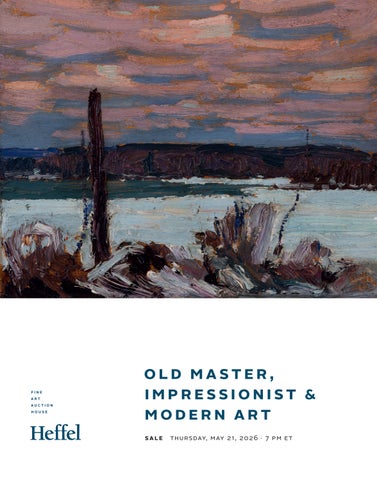
old master, Impressionist & Modern Art Sa l e
th u r sday, m ay 21 , 2026 · 7 P m e t
i
ii
iii
iv
old master, Impressionist & Modern Art Auction Thursday, May 21, 2026
155 Yorkville Avenue, 2nd Floor, Units 1 & 2, Toronto Entrance at STK, 153 Yorkville Avenue Together with Heffel’s Digital Saleroom Registration required to attend or bid in person Video Presentation 4:30 PM ET Post-War & Contemporary Art, *followed by E.J. Hughes: Coastal Boats Near Sidney, BC 5 PM ET Old Master, Impressionist & Modern Art 7 PM ET
Previews Heffel Gallery, Calgary
220 Manning Road NE, Unit 1080 Thursday, April 9 through Saturday, April 11, 11 am to 6 pm MT Heffel Gallery, Vancouver
2247 Granville Street Thursday, April 16 through Tuesday, April 21, 11 am to 6 pm PT Galerie Heffel, Montreal
1840 rue Sherbrooke Ouest Thursday, April 30 through Monday, May 4, 11 am to 6 pm ET Heffel Gallery, Toronto
13 Hazelton Avenue Together with our Yorkville exhibition galleries Tuesday, May 12 through Tuesday, May 19, 11 am to 6 pm ET
Heffel Gallery Limited
Heffel.com Departments
Additionally herein referred to as “Heffel” or “Auction House”
consignme nts
CONTACT
consignments@heffel.com Appra isa ls
appraisals@heffel.com
Toll Free 1-888-818-6505 mail@heffel.com, www.heffel.com Please send all physical mail to our Vancouver address
Abse nt e e , Te le phone & online Bidding
To ro n to
Shipping
Main Yorkville Reception 13 Hazelton Avenue, Toronto, ON M5R 2E1 Telephone 416-961-6505, Fax 416-961-4245
shipping@heffel.com
15 Hazelton Avenue, Unit 200, Toronto, ON M5R 2E1 135 Yorkville Avenue, Unit 401, Toronto, ON M5R 3W5 via main reception 155 Yorkville Avenue, 2nd Floor, Toronto, ON M5R 1C4 via main reception M o n t r e al
1840 rue Sherbrooke Ouest, Montreal, QC H3H 1E4 Telephone 514-939-6505 Va n co u v e r
2247 Granville Street, Vancouver, BC V6H 3G1 Telephone 604-732-6505 NORTH Van co u v e r
2455 Dollarton Highway, Unit 108 North Vancouver, BC V7H 0A2 Telephone 604-732-6505 ext. 150 by appointment Ca lgary
220 Manning Road NE, Unit 1080, Calgary, AB T2E 8K4 Telephone 403-238-6505 by appointment
bids@heffel.com
Subscript ions
subscriptions@heffel.com
Cata logue Subscript ions
Heffel Gallery Limited regularly publishes a variety of materials beneficial to the art collector. An Annual Subscription entitles you to receive our Auction Catalogues. Our Annual Subscription Form can be found on page 99 of this catalogue.
Cata logue Product ion
Essay Contributors—Alec Blair, Mark Cheetham, David Franklin, Daniel Gallay, Ainsley Heffel, Robert Heffel, Alec Kerr, Lauren Kratzer, Adam Lauder, Catharine Mastin, Gerta Moray, Joan Murray, Marie-Jo Paquet, Lorien Peralta-Ramos, Rosalin Te Omra, Molly Tonken and Douglas Watt Text Editing, Catalogue Production—David Heffel, Robert Heffel, Alec Kerr, Kristian Martin, Naomi Pauls and Kirbi Pitt Director of Imaging—Martie Giefert Digital Imaging—Ward Bastian, Jasmin Daigle, Brandon Prince Justin Somjen and Jared Tiller Catalogue Layout and Production—Kirbi Pitt and Clara Wong
Copyright Co rpo rat e Ba n k
Royal Bank of Canada, 2735 Granville Street Vancouver, BC V6H 3J1 Telephone 604-665-5700 Incoming wires are required to be sent in Canadian funds and must include: Heffel Gallery Limited, 2247 Granville Street, Vancouver, British Columbia V6H 3G1 as beneficiary.
No part of this publication may be reproduced, stored in retrieval systems or transmitted in any form or by any means, digital, photocopy, electronic, mechanical, recorded or otherwise, without the prior written consent of Heffel Gallery Limited. All photographic representations and other illustrations depicted are solely for guidance and are not to be relied upon in terms of tone or colour.
Boa r d o f Di r ecto rs
Chairman In Memoriam—Kenneth Grant Heffel President—David Kenneth John Heffel Auctioneer License T83-3364318 and #26-155436 Vice-President—Robert Campbell Scott Heffel Auctioneer License T83-3365303 and #26-155435
Follow us:
IX Printed in Canada by Friesens ISBN: 978-1-927031-83-4
contents
4 5
Notice for Collectors Auction Details
Selling at Auction
Buying at Auction
General Bidding Increments
Framing, Conservation and Shipping
Written Valuations and Appraisals
7
Old Master, Impressionist & Modern Art Catalogue
86
Heffel Specialists
88
Terms and Conditions of Business
94
Property Collection Notice
95
Catalogue Abbreviations and Symbols
96
Lot 128 Priority Special Terms & Conditions of Business
98
Catalogue Terms
98
Heffel’s Code of Business Conduct, Ethics and Practices
99
Annual Subscription Form
99
Collector Profile Form
100
Absentee Bid Form
101
Telephone Bid Form
102
Digital Saleroom Registration Form
103
Shipping Authorization Form for Property
104
Terms and Conditions for Shipping
105
Index of Artists by Lot
notice for Collectors Auction Location HEFFEL TORONTO
155 Yorkville Avenue, 2nd Floor, Units 1 & 2, Toronto Entrance at STK, 153 Yorkville Avenue Together with Heffel’s Digital Saleroom
HEF F EL SA L ERO O M
Entrance through 153 Yorkville Ave
Reserved Seating and Attendance This auction is by pre-arranged reserved seating only. To register for in-person bidding or general attendance, please contact bids@heffel.com. Please note that all reserved seating requests must be received by Heffel at least two (2) business days prior to the commencement of the sale. Admission is based on approved registration and verification by Heffel. Registered bidders will have priority for seating. General admission is limited and cannot be guaranteed. Please note that Heffel may, at its discretion, restrict entry for event security and safety.
Auction Notice The Buyer and the Consignor are hereby advised to read fully the Terms and Conditions of Business and Catalogue Terms, which set out and establish the rights and obligations of the Auction House, the Buyer and the Consignor, and the terms by which the Auction House shall conduct the sale and handle other related matters. This information appears on pages 82 through 98 of this publication. Please visit www.heffel.com for information on which Lots will be present at each preview location, virtual auction previews and to book your in person preview appointment. Preview appointments can also be booked by calling 1-888-818-6505.
Absentee, Telephone and Digital Saleroom Bidding
Live Stream Please note that we produce a live stream of our sale beginning with a video presentation at 4:30 PM ET and the auction commencing at 5 PM ET. We recommend that you test your video streaming 30 minutes prior to our sale at www.heffel.com. All Lots and additional images depicting the frame and verso are available at www.heffel.com.
4
If you are unable to attend our auction in person, Heffel recommends submitting an Absentee Bid Form to participate. Heffel also accepts telephone bidding, prioritized by the first received Telephone Bid Form and limited to available Telephone Bid Operators per Lot. Alternatively, Heffel offers online bidding in real time through our Digital Saleroom, subject to advanced registration and approval. All forms of remote bidding participation and registration must be received by Heffel at least two (2) business days prior to the commencement of the sale. Information on absentee, telephone and online bidding appears on pages 5, 100, 101 and 102 of this publication.
Estimates and Currency Our Estimates are in Canadian funds. Exchange values are subject to change and are provided for guidance only. Buying 1.00 Canadian dollar will cost approximately 0.71 US dollar, 0.62 euro, 0.53 British pound, 0.56 Swiss franc, 113 Japanese yen or 5.6 Hong Kong dollars as of our publication date.
a u c t i o n d e ta i l s Selling at Auction Heffel offers individuals, collectors, corporations and public entities a full-service firm for the successful de-acquisition of their artworks. Interested parties should contact us to arrange for a private and confidential appointment to discuss their preferred method of disposition and to analyse preliminary auction estimates, pre-sale reserves and consignment procedures. This service is offered free of charge. If you are from out of town or are unable to visit us at our premises, we would be pleased to assess the saleability of your artworks by mail, courier or e-mail. Please provide us with photographic or digital reproductions of the artworks front and verso and information pertaining to title, artist, medium, size, date, provenance, etc. Representatives of our firm travel regularly to major Canadian cities to meet with Prospective Sellers. It is recommended that property for inclusion in our sale arrive at Heffel at least 90 days prior to our auction. This allows time to photograph, research, catalogue and promote works and complete any required work such as re-framing, cleaning or conservation. All property is stored free of charge until the auction; however, insurance is the Consignor’s expense. Consignors will receive, for completion, a Consignment Agreement and Consignment Receipt, which set forth the terms and fees for our services. The Seller’s Commission is the amount paid by the Consignor to the Auction House on the sale of a Lot, which is calculated on the Hammer Price, at the rates specified in writing by the Consignor and the Auction House on the Consignment Agreement, plus applicable Sales Tax. Consignors are entitled to set a mutually agreed Reserve or minimum selling price on their artworks.
Buying at Auction
All items that are offered and sold by Heffel are subject to our published Terms and Conditions of Business, our Catalogue Terms and any oral announcements made during the course of our sale. Heffel charges a Buyer’s Premium calculated on the Hammer Price as follows: a rate of twenty-five percent (25%) of the Hammer Price of the Lot up to and including $25,000; plus twenty percent (20%) on the part of the Hammer Price over $25,000, plus applicable Sales Tax. If you are unable to attend our auction in person, you can bid by completing the Absentee Bid Form found on page 100 of this catalogue. Please note that all Absentee Bid Forms should be received by Heffel at least two (2) business days prior to the commencement of the sale. Bidding by telephone, although limited, is available. Please make arrangements for this service well in advance of the sale. Telephone lines are assigned in order of the sequence in which requests are received. We also recommend that you leave an Absentee Bid amount that we will execute on your behalf in the event we are unable to reach you by telephone. Digital Saleroom online bidding is available subject to pre-registration approval by the Auction House at least two (2) business days in advance of the auction. Payment must be made by: a) Bank Wire direct to the Auction House’s account, b) Certified Cheque or Bank Draft, c) a Personal or Corporate Cheque, d) Debit Card and Credit Card only by Visa, Mastercard or Union Pay or American Express or e) Interac
version 2026.03 © Heffel Gallery Limited
e-Transfer. Bank Wire payments should be made to the Royal Bank of Canada as per the account transit details provided on your invoice. All Certified Cheques, Bank Drafts and Personal or Corporate Cheques must be verified and cleared by the Auction House’s bank prior to all purchases being released. Credit Card payments are subject to our acceptance and approval and to a maximum of $5,000 if the Buyer is providing their Credit Card details by fax or to a maximum of $25,000 per Lot purchased if paying online or if the Credit Card is presented in person with valid identification. A two percent (2.00%) Convenience Fee will apply to all Credit Card payments. In all circumstances, the Auction House prefers payment by Bank Wire.
General Bidding Increments Bidding typically begins below the low estimate and generally advances in the following bid increments: $50 – 300 $25 increments $300 – 500 $50 $500 – 2,000 $100 $2,000–5,000 $250 $5,000–10,000 $500 $10,000–20,000 $1,000 $20,000–50,000 $2,500 $50,000–100,000 $5,000 $100,000–300,000 $10,000 $300,000–1,000,000 $25,000 $1,000,000–2,000,000 $50,000 $2,000,000–3,000,000 $100,000 $3,000,000–5,000,000 $250,000 $5,000,000–10,000,000 $500,000 $10,000,000+ $1,000,000
Framing, Conservation and Shipping As a Consignor, it may be advantageous for you to have your artwork re-framed and/or cleaned and conserved to enhance its saleability. As a Buyer, your recently acquired artwork may demand a frame complementary to your collection. As a full-service organization, we offer guidance and in-house expertise to facilitate these needs. Buyers who acquire items that require local delivery or out-of-town shipping should refer to our Shipping Authorization Form for Property on page 103 and our Terms and Conditions for Shipping on page 104 of this publication. Please feel free to contact us to assist you in all of your requirements or to answer any of your related questions. Full completion of our shipping form is required prior to purchases being released by Heffel.
Written Valuations and Appraisals Written valuations and appraisals for probate, insurance, family division and other purposes can be carried out in our offices or at your premises. Appraisal fees vary according to circumstances. If, within five years of the appraisal, valued or appraised artwork is consigned and sold through Heffel, the client will be refunded the appraisal fee, less incurred “out of pocket” expenses on a prorated basis. 5
6
Sale
T h u r s d ay, M ay 2 1 , 2 0 2 6 · 7 P m et
old master, Impressionist & M o d e r n ART c ata lo g u e
F e at u r i n g W o r k s f r o M Collection of Hudson’s Bay Company, Canada An Important Canadian Collection An Important Nova Scotia Estate & other Important Private and Corporate Collections
8
101 Walter Joseph (W.J.) Phillips ASA CPE CSPWC RCA 1884 – 1963
Karlukwees, BC colour woodcut on paper, signed and signed in the block, 1929 10 1/4 × 12 1/2 in, 26 × 31.8 cm P rov e n an c e
Masters Gallery Ltd., Calgary Private Collection, Victoria Li t e rat u r e
Duncan Campbell Scott, Walter J. Phillips, 1947, reproduced page 27 Carlyle Allison, The Art of W.J. Phillips, 1970, the related 1927 watercolour and graphite sketch Karlukwees, Village Island and the woodcut reproduced, unpaginated Michael J. Gribbon, Walter J. Phillips: A Selection of His Works and Thoughts, National Gallery of Canada, 1978, reproduced front cover, the 1927 watercolour and graphite sketch Karlukwees, BC reproduced page 64, the larger finished watercolour reproduced page 65, and a photograph of Walter J. Phillips holding an impression of the woodcut reproduced page 62 Roger H. Boulet, The Tranquility and the Turbulence: The Life and Work of Walter J. Phillips, 1981, page 101, the related 1926 watercolour Myth of the Thunderbird (Karlukwees) reproduced page 101, the 1927 watercolour and graphite sketch Karlukwees, Village Island and the woodcut reproduced pages 125 and 126 Roger Boulet, Walter J. Phillips: The Complete Graphic Works, 1981, reproduced page 3 Exhibited
National Gallery of Canada, Ottawa, Walter J. Phillips, 1978, same image Art Gallery of Greater Victoria, To the Totem Forests: Emily Carr and Contemporaries Interpret Coastal Villages, August 5 – October 31, 1999, same image, catalogue #55.26.59 In 1927, Walter j. phillips took a sketching trip to the West Coast, visiting his sister at Alert Bay and then traveling by boat to the villages of Tsatsisnukomi, Mamalilicoola and Karlukwees, a small settlement on Turnour Island, at the entrance to Knight Inlet. He wrote, “We found another village—Karlukwees—more interesting than the others. The clean white beach had borrowed
W.J. Phillips holding up his famous colour woodcut Karlukwees, BC, circa 1942
its shape from the new moon. . . . Karlukwees provided many subjects for painting. In fact, never have I seen a more delectable sketching ground.” This exquisite woodcut is considered to be among the finest in Phillips’s oeuvre. Technically superb, with a composition perfectly in balance, the delicate impression of falling snow cloaking the village in stillness creates an unforgettable atmosphere of peace. The woodcut is also a poignant record of the village, as little remains of it today. In 1929, Karlukwees, BC was awarded a gold medal for best colour woodcut by the Society of Arts and Crafts, Boston. The National Gallery of Canada has two impressions of this woodcut in its collection. This woodcut was produced in a limited edition of 100. Est imat e : $25,000 – 35,000
9
10
102 Walter Joseph (W.J.) Phillips ASA CPE CSPWC RCA 1884 – 1963
Mamalilicoola, BC colour woodcut on paper, signed and signed in the block, titled, editioned 12/100, 1928 12 1/8 × 13 7/8 in, 30.8 × 35.2 cm P rov e n an c e
Petley Jones Gallery, Vancouver Private Collection, Victoria Li t e rat u r e
Duncan Campbell Scott, Walter J. Phillips, 1947, reproduced page 19 Walter J. Phillips, Wet Paint, undated, unpublished manuscript, Glenbow Museum archives, m-969-4, described page 104 Michael J. Gribbon, Walter J. Phillips, A Selection of His Works and Thoughts, National Gallery of Canada, 1978, reproduced page 67 Roger Boulet, The Tranquility and the Turbulence, 1981, page 101, reproduced page 100 Roger Boulet, Walter J. Phillips: The Complete Graphic Works, 1981, reproduced page 293 Maria Tippett and Douglas Cole, Phillips in Print: The Selected Writings of Walter J. Phillips on Canadian Nature and Art, Manitoba Record Society, 1982, reproduced, unpaginated In 1927, Walter j. phillips, one of Canada’s premier artists in the mediums of watercolour and printmaking, embarked on his first journey to the West Coast of British Columbia. His travels took him to Alert Bay and the surrounding areas, where he explored remote villages such as Mamalilicoola by boat (‘Mimkwamlis). The unique, ever-changing landscapes of the region captivated him, with their humid atmosphere and shifting skies. Phillips was particularly taken by the beauty of the village, which offered a breathtaking view across layers of islands towards the snow-capped peaks of Vancouver Island. After hiking through what he called the “green twilight” to the village, Phillips encountered the centrepiece of his large woodcut: a towering and magnificent totem pole. This totem stood in front of a community house, its pediment intricately carved and painted with an allegorical sun figure, flanked by two fish. As Phillips explored the village further, he marveled at the totems, house posts, and “zunuks” (Dzunuḵ̓wa), finding ample inspiration for days of sketching. The West Coast experience left a lasting impression on Phillips. He later reflected, “I regretted leaving the coast, and I long to return.” His woodcut Mamalilicoola, BC, renowned for its beauty and exquisite detail, remains one of Phillips’s most celebrated works. This woodcut was produced in a limited edition of 100. Est i m at e : $20,000 – 30,000
11
103 Emily Carr BCSFA CGP 1871 – 1945
Alive oil on paper, signed and on verso signed, titled and inscribed $50.00 on a label in the artist’s hand and variously on the Vancouver Art Gallery label, 1939 36 × 24 in, 91.4 × 61 cm P rov e n an c e
Collection of the Artist Vancouver Art Gallery Acquired from the above by Dorothy Salisbury, Vancouver, June 1943 Gift to the present Private Collection, Vancouver Li te rat u r e
Exhibition by Emily Carr, Vancouver Art Gallery, 1939 British Columbia Society of Fine Arts, Thirty-Third Annual Exhibition, Vancouver Art Gallery, 1943 Emily Carr: Paintings & Sketches, Vancouver Art Gallery, 1943 Exhibition of Oil Paintings by Emily Carr, Seattle Art Museum, organized by the Vancouver Art Gallery, 1943 E x hi b i t e d
Vancouver Art Gallery, Exhibition by Emily Carr, November 7 – 19, 1939, catalogue #7 Vancouver Art Gallery, British Columbia Society of Fine Arts, Thirty-Third Annual Exhibition, May 15 – June 6, 1943, catalogue #15 Vancouver Art Gallery, Emily Carr: Paintings & Sketches, June 11 – 24, 1943, catalogue #18 Seattle Art Museum, Exhibition of Oil Paintings by Emily Carr, August 25 – October 3, 1943, organized by the Vancouver Art Gallery, catalogue #11 Collection of Artists for Kids and the Gordon Smith Gallery, North Vancouver, extended loan, 1999 – 2025 Emily Carr’s Alive stands as a powerful testament to a pivotal moment in the artist’s life and creative evolution. Painted shortly after her recovery from a major heart attack in 1937, the work’s title carries unmistakable emotional weight. To name a painting Alive at such a moment was not merely descriptive—it was a declaration. Carr had returned to painting with renewed vitality as she embarked on an extraordinary period of artistic productivity that resulted in works such as Roll of Life and Spring Wave, both sold by Heffel, and Juice of Life, in the collection of the Art Gallery of Greater Victoria. Alive radiates an elemental energy, a life force that seems to surge upward through the natural forms she depicts. Within Alive, one can sense the profound resurgence that defined this chapter of her career. The painting presents a dynamic forest scene alive with movement, colour and spiritual energy. A towering tree dominates the foreground, its trunk thick and rooted, its branches sweeping upward in expressive, almost wind-driven arcs. Around it, smaller trees and undergrowth cluster in rhythmic, curving forms, as if the entire forest is breathing
12
in unison. Carr’s signature swirling brush-strokes give the vegetation a sense of motion—nothing here feels still or static. Her brushwork and composition evoke movement, growth and spiritual renewal, as if nature itself is stretching towards the sky in an act of affirmation. The result is a work that feels both deeply personal and universally resonant—a visual expression of survival, gratitude, and the enduring vitality of the natural world. Carr’s persistent financial constraints did little to hinder her artistic evolution; rather, they yielded an ingenuity that became fundamental to her creative practice. Lacking the means to purchase traditional materials in abundance, in the 1930s, she devised an innovative painting medium by thinning high-quality white house paint with gasoline or turpentine and enriching it with the finest pigments she could reasonably afford. Complementing this experimentation, she engineered a portable easel designed to support large sheets (24 × 36 inches) of inexpensive manila paper bought in bulk, a practical solution that suited her constraints and also provided artistic freedom. This combination of resourcefulness and technical invention proved transformative during her extensive sketching excursions around Victoria in the 1930s. Carr embraced this new medium, which enabled gestural, fluid and rhythmic brushwork, producing compositions marked by a heightened sense of renewal and expressive force. The provenance of Alive is superb and reaches back to its purchase in 1943 by Dorothy Salisbury, a librarian at the University of British Columbia and the Vancouver Public Library. Carr staged an exhibition at the UBC library in 1939, and it is possible Salisbury attended this show. She acquired Alive from Carr’s solo exhibition at the Vancouver Art Gallery in 1943, and the sale is recorded in the financial records of the VAG Archives. Carr sold few paintings during her lifetime, and only rarely did she sell a painting from one of the many exhibitions in which she participated, so the sale of Alive would have been an important event for the artist. On verso of this work are two significant labels. One label is signed, titled and priced $50 in the artist’s hand, which is rare. Another label is likely from the 1943 Exhibition of Oil Paintings by Emily Carr at the Seattle Art Museum, organized by the Vancouver Art Gallery, which states the painting details, the original owner, Dorothy Salisbury’s name and address, and is also marked for sale, with an insured value of $60. Alive was a painting Carr would have been proud of, having shown it many times in her lifetime. Fittingly, in contemporary times, Alive was on long-term loan at the Gordon Smith Gallery, from 1999 until its consignment to Heffel. Carr is being celebrated in 2026 with a major retrospective at the Vancouver Art Gallery, That Green Ideal: Emily Carr and the Idea of Nature. We thank Dr. Michael Polay, contributing author to Emily Carr: Fresh Seeing—French Modernism and the West Coast, for his assistance in researching this lot. Est imat e : $250,000 – 350,000
13
104 James Edward Hervey (J.E.H.) MacDonald ALC CGP G7 OSA RCA 1873 – 1932
After Sunset, Georgian Bay oil on board, initialed and dated 1931 and on verso faintly signed, titled, dated August 1931 and inscribed After Sunset / McLean’s Island / . . . near Point au Baril / Georgian Bay / N.F.S. in the artist’s hand and “made the year before JM died on his last trip to northern country / #1619/ 11 / 15 / R. McMichael, Kleinberg [sic] / E.W. Dader 8 1/2 × 10 1/2 in, 21.6 × 26.7 cm
14
Prove na nce
Thoreau MacDonald, Thornhill A.K. Prakash & Associates Inc., Toronto Estate of W. Allan Manford, Toronto Important Canadian Art, Sotheby’s Canada, June 2, 2010, lot 17 Private Collection, Switzerland Li t e rat ure
Peter Mellen, The Group of Seven, 1970, MacDonald lecture “Relation of Poetry to Painting,” 1929, quoted page 141
James Edward Hervey ( j.e.h.) macdonald was among the most poetic and intellectually driven members of the Group of Seven, an artist for whom landscape was not merely observed but also deeply felt. Throughout his career, he sought to move beyond naturalistic description, creating images that conveyed what he described as “a compound of feelings aroused in the artist by the things seen.” This ambition, to distill the emotional and spiritual essence of nature, finds a compelling expression in After Sunset, Georgian Bay, painted in August 1931, during the final year of his life. Georgian Bay held a central place in the development of Canadian landscape painting in the early twentieth century. From the years preceding the formal establishment of the Group of Seven, its rugged granite shores, wind-swept pines and ever-changing light provided a powerful source of inspiration. The region offered an environment of both serenity and drama, where calm waters could give way to turbulent weather, and where the stark, elemental forms of rock and tree invited a bold, expressive response. For MacDonald and his colleagues, Georgian Bay was a proving ground, a place where a distinctly Canadian vision of landscape could be forged. In these formative years, the artists were encouraged and supported by Dr. James MacCallum, whose cottage at Go Home Bay became an important gathering place for Tom Thomson and members of the Group. MacCallum provided crucial financial support and he commissioned decorative schemes for his cottage, including murals by MacDonald, Thomson and Arthur Lismer. This environment of camaraderie and patronage fostered a shared commitment to a new approach to landscape painting and helped shape the artistic language that would come to define the Group. The influence of Tom Thomson, whose close association with the Group preceded its official formation, is felt profoundly in this context. By combining direct observation with a heightened sensitivity to colour, design and atmosphere, Thomson’s work showed what was possible. His example encouraged MacDonald and his colleagues to embrace a more personal, interpretive vision of nature, seeking to capture the underlying spirit of the land. In After Sunset, Georgian Bay, this legacy is evident in MacDonald’s emphasis on mood and structure rather than topographical exactitude, as well as in the dynamic interplay between sky, water and land, an approach that recalls works such as Thomson’s Snow Pillars in the Sky of 1916 (collection of the National Gallery of Canada). The composition is anchored by a wind-bent pine at the left, its dark silhouette standing in dramatic counterpoint to the luminous expanse of water beyond. The setting sun, though unseen, radiates across the surface of the bay in bands of pale yellow and white, creating a path of light that draws the eye into the distance. Above, the sky is animated by sweeping, calligraphic cloud forms, their sinuous contours echoing the movement of the water below. These elements are simplified and stylized, forming a rhythmic arrangement of shapes alive with motion and atmosphere.
TOM THOMSON Snow Pillars in the Sky oil on board, 1916 8 3/8 × 10 3/8 in, 21.4 × 26.5 cm Collection of the National Gallery of Canada Bequest of Dr. J.M. MacCallum, Toronto, 1944 Photo: NGC Not for sale with this lot
MacDonald’s handling of colour further reinforces the expressive character of the work. The cool blue greens of the water and sky are set against passages of warm, glowing light, producing a striking contrast that heightens the scene’s emotional intensity. The paint is applied with energy and confidence, the brushwork at once controlled and spontaneous. In contrast to the more restrained, tonal qualities of his earlier Georgian Bay works, which often explored a quieter range of greys and subdued hues, this late painting is marked by a heightened boldness of colour and a more overtly expressive handling of form. The composition itself takes on an increasingly decorative character, with flattened forms and rhythmic patterning that suggest an affinity with the broader currents of decorative modernism. Executed on his final trip to the north, After Sunset, Georgian Bay may be seen as a culminating statement within MacDonald’s oeuvre. Returning to a region so closely associated with the origins of the Group of Seven, he presents a distilled and deeply personal vision of Georgian Bay, one shaped by decades of reflection, experience and artistic conviction. In this refined and evocative painting, MacDonald achieves a harmonious balance between observation and expression, offering a resonant meditation on the enduring power and poetry of the Canadian landscape. Est imat e : $100,000 – 150,000
15
105 Helen Galloway McNicoll ARCA RBA 1879 – 1915
The Farmyard oil on canvas, signed and on verso stamped with the Artist’s Estate stamp, catalogue #10 and Studio Helen G. McNicoll RBA ARCA, catalogue #73 22 × 21 1/8 in, 55.9 × 53.7 cm 16
Prove na nce
Estate of the Artist, Montreal Morris Gallery, Toronto, 1976 Peter Ohler Fine Arts Ltd., Vancouver Private Collection, Vancouver
Li t e rat u r e
Memorial Exhibition of Paintings by the Late Helen G. McNicoll, RBA, ARCA, Art Association of Montreal, 1925, listed, unpaginated Helen McNicoll: Oil Paintings from the Estate, Morris Gallery, 1976, listed, unpaginated Exhibited
Scott & Sons, Montreal, label verso, inventory #9/190-8 Art Association of Montreal, Memorial Exhibition of Paintings by the Late Helen G. McNicoll, RBA, ARCA, November 7 – December 6, 1925, catalogue #73 Morris Gallery, Toronto, Helen McNicoll: Oil Paintings from the Estate, February 7 – 21, 1976, catalogue #10 Glenbow Museum, Calgary, Canadians in Paris and the French Influence, October 16, 1999 – January 3, 2000 Helen McNicoll was one of the most accomplished and internationally engaged Canadian artists of the early twentieth century. Working between Montreal, London, and the artists’ colonies of England and France, she developed a highly refined Impressionist language marked by its luminosity, structural clarity and profound sensitivity to lived experience. In a career cut tragically short at the age of 35, McNicoll achieved noted recognition on both sides of the Atlantic, playing a formative role in the introduction and adaptation of Impressionism in Canada. Born in Toronto and raised in Montreal, McNicoll studied at the Art Association of Montreal under William Brymner, whose advocacy of modern French painting and plein air practice proved decisive. She continued her training at London’s Slade School of Fine Art, a progressive institution that encouraged direct engagement with contemporary artistic developments, before establishing a cosmopolitan practice centred in England and northern France. There, immersed in the vibrant culture of artists’ colonies such as St. Ives and Grez-sur-Loing, McNicoll absorbed the lessons of French Impressionism—its emphasis on light, atmosphere and immediacy—while forging a distinctly personal and quietly modern vision. Painted during the most assured phase of her career, The Farmyard exemplifies the qualities for which McNicoll is most celebrated. The composition is anchored by the monumental form of a haystack, rendered in rich, sunlit ochres that dominate the foreground. Around it, a scattering of hens animates the scene, their movement introducing a lively counterpoint to the stable geometry of the stack. In the middle distance, two figures attend to routine tasks, their presence understated yet integral, reinforcing the patterns of rural life rather than a narrative emphasis. McNicoll’s interest lies not so much in storytelling as in atmosphere, in the articulation of a moment quietly observed. Light is the central protagonist of the work. Employing a vibrant, broken brush-stroke, McNicoll captures the fleeting effects of sunlight across hay, grass and foliage, infusing the scene with a palpable sense of summer warmth. Her characteristically airy palette balances golden yellows with cool blues and greens, creating a chromatic harmony that recalls the innovations of French Impressionism while retaining an individual sensibility. As in her finest canvases, the viewer is invited not simply to observe the scene but to experience it—to sense the heat of the day, the texture of the harvested field, and the seasonal round of rural life.
Helen McNicoll’s studio, with possibly The Farmyard indicated, circa 1906
McNicoll’s depictions of agrarian subjects align her with a long European tradition, yet her approach remains resolutely modern. Rejecting both sentimentality and overt social commentary, she presents rural labour with clarity and dignity. Figures are absorbed in their tasks, detached from both viewer and narrative, their inner lives left intact. This quality of restraint—frequently remarked upon by critics—has often been associated with the artist’s hearing loss, which may have heightened her visual perception and contributed to the contemplative distance that characterizes her work. In The Farmyard, this sensibility results in a composition of remarkable balance, where human presence and landscape exist in bucolic equilibrium. This canvas has long been recognized as a key example of the artist’s rural subjects, and its distinguished exhibition history underscores its importance within McNicoll’s oeuvre. It was included in the 1925 memorial exhibition at the Art Association of Montreal, a significant posthumous tribute that consolidated her reputation. Later it was shown in the Morris Gallery’s 1976 exhibition of works from the artist’s estate. Its inclusion in the exhibition Canadians in Paris and the French Influence (Glenbow Museum, 1999 – 2000) situates it within the broader transatlantic context that shaped her practice and affirms her place within the international currents of early modernism. In recent years, McNicoll has been the subject of renewed scholarly and institutional attention, culminating in the landmark retrospective Helen McNicoll: An Impressionist Journey, organized by the Musée national des beaux-arts du Québec and adapted for presentation at the National Gallery of Canada in Ottawa from May to October 2026. This major exhibition offers a timely reassessment of her career, emphasizing her role as a leading interpreter of Impressionism and a vital voice in the representation of modern womanhood. Within this context, The Farmyard assumes particular resonance as a luminous and assured statement of McNicoll’s mature practice—an evocative meditation on light, labour and the enduring rhythms of the natural world. Est imat e : $90,000 – 120,000
17
106 Franklin Carmichael CSPWC G7 OSA RCA 1890 – 1945
Snow Clouds oil on board, signed, circa 1928 10 × 12 in, 25.4 × 30.5 cm P rov e n an c e
Contemporary and Canadian Art, Maynards, May 14, 2014, lot 62 Private Collection, British Columbia Li te rat u r e
Roger Boulet, A Legacy of Canadian Art from Kelowna Collections, Kelowna Art Gallery, 2017, reproduced page 42 E x hi b i t e d
Art Gallery of Toronto, The Exhibitions of the Group of Seven and Painting, Sculpture and Wood Carving of French Canada,
18
May 8 – 31, 1926, the related 1926 canvas Snow Clouds, catalogue #2 Kelowna Art Gallery, A Legacy of Canadian Art from Kelowna Collections, July 1 – October 15, 2017 In 1925, 1926 and 1928, Frank Carmichael made three sketching trips to the northern Canadian shores of Lake Superior. The Group of Seven’s de facto leader Lawren Harris was the organizer for all three excursions. A.Y. Jackson joined them in 1925; Harris and Carmichael were on their own in 1926; and A.J. Casson joined Harris, Jackson and Carmichael in 1928. The artists were challenged by the cool October weather, including frequent snow squalls. Carmichael’s working media on the Lake Superior trips included drawing, watercolour and oil, but drawing formed the one constant on all three trips because of its portability and expediency during inclement weather.
The drawing Port Coldwell, 1928 (collection of the Montreal Museum of Fine Arts, figure 1) may have served as the plein air work on which this oil sketch was based, its composition very close in structure. Port Coldwell was located about 24 kilometres west of Marathon, and Carmichael had been interested in it since 1925. It was then that he made the sketches for his well-known canvas Snow Clouds, 1926 (in the Hart House Permanent Collection, figure 2), a large oil painting first exhibited in the 1926 Group of Seven exhibition held at the Art Gallery of Toronto.1 Usually an oil sketch precedes the studio painting, but Carmichael had experienced such lousy weather during his last Lake Superior sojourn that some of his painted sketches were done afterwards. Lake Superior, 1929 (collection of the National Gallery of Canada, acc. #6665) was painted a year afterwards, for example. Carmichael explained his difficulties to National Gallery director Eric Brown when he wrote on January 2, 1929: “The demand for sketches and small pictures has been more than double of any previous year and I am sadly behind in numbers, having had two years of extremely bad weather when on holidays + my time being more or less limited for sketching, I have been left high and dry.” 2 As there are no known Lake Superior oil sketches dated by Carmichael from 1925 or 1926, it seems his commitment to sketching in oil was made in 1928, the probable date for this sketch. That year, Carmichael produced a significant cluster of dated oil sketches, including the Port Coldwell i – IV series in the National Gallery of Canada collection (acc. #38407 – 38410). This sketch was among several to demonstrate Carmichael’s commitment to painting Port Coldwell subjects well into the 1930s. A dynamic sky, and the twisting channel meandering through cliffs out to the shores of Lake Superior, provided backdrops against which to contour the steep hills, burnt umber fall colours, remnants of summer greenery and evergreens. Unlike Harris, Carmichael was more engaged by the geology of the rocks and ephemeral effects of light and weather. These various moments of natural wonder, including storms such as seen in this sketch, were constant sources of inspiration. Carmichael later became an art instructor at his alma mater, the Ontario College of Art. In 1933, he advised students in a lecture on theory that “Nature is the painter’s storehouse.” A “good picture,” he explained, was not a “literal imitation of nature” but rather it is “a decorative panel which conveys its message to us primarily by the visible attractiveness of its pattern.” Yet, he argued, it must also have significance, because “Significance is the parent of Decoration—The Decorative aspect of any picture arises from the subject matter.” 3 In this sketch, the oscillating bands of greens and umbers used to articulate the trees and hills, and the lights and darks of the sky and hills, form such a decorative pattern of significance. We thank Catharine M. Mastin, PhD, an independent scholar, writer and curator of Canadian art, for contributing the above essay.
top: FIGURE 1: FRANKLIN CARMICHAEL Port Coldwell graphite on paper, 1928 Collection of the Montreal Museum of Fine Arts, 2024.147.21 Not for sale with this lot bottom: FIGURE 2: FRANKLIN CARMICHAEL Snow Clouds oil on canvas, 1926 40 1/2 × 48 5/8 in, 103 × 123.5 cm Hart House Permanent Collection, University of Toronto, HH1926.001 Gift from the Graduating Class of 1926 Photo: Toni Hafkenscheid Not for sale with this lot
1. See also two related works in the collection of the National Gallery: Port Coldwell, 1925, graphite on paper, acc. #39430; and Untitled (Pines, Lake Superior), 1925, watercolour, acc. #37157. 2. Exhibition of Canadian Art, 1929 file, NGC Library & Archives, Ottawa. 3. Carmichael Papers, Library & Archives Canada, Ottawa. Est i m at e : $80,000 – 100,000
19
107 James Edward Hervey (J.E.H.) MacDonald ALC CGP G7 OSA RCA 1873 – 1932
Mt. Ringrose from Wiwaxy Peaks Above Oesa Trail oil on board, initialed and dated September 2, 1930 and on verso signed, titled, dated and inscribed variously 8 1/2 × 10 1/2 in, 21.6 × 26.7 cm P rov e n an c e
Private Collection, Edmonton Douglas Udell Gallery, Edmonton Acquired from the above by a Private Collection, Edmonton then Victoria Li te rat u r e
Stanley Munn and Patricia Cucman, To See What He Saw: J.E.H. MacDonald and the O’Hara Years, 1924 – 1932, Whyte Museum of the Canadian Rockies, 2024, reproduced pages 70 and 331 J.E.H. MacDonald’s mountain sketches radiate with the enthusiasm he had for the spectacular environments of the Canadian Rockies, and Mt. Ringrose from Wiwaxy Peaks Above Oesa Trail is a fine example from this catalogue. This lively oil sketch is a celebration of the alpine, where the artist has hiked high up a mountain slope and captured the effects of the early afternoon light playing on the spires and gullies that bring glorious drama to the settings around Lake O’Hara. The composition is direct and effective, highlighting the verticality of the scene and bringing viewers to his enviable vantage point in one of Canada’s most celebrated regions. After his first visit in 1924, MacDonald was entranced by the potential of Lake O’Hara and its surroundings. He made annual late-summer visits until, in 1931, his failing health finally prevented his return. Many of Canadian art’s most exciting and powerful compositions capturing the spirit of the mountains emerged from the sketches MacDonald produced, and the experience he gathered, across his seven trips to the area. He created work of remarkable variety, his attention shifting constantly depending on the weather, the atmospheric conditions and the lighting. He diligently moved up and through the landscape to capture new and exciting viewpoints that went well beyond the typical lakeshore scenes that are often the most familiar and wellknown depictions of the region. As is characteristic of MacDonald, his faithful translation of the area’s topography gives the opportunity to pinpoint the exact
20
location of this painting, as is done thoroughly for many paintings in the 2024 publication To See What He Saw, by Stanley Munn and Patricia Cucman. The authors determine that Mt. Ringrose from Wiwaxy Peaks “was painted at about 2,375 metres elevation on the steep, upper slope of Wiwaxy, approximately 150 metres below the saddle that separates Wiwaxy Peaks from Mount Huber.” 1 The date for the work, September 2, 1930, is inscribed by the artist on the lower right of the painting and written on the verso in his hand. Given this information, MacDonald’s journals can provide even more fascinating insight surrounding the conditions of the work’s creation. His entry for that day reads: To head of Lake again alone and up Oesa trail again. Went higher up Wiwaxy and made sketch of Biddle and Shaffer [sic] in mist effect. . . . Climbed higher for lunch and ate it above gravel slopes in a goat pasture. Many signs of goats about but saw no animals. . . . Smoky mountains again in afternoon & a singing bird new to me on mountain, a hurried formless little song but sweet & wild. Another sketch. Later it cleared a little and made a third one of Lefroy and Ringrose. Came down by a well established goat path. . . . A fine day. 2
From this account, and knowledge of his other works, we can determine that Mt. Ringrose from Wiwaxy Peaks was the second of the three sketches MacDonald painted that day, and we are able to appreciate more fully that his work capturing the atmospheric early afternoon light on the mountains was carried out in seemingly as idyllic and heavenly conditions as one might hope for. It is easy to see why MacDonald concluded his journal entry for the day with the satisfied, succinct and understated “A fine day.” This work stands as a testament to the many moments where the vitality of the mountains is presented to those lucky enough to visit them, skilfully and effectively translating such majesty into paint and crystallizing it to be treasured and enjoyed by all. 1. Stanley Munn and Patricia Cucman, To See What He Saw: J.E.H. MacDonald and the O’Hara Years, 1924–1932 (Whyte Museum of the Canadian Rockies, 2024), 70. 2. J.E.H. MacDonald, 1930 diary, MG30, D111, Library and Archives Canada, Ottawa. Est imat e : $60,000 – 80,000
21
P r o p e r t y o f a n I m p o r ta n t N o va S c ot i a Es tat e
22
P r o p e r t y o f a n I m p o r ta n t N o va S c o t i a Es tat e
108 Lawren Stewart Harris ALC BCSFA CGP FCA G7 OSA TPG 1885 – 1970
The Turning Earth oil on board, signed and on verso signed, titled on the labels and inscribed 3/34 and indistinctly, circa 1950 12 × 15 in, 30.5 × 38.1 cm P rov e n an c e
Collection of Bess Harris Jerrold Morris International Gallery Ltd., Toronto An Important Private Collection, Toronto By descent to the present Private Estate, Nova Scotia Lawren S. Harris’s transition to non-objective abstraction in the mid-1930s is one of the most interesting and significant reinventions by an artist in Canadian art history. After unofficially leading the establishment of a distinctly Canadian approach to landscape painting, and pushing the boundaries of what the Canadian public would accept, and then celebrate, his relatively abrupt and nearly complete switch in focus to non-objective subjects was also well in advance of the public’s appreciation of such modern approaches to art. For the artist, however, this transition was entirely consistent with his process of artistic reinvention and allowed him to more freely explore ever expanding ideas. In his writing, he clearly communicated his ideas on the topic, stating: “My purpose in attempting to paint abstractions is that there is at once more imaginative scope and a more exacting discipline in non-objective painting. I have had ideas insistently forming which could not be expressed in representational terms.” 1 By the 1950s, Harris had settled into his own unique style of confident and bold abstract painting. Hard-edged, geometric shapes and volumes that had defined his initial phases transformed into more expressive line-based rhythmic designs, with organic forms and suggestions becoming central. At this point, Harris had returned to Canada after half a decade in the United States, settling in Vancouver in 1940. From this mature abstract period, an exciting and recognizable style emerges, where natural suggestions assert themselves in novel ways, constructing something unusual from the familiar. The Turning Earth is an exemplary demonstration of such work. The bold and jubilant colours reflect an enthusiasm that had returned to Harris’s practice, and despite the non-objective
nature of the work, a clear sense of glowing light is tangible. Echoes of the landscape manifest in the suggestion of shimmering water, with colouring straight from his arctic works and a small, fragmented island form. Similar natural allusions can be found in other Harris abstracts from this time, including the monumental canvases Abstraction 119 (Audain Art Museum Collection, sold by Heffel in May 2005) and Northern Image (private collection, sold by Heffel in May 2023). During the 1950s, Harris returned to using boards 12 by 15 inches for his initial sketches, which had been his standard size between 1925 and 1934, at the peak of his landscape career. His process often included scraping off old landscape paintings and repurposing the boards for new ideas, as is the case here. From the labels on the verso and cataloguing from the 1930s, we know that The Turning Earth was painted over a scraped-off sketch entitled Building in the North, done sometime between 1925 and 1934, and catalogued by Doris Mills as being in Toronto when Harris left the country. At some point this board, along with many other landscape sketches, was reclaimed by the artist; some began their new phase as supports for new, abstract compositions. Often, elements of the original sketch were subtly incorporated into the composition, and the combination of these ideas would evolve and recombine as Harris repeated and refined the design in other, larger compositions. The concepts first expressed in these sketches then continued to develop over the years and became regular and critical sources of inspiration for increasingly diverse abstractions. In this case, The Turning Earth was the basis for at least two other larger works, LSH 76 and Abstraction U, the latter produced at least a decade after this preliminary sketch. The lasting impact of this painting on Harris is easily understood when viewing it today: it stands out as a remarkably potent and dynamic work, a powerful manifestation of Harris’s abstract ambitions and among his finest executions at this scale. We thank Alec Blair, Director/Lead Researcher, Lawren S. Harris Inventory Project, for contributing the above essay. 1. Quoted in Bess Harris and R.G.P. Colgrove, eds., Lawren Harris (Macmillan, 1969), 91. Est imat e : $25,000 – 35,000
23
P r o p e r t y o f a n I m p o r ta n t N o va S c ot i a Es tat e
24
P r o p e r t y o f a n I m p o r ta n t N o va S c o t i a Es tat e
109 Emily Carr BCSFA CGP 1871 – 1945
Community House, Quatsino, BC oil on canvas, signed and on verso titled Indian Meeting House and inscribed 61 / s / A4 and indistinctly on a label, 1937 20 3/4 × 26 3/4 in, 52.7 × 67.9 cm P rov e n an c e
An Important Private Collection, Toronto By descent to the present Private Estate, Nova Scotia Li t e rat u r e
Doris Shadbolt fonds on Emily Carr, listed and titled as Indian Meeting House Exhibited
Art Gallery of Nova Scotia (loan) Community House, Quatsino, BC is an outstanding painting from Emily Carr’s last period. During the years when her heart attacks of 1937 and 1942 restricted her travels, her art became increasingly visionary and expressively free in handling, a change that is reflected in this representation of a First Nations village she had visited many years before. As her health challenges kept her grounded for a year in 1937, Carr divided her time between painting canvases from earlier sketch material and finishing up a collection of stories about her contacts with First Nations that would become her book Klee Wyck.1 As she vividly relived her travels to visit Indigenous peoples and places in her imagination, she felt the urge to complement her word sketches with painted images. She chose images of specific poles, most representing bears, and one sole village scene, Community House, Quatsino, BC. On April 20, 1937, Carr wrote in her journal: “I have been painting all day and have 4 canvases on the go—Nass pole in the undergrowth, Koskimo, Masset bear, and an exultant wood.” 2 The first mentioned is the well-known painting in the Vancouver Art Gallery collection, which she evocatively titled Forsaken (figure 1). “Koskimo,” I believe, is the painting we now know as Community House, Quatsino, BC.3 The picture’s rhythmic unity springs from the style of Carr’s immediately preceding landscape sketches, crystallized in her famous canvas Above the Gravel Pit, 1937.4 The effect she creates in Community House, Quatsino, BC is of a great sweep of space through a vast landscape. The monumental multi-family house is integrated into the design with flowing brush-strokes and with colours that echo those of the broad, sandy path that leads our eye from the foreground on to the distant mountains that rear upward till they are cut off by the frame. Together they form a great symphony, sculpted by the elements of wind and water and organic growth. The previous day, April 19, Carr had written in her journal: “It seems to me that a large part of painting is longing, a fluid movement ahead, a pouring forward towards the unknown. . . . A picture is just an on-the-way thing, not something caught and static, something frozen in its tracks, but a joyous going, towards what? We don’t know. Music is full of longing and movement. Painting should be the same.” 5 Just such a feeling, of being swept on into unlimited vastness, pervades Community House, Quatsino, BC.
figure 1: EMILY CARR Forsaken oil on canvas, 1937 Collection of the Vancouver Art Gallery Emily Carr Trust, VAG 42.3.12 Photo: VAG Not for sale with this lot
This sense of unity is absent from the detailed watercolour sketch, made at the site in 1930, on which Carr’s later canvas is based (figure 2, Comunity [sic] House, Quatsino, BC). Here, the house front with its painted, smoothly milled timber facade recedes in strongly foreshortened perspective away from the old hand-hewn timbers of its side wall. The perspective recession is reinforced by a large jetty or platform in front of it. Beyond the house is a smaller modern-style house and shed and, along the shore, a row of ancient house posts and beams, now denuded of their planking. Behind them the forest begins. Carr’s later canvas is greatly simplified. She aligns the house front more towards the picture plane and expands the forms of mountain, forest and shore, eliminating the jetty and allowing its corner posts to stand as a lattice that links the foreshore visually to the distant house posts and points up towards the sky. While the landscape is flattened, its powerful forms are charged with a
25
P r o p e r t y o f a n I m p o r ta n t N o va S c ot i a Es tat e left: figure 2: EMILY CARR Comunity [sic] House, Quatsino, BC watercolour on paper 11 × 15 in, 27.9 × 38.1 cm Private Collection Not for sale with this lot right: figure 3: EMILY CARR House at Quatsino oil on canvas, circa 1937 20 1/8 × 33 3/4 in, 51.2 × 86 cm Collection of the Vancouver Art Gallery, Bequest of H.R. MacMillan, VAG 76.23 Photo: VAG Not for sale with this lot
constrained energy that thrusts beyond the frame in every direction. Seashore, village, forest, mountain and sky are united by an all-encompassing force. With its pervasive unifying movement, Community House, Quatsino, BC also differs from another oil painting Carr made from her sketch, House at Quatsino, not long after her return, early in 1931 (figure 3, House at Quatsino, collection of the Vancouver Art Gallery).6 Here, the elements of houses, surging growth, forest and mountain each stand out with dramatic contrast but remain juxtaposed as separate items. Carr had visited Quatsino Sound in August 1930. This was the last visit she would make to a remote Indigenous village on the coast. To get there had been difficult. She began her sketching trip at the Kwakwaka’wakw villages of ’Yalis (Alert Bay) and Tsaxis (Fort Rupert) on Vancouver Island’s east coast. She then traveled north to Port Hardy, where she had to wait for the mail boat that would take her from Hardy Bay around the northern tip of Vancouver Island and then southward to the mouth of Quatsino Sound. The area had attracted the growing Canadian extraction industries but was too remote and mountainous for much permanent settlement. Carr recorded fragments of her journey in her journal, describing her arrival after nightfall, “slithering through the still waters of Quatsino Sound on the flat little mail boat bulging all over with mailbags and stuff. I sat on the back deck on a big mail sack with my back to a barrel. Koko in my arms, the two of us covered with my oilskin coat. The great September moon was playing hide and seek, an overgrown baby way behind the clouds: and then it moved back behind mountains and tall trees, leaving us in the dark.” 7 Carr arrived first at the small settler village of Quatsino, 26
and next morning she hired a canoe or rowing boat to take her on two successive days to the Koskimo village of Xwatis. There is a striking contrast between the mood of openness to the sublime that Carr conveys with Community House, Quatsino, BC and the effect she produced in other oil paintings of Xwatis she had made immediately after her return in mid-September 1930. By November 1930 she had completed her dramatic painting Zunoqua of the Cat Village, showing a house post “up in the burnt part, strangled round by undergrowth.” Carr had beaten her way there through the thick growth between the front row of houses and was confronted by a carved post she interpreted as Dzunuḵ̓wa, the Kwakwaka’wakw wild woman of the woods.8 This figure had been a source of terror and fascination for her since a first encounter in 1912. In January of 1931, she was working on a second canvas, Strangled by Growth,9 and wrote of her intentions: “I want the ferocious, strangled lonesomeness of that place, creepy, nervy, forsaken, dank, dirty, dilapidated, the rank smell of nettles and rotting wood, the lush greens of the rank sea grass and the overgrown bushes, and the great dense forest behind full of unseen things and great silence . . . ” 10 It is interesting, then, that Carr did not choose to paint a Dzunukwa among these late works after her 1937 heart attack. With Community House, Quatsino, BC she evokes a different range of associations with the place, consonant with those we find in her other 1937 to 1942 paintings of Indigenous motifs such as Forsaken, or the famous Skidegate Pole, 1941 – 1942. 11 These images portray Indigenous carvings, or in this case a traditional Indigenous bighouse, as timeless monuments now enfolded within an active and dynamic landscape. They attest to Carr’s belief that Indigenous peoples were deeply in tune with the natural world in
P r o p e r t y o f a n I m p o r ta n t N o va S c o t i a Es tat e
which they lived and had sensed a transcendent truth beyond it. In 1929 she had written about Indigenous cultures that “the artists have searched beneath the surface for the hidden thing which is felt rather than seen, the ‘reality’ in fact which underlies everything.” 12 She gave these late paintings a declaratory force. With Community House, Quatsino, BC, painted in 1937, she made the house a memorial to a First Nations culture developed in harmony with the land. We thank Gerta Moray, Professor Emerita, University of Guelph, and author of Unsettling Encounters: First Nations Imagery in the Art of Emily Carr, for contributing the above essay. Community House, Quatsino, BC is consigned to Heffel from an important private collection in Canada, where it was held for many decades. This work was on long-term loan at the Art Gallery of Nova Scotia prior to its offering at Heffel this spring. Mature paintings on canvas by Carr are rare to the market, as many mature paintings were included in the Emily Carr Trust, a foundational collection of paintings and artworks by Carr, bequeathed to the people of British Columbia shortly before her death in 1945. Carr is being celebrated in 2026 with a major retrospective at the Vancouver Art Gallery, That Green Ideal: Emily Carr and the Idea of Nature. 1. Published as Emily Carr, Klee Wyck (Oxford University Press, 1941). 2. Emily Carr, Hundreds and Thousands (Clarke, Irwin, 1966), 288. 3. Carr’s naming of paintings from Quatsino Inlet can be fluid and confusing. Today’s Quatsino First Nation combines the members of five ancient Kwakwaka’wakw tribes, including the Koskimo and Quatsino tribes. Carr visited their principal village, located on traditional
Koskimo territory and named Xwatis (Quattishe IR #1 in Carr’s time). For the Indigenous history of the area, see First Nations Land Rights and Environmentalism in British Columbia, Fisheries, “Quatsino,” https://www.firstnations.eu/fisheries/kwakwakawakw-quatsino.htm. For the settler colonial history, Hamlet of Quatsino, “History,” https:// www.quatsino.org/history. 4. See Doris Shadbolt, The Art of Emily Carr (Clarke, Irwin, 1979), 133. 5. Carr, Hundreds and Thousands, 286. 6. Carr wrote in her journal on February 1, 1931: “Worked all afternoon, first on ‘Koskemo Village’ x. 1., and then on x. 2., ‘Strangled by Growth.’ ” Carr, Hundreds and Thousands, 26. House at Quatsino is similar in style to her 1931 painting Cordova Drift, reproduced in Shadbolt, Art of Emily Carr, 150. 7. Quoted in Susan Crean, ed., Opposite Contraries: The Unknown Journals of Emily Carr (Douglas & McIntyre, 2003), 26. 8. For Carr’s various encounters with Dzunuḵ̓wa figures, see her story “D’Sonoqua” in Klee Wyck, 47–58, and Gerta Moray, Unsettling Encounters: First Nations Imagery in the Art of Emily Carr (UBC Press, 2006), 327–29. 9. For these paintings see Shadbolt, Art of Emily Carr, 88 and 89. 10. Carr, Hundreds and Thousands, 26. 11. For these “last period” paintings see Shadbolt, Art of Emily Carr, 180, 181, 183 and 185. 12. Emily Carr, “Modern and Indian Art of the West Coast,” in Supplement to the McGill News (June 1929): 18–22. Est imat e : $600,000 – 800,000
27
P r o p e r t y o f a n I m p o r ta n t N o va S c ot i a Es tat e
110 Alexander Young (A.Y.) Jackson ALC CGP G7 OSA RCA RSA 1882 – 1974
Cobalt, Early Snow / Landscape (verso) double-sided oil on board, signed and on verso signed, titled, dated 1935 and inscribed #798 on a label and #795 8 1/2 × 10 1/2 in, 21.6 × 26.7 cm P rov e n an c e
Laing Galleries, Toronto Acquired from the above by an Important Private Collection, Toronto, January 15, 1963 By descent to the present Private Estate, Nova Scotia
28
Li t e rat ure
Naomi Jackson Groves, A.Y.’s Canada, 1968, page 120 Exhibit e d
Art Gallery of Toronto, Ontario Society of Artists, 80th Annual Exhibition, March 1952, the related canvas Mining City, Cobalt, Ontario Cobalt, located on the Ontario-Quebec border some 140 kilometres north of North Bay, near the western shore of Lake Timiskaming, briefly achieved boom-town status at the turn of the twentieth century, spurred by deposits of silver and cobalt discovered by surveyors for the Temiskaming and Northern
P r o p e r t y o f a n I m p o r ta n t N o va S c o t i a Es tat e
Ontario Railway in 1903. A silver rush followed, with mines, worker housing and attendant businesses springing out of the hills faster than roads could be built around them. This rush was short-lived, however, and by the time A.Y. Jackson first visited Cobalt in the autumn of 1932 with his friend and painting partner Dr. Frederick Banting, the once-bustling mining town had declined significantly. Here, Jackson found an able subject in the town’s jumbled, snow-covered rooftops, steeply winding roads, and teetering mining towers with the same romance and picturesque charm that he found in the rustic farmhouses of rural Quebec. As he recalled later: “The palmy days were over by the time I got there, but the people had stayed on, subsisting somehow. It was a wonderful place to paint, especially under some snow. I can’t find a thing to work on in towns laid out on a grid.” Jackson’s contemporary scenes set in Charlevoix or the Laurentians often depicted the resilience of rural life within a winter landscape: tilted fences and weathered farmhouses sagging under snow and nestled in the sweep of a hill. In contrast, his depiction of the town in Cobalt, Early Snow is much more primordial in tone. From the vantage of a high foreground hill, the ragged roofs seem to emerge from the rolling landscape of northern Ontario with an expressive geometry. Covered by an early autumnal snowfall, the houses are rendered in a chromatic motley of blues, reds and yellows, while a meandering road picks its way between the ramshackle buildings. Under an overcast sky and with further hills in the distance, the town feels less enclosed by the landscape than sprouting directly from it—a reflection of how quickly the community was thrown together during the boom years. Jackson was so pleased with this scene that he painted it as a full canvas entitled Mining City, Cobalt, Ontario (sold by Heffel in May 2017). That painting more fully reveals elements that the artist already includes here: the brown-coloured dots on the central curve of road near the horizon are now a pair of figures and a typically Jackson horse and sled, while the thin forms in the foreground, first understood as winter trees sparse of branches, are shown to be the curved arcs of telephone poles. While the dating for the canvas Mining City, Cobalt, Ontario was circa 1932, it is possible that that painting and Cobalt, Early Snow could date from Jackson’s second trip to Cobalt in 1935. The best evidence for this would be Jackson’s own dating on a label on the verso of the work—though this was very likely added many years after the fact, and the artist did not always have a reliable memory. Further evidence for a 1935 date can be found in the partially finished sketch on the verso of the painting, which trades the crowded rooftops of Cobalt for a tangled screen of trees and rocks. With scraggy pines and birches among pinkish rocks, the forest has the sun-baked composure of late summer in Ontario— and indeed, Jackson had traveled to Georgian Bay in September 1935 before turning further north, sketching in Cobalt that October. In either date, Jackson’s depictions of the dilapidated industrial town from this period are among his most captivating images, with Cobalt, Early Snow standing as an evocative example.
top: verso 110 bottom: A.Y. JACKSON Mining City, Cobalt, Ontario oil on canvas, circa 1932 20 × 25 in, 50.8 × 63.5 cm Private Collection Sold by Heffel May 24, 2017, lot 134 Not for sale with this lot
Est i m at e : $30,000 – 50,000
29
P r o p e r t y o f a n I m p o r ta n t N o va S c ot i a Es tat e
30
P r o p e r t y o f a n I m p o r ta n t N o va S c o t i a Es tat e
111
David Brown Milne
CGP CSGA CSPWC 1882 – 1953
In the Bronx II oil on canvas, signed and dated 1915 and on verso dated 18 × 20 in, 45.7 × 50.8 cm P rov e n an c e
Douglas Duncan Picture Loan Society, Toronto, 1962 An Important Private Collection, Toronto, 1962 By descent to the present Private Estate, Nova Scotia Li t e rat u r e
David P. Silcox, Painting Place: The Life and Work of David B. Milne, 1996, page 79 David Milne Jr. and David P. Silcox, David B. Milne: Catalogue Raisonné of the Paintings, Volume 1: 1882 – 1928, 1998, reproduced page 147, catalogue #106.31, the related 1915 watercolour In the Bronx i, catalogue #106.30, reproduced as colour plate 22 David Milne Jr. and David P. Silcox, David B. Milne: Catalogue Raisonné of the Paintings, Volume 2: 1929 – 1953, 1998, the related 1915 drawing Bronx Hillside, catalogue #601.6, reproduced page 989 David Milne was born in Bruce County in southwestern Ontario, but at age 21, he left for the big city and enrolled at the Art Students League of New York. As a student from 1903 to 1905, he was exposed to American and European Impressionism, Post-Impressionism and Fauvism, modernist movements that would stand behind his own unique painting style. By about 1910, Milne’s work was exhibited regularly and reviewed favourably by the New York press. Significantly for an art history of Canadian painters, he exhibited five paintings in the Armory Show (1913), North America’s most impactful and controversial early exhibition of modern art, which was mounted in New York, Boston and Chicago. Through this exhibition Milne came into contact with the contemporary international avant-garde paintings of Paul Cézanne, Henri Matisse and Édouard Vuillard that he had begun to see in New York art galleries. Milne lived in Manhattan and the Bronx for 13 years. As this painting shows, he acquired both an intimate knowledge of and abiding affection for the city. His first known professional exhibition, in 1909, featured a Bronx subject. Milne painted
many images of buildings and streets around New York, but In the Bronx II stands out by showing the more verdant side of the metropolis. Shapes of trees and houses compete for dominance in the enclosed space of the canvas. Close to the greenery in hue but also distinct, the buildings are rendered in a bluer green than the trees. The painting is a hybrid of cityscape and landscape. The late Milne expert David Silcox claimed that “painting, for Milne, was a purely aesthetic activity, not concerned with social problems. . . . It was not even a process of recording or describing an object or a scene with fidelity or truth. Rather, a painting was a charged world of its own . . . ” 1 His comment chimes with In the Bronx II. With almost no horizon line to provide depth and perspective, the interlocking forms in this painting seem to play on the surface. The tight chromatic range in greens—with white spaces and black structural emphases—draws our attention to the intricacies of pattern. Bright red chimneys catch our eye and move it around the image. The composition forms and reforms like a puzzle. Close up, we see pattern. At a greater remove, the image resolves into a view of a neighbourhood. Milne constantly challenged himself and his viewers to see differently and with greater intensity. True to that purpose, this scene is restless and fluid, especially because the large green and white form in the centre left foreground refuses to fit with the rest of the picture. We read it as a tree, given its vibrant green canopy and black trunk, but it is not part of the welter of organic and architectural forms that rise behind it. Perhaps this tree is simply closer to our vantage point, but its almost awkward refusal to fit with other patterns animates the entire surface. We thank Mark A. Cheetham for contributing the above essay. Cheetham is a freelance writer and curator and a professor emeritus at the University of Toronto. He has written extensively on Canadian artists, including Jack Chambers, Alex Colville, Robert Houle and Camille Turner. 1. David P. Silcox, Painting Place: The Life and Work of David B. Milne (University of Toronto Press, 1996), 34. Est imat e : $100,000 – 150,000
31
P r o p e r t y o f a n I m p o r ta n t N o va S c ot i a Es tat e
32
P r o p e r t y o f a n I m p o r ta n t N o va S c o t i a Es tat e
112 David Brown Milne CGP CSGA CSPWC 1882 – 1953
Queen’s Hotel on a Sunny Morning oil on canvas, signed and dated 1932 and on verso inscribed by Douglas Duncan David Milne / Red House, Palgrave, 1932 12 1/8 × 16 1/4 in, 30.8 × 41.3 cm P rov e n an c e
Acquired directly from the Artist by Vincent Massey, Toronto, 1934 A Gift to Mr. and Mrs. G.R. Parkin, Toronto, 1934 Douglas Duncan, Toronto, 1951 An Important Private Collection, Toronto, circa 1961 By descent to the present Private Estate, Nova Scotia Li t e rat u r e
Ian M. Thom, editor, David Milne, Vancouver Art Gallery & McMichael Canadian Art Collection, 1991, a similar 1931 canvas titled Queen’s Hotel, Palgrave reproduced page 137 as plate 87 David Milne Jr. and David P. Silcox, David B. Milne: Catalogue Raisonné of the Paintings, Volume 2: 1929 – 1953, 1998, reproduced page 541, catalogue #302.142 David and Patsy milne moved back to Canada from the USA in 1929, lived briefly in Toronto, and arrived in Palgrave, in the Caledon Hills north of Toronto, in the spring of 1930. Palgrave was a village of about 100 at this time and had only a few larger buildings, of which this hotel was one. Milne was as taken with the forms of these simple structures as he was with the surrounding countryside. To some extent, his paintings of this time treat them as one aesthetic unit. For example, the loosely painted, highly illuminated white of the sky is here continued onto the hotel’s roof. The Milne catalogue raisonné suggests that this painting is closely related to Serenity (cat. #302.94) and Village in the Sun (cat. #302.95). Queen’s Hotel on a Sunny Morning shares with the former the unique effect Milne experienced and rendered in the
meeting of land and sky near the horizon, but this painting takes up a closer viewpoint that emphasizes architectural forms over landscape. This view of Palgrave was accomplished with Milne’s characteristic parsimony. He was sparing with his pigments for economic as well as aesthetic reasons. As he explained in a letter from this time: The reason for this way of putting on the paint is a feeling for economy—of aesthetic means . . . a hankering to do things by the slightest touch on the canvas, the brush meeting it and no more. . . . Some feeling of economy prevents me from varying hues in the same picture (by adding white or less white). This is so strong that I sacrifice economy of touch . . . to economy of value in the hues. These things are slight when put in words but they are very strong and control you pretty completely.1
In Queen’s Hotel on a Sunny Morning, we see one way in which Milne was economical and at the same time able to produce a strong composition, in other words, the way his strong aesthetic principles dovetailed with economic necessity. He uses fully saturated black lines and rectilinear passages to structure the image and to function as highlights across the surface. Black is an assertive agent here, outlining forms such as the roofline of the hotel, creating spatial boundaries but never becoming descriptive. These black lines and forms dance with patches of red, orange, purple and green to create a highly animated view of the village. We thank Mark A. Cheetham for contributing the above essay. Cheetham is a freelance writer and curator and a professor emeritus at the University of Toronto. He has written extensively on Canadian artists, including Jack Chambers, Alex Colville, Robert Houle and Camille Turner. 1. Quoted in David P. Silcox, Painting Place: The Life and Work of David B. Milne (University of Toronto Press, 1996), 240. Est imat e : $30,000 – 50,000
33
P r o p e r t y o f a n I m p o r ta n t N o va S c ot i a Es tat e
113 Alexander Young (A.Y.) Jackson ALC CGP G7 OSA RCA RSA 1882 – 1974
French Canadian Farm oil on board, signed and on verso signed, titled and inscribed Studio BLDG Severn St. Toronto and #7028 8 1/2 × 10 1/2 in, 21.6 × 26.7 cm P rov e n an c e
Roberts Gallery, Toronto An Important Private Collection, Toronto By descent to the present Private Estate, Nova Scotia French Canadian Farm is a bright and serene sketch by A.Y. Jackson capturing one of his most cherished subjects, the pastoral countryside of rural Quebec. Beginning in the early 1920s, Jackson and his associates traveled up the St. Lawrence River seeking out modestly populated farm vistas for his devoted painting practice. The rolling snow-covered hills that dominate this sketch 34
emanate a warm glow as they reflect the winter sun, while the shaded patches have been rendered in a periwinkle blue typical of Jackson’s winter palette. Four wooden pitch-roofed buildings are tightly clustered together at the centre of the composition, partially buried in snow as they protect feed, equipment and livestock from the frost. Jackson tended to paint buildings in his rural scenes as if they were a part of the natural landscape. This is evidenced here by the expressive curved lines that make up the small barns and sheds, mimicking the rhythmic strokes used to render the high horizon, pastel sky and wind-tossed banks of snow. The tiny horse-drawn cart and its human driver are dwarfed by the other elements in the sketch, emphasizing the magical grandeur of Quebec’s rustic landscapes that Jackson was repeatedly compelled to replicate in paint. Est imat e : $25,000 – 35,000
P r o p e r t y o f a n I m p o r ta n t N o va S c o t i a Es tat e
114 Alexander Young (A.Y.) Jackson ALC CGP G7 OSA RCA RSA 1882 – 1974
Barns at Ripon, Que oil on board, signed and on verso signed, titled and dated April 1950 10 1/2 × 13 1/2 in, 26.7 × 34.3 cm P rov e n an c e
An Important Private Collection, Toronto By descent to the present Private Estate, Nova Scotia Barns at Ripon, que is a quintessential example of A.Y. Jackson’s mature Quebec landscapes, radiating warmth and rustic charm. The Outaouais region, where Ripon is located, with its mix of rugged natural terrain and rural communities, perfectly suited Jackson’s romantic vision of Quebec. In this sketch, simple barns, crooked fences and a bumpy roadway are set within a rolling, partially snow-covered landscape. The sky is overcast
and the tones muted, yet the scene exudes warmth as the whitepink snow emits a soft glow. Executed with a minimal palette and gestural surety, Barns at Ripon, Que conveys Jackson’s artistic confidence and intimate understanding of his subject. The work’s spontaneous character, sparsely painted in areas with the raw board visible throughout, suggests the scene was painted on location outdoors. Only a few years after painting this work, Jackson relocated to the Ottawa region, settling in the village of Manotick, Ontario, where his niece Naomi Jackson Groves lived. From this base he maintained an active schedule of painting excursions, continuing to travel and paint throughout the Ottawa Valley, the Gatineau Hills and western Quebec. Est imat e : $15,000 – 20,000
35
P r o p e r t y o f a n I m p o r ta n t N o va S c ot i a Es tat e
115 James Edward Hervey (J.E.H.) MacDonald ALC CGP G7 OSA RCA 1873 – 1932
Early Morning, Big Turtle Lake oil on board, on verso signed twice, titled, dated 1923 and inscribed #7588 / 46 / J.J.V. / 2 / #3 and MacD on a label 8 1/2 × 10 3/8 in, 21.6 × 26.4 cm P rov e n an c e
Roberts Gallery, Toronto An Important Private Collection, Toronto By descent to the present Private Estate, Nova Scotia J.E.H. MacDonald’s colleague from Grip Ltd., Fred Peel, owned a cottage just north of Coboconk, located in the Haliburton region just below the southern edge of Algonquin Park. While on holiday from his teaching commitments in Toronto, MacDonald spent part of the summers of 1921, 1922 and 1923 there, 36
finding ample subjects along the shores of the nearby Gull River and Turtle Lake. The works painted here feel more relaxed and at ease than his audaciously energetic Algoma works from a few years previous, and a sense of loose confidence is palpable in scenes such as this fine sketch. A tree (beech or maple, its smooth trunk marred and knotted) emerges from a grassy hillside scattered with rocks. In the midground a screen of trees lines the near shore of the lake, with the hills of the far shore visible in the distance. MacDonald keeps the colours remarkably cool, evoking the last vestiges of the dawn chill with a reduced palette of grey blues and earthy greens. Effortlessly evocative and briskly rendered, this charming scene is a quiet interlude by MacDonald at the height of his career. A 1921 pencil sketch of a similar scene, entitled Coboconk, is held in the Firestone Collection of Canadian Art at the Ottawa Art Gallery (acc. #FAC 0923). Est imat e : $30,000 – 50,000
116 Alfred Joseph (A.J.) Casson CGP CSPWC G7 OC POSA PRCA 1898 – 1992
High Falls on the York River oil on board, signed and on verso signed on the artist’s label and titled, circa 1954 12 × 15 in, 30.5 × 38.1 cm P rov e n an c e
Roberts Gallery, Toronto John Goldie Breckenridge, Toronto Estate of Mary Breckenridge Fine Canadian Art, Heffel Fine Art Auction House, November 25, 2010, lot 125 Mayberry Fine Art, Winnipeg Private Collection, Switzerland Li t e rat u r e
A.J. Casson, My Favourite Watercolours, 1919 to 1957, 1982, foreword by Paul Duval, page 130, a similar 1954 watercolour titled Below High Falls, York River reproduced page 130
A.J. Casson, the youngest member of the Group of Seven, defined his artistic voice through depictions of the villages of southern Ontario and the rugged landscapes of the north. The York River was one of his recurring subjects, especially the dramatic drop at High Falls. In reference to a similar watercolour, Casson wrote, “The York River, in northern Ontario, leaves Lake Baptiste and flows through the town of Bancroft. It was while staying at a cottage on Lake Baptiste, during the summer of 1954, that I sketched this watercolour of the debris that always accumulates at the foot of a falls.” In our active sketch, Casson captures the river’s raw energy: rushing water, tangled driftwood, and rock formations pushed into dynamic diagonals. The falls lean left, the ledges tilt downward, and even the stone seems to shift under the force of the current. True to the Group’s vision, Casson distills the northern landscape to its essential elements, making High Falls on the York River a lively example of his distinct visual language. Est imat e : $20,000 – 30,000 37
117 Emily Carr BCSFA CGP 1871 – 1945
Strait of Juan de Fuca oil on paper on board, signed and on verso titled on various labels, inscribed with the Dominion Gallery inventory #G8782 and Collection: Dr. and Mrs. Max Stern on a label and stamped Dominion Gallery, circa 1935 21 × 31 1/2 in, 53.3 × 80 cm P rov e n an c e
Dr. and Mrs. Max Stern, Montreal Canadian Art and International Works, Heffel Fine Art Auction House, November 9, 1995, lot 68 Private Collection, United States Fine Canadian Art, Heffel Fine Art Auction House, May 17, 2012, lot 137 Private Collection, Switzerland Li te rat u r e
G. Blair Laing, Memoirs of an Art Dealer, volume 1, 1979, page 150 Doris Shadbolt, Emily Carr, 1990, pages 180 and 182 Emily Carr, The Complete Writings of Emily Carr, 1993, pages 735 – 736 and 737 E x hi b i t e d
Possibly Junior Associates of the Montreal Museum of Fine Arts, May 12 – June 2, 1959, loaned by Dr. and Mrs. M. Stern Glenbow Museum, Calgary, temporary loan, label on verso Emily Carr’s biographer Doris Shadbolt observes that “the sketches of the years 1933 to 1936 when she had the van are her most direct and free,” adding that the period she spent living and working from it “were surely the most blissful of her adult years.” By the mid-1930s, Carr had reached a level of spiritual and artistic ease she had never known before. That inner calm seeped into her writing and her paintings, as seen in Strait of Juan de Fuca. This period, despite the economic hardships of the Depression, provided a window of liberation for Carr. She roamed Vancouver Island in her beloved canvas-topped trailer, christened The Elephant, a makeshift camper she shared with her assortment of pets. At places like Cordova Bay, she settled in for long stretches, sketching from countless vantage points overlooking the Strait of Juan de Fuca. While Carr never embraced abstraction in the manner of Mark Tobey—a Seattle painter who, along with Lawren Harris, was influential in encouraging her to develop her style in the late 1920s—her work of the 1930s shares with him a broader modernist concern for spiritual and expressive content beyond literal representation. The paintings associated with this period pulse with a sense of joy; the sky vaults upward, the sea surges towards the cliffs, and every line seems to vibrate with movement. These scenes feel charged, swirling and exuberantly alive.
38
Since 1932, Carr had been experimenting with an unconventional medium: oil on paper, thinned with gasoline and mixed with white house paint. The choice was partly financial—she simply could not afford traditional supplies—but it also unlocked a new freedom. The mixture allowed her to paint with the fluidity and immediacy of watercolour while retaining the tonal depth of oil. As she explained in a letter to the director of the National Gallery, “It is a kind of sketchy medium I have used for the last three or four years. . . . It is inexpensive, light to carry and allows great freedom of thought and action.” The forests and coastlines of Vancouver Island were well suited to this approach, and Carr felt newly satisfied with what she was creating. Her journals record the delight she took in her oil sketches during this phase: “I do feel I put more of myself into them. . . . I am painting my own vision now, thinking of no one else’s approach, trying to express my own reactions.” She worked confidently, sometimes painting three or four large sketches in a single day, and those around her were also moved by the maturity of these works. As Carr began to pay attention to how others received her art, something she had long resisted, she found herself unexpectedly touched by the admiration of her friends, family members and critics. Carr was endlessly drawn to the meeting place of sea, sky and land. She believed, as she wrote, that “the air and the earth and the sea seemed to be holding some splendid wonderful secret . . . saying to you, ‘Peep and guess. If you guess right you can have it.’ ” That sense of mystery and invitation permeates her work from this era, and characterizes the modern art icon Carr would soon become. This painting has sterling provenance. It was once held in the private collection of Dr. and Mrs. Max Stern of Montreal’s Dominion Gallery. Stern, who competed with dealer G. Blair Laing for access to Carr’s work, had met her in 1943 at precisely the right moment. Laing later remarked that Stern “had already gained an insurmountable advantage. . . . He had read her potentials accurately and pressed his advantage, doing an excellent job of imparting his dealing philosophy . . . to retain exclusive and complete control over the sale of her work.” Stern ultimately handled Carr’s estate and selected the finest pieces for his own collection. Strait of Juan de Fuca is one of those exceptional works, a luminous oil on paper that captures Carr’s clear, iconic and uniquely personal vision and contribution to modern art. We thank Dr. Michael Polay, contributing author to Emily Carr: Fresh Seeing—French Modernism and the West Coast, for his assistance in researching this lot. Carr is being celebrated in 2026 with a major retrospective at the Vancouver Art Gallery, That Green Ideal: Emily Carr and the Idea of Nature. Est imat e : $200,000 – 300,000
39
118 Alfred Joseph (A.J.) Casson CGP CSPWC G7 OC POSA PRCA 1898 – 1992
Autumn on the York River oil on canvas, signed and on verso signed, titled on the artist’s label and inscribed Near Bancroft on the Roberts Gallery label and 58 London Club on a label, 1959 36 × 45 in, 91.4 × 114.3 cm
40
Prove na nce
Roberts Gallery, Toronto Acquired from the above by Alex S. Graydon of Labatt’s Ltd., London, Ontario, June 19, 1959 The London Club, London, Ontario Gardner Galleries Auction, May 26, 1996, lot 400, reproduced front cover Acquired from the above by a Private Collection, Ontario then Washington
Li t e rat u r e
Paul Duval, A.J. Casson, Roberts Gallery, 1975, reproduced page 140 Paul Duval, A.J. Casson, His Life and Works: A Tribute, 1980, reproduced page 205 Exhibited
Roberts Gallery, Toronto, A.J. Casson, March 1959 “That’s a good canvas” was A.J. Casson’s succinct judgment of Autumn on the York River (1959), a canvas whose elemental drama conveys the burst of creative energy that fueled his first solo show.1 Though he was widely exhibited and collected by leading art institutions for decades, the celebrated Group of Seven member was not represented by a one-person show until after his retirement as vice-president of the graphic design firm Sampson-Matthews Ltd. in January 1958. Casson’s solo debut at Roberts Gallery in March 1959 presented more than 60 works, including 35 canvases, of which this painting is one of the finest and largest examples.2 The bold brushwork and citrus palette of Autumn on the York River represent something of a homecoming for Casson, whose restless experimentation led him to explore increasingly flat and desaturated areas of colour, culminating in the introduction of “cubist” accents.3 In Autumn on the York River, the growing linearity and subtly overlapping planes of Casson’s landscapes of the 1940s and early 1950s give way to a more generous painterly treatment reminiscent of works produced during his association with the Group of Seven. Casson had joined the storied band of “rebels” in 1926 as the Group’s youngest member.4 Apprenticing to Franklin Carmichael as a commercial artist at Rous & Mann Ltd. had led to joint sketching trips to the outskirts of Toronto as well as Casson’s initial contact with other future Group members at the Arts and Letters Club in 1920. A 1928 painting expedition to the north shore of Lake Superior accompanied by Carmichael, Lawren Harris and A.Y. Jackson was an important stepping stone to more adventurous explorations of northern and eastern Ontario.5 Autumn on the York River depicts the densely forested hills north of Bancroft. The titular waterway running through its centre has its source in Algonquin Park, an area closely connected with the genesis of the Group of Seven through excursions that Tom Thomson and Jackson undertook in the 1910s. In subsequent decades, the cottage of Casson’s employer Charles Matthews on Canoe Lake would be another draw to this part of eastern Ontario.6 Casson’s innovative application of silkscreen printing in his day job at Matthews’s firm—notably, the influential Sampson-Matthews print program (1942 – 1963) that partnered with the National Gallery of Canada—undoubtedly contributed to the flattened planes in his 1940s canvases.7 In Autumn on the York River, Casson achieves a rare balance between the elegant economy of his design work and the flair for elemental dynamism that he inherited from Thomson and Jackson.
Purchased directly from Casson’s inaugural 1959 solo show by Alex S. Graydon of Labatt’s Ltd., this work was acquired by the historic London Club. One of Canada’s oldest private members’ associations, the London Club has operated in the eponymous southwestern Ontario city since 1880 as a convivial hub for networking akin to Toronto’s Arts and Letters Club. It was the creative ferment of the latter that initially brought Casson into the artistic orbit of Harris, whose Lake Superior canvases display a deepening commitment to abstraction that would encourage Casson’s modernist forays. However, the lush greens and loamy earth tones of Casson’s landscapes stand apart from the otherworldly blues of Harris’s landscapes.8 Kanien’kehá:ka curator Wahsontiio Cross fruitfully compares Casson’s chthonic “respect for the land” with the values expressed by the art of contemporary Anishinaabe artist Michael Belmore.9 Casson’s celebration of Ontario landscapes is fittingly memorialized by the toponyms Casson Township, near Thessalon; Casson Peak, located in the artist’s beloved La Cloche Hills on the north shore of Lake Huron; as well as Casson Lake in the district of Sudbury, whose scenic waters the artist painted in 1976.10 We thank Adam Lauder for contributing the above essay. Lauder is an art historian based in Toronto and an adjunct professor at the Ontario College of Art and Design. 1. A.J. Casson quoted in Ted Herriott, Sunday Morning with Cass: Conversations with A.J. Casson (Purpleville Publishing, 1993), 126. 2. Paul Duval, A.J. Casson (Roberts Gallery, 1975), 133. 3. Christopher E. Jackson, A.J. Casson: An Artist’s Life (McMichael Canadian Art Collection, 1998), 46. 4. Ann Davis, “The Wembley Controversy in Canadian Art,” in Beyond Wilderness: The Group of Seven, Canadian Identity, and Contemporary Art, ed. John O’Brian and Peter White (McGill-Queen’s University Press, 2007), 124. 5. See A.J. Casson, “A.J. Casson in Conversation,” in A.J. Casson (Art Gallery of Windsor, 1978), exhibition catalogue, iii. 6. Herriott, Sunday Morning with Cass, 73–74. 7. See A.J. Casson, “The Possibilities of Silk Screen Reproduction,” Canadian Art 7, no. 1 (1949): 12–14; Joyce Zemans, “Sampson-Matthews and the NGC: The Post-War Years,” Journal of Canadian Art History 21, no. 1/2 (2000): 96–139. 8. See Barry E. Morrison, A.J. Casson: Retrospective (McMaster University Art Gallery, 1971), exhibition catalogue, n.p. 9. Wahsontiio Cross, “Confluences and Tributaries: Michael Belmore and A.J. Casson,” in Michael Belmore and A.J. Casson: Nkweshkdaadiimgak Miinwaa Bakeziibiisan / Confluences and Tributaries (Ottawa Art Gallery, 2018), exhibition catalogue, 9. 10. See Herriott, Sunday Morning with Cass, 122; Roger Matuz, “A.J. Casson: Painter,” in Contemporary Canadian Artists (Gale Canada, 1997), 99; Joan Murray, “Introduction: The Art of A.J. Casson,” in A.J. Casson (Art Gallery of Windsor, 1978), 13; Morrison, A.J. Casson, n.p. Est imat e : $200,000 – 300,000
41
P r o p e r t y o f A n I m p o r ta n t C a n a d i a n C o l l e c t i o n
42
P r o p e r t y o f A n I m p o r ta n t C a n a d i a n C o l l e c t i o n
119 Alexander Young (A.Y.) Jackson ALC CGP G7 OSA RCA RSA 1882 – 1974
Abandoned Mine, Great Bear Lake oil on canvas, signed 21 1/4 × 26 in, 54 × 66 cm P rov e n an c e
A Gift from the Artist By descent to a Private Collection Canadian Art, Joyner / Waddington’s, May 26, 2009, titled as The Abandoned Consolidated Mining and Smelt Corp. at Cross Fault Lake Near Port Radium, Great Bear Lake, lot 34 Private Collection, Vancouver An Important Canadian Collection A.Y. Jackson first traveled to Great Bear Lake, Northwest Territories, in 1938 at the invitation of Gilbert LaBine, the mine owner who had discovered radium and uranium deposits at Port Radium. The journey marked the start of an important chapter in Jackson’s career. He spent six weeks exploring and painting in the region, establishing a deep and lasting connection to this remote landscape that would draw him back repeatedly—in 1949, 1950, 1951 and 1959.1 As he later reflected, “I guess I am a compass, always heading north. I really do belong to the caribou country, not to the cow country.” 2 The initial journey north made a profound impression. Flying over an immense and unfamiliar terrain, Jackson encountered a landscape of striking geological clarity—rocky hills, scattered stands of spruce and birch, and an intricate network of lakes formed during the retreat of the polar ice cap. He described his arrival at Port Radium as reaching “a little centre of industry in a great empty wilderness,” a phrase that conveys both the isolation of the region and the incongruous presence of human enterprise within it. Writing of his time there, he noted, “I spent six weeks at Eldorado, from August into October. The weather was lovely. I wandered over the rocky hills, which were easy to traverse.” The experience fulfilled a long-held desire to explore more of the North. As Jackson recalled, “Ten years earlier I had been as far as Yellowknife and I always had a yearning to see what kind of country lay beyond.” Unlike many of Jackson’s Great Bear Lake compositions, which emphasize wilderness terrain, Abandoned Mine, Great Bear Lake introduces a distinct human presence. The cluster of buildings along the shoreline, set against rolling hills and luminous water, alludes to the mining activity that briefly animated this remote region. The Eldorado Mine at Port Radium was among the most significant northern industrial enterprises of its time, first developed for radium extraction and later for uranium, a material that would assume global importance in the mid-twentieth century. In the late 1930s, the settlement drew prospectors, engineers and geologists northward. Jackson, who moved easily
among these communities, was attentive to their presence within the landscape. Here, however, the structures appear quiet and uninhabited, softened by light and integrated into the broader landforms. The composition unfolds through gently undulating forms that guide the eye across the canvas—from the foreground buildings and shoreline, across the bright expanse of water, and towards the rising hills beyond. Jackson’s handling of the landscape is both descriptive and expressive. Broad passages of colour—deep purples, russets and warm ochres—define the hills, while bands of yellow and green vegetation enliven the surface. The sky, articulated in flowing horizontal streaks, echoes the movement of the land below, creating a unified and harmonious composition. Jackson was, above all, a painter deeply attuned to the rhythm of the land. His approach was grounded in direct experience, often traveling on foot and observing closely the textures and subtle variations of the terrain. As Wayne Larsen has noted, works from the Great Bear Lake expeditions demonstrate a profound sensitivity to the physical character of the northern landscape, where colour and form are distilled into compositions of clarity and vitality.3 The contrast between the cool blues of the lake and the warm tones of the land intensifies the visual impact. In his travels across Canada, Jackson sought to capture the essential character of the land. The region around Great Bear Lake, with its exposed geology and sparse vegetation, offered precisely the kind of subject that aligned with his artistic vision. Dennis Reid wrote that Jackson’s works from the Barren Lands are among the finest of his career, revealing a landscape where “nothing extraneous survives. Fundamental values seem clear.” 4 In Abandoned Mine, Great Bear Lake, Jackson presents both the enduring presence of the northern landscape and the fleeting imprint of human industrial endeavor. The modest buildings, dwarfed by the expansive hills and sky, underscore the impermanence of industrial settlements in northern regions, while affirming Jackson’s deep and abiding connection to the North— a landscape that remained throughout his life a source of inspiration, challenge and renewal. 1. Naomi Jackson Groves, A.Y.’s Canada (Clarke, Irwin, 1968), 208, 214. 2. A.Y. Jackson, A Painter’s Country: The Autobiography of A.Y. Jackson (Clarke, Irwin, 1958), 122–23, including next three quotes. 3. Wayne Larsen, A.Y. Jackson: The Life of a Landscape Painter (Dundurn Press, 2009), 176. 4. Dennis Reid, Alberta Rhythm: The Later Work of A.Y. Jackson (Art Gallery of Ontario, 1982), exhibition catalogue, 28. Est imat e : $100,000 – 150,000
43
P r o p e r t y o f A n I m p o r ta n t C a n a d i a n C o l l e c t i o n
44
P r o p e r t y o f A n I m p o r ta n t C a n a d i a n C o l l e c t i o n
120 Thomas John (Tom) Thomson OSA 1877 – 1917
Early Winter Frost oil on board, stamped with the estate stamp and on verso titled faintly and titled Early Winter, Canoe Lake on the gallery label, inscribed 1st class by Lawren Harris / h / Coffee / ood and stamped with the estate stamp, 1914 8 1/2 × 10 1/2 in, 21.6 × 26.7 cm P rov e n an c e
Estate of the Artist Elizabeth Thomson Harkness, sister of the Artist, Annan and Owen Sound Ralph Thomson, Seattle and Burien, Washington By descent to John Gardner Thomson, Seattle, Washington By descent within the family to a Private Collection, Renton, Washington Masters Gallery Ltd., Calgary An Important Canadian Collection Tom Thomson’s beautiful Early Winter Frost is one of the few sketches by Thomson that received the highest praise of Lawren Harris after Thomson’s death, when Harris reviewed all of Thomson’s work that the artist had stored in the Studio Building and which remained with the family. On the back of this oil Harris wrote “1st class,” praise which he gave only rarely.1 Like others among Harris’s list of favourites, the work delighted him because of its colour and its composition. The subtle pinks, purples and greyed blues of the sky shading towards a confident blue grey where sky joins the land, the dark grey and brown of the contrasting land and water by the shoreline in the background, the arresting colour of the icy water of the lake, the indications of patches of frost on the narrow band of brown and greyish foreground—all result in a powerful, almost stark work that comes alive from the single tree trunk audaciously stationed among the rocks and undergrowth like a sentinel. Indeed, we might think it stands in for Thomson himself taking a last look at the scene he loved so well before the snow came in the year in which he discovered himself as a painter, finally able to express the eloquent vision of nature he knew was within him. A.Y. Jackson, Thomson’s friend and fellow artist who was with him that fall, puts Thomson’s new ability well when he said that Thomson found his way through “transposing, eliminating, designing, experimenting, finding happy colour motives . . . revelling in paint . . . ” 2 The question remains: How did Thomson achieve his ability? He was a man with little training except for his skill in design
and commercial art and the suggestions of painting friends such as Jackson, who had that summer and fall joined him in Algonquin Park. How was he able to find magic in Canadian nature and express it in radiant colour and mysterious but often joyous mood? The best of his work, as here, has a rapturous quality that conveys the way Thomson used light in his radically simplified scenes to obtain a ravishing yet understated effect. Early Winter Frost was owned by Thomson’s younger brother, Ralph, who, like his brothers, had gone to Seattle to find work. He settled there and married in 1906 but when Thomson died, his family did not forget him but gave him this work as his share of his brother’s art. Unlike many other works gifted by John Thomson to the family, it does not come from the final spring of Thomson’s life, the works acquired by the family when he died. Likely, Elizabeth Thomson Harkness, who was in charge of the estate, selected it for Ralph. It is too good a work to try and sell: it belonged, she would have thought, with the family. Ralph left the painting to his son John Gardner Thomson, also living in Seattle, Washington, and the painting remained in the Thomson family until it was sold to an important Canadian collection. Few other works so praised by Lawren Harris have come on the market or will ever do so. It is therefore in its own way unique on the contemporary Canadian art scene. We thank Joan Murray, former curator of Canadian art and chief curator (1972) at the Art Gallery of Ontario, for contributing the above essay. Murray helped to bring the paintings of Tom Thomson to world attention through a series of exhibitions and seven books, including a biography (the most recent is A Treasury of Tom Thomson). Murray is the author of the Tom Thomson Catalogue Raisonné. This work is included in the Tom Thomson catalogue raisonné, researched and written by Murray, as catalogue #1914.88: https://www.tomthomsoncatalogue.org/catalogue/entry. php?id=262. 1. See also Joan Murray, A Treasury of Tom Thomson (Douglas & McIntyre, 2011), 149. I have recorded fewer than 20 works marked by him “first class” or “1st class” or “Save for Lawren Harris,” and he changed his mind on one, Blueberry Bushes, October. Almost all of these works are in public or private collections. 2. A.Y. Jackson, foreword to Catalogue of Paintings by the Late Tom Thomson (The Arts Club, 1919), n.p. Quoted in Charles C. Hill, “Tom Thomson: Painter,” in Tom Thomson, ed. Dennis Reid and Charles C. Hill (Douglas & McIntyre, 2002), 127. Est imat e : $900,000 – 1,200,000
45
P r o p e r t y o f A n I m p o r ta n t C a n a d i a n C o l l e c t i o n
46
P r o p e r t y o f A n I m p o r ta n t C a n a d i a n C o l l e c t i o n
121 Lawren Stewart Harris ALC BCSFA CGP FCA G7 OSA TPG 1885 – 1970
Mt. Charlton & Unwin, Maligne Lake, Jasper oil on board, signed and on verso signed and titled twice, 1924 10 1/2 × 13 7/8 in, 26.7 × 35.2 cm P rov e n an c e
Collection of the Artist Acquired directly from the Artist by a Private Collection, Vancouver, circa 1940 Masters Gallery Ltd., Calgary An Important Canadian Collection Exhibited
Masters Gallery Ltd., Lawren Harris: Works from Private Collections, October 22 – November 1, 2016 This 1924 oil-on-board sketch is a bold and radiant example of Lawren Harris’s iconic mountain forms, exemplifying his clarity of vision and prowess of execution. Harris’s mountain works are among his most identifiable and impressive subjects, and works like Mt. Charlton & Unwin, Maligne Lake, Jasper, from his first visit to the Canadian Rockies, capture a phase of important stylistic development. As with his Lake Superior works from the same year, these paintings see Harris pushing his approach of abstracting natural forms and honing his compositions to potent representations of the essential elements he found in the increasingly austere and dramatic areas he was exploring. The result of this artistic evolution was to place Harris at the forefront of painting in Canada and secure his inclusion in the international modern art movement, to which he was enthusiastically attuned. After arriving in Jasper in July 1924 and settling in at the Jasper Park Lodge, Harris, accompanied by fellow Group of Seven member A.Y. Jackson, ventured out into the wilds of the park to explore the diverse potential that its abundance could inspire in art. The artists’ first major excursion was to Maligne Lake, the largest natural lake in the Canadian Rockies. Jackson and Harris traveled by canoe down its 22 kilometre length, stopping to paint the towering peaks along their journey. It is from a spot at the northern end of the Narrows, midway down the lake, that the artists paused to paint this view of the peaks of Mount Unwin (on the right) and Mount Charlton (on the left). A likely site for one of their camps, there is a large gravel delta where a stream enters the lake on the east side. From there, this glorious view of the mountains and glacier provided both Jackson and Harris with inspiration for sketching, resulting in a rare and exciting example of matching compositions from the artists (Jackson’s sketch entitled Maligne Lake is in a private collection).
Maligne Lake below Mount Charlton (left) and Mount Unwin, July 2025 Photo: Alec Blair
In this painting we find massive mountain peaks bathed in the evening light, bringing a warmth that distinguishes the composition from many of Harris’s other works from this region. The depiction presents a harmonious combination of complementary colours and geometric simplifications, crystallizing a tranquil moment in this rugged land. Harris has clearly highlighted the light falling on the upper peaks, illuminating the snow in a pale cream colour and the exposed rock faces with a glowing ochre. These colours are elegantly balanced with the cooler hues of ultramarine and purple in the shadows and the brilliant blue in the sky, all anchored by the range of dark greens and teal in the lower elevations and lake. The outcome, a heightened yet faithful representation of the subject, is an effective demonstration of Harris’s belief at the time that nature’s majesty was the ultimate source for artistic expression. Works from this trip would provide a rich trove of material for Harris to work on when he returned to Toronto, resulting in several of his most grand and celebrated canvases. Further, the inspiration and fascination that this trip catalyzed would fuel a lifetime of artistic expression of mountain forms and their underlying spirit, transcending his landscape painting and shaping much of his abstract endeavors to come. We thank Alec Blair, Director/Lead Researcher, Lawren S. Harris Inventory Project, for contributing the above essay. Est imat e : $250,000 – 350,000
47
P r o p e r t y o f A n I m p o r ta n t C a n a d i a n C o l l e c t i o n
122 Frederick Horsman Varley ARCA G7 OSA 1881 – 1969
From Kitsilano oil on paper on board, signed and signed with thumbprint and on verso titled, dated 1932 and circa 1928 – 1929 on a label by Chris Varley, inscribed North Shore from Bayswater, Vancouver (crossed out) and stamped with the Varley inventory #1082 12 × 15 1/4 in, 30.5 × 38.7 cm P rov e n an c e
Roberts Gallery, Toronto Private Collection, Toronto
48
Fine Canadian Art, Heffel Fine Art Auction House, May 22, 2008, lot 114 Private Collection, Montreal An Important Canadian Collection Li t e rat ure
Christopher Varley, F.H Varley: A Centennial Exhibition, Edmonton Art Gallery, 1981, page 110 Exhibit e d
Art Gallery of Hamilton, 1967 Art Gallery of Greater Victoria, Harold Mortimer-Lamb: The Art Lover, 2013
P r o p e r t y o f A n I m p o r ta n t C a n a d i a n C o l l e c t i o n
Frederick Varley’s relationship with the British Columbia landscape began in 1926, when he arrived from Toronto to take a teaching position at the Vancouver School of Decorative and Applied Arts. The Varley family moved into “The Bungalow” at 3857 Point Grey Road, overlooking Jericho Beach, the Strait of Georgia, Bowen Island and the North Shore mountains. Biographer Maria Tippett describes the rental property as the second storey of a boathouse. It featured a broad deck facing the expansive view of the water, which Varley often painted directly from his studio window. Inscribed by Chris Varley on a label on verso, June 20, 1988, is the note: “re: F.H. Varley—view of Jericho Beach, with Burrard Inlet & Hollyburn Ridge (West Vancouver) beyond—Varley lived in house on left from 1926 to ca. 1934—ptng. Ca. 1928–29.” From Kitsilano depicts two houses: the smaller brown bungalow on the left nestled next to a larger home on the right. The scene is quiet, devoid of figures, save for two modest structures gazing across the shoreline. The brown house, easily mistaken for an outbuilding, was Varley’s residence. From this vantage point he looked out daily over Jericho Beach and Burrard Inlet towards Hollyburn Ridge. In this sense, the painting serves as a kind of self-portrait, though not of the artist’s likeness but of his lived environment. Notably, Varley chooses not to centre his own home; instead, it is partly cropped at the edge of the composition. The primary subject is the view itself, a vista that appears again in his later work, notably Open Window (circa 1932 – 1933, Hart House Collection, University of Toronto). When Varley moved from Ontario to BC, he exchanged a landscape of vast lakes, deciduous forests, and the granite backbone of the Canadian Shield for a world of lush evergreens, ferns, rainsoaked atmospheres and oceanic horizons. The artist and teacher frequently ventured across the water for day trips into the North Shore mountains and undertook longer hiking and camping expeditions each summer to Garibaldi Park. Varley eloquently conveyed the effect of the BC landscape on his spirit: British Columbia is heaven. . . . It trembles within me and pains me with its wonder as when a child I first awakened to the song of the earth at home. Only the hills are bigger, the torrents are bigger. The sea is here, and the sky is as vast; and humans—little bits of mind—would clamber up rocky slopes, creep in and out of mountain passes, fish in the streams, build little hermit cabins in sheltered places, curl up in sleeping bags and sleep under the stars.
From Kitsilano is rich with emotional resonance, achieved through Varley’s intricate layering of colours. Fascinated by how certain colour combinations produce visual harmony or tension, he intentionally crafted palettes that would evoke particular emotional responses. Even simple compositions come alive under his brush, animated by subtle, carefully constructed tonal relationships. During his Vancouver period, Varley felt deeply at home in British Columbia. He thrived as both a painter and a teacher, working at the Vancouver School of Decorative and Applied Arts (now Emily Carr University of Art + Design), where he eventually
Frederick Varley painting from his Jericho Beach veranda, 3857 Point Grey Road, circa 1927 Photographer unknown
became head of the Drawing and Painting Department. His success there led him to co-found with Jock Macdonald the British Columbia College of Arts in 1933, a short-lived venture that nonetheless helped shape a new generation of West Coast artists. Today, 3857 Point Grey Road is the site of the Jericho Tennis Club, its large white bubble structures rising where Varley’s modest home once stood. Yet in the late 1920s and early 1930s, that simple bungalow offered one of the most extraordinary studio views in Canadian art history. From Kitsilano remains a luminous record of that time—a quintessential Vancouver image of Kitsilano, English Bay and the North Shore mountains, rendered with the emotional depth and colouristic brilliance that defined Varley’s West Coast works. Est imat e : $150,000 – 250,000
49
P r o p e r t y o f A n I m p o r ta n t C a n a d i a n C o l l e c t i o n
50
P r o p e r t y o f A n I m p o r ta n t C a n a d i a n C o l l e c t i o n
123 Alfred Joseph (A.J.) Casson CGP CSPWC G7 OC POSA PRCA 1898 – 1992
February in the Village oil on board, signed and on verso signed, titled on the artist’s label and dated circa 1940 on a gallery label 20 × 24 in, 50.8 × 61 cm P rov e n an c e
Roberts Gallery, Toronto Private Collection, Toronto Masters Gallery Ltd., Calgary An Important Canadian Collection Li t e rat u r e
A.J. Casson, My Favourite Watercolours, 1919 to 1957, 1982, page 70 I have always had an affection for old, country stores. This may well stem from the fact that there were storekeepers both in mine and my wife’s families. —a.j. casson
The imagery of rural Ontario communities is central to A.J. Casson’s distinctive body of work. These subjects allowed him to showcase his deft skills as a draughtsman and also gave him the opportunity to convey a kind, even idyllic, sentiment. Rendered with rich detail and character, his depictions of country buildings are often central to the composition, as a sitter might appear within a portrait. Over decades of sketching journeys with his friend, mentor and fellow Group of Seven member Franklin Carmichael, Casson revisited views of homes, inns, mills and storefronts. The dominant building in this composition may, in fact, be a modest country storefront. Various goods and advertisements can be discerned in the window, and its construction aligns with Casson’s observation that these general stores were “invariably part business and part house.” The exact subject, however, is less important than Casson’s ability to place humanity harmoniously within nature, in compelling counterpoint to the ethos of many of his contemporaries, who often kept nature and humanity on either side of a divide.
He began to engage with these themes in the late 1910s, and they would become a recognizably Casson motif. While other Group members, such as Lawren Harris, had periods in which they focused on urban and rural architecture, only Casson maintained a steadfast interest throughout his career. As a further testament to the uniqueness of Casson’s works within this period of Canadian painting, when placed on a broader spectrum of artistic comparisons, Casson’s village paintings lean more towards Edward Hopper than they do to John Constable, whose work so compelled Group patriarch J.E.H. MacDonald. Comparable in their modernity to Hopper’s, Casson’s works take on a distinctive, individual tone: while one can often perceive a harrowing alienation in Hopper’s work, something more existentially serene exists in Casson’s. Although Casson was entirely capable of depicting the imposing, even immense grandeur of nature, especially in his angular skies and massive vistas, he was equally adept at placing his sympathies amongst people and community. With regards to technique, aside from earlier oil sketches, Casson did not typically utilize thick impasto applications. Instead, he experimented with more nuanced variations of texture and gesture, as seen here. The character of the painted surface of the sky, for example, and its large, varying applications, serves to scatter reflected light, lending a sense of inner luminosity. Through a palette dominated by shades of white and pale, cool blues, a stilled winter chill is palpable within the scene, accentuated by the lone figure’s subtle hunch against the cold. These overarching choices are complemented by the subtle yet joyful playfulness of the angular blocks of colour depicting doors, signs, windows and half-pulled blinds. The stylized simplicity of these decisions underscores the modernity in Casson’s work, even carrying a subtle nod to the formalist experiments of De Stijl artists such as Piet Mondrian. Most importantly, however, Casson captures here, with a remarkable distinctiveness, an intimate daily moment in a rural community with a warm and enduring regard. Est imat e : $125,000 – 175,000
51
52
124 Arthur Lismer AAM CGP CSGA CSPWC G7 OSA RCA 1885 – 1969
Bon Echo Rock oil on canvas, signed and dated 1922 32 3/4 × 26 1/2 in, 83.2 × 67.3 cm P rov e n an c e
Morris Gallery, Toronto Estate of W. Allan Manford, Toronto Important Canadian Art, Sotheby’s Canada, June 2, 2010, lot 12 Private Collection, British Columbia Li t e rat u r e
Augustus Bridle, “Pictures of the Group of Seven Show ‘Art Must Take to the Road,’ ” Toronto Daily Star, May 20, 1922 Roger Boulet, A Legacy of Canadian Art from Kelowna Collections, Kelowna Art Gallery, 2017, reproduced front cover and page 39 Exhibited
Possibly Art Gallery of Toronto, Group of Seven Exhibition, December 1922, titled as Red Pine, Lake Mazinawe Kelowna Art Gallery, A Legacy of Canadian Art from Kelowna Collections, July 1 – October 15, 2017 Bon Echo was a defining source of inspiration to Arthur Lismer in the early 1920s. Its dramatic vistas helped shape his development as a landscape painter and played an important role in the early history of the Group of Seven. Situated in eastern Ontario, Bon Echo is dominated by the imposing mass of Mazinaw Rock, a sheer wall of Precambrian granite rising over 100 metres directly from the waters of Mazinaw Lake. Both monumental and enigmatic, its vast rock face bearing ancient Indigenous pictographs, the site had long been regarded as a place of cultural and natural significance. In the early twentieth century, Bon Echo attracted a community of artists, writers and intellectuals drawn to its dramatic setting. In 1910, the Toronto feminist Flora MacDonald Denison acquired the lakeside Bon Echo Inn. Inspired by poet Walt Whitman, Denison envisioned the inn as a retreat for creative exchange, a place where artists could work in close proximity to one another and to the landscape itself. Under her stewardship, Bon Echo became an important gathering place for many of the figures associated with the Group of Seven. Lismer first visited the site in 1921 at the invitation of Flora’s son Merrill Denison. Finding in Mazinaw Rock a subject of extraordinary visual power, he returned the following year. Inspired by its vast vertical planes, fractured surfaces and shifting light, he produced a series of ambitious canvases that explore the site from a range of viewpoints. The immensity of the site was inspiration to other important Canadian artists: A.Y. Jackson depicted it in Mazinaw Lake, March, Bon Echo, 1924 (sold by Heffel in May 2014), A.J. Casson captured it in multiple evocative watercolours, and it was rendered in works by F.M. Bell-Smith, Frank Johnston, J.W. Beatty and Franklin Carmichael, to name a few. The Denisons also enlisted
ARTHUR LISMER The Big Rock—Bon Echo graphite on paper, 1922 6 1/4 × 3 3/8 in, 15.8 × 8.6 cm Mendel Art Gallery Collection at Remai Modern, 1990.13.2.a-b Gift of Marjorie Lismer Bridges, 1990 Not for sale with this lot
53
figure 1: ARTHUR LISMER The Big Rock, Bon Echo oil on canvas, 1922 36 × 40 in, 91.6 × 101.7 cm Collection of the National Gallery of Canada Purchased 1922, acc. #2004 Not for sale with this lot
Carmichael and Jackson to create advertising images that would bring Bon Echo to the attention of nature seekers. The present work by Lismer, Bon Echo Rock, dated 1922, belongs to this small and important group of canvases executed during Lismer’s visits of 1921 and 1922. Among these are The Big Rock, Bon Echo (in the collection of the National Gallery of Canada, figure 1) and The Sheep’s Nose, Bon Echo (sold by Heffel in 2010 and now in the collection of the Vancouver Art Gallery, figure 2). Of these major canvases, Bon Echo Rock remains the only example in private hands. A canvas titled Red Pine, Lake Mazinawe, exhibited in the Group of Seven’s 1922 exhibition, may correspond to the present painting, whose composition prominently features the distinctive pines noted by contemporary critic Augustus Bridle as “a pair of stunty, twisted red pines on a rock.” While each of Lismer’s Bon Echo canvases approaches the subject from a distinct vantage point—ranging from the frontal monumentality of The Big Rock to the compact, architectonic structure of The Sheep’s Nose—our painting is notable for its elevated and immersive viewpoint. 54
Rather than confronting the rock face directly from the water’s edge, Lismer has chosen a position high along the shoreline, looking down across the steep descent to the lake below. This overlook introduces a dynamic sense of movement into the composition, guiding the viewer through a series of interlocking forms. In the foreground, a strong vertical pine trunk anchors the picture plane, its sinuous branches extending laterally to frame the scene. A slender white birch, flecked with autumnal yellow, rises alongside it, while passages of red and ochre foliage brighten the immediate foreground. These elements serve not merely as descriptive detail, but as compositional devices that lead the eye inward and downward, towards the cliff and water. The rock itself dominates the centre of the canvas, its angular planes rendered in a rich array of ochres, greens and purples. Lismer articulates the surface through a network of faceted shapes, each plane catching light differently, creating a sense of structure and weight while avoiding literal description. The vertical drop of the cliff is emphasized by the sharp transitions between light and shadow, as well as by the abrupt meeting of rock and water below.
figure 2: ARTHUR LISMER The Sheep’s Nose, Bon Echo oil on canvas, 1922 40 × 45 in, 102.0 × 114.5 cm Collection of the Vancouver Art Gallery, VAG 2010.7.1 Purchased with funds from the Anne Eliza Winn Trust Not for sale with this lot
Beyond, the expanse of Mazinaw Lake opens into bands of luminous blue and turquoise, providing spatial depth and a striking chromatic contrast to the warm tones of the rock face. Colour plays a central role in the expressive power of the painting. Lismer employs a high-key palette, favouring bold juxtapositions of complementary hues rather than naturalistic modulation. With the warm, sunlit surfaces of the rock set against the cool blues of water and sky, a vibrant tension animates the entire composition. The brushwork is confident and varied—at times broad and emphatic, at others more controlled—reflecting Lismer’s mature ability to balance structural clarity with painterly freedom. Throughout, Bon Echo Rock exhibits a strong sense of rhythm, as repeated shapes and colours echo across the surface, unifying the composition. The Bon Echo paintings mark a period in which Lismer, alongside his colleagues in the Group, was actively defining a new approach to landscape painting in Canada. Rejecting European picturesque conventions, they sought instead to show the essential scale, structure and vitality of the Canadian landscape
through a language of bold colour and simplified form. In Bon Echo Rock, this ambition is fully realized. Rather than merely recording a specific place, the painting transforms it into a dynamic arrangement of form and colour, conveying both the physical presence of the rock and the artist’s experience of it. Today, the location in our painting is a provincial park, owned and operated by Ontario Parks. With the other important Bon Echo canvases held in public collections, Bon Echo Rock offers a rare opportunity to acquire a work from this important group of paintings. As part of Lismer’s sustained interpretation of one of Canada’s most celebrated natural landmarks, it stands as a significant achievement in early twentieth-century Canadian art, an evocative and enduring expression of the landscape that helped define a national vision. Est imat e : $750,000 – 850,000
55
125 Lawren Stewart Harris ALC BCSFA CGP FCA G7 OSA TPG 1885 – 1970
Algonquin Park oil on board, signed and on verso signed, titled and inscribed 6 28 on a label, circa 1918 – 1921 10 5/8 × 13 7/8 in, 27 × 35.2 cm P rov e n an c e
Laing Galleries, Toronto, titled as First Snow, Algonquin Park Acquired from the above by Mr. and Mrs. Jerry A. Cogan, Toronto, February 2, 1962 By descent to the present Private Collection, Vancouver
56
The early twentieth-century landscape work of Lawren Harris and his contemporaries, including the Group of Seven, is defined by an appreciation for the Canadian North; the art they produced forged a new vision of the country, securing a profound legacy. Harris wrote of their endeavor: Our aim is to paint the Canadian scene in its own terms. This land is different in its air, moods, and spirit from Europe and the Old Country. . . . It has to be seen, lived with, and painted with complete devotion to its own life and spirit before it yields its secrets.1
Inspired by the Scandinavian works that he and fellow future Group member J.E.H. MacDonald saw exhibited in Buffalo, New York, in 1913, Harris’s landscape work in Canada into the 1920s centred on discovering the diverse subjects of Ontario. One of the earliest, and most quintessential, subjects for this burgeoning art movement was Algonquin Park. Adopted first by Tom Thomson as a sketching ground, Algonquin became the site where most of his development occurred and iconic works originated. He was joined at various times by future Group members, including Harris, who enjoyed a well-documented trip to the park in the late spring of 1916. This resulted in a fine series of works, including, for Thomson, the sketch for his celebrated canvas The West Wind (1917, collection of the Art Gallery of Ontario). Other visits by Harris are not as clearly documented, though he made multiple trips to Algonquin until the early 1930s, often accompanied by his young family. A distinct series of paintings, to which this Algonquin Park sketch belongs, were painted during a winter trip with significant snow covering the ground and thus stand out from his other paintings of the region. Executed en plein air, and sketched with the same vigour and energy as his Algoma sketches of 1918 to 1921, Algonquin Park most likely comes from those same few years. This dating is supported by the existence of a finished canvas depicting a snow-covered camp, entitled Shacks, Algonquin Park (present whereabouts unknown), which was exhibited in the third Group of Seven exhibition, held in May 1922, and likely executed shortly beforehand. Given the Algonquin subject, this work invites a strong association with Thomson, who died suddenly and mysteriously in the park in the summer of 1917. Without knowing the exact date of this work, we cannot know definitively whether Harris would have had the opportunity to discuss the piece with his friend, or if it instead was a chance to celebrate his memory. However, we can safely assume that the artist would have been reflecting on Thomson’s own works depicting the magnificence of the quiet streams and corners of the northern woods when sketching this subtle and nuanced scene. Harris owned four works by Thomson, including A Rapid (collection of the Art Gallery of Ontario, gift of Mr. and Mrs. Lawren S. Harris, 1927), a solemn and resonant sketch that immediately elicits comparison to this evocative work. Thomson’s work, though a fall scene, has a similar foreground of water (with swirling pools introducing complexity in the same way that the felled trees do in Harris’s work) and leads the audience towards a dark and shadowy distance in the centre background. The drama of both scenes allows their relatively limited palettes to work to great effect, displaying remarkable depth and dimension. In Harris’s Algonquin Park sketch, the brilliant white of the snow in the foreground, blanketing the interlocked array of branches, provides engaging complexity, with understated
TOM THOMSON A Rapid oil on board, 1915 8 ½ x 10 ½ in, 21.6 x 26.7 cm Collection of the Art Gallery of Ontario Gift of Mr. and Mrs. Lawren S. Harris, 1927 Not for sale with this lot
colouring variation giving volume to the forms. The shadowy forest beyond, with the ultramarine snow and deep viridian and umber trees, carries our attention deep into the quiet of the winter scene. This painting, and the small series of sketches from this winter trip to Algonquin, are rare and significant, as they link Harris’s early fascination with snow scenes, which were commonly executed with decorative formality, to his outdoor, plein air oil sketches that define his most essential Group-era works. Algonquin Park is a brilliant example of the crystallization of a new perspective on Canada, and an embodiment of the mission that Thomson, Harris and others in the Group of Seven sought to achieve: a celebration of the varied landscapes that Canada has to offer. We thank Alec Blair, Director/Lead Researcher, Lawren S. Harris Inventory Project, for contributing the above essay. 1. Quoted in Bess Harris and R.G.P. Colgrove, eds., Lawren Harris (Macmillan, 1969), 48. Est imat e : $125,000 – 175,000
57
58
126 Frederic Marlett Bell-Smith OSA RCA SCA 1846 – 1923
On London Bridge oil on canvas, signed and on verso titled on the gallery label 22 1/8 × 32 1/4 in, 56.2 × 81.9 cm P rov e n an c e
Dominion Gallery, Montreal, inventory #H9500 Private Collection, Vancouver Li t e rat u r e
17th Annual Spring Exhibition of Oil Paintings, Water Colours, Sculpture. &c., Art Association of Montreal, 1896, listed page 6 18th Annual Exhibition, Royal Canadian Academy of Arts, 1897, listed page 2 G.H. Lardner, “The City Art Gallery,” Museum and Art Notes, vol. 4, no. 1, March 1929 Exhibited
Art Association of Montreal, 17th Annual Spring Exhibition of Oil Paintings, Water Colours, Sculpture. &c., April 1896, catalogue #14 National Gallery, Ottawa, Royal Canadian Academy of Arts, 18th Annual Exhibition, March 1897, catalogue #18 Frederic Marlett Bell-Smith’s On London Bridge offers a vivid, atmospheric vision of late nineteenth-century London, shaped equally by the artist’s interest in the bustling tableau of the modern city street and his abiding affection for the city of his birth. Born in London in 1846 and trained at the South Kensington School of Art, Bell-Smith emigrated in 1867 to Canada, where he soon established himself as a central figure in the young nation’s cultural life. Yet throughout his career he maintained strong artistic and personal ties to Britain. His extended stays in London (especially in the late 1880s and early 1890s) provided him with first-hand exposure to European tonalism, the international watercolour movement, and the densely textured visual rhythms of the modern metropolis. These experiences shaped his technical approach as well as his sensitivity to the city’s atmosphere, architecture and social diversity. During these visits, Bell-Smith sketched London with remarkable consistency, producing a number of studies of its bridges, river traffic and fog-laden embankments. He often worked in watercolour, his earliest and often preferred medium for observed urban subjects. In this context, On London Bridge—a fully realized and tonally unified oil painting—stands out as a
comparatively rare and significant contribution to his Londonbased oeuvre. Its emphasis on soft light and tonal harmonies invites comparison with European urban scenes such as Gustave Caillebotte’s Paris Street; Rainy Day (1877, collection of the Art Institute of Chicago), which similarly explores the interplay of rain, reflection and modern city life. A gentle rain has settled over the city, dampening the pavement into a silvery mirrored surface that unites figures, carriages and architecture within a restrained palette of greys and blues. Pedestrians bearing umbrellas cross the wide sidewalk of the bridge, their movement softened by mist and diffused light. BellSmith’s treatment of atmospheric effects—his dissolving of edges, modulated hues, and attention to reflective surfaces—reveals the influence of contemporary European tonal painters while remaining grounded in his own observational discipline. At the forefront of the composition, a young flower seller wrapped in a vivid red shawl turns towards the viewer. Bell-Smith’s early experience in photographic studios shaped his attentive rendering of physiognomy and gesture, and in On London Bridge, each figure contributes to the tableau with individualized presence. This nuanced handling of urban movement and character aligns the work with his exceptional canvas Lights of a City Street (1894), the celebrated Toronto cityscape sold by Heffel in November 2025 from the Hudson’s Bay Company Collection, where he similarly orchestrates a complex urban setting through carefully observed figures and atmospheric unity. Contemporary critics frequently noted the artist’s ability to convey what one commentator called “the softness which time has laid over the stones. . . . It is London, essentially London.” That sentiment resonates here. The grey domes and towers emerging through haze, the rain-soaked atmosphere, and the subtle narrative life of the figures together evoke a city understood not merely as a backdrop but as a living organism shaped by weather, movement and human interaction. On London Bridge was exhibited at the Art Association of Montreal’s 17th Annual Spring Exhibition in 1896 and later at the Royal Canadian Academy of Arts’ 18th Annual Exhibition in Ottawa (1897), demonstrating its early recognition within Canada’s major artistic institutions. Since London subjects are comparatively rare in Bell-Smith’s oeuvre, particularly in oil, the painting occupies a distinctive place within his body of work. It unites narrative detail, atmospheric subtlety and a sophisticated understanding of the nineteenth-century metropolis, offering an elegant and resonant expression of Bell-Smith’s transatlantic artistic vision. Est imat e : $35,000 – 45,000
59
60
127 Cornelius David Krieghoff 1815 – 1872
Settlers Home, Saint Maurice Valley oil on canvas, signed and on verso titled and dated 1858 on the gallery label 13 × 18 1/4 in, 33 × 46.4 cm P rov e n an c e
William Hill, New York, 1870 By descent within the family to Jane Hill, W.L. Hill, Marth (Beckford) Hill, and Elizabeth (Beckford) Hill, New York, 1989 Mahoon Estate, 1997 Masters Gallery Ltd., Vancouver Private Collection, Vancouver Exhibited
Galerie Walter Klinkhoff Inc., Montreal, Canadian Masterpieces, September 20 – October 4, 2008, catalogue #2 detail 127
Much of Cornelius krieghoff’s most enduring work is devoted to the lives of the habitants of rural Quebec, whose customs, labours and domestic rituals offered the artist a rich and recurring source of inspiration. Returning repeatedly to the countryside along the St. Lawrence River and traveling into the valleys beyond, Krieghoff fashioned vivid pictorial narratives that have come to define the visual imagination of nineteenth-century French Canada. Painted in 1858, Settlers Home, Saint Maurice Valley is at once intimate in scale and expansive in its storytelling, serving as an exceptional example of Krieghoff ’s indelible vision. The canvas centres on a winter homestead nestled within the rugged landscape of the Saint-Maurice region. Snow lies thick upon the ground and clings to the low roof of the log cabin, from which icicles descend in crystalline formations. Smoke rises gently from the chimney, quietly suggesting the fire within. Krieghoff delights in such descriptive nuance: the texture of the squared logs, the irregular fencing, and the neatly stacked woodpile all speak to the rhythms of settler life and the careful preparation required to endure the Canadian winter. At the heart of the composition, a habitant dressed in a vivid yellow coat, secured with a ceinture fléchée, returns home and affectionately lifts a small child in the air. His wife and another child stand nearby, while a small dog animates the mid-ground, reinforcing the warmth and intimacy of the scene. This central moment of reunion anchors the composition, yet Krieghoff expands the narrative outward, capturing the broader activities that sustained daily life. To the right of the home’s doorway, a sturdy horse stands harnessed to a wooden sleigh, its breath faintly visible in the cold air. The sleigh itself is rendered with remarkable precision: the elegant curve of its runners, the painted green box. A rich red blanket draped over its side introduces both colour and texture to the composition. A figure tends to the horse, his clothing—red cap, green jacket and blue trousers—echoing the vibrant palette that punctuates the snowy landscape. These bold colour accents are characteristic of Krieghoff ’s finest works and draw the viewer’s eye across the scene. In the left foreground, a woman kneels at a partially frozen water source, breaking the ice to draw water—an essential task in winter. Nearby, the chopping block and axe, along with the carefully arranged woodpile, emphasize the labour required to sustain
the household. Three chickens gather in the centre foreground, a modest yet telling indication of the family’s reliance on their own provisions. Every element is observed with extreme care, contributing to a richly layered narrative in which each detail carries meaning. What is particularly striking in this work is the exceptional state of preservation and the vibrancy of the colours. Unlike many paintings of this period, the pigments retain a fresh, luminous quality, allowing the brilliance of Krieghoff ’s palette to be fully appreciated. It is understood that the painting remained for many years in a New York family collection, where it was kept behind glass. Equally noteworthy is the artist’s extraordinary precision of execution. The level of detail is almost microscopic: from the delicate icicles along the roofline to the intricate harness of the horse, from the texture of the snow to the smallest implements of daily life. This meticulous attention invites close viewing and rewards sustained engagement, revealing Krieghoff ’s technical control and observational acuity. The isolation of the homestead is heightened by the mountainous backdrop, while the forest presses closely behind the buildings. Yet the scene conveys not hardship alone, but resilience and quiet prosperity. The glazed window, well-kept sleigh, horse and barn suggest a degree of comfort within this remote environment. Settlers Home, Saint Maurice Valley belongs to a mature period in Krieghoff ’s career when his command of narrative composition and atmospheric effect was fully realized. Though these scenes are often products of the artist’s imagination—composite visions drawn from memory and observation—they convey a vivid sense of everyday life that has resonated with generations of viewers. In this finely preserved canvas, Krieghoff offers not merely an anecdote of rural life but a carefully constructed vision of identity, endurance and domestic harmony in nineteenthcentury Quebec. Est imat e : $120,000 – 160,000 61
C o l l e c t i o n o f H u d s o n ’ s B ay C o m pa n y, C a n a d a
62
C o l l e c t i o n o f H u d s o n ’ s B ay C o m pa n y, C a n a d a
128 Sir Peter Lely 1618 – 1680 British
His Royal Highness Prince Rupert oil on canvas, on verso titled on the Hudson’s Bay Company Collection label, circa 1665 49 3/4 × 38 in, 126.4 × 96.5 cm P rov e n an c e
Said to have been presented to Hudson’s Bay Company upon its foundation by Prince Rupert, 1670 Collection of Hudson’s Bay Company, Canada Li t e rat u r e
The Beaver, June 1945, reproduced page 21 Exhibited
22 Grosvenor Place, London, UK, Charles II: Loan Exhibition, January 28 – March, 1932, no. 623 This portrait of Prince Rupert has long been attributed to the Studio of Sir Anthony van Dyck. The Van Dyck attribution is initially understandable because the artist produced portraits of the prince as a youth. Stylistic analysis aside, however, the persistent Van Dyck attribution can be ruled out since the painter died in 1641, and the sitter in this portrait, born in 1619, must be considerably older than 22. Appointed the first governor of the Hudson’s Bay Company in 1670, serving until his death in 1682, Prince Rupert is portrayed as a military leader, three-quarter-length in a heavy buff coat and armoured breastplate with a baton in his right fist, his left hand on a sword, and an abbreviated scene of violent battle behind. The land battle depicted presumably commemorates the prince as a commander during the First English Civil War from 1642 to 1646, and this also endorses a later dating. Guessing age in images is always difficult but here the prince appears slightly younger, certainly not older, than in the Portrait of Prince Rupert by the English Baroque artist Sir Peter Lely in the Royal Collection at Windsor Castle (figure 1), from the so-called flag officer series of 13 canvases, and so dated to 1665 – 1668. It seems plausible to propose a date in the 1660s for the Hudson’s Bay Company portrait based on the likeness alone and now to argue for Lely’s authorship.
The earliest documentary reference to the painting is an archival record of the Company secretary Willam Smith, writing to a Mr. Winstanley, who valued the entire collection in 1821: “Since you were here yesterday, I have seen my predecessor Mr. Lean, who has kindly informed me that . . . the Portrait [of Prince Rupert] in the hall of No. 3 is by Van Dyke and was presented to the Company by the Prince on its Foundation.” 1 No. 3 refers to the address at Fenchurch Street in the City of London, the then premises of the Company. The portrait attributed to Van Dyck was lent for an exhibition devoted to Charles II in London in 1932.2 This was the first time it appeared in public. To complicate its attributional history further, it was newly ascribed there to Jacob Huysmans—a still not well studied contemporary of Lely, born in Antwerp and later favoured by Catholic circles in England. C.H. Collins Baker is thanked in the catalogue preface for assistance with the cataloguing, and as a leading authority on this period of English painting he was probably responsible for reattributing the “Van Dyck” to Huysmans.3 More confusingly, but rather extraordinarily, in the review of this exhibition by Louise Gordon-Stables, this “Huysmans” Portrait of Prince Rupert is described as “finely sensitive” and admirably superior in quality for its subtle lighting and depth of characterization to anything by Lely.4 So the portrait was definitely regarded by that reviewer as a major work. Credit goes to C.R. Cammell in a 1937 general survey article of the portraits of Prince Rupert for discrediting the School of Van Dyck label on the HBC painting and praising it as “in Lely’s undoubted manner.” 5 It seems the Company did not notice or credit this published reference, and the Van Dyck label was maintained until the present day. Assigning Lely’s name to the portrait of Prince Rupert with baton should never have been in doubt, because a related documented version of the image survives in the Galleria Palatina (Palazzo Pitti) in Florence (figure 2). Published in 1958, the canvas is firmly documented from its commission in 1674 to when it was shipped and received in Florence in 1677.6 Oliver Millar praised the quality of the Lely in Florence as fully autograph but, tellingly, mentioned that the composition was a retrograde one for the painter at that date. Millar did cite the HBC version in a footnote as a copy, so the first and only time linking the two works
63
C o l l e c t i o n o f H u d s o n ’ s B ay C o m pa n y, C a n a d a
in print, but curiously again, mentioned that the features seemed closer to the earlier portrait of Prince Rupert at Windsor Castle of approximately a decade earlier. It is not clear Millar knew the Company painting in person, but his suggestions that both the design and face in the Florence version seemed earlier are relevant, if the HBC portrait was indeed painted earlier. And it is possible to defend the priority of the Company version from a reference in its archives stating that this portrait had been presented to the Company by Prince Rupert himself when it was founded in 1670, according to the document of 1821 already cited. Assuming the 1670 reference is accurate, the Florence painting must be either dependent directly on the HBC canvas in existence by 1670 at the latest, or another close version of it. As Lely had such a large workshop and prolific practice, one must argue for the autograph status of the Company painting solely on basis of style. But the brisk liquidity of touch suggests the hand of the master. The roughly applied bituminous patch behind the head to define the hair and face compares to the oil sketch of King James II in the National Portrait Gallery (NPG 5211), which is one of the finest of all Lely’s efforts. A copyist would not have left that visible in the final image. From this detail alone it is arguable that this version was the primary one from which other copies were made. Similarly, the planar treatment of the face also suggests the master working with efficiency to establish form. Most significantly, the Uffizi portrait lacks the electric flash of red on the upturned cuff on the left sleeve, one of the bolder details of paint handling. Conversely, the red sash added to the Florence canvas gives the portrait a glamour appropriate for the new ducal patron but clearly thought too ostentatious in the earlier version. It is now possible to confirm the attribution of
64
figure 1: Sir Peter Lely Portrait of Prince Rupert oil on canvas, circa 1665 – 1668 48 3/8 × 39 5/8 in, 123 × 100.8 cm Royal Collection Trust, 405883 Not for sale with this lot
C o l l e c t i o n o f H u d s o n ’ s B ay C o m pa n y, C a n a d a
this Company portrait of Prince Rupert to Sir Peter Lely and propose a date in the 1660s. We thank David Franklin, art historian, curator and expert in Renaissance and Baroque art, for his extensive research on this work and for contributing the above essay. A longer version of this essay will be published in a forthcoming issue of the British Art Journal. We are very grateful to Diana Dethloff, Catharine MacLeod and David Taylor for their advice about this work, as well as a number of other portraits. 1. Hudson’s Bay Company Archives, A.5/6 fol.165. I owe this reference to the kindness of Kathleen Epp in Winnipeg. 2. A Loan Exhibition Depicting the Reign of Charles II, 22 & 23 Grosvenor Place, London, SW1, January 28 – March 1932, cat. #623. 3. According to Oliver Millar, Sir Peter Lely, 1618–80 (National Portrait Gallery, London, 1978), exhibition catalogue, 54. 4. Louise Gordon-Stables, “The Charles II Exhibition,” The Burlington Magazine 60, 1932, 151. 5. C.R. Cammell, “Rupert, Prince Palatine: Portraits of a Royal Artist,” The Connoisseur, August 1937, 63. The other HBC portrait of Prince Rupert is illustrated on p. 63, fig. 7, with a list of the other versions. 6. Anna Maria Crinò and Oliver Millar, “Sir Peter Lely and the Grand Duke of Tuscany,” The Burlington Magazine 100, 1958, 129n35.
figure 2: Sir Peter Lely Portrait of Prince Rupert oil on canvas, 1674 – 1677 49 1/4 × 40 1/2 in, 125 × 103 cm Galleria Palatina, Florence Photographic Department of the Uffizi Galleries
The Buyer is hereby advised to read fully the Lot 128 Priority Special Terms & Conditions of Business pertaining to this Lot on pages 96 – 97. Est imat e : $100,000 – 150,000
Not for sale with this lot
65
129 Alfred James Munnings 1878 – 1959 British
Postillions and Horses (Sketch for the Royal Carriage Leaving Windsor for Ascot) oil on board, on verso signed and inscribed Given to me by A.J. Munnings, April 1915 in Cornwall and indistinctly and variously, 1915 9 3/4 × 13 in, 24.8 × 33 cm P rov e n an c e
A Gift from the Artist to a Private Collection, April 1915 By descent within the family Modern British and Irish Paintings, Watercolours, Drawings and Sculpture, Christie’s London, October 15, 1993, lot 56 Private Collection, Toronto Sir Alfred Munnings was born into a family of millers in Mendham, East Anglia. Horses were a natural part of everyday existence before the turn of the century, and harnessed horses made perfect subjects as they waited to deliver wagonloads of grain to his father’s mill, one of the largest in Suffolk. With pencil in hand, Munnings was a precocious artist, even producing a reasonably accomplished drawing of a harnessed horse at about age six.1 Apprenticing at Page Bros., a lithography company, required the boy to work quickly and accurately on the unforgiving lithographer’s stone. Consequently, he learned to visualize his intended stroke and then to set it down with deliberate and precise draughtsmanship. This practice became a hallmark of Munnings’s work, which enabled him to capture equine movement and attitude. Another early learning experience that became a mainstay of his artistry was painting from direct observation in the open air. In the final two decades of the nineteenth century, the avant-garde Impressionists painted en plein air, capturing the ever-changing light and its reflections. Combining this practice with the deliberateness learned as a lithographer, Munnings mastered loose fluidity of line and stroke. Although Munnings’s work illustrates a painterly flair, he was rooted in tradition. His artistic philosophy was based on his staunch adherence to and profound love of Nature, like his fellow East Anglian John Constable. Truth was found in Nature and should not be distorted by modernism. In his own words, pictures were meant “to fill a man’s soul with admiration and sheer joy, not to bewilder and daze him.” 2 In his formative years, Munnings had a fascination with fancy carriage horses in harness. He recalls in his memoirs: A distinct scene from my earliest days, which for some strange reason remains clear and more unclouded than others, is my Aunt Rosa’s wedding, with grey horses and white rosettes. I see them trotting up to Walsham Hall, the old farmhouse where my grandmother lived. . . . They were no doubt quite ordinary greys, but let me cling to my dream of beauty.3
66
In 1909 and 1910, Munnings painted a series of pictures depicting carriage scenes. In the present work, two riders, called postillions, guide the horses on the near or left side of the team, in lieu of a coachman perched on the box-seat on the carriage. The wheels and hood of the open landau are just visible on the right. The solid red livery of the postillions is unknown, and the fact that the horses have docked tails establishes that these are not the Royal Windsor horses and riders. Queen Victoria banned the docking of horses’ tails and the ban has remained in place ever since, according to Buckingham Palace. Although the circumstances surrounding this painting session are unknown, a few similar works dated 1909 point to the date of the present work. We do know that Munnings liked the composition of this sketch, for he painted a slightly larger version (sold by Sotheby’s, London, in May 1990). The energetic brushwork and the looser handling of the horses’ legs to suggest movement indicate that the figures in the present work were painted from life. The horses are solid, moving figures with life and vitality. The impasto created by the artist’s signature style as well as the sense of movement in this work give the viewer a fresh and immediate sense of the artist’s direct observation. This practice became a notable hallmark in Munnings’s later racing scenes. A sense of motion has also been created by the figures traversing from dark to light and into relatively empty space, another practice used by Impressionist painters. These early carriage studies such as the present picture proved to be important forerunners to some of Munnings’s most iconic compositions. In 1925, the same year he became a member of the Royal Academy, Munnings produced a series of paintings that do depict the royal family, one of which, Their Majesties’ Return from Ascot, is nearly 10 feet long (collection of the Tate in London, N04956). The horses and postillions in this large version are viewed from the same perspective as this present study. One might conclude that Munnings was pleased with his earlier work and repeated the viewpoint. Another painting from the series, purchased by Lord Fairhaven of Anglesey Abbey, shows the horses and landau set back at a slight three-quarter angle but also in profile like the present work. We thank Lorian Peralta-Ramos, director of the forthcoming catalogue raisonné of Sir Alfred James Munnings and author of The Mastery of Munnings: Sir Alfred J. Munnings, 1878 – 1959, for contributing to the above essay and confirming the authenticity of this work. 1. See Sir Alfred J. Munnings, An Artist’s Life (Museum Press, 1950), illus. opposite p. 40. 2. Ibid., 16. 3. Ibid. Est imat e : $100,000 – 150,000
67
130 Cornelius David Krieghoff 1815 – 1872
Five Habitants Driving in Winter oil on canvas, signed and on verso titled and dated circa 1860 on the Masters Gallery label 11 1/4 × 13 1/8 in, 28.6 × 33.3 cm P rov e n an c e
Laing Galleries, Toronto Kenneth R. Thomson, Toronto Masters Gallery Ltd., Calgary Private Collection, Vancouver Canadian, Impressionist & Modern Art, Heffel Fine Art Auction House, November 20, 2019, lot 150 Private Collection, Toronto This is a classic Cornelius Krieghoff winter scene of Québécois habitants traveling by sleigh, likely over the frozen St. Lawrence River. In 1860, Krieghoff was living in Quebec City, and he would have regularly observed scenes such as this. The wooden sleigh is drawn by a small, sturdy horse from a distinctive breed known
68
as le cheval canadien, descended from Norman and Breton horses introduced into New France in the seventeenth century. Here, the horse is doing what it does best: with its head bent, muzzle foaming, the effort of pulling five people is evident, but the speed at which it is trotting along can be sensed by its streaming mane, flying red sash and the snow kicking up from its hooves. Indeed, Krieghoff ’s keen skill at rendering detail is what makes this scene so distinctive. Note, for instance, the horse’s wooly winter coat and its plumes of hot breath against the cold, or the habitants’ faces going ruddy from the winter bite. The veracity of the habitants’ clothing—coloured toques, clay pipes, a striped Hudson’s Bay Company blanket coat—point to Krieghoff ’s efforts to integrate detailed depictions of material culture into romantic vignettes of the distinctive people and places of his time. Krieghoff was renowned for his sensitivity to winter atmospheric effects, and here he captures the pale green tints in the ice, the slushy snow conditions, and a delicate sky full of misty clouds, with pastel tints of mauve, pink and peach fading into the deeper blue of a dimming winter afternoon. Est imat e : $40,000 – 60,000
131 Kathleen Moir Morris AAM ARCA BHG 1893 – 1986
The Cab Stand, Quebec oil on board, signed and on verso signed, titled and inscribed Address: 172 O’Connor St., Ottawa on the artist’s label 10 × 14 in, 25.4 × 35.6 cm P rov e n an c e
Canadian Art, Joyner Fine Art, November 20, 1998, lot 22 Private Collection, Toronto Li t e rat u r e
Evelyn Walters, The Beaver Hall Group and Its Legacy, 2017, page 115 You know my picture of the old cab stand with the horses and sleighs and the old stone wall. The wall is gone. The horses are gone. Do you know what is there now? A gasoline station. —kathleen moir morris
This poignant reflection by Kathleen Morris speaks directly to her instinct for capturing moments on the brink of disappearance. A founding member of the Beaver Hall Group, Morris was instrumental in shaping a more modern, urban vision for Canadian art. Working alongside a progressive circle of Montreal artists, she favoured direct observation, simplified forms and bold brushwork, bringing vitality and colour to scenes drawn from everyday life. The Cab Stand, Quebec exemplifies these qualities. The subject of cab stands held lasting appeal for artists working in Quebec, offering a distinctly local motif rooted in winter streets, horsedrawn transport and daily routine. Morris’s composition is both animated and composed, with figures and horses rendered through confident, expressive brush-strokes and vibrant colours. This charming oil sketch balances immediacy with structure, preserving a fleeting urban scene with warmth, clarity and lasting resonance. Est imat e : $30,000 – 50,000
69
132 Thomas John (Tom) Thomson OSA 1877 – 1917
Daydreaming (Portrait of Thoreau MacDonald) oil on board, on verso certified by Thoreau MacDonald, circa 1914 – 1915 7 1/2 × 11 5/8 in, 19.1 × 29.5 cm P rov e n an c e
Acquired directly from the Artist by Thoreau MacDonald Estate of Thoreau MacDonald Empire Auctions, Montreal, October 18, 1989, lot 493 Nancy Poole’s Studio, Toronto, 1990 Private Collection, Vancouver Private Collection, British Columbia E x hi b i t e d
Nancy Poole’s Studio, Toronto, November 10 – 22, 1990 Tom Thomson’s charming painting of a daydreaming boy depicts a thoughtful youngster in a recumbent pose, lying in the shade on a grass-covered hill with a bright view of farmland in the distance, wearing a hat with a wide brim. There seems to be something red at his neck, a neckerchief perhaps.1 The boy looks at the painter studying him with a glance composed partly of curiosity, partly of sensitivity to the world around him. The painting is of the young Thoreau MacDonald, only child of J.E.H. MacDonald, destined already at this young age (he would be about 13)2 to be an artist, a boy said to be intelligent, with a gravity beyond his years. As an artist, young Thoreau’s seriousness would certainly have been shaped in part by his colour-blindness. As a result, when he did become adept at art and design, he worked in black-and-white lifelong as an illustrator, graphic artist and designer. But this painting is of Thoreau when he was young. Thomson would have felt an affinity with this curious young person, who, like Thomson himself, was finding his way in the world. Thoreau’s father, J.E.H. MacDonald, was the senior artist in the Design section at Toronto’s Grip Ltd., where Thomson had begun to work in 1909, and it was through this job that Thomson would take part in his earliest sketching trips, including his first visit to Algonquin Park. Although MacDonald was only four years older than Thomson, in his role as a senior artist he provided guidance and encouragement to Thomson, who had received the bare minimum in artistic instruction and relied upon colleagues and magazines to learn about the movements gaining momentum in art circles. Thomson regarded MacDonald as a trusted mentor and friend. MacDonald lived in Thornhill, a rural area situated along the northern border of Toronto, in a two-storey white house with a garden. Occasionally, MacDonald had a rush job calling for overnight work and Thomson went to Thornhill to help him. He would have met MacDonald’s son on this and other, social visits. In these years, Thomson too was finding his feet as an artist. Coached by MacDonald, he had been told to paint out of doors.
70
He would have carried sketch equipment in case something struck him as paintable. What better subject than Thoreau, the older man’s son, he might have thought. As a result, Thomson not only painted this sketch but gave the youngster other sketches painted on early painting trips to Algonquin Park, such as Northern Lake of 1912 (private collection).3 Thomson would probably not have given Daydreaming to Thoreau immediately after he painted it but taken it home to add a few final touches. The light-blue colouring on the face, which gives it more detail, may be one of those later improvements, caused less by an interest on Thomson’s part in painting an accurate portrait in situ than in capturing Thoreau’s position on the grass. Thomson’s interest in rendering his subject’s pose and dress rather than in painting a formal portrait is clarified by the verso of the oil sketch. Here, Thomson sketched in pencil the boy’s face but this version is more detailed, more fully realized. Thomson likely drew the sketch first in pencil, then flipped the panel to the other side and painted Daydreaming. Thomson did not paint many figure paintings. The figurative artists were in another section of Grip Ltd. Although he and MacDonald were in the Design section, this sketch demonstrates Thomson’s ease in tackling the figurative subject. The composition has an easy grace, proof of Thomson’s adaptability and skill. Daydreaming is something of a surprise in the body of his work. Thomson’s true love was landscape, what MacDonald Sr. called “the breadth of the Four Seasons,” and even in an endearing subject like this one, the suggestion of farmland in the background, the house and distant silo indicate that nature would be Thomson’s primary inspiration. We thank Joan Murray, former curator of Canadian art and chief curator (1972) at the Art Gallery of Ontario, for contributing the above essay. Murray helped to bring the paintings of Tom Thomson to world attention through a series of exhibitions and seven books, including a biography (the most recent is A Treasury of Tom Thomson). Murray is the author of the Tom Thomson Catalogue Raisonné. This work is included in the Tom Thomson catalogue raisonné, researched and written by Murray, as catalogue #1913.39: https:// www.tomthomsoncatalogue.org/catalogue/entry.php?id=165. 1. What he wears resembles the outfit of a member of a Scouts troop in Canada, although his membership in such a group is unknown. 2. MacDonald wrote on the verso: “Drawing and oil by Tom Thomson looks about 13 or 14 / Thoreau MacDonald.” 3. Thomson gave the young man this sketch around 1915 or 1916, as Thoreau wrote on the back, likely on a visit by Thoreau to the shack behind the Studio Building on Severn Street where Thomson lived and worked at the time. Est imat e : $200,000 – 300,000
71
72
133 Emily Carr BCSFA CGP 1871 – 1945
Crécy-en-Brie oil on canvas, signed M. Carr and on verso titled A House in Brittany on a gallery label and inscribed CN and 35, 1911 18 × 14 in, 45.7 × 35.6 cm P rov e n an c e
Masters Gallery Ltd., Calgary Private Collection, Calgary Li t e rat u r e
Emily Carr, Growing Pains: The Autobiography of Emily Carr, 1946, pages 265 – 266 Kiriko Watanabe et al., Emily Carr: Fresh Seeing—French Modernism and the West Coast, Audain Art Museum, 2019, page 26 In 1910, Emily carr traveled to Paris, embarking on a major phase in her artistic development. She remained in France for 15 months, studying with expatriate teachers—John Duncan Fergusson, Harry Phelan Gibb and Frances Mary Hodgkins—who introduced her to contemporary European art movements. The training she received transformed her work irrevocably, moving her away from academic naturalism towards bolder colour, more direct brushwork, and a modern sense of structure and space that would become hallmarks of her remarkable body of work. While the early months of Carr’s time in France were marked by illness, in the spring of 1911 she joined an outdoor landscape class led by Gibb in Crécy-en-Brie (now Crécy-la-Chapelle), about 45 kilometres east of Paris. Most of Carr’s French paintings were sold after her death, and many now carry attributed titles assigned by Max Stern or later owners, which can be imprecise. In the case of this canvas, although a label notes Brittany, the scene is more likely Crécy-en-Brie, with its distinctive canal. In her autobiography Growing Pains, Carr describes the village and its lively atmosphere:
In this lush, intriguing canvas, Carr’s deep affection for Crécyen-Brie and her evolving artistic voice are immediately evident. The scene pulses with vitality: the descending steps, billowing greenery and reflective water surface are alive and intertwined, each element rendered distinct and vibrant. In the distance, a small pink and white house is mirrored in the still water, evoking the gentle rhythms of rural French life. The canvas’s perspective is charmingly imperfect, lending the composition warmth and immediacy. The true star of the work is its rich, distinctive palette: soft, pastel greens and turquoise accented with pinks and creams, applied with confident modernist expression and a striking sense of fullness. Together, these elements reveal an artist boldly experimenting—absorbing modernist lessons while maintaining her personal vision. Later that summer, Carr moved on to Saint-Éfflam on the Brittany coast. Painting the region’s cottages and coastal villages, she relished the time outdoors and enjoyed her new-found artistic freedom. In November 1911, two of Carr’s canvases were accepted for exhibition at the prestigious Salon d’Automne in Paris, confirming her engagement with and relevance to contemporary European artistic movements. When she returned to Canada in 1912, she mounted a studio exhibition of 70 watercolours and oils from her French sojourn, becoming the first artist to introduce Fauvist-inflected modernism to Vancouver and Canada. Her experience in France gave Carr the artistic tools and assurance she needed; armed with a liberated palette and expressive brush, she was ready to create the brilliant 1912 canvases depicting First Nations subjects that would define the next, monumental phase of her career. We thank Kathryn Bridge, contributing author to Emily Carr: Fresh Seeing—French Modernism and the West Coast, for her assistance in researching this lot. Carr is being celebrated in 2026 with a major retrospective at the Vancouver Art Gallery, That Green Ideal: Emily Carr and the Idea of Nature. Est imat e : $60,000 – 80,000
The women did their laundry here, and were very merry about it. Shrill voices, boisterous laughter, twisted in and out between the stone walls of the canal. Lovely trees drooped over the walls to dabble their branches . . . while the women laughed and chatted, and the water gave back soapy reflections of their rosy faces and white coifs.
Carr’s concentrated period of study in Crécy-en-Brie marked a decisive shift in her work. At the time, Gibb was painting in a Fauvist style, using bright pigments and expressive brushwork, and his teaching proved transformative. As Carr recalled, as quoted in the Fresh Seeing catalogue, “That session with Harry Gibb down in Crécy-en-Brie awoke me.” Freed from the constraints of naturalism, she began to express herself more brilliantly. She moved from a largely representational approach towards a more impressionistic style, painting with bold, vivid colours and a vigorous, textured brush-stroke.
73
74
134 Alfred Joseph (A.J.) Casson CGP CSPWC G7 OC POSA PRCA 1898 – 1992
Village Pattern oil on board, signed and on verso signed on the artist’s label, titled, dated circa 1958–59 on the Roberts Gallery label and inscribed X-1568 / 320-288 and 16 and Bancroft on the Roberts Gallery label 20 × 24 in, 50.8 × 61 cm P rov e n an c e
Roberts Gallery, Toronto Douglas Rae, Vancouver Masters Gallery Ltd., Calgary Private Collection, Calgary Among the artists of the Group of Seven, A.J. Casson is widely celebrated for his serene compositions. While the works of his contemporaries often captured the Canadian wilderness in bold, dramatic strokes, Casson’s depictions of the villages of Ontario and Quebec radiate a quiet elegance, harmony and balance. Alongside this understated grace, his work from the 1950s demonstrates remarkable experimentation, as he skilfully explored simplified forms, nuanced colour relationships and varying degrees of abstraction. Casson’s distinctive approach was shaped in part by his long and successful career as a commercial artist. For decades he worked with Sampson-Matthews Ltd., one of Canada’s leading design and printing firms. Casson relied on commercial work to supplement the modest income generated by painting, and the experience had a deep impact on his artistic development. The discipline of graphic design became central to his aesthetic. From a firm foundation in colour harmony and compositional balance, he created works of refined sensibility and bold creativity. Village Pattern is dated circa 1958, the height of Casson’s most experimental period, when he produced some of his most distinctive landscapes. The canvas depicts a cluster of village buildings along the water’s edge. Architecture, a recurring subject throughout Casson’s career, often served to evoke the character of Ontario’s small communities. Here, the structures are reduced to angular planes, forming a rhythmic pattern that pushes the scene towards geometric abstraction. In the foreground, a small boat sits moored and still, its dimensionality contrasting with the stylized buildings and emphasizing the flattened quality of the surrounding architecture.
Devoid of human presence, the scene exudes a sense of calm, further enhanced by the reflections of both the boat and village in the glassy water. The palette is subdued yet rich, with vibrant greens, glowing golds and warm creams composing the architecture, water and sky. By focusing on these complementary hues, Casson draws attention to the depth and subtlety of tonal variation. Rather than expressive brushwork or heavy impasto, the surface is smooth and controlled, with careful brush-strokes and a heavy varnish that gives the painting a polished, almost crystalline finish. Through this experimental approach to form, colour and composition, Village Pattern transforms a simple village scene into a contemplative study of visual pattern and formal elegance. Casson paintings from this period are not only artistically remarkable but also highly sought after. His first solo exhibition at Roberts Gallery was held in 1959—around the time Village Pattern was created. The Roberts Gallery exhibitions would go on to become landmark events in Toronto’s art world, with collectors reportedly lining up along Yonge Street before the openings. Village Pattern is a true gem: a rare and distinctive work created just before Casson’s most prolific decades. Its restrained palette, abstract form and rhythmic composition exemplify the sophistication, experimentation and formal mastery that set this transitional period apart. Today, works from this moment are among the most coveted by collectors, prized for their beauty, rarity and enduring significance in Canadian art. Est imat e : $125,000 – 175,000
75
76
135 David Brown Milne CGP CSGA CSPWC 1882 – 1953
Village and Country oil on canvas, signed and on verso titled and inscribed 148 and m-124, circa 1931 16 1/8 × 20 1/8 in, 41 × 51.1 cm P rov e n an c e
Acquired directly from the Artist by Vincent Massey, Toronto, 1934 Norman Platt Lambert, Ottawa, 1935 By descent to P. Lambert, Ontario Important Canadian Art, Sotheby’s Canada, November 3, 1993, lot 163 Private Collection, Toronto Li t e rat u r e
Donald W. Buchanan, Exhibition of Paintings by David B. Milne, Mellors Galleries, 1935, listed page 2 David P. Silcox, Painting Place: The Life and Work of David B. Milne, 1996, mentioned page 230 David Milne Jr. and David P. Silcox, David B. Milne: Catalogue Raisonné of the Paintings, Volume 2: 1929 – 1953, 1998, reproduced page 510, catalogue #302.54
and the USA at this time, but garnered no sales at the nadir of the Great Depression. Not able to get by as a full-time painter, Milne did farm labour in return for firewood. Typical of his unwavering dedication to painting and the solace he found there, however, Village and Country is luminous. We look over part of the village towards the adjacent hills. Flecks of red, orange and purple animate the scene. At the horizon on the far right is a streak of purple that catches the eye as it marks quite distant rolling hills. A loosely and opaquely painted cloudy sky hovers just above a clear zone just above the horizon line. This sky dominates not only the composition but the mood, which Milne (an excellent commentator on his own principles and work) defined as “serenity.” He explained what he meant to his main patrons, Alice and Vincent Massey: On a bright day you go out and stand for a moment: a burden falls from you, you are refreshed, stimulated, uplifted. Why? Just exactly what, in nature, has stimulated you: the fresh air, the sunshine, the beauty of the landscape? No, none of these! The painter gets this feeling of serenity, just as anyone else does: then something, some timing of his particular art interest at the period, moves him to search out the mystery by painting. In the end he knows that his feeling came from just one thing, the great, restful space above the horizon.1
Exhibited
Mellors Galleries, Toronto, Exhibition of Paintings by David B. Milne, November 1935, catalogue #25 James Wilson & Co., Ottawa, Exhibition of Pictures by David B. Milne, December 1935 David Milne moved more than most artists, often for financial reasons. After his student days and early successes in New York City, and a time in the Canadian Army at the end of World War i, in 1919, Milne settled in Boston Corners in New York State. Though he established a strong reputation in the USA, he and his wife Patsy returned to Canada in 1929 and soon moved to the town of Palgrave, in the Caledon Hills of southern Ontario, just north of Toronto. Milne sought out the quiet, domestic, agrarian landscapes of the area and the simplicity of the town. The Palgrave paintings he made in 1930 to 1933 are among Milne’s most adept and praised. Some were exhibited in Canada
An everyday scene in an initially unremarkable place, Milne sees and is able to hold onto something transcendent in the experience of this subtle landscape. We thank Mark A. Cheetham for contributing the above essay. Cheetham is a freelance writer and curator and a professor emeritus at the University of Toronto. He has written extensively on Canadian artists, including Jack Chambers, Alex Colville, Robert Houle and Camille Turner. 1. Quoted in David P. Silcox, Painting Place: The Life and Work of David B. Milne (University of Toronto Press, 1996), 229. Est imat e : $60,000 – 80,000
77
136 Lawren Stewart Harris ALC BCSFA CGP FCA G7 OSA TPG 1885 – 1970
Country North of Lake Superior, Algoma Sketches LIII oil on board, on verso signed twice, titled, dated October 1921 and inscribed with the artist’s symbol and in graphite with the Doris Mills inventory #2/53 10 1/2 × 13 1/2 in, 26.7 × 34.3 cm P rov e n an c e
Private Collection, British Columbia Fine Canadian Art, Heffel Fine Art Auction House, May 28, 2014, lot 147 Private Collection, British Columbia Li te rat u r e
Doris Mills, L.S. Harris Inventory, 1936, listed as Group 2 (2/53), Algoma Sketches, location noted as the Studio Building Country North of lake superior is a stirring example of Lawren Harris’s ability to depict the boundlessly varied Canadian landscape, effectively translating into paint the essence of a brisk autumn day in this rugged locale through carefully considered design and skilfully executed brush-strokes. In this densely arranged composition, we find Harris simplifying forms and clarifying patterns to capture the spirit of what would have been a chaotic and busy setting, revealing the underlying beauty that he hoped audiences would relate to and celebrate. Sketches such as this one manifest the new artistic approaches Harris and his fellow members of the Group of Seven were fascinated with developing to convey the spirit of the country. The foreword to the catalogue for the spring 1922 Group exhibition begins: “New material demands new methods and new methods fling a challenge to old conventions. It is as impossible to depict the autumn pageantry of our northern woods with a lead pencil as it is to bind our young art with the conventions and methods of other climates and other ages. The thought of today cannot be expressed by the language of yesterday.” 1 For Harris, this endeavor meant developing his own stylistic language to portray the complexity of forms he encountered but also pushing forward into new territory, and finding subjects that could be appreciated as uniquely Canadian. In 1921, after visiting and painting in Algoma for the fourth autumn in a row, Harris
78
decided to venture even farther north to see what potential might be found on the north shore of Lake Superior. Accompanied by A.Y. Jackson, he took the Algoma Central Railway from Sand Lake, where the two had been sketching, to its intersection at Franz with the Canadian Pacific tracks and ventured west to Rossport, a fishing town on the shore of the great lake. This visit represented a turning point for Harris, his first engagement with the region that would catalyze the development of, and come to be closely associated with, his most revered and well-known period of landscape painting. Harris later reflected on his and Jackson’s enthusiasm for the area, writing, “We found new and inspiring subjects, both in the hills along the shores of the great lake and inland in the high country with its rugged scenery, rocky streams and innumerable lakes.” 2 Harris’s paintings from this first visit to Lake Superior focused on the town of Rossport itself as well as forested areas found amongst the rocky slopes and dramatic topography north of the town. Recent forest fires in the area would provide Harris with ample and important subject matter in the years to come; in Country North of Lake Superior, several pale and slender skeletal remains of trees amid the fall colour hint at this future direction. When Harris left Toronto in 1934, fellow artist Doris Mills inventoried his works left behind, a job that in many cases included assigning titles and categorizing them. As Mills was working without Harris’s direct input on many works, occasionally there would be confusion about the subjects, particularly when they captured moments of evolution, such as we find here. While Mills categorized this work as an Algoma piece, Harris’s own writing on the label, done afterwards, clarifies that the work was instead painted on the north shore of Lake Superior. The October 1921 date affirms that this was one of the first works done on the North Shore, capturing the start of a new and critically important phase for the artist. We thank Alec Blair, Director/Lead Researcher, Lawren S. Harris Inventory Project, for contributing the above essay. 1. Group of 7: Exhibition of Paintings; May 5 – May 29, 1922 (Art Gallery of Toronto, 1922), 2. 2. Lawren Harris, “The Group of Seven in Canadian History,” Report of the Annual Meeting of the Canadian Historical Association 27, no. 1 (1948): 34. Est imat e : $100,000 – 125,000
79
80
137 Alfred Joseph (A.J.) Casson CGP CSPWC G7 OC POSA PRCA 1898 – 1992
Summer Landscape oil on canvas, signed 24 × 30 in, 61 × 76.2 cm P rov e n an c e
The Art Emporium, Vancouver, 1976 Private Collection, Vancouver Fine Canadian Art, Heffel Fine Art Auction House, May 15, 2013, lot 112 Private Collection, British Columbia A.J. Casson formally joined the Group of Seven in the summer of 1926, a decade younger than the youngest original member, Franklin Carmichael. Casson had begun his commercial art career at Brigden’s Ltd. and in 1919 moved to Rous & Mann Ltd. There, fatefully, he apprenticed under Carmichael. When Carmichael later moved to the rival firm SampsonMatthews Ltd., in 1926, Casson followed. Casson would work at Sampson-Matthews for the next three decades, navigating his way through the Great Depression, eventually rising to the role of art director and company vice-president. Aside from the important artistic friendships and associations the work afforded him, Casson held a deep respect for the focus, efficiency and technical skill imparted by his long-term employment at one of Canada’s premier commercial art firms. He applied this expertise to his artwork in a way few others did, injecting graphic pictorial stylization directly into his paintings. Over his career, which stretched into the 1980s, Casson experienced admiration, renown and success, all while producing some of the most iconic images in Canadian art. It is important to note that many of the best-known works Casson produced are not from the celebrated Group period but from the years following its disbandment in 1933. A beloved work such as Country Crisis, for example (sold by Heffel for the artist’s current auction record in November 2016), was produced in 1940; White Pine (in the McMichael Canadian Art Collection) and Blue Heron (sold by Heffel in May 1996) were both produced circa 1957; and the indelible masterwork Summer Sky (sold by Heffel in May of 2024) was produced only two years earlier, in 1955.
Casson was a young man when he joined the Group, not yet 30, and he still had many years in which to explore his own distinctive aesthetic vision. It could be argued that when Casson’s career is examined as a whole, it is the mid-career period of the mid-1950s through mid-1960s, when Summer Landscape was likely produced, that marks the emergence of a style that was eminently new and his own. By 1955, his professional responsibilities at Sampson-Matthews Ltd. were drawing to a close, sparking a renewed energy towards his artistic practice. In this luminous mid-sized canvas, the viewer is immediately drawn to Casson’s expert use of green, a demanding colour that can easily overwhelm an image. Casson became particularly adept in his handling of green, thanks in part to his commercial training, and to his many en plein air sketching trips during his summer breaks. Casson’s command of green is perhaps only matched in the entirety of Canadian art by the vibrant landscapes of Emily Carr. The far shore in the mid-distance and the towering, architectural clouds above, featuring a deft use of a pink undertone, are fully reflected in the utterly still surface of the water. The bilateral symmetry of the central composition is compelling, with the sky, land and water merging into one unified whole, conveying a sense of infinity. A superb example from a key period, Summer Landscape resonates with a pristine serenity found only in Casson’s most accomplished works. Est imat e : $100,000 – 150,000
81
82
138 Emily Carr BCSFA CGP 1871 – 1945
Trunks on a Hill-Top oil on paper on board, signed with the estate stamp and on verso titled on the gallery label, inscribed with the Dominion Gallery inventory #A178 and variously and stamped Dominion Gallery 18 × 24 1/4 in, 45.7 × 61.6 cm P rov e n an c e
Estate of the Artist, Victoria Dominion Gallery, Montreal Private Collection, Toronto Important Canadian Art, Sotheby’s, Toronto, June 16, 1998, lot 198 Private Collection, Ontario By descent to the present Private Collection, Ontario The 1930s saw Emily Carr enter a creative renaissance, spurred by two important developments in her practice. The first was her choice of materials: she worked on paper and thinned her oil paint with gasoline, attempts at economy that nevertheless facilitated expression, promoting fluidity of application and richness of tone while providing the portability and speed of watercolours. The second development was her purchase in 1933 of The Elephant, a caravan that became a mobile studio, allowing her access to the forests and coasts around Victoria and Vancouver Island. This painting, kept in the artist’s estate, was likely produced during this pivotal time in Carr’s life and practice. What is most interesting about Trunks on a Hill-Top is Carr’s use of pink pigment. She had first used this colour during her travels in Brittany in 1910 to 1911, when she was introduced to more adventurous palettes through the work of the Fauvists and Post-Impressionists. The influence on her practice was immediate, and the works following this period attained the brilliance of colour and purity of tone that would come to characterize Carr’s best paintings. But where we can mark her increased use of lush ultramarines and vivid greens on her return to the West Coast, she seemed to use pink less frequently—maybe for the simple reason that
this colour occurs more naturally on the sun-dappled fields of northern France than in the forests of the Pacific. When it does appear, pink is usually relegated to a highlight colour or a background element, though often deployed to blazing effect. This is perhaps most eloquently demonstrated in Carr’s masterpiece The Crazy Stair (sold by Heffel in November 2013, now in the collection of the Audain Art Museum), completed in 1928 – 1931 but first sketched by the artist in 1912, in the summer after her return from France. In that work, the swirling greens and weighty browns of the hillside are backed by a large building rendered in a searing pink, producing a theatricality that captures the essence of the scene as she felt it. In Trunks on a Hill-Top, pink takes centre stage, darting across the paper and fanning out across the sky. A tangle of fallen trees is rendered in the same tones, bright against the green of the hillside and the darkened shadows of its hollows. The exact geography of the subject here is kept relatively ambiguous. Certainly the composition feels similar to Carr’s sketches of the Vancouver Island coasts: the broad, concave curving of the hill seeming to trace the arc of a shoreline, while the darkening blues of the lower registers recall the waves and seascapes observed in other works. Read this way, the tangle of fallen trees takes on the bleached aspect of driftwood, emphasized by peeling bark and ravelled roots highlighted in pure white pigment. At the same time, the fallen trunks and barren hilltop immediately recall the cleared land and devastated forests resulting from the BC logging industry, a subject that Carr was exploring around this time and most effectively rendered in her remarkable 1935 canvas Scorned as Timber, Beloved of the Sky (collection of the Vancouver Art Gallery). In either context, Carr’s expansive approach presents here a dramatic and uplifting view of the BC coast, with the radiating sky and fluid ground seeming to merge with shimmering effect. Rendered with gestural immediacy, Carr’s raw and energetic landscapes from this period reflect the visceral conviction of the artist’s mature vision. Carr is being celebrated in 2026 with a major retrospective at the Vancouver Art Gallery, That Green Ideal: Emily Carr and the Idea of Nature. Est imat e : $70,000 – 90,000
83
139 Marc-Aurèle Fortin ARCA 1888 – 1970
La fin d’été dans les Laurentides oil on board, signed and on verso titled on the gallery labels, circa 1945 22 × 26 in, 55.9 × 66 cm P rov e n an c e
Galerie Bernard Desroches, Montreal Continental Galleries, Montreal Private Collection, Scotland By descent to the present Private Collection, Toronto Marc-Aurèle Fortin’s oil sketch La fin d’été dans les Laurentides captures the Quebec countryside at a moment of quiet seasonal transition, when the warmth of late summer begins to yield to the cooler days of autumn. Dominating the composition
84
is Fortin’s characteristically monumental tree—classically a mature elm. Its sinuous branches and lush foliage unfurl across the picture plane, creating a protective canopy over the rural settlement below. Here, the artist’s assured handling of colour and contour brings the landscape to life. Billowing, sculptural clouds drift across the sky in softly modulated whites and blues, set against the saturated greens and warm ochres of the foreground. The modest village and horse-drawn hay wagon, rendered with Fortin’s distinctive simplification of form, gently anchor the scene in the familiar rhythms of rural Quebec. This classic Fortin composition reflects the artist’s mature vision, in which careful observation meets expressive design. Through bold structure and a lyrical touch, he imbues an everyday rural scene with a deeply evocative sense of place and season. Est imat e : $30,000 – 50,000
140 Marc-Aurèle Fortin ARCA 1888 – 1970
In the Village oil on canvas, signed and on verso titled on the gallery label 15 × 19 3/8 in, 38.1 × 49.2 cm P rov e n an c e
Dominion Gallery, Montreal Acquired from the above in the 1940s By descent to a Private Collection, Montreal Fine Canadian Art, Heffel Fine Art Auction House, November 22, 2017, lot 147 Acquired from the above by the present Private Collection, Philadelphia Li t e rat u r e
Michèle Grandbois, editor, Marc-Aurèle Fortin: The Experience of Colour, Musée national des beaux-arts du Québec, 2011, essay by François-Marc Gagnon, page 157
As a young man, Marc-Aurèle Fortin was sent by his father to work on a farm in Sainte-Thérèse as a punishment for his lack of interest in his schooling. Ironically, Fortin enjoyed the experience, and it cultivated in him a love of Quebec’s rural life that would forever stay with him. As François-Marc Gagnon wrote, it was the countryside “that provided the opportunity to find the purest form of the French-Canadian national character.” Here Fortin depicts a farmhand carrying a scythe, heading to or returning from a day in the fields. As seen in the centrality of the housing, Fortin was compelled not only by the inhabitants of these villages but also by the character of the villages themselves, with their simple clapboard houses and sheltering elms. As with Fortin’s best examples, the bold, almost naive colouration in In the Village is contrasted by a stark use of off-white, heightening its impact. Additionally, as Fortin was an artist of extremely meagre means throughout his career, his use of canvas as a support was a rare occurrence, making it a notable element of this work. Est imat e : $30,000 – 50,000
85
Fi n e A r t S p e c i a l i s t s With the largest and most experienced team of fine art specialists in Canada, it is our mission to provide transparent and superior client service to sellers and buyers of fine art globally. David K.J. Heffel
Robert C.S. Heffel
President
Vice-President
to ro n to
gordon butler
Martie Giefert
Lindsay Jackson
ALEC KERR
rochelle konn
Kristian Martin
Director of Art Handling and Storage Facilities
Director of Imaging, Collector Motorcycle Specialist
Director of Appraisals, Eastern Division, Consignment Specialist
Manager of Online Auctions, Toronto, Consignment Specialist
Consignment Specialist
Senior Administrator, Consignment Specialist
Anders Oinonen
wojciech olejnik
Marie-Jo Paquet
rebecca Rykiss
Melina Rymberg
Judith Scolnik
Art Handler
Art Handler
Director of Business Development, Consignment Specialist
National Director, Brand and Communications, Consignment Specialist
Manager of Toronto Office, Consignment Specialist
Past Director
Thomas Tang
ANTHONY WU
APRIL YIN
Art Handler
Asian Art Specialist
Client Services and Administration, Asian Art Specialist
Marie-Hélène busque
Rania Chaddad
Jasmin DAigle
DAMON HOGE
John Maclean
Kevin Oehen
Director of Montreal Office, Co-Director of Online Auctions
Senior Administrator, Consignment Specialist
Manager of Imaging, Montreal
Art Handler
Manager of Facilities, Montreal, Art Handler
Client Services and Administration
mo n t r e al
86
Ca lgary
Brandon Prince
Jared Tiller
Molly Tonken
Digital Imaging, Art Handler
Co-Director of Calgary Office, Consignment Specialist
Co-Director of Calgary Office, Consignment Specialist
va n co u v e r
Ward Bastian
THIBAULT BENNETT
Martin Burian
AINSLEY HEFFEL
Patsy Kim Heffel
deirdre hofer
Manager of Imaging, Manager of Facilities, Vancouver
Co-Director of Online Auctions, Consignment Specialist
Chief Financial Officer
Director of Appraisals, Western Division, Consignment Specialist
Corporate Director
Consignment and Appraisal Specialist
Lauren Kratzer
Meredith Longridge
Seth Mendoza
KIRBI Pitt
Justin Somjen
Cynthia Tai
National Director of Consignments, Director of Vancouver Office
Senior Finance Manager
Art Handler
Director of Marketing, Consignment Specialist
Art Handler, Digital Imaging
Administrative and Accounting Associate, Consignment Specialist
Goran Urosevic
SHERRY WANG
DOUGLAS WATT
Clara Wong
Director of Information Services
Client Services and Administration, Luxury Handbag Specialist
Art Handler
Director of Operations, Consignment Specialist
N o rt h va n co u v e r
Josh Heffel
RYAN HEFFEL
Art Handler
Art Handler
87
Terms and Conditions of Business These Terms and Conditions of Business represent the terms upon which the Auction House contracts with the Consignor and, acting in its capacity as agent on behalf of the Consignor, contracts with the Buyer. These Terms and Conditions of Business shall apply to the sale of the Lot by the Auction House to the Buyer on behalf of the Consignor, and shall supersede and take precedence over any previously agreed Terms and Conditions of Business. These Terms and Conditions of Business and the Heffel Privacy Policy are hereby incorporated into and form part of the Consignment Agreement entered into by the Auction House and the Consignor.
A. Defined Terms 1.
Auction House The Auction House is Heffel Gallery Limited, or an affiliated entity;
2. Consignor The Consignor is the person or entity named in the Consignment Agreement as the source from which the Property or Lot has been received for auction; 3. Seller’s Commission The Seller’s Commission is the amount paid by the Consignor to the Auction House on the sale of a Lot, which is calculated on the Hammer Price, at the rates specified in writing by the Consignor and the Auction House on the Consignment Agreement Form, plus applicable Sales Tax and Expenses; 4. Property The Property is any Property delivered by the Consignor to the Auction House to be placed in the auction sale held by the Auction House on its premises, online or elsewhere and, specifically, that Property described by Lot number in the Auction House catalogue for the auction sale. The Auction House will have the authority to partition the Property into Lots (the “Lots” or “Lot”); 5. Reserve The Reserve is a confidential minimum price for the sale of the Lot, agreed to between the Consignor and the Auction House. The Reserve will not exceed the low estimate; 6. Knocked Down Knocked Down means the conclusion of the sale of the Lot being auctioned by the Auctioneer; 7. Expenses Expenses shall include all costs incurred, directly or indirectly, in relation to the consignment and sale of the Lot; 8. Hammer Price The Hammer Price is the price at which the Auctioneer has Knocked Down the Lot to the Buyer; 88
9. Buyer The Buyer is the person, corporation or other entity or such entity’s agent who bids successfully on the Lot at the auction sale; 10. Purchase Price The Purchase Price is the Hammer Price and the Buyer’s Premium, applicable Sales Tax and additional charges and Expenses, including expenses due from a defaulting Buyer; 11. Buyer’s Premium The Buyer’s Premium is the amount paid by the Buyer to the Auction House on the purchase of a Lot, which is calculated on the Hammer Price as follows: a rate of twenty-five percent (25%) of the Hammer Price of the Lot up to and including $25,000; plus twenty percent (20%) on the part of the Hammer Price over $25,000, plus applicable Sales Tax; 12. Sales Tax Sales Tax means Federal and Provincial sales, excise and other taxes applicable to the sale of the Lot, applied using place of supply rules required by Canadian taxation authorities. QST will be levied on all purchases collected in Quebec or shipped to Quebec; 13. Registered Bidder A Registered Bidder is a bidder who has fully completed the registration process, provided the required information to the Auction House and has been assigned a unique paddle number for the purpose of bidding on Lots in the auction; 14. Proceeds of Sale The Proceeds of Sale are the net amount due to the Consignor from the Auction House, which shall be the Hammer Price less Seller’s Commission at the Published Rates, Expenses, Sales Tax and any other amounts due to the Auction House or associated companies; 15. Live and Online Auctions These Terms and Conditions of Business apply to all live and online auction sales conducted by the Auction House. For the purposes of online auctions, all references to the Auctioneer shall mean the Auction House and Knocked Down is a literal reference defining the close of the auction sale.
B. The Buyer 1.
The Auction House The Auction House acts solely as agent for the Consignor, except as otherwise provided herein.
2. The Buyer a) The Buyer is the highest Registered Bidder acknowledged by the Auctioneer as the highest bidder at the time the Lot is Knocked Down; b) The Auctioneer has the right, at their sole discretion, to reopen a Lot if they have inadvertently missed a Bid, or if a
Registered Bidder, immediately at the close of a Lot, notifies the Auctioneer of their intent to Bid; c) The Auctioneer shall have the right to regulate and control the bidding and to advance the bids in whatever intervals they consider appropriate for the Lot in question; d) The Auction House shall have absolute discretion in settling any dispute in determining the successful bidder; e) The Buyer acknowledges that invoices generated during the sale or shortly after may not be error free, and therefore are subject to review; f) Every Registered Bidder shall be deemed to act as principal unless the Auction House has acknowledged in writing at least two (2) business days prior to the date of the auction that the Registered Bidder is acting as an agent on behalf of a disclosed principal and such agency relationship is acceptable to the Auction House; g) In order to become a Registered Bidder, the registration process shall be completed in full, and the required information shall be provided to the Auction House. Every Registered Bidder will be assigned a unique paddle number (the “Paddle”) for the purpose of bidding on Lots in the auction. Those interested in bidding in the live auction via telephone bid, absentee bid or through the Digital Saleroom shall register at least two (2) business days in advance of the auction. For online auctions, a password will be created for use only in current and future online auctions. This online registration procedure does not allow for participation in the live auction and may require up to two (2) business days to complete; h) Every Registered Bidder acknowledges that once a bid is made with their Paddle, or Paddle and password, as the case may be, it may not be withdrawn without the consent of the Auctioneer, who, in their sole discretion, may refuse such consent; and i) Every Registered Bidder agrees that if a Lot is Knocked Down on their bid, they are bound to purchase the Lot for the Purchase Price. 3. Buyer’s Price The Buyer shall pay the Purchase Price (inclusive of the Buyer’s Premium) and applicable Sales Tax to the Auction House. The Buyer acknowledges and agrees that the Auction House may also receive a Seller’s Commission. 4. Sales Tax Exemption All or part of the Sales Tax may be exempt in certain circumstances if the Lot is delivered outside of the jurisdiction of sale of the Lot. It is the Buyer’s obligation to demonstrate, to the satisfaction of the Auction House, that such delivery or removal results in an exemption from the relevant Sales Tax legislation. Shipments out of the jurisdiction of sale of the Lot(s) shall only be eligible for exemption from Sales Tax if shipped directly from the Auction House with shipping contracted by the Auction House. All claims for Sales Tax exemption must be made prior to or at the time of payment of the Purchase Price. Sales Tax will not be refunded once the Auction House has released the Lot. The Buyer agrees and shall fully indemnify the Auction House for any amount claimed by any taxing authority due as Sales Tax upon the sale of the Lot, including any related costs, legal fees, interest and penalties.
5. Payment of the Purchase Price a) The Buyer shall: (i) unless they have already done so, provide the Auction House with their name, address and banking or other suitable references as may be required by the Auction House; and (ii) make payment by 4:30 p.m. on the seventh (7th) day following the auction by: a) Bank Wire direct to the Auction House’s account, b) Certified Cheque or Bank Draft, c) Personal or Corporate Cheque, d) Debit Card and Credit Card only by Visa, Mastercard, UnionPay or American Express, or e) Interac e-Transfer. Bank Wire payments should be made to the Royal Bank of Canada as per the account transit details provided on the invoice. All Certified Cheques, Bank Drafts and Personal or Corporate Cheques must be verified and cleared by the Auction House’s bank prior to all purchases being released. Credit Card payments are subject to our acceptance and approval and to a maximum of $5,000 if the Buyer is providing their Credit Card details by telephone or to a maximum of $25,000 per Lot purchased if paying online or if the Credit Card is presented in person with valid identification. A two percent (2.00%) Convenience Fee will apply to all Credit Card payments. In all circumstances, the Auction House prefers payment by Bank Wire. b) Title shall pass, and release and/or delivery of the Lot shall occur, only upon payment of the Purchase Price by the Buyer and receipt of cleared funds by the Auction House. 6. Descriptions of Lot a) All representations or statements made by the Auction House, or in the Consignment Agreement, or in the catalogue or other publication or report as to the authorship, origin, date, age, size, medium, attribution, genuineness, provenance, condition or estimated selling price of the Lot are statements of opinion only. The Buyer agrees that the Auction House shall not be liable for any errors or omissions in the catalogue or any supplementary material produced by the Auction House; b) All photographic representations and other illustrations presented in the catalogue are solely for guidance and are not to be relied upon in terms of tone or colour or necessarily to reveal any imperfections in the Lot; c) Many Lots are of an age or nature which precludes them from being in pristine condition. Some descriptions in the catalogue or given by way of condition report make reference to damage and/or restoration. Such information is given for guidance only and the absence of such a reference does not imply that a Lot is free from defects, nor does any reference to particular defects imply the absence of others; d) The prospective Buyer must satisfy themselves as to all matters referred to in a), b) and c) of this paragraph by inspection, other investigation or otherwise prior to the sale of the Lot. The Buyer acknowledges that the Buyer has not relied on the Auction House, its statements or descriptions in regard to determining whether or not to purchase a Lot. The Buyer understands it is incumbent upon the Buyer to inspect the Lot and hire any necessary experts to make the determination as to the nature, authenticity, quality and condition of any Lot. If the prospective Buyer is unable to personally view any Lot, the Auction House may, upon request, e-mail or fax a condition report describing the Lot to the prospective Buyer. Although the Auction House takes great care in executing such condition 89
reports in both written and verbal format, condition reports are only matters of opinion, are non-exhaustive, and the Buyer agrees that the Auction House shall not be held responsible for any errors or omissions contained within. The Buyer shall be responsible for ascertaining the condition of the Lot; and e) The Auction House makes no representations or warranties to the Buyer that the Buyer of a Lot will acquire any copyright or other reproduction right in any purchased Lot. 7. Purchased Lot a) The Buyer shall collect the Lot from the Auction House by 4:30 p.m. on the seventh (7th) day following the date of the auction sale, after which date the Buyer shall be responsible for all Expenses until the date the Lot is removed from the offices of the Auction House; b) All packing, handling and shipping of any Lot by the Auction House is undertaken solely as a courtesy service to the Buyer, and will only be undertaken at the discretion of the Auction House and at the Buyer’s risk. Prior to all packing and shipping, the Auction House must receive a fully completed and signed Shipping Authorization Form for Property and payment in full of all purchases; and c) The Auction House shall not be liable for any damage to glass or frames of the Lot and shall not be liable for any errors or omissions or damage caused by packers and shippers, whether or not such agent was recommended by the Auction House. 8. Risk a) The purchased Lot shall be at the Consignor’s risk in all respects for seven (7) days after the auction sale, after which the Lot will be at the Buyer’s risk. The Buyer may arrange insurance coverage through the Auction House at the then prevailing rates and subject to the then existing policy; and b) Neither the Auction House nor its employees nor its agents shall be liable for any loss or damage of any kind to the Lot, whether caused by negligence or otherwise, while any Lot is in or under the custody or control of the Auction House. Proceeds received from the insurance shall be the extent of the Auction House’s liability for any loss, damage or diminution in value. 9. Non-payment and Failure to Collect Lot(s) If the Buyer fails either to pay for or to take away any Lot by 4:30 p.m. on the seventh (7th) day following the date of the auction sale, the Auction House may in its absolute discretion be entitled to one or more of the following remedies without providing further notice to the Buyer and without prejudice to any other rights or remedies that the Auction House or the Consignor may have: a) To issue judicial proceedings against the Buyer for damages for breach of contract together with the costs of such proceedings on a full indemnity basis; b) To rescind the sale of that or any other Lot(s) sold to the Buyer; c) To resell the Lot or cause it to be resold by public or private sale, or by way of live or online auction, with any deficiency to be claimed from the Buyer and any surplus, after Expenses, to be delivered to the Buyer; d) To store the Lot on the premises of the Auction House or third-party storage facilities with Expenses accruing to the account of the Buyer, and to release the Lot to the Buyer only 90
after payment of the Purchase Price and Expenses to the Auction House; e) To charge interest on the Purchase Price at the rate of five percent (5%) per month above the Royal Bank of Canada base rate at the time of the auction sale and adjusted month to month thereafter; f) To retain that or any other Lot sold to or consigned by the Buyer at the same or any other auction and release the same only after payment of the aggregate outstanding Purchase Price; g) To apply any Proceeds of Sale of any Lot then due or at any time thereafter becoming due to the Buyer towards settlement of the Purchase Price, and the Auction House shall be entitled to a lien on any other property of the Buyer that is in the Auction House’s possession for any purpose; h) To apply any payments made by the Buyer to the Auction House towards any sums owing from the Buyer to the Auction House without regard to any directions received from the Buyer or their agent, whether express or implied; i) In the absolute discretion of the Auction House, to refuse or revoke the Buyer’s registration in any future auctions held by the Auction House; and j) All the above rights and remedies granted to the Auction House may be assigned to the Consignor at the Auction House’s discretion. Further, the Auction House may disclose to the Consignor the Buyer’s identity, contact information and other such information as the Consignor may need in order to maintain a claim against the Buyer for non-payment. 10. No Warranty The Auction House, its employees and agents shall not be responsible for the correctness of any statement as to the authorship, origin, date, age, size, medium, attribution, genuineness or provenance of any Lot or for any other errors of description or for any faults or defects in any Lot, and no warranty whatsoever is given by the Auction House, its employees or agents in respect of any Lot, and any express or implied conditions or warranties are hereby excluded. 11. Attendance by Buyer a) Prospective Buyers are advised to inspect the Lot(s) before the sale, and to satisfy themselves as to the description, attribution and condition of each Lot. The Auction House will arrange suitable viewing conditions during the preview preceding the sale, or by private appointment; b) If prospective Buyers are unable to personally attend the live auction, telephone bid, or bid in the Digital Saleroom, the Auction House will execute bids on their behalf subject to completion of the proper Absentee Bid Form, duly signed and delivered to the Auction House two (2) business days before the start of the auction sale. The Auction House shall not be responsible or liable in the making of any such bid by its employees or agents; c) In the event that the Auction House has received more than one Absentee Bid Form on a Lot for an identical amount and at auction those absentee bids are the highest bids for that Lot, the Lot shall be Knocked Down to the person whose Absentee Bid Form was received first; and d) At the discretion of the Auction House, the Auction House
may execute bids in the live auction, if appropriately instructed by telephone or through Heffel’s Digital Saleroom, on behalf of the prospective Buyer, and the prospective Buyer hereby agrees that neither the Auction House nor its employees nor agents shall be liable to either the Buyer or the Consignor for any neglect or default in making such a bid. 12. Export Permits Without limitation, the Buyer acknowledges that certain property of Canadian cultural importance sold by the Auction House may be subject to the provisions of the Cultural Property Export and Import Act (Canada), and that compliance with the provisions of the said act is the sole responsibility of the Buyer. Failure by the Buyer to obtain any necessary export license shall not affect the finality of the sale of the Lot or the obligations of the Buyer.
C. THE CONSIGNOR 1. The Auction House a) The Auction House shall have absolute discretion as to whether the Lot is suitable for sale, the particular auction sale for the Lot, the date of the auction sale, the manner in which the auction sale is conducted, the catalogue descriptions of the Lot, and any other matters related to the sale of the Lot at the auction sale; b) The Auction House reserves the right to withdraw any Lot at any time prior to the auction sale if, in the sole discretion of the Auction House: (i) there is doubt as to its authenticity; (ii) there is doubt as to the accuracy of any of the Consignor’s representations or warranties; (iii) the Consignor has breached or is about to breach any provisions of the Consignment Agreement; or (iv) any other just cause exists. c) In the event of a withdrawal pursuant to Conditions C.1.b (ii) or (iii), the Consignor shall pay a charge to the Auction House, as provided in Condition C.8. 2. Warranties and Indemnities a) The Consignor warrants to the Auction House and to the Buyer that the Consignor has and shall be able to deliver unencumbered title to the Lot, free and clear of all claims. You, as the Consignor, are the owner of the Lot or a joint owner of the Lot acting with the express permission of all of the other co-owners, or, if you are not the owner of the Lot: (i) You have the permission of the owners to sell the property under the terms of this Agreement and the Buyer’s Agreement; (ii) You will disclose to the owner(s) all material facts in relation to the sale of the Lot; (iii) You are irrevocably authorized to receive the proceeds of sale on behalf of the owner(s) of the Lot; (iv) You have or will obtain the consent of the owner(s) before you deduct any commission, costs or other amounts from the proceeds of sale you receive from the Auction House; (v) You have conducted appropriate customer due diligence on the owner(s) of the Lot in accordance with any and all applicable anti–money laundering and sanctions laws, consent to us relying on this due diligence and will retain for a period
of not less than five (5) years the documentation and records evidencing the due diligence; (vi) You will make such documentation and records (including originals, if available) evidencing your due diligence promptly available for immediate inspection by an independent thirdparty auditor upon our written request to do so. The Auction House will not disclose such documentation and records to any third parties unless (1) it is already in the public domain, (2) it is required to be disclosed by law, or (3) it is in accordance with anti–money laundering laws; and (vii) You and your principal (if any) are not aware of, nor are you knowingly engaged in any activity designed to facilitate tax evasion or tax fraud. b) At the time of handing over the Property to us, you have met all import and export requirements of all applicable law. You are not aware that anyone else has failed to meet these requirements; c) The Property and any proceeds of sale paid to you pursuant to this Agreement will not be used for any unlawful purpose and are not connected with any unlawful activity; d) The Consignor shall indemnify the Auction House, its employees and agents and the Buyer for breach of its representations, warranties and obligations set forth herein and against all claims made or proceedings brought by persons entitled or purporting to be entitled to the Lot; e) The Consignor shall indemnify the Auction House, its employees and agents and the Buyer against all claims made or proceedings brought due to any default of the Consignor in complying with any applicable legislation, regulations and these Terms and Conditions of Business; and f) The Consignor shall reimburse the Auction House in full and on demand for all costs, Expenses, judgment, award, settlement, or any other loss or damage whatsoever made, including reasonable legal fees incurred or suffered as a result of any breach or alleged breach by the Consignor of Conditions or its obligations as set forth in this Agreement. 3. Reserves The Auction House is authorized by the Consignor to Knock Down a Lot at less than the Reserve, provided that, for the purposes of calculating the Proceeds of Sale due to the Consignor, the Hammer Price shall be deemed to be the full amount of the agreed Reserve established by the Auction House and the Consignor. 4. Commission and Expenses a) The Consignor authorizes the Auction House to deduct the Seller’s Commission and Expenses from the Hammer Price and, notwithstanding that the Auction House is the Consignor’s agent, acknowledges that the Auction House shall charge and retain the Buyer’s Premium; b) The Consignor shall pay and authorizes the Auction House to deduct all Expenses incurred on behalf of the Consignor, together with any Sales Tax thereon including but not limited to: (i) the costs of packing the Lot and transporting it to the Auction House, including any customs, export or import duties and charges; 91
(ii) if the Lot is unsold, the costs of packing it and returning it to the Consignor, including any customs, export or import duties and charges; (iii) the costs of any restoration to the Lot that has been agreed by the Consignor in advance; (iv) the costs of any framing and/or unframing, and any mounting, unmounting and/or remounting, if applicable for the Lot; (v) the costs of any third-party expert opinions or certificates that the Auction House believes are appropriate for the Lot; (vi) the costs of any physically non-invasive tests or analyses that the Auction House believes need to be carried out to decide the quality of the Lot, its artist or that it is authentic; and (vii) the costs of photographing the Lots for use in the catalogue and/or promoting the sale of the Lot or auction. c) The Auction House retains all rights to photographic and printing material and the right of reproduction of such photographs. 5. Insurance a) Lots are only covered by insurance under the Fine Arts Insurance Policy of the Auction House if the Consignor so authorizes; b) The rate of insurance premium payable by the Consignor is $15 per $1,000 (1.5%) of the greater value of the high estimate value of the Lot or the realized Hammer Price or for the alternative amount as specified in the Consignment Receipt; c) If the Consignor instructs the Auction House not to insure a Lot, THE AUCTION HOUSE SHALL HAVE NO LIABILITY OF ANY KIND FOR ANY LOSS, THEFT, DAMAGE, DIMINISHED VALUE TO THE LOT WHILE IN ITS CARE, CUSTODY OR CONTROL, and the Lot shall at all times remain at the risk of the Consignor, who hereby undertakes to: (i) indemnify the Auction House against all claims made or proceedings brought against the Auction House in respect of loss or damage to the Lot of whatever nature, howsoever and wheresoever occurred, and in any circumstances even where negligence is alleged or proven; (ii) reimburse the Auction House for all Expenses incurred by the Auction House. Any payment which the Auction House shall make in respect of such loss or damage or Expenses shall be binding upon the Consignor and shall be accepted by the Consignor as conclusive evidence that the Auction House was liable to make such payment; and (iii) notify any insurer of the existence of the indemnity contained in these Terms and Conditions of Business. d) The Auction House does not accept responsibility for Lots damaged by changes in atmospheric conditions and the Auction House shall not be liable for such damage nor for any other damage to picture frames or to glass in picture frames; and e) The value for which a Lot is insured under the Fine Arts Insurance Policy of the Auction House in accordance with Condition C.5.b above shall be the total amount due to the Consignor in the event of a successful claim being made against the Auction House. The actual proceeds received from the Auction House’s insurance shall be and shall represent the sole liability of the Auction House for any damages, loss, theft or diminished value of the Lot. Under no circumstances shall the Auction House be liable for any special,
92
consequential, incidental or indirect damages of any kind or lost profits or potential lost profits. 6. Payment of Proceeds of Sale a) The Auction House shall pay the Proceeds of Sale to the Consignor thirty-five (35) days after the date of sale, if the Auction House has been paid the Purchase Price in full by the Buyer; b) If the Auction House has not received the Purchase Price from the Buyer within the time period specified, then the Auction House will pay the Proceeds of Sale within seven (7) working days following receipt of the Purchase Price from the Buyer; and c) If before the Purchase Price is paid in full by the Buyer, the Auction House pays the Consignor an amount equal to the Proceeds of Sale, title to the property in the Lot shall pass to the Auction House. 7. Collection of the Purchase Price If the Buyer fails to pay to the Auction House the Purchase Price within thirty (30) days after the date of sale, the Auction House will endeavour to take the Consignor’s instructions as to the appropriate course of action to be taken and, so far as in the Auction House’s opinion such instructions are practicable, will assist the Consignor in recovering the Purchase Price from the Buyer, save that the Auction House shall not be obligated to issue judicial proceedings against the Buyer in its own name. Notwithstanding the foregoing, the Auction House reserves the right and is hereby authorized at the Consignor’s expense, and in each case at the absolute discretion of the Auction House, to agree to special terms for payment of the Purchase Price, to remove, store and insure the Lot sold, to settle claims made by or against the Buyer on such terms as the Auction House shall think fit, to take such steps as are necessary to collect monies from the Buyer to the Consignor and, if appropriate, to set aside the sale and refund money to the Buyer. 8. Charges for Withdrawn Lots The Consignor may not withdraw a Lot prior to the auction sale without the consent of the Auction House. In the event that such consent is given, or in the event of a withdrawal pursuant to Condition C.1.b (ii) or (iii), a charge of twenty-five percent (25%) of the high presale estimate, together with any applicable Sales Tax and Expenses, is immediately payable to the Auction House, prior to any release of the Property. 9. Unsold Lots a) Unsold Lots must be collected at the Consignor’s expense within the period of ninety (90) days after receipt by the Consignor of notice from the Auction House that the Lots are to be collected (the “Collection Notice”). Should the Consignor fail to collect the Lot from the Auction House within ninety (90) days from the receipt of the Collection Notice, the Auction House shall have the right to place such Lots in the Auction House’s storage facilities or third-party storage facilities, with Expenses accruing to the account of the Consignor. The Auction House shall also have the right to sell such Lots by public or private sale and on such terms
as the Auction House shall alone determine, and shall deduct from the Proceeds of Sale any sum owing to the Auction House or to any associated company of the Auction House including Expenses, before remitting the balance to the Consignor. If the incurred Expenses by the Auction House exceed the sums received from the sale of the Lot, the Buyer shall be liable for the difference between the sums received and the Expenses. If the Consignor cannot be traced, the Auction House shall place the funds in a bank account in the name of the Auction House for the Consignor. In this condition the expression “Proceeds of Sale” shall have the same meaning in relation to a private sale as it has in relation to a sale by auction; b) Lots returned at the Consignor’s request shall be returned at the Consignor’s risk and expense and will not be insured in transit unless the Auction House is otherwise instructed by the Consignor at the Consignor’s expense; and c) If any Lot is unsold by auction, the Auction House is authorized as the exclusive agent for the Consignor for a period of ninety (90) days following the auction to sell such Lot by private sale or auction sale for a price that will result in a payment to the Consignor of not less than the net amount (i.e., after deduction of the Seller’s Commission and Expenses) to which the Consignor would have been entitled had the Lot been sold at a price equal to the agreed Reserve, or for such lesser amount as the Auction House and the Consignor shall agree. In such event, the Consignor’s obligations to the Auction House hereunder with respect to such a Lot are the same as if it had been sold at auction. The Auction House shall continue to have the exclusive right to sell any unsold Lots after the said period of ninety (90) days, until such time as the Auction House is notified in writing by the Consignor that such right is terminated. 10. Consignor’s Sales Tax Status The Consignor shall give to the Auction House all relevant information as to their Sales Tax status with regard to the Lot to be sold, which the Consignor warrants is and will be correct and upon which the Auction House shall be entitled to rely. 11. Photographs and Illustrations In consideration of the Auction House’s services to the Consignor, the Consignor hereby warrants and represents to the Auction House that the Consignor has the right to grant to the Auction House, and the Consignor does hereby grant to the Auction House, a non-exclusive, perpetual, fully paid up, royalty-free and non-revocable right and permission to: a) reproduce (by illustration, photograph, electronic reproduction, or any other form or medium whether presently known or hereinafter devised) any work within any Lot given to the Auction House for sale by the Consignor; and b) use and publish such illustration, photograph or other reproduction in connection with the public exhibition, promotion and sale of the Lot in question and otherwise in connection with the operation of the Auction House’s business, including without limitation by including the illustration, photograph or other reproduction in promotional catalogues, compilations, the Auction House’s Art Index, and other publications
and materials distributed to the public, and by communicating the illustration, photograph or other reproduction to the public by telecommunication via an Internet website operated by or affiliated with the Auction House (“Permission”). Moreover, the Consignor makes the same warranty and representation and grants the same Permission to the Auction House in respect of any illustrations, photographs or other reproductions of any work provided to the Auction House by the Consignor. The Consignor agrees to fully indemnify the Auction House and hold it harmless from any damages caused to the Auction House by reason of any breach by the Consignor of this warranty and representation.
D. GENERAL CONDITIONS The Auction House as agent for the Consignor is not responsible for any act, omission or default by the Consignor or the Buyer. 2. The Auction House shall have the right at its absolute discretion to refuse admission to its premises or attendance at its auctions by any person. 3. The Auction House has the right at its absolute discretion to refuse any bid, to advance the bidding as it may decide, to withdraw or divide any Lot, to combine any two or more Lots and, in the case of dispute, to put up any Lot for auction again. At no time shall a Registered Bidder retract or withdraw their bid. 4. The Auctioneer may open the bidding on any Lot below the Reserve by placing a bid on behalf of the Auction House. The Auctioneer, on behalf of the Auction House, may continue to bid up to the amount of the Reserve, either by placing consecutive bids or by placing bids in response to other bidders. 5. For advertising and promotional purposes, the Consignor acknowledges and agrees that the Auction House shall, in relation to any sale of the Lot, make reference to the aggregate Purchase Price of the Lot, inclusive of the Buyer’s Premium, notwithstanding that the Seller’s Commission is calculated on the Hammer Price. 6. Any indemnity hereunder shall extend to all actions, proceedings, costs, claims and demands whatsoever incurred or suffered by the person for whose benefit the indemnity is given, and the Auction House shall hold any indemnity on trust for its employees and agents where it is expressed to be for their benefit. 7. Any notice given hereunder shall be in writing and if given by post shall be deemed to have been duly received by the addressee within three (3) business days delivered by a recognized overnight delivery service with a signature required. 8. The copyright for all illustrations and written matter relating to the Lots shall be and will remain at all times the absolute property of the Auction House and shall not, without the prior written consent of the Auction House, be used by any other person. 9. The Auction House will not accept any liability for any failure or errors that may occur in the operation of any online, telephonic, video or digital representations produced and/or broadcasted during an auction sale. 10. This Agreement shall be governed by and construed in accordance with British Columbia Law and the laws of Canada 1.
93
applicable therein. Any dispute, controversy or claim arising out of, relating to, or in connection with this Agreement, or the breach, termination, or validity thereof (“Dispute”), shall be submitted for mediation in Vancouver, British Columbia, Canada. If the Dispute is not settled by mediation within sixty (60) days from the date when mediation is initiated, then the Dispute shall be submitted for final and binding arbitration to the British Columbia International Commercial Arbitration Centre, with such Dispute to be resolved pursuant to its Rules and procedure. The arbitration shall be conducted by one arbitrator, who shall be appointed within thirty (30) days after the initiation of the arbitration. The language used in the arbitration proceedings will be English. The arbitration shall be confidential, except to the extent necessary to enforce a judgment or where disclosure is required by law. The arbitration award shall be final and binding on all parties involved. Judgment upon the award may be entered by any court having jurisdiction thereof or having jurisdiction over the relevant party or its assets. 11. Unless otherwise provided for herein, all monetary amounts referred to herein shall refer to the lawful money of Canada. 12. All words importing the singular number shall include the plural and vice versa, and words importing the use of any gender shall include the masculine, feminine and neuter genders and the word “person” shall include an individual, a trust, a partnership, a body corporate, an association or other incorporated or unincorporated organization or entity. 13. If any provision of this Agreement or the application thereof to any circumstances shall be held to be invalid or unenforceable, the remaining provisions of this Agreement, or the application thereof to other circumstances, shall not be affected thereby and shall be held valid to the full extent permitted by law. 14. In the event of any discrepancy or conflict between the English and French versions of these Terms and Conditions of Business, the English version will prevail. The Buyer and the Consignor are hereby advised to read fully the Agreement which sets out and establishes the rights and obligations of the Auction House, the Buyer and the Consignor and the terms by which the Auction House shall conduct the sale and handle other related matters.
property collection notice Heffel Gallery Limited maintains a strict Property Collection Notice policy that governs the Property collection terms between the Auction House and the Consignor, Buyer and Clients being provided professional services from the Auction House. The Collection Notice is pursuant to the Auction House’s published Terms and Conditions of Business with specific reference to Conditions B.7, B.9, B.12, C.5, C.9 and D.6.
A. PROPERTY COLLECTION REQUIREMENT 1. Buyer a) Sold Property must be collected or have a completed and signed Shipping Authorization Form for Property submitted to the Auction House within seven (7) days post auction sale date and a shipping dispatch date not greater than thirty (30) days post auction sale date; 2. Consignor a) Unsold Property must be collected by the Consignor within ninety (90) days post auction sale date; 3. Client being provided additional professional services a) Property delivered and deposited with the Auction House by the Client for the purpose of appraisal, assessment, research, consultancy, photography, framing, conservation or for other purpose must be collected within thirty (30) days after delivery receipt of the Property to the Auction House.
B. TREATMENT OF PROPERTY COLLECTION NOTICE DEFAULT AND OF UNCLAIMED PROPERTY All Property in default to the Property Collection Notice, as defined in Condition A, will be resolved as follows: a) Property in default of the Property Collection Notice will require a completed and signed Auction House or third party Storage Agreement for Property submitted to the Auction House within seven (7) days of default; b) Property listed in the signed and completed Storage Agreement for Property may be moved off-site from the Auction House offices or preview galleries to warehouse storage at the Property Owner’s expense; c) Remaining unclaimed Property will be subject to the Unclaimed Property Act (British Columbia) [SBC 1999] 199948-19 to 32 and consequential amendments and repeal.
1.
These Property Collection Notice terms shall supersede and take precedence over any previously agreed terms.
94
version 2026.02 © Heffel Gallery Limited
version 2020.03 © Heffel Gallery Limited
C ata l o g u e A b b r e v i at i o n s a n d S y m b o l s
AAM AANFM AAP ACM AGA AGQ AHSA ALC AOCA ARCA ASA ASPWC ASQ AUTO AWCS BCSA BCSFA BHG CAC CAS CC CGP CH CM CPE CSAA CSGA CSMA CSPWC EGP FBA FCA FRSA G7 IAF IWCA LP MSA NAD NEAC NSSA OC OIP OM OSA P11 PDCC PNIAI POSA
Art Association of Montreal founded in 1860 Association des artistes non-figuratifs de Montréal Association des arts plastiques Arts Club of Montreal Art Guild America Association des graveurs du Québec Art, Historical and Scientific Association of Vancouver Arts and Letters Club Associate Ontario College of Art Associate Member Royal Canadian Academy of Arts Alberta Society of Artists American Society of Painters in Water Colors Association des sculpteurs du Québec Les Automatistes American Watercolor Society British Columbia Society of Artists British Columbia Society of Fine Arts founded in 1909 Beaver Hall Group, Montreal 1920 – 1922 Canadian Art Club Contemporary Arts Society Companion of the Order of Canada Canadian Group of Painters 1933 – 1969 Companion of Honour Commonwealth Member of the Order of Canada Canadian Painters–Etchers’ Society Canadian Society of Applied Art Canadian Society of Graphic Artists founded in 1905 Canadian Society of Marine Artists Canadian Society of Painters in Water Colour founded in 1925 Eastern Group of Painters Federation of British Artists Federation of Canadian Artists Fellow of the Royal Society of Arts Group of Seven 1920 – 1933 Institut des arts figuratifs Institute of Western Canadian Artists Les Plasticiens Montreal Society of Arts National Academy of Design New English Art Club Nova Scotia Society of Artists Officer of the Order of Canada Ontario Institute of Painters Order of Merit British Ontario Society of Artists founded in 1872 Painters Eleven 1953 – 1960 Print and Drawing Council of Canada Professional Native Indian Artists Incorporation President Ontario Society of Artists
version 2023.03 © Heffel Gallery Limited
PPCM PRCA PSA PSC PY QMG R5 RA RAAV RAIC RBA RCA RI RMS ROI RPS RSA RSC RSMA RSPP RWS SAA SAAVQ SAP SAPQ SC SCA SCPEE SSC SWAA TCC TPG WAAC WIAC WS YR w ϕ
Pen and Pencil Club, Montreal President Royal Canadian Academy of Arts Pastel Society of America Pastel Society of Canada Prisme d’yeux Quebec Modern Group Regina Five 1961 – 1964 Royal Academy Regroupement des artistes en arts visuels du Québec Royal Architects Institute of Canada Royal Society of British Artists Royal Canadian Academy of Arts founded in 1880 Royal Institute of Painters in Watercolour Royal Miniature Society Royal Institute of Oil Painters Royal Photographic Society Royal Scottish Academy Royal Society of Canada Royal Society of Marine Artists Royal Society of Portrait Painters Royal Watercolour Society Society of American Artists Société des artistes en arts visuels du Québec Société des arts plastiques Société des artistes professionnels du Québec The Studio Club Society of Canadian Artists 1867 – 1872 Society of Canadian Painters, Etchers and Engravers Sculptors’ Society of Canada Saskatchewan Women Artists’ Association Toronto Camera Club Transcendental Painting Group 1938 – 1942 Women’s Art Association of Canada Women’s International Art Club Woodlands School Young Romantics Denotes that additional information on this lot can be found on our website at www.heffel.com Indicates that Heffel owns an equity interest in the Lot or may have funded all or part of our interest with the help of a third party. Additionally Heffel may have entered into arrangements to provide a Consignor a guaranteed Reserve bid. A guaranteed Reserve bid may have funded all or part with a third-party guarantor.
95
lot 128 Priority Special Terms & Conditions of Business
A. Sale Notice On April 24, 2025, the Ontario Superior Court of Justice granted an Amended and Restated SISP Approval Order, Court File No. CV-25-00738613 (“Court Order”) that approved the engagement of Heffel Gallery Limited as Auctioneer (“Auction House”) to conduct the auction sale. In accordance with an order issued by the Court on September 25, 2025, the auction sale is scheduled to take place on May 21, 2026, or such other date as determined by the Auction House and the Consignor, in consultation with Alvarez & Marsal Canada Inc. in its capacity as monitor of the Applicants (in such capacity, the “Monitor”). The following are the Priority Special Terms & Conditions of Business which are in addition to the Auction House standard Terms and Conditions of Business, as published by the Auction House.
b)
“Free of Any and All Claims and Interests”: 1 Pursuant to the Court Order, the sale of the Property and all of the rights, title and interests in and to the Property will be sold free and clear of all pledges, liens, security interests, encumbrances, claims, charges, options, and interests thereon and there against (collectively, the “Claims and Interests”).
c)
Notwithstanding any other terms in this Agreement, the only indemnity obligations of each party are the following: Each party shall indemnify the other party completely, including reasonable legal fees, against all costs, Expenses, claims, actions, damages, awards, settlements or liabilities such party may incur as a result of (a) any breach by such party of their obligations, warranties or representations made with respect to the Property or any terms of this Agreement; or (b) the gross negligence, fraud or misconduct by such party or such party’s employees or agents.
The purchase price shall be the Hammer Price plus the Buyer’s Premium calculated at a rate of twenty-five percent (25%) of the Hammer Price of the Lot up to and including $25,000; plus twenty percent (20%) on the part of the Hammer Price over $25,000 plus applicable Sales Tax. Please note that Lot 128 is subject to the Priority Special Terms & Conditions of Business. Prior to bidding, bidders are advised to review these terms in full. Auction registration is available in person at our offices and online at Heffel.com.
B. Priority Special Terms & Conditions of business The Buyer and the Consignor are hereby advised to read fully the Terms and Conditions of Business and Catalogue Terms, which set out and establish the rights and obligations of the Auction House, the Buyer and the Consignor, and the terms by which the Auction House shall conduct the sale and handle other related matters. The following Priority Special Terms & Conditions of Business are in addition to, and will take precedence over, the Auction House standard Terms and Conditions of Business, Code of Business Conduct, Ethics and Practices and Privacy Statement. This agreement shall be governed by and construed in accordance with Ontario Law and the laws of Canada, applicable therein. Any dispute, controversy or claim arising out of, relating to, or in connection with this Agreement, or the breach, termination, or validity thereof (“Dispute”), shall be submitted to the Ontario Superior Court of Justice, Commercial List. 1.
a)
“As Is, Where Is”: The Property will be sold on an “as is, where is” basis as per the Court Order. The Auction House provides no warranties with respect to the state of the Property. The Buyer accepts the Property in its actual physical condition and at the location specified.
1. As approved by the Ontario Superior Court of Justice on September 25, 2025. 96
2. Export Control
Without limitation, the Buyer acknowledges that the Property may be of Canadian cultural importance as sold by the Auction House and will be subject to the provisions of the Cultural Property Export and Import Act (RSC, 1985, c C-5 1) (“the Act”) and its two regulations, the Canadian Cultural Property Export Control List (“the Control List”) and the Cultural Property Export Regulations, and that compliance with the provisions of the Act is the lawful responsibility of the Buyer. Failure by the Buyer to obtain any necessary Export Permit shall not affect the finality of the sale of the Property or the obligations of the Buyer. 3. Preview of the Property
The Property can be viewed online at Heffel.com including detailed cataloguing and digital images. Please consult Heffel.com for published in-person auction preview times and location. 4. Payment Contact
Meredith Longridge meredith@heffel.com 604-732-6505 ext. 134 5. Payment of Proceeds of Sale
a)
The Auction House shall pay the Proceeds of Sale to the Court-appointed Monitor twenty-one (21) days after
the date of sale, if the Auction House has been paid the Purchase Price in full by the Buyer; b)
If the Auction House has not received the Purchase Price from the Buyer within the time period specified, then the Auction House will pay the Proceeds of Sale within seven (7) working days following receipt of the Purchase Price from the Buyer; and
c)
If before the Purchase Price is paid in full by the Buyer, the Auction House pays the Consignor an amount equal to the Proceeds of Sale, title to the Property in the Lot shall pass to the Auction House.
6. Non-payment of Debt
If the Buyer fails either to pay for or to take away any Lot by 4:30 p.m. on the seventh (7th) day following the date of the auction sale, the Auction House, with the consent of the Consignor and the Court-appointed Monitor, may in its absolute discretion be entitled to one or more of the remedies listed in the standard Terms and Conditions of Business. 7. Post-sale Logistics and Transport
Gordon Butler gordon@heffel.com 416-961-6505 ext. 337 If you have further questions regarding this specialty auction, please contact: Rebecca Rykiss rebecca@heffel.com 416-961-6505 ext. 323
version 2025.10.01 © Heffel Gallery Limited
97
C ata l o g u e t e r m s
H e f f e l’ s C o d e o f B u s i n e s s C o n d u c t, E t h i c s a n d P r a c t i c e s
These catalogue terms are provided for your guidance:
Heffel takes great pride in being the leader in the Canadian fine art auction industry and has an unparalleled track record. We are proud to have been the dominant auction house in the Canadian art market from 2004 to the present. Our firm’s growth and success has been built on hard work and innovation, our commitment to our Clients and our deep respect for the fine art we offer. At Heffel we treat our consignments with great care and respect, and consider it an honour to have them pass through our hands. We are fully cognizant of the historical value of the works we handle and their place in art history. Heffel, to further define its distinction in the Canadian art auction industry, has taken the following initiative. David and Robert Heffel, second-generation art dealers of the Company’s founding Heffel family, have personally crafted the foundation documents (as published on our website www.heffel.com): Heffel’s Corporate Constitutional Values and Heffel’s Code of Business Conduct, Ethics and Practices. We believe the values and ethics set out in these documents will lay in stone our moral compass. Heffel has flourished through more than four decades of change, since 1978, proof that our hard work, commitment, philosophy, honour and ethics in all that we do serve our Clients well. Heffel’s Employees and Shareholders are committed to Heffel’s Code of Business Conduct, Ethics and Practices, together with Heffel’s Corporate Constitutional Values, our Terms and Conditions of Business and related corporate policies, all as amended from time to time, with respect to our Clients, and look forward to continued shared success in this auction season and ongoing.
Co r n e l i us Dav i d K r ieg hoff
In our best judgment, a work by the artist. Attr i bu t e d to Co r nelius David Krieg ho ff
In our best judgment, a work possibly executed in whole or in part by the named artist. Stud i o o f Co r n e l i us David Krieg hoff
In our best judgment, a work by an unknown hand in the studio of the artist, possibly executed under the supervision of the named artist. Ci rc l e o f Co r n e l i us David Krieg hoff
In our best judgment, a work of the period of the artist, closely related to the style of the named artist. M a nn e r o f Co r n e l i us David Krieg ho ff
In our best judgment, a work in the style of the named artist and of a later date. A f te r Co r n e l i us David Krieg hoff
In our best judgment, a copy of a known work of the named artist. N ati o n a l i ty
Unless otherwise noted, all artists are Canadian. Si g n e d / Ti t l e d / Dated
In our best judgment, the work has been signed/titled/dated by the artist. If we state “dated 1856 ” then the artist has inscribed the date when the work was produced. If the artist has not inscribed the date and we state “1856 ”, then it is known the work was produced in 1856, based on independent research. If the artist has not inscribed the date and there is no independent date reference, then the use of “circa” approximates the date based on style and period.
He f f e l Ga lle ry Li mit e d
David K.J. Heffel President, Director and Shareholder (through Heffel Investments Ltd.)
B ea rs Si gn at u r e / Bears Date
In our best judgment, the signature/date is by a hand other than that of the artist. Di me n s i o n s
Measurements are given height before width in both inches and centimetres.
Robert C.S. Heffel Vice-President, Director and Shareholder (through R.C.S.H. Investments Ltd.)
P rov e n a n c e
Is intended to indicate previous collections or owners. C ert i f i cat es / Li t e ratu re / Ex hib ited
Any reference to certificates, literature or exhibition history represents the best judgment of the authority or authors named. Literature citations may be to references cited in our Lot essay. These references may also pertain to generic statements and may not be direct literary references to the Lot being sold. Esti m at e
Our Estimates are intended as a statement of our best judgment only, and represent a conservative appraisal of the expected Hammer Price.
98
version 2019.03 © Heffel Gallery Limited
annual subscription form
Collector Profile Form
Please complete this Annual Subscription Form to receive our twice-yearly Auction Catalogues. By submitting this form, I am indicating that I understand and acknowledge the Terms and Conditions of Business printed in the Heffel catalogue.
Please complete this Collector Profile Form to assist us in offering you our finest service.
Artists of Particular Interest in Purchasing
Catalogue Subscriptions—tax included
1
D e l i v e r e d w i t h i n Canada
2
■ One Year (four catalogues) Post-War & Contemporary Art / Canadian, Impressionist & Modern Art
$80
3
■ Two Years (eight catalogues) Post-War & Contemporary Art / Canadian, Impressionist & Modern Art
$130
4
D e l i v e r e d to t h e United States and Overs eas
5
■ One Year (four catalogues) Post-War & Contemporary Art / Canadian, Impressionist & Modern Art
$90
■ Two Years (eight catalogues) Post-War & Contemporary Art / Canadian, Impressionist & Modern Art
$150
Billing Information
6
7
8
Name
Artists of Particular Interest in Selling 1
Address
city
Province/State, Country
2
Postal Code
E-mail Address
3
Cellular phone Home phone
4
Office pHONE Fax
5
Credit Card Number
6
Expiry Date
cvv number
signature Date
A two percent (2.00%) Convenience Fee will apply to all Credit Card payments. Di gi ta l Co m m u n i catio n Cons ent
I agree to receive e-mails and SMS notifications from Heffel. version 2026.03 © Heffel Gallery Limited
7
8
He f f e l Ga lle ry Li mit e d
13 Hazelton Avenue Toronto, ON, Canada M5R 2E1 Tel 416-961-6505 · Fax 416-961-4245 mail@heffel.com · www.heffel.com 99
A b s e n t e e Bi d F o r m Heffel recommends submitting your Absentee Bid Form via e-mail to bids@heffel.com for expedited service. Should you wish to participate in French, please complete the French version of this form. If you are bidding as a corporation (and not as an individual), please provide the Registered Business Name and Address of the corporation.
Please view our General Bidding Increments as published by Heffel.
Lot Number
Lot Description
numerical order artist
Maximum Bid
Hammer Price $ CAD (excluding Buyer’s Premium)
1 Sale Date
2
BILLING NAME OR REGISTERED BUSINESS NAME (as applicable)
DATE OF BIRTH (if bidding as an individual)
ADDRESS OR REGISTERED BUSINESS ADDRESS (as applicable)
City
Province/state, Country
Postal Code
E-mail Address
Cellular Phone Home Phone
Office pHONE FAX
I request Heffel Gallery Limited (“Heffel”) to enter bids on my behalf for the following Lots, up to the maximum Hammer Price I have indicated for each Lot. I understand that if my bid is successful, the purchase price shall be the Hammer Price plus the Buyer’s Premium calculated at a rate of twenty-five percent (25%) of the Hammer Price of the Lot up to and including $25,000; plus twenty percent (20%) on the part of the Hammer Price over $25,000, plus applicable Sales Tax. I understand that Heffel executes Absentee Bids as a convenience for its clients and is not responsible for inadvertently failing to execute bids or for errors relating to their execution of my bids. On my behalf, Heffel will try to purchase these Lots for the lowest possible price, taking into account the Reserve and other bids. If identical Absentee Bids are received, Heffel will give precedence to the Absentee Bid Form received first. I understand and acknowledge all successful bids are subject to the Terms and Conditions of Business, including any amendments in the Priority Special Terms & Conditions of Business and Saleroom Announcements, as printed in the Heffel catalogues and published on Heffel.com. signature Date
Date Received (for office use only)
3
4
5
6
To be sure that bids will be accepted and delivery of the Lot(s) is/are not delayed, bidders not yet known to Heffel must supply a bank reference letter at least two (2) business days before the time of the auction. All Absentee Bidders must supply a valid credit card number, expiry date and CVV number. Name of Bank Branch location
Name of Account Officer
Telephone
E-mail address of account officer
Credit Card Number
Expiry Date CVV number
I authorize the above financial institution to release information to Heffel and to discuss with them particulars of my financial condition and typical transactions conducted. signature Date
To allow time for processing, Absentee Bids should be received at least two (2) business days before the sale begins. Heffel will confirm by telephone or e-mail all bids received. If you have not received our confirmation within two (2) business days, please re-submit your bids or contact us at: He f f e l Ga lle ry Li mit e d
cONFIRMED (fOR oFFICE uSE oNLY) Di g i ta l Co m m u n i cat io n Cons ent
I agree to receive e-mails and SMS notifications from Heffel. 100
13 Hazelton Avenue Toronto, ON, Canada M5R 2E1 Tel 416-961-6505 · Fax 416-961-4245 bids@heffel.com · www.heffel.com version 2026.02 © Heffel Gallery Limited
T e l e p h o n e Bi d F o r m Heffel recommends submitting your Telephone Bid Form via e-mail to bids@heffel.com for expedited service. Should you wish to participate in French, please complete the French version of this form. If you are bidding as a corporation (and not as an individual), please provide the Registered Business Name and Address of the corporation.
Please view our General Bidding Increments as published by Heffel.
Lot Number
Lot Description
numerical order artist
Maximum Bid
Hammer Price $ CAD (excluding Buyer’s Premium)
1 Sale Date
2
BILLING NAME OR REGISTERED BUSINESS NAME (as applicable)
DATE OF BIRTH (if bidding as an individual)
ADDRESS OR REGISTERED BUSINESS ADDRESS (as applicable)
City
Province/state, Country
Postal Code
E-mail Address
Telephone No. to call
Back-up telephone no.
I request Heffel Gallery Limited (“Heffel”) to enter bids on my behalf for the following Lots, up to the maximum Hammer Price I have indicated for each Lot. I understand that if my bid is successful, the purchase price shall be the Hammer Price plus the Buyer’s Premium calculated at a rate of twenty-five percent (25%) of the Hammer Price of the Lot up to and including $25,000; plus twenty percent (20%) on the part of the Hammer Price over $25,000, plus applicable Sales Tax. I understand that Heffel executes Telephone/Absentee Bids as a convenience for its clients and is not responsible for inadvertently failing to execute bids or for errors relating to their execution of my bids. On my behalf, Heffel will try to purchase these Lots for the lowest possible price, taking into account the Reserve and other bids. I am aware that all telephone bid lines may be recorded.I understand and acknowledge all successful bids are subject to the Terms and Conditions of Business, including any amendments in the Priority Special Terms & Conditions of Business and Saleroom Announcements, as printed in the Heffel catalogues and published on Heffel.com. signature Date
Date Received (for office use only)
3
4
5
6
To be sure that bids will be accepted and delivery of the Lot(s) is/are not delayed, bidders not yet known to Heffel must supply a bank reference letter at least two (2) business days before the time of the auction. All Telephone Bidders must supply a valid credit card number, expiry date and CVV number. Name of Bank Branch location
Name of Account Officer
Telephone
E-mail address of account officer
Credit Card Number
Expiry Date
cvv number
I authorize the above financial institution to release information to Heffel and to discuss with them particulars of my financial condition and typical transactions conducted. signature Date
To allow time for processing, Telephone/Absentee Bids should be received at least two (2) business days before the sale begins. Heffel will confirm by telephone or e-mail all bids received. If you have not received our confirmation within two (2) business days, please re-submit your bids or contact us at: He f f e l Ga lle ry Li mit e d
confirmed (for office use only) Di gi tal Co m m u n i catio n Cons ent
I agree to receive e-mails and SMS notifications from Heffel. version 2026.02 © Heffel Gallery limited
13 Hazelton Avenue Toronto, ON, Canada M5R 2E1 Tel 416-961-6505 · Fax 416-961-4245 bids@heffel.com · www.heffel.com 101
Di g i ta l S a l e r o o m R e g i s t r at i o n F o r m Heffel recommends submitting your Digital Saleroom Registration Form via e-mail to bids@heffel.com for expedited service. This form should be received at least two (2) business days before the sale begins. Should you wish to participate in French, please complete the French version of this form. If you are bidding as a corporation (and not as an individual), please provide the Registered Business Name and Address of the corporation.
Live Auction Paddle # (for office use only) Sale Date CLIENT BILLING NAME OR REGISTERED BUSINESS NAME
Please print
Address OR REGISTERED BUSINESS ADDRESS
City
Province/state, country
Postal Code
Cellular Phone Home pHONE Office pHone
E-mail Address DATE OF BIRTH (applicable when bidding as an individual) ■ Existing Heffel.com Users
Existing ONLINE paddle number
Once approved, those who have previously bid in Heffel’s online auctions will log on to Heffel.com with their existing online paddle number and password in order to access the digital saleroom for the live auction. ■ New Heffel.com Registrants
DESIRED PASSWORD (MINIMUM OF 8 CHARACTERS AND A COMBINATION OF Numbers, Uppercase, Lowercase and Special characters)
online paddle number (to be supplied by Heffel upon approval)
If my bid is successful, the purchase price shall be the Hammer Price plus a Buyer’s Premium of twenty-five percent (25%) of the Hammer Price of the Lot up to and including $25,000; plus twenty percent (20%) on the part of the Hammer Price over $25,000, plus applicable Sales Tax. I understand and acknowledge all successful bids are subject to the Terms and Conditions of Business, including any amendments in the Priority Special Terms & Conditions of Business and Saleroom Announcements, as printed in the Heffel catalogues and published on Heffel.com. Client Signature Date Driver’s Licence Number
Credit card Number
Expiry Date
Expiry Date and cvv number
To be sure that bids will be accepted and delivery of Lot(s) not delayed, bidders not yet known to Heffel should supply a bank reference at least two (2) business days before the time of the auction. Name of Bank Branch Address of Bank
Name of Account Officer
Telephone e-mail address of account officer
■ I authorize the above financial institution to release information to Heffel and to discuss with them particulars of my financial condition and typical transactions conducted.
Digital Communication Consent I agree to receive e-mails and SMS notifications from Heffel. 102
version 2026.02 © Heffel Gallery Limited
S h i p p i n g A u t h o r i z at i o n F o r m f o r P r o p e r t y Heffel recommends submitting shipping authorization and payment by logging in at heffel.com for expedited service. Alternatively, please sign and return this form via e-mail to shipping@heffel.com. Please contact the Shipping Department at 1-888-818-6505 for questions.
Shipping Method (Choose Option A, B or C) Option A Consolidated ground shipment (when available) to destination Heffel Gallery: ■ Heffel Vancouver ■ Heffel Montreal
■ Heffel Calgary ■ Heffel Toronto
Property Information Lot Number
Property Description
in numerical order
artist / title
1
2
Pac ki n g M e t h o d
■ Soft packed (Cardboard)
■ Hard packed (Custom crate)
3
Opt iona l Loss a nd Da mage Li a bility Cove rage
Option B Direct shipment to address below via Heffel approved third-party carrier:
■ Please DO NOT insure my Property while in transit. I accept full responsibility for any loss or damage to my Property while in transit.
Recipient’s Name
Address
City
Province/State, Country
Postal Code
E-Mail Address
Cellular Phone HOme Phone
Office phone tax ID (U.S. shipments only) Pac ki n g M e t h o d
■ Soft packed (Cardboard)
Your Property will be insured under Heffel’s insurance policy at a rate of 1.5% of the value. Heffel does not insure ceramics, frames or glass. Please review Section 3 of Heffel’s Terms and Conditions for Shipping for further information regarding insurance coverage.
■ Hard packed (Custom crate)
Heffel’s insurance does not cover Fedex shipments with glass. Framed works will be shipped without glass. All customs duties, import taxes and related charges are the sole responsibility of the buyer. Heffel is not liable for any such fees or delays related to international shipping or customs clearance.
Payment Information
Credit Card Number
Expiry Date CVV NUMBER
A two percent (2.00%) Convenience Fee will apply to all Credit Card payments. Shipping costs will be provided for approval prior to shipment unless authorized below to proceed. ■ No shipping quotation necessary, please forward my Property as indicated above
Signature Signed with agreement to the above, Heffel’s Terms and Conditions of Business and Heffel’s Terms and Conditions for Shipping. Property Owner’s Name
Option C I do not require packing/shipping services provided by Heffel. I have reviewed Section B.4 of Heffel’s Terms and Conditions of Business and accept all consumer tax liabilities. I authorize for my Property to be retrieved on my behalf by: Authorized Third Party’s Full Name
version 2026.03 © Heffel Gallery Limited
sIGNATURE
dATE
He f f e l Ga lle ry Li mit e d
13 Hazelton Avenue Toronto, ON, Canada M5R 2E1 Tel 416-961-6505 · Fax 416-961-4245 shipping@heffel.com · www.heffel.com 103
T e r m s a n d COn d i t i o n s f o r S h i p p i n g Heffel Gallery Limited (“Heffel” or “Auction House”) provides professional
4.
All such works are packed at the Property Owner’s risk and then must be trans-
guidance and assistance to have Property packed, insured and forwarded at the
ported by a Heffel approved third-party carrier. Prior to export, works may be
Property Owner’s expense and risk pursuant to Heffel’s Terms and Conditions of
subject to the Cultural Property Export and Import Act (Canada), and compli-
Business and Property Collection Notice, as published in the auction sale catalogue
ance with the provisions of the said act is the sole responsibility of the Property
and online. The Property Owner is aware and accepts that Heffel does not operate a full-service fine art packing business and shall provide such assistance for the con-
Owner. 5.
Heffel shall have the right to subcontract other parties in order to fulfill its obliga-
6.
As per section B.4 of Heffel’s Terms and Conditions of Business, all or part of the
venience only of the Property Owner. Heffel agrees to ship your Property (the “Property”), as described by sale and
tion under these Terms and Conditions for Shipping.
Lot number or such other designation on the front side of this Shipping Authoriza-
Sales Tax may be exempt in certain circumstances if the Lot is delivered outside
tion Form for Property, subject to the following terms and conditions:
of the jurisdiction of sale of the Lot. Shipments out of the jurisdiction of sale of
1.
2.
If the Property has been purchased at an auction or private sale conducted by
from the Auction House with shipping contracted by the Auction House. All
full of the purchase price for the Property, including the Buyer’s Premium and
claims for Sales Tax exemption must be made prior to or at the time of payment
any applicable sales tax has been received in funds cleared by Heffel.
of the Purchase Price. Sales Tax will not be refunded once the Auction House has
All packing and shipping services offered by Heffel must be preceded by a
released the Lot. The Buyer agrees and shall fully indemnify the Auction House
completed and signed Shipping Authorization Form for Property which releases
for any amount claimed by any taxing authority due as Sales Tax upon the sale
Heffel from any liability that may result from damage sustained by the Prop-
of the Lot, including any related costs, legal fees, interest and penalties.
erty during packing and shipping. 3. a)
bility of the buyer. Heffel is not liable for any such fees or delays related to international shipping or customs clearance.
Lots are only covered by insurance under the Terms and Conditions of the
b) The rate of the insurance premium payable by the Property Owner is $15 per
Packing Options Soft packed Works will be glass taped, plastic wrapped, cardboard wrapped and labeled. All fees
$1,000 (1.5% of the value). The value of insurance is determined by the High
are exclusive of applicable taxes.
Estimate value, or Purchase Price, or Appraised Value or for the alternative
• Works up to 40 united inches (height + width + depth = united inches) — $30 per work
amount as listed and defined under Insured Value while in transit as specified
• Works 41 to 75 united inches — $50 per work
in the Shipping Authorization Form for Property. Heffel will charge a flat rate fee
• Works 76 to 150 united inches — $100 per work
of $40 should the value be less than $2,500;
• Works 151 to 250 united inches — minimum $150 per work
The value for which a Lot is insured under the Fine Arts Insurance Policy provided to Heffel in accordance with Condition 3.b above shall be the total amount due to the Property Owner in the event of a successful claim being made against the Auction House;
d) With regard to loss or damage, however caused, not covered by Heffel’s Insurance Underwriters, the Property Owner hereby releases Heffel, its employees, agents and contractors with respect to such damage; Heffel does not accept responsibility for Lots damaged by changes in atmospheric conditions and Heffel shall not be liable for such damage nor for any other damage to picture frames or to glass in picture frames; f)
All customs duties, import taxes and related charges are the sole responsi-
Property shall be limited according to the following terms: Fine Arts Insurance Policy provided to Heffel if the Property Owner so
e)
7.
The Property Owner agrees that Heffel’s liability for any loss or damage to the
authorizes;
c)
the Lot(s) shall only be eligible for exemption from Sales Tax if shipped directly
Heffel, Heffel will not pack and ship, or release the Property, until payment in
In no event will Heffel be liable for damage to glass, frames or ceramics;
g) If your Property is damaged in transit, please contact the Shipping Department promptly and provide photographs of the damage, retain the shipping box and materials and gather all relevant information; h) If the Property Owner instructs Heffel not to insure a Lot, it shall at all times remain at the risk of the Property Owner, who hereby undertakes to: (i)
Indemnify Heffel against all claims made or proceedings brought against Heffel in respect of loss or damage to the Lot of whatever nature, howsoever and wheresoever occurred, and in any circumstances even where negligence is alleged or proven;
(ii) Reimburse Heffel for all Expenses incurred by Heffel. Any payment which Heffel shall make in respect of such loss or damage or Expenses shall be binding upon the Property Owner and shall be accepted by the Property Owner as conclusive evidence that Heffel was liable to make such payment; and (iii) Notify any insurer of the existence of the indemnity contained in these Terms and Conditions for Shipping.
104
Hard packed (Custom Crate) Custom crates are available when required or upon request. Works will be glass taped, plastic wrapped, cardboard wrapped, or divided foam packed in a custom wooden crate and labeled. All fees are exclusive of applicable taxes. • Works up to 40 united inches (height + width + depth = united inches) — $150 per crate • Works 41 to 75 united inches — $300 – $500 per crate • Works 76 to 150 united inches — $500 – $750 per crate • Works 151 to 250 united inches — minimum $750 per crate International shipments as per international wooden packing restrictions may require ISPM 15 rules certified crating material to be used. Additional minimum $200 per crate.
Shipping Transportation Carrier Options Heffel may periodically offer consolidated ground shipments between Heffel’s offices in Vancouver, Calgary, Toronto and Montreal. Consolidated rates, in addition to the Packing Options outlined above, between our offices are as follows. All fees are exclusive of applicable taxes.
Regional (maximum range of two provinces)
• Works up to 40 united inches (height + width + depth = united inches) — $35 per work • Works 41 to 75 united inches — $50 per work • Works 76 to 150 united inches — $100 per work • Works 151 to 250 united inches — minimum $150 per work
National
• Works up to 40 united inches (height + width + depth = united inches) — $35 per work • Works 41 to 75 united inches — $75 per work • Works 76 to 150 united inches — $150 per work • Works 151 to 250 united inches — minimum $250 per work version 2025.08 © Heffel Gallery Limited
Index of artists by lot
A–E
Bell-Smith, Frederic Marlett 126 Carmichael, Franklin 106 Carr, Emily 103, 109, 117, 133, 138 Casson, Alfred Joseph (A.J.) 116, 118, 123, 134, 137
F–J
Fortin, Marc-Aurèle 139, 140 Harris, Lawren Stewart 108, 121, 125, 136 Jackson, Alexander Young (A.Y.) 110, 113, 114, 119
M –O
MacDonald, James Edward Hervey (J.E.H.) 104, 107, 115 McNicoll, Helen Galloway 105 Milne, David Brown 111, 112, 135 Morris, Kathleen Moir 131 Munnings, Alfred James 129
P–Z
Phillips, Walter Joseph (W.J.) 101, 102 Thomson, Thomas John (Tom) 120, 132 Varley, Frederick Horsman 122
K –L
Krieghoff, Cornelius David 127, 130 Lely, Sir Peter 128 Lismer, Arthur 124
105
106
107
108