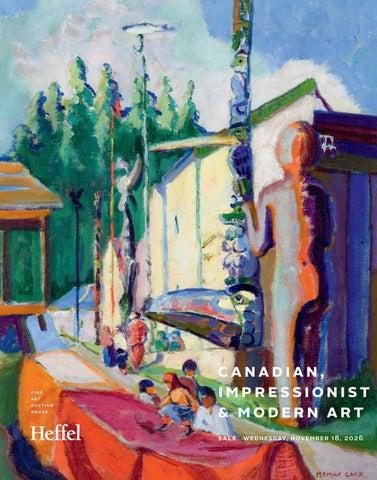
nr a,d i a n , o l d m ac sa te pn r iessts i&o n i s t I m p r e s Ismi o M o d e r n& AMrotd e r n A r t Sa l e
th u r sday, m ay 7 Pday, m e tn ov e mbe r 18, 2026 Sa21 l e, 2026 we d n· es
i
ii
Canadian, Impressionist & Modern Art Auction Wednesday, November 18, 2026
155 Yorkville Avenue, 2nd Floor, Units 1 & 2, Toronto Entrance at STK, 153 Yorkville Avenue Together with Heffel’s Digital Saleroom Registration required to attend or bid in person Video Presentation 4:30 PM ET Post-War & Contemporary Art 5 PM ET Canadian, Impressionist & Modern Art 7 PM ET
Previews Heffel Gallery, Calgary
220 Manning Road NE, Unit 1080 Friday, October 2 through Sunday, October 4, 11 am to 6 pm MT Heffel Gallery, Vancouver
2247 Granville Street Wednesday, October 14 through Sunday, October 18, 11 am to 6 pm PT Galerie Heffel, Montreal
1840 rue Sherbrooke Ouest Thursday, October 29 through Monday, November 2, 11 am to 6 pm ET Heffel Gallery, Toronto
13 Hazelton Avenue Together with our Yorkville exhibition galleries Tuesday, November 10 through Monday, November 16, 11 am to 6 pm ET
Heffel Gallery Limited
Heffel.com Departments
Additionally herein referred to as “Heffel” or “Auction House”
consignme nts
CONTACT
consignments@heffel.com Appra isa ls
appraisals@heffel.com
Toll Free 1-888-818-6505 mail@heffel.com, www.heffel.com Please send all physical mail to our Vancouver address
Abse nt e e , Te le phone & online Bidding
To ro n to
Shipping
Main Yorkville Reception 13 Hazelton Avenue, Toronto, ON M5R 2E1 Telephone 416-961-6505, Fax 416-961-4245
shipping@heffel.com
15 Hazelton Avenue, Unit 200, Toronto, ON M5R 2E1 135 Yorkville Avenue, Unit 401, Toronto, ON M5R 3W5 via main reception 155 Yorkville Avenue, 2nd Floor, Toronto, ON M5R 1C4 via main reception M o n t r e al
1840 rue Sherbrooke Ouest, Montreal, QC H3H 1E4 Telephone 514-939-6505 Va n co u v e r
2247 Granville Street, Vancouver, BC V6H 3G1 Telephone 604-732-6505 NORTH Van co u v e r
2455 Dollarton Highway, Unit 108 North Vancouver, BC V7H 0A2 Telephone 604-732-6505 ext. 150 by appointment Ca lga ry
220 Manning Road NE, Unit 1080, Calgary, AB T2E 8K4 Telephone 403-238-6505 by appointment
bids@heffel.com
Subscript ions
subscriptions@heffel.com
Cata logue Subscript ions
Heffel Gallery Limited regularly publishes a variety of materials beneficial to the art collector. An Annual Subscription entitles you to receive our Auction Catalogues. Our Annual Subscription Form can be found on page 107 of this catalogue.
Cata logue Product ion
Essay Contributors—Alec Blair, Samantha Burton, Gilbert Gignac, Robert Heffel, Charles C. Hill, Savannah Holmes, Lindsay Jackson, Alec Kerr, Lauren Kratzer, Adam Lauder, Kristian Martin, Catharine Mastin, Naomi Pauls, Marie-Jo Paquet, Michael Parke-Taylor, Rebecca Rykiss and Douglas Watt Text Editing, Catalogue Production—Rania Chaddad, David Heffel, Robert Heffel, Alec Kerr, Kristian Martin, Naomi Pauls and Kirbi Pitt Director of Imaging—Martie Giefert Digital Imaging—Ward Bastian, Jasmin Daigle, Brandon Prince and Justin Somjen Catalogue Layout and Production—Kirbi Pitt and Clara Wong
Copyright Co r po rat e Ba n k
Royal Bank of Canada, 1465 West Broadway Vancouver, BC V6H 0E3 Telephone 604-668-4968 Incoming wires are required to be sent in Canadian funds and must include: Heffel Gallery Limited, 2247 Granville Street, Vancouver, British Columbia V6H 3G1 as beneficiary.
No part of this publication may be reproduced, stored in retrieval systems or transmitted in any form or by any means, digital, photocopy, electronic, mechanical, recorded or otherwise, without the prior written consent of Heffel Gallery Limited. All photographic representations and other illustrations depicted are solely for guidance and are not to be relied upon in terms of tone or colour.
Boa r d o f D i r ecto rs
Chairman In Memoriam—Kenneth Grant Heffel President—David Kenneth John Heffel Auctioneer License T83-3364318 and #26-155436 Vice-President—Robert Campbell Scott Heffel Auctioneer License T83-3365303 and #26-155435
Follow us:
IX Printed in Canada by Friesens ISBN: 978-1-927031-87-2
contents
4 5
Notice for Collectors Auction Details
Selling at Auction
Buying at Auction
General Bidding Increments
Framing, Conservation and Shipping
Written Valuations and Appraisals
7
Canadian, Impressionist & Modern Art Catalogue
96
Heffel Specialists
98
Terms and Conditions of Business
104
Property Collection Notice
105
Catalogue Abbreviations and Symbols
106
Catalogue Terms
106
Heffel’s Code of Business Conduct, Ethics and Practices
107
Annual Subscription Form
107
Collector Profile Form
108
Absentee Bid Form
109
Telephone Bid Form
110
Digital Saleroom Registration Form
111
Shipping Authorization Form for Property
112
Terms and Conditions for Shipping
113
Index of Artists by Lot
notice for Collectors Auction Location HEFFEL TORONTO
155 Yorkville Avenue, 2nd Floor, Units 1 & 2, Toronto Entrance at STK, 153 Yorkville Avenue Together with Heffel’s Digital Saleroom
HEF F EL SA L ERO O M
Entrance through 153 Yorkville Ave
Reserved Seating and Attendance This auction is by pre-arranged reserved seating only. To register for in-person bidding or general attendance, please contact bids@heffel.com. Please note that all reserved seating requests must be received by Heffel at least two (2) business days prior to the commencement of the sale. Admission is based on approved registration and verification by Heffel. Registered bidders will have priority for seating. General admission is limited and cannot be guaranteed. Please note that Heffel may, at its discretion, restrict entry for event security and safety.
Auction Notice The Buyer and the Consignor are hereby advised to read fully the Terms and Conditions of Business and Catalogue Terms, which set out and establish the rights and obligations of the Auction House, the Buyer and the Consignor, and the terms by which the Auction House shall conduct the sale and handle other related matters. This information appears on pages 98 through 106 of this publication. Please visit www.heffel.com for information on which Lots will be present at each preview location, virtual auction previews and to book your in person preview appointment. Preview appointments can also be booked by calling 1-888-818-6505.
Absentee, Telephone and Digital Saleroom Bidding
Live Stream Please note that we produce a live stream of our sale beginning with a video presentation at 4:30 PM ET and the auction commencing at 5 PM ET. We recommend that you test your video streaming 30 minutes prior to our sale at www.heffel.com. All Lots and additional images depicting the frame and verso are available at www.heffel.com.
4
If you are unable to attend our auction in person, Heffel recommends submitting an Absentee Bid Form to participate. Heffel also accepts telephone bidding, prioritized by the first received Telephone Bid Form and limited to available Telephone Bid Operators per Lot. Alternatively, Heffel offers online bidding in real time through our Digital Saleroom, subject to advanced registration and approval. All forms of remote bidding participation and registration must be received by Heffel at least two (2) business days prior to the commencement of the sale. Information on absentee, telephone and online bidding appears on pages 5, 108, 109 and 110 of this publication.
Estimates and Currency Our Estimates are in Canadian funds. Exchange values are subject to change and are provided for guidance only. Buying 1.00 Canadian dollar will cost approximately 0.74 US dollar, 0.64 euro, 0.55 British pound, 0.61 Swiss franc, 115 Japanese yen or 5.8 Hong Kong dollars as of our publication date.
a u c t i o n d e ta i l s Selling at Auction Heffel offers individuals, collectors, corporations and public entities a full-service firm for the successful de-acquisition of their artworks. Interested parties should contact us to arrange for a private and confidential appointment to discuss their preferred method of disposition and to analyse preliminary auction estimates, pre-sale reserves and consignment procedures. This service is offered free of charge. If you are from out of town or are unable to visit us at our premises, we would be pleased to assess the saleability of your artworks by mail, courier or e-mail. Please provide us with photographic or digital reproductions of the artworks front and verso and information pertaining to title, artist, medium, size, date, provenance, etc. Representatives of our firm travel regularly to major Canadian cities to meet with Prospective Sellers. It is recommended that property for inclusion in our sale arrive at Heffel at least 90 days prior to our auction. This allows time to photograph, research, catalogue and promote works and complete any required work such as re-framing, cleaning or conservation. All property is stored free of charge until the auction; however, insurance is the Consignor’s expense. Consignors will receive, for completion, a Consignment Agreement and Consignment Receipt, which set forth the terms and fees for our services. The Seller’s Commission is the amount paid by the Consignor to the Auction House on the sale of a Lot, which is calculated on the Hammer Price, at the rates specified in writing by the Consignor and the Auction House on the Consignment Agreement, plus applicable Sales Tax. Consignors are entitled to set a mutually agreed Reserve or minimum selling price on their artworks.
Buying at Auction
All items that are offered and sold by Heffel are subject to our published Terms and Conditions of Business, our Catalogue Terms and any oral announcements made during the course of our sale. Heffel charges a Buyer’s Premium calculated on the Hammer Price as follows: a rate of twenty-five percent (25%) of the Hammer Price of the Lot up to and including $25,000; plus twenty percent (20%) on the part of the Hammer Price over $25,000, plus applicable Sales Tax. If you are unable to attend our auction in person, you can bid by completing the Absentee Bid Form found on page 108 of this catalogue. Please note that all Absentee Bid Forms should be received by Heffel at least two (2) business days prior to the commencement of the sale. Bidding by telephone, although limited, is available. Please make arrangements for this service well in advance of the sale. Telephone lines are assigned in order of the sequence in which requests are received. We also recommend that you leave an Absentee Bid amount that we will execute on your behalf in the event we are unable to reach you by telephone. Digital Saleroom online bidding is available subject to pre-registration approval by the Auction House at least two (2) business days in advance of the auction. Payment must be made by: a) Bank Wire direct to the Auction House’s account, b) Certified Cheque or Bank Draft, c) a Personal or Corporate Cheque, d) Debit Card and Credit Card only by Visa, Mastercard or Union Pay or American Express or e) Interac
version 2026.03 © Heffel Gallery Limited
e-Transfer. Bank Wire payments should be made to the Royal Bank of Canada as per the account transit details provided on your invoice. All Certified Cheques, Bank Drafts and Personal or Corporate Cheques must be verified and cleared by the Auction House’s bank prior to all purchases being released. Credit Card payments are subject to our acceptance and approval and to a maximum of $5,000 if the Buyer is providing their Credit Card details by fax or to a maximum of $25,000 per Lot purchased if paying online or if the Credit Card is presented in person with valid identification. A two percent (2.00%) Convenience Fee will apply to all Credit Card payments. In all circumstances, the Auction House prefers payment by Bank Wire.
General Bidding Increments Bidding typically begins below the low estimate and generally advances in the following bid increments: $50 – 300 $25 increments $300 – 500 $50 $500 – 2,000 $100 $2,000–5,000 $250 $5,000–10,000 $500 $10,000–20,000 $1,000 $20,000–50,000 $2,500 $50,000–100,000 $5,000 $100,000–300,000 $10,000 $300,000–1,000,000 $25,000 $1,000,000–2,000,000 $50,000 $2,000,000–3,000,000 $100,000 $3,000,000–5,000,000 $250,000 $5,000,000–10,000,000 $500,000 $10,000,000+ $1,000,000
Framing, Conservation and Shipping As a Consignor, it may be advantageous for you to have your artwork re-framed and/or cleaned and conserved to enhance its saleability. As a Buyer, your recently acquired artwork may demand a frame complementary to your collection. As a full-service organization, we offer guidance and in-house expertise to facilitate these needs. Buyers who acquire items that require local delivery or out-of-town shipping should refer to our Shipping Authorization Form for Property on page 111 and our Terms and Conditions for Shipping on page 112 of this publication. Please feel free to contact us to assist you in all of your requirements or to answer any of your related questions. Full completion of our shipping form is required prior to purchases being released by Heffel.
Written Valuations and Appraisals Written valuations and appraisals for probate, insurance, family division and other purposes can be carried out in our offices or at your premises. Appraisal fees vary according to circumstances. If, within five years of the appraisal, valued or appraised artwork is consigned and sold through Heffel, the client will be refunded the appraisal fee, less incurred “out of pocket” expenses on a prorated basis. 5
6
Sale
W e d n e s d ay, N o v em b e r 1 8 , 2 0 2 6 · 7 P m et
Canadian, Impressionist & M o d e r n ART c ata lo g u e
F e at u r i n g W o r k s f r o M The Collection of Edward Britton The Collection of John and Molly Pollock An Important Private Canadian Collection & other Important Private and Corporate Collections
101 Walter Joseph (W.J.) Phillips ASA CPE CSPWC RCA 1884 – 1963
House Posts, Tsatsisnukomi, BC tempera on board, signed and dated 1927 and on verso signed, titled Siwash House Posts and inscribed 739 Wolseley Ave. Winnipeg and 150.00 on the Royal Canadian Academy of Arts label 20 × 16 in, 50.8 × 40.6 cm P rov e n an c e
Private Collection, Winnipeg, circa 1927 By descent to the present Private Collection, Montreal
8
Lit e rat ure
Catalogue of Fine, Graphic & Applied Arts & Salon of Photography, Canadian National Exhibition, 1927, listed unpaginated, titled as Siwash House-posts, Tsatsisnukomi, BC Catalogue of the Forty-Ninth Exhibition of the Royal Canadian Academy of Arts, Art Association of Montreal, Canada, 1928, listed page 18 Evelyn de R. McMann, Royal Canadian Academy of Arts: Exhibitions and Members 1880 – 1979, 1981, listed page 327 Roger H. Boulet, The Tranquility and the Turbulence: The Life and Works of Walter J. Phillips, 1981, the related woodcut reproduced page 99
Roger Boulet, Walter J. Phillips: The Complete Graphic Works, 1981, the woodcut reproduced page 297 Exhibited
Canadian National Exhibition, Toronto, Canadian Paintings, August 27 – September 10, 1927, catalogue #518 Art Association of Montreal, Royal Canadian Academy of Arts 49th Annual Exhibition, November 24, 1927 – January 2, 1928, catalogue #182 W.J. Phillips’s depictions of Canada, proliferated widely through his expertly crafted woodblock prints, have become wellknown, iconic images, establishing his meticulous and insightful vision of the country in the catalogue of our collective imagination. With careful attention to the nuanced subtleties found in diverse landscapes as well as the human activities carried out within them, Phillips’s works present a strong, unique voice in the canon of Canadian historical art. Like many Canadian artists in the early twentieth century, Phillips sought inspiration for his art through traveling the country and seeking out material in the landscapes and communities he encountered. In 1927, the artist ventured to various settlements on the west coast of British Columbia, recording his excitement in a column for the Winnipeg Evening Tribune: “I am on the British Columbia coast for a definite purpose. . . . l am here on a sketching trip, that is, to gather material for possible easel pictures, dignified or otherwise. Time and place are in the happiest conjection [sic] for although when I left Winnipeg, snow lay on the ground, in Alert Bay spring flowers have been blooming for a week or two.” 1 The favourable conditions allowed Phillips to sketch in pencil and watercolour on site, gathering abundant material to be developed later in the studio into either larger paintings, woodblock prints or both. For our painting specifically, the origins are noted in an undated article by the artist for the Winnipeg Evening Tribune entitled “Canadian Sketching Grounds: Three West Coast Villages,” where he recalls anchoring in the bay of a deserted village, Tsatsisnukomi: “We stayed a while the next day, until wind made the anchorage uncomfortable, but I had time to make pencil drawings . . . and a water-colour of the beach and part of the village with two house-posts in the foreground, each representing a bear suckling a wolf. 2 From this initial watercolour (present whereabouts unknown), our painting is the resulting easel picture, a confident and purposeful rendering of a classic West Coast scene, attuned to the specific environment and lighting. In this large work, Phillips has translated his on-site impressions into the tempera medium. Zones of flat colour bring this scene to life, a process aligned with how he would plan a woodblock print. The chosen colours bring dramatic contrast to the work, especially in the rich, cool and vibrant shadows on the carved foreground poles, the work’s focal point. Further details sustain the viewer’s interest, including the building in the distance bathed in sunlight and the beached canoe in the middle ground, seemingly waiting for high tide. Phillips was clearly pleased with the result of this studio painting and showed the work in the 1927 Canadian National Exhibition show (catalogue #518) and in the 1927 Royal Canadian Academy of Arts show (catalogue #182). Further speaking to its importance, he continued to develop the composition and translate it into one of his most celebrated woodblock prints from
WALTER JOSEPH (W.J.) PHILLIPS Siwash House Posts, Tsatsisnukomi, British Columbia colour woodcut on paper, 1928 8 × 6 1/4 in, 20.3 × 15.9 cm Not for sale with this lot
Royal Canadian Academy of Arts exhibition label on verso
this period, Siwash House Posts, Tsatsisnukomi, British Columbia (1928), part of the portfolio entitled The Canadian Scene. The success of the composition on a small scale affirms the excellence of its design and brings further significance to this large version of it, a rare opportunity to appreciate anew a familiar picture and delve deeper into Phillips’s time on BC’s west coast. 1. W.J. Phillips, “Canadian Sketching Grounds: Three West Coast Villages,” n.d., reproduced from the Winnipeg Evening Tribune in Maria Tippett and Douglas Cole, eds., Phillips in Print: The Selected Writings of Walter J. Phillips on Canadian Nature and Art (Manitoba Record Society, 1982), 60. 2. Ibid., 61.
This work has remained in the same family’s collection for almost 100 years until its consignment to Heffel this summer. Est imat e : $20,000 – 30,000 9
10
102 Emily Carr BCSFA CGP 1871 – 1945
View from Kitsilano watercolour on paper, signed M. Carr and on verso titled View from Point Grey and dated circa 1909 on the backing 10 5/8 × 14 1/2 in, 27 × 36.8 cm P rov e n an c e
The Art Emporium, Vancouver Acquired from the above by a Private Collection, Vancouver, August 5, 1972 Private Collection, Vancouver L i t e rat u r e
Doris Shadbolt, editor, The Complete Writings of Emily Carr, 1993, page 424 and 858 Painted on the eve of Emily Carr’s transformative journey to France, View from Kitsilano is a rare and compelling example from the artist’s early career, created at a moment when both Carr and the city of Vancouver stood on the cusp of profound change. In the midst of the city’s rapid expansion at the turn of the twentieth century, Carr had established a studio at 570 Granville Street and was earning her living teaching art classes to children. She championed the principles of outdoor plein air painting that she had absorbed during her studies in England, encouraging her students to engage first-hand with the surrounding landscape. Recalling these formative years, Carr later wrote, “I took my classes into the woods and along Vancouver’s waterfront to sketch. . . . We sat on beaches over which great docks and stations are now built, we clambered up and down wooded banks solid now with Vancouver’s commercial buildings.” Her teaching practice flourished, and by the end of 1907 she had attracted more than 75 pupils. Yet this success left her with little time for independent artistic pursuits, which were largely confined to weekends and summer holidays. Despite these demands, Carr remembered her early Vancouver years as a period filled with “joy, independence and lots of laughing.” View from Kitsilano was likely painted near the site of the present-day Kitsilano Pool, looking across English Bay towards Vancouver’s emerging downtown skyline, the forested sweep of Stanley Park, and the North Shore mountains beyond. The landform to the right is probably Kits Point, where old-growth cedars once rose above the shoreline. At the time Carr painted this view, the city was still emerging from its natural setting, and the balance between urban growth and forest is captivating. The composition is distinguished by its luminous and assured handling of watercolour. Carr’s confident brushwork animates the surface, as vibrant foreground flowers dissolve into shimmering reflections of sky and water. Delicate passages of colour describe the bay, while successive bands of violet and blue mountains recede into the distance with atmosphere and subtlety. The painting reveals Carr’s keen sensitivity to light as well as her ability to convey the immediacy of direct observation.
TOP: Kitsilano Beach, circa 1909 Photo: City of Vancouver Archives BOTTOM: View from above Kitsilano Pool, Vancouver Photo: Alec Blair
View from Kitsilano foreshadows the artistic vision that would later establish Carr as one of the country’s most celebrated and influential modern painters. While still rooted in the traditions of plein air landscape painting, the work already demonstrates her profound engagement with the distinctive character of the British Columbia coast. Today, View from Kitsilano serves as a valuable record of a shoreline that has undergone dramatic transformation, preserving not only the physical beauty of early Vancouver but also a sense of its cultural memory and identity. This work was previously sold by Torben V. Kristiansen of the Art Emporium, a noted Vancouver dealer, collector and steadfast supporter of Emily Carr’s work. Est imat e : $30,000 – 50,000
11
103 James Edward Hervey (J.E.H.) MacDonald ALC CGP G7 OSA RCA 1873 – 1932
Magnetawan River Rapids oil on board, signed and dated 1912 and on verso titled Song of the Rapid (Study) on a label and inscribed #698A and 7 7 × 9 in, 17.8 × 22.9 cm P rov e n an c e
Florence Alicia Grasset Gates (Mrs. George F. Hagarty), likely owner until 1939 Beatrice Hagarty (Mrs. Percy Robertson), Toronto, until 1962 Anne Grasset Hagarty (Mrs. Samuel Casey Wood), Toronto, until circa 1965 Allan Hagarty Wood, Toronto, by 1965 By descent to a Private Estate, Toronto Private Collection, Toronto
12
Lit e rat ure
E. R. Hunter, J.E.H. MacDonald: A Biography & Catalogue of His Work, 1940, the related canvases A Rapid in the North and The Song of the Rapid listed page 48 Nancy Robertson, J.E.H. MacDonald, R.C.A., 1873 – 1932, Art Gallery of Toronto, 1965, pages 7 – 8, reproduced page 46, and the related 1913 canvas A Rapid in the North reproduced page 20 Paul Duval, The Tangled Garden: The Art of J.E.H. MacDonald, 1978, pages 46 – 47, a related 1912 sketch titled Thomson’s Rapids, Magnetawan River reproduced page 32, its related 1913 canvas Song of the Rapids reproduced page 33 and both works listed unpaginated Robert Stacey, ed. “J.E.H. MacDonald, ‘Scandinavian Art,’ ” Northward Journal, no. 18/19, 1980, pages 17 – 18
Exhibited
Art Galleries of the Public Reference Library, Toronto, First Exhibition of Little Pictures by Canadian Artists, February 26 – March 22, 1913, possibly catalogue #218, titled as Rapid, Magnetawan River Art Gallery of Toronto, J.E.H. MacDonald, RCA, 1873 – 1932, November 13 – December 12, 1965, traveling to the National Gallery of Canada, Ottawa, January 7 – February 6, 1966, catalogue #53 Having made a career in the graphic arts in Toronto and London, J.E.H. MacDonald first exhibited paintings in the spring of 1908, small landscapes of High Park near his home in west Toronto and the Humber River. In the summer of 1911, he painted on Georgian Bay. Two years before he had first traveled to Burks Falls in Muskoka, where his wife’s aunt, Esther Prior, lived. There he painted a small, vertical oil sketch of a rapid on the Magnetawan River and exhibited the canvas Clearing after Rain, Magnetawan River, Ontario (collection of the Beaverbrook Art Gallery, Fredericton, 1984.04) in the 1910 exhibition of the Ontario Society of Artists. MacDonald gave up his job at the design firm Grip Ltd. in December 1911 to work freelance, thus enabling him to devote more time to painting, and in the spring or summer of 1912, MacDonald returned to Burks Falls. He painted a sawmill on nearby Lake Cecebe (collection of the National Gallery of Canada, acc. no. 4741) and some rapids on the Magnetawan River (Spring Rapids, National Gallery of Canada, acc. no 4740), identified in a sketch in the McMichael Canadian Art Collection as Thomson’s Rapids (acc. no. 1981.38), however, not after Tom Thomson, as the latter had never painted on the Magnetawan. The McMichael sketch and Magnetawan River Rapids (our painting) were worked up into two canvases included in the Exhibition of Paintings by J.W. Beatty, Wm. Brymner, W.H. Clapp, Maurice Cullen, Clarence A. Gagnon, E. Wyly Grier, Lawren Harris, Charles W. Jefferys, and J.E.H. MacDonald shown at the MacDowell Club in New York in March 1913, where they were titled A Rapid in the North and A Canadian Rapid. The latter was retitled The Song of the Rapid when exhibited at the Ontario Society of Artists exhibition in Toronto in April 1913. E.R. Hunter confused the two very similar canvases in his 1940 catalogue of MacDonald’s paintings. Hence the error on the typed label on the back of the sketch being offered here, an error corrected by Nancy Robertson (later Dillow) in 1965. A Rapid in the North is in the collection of the Art Gallery of Hamilton, a gift of the artist’s family (acc. no. 74.87.2) and The Song of the Rapid is in the Thomson Collection at the Art Gallery of Ontario (acc. no. 103852). In A Rapid in the North, painted from our oil sketch Magnetawan River Rapids, MacDonald abandoned the more open composition of the other sketches. A prominent rock on the right frames the rapid, breaking the flow of the water, forcing the stream to the left and leaving a calm pool at its base. The intimacy of the composition is enhanced by the background screen of trees, and the overall linear rhythm creates a superbly decorative effect. In January 1913, MacDonald and fellow artist Lawren Harris traveled to Buffalo to see an exhibition of contemporary
J.E.H. MacDonald painting in Algoma, circa 1918 – 1919 Photo: National Gallery of Canada
Scandinavian art, an experience that has long been seen as key to the development of both artists’ work. MacDonald famously lectured on their visit in 1931. Harris and MacDonald were most struck by the paintings of the Swedish artist Gustaf Fjaestad. [T]hose two Canadian innocents abroad . . . found his work perhaps the most attractive of all. It was more definitely stylized than that of most of the painters. . . . The flow and ripple of water were beautifully painted by him, and shaded trees and stony rapids, and mottled rocks, and spotted birch trunks.
Yet MacDonald was already arranging his compositions in a decorative and intimate manner, as evidenced by this oil sketch. His exposure to the Scandinavian exhibition confirmed a direction MacDonald had already embarked on, though it would mark a major turning point for Harris. Nancy Robertson admiringly wrote of our sketch: Suggestions of what he [MacDonald] could achieve can be detected in sketches and paintings as early as 1912 and 1913 . . . . The sketch (No. 53) for A Rapid in the North (No. 11) has much of the decisive, economic vigour of an Algoma sketch while the final painting itself and the companion picture Song of the Rapid (No. 10) are logical predecessors of The Little Fall (No. 30) or Leaves in the Brook (No. 31) of 1919.
13
JAMES EDWARD HERVEY (J.E.H.) MACDONALD A Rapid in the North oil on canvas, 1913 20 1/4 × 28 3/8 in, 51.4 × 72.1 cm Collection of the Art Gallery of Hamilton, 74.87.2. Gift of the MacDonald Family, 1974 Photo: Mike Lalich, 2008 Not for sale with this lot
And Paul Duval acutely observed of the two sketches for A Rapid in the North and The Song of the Rapid: They are close-up studies, vibrating with crisp, stabbing brush strokes that trace the foaming passage of the rapids . . . . For some years the artist repeatedly tackled the difficult pictorial task of expressing such an elusive theme, and the two Magnetawan River compositions were only the first of those canvases of rushing water which led to such masterpieces as Leaves in the Brook; Falls, Montreal River; The Wild River; and Algoma Waterfall.
Robertson identified the first owner of this sketch as Mrs. George F. Hagarty, and subsequently Mr. and Mrs. Percy Robertson, information most likely obtained from the owner of the sketch in 1965. But it is possible that the painting may have been first acquired by the artist Mrs. Percy Robertson, née Beatrice Hagarty. On October 5, 1914, A.Y. Jackson wrote to MacDonald from Canoe Lake in Algonquin Park: “Art is raging round
14
here now, no less than five O.S.A. exhibitors on the job. Varley, Lismer, Tom and a Miss Beatrice Hagarty that was . . . now Mrs. Robertson.” 1 Beatrice Hagarty married Percy Robertson September 27, 1914, and they spent their honeymoon at Canoe Lake. Boasting historic provenance, Magnetawan River Rapids represents a rare opportunity to acquire an on-site sketch directly related to MacDonald’s early canvas A Rapid in the North. We thank Charles C. Hill, former curator of Canadian art from 1980 to 2014 at the National Gallery of Canada, for contributing the above essay. Hill is the author of The Group of Seven: Art for a Nation, among other publications. 1. A.Y. Jackson, Canoe Lake, to J.E.H. MacDonald, Toronto, October 5, 1914, J.E.H. MacDonald fonds, Library & Archives Canada, Ottawa. Est imat e : $100,000 – 150,000
104 James Edward Hervey (J.E.H.) MacDonald ALC CGP G7 OSA RCA 1873 – 1932
Flower Study oil on board, on verso signed, titled and inscribed Studio Bldg. on the artist’s label and inscribed with the Dominion Gallery inventory #D850 8 × 10 1/2 in, 20.3 × 26.7 cm P rov e n an c e
Thoreau MacDonald, son of the Artist Dominion Gallery, Montreal Private Collection, Ontario Canadian Art, Sotheby’s Canada, May 26, 2011, lot 7 Private Collection, Toronto While A.Y. Jackson famously remarked that J.E.H. MacDonald had effectively “claimed” Algoma as his own through the strength of his interpretations of its remarkable landscape, MacDonald’s artistic vision was no less engaged with places closer
to home. The gardens and streets of Toronto, his residence in Thornhill, and the dramatic skies above Lake Simcoe all inspired works of equal conviction. Paintings such as The Tangled Garden (1916), once controversial among conservative critics, apply the same forceful vision and expressive energy that characterize his celebrated northern scenes to the modest country garden. That same vitality is evident in this refined floral composition. MacDonald approaches the subject with sensitivity and clarity, arranging colour, form and movement with exceptional confidence. Particularly noteworthy is his treatment of the background, which recedes quietly while remaining visually engaging, enhancing rather than competing with the flowers themselves. MacDonald resists mere ornamentation in favour of a deeper, more intimate exploration of the subject. Through keen observation and an intuitive understanding of nature, he captures both its vitality and its endurance, while quietly evoking its inherent transience. The result is a painting that invites viewers beyond the simple appreciation of its beauty, encouraging a more thoughtful connection with the natural world. Est imat e : $30,000 – 50,000 15
105 Alexander Young (A.Y.) Jackson ALC CGP G7 OSA RCA RSA 1882 – 1974
St. Fabien, Quebec oil on board, signed and on verso titled on the gallery label and inscribed variously, circa 1930 8 1/2 × 10 1/2 in, 21.6 × 26.7 cm P rov e n an c e
Masters Gallery Ltd., Calgary Private Collection, Vancouver A.Y. Jackson frequently embarked on sketching trips along the St. Lawrence River throughout the 1920s and 1930s, often accompanied by fellow painters associated with the Group of Seven. While each artist brought a unique perspective to Canada’s landscapes, Jackson was particularly drawn to quaint clusters of vernacular buildings nestled within gently rolling countryside.
16
He once remarked that the southern shore of the river, where the small parish of Saint-Fabien still stands, was his favourite place to paint. His affection for the region is evident in the way he returned to its quiet simplicity season after season. In this bright winter sketch, the vibrant blue sky is enlivened by flecks of yellow and green. A winding path cuts horizontally across the composition, curving towards a cluster of buildings. Nearing them is a person on a horse-drawn sled, adding a colourful human presence. Jackson’s brushwork is both swift and assured, capturing winter light as it dances across the snowcovered fields with long, confident strokes. The result is a fresh and vivid impression of rural Quebec, rendered with immediacy and charm. Est imat e : $25,000 – 35,000
106 Alexander Young (A.Y.) Jackson ALC CGP G7 OSA RCA RSA 1882 – 1974
Lake Superior Hills oil on board, signed and on verso titled and dated 1923 8 1/2 × 10 1/2 in, 21.6 × 26.7 cm P rov e n an c e
Laing Galleries, Toronto Peter Ohler Fine Arts Ltd., Vancouver Private Collection, Vancouver L i t e rat u r e
A.Y. Jackson, A Painter’s Country: The Autobiography of A.Y. Jackson, 1958, page 48 In the autumn of 1921, A.Y. Jackson embarked on his first sketching trip to the north shore of Lake Superior, accompanied by fellow Group of Seven member Lawren Harris. The new vistas proved inspiring to Jackson, who returned annually alongside
various members of the Group until 1925. While Harris sought the sublime in the expansive lake and sky, Jackson turned inland, drawn to the rugged hills above the shore. In his autobiography, Jackson notes: “I know of no more impressive scenery in Canada for the landscape painter. There is a sublime order to it, the long curves of the beaches, the sweeping ranges of hills, and headlands that push out into the lake. . . . In the autumn the whole country glows with colour . . . ” Here, Jackson renders the landscape in a luminous autumnal palette, his vibrant brushwork animating the rhythmic hilltops and rocky ledge in the foreground. Expressive daubs of honeyed yellow, ochre and crimson punctuate the scene, set against the cool, muted hillside and barren tree trunks in the distance. This sketch would go on to inform Jackson’s major Lake Superior canvases, including the 1924 canvas Lake Superior Country (in the McMichael Canadian Art Collection). Est imat e : $20,000 – 30,000
17
18
107 Frank Hans (Franz) Johnston ARCA CSPWC G7 OSA 1888 – 1949
The Kiss tempera on board, on verso signed, titled and inscribed 96 Keewatin Ave. on the Canadian National Exhibition label, 1920 20 1/2 × 27 1/2 in, 52.1 × 69.8 cm P rov e n an c e
By descent to the present Private Collection, Vancouver L i t e rat u r e
Catalogue of Etchings, Wood Block Prints, Lithographs, Decorations and Illustrations (under the auspices of the Society of Graphic Arts and the Society of Canadian Painter-Etchers), Canadian National Exhibition, 1920, listed page 4 Exhibited
The 1920 Canadian National Exhibition label on verso
Canadian National Exhibition, Toronto, International Exhibition: Graphic and Applied Arts and Photography, under Etchings, Wood Block Prints, Lithographs, Decorations and Illustrations, August 28 – September 11, 1920, catalogue #18 An enchanting picture of remarkable modernism, The Kiss conveys the magic and wonder of a child’s fleeting encounter with a butterfly. With shocking yellow wings reminiscent of the chromatic experiments of Symbolists such as Paul Sérusier, and sinuous contours that recall the Japanese-inspired signature of James McNeill Whistler, Franz Johnston’s butterfly is a disarming emblem of modernity. The formal concerns of Symbolism and Whistler’s Aestheticism carried over into the Art Nouveau movement, whose influence was strongly felt by Tom Thomson and future members of the Group of Seven, including Johnston, while working as commercial artists at the storied graphic design firm of Grip Ltd., itself named after another winged icon of aesthetic innovation claimed by Symbolist artists and their fellow travelers: the raven of Edgar Allan Poe.1 Toiling alongside Thomson, Franklin Carmichael, Arthur Lismer, J.E.H. MacDonald and Frederick Varley, Johnston spent his years at Grip synthesizing the “sinuous lines, loops and flat patterns” of Art Nouveau.2 Yet, as his biographer Roger Burford Mason observes, Johnston’s adaptation of Art Nouveau was always “an entirely personal and creative interpretation.” 3 The Kiss testifies to this canny ability to channel European modernisms into an original statement, fusing a penchant for fantasy with a keen observation of Canadian landscape motifs. The rose and baby-blue fairyland of The Kiss simultaneously recalls the naturalist’s attention to detail that characterizes Johnston’s Drowned Land, Algoma (1918). The latter work was the product of his participation in the first of the legendary “boxcar” expeditions to the Algoma region organized by Lawren Harris, in 1918. 4 These sketching trips to northern Ontario were an important catalyst in the formation of the Group of Seven in 1920. The Kiss was exhibited at the Canadian National Exhibition in that annus mirabilis for Canadian art, the Group’s inaugural exhibition—in which Johnston was represented by more works than any of his colleagues—having opened at the Art Gallery of Toronto in May. If Johnston’s affiliation with the Group proved to be short-lived (he relinquished his association in the year of its founding to assume new duties as principal of the Winnipeg School of Art and
director of that city’s art gallery), it was unquestionably consequential. 5 He is reputed to have coached Thomson’s first outdoor oil sketch and is even said to have coined the name Group of Seven. 6 It is somewhat ironic, then, that Johnston’s amicable departure from the Group was to prove such an enduring lightning rod for controversy. Ultimately, the fiercely independent Johnston was something of a victim of his own success: the most financially successful Canadian artist of his generation, his astonishing productivity and near-constant presence in exhibitions at home and abroad inevitably provoked envious words of criticism. The Kiss showcases the multi-faceted Johnston’s whimsical side as well as his mastery of his favourite medium, tempera. Preferring its quick-drying properties for sketching over the oil paints employed by his Group of Seven peers, Johnston skilfully exploits the egg-based medium to accentuate the flatness of the picture plane, as if demonstrating Maurice Denis’s modernist dictum that “a painting, before being a battle horse, a nude woman or some anecdote, essentially is a flat surface covered with colours assembled in a certain order.” 7 With The Kiss, Johnston delivers a bold yet playful embrace of the picture plane that is striking and rare in Canadian art of its time. We thank Adam Lauder for contributing the above essay. Lauder is an art historian based in Toronto and an adjunct professor at the Ontario College of Art and Design. 1. See Roger Burford Mason, A Grand Eye for Glory: A Life of Franz Johnston (Dundurn Press, 1998), 18. 2. Franklin Arbuckle quoted in ibid., 19. 3. Mason, Grand Eye for Glory, 20. 4. See ibid., 27–29. 5. For Johnston’s Winnipeg tenure, see Marilyn Baker, “Another Beginning: Frank Johnston, Principal,” in The Winnipeg School of Art: The Early Years (Gallery 111, 1984), 44–56. 6. See Mason, Grand Eye for Glory, 19, 38. 7. Quoted in Øystein Sjåstad, A Theory of the Tache in NineteenthCentury Painting (Routledge, 2016), 16. Est imat e : $30,000 – 40,000
19
108 James Wilson Morrice CAC RCA 1865 – 1924
Boats at the Cale de Dinan, Saint-Malo oil on panel, signed and on verso inscribed Morrice 1905 Venezia / 978 / xx and stamped twice with the Giuseppe Biasutti art supply stamp 7 × 9 7/8 in, 17.8 × 25.1 cm P rov e n an c e
Dr. Ante Grgic, Zagreb, circa 1930s By descent to the present Private Collection, Vienna
20
Lit e rat ure
Henry Marcel, “Les Salons de 1902,” Gazette des beaux-arts, vol. 27, June 1902, page 472 Saint-Malo occupies an important place in the artistic development of James Wilson Morrice. He returned repeatedly to the Breton port, drawn to its beaches, harbour, old walls and maritime activity. In these compact oil sketches, or pochades, Morrice found subjects ideally suited to the increasingly distilled language that would distinguish his mature work: figures reduced to accents of colour, architecture simplified into broad form, and water transformed through broken reflections and shifting light.
Boats at the Cale de Dinan, Saint-Malo is a classic example of this approach. Within the intimate format of a small oil panel, Morrice constructs a remarkably complete world. Boats fill the harbour, their sails and masts establishing a lively rhythm across the composition. At the left, a figure in a rowboat is distinguished by a red shirt, a characteristically Morrice-like note of colour that immediately animates the scene. On the ramp beyond, small figures ascend towards the town, introducing a further note of human activity. On the right, three rounded trees line the long wall, while the buildings of Saint-Malo rise behind them. Their pale facades, dark roofs and chimneys are rendered with extraordinary economy. Morrice describes rather than enumerates: a few assured strokes are enough to establish architecture, atmosphere and distance. In the foreground, the boats dissolve into their reflections, where greens, blues, creams and darker tones are broken into passages of freely handled paint. The result remains rooted in observation while moving beyond literal description, the motif becoming an arrangement of colour, rhythm and sensation. Two related Saint-Malo paintings, both executed on panels of the same dimensions, help situate the present work within Morrice’s practice. La petite plage de St-Malo (sold by Heffel on November 22, 2017, lot 107) similarly combines architecture, figures, beach and water within an intimate coastal scene, enlivened by characteristic accents of colour. The Town of St. Malo, in the collection of the New Brunswick Museum, provides an especially compelling comparison. Significantly, its panel bears the same Giuseppe Biasutti art supply stamp found twice on the verso of the present work, establishing a tangible material connection between these related Saint-Malo pochades. The Venetian stamp is particularly evocative of Morrice’s peripatetic working life. In 1902, French critic Henry Marcel memorably described him as a “nomadic Canadian” moving “from Venice to Brittany,” an apt characterization of an artist repeatedly drawn to the subtle effects of atmosphere, water and reflected colour. What makes Boats at the Cale de Dinan, Saint-Malo so compelling is precisely this balance between observation and modernity. Nothing is overworked. Figures, boats, trees, buildings and reflections are each reduced to their essential qualities, yet the harbour remains wonderfully alive. The red-shirted rower, abbreviated trees, pale architecture and fractured reflections become individual notes within a carefully balanced whole. In this luminous panel, Morrice transforms the everyday life of the harbour into something quieter and more poetic, a composition in which atmosphere, colour and sensation become as important as the subject itself. We thank Charles C. Hill and Lucie Dorais for their assistance in researching and cataloguing this lot.
TOP: JAMES WILSON MORRICE La petite plage de St-Malo oil on panel 7 x 9 7/8 in, 17.8 x 25.1 cm Sold by Heffel November 22, 2017, lot 107 Not for sale with this lot BOTTOM: JAMES WILSON MORRICE The Town of St. Malo oil on panel, circa 1900 7 x 10 in, 17.8 x 25.4 cm Collection of the New Brunswick Museum, 1981.73.1 Bequest of F. Eleanore Morrice Not for sale with this lot
Est i m at e : $60,000 – 80,000
21
22
109 Arthur Lismer AAM CGP CSGA CSPWC G7 OSA RCA 1885 – 1969
Arichat, Nova Scotia oil on board, on verso signed, titled and dated 1940 11 3/4 × 15 3/4 in, 29.8 × 40 cm P rov e n an c e
Galerie Walter Klinkoff Inc., Montreal A.K. Prakash & Associates Inc., Toronto Peter Ohler Fine Arts Ltd., Vancouver Private Colleciton, Vancouver l i t e rat u r e
Lois Darroch, Bright Land: A Warm Look at Arthur Lismer, 1981, the related oil entitled Cape Breton, Nova Scotia, Near Cheticamp, reproduced page 119, plate 28 Arichat, Nova Scotia perfectly captures the tumult of Maritime weather, a subject Arthur Lismer knew intimately. During his time as principal of Halifax’s Victoria School of Art and Design, from 1916 to 1919, he developed a close connection to the region, returning often in later years. This painting captures the living rhythms of the land, balancing a sense of vastness with a wealth of detail. A dark, brooding sky hangs low over the upper left of the composition while light pierces the distant horizon and the storm begins to break. The water and surf turn almost electric beneath the brightening sky. Strong, assured brushstrokes reveal Lismer’s mature command of colour, rendering the ferocity of the elements and the shifting atmospheric effects with remarkable immediacy. In 1940, Lismer toured the Maritimes for the National Gallery of Canada, revisiting a region that remained a constant source of inspiration. This oil sketch seems to relate directly to the oil on canvas held in the Sobey Art Foundation’s Crombie Collection of Canadian Art, titled Cape Breton, Nova Scotia, Near Cheticamp. The title of the sketch, more geographically specific, situates the scene at the storied harbour about 100 miles from Cheticamp. Arichat is located off the southeast coast of Cape Breton on Isle Madame, whose maritime history dates to the 1700s. Here, a few short brush-strokes evoke the moody atmosphere of the open sea and the calmer waters of the harbour, protected by the breakwall. Lismer’s mastery of colour and weather lends the scene a distinctive drama and vitality.
ARTHUR LISMER Cape Breton, Nova Scotia, Near Cheticamp oil on canvas, circa 1940 Crombie Collection of Canadian Art, Sobey Art Foundation Not for sale with this lot
Est i m at e : $15,000 – 25,000
23
24
110 Alexander Young (A.Y.) Jackson ALC CGP G7 OSA RCA RSA 1882 – 1974
Northern Landscape oil on canvas, signed, circa 1939 41 1/8 × 50 1/8 in, 104.5 × 127.3 cm P rov e n an c e
Keith MacIver, friend of the Artist, likely a gift Important Canadian Art, Sotheby’s Canada, May 17, 1989, lot 29 Private Collection, USA In this majestic landscape, a work of rare scale, A.Y. Jackson weaves a rich autumnal brocade of cadmium and ochre stands of birch and poplar with viridian accents of spruce set against a pale ground of madder and blue. Evocative of his renowned snowy landscapes of the Lower St. Lawrence, the opalescent mountain forms of Northern Landscape capture the distinctive quartzite geology of the La Cloche region north of Georgian Bay. In the early 1930s, Jackson chose this range of hills as “a closer, more ‘private’ area for annual fall visits” than the austere north shore of Lake Superior favoured by Lawren Harris during the 1920s.1 This geographical shift coincided with a period of personal and professional strain following the stock market crash of 1929 that included the dissolution of the Group of Seven and a rejected marriage proposal to Montreal painter Anne Savage.2 The latter is recorded in an intense correspondence between the two artists dating from 1933, with Jackson’s letters bearing the postmark of Willisville, the town nearest to his La Cloche sketching grounds. In one of those letters, Jackson proposes that the pair construct a cabin at Grace Lake, his favourite of the area’s string of hilllocked lakes, somewhat facetiously suggesting that it could serve as a “northern headquarters” for the nascent Canadian Group of Painters, of which both he and Savage were founding members.3 Though the cabin failed to materialize, the region would attract fellow artists Franklin Carmichael and A.J. Casson, likewise inspired by its signature bell-shaped peaks.4 True to his penchant for annual return trips to his preferred sketching locales, which his niece Naomi Jackson Groves aptly likened to the seasonal migrations of birds, Jackson made repeat visits to the La Cloche area in the autumns of 1933, 1934, 1938, 1939 and 1940.5 A gem-like colour film produced by the National Film Board of Canada,6 with a script by noted art historian and critic Graham McInnes, documents Jackson’s process at Grace Lake in the autumn following his execution of Northern Landscape, whose dating we owe to a letter by Groves, a copy of which accompanies this lot. Canadian Landscape (1941), the NFB documentary by Radford “Budget” Crawley, shows a remarkably spry Jackson, equally adept with canoe paddle and paintbrush. Film and painting alike testify to an artist at the peak of his powers and influence.7 The skilful braiding of trees, rocks and sky in Northern Landscape is characteristic of Jackson’s later style, which Dennis Reid perceptively characterized in terms of its carefully argued counterpoint. Painterly facture and holistic relationships eloquently express the artist’s intuitive search for order in this mature phase of his development. From the rippling quartzite strata of La Cloche, Jackson distills a primordial structure eons in the making. But even as he peers into telluric patterns
revelatory of the region’s Precambrian formation, Jackson’s “eagle eye” is ever alert to the land’s vulnerability to humaninduced transformations.8 The restless prospecting of Keith MacIver, his faithful companion on his La Cloche adventures and the original owner of Northern Landscape (likely gifted to him by the artist), was a constant reminder of the traces left by human presence on the land. In his paintings of the area that he termed Algoma East, Jackson composes a nimble polyphony of human and geological time scales. Fluid rhythms evocative of magma flows comingle with more subtle signs of industry in Northern Landscape’s stunning symphony of opal, emerald and gold. We thank Adam Lauder for contributing the above essay. Lauder is an art historian based in Toronto and an adjunct professor at the Ontario College of Art and Design. 1. Naomi Jackson Groves, Works by A.Y. Jackson from the 1930s (Carleton University Press, 1990), 9. 2. See Dennis Reid, Alberta Rhythm: The Later Work of A.Y. Jackson (Art Gallery of Ontario, 1982), 11. 3. A.Y. Jackson quoted in Groves, Works by A.Y. Jackson, 28. 4. See Christopher E. Jackson, A.J. Casson: An Artist’s Life (McMichael Canadian Art Collection, 1998), 46. 5. See Groves, Works by A.Y. Jackson, 9; Naomi Jackson Groves, A.Y.’s Canada (Clarke, Irwin, 1968), 118. 6. Canadian Landscape, directed by Crawley Radford (National Film Board of Canada, 1941). See also A.Y. Jackson, A Painter’s Country: The Autobiography of A.Y. Jackson (1958; repr., Clarke, Irwin, 1976), 186. 7. See Dennis Reid, A Concise History of Canadian Painting, 3rd ed. (Oxford University Press, 2012), 254. 8. Groves, A.Y.’s Canada, 114. See also Reid, Alberta Rhythm, 17.
A copy of a letter from Naomi Jackson Groves that dates this work to circa fall 1939 accompanies this lot. Est imat e : $300,000 – 400,000
25
26
111
Clarence Alphonse Gagnon
CAC RCA 1881 – 1942
Maison de ferme, Charlevoix oil on panel, on verso titled, dated circa 1922 and certified by the Lucile Rodier Gagnon inventory #785 6 × 9 1/4 in, 15.2 × 23.5 cm P rov e n an c e
Private Collection, Vancouver Exhibited
Galerie Walter Klinkhoff Inc., Montreal, Clarence Gagnon Retrospective, September 8 – 20, 1975, catalogue #11 Maison de ferme, charlevoix depicts the place and season that most fascinated Clarence Gagnon and inspired many of his paintings. A sensitive observer and skilled draughtsman, Gagnon possessed an exceptional ability to convey the harmony of rural Quebec and the brilliance of winter. Painted while living in BaieSaint-Paul, this oil sketch epitomizes his deep connection to the Laurentian region and the delight he found in portraying its ancient and scenic landscape. Gagnon often traveled on skis, painting jewel-like sketches en plein air. In this delightful composition, a farmhouse nestles among pale blue and cream snowdrifts, its cheerful greens and reds punctuating the winter landscape. Fluid, economical brushwork suggests stacked firewood, a cleared path, and a chimney with confidence and immediacy. Warm and cool tones play against one another to create the chromatic harmony that characterizes the artist’s mature work. This charming sketch exemplifies the luminous palette and poetic sensitivity that established Gagnon as one of the masters of Canadian Impressionism. Est i m at e : $25,000 – 35,000
27
112 Lawren Stewart Harris ALC BCSFA CGP FCA G7 OSA TPG 1885 – 1970
Mount Leah, Maligne Lake oil on board, signed and on verso signed, titled, inscribed Stern / 19 and variously and stamped Dominion Gallery, 1924 10 5/8 × 13 3/4 in, 27 × 34.9 cm P rov e n an c e
Collection of the Artist Acquired directly from the Artist by Dr. and Mrs. Max Stern, Montreal, 195 1 Estate of Dr. Max Stern, Montreal A.K. Prakash & Associates Inc., Ottawa Masters Gallery Ltd., Calgary Private Collection, Vancouver
28
Lit e rat ure
“Interesting Works by Lawren Harris,” Montreal Gazette, May 26, 1951, mentioned page 18 Montreal Gazette, June 9, 1951, reproduced page 28 The Group of Seven in the Rockies, Edmonton Art Gallery, 1974, listed unpaginated Painting in Alberta: An Historical Survey, Edmonton Art Gallery, 1980, reproduced and listed unpaginated Roger H. Boulet, A Legacy of Canadian Art from Kelowna Collections, Kelowna Art Gallery, 2017, the related 1924 sketch Mount Samson, Maligne Lake reproduced page 41
Exhibited
Dominion Gallery, Montreal, Lawren Harris, May – June 1951 Edmonton Art Gallery, The Group of Seven in the Rockies, April 17 – May 19, 1974, traveling to the Dunlop Art Gallery, Regina, and the Peter Whyte Gallery, Banff Edmonton Art Gallery, Painting in Alberta: An Historical Survey, July 11 – August 31, 1980, catalogue #36 Glenbow Museum, Calgary, label on verso Lawren Harris first visited the Rocky Mountains in the summer of 1924, exploring Jasper National Park accompanied by fellow Group of Seven member A.Y. Jackson. They began their trip in the area near Jasper Park Lodge but quickly moved to more remote and wild country, where inspiration and potential painting subjects began to emerge more abundantly. Their areas of exploration in 1924 included the dramatic mountains surrounding Maligne Lake. Here they found the most rewarding material in the jagged peaks near the northern end of the lake, especially those in the Colin Range along the east side. In addition to climbing and painting amongst those mountains, Harris and Jackson hiked to the top of the Bald Hills on the west side of the lake, from where this expansive composition originates. Jackson explained in his later recollections that they “found the six-thousand-foot level, where we could look both up and down, most satisfying for painting.” 1 As seen here, this vantage point allowed the artists to capture the entirety of the scene, from the radiant turquoise lake below up to the jagged and varied mountaintops that Jackson described as “an amazing place, a kind of cubists’ paradise full of geometric formations.” 2 Experiences and locations like this ignited Harris’s passion for mountains and for sketching in the alpine. Central to this work’s composition is Leah Peak, a towering and imposing triangular massif that rises from the shore of the lake. 3 Though the subject for his later masterwork Mountain Forms (sold by Heffel November 23, 2016, lot 118) is found a couple hundred kilometres south in Banff, the two compositions have many congruent characteristics, such as similar colour palettes and their focus on the central and exposed limestone peak. With its early date, Mount Leah, Maligne Lake can be considered the earliest germination of this extremely important motif in Harris’s works, foreshadowing the essence of mountains he was seeking to capture and the triangular abstractions of mountains that would persist into his abstract era. This work was purchased by the esteemed Canadian art dealer Max Stern for his personal collection. His Dominion Gallery in Montreal was one of the few galleries Harris dealt with directly, and Stern, who had been the first and only dealer to give Emily Carr a commercial show in her lifetime, had an exceptional eye for Canadian art. At the end of April in 1951, Harris sent Stern 21 sketches, which were then displayed and for sale during a show that ran in May and June. This was the only work Stern chose
LAWREN STEWART HARRIS Mountain Forms oil on canvas, circa 1926 60 × 70 in, 152.4 × 177.8 cm Sold by Heffel, November 23, 2016, lot 118 Not for sale with this lot
to purchase himself before the show opened, and one of two works that the Montreal Gazette newspaper chose to reproduce in its reporting on the show. Given the work’s connection to the development of Harris’s painting and its dramatic and striking composition, it is no surprise that this work caught Stern’s attention, and its inclusion in his collection only further cements its pedigree as an exceptional sketch by the artist. We thank Alec Blair, Director/Lead Researcher, Lawren S. Harris Inventory Project, for contributing the above essay. 1. A.Y. Jackson, A Painter’s Country: The Autobiography of A.Y. Jackson (Clarke, Irwin, 1958), 88. 2. Ibid., 89. 3. Harris refers to this as Mount Leah on the verso, and this has also been misread as Mount Lean at various points of this work’s cataloguing history. Est imat e : $250,000 – 350,000
29
30
113 Peter Rindisbacher 1806 – 1834
A Métis Man and His Two Wives watercolour and ink on watermarked wove paper: B&R 1822, on verso stamped, circa 1824 6 1/2 × 8 1/4 in, 16.5 × 21 cm P rov e n an c e
By descent to the present Private Collection, Australia Peter Rindisbacher was born in 1806 in Eggiwil, canton of Berne, Switzerland.1 In 1821, at age 15, he immigrated with his large farming family, via Hudson Bay, to Lord Selkirk’s Red River Settlement, in the heart of British North America (present-day Manitoba). On an “immigrants arrival list” he had boldly declared his occupation to be “dessinateur” (draughtsman) with a brimming portfolio. At age 12, Rindisbacher’s talents had blossomed under the tutelage of Swiss printmaker Jakob Samuel Weibel (1771 – 1846) in Berne. He had studied drawing and painting in the field with his master and developed a deft hand in the studio production and colouring of popular outline-etchings of Swiss landscapes and of regional customs, manners and costumes of Swiss inhabitants, which directly informed his work in North America.2 Comparisons of teacher and apprentice works in a biography of Weibel reveal their perfect alignment of subject, composition, scale, manner and colouring.3 Rindisbacher successfully promoted his art in Red River, satisfying numerous requests for specific subjects, of which he painted “variants” by tracing and transposing identical figures in slightly altered configurations and settings with varied light and shadows. Several of his popular subjects were reproduced as colour lithographs, printed in London in 1826. The cover-sheet inscription confirmed Rindisbacher’s “Swiss manner” approach: “Views . . . illustrative of the Customs, Manners, and Costumes of those Tribes of North American Indians . . . .” Weibel’s artistic training and business acumen showed Rindisbacher that portrayals of his arctic voyage and new North American experiences could prove lucrative locally, and in North American and European printmaking culture. Prior to his departure from Switzerland, Rindisbacher had likely been commissioned to create depictions of his North Atlantic crossing, now held at Library & Archives Canada. The album, now unbound, includes rare watercolours of several Indigenous family groups that he encountered among the Inuit, Saulteaux and Cree First Nations, among others. He also depicted two Métis families of combined First Nations and European descent, one in the collection of the Winnipeg Art Gallery (figure 1) and another presented here, A Métis Man and His Two Wives (lot 113). Not intended as individual portraits, the figures are representatives of Red River Métis society, distinguished by their particular relationships and aspects of material culture. The latter image, representing two wives, is a much rarer depiction of the
Figure 1: Peter Rindisbacher A Metis Family (A Half-caste with his Wife and Child) watercolour and ink on paper, 1825 Collection of the Winnipeg Art Gallery, g-82-215 Not for sale with this lot
complex polygamous Métis social reality, which incorporated women and children within many Indigenous communities in North America. This practice would later be discouraged by evangelizing colonists, who would also introduce residential schools to disrupt Métis life. Rindisbacher presents the Métis family, with husband, two wives and infant, in classical simplicity and quiet grandeur, each standing adult figure facing each other directly, under an open sky in their homeland. He depicts with care the colourful and intricately woven and printed decorative patterns ornamenting the dress of each standing figure, and of the child nestled on a cradleboard. Other sartorial details such as the moccasins worn by all three adults and the man’s feather-adorned tall felt hat and arrow sash (ceinture fléchée) were uniquely emblematic of Indigenous Métis identity and are still proudly worn today. The artist reveals the tenderness of human commitment, not often celebrated in early Canadian painting. Though small in scale, the work is undeniably one of Rindisbacher’s most magnificent achievements. The artist also captured the unique modes of transportation of various nomadic First Nations family groups in different seasons at the Red River colony. His lively depiction of a Saulteaux family in winter dress (lot 114), progressing with dog-drawn toboggan
31
figure 2: Peter Rindisbacher A Souteaux Indian Travelling with his Family in Winter near Lake Winnipeg lithograph on paper Library & Archives Canada, 1970-188-1756 W.H. Coverdale Collection of Canadiana Not for sale with this lot
gliding over the flat snow-swept prairie, is brought into the immediate foreground under a vast sky. In the lead, a father warmly wrapped and dressed in snowshoes, grasps bow and arrows as he confidently leads his family in their seasonal pursuit of lifesustaining buffalo, followed by his load-carrying wife and the smiling mother of their two young children. The straining, tongue-drawn dogs at centre can almost be heard panting as they pull the laden toboggan. This watercolour was held in such high esteem that it was one of the six subjects chosen to be included in the 1826 set of lithographic views after Rindisbacher’s work, mentioned above. The lithograph was entitled A Souteaux Indian Travelling with his Family in Winter near Lake Winnipeg (figure 2). Rindisbacher often qualified his views as “drawn after nature,” a familiar artist’s oath to the truthfulness of his depictions, here further qualified by identifying this scene’s exact geographic location. After five difficult years marked by hardship and natural disaster at Red River, the Rindisbacher family moved to the United States, and Peter eventually set up his studio in St. Louis, Missouri. He died prematurely in 1834, possibly of cholera.4 He experienced a degree of success during his short life, and the inestimable and compelling truth and beauty of his work continues to captivate us. It also stimulates new scholarship, in both North America and Europe, in unraveling his style and intent, while deepening our understanding of his subjects. 5
32
Two centuries on, there is growing appreciation for his unique oeuvre and its enriching contribution to our shared visual culture. We are grateful to Gilbert L. Gignac, independent curator, previously with Library & Archives Canada, for sharing his recent unpublished research and contributing the above essay. 1. Dictionary of Canadian Biography, online ed., vol. 6, 1821–1835, s.v. “Rindisbacher, Peter,” in collaboration with J. Russell Harper, rev. 2020, https://www.biographi.ca/en/bio/ rindisbacher_peter_6E.html. Other works on Rindisbacher include Alvin M. Josephy Jr., The Artist Was a Young Man: The Life Story of Peter Rindisbacher (Amon Carter Museum, 1970); Émile H. Bovay, Le Canada et les Suisses, 1604–1974 (Édition Universitaires, 1976). 2. On Swiss engravers, see Daniel Baud-Bovy, Les maîtres de la gravure suisse (Librairie A. Julien, 1935). 3. Edouard Pettit, Jakob Samuel Weibel (Stämpfli, 1996). 4. Dictionary of Canadian Biography. 5. See Eva Major-Marothy et al., A Place in History: Twenty Years of Acquiring Paintings, Drawings and Prints at the National Archives of Canada (National Archives of Canada, 1991), 17–23; Laura Peers, “ ‘Almost True’: Peter Rindisbacher’s Early Images of Rupert’s Land, 1821–26,” Art History 32, no. 3 (2009): 516–44 (published by Oxford University Press). Est imat e : $40,000 – 60,000
114 Peter Rindisbacher 1806 – 1834
Saulteaux Family Traveling in Winter watercolour and ink on wove paper, circa 1824 6 5/8 × 9 1/2 in, 16.8 × 24.1 cm P rov e n an c e
By descent to the present Private Collection, Australia Est i m at e : $40,000 – 60,000
33
115 Cornelius David Krieghoff 1815 – 1872
Sleigh Racing on the St. Lawrence oil on canvas, signed, dated 1859 and inscribed Quebec and on verso titled Crossing the Ice at Quebec on the Laing Galleries label 12 × 18 in, 30.5 × 45.7 cm P rov e n an c e
G. Blair Laing, Toronto Acquired from the above by Isobel B. Harper, Toronto, 1979 Kenneth R. Thomson, Toronto, 1986 Loch Mayberry Fine Art Inc., Winnipeg, 2000 Private Collection, Vancouver A.K. Prakash & Associates Inc., Toronto Private Collection, Toronto L ite rat u r e
Dennis Reid, Krieghoff: Images of Canada, Art Gallery of Ontario, 1999, page 58 E x hi b i t e d
Art Gallery of Ontario, Toronto, 1998, label on verso Few artists have defined the populist vision of nineteenth-century Quebec as profoundly as Cornelius Krieghoff. Working primarily from his studio, he transformed close observation of the province’s landscape, customs and inhabitants into richly detailed compositions that captured the character of Canadian life with remarkable immediacy. Winter provided some of his most enduring subjects, and scenes of sleigh racing on the frozen St. Lawrence River rank among his most spirited and memorable. By the mid-nineteenth century, the frozen St. Lawrence River became the stage for horse-drawn sleigh races, an exhilarating pastime that attracted participants and spectators alike. Krieghoff began painting sleigh scenes during his early years in Montreal, from 1846, while establishing himself as an artist. “Once engaged by one of these paintings,” wrote Dennis Reid, “we’re fascinated by the information it provides and delighted by the graceful poise of its composition, its lucid, vibrant colour, the clarity of its forms, and the magnificently rendered sky. . . ” Krieghoff returned to this subject on several occasions, finding in
34
it an ideal opportunity to capture the thrill and dynamism of the event alongside the grandeur of the Canadian winter landscape, including after his move to Quebec City in 1853. With its commanding Citadel overlooking the river, Quebec City provided the artist with one of his most recognizable settings, uniting a celebrated landmark with lively scenes of winter recreation. Painted in 1859, Sleigh Racing on the St. Lawrence is a superb example from the mature period of Krieghoff ’s career. This work captures a horse at full gallop as it pulls a low racing sleigh across the uneven surface of the frozen river, and Krieghoff vividly conveys the momentum of the race in this composition. The driver, dressed in a white capote secured with a bright-red ceinture fléchée, urges the horse onward with raised whip while his companions brace against the wind. The horse stretches confidently into its stride, its lifted forelegs and flowing mane emphasizing speed and power, while the slight angle of the sleigh heightens the sensation of rapid movement across the ice. Against the skyline of Quebec City, nestled among the distant hills, the broad expanse of the frozen river and the low horizon create a sense of openness and vastness, while blocks of broken river ice punctuate the foreground, highlighting the ruggedness of the winter terrain. One of the painting’s greatest achievements is its atmosphere. The pale blue sky is suffused with delicate bands of pink and lavender that suggest the fleeting light of dusk. The subtle tonal transitions of this background contrast with the vigorous action below, balancing the excitement of the race with the serenity of a winter evening. Such sensitivity to light and seasonal effects distinguishes Krieghoff ’s finest winter paintings, evoking not merely the appearance of winter, but its crisp air, fleeting light and distinctive mood. Created at a time when Krieghoff ’s command of narrative and landscape was at its height, this canvas brings together many of the qualities for which the artist is celebrated: vivid storytelling, meticulous observation and an exceptional ability to capture the spirit of the Canadian winter. Formerly in the celebrated collection of Kenneth Thomson, the painting passed through the hands of some of Canada’s most discerning collectors. Rich in atmosphere, technical refinement and narrative vitality, this distinguished canvas represents an outstanding example of Krieghoff ’s most sought-after winter subjects. Est imat e : $70,000 – 90,000
35
Pa r t i a l p r o c e e d s w i l l b e n e f i t t h e A u d a i n A r t M u s e u m i n W h i s t l e r , BC
36
Pa r t i a l p r o c e e d s w i l l b e n e f i t t h e A u d a i n A r t M u s e u m i n W h i s t l e r , BC
116 Emily Carr BCSFA CGP 1871 – 1945
Alert Bay (with Welcome Figure) oil on canvas, signed M. Emily Carr and on verso titled on various labels, inscribed 1402 and stamped Dominion Gallery twice, circa 1912 25 3/4 × 18 3/8 in, 65.4 × 46.7 cm P rov e n an c e
Dominion Gallery, Montreal Private Collection Kenneth G. Heffel Fine Art Inc., Vancouver Acquired from the above by Peter and Joanne Brown, Vancouver, 1983 The Peter and Joanne Brown Collection, Heffel Fine Art Auction House, November 23, 2016, lot 261 An Important Private Canadian Collection L i t e rat u r e
Doris Shadbolt, Emily Carr, 1990, reproduced page 106 Gerta Moray, “Northwest Coast Native Culture and the Early Indian Paintings of Emily Carr, 1899 – 1913,” PhD dissertation, University of Toronto, 1993, listed page 15 and reproduced unpaginated, catalogue #e.1/31 Peter Macnair and Jay Stewart, To the Totem Forests: Emily Carr and Contemporaries Interpret Coastal Villages, Art Gallery of Greater Victoria, 1999, a photograph of this Alert Bay scene in the collection of the Royal BC Museum and a 1912 watercolour titled Thunderbird of Wawkyas: Pole & Housefront, Alert Bay, BC in the collection of the BC Archives, a view of this scene from a different angle, reproduced page 17 and listed page 44 Charles C. Hill et al., Emily Carr: New Perspectives on a Canadian Icon, National Gallery of Canada, 2006, a 1912 canvas titled Street, Alert Bay, a view of the same section of street seen from the opposite direction, reproduced page 145, plate 105, catalogue #32 Gerta Moray, Unsettling Encounters: First Nations Imagery in the Art of Emily Carr, 2006, a circa 1908 – 1909 watercolour of this view entitled Alert Bay reproduced page 165 Kiriko Watanabe et al., Emily Carr: Fresh Seeing—French Modernism and the West Coast, Audain Art Museum, 2019, page 132, reproduced page 79 and listed page 141 Exhibited
Audain Art Museum, Whistler, Emily Carr: Fresh Seeing— French Modernism and the West Coast, September 21, 2019 – January 19, 2020, traveling in 2020 – 2021 to the Beaverbrook Art Gallery, Fredericton, and the Royal BC Museum, Victoria Great art of all ages remains stable because the feelings it awakens are independent of time and space. —emily carr
Emily Carr’s Alert Bay (with Welcome Figure) is a bold masterpiece of Canadian modern art. This painting marks a pivotal moment in Carr’s modern artistic development. Vibrant and uncompromising in its colour, it
Emily Carr, 1912
conveys the emotional intensity with which she approached her subject and heralds the union of the two defining passions of her career. The painting connects the profound impact of her encounters with the Indigenous communities of British Columbia’s northern coast with the transformative lessons of Post-Impressionism and Fauvism absorbed during her studies in France. In this work, these influences coalesce, resulting in a bold new visual language through which Carr could express not only what she saw, but also the deeper spiritual and emotional truths she sought to communicate. Carr’s transformative trip to France in 1910 to 1911 exposed her to the radical innovations of Post-Impressionism and Fauvism, reshaping her artistic vision. There she encountered expressive colour, simplified forms and a new understanding of painting as a vehicle for emotion rather than mere representation. The experience liberated her from academic convention and provided the modernist language she would later apply to the forests, villages and cultural landscapes of the Pacific Northwest. Carr regarded her discoveries in France as a revelation, one that set her on the artistic path that would define her career and secure her place in Canadian art history. This significant moment was most recently celebrated with the major exhibition Emily Carr: Fresh Seeing—French Modernism and the West Coast, curated by the Audain Art Museum in Whistler, BC, and traveling to the
37
Pa r t i a l p r o c e e d s w i l l b e n e f i t t h e A u d a i n A r t M u s e u m i n W h i s t l e r , BC
Figure 1: Emily Carr Alert Bay watercolour on paper, circa 1908 – 1909 21 3/4 × 14 3/4 in, 55.3 × 37.5 cm Private Collection Photo: © Montreal Museum of Fine Arts, Brian Merrett Not for sale with this lot
38
Beaverbrook Art Gallery and the Royal BC Museum in Victoria, in 2019 to 2021. Our painting was included in this landmark exhibition and is a testament to Carr’s distinctive modern vision. On her return from France she told a reporter in Vancouver, “Pictures should be made in the soul of the artist, no two individualities could behold the same subject and express it alike, either in words or in painting; it is the soul of the individual that counts. Extract the essence of your subject and paint yourself into it.” 1 Carr notes in her memoirs that she took some of her totem pole sketches with her to France. While there, she wrote, “[I] re-painted them cooperating [sic] the bigger methods I had absorbed over here with the bigger material of the west.” 2 It is possible that Alert Bay (with Welcome Figure) is actually one of the works she made in France. The composition draws on a watercolour made during her trip to Alert Bay in 1908 entitled Alert Bay (figure 1). Or potentially she could have made the oil painting soon after her return to Vancouver, as she prepared for her major sketching tour of northern native villages in 1912. The Kwakwaka’wakw village of ’Yalis, known to settlers as Alert Bay, occupied a special place in Carr’s thoughts. She first encountered the village in 1907 while traveling to Alaska with her sister Alice aboard a coastal steamship. The vessel stopped at Alert Bay, where visitors were drawn to the remarkable totem poles and Indigenous artworks. For Carr, the experience proved transformative. Seeing the totem poles in their original setting awakened a profound sense of purpose and inspired what would become a lifelong commitment to documenting Indigenous cultures and monumental carvings along the Northwest Coast. In our canvas, Carr abandons the grey tones that modeled the forms in her earlier watercolour and lights up the scene by applying Parisian studio teachings on how to reproduce the brilliance of sunlight through a full range of spectral colour. Contrasts of light and shadow are rendered with pure hues: dark blue and purple create deep shade and define forms, the orange of sunlight and the pale blue of reflected sky inflect the lighter areas, and the bighouse facades take on a mother-of-pearl shimmer of palest yellows, blues and pinks. Areas of mid-tone are enriched with juxtaposed complementary colours, as in the blue and orange of the platform roof at the left edge of the picture. The clouds, too, are inflected with pale greens and mauve—every area of the painting is modulated according to the infinitely varied mingling of reflected, refracted and transmitted light that assails the eye in the presence of bright sunlight. In addition, Carr simplifies her earlier, more detailed rendering of figures, canoes and poles to create a bold compositional unity. The house fronts and path become a bright triangular wedge that thrusts diagonally across the surface to the left, with a foreground of a single blanket-draped canoe, now a unified bold red. The brilliance of the red is cleverly modulated and balances the background screen of green trees, creating a bold major chord of complementary red and green, framed by the encircling blues and purples. The human figures as well are consolidated into two groups and repositioned to lead our eye in the direction of the path. We see in this canvas the tremendous skill and confidence Carr had gained with her work’s acceptance for the 1911 Paris Salon d’Automne, where she exhibited alongside vanguard painters such as Pierre Bonnard, Henri Matisse, and her teacher, the leading Scottish colourist J.D. Fergusson.
Pa r t i a l p r o c e e d s w i l l b e n e f i t t h e A u d a i n A r t M u s e u m i n W h i s t l e r , BC
Nothing so modern had yet been seen in British Columbia. A perplexed reviewer in the Victoria Colonist reproached Carr for using colours of a “higher key than is vouchsafed to ordinary mortals to see,” 3 and ethnographer Charles F. Newcombe (replying to inquiries from Victoria’s Royal BC Museum director, Frank Kermode) judged that her pictures were “too brilliant and vivid to be true to the actual conditions of the coast villages.” 4 But Carr was aiming to convey a greater truth than the camera could capture. She highlighted the jeweled colours and vastness of the coastal environment as well as the extraordinary imagery of the Kwakwaka’wakw carvers, who had taken advantage of newly available commercial paints to pick out the forms on their poles with brilliant red, green, white and black. Compared with her sober earlier watercolour, Carr’s oil painting is a dramatic celebration of the village scene. Carr’s painting registers how the leading families openly displayed their wealth and pride in their heritage. In the right foreground Carr shows a giant “welcome” figure recently carved for a chief to greet families from neighbouring villages as they arrived in their canoes for his potlatch feast. The large canoe in the foreground was one of several that stood in the village as heirlooms, no longer in active use but now emblems of rank, passed on as potlatch gifts. Carr shows the great facades of the bighouses, each with its crest pole displaying the insignia of the chief. Foremost here is the pole of Wakas, with its great thunderbird at the base. The bird’s beak could open to form a ramp, so that guests to a feast would enter as though being taken into the body of the mythic ancestor. In ancient times of intertribal warfare, this kind of constricted doorway also enabled occupants of the house to fell unwelcome intruders as they entered one by one. The traditional cultures of First Nations on the northern coast, Carr believed, were under threat from encroachment by settlers and resource industries—hence her goal to record their villages with the urgency and enthusiasm that this vivid painting attests. Carr stands among the most celebrated artists of the Americas, holding a place in art comparable to that of Georgia O’Keeffe and Frida Kahlo. Like her distinguished contemporaries, Carr created a deeply personal modernist vision rooted in the spirit of her homeland. Yet her achievement is uniquely her own: through sweeping forests, luminous skies and powerful depictions of the Pacific Northwest, she forged an enduring image of Canada itself. Carr transformed her surroundings into a vessel for emotion, spirituality and national identity, creating works that resonate far beyond their geographical origins. Today, she is recognized not only as Canada’s foremost woman painter, but as one of the defining artistic voices of the twentieth century. This painting stands at the beginning of the singular path that would establish her as one of Canada’s most visionary modern artists. Paintings on canvas by Carr are rare to the market, as many paintings were included in the Emily Carr Trust, a foundational collection of paintings and artworks by Carr, bequeathed to the people of British Columbia shortly before her death in 1945. Further enhancing its rarity is a distinguished provenance that includes the Dominion Gallery, Kenneth G. Heffel Fine Art Inc., and renowned collectors Peter and Joanne Brown. Carr is being celebrated in 2026 with a major retrospective at the Vancouver Art Gallery, That Green Ideal: Emily Carr and the Idea of Nature.
Installation views for the exhibition Emily Carr: Fresh Seeing—French Modernism and the West Coast at the Audain Museum in Whistler in 2019 with Alert Bay (with Welcome Figure) showing. Photo: Scott Brammer
Partial proceeds from the sale of this work will benefit the Audain Art Museum in Whistler, BC. We thank Dr. Gerta Moray, professor emerita, University of Guelph, and author of Unsettling Encounters: First Nations Imagery in the Art of Emily Carr, whose research and account of this lot in 2016 is incorporated into this essay. 1. “Miss Carr Replies,” Daily Province (Vancouver), April 8, 1912, 5. 2. Emily Carr, Growing Pains MS, Carr Papers, n.d., n.p., BC Archives, Victoria. 3. Daily Colonist, 1912. 4. Charles F. Newcombe to Frank Kermode, BC Archives. Est imat e : $1,000,000 – 1,500,000
39
40
117 Alexander Young (A.Y.) Jackson ALC CGP G7 OSA RCA RSA 1882 – 1974
St. Lawrence, Early Spring oil on canvas, signed and on verso signed, titled and inscribed Studio Bldg. Severn St. Toronto on a label, circa 1930 26 1/4 × 36 1/4 in, 66.7 × 92.1 cm P rov e n an c e
Acquired from the Artist’s studio By descent to a Private Collection Impressionist & Modern Art, Bonhams New York, November 5, 2012, lot 18 Private Collection, Vancouver Swirling banks of snow cling to a valley opening onto a spectacular vista of the St. Lawrence River, whose daiquiri-ice waters cut across the middle distance of this captivating landscape. Setting off the golden highlights of the surrounding ochre hills, a winding stream of vibrant ultramarine leads the viewer’s eye to the gentle contours of the Notre Dame Mountains on the horizon. The emerald glow of scattered evergreens is another portent of seasonal renewal in this quicksilver document of late-winter transitions, likely sketched towards the end of one of A.Y. Jackson’s perennial visits to the region surrounding Baie-Saint-Paul. The painter’s niece Naomi Jackson Groves identified this area on the north shore of the St. Lawrence as the winter “headquarters of most of the snow-painting artists of our land.” 1 The panoramic vantage of St. Lawrence, Early Spring as well as the low-lying rose and pewter strip of land (likely L’Isle-aux-Coudres) that splits the river into two channels situates its subject slightly downriver, in the vicinity of Les Éboulements, a spot so named in honour of a legendary earthquake that triggered devastating landslides in 1663. 2 In a related pencil drawing from 1930, Jackson shows the rugged coastline wrought by that seismic event as it extends southwest towards Baie-Saint-Paul. 3 A close association can also be seen between the present canvas and a 1923 oil on panel sketch for Les Éboulements, Charlevoix County (1924). In the panel, we find a similar rapport between the telltale outline of L’Isle-aux-Coudres in the middle ground and subtle mountain forms in the distance. If Jackson initially explored this area in the company of future Group of Seven member Edwin Holgate, he would periodically return to this stretch of the North Shore in ensuing visits to Quebec. The organic interrelationships and subtle counter-rhythms of this work identify it as an exemplar of the “later” Jackson whose qualities were championed by Dennis Reid, 4 perhaps tying St. Lawrence, Early Spring to the same 1930 visit to Les Éboulements that produced the previously noted work in pencil. A 1925 visit to l’Île d’Orléans with the ethnographer Marius Barbeau may have encouraged Jackson’s collection of the colourful anecdotes of waning habitant life that animate his reminiscences of annual visits to the nearby Charlevoix area in which Les Éboulements is nestled. 5 In addition to the amusing textual sketches of rural life gathered in his autobiography, Jackson was also disposed to acquire souvenirs of the region’s distinctive material culture, such as the rocking chair from Saint-Hilarion from whose perch he penned A Painter’s Country. 6 But Jackson’s penchant for ethnographic detail was always in tension with a tendency to (self-)mythologize. The latter fed his
A.Y. Jackson’s illustration from The Kingdom of Saguenay by Marius Barbeau related to lot 117
persona as Père Raquette (“Father Snowshoe”), which Barbeau would propagate in a chapter of The Kingdom of Saguenay (1936 ), a book that includes illustrations by Jackson related to St. Lawrence, Early Spring such as “La Misère,” whose title references the forbidding incline of the road between Baie-Saint-Paul and Les Éboulements. 7 Much more than a sensitive record of place, St. Lawrence, Early Spring is an invitation to the type of expansive contemplation that Jackson associated with the Gouffre River valley that empties into Baie-Saint-Paul. The painting’s rhythmic play of landscape elements inspires a similarly “cosmic” awareness of “the infinite” lurking in the realities of rural life. 8 St. Lawrence, Early Spring showcases the profundity of Jackson’s mature landscape vision. We thank Adam Lauder for contributing the above essay. Lauder is an art historian based in Toronto and an adjunct professor at the Ontario College of Art and Design. 1. Naomi Jackson Groves, A.Y.’s Canada (Clarke, Irwin, 1968), 70. 2. Ibid., 68. 3. See ibid. 4. See Dennis Reid, Alberta Rhythm: The Later Work of A.Y. Jackson (Art Gallery of Ontario, 1982), 10. 5. See Groves, A.Y.’s Canada, 64; A.Y. Jackson, A Painter’s Country: The Autobiography of A.Y. Jackson (1958; repr., Clarke, Irwin, 1976), 80–81. 6. Jackson, Painter’s Country, 74–75. 7. Groves, A.Y.’s Canada, 68. 8. Jackson quoted in Marius Barbeau, The Kingdom of Saguenay (Macmillan, 1936), 78. Est imat e : $125,000 – 175,000 41
42
118 Emily Carr BCSFA CGP 1871 – 1945
Music in the Trees oil on paper on board, signed Emily Carr and on verso titled Misic [sic] in the Trees on the Dominion Gallery label and inscribed with the Dominion Gallery inventory #D122, circa 1935 35 1/2 × 23 3/4 in, 90.2 × 60.3 cm P rov e n an c e
Dominion Gallery, Montreal Acquired from the above by a Private Collection, April 29, 1960 By descent to a Private Collection, Toronto Canadian, Impressionist & Modern Art, Heffel Fine Art Auction House, December 1, 2021, lot 111 Private Collection, Toronto L i t e rat u r e
Doris Shadbolt, The Art of Emily Carr, 1979, page 144 Emily Carr, Hundreds and Thousands: The Journals of Emily Carr, 2006, pages 179, 264, 265 and 275 Music in the trees is a superb example of Emily Carr’s 1930s inner-forest subjects, suffused with light and richly pigmented. Her depiction of the trees is inventive in its use of stylized forms— the trunk of the left tree has the horizontal segmented structure that she sometimes used from the mid-1930s on, and its foliage flows out in great sweeping layers. The tree on the right is topped by a conical mass of green growth, highlighted with dappled white light. The foreground clearing, which appears to include a pool of water reflecting its surroundings, and a glimpse of turquoise sky through the tall trees together bring a sense of spaciousness and light into the forest. In the mid-1930s, Carr was in contact with Group of Seven artist Lawren Harris and was aware of his movement into abstraction. Doris Shadbolt noted that “Carr found his work beautiful and deeply moving, and his ideas on the subject [of abstraction] tremendously interesting.” Harris advised her, “When, in your letter, you refer to ‘movement in space,’ that is abstract, try it. . . . Take an idea, abstract its essence.” Possibly that is what she did here. In her work Forest Interior in Shafts of Light (circa 1935 – 1937), the shafts are abstracted in geometrical forms. Perhaps the central lines in Music in the Trees represent an idea, abstracted.
Carr loved music, and in her journals she related her joy at hearing a concert in Victoria by the Hart House String Quartet. She often wrote about the natural sounds in the woods—their presence and their absence—such as she experienced while camping in her caravan The Elephant. She wrote: “I am circled by trees. They are full of chatter, the wind and the birds helping them. Through the sighing of the wind they tell their sorrows. Through the chortle of the birds they tell their joy.” In another entry she noted: “Moss and ferns, and leaves and twigs, light and air, depth and colour chattering, dancing a mad joy-dance . . . ” In Carr’s rich imagination, trees danced and the wind through the trees was music. Being in nature made her also think of poetry, such as Walt Whitman’s. When Carr began using the medium of oil on paper in the 1930s, it was a liberating experience. The manila paper she used was light, inexpensive and easily transported, and thinning her oils with gasoline or turpentine made them as fluid as watercolour. Her brushwork became open and intuitive, expressing the energy she sensed in the landscape. In the mid-1930s, she camped at Esquimalt Lagoon in The Elephant. Immersed in the woods, she set up her easel and paused to take in the scene and choose what to depict—perceiving, as she wrote: Life is sweeping through the spaces. Everything is alive. The air is alive. The silence is full of sound. The green is full of colour. Light and dark chase each other. Here is a picture, a complete thought, and there another and there . . . .
With exuberant brush-strokes she captured the rich growth she saw before her in swathes of pigment, such as in the extraordinary Music in the Trees. It is an inventive work, replete with the effects Carr discovered in her new use of the oil on paper medium. Music in the Trees uplifts us with its joyous expression of a forest that is very alive. Est imat e : $300,000 – 350,000
43
44
119 Lawren Stewart Harris ALC BCSFA CGP FCA G7 OSA TPG 1885 – 1970
Mountain, Winter oil on board, on verso signed, titled and inscribed 4760 Belmont Ave., Vancouver, B.C., circa 1934 – 1944 18 × 22 in, 45.7 × 55.9 cm P rov e n an c e
By descent through the Artist’s family to the present Private Collection, Ontario Exhibited
Dominion Gallery, Montreal, Group of Seven: Lawren Harris, A.Y. Jackson, Arthur Lismer, Frederick Horsman Varley, May 13 – 24, 1944 Lawren S. Harris found deep and lasting inspiration in the mountains. In the 1920s, they quickly became one of his most recognizable subjects, and depictions of austere peaks soaring into atmospheric skies are among his most sought-after works, both culturally iconic and visually arresting. Mountain, Winter captures the essence of what makes Harris’s approach to the subject so impactful: a combination of deep observation of topography and lighting effects combined with an ability to eschew any unnecessary elements, revealing a portrait of a mountain that is direct, awe-inspiring and timeless. After first visiting the Canadian Rockies in 1924, Harris spent the following years rapidly and effectively developing his approach to capturing the challenging subjects he found there. He also acknowledged the stark and dramatic mountains to be one of the most amenable subjects to his increasingly modernist and abstracted approach to landscape. Between 1934 and 1938, Harris settled in Hanover, New Hampshire, taking on a position as an unpaid artist-in-residence at Dartmouth College, where his uncle, William Kilborne Stewart, was a professor. Reinvigorated after several years of waning enthusiasm for painting, he found the new context and subjects reignited his attention to the world around him and its potential. He filled sketchbooks with drawings on trips to the nearby White Mountains, including many of the imposing and impressive Mount Washington. Back at his studio, in parallel with his increasing focus on abstraction, he used these studies as sources
for larger works on Masonite boards, roughly 18 by 22 inches, carefully rendering finished compositions that he referred to as paintings (as he would his canvases) rather than sketches (the smaller works that were often done in the field or in preparation for a canvas). This is one such fine work, completed sometime in the decade that followed his departure from Toronto. It depicts Mount Washington in winter from the hills near Bretton Woods. While the mountain ridgeline and characteristics have a fidelity to the scene, Harris has introduced a substantial lake into the foreground. As seen with other works near the end of his landscape period, as his interest in mountains became less literal, he was increasingly prone to manipulating the scene to match his vision and arrive at a more idealized composition. The same addition of a lake is found in another work of the same scene that Harris gifted to his uncle at the university while he was there, Mount Washington (circa 1934, now in the Hood Museum of Art at Dartmouth). Such modifications provide context to better demonstrate the epic scale Harris was trying to convey of the White Mountains, which he and his wife Bess Harris described as seeming almost Himalayan in character. With this striking portrait of a mountain, we find Harris’s keen eye expertly depicting the falling of night over this massive snow-covered peak. A robust sense of volume and weight radiates from the muscular mountain form, which seems to glow under the dark phthalo blue of the sky, immediately recalling his otherworldly 1929 depiction of Mount Resplendent in Mountains in Snow: Rocky Mountain Painting VII (in the Thomson Collection at the Art Gallery of Ontario). Though Harris’s depictions of the White Mountains would be his last true significant landscape subject, mountain forms such as these remained central to his work as he moved deeper into abstraction, and their inspiration was a constant throughout the remainder of his career. We thank Alec Blair, Director/Lead Researcher, Lawren S. Harris Inventory Project, for contributing the above essay. This painting was gifted directly from the artist and his wife within the family and has remained in that collection until its consignment this fall. Est imat e : $350,000 – 450,000
45
P r o p e r t y o f t h e c o l l e c t i o n o f j o h n a n d m o l ly p o l l o c k Sha ring a Lif e long Passion for ca na dia n Art
John and Molly pollock’s collection was the product of many years of careful and considerate acquisition, rooted in a love of Canadian art. Over the course of their life together, they assembled a large and varied collection that filled the walls of their family home, comprising many of the most important names in Canadian art history. Guided by an abiding appreciation for art, enriched by the friendships and relationships they developed over the years, the Pollocks created a collection that was deeply personal, reflecting not only their discerning eye but also the well-lived life they shared. John became a lawyer in 1955 and would practise corporate and real estate law for more than 50 years, affording them the opportunity to pursue a lifelong passion for art. One of John’s clients was fellow Toronto resident A.J. Casson, the youngest member of the Group of Seven. Casson maintained a close personal relationship with the Pollocks throughout his life, and through this connection they acquired several paintings and sketches by the renowned artist. The selection of works included in this sale are exceptional examples from the artist’s early and late career, including the important canvas The Client (lot 120). Speaking to the closeness of Casson to the Pollocks, this masterwork features as its subject a charming Gothic Revival house, cast by the artist as a romanticized vision of John’s office (the scene is invented: John practised law for many years in an office in North York). In 1990, John, alongside the artist, oversaw the production of A.J. Casson: The Group of Seven Commemorative Anniversary Suite, a pair of lithographic folios published to celebrate the 70th anniversary of the founding of the Group. These suites reproduced some of Casson’s favourite paintings in oil and watercolour from across his career; The Client was included in this timely commemorative portfolio.
46
Other important artists of the twentieth century feature within the Pollocks’ collection, including J.W. Beatty, Molly Lamb Bobak and Jock Macdonald. Artists represented from the Group of Seven include Franz Johnston, Edwin Holgate and Arthur Lismer. Over the years, John and Molly’s interest in Canadian art would expand to include contemporary and post-war artists, including fine examples by William McElcheran, Peter Aspell and Dorothy Knowles. The Pollocks’ collection of Canadian artworks was complemented by significant examples of First Nations art, early Canadiana, Judaica, Asian antiquities and African art, as well as an expansive library of rare and collectible books. Of particular importance to the Pollocks was a substantial collection of Holocaust materials, comprising over 1,000 photos, monographs, personal accounts and media objects from 1930 to the present day. The Pollock Holocaust & Genocide Studies Collection was donated to Centennial College in 2000, where it remains an important resource for research and study of the Holocaust, propaganda, war and racism. In his years as a lawyer, John’s clients included many important Canadian figures—including one Kenneth G. Heffel, with whom he shared a lasting friendship and love of Canadian art. David and Robert Heffel fondly recall visiting the Pollock family home during their father’s visits to Toronto, where the warm welcome of John and Molly would foster lengthy conversations on art and artists. Heffel is very proud to continue this long-standing relationship by presenting a selection of a lifetime’s worth of passionate collecting. In addition to the very fine Casson works present in this sale, Heffel will be hosting the Collection of John and Molly Pollock as a specialty session in our November online auction, including fine art and a selection of reference monographs.
John and Molly Pollock with AJ Casson at their family cottage
47
P r o p e r t y o f t h e c o l l e c t i o n o f j o h n a n d m o l ly p o l l o c k
48
P r o p e r t y o f t h e c o l l e c t i o n o f j o h n a n d m o l ly p o l lo c k
120 Alfred Joseph (A.J.) Casson CGP CSPWC G7 OC POSA PRCA 1898 – 1992
The Client oil on canvas, signed and on verso signed, titled and dated 1983 26 × 32 in, 66 × 81.3 cm P rov e n an c e
Roberts Gallery, Toronto Collection of John and Molly Pollock, Toronto L i t e rat u r e
Paul Duval, A.J. Casson, Roberts Gallery, 1975, page 89 A.J. Casson found enduring inspiration in Ontario’s landscapes and architecture. In The Client, painted in 1983, he transforms a modest Gothic Revival law office into an image of remarkable stillness and presence. With its crystalline light, carefully ordered geometry and solitary figure approaching the entrance, the scene echoes the quiet tableaux of American Realist painters. As Paul Duval writes, “Like the American painter Edward Hopper, Casson manages to imbue his rural structures with deeply human overtones.” Although firmly rooted in observation, The Client evokes an atmosphere akin to magical realism. The immaculate facade, crisp shadows, framing foliage and suspended sense of time imbue the scene with cinematic tension. Casson invites the viewer to linger, revealing the emotional potential of an everyday place while demonstrating his extraordinary ability to distill the essence of architecture through light, colour and design. The building is an idealized dipiction of the office of John Pollock, Casson’s lawyer, establishing a personal connection between the artist and his subject. Bathed in brilliant afternoon light, the building’s bright white face and vibrant green trim command the composition and give the structure an almost portrait-like presence. Although a figure carrying papers approaches the entrance, the building remains the true protagonist. Its carefully balanced forms and ornate embellishments reflect the order and clarity that define Casson’s mature work. The composition clearly held lasting significance for the artist. The Client was later selected for reproduction as a silkscreen in A.J. Casson: The Group of Seven Commemorative Anniversary Suite (1990), affirming the strength of its design and its place among the pre-eminent works of Casson’s mature career. More than a depiction of a stately rural building, The Client reflects Casson’s exceptional ability to elevate an everyday subject into a timeless and deeply evocative image, illustrating the quiet confidence and artistic vision that characterize his finest works.
Alfred Joseph (A.J.) Casson The Client (from A.J. Casson: The Group of Seven Commemorative Anniversary Suite) silkscreen on paper 25.5 × 30 in, 64.8 × 76.2 cm Not for sale with this lot
Est i m at e : $150,000 – 250,000
49
P r o p e r t y o f t h e c o l l e c t i o n o f j o h n a n d m o l ly p o l l o c k
121 Alfred Joseph (A.J.) Casson CGP CSPWC G7 OC POSA PRCA 1898 – 1992
The Red Schoolhouse oil on board, signed and on verso signed, dated 1932 – 1982 and inscribed Dear Molly, You will have the only sketch started in 1932 and finished in 1982—50 years later. 9 1/4 × 11 1/4 in, 23.5 × 28.6 cm P rov e n an c e
A gift from the Artist to Molly Pollock, Toronto Collection of John and Molly Pollock, Toronto Begun in the 1930s and completed five decades later, this sketch spans the length of A.J. Casson’s artistic career and returns to one of his most cherished subjects: the picturesque architecture of rural Ontario. While fellow Group of Seven member A.Y. Jackson focused on the barns and villages along the St. Lawrence, 50
Casson was drawn to the atmospheric stillness of the quiet towns surrounding Toronto. With his characteristically refined palette and simplified forms, he captured the quaint houses, buildings and shopfronts nestled within these pastoral communities. Here, a quintessential Ontario village is harmoniously rendered in vibrant autumnal hues, exhibiting the more sculptural elements that would emerge in Casson’s later work, from the cresting cloud above the bell tower to the maple tree ablaze in the foreground. Anchoring the composition, like a hearth at the heart of the village, is the warm red facade of the old brick schoolhouse. This charming sketch stands as a resounding testament to the artist’s enduring affection for the rural landscapes near his home and is also a fitting gift, which honoured the long-standing relationship between the artist and the Pollock family. Est imat e : $20,000 – 30,000
P r o p e r t y o f t h e c o l l e c t i o n o f j o h n a n d m o l ly p o l lo c k
122 Alfred Joseph (A.J.) Casson CGP CSPWC G7 OC POSA PRCA 1898 – 1992
Pine Trees oil on board, on verso signed and dated July 1983 12 × 15 in, 30.5 × 38.1 cm P rov e n an c e
Collection of John and Molly Pollock, Toronto By the 1980s, A.J. Casson had enjoyed a long and distinguished career, earning well-deserved recognition for his contributions to Canadian art. As the last living member of the Group of Seven, he maintained a dedicated painting practice, executing refined compositions characterized by their harmonious structure and restrained palette. This eloquent sketch embodies the artist’s distinctive vision and foregrounds his skilful handling of the tonal variations of green, a notoriously difficult colour to master.
Casson’s use of green was one of his greatest strengths; he had developed an exemplary eye through his years spent in commercial design. In this painting, Casson constructs a verdant yet architectural formation of pines atop a solitary island, assembled through thinly applied layers of modulated greens. Subtle flecks of dappled light pattern the muted lake, while wisps of cloud above infuse the otherwise still scene with a gentle vitality. Beautifully representative of Casson’s defining stylistic qualities, Pine Trees captures an ephemeral moment of a midsummer day in the Ontario landscape. Est imat e : $20,000 – 25,000
51
P r o p e r t y o f t h e c o l l e c t i o n o f j o h n a n d m o l ly p o l l o c k
123 Alfred Joseph (A.J.) Casson CGP CSPWC G7 OC POSA PRCA 1898 – 1992
Houses in Weston, Ont. watercolour on paper, signed and dated 1924 and on verso signed and inscribed This watercolour was painted near Weston about 1923 by the artist on a label 9 1/2 × 11 1/2 in, 24.1 × 29.2 cm P rov e n an c e
Collection of John and Molly Pollock, Toronto L ite rat u r e
A.J. Casson, My Favorite Watercolours, 1919 to 1957, 1982, page 11 A.J. Casson once remarked that “watercolour is exceedingly exacting, demanding and unforgiving.” Yet he held a steadfast fascination with the medium throughout his career, noting that “no medium gives me more pleasure.” In the 1920s, Casson was apprenticing under Franklin Carmichael at the commercial art
52
firm Rous & Mann Ltd. while painting alongside other artists in the Group of Seven, of which he would formally become a member in 1926. In 1925, Casson and Carmichael co-founded the Canadian Society of Painters in Water Colour, seeking to elevate the status of the medium among artists and collectors alike. Painted during this formative period, this work showcases Casson’s acute design sensibilities through its refined brushwork, controlled washes of muted pastels, and balanced composition. Importantly, this work features one of Casson’s beloved subjects—the quaint houses and buildings dotting the villages of rural Ontario. Here, Casson captures an idyllic sunlit day in Weston, at the time a small town on the outskirts of Toronto, imbuing the scene with subtle detail and warmth. This early work is a reverent depiction of one of Casson’s most cherished locales, executed in his favoured medium. Est imat e : $12,000 – 16,000
124 Alexander Young (A.Y.) Jackson ALC CGP G7 OSA RCA RSA 1882 – 1974
Old Mine, Cobalt oil on board, signed and on verso titled and dated 1928 on the gallery labels, circa 1932 8 1/2 × 10 1/2 in, 21.5 × 26.6 cm P rov e n an c e
Morris Gallery, Toronto Masters Gallery Ltd., Calgary Acquired from the above by the present Private Collection, Calgary, 1978 L i t e rat u r e
A Look Within: The Vision of Alberta Collectors, Art Gallery of Alberta, 2025, reproduced unpaginated Exhibited
Art Gallery of Alberta, Edmonton, 100 Years: The Group of Seven and Other Voices, August 29, 2020 – March 14, 2021 Art Gallery of Alberta, Edmonton, A Look Within: The Vision of Alberta Collectors, November 23, 2024 – February 17, 2025
Old Mine, Cobalt was painted during a period when A.Y. Jackson was expanding his vision of the Canadian landscape. Celebrated for his depictions of Charlevoix and La Malbaie, he increasingly sought new subjects across the country, including undertaking arctic expeditions with Dr. Frederick Banting. It was during this time that he became intrigued by the mining town of Cobalt, Ontario. In the early decades of the twentieth century, Cobalt inspired artists through its combination of industry, resilience and rugged northern geography. However, by the late 1920s few mines remained operational and the population had greatly reduced. Abandoned headframes, weathered structures, and traces of former prosperity created a distinct landscape where industry and nature coexisted. In Old Mine, Cobalt, winter softens the industrial site. Whites, blues and pinks animate snow-covered slag heaps, and angular wooden structures stand out against a bright blue sky. Jackson’s masterful handling of colour and form creates a rhythmic composition of remarkable calm, capturing the character of Canada’s diverse and dynamic landscapes. Est imat e : $35,000 – 45,000 53
125 Lawren Stewart Harris ALC BCSFA CGP FCA G7 OSA TPG 1885 – 1970
Cathedral Mountain from the Opabin, Mountain Sketch XVII oil on board, signed and on verso signed, titled and titled Mountain Sketch XVII and inscribed with the Doris Mills inventory #7/17 and variously, circa 1926 12 × 15 in, 30.5 × 38.1 cm P rov e n an c e
Roberts Gallery, Toronto Private Collection, Vancouver L ite rat u r e
Doris Mills, L.S. Harris Inventory, 1936, listed as Group 7/17, Rocky Mountain Sketches, titled as Mountain Sketch, location noted as the Studio Building, and a drawing of this work illustrated by Hans Jensen Darrin Martens et al., Stone and Sky: Canada’s Mountain Landscape, Audain Art Museum, 2017, titled as Cathedral Mountain, Opabin Pass and dated 1925, listed page 141 E x hi b i t e d
Audain Art Museum, Whistler, Stone and Sky: Canada’s Mountain Landscape, November 11, 2017 – February 26, 2018 Lawren S. Harris’s Cathedral Mountain from the Opabin, Mountain Sketch XVII is a bright and dynamic work, painted at the height of the artist’s renowned landscape period in the late 1920s. During this time, Harris’s regular visits to the Rocky Mountains and Lake Superior produced some of the most important and impressive depictions of the Canadian environment. Characterized by their superb design and sublime colour selection, these modernist works remain as impactful and resonant today as they did a century ago. They derive from Harris’s reverence for landscape and the path he believed art could provide to higher truths, as he expressed in a 1930 letter to fellow artist Emily Carr, writing: “We should saturate ourselves in our own place, the trees, skies, earth and rock and let our art grow out of these. If it becomes abstract, wholly or in part or not at all is not the paramount thing. It’s the life that goes into the thing that counts.” 1 In this oil on board sketch, Harris has drawn inspiration from the landscapes in the Lake O’Hara region of Yoho National Park. An area of outstanding beauty and abundant opportunities for exploration, it was a favourite location for the artist, who first visited on a painting trip in 1926, when this work was likely created, and then returned in 1928. Such was Harris’s passion for
54
the region, he visited regularly in the 1940s, when his painting practice had turned towards abstraction. In 1941, he wrote to fellow artist Raymond Jonson that he was busy “imbibing the elevation of the spirit the mountains afford in the hope that it will convert itself into plastic ideas for painting . . . There is an austere starkness about them that braces me no end.” 2 Harris was likely accompanying Jock Macdonald when the latter painted this same exact view in 1941 (Looking to Cathedral Mountain from Opabin Meadows Near Lake O’Hara, BC, sold by Heffel November 22, 2012, lot 162), as Harris and Macdonald are known to have sought inspiration there together that year. Depicted in this composition are Hungabee Lake and Moor Lakes on the Opabin plateau and, framed by Odaray Mountain and Wiwaxy Peaks in shadow, the impressive and towering Mount Stephen and Cathedral Mountain rising across the valley, bathed in sunlight. These contrasts in light speak to the variability and power of the mountains that so inspired Harris and made this region the subject for so many diverse paintings and visions. Here, with deft handling of complex forms, Harris has reduced the details in the landscape to their most essential. While there certainly are more trees present today than a century ago, any sign of them has been excluded from his work, and instead, a rolling green hillside carries the viewer’s gaze into the brightly lit distance. Harris’s mountain sketches remain among the most treasured and highly celebrated works in Canadian art. His modernist vision, distilling the essence of the Canadian landscape into expressive and impactful small-scale paintings, manages to capture the spirit of grandeur and adventure that is so highly valued and integral to our collective cultural imagination. Cathedral Mountain from the Opabin, like other notable works of his from this outstanding period of creative expression, presents a timeless crystallization of one of the country’s finest and most idyllic landscapes. We thank Alec Blair, Director/Lead Researcher, Lawren S. Harris Inventory Project, for contributing the above essay. 1. Harris to Emily Carr, June 1930, Correspondence—Lawren Harris, January 1928 to December 1932, Emily Carr fonds, MG 30 D215, Library & Archives Canada, Ottawa. 2. Harris to Raymond Jonson, August 3, 1941, quoted in James King, Inward Journey: The Life of Lawren Harris (Thomas Allen, 2012), 284. Est imat e : $250,000 – 350,000
55
56
126 Emily Carr BCSFA CGP 1871 – 1945
The Young Forest oil on paper on board, signed M.E. Carr and on verso titled on the gallery labels, circa 1935 34 × 23 in, 86.4 × 58.4 cm P rov e n an c e
McCready Galleries Inc., Toronto Private Collection 19th and 20th Century Paintings, Watercolours and Drawings and Prints by Canadian Artists, Christie, Manson & Woods (Canada) Ltd., Montreal, October 24, 1974, lot 90 Dr. Glen Martin, British Columbia Masters Gallery Ltd., Calgary Private Collection, Vancouver L i t e rat u r e
Doris Shadbolt, Emily Carr, 1990, pages 181 and 182 Amidst the Great Depression, Emily Carr found inspiration in nature, close to her home base in Victoria, BC. From 1933, her purchase of a portable caravan, nicknamed The Elephant, enabled her to set up camp for weeks in scenic spots where she could paint without interruption. These locations included Metchosin, Albert Head, Goldstream Flats, Langford and Cordova Bay. As Doris Shadbolt observed, “The sketches of the years 1933 to 1936 when she had the van are her most direct and free, and the times when she was living in it and working from it were surely the most blissful of her adult life.” Carr’s subjects were the shores, skies and especially the woods of southern Vancouver Island, as in this animated work, The Young Forest. She would sit on her campstool, surrounded by evergreens, birdsong and filtered sunlight, absorbing the forest’s atmosphere. In her journal she recorded how a practice of observation fed her creative process:
By 1932, Carr had developed a new, economical medium that seemed perfectly suited to her artistic intentions. By thinning oil paint with turpentine or gasoline, she was able to capture her impressions on sheets of manila paper with grand, expressive brush-strokes. In her oil on paper works, she aimed to convey the very “aliveness” that she described in her journal—and here, in The Young Forest, we see how perfectly the medium suited her subject. Two large stumps, rising as if on waves from the forest floor, anchor the foreground, suggesting that the trees growing beyond may be second growth. With her rhythmic, flowing brushstrokes throughout, Carr gives the impression of movement, of tree trunks swaying and branches sighing in the wind. Her long, upward strokes of blue, green and black express nature’s constant growth and the life energy of the forest. There is hardly a point of stillness here, although the slender central tree trunk seems well rooted, providing a fulcrum for the eye. Consistent with her free-flowing medium, Carr has let the paper ground show through, especially in the patches of bright blue sky. Working on the West Coast, far removed from major art centres, Carr was nonetheless in touch with emerging trends in modern art, such as abstraction. She had met the Group of Seven painter Lawren Harris in 1927. By 1934, he had shifted from painting representational landscapes to abstract works and encouraged Carr to do likewise. She, however, remained committed to painting from nature. Works such as The Young Forest illustrate how the concepts of movement and space came to inform her dynamic, uplifting forest works of the mid-1930s. Est imat e : $250,000 – 350,000
Everything is green. Everything is waiting and still. Slowly things begin to move, to slip into their place. Groups and masses and lines tie themselves together. Colours you had not noticed come out, timidly or boldly. In and out, in and out your eye passes. Nothing is crowded; there is living space for all. Air moves between each leaf. Sunlight plays and dances. Nothing is still now. Life is sweeping through the spaces. Everything is alive . . . .
57
127 Lawren Stewart Harris ALC BCSFA CGP FCA G7 OSA TPG 1885 – 1970
Newfoundland Sketch oil on board, signed and on verso signed, titled, dated circa 1921 on the exhibition label and inscribed with the artist’s symbol, Bess Harris collection / m16-5-6 / 138 on a label and variously 10 1/2 × 13 7/8 in, 26.7 × 35.2 cm P rov e n an c e
Bess Harris Collection Roberts Gallery, Toronto Masters Gallery Ltd., Calgary Acquired from the above by the present Private Collection, Calgary, 1977 L ite rat u r e
A Look Within: The Vision of Alberta Collectors, Art Gallery of Alberta, 2025, reproduced unpaginated E x hi b i t e d
Art Gallery of Alberta, Edmonton, 100 Years: The Group of Seven and Other Voices, August 29, 2020 – March 14, 2021 Art Gallery of Alberta, Edmonton, A Look Within: The Vision of Alberta Collectors, November 23, 2024 – February 17, 2025 In the spring of 1921, Lawren Harris ventured on a trip east to Newfoundland and Nova Scotia, exploring these regions along the Atlantic Ocean and their distinct and dramatic seaside communities and landscapes. Newfoundland Sketch is one of 17 known paintings completed in the areas near St. John’s, filled with the verdant green of lush vegetation and the dramatic headland that stands at the entrance to Quidi Vidi Harbour. This subject was a favourite of the artist, and he painted at least five versions of it from different viewpoints and at various elevations and tides. This work overlooks the rocks and water from a ledge about 25 feet above the water. From this angle, the vibrant blue green of the water, with gentle waves rippling across it, contrasts with the tan and pink rock outcroppings and purple shadows on the cliffside across the bay. With the Group of Seven freshly established just the year before, this was an exciting time for the artist. He was nearing the end of his time exploring Algoma’s expansive forests and lakes and in search of new sketching grounds that might help achieve his mission to convey universal truths through the depictions
58
of landscapes. While he would not return to the area to sketch again, his visit to Newfoundland left a definite impression on Harris. The title page for his 1922 book of poetry, Contrasts, features a depiction of the same headland seen here, and the book itself presents several poems related to his time by the sea. However, there are no known canvases of the region, and therefore smaller works such as this one are the only window we have into the artist’s interpretations of this charming and scenic part of the country. Despite the lack of canvases, this painting and others from Quidi Vidi are instantly relatable to the Lake Superior works that would become his new focus after his first trip to the North Shore a few months later, in the fall of 1921. In particular, the harbour of Port Coldwell, sheltered behind steep rocky cliffs, he depicted in sketches and canvases in a strikingly similar manner to this sketch. While there are many commonalities, the bright greens of the spring vegetation in the Newfoundland works provide an interesting contrast to the more austere hues of the Lake Superior scenes, which were always painted in the fall. Harris, who was instrumental in the establishment of the Group of Seven, described their mission and its connection to this place with the following: Our aim is to paint the Canadian scene in its own terms. This land is different in its air, moods, and spirit from Europe and the Old Country. It invokes a response which throws aside all preconceived ideas and rule-of-thumb reactions. It has to be seen, lived with, and painted with complete devotion to its own life and spirit before it yields its secrets. 1
Despite Newfoundland not joining Confederation until 1949, its impressive and rugged landscapes would certainly qualify as part of the distinctly North American context that the Group was aiming to build appreciation for—and succeeded in enshrining in the country’s cultural imagination. We thank Alec Blair, Director/Lead Researcher, Lawren S. Harris Inventory Project, for contributing the above essay. 1. Quoted in Bess Harris and R.G.P. Colgrove, eds., Lawren Harris (Macmillan, 1969), 48. Est imat e : $90,000 – 120,000
59
60
128 Emily Carr BCSFA CGP 1871 – 1945
Forest Interior oil on paper on board, signed ME Carr and on verso inscribed with the Dominion Gallery inventory #C162 and #E7254 and stamped Dominion Gallery 24 × 36 in, 61 × 91.4 cm P rov e n an c e
George Jacobson, Montreal Dominion Gallery, Montreal Private Collection, Montreal Important Canadian Art, Sotheby’s Canada in association with Ritchies, May 29, 2006, lot 154 Private Collection, British Columbia Fine Canadian Art, Heffel Fine Art Auction House, May 25, 2016, lot 151 Private Collection, British Columbia L i t e rat u r e
Edythe Hembroff-Schleicher, Emily Carr: The Untold Story, 1978, page 126 Doris Shadbolt, The Art of Emily Carr, 1979, pages 114 and 122 Kiriko Watanabe et al., Emily Carr: Fresh Seeing—French Modernism and the West Coast, Audain Art Museum, 2019, essay by Robin Laurence, “Looking at ‘Fresh Seeing,’ ” page 120 By the early 1930s, in her seventh decade, Emily Carr had gained a modicum of public recognition, albeit little financial success, in her hometown of Victoria and nearby. From March 4 to 6, 1930, she had her very first local solo show, sponsored by the Victoria branch of the Women’s Canadian Club and mounted at the Crystal Garden, the city’s new glass-roofed amusement centre. Carr’s accompanying lecture, titled “Fresh Seeing,” was well attended. As Robin Laurence noted:
Undaunted by parochial views, Carr remained staunchly committed to modern art and experimentation. Later the same year, she received her first solo exhibition in Seattle and was invited to exhibit with the Group of Seven in Toronto. During the 1930s, Carr made the forest and the sea her focus. Within a short journey from her home in Victoria were many locations for these subjects—such as Langford, Goldstream and Metchosin. Early in the decade she was accompanied on some of her sketching expeditions by a young fellow artist, Edythe Hembroff, a portraitist fresh from art studies in France. Hembroff wrote of one such trip, to Goldstream Park in September 1931: “On good days, Emily did three, sometimes four, large manila paper sketches. On others, she varied her routine by doing smaller oils, or perhaps a charcoal drawing.” In using thinned oil on paper, Carr had found her ultimate sketching medium, commenting in her journal that in it she found both “freedom and direction.” Her new, liberated brushwork expressed her joyous identification with nature and brought her a breakthrough idea: “A picture equals a movement in space.” Forest Interior explores that movement, with its swirling inner space behind the anchoring tree trunks. Brush-strokes arise from the forest floor as well, adding to the fluidity of this vital painting. In Forest Interior Carr accomplished what she intended, the articulating of one movement into another to express the life energy of the forest. Est imat e : $125,000 – 175,000
In her address she sought to explain modern art to a general audience whose previous attitude toward the subject probably ranged from mystified to hostile. Through terms both considered and impassioned, Carr invited her listeners to cultivate an understanding of and openness toward the progressive art of her time.
61
62
129 Alfred Joseph (A.J.) Casson CGP CSPWC G7 OC POSA PRCA 1898 – 1992
Killarney oil on canvas, signed, circa 1957 20 × 28 in, 50.8 × 71.1 cm P rov e n an c e
A gift from the Artist to the present Private Collection, Toronto L i t e rat u r e
Margaret Gray, Margaret Rand and Lois Steen, A.J. Casson, 1976, page 56 Following his retirement from Sampson-Matthews in 1957, A.J. Casson was free to devote himself to painting full time, to return to his favoured locales and build upon the stylistic foundations shaped by his invaluable career as a commercial artist. In this atmospheric canvas, painted during this critical transitional period, we see a softened expression of the neo-Cubist explorations he returned to in the mid-1950s. Here, minimal, stylized forms and structural lines pare down the landscape to its essence. Monolithic cloud forms loom above, echoing the rolling peaks below, while angular rays of light fall upon slabs of white quartzite in the foreground. Casson returned often to the Killarney region, set within the La Cloche range, and painted it from many vantage points. The dramatic, sculptural composition is animated by subtle natural elements: moss and lichen adorn the rocky outcrop, while a solitary pine arcs and sways against the wind. Casson deftly captures a landscape suspended in time yet teeming with life and energy, and as the first book in the Canadian Artists series noted, “simply distills for us a scene of primordial beauty or monumental calm.” Est i m at e : $70,000 – 90,000
63
64
130 William Percival (W.P.) Weston ARCA BCSFA CGP RBA 1879 – 1967
Mt. Denver—Evening oil on canvas, signed and on verso signed and titled, 1945 30 × 37 in, 76.2 × 94 cm P rov e n an c e
Collection of the Artist By descent to the present Private Collection, British Columbia L i t e rat u r e
14th Annual British Columbia Artists’ Exhibition, Vancouver Art Gallery, 1945, titled as Mt. Denver, listed unpaginated Exhibited
Vancouver Art Gallery, 14th Annual British Columbia Artists’ Exhibition, September 22 – October 21, 1945, catalogue #203 Mt. Denver—Evening is a glowing depiction of British Columbia’s Selkirk Mountains, an impressive canvas that captures an atmosphere of tranquility in a powerful and intimidating landscape and demonstrates W.P. Weston’s profound ability to convey the majesty of Canada’s western landscapes. Like other iconic depictions of mountains by the artist, the unique and recognizable style captures the essential identity of the location and the awe that such grand vistas can provoke. Viewed from the calm shoreline of Slocan Lake, near the town of New Denver, the low light of evening casts shadows across the forested slopes of Mount Denver, leading up to imposing and austere rocky peaks. In this composition, nature’s epic scale and impressive splendour are the focus, in line with Weston’s ethos of deliberately eschewing human elements, on which he commented, “The mountains and forests are so gigantic that man seems puny and his slight inroads are comparatively insignificant. If, as I believe, the function of the artist is to express his reactions to the environment, he cannot but record the overwhelming preponderance of nature and omit the human element.” 1 This work was painted in 1945, when Weston was a wellestablished Canadian landscape artist, firmly embedded in BC’s artistic community and one of the charter members of the Canadian Group of Painters (CGP), the more geographically inclusive successor to the Group of Seven. After arriving in Canada from England in 1909 and spending several decades primarily depicting the west coast of BC, in the 1940s Weston was broadening his exploration of the province, including to this region around Slocan Lake, which would become one of his favoured subjects, further expanding his catalogue of iconic BC landscapes. The luminous and serene ambience of this work stands in contrast to a much darker related canvas, known as Glacier Mountain, Thunder Weather, Mt. Cheam, painted in the same year with an almost identical framing and depicting very different conditions.2 Consistent is the dramatic style, where defined forms and clean lines are used to conjure patterns and volumes out of the vitality and drama of the landscape. In Mt. Denver—Evening, warm greens dominate the painting, recalling the forest works of Emily Carr, Weston’s friend and fellow BC representative of the CGP, who died in the spring this work was completed. Weston maintained a strong connection to the objective elements in his paintings throughout his career, unlike Lawren
Vancouver Art Gallery, 14th Annual British Columbia Artists’ Exhibition, 1945, catalogue cover
Harris, another CGP member whose work resonates with canvases such as this. Whereas Harris’s mountain depictions transitioned into abstracted forms, eventually completely decoupling from real mountains, Weston persisted with his fidelity to the environment and carefully observed characteristics. He wrote, “I wasn’t painting mountains generally but . . . particular mountains . . . anyone could recognize the mountains.” 3 This strong commitment to the landscapes around him now manifests as invaluable opportunities for his paintings to inspire connection to the locations he depicted and celebrated, imbibed with the spirit of these places and illuminating the richness of British Columbia’s vast natural abundance. 1. Undated note, quoted in Ian Thom, W.P. Weston (Heffel Gallery, 1991), exhibition catalogue, 7. 2. Ibid., cat. #15, reproduced p. 27. The source of this title and its geographic inconsistency is unclear, but the mountains depicted are consistent with our painting and Mount Denver. 3. W.P. Weston to Margery Dallas, 1962, eight taped interviews in the collection of the Glenbow Museum, Calgary, as quoted in Letia Richardson, Silence and Storm: The Art of W.P. Weston (Richmond Art Gallery, 1993), exhibition catalogue, 14. Est imat e : $40,000 – 60,000
65
66
131 Alfred Joseph (A.J.) Casson CGP CSPWC G7 OC POSA PRCA 1898 – 1992
Island at Oxtongue Lake oil on board, signed and on verso signed titled and dated 1971 on the artist’s label and inscribed with the Roberts Gallery inventory #4823A 20 × 24 in, 50.8 × 61 cm P rov e n an c e
Roberts Gallery, Toronto Private Collection, Ontario L i t e rat u r e
Margaret Gray, Margaret Rand and Lois Steen, A.J. Casson, 1976, page 50 Christopher E. Jackson, A.J. Casson: An Artist’s Life, McMichael Canadian Art Collection, 1998, page 53 A.J. Casson returned to Oxtongue Lake throughout his career, finding endless inspiration in its islands, forested shorelines and changing skies. Located in Ontario’s Algonquin Highlands, the lake was a favourite destination for Casson and other members of the Group of Seven. Casson was so familiar with the landscape that, at the age of 78, he remarked, “I could paint Oxtongue today with my eyes closed.” Painted in 1971, Island at Oxtongue Lake is exemplary of Casson’s mature work and was created during a rewarding period in his career. He had been retired from the commercial art firm Sampson-Matthews for a dozen years and was painting full time. Represented by Roberts Gallery in Toronto since 1959, Casson was exhibiting regularly and, from the mid-1960s, his shows had been selling out. As Christopher E. Jackson points out, “In the early 1970s Casson’s connection with the Group of Seven was again coming to the forefront of public attention.” The senior artist received wide acclaim and academic honours; he was given his first solo exhibition at a public institution in 1971, a retrospective at McMaster University’s art gallery.
Island at Oxtongue Lake clearly displays Casson’s distinctive artistic vision. The composition is defined by a masterful balance of geometry, light and colour. A broad area of shadow sweeps across the left side of the painting, echoing the steep, darkly wooded mountain on the right. Together, these forms frame the sunlit island at the centre, where brilliant greens immediately draw the eye. The curved passage of sunlight across the lake then leads the eye back towards the island, creating a subtle counterpoint to the strong angular forms of the surrounding landscape. Above, Casson has given considerable space to the dramatic sky, with large, sweeping clouds that echo the forms of the mountains below. The calm horizontal expanse of the lake provides a further counterpoint, grounding the composition while allowing the shifting effects of light to take centre stage. Casson’s ability to simplify the landscape without losing its character is particularly evident here. The familiar scenery of Oxtongue Lake has been reduced to carefully balanced forms, creating a painting that is highly structured and atmospheric. The contrast between the deep shadows and the sudden brightness of the island gives the work a sense of drama, while the restrained palette and still water provide a sense of calm. The eye moves naturally between the shadowed forms, the illuminated island and the expansive sky, revealing the careful relationships of shape, colour and light that unite the composition. An arresting landscape by a key figure of twentieth-century Canadian art, it is a painting that continues to reveal itself through looking, with a balance and visual richness that make it deeply rewarding to spend time with. Est imat e : $80,000 – 100,000
67
68
132 Emily Carr BCSFA CGP 1871 – 1945
Forest View watercolour on paper, signed with estate stamp and on verso titled Forest Interior and dated 1909 on a gallery label 22 × 15 in, 55.9 × 38.1 cm P rov e n an c e
Estate of Emily Carr, Victoria Alex Fraser Galleries, Vancouver, 1967 Warwick Gallery Ltd., Vancouver Masters Gallery Ltd., Calgary Peter Ohler Fine Arts Ltd., Vancouver Private Collection, Vancouver L i t e rat u r e
Doris Shadbolt, The Art of Emily Carr, 1979, page 28 Ian M. Thom, Hope at Dawn: Watercolours by Emily Carr and Charles John Collings, Vancouver Art Gallery, 2012, pages 13 – 14 discuss Carr’s early forest watercolours and technique; the related 1909 watercolour Wood Interior reproduced page 22 and the related 1910 watercolour Untitled reproduced page 23 Painted circa 1909, Forest View is a compelling expression of a subject that would ultimately become central to Emily Carr’s oeuvre. More than two decades before the great forest paintings of the 1930s established her mature reputation, Carr was already exploring the woods and treating the forest as a subject worthy of sustained attention. This substantial, full-sheet watercolour offers a fascinating early encounter with the environment that would become one of the defining themes of her career. Carr had returned to British Columbia in 1904 following periods of study in San Francisco and England. During the ensuing years she worked extensively in watercolour, then her preferred medium. Doris Shadbolt highlighted Carr’s woodland interiors of this period, many painted in the “magnificent forests of Vancouver’s Stanley Park.” Forest View relates closely to this important early exploration of the coastal forest. Ian Thom’s discussion of Carr’s watercolours in Hope at Dawn is particularly illuminating. He singles out the closely related Wood Interior of 1909, observing that such early works possess “a certain sombre beauty” and that Carr at this stage was primarily interested in the actuality of the landscape before her. Significantly, Wood Interior and another forest watercolour of 1910, Untitled, situate Forest View within a remarkably focused group of woodland subjects from precisely this period.
Yet Forest View possesses a distinctive compositional complexity. Rather than organizing the forest primarily through parallel vertical trunks, Carr builds the image around an intricate architecture of bifurcating trees and crossing limbs. Massive trunks rise from the forest floor before bending and dividing overhead, their branches interlocking across the upper part of the composition. Against this density, a bright opening near centre right draws the eye deeper into the woods. Earthy ochres, browns and muted greens, enlivened by touches of blue and violet, create a richly modulated surface, while the comparatively open foreground showcases the grandeur of the central tree. The work’s scale is also significant. This is a large, full-sheet watercolour, giving Carr considerable scope to convey the physical presence of the forest. Thom emphasizes the immediacy of Carr’s watercolour practice: she generally worked directly from her subject, beginning on the spot, and this quality of direct observation is fundamental to the character of her works in this medium. In Forest View, individual trunks, foliage, branches and shifting passages of light remain closely observed rather than generalized. Carr’s artistic language would change profoundly following her studies in France in 1911. Thom characterizes the technique she brought back from her earlier training as “solid but conservative”; afterwards her colour and handling became broader and freer. By the 1930s, watercolour itself had largely been replaced by her extraordinarily fluid oil on paper technique, the paint thinned with turpentine and at times gasoline. Carr’s forest subjects became increasingly rhythmic, animated and spiritual. That later transformation makes Forest View all the more intriguing. The mature language is still to come, but the great subject is already there. In this ambitious watercolour, Carr is already looking deeply into the forest that would occupy her imagination for the rest of her life. Est imat e : $30,000 – 50,000
69
70
133 Helen Galloway McNicoll ARCA RBA 1879 – 1915
Avenue of Trees oil on canvas, on verso inscribed #34 and stamped with the Artist’s Estate stamp, circa 1907 18 × 14 in, 45.7 × 35.6 cm P rov e n an c e
Helen McNicoll Estate Masters Gallery Ltd., Calgary Peter Ohler Fine Arts Ltd., Vancouver Private Collection, Vancouver Helen Galloway McNicoll’s Avenue of Trees is a remarkable example of the artist’s dedication to plein air painting and Impressionist style. Produced as a study for Landscape with Cows (1907, collection of the Art Gallery of Ontario), the luminous landscape gives valuable insight into the artist’s mind and working process at an important moment in her career. Avenue of Trees was painted at the beginning of McNicoll’s professional career, in the years after the artist completed her formal art education at the Art Association of Montreal and the Slade School of Fine Art in London. She first exhibited her work publicly in 1906—just a year before creating Avenue of Trees. McNicoll traveled widely throughout England and Europe during this time, focusing her eye and brush on rural landscapes, seaside vistas, and scenes of women and children at work and at play. Her canvases of this moment show a decided shift away from the darker palette and more naturalistic approach of her earliest work towards the Impressionist-influenced bright sunshine and loose brushwork celebrated in her very first reviews, and for which she remains revered today. Avenue of Trees is an especially pure distillation of these artistic tendencies, with its bright colours, bold, unblended brush-strokes and sharp attention to the effects of sunlight on a scene. The asymmetrical composition places the viewer to the side of a dirt road that stretches to a low horizon; slender towering trees line one side of the path, while an almost blinding white gap in the foliage extends our view into the distance even farther. The sun rakes across the scene from the right, causing the leaves to change from darker greens, and even blues and purples, to lemony yellow in the warm light. There is little interest in fleshing out detail. The ground consists of not much more than a few long strokes; brown verticals on the bottom left merely suggest a fence. Landscape with Cows looks surprisingly restrained in comparison to its study. No cows, farmhand or outbuildings appear in Avenue of Trees—no “subject” beyond what evidently absorbed the artist most: the light itself. One goal of the Impressionist movement was to portray a subjective, personal experience of the world. McNicoll was known to work en plein air in pursuit of this aim, sketching outdoors to achieve a more direct observation of her chosen subject, before completing works in her studio. Plein air painting became popular
Helen Galloway McNicoll Landscape with Cows oil on canvas, 1907 35 1/2 x 28 in, 90.2 x 71.1 cm Collection of the Art Gallery of Ontario Gift of Mrs. R. Fraser Elliot, 1977 Not for sale with this lot
after the mid-nineteenth century when new pre-mixed paint tubes in myriad colours became commercially available. But it was not always easy. One photograph of the artist painting outdoors in a similar environment to the landscape in Avenue of Trees includes a note on its back complaining about the hot conditions she endured. Painted in the more comfortable atmosphere of early morning (judging by the extreme angle of the light and the cows being let out to graze for the day in the AGO canvas), Avenue of Trees gives the viewer a glimpse of a particular place at a particular time, just as McNicoll saw it herself. We thank Samantha Burton, Assistant Professor (Teaching) of Art History at the University of Southern California, for contributing the above essay. In 2017, Burton authored the Art Canada Institute publication Helen McNicoll: Life & Work. Est imat e : $40,000 – 60,000
71
72
134 David Brown Milne CGP CSGA CSPWC 1882 – 1953
Green Chiffonier watercolour and gouache on paper, on verso dated circa 1913 on the labels and inscribed 274 by the Duncan Estate and c by Kathleen Milne 23 7/8 × 16 in, 60.6 × 40.6 cm P rov e n an c e
Estate of Douglas Duncan, Toronto Estate of the Artist, Ottawa Mira Godard Gallery, Toronto Mr. and Mrs. Deno Pappageorge, Bermuda A.K. Prakash & Associates Inc., Toronto Private Collection, Toronto L i t e rat u r e
David Milne Jr. and David P. Silcox, David B. Milne: Catalogue Raisonné of the Paintings, Volume 1: 1882 – 1928, 1998, reproduced page 108, catalogue #105.43 David Milne’s years in New York were among the most formative and consequential of his career. By 1913, the period of experimentation that had occupied him several years earlier had given way to a highly individual and immediately recognizable modernist language. An exhibition of Paul Cézanne watercolours at Alfred Stieglitz’s 291 Gallery in 1911 had encouraged Milne towards a freer handling of the medium, emphasizing the expressive force of each individual brush-stroke. By 1912 to 1913, his work was attracting considerable critical attention in New York and was praised for its originality, daring colour and distinctly modern character. Milne was also immersed in one of the most stimulating artistic environments in North America at the time. Artists associated with “The Eight,” including Maurice Prendergast, John Sloan, Robert Henri and George Luks, exhibited at the N.E. Montross Gallery, which also represented Milne, while exhibitions by Henri Matisse, Constantin Brâncusi and John Marin at Stieglitz’s 291 Gallery contributed to the ferment surrounding modern art. By this point Milne’s own distinctive style was firmly established. His inclusion in the landmark 1913 Armory Show confirmed his place within this emerging avant-garde. Milne exhibited five works— two oils and three watercolours—more than most artists in the American section.
Green Chiffonier belongs directly to this extraordinary moment. Its subject is Milne’s wife, Patsy Hegarty Milne, whom he had married in August 1912 after a six-year courtship. Marriage proved a catalyst for Milne, and after the couple returned to New York, he painted Patsy repeatedly. Here, however, portraiture in the conventional sense is almost beside the point. Patsy, the chiffonier and its mirror each become integral elements within a daring orchestration of colour, line and flattened space. The pale green chest of drawers dominates the composition, dramatically outlined in blue against a nearly black field, making the colours appear exceptionally luminous. Patsy’s face is transformed into a brilliant passage of orange red, while her reflection in the mirror shifts unexpectedly towards blue, pink and violet. Bottles and small objects atop the chiffonier are reduced to concentrated patches of colour, hovering between representation and abstraction. The mirror itself becomes almost a painting within the painting, destabilizing ordinary spatial relationships and allowing Milne to explore colour beyond a naturalistic portrayal. The result is sophisticated and strikingly modern. Milne takes the most intimate and everyday of subjects, his wife standing before a piece of bedroom furniture, and turns it into an audacious investigation of pictorial structure and colour. Painted at the very moment his mature artistic identity had crystallized, Green Chiffonier demonstrates the confidence and originality that distinguished Milne within the New York avant-garde and would ultimately establish him as a singular figure in Canadian modernism. Est imat e : $50,000 – 60,000
73
135 Peleg Franklin Brownell CAC OSA RCA 1857 – 1946
Waiting for the Nevis Boats oil on canvas, initialed and on verso signed, titled, dated 1915 and inscribed St. Kitts 17 1/8 × 21 1/4 in, 43.5 × 54 cm P rov e n an c e
Mrs. A.W. Fleck, Ottawa By descent to B.W. Fleck, Vancouver Private Collection, Vancouver Uno Langmann, Vancouver, circa 2005 A.K. Prakash & Associates Inc., Toronto Private Collection, Toronto L ite rat u r e
Exhibition of Canadian Painting by a Group of Selected Artists: 10th Annual Exhibition of Canadian Painting, National Gallery of Canada, 1935, reproduced Works by Senior Painters in Canada, Art Gallery of Toronto, 1937, reproduced A Century of Canadian Art, Tate Gallery, 1938, reproduced Donald Buchanan, Canadian Painters from Paul Kane to the Group of Seven, 1945, reproduced plate 9 Franklin Brownell RCA, OSA (1857 – 1946): Retrospective Exhibition, Galerie Walter Klinkhoff Inc., 2007, reproduced page 6 The Group of Seven: Revelations and Changing Perspectives, McMichael Canadian Art Collection, 2010, reproduced Forging the Path: The Forerunners (1870 – 1920), McMichael Canadian Art Collection, 2010, reproduced page 31 A.K. Prakash, Impressionism in Canada: A Journey of Rediscovery, 2015, listed page 409 and reproduced page 411 Katerina Atanassova et al., Canada and Impressionism: New Horizons, National Gallery of Canada, 2019, listed pages 80, 239 and 268 and reproduced page 173 “Le Canada et l’impressionnisme: Nouveaux horizons,” Montpellier Méditerranée Métropole, France, press kit, August 2020, reproduced page 22 Exhibited
National Gallery of Canada, Ottawa, Exhibition of Canadian Painting by a Group of Selected Artists: 10th Annual Exhibition of Canadian Painting, November – December 1935, catalogue #7 Art Gallery of Toronto, Works by Senior Painters in Canada, January 1937, catalogue #3 Tate Gallery, London (organized by the National Gallery of Canada), A Century of Canadian Art, October – December 1938, catalogue #16 Galerie Walter Klinkhoff Inc., Montreal, Franklin Brownell Retrospective Exhibition, September 29 – October 13, 2007, catalogue #16 McMichael Canadian Art Collection, Kleinburg, The Group of Seven: Revelations and Changing Perspectives, May 22 – September 19, 2010, catalogue #44 McMichael Canadian Art Collection, Kleinburg, Forging the Path: The Forerunners (1870 – 1920), October 2, 2010 – January 30, 2011
74
Kunsthalle München, Munich, Canada and Impressionism: New Horizons, July 19 – November 17, 2019, traveling in 2020 – 2022 to the Fondation de l’Hermitage, Lausanne; Musée Fabre, Montpellier; and National Gallery of Canada, Ottawa, catalogue #45 Following his training at the School of the Museum of Fine Arts in Boston and later at the Académie Julian in Paris, Massachusetts-born Peleg Franklin Brownell moved to Canada in 1886 to become headmaster of the Ottawa Art School. Alongside his prolific artistic career, Brownell was an influential educator in the Ottawa community, a position he held until his retirement in 1937. He exhibited with the Royal Canadian Academy of Arts and the Art Association of Montreal and notably had the first oneman show dedicated to a living artist at the National Gallery of Canada, in 1922. A celebrated Impressionist, Brownell was renowned for his exquisite landscapes and luminous depictions of light across a range of subjects, from landscape and still lifes to portraiture and scenes of everyday life at home and abroad. His first journey to the Caribbean in 1911 marked a key development in his practice. He would return regularly in the years following, visiting the islands of Nevis and nearby St. Kitts, often in the company of Eric Brown, then director of the National Gallery of Canada, whose enthusiasm for Brownell’s work contributed significantly to its recognition. The Caribbean landscape, with its radiant light and sun-warmed beaches, had a profound effect on his work: his brushwork became increasingly fluid and his palette more vibrant, responding to the effervescent light of his surroundings. Here, Brownell captures a moment of daily life along the shore of St. Kitts. The scene unfolds through a delicate interplay of light, movement and colour. Women gather in conversation beneath the midday sun, the rich textures of woven baskets and soft folds of their clothing bathed in dappled light, and beyond them small boats come ashore with their passengers. Heat-laden sand stretches towards the water in a patchwork of layered pastels, and flecks of sea foam animate the undulating waves, while the distant Nevis Peak rises as a dramatic counterpoint to the horizontal expanse. For Brownell, light and its fleeting qualities are the primary subject: how it shifts across surfaces and refracts through water and air. In Waiting for the Nevis Boats, he envisions the bustling nexus of the seaside market—its rhythms, routines, gestures and daily encounters—as a romantic vignette, suffused with diaphanous light and shimmering atmosphere. Widely exhibited, this canvas is an exceptional example from one of the most significant periods in Brownell’s career, and a related composition from 1913, The Beach, St. Kitts, is held in the collection of the National Gallery of Canada. With its assured handling of light, colour and atmosphere, this work stands among the most accomplished expressions within Brownell’s oeuvre and occupies an important place within the history of Canadian Impressionism. Est imat e : $50,000 – 70,000
75
136 David Brown Milne CGP CSGA CSPWC 1882 – 1953
Gray Chimney / Village in White II (verso) double-sided oil on canvas, signed, 1931 – 1932 20 1/2 × 24 3/4 in, 52.1 × 62.9 cm P rov e n an c e
Vincent Massey, Toronto Laing Galleries, Toronto Preston Gilbride, Toronto William Arthur Heaslip, CM, LLD (Hon), Toronto By descent to the present Private Collection, Ontario L ite rat u r e
Rosemarie L. Tovell, Reflections in a Quiet Pool: The Prints of David Milne, National Gallery of Canada, 1980, listed page 162 David Silcox, Painting Place: The Life and Work of David B. Milne, 1996, page 229
76
David Milne Jr. and David Silcox, David B. Milne: Catalogue Raisonné of the Paintings, Volume 2: 1929 – 1953, 1998, reproduced page 512, catalogue #302.62 and page 544, catalogue #302.154 During the difficult years of the Depression, David Milne frequently painted on both sides of his canvases, making the most of the materials available to him. Rarely, however, does this practice reveal itself as remarkably as it does here. Both Gray Chimney and Village in White II are fully realized and compelling paintings, each offering a distinct vision of the landscape while sharing an intimate connection to Milne’s surroundings during his important Palgrave years. The Palgrave period, from 1929 to 1933, is widely regarded as one of the finest periods of Milne’s career. Living in the countryside north of Toronto, Milne found an inexhaustible source of inspiration in the village, its buildings, surrounding fields and,
verso 136
above all, the changing atmosphere of the sky. He returned repeatedly to the same views, using them to explore the relationships between line, form, colour, light and space. As Milne himself described it, he was drawn to “the great, restful space above the horizon.” In Gray Chimney, the view is understood to be from Milne’s studio, looking across the village. A tall chimney rises into the heavily clouded and expansive sky, its strong vertical presence providing a striking counterpoint to the horizontal rhythms of the landscape. Below, the village is rendered in deep, earthy tones, punctuated by unexpected flashes of red, purple, green and blue. These vivid accents bring warmth and movement to the otherwise subdued scene. The sky, filled with expressive, sweeping marks and layered clouds, occupies much of the composition, demonstrating Milne’s refined ability to make atmosphere an active participant in the landscape.
On verso, Village in White II offers an almost opposite approach. Here, Milne reduces the landscape to its essential elements, using sparse lines and restrained passages of colour against a luminous expanse of sky. The apparent simplicity is characteristic of his mature work, in which a few carefully placed marks could suggest an entire landscape. The sky becomes less a backdrop than a field of light and air, allowing the village to emerge through the most economical means. Together, the two paintings reveal the wonderful breadth of Milne’s vision. On one side, the chimney and clustered village forms press upward into a dramatic sky; on the other, the landscape recedes into a few delicate lines beneath an open expanse. That these two distinct and accomplished paintings exist on opposite sides of a single canvas is both a testament to Milne’s resourcefulness and a rare glimpse into the extraordinary freedom and artistic innovation of his Palgrave years. Est imat e : $80,000 – 120,000
77
78
137 Franklin Carmichael CSPWC G7 OSA RCA 1890 – 1945
July Afternoon oil on board, signed and on verso signed, titled, dated 1920 and inscribed 683 and 2687A 10 × 12 in, 25.4 × 30.5 cm P rov e n an c e
Collection of Ada Carmichael G. Blair Laing Galleries, Toronto Roberts Gallery, Toronto Dr. Ernie Takacs, Edmonton Masters Gallery Ltd., Calgary Acquired from the above by the present Private Collection, Calgary, 1999 L i t e rat u r e
A Look Within: The Vision of Alberta Collectors, Art Gallery of Alberta, 2025, reproduced unpaginated Exhibited
Orillia Artists’ Guild, Mount Slaven School, The Franklin Carmichael Memorial Exhibition, April 28 – 30, 1961, catalogue # 27, lent by Mrs. F. Carmichael Art Gallery of Alberta, Edmonton, 100 Years: The Group of Seven and Other Voices, August 29, 2020 – March 14, 2021 Art Gallery of Alberta, Edmonton, A Look Within: The Vision of Alberta Collectors, November 23, 2024 – February 17, 2025 The sketch July Afternoon was painted just weeks after the first Group of Seven exhibition was held at the Art Gallery of Toronto in May 1920. In that exhibition, Franklin Carmichael had shown major paintings of spring and autumn, but not of summer. Sketches such as this one demonstrate that he was beginning to consider painting the variations found throughout the summer season. His 1921 canvas The Valley and its preliminary sketch (in the collection of the Art Gallery of Alberta, 26.1 and 2014.12, respectively) were among those new works to interpret summer greens and what moments could be observed to create engaging sketches. In July Afternoon, Carmichael’s focus was the warm heat of a summer afternoon when huge clouds rolled across a vast blue sky and cast abundant shadows on the rocks and trees below. The speed at which these clouds were moving suggests it was quite a windy day. It is of interest that Carmichael included “afternoon” in his title on the back of this sketch because, in the years ahead, he attended to the possibilities offered by lighting at different times of the day. In 1921, he created one of his most important canvases
about light and shadow, the painting known as Festive Autumn (Thomson Collection at the Art Gallery of Ontario, 104085), the study for which is included in the collection of the National Gallery of Canada, 38404. In the 1922 Group of Seven exhibition, he showed a painting called Morning (location unknown) and, just a few years later, after sketching at Lake Superior, he created the nocturnes Evening (1926, McMichael Canadian Art Collection, 1995.27.19) and Evening, North Shore Lake Superior (collection of the Montreal Museum of Fine Arts, 1959.1211). The subjects of rock and sky, as shown in July Afternoon, had become important to Carmichael after he spent time at West Wind Island, Georgian Bay, in September 1916. During and after that trip, while living in Thornhill, Ontario, between 1916 and 1919, he painted sketches of sky and rock formations. The place where July Afternoon was sketched is unknown, but it was likely in the vicinity of either Orillia, where he and his wife visited family, or the Blue Mountains west of Orillia, where the Carmichaels are known to have taken holidays in the early 1920s. It is highly possible that Carmichael showed this work during his lifetime since this sketch is signed on both the front and the back, and it is titled and dated. Yet the details of an early exhibition history remain elusive, especially for the Group of Seven and Ontario Society of Artists exhibitions in the early 1920s. Even though Carmichael titled his sketches in these years, he exhibited many of them without their titles, as groupings of “Six Sketches” or “Seven Sketches.” Sometimes, too, titles were altered. Might it be possible that July Afternoon was shown as Summer Afternoon in the small sketches Exhibition of Pictures by the Group of Seven that toured Western Canada from January through May 1921? The title is close enough to be considered. It is after Carmichael’s lifetime that an exhibition history for July Afternoon can be definitively confirmed. A label from the G. Blair Laing gallery in Toronto indicates it was consigned to Laing by the artist’s widow, Ada Carmichael. The painting was returned to Ada, who then loaned it to the Orillia Artists’ Guild for inclusion in a memorial exhibition held at the Mount Slaven School from April 28 to 30, 1961. July Afternoon was one of several oil sketches on display, alongside 49 major oil paintings, pencil sketches and prints, where this lively atmospheric work represented the early years of Carmichael’s association with the Group of Seven. We thank Catharine M. Mastin, PhD, an independent scholar, writer and curator of Canadian art, for contributing the above essay. Est imat e : $40,000 – 60,000
79
80
138 Arthur Lismer AAM CGP CSGA CSPWC G7 OSA RCA 1885 – 1969
French River, Ont. oil on canvas on board, signed and on verso signed, titled, dated 1948 and inscribed Nov. 1978 / With Love on your Birthday / To Brenda from Mom and 17 on a label 20 × 24 in, 50.8 × 61 cm P rov e n an c e
By descent through the family to the present Private Collection, Montreal An esteemed charter member of the Group of Seven, Arthur Lismer retained a lifelong fascination with the Canadian landscape in all its diversity. From initial sketching trips to Georgian Bay and Algonquin Park, Ontario, before World War i, he went on to paint in the Maritimes, the Rockies and, later in life, on the West Coast. His early works were influenced by Impressionism. However, in keeping with the Group’s aims to develop art that reflected the spirit of Canada’s northern landscape, Lismer began to utilize heavy impasto, strong colours and energetic brushwork to convey the raw power of nature. Lismer had a talent for “diving in” to a landscape, favouring tightly framed, close-up compositions of vegetation and natural features, such as rocks, pieces of driftwood and sheltered pools. In French River, Ont., swirling lines of white, black and cobalt convey the water surging downstream. The rounded foreground rocks and branches of a small bush, wearing fall colours, appear equally animated. In a special and rare instance, Lismer has captured the prismatic effect of water vapour, adding a touch of natural magic to this dynamic sketch. Est i m at e : $25,000 – 35,000
81
82
139 James Edward Hervey (J.E.H.) MacDonald ALC CGP G7 OSA RCA 1873 – 1932
Rocky Mountains oil on board, signed and dated 1929 and on verso signed, titled twice, dated, inscribed 1374 / BA286 / 49 and stamped with a 1939 National Revenue Canada customs excise stamp 8 1/2 × 10 1/2 in, 21.6 × 26.7 cm P rov e n an c e
The Right Honourable Malcolm MacDonald, Kent, England, British High Commissioner to Canada from 1941 to 1946 By descent to a Private Collection, Toronto Fine Canadian Art, Heffel Fine Art Auction House, May 15, 2013, lot 107 Private Collection, British Columbia L i t e rat u r e
Stanley Munn and Patricia Cucman, To See What He Saw: J.E.H. MacDonald and the O’Hara Years, 1924 – 1932, Whyte Museum of the Canadian Rockies, 2024, pages 188, 239, reproduced page 188, listed and reproduced page 329, catalogue #29-7.1 In 1929, J.E.H. macdonald made his sixth annual summer visit to Lake O’Hara Bungalow Camp in the Canadian Rockies. This was no easy trip—four days by train from Toronto to Banff, then overland by packhorse to O’Hara—but the mountains held a strong attraction. Stanley Munn and Patricia Cucman describe MacDonald’s almost three-week stay, from August 30 to September 17, as being “incredibly prolific,” a period during which he produced a total of 49 sketches, at the rate of more than two per day. Rocky Mountains is one of these vital works. Munn and Cucman spent years locating MacDonald’s sketching locales in the Lake O’Hara region, and they situate this 1929 sketch with precision, noting evidence of wildfire almost a century ago: Rocky Mountains was painted from Sherbrooke Lake Trail and shows a foreground of open, old burn in the rise above Wapta Lake and the bungalow camp, [both of ] which are unseen beneath the high ground. The large, bare slope in the middle ground, right, is the foot of Cathedral Mountain. On the left is Narao Peak—the eastern flank of the Cataract Brook valley—and beyond is North Peak of Mount Victoria. The snowy peak on the right is Mount Huber.
Sketching at Lake McArthur, 1929. J.E.H. MacDonald second from left. Photo courtesy of the Estate of Thoreau MacDonald
This fine, closely cropped sketch captures the drama of the mountainous landscape through careful composition and harmonious colour choices. Bright swathes of lingering snow on the distant peaks catch our eyes and draw them upward. In the foreground and mid-ground, the bare mountain slopes, already taking on their autumn colours, along with the blackened tree trunks and leaning spar, show definite signs of forest fire. The clouds streaking across the turquoise sky could possibly be interpreted as drifting smoke. MacDonald’s trip diary notes hazy, smoky skies early on, followed by cold temperatures, snow and rain. A later letter also references smoke at Mount Assiniboine. The intrepid researchers Munn and Cucman write that the trail hiked by MacDonald is today thick with regrowth, offering limited views. Luckily, we have MacDonald’s sketch to transport us back in time, capturing a majestic late-summer vista in the heart of the Canadian Rockies. Est imat e : $70,000 – 90,000
83
140 Clarence Alphonse Gagnon CAC RCA 1881 – 1942
Winter Scene, Quebec pastel on paper, stamped Atelier Gagnon and on verso titled on the gallery label 18 1/2 × 29 1/4 in, 47 × 74.3 cm P rov e n an c e
Willford Gagnon, brother of the Artist Galerie Walter Klinkhoff Inc., Montreal Peter Ohler Fine Arts Ltd., Vancouver Private Collection, Vancouver Winter Scene, Quebec by Clarence Gagnon is a large-format pastel with distinguished provenance, having belonged to the artist’s brother, Willford Gagnon. Sensitive to the fleeting effects of light on snow, Gagnon uses pastel to convey the delicacy and
84
transience of the season. Layers of colour create a brilliant blue winter sky, while considered passages of colour bring definition to the stonework, shutters and windows. The softness of the medium enhances the scene’s fragile beauty and seems perfectly suited to the impermanence of winter. Gagnon was fascinated by the peaceful, picturesque world embodied in the Quebec village of bygone days. Here, bare poplar trees frame the steep-roofed building, while smaller structures appear in the background. Warm light washes across the windows and porch, contrasting with the bright blue sky and crisp snow-covered landscape. The harmony of colour and composition reflects the sensitivity with which Gagnon depicted rural Quebec. Rare in scale, this pastel is an impressive example of Canadian Impressionism, demonstrating Gagnon’s masterful treatment of light, atmosphere and colour. Est imat e : $15,000 – 25,000
141 Maurice Galbraith Cullen AAM RCA 1866 – 1934
Bow River, Banff oil on canvas, signed and on verso titled and dated circa 1930 on a gallery label and inscribed with the Cullen inventory #419 on a label and variously 20 × 24 in, 50.8 × 61 cm P rov e n an c e
Watson Galleries, Montreal Galerie Walter Klinkhoff Inc., Montreal Private Collection, Vancouver Maurice Cullen was a stylistic trailblazer of Canadian painting and widely regarded as the father of Canadian Impressionism. Born in St. John’s, Newfoundland, he initially trained as a sculptor in Montreal before moving to Paris, where the work of Claude Monet and other Impressionists inspired him to pursue painting. Returning to Canada in 1895, Cullen adapted the Impressionists’
liberated treatment of light and colour to capture the country’s changing seasons and distinctive landscapes. Through his visionary works and decades of teaching, he influenced many upcoming Canadian artists. In 1930, on his only painting trip to Western Canada, Cullen was inspired to paint Bow River, Banff, a canvas radiant with winter light and the optimism of an approaching spring thaw. The sinuous course of the Bow River cuts through the frozen landscape, drawing the viewer towards a majestic vista where fresh growth begins to emerge at the foot of snow-capped, pyramid-like peaks. Through a delicate palette of pale teals and soft blues, Cullen conveys the shimmering atmosphere of the Rocky Mountains, allowing viewers to experience their grandeur as he first encountered them. This mature late work is both exceptionally accomplished and remarkably rare among early painted depictions of Western Canada. Est imat e : $20,000 – 30,000
85
P r o p e r t y o f t h e c o l l e c t i o n o f e dwa r d b r i t to n
E xc e pt i o n al E xa m p les of Canad ian Art: THE COLLECTION OF EDWARD BRITTON
Edward “Ted” Britton was a consummate collector, whose expansive and considerate approach to acquiring artworks was grounded in the love of a good story. For Britton, the narrative behind the work bore the same importance as the quality of the image itself. He was drawn to the act of its making, situating a particular example within the context of the artist’s career or unveiling the connections between different artists, movements and moments of transition. Over years of conscientious and deliberate collecting, and driven by boundless curiosity, Britton assembled a substantial collection that spanned the canon and geography of Canadian art, with high-quality representative examples of the nation’s best artists hanging alongside exceptional and novel pieces. This rigorous approach began early with an extended academic career; his degrees at York and Brown universities led to a successful PhD in medieval history at the University of Toronto. While studying as an undergraduate at York, he met his first wife,
86
Joan, who fostered in him a love of the arts that would continue throughout his life. In 1975, while Ted was finishing his PhD, the couple moved to Muskoka, where Joan’s family had a cottage, settling in the town of Bracebridge. As opinionated as he was energetic, Britton would pursue a career in journalism and publishing, starting a job at Bracebridge’s weekly newspaper, the Herald-Gazette. Within six months he would become the Gazette’s editor, and in 1977 launched his own competing paper, the Bracebridge Examiner. Over the years he and Joan would go on to own and publish a small stable of local newspapers, leading the local conversation about politics and community issues for more than 20 years. After selling the Bracebridge Examiner and associated publications in 2005, Ted directed his energy towards his lifelong interest in Canadian art and began to collect in earnest. The breadth and quality of the artworks in his collection is matched perhaps only by the speed and decisiveness with which they were acquired, concentrating a lifetime’s worth of interest into a decade of intensive collecting. Britton’s approach to collecting was informed by his background in journalism and academia, and he would diligently research and interrogate the story behind each work he acquired. This approach often drew him to the less typical examples: unusual or novel diversions from the artist’s expected milieu, or works produced during moments of transition or development in their practice. For instance, he acquired works by Guido Molinari at his most tactile and textured, William Kurelek at his most poignant, and Gordon Smith at the point of integrating landscape with abstraction. Britton maintained a focus on painters who could capture the romance and history of the Canadian landscape, without limiting his interests to one period or location. In his later years, Britton founded the Britton Gallery in downtown Bracebridge, presenting a home for a diverse selection of artists from across Canadian art history—from Group of Seven masters to contemporary local painters and sculptors. He also pursued his own photography and maintained an interest in philanthropy, in particular establishing a scholarship fund for high-school graduates. The Collection of Edward Britton features exceptional examples from some of the most important names in the Canadian art historical canon, from Christopher Pratt to David Milne, with highlights included in both of Heffel’s fall auctions, Post-War and Contemporary Art (lots 32 to 33) and Canadian, Impressionist and Modern Art (lots 142 to 147). Heffel is honoured to offer a significant portion of the remaining works, representing the breadth and quality of the collection, in forthcoming specialty sessions held online in late 2026 and early 2027, with simultaneous previews held in Toronto, Montreal and Calgary.
P r o p e r t y o f t h e c o l l e c t i o n o f E d wa r d b r i t to n
142 Edwin Headley Holgate AAM BHG CGP CSGA G7 RCA 1892 – 1977
Laurentian Back Street oil on board, initialed and on verso signed and titled on the artist’s label and dated circa 1930 on the gallery labels 8 1/2 × 10 1/2 in, 21.6 × 26.7 cm P rov e n an c e
Galerie Walter Klinkhoff Inc., Montreal A.K. Prakash & Associates Inc., Toronto Galerie d’Art Vincent, Ottawa Private Collection Important Canadian Art, Cowley Abbott, December 1, 2022, lot 16 Galerie Eric Klinkhoff, Montreal Collection of Edward Britton, Muskoka
The rural Quebec landscape was a significant source of inspiration for Edwin Holgate throughout his career, and along with fellow Group of Seven and Beaver Hall member A.Y. Jackson, he would travel and paint Charlevoix, Baie-Saint-Paul and the Laurentians between periods of teaching at the École des beauxarts de Montréal. He built a cabin near Lake Tremblant in 1925, anchoring the Laurentians as one of his most important locales. This sketch, likely painted around the time Holgate joined the Group, showcases the cluttered back alleys of an unnamed town, buried under winter snowdrifts. The tight composition sees building facades receding through the scene, before opening to the rise of hills in the background. The work is animated further by some deftly rendered details: a stack of firewood; a bright bare tree; a stretch of wire suspended by a forked post across the foreground. A red-shirted figure stands in the doorway of the shed, while a very small, very black cat traverses the softly shadowed yard. Lively and complex, this excellent landscape captures one of Holgate’s most treasured subjects. Est imat e : $15,000 – 20,000 87
P r o p e r t y o f t h e c o l l e c t i o n o f E d wa r d b r i t to n
88
P r o p e r t y o f t h e c o l l e c t i o n o f E d wa r d b r i t to n
143 Lawren Stewart Harris ALC BCSFA CGP FCA G7 OSA TPG 1885 – 1970
Near Metis, Quebec oil on board, signed and on verso signed, titled, dated circa 1921 on a gallery label and inscribed 3/28 and 36 on a label and variously, circa 1922 10 1/2 × 13 3/4 in, 26.7 × 34.9 cm P rov e n an c e
Private Collection Masters Gallery Ltd., Calgary Roberts Gallery, Toronto Private Collection, Ontario Private Collection, Toronto Important Canadian Art, Cowley Abbott, November 22, 2021, lot 42 Collection of Edward Britton, Muskoka Lawren Harris played a catalytic role in establishing the Group of Seven, the first significant artistic movement in Canada that strove purposefully to define and establish the uniqueness of the country and its people. Fellow member A.Y. Jackson wrote, “To Lawren Harris art was almost a mission. He believed that a country that ignored the arts left no record of itself worth preserving.” 1 It was this desire to depict the country on its own terms that led the artists to venture out, together and independently, through Toronto’s varied neighbourhoods and much farther beyond, to find elements of the Canadian landscape that could speak to its history, present and future. This determination to create “an art expression which should embody the moods and character and spirit of the country” 2 resulted in a wide range of subjects in Harris’s catalogue, including some that are still little known today. One such subject is featured in this fine oil sketch from the Gaspé Peninsula, Near Metis, Quebec, painted circa 1922 during the exciting and productive Group of Seven period. In the early 1920s, Harris, constantly in search of new subjects, branched out from his (by then) more established subjects of Algoma, Ontario, and urban Toronto. In the spring of 1921, he
traveled and sketched in Newfoundland and Halifax, Nova Scotia, and in the fall, Jackson accompanied him on his first trip to the north shore of Lake Superior, where they painted around the village of Rossport. Many of the works from these trips are set at the intersection of wilderness and settlement. Depicting rural life in its various manifestations, they are often captivating representations of subjects that others may have dismissed as commonplace. Near Metis, Quebec adheres to this approach and can be appreciated within the evolution of Harris’s work at this time. The vibrant blue greens and more simplified trees here hint at the direction the artist would take in the coming years. We see an increasing sense of formality to the forms not found even a few years previous in the early trips to Algoma, and confident loose brushwork that aligns with the aforementioned subjects. Harris is known to have visited the Gaspé at least three times (1915, 1922 and 1929), with the earlier trips brought to light through the research of Hartland Price. 3 Given the size of the support, this work would appear to date from 1922, when Harris spent the summer in the Gaspé with his family. Although family trips did not seem to accommodate abundant sketch production, this work joins several other works from Temagami, Algonquin Park and Lake Simcoe in the 1920s that can be associated with such vacations. Through Harris’s dedication to his artistic mission and passion for painting, these interesting and unique works provide us with valuable depictions of new landscapes and regions that can be added to his impressive and diverse catalogue. We thank Alec Blair, Director/Lead Researcher, Lawren S. Harris Inventory Project, for contributing the above essay. 1. A.Y. Jackson, A Painter’s Country: The Autobiography of A.Y. Jackson (Clarke, Irwin, 1958), 29. 2. Lawren Harris, “The Group of Seven in Canadian History,” Report of the Annual Meeting of the Canadian Historical Association 27, no. 1 (1948): 31. 3. Hartland W. Price, “Lawren Harris du Groupe des Sept: Sur les traces d’un tableau,” Magazine Gaspésie 55, no. 2 (2018): 37–39. Est imat e : $80,000 – 120,000
89
P r o p e r t y o f t h e c o l l e c t i o n o f E d wa r d b r i t to n
90
P r o p e r t y o f t h e c o l l e c t i o n o f E d wa r d b r i t to n
144 David Brown Milne CGP CSGA CSPWC 1882 – 1953
Billowing Trees (New York) oil on canvas, on verso titled on the gallery label, circa 1910 – 1911 15 × 18 1/4 in, 38.1 × 46.4 cm P rov e n an c e
Estate of the Artist Mira Godard Gallery, Toronto Joe and Anita Robertson, Niagara-on-the-Lake Important Canadian & International Art, Cowley Abbott, December 6, 2023, lot 45 Collection of Edward Britton, Muskoka L i t e rat u r e
David P. Silcox, Painting Place: The Life and Work of David B. Milne, 1996, page 17 David Milne Jr. and David P. Silcox, David B. Milne: Catalogue Raisonné of the Paintings, Volume 1: 1882 – 1928, 1998, listed and reproduced page 61, catalogue #103.91 David Brown Milne occupies a singular position in twentieth-century art. While many of his Canadian contemporaries sought artistic direction in Europe, Milne found himself in New York at a pivotal time in the emergence of modernism. Arriving in 1903 to study at the Art Students League, he absorbed the revolutionary ideas of Impressionism, Post-Impressionism and Fauvism, forging a visual language of remarkable independence. Painted circa 1910 to 1911, Billowing Trees (New York) belongs to this formative period, immediately preceding his inclusion in the landmark Armory Show of 1913—an exhibition that forever altered the course of modern art in North America. Among the finest surviving paintings from Milne’s formative New York years, Billowing Trees captures the artist at the precise moment his distinctive modern vision emerged. A sweeping canopy of warm ochre fills the composition, animated by brilliant passages of cobalt blue, crimson and ivory that dance across the surface with extraordinary vitality. Beneath this vibrant mass, delicate trunks rise rhythmically through the picture plane, while the light-coloured foreground dissolves into a rich tapestry of
creams, soft violets and pale greens. Every element contributes to a composition that is less concerned with recording a specific place than with expressing the sensation of light, season and atmosphere. The painting’s greatest achievement lies in the assurance of its execution. Milne paints with notable economy, each brush-stroke placed with apparent spontaneity yet contributing equally to the harmony of the whole. Thick passages of impasto alternate with thin washes that allow the weave of the canvas to remain visible, lending the surface a certain freshness. Viewed closely, the landscape dissolves into an abstract arrangement of colour and gesture; from a distance, it resolves effortlessly into a woodland in late autumn. This constant oscillation between observation and abstraction would become one of the defining characteristics of Milne’s mature achievement. The international character of Billowing Trees is unmistakable. Its liberated colour recalls the expressive freedom of the Fauves, while its rhythmic simplification of nature reflects the broader search for new forms of expression that was transforming landscape painting on both sides of the Atlantic. Yet these affinities only underscore Milne’s originality. As he later recalled of his years in New York, “We saw everything, discussed everything, criticized everything.” Rather than adopting the language of any one movement, he distilled the artistic energy surrounding him into a style that was quieter, more lyrical and unmistakably his own. That originality was recognized early. Only two years after this work was painted, Milne was invited to exhibit five paintings in the historic Armory Show alongside artists including Paul Cézanne, Henri Matisse, Maurice Prendergast and Arthur B. Davies. His participation remains a standout accomplishment in Canadian art history, affirming that one of the country’s most original painters had already secured a place within the international avant-garde. Painted on the eve of the Armory Show, the canvas Billowing Trees (New York) represents not merely an autumn landscape, but the breakthrough that established Milne as one of the most innovative voices in early North American modernism. Est imat e : $70,000 – 90,000
91
P r o p e r t y o f t h e c o l l e c t i o n o f E d wa r d b r i t to n
145 Franklin Carmichael CSPWC G7 OSA RCA 1890 – 1945
After the Shower oil on board, signed and dated 1923 and on verso signed, titled, dated, inscribed Afternoon (crossed out) / Lansing / OS 91 and stamped Estate of Franklin Carmichael 10 × 12 in, 25.4 × 30.5 cm P rov e n an c e
Estate of the Artist By descent to a Private Collection, Ontario Fine Canadian Art, Heffel Fine Art Auction House, November 22, 2017, lot 124 Collection of Edward Britton, Muskoka L ite rat u r e
Small Pictures Exhibition by Members of the Ontario Society of Artists Catalogue, Art Gallery of Toronto, 1923, listed unpaginated Catalogue of Paintings, Graphic Art and Photography, Small Pictures Section, Canadian National Exhibition, 1924, listed page 63 Megan Bice and Mary Carmichael Mastin, Light and Shadow: The Work of Franklin Carmichael, McMichael Canadian Art Collection, 1990, mentioned page 30, listed page 116, a similar 1923 oil entitled Rock and Sky reproduced page 35 E x hi b i t e d
Art Gallery of Toronto, Small Pictures Exhibition by Members of the Ontario Society of Artists, October 20 – November 18, 1923, catalogue #19 Canadian National Exhibition, Toronto, Paintings, Graphic Art and Photography, Small Pictures Section, August 23 – September 6, 1924, catalogue #336 McMichael Canadian Art Collection, Kleinburg, Light and Shadow: The Work of Franklin Carmichael, May 4 – August 6, 1990, traveling in 1991 to the Art Gallery of Nova Scotia, Halifax; Winnipeg Art Gallery; and Art Gallery of Windsor, catalogue #27 In October 1923, Franklin Carmichael made his second known sketching trip to the Severn River, north of Orillia, Ontario. The Township of Severn was then a defunct logging area, recovering from extensive deforestation in the nineteenth century. Carmichael sketched the Severn again in 1928 and 1929, which led him to develop the studio watercolour Old Sawmills, Severn Bridge (1930, McMichael Canadian Art Collection, 1974.14). In October 1923, when After the Shower was painted, Carmichael sketched at the Severn River with the artist William J. Wood (1877 – 1954). Wood reflected on their time together a few weeks afterwards, writing to Carmichael: “Remembering your happy holiday and I might say mine too in Severn . . . so far I have fared quite fortunately since our stay in Severn.” 1
92
At the Severn River, Carmichael painted the remains left behind by industry, the fall colours and cloud formations in the sky. Given his choice of title, it was the latter that interested him most in this work. Carmichael had begun to show an interest in skies and cloud formations during his time living in Thornhill between 1916 and 1919, in oils such as the sketch Thornhill (1917, Thomson Collection at the Art Gallery of Ontario, 2017/222), and when he painted at West Wind Island, Georgian Bay, in September 1916, at the cottage of Dr. James and Cornelia MacCallum, such as his untitled sketch of clouds and sky in the Art Gallery of Sudbury collection (2017-06). In After the Shower, ephemeral cloud formations occupy almost the entire composition. With just a small area dedicated to the rock formations below, it was a composition that curator Megan Bice described in her retrospective exhibition catalogue of Carmichael’s work in 1990 as “dramatic.” Her show included this and two other works from the Severn excursion, Rock and Sky (1923, Glenbow Museum, 997.014.002), and Severn Bridge (1923, private collection). Bice noted that Carmichael felt his Severn works successful enough to be exhibited immediately in the Ontario Society of Artists’ Small Pictures Exhibition in 1923. After the Shower was one of seven sketches shown. Carmichael’s focus as a landscape painter at this time was on his sketches rather than studio paintings, since he was working on two big murals for the chancel of St. Anne’s Anglican Church in Toronto (destroyed by fire June 9, 2024); Entry into Jerusalem and Adoration of the Magi were both completed at the end of 1923, under the leadership of project designer J.E.H. MacDonald. No studio paintings are known to have resulted from Carmichael’s 1923 Severn excursion. Although his time at Severn River has not been well known, the township provided Carmichael with subjects that led him to paint at more places along the Canadian Shield, such as his first trip to the Upper Ottawa River, which followed in September 1924. After Thornhill, Georgian Bay and the Severn, Carmichael continued to finesse his interpretations of fleeting cloud formations and skies, leading to such acclaimed works as his Royal Canadian Academy of Arts diploma picture, Snow Clouds (1938, collection of the National Gallery of Canada, 4549). After the Shower holds a deserving place in the evolution of Carmichael’s many sketches and studio paintings of skies, which include the studio watercolour Snow Flurries, North Shore of Lake Superior (1930, NGC, 37159). We thank Catharine M. Mastin, PhD, an independent scholar, writer and curator of Canadian art, for contributing the above essay. 1. William J. Wood to Franklin Carmichael, December 30, 1923, Carmichael Papers, Library & Archives Canada, Ottawa. Est imat e : $70,000 – 90,000
P r o p e r t y o f t h e c o l l e c t i o n o f E d wa r d b r i t to n
93
P r o p e r t y o f t h e c o l l e c t i o n o f E d wa r d b r i t to n
146 David Brown Milne CGP CSGA CSPWC 1882 – 1953
Tower and Balcony oil on canvas, signed and on verso titled and dated February – March 1945 on the gallery label 12 × 16 in, 30.5 × 40.6 cm P rov e n an c e
Estate of the Artist Mira Godard Gallery, Toronto Collection of Edward Britton, Muskoka L ite rat u r e
David Milne Jr. and David P. Silcox, David B. Milne: Catalogue Raisonné of the Paintings, Volume 2: 1929 – 1953, 1998, listed and reproduced page 860, catalogue #405.13 E x hi b i t e d
Picture Loan Society, Toronto, Small Oils by David Milne, 1922 – 1945, March 8 – 21, 1952, catalogue #14 Mira Godard Gallery, Toronto, David Milne: Centenary Exhibition, March 6 – 31, 1982, catalogue #10 Mira Godard Gallery, Toronto, David Milne: Directly from the Estate of David Milne, November 4 – December 16, 2023 94
In 1940, after a brief time in Toronto, David Milne moved with Kathleen Pavey to the rural town of Uxbridge, to the northeast. They would remain there for most of the following years, and the townscape and surrounding countryside would prove to be productive subjects for the painter. The year 1945, when this canvas was painted, is the last period when Milne painted oils with any significant frequency, as he shifted primarily to watercolours for the remainder of his life. Of the 30 oils he painted that year, only three featured Uxbridge itself; of these, Tower and Balcony—with its lush colouration and deep spatial geometries—is the most complex. Depicting the city centre, the dueling subjects here are the tilting spear of the firehall tower and the white balcony jutting from the tightly flattened angle of the wall of the Martin Hotel. Billowing grey snowdrifts fill the foreground, and over all, the sky is rendered in deep and roughly rendered blacks. Coming at the end of his oil practice, Tower and Balcony is testament to the skill and sophistication of Milne’s modernism. Est imat e : $30,000 – 50,000
P r o p e r t y o f t h e c o l l e c t i o n o f E d wa r d b r i t to n
147 David Brown Milne CGP CSGA CSPWC 1882 – 1953
Clarke’s House, Late Afternoon oil on canvas, signed and on verso titled Clarke’s House, Early Spring, dated 1922 – 23 by Douglas Duncan, inscribed O-76 and certified by David Milne Jr. on the gallery label 11 7/8 × 16 in, 30.2 × 40.6 cm P rov e n an c e
Estate of the Artist; Mira Godard Gallery, Toronto; Private Collection, Toronto; Mira Godard Gallery, Toronto Collection of Edward Britton, Muskoka L i t e rat u r e
David Milne, Late Boston Corners – Adirondacks Years: 1920 to 1926, Mira Godard Gallery, 1989, reproduced page 31 and listed page 39 David P. Silcox, Painting Place: The Life and Work of David B. Milne, 1996, reproduced page 156 David Milne Jr. and David P. Silcox, David B. Milne: Catalogue Raisonné of the Paintings, Volume 1: 1882 – 1928, 1998, page 352, listed and reproduced page 352, catalogue #204.56 Mira Godard Gallery, Sixty Years, 2022, reproduced page 119
Exhibit e d
Mira Godard Gallery, Toronto, David Milne, Late Boston Corners – Adirondacks Years: 1920 to 1926, October 26 – November 11, 1989, catalogue #16 Mira Godard Gallery, Toronto, Sixty Years, April 23 – August 6, 2022 This masterful canvas was painted during a period when David Milne was living in Mount Riga, New York, just five miles south of Boston Corners, in a house owned first by his friend Howard Sherman and later by James Clarke. At this time, Milne was using oils to emphasize surface and volume as well as experimenting with more complex uses of white pigment and more expressive colour. By February 1922, he had found a new and productive rhythm, calling this work one of “the most successful oils done in a long time. The texture change in this has not been used to mark contours in the snow but to give emphasis to the cold white patches of snow contrasted with other light-colored objects in the picture, which are all warmer in color than the snow.” Clarke’s House, Late Afternoon emerges from this period of experimentation as particularly satisfying to Milne, appearing at a unique moment of achievement of his painterly expectations. Est imat e : $30,000 – 50,000 95
Fine Art Specialists With the largest and most experienced team of fine art specialists in Canada, it is our mission to provide transparent and superior client service to sellers and buyers of fine art globally. David K.J. Heffel
Robert C.S. Heffel
President
Vice-President
to ro n to
gordon butler
MEG FARRAR
Martie Giefert
Lindsay Jackson
ALEC KERR
rochelle konn
Director of Art Handling and Storage Facilities
Client Services and Administration
Director of Imaging, Collector Motorcycle Specialist
Director of Appraisals, Eastern Division, Consignment Specialist
Manager of Online Auctions, Toronto, Consignment Specialist
Consignment Specialist
Kristian Martin
Anders Oinonen
wojciech olejnik
Marie-Jo Paquet
rebecca Rykiss
Melina Rymberg
Senior Administrator, Consignment Specialist
Art Handler
Art Handler
Director of Business Development, Consignment Specialist
National Director, Brand and Communications, Consignment Specialist
Manager of Toronto Office, Consignment Specialist
Ca lga ry
Judith Scolnik
Thomas Tang
ANTHONY WU
APRIL YIN
Brandon Prince
Jared Tiller
Past Director
Art Handler
Asian Art Specialist
Client Services and Administration, Asian Art Specialist
Digital Imaging, Art Handler
Director of Calgary Office, Consignment Specialist
96
m o n t r e al
Marie-Hélène busque
Rania Chaddad
Jasmin DAigle
DAMON HOGE
John Maclean
Kevin Oehen
Director of Montreal Office, Co-Director of Online Auctions
Senior Administrator, Consignment Specialist
Manager of Imaging, Montreal
Art Handler
Manager of Facilities, Montreal, Art Handler
Client Services and Administration
THIBAULT BENNETT
Martin Burian
AINSLEY HEFFEL
Patsy Kim Heffel
deirdre hofer
Savannah Holmes
Co-Director of Online Auctions, Consignment Specialist
Chief Financial Officer
Director of Appraisals, Western Division, Consignment Specialist
Corporate Director
Consignment and Appraisal Specialist
Client Services and Administration
van co u v e r
Lauren Kratzer
Meredith Longridge
Seth Mendoza
KIRBI Pitt
Justin Somjen
Cynthia Tai
National Director of Consignments, Director of Vancouver Office
Senior Finance Manager
Art Handler
Director of Marketing, Consignment Specialist
Art Handler, Digital Imaging
Administrative and Accounting Associate, Consignment Specialist
Nort h va ncouve r
Goran Urosevic
DOUGLAS WATT
Clara Wong
Josh Heffel
RYAN HEFFEL
Director of Information Services
Art Handler
Director of Operations, Consignment Specialist
Art Handler
Art Handler
97
Terms and Conditions of Business These Terms and Conditions of Business represent the terms upon which the Auction House contracts with the Consignor and, acting in its capacity as agent on behalf of the Consignor, contracts with the Buyer. These Terms and Conditions of Business shall apply to the sale of the Lot by the Auction House to the Buyer on behalf of the Consignor, and shall supersede and take precedence over any previously agreed Terms and Conditions of Business. These Terms and Conditions of Business and the Heffel Privacy Policy are hereby incorporated into and form part of the Consignment Agreement entered into by the Auction House and the Consignor.
A. Defined Terms 1.
Auction House The Auction House is Heffel Gallery Limited, or an affiliated entity;
2. Consignor The Consignor is the person or entity named in the Consignment Agreement as the source from which the Property or Lot has been received for auction; 3. Seller’s Commission The Seller’s Commission is the amount paid by the Consignor to the Auction House on the sale of a Lot, which is calculated on the Hammer Price, at the rates specified in writing by the Consignor and the Auction House on the Consignment Agreement Form, plus applicable Sales Tax and Expenses; 4. Property The Property is any Property delivered by the Consignor to the Auction House to be placed in the auction sale held by the Auction House on its premises, online or elsewhere and, specifically, that Property described by Lot number in the Auction House catalogue for the auction sale. The Auction House will have the authority to partition the Property into Lots (the “Lots” or “Lot”); 5. Reserve The Reserve is a confidential minimum price for the sale of the Lot, agreed to between the Consignor and the Auction House. The Reserve will not exceed the low estimate; 6. Knocked Down Knocked Down means the conclusion of the sale of the Lot being auctioned by the Auctioneer; 7. Expenses Expenses shall include all costs incurred, directly or indirectly, in relation to the consignment and sale of the Lot; 8. Hammer Price The Hammer Price is the price at which the Auctioneer has Knocked Down the Lot to the Buyer; 98
9. Buyer The Buyer is the person, corporation or other entity or such entity’s agent who bids successfully on the Lot at the auction sale; 10. Purchase Price The Purchase Price is the Hammer Price and the Buyer’s Premium, applicable Sales Tax and additional charges and Expenses, including expenses due from a defaulting Buyer; 11. Buyer’s Premium The Buyer’s Premium is the amount paid by the Buyer to the Auction House on the purchase of a Lot, which is calculated on the Hammer Price as follows: a rate of twenty-five percent (25%) of the Hammer Price of the Lot up to and including $25,000; plus twenty percent (20%) on the part of the Hammer Price over $25,000, plus applicable Sales Tax; 12. Sales Tax Sales Tax means Federal and Provincial sales, excise and other taxes applicable to the sale of the Lot, applied using place of supply rules required by Canadian taxation authorities. QST will be levied on all purchases collected in Quebec or shipped to Quebec; 13. Registered Bidder A Registered Bidder is a bidder who has fully completed the registration process, provided the required information to the Auction House and has been assigned a unique paddle number for the purpose of bidding on Lots in the auction; 14. Proceeds of Sale The Proceeds of Sale are the net amount due to the Consignor from the Auction House, which shall be the Hammer Price less Seller’s Commission at the Published Rates, Expenses, Sales Tax and any other amounts due to the Auction House or associated companies; 15. Live and Online Auctions These Terms and Conditions of Business apply to all live and online auction sales conducted by the Auction House. For the purposes of online auctions, all references to the Auctioneer shall mean the Auction House and Knocked Down is a literal reference defining the close of the auction sale.
B. The Buyer 1.
The Auction House The Auction House acts solely as agent for the Consignor, except as otherwise provided herein.
2. The Buyer a) The Buyer is the highest Registered Bidder acknowledged by the Auctioneer as the highest bidder at the time the Lot is Knocked Down; b) The Auctioneer has the right, at their sole discretion, to reopen a Lot if they have inadvertently missed a Bid, or if a
Registered Bidder, immediately at the close of a Lot, notifies the Auctioneer of their intent to Bid; c) The Auctioneer shall have the right to regulate and control the bidding and to advance the bids in whatever intervals they consider appropriate for the Lot in question; d) The Auction House shall have absolute discretion in settling any dispute in determining the successful bidder; e) The Buyer acknowledges that invoices generated during the sale or shortly after may not be error free, and therefore are subject to review; f) Every Registered Bidder shall be deemed to act as principal unless the Auction House has acknowledged in writing at least two (2) business days prior to the date of the auction that the Registered Bidder is acting as an agent on behalf of a disclosed principal and such agency relationship is acceptable to the Auction House; g) In order to become a Registered Bidder, the registration process shall be completed in full, and the required information shall be provided to the Auction House. Every Registered Bidder will be assigned a unique paddle number (the “Paddle”) for the purpose of bidding on Lots in the auction. Those interested in bidding in the live auction via telephone bid, absentee bid or through the Digital Saleroom shall register at least two (2) business days in advance of the auction. For online auctions, a password will be created for use only in current and future online auctions. This online registration procedure does not allow for participation in the live auction and may require up to two (2) business days to complete; h) Every Registered Bidder acknowledges that once a bid is made with their Paddle, or Paddle and password, as the case may be, it may not be withdrawn without the consent of the Auctioneer, who, in their sole discretion, may refuse such consent; and i) Every Registered Bidder agrees that if a Lot is Knocked Down on their bid, they are bound to purchase the Lot for the Purchase Price. 3. Buyer’s Price The Buyer shall pay the Purchase Price (inclusive of the Buyer’s Premium) and applicable Sales Tax to the Auction House. The Buyer acknowledges and agrees that the Auction House may also receive a Seller’s Commission. 4. Sales Tax Exemption All or part of the Sales Tax may be exempt in certain circumstances if the Lot is delivered outside of the jurisdiction of sale of the Lot. It is the Buyer’s obligation to demonstrate, to the satisfaction of the Auction House, that such delivery or removal results in an exemption from the relevant Sales Tax legislation. Shipments out of the jurisdiction of sale of the Lot(s) shall only be eligible for exemption from Sales Tax if shipped directly from the Auction House with shipping contracted by the Auction House. All claims for Sales Tax exemption must be made prior to or at the time of payment of the Purchase Price. Sales Tax will not be refunded once the Auction House has released the Lot. The Buyer agrees and shall fully indemnify the Auction House for any amount claimed by any taxing authority due as Sales Tax upon the sale of the Lot, including any related costs, legal fees, interest and penalties.
5. Payment of the Purchase Price a) The Buyer shall: (i) unless they have already done so, provide the Auction House with their name, address and banking or other suitable references as may be required by the Auction House; and (ii) make payment by 4:30 p.m. on the seventh (7th) day following the auction by: a) Bank Wire direct to the Auction House’s account, b) Certified Cheque or Bank Draft, c) Personal or Corporate Cheque, d) Debit Card and Credit Card only by Visa, Mastercard, UnionPay or American Express, or e) Interac e-Transfer. Bank Wire payments should be made to the Royal Bank of Canada as per the account transit details provided on the invoice. All Certified Cheques, Bank Drafts and Personal or Corporate Cheques must be verified and cleared by the Auction House’s bank prior to all purchases being released. Credit Card payments are subject to our acceptance and approval and to a maximum of $5,000 if the Buyer is providing their Credit Card details by telephone or to a maximum of $25,000 per Lot purchased if paying online or if the Credit Card is presented in person with valid identification. A two percent (2.00%) Convenience Fee will apply to all Credit Card payments. In all circumstances, the Auction House prefers payment by Bank Wire. b) Title shall pass, and release and/or delivery of the Lot shall occur, only upon payment of the Purchase Price by the Buyer and receipt of cleared funds by the Auction House. 6. Descriptions of Lot a) All representations or statements made by the Auction House, or in the Consignment Agreement, or in the catalogue or other publication or report as to the authorship, origin, date, age, size, medium, attribution, genuineness, provenance, condition or estimated selling price of the Lot are statements of opinion only. The Buyer agrees that the Auction House shall not be liable for any errors or omissions in the catalogue or any supplementary material produced by the Auction House; b) All photographic representations and other illustrations presented in the catalogue are solely for guidance and are not to be relied upon in terms of tone or colour or necessarily to reveal any imperfections in the Lot; c) Many Lots are of an age or nature which precludes them from being in pristine condition. Some descriptions in the catalogue or given by way of condition report make reference to damage and/or restoration. Such information is given for guidance only and the absence of such a reference does not imply that a Lot is free from defects, nor does any reference to particular defects imply the absence of others; d) The prospective Buyer must satisfy themselves as to all matters referred to in a), b) and c) of this paragraph by inspection, other investigation or otherwise prior to the sale of the Lot. The Buyer acknowledges that the Buyer has not relied on the Auction House, its statements or descriptions in regard to determining whether or not to purchase a Lot. The Buyer understands it is incumbent upon the Buyer to inspect the Lot and hire any necessary experts to make the determination as to the nature, authenticity, quality and condition of any Lot. If the prospective Buyer is unable to personally view any Lot, the Auction House may, upon request, e-mail or fax a condition report describing the Lot to the prospective Buyer. Although the Auction House takes great care in executing such condition 99
reports in both written and verbal format, condition reports are only matters of opinion, are non-exhaustive, and the Buyer agrees that the Auction House shall not be held responsible for any errors or omissions contained within. The Buyer shall be responsible for ascertaining the condition of the Lot; and e) The Auction House makes no representations or warranties to the Buyer that the Buyer of a Lot will acquire any copyright or other reproduction right in any purchased Lot. 7. Purchased Lot a) The Buyer shall collect the Lot from the Auction House by 4:30 p.m. on the seventh (7th) day following the date of the auction sale, after which date the Buyer shall be responsible for all Expenses until the date the Lot is removed from the offices of the Auction House; b) All packing, handling and shipping of any Lot by the Auction House is undertaken solely as a courtesy service to the Buyer, and will only be undertaken at the discretion of the Auction House and at the Buyer’s risk. Prior to all packing and shipping, the Auction House must receive a fully completed and signed Shipping Authorization Form for Property and payment in full of all purchases; and c) The Auction House shall not be liable for any damage to glass or frames of the Lot and shall not be liable for any errors or omissions or damage caused by packers and shippers, whether or not such agent was recommended by the Auction House. 8. Risk a) The purchased Lot shall be at the Consignor’s risk in all respects for seven (7) days after the auction sale, after which the Lot will be at the Buyer’s risk. The Buyer may arrange insurance coverage through the Auction House at the then prevailing rates and subject to the then existing policy; and b) Neither the Auction House nor its employees nor its agents shall be liable for any loss or damage of any kind to the Lot, whether caused by negligence or otherwise, while any Lot is in or under the custody or control of the Auction House. Proceeds received from the insurance shall be the extent of the Auction House’s liability for any loss, damage or diminution in value. 9. Non-payment and Failure to Collect Lot(s) If the Buyer fails either to pay for or to take away any Lot by 4:30 p.m. on the seventh (7th) day following the date of the auction sale, the Auction House may in its absolute discretion be entitled to one or more of the following remedies without providing further notice to the Buyer and without prejudice to any other rights or remedies that the Auction House or the Consignor may have: a) To issue judicial proceedings against the Buyer for damages for breach of contract together with the costs of such proceedings on a full indemnity basis; b) To rescind the sale of that or any other Lot(s) sold to the Buyer; c) To resell the Lot or cause it to be resold by public or private sale, or by way of live or online auction, with any deficiency to be claimed from the Buyer and any surplus, after Expenses, to be delivered to the Buyer; d) To store the Lot on the premises of the Auction House or third-party storage facilities with Expenses accruing to the account of the Buyer, and to release the Lot to the Buyer only 100
after payment of the Purchase Price and Expenses to the Auction House; e) To charge interest on the Purchase Price at the rate of five percent (5%) per month above the Royal Bank of Canada base rate at the time of the auction sale and adjusted month to month thereafter; f) To retain that or any other Lot sold to or consigned by the Buyer at the same or any other auction and release the same only after payment of the aggregate outstanding Purchase Price; g) To apply any Proceeds of Sale of any Lot then due or at any time thereafter becoming due to the Buyer towards settlement of the Purchase Price, and the Auction House shall be entitled to a lien on any other property of the Buyer that is in the Auction House’s possession for any purpose; h) To apply any payments made by the Buyer to the Auction House towards any sums owing from the Buyer to the Auction House without regard to any directions received from the Buyer or their agent, whether express or implied; i) In the absolute discretion of the Auction House, to refuse or revoke the Buyer’s registration in any future auctions held by the Auction House; and j) All the above rights and remedies granted to the Auction House may be assigned to the Consignor at the Auction House’s discretion. Further, the Auction House may disclose to the Consignor the Buyer’s identity, contact information and other such information as the Consignor may need in order to maintain a claim against the Buyer for non-payment. 10. No Warranty The Auction House, its employees and agents shall not be responsible for the correctness of any statement as to the authorship, origin, date, age, size, medium, attribution, genuineness or provenance of any Lot or for any other errors of description or for any faults or defects in any Lot, and no warranty whatsoever is given by the Auction House, its employees or agents in respect of any Lot, and any express or implied conditions or warranties are hereby excluded. 11. Attendance by Buyer a) Prospective Buyers are advised to inspect the Lot(s) before the sale, and to satisfy themselves as to the description, attribution and condition of each Lot. The Auction House will arrange suitable viewing conditions during the preview preceding the sale, or by private appointment; b) If prospective Buyers are unable to personally attend the live auction, telephone bid, or bid in the Digital Saleroom, the Auction House will execute bids on their behalf subject to completion of the proper Absentee Bid Form, duly signed and delivered to the Auction House two (2) business days before the start of the auction sale. The Auction House shall not be responsible or liable in the making of any such bid by its employees or agents; c) In the event that the Auction House has received more than one Absentee Bid Form on a Lot for an identical amount and at auction those absentee bids are the highest bids for that Lot, the Lot shall be Knocked Down to the person whose Absentee Bid Form was received first; and d) At the discretion of the Auction House, the Auction House
may execute bids in the live auction, if appropriately instructed by telephone or through Heffel’s Digital Saleroom, on behalf of the prospective Buyer, and the prospective Buyer hereby agrees that neither the Auction House nor its employees nor agents shall be liable to either the Buyer or the Consignor for any neglect or default in making such a bid. 12. Export Permits Without limitation, the Buyer acknowledges that certain property of Canadian cultural importance sold by the Auction House may be subject to the provisions of the Cultural Property Export and Import Act (Canada), and that compliance with the provisions of the said act is the sole responsibility of the Buyer. Failure by the Buyer to obtain any necessary export license shall not affect the finality of the sale of the Lot or the obligations of the Buyer.
C. THE CONSIGNOR 1. The Auction House a) The Auction House shall have absolute discretion as to whether the Lot is suitable for sale, the particular auction sale for the Lot, the date of the auction sale, the manner in which the auction sale is conducted, the catalogue descriptions of the Lot, and any other matters related to the sale of the Lot at the auction sale; b) The Auction House reserves the right to withdraw any Lot at any time prior to the auction sale if, in the sole discretion of the Auction House: (i) there is doubt as to its authenticity; (ii) there is doubt as to the accuracy of any of the Consignor’s representations or warranties; (iii) the Consignor has breached or is about to breach any provisions of the Consignment Agreement; or (iv) any other just cause exists. c) In the event of a withdrawal pursuant to Conditions C.1.b (ii) or (iii), the Consignor shall pay a charge to the Auction House, as provided in Condition C.8. 2. Warranties and Indemnities a) The Consignor warrants to the Auction House and to the Buyer that the Consignor has and shall be able to deliver unencumbered title to the Lot, free and clear of all claims. You, as the Consignor, are the owner of the Lot or a joint owner of the Lot acting with the express permission of all of the other co-owners, or, if you are not the owner of the Lot: (i) You have the permission of the owners to sell the property under the terms of this Agreement and the Buyer’s Agreement; (ii) You will disclose to the owner(s) all material facts in relation to the sale of the Lot; (iii) You are irrevocably authorized to receive the proceeds of sale on behalf of the owner(s) of the Lot; (iv) You have or will obtain the consent of the owner(s) before you deduct any commission, costs or other amounts from the proceeds of sale you receive from the Auction House; (v) You have conducted appropriate customer due diligence on the owner(s) of the Lot in accordance with any and all applicable anti–money laundering and sanctions laws, consent to us relying on this due diligence and will retain for a period
of not less than five (5) years the documentation and records evidencing the due diligence; (vi) You will make such documentation and records (including originals, if available) evidencing your due diligence promptly available for immediate inspection by an independent thirdparty auditor upon our written request to do so. The Auction House will not disclose such documentation and records to any third parties unless (1) it is already in the public domain, (2) it is required to be disclosed by law, or (3) it is in accordance with anti–money laundering laws; and (vii) You and your principal (if any) are not aware of, nor are you knowingly engaged in any activity designed to facilitate tax evasion or tax fraud. b) At the time of handing over the Property to us, you have met all import and export requirements of all applicable law. You are not aware that anyone else has failed to meet these requirements; c) The Property and any proceeds of sale paid to you pursuant to this Agreement will not be used for any unlawful purpose and are not connected with any unlawful activity; d) The Consignor shall indemnify the Auction House, its employees and agents and the Buyer for breach of its representations, warranties and obligations set forth herein and against all claims made or proceedings brought by persons entitled or purporting to be entitled to the Lot; e) The Consignor shall indemnify the Auction House, its employees and agents and the Buyer against all claims made or proceedings brought due to any default of the Consignor in complying with any applicable legislation, regulations and these Terms and Conditions of Business; and f) The Consignor shall reimburse the Auction House in full and on demand for all costs, Expenses, judgment, award, settlement, or any other loss or damage whatsoever made, including reasonable legal fees incurred or suffered as a result of any breach or alleged breach by the Consignor of Conditions or its obligations as set forth in this Agreement. 3. Reserves The Auction House is authorized by the Consignor to Knock Down a Lot at less than the Reserve, provided that, for the purposes of calculating the Proceeds of Sale due to the Consignor, the Hammer Price shall be deemed to be the full amount of the agreed Reserve established by the Auction House and the Consignor. 4. Commission and Expenses a) The Consignor authorizes the Auction House to deduct the Seller’s Commission and Expenses from the Hammer Price and, notwithstanding that the Auction House is the Consignor’s agent, acknowledges that the Auction House shall charge and retain the Buyer’s Premium; b) The Consignor shall pay and authorizes the Auction House to deduct all Expenses incurred on behalf of the Consignor, together with any Sales Tax thereon including but not limited to: (i) the costs of packing the Lot and transporting it to the Auction House, including any customs, export or import duties and charges; 101
(ii) if the Lot is unsold, the costs of packing it and returning it to the Consignor, including any customs, export or import duties and charges; (iii) the costs of any restoration to the Lot that has been agreed by the Consignor in advance; (iv) the costs of any framing and/or unframing, and any mounting, unmounting and/or remounting, if applicable for the Lot; (v) the costs of any third-party expert opinions or certificates that the Auction House believes are appropriate for the Lot; (vi) the costs of any physically non-invasive tests or analyses that the Auction House believes need to be carried out to decide the quality of the Lot, its artist or that it is authentic; and (vii) the costs of photographing the Lots for use in the catalogue and/or promoting the sale of the Lot or auction. c) The Auction House retains all rights to photographic and printing material and the right of reproduction of such photographs. 5. Insurance a) Lots are only covered by insurance under the Fine Arts Insurance Policy of the Auction House if the Consignor so authorizes; b) The rate of insurance premium payable by the Consignor is $15 per $1,000 (1.5%) of the greater value of the high estimate value of the Lot or the realized Hammer Price or for the alternative amount as specified in the Consignment Receipt; c) If the Consignor instructs the Auction House not to insure a Lot, THE AUCTION HOUSE SHALL HAVE NO LIABILITY OF ANY KIND FOR ANY LOSS, THEFT, DAMAGE, DIMINISHED VALUE TO THE LOT WHILE IN ITS CARE, CUSTODY OR CONTROL, and the Lot shall at all times remain at the risk of the Consignor, who hereby undertakes to: (i) indemnify the Auction House against all claims made or proceedings brought against the Auction House in respect of loss or damage to the Lot of whatever nature, howsoever and wheresoever occurred, and in any circumstances even where negligence is alleged or proven; (ii) reimburse the Auction House for all Expenses incurred by the Auction House. Any payment which the Auction House shall make in respect of such loss or damage or Expenses shall be binding upon the Consignor and shall be accepted by the Consignor as conclusive evidence that the Auction House was liable to make such payment; and (iii) notify any insurer of the existence of the indemnity contained in these Terms and Conditions of Business. d) The Auction House does not accept responsibility for Lots damaged by changes in atmospheric conditions and the Auction House shall not be liable for such damage nor for any other damage to picture frames or to glass in picture frames; and e) The value for which a Lot is insured under the Fine Arts Insurance Policy of the Auction House in accordance with Condition C.5.b above shall be the total amount due to the Consignor in the event of a successful claim being made against the Auction House. The actual proceeds received from the Auction House’s insurance shall be and shall represent the sole liability of the Auction House for any damages, loss, theft or diminished value of the Lot. Under no circumstances shall the Auction House be liable for any special,
102
consequential, incidental or indirect damages of any kind or lost profits or potential lost profits. 6. Payment of Proceeds of Sale a) The Auction House shall pay the Proceeds of Sale to the Consignor thirty-five (35) days after the date of sale, if the Auction House has been paid the Purchase Price in full by the Buyer; b) If the Auction House has not received the Purchase Price from the Buyer within the time period specified, then the Auction House will pay the Proceeds of Sale within seven (7) working days following receipt of the Purchase Price from the Buyer; and c) If before the Purchase Price is paid in full by the Buyer, the Auction House pays the Consignor an amount equal to the Proceeds of Sale, title to the property in the Lot shall pass to the Auction House. 7. Collection of the Purchase Price If the Buyer fails to pay to the Auction House the Purchase Price within thirty (30) days after the date of sale, the Auction House will endeavour to take the Consignor’s instructions as to the appropriate course of action to be taken and, so far as in the Auction House’s opinion such instructions are practicable, will assist the Consignor in recovering the Purchase Price from the Buyer, save that the Auction House shall not be obligated to issue judicial proceedings against the Buyer in its own name. Notwithstanding the foregoing, the Auction House reserves the right and is hereby authorized at the Consignor’s expense, and in each case at the absolute discretion of the Auction House, to agree to special terms for payment of the Purchase Price, to remove, store and insure the Lot sold, to settle claims made by or against the Buyer on such terms as the Auction House shall think fit, to take such steps as are necessary to collect monies from the Buyer to the Consignor and, if appropriate, to set aside the sale and refund money to the Buyer. 8. Charges for Withdrawn Lots The Consignor may not withdraw a Lot prior to the auction sale without the consent of the Auction House. In the event that such consent is given, or in the event of a withdrawal pursuant to Condition C.1.b (ii) or (iii), a charge of twenty-five percent (25%) of the high presale estimate, together with any applicable Sales Tax and Expenses, is immediately payable to the Auction House, prior to any release of the Property. 9. Unsold Lots a) Unsold Lots must be collected at the Consignor’s expense within the period of ninety (90) days after receipt by the Consignor of notice from the Auction House that the Lots are to be collected (the “Collection Notice”). Should the Consignor fail to collect the Lot from the Auction House within ninety (90) days from the receipt of the Collection Notice, the Auction House shall have the right to place such Lots in the Auction House’s storage facilities or third-party storage facilities, with Expenses accruing to the account of the Consignor. The Auction House shall also have the right to sell such Lots by public or private sale and on such terms
as the Auction House shall alone determine, and shall deduct from the Proceeds of Sale any sum owing to the Auction House or to any associated company of the Auction House including Expenses, before remitting the balance to the Consignor. If the incurred Expenses by the Auction House exceed the sums received from the sale of the Lot, the Buyer shall be liable for the difference between the sums received and the Expenses. If the Consignor cannot be traced, the Auction House shall place the funds in a bank account in the name of the Auction House for the Consignor. In this condition the expression “Proceeds of Sale” shall have the same meaning in relation to a private sale as it has in relation to a sale by auction; b) Lots returned at the Consignor’s request shall be returned at the Consignor’s risk and expense and will not be insured in transit unless the Auction House is otherwise instructed by the Consignor at the Consignor’s expense; and c) If any Lot is unsold by auction, the Auction House is authorized as the exclusive agent for the Consignor for a period of ninety (90) days following the auction to sell such Lot by private sale or auction sale for a price that will result in a payment to the Consignor of not less than the net amount (i.e., after deduction of the Seller’s Commission and Expenses) to which the Consignor would have been entitled had the Lot been sold at a price equal to the agreed Reserve, or for such lesser amount as the Auction House and the Consignor shall agree. In such event, the Consignor’s obligations to the Auction House hereunder with respect to such a Lot are the same as if it had been sold at auction. The Auction House shall continue to have the exclusive right to sell any unsold Lots after the said period of ninety (90) days, until such time as the Auction House is notified in writing by the Consignor that such right is terminated. 10. Consignor’s Sales Tax Status The Consignor shall give to the Auction House all relevant information as to their Sales Tax status with regard to the Lot to be sold, which the Consignor warrants is and will be correct and upon which the Auction House shall be entitled to rely. 11. Photographs and Illustrations In consideration of the Auction House’s services to the Consignor, the Consignor hereby warrants and represents to the Auction House that the Consignor has the right to grant to the Auction House, and the Consignor does hereby grant to the Auction House, a non-exclusive, perpetual, fully paid up, royalty-free and non-revocable right and permission to: a) reproduce (by illustration, photograph, electronic reproduction, or any other form or medium whether presently known or hereinafter devised) any work within any Lot given to the Auction House for sale by the Consignor; and b) use and publish such illustration, photograph or other reproduction in connection with the public exhibition, promotion and sale of the Lot in question and otherwise in connection with the operation of the Auction House’s business, including without limitation by including the illustration, photograph or other reproduction in promotional catalogues, compilations, the Auction House’s Art Index, and other publications
and materials distributed to the public, and by communicating the illustration, photograph or other reproduction to the public by telecommunication via an Internet website operated by or affiliated with the Auction House (“Permission”). Moreover, the Consignor makes the same warranty and representation and grants the same Permission to the Auction House in respect of any illustrations, photographs or other reproductions of any work provided to the Auction House by the Consignor. The Consignor agrees to fully indemnify the Auction House and hold it harmless from any damages caused to the Auction House by reason of any breach by the Consignor of this warranty and representation.
D. GENERAL CONDITIONS The Auction House as agent for the Consignor is not responsible for any act, omission or default by the Consignor or the Buyer. 2. The Auction House shall have the right at its absolute discretion to refuse admission to its premises or attendance at its auctions by any person. 3. The Auction House has the right at its absolute discretion to refuse any bid, to advance the bidding as it may decide, to withdraw or divide any Lot, to combine any two or more Lots and, in the case of dispute, to put up any Lot for auction again. At no time shall a Registered Bidder retract or withdraw their bid. 4. The Auctioneer may open the bidding on any Lot below the Reserve by placing a bid on behalf of the Auction House. The Auctioneer, on behalf of the Auction House, may continue to bid up to the amount of the Reserve, either by placing consecutive bids or by placing bids in response to other bidders. 5. For advertising and promotional purposes, the Consignor acknowledges and agrees that the Auction House shall, in relation to any sale of the Lot, make reference to the aggregate Purchase Price of the Lot, inclusive of the Buyer’s Premium, notwithstanding that the Seller’s Commission is calculated on the Hammer Price. 6. Any indemnity hereunder shall extend to all actions, proceedings, costs, claims and demands whatsoever incurred or suffered by the person for whose benefit the indemnity is given, and the Auction House shall hold any indemnity on trust for its employees and agents where it is expressed to be for their benefit. 7. Any notice given hereunder shall be in writing and if given by post shall be deemed to have been duly received by the addressee within three (3) business days delivered by a recognized overnight delivery service with a signature required. 8. The copyright for all illustrations and written matter relating to the Lots shall be and will remain at all times the absolute property of the Auction House and shall not, without the prior written consent of the Auction House, be used by any other person. 9. The Auction House will not accept any liability for any failure or errors that may occur in the operation of any online, telephonic, video or digital representations produced and/or broadcasted during an auction sale. 10. This Agreement shall be governed by and construed in accordance with British Columbia Law and the laws of Canada 1.
103
applicable therein. Any dispute, controversy or claim arising out of, relating to, or in connection with this Agreement, or the breach, termination, or validity thereof (“Dispute”), shall be submitted for mediation in Vancouver, British Columbia, Canada. If the Dispute is not settled by mediation within sixty (60) days from the date when mediation is initiated, then the Dispute shall be submitted for final and binding arbitration to the British Columbia International Commercial Arbitration Centre, with such Dispute to be resolved pursuant to its Rules and procedure. The arbitration shall be conducted by one arbitrator, who shall be appointed within thirty (30) days after the initiation of the arbitration. The language used in the arbitration proceedings will be English. The arbitration shall be confidential, except to the extent necessary to enforce a judgment or where disclosure is required by law. The arbitration award shall be final and binding on all parties involved. Judgment upon the award may be entered by any court having jurisdiction thereof or having jurisdiction over the relevant party or its assets. 11. Unless otherwise provided for herein, all monetary amounts referred to herein shall refer to the lawful money of Canada. 12. All words importing the singular number shall include the plural and vice versa, and words importing the use of any gender shall include the masculine, feminine and neuter genders and the word “person” shall include an individual, a trust, a partnership, a body corporate, an association or other incorporated or unincorporated organization or entity. 13. If any provision of this Agreement or the application thereof to any circumstances shall be held to be invalid or unenforceable, the remaining provisions of this Agreement, or the application thereof to other circumstances, shall not be affected thereby and shall be held valid to the full extent permitted by law. 14. In the event of any discrepancy or conflict between the English and French versions of these Terms and Conditions of Business, the English version will prevail. The Buyer and the Consignor are hereby advised to read fully the Agreement which sets out and establishes the rights and obligations of the Auction House, the Buyer and the Consignor and the terms by which the Auction House shall conduct the sale and handle other related matters.
property collection notice Heffel Gallery Limited maintains a strict Property Collection Notice policy that governs the Property collection terms between the Auction House and the Consignor, Buyer and Clients being provided professional services from the Auction House. The Collection Notice is pursuant to the Auction House’s published Terms and Conditions of Business with specific reference to Conditions B.7, B.9, B.12, C.5, C.9 and D.6.
A. PROPERTY COLLECTION REQUIREMENT 1. Buyer a) Sold Property must be collected or have a completed and signed Shipping Authorization Form for Property submitted to the Auction House within seven (7) days post auction sale date and a shipping dispatch date not greater than thirty (30) days post auction sale date; 2. Consignor a) Unsold Property must be collected by the Consignor within ninety (90) days post auction sale date; 3. Client being provided additional professional services a) Property delivered and deposited with the Auction House by the Client for the purpose of appraisal, assessment, research, consultancy, photography, framing, conservation or for other purpose must be collected within thirty (30) days after delivery receipt of the Property to the Auction House.
B. TREATMENT OF PROPERTY COLLECTION NOTICE DEFAULT AND OF UNCLAIMED PROPERTY All Property in default to the Property Collection Notice, as defined in Condition A, will be resolved as follows: a) Property in default of the Property Collection Notice will require a completed and signed Auction House or third party Storage Agreement for Property submitted to the Auction House within seven (7) days of default; b) Property listed in the signed and completed Storage Agreement for Property may be moved off-site from the Auction House offices or preview galleries to warehouse storage at the Property Owner’s expense; c) Remaining unclaimed Property will be subject to the Unclaimed Property Act (British Columbia) [SBC 1999] 199948-19 to 32 and consequential amendments and repeal.
1.
These Property Collection Notice terms shall supersede and take precedence over any previously agreed terms.
104
version 2026.02 © Heffel Gallery Limited
version 2020.03 © Heffel Gallery Limited
C ata l o g u e A b b r e v i at i o n s a n d S y m b o l s
AAM AANFM AAP ACM AGA AGQ AHSA ALC AOCA ARCA ASA ASPWC ASQ AUTO AWCS BCSA BCSFA BHG CAC CAS CC CGP CH CM CPE CSAA CSGA CSMA CSPWC EGP FBA FCA FRSA G7 IAF IWCA LP MSA NAD NEAC NSSA OC OIP OM OSA P11 PDCC PNIAI POSA
Art Association of Montreal founded in 1860 Association des artistes non-figuratifs de Montréal Association des arts plastiques Arts Club of Montreal Art Guild America Association des graveurs du Québec Art, Historical and Scientific Association of Vancouver Arts and Letters Club Associate Ontario College of Art Associate Member Royal Canadian Academy of Arts Alberta Society of Artists American Society of Painters in Water Colors Association des sculpteurs du Québec Les Automatistes American Watercolor Society British Columbia Society of Artists British Columbia Society of Fine Arts founded in 1909 Beaver Hall Group, Montreal 1920 – 1922 Canadian Art Club Contemporary Arts Society Companion of the Order of Canada Canadian Group of Painters 1933 – 1969 Companion of Honour Commonwealth Member of the Order of Canada Canadian Painters–Etchers’ Society Canadian Society of Applied Art Canadian Society of Graphic Artists founded in 1905 Canadian Society of Marine Artists Canadian Society of Painters in Water Colour founded in 1925 Eastern Group of Painters Federation of British Artists Federation of Canadian Artists Fellow of the Royal Society of Arts Group of Seven 1920 – 1933 Institut des arts figuratifs Institute of Western Canadian Artists Les Plasticiens Montreal Society of Arts National Academy of Design New English Art Club Nova Scotia Society of Artists Officer of the Order of Canada Ontario Institute of Painters Order of Merit British Ontario Society of Artists founded in 1872 Painters Eleven 1953 – 1960 Print and Drawing Council of Canada Professional Native Indian Artists Incorporation President Ontario Society of Artists
version 2023.03 © Heffel Gallery Limited
PPCM PRCA PSA PSC PY QMG R5 RA RAAV RAIC RBA RCA RI RMS ROI RPS RSA RSC RSMA RSPP RWS SAA SAAVQ SAP SAPQ SC SCA SCPEE SSC SWAA TCC TPG WAAC WIAC WS YR w ϕ
Pen and Pencil Club, Montreal President Royal Canadian Academy of Arts Pastel Society of America Pastel Society of Canada Prisme d’yeux Quebec Modern Group Regina Five 1961 – 1964 Royal Academy Regroupement des artistes en arts visuels du Québec Royal Architects Institute of Canada Royal Society of British Artists Royal Canadian Academy of Arts founded in 1880 Royal Institute of Painters in Watercolour Royal Miniature Society Royal Institute of Oil Painters Royal Photographic Society Royal Scottish Academy Royal Society of Canada Royal Society of Marine Artists Royal Society of Portrait Painters Royal Watercolour Society Society of American Artists Société des artistes en arts visuels du Québec Société des arts plastiques Société des artistes professionnels du Québec The Studio Club Society of Canadian Artists 1867 – 1872 Society of Canadian Painters, Etchers and Engravers Sculptors’ Society of Canada Saskatchewan Women Artists’ Association Toronto Camera Club Transcendental Painting Group 1938 – 1942 Women’s Art Association of Canada Women’s International Art Club Woodlands School Young Romantics Denotes that additional information on this lot can be found on our website at www.heffel.com Indicates that Heffel owns an equity interest in the Lot or may have funded all or part of our interest with the help of a third party. Additionally Heffel may have entered into arrangements to provide a Consignor a guaranteed Reserve bid. A guaranteed Reserve bid may have funded all or part with a third-party guarantor.
105
C ata l o g u e t e r m s
H e f f e l’ s C o d e o f B u s i n e s s C o n d u c t, E t h i c s a n d P r a c t i c e s
These catalogue terms are provided for your guidance:
Heffel takes great pride in being the leader in the Canadian fine art auction industry and has an unparalleled track record. We are proud to have been the dominant auction house in the Canadian art market from 2004 to the present. Our firm’s growth and success has been built on hard work and innovation, our commitment to our Clients and our deep respect for the fine art we offer. At Heffel we treat our consignments with great care and respect, and consider it an honour to have them pass through our hands. We are fully cognizant of the historical value of the works we handle and their place in art history. Heffel, to further define its distinction in the Canadian art auction industry, has taken the following initiative. David and Robert Heffel, second-generation art dealers of the Company’s founding Heffel family, have personally crafted the foundation documents (as published on our website www.heffel.com): Heffel’s Corporate Constitutional Values and Heffel’s Code of Business Conduct, Ethics and Practices. We believe the values and ethics set out in these documents will lay in stone our moral compass. Heffel has flourished through more than four decades of change, since 1978, proof that our hard work, commitment, philosophy, honour and ethics in all that we do serve our Clients well. Heffel’s Employees and Shareholders are committed to Heffel’s Code of Business Conduct, Ethics and Practices, together with Heffel’s Corporate Constitutional Values, our Terms and Conditions of Business and related corporate policies, all as amended from time to time, with respect to our Clients, and look forward to continued shared success in this auction season and ongoing.
Co r n e l i us Dav i d K r i eg hoff
In our best judgment, a work by the artist. Attr i bu t e d to Co r nelius David Krieg ho ff
In our best judgment, a work possibly executed in whole or in part by the named artist. Stud i o o f Co r n e l i us David Krieg ho ff
In our best judgment, a work by an unknown hand in the studio of the artist, possibly executed under the supervision of the named artist. C irc l e o f Co r n e l i us David Krieg hoff
In our best judgment, a work of the period of the artist, closely related to the style of the named artist. M a nn e r o f Co r n e l i us David Krieg ho ff
In our best judgment, a work in the style of the named artist and of a later date. A f te r Co r n e l i us David Krieg hoff
In our best judgment, a copy of a known work of the named artist. N ati o n a l i ty
Unless otherwise noted, all artists are Canadian. S ig n e d / T i t l e d / Dated
In our best judgment, the work has been signed/titled/dated by the artist. If we state “dated 1856 ” then the artist has inscribed the date when the work was produced. If the artist has not inscribed the date and we state “1856 ”, then it is known the work was produced in 1856, based on independent research. If the artist has not inscribed the date and there is no independent date reference, then the use of “circa” approximates the date based on style and period.
He f f e l Ga lle ry Limit e d
David K.J. Heffel President, Director and Shareholder (through Heffel Investments Ltd.)
B ea rs S i gn at u r e / Bears Date
In our best judgment, the signature/date is by a hand other than that of the artist. D ime n s i o n s
Measurements are given height before width in both inches and centimetres.
Robert C.S. Heffel Vice-President, Director and Shareholder (through R.C.S.H. Investments Ltd.)
P rov e n a n c e
Is intended to indicate previous collections or owners. C ert i f i cat es / L i t e ratu re / Ex hib ited
Any reference to certificates, literature or exhibition history represents the best judgment of the authority or authors named. Literature citations may be to references cited in our Lot essay. These references may also pertain to generic statements and may not be direct literary references to the Lot being sold. Esti m at e
Our Estimates are intended as a statement of our best judgment only, and represent a conservative appraisal of the expected Hammer Price.
106
version 2019.03 © Heffel Gallery Limited
annual subscription form
Collector Profile Form
Please complete this Annual Subscription Form to receive our twice-yearly Auction Catalogues. By submitting this form, I am indicating that I understand and acknowledge the Terms and Conditions of Business printed in the Heffel catalogue.
Please complete this Collector Profile Form to assist us in offering you our finest service.
Artists of Particular Interest in Purchasing
Catalogue Subscriptions—tax included
1
D e l i v e r e d w i t h i n Canada
2
■ One Year (four catalogues) Post-War & Contemporary Art / Canadian, Impressionist & Modern Art
$80
3
■ Two Years (eight catalogues) Post-War & Contemporary Art / Canadian, Impressionist & Modern Art
$130
4
D e l i v e r e d to t h e United States and Overs eas
5
■ One Year (four catalogues) Post-War & Contemporary Art / Canadian, Impressionist & Modern Art
$90
■ Two Years (eight catalogues) Post-War & Contemporary Art / Canadian, Impressionist & Modern Art
$150
Billing Information
6
7
8
Name
Artists of Particular Interest in Selling 1
Address
city
Province/State, Country
2
Postal Code
E-mail Address
3
Cellular phone Home phone
4
Office pHONE Fax
5
Credit Card Number
6
Expiry Date
cvv number
signature Date
A two percent (2.00%) Convenience Fee will apply to all Credit Card payments. D i gi ta l Co m m u n i catio n Cons ent
I agree to receive e-mails and SMS notifications from Heffel. version 2026.03 © Heffel Gallery Limited
7
8
He f f e l Ga lle ry Limit e d
13 Hazelton Avenue Toronto, ON, Canada M5R 2E1 Tel 416-961-6505 · Fax 416-961-4245 mail@heffel.com · www.heffel.com 107
Absentee Bid Form Heffel recommends submitting your Absentee Bid Form via e-mail to bids@heffel.com for expedited service. Should you wish to participate in French, please complete the French version of this form. If you are bidding as a corporation (and not as an individual), please provide the Registered Business Name and Address of the corporation.
Please view our General Bidding Increments as published by Heffel.
Lot Number
Lot Description
numerical order artist
Maximum Bid
Hammer Price $ CAD (excluding Buyer’s Premium)
1 Sale Date
2
BILLING NAME OR REGISTERED BUSINESS NAME (as applicable)
DATE OF BIRTH (if bidding as an individual)
ADDRESS OR REGISTERED BUSINESS ADDRESS (as applicable)
City
Province/state, Country
Postal Code
E-mail Address
Cellular Phone Home Phone
Office pHONE FAX
I request Heffel Gallery Limited (“Heffel”) to enter bids on my behalf for the following Lots, up to the maximum Hammer Price I have indicated for each Lot. I understand that if my bid is successful, the purchase price shall be the Hammer Price plus the Buyer’s Premium calculated at a rate of twenty-five percent (25%) of the Hammer Price of the Lot up to and including $25,000; plus twenty percent (20%) on the part of the Hammer Price over $25,000, plus applicable Sales Tax. I understand that Heffel executes Absentee Bids as a convenience for its clients and is not responsible for inadvertently failing to execute bids or for errors relating to their execution of my bids. On my behalf, Heffel will try to purchase these Lots for the lowest possible price, taking into account the Reserve and other bids. If identical Absentee Bids are received, Heffel will give precedence to the Absentee Bid Form received first. I understand and acknowledge all successful bids are subject to the Terms and Conditions of Business, including any amendments in the Priority Special Terms & Conditions of Business and Saleroom Announcements, as printed in the Heffel catalogues and published on Heffel.com. signature Date
Date Received (for office use only)
3
4
5
6
To be sure that bids will be accepted and delivery of the Lot(s) is/are not delayed, bidders not yet known to Heffel must supply a bank reference letter at least two (2) business days before the time of the auction. All Absentee Bidders must supply a valid credit card number, expiry date and CVV number. Name of Bank Branch location
Name of Account Officer
Telephone
E-mail address of account officer
Credit Card Number
Expiry Date CVV number
I authorize the above financial institution to release information to Heffel and to discuss with them particulars of my financial condition and typical transactions conducted. signature Date
To allow time for processing, Absentee Bids should be received at least two (2) business days before the sale begins. Heffel will confirm by telephone or e-mail all bids received. If you have not received our confirmation within two (2) business days, please re-submit your bids or contact us at: He f f e l Ga lle ry Limit e d
cONFIRMED (fOR oFFICE uSE oNLY) D ig ita l Co m m u n i cat io n Cons ent
I agree to receive e-mails and SMS notifications from Heffel. 108
13 Hazelton Avenue Toronto, ON, Canada M5R 2E1 Tel 416-961-6505 · Fax 416-961-4245 bids@heffel.com · www.heffel.com version 2026.02 © Heffel Gallery Limited
Telephone Bid Form Heffel recommends submitting your Telephone Bid Form via e-mail to bids@heffel.com for expedited service. Should you wish to participate in French, please complete the French version of this form. If you are bidding as a corporation (and not as an individual), please provide the Registered Business Name and Address of the corporation.
Please view our General Bidding Increments as published by Heffel.
Lot Number
Lot Description
numerical order artist
Maximum Bid
Hammer Price $ CAD (excluding Buyer’s Premium)
1 Sale Date
2
BILLING NAME OR REGISTERED BUSINESS NAME (as applicable)
DATE OF BIRTH (if bidding as an individual)
ADDRESS OR REGISTERED BUSINESS ADDRESS (as applicable)
City
Province/state, Country
Postal Code
E-mail Address
Telephone No. to call
Back-up telephone no.
I request Heffel Gallery Limited (“Heffel”) to enter bids on my behalf for the following Lots, up to the maximum Hammer Price I have indicated for each Lot. I understand that if my bid is successful, the purchase price shall be the Hammer Price plus the Buyer’s Premium calculated at a rate of twenty-five percent (25%) of the Hammer Price of the Lot up to and including $25,000; plus twenty percent (20%) on the part of the Hammer Price over $25,000, plus applicable Sales Tax. I understand that Heffel executes Telephone/Absentee Bids as a convenience for its clients and is not responsible for inadvertently failing to execute bids or for errors relating to their execution of my bids. On my behalf, Heffel will try to purchase these Lots for the lowest possible price, taking into account the Reserve and other bids. I am aware that all telephone bid lines may be recorded.I understand and acknowledge all successful bids are subject to the Terms and Conditions of Business, including any amendments in the Priority Special Terms & Conditions of Business and Saleroom Announcements, as printed in the Heffel catalogues and published on Heffel.com. signature Date
Date Received (for office use only)
3
4
5
6
To be sure that bids will be accepted and delivery of the Lot(s) is/are not delayed, bidders not yet known to Heffel must supply a bank reference letter at least two (2) business days before the time of the auction. All Telephone Bidders must supply a valid credit card number, expiry date and CVV number. Name of Bank Branch location
Name of Account Officer
Telephone
E-mail address of account officer
Credit Card Number
Expiry Date
cvv number
I authorize the above financial institution to release information to Heffel and to discuss with them particulars of my financial condition and typical transactions conducted. signature Date
To allow time for processing, Telephone/Absentee Bids should be received at least two (2) business days before the sale begins. Heffel will confirm by telephone or e-mail all bids received. If you have not received our confirmation within two (2) business days, please re-submit your bids or contact us at: He f f e l Ga lle ry Limit e d
confirmed (for office use only) D i gi tal Co m m u n icatio n Cons ent
I agree to receive e-mails and SMS notifications from Heffel. version 2026.02 © Heffel Gallery limited
13 Hazelton Avenue Toronto, ON, Canada M5R 2E1 Tel 416-961-6505 · Fax 416-961-4245 bids@heffel.com · www.heffel.com 109
D i g i ta l S a l e r o o m R e g i s t r at i o n F o r m Heffel recommends submitting your Digital Saleroom Registration Form via e-mail to bids@heffel.com for expedited service. This form should be received at least two (2) business days before the sale begins. Should you wish to participate in French, please complete the French version of this form. If you are bidding as a corporation (and not as an individual), please provide the Registered Business Name and Address of the corporation.
Live Auction Paddle # (for office use only) Sale Date CLIENT BILLING NAME OR REGISTERED BUSINESS NAME
Please print
Address OR REGISTERED BUSINESS ADDRESS
City
Province/state, country
Postal Code
Cellular Phone Home pHONE Office pHone
E-mail Address DATE OF BIRTH (applicable when bidding as an individual) ■ Existing Heffel.com Users
Existing ONLINE paddle number
Once approved, those who have previously bid in Heffel’s online auctions will log on to Heffel.com with their existing online paddle number and password in order to access the digital saleroom for the live auction. ■ New Heffel.com Registrants
DESIRED PASSWORD (MINIMUM OF 8 CHARACTERS AND A COMBINATION OF Numbers, Uppercase, Lowercase and Special characters)
online paddle number (to be supplied by Heffel upon approval)
If my bid is successful, the purchase price shall be the Hammer Price plus a Buyer’s Premium of twenty-five percent (25%) of the Hammer Price of the Lot up to and including $25,000; plus twenty percent (20%) on the part of the Hammer Price over $25,000, plus applicable Sales Tax. I understand and acknowledge all successful bids are subject to the Terms and Conditions of Business, including any amendments in the Priority Special Terms & Conditions of Business and Saleroom Announcements, as printed in the Heffel catalogues and published on Heffel.com. Client Signature Date Driver’s Licence Number
Credit card Number
Expiry Date
Expiry Date and cvv number
To be sure that bids will be accepted and delivery of Lot(s) not delayed, bidders not yet known to Heffel should supply a bank reference at least two (2) business days before the time of the auction. Name of Bank Branch Address of Bank
Name of Account Officer
Telephone e-mail address of account officer
■ I authorize the above financial institution to release information to Heffel and to discuss with them particulars of my financial condition and typical transactions conducted.
Digital Communication Consent I agree to receive e-mails and SMS notifications from Heffel. 110
version 2026.02 © Heffel Gallery Limited
S h i p p i n g A u t h o r i z at i o n F o r m f o r P r o p e r t y Heffel recommends submitting shipping authorization and payment by logging in at heffel.com for expedited service. Alternatively, please sign and return this form via e-mail to shipping@heffel.com. Please contact the Shipping Department at 1-888-818-6505 for questions.
Shipping Method (Choose Option A, B or C) Option A Consolidated ground shipment (when available) to destination Heffel Gallery: ■ Heffel Vancouver ■ Heffel Montreal
■ Heffel Calgary ■ Heffel Toronto
Property Information Lot Number
Property Description
in numerical order
artist / title
1
2
Pac ki n g M e t h o d
■ Soft packed (Cardboard)
■ Hard packed (Custom crate)
3
Opt iona l Loss a nd Da mage Lia bility Cove rage
Option B Direct shipment to address below via Heffel approved third-party carrier:
■ Please DO NOT insure my Property while in transit. I accept full responsibility for any loss or damage to my Property while in transit.
Recipient’s Name
Address
City
Province/State, Country
Postal Code
E-Mail Address
Cellular Phone HOme Phone
Office phone tax ID (U.S. shipments only) Pac ki n g M e t h o d
■ Soft packed (Cardboard)
Your Property will be insured under Heffel’s insurance policy at a rate of 1.5% of the value. Heffel does not insure ceramics, frames or glass. Please review Section 3 of Heffel’s Terms and Conditions for Shipping for further information regarding insurance coverage.
■ Hard packed (Custom crate)
Heffel’s insurance does not cover Fedex shipments with glass. Framed works will be shipped without glass. All customs duties, import taxes and related charges are the sole responsibility of the buyer. Heffel is not liable for any such fees or delays related to international shipping or customs clearance.
Payment Information
Credit Card Number
Expiry Date CVV NUMBER
A two percent (2.00%) Convenience Fee will apply to all Credit Card payments. Shipping costs will be provided for approval prior to shipment unless authorized below to proceed. ■ No shipping quotation necessary, please forward my Property as indicated above
Signature Signed with agreement to the above, Heffel’s Terms and Conditions of Business and Heffel’s Terms and Conditions for Shipping. Property Owner’s Name
Option C I do not require packing/shipping services provided by Heffel. I have reviewed Section B.4 of Heffel’s Terms and Conditions of Business and accept all consumer tax liabilities. I authorize for my Property to be retrieved on my behalf by: Authorized Third Party’s Full Name
version 2026.03 © Heffel Gallery Limited
sIGNATURE
dATE
He f f e l Ga lle ry Limit e d
13 Hazelton Avenue Toronto, ON, Canada M5R 2E1 Tel 416-961-6505 · Fax 416-961-4245 shipping@heffel.com · www.heffel.com 111
T e r m s a n d COn d i t i o n s f o r S h i p p i n g Heffel Gallery Limited (“Heffel” or “Auction House”) provides professional
4.
All such works are packed at the Property Owner’s risk and then must be trans-
guidance and assistance to have Property packed, insured and forwarded at the
ported by a Heffel approved third-party carrier. Prior to export, works may be
Property Owner’s expense and risk pursuant to Heffel’s Terms and Conditions of
subject to the Cultural Property Export and Import Act (Canada), and compli-
Business and Property Collection Notice, as published in the auction sale catalogue
ance with the provisions of the said act is the sole responsibility of the Property
and online. The Property Owner is aware and accepts that Heffel does not operate a full-service fine art packing business and shall provide such assistance for the con-
Owner. 5.
Heffel shall have the right to subcontract other parties in order to fulfill its obliga-
6.
As per section B.4 of Heffel’s Terms and Conditions of Business, all or part of the
venience only of the Property Owner. Heffel agrees to ship your Property (the “Property”), as described by sale and
tion under these Terms and Conditions for Shipping.
Lot number or such other designation on the front side of this Shipping Authoriza-
Sales Tax may be exempt in certain circumstances if the Lot is delivered outside
tion Form for Property, subject to the following terms and conditions:
of the jurisdiction of sale of the Lot. Shipments out of the jurisdiction of sale of
1.
2.
If the Property has been purchased at an auction or private sale conducted by
from the Auction House with shipping contracted by the Auction House. All
full of the purchase price for the Property, including the Buyer’s Premium and
claims for Sales Tax exemption must be made prior to or at the time of payment
any applicable sales tax has been received in funds cleared by Heffel.
of the Purchase Price. Sales Tax will not be refunded once the Auction House has
All packing and shipping services offered by Heffel must be preceded by a
released the Lot. The Buyer agrees and shall fully indemnify the Auction House
completed and signed Shipping Authorization Form for Property which releases
for any amount claimed by any taxing authority due as Sales Tax upon the sale
Heffel from any liability that may result from damage sustained by the Prop-
of the Lot, including any related costs, legal fees, interest and penalties.
erty during packing and shipping. 3. a)
bility of the buyer. Heffel is not liable for any such fees or delays related to international shipping or customs clearance.
Lots are only covered by insurance under the Terms and Conditions of the
b) The rate of the insurance premium payable by the Property Owner is $15 per
Packing Options Soft packed Works will be glass taped, plastic wrapped, cardboard wrapped and labeled. All fees
$1,000 (1.5% of the value). The value of insurance is determined by the High
are exclusive of applicable taxes.
Estimate value, or Purchase Price, or Appraised Value or for the alternative
• Works up to 40 united inches (height + width + depth = united inches) — $30 per work
amount as listed and defined under Insured Value while in transit as specified
• Works 41 to 75 united inches — $50 per work
in the Shipping Authorization Form for Property. Heffel will charge a flat rate fee
• Works 76 to 150 united inches — $100 per work
of $40 should the value be less than $2,500;
• Works 151 to 250 united inches — minimum $150 per work
The value for which a Lot is insured under the Fine Arts Insurance Policy provided to Heffel in accordance with Condition 3.b above shall be the total amount due to the Property Owner in the event of a successful claim being made against the Auction House;
d) With regard to loss or damage, however caused, not covered by Heffel’s Insurance Underwriters, the Property Owner hereby releases Heffel, its employees, agents and contractors with respect to such damage; Heffel does not accept responsibility for Lots damaged by changes in atmospheric conditions and Heffel shall not be liable for such damage nor for any other damage to picture frames or to glass in picture frames; f)
All customs duties, import taxes and related charges are the sole responsi-
Property shall be limited according to the following terms: Fine Arts Insurance Policy provided to Heffel if the Property Owner so
e)
7.
The Property Owner agrees that Heffel’s liability for any loss or damage to the
authorizes;
c)
the Lot(s) shall only be eligible for exemption from Sales Tax if shipped directly
Heffel, Heffel will not pack and ship, or release the Property, until payment in
In no event will Heffel be liable for damage to glass, frames or ceramics;
g) If your Property is damaged in transit, please contact the Shipping Department promptly and provide photographs of the damage, retain the shipping box and materials and gather all relevant information; h) If the Property Owner instructs Heffel not to insure a Lot, it shall at all times remain at the risk of the Property Owner, who hereby undertakes to: (i)
Indemnify Heffel against all claims made or proceedings brought against Heffel in respect of loss or damage to the Lot of whatever nature, howsoever and wheresoever occurred, and in any circumstances even where negligence is alleged or proven;
(ii) Reimburse Heffel for all Expenses incurred by Heffel. Any payment which Heffel shall make in respect of such loss or damage or Expenses shall be binding upon the Property Owner and shall be accepted by the Property Owner as conclusive evidence that Heffel was liable to make such payment; and (iii) Notify any insurer of the existence of the indemnity contained in these Terms and Conditions for Shipping.
112
Hard packed (Custom Crate) Custom crates are available when required or upon request. Works will be glass taped, plastic wrapped, cardboard wrapped, or divided foam packed in a custom wooden crate and labeled. All fees are exclusive of applicable taxes. • Works up to 40 united inches (height + width + depth = united inches) — $150 per crate • Works 41 to 75 united inches — $300 – $500 per crate • Works 76 to 150 united inches — $500 – $750 per crate • Works 151 to 250 united inches — minimum $750 per crate International shipments as per international wooden packing restrictions may require ISPM 15 rules certified crating material to be used. Additional minimum $200 per crate.
Shipping Transportation Carrier Options Heffel may periodically offer consolidated ground shipments between Heffel’s offices in Vancouver, Calgary, Toronto and Montreal. Consolidated rates, in addition to the Packing Options outlined above, between our offices are as follows. All fees are exclusive of applicable taxes.
Regional (maximum range of two provinces)
• Works up to 40 united inches (height + width + depth = united inches) — $45 per work • Works 41 to 75 united inches — $95 per work • Works 76 to 150 united inches — $125 per work • Works 151 to 250 united inches — minimum $190 per work
National
• Works up to 40 united inches (height + width + depth = united inches) — $45 per work • Works 41 to 75 united inches — $95 per work • Works 76 to 150 united inches — $190 per work • Works 151 to 250 united inches — minimum $315 per work version 2026.09 © Heffel Gallery Limited
Index of artists by lot
A–F
M –O
Brownell, Peleg Franklin 135 Carmichael, Franklin 137, 145 Carr, Emily 102, 116, 118, 126, 128, 132 Casson, Alfred Joseph (A.J.) 120, 121, 122, 123, 129, 131 Cullen, Maurice Galbraith 141
MacDonald, James Edward Hervey (J.E.H.) 103, 104, 139 McNicoll, Helen Galloway 133 Milne, David Brown 134, 136, 144, 146, 147 Morrice, James Wilson 108
G–I
Phillips, Walter Joseph (W.J.) 101 Rindisbacher, Peter 113, 114 Weston, William Percival (W.P.) 130
Gagnon, Clarence Alphonse 111, 140 Harris, Lawren Stewart 112, 119, 125, 127, 143 Holgate, Edwin Headley 142
P–Z
J –L
Jackson, Alexander Young (A.Y.) 105, 106, 110, 117, 124 Johnston, Frank Hans (Franz) 107 Krieghoff, Cornelius David 115 Lismer, Arthur 109, 138
113
114
115
116
117
118