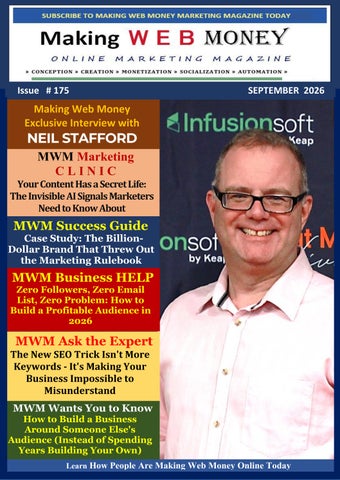
Neil Stafford Neil Stafford Neil Stafford
Issue # 175
SEPTEMBER 2026
Making Web Money Exclusive Interview with
NEIL STAFFORD MWM Marketing CLINIC
Your Content Has a Secret Life: The Invisible AI Signals Marketers Need to Know About
MWM Success Guide Case Study: The BillionDollar Brand That Threw Out the Marketing Rulebook
MWM Business HELP Zero Followers, Zero Email List, Zero Problem: How to Build a Profitable Audience in 2026
MWM Ask the Expert The New SEO Trick Isn't More Keywords - It's Making Your Business Impossible to Misunderstand MWM Wants You to Know How to Build a Business Around Someone Else's Audience (Instead of Spending Years Building Your Own) Learn How People Are Making Web Money Online Today
BONUS! John Cornetta
Discover The 7 Secrets to Achieve Anything You Want In Life... ***Limited Time Only: Grab This FREE Gift Now!***
These 7 Secrets Will Enable You To... • • •
Discover the Foundational Meaning of SUCCESS Demonstrate PASSION and PERSEVERANCE for long-term goals Learn the untold secrets on how to create the life you TRULY DESIRE
IT’S FREE … CLICK HERE to get yours!
You Asked and We Listened. HELP is HERE How Would You Like to Get Your Hands On My Proven Marketing Strategies That Have Created A Multiple Six Figure Online Business? Now You Too Can Explode Your Business Income With
Monthly Internet Marketing Training and Coaching! If You Are Serious About Changing From A Failing Online Business To An Uber Profitable Online Business I Can Help You! Listen, I know what it's like to have a strong desire to have a successful online business but have no real idea of HOW to market it... I'm not making empty promises. One thing you will not find on this site is a promise of "easy riches". I make no claims of how much you can make. I make no claims that you'll make any money at all. I don't know you. I don't know if you're a thinker or a doer. How can I promise you'll make X dollars? I can't. And I don't. That SHOULD be a sign of trust to you. There are many others out there making crazy income claims. I won't promise riches. I won't promise any results. I'll simply tell you that I will show you things you can do to get your online business rocking and rolling! There is absolutely no risk. I'm even going to take away ALL RISK for you. It's pretty simple: if you don't like the Training, you don't pay. Period. You have nothing to risk and everything to gain. Let me say it a different way...
You Don't Even Have To Say "Yes" To Get Started Right Away, Just Say "Maybe" And I'll Send Your First Lesson Instantly!
Click Here
MWM contents 2 7 Secrets to Unstoppable Success 3 Internet Marketing Academy 6 MWM Editor’s Letter SETEMBER 2026 7 In The NEWS 9 MWM – FREE Affiliate Funnel 10
PLR Profits Coaching Club
11 MWM Success Guide – Case Study: The Billion-Dollar Brand That Threw Out The Marketing Rulebook 13 Dynamic Digital Software Store Want A FREE Website? 14 Subscribe For FREE
9 FREE Affiliate Funnel Offer
16 MWM Ask the Expert – The New SEO Trick Isn't More Keywords – Making Your Business Impossible to Misunderstand 19 The Secret Searches ChatGPT Makes Before It Answers You and How to Get Your Business Into Them 20 Introducing 6FigZ - New Product 22 Business HELP - Zero Followers, Zero Email List, Zero Problem: How to Build a Profitable Audience in 2026 25 Master Resell Rights Membership Site 26 Ecommerce Made Easy 27 New Product SHOPZPRESSO MEGA STORE 29 The 30 Questions That Tell You Whether AI Knows Your Business Exists 30 FREE eBook - Six Figures A Year in Info Publishing 33 MWM Interview – NEIL STAFFORD 37 The Functional Strength Guide
20
Introducing 6FigZ
MWM conte nts
38 MWM Q & A - From Readers to Revenue: How to Build a Specialty Newsletter That Pays Off
40 Your Sales Page Is Selling the Wrong Thing - Here's How to Fix It 42 People Don't Buy Products. They Buy the Story They'll Tell Afterward 44 Covert Video Press 45 MWM Marketplace 46 NEW PRODUCT – DriveZPresso
46 New Product DriveZPresso
47 Massive Traffic Blueprint 48 JVZoo Hosting 48 MWM wants You to Know - How to Build a Business Around Someone Else's Audience (Instead of Spending Years Building Your Own)
53
This Month’s Marketing CLINIC Your Content Has a Secret Life: The Invisible AI Signals Marketers Need to Know About
57 Start Your Own Recurring Membership Site 58
33
59 60 YouTube Ads Made Easy
NEIL STAFFORD MWM Interview
Advertise in Making Web Money Contact: Admin@makingwebmoney.com for Details
MWM editors letter Welcome to the SEPTEMBER 2026 Issue of our monthly “Making Web Money” Online Digital Marketing magazine - where every month we show you how real people, just like you, are making web money – online. This month we have MORE great articles and personal success insights, interviews, plus some ONLINE opportunities for you. - MWM Series on Business Help - Zero Followers, Zero Email List, Zero Problem: How to Build a Profitable Audience in 2026 - MWM Interview – NEIL STAFFORD - The Functional Strength Guide - The Secret Searches ChatGPT Makes Before It Answers You and How to Get Your Business Into Them - Sell the Result, Not the Hours: How to Productize Your Service - The Marketing Words That Have Lost All Meaning - The 30 Questions That Tell You Whether AI Knows Your Business Exists - FREE eBook - Six Figures A Year in Info Publishing - MWM Wants You to Know - How to Build a Business Around Someone Else's Audience (Instead of Spending Years Building Your Own) - MWM Q & A - From Readers to Revenue: How to Build a Specialty Newsletter That Pays Off - MWM Marketing CLINIC - Your Content Has a Secret Life: The Invisible AI Signals Marketers Need to Know About - MWM Success Guide - Case Study: The Billion-Dollar Brand That Threw Out the Marketing Rulebook - MWM Ask the Expert -The New SEO Trick Isn't More Keywords It's Making Your Business Impossible to Misunderstand - Dynamic Digital Software Store - Want A FREE Website?
I hope you enjoy this month's magazine. Thanks for reading. – Check out our 174 Great Back Issues of Making Web Money!
Talk to me
>>
facebook.com/harrycrowder twitter.com/harrycrowder
Keep your valuable feedback coming. I try to reply to every email, I appreciate your input as it helps to make MWM the Best magazine possible. Email me at: crowderharry598@gmail.com
MakingWebMoney.com Subscription enquires: www.MakingWebMoney.com Order the printed edition: www.issuu.com/hectwo Advertising enquires: www.MakingWebMoney.com Making Web Money Magazine Published 12 times per year. Copyright
All rights reserved. Reprinted with permission. No part of this publication may be reproduced, translated or converted into machine-readable form or language without the written consent of the publisher. Articles express the opinions of the authors and are not necessarily those of the publisher Making Web Money Online Marketing Magazine Editor Harry Crowder Advertising: See Above Contributors Various experts in their fields The instructions and advice in the magazine are for educational and entertainment purposes only. The creators, producers, contributors and distributors or Making Web Money Marketing Magazine disclaim any liability for loss or lack of results from following the advice expressed herein.
Follow me on Facebook: https://www.facebook.com/harrycrowder
Both the paper and our printer meet the international standard ISO 14001 for environmental management. The paper comes from sources certified under the Program for Endorsement of Forest Certification scheme (PEFC). Please recycle this magazine – or give it to a mate.
MWM inbox How Handy is This? You can NOW Shop
Walmart Online, save a lot of time, money and hassles. Pick from everything at Walmart and
Then choose to have Tell us what you like and don’t like about Making Web Money Digital Marketing magazine. What worked for you or what you think sucks, then we can make Making Web Money an even better online magazine. So, send me an email with your feedback and let me know. crowderharry598@gmail.com
your order Delivered to you by mail / freight OR
YOU can Pick Your Order Up at
NEAREST WALMART Shop at home. Drive to the store. Pick Up Your Order!
QUOTABLE.. “Productivity isn’t about being a workhorse, keeping busy or burning the midnight oil. It’s more about priorities, planning, and fiercely protecting your time.” – Margarita Tartakovsky
RESOURCES AND NEWS Google Just Launched Another Spam Update — Watch Your Rankings Google launched its August 2026 spam update on August 18, and this one applies globally and across all languages. Google says the rollout should take only a few days, making it considerably faster than some of its larger algorithm updates. It's also Google's third announced spam update of 2026, following the June update. For marketers, the important advice is simple: Don't start "fixing" things in the middle of the rollout. Watch your organic traffic and rankings, particularly pages that suddenly gain or lose visibility, and wait until the update finishes before drawing conclusions. If you do get hit, this is also a good time to look critically at tactics designed primarily to manipulate rankings rather than help visitors—especially scaled low-value content, questionable links and anything else that exists mainly for Google rather than humans. And if your traffic jumps? Don't celebrate too quickly. Some gains can disappear as Google finishes recalibrating the results. https://searchengineland.com/google-releases-august-2026-spam-update-485369
LinkedIn Is Changing Its Feed — And Comments May Be About to Matter More LinkedIn has updated its feed display in an effort to generate more meaningful replies and conversations around posts. The platform is putting increased emphasis on relevance, including how pertinent an interaction is to an individual user, rather than treating all engagement as equally valuable. That's an important distinction for marketers because it reinforces something we've been seeing across social platforms: Raw engagement numbers don't necessarily tell the whole story anymore. For marketers, I'd take this as another reason to stop ending every LinkedIn post with generic engagement bait such as "Agree?" or "Thoughts?" A smaller discussion involving the right people talking about the actual subject could potentially be more valuable than dozens of meaningless reactions. Try ending posts with questions that invite expertise, disagreement, experiences or examples: "What's the one part of this you've found doesn't work?" is much harder to answer with a thumbs-up than "Do you agree?" In other words, don't optimize for comments. Optimize for conversations worth reading. https://www.socialmediatoday.com/news/linkedin-updates-feed-display-todrive-more-post-replies-and-comments/827394/aren't designed to maximize
It Exists
MWM New Product
MWM 09
Creating More Content Isn't an Advantage Anymore — Trust Is Content marketing pioneer Joe Pulizzi argues that AI has effectively destroyed one of the old advantages of content marketing: The ability to win simply by producing lots of useful content consistently. AI can now produce more content in an afternoon than many marketing departments once produced in a month. When content becomes practically unlimited, producing more of it stops being particularly impressive. What's scarce instead? Trust, distinctiveness and genuine relationships. https://www.marketingaiinstitute.com/blog/trust-as-contentstrategy-maicon-2026
ChatGPT May Decide Who Makes the Shortlist Before It Even Searches An analysis of ChatGPT's search behavior found that ChatGPT can include brand names in the search queries it generates before retrieving outside sources. Even more striking, the analysis found that brands included in those generated queries had dramatically better odds of appearing in the final answer—about 33 times better, according to the research. In other words, by the time ChatGPT goes searching the web, it may already have some idea of which brands belong in the conversation. That's a major clue for marketers trying to figure out GEO. Simply publishing pages designed to get cited may not be enough. You also want your brand to become strongly associated with the problem, product category or niche before the AI searches. That means brand mentions, third-party coverage, reviews, comparisons, authoritative content and consistent positioning could become increasingly important. The goal isn't merely "get ChatGPT to find my webpage." It's get ChatGPT to think of my brand when someone asks the question. That's a much bigger and more interesting marketing challenge.
https://www.searchenginejournal.com/chatgpt-already-knows-whosin-the-running-before-it-searches/
MWM 10
Case Study: The Billion-Dollar Brand That Threw Out the Marketing Rulebook Liquid Death doesn't use a traditional brand book, ad agency or creative brief. Maybe there's something marketers can learn from that. Most marketing advice tells you to protect your brand consistency, establish guidelines, speak in one voice, use the right colors and stick to the chosen strategy. Then there's Liquid DEATH. The canned-water company has grown into a billion-dollar brand while rejecting several fixtures of traditional marketing, including traditional brand books, ad agencies and creative briefs. As its Chief Media & Digital Commerce Officer explained in an interview with Think with Google, the company's creative philosophy puts enormous emphasis on doing the unexpected and producing ideas capable of earning attention. Liquid Death's marketing has included everything from bizarre celebrity collaborations to intentionally outrageous products and stunts. The common denominator isn't randomness… It's surprise. And that's something smaller marketers can steal without trying to imitate Liquid Death's extreme personality. Has Your Brand Become Too Predictable? Brand consistency is useful. But there's a point where consistency becomes predictability. If customers can practically guess your next email, Instagram post or promotion before you create it, being "on brand" may actually be making you easier to ignore. Try this exercise once a month: Brainstorm 10 ideas that would make your customers say, "Wait...they did WHAT?" Don't judge them yet. Don't worry about budget. In fact, make several deliberately ridiculous. A bakery might hold a contest for the ugliest birthday cake. A bookkeeping firm might create an annual award for the world's strangest legitimate business expense. A pet store could let dogs "review" new products. Then look through your ten ideas and find the one that's surprising but still unmistakably you. That's the sweet spot. The Killer Question Before approving your next campaign, don't ask only: "Is this on brand?" Also ask: "Would anybody tell another person about this?" Your competitors can copy your posting frequency, keywords, discounts and funnel. It's much harder to copy an idea people can't stop talking about. Sometimes the safest thing you can do with your marketing is take a creative risk.
Starting today you can enroll in my new monthly coaching program where I will teach you how to turn PLR content into spendable cash using several underground methods. Each and every month you'll get a new lesson showing you a different way to profit with the PLR products you already have. Each month will be a different lesson (sometimes delivered as a stepby-step PDF and sometimes delivered as video tutorial lessons, and even sometimes a mixture of both) that you can download, view, and then implement to start making money with PLR content. This 12 month coaching program can help you feel good about every PLR purchase you've made (even those "junky" ones because I will show you how to polish them 'til they shine!). The PLR Profits Coaching Club can justify every penny you've spent. It can make those purchases worth something to you because you can put that content to work making money for you. Click Here to Start
How Would You Like a Complete Done-For-You Niche Targeted Website - All Professionally Designed And Ready For You to Profit From?
The Dynamite Digital Software Store
Subscribe TODAY! Do it now! It’s Free
To subscribe for free, go to:
MakingWebMoney.com The digital edition of our magazine is FREE !! You can upgrade to receive the printed edition, Or cancel your subscription at any time.
Subscribe today for FREE!
Forget Evergreen Your Brand Is the New SEO Strategy Why generic "evergreen" content is losing ground to recognizable experts and trusted voices. For years, marketers were told to create evergreen content that would rank on Google for years. But according to a new Search Engine Journal analysis, the AI era is changing that formula. As AI search engines increasingly summarize information instead of simply listing links, trust is shifting away from anonymous websites and toward recognizable individuals with proven expertise. People—and AI systems—are more likely to trust content connected to a real expert than another generic "Ultimate Guide" written to rank in search results. The future belongs to brands that become the source, not just another source of information . https://www.searchenginejournal.com/evergreen-is-over-theindividual-is-the-only-strategy-left/581532/
Google Images Just Became a Discovery Platform The biggest redesign in years could change how marketers get found online. Google is giving Image Search its biggest makeover in years—and it's about much more than finding pictures. To celebrate the platform's 25th anniversary, Google is rolling out a redesigned homepage featuring a personalized stream of images tailored to each user's interests, along with built-in AI image generation inside AI Overviews. Instead of simply searching for existing images, users can now ask Google to create entirely new visuals from text prompts, while the new homepage encourages browsing and inspiration in a way that feels surprisingly similar to Pinterest. For marketers, this signals another shift from search to discovery. Success will depend less on whether someone types the perfect keyword and more on whether your images, products, and visual content are compelling enough to appear in personalized feeds and AI-powered experiences. If your business relies on photos, infographics, product images, or visual branding, now is the time to invest in original, high-quality visuals with descriptive metadata. In the AI era, the brands that win won't just answer questions—they'll inspire clicks before people even know what they're looking for. https://www.mediapost.com/publications/article/416522/googleredesigns-image-search-adds-built-in-ai.html
The New SEO Trick Isn't More Keywords - It's Making Your Business Impossible to Misunderstand If Google and AI can't quickly figure out exactly who you are, what you do and who you help, you've got a problem. For years, SEO advice revolved around keywords. Find the phrase people search for, put it in the right places and convince Google your page deserves to rank. That's still useful, but AI search adds another challenge: Machines need to understand what your business actually is. HubSpot recently highlighted the growing importance of entities—the people, companies, products, services and subjects that search and AI systems recognize—and the relationships between them. Structured data such as schema markup can explicitly provide some of this context. But there's an even simpler lesson here that every marketer can use, technical or not: Make your business impossible to misunderstand. Try the 10-Second Test Open your homepage and pretend you've never seen it before. Give yourself ten seconds, then answer: What does this company sell? Who is it for? What problem does it solve? Why should I trust it? If the answers aren't obvious, start there. Replace clever-but-vague headlines like "Helping You Reach Your Potential" with language that actually identifies what you do and whom you serve. Then check your About page, product descriptions, author bios and articles. They should reinforce the same basic story rather than describing your business five different ways. The Killer Tip: Build a Fact Box for Your Business Create a one-page internal document containing the facts you want humans and machines to understand about you: We are: [type of business] We help: [specific audience] We provide: [products/services] We specialize in: [topics/problems] Our expertise comes from: [credentials/experience/proof] Use those facts consistently across your website, social profiles, author bios, press materials and directory listings. Then, if appropriate, add structured data that reinforces those relationships for search engines. The objective isn't repeating the same keywords everywhere. It's creating consistent signals about who you are. Think of it this way: every page on your website is introducing your business to Google, ChatGPT and potential customers. Make sure they're all introducing the same business. Because in AI search, clarity isn't merely good copywriting anymore. It's discoverability.
The Marketing Words That Have Lost All Meaning If everyone uses the same "power words," they stop being powerful. Here's a fun exercise. Visit the websites of ten different companies in the same industry. I bet you'll find words like innovative, premium, customer-focused, passionate, authentic, game-changing, or crafted with care on almost every one. None of them are bad words. They're just... tired. The problem isn't that they're untrue. The problem is they've become placeholders. Instead of telling customers something meaningful, they simply announce, "We're a business, and we used the same marketing playbook as everyone else." The same thing has happened with phrases like "Made with love," "Built with ," and "Customer obsessed." Once they felt personal. Now they feel automatic. Here's a simple rule I've found incredibly useful: The more often a marketing phrase is repeated, the less persuasive it becomes. Customers don't trust words because they're emotional. They trust words because they're believable. Instead of saying your coffee is "crafted with care," tell people it's roasted within 48 hours of shipping. Instead of saying your support team "cares," tell customers they'll hear back from a real person within two hours. Instead of saying you're "passionate about quality," explain the one thing you refuse to compromise on—even if it costs you money. Notice the difference? One sounds like advertising… …the other sounds like evidence… …and that's where trust comes from. The strongest brands rarely tell you they're authentic. They show you. They tell stories. They explain why they make certain decisions. They share details that competitors wouldn't think to mention. Specifics are memorable while clichés are invisible. So, here's a challenge: Pick one page on your website today and circle every word or phrase that could appear on your competitor's site without anyone noticing. Then replace each one with something only you could honestly say. Because the goal isn't to sound like a great marketer. It's to sound like a business that's actually worth listening to.
The Secret Searches ChatGPT Makes Before It Answers You - and How to Get Your Business Into Them One question can trigger multiple searches behind the scenes. Understanding those searches could give you a whole new way to get discovered. When someone asks ChatGPT a question, the words they type aren't necessarily the only words that matter. AI systems can break a question into additional searches—often called query fanouts—to gather the information needed to construct an answer. Research highlighted by Neil Patel examined 5 million AI query fanouts and found something marketers should pay attention to: ChatGPT frequently added words such as "best," "reviews" and the current year, even when the original user hadn't used them. The research also found a sharp increase in fanouts specifically mentioning Reddit. That's a potentially important clue for getting your business into AI answers. Think Like ChatGPT's Research Assistant Suppose someone asks: "What email marketing software should I use for my small business?" ChatGPT might need information surrounding: • Best email marketing software for small businesses • Email marketing software reviews • Product A vs. Product B • Email marketing software pricing • Best email marketing software 2026 • User experiences with email marketing software Instead of trying to rank for one giant phrase, build the information ecosystem AI might need to answer the question. Try the Fanout Exercise Choose five questions you'd love prospective customers to ask ChatGPT. For each one, brainstorm 10 follow-up searches an intelligent researcher might make before answering it. How many of those questions do you actually answer?
Look especially for: •
BEST: Which options deserve consideration?
•
COMPARE: How do the leading choices differ?
•
PROOF: What evidence supports the claims?
•
REVIEWS: What do actual customers say?
•
PRICE: What does each option cost?
•
CURRENT: Is the information still accurate in 2026?
• PROBLEMS: What complaints or drawbacks keep appearing? Now search your website. The Killer Trick: Don't Put All the Answers on Your Own Website Here's where this gets really interesting. If AI is consulting reviews, discussions, comparisons and other outside sources, publishing another page saying "We're the best!" won't necessarily solve your problem. You want your business appearing in places AI may encounter while researching you: reputable industry sites, genuine customer reviews, relevant directories, interviews, comparisons and useful public discussions. That's a major shift in thinking. Traditional SEO often asks: "How do I rank my page for this search?" AI visibility adds another question: "How do I make my business keep showing up while AI researches the answer?" The winner may not be the company with one perfectly optimized page. It may be the company AI keeps bumping into everywhere it looks. https://neilpatel.com/blog/chatgpt-query-sourcepreferences/
Sell the Result, Not the Hours: How to Productize Your Service Take something you already do for clients, give it a fixed result and price, and you may have a much easier business to sell. If you're a freelancer or consultant, you're probably familiar with the routine: someone asks what you charge, you schedule a call, figure out what they need, write a proposal, negotiate the scope and finally start working. There's another way: Productize the service. A productized service takes work you normally customize and turns it into a clearly defined package with a specific deliverable, price and turnaround time. Instead of "I do copywriting for $75 an hour," you might sell: The $495 Landing Page Makeover — Complete rewrite of one landing page, delivered within five business days. A graphic designer could offer a $299 YouTube Thumbnail Pack containing ten thumbnails. An SEO consultant might sell a $750 SEO Quick-Fix Audit identifying the 20 highest-priority problems. A virtual assistant could offer a $399 Inbox Rescue that organizes an overloaded inbox and creates a simple management system. The possibilities are enormous. How to Build Yours Start by looking at work you've already done repeatedly. What problem do clients keep paying you to solve? Then remove as many variables as possible. Define exactly what the customer receives, what isn't included, how long it takes and what it costs. Next, give the package a name that emphasizes the result, not your labor. "Five Hours of Marketing Consulting" sounds like work. "The 30Day Lead Generation Plan" sounds like something a customer wants. Finally, create a simple sales page where someone can understand the entire offer without scheduling a discovery call. The Killer Tip: Productize the First Step You don't have to productize your entire business. If your main service costs $5,000, create a $300–$500 productized entry service: an audit, assessment, teardown, strategy session or diagnostic. Now a stranger can try working with you without making a huge commitment. If you uncover a larger problem while completing the package, that customer becomes a natural prospect for your premium service. And here's the beautiful part: the more often you deliver the same package, the faster and better you become at producing it.
Zero Followers, Zero Email List, Zero Problem: How to Build a Profitable Audience in 2026 No followers. No email list. No famous friends. Here's how to build your first real audience when everyone else is fighting for attention, too. Building an audience used to sound deceptively simple: Pick a subject, start publishing useful content and keep going until people discover you. That advice isn't completely wrong. It's just missing something rather important: distribution. In 2026, there's more content than any human could possibly consume, and AI has made creating even more of it almost effortless. You can publish the greatest article, video or LinkedIn post you've ever created and still hear crickets. So if you're starting with zero followers, your job isn't merely to create content. You need to create something recognizable, deliberately put it in front of the right people, learn what gets a reaction and turn those occasional viewers into an audience you can reach again. Here's how. Step 1: Don't Pick a Topic. Pick a Promise. "Marketing" isn't an audience strategy. Neither is fitness, investing, cooking, travel or entrepreneurship. They're categories. Instead, finish this sentence: People should follow me because I consistently help them __________. For example: • Find unusual ways to earn an extra $1,000 online. • Make inexpensive meals that don't taste inexpensive. • Find overlooked weekend trips within three hours of Chicago. • Get more customers from LinkedIn without posting every day. Now someone immediately understands why following you might improve their life. The Killer Tip: Make the Promise Repeatable Before committing to an idea, write 50 possible content headlines. If you struggle after eight, your concept may be too narrow. If the 50 ideas wander all over the place, it's probably too broad. You're looking for the sweet spot where the subject is narrow enough to attract the same person repeatedly but broad enough to sustain hundreds of pieces of content. Step 2: Choose One Primary Platform One of the fastest ways to fail is trying to become a YouTuber, TikToker, podcaster, blogger, Instagram creator, LinkedIn expert and newsletter publisher simultaneously. Pick one primary discovery platform for your first 90 days.
Choose based on where your prospective audience already gathers and which medium you can realistically sustain. If you're good on camera, video may be natural. If you love explaining things in writing, use text. If conversation brings out your best ideas, consider audio or interview-based content. Don't choose the format gurus say is hottest. Choose the one you'll still be producing six months from now. Step 3: Create a Recognizable Content Franchise Random content creates random audiences. Instead, develop two or three recurring series people can recognize. A marketing creator might publish: The $100 Marketing Fix — One inexpensive improvement a small business can make immediately. Why This Worked — A breakdown of one successful campaign. Steal This Idea — One clever tactic readers can adapt for their own business. Notice what's happening. You no longer have to invent an entirely new concept every Tuesday. You simply need another episode. That's how newspapers, television programs and magazines have worked forever: familiar format, fresh information. Step 4: Make 20 Pieces Before Judging Anything Your first content will probably underperform. Good. You need the practice. Don't spend six hours mourning a post that received 37 views. Produce the next one. For your first 20 pieces, concentrate on improving one thing at a time: headline, opening hook, pacing, usefulness, examples, thumbnail, storytelling or call to action. You're collecting information about what your audience responds to. And don't automatically delete failures. Six months from now, revisit promising ideas that performed poorly and try them again with a better hook or format. Sometimes the idea wasn't bad. The packaging was. Step 5: Borrow Your First Audience Here's the problem nobody likes talking about: you have 14 followers. Even brilliant content shown to 14 people doesn't give an algorithm much evidence that it deserves wider distribution. So, borrow somebody else's audience. Interview people your target audience already follows. Contribute useful guest content. Appear on small podcasts. Participate intelligently in niche communities. Collaborate with newsletters. Create something that gives another creator a reason to mention you.
Create a tiny lead magnet closely connected to your content promise: checklist, cheat sheet, template, resource list, calculator, swipe file or five-day email mini-course. If you teach freelancers how to find clients, don't offer "My 72-Page Guide to Freelancing." Offer "17 Places to Find Clients Nobody Checks." Specific beats comprehensive. Then mention it naturally when your content solves a related problem. Step 10: Turn One Great Piece Into Ten Once you've established a consistent rhythm on your primary platform, start repurposing—but don't simply copy and paste. Suppose you create a 20-minute YouTube video called 7 Ways Freelancers Can Find Clients Without Upwork. That might become seven short videos, an email, a checklist, a LinkedIn post, a blog article and several standalone tips. One original idea becomes an entire content ecosystem. The Killer Tip: Repurpose Angles, Not Words This is where most repurposing becomes boring. Don't ask "How can I repost this?" Ask "What other interesting ideas are hiding inside this?" A statistic becomes one post. A mistake becomes another. An example becomes a case study. A controversial statement becomes a discussion question. One step becomes a tutorial. You're not repeating yourself. Mining your own best thinking. Step 11: Watch for Your "Unfair Winners" After 30–50 pieces, patterns should begin appearing. Maybe interviews consistently outperform tutorials. Perhaps posts about pricing generate twice the comments. Maybe your "three mistakes" format gets shared constantly. These are clues. When something performs unusually well, don't immediately move on because you've "already covered that." Milk it. Create the sequel. Go deeper. Turn it into a series. Approach the same subject from the beginner, intermediate and advanced perspectives. Answer objections from the comments. Most creators constantly chase new ideas. Smart audience builders identify proven audience demand and keep serving it. Step 12: Measure Followers Per 1,000 Views Raw follower count can fool you. Instead, watch how effectively attention converts into audience. Suppose Post A receives 100,000 views and generates 100 followers. Post B receives 10,000 views and generates 300. Which is better? For an audience-building business, quite possibly Post B. Track metrics such as followers per 1,000 views, email subscribers per 1,000 visitors, shares and saves, returning viewers/readers, replies and meaningful comments, and clicks to your owned platform. Step 13: Create a "Minimum Viable Community" Don't think of your first 100 followers as a disappointingly small audience. Think of them as your research department. Talk to them. Reply to comments. Ask what they're struggling with. Send questions to email subscribers. Notice which subjects generate unusually detailed responses. Here's an especially useful question: "What's one thing you're trying to figure out right now?"
Twenty responses could give you your next 20 pieces of content—and potentially your first product. Your earliest followers are also disproportionately valuable because they're often the people who will tell others about you. Treat them accordingly. Step 14: Don't Monetize Based on Follower Count You don't necessarily need 100,000 followers to make money. A creator with 2,000 highly specific followers could have a better business than someone entertaining 200,000 people who have no intention of buying anything. Instead, look for commercial signals: "Do you offer this as a service?" "Can you help me with mine?" "Do you have a template?" "Could you teach this?" "Where can I buy that?" Those questions are telling you what the audience wants next. Before creating a giant course, test something small: consulting session, workshop, template bundle, paid report, affiliate recommendation, membership or tiny digital product. Let the audience pull products out of you instead of guessing what they might buy. The 90-Day Audience-From-Zero Plan For the first 30 days, choose your promise, primary platform and two or three repeatable content formats. Publish consistently and deliberately improve with every piece. Begin leaving genuinely valuable comments wherever your target audience already gathers. During Days 31–60, identify your strongestperforming topics, collaborate with several one-rungup creators and launch a simple lead magnet. Start moving followers onto your email list. During Days 61–90, double down on your unfair winners, repurpose your strongest content onto one additional platform, survey your growing audience and watch carefully for commercial signals. Don't add five new platforms because you're impatient. Don't change niches because one post flopped. Don't confuse virality with audience building. And don't fall into the trap of believing that publishing automatically creates distribution. The real system is: Create → Distribute → Listen → Improve → Capture → Repeat That's how you build an audience in 2026: not by shouting louder into an increasingly crowded internet, but by becoming consistently useful to the same identifiable group of people until they start looking for you on purpose. And that's the point where you've stopped merely accumulating followers. You've built an audience.
MWM New Product World’s First 3-in-1 Online MegaStore Creator that combines Physical Products, Software Products and Licenses + Affiliate Marketing into ONE.
Launch Your BRAND NEW 3-in-1 Online MegaStore in Just 3 Simple Steps STEP 1 Access Account
your
ShopZPresso
STEP 2 Import or Add products in one click STEP 3 there is no step-3… enjoy profit BOOM! Your Online MegaStore Launched IN LESS THAN 60 SECONDS
CLICK Here Now
"Discover How to Start, Build and Launch Your Own Digital Product Business Without Breaking The Bank..." Find Out How To Create Your First Digital Product For Sale And Start Getting Sales On Autopilot! What you'll discover in this eBook: •
You'll have an idea for the type of digital product you want to create and what the strengths and weaknesses of each option are
•
Understand what makes digital products sell and how you need to design your creation in such a way that people will be eager to buy it
•
Know how to quickly and cost effectively create the type of digital product you want
How to create a potential hot-selling eBook • Know how to alter things like price, cover image and more in order to optimize your sales • Understand how to drive more traffic to your landing page using SEO, PPC, e-mail marketing and social media • Understand affiliate programs and tools like JVZoo, ClickBank and WSO Pro • Know how to build an army of affiliate marketers who can drastically increase your sales and profits •
• ...and much, much more!
This is the ultimate guide to How to Launch a Digital Product Business! You'll discover all the steps, tools and resources to help you become a successful digital marketer!
Get your copy today!
Now you can create full image variations inspired by your original ad
Now you can create full image variations inspired by your original ad creative with text overlay capabilities, generating improved backgrounds around product images and expanding images to better fit multiple surfaces. In addition, you will r brands to choose from. Lastly, image expansion allows you to seamlessly adjust creative assets to fit different aspect ratios across multiple surfaces. These tools are now available on Reels and Feed across both Instagram and seamlessly with text overlays on your ads. https://www.facebook.com/business/news/Introducing-Enhanced-Gen-AIFeatures-and-Other-Tools-to-Help-Build-Your-Business
CLICK HERE_
The 30 Questions That Tell You Whether AI Knows Your Business Exists Forget complicated AI visibility dashboards for a minute. This simple test will tell you whether your business is even in the conversation. Here's a marketing exercise worth doing this week: Write down 30 questions you'd love potential customers to ask ChatGPT, Gemini or another AI assistant—and have your business appear in the answer. Don't use your business or product name. Think like someone who has never heard of you. A bookkeeping service might use, "What's the best bookkeeping service for a one-person ecommerce business?" A software company might try, "What are good alternatives to [major competitor] for small businesses?" A consultant might ask, "Who specializes in helping dentists get more local customers?" Build Your 30-Question Test Divide your questions into three groups: 10 "Best" Questions: What's the best...? Who are the top...? What companies specialize in...? 10 Problem Questions: How do I...? Who can help me...? What's the easiest way to...? 10 Comparison Questions: What's a good alternative to...? Which is better for...? What should I use if...? Now run the questions through the AI assistants your customers are most likely to use. Create a simple spreadsheet and record whether you're mentioned, which competitors appear, which sources are cited and how your business is described. Don't panic if you score 2 out of 30. You've just discovered something useful. The Killer Trick: Study Who AI Trusts For every question where a competitor appears and you don't, ask: Why them? Look at the sources behind the answer. Is the competitor appearing in industry articles, directories, reviews, comparison pages or authoritative websites? Do they publish original research? Do they have clearer product pages? Are other people talking about them? This turns your test into a marketing roadmap. And don't obsess over getting your name into all 30 answers. Identify the five questions closest to a buying decision and attack those first. Create better pages answering those questions, strengthen your proof, earn relevant third-party mentions and make it unmistakably clear what your company does and whom it serves. Then rerun the same 30 questions every month. Traditional SEO taught us to ask: "Where do I rank?" AI search adds a new question: "When my ideal customer asks for help, does AI even know I'm one of the choices?" That's a question every marketer should know the answer to.
Finally, A Bunch of Great FREE Help! No more Paying for Products That Don't Deliver Results! Get Everything You Need To Know To Start A Wildly Successful Home-Based Internet Business! • • • • • • • •
Search Engine Optimization Affiliate Marketing Viral Marketing Joint Ventures Blogging for Cash Social Networking And more! Get the Facts - What It Takes to Make Money Online Today!
MWM Videos http://makingwebmoney.com/videos
http://www.youtube.com/watch?v=RSkWqI7M3Ts
http://www.youtube.com/watch?v=6t6ba6Cj690
http://www.youtube.com/watch?v=rzEuURaTiZU
http://www.youtube.com/watch?v=h5GQ m55ccTk&feature=related
http://www.youtube.com/watch?v=0CaUcIwPsH8
http://www.youtube.com/watch?v=EYN1BjtZ6nc
MWM Interview ANeil Stafford Editor:
Interview
Today's guest is Neil Stafford, an entrepreneur, business mentor, and expert in building successful membership businesses. Neil has spent years helping entrepreneurs turn their knowledge and expertise into recurring revenue. So today we're going to find out how to create a membership that people actually want to join, how to keep those members engaged and how to increase their value over the long term. Neil, it is great to have you with us. Neil Stafford: Yeah, thank you very much. Editor: Well, before we dive in, maybe you could start by giving us the quick version of your background and how membership businesses became such a big part of what you do. Neil Stafford: Yeah, it's one of those things when you've been in the business so long, you feel like a dinosaur, but I made my first sale online way back in 1998. It was for an oil painting, that's a story for another day, but that really said, "Yep, there's a possibility here." I lost my first membership site in 2003, and that was one aimed at people who coaching on junior soccer teams. Previous to that, I did printed, published subscription newsletters in 1990s, and I always joke and say, "Yes, I'm that old." One was about travelling in the Caribbean, one was about mountain biking.
So, I've had subscription and recurring revenue businesses in my blood for a number of years. Then over time, the internet came along, we moved it online, and that grew into what I would know as an info publishing business or an education business. We've done many different niches, many different markets.
We've helped people grow and start their own online businesses, but today primarily focused on people who have membership sites and helping them grow it. Editor: Well, starting with the basics, what would you say actually makes a great membership business?
Neil Stafford: Yeah, it's interesting because what people have signed up for or what people sign up for and have a monthly charge for has changed over the years as technology has changed, as our access to information has changed. So a prime example was way back when we did the Caribbean Adventure Journal. That was a newsletter, printed newsletter. My wife and I, or girlfriend and fiance back then, we would travel to the Caribbean twice a year, and all I did was take photographs, made notes, and had an old camcorder that we'd take photographs. And then we'd talk about our time in the Caribbean, what we did, and we called it the Caribbean Adventure Journal, so it's off the beaten track. So, people buying that we found were dreamers and doers, and there's nothing wrong with either one of them. So, there's people who would live through our eyes and our visits and love to hear about the different places in the Caribbean we went to, loved to see the pictures. Now remember, this was a printed newsletter, single color, or black and white as people call it. So, we'd put photographs in there, but they were single color. Now, as an upsell, we'd sell some photographs and we'd sell some of the video as well, which is an interesting one. That worked very well with the mountain biking newsletter that we did. I would go and ride with different clubs around the UK. I'd take videos. And again, it makes me smile because today it's so much easier. You GoPros on your helmets. We had cameras strapped on the bike and that would be filming it. And then we would film different riders of the club and I would get filmed as well and we'd sell those VHS cassette tapes back in the day. But with the information in them, people would buy it for dreaming because they'd want to do it or because they were going to do it. So, people who were going to the Caribbean would use our newsletter as a guide to go and find a place to go to or write Word of Neil and Caribbean, I'd like to go and do that. Same with the mountain biking. It was a lot of people who would like to see how other people ride, how I ride.
So, the information was dreamers and doers. And over time now, can you imagine selling a VHS cassette now, you just couldn't imagine it because you can go on YouTube. Why would somebody buy it now?
That's what's changed over the time. So, a reason to join a membership today or a subscription today when we have Google, all the AIs that are available, all the large language models which you can type in and get things back from it instantly, and it's pretty good. Yes, sometimes it can hallucinate, but it's pretty darn good what you can get back.
So, the reason people would buy today is for insight. The AI can't give you insight of a person, if that makes sense. I'm happy. I'll point to people and say, "Listen, you could type anything about membership sites into AI, into Google and get some good information back. What you won't get is insight. What you won't get is my expertise. What you won't get is the community or the area that I've created."
So having a membership site today isn't about filling it with a million and one articles or a million one videos or downloads galore, which worked in the past. It's about getting people a result that they're looking for with your insight, with your guidance, with your help and support. And I always say people will join membership sites for a number of reasons. And the first one is they'll join for the content or the outcome that you are promising them.
They'll stick around for community. You've got a community in there. Now that doesn't have to be a Facebook group. We've worked with people with Slack channels, with Telegram channels. The community is a one-way community developed around an email list. So the owner of the membership communicates and creates a community with the words he uses in his email list. It could be meeting online like Zoom once a week, twice a week, once a month, that creates a community. So people will stick around for community. Now we found that they will go deeper with you. You'll get better connections or start to make better connections with what I call commerce. So, they join for content, stick around a bit for community, go deeper with you for content, and that's other products and services that they buy from you. So, it's not content in the membership, it's commerce that you sell to them. And yes, you can sell to people in a membership. They're paying you to be in a membership to get a result, but if they want other stuff from you, extra stuff from you to go deeper with you, then you can sell your other products and services.
And then they'll go further with coaching, help and support. So that's another C. So you've got join for content, stick around for community, go deeper with commerce and go further with coaching, help and support. Now, some people say, "I'm not really a coach, but I want to do a membership site." Well, don't call it coaching, call it help and support. I call it coaching because it sits in with the four Cs that we've done so far. So, I call it coaching, help and support. But the secret sauce to any membership, any subscription programme is they are four great pillars, but I will die on my soul…
MWM Q & A From Readers to Revenue: How to Build a Specialty Newsletter That Pays Off Pick a narrow topic, become indispensable, and turn a small audience into a surprisingly valuable business. You do not need 100,000 subscribers to build a profitable newsletter. In fact, chasing a giant audience may be exactly the wrong strategy. Some of the most interesting newsletter opportunities are hiding in small, specific groups of people who share the same profession, obsession, problem, or goal. Instead of writing about "marketing," you might cover email marketing for dentists. Instead of "travel," you might cover cheap weekend flights from Portland. Instead of "small business," you might track grants and funding opportunities for independent retailers. That's a specialty newsletter: one clearly defined promise for one clearly defined group of people. And there's a wonderful business advantage to being specific. When the right person discovers your newsletter, you want them thinking: "Wait. This is exactly for people like me." That's when subscribing becomes an easy decision. Step 1: Choose a Painfully Specific Audience "Entrepreneurs" is an audience. "People starting their first Etsy jewelry shop" is a specialty audience. The second is often much easier to serve — and monetize — because its members share similar questions, problems, products, tools, and ambitions. Other possibilities might include: • Independent bookstore owners • Airbnb hosts in coastal towns • Freelance medical writers • Parents homeschooling teenagers • Wedding photographers • Owners of independent pet stores • Newsletter operators looking for sponsors • People buying and restoring vintage campers Here's a useful test: Could you easily name 25 things these people regularly buy, worry about, search for, or want to accomplish?
If you can, you may have the beginnings of a business. And don't automatically reject a niche because it seems "too small." A smaller audience can actually be an advantage when its members spend money. A newsletter read by 2,000 commercial landscapers could potentially be more valuable than one read by 20,000 people interested in gardening. One audience buys flowers and pruning shears. The other may buy trucks, equipment, software, insurance, training, and thousands of dollars' worth of supplies. Think purchasing power and commercial value, not just audience size. Step 2: Find a Recurring Need This is where an interesting newsletter becomes a useful newsletter. You want a problem that comes back again and again. Ask yourself: What does this audience repeatedly need to find, understand, compare, avoid, or decide? That might lead to a newsletter promising: • The five industry developments that actually matter this week • Fresh leads, grants, jobs, tenders, or sponsorship opportunities • New products and tools worth knowing about • Tested tactics for solving one expensive problem • Regulatory changes explained in plain English • Competitor campaigns worth studying • Prices, deals, or opportunities that are difficult to track • Curated resources that save readers hours of research The strongest newsletters often perform one of three jobs: They make readers money, save readers money, or save readers time. Do one of those consistently and monetization gets considerably easier. Step 3: Validate the Idea Before You Spend Months Building It Before designing logos, buying five domain names, and debating whether your newsletter's accent color should be "Ocean Mist" or "Slightly More Entrepreneurial Ocean Mist," find out whether people actually want what you're planning. Create a simple description: Every Friday, I find and summarize the best sponsorship opportunities for independent podcasters, including who is buying, what they're looking for, and how to pitch them.
If you can, you may have the beginnings of a business. And don't automatically reject a niche because it seems "too small." A smaller audience can actually be an advantage when its members spend money. A newsletter read by 2,000 commercial landscapers could potentially be more valuable than one read by 20,000 people interested in gardening. One audience buys flowers and pruning shears. The other may buy trucks, equipment, software, insurance, training, and thousands of dollars' worth of supplies. Think purchasing power and commercial value, not just audience size. Step 2: Find a Recurring Need This is where an interesting newsletter becomes a useful newsletter. You want a problem that comes back again and again. Ask yourself: What does this audience repeatedly need to find, understand, compare, avoid, or decide? That might lead to a newsletter promising: • The five industry developments that actually matter this week • Fresh leads, grants, jobs, tenders, or sponsorship opportunities • New products and tools worth knowing about • Tested tactics for solving one expensive problem • Regulatory changes explained in plain English • Competitor campaigns worth studying • Prices, deals, or opportunities that are difficult to track • Curated resources that save readers hours of research The strongest newsletters often perform one of three jobs: They make readers money, save readers money, or save readers time. Do one of those consistently and monetization gets considerably easier. Step 3: Validate the Idea Before You Spend Months Building It Before designing logos, buying five domain names, and debating whether your newsletter's accent color should be "Ocean Mist" or "Slightly More Entrepreneurial Ocean Mist," find out whether people actually want what you're planning. Create a simple description: Every Friday, I find and summarize the best sponsorship opportunities for independent podcasters, including who is buying, what they're looking
Then show that promise to people in the target audience. Ask: • Would you subscribe? • What would make this more useful? • What information do you currently struggle to find? • What would make you forward this to somebody else? Even better, create a simple signup page and see whether strangers actually subscribe. Compliments are nice but email addresses are evidence. Step 4: Create a Repeatable Format Readers like knowing what they're going to receive, and you will appreciate not having to reinvent your newsletter every Tuesday morning. Your format might look like this: • The Big Story: One important development explained simply. • Three Useful Finds: Tools, examples, resources, or opportunities. • One Action Step: Something readers can do immediately. • Quick Win: A short tactic, shortcut, template, or idea. • Worth Watching: One trend that could become important. You don't need all of these. Three or four dependable sections may be plenty. The secret is creating something readers can mentally recognize. Eventually they should have a favorite section. That's a very good sign. Step 5: Publish Before It Feels Perfect Write three sample issues. Create a simple signup page. Start publishing. That's enough. You do not need elaborate branding, seven automations, seventeen sections, a $2,000 website, or a logo featuring a thoughtful owl wearing glasses. Your first version will probably change anyway. Publishing teaches you things planning cannot. You'll discover which stories readers click, which subjects get replies, which sections take forever to produce, and which supposedly brilliant ideas nobody seems to care about. Your first ten issues are partly a product and partly market research. Treat them that way. Step 6: Find Your First 100 Readers Don't begin by asking, "How do I get newsletter subscribers?" Ask: "Where are these exact people already gathering?" Look for: • Reddit communities • Facebook groups • LinkedIn groups and conversations • Trade associations • Industry forums
CLICK HERE_
MWM 43
MWM marketplace Domains, Websites & Products For Sale. Domain for sale Contact: ads@makingwebmoney.com Make an offer A great brand name for an internet marketing Product or service ViralInternetMarketing.com.
Get FastEye Pages Now!
See It In Action !
Your Ad here Contact ads@makingwebmoney.com Contact Us >Contact us to list your Domain name or website For sale in this section
http://websitemarketingmagazine.com/recommends/explaindo/
NEW PRODUCT DriveZPresso Now you can have Unlimited Cloud Storage For Life (Goodbye Dropbox!) Say goodbye to overpriced Dropbox subscriptions and time-wasting tech headaches… Because there’s a brandnew Cloud Storage Solution that lets you host, share, and back-up ALL your files… With Unlimited Storage For Life at an unbeatable ONE-TIME price. Get the details here (limited availability). Imagine… All your files stored in one central location so you can find whatever you need in seconds Never paying another overpriced subscription fee to Dropbox or Google Drive Freeing yourself from storage limits and tech hassles once and for all Big Tech has been sticking it to the little guy for far too long… With ridiculously high monthly fees and huge mark-ups that line the pockets of Silicon Valley billionaires DriveZPresso lets you take back control of your data and your business future… With all the capabilities of Dropbox and Google Drive and NONE of the overpriced subscription fees…
Go here now DriveZPresso UNLIMITED file storage for an ultra-low one-time fee Host website images and videos with lighting fast upload speeds on your website. Find any file in seconds with the advanced search technology Share links to any file – just like Dropbox or Google Drive Collaborate with team members to edit documents in real-time Keep your files safe from hard drive crashes, hackers and malware It’s time to say NO to the “Big Tech Tax” and join the future of cloud storage… Grab your DriveZPresso license click here.
For The Next 12 Months, I Will Show You Step-By-Step How To Implement 12 Channels To Draw Targeted Visitors To Your Site.
See It All Here
JVZooHost is dedicated to providing safe, fast, and affordable web hosting with superior support. You can concentrate on running your business and rest assured your website will be up and running. Get your site noticed on the web today with JVZooHost!
MWM wants You to Know How to Build a Business Around Someone Else's Audience (Instead of Spending Years Building Your Own) The fastest path to making money online isn't attracting millions of visitors. It's finding the people who are already gathered together. One of the biggest mistakes aspiring online entrepreneurs make is believing they need a huge audience before they can make money. So they spend months—or even years—trying to grow a YouTube channel, build an email list, master Instagram, or crack the latest social media algorithm. What if you skipped that entire process? Instead of building an audience from scratch, build a business around an audience that already exists. Every day, millions of people gather in Facebook groups, Reddit communities, Discord servers, newsletters, YouTube channels, LinkedIn groups, and niche forums to talk about the things they care about most. They're asking questions, sharing frustrations, recommending products, and looking for solutions. That means they've already done the hardest part for you. They've told you exactly what they want. Step 1: Find Passionate Communities Start by making a list of topics you're interested in and then search for communities centered around those topics. Look for: • Facebook Groups with thousands of active members • Reddit communities (subreddits) • Discord servers • Popular YouTube channels • Industry newsletters • Specialized forums • LinkedIn groups Don't worry about how many members they have. Activity is far more important than size. A group with 3,000 engaged members is often far more valuable than one with 300,000 people who never participate. Step 2: Become a Student Here's where most people get it wrong: They join a community and immediately start trying to sell something. Don't. Spend a week or two simply observing by reading the posts, watching the conversations, paying attention to the questions people ask repeatedly and noticing which posts generate hundreds of comments.
Look for complaints, confusion and unmet needs. You're doing market research that companies often spend thousands of dollars to obtain, only you get it for free. Step 3: Look for Patterns After a while, you'll start noticing the same conversations happening over and over. Maybe photographers keep asking which editing software is best. Perhaps Etsy sellers constantly wonder how to increase sales. Dog owners might repeatedly ask how to stop destructive chewing. Those repeated questions are opportunities. When hundreds of people ask the same question, there's probably money hiding behind it. Step 4: Build What They're Already Asking For Now create something that solves one specific problem and remember that it doesn't have to be complicated. You could create: • An ebook • A video course • A spreadsheet • A Notion template • A prompt library • A checklist • A swipe file • A directory • A members-only newsletter • A printable planner • A toolkit You don't need to invent the next Facebook. Simple products solve simple problems every single day. Step 5: Make Your First Version Small Many entrepreneurs spend six months building the "perfect" course. Don't. Create the smallest product that genuinely helps people. If you're helping real estate agents organize leads, maybe it's just a CRM template. If you're serving teachers, perhaps it's a collection of classroom printables. If you're targeting newsletter writers, maybe it's 100 subject lines that consistently increase open rates. Start small and improve later. Step 6: Become Part of the Community Here's the secret that separates successful entrepreneurs from spammers. Be genuinely helpful by answering questions, sharing useful resources, celebrating other people's wins and offering thoughtful advice.
Become someone people recognize. When community members already know and trust you, your products feel like natural recommendations—not advertisements. Trust always sells better than traffic. Step 7: Listen More Than You Sell One of the greatest advantages of building around an existing audience is that your customers keep telling you what to create next. After selling your first product, ask buyers questions. What else are they struggling with? What takes too much time? What do they wish existed? Your next product should come directly from those answers. Instead of guessing what people might buy, you'll be building products customers are already requesting. Step 8: Expand Carefully Once you've earned the trust of one community, look for similar audiences. For example, if your productivity templates become popular with freelance writers, they may also appeal to consultants, designers, virtual assistants, and coaches. One successful product can often serve several closely related communities. That's how a small side project becomes a real business. A Real-World Example One of the best examples of this strategy is Stacked Marketer. Instead of trying to appeal to everyone interested in business, it focused on marketers who wanted curated industry news. By serving a clearly defined audience exceptionally well, it grew into one of the most respected marketing newsletters, generating substantial revenue through sponsorships, memberships, and partnerships. It didn't invent a new audience. It served an existing one better than anyone else. The Big Takeaway Too many entrepreneurs start with an idea and then go looking for customers. Flip that process around. Start with the customers. Find the communities where they already gather. Listen to what they're talking about. Pay attention to the problems they haven't solved. Then create something that makes their lives easier. When you build around an audience that's already engaged, you eliminate much of the guesswork that causes new businesses to fail. The internet doesn't need another generic product. It needs better solutions for the conversations that are already happening. And those conversations are taking place right now—you just have to join them.
MWM Your Content Has a Secret 57 You generate an AI image. You edit it, crop it, add your Life: The Invisible AI Signals FLASHBACK STORY own work, MWM rename it and perhaps convert it to another format. Or you use AI to help create an article, audio clip Marketers Need to Know or video and then substantially transform the result. About You see the finished content.
MWM Marketing Clinic
But you may not see everything that's traveling with it. AI companies are developing and deploying provenance In Day 2008, Sadler 1 –Jason Intro & Hook turned one of the strangest marketing stunts of (And Why Online Marketers Should Steal This Strategy technologies - including metadata, content credentials, the decade into a six-figure business. The him to wear your Post Idea: Introduce yourself and your sidepitch? hustle Pay journey. Immediately) digital signatures and invisible watermarking - designed to Caption: “Trying hustles next 30itdays…let’s seeone what works! company’s T-shirt forside a day, and for he’dthe promote online. Day cost $1. B2B marketers to act like we’re above emotions. provide clues love about where content originated and #SideHustleJourney two cost $2. Day#MakeMoneyOnline” three cost $3. By December 31, the price was $365. “Oh no—we’re not B2C. We don’t do feelings. WeDay do solutions, whether AI was involved. Hashtags: #SideHustleTips #TikTokGrowth #LearnAndEarn It sounds like a joke. But that “joke” made him $66,795 in year one— deliverables, and KPIs.” Goal: Hook viewers with curiosity — you’re the guide on a real journey. later There's strong argument this.B2B As synthetic images, Sure. Andathat’s exactly why sofor much contentand reads likegrew an into a half-million-dollar venture. Day 2 – Quick Win Tip voices, text andwritten videobybecome increasingly convincing, Why It Worked insurance manual a committee of beige folders. Post Idea: Share a tiny tip people can implement today. Example: “3 apps to knowing where something provide Here’s the not-so-secret secret:came from can 1. Scarcity & Urgency earn $20 in an hour.” valuable transparency. People don’t engage with businesses. They engage with people. Every day that passed, the price went up. Brands knew if they hesitated, Caption: “You don’t need fancy tools to start earning. Try these! Which brings us to an unlikely case study. the#EasyMoney deal would#SideHustleTips” slip away. But thingsLocal get 48 considerably more once NECA-IBEW is an electrical unioncomplicated in the Pacific 2. Hashtags: Novelty &#MakeMoneyFast Humor #SideHustleHacks #QuickCash humans start editing AI output. Northwest — not a startup, not a SaaS company, not a brand Ads on T-shirts weren’t new. But the value. way he packaged it—quirky, Goal: Build trust by delivering immediate Should you be able to control what's invisibly anyone expects to “win” on social media. For years, their content transparent, almost tongue-in-cheek—was impossible to ignore. DayAI 3 – Mistakes to Avoid embedded in content you own? What happens when looked like most B2B content: project updates, program highlights, created 10% and a human created the other 90%? And Idea: Highlight one common side hustle mistake. 3. Post Social Media Leverage formal announcements. does calling something “AI-generated” tell us anything Caption: “Stop doing you wantamplified to actually money online. Sadler didn’t just wear this the ifshirt—he it. make Facebook, Twitter, Then they made one simple but radical shift. meaningful when AI might have done everything—or #SideHustleFails #LearnFromMe” YouTube… each sponsor got exposure far beyond a guy in cotton. They stopped telling corporate merely corrected three typos? stories about work… Goal: Show experience, make viewers nod along — authority + relatability. …and started telling human stories about workers. 4. Radical Transparency Day 4 – Demonstration The calendar was public and everyone knew what it cost. That honesty The result? Those aren't abstract questions anymore. Post Idea: Show a real example of you doing the hustle — screenshots, Their improve it exploded. built credibility amid constant hype. Let'scontent look atdidn’t this just strange new—layer of digital content screen recordings, or step-by-step demo. We’re talking: Results from three angles: what's hiding inside your files, The doCaption: you “Here’s exactly how I made $10 flipping old items today! • 354% increase in website traffic from social control it, and is, “AI-generated” even relevant anymore? By 2010, Sadler had scaled his idea with more “human billboards” and #SideHustleDemo #MoneyMoves” • 72% lift in LinkedIn interactions a steeper Annual revenue? All from what Goal:pricing Make itladder. actionable; people follow Roughly what they$500,000. see. AI Content May Be Carrying a Secret Passport •Your65% more reactions looked a stunt—but really a masterclass in unconventional Daylike 5 – Q&A / Responsewas Video video—and more text—can •Images, Up toaudio, 115% boosts across eventually other platforms marketing. Post Idea: Reply to a comment or make a video answering “How do I start?” carry where they came from. Readinvisible that again:clues electricabout growth… from electricians. Caption: “You for asked…here’s The Takeaway Marketershow ANYONE can start a side hustle this week. Marketers should what's traveling with (Credit to Ann Gynn know at Content Marketing Institute for their #AskMeAnything You don’t need #SideHustleHelp” a massive ad budget. You need an angle. content.this story.) surfacing Goal: Boost engagement; TikTok loves reply videos. This wasn’t luck. It wasn’t a viral fluke. It was a deliberate• Use scarcity. Tiered or time-based pricing creates urgency. When you download an AI-generated image, audio Day clip6 – Behind-the-Scenes / Fail rewrite of their entire content strategy — moving away from• Leverage authenticity. Quirky > polished when you want or other asset, what you see isn't necessarily everything Post Idea: Show a side hustle fail, funny moment, or frustration. polished, project-based case studies and toward raw, first-person attention. you get. Caption: “Not every day is a win — here’s what went wrong today stories that actually made people feel something. • Be transparent. Clear offers build trust. #SideHustleLife #KeepTrying” Let’s break down what changed — and how you can apply • it Think sideways. and Theconnection. ideas that sound too weird to work are A growing number of AI companies and technology Goal: Build authenticity immediately. organizations are developing provenance systems ones that break through the noise. Day 7often – Minithe Case Study / Proof The Aha Moment: “Thisinformation Isn’t a Case Study… a Human designed to provide about It’s where digital Jason Sadler didn’t justsuccess sell ad story space—he people wanted Post Idea: Share a small — yoursold ownaorstory someone else’s. Story.” content originated and, in some cases, what happened to Caption: “Made week sharing tips Imarketing. learned. You can too! to follow. That’s the$70 realthis power of just unconventional Fish Digital’s senior Jasmine Paul, went it Madafterward. Thesecontent canstrategist, include metadata, #SideHustleProof #MoneyMoves” And while Sadler’s stunt belongs to 2008, the principle behind it hasn’t into her first interview signed expecting credentials the usual B2B playbook: cryptographically and invisible Show and inspire action. the audiences have shifted, but agedGoal: a day. Theresults platforms have changed, watermarking • “Tell me technologies. about the project.” for the Week the Tips psychology is identical. Scarcity still drives urgency. Novelty still grabs • “What were the deliverables?” • Post at consistent times. of it were as a digital passport for content. attention. Transparency still builds trust. •Think “What the outcomes?” •
Keep videos 15–30 seconds.
The broader industry is also adopting standards such as C2PA, which the information usual question— canThat's attachwhy signed about an asset's origin and editing history. "Can bother? we tell whether AI was involved?" Why —may eventually give way to a much more interesting one: Because we're entering a world where a realistic photograph, voice "If I created the might finished work, how much control should could I recording or video never have happened. Provenance help have over the invisibleand information that travels with it?" material from platforms, businesses consumers distinguish authentic And that directly media. to the next question in this series: synthetic or leads manipulated When the we good say something is “AI-generated,” what do we That's part. actually mean? But marketers should understand what this means for everyday Stop creation, Asking “Was content too. AI Used?” Ask “What Did the Human Contribute?” Your File Is More Than What You Can See The label “AI-generated” is becoming useless invisible A JPEG, PDF, audio file or document canincreasingly contain information because can describe kinds ofand creative when youit simply open it.completely Dependingdifferent on the format tools involved, work.might include ordinary metadata such as software information, that Imagine two timestamps andmarketers. editing details, or newer provenance credentials. Marketer types:type of provenance works the same way. Some And not A every "Write melives a 1,000-word article about marketing." credentials. information in file metadata. Someemail uses cryptographic AI produces it. Sheiscopies it, pastes into WordPress Some watermarking embedded intoitthe content itself.and hits Publish. That distinction matters because editing, resizing, screenshotting, Marketeror reposting B spendsa file three a subject, converting maydays affectresearching different signals differently. interviews experts, to develops an original argument and So add a two new question your publishing checklist: writes thetraveling article. Then asks AI to suggest five alternative What's with she this file? headlines andneed proofread the finished draft. You don't to become a digital-forensics expert. Bothifmarketers used AI.part of your marketing production process, But AI is becoming Did they create AI content? understanding the equivalent invisible layer of your content may soon become as Obviously not. image rights or proofreading your copy. normal as checking And that's the problem with doesn't our increasingly Because increasingly, your content just containbinary a message. conversation about AI-generated versus human-generated It may contain a history. work. You Wrote It. You Edited It. You Own It. But Do You Control What's We Need Better Question Hidden Insidea It? can participate at almost every point creation: AI provenance can help us understand where in digital content came brainstorming, research, outlining,tricky transcription, drafting, from. But it also raises a surprisingly question: Who gets to control image generation, editing, fact-checking, translation the invisible information attached to yourformatting, work? andLet's proofreading. say you ask AI to create an image. The mere presence of your AI tells youphotography, remarkably little about Then you crop it, add own change thehow background, much human thinking wentadd into the finished product. replace several elements, typography and spend another two hours So instead only "Was AI used?", ask: turning it into of anasking advertisement. • that Where was AI created used? the finished image? At point, who • What did it contribute? That's complicated enough. But here's an even more interesting • What did the human contribute? question: • Who the made the important creative decisions? Conduct experiment yourself. Interview the customer. Collect • Was finished workonly independently checked? original data.the Tell the story you experienced. Develop an opinion. Those questions tellpublishing you considerably more. Test the advice before it. Here's thewherever Bigger Opportunity Marketers Then use AI it genuinely for makes you faster or better. As goal AI-generated material becomes plentiful, The doesn't need to be 100% human or 100% AI. human contribution itself canworth become part of your positioning. It should be 100% consuming.
That's why I suspect the phrase "AIgenerated content" will eventually become inadequate. The future is likely to contain a huge spectrum—from one-click machine output to deeply original human work that happened to use AI along the way. And when everybody has access to essentially the same AI tools, the competitive advantage won't simply be knowing how to use them. It will be having something worth contributing before you turn the AI on. Metadata vs. Watermark vs. Content Credential: They're Not the Same Thing It's easy to lump all of these technologies together, but they do different jobs. Metadata: Information stored with a digital file, such as creation details, software information, descriptions or other file data. Content credential: Cryptographically signed provenance information that can record details about an asset's origin and editing history. Watermark: A signal deliberately incorporated into content that may be visible or invisible and, depending on the technology, may be designed to survive some editing or transformation. AI detector: Software that analyzes content and infers whether it may have been AI-generated. The important distinction: A detector makes an assessment. A provenance system provides evidence or signals about origin or history. Those are very different things. “The 10% Problem” AI generates an image. You replace the background, add your own photography, change the colors, redraw portions and add original typography. At what point does it stop being an “AIgenerated image”? 90% AI / 10% human? Easy enough. 50% / 50%? Hmm. 10% AI / 90% human? Now the label starts feeling inadequate. There is no universal percentage at which authorship magically changes. That's why simply labeled items as “AI-generated” can conceal more than it explains.
That's why the usual question— "Can we tell whether AI was involved?" —may eventually give way to a much more interesting one: "If I created the finished work, how much control should I have over the invisible information that travels with it?" And that leads directly to the next question in this series: When we say something is “AI-generated,” what do we actually mean? Stop Asking “Was AI Used?” Ask “What Did the Human Contribute?” The label “AI-generated” is becoming increasingly useless because it can describe completely different kinds of creative work. Imagine two marketers. Marketer A types: "Write me a 1,000-word article about email marketing." AI produces it. She copies it, pastes it into WordPress and hits Publish. Marketer B spends three days researching a subject, interviews two experts, develops an original argument and writes the article. Then she asks AI to suggest five alternative headlines and proofread the finished draft. Both marketers used AI. Did they create equivalent AI content? Obviously not. And that's the problem with our increasingly binary conversation about AI-generated versus human-generated work. We Need a Better Question AI can participate at almost every point in creation: brainstorming, research, outlining, transcription, drafting, image generation, editing, fact-checking, formatting, translation and proofreading. The mere presence of AI tells you remarkably little about how much human thinking went into the finished product. So instead of asking only "Was AI used?", ask: • Where was AI used? • What did it contribute? • What did the human contribute? • Who made the important creative decisions? • Was the finished work independently checked? Those questions tell you considerably more. Here's the Bigger Opportunity for Marketers As AI-generated material becomes plentiful, human contribution itself can become part of your positioning.
Who gets to decide what invisible information travels with it? There are good reasons for AI provenance. We're entering an era of remarkably convincing AI-generated images, cloned voices and synthetic video. Being able to trace where digital content came from could help distinguish genuine material from something that was generated or manipulated. That's valuable. But there's another side to the argument that marketers and creators should be thinking about: If it's your finished content, how much control should you have over what's hidden inside it? Transparency and Control Can Collide Businesses have dealt with invisible file information for years. Photos and documents can contain metadata about things such as the software used to create them, when they were created and, in some cases, where they were created. There can be perfectly legitimate reasons to remove some of that information before publishing a file, including privacy, security and simply cleaning up unnecessary data. AI provenance adds a new wrinkle. Suppose AI created 10% of an image and you created or substantially changed the other 90%. Should the finished image forever be identified simply as AIgenerated? What if AI supplied the original image, but after hours of editing almost nothing from that version remains? Or what if you want to preserve useful information about where an asset originated while removing unrelated metadata you don't want publicly attached? Suddenly, a seemingly simple idea—"Let's identify AI content"— isn't quite so simple. And there may not always be one correct answer. Marketers Need to Decide Their Own Rules This is why businesses using generative AI should start thinking about their policies before a problem forces them to. When will you disclose that AI was used? What provenance information will you preserve? What ordinary metadata will you remove for privacy? How will you handle AI-assisted work created by employees or freelancers? Will you keep original files so you have your own record of how important content was created? And here's perhaps the most important distinction: Provenance isn't necessarily proof of authorship. Knowing that AI was involved somewhere along the way doesn't tell you who came up with the idea, conducted the research, made the important creative decisions, spent hours editing the result or ultimately created the finished work.
Meta Just Gave Advertisers Something They've Been Asking For: A Better Way to Exclude the Wrong People Meta has added dedicated exclusion audiences to Ads Manager, giving advertisers a cleaner way to prevent ads from reaching people they don't want to target. Advertisers can create exclusion lists independently and then apply them across multiple ad sets, rather than repeatedly rebuilding exclusions inside individual campaigns. It's a fairly small-looking update, but for marketers running multiple campaigns, it could make audience management considerably easier. https://www.socialmediatoday.com/news/meta-adds-dedicated-adexclusion-audiences/827520/
LinkedIn Is Changing Its Feed — And Comments May Be About to Matter More LinkedIn has updated its feed display in an effort to generate more meaningful replies and conversations around posts. The platform is putting increased emphasis on relevance, including how pertinent an interaction is to an individual user, rather than treating all engagement as equally valuable. That's an important distinction for marketers because it reinforces something we've been seeing across social platforms: Raw engagement numbers don't necessarily tell the whole story anymore. For marketers, I'd take this as another reason to stop ending every LinkedIn post with generic engagement bait such as "Agree?" or "Thoughts?" A smaller discussion involving the right people talking about the actual subject could potentially be more valuable than dozens of meaningless reactions. Try ending posts with questions that invite expertise, disagreement, experiences or examples: "What's the one part of this you've found doesn't work?" is much harder to answer with a thumbs-up than "Do you agree?" In other words, don't optimize for comments. Optimize for conversations worth reading. https://www.socialmediatoday.com/news/linkedin-updates-feed-display-to-drivemore-post-replies-and-comments/827394/
CLICK HERE
Click Here