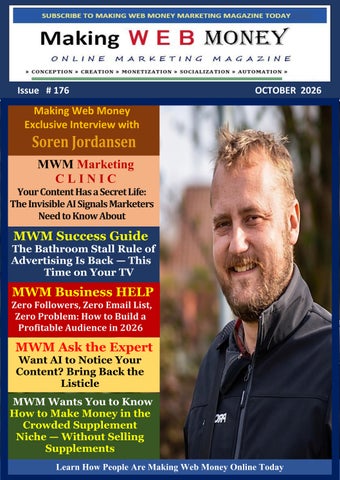
Issue # 176
OCTOBER 2026
Making Web Money Exclusive Interview with
Soren Jordansen MWM Marketing CLINIC Your Content Has a Secret Life: The Invisible AI Signals Marketers Need to Know About
MWM Success Guide
The Bathroom Stall Rule of Advertising Is Back — This Time on Your TV
MWM Business HELP Zero Followers, Zero Email List, Zero Problem: How to Build a Profitable Audience in 2026
MWM Ask the Expert Want AI to Notice Your Content? Bring Back the Listicle
MWM Wants You to Know How to Make Money in the Crowded Supplement Niche — Without Selling Supplements Learn How People Are Making Web Money Online Today
BONUS! John Cornetta
Discover The 7 Secrets to Achieve Anything You Want In Life... ***Limited Time Only: Grab This FREE Gift Now!***
These 7 Secrets Will Enable You To... • • •
Discover the Foundational Meaning of SUCCESS Demonstrate PASSION and PERSEVERANCE for long-term goals Learn the untold secrets on how to create the life you TRULY DESIRE
IT’S FREE … CLICK HERE to get yours!
You Asked and We Listened. HELP is HERE How Would You Like to Get Your Hands On My Proven Marketing Strategies That Have Created A Multiple Six Figure Online Business? Now You Too Can Explode Your Business Income With
Monthly Internet Marketing Training and Coaching! If You Are Serious About Changing From A Failing Online Business To An Uber Profitable Online Business I Can Help You! Listen, I know what it's like to have a strong desire to have a successful online business but have no real idea of HOW to market it... I'm not making empty promises. One thing you will not find on this site is a promise of "easy riches". I make no claims of how much you can make. I make no claims that you'll make any money at all. I don't know you. I don't know if you're a thinker or a doer. How can I promise you'll make X dollars? I can't. And I don't. That SHOULD be a sign of trust to you. There are many others out there making crazy income claims. I won't promise riches. I won't promise any results. I'll simply tell you that I will show you things you can do to get your online business rocking and rolling! There is absolutely no risk. I'm even going to take away ALL RISK for you. It's pretty simple: if you don't like the Training, you don't pay. Period. You have nothing to risk and everything to gain. Let me say it a different way...
You Don't Even Have To Say "Yes" To Get Started Right Away, Just Say "Maybe" And I'll Send Your First Lesson Instantly!
Click Here
MWM contents 2 7 Secrets to Unstoppable Success 3 Internet Marketing Academy 6 MWM Editor’s Letter OCTOBER 2026 7 In The NEWS 9 MWM – FREE Affiliate Funnel 10
PLR Profits Coaching Club
11 MWM Success Guide – The Bathroom Stall Rule of Advertising Is Back — This Time on Your TV 13 Dynamic Digital Software Store Want A FREE Website? 14 Subscribe For FREE
9 FREE Affiliate Funnel Offer
16 MWM Ask the Expert – Want AI to Notice Your Content? Bring Back the Listicle 19 Business HELP - Zero Followers, Zero Email List, Zero Problem: How to Build a Profitable Audience in 2026 20 Introducing 6FigZ - New Product 22 The Internet's Biggest Yard Sale: How to Buy Forgotten Digital Assets and Bring Them Back to Life 25 Master Resell Rights Membership Site 26 Ecommerce Made Easy 27 New Product SHOPZPRESSO MEGA STORE 29 Stop Saying “Comment Below!” CTAs People Actually Want to Answer 30 FREE eBook - Six Figures A Year in Info Publishing 33 MWM Interview – SOREN JORDANSEN 37 The Functional Strength Guide
20
Introducing 6FigZ
MWM conte nts
38 MWM Q & A - From Readers to Revenue: How to Build a Specialty Newsletter That Pays Off 40 Your Sales Page Is Selling the Wrong Thing - Here's How to Fix It 42 People Don't Buy Products. They Buy the Story They'll Tell Afterward 44 Covert Video Press 45 MWM Marketplace 46 NEW PRODUCT – DriveZPresso 47 Massive Traffic Blueprint
46 New Product DriveZPresso
48 JVZoo Hosting 48 MWM wants You to Know - How to Make Money in the Crowded Supplement Niche - Without Selling Supplements 50 The AI Gold Rush Is Happening Where Nobody Is Looking
53
This Month’s Marketing CLINIC Your Content Has a Secret Life: The Invisible AI Signals Marketers Need to Know About
57
The Secret Isn't Working Harder—It's Building Assets That Keep Working
58
Unlock My Secret Traffic Methods
60
YouTube Ads Made Easy
SOREN JORDANSEN MWM Interview
Advertise in Making Web Money Contact: Admin@makingwebmoney.com for Details
MWM editors letter Welcome to the OCTOBER 2026 Issue of our monthly “Making Web Money” Online Digital Marketing magazine - where every month we show you how real people, just like you, are making web money – online. This month we have MORE great articles and personal success insights, interviews, plus some ONLINE opportunities for you. - MWM Series on Business Help - Zero Followers, Zero Email List, Zero Problem: How to Build a Profitable Audience in 2026 - MWM Interview – SOREN JORDANSEN - The Functional Strength Guide - Don't Let One Platform Hold Your Income Hostage - FREE eBook - Six Figures A Year in Info Publishing - MWM Wants You to Know - How to Make Money in the Crowded Supplement Niche — Without Selling Supplements - MWM Q & A - From Readers to Revenue: How to Build a Specialty Newsletter That Pays Off - MWM Marketing CLINIC - Your Content Has a Secret Life: The Invisible AI Signals Marketers Need to Know About - MWM Success Guide - The Bathroom Stall Rule of Advertising Is Back — This Time on Your TV - MWM Ask the Expert - Want AI to Notice Your Content? Bring Back the Listicle - Dynamic Digital Software Store Want A FREE Website? - The ‘Accidental’ Affiliate Marketer: How to Make Sales Without Selling - Introducing 6FigZ - New Product - Stop Saying “Comment Below!” Facebook CTAs People Actually Want to Answer - Master Resell Rights Membership Site I hope you enjoy this month's magazine. Thanks for reading. – Check out our 175 Great Back Issues of Making Web Money!
Talk to me
>>
facebook.com/harrycrowder twitter.com/harrycrowder
Keep your valuable feedback coming. I try to reply to every email, I appreciate your input as it helps to make MWM the Best magazine possible. Email me at: crowderharry598@gmail.com
MakingWebMoney.com Subscription enquires: www.MakingWebMoney.com Order the printed edition: www.issuu.com Advertising enquires: www.MakingWebMoney.com Making Web Money Magazine Published 12 times per year. Copyright
All rights reserved. Reprinted with permission. No part of this publication may be reproduced, translated or converted into machine-readable form or language without the written consent of the publisher. Articles express the opinions of the authors and are not necessarily those of the publisher Making Web Money Online Marketing Magazine Editor Harry Crowder Advertising: See Above Contributors Various experts in their fields The instructions and advice in the magazine are for educational and entertainment purposes only. The creators, producers, contributors and distributors or Making Web Money Marketing Magazine disclaim any liability for loss or lack of results from following the advice expressed herein.
Follow me on Facebook: https://www.facebook.com/harrycrowder
Both the paper and our printer meet the international standard ISO 14001 for environmental management. The paper comes from sources certified under the Program for Endorsement of Forest Certification scheme (PEFC). Please recycle this magazine – or give it to a mate.
MWM inbox How Handy is This? You can NOW Shop
Walmart Online, save a lot of time, money and hassles. Pick from everything at Walmart and
Then choose to have Tell us what you like and don’t like about Making Web Money Digital Marketing magazine. What worked for you or what you think sucks, then we can make Making Web Money an even better online magazine. So, send me an email with your feedback and let me know. crowderharry598@gmail.com
your order Delivered to you by mail / freight OR
YOU can Pick Your Order Up at
NEAREST WALMART Shop at home. Drive to the store. Pick Up Your Order!
QUOTABLE.. The difference between a successful person and others is not a lack of strength, not a lack of knowledge, but rather a lack of will. .” – Albert Einstein
RESOURCES AND NEWS Marketers Are Creating More Content Than Ever. So Why Are the Results the Worst in 12 Years? AI has made it ridiculously easy to produce content, and yet content marketing performance has fallen to its lowest level in 12 years. Only 14% of marketers surveyed said their blogs are producing "strong results." But the evidence doesn't simply point to AI as the culprit. Marketers have simultaneously been cutting back on many of the things associated with successful content such as original research, keyword research, expert collaboration, human editing and analytics. In other words, we're creating content so quickly, we’ve forgotten to make it worth reading. Why this matters to marketers: Instead of trying to publish more, create something AI can't manufacture on its own such as firsthand experience, original numbers, customer stories, experiments, strong opinions, interviews and genuinely useful answers. And bring back the supposedly boring stuff like keyword research, editing, updating old winners and checking analytics to see what actually produces leads and sales. https://searchengineland.com/content-marketing-success-falls-survey-488049
Marketers Are Creating More Content Than Ever. So Why Are the Results the Worst in 12 Years?
LinkedIn has updated its feed display in an effort to generate more meaningful It Exists replies and conversations around posts. The platform is putting increased emphasis on relevance, including how pertinent an interaction is to an individual user, rather than treating all engagement as equally valuable. That's an important distinction for marketers because it reinforces something we've been seeing across social platforms: Raw engagement numbers don't necessarily tell the whole story anymore. For marketers, I'd take this as another reason to stop ending every LinkedIn post with generic engagement bait such as "Agree?" or "Thoughts?" A smaller discussion involving the right people talking about the actual subject could potentially be more valuable than dozens of meaningless reactions. Try ending posts with questions that invite expertise, disagreement, experiences or examples: "What's the one part of this you've found doesn't work?" is much harder to answer with a thumbs-up than "Do you agree?" In other words, don't optimize for comments. Optimize for conversations worth reading. https://www.socialmediatoday.com/news/linkedin-updates-feed-display-todrive-more-post-replies-and-comments/827394/aren't designed to maximize
MWM New Product
MWM 09
Goodbye, Short Keywords? Searchers Are Starting to Talk to Google Like They Talk to AI Something big is happening to the way people search. Google Ads data shows that searches containing just one or two words fell from 42% of impressions in January 2025 to only 24% by August 2026. Meanwhile, three- and four-word searches jumped from 33% to 48%. Even more important, longer queries are increasingly driving conversions. People aren't simply typing "email software" or "weight loss" anymore. They're becoming more specific and conversational… a behavior almost certainly being reinforced by the way millions of people now ask detailed questions of AI tools. https://searchengineland.com/google-ads-data-shows-query-lengthshift-post-ai-mode-458162
Did Instagram Turn Comments into an Automatic Sales Funnel? You've probably seen posts that say something like, "Comment GUIDE below and I'll send it to you." Until now, handling those responses could mean using outside automation software or spending a lot of time answering people yourself. Instagram is testing a much easier solution. A new Reply to Keywords option lets advertisers choose up to five words that trigger an automatic private message when someone uses one of them in a comment on a promoted post. So you could run an ad saying, "Comment CHECKLIST and I'll send you my free checklist," and Instagram would automatically deliver your prewritten DM. For now, the feature is appearing only for some Instagram advertisers and isn't yet available for Facebook ads. Why this matters to marketers: This could turn a simple Instagram comment into the beginning of an automated sales funnel. Offer a free guide, coupon, checklist, webinar, product information or other irresistible freebie, ask people to comment with your chosen keyword, and let Instagram immediately continue the conversation privately. https://www.socialmediatoday.com/news/meta-tests-auto-dmresponse-for-instagram-ad-comments/828791/
MWM 10
The Bathroom Stall Rule of Advertising Is Back — This Time on Your TV Pause ads look like a brand-new advertising idea. The thinking behind them is anything but new. Remember those ads placed inside public bathroom stalls? Marketers figured out something wonderfully simple: You were already there, you weren't going anywhere, and there wasn't much competing for your attention. Now that same idea has arrived on your television. Pause ads appear when you pause a streaming program and disappear when you start watching again. Ad-tech company Nexxen recently expanded programmatic access to premium pause-ad inventory, making the format much easier for advertisers to buy at scale. And the early numbers explain the interest. Pause ads reportedly generate nearly twice the attention of standard connected-TV ads, while 51% of viewers in one survey said they took some kind of action after seeing one. Better yet for advertisers, 54% of U.S. ad-supported TV viewers typically leave programs paused for one to five minutes. That's a surprisingly long time to stare at an advertisement. But there's a bigger lesson here for marketers, even if you'll never buy a pause ad. Stop looking exclusively for ways to interrupt people… And start looking for the moments when people naturally stop. Waiting for an order. Standing in line. Sitting in a lobby. Checking a confirmation page. Waiting for something to download. Even opening packaging after a purchase. These are little pockets of attention where a useful message, special offer, QR code, upsell or invitation might work without annoying anyone. The important part is not to ruin the opportunity. Pause ads work partly because they aren't interrupting the program. The viewer created the pause. So, keep the message simple, relevant and easy to act upon. It's the old bathroom-stall advertising principle updated for 2026: Sometimes the best advertising space isn't where everybody is looking. It's where they have nothing else to look at. https://www.emarketer.com/content/pause-ads-gainprogrammatic-scale--next-test-creative
Starting today you can enroll in my new monthly coaching program where I will teach you how to turn PLR content into spendable cash using several underground methods. Each and every month you'll get a new lesson showing you a different way to profit with the PLR products you already have. Each month will be a different lesson (sometimes delivered as a stepby-step PDF and sometimes delivered as video tutorial lessons, and even sometimes a mixture of both) that you can download, view, and then implement to start making money with PLR content. This 12 month coaching program can help you feel good about every PLR purchase you've made (even those "junky" ones because I will show you how to polish them 'til they shine!). The PLR Profits Coaching Club can justify every penny you've spent. It can make those purchases worth something to you because you can put that content to work making money for you. Click Here to Start
How Would You Like a Complete Done-For-You Niche Targeted Website - All Professionally Designed And Ready For You to Profit From?
The Dynamite Digital Software Store
Subscribe TODAY! Do it now! It’s Free
To subscribe for free, go to:
MakingWebMoney.com The digital edition of our magazine is FREE !! You can upgrade to receive the printed edition, Or cancel your subscription at any time.
Subscribe today for FREE!
Stop Guessing What Your Competitors Are Doing — Spy on Them Properly Buffer's August 31 roundup examines 11 competitor-analysis tools spanning social media, SEO, audience research and brand tracking. But here's the part solo marketers should appreciate: Buffer explicitly says you don't necessarily need expensive software. You can learn plenty by manually examining competitors' social accounts, websites, content, positioning and audience reactions, while tools such as SparkToro and vidIQ offer free options for digging deeper.
https://buffer.com/resources/competitor-analysis-tools/
Scared to Go Live on YouTube? Now You Can Rehearse First Going live on YouTube can be nerve-racking when you're doing everything yourself. Is the microphone working? Is the camera angle awful? And what exactly are you going to say after "Hi, everybody"? YouTube has a useful solution: Live Practice Mode, rolling out to creators in the mobile app. It gives you a private space with no real audience where you can rehearse, test your setup and practice interacting with viewers. When you're ready, you can go live directly from Practice Mode. Why this matters to marketers: Live video is great for product demonstrations, Q&As, tutorials, launches and simply letting customers get to know you. But don't use Practice Mode just to check your microphone. Rehearse your first 60 seconds, your offer, your call to action and answers to the three questions viewers are most likely to ask. Then go live while you're already warmed up. YouTube just gave solo creators something larger productions take for granted: A rehearsal before showtime.
https://support.google.com/youtube/answer/9072033
Want AI to Notice Your Content? Bring Back the Listicle Remember listicles? Those “10 Best Tools for…” and “7 Best Ways to…” articles that became so common you assumed their glory days were over? Well, AI didn't get the memo. Ahrefs analyzed 26,283 source URLs associated with buyerstyle ChatGPT prompts and found that 43.8% of the page types cited were “best X” blog lists, more than any other format. And this isn't just a ChatGPT quirk. Evertune reports that across ChatGPT, Copilot, Gemini, Google AI Mode, Google AI Overviews and Perplexity, listicles accounted for 63% of citations by volume in its analysis of heavily cited URLs. Ranked lists were especially prominent. Why should you care? Because people increasingly ask AI the same questions they once typed into Google: What's the best email platform for a tiny business? What are the easiest website builders for beginners? Which microphones are best for YouTube? And when AI goes looking for information to help answer those questions, well-constructed lists give it something extremely useful: Multiple options, comparisons and recommendations conveniently organized in one place. Try This Today Look at your niche and identify five “best” questions your customers might ask AI. Then create genuinely useful lists answering them. Don't simply slap together “10 Best Whatevers” and stuff your product into the #1 position. Include real comparisons, explain who each choice is best for, discuss drawbacks as well as advantages, keep the information current and link to trustworthy supporting sources. Evertune says sponsored and affiliate content can still earn citations when it provides genuine editorial value and properly discloses the relationship. The humble listicle may suddenly have a much bigger job. You're no longer creating lists just to rank in Google. You're creating resources that could help AI decide what to tell its users. And that's a pretty interesting place for your business to be. https://ahrefs.com/blog/best-lists-research/ https://www.evertune.ai/resources/faq
Don't Let One Platform Hold Your Income Hostage You spend three years building 40,000 followers. You post regularly, answer comments, make sales and finally have a nice little income stream humming along. Then one morning you can't log in. Or your reach suddenly drops. Your account gets restricted. A hacker changes the password. The algorithm decides your formerly wonderful content is about as interesting as wet cardboard. There's an uncomfortable truth every social media marketer eventually needs to face: You Built the Audience, But You Don't Own the Platform That doesn't mean you should abandon social media. Far from it. It means you should protect what you've built before something goes wrong. Start with the boring-but-important stuff: Use strong unique passwords, turn on two-factor authentication, keep recovery information current and regularly check which people and apps have access to your accounts. Watch for strange login attempts, unexplained changes in reach, unfamiliar posts or messages, and notifications you don't recognize. Next, preserve what you can. Keep copies of important videos, images, posts and business records rather than treating the platform as permanent storage. Here's The Tip Most People Skip Create a “platform emergency kit” while everything is working normally. Once every few months, take screenshots showing your account name, profile URL, follower count, bio, connected business information and anything else that helps establish the account as yours. Save advertising receipts, platform emails, account IDs and support correspondence in the same folder. Then add one more thing: An emergency landing page on your own domain. You don't even have to publish it yet. Prepare a simple page that says, essentially, “Having trouble finding us? Here's where we are now,” with your email signup and links to your other active channels. If a major account suddenly vanishes, you aren't inventing your backup plan while mildly hyperventilating. The Real Asset Isn't Your Follower Count Your goal isn't to own your followers. It's to own the connection. If Facebook, Instagram, TikTok, YouTube or another platform disappeared from your business tomorrow, could you still reach your best customers? Social media can be an extraordinary income machine. Just make sure someone else can't accidentally turn yours off.
The Lazy Marketer’s Loyalty Program: Keep Customers Coming Back Without Creating More Work You don’t need points, tiers, an app and a 47-page rulebook to give customers a reason to buy again. Getting a new customer is hard. Getting someone who already likes you to come back? That should be easier. And loyalty programs work: 72% of customers say they encourage them to spend. But if you're running a one-person business, the last thing you need is another complicated “system” to manage. So keep it ridiculously simple. Start with the second-purchase reward. After someone buys, automatically email them a coupon for their next purchase. Give it an expiration date—say 30 days—and you're done. Try a punch-card program without the card. Buy five times, get $10 off. Buy nine coffees, get the tenth free. Most ecommerce loyalty apps can track this automatically, but tiny businesses can start with something as simple as tagged customer records. Reward referrals. Give customers a unique referral link or code: “Give a friend $10 off and you get $10, too.” Now your loyalty program does double duty as customer acquisition. Reward actions besides buying. Shopify suggests awarding rewards for leaving reviews, joining your email list, referring friends or following your social accounts. That means customers can become more valuable even between purchases. And don't overlook VIP treatment that costs almost nothing. Give repeat customers first access to a new product, a members-only sale, free shipping, a birthday bonus or an occasional surprise gift. Exclusivity can feel more special than another 10% coupon. Most importantly, automate the communication. Your email system should tell customers when they've earned something and remind them to use it. Shopify specifically recommends postpurchase emails showing customers what they've earned and what they can unlock next. Start with one reward, one rule and one automated email. You can always get fancy later. Because the best loyalty program isn't the most sophisticated one. It's the one that quietly brings customers back without creating another job for you. https://www.shopify.com/blog/loyalty-program The Loyalty Payoff 2.5X MORE Repeat Purchases Customers who redeemed loyalty rewards made 2.5 times as many repeat purchases as customers who didn’t redeem rewards, according to an analysis of more than 100 Shopify brands. And they didn’t just come back more often. Their average order value was 23% higher, too.
The ‘Accidental’ Affiliate Marketer: How to Make Sales Without Selling But people absolutely will watch something entertaining, useful, surprising or fascinating. And then they'll click. That's the simple idea behind shoppertainment — the increasingly blurry line between entertainment, content and commerce. Instead of creating content whose obvious purpose is to sell something, you create content people genuinely want to watch...and let the selling happen naturally along the way. You've probably experienced this yourself. You're scrolling along with absolutely no intention of buying anything when somebody demonstrates a clever kitchen gadget, tries an unexpectedly useful product, compares two supposedly identical items or tests something that looks almost too good to be true. Thirty seconds later you're thinking, Okay...where do I get that? That's shoppertainment at work. And if you're an affiliate marketer, content creator or simply someone looking for another realistic way to make money online, this shift is worth paying very close attention to. Because it turns the traditional affiliate marketing formula upside down. Instead of asking: "How do I get someone to click my affiliate link?" You ask: "What could I create that would make someone stop scrolling and watch?" That's a much more powerful question. Because the product isn't really the content. The experience surrounding the product is the content. Imagine promoting a $19 kitchen tool. You could say, "This handy vegetable slicer has stainless-steel blades and is available here." Yawn. Or you could film yourself attempting to slice an entire cucumber in five seconds. Now we have a show. Maybe it works beautifully. Maybe cucumber goes flying across the kitchen. Either outcome could make good content. And conveniently, the product is sitting right there in the middle of it. Entertainment First. Selling Second. This is probably the most important rule of shoppertainment: Don't make an advertisement people tolerate. Make content people would watch even if they weren't buying.
That doesn't mean hiding the fact that you're selling something. Affiliate relationships should always be disclosed clearly. It simply means giving people another reason to watch: curiosity, humor, transformation, competition, demonstration, surprise, education, a strong opinion, a before-and-after, a challenge or a story. Instead of reviewing a stain remover, spill something horrible on a white shirt and see whether it survives. Instead of promoting camping gadgets, test five inexpensive ones and announce which deserve space in your backpack. Instead of simply showing organizing products, tackle the junk drawer from hell. Suddenly you've moved from "Here is something you can buy" to "You've got to see what happens." Best of all, you don't need to dance, sing, perform comedy or become some hyperactive internet personality to do it. Useful can be entertaining. Fascinating can be entertaining. Satisfying can be entertaining. Even watching somebody solve an ordinary problem can be surprisingly compelling. Choose Products That Give You Something to Show This model also changes how you choose affiliate products. Commission percentage matters, obviously, but there's another question worth asking: What can I DO with this product on camera? Some products practically arrive with their own content ideas. They transform something, solve a visible problem, produce an unusual result, invite comparison, look impressive, have an unexpected use or simply make people wonder, Does that thing actually work? Those characteristics give you something affiliate marketers desperately need: a hook. A $15 product capable of generating 20 interesting videos may ultimately be far more valuable than a $200 product you can barely think of anything interesting to say about. This is where your affiliate business starts looking less like a catalog and more like a little media company. One Product Doesn't Mean One Video Here's where things get especially interesting. Suppose you discover a product people respond to. Don't make one video and move on. Make ten. "I Bought the Viral $20 Gadget So You Don't Have To." "Three Things Nobody Tells You About This Thing." "Does the Cheap Version Work as Well as the Expensive One?" "I Used It Every Day for a Week. Here's What Happened." "Who Should NOT Buy This?" "The Strange Little Product I Didn't Know I Needed." One product can become an entire miniature content franchise, and every piece of content becomes another doorway into the same offer. That's an important mindset shift. You're no longer constantly hunting for the next product. You're learning how to extract more attention and revenue from the products that already work.
You Don't Need a Giant Audience This might be the best part: Shoppertainment doesn't necessarily depend on having 100,000 loyal followers. Recommendation-driven platforms can put an individual piece of content in front of people who have never heard of you. That means the content itself gets an opportunity to earn distribution. A small creator can produce one extremely useful demonstration, entertaining comparison or curiosity-driven test that travels far beyond their existing audience. And smaller creators have another advantage: They often feel believable. A slick commercial tells us we're being sold. A normal person saying, "I thought this thing looked ridiculous, but watch this..." feels different. Don't underestimate that. You don't necessarily need a studio, expensive cameras or an elaborate set. You need decent lighting, understandable audio and something worth watching. Your kitchen table may be enough. Don't Murder the Moment with Your Affiliate Link There's another mistake to avoid. You create a genuinely entertaining video...and then suddenly transform into a late-night infomercial host. "BUY NOW! LINK BELOW! DON'T MISS OUT!" Easy there, tiger. The affiliate link should feel like the natural next step: "If you want to see the exact one I'm using, I've linked it below." Done. Let the content do the heavy lifting. Your goal isn't to pressure someone into clicking. Your goal is to create enough interest that they want the link. That's a completely different kind of selling. Turn Winners Into Assets Now we get to the business part. Don't treat every video as a disposable social post. Watch what happens. Which videos hold attention? Which products generate questions? Which demonstrations get shared? Which ones produce clicks? Most importantly, which ones produce sales? When something works, squeeze it. Create variations. Make follow-ups. Answer comments with new videos. Compare the product with competitors. Put it into a roundup. Write an article around it. Add it to your email newsletter. Build a product page or resource page. Repurpose the concept across platforms.
A winning 45-second video isn't merely a post. It's market research with revenue attached. Eventually you'll begin seeing patterns. Maybe your audience loves inexpensive problem-solving gadgets. Maybe before-and-after videos outperform reviews. Maybe comparison videos generate fewer views but far more buyers. Now you're building knowledge competitors can't simply copy. Let AI Make the Machine Faster AI can also help without becoming the star of the show. Give it information about a product and ask for 30 video angles. Feed it your comments and ask it to identify recurring questions. Use it to generate hook variations, comparison ideas, scripts, titles, FAQs and follow-up concepts. That's a much smarter use of AI than generating endless generic product reviews. Let AI multiply your ideas. Let you provide the personality, experience, judgment and trust. This Can Become Much Bigger Than Affiliate Commissions Here's where shoppertainment gets really exciting. Affiliate income can simply be the starting point. Once you know how to attract buyers around a particular subject, you've built something far more valuable than a collection of links. You've built an audience with commercial intent. That can eventually lead to sponsorships, email lists, paid newsletters, digital products, memberships, brand partnerships, your own products and other revenue streams. The person demonstrating gardening tools today could eventually own a gardening newsletter, sell a planting guide, attract sponsors and launch a private-label product. The videos were simply the front door. The Big Opportunity Don't build an affiliate business around links. Build an entertainment-and-information business around buyers. The affiliate links monetize the attention. But the attention and trust are the real assets.
MWM New Product World’s First 3-in-1 Online MegaStore Creator that combines Physical Products, Software Products and Licenses + Affiliate Marketing into ONE.
Launch Your BRAND NEW 3-in-1 Online MegaStore in Just 3 Simple Steps STEP 1 Access Account
your
ShopZPresso
STEP 2 Import or Add products in one click STEP 3 there is no step-3… enjoy profit BOOM! Your Online MegaStore Launched IN LESS THAN 60 SECONDS
CLICK Here Now
"Discover How to Start, Build and Launch Your Own Digital Product Business Without Breaking The Bank..." Find Out How To Create Your First Digital Product For Sale And Start Getting Sales On Autopilot! What you'll discover in this eBook: •
You'll have an idea for the type of digital product you want to create and what the strengths and weaknesses of each option are
•
Understand what makes digital products sell and how you need to design your creation in such a way that people will be eager to buy it
•
Know how to quickly and cost effectively create the type of digital product you want
How to create a potential hot-selling eBook • Know how to alter things like price, cover image and more in order to optimize your sales • Understand how to drive more traffic to your landing page using SEO, PPC, e-mail marketing and social media • Understand affiliate programs and tools like JVZoo, ClickBank and WSO Pro • Know how to build an army of affiliate marketers who can drastically increase your sales and profits •
• ...and much, much more!
This is the ultimate guide to How to Launch a Digital Product Business! You'll discover all the steps, tools and resources to help you become a successful digital marketer!
Get your copy today!
Now you can create full image variations inspired by your original ad
Now you can create full image variations inspired by your original ad creative with text overlay capabilities, generating improved backgrounds around product images and expanding images to better fit multiple surfaces. In addition, you will r brands to choose from. Lastly, image expansion allows you to seamlessly adjust creative assets to fit different aspect ratios across multiple surfaces. These tools are now available on Reels and Feed across both Instagram and seamlessly with text overlays on your ads. https://www.facebook.com/business/news/Introducing-Enhanced-Gen-AIFeatures-and-Other-Tools-to-Help-Build-Your-Business
CLICK HERE_
Stop Saying “Comment Below!” Facebook CTAs People Actually Want to Answer You just wrote a terrific Facebook post. Now comes the awkward ending: "What do you think? Comment below!" There's nothing technically wrong with it. It's just incredibly easy to ignore. If you want more comments, give people a specific, easy and interesting reason to respond. The best calls-to-action don't feel like you're begging for engagement. They feel like the beginning of a conversation. Instead of "Any thoughts?" lower the effort required: • "Which would you choose: A or B?" • "What's one thing you'd add to this list?" • "Finish this sentence: I knew I was officially an entrepreneur when _____." • "What's the best $50 you've ever spent on your business?" People can answer those without composing an essay. Better yet, ask questions that let people talk about themselves. Opinions, experiences, preferences and little victories are easier—and more enjoyable—to share than answers requiring expertise. Try the one-word CTA: "Describe your first website in ONE word." Or the number CTA: "On a scale of 1–10, how much do you trust your analytics?" Another winner is the advice CTA: "Someone is starting their first email list tomorrow. What's the ONE thing you'd tell them?" Now your commenters aren't merely responding. They're contributing. And don't disappear after posting. Reply to early comments, ask follow-up questions and occasionally turn a particularly interesting response into another conversation. If somebody says, "Email has worked best for me," ask why. One caution: don't manufacture meaningless engagement with questions unrelated to your content just to rack up comments. Make the conversation worth having. Your goal isn't simply more comments. It's getting people to stop scrolling, think for two seconds and genuinely want to answer. That's the secret to a strong Facebook CTA: Don't ask people to engage with your post. Give them something irresistible to engage about. They'll build the one almost nobody else thinks to build.
Finally, A Bunch of Great FREE Help! No more Paying for Products That Don't Deliver Results! Get Everything You Need To Know To Start A Wildly Successful Home-Based Internet Business! • • • • • • • •
Search Engine Optimization Affiliate Marketing Viral Marketing Joint Ventures Blogging for Cash Social Networking And more! Get the Facts - What It Takes to Make Money Online Today!
MWM Videos http://makingwebmoney.com/videos
http://www.youtube.com/watch?v=RSkWqI7M3Ts
http://www.youtube.com/watch?v=6t6ba6Cj690
http://www.youtube.com/watch?v=rzEuURaTiZU
http://www.youtube.com/watch?v=h5GQ m55ccTk&feature=related
http://www.youtube.com/watch?v=0CaUcIwPsH8
http://www.youtube.com/watch?v=EYN1BjtZ6nc
MWM Interview SOREN A JORDANSEN Editor:
Interview
Today's guest is Soren Jordansen, better known to many as The Copy Viking. For more than two decades, Soren has been writing high converting copy, creating successful digital products, and helping entrepreneurs communicate more effectively. And rather than standing still, he's also continued to evolve with the industry, embracing AI, publishing, and also entirely new business models. I'm excited for this. Soren, welcome. Søren: Thank you very much. Pleased to be here. Editor: You've been in marketing, as I mentioned, for over 20 years, but how did it all begin? Søren: Yeah, that's a funny story, actually. I'm based in Denmark and I was in the army. I was an officer in the Danish army, first lieutenant, platoon commander in Danish artillery, actually air defence. I did my tours around the world and all that. Soldiering is a lot about waiting, whether you're deployed or you're at base. I noticed the thing, a lot of my fellow soldiers, they would spend a lot of time, back then, 20 plus years ago, gambling sites, poker sites, that was huge. And a lot of them, they would gamble. They would also watch, let's say, more colourful websites. We don't have to mention, but you get the idea. And all these sorts of things that soldiers do. One day I noticed something on one of these sites that was like become an affiliate at the bottom. Something clicked in my mind. I was like, wait a minute, all these guys are doing all this. You're telling me if they go through my link, I'll earn a percentage of everything they do. It was my first foray into it.
And I did what any reasonable person would do. I went to local kiosk and bought a front page for dummies. Back then, you could build websites with Microsoft FrontPage, which I'm sure doesn't exist anymore. And I built a website and you imagine a GeoCities kind of website banner farm and I was very much in the build it and they'll come kind of mode. I built this website, I figured it all out on my own and it was a terrible affiliate website. Obviously never got a single visitor or anything.
That led me to the famous Google search. I'm not even sure it was Google back then. It probably was just the start of Google, where I searched how to get traffic to a website. And then I found a forum, netmarketingforum.com, which also doesn't exist anymore. And from there, I got connected with people who were doing affiliate marketing, launching traffic exchanges, which was a big thing back then. And then I got in. So instead of doing this affiliate side, I then got into the traffic generation side of things, launch my own safe list, traffic exchange. That's where the copywriting came in because then I discovered that I actually had a knack for that. I always been good at writing this go, but I had a good active copywriting as well. So I wrote my own copy and it sort of evolved from there. Then I started, I had customers, I had members, then I did products, information products, then software products and along the lines. And always wrote my own copy and got better and better at it until people started also wanting to pay me to write their copy. We got quite big. I partnered up with a few people, John Merrick and Cindy Batty. We ran wealth builders, instant marketing wealth builders. We were the top vendors on JVC.com. We were pretty big on ClickBank as well, Warrior Plus. Yeah, so that's how I got started. Editor: From day zero to where you are now, how long did it take maybe before you thought, "This is viable. This is something that I can do now. I can leave everything I've done before behind and concentrate fully on this"? Søren: The famous, building the terrible website happened in 2004. And then, same year, finding out that it doesn't just magically come to you. And then I did this whole and started out. So that would be late 2004. So 2005 was a year where I built simultaneously with having my full-time job in the army. June of 2006 is when I went to the colonel's office and said, "Good day, sir. I would like to resign." Because at that point, I was making more money from the internet marketing than the army would ever pay me. So it took me year and a half to go full-time. Editor: It's a great story that you have and obviously the internet itself has changed so much in that time. And I think a lot of people think it must have been easier back then to get started than it is today. What would you say? What's your experience of that, Soren?
Søren: Actually, yes and no. It was easy back then. We like to refer to it as the wild west of internet marketing. Anything goes, everything was new. We made it up as we went along, which made some things easier and some things a lot harder as well. It was easy in the sense that the bar was pretty darn low. People hadn't seen a lot of stuff yet. So that little idea you got turned into a product that could actually sell and a product that probably wouldn't sell today because people, they've seen it a million times. But I actually think we are right now at a point in time that is very similar to when I got into it because of AI. I think it's a little bit of a wild west situation now too because I love this because you have a very short path from idea to execution now because you can use AI to help you along the way, both for coding and writing and ideation and all that stuff. I don't need to employ a bunch of programmers necessarily or all the stuff that I eventually ended up having. So I think it's a little bit of both. Yeah, it might've been easier back then, but we didn't have AI. And if you gave me the two time periods as to which one would you prefer to start in, I would probably pick this one where I have the AI sidekick, but I do say that with the benefit of the hindsight and all the knowledge I have to get what I get out of AI. So I don't know, but I don't think it was particularly easier back then than it is now. Editor: I think one of the things that strikes me most about you, Soren, is the way that you've reinvented yourself several times in that period. How important is it to be adaptable? Søren: I think it's very important because in internet marketing, well, internet in general, things move really, really, really fast. What is the trend today will be potentially outdated next month, and that's always been the case. I've seen a lot of people come and go, and go because they did not reinvent themselves. They found something that worked and they kept doing it and then they stopped working and they still kept doing it and then they go out of business. And there's very few people who can do the same thing over and over again.
Actually, the internet marketing newsletter is one of the very few examples of something that has been persistent for, I don't even know the number, but I think it's way over 15 years, I think, but that comes down to the quality of it. And they've also reinvented, Nick James reinvented it over the years, but for everyone else, yeah, you didn't need to keep it the times and you can't just keep doing the same thing… My reinvention was also...
MWM Q & A How to Turn Boring Public Records into a Hugely Profitable Business No, you're probably not going to build a business empire this weekend. But with AI, three focused days may be enough to find an opportunity, create an offer and convince your first customer to pay you. Could you really start a business in three days? A few years ago, that would have sounded ridiculous. You'd need to research the market, develop something to sell, create marketing materials, write sales copy, build a website and somehow find customers. Today, AI can compress an astonishing amount of that work. A word of caution: Don't spend three days using AI to build a business nobody wants. The goal of this challenge isn't to create the perfect company. It's to find one real problem, create one small solution and see whether one actual human being will give you money for it. That's a business worth developing. So clear your calendar because you've got 72 hours to do this. DAY 1: Find a Problem Somebody Will Pay to Make Go Away Don't begin by asking ChatGPT, "Give me 100 business ideas." That's how you end up with another generic ebook, print-ondemand T-shirt shop or productivity app nobody requested. Start with people. Pick a group you understand or can easily reach: Real estate agents, Etsy sellers, independent pet groomers, contractors, coaches, eBay sellers, Airbnb hosts, wedding photographers, newsletter publishers, consultants or local businesses. Now investigate them. Search Reddit discussions, Facebook groups, YouTube comments, reviews, forums and competitor sites. What do these people complain about? What takes too much time? What do they hate doing? What are they confused about? What are they already paying somebody else to do? What keeps appearing in questions and complaints? Collect 30, 50 or even 100 comments and feed the non-sensitive, publicly available material into AI. Ask: "Identify the recurring problems here. Which appear urgent? Which cost these people time or money? Which could a one-person business realistically solve?" Now AI isn't inventing business ideas. It's helping you find patterns in real customer problems. That's a huge difference.
Choose Something You Can Deliver Quickly For a 72-hour launch, I'd strongly favor a service or small digital deliverable. You don't need inventory. You don't need manufacturing. You don't need 50,000 website visitors. You need one customer. Suppose pet groomers frequently struggle to market consistently. Your offer could be: "I'll create your next 30 days of marketing: 12 social posts, four customer emails and one reactivation campaign for $149." Or perhaps Etsy sellers struggle with product listings: "I'll rewrite your 10 most important Etsy listings for search visibility and conversion for $99." Maybe consultants don't know what competitors are doing: "I'll research your five biggest competitors and create a 10-page opportunity report showing what they're doing, what's working and what they're missing for $199." Notice what's happening. You're not selling AI. You're selling an outcome. AI simply helps you produce that outcome faster. By Tonight, You Need Four Things Before Day 1 ends, create: One offer. One price. One sample. One way to get paid. That's it. You don't need a logo, business cards or three hours deciding whether your logo should be blue or slightly darker blue. If you need a sales page, make it ridiculously simple: who this is for, what problem you solve, exactly what the customer receives, what it costs and how to buy. AI can help create the sample, polish the offer, anticipate objections, write the page and develop your fulfillment process. Then stop building. Tomorrow you need customers.
That's validation. And if nobody buys? That's useful information, too. Maybe you've got the wrong audience. Maybe the problem isn't painful enough. Maybe the offer is confusing. Maybe the price is wrong. Maybe customers want a different solution. Change something and test again. You've lost three days — not six months. That's one of the greatest advantages of this approach. Now Use AI to Fulfill the Order Congratulations. Someone bought. Now AI gets to earn its keep. Use it to accelerate research, organize information, brainstorm alternatives, create first drafts, analyze data, build templates, proofread and repurpose material. But don't hand your customer a pile of raw AI output. That's not much of a business. You are the quality-control department. Check facts. Customize the work. Remove generic filler. Add insights. Make sure everything fits this particular customer's situation. AI provides leverage. Your judgment provides value. Turn the First Sale into a System Once you've delivered the work, ask the customer: What was most useful? What wasn't useful? What do you wish I'd included? What else are you struggling with? Now improve the offer. Suppose your $149 service initially takes six hours to deliver. That's not terribly exciting. But after three customers, you've developed templates, prompts, checklists and a repeatable process. AI helps reduce fulfillment to 90 minutes without reducing quality. Now things get interesting. You've created a productized service. What Could You Actually Launch This Way? There are dozens of possibilities: competitor-intelligence reports, newsletter production, content repurposing, customer-review analysis, ecommerce listing makeovers, local-business marketing kits, lead research, email sequences, social-content packages or "voice of customer" reports created by analyzing reviews and customer comments. If you already know a particular niche well, you could also create a tiny information product: a research report, template collection, specialized database, buying guide or curated opportunity list. What I wouldn't attempt over one weekend is building an elaborate SaaS product, recording a giant course, creating 200 SEO articles, filling a drop-shipping store with random products or publishing an AIgenerated ebook and hoping strangers magically discover it. Keep the experiment small enough to succeed.
Your 72-Hour Scorecard At the end of the three days, don't ask: "Did I build a successful business?" That's far too much to expect. Ask: • Did I identify a real problem? • Did I create a clear offer? • Did I talk to prospective customers? • Did I learn what they actually want? • Did somebody pay me? If you accomplished the first four but didn't make the sale, you've still learned enormously. If somebody did pay you? Now you have somewhere to go. Find customer #2. Then #3. Improve the offer. Document your process. Automate the repetitive parts. Raise your price when the value supports it. Perhaps eventually hire help. But don't worry about any of that this weekend. AI Isn't the Business That's the most important lesson in this entire experiment. AI can research faster than you can. It can analyze hundreds of comments, brainstorm offers, draft copy, organize information and help one person produce an extraordinary amount of work. But none of that creates demand. The business is still remarkably old-fashioned. Find somebody with a problem. Offer something that makes the problem smaller. Ask them to pay you. Then do an excellent job. AI simply means that one person sitting at a kitchen table can now accomplish in three days what might once have taken weeks. And that's the exciting part. You don't need a staff, a giant budget or everything figured out before you begin. You need a few days, access to AI, some curiosity and a willingness to talk to real prospective customers. So don't spend this weekend trying to build your future empire. Build something much smaller: One problem. One offer. One customer. Then see where you can take it.
How to Use Cunningham's Law to Make Your Social Media Explode Stop trying to get answers. Start giving people something they can't resist responding to. Here's an uncomfortable truth about social media: People are far more likely to tell you you're wrong than they are to tell you you're right. That's the thinking behind Cunningham's Law. Instead of asking people to contribute, give them something they instinctively want to challenge, improve, or argue with. Notice this post: "What's your biggest marketing challenge?" It might get a handful of replies. Now compare it to this: "Cold email is a complete waste of time in 2026. Change my mind." Suddenly you've got hundreds of marketers explaining why you're wrong, sharing their success stories, debating one another, and pushing your post to even more people. The magic isn't in being controversial… it's in giving people something worth reacting to. Publish your "Top 10 Most Overrated Marketing Tactics." Predict which social platform will lose the most users next year. Declare that one beloved marketing rule is outdated. Rank famous entrepreneurs from most to least influential. Tell people which business advice you're convinced is terrible. Some people will agree. Many won't. That's exactly the point. The biggest mistake marketers make is trying to write posts that nobody could possibly disagree with. Safe posts feel polished, but they're also forgettable. The posts people remember are the ones that make them think, "No way... I have to respond to this." There's one important rule, though: Be opinionated, not dishonest. Don't invent statistics. Don't spread misinformation. Don't manufacture outrage simply to collect clicks. Instead, share authentic opinions, predictions, rankings, and observations that invite intelligent disagreement. Remember, the goal isn't to win the argument. The goal is to start one. Because every comment creates visibility. Every disagreement creates curiosity. And every person who joins the conversation introduces your content to an entirely new audience. Sometimes the fastest way to go viral isn't having all the answers. It's giving people a reason to prove you wrong.
MWM 44
MWM marketplace Domains, Websites & Products For Sale. Domain for sale Contact: ads@makingwebmoney.com Make an offer A great brand name for an internet marketing Product or service ViralInternetMarketing.com.
Get FastEye Pages Now!
See It In Action !
Your Ad here Contact ads@makingwebmoney.com Contact Us >Contact us to list your Domain name or website For sale in this section
http://websitemarketingmagazine.com/recommends/explaindo/
NEW PRODUCT DriveZPresso Now you can have Unlimited Cloud Storage For Life (Goodbye Dropbox!) Say goodbye to overpriced Dropbox subscriptions and time-wasting tech headaches… Because there’s a brandnew Cloud Storage Solution that lets you host, share, and back-up ALL your files… With Unlimited Storage For Life at an unbeatable ONE-TIME price. Get the details here (limited availability). Imagine… All your files stored in one central location so you can find whatever you need in seconds Never paying another overpriced subscription fee to Dropbox or Google Drive Freeing yourself from storage limits and tech hassles once and for all Big Tech has been sticking it to the little guy for far too long… With ridiculously high monthly fees and huge mark-ups that line the pockets of Silicon Valley billionaires DriveZPresso lets you take back control of your data and your business future… With all the capabilities of Dropbox and Google Drive and NONE of the overpriced subscription fees…
Go here now DriveZPresso UNLIMITED file storage for an ultra-low one-time fee Host website images and videos with lighting fast upload speeds on your website. Find any file in seconds with the advanced search technology Share links to any file – just like Dropbox or Google Drive Collaborate with team members to edit documents in real-time Keep your files safe from hard drive crashes, hackers and malware It’s time to say NO to the “Big Tech Tax” and join the future of cloud storage… Grab your DriveZPresso license click here.
For The Next 12 Months, I Will Show You Step-By-Step How To Implement 12 Channels To Draw Targeted Visitors To Your Site.
See It All Here
JVZooHost is dedicated to providing safe, fast, and affordable web hosting with superior support. You can concentrate on running your business and rest assured your website will be up and running. Get your site noticed on the web today with JVZooHost!
MWM wants You to Know How to Make Money in the Crowded Supplement Niche — Without Selling Supplements Not In the Supplement Business? Keep Reading. This article is about supplements — but the strategy isn't. The same approach can work in almost any ridiculously crowded niche: weight loss, pets, beauty, crafts, gardening, personal finance, travel, software, fitness, online marketing and plenty more. The secret isn't finding a market with no competition. It's finding something the competition isn't doing very well. A customer being ignored. A confusing buying decision nobody explains clearly. A smaller niche hiding inside the big one. A useful tool nobody has built. A question everyone answers badly. As you read, mentally replace the word “supplements” with your own niche and keep asking: “What could I do differently here?” Because you don't necessarily need an undiscovered market. You need an underserved corner of a market that already exists. Yes, the supplement market is ridiculously crowded. That doesn't mean there isn't room for you. It means you need a better reason for people to choose you. Let's say you're thinking about entering the gazillion dollar supplement niche. Then you look around. There are enormous supplement companies. Thousands of Amazon products. Doctors on YouTube. Fitness influencers on TikTok. Affiliate sites everywhere. Reddit discussions about practically every ingredient ever put into a capsule. Your first thought might reasonably be: "There's no room left for me." I don't think that's necessarily true. But I also wouldn't launch another website called something like Best Supplements Today and start publishing articles titled "10 Best Supplements for Energy." That's the part of the market I'd avoid. The opportunity isn't becoming another supplement seller or another website recommending products. It's becoming the person who makes this ridiculously confusing market easier to understand. And that's something a solo marketer can realistically build.
The Crowded Market Is Actually Part of the Opportunity Think about the problem from the customer's perspective. They aren't suffering from a shortage of supplements… They're suffering from too many choices. Search for magnesium and you'll find glycinate, citrate, oxide, malate, threonate and several other forms. Then there are different doses, serving sizes, certifications, additives, prices and claims. One bottle costs $12. Another costs $49. Why? Is the expensive one better? Is the dosage comparable? Does "500 mg" on one label mean the same thing as "500 mg" on another? Which claims actually have decent evidence behind them? That's where you come in. Instead of asking, "How can I compete with 10,000 supplement websites?" ask, "What part of buying supplements is still unnecessarily difficult?" Now you're on the right track. Don't Own "Supplements," Own Something Smaller This is probably the most important decision you'll make. Don't start by trying to become an authority on every supplement for every person. That's enormous. Start ridiculously narrow. Maybe your site is about magnesium supplements. Or supplements for runners over 40. Or third-party-tested supplements. Or supplements for vegans. Or affordable supplements for people who don't want to spend $200 a month. Or evidence-based supplementation for healthy aging. And here's a particularly interesting niche hiding in plain sight: Healthy longevity. Consumers aren't simply interested in living longer; increasingly, they want to remain active, sharp and independent while they do it. According to NielsenIQ data cited by Brand Innovators, 57% of consumers say they're prioritizing “aging well” more than they were five years ago. That's a substantial shift, and it creates opportunities well beyond simply recommending another bottle of vitamins. A marketer could specialize in researching supplements associated with healthy aging, comparing products and ingredients, translating confusing claims, creating longevity-focused newsletters and buyer's guides, or building resources for people trying to separate promising science from very expensive wishful thinking. The opportunity isn't to promise people they'll live to 120. It's to become the trusted guide for consumers who are already spending money trying to make their later years healthier ones.
There's an advantage to going narrow: You can become unusually useful much faster. Imagine two websites. One has 2,000 generic articles about every imaginable health topic. The other has tested, photographed, researched and compared 75 magnesium products. Which one would you trust when you're standing in a store wondering which magnesium to buy? - Exactly. Become the Consumer Reports of Your Tiny Niche This is one of my favorite approaches. Don't merely recommend products. Compare them. Create charts showing ingredient form, amount per serving, number of capsules required, price per serving, price per meaningful unit of ingredient, other ingredients, third-party certifications, subscription requirements, return policy and manufacturer transparency. Then explain what those differences actually mean. Here's where a solo marketer can beat much larger websites: Do the work they aren't doing. Buy the products. Photograph the bottles yourself. Read the labels. Contact manufacturers when something isn't clear. Save their responses. Check whether formulas have changed. Calculate the actual cost per serving instead of simply repeating the bottle price. Look for independent certifications and testing where appropriate. Link readers to credible underlying research. When the evidence for something is weak, say so. In other words: Bring receipts. Build a Supplement Label Translator Here's another business idea I particularly like: Become the person who teaches consumers how to decode supplement labels. You could explain serving sizes, proprietary blends, ingredient forms, certifications, additives and confusing dosage terminology. Then build simple tools around those problems. Imagine a magnesium comparison calculator where someone could compare products by cost per 100 mg of elemental magnesium. That's much more useful than another article called The 17 Benefits of Magnesium. Or create a searchable database where readers can filter products according to what matters to them. Now you're building something competitors can't reproduce by asking AI to write another article. You're building an asset. Don't Just Publish Articles… Build Tools This is increasingly important. Information itself is becoming incredibly cheap. Google can summarize it. ChatGPT can explain it. Thousands of websites can rewrite it. So, ask: "What can I create that people will actually want to use?" Maybe it's a supplement comparison database, price-per-serving calculator, label-reading checklist, third-party certification directory, "compare these two products" feature, formulation-change tracker, weekly price alert or printable supplement shopping worksheet. Some of these could be free traffic generators. Others could eventually become paid membership features. The point is to create reasons for someone to bookmark your website and come back. Build an Email List from Day One This part matters. Don't spend two years building Google traffic and assume Google will always send those visitors back. Give readers a reason to join your email list. Something simple could work beautifully: The Supplement Detective — One Supplement, Five Minutes, No Hype. Every week, investigate one ingredient, product, confusing claim or buying question. Not: "BUY THIS AMAZING SUPPLEMENT NOW!" More like: "I compared 14 magnesium glycinate products. Here's the labeling difference I didn't expect." That's an email I'd open. And once someone trusts your analysis, they're far more likely to come back when they're ready to buy something. Use Affiliate Marketing — But Don't Let It Control You Affiliate commissions are an obvious monetization method. Someone reads your comparison, clicks through to a retailer and purchases a product. You receive a commission. Nothing wrong with that. But there's a trap. If Product A pays you 3% and Product B pays 12%, you cannot suddenly discover that Product B is "better." Your credibility is worth considerably more than today's commission. I'd establish an editorial rule early: Products don't rank higher because they pay more. Say that publicly. Clearly disclose affiliate relationships. And be willing to recommend a product that doesn't pay you anything when it's genuinely the better choice. That may cost you $4 today and earn you a loyal reader for five years. Then Add a Paid Membership Once you've built an audience, there's an interesting recurring-revenue opportunity. You could keep your main articles and newsletter free while offering something like The Supplement Detective Plus for perhaps $7–$12 per month.
Members might receive detailed comparison databases, newproduct alerts, price-drop notifications, formulation-change alerts, full research summaries, member-requested product investigations, printable comparison reports and early access to new findings. Now you're not asking someone to pay for information they can Google. You're asking them to pay because you've already done hours of annoying work for them. That's a much stronger proposition. You Can Monetize the Same Research Several Ways This is where the economics get interesting for a solo marketer. Suppose you spend an afternoon deeply researching one ingredient. That research could become a detailed website article, a YouTube video, five short social posts, a comparison chart, a newsletter issue, several Pinterest graphics, a downloadable checklist, a membersonly expanded report and affiliate links to relevant products. That's not creating eight separate things from scratch. It's doing the research once and packaging the value eight ways. AI can be tremendously helpful here. Use it to organize notes, summarize studies for further verification, create comparison-table structures, brainstorm questions, identify missing information and repurpose your original research. But don't outsource the thing people are trusting you for: Judgment. YouTube Could Be Especially Good for This Supplements are physical products, which makes them naturally suited to video. Show the bottle. Show the label. Put two products side by side. Explain why their serving sizes make the prices misleading. Walk through a comparison chart. Answer a question you've repeatedly seen people asking. A video titled "$14 Magnesium vs. $42 Magnesium: What's Actually Different?" has a much stronger curiosity hook than "Everything You Need to Know About Magnesium." And you don't need a television studio. A phone, decent lighting, clear audio and actual knowledge can take you surprisingly far. Your Customers Can Tell You What to Investigate Next Here's an easy content-research system. Read comments under competitor videos. Look at questions on Reddit and other communities. Read one-star, three-star and five-star product reviews. Read Amazon questions. Look at Google autocomplete and related searches. Pay particular attention when people say: "What's the difference between...?" "Why does this one cost more?" "Is this the same as...?" "How do I know if...?" "Does anyone make one without...?" Those aren't merely content ideas. They're little signals telling you where confusion exists in the marketplace. And confusion creates opportunities for someone willing to provide clarity.
Don't Make Medical Miracles Your Business Model This niche comes with an important responsibility. Be extremely careful with health claims. Don't promise that a supplement will cure, prevent or treat a disease when you don't have a lawful and well-supported basis for saying so. Don't turn a preliminary study into "Scientists prove..." because it makes a better headline. Use credible sources. Distinguish between established evidence, preliminary evidence and marketing claims. Clearly disclose affiliate relationships and sponsorships. Learn the applicable FTC and FDA rules before publishing commercially. And when something isn't known, say it isn't known. Interestingly, this restraint can become part of your brand. Imagine a website whose promise is: "We don't sell supplements. We investigate them." That's powerful precisely because the niche contains so much hype. Here's How I'd Start With $500 or Less I wouldn't begin with 100 supplements. I'd choose one small corner of the market, then identify the 20 questions people repeatedly ask about it. I'd buy perhaps five to ten representative products, depending on cost. I'd create one genuinely excellent comparison. I'd create one simple downloadable checklist in exchange for an email address. Then I'd turn that original comparison into articles, videos, emails and social content. After that, I'd watch. What are people clicking? What questions are they asking? Which comparisons attract traffic? What products are they curious about? Then I'd create more of what the audience demonstrates it wants. Only after I had meaningful traffic and subscribers would I worry about building elaborate databases, expensive software or a paid membership. Your First Goal Isn't $10,000 a Month Make the first goal much smaller. Can you get 100 genuinely interested email subscribers? Can you make your first affiliate commission? Can you get someone you've never met to email you and say: "Can you compare these two products?" That's validation. Then aim for 500 subscribers. Then 1,000. Perhaps add a small membership. Perhaps manufacturers eventually pay for clearly disclosed sponsorships. Perhaps your comparison database itself becomes the valuable asset.
How to Make Affiliate Sales When You Have MWM 57 No Audience STORY MWMAbsolutely FLASHBACK Do you want to make money with affiliate marketing but you have 17 followers, no email list and a website your mother occasionally visits? In Day 2008, Sadler 1 –Jason Intro & Hook turned one of the strangest marketing stunts of (And Why Online Marketers Should Steal This Strategy news… the decade into a six-figure business. The him to wear your Post Good Idea: Introduce yourself and your sidepitch? hustle Pay journey. Immediately) Caption: You “Trying don'tfor need side an hustles audience. You next need 30itaccess days…let’s toDay an seeaudience. what works! company’s T-shirt a day, and for he’dthe promote online. one cost $1. B2B marketers love to act like we’re above emotions. #SideHustleJourney #MakeMoneyOnline” Somebody TikTok, Pinterest, Facebook group, two cost $2. Dayelse's threeYouTube, cost $3. By December 31, the price was $365. “Oh no—we’re not B2C. We don’t do feelings. WeDay do solutions, Hashtags: #SideHustleTips #TikTokGrowth #LearnAndEarn Reddit like community or search resultsmade already peopleinlooking for It sounds a joke. But that “joke” himhas $66,795 year one— deliverables, and KPIs.” Goal: Hook viewers with curiosity — you’re the guide on a real journey. solutions. Youra job is to get something useful in front of them at later half-million-dollar venture. Sure. And that’s exactly why so much B2B contentand reads likegrew an into Day 2 – Quick Win Tip exactly the right moment. Why It Worked insurance manual written by a committee of beige folders. Post Idea: Share a tiny tip people can implement today. Example: “3 apps to Here’s the not-so-secret secret: 1. Scarcity & Urgency earn $20 in an hour.” People don’t engage with businesses. They engage with people. Go that Where the Buyers Already AreBrands knew if they hesitated, Every day passed, the price went up. Caption: “You don’t need fancy tools to start earning. Try these! Which brings us to an unlikely case study. Suppose the#EasyMoney deal would slipyou're away. an affiliate for an expensive espresso machine. #SideHustleTips” NECA-IBEW Local 48 is an electrical union in the Pacific Creating&#MakeMoneyFast general coffee puts#QuickCash you in front of coffee 2. Hashtags: Novelty Humorcontent about #SideHustleHacks Northwest — not a startup, not a SaaS company, not a brand drinkers. Creating "Breville vs.But De'Longhi: Should You Buy?" Ads on Build T-shirts new.immediate the value. wayWhich he packaged it—quirky, Goal: trustweren’t by delivering anyone expects to “win” on social media. For years, their content puts3 you in front people considering spending to several hundred transparent, almost tongue-in-cheek—was impossible ignore. Day – Mistakes toofAvoid looked like most B2B content: project updates, program highlights, dollars. Idea: Highlight one common side hustle mistake. 3. Post Social Media Leverage formal announcements. Caption: “Stop doing this ifshirt—he youThe want to actually money online. audience likes coffee. other may have a credit card Sadler One didn’t just wear the amplified it. make Facebook, Twitter, Then they made one simple but radical shift. #SideHustleFails #LearnFromMe” sittingeach beside them.got exposure far beyond a guy in cotton. YouTube… sponsor They stopped telling corporate stories about work… Goal: Show experience, make viewers nod along — authority + relatability. Create specific comparisons, demonstrations, tutorials, buyer's Transparency …and started telling human stories about workers. 4. Radical Day 4 – Demonstration andwas “before you buy” content. Discovery put Theguides calendar public and everyone knew what itplatforms cost. Thatcan honesty The result? Post Idea: Show a real example of you doing the hustle — screenshots, that content in constant front of people Their content didn’t just improve — it exploded. built credibility amid hype. who have never heard of you. screen recordings, or step-by-step demo. We’re talking: You can also participate in niche communities, but don't charge The Results Caption: “Here’s exactly how I made $10 flipping old items today! • 354% increase in website traffic from social By in tossing affiliate links around like confetti. Be usefulbillboards” first. 2010, Sadler had scaled his idea with more “human and #SideHustleDemo #MoneyMoves” • 72% lift in LinkedIn interactions a steeper Annual revenue? All from what Goal:pricing Make itladder. actionable; people follow Roughly what they$500,000. see. • 65% more reactions Something People Want looked a stunt—but really a masterclass in unconventional Daylike 5Create – Q&A / Responsewas Video • Up to 115% boosts across other platforms another powerfulorapproach: Create a useful freedo tool or marketing. Post Here's Idea: Reply to a comment make a video answering “How I start?” Read that again: electric growth… from electricians. Caption: resource. “You for asked…here’s The Takeaway Marketershow ANYONE can start a side hustle this week. (Credit to Ann Gynn at Content Marketing Institute for #AskMeAnything A calculator, checklist, template, comparison chart, buyer's guide You don’t need #SideHustleHelp” a massive ad budget. You need an angle. surfacing this story.) Goal: Boost engagement; loves replypricing videos. creates or directory canTikTok attract people because it solves a problem. • curated Use scarcity. Tiered or time-based urgency. This wasn’t luck. It wasn’t a viral fluke. It was a deliberate Day 6 – Behind-the-Scenes / Fail Your affiliate recommendations then become a natural of the • Leverage authenticity. Quirky > polished whenpart you want rewrite of their entire content strategy — moving away from Post Idea: Show a side hustle fail, funny moment, or frustration. solution. polished, project-based case studies and toward raw, first-person attention. Caption: “Not every day is a win — here’s what went wrong today stories that actually made people feel something. • Be transparent. Clear offers build trust. #SideHustleLife #KeepTrying” Let’s break down what changed — and how you can apply go sideways. specific. Don't create another website about to dogs. Create • itAnd Think Theconnection. ideas that sound too weird work are Goal: Build authenticity and immediately. the best little resource for traveling with an anxious dog, then ones that break through the noise. Day 7often – Minithe Case Study / Proof The Aha Moment: “This Isn’t a Case Study… It’s a Human recommend useful carriers, portable water bowls and Jason Sadler didn’t just sell adharnesses, space—he sold people wanted Post Idea: Share a small success story — your ownaorstory someone else’s. Story.” other That’s products. Caption: “Made week sharing tips Imarketing. learned. You can too! to follow. the$70 realthis power of just unconventional Mad Fish Digital’s senior content strategist, Jasmine Paul, went #SideHustleProof #MoneyMoves” into her first interview expecting the usual B2B playbook: And while Sadler’s stunt belongs to 2008, the principle behind it hasn’t The Show Zero-Audience results and inspire Shortcut action. the audiences have shifted, but agedGoal: a day. The platforms have changed, • “Tell me about the project.” for the Week Find the before buying. the Tips psychology isquestions identical. people Scarcityask stillimmediately drives urgency. Novelty still grabs • “What were the deliverables?” • Post at consistent times. attention. Transparency still builds trust. • “What were the outcomes?” • Keep videos 15–30 seconds.
Look at search suggestions, Reddit discussions, forums, YouTube comments, reviews and Q&A sections. Then create content that answers those questions. Don't chase the audience. Intercept the decision. Eventually, build your own email list and audience. They're valuable assets. But you don't need thousands of followers to make your first affiliate sale. The Internet already has the audience. You just need to show up where they're already looking. -----------------------------------------------------------------YOUR FIRST AFFILIATE SALE STARTS HERE Forget building an audience for the moment. Your first mission is simply to get one useful recommendation in front of someone already looking to buy. 1. Pick ONE product. Choose something you know, understand or can research thoroughly. 2. Find 10 buyer questions. Search Google, Reddit, YouTube comments, forums, reviews and Q&A sections. Look especially for questions people ask when they're close to purchasing.
3. Choose the best question. Look for something specific you can answer genuinely well — preferably one that isn't already buried under 500 identical articles. 4. Create ONE genuinely useful resource. Make a comparison, short video, checklist, buyer's guide, tutorial or simple chart that answers the question better or more clearly than what's already available. 5. Add your recommendation naturally. Don't turn your helpful resource into an infomercial. Explain why you recommend the product, who it's right for and, just as importantly, who probably shouldn't buy it. Include your properly disclosed affiliate link. 6. Put it where buyers can find it. Publish it somewhere discoverable through search, recommendations or sharing. Then repeat. Your first goal isn't 10,000 followers. It's one stranger, one problem, one helpful answer and one sale. Get that little machine working once. Then build it again.
The Secret Isn't Working Harder—It's Building Assets That Keep Working The most successful solo marketers don't just earn money. They build things that continue creating value long after they're finished. When most people think about making more money, they immediately think about working more hours. It's an understandable assumption: more effort should equal more income. But online business doesn't always work that way. The biggest shift I ever made wasn't discovering a magic platform or the latest AI tool. It was realizing that successful marketers spend much of their time creating assets instead of simply completing tasks. A task ends when you finish it. An asset keeps working. A helpful blog post can attract visitors for years. A YouTube video can continue generating subscribers long after it's published. A digital product can be sold hundreds of times without being recreated. An email newsletter grows more valuable with every new subscriber. Even a thoughtful social media post can introduce new customers to your business months after you hit "Publish." If you're just getting started, here's a simple framework to remember: Choose one niche. Don't chase every opportunity. Solve one problem. People pay for solutions, not products. Create one valuable asset each week. A guide, checklist, video, template, or tutorial is far more valuable than another hour spent scrolling for ideas. Recommend tools you genuinely use. Affiliate income works best when it's built on trust rather than sales pitches. Keep publishing. Most online success comes from consistency, not overnight breakthroughs. The wonderful thing about asset-building is that every piece of work makes the next one more valuable. Your audience grows. Your content library expands. Your email list gets larger. Your products improve. The goal isn't to become "lazy." It's to spend your time building things that continue working for you tomorrow, next month, and years from now. That's how solo marketers create businesses that grow without constantly having to start over every Monday morning.
CLICK HERE
Click Here