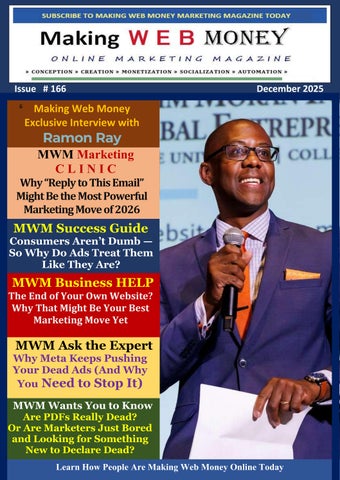
Issue # 166 6
December 2025
Making Web Money Exclusive Interview with
Ramon Ray MWMWeb Marketing Making Money CL I N I C With Exclusive Interview Why “Reply This Email” John to Assaraf Might Be the Most Powerful Marketing Move of 2026
MWM Success Guide
Consumers Aren’t Dumb — So Why Do Ads Treat Them Like They Are?
MWM Business HELP The End of Your Own Website? Why That Might Be Your Best Marketing Move Yet
MWM Ask the Expert
Why Meta Keeps Pushing Your Dead Ads (And Why You Need to Stop It)
MWM Wants You to Know Are PDFs Really Dead? Or Are Marketers Just Bored and Looking for Something New to Declare Dead? Learn How People Are Making Web Money Online Today
BONUS! John Cornetta
Discover The 7 Secrets to Achieve Anything You Want In Life... ***Limited Time Only: Grab This FREE Gift Now!***
These 7 Secrets Will Enable You To... • • •
Discover the Foundational Meaning of SUCCESS Demonstrate PASSION and PERSEVERANCE for long-term goals Learn the untold secrets on how to create the life you TRULY DESIRE
IT’S FREE … CLICK HERE to get yours!
You Asked and We Listened. HELP is HERE How Would You Like to Get Your Hands On My Proven Marketing Strategies That Have Created A Multiple Six Figure Online Business? Now You Too Can Explode Your Business Income With
Monthly Internet Marketing Training and Coaching! If You Are Serious About Changing From A Failing Online Business To An Uber Profitable Online Business I Can Help You! Listen, I know what it's like to have a strong desire to have a successful online business but have no real idea of HOW to market it... I'm not making empty promises. One thing you will not find on this site is a promise of "easy riches". I make no claims of how much you can make. I make no claims that you'll make any money at all. I don't know you. I don't know if you're a thinker or a doer. How can I promise you'll make X dollars? I can't. And I don't. That SHOULD be a sign of trust to you. There are many others out there making crazy income claims. I won't promise riches. I won't promise any results. I'll simply tell you that I will show you things you can do to get your online business rocking and rolling! There is absolutely no risk. I'm even going to take away ALL RISK for you. It's pretty simple: if you don't like the Training, you don't pay. Period. You have nothing to risk and everything to gain. Let me say it a different way...
You Don't Even Have To Say "Yes" To Get Started Right Away, Just Say "Maybe" And I'll Send Your First Lesson Instantly!
Click Here
MWM contents 2 7 Secrets to Unstoppable Success 3 Internet Marketing Academy 6 MWM Editor’s Letter December 2025 7 In The NEWS 9 MWM – FREE Affiliate Funnel 10
PLR Profits Coaching Club
11 MWM Success Guide – Consumers Aren’t Dumb — So Why Do Ads Treat Them Like They Are? 13 Dynamic Digital Software Store Want A FREE Website? 14 Subscribe For FREE
9 FREE Affiliate Funnel Offer
16 MWM Ask the Expert – Why Meta Keeps Pushing Your Dead Ads (And Why You Need to Stop It) 17 How to Stop Your Customers from Lying to You (So You Can Actually Sell Something) 19 Business HELP - The End of Your Own Website? Why That Might Be Your Best Marketing Move Yet 20 Introducing 6FigZ - New Product 23 The Newsletter Shake Up: Reinventing the Inbox for 2026 and Beyond 22 Case Study: The Month She Finally Cracked $1K (And What Actually Worked) 25 Master Resell Rights Membership Site 26 Ecommerce Made Easy 27 New Product SHOPZPRESSO MEGA STORE 28 How to Launch a Digital Product Business! 29 FREE eBook - Six Figures A Year in Info Publishing 33 MWM Interview – Ramon Ray
20
Introducing 6FigZ
MWM conte nts
39 MWM Q & A - Free Lead Magnets vs $7 Offers: The Debate No Marketer Can Seem to Shut Up About 41 How Textfiles Turns Ancient Internet Junk into $15,000/Month
42 Why Your Upsells Flop (And How to Fix Them in 9 Minutes Flat) 43 From Tiny PDF to Full-Fledged InfoEmpire: The Unusual Moves That Work 44 Covert Video Press 45 MWM Marketplace
46 New Product DriveZPresso
46 NEW PRODUCT - DriveZPresso 47 Massive Traffic Blueprint 48 JVZoo Hosting 49 MWM wants You to Know - Are PDFs Really Dead? Or Are Marketers Just Bored and Looking for Something New to Declare Dead? 52 The VENUS Factor 54
This Month’s Marketing CLINIC Why “Reply to This Email” Might Be the Most Powerful Marketing Move of 2026
60 YouTube Ads Made Easy
33
Ramon Ray MWM Interview
Advertise in Making Web Money Contact: Admin@makingwebmoney.com for Details
MWM editors letter Welcome to the December 2025 Issue of our monthly “Making Web Money” Online Digital Marketing magazine - where every month we show you how real people, just like you, are making web money – online. This month we have MORE great articles and personal success insights, interviews, plus some ONLINE opportunities for you. - MWM Series on Business Help The End of Your Own Website? Why That Might Be Your Best Marketing Move Yet - MWM Interview – Raymond Ray - How to Stop Your Customers from Lying to You (So You Can Actually Sell Something) - The Functional Strength Guide - Unlocking the Future of Content: Real Results from AI Video & Voice Tools - Start a Recurring Membership Site - Case Study: The Month She Finally Cracked $1K (And What Actually Worked) - Why Your Upsells Flop (And How to Fix Them in 9 Minutes Flat) - From Tiny PDF to Full-Fledged Info-Empire: The Unusual Moves That Work - FREE eBook - Six Figures A Year in Info Publishing - How Textfiles Turns Ancient Internet Junk into $15,000/Month - MWM Wants You to Know - Are PDFs Really Dead? Or Are Marketers Just Bored and Looking for Something New to Declare Dead? - MWM Q & A - Free Lead Magnets vs $7 Offers: The Debate No Marketer Can Seem to Shut Up About - MWM Marketing CLINIC - Why “Reply to This Email” Might Be the Most Powerful Marketing Move of 2026 - MWM Success Guide Consumers Aren’t Dumb — So Why Do Ads Treat Them Like They Are? - MWM Ask the Expert - 23 Power Verbs to Supercharge Your AI Prompts I hope you enjoy this month's magazine. Thanks for reading. – Check out our 165Great Back Issues of Making Web Money!
Talk to me
>>
facebook.com/harrycrowder twitter.com/harrycrowder
Keep your valuable feedback coming. I try to reply to every email, I appreciate your input as it helps to make MWM the Best magazine possible. Email me at: crowderharry598@gmail.com
MakingWebMoney.com Subscription enquires: www.MakingWebMoney.com Order the printed edition: www.issuu.com Advertising enquires: www.MakingWebMoney.com Making Web Money Magazine Published 12 times per year. Copyright
All rights reserved. Reprinted with permission. No part of this publication may be reproduced, translated or converted into machine-readable form or language without the written consent of the publisher. Articles express the opinions of the authors and are not necessarily those of the publisher Making Web Money Online Marketing Magazine Editor Harry Crowder Advertising: See Above Contributors Various experts in their fields The instructions and advice in the magazine are for educational and entertainment purposes only. The creators, producers, contributors and distributors or Making Web Money Marketing Magazine disclaim any liability for loss or lack of results from following the advice expressed herein.
Follow me on Facebook: https://www.facebook.com/harrycrowder
Both the paper and our printer meet the international standard ISO 14001 for environmental management. The paper comes from sources certified under the Program for Endorsement of Forest Certification scheme (PEFC). Please recycle this magazine – or give it to a mate.
MWM inbox How Handy is This? You can NOW Shop
Walmart Online, save a lot of time, money and hassles. Pick from everything at Walmart and
Then choose to have Tell us what you like and don’t like about Making Web Money Digital Marketing magazine. What worked for you or what you think sucks, then we can make Making Web Money an even better online magazine. So, send me an email with your feedback and let me know. crowderharry598@gmail.com
your order Delivered to you by mail / freight OR
YOU can Pick Your Order Up at
NEAREST WALMART Shop at home. Drive to the store. Pick Up Your Order!
QUOTABLE.. “Today it’s not about ‘get the traffic’ — it’s about ‘get the targeted and relevant traffic.’” – Adam Audette
RESOURCES AND NEWS
57 Fresh Business Ideas to Kickstart Your Next Venture Each week on the My First Million podcast, Sam Parr and Shaan Puri riff on new business ideas—many of which listeners have already turned into thriving companies. Now, they're spotlighting their most standout opportunities so more entrepreneurs can turn inspiration into real momentum. You’ll find 50+ promising ideas across categories like AI, content, education, events, health and wellness, subscriptions, physical products, and retail. Browse the searchable idea database or listen to the original pitches straight from Sam, Shaan, and their top-tier guests. Access requires an email address. https://offers.hubspot.com/mfm-business-idea
OpenAI Bleeds Cash as Sora’s Daily Costs Hit $15 Million OpenAI is taking a massive financial hit, reporting an estimated $12 billion loss in the past three months while its viral video app, Sora, burns through more than $15 million a day. With each 10-second AI clip costing about $1.30 to generate, the invite-only app has already surpassed 4 million downloads—and more than $5 billion a year in video-generation expenses alone, according to Forbes. Despite the staggering costs, analysts say the strategy is deliberate. By launching Sora for free, OpenAI is prioritizing rapid adoption, user data, and realworld training to power future video models. If AI processing costs drop as expected, today’s extreme burn rate could become a long-term competitive edge—assuming OpenAI can afford to ride out the losses. https://www.forbes.com/sites/phoebeliu/2025/11/10/openai-spending-aigenerated-sora-videos/ Zuckerberg's recent decisions for Meta, including halting independent factchecking, relaxing moderation policies on hate speech, and scaling back
MWM New Product
MWM 09
From Boring to Brilliant: New Tool Transforms Training Videos A new AI-powered tool called Guidde is shaking up workplace training by turning dense, static documentation into fast, engaging how-to videos. With its simple browser extension, teams can create step-by-step guides in minutes, revise them instantly, and share them in any language—making training clearer, faster, and far more accessible. Early adopters say the platform is helping them replace long manuals with dynamic walkthroughs that anyone can follow. And with the extension offered completely free, Guidde is positioning itself as one of the easiest ways for organizations to modernize their internal training without adding extra cost or complexity. https://www.guidde.com/
Study Finds Most Listeners Can’t Spot AI Voices — And That Changes Everything for Marketers New study shows that fewer than half of listeners can tell the difference between AI-generated voices and real human speakers — a turning point that’s quietly reshaping the audio landscape. Podcasts, ads, training content, TikTok narration, and even radio spots are increasingly using synthetic voices without triggering listener suspicion. The lines between human and machine are blurring faster than consumers realize. For online marketers, this isn’t just interesting — it’s a green light and a caution sign rolled into one. The opportunity is enormous: you can scale audio content, translate and localize scripts instantly, and produce professional voice-overs without hiring talent or booking studio time. But there’s a flip side: once audiences discover AI is speaking to them, transparency and trust become strategic decisions, not afterthoughts. The brands that win will be the ones who use AI voices to enhance efficiency without undermining authenticity — and who stay ahead of the curve as consumer perception continues to shift. https://www.insideradio.com/free/fewer-than-half-of-listeners-canspot-ai-generated-voices/article_d43127bf-d329-4570-bdf2f27afe23e178.html
MWM 10
Consumers Aren’t Dumb — So Why Do Ads Treat Them Like They Are? There’s an ad running on Amazon Prime right now that confidently declares: “Imagine being a million miles away.” The screen cuts to a serene beach on Earth, palm trees swaying, ocean glittering, everything very… Earthy. Lovely? Yes. But here’s the thing: if you’re a million miles away and still on Earth, you’ve got bigger problems than stress. You’ve broken physics. Because Earth’s circumference is only about 25,000 miles. If you tried to go “a million miles away” on Earth, you’d just keep looping the planet over. And over. And over. In fact, you’d circle the Earth about 40 times before hitting that million-mile mark. Mathematically speaking: 1,000,000 miles ÷ 24,901 miles per rotation ≈ 40.15 (Or, as scientists call it: “a whole lot of steps.”) So yes — after 40 laps, several new passport stamps, and quadriceps made of steel, you’d end up just slightly east of where you started. Still very much on Earth. And definitely questioning the copywriter’s relationship with numbers. Here’s the Bigger Point: People Notice This Stuff The average consumer is far smarter than many advertisers seem to think. They catch inconsistencies. They spot weird phrasing. They pause and go: “Wait, that doesn’t make sense,” halfway through their popcorn. And when your ad is built on a paradox, it sticks out — not for the reason you hoped. Consumers Google things. They do the math. They read comments. They have access to calculators, curiosity, and the collective brain of the internet. In other words: It’s nearly 2026. You can’t bluff your way through your marketing anymore. Marketers, Take Note People appreciate ads that respect their intelligence. They share marketing that feels clever, intentional, and rooted in reality — not marketing written like we’re all living on a magic planet with a million-mile radius. So, the next time you brainstorm a “hooky” opening line, remember the lesson from Amazon Prime’s accidental math comedy: If your copy collapses under a calculator, it might not survive a real audience. Think sharper. Think smarter. Think “humans will notice.” Because they will — and honestly? They already have.
Starting today you can enroll in my new monthly coaching program where I will teach you how to turn PLR content into spendable cash using several underground methods. Each and every month you'll get a new lesson showing you a different way to profit with the PLR products you already have. Each month will be a different lesson (sometimes delivered as a stepby-step PDF and sometimes delivered as video tutorial lessons, and even sometimes a mixture of both) that you can download, view, and then implement to start making money with PLR content. This 12 month coaching program can help you feel good about every PLR purchase you've made (even those "junky" ones because I will show you how to polish them 'til they shine!). The PLR Profits Coaching Club can justify every penny you've spent. It can make those purchases worth something to you because you can put that content to work making money for you. Click Here to Start
How Would You Like a Complete Done-For-You Niche Targeted Website - All Professionally Designed And Ready For You to Profit From?
The Dynamite Digital Software Store
Subscribe TODAY! Do it now! It’s Free
To subscribe for free, go to:
MakingWebMoney.com The digital edition of our magazine is FREE !! You can upgrade to receive the printed edition, Or cancel your subscription at any time.
Subscribe today for FREE!
Google’s AI Overviews Crush ClickThrough Rates, Marketers Warn A recent study found that queries triggering Google AI Overviews saw a dramatic drop in click-throughs: organic rates collapsed by 61% (from 1.76% to 0.61%), while paid clicks plunged 68% (from 19.7% to 6.34%). For marketers, this signals a seismic shift: Ranking high on Google no longer guarantees traffic, and ads are losing impact in “answer-box” style results. The message is clear—marketing strategies that rely on clicks must evolve as search becomes more of a stop-on-the-page experience than a click-through funnel.
https://searchengineland.com/google-ai-overviews-drive-droporganic-paid-ctr-464212
YouTube Lets You “Remix” Shorts with AI — Should Marketers Care? OpenAI is taking a massive financial hit, reporting an estimated $12 billion loss in the past three months while its viral video app, Sora, burns through more than $15 million a day. With each 10-second AI clip costing about $1.30 to generate, the invite-only app has already surpassed 4 million downloads— and more than $5 billion a year in video-generation expenses alone, according to Forbes. Despite the staggering costs, analysts say the strategy is deliberate. By launching Sora for free, OpenAI is prioritizing rapid adoption, user data, and real-world training to power future video models. If AI processing costs drop as expected, today’s extreme burn rate could become a long-term competitive edge—assuming OpenAI can afford to ride out the losses.
https://www.forbes.com/sites/phoebeliu/2025/11/10/openai-spendingai-generated-sora-videos/
Why Meta Keeps Pushing Your Dead Ads (And Why You Need to Stop It) Meta’s ad engine is brilliant… and also kind of clueless. Its entire recommendation system is built on one thing above all else: Engagement. Likes, comments, shares, saves — if people interacted with your ad at any point in history, Meta assumes it must still be relevant. So what happens? Your old, tired, no-longer-converting ads keep getting pushed because they’re coasting on old engagement like a retired rock star living off past hits. Here’s the problem: Meta doesn’t know your breakeven CPA. It doesn’t know your margins. It doesn’t know that what was profitable six weeks ago is now draining your budget faster than a bad agency retainer. All it sees is, “Wow, this ad got 800 comments — must be amazing!” Meanwhile, you’re wondering why results suddenly tanked even though the algorithm keeps happily spending your money. So do yourself a favor: Turn off your old fatigued ads. Meta won’t pause them. Meta won’t warn you. Meta won’t whisper, “Hey… this isn’t converting anymore.” The algorithm is obsessed with engagement, not performance — you have to protect your wallet. Reset your creatives regularly, rotate in new angles, and don’t let yesterday’s likes sabotage today’s ROAS.
How to Stop Your Customers from Lying to You (So You Can Actually Sell Something) Everyone says “know your customer,” but no one tells you the real problem: Your customers are lying to you and they’re doing it with a smile. You hop on a Zoom call, pitch your idea, and get polite applause: “Sounds great. I’d totally buy that!” Fast-forward to launch day? Crickets. Why? Because people hate hurting your feelings—but they also hate buying things they don’t need. So, they say what sounds right and do something else entirely. The solution? Stop listening to polite fiction and start chasing inconvenient truth. And nothing shatters fantasy faster than asking for real commitment. Just ask Honda: In the 90s, they asked customers what color Accord they’d buy. Everyone said silver, white, beige… rational “sensible” colors. Then Honda offered a free car as they left—and people sprinted for red, green, blue. That’s the difference between stated intent vs. revealed desire. They thought they wanted neutral. But their real self-tapped out of polite mode and said, “Gimme the fun one.” So, here’s your new playbook: Stop asking “Would you buy this?” and start asking “Will you pay me right now?” • Sell before you build. If they won’t pre-order, they won’t buy later. • Use a commitment ladder. Ask for micro-yeses before big yeses: calendar booking, small paid deposit, early-bird spot. • Watch what they do, not what they say. Nobody lies with their credit card. Yes, it’s scary. Even founders with dollar signs in their eyes fear asking that direct question: “Will you pay?” But what’s scarier? Spending six months building an offer that crashes harder than Windows 95 on startup.” Remember: Your customers don't owe you honesty. They owe you nothing. And you owe it to yourself to test truthfully. Because polite words don’t pay the bills—but committed cash does.
The End of Your Own Website? Why That Might Be Your Best Marketing Move Yet Tricks MostOnce Marketers Miss was your digital castle. Your upon a time, yourname.com homepage was a handcrafted online fortress where your brand lived, breathed, and sometimes broke due to plugin updates. But let’s be honest: in 2026, who’s typing URLs anymore? Today’s smart marketers aren’t building castles—they’re setting up sleek kiosks in thriving marketplaces. Platforms like Substack, Medium, Gumroad, and Instagram already have the crowds. And they hand you the keys to design, deliver, and distribute—no coding required. What Marketers Gain by Letting Go: 1. You get to do the real work. Writing. Selling. Serving. Not debugging a menu bar that vanished after an update. 2. Platforms handle the heavy lifting. Templates, payments, discoverability—it’s all built-in. Plus, your Substack profile is a website. Same with Gumroad, your link-in-bio, your Medium page, and your Notion link hub. 3. Audience behavior changed—and fast. Visitors aren’t wandering the web; they’re scrolling feeds, tapping links, skimming newsletters. A website without traffic is a gorgeous ghost town. Here’s the kicker: Your digital home still matters. But the definition has changed. Independence today isn’t just owning a domain—it’s diversifying across platforms, owning your email list, and showing up where your audience already spends time. Actionable Shift: This week, audit your last five purchases or sign-ups. Where did they come from—a homepage or a platform? If your website didn’t show up, your work is telling you where it wants to live. The Bottom Line: Websites haven’t died. They’ve just stopped being kings. The internet’s new motto? Stop trying to pull people to your castle— start pitching your flag where the villagers gather.
Unlocking the Future of Content: Real Results from AI Video & Voice Tools If you’re tired of hearing “AI will change everything” with zero proof, you’re going to love this. Below are real case studies from AI-video and AI-voice companies that show what’s possible when you stop waiting and start using. HeyGen: “Make Videos in Hours, Not Weeks” What they promise: With HeyGen, you upload a script, pick an AI avatar, and produce branded video content with voice-over and lip-sync in multiple languages, all without a studio. Heard it before? The kicker is the results. Case study highlights: •
The Würth Group used HeyGen to shift from written communications to video training globally, slashing translation-costs by 80% and halving production time.
•
The travel brand Trivago localized TV ads across 30 markets using avatars and automation—cutting postproduction time by 3-4 months.
•
HeyGen offers a video case study template that uses avatars + voice + captions so marketers can “turn customer story → shareable video” in minutes.
Why it matters for you: If you’re creating content (explainers, promos, trainings) and wish you could do it quicker and cheaper, HeyGen shows you how that’s already happening. It’s not sci-fi—it’s strategy. Link to explore: HeyGen Customer Stories → https://www.heygen.com/customer-stories Synthesia: Scaling Video Production With AI and Real Impact What they promise: Text-to-video with AI avatars and voices. Skip the cameras, skip the actors, skip the studio. You script it, upload it, create it. Case study highlights: • With Heineken, one video platform enabled multilingual delivery across 90,000+ staff in 170 countries— localized, updated, engaging. • In training & L&D, one report found personalized videos via Synthesia produced 50-60 % higher retention than traditional formats.
•
Their case study library is massive: “100 hours of work turned into 10 minutes” kind of language appears often. Why it matters for you: If your content goals include efficiency, localization, or scale— for example marketing to multiple geographies or pushing frequent updates—Synthesia demonstrates it’s done already. The lessons translate to any niche. Link to explore: Synthesia Case Studies → https://www.synthesia.io/casestudies ElevenLabs: The Voice-Power Behind Realistic Content What they promise: Outstanding AI voices. Natural-sounding. Multilingual. Clone your voice, or select from a rich library. Pair it with avatars, videos, or interactive media. Case study highlights: • The collaboration between ElevenLabs and Krikey AI shows how text-to-speech + animation + avatars = marketing content anyone can produce in minutes. • ElevenLabs blogs include customer stories like a major U.S. retailer using hyper-localized ads with ElevenLabs voices to drive real store visits. • And when you combine ElevenLabs voices with platforms like Synthesia, you get full-fledged AI video + voice workflows. Why it matters for you: If your bottleneck is voice-over, native language versions, or sounding “professional” without hiring actors, ElevenLabs helps bridge the gap. Combine it with video/avatars and you’ve got a full stack of future-proof content. Link to explore: ElevenLabs Customer Stories → https://elevenlabs.io/blog/category/customer-stories Your Next Move Pick one of these three platforms and browse 2-3 case studies. Note the headline metric (time saved, cost cut, scale achieved). Then ask yourself: • Where could I apply this in my business? • What content am I still filming the old way? • What voice/locale am I ignoring? • What could I stop doing to make space for this faster method? Since you’re in the space of online marketing, digital infoproducts, and content funnels, your advantage is clear… Use these platforms not just for “cool tech,” but as content leverage. They’re not the future—they’re already the present.
How She Finally Hit $1,000 Online (After 22 Months of False Starts, Pivots & Mini-Wins) A quick, inspirational case study for anyone who thinks they’re “behind.” Most case studies start at the win but this one starts at the struggle. When Lillith Elaina first tried to make money online, nothing worked. Not YouTube. Not social media. Not the “post every day” grind. She spent nearly two years fumbling through platforms, trying things that flopped, and discovering the hard way that having passion doesn’t automatically translate into income. But here’s where her story becomes relevant: She didn’t quit. She pivoted. And with each pivot, she collected a micro-skill that would eventually help her break through. The $100 Breakthrough: Etsy Her first real progress came from Etsy—not because she loved crafting, but because Etsy already had traffic. She didn’t have an audience, so she “borrowed” one from a platform that had millions of shoppers built in. Her early sales were tiny: $44 her first month, then $154, then $165. But she learned Etsy SEO, product photography, how to write listings that convert, and how to fulfill orders efficiently. Nothing glamorous. Everything foundational. Etsy taught her the first big lesson of online business: If you can’t market yet, start where the customers already are. The $750 Lesson: A Website Client with a Hidden Price Tag Her next win came from a simple referral. She built a six-page website for her boyfriend’s boss and earned $750. But here’s the kicker: The project dragged out four months, turned into unexpected tech support, and taught her exactly what underpricing + unclear boundaries leads to. She walked away exhausted, smarter, and determined to build something more scalable. The $1,000 Month: Fiverr Changes Everything Her real breakthrough came when she treated Fiverr like a serious business, not a side experiment.
Month two on Fiverr: $381. A client who found her through Fiverr: $850. Combined with Etsy, she crossed her first $1,000+ month, after nearly two years of trying. That moment—the slow, earned, hard-won milestone—didn’t feel like luck. It felt like accumulation. Every failed attempt, every skill learned, every small win she stuck with… it all clicked at once. Why This Matters for Anyone Starting Now Lillith didn’t succeed because she found “the one platform.” She succeeded because she learned how to: • leverage platforms with built-in audiences • pivot when something wasn’t working • stack micro-skills until they compounded • keep going long enough to let the data guide her • build foundations instead of chasing trends She didn’t blow up overnight. She built up over time. And that’s the part most creators need to hear. The Inspirational Punchline Her first $1,000 month wasn’t magic. It wasn’t viral. It wasn’t passive. It was earned through persistence + platform leverage + skill stacking. If you feel behind, scattered, inconsistent, or unsure of your niche? Good. That means you’re exactly where almost everyone starts. • Pick a platform with traffic. •
Ship something imperfect.
•
Learn one skill at a time.
•
Pivot when needed.
•
Let the small wins compound.
Give yourself 12 months, and your “first $1,000” story may look a lot like hers—longer than you expected, but ultimately the thing that changes everything.
Case Study: The Month She Finally Cracked $1K (And What Actually Worked) She wasn’t a guru, she wasn’t an influencer, and she definitely wasn’t “manifesting abundance.” She was broke, stressed, and tired of watching strangers online brag about “multiple income streams” while she was deciding whether oatmeal counted as dinner. So, she set a challenge: Make $1,000 in 30 days — completely outside her 9–5. What follows is exactly how she cobbled together that first four-figure month… and the misfires she survived along the way. Week 1: Mild Panic → Bold Decision Rent was looming. Her paycheck wasn’t. She had no startup capital, but she did have the Internet — and a willingness to try things she wasn’t “qualified” for yet. She dove in. Hustle #1: Freelance Writing — $460 She took her rusty college writing skills, slapped together three portfolio samples in Canva, and opened a Fiverr account. Her first gig? $20 for 500 words. But it lit the fuse. She pitched on Upwork, emailed small businesses, and slowly picked up steam until she’d completed eight micro-projects. The turning point came when she niched herself as a “lifestyle brand blogger” instead of a generic writer. Suddenly, clients started choosing her on purpose. Hustle #2: Etsy Printables — $120 After seeing a TikTok about selling digital planners, she created a few clean, minimalist designs, uploaded them, and waited. Nothing happened for 10 days. Then a $4 sale. Then another. Then a trickle. Promoting inside a few Facebook groups bumped traffic, and she ended the month with about $120 in profit. Not life-changing money — but 100 percent passive once the PDFs were uploaded. Hustle #3: Pet Sitting — $300 This one blindsided her. She signed up for Rover as a “why not” experiment and got booked immediately by a neighbor going out of town. Two weekends with a hyper golden retriever = $300 and free access to their fridge. Turns out the fastest path to cash isn’t always digital. Sometimes it has fur. Hustle #4: User Testing — $80 UserTesting and TryMyUI paid her $10 per test to poke around websites and give feedback. She did most of them while watching Netflix, earning an easy $80. It wasn’t steady, but it filled the gaps between bigger gigs. What Failed (Gloriously) She tried Poshmark flipping. Bought three jackets for $30. Sold one for $12. The other two now rent permanent space in her closet. She also launched a blog that got exactly two visitors: her mom and herself. A crushing but honest metric. Both experiments died quickly, but they taught her the most important lesson: Don’t chase hustles you don’t actually care about.
MWM New Product World’s First 3-in-1 Online MegaStore Creator that combines Physical Products, Software Products and Licenses + Affiliate Marketing into ONE.
Launch Your BRAND NEW 3-in-1 Online MegaStore in Just 3 Simple Steps STEP 1 Access Account
your
ShopZPresso
STEP 2 Import or Add products in one click STEP 3 there is no step-3… enjoy profit BOOM! Your Online MegaStore Launched IN LESS THAN 60 SECONDS
CLICK Here Now
"Discover How to Start, Build and Launch Your Own Digital Product Business Without Breaking The Bank..." Find Out How To Create Your First Digital Product For Sale And Start Getting Sales On Autopilot! What you'll discover in this eBook: •
You'll have an idea for the type of digital product you want to create and what the strengths and weaknesses of each option are
•
Understand what makes digital products sell and how you need to design your creation in such a way that people will be eager to buy it
•
Know how to quickly and cost effectively create the type of digital product you want
How to create a potential hot-selling eBook • Know how to alter things like price, cover image and more in order to optimize your sales • Understand how to drive more traffic to your landing page using SEO, PPC, e-mail marketing and social media • Understand affiliate programs and tools like JVZoo, ClickBank and WSO Pro • Know how to build an army of affiliate marketers who can drastically increase your sales and profits •
• ...and much, much more!
This is the ultimate guide to How to Launch a Digital Product Business! You'll discover all the steps, tools and resources to help you become a successful digital marketer!
Get your copy today!
Now you can create full image variations inspired by your original ad
Now you can create full image variations inspired by your original ad creative with text overlay capabilities, generating improved backgrounds around product images and expanding images to better fit multiple surfaces. In addition, you will r brands to choose from. Lastly, image expansion allows you to seamlessly adjust creative assets to fit different aspect ratios across multiple surfaces. These tools are now available on Reels and Feed across both Instagram and seamlessly with text overlays on your ads. https://www.facebook.com/business/news/Introducing-Enhanced-Gen-AIFeatures-and-Other-Tools-to-Help-Build-Your-Business
CLICK HERE_
Finally, A Bunch of Great FREE Help! No more Paying for Products That Don't Deliver Results! Get Everything You Need To Know To Start A Wildly Successful Home-Based Internet Business! • • • • • • • •
Search Engine Optimization Affiliate Marketing Viral Marketing Joint Ventures Blogging for Cash Social Networking And more! Get the Facts - What It Takes to Make Money Online Today!
MWM Videos http://makingwebmoney.com/videos
http://www.youtube.com/watch?v=RSkWqI7M3Ts
http://www.youtube.com/watch?v=6t6ba6Cj690
http://www.youtube.com/watch?v=rzEuURaTiZU
http://www.youtube.com/watch?v=h5GQ m55ccTk&feature=related
http://www.youtube.com/watch?v=0CaUcIwPsH8
http://www.youtube.com/watch?v=EYN1BjtZ6nc
MWM ARamon Ray Interview
Interview Editor: This time we're talking with Ramon Ray, a serial entrepreneur, keynote speaker, and best-selling author who has launched five companies and sold three. He publishes ZoneofGenius.com and wrote The Celebrity CEO to help small business owners build their brands. With global speaking experience and collaborations with major brands, he focuses on helping entrepreneurs and small businesses gain visibility, credibility, and community. Ramon, it is great to meet you. Ramon Ray: It's great to be here. Thank you so much for having me on this amazing podcast, Internet Marketing Newsletter. Glad to be here and serve your audience. Anytime I can help small business owners or entrepreneurs or anybody in between, it's always a fun day for me. So, thank you for having me. Editor: Oh, it's lovely to have you. And now you, as I say, have founded five companies. You've successfully exited three. What would you say are the biggest lessons, the biggest experiences that you've gained from that in building and growing your own businesses? Ramon Ray: Sure. And for my journey, it's not been the billion dollar, even hundreds of millions of dollars of exits that we may read in headlines on Bloomberg or CNBC or BBC, depending on where you're at. But mine have been in no shame full embracing it, a few hundred thousand dollars. And some people may, "Wow, Ramon, maybe that's not a lot," but when you think about it, that's still the top 1%, maybe even of the 1% in the U.S. context, 30 million businesses and I'm sure several million more globally. So, my point is, the biggest lesson learned is really the power of relationships and connectivity.
Recently I was appointed as the Bitdefender Small Business Ambassador. Bitdefender is an amazing company that helps small businesses stay secure. That was due to relationships. Or I think about me being on stage with Daymond John, Jason Feifer, Von Trapp, or other name-dropping intentionally. My point to answer your question, the biggest lesson learned was at the level I'm at, at large, part is about relationships. You can do Alex Hormozi, and I love what he did to those who don't know the reference, but spend quite a bit on Facebook ads and build up credibility.
But for me, listen, you build good relationships, do good to people, build something of value, then you have the right to proactively say, "Hey, does somebody want to buy it from me?" And/or organically somebody will see it and say, "Hey, would you like to sell that?" So that's the biggest lesson I've learned, the power of relationships, not-withstanding the things we can get into of scalability and processes and systems and all of those things, but relationships is the biggest thing I can think of. Editor: Well, Ramon, how did your journey start? How did you enter this world in the first place? Ramon Ray: Well, that's a great question, but I spent some years moving forward from being a child and all those kinds of things. But my professional career, I got one of my first jobs at the United Nations. It wasn't my first one, but one of my first jobs at the United Nations. And while there, was the cusp of this current.com era. There was the steam engine era. I'm sure there was a guy there were like, "Ooh, we have steam." And he got into steam engines or there was the gal who fabrics. I was a little after that. But this was the cusp of this current season of.com. Now we're in this, there was the AI season, which we're in, you have apps and mobility. I was the seasons of computer technology and modems and networking and Wi-Fi and Intel was at its primacy or primacy. So that's where I got in just context, AOL, CompuServe, America, all this blogging before it was called blogging. And that gave me the foothold to know how to install or repair computers and the updating software that come on a thumb drive or a floppy disc, and the beginnings of downloading the Mosaic browser, which is the precursor to Netscape, AltaVista before there was Google. So that was the era I was in. I'm 50 plus years old, that was the era I was in. And from there, I parlayed that into being a motivational professional speaker. Somebody just asked me, they saw me doing some things, "Ramon, what's your fee to speak?" And then Inc. Magazine and BLACK ENTERPRISE, two prominent USA Magazines publications said, "Ramon, can you write for us?" And that started again, the journey today of content monetization and being paid to speak. That was a compressed version of how I got to be who I am today.
Editor: I love it. And of course, you are widely known and widely respected for the book, The Celebrity CEO. Maybe you could just perhaps explain for anybody whose perhaps not come across that, explain what you mean by that concept and also why it's so important for small business owners. Ramon Ray: Yeah, one of my deep passions is of course, entrepreneurship. Having started a few companies, as you already said, sold a few. So I love entrepreneurship and scaling and hiring and the thrill of going into debt or not, or however you build it, but the risks, that excites me, it's how I'm built. But yes, the core thing, one of my expertise is, because I've done it myself several times, is how do you build your personal brand? How do you take who you are, your face, your voice, how you show up, your smile, your credibility, how I interact with the radio or a podcast host or not? All these things becomes your brand. So that's my specialty because I have several books. I do my podcasts, I have websites, I produce content. I've been on Fox Business and MSNBC and Associated Press and all these things. So how do you build your personal brand? And three simple things I like to talk about is, one, is getting awareness for who you are. That's important. If people don't even know, oh, he has a solution for me, game over. So one is awareness. Awareness of that I have a problem to solve her problem. It's all the same principle, awareness. Number two is nurturing. What am I doing on a consistent basis to nurture that relationship, nurture that relationship, and/or to build trust? And once I do that, sales will then follow. So that's the summary of it is to challenge all entrepreneurs, all small business owners. We have the opportunity to leverage the power of our personal brand to be more known. We don't have to be hidden. We can leverage it as an asset in our business. Editor: I think that's become way more obvious, hasn't it, in more recent times? Obviously these days, everybody knows that Jeff Bezos is the owner of Amazon. You've got Richard Branson, who of course for many years has been the face of the Virgin brand. And a lot of people start businesses, but they want to almost hide behind the business. But are you of the belief, Ramon, that people do business with people not with companies?
Ramon Ray: Absolutely. You take a look at this short time we've been together, right, we had some banter, had some fun, had some laughter before we started? We connected and I realised that my voice of course is being heard today, but the point I'm making is that, yes, people work with people they know, like, and trust…
Tired Of Fad Diets and Exercise Plans That Are Expensive And Just Don’t Seem To Work? Pay Attention… Because You’re About To Discover A Complete Training Guide Introducing:
The Functional Strength Guide…
For the Whole Story go here:
http://www.functionalstrengthnow.com
MWM Q & A Free Lead Magnets vs $7 Offers: The Debate No Marketer Can Seem to Shut Up About Every few months, the marketing world finds something new to argue about. Last year it was “Is Instagram dead?” Before that, “Is blogging dead?” Before that, “Is email dead?” (You know what’s never dead? Marketers declaring things dead. If the industry had a mascot, it’d be a guy holding a tombstone.) Now the debate du jour is this: Should you grow your list with free lead magnets… or charge $5–$7 and only let buyers in the door? And depending on which Facebook Group you lurk in, the “correct” answer is either: “You’re stupid if you still use free lead magnets,” or “You’re stupid if you think someone will pay for a $7 PDF in 2025.” Let’s cut through the drama. Why This Debate Even Exists The truth is embarrassingly simple: Ads are more expensive, people are more distracted, and audiences are smarter than ever. That’s it. That’s the whole reason this conversation blew up. Free gets you volume. Paid gets you commitment. And marketers want BOTH — which is why everyone is fighting. What we’re actually seeing is classic loss aversion (fear of wasted ad spend) colliding with commitment psychology (buyers behave differently than browsers). When you understand those two forces, the whole debate suddenly looks less like “genius marketers disagreeing” and more like “adults arguing over who gets the last cookie.” So, let’s break it down without the hype. Why Free Lead Magnets Still Work (Yes, Still) Here’s an uncomfortable truth for the “free is dead" crowd: Free still converts at insanely high rates. Industry average for a lead magnet landing page? - 18% conversion. Top-of-the-food-chain cheat sheets? - Up to 34%. That’s not “dead.” That’s “please feed me more traffic, preferably with sprinkles.” But the flip side?
Once you have all those freebie hunters… …less than 1% of them buy anything. That’s the part nobody brags about on Facebook. Nobody posts: “Just added 3,000 leads to my list… and only two bought something!” Because it doesn’t fit well on an inspirational Canva post. If you want volume, free wins. But if you want buyers, free can be a very slow burn. Mini Case Study: The Freebie Funnel That Went Viral (But Converted Like a Wet Sponge) A creator recently shared that she added 14,000 leads via a viral free checklist. Sounds amazing, right? Except only 0.8% ever purchased a single thing, even after a six-email nurturing sequence and a coupon. She called it “the most successful failure of my career.” Free gets eyeballs. Free does NOT guarantee wallets. Why $5–$7 Front-End Offers Are (Sometimes) Smart Marketers finally discovered something psychologists have known forever: The moment someone pays you — even $5 — they behave differently. • A freebie seeker becomes a customer. • A browser becomes a buyer. • A stranger becomes a stakeholder. That tiny transaction triggers the I-invested -in-this bias, which causes people to value, consume, and act on what they purchased. It’s basically the IKEA Effect: If you put effort (or money) into something, you assume it has to be good. This is why the “$7 low-ticket funnel” exploded. It’s a filter, not a moneymaker. But here’s the twist: • Low-ticket doesn’t beat free if your traffic is cold and your pitch is weak. • And it doesn’t beat free if your upsells suck. • And it doesn’t beat free if your niche expects free. Example: One marketer found: • $7 micro-offer → 22% conversion • Free lead magnet → 93% conversion, and 9% • purchased the next offer Volume. Matters. Her conclusion wasn’t “free wins” or “paid wins.” It was: “People will happily pay $0, but they’ll also buy a lot of things afterward if you warm them up correctly.”
Mini Case Study: The $7 Offer That Outsold the Creator’s Entire Course Catalog A funnel strategist shared that her $7 “mini system” (a 9-page PDF + Loom video) attracted fewer people than her free lead magnets, but those buyers went on to purchase her $97 and $197 offers at 3X the rate of freebie leads. Why? Because small payments create micro-commitments, which create bigger commitments. This is textbook foot-in-the-door psychology at work. So neither model is “better” and each one has a job. The Real Question: What’s the Job of Your Funnel? If the job is “build the biggest list humanly possible,” free wins. If the job is “build a list of buyers,” low-ticket wins. If the job is “pay for ads immediately,” low-ticket maybe wins. If the job is “nurture and educate,” free wins. If the job is “I want my audience to invest early,” low-ticket wins. This is why vague advice like… “Everyone should stop giving away free stuff!” …is not helpful. It’s like yelling “Everyone should buy Ferraris!” Sure, sounds great, but context matters. So here’s your simple compass: Use Free Lead Magnets When: • Your audience is cold • You want list growth • You don’t have strong backend offers • You’re building relationships, not revenue Use $5–$7 Low-Ticket Offers When: • You want buyers • You want to offset ad spend • You have upsells • Your market is solution-aware Or, more simply: Is your funnel trying to make friends or make money? Or, more simply: Is your funnel trying to make friends or make money? My Take: Stop Choosing Sides & Build a Two-Track System The smartest marketers right now aren’t picking “free vs paid.” They’re doing this: Free lead magnet → nurture → small offer → core offer AND Low-ticket micro-offer → upsell → core offer
•
Both run simultaneously.
•
Both feed each other.
• Both serve different psychological entry points. Everyone else is fighting. You’re building. Think of it like having two doors into your business: • Door A says “Come on in, it’s free!”
• Door B says “Come in if you’re serious.” Why choose only one door when your audience is literally sp between both behaviors? What You Can Do Now Choose ONE experiment to run next week: 1. Launch a free cheat sheet and track cost-per-lead. 2. Launch a $7 micro-offer and track cost-per-buyer. 3. Compare the backend revenue of each funnel after days. Let data decide what works — not Facebook Group drama.
Why Your Upsells Flop (And How to Fix Them in 9 Minutes Flat) You built the upsell. You wrote the copy. You watched one too many Russell Brunson videos. So why is your upsell page converting like a soggy sandwich? Here’s the hard truth: most upsells don’t fail because of bad products—they fail because of bad timing, bad vibes, or bad psychology. The biggest culprit? Relevance Whiplash. Your customer just said yes to a problem-solving product. And now you’re throwing a random “Hey, wanna buy this totally unrelated thing?” pitch at them. It’s like ordering a pizza and immediately being asked if you’d like a unicycle. Confusion kills conversions. Fix it fast by asking: Does this upsell make the original purchase easier, faster, or more fun? If not, cut it. Then rebuild it using these three magic tweaks (yes, you can do this in 9 minutes): 1. Anchor It to the First Win: Start your upsell with “Now that you’ve grabbed [product name]…” to reinforce the dopamine rush from buying. 2. Add a Micro-Story: Instead of bland bullet points, tell a 2-sentence story about someone who used both the main offer and the upsell together—with a great result. 3. Use a Time-Boxed Hook: Not fake scarcity, just urgency with clarity: “You’ll only see this upgrade offer on this page—then it’s gone.” Boom 4. . Bonus move? Add a one-click “Yes, upgrade me!” button. No forms, no second checkout. Just buttery smooth conversion. Upsells aren’t about jamming in extra products. They’re about extending the narrative your customer just bought into. Make it relevant. Make it fast. And above all—make it feel like a win, not a wallet attack. Now go turn that soggy sandwich into a steak dinner. You’ve got 9 minutes.
From Tiny PDF to FullFledged Info-Empire: The Unusual Moves That Work Riley wasn’t trying to build a funnel empire. She just wanted to sell a $27 checklist to help first-time creators launch their digital product. But what started as a quick downloadable turned into a fullblown info-product business—because she did a few things most marketers don’t. First, she didn’t treat the $27 PDF like “just a lowticket offer.” She gave it a vibe. It was designed like a quickstart mission, not a homework assignment. The checklist included cheeky prompts like “Put on your launch pants” and “Send the scary email.” Result? People actually used it—and wrote back with screenshots of their progress. Second, she skipped the boring upsell and offered something weirdly effective: A one-week support chat. No modules. No logins. Just a temporary group chat for people who bought the guide. It felt intimate, low-commitment, and human—which made people feel safe asking “dumb” questions. (Spoiler: Those “dumb” questions turned into big coaching opportunities.) Third, she turned casual chats into a mid-ticket accelerator—but not in the traditional “here’s a 6week video course” kind of way. Instead, it was a 2week sprint with daily check-ins, no fluff, and a vibe like “co-working meets creative bootcamp.” Her key insight? People don’t just want products. They want momentum. The Real Lesson for Marketers? Stop building perfect funnels. Build useful momentum loops. Start with something small but action-driven, stack human connection in weird places (like chat apps or DMs), and then offer your audience a way to keep going—without overwhelming them with more content. Forget evergreen. Go ever-curious. Riley did— and now her inbox is full of testimonials, not refund requests.
MWM 45
MWM marketplace >
Domains, Websites & Products For Sale. Domain for sale Contact: ads@makingwebmoney.com Make an offer A great brand name for an internet marketing Product or service ViralInternetMarketing.com.
Get FastEye Pages Now! Your Ad here Contact ads@makingwebmoney.com Contact Us >Contact us to list your Domain name or website For sale in this section
See It In Action !
NEW PRODUCT DriveZPresso Now you can have Unlimited Cloud Storage For Life (Goodbye Dropbox!) Say goodbye to overpriced Dropbox subscriptions and time-wasting tech headaches… Because there’s a brand new Cloud Storage Solution that lets you host, share, and back-up ALL your files… With Unlimited Storage For Life at an unbeatable ONE-TIME price. Get the details here (limited availability).
Imagine… All your files stored in one central location so you can find whatever you need in seconds Never paying another overpriced subscription fee to Dropbox or Google Drive Freeing yourself from storage limits and tech hassles once and for all Big Tech has been sticking it to the little guy for far too long… With ridiculously high monthly fees and huge mark-ups that line the pockets of Silicon Valley billionaires DriveZPresso lets you take back control of your data and your business future… With all the capabilities of Dropbox and Google Drive and NONE of the overpriced subscription fees…
Go here now DriveZPresso UNLIMITED file storage for an ultra-low one-time fee Host website images and videos with lighting fast upload speeds on your website. Find any file in seconds with the advanced search technology Share links to any file – just like Dropbox or Google Drive Collaborate with team members to edit documents in real-time Keep your files safe from hard drive crashes, hackers and malware It’s time to say NO to the “Big Tech Tax” and join the future of cloud storage… Grab your DriveZPresso license click here.
For The Next 12 Months, I Will Show You Step-By-Step How To Implement 12 Channels To Draw Targeted Visitors To Your Site.
See It All Here
JVZooHost is dedicated to providing safe, fast, and affordable web hosting with superior support. You can concentrate on running your business and rest assured your website will be up and running. Get your site noticed on the web today with JVZooHost!
MWM wants You to Know Are PDFs Really Dead? Or Are Marketers Just Bored and Looking for Something New to Declare Dead? If you’ve spent any time in marketing groups lately, you’ve probably seen the bold proclamation floating around like a motivational poster in a dentist’s office: “PDFs are dead.” And—because marketers love dramatic absolutes—it’s usually followed by something like, “No one reads anymore. It’s all TikTok, video courses, and brain implants now.” But before we mourn the humble PDF, let’s pause and notice something important: Almost every marketer declaring PDFs dead is either selling a video course or a video tool. Now isn’t that a little suspicious? Let’s step back and look at what’s actually happening in the real world—through data, psychology, case studies, and a few honest stories from marketers who accidentally disproved the “PDFs are dead” narrative by making more money than expected. Why Marketers Think PDFs Died (When They Really Just Got Misused) PDFs didn’t keel over and die suddenly. What actually happened was far more predictable: We collectively abused them. For years, marketers shoved bloated “ebooks” into the world—47 pages of backstory, nine pages of introduction, entire paragraphs starting with “Before we begin…”, and long-winded theory dumps that belonged in a college textbook circa 1997. Then we topped it off by allowing AI to create 20-page “ebooks” in four minutes, which increased the quantity of PDFs while reducing the quality to somewhere between “generic oatmeal” and “legal disclaimers.” People didn’t stop liking PDFs. People stopped liking bad PDFs. We trained readers to assume that downloading a PDF meant committing to a long, boring slog that would sit in their downloads folder until their next computer upgrade.
But What Does the Data Show? Spoiler: PDFs Are Still Very Much Alive When you look past the Facebook hot takes and into real numbers, the picture looks dramatically different. Yes, some reports show generic free ebooks declining in conversion— down to around 3.8% in some cases. That’s not a sign of a dying format; that’s a sign of a tired tactic. Meanwhile, paid PDF products—small guides, mini-books, toolkits, frameworks—continue to rank among the top-selling digital product types online. Revenue-wise, they haven’t slipped at all. If anything, they’ve had a resurgence thanks to creators focusing on short, tactical, high-utility content rather than long-winded manifestos. And there’s an even bigger trend: Bundles are exploding. A PDF paired with a video walkthrough, or a PDF paired with a short audio guide, or a PDF packaged with templates, checklists, and prompts—all of these combinations convert better than single-format offers. Buyers don’t want more volume. They want more ways to access the same idea. It’s not that PDFs died. It’s that the audience evolved and PDFs evolved with them. Case Study #1: The Tiny 12-Page PDF That Earned $126,000 in 11 Months One creator shared that she launched a simple, 12-page tactical PDF— not a video course, not a membership, not a high-production anything. Just a $19 PDF that solved a very specific problem in the social media niche. No fluff, no filler, just steps, screenshots, and examples. It went on to sell 6,600 copies, earning her over $126K in under a year. The kicker? Her customers actually finished it. Unlike many video courses, where completion rates hover somewhere between “less than half” and “did they even open it?”, this tiny PDF got read, used, and recommended. Which brings us to the next case. Case Study #2: The “Nobody Reads PDFs” Myth — Debunked by a 62% Completion Rate Another creator in the productivity niche created both a small PDF workbook and a video version of the same material. She assumed the video would outperform because that’s what the trend pieces kept screaming: “People only want video now! Video is the future! Attention spans are shrinking!” Except… no.
Her PDF workbook had a 62% completion rate, while her video course had a dramatically lower one. When she asked her audience why, she got answers like: • “I prefer working through things I can print.” • “The PDF helped me take action immediately.” • “I can’t watch videos with kids around.” • “The workbook made the steps concrete.” The psychology is simple: Humans complete what they can see, hold, mark up, or check off. Videos can be inspiring, but PDFs are easier to finish, which makes them powerful. Case Study #3: The 7-Page PDF That Outperformed a Full Video Workshop A third marketer tested two lead magnets: • A polished 22-minute recorded workshop • A fast, skimmable, 7-page PDF version of the same material To her surprise—and mild irritation—the PDF crushed the video. The reason came down to cognitive ease: Readers knew the PDF would be quicker. There was no need for headphones, no pressure to “sit and watch,” no fear of investing 22 minutes and getting halfway through before realizing it wasn’t relevant. The PDF delivered the promise faster. Psychologically, PDFs reduce friction and videos increase commitment. Neither is better. They simply fit different jobs. Why PDFs Still Win: The Psychology Behind the Format People don’t crave video. People crave clarity. PDFs have a few psychological advantages that video can’t touch: 1. Cognitive Ease PDFs feel easy to consume. They’re skimmable, scannable, and digestible. When something feels easy, the brain is more likely to believe it’s true, helpful, and worth finishing. 2. Completion Bias We get a dopamine hit from finishing something. A short PDF lets us complete quickly. A long video does not. 3. Instant Application PDFs support action. They can be printed, highlighted, checked off, followed step-by-step, and referenced while doing the task. You can’t follow a video and implement at the same time unless you’re constantly pausing and rewinding like someone stuck in remotecontrol purgatory.
This Month’s Marketing CLINIC MWM FLASHBACK STORY 57
MWM
Why “Reply to This Email” Might Be the Most Powerful Marketing Move of 2026 In Day 2008, Sadler 1 –Jason Intro & Hook turned one of the strangest marketing stunts of Marketers love their fancy funnels, automated the decade into a six-figure business. The him to wear your Post Idea: Introduce yourself and your sidepitch? hustlePay journey. workflows, Caption: “Trying hustles next 30itdays…let’s seeone what works! company’s T-shirt forside a day, and for he’dthe promote online. Day cost $1. AI-driven segmentation, and 47-step “value ladders.” #SideHustleJourney Day two cost $2. Day#MakeMoneyOnline” three cost $3. By December 31, the price was $365. But sometimes? The simplest tactic— Hashtags: #SideHustleTips #TikTokGrowth #LearnAndEarn It sounds like a joke. But that “joke” made him $66,795 in year one— the one hiding in plain sight Goal: Hook viewers with curiosity — you’re the and later grew into a half-million-dollar venture. guide on a real journey. —turns out to be the unfair advantage. Day 2 – Quick Win Tip Why It Worked And right now, that tactic is this: Post Idea: Share a tiny tip people can implement today. Example: “3 apps to Getting your subscribers to hit “reply.” 1. Scarcity & Urgency earn $20 in an hour.” Not click. Every day that passed, the price went up. Brands knew if they hesitated, Caption: “You don’t need fancy tools to start earning. Try these! Not fill out a form. the#EasyMoney deal would#SideHustleTips” slip away. Not join a challenge. 2. Hashtags: Novelty &#MakeMoneyFast Humor #SideHustleHacks #QuickCash Not take a quiz (don’t worry, those are still powerful). Ads on T-shirts weren’t new. But the value. way he packaged it—quirky, Goal: Build trust by delivering immediate Just… reply. transparent, almost tongue-in-cheek—was impossible to ignore. Day 3 – Mistakes to Avoid A single-word reply. Idea: Highlight one common side hustle mistake. 3. Post Social Media Leverage A keyword reply. Caption: “Stop doing you wantamplified to actually money online. Sadler didn’t just wear this the ifshirt—he it. make Facebook, Twitter, A “yep, I’m in.” #SideHustleFails #LearnFromMe” YouTube… each sponsor got exposure far beyond a guy in cotton. A “send it.” Goal: Show experience, 4. Radical Transparency make viewers nod along — authority + relatability. A “pizza.” (Yes, some marketers use that.) Day 4 – Demonstration The calendar was public and everyone knew what it cost. That honesty And the results? Wild. Post Idea: Show a real example of you doing the hustle — screenshots, Let’s break down why this works, why it works now, built credibility amid constant hype. screen recordings, or step-by-step demo. and how the smartest marketers will weaponize it in The Results Caption: “Here’s exactly how I made $10 flipping old items today! 2026. By 2010, Sadler had scaled his idea with more “human billboards” and #SideHustleDemo #MoneyMoves” Why the Humble “Reply” Is Suddenly a Power Move a steeper Annual revenue? All from what Goal:pricing Make itladder. actionable; people follow Roughly what they$500,000. see. Email service providers—Google, Apple, Yahoo, looked a stunt—but really a masterclass in unconventional Daylike 5 – Q&A / Responsewas Video Outlookare basically bouncers at the inbox door. marketing. Post Idea: Reply to a comment or make a video answering “How do I start?” They decide who gets in, who’s cool enough for the Caption: “You for asked…here’s The Takeaway Marketershow ANYONE can start a side hustle this week. VIP section #AskMeAnything You don’t need #SideHustleHelp” a massive ad budget. You need an angle. (Primary Inbox), and who gets shoved into Goal: Boost engagement; loves replypricing videos. creates urgency. • Use scarcity. TieredTikTok or time-based Promotions Day 6 – Behind-the-Scenes / Fail • Leverage authenticity. Quirky > polished when you want like someone trying to sell mixtapes outside a Post Idea: Show a side hustle fail, funny moment, or frustration. nightclub. attention. Caption: “Not every day is a win — here’s what went wrong today For years, marketers have been trying to outsmart • Be transparent. Clear offers build trust. #SideHustleLife #KeepTrying” The algorithm. Shorter emails. • Think sideways. and Theconnection. ideas that sound too weird to work are Goal: Build authenticity Plain-text emails. Fewer links. ones that break through the noise. Day 7often – Minithe Case Study / Proof More links. Personality. Jason Sadler didn’t justsuccess sell ad story space—he people wanted Post Idea: Share a small — yoursold ownaorstory someone else’s. No personality. “Don’t say FREE or SALE.” Caption: “Made week sharing tips Imarketing. learned. You can too! to follow. That’s the$70 realthis power of just unconventional “Actually, it doesn’t matter.” #SideHustleProof #MoneyMoves” And while Sadler’s stunt belongs to 2008, the principle behind it hasn’t No one knows. It changes monthly.. Show and inspire action. the audiences have shifted, but agedGoal: a day. Theresults platforms have changed, But one thing has stayed consistent: Tips for the Week Two-way communication is the #1 signal that you the psychology is identical. Scarcity still drives urgency. Novelty still grabs • Post at consistent still times. attention. Transparency builds trust. are a real person, not a spam cannon. • Keep videos 15–30 seconds.
When a subscriber replies to your email, Gmail doesn’t think: “Oh cute, she’s engaging with her audience.” It thinks: “This sender has a real human relationship with this user. Boost their reputation.” And suddenly… Higher deliverability. More emails hitting the Primary inbox. Cheaper ads (because warm email lists always lower CPA). More visibility. More revenue. Even better: a reply doesn’t have to be logical. It just has to exist. The Psychology Behind Why This Works A reply is micro-commitment gold. When someone replies—even with a single word—they’ve taken an action that feels personal: • They wrote something with their fingers. • They attached their identity to the message. • They broke the “passive consumption” pattern. • They opened a loop internally (“now I’m part of this”), making them more likely to take the next step. It’s the same psychology that makes text-message marketing powerful, but without the creep factor. Replying also creates a small moment of status for the subscriber. It feels like: “I’m not just a name on a list. I’m part of the club.” And suddenly you’ve created a community—without creating a community. The Campaigns That Work Best You don’t need anything elaborate. In fact, the simpler the keyword, the better the completion rate. Here are real formats that perform extremely well: 1. The Keyword to Unlock Something “Reply YES if you want the advanced version.” “Reply GREEN if you want the templates.” “Reply READY for the training.” 2. The Choose-Your-Adventure Reply “What do you want this month? Reply with A, B, or C.” (A = tutorials, B = templates, C = case studies) 3. The Launch Warmer “Want early access? Reply EARLY.” 4. The Segmentation Trigger “Building a course this year? Reply COURSE.” “Growing your email list? Reply LIST.”
5. The Anti-Spam Reputation Booster Use as a once-per-month “engagement pulse” to warm your domain reputation before you send a major promo. These work even better when paired with a follow-up automation that sends the requested resource instantly— eShowcase.com handles this beautifully because the keyword reply can fire off workflows automatically. Why This Will Be Even Bigger in 2026 We’re heading toward an era where: • AI is generating more emails than humans • inbox algorithms are tightening • engagement signals matter more than content volume • and audiences crave personalization Reply-triggered campaigns solve all of these simultaneously. They’re human… They’re algorithm-friendly… They’re conversion-boosting… …and they create better customer relationships without creating more work. This is the kind of tactic that looks simple on the surface but becomes a competitive moat once you use it consistently. In fact, many marketers quietly use “reply campaigns” as their pre-launch deliverability warm-up ritual—kind of like stretching before a workout, but for your domain reputation. Expect to see much more of this trend, especially once AI platforms begin integrating two-way conversational marketing (and they will). What You Can Do Now Try this simple 48-hour experiment: 1. Email your list and say: “If you want tomorrow’s resource, reply YES.” 2. Track how many people reply. 3. Watch your next broadcast land more often in the Primary inbox. That’s it. No funnel rebuild. No new tech. Just a reply. And if you want the easiest way to set up reply-powered workflows, trigger automations, segment your list, and instantly deliver what people ask for…
From Boring to Brilliant: New Tool Transforms Training Videos A new AI-powered tool called Guidde is shaking up workplace training by turning dense, static documentation into fast, engaging how-to videos. With its simple browser extension, teams can create step-by-step guides in minutes, revise them instantly, and share them in any language—making training clearer, faster, and far more accessible. Early adopters say the platform is helping them replace long manuals with dynamic walkthroughs that anyone can follow. And with the extension offered completely free, Guidde is positioning itself as one of the easiest ways for organizations to modernize their internal training without adding extra cost or complexity. https://www.guidde.com/
A new study shows that fewer than half of listeners can tell the difference between AI-generated voices and real human speakers — a turning point that’s quietly reshaping the audio landscape. Podcasts, ads, training content, TikTok narration, and even radio spots are increasingly using synthetic voices without triggering listener suspicion. The lines between human and machine are blurring faster than consumers realize. For online marketers, this isn’t just interesting — it’s a green light and a caution sign rolled into one. The opportunity is enormous: you can scale audio content, translate and localize scripts instantly, and produce professional voice-overs without hiring talent or booking studio time. But there’s a flip side: once audiences discover AI is speaking to them, transparency and trust become strategic decisions, not afterthoughts. The brands that win will be the ones who use AI voices to enhance efficiency without undermining authenticity — and who stay ahead of the curve as consumer perception continues to shift. https://www.insideradio.com/free/fewer-than-half-of-listeners-can-spot-aigenerated-voices/article_d43127bf-d329-4570-bdf2-f27afe23e178.html
CLICK HERE
Click Here