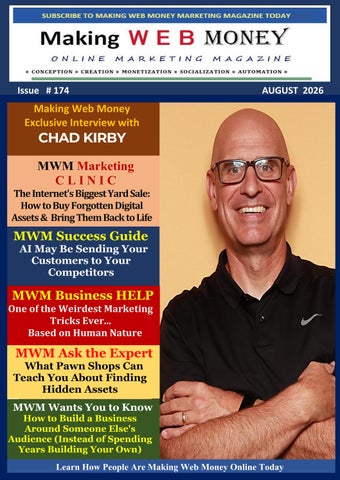
Issue # 174
AUGUST 2026
Making Web Money Exclusive Interview with
CHAD KIRBY MWM Marketing CLINIC
The Internet's Biggest Yard Sale: How to Buy Forgotten Digital Assets & Bring Them Back to Life
MWM Success Guide AI May Be Sending Your Customers to Your Competitors
MWM Business HELP One of the Weirdest Marketing Tricks Ever... Based on Human Nature
MWM Ask the Expert
What Pawn Shops Can Teach You About Finding Hidden Assets
MWM Wants You to Know How to Build a Business Around Someone Else's Audience (Instead of Spending Years Building Your Own) Learn How People Are Making Web Money Online Today
BONUS! John Cornetta
Discover The 7 Secrets to Achieve Anything You Want In Life... ***Limited Time Only: Grab This FREE Gift Now!***
These 7 Secrets Will Enable You To... • • •
Discover the Foundational Meaning of SUCCESS Demonstrate PASSION and PERSEVERANCE for long-term goals Learn the untold secrets on how to create the life you TRULY DESIRE
IT’S FREE … CLICK HERE to get yours!
You Asked and We Listened. HELP is HERE How Would You Like to Get Your Hands On My Proven Marketing Strategies That Have Created A Multiple Six Figure Online Business? Now You Too Can Explode Your Business Income With
Monthly Internet Marketing Training and Coaching! If You Are Serious About Changing From A Failing Online Business To An Uber Profitable Online Business I Can Help You! Listen, I know what it's like to have a strong desire to have a successful online business but have no real idea of HOW to market it... I'm not making empty promises. One thing you will not find on this site is a promise of "easy riches". I make no claims of how much you can make. I make no claims that you'll make any money at all. I don't know you. I don't know if you're a thinker or a doer. How can I promise you'll make X dollars? I can't. And I don't. That SHOULD be a sign of trust to you. There are many others out there making crazy income claims. I won't promise riches. I won't promise any results. I'll simply tell you that I will show you things you can do to get your online business rocking and rolling! There is absolutely no risk. I'm even going to take away ALL RISK for you. It's pretty simple: if you don't like the Training, you don't pay. Period. You have nothing to risk and everything to gain. Let me say it a different way...
You Don't Even Have To Say "Yes" To Get Started Right Away, Just Say "Maybe" And I'll Send Your First Lesson Instantly!
Click Here
MWM contents 2 7 Secrets to Unstoppable Success 3 Internet Marketing Academy 6 MWM Editor’s Letter MARCH 2026 7 In The NEWS 9 MWM – FREE Affiliate Funnel 10
PLR Profits Coaching Club
11 MWM Success Guide – AI May Be Sending Your Customers to Your Competitors 13 Dynamic Digital Software Store Want A FREE Website? 14 Subscribe For FREE
9 FREE Affiliate Funnel
16 MWM Ask the Expert – What Pawn Shops Can Teach You About Finding Hidden Assets)
Offer
19 Business HELP - One of the Weirdest Marketing Tricks Ever... Based on Human Nature 20 Introducing 6FigZ - New Product 22 The Internet's Biggest Yard Sale: How to Buy Forgotten Digital Assets and Bring Them Back to Life 25 Master Resell Rights Membership Site 26 Ecommerce Made Easy 27 New Product SHOPZPRESSO MEGA STORE 29 The Quiet Millionaire Businesses Nobody Brags About 30 FREE eBook - Six Figures A Year in Info Publishing
33 MWM Interview – CHAD KIRBY 37 The Functional Strength Guide
20
Introducing 6FigZ
MWM conte nts
38 MWM Q & A - The Highest-Paid Skill Isn't What You Think
40 Your Sales Page Is Selling the Wrong Thing - Here's How to Fix It 42 People Don't Buy Products. They Buy the Story They'll Tell Afterward 44 Covert Video Press 45 MWM Marketplace 46 NEW PRODUCT – DriveZPresso 47 Massive Traffic Blueprint
46 New Product DriveZPresso
48 JVZoo Hosting 48 MWM wants You to Know - How to Build a Business Around Someone Else's Audience (Instead of Spending Years Building Your Own) 50 The AI Gold Rush Is Happening Where Nobody Is Looking
54
This Month’s Marketing CLINIC
Multi-B‘Kidulting’ Becomes a Multi-Billion Dollar Marketing Niche Million Dollar Marketing 56
What Email Marketers Need to Know About the “Unsubscribe” Scam Surge
60 YouTube Ads Made Easy
33
CHAD KIRBY MWM Interview
Advertise in Making Web Money Contact: Admin@makingwebmoney.com for Details
MWM editors letter Welcome to the AUGUST 2026 Issue of our monthly “Making Web Money” Online Digital Marketing magazine - where every month we show you how real people, just like you, are making web money – online. This month we have MORE great articles and personal success insights, interviews, plus some ONLINE opportunities for you. - MWM Series on Business Help - One of the Weirdest Marketing Tricks Ever... Based on Human Nature - MWM Interview – CHAD KIRBY - The Functional Strength Guide - The Quiet Millionaire Businesses Nobody Brags About - The Great Traffic Migration Has Begun - Duolingo Didn't Go Viral by Killing Its Mascot. It Went Viral by Making Millions of People Part of the Story. - What Email Marketers Need to Know About the“Unsubscribe” Scam Surge - FREE eBook - Six Figures A Year in Info Publishing - MWM Wants You to Know - How to Build a Business Around Someone Else's Audience (Instead of Spending Years Building Your Own) - MWM Q & A - The Highest-Paid Skill Isn't What You Think - MWM Marketing CLINIC - Multi-B‘Kidulting’ Becomes a Multi-Billion Dollar Marketing Niche Million Dollar Marketing - MWM Success Guide - AI May Be Sending Your Customers to Your Competitors - MWM Ask the Expert - What Pawn Shops Can Teach You About Finding Hidden Assets
I hope you enjoy this month's magazine. Thanks for reading. – Check out our 173 Great Back Issues of Making Web Money!
MakingWebMoney.com Subscription enquires: www.MakingWebMoney.com Order the printed edition: www.issuu.com Advertising enquires: www.MakingWebMoney.com Making Web Money Magazine Published 12 times per year. Copyright
All rights reserved. Reprinted with permission. No part of this publication may be reproduced, translated or converted into machine-readable form or language without the written consent of the publisher. Articles express the opinions of the authors and are not necessarily those of the publisher Making Web Money Online Marketing Magazine Editor Harry Crowder Advertising: See Above Contributors Various experts in their fields The instructions and advice in the magazine are for educational and entertainment purposes only.
Talk to me
>>
facebook.com/harrycrowder twitter.com/harrycrowder
Keep your valuable feedback coming. I try to reply to every email, I appreciate your input as it helps to make MWM the Best magazine possible. Email me at: crowderharry598@gmail.com
The creators, producers, contributors and distributors or Making Web Money Marketing Magazine disclaim any liability for loss or lack of results from following the advice expressed herein.
Follow me on Facebook: https://www.facebook.com/harrycrowder
Both the paper and our printer meet the international standard ISO 14001 for environmental management. The paper comes from sources certified under the Program for Endorsement of Forest Certification scheme (PEFC). Please recycle this magazine – or give it to a mate.
MWM inbox How Handy is This? You can NOW Shop
Walmart Online, save a lot of time, money and hassles. Pick from everything at Walmart and
Then choose to have Tell us what you like and don’t like about Making Web Money Digital Marketing magazine. What worked for you or what you think sucks, then we can make Making Web Money an even better online magazine. So, send me an email with your feedback and let me know. crowderharry598@gmail.com
your order Delivered to you by mail / freight OR
YOU can Pick Your Order Up at
NEAREST WALMART Shop at home. Drive to the store. Pick Up Your Order!
QUOTABLE.. “Surround yourself only with people who are going to lift you higher.” – Oprah Winfrey
RESOURCES AND NEWS AI Shopping Isn't Taking Over Just Yet Consumers are curious—but most still aren't ready to let AI fill their shopping carts. Artificial intelligence may be transforming how people discover products, but most shoppers still aren't willing to hand over the final buying decision. New research from EMARKETER suggests that while consumers are increasingly using AI to compare products, summarize reviews, and narrow their choices, trust remains the biggest obstacle. Most shoppers still want to make the final decision themselves rather than letting an AI assistant complete the purchase automatically. For online marketers, that's an important distinction. AI is quickly becoming a discovery engine, meaning your products need to be visible to AI assistants as well as search engines. At the same time, human trust signals—customer reviews, recognizable brands, detailed product information, and authentic testimonials—are becoming even more valuable. The future of ecommerce isn't AI replacing shoppers. It's AI helping shoppers make faster decisions while people remain firmly in control of the final click. https://www.emarketer.com/content/most-digital-shoppers-still-aren-t-sold-on-ai-shopping
Google Says Clicks Matter Less Than Customers
It Exists
The search giant is shifting marketers' attention from traffic numbers to the people most likely. The search giant is shifting marketers' attention from traffic numbers to the people most likely to buy. Google is encouraging marketers to rethink how they measure success in the AI era. In a recent clarification from Google's Ads Liaison, Ginny Marvin explained that new AIpowered search experiences aren't designed to maximize clicks—they're designed to connect businesses with people who are more likely to convert. She also shed more light on Qualified Future Conversions (QFC), a predictive metric that estimates conversions up to 180 days after someone interacts with an ad by combining early signals, such as branded searches, with historical performance data. In other words, Google is becoming less focused on immediate clicks and more focused on long-term business outcomes. https://www.searchenginejournal.com/googles-marvin-clarifies-ai-search-andqualified-future-conversions/582185/ that new AI-powered search experiences aren't designed to maximize clicks— they're designed to connect businesses with people who are more likely to convert.
MWM New Product
MWM 09
Google's Latest Core Update Just Shook the Internet If your rankings have been bouncing around lately, you weren't alone. Google's May 2026 Core Update officially wrapped up on June 2 after nearly two weeks of volatility, and many SEO professionals are calling it one of the most disruptive updates in years.
Some studies found that nearly 90% of Top 10 rankings shifted during the rollout, continuing Google's push toward rewarding authoritative, trustworthy, and genuinely useful content over formulaic SEO tactics.
https://ignitedigital.com/resources/blog/google-updates/the-may2026-google-core-update-is-done-did-your-rankings-survive/
AI Advertising Just Got Real For years, SEO and AI visibility were the internet's power couple. Rank high in Google and you were practically guaranteed attention everywhere else. Then came Google's May 2026 Core Update, and suddenly things got messy. New data suggests traditional search rankings and AI citations are drifting apart faster than a celebrity breakup. Last year, the pages sitting at the top of Google were also getting most of the AI mentions. Today, AI systems are increasingly picking their own favorite sources, regardless of who ranks #1. In other words, your website might be crushing it in search while AI quietly ignores it at the party. For marketers, this changes the game. Ranking well is still valuable, but it's no longer the whole story. AI doesn't seem nearly as impressed by keyword optimization as old-school search engines were. Instead, it appears to favor depth, expertise, authority, structured information, and genuinely useful answers. The old SEO goal was simple: get the click. The new goal is trickier: become the source AI trusts enough to quote. Think of it this way: traditional SEO is trying to get invited to the concert. AI SEO is trying to get invited backstage. https://www.youtube.com/watch?v=eD6sNhLHM0I
MWM 10
AI May Be Sending Your Customers to Your Competitors If an AI assistant can't understand your pricing, it may recommend someone else's business instead. A new kind of customer has arrived at your website—and it isn't human. More buyers are asking ChatGPT and other AI assistants questions like, "What's the best CRM under $30 a month?" or "Find the cheapest email marketing platform for a small business." The AI researches the options, compares features and prices, and often recommends a single solution before the customer ever visits a website. That creates a new challenge for marketers. If an AI can't clearly understand your pricing, features, or plans, it may simply skip your business and recommend a competitor whose information is easier to interpret. Many pricing pages are built for people, with interactive tables, pop-ups, animations, and code-heavy layouts. They look great to human visitors but can be surprisingly difficult for AI systems to read accurately. That's why companies like Buffer, Resend, Stacktree, and Promptfax have started publishing simple, machine-readable versions of their pricing pages. These plain-text or Markdown files clearly list plans, prices, limits, billing options, and frequently asked questions, making it easy for AI assistants to compare products and recommend them with confidence. The idea is surprisingly simple. Create a clean, text-based version of your pricing page that includes your plans, prices, what's included, billing options, and answers to common questions. Think of it as writing your pricing page for an AI researcher instead of a human visitor. For years, marketers optimized their websites for Google. Today, they also need to optimize them for AI assistants. Because the next customer who chooses your product may never read your beautifully designed pricing page. They'll simply ask an AI which option is best—and if the AI can't understand your business, it may never mention you at all.
Starting today you can enroll in my new monthly coaching program where I will teach you how to turn PLR content into spendable cash using several underground methods. Each and every month you'll get a new lesson showing you a different way to profit with the PLR products you already have. Each month will be a different lesson (sometimes delivered as a stepby-step PDF and sometimes delivered as video tutorial lessons, and even sometimes a mixture of both) that you can download, view, and then implement to start making money with PLR content. This 12 month coaching program can help you feel good about every PLR purchase you've made (even those "junky" ones because I will show you how to polish them 'til they shine!). The PLR Profits Coaching Club can justify every penny you've spent. It can make those purchases worth something to you because you can put that content to work making money for you. Click Here to Start
How Would You Like a Complete Done-For-You Niche Targeted Website - All Professionally Designed And Ready For You to Profit From?
The Dynamite Digital Software Store
Subscribe TODAY! Do it now! It’s Free
To subscribe for free, go to:
MakingWebMoney.com The digital edition of our magazine is FREE !! You can upgrade to receive the printed edition, Or cancel your subscription at any time.
Subscribe today for FREE!
Forget Evergreen Your Brand Is the New SEO Strategy Why generic "evergreen" content is losing ground to recognizable experts and trusted voices. For years, marketers were told to create evergreen content that would rank on Google for years. But according to a new Search Engine Journal analysis, the AI era is changing that formula. As AI search engines increasingly summarize information instead of simply listing links, trust is shifting away from anonymous websites and toward recognizable individuals with proven expertise. People—and AI systems—are more likely to trust content connected to a real expert than another generic "Ultimate Guide" written to rank in search results. The future belongs to brands that become the source, not just another source of information . https://www.searchenginejournal.com/evergreen-is-over-theindividual-is-the-only-strategy-left/581532/
Google Images Just Became a Discovery Platform The biggest redesign in years could change how marketers get found online. Google is giving Image Search its biggest makeover in years—and it's about much more than finding pictures. To celebrate the platform's 25th anniversary, Google is rolling out a redesigned homepage featuring a personalized stream of images tailored to each user's interests, along with built-in AI image generation inside AI Overviews. Instead of simply searching for existing images, users can now ask Google to create entirely new visuals from text prompts, while the new homepage encourages browsing and inspiration in a way that feels surprisingly similar to Pinterest. For marketers, this signals another shift from search to discovery. Success will depend less on whether someone types the perfect keyword and more on whether your images, products, and visual content are compelling enough to appear in personalized feeds and AI-powered experiences. If your business relies on photos, infographics, product images, or visual branding, now is the time to invest in original, high-quality visuals with descriptive metadata. In the AI era, the brands that win won't just answer questions—they'll inspire clicks before people even know what they're looking for. https://www.mediapost.com/publications/article/416522/googleredesigns-image-search-adds-built-in-ai.html
What Pawn Shops Can Teach You About Finding Hidden Assets The next breakthrough in your business may already be sitting on a shelf—you just don't recognize its value yet. One of the most valuable skills a pawnbroker can develop is seeing opportunity where everyone else sees junk. Someone walks in carrying a dusty box from the attic filled with old comic books, a forgotten camera, vintage jewelry, or an antique sign. To the owner, it's just clutter that's been collecting dust for years. To the pawnbroker, it might be worth hundreds—or even thousands—of dollars. The difference isn't the object. It's the ability to recognize hidden value. That's exactly the skill successful online marketers develop. Most people think growth comes from constantly creating something new: a new course, a new lead magnet, a new YouTube channel, a new product, or a new social platform. Sometimes that's true. But just as often, your next big opportunity is already sitting inside your business—you simply haven't recognized it yet. That old blog post from three years ago could become a YouTube video, a podcast episode, an email series, twenty social media posts, and a downloadable guide. Those customer emails you've been answering one by one are telling you exactly what your audience wants to learn next. That webinar you haven't looked at since last year might contain enough material for an entire mini-course. Even your testimonials are hidden assets. They contain the exact language your customers use to describe the transformation you provide—language that's often far more persuasive than anything you could write yourself. The best marketers become value detectives. They don't just create assets—they discover them. Before you spend the next three weeks building something from scratch, take one afternoon and ask yourself: What am I already sitting on that I've overlooked? Because sometimes the biggest opportunity in your business isn't waiting to be invented. It's waiting to be recognized. Just like that dusty box sitting on the counter of a pawn shop.
The Great Traffic Migration Has Begun What happens when Google is no longer the front door of the internet? Something remarkable is happening online. People are no longer starting every online journey with a search engine. Instead, they're asking ChatGPT for recommendations. They're watching YouTube tutorials instead of reading articles. They're searching Reddit for honest opinions, joining niche communities for trusted advice, browsing Pinterest for ideas, and relying on newsletters that curate the best information for them. The front door to the internet is no longer a single search box—it's dozens of different destinations. For marketers, this changes everything. The winners of the next decade won't simply rank well on Google. They'll build a presence wherever people naturally go to discover information. That means creating videos for YouTube, publishing a newsletter people look forward to opening, participating in online communities, producing content that AI assistants can reference, and showing up on platforms where your audience already spends time. So, what should you do? First, stop putting all your marketing eggs in one basket. If 90% of your traffic depends on Google, you're far more vulnerable than you think. Second, create content in multiple formats. Turn one article into a YouTube video, a Pinterest graphic, a LinkedIn post, a newsletter, and a series of social media updates. One idea should become five or six pieces of content. Third, start building assets you own. An email list, a newsletter, and a loyal community will continue to bring you customers regardless of which platform happens to be popular next year. Finally, ask yourself a different question before publishing anything. Instead of asking, "Will this rank on Google?" ask, "Where would my ideal customer naturally look for this information?" Then create content specifically for that platform. The lesson is simple. Traffic isn't disappearing. It's spreading out. The marketers who thrive won't be the ones chasing Google's algorithm. They'll be the ones showing up wherever their audience chooses to learn, search, and discover.
One of the Weirdest Marketing Tricks Ever... Based on Human Nature People don't always rush to help. But they will sprint to correct you. Here's one of my favorite internet stories. A programmer gets stuck on a difficult coding problem. They ask Reddit for help. Nothing. Hours go by. Crickets. So they try something completely different. They log into a second account and confidently post an answer that's spectacularly, hilariously, undeniably wrong. Five minutes later? • The comments explode. • Experts appear from nowhere. • Paragraph-long explanations. • Code samples. • Links to documentation. People practically trip over each other trying to explain why the answer is wrong. Why does this work? Because humans are surprisingly inconsistent creatures. Ask for help, and many people keep scrolling. State something incorrect with complete confidence... and suddenly everyone becomes a volunteer professor. Digital marketers can learn something valuable from this. The highest-performing content rarely gives people nothing to do. It gives them something to react to. That's why polls outperform announcements. Why "Hot take..." posts generate endless comments. Why asking people to rank something often beats asking them to recommend something. And why "Five marketing mistakes" usually attracts dozens of comments saying, "Actually... you forgot number six." And that's exactly what you want. Not because you were wrong, but because you invited participation. There's a huge difference. Too many marketers think engagement comes from having all the answers. Often, it comes from leaving just enough room for your audience to contribute. So instead of trying to write the perfect post, write the post that starts the best conversation. Because social media isn't a lecture. It's a dinner party. The people who keep everyone talking usually aren't the ones giving the longest speech. They're the ones who ask the question— or make the observation—that nobody can resist responding to. And if someone politely tells you that you're wrong... Congratulations. Your marketing is probably working.
If you're an electrician, roofer, HVAC contractor, landscaper, painter, flooring installer, or window company, that's practically a list of future customers. Instead of cold-calling random businesses, you're contacting people who are already planning projects. That's incredibly valuable. Real-World Example #2: Trademark Filing Watch Every trademark application filed with the U.S. Patent and Trademark Office becomes public, but most entrepreneurs never look at them. Imagine a newsletter that tracks only one industry such as: • AI startups • Beauty brands • Food companies • Toy manufacturers • Outdoor equipment • Pet products Subscribers would discover new brands, upcoming products, and emerging competitors months before many products reach store shelves. Marketing agencies, investors, domain-name buyers, journalists, and product developers would all find that information useful. Real-World Example #3: Government Contract Digest Thousands of government contracts are posted every week. Unfortunately, they're spread across complicated government procurement websites that most small businesses never have time to search. Now imagine a newsletter called: Government Contracts for Small Marketing Agencies Every Monday morning, subscribers receive the ten best contract opportunities for marketing firms. Or perhaps: • Government Contracts for Graphic Designers • Government Contracts for IT Consultants • Government Contracts for Security Companies • Government Contracts for Cleaning Businesses Instead of searching hundreds of listings, subscribers receive only the opportunities that match their business. You've just saved them hours of work. Step 3: Let AI Do the Heavy Lifting Public records are often difficult to read. Some are dozens—or even hundreds—of pages long, and this is where AI becomes your research assistant.
Use it to: • Summarize long documents • Highlight important changes • Explain technical language • Create short bullet-point summaries • Identify trends over time You're still providing the expertise. AI simply helps you process information much faster. Step 4: Publish a Free Weekly Bulletin Don't charge immediately. Start by sending one excellent newsletter each week. Make it so useful that readers begin forwarding it to colleagues. Word-of-mouth is incredibly powerful when you're saving professionals time. Step 5: Add a Premium Version Once you've built trust, offer more inside a member’s area or newsletter. Examples include: • Daily alerts • Early notifications • Searchable databases • Local editions • Industry-specific reports • AI-powered summaries • Trend analysis Professionals happily pay for information that helps them earn more money or saves them several hours each week. Step 6: Become the Go-To Source Eventually, your membership or newsletter becomes an industry resource. From there, you can expand into: • Sponsorships • Consulting • Paid memberships • Private communities • Custom reports • Training courses • Speaking engagements One simple newsletter can become an entire business. The Bottom Line Here's the secret: The information isn't valuable because it's hidden, it's valuable because it's ignored. Every day, governments quietly publish information that predicts future construction projects, product launches, business opportunities, and millions of dollars in contracts. Most people will never see it. If you become the person who finds it first, explains it clearly, and delivers it consistently, you won't just build a newsletter.
The Internet's Biggest Yard Sale: How to Buy Forgotten Digital Assets and Bring Them Back to Life Why build everything from scratch when someone else has already done the hard part? Most people think building an online business means starting with a blank page. A new website. A new newsletter. A new YouTube channel. A new product. But here's a strategy that almost nobody talks about: Buy something that's already been built—but forgotten. The internet is filled with abandoned digital assets that could be making money again. Newsletters that haven't been emailed in two years. Blogs that still receive Google traffic but haven't published new content in ages. Template shops, niche directories, membership sites, Facebook groups, online communities, and digital products whose creators simply lost interest. Think of it as an estate sale. The owner has moved on. The asset is still valuable. It just needs someone willing to dust it off. Step 1: Decide What Kind of Asset You Want Don't buy everything. Pick one category that interests you. Maybe it's a newsletter with 8,000 subscribers. A niche website with steady search traffic. A printable shop on Etsy. A WordPress plugin. A directory for wedding vendors. Even an old Facebook group with thousands of engaged members. You're not buying technology. You're buying attention. Step 2: Find Forgotten Properties Search for websites that haven't been updated recently but still appear in Google. Look for inactive newsletters, neglected communities, expired SaaS products, abandoned Gumroad stores, or blogs whose owners have clearly moved on to something else. Many owners aren't actively trying to sell. They simply haven't considered that someone might want to buy.
Step 3: Contact the Owner Keep your email short and friendly. Tell them you've enjoyed their work and ask whether they've ever considered selling the business, the mailing list, or even entering into a revenue-sharing partnership. You'll be surprised how many people say, "I've actually been thinking about that." Step 4: Look Beyond the Website A neglected website isn't necessarily a neglected business. Check whether it still has search traffic, an email list, social media followers, backlinks, or a recognizable brand. Sometimes the email list alone is worth more than the website itself. Remember, you're buying future potential—not yesterday's revenue. Step 5: Give It a Second Life Don't immediately redesign everything. First, understand why people subscribed or visited in the first place. Then refresh the content, improve the design, update outdated information, rebuild the email welcome sequence, and introduce products that today's audience actually wants. Often, a few thoughtful improvements can revive years of neglected work. Step 6: Let the Asset Fund Its Own Growth Once the audience becomes active again, introduce affiliate products, sponsorships, premium memberships, consulting, courses, or your own digital products. Because you're starting with an existing audience instead of zero, you're often months—or even years—ahead of someone building from scratch. The smartest real-estate investors don't always build new houses. Sometimes they buy neglected ones, renovate them, and unlock value everyone else overlooked. The same opportunity exists online. Every day, thousands of digital businesses are quietly abandoned—not because they failed, but because their owners changed careers, started families, retired, or simply lost interest. For someone willing to look beyond the shiny new opportunities, those forgotten digital properties can become tomorrow's most profitable businesses. The next great online business you own may already exist. It's just waiting for someone to bring it back to life.
MWM New Product World’s First 3-in-1 Online MegaStore Creator that combines Physical Products, Software Products and Licenses + Affiliate Marketing into ONE.
Launch Your BRAND NEW 3-in-1 Online MegaStore in Just 3 Simple Steps STEP 1 Access Account
your
ShopZPresso
STEP 2 Import or Add products in one click STEP 3 there is no step-3… enjoy profit BOOM! Your Online MegaStore Launched IN LESS THAN 60 SECONDS
CLICK Here Now
"Discover How to Start, Build and Launch Your Own Digital Product Business Without Breaking The Bank..." Find Out How To Create Your First Digital Product For Sale And Start Getting Sales On Autopilot! What you'll discover in this eBook: •
You'll have an idea for the type of digital product you want to create and what the strengths and weaknesses of each option are
•
Understand what makes digital products sell and how you need to design your creation in such a way that people will be eager to buy it
•
Know how to quickly and cost effectively create the type of digital product you want
How to create a potential hot-selling eBook • Know how to alter things like price, cover image and more in order to optimize your sales • Understand how to drive more traffic to your landing page using SEO, PPC, e-mail marketing and social media • Understand affiliate programs and tools like JVZoo, ClickBank and WSO Pro • Know how to build an army of affiliate marketers who can drastically increase your sales and profits •
• ...and much, much more!
This is the ultimate guide to How to Launch a Digital Product Business! You'll discover all the steps, tools and resources to help you become a successful digital marketer!
Get your copy today!
Now you can create full image variations inspired by your original ad
Now you can create full image variations inspired by your original ad creative with text overlay capabilities, generating improved backgrounds around product images and expanding images to better fit multiple surfaces. In addition, you will r brands to choose from. Lastly, image expansion allows you to seamlessly adjust creative assets to fit different aspect ratios across multiple surfaces. These tools are now available on Reels and Feed across both Instagram and seamlessly with text overlays on your ads. https://www.facebook.com/business/news/Introducing-Enhanced-Gen-AIFeatures-and-Other-Tools-to-Help-Build-Your-Business
CLICK HERE_
The Quiet Millionaire Businesses Nobody Brags About Social media makes it look like everyone is getting rich with AI startups and viral YouTube channels. Reality is often much quieter. Spend ten minutes on social media and you'll start believing there's only a handful of ways to become wealthy online. • Launch an AI company. • Build the next billion-dollar app. • Create a massive YouTube channel. • Go viral on TikTok. • Raise venture capital. It's exciting. It's flashy. And it's only part of the story. Meanwhile, someone you've never heard of is quietly making a fortune selling Excel templates to accountants. Someone else earns six figures a year creating printable planners for teachers. Another entrepreneur runs a tiny membership site for family historians. Someone sells sewing patterns. Someone else licenses bird sounds to app developers. Nobody is interviewing these people on podcasts. They're too busy serving customers. I call these Quiet Millionaire Businesses. They're the businesses nobody brags about because they aren't glamorous enough to impress strangers at networking events. But they have something far more valuable than glamour: customers who happily pay. The biggest mistake aspiring online entrepreneurs make is chasing the biggest markets. They assume more customers automatically means more opportunity. Often, the opposite is true. Large markets attract armies of competitors. Small, overlooked niches attract loyal customers who feel genuinely understood. Think about it. Would you rather be one of 50,000 people selling a generic productivity course... or the person with the best resource on the internet for Airbnb hosts, watercolor artists, beekeepers, genealogists, escape-room owners, or homeschooling parents? The internet rewards specificity. When someone discovers a business built specifically for their unusual interest or profession, they don't think, "That's kind of interesting." They think, "Finally— someone made this for me!" That's a completely different buying emotion. Here's another secret about Quiet Millionaire Businesses. Their owners don't spend every day chasing the next trend or reinventing themselves. They solve the same valuable problem over and over for people who are thrilled to pay for the solution. No drama. No viral dances. No "secret growth hacks." Just consistency. As AI makes it easier than ever to create generic content, generic courses, and generic products, businesses serving highly specific audiences may become even more valuable. AI can generate information. It can't replace deep understanding of every tiny community, hobby, profession, and obsession on Earth. So if you're wondering what online business to build next, stop asking: "What's trending?" Start asking: "What group of people is quietly spending money while everyone else is chasing the next shiny object?" Because the next online millionaire probably won't build the loudest business. They'll build the one almost nobody else thinks to build.
Finally, A Bunch of Great FREE Help! No more Paying for Products That Don't Deliver Results! Get Everything You Need To Know To Start A Wildly Successful Home-Based Internet Business! • • • • • • • •
Search Engine Optimization Affiliate Marketing Viral Marketing Joint Ventures Blogging for Cash Social Networking And more! Get the Facts - What It Takes to Make Money Online Today!
MWM Videos http://makingwebmoney.com/videos
http://www.youtube.com/watch?v=RSkWqI7M3Ts
http://www.youtube.com/watch?v=6t6ba6Cj690
http://www.youtube.com/watch?v=rzEuURaTiZU
http://www.youtube.com/watch?v=h5GQ m55ccTk&feature=related
http://www.youtube.com/watch?v=0CaUcIwPsH8
http://www.youtube.com/watch?v=EYN1BjtZ6nc
MWM Interview ACHAD KIRBY Editor:
Interview
Today's guest is Chad Kirby, a speaker, educator, a master communicator who's been part of the online business world now for well over a decade. Many people first encountered Chad through his time at Infusionsoft, where he became known for his ability to sell from the stage and connect deeply with audiences. Well, since then, he's carved out a unique position for himself by teaching through storytelling, using stories to educate, persuade, and inspire action. Chad, it is great to have you with us. Chad Kirby: Oh, it's great to be here. Love spending time with you. Editor: Well, let's start right at the beginning, if we can. How did you first get into speaking and communication, and how did you find that you enjoyed it so much? Chad Kirby: Actually, I didn't realise that I was necessarily good at it until I started people being moved by what I was saying. And so I realised, wait a second, I can learn how to help inspire people to get them to take action. And so I was watching people, and then I started watching other people communicate. And I was watching people get up and give these amazing presentations or communicate very what I perceived powerfully. And then nobody did anything because of it. And I realised, wait a second, people need to understand that there's a way to help people not only listen and learn, but also take action. And so that's the key, because at the end of the day, if we're not taking action, then what's the point of the communication?
I would hope at the end of my talk someone would walk up to me and say, "I love what you said. How can we work together?" And it was great when it happened, but it was painful when it didn't. And then I realized that if I used some strategies to make it less based on hope, but more on strategic positioning, that I could turn talks into profit. Editor: So, did you study other speakers to find that inspiration for yourself, Chad? Or, again, was it one of those things where you found that once you immersed yourself in it, you just became a natural? Chad Kirby: Well, first of all, I immersed myself in it first. And so I was like, there was a lot of trial and error, like saying, "Okay, this works, this doesn't work." But then it really went from black and white to colour when I started coaching other speakers to be successful from the stage.
And so, then I started realizing not only what worked well for me, but then when I had to start coaching it, I had to take what naturally was working well for me and articulate it in a way that helped other people consume it and then go execute. Editor: Well, I'm sure a lot of people remember you from your time with Infusionsoft, and I'm sure that was a great time for you in your career. What did that teach you about persuasion and influence? Chad Kirby: Well, what it taught me about persuasion and influence was that you really have to quickly get to people's pain points. And so let me back up a little further. When I was speaking on behalf of Infusionsoft, I often went and spoke on behalf of the CEO. And so I wasn't the CEO. So, I had to show up with people anticipating it was going to be the CEO, and then it's somebody else. In fact, one event that comes to mind is there's a very big radio personality in the United States by the name of Dave Ramsey. And he's the second-largest radio personality in the United States. And he invited the CEO of Infusionsoft at the time to speak in between Dave Ramsey and then they had a former President of the United States George W. Bush. And so they were thinking that would be the lineup. Well, it wasn't. It was actually me. And so, it was like, wait a second, I'm going Dave Ramsey, me, George W. Bush. And I quickly realised that people were going to be like, "Who's this guy? Why is this guy in between?" So what it really taught me is people truly don't care about your credentials as much as they care about your ability to solve their problem. And so obviously when you don't have the credentials to being a former President of the United States, when you don't have the credentials of being a top syndicated radio talk show host, I had to quickly get to their pain in order to capture their minds so they can go, "Wait a second, does he have a solution for my pain?" The only reason why people are listening to you is, can you help them live a better life? Can you help them achieve their goals? People think to themselves, "Oh, they just want to hear from me." At the end of the day, and we all know this, everyone's favorite subject's themselves. And so the quicker you can get to how they win by listening to you, the faster you'll be able to capture their hearts and minds.
Editor: Absolutely true. And the fact that you spoke with both Dave Ramsey and George W. Bush, how did you feel at the time? Were there any nerves, or was it water off a duck's back, as they say? Chad Kirby: There were certainly nerves, right? There were a lot of nerves involved as there was when I shared the stage with a lot of people like a Simon Sinek or others that have maybe name recognition, and you don't have that same level of name recognition. Now, what I will say is this, do not discount yourself because you don't have that name recognition because if you can solve somebody's problem, if you can help people be more effective, if you have experience or you've been through experiences that have created a message for you, then don't discount yourself. Never discount yourself for that. So yes, I did have nerves, but at the same time, I knew that I was going to help them get to where they wanted to be. Editor: Anybody who is listening to this or who is reading this, and they still suffer with those nerves, do you have any little tips or tricks that you could share, some takeaway points so that, again, we could overcome that fear? Chad Kirby: Yeah. The best way to overcome the nerves. Now, I'm not going to say they're never going to go away. Because there's actually what you really need to is help yourself understand that those nerves are generated from excitement, not from fear. And so when you focus on the fear element of those nerves, then it can be detrimental to your delivery. It can be detrimental to your presentation, but if you focus on those nerves of excitement, those nerves that I'm about to make everyone's life better here. Now, when I'm speaking, I will take opportunity. I'll take moments to where I really get myself excited and try and translate those nerves from the fear space to the excitement space. And if you're clear on how you help other people, if you're clear on how your message is going to impact the audience, then it's easy for you to transition from that fear to that excitement. So don't try and get rid of those nerves, just translate them into excitement. Editor: So, kind of lean into it is what you're saying, I guess
Chad Kirby: Absolutely. Editor: I think a lot of people also fear the fact that they may get on stage and their mind goes completely blank, and they're going to be stood there, stage fright, looking out into an audience, not really recalling anything that they want to talk about. Have you ever experienced that, Chad? And if so, how did you overcome that?...
MWM Q & A The Highest-Paid Skill Isn't What You Think The people who earn the most online aren't the ones who know the most—they're the ones who solve the biggest problems. If you want to make more money online, stop asking, "What skill should I learn next?" Start asking, "What problem can I solve?" That one shift can completely change your business. Too many aspiring entrepreneurs spend months learning AI, copywriting, design, coding, or social media marketing. They buy courses, watch tutorials, and collect certifications, believing that one more skill will finally unlock their income. But customers don't buy skills. They buy outcomes. A business owner doesn't care whether you use ChatGPT, Photoshop, or the latest marketing software. They care that you help them get more customers, save time, organize their business, or increase sales. The tools you use are simply the means to an end. That's why the best opportunities often begin with listening instead of selling. Pay attention to what people complain about. "I never have time to write my newsletter." "Our customer service is overwhelmed." "We keep forgetting to follow up with leads." Every frustration is a potential business opportunity. Once you've identified a recurring problem, you can solve it in many different ways. Offer it as a service. Create a template or digital product. Build a course. Develop a simple software tool. The format matters far less than the value you provide. The internet will continue to change. AI will become more capable. New platforms will appear while old ones fade away. But one thing never changes: people are willing to pay for solutions. Instead of becoming an expert in every new tool, become the person who makes someone else's life or business easier. That's a skill that never goes out of style—and one that's always in demand.
The greatest marketing campaign of 2025 wasn't about shock value. It was about participation. Most companies spend years trying to make a mascot famous. Duolingo did that. Then it did something almost unthinkable. It killed him. On February 11, 2025, the language-learning app announced that Duo—the slightly unhinged green owl famous for relentlessly reminding people to complete their lessons—had died after an unfortunate encounter with a Cybertruck. The company changed its app icon, released an official obituary, staged a funeral across social media, and fully committed to the joke. The internet exploded. Within two weeks, the campaign generated roughly 1.7 billion social impressions. Conversation around Duo's death outperformed the buzz surrounding the biggest Super Bowl commercials that had aired just days earlier. Mentions of Duo increased by more than 25,000%, celebrities joined the conversation, and the hashtag #RIPDuo spread everywhere. But here's what most marketers got wrong. The lesson wasn't: "Do something outrageous." The lesson was: Create something people actually care enough to play along with. That's a very different strategy. The campaign succeeded because Duo wasn't just a mascot. He had become a personality. Over the years, Duolingo gave him quirks, running jokes, an unhealthy obsession with reminding people to finish their lessons, celebrity crushes, and a delightfully unhinged sense of humor. People weren't reacting to a green owl. They were reacting to someone they felt like they knew. That's lesson number one. People don't form relationships with logos. They form relationships with personalities. Then came the truly brilliant part. Duolingo didn't simply announce that Duo had returned. It made users earn the resurrection. The company challenged its community to collectively reach 50 billion XP by completing lessons. Suddenly, millions of people weren't spectators anymore—they were participants. That's the difference between content and experiences. Content gets viewed. Experiences get joined.
Duolingo Didn't Go Viral by Killing Its Mascot. It Went Viral by Making Millions of People Part of the Story.
Your Sales Page Is Selling the Wrong Thing - Here's How to Fix It If people understand what you're selling but still don't buy, your copy may be climbing the wrong ladder. Have you ever looked at a competitor's sales page and thought: "My product is better than theirs. So why are they making more sales?" Often, the answer isn't your pricing, it isn't your product and it isn't your offer. It's what your sales page is actually selling. Most sales pages are written from the seller's perspective, not the buyer's. They explain features, describe the process, list everything that's included, and proudly showcase specifications and bonuses. Then they stop… …Right at the moment your prospect needs something more than information. The visitor doesn't think, "This isn't a good product." They think, "I'm not convinced this is for me." So, they close the page, keep browsing, and eventually buy somewhere else. Not because the other product was better, but because the other sales page made them feel understood. There's a simple framework that explains why. It's called the Benefits Ladder, and it maps the journey every buyer takes from "I understand what this is" to "I need this in my life." Rung One: Features What it is. The specifications. The ingredients. The modules. The deliverables. Everything that's included. Rung Two: Functional Benefits What those features actually do. They save time. Improve results. Eliminate frustration. Make something easier, faster, or better. Rung Three: Emotional Benefits How life feels after the problem is solved. Relief. Confidence. Excitement. Peace of mind. Pride. Freedom. Rung Four: Identity Benefits This is the highest rung and the one most marketers skip. At this level, people aren't simply buying a product or service; they're buying the person they become after they own it.
They're not buying accounting software; they're becoming someone who's finally in control of their finances. They're not buying a marketing course; they're becoming someone who confidently grows a business. They're not buying premium cookware; they're becoming someone who loves inviting friends over for dinner. Identity is where products stop being purchases and start becoming part of someone's story. Here's the problem… Most sales pages never climb past the second rung. Yes, they're informative, logical and technically accurate. And they're quietly losing sales because they're explaining the offer instead of selling the transformation. The fix isn't making your copy "more emotional." It's changing where your sales page spends its time. Open with the identity and emotional transformation so prospects immediately recognize themselves. Build credibility in the middle by explaining how your product or service delivers that transformation. Then finish by reinforcing the outcome—not simply what your offer does, but what it makes possible. Because people don't buy products and they don't buy services… …They buy a better version of tomorrow. So, here's one question that's worth asking before you publish another sales page: Does your prospect finish reading feeling informed... or feeling understood? Because informed people compare prices. Understood people become customers. One Product. Four Different Sales Messages. Feature: Noise-canceling headphones Functional Benefit: Blocks distracting sounds. Emotional Benefit: Lets you focus without interruptions. Identity Benefit: Become the kind of person who gets meaningful work done anywhere. Notice how each rung becomes more powerful. The headphones never changed—only what they mean to the buyer.
People Don't Buy Products. They Buy the Story They'll Tell Afterward. The biggest winners this summer weren't selling products. They were selling participation. Have you noticed what's been happening this summer? The FIFA World Cup. Music festivals. Backyard barbecues. Outdoor concerts. Even record-breaking heat waves. Restaurants filled up. Jerseys flew off the shelves. Patio furniture sold. Food delivery spiked. Travel picked up. Did people suddenly need more stuff? Probably not. They wanted to be part of the moment. And that's a lesson every marketer should pay attention to. Here's the thing: people rarely buy a product because they suddenly need another product. They buy because they want to experience something. A new grill isn't really about cooking hamburgers. It's about becoming the host of the neighborhood barbecue. A premium camera isn't about owning better equipment. It's about capturing memories worth sharing. A fitness program isn't about exercise. It's about crossing the finish line, feeling healthier, or finally fitting into those favorite jeans again. The product is simply the ticket… While the experience is what people are actually paying for. That's why brands connected to big events often outperform brands that simply advertise features. They're inviting customers into a shared story. Buying becomes a way of participating instead of simply consuming. The world's best marketers understand this instinctively. Apple rarely talks about processors and memory chips. It talks about creativity. Disney doesn't sell admission tickets. It sells unforgettable family memories. Nike isn't really selling shoes. It's selling the feeling of becoming the kind of person who gets up early, trains harder, and achieves something meaningful. Before your customers buy, they're quietly asking themselves one question: "What will my life look like after this?" If your marketing only talks about features and specifications, you're missing the conversation already happening inside your customer's head. Instead of selling ownership, sell participation. Instead of describing the product, describe the moment it creates. Because people don't just want another thing to put on a shelf. They want something that becomes part of their story. The businesses that grow the fastest won't simply have the best products. They'll help customers imagine a better chapter in their own lives—and make buying feel like the first page.
MWM 43
MWM marketplace Domains, Websites & Products For Sale. Domain for sale Contact: ads@makingwebmoney.com Make an offer A great brand name for an internet marketing Product or service ViralInternetMarketing.com.
Get FastEye Pages Now!
See It In Action !
Your Ad here Contact ads@makingwebmoney.com Contact Us >Contact us to list your Domain name or website For sale in this section
http://websitemarketingmagazine.com/recommends/explaindo/
NEW PRODUCT DriveZPresso Now you can have Unlimited Cloud Storage For Life (Goodbye Dropbox!) Say goodbye to overpriced Dropbox subscriptions and time-wasting tech headaches… Because there’s a brandnew Cloud Storage Solution that lets you host, share, and back-up ALL your files… With Unlimited Storage For Life at an unbeatable ONE-TIME price. Get the details here (limited availability). Imagine… All your files stored in one central location so you can find whatever you need in seconds Never paying another overpriced subscription fee to Dropbox or Google Drive Freeing yourself from storage limits and tech hassles once and for all Big Tech has been sticking it to the little guy for far too long… With ridiculously high monthly fees and huge mark-ups that line the pockets of Silicon Valley billionaires DriveZPresso lets you take back control of your data and your business future… With all the capabilities of Dropbox and Google Drive and NONE of the overpriced subscription fees…
Go here now DriveZPresso UNLIMITED file storage for an ultra-low one-time fee Host website images and videos with lighting fast upload speeds on your website. Find any file in seconds with the advanced search technology Share links to any file – just like Dropbox or Google Drive Collaborate with team members to edit documents in real-time Keep your files safe from hard drive crashes, hackers and malware It’s time to say NO to the “Big Tech Tax” and join the future of cloud storage… Grab your DriveZPresso license click here.
For The Next 12 Months, I Will Show You Step-By-Step How To Implement 12 Channels To Draw Targeted Visitors To Your Site.
See It All Here
JVZooHost is dedicated to providing safe, fast, and affordable web hosting with superior support. You can concentrate on running your business and rest assured your website will be up and running. Get your site noticed on the web today with JVZooHost!
MWM wants You to Know How to Build a Business Around Someone Else's Audience (Instead of Spending Years Building Your Own) The fastest path to making money online isn't attracting millions of visitors. It's finding the people who are already gathered together. One of the biggest mistakes aspiring online entrepreneurs make is believing they need a huge audience before they can make money. So they spend months—or even years—trying to grow a YouTube channel, build an email list, master Instagram, or crack the latest social media algorithm. What if you skipped that entire process? Instead of building an audience from scratch, build a business around an audience that already exists. Every day, millions of people gather in Facebook groups, Reddit communities, Discord servers, newsletters, YouTube channels, LinkedIn groups, and niche forums to talk about the things they care about most. They're asking questions, sharing frustrations, recommending products, and looking for solutions. That means they've already done the hardest part for you. They've told you exactly what they want. Step 1: Find Passionate Communities Start by making a list of topics you're interested in and then search for communities centered around those topics. Look for: • Facebook Groups with thousands of active members • Reddit communities (subreddits) • Discord servers • Popular YouTube channels • Industry newsletters • Specialized forums • LinkedIn groups Don't worry about how many members they have. Activity is far more important than size. A group with 3,000 engaged members is often far more valuable than one with 300,000 people who never participate. Step 2: Become a Student Here's where most people get it wrong: They join a community and immediately start trying to sell something. Don't. Spend a week or two simply observing by reading the posts, watching the conversations, paying attention to the questions people ask repeatedly and noticing which posts generate hundreds of comments.
Look for complaints, confusion and unmet needs. You're doing market research that companies often spend thousands of dollars to obtain, only you get it for free. Step 3: Look for Patterns After a while, you'll start noticing the same conversations happening over and over. Maybe photographers keep asking which editing software is best. Perhaps Etsy sellers constantly wonder how to increase sales. Dog owners might repeatedly ask how to stop destructive chewing. Those repeated questions are opportunities. When hundreds of people ask the same question, there's probably money hiding behind it. Step 4: Build What They're Already Asking For Now create something that solves one specific problem and remember that it doesn't have to be complicated. You could create: • An ebook • A video course • A spreadsheet • A Notion template • A prompt library • A checklist • A swipe file • A directory • A members-only newsletter • A printable planner • A toolkit You don't need to invent the next Facebook. Simple products solve simple problems every single day. Step 5: Make Your First Version Small Many entrepreneurs spend six months building the "perfect" course. Don't. Create the smallest product that genuinely helps people. If you're helping real estate agents organize leads, maybe it's just a CRM template. If you're serving teachers, perhaps it's a collection of classroom printables. If you're targeting newsletter writers, maybe it's 100 subject lines that consistently increase open rates. Start small and improve later. Step 6: Become Part of the Community Here's the secret that separates successful entrepreneurs from spammers. Be genuinely helpful by answering questions, sharing useful resources, celebrating other people's wins and offering thoughtful advice.
Become someone people recognize. When community members already know and trust you, your products feel like natural recommendations—not advertisements. Trust always sells better than traffic. Step 7: Listen More Than You Sell One of the greatest advantages of building around an existing audience is that your customers keep telling you what to create next. After selling your first product, ask buyers questions. What else are they struggling with? What takes too much time? What do they wish existed? Your next product should come directly from those answers. Instead of guessing what people might buy, you'll be building products customers are already requesting. Step 8: Expand Carefully Once you've earned the trust of one community, look for similar audiences. For example, if your productivity templates become popular with freelance writers, they may also appeal to consultants, designers, virtual assistants, and coaches. One successful product can often serve several closely related communities. That's how a small side project becomes a real business. A Real-World Example One of the best examples of this strategy is Stacked Marketer. Instead of trying to appeal to everyone interested in business, it focused on marketers who wanted curated industry news. By serving a clearly defined audience exceptionally well, it grew into one of the most respected marketing newsletters, generating substantial revenue through sponsorships, memberships, and partnerships. It didn't invent a new audience. It served an existing one better than anyone else. The Big Takeaway Too many entrepreneurs start with an idea and then go looking for customers. Flip that process around. Start with the customers. Find the communities where they already gather. Listen to what they're talking about. Pay attention to the problems they haven't solved. Then create something that makes their lives easier. When you build around an audience that's already engaged, you eliminate much of the guesswork that causes new businesses to fail. The internet doesn't need another generic product. It needs better solutions for the conversations that are already happening. And those conversations are taking place right now—you just have to join them.
The AI Gold Rush Is Happening Where Nobody IsMWM 57 Looking MWM FLASHBACK STORY The biggest AI opportunities aren't in Silicon Valley—they're in ordinary businesses drowning in repetitive work. Every day, thousands of small business owners spend hours doing work they secretly hate. In Day 2008, Sadler 1 –Jason Intro & Hook turned one of the strangest marketing stunts of (And Why Online Marketers Should Steal This Strategy Answering the same questions. the decade into a six-figure business. The him to wear your Post Idea: Introduce yourself and your sidepitch? hustle Pay journey. Immediately) Writing the same emails. Caption: “Trying hustles next 30itdays…let’s seeone what works! company’s T-shirt forside a day, and for he’dthe promote online. Day cost $1. B2B marketers love to act like we’re above emotions. #SideHustleJourney Sending the same invoices. two cost $2. Day#MakeMoneyOnline” three cost $3. By December 31, the price was $365. “Oh no—we’re not B2C. We don’t do feelings. WeDay do solutions, Hashtags: #SideHustleTips #TikTokGrowth #LearnAndEarn Followingand upKPIs.” with customers who forgot their appointments. It sounds like a joke. But that “joke” made him $66,795 in year one— deliverables, Goal: Hook viewers with curiosity — you’re the NoneAnd of these tasks make them more money.and They simply later grew into a half-million-dollar venture. guide on a real journey. Sure. that’s exactly why so much B2B content reads like an keep Day 2 – Quick Win Tip the business running. Why It Worked insurance manual written by a committee of beige folders. Post Idea: Share a tiny tip people can implement today. Example: “3 apps to Here'sthe thenot-so-secret exciting part: you don't need to become an "AI & Urgency Here’s secret: 1. Scarcity earn $20 in an hour.” People people. expert" todon’t helpengage them. with businesses. They engage with Every day that passed, the price went up. Brands knew if they hesitated, Caption: “You don’t need fancy tools to start earning. Try these! Which brings us to an unlikely case study. In fact, the biggest opportunity today isn't building another AI the#EasyMoney deal would#SideHustleTips” slip away. NECA-IBEW Local 48 is an electrical union in the Pacific agency that promises to "transform your business with cutting-edge 2. Hashtags: Novelty &#MakeMoneyFast Humor #SideHustleHacks #QuickCash Northwest — not a startup, not a SaaS company, not a brand artificial intelligence." Ads on T-shirts weren’t new. But the value. way he packaged it—quirky, Goal: Build trust by delivering immediate anyone expects to “win” on social media. For years, their content It's becoming the person who solves one annoying problem for tongue-in-cheek—was transparent, almost impossible to ignore. Day 3 – Mistakes to Avoid looked like most B2B content: project updates, program highlights, one overlooked industry. Idea: Highlight one common side hustle mistake. 3. Post Social Media Leverage formal announcements. Caption: “Stop doing you wantamplified to actually money online. Think about businesses like mobile pet groomers, chimney Sadler didn’t just wear this the ifshirt—he it. make Facebook, Twitter, Then they made one simple but radical shift. #SideHustleFails #LearnFromMe” sweeps, estate-sale companies, privateabout tutors, piano teachers, fence YouTube… each sponsor got exposure far beyond a guy in cotton. They stopped telling corporate stories work… Goal: Show experience, make viewers nod along — authority + relatability. installers, or equipment-rental companies. Many are at 4.fantastic Radical Transparency …and started telling human stories about workers. Day 4 – Demonstration their but still run their businesses with sticky notes, The calendar was public and everyone knew what it cost. That honesty Thecraft result? Post Idea: Show a real example of you doing the hustle — screenshots, spreadsheets, phone calls. — it exploded. built credibility amid constant hype. Their contentand didn’t just improve screen recordings, or step-by-step demo. We’re They talking: don't want AI. The Results Caption: “Here’s exactly how I made $10 flipping old items today! •They354% increase in website traffic from social want fewer headaches. By 2010, Sadler had scaled his idea with more “human billboards” and #SideHustleDemo #MoneyMoves” • 72% lift in LinkedIn interactions a steeper Annual revenue? All from what Goal:pricing Make itladder. actionable; people follow Roughly what they$500,000. see. •Step65% more reactions 1: Choose an Industry Nobody Else Is Chasing looked a stunt—but really a masterclass in unconventional Daylike 5 – Q&A / Responsewas Video • Up to 115% boosts across other platforms Forget restaurants and real estate. Every AI consultant is already marketing. Post Idea: Reply to a comment or make a video answering “How do I start?” Read that again: electric growth… from electricians. knocking on those doors. Caption: “You for asked…here’s The Takeaway Marketershow ANYONE can start a side hustle this week. (Credit to Ann Gynn at Content Marketing Institute for #AskMeAnything Instead, look for industries where owners are busy, You profitable, don’t need #SideHustleHelp” a massive ad budget. You need an angle. surfacing this story.) Goal: Boost engagement; loves replypricing videos. creates urgency. andThis underserved. service are ideal because they • Use scarcity. TieredTikTok or time-based wasn’t luck. Local It wasn’t a viralbusinesses fluke. It was a deliberate Day 6 – Behind-the-Scenes / Fail often same administrative every day. rewriterepeat of theirthe entire content strategy —tasks moving away from• Leverage authenticity. Quirky > polished when you want Post Idea: Show a side hustle fail, funny moment, or frustration. The less glamorouscase thestudies industry, less raw, competition you'll face. polished, project-based andthe toward first-person attention. Caption: “Not every day is a win — here’s what went wrong today Step 2: actually Ask Onemade Simple Question stories that people feel something. • Be transparent. Clear offers build trust. #SideHustleLife #KeepTrying” Let’s down what changed and how you can apply Call break five business owners and—ask: • it Think sideways. and Theconnection. ideas that sound too weird to work are Goal: Build authenticity immediately. "If I could wave a magic wand and eliminate one task from your ones that break through the noise. Day 7often – Minithe Case Study / Proof The Aha Moment: “This Isn’t a Case Study… It’s a Human day forever, what would it be?" Jason Sadler didn’t justsuccess sell ad story space—he people wanted Post Idea: Share a small — yoursold ownaorstory someone else’s. Story.” Don't mention AI. Caption: “Made week sharing tips Imarketing. learned. You can too! to follow. That’s the$70 realthis power of just unconventional Mad Fish Digital’s senior content strategist, Jasmine Paul, went Don't sell anything. #SideHustleProof #MoneyMoves” into her first interview expecting the usual B2B playbook: And while Sadler’s stunt belongs to 2008, the principle behind it hasn’t Just listen. Show and inspire action. the audiences have shifted, but agedGoal: a day. Theresults platforms have changed, • “Tell me about the project.” Tips for the Week You'll start hearing the same answers over andthe over. psychology is identical. Scarcity still drives urgency. Novelty still grabs • “What were the deliverables?” • Post at consistent times. hours every evening returning calls." attention. Transparency still builds trust. •"I spend “Whattwo were the outcomes?” •
Keep videos 15–30 seconds.
"We constantly answer the same questions." "I forget to follow up with estimates." "Our scheduling is a nightmare." Congratulations—you've just found a business opportunity. Step 3: Build the Simplest Possible Solution Now use AI to eliminate that one problem. Maybe it's an automated appointment reminder. Maybe it's an AI assistant that drafts follow-up emails. Maybe it's a system that summarizes customer phone calls or answers common questions after hours. It doesn't have to be revolutionary. It just has to save someone an hour every day. Step 4: Test It Yourself Before selling anything, run the process manually for one client. Watch where it breaks. Notice what customers actually ask. Improve the workflow before introducing more automation. Ironically, the best AI systems usually begin with human observation. Step 5: Charge for Results—Not Technology Business owners don't care which AI model you're using. They care that they no longer spend Saturday mornings chasing unpaid invoices. Instead of saying, "I built an AI workflow," say: "I'll save you five hours every week and make sure every customer gets a follow-up within 24 hours." That's a completely different conversation. Step 6: Turn One Client Into Twenty Once the system works for one mobile pet groomer, it will probably work for fifty more. That's when you stop selling custom projects and start selling a proven system. Charge an initial setup fee, then a monthly management fee to monitor, improve, and update the workflow. Recurring revenue is where this model becomes powerful. The greatest misconception about AI is that it replaces people. In reality, AI often makes helpful people more valuable than ever. Small business owners don't need another software subscription. They need someone they trust to make the software useful. That's your opportunity. The next million-dollar AI business probably won't be built by creating a smarter chatbot. It will be built by helping ordinary businesses stop wasting extraordinary amounts of time. Find one industry. Solve one expensive problem. Repeat.
Multi-B‘Kidulting’ Becomes a Multi-Billion Dollar Marketing Niche Million Dollar Marketing NIt turns out grownups just want to have fun—and businesses are cashing in. The rise of “kidulting,” where fully grown adults rediscover the joys of toys, games, and playground-style fun, is reshaping industries from hospitality to retail and beyond. Since its splashy debut in early 2024 at the Luxor Hotel in Las Vegas, Play Playground - a massive indoor experience center featuring nostalgic games, ball pits, slides, and competitive play zones—has drawn over 270,000 visitors, not to mention a surprising number of marriage proposals. But this isn’t just a quirky trend. It’s a powerful shift in consumer behavior. In 2024, for the first time ever, adults aged 13+ outspent parents buying toys for toddlers. A global survey confirmed what kidults already know: 87% of people believe play fights loneliness, and 79% say it helps bridge social divides. As Gen Z and Millennials continue to seek in-person, non-digital joy, everything from toy companies to escape rooms to adult summer camps are pivoting to serve this fun-hungry crowd. For marketers, the message is loud and clear: Fun is not just for kids - it’s a viable, scalable business niche. Whether you’re selling collectibles, retro games, oversized inflatables, or themed experiences, the real opportunity lies in blending nostalgia with community. This isn’t just a trend - it’s a cultural correction. Grownups are tired of hustle culture, digital overload, and doomscrolling. Give them a ball pit, a foam sword, or a neon-colored board game—and they’ll give you their money, their attention, and probably their friends, too. Marketing takeaway? If your funnel isn’t fun, it’s not built for the future. For more info: https://www.uschamber.com/co/goodcompany/launch-pad/kidults-drive-brand-growth
What Email Marketers Need to Know About the “Unsubscribe” Scam Surge A growing email security threat has major implications for legitimate email marketers: Fake "unsubscribe" buttons are being weaponized by scammers to phish for credentials or confirm active email addresses for future targeting. According to DNSFilter, roughly 1 in every 644 unsubscribe links in emails leads to potentially malicious websites. That may seem like a small number, but in the era of inbox overload, it only takes one bad click to erode trust across the board. So, what does this mean for you as an email marketer? First, it reinforces the urgent need for transparency and trust. If your unsubscribe process feels shady, clunky, or unclear, users may associate your brand with the very scams they’re being warned about. Worse, some users are skipping the unsubscribe button altogether and going straight for the “Mark as Spam” option, which can quickly damage your sender reputation and deliverability. To stay ahead, marketers should: •
Use list-unsubscribe headers so users can safely opt out from within their inbox client (especially Gmail and Apple Mail).
•
Avoid redirect chains or odd-looking URLs in your unsubscribe links - make them clean, clearly branded, and instantly effective.
•
Never ask for passwords during an unsubscribe process. This is a red flag to users and a near-certain trip to the spam folder.
•
Add a preference center to give users options (e.g., fewer emails instead of a full unsubscribe).
When trust is fragile and inboxes are war zones, your unsubscribe link isn’t just a compliance checkbox— it’s a trust-building moment. Treat it like one.
"Cozy Modern Chair with a Luxury Hotel Vibe" Is Now a Valid Amazon Search Amazon has launched a new AI-powered shopping feature that feels like something straight out of the future. Instead of knowing the exact name of what you're looking for, you can simply describe it. Looking for a dress that says "summer vacation in Italy" or a rug that whispers "successful adult"? Go for it. Amazon's AI generates images based on your description and then shows you real products that match the aesthetic. Suddenly, shoppers don't need product names - they just need a vibe.
https://www.retaildive.com/news/amazon-launches-ai-imagegenerator-search-bar-queries/822231/
Is Google Finally Trying to Make Peace With Publishers? For the past two years, Google's AI search features have frustrated publishers by answering questions without sending visitors to the sites that created the information. Now Google appears to be extending an olive branch. New AI Overview and AI Mode updates include more links, source previews, community perspectives, and a new "Subscribed" label that highlights publications users already pay for. In short, Google is trying to reassure publishers that AI search and website traffic can still coexist. For marketers, this offers a glimpse into the future of search. The new "Subscribed" label suggests that trust and credibility are becoming increasingly important inside AI-generated results. Being the most trusted source may soon matter as much as being the highest-ranked source. The marketers who win won't just optimize for keywords - they'll build authority, expertise, and content that AI systems consider worth citing. The question is no longer just, "How do I rank?" It's "Will the AI mention me?" https://seafoammedia.com/june-2026-marketing-news-trends-insights/
CLICK HERE
Click Here