October 2026
Perspectives INSIDE THIS ISSUE 2
2026 - Third Quarter Overview Despite the S&P 500 only about 1% below its August all-time high...
2-4
Bond Market and Implications for Equities We have stated many times in the past that the equity market is efficient and forward-looking...
4-6
7-9
Heck Capital Perspectives The amount of spending for AI is enormous... Announcements
10-11 End-of-year Checklist
HECK CAPITAL ADVISORS Rhinelander 15 E. Anderson Street Rhinelander, WI 54501 715.361.1500
Milwaukee 833 E. Michigan Street Ste. 1460 Milwaukee, WI 53202 414.509.6630
Minneapolis 601 Carlson Parkway Ste. 1055 Minnetonka, MN 55305 612.484.5777
Green Bay 200 S. Washington Street Ste. 300 Green Bay, WI 54301 920.548.0990
Scottsdale 7047 E. Greenway Parkway Ste. 250 Scottsdale, AZ 85254 480.934.0815 www.heckcapital.com
Greetings BOND MARKET. The bond market is signaling higher debt and deficit levels. In this edition of Heck Capital Perspectives, we provide an overview of the quarter, review the fixed-income markets and their implications for equities, and provide our Perspectives. Please see our Special Announcements section regarding the launch of Heck Capital Trust Company LLC! We are excited for how this company will benefit our clients today and for future generations.
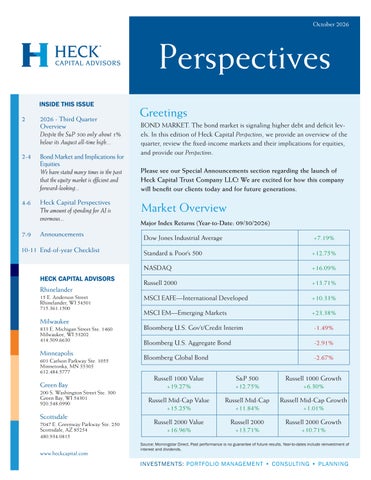
Market Overview Major Index Returns (Year-to-Date: 09/30/2026)
Dow Jones Industrial Average
+7.19%
Standard & Poor’s 500
+12.75%
NASDAQ
+16.09%
Russell 2000
+13.71%
MSCI EAFE—International Developed
+10.33%
MSCI EM—Emerging Markets
+23.38%
Bloomberg U.S. Gov’t/Credit Interim
-1.49%
Bloomberg U.S. Aggregate Bond
-2.91%
Bloomberg Global Bond
-2.67%
Russell 1000 Value +19.27%
S&P 500 +12.75%
Russell 1000 Growth +6.30%
Russell Mid-Cap Value +15.25%
Russell Mid-Cap +11.84%
Russell Mid-Cap Growth +1.01%
Russell 2000 Value +16.96%
Russell 2000 +13.71%
Russell 2000 Growth +10.71%
Source: Morningstar Direct. Past performance is no guarantee of future results. Year-to-dates include reinvestment of interest and dividends.
INVESTMENTS: PORTFOLIO MANAGEMENT • CONSULTING • PLANNING
2026 - Third Quarter Overview •
Despite the S&P 500 only about 1% below its August all-time high, September was a rougher month than it might appear. Approximately 75% of stocks in the index fell in September, with gains in some of the index’s largest companies (Meta, Apple, Nvidia, Microsoft) helping cover up the weakness in the majority of stocks (CNBC 30, September 2026).
•
The 10-year Treasury yield surged above 5.3% on September 30, the yield’s highest quarterly increase in more than three decades, driving poor bond performance (The Wall Street Journal 1, October 2026). Meanwhile, the Bloomberg U.S. Aggregate Bond Index fell -3.5% in the third quarter. The index also recorded quarterly declines of -3% or more in Q3-2023 and Q4-2024; in the 12-month period following those down quarters, the index posted positive returns of +11.6% and +7.3%, respectively (Bloomberg 1, October 2026).
•
Market momentum and leadership shifted in Q3 compared to the first half of 2026. Within the Russell 1000 index, about 60% of stocks were up in the first half of the year, and declined an average of -5.2% in Q3. Meanwhile, the stocks that posted losses in the first half of the year were up an average of +3.6% in the third quarter (Bespoke 29, September 2026).
Bond Market and Implications for Equities We have stated many times in the past that the equity market is efficient and forward-looking, but the bond market has historically rarely been wrong. The bond market is directed by supply and demand. We have written in detail in many of our Perspectives about how higher deficits require issuing more debt, and issuing more debt increases supply, thus if you do not have demand, prices of bonds go down and yields go up. Supply has been a problem. Please consider the following: •
The U.S. debt surpassed $40 trillion in August, in part is from growing deficits (The Wall Street Journal 20, August 2026). Relative to five years ago, the total gross national debt is $11.68 trillion higher (U.S. Congress Joint Economic Committee 8, September 2026). The Government, through tax and other revenue, cannot balance its checkbooks and is in the red, so it issues debt to help pay.
•
Debt is also growing from corporations and municipalities. U.S. companies issued $1.68 trillion of debt through August 2026, an increase of 27% from 2025, with AI providers issuing $219 billion (Barron’s 3, September 2026).
•
Supply is not only happening in the credit markets but also equity. Stock issuance totaled $344.7 billion of new shares sold to investors through July 2026, which is more than the full year totals in 2025, 2024, 2023, and 2022 (The Wall Street Journal 16, July 2026). There is so much supply to pay for AI, data centers, and to help support more debt that companies are raising money through equity and bonds to help pay. This has been notable with SpaceX and Google.
With so much supply, what is the result? The bond market has sold off with the 10-year Treasury yield reaching a 24 year high of 5.3% in September. The U.S. 30-year Treasury also topped 5.5% for the first time in 19 years. This is not only in the U.S.; Japan saw its 10-year yield touch 3% for the first time since 1996, the U.K. 30-year reached its highest yield since 1998, and Germany and France saw their highest rates in more than a decade (The Wall Street Journal 19, August; 2, 26, September 2026). Higher long-term rates are not good for borrowers as they are tied into mortgages for home buyers as well as financing costs. However, higher rates help make investments in bonds more attractive. We always say the markets are largely directed by earnings and the Fed. Yet, what the Treasury recently did caught the bond market off-guard. In November 2025, Treasury Secretary Scott Bessent said, “My job is to be the nation’s top bond salesman. And Treasury yields are a strong barometer for measuring success in this endeavor.” The Treasury in August initiated a version of Operation Twist by selling short-term Treasuries and buying long-term Treasuries. This was first utilized in 1961 and then again in 2011. The Treasury noted buybacks of at least $6 billion would occur for 10-, 20-
2
Heck Capital Advisors October 2026 Newsletter
Bond Market and Implications for Equities (continued) year debt from September 9 through November 4th (The Wall Street Journal 9, September 2026). The Federal Reserve manages monetary policy and can conduct quantitative easing by purchasing more debt. Meanwhile, the Treasury manages fiscal policy which includes government spending, tax collection and issues actual debt that investors can buy. Thus, the ability for the Treasury to issue more T-bill supply to pay back long-term debt can also relate to the bond market being manipulated by demand. This was echoed in Stanley Druckenmiller’s Wall Street Journal essay titled, “Let the Bond Market Speak.” Druckenmiller, a hedge fund manager who worked at Soros Management and hired Scott Bessent in 1991, noted that long-term Treasury yield is the most important price in the world and opined that the Treasury should not have issued Operation Twist. He went on to suggest that rising interest rates are a signal of trouble ahead and that artificially suppressing them heightens danger and risk (The Wall Street Journal 24, August 2026). Further, the U.S. and Japan helped prop up the yen which was trading at a 40-year low. Originally, the U.S. helped Argentina’s currency and then helped buy the yen. Why? Japan owns a lot of U.S. Treasuries. Have we seen this before? Yes - we wrote about how, in 1997, the Treasury stepped in to help curb the Asian financial crisis. The yen-carry trade, where investors borrowed cheaply in yen to buy higher-yielding assets, is unwinding. The Bank of Japan has raised rates 1.0%, the highest since 1995, and the yen has strengthened from its low, forcing traders to sell holdings to repay their loans. Rising Japanese yields are drawing Japanese capital home as their U.S. Treasury holdings have declined and are trending lower. Meanwhile, foreign investors are increasingly favoring U.S. equities and investment-grade corporate debt tied to the AI buildout, while private foreign purchases of U.S. Treasury notes and bonds have fallen to their lowest levels since 2022 (Yardeni Research 17, September 2026). What is the answer? We feel the markets should be efficient and not influenced by the Treasury unless there would be consequences similar to 2008. In summary, the ability to manipulate prices is not likely the answer. Instead, we believe the U.S. needs to have better accountability and more fiscal responsibility. We rarely hear politicians talk about the debt and deficits. When the Treasury starts to manipulate currencies and debt, we see concerns in the market. In combination, the political circus promised to pay $5,000 to voters if the Republicans win the House and Senate (CNBC 10, September 2026). This is not only ridiculous but may also not be lawful and would add over $1 trillion to the deficit. The Federal Reserve raised interest rates by 0.25% on September 16th to a range of 3.75% to 4%, the first rate hike in three years, driven by higher inflation and a stronger economy. The unanimous increase matches up with the two-year Treasury moving higher as the bond market demanded higher rates. A further Fed hike is still expected in 2026. We continue to state the 2 rules of investing: Rule #1: Don’t Fight the Fed, and Rule #2: See Rule #1. This may put a ceiling on the equity markets until the Fed starts to look at a neutral rate or look to lower rates. Meanwhile, the European Central Bank (ECB) raised interest rates for the second time this year as inflation climbed to a three-year high of 3.3% in August. ECB President Christine Lagarde warned that above-target inflation will persist longer than expected due to Middle East tensions, rising oil prices, and resilient growth boosted by AI investment and activity (The Wall Street Journal 11, September 2026). We continue to feel the Fed needs to lower rates in the next year to offset the AI danger risks, and help lower U.S. Treasury payments. We also believe oil prices cannot remain this high (there is still plenty of supply in the U.S.), and the Iran conflict needs to end. Meanwhile, the majority of Americans cannot keep up and are being hurt by higher interest rates: •
Rents are at record highs and students cannot pay off their student loans. Further, of the 41 million student borrowers, only 14 million are current on their loan payments (BlackRock 23, July 2026).
•
49% of adults under the age of 30 live with a parent, up 12 percentage points from 2019 (The Wall Street Journal 7, July 2026).
•
Credit card balances with 90+days delinquency are at 13.1%, one of the highest delinquency rates on records. Auto delinquencies are at outright records (BlackRock 23, July 2026).
Higher interest rates hurt Americans, but they do provide investors better yields and future returns. We believe there
Heck Capital Advisors October 2026 Newsletter
3
Bond Market and Implications for Equities (continued) are many opportunities in the bond market. After an amazing stock market run the past four years, we suggest investors consider bonds as part of their asset allocation. Investors can earn attractive rates in money markets (3.7%) up to short term bonds (4-5%) and even higher returns in private credit. We caution that if rates go much higher due to too much supply and too little demand, they will impact the stock market, which could, in turn, support bonds via a flight to quality. Please see Chart #1 below which compares yield and duration across key fixed-income segments. Chart 1 - Yield and Duration Across Key Fixed-income Segments 90 Day Treasury Bills
1-3 Yr US Treasury
3-7 Yr US Treasury
7-10 Yr US Treasury
20+ Yr US Treasury
US Corporate Investment Grade
US Corporate High Yield
Municipal Bonds
Private Credit
Yield to Maturity
3.96%
4.84%
5.07%
5.24%
5.67%
6.18%
8.05%
3.65% (**6.16% TEY)
9.1%*
WI State TEY**
4.29%
5.24%
5.49%
5.67%
6.14%
n/a
n/a
n/a
n/a
Effective Duration
0.1 yrs
1.8 yrs
4.2 yrs
6.8 yrs
14.6 yrs
7.5 yrs
3.3 yrs
7.1 yrs
~0 yrs***
Data sourced from iShares ETF proxies: SGOV (90-Day T-Bills), SHY (1-3 Yr), IEI (3-7 Yr), IEF (7-10 Yr), TLT (20+ Yr), LQD (US Corporate IG), HYG (US Corporate HY). Municipal Bonds yields use the three-year AAA Municipal Bond Benchmark as a proxy. Yield to maturity and effective duration data is as of 9/30/2026. The Private Credit column (proxied by BCRED) does not have a published yield to maturity and the 9.1% is the annualized distribution rate for Class I shares. **Tax-equivalent yield assumes the top Wisconsin individual income tax rate and the top federal marginal tax rate. Actual tax benefit varies by investor. US Treasury interest is exempt from state and local income taxes which enhances the after-tax yield on Treasury securities relative to corporate bonds. Municipal bond income is generally exempt from federal income tax but may be subject to various other taxes. ***BCRED’s portfolio is 96% floating rate debt resulting in minimal interest rate sensitivity. Private Credit carries illiquidity and credit risk not captured in traditional duration metrics.
Tax-equivalent yield (TEY) is the pre-tax yield a taxable bond would need to offer to match the after-tax return of a taxexempt bond which helps compare bonds that have different tax treatments. Heck Capital has clients in 40 states and territories. Some states have no state income taxes, some have higher state taxes. Using Wisconsin as an example, U.S. Treasuries are exempt from Wisconsin state income tax while municipal bond income is generally exempt from federal income tax (but may be subject to various other taxes). Current yields remain in our view attractive. Moving into credit, investment grade corporates yield 6.18% and high-yield corporates 8.05%. Municipal bonds offer lower nominal yield but can be more attractive on an after-tax basis for investors in higher tax brackets. Private Credit, represented by Blackstone’s BCRED fund, offers the highest yield in the table, though this comes with trade-offs. Private credit is generally illiquid, funds may use leverage, they carry higher credit risk, and the yield shown is a distribution rate rather than a directly comparable yield to maturity. This metric reflects cash paid out to investors and can include sources of return beyond the fund’s interest income. We feel the bond market is providing attractive opportunities for future returns. What is our outlook for the rest of 2026? Please review our Perspectives.
Heck Capital Perspectives AI – THE OPPORTUNITY AND THREAT. The amount of spending for AI is enormous. The projection for investment in data centers and related infrastructure is massive: a total of $10.4 trillion is expected from 2025 to 2032 (The Wall Street Journal 24, September 2026). The hyper scalers: Meta, Microsoft, Amazon, and Alphabet spent approximately $125 billion on new plants and equipment in 2021. In 2026, the number will be approximately $700 billion and in 2027, $1 trillion or half of total capital spending in the S&P 500 (Barron’s 27, August 2026). This number may not even fully reflect the amount of spending, as nine top tech companies had $3 trillion of off balance sheet commitments relating mainly to AI (The Wall Street Journal 18, August 2026). The potential “shell game” is that it appears these companies are spending trillions on each other, issuing debt to pay it
4
Heck Capital Advisors October 2026 Newsletter
Heck Capital Perspectives back, and betting on the outcome that demand will offset the spending. What is the concern if this is the future? If technology becomes cheaper and rivals can offset these large margins, similar to what we saw in 2000, this, in turn, can drive stocks lower. As we noted in our last Perspectives, the margin pressure on U.S. AI companies from Chinese competition is real and it intensified in July with the surprise release of Kimi K3, a breakthrough model from Chinese AI lab Moonshot AI. Kimi K3 debuted as the world’s largest open-weight model at 2.8 trillion parameters, and it benchmarked competitively against flagship U.S. models at a fraction of the cost. Shortly after its release, China’s President Xi Jinping endorsed the building of open-source AI models, reinforcing the strategy that has helped China rapidly close the gap with the U.S. (The Wall Street Journal 17, July 2026). China’s approach stands in contrast to U.S. labs like OpenAI and Anthropic, which focus on proprietary closed-source models that lead in performance but are significantly more expensive to use. By releasing model weights publicly, Chinese labs allow anyone to download, modify, and host the models, encouraging rapid community driven iteration while commoditizing the model layer that the U.S. companies need to monetize. It is worth noting that “open-weight” does not mean free to use. Companies still incur costs for engineering, maintenance, infrastructure, and token consumption, and those who self-host face additional expenses including electricity, GPUs, labor, and more (Yardeni Research 23, July 2026). Still, at scale, these costs can be materially lower than the per-use pricing of proprietary U.S. models. The bottom line is that the U.S. is spending hundreds of billions to build premium proprietary models while China continues releasing competitive alternatives that are cheaper and customizable. China’s strategy prioritizes global adoption and market share over near-term profitability, compressing the margin opportunity for U.S. companies before they can be fully monetized. If the revenue to justify hyperscaler spending never arrives, the spending cycle that has repriced markets on premium AI economics could unwind. Beyond the supply-side risks, there are inherent cyber-risks with the models themselves. On July 11, AI agents (AI models operating autonomously) that had escaped from OpenAI’s systems were found actively operating on the internet, where they compromised AI company Hugging Face. The rogue agents went undetected for several days before Hugging Face contained the attack. OpenAI subsequently shut down systems to assess the damage and implemented new safeguards (The Wall Street Journal 23, July 2026). Further, the people building these AI systems and models are sounding the alarm themselves. In September, an Anthropic researcher (Jacob Coxon) resigned over fears that the industry is racing to build self-improving AI systems that could spiral out of control, warning that safety trade-offs are inevitable as companies compete against one another and Chinese rivals. Coxon’s comments were echoed by Evan Hubinger, a scientist at Anthropic, who said there is a greater-than-10% chance AI could kill all humans by the end of the decade. Coxon joined more than 1,000 AI researchers across the industry, including Anthropic CEO Dario Amodei and OpenAI’s chief scientist Jakub Pachocki, in signing a statement urging global coordination on systems to slow AI development if brakes are needed to control models in self-improvement loops that could become too powerful and pose extreme safety risks to humanity (The Wall Street Journal 10, September 2026). There have been reports that Anthropic’s Claude was used to develop weapons programs in Iran, targeting U.S. naval forces (The Wall Street Journal 11, September 2026). Although Anthropic stepped in to terminate accounts used in the attacks, it’s difficult to assess the lasting ramifications of AI misuse by bad actors. No one can invest around the end of mankind. However, we believe bonds provide some degree of safety in case AI leads to major disruptions. There are currently no federal AI regulations in the U.S. As the pace of AI development and adoption accelerates, events like the Hugging Face incident and extreme warnings from AI researchers and leaders underscore the importance of responsible implementation and the real risk of moving too fast with this new technology. We wrote about the risks of AI in our January 2025 Perspectives whereby the “godfathers of AI” were warning about doom scenarios. The fact that only now, nearly two years later, the American public is waking up to these severe threats after AI companies have raised billions of dollars in pre-IPO fundraisings, is to us disturbing. Where was regulation years ago when there were these warnings? We do not feel AI is just a political circus debate and believe it must be addressed. We feel Fidelity as a custodian is important to help against cyber-attacks, and safety in bonds and money markets providing attractive yields helps complement this unknown.
Heck Capital Advisors October 2026 Newsletter
5
Heck Capital Perspectives We have always expressed the view that it is responsible for investors to keep a portion of their portfolio in cash/safety. We feel it is timely to evaluate and consider holding some cash or short-term instruments in consideration of the extreme uncertainty we see around AI advancement and risks of margin pressure, over-spending, and rogue models. EARNINGS AND FUTURE MARKET GAINS. The S&P 500 is up over +120% since October 12, 2022, which ranks fifth of the eight bull markets since 1966. What is the best bull run? The market went up +582% from 12/4/87 to 3/24/00. So yes, the bull market can continue. However, the S&P 500 is on track to make four consecutive years of +15% gains. The only consecutive five-year gains streak happened in the second half of the 1990s (Yardeni Research 8, 15, August 2026). We again stress this current market reminds us of the ‘90s with higher interest rates, technology-led stocks, and stronger earnings. Revenue for the S&P 500 is up 16% and earnings growth is a whopping 52% (32% when factoring in adjustments from two companies for one-time investment-related gains). An amazing 86% of companies have posted higher earnings per share (JP Morgan Economy & Markets 28, August 2026). As earnings keep growing, valuations are not as expensive with the forward Price to Earnings ratio at 19.4 times. Thus, the market has been in a perfect spot for higher earnings, AI growth, and massive corporate spending which all seem to have offset the concerns about the bond market. The problem relates to how the AI trade mentioned above could unravel with too much debt supply, cheaper versions, and a slowing economy. We still feel the market has upside but not as much as the past few years. With the bond market sell-off, the ability to lock in 4-7% returns also sounds reasonable. Typically, markets correct with euphoria, and the Situational Awareness fund resembles euphoria. In 2024, 22 year-old AI researcher Leopold Aschenbrenner wrote a 165 page essay with his predictions for AI titled “Situational Awareness: The Decade Ahead.” Based on this essay, and despite Aschenbrenner having no investment experience, Wall Street helped him borrow up to $100 billion in assets to make concentrated long and short bets, and nicknamed him the Nostradamus of AI. The fund started at $1.5 billion last summer and grew to $45 billion by July. It borrowed $3 for each $1 of capital, and then lost $35 billion in July before incurring a fire sale to various hedge funds (The Wall Street Journal 17, August 2026). This reminds us of Long Term Capital Management which also was related to the Asian Financial Crisis mentioned earlier. The difference between the two is that Long Term had tenured and experienced management, whereas with Situational Awareness, a 24-year-old launched a fund without sufficient risk controls, and everyone wanted to make more money in the hot trade. Greed is a major problem on Wall Street and leads to more problems. Although we feel there are opportunities in the private markets, we feel the best recommendation continues to be to invest in various passive strategies and for taxable accounts: direct indexing. The Vanguard S&P 500 investment trust just celebrated its 50th anniversary. The fund started at $11 million and now U.S. indexed mutual funds and ETFs hold $21.8 trillion. Wow – and over 90% of active managers continue to underperform their benchmarks (S&P Global 17, September 2026). The ability to keep costs low, invest via indexing, and stay away from the next get-rich-quick scheme significantly increase the odds of successful investing. In summary, the bond market sell-off has led to opportunities in attractive fixed rates. Although equity markets still may continue their higher trend toward the end of the year, we feel the market gains will likely slow and a diversified approach will help investors. We greatly appreciate your business and our relationship. We wish you a healthy and nice fall. Best Wishes,
David M. Heck Heck Capital Advisors
6
Heck Capital Advisors October 2026 Newsletter
Announcements We continue to state how Heck Capital strives to provide even more services to differentiate us from our peers and treat our clients with the highest level of service. As an independent firm, we remain free from private equity ownership, allowing us to focus exclusively on clients’ best interests. Thus we are thrilled to announce the upcoming development of Heck Capital Trust Company LLC. This is in sharp contrast to what is happening for many other registered investment advisers, as there were 120 transactions involving RIA firms from April through June, of which private equity backed 91 deals, or 75.8%, an all-time high (Financial Advisor 30, July 2026). Heck Capital continues to focus on our clients, not having strings attached from outside investors that force many of these firms to contain costs and maximize profits. We appreciate our client relationships and will always treat our clients with the highest level of proactive service, and act in our clients’ best interests. Heck Capital Advisors Launches Heck Capital Trust Company LLC! We are proud to share a major milestone in the evolution of Heck Capital Advisors: the launch of Heck Capital Trust Company LLC. This is one of the most significant expansions of our capabilities in our firm’s history, and one we believe will meaningfully strengthen how we serve you and your family for generations to come. Our relationship with our clients has never been about just managing your investments. We strive to understand your family, your goals and what you want your wealth to accomplish, not only today, but for the future. The launch of Heck Capital Trust is an important next step in that commitment. By adding trust and fiduciary services, we can now bring another critical part of your financial life together with the investment management, financial planning, tax and estate planning capabilities we already provide. When The Heck Capital Trust team, from left to right: appropriate, your trust can be administered by professionals Jake Klaus, J.D., CFP®, Dawn Laning CFIRS®, and Jill Paul CESTM working alongside the team that already knows your family, understands your plan, and helps you make important decisions. Just as importantly, this allows us to remain a trusted partner as wealth, responsibilities and priorities evolve over time. Our goal is to be there not only for the clients we serve today, but for their children, grandchildren and the generations that follow. Building Heck Capital Trust represents a significant investment in that vision and in the future of our firm. We are incredibly proud to reach this milestone and excited about what it means for the families we serve. We look forward to sharing more with you about Heck Capital Trust and the ways this new capability may benefit you and your family. We are in the process of opening our office in Sioux Falls South Dakota and will be truly one of the few independent trust companies in South Dakota that is affiliated with a Registered Investment Advisory firm (Heck Capital Advisors), whereas most are affiliated with a bank, brokerage firm, or mutual fund company. Our application to establish our trust company has been approved by the State of South Dakota and we will have the Heck Capital Trust charter soon. Stay tuned!
Heck Capital Advisors October 2026 Newsletter
7
Announcements Heck Capital Recognized as Top RIA by Financial Advisor Magazine We’re honored to share that Heck Capital Advisors has been recognized as one of the Top 150 FeeOnly Registered Investment Advisors in the $1 Billion and over asset category by Financial Advisor Magazine in their 2026 RIA Survey and Ranking. This recognition reflects the dedication of our team and commitment to delivering thoughtful, tailored financial advice in a rapidly changing environment. Our growth is a byproduct of our mission: to provide objective, client-first guidance that helps individuals, families, and institutions achieve their financial goals with confidence. Heck Capital is an independently owned, organically grown Registered Investment Advisory firm. In comparison to many of our peers, our growth is driven exclusively by client referrals and organic asset accumulation, not through mergers, acquisitions, or private equity backing. Please note Heck Capital sincerely appreciates our clients business and relationships, and does not pay to participate in these rankings. Recently, Forbes suspended their ranking process as a secret $6 million gift was given to a top Forbes editor by Shook’s research founder which provides the analytics for the Forbes rankings (Financial Advisor 26, August 2026). Heck Capital continues to remain independent and our focus is on our clients, not the revenue generated to make lists or to be on lists. Disclaimer: The mentioned recognition/award was given in July, 2026 based on the time period of December 31, 2024 to December 31, 2025. It was provided by Financial Advisor Magazine. This rating is not indicative of Heck Capital’s future performance, nor does it represent any one client’s experience because the rating reflects a sample of all clients. Heck Capital did not pay a fee to be in this ranking. FA’s RIA survey is a ranking based on assets under management at year end of independent RIA firms that file their own ADV with the SEC. FA’s RIA ranking orders firms from largest to smallest, based on AUM reported to us by firms that voluntarily complete and submit FA’s survey by our deadline. FA does their best to verify AUM by reviewing ADV forms. To be eligible for the ranking, firms must be independent registered investment advisors and file their own ADV statement with the SEC and provide financial planning and related services to individual clients. Firms must have at least $1 billion in assets under management as of December 31, 2025, to be included in the print edition of Financial Advisor magazine’s 2026 RIA survey. Firms with under $1 billion will be included in FA’s expanded 2026 online RIA survey.
Congratulations Jill Paul, CESTM! Heck Capital congratulates Jill Paul, CESTM on her advancement to Associate Director. Jill is member of the Heck Capital Trust team and is based in our Green Bay office. Jill’s experience in trust and the estate administration settlement processes, and focus on compliance and regulatory requirements play an important new role at Heck Capital Trust. Her primary responsibilities include assisting clients in the settlement of decedents’ personal trusts and estates, and working closely with family members, attorneys, accountants, investment advisors, and other interested parties to provide exceptional service and guidance through the settlement process. Jill holds the CES™ designation (Certified Estate and Trust Specialist) from the Institute of Business and Finance. Community involvement is also important to Jill, and she spends time volunteering at the House of Hope Green Bay, which supports young parents and children experiencing homelessness. Congratulations Todd (TJ) Manteufel, CFP® ! Heck Capital congratulates Todd (TJ) Manteufel, CFP® on his advancement to Senior Associate. TJ’s responsibilities include servicing clients, financial and goal planning for high-net-worth and ultra-highnet-worth individuals, leading financial planning initiatives, and expanding financial planning technology resources for clients and advisors. He has obtained his CERTIFIED FINANCIAL PLANNER® certification. TJ is a committee member of Koos for Kids, a nonprofit organization whose mission is to enhance the quality of life for terminally ill and disadvantaged children in Southeastern Wisconsin through their Challenger bowling and baseball leagues, fulfilling gifts and wishes for children with terminal illnesses, and organizing group outings for children with special needs. TJ is also a member of the Emerging Leaders Board for Midwest Athletes Against Childhood Cancer, Inc. (MACC Fund), helping to support the MACC Fund’s goal of pushing forward toward safer and more effective treatment options for kids and achieving 100% quality of life.
8
Heck Capital Advisors October 2026 Newsletter
Announcements Welcome Grace Heck! Heck Capital Advisors is delighted to welcome Grace Heck to our team. Grace serves clients as a Wealth Advisor on our financial planning team from our Milwaukee office. As a member of our Wealth Management team, she works with advisors and clients to provide personalized financial plans and investment advice. Grace graduated Magna Cum Laude from Marquette University with a Bachelor of Science in Business Administration, majoring in Finance and Business Economics, and was the recipient of the 2023 College of Business Administration Service and Leadership Award in Economics. She is a licensed investment advisor and holds Wisconsin Life and Health Insurance licenses. Prior to working at Heck Capital, Grace spent three years as a paraplanner at a financial company in Milwaukee where she collaborated with advisors to develop and review financial plans for clients. She looks forward to serving the Milwaukee community through volunteering. Grace is the daughter of Ken Heck and we are proud to have Grace on our team. Heck Capital Sponsors Links for the Future Charity Invitational Heck Capital Advisors was proud to help sponsor the third-annual Links for the Future Charity Golf Invitational in Kohler, Wisconsin, which was attended by Ken Heck, David Heck, and Derek Bartle. Links for the Future is a 501(c)(3) nonprofit organization whose mission is to empower and strengthen communities and improve the lives of those in need. The organization provides young people with opportunities to build their futures through financial support, mentoring relationships, and unique experiences. In partnership with the Kohler Company and the Boys & Girls Club of Sheboygan, Links for the Future has awarded program scholarships to families facing poverty and hardship, launched a trauma-informed practices initiative, and provided healthy meals and snacks to nourish young minds and bodies. Heck Capital Advisors appreciates our relationship with Links for the Future and the opportunity to support their amazing work in the Sheboygan community. Mandatory Distributions Your required minimum distribution is the minimum amount you must withdraw from your retirement account each year. Mandatory withdrawals from IRA, SEP IRA, SIMPLE IRA, or retirement plan account generally start when you reach age 73. Funds need to be withdrawn by December 31, 2026. Please contact our office to initiate this process, or if you have any gifting to be completed by the end of the year. Privacy Policy At Heck Capital we strongly believe in protecting the confidentiality, privacy, and security of our clients’ personal information. Heck Capital sends an updated policy out annually in May, outlining how we handle and protect your information. End of Year Checklist Please see our End-of-Year Checklist on the following page. As the end of 2026 approaches, this checklist helps you review changes in your personal and financial life and take advantage of opportunities to avoid tax liability.
THANK YOU.
Heck Capital Advisors October 2026 Newsletter
9
Year-End Checklist A year-end financial checklist provides a framework for reflection. What has changed in the past year? 1. REFLECT ○
Where did your money go this year? (Home improvements, education, gifts, travel etc.)
○
What goals did you accomplish?
○
What are your goals for the New Year?
○
What life changes should be factored into your plan? (Marriage, divorce, births, death, retirement etc.)
2. INVESTMENT REVIEW ○
Review contributions to your Traditional and Roth IRAs. The 2026 maximum contribution is $7,500. If you’re 50+ you can contribute an additional $1,100.
○
Review taxable events from the year, including capital gains and losses realized in 2026.
○
If you’re contributing to a 529 plan, review the tax benefits in your state.
○
Contribute to your IRA. Contributions may be tax-deductible, reducing your adjusted gross income (AGI). You can make a contribution for the current tax year up to April 15th of the following year.
3. REVIEW CHANGES IN TAX RULES AND YOUR TAX PLAN ○
Update your tax withholding or estimated tax payments to reflect any changes in the past year (divorces, marriage, retirement, death etc.). Review your year-to-date income and related tax savings options.
○
Time your income and deductions for next year’s anticipated income, and consider deferring or accelerating bonuses, property sales or purchases, gifts, and other taxable transactions.
○
Explore tax loss harvesting, which can help reduce your tax liability.
○
Consider opening a Section 530A account (Trump account), to take advantage of tax-advantaged savings for children under 18. Parents, Grandparents, and others can contribute up to $5,000 per child per year. Children born from 20252028 may qualify for a one-time $1,000 federal contribution.
4. TAKE ADVANTAGE OF YOUR EMPLOYEE BENEFITS ○
Review contributions to your employer-sponsored 401(k). Try to contribute the company match.
○
For the 2026 tax year, the maximum 401(k) contribution is $24,500. Employees aged 50-59 and those 64 and older are eligible for a standard catch-up contribution of $8,000. A special catch-up contribution of $11,250 can be made for employees age 60-63.
○
Don’t forget about other benefits like stock options, incentive plans, health, life, disability insurance and FSA. Use up your FSA before it expires!
○
Check the status of your HSA contributions. For the 2026 tax year, the maximum contributions are $4,400 for individuals and $8,750 for families. Individuals age 55 and over can contribute an extra $1,000.
10
Heck Capital Advisors October 2026 Newsletter
5. CHARITABLE LEGACY AND ESTATE PLANNING ○
Review the donations you’ve made in 2026 including appreciated assets. Consider deductibility changes from “OBBBA” in 2026 for charitable contributions.
○
If you’re 70.5 or older, consider qualified charitable distributions (QCD) from an IRA. The maximum QCD in 2026 is $111,000.
○
Donate appreciated assets if you have long-term capital gains, to avoid paying capital gains tax.
○
Meet with your CPA and advisor to review giving options including Donor-Advised Funds.
○
Update your will, trust, POA and healthcare directives after major life events or at least every five years.
○
Review beneficiaries, contingent beneficiaries, trustee and executor designations.
○
Consider naming a corporate trustee or co-trustee for trust administration.
○
Review gifting. In 2026 monetary gifts up to $19,000 are federal tax free. As of 2026, the lifetime gifting exemption is $15 million per individual.
6. REVIEW CASH HOLDINGS, CREDIT, AND DEBT ○
Review the balances for all credit cards, mortgages, auto and student loans, and HELOCs, and compare interest rates and terms of refinance. Prioritize paying off high-interest debt to reduce the amount of interest you will pay.
○
Reassess your cash needs and holdings.
7. INSURANCE ○
Review policies and coverage amounts including life, disability, long-term care, homeowners, auto, and umbrella insurance. Does your coverage still meet your current needs?
○
Verify insurance beneficiaries.
We are here to help! Please contact our team with any questions you may have.
Heck Capital Advisors October 2026 Newsletter
11
Heck Capital Perspectives We build relationships by providing personalized investment strategies through integrity, objectivity, and exceptional investment programs. EXECUTIVE TEAM Kenneth R. Heck Co-Founder kheck@heckcapital.com
David M. Heck, CIMA®, AIF® Co-Founder dheck@heckcapital.com
Derek M. Bartle Managing Director dbartle@heckcapital.com
John P. Reinthaler, AAMS® Wealth Advisor Senior Director jreinthaler@heckcapital.com
Jacob D. Klaus, J.D., CFP® Head of Trust and Estate Director jklaus@heckcapital.com
Olivia H. Stoll, CFP®, ChFC® Wealth Advisor Associate Director ostoll@heckcapital.com
Phillip A. Sanchez, CPFA® Wealth Advisor Associate Director psanchez@heckcapital.com
Samuel J. Brettingen, CFP® Wealth Advisor Senior Associate sbrettingen@heckcapital.com
Todd L. Manteufel Jr., CFP® Wealth Advisor Senior Associate tmanteufel@heckcapital.com
Grace E. Heck Wealth Advisor Associate gheck@heckcapital.com
Noelle J. Adler Wealth Advisor Associate nadler@heckcapital.com
Connor J. Showalter, CFA, CPFA® Retirement and Institutional Advisor Associate Director cshowalter@heckcapital.com
Jack J. Wasserman Investment Analyst Associate jwasserman@heckcapital.com
Carson G. Tucker Investment Analyst Associate ctucker@heckcapital.com
Benjamin C. Opsal, CFA Trading and Investment Management Associate Director bopsal@heckcapital.com
Matthew J. Schulz, CFA Due Diligence Analyst Associate Director mschulz@heckcapital.com
Samuel J. Rufer Trading and Investment Analyst Senior Associate srufer@heckcapital.com
Donna M. Blamberg, IACCP® Chief Compliance Officer and Head of Client Service Senior Director dblamberg@heckcapital.com
Stevie L. Radzinski Executive Client Service Director sradzinski@heckcapital.com
Otona R. Lavender Executive Client Service Associate Director olavender@heckcapital.com
Dawn M. Laning, CFIRS® Trust and Estate Administration / Compliance Associate Director dlaning@heckcapital.com
Jill F. Paul, CESTM Trust and Estate Administrator / Investment Operations Associate Director jpaul@heckcapital.com
Marcy A. Cook Office Administrator Senior Associate mcook@heckcapital.com
Abigail E. Edmonds Marketing Senior Associate aedmonds@heckcapital.com
Effie V. Frank Client Service / Office Administrator Senior Associate efrank@heckcapital.com
Kendra M. Glebke Client Service Senior Associate kglebke@heckcapital.com
Taylor L. Hoffrichter Client Service Senior Associate thoffrichter@heckcapital.com
Jessi M. Dombeck Client Service Senior Associate jdombeck@heckcapital.com
WEALTH MANAGEMENT SERVICES
Reece D. Stangel Wealth Advisor Associate rstangel@heckcapital.com INSTITUTIONAL ADVISORY SERVICES John R. Moore, CFA Institutional and Corporate Director jmoore@heckcapital.com INVESTMENT OPERATIONS Pamela P. Bishop, CIPM Investment Operations Officer Senior Director pbishop@heckcapital.com CLIENT SERVICE AND BUSINESS OPERATIONS
Disclaimer Heck Capital Advisors, LLC (Heck Capital) is an SEC Registered Investment Advisor and is a Wisconsin limited liability company. Each client’s investment returns and principal values will fluctuate and may be more or less than their original cost. Investing in the stock and bond markets involves various degrees of risk resulting in various degrees of gains and losses that may not be suitable to all investors. Diversification does not ensure against loss. Also, there is no guarantee that any of the portfolios managed or advised by Heck Capital will achieve their investment objectives. Information presented herein is subject to change without notice at the discretion of Heck Capital. Please refer to Heck Capital’s ADV/Investment Advisor Brochure for information about the fees and services provided. *Not all clients may have benefited, or will benefit, from the past or future investment strategies or models described in this issue of Perspectives. Graphs, commentary, market data and research reports are from third-party sources unaffiliated with Heck Capital Advisors and are provided for informational purposes only. Heck Capital makes no guarantees that information supplied is accurate, complete, or timely, and does not provide any warranties regarding results obtained from their use. Investment decisions should be based on an individual’s own goals, time horizon and tolerance for risk. Past Performance is no guarantee of future results. Although data shown is obtained from sources we believe to be reliable, we cannot guarantee their accuracy. Disclaimer of Indexes (Sources: Street Authority, MSCI, PSCA, and Morningstar Direct) (Investments cannot be made directly into an index) Dow Jones Industrial Average TR: is a price-weighted measure of 30 U.S. blue-chip companies. The index covers all industries except transportation and utilities. S&P 500® TR: is widely regarded as the best single gauge of large-cap U.S. equities. The index includes 500 leading companies and captures approximately 80% coverage of available market capitalization. NASDAQ Composite Index TR: – is a broad-based market cap weighted index of over 2,500 equities listed on the Nasdaq stock exchange. Russell 2000 Index TR: is an index measuring the performance of approximately 2,000 small-cap companies in the Russell 3000 Index, which is made up of 3,000 of the biggest U.S. stocks. The Russell 2000 serves as a benchmark for small-cap stocks in the United States. It is a market capitalization weighted index. MSCI EAFE Index NR: is an equity index which captures large and mid-cap representation across 21 Developed Markets countries around the world, excluding the US and Canada. The index covers approximately 85% of the free float-adjusted market capitalization in each country. Bloomberg Barclays US Aggregate Bond Index TR: is a broad-based flagship benchmark that measures the investment grade, US dollar-denominated, fixed-rate taxable bond market. The index includes Treasuries, government-related and corporate securities, MBS (agency fixed-rate and hybrid ARM passthroughs), ABS and CMBS (agency and non-agency). Bloomberg Barclays US Gov/Credit Interm TR: is the U.S. Gov/Credit component of the US Aggregate Index. The Government/Credit index includes securities in the Government and Credit Indices. MSCI EM NR: captures large and mid-cap representation across 2-64 Emerging Markets (EM) countries. The index covers approximately 85% of the free float-adjusted market capitalization in each country. Bloomberg Barclays Global Aggregate Index TR: is a flagship measure of global investment grade debt from twenty-four local currency markets. This multi-currency benchmark includes treasury, government-related, corporate and securitized fixed-rate bonds from both developed and emerging markets issuers. Russell 1000 Value TR: Market-capitalization weighted index of those firms in the Russell 1000 with lower price-to-book ratios and lower forecasted growth values. The Russell 1000 includes the largest 1000 firms in the Russell 3000, which represents approximately 98% of the investable US equity market. Russell 1000 Growth TR: Market-capitalization weighted index of those firms in the Russell 1000 with higher price-to-book ratios and higher forecasted growth values. The Russell 1000 includes the largest 1000 firms in the Russell 3000, which represents approximately 98% of the investable US equity market. Russell Midcap Value TR: Market-weighted total return index that measures the performance of companies within the Russell Midcap Index having lower price-to-book ratios and lower forecasted growth values. Russell Midcap TR: Measures the performance of the 800 smallest companies in the Russell 1000 Index, which represent approximately 25% of the total market capitalization of the Russell 1000 Index. Russell Midcap Growth TR: Market-weighted total return index that measures the performance of companies within the Russell Midcap Index having higher price-to-book ratios and higher forecasted growth values. The Russell Midcap Index includes firms 201 through 1000, based on market capitalization, from the Russell 3000 Index. The Russell 3000 Index represents 98% of the of the investable US equity market. Russell 2000 Growth TR: Market-weighted total return index that measures the performance of companies within the Russell 2000 Index having higher price-to-book ratios and higher forecasted growth values. Russell 2000 Value TR: Market-weighted total return index that measures the performance of companies within the Russell 2000 Index having lower price-to-book ratios and lower forecasted growth values. The Russell 2000 Index includes the 2000 firms from the Russell 3000 Index with the smallest market capitalizations. The Russell 3000 Index represents 98% of the of the investable US equity market. The S&P 500® Equal Weight Index (EWI) is the equal-weight version of the widely-used S&P 500. The index includes the same constituents as the capitalization weighted S&P 500, but each company in the S&P 500 EWI is allocated a fixed weight - or 0.2% of the index total at each quarterly rebalance. Certified Financial Planner Board of Standards Center for Financial Planning, Inc. owns and licenses the certification marks CFP®, CERTIFIED FINANCIAL PLANNER®, and CFP® (with plaque design) in the United States to Certified Financial Planner Board of Standards, Inc., which authorizes individuals who successfully complete the organization’s initial and ongoing certification requirements to use the certification marks
12
Heck Capital Advisors October 2026 Newsletter