




Product: TRUCK ENGINE
Model: 3126 TRUCK ENGINE 1WM
Configuration: 3126 Truck Engine 1WM00001-UP
Operation and Maintenance Manual
Cold Weather Recommendations for On-Highway Diesel Truck Engines
Foreword
Literature Information
This manual should be stored in the literature storage area.
The information contained in this document is the most current information available for coolants, fuels, and lubricants. Refer to the Operation and Maintenance Manual for any special lubrication requirements for your engine.
Whenever a question arises regarding the engine, this publication, or the Operation and Maintenance Manual, please consult any Cat dealer for the latest available information.
Safety
Refer to the Operation and Maintenance Manual for your engine for all safety information. Read and understand the basic safety precautions listed in the Safety Section. In addition to safety precautions, this section identifies the text and locations of safety signs used on the engine.
Read and understand the basic precautions listed in the Safety Section before operating or performing lubrication, maintenance and repair on this engine.
Maintenance
Refer to the Operation and Maintenance Manual for your engine to determine all maintenance requirements.
Maintenance Intervals
Use the Maintenance Interval Schedule in the Operation and Maintenance Manual for your engine to determine servicing intervals. The actual operating environment of the engine also governs the
maintenance interval schedule. Therefore, under extremely severe, dusty, wet or freezing cold operating conditions, more frequent lubrication and maintenance than is specified in the Maintenance Interval Schedule may be necessary.
Extended Engine Oil Drains and Warranty
Failures that result from extended oil drain periods are not Caterpillar factory defects and therefore are not covered by Caterpillar's warranty. In addition, failures that result from not using the recommended oil type are not Caterpillar factory defects and therefore are not covered by Caterpillar's warranty.
Refer to the applicable Operation and Maintenance Manual for standard oil drain periods and to the Maintenance Section, "Lubricant Specifications" of this publication for engine oil type and viscosity grade recommendations.
To reduce the potential risk of failures associated with extended oil drain periods; it is recommended that oil drain intervals only be extended based on oil analysis, and subsequent engine inspections. Oil analysis alone does not provide an indication of the rate of formation of lacquer, varnish and/or carbon on pistons and other engine surfaces. The only accurate way to evaluate specific oil performance in a specific engine and application that utilizes extended oil drain periods is to observe the effects on the engine components. This involves tear-down inspections of engines that have run to their normal overhaul period with extended oil drain intervals. Following this recommendation will help ensure that excessive component wear does not take place in a given application.
NOTICE
Light loads, low hour accumulation, and excessive idling time can contribute to excessive water in the crankcase oil. Corrosive damage, piston deposits and increased oil consumption can also result. If oil analysis is not done or the results are ignored, the potential for corrosive damage and piston deposits increases. Refer to the appropriate Operation and Maintenance Manual for guidance.
Note: Failures that result from extended oil drain periods are not warrantable failures, regardless of use of this recommended procedure. Failures that result from extended engine oil drain periods are considered improper use under the warranty.
Aftermarket Products and Warranty
NOTICE
When auxiliary devices, accessories or consumables (filters, oil, additives, catalysts, fuel, etc.) made by other manufacturers are used on Caterpillar products, the Caterpillar warranty is not affected
simply because of such use. Failures that result from the installation or usage of other manufacturers auxiliary devices, accessories or consumables, however, are not Caterpillar factory defects and therefore are NOT covered by Caterpillar's warranty.
Caterpillar is not in a position to evaluate the many auxiliary devices, accessories or consumables promoted by other manufacturers and their effect on Caterpillar products. Installation or use of such items is at the discretion of the customer who assumes ALL risks for the effects that result from this usage.
Furthermore, Caterpillar does not authorize the use of its trade name, trademark, or logo in a manner which implies our endorsement of these aftermarket products.
Copyright 1993 - 2024 Caterpillar Inc. All Rights Reserved. Private Network For SIS Licensees. Mon Apr 22 10:15:43 UTC+0530 2024
This is the sample of the manual click on the download link for complete manual
DOWNLOAD LINK
For some reason if link does not work download this pdf and then click
Product: TRUCK ENGINE
Model: 3126 TRUCK ENGINE 1WM
Configuration: 3126 Truck Engine 1WM00001-UP
Operation
and Maintenance Manual
Cold Weather Recommendations for On-Highway Diesel Truck Engines
Cold Weather Recommendation Charts
SMCS - 1000; 1250; 1450; 1453; 1456; 1900
If equipped with an air inlet heater (AIH) for cold weather starting, do not use types of starting aids such as ether. Such use could result in an explosion and injury.
NOTICE
When starting the engine with ether, follow these starting procedure instructions carefully.
Use ether sparingly and spray it ONLY WHILE CRANKING THE ENGINE. Excessive ether use can cause piston and ring damage. Ether should be used only for cold weather starting.
Table 1
Medium and Heavy-Duty On-Highway Engines (1) Cold Weather Recommendations
Starting Aids
Expected Coldest Temperature Ether Injection (2) OR Air Inlet Heater
Above



Cylinder Block Coolant Heater Larger Battery Larger Alternator
Less than Required Required Required
( 1 ) Options may not be available for all models.
( 2 ) If the engine is equipped with an air inlet heater (AIH) for cold weather starting, do not use types of starting aids such as ether. Such use could result in an explosion and injury.
Table 2
Medium and Heavy-Duty On-Highway Engines (1) Cold Weather Recommendations
Improvements for Engine Warm-Up
Improvements for Idle Temperature
Expected
Coldest Temperature Hand Throttles Winter Fronts Shutters Air Cleaners Located Under the Hood On/Off Fan Drives BrakeSavers Exhaust Restrictors
Above
to Available

( 1 ) Options may not be available for all models.
Copyright 1993 - 2024 Caterpillar Inc. All Rights Reserved. Private Network For SIS Licensees. Mon Apr 22 10:18:52 UTC+0530 2024
Product: TRUCK ENGINE
Model: 3126 TRUCK ENGINE 1WM
Configuration: 3126 Truck Engine 1WM00001-UP
Operation and Maintenance Manual
Cold Weather Recommendations for On-Highway Diesel Truck Engines
Coolant Recommendations
SMCS - 1350; 1352; 1395
The following two coolants are used in Caterpillar diesel engines.
Preferred - Cat Extended Life Coolant (ELC) or a commercial heavy-duty coolant that meets the Caterpillar EC-1 specification
Acceptable - Cat Diesel Engine Antifreeze/Coolant (DEAC) or a commercial heavy-duty coolant/antifreeze that meets "ASTM D4985" or "ASTM D6210" specifications
NOTICE
Do not use a commercial coolant/antifreeze that only meets the ASTM "D3306" specification. This type of coolant/antifreeze is made for light duty automotive applications.
Use only the coolant/antifreeze that is recommended.
Note: Caterpillar recommends a 1:1 mixture of water and glycol. This mixture of water and glycol will provide optimum heavy-duty performance as a coolant/antifreeze.
Note: Caterpillar DEAC DOES NOT require a treatment with an Supplemental Coolant Additive (SCA) at the initial fill. Commercial heavy-duty coolant/antifreeze that meets "ASTM D4985" or "ASTM D6210" specifications MAY require a treatment with a supplemental coolant additive at the initial fill. Read the label or the instructions that are provided by the OEM of the product.
Note: These coolants WILL require a treatment with a supplemental coolant additive on a maintenance basis. Regardless of the ambient temperature, the supplemental coolant additive should
be maintained between three to six percent. The Caterpillar 4C-9297 Test Strip can be used to help maintain the appropriate concentration of Caterpillar SCA.
NOTICE
All Caterpillar diesel engines equipped with air-to-air aftercooling (ATAAC) require a minimum of 30 percent glycol to prevent water pump cavitation.
Glycol
For optimum performance, Caterpillar recommends a 1:1 mixture of a water/glycol solution.
Note: Use a mixture that will provide protection against the lowest ambient temperature.
Note:
Table 1
Ethylene Glycol
Concentration Freeze Protection Boil Protection
50 Percent 106 °C (223 °F)

60 Percent 111 °C (232 °F)
Check the coolant for the concentration of glycol frequently in cold weather with a refractometer type coolant tester in order to ensure adequate freeze protection.
To check the concentration of glycol, use the 1U-7298 Coolant/Battery Tester (DEGREES CELSIUS) or use the 1U-7297 Coolant/Battery Tester (DEGREES FAHRENHEIT). The testers give readings that are immediate and accurate. The testers can be used with ethylene or propylene glycol.
Water
NOTICE
Distilled water or deionized water is recommended for use in engine cooling systems. DO NOT use the following types of water in cooling systems: hard water, softened water that has been conditioned with salt, and sea water. Damage to the cooling system may result.
Note: If distilled water or deionized water is not available, use water with the properties that are listed in table 2.
Table 2
Caterpillar Minimum Acceptable Water Requirements Property
Chloride (Cl) 40 mg/L (2.4 grains per US gal) "D512" "D4327"
Sulfate (SO4) 100 mg/L (5.9 grains per US gal) "D516"
Total Hardness 170 mg/L (10 grains per US gal) "D1126"
Total Solids 340 mg/L (20 grains per US gal) "D1888"
Acidity pH of 5.5 to 9.0 "D1293"
Copyright 1993 - 2024 Caterpillar Inc.
All Rights Reserved.
Private Network For SIS Licensees.
Mon Apr 22 10:17:39 UTC+0530 2024
Product: TRUCK ENGINE
Model: 3126 TRUCK ENGINE 1WM
Configuration: 3126 Truck Engine 1WM00001-UP
Operation and Maintenance
Manual
Cold Weather Recommendations for On-Highway Diesel Truck Engines
Engine Coolant Considerations
SMCS - 1350; 1395
Note: These recommendations are subject to changes without prior notice. Contact your Caterpillar dealer for the most up-to-date recommendations.
Always Allow the Engine to Reach Normal Operating Temperature
Damage to valves and components during operation in very cold temperature conditions can result from engine operation for short intervals. Damage to the engine can occur from starting the engine and stopping the engine many times without allowing the engine to reach normal operating temperature. The fuel and the oil are not completely burned in the combustion chambers while the engine is operating below the normal operating temperature. This fuel and oil causes soft carbon deposits on the valve stems. Generally, these deposits do not cause problems because these deposits are burned off during operation at normal engine temperatures. When the engine is started and the engine is stopped frequently the engine may not reach the normal operating temperature. This will cause the carbon deposits to become thicker. This will prevent the free operation of the valves. This can also cause the following conditions: valves to stick, pushrods to bend and other damage to valve train components. Begin operating the engine at low load. After the engine oil pressure is normal and the coolant temperature begins to rise, the engine may be operated at full load. Allow the engine to reach normal operating temperature. This will keep the carbon deposits on the valve stems at a minimum. This will also maintain free operation of the valves and the valve train components. The engine will remain in better condition and the service life of the engine may be extended when the engine is warmed up properly. Lubrication will be improved, with less acid and sludge in the oil. This will give longer service life for the engine bearings, the piston rings, and other parts. However, limit unnecessary idle time to ten minutes. Engine wear is greatest at low idle and unnecessary idling wastes fuel.
Engine Block Heaters
A block heater can improve the startability and a block heater can reduce the warm up time by heating the coolant that surrounds the combustion chambers. An electric block heater can be activated immediately after the engine is stopped. The use of a block heater will reduce the temperature that would require a starting aid. An effective block heater is typically a 1250/1500 W unit. Contact your truck dealer for more information.
On/Off Fan Clutch
For better control of the operation of the fan, an ON/OFF fan clutch may be used. ON/OFF fan clutches can help prevent excessive cooling in cold weather. Often, a viscous fan drive will rotate continuously in cold weather. Fan clutches that keep the fan stationary in the OFF position reduce unnecessary movement of air in order to help maintain adequate engine operating temperatures. NOTE: For some engines, if a viscous fan drive must be specified, select a "slow speed" viscous fan drive that turns the fan at 200 to 250 rpm at engine idle speed. Contact your OEM dealer for more information.
Bypass Valves and Insulated Heater Lines
The coolant must be able to bypass the radiator in order to help prevent cooling the engine excessively during periods of operation at light loads. Coolant that passes through the radiator must be minimized in order to maintain the engine operating temperature in cold weather. A valve that will allow air flow but not coolant flow can prevent the engine from being cooled excessively. These valves will prevent the coolant from flowing around the thermostat and through the radiator. For very cold climates, insulated cab heater lines are also beneficial. Insulated cab heater lines will provide more available heat from the coolant to the cab and less heat will be lost to the outside air.
Insulated Air Intake and Cab Insulation
C (0 °F) are frequently encountered. This is sometimes referred to as a Snow Valve. An air cleaner that is located under the hood may also minimize the amount of snow that gets packed into the air cleaner. Heat that is rejected by the engine through the convection can warm the intake air. Additional heat can be retained around the engine by specifying additional insulation for the cab and additional insulation for the hood when the truck is ordered. This will improve the comfort of the operator in certain situations when the engine must be kept at an idle overnight.
Winter Fronts, Shutters and Winter Backs
With the introduction of air-to-air aftercooling, the use of winter fronts or shutters for normal operating conditions that are above freezing requires caution to avoid high intake and high exhaust temperatures. The restriction in air flow can cause higher exhaust temperatures, power loss, excessive fan usage and a reduction in fuel economy. However, winter fronts and shutters are useful in maintaining minimum engine coolant temperatures when outside air temperatures drop below freezing. If the engine coolant temperature is above the minimum of 82 °C (180 °F), a winter front is not needed even with cold ambient temperatures.
Note: Caterpillar recommends installing an alarm for a high inlet manifold air temperature when a winter front or a radiator shutter is used. The alarm will warn the operator if the inlet air temperature exceeds 66 °C (150 °F). The operator needs to be warned because of power loss and potential engine damage. An 4W-2682 Temperature Indicator for the inlet manifold is available from Caterpillar for all engines except 3116.
Normally, a winter front must have an opening in order to permit air flow through the winter front. The opening should be circular or the opening should be shaped as a diamond. The opening should be directly in line with the fan hub. Openings for winter fronts are shown in Table 1.
Table 1
Openings for Winter Fronts
Temperature Size of Opening
Above 1 °C (34 °F) Winter Fronts should be opened or removed.
0 °C (32 °F)
770 cm2 (120 in2) (1)
230 cm2 (36 in2) (2)
Less than
102 cm2 (16 in2)
No opening is necessary.
( 1 ) The minimum opening is 385 cm2 (60 in2) for 3116 engines.
( 2 ) The minimum opening is 193 cm2 (30 in2) for 3116 engines.
The temperature of the coolant should be monitored by gauges. Monitoring the gauges will ensure that the engine does not overheat when the winter front is used on the vehicle. Winter fronts are generally less expensive than radiator shutters. The radiator shutter thermostat should open the radiator shutters at a temperature that is 5 °C (10 °F) less than the opening temperature of the engine thermostat. If the truck is a cabover style, a winter back that is an air dam for the rear of the cab may be used in addition to a winter front. This will help to maintain the temperature of the engine compartment, especially if the engine will be idling overnight.
Exhaust Restrictors and BrakeSavers
Exhaust restrictors apply a load to the engine in order to provide reduced warm-up time and a reduction in white smoke at start-up. When extended idling periods are unavoidable, the exhaust restrictor can help maintain acceptable coolant temperatures above 82 °C (180 °F). A 6I-0799 Exhaust Restrictor is available from Caterpillar for use on the 3406 Truck Engine. In addition to a
primary application as an engine brake, the Caterpillar BrakeSaver can also be used to load the engine in order to maintain acceptable coolant temperatures while the engine is idling. With an exhaust restrictor or a BrakeSaver, the PTO engine governor on an electronically controlled engine or the hand throttle on a mechanically controlled engine can be used to elevate the low idle in order to obtain an engine speed that is near 1000 rpm after the load is applied.
Copyright 1993 - 2024 Caterpillar Inc. All Rights Reserved.
Product: TRUCK ENGINE
Model: 3126 TRUCK ENGINE 1WM
Configuration: 3126 Truck Engine 1WM00001-UP
Operation and Maintenance Manual
Cold Weather Recommendations for On-Highway Diesel Truck Engines
Engine Oil
SMCS - 1348
Note: These recommendations are subject to changes without prior notice. Contact your local Caterpillar dealer for the most up-to-date recommendations.
Note: For additional information, refer to Special Publication, SEBU6385, "Caterpillar On-Highway Diesel Truck Engine Fluid Recommendations".
Cat DEO (Diesel Engine Oil)
Caterpillar Oils have been developed and tested in order to provide the full performance and service life that has been designed and built into Caterpillar Engines. Caterpillar Oils are currently used to fill diesel engines at the factory. These oils are offered by Caterpillar dealers for continued use when the engine oil is changed. Consult your Caterpillar dealer for more information on these oils.
Due to significant variations in the quality and in the performance of commercially available oils, Caterpillar makes the following recommendations:
• Cat DEO (Diesel Engine Oil) (10W-30)
• Cat DEO (Diesel Engine Oil) (15W-40)
Caterpillar multigrade DEO is formulated with the correct amounts of detergents, dispersants, and alkalinity in order to provide superior performance in Caterpillar Diesel Engines.
Caterpillar multigrade DEO is available in various viscosity grades that include SAE 10W-30 and SAE 15W-40. To choose the correct viscosity grade for the ambient temperature, see Table 1. Multigrade oils provide the correct viscosity for a broad range of operating temperatures.
Multigrade oils are effective in maintaining low oil consumption and low levels of piston deposits.
Caterpillar multigrade DEO can be used in other diesel engines and in gasoline engines. See the engine manufacturer's guide for the recommended specifications. Compare the specifications to the specifications of Caterpillar multigrade DEO. The current industry standards for Caterpillar DEO are listed on the product label and on the data sheets for the product.
Consult your Caterpillar dealer for part numbers and for available sizes of containers.
Note: Caterpillar SAE 15W-40 multigrade DEO exceeds the performance requirements for the following API classifications: CI-4, CH-4, CG-4, CF-4 and CF. The Caterpillar multigrade DEO exceeds the requirements of the Caterpillar specification that is ECF-1 (Engine Crankcase Fluid-1). The Caterpillar SAE 15W-40 multigrade DEO passes the following proprietary tests: sticking of the piston ring, oil control tests, wear tests and soot tests. Proprietary tests help ensure that Caterpillar multigrade oil provides superior performance in Caterpillar Diesel Engines. In addition, Caterpillar multigrade oil exceeds many of the performance requirements of other manufacturers of diesel engines. Therefore, this oil is an excellent choice for many mixed fleets. True high performance oil is produced with a combination of the following factors: industry standard tests, proprietary tests, field tests and prior experience with similar formulations. The design and the development of Caterpillar lubricants that are both high performance and high quality are based on these factors.
Note: Non-Caterpillar commercial oils are second choice oils.
Commercial Engine Oils
These Engine Crankcase Fluid Recommendations are for all Current and Noncurrent Caterpillar On-highway Truck Engines..
• API CH-4 oils and API CI-4 oils are acceptable if the requirements of Caterpillar's ECF-1 (Engine Crankcase Fluid specification-1) are met. CH-4 oils and CI-4 oils that have not met the requirements of Caterpillar's ECF-1 Specification may cause reduced engine life.
• API CG-4 oils are acceptable for all Caterpillar diesel engines. When the API CG-4 oils are used, the oil drain interval should not exceed 75 Percent of the standard oil drain interval for your engine.
• API CF-4 oils are no longer recommended.
NOTICE
In selecting oil for any engine application, both the oil viscosity and oil performance classification/specification as specified by the engine manufacturer must be defined and satisfied. Using only one of these parameters will not sufficiently define oil for an engine application.
In order to make the proper choice of a commercial oil, refer to the following explanations:
API CI-4 - API CI-4 oils were developed in order to meet the requirements of high performance diesel engines that use cooled Exhaust Gas Recirculation (EGR). API CI-4 oils are acceptable if the requirements of Caterpillar's ECF-1 (Engine Crankcase Fluid specification-1) are met.
API CH-4 - API CH-4 oils were developed in order to protect low emissions diesel engines that use a 0.05 percent level of fuel sulfur. However, API CH-4 oils may be used with higher sulfur fuels. Refer to illustration 1. API CH-4 oils are acceptable if the requirements of Caterpillar's ECF-1 (Engine Crankcase Fluid specification-1) are met.
Note: CH-4 oils and CI-4 oils that have not met the requirements of Caterpillar's ECF-1 Specification may cause reduced engine life.
NOTICE
Failure to follow these oil recommendations can cause shortened engine service life due to deposits and/or excessive wear.
Total Base Number (TBN) and Fuel Sulfur Levels for Direct Injection (DI) Diesel Engines
The Total Base Number (TBN) for an oil depends on the fuel sulfur level. For direct injection engines that use distillate fuel, the minimum TBN must be 10 times the fuel sulfur level. The TBN is determined by the "ASTM D2896" procedure. The minimum TBN of the oil is 5 regardless of a low fuel sulfur level. Illustration 1 demonstrates the TBN.
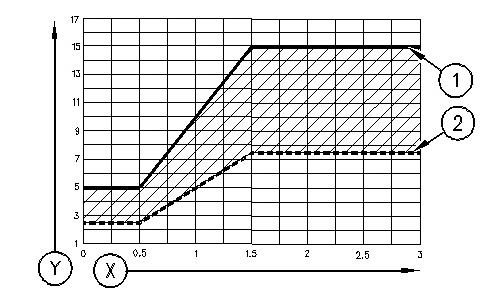
Illustration 1 g00104890
(Y) TBN by "ASTM D2896"
(X) Percentage of fuel sulfur by weight
(1) TBN of new oil
(2) Change the used oil when the TBN reaches this level.
Use the following guidelines for fuel sulfur levels that exceed 1.5 percent:
1. Choose an oil with the highest TBN that meets one of these classifications:
API CG-4
API CH-4
API CI-4
Note: API CH-4 oils and API CI-4 oils are acceptable if the requirements of Caterpillar's ECF1 (Engine Crankcase Fluid specification-1) are met. CH-4 oils and CI-4 oils that have not met the requirements of Caterpillar's ECF-1 Specification may cause reduced engine life.
2. Reduce the oil change interval. Base the oil change interval on the oil analysis. Ensure that the oil analysis includes the condition of the oil and a wear metal analysis.
Excessive piston deposits can be produced by an oil with a high TBN. These deposits can lead to a loss of control of the oil consumption and to the polishing of the cylinder bore.
NOTICE
Operating Direct Injection (DI) diesel engines with fuel sulfur levels over 1.0 percent may require shortened oil change intervals in order to help maintain adequate wear protection.
Lubricant Viscosity Recommendations for Direct Injection (DI) Diesel Engines
The proper SAE viscosity grade of oil is determined by the minimum ambient temperature during cold engine start-up, and the maximum ambient temperature during engine operation.
Refer to Table 1 (minimum temperature) in order to determine the required oil viscosity for starting a cold engine.
Refer to Table 1 (maximum temperature) in order to select the oil viscosity for engine operation at the highest ambient temperature that is anticipated.
Note: Generally, use the highest oil viscosity that is available to meet the requirement for the temperature at start-up.
If ambient temperature conditions at engine start-up require the use of multigrade SAE 0W oil, SAE 0W-40 viscosity grade is generally preferred over SAE 0W-20 or SAE 0W-30.
Note: SAE 10W-30 is the preferred viscosity grade for the following diesel engines when the ambient
• C7
• C-9
• C9
• 3116
• 3126
use multigrade oils that are capable of flowing in low temperatures.
These oils have lubricant viscosity grades of SAE 0W or SAE 5W.
synthetic base stock multigrade oil with a 0W viscosity grade or with a 5W viscosity grade. Use an oil
The number of acceptable lubricants is limited in cold weather conditions. Caterpillar recommends the following lubricants for use in cold weather conditions:
• API classification CI-4 and CH-4 oils that also meet the Caterpillar ECF-1 specification with an SAE 0W20, SAE 0W30, SAE 0W40, SAE 5W30, or SAE 5W40 lubricant viscosity grade.
• An API classification CG-4 oil with an SAE 0W20, SAE 0W30, SAE 0W40, SAE 5W30, or SAE 5W40 lubricant viscosity grade may also be used.
NOTICE
Shortened engine service life could result if second choice oils are used.
Table 1
Engine Oil Viscosities for Ambient Temperatures(1)
Ambient Temperature
Viscosity
SAE 0W-20
SAE 0W-30
10 °C (50 °F)
30 °C (86 °F)
SAE 0W-40
SAE 5W-30
SAE 5W-40
SAE 10W-30(2)
SAE 10W-40
SAE 15W-40

40 °C (104 °F)
30 °C (86 °F)
50 °C (122 °F)
40 °C (104 °F)
50 °C (122 °F)
50 °C (122 °F)
(1) Refer to this publication, "Engine Oil (Recommendations)" for recommendations of diesel engine oil type.
(2) SAE 10W-30 is the preferred viscosity grade for the 3116, 3126, C7, C-9 and C9 diesel engines when the ambient
Note: Supplemental heat is recommended below the minimum recommended ambient temperature. In addition, supplemental heat may be required for cold soaked starts at ambient temperatures that are above the minimum temperature that is stated, depending on the parasitic load and other factors.
Copyright 1993 - 2024 Caterpillar Inc.
All Rights Reserved.
Private Network For SIS Licensees. Mon Apr 22 10:16:23 UTC+0530 2024
Product: TRUCK ENGINE
Model: 3126 TRUCK ENGINE 1WM
Configuration: 3126 Truck Engine 1WM00001-UP
Operation and Maintenance Manual
Cold Weather Recommendations for On-Highway Diesel Truck Engines
Fuel Recommendations
SMCS - 1250; 1280
Characteristics of Diesel Fuel
Lubricity and Low Sulfur Fuel
The fuel lubricity is important. You should consider the fuel's lubricity whenever you operate the equipment in arctic weather. Also, you should consider the fuel's lubricity whenever you use fuels that are lower in viscosity. There are many aftermarket additives that are available to treat fuel. If the fuel's lubricity is an issue, consult your fuel supplier for proper recommendations regarding fuel additives.
Viscosity
The viscosity of the fuel is significant because the fuel serves as a lubricant for fuel system components. Arctic fuels need to have sufficient viscosity. The fuel must lubricate the fuel system at a temperature of 0°C (32°F) or below freezing. If the kinematic viscosity of the fuel is lower than 1.4 cSt as supplied to the fuel injection pump or to the unit injectors, excessive scuffing and seizure can occur.
Cetane Number
The cetane number of the fuel has an effect on the ability of the engine to start. Also, the cetane number has an effect on the interval of time before the engine runs smoothly. Generally, an increase of ten in the cetane number will allow the engine to be started at a lower temperature. The starting temperature can be improved approximately 7 to 8°C (12 to 15°F) for every increase of ten in the cetane number. After the engine reaches the normal operating temperature, a change in the cetane from 40 to 50 will have a minimal effect on engine performance.
During average starting conditions, direct injection engines require a minimum cetane number of 40. A higher cetane value may be required for operation in high altitudes or for cold weather operation. The minimum fuel cetane number that is required for the precombustion engine is 35.
Modifying the Cetane Number
The cetane number of a fuel can be changed if the fuel is mixed with a fuel that has a different cetane number. Generally, the cetane number of the mixture will be in direct relation to the ratio of the fuels that were mixed. Your fuel supplier can provide the information about the cetane number of a particular fuel.
Additives can also be used to improve the cetane number of a fuel. Additives are evaluated through testing in special engines. However, the fuel characteristics of additives are not identical to a natural product. While both fuels may be rated as having the same cetane number, starting may be different.
Cloud Point
It is important to understand that the cloud point of a fuel is different from the pour point. There is no relationship between cloud point and the pour point. The cloud point is the temperature that allows some of the heavier components in the wax to solidify in the fuel. This wax is not a contaminant in the fuel. The wax is an important element of No. 2 diesel fuel. The wax has a high fuel energy content and the wax has a very high cetane value. Removal of the heavier wax lowers the cloud point of the fuel. Removal of the wax also increases the cost because less fuel can be made from the same amount of crude oil. Basically, a No. 1 diesel fuel is formulated by removing the wax from a No. 2 diesel fuel.
The cloud point of the fuel is important because the cloud point can limit the performance of the fuel filter. The wax can alter the fuel characteristics in cold weather. Solid wax can fill the fuel filters. The solidified wax will stop the flow of fuel. Fuel filters are necessary in order to remove dirt from the fuel. The filters block foreign material, and the filters protect the parts for the fuel injection system. Since fuel must flow through the filters, installing a fuel heater is the most practical way to prevent the problem. A fuel heater will keep the fuel above the cloud point as the fuel flows through the fuel system. The fuel heater will permit the wax to flow through the filters with the fuel.
Modifying the Cloud Point
You can lower the cloud point of a diesel fuel by mixing the diesel fuel with a different fuel that has a lower cloud point. No. 1 diesel fuel or kerosene may be used to lower the cloud point of a diesel fuel. The efficiency of this method is not good, because the ratio of the mixture does not have a direct relation to the improvement in cloud point. The amount of fuel with low cloud point that is required makes the process less preferable to use.
The following illustration contains a table that can be used to find the necessary mixture for two fuels with different cloud points. In order to use the table, you must know the exact fuel cloud point of each fuel. This specification can change from one purchase of fuel to the next purchase of fuel. This specification is normally available from personnel at the source of the fuel supply. When fuels that have a lower cloud point are not available, this method cannot be used.
The manufacturer of the fuel can add cold flow improvers to the fuel. Cold flow improvers modify the wax crystals in the fuels. The cold flow improvers do not change the fuel's cloud point. However, the
cold flow improvers keep the wax crystals small enough to pass through standard fuel filters. For mixing precautions, see the topic "Pour Point".
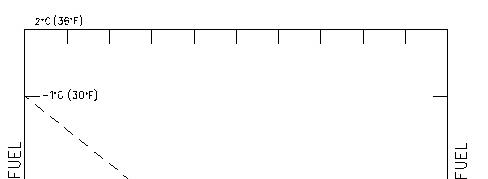
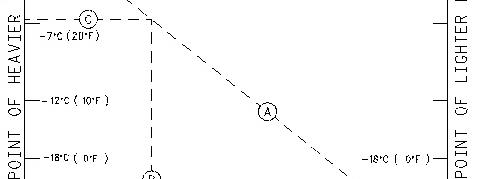
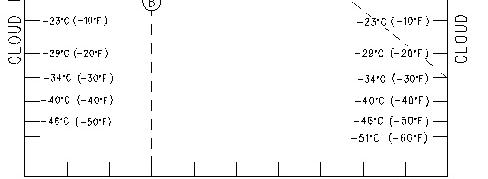

Illustration 1 g00592741
Cloud point of fuel mixtures
Generally, the most practical method that is used to prevent problems that are caused by fuel cloud point at low temperatures is the use of fuel heaters. In most applications, fuel heaters can be used at a lower cost than fuel mixtures.
Pour Point
The fuel's pour point is a temperature below the fuel's cloud point. Fuel stops flowing below the pour point. The pour point is the temperature which limits movement of the fuel with pumps.
To measure the pour point, the fuel temperature is lowered below the cloud point in steps of 3°C (5°F) at a time. The temperature is lowered until the fuel does not flow. The pour point is the last temperature that is shown before the flow stops. At the pour point, the wax has solidified out of the fuel. This makes the fuel more solid than liquid. The pour point of the fuel can be improved. This does not require the removal of important elements. This process is the same process that is used to improve the cloud point of a fuel.
A fuel's pour point should be at least 6°C (10°F) below the lowest ambient temperature that is required for engine start-up and for engine operation. To operate the engine in extremely cold weather, No. 1 fuel or No. 1-D fuel may be necessary because of these fuels' lower pour points.
Modifying the Pour Point
You can lower the fuel's pour point by using additives. You can also lower the pour point of a diesel fuel by mixing the diesel fuel with a different fuel that has a lower pour point. No. 1 diesel fuel or kerosene may be used to lower the pour point of a diesel fuel. The amount of fuel with low pour point that is required makes the process less preferable to use.
The following illustration contains a table that can be used to find the necessary mixture for two fuels with different pour points. This is true only if the fuels do not have additives which change the pour point. In order to use the table, you must know the exact pour point of each fuel. This specification can change from one purchase of fuel to the next purchase of fuel. This specification is normally available from personnel at the source of the fuel supply. When fuels that have a lower pour point are not available, this method cannot be used.
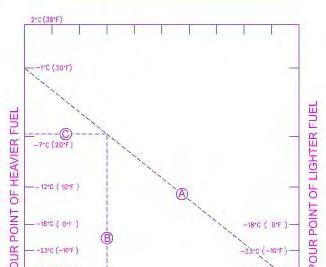
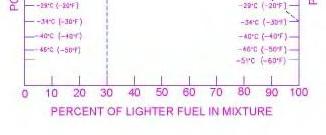
Illustration 2
Pour point of fuel mixtures
In order to calculate the amount of lighter fuel that is required to be blended with the heavier fuel, perform the following steps:
1. Obtain the specification for the cloud point or the pour point of both fuels from your fuel supplier.
2. Locate the cloud point or the pour point of the heavier fuel on the left side of the table. Mark the point on the table.
3. Locate the cloud point or the pour point of the lighter fuel on the right side of the table. Mark the point on the table.
4. Draw a line between the two points that were established. Label this line "A".
5. Determine the lowest outside temperature for machine operation. Find this point on the left side of the table. Mark this point. Draw a horizontal line from this point. Stop the line at the intersection of line "A". Label this new line "C".
6. Line "C" and line "A" intersect. Mark this point. Draw a vertical line from this point. Stop the line at the bottom of the table. Label this line "B". The point at the bottom of line "B" reveals the percentage of lighter fuel that is required to modify the cloud point or the pour point.
The above example shows that the blending will require a thirty percent mixture of lighter fuel.
Additives are a good method to use in order to lower the pour point of a fuel. These additives are known by the following names: pour point depressants, cold flow improvers and wax modifiers. When the additives are used in a low concentration, the fuel will flow through pumps, lines, and hoses. These additives must be thoroughly mixed into the fuel at temperatures that are above the cloud point. The fuel supplier should be contacted in order to blend the fuel with the additives. The blended fuel can be delivered to your fuel tanks.
Moisture Content
Problems with fuel filters can occur at any time. The cause of the problem can be water in the fuel or moisture in the fuel. At low temperatures, moisture causes special problems. There are three types of moisture in fuel: dissolved moisture (moisture in solution), free and dispersed moisture in the fuel and free and settled at the bottom of the tank.
Most diesel fuels have some dissolved moisture. Just as the moisture in air, the fuel can only contain a specific maximum amount of moisture at any one temperature. The amount of moisture decreases as the temperature is lowered. For example, a fuel could contain 100 ppm (0.010 percent) of water in solution at 18°C (65°F). This same fuel can possibly hold only 30 ppm (0.003 percent) at 4°C (40°F).
After the fuel has absorbed the maximum possible amount of water, the additional water will be free and dispersed. Free and dispersed moisture is fine droplets of water that is suspended in the fuel. Since the water is heavier than the fuel, the water will slowly become free and settled at the bottom of
the tank. In the above example, when the fuel temperature was lowered from 18°C (65°F) to 4°C (40°F), 70 ppm of water became free and dispersed in the fuel.
The sma,l drops of water cause a cloudy appearance in the fuel. If the change in temperature is slow, the small drops of water can settle to the bottom of the tank. When the fuel temperature is lowered rapidly to freezing temperature, the moisture that comes out-of-solution changes to very fine particles of ice instead of small drops of water.
The particles of ice are lighter than the fuel, and the particles of ice will not settle to the bottom of the tank. When this type of moisture is mixed in the fuel, this moisture will fill the fuel filters. The ice crystals will plug the fuel filters in the same way as wax plugs the fuel filters.
If a filter is plugged and fuel flow is stopped, perform the following procedure to determine the cause:
1. Remove the fuel filters.
2. Cut the fuel filters open.
3. Inspect the fuel filter before the filter warms. This inspection will show that the filter is filled with particles of either ice or wax.
The moisture which is free and settled at the bottom of the tank can become mixed with the fuel. The force of any pumping action will mix the moisture with the fuel whenever fuel is transferred. This moisture then becomes free and dispersed water. This moisture can cause ice in the filters. This moisture can cause other problems with filters at any temperature. Generally, the same force that mixes the water into the fuel will also mix dirt and rust from the bottom of the tank with the water. The result is a dirty mixture of fuel and water which can also fill the filters and stop fuel flow.
Preferred Fuel Grades
The two main types of diesel fuel that are available for your truck engine are typically low sulfur No. 1 diesel fuel and low sulfur No. 2 diesel fuel. Although No. 2 diesel fuels are the most commonly used fuel, No. 1 diesel fuels or a blend of No. 1 diesel fuel and No. 2 diesel fuel is best suited for cold weather operation.
There are three major differences between No. 1 diesel fuel and No. 2 diesel fuel.
• No. 1 diesel fuel has a lower cloud point. The fuel cloud point is the temperature when a haze appears in the fuel. When the temperature falls below the melting point of the paraffins a haze results. Paraffins are a wax that naturally occurs in petroleum products. The wax can alter the fuel characteristics in cold weather. Solid wax can fill the fuel filters. The solidified wax will stop the flow of fuel. The cloud point must not exceed the lowest expected ambient temperature or other precautions must be taken. Installing a fuel heater is the most practical way to address problems with the cloud point.
• No. 1 diesel fuel has a lower pour point. The pour point of the fuel is the temperature that is 3 °C (5 °F) above the temperature that is required for fuel to flow. Fuel stops flowing below the pour point. A fuel's pour point should be at least 6°C (10°F) below the lowest ambient temperature that is required for engine start-up and for engine operation.
• No. 1 diesel fuel has a lower rating for kJ or Btu per unit volume of fuel than the average No. 2 diesel fuel.
Table 1
Fuel Recommendations for Ambient Temperatures
Fuel Type Temperature Range(1)
No. 2 Above 0 °C (32 °F)
No. 1
(1) Contact your Caterpillar dealer for information regarding the acceptable fuels and/or the acceptable blends, if there is potential for colder operating temperatures.
No. 2 diesel fuel may be blended with No. 1 diesel fuel or blended with kerosene in the following proportions in order to achieve the capability to flow at lower temperatures.
Table 2
Modification of No. 2 Fuel
(1) Never blend the fuel with gasoline under any circumstances.
No. 1 diesel fuel does not have the same energy per unit volume as No. 2 diesel fuel. No. 1 diesel fuel has less energy per unit volume. A reduction in power and fuel efficiency may be noticed with No. 1 diesel fuel or a blend of No. 1 diesel fuel and No. 2 diesel fuel but other operating effects should not be experienced.
Check the type of fuel or the fuel blend that is being used before troubleshooting for poor performance during the winter. Be aware of these values when you purchase diesel fuel. Anticipate the average outside temperature for the area for operation of the engine. Engines that are fueled in a warm climate may not operate satisfactorily if the engine is moved to a cold climate because of problems that result from cold weather.
permitted. These fuels are lighter than No. 2 grades, but these fuels must have a minimum cetane number of 40. Refer to the chart in the Special Publication, "Caterpillar Specifications for Distillate Diesel Fuel".
Table 3
This is the sample of the manual click on the download link for complete manual
DOWNLOAD LINK
For some reason if link does not work download this pdf and then click