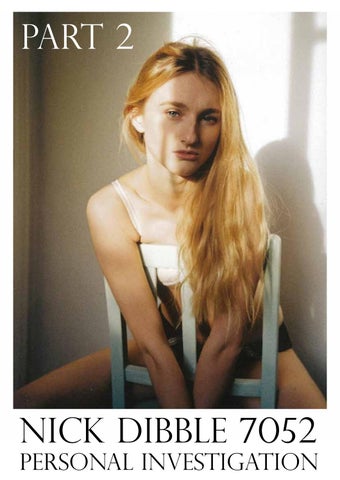
part 2
NICK DIBBLE 7052
PERSONAL INVESTIGATION
Experimenting with Film explain..
h
introduction to journals
Scan photos in from small book that arent in this book and put into edits.
Evaluation
explain why i like this layout
Add bigger
Add bigger
Add bigger
Explain page breakers
Evaluate polaroids
title page: Small Journals Development
3 Journal Development Title Page
Physical Experimantation Polariods, burning hot knife etc.
evaluation of small journals explain Journals in VHS Tape Boxes Photos
Title Page Film Development
Developing Film title Page
Developing ideas for film
Developing ideas for film
Developing Look Book Title Page
Film development Digital development
Screenshots of final film.
Evaluatuion
Title Page Look Book Development
Tape box Development Individual images include box template
Tape box Development Images that are presented over a number boxes
Planning for exhibition installation Sketch
Final Evaluation
Essay Development title page
Essay Plan
Can photographers capture the true feelings, moods and emotions of modern youth?
Nick Dibble
‘The thing about youth culture is that I don’t understand it’ says the grandparent that does not remember their own teenage years. Youth Culture is something that can be perceived and interpreted many different ways, in this personal study I intend to investigate whether photographers can capture the true emotions and feeling of the youth or whether this subject matter is too complex to define through photographic image alone. I will be looking beyond the stereotypical views of what adults feel define modern youth, which include mediations like trouble makers, riot starters, mouthy and of course rude towards our elders. I am looking to define the more complicated and often subtler aspects of growing up and finding your place in modern society, the real emotions and feeling of this often misunderstood section of the population. I will focus on these elements when assessing the success of photographs that capture the feelings of modern youth. The theme of my personal investigation is the Identity of youth and I have studied modern photographers who have an empathy and understanding of this subject matter, these new breed of photographers are spontaneous and reactive using social media and photography blogs to communicate their art to selected audiences. This photograph was taken by an American born photographer, 18-year-old, Olivia Bee. This photograph has been published in a book called “Kids in Love”. Immediately, we can base this book around adolescence and ‘youth’ because of the word ‘kids’. We don’t quite know what the term ‘in love’ could mean, yet we can stereotypically associate it with ‘young love’ and relationships. The photography is named ‘4th of July’ and a subtitle of “Family you choose”. This suggests that the bond between teenage friends are strong and unbreakable. Referring to friends as family shows the relationship they have with each other too. Teenagers like to push boundaries and break rules, so this image suggests that they are daring by swimming at night time half naked. This photograph depicts the fun and spontaneity of teenage life without the guidance of an adult. It shows that they are ‘in love’ with being rebellious and daring by going in the sea at night without a life guard or guidance from an adult that teenagers need, which relates back to the title of the book. Cleverly, Bee has made the teenagers wear red, white and blue which are the colours in the American flag or is this just coincidence? These little details intrigue us and give us clues as to what this picture means if we had no caption. If you closely look at the two males, you will see a third person in the middle of them. I didn’t notice this at first and it makes the composition more interesting to look at for you find details by studying the photograph further. Society has a pre conceived ideology about how teenagers live and what they stereotypically do. This photo shows teenagers having harmless fun instead of supporting the negative stereotypes. Friends are hugging close together, which suggests that the relationship between these 3 people is very strong and is a bond that can’t be broken. This reminds me of the phrase ‘friends for life’ as many adults say that some relationships that you create will always stay. Again, this links back to the title ‘Kids in Love’. The composition has a central focal point, and a shallow diagonal line the wave which has crashed against the teens legs is slightly at an angle; this breaks up the harsh subject focus in the middle of the image, which is why it is so effective, giving a feel of movement. The sea slowly fades into the background and so the foreground stands out more vividly. The harsh white from the crashing waves contrasts the harsh black which reflects a good contrast between the two. I can tell that Bee has used flash to make the subject stand out more noticeably and the light on the skin is quite harsh. This allows us to see the different skin tones that both teenagers have, allowing the dark background of the night sky to frame the image. In contrast to Bee’s ‘family you choose’ we can now look at Lehtola’s photograph from his ‘Finnish youth project’. Both these photographers have made these images portraying an intimate mood as if they are all sharing a moment which is important to them. However, Lehtola’s photograph below conveys a rebellious mood because of the smoking and the consumption of alcohol. I can understand why people may think that Lehtola’s image plays to the stereotype that teenagers are up to no good. However, I would see it as teenagers
enjoying themselves and trying out things that were once restricted. The two environments are juxtaposed as Bee’s looks more serene, whereas Lehtola’s looks more confrontational. “I try to capture innocence and rage. Anyone who has been a teenager knows it ain’t fun. It’s not a very nice situation”. - Lehtola Lehtola is a Finnish photographer who captured a teenagers expressive and exploratory stage in their lives. These candid images perpetuate the youth in Finland in the 90’s which was a time known for raves and reckless behavior. Which has been documented by a number of other photographers and film makers. In this photograph, we see 3 teenagers that all look like they are under the influence of alcohol or drugs. The topless man on the left looks like he is the ‘Alpha male’ in this image because of his confidence that he possesses. We believe he’s confident because lack of clothing, which means he is comfortable with his body and with his direct eye contact with the camera. The two teenagers on the right are staring at him. the woman is looking at him in an admiration type of way because of her eyes she has pushed her body against his The boy on the right of the image looks like an outsider, he is staring in amore uneasy way maybe because he is scared of the other male or even is envious of him. Even though the female has her arm around him she is closer to the topless male. We see the man on the left smoking and drinking and he is the only one visibly doing that. Again, this shows confidence and supports the stereotypical view that teenagers are reckless and like to lose control. The man, who is topless, looks like he has had his appendix removed or he has been in an accident. A lot of people have their appendix removed, but by having this scar on the subject matter, that seems to be the most reckless, it makes him look more tough and intimidating in comparison to the boy on the right. You can tell that this is a 90’s party because of the clothing that they’re wearing and the hairstyles. All of these factors are iconic to the 90’s, which makes it almost nostalgic for the youth of the 90’s, depicting a specific mood of this decade. Lehtola is portraying what a real teenager’s life is like. He is conveying an exciting, experimental stage in many teens lives and this makes every teenager feel more comfortable with what they’re going through. Lehtola has shown a strong similarity to Bee’s work by shooting a comfortable situation and by portraying an accurate representation of teens. The photographer has tried to capture a boundless emotion because of the underage drinking and the smoking. It feels like this photograph has been taken by another member of the party rather than a photographer documenting the lives of teenagers.
Igor Pjörrt was born in 1996, Portugal and is currently based in London. We are looking at one of his photos from the series ‘Melancholy 1’, which is about “The symbolic condition of growing up in the confinement of the ocean and under the impression of being stopped in time.” These photos were taken in Portugal and judging by the title ‘Melancholy’, I can clearly see that he misses his country and the people that he has left to go to London. In the photo, the subject matter is clearly PJÖRRT’s friends all spending time together in a bath tub. Because they are all in the bath together. It suggests that they all have a close relationship with each other, It looks as if they have all been drinking, the two women look drowsy and under the influence of alcohol or staying up late at night because of their expressions. One of the women is not wearing a bikini or any clothing, as far as we know, and we can’t see if the men are either because of the bubbles. This implied nude, or actual nudity, still suggests that they all have an intimate relationship and that they are comfortable with themselves and one another. This shows that closeness, which is similar to Bee’s photograph as both friendship groups are sharing an intimate moment. The woman, who is holding the glass, looks as if she is celebrating something. She could be making an announcement because of the way she is holding the glass almost as if she is raising a toast. Lehtola and Pjörrt have photographed the youth in different eras. Lehtola has taken pictures form the 1990’s, this can be seen with the direction and style of fashion and youth posturing. In to this contrast this, PJÖRRT and Bee have taken photographs that are less defined by an era being more subtle and open to interpretation. The quality of PJÖRRT images are clearer and have varied connotations because of the use of colour. Lehtola used positioning and narrative to convey a particular story. You can see that Lehtola’s picture was taken on film and I believe that it is more recognisable because of the colour and the slight grain. This image was taken before digital broke through and dominated the lens based world. These photographers are a vital part of my personal study because of the photographic technique and their ability to understand and emphasise with the subject matter.
Nan Goldin was born in Washington D.C, 1953 and is known for her powerful photography, this particular piece, ‘Amanda in the mirror’ was shot in 1992. In this photograph, the subject matter is Amanda, who looks as if she is putting on makeup. This image is visually intriguing because of what is included within this image. For example, behind Amanda, you can see dirty towels that haven’t been folded and look as if they’ve recently been used. This could suggest that this woman has recently just had a shower because of these towels and because of the shine in her hair. Her mirror is also dirty and dusty, which gives a really cold and negative feeling; alongside the lighting being dark and including a dark green tint. This woman could be getting ready for a night out as she is seen putting on makeup in a dark environment. However, her face is so pale and contrasting her top and the background, which is why I could think that the background is so dark. It’s interesting to see that there is one light which is shining on her. This suggests to us that she is the focus of this image so our attention is immediately drawn to her and what she is doing. I feel like I can’t emotionally attach
myself to her because all I am looking at is a reflection- not her true identity. She’s not looking directly at the camera either to show that she is concentrating on herself and herself only, which separates us even more from the actual image. Society often forces women to believe that every woman should have visible breasts that are large and noticeable for the pleasure of other people. In this image, I believe that there are androgynous qualities such as her vest top. It completely detracts people’s attention because her breasts aren’t visible. We are immediately focusing on her face, which should be the main focus anyway. Her hair is slicked back instead of letting it flow. Her hair is also relatively short which breaks the expectation that women should have long hair. This relates to my theme of youth culture by showing a raw representation of different people. Not everyone acts or looks the same as everyone else. Nan Goldin mainly looks at LGBT themes such as drag. By including this relatively masculine woman in her work suggests diversity and possibly struggle because of the dark emotion we get from looking at it. Goldin, Bee, Lehtola and Pjörrt share similarities of capturing candid images that have a strong narrative behind them. By looking at the small details in each frame, you can see that each one has a distinctive narrative to tell, that is personal to the model in the frame. For example, there is a strong theme of friendship and love in Bee’s image, and Goldin’s image conveys insecurities and being true to who you are, even being alone. They both have a very distinctive style and emotion. The emotion of Bee’s image is very bright and warm because of the colour of their skin and the human interaction. Whereas Goldin’s image portrays a strong isolated emotion and because there is no one else in the frame apart from one women, it makes it look very ghostly because of the colour too. However, both photographers capture youth in a different way. Bee captures youth in a positive and daring way. Whereas Goldin represents the struggle and self-love that a teenager goes through. This is why these two photographers are a vital part of my research as they show two contrasting emotions. Petra Collins is a Canadian artist and photographer, who enjoys taking provocative, relaxed and authentic images of people. She is a strong feminist and enjoys taking images of women that portray a strong feministic approach. This photograph is the only photograph that actually follows a strong narrative and has purposely been constructed, instead of being candid and taken randomly. Even though this photograph has been planned, I still believe that it represents youth in a clear and accurate way. The main focus in this image is Tavi Gevinson who takes on the role of being a teenage school girl. There are important details such as the Disney land images on her wall that are juxtaposing the images of the cars and men. This shows a slow transition from childhood to becoming an adult. She also has cuddly toys on her bed that could also juxtapose the images because it could mean that her parents are still treating her as a child instead of allowing her to grow up and experience the world. We can see that she is turning into a teenager/ young adult because of the perfume bottles in the background. It portrays that this young woman is transitioning into a mature woman instead of being that young child. Her facial expression looks very confused and almost sad because she is staring into one space. She looks as if she is thinking about something serious that plays on her mind and has similarities to Goldin’s photo. Stereotypically, we would think that this would be about love and first love. Her facial expression isn’t positive, but is tired and almost hazed. She is resting her head on her pillows as a form of support and comfort. She is laying comfortably to show that she feels comfortable and relaxed in this particular environment when she can get privacy and time to herself. There is a green tinge in the image and green has a connotation to jealousy. I believe that Collins has twisted the provocative approach to girls in uniform by making the uniform baggier, creased and done up. Normally, there is a sexualised connotation to women in uniform, which is degrading and objectifying. However, by dressing the model like this, it breaks that ideology and reconstructs it. The colours on this have low saturation to reflect a mute and dull mood. This matches her facial expression and makes us feel ‘down’ just like she is. Petra Collins has captured youth in a more constructed way in comparison to photographers such as Lehtola.
However, she still represents youth in an accurate way that is very true to modern day society. She captures a strong emotion that allows us to unravel a deeper story/ narrative, which is why she relates to my question. Collins and Bee are, to me, the most similar photographers that I have researched purely because of the strong narrative and the positioning of characters within the frame. They both capture a personal story that has still been constructed for an audience. A lot of these photographers such as Lehtola and Tom Wood, who you will know more about in the next paragraph, shoot strictly with a goal of proving to the world that this is what youth is like. They both have a raw representation because of the candid images that they produce. Whereas Bee and Collins, construct a story through posing and detail. All these photographers portray youth in a different way, yet they all create a semantic overview that gives the audience an idea of what the youth are really like in modern and traditional eras.
Tom Wood was born in Ireland in 1951 and predominantly photographs life in small areas in the north, mainly in Liverpool and Merseyside. Throughout his work, I can see that he has predominantly photographed people in pubs and clubs. I chose to focus on Wood’s work because there seems to be a strong theme of interaction between every day, normal people. My question is about how photographers capture emotion through images and I believe that there is a strong lustful emotion that is portrayed through his photography. A constant theme of love and attention is within this series of photographs and it’s interesting to see how people interact with each other in such a social environment. These photos are from a working class environment from Liverpool and in the 1980’s, clubs and pubs were popular and held a strong sense of community in a small area. Margret Thatcher was in power and started to slowly break down the north and the communities as everyone was becoming poorer and jobs were becoming more scarce. By creating a series of photographs that depicts a strong sense of love and friendship, it juxtaposes the depressing emotion that the 80’s held against the working class. In this photograph, you can see three women and an unknown man. The woman at the back on the left is looking confused and in some case bored as she is looking around and not talking directly to the man that is leaning against the wall. The woman sitting down at the front is the subject matter of this photograph and immediately grabs my attention. She looks as if she is lonely, could be drunk and is having no luck when it comes to social interaction. She has her clutch bag on her legs and is somewhat hiding it by covering it with her arm. By including a couple that are interacting right next to her, it makes the woman sitting down look lonely and sad because of what has been included in this particular composition. The woman, that is latching onto the man’s leg, looks as if she is in love with this man and that she needs protection and security from him. It’s very stereotypical in the sense that he has his arm around her, looking dominant whilst she is submissive and needs to be cuddled and protected. All three women are looking at different parts of the room instead of
looking directly into the camera. This allows the image to look candid and not planned, which juxtaposes Petra Collins’ work, but similar to Lehtola’s. The man’s face is hidden, which, to me, leaves a connotation of suspicion and trouble. Wood clearly wanted to leave a mysterious element to this image by not including the man’s face in the composition which makes us want to find out more about the woman’s relationship with this man and if it’s safe. The intentions of this photograph were to make us feel nostalgic and understand different types of love just through different fashion expressions and body language. Wood has allowed us to identify what each person is like in social events like this, which is interesting to me. Wood relates to my question because he portrays a strong mood and emotion that can be easily identified through key aspects of this photograph. He’s showing what young people are like in the 80’s and what the effect on alcohol can have on people and what love can do to different individuals. Most photographers, that I have studied, have recently progressed onto adulthood and have left their teenage years behind. Because they are young, maybe this allows them to connect with the youth of today a lot easier than older generations? I believe that they understand the moods and emotions, that can complicate teenage life, which is why they have produced such accurate images that are iconic to the time that they were taken in. All photographers have a passion, or an affinity towards youth culture. The constant reinvention of youth is conveyed through their work because of the emotion that is being emitted. Each environment, that all these photographs were taken in, are all intimate, but in different ways. They are all photographed in surroundings that they feel most comfortable in, which shows that they are all real people. I wanted to portray an accurate and realistic representation of youth culture, and because these locations are so personal it allows each person within the photograph to feel comfortable and look like real, genuine people. There will be a strong variation in opinion when looking at these photos, depending on the person. Maybe it’s the viewer’s memories and personal experience of being a youth that helps define their feelings towards the photographs. What I have also discovered from researching these photographers is that all photographs portray a connection, or a relationship between people. Teenage years can be difficult and some people can feel isolated when growing up. However, by incorporating relationships and a sense of interaction allows us to understand that love and friendship is what helps contribute to growing up in a challenging environment as a teenager. These photographers have avoided the negative stereotype and the depiction of modern youth by visually explaining that interaction between people is important, and is a key convention to happiness. What makes it more reassuring is that these photos are predominantly candid, which proves that the youth know how important love and relationships between people are. Teenagers shouldn't be portrayed as demonic people that go round and cause trouble towards society. There is a lot more to growing up and being part of the modern youth than what is made out. These photographers portray topics such as: Being young, experiencing new emotions, friendship, passion, intimacy, love, maturing, humour, expressing yourself, lack of responsibility and of course- culture. This personal study affected my investigation as it made me want to portray what youth culture means to me, personally. Before, I studied the traditional outlook on fashion photography and stereotypical beauty within the fashion industry. While writing the personal study, I became more interested to record real people instead of create a fake representation that is not ideological to everyone. I wanted to show what youth culture is; not just to us, but to other generations that may not accept/ believe what we really are like. Each photographer has displayed what youth was like in traditional society and what youth is like in modern day. The moods are similar, but are just portrayed in different ways. Whether the images are candid or planned, we can still see the love and a variety of experiences the youth faces. Now tell me, do you still not understand youth culture?
Bibliography : ‘Finnish Youth’ by ‘The Library Project’, [January 2017] http://tlp.photoireland.org/photobooks/finnish-youth/ Gevinson T., Olivia Bee, Kids in Love, Aperture, 4th April 2016 'Tavi Gevinson in her bedroom by Petra Collins’ by ‘Old Hand’, [January 2017] https://uk.pinterest.com/pin/299770918920039582/ Olivia Bee: People don’t take me seriously until they see my work, [20th January], https://www.theguardian.com/artanddesign/2013/feb/24/olivia-bee-interview-photographer-hermes ‘Capturing Fleeting Moments of Finnish Youth’ by Ashleigh Kane, [January 2017] http://www.dazeddigital.com/photography/article/25338/1/capturing-fleeting-moments-of-finnish-youth ‘Melancholy' by Igor Pjorrt, [January 2017] http://www.igorpjorrt.com/melancholy#7 ‘Nan Goldin- Born 1953’ by ‘The Tate’, [January 2017] http://www.tate.org.uk/art/artists/nan-goldin-2649 'Nan Goldin, Amanda in the mirror, Berlin 1992’ by Matthew Marks Gallery [January 2017] https://uk.pinterest.com/pin/565624034426657061/ ‘Petra Collins’ by Wikipedia, [December 2016] https://en.wikipedia.org/wiki/Petra_Collins 'Political, provocative, personal: photography to look forward to’, by Sean O'Hagan [March 2017] https://www.theguardian.com/artanddesign/2012/aug/16/photography-preview-autumn-winter-2012 'Tom Wood, Making Sense, by Jane Fletcher, [March 2017] http://issuemagazine.com/tom-wood-making-sense/#/ ‘The Work of Tom Wood’ by ‘We- English’, [January 2017] http://we-english.co.uk/blog/2010/03/09/the-work-of-tom-wood/