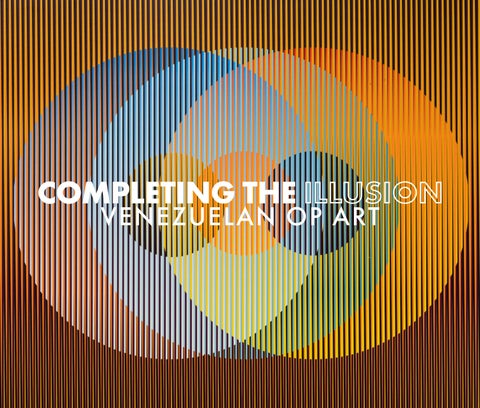
Completing the Illusion: Venezuelan Op Art (July 24 - October 9, 2026) brings together some of art history’s most important op art creators. Each of these artists brought their own style and sleight of hand to the medium, contributing to an international genre while also forging a movement unique to Venezuela, their shared home country. Each artist created motion without machinery. These beautiful works trick the eye and engage the brain; no motor or batteries required. The common thread is the viewer, the unknown observer whose participation activates the illusion.
These artists were integral to that larger international genre, each studying or working in Paris at some point. And yet, viewed together, a distinct national identity emerges. Since 1863, Venezuela’s coat of arms has borne the motto “Dios y Federación” — “God and Federation.” Shared responsibility and participation lie at the core of the country’s values, and that inclination runs through each artist’s work, even as their approaches and scales vary. Where Cruz-Diez employs optical artifice through color, often on an intimate scale, Soto uses wire and suspension to create works large enough to walk through. Salazar creates movement from light and shadow, while Barrios constructs the illusion of shape shifting. All four, however, depend on the viewer’s participation to achieve their ultimate goal of shifting perception. Just as federation asks a nation to complete itself through participation, the artwork is not finished until you are standing in front of it. Each artist created illusion in his own way, but the communal spirit of engagement runs through all of their work.
photos: Completing the Illusion: Venezuelan Op Art Installation at Heather James - Palm Desert, California
Heather James is honored to donate proceeds from this exhibition to relief efforts following the devastating earthquakes that struck Venezuela in June 2026.
COMPLETING THE ILLUSION: VENEZUELAN OP ART
3
RAFAEL BARRIOS CARLOS CRUZ-DIEZ FRANCISCO SALAZAR JESÚS RAFAEL SOTO ABEL VENTOSO
CARLOS CRUZ-DIEZ
Born in Venezuela, Cruz-Diez lived and worked in Paris. He studied at the Escuela de Artes Plásticas y Aplicadas in Caracas, training in both art education and fine art. He also studied advertising in New York and served as art director for an advertising agency in Caracas, traveling to Europe, where he encountered geometric abstraction and the Bauhaus ideas of combining art and industry. He worked as well as a designer and illustrator, and his professional experience in advertising, combined with his exposure to photography and the new artistic ideas he encountered abroad, inspired him to explore color concepts within a new medium — one responsive to, and representative of, the demands of modern society. Carlos Cruz-Diez was known internationally for his experiments with Op and Kinetic art, which he developed beginning in the 1950s. In his work, movement was an optical illusion, produced through a sophisticated use of light and color to create virtual volumes that changed depending on the position of the viewer. Throughout his career, he focused consistently on color, line, and viewer perception. The Physichromie series, which Cruz-Diez began in 1959, combined painting with sculptural relief. Works in the series comprised a painted background of narrow vertical colored lines, onto which vertical plastic divisions were placed at right angles. As the viewer passed each piece, previously invisible colors and geometric forms emerged, and the entire chromatic field appeared to vibrate. It became one of the defining bodies of work in his exploration of color and perception.
COMPLETING THE ILLUSION: VENEZUELAN OP ART
9
Color Aditivo Panam Círculos 9 Signed verso, “Cruz-Diez” chromography and pigments on aluminum 39 3/4 x 78 3/4 in. 2010
10 COMPLETING THE ILLUSION: VENEZUELAN OP ART
CARLOS CRUZ-DIEZ Color Aditivo Panam Círculos 9
Color Aditivo Panam Círculos 9 (2010) belongs to Color Aditivo, a line of research distinct from his better-known Physichromies, in which adjacent colored forms generate a third, virtual color that exists only in the eye of the viewer. Cruz-Diez was one of three founding figures, alongside Jesús Rafael Soto and Alejandro Otero, of the Venezuelan Kinetic Art movement, and this work was executed in 2010 at his Panama City atelier, one of three studios he maintained alongside Paris and Caracas. Rendered in chromography and pigment on PVC, the composition builds from overlapping circular fields of blue, orange, pale green, and cream, their edges bleeding into one another so that new hues seem to hover between them rather than sit on the surface. Fine vertical ridges run across the entire picture plane, shifting the color relationships as the viewer moves past it. The circular vocabulary marks this as part of the Círculos sub-group within Panam Color Aditivo, distinct from the triangular and other geometric variants Cruz-Diez produced in the same series around 2010.
COMPLETING THE ILLUSION: VENEZUELAN OP ART
11
CARLOS CRUZ-DIEZ Physichromie Panam 106
Physichromie Panam 106 (2013) belongs to the Panam sub-series of his signature Physichromie project, works produced at his Panama City atelier, one of three studios, alongside Paris and Caracas, where CruzDiez and his team worked across more than five decades. Cruz-Diez was one of three founding figures, with Jesús Rafael Soto and Alejandro Otero, of the Venezuelan Kinetic Art movement, and the Physichromies, debuted in Caracas in 1960, remain the clearest expression of his lifelong project: capturing color as a physical, light-based event rather than a fixed pigment. At nearly six and a half feet wide, the work is built from strips of color inserted into and projecting from an aluminum support, so that its bands appear to shift and reorganize as a viewer moves past it, the composition never quite the same from two vantage points. Cruz-Diez produced it using tools he adapted or invented himself for the Panama studio, rendering it in chromography and pigment on aluminum, the atelier’s standard practice for large-scale Physichromies of this period. More than fifty years after he first proposed that color could be generated by the viewer rather than fixed by the artist, Physichromie Panam 106 carries that idea into the monumental scale his late studio practice increasingly favored.
12
COMPLETING THE ILLUSION: VENEZUELAN OP ART
Physichromie Panam 106 Signed verso, “Cruz-Diez” chromography and pigments on aluminum 39 3/4 x 78 3/4 in. 2013
COMPLETING THE ILLUSION: VENEZUELAN OP ART
13
Physichromie 1530 Signed verso, “Cruz-Diez” chromography and pigments on PVC 39 3/4 x 118 in. 2008
14
COMPLETING THE ILLUSION: VENEZUELAN OP ART
CARLOS CRUZ-DIEZ Physichromie 1530
Physichromie 1530 (2008) belongs to the panoramic-format examples within the Physichromie series he first proposed in Caracas in 1960 and continued refining for the rest of his life. Cruz-Diez was one of three founding figures, alongside Jesús Rafael Soto and Alejandro Otero, of the Venezuelan Kinetic Art movement, and in 2023, the artist’s centenary, his achievement was celebrated with RGB: The Colors of the Century, a touring exhibition organized in partnership with the Centre Pompidou. At nearly ten feet wide, the composition unfolds across five distinct color zones, each built from Cruz-Diez’s signature vertical color strips: a cool lavender panel gives way to warm gold, then green, teal, and a final olive-yellow band, the palette shifting register by register rather than blending. Rendered in chromography and pigment on PVC, the ridged surface catches light differently as a viewer passes in front of it, so the sequence of colors seems to travel with the eye rather than sit fixed on the wall. With the artist’s centenary renewing institutional and market attention alike, a large-format Physichromie like this one sits squarely within the scale and period collectors have prized most.
COMPLETING THE ILLUSION: VENEZUELAN OP ART
15
CARLOS CRUZ-DIEZ Physichromie 1800
Physichromie 1800 (2012) extends a series the artist debuted in Caracas in 1960 and continued, largely unbroken, for the rest of his career. The Physichromies remain his signature body of work: an attempt, in his own words, to capture color as a physical, light-based event rather than a fixed pigment. Built from strips of color inserted into and projecting from the support, the composition shifts as the viewer moves past it, passing from nearblack at the top through bands of gold, burnt orange, coral, and deep maroon, as if a sunset had been compressed into a single frame. CruzDiez rendered this example, numbered 2 of 8, in chromography and pigment on PVC, the strip construction giving the surface a literal depth and flicker that no flat photograph can fully convey. A closely numbered work from the same body, Physichromie 1839 (2013), is held in the permanent collection of the Centre Pompidou, alongside further examples at the Museum of Modern Art, Tate Modern, and the Museum of Fine Arts, Houston. More than fifty years into the Physichromie project, Cruz-Diez was still refining the same basic proposition: that color is not painted but experienced, generated anew each time a viewer steps in front of the work.
16 COMPLETING THE ILLUSION: VENEZUELAN OP ART
Physichromie 1800 Signed verso, “Cruz-Diez” chromography and pigments on PVC 11 3/4 x 23 1/2 in. 2012
COMPLETING THE ILLUSION: VENEZUELAN OP ART
17
Physichromie 250 Signed verso, “Cruz-Diez” acrylic and plastic elements on wooden panel with wood frame 39 3/4 x 39 3/4 in. 1966
18
COMPLETING THE ILLUSION: VENEZUELAN OP ART
CARLOS CRUZ-DIEZ Physichromie 250
Physichromie 250 (1966) falls early in the Physichromie series, begun in 1959, and dates to the same years in which Cruz-Diez first won critical and commercial recognition in Paris. Cruz-Diez was one of three founding figures, alongside Jesús Rafael Soto and Alejandro Otero, of the Venezuelan Kinetic Art movement, and works numbered, like this one, from No. 1 through roughly the 400s were typically executed in acrylic and plastic elements on wood, before Cruz-Diez’s later move to aluminum supports in the 1970s. A band of large color fields, in blue, green, and burnt orange, runs across the center of an otherwise blank white panel, each one built from vertical plastic strips set into the wood support so its color shifts as a viewer changes position. The wide white margin above and below concentrates the optical activity into a single horizontal band, giving the piece a directness rare in Cruz-Diez’s later, more elaborate work. It is executed in mixed media on wood, consistent with his early-period studio practice, and signed by the artist verso. Physichromie 250 dates to the years just after the artist settled in Paris and began exhibiting internationally, making it an early document of the ideas about color and perception that would occupy him for the rest of his career.
COMPLETING THE ILLUSION: VENEZUELAN OP ART
19
CARLOS CRUZ-DIEZ Cromovela No. 7
Carlos Cruz-Diez’s Cromovela No. 7 (1995) extends his lifelong color research into a freestanding, vertical, totem-like form rather than the flat panels of the Physichromies. Cruz-Diez was one of three founding figures, alongside Jesús Rafael Soto and Alejandro Otero, of the Venezuelan Kinetic Art movement, and the Cromovela series occupied him across more than two decades and multiple materials, from these PVC examples through a monumental public installation in Panama City in 2014 and a polychrome ceramic edition in 2018. Executed in acrylic lacquer on PVC, the sculpture’s banded color wraps continuously around a tapering column, so a viewer walking around it experiences a shifting sequence of hues rather than the single fixed image of a flat Physichromie. Here the palette moves from warm copper and rust near the base through cooler blues, teals, and violets toward the top, the twisting silhouette of the column echoing the way the bands seem to rotate as the eye travels upward. Cromovela’s public ambitions are visible in a large-scale 2014 installation, in enamel on steel, at Cinta Costera III in Panama City, and a further edition realized in polychrome ceramic in 2018. This early, hand-signed Cromovela offers a rare sculptural counterpart to that better-known body of work.
20
COMPLETING THE ILLUSION: VENEZUELAN OP ART
Cromovela No. 7 Signed and titled on the base, “Cromovela No 7 / Cruz-Diez / Jun 1995” acrylic lacquer on PVC 45 5/8 x 17 x 11 in. 1995
COMPLETING THE ILLUSION: VENEZUELAN OP ART
21
JESÚS RAFAEL SOTO
Jesús Rafael Soto was a visionary Venezuelan sculptor, painter, and a towering figure of the post-war avant-garde who fundamentally redefined the relationship between artwork, space, and the viewer. Born in Ciudad Bolívar, Venezuela, Soto began his artistic journey as a self-taught poster painter before studying at the School of Fine Arts in Caracas. In 1950, drawn by the vibrant European art scene, he relocated to Paris, where he participated in the historic 1955 exhibition Le Mouvement, which officially launched Kinetic and Op Art into the international spotlight. Soto’s revolutionary practice moved art beyond flat representation into a realm of pure perception and physical movement. He achieved this through the precise manipulation of industrial materials, such as nylon filaments, thin steel rods, wire, and Plexiglas. By superimposing these elements over densely striped or geometric backgrounds, he produced the Moiré effect. His ultimate breakthrough arrived in 1967 with the creation of the Pénétrables. These legendary, large-scale public installations consisted of thousands of hanging plastic or nylon tubes suspended in space. By inviting viewers to physically walk through the dense rows of colorful strings, Soto shattered the traditional boundary between onlooker and art piece. Today, Soto’s monumental public commissions and interactive installations are celebrated worldwide, preserved in major institutions like MoMA in New York and the Centre Pompidou in Paris.
COMPLETING THE ILLUSION: VENEZUELAN OP ART
25
JESÚS RAFAEL SOTO Negro y Color (Black and Color)
Jesús Rafael Soto’s Negro y Color (Black and Color) (1995) extends the principles of his Ambivalencias series into the artist’s mature late work. Begun in the late 1970s as an evolution of his earlier Vibraciones, the Ambivalencias introduced bold color into Soto’s optical equation — recognized today as one of the defining phases of his career, alongside the Agujas, Vibraciones, and Penetrables. The composition divides into two registers. Across the upper half, a grid of low-relief black squares projects subtly from a black ground, an architecture of light and shadow. The lower half erupts into a blackand-white striped backdrop overlaid with colored squares — red, yellow, ultramarine, emerald, violet, ochre, brown — floating forward on shallow supports. As the viewer moves before the piece, the stripes set the panels into apparent vibration, the eye unable to fix them in stable space. Soto led the kinetic movement alongside Yaacov Agam, Jean Tinguely, and Victor Vasarely, drawing on physics, mathematics, music, and color theory. His commissions placed his work inside UNESCO’s Paris headquarters (1969), the Grand Hall de la Régie Renault (1975), and the Volume Virtuel at the Centre Pompidou (1987). Works are held by the Tate, MoMA, Museum Ludwig, and Centre Georges Pompidou. Still undervalued relative to his European peers, Soto offers here a defining example of postwar optical art.
26
COMPLETING THE ILLUSION: VENEZUELAN OP ART
Negro y Color (Black and Color) painted metal and wood 79 7/8 x 59 3/4 x 6 1/2 in. 1995
COMPLETING THE ILLUSION: VENEZUELAN OP ART
27
Ambivalencia Signed verso, “Soto 1981” assemblage made of acrylic painted wood 24 1/2 x 24 1/2 in. 1981
28
COMPLETING THE ILLUSION: VENEZUELAN OP ART
JESÚS RAFAEL SOTO Ambivalencia
Ambivalencia (1981) is a quintessential example of Venezuelan master Jesús Rafael Soto’s mastery of Op art and kinetic art. This dimensional assemblage features an array of colored wooden squares arranged in a meticulous five-by-five grid against a background of dense, vertically striped black-and-white lines. The composition shifts dramatically from heavy, dark tones at the top to vibrant reds, deep magenta, warm ochre, and bright yellow in the lower half, grounded by a uniform row of pale grey blocks at the base. By juxtaposing solid geometric blocks against fine background repetitions, Soto creates a striking optical illusion of vibration and depth, making static matter appear to dance and transform with the viewer’s movement.
COMPLETING THE ILLUSION: VENEZUELAN OP ART
29
JESÚS RAFAEL SOTO Vibrations Metalliques
Vibrations Métalliques (1969) is a compelling three-dimensional kinetic sculpture that beautifully showcases Jesús Rafael Soto’s interest in the dematerialization of solid form. The work features a central, rectangular plaque painted with fine, horizontal black and white lines, set against a smooth, square aluminum background. Suspended delicately by thin nylon strings in front of this high-contrast striation is a cluster of slender brass and aluminum rods. These rods cut across the background at sharp, irregular angles. When a viewer moves around the sculpture or a stray breeze gently catches the loose rods, the fine lines clash with the metallic elements to create a flickering optical distortion. This illusion collapses the physical distance between the layers, transforming rigid metal into a shifting field of pure, energetic vibration.
30
COMPLETING THE ILLUSION: VENEZUELAN OP ART
Vibrations Metalliques Signed verso, “Soto” mixed media on aluminum 10 5/8 x 11 3/4 x 4 7/8 in. 1969 Edition 26/250
COMPLETING THE ILLUSION: VENEZUELAN OP ART
31
RAFAEL BARRIOS
Rafael Barrios was born November 22, 1947, in Baton Rouge, Louisiana, to Venezuelan parents, and was raised in Venezuela. He studied at the Museo de Bellas Artes in Caracas, where he received the National Youth Painting Award in 1963, and later studied at New York University. He is a sculptor known for large scale public works made of brightly colored, geometric metal forms that use optical illusion to suggest three dimensional depth and instability in flat or thin material, an approach informed by Alexander Calder. Over a career spanning more than four decades, he has participated in more than 100 solo and group exhibitions in the United States, Europe, Latin America, and the Middle East. His work is held in the collections of the Museo de Arte Contemporáneo de Caracas and the Art Gallery of Ontario in Toronto. His awards include the Sculpture Award at the Ernesto Avellán Exhibition, the McLean Foundation Scholarship from the Ontario College of Art in Canada, second prize at the Sofía Ímber Caracas Contemporary Museum’s Biennial of Visual Arts, and the Conferry Award at the First Sculpture Biennial of the Francisco Narváez Contemporary Art Museum on Margarita Island, Venezuela. He has also worked as art director for UNESCO and as a stage designer for photographer Chris von Wangenheim for Vogue and Esquire. Barrios lives and works between Miami, Florida, and Caracas, Venezuela.
COMPLETING THE ILLUSION: VENEZUELAN OP ART
35
Nimbus Levitante Signed on base, “Rafael Barrios C.65” and inscribed “Nimbus Levitante, 3/3 2012” hand-made iron, violet purple lacquer 86 1/2 x 42 1/4 x 7 3/4 in. 2012 Edition 3/3
36
COMPLETING THE ILLUSION: VENEZUELAN OP ART
RAFAEL BARRIOS Nimbus Levitante
Nimbus Levitante (2012) is a hypnotic exercise in optical illusion that playfully disrupts the laws of physics and perception. Coated in a striking, uniform violet-purple lacquer, the sculpture presents itself as a towering, vertical zigzag of heavy, volumetric geometric blocks that appear to float in a state of suspended animation. As the viewer moves around the piece, its seemingly massive, three-dimensional prisms shift and collapse into unexpectedly flat, concave planes. This masterful manipulation of perspective creates a profound tension between weight and weightlessness, inviting onlookers into a surreal space where heavy metallic structures defy gravity and trick the eye into seeing depth that does not exist.
COMPLETING THE ILLUSION: VENEZUELAN OP ART
37
FRANCISCO SALAZAR
Francisco Salazar was a Venezuelan artist born in Quiriquire, Venezuela, who died in Paris. He began his artistic path after enrolling in architecture at the Central University of Venezuela, where an interest in spatial relationships and pure form led him toward Kinetic Art in the late 1960s. Salazar focused on optical phenomena, using corrugated cardboard as his primary material to build three-dimensional reticular patterns. By painting and cutting relief into the cardboard, he created interplays of light and shadow that produced a sense of kinetic movement for the viewer. His leaning toward monochrome arose from a need to precisely modulate light, allowing him to distinguish and unite the concepts of empty and full space within a single composition.
COMPLETING THE ILLUSION: VENEZUELAN OP ART
41
Le blanc est la reduction de la couleur Signed and numbered verso, “Salazar 2005, No. 835/1994” corrugated cardboard, wood, and acrylic paint 39 3/4 x 39 3/4 x 2 1/2 in. 2002 Edition 835/1994
42
COMPLETING THE ILLUSION: VENEZUELAN OP ART
FRANCISCO SALAZAR
Le blanc est la reduction de la couleur Le blanc est la réduction de la couleur (2002) is a mesmerizing exercise in monochromatic depth and structural precision. The piece is deeply rooted in the art historical legacy of Mid-Century Geometric Abstraction and the 1960s Parisian Kinetic and Op Art movements—a creative lineage Salazar embraced fully alongside fellow Venezuelan pioneers like Jesús Rafael Soto and Alejandro Otero. Constructed from meticulously cut corrugated cardboard layered over a wooden frame, the square relief features a rigid geometric grid that shifts dynamically as it catches the light. By pulling from both Russian Supremacist and Western Minimalist traditions, Salazar strips away all pigment to transform the canvas into a living architectural landscape. The exposed, raw fluting of the sliced cardboard creates thousands of tiny, repeating linear channels that trap and release shadows across the stark white acrylic surface. Consequently, the piece constantly evolves from brilliant, blinding white to soft, complex gradients of gray depending on the viewer’s perspective and the room’s ambient illumination. It stands as an optical dance of negative space and structural rhythm, demonstrating how Kinetic Art can achieve virtual movement through the modulation of pure light, shadow, and the active perception of the spectator.
COMPLETING THE ILLUSION: VENEZUELAN OP ART
43
ABEL VENTOSO
Abel Ventoso is one of three members of Ventoso, a family artistic collective formed in 2006, working alongside Héctor and Jorge Ventoso. Abel is an architect by profession; Héctor and Jorge are engineers. The collective’s work is rooted in geometric abstraction, emphasizing formal, programmed compositions and volumetric effects intended to create a visual and tactile experience for the viewer. Ventoso works primarily in high density polymers rather than traditional sculptural materials such as wood, a material choice the collective has framed as reinforcing its interest in abstraction as a constructed, non-natural language. The collective began building an international following from 2007, with particular presence in Latin America and the United States, and in 2016 exhibited at Galerie Denise René in Paris.
COMPLETING THE ILLUSION: VENEZUELAN OP ART
47
CV294 Signed verso, “Ventoso 2013” cut and shaped high density polymer 40 x 40 in. 2013
48
COMPLETING THE ILLUSION: VENEZUELAN OP ART
ABEL VENTOSO CV294
CV294 (2013) is a mesmerizing exploration of light, shadow, and geometric precision, masterfully sculpted from high-density polymer. The composition features a dense, rhythmic arrangement of vertical lines that cascade across the square surface, undulating gracefully to form a swelling, central focal point that mimics the organic movement of a wave. Firmly rooted in the legacy of 20th-century South American abstraction, the piece directly engages with the Venezuelan and Argentine Kinetic and Op Art movements pioneered by masters like Jesús Rafael Soto and Julio Le Parc. By using an monochromatic white palette, Ventoso shifts the focus from color to the physical topology of the piece, allowing the subtle incisions and curved protrusions to catch ambient light in a manner reminiscent of mid-century Relief Art. As the viewer shifts perspective, this interplay transforms the static, industrial material into a kinetic landscape where sharp highlights and deep-set shadows continually redefine the contours. The result is a seamless dialogue between historical calculation and fluid grace, pulling the observer into a deeply immersive, optical experience that bridges past geometric traditions with contemporary materials.
COMPLETING THE ILLUSION: VENEZUELAN OP ART
49
This catalogue has been published on the occasion of the exhibition Completing the Illusion: Venezuelan Op Art at Heather James, Palm Desert, July 24 – October 9, 2026. Curation: Chip Tom Exhibition Coordination: Sarah Fischel, Eva Brydson, Lily Brooks Essay by: Sarah Fischel Design by: Timothy Tompkins Copyediting by: Jenna Grotelueschen Image Credits: Artwork Photography: Sean Marateo and Timothy Tompkins Installation Photography: Timothy Tompkins © 2026 Heather James
heatherjames.com
heatherjames.com