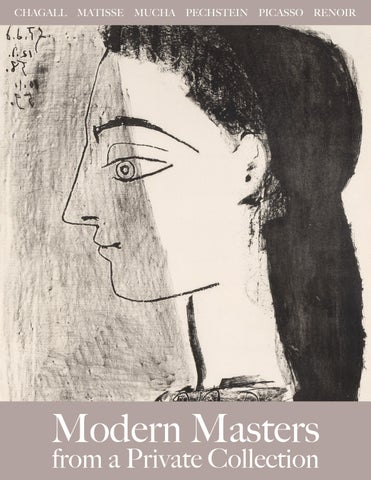
A selection of art from the collection on view at Heather James - Palm Desert, CA
Modern Masters from a Private Collection
MARC CHAGALL HENRI MATISSE ALPHONSE MUCHA MAX PECHSTEIN PABLO PICASSO PIERRE-AUGUSTE RENOIR
Modern Masters from a Private Collection
An Immediate Path into the Modern Canon There is a particular privilege in owning a painting by a titan of Modern art, and a quieter one in owning a drawing, print, or ceramic by the same hand. This single owner collection containing Chagall, Picasso, Miró, Renoir, Matisse, Pechstein, and Mucha belongs to the second category. The artists developed and tested their ideas through these mediums, and they remain some of the most accessible entry points into art historical greatness available to a collector today.
Clay and the Drawn Line Picasso's ceramics are a way of getting a drawn line onto a reproducible surface. Two ceramic editions present two different modes. In Vase deux anses hautes (1953), the sgraffito decoration was cut directly through a layer of colored clay slip with a knife, exposing the lighter clay underneath to form the line—closer to carving than painting. Jacqueline au Chevalet (1956) shows another approach: Picasso first engraved the image into a plaster mould, then pressed fresh clay into that mould to form each dish, so the mould worked like a stamp that could reproduce the same drawing again and again. The critic Douglas Cooper, who visited Picasso's studio that year, put it simply: “this mould served as an intermediary element for reproduction, exactly as the copper plate does for the etcher."
The Plate as the Artist's Hand Etching's great advantage is directness: the needle records exactly what the hand does, with nothing between the gesture and the mark. Two Picasso works from his Carmen portfolio retain their original copper plates alongside the etchings pulled from them — each plate a direct record of the artist's hand, its incised lines his exact marks, not a reproduction of them. Chagall worked the same way in Le Rêve de L’Âne, the copper plate where the drypoint burr softens the line into something as personal as handwriting.
Modern Masters from a Private Collection
Lithography as Drawing For other artists here, the stone rather than the plate became the natural extension of the hand. Henri Matisse’s Le Repos du Modèle (1922), from the landmark album Les peintres lithographes de Manet à Matisse, treats lithography as pure drawing — the reclining figure built from the same fluent, economical line as his most intimate work. Chagall’s Bible themed lithographs, from the suite created for a special issue of Verve, carry that same warmth into a very different subject matter. Renoir’s lithographs hold their own quiet history: Le Chapeau Épinglé captures a fifteen year old Julie Manet pinning flowers into her cousin’s hat, while L’Enfant au biscuit tenderly portrays his young son Jean. Renoir made only 35 lithographs across a two decade printmaking career, and only 4 distinct lithographs using multiple colors—Le Chapeau Épinglé is one and 2e Planche (Second Plate) is widely celebrated as his color lithograph triumph, built using up to 11 separate color stones for a rich, pastel like quality.
Pushing the Medium Further Some works here treat printmaking as a place to experiment. Joan Miró's Le Grand Ordonnateur, made late in his career with the master printers at Atelier Morsang, combines etching and aquatint with carborundum — a technique Miró helped popularize that holds ink in dense, velvety blacks, closer to a painted surface than a printed one.
The Drawn Line, Unmediated Max Pechstein's Studie von drei Figuren, made in 1917 in the final stretch of the First World War, shows the hand working directly and unmediated in watercolor, reed pen, and India ink on Japon paper. It is Expressionism turned inward: the spontaneous line and atmospheric color of an artist processing wartime experience through a quieter, more introspective mode.
Together, these works make the case that drawing and printmaking are not diminished forms of Modern mastery, but its most honest ones — the moment before polish, where the hand is still visible.
Modern Masters from a Private Collection
MARC CHAGALL
Modern Masters from a Private Collection
Marc Chagall (1887–1985) was a pioneering modern artist whose deeply personal and imaginative work drew from a wide range of influences, including Cubism, Fauvism, and Symbolism. Born in Vitebsk, in present-day Belarus, into a Hasidic Jewish family, Chagall’s early life and cultural heritage remained central to his art throughout his career. His paintings often blend memory, folklore, religion, and dreamlike imagery, establishing him as one of the most distinctive voices of the twentieth century. Chagall studied at the Imperial Society for the Protection of the Arts in St. Petersburg before moving to Paris in 1910, then the epicenter of the avant-garde. There, he encountered the work of Impressionist, Post-Impressionist, and Fauvist artists, which informed his use of bold color and expressive form. Rather than fully adopting any single movement, Chagall developed a poetic and symbolic visual language characterized by floating figures, inverted perspectives, and scenes of village life infused with fantasy. After his first solo exhibition in Berlin in 1914, Chagall returned to Vitebsk, where he remained during World War I. In 1915, he married Bella Rosenfeld, who became a central figure and recurring presence in his work. Following the Russian Revolution, Chagall played an active role in the cultural life of his hometown, serving as Commissar of Arts in Vitebsk and founding an art school. However, artistic disagreements led him to leave, and in 1923 he returned to Paris with his family. During the 1930s and 1940s, Chagall’s work increasingly reflected themes of exile, persecution, and Jewish identity, particularly in response to the rise of Nazism. He fled Europe during World War II, spending several years in the United States before returning to France in 1948. In his later decades, Chagall expanded his practice beyond painting to include stained glass, ceramics, mosaics, and stage design, completing major public commissions for institutions around the world. Marc Chagall died in Saint-Paul-de-Vence, France, on March 28, 1985. His legacy endures as a visionary artist who merged modernist experimentation with deeply personal symbolism, creating a body of work that continues to resonate across cultures and generations.
Modern Masters from a Private Collection
MARC CHAGALL Le Rêve de L'Âne
1963 copper plate for the editioned etching 12 x 9 1/4 in. $120,000 Inv. 48628
Modern Masters from a Private Collection
MARC CHAGALL
Josue devant Jericho (from the Bible Series) 1931-1939 etching on paper 17 1/2 x 12 1/2 in., Edition 11/110 $12,950 Inv. 41482
Modern Masters from a Private Collection
MARC CHAGALL
L’Homme Guide par L’Eternel, pl. 97 (from the Bible Series) 1958 etching with hand coloring on Arches paper 21 1/2 x 15 1/2 in., Edition II/V $13,000 Inv. 34632
Modern Masters from a Private Collection
MARC CHAGALL
Onction de Saul (From the Bible Series) 1931-1958 etching with hand coloring on Arches paper 15 1/2 x 11 1/4 in., Edition 13/100 $12,000 Inv. 41860
Modern Masters from a Private Collection
MARC CHAGALL
Adam and Eve and the Forbidden Fruit c. 1960 lithograph in colors 13 3/4 x 10 1/4 in. $3,000 Inv. 48773
Modern Masters from a Private Collection
HENRI MATISSE
Modern Masters from a Private Collection
Henri Matisse (1869–1954) was a French painter, sculptor, and printmaker widely regarded as one of the most influential artists of the twentieth century. Born in Le Cateau- Cambrésis, France, he initially trained in law before turning to art after discovering painting during a period of recovery from illness. He studied under Gustave Moreau at the École des BeauxArts in Paris, where he absorbed the lessons of Impressionism before pushing beyond them. In 1905, Matisse became the leading figure of Fauvism, a movement defined by bold, nonnaturalistic color and expressive brushwork, first shown to a scandalized public at the Salon d’Automne. Many of his finest works date from the decade or so after 1906, when he developed a more rigorous style emphasizing flattened forms and decorative pattern, seen in paintings like “The Joy of Life,” “Harmony in Red,” and “The Dance.” Throughout his career, he was known equally for his innovative use of color and for his fluid, original draughtsmanship, qualities that carried through his paintings, drawings, and prints alike. Matisse continued to reinvent his practice over the following decades, moving through phases of Mediterranean-inspired odalisques and, in his final years, the celebrated paper cutouts (“gouaches découpées”) he created after illness left him largely confined to bed. These late works, including “The Snail” and the designs for the Chapelle du Rosaire in Vence, distilled his lifelong pursuit of color and form into pure, joyful simplicity. Alongside Picasso, Matisse is considered one of the two dominant figures of early modern art. His emphasis on color, pattern, and decorative harmony influenced generations of artists, from the Abstract Expressionists to contemporary painters. He died in Nice in 1954, leaving behind a body of work celebrated for its sensuality, vitality, and enduring pursuit of visual pleasure.
Modern Masters from a Private Collection
HENRI MATISSE Le Repos du Modele
c. 1922-1924 lithograph 8 1/2 x 12 in., Edition 5/50 $18,000 Inv. 48624
Modern Masters from a Private Collection
ALPHONSE MUCHA
Modern Masters from a Private Collection
Born Alfons Maria Mucha on 24 July 1860 in Ivančice, Moravia, then part of the Austrian Empire, he is known professionally by the French rendering of his name, Alphonse Mucha, adopted after he settled in Paris. He trained in Vienna, Munich, and Paris, studying at the Académie Julian and the Académie Colarossi. Mucha rose to prominence in Paris in 1894 with his poster for Sarah Bernhardt’s play Gismonda, which established the decorative style that became closely associated with Art Nouveau, though Mucha himself resisted that label and described his work as an expression particular to himself. He continued to design posters, advertisements, and decorative panels through the 1890s and early 1900s, and also worked in jewelry design, illustration, and interior decoration. Mucha regarded his largest undertaking, the Slav Epic, a cycle of twenty large canvases depicting Slavic history, as his most significant work; he presented it to the Czech nation in 1928. He died on 14 July 1939 in Prague.
Modern Masters from a Private Collection
ALPHONSE MUCHA
First American Tour 1880-1881 Sarah Bernhard graphite, colored pencil, and ink on paper 24 x 19 in. $7,950 Inv. 41521
Modern Masters from a Private Collection
ALPHONSE MUCHA
First American Tour 1880-1881 Sarah Bernhardt 1880 graphite, colored pencil, and ink on paper 24 x 19 in. $30,000 Inv. 48707
Modern Masters from a Private Collection
ALPHONSE MUCHA Untitled
graphite and crayon on paper 10 x 7 1/2 in. $20,000 Inv. 48775
Modern Masters from a Private Collection
ALPHONSE MUCHA
L’Anniversaire Mascarade de Sarah B., October 29 graphite on paper 12 x 9 in. $4,950 Inv. 41517
Modern Masters from a Private Collection
ALPHONSE MUCHA Merci
graphite on paper 12 x 9 in. $5,950 Inv. 41520
Modern Masters from a Private Collection
ALPHONSE MUCHA Preparation for Poster
graphite and colored pencil on paper 24 x 19 in. $9,850 Inv. 41515
Modern Masters from a Private Collection
ALPHONSE MUCHA Study for Poster graphite on paper 24 x 19 in. $5,950 Inv. 41519
Modern Masters from a Private Collection
ALPHONSE MUCHA Untitled
pencil on paper 16 x 13 1/2 in. $15,000 Inv. 48776
Modern Masters from a Private Collection
ALPHONSE MUCHA Sarah Bernhardt ink on paper 12 x 9 in. $5,950 Inv. 41518
Modern Masters from a Private Collection
ALPHONSE MUCHA
Sarah Bernhard in Victor Hugo’s Hernani graphite on paper 13 3/4 x 10 in. ea. $12,500 Inv. 41516
Modern Masters from a Private Collection
MAX PECHSTEIN
Modern Masters from a Private Collection
Hermann Max Pechstein was born on December 31, 1881, in Zwickau, into a working class family headed by his father, a textile-mill craftsman. Drawn to art early on, he apprenticed as a decorative painter from 1896 to 1900 before enrolling at Dresden’s School of Applied Arts and, from 1902, studying under Otto Gussmann at the Royal Academy of Fine Arts. His academic grounding—unique among his future peers—laid a solid foundation for the bold, expressive work that would follow. In 1906 Erich Heckel invited Pechstein to join Die Brücke, the pioneering Expressionist collective, and he quickly became one of its most active members. Exposure to ethnographic wood carvings in Dresden in 1905 spurred his first woodcuts, and travels to Italy (1907) and Paris (1908)—where he befriended the Fauvist Kees van Dongen—expanded his palette and compositional daring. After relocating to Berlin in 1908, he co-founded the New Secession in 1910, serving as its chairman and gaining acclaim for richly colored prints inspired by Van Gogh, Matisse, and the Fauves. With the outbreak of World War I, Pechstein’s peripatetic life took him from internment in Japan to service on the Western Front in 1916. In the revolution’s aftermath, he aligned with radical socialist art groups—the Arbeitsrat für Kunst and the November Group— before accepting a professorship at the Berlin Academy in 1922, where he influenced a new generation of modernists. The Nazi regime’s rise in 1933 marked a dark chapter: Pechstein was barred from exhibiting, fired from his teaching post, and branded a “degenerate” artist, with 326 paintings removed from German museums and sixteen displayed in the infamous 1937 Entartete Kunst exhibition. He spent the war years in rural Pomerania, only to be reinstated in 1945 and later honored with numerous awards before his death in West Berlin on June 29, 1955. Over his career, Pechstein produced some 421 lithographs, 315 woodcuts and linocuts, and 165 intaglio prints, alongside hundreds of paintings, cementing his reputation as a master of German Expressionism and a pivotal figure in 20th-century art.
Modern Masters from a Private Collection
MAX PECHSTEIN Studie von drei Figuren
1917 watercolor, reed pen and India ink on Japon paper 17 1/2 x 12 in. $65,000 Inv. 41508
Modern Masters from a Private Collection
PABLO PICASSO
Modern Masters from a Private Collection
Pablo Picasso was born in Malaga in 1881. He grew up in Barcelona, where he spent his childhood studying drawing and painting under his father, Jose Ruíz, who taught at the local art school. Picasso spent a year studying at the Academy of Arts in Madrid, before traveling to Paris in 1900. Landing in the center of the European art world, Picasso shared lodgings with the poet and journalist Max Jacob, with whom he lived the Bohemian lifestyle of the poor and starving artist. The next few years saw an improvement in his fortunes and he spent time in Paris and Madrid, founding and illustrating the art magazine Arte Joven. Picasso began to mingle in the company of other artists and literary figures including the poet Guillaume Apollinaire and the legendary writer, art critic and salon hostess Gertrude Stein, whose portrait he painted in 1906. He had astonishing powers of invention, continually innovating and refreshing his work and experimenting with one style after another. His earliest distinguishable period is the Blue Period, dating approximately from 1901 to 1904 when he used a mostly blue and bluegreen color palette and painted poignant images of beggars, prostitutes and other tragic figures from the streets of Paris. His Rose Period, which followed thereafter, made use of a warmer color palette and focused on generally less somber subject matter. Around 1907, Picasso became very influenced by African masks and art which began making their way into Parisian museums following the expansion of the French Empire into Africa. The faces and simplified, angular planes of the women in Picasso’s Les Demoiselles d’Avignon, clearly derive their style from African masks and sculptures and this painting is often heralded as the beginning of Cubism. Along with his contemporary, Georges Braque, Picasso began to develop an artistic style, later known as Analytical Cubism, which approached the visual world from the perspective of geometric forms. In 1926, Picasso turned towards Surrealism, a movement that was growing in strength and popularity among Parisian artists. Picasso’s most famous surrealist work, Guernica, depicted the bombing of Guernica during the Spanish Civil War. This painting is a powerful anti-war statement warning against the suffering and devastation of war. Arguably one of the greatest, most radical and most influential artists of the 20th century, Picasso’s legacy is far-reaching and enduring. More than any other artist, Picasso defined Modern Art of the twentieth century by his establishment and development of one of its major movements, Cubism.
Modern Masters from a Private Collection
PABLO PICASSO
Femme regardant par la fenetre 1959 linocut 22 3/4 x 26 3/4 in., Edition 17/50 $48,000 Inv. 48652
Modern Masters from a Private Collection
PABLO PICASSO
Tête de femme à la couronne de fleurs 1964 terracotta with black slip 12 5/8 x 9 5/8 in., Edition 25/100 $70,000 Inv. 34625
Modern Masters from a Private Collection
PABLO PICASSO
Vase deux anses hautes (A.R. 213) 1953 ceramic vase 15 1/2 x 10 x 6 in., Edition of 400 $115,000 Inv. 32514
Modern Masters from a Private Collection
PABLO PICASSO Jacqueline au Chevalet
1956 partly glazed ceramic 16 3/4 x 16 3/4 in., Edition 40/200 $95,000 Inv. 11454
Modern Masters from a Private Collection
PABLO PICASSO
Fumeur a la Cigarette Blanche 1965 aquatint on paper 21 1/4 x 15 1/4 in., Edition 18/50 $90,000 Inv. 34619
Modern Masters from a Private Collection
PABLO PICASSO Groupe de Trois Femmes 1922-23 etching and drypoint 9 1/4 x 7 1/4 in., Edition 64/100 $35,000 Inv. 48628
Modern Masters from a Private Collection
PABLO PICASSO Le Collier
1923 drypoint on laid paper 7 x 5 in. (sheet: 12 1/4 x 9 5/8 in.), Edition 38/50 $12,000 Inv. 48635
Modern Masters from a Private Collection
PABLO PICASSO
Two Sculptured Men (from the Vollard Suite) 1933 etching 17 1/2 x 13 3/8 in. $40,000 Inv. 48733
Modern Masters from a Private Collection
PABLO PICASSO Deux Nus Assis
1930 etching 15 x 11 1/2 in., Edition 47/100 $30,000 Inv. 11450
Modern Masters from a Private Collection
PABLO PICASSO
Femme nue couronnée de fleurs, aux jambes croisées (from the Vollard Suite) 1930 etching on paper 12 1/2 x 8 3/4 in. $40,000 Inv. 48734
Modern Masters from a Private Collection
PABLO PICASSO
Square Head of a Man (from the Carmen portfolio) 1949 copper plate etching on Montvale, copper plate with cancellation mark plate: 14 x 11 in./sheet: 12 3/4 x 9 3/4 in. $60,000 Inv. 48647
Modern Masters from a Private Collection
PABLO PICASSO
Oval Head with Dividing Line (from the Carmen portfolio) 1949 copper plate etching on Montvale, copper plate with cancellation mark plate: 14 x 11 in./sheet 13 x 9 3/4 in. $60,000 Inv. 48648
Modern Masters from a Private Collection
PABLO PICASSO Les deux femmes nues
1946 lithograph 11 1/2 x 15 1/4 in. One of 19 impressions of the 14th state $48,000 Inv. 48644
Modern Masters from a Private Collection
PABLO PICASSO Mère et enfant au fichu
1966 color lithograph 20 1/2 x 17 1/2 in., Edition AP aside from the edition of 60 $30,000 Inv. 34622
Modern Masters from a Private Collection
PABLO PICASSO Buste de femme au fichu
1939 etching with aquatint on wove paper 10 x 9 in. $12,000 Inv. 48642
Modern Masters from a Private Collection
PABLO PICASSO
Portrait de Mousquetaire vieillissant, au visage couperose (from ‘La Serie’ 347) 1968 etching 6 3/4 x 5 5/8 in., Edition 15/50 $14,500 Inv. 34629
Modern Masters from a Private Collection
PABLO PICASSO Profil d’homme
1924-1961 etching on laid paper 6 x 4 1/2 in. (sheet: 12 3/4 x 9 1/8 in.), Edition 17/50 $15,000 Inv. 48636
Modern Masters from a Private Collection
PABLO PICASSO Femme au Fauteuil
1939 aquatint and engraving on wove paper 19 x 15 in., Edition 32/50 $28,000 Inv. 48710
Modern Masters from a Private Collection
PABLO PICASSO
Tête de femme, face et profil (from Picasso Dessins) c. 1926 lithograph on Japanese Imperial paper 5 x 4 5/8 in. (sheet: 11 x 8 5/8 in.) $40,000 Inv. 48637
Modern Masters from a Private Collection
PABLO PICASSO Tete de femme
1925 lithograph 10 x 5 in., Edition 24/25 $30,000 Inv. 48711
Modern Masters from a Private Collection
PIERRE-AUGUSTE RENOIR
Modern Masters from a Private Collection
Pierre-Auguste Renoir is regarded as one of the most famous and well respected Impressionist artists of the 19th and 20th centuries. Born in Limoges, Haute-Vienne, France, Renoir was a working class prodigy, who studied and gained inspiration from the French master painters Alfred Sisley, Frederic Bazille, and Claude Monet. This French artist was a leading force in the development of the revolutionary Impressionistic style, and dramatically drifted from the classical and romantic schools of art so popular during this time. Renoir gained initial acclaim when he displayed work in the first Impressionist exhibition in Paris, in 1874. That same year two of his works were shown with Durand-Ruel in London. His maturity as a painter heightened during the mid- 1880’s as he applied a more formal and disciplined technique to his painting and portraiture style. However, after 1890 his return to the use of thinly brushed color and changed his painting direction once. This style reflected a more synthesized and airy appeal of dissolved outlines and implied imagery. This prolific artist painted with a warm sensuality, making his paintings some of the most well-known works in the history of art.
Modern Masters from a Private Collection
PIERRE-AUGUSTE RENOIR L’Enfant au biscuit
1899 lithograph on laid Arches paper 12 1/2 x 10 1/4 in. $18,000 Inv. 48656
Modern Masters from a Private Collection
PIERRE-AUGUSTE RENOIR Le Chapeau Epingle (1e planche) 1897 lithograph on paper 26 5/8 x 21 5/8 in. $28,000 Inv. 48654
Modern Masters from a Private Collection
PIERRE-AUGUSTE RENOIR Le Chapeau Épinglé (2e planche) 1898 color lithograph on cream laid paper 23 5/8 x 19 1/4 in., Edition of 200 $90,000 Inv. 34621
Modern Masters from a Private Collection
PIERRE-AUGUSTE RENOIR La Danse à la Campagne (2e planche) 1890 etching 8 7/8 x 5 1/2 in. $19,000 Inv. 34623
heatherjames.com