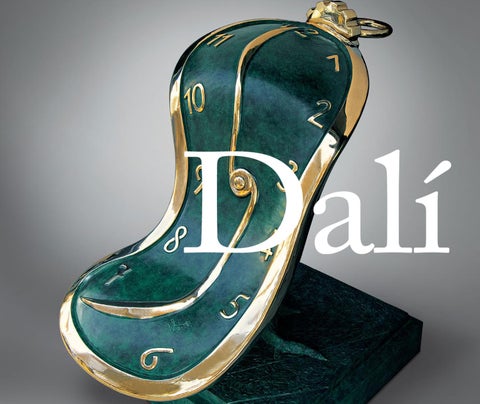
Heather James Fine Art presents an exclusive exhibition of sculptures by Salvador Dalí (1904-1989), representing the great Catalan genius’ iconographic images in three dimensional form. All of the sculptures were cast at prestigious international foundries in Europe, using the age old lost wax technique. Intricate detail can be achieved using this traditional method of casting bronze, which has its roots in ancient times and dates back as far as 5,000 BC. Dalí discovered modern painting at the age of twelve, and the following year his father organized an exhibition of his charcoal drawings in their family home. He had his first public exhibition in 1919 and entered art school in 1922. However, shortly before his final exams Dalí was expelled when he stated that, “no one on the faculty was competent enough to examine him.” During one of his many trips to Paris in the late 1920s, Dalí met and worked alongside artists such as Picasso, Miro and Magritte. Through his many artistic experimentations with Impressionism, Dadaism, Cubism, and Futurism, Dalí finally settled into and became the leader of Surrealism. In 1934, Dalí was introduced to America by art dealer Julien Lev, where his exhibition, including the iconic painting Persistence of Memory, created an immediate sensation. Dalí was highly imaginative, and also enjoyed indulging in unusual and grandiose behavior. His eccentric manner and attention-grabbing public actions sometimes drew more attention than his artwork. On display at the gallery are more than a dozen exquisite examples of the artist’s surrealist forms and figures including four monumental sculptures. Highlights of the exhibition include Dance of Time III, a large-scale sculpture based on the melting watch in the infamous “Persistence of Memory” painting, representing the artist’s fantastical relationship with time; Homage to Newton, a symbolic figure holding a dangling sphere which pays respect to Newton’s discovery of the law of gravity; and Space Venus, an homage to the female figure. Although most known for his dream-like surrealistic imagery, Dalí was actually a man of hard sciences. His explorations of these dichotomies; where time becomes fluid rather than linear and laws of gravity are overturned, expose the complexity of his mind.
ŠI.A.R. Art Resources Ltd
Dance of Time III Bronze (lost wax process) 41 5/8 x 59 x 76 in Edition 1/8 Edition size: 8 plus 3 EA, 2 EF Foundry: Perseo Foundry, Switzerland Conceived in 1979, first cast in 1984 Includes certificate issued by Robert Descharnes
The melted watch is the most well-known and beloved of Dalí’s iconoclastic images - the artist chose to portray this image consistently throughout his lifetime, beginning in 1932. The everpresent fluidity of time is represented in this sculpture as time not only moving, but dancing in rythm to the beat of the universe. Universal time knows no limits; it must be remembered that time, as we understand it, is a human notion. Instead, Dalinian time is perpetual and ‘dances on’ stopping for no man, history or even the cosmos.
Saint George and the Dragon Bronze (lost wax process) 55 x 57 x 32 1/2 in. Edition 7/7 Edition size: 7 plus 3 EA, 2 HC Foundry: Tesconi, Italy Conceived in 1977, first cast in 1984 Includes certificate issued by Robert Descharnes
Salvador Dalí again transforms a traditional image by adding new and unexpected symbolic connotations. The classic interprestation os “St. George and the Dragon” is commonly seen as the saint’s battle against heresy and evil, St. George being the guardian angel of Aragon and a celebrated saint of chivalry throughout medievel Europe. In this sculpture, we can see the artist himself, represented by St. George, slaying the dragon, while his inspirational muse, Surrealist Art, exalts in the background. Metamorphic touches find their way into this sculpture too: the dragon’s wings turn into flames, and the monster’s tongue is acrutch, a favorite Dalinian image.
ŠI.A.R. Art Resources Ltd
ŠI.A.R. Art Resources Ltd
Vision of the Angel Bronze (lost wax process) 39 x 55 x 38 3/4 in. Edition 7/7 Edition size: 7 plus 3 EA, 2 HC Foundry: Tesconi, Italy Conceived in 1977, first cast in 1984 Includes certificate issued by Robert Descharnes
Dalí reinvents a classic religious depiction through an unusual surrealistic interpretation. As symbolised in this sculpture, the stength and supremacy of God is represented by a thumb from which all life emerges (the branches of the trees). To the right of this divine being stands humanity: a man bursting with life’s vitality. On the left, the presence of the Angel, representative of the meditative spirit, can be found with his wing resting on and supported by a crutch. Although man is united with God, God’s knowledge is supreme.
Unicorn Bronze (lost wax process) 55 x 57 x 32 1/2 in. Edition 3/7 Edition size 7 plus 3 EA, 2 HC Foundry: Perseo Foundry, Switzerland Conceived in 1977, first cast in 1984 Includes certificate issued by Robert Descharnes
The unicorn is a mythical creature prominent in legends as an intricately linked symbol of purity. The horn of the unicorn is believed capable of neutralizing any poison. This animal also has connotations of chastity and virginity, both male and female, and was adopted as the sign or ideal representation of the “perfectâ€? knight. In some legends it was also a symbol of virility. DalĂ chose to portray the unicorn as a phallic figure whose horn penetrates a stone wall through a heart-shaped opening, from which a drop of blood seems to be slowly falling. The nude, reposing female stretched out in the foreground at the hooves of the animal underlines the sensual nature of this sculpture.We see a woman with her arm raised in the sign of victory.
ŠI.A.R. Art Resources Ltd
Alice in Wonderland Bronze (lost wax process) 35 1/2 x 18 x 8 1/8 in. Edition number 285 of 350 + 35 AP Signature: Inscribed by the foundry Foundry: Perseo Fonderia, Mendrisio, Switzerland Conceived in 1977; cast at a later date Includes Certificate of Authenticity issued by I.A.R. Art Resources and Foundry Certificate issued by Perseo Fonderia
Like Alice in Wonderland, Dalí traveled a long and arduous road to the land of dreams, by means of his artistic expression. The artist was drawn to both the incredible story and the extravagant characters in this intoxicating fairytale. Alice is one of the least favorite images. She is the eternal girl child responds to the confusion of the world behind the looking glass with the irrefutable naivety of childhood. After all her meetings with the inhabitants of this fantastic world, she returns to reality not only unharmed but unchanged by her surrealistic experience. Looking at Dalí’s sculpture we see that Alice’s skipping rope is becoming a twisted cord symbolizing everyday life. Her hands and hair have blossomed into roses symbolizing feminine beauty and eternal youth. The Grecian drapes of her dress symbolize antiquity and the beauty that is respected throughout the ages.
Dance of Time I Bronze (lost wax process) 14 x 8 3/4 x 8 in. Edition number 297 of 350 + 35 AP Signature: Inscribed by the foundry Foundry: Perseo Fonderia, Mendrisio, Switzerland Conceived in 1977; cast at a later date Includes Certificate of Authenticity issued by I.A.R. Art Resources and Foundry Certificate issued by Perseo Fonderia
The melted watch is the most well-known and beloved of Dalí’s iconoclastic images - the artist chose to portray this image consistently throughout his lifetime, beginning in 1932. The everpresent fluidity of time is represented in this sculpture as time not only moving, but dancing in rythm to the beat of the universe. Universal time knows no limits; it must be remembered that time, as we understand it, is a human notion. Instead, Dalinian time is perpetual and ‘dances on’ stopping for no man, history or even the cosmos.
Homage to Fashion Bronze (lost wax process) 21 3/8 x 14 x 11 1/4 in. Edition number 329 of 350 + 35 AP Signature: Inscribed by the foundry Foundry: Perseo Fonderia, Mendrisio, Switzerland Conceived in 1977; cast at a later date Includes Certificate of Authenticity issued by I.A.R. Art Resources and Foundry Certificate issued by Perseo Fonderia
Dalí’s relationship with the world of haute couture began in the 1930s through his work with Coco Chanel, Elsa Schiaparelli an Vogue Magazine, and lasted throughout his lifetime. This remarkable Venus, posing in the stance of a supermodel, has been created with a head of roses, the most exquisite of flowers. Her face lacks definition, allowing the admirer to imagine any face he desires. On bended knee we observe a dignified gentlemen, a “dandy” paying homage to this twentieth-century muse.
Homage to Newton Bronze (lost wax process) 15 1/2 x 8 x 4 1/4 in.. Edition number 213 of 350 + 35 AP Signature: Inscribed by the foundry Foundry: Perseo Fonderia, Mendrisio, Switzerland Conceived in 1977; cast at a later date Includes Certificate of Authenticity issued by I.A.R. Art Resources and Foundry Certificate issued by Perseo Fonderia
Dalí honors and commends Newton for his discovery of the law of gravity, symbolized by the famed falling apple, represented here by sphere of metal attached to a line, thus losing its impermanence as well as its capacity for regeneration. Dalí implies that the living being, Sir Isaac Newton, has become a mere name in science, completely stripped of his personality and individuality. To represent this transformation, Dalí has pierced the figure with two large holes: one portrays the absence of Newton’s vital organs, while the other clearly displays the lack of mind. What remains is only symbolic representation.
Homage to Terpsichore Bronze (lost wax process) 27 x 18 1/2 x 10 1/2 in. Edition number 202 of 350 + 35 AP Signature: Inscribed by the foundry Foundry: Perseo Fonderia, Mendrisio, Switzerland Conceived in 1977; cast at a later date Includes Certificate of Authenticity issued by I.A.R. Art Resources and Foundry Certificate issued by Perseo Fonderia
Terpsichore is one of the famed nine mythological Muses. Creating his version of the muse of dance, Terpsichore, DalĂ uses a reflective image, setting the soft, carnal muse against the hardened, statuesque one. The lack of definition in both faces clearly underlines the purely symbolic significance of these figures. The dancer with the smooth and classical form represents grace and the unconscious, while the other angular, Cubist figure represents the ever-growing and chaotic rhythm of modern life.
Horse Saddled with Time Bronze (lost wax process) 19 x 7 x 20 1/2 in. Edition number 209 of 350 + 35 AP Signature: Inscribed by the foundry Foundry: Perseo Fonderia, Mendrisio, Switzerland Conceived in 1977; cast at a later date Includes Certificate of Authenticity issued by I.A.R. Art Resources and Foundry Certificate issued by Perseo Fonderia
Lady Godiva with Butterflies Bronze (lost wax process) 20 1/2 x 9 1/4 x 16 1/4 in. Edition number 286 of 350 + 35 AP Signature: Inscribed by the foundry Foundry: Perseo Fonderia, Mendrisio, Switzerland Conceived in 1977; cast at a later date Includes Certificate of Authenticity issued by I.A.R. Art Resources and Foundry Certificate issued by Perseo Fonderia
DalĂ, the great surrealist master, selected the image of Lady Godiva as one of his favorites, and pays homage to her sensuous shapely female form through the conception of this sculpture. Announcing her arrival, butterflies not only hover around her and her noble steed, but also adorn her body as she plays her trumpet. Lady Godiva embodies earthly beauty, whereas the butterflies depict the ethereal otherworld.
Nobility of Time Bronze (lost wax process) 23 3/4 x 15 x 11 1/2 in. Edition number 310 of 350 + 35 AP Signature: Inscribed by the foundry Foundry: Perseo Fonderia, Mendrisio, Switzerland Conceived in 1977; cast at a later date Includes Certificate of Authenticity issued by I.A.R. Art Resources and Foundry Certificate issued by Perseo Fonderia
Dalí’s soft watch is both draped against and supported by the remains of a tree whose trunks sprout new life and whose roots entwine a stone. The terminology, “the crown of a watch”, usually indicates mechanical device, which allows us to set the hands and wind the timepiece. Time, however, according to a Dalinean watch, is changeless and cannot be set, and the watch itself has no internal power or motion. Given this absence of movement, the crown in this case is interpreted by the artist as a royal crown, which adorns the watch, identifies time’s mastery over human beings rather than it’s utility to him. His majesty is attended by two reoccurring, fantastic Dalinean symbols: a contemplative angel, and a woman draped in shawls. Time reigns supreme over both art and reality.
Snail and the Angel Bronze (lost wax process) 19 1/2 x 15 x 24 in. Edition number 170 of 350 + 35 AP Signature: Inscribed by the foundry Foundry: Perseo Fonderia, Mendrisio, Switzerland Conceived in 1977; cast at a later date Includes Certificate of Authenticity issued by I.A.R. Art Resources and Foundry Certificate issued by Perseo Fonderia
This sculpture occupies an important place in the dolly need universe, as it is intimately connected with the artists encounter with Sigmund Freud, Dalí came to regard as his spiritual father. As part of the early surrealist movement, Dalí was surrounded by psychoanalytical influences, and these ideas were strongly incorporated into his artwork. Dalí was captivated when he saw a snail on a bicycle outside Freud’s house, connecting the snail with the image of the human head; the head of Freud. Dalí was also fascinated by the natural geometry of snail shells, and, like the egg, the duality of its soft interior its hard exterior. Paradoxically then, the snail, the universal symbol of the idle passing of time, has been given wings and is riding fluidly moving waves. A winged messenger of the gods, capable of limitless speed, bestows the snail with the gift of motion by touching down on its back for the briefest of moments.
Space Venus Bronze (lost wax process) 25 x 13 x 14 in. Edition number 94 of 350 + 35 AP Signature: Inscribed by the foundry Foundry: Perseo Fonderia, Mendrisio, Switzerland Conceived in 1977; cast at a later date Includes Certificate of Authenticity issued by I.A.R. Art Resources and Foundry Certificate issued by Perseo Fonderia
Venus is the goddess of beauty, and DalĂ pays homage to the female figure by adding his own special elements. The underlying form in the sculpture is a classic marble statue of a female torso, which Dalinean elements have been added: a soft watch, an egg, two ants and a separation of the body into two parts. The watch is draped over the neck to give us two opposing messages: the beauty of the flesh is temporary and will vanish, while beauty of art is timeless and eternal. The ants are reminders of human mortality and impermanence. The egg, like the ant, is a favorite Dalinean theme given the duality of its hard exterior and soft interior, and is a positive symbol. The egg represents life, renewal, continuation and the future.
Woman of Time Bronze (lost wax process) 24 1/2 x 12 1/2 x 9 5/8 in. Edition number 310 of 350 + 35 AP Signature: Inscribed by the foundry Foundry: Perseo Fonderia, Mendrisio, Switzerland Conceived in 1973; cast at a later date Includes Certificate of Authenticity issued by I.A.R. Art Resources and Foundry Certificate issued by Perseo Fonderia
Holding a perfectly formed flower and dressed in gently flowing robes, this radiant young woman bears Dalí’s most famous symbol... the melting watch, which hints at the human construction of the nature of time. The artist allows the watch to pose the question - is beauty dependent on time, or is it eternal? The clock alludes to the woman’s awareness that beauty can be independent of time, whether it is corporeal grace or an ethereal rose.
45188 Portola Avenue Palm Desert, CA 92260 760-346-8926 PO Box 3580 172 Center Street Suite 101 Jackson, WY 83001 307-200-6090 www.heatherjames.com