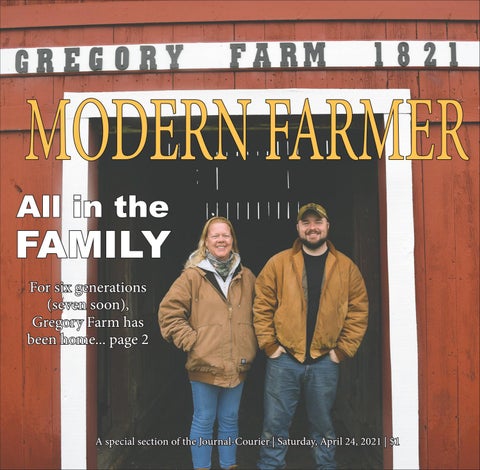
MODERN FARMER
All in the
FAMILY For six generations (seven soon), Gregory Farm has been home... page 2
A special section of the Journal-Courier | Saturday, April 24, 2021 | $1
2 • Saturday, April 24, 2021 • Modern Farmer
Six generations brought Greene farm to 200 years By Samantha McDaniel-Ogletree smcdaniel@myjournalcourier.com
WHITE HALL — Six generations, soon seven, have operated a farm about a mile south of White Hall, raising cattle and hogs, as well as growing what is needed to feed their animals. However, what they were most known for were their raising of Percheron horses. The farm will be celebrating its 200th anniversary this year and is being cared for by the sixth generation of the family. Sisters Laura Dukett and Le Esarey are the current generation overseeing the farm. The farm was established by Col. Charles Gregory in 1821. It was the third generation — W.S Corsa and Eugenia “Genie” Corsa, the granddaughter of Charles Gregory — that established its horse breeding operation with Carnot 66666. Carnot was a Percheron horse that was a top sire among the horse breeding community. “They used the horses to work
MODERN FARMER April 24, 2021
On the cover:
Le Esarey (left) and Greg Finn, the sixth and seventh generation of the owners of Gregory Farm, stand in front of the original barn.
4 Crop adviser’s job to help growers
9 Marijuana new for vertical farms
5 Composting, an art and a science
12 Dicamba rules for growing season
5
12 Online pesticide testing available
USDA explores climate-smart ag Samantha McDaniel-Ogletree | Journal-Courier
Billy Meyer of California, Missouri, leads a Percheron horse from the field in preparation for loading at Gregory Farm.
the farm and they had a lot of horses then,” Dukett said. “They liked the Percherons because they had a good, gentle nature and a good stamina and were really strong.” Because it took a team of two horses to pull an instrument, and each team could only go for up to four hours, Dukett said the farm had a lot of horses. “Then that’s a lot of food to feed
them,” she said. “We keep finding wells around the farm where they’d stabled or worked the horses.” The Corsas also raised Berkshire hogs and had a well known hog among its animals as well —Masterpiece. “They raised horses, hogs, cattle, whatever they needed for the See FARM | Page 18
6 Pilot for farmer mental health
13
Demand growing for meatless options
14 Producers, farmers WIU honors six agri- not sold on electric culture graduates 15 7 Bad news for monUrban farmers work arch butterflies to provide fresh food 16 8 What infrastructure Next biofuel source means for farming 6
Modern Farmer • Saturday, April 24, 2021 • 3
Farmers concerned with soil health turn to cover crops By Kevin Bessler The Center Square
In an effort to improve soil and water health, while preventing soil erosion, Illinois farmers are exploring the benefits of cover crops. Cover crops are plants that are cover the soil rather than for the purpose of being harvested. The crops manage soil erosion and fertility, water quality, weeds pests, wildlife in an agroecosystem, an ecological system managed and shaped by humans. The Illinois Farm Bureau, along with the Department of Natural Resources, is holding cover crop field days around the state. The events provide an opportunity to discuss cover crop strategies and water infiltration benefits. “Cover crop interest is growing in Illinois and has been for some time,” said Leon McClerren, president of the Franklin County Farm Bureau, site of a cover crop pilot program. “Our farmers are interested
in learning how to be better stewards of our soil and natural resources.” In traditional corn or soybean rotations, overwintering with a cover crop is an attractive option for producers wanting to make improvements to field conditions or take advantage of forage potential for livestock. “We have livestock farmers across the state that look at some of these diverse mixes for a couple of different benefits including forage,” said Lauren Lurkins, director of environmental policy at the Illinois Farm Bureau. There is a cover crop pilot program at Wayne Fitzgerald State Recreation Area, which Lurkin said will involve a different blend of cover crops. “They are interested in not only the soil health benefits that can come whenever you have a crop between your corn and soybeans, but also the wildlife benefits because it is a state park,” Lurkins said. Some of the cover crops
Andrew Caballero-Reynolds | AFP
Farmer Dave Burrier steers his tractor through a field following a GPS map as he tries to plant as much corn as possible amid the yellow and green rye covering the ground.
being used include crimson clover, sunflowers, hemp, cowpeas, rye and buckwheat. Twenty-one projects are currently under way to support the Illinois Nutrient Loss Reduction Strategy. The primary goals for the program include
You YouCan CanCount CountOn OnUs Us!
From the basics of grain hauling and WHALEN TRUCKING storage to complete marketing services, we
You Can C
reducing nitrate-nitrogen losses in the soil by 15%, and reducing total phosphorus losses by 25% by the year 2025. The Department of Natural Resources’ cover crop pilot is part of a USDA-NRCS Regional Conservation Partnership Pro-
gram project. USDA awarded more than $8 million to the Illinois Working Lands, Water and Wildlife Conversation Partnership to protect working farmland, improve water quality and increase and enhance wildlife habitat.
From the basics of grain h storage to complete mark ELEVATING YOUR FARM TO help you grow a more THE can NEXT LEVEL
can help you grow a more successful farm.
• Grain Buying Off-Farm
• Grain Buying Off Farm • Grain Storage • Grain Storage& Drying & Drying • Authorized Dealer • Authorized Dealer
• Grain Buying Off Farm • Grain Storage & Drying • Authorized Dealer
Now operating Sc FranklinElevator.com Franklin Franklin 675-2393 • Inc.
From the basics of grain hauling and storage to complete marketing services, we can help you grow a more successful farm.
Franklin Elevator, “Haulers of General Commodities”
FRANKLIN ELEVATOR, INC. Franklin 675-2393 • Orleans 478-2000 Franklin 67
VAN - DUMP - TANK - HOPPER 217-435-2231 800-397-6469
Franklin: 675-2393 • Orleans: 478-2000 Scottville 484-4879
4 • Saturday, April 24, 2021 • Modern Farmer
Crop adviser’s job is to help growers By Rochelle Eiselt rochelle.eiselt@myjournalcourier.com
Carrollton native Todd Steinacher uses his knowledge in the agronomy industry to educate others. Steinacher first won an award in 2020 for Illinois Certified Crop Advisor. He is a regional agronomist. Winning that award allowed Steinacher to compete for the 2021 ICCA of the year which was international. He started his education at Lincoln Land Community College in its agriculture program for two years and then transferred to Western
Illinois University, where he finished his bachelor’s degree in agronomy. He went back to graduate school for distance program in crop science at the University of Illinois. The International Certified Crop Adviser of the Year Award is designed to annually recognize a certified crop adviser who delivers exceptional customer service, is highly innovative, has shown that they are a leader in their field, and has contributed substantially to the exchange of ideas and the transfer of agronomic knowledge within the agriculture industry. The Illinois CCA board nominated Steinacher.
The board nominates people who stand out in advising farmers. These farmers bring innovative ideas to the market place that share educational opportunities with farmers. Steinacher said he has worked on the CCA board. He has been a member for that board for the past two to three years. He worked with the Illinois Soybean Association, developing things such as webinars, and has worked with the CCA Soy Envoy Program. His full-time job is being a regional agronomist for AgriGold, which covers central and westRegional agronomist Todd Steinacher.
ern Illinois. “Every day, I get to work in agronomy. I enjoy thoroughly what I do,” he said. “I enjoy agronomy. I enjoy trying to educate customers and salesman on our new products.” In 2018, he went to Africa. Illinois Rotary sponsored a project in Zambia, Africa to try to improve food sustainability. Steinacher said he worked with the village to discover what their farming challenges were and then created a plan and educated them on how to improve yields. Most of the farms he worked with were small villages. Because there isn’t a market like there is in the United States in another country like Africa, we
may take our soils or the education we learn for granted at times and until you actually see an area that doesn’t have that, it just really makes you respect it much more, Steinacher said. “What they grew is what their family ate,” he said. When crop advising, he said he tries to understand what they’re currently doing and he tries to find out what their challenges may be. From different stand points, he knows where to go such as if they crop is running out of nutrition. Depending on what challenge the farmer is going through, it can change the recommendation. Every year he said he tries to have special proj-
Provided
ects that he works on and tries to elevate customer awareness and uses those things as talking points on sharing how yield is gained and loss. Next year he said he has a goal of expanding tissue sampling project for corn and then adding soy beans, tracking nutrition content. It gives a good understanding on how fields are doing by doing that sampling. He said he would like to share information with growers this fall during agronomy meetings going into next year. He uses insight from the previous five seasons to make recommendations. “When I’m doing these projects hopefully it will make growers make better decisions moving forward,” Steinacher said.
Modern Farmer • Saturday, April 24, 2021 • 5
Composting, an art and science By Darren Iozia
darren.iozia@myjournalcourier.com
Many back yards have some sort of composting area, which is both an art and a science that consists of using the correct materials, the right temperature to “cook” and the right amount of water — in addition to patients. “You’re doing the same thing as if it’s naturally occurring,” Duane Friend, educator at the University of Illinois Extension’s office, said. Composting, simply put, is the process of decomposing organic materials like paper, leaves or plant trimmings, food waste like eggs shells or chopped up vegetables. “You’re managing the organic materials,” Friend said. The best way to start a composting pile is placing it somewhere in the yard that doesn’t get direct sun all the time and an area that has low wind. The perfect place will allow the organic material to heat up, allowing the natural materials to breakdown, according to Friend. “The easiest way is to make layers,” Friend said. Starting with about 6 to 8 inches of brown materials, like leaves or straw, add a second layer that about 2 inches of greens and then add about one inch of garden soil. “They you just keep repeating the layers,” Friend said. Once you have enough material, Friend said
oxygen is crucial to composting and turning it so the outer materials can benefit from the heat generated within the center of the pile. “The temperature will heat up quickly but when it’s cooling down it’s losing oxygen,” Friend said, adding that the optimal, internal temperature should be around 140 degrees Fahrenheit but not to go above 160 degrees. “You want to turn it at least once a month.” When composting, another element is moisture. “You should have a nice dampness to it,” Friend said. One way to test to see if your compost is ready is to take three foam cups and fill one with your compost, one with garden soil and one with a oneto-one ratio of compost and garden soil. Place some seeds and monitor to see which mixtures germinates the best. “If they don’t germinate well then it’s not ready,” Friend said, adding that when your compost is ready, wait one more month. When placing materials in your compost, you want to break them down in size as much as possible. “You don’t want to throw in a tree branch,” he said. Other materials you can place is coffee and tea grounds, too. “Weeds are fine as long as they don’t have the seed heads,” Friend said.
USDA explores climate-smart agriculture Journal-Courier
The U.S. Department of Agriculture has published a federal register notice requesting public input on a climate-smart agriculture and forestry strategy. The notice represents a step toward implementing President Joe Biden’s executive order on tackling the climate situation at home and abroad. “America’s farmers, ranchers, and forest landowners have an important role to play in combating the climate crisis and reducing greenhouse gas emissions, by sequestering carbon in soils, grasses, trees, and other vegetation and sourcing sustainable bioproducts and fuels,” according to the order, which directs Agriculture Secretary Tom Vilsack to solicit input to develop a climate-smart agriculture and forestry approach.
Getty Images
Corn grows in a field during a drought. The U.S. Department of Agriculture has published a federal register notice requesting comments on a climate-smart agriculture and forestry strategy.
“USDA is committed to addressing climate change through actions that are farmer, rancher, and forest landowner-focused and that create new market opportunities for the sector in a fair and equitable way,” Vilsack said. “We want ideas on how to position the agriculture and forestry sectors to be leaders on climate smart practices to miti-
gate climate change. This includes making the most of USDA programs, developing new USDA-led climate strategies, strengthening existing markets and developing new markets that generate income.” The notice seeks information on four topics: climate-smart agriculture and forestry; biofuels, bioproducts and renewable energy; catastrophic wildfire; and meeting the needs of disadvantaged communities through USDA’s climate strategy. The notice is available for comment until April 30 and is available online through the federal register. Through research, conservation practices and partnerships, USDA aims to find solutions to agricultural challenges, enhance economic growth and create new streams of income for farmers, ranchers, producers and private foresters.
6 • Saturday, April 24, 2021 • Modern Farmer
Morgan part of pilot for farmer mental health By Kevin Bessler The Center Square
Nearly every industry has felt the impact of the coronavirus pandemic, and the farming and agriculture industry in Illinois is no exception. In light of the challenges faces by farmers this year, SIU Medicine in Carbondale along with the Illinois Department of Agriculture has launched a new program called the Farm Family Resource Initiative. The goal of the pilot program is to improve the mental and physical wellbeing of Illinois farm owners and their families. Karen Stallmann, an Agriculture Resource Specialist at SIU, said someone should be there if an Illinois farmer needs a helping hand. “Farmers take care of their crops, they take care of their livestock and their equipment, but
Getty Images
A pilot program hopes to improve the mental and physical wellbeing of Illinois farm owners and their families.
often farmers don’t take care of themselves,” Stallmann said. At the center of the program is a new telephone helpline. It is free of charge to farmers and
their families who are in need of someone to talk to during their moments of stress. The number is 1-833-FARM-SOS. SIU Medicine and its partners also plan to provide ongoing outreach, education and training programs to rural Illinois communities with free webinars. They will cover topics like signs of psychological stress, skill-building opportunities for coping strategies, and mental health first aid programs. The pilot program is being launched in six counties: Morgan, Christian, Macon, Logan, Sangamon and Macoupin. Stallmann said with funding, they hope to expand the program statewide. “Maybe think about the 66 school of medicine counties, and then maybe think about going statewide, but we definitely want to expand,” Stallmann said.
WIU honors six agriculture graduates Journal-Courier
MACOMB — Six Western Illinois University School of Agriculture alumni have been chosen for the 2021 School of Agriculture Distinguished Alumni. Because of COVID-19, a face-to-face gathering will not be held this year. However, honorees were recognized and received their plaques March 26. This year’s honorees include: • Cliff Becker, a 1984 graduate with a degree in agriculture, is senior vice president and publishing director for Farm Journal in Lenexa, Kansas. Becker holds a degree in agriculture with a minor in animal science from Western and attended Northwestern University Medill School for the Master’s of Publishing program. • Larry Thurow, a 1977 graduate with a degree in agriculture, is a professor at Parkland College in Monticello. He is a member of WIU’s Alpha Gamma Rho fraternity. Thurow went on to teach agriculture at the high school level before spending 10 years in agri-business and then returning to the classroom. He taught at John Wood Community College, followed by a research position at the University of Illinois, where he received his graduate degrees. He spent 20 years at Parkland College, holding faculty positions as well as vice-president of institutional advancement. • Jeff Adkisson, a 1985 graduate with a degree in agriculture education, is executive vice president and treasurer of the Grain and Feed Association of Illinois in Springfield. He is a member of Alpha Gamma Rho fra-
ternity, the Student Alumni Association, Blue Key Honor Society, Mortar Board and Order of Omega. Adkisson has been with the association since 1987, and held his current position since 1999. He also serves as the chief lobbyist for the Grain and Feed Association of Illinois and is responsible for the overall operations of the organization. • Richard E. Horner, a 1974 graduate with a degree in agriculture, has been a Country Financial insurance representative for 37 years, servicing in Vandalia. He is a Life Underwriting Training Council Fellow, a member of Million Dollar Round Table and maintains emphasis on farm and crop insurance. Horner and his wife, Brenda, own and operate Horner Show Lambs in Vandalia. • Wayne Whipps, a 1977 graduate with a degree in agriculture, works as an account executive for Coloff Media. Whipps was a former marketing consultant in Cedar Falls, Iowa. Whipps spent the past 40-plus years in marketing and sales, 26 of them in the ag sector and the last 14 years with a home health company. • Randy Frese, a 1981 graduate with a degree in agriculture, is an Illinois state representative from Paloma since 2015. Frese graduated from WIU in 1981, and was a member of Alpha Gamma Rho fraternity, Alpha Zeta, Blue Key Honor Society, Order of Omega and president of the Interfraternity Council and Greek Council. Frese was owner of Frese’s Video from 1985-2005. He was also a circuit clerk for Adams County from 2004 to 2012.
Modern Farmer • Saturday, April 24, 2021 • 7
Urban farmers work to provide fresh food By Deasia Paige News-Democrat
During the beginning of the pandemic, as many people were trying to grasp what exactly COVID-19 was, Eugenia Alexander decided she’d start growing produce for her family and the community at her Glen Carbon home. She thought she needed it for survival. “I wanted to do that because what was happening was a lot of fruit was being recalled,(and) a lot of veggies were being recalled during the pandemic when it first started, so I was just like, you know what, us getting food from these grocery stores isn’t like promised,” Alexander said. . “Anything can happen. If it wasn’t a pandemic, to where it could be shut down and what are we gonna do?” That was the start of Alexander’s fight for food justice, a grassroots cause aimed at eliminating barriers to accessing healthy foods. Now, nearly a year later, she’s making final preparations for what will become an urban farm compound in East St. Louis, a food desert, where the community can receive fresh produce and learn more about gardening. She plans to start it in the summer. But she wouldn’t have been able to make preparations for the farm compound without the small network of Black women urban farmers in the St. Louis and metro-east region who are dedicated to bringing fresh produce to
underserved communities. That camaraderie is especially needed now, as Black communities are still experiencing the disproportionate consequences of the COVID-19 pandemic and police brutality that defined the past year. “I know that there’s a need for it because who’s going to take care of us if we don’t take care of us?” said Alexander, who is 31. Urban farming is simply the practice of growing or producing food in an urban area. It is especially vital in underserved communities that lack access to fresh food. In north St. Louis, an underserved community, Tosha Phonix has made supporting the work of urban farmers her life’s work. Known for her food justice activism, Phonix advocates for Black urban farmers to ensure they’re not lacking resources. Last year, she held a tool bank at her farm in Spanish Lake where farmers could rent and donate tools. She also founded EVOLVE (Elevating Voices of Leaders Vowing for Equity), a community-based group that’s aimed at building equitable food systems in St. Louis. Additionally, she consistently helps Black urban farmers in St. Louis and the metro-east area, especially those working in underserved communities. She helped Alexander find grant opportunities for her farm compound in East St. Louis. “I listen to what they need,” Phonix, 33, said
about her work. “I listen to what the community needs and get them the resources they need to be successful in the market. My co-director (at EVOLVE) is working on helping the community understand the political process and how to advocate for themselves, and I’m working with farmers to provide the food that’s needed for the community where grocery stores have left and abandoned communities.” Nearly 30 census tracts in St. Louis and St. Louis County qualify as food deserts, according to the most recent data from the
Derik Holtmann | Belleville News-Democrat (AP)
Eugenia Alexander is planning to build a creative green safe space for the community serving the city of East Saint Louis.
United States Department of Agriculture. Almost all of them are in the area’s north side. Spanish Lake, where Phonix farms three acres, is one of them. St. Louis’ northern
region is home to most of the city’s Black population. Among the issues in the area are homes decreasing in value and residents experiencing striking health disparities compared to
A Local Family Business Serving Local Family Farmers Since 1953 New Berlin Franklin Ashland Virginia
www.brandt.co
217 488 3125 217 675 2302 217 476 3438 217 452 3545
white residents in the city’s south side. Phonix knows those problems are systemic. It’s what encourages her to continue being a conduit through which Black urban farmers can gain more support and resources. For Phonix, that work starts with the community. “I would be out growing food, and neighbors would come out, and it would be older neighbors and they were shocked to see me out because I’m young,” Phonix said about the community reception when she first started farming. “And we would start to have these conversations and build a relationship, and when I would leave and come back, they’d tell me they’d watch my stuff for me. That’s community. It was building community.” See FRESH | Page 19
8 • Saturday, April 24, 2021 • Modern Farmer
Next biofuel source could be giant kelp Diane Kim
The Conversation
Giant kelp, the world’s largest species of marine algae, is an attractive source for making biofuels. In a recent study, we tested a novel strategy for growing kelp that could make it possible to produce it continuously on a large scale. The key idea is moving kelp stocks daily up to near-surface waters for sunlight and down to darker waters for nutrients. Unlike today’s energy crops, such as corn and soybeans, growing kelp doesn’t require land, fresh water or fertilizer. And giant kelp can grow over a foot per day under ideal conditions. The big idea Kelp typically grows in shallow zones near the coast, and thrives only where sunlight and nutrients are both plentiful. There’s the challenge: The
ocean’s sunlit layer extends down about 665 feet or less below the surface, but this zone often doesn’t contain enough nutrients to support kelp growth. Much of the open ocean surface is nutrient-poor year-round. In coastal areas, upwelling – deep water rising to the surface, bringing nutrients – is seasonal. Deeper waters, on the other hand, are rich in nutrients but lack sunlight. Our study demonstrated that kelp withstood daily changes in water pressure as we cycled it between depths of 30 feet and 262 feet. Our cultivated kelp acquired enough nutrients from the deeper, dark environment to generate four times more growth than kelp that we transplanted to a native coastal kelp habitat. Why it matters Making biofuels from terrestrial crops such as corn
Getty Images
Unlike today’s energy crops, such as corn and soybeans, growing kelp doesn’t require land, fresh water or fertilizer.
and soybeans competes with other uses for farmland and fresh water. Using plants from the ocean can be more sustainable, efficient and scalable. Marine biomass can be converted into different forms of energy, including ethanol, to replace the corn-derived additive that currently is blended into gasoline in the U.S. Per-
ROODHOUSE
GREENFIELD
PITTSFIELD
WINCHESTER
215 S. Morse St. 589-4331
1 Professional Plaza 285-2176
UCBbank.com
haps the most appealing end-product is bio-crude – oil derived from organic materials. Bio-crude is produced through a process called hydrothermal liquefaction, which uses temperature and pressure to convert materials like algae into oils. These oils can be processed in existing refineries into bio-based fuels for trucks and planes. It’s not practical yet to run these long-distance transportation modes on electricity because they would require enormous batteries.
By our calculations, producing enough kelp to power the entire U.S. transportation sector would require using just a small fraction of the U.S. Exclusive Economic Zone – the ocean area out to 200 nautical miles from the coastline. Our work is a collaboration between the USC Wrigley Institute and Marine BioEnergy Inc., funded by the U.S. Department of Energy’s ARPA-E MARINER (Macroalgae Research Inspiring Novel Energy Resources) program. The research team includes biologists, oceanographers and engineers, working with scuba divers, vessel operators, research technicians and students. We tested kelp’s biological response to depth cycling by attaching it to an open ocean structure we call the “kelp elevator,” designed by the team’s engineers. The elevator is anchored near the USC Wrigley Marine Science Center on California’s Catalina Island. A solar-powered winch raises and lowers
You Work Hard for Your Money!
402 Main St. 368-2171
it daily to cycle the kelp between deep and shallow water. We depth-cycled 35 juvenile kelp plants for three months and planted a second set at a nearby healthy kelp bed for comparison. To our knowledge, this was the first attempt to study the biological effects of physical depth cycling on kelp. Prior studies focused on artificially pumping deep nutrient-rich water to the surface. What’s next Our results suggest that depth cycling is a biologically viable cultivation strategy. Now we want to analyze factors that can increase yields, including timing, water depth and kelp genetics. Many unknowns need further study, including processes for permitting and regulating kelp farms, and the possibility that raising kelp on a large scale could have unintended ecological consequences. But we believe marine biomass energy has great potential to help meet 21st century sustainability challenges.
WE WORK HARD TO BRING YOU THE BEST DEAL!
21 E. Market St. 742-3121
NMLS# 571147
Competitive Grain Prices Delivered or Pick Up
FARMERS GRAIN CO. of New Berlin 202 N. Locust Rd., New Berlin, IL
(217) 488-3105
Modern Farmer • Saturday, April 24, 2021 • 9
Marijuana new growth area for vertical farms By Heesu Lee Bloomberg
Supercharged by the need to secure local supplies of fresh vegetables during the pandemic, some vertical farms are now branching out into other high-margin areas such as medical cannabis, health supplements and cosmetics. South Korean startup Farm 8 is among a proliferation of indoor urban growers that saw sales jump during COVID-19. It’s
looking to increase sales by almost 50% to 90 billion won ($79 million) this year, partly by boosting production of medical and cosmetic-based plants such as ginseng, centella asiatica and artemisia campestris, CEO Kang Dae Hyun said. In August, the company joined the country’s first regulation-free zone for medical cannabis, growing and processing hemp for cannabidiol. “There’s massive demand for medical cannabis and the market’s growing rap-
Getty Images
Vertical farming facilities, often used for lettuce and other vegetables, are finding a new market in cannabis production.
idly,” Kang said in an interview. “Most of our production is dedicated to salad greens at the moment, but ultimately we’ll be ramping up production of cosmetic and medical-based plants to maximize profit.” Other vertical farms are also using the technology to meet rising demand for stringent quality control
in medical and cosmetic applications, such as Denmark’s International Cosmetics Science Centre, Poland’s Vertigo Farms and California-based MedMen Enterprises. Farm 8 currently grows about 1.2 tons of salad greens per day on less than an acre (0.5 hectare) of land, spread across
locations in three cities in South Korea, including in a busy subway station in South Korea’s capital. It’s one of the top local lettuce producers for fast-food chains including Subway, Burger King and KFC. Sales rose 30% last year. That’s the traditional market for vertical farms — guaranteed delivery of quality controlled fresh produce that needs to reach the consumer quickly regardless of weather or season. Those advantages were underlined as pandemic supply disruptions and unreliable harvests pushed global food prices to a six-year high in February. “You need the right amount of everything from water to light, and the weather has to be perfect, which is increasingly hard to predict,” said Kang. “We
started as a traditional farming company 16 years ago, but we’ve learned to incorporate technology because we needed to protect ourselves from the changing climate.” Vertical farming uses as much as 90% less water and reduces emissions caused by plowing fields, weeding, harvesting and transportation, but uses much more energy than traditional methods, making it unsuitable for many crops like grains. Farm 8’s greens grow in six-story hydroponic trays, lit by LED panels, allowing the company to produce plants twice as fast as a conventional farm. Light, water, temperature, humidity and carbon dioxide levels are controlled by robots that use artificial intelligence to assess data collected from the farms.
10 • Saturday, April 24, 2021 • Modern Farmer
Considering Selling Your Property? Farm • Ranch • Hunting • Residential I was raised on a farm in rural Morgan County where I learned the importance of family, hard work, honesty, and integrity early on. It was always my dream to own a farm. With a lot of hard work, that dream became reality. I’m passionate about helping others reach their goals; I understand that buying or selling a farm, ranch, or recreational property is more than just a simple purchase or sale. It’s about capitalizing on your investment or diversifying your portfolio. It’s about new beginnings and past heritage, building a new family legacy or a transition from one generation to the next. Please contact me for all of your real estate needs. - Breanne Sheehan
New Office Location NOW OPEN! 304 N. Westgate • Jacksonville, IL
Office: 217-245-2403 • Cell: 217-204-2403
Modern Farmer • Saturday, April 24, 2021 • 11
Jacksonville Chrysler Dodge jeep ram • Jacksonville Chrysler Dodge jeep ram • Jacksonville Chrysler Dodge jeep ram
Wishing all Area Farmers JACKSONVILLE A Safe & Successful Season l l A e h T ewCHRYSLER N JACKSONVILLE JACKSONVILLE DODGE All e Th ew N
Jacksonville Chrysler Dodge jeep ram • Jacksonville Chrysler Dodge jeep ram • Jacksonville Chrysler Dodge jeep ram
New Owner, Fresh Attitude
New Owner, Fresh Attitude
CH LER DODGE JEEP RAM JEEP •R YS RAM CHRYSLER All e Th2016 2016 Dodge Grand Cherokee 2016 Jeep Wrangler 2016 Dodge Journey DODGE New Jeep Caravan Unlimited New Owner, Fresh Attitude JEEP • RAM CHRYSLER 2016 Dodge Grand Jeep Wrangler YOUR 2016PRICE Dodge Journey YOUR 2016 Jeep Cherokee 2016 PRICE $18,900 $17,900 $29,900 YOUR PRICE YOUR PRICE $23,900 Caravan Unlimited DODGE 2017 Chrysler Pacifica 2016 Chrysler 200 Limited 2016 Jeep Grand Cherokee 2016 Ram 1500 Crew Cab Laredo Platinum 4x4 Sport W ALL NE E! JEEP • VRAM EHICL $29,900 YOUR PRICE $17,900 YOUR PRICE $18,900
Jacksonville Chrysler Dodge jeep ram • Jacksonville Chrysler Dodge jeep ram • Jacksonville Chrysler Dodge jeep ram
JACKSONVILLE
3.2 V6, Sport Appearance Group Sirius XM
UConnect Hands Free Group
#75779
#75806
#75686
#75646
MSRP $31,230
MSRP $27,150
3.2 V6, Sport Appearance Group Sirius XM
MSRP $23,780
MSRP $21,990
UConnect Hands Free Group
#75779
#75806
#75686
TorRed Sport Package MSRP $27,150 5.7 Hemi Spray In Bedliner Limited Edition
YOUR PRICE
#75646
$23,900
#75691
MSRP $31,230
YOUR PRICE #75810
Jeep Wrangler 2016 Jeep Cherokee 2016 MSRP $51,220 2017 Chrysler Pacifica 2016 Ram 1500 Crew Cab $27,900 YOUR PRICE YOUR PRICE $39,900 Unlimited 3.2 V6, Sport 4x4 Sport W Appearance Group ALL NE
SiriusSport XM Package TorRed 5.7 Hemi Spray In #75686 Bedliner Limited Edition Sport #75691 Appearance MSRP $27,150 Group MSRP $51,220
2016 Dodge Charger
MSRP $30,560
MSRP $21,990
MSRP $23,780
#75809
#75761
2016 MSRP $35,735Dodge Grand MSRP $25,485 2016 Dodge Journey 2016 Jeep Grand Cherokee 2016 200 Limited YOUR PRICE YOUR Chrysler PRICE Caravan Platinum AFTER REBATE AND TRADE ASSISTANCE Laredo AFTER REBATE AND TRADE ASSISTANCE
ICLE! EH #75779 Jeep Renegade V #75806 2016 Ram 2500 Crew Cab 4x4 2016
Bighorn
$31,900
$19,900
Latitude #75809
UConnect Hands Free Group
2016 Jeep Patriot Sport #75761 #75646
MSRP $21,990 MSRP $25,485 $17,900 $18,900 YOUR $29,900 YOUR PRICE $23,900 YOUR PRICE $27,900 YOUR PRICE PRICE $19,900 YOUR PRICE $31,900 YOUR PRICE $39,900 YOUR PRICE 2016 Jeep Grand Cherokee MSRP $30,585 MSRP $51,225 2017 Chrysler Pacifica 2016 Chrysler 200 Limited MSRP $27,120 MSRP $24,105 2016 Ram 1500 Crew Cab Pleas e see us for all of your Sales, Service and Parts Needs. 2016 Ram 2500 Crew Cab 4x4 2016 Jeep Renegade 2016 Jeep Patriot Sport 2016 Dodge Charger Laredo PRICE $22,900 YOUR PRICE $18,900 YOUR PRICE $26,900 YOUR PRICE Platinum 4x4 Sport W $41,900 YOUR #75732
#75810$31,230 MSRP
5.7 Hemi, Parkview MSRP $30,560 Camera, Rear Park Assist, Bighorn
#75595
Sport TorRed Sport Package Appearance 5.7Group Hemi Spray In Bedliner Limited Edition
My Sky Power Retract 2.4 4cyl #75764
Bighorn ALL NE
Latitude
Camera, Rear Park Assist, Bighorn
My Sky Power Retract#75809 2.4 4cyl
ICLE! 5.7 Hemi, Parkview VEH
MSRP $23,780 MSRP $35,735 #75638 YOUR PRICE
AFTER REBATE AND TRADE ASSISTANCE
AFTER REBATE AND TRADE ASSISTANCE
JACKSONVILLECHRYSLERDODGE.NET JACKSONVILLE CHRYSLER DODGE JEEP RAM
All e h #75732 T#75691ew N MSRP $51,220 MSRP $30,585 YOUR PRICE PRICE YOUR
#75810 #75595
#75638 #75761
MSRP $27,120 MSRP $24,105 YOUR PRICE $31,900 YOUR PRICE $19,900 $27,900 Please see us for all of your Sales, Service and Parts Needs. YOURPRICE PRICE $39,900 YOUR YOUR PRICE YOUR PRICE $18,900 $41,900 $22,900 $26,900 TULLIS 217-243-3371 217-243-3333 800-851-6039
2016 ll Dodge Charger
MSRP $30,560 MSRP $51,225
#75764
MSRP $35,735
MSRP $25,485
AFTER REBATE AND TRADE ASSISTANCE
AFTER REBATE AND TRADE ASSISTANCE
2016 Ram 2500 Crew Cab 4x4 2016 Jeep Renegade Jeep Patriot Sport 1600 W. Morton2016 Jacksonville, Illinois
12 • Saturday, April 24, 2021 • Modern Farmer
Dicamba rules in effect for growing season Journal-Courier
The Illinois Department of Agriculture has released emergency administrative rules detailing additional restrictions for dicamba application on soybeans for the 2021 growing season. In October, the U.S. Environmental Protection Agency announced that it had renewed the Federal Insecticide, Fungicide and Rodenticide Act registrations for three dicamba pesticides for growing seasons 2021-2025. Contrary to prior practice, the EPA declared that the only way for states to add safety restrictions to these products is through Section 24(a) of the act, which allows a state to add restrictions through its
rule-making process. The Illinois Department of Agriculture filed emergency rules effective Feb. 5. Impacted registrations include: XtendiMax with VaporGrip Technology, Engenia Herbicide and Tavium Plus VaporGrip Technology. In addition to the requirements of the federally approved labels, all use of pesticides containing dicamba on soybeans in Illinois must comply with the following requirements: • A pesticide containing dicamba shall not be applied on soybeans if the air temperature at the field at the time of application is over 85 degrees Fahrenheit or if the National Weather Service’s forecast
high temperature for the nearest available location for the day of application exceeds 85 degrees Fahrenheit. Local National Weather Service forecasts are available at weather. gov. • Application on soybeans of a pesticide containing dicamba shall not be made after June 20 of each year. • Before applying a pesticide containing dicamba on soybeans, the applicator shall consult the FieldWatch sensitive crop registry (fieldwatch.com) and comply with all associated record-keeping and label requirements. • Application on soybeans of a pesticide containing dicamba shall not be made if the wind
is blowing toward: any Illinois Nature Preserves Commission site that is adjacent to the field of application; or an adjacent residential area. “After the announcement of the decision and as the lead agency of pesticide regulation in the state of Illinois, the department quickly looked at options to allow farmers to make their input decisions for the 2021 growing season in a timely manner,” acting Director Jerry Costello II said. “Illinois is the No. 1 soybean-producing state in the nation, and it’s critical to balance the use of this important tool (dicamba) while also protecting surrounding farmers, landowners, specialty crops, trees, forests and natural
Nicholas Kamm | AFP via Getty Images
Perry Galloway holds a sign reading “Farmers Need Dicamba” at his farm. The use of the herbicide has pitted farmers against each other as some states put more prohibitions on its use.
areas.” In 2019, the Illinois Department of Agriculture received 723 dicamba-related complaints. Subsequently, it initiated a June 20 application cut-off date and 85-degree temperature restriction, which led to an 80% decrease in dicam-
ba-related complaints in l 2020. e Prior to applying p dicamba, applicators t must complete dicamP ba-specific training on an i annual basis. Training and a certification programs d are offered online at no f charge.
Online pesticide t testing available pd
l B The Illinois Department u of Agriculture, in conjunc- w e tion with the University of Illinois Pesticide Safety Education Program, is now f offering the option to take b e pesticide applicator and b operator exams online. All exams are proctored s through an exam proctoring l service to be compliant with federal certification b and licensing guidelines. S “In order to safely test n our applicators and operators across the state follow- e ing [Illinois Department of F Public Health] guidelines, o w we needed to create a mechanism to supplement w limited in-person testing,” b e Illinois Department of v See TESTING | Page 19 v Journal-Courier
Modern Farmer • Saturday, April 24, 2021 • 13
Stores say demand growing for meatless options By Annie Mehl Associated Press
Although vegetarian or even vegan options at grocery stores or on restaurant menus are not usually as prevalent as items like hamburgers or steaks, businesses and grocers said they are continuing sto expand their meatless rproducts as the push for plant-based diets continues to grow. “We have seen a rather large increase in customers adding plant-based proteins to their diets over the past year,” said Tina Potthoff, senior vice president of communications at Hy-Vee. “This category does not appear to be a food trend but rather a lifestyle choice.” Potthoff said Hy-Vee’s demand for meat substitutes has doubled in the past year. During the past decade, meatless options like Impossible Burger and Beyond Meat have popped up in fast food restaurants, while similar options have emerged at grocery stores. Hy-Vee carries a handful of meat substitute brands but continues to expand its options as more become available, Potthoff said. Beyond Meat first launched in 2009 and is based out of Los Angeles. Since its start, the company has continued to grow. Leslie Shalabi, co-founder of Convivium Urban Farmstead, said when she opened her restaurant she wanted to make sure it was as inclusive as possible. For her, that meant ensuring she had not only vegetarian options but also vegan.
“I wanted to make sure to be as inclusive as possible and that was one of the ways that we did that,” she said. Shalabi said her restaurant makes veggie burgers and other plant-based protein alternatives. Through the years, she has seen the push for meatless food choices grow in the area. “I think many more people are seeing the benefits of limiting meat intake,” she said. “It doesn’t mean necessarily that they are full vegetarians. I just think people are seeing meatless Mondays and are just cutting back for both health and environmental reasons as well.” Dede Livingston, owner of Durty Gurts in Galena, said she has been serving the same meatless burger for 14 years. For her restaurant, it’s not vegetarian options that she has seen a demand for but gluten free. “We do see a lot more gluten issues,” she said. “We’ve seen a big swing in gluten allergies. We have needed to revamp things over the past 10 years.”
Kirsty O’Connor | PA Images
Meat-free burgers are growing in popularity, along with other meatfree food options.
Andrew Weis, head chef at Hops & Rye in Dubuque, Iowa, said the restaurant has one veggie burger on the menu. Although it is not the most popular item, the people who do order it are very
thankful to have a meatless choice, he said. “People definitely want that option and it definitely gives you a little variety on the menu,” he said. “There is definitely a demand, though.”
Kim Wolff, owner of Pepper Sprout Midwest Cuisine, said her restaurant is known for farm-totable options so she gets a lot of requests for meatless meals. She encourages customers to call ahead and let her know if they want a vegan or vegetarian dish. “We do curry vegetable, eggplant parmesan and a black bean burger,” she said. “I have done acorn squash.” When L. May Eatery in Dubuque first opened, it offered one or two vegetarian items but has since expanded to include several vegetarian, vegan and even gluten free meals as the demand for meatless options increases, said restaurant owner said E.J.
Droessler. “We really try to work hard on the vegan and vegetarian side,” he said. “It is still the Midwest, and I get that. It just opened up another door for us. It just gives us another avenue and another group of clientele.” Droessler said L. May did consider buying products like Beyond Meat, but instead plans to stick with making its vegetarian options using cauliflower, black beans and other foods that can mimic a meat-like consistency or flavor. “I just wish everyone would embrace this,” he said. “A lot of people eat the way they eat because it makes them feel good.”
See Us For All Of Your Equipment Needs! Sales • Parts • Service
SLOANS.COM
YOURHOMETOWN HOMETOWNJOHN JOHNDEERE DEER DEALER YOUR DEALER SINCE SINCE 1931 1931
14 • Saturday, April 24, 2021 • Modern Farmer
Biofuels producers, farmers not sold on electric Associated Press
The president and auto industry maintain the nation is on the cusp of a gigantic shift to electric vehicles and away from liquid-fueled cars, but biofuels producers and some of their supporters in Congress aren’t buying it. They argue that now is the time to increase sales of ethanol and biodiesel, not abandon them. To help address climate change, President Joe Biden has proposed an infrastructure plan that includes billions of dollars to pay for 500,000 electric vehicle charging stations, electrify public vehicles and enhance the nation’s power grid. These moves follow initiatives in California and other states to mandate electric vehicle sales and a goal by General Motors to shift production fully to electric vehicles by 2035. Yet any shift from liquid-fueled cars to electric would be gradual, given the fleet of 279 million petroleum-powered vehicles now on U.S. roads. And producers of corn-based ethanol and soy-based biodiesel argue that biofuels will be needed for the foreseeable future. The government’s promotion of electric vehicles comes as the U.S. works to reduce carbon emissions that worsen climate change and to compete in the increasing-
Grain Handling & Construction 212 Cedar Drive P.O. Box 167 Chapin, IL 62628 (217) 472-8411 FAX: (217) 472-8421
ly electric global auto market. The transportation sector accounts for the largest share of U.S. greenhouse gas emissions, and more than 80% of that comes from cars, pickups and larger trucks, according to the Environmental Protection Agency. LMC Automotive, a consulting firm, predicts more than 1 million electric vehicles will be sold in the U.S. in 2023, rising to over 4 million by 2030 — still less than one-quarter of normal annual new vehicle sales of around 17 million. Electric vehicles now comprise less than 2% of U.S. new-vehicle sales. Citing a recent study from Harvard and Tuft universities that found ethanol emits 46% less carbon than gasoline, biofuels advocates say it’s imperative for the climate that the nation prioritize increased biofuel production. Geoff Cooper, who heads the St. Louis-based Renewable Fuels Association, calls ethanol the “low-hanging fruit” for reducing carbon emissions and slowing global warming. He supports an immediate move from gasoline blended with 10% ethanol to a blend of 15%. “If the goal is to reduce carbon impacts of our transportation sector and we knew we’re going to be using hundreds of billions of gallons of liquid fuels for the next several decades, why not take steps now to reduce
Charlie Riedel | AP
An ethanol plant stands next to a cornfield. The president and auto industry maintain the nation is on the cusp of a gigantic shift to electric vehicles and away from liquid-fueled cars, but biofuels producers and some of their supporters in Congress aren’t buying it. They argue that now is the time to increase sales of ethanol and biodiesel, not abandon them.
the carbon intensity of those liquid fuels?” Cooper said. Each year, U.S. refineries produce about 15 billion gallons of ethanol — about 10% the volume of gasoline — and 1.5 billion gallons of biodiesel, which is typically blended with petroleum-based diesel for trucks and other heavy vehicles. Plants around the country produce the fuel, but most are in the Midwest, led by Iowa with 43 ethanol refineries and 11 biodiesel plants. Nearly 40% of the U.S. corn crop is used for ethanol, and 30% of soybeans goes to biodivesel. Despite the carbon benefits of ethanol, others note the growth of biofuels prompted an expansion of
corn acreage, increased use of fertilizers and more pollution of waterways. Biofuels plants also typically use hundreds of millions of gallons of water annually. Iowa’s two Republican U.S. senators consider the shift toward electric vehicles a threat to farmers. Sen. Charles Grassley said last fall that a proposal by Democratic Sen. Jeff Merkley of Oregon and Rep. Mike Levin of California to end U.S. sales of gas-powered vehicles by 2035 would devastate Iowa. “This … would absolutely destroy Iowa’s economy because it’s so dependent on agriculture and agriculture is so dependent on biofuels,” Grassley said.
532 W. Walnut Jacksonville, IL 62650 (217) 245-8249 FAX: (217) 245-0410
Iowa Sen. Joni Ernst argues that tax credits for buying electric cars typically go to well-to-do people on the East and West coasts and are propping up an industry that hurts demand for biofuels. “It’s not only the move to all-electric vehicles that should have Iowans concerned; it’s the crazy tax breaks that wealthy coastal elites are getting for their electric vehicles,” Ernst states on her Senate website. “I firmly believe Iowa taxpayers shouldn’t be footing the bill for millionaires to get a discount on luxury cars.” It is true that many who got the $7,500 federal electric vehicle tax credit since its inception in 2009 could afford a car that cost six figures or more. But since then, new models and higher sales have brought economies of scale and lower prices that appeal to more mainstream buyers. The ethanol industry itself was a beneficiary of a 45-cent-per-gallon tax credit that provided about $30 billion to help the industry get established before that expired a decade ago. And farmers who grow commodity crops, such as corn and soybeans, still receive help from the federal government, including subsidized crop insurance costing billions of dollars annually. Despite assurances the
move to electric will be gradual, many farmers see the shift as a threat to their livelihoods and doubt state and federal officials from urban areas will protect rural economies. “It’s like you’re almost helpless,” said Ed Wiederstein, a semi-retired livestock and grain farmer near Audubon in western Iowa. “It’s like a snowball that goes downhill.” Joel Levin, executive director of the nonprofit advocacy group Plug In America, said the market will favor electric cars not only for environmental reasons but also because they’re high performance. “It’s not like Californians wants you to eat your broccoli. These cars are fun to drive,” Levin said. “People don’t drive Teslas just because it’s good for the environment. They drive Teslas because it’s a sick car.” Over time, a switch to electric vehicles likely will force farmers to adapt, said Chad Hart, an agriculture economist at Iowa State University. Farmers in states such as Iowa and Illinois still will mainly grow corn and soybeans because the soil and climate are perfect, but farmers elsewhere will raise other crops, he said. “Agriculture is always shifting the crop mix to fit whatever markets offer the best opportunity,” he said.
T&R Ag Service, LLC
Electric Motors, Air Compressors, Generators & Pumps
Healthy Plants Start with Healthy Soils
3089 Austif Road Franklin, IL 62638 217-370-3099 80862207
By Scott McFetridge
Rick Knifley, Jr. Owner Rknifley@corn-belt.net
Modern Farmer • Saturday, April 24, 2021 • 15
Bad news grows for monarch butterflies By Mark Stevenson Associated Press
The number of monarch butterflies that showed up at their winter resting grounds in central Mexico decreased by about 26% this year, and four times as many trees were lost to illegal logging, drought and other causes, making 2020 a bad year for the butterflies. The government commission for natural protected areas said the butterflies’ population covered only 2.1 hectares (5.2 acres) in 2020, compared to 2.8 hectares (6.9 acres) the previous year and about one-third of the 6.05 hectares (14.95 acres) detected in 2018. Because the monarchs cluster so densely in pine and fir trees, it is easier to count them by area rather than by individuals. Gloria Tavera, the regional director of Mexico’s Commission for National Protected Areas, blamed the drop on “extreme climate conditions,” the loss of milkweed habitat in the United States and Canada on which butterflies depend, and deforestation in the butterflies’ wintering grounds in Mexico. Illegal logging in the monarchs wintering rounds rose to almost 13.4 hectares (33 acres), a huge increase from the 0.43 hectare (1 acre) lost to logging last year. Jorge Rickards of the WWF environmental group acknowledged the lost trees were a blow, but said “the logging is very localized” in three or four of the moun-
tain communities that make up the butterfly reserve. In addition, wind storms, drought and the felling of trees that had fallen victim to pine beetles or disease, caused the loss of another 6.9 hectares (17 acres) in the reserve, bringing the total forest loss in 2020 to 20.65 hectares (51 acres). That compares to an overall loss of about 5 hectares (12.3 acres) from all causes the previous year. Tavera said the drought was affecting the butterflies themselves, as well as the pine and fir trees where the clump together for warmth. “The severe drought we are experiencing is having effects,” Tavera said. “All the forests in the reserve are under water stress, the forests are dry.” “The butterflies are looking for water on the lower slopes, near the houses,” she noted. Tavera also expressed concern about the sever winter storms in Texas, which the butterflies will have to cross — and feed and lay their eggs — on their way back to their northern summer homes in coming months. “This is a cause for worry,” Tavera said, referring to whether the monarchs will find enough food and habitat after the winter freeze. It was also a bad year for the mountain farming communities that depend for part of their income on tourists who visit the reserves. Because of the coronavirus pandemic, visits fell from around 490,000 last year, to just 80,000 in the 2020-2021 season.
Environmentalist and writer Homero Aridjis, who grew up around the reserve, said the decline in butterflies and rise in logging was not surprising, given the reduction in Mexican government funding for protected natural areas and environmental work. “While the reserves were closed to tourism during practically the whole (winter) season, the way was open for loggers, with no control,” Aridjis said. “The question is, can the monarch migration survive this environmental negligence?” The U.S. group Center for Food Safety called for the monarchs to be granted endangered species protection, noting “the minimum population threshold needed to be out of the danger
Gregory Bull | AP
The number of western monarch butterflies has plummeted to a new record low, putting the orange-and-black insects closer to extinction, researchers say.
zone of extinction is six hectares.” It was unclear whether the drop in tourism income contributed to the increased logging. Rickards said there has long been pressure on the area’s forests from people who want to open land for planting crops. Felipe Martínez Meza, director of the butterfly reserve, said there have been attempts to plant orchards of avocados — hugely profitable crop for
farmers in the area — in the buffer zones around the reserve. The high mountain peaks where the butterflies clump in trees are probably a bit above the altitude where avocado trees like to grow, Martinez Meza said. But the buffer zones provide protection and support for the higher areas, and he said more must be done to combat the change in land use. Frequently, illegal logging is carried out by outsiders
or organized gangs, and not by the farm communities that technically own the land. Millions of monarchs migrate from the U.S. and Canada each year to forests west of Mexico’s capital. The butterflies hit a low of just 0.67 hectares (1.66 acres) in 2013-2014. Loss of habitat, especially the milkweed where the monarchs lay their eggs, pesticide and herbicide use, as well climate change, all pose threats to the species’ migration. While there was plenty of bad news for the butterflies — very few showed up to some historic wintering sites like Sierra Chincua — there was the welcome news that a new wintering site was discovered nearby, in a mountaintop near the Lagunas de Zempoala protected area, near Mexico City. Tavera said the wintering site had always been there, but was so difficult to reach that it wasn’t discovered until earlier this month.
16 • Saturday, April 24, 2021 • Modern Farmer
What infrastructure plan could mean for farming By Jeremy Bricker The Conversation
The Biden administration is proposing a massive infrastructure plan to replace the nation’s crumbling bridges, roads and other critical structures. But to make those investments pay off, the U.S. will need designs that can endure the changing climate. Most U.S. infrastructure is designed to stand for decades, including through what engineers expect to be rare storms and floods. However, extreme storms that were considered rare a few decades years ago are already becoming more common. Hurricane Harvey in 2017 was the Houston area’s third “500-year flood” in three years, and it was followed by two more major flooding events.
Building infrastructure today that will be strong enough to manage the extreme scenarios the nation might see a century from now can be expensive. But what if infrastructure were instead designed to meet shorter-term needs and also be easily adapted later for the future climate? I’m a hydraulic and coastal engineer who has been working on infrastructure design in the Netherlands, where dams and storm surge barriers are being designed to be adaptable. The methods there hold lessons for the U.S. as it prepares for a wave of new construction. Bridges in the U.S. are typically designed to allow the unimpeded passage of floods that have a 1-in-100 chance of happening each year. Similarly, a dam spillway might be
Getty Images
On the Mississippi River and its tributaries, many of the old lock complexes that raise and lower the barges carrying agricultural products and industrial materials are now undergoing replacement.
built to handle a 10,000-year flood, and stormwater drains for two-year rainfall events. These “return periods” are traditionally calculated using a method based on historical statistics that assume the climate doesn’t change much. In a warming climate with more extreme rainfall, wors-
ening droughts and rising sea levels, these historical statistics can underestimate the intensity of future floods. That puts critical infrastructure, homes and lives in danger. The Dutch are masters of flood control. When about a third of a country sits below
Crop Insurance
I
sea level, it becomes a necessity. U.S. engineers have been turning to them for advice in recent years as understanding of climate change and its impact on storms and sea level rise increases. The Netherlands’ innovative designs, like the giant gates of the Maeslant flood defense, are getting noticed, but equally important is how the Dutch use adaptive designs to prepare for the future and keep costs under control. To see adaptive design at work, look at the renovation underway of the Afsluitdijk, a 20-mile-long dam that protects Amsterdam’s port from storm surges on the North Sea. When the dam was completed in 1932, it drained river water to the sea by gravity at low tide. However, sea
Grain Marketing
I
Financial Services
You Manage the Farm. WE MANAGE THE RISK. Judy Morrison 2251 West Morton Avenue • Jacksonville, IL 62650 Office: (217) 479-8880 • Cell: (217) 602-8880 Fax: (217) 479-8881 • judy.morrison@cgb.com
www.diversifiedservices.com Diversified Services Agency is a company of CGB Enterprises, Inc. and is an Equal Opportunity Provider. #11569_080919
level rise, combined with the need to keep the water level in Amsterdam’s port low to protect the city, are making drainage by gravity alone increasingly ineffective. To update the dam, the Dutch have built pump stations for draining water into the North Sea. Importantly, the new design reserves enough land to expand the existing pump stations or build new ones when future storms and sea level rise make it necessary. Several U.S. cities, including Houston, New York and Boston, are now considering hurricane defense systems, and the future protection they will actually need to prevent flooding is unknown at this point. By using adaptive design, they could include room for expanding those defenses as the climate changes. That might mean building earthen dams and levees wide enough to allow for raising them when necessary, and reserving land for widening and heightening of coastal dunes that form part of the system and for adding pump infrastructure. Crucially, movable storm surge barriers, which typically make up a short section of a barrier system, offer protection only from sporadic hurricanes and not from long-term sea level rise. The movable barriers may eventually need to be replaced with a dam, shipping lock and drainage pumps – that, too, can be planned for. By starting with an adaptive design, the U.S. can save billions of dollars compared with having to build new systems decades down the road. The recent renovations of California’s Folsom Dam, built in 1955, illustrate that cost. A new spillway completed in 2018 cost $900 million – with See PLAN | Page 19
Modern Farmer • Saturday, April 24, 2021 • 17
18 • Saturday, April 24, 2021 • Modern Farmer
Farm From page 2
livestock,” Dukett said. “They grew hay and corn until the 50s, then our dad started planting soybeans.” The farm continued to pass down through the family and even had a hand in developing the Hog Cholera serum through Gregory Labs, which is now Zoetis US in White Hall. “It was a big help to those in the hog industry at the time,” Dukett said. Now, the sixth generation is on the farm, with a seventh generation off in the wings ready to help. “Each generation has puts our own stamp on the farm during our time
Photos by Samantha McDaniel-Ogletree | Journal-Courier
Above: The original barn at Gregory Farm, which is 200 years old. Left: Le Esarey (from left), Greg Finn, Amy Finn and Laura Dukett, the sixth and seventh generation of the owners of Gregory Farm, stand in front of the original barn.
here,” Esarey said. “We get from the farm what we put into it and hope we leave it in better shape for future generations.” The farm no longer
operates as a horse breeding operation and a neighbor rents the farm’s land to raise crops. However, the family does have plans to open it up for educational opportu-
Trust COUNTRY Financial® for farm and crop insurance coverage With one call to a COUNTRY Financial representative, farmers can get all the insurance coverage they need. Whether it’s crop insurance or protection for buildings and equipment, we can help.
nities within the community. Because of some original structures to the farm — a barn, stables, and a cabin that is time-period accurate — the farm was operated as a museum for a time, prior to a fire that destroyed the main house/museum and many of the family’s artifacts in 2012. “We saved some of the items and we hope to display them later this year around Greene County Days,” Dukett said. “We hope to get a museum of sorts together again.” The sisters are hoping to restore it to its former glory and open it up for
more public events. Though other buildings, like the blacksmith’s shop where the family made many of its own tools, are no longer there, Dukett said there is still a lot of history around the farm and people can still learn a lot about 1800s and early 1900s farming. “There is a legacy of involvement in the community, working with organizations,” Dukett said. “We want to be able to invite people to events at the farm, learn about farming and farm life, bring students out to the farm.” Esarey said they are working to rebuild some
exhibit-type presentations that they hope to display during Greene County Days and open up the farm to visitors, like it was prior to the fire. “We were able to save some things and we are going to try to piece back together our history,” Esarey said. Dukett said she and her sister just want to make their ancestors proud and keep the farm they worked hard for around for the future generations. “We’ve are very honored to be given the responsibility to continue to live on and work this farm,” she said.
80630355
We have a huge Selection We have a huge Selec Tractor Tires • Fork Lift Tir of Tractor Tires • Fork Skid Loader Tires • Comme Tires • Skid Loader Tir Truck Tires & More! We have a huge Selection of Tractor Tires • Fork Lift Tires • Skid Commercial Truck Ti Loader Tires • Commercial Tires • Truck Tires & More! & More!
Let us help - Call us today! (800) 792-8473
Let us help - Call us today! (8 www.bestdrivetire.com 21 Harold Cox Drive, Jacksonville • 243-6471 • www.brahlers.com
Modern Farmer • Saturday, April 24, 2021 • 19
Plan From page 16
inflation, that’s about the original cost of the entire dam. When Dutch engineers plan new levees, storm surge barriers and river locks, they consider what are known as the Delta Scenarios – four possible futures for flood risk and sea level rise, ranging from moderate to extreme global warming. These scenarios create a framework for r adaptive design. e For example, a complex nof locks on the Meuse River, used to raise and lower ships and barges as they travel upor downstream, needs to be replaced or rehabilitated. A new lock complex must have enough sluice gates, which can be closed or opened to allow high water through after storms, so the water doesn’t flood surrounding farms and cities. The accompanying weir – the low dam that raises the river’s level – must be high enough to retain enough water for ship operations during times of drought. Building a tall weir with many sluice gates, and raising riverbank levees to match, would allow the lock complex to manage future climate scenarios, but that would be expensive. With adaptive design, the complex can instead be built to be easily modified later to meet changing climate needs. That includes reserving space for additional sluice gates, and designing gates that can be made taller by welding on additional components as needed. On the Mississippi River and its tributaries, many of the old lock complexes that raise and lower the barges carrying agricultural products and industrial materials are now undergoing replacement. Using similar adaptive design techniques would be a cost-efficient way to face an uncertain future.
Testing
Fresh
From page 12
From page 7
Agriculture acting Director Jerry Costello II said. “Through partnership with the University of Illinois, we are able to offer a safe and secure on-line testing process.” The cost for a three-year license remains unchanged, however, online testing will include a $12 fee that is paid directly to the proctoring service. For more information or to enroll for an exam, go to extension.illinois.edu. In place of traditional in-person pesticide training, the University of Illinois offers supplemental online training courses to prepare applicators and operators for their exams. For those needing an alternative to online testing, the agriculture department is offering small capacity, in-person testing for all pesticide exams. Because of pandemic social-distancing requirements and occupancy restrictions, there will be limited availability of in-person testing sessions.
Phonix’s farming journey started seven years ago as she became curious about eating healthier. Having a dietary restriction because of her Muslim faith was also a factor. Along with having her family’s farm in Spanish Lake, she has land in Walnut Park that will be used for the community to have fresh produce. Phonix grows mainly vegetables, but she also grows fruits like watermelon, cantaloupe and strawberries. She plans to grow fruit trees soon. Phoenix said the more she started doing the work, the more she realized how easy it is for Black women urban farmers to be overlooked. “Being a Black woman in fighting (for food justice) and not allowing anybody to limit me, I started to see the prob-
by Your Health Insurance Options? Let us help you put all the pieces in place Mutual of Omaha Silverscript Health Alliance Humana Pekin Insurance AETNA Blue Cross WellCare Specializing in Medicare Supplements and Prescription Drug Plans. ACA individual, short term plans Group insurance
Tom Tiffin Insurance
Call 243-3593 or visit Tom Tiffin and Matt Duncan at 1840 South Main Fergurson Insurance Office
lems of my ancestors, and the deliberate effort to erase me from the work,” Phoenix said. That’s why Phonix ensures Black women are included in conversations about urban farming and the need for more Black farmers to acquire land. After all, she understands the historical tie between Black people and land in this country. “If you go to Africa, women are in the field too,” Phonix said. “Sometimes, they are the ones that are in charge of it. When you go to slavery, there was no description; man, woman and child was working in the field. If you go to sharecropping, men, women and children are working in the field. We’ve always been a part of land, especially in our history in America.” She added: “Black women haven’t been afforded the right to be stay-at-home moms. We haven’t been afforded the right to not work and be on
our hands and knees. My aunt worked for white families scrubbing floors, cleaning houses. That, mentally, is taxing on us. Black women have been working in agriculture. We’ve been sharecropping. We’ve been drawing water.” Last year, Phoenix launched a grant program for BIPOC (Black, Indigenous and people of color) farmers. She secured money from outside organizations and her personal funds to give multiple urban farmers $400 grants. “It’s not a lot, but it’s enough to get them started, especially since there isn’t much out there for Black and Indigenous People of Color growers, and I narrowed it down to North St. Louis County and the metro-east - the areas that need the help,” Phoenix said. “And when I say metro-east, I mean East St. Louis, Brooklyn and places like that that need the help that don’t get the resources.”
Top 3 Reasons Producers Come to Us for Results 1. The area’s only bank-managed research & seed plot
Customer-only access to unbiased results to validate information from other sources and make the best agronomical decisions for their operation. “The plot results helped me select seed which increased my yield by 25 bushels/acre.” -Local Producer
2. “Two-heads-are-better-than-one” “ approach
We take personal attention to the next level. Every ag loan customer gets not just one, but two, dedicated loan officers who know the details of their unique financial situation, which ensures fast, local decision making.
3. We bring Farming and Finance together
We provide workshops and education from industry experts to keep our customers at the forefront of all farming and finance related topics. “You guys always go above and beyond. Glad to have partners like you.” -Jeff Hurrelbrink
20 • Saturday, April 24, 2021 • Modern Farmer
SUPPORTING MORGAN COUNTY Lincoln Land Wind is under construction, and new community grants are available.
Please visit LINCOLNLANDWIND.COM/GRANT for details and to apply.