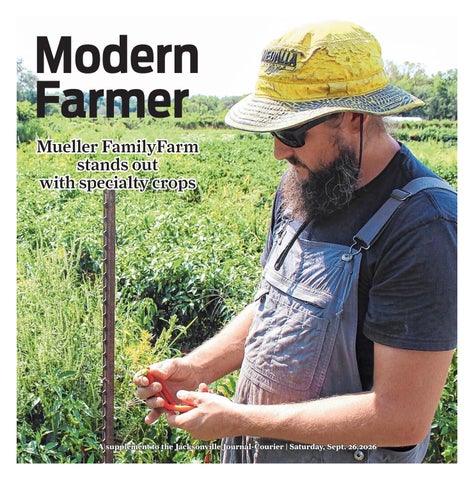
Modern Farmer Mueller FamilyFarm stands out with specialty crops
A supplement to the Jacksonville Journal-Courier | Saturday, Sept. 26,2026
H2 SATURDAY, SEPTEMBER 26, 2026
JACKSONVILLE | MYJOURNALCOURIER.COM
COVER STORY
MODERN FARMER 2. Farm stands out with specialty crops
13. Protein demand puts more pork on plates
4. 200 years of growing
14. Can healthy farms help bring back rain? Possibly.
6. Rising costs and razor-thin margins 8. Self-serve farmers market booming, expanding 10. Farm grows into agritourism destination 12. Female-led farms push for a greener future
15. Key bacteria may help farm children avoid asthma, allergies 16. New network helps agroforestry branch out 17. Farmers weigh warranties as machinery costs climb
Dave Dawson/Journal-Courier
Michael Meyer, owner and operator of Mueller Family Farm near Bluffs, inspects a load of squash that was picked by his employees. From the back of the truck, the squash will go to a greenhouse for curing. Meyer has operated the farm since 2016 after taking over after the death of his grandfather in 2014.
Farm stands out with specialty crops By Dave Dawson CONTRIBUTING WRITER
BLUFFS — Tucked away among the trees and grain fields in Scott County are 15 acres of land that produce vegetables, lettuce and melons under the flag of Mueller Family Farm. The farm, owned and operated by Michael Meyer, is a bit of an anomaly. Unlike its neighbors who focus on soybeans or corn, there are more than 40 types of produce, multiplied by varieties, on the Mueller farm that can be found for sale locally and at farmers markets in the region, including Jacksonville and Springfield. Meyer began running the farm after the death of his grandfather, Lari Mueller. His grandmother, Linda Mueller, continues to be an integral part of the farm.
“Our family has been farming in some fashion for at least 75 years,” Meyer said. “While some of the family has raised cattle, hogs, alfalfa and hay, I got involved in specialty crops, which is fruits, vegetables and cut flowers. We have been growing fresh produce for markets since 1996, and I have been running the operation since 2016.” The original farm was three acres, but Meyer acquired another 12 acres in the rolling, sandy soil of Scott County, just east of Bluffs. Of the 15 acres, 13 are suitable for Meyer’s purposes. The biggest seller is the array of lettuces as well as other greens including spinach, kale and arugula. But Meyer raises plenty of tomato varieties, 40 kinds of peppers, zucchini, cucumbers, eggplant, spring onions, radishes,
carrots, various types of melons and squashes, and cut flowers. “Where we have the biggest lead against competitors is lettuce. We’ve invested a lot in our infrastructure to do that. A few grow lettuce in the spring, but we’re unique in that we can provide lettuce practically year-round,” Meyer said. “We’ve invested in irrigation, machinery and cold storage. It’s not like tomatoes where the plant can keep producing fruit for weeks. Once the head is gone, you need to replace it. It goes on all year. There’s a germination room where we keep the lettuce coming,” Meyer said.
Lettuce begin Before Mueller Family Farm was created, it was a mom-and-pop operation Crops continues on H3
JACKSONVILLE | MYJOURNALCOURIER.COM
SATURDAY, SEPTEMBER 26, 2026 H3
CROPS From page H2 run by Meyer’s maternal grandparents, Lari and Linda Mueller. “We got started as Mueller Produce in 1996 after my husband was ready to step back from raising hay, cattle and row crops. He said he needed a hobby, so he started planting a garden and that’s how this all started,” Linda Mueller said. “We started out with vegetables and lettuce, but it was a very primitive operation. He poked holes in the ground and I put the plants in and covered them and watered them,” Mueller said. “I also went to market. My husband loved it.” Meyer was exposed to the operation as a youngster in the mid-1990s, helping around the farm until he was a teenager.
Dave Dawson/Journal-Courier
Linda Mueller and Josh Olmstead inspect the selection of cut flowers that Mueller Family Farm had for sale at the Jacksonville Farmers Market. Mueller started the farm near Bluffs in 1996 with her late husband. The farm is now operated by their grandson, Michael Meyer.
Eventually, as happens with many young Mueller employees, Meyer aged out and embarked on a career that led him to being a
cook at Illinois College. His cooking career shifted when his grandfather died Oct. 27, 2014, at the family home.
“I came back to help after my grandfather became ill and I helped him during his final season to get through the final mar-
kets in October. When I came back, I fell in love with it again, and eventually went full time,” Meyer said. “If grandma wasn’t willing to keep the operation going, there probably would be no Mueller Family Farm. Grandma and I had to figure how to keep it going after they had run it together for close to 20 years,” Meyer said. They didn’t miss a beat as the crops continued and Mueller continued selling the produce at the Jacksonville Farmers Market. “I was working with Zach (Sigler) at the Illinois College kitchen. I would get done, then get out here and help. When the kids were gone for the summer, I started working it full time,” Meyer. “Zach stayed at IC for another couple of years after I quit — he came here during the summers —
but he saw the potential and came here to work full time. He’s been here in some fashion for all 10 of those years. He’s a fulltime, salaried employee and my right-hand man,” Meyer said. Mueller has no formal training in agriculture, but acquired a base skill set from his early years working with his grandparents. “I didn’t remember some of the technical things, but I understood the work that was required,” Meyer said. “Grandpa leaned into lettuce. There are no other large-scale, open-air lettuce operations in central Illinois. Many think we use hydroponics, but we don’t. It’s a process that involves continually getting young plants ready to plant as the harvest continually progresses,” Meyer said. Crops continues on H18
H4 SATURDAY, SEPTEMBER 26, 2026
JACKSONVILLE | MYJOURNALCOURIER.COM
200 years of growing Farming has both changed and stayed much the same over two centuries By Angela Bauer STA F F W R I T E R
When Michael Huffaker bought Woodlawn Farm in 1824 as a 160-acre plot, it was considered a large farm. “It wasn’t on the scale we’d be looking at today,” said Terry Maggart, chairman of Morgan County Historical Society’s Underground Railroad Committee, which runs the farm as a living history museum and selfsupporting historic site. “But it was a large farm (for the time), 160 acres. “Today, sometimes, you can’t turn a tractor around in that” amount of space. Farming has seen some major changes in just more than 200 years, though the basic concepts remain similar. While contemporary farm mowers feature cutting widths that can top 20 feet in a single pass,
Angela Bauer/Journal-Courier
Woodlawn Farm volunteer Terry Maggart stands near a seeder, a wood wagon equipped with a funnel and feeding system to plant seeds as the wagon is pulled through a field.
mowing in the 1820s was limited to what could be accomplished by a farmhand or family member wielding a single-bladed scythe. “They wouldn’t have seen a tractor,” Maggart
said. The earliest tractors trace to the 1870s or 1880s but didn’t come into popular use until well into the 1900s. Huffaker died in 1883. Planting was similar.
While today’s farm equipment can accommo-
date simultaneously planting 54 rows or more
Angela Bauer/Journal-Courier
Woodlawn Farm volunteer Terry Maggart stands next to a scythe. While today's farms have equipment that can mow or harvest a strip of land more than 20 feet wide in a single pass, farms in the 1800s would have used a scythe for mowing and some harvesting, Maggart said.
over a span of dozens of feet, that planting capacity was limited to just a few rows at a time and done either by hand or by using what was known as a seeder and drawn by a horse, oxen or person. “When Huffaker came in the 1820s, they were pulling plows with mules or horses or whatever they could get, (including) people,” Maggart said. The property at 1463 Gerkie Lane — now reduced to around 10 acres, the Huffaker farmhouse and barn — no longer operates as a farm, though about 7 acres of its land is maintained as grassland that another farmer mows for his own livestock, Maggart said. Even so, the juxtaposition of the 200-year-old Huffaker farm and the contemporary, active farms that surround it is clear. Windmills tower over neighboring soybean fields as cars and trucks pass by on Interstate 72. At Woodlawn Farm, meanwhile, the first few rows of construction on a log cabin stand on the grounds, a visual aid to the Huffaker history lesson. Huffaker and his sizable family — eventually including 17 children — lived for years in a 16square-foot cabin on the property before he built the farmhouse in 1840. “Farm families were big because they needed people to help on the farm,” Maggart said. “That’s how he started out — tilling the land, cultivating the land. He had to cut down prairie grass with its long roots. “He had a lot of crops 200 continues on H5
SATURDAY, SEPTEMBER 26, 2026 H5
JACKSONVILLE | MYJOURNALCOURIER.COM
200 From page H4 and a lot of people were required back then.” Southern plantations filled their demand for able bodies via slavery, Maggart said. “Cotton, tobacco, it was all made on slavery,” he said. “Up here, it wasn’t quite that way.” Instead, Huffaker “advertised by word of mouth that he was looking for free Black families to help on the farm,” Maggart said, noting Huffaker built four cabins on the property to house his farm workers. Near the the more recently built cabin sits a weathered-wood wagon that served as a seeder, a chain powering the mechanism that allowed seeds to be planted as the wagon was pulled through the fields. “Until steel blades came in, you had to have more people on a farm doing stuff than you do today,” Maggart said. The progression started with a two-bottom plow and increased to a
four-bottom plow, and then 16, he said. The plows were fitted with plates to dig into and turn over the soil for tilling. “It just gets bigger and bigger,” Maggart said. “Eventually, you had to know where you were going in the field. Now, GPS keeps you straight and tells you where to plant.” Many of today’s farms also specialize, planting nothing but corn one year, nothing but soybean another. “We know (Huffaker) grew potatoes,” Maggart said. “He had corn, beans, wheat, just a variety. Apple orchards, all kinds of stuff. They were pretty self-sufficient.” Huffaker also had cattle, Maggart said. Even though Illinois soil retains a reputation for being nutrient-rich farmland, soil 200 years ago was richer, he said. “All the nutrients were still there,” Maggart said. “They rotated crops a lot more, moved stuff.” Farmers in the 1800s, including Huffaker, followed a lot of Amish farming practices, he said.
Angela Bauer/Journal-Courier
A sign marks the front entrance to 1820s Woodlawn Farm as windmills tower over more modern farms east of Jacksonville. A lot about farming has changed in 200 years, while a lot has remained fairly similar.
“They’d keep manure from the horses and cattle and put it on the field,” Maggart said. “There wasn’t anybody coming out with a truck full of fertilizer.”
Angela Bauer/Journal-Courier
Woodlawn Farm volunteer Terry Maggart looks over the beginnings of a 16-square-foot cabin on the property. It is intended to give visitors to the historic site an idea of the size of the cabin in which Woodlawn Farm founder Michael Huffaker and his growing family lived for many years before he built a brick farmhouse.
H6 SATURDAY, SEPTEMBER 26, 2026
JACKSONVILLE | MYJOURNALCOURIER.COM
Rising costs, with razor-thin margins By Todd Marver STA F F W R I T E R
West-central Illinois grain producers are facing the reality that a bumper crop can still lose money. According to Farm Business Farm Management data, grain producers in the region are coming off a tough three-year stretch. From 2023 through 2025, west-central Illinois corn operations on high-productivity farmland lost an average of $91 per acre annually. While margins are projected to increase back into positive territory for 2027, overhead costs for local operators remain high. For corn, total direct costs climb to $579 per acre, driven by $263 for fertilizer, $134 for seed and $119 for pesticides. Operating equipment, including fuel, repairs and depreciation, adds $186 per acre in total power costs, while overhead costs include a $40 per acre interest fee on operating credit. For soybeans, expenses are lower at $256 in direct costs with fertilizer holding at $77 per acre, $165 in total power costs and $113 in overhead. Average lo-
Todd Marver/Journal-Courier
John Poter processes field corn with a John Deere combine harvester during seasonal harvest operations on Potter Road.
cal cash rent remains fixed, holding firm at $321 per acre for both crops. According to Farm Business Farm Management, a high-productivity trend yield of 245 bushels of corn per acre valued at a baseline price of $5 per bushel generates $1,225 in crop revenue. When
stacked against $885 in total non-land costs and the $321 cash rent, total expenses reach $1,206 per acre, leaving area operators with a net return of just $36 profit per acre. A trend yield of 77 bushels per acre at $12 per bushel generates $924 in crop revenue. Balanced
against $534 in non-land costs and $321 in cash rent, soybeans have a net return of $86 per acre, outpacing corn by $50 per acre. Each area of the state has yield differences due to excessive rain and wind, but Farm Business Farm Management is using trend yields for the 2026 and 2027 projections, said Brad Zwilling, Farm Business Farm Management vice president of data analysis. The agency is showing positive returns to corn and soybeans in central Illinois using an average cash rent number from National Agricultural Statistics Service, he said. Farm Business Farm Management has revised prices received upward, but the biggest reason for
lower (still positive) projected returns is much higher costs, especially in fuel and fertilizer, Zwilling said. The fertilizer costs are hard to predict for 2026 as it depends on when it was paid for, he said. “Many farmers prepay for that in the fall or winter and that would have been prior to the increased prices due to the Iran conflict. If fertilizer was purchased after that date, the cost could be much higher,” Zwilling said. The drivers of tight margins are skyrocketing input costs, high cash rents and elevated interest rates, said Mike Gunderson, chief credit officer at Farm Credit Illinois. Increases in fertilizer and fuel in particular
added costs to per acre budgets, he said. University of Illinois Extension agricultural communications specialist Todd Gleason also noted that tight margins stem from “high input cost particularly fertilizer and fuel.” Gunderson’s advice to operators navigating tight margins includes having a budget in a spreadsheet that can be stress tested for changes in the market. A great budget identifies break even prices and guides marketing decisions, Gunderson said. Budgeting on a field level, in addition to whole farm, will allow farmers to know where to reassess their budget and production decisions, he said. Gunderson also advised operators to optimize the balance sheet and make sure to have the right amount of equipment to farm the acres in the operation. Having too much cost per acre of equipment can be a hindrance to long term profitability, he said. Another piece of advice Gunderson provided is to renegotiate fixed cash rents and consider a rental agreement that includes a base rent and a flexible additional payment that accounts for fluctuations in yield and prices. Gunderson also said to explore other ways to add to revenue; for example, growing seed beans or food grade corn can generate premiums and widen margins if the additional costs are managed. Harvest started around late August or early September, said Marcus Christensen, Scoular facility merchant based at Margins continues on H7
JACKSONVILLE | MYJOURNALCOURIER.COM
MARGINS From page H6 its Waverly facility. There are definitely strong yields, but it’s too early to tell if we have record yields, he said. The cash prices at the elevator at the Waverly facility are $5.10 for fall delivery corn and $12.92 for fall delivery on soybeans. Historically, cash prices for corn and soybeans follow a seasonal pattern, making their lows at harvest, but this year, they’re seeing the opposite and cash prices are at multiyear highs, Christensen said. There was a USDA report that recently came out with a lower corn yield nationally, and commodities are a globally traded futures market, so things that happen around the world affect them, he said.
“As far as commodity prices, we’re at multi-year highs for harvest delivery, which is historically very rare. Seasonality we generally make lows in the commodity markets at harvest when there is excess supply and prices get better and stay stagnant throughout the year. This year with a tighter USDA carry out on both corn and soybeans via the USDA report, it has driven prices to move quite a bit higher, not only on the USDA report, but on some of the other macro things going on in the market,” he said. The price of crude oil continues to go up every day, and the conflict with Russia and Ukraine has wheat prices rising with supply uncertainties, Christensen said. Funds — the managed money which trades some of these commodity mar-
SATURDAY, SEPTEMBER 26, 2026 H7
Courtesy of Scoular
Assets are prepared to handle high regional yields at the commercial processing and silo footprint at the Scoular facility in Waverly.
kets — are at near-record long levels, which has driven the prices up for harvest delivery to multiyear highs for both corn and soybeans, he said.
Courtesy of Scoular
BNSF hopper cars load up at the Waverly elevator to ship west-central Illinois grain directly into global futures markets.
Things are still tight on the farm because inputs continue to go up, and the cost of seed and equipment and fertilizer continues to go up, Christensen said. But the price of
commodities is at multiyear highs for harvest delivery, and given the strong prices seasonality for this time of year and these levels at harvest, it’s a good time to look at get-
ting some additional crops sold that they can’t store or are going to bring to town, he said. “It varies per operation or per producer. They should definitely do what’s best for their operation. They could always forward contract by putting grain in the bin to lock in forward carries of those commodities. Scoular offers different and more advanced marketing strategies and options they could utilize if that’s something they choose to do as well,” he said. The state varies quite a bit, Christensen said. Locally, Scoular has strong yields and as far as its assets and elevators they’re prepared to handle the crop and service the customers, he said. “That’s what we think about every day and that’s what we’re prepared to do,” Christensen said.
H8 SATURDAY, SEPTEMBER 26, 2026
JACKSONVILLE | MYJOURNALCOURIER.COM
Self-serve farmers market booming By Bridgette Fox STA F F W R I T E R
Bridgette Fox/Journal-Courier
Jenny Sauer-Schmidgall changes the water in the fresh flowers sold in her shop as customers peruse the store.
RIGGSTON — Four years after starting her self-serve farmers market, Jenny Sauer-Schmidgall said there will be seven of her stores in the state before the end of the year, and four more are slated for next year. “All of this good stuff is grown in a rural community — why is it going to cities?” Sauer-Schmidgall said. “Why aren’t rural communities the healthiest in the nation? Why is it that way instead of practically the opposite?” The first Grab ‘n’ Grow Greenhouse she started is in Riggston, about 15 minutes west of Jacksonville. In a small, air-conditioned building there are packaged meats, baked goods, milk, cheese, honey, preserves and more. In the middle of the room is a screen and barcode scanner for people to check out their items by themselves. The room looks kind of like a garage with its concrete floors and overhead rolling door — which was on purpose. “My husband built this. We put a garage door on it because if it didn’t work out, we would have a nice garage,” SauerSchmidgall said before chuckling. The produce in the farmhouse comes mostly from local farmers and bakers. There are some exceptions: Wisconsinmade cheese and pressed juices from California, where she briefly lived. Sauer-Schmidgall said people have come to her to ask for advice on how to start something like this, but she said she
doesn’t really give advice. She’s franchising out right now with people running chains of the store. “We’ve heard people say, ‘This is this looks really easy, we can do this,’ ” she said. “It looks easy because of all the mistakes and all the time it’s taken for me to get there. I don’t mind helping people, but I’m not going to give them how I did everything.” Sauer-Schmidgall had non-disclosure agreements signed with all the producers that sell out of her store that determines what cut of the sale they get. She wouldn’t share how much farmers get, but some producers have been able to expand their businesses because of the income they get through the stores. They also aren’t signed to any exclusivity deals. “They are obviously able to make enough that they can grow, and that was the whole premise,” Sauer-Schmidgall said. “I didn’t start this to make money because I didn’t think it was going to work.” It was surprisingly simple to start selling black Angus raised on the family farm. They already raised cattle and took it to get processed, but the family didn’t sell directly to customers. There was less red tape to sell meat in the greenhouse than for homebaked goods though; their processor, Jones, was already licensed to be that middle man. “I thought that was a horrible idea, there’s going to be too much red tape and licensing and everything else,” Sauer-
Schmidgall said. “Come to find out, it is easier to sell that than a bag of cookies.” Cookies and other baked goods made in someone’s home still have to be licensed as a home bakery. The Riggston store will be expanding soon too. The building will soon to be able to house kitchen appliances, which was supported by a grant from the state. In 2024, two years after opening the market, a new law was signed that allowed markets like SauerSchmidgall’s to be awarded grants for expansions. That bill came about because Sauer-Schmidgall got in contact with anyone and everyone she could that had anything to do with agriculture. One legislator who sits on the Illinois Senate’s agriculture committee responded: Sen. Doris Turner, D-Springfield. “I believe I sent Doris an email, and I didn’t know Doris. I’ve had no political affiliations and aspirations at all. I just sent out a couple of emails to people that were involved with food, agriculture,” she said. “Because I thought, well, those are the people that know what’s going on so they can make some kind of difference if anything. And yeah, so she said, ‘Hey, come in. I’d like to meet you.’ ” Since then, SauerSchmidgall has had another meeting with Turner set up for the middle of September. She wants to make her official classification for her type of business because she’s neither a grocery store, a Market continues on H9
JACKSONVILLE | MYJOURNALCOURIER.COM
MARKET From page H8 wholesaler or manufacturer. “This has been a constant learning experience, just meeting these people, knowing how it works: ‘OK, well now I know,’ ” she said. “As we start to grow — OK, what are the next steps? What what are the things you’re supposed to say? How do you phrase things, and how do you go about navigating that world? Because if you’re going to get anywhere, you have to learn how to play with people in politics.” One of the market’s regulars joked about how he doesn’t like telling people about “such a good little secret place” so it doesn’t get overcrowded. He was buying $58 worth of ground beef along with some rolls and sourdough bread. The store tries not to advertise too much so that the shelves don’t go empty. An older pair of ladies came in after him to pur-
chase some baked goods — one of them had asked her friend to show her that little market because she didn’t know how to find it. Sauer-Schmidgall said the plans for the store came to her over three days. “It was God. That is the only answer I can give you.” She has been a model and actress — she’s still an actor’s guild member just because it was hard to get into it in the first place. She also has a degree in biology. Those experiences shaped her relationship with food, but not more than her upbringing with agriculture did. “I already had a good idea of marketing, how it works, and how you relate to people. And living in all the different cities, I have met every type of person, so I know how to deal with customers, what they look for kind of how they how they view things, how they act, how they shop, that kind of thing,” Sauer-Schmidgall
SATURDAY, SEPTEMBER 26, 2026 H9
Bridgette Fox/Journal-Courier
Steve Pate, a regular of the Grab 'n' Grow Greenhouse, checks out ground black Angus.
said. “So those experiences really affected this, but the farm background made it really much easier to navigate.”
Bridgette Fox/Journal-Courier
A sign points to the Grab 'n' Grow Greenhouse. It first opened in April 2022 and has expanded since then.
H10 SATURDAY, SEPTEMBER 26, 2026
JACKSONVILLE | MYJOURNALCOURIER.COM
Farm grows into agritourism destination By Samantha McDaniel-Ogletree STA F F W R I T E R
GREENFIELD — Growing up, Regan Joehl knew he would follow in his family’s footsteps and join the family farm. He did not know his vision of harvesting corn and soybeans from the seat of a tractor would not become reality. For its 11th season, Greene Field Farms is opening its fields for selfpick items, including apples, pumpkins, fresh-cut flowers and freshly made food products. The self-pick operation was not intentional, but has become an agritourism destination. In 2016, Joehl’s wife, Christie, left her job as an agriculture teacher to raise
Samantha McDaniel-Ogletree/Journal-Courier
Regan Joehl, owner of Greene Field Farms, checks apples as the self-pick farm prepares to open.
their children, leading to a change in the family’s financial situation. The selfpick pumpkin patch was an unintended result. “It really started by acci-
dent,” Joehl said. “We couldn’t afford to go to the pumpkin patch, so I planted some. We invited people out to pick the extra. Then, we kept adding and word
spread and it turned into a full time job.” The farm at 311 Daum Station Road is open from 10 a.m. to 5 p.m. Friday and Saturday and noon to 5 p.m. Sunday during weekends of operation. Since that first season, the operation has grown, expanding beyond pumpkins. Starting each September, the farm opens for apple picking, flower cutting and pumpkin picking, with pumpkins ranging from small to large. The self-pick operation occupies a small portion of
the farm Joehl’s family bought in 2009. After graduating, he and his wife joined the family operation growing corn and soybeans, which his father and brother still operate. Joehl, his wife and their six children each contribute to the self-pick operation. “It has become a family affair,” Joehl said. “This has been everything. Exciting, terrifying and everything in between. This has given us the chance to farm in a way that supports us on a smaller acreage.” And it continues to grow. Starting in the spring, Joehl said they will offer self-pick strawberries. The family is already preparing a section of the farm for planting this fall. In addition to self-picking, there are areas for children to play, space to learn about farming and farm animals. “We try to keep this a real farm experience and we keep a focus on agriculture and the farm products,” Joehl said. And while the venture started out accidentally, Joehl said it has become something that interests
him. As a specialty crop producer, Joehl said it has been a bit of a learning curve. “There aren’t a whole lot of specialty farmers,” Joehl said. “We all work together and share advice.” Expansion also presents opportunities. Joehl said expanding is not something you do each year, but something that has to be considered carefully. “One opportunity with agritourism is deciding what you do and what works for your family,” Joehl said. “You have to decide if you expand or stay as you are. You have to look at what fits.” The family is adding strawberries. The plants will be planted this fall and harvested in the spring, opening a different picking season for the farm. The farm is open through Oct. 31. After the season closes, Joehl said he gets his own form of meditation — finally getting in a tractor. “I call it my end-of-year therapy,” Joehl said. “Any pumpkins left get tilled under and the picked ones get fed to animals. It’s my time to be in a tractor.”
Samantha McDaniel-Ogletree/Journal-Courier
Greene Field Farms has a variety of items for people to look at as they explore the farm and pick items.
JACKSONVILLE | MYJOURNALCOURIER.COM
SATURDAY, SEPTEMBER 26, 2026 H11
H12 SATURDAY, SEPTEMBER 26, 2026
JACKSONVILLE | MYJOURNALCOURIER.COM
Female-led farms push for greener future By Judith Ruiz-Branch P U B L I C N EWS S E RV I C E ILLINOIS
Mint Images RF/Getty Images
According to the USDA, 35% of all U.S. producers are women.
A new generation of women in farming is expanding ideas about land management and conservation across Illinois. Women make up nearly 30% of farmers in the state. Crystal Siltman, farmer training program manager for the educational nonprofit The Land Connection, said a growing number are using more conservation practices, often because of health issues they have seen in their communities they believe may be tied to chemicals used in traditional farming. “It may sound woo-woo, but I do think that women are more naturally tuned into nature’s cycles,” Siltman said. “These women are taking over the business, but they’re also thinking about the health of the farm, the health of the people running the farm, and also the community that the farm is in, the creeks and the streams and the rivers that those chemicals eventually
Pramote Polyamate/Getty Images
Interest in women-focused farming gatherings continues to grow, especially in central Illinois.
make their way to.” The Land Connection recently partnered with the Michael Fields Agricultural Institute to launch Illinois Women in Conservation. Siltman pointed out the goal is to provide local women with resources to support their conservation goals while creating a dedicated community for collaboration. Despite federal funding cuts for programs like these, Siltman’s group is trying to find creative ways to fill the gaps. She noted interest in womenfocused gatherings continues to grow, especially in central Illinois, where some women may not feel
comfortable in other agricultural spaces. “We are in cornlandia, if you will, and a lot of it is monoculture,” Siltman observed. “It’s your corn, your soy, and you see Pioneer signs there. And so this opportunity provided not only a space for them to connect with one another but to speak freely.” More than 90% of Illinois farms are familyowned. Siltman underscored while farm lineage has historically focused on men, a demographic shift is underway as more female heirs take over. Today, 41% of beginning farmers in the U.S. are women.
Me 3645 Studio/Getty Images
Crystal Siltman, farmer training program manager for the educational non-profit The Land Connection, noted interest in women-focused gatherings continues to grow, especially in central Illinois.
SATURDAY, SEPTEMBER 26, 2026 H13
JACKSONVILLE | MYJOURNALCOURIER.COM
Protein demand puts more pork on plates about recognizing where we are as an industry and as a protein and recognizing that where we’re going is much different than where we’ve been.”
By Rhiannon Branch FA R M W E E K
As Americans want additional meat-based protein in their diets and diverse culinary experiences, pork is being plated on more tables across the country. Total pork consumption in the U.S. this year is estimated to total 21.9 billion pounds, up about 185 million pounds from 2025, according to USDA. The department is projecting U.S. pork use to increase again in 2027. Global demand for pork has also been strong in the first half of 2026. Meanwhile, as Millennial and Gen Z consumers take a greater role in food purchasing decisions, the pork industry is working to modify products to fit
‘Meat is having a moment’
Catrina Rawson/FarmWeek
Woodford County Farm Bureau member and pork producer Chad Leman has made practical changes on his farm in Eureka to help meet the changing preferences of consumers.
changing consumer preferences. “The reality is the young consumer in to-
day’s society is very different than my parents and the Baby Boomer generation that has really
propped up pork for a long time,” said Jesse Heimer, National Pork Board member. “This is
Americans are eating more meat than ever before – not just pork, but beef and chicken, too. According to the Meat Institute, meat sales hit a record-high $112 billion in 2025 with more than 98% of American households purchasing meat for daily meals. U.S. consumption of beef, pork and chicken are all expected to rise again this year. “Meat is having a moment,” Kansas State University ag economist Glynn Tonsor told FarmWeek. “The desire for
protein in the U.S. diet has definitely grown and that’s beneficial for pretty much the entire meat and livestock space.” According to KSU’s Meat Demand Monitor, which surveys more than 3,000 U.S. residents each month, taste and freshness are most important to consumers shopping for protein – outranking price. Woodford County Farm Bureau member Chad Leman, who markets about 120,000 pigs annually from his farm in Eureka, said his family changed herd genetics to accommodate consumers. “We raise Duroc sired pigs now because studies have shown that consumers prefer the taste of Duroc pork versus other Pork continues on H14
H14 SATURDAY, SEPTEMBER 26, 2026
JACKSONVILLE | MYJOURNALCOURIER.COM
Can healthy farms help bring back rain? By Judith Ruiz-Branch P U B L I C N EWS S E RV I C E ILLINOIS
A new venture in Illinois is highlighting how healthy farmland can help to address climate change and restore local rainfall. The Nature Cools project, led by the Climate Land Leaders initiative, is studying how healthy soils, trees and diverse plant life work together to strengthen local water cycles. Katie Ross, a scientist and researcher for Nature Cools, said regenerating land brings back diversity both above and below the ground. Then, living landscapes can release natural particles helping clouds form and bring rain back to the places
Goroden Koff/Getty Images
Balancing climate change via the movement of water through life is referred to as the second leg of climate, alongside greenhouse gas emissions and the greenhouse effect.
where water first evaporated. “In addition to carbon sequestration, restoring
that local rain cycle includes several powerful processes, which is nature’s way of cooling the
climate,” Ross explained. Research shows by 2050, Illinois is projected to have at least 26 more days above 95 degrees and more frequent and rapidonset droughts. With increasing incidents of wildfires and flooding, Ross stressed the project serves to remind farmers of how much agency they can have in the face of natural disasters.
PORK From page H13 breeds,” he said. Knowing consumers are interested in animal welfare, the Lemans also transitioned to open-pen gestation for their sows and focus on educating consumers about the benefits of raising pigs in barns.
Pork chops No. 1 cut Seasonal demand for pork peaks during the summer months, and pork chops are the most popular cut of pork. According to data from
Along with carbon emissions, Ross noted practices killing the microbial community in soils have stunted nature’s natural cooling processes. This summer, Ross visited three central Illinois farms that are part of the project to measure soil temperature and test how quickly rainwater soaks into the ground. Farms with restored prairie and long-term regenerative practices absorbed water far more quickly than land with a long history of conventional row cropping. The findings suggest healthier soils are better able to capture rainfall instead of letting it run off. “What these farmers are doing is incredibly important,” Ross emphasized. “That’s part of the joy and purpose of this project, is to say you guys actually are superheroes more than is recognized.” The results revealed how difficult land recovery can be. Leslie Cooperband, coowner of Prairie Oasis
Farm near Champaign, said researchers found compacted soils with very little organic matter, even in areas covered by perennial vegetation for decades. Cooperband called it a reminder rebuilding soil damaged over generations takes time. “It’s like a paradigm shift. I will say though, it’s a long-term proposition,” Cooperband observed. “It’s not like plant a bunch of trees and next year you’re going to have rain clouds over your farm. The damage is so profound that it is going to take years to bring that soil life back.” Cooperband added with so many farmers feeling squeezed to maximize productivity, it can be hard for farmers to commit to sparing farmland for alternative uses. Still, Cooperband stressed as farmers crave greater climate predictability, the project’s findings can help expand efforts beyond farmers already open to adopting regenerative practices.
the Federal Reserve Bank of St. Louis, the average retail price for pork chops in U.S. cities was $4.33 per pound in April, up 9 cents per pound, or 2.1%, from $4.24 last year. During an educational session at the 2026 World Pork Expo in Des Moines, Iowa, National Pork Board CEO David Newman demonstrated how to trim a pork carcass into different cuts and challenged attendees to explore how traditional primal cuts can be processed differently to entice consumers. “As the industry has changed, as our consumer
has changed, are we meeting the consumer where they want to be?” Newman asked the audience. For example, Newman said there are more air fryers in U.S. households today than there are coffee makers, pointing to a need for smaller cuts that can easily fit in condensed appliances. Portion sizes are also more relevant to the growing number of consumers on GLP-1 weight loss medications who desire more protein packed into smaller meals. “This doesn’t have to be rocket science, this is Pork continues on H18
SATURDAY, SEPTEMBER 26, 2026 H15
JACKSONVILLE | MYJOURNALCOURIER.COM
Key bacteria may help farm children Can help avoid asthma, allergies By Karl Hille T R I B U N E N EWS S E RV I C E
German scientists identified bacteria present in cow digestion and poop that seem to help children exposed to them avoid developing asthma. The catch is they have to inhale the germs. As rates of allergies, asthma, eczema and hay fever rose in industrial civilizations, children raised on farms did not seem to be affected. By the 1990s, research suggested that certain childhood infections helped the body tune its immune system, instead of overreacting to dust, pollen and other allergens. It became known as the “hygiene hypothesis” — staying too clean had a cost. Now, researchers at LMU University Hospital and the Institute of Asthma and Allergy Prevention at Helmholtz Munich in Germany measured the bacteria that children tend to inhale when playing or working in cow barns and traced the mechanism that helps
fight inflammation in their lungs. “Girls and boys who grow up on farms and are exposed to a wider variety of microbes have the problem far less often,” epidemiologist Markus Ege said. “With our new study, we can make a much stronger case, because we can identify the individual links in the proposed causal chain: the bacteria, the relevant microbial metabolic products, and the human receptors.” The team analyzed data from more than 1,000 children participating in European health studies in rural areas. They compared nasal swabs and samples of mattress dust, as well as airborne samples from cowsheds for 47 farm children. They published their findings in the July 28 issue of the New England Journal of Medicine. Within the microbial stew of a farm environment, his team’s study identified nine gram-positive environmental bacterial genera. Together, those microbes explained two-thirds of the association of farm exposure and reduced rates of asthma. The findings ruled out
fungus as a contributing factor. Those bacteria produced chemicals that could switch on certain proteins in the human body to help control the immune system and inflammation. These chemicals include Kynurenine and xanthine, which activate a protein called the aryl hydrocarbon receptor, and alpha-Linolenic acid and stearidonic acid, two types of healthy fatty acids which activate another protein called PPAR-y. Both receptors are common on human airway cells High levels of stimulation are detrimental, the researchers wrote, whereas moderate levels indicating small amounts of time spent in cowsheds seemed to be beneficial. The effect of the cow bacteria doesn’t benefit everyone. Small variations in genetics, especially those genes involved in sensing molecules produced in the body or influenced by the gut biome, could affect the results. The effect is common enough, Ege said, to suggest new medical treatments to prevent asthma in children who do not have access to cowsheds.
Mathieu Young/Mathieu Young Inc.
German scientists identified bacteria present in cow digestion and poop that seem to help children exposed to them avoid developing asthma.
Catherine Falls/Catherine Falls Commercial
As rates of allergies, asthma, eczema and hay fever rose in industrial civilizations, children raised on farms did not seem to be affected.
H16 SATURDAY, SEPTEMBER 26, 2026
JACKSONVILLE | MYJOURNALCOURIER.COM
New network helps agroforestry branch out By Judith Ruiz-Branch P U B L I C N EWS S E RV I C E ILLINOIS
Nitat Termmee/Getty Images
Some agroforestry practices, like trees planted in windbreaks along field edges or in riparian buffers along riverbanks, are already common in the Midwest. Others like alley cropping and silvopasture can be harder to find but if adopted widely, experts said they can improve soil health, water quality and wildlife habitat.
An initiative to expand agroforestry practices is taking root in Illinois. Spearheaded by the Savanna Institute, the Midwest Agroforestry Farm Network aims to show how farming with trees and shrubs can give producers options to add new income sources or cope with extreme weather, while improving local ecosystems. Evan Barry, network coordinator for the institute, said it helps connect farmers who are already practicing agroforestry with those who are interested in getting started. “Not only farms practicing agroforestry but also folks with commercial kitchens and agroforestry-specific processing equipment,” Barry explained. “That’s another big barrier that we see for our farmers is access to equipment.”
Barry pointed out the institute wants to map agroforestry farms and resources across the state. John Williams, manager of Sola Gratia Farm in Urbana, said perennial plantings are being added alongside the farm’s annual vegetable crops. Williams stressed it is still too early to measure the full effects but the farm has already seen improvements in soil quality and reduced erosion and compaction from similar practices. “Really thinking through and designing systems that integrate fairly seamlessly with your current cropping systems is really important,” Williams emphasized. “We designed ours to really fit the equipment we had without too much hiccups and having to change our systems.” John Plescia, an Ogle County physician and farmer, noted the transition can be difficult, especially because perennial
crops can take years to produce income. Plescia pointed out the biggest challenge for farmers is financial, as federal subsidies and commodity markets have long favored traditional crops like corn and soybeans. “It’s a risk but I think farmers are hardworking people and I think we have to bring back some of that creativity to look for our own markets,” Plescia underscored. “We can’t keep doing things the way that we’ve been doing them for 50 years. It might have worked before, but it’s not working anymore.” Plescia believes enough people are getting interested in healthy, local foods they are willing to pay a premium for them, adding the longterm goal should be an agricultural system building healthier soil, supporting local economies and producing nourishing food with fewer inputs.
Nitat Termmee/Getty Images
A geologist analyzes the color of soil on his hand to compare with centralized data on a tablet computer in field operations.
SATURDAY, SEPTEMBER 26, 2026 H17
JACKSONVILLE | MYJOURNALCOURIER.COM
Farmers weigh warranties as costs climb By Tammie Sloup FA R M W E E K
Without a solid warranty and a good relationship with his dealer, Piatt County farmer Jared Gregg’s planting season could’ve gone downhill fast. “I blew the transmission in a tractor. I had no warning sign of what was going to happen. All of a sudden, the planter just powered down, and at first I thought I hit a button inadvertently, and then come to find out that the transmission, front wheel assist, the hydraulic system — it’s all interlocked in one big hydraulic system — it all went down.” He estimated the transmission alone cost $80,000, with the total repair cost likely exceeding $100,000. Luckily, his warranty covered nearly all costs, and his dealer quickly provided a loaner tractor so planting could continue. Maintaining warranty coverage is critical because repair costs have become extremely expensive, Gregg said. Strong relationships with equipment dealers also are more important than ever when major breakdowns occur. “Keeping powered equipment in warranty is very, very vital in today’s economy,” Gregg said. Many farmers facing tighter margins are trying to extend the life of their machinery as costs remain high and are unlikely to decline significantly soon. Producers are focused on managing risk, preserving cash flow and maximizing the performance of the equipment they already own, Gregg
Courtesy of Jared Gregg
Piatt County Farm Bureau President Jared Gregg is grateful a catastrophic transmission failure in spring was covered by his tractor’s warranty. Gregg said maintaining warranty coverage is critical because of rising repair costs.
said, adding carefully reviewing warranties is a way farmers can protect their assets in a tough ag economy. As farmers prepare to budget for 2027, some considerations should be made around their machinery budgets, especially as factors such as aging equipment, technology upgrades and parts availability will eventually force replacement decisions. For farmers considering machinery purchases, Brad Zwilling, vice president of data analysis for Illinois Farm Business Farm Management, offered several pieces of advice: • Develop a long-term capital replacement plan. • Create detailed machinery budgets. • Carefully evaluate loan terms and interest rates. • Review cash flow and existing debt obligations before making purchases. • Plan ahead so equipment purchases are strate-
gic rather than reactive. • He stressed the importance of identifying equipment needs early and shopping proactively. “First make your capital budget to get a good idea of what you know you’re going to have to replace when, and that way you can be in the driver’s seat, so it’s not necessarily a knee-jerk reaction,” Zwilling told FarmWeek. Kankakee County farmer Grant Senesac stressed preventive maintenance during the offseason helps minimize breakdowns during planting and harvest. He also pays close attention to trade-in values when considering equipment replacement. “If they’re giving you a good price for your trade, you have to really consider trading at that point because the value of your equipment does go down and depreciates,” he said. “Keeping up (with equipment rotation) is hard, but you do have to do it as much as you can. Maybe not necessarily buying
brand new equipment, but stuff that’s maybe a few
years old.” Gary Schnitkey, Univer-
sity of Illinois professor and Soybean Industry Chair in Agricultural Strategy, provided additional equipment management recommendations for farmers, such as evaluating machinery fleet size to avoid owning underutilized equipment. “Sizing and quantity really matter,” Schnitkey said. “As we’ve seen those (machinery) costs increase, particularly for (relatively new) combines, we’ve got to be using it on 2,000 acres, roughly, and more. If we use it on 1,000, we really increase the cost per acre.” Equipment-sharing arrangements among neighboring farms also are becoming more common as farmers look for ways to spread costs across more acres, he added.
H18 SATURDAY, SEPTEMBER 26, 2026
PORK From page H14 meat science,” Newman told FarmWeek. “You could actually just cut that pork shoulder roast in half to make it a portion size that will meet a smaller family or meet someone who’s eating
CROPS From page H3 The strategy seems to be paying off as Meyer said they have grown revenue each year since he formed the LLC called Mueller Family Farm in 2016.
All in the family It’s no accident that “family” is part of the Mueller Family Farm name. Meyer’s grandparents
less grams of protein at a single serving or make it something that will fit in an air fryer.”
JACKSONVILLE | MYJOURNALCOURIER.COM
The industry is also tapping into innovation in nomenclature, or how things are named. Newman used pork loin chops as an example.
“Let’s use (a name) that also gives (consumers) a recognizable experience. Should we call it a pork ribeye, for example? That’s exactly what it is from an anatomical standpoint,” Newman said. Culturally authentic names also resonate well with consumers. “Things that I like to
highlight out of the carcass are some Spanish and Italian cuts, like the pluma or the secreto,” Newman said. “It’s not about the cut, it’s about the dish, and it’s about the eating experience they could get from that.” Catering to different cultures is also an important goal of the National
were a major force in his life as his parents divorced when he was young and he spent most of his time with his mother, Mindy Carter. He spent time with his grandfather who Meyer said was a strong, stoic figure who didn’t play a lot of games, but valued work ethic, respect and family. His mother pitches in, too, delivering produce in the Mueller van. “I can’t say enough about Grandma. She is my best friend and business
partner,” Meyer said. “She’s more like a buddy. What a unique position for her to be in her 80s and I get to see her five days a week and work together.” Meyer emphasizes customer experience and quality. “We are never going to be the cheapest option. We are going to stand by our quality. We pay our employees a living wage and we take steps to ensure our produce is high quality and safe to eat,” Meyer said.
On the business side, he invests in infrastructure and new equipment and technology to automate where possible. “Finding good labor can be a problem, so we lean into automating where we can. Instead of having a good year and say, ‘Hey, let’s go to the Bahamas,’ we invest to the point we have a sustainable business,” Meyer said. “It’s always been a family operation, no matter how big it has gotten. Zach is Michael’s best friend and he’s accepted as if he’s another grandson.” Mueller said. “We have some people who come to work here who don’t make it through the first day. But we have others who left and went into other professions. But after being here that long, you know they’ll be a success in whatever they do,” Mueller said. “It’s hard to find people who want to do this. It’s hot, hard work. Those who keep coming back every day are so special to us,” Mueller said.
What’s in a name
The products Mueller farm produces from April through midNovember, but Meyer has adopted methods to extend his growing season, His primary retail outlets are the farmers markets season, which is from May to the end of October. “When I took over, it was just the Jacksonville Farmers Market, which is
Pork Board’s ongoing consumer marketing campaign, “Taste What Pork Can Do.” National Pork Board recently launched a new tagline, Explora Todo El Gusto Del Pork, to connect with young Hispanic consumers. “Over the next 20 or 30 years, the majority of the
U.S. population growth is going to come from Hispanic American audiences, so this is about making sure that we’re meeting that very important audience where they are,” Newman said. “Because pork is so culturally relevant and authentic to them, it’s a dynamite audience for us.”
Dave Dawson/Journal-Courier
Linda Mueller, left, and Josh Olmstead tend to business while a customer looks over the offerings Mueller Family Farm had for sale at the Jacksonville Farmers Market. Mueller started the farm near Bluffs in 1996 with her late husband. The farm is now operated by their grandson, Michael Meyer.
our home base. I had another farmer tell me I should go to Springfield because it’s a really good market,” Meyer said. “That was seven years ago and now our biggest market in foot traffic and revenue is the Old Capitol Farmers Market in downtown Springfield,” Meyer said. “Last year, we started going to the Urbana Market at the Square.” Every Saturday, they load up three vehicles and head to three markets. Linda Mueller runs the Jacksonville market, while Meyer goes to Springfield and Sigler tends to business in Urbana. The reason they have produce to sell each week is an intricate, miles-long irrigation system that courses throughout the farm. It is powered by a small tractor his grandfather used in the original three acres of the farm.
Meyer can easily control what gets watered and when. “We went through the drought and had product every week. We want to be consistent and reliable so we go to each market with the products our customers expect.” “It’s the mentality that we work for our customers — we see it all the way through. We plant it, we grow it, we pick it and we sell it,” Meyer said. “We can offer cooking tips and suggest recipes to customers who aren’t sure what to do with a particular piece of produce. Cooking and growing food go well together.” Initially, Meyer just sold at the markets. But they had excess product to sell, so they expanded by selling wholesale to customers such as Proud Richard’s restaurant in Jacksonville as well as loCrops continues on H19
SATURDAY, SEPTEMBER 26, 2026 H19
JACKSONVILLE | MYJOURNALCOURIER.COM
CROPS From page H18 cal stores including the Farms of Illinois outlet on West Walnut Street in Jacksonville. The latter connection provides a connection to a wider distribution area that includes Bloomington. “A major break we’ve had is working with food banks. We value these programs. We now have a relationship with Feeding Illinois, which is connected to Feeding America, which works with statefunded food banks including the Eastern Illinois Food Bank in Urbana and the Central Illinois Food Bank in Springfield through grant programs. Those food banks, in turn, help supply smaller food banks and churches,” Meyer said.
Customer focus Mueller is a constant presence at the Jacksonville Farmers Market with another Mueller employee, Josh Olmstead. “I love market days because customers and other vendors are like family. When it’s over, I can’t wait until spring so I can see them all and make sure they are happy and healthy,” Mueller said. One satisfied customer is Joe Standley, owner and chef at Proud Richard’s. Standley sources a significant portion of his produce from Mueller Farm, especially lettuce and seasonal offerings such as tomatoes and zucchini. He values the partnership for its flexibility, quality and the opportunity to support local producers. “I approach my seasonal menus with the thought in mind that these are the products they have and that’s what we are going to try to highlight in spring, summer and fall. It’s a
Dave Dawson/Journal-Courier
Michael Meyer, owner and operator of Mueller Family Farm near Bluffs, shows off the machine that plants lettuce on his farm. Made by Checchi & Magli, an Italian manufacturer, the machine makes the hole, plants the seeds, covers them and then waters them. Meyer has operated the farm since 2016 after taking over after the death of his grandfather in 2014.
foundational partnership and helps direct where my creative process goes,” Standley said. As Standley spoke, he was working with some fresh zucchini from Mueller that serves as the base of the sauce for a vegetarian dish called linguine alla nerano, which is also composed of linguine pasta, garlic, white wine and pecorino. “Summer is definitely tomato-fest. They have so
many different varieties and so many different colors, shapes and textures,” Standley said. “Then there are the lettuces, which I think is the backbone of the operation. They have spring mix from mid-March and into December, which means I have this wonderful, locally grown lettuce to use in my salads,” Standley said. “Our partnership creates a mutually beneficial
Dave Dawson/Journal-Courier
Linda Mueller and Josh Olmstead inspect the selection of cut flowers that Mueller Family Farm had for sale at the Jacksonville Farmers Market. Mueller started the farm near Bluffs in 1996 with her late husband. The farm is now operated by their grandson, Michael Meyer.
relationship. We advertise each other and send people each other’s way. I can
also determine how much I want and when I want it. In light of all the food recalls and the concerns over lettuce, I can be sure my food is safe,” Standley said. “The quality of their produce is far above anything else you will find around here. There are other people producing wonderful stuff that you can find at farmers markets, but as far as the scale and size of what we need and the relationship we have built with them, it’s our best option,” Standley said. Mueller appreciates the renewed focus on local food as well as the people who come out and support the Jacksonville market. “You know you can get a good product that has been raised with care and great pride,” Mueller said. “We deeply appreciate our customers, some of
whom we have been feeding for 30 years.” For grandma and grandson, it is clearly a labor of love. “From what I see in society, it’s rare to love what you do. Some people may like what they do, but very few can say they love it. But I love what I do. I’m a problem-solver, so there is always something that needs to be done, something different to do,” Meyer said. “I love the seasonal lifestyle and experiencing the cycles in life and nature. It’s busy in the summer, but I’m ready for winter’s rest when the work is done. Before long, I feel as if it’s time to get back to work,” Meyer said. “It’s part of the seasonal lifestyle, which is the way humans used to live. We get to experience the seasons and celebrate what is in season.”
H20 SATURDAY, SEPTEMBER 26, 2026
JACKSONVILLE | MYJOURNALCOURIER.COM