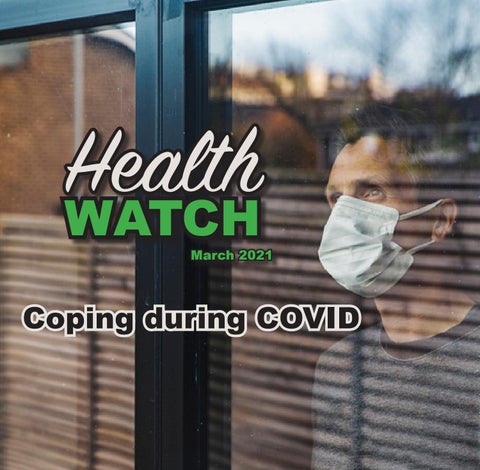
Health WATCH
March 2021
Coping during COVID
2 • Thursday, March 18, 2021 • Health Watch
IN THIS ISSUE 2.......Doctors and team care 3.......COVER STORY: Mental health help is available free in ‘telehealth’ hotlines 4 ......Hearing Aids: More than just better hearing 6.......‘Dear Dietitian’ answers your health questions 6.......Giving yourself grace during the COVID-19 pandemic 7.......Mental health resources
Doctors and team care OSF HealthCare Saint Anthony’s Health Center Special to Health Watch
ALTON — Because you have options, OSF HealthCare has continued to look for ways to improve your experience, focusing on keeping you healthy and out of the hospital. While a lot of our focus is on innovative technology, one of our main initiatives has a personal touch. We formed teams with our primary care Strohbeck physicians and advanced practice registered nurses to provide better access and coverage for you and your family. Advanced practice registered nurses Colin Solomon and Roxanne Strohbeck are the newest to join a care team at OSF Medical Group – Alton. They practice family medicine and have received advanced medical training allowing them to treat patients alongside Dr. Yusuf MohyudSolomon din and Dr. Michael Klein,
respectively. Nurse practitioners are considered advanced practice providers (APP), a term that describes advanced practice registered nurses (APRN) and physician assistants (PA), who provide care and treatment while working under the close supervision of a doctor. These providers have advanced degrees and are trained to approach patient care in a way that supports coordination and collaboration. The care teams work together to anticipate the needs of their patients and make sure no aspect of a patient’s health slips through the cracks. “They perform physical exams, prescribe medications, order tests, educate and make referrals, allowing us to expand care options,” Dr. Klein said. “It’s all about doing what is best for our patients, and advanced practice providers give our patients more options while maintaining a high
healthwatch HEALTH WATCH PUBLISHER Denise VonderHaar dvonderhaar@edwpub.net (618) 463-2500 — HEALTH WATCH ADVERTISING DIRECTOR Carole Fredeking carole.fredeking@hearst.com (618) 463-2500 — Getty Images
HEALTH WATCH EDITOR-IN-CHIEF Jill Moon jill.moon@hearst.com (618) 208-6448 — HEALTH WATCH COORDINATOR Regina Harbison rharbison@thetelegraph.com (618) 208-6433 —
Health Watch • Thursday, March 18, 2021 • 3 standard of care.” What this means for you With the help of APPs, OSF HealthCare is expanding options for patients, while keeping their care within a single care team they know and trust. “Care teams provide our patients with a team that knows their history,” said Dr. Klein, “a team they can feel comfortable
with. Plus, if we aren’t available, the advanced practice providers and the office staff can answer questions and care for the patient, providing greater consistency. The patient will always be with someone that they know, rather than an on-call doctor who isn’t familiar with their situation.” The two teams are examples of how
health care is changing. According to the American Association of Nurse Practitioners, January set a record of more than 270,000 nurse practitioners (estimated) licensed to practice in the U.S. This number is higher than the previous estimated 248,000 nurse practitioners in March 2018. The increase in advanced practice pro-
viders is good for patients who benefit from better access and patient-centered services. “The amount of advanced practice providers continues to grow because nurses have the opportunity to pursue a medical career and make a huge difference in our patients’ lives,” Dr. Mohyuddin said. See DOCTORS | Page 5
Prolonged isolation raises mental health concerns Help is available, free in ‘telehealth’ hotlines
Health Watch
EDWARDSVILLE — As residents face one year under different degrees of “stay-at-home” precautions, limited social interaction and distancing, working from home, remote learning (just now a majority of public schools have returned to in-person learning) and social isolation of nursing home residents and rehabilitation facilities, mental health concerns are at a height. The Madison County Mental Health Board’s Deborah Humphrey, executive director, warned last summer that as the pandemic wore on, it was likely the mental health burden would increase as measures taken to slow the spread of the virus led to greater isolation and potential financial distress. “Lives have now been lost which has had a deeper emotional impact on families, friends and medical professionals,” she said. The Regional Disaster Mental Health Volunteer response team has a support line to respond to the stressors that local medical professionals and first responders are experiencing. This includes those who provide healthcare in long-term care and assisted living centers. Trained, licensed professionals are available to offer support and resources by calling 618-381- 5173. “We want them to know, people are here to support their heroic efforts,” Humphrey said. Humphrey said the COVID-19 pan-
demic and resulting economic downturn have negatively affected many people’s mental health and created new barriers for people already suffering from mental illness and substance abuse disorders. “Our mental health providers have done a tremendous job in moving quickly to adapt services to be responsive to the impact of the pandemic and ensure help is available to any individual feeling distressed,” Humphrey said. Touchette Regional Hospital, now providing outpatient behavioral health services in Madison County has implemented a Mental Health Support and Resource Line answered by trained therapy staff. Anyone who is struggling can call 618-482-7158 at any time. The state also has a text line that allows Illinois residents to talk to a mental health professional, free of charge, during the pandemic. The program, called “Call4Calm,” was launched by the state’s Human Services Mental Health Division. Illinois residents wanting to speak to a mental health care professional can text the word “TALK” to 552020, and the service is free to use. “There has been a movement toward telehealth in the mental health field for a number of years and this technology is increasing,” Humphrey said. “There is a lack of psychiatry/psychiatrists in the United States and many areas have to rely on this now, particularly rural areas which are even more
under-resourced.” She said telehealth has been an effective treatment tool even with children. Mental health stigma may prevent individuals from seeking mental health treatment for fear that someone will see them, adding to their stress. Others may find it difficult to seek treatment if they reside in a rural area where services are less available and where lack of transportation becomes a barrier to getting to treatment. “Telehealth is more private, it can be done in the person’s home where they feel safe and removes barriers to access,” Humphrey said. There are various platforms though virtual and telehealth individual and support groups, social media, and crisis mental health services. Telehealth-Virtual Mental Health Services are available in Madison County at Centerstone of Illinois Inc. through the Open Access services at 618-462-2331 and Chestnut Health Systems, Central Access, 618-877- 4420. Humphrey said there are added stresses with someone experiencing economic stress, unemployment and food insecurity that increases feelings of depression and hopelessness. She said it is estimated that the coronavirus has the potential to result in a 20% increase in unemployment and a spike of up to 20,000 suicide deaths in the United States and Europe. “Social distancing and social isolation can create a high level of stress,
anxiety, sleep difficulties, agitation-anger and depression,” Humphrey said. “For individuals who have an existing mental health disorder this may have an even greater impact. The longer the duration, there is greater risk of deterioration of one’s coping mechanisms.” She said there is speculation that the suicide rate will go up during the pandemic and research has demonstrated that feeling alone, hopeless or a burden to others are feelings individuals have reported leading to suicide.
“Individuals are cut off from their support systems,” Humphrey said. “It puts someone at a higher risk of depression that can lead to suicidal ideations, intent or attempt and is further complicated by the economic issues.” In Madison County, there are supports in place aimed at suicide prevention and a number of support sessions for mental health and addictions. Substance use is also on the increase and combined with depression can place a person in a state of reducing the fear of death by suicide. Virtual meetings are available through Narcotics and Alcoholics Anonymous, call 618-398-9409 or email metroeastnapr@gmail.com. The Madison County Mental Health Board funds 14 mental health agencies that serve county residents. Local COVID-19 resources are posted on its website and using social media https:////Facebook.com/co.madison. il.us to share information with the general public.
4 • Thursday, March 18, 2021 • Health Watch
Hearing Aids: More Than Just Better Hearing By Dr. T.K. Parthasarathy For Health Watch
GLEN CARBON — Research has shown that if someone has a hearing loss and doesn’t get help, the effects are more than not understanding your family, your friends or your co-workers. People who don’t get help for their hearing loss are at increased risk for depression, anxiety and dementia. They also have more hospital stays, more emergency room visits and a greater likelihood of falls- one of the most common causes of medical visits in the over-60 year age group. The good news is that hearing aids minimize these effects. Hearing aid users reported better family relationships, an improved social life and less depression. They also have fewer hospital visits, lower
Parthasarathy
Need hearing help but don’t know where to safely turn? Lately, if you’ve noticed
hearing issues:
During in-person conversations, Over phone & video calls, or Despite already wearing hearing aids
Then call us today — we have flexible care options Dr. T.K. Parthasarathy to keep you healthy and safe. President of Better Hearing
618.208.4604
Clinic and Former SIUE Professor of Audiology
94 Northport Dr | Alton 9 Junction Dr W, Ste 5 | Glen Carbon 30 Ronnie's Plaza | St. Louis www.betterhearingclinic.com
Featuring Technology by
health care costs and improved cognitive health. Hearing aids and your brain A fascinating study published in the Frontiers in Neuroscience(Glick and Sharma, 2020) that hearing aids can also improve how our brains work. The greatest barrier to better hearing is the person’s refusal to seek help. The researchers studied two groups of older adults (average age of 61 years). One group had normal hearing, while the other group had mild to moderate hearing loss but had not yet used hearing aids. Brain wave studies found a different pattern in the auditory-attending portion of the brain for the group with hearing loss. Each member of this group was then fit with hearing aids for six months, the hearing loss group had brain wave results more similar to the group with normal hearing. The researchers concluded that hearing aids may reverse the compensatory changes (in brain function). These changes were accompanied by improvement in a series of mental tasks. Not surprisingly, there were also significant improvements in their ability to understand speech in noisy settings. It’s more than just hearing better These research findings add to the wealth of knowledge we’ve accumulated over the past 10 years about how important good hearing is. Hearing keeps us in touch with our family and friends, our co-workers, and the world around us. Hearing as well as possible also keeps us healthier and happier. Fortunately, we’ve also seen dramatic improvements in hearing aid technology in the past 10 years. But there is still a major obstacle to good hearing. The greatest barrier to better hearing is the individual’s refusal to seek help. Believe it or not, many people with hearing loss choose not to seek help, even when they admit that their hearing loss is a serious problem. Oh, the person may admit that “sometimes I hear
– I just can’t understand.” But does anyone ever say,” I can see, just not clearly” and think that’s OK? Fortunately for you and your family, you’ve taken the steps to hear as well as possible. And that’s healthier for you- and your brain. Your Healthy Hearing Check-up Regular hearing health check-ups are an important part of good hearing health care. Your hearing check-up includes the following: 1. Hearing test. Do you think your hearing has changed? We’ll compare the results to your previous hearing levels. If we find a change, we’ll recommend treatment or adjust your hearing aids to compensate for any change in hearing. 2. Re-program your hearing aids. Sometimes a re-programming of your hearing aids due to a change in hearing or hearing needs is helpful. Many people find they hear better after this adjustment. 3. Ear canal examination. Earwax is one of the most common causes of hearing aid feedback (whistle) and hearing aid repairs. 4. Clean and adjust your hearing aids. Regular cleaning minimizes hearing aid repairs sand makes sure that your hearing aids are providing the maximum benefit. Cleaning your hearing aids sometimes provides a noticeable improvement. 5. Review other sources of help. This is a good time to ask about telephone amplifiers, clock and smoke alarms, and devices for television and group settings. Hearing Care and COVID-19 We have always followed strict procedures for infection control. Because of the coronavirus pandemic, we have instituted additional stringent procedures in accordance with national and professional association guidelines. We know it’s vital that we protect your overall health as we provide your hearing health care needs. Stay safe!
Health Watch • Thursday, March 18, 2021 • 5
Doctors From page 3
“Not to mention, many advanced practice providers develop expertise in different areas and manage patients with chronic conditions, enabling us to see more patients.” Team approach yields results Dr. Mohyuddin said he hopes that patients can see the value and benefit of the team approach. For instance, evidence shows that team-based care is effective in improving hypertension control among patients in a cost-effective way. “The care-team model offers patients to be seen in a more timely fashion to have their health care needs addressed,” Dr. Mohyuddin said. “The APRNs work
closely with us, especially for acutely ill patients. Most of the time, my schedule is booked for a few months ahead. There are not enough physicians to go around, so the nurse practitioners help fill that void.” If you don’t have a primary care provider, ask questions and do your homework to find a primary care team that’s right for you. The quality of care and the relationships you build will help you get the care that’s best for you and your family. You can make an appointment with Dr. Mohyuddin and APRN Colin Solomon or Dr. Klein and APRN Roxanne Strohbeck by calling OSF Medical Group – Alton at 618-462-2222 or schedule an appointment at www.osfsaintanthonys.org by clicking on “Find a Doctor.” For more information, contact OSF HealthCare Saint Anthony’s Health Center.
“The care-team model offers patients to be seen in a more timely fashion to have their health care needs addressed. The APRNs work closely with us, especially for acutely ill patients. Most of the time, my schedule is booked for a few months ahead. There are not enough physicians to go around, so the nurse practitioners help fill that void.” — Dr. Yusuf Mohyuddin
Don’t feel more socially isolated than needed due to hearing loss... Call for a FREE HEARING SCREENING today Over 1/2 of all hearing aid repairs are due to improper maintenance procedures. We honor most repair warranties regardless of where your hearing devices were purchased.
Breathe Easier with
MedResources is the premier provider of home oxygen and sleep therapy equipment including CPAPs and BiPAPs. Our Clinical Respiratory Program includes: ● State-of-the-Art Sleep Center on-site for fittings, assessments and education for all oxygen and CPAP/BiPAP patients. ● Top of the line equipment with an excellent selection of accessories and supplies. ● Enhanced outcomes through a personalized approach to your care.
Be confident that you will always see a Doctor of Audiology.
Please call us today to learn more.
Thank you for voting us
#1
Best Hearing Clinic
Dr. Joe Hopper , FAAA
Doctor of Audiology
Dr. Michelle Cramer , FAAA
Doctor of Audiology
Godfrey, IL Main Office 1344 D’Adrian Professional Park 618-466-4444
ProfessionalHearingAssociates.com
Jin Yi, RRT Respiratory Therapist
Chester, IL Memorial Hospital 1900 State Street
618-826-4581
Jerseyville, IL Jersey Community Hospital 400 Maple Rd 618-466-4444
facebook.com/JoeHopper
================================================= 2350 State Street Alton, IL 62002 618-466-5632 Fax: 618-466-4642
15454 Olive Blvd., Ste. 200 Chesterfield, MO 63017 636-530-4500 Fax: 636-530-4577
www.medresourcesinc.com
6 • Thursday, March 18, 2021 • Health Watch
Dear Dietitian: Foods offer a lift for brains
Dear Dietitian, I enjoyed your recent column on functional foods and heart health. I eat healthy and exercise regularly. I’ve also read about functional foods that are good for your brain. What is your opinion? Ken Dear Ken, The concept of functional foods began in Eastern cultures, where many believe food and medicine come from the same source. These societies have used herbal remedies for years to treat certain illnesses and maintain health. McCrate While there is no legal definition of functional food, the Academy of Nutrition and Dietetics defines them as “whole foods along with fortified, enriched or enhanced foods that have a potentially beneficial effect on health when consumed as part of a varied diet regularly at effective levels”. Functional foods have gained popularity
in Western cultures because of scientific discoveries that connect certain dietary factors to disease. For example, there is a link between a diet high in saturated fat and heart disease. Conversely, when saturated fats are replaced with unsaturated fats in a diet that also is low in cholesterol, the risk of heart disease goes down. Many of the same foods that aid in heart health also are good brain food. Listed below are foods that may help prevent mental decline. • Green, leafy vegetables such as kale, spinach, broccoli and turnip greens — antioxidants lutein, folate and beta carotene protect the brain from free radicals, thereby possibly slowing mental decline. • Walnuts — All nuts are a good source of monounsaturated fat. Walnuts also contain an omega-3 fatty acid called alphalinolenic acid, which lowers blood pressure and, in turn, helps the heart and brain.
• Flavonoids such as dark chocolate, red wine and green tea — improvement in cognitive function of the elderly. • Choline such as egg yolks, chicken and veal — may slow mental decline. • Fatty fish such as salmon, mackerel, trout and sardines — the omega-3s may slow cognitive decline. • Mushrooms such as shiitake, golden, oyster and white button varieties — may slow mild cognitive decline. • Coffee, whether caffeinated or decaffeinated — caffeine may improve mood by increasing serotonin levels. It also improves concentration, and both caffeinated and decaffeinated coffee contain antioxidants. It is important to note that studies on functional foods are limited. Much of the research has been conducted on rodents or in a laboratory. These studies are considered pre-clinical, and the same results cannot be predicted in humans. Human nutrition studies often are expensive and difficult to perform. Many studies
rely on volunteers’ recording their food intake, and these food recalls sometimes are inaccurate. It is costly to conduct nutrition research in a hospital setting where the amounts and types of foods eaten can be controlled. That said, the foods listed above are healthy, providing fiber, vitamins, minerals and other important nutrients. Remember to limit coffee to four cups a day, because too much of a good thing is not a good thing. Up to 400 mg of caffeine each day generally is considered safe for healthy adults. Stay tuned for next week’s column on fermented functional foods. Until then, be healthy! Dear Dietitian Leanne McCrate, RDN, LD, CNSC, is based in St. Louis, MO. Her mission is to educate consumers on sound, scientifically-based nutrition. Do you have a nutrition question? Email her today at deardietitian411@gmail.com. Dear Dietitian does not endorse any products, health programs or diet plans.
Giving yourself grace during the COVID-19 pandemic ALTON — As we continue isolating during the COVID-19 pandemic, there are pressures all around for everyone to use their “free time” productively. When we continue hearing about what others are doing with their time, we develop unrealistic expectations for ourselves, which can lead to self-criticism when we don’t meet them. There is this deceptive idea that because we are spending so much more time at home, we should have extra time to be more productive, and if we don’t use it in this way then we are being unwise. In reality, even though we are not working in the office or going out to do things as often, many are still feeling exhausted Alstat and overwhelmed by the state of the world. Daily routines were suddenly uprooted, schools were closed, jobs were changed orv lost, and social gatherings were discontinued. There is real grief that comes from these losses and stress about what to do moving forward, so we must extend grace to ourselves and avoid letting ourselves feel bad if we’re not being “productive enough.”
Ways to work through productivity guilt • Don’t compare yourself to others. Everyone has their own circumstances and realities, and you must recognize you are doing the best you can in your situation. When you hear of others remodeling their bathrooms, planting new gardens or doing any other extensive activity while staying at home, this is the best time to remind yourself to avoid making comparisons. • Let yourself rest. Depending on the circumstances, recognize that this may be a time where you need even more relaxation and down time than before. COVID-related stress may have taken a toll on you, and it is important for you to work through those feelings to be mentally healthy. • Give yourself permission to feel the way you do. Remember that everyone deals with these events in different ways. For some, a distraction such as a project is needed, while others need quiet and comfort. Recognize and accept your need, and don’t criticize anyone else for doing what they need to do. • Educate yourself on grief. People are
experiencing genuine grief in these confusing times. Life as we know it was changed in a matter of weeks, and we all have to work through it somehow. Understanding the stages of grief can help you better understand yourself and work through your difficult feelings.
Practicing mindfulness Practicing mindfulness can help you process your feelings and move past your productivity guilt. Here are a few exercises for practicing mindfulness: 1. One-minute meditation. Get in a comfortable position and set your timer for one minute. Close your eyes and repeat a positive affirmation or imagine a peaceful scene. 2. Mindful eating. Choose your favorite piece of candy or snack and eat it mindfully. Slowly open or unwrap it, listening to the sound it makes. Examine your snack from all sides, engaging each of your senses – touch, sight, sound and smell. Slowly take a bite, savoring the flavor before swallowing, and then think about why you enjoy it. 3. Massage your arms. Using hand lotion, work your way up from your hands to your elbows with soothing motions. 4. Listen to comforting sounds. Choose
whether you want to play your favorite music or simply sit outside and listen to the sounds of nature. Close your eyes and take in all the sounds to enjoy a moment of peace. 5. Doodle or color. Even if you feel like it is childish, doodling and coloring are relaxing, easy activities that can help put you at ease. If COVID-related stress is affecting your ability to care for yourself or your family, remember to reach out for support. Talk to a qualified mental health professional or your primary care physician. To learn more about help you can receive from Centerstone, call 1-877-HOPE123 (877-467-3123). Jean Alstat serves as Clinical Director for behavioral health, community and prevention services in the Carbondale, Marion and West Frankfort offices in Illinois. In this role, she oversees a variety of services including Prevention, Early Head Start, Community Outreach, Early Intervention and Family Services. Alstat received her MSEd in Educational Psychology with a specialization in Community Counseling. She has the National Counselor Certification and has worked for Centerstone and its legacy organizations for 20 years. She is a long-term resident of Jackson County.
Health Watch • Thursday, March 18, 2021 • 7
Mental health resources EDWARDSVILLE—Provided by the Madison County Mental Health Board, here is a list of resources that people can access for more information about mental health. The following list are agencies recommended by the board: Talk helplines • Touchette Regional Hospital Mental Health & Support Line 618-482-7158 • CALL4 CALM COVID-19 Emotional “TEXT” Support Text “TALK” or “HABLAR” to 552020 • Illinois Warmline Mental Health Challenges Support 1-866-359-7953 • Regional Disaster Mental Health Volunteer Medical & First Responder Support Line 618-381-5173 • National Suicide & Veterans’ Lifeline Suicide Prevention & Support 1-800-273-825
• • •
Karla Smith Behavioral Health Healthcare Professional Online Support Group https://karlasmith health.org St. John’s Community Care Alzheimers Support Group -Online ZOOM gshaw@stjohnsxx.org Family Caregiver Support Group-Zoom srhodes@ stjohnscc.org
•
Food, cash or medical payments •
Other services by appointment only
•
• •
•
•
Substance Use-Illinois Helpline Opioid Use Disorder or Other Substance Abuse 1-833-2-FINDHELP Amare NFP Peer Led Recovery, Support services 24/7 618-741-7669 Riverbend Family Ministries-Wood River Youth and Recovery Groups 618-251-9790
•
•
12 step support groups
•
•
•
•
• • •
Centerstone of Illinois, Inc. Open Access Services: Telehealth-Virtual 618-462-2331 Chestnut Health Systems Central Access Services: Telehealth-Virtual 618-877-4420 Mental Health Crisis Lines Centerstone 24/7 Adult Crisis Line 618-462-2331 24/7 SASS Child & Adolescent Crisis Line 618462-2331 Chestnut 24/7 Adult Crisis Line 618-877-0316
•
• • •
Behavioral health hospital care
•
•
• •
•
• • • • •
Alton Memorial BJC Senior Renewal Inpatient and Outpatient Care 618-463-7895 Gateway Regional Medical Center Child & Adolescent, Adult, and Senior Inpatient Services OSF Healthcare Saint Anthony’s Psychological Services-Employee Assistance 618-474-6240 Tele-Health or Personal Visits (social distancing) Parenting Support Online www.osfsilvercloud health.com Touchette Regional Hospital Inpatient Services Intensive Outpatient Services, Alton, IL 618-3324038 24/7 Referral Line
Specialized service agencies • •
Heartlinks-Grief & Loss Virtual Counseling Children & Adults & Support Groups 618-277-1800 support@myhearts.com Refuge 4 Kids-Child Trauma Telehealth Supporting Children & Families 618-251-9790 Ext. 203
• • •
• •
Centerstone of Illinois Inc. Parent Support Centerstone.zoom.us/j/638185123 or call 888-475-4499or 977-853-5257 Heartlinks Grief Center Virtual Support Meetings National Alliance for the Mentally Ill (NAMI) NAMI Connection Recovery Support Groups -Ages 18+ ZOOM Virtual Meeting RsVP: namis wi2019@gmail.com
Alcoholics Anonymous Support Information https://www.aa.org Virtual Meetings https;//aastl.org/wp-content/ uploads/2020/04/STL-Virtual-Mtgs-4-10-20-1145. pdf Narcotics Anonymous 24 Hour Helpline 314-8303232 Virtual Meetings https://metroeastnapr@gmail.com SMART Recovery Zoom Virtual Meetings https:// www.smartrecoverytest.org/local/ Gambling Addictions Resources & Treatment Services 1-800-GAMBLER or https://weknowthe feeling.org/ Treatment Services Centerstone of Illinois, Inc. Addiction Outpatient Services 618-462-2331 Chestnut Health Systems Addiction Outpatient Services 618-877-4420 Maryville Adolescent Addiction Treatment Center 888-924-3786 Madison County Mental Health Board Covid-19 Mental Health Services & Support Updates on https://www.facebook.com/co.madison.il.us
• • •
•
• •
•
• •
•
Oasis Women’s Center Emergency Shelter Women & Children 618-465-1978 Illinois Department of Human Services Domestic Violence and/or Abuse 1-877-863-6338 National Domestic Violence Hotline To speak with a trained professional Text LOVEIS to 22522 or https://www.thehotline.org/
Intellectual & developmental disabilities •
Illinois Department of Human Services For Inquiries about available services 1-888-3375267 or visit http://www.dhs.state.il.us.page.spx?item=32253
Physical disability services
Child Care Resource for Essential Employees 1-888-228-1146 or www2.illinois.gov/sites/OECD/ Pages/For-Communities.aspx
Rent, housing and shelter
•
•
Salvation Army Pre-Package Food Pantry Sites: 618-465-7764 Alton Corps Community Center, 9 a.m.-11 a.m. Granite City Corps Community Center, 1 p.m.2:45 p.m. The Community Hope Center-Cottage Hills Drive-Thru Food Pickup, Tuesday & Friday 9 a.m. - noon 618-259-0959 AltonWorks Food & Resources 618-433-9214 Press 1 to Donate; 2 Help last name A-M, 3 Help last name N-Z Illinois Department of Human Services Food, Cash, or Medical Benefits 1-833-2-Find-HELP or https://www.dhs.state.il.us/page.aspx?item=123529 USDA/FNS Food Banks Information www.illinois foodbanks.org/sites.asp Riverbend Family Ministries-Wood River Triaging food, shelter, utility and temporary shelter needs 618-251-9790 STL United Way Ongoing List of Illinois Covid-19 Resources Call 2-1-1 or call 1-800-427-4626 or visit 211helps.org
Childcare
Domestic violence
Support groups •
Catholic Charities Granite City & Alton The Guardian Food Pantry are open Wednesdays & Fridays 12:30-3:30 p.m. 618-462-0634
Addictions-substance use
Community mental health agencies •
Division of Rehabilitation Services 1-877-5813690 or drs.illinois.gov
Catholic Charities Rental Assistance 618-462-0634 Madison County Community Development To get funding to assist. Check in for updates 618-6928940 Madison County Partnership to End Homelessness Homeless Resources 618-296-4394 Shelter Emergency Lodging 1-833-2-FIND-HELP Emergency and Transitional Provider Housing List Visit:housingactionil.org/get-help/resourceshomeless
Utilities • • •
Ameren Payment assistance AmerenIllinois.com/ WaysToPay UHEAP Low Income Home Energy Assistance 1-877-411-9276 or ILHEAPIllinois.com WNCF Moderate Income-Warm Neighbors Cool Friends 1-888-690-5700 or https://www.ameren. com/illinois/company/community/warmneighbors-cool-friends
Things have changed. Cancer hasn’t. We’ve learned to be prepared. We should do the same for our health – like getting a lung cancer screening. We’re ready and here to help. We’ve taken extra precautions so that our facilities are safe. Because while our world has changed, cancer hasn’t, and early detection is the key to good outcomes.
Check with your primary care provider and see if you qualify for a low-dose CT lung screening. osfhealthcare.org/lung-screening