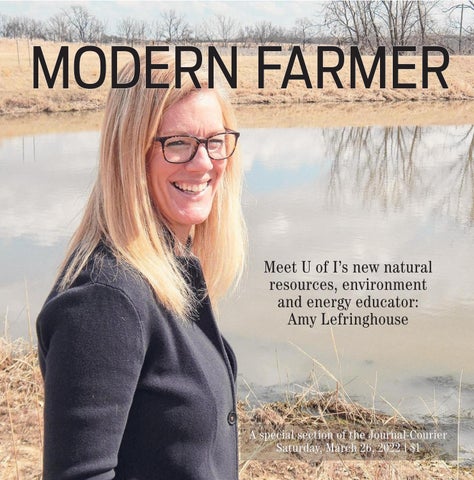
MODERN FARMER
Meet U of I’s new natural resources, environment and energy educator: Amy Lefringhouse
A special section of the Journal-Courier Saturday, March 26, 2022 | $1
2 - Modern Farmer - March 2022
MODERN FARMER MARCH 2022 4....Safety a must when working with grain 6....Land values see record-breaking numbers 8....Fund launches program to help young farmers 8....Corn marketing board vote coming 9....Foundation provides $9 million to create agriculture education center 12....Beekeepers turn to anti-theft technology 13....Farm offers cow-hugging therapy as a way to cope
Amy Lefringhouse, seen on land at John Wood Community College Agricultural Education Center and University of Illinois Orr Agricultural Research and Demonstration Center in Baylis, is University of Illinois Extension's new natural resources, environment and energy educator for Adams, Brown, Pike, Hancock and Schuyler counties. Angela Bauer/Journal-Courier
14....Program brings farm families to classrooms to promote ag 15....Walmart invests in indoor vertical farming 16...Illinois wine industry pushes to change law 17...As guest workers increase, so do concerns of wage cheating 18...USDA program to assist under-served farmers 18...Advocates push for greater awareness of soil health
Job lets her look at nature on a higher level By Angela Bauer LI F E ST Y L E S E D I T O R
Amy Lefringhouse’s new job — educating a five-county area on natural resources, the environment and energy — is no small task. Rather than be overwhelmed, Lefringhouse sees being the University of Illinois Extension’s first natural resources, environment and energy educator for Adams, Brown, Hancock, Pike and Schuyler counties as her dream job. “I was always an outdoors kid,” Lefringhouse said. “I always saw myself working at a park. When I went to college, I thought maybe I would go into the medical field.
Angela Bauer/Journal-Courier
Amy Lefringhouse stands between a pond and native prairie grass on land at John Wood Community College Agricultural Education Center and University of Illinois Orr Agricultural Research and Demonstration Center in Baylis. Lefringhouse is University of Illinois Extension's new natural resources, environment and energy educator for Adams, Brown, Pike, Hancock and Schuyler counties.
Then I realized you can actually get paid to work outside.” Lefringhouse attended Illinois College in Jacksonville, playing volleyball — she’s also a member of IC’s Athletic Hall of Fame — and graduating in 2002 with an environmental studies degree the school had only begun offering a couple of years earlier. She also has a master’s degree in environmental planning and management from University of Illinois-Springfield. “We were one of the first (IC) classes to have that degree,” she said. “That was also my ‘wait a second, I can get a degree in this’ moment.” Before joining Extension, Lefringhouse worked for several natural resource agencies, developing educational materials for the Illinois Department of Natural Resources and performing fish and aquatic vegetation studies on the Illinois
River for the Illinois Natural History Survey. She also helped the U.S. Fish and Wildlife Service with research on oak savannah prairies at Minnesota Valley National Wildlife Refuge and waterfowl research at Upper Mississippi National Wildlife Refuge in Winona, Minnesota. Now, she will work with the five counties in her region — both municipalities and individuals — to offer advice and education on everything from native-plant gardens in residents’ backyards to drainage suggestions for entire counties. She will teach courses on natural resources, wildlife and sustainable and renewable energy at John Wood Community College’s Orr Multipurpose Agriculture Facility in Baylis. She also will work with residents interested in becoming an Illinois Master Naturalist. “It’s both residential
March 2022 - Modern Farmer - 3
Deer tracks are imprinted in soft soil at the edge of a pond on land at John Wood Community College Agricultural Education Center and University of Illinois Orr Agricultural Research and Demonstration Center in Baylis. Photos by Angela Bauer/Journal-Courier
A sign on land at John Wood Community College Agricultural Education Center and University of Illinois Orr Agricultural Research and Demonstration Center in Baylis explains some of the soil and water conservation efforts being employed on the more than 400-acre site.
community members and also farmers and landowners who have large tracts of land,” Lefringhouse said. “We can offer education and assistance. Maybe they have water resources — a farm pond or a fishing pond. We can help them figure out how to manage those ponds, or just how to navigate some of the government programs through USDA, those resources.” If it involves some aspect of nature and the environment, Lefringhouse is the starting point. “They may have some resources on their farm,” she said. “They might have ag farmland, but they might also have some timber. There’s value in that timber, and I can offer them advice in managing those resources. If it’s something you wouldn’t say Extension is an expert in, we can (still) be that resource or that call they can make.” Since it’s a relatively new role for Lefringhouse and for the counties she serves — Duane Friend, Extension’s ener-
gy and environmental stewardship educator for Calhoun, Cass, Greene, Morgan and Scott counties, serves a similar role in his region — she’s still in the process of meeting people and trying to determine what her region needs, she said. “I’m figuring out what communities need from me in terms of education and outreach,” Lefringhouse said. “Do people need education on a pollinator class, composting advice on how to compost at home? Those kinds of things.” One task already at hand is working with Hancock County to cre-
ate hazard mitigation plans. “We’ll look at flooding and what the community can do to prevent it,” Lefringhouse said, noting that part of the plan is to install a rain garden to help with drainage from parking lots and roads. “It collects that rainwater and beautifies the neighborhood,” she said of the rain garden. “It lessens soil loss. You’re choosing plants that are going to thrive in that kind of environment. You wouldn’t put it in a drainage ditch on a farm. It’s more for communities where you’ve got roadways, lots of parking lots
where stormwater is coming off those areas. It’s about capturing (the water), slowing it down, beautifying” the area. Starting this fall, Lefringhouse will teach nat-
ural resources-focused classes at John Wood Community College’s Orr Agricultural Research and Education Center in Baylis for JWCC’s new conservation manage-
ment certificate program. While those classes will be geared toward college students wanting to go into agriculture or conservation management, Nature continues on A7
4 - Modern Farmer - March 2022
Grain bin safety a must when working with grain By Darren Iozia A S S O C I AT E E D I T O R
Safety is protocol not only when working with farming equipment, but when working, cleaning and maintaining grain bins that store corn, soybeans, wheat, oats and grain sorghum. “You really should have a harness; it’s like quick sand.” said Jon Freeman, owner of Freeman Seeds at 625 Illinois Route 967 in Murrayville. “Everything you do
is a gamble.” The dangers of working inside a grain bin stem from grain being stored with an opening toward the lower portion of the grain to allow the grain to flow out. When obtaining for usage or transferring, gravity pulls the grain down and the center of the bin develops a depression that can be life threatening. When cleaning the crust on top of the grain and circulating the grain with someone inside, the
Photos by Darren Iozia/Journal-Courier
Jon Freeman stands next a fan that helps circulate air inside the grain bin. Temperatures need to be below 50 degrees Fahrenheit, with grain needing to be dried below 15%. Another danger of grain bins is the fact that there is electricity hooked to it, which if not grounded, can be life threatening.
Grain will flow out of the shoot and then transported. Jon Freeman said that there are many dangers when being inside the bins that can crush a person if sucked down into the grain.
March 2022 - Modern Farmer - 5
same affect can happen. “It sucks people in and it’ll crush you, there’s so much pressure,” Freeman said. “When you get in there alone, that’s when you get in trouble.” Bins also need to maintain a temperature below 50 degrees Fahrenheit so it requires connection to electricity to have a fan running which circulates the air, that can also make it like quick sand with the balance of inside and outside temperatures. “It needs to be dried down to 15%,” Freeman said. In addition to not entering the grain alone, or at least having someone on hand should an incident happen, there are other safety measure to take. Breaking up crusted grain from the outside of the bin with a long pole
is better than standing on the grain directly. When using a pole, check to see that it doesn’t come into contact any of the electrical lines. Its best to position yourself on the outer wall of the bin and keep walking if the grain should start to flow. Get to the bin ladder or safety rope as quickly as possible. Grain fines and dust may cause difficulty in breathing so it is recommended that anyone working in a grain bin, especially for the purpose of cleaning the bin, wear an appropriate dust filter or filter respirator. Stay out of grain bins, wagons and grain trucks when unloading equipment is running. If it is necessary to enter the bin, be sure to shut off the power to au-
Photos by Darren Iozia/Journal-Courier
Jon Freeman talks about safety tips when working in a grain bin by wearing a safety harness and never enter alone with anyone either close.
gers and fans. It’s also suggested to lock out any unloading equipment before you enter a bin to prevent someone from unintentionally starting the equipment while you inside the bin. Keep children away from bins and it is not suggested they play in or around grain bins, wagons or truck beds. Where possible, ladders should be installed inside grain bins to for an emergency exit. Ladders are easier to locate inside a dusty bin if there are brightly painted stripes just above or behind the ladder. Freemen said that the South Jacksonville Fire Department is equipped with specific tools to assists anyone that is stuck in a grain bin with a tube, improvised mechanical advantage systems, high point anchors and retrieval systems.
Power, a generator and a fan is connected to one of Jon Freeman's grain bin to help cool and circulate air inside.
“It’s a tube-like system,” Freeman said. The Illinois Fire Institute offers a 40-hour course that teaches students about grain storage facilities, there con-
struction and operating features. The course also features Occupational Safety and Health Administration regulations, physical-environmental
hazards and potential rescue resources identified to ensure the response falls within the requirements minimizing fire department civil or criminal liability.
6 - Modern Farmer - March 2022
Land values see record breaking numbers in region By Samantha McDaniel-Ogletree R E P O RT E R
Expecting to bring in between $16,000 and $17,500 per acre at a recent auction, Aron Cowman with Cowman Auction was surprised when for several tracts, the price came in at $3,000 more than expected. "Land prices oover the last five years have been steadily going up," Cowman said. "I would say between 5% to 7% a year, probably more than that." At a recent sale, Cowman said they were seeing some really high numbers. And some large crowds. "We had some tremendous crowds," Cowman said. "I'm looking at this crowd and thinking I was doing the seller a disservice, that I underpriced the land. In the end, it sold for record prices. In fact, one tract of about 30 acres sold for $21,250 per acre, one tract of 119 acres sold for
$20,300 per acre and a third of 100 acres sold for $17,800. "These land prices have skyrocketed," he said. "Cowman Auctions has had some of the highest land prices in Morgan and surrounding counties." Luke Worrell, owner and managing broker with Worrell Land Services, said land values have been increasing, but the market really started gaining in Spring of 2021 with records starting to appear in the fall. "It was September/ October when when we really started seeing record numbers and if anything, we are even stronger now," Worrell said. Acres are ranked by the state in classes based on soil quality, Worrell said. Each class has seen a rise in value, though some have seen greater gains. "Class A acre values are up 35%," Worrell said. "We are at prices we've never seen before and there is a lot of demand."
Artur Carvalho/Getty Images
Farmland values increased by 22% last year in Illinois and four other neighboring states, according to the Federal Reserve Bank of Chicago.
Currently, Worrell estimates Class A acres are averaging about $19,000 an acre or above, where $16,000 was the record in Morgan County for a long time previously— until last year. "We are not barely beating records," Worrell said. "We are blowing past them. The whole state has seen these increases. And it's not just farm land, but also recreational land. Class B acres are up by
about 30%, Class C is up between 15%-20%, and recreational is up by about 20%, Worrell said. Worrell said he expects the demand will tapper off in the coming months as farmers plant and grow their crop, but said things usually pick back up after harvest. "September through February is the typical selling season," he said. "We were off to the races last September, so I'm not convinced we are at our
peak yet." Cowman said he expects values will remain high as interest rates stay low, but said if rates increases, that will likely impact land values as well. "I don't know if it has to do with interest rates, so if rates increase, I don't know if land prices will drop," Cowman said. Worrell said he believe many things have contributed to the increase. As the price of grain,
corn and soybeans have increased, as well as the demand for them globally, so have the land prices. Worrell said though prices to grow products have increased, the value placed on these have gone up, making the land more appealing. He said there is also a historic trend of land values increasing in times of uncertainty. "Historically, land values have done well in unsettling or turbulent times," Worrell said. "I believe it's because land is a safe, tangible asset.: The demand is also high. "From day to day, the calls from people looking for land has probably doubled today from this time last year," Worrell said. Worrell said there were fewer sales in 2020 as less land was available, causing a high demand on what was available. Though there has been an increase in sales this year, Worrell said there is still not enough land for Values continues on A7
March 2022 - Modern Farmer - 7
NATURE
VALUES
From page A3
From page A6
there will be other programs geared toward community education, she said, noting she hopes to start a Master Naturalist chapter that, in turn, will send those trained volunteers out into their communities to help residents and communities improve their environmental stewardship. She also is looking to embrace the larger possibilities, she said. “The cool part about this job is I get to look at it at a higher level, a bigger scale for the communities in this region,” Lefringhouse said. On an individual level, someone might have questions about recycling, she said. “On a community level … what are cities doing to help residents live a little more environmentally responsible?” she said. “Are they providing recycling, making sure the drinking water is safe? There are a lot of different layers to this job to pay attention to.” But none of those layers is insignificant and she wants residents to feel comfortable turning to her with their questions, she said. “The fish died in my pond; what do I do?” she
sale to meet the demand. The value of land isn't just impacting those looking to buy or sell, however. Farmers leasing land are also seeing the impact on the increased value. Worrell said the value of land has also caused an increase in cash rents for many farmers. "Most 2022 cash rents were negotiated last year, but they will probably see more increases," Worrell said. "They've gone up probably 15%20%. I suspect that these will continue to go up as long as we stay on this path." The increased cash rents will impact the bottom line for farmers, Worrell said. Though the price of their crops is up, rent increases, as well as the increased cost of fertilizers, pesticides and other expenses. "Values are up, but so are expenses," Worrell said. "It's a wild time for everyone working through this."
Angela Bauer/Journal-Courier
Amy Lefringhouse looks at native prairie grass growing on land at John Wood Community College Agricultural Education Center and University of Illinois Orr Agricultural Research and Demonstration Center in Baylis. Lefringhouse is University of Illinois Extension's new natural resources, environment and energy educator for Adams, Brown, Pike, Hancock and Schuyler counties.
said. “I want to start a pollinator garden; how can I start one? I need my soil tested; what do I do? Is my drinking water in my well safe? There is a skunk or a raccoon or a chipmunk messing up my yard; how can I deal with it? Is there any value in those walnut trees?”
Lefringhouse will try to have the answer, no matter how large or small the question. If not, “I can steer them to the right person,” she said. Because even the small things make a difference, she said. “The natural world is so amazing and awe-in-
spiring,” she said. “... Sometimes we don’t slow down enough to see the little bitty details of na-
ture. But nature can help people slow down, relax. It’s good for our minds, good for our health.”
8 - Modern Farmer - March 2022
Fund launches program to help young farmers BY T H E C E N T E R S QUA R E
The Illinois Conservation Fund has kicked off the Working Farms Fund program to enable new and young farmers to secure farmland for local food production. Because land is expensive and scarce, too many farmers are leaving the profession and small and medium farms are being converted to other uses, said Emy Brawley, state director for the Illinois Conservation Fund. “Inability to access farmland is the number one reason that people are leaving agriculture,” Brawley told Illinois Radio Network. The goal of the Working Farms Fund is to help young farmers find affordable land, while at the same time protecting threatened farmland, she
said. “Illinois continues to lose high-quality farmland in metro-influenced counties to urban and rural development,” Brawley said. In the past 20 years, half the farmland in metro Chicago that had been growing food was converted to other uses. “That land close to the metropolitan market is the land that grows food and it’s the land that young farmers want,” Brawley said. The majority of new and young farmers in Illinois today are not legacy farmers. Seventy-five percent of them come from nonfarming families. “The people who are looking for land are not inheriting a farm. They are starting from scratch,” she said. This new generation of
farmers is interested in being close to metro markets where they can work value-add, higher margin farms, Brawley said. Demand for local food is growing every year. In the past 10 years, local food sales have increased from $5 billion to $20 billion nationwide. The Illinois Conservation Fund’s Working Farms Fund is designed to be an innovative solution. The Fund acquires small and mid-sized local farms (20 to 500 acres) that are threatened by development and matches the land with farmers. The farmer gets a patient pathway to eventual ownership, while a conservation easement protects the land. A revolving loan fund then rolls the purchase dollars forward to the next farm. The goal is to protect
Anders Andersson/Getty Images
The goal of the Working Farms Fund is to help young farmers find affordable land, while at the same time protecting threatened farmland.
10,000 acres of farmland in the next 20 years and support 150 farm businesses as they become successful and independent. “We are very excited about this model,” Brawley said. “It has the potential to protect farmland near metro areas from con-
version to non-farming uses. It will also help ambitious and diverse farmers scale up their operations and meet the demand for food in our population centers.” Even though Illinois has some of the best farmland in the world, only 4% of
food consumed in the state is grown there. The pandemic has reinforced the importance of local food for national security, Brawley said. “A more local food system, anchored to the city, is much safer in times of shock,”
Corn marketing board vote coming BY J OU R NA L - C OU R I E R
The Illinois Department of Agriculture held a public meeting Feb. 10 allowing public comment regarding a proposed referendum for the Illinois Corn Marketing Board. The referendum proposes raising the corn checkoff rate from 5/8 of a cent to 7/8 of a cent per bushel. Following the review of public comments, the Illinois Corn Marketing Board decided to proceed with a membership vote on the referendum on March 29. The amendment is approved if a majority of those voting in the referendum
vote in favor of the amendment. Polling is to take place at the local Extension offices during normal business hours. Extension offices in Brown and Pike counties will be closed. Eligible voters who reside outside of the state or who cannot be physically present at the polls may cast an absentee ballot. Absentee ballots must be requested in writing from the Illinois Department of Agriculture. Requests should be sent to: Director, Illinois Department of Agriculture, Attn: Bureau of Marketing and Promotion, State Fairgrounds, P.O. Box 19281, Springfield, IL 62794-9281.
March 2022 - Modern Farmer - 9
Foundation provides $9 million to create agriculture education center By Donnette Beckett H E R A L D & R EV I EW
The Decatur Public Schools Foundation has received a $9 million commitment from the Howard G. Buffett Foundation to build the FFA Agriculture Education Center. This investment is designed for high school ag programs in the United States and will establish the Dwayne O. Andreas Ag Academy “as one of the country’s premier dedicated ag education sites and supplement the coursework and National FFA Organization programming available to students enrolled in the program,” the foundation said. “When we provided the funding to create the Dwayne O. Andreas Ag Academy, we had no idea how successful this program would become,” said Howard G. Buffett, chairman and CEO of the Howard G. Buffett Foundation. “By building this facility, I believe it further solidifies the reputa-
tion of the Ag Academy and its students as among the best in the United States.” The center will be on U.S. 51, according to foundation Executive Director Zach Shields, and will include classrooms, labs, offices and an arena to allow other area schools’ FFA programs to hold events there. “We grew so fast we outgrew our space,” Shields said. “We’ve been shoe-stringing it to make it work, but we haven’t had enough classroom and lab space, combined with that (new building), we could use more land to do crops and actual ag stuff.” The Living Science Farm will continue to be part of the program, too, he said, and the new site will free up space at MacArthur and Eisenhower high schools. The plans at present are for the first and second year students to remain at the high schools for their ag classes, while the juniors and seniors will spend blocks of time in morn-
ing or afternoon at the new center when it’s completed. The new center will also allow the ag academy students to work with all four ag teachers, who each has his or her own area of expertise. The hope is that work on the new center will begin in the spring and completed by winter, Shields said. Established in August 2018 with a $1.65 million gift from the Howard G. Buffett Foundation, the Andreas Academy includes educators and FFA advisers who lead a formal academic and field-based curriculum, with an emphasis on career development in the agriculture industry. Since then, Academy students from both high schools have worked collaboratively to build a hands-on Living Science Farm. At this site they pursue entrepreneurial ventures and Supervised Ag Experience activities with livestock and horticulture. The new facility will vastly expand the
BartCo/Getty Images
An investment will establish the Dwayne O. Andreas Ag Academy “as one of the country’s premier dedicated ag education sites.”
program’s acreage and dedicated instructional space. Andreas Academy FFA officers from Mac-
Arthur High School recently were selected as a National Model of Excellence chapter based on activities during its third
year of existence. This achievement recognized these Decatur students as a top chapter among 8,817 in the nation.
10 - Modern Farmer - March 2022
March 2022 - Modern Farmer - 11
12 - Modern Farmer - March 2022
Beekeepers turn to anti-theft technology as hive thefts rise By Daisy Nguyen A S S O C I AT E D P R E S S
For a few frenzied weeks, beekeepers from around the United States truck billions of honeybees to California to rent them to almond growers who need the insects to pollinate the state’s most valuable crop. But as almond trees start to bloom, blanketing entire valleys in white and pink flowers, so begin beehive thefts that have become so prevalent that beekeepers are now turning to GPS tracking devices, surveillance cameras and other anti-theft technology to protect their precious colonies. Hive thefts have been reported elsewhere in the
country, most recently three hives containing about 60,000 bees taken from a grocery chain’s garden. They happen at a larger scale this time of year because bees are most in demand during the largest pollination event in the world. In the past few weeks, 1,036 beehives worth hundreds of thousands of dollars were reported stolen from orchards statewide, authorities said. The largest heist involved 384 beehives that were taken from a field, prompting a beekeepers association to offer a $10,000 reward for information leading to their recovery. “It’s hard to articulate how it feels to care for your
hives all year only to have them stolen from you,” Claire Tauzer wrote on Facebook to spread the word about the reward. A day later, an anonymous tipster led authorities to recover most of the boxes and a forklift stolen from Tauzer’s family business some 55 miles away. Investigators also found frames, the kinds used to hold the honeycomb, belonging to Helio Medina, another beekeeper who lost 282 hives a year ago. Medina said the theft devastated his apiary, so this year he placed GPS trackers inside the boxes. He also strapped cable locks around them and installed cameras nearby. As
Rich Pedroncelli/AP
Beekeeper Helio Medina displays a beehive frame outfitted with a GPS locater that will be installed in one of the beehives he rents.
the almond bloom approached and the hives became most valuable, he drove around patrolling the orchards in the dark. “We have do what we can to protect ourselves. Nobody can help us,” Medina said. Thefts usually happen at
night, when no one is in the orchard and the bees are back in their hives. The rustler is usually a beekeeper or someone familiar with the transportation of bees. “More often than not, they steal to make money and leave the bees to die,” said Rowdy Jay Freeman, a
sheriff’s detective who has been keeping track of hive thefts since 2013. A tightening supply of bees and soaring pollination fees — jumping from less than $50 to rent a hive two decades ago to as much as $230 per hive this year — are likely motivating beekeepers to go rogue. The demand for bees has steadily risen over the last 20 years as popularity of the healthy, crunchy nut turned California into the world’s biggest almond producer. Accordingly, the amount of land used to grow almonds has more than doubled to an estimated 1.3 million acres. Beekeepers have been keeping up with that growth by providing an ever-increasing proportion of the nation’s available stock of hives. This year, a survey of commercial beekeepers Theft continues on A15
March 2022 - Modern Farmer - 13
Farm offers cow-hugging therapy as a way to cope BY A S S O C I AT E D P R E S S
He’s one of those therapists who doesn’t say much, really. No probing questions about one’s mood or concerns. But his body was warm and soft, and his stomach churned with a calming, rhythmic rumble. As Chico lay chewing his cud, a visitor could kneel next to him, hugging or petting the 1,500-pound bovine. It’s a paying gig that helps finance hay and care at an animal sanctuary in Dittmer in Jefferson County. The Gentle Barn, one of three founded by Ellie Laks and her husband, Jay Weiner, has offered “cow hugging therapy” for two decades in California. The sanctuary is also promoting hugs as a way for St. Louis-area visitors to become familiar with five animals that escaped a slaughterhouse in north St. Louis in 2017. “You see them in fields, but there isn’t a lot of opportunity to be with cows,” Britt Johansson, 26, said on
a recent winter day. Her partner, Philip Masini, 25, had purchased a private session with the cows as a Christmas present. The pair grew up in Chicago and attended universities in St. Louis. Now they live in Tower Grove East with one canine, which just happens to be an Australian cattle dog. The couple have no farming background, but they’ve always found cows charming. All smiles, the pair’s interest was prompted by a desire to reconnect with nature during the pandemic, and they were excited to go into a barn and mingle with the herd, which was eating lunch at noon. The five guys (neutered males but referred to at the barn as cows) paid little attention to their human observers at first. They chomped hay from racks, then a couple of them wandered over to lick a salt block and get a drink of water. It was an opportunity for Johansson and Masini to approach the cows, who seemed un-
SOPA Images
The Gentle Barn, one of three founded by Ellie Laks and her husband, Jay Weiner, has offered “cow hugging therapy” for two decades.
concerned by attention. In addition to Chico, the cows are Eddie, Houdini, Johnny Cash and Roo. A sixth, Spirit, did not survive after the breakaway but has a pond named for him. As the five finished eating, they mostly stood placidly while the clearly captivated Johansson and Masini patted their dusty coats or brushed them. Johnny seemed a little more aloof than a couple of others, notably Chico, who
led the crew through steel bars on the famous slaughterhouse escape that involved running through city streets for hours before being corralled (so to speak). Eddie batted his long eyelashes, while Houdini, identified by a white stripe down his face, turned to see who was wrapping arms around his 5-foot back. Occasionally, one of the boys would unceremoniously push away another, while humans, who in-
cluded a couple of docents, just stepped back a foot or two if a large animal needed space to pass by. (Because of the docents, no cowpies threatened boots.) For observers not used to cattle, it took a few minutes to relax, to recognize that the herd seemed unlikely to suddenly trample bystanders. In fact, no one has been injured visiting the Gentle Barn cows, Laks said. The first time she rescued one from slaughter it was a miniature Hereford in California that she named Buddha. In her memoir, “My Gentle Barn,” Laks writes that Buddha stood still immediately when a “sea of children” surrounded her. While lying down, Buddha would wrap her neck round to encircle Laks, making her feel at peace, “so totally accepted by this animal.” She decided she needed to introduce the hug to wary, at-risk kids who were brought to the barn. Laks writes that the kids need to hug the cow close-
ly, showing vulnerability: “It was in this hug — I was sure of it — that they would begin to shed their survival armor and start to heal.” Laks and her family live in California, but every couple of months they visit the barns in Missouri and Tennessee. While in Dittmer in January, she explained that for 22 years, “we’ve been doing cow hug therapy with people in real crisis. We’ve been working with kids in foster care, families in domestic violence shelters, homeless shelters, war veterans centers, probation camps, alcohol rehab centers. “Anyone out there that was in real crisis, the agencies would bring groups of people to the Gentle Barn to feel the healing among the animals and of course while they were there, everyone had to have a cow hug. And over the last 22 years, we’ve gotten really wonderful feedback on how they brought people who Therapy continues on A18
14 - Modern Farmer - March 2022
Program brings farm families to classrooms to promote ag By Michael Neary R A P I D C I T Y J OU R NA L
As Danya Buseman and her husband DJ fielded questions from curious fourth-graders, some of the queries focused on small details. And then there were those that spanned a larger space. “Is it fun to farm, or is it hard?” asked one student. “It’s both,” said DJ Buseman. “There are good days and bad days — like everything. When the weather’s good, it’s a lot better.” The Busemans are participating in program called Ag United. It connects farmers with fourth-graders through a series of monthly videos along with in-person visits. Heidi Zwinger, out-
reach director for Ag United, said the Adopt A Farmer program creates “a way for the kids to find a little bit of a connection to agriculture ... and where their food comes from.” DJ Buseman is a fifthgeneration farmer focusing on cattle, sheep and grain. Danya Buseman works as training coordinator at a seed company. She also does work on the farm. Throughout their presentations, the Busemans passed around some of the objects that emerged from the farm, such as wool or corn, for the students to touch. The Busemans also talked about the way ordinary objects emerged from farm products such as soybeans. “These are some of the
Katrina Wittkamp/Getty Images
The program Ag United connects farmers with fourth-graders through a series of monthly videos along with in-person visits.
things that come from soybeans,” Danya Buseman told the class. “We’ve got paint, we’ve got candles, tires that people use for their cars or bicycles. …” She mentioned food, too, including baby formula.
Late in the session, the Busemans began discussing possible careers the students might pursue in agriculture. DJ Buseman said that his college degree was in animal science. “I came home to farm, but if I’d wanted to, there
are several other things I could have done,” he said. “A common thing would have been a livestock nutritionist. So, I could have been the person that put all these (foods) together.” The Busemans touched on some concepts the students were exploring in different contexts. “In our reading curriculum this week we were talking about organic farming, so it tied in pretty well,” teacher Ashley Holmgren said, noting that learning about farm work also helped their science lessons. After the session was over, Danya Buseman recalled some of the details that children seemed really to scrutinize. “The details they pay attention to are kind of amazing,” she said, recalling some students’ inter-
est in the process of wool packing. She explained the process as taking place with “a big burlap sack that you hung down and would kind of jump into to pack it down.” DJ Buseman had described the process earlier, while the students were listening. Students became excited and said things like, “That sounds fun.” “It’s not fun at all,” DJ Buseman replied to them, eliciting chuckles throughout the room. There’s now a machine they can use to do that, the Busemans explained. After the session, DJ Buseman sounded a note of optimism regarding career prospects for wouldbe farmers — even those who haven’t grown up Families continues on A18
March 2022 - Modern Farmer - 15
THEFT From page A12
Edwin Tan/Getty Images
Vertical farmers tout their high-quality produce that brings higher yields while using less water and land. The method also doesn’t use pesticide, and the produce can be grown year round near the point of distribution, increasing the reliability of supply.
Walmart invests in indoor vertical farming By Anne D’Innocenzio AS S O C I AT E D P R E S S
Walmart said it has taken a stake in agriculture startup Plenty, becoming the first large U.S. retailer to significantly invest in indoor vertical farming as a way to deliver fresher produce to its stores. Vertical farmers tout their high-quality produce that brings higher yields while using less water and land. The method also doesn’t use pesticide, and the produce can be grown year round near the point of distribution, increasing the reliability of supply. Walmart, the nation’s largest retailer, declined to comment on the size of its investment or the financial terms of the deal. But the retailer based in Bentonville, Arkansas, said that it will join Plenty’s board at the close of the transaction. The deal comes as grocery stores are under pressure to have more environmentally friendly
practices. Plenty, based in San Francisco, is one of many players in the fastgrowing field of indoor farming. Others include Morehead, Kentuckybased AppHarvest, and New York-based Gotham Greens. In a recent global survey, consulting firm Agritecture — which works with urban farmers — found that at least 74 indoor farming companies were founded in 2020 alone. Plenty, which was founded in 2014 and has a vertical farm in South San Francisco, also operates an indoor plant science research facility in Laramie, Wyoming. It is now building in Compton, California, what it says will be the world’s highest output vertical indoor farm, due to open in the second half of this year. Plenty said its vertical farming towers are designed to grow multiple crops on one platform in a building the size of a big box retail store. Its sys-
tems feature vertical plant towers, LED lighting and robots to plant, feed and harvest crops. It says its farms use 1% of the land that an outdoor farm requires while delivering anywhere from 150 to 350 times more food per acre. Walmart said that under the deal, Plenty’s Compton farm will send leafy greens to Walmart’s California stores beginning later this year. It said the vertical farms will supplement, but won’t replace, traditional farming practices, while helping increase the food supply in a sustainable way.
estimated it will take 90% of honeybee colonies in the U.S. to pollinate all the almond orchards. “What that means is that beekeepers are coming from as far as New York and Florida, and to get them to come all that way, pollinator fees have to rise,” said Brittney Goodrich, an agriculture economist at the University of California at Davis. But bee populations are notoriously unstable due to a host of problems, including disease, loss of habitat and insecticides. The drought that gripped Western states last summer also weakened colonies. The lack of rain ravaged wildflowers that provide the nectar that bees turn into honey. Beekeepers had to artificially supplement their diet with sugar solutions and pollen substitutes — and incur more costs.
For beekeepers, the loss of a hive means the loss of income from honey production and future pollination, not to mention the expense of managing the hive throughout the year. They say they hardly break even. “For every $210 paid to rent a beehive, we put close to that much into it the whole year feeding the bees because of drought. We do all the health checks, which is labor intensive, and we pay our workers full benefits,” Tauzer said. Denise Qualls, a pollination broker who connects beekeepers with growers, suspects the thefts are happening because beekeepers can’t provide the strong colonies they promised, “so they can get the money from the grower and then they leave the hives.” “The grower is just as responsible when they accept them,” she said. To help her clients track their investments, Qualls merged her business with
tech startup Bee Hero to equip hive boxes with a GPS-enabled sensor. Freeman, who got into beekeeping after investigating his first hive theft, said he advises beekeepers to use security cameras and put their names and phone numbers on the boxes. He said some beekeepers have tried tagging their boxes with SmartWater CSI, a forensic tool used to help police trace recovered stolen property. The clear liquid is visible only under UV light, even through layers of paint, so police can ascertain the rightful owner even when thieves try to disguise boxes. To raise the crime’s severity, Freeman worked with prosecutors in 2016 to charge a man accused of stealing 64 beehives with theft of livestock. Under California law, theft of property worth $950 or less is classified as a misdemeanor. But the theft of any agricultural product worth at least $250 is considered a felony.
16 - Modern Farmer - March 2022
Illinois wine industry pushes to change Prohibition-era distribution law By Robert Channick T R I B U N E N EWS S E RV I C E
The Illinois wine industry, a small but growing network of boutique wineries and vineyards dotting the state, is looking for a little more shelf space at your local retailer. Struggling during the pandemic with a business model built mostly on tours, tastings and in-person sales, Illinois wine producers are pushing for legislation to increase self-dis-
tribution to stores and restaurants, bypassing a Prohibition-era state law requiring a middleman in such transactions. Lynfred Winery in Roselle, a 43-year-old former basement hobby that has grown into one of the state’s oldest and largest familyowned wine producers, saw its sales decline sharply as visits by its 6,000 wine club members to the northwest suburban winery and satellite tasting rooms were curtailed by the pandemic.
State law prevented the winery from delivering the products to retailers without a distributor, making it difficult to compensate for the lost in-person sales, according to Andres Basso, general manager at Lynfred Winery. “We make really good wine in the state of Illinois, and we’re not allowed to self-distribute a single gallon,” said Basso, 49, a Chilean-born winemaker who has been at Lynfred for more than 20 years. “It’s
been a very, very difficult thing for us to survive.” Roselle is a long way from Napa Valley — 2,090 miles, to be exact. But the Illinois industry is more robust than many people realize, with 139 wineries, 53 vineyards and two homegrown viticultural areas: Shawnee Hills in the southernmost part of the state and the Upper Midwest Valley in northwest Illinois. Most Illinois wineries are more mom-and-pop
Morsa Images/Getty Images
Most Illinois wineries are more mom-and-pop than Ernest and Julio Gallo, however, lacking the retail heft and distributor relationships to end up on store shelves and restaurant wine lists.
than Ernest and Julio Gallo, however, lacking the retail heft and distributor relationships to end up on store shelves and restaurant wine lists. The pandemic disrupted the primary inperson sales channel for the wineries, highlighting the need for more retail distribution. “Our biggest issue is limits on self-distribution and production,” said Lisa Ellis, executive director of the nonprofit Illinois Grape Growers and Vintners Alliance. “We’re for the most part small boutique winery operations, not producing millions of gallons a year like some of the West Coast wineries that you see on the shelves and grocery stores and liquor stores all across the country.” The Springfield-based alliance is backing a proposed amendment to the state’s Liquor Control Act of 1934 that would substantially increase the amount that wineries could selfdistribute to restaurants, retailers and other customers without the required middleman. Under the current law, only wineries that produce less than 25,000 gallons a year are allowed to self-distribute their wine, with a maximum of 5,000 gallons to sell themselves to outside retailers. The proposed legislation, sponsored by Sen. Rachelle Crowe, a Democrat from
suburban St. Louis, seeks to raise the production threshold to 250,000 gallons and the self-distribution limits to 50,000 gallons, enabling smaller wineries to bypass distributors and grow their own local connections. Lynfred produces about 95,000 gallons of wine per year, Basso said. The bill also would reduce a 60% increase in licensing fees for Illinois wineries implemented last year and allow them to retain a premises license — the ability to sell alcoholic products they don’t make — if wineries expand manufacturing operations to include beer or spirits. The Illinois Liquor Control Act of 1934 created a three-tier system of producers, distributors and retailers. It requires that most alcohol produced for sale in the state go through a distributor and be sold by a licensed retailer. There are 305 licensed liquor distributors in the state, according to the Wine and Spirits Distributors of Illinois, a not-for-profit trade organization. “Wine and Spirits Distributors of Illinois supports the efforts of the Illinois Grape Growers and Vintners Association to lower their state licensing fees,” Jeremy Kruidenier, vice executive director of the trade organization, said in a statement Wednesday.
March 2022 - Modern Farmer - 17
As guest workers increase, so do concerns of wage cheating By Susan Ferriss, Joe Yerardi CENTER FOR PUBLIC INTEGRITY
For Maribel Hernández, falling ill with COVID-19 at a Louisiana crawfish processor and losing her job was terrible enough. But the Mexican guest worker was in for another shock. A federal labor investigation in 2020, initially focusing on worksite safety, revealed that the company failed to pay Hernández and 99 other guest workers a total of $138,629 in overtime earnings. The 100 workers were deprived of pay “amid the pandemic, when food industry workers put themselves at risk to support the economy,” U.S. Labor Department officials announced in August of 2021. Officials recently told the Center for Public Integrity that 35 of the foreign workers were also owed $12,922 in sick pay required under the Families First Coronavirus Response Act. Shortchanging workers such as Hernández isn’t an isolated problem. From 2005 to 2020, U.S. employers around the country were ordered to pay more than $42.5 million in back wages to 69,000 workers who perform seasonal lowwage jobs on H-2A and H-2B visas. But labor advocates are worried that many more workers are being cheated. They’re also concerned that investigations by the Labor Department — which has special oversight over guest workers — aren’t keeping pace with a dramatic increase in workers. Closed cases focused on allegations of violations specific to H-2A and H-2B visas increased only slightly from 424 cases in 2011 to 478 in 2019, according to a Public Integrity analysis of department data. Over the same period, the total number of these annual
guest worker visas issued leaped from 106,000 to 302,000. Demand for more visas is surging, despite the Trump era rise in anti-foreign worker rhetoric in some states. Like anyone employed in the U.S., guest workers have protections under the law and the right to complain to government officials, confidentially, about suspected wage theft. But advocates say that workers often hesitate because of the very structure of the H-2A and H-2B visa programs. They’re uniquely vulnerable: Guest workers’ visas tie them to a specific employer, and if a boss even suspects they’re whistleblowers, workers can fear they’ll lose their visas and a coveted chance to work legally in the United States. “The workers who con-
AP
This photo provided by Texas RioGrande Legal Aid shows H-2A farmworker housing in Plains, Texas.
tact us, we talk to them, and a lot of them know that their rights are being violated,” said Caitlin Berberich, attorney with Southern Migrant Legal Services in Nashville, whose clients seeking pro bono legal aid include
guest workers. But many choose not to act. In the spring of 2020, Hernández’s immediate concern was health, not pay. She and other H-2B workers at Acadia Processors LLC in Crowley, Louisiana, began testing posi-
tive for the coronavirus. Supervisors first confined those with COVID-19 symptoms to company bunkhouses, then on May 15 ordered workers to board vehicles bound for state-supplied quarantine housing, Hernández said in a complaint she later filed with the Labor Department’s Occupational Safety and Health Administration. Coughing and in pain, Hernández and a coworker instead headed to a hospital. They’d complained that the company was slow to prevent virus spread at work, and worried that they might not receive medical care in quarantine. The women say they intended to resume work once healthy. But the women claim a company liaison they spoke to from the hospital told them Acadia was required to re-
port them to immigration officials for leaving work in violation of their visas. The women filed a complaint a few weeks later with the Labor Department claiming they’d been fired in retaliation for voicing safety concerns. “I feared that staying in the quarantine housing would put my life in jeopardy,” Hernández told investigators in a sworn written statement. Six months later, the department’s Occupational Safety and Health Administration found “insufficient evidence” to support the claim. But OSHA alerted the department’s Wage and Hour Division to suspected sick pay violations — and that led to the discovery that Acadia hadn’t properly calculated overtime pay and bonuses per pound of crawfish processed.
18 - Modern Farmer - March 2022
USDA program to assist under-served farmers Advocates push for BY J OU R NA L - C OU R I E R
The U.S. Department of Agriculture is accepting grant applications for the American Rescue Plan Technical Assistance Investment Program to provide historically underserved farmers, ranchers and forest landowners technical support in accessing USDA programs and services. “This past year, the Biden-Harris administra-
tion has taken bold and historic actions to level the playing field to ensure all Americans benefit from the many opportunities open to them,” Agriculture Secretary Tom Vilsack said. “As part of USDA’s American Rescue Plan investments, we want to ensure that those who have been traditionally underserved by USDA have the same understanding and technical
THERAPY From page A13 wouldn’t talk, who were not responding to traditional therapy. They were angry, they were shut down. But magically in the barnyard among the animals and in those cow hugs, it kind of would reset them, open them up and help them be vulnerable and allow them to progress in regular therapy.” During the pandemic, many more people felt traumatized, she says. So last year, the Gentle Barn opened up cow hugging to individuals. In addition to the rescued cows, there are three large hogs, along with some chickens, turkeys, donkeys, goats, sheep and a duck. Each animal’s back story is told at gentlebarn.org. Jay Weiner, who keeps track of finances, says the three sanctuaries have a combined budget of about $3.1 million. Income mostly comes in the form of grants or large donations, which decreased during the pandemic.
Animal studies
support needed to access programs and services.” USDA’s National Institute of Food and Agriculture will provide a minimum of $25 million investment of American Rescue Plan funds, with awards normally ranging from $500,000 to $3.5 million for a five-year cooperative agreement. The deadline to submit applications is June 1. Common barriers expe-
Scientific studies of animal-assisted therapy have increased over the past two decades, but few focus on farm animals, says Gretchen Carlisle, a research scientist at the Research Center for Human Animal Interaction at the University of Missouri’s veterinary college. She can point to a 2011 study that did find improvement in psychiatric patients who had work-related tasks connected to dairy cattle. There are many other studies that show measurable physiological change in people who interact with animals, especially dogs, cats and horses. Studies not only measure decreases in blood pressure and cortisol, but also increases in oxytocin, the “love hormone” active in breastfeeding mothers, Carlisle says. “But we don’t always know the dosages,” she says. That is, how long and how often does a depressed or anxious human need to interact with an animal to show improvement. Another question scientists want to know is how long positive effects last and whether patients might just need an occasional “booster.”
rienced by small or underserved farms and ranches include challenges with accessing federal agricultural programs, including receiving information about available programs, difficulty navigating complex application processes, lack of standardization and transparency, limited knowledge of qualification requirements for all programs and complicated reporting requirements.
FAMILIES From page A14 working on a farm. “I would advise them to try to work for a farmer, and maybe an opportunity would arise that way,” he said. “There may be other opportunities through (USDA) Farm Service Agency and other programs.” But the need for help that some farmers are experiencing could nudge the door open to young farmers, DJ Buseman suggested. “Farmers are getting to be an older generation, and farm help is hard to find right now,” he said. “There’s a demand for farm workers, and that could lead to something bigger and better.”
greater awareness of soil health
By Jonah Chester IL L I N O I S N EWS C O N N E C T I O N
Illinois environmental advocates are pushing lawmakers in Springfield to recognize the importance of soil health. The General Assembly is considering a resolution that would establish the second full week of March this year as Soil Health Week, and March 9 as Soil Health Day. Liz Rupel, lead organizer with the Illinois Stewardship Alliance, said the event will feature a series of virtual talks and discussions with lawmakers, farmers and experts in the field of sustainable agriculture. "So it's an educational opportunity," said Rupel, "for really anybody in the food system who wants to learn about ways that farmers are building soil health from all the way up in the city of Chicago down to southern Illinois." According to a report from the state, Illinois invested nearly $7 million in soil nutrient loss research and education
programs from 2019 to 2020. The resolution passed out of the Senate's environment committee with a recommendation to adopt, although the full chamber still needs to approve the measure. Rupel said the event also will be an opportunity for folks to learn more about the state's expansive Nutrient Loss Reduction Strategy - which, in part, aims to keep nutrients from agricultural operations out of the state's waters. The initiative seeks to reduce nitrogen in Illinois waters by 15% and phosphorus by 25% by 2025. "This event and the resolution," Rupel said, "can be a vehicle to reach those who don't understand how healthy soil can benefit our food and our drinking water." Per the strategy's biennial report, from 2019 to 2020, partners in the state's agriculture sector invested nearly $27 million implementing the nutrient loss-reduction strategy.
March 2022 - Modern Farmer - 19