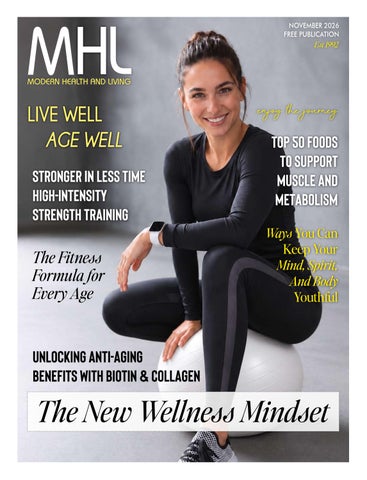
MHL
NOVEMBER 2026 FREE PUBLICATION
Est 1992
MODERN HEALTH AND LIVING
LIVE WELL AGE WELL Stronger in Less Time High-Intensity Strength Training The Fitness Formula for Every Age
enjoy the journey Top 50 Foods To Support Muscle and Metabolism Ways You Can Keep Your Mind, Spirit, And Body Youthful
Unlocking Anti-Aging Benefits with Biotin & Collagen
The New Wellness Mindset
60,/( &21),'(17/< $7 %(<21' ',6&29(5 (;3(57 62/87,216 -867 )25 <28
0,66,1* 7((7+" $VN DERXW RXU OLIH FKDQJLQJ GHQWDO LPSODQWV 6758**/,1* :,7+ '(1785(6" :H KDYH VHFXUH QDWXUDO ORRNLQJ DOWHUQDWLYHV &21&(51(' $%287 &267" 2XU 'HQWDO 6DYLQJV 3ODQ PDNHV FDUH DIIRUGDEOH
<285 %(67 60,/( ,6 67,// $+($' 6SHDN WR RXU WHDP WRGD\ DERXW VROXWLRQV GHVLJQHG IRU \RXU QHHGV FRPIRUW DQG EXGJHW
*80 +($/7+ 0$77(56 (DUO\ WUHDWPHQW SUHYHQWV VHULRXV LVVXHV )5(( ,1,7,$/ &2168/7 ,QFOXGHV D FRPSUHKHQVLYH H[DP DQG ; UD\V JHW VWDUWHG ZLWK FRQÀGHQFH
:( /,67(1 :( &$5( :( &86720,=(
6 WK 6W :HVW $OOLV _ _ ZLVFRQVLQVPLOHV FRP
Employment
Editors Note Somewhere along the way, wellness became another thing we were supposed to be good at. Eat perfectly. Exercise consistently. Sleep eight hours. Manage stress. Drink more water. Take the right supplements. Follow the latest health advice. And somehow, find time to enjoy life in between. It’s no wonder so many of us feel exhausted by the very idea of being healthy. But what if the next chapter of wellness isn’t about doing more? What if it’s about looking at health differently? I’ve always believed that taking care of ourselves should be a lifelong commitment, not a temporary project. But I’ve also come to appreciate that wellness isn’t measured by how perfectly we follow a routine. It’s reflected in how we feel, how we live, and how much of life we’re actually enjoying. Maybe the most important wellness reset begins with our mindset. Instead of asking what we need to change about ourselves, perhaps we should start asking what’s already working. What makes us feel energized? What brings us peace? What habits genuinely improve our days, rather than simply adding another obligation? There’s something liberating about realizing that we don’t have to chase every new health trend to be healthy. Sometimes the most meaningful changes are surprisingly simple: moving our bodies in ways we enjoy, eating foods that nourish us, spending time with people who make us laugh, and giving ourselves permission to slow down. And perhaps most importantly, recognizing that taking care of ourselves isn’t selfish. It’s what allows us to show up fully for the people, experiences, and opportunities that matter. As we move toward another year, I hope we can rethink the traditional idea of a reset. Not as a dramatic transformation or a list of resolutions we’ll struggle to maintain, but as an opportunity to be more intentional about how we want to feel and live. Because wellness shouldn’t become another source of pressure in our lives. It should make our lives better. The goal isn’t to create a perfect version of ourselves. It’s to create a life that feels good to live. And that might just be the healthiest mindset of all.
AmandaLewis enjoy the journey MHL STAFF staff
publishers editor graphic design advertising
Lewis Media Group Amanda Lewis Malberry Media Tom Delgado Barry Lewis
distribution manager travel editor founder
Jerry Kornowski Marlys Metzger Barry Lewis
contributors The Ommani Center, Livestrong.com, Environmental Nutrition, Nutrition Action Health Letter, Columbia/St. Mary’s, Ascension, Eye Care Specialists, Aurora, Alexian, Eye Physician Associates, Brothers Village, Ye Olde Pharmacy, NIH, Jensen Health and Energy, Foot Solutions, Allergy and Asthma Centers, Tudor Oaks, Active Care Rehab, Greensquare Center for the Healing Arts, Midwest Audiology, Integrative Family Wellness Center, Universal Services, American Camp Association and Home Instead contact For information on advertising or to submit articles call, 414-659-6705 or 608-237-6000, or email mhl@wi.rr.com. Subscriptions are $20 per year. Thanks for reading MHL.
We are
Hiring!
OPEN POSITIONS: Starting Wage/hr. for Full-Time Employees
5 $2
C.N.A
6 $2
Medication Tech
0 $3
Nurse Tech
3 $4
Respiratory Therapy
5 $3
LPN
0 $4
RN
Apply at vmpcares.com OR SCAN HERE:
OLDER ADULTS MONTH NOVEMBER
NOW ENROLLING
Childcare Passionate, caring teachers, and... - 4-Star Youngstar Rating - 6 Weeks-5 Years
- Before- & After-School Care, 5-12 Years - Healthy, Tasty Meals & Snacks - Nature-Based Curriculum
disclaimer MHL is published on the first of each month . The articles in this publication are in no way intended to replace the knowledge or diagnosis of your doctor. We advise seeing a physician whenever a health problem arises requiring an expert’s care.
& More!
thanks Special Thanks! To all the local professionals that provide us with articles containing new information and keeping all our readers informed of the latest in healthy living. images Istock.com
STEIN CAMPUS 414-977-5000
BUCYRUS CAMPUS 414-210-2450
2801 E. Morgan Ave. Milwaukee, WI 53207
2450 W. North Ave. Milwaukee, WI 53205
Lewis Media Group | www.modernhealthandliving.com
Join our Team!
FINANCIAL ASSISTANCE AVAILABLE November 2026 MHL
MHL September 2025
AGE WELL Wellness
stock.adobe.com/Iuliia
The New Way to Whole-Body Wellness
F
unctional medicine providers spend time listening to you and gathering your medical history. We use this information to identify the root cause(s) of the illness, including triggers such as poor nutrition, stress, toxins, allergens, genetics and your microbiome (the bacteria living in and on your body). Once we identify the triggers, we can customize a healthy living plan for you. Your plan will address many aspects of your life, from physical needs, including nutrition, exercise and sleep, to mental and emotional stressors related to social, work and community life. By addressing the whole person and not just an isolated set of symptoms, Functional Medicine shifts the focus from a traditional disease-centric approach to a more person-centric approach. Functional Medicine is a systems-oriented approach that addresses the whole person. Treatment focuses on removing a person’s underlying imbalance and not just suppressing their symptoms.
This “whole-person approach” shifts the focus from being disease-centric to person-centric, and strives to arrive at the root cause of a person’s presentation. Hence, two people with a similar diagnosis may receive very different treatment recommendations. The goal is to help everyone express their full potential in terms of health. Functional Medicine practitioners take extra time to listen to their patients and considering the various genetic, environmental, and lifestyle factors that influence long-term health and complex, chronic disease. In this way, Functional Medicine supports each person’s unique expression of health and vitality What is integrative psychiatry? Unlike conventional psychiatry, Integrative Psychiatry attempts to find the root cause of a person’s problems and work towards achieving overall mental health and balance. Unfortunately, conventional psychiatry has become a linear, medication-focused model with little to offer the millions of people suffering from mental illness. The conventional psychiatry model does not address the specific nutrient, genetic or even “spirit” requirements of a person, leaving them in a non-recovery limbo state.Unlike conventional psychiatry, Integrative Psychiatry, uses a collaborative, patient-centered, mind-body-spirit approach that combines the science of modern medicine with the wisdom of ancient and traditional forms of medicine from around the world. Integrative Psychiatry recognizes not just the mind-body connection, but also the body-mind influence. It attempts to find and address the root cause of a person’s symptoms and work together to achieve overall mental health and balance. Rather than just addressing the symptoms of mental illness, Integrative Psychiatry uses a broad scope of intervention. Diet, nutrition, lifestyle, health of the gut, hormones, state of the immune system, genetics and relationships in life all become important considerations for analysis and intervention. What Is Functional Medicine? Functional Medicine is a personalized, systems-oriented model that empowers patients and practitioners to achieve the highest expression of health by working in collaboration to address the underlying causes of disease. Functional Medicine is a branch of medicine which derives extensively from various traditional healing systems of the world, chiefly Ayurveda and Traditional Chinese Medicine. Functional Medicine has skillfully interwoven ancient medicine with modern technology to provide incredible tools to help arrive at the root cause of a person’s problem.
2QdZc 5Mh 4R]cRa
;S h^da Z^eRQ ^]R ]RRQb QMhcW\R PMaR͜ fRͭaR VRaR c^ _a^eWQR Wc fWcV Z^eR M]Q P^\_MbbW^]͙
5MhcW\R 4MaR
E^PWMZWjMcW^]
BRab^]MZWjRQ 4MaR
2 V^\R MfMh Sa^\ V^\R
Ada U^MZ Wb c^ R]VM]PR cVR W]QR_R]QR]PR ^S ^ZQRa MQdZcb cVa^dUV MPcWeR ZWeW]U cVMcͭb _Rab^]MZWjRQ S^a ReRah^]Rͭb ]RRQb͙ 4MZZ c^QMh S^a M c^da͟ @͙ cV Ec͜ ?WZfMdYRR ͛ M͙\͙ ͛ _͙\͙
:RMZcV ̿ IRZZ]Rbb
6]aWPVW]U 2PcWeWcWRb
͙ ͙
MXM]Y^fbYW̓PP\YR͙^aU
44?=6͙AD8 November 2026 MHL
LIVE WELL Fitenss
The Fitness Formula for Every Age
W
e all know being physically active is beneficial, even if we don’t heed the advice. Yet we may not always be clear about the best way to stay active as we age. Not all exercise programs are fitting for all people. Where someone is in their lifespan influences their best exercise program, and knowing what the right program is can help ensure the benefits are maximized. “As we age, we can do forms of the same exercise routine, but it should be adjusted depending on what our bodies need for that decade in our life,” explains Jennifer Scherer, medical exercise specialist, certified personal trainer, and owner of Fredericksburg Fitness Studio. “A high-impact jumping working in your 30s may not affect your joints like it would in your 60s. However, that does not
MHL November 2026
mean someone in their 60’s can’t do high-intensity workouts.” According to the Centers for Disease Control and Prevention (CDC), regular physical activity is one of the most important things you can do for your health. Not only does it help prevent health problems, but it will help keep people more mobile and able to do daily activities as they age. The CDC recommends that adults get at least 150 minutes per week of moderate-intensity exercise (i.e., brisk walking) and two days per week of strength training. Scherer explains that most workouts can be scaled up or down depending on the individual. A 20-year-old and a 70-year-old can do the same workout as long as modifications and adjustments are made to fit the individual’s needs for that session. Going to a personal trainer is helpful because the fitness professional can take the guesswork out of the workout and ensure you are getting an appropriately challenging workout for your age and ability. Going to a general workout group class or working out alone in a gym limits the personalization of the exercise and can lead to injury if the workout is not done correctly. Here is the best exercise program for each decade of life: The 20s and 30s Include high impact, high-intensity interval training, strength training, core, flexibility, and stretching. Additionally, add in low impact, slow, steady state, yoga, and Pilates. Those in this age group who are healthy enough and don’t have co-morbidities should be able to do anything they want regarding fitness. The 40s-50s Work on a plan that includes high-intensity, low-impact, strength training, core, flexibility, and stretching. High impact can be done by those in this age group, provided they don’t have joint pain or other issues that would prevent them from doing so. At this age it is moving is important and should be a priority. The 60s-70s This age group is ideal for focusing on low impact, low-moderate intensity, depending on the individual. Include walking, daily movement, strength training, stretching, and core exercises. The intensity levels are dependent on the individual. “We need to remember that not all exercise programs are fitting for every age span,” added Scherer. “It’s important to be mindful of how our bodies change as we age and give them the appropriate level of challenge in a workout for that season of life.” Photo Credit: Stock.adobe.com/ (JLco) Julia Amaral.
AGE WELL Fitenss
vitlana
Stronger in Less Time: The Benefits of High-Intensity
W
hen it comes to building strength, improving health and maintaining independence as we age, the quality of exercise may matter more than the time spent doing it. For decades, exercise has often been measured by time. Thirty minutes on the treadmill, an hour at the gym or several days a week devoted to fitness have become familiar recommendations. But a different approach to strength training suggests that achieving meaningful results doesn’t always require lengthy workouts. High-intensity strength training focuses on challenging muscles through controlled movements and concentrated effort, followed by sufficient recovery. Rather than emphasizing the number of repetitions or hours spent exercising, the method prioritizes muscular effort, proper technique and rest. The underlying principle is simple: Exercise stimulates the body to improve, but many of those improvements occur during recovery. Why Muscle Matters as We Age Maintaining muscle strength becomes increasingly important with age. Beginning in adulthood, muscle mass gradually declines, a process that can accelerate later in life without regular physical activity. This loss affects more than appearance. Reduced strength can make everyday activities such as climbing stairs, carrying groceries, getting out of a chair or maintaining balance increasingly difficult. Resistance training helps counteract these changes by preserving and building muscle, supporting bone health and improving physical function. Stronger muscles contribute to better mobility, stability and the ability to remain active and independent. Research consistently demonstrates that strength training benefits adults across different ages and fitness levels. The question is how to make that training effective, manageable and sustainable. A Different Approach to Exercise Traditional strength-training routines often involve multiple sets of exercises performed at a moderate pace. Some high-intensity methods use slower, more deliberate movements to keep muscles working throughout each repetition. In slow-motion resistance training, for example, a person may take approximately 10 seconds to lift a weight and another 10 seconds to lower it. Moving slowly reduces momentum and encourages muscles to perform the work rather than relying on swinging or bouncing movements. As an exercise continues, the muscles gradually fatigue, creating a stimulus that encourages the body to adapt and become stronger. Some programs use only a handful of exercises targeting major muscle groups, allowing workouts to be completed in relatively little time. Although these sessions are brief, they can be demanding. Proper technique, appropriate resistance and attention to individual abilities are essential. Recovery Is Part of the Process One of the most important aspects of strength training happens after the workout ends. Exercise places stress on muscle tissue. During recovery, the body repairs and adapts to that stress, helping muscles become stronger and better prepared TRAINING>>page 39
November 2026 MHL
LIVE WELL Nutrition
Top 50 Foods To Support Muscle and Metabolism HOLIDAY HEALTH EDITION DECEMBER
Published by Ginger Hultin, MS RDN CSO Photo Credit: stock.adobe.com/ Studio Romantic hinking about your muscle mass isn’t just for body builders. Every single person needs to focus on maintaining their “lean body mass.” Not only does this protect your ability to be active and live healthfully as you age, it is a key part of having a healthy metabolism. Muscle is so much more metabolically active than fat. The more muscle mass you build, the healthier your metabolism will be and the easier it will be to burn fat and achieve balance. Amino acids are the building blocks of protein, so these types of foods are key but so are other vitamins, minerals, and macronutrients like carbohydrates. Here are the FoodTrients top 50 foods to support muscle and metabolism. 1. Amaranth A healthy ancient whole grain, amaranth is naturally gluten-free and versatile for cooking and baking. Researchers have studied this grain’s superior protein content, even comparing it in one study to the high-quality protein in cheese. They concluded that the protein from amaranth is comparable to protein found in animal foods. Bonus: it’s high in fiber! 2. Avocado One of the highest protein fruits is everyone’s favorite: avocado. Packed with healthy calories and fat for fuel, you’ll still get 4 grams of protein from a cup of avocado. Blend it into a smoothie or smear it on toast as a pre- or post-workout option that will help support your muscle growth. Cut bananas in the plate 3. Banana No, bananas don’t contain much protein. However, they are incredible complex-carb-rich snacks to include pre-or post-workout so that your muscles have the energy (glycogen) you need to perform. In order to build muscle, you need to use them. That will require a lot of energy to get through a tough workout so eating a snack that contains carbohydrates will actually increase your ability to build muscle. 4. Beans Forget beef burgers; beans are taking over as the plant-based trend continues to boom in popularity. There are many reasons for this – growing beans take less water and produce less greenhouse gas emissions than growing cows for one. Also, beans are a rich source of protein and have the added benefit of complex carbohydrates to fuel your workout and replenish energy stores in your muscles. 5. Blue-Green Algae Ever heard of spirulina and chlorella? If you want to focus on muscle mass and metabolism, you should consider using them. These sea-vegetables are usually found in powder form in your supplement aisle. Keep in mind they’re bright blue so anything you use them for will turn that color, but benefits include anti-inflammatory omega-3 fatty acids and 4 grams of protein per tablespoon. 6. Bone Broth Bone broth is a popular product that you can now find in any grocery store and it may have some benefit for muscle building. It’s a natural source of collagen
T
Call (262) 523-1440 today.
MHL November 2026
which is part of the structure of muscle and connective tissue in the body. Up to 10% of muscle is made of collagen so sip on bone broth for hydration, electrolytes and muscle-building properties. 7. Broccoli No, broccoli isn’t a rich source of protein, though it is considered a higherprotein veggie with nearly 3 grams in a cup. Importantly, it contains antioxidant vitamin C which is not only anti-inflammatory for the body during tough workouts but also is a precursor to collagen, an important building block for muscle. 8. Brown Rice Whole grain brown rice is another complex carbohydrate to fuel your workouts. Also, just ½ cup contains over 10% of our daily value of magnesium which is an important bone and muscle builder. Magnesium is often given to prevent muscle cramps so try instead meeting your needs through whole foods. Bonus: brown rice provides energy for your muscles during a workout. 9. Cashews Cashew nuts are a perfect combination of complex carbohydrates, fiber and protein for fueling workouts and building muscle. 1 ounce contains 9 grams of complex carbs and over 5 grams of protein. This balance makes for a perfect pre- or post-workout snack because the carbs fuel the workout and the protein provides the building blocks. 10. Cheese Yes cheese made the list of 50 healthy foods! Though it doesn’t contain carbohydrates, it’s a wonderful source of protein. It also contains a high amount of fat and so it’s rich in calories to help re plenish what your body burns during an ÅàÝÙÔÙÒ dc intense workout. Just 1 ounce of cheese has 7 grams of protein. 11. Clams All seafood is a good source of protein combined with healthy fat. In just 10 small clams, you’ll get 25 grams of protein to fuel your muscles and provide those amino acid building blocks you need to maintain lean body mass. A huge benefit of shellfish like clams is their minerals such as calcium, iron and zinc which help the body support healthy bones and red blood cells. 12. Cottage Cheese The simplest of breakfast or snack, cottage cheese is a wonderful source of protein combined with carbohydrates. It would be an ideal pre- or post-workout fuel that you can easily grab and go. Just 1 cup contains 25 grams of protein and 8 grams of carbs to support your muscles. 13. Chia Seeds Chia seeds are a wonderful plant¸Ðß ßÓÐ ÝÔÒÓß ÎÚáÐÝÌÒÐ ×ÚÎÌ× ÝÐÞÚàÝÎÐÞ ÌÙÏ ßÓÐ ÎÌÝÐ äÚà ÙÐÐÏ ßÚ ×ÔáÐ ßÓÐ based protein option which also offer ×ÔÑÐ äÚà âÌÙß anti-inflammatory properties in the form of omega-3 fatty acids. Enjoy a simple chia seed pudding before or after your ´Ì×× ÑÚÝ ÌÙ ÌÛÛÚÔÙßØÐÙß workout for healthy fat, complex carbs and protein. ¿ÌÕÔ ²Íà#½àÒÓÚÏ 14. Chickpeas (`d`) `b_#add` (ÅÅÊ e__) Monthly Plan All beans are the friends of a healthy f ^^ ²¾ # c ^^ Á¾ ¾ÚÙ # ·ÝÔ Premiums with metabolism. Chickpeas, or garbanzo ² ×ÔÎÐÙÞÐÏ ÌÒÐÙß âÔ×× ÌÙÞâÐÝ äÚàÝ ÎÌ×× beans, are no exception. Versatile and ØâÞÞ5ØâÞÐ×ÐÎß ÎÚØ Dental, Vision delicious, they are a great source of proand Hearing tein but also offer complex carbs to fuel your workouts. Toss chickpeas on a salad or roast them in the oven for a light, crunchy snack you can enjoy on the way ²ÐßÙÌ ¾ÐÏÔÎÌÝÐ ÔÞ Ì ¹¾À ÁÁÀ Û×ÌÙ âÔßÓ Ì ¾ÐÏÔÎÌÝÐ ÎÚÙßÝÌÎß ÀàÝ µÄ¿ÁÞ Ì×ÞÚ ÓÌáÐ to or from the gym. ÎÚÙßÝÌÎßÞ âÔßÓ ÄßÌßÐ ¾ÐÏÔÎÌÔÏ ÛÝÚÒÝÌØÞ ¶ÙÝÚ××ØÐÙß ÔÙ ÚàÝ Û×ÌÙÞ ÏÐÛÐÙÏÞ ÚÙ ÎÚÙßÝÌÎß 15. Cod ÝÐÙÐâÌ× Á×ÌÙ ÑÐÌßàÝÐÞ ÌÙÏ ÌáÌÔ×ÌÍÔ×Ôßä ØÌä áÌÝä Íä ÞÐÝáÔÎÐ ÌÝÐÌ Á×ÌÙ ÑÐÌßàÝÐÞ ÌÙÏ ÌáÌÔ×ÌÍÔ×Ôßä ØÌä áÌÝä Íä ÞÐÝáÔÎÐ ÌÝÐÌ ÈÐ ÏÚ ÙÚß ÚÑÑÐÝ ÐáÐÝä Û×ÌÙ ÌáÌÔ×ÌÍ×Ð ÔÙ äÚàÝ ÌÝÐÌ All fish is a great source of protein ´àÝÝÐÙß×ä âÐ ÝÐÛÝÐÞÐÙß _^ ÚÝÒÌÙÔåÌßÔÚÙÞ âÓÔÎÓ ÚÑÑÐÝ d_ ÛÝÚÏàÎßÞ ÔÙ äÚàÝ ÌÝÐÌ Á×ÐÌÞÐ that also offers unsaturated fatty acids. ÎÚÙßÌÎß ¾ÐÏÔÎÌÝÐ ÒÚá _#f^^#¾¶µº´²Ã¶ ÚÝ äÚàÝ ×ÚÎÌ× ÄßÌßÐ ¹ÐÌ×ßÓ ºÙÞàÝÌÙÎÐ ÁÝÚÒÝÌØ Cod and other fish also contain vitamin ßÚ ÒÐß ÔÙÑÚÝØÌßÔÚÙ ÚÙ Ì×× ÚÑ äÚàÝ ÚÛßÔÚÙÞ B12 which plays a major role in building [`^`b ²ÐßÙÌ ºÙÎ
²×× ßÓÐ ÍÐÙÐÑÔßÞ ÚÑ ÀÝÔÒÔÙÌ× ¾ÐÏÔÎÌÝÐ ÌÙÏ ØÚÝÐ
0
$
FOODS>>page 53
Ê^^^_ ac^e_ `^`b ¾ `cgc_eg#^d#^_
November 2026 MHL
LIVE WELL Nutrition
The World’s One-and-Only dedicated bakery that is: z Grain and Gluten-Free
Grain Free
z Dairy-Free and Egg-Free z Peanut and Soy-Free z Cane Sugar and Yeast-Free
All of our delicious products are:
Getting More Veggies in Your Diet: 5 Tips
z VEGAN z KOSHER z WHOLE PLANT (no oils)
2215 E. North Ave.
414.212.8010
www.blbmke.com
GRAIN, GLUTEN, EGG & DAIRY FREE
UNLIMITED CLASSES! 4 weeks for $60 Class schedule at www.mycmke.com or call 414-332-3551
Offer good for students NEW to Milwaukee Yoga Center. Unlimited classes available for
ZHHNV IURP ZKHQ ¿UVW FODVV LV WDNHQ
All classes must be completed by 8/13/2019
New 4-Class Intro Tuesdays 5:30-7 pm $40 June 25–July 16 July 23–August 13
6 3514 N. Oakland Ave., Milwaukee, WI 53211 linda@mycmke.com www.mycmke.com 10 MHL November 2026
7
By: KURU Footwear Photo Credit: stock.adobe.com/ SerPak f you’re trying to eat healthier, one of the best places to start is by increasing your intake of vegetables. Yet, despite knowing the benefits, many of us struggle to meet the recommended five servings a day. Whether it’s busy schedules, picky palates, or the perception that veggies are boring or hard to prepare, obstacles abound. Good news: small, sustainable changes can make a big difference. Below, we’ll share five tips to help you eat more vegetables—and enjoy doing it. From simple storage tricks to delicious recipes and meal-planning hacks, these tips are rooted in insights from nutritionists, food scientists, and behavioral experts. Why More Veggies? The Evidence Is Clear Vegetables are nutritional powerhouses. They’re rich in vitamins, minerals, antioxidants, and fiber. A diet high in vegetables supports: Improved digestion and gut health Enhanced immune function Lower risk of chronic disease Balanced hormones and improved mood Better weight management In fact, studies from the CDC and USDA consistently show that increasing fruit and vegetable intake is associated with a longer life and reduced incidence of obesity, heart disease, and diabetes. Read more about how food impacts your foot health. So why don’t we eat more of them? Let’s explore five smart strategies to make it easier. 1. Stop Hiding Them: Make Veggies Visible and Convenient Out of sight, out of mind. One of the biggest barriers to eating more vegetables is forgetting about them entirely—especially when they’re hidden in the bottom drawer of your fridge. Pro Tip: Rethink the Crisper Instead of tucking veggies away in the crisper drawer, bring them front and center. Wash and prep them in advance and store them in clear containers at eye level. When healthy choices are easy and visible, you’re more likely to reach for them. Replace your crisper drawer items with long-lasting staples like eggs, yogurt, or cheese—items that don’t spoil as quickly. This minor shift can make a major difference. Try This: Keep carrot sticks, snap peas, or bell pepper slices in containers ready to grab-and-go. Pair with hummus or tzatziki for an energizing snack. 3 Nutritional Trends: Are They Good for You? Read More About Continue Reading 2. Try Something New—and Something Old Routine can be the enemy of variety. If you’re bored with broccoli or tired of tomatoes, it might be time to shake things up.
I
VEGGIES>>page 12
VEGGIES<<page 11
Explore New-to-You Veggies Grocery stores and farmers markets now offer a wide variety of fresh, frozen, and prepared vegetables—some you may never have tried. Think kohlrabi, romanesco, or rainbow chard. If you’re not sure how to cook them, YouTube is your friend. Internal Resource: Discover the power of seasonal eating to align your vegetable choices with what’s fresh and affordable. Revisit Childhood Favorites Sometimes, the easiest way to eat more vegetables is to go back to basics. Did you love cucumber slices with ranch as a kid? There’s no rule saying adults can’t enjoy simple veggie snacks. Indulge in nostalgia—and nutrition. 3. Drink Your Greens (The Smart Way) Green smoothies are a popular and surprisingly tasty way to get your daily dose of vegetables—especially leafy greens. But if you’ve ever tried tossing kale into a blender and ended up with bitter sludge, you’re not alone. Blend with Balance The key is balancing strong flavors. Start with a solid recipe before experimenting. A good beginner blend might include: 1 handful of spinach 1 banana 1/2 cup frozen mango 1 tablespoon nut butter 1 cup almond milk This combo masks the greens while delivering fiber, healthy fats, and plantbased protein. istock.com/Ilija Erceg Want to take it up a notch? Add in anti-inflammatory boosters like ginger or turmeric. 4. Keep Frozen Veggies on Hand You don’t have to cook gourmet meals from scratch to eat well. Frozen vegetables are just as nutritious as fresh ones—sometimes even more so, thanks to flash-freezing at peak ripeness. Why Frozen Is a Game-Changer No chopping or peeling required Lower food waste
Budget-friendly Always available, even out of season Stock up on frozen broccoli, spinach, mixed stir-fry blends, and riced cauliflower. Steam them, stir-fry them, or toss them into soups and pastas. Helpful Hack: Stir a handful of frozen spinach into scrambled eggs for a fiber boost. Bonus: it’ll keep you fuller longer. 5. Pair Healthy Eating with Movement Adding vegetables to your diet is just one piece of the wellness puzzle. Regular movement not only helps support a healthy metabolism, but also complements your nutritional goals by encouraging muscle strength, cardiovascular fitness, and improved mood. Daily activity—whether it’s walking, stretching, gardening, or climbing the stairs—can help your body better absorb and utilize the nutrients you eat. It’s also a great way to manage stress and increase energy levels. The key is consistency. Even short bouts of physical activity can add up over the course of the day, and pairing that movement with a nourishing, veggie-rich diet helps maximize overall wellness. Bonus Tips for Long-Term Success Looking to turn your veggie habit into a lifestyle? These bonus strategies can help you stay consistent and make plant-rich meals a long-term success: Meal prep weekly. Dedicate an hour or two each week to wash, chop, and portion out your vegetables. Prepped veggies make quick meals easier and reduce decision fatigue when you’re hungry. Use dips and dressings wisely. Not every vegetable has to be eaten raw or plain. Try healthy pairings like Greek yogurt dip, hummus, or vinaigrettes. You’re more likely to eat your veggies when they taste great. Sneak veggies into sauces and comfort foods. Puree carrots, spinach, or zucchini into pasta sauces, mac and cheese, or lasagna for extra nutrients. Even pizza night can get a healthy twist with veggie toppings and cauliflower crust. Join a CSA or local produce box. Supporting local farms gives you fresh, seasonal produce—and exposes you to new veggies you may not otherwise try. It’s a fun way to experiment with recipes and elevate your home cooking. Grow your own garden. You don’t need acres—just a patio planter for herbs or greens can inspire healthier meals. Kids are also more likely to try veggies they helped grow.
Hey, WHITEFISH BAY! REAL STRENGTH TRAINING.
REAL RESULTS
FOR ADULTS 40+! 40+!
FORM & FITNESS PERSONAL TRAINING STUDIO-WFB 153 E. Silver Spring Dr. Whitefish Bay 53217 (414) 226-5030 info@formandfitness.com
12 MHL November 2026
AGE WELL Nutrition
stock.adobe.com/ Drobot Dean
Regular Exercise Linked to Longer Life
W
hat’s the secret to longer life… never smoking, avoiding alcohol, a nutritious diet? While those healthy habits certainly contribute to healthy aging, a recent study suggests walking, swimming, playing golf or other forms of regular physical exercise could be the key to living longer. According to Physical Activity Guidelines for Americans, older adults should engage in 150 – 300 minutes a week of moderate-intensity exercise (walking, weight-lifting and other low-intensity activities) or 75-150 minutes a week of vigorous physical activity (jogging, running, swimming, biking and other highintensity activities). The study found that adults who followed the minimum guidelines lowered their risk of death by as much as 21%. The findings also suggest that those who exercised two to four times the minimum requirement could lower their mortality risk by as much as 31%.
“Our study provides evidence to guide individuals to choose the right amount of intensity of physical activity over their lifetime to maintain their overall health,” said study author Dong Soon Lee. “Our findings support the current national physical activity guidelines and further suggest that the maximum benefits may be achieved by performing medium to high levels of either moderate or vigorous activity or a combination.” Lori Lutz, Director of Tudor Oaks HomeCare, said this study offers some additional insight into the benefits of regular exercise. “At Tudor Oaks Home Care, we encourage our clients to be as active as possible – even those with limited mobility – because it will help them maintain their independence for as long as possible,” she said. “Staying active can make it easier for seniors to bathe, dress, get into and out of a chair and move around the house or neighborhood. It can also help reduce the risk of falls.” Lutz added that other studies showregular, moderate physical activity can also ward off detention in older adults. “The bottom line… for seniors, regular physical activity is one of the most important things they can do for their health,” she said. “Whether it’s a bike ride, a brisk walk around the block or just keeping up with household chores, exercise can prevent or delay many of the health problems that cause them to become dependent on others.” To learn more about exercise guidelines and suggestions for seniors, visit tudoroakshomecare.com, or call 414-525-6402. Tips for older adults to stay motivated to exercise Physical activity is a great way for older adults to gain substantial health benefits and maintain independence. Try to make exercise a priority. Remember that being active is one of the most important things you can do each day to maintain and improve health. Try these tips to help you stay motivated to exercise. 1. Find simple ways to make exercise fun and enjoyable. 2. Find ways to fit exercise into your day. 3. Make exercise a social activity. 4. Keep track of your exercise progress Don’t forget to build rewards into your plan. Write down something you will do for yourself when goals are achieved. Treat yourself to something special: a movie, a trip to the museum, a new audiobook, or a massage. To keep older adult exercise routines safe, effective, and sustainable, focus on structured guidelines, smart modifications, and injury prevention To keep older adult exercise routines safe, effective, and sustainable, focus on structured guidelines, smart modifications, and injury prevention. 285 +20( &$5( 6(59,&(6
+20( &$5( 6(59,&(6
7KH 5LJKW +HOS &KDQJHV (YHU\WKLQJ dƌƵƐƚĞĚ͕ ƉĞƌƐŽŶĂůŝnjĞĚ ĐĂƌĞ ƐŽ LJŽƵ ĐĂŶ ƐƚĂLJ ŝŶĚĞƉĞŶĚĞŶƚ ŽŶ LJŽƵƌ ƚĞƌŵƐ͘
&RPSDQLRQ &DUH
0HDQLQJIXO &RQQHFWLRQ DQG 'DLO\ 6XSSRUW
3HUVRQDO &DUH
1XWULWLRQ 0HDO 3UHS DQG +RXVHNHHSLQJ
$GYDQFHG 6SHFLDOL]HG &DUH 0HPRU\ &DUH 6XSSRUW
3RVW 2SHUDWLYH 6XSSRUW $VVLVWDQFH :KLOH <RX 5HKDE
9,578$/ +<%5,' +20( &$5(
&DOO IRU \RXU )5(( ,Q +RPH &DUH &RQVXOWDWLRQ WRGD\
)OH[LEOH FDUH RSWLRQV LQFOXGLQJ YLUWXDO FKHFN LQV PHGLFDWLRQ PDQDJHPHQW DQG SHUVRQDOL]HG FDUH SODQV GHVLJQHG WR NHHS \RX FRQQHFWHG DQG VXSSRUWHG
7XGRU2DNV+RPH&DUH FRP 6 : 0F6KDQH 'U 6XLWH _ 0XVNHJR :,
November 2026 MHL 13
LIVE WELL Longevity
Feel Great & Live Longer
+RQRULQJ WKH ERQG WKDW ZLOO QHYHU EH IRUJRWWHQ 2Q VLWH 6HUYLFHV &UHPDWLRQ 3HWV 1HYHU /HDYH 2XU &DUH 3ULYDWH *URXS &UHPDWLRQ 3DFNDJHV 8QLTXH 8UQV $QG .HHSVDNHV ,Q +RPH 9HWHULQDU\ 3LFN XS 6HUYLFHV
(DJOH /DNH $YHQXH 0XNZRQDJR WUHDVXUHGWDLOVPXNZRQDJR FRP
HAVING TROUBLE HEARING THE TV OR FAMILY MEMBERS TALKING?
Our state-wide nonprofit organization can help anyone with all degrees of hearing loss!
Visit our facility in the greater Milwaukee area to discover a wide range of products or explore our online store! Our ĂƵĚŝŽůŽŐŝƐƚƐ ŽīĞƌ ŚĞĂƌŝŶŐ ĞǀĂůƵĂƟŽŶƐ ĂŶĚ ŚĞĂƌŝŶŐ ĂŝĚ ĮƫŶŐƐ͕ ǁŚŝůĞ ŽƵƌ ƚĞĐŚŶŽůŽŐLJ ĞdžƉĞƌƚƐ ĐĂŶ ŚĞůƉ ŝĚĞŶƟĨLJ LJŽƵƌ ŶĞĞĚƐ͕ ƐƵĐŚ ĂƐ ƐŵĂƌƚƉŚŽŶĞƐ͕ ĐĂƉƟŽŶĞĚ ĂŶĚ ĂŵƉůŝĮĞĚ ƉŚŽŶĞƐ͕ ĂŶĚ ĂůĞƌƚ ƐLJƐƚĞŵƐ͘ They can also assist you in purchasing qualifying products at a ƌĞĚƵĐĞĚ ĐŽƐƚ ƚŚƌŽƵŐŚ Ă ƐƚĂƚĞͲƐƉŽŶƐŽƌĞĚ ǀŽƵĐŚĞƌ ƉƌŽŐƌĂŵ͘
Call or visit us today!
ϭϬϮϰϯ t͘ EĂƟŽŶĂů ǀĞŶƵĞ͕ tĞƐƚ ůůŝƐ͕ t/ ϱϯϮϮϳ 414-604-2200 | info@hearwi.org | www.hearwi.org 14 MHL November 2026
Ways You Can Keep Your Mind, Spirit, And Body Youthful
I
t seems like everyone is obsessed with looking young these days. And hey, who can blame them? We all want to look young for our age. But the truth is, there’s only one thing better than looking young: feeling young and living young longer. Consider this: 61% of men describe their current energy level as lower than their energy level 5 years ago, and 65% of men say that they experience brain fog and think their mind is not as sharp as it used to be. Once thought to be hard-wired after early childhood, the brain actually has a remarkable ability to change and heal itself. Known as neuroplasticity, this remodeling due to our environment, behavior, and feelings happen throughout our lives. Given the flexibility of your brain, how will you rewire it to help you live younger longer? Dr. Myles Spar, Chief Medical Officer of Vault Health, is an expert when it comes to men’s physical, emotional, and sexual health. He has shared 13 ways you can keep your mind, spirit, and body youthful regardless of your age. Here are his 13 tips to live younger longer: 1.Meditate When it comes to keeping you young, meditation has been shown to actually change the brain. Sara Lazar, a neuroscientist at Harvard Medical School and Massachusetts General Hospital, conducted studies involving brain scans of meditators. She found that people who had been meditating for a long time had increased grey matter in the auditory and sensory cortex, which she attributes to the mindful attention paid to breathing, sounds, and other stimuli during meditation. She also discovered more grey matter in the frontal cortex, the part of the brain associated with memory and decision making. According to Lazar, meditators in their fifties had the same amount of gray matter in one part of the prefrontal cortex as people in their twenties in spite of the fact that the cortex is known to shrink as we age. Why not incorporate this brain-boosting practice into your life? 2.Play Have you seen ads for brain-training games and wondered if they were legit? According to recent research, the answer is yes. A new study found cognitive training increased the energy efficiency of participants’ brains. In the randomized clinical trial, adults aged 56 to 71 were either given twelve weeks of cognitive training or assigned to one of two control groups. Measuring brain activity, researchers found those in the cognitive training group showed a significant increase in the association between reaction time and frontal lobe activity compared to the control groups, meaning their brains didn’t have to work as hard to perform tasks. The study’s authors hope their findings pave the way for further research that attempts to harness the potential of the aging brain. 3.Get Busy According to Dr. Oz, having loving sex a couple of times a week increases testosterone in men and can reduce your “real age” by nearly three years. Even if you’re not romantically involved, spending time with friends and family keeps you from isolating yourself as you get older. Volunteering, too, can be a nice way
to ward off loneliness while helping your community. The website volunteermatch.org can help you figure out where your skills can best be put to use. 4.Stretch it Out Flexibility decreases as we age, but the National Academy of Sports Medicine says following a systematic and progressive flexibility program can help keep you limber. Even a few minutes of light stretching every morning can make a difference. The National Institute on Aging provides some good information and exercises here. 5.Socialize It’s probably a given that loneliness takes a toll on your mental health, but did you know it can actually affect your genes—and maybe even shorten your life? Research suggests being lonely can have a negative impact on telomeres, the segments of DNA at the end of our chromosomes that shorten each time a cell divides and may indicate how long we’ll live. Longer telomeres are associated with slower aging, fewer age-related diseases, and generally greater life spans. In a study of African grey parrots in captivity, those who were housed alone had shorter telomeres compared to those who lived with a companion bird. This finding supports a growing body of evidence showing that social isolation and other stressors can be detrimental to our telomeres. Loneliness can also increase your risk of depression, cognitive decline, heart disease, and other serious conditions in ways similar to obesity and smoking. Schedule a dinner with a buddy you haven’t seen in a while or take your spouse out for a night on the town. You could also consider volunteering in your community, which gives you a chance to help others while you interact with them. 6.Exercise Not only does exercise benefit your body and mind, research shows it could also keep your muscles young by stopping or even reversing the decline in their cellular health that comes with aging. 7.Eat Clean A balanced diet high in whole foods provides your body with the nutrients it needs to stay in top form. Avoid refined sugar, which causes inflammation linked to diseases like diabetes and Alzheimer’s. Unsure what to eat? Check out livestrong.com’s list of anti-aging foods here. 8.Sleep Well According to a survey by Vault Health, 41% of men get 6 hours or less of sleep on an average night. It’s common for sleep patterns to shift as we age. Taking steps like cutting caffeine intake and putting your devices down well before bed can help you get the rest you need. And while it might be tempting to exercise in an attempt to wear yourself out, don’t work out too close to bedtime or you’ll
have a hard time winding down. 9.Manage Stress If left unchecked, chronic stress can lead to depression, heart disease, and other serious conditions, potentially shaving years off your life. Try a relaxation technique like yoga or meditation, both scientifically proven to lower stress levels. Or consider tai chi, a practice that may improve balance and stability in older people while reducing anxiety. 10.Consider Supplements Even if you eat well you’re probably lacking nutrients important for healthy aging. And many supplements have been shown to protect the body from disease—fish oil, for example, is associated with prevention of heart disease and stroke. 11.Have a Drink Moderate alcohol consumption has been shown to bump up HDL (“good”) cholesterol, and red wine in particular may have additional heart-healthy powers. As far as nonalcoholic beverages go, both green tea and coffee contain antioxidants that may help you fight off age-related illnesses. A 2013 study found green tea drinkers who consumed four cups a day had an almost 20% lower stroke risk compared to people who rarely drank green tea, probably due to compounds called catechins that help regulate blood pressure and improve blood flow. 12.Use Your Head According to research in the burgeoning field of epigenetics, your brain never loses its capacity to change and heal itself. Known as neuroplasticity, this malleability needs to be maintained so you can stay sharp into your golden years. According to alzheimers.net, games that challenge your memory and mental agility may help strengthen the neural connections in your brain. Instead of spending your lunch break scrolling through Facebook, why not spend a few minutes doing some brain training? 13.Care for Your Skin Science shows the condition of your skin has a big impact on how old people think you are. To keep wrinkles and sunspots at bay, wear sunscreen, use a basic moisturizer, and drink plenty of water. If you still smoke, quit! Among other negative effects, it makes you look A LOT older. For more anti-aging ideas, check out these 5 steps to looking 10 years younger. “You’re only as old as you feel.” While something of a cliché, this expression’s general idea—that you have control over the ways your body is affected by the 2025aging MHL 15process—is absolutely true. By making healthy lifestyle choices, you can keep yourself feeling strong and vital well into old age. Photocredit: stock.adobe.com/ nsta_photos
Q H W K V J L /HW 8 / G D R / <RXU
P_kXaV cvanX /PaXcmn P $mVCa X P ,CL^ Ä !cuP Uc m =PCm n
6HQLRU 'LVRXQW
8QSDFNLQJ &OHDQ 2XW 7UDQVSRUWDWLRQ
5LJKWVL]LQJ 2UJDQL]LQJ 3DFNLQJ 0RYLQJ (VWDWH 6DOHV &RQVLJQPHQW 6KRS
81,9(56$/ 6(59,&(6 6(1,25 5(/2&$7,21 /2*,67,&6 0$1$*(0(17
vvv paXuPmnC_nPmuXLPnvX Lc`
=PCmn Xa oWP pnXaPnn cU P_kXaV /PaXcmn Ê § § __ nPmuXLPn paNPm caP mccU 7XnLcanXa kmP`XPm nPaXcm `cuXaV Lc`kCa| November 2026 MHL 15
LIVE WELLVision
November is “National Diabetes Awareness Month”
stock.adobe.com/nart
Are You At Risk? Local Eye MDs Answer Key Questions About Diabetes-related Vision Loss By Cheryl L. Dejewski iabetes is reaching epidemic levels across all ages and races. Chances are you know (or are) one of the more than 29 million Americans with the disease. Whether or not the cause is due to genetics, poor lifestyle choices, or both, take note: Diabetes does more than affect blood sugar levels. Complications from the disease make it a leading cause of blindness in the U.S. And, if you are black or Latino, you have up to a three times greater risk of losing vision to diabetes than a white person. “We would like to give all Wisconsinites at risk for diabetes a chance to protect their vision by educating them about the importance of early detection and treatment,” says Mark Freedman, MD, senior partner at Eye Care Specialists, a leading Milwaukee-area ophthalmology practice that specializes in the care of diabetic eye disease. In an effort to achieve this goal, Freedman and his partners answer the following key questions regarding this sight-robbing condition.
D
1. How does diabetes affect vision? “With diabetes, fluctuating and high blood sugar levels can cause the blood vessels that nourish the retina in the back of the eye to become weak or abnormal. This leads to leakage and bleeding that can blur vision and permanently impair sight.” reports Brett Rhode, MD, Head of Ophthalmology at Aurora Sinai Medical Center and a partner at Eye Care Specialists, where he utilizes advanced medication injection and laser treatments for eye diseases. “For some people, when a routine vision check-up uncovers signs of retinopathy, it is their first clue that they even have diabetes.” 2. What are the symptoms? Usually, none. Most people don’t notice a problem until retinopathy is so far advanced that lost vision can’t be restored. That’s why annual dilated eye exams are crucial. You should also call your doctor immediately if you notice vision changes in one or both eyes (not associated with fluctuations in blood sugar), numerous floating spots (like spider webs), or a veil over your vision. 3. Are you at risk? “Of the more than 29 Americans diagnosed with diabetes, up to 45 percent have some degree of diabetic retinopathy (damage to the retina), which can lead to vision loss and blindness. And, diabetic eye disease can appear as early as a year after the onset of diabetes,” says Daniel Ferguson, MD, a leading area eye surgeon who conducts continuing education programs for local health care professionals. Ferguson adds, “All diabetics—Type 1, Type 2, insulin-dependent or not—are at risk, which increases with the number of years you have diabetes. For example, patients with diabetes for less than five years have about a 15 percent incidence of retinopathy, but this skyrockets to 80 percent for people who are diabetic for 15 or more years. That’s why we can’t stress enough the sight-saving benefits of annual eye exams.” 4. How is retinopathy detected? “For many patients, diabetes-related changes in vision occur so gradually that they don’t notice or take action. Or, because fluctuations in blood sugar levels can temporarily affect vision, they don’t know or realize that a more serious eye problem is developing. And, even if a person’s vision appears to be good, significant retinopathy may be present and progressing. That’s why diabetes-related eye damage can only be diagnosed through a comprehensive eye examination. Pupil dilation (enlargement with drops) is necessary to best check the back of the eye for early signs of retinopathy before noticeable vision undefined loss occurs,” explains Daniel Paskowitz, MD, PhD,istock.com/undefined an ophthalmologist with credentials from Harvard and Johns Hopkins. VISION>>page 55
November 2026 MHL 17
THE WELL BEING
lifestyle
stock.adobe.com/ Jeff Whyte
18 MHL November 2026
LIVE WELL Wholistic Medicine
Do I Need to Take Supplements to Stay Healthy? Authored by: Michelle Sopa, NTP, By: Michelle Sopa, NTP his is a question I get a lot, and I have given a lot of thought about my answer, since the response can depend on a lot of factors. Being a Nutritional Therapy Practitioner, I have been trained in the principles of the Weston A. Price Foundation. The philosophy of their teaching is that we need to be eating a nutrient-dense, whole food diet, with a focus on preparing food through traditional methods. I will probably need to write a separate article on traditional food preparation methods. So for the sake of brevity, this article will focus on any potential gaps in eating a nutrient-dense diet. I think it’s safe to say that in our world today disease state is very common. We all know someone with a health condition; diabetes, autoimmune conditions, hypertension, cholesterol issues, heart conditions, endocrine dysfunction, digestive impairment, cancer, etc. Frequently, long-term nutrient deficiencies, among other things, allow a degenerative state to progress in a person’s body causing these conditions to manifest. Why We Need Supplements: The Importance of Nutrients Problems with Highly Processed Foods The prevalence of highly processed foods in people’s diets today sets them up for health failure. This is due to the long list of unhealthy, sometimes unnatural ingredients that are devoid of nutrients. And when you don’t get enough nutrients from your food, the body cannot perform all the intricate processes that regulate your health. As a result, over a period of time, disease state will set in. And when you are sick or have lost your optimum health, you then actually need additional nutrients to be able to heal properly. In addition to making dietary corrections, supplements can help fill the gap and restore insufficient levels of nutrients. Decreased Levels of Nutrients in Soil Another reason that people may need supplementation is due to the decreased levels of nutrients in the soils our food is grown in. A lot of factors affect soil health such as over-farming, pesticides, and other chemicals. These all minimize what elements our food is able to uptake and what we then ingest. Gut Health Issues Yet another factor that impacts most people, whether you have an active disease state or not, is gut health. If your digestion system is not performing optimally, you will not be able to break down and assimilate all the nutrients that are in your food. It doesn’t matter how good your diet is! Conditions that affect digestive power are things like dyspepsia (indigestion), hypochlorhydria (low stomach acid), pancreatic dysfunction, gallbladder imbalance, SIBO (small intestine bacterial overgrowth), etc. Again, it is best to correct and improve your digestive function. But to ensure you are getting enough nutrients during healing and beyond supplements can be a great addition. How to Properly Use Supplements The goal is not to use supplements as a cure-all for a poor diet. You can never out-supplement a good, nutrient-dense diet! However, given the challenges we face with intaking and assimilating enough key nutrients from our food, I encourage supplementing where it makes sense for each person’s unique biochemistry. Most of us are not getting anywhere near the level of nutrients our ancestors got. Nor are we getting what we need to achieve vibrant health. But at the same time, you want to be sure that you are taking what your body actually needs, and in the right amounts. It does your health no good to buy a supplement that you don’t take or that your body doesn’t actually need. Just remember, the bulk of our nutrition should always come from whole, minimally processed foods. But we also recognize that the right supplement at the right time can help you on your path to regaining vibrant health. How We Can Help!Here at Total Health, we can help you assess your health,. If you have any questions for me or are interested in coming to our clinic for testing, please give the clinic a call at 262-251-2929 for a complimentary, 15-minute phone call with myself or one of the other practitioners.
T
Join our team of holistic health practitioners WHO UNDERSTAND THAT HEALTH IS PERSONAL
We are looking for strategic thinkers, team players and leaders who align with our purpose of improving the health and wellbeing of those we serve. Our work focuses on crea ng meaningful connec ons with each of our clients, helping them to move toward a healthier lifestyle. We assist each individual’s journey by helping to uncover root causes of their health concerns through holis c natural health and wellness advocacy. If our purpose resonates with you, we invite you to explore career opportuni es and apply today.
MENOMONEE FALLS AND NEW BERLIN
Send resume to: CLINIC@TOTALHEALTHINC.COM *Full me or part me (at least three days a week as client load builds). $35/hr, up to $40hr maximum. Qualifica ons: Must have a passion for natural health. Background in Nutri on preferred Willing to train the right candidate.
SEE WEBSITE TOTALHEALTHINC.COM FOR MORE INFORMATION
November 2026 MHL 19
LIVE WELL Mindfullness
stock.adobe.com/OnPoint/peopleimages.com
Vitamin D Deficiency: Symptoms, Causes & Treatment
A
re You Running on Empty? The Truth About Vitamin D You eat your veggies, you get enough sleep, and you try to exercise. Yet you feel sluggish. Your bones ache after a mild workout. You seem to catch every cold that goes around the office. Before you blame it on stress or “just getting older,” it may be worth checking your labs. You could be low in the “sunshine vitamin.” Vitamin D deficiency or insufficiency is common worldwide, and estimates vary by country, age, and how “low” is defined. Modern life keeps many of us indoors, and that changes how much vitamin D our bodies can make. Here is what vitamin D does, how to spot possible signs of low levels, and the most effective, safe vitamin D deficiency treatment options to raise your level without guessing. 1. More Than Just a Vitamin Despite the name, vitamin D acts more like a pro-hormone than a simple vitamin. Your skin can make it from sunlight, then your body converts it into active forms that influence many tissues. Its most famous job is bone health. Without enough vitamin D, your body cannot absorb calcium efficiently, which can weaken bones over time. Vitamin D is also involved in: Immune function: It helps support normal immune responses. Muscle function: Low vitamin D is linked with muscle weakness in some people, especially older adults. Mood and energy: Low vitamin D is associated with low mood in some studies, but supplement benefits vary, so it is not a stand-alone “depression fix.” 2. The “Silent Epidemic”: Why Are So Many People Low? If the body can make vitamin D from sun exposure, why are low levels so common? Usually it is not one reason, it is a stack of them. The great indoors: Office work, indoor exercise, and screen time reduce direct sun exposure. Skin protection: Sunscreen is important for skin cancer prevention. It can reduce UVB-driven vitamin D production, although it does not block it perfectly in real life use. Darker skin tone: Higher melanin reduces vitamin D production from the same sun exposure, so some people need more time or may rely more on diet and supplements. Geography and season: Farther from the equator, winter UVB can be too weak for reliable vitamin D production. Age and body composition: Older adults produce less in skin. Higher body fat can be associated with lower measured 25(OH)D. Absorption issues: Conditions or surgeries that affect fat absorption can lower vitamin D status. 3. Recognizing the Symptoms Vitamin D deficiency symptoms are often vague. Many people feel “off” but cannot point to one clear sign. Symptoms can also overlap with anemia, thyroid problems, sleep issues, and stress. Possible signs include: Fatigue: More than sleepiness, a dragged-down feeling that persists. Bone, back, or leg discomfort: Especially a deep ache in the lower back or hips. VITAMIN D>>page 40 20 MHL November 2026
FREE ENTRY INTO GERMANFEST MILWAUKEE
LIVE WELL Well-Being
stock.adobe.com/muhammad
Mindfulness Practices for a Stress-Free Fall Transition
S
easonal shifts ask something of your nervous system. A few simple practices can make the change easier. The calendar turns to September and the pace changes. Schedules tighten back up, the light shifts earlier, and the loose rhythm of summer gives way to something more scheduled. For a lot of people, this annual transition can bring a low hum of stress that is hard to name. Nothing is wrong exactly, but the ease of summer seems to have disappeared. Mindfulness practices are among the more reliable strategies to ease this transition. Here are some practices that work in the small gaps of an ordinary day. Why the Season Change Feels Unsettling Your body responds to seasonal change more dramatically than you may realize. Daylight shrinks by a couple of minutes each day through September, which shifts sleep timing, energy, and mood. Temperature swings ask your body to adjust. Routines that had gone comfortably slack tighten again.
None of that is a problem to solve. It is just a transition, and transitions take energy even when they are welcome. Recognizing the source can take some of the weight out of this transition, since a vague unease is much harder to sit with than a known and temporary adjustment. Start With Two Minutes, Not Twenty The most common reason mindfulness practices fail is that people begin with an overly-ambitious version. Twenty minutes of seated meditation is a real commitment, and it is a lot to ask of a habit that has not established itself yet. Instead, two minutes is enough to be useful. Sitting quietly with your coffee before the day starts, without looking at your phone, is a genuine practice. Pausing during your day to look out the window and watching your surroundings can also do the trick. If possible, attach the practice to something already fixed in your day. The first cup of coffee. The moment after you brush your teeth. The stretch of time while istock.com/Polina Lebed the microwave runs. Building into a routine carries the habit so willpower does not have to. Anchor Yourself Through Your Senses When your mind is spinning, sensory attention tends to work better than trying to think your way calm. A common approach is to name five things you can see, four you can touch, three you can smell, two you can taste, and one thing you notice about how your body feels. The exercise adapts easily. If hearing is not the sense you want to rely on, lean on sight and touch instead. The warmth of a mug, the texture of a wool blanket, the smell of the air after rain, the specific color of a maple leaf. The point is simply to occupy your attention with what is actually around you. Fall makes this easier, since the season provides a lot of sensory material. Cool air, changing color, the smell of woodsmoke, the feel of the first sweater of the year. Use Your Breath as the Simplest Tool Breathing practices work because they are the one part of your nervous system you can operate directly. Slowing your exhale sends a signal that things are safe, and your heart rate tends to follow. A useful pattern is to breathe in for a count of four and out for a count of six, keeping the exhale longer than the inhale. Four or five rounds is usually enough to notice a difference. It works while you are waiting in a parking lot, before a difficult phone call, or lying awake at night. If counting feels fussy, simply putting a hand on your stomach and noticing it rise and fall does most of the same work. Visit Captel.com for more info.
Can’t Hear on the Phone? Get a NO-COST CapTel Captioned Telephone! The CapTel® Captioned Telephone shows word-for-word captions of everything a caller says, letting you read anything you cannot hear over the phone. CapTel is a NO-COST, federally funded technology available under the Americans with Disabilities Act. To qualify, users need: • Hearing loss • Internet connection • Landline telephone service
Several phones to choose from for landlines, Internet phone, or mobile
800-233-9130 CapTel.com FEDERAL LAW PROHIBITS ANYONE BUT REGISTERED USERS WITH HEARING LOSS FROM USING INTERNET PROTOCOL (IP) CAPTIONED TELEPHONES WITH THE CAPTIONS TURNED ON. Advanced speech recognition software is used to process calls, and, in certain circumstances, a live communications assistant may be included on the call. There is a cost for each minute of captions generated, paid from a federally administered fund. No cost is passed on to the CapTel user for using the service. CapTel captioning service is intended exclusively for individuals with hearing loss. CapTel® is a registered trademark of Ultratec, Inc. The Bluetooth® word mark and logos are registered trademarks owned by Bluetooth SIG, Inc. and any use of such marks by Ultratec, Inc. is under license. (v1.7 01-23)
22 MHL November 2026
“An Ancient Medicine for Modern Times” (DUQ DQ DFFUHGLWHG 0DVWHU·V RI 6FLHQFH Degree in Oriental Medicine combined with D %DFKHORU·V 'HJUHH LQ 1XWULWLRQ 7&0 RU D 0DVWHU·V &HUWLÀFDWLRQ LQ $FXSXQFWXUH
(YHQLQJ DQG :HHNHQG &ODVVHV $YDLODEOH
Dr. William Dunbar, PhD President of Midwest College
/HDUQ &KLQHVH 0HGLFLQH ,QFOXGLQJ $FXSXQFWXUH 7XLQD 0DVVDJH Traditional Herbal Medicine
Financial aid is available for those who qualify
Please call for additional information or to schedule a tour 800-593-2320 5DFLQH :, &DPSXV 6232 Bankers Road
(YDQVWRQ ,/ &DPSXV 6KHUPDQ $YHQXH UG )ORRU
Caring for you, Completely.
Complete Care specializes in short term rehabilitation to get you back home safely, and long term care. Be at peace knowing your loved one is receiving outstanding care with the amenities of home in a serene setting.
Find a Complete Care center near you to learn more and schedule a tour! HALES CORNERS CARE CENTER 9449 W Forest Home Ave, Hales Corners, WI 53130 GLENDALE|CARE AND REHAB CENTER 414.529-6888 halescornerscarecenter.com 6263 N Green Bay Avenue, Glendale, WI 53209 414.351.0543 | glendalecrc.com GLENDALE CARE AND REHAB 6263 N Green Bay Avenue, Glendale WI 53209 GRANDE PRAIRIE CARE AND REHAB CENTER 414.351-0543 | glendalecrc.com 10330 Prairie Ridge Blvd, Pleasant Prairie, WI 53158 262.612.2800 | grandeprairiecrc.com GRANDE PRAIRIE CARE AND REHABE CENTER 10330 Prairie Ridge Blvd. Pleasant Prairie, WI 53158 KENSINGTON CARE AND REHAB CENTER 262.612.2800 | grandeprairiecrc.com 1810 Kensington Drive, Waukesha, WI 53188 262.548.1400 KENSINGTON CARE| kensingtoncareandrehab.com AND REHAB 1810 Kensington Drive, Waukesha, WI 53188 262-548-1400 | kensingtoncareandrehab.com
OUR CARE SERVICES • • • • • • •
Inpatient Dialysis Physical, Occupational, and Speech Therapy Wound Care Behavioral Health Respite Care VA Contracting And Much More
CARE-AGE OF BROOKFIELD 1755 N. Barker Rd Brookfield, WI 53045 RIDGEWOOD CARE CENTER 262.821.3939 | care-age.com 3205 Wood Road, Racine, WI 53406 262.554.6440 | ridgewoodcarecenter.com RIDGEWOOD CARE CENTER 3205 Wood Road, Racine, WI 53406 SOUTHPOINTE CARE AND REHAB CENTER 262.554.6440 | ridgewoodcarecenter.com 4500 West Loomis Road, Green�ield, WI 53220 414.325.5300 SOUTHPOINTE CARE| southpointecrc.com AND REHAB CENTER 4500 West Loomis Road, Greenfield WI 53220 VIRGINIA |HIGHLANDS CARE AND REHAB CENTER 414.325.5300 southpointecrc.com W173 N 10915 Bernie’s Way, Germantown, WI 53022 262.509.3300 | virginiahighlandscrc.com VIRGINIA HIGHLANDS CARE AND REHAB W173 N 10915 Berniew’s Way, Germantown, WI 53022 262.509.3300 | virginiahighlandscrc.com
Scan to Learn More 24 MHL Febraury 2026
LIVE WELL Hydration
stock.adobe.com/VERTEX SPACE
Understanding Alternative Bodywork Unlocking the Path to Holistic Healing
M
etaTouch Body Balance, specializing in a groundbreaking alternative manual therapy that helps heal injuries and alleviate chronic pain, offers tips you need to know Millions of people in the country suffer from ongoing pain, emotional issues, and other stressors. Often, they don’t know where to turn to find relief, especially when getting help that doesn’t involve taking pharmaceuticals. While there are a lot of people finding relief through holistic bodywork, there are many others who have never heard of it or do not know what it entails. The more people know about bodywork and body balancing, the more they will have a holistic option for healing and finding the source of their pain. “I’ve dedicated my life to the art of bodywork and helping people who are unbalanced or suffering in pain,” explains Holden Zalma, founder of MetaTouch Body Balance and creator of the MyoAlign Technique. “It’s truly an art that helps people in ways other forms of care are usually incapable of. I love sharing new bodywork techniques so that it can help more people around the country.” Zalma has been a holistic bodyworker practitioner for over 28 years and has created an alternative manual therapy that has helped people who suffer from se-
vere injuries and chronic pain. His, now famous, MyoAlign Technique is a form of manual bodywork that helps people avoid surgeries and gets to the root of the problem that is causing all the symptoms. He can help patients restore their mobility within three sessions and relieve the systems. His bodywork technique is so popular that people fly in from all over the world for help. It’s a technique that focuses on locating and correcting fascial restrictions, which brings balance back to the body, thus alleviating pain and restoring mobility. As a holistic bodyworker, he knows that more people would opt for such an approach to healing if only they were familiar with it, which puts him on a mission to get the word out about bodywork. Here are 5 things to know about the art of bodywork: •Bodywork defined. An umbrella term encompassing a range of therapeutic practices, bodywork promotes relaxation while reducing pain and focuses on restoring balance within the body. It’s a whole-body approach that doesn’t look at one area that is bothering someone but keeps in mind that everything is connected. •What it entails. Using a collection of techniques, bodywork focuses on manipulation and manual pressure of the soft tissue. The holistic approach focuses on the individual so that everyone’s session is tailored to meet and address their needs. The goal is to use body-centered therapies to improve the person’s overall well-being and health. •Who it helps. Many people of any age can benefit from bodywork, including those with muscle tension, pain, discomfort, and imbalances in the body. With an approach that focuses on the interconnectedness of the mind and body, it can help those with physical issues connected to emotional health, even though they may not be aware of it. •How it differs from massage. Many people assume bodywork is the same as massage therapy, but that is not true. Bodywork differs from massage therapy because it’s a more comprehensive approach to healing the body and mind. While massage focuses on manual soft tissue manipulation, holistic manual bodywork recognizes that physical ailments routinely stem from emotional or energetic . • Bodywork takes a deeper look at the connection between physical tension, emotional stress, and overall well-being. By addressing the body as a whole rather than focusing solely on isolated symptoms, practitioners aim to encourage relaxation, improve mobility, release accumulated tension, and support the body’s natural ability to recover. Each session offers a personalized experience designed to help individuals feel more balanced, comfortable, and connected to their bodies. Regular bodywork sessions may also help reduce everyday stress, improve flexibility, and promote a greater sense of physical and mental relaxation. Whether someone is seeking relief from chronic discomfort or simply looking to enhance their overall wellness, bodywork offers a thoughtful, individualized approach to self-care. Incorporating bodywork into a healthy lifestyle can be another meaningful step toward maintaining balance, comfort, and long-term well-being.
FREE ENTRY INTO GERMANFEST MILWAUKEE November 2026 MHL 25
MATURE ADULTS
lifestyle
Wellness. Community. Peace of Mind.
stock.adobe.com/ Farah
CALL TO SCHEDULE A TOUR TODAY! (262) 896-8888
LIFESTYLE & WELLNESS YOUR HOME • Safe & Secured Community • 24 Hours Emergency Response System • Cable TV and Wifi Available
• Spacious Apartments • 3 Chef-Inspired Nutritious Meals Daily • Housekeeping and Laundry Services
• Onsite Beauty Shop • Inviting Common Areas • Social and Recreational Activities
www.missioncreekseniorliving.com 26 MHL November 2026
AGE WELL Lifestyle
What’s Included in Independent Living Community Fees?
W
hen comparing independent living communities, the monthly fee is usually one of the first things people look at. But the price only tells part of the story. What really matters is what that monthly fee includes—and what costs extra. Some communities bundle most services into one monthly fee, while others offer a lower base rate and charge separately for things like meals, housekeeping and transportation. Understanding the total cost makes it much easier to compare communities fairly. What Monthly Fees Typically Include While every community is different, a standard independent living monthly fee often includes: • Rent for your apartment • Basic utilities such as water, heat and electricit • Basic cable and internet in many communitie • Access to fitness centers, lounges and other shared amenitie • Activities, programs and social event • Building maintenance and groundskeepin • Security and emergency call systems
Dining, housekeeping and transportation are the areas where communities tend to differ most. Dining and Meal Plans Some communities include all meals in the monthly fee. Others provide a monthly dining credit or offer meal packages based on how often you plan to eat in the dining room. Some communities charge separately for all meals.Ask what the meal plan includes, whether unused dining credits carry over, how dietary restrictions are handled and whether guest meals cost extra. Housekeeping and Maintenance Many independent living communities include regular housekeeping. This may include vacuuming, dusting, bathroom cleaning and linen service.Routine maintenance and repairs are also generally included. Services such as personal laundry, deep cleaning or special requests may cost extra, so ask exactly what is provided and how often. Transportation and Activities Scheduled transportation to places such as grocery stores, pharmacies, medical appointments and local attractions is often included. Private or on-demand transportation may involve an additional charge. Activities and social programs are another important part of independent living. Many communities offer fitness classes, educational workshops, entertainment, group outings and opportunities to connect with neighbors. While most on-site activities are included in the monthly fee, special excursions, ticketed events or off-site experiences may involve additional costs. Understanding what is included can help residents make the most of the community’s offerings without unexpected expenses. Looking Beyond the Monthly Price When comparing communities, it’s important to consider the overall lifestyle and value rather than focusing solely on the monthly rate. A community with a higher fee may actually be more economical if it includes meals, housekeeping, transportation and recreational activities that would otherwise be separate expenses. Ask about annual rate increases, additional service charges and any onetime move-in fees. Taking the time to understand the full picture can help you choose a community that fits both your budget and the lifestyle you envision. Most regular activities and programs are included as well, although special outings, theater tickets or other events may have an additional cost. Want a clear picture of what independent living fees cover? Reach out to Avina Living of Milwaukee for a full breakdown of what’s included in their monthly fees. Transparency matters, and a good community will walk you through it without any pressure. Visit avinahc.oc or call 414-286-1083. Email cmorrow@avinahc.com. Photo Credit: Stock.Adobe.com/Krakenimages.com
Resort-style independent living that fits your budget Discover worry‑free, resort‑style living with flexible dining, dynamic activities, Happy Hour at our Skylight Bar, a fitness center, day spa, café, stores, chapel, transportation, scenic walking paths and much more. All at an exceptional value. Schedule your tour today. Call 414-286-1083 today or email cmorrow@avinahc.com.
9301 N 76th St., Milwaukee, WI 53223 • avinahc.com November 2026 MHL 27
AGE WELL Community Lifestlye
Memory Care: More Than Just Care By Anthem Memory Care, Photo Credit: stock.adobe.com/ OnPoint/peopleimages.com dementia diagnosis can bring uncertainty, difficult decisions, and concerns about the future. Families often find themselves navigating questions about safety, independence, and long-term care. Understanding memory care and planning early can make this journey less overwhelming. The National Institute on Aging encourages families to begin exploring longterm care options soon after a dementia diagnosis. Early planning allows loved ones to participate in decisions about their future while giving families time to evaluate their choices. What Is Memory Care? Memory care is a specialized form of senior living designed for individuals with Alzheimer’s disease and other forms of dementia. Unlike traditional assisted living, memory care communities provide environments specifically designed to support cognitive changes, with trained caregivers available around the clock. Residents receive assistance with daily activities, including bathing, dressing, medications, meals, and personal care. Equally important are opportunities for social interaction, meaningful activities, and maintaining independence. For example, someone who once enjoyed cooking may still participate in simple kitchen activities with assistance. A person who loves walking can enjoy secure outdoor spaces without the risk of becoming lost.
A
The goal extends beyond physical care. Quality memory care preserves dignity, encourages independence, and helps residents continue enjoying meaningful experiences. Benefits of Specialized Memory Care Communities dedicated exclusively to dementia care offer several advantages. Specialized expertise: Caregivers receive dementia-focused training to better understand changes in memory, communication, behavior, and mobility. Thoughtfully designed environments: Lighting, flooring, hallways, and secure outdoor spaces are designed to reduce confusion, encourage independence, and promote safety. Purposeful engagement: Activities are tailored to residents’ cognitive abilities, personal interests, and life experiences, creating opportunities fo connection without unnecessary stress. When Is It Time to Consider Memory Care? There is no universal timeline. Dementia progresses differently for everyone, making individual needs the most important consideration. Warning signs that additional support may be necessary include difficulty managing medications, getting lost in familiar surroundings, increased falls, wandering, changes in behavior, or needing supervision throughout the night. Family caregiver well-being matters, too. Providing dementia care can become physically and emotionally exhausting. When caregiving responsibilities become overwhelming or safety becomes a concern, memory care may provide essential support. Rather than waiting for an emergency, families benefit from exploring options before a crisis occurs. Why Early Planning Matters Planning ahead provides time to visit communities, compare services and costs, evaluate safety measures, and understand how care changes as dementia progresses. It also allows families to ask important questions about staff training, caregiver turnover, daily routines, activities, and personalized care. Most importantly, early conversations give individuals living with dementia an opportunity to express their preferences and participate in decisions about their future. Choosing the Right Memory Care Community Look beyond attractive surroundings and busy activity calendars. The strongest communities emphasize person-centered care, recognizing each resident’s unique personality, interests, history, and abilities. Visit anthemmemorycare.com.
November 2026 MHL 29
SENIOR LIVING
INDEPENDENT LIVING ASSISTED LIVING M E M O RY C A R E
DISCOVER A LIFESTYLE THAT YOU’LL
Love
!
INDEPENDENT LIVING C O T TA G E S INDEPENDENT LIVING ASSISTED LIVING M E M O RY C A R E
In the Heart of Drexel Town Square 262-320-3017 8000 South Market St. Oak Creek, WI 53154
Ready to see for yourself?
Nestled On a Lush 22-Acre Campus 262-333-1872 W239N2540 Dahlia Blvd. Waukesha, WI 53188
To learn about our saving specials & schedule a tour,
SCAN OUR QR CODE
AGE WELL Lifestyle
Physical Activity For Older Adult Care By Comfort Keepers , Photo Credit: stock.adobe.com/ rh2010 t’s been proven time and again that exercise is good for older adult’s physical and mental health. Regular exercise, even in small amounts, can improve mood, relieve stress and improve health. According to the CDC, four of the five most expensive health conditions older adults face can be prevented or managed with physical activity. But, only about 35% of adults over the age of 65 are physically active. Anyone starting a new exercise plan should consult with their physician. And, it is helpful for family and members of the care team to assist and support physical activity in any way they can. For those that are physically able to begin an exercise program, regular movement can help them live a more vibrant and healthy life. Some of the health benefits include: •Improved mental health, mood and outlook •Prevention, or improvement of, diseases such as diabetes, obesity, heart disease, and osteoporosis •Reduced pain from arthritis and minimizing its severity •Decreased risk of falls Each individual has different needs when it comes to exercise and varying health conditions that may need to be taken into consideration before beginning an exercise regimen. A health professional to determine the best approach to physical activity with senior care. There are a variety of ways to incorporate aerobic activity, strength building exercises, stretching and balance – all without leaving the comfort of home! Aerobic exercise – Walking in place, dancing or aerobic routines can help get the heart rate up. These activities improve cardiovascular health and help older adults maintain a healthy weight. Strength building exercises – there are many easy strength building exercises that can help seniors build the muscles they need to do everyday activities and prevent muscle loss. And, exercises can be done with household items or using body weight, so no expensive equipment is required. In one study, 100 nursing-home residents performed resistance exercises three times a week for 10 weeks. At the end the exercise group could lift significantly more weight, climb more stairs, and walk faster and farther than their sedentary counterparts. Stretching – Stretching before and after exercise can help prevent soreness after exercise. And, the additional benefit is improved flexibility, which is good for older adult’s physical health. For those looking to improve their flexibility even more, there are exercise routines available online that include yoga or stretching routines specifically for seniors. Balance exercises – Balance exercises help seniors prevent falls and improve mobility. Yoga, tai chi, and other low-impact activities can all help improve balance and overall physical health. Those that need a little assistance getting started should not hesitate to reach out to their doctor, family or caregiver. It is never too late to adopt an active lifestyle! When looking for a healthy remedy to help stay engaged, active and healthy, a small herb garden can be just what the doctor ordered in more ways than one! For more information contact Comfort Keepers at 414-858-9400 or visit www. comforkeepers.com/offices?Wisconsin/Milwaukee
I
November 2026 MHL 31
Independent, Senior Communities Let us help you live your best life! Alta Mira II
Menomonee Falls - 55+
262-364-7783
Alta Mira II offers one & two bedroom apartment homes for those 55 & older. Alta Mira II is a non-smoking community that was constructed with special features for those who may be deaf or hard of hearing. Alta Mira II offers an array of amenities and social activities for its residents. Income restrictions apply.
Bell Tower Place
Franklin - 55+
414-254-8410
Bell Tower Place is a non-smoking community offering elegant one & two bedroom apartment homes. Located in a quiet, residential neighborhood you are still situated in close proximity to all the modern conveniences you will need to live an independent, maintenance-free lifestyle.
Cedar Glen
Wawautosa - 55+
262-719-3884
Cedar Glen offers spacious one & two bedroom apartment homes centrally located in Wauwatosa, just 10 minutes from all of your shopping & dining needs. A variety of activities, 24-hour emergency maintenance and on-site management allow for the independent lifestyle you deserve! Income restrictions apply.
Granville Heights*
Milwaukee - 55+
414-357-6740
Granville Heights offers one & two bedroom apartment homes in a non-smoking community. Centrally located, you will have easy access to churches, grocery stores, restaurants and more while enjoying a relaxed, maintenance-free lifestyle within the community. Income restrictions may apply.
Woodland Ridge
,VIIRǻIPH
414-541-3333
ǻÌs ɟŸŸ_Ķ Ř_ NJÞ_¶s O ŎƼȖǣ Þǣ ĶŸO Ǽs_ ÞŘ µNjssŘʩsĶ_ʰ OŸŎƼNjÞǣs_ Ÿ¯ ¯ŸȖNj ÞŘ_sƼsŘ_sŘǼ ǣsŘÞŸNj communities that sit adjacent to the Towering Woods Nature Center; a mature, wooded conservancy allowing for beautiful outdoor scenery and tranquil walking paths. Each property is unique in it’s own way offering one and two bedtoom apartment homes within a smoke-free commuity. Residents have the opportunity to take advantage of the abundant social activities each property provides as well as the availibility of heated, underground parking, 24-hour emergency maintenace, professional on-site management and more!
High Grove - 62+
Hill Crest* - 55+
Prairie Hill* - 55+
Crest View*- 55+
*Income restrictions may apply.
We invite to take a tour at any of our Horizon managed properties
www.horizonseniorhousing.com
AGE WELL Retirement
stock.adobe.com/Nicholas Felix/peopleimages.com
Redefining Home: A Positive Approach to Downsizing
L
eaving a longtime home can bring up powerful emotions. Familiar rooms may hold decades of memories. From family celebrations around the dining table to quiet everyday routines that have become part of life. Sorting through belongings and preparing for a move takes time and patience. Downsizing can also create space for a home that better fits life today. At The Westerly Pewaukee, residents have a private residence to make their own. Community spaces expand where they can relax, dine, and socialize. The result is a living environment shaped around comfort, connection, and greater freedom from household responsibilities. Give Yourself Time to Let Go Leaving a longtime home is a process, and you don’t need to rush it. Starting early and working through one room at a time can make each decision feel more manageable and give you space to reflect as you go. Invite family into the experience. Telling the story behind a quilt or a set of dishes as you pass it on can turn sorting into a meaningful afternoon together. Photographing each room before you pack is another gentle way to carry the house with you. Keep What Matters Most A longtime home naturally fills with possessions over the years. Some are
used every day, while others remain tucked away in closets for months at a time. Deciding what to bring can feel like one of the most personal parts of downsizing. Starting with meaningful and useful belongings can make those decisions easier. Family photographs, artwork, favorite furniture, and keepsakes can bring personality and comfort into a new residence. The process creates an opportunity to think carefully about which possessions still have a place in daily life and which memories can be preserved in other ways. A Private Retreat of Your Own Your residence is entirely yours to decorate and settle into. Hang the family photos, arrange the bookshelf, and close the door whenever you want quiet time. Thoughtful features make each apartment feel like a true home. Residences include stainless steel kitchen appliances and an in-residence washer and dryer. Most assisted living residences also have a private deck, 9-foot ceilings, tall windows, and 8-foot sliding patio doors that fill the space with natural light. Enjoy a Simpler Approach to Home Maintenance Maintaining a house can take considerable time and energy. Yard work, snow removal, household repairs, cleaning, and general upkeep can fill hours that could be spent elsewhere. Moving to a senior living community reduces many of these everyday responsibilities. Independent living at The Westerly includes monthly light housekeeping, while assisted living includes weekly light housekeeping. Both options include utilities in the monthly fee. A simpler home routine can leave more time for hobbies, family and friends, community programs, or an unhurried afternoon at home. Greater Peace of Mind Owning a property means carrying responsibility for it, even while you sleep. Here, that weight lifts. Independent living includes daily “I’m Okay” checks, and assisted living residents have safety call pendants and clinical staff on site around the clock. You and your family can rest easier knowing support is close by. More Time for What You Love When chores no longer fill the calendar, the hours open up. You might finally return to a hobby you set aside years ago, or say yes to every grandchild’s ball game. A smaller space is also simpler to keep tidy and organized. Days feel lighter and more flexible, with fewer obligations deciding how you spend them. For many residents, that freedom becomes the best part of a fresh start.
November 2026 MHL 33
Discover the Advantages of Tudor Oaks Senior Living Community! Located on a large, beautifully landscaped campus, Tudor Oaks is a unique retirement community for today’s seniors seeking a comfortable retirement lifestyle in a home-like atmosphere, filled with new opportunities and experiences.
AGE WELL Longevity
Unlocking Anti-Aging Benefits with Biotin & Collagen By Adrian Gramajo, Photo Credit; stock.adobe.com Marko The Pursuit of Beauty and Wellness n our relentless pursuit of beauty and wellness, we often find ourselves navigating through a maze of products and treatments, seeking solutions to our pressing concerns. From lackluster hair and dull skin to brittle nails and joint discomfort, the challenges we face can be disheartening. Amidst this sea of possibilities, a remarkable solution has emerge: biotin collagen supplements. Unveiling the Challenge In a fast-paced world, where stress, environmental factors, and aging can take a toll on our appearance and well-being, we’re all searching for effective remedies to address our beauty and wellness concerns. Hair that lacks vitality, skin that has lost its natural radiance, and nails that break easily can dampen our confidence and hinder our ability to feel our best selves. The Marriage of Biotin and Collagen: A Dynamic Duo Understanding the Power Couple Biotin and collagen, renowned for their benefits, form an incredible partnership when combined. Biotin, also known as vitamin B7, is a water-soluble vitamin essential for various bodily functions, including healthy hair, skin, and nails. Collagen is the most abundant protein in our bodies, responsible for maintaining the structural integrity of our skin, bones, and connective tissues. Radiant Hair, Glowing Skin, and Strong Nails: A Triumphant Trio Hair Health Reinvented Biotin and Collagen provide the necessary building blocks for vibrant, lustrous locks. By strengthening hair follicles, promoting healthy hair growth, and reducing breakage, these nutrients unlock the potential for luxurious hair. Unveiling the Glow: Your Skin’s New Best Friend Collagen is synonymous with youthful, radiant skin. As we age, our natural collagen production declines, leading to fine lines, wrinkles, and a loss of elasticity. Biotin and collagen together revitalize the skin from within, replenishing and supporting collagen levels. The result? A revitalized complexion that exudes a natural, healthy glow. From Brittle to Beautiful: Nourishing Nails Biotin collagen supplements provide the essential nutrients to fortify and rejuvenate your nails. As the building blocks of nail health, biotin and collagen work together to promote growth, prevent breakage, and foster healthier, more beautiful nails. Anti-Aging: Unlocking Timeless Beauty Diminishing Fine Lines and Wrinkles: The Role of Biotin Collagen Supplements in Skin’s Youthfulness One of the most visible signs of aging is the presence of fine lines and wrinkles. Biotin collagen supplements play a crucial role in maintaining skin’s youthfulness by supporting collagen production. Collagen, known for its ability to improve skin’s elasticity and firmness, helps reduce the appearance of fine lines and wrinkles, leaving the skin smoother and more youthful-looking. By incorporating these supplements into a daily routine, individuals can diminish the visible effects of aging and reveal a more rejuvenated complexion.
I
Tudor Oaks offers... ■
Independent Living
Luxury apartments with attached heated garages
■
Assisted Living
Style-smart, charming private apartments
■
Skilled Nursing
Quality Care 24/7
■
Rehab Stays
Private room/bath, TV, Phone, WiFi
■
Memory Care
Personal suite with private bathroom
■
Respite Stays
Private Room, up to 28-day stay
Call 414-529-0100 for a tour or visit www.TudorOaks.net for a fly-thru video tour of our community.
Tudor Oaks Senior Living Community S77 W12929 McShane Drive, Muskego, WI 53150
414-529-0100 • TudorOaks.net
Tudor Oaks is owned and operated by American Baptist Homes of the Midwest, a not-for-profit provider of senior housing and healthcare since 1930.
34 MHL November 2026
AGE WELL Longevity
stock.adobe.com/Milan
Getting Healthy Aging Goals That Fit Your Real Life
H
ealthy aging goals work best when they match your current lifestyle. It’s important to set realistic goals for healthy aging. The trouble is usually not motivation. It occurs when goals are built for someone else’s schedule, kitchen, and body type. Goals that last tend to be smaller, more specific, and built around activities you already enjoy on any given day. Here are some practical tips to setting healthy aging goals that are easy to stick with. As always, be sure to check with your healthcare provider before beginning any new fitness routine. Start With What Matters to You Before you write a new goal, it helps to name what you want more of. More energy in the afternoon. Fewer aches on stairs. More time with the people you care about. Better sleep. Those are outcomes, and they make far better starting points than a number on a scale or a step counter. Once you know the outcome you are striving for, the goal writes itself. If you want more energy in the afternoon, the goal might be a short walk after lunch. If you want more time with the people you care about, the goal might be one standing phone call each week. Working backward from what you want keeps the goal tied to something you genuinely care about, which helps carry you through dips in motivation. Make the Goal Small Enough to Manage Ambitious goals feel good on day one and can feel unachievable on day nine. A goal that takes five minutes is a goal you can do on any given day, even on a bad day when motivation may be low. If possible, shrink the goal until it feels almost too easy. Two glasses of water before noon. One flight of stairs instead of the elevator. Ten minutes of stretching while the coffee brews. You can always add to it once you’ve accomplished the small version. The National Institute on Aging offers a helpful framing here: consistency over months matters more than intensity in any single week. It also helps to attach the new habit to something you already do without thinking. As mentioned previously, stretching while the coffee brews. Take your vitamins at the same time you feed your pet. Call a friend or family member on Sunday afternoons. Fitting new goals into your existing routine makes it easy to follow through. Move in Ways You Enjoy Exercise you dread is exercise you skip. Exercise you look forward to is exercise you keep. If a gym has never appealed to you, a gym membership is unlikely to keep you motivated. Consider what movement looks like when it is not called exercise. Gardening counts. So does walking the dog, dancing in the kitchen, swimming laps at the community pool, or a weekly pickleball game with friends. As we age, strength matters as much as cardio, so consider adding something that works your muscles a couple of times a week, whether that means resistance bands, water aerobics, or carrying the groceries in two trips instead of four. Balance work deserves a spot too, since falls are one of the most common setbacks people face later in life. Standing on one foot while you brush your teeth is a genuinely useful thirty seconds. Eat Well Without Overhauling Your Kitchen GOALS>>page 37
3HDFH RI 0LQG 6HUYLFHV K ° ³ l¼ ¦¡ ēàãßäÚÚ ÷ Îx ¿| ¡ ³ l¼ ¦¡ D ³ ¼ Ċ ø
P³l| ¼ ¦¡l ¿¡ ³l · ēÛåããßäÚÚ
l¼ Ϧ¿³ ¿³x ¦³ ¼ ³Ï l° ¦ Ϧ¿³ x ¦ x
P³l| ¼ ¦¡l ¿¡ ³l · l¼ ¼ ¿¡ ³l "¦ ēÜÞãßäÚÚ l ¦³ ¦³ | ¼l ·
ÞÛÞäÞßÝäÛßàÜ
K G\#5 // : ]#K :5K#5 $IIRUGDEOH 2QH %HGURRP +RPHV
?[^^ Ba`V 6(1,25 $3$570(176
$ FRPPXQLW\ WKDW HQFRXUDJHV
'RJJLH &XGGOHV 1RZ 5HQWLQJ )RU 0DWXUH $GXOWV DQG ROGHU 3DWLRV 2YHUORRNLQJ &RQVHUYDQF\ 6SDFLRXV )ORRU 3ODQV (DV\ $FFHVV 7R 6KRSSLQJ 'LQLQJ $QG 0XFK 0RUH &DOO )RU $ 7RXU 7RGD\
: 1 :DWHU 6WUHHW 0HQRPRQHH )DOOV 3URIHVVLRQDOO\ 0DQDJHG %\ 7KH 2DNEURRN &RSURUDWLRQ November 2026 MHL 35
/LYLQJ D &RPPXQLW\ ,QVSLUHG /LIH
:LWK 1HZ 5HVLGHQFH &RPLQJ ,Q 3KDVH ,W·V 3HUIHFW 7LPLQJ 7R 3ODQ $KHDG
12: /($6,1* 3+$6( 1(: $3$570(176 ,QGHSHQGHQW DQG $VVLVWHG /LYLQJ
([SHULHQFH PDLQWHQDQFH IUHH OLYLQJ LQ D YLEUDQW FRPPXQLW\ GHVLJQ IRU FRQQHFWLRQ FRPIRUW DQG FRQYHQLHQFH
&855(17 $0(1,7,(6
/RFDWHG EHVLGH WKH WK KROH DW 3DJDQLFD *ROI &RXUVH (9,1 RIIHUV EHDXWLIXO YLHZV HQJDJLQJ DPHQLWLHV DQG D ZHOFRPLQJ OLIHVW\OH
&20,1* ,1 3+$6(
$FWLYLW\ &HQWHU %LVWUR 7KHDWUH )LWQHVV $UHD &OXEURRP 2XWGRRU 3DWLR
7HD 5RRP 3LFNOHEDOO &RXUW *ROI 6LPXODWRU &OXEURRP &RYHUHG 2XWGRRU 3DWLR
&RQWDFW $OOL 7R 6FKHGXOH <RXU 3ULYDWH 7RXU 7RGD\
(9,16(1,25 &20 _ 6,/9(5 /$.( 675((7 2&21202:2& :,
GOALS<<page 35
Nutrition goals tend to fail when they require a completely different grocery list. A more workable approach is to add rather than subtract. Add a vegetable to lunch. Add a protein source to breakfast. Add a glass of water before each meal. Your sense of thirst can decrease as you age, so hydration often needs to become deliberate rather than instinctive. Keeping a glass of water or water bottle somewhere you pass frequently, like the kitchen counter or your reading chair, tends to work better than any “to do” list. Protein is worth paying attention to as well, since it helps maintain muscle. Eggs, Greek yogurt, beans, canned fish, and rotisserie chicken all make this easy without much cooking. Keep Your Mind Curious Cognitive health responds to novelty. While staying in a routine can be pleasant, learning something genuinely new stimulates your brain. That could mean a language app, a woodworking class at the community center, learning to read music, or finally figuring out how the camera on your phone works. Social learning has a double benefit, since classes and clubs bring conversation along with the new skill. If you have been thinking about a class, September is a good month to look, because most community programs start their fall sessions now. Put Hearing Health on the List Hearing tends to be a health goal people postpone longest. Changes to our hearing happen slowly enough that any decline may go unnoticed. Hearing is closely tied to the things most healthy aging goals are really about: staying connected, staying engaged, and staying independent. Straining to follow conversations can be tiring, and often causes people to shy away from conversations or social events. If you have noticed yourself turning the television up, asking people to repeat themselves, or avoiding restaurants you used to enjoy, it may be time for a hearing checkup. Our guide to types of hearing loss and how they affect phone communication is a good place to start if you are not sure what you are noticing. For people who already live with hearing loss, the goal may be less about testing and more about tools. A captioned telephone displays written captions of what the caller says, so phone conversations stay easy and stress-free.. Our hearing health FAQs page answers many of the questions people ask first. Give Yourself Room to Adjust A goal that survives integration with real life is one you are allowed to change. Travel weeks happen. So do stretches of bad weather, family obligations, and the occasional illness that can derail your goal. Consider building the adjustment in from the start. Decide now what the smallest possible version of the goal looks like on a hard day, and treat that version as a success. If you miss a day, give yourself grace and start anew the next. Building habits takes time. Healthy aging is less about a dramatic reset and more about a handful of small things you do consistently. Pick two goals that fit the life you already have, and let the rest wait until they earn their place. One of the most rewarding parts of setting healthy aging goals is recognizing how far you’ve come. Progress doesn’t always show up in dramatic ways. You may notice that you have more energy throughout the day, feel steadier on your feet, sleep more soundly, or recover more quickly after physical activity. These everyday improvements are worth celebrating. Rather than focusing on what you haven’t accomplished, take time to appreciate the positive changes you’ve made and use them as motivation to keep going. Make Healthy Habits a Social Experience Healthy aging doesn’t have to be a solo journey. Involving friends, family members, or neighbors can make healthy habits more enjoyable and easier to maintain. Consider scheduling regular walks with a friend, trying a new fitness class together, or sharing healthy recipes with family. Having someone to encourage you can provide accountability while strengthening important social connections. Sometimes, the conversation and companionship become just as rewarding as the activity itself. Remember That Every Day Is a New Opportunity There is no perfect age or time to begin making healthier choices. Whether you’re in your 50s, 60s, 70s, or beyond, small improvements can make a meaningful difference in how you feel and function. The goal isn’t to turn back the clock but to make the most of the years ahead. By remaining flexible, staying curious, and choosing activities that bring you satisfaction, you can create a healthier lifestyle that continues to evolve with you. Remember, healthy aging is a lifelong journey, and every positive choice you make today is an investment in your wellbeing tomorrow.
:KHQ OLIH Rƫ HUV WKH JLIW RI WLPH
how will you spend it? Oak Park Place offers Assisted Living and Memory Care with all the features you expect in a place to call home. Individualized services, life-enhancing amenities, and compassionate, professional staff are the foundation of all we do. Choose from a range of spacious studio and one-bedroom apartments with assistance available from staff 24 hours a day, every day. Independence when you want it, assistance when you need it. Oak Park Place. We’ll help you every step of the way.
Call 414-292-0400 or email wauwatosasales@oakparkplace.com.
/LYH /LIH /LYH ZHOO 1621 Rivers Bend, Wauwatosa, WI 53226 www.OakParkPlace.com/Wauwatosa
November 2026 MHL 37
AGE WELL Fitness
Five Easy Ways to Form Good Fitness Habits
H
ow can anyone find time to work out, do so consistently, and effectively? Bestselling fitness author and social media influencer Beth Linder-Moss knows the best ways to form fitness habits is a little at a time with proper motivation, and a view to a desired future. She described some ways to incorporate heathier habits into the day on her podcast hosted by Dr. Marissa Pei. This podcast that can be heard on: Apple, Spotify, Libsyn, Soundcloud, Deezer, Boomplay, Audacy, Tune In, MetaphorFM, and her website Beth Linder-Moss. Set Achievable Goals Among other things, Beth stressed the importance of setting achievable goals and creating a plan to reach them. “By breaking down larger goals into smaller, more manageable steps, it can be easier to stay motivated and on track,” she said.
38 MHL November 2026
“This can lead to a greater sense of confidence and accomplishment, which can further encourage positive habits and behaviors.” Beth also believes that by setting more realistic goals and ways to reach them by working incrementally will avoid the ‘all or nothing’ trap so many fall into. This ‘all or nothing’ approach to fitness programs is a very rigid mindset in which the individual believes that they must follow a strict exercise and nutrition regime without any deviation or exception to make progress or see any results. This approach can lead to an unhealthy relationship with food and exercise, as there is no room for flexibility regarding meals or workouts. It can also be an ineffective approach, as the rigidity of the program can cause burnout, leading individuals to quit their fitness programs altogether. It’s important to remember that balance is key when it comes to fitness and health. It’s okay to have indulgences or miss workouts occasionally if you prioritize consistency and sustainability in the long run. Link Existing Habits Together According to Beth, “it’s amazing how a small change in our routine can make such a big difference in our energy and mindset throughout the day.” None of her ideas necessarily require large chunks of time, equipment, or expense. Another way is to link existing habits to healthier ones. “Any one of us can take a few moments to get more from ourselves for ourselves.” Here are a few. 1.If making coffee or tea in the morning is an engrained habit, use the time the coffee or tea brews for a brief meditation. “It’s a simple way to center yourself and prepare for whatever the day may bring. Now that few minutes of time work for your benefit,” Beth said. 2.Everybody sleeps, so that is definitely an existing habit. To tie this to fitness, sleep with your workout clothes on. It certainly eliminates the excuse of not being ready to exercise in the morning! “It may sound a bit odd at first, but try it before you dismiss it,” she suggested. 3.Most Americans drive or ride in cars. While inside the vehicle, sit with your shoulders back and straight. “This will help posture, and alertness when behind the wheel, Beth coached. “This is also a good approach for when seated at a desk.” 4.Another exercise while seated in the car or anywhere, is to engage the core. It is accomplished by firming the stomach muscles. “I do this while using my stomach muscles and imagine sucking my bellybutton into my back,” Beth confessed. A strong core is key to a strong base which leads to better overall strength
for anyone. She also discussed the importance of breathing while engaging the core and suggested using lumbar support in car seats. 5.Daydreaming. Everyone daydreams about the future and how great it will be. While daydreaming, think about the future and the impact healthy habits will make on that ‘potential you.’ “Humans want immediate gratification,” Beth counseled. “Not just lately but since the earliest evolutionary versions of humans Come to Milwaukee Catholic Home the for our annual “Spring into Wellness” Health existed.” She continued, “visualizing future benefits of good habits now for a Fair on Thursday, March 16th from 10 am 3 pm at 2462 N. Prospect Avenue. better tomorrow is higher ordered thinking which is way more difficult thanThe the event such ashave.” blood pressure checks, diabetes test‘want includes food eat free foodhealth now’ screenings reflex all humans ing, cholesterol pre-screenings, and eye exams, as well as massages, reiki, door and Benefits of Good Fitness Habits raffle prizes, goodie bags, and more! Contact Linda Cardinale at 414.220.3216 or In today’s fast-paced world, it can be challenging to maintain a healthy lifelcardinale@milwaukeecatholichome.org learncan more. style. However, forming good fitness to habits significantly improve overall well-being. Studies have shown that regular exercise can help reduce stress, improve mental health, enhance cognitive function, and reduce your risk of various health conditions like heart disease and diabetes. According to the World Health Organization, adults should get at least 150 minutes of moderate-intensity exercise or 75 minutes of vigorous-intensity exercise each week. Unfortunately, many people struggle to meet these guidelines due to their busy schedules, lack of motivation or some combination. That’s why forming good fitness habits is crucial. “By establishing a routine and sticking to it, you can make exercise a part of your daily life,” Beth concluded. About Beth Linder Moss Beth Linder-Moss is the author of an Amazon best-selling book, “Think Healthy, Be Healthy” and hosts a weekly nationally syndicated podcast. Ms. Linder-Moss is a certified Health and Wellness Coach, certified Personal and Group Fitness Trainer, certified sports nutritionist, and an Exercise Physiologist, having earned her Bachelor of Science degree from Penn State University. Beth has helped thousands take positive steps in their journey to a healthier life through the written word, social media, one-on-one training, and group sessions. Learn more at her website: https://bethlinder-moss.com.
Mark Your Calendar!
“SPRING INTO WELLNESS” HEALTH FAIR
SENIOR<<page 30
What’s Love Got to Do With It?
Assisted Living Assisted living provides a great alternative for seniors who need some additional Half century! Yes, 50 years of living withetc. theAssisted same person. Wetwo have just help witha medication, grooming, dressing, eating, living has options celebrated that milestone and hope for another 50 or so. Of course, people ask including; Residential Care Apartment Communities (RCAC), which allows seniors what secret a long marriage? I want to say, is not thing, it’s to liveisinthe their ownofapartment, but onlyAnd offers 28 hours of itcare, andone CommunityBased Residential Facility CBRF. Thisthings type of anmost ideal of living a forever work in Care progress. Oneorof the best wecommunity have doneisfor our option for –seniors need more assistance thateach what other can beaprovided by of an money. RCAC, marriage is bet.who Instead of arguing we bet large sum offering carehusband 24 hoursowes a day,me seven week.million Assisted living Icommunities to So far, my one days and a half dollars. owe him 47tend cents. offer more a residential, environment, as to well as provide meals, social But one ofofthe best thingshome-like we did was to find ways give each other space by activities, housekeeping andhusband transportation. joining things. When my retired, he was sitting at the table one mornSpecialized Care Community ing and said, “what’s for breakfast?” I said, “I don’t know, what do you want to There So areyes, some that specialize for one to kind illness. One of make?” weCBRFs take turns. However,inwecaring still needed findofsomething new the most common is an Alzheimer’s or memory impairment care community. In and interesting to do. I sent my husband to check out a darts league. Four years specialized assisted living communities, the environment, staff and programming later he is still there with new friends, ditto for a fishing club and the best for is designed to meet the unique of those individuals who are thespecifically last, LIRWC “Learning in Retirement of needs Waukesha County.” We both joined living there. Like a non-specialized assisted living community, a specialized care and it has been the most interesting, brain stimulating and finding curious people community 24/7Here care,issocial programming, housekeeping who like to also learnprovides new stuff. a partial list of whatmeals, we have learned in and the transportation are generally provided. last seven years. Repair and clean a clock, World War I and II, how bridges are Nursing Home made, Polish Star making (I teach that), the life of Les Paul, lessons about sailing This is probably the most commonly known, but often confused type of senior a boat, and studying the history of Mexico and China. There is much more but I living option. It’s also one of the only options that used to be available to seniors. wanted to show you the diversity of things to learn. Because everything is taught Nursing homes provide 24-hour skilled nursing services for seniors who need by instructors who are interested in the topic, you get to share their enthusiasm rehabilitation after a surgery, or require care for issues like feeding tubes. The levels andhospitality insightfulness. of services in nursing homes vary greatly depending on their targeted A couple of other things that kept us having fun is driving around Wisconsin clientele. – no one can top uslooking in finding all the good thrift stores. pleased to to meet say over Whether you’re to down-size your home or a I’m community the 70% of my wardrobe is from friends I will never know. Also, the wonderful needs of an aging parent, there is a senior living community to meet your needs. tchotchkes adorning my home. Once I get three of something, it’stolegally colBeing prepared and understanding the options available will help you chooseawhat lection! Ask me about my flail. type of senior living community is best for you or your loved one. But perhaps my favorite part of being for suchfor a long is the colByline: Jan Rupnick is the director of married public relations CRLtime Senior Living lection of cards my husband has given me for every occasion. The man is a poet Communities. CRL owns and operates state-of-the-art senior care residences that dedicated keeping Hallmark in business. deliver the to highest quality, cutting-edge level of care in specially designed therapeutic Doreen Giesfeldt environments. The company meets the needs of seniors with independent living, assisted living and Alzheimer’s/dementia care communities. .
140 years old and still turning heads. See what’s new at St. Anne’s. Take a tour of our innovative enhanced assisted living facilities or visit our renovated chapel.
Call 414-463-7570. Caring for people since 1876.
St. Anne’s Salvatorian Campus 3800 N. 92nd Street, Milwaukee 53222 www.stannessc.org
IW^Ua_W :a_W
`i«i `i ÌÊ-i ÀÊ Û }Êv ÀÊÌ ÃiÊxxÊ> `Ê iÌÌiÀ £ÊEÊÓÊLi`À Ê>«>ÀÌ i ÌÊ ià ÊÕ ÌÃÊ V Õ`iÊ /]Ê7 / ,]Ê >«« > ViÃÊEÊÃÌ À>}i *>À } ÕiÃÌÊÃÕ ÌiÊ>Û> >L iÊv ÀÊ Û Ã Ì }ÊvÀ i `ÃÊEÊv> Þ
ÕÌiÃÊvÀ ÊëiV > ÌÞÊà «Ã]Ê ` }ÊEÊV Và VÌ Û Ì ià i>ÕÌÞÊÃ> Ê>Û> L iÊ>ÌÊ iÝ }Ì ÊEÊ- ÛiÀÊ Àii ® Õ ÌÞÊÀ Êv ÀÊ«À Û>ÌiÊ«>ÀÌ ià ÝiÀV ÃiÊÀ «ÕÌiÀÊÀ
ÌÊ>Û> >L iÊ>ÌÊ ÕÀÌÞ>À`®
>Wj[`Yfa` H[^^SYW
5agdfkSdV 3 bSdf_W`fe
E[^hWd 5dWW] H[^^SYW
xäääÊ-°Ê£äÇÌ Ê-Ì° Ê Àii v i ` {£{ {Óx {ään
££xäxÊ7°Ê Àii v i `Ê Ûi°Ê Ê Ê7iÃÌÊ Ã Ê{£{ {Ç äÈÈä
Ó{xxÊ7Ê- ÛiÀÊ-«À }Ê À ÛiÊ Ê i `> i {£{ xÇn ÎÈ£ÓÊ
> Ê ÀÊ Ê/ ÕÀÊ/ `>ÞtÊ Ǥ Ǥ I V iÊÀiÃÌÀ VÌ ÃÊ >ÞÊ>«« Þ
November 2026 MHL 39 (48$/ +286,1* 23325781,7<
MARCH 2017 MHL 31
VITAMIN D<<page 20 Muscle weakness or cramps: More noticeable with stairs or workouts. Frequent illness: Not proof on its own, but worth checking if it is a pattern. Slow recovery: Healing and recovery can feel slower when multiple factors are in play. Hair shedding: Can happen for many reasons; severe deficiency is one possible contributor, not the default cause. 4. Diagnosis: The Only Way to Know You cannot accurately guess your vitamin D level based on symptoms alone. You need a blood test. Ask for a 25-hydroxyvitamin D test, written as 25(OH)D. Important: Cutoffs vary by guideline and by lab. A commonly cited reference from the U.S. National Academies notes: Higher risk of deficiency: below about 12 ng/mL (30 nmol/L) Possible inadequacy: about 12 to 20 ng/mL (30 to 50 nmol/L) Sufficient for most people: 20 ng/mL or higher (50 nmol/L or higher) Some clinicians use a higher target in specific situations (for example, certain bone disorders), but for many people, “adequate for bone health” is the priority. 5. Treatment: How to Raise Your Levels If your test comes back low, do not panic. Vitamin D levels usually improve with a consistent plan. Option A: Sunlight (Use Caution) Sun exposure can help the body produce vitamin D, but it also increases skin cancer risk. Dermatology organizations generally recommend getting vitamin D from food and supplements rather than intentional unprotected UV exposure. Option B: Food Sources (Helpful, but Often Not Enough Alone) Diet rarely corrects deficiency by itself, but it supports maintenance: Fatty fish: salmon, trout, sardines, mackerel, tuna Fortified foods: many milks, plant milks, yogurts, cereals, and some juices (check labels) Egg yolks UV-exposed mushrooms Option C: Supplements (The Reliable Route) For many adults with low labs, supplementation is the most reliable way to raise 25(OH)D. D2 vs D3: Both can work, but vitamin D3 generally raises and maintains blood levels better than D2 in head-to-head research. Take it with a meal: Vitamin D is fat-soluble. Studies show absorption is better when vitamin D is taken with a meal containing fat compared with a fat-free meal. How much should you take? This depends on your lab result, age, weight, medi-
40 MHL November 2026
cations, and health conditions. Many people use a maintenance dose, while true deficiency may require a higher short-term plan under clinician guidance. If you have kidney disease, a history of high calcium, sarcoidosis, or are pregnant, do not selfdose without medical advice. 6. Can You Take Too Much? Yes. Vitamin D is stored in the body, and excessive long-term intake can cause hypercalcemia (high blood calcium), which can lead to nausea, constipation, confusion, and kidney stones. Practical safety rule: Avoid “mega-doses” unless your clinician prescribed them and is monitoring labs. For adults, the commonly cited tolerable upper intake level is 4,000 IU/day without medical supervision. Summary: Let the Light Back In, Safely Vitamin D deficiency can make you feel run down, but it is one of the easier problems to confirm and correct. If you have been feeling “off,” do not just reach for more coffee. Ask for a 25(OH)D test, then use a plan that fits your result and your health history. Need a Boost? Not sure which vitamin D supplement fits your lab result or medication list? Chat with a pharmacist or clinician. A simple plan, taken consistently and checked with follow-up labs, is how you fix this without guessing. Visit www.uptownpharmacywi. com or call 414-372-0700. Vitamin D is a crucial nutrient that acts like a master key in your body, allowing you to absorb the calcium needed to build strong bones and teeth. Often called the “sunshine vitamin,” your body can actually make its own supply whenever your bare skin gets direct sunlight. Without enough of it, your bones can become weak, brittle, or painful because your body can’t use the calcium from the foods you eat. Since it can be hard to get enough sunlight during the winter or if you work indoors, you can also get Vitamin D by eating foods like salmon, eggs, and fortified milk, or by taking a simple daily supplement to keep your immune system and bones healthy. Vitamin D is a crucial nutrient that acts like a master key in your body, allowing you to absorb the calcium needed to build strong bones and teeth. Often called the “sunshine vitamin,” your body can actually make its own supply whenever your bare skin gets direct sunlight. Without enough of it, your bones can become weak, brittle, or painful because your body can’t use the calcium from the foods you eat. Getting enough vitamin D is a simple but important step toward maintaining good health at every age. From supporting strong bones and muscles to helping your immune system function properly, this essential nutrient plays a role in keeping your body healthy and active. Whether through food, sensible sun exposure, or supplements when needed, making vitamin D a priority today can help support your strength, mobility, and overall well-being for years to come.
LIVE WELL Pets
Be Confident in Your Coverage. Health Insurance Life Insurance Annuities Long Term Care Insurance Auto Homeowners Immediate SR22 Filings Free Quotes We are not limited to representing one company, so we can give you unbiased advice.
7421 W. Becher St. West Allis, WI Courtney H/peopleimages.com
414-545-7878
1-800-924-4061
www.AlliedSeniorServices.com
Best Pets for Seniors: Finding the Perfect Companion
F
or many seniors, having a pet brings love, companionship, and a sense of purpose to daily life. Whether it’s a good dog for seniors, a low-maintenance cat, or a relaxing fish tank, choosing the right pet can significantly improve an older adult’s quality of life. However, selecting the right pet requires careful consideration of a senior’s lifestyle, mobility, and living environment. Some pets need frequent care, while others require minimal upkeep, making them good pets for elderly individuals with limited mobility. Let’s explore some of the best pets for seniors and the pros and cons of each one. Dogs Loyal and Loving Companions for Seniors Dogs have long been known as man’s best friend. They are loving, loyal, protective and wonderful companions. Dogs are one of the best pets, but they do need to be walked, bathed, groomed, fed, and sometimes require medical attention. For active seniors, dogs can be a wonderful choice, offering both emotional support and a reason to stay physically active. When considering a good dog for seniors, it’s important to choose a breed that matches the person’s energy level and lifestyle. Some of the best dog breeds for seniors include: Cavalier King Charles Spaniel – Affectionate and easygoing Poodle – Hypoallergenic and intelligent Shih Tzu – Small, friendly, and low-energy Bichon Frise – Low-shedding and easy to train An elderly man sits on a couch with a walking cane, petting a small dog wearing a blue vest. Cats Independent and Affectionate Pets Cats make great pets for seniors who may not have the energy or ability to care for a high-maintenance pet. They require less daily attention than dogs but still provide plenty of companionship. However, cats also need to be fed, groomed, taken to the Vet, and have a litter box maintained. Shedding can be an issue with some cats, so a senior needs to know what is involved with various breeds. Consider these friendly and low-maintenance cat breeds for seniors: Ragdoll – Gentle, affectionate, and relaxed British Shorthair – Calm and independent Maine Coon – Large but friendly and intelligent Persian – Quiet and enjoys lap time Fish A Calming and Low-Maintenance Pet For seniors who prefer a low-maintenance pet, fish can be a great option. Watching fish swim in an aquarium can reduce stress and create a peaceful environment. There are many sizes of fish tanks available, from small to very large. Fish come in many different varieties and colors, so the choice of which types to have is virtually unlimited. Watching fish swim in a tank is very calming, and can provide a sense of comfort for an older person. The one possible downside to keeping fish is that their tank must be cleaned on a regular schedule to keep them healthy. If a senior is not able to do PET>>page 43
Steeple View 414-525-5500 An Independent Senior Community Embracing Christian Values
Make this YOUR YEAR for Maintenance-Free, Luxury, Senior Living! Enjoy secure, worry-free, independent living for active seniors in a caring, Christian atmosphere. Relax with the comforts of home without the burden of home ownership! (Above) Judy and Bryon and Daryl and Bonnie (below) enjoy their life at Steeple View.
Our spacious 1, 2 and 3 bedroom deluxe apartment homes start at $927 per month with a 85% refundable entrance fee required.
Call to schedule your personal tour of STEEPLE VIEW!
414-525-5500 12455 West Janesville Road, Muskego 414-525-5500 | steepleview.org | info@steepleview.org November 2026 MHL 41
PET<<page 41 that themselves, there might be a family member or service that can perform that task for them. Consider best fish pets for seniors: Betta Fish – Requires a small tank and little maintenance Goldfish – Classic and easy to care for Guppies – Colorful, lively, and low-maintenance No matter your need, we have the right community for you. Get started finding the perfect new home for you or your loved one today! Guinea Pigs Fun, Easy-to-Care-For Pets for the Elderly: A Calming and Low-Maintenance Pet While certainly not for everyone, another pet option for seniors is a guinea pig. These animals are extremely easy to take care of, and can provide many hours of entertainment. Guinea pigs love to be handled, and only require a small amount of space for their cage and supplies. Their living area does have to be cleaned on a regular basis, but the process is not physically exerting. Guinea pigs don’t need to be walked or cleaned up after in the yard, so they can be an ideal pet for those with mobility issues. Some of the best guinea pig breeds for seniors are: Abyssinian Guinea Pig – Playful and social American Guinea Pig – Easy to care for and friendly Peruvian Guinea Pig – Requires grooming but is affectionate Birds Chatty and Entertaining Pets for Seniors adobe.stock.com/luengo_ua Birds can be an exciting and interactive pet choice, especially for elderly individuals who enjoy companionship and a bit of activity in their home. There is a seemingly endless variety of birds to choose from. Some require very little maintenance, while others require more hands on contact. All bird cages need to be cleaned on a regular basis, but it’s often not an overly taxing activity. Birds such as canaries sing, while others like parrots can talk. Before choosing a bird for a pet, a senior should clearly understand the animal’s feeding and care requirements, lifespan, and other important factors to ensure compatibility in their home. Here are some birds that are good choices to keep seniors entertained: Canary – Low-maintenance and sings beautifully Parakeet (Budgie) – Friendly and can mimic words Cockatiel – Playful and affectionate ets can bring significant joy and benefits to seniors, including companionship, stress reduction, and a boost to mental and physical health. Research from the Human-Animal Bond Research Institute (HABRI) shows that a large percentage of pet owners report mental health improvements. Beyond companionship, pets can provide structure and purpose to everyday life. Feeding, grooming, and interacting with an animal creates a daily routine that can be especially meaningful for older adults who live alone. The unconditional affection of a pet can also help ease feelings of loneliness and provide comfort during difficult times. Before welcoming a pet into the home, it’s important to consider long-term care needs, including veterinary expenses, grooming, feeding, and the ability to provide appropriate care as circumstances change. Family members can help by offering support with transportation to veterinary appointments or assisting with daily pet care when needed. Ultimately, the best pet is one that fits comfortably into an individual’s lifestyle while bringing happiness and companionship. Whether it’s the playful personality of a dog, the quiet affection of a cat, or the soothing presence of fish, the right animal companion can make everyday life more enjoyable and fulfilling. One of the unexpected benefits of pet ownership is how naturally animals encourage movement throughout the day. Walking a dog, playing with a cat, or simply tending to a pet’s daily needs can help older adults stay physically engaged. Even small activities, such as tossing a toy or brushing an animal, encourage movement and interaction. For seniors who spend considerable time at home, these everyday moments can provide an enjoyable reason to get up, move around, and maintain a more active routine. A Natural Way to Meet New People Pets can also open the door to new friendships and social opportunities. Dog owners often strike up conversations during neighborhood walks, at parks, or while visiting pet-friendly businesses. Animals are natural conversation starters, making it easier to connect with neighbors and other pet lovers. For older adults who have recently retired, relocated, or experienced changes in their social circles, these casual interactions can help create a greater sense of belonging and community. Consider Adopting an Older Pet While puppies and kittens may be adorable, they often require considerable time, training, and energy. An older pet can be an excellent match for a senior looking for a more relaxed companion. Many mature dogs and cats are already housetrained, have established personalities, and are content with a quieter lifestyle. Animal shelters and rescue organizations frequently have wonderful older pets waiting for homes. Adopting a senior animal can be especially rewarding, offering both the pet and its new owner an opportunity for companionship during their later years.
MHL
enjoy the journey
modernhealthandliving.com
November 2026 MHL 43
AGE WELL Welllness
The Future of Independent Living: Health and Wellness
I
ndependent living offers many benefits, but it’s still a big decision. Here are signs you might enjoy the convenience and social lifestyle that come with a move to independent living. Photo Credit: iStock. com/NickyLloyd Looking to downsize your household responsibilities so you can spend more time playing pickleball, hiking, or visiting the grandkids instead of cooking, cleaning, and mowing the lawn? If you prefer to spend your retirement doing things you love, a move to independent living could be the decision that enhances your lifestyle, thanks to easy access to amenities, services, and resources designed to make life a little more convenient and a lot more fun. Independent living is a type of senior living community that caters to active adults who are looking to trade a to-do list for an all-inclusive lifestyle full of
new friends and fun opportunities. More like a resort than a stereotypical retirement home, today’s independent living communities feature luxury amenities and five-star hospitality, where team members greet you by name, deliver room service, and reserve your appointment for a massage at the community spa. How can you tell if you’d be suited for independent living and when to move there? Here are a few signs that you will thrive in a community setting. You’re a social butterfly Consistent socialization with peers has been linked with positive health outcomes, including decreased risk for chronic illness in older adults. If you’re a social butterfly, you might have noticed that getting your friends all together is getting a little more challenging. Friends might move away, have health challenges, or no longer be driving, which can make your typical lunch group smaller over time. Independent living communities are hubs of activity, with friendly neighbors right down the hall. This makes peer connection and cultivating new friendships so much easier than living in a multigenerational neighborhood. You can meet new people at the community’s happy hour, at your table at dinner, or while playing bocce ball on the courts on the patio. Social butterflies quickly find their wings and become the life of the party after a move to an independent living community. You’re more of an introvert You don’t need to be a social butterfly to benefit from the social opportunities available from a move to independent living. Thanks to the community design, introverts or naturally shy residents can also quickly meet new people and nurture meaningful friendships. Shared spaces, both indoors and out, become gathering spots for people to read their newspapers, discuss the latest celebrity gossip, or practice their golf swings. You’re more likely to make a friend by attending an activity you are interested in. Independent living communities feature a busy calendar of activities, events, and opportunities, including art workshops, history lectures, and meditation classes. Attend something that you’re interested in to find others who share your hobbies. You’re tired of cooking, cleaning, and maintaining the home Many older adults find cooking for one or two people both challenging and tedious. If you’re struggling to plan, shop, prep, and cook three healthy meals each day, moving to independent living will offer you the opportunity to ditch
"ęFS EFDBEFT PG CFJOH B SFTQPOTJCMF BEVMU TPNFUIJOH T HPUUB HJWF
Ë 'uÁÚ´´ J¨u 4ÐßÐÁà Q ® ´Á 4 Ù ® ˒ Ú ˿Á Á Ë´ u¥ Ë ® ßË u¾Ë Á ® à´ÐÁ ¨ uŠШ騨 ® uÅ Ë ¨uÅËˑ
'uÁÚ´´ J¨u ˑ´Á 44 MHL November 2026
your sauté pan in favor of a plated, chef-created meal at the on-site restaurant or dining hall. Of course, you can still cook in your apartment when you want to, but there’s something reassuring about knowing that you don’t need to come up with a weekly menu. Cooking can also become more complicated if you’re adjusting to a new health diagnosis, such as diabetes. Fortunately, independent living makes adjusting your diet even easier, as communities often provide specialized selections that can meet dietary preferences and requirements. Independent living communities also often provide grounds upkeep, maintenance, housekeeping, and laundry services, which will free up a lot of time for you to spend doing things you enjoy. Driving (and parking) is stressful When you live at home, you likely have to get out and drive multiple times per week. You might drive to the salon to get your haircut, to church for your fellowship group, to the coffee shop to meet your friends, to the grocery store, and to your medical appointments. However, all this driving (and parking) can quickly begin to feel more stressful as you navigate the physical challenges that come with aging. A move to independent living can help in a few ways. First, communities are designed to have as many on-site amenities as possible. This means you may not need to drive to your salon to get your haircut. Instead, you just head downstairs to the on-site salon and spa at your appointment time, if the community has these amenities. Stop by the community sundry store to pick up a birthday card for a friend and snacks for your upcoming movie night. You might even be able to attend church services at the on-site chapel. Each independent living community features its own unique amenities, but the majority of communities want to make daily life as convenient as possible for the residents who live there. But what about the errands that you need to take care of away from the independent living community? If you don’t feel like driving, take advantage of the community’s transportation service. Most independent living communities feature a robust transportation schedule, with buses and cars that run routes through town, stopping at popular places on the way for drop-offs and pickups. Private transportation can often be scheduled as well, with a driver taking residents to and from appointments not on the main route. You feel anxious about being on your own Even if you are in excellent physical health, you might find yourself becoming more and more anxious about health emergencies as you age. This is a common concern, and a move to independent living will give you access to services that will build your confidence and peace of mind. Independent living communities offer wellness resources, which may include a wellness nurse who can answer questions about anything from a new medication side effect to a new medical diagnosis. In addition, communities often bring in visiting health experts to give educational lectures about specific topics and even health screenings. Communities also typically feature various built-in safety and accessibility features. Features may include wide doorways and hallways to support walkers, nonslip flooring, grab bars, emergency call systems, and security cameras. In addition, you can find peace of mind in knowing that someone is always looking out for you. Most independent living communities have residents check in with someone each morning. If you don’t check in, the team comes to knock on your door. In addition, security staff is available around the clock and can contact first responders in case of an emergency. When is it time to move to independent living? Independent living is an excellent solution for adults looking to experience a social, vibrant atmosphere and an all-inclusive lifestyle meant to enhance wellness. If any of the above sounds like you, you might love to move to independent living. Experience what life can be like in a community by contacting your local Oasis Senior Advisor and scheduling a tour at a few communities in your desired location. You’ll be able to see what the community is like, ask questions, and schedule follow-up visits where you can enjoy a meal or attend an event there. Senior care facility rules and requirements vary based on company-specific policies and state-level regulations. The content above represents common guidelines but may differ from a particular facility’s policies or requirements. Wellness is one of the most impoartant part about indpendent living while aging. To learn the regulations that apply in your state, contact your local Oasis Senior Advisor. PhotoCredit: stock.adobe.com/ Felix/peopleimages.com
7KH OLIHVW\OH \RX GHVHUYH 6SDFLRXV DIIRUGDEOH DSDUWPHQW KRPHV DUH KHUH IRU \RX )RU DQ DFWLYH VHQLRU OLIHVW\OH WKDW LV HTXDOO\ DSSHDOLQJ IRU WKH SHUVRQ ZKR OLNHV WR UHOD[ LQ FRPIRUW DQG HDVH
:RUOG &ODVV VKRSSLQJ JRXUPHW UHVWDXUDQWV DQG PRUH ULJKW DW \RXU GRRUVWHS $GXOW $FWLYH OLYLQJ IRU WKRVH SOXV
3DUNVLGH &RPPRQV 6HQLRU $SDUWPHQWV :HVW &XVWHU $YHQXH *OHQGDOH :, 3URIHVVLRQDOO\ PDQDJHG E\ 2DNEURRN &RUSRUDWLRQ
(48$/ +286,1* 23325781,7<
Joy in the little things
Finding
Brenwood Park Senior Apartments is ideally located in beautiful Franklin, Wisconsin. Our great location is conveniently situated near shopping, hospitals, a library, recreationand so much more.
2 Bedroom 1 Bath Openings
BRENWOOD
PARK
9501 W. Loomis Rd. Franklin WI 53132
Call Us To Schedule A Tour ASAP! 414-427-8499 EQUAL HOUSING OPPORTUNITY
Professionally Managed by Oakbrook Integrated Real Estate November 2026 MHL 45
Find ÚZWUTXJ find ÚFæ NTS Freedom to Live Well find PHS
®
Find joy and peace of mind with Presbyterian Homes & Services, one of the largest and most experienced nonprofit, faith-based providers of senior housing and services in the nation.
Now Expanding
Engaging programming for an active lifestyle | Access to a spectrum of care options
Avalon Square
Dickson Hollow
S67W14765 Janesville Road Muskego, WI
222 Park Place Waukesha, WI
W156N4881Pilgrim Road Menomonee Falls, WI
414-367-2400 StairCrest.org
262-446-9300 AvalonSquare.org
262-599-8300 DicksonHollow.org
Fairway Knoll
Kirkland Crossings*
Towner Crest
N112W17500 Mequon Road Germantown, WI
700 Quinlan Drive Pewaukee, WI
1205 East Lisbon Road Oconomowoc, WI
262-735-7900 FairwayKnoll.org
262-695-5800 KirklandCrossings.org
262-468-2300 TownerCrest.org
Now Expanding
Stair Crest
Contact Us for a Tour! PresHomes.org Townhomes* | Senior Apartments | Assisted Living Apartments | Memory/Specialty Care Residence Equal housing opportunity. All faiths welcome. © 2025 Presbyterian Homes & Services 8/25
AGE WELL Fitness
stock.adobe.com/Pixel-Shot
7 Five-Minute Exercises
T
hese five-minute exercises for seniors can be done at home whenever you have a little extra time. The idea of starting a workout routine can be intimidating. Some days, it’s tough just to find enough time to dedicate to exercise. Fortunately, you don’t have to add hours to your schedule! It can be much easier (physically and psychologically) to do bite-sized workouts whenever you have a few extra minutes Even though these exercises are short and mostly low-impact, it’s still a good idea to check in with your doctor before trying any new type of physical activity. Commercial-break bodyweight exercises Looking for a way to make TV watching healthy? Turn commercial breaks into exercise opportunities! You can do push-ups (including knee push-ups, wall push-ups, or couch push-ups), sit-ups or crunches, squats, or planks. These are all exercises that allow you to do as many or as few as you have the time and energy for. Walking during phone calls When you take a call on your mobile or cordless phone, use it as a reminder to start strolling! You don’t have to walk so quickly that you get out of breath and it’s hard to talk, of course. Just walking between rooms or down the sidewalk gets your blood moving. If you look for any possible opportunity to walk more each day, you’ll start noticing the health benefits of walking. Five-minute morning yoga Mornings and yoga go together like peanut butter and jelly! Find a few simple stretches that make your body feel amazing, and take five minutes after you wake up to start your day on the right foot (maybe you’ll literally be balancing on your right foot!). Check out the benefits of yoga and some yoga moves that promote better hearing. Hallway lunges A nice long hallway is a perfect spot to do some lunge laps! There are a few different variations of the walking lunge, but the basic idea is pretty consistent. You take wide steps and lower your body with each one, which simultaneously stretches out the leg in the back and engages the muscles in the front leg. If you like, you can carry dumbbells to engage the arms as well. Doing laps around the house Here’s another way to increase your walking! If you have five minutes and want to move a little, do a couple of power-walking laps of your house. On nice days, you can do it outside and maybe take a lap around the block. For an interior challenge, make it a goal to pass each room of your house as many times as you can in five minutes! Just remain aware of tripping hazards while you’re at it. Quick dumbbell exercises Dumbbell workouts are one of our top ways to stay active indoors. It’s easy to just grab them when you have a few minutes and feel like pumping some iron. Try a five-minute dumbbell routine like this, incorporating a variety of different exercises to engage all your muscles. Jumping rope Jump ropes aren’t just for kids anymore! If you have good balance and your doctor clears you for jumping exercises, five minutes is more than enough to get your heart rate pumping. Here’s a workout video guiding beginners through a five-minute jump rope workout. Looking for more ways to add extra movement to your lifestyle? Check out these exercises that improve posture and some ways to make exercise fun!
$IIRUGDEOH 6(1,25 +286,1*
$FFHVVLEOH VDIH VHFXUH EDUULHU IUHH DIIRUGDEOH IHGHUDOO\ VXEVLGL]HG RQH EHGURRP DSDUWPHQWV IRU VHQLRUV
'HVLUDEOH DQG &RQYHQLHQW /RFDWLRQV LQ %XUQKDP 9LOODJH :HVW 0LOZDXNHH
2DN :HVW :HVW $OOLV
&LIDOGL 6TXDUH &XGDK\
6XQVHW +HLJKWV :DXNHVKD
*RQ]DJD 9LOODJH :HVW $OOLV
9DOHQWLQR 6TXDUH :HVW $OOLV
%HFNHU 3URSHUW\ 6HUYLFHV //&
(PDLO %HFN3URS6YFV#DRO FRP :HEVLWH ZZZ EHFNHUSURSHUW\VHUYLFHV FRP
(48$/ +286,1* 23325781,7<
November 2026 MHL 47
AGE WELL Healthy Lifestyle
5 Simple Ways to Stop Age-Related Weight Gain By Kelly Glass, Photo Credit stock.adobe.com/ Lumos sp our body naturally loses muscle as you age, but training with weights can help you gain it back and boost your metabolism. As the years add up, so do the pounds, it seems. Even if you maintain the same diet and the same physical activity level, you may still see the number on the scale creep up as you age. Adults in the U.S. gain an average of 1 pound per year, according to a September 2019 study in BMJ Nutrition, Prevention & Health. And while that doesn’t sound like much, it can add up over the decades, increasing your risk for heart disease, stroke, diabetes and some cancers. Why We Gain Weight as We Age 1. Slower Metabolism With age, our bodies tend to burn calories at a slower rate, according to Piedmont Healthcare. In fact, the speed at which we break down food decreases by about 10 percent for each decade after age 20. Most people tend to blame a slowed-down metabolism for age-related weight gain. But that’s not the whole story, says dietitian Megan Wong, RD. 2. Loss of Muscle Mass “The problem is, we naturally lose muscle mass as we age,” Wong tells LIVESTRONG.com. “Muscle is more metabolically active than fat. This means that if there are two people both at rest, the person with more muscle mass will be burning off more calories.” Indeed, people generally start to lose lean tissue and gain fat after age 30, according to the U.S. National Library of Medicine. Older people may have about one-third more body fat compared to when they were younger, and this fat tends to accumulate around the belly. 3. Less Physical Activity Nearly a third of adults older than 50 are physically inactive, according to the Centers for Disease Control and Prevention. When we move less, we burn fewer calories. The recommendation for all adults is to get at least 150 minutes of moderate-intensity aerobic activity (think: walking, biking) each week. 4. Hormone Changes Changing hormones also play a role in age-related weight gain. For people assigned male at birth, the years come with a drop in testosterone, according to Harvard Health Publishing, which causes the body to lose muscle and gain fat. Estrogen in those assigned female at birth also decreases with age, per the North American Menopause Society. This lack of estrogen causes the body to hold on to fat in the least desirable place — the midsection. With all that said, age-related weight gain isn’t totally inevitable. Here are five simple things you can do to help prevent it. How to Stop Weight Gain With Age 1. Get More Sleep A good night’s rest does wonders, including improving your metabolism and hunger levels, according to Wong. The Mayo Clinic recommends adults get seven to nine hours of quality sleep each night. Most adults, however, are
Y
48 MHL November 2026
hardly getting that, especially as more life happens. “Unfortunately, as we get older, we tend to have a harder time falling asleep and staying asleep,” Wong says. About 1 in 3 Americans don’t get enough sleep. Such sleep deprivation is linked to reduced insulin sensitivity, which causes insulin-resistant hunger and leads to overeating and weight gain, according to Wong. The National Sleep Foundation recommends sticking to a sleep schedule, exercising regularly, turning off electronics before bed and avoiding caffeine at night to help you catch better shut-eye. 2. Count Those Calories “We need to take a step back and assess our eating habits. Are we still snacking on processed foods that are high in fat, sugar and salt? Do we eat whatever we want whenever we want?” Wong says. As we age, it’s more important than ever to make every calorie count, she adds. That means making nutritious choices as often as possible and staying away from empty-calorie foods like chips, soda and sweets. User-friendly apps can help take some of the guesswork out of planning meals by suggesting healthy foods based on your recommended calorie goal. Balancing the number of calories you consume and the number of calories you burn will help keep your weight stable despite the effects of age. 3. Snack Sensibly Nuts are full of vitamins, minerals and fiber to keep you feeling full between meals. Despite the fact that nuts are also high in fat and calorie-dense, they are excellent little snacks for weight control. The September 2019 study in BMJ Nutrition, Prevention & Health found that increasing any type of nut consumption by just half a serving of nuts, or about a half ounce, per day is linked to less weight gain over time. In other words, snacking on a handful of nutrient-dense nuts as opposed to chips and other processed and refined snacks may help curb the scale creep associated with aging. As a bonus, eating raw nuts twice a week is associated with a 17 percent lower risk of death from heart disease, according to the European Society of Cardiology. 4. Release the Stress With age comes a little wisdom and a lot of stress. According to Harvard Health Publishing, our bodies have a harder time recovering from stress as we age. This makes it harder to maintain a healthy weight for a variety of
reasons. “Not only can stress cause you to have poor sleep quality or make poor dietary choices, it can also increase levels of a hormone called cortisol,” says Wong. High cortisol levels are linked to increased abdominal fat, reduced insulin sensitivity, inflammation, indigestion and more — all of which can contribute to weight gain. Studies have shown that stress management can help with weight management. In a small December 2018 study in the Journal of Molecular Biochemistry, 45 adults with obesity were enrolled in an eight-week healthy lifestyle intervention. The participants who were concurrently enrolled in a stress-management program had a significantly lower body mass index at the end than the group without the stress intervention. Nicholas Rizzo, personal trainer and fitness director for RunRepeat.com, emphasizes taking time for yourself to counteract the stressful lives many of us lead. “Whether it is a personal hobby, community-oriented or activities with friends or family, finding time to enjoy yourself will help reduce your stress levels and improve your overall life satisfaction,” he says. 5. Start Strength Training “When you mention weight loss, most people drop the weights and dash over to the closest cardio machine,” Jackie Wilson, certified personal trainer and founder of NOVA Fitness, tells LIVESTRONG.com. “However, resistance training is one of the best ways to combat age-related weight gain.” Remember, the natural loss of muscle mass with age is one of the major culprits of age-related weight creep. Build more muscle, and in turn burn more calories, by adopting a resistance training regimen. Wong recommends working out different muscle groups, with sets of eight to 12 repetitions, at least twice a week. “If the gym and dumbbells aren’t your style, that’s OK! Use anything that resists your movement, like resistance bands, a milk jug filled with water or even your own body weight,” she says. Squats, burpees, push-ups and pull-ups using the body’s own resistance are some of the most effective weight-training exercises for weight loss. So, while you can’t control aging, you can adjust your physical activity to help control how your body responds to it. The goal isn’t simply to weigh less. It’s to stay strong, energetic and healthy at every age.
] G ]#55#5 K 5#:G /#\#5
c:Sĉ// /
5LJKW DW +RPH
)UHH /DXQGU\ )UHH 6KRSSLQJ %XV )UHH 8QGHUJURXQG 3DUNLQJ *UHDW $PHQLWLHV 2Q 6LWH
istock.com/Inside Creative House
3HW )ULHQGO\ 6PRNH )UHH ,QFRPH /LPLWV 0D\ $SSO\ $FWLYLWLHV (QWHUWDLQPHQW &DULQJ 6WD
6HFWLRQ 6HFWLRQ +RXVLQJ &DOO IRU 'HWDLOV
: - G -
] S- K"
͔͔͘ Ǥ Ǥ ͕͘͘Ǥ͚͖͛Ǥ͚͖͛͛ ͙͙
͖͙͕͘ Ǥ ͖͚͖Ǥ͚͜͝Ǥ͖͕͔͔ ͚͖
] ¢¢ ¶ ¨¢¢Ä£ Á ºëx¨¢ ͖͔͕͚Ȁ͖͔͕͛Ȁ͖͔͖͕ β ͕͔͔
November 2026 MHL 49
LIVE WELL Balance
stock.adobe.com/ oodluz
With more than 100 years of experience, Milwaukee Catholic Home has now been recognized as a top Life Plan Community for both Short-Term Rehabilitation and Long-Term Care. To learn more or to schedule a tour, call 414-220-3216 or visit us at milwaukeecatholichome.org!
2462 North Prospect Avenue, Milwaukee, WI 53211 · milwaukeecatholichome.org
ѳ; b0bѳb| ou +o u ;;7vķ -u; ; ;ѳv $-bѳou;7 |o +o
͚͜Ȁ͟ ǡ Ǥ ǡ ǡ ǡ ơ Ǥ
! .% A A/","-
ϮϵϬϬ ^͘ DŽŽƌůĂŶĚ ZĚ͘ EĞǁ ĞƌůŝŶ t/ ϱϯϭϱϭ ϮϲϮͲϯϴϰͲϲϬϬϲ ͮ ƐƵŶƐĞƚǁŽŽĚƐƐĞŶŝŽƌůŝǀŝŶŐ͘ĐŽŵ 50 MHL November 2026
Increase Your Balance & Stability with these Simple Steps
F
or aging adults, maintaining independence and safety at the same time can be a challenge. After all, 80% of falls occur in the home, leading to an understandable amount of anxiety for the older adult and their family members who fear for their safety. However, balance and stability aren’t to be feared - they can be improved and managed with simple steps at home with help and support from loved ones! So to get you started, we’re giving you 5 simple steps to increase your balance and stability where we’ll discuss strength training, building confidence, and practicing your balance skills in a safe environment. #1 Try Balance Exercises As we age, the risk of falls increases and one effective way to prevent this is through balance exercises. Standing on one leg or holding onto a chair can help older adults increase their balance and stability. These exercises not only help prevent falls but also improve overall coordination and flexibility. If you want to feel extra safe, why not ask a loved one to be nearby just in case anything happened? In fact, doing these exercises together with a friend or family member can be a fun way to stay motivated and committed to improving your balance and overall health. So, don’t let age stand in the way of staying active and independent! #2 Build Your Confidence Becoming confident on your feet is vital for maintaining your balance and stability. Hesitancy can often lead to falls, and it’s important to establish a solid foundation of self-assurance in your movements. A lack of confidence can prevent you from moving freely, which restricts your ability to improve your balance and stability. Confidence is the key element in building up your physical abilities, and it starts with believing in yourself and your abilities. Begin by taking small steps, and gradually increasing the intensity of your movements to improve your overall balance. Remember, the more confident you feel on your feet, the more agile and stable you will become. #3 Well-Fitting Shoes Few people realize the impact your footwear has on your ability to stay balanced. The right shoes can increase your grip on the ground and provide additional support for your foot and ankle. This increased stability works to prevent any potential slips, trips or falls that may happen as we engage in daily activities. Invest in a pair of shoes that are comfortable, fit well, and have a good sole to provide adequate protection and cushioning. Improving your balance and stability through footwear is not only practical, but it’s a step towards overall healthy aging. #4 Become Stronger Our core muscles are the centre of our balance and stability, and weak core muscles can cause your balance to become off-centre.
AGE WELL Nutrition
stock.adobe.com/limesky
Nutrition and Aging: Why What You Eat Matters More Than Ever
N
utrition for seniors matters because food can affect strength, energy, immunity, mood, memory, hydration, and daily comfort. As people age, the body often needs more support from meals, even when appetite becomes smaller. This topic is especially important for older adults, families, and caregivers who want realistic guidance without strict food rules. Changing Nutritional Needs Deserve Personal Attention Changing nutritional needs are a normal part of aging. People age in different ways, so dietary needs can shift based on health, medications, appetite, mobility, and routine. Some seniors may need fewer calories but more nutrients. Others may need support with chewing, swallowing, hydration, or meal reminders. Nutrient absorption can also change with age, which means the average person may need more intentional food choices later in life. A healthcare provider can help families understand personal needs, especially when chronic disease, weight changes, or medication concerns are involved.
Nutrition for Seniors Can Support Healthy Aging Nutrition for seniors should focus on steady energy, strength, and comfort. Good nutrition can support healthy aging by helping the body maintain muscle, bone health, skin integrity, and immune function. A balanced diet often includes fruits and vegetables, whole grains, lean meats, low fat dairy products, and plant-based foods. These choices can provide protein, fiber, vitamins, minerals, and plenty of liquids to stay hydrated. Nutrient dense foods are especially helpful when appetite is smaller. They offer more nourishment in each bite. Empty calories, fried food, and ultra processed foods may leave less room for the nutrients seniors need most. This does not mean favorite foods disappear; it just means that daily choices matter. Help Older Adults Eat Healthy With Realistic Choices Helping older adults eat healthy works best when meals feel familiar and enjoyable. Healthy food choices should support independence, appetite, culture, comfort, and personal preference. Choosing foods with color, protein, and fiber can help residents stay healthy. Leafy greens, berries, eggs, soups, yogurt, beans, and soft cooked vegetables can be easier options for many seniors. Small changes often feel more sustainable than strict rules. Build Bone Health With Key Nutrients Bone health becomes more important with age. Seniors may face a higher risk of fractures due to weaker bone density, balance changes, or reduced physical activity. Calcium and vitamin D work together. Vitamin D helps the body absorb calcium, which supports stronger bones and muscles. Low fat dairy products, fortified foods, eggs, and safe sunlight exposure may help. Protein also supports muscle mass, which can improve steadiness and mobility. Staying physically active adds another layer of support. Lumia Mequon’s wellness studio and daily exercise programming give residents opportunities to stay active in ways that feel manageable. Protect Heart Health Through Daily Patterns Heart health is closely connected to food, movement, and other lifestyle factors. A healthy diet may help support blood pressure, cholesterol, and overall health. The Mediterranean diet is one well-known approach. It often includes vegetables, beans, whole grains, olive oil, nuts, fish, and limited red and processed meat. Healthy eating patterns may support heart health and help lower the risk of cardiovascular disease, including heart disease. Saturated fats and trans fats are often limited in many dietary guidelines. Unsaturated fats, found in nuts, seeds, avocado, and olive oil, can support heart-friendly meals.
THE NORTH SHORE’S NEWEST ASSISTED LIVING & MEMORY CARE COMMUNITY
NOW ING L EDU SCH ITE S RS! TOU
Opening Early Summer 2023 Schedule a Tour Today!
262�261�7099 � LUMIAMEQUON.COM Our Welcome Center is open! Contact Samantha to schedule a visit and learn more about Lumia’s illuminating senior living options. November 2026 MHL 51
FOODS<<page 7
/PaXcm XuXaV 0WP 7C| o 7Cn !PCao 0c P® `PaoXoXPn Ä $a§/XoP /PmuXLPn 0 $OO DSSOLDQFHV LQFOXGHG 0 ,Q 8QLW :DVKHU 'U\HU 0 *HQHURXV FORVHW VSDFH 0 3DWLR RU EDOFRQ\ 0 8QGHUJURXQG KHDWHG SDUNLQJ
0 6FKHGXOHG DFWLYLWLHV 0 %HDXW\ 6DORQ %DUEHU VKRS 0 )LWQHVV URRP 0 3ULYDWH FKHI VHUYLFH 0 /LEUDU\ 0 &RPPXQLW\ *DUGHQ
d, Z Z >/D/d EhD Z K& hE/d^ hZZ Ed>z s /> > ͘ ^ , h> d/D dK dKhZ KhZ >hy Ϯ ZKKD ͕ Ϯ &h>> d, hE/d^͘
E /E W E Ed Z d/Z D Ed KDDhE/dz t/d, ^K Dh , dK K&& Z͊
>> hd/>/d/ ^ Z /E >h /E d, >Kt DKEd,>z Z Ed t/d, ϵϬй Z &hE > EdZ E & ͊
0$ / 1 =$1. ,. 6 0 0$1. :DVKLQJWRQ 6W *UDIWRQ :, 9LVLW XV DW ZZZ WKHSURYLGHQFHSODFH RUJ 52 MHL November 2026
(48$/ +286,1* 23325781,7<
inflammation that could build up when you’re training hard. Make sure to grind your flax before eating it (try putting it on oatmeal or in a smoothie) so that the body can more easily access the benefits. Whole flax seeds often move through the digestive tract unable to be broken open. 19. Fortified Breakfast Cereal High fiber, low sugar whole grain cereal can be an incredible source of fuel for your body that can help build muscle. Many cereals have added B-vitamins and iron which are critical for building healthy red blood cells which will bring oxygen around the body to muscles when you’re working out. 20. Greek Yogurt All yogurt is a great source of protein, but Greek yogurt is made in such a way that it provides an even higher amount. Greek yogurt is thicker and has a lower carb content than regular yogurt, yet it still contains gut health promoting good bacteria as well as vital minerals for bone health such as calcium and phosphorus. 21. Green Peas Simple green peas are a muscle building and metabolism powerhouse. Fresh, frozen or canned, include green peas in your daily routine. They’re high in complex carbohydrates but also contain a nice amount of protein. This combination has been mentioned several times because it’s exactly what your body needs to fuel and build. A cup of peas contains 8 grams of protein. 22. Halibut This fatty fish lives in cold waters which means that it’s going to be packed with omega-3 fatty acids. In addition to protein, it’s helpful to find foods that can help calm the body and quench free radicals. Whenever you’re training hard and building muscle, some natural damage occurs and you need foods that help mop it up and help the body recover quickly. 23. Hemp Soft, nutty hemp seeds are the perfect addition to your diet if you’re looking to build muscle and support your metabolism. Rich in complex carbs, omegas and protein, this is the ideal trifecta to help support your body as you work on your fitness. 3 tablespoons provide over 10 grams of protein so toss them in your cereal, add them to a smoothie or put them on your next salad. 24. Kefir Tangy kefir, a fermented yogurt beverage, is a great way to refuel after a workout if you want to keep things light on your stomach. A natural beverage, lightly sweet and delicious, a cup of kefir has 10 grams of protein plus bone building calcium. 25. Lentils Lentils are so rich in fiber that you likely don’t want to consume them right before a hard workout. However, afterwards, this is an ideal food to use to replace glycogen stores that the body needs for energy. Lentils are rich in protein as well with 18 grams in a cup. Toss them in a salad or enjoy some lentil soup to replace your electrolytes after a hard workout. Bonus: they’re rich in iron to help your red blood cells thrive. 26. Milk Yes, plain milk is an incredible fuel for your active body. Balanced in a unique way that offers both carbohydrates, fat and protein (8 grams per cup), many athletes use both regular and chocolate milk to fuel their workouts. High fat foods can be harder to digest when you’re working out so choose a lower fat option – 1% or 2%. 27. Nutritional Yeast Flavorful nutritional yeast is nearly always fortified with B vitamins including B12. You need this class of vitamins to support blood cells that transport oxygen to the muscles. Additionally, it’s a nice source of protein with 4 grams in 2 tablespoons. 28. Oatmeal Full of slow-burning, high fiber, complex carbs that help fuel the body while stabilizing blood sugar for long-term energy, oats are dense in nutrients and also offer some protein. One cup of regular oatmeal contains 6 grams of protein and 70 mg of magnesium to support your muscle growth when active. 29. Oysters These salty shellfish can help you replace the electrolytes you lose when working out and they are also rich in anti-inflammatory omega-3s and protein. 1 medium sized oyster offers 5 grams of protein so even a little can go a long way to helping you build muscle. If you enjoy them, oysters could really compliment your training routine. 30. Peanuts Peanuts contain many vitamins and minerals that help build muscle. In addition to b-vitamins for supporting red blood cell production, just ¼ cup of peanuts
provides 16% of your daily value of magnesium which can help reduce muscle cramping and build healthy bones. Peanuts are a great source of plant-based protein. 31. Potato Did you know that potatoes have such quick burning energy that some marathon runners use them for fuel during races? Don’t let simple potatoes fool you; they are rich in critical nutrients for intense workouts including iron, zinc, and magnesium. Bonus: keep the skin on for even more nutrition and fiber. 32. Pumpkin Seeds Versatile pumpkin seeds (aka pepitas) are great sources of healthy fat calories, protein and magnesium which helps build both bones and muscles. A serving can have up to 5 grams of protein. Uniquely, they are packed with zinc which is critical for muscle building reactions. 33. Quinoa This whole grain is truly unique. It is a very rich source of protein and it also contains all the essential amino acids, like meat and soy does. Many grains, seeds and beans are limited in one or more amino acids. There’s no real worry about this as long as you eat a variety of foods; the body has large stores and it can use them as needed. However, it’s always nice to find a very high-quality plant-protein and quinoa is it with over 8 grams of protein in a cup. 34. Raisins No, raisins aren’t very high in protein. However, they do support muscle growth through their wonderful complex carbohydrate’s energy content and even more importantly, their iron. This mineral is critical to a healthy metabolism, red blood cells and energy. ¼ cup of raisins contain 1 mg of iron. That might not sound like a lot but adult men only need 8 mg per day. A serving of raisins can help get you there. 35. Salmon This delicious cold-water fish contains several nutrients that could benefit your muscle building activities including magnesium, iron and B-12. It also contains 17 grams of protein in 3 ounces plus omega-3s to calm inflammation that could build up when working out hard to build muscle. 36. Scallops Scallops are a unique shellfish; their delicate white meat provides 20 grams of protein in just 100 calories. They contain omega-3s like so many other seafoods on this list and they also have B12, iron and calcium for bone and red blood cell health that are so critical to living an active life. 37. Seitan You may see this plant-based protein at your local vegetarian restaurant listed on the menu. Also called “vital wheat gluten,” this is a meat substitute made from the protein in wheat. It has a chewy, meat-like texture that takes on whatever flavor you choose to add to it. It’s not appropriate for those avoiding gluten but if you’re not, it could be a nice protein to add to the diet. 38. Shrimp Fresh or frozen, large or small, shrimp are a versatile protein source that have added benefits of minerals that help support muscle growth and red blood cell production as well as unsaturated fatty acids to fuel the body. Enjoy some shrimp on their own as a snack or on top of a fresh salad or some whole grain pasta for a comprehensive and healthy meal. 39. Spelt This whole grain is actually a type of wheat, except that it’s higher in protein than regular wheat is. In Italy, they sell spelt as “farro grande” (big farro). Farro is also a form of wheat and so all of these grains offer a rich source of carbohydrate and fiber in addition to vitamins, minerals and antioxidants. Enjoy a simple pb&j on spelt bread pre-workout. 40. Spinach Like broccoli, spinach is another green veggie that actually does contain protein; 1 cup has about a gram. The benefit really lies in its ability to quench free radical damage the body produces from working out hard – vitamin C especially. Spinach helps build muscle also because of its iron content which helps fuel red blood cells so they can carry oxygen to muscle. 41. Sprouted Grains Studies show that sprouting grains can actually make nutrients and protein more bioavailable to the body. That’s right; sprouted grains can increase the body’s ability to absorb nutrients. Look on the label of breads, cereals, bars and protein powder for the words “sprouted grains” or “sprouted” before the grains are listed out so that you know you’re getting a product your body can easily utilize. 42. Sunflower Seeds Another on-the-go snack for pre- or post-workout, simple sunflower seeds FOODS>>page 54
Experience a unique senior living lifestyle of well-being, connectedness and convenience in a vibrant intergenerational setting.
Tour Today! Call us at 414-625-9909.
9525 W. Burleigh Street, Milwaukee, WI 53222 trinitywoods.com · alifeengaged.org · 414-625-9905 November 2026 MHL 53
FOODS<<page 53
A MEMORY CARE COMMUNITY
Our Auberge Communities support, engage and encourage the whole individual providing residents with a homelike environment and improved quality of life.
We Are An Assisted Living Community Specializing In Dementia Care That Provides: 24 Hour Nursing Purpose Driven, Life Enriching Programs SPARK programing based on Montessori style engagement Restaurant Style, Quality Dining Pet Friendly Environment Respite Stays Available
The Auberge at Oak Village
W128N6900 Northfield Dr Menonomee Falls WI | 262.532.0800 aubergeoakvillage.com 54 MHL November 2026
have more than just healthy calories and protein (21 grams of protein in a 100gram serving). They contain minerals like zinc, magnesium and iron to support red blood cells and give the body the building blocks it needs to grow and maintain muscle mass. 43. Teff If you’ve ever had Ethiopian food, you’ve likely had teff in the form of “injera” flatbread. This ancient grain used in many cultures provides a lot of nutrition that can support muscle building and metabolism. Enjoy it as a hot cereal, in flour as baked foods and as a side-dish for a protein-packed, complex-carbohydrate source that can fuel your body. 44. Tempeh This fermented soy product is so versatile and packed with both antioxidants and protein. Crumble it into taco ‘meat’ or slice it up in a sandwich or wrap for an on-the-go source of fuel for your muscles. There’s a whopping 31 grams of protein in a cup of tempeh. Bonus: it’s a fermented food that’s good for gut health. 45. Tofu Tofu can be enjoyed in so many ways from scrambles to stir-fries, appetizers, salads and sandwiches. With 20 grams of protein in a cup, tofu also provides healthy unsaturated fat and vitamins and minerals your body needs to build muscle including magnesium, iron and B6. Bonus: it’s high in calcium to support your bones which also grow stronger when you work out. 46. Trout Sometimes people forget that trout is a great source of omega-3 fatty acids. Another cold-water fish, trout is often found in rivers but it’s still a great way to calm inflammation in the body. Plus, with 17 grams of protein in 3 ounces, it’s a wonderful way to replenish the body’s amino acid stores so it can build muscle. 47. Tuna So convenient and versatile, you can grab and go tuna in cans and in pouches. Low in calories and high in protein (nearly 25 grams in 3 ounces), tuna is a perfect food for building muscle. Enjoy it post workout when your body really needs to replenish stores but keep in mind that tuna can be a source of mercury if this is an issue for you in any way. 48. Walnuts These nuts are high in protein with over 4 grams in just 1 ounce but they have many other benefits for fueling your muscles as well. They’re a natural, plantbased source of omega 3 fatty acids and they also contain vital nutrients for supporting both muscle mass and red blood cells: biotin and iron. 49. Whey Whey is one of the gold standards of protein powders. Flavorless and mild, it has a fluffy texture that blends perfectly into smoothies and other beverages. You can boost your protein intake (it’s 90% protein) so easily with a scoop often delivering about 20 grams. Studies show that people who ate whey after resistance training actually experienced more muscle growth than those who didn’t. 50. Wild Rice Like brown rice, wild and black rice offer unique muscle-building support. Rich in complex carbohydrates which is the main benefit of this food, a cup also offers up to 7 grams of protein to support the body’s amino acid pools. What foods do you rely on to build muscle and support your metabolism? Let us know in the comments! Building and maintaining muscle isn’t just about spending time at the gym. What you eat throughout the day plays an equally important role in how your body performs, recovers and stays strong. Combining protein-rich foods with healthy fats, complex carbohydrates and essential vitamins and minerals gives your muscles the nutrients they need. Variety is especially important because different foods provide different benefits, from supporting energy production to helping repair muscle tissue after exercise. As we age, maintaining muscle becomes even more important. Muscle mass naturally begins to decline over time, which can affect strength, balance, metabolism and everyday mobility. The good news is that a nutritious diet combined with regular strength training can help slow this process. Simple choices, such as adding Greek yogurt to breakfast, enjoying salmon for dinner or snacking on nuts and seeds, can make a meaningful difference in supporting long-term muscle health. The key is consistency rather than perfection. You don’t need expensive supplements or a complicated meal plan to nourish your muscles and support a healthy metabolism. Many of the best muscle-building foods are affordable, familiar and easy to incorporate into everyday meals. By focusing on whole, nutrient-rich foods and staying physically active, you can help preserve strength, maintain energy and enjoy a healthier, more active lifestyle at any age.
VISION<<page 17
David Scheidt, OD, a medical optometrist with a special interest in establishing guidelines for the care of diabetic patients adds, “Diabetes-related sight loss is often preventable with yearly exams and early intervention. But all of our expertise, equipment and treatments are of no use if patients don’t come in for regular eye check-ups.” 5. How is diabetic retinopathy treated? “When treatment is necessary, we have been very pleased with the success of medications (such as Avastin, Eylea and Lucentis) that can be painlessly injected into the eye to decrease blood vessel leakage and inhibit abnormal new growth—thus staving off progression of diabetic eye. We evaluate each patient’s response individually to determine if and when (about every 4-12 weeks) they istock.com/ Seamni should receive injections. As a result, we have seen amazing results, including not only stabilization of vision, but in some cases, improvement in sight,” reports ophthalmologist Michael Raciti, MD, a local leader in the fight against diabetic eye disease. 6. Should you be screened for diabetic eye disease? Do you have diabetes? Was your last eye exam more than a year ago? If you can answer “Yes” to those two questions, then it’s time to have your vision checked. Keep in mind that appointments are often covered by insurance, Medicare or Medicaid. If these options are not applicable, arrangements can usually be made to accept cash, check, credit card or financing plan payment. “Don’t hesitate. It’s an opportunity to ensure that you see life to the fullest—now and in the future. And, remember, EVERYONE should have their eyes checked at least every two years after age 40 for other conditions, like glaucoma, that may be causing permanent vision loss without you even noticing it,” advises Freedman. FREE Booklets & Information Eye Care Specialists’ doctors are dedicated to providing the highest quality, diabetic, glaucoma, cataract, and macular degeneration care. They frequently lecture to the public and fellow physicians and have written their own series of booklets on these conditions. Call 414-321-7035 for FREE copies or to schedule an appointment for a thorough examination at their offices on 6th & Wisconsin Ave., Mayfair Road across from the mall, or 102nd & National Ave. They also offer detailed eye care information at www.eyecarespecialists.net. How to reduce diabetes-related vision loss -Have a blood sugar test every three years after age 45 to screen for diabetes -Keep blood glucose levels close to normal through diet, medication and exercise -Don’t smoke -Keep blood pressure under control -Keep cholesterol levels low -Check hemoglobin A1C levels at least every four months. Aim for less than 7.0 -Schedule dilated eye exams once a year, or as often as your Eye M.D. suggests
Embracing Autumn: A Season for Healthy Aging Autumn is a season of change, offering a wonderful opportunity to slow down, recharge and focus on healthy aging. As the air turns crisp and the leaves transform into beautiful shades of red, orange and gold, it’s the perfect time to embrace activities that nourish both the body and mind. Taking a walk through a colorful park, visiting a local farmers market or simply enjoying a warm cup of tea outdoors can provide moments of relaxation while encouraging movement and connection with nature. The cooler temperatures also make outdoor exercise more comfortable, creating an ideal environment for staying active. Fall brings an abundance of seasonal foods that can support health and vitality as we age. Apples, pumpkins, squash, sweet potatoes and hearty greens are packed with vitamins, minerals, fiber and antioxidants that contribute to overall wellness. Incorporating these colorful foods into meals can help support digestion, immune function and heart health. Homemade soups, roasted vegetables and warm oatmeal topped with apples and cinnamon are comforting ways to enjoy the season while giving your body the nourishment it needs. Eating seasonally can also inspire creativity in the kitchen and encourage healthier eating habits. As daylight hours grow shorter, maintaining a consistent daily routine becomes especially important. Changes in sunlight can influence sleep patterns, energy levels and mood, making it beneficial to spend time outdoors during daylight hours. Staying socially connected is equally important for emotional wellbeing. Fall festivals, community events, volunteer opportunities and gatherings with friends or family provide meaningful ways to remain engaged. November 2026 MHL 55