Winter 2018
from Health Plan of San Joaquin
HealthReach – HPSJ’s 24/7 Advice Nurse expands services with MDLive – Specialized Technology tailored to support your practice
HPSJ is excited to introduce this enhanced level of service.
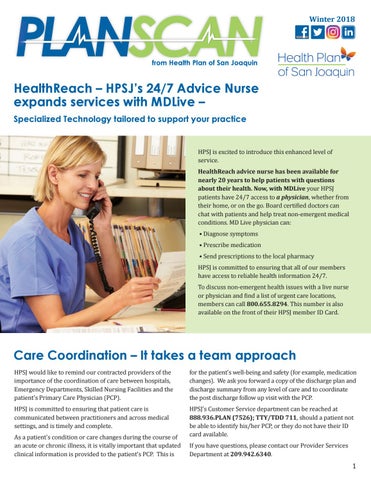
HealthReach advice nurse has been available for nearly 20 years to help patients with questions about their health. Now, with MDLive your HPSJ patients have 24/7 access to a physician, whether from their home, or on the go. Board certified doctors can chat with patients and help treat non-emergent medical conditions. MD Live physician can: • Diagnose symptoms
• Prescribe medication
• Send prescriptions to the local pharmacy
HPSJ is committed to ensuring that all of our members have access to reliable health information 24/7.
To discuss non-emergent health issues with a live nurse or physician and find a list of urgent care locations, members can call 800.655.8294. This number is also available on the front of their HPSJ member ID Card.
Care Coordination – It takes a team approach HPSJ would like to remind our contracted providers of the importance of the coordination of care between hospitals, Emergency Departments, Skilled Nursing Facilities and the patient’s Primary Care Physician (PCP).
for the patient’s well-being and safety (for example, medication changes). We ask you forward a copy of the discharge plan and discharge summary from any level of care and to coordinate the post discharge follow up visit with the PCP.
As a patient’s condition or care changes during the course of an acute or chronic illness, it is vitally important that updated clinical information is provided to the patient’s PCP. This is
If you have questions, please contact our Provider Services Department at 209.942.6340.
HPSJ is committed to ensuring that patient care is communicated between practitioners and across medical settings, and is timely and complete.
HPSJ’s Customer Service department can be reached at 888.936.PLAN (7526); TTY/TDD 711, should a patient not be able to identify his/her PCP, or they do not have their ID card available.
1
Important information, tools and materials – Always available at www.hpsj.com/Providers As a valued Health Plan of San Joaquin (HPSJ) provider, we want to remind you about all of the important information, tools, and materials that you can easily access at our website, www.hpsj.com/Providers.
Preventative Health Guidelines: ° Pediatrics (age 0-19), Preventative Pediatric Health Care ° Pediatrics (age 0-19), Immunization Recommendations ° Perinatal Care ° Adults (age 20-64), Preventative care
° Geriatrics (age 65+), Fall precautions for ages 65 and older
• Information about HPSJ’s medical necessity criteria, including how to obtain or view a copy • Information about the availability of staff to answer questions about UM issues
• The toll-free number to contact staff regarding UM issues • The availability of TTY/TDD 711 services for members • Information about how members may obtain language assistance to discuss UM issues
• HPSJ’s policy prohibiting financial incentives for utilization management decision-makers You can view and download information about the following topics: • Information about HPSJ’s Quality Improvement Program including goals, processes and outcomes as related to care and service
• The process for practitioners, facility staff, including discharge planners, to refer members to case management • The process to refer members to disease management
• Information about disease management programs, including how to use the services and how HPSJ works with a practitioner’s patients in the program Information about how to obtain or view copies of HPSJ’s specific adopted clinical practice guidelines and preventive health guidelines, including those for: Clinical Practice Guidelines:
° Attention deficit hyperactivity disorder (ADHD) ° Asthma ° Chronic Obstructive Lung Disease (COPD) ° Depression
2
° Diabetes ° Heart Failure
• Information about HPSJ’s pharmaceutical management procedures including:
° HPSJ’s drug list, along with restrictions and preferences ° How to use pharmaceutical management procedures ° An explanation of limits and quotas
• How practitioners can provide information to support an exception request • HPSJ’s processes for generic substitution, therapeutic interchange, and step therapy
• A description of the process to review information submitted to support a practitioner’s credentialing application, how to correct erroneous information and, upon request, how to be informed of the status of the credentialing or re-credentialing application • HPSJ’s member rights and responsibilities statement
If you have any questions about accessing our website or if you would like more information, please call the Provider Relations Department at 209.942.6340. The most recent information about HPSJ and our services is always available on our website.
NEWS YOU CAN USE! Direct Deposit – Payments quick and easy (EFT) For many years, HPSJ has used two vendors for electronic claims submissions (EDI). Office Ally, which is free to providers, and Emdeon, which charges a fee to providers. Most providers have adopted this practice.
But did you know that you could also receive direct deposit, electronic funds transfers (EFT), as well as electronic remittance advice (ERA), for no cost to you? This will ensure quicker turn around on payment. For more information, call our Customer Service Department at 209.942.6320. Encounter Data
It is important to submit timely billings, regardless if they are capitated services (pre-paid) or fee-for-service. For PCP providers
• It’s even more important since your capitated encounter submissions are key to a positive HEDIS outcome and impacts your quarterly incentive payment.
• Please refer to the DRE Provider Portal, your secure online HPSJ portal, to check on your HEDIS Gap Report, as well as view the HEDIS Tip sheet which offers you the codes required to receive HEDIS credit for your incentive payments.
Increased Reimbursement on Fluoride Varnish & Expanded Pharmacy Benefit for Fluoride Drops & Tablets
• The increased reimbursement flat rate per treatment is $24.00.
• 90 day supply of oral fluoride.
• Both PCPs & specialists are able to administer fluoride varnish. • Billing:
° CPT Code D1206 is to be billed for fluoride varnish treatment along with ICD.10 code Z41.8.
• No prior authorization is required when treatment is administered by contracted PCP or specialist.
To learn more about fluoride varnish treatment opportunities and pharmacy fluoride drops and tablets, contact our Customer Service Department at 209.942.6320.
Best Practices: ADHD Follow Up
For patients who are newly prescribed an ADHD medication, it is important to follow up with them to check whether the new medication is working and whether the patient is experiencing any side effects. • The first follow up visit should occur within the first 30 days after the start of the new ADHD medication. • Two more follow up visits should occur in the next nine months. • To ensure the first follow up visit occurs, schedule the follow up visit before the patient leaves your office.
During follow up visits, the patient can be assessed for co‑morbidities and whether referrals to specialists are needed. Behavior modification strategies can also be shared with the patient and their caregivers.
3
Childhood Obesity Crisis –
A Lifelong Health Problem and What We Need to Do, Now The percentage of children with obesity in the United States has more than TRIPLED since the 1970’s. About one in five children between 6-19 years of age are obese.
Where are children most effected?
It’s happening here. In our towns and our communities. Children in the Central Valley have higher rates of obesity as compared to children living in other areas of California. Location, built environment and access to healthy foods versus fast foods all contribute to how families face weight management issues.
Why is this happening?
The essential cause of the increase in weight among children and adolescents is straightforward: An excess of caloric intake compared with caloric expenditure. Our young people are making unhealthy eating choices and are not getting enough physical activity.
California is at 4.48. That means, for each grocery store or produce vendor around homes, there are nearly four and a half times as many fast-food restaurants, pizza places, and convenience stores.
Poverty and Neighborhood Safety: People who live in unsafe neighborhoods are one-and-a-half times more likely to be overweight than those who live in friendlier ones. The lack of physical activity raises the obesity levels for people living in unpleasant surroundings.
Access: Retail Food Environment Index (RFEI) is the ratio of fast-food restaurants and convenience stores to grocery stores and produce vendors.
4
Research has found that those who perceived their neighborhood as dangerous, were more likely to be overweight. The more negative qualities reported, the higher the obesity rate. Other factors that have been linked to higher obesity rates include: educational attainment, genetics, health behaviors, social and individual psychology, and environmental factors.
How can we make a difference? It Takes a Community Building a network of resources to ensure our communities are connected to all resources available to them is crucial. Filling all the missing pieces by continued collaboration takes commitment. We should support innovations. Obesity is a result of many behavioral, environmental, and social factors. For sustained weight management, healthy living, healthy behaviors and social concerns must also be considered. We must continue to move forward and support new programs whenever available.
For more details on this article visit: http://pediatrics. aappublications.org/content/136/1/e275 HPSJ is here to support your practice
Health Plan of San Joaquin also covers nutrition consultation for members who meet the following criteria: Children and Teens • BMI 85% of greater—obese or at risk for obese
Providers – An essential role to play
Adults, morbidly obese • BMI>40 • BMI 35-40 with clinically serious conditions related to obesity (i.e. obesity hypoventilation, obstructive sleep apnea, type II DM, HTN)
Childhood obesity starts at home – and so do healthy eating habits. But the discussion can start at the doctor’s office.
Looking for materials and resources to use in your office? Try these websites for free content you can print anytime:
1. 2. 3. 4. 5. 6.
Provider Pro-Tip! Use this guide to document and discuss nutrition plus activity.
The American Academy of Pediatrics published an article in 2015 titled, “The Role of the Pediatrician in the Primary Prevention of Obesity” where they recommend that physicians: Identify children at risk Provide resources for health education when available Encourage behavior modification Include the family in planning and setting goals Encourage self-monitoring Focus on family-based interventions
Prior authorization is required.
• California Champions for Change – find recipes, materials, and MyPlate Resources. http://cachampionsforchange. cdph.ca.gov/Pages/default.aspx • We Can! NIH Curriculum with free posters, materials, activities, and recipes. www.nhlbi.nih.gov/health/ educational/wecan/ • Nourish Interactive – find games for kids, clinical tools, and free printables. http://www.nourishinteractive.com
WCC Weight Assessment & Counseling for Nutrition & Physical Activity for Children/Adolescents Counseling for physical activity – Documentation must include a note indicating the date and at least one of the following:
• Discussion of current physical activity behaviors (e.g., exercise routine, participation in sports activities, exam for sports participation) • Checklist indicating physical activity was addressed • Counseling or referral for physical activity • Member received educational materials on physical activity during a face-toface visit • Anticipatory guidance specific to the child’s physical activity • Weight or obesity counseling
Counseling for Nutrition – Documentation must include a note indicating the date and at least one of the following: • Discussion of current nutrition behaviors (e.g., eating habits, dieting behaviors) • Checklist indicating nutrition was addressed • Counseling or referral for nutrition education • Member received educational materials on nutrition during a face-to-face visit • Anticipatory guidance for nutrition • Weight or obesity counseling
Physical Activity Counseling HCPCS
G0447, S9451
CPT Codes
97802-97804
ICD10 Code
Z71.3
Nutrition Counseling
HCPCS
G0270, G0271, G0447, S9449, S9470
5
7751 S. Manthey Road French Camp, CA 95231 1025 J Street Modesto, CA 95354 Provider Services Department 209.942.6340 or TTY/TDD (711) www.hpsj.com
Proud to be an NCQA Accredited Health Plan
HPSJ’s Affirmative Statement Regarding Utilization Management (UM) Incentives The vision of Health Plan of San Joaquin (HPSJ) is to continuously improve the health of our community. HPSJ supports its vision through our mission statement, which is to provide health care value and advance wellness. Our affirmation statement about Utilization Management (UM) Incentives is clear and understood by all HPSJ staff involved in UM decision making as follows:
1. UM decision making is based only on appropriateness of care, services, and existence of coverage. 2. HPSJ does not specifically reward practitioners or other individuals for issuing denials of coverage.
3. Financial incentives for UM decision makers do not encourage decisions that result in underutilization.
6
Health Plan of San Joaquin has an obligation to investigate all allegations of fraud Health Plan of San Joaquin has an obligation to investigate all allegations of fraud, waste and abuse (FWA). If you uncover or suspect potential FWA, bring it to our attention immediately. Lighthouse Anonymous Reporting:
• Telephone: English speaking: 855.400.6002 or Spanish speaking: 800.216.1288 • Website: www.lighthouse-services.com/hpsj
• Email: reports@lighthouse-services.com (must include company name with report) • Fax: 215.689.3885 (must include company name with report)