FALL 2026
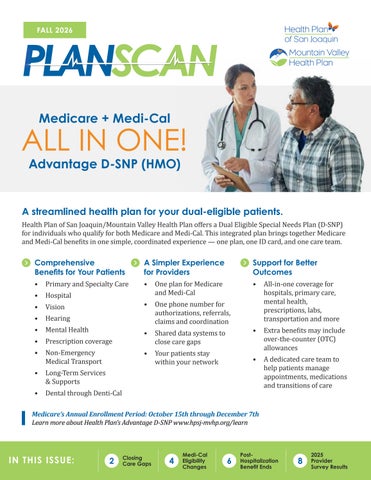
Medicare + Medi-Cal
ALL IN ONE! Advantage D-SNP (HMO)
A streamlined health plan for your dual-eligible patients. Health Plan of San Joaquin/Mountain Valley Health Plan offers a Dual Eligible Special Needs Plan (D-SNP) for individuals who qualify for both Medicare and Medi-Cal. This integrated plan brings together Medicare and Medi-Cal benefits in one simple, coordinated experience — one plan, one ID card, and one care team.
Comprehensive Benefits for Your Patients
A Simpler Experience for Providers
Support for Better Outcomes
•
Primary and Specialty Care
•
One plan for Medicare and Medi-Cal
•
•
Hearing
•
Shared data systems to close care gaps
•
• • • • • • •
Hospital Vision
Mental Health
Prescription coverage Non-Emergency Medical Transport
Long-Term Services & Supports
•
•
One phone number for authorizations, referrals, claims and coordination Your patients stay within your network
•
Dental through Denti-Cal
All-in-one coverage for hospitals, primary care, mental health, prescriptions, labs, transportation and more
Extra benefits may include over-the-counter (OTC) allowances
A dedicated care team to help patients manage appointments, medications and transitions of care
Medicare’s Annual Enrollment Period: October 15th through December 7th Learn more about Health Plan’s Advantage D-SNP www.hpsj-mvhp.org/learn
IN THIS ISSUE:
2
Closing Care Gaps
4
Medi-Cal Eligibility Changes
6
PostHospitalization Benefit Ends
8
2025 Provider Survey Results
Medical and Prescription Benefit Resources
PHARMACY
Understanding the Difference between Advantage D-SNP and Medi-Cal program benefits Health Plan’s Advantage D-SNP Part D & Part B Drug Resources The Part D (prescription drug/pharmacy) Benefit can be reviewed by accessing Health Plan of San Joaquin/Mountain Valley Health Plan Advantage D-SNP’s List of Covered Drugs, or Drug List for short. Medications that are prescribed and dispensed by a retail, mail, or specialty pharmacy fall within the pharmacy benefit and are subject to any restrictions listed within the Drug List. Updates to the Drug List are made on a monthly basis. Additional Part D benefits, such as Medication Therapy Management and Part D Transition processes can be found at www.hpsj.com/d-snp-pharmacy-drug-benefits/. The Part B Drug (medical) Benefit includes most physician administered drugs, insulin or other drugs furnished through an item of durable medical equipment (e.g. insulin pump or nebulizer), clotting factors, transplant/immunosuppressive drugs if Medicare paid for the organ transplant, certain antigens, certain oral anti-cancer drugs if the same drug is available in injectable form or it is a prodrug, oral anti-nausea drugs if administered before, at, or within 48 hours of chemotherapy or used as a full therapeutic replacement for an IV anti-nausea drug, certain oral and IV ESRD drugs, certain drugs for home dialysis, erythropoiesis-stimulating agents if the enrollee has ESRD or a certain condition requiring anemia treatment, IVIG at home for primary immune deficiency diseases, parenteral and enteral nutrition, and certain vaccines (Hepatitis B in medium/high risk, Influenza, COVID-19, and Pneumococcal, all other vaccines are covered through Part D). Part B Drugs are reviewed following the Centers for Medicare & Medicaid Services (CMS) National Coverage Determination/Local Coverage Determination (NCD/LCD) criteria. If no criteria exist, then internal criteria is used to make a coverage determination. Health Plan has full coverage policies available as a reference for any coverage criteria created by Health Plan for Part B Drugs. The medications on the Part B Drug Benefit may have restrictions (e.g. Prior Authorization, quantity limitations) which are specified through the CMS NCD/LCD criteria or within www.hpsj.com/ compliance/#policiesAndProcedures Health Plan’s coverage policies.
Part D Drug Lookup Tool client.formularynavigator.com/Search.aspx?siteCode=0143685768
Part B Drug List cms.gov/medicare-coverage-database/search.aspx
www.hpsj-mvhp.org | 1-888-936-PLAN (7526)
Part D Model Coverage Determination Request Form
For your Health Plan Medi-Cal patients, our health plan administers coverage for medications included under the medical benefit, such as physician-administered drugs. Our coverage policies outline applicable criteria and restrictions, including prior authorization requirements and quantity limits. Providers can review these policies to help guide care and coverage decisions. Medi-Cal Rx administers the pharmacy benefit, which includes medications prescribed and dispensed by retail or specialty pharmacies. These medications are subject to Medi-Cal Rx coverage requirements, which may include Code 1 restrictions, prior authorization and age limits. The following resources explain coverage requirements and offer guidance to help you support your Medi-Cal patients:
Medi-Cal Online Drug Lookup medi-calrx.dhcs.ca.gov/provider/drug-lookup
Stay Connected with Health Plan Provider Alerts At Health Plan, keeping you informed is a priority. Provider Alerts are sent directly to your office by fax to share timely updates, regulatory requirements, and resources that support quality care for your patients.
ALERTS YOU MAY HAVE MISSED Here are a few highlights from September: 2026 Provider Appointment Availability Survey is Here
Medi-Cal Rx Covered Products medi-calrx.dhcs.ca.gov/provider/forms
HPSJ/MVHP Medical Benefits Updates hpsj.com/medical-drug-benefit
2026 Provider Satisfaction Survey is Here Developmental Screening in the First Three Years of Life (DEV) FDA Drug Recall Alert
Other Resources Health Plan Provider Manual hpsj.com/provider-manual
DON’T MISS AN UPDATE Visit www.hpsj.com/alerts to access current and past Provider Alerts. Use the search feature to quickly find the information most relevant to your practice.
hpsj.com/d-snp-member-materials/#forms
Part B Authorization Form hpsj.com/wp-content/uploads/2025/12/HPSJ-MVHP-DSNPAuthorization-Request-Form-12232025E-FINAL.pdf
www.hpsj-mvhp.org | 1-888-936-PLAN (7526)
PlanScan - Fall 2026 | 3
IMPORTANT UPDATES
Medi-Cal Program Changes Beginning in 2027, Medi-Cal changes are expected to affect eligibility, coverage and how some Californians access care. While many members may not see changes to their everyday benefits, certain adults- including some enrolled through the Affordable Care Act (ACA) expansions and members with unsatisfactory immigration status (UIS)- may experience new requirements or changes in how care is delivered.
UIS members transitioning to fee-for-service
On January 1, 2027 Approximately two million Medi-Cal members with unsatisfactory immigration status (UIS) will transition from managed care to fee-for-service (FFS). Although Medi-Cal coverage will continue, the way members access care may change.
How providers can help •
Encourage patients to create an account at BenefitsCal.com
•
Remind patients to open and respond promptly to official notices, renewal requests and deadlines
• • •
Encourage patients to keep their contact information current so they receive important Medi-Cal notices
Be aware that coverage or delivery-system changes may affect referrals, authorizations and where some patients can receive care
Direct patients who have questions or need assistance to appropriate Medi-Cal resources and support
As implementation approaches, additional guidance may become available. Health Plan will continue working with providers and community partners to help members understand upcoming Medi-Cal transitions and maintain access to care.
Under FFS, members will need to receive care from providers who accept Medi-Cal FFS. Some enhanced supports available through managed care- such as care coordination, case management, and medically tailored services- may be reduced or discontinued, and members may need new authorizations for services previously approved under managed care. The state is providing funding for care navigators who can help affected members understand their options and locate participating providers.
Work requirements for some adults
Starting January 1, 2027, Some adults ages 19–64 enrolled through ACA expansions will need to meet new work and community engagement requirements. Affected members may need to demonstrate at least 80 hours per month of qualifying activities, such as work, volunteering, job training, or half time school enrollment, or meet a minimum monthly income requirement to maintain coverage.
Exemptions apply for certain individuals, including those who are pregnant, have disabilities or serious health conditions, or were recently released from incarceration. Affected members will receive notices and should respond promptly.
More frequent eligibility checks and other changes
Beginning March 1, 2027 Certain members will have their eligibility reviewed every six months. A streamlined renewal form through BenefitsCal.com is expected to help with this process, but responding to requests and deadlines will remain important. Medi-Cal will also shorten the period during which medical bills incurred before enrollment may be covered retroactively.
Looking further ahead, some adult immigrants will begin paying small monthly premiums starting July 2027, and certain members may encounter copayments for specialty care starting in October 2028. These copayments will be limited each year to ensure they remain affordable. www.hpsj-mvhp.org | 1-888-936-PLAN (7526)
Access updates and resources Provider Toolkit
BENEFIT UPDATE
PATIENT ENGAGEMENT
Short-Term Post-Hospitalization Housing Benefit Ending January 1st
Childhood Lead Screenings Lead exposure can come from more places than many families realize. While lead-based paint remains a well-known source, children may also be exposed through certain water pipes, toys and jewelry, candies or traditional home remedies, pottery, and some jobs or hobbies.
Providers: Please plan ahead for this upcoming Medi-Cal benefit change. Short-Term Post-Hospitalization Housing (STPHH) will no longer be a covered Medi-Cal benefit beginning January 1, 2027, following the end of the state’s coverage authority for this service.
Health Plan is working to support members and providers through this transition. Here’s what you need to know: •
• •
Authorizations received on or after July 1, 2026, will be limited and cannot extend beyond December 31, 2026. When Health Plan authorizes a shorter duration of STPHH than requested, it is considered an adverse benefit determination under Medi-Cal requirements, and applicable appeal rights will be available.
•
Beginning December 1, 2026, no new STPHH authorizations will be issued. Providers should consider Recuperative Care (Medical Respite) or other available Community Supports for members who need continued support.
•
Health Plan will notify members of this change in coverage no later than December 1, 2026.
Existing authorizations extending beyond December 31, 2026, will be shortened to comply with the statewide end date. A Notice of Action (NOA) will be sent to affected members.
Supporting Members Through the Transition
Members with STPHH authorizations approaching the December 31 end date will receive appropriate transition planning based on their individual needs. This may include connections to: •
Recuperative Care (Medical Respite)
•
Other available Community Supports
• •
Transitional Rent
Enhanced Care Management (ECM)
•
Other covered Medi-Cal benefits, including Community Health Worker (CHW) services when appropriate and when there is no duplication of services or payments
We encourage providers to begin planning early for members who may be affected by this change and to consider alternative services and supports that can help ensure continuity of care. www.hpsj-mvhp.org | 1-888-936-PLAN (7526)
Because lead can damage a child’s developing brain and nervous system and contribute to permanent learning and behavioral problems, providers play an important role in identifying potential exposure and making sure children receive required blood lead screenings.
Start the conversation
Ask parents and caregivers about possible sources of lead in the child’s home and environment. Potential sources may include: •
Lead-based paint
•
Some toys and jewelry
• • •
Certain water pipes
Close the screening gap with Use well-child visits and other patient encounters to review screening history, identify children who are overdo and talk with families about why lead screening matters. Eligible Health Plan members can also earn a reward for completing a lead screening. Member incentives can help reinforce the importance of preventive care and encourage families to complete recommended screenings.
Candies or traditional home remedies Certain jobs and hobbies, including stained-glass work
Know when to screen
Children covered by Medi-Cal must receive blood lead screening tests at • • •
12 months of age
24 months of age
At least one between 24 and 72 months of age if there is no record of a previous blood lead screening
www.hpsj-mvhp.org | 1-888-936-PLAN (7526)
For more information, read Health Plan’s Provider Alert on Childhood Lead Screening at www.hpsj.com/childhoodlead-screening-lsc-2023-hedis-measure. PlanScan - Fall 2026 | 7
MEASURING QUALITY
2025 Survey Results Are In Thank you to our provider network for your continued participation in Health Plan surveys. Your feedback and compliance help us evaluate access to care, identify opportunities for improvement and strengthen the services we provide to our members and provider partners.
After-Hours Survey
The After-Hours Survey assessed providers’ compliance with after-hours emergency instructions and their ability to ensure members can access care when offices are closed. •
Of the 681 providers surveyed, 564 were compliant with appropriate emergency instructions in their after-hours messaging, resulting in an 83% compliance rate.
Provider Satisfaction Survey The Provider Satisfaction Survey helps us understand how well Health Plan is meeting the needs of our provider network. Feedback covers key areas including overall satisfaction, network and coordination of care, finance, utilization and quality management, call center service and provider relations.
Areas identified as Health Plan strengths include: • •
Ability to answer questions and resolve problems
Accuracy and timeliness of claims processing
Thank you for helping ensure members have clear direction for accessing the care they need after regular business hours.
MEASURE NAME
The Provider Appointment Availability Survey assessed compliance with appointment wait-time standards designed to support timely access to care.
All Other Plans (Comparative Rating) (% Well or Somewhat above average)
Provider Appointment Availability Survey 2025 compliance rates • •
Urgent appointments: 61%
Non-urgent appointments: 78%
•
Non-urgent follow-up for non-physician mental health providers: 96%
We appreciate your continued attention to appointment availability standards. Improving urgent appointment wait times remains an important opportunity as we work together to ensure members receive timely access to care.
Would Recommend (% Yes)
Overall Satisfaction (% Completely or Somewhat Satisfied) Finance Issues (% Well or Somewhat above average)
Utilization and Quality Management (% Well or Somewhat above average) Network/Coordination of Care (% Well or Somewhat above average)
Health Plan Call Center Service Staff (% Well or Somewhat above average) Provider Relations (% Well or Somewhat above average)
• •
Consistency of reimbursement fees with contracted rate
Quality of written communications, policy bulletins and manuals
2025 SUMMARY RATE SCORE
2024 PG MEDICAID BoB PERCENTILE*
96.3%
83rd
48.9%
87th
78.8%
83rd
39.4%
80th
41.1%
79th
34.7%
73rd
42.2%
76th
40.8%
76th
*Press Ganey Medicaid Book of Business This year’s Provider Appointment Availability Survey and Provider Satisfaction Survey are now available!
Check your email and respond promptly
www.hpsj-mvhp.org | 1-888-936-PLAN (7526)
PlanScan - Fall 2026 | 9
SAN JOAQUIN MEDICAL SOCIETY DECISION MEDICINE PROGRAM
Investing in our Community’s Healthcare Workforce Building a strong local healthcare workforce starts by investing in students who understand our communities and are inspired to serve them.
Each year, the Decision Medicine Program, founded by the San Joaquin Medical Society, gives local students an opportunity to explore careers in medicine through mentorship, hands-on learning and exposure to the health care field. The program helps students turn an interest in health care into a potential career path while encouraging them to bring their skills back to the communities that helped shape them.
•
•
Sophia Samaniego | Aspiring General Surgeon A bilingual Spanish speaker committed to improving health care access and communication for underserved families in San Joaquin County. Syrell Louisse Gatan | Aspiring Pediatric Surgeon Syrell hopes to return to the community that welcomed her and provide specialized pediatric surgical care to local families.
Growing Our Own
For many of these students, the goal is not simply to enter health care—it is to return home and serve the communities they know firsthand. Their backgrounds, experiences and commitment to service reflect the kind of locally rooted workforce that can help strengthen access to care throughout our region. “ Access to quality health care begins with building a strong local workforce. By supporting these exceptional students today, we’re helping cultivate the next generation of physicians and health care professionals who understand our communities and are committed to caring for them in the future.”
This year, Health Plan awarded $24,000 in Health Careers Scholarships to eight Decision Medicine graduates pursuing careers ranging from surgery and dermatology to nursing and physician assistant studies.
Meet Your Future Colleagues
These eight scholarship recipients represent the next generation of professionals preparing to care for communities throughout the Central Valley: •
•
•
•
•
•
Emmanuel Reyes | Aspiring Pediatric Anesthesiologist A first-generation student who hopes to combine medicine with health policy advocacy and help improve health equity. Eshal Masqood | Aspiring General Surgeon A first-generation college student interested in serving diverse and underserved communities while advancing research in genetic engineering and oncology. Jasmine Faith Johnson | Aspiring Dermatologist Inspired by her own skin health journey, Jasmine hopes to help patients feel seen, heard and confident while expanding access to dermatologic care.
Jenna Ibrahim | Aspiring Physician Assistant Motivated by her experience navigating an autoimmune disease, Jenna hopes to return to San Joaquin County to provide compassionate, community-centered care.
Jolene Cisneros | Aspiring Registered Nurse Jolene plans to build a career centered on compassionate patient care while helping address the Central Valley’s growing need for health care professionals.
Layla Amon Foster | Aspiring Orthopedic Surgeon Her passion for sports medicine grew through Decision Medicine, inspiring her to combine medicine, mentorship and service.
www.hpsj-mvhp.org | 1-888-936-PLAN (7526)
— Lizeth Granados, Chief Executive Officer, Health Plan of San Joaquin/Mountain Valley Health Plan
Health Careers Scholarship Program 2026 - final results! Our partnership with San Joaquin Medical Society’s Decision Medicine Program is one part of Health Plan’s broader Health Careers Scholarship Program, which supports students pursuing careers in health care throughout our service area with scholarships and mentors to guide their journey. This year, Health Plan awarded $159,000 to 53 students including: •
27 Continuing Education Students
•
22 First-Year College students
•
2 University of the Pacific (UOP) students
•
2 California Stanislaus State students
www.hpsj-mvhp.org | 1-888-936-PLAN (7526)
PATIENT RESOURCES
PREVENTION
Help Patients at Risk for Type 2 Diabetes Take the Next Step
Preventive Health Guidelines
You can refer your Health Plan Medi-Cal patients to our Diabetes Prevention Program through Inspiring Communities. For patients at risk of developing type 2 diabetes, small, sustainable changes can make an important difference.
The year-long virtual program gives members practical tools and ongoing support to build healthier habits, manage stress and work toward reducing their risk of type 2 diabetes. To be eligible for the program, members must meet ALL of the following criteria:
Who is eligible?
Members must meet all of the following criteria: • •
Be age 18 or older and a Health Plan member Be overweight
•
•
Not have a diagnosis of type 1 or type 2 diabetes Not currently be pregnant
Members must also meet at least one qualifying risk criterion, such as a blood test indicating prediabetes, a previous diagnosis of gestational diabetes, or a high-risk result on a prediabetes risk test.
What members receive • •
A CDC-approved curriculum
A year-long virtual program delivered through an app, with weekly modules during the first six months and sessions once or twice a month during the following six months
Refer your Health Plan patients
• • •
Encouragement from others working toward similar goals
Support from a trained lifestyle coach
Skills and strategies to support healthy living and stress management
To refer an eligible member, visit www.inspiringcommunities.org and enter the patient information in the program sign-up section. For more information, visit www.hpsj.com/dpp or contact Health Education at 1-209-942-6356 or healtheducation@hpsj.com. www.hpsj-mvhp.org | 1-888-936-PLAN (7526)
Preventive care provides an important opportunity to identify health risks early, support healthier outcomes and help patients stay on track with recommended screenings and immunizations.
Health Plan’s Preventive Health Guidelines bring key recommendations together in one convenient resource to support providers in delivering age-appropriate preventive care. The guidelines incorporate recommendations from nationally recognized organizations, including the U.S. Preventive Services Task Force (USPSTF), Advisory Committee on Immunization Practices (ACIP), and Bright Futures/American Academy of Pediatrics (AAP).
2026 Pediatric Immunization Updates
The AAP released its 2026 Recommended Childhood and Adolescent Immunization Schedule with several updates providers should be aware of: •
• •
•
RSV: The schedule incorporates clesrovimab as an additional monoclonal antibody option for RSV prevention and provides updated guidance based on age, risk and maternal RSV vaccination status.
HPV: The recommended age range is now 9–12 years, aligning the schedule with AAP policy.
COVID-19: Updated AAP recommendations include routine vaccination for children ages 6–23 months, with risk-based recommendations and vaccination for those who desire protection for children and adolescents ages 2–17 years. Influenza: The schedule has been streamlined to combine injectable and intranasal influenza vaccine recommendations into one row. Annual influenza vaccination continues to be recommended for eligible patients.
Preventive Screening Reminders
Providers should continue to incorporate recommended preventive screenings into routine care based on each patient’s age and risk factors. The USPSTF’s current A and B recommendations cover preventive services across the lifespan, while Bright Futures provides age-specific screening, assessment and preventive-care recommendations from infancy through adolescence. Download Health Plan’s Preventive Health Guidelines for children and adults at hpsj.com/preventive-health-guidelines. To request printed copies for your office, contact the Health Education Team at healtheducation@hpsj.com. www.hpsj-mvhp.org | 1-888-936-PLAN (7526)
PlanScan - Fall 2026 | 13
PREVENTIVE HEALTH MEASURES
Screening Saves Lives: Close BCS and CCS Care Gaps As the year draws to a close, providers have an opportunity to help patients complete overdue screenings and close care gaps. Two key HEDIS measures-Breast Cancer Screening (BCS) and Cervical Cancer Screening (CCS)-support preventive care for women in our member population. Your outreach can help members understand their screening needs and take the next step toward completing care.
Breast Cancer Screening (BCS)
The BCS measure focuses on women ages 40–74 who received a mammogram within the last two years. Routine mammography can help detect breast cancer earlier, when treatment may be more successful What providers can do: •
Flag overdue patients at every visitnot only during annual wellness exams.
•
Talk with patients about common barriers, including transportation, fear and scheduling conflicts, and help connect them with available support.
•
Offer same-day orders or on-site scheduling when possible.
Cervical Cancer Screening (CCS) The CCS measure looks at whether women ages 21–64 received appropriate cervical cancer screening: cytology (Pap test) every three years for ages 21–64, or cytology combined with HPV co-testing every five years for ages 30–64. What providers can do: • • •
•
Use patient encounters as opportunities to review screening status and identify open care gaps.
Pair cervical cancer screening conversations with HPV vaccination outreach for eligible patients.
Consider available alternative screening approaches, when clinically appropriate, for patients who are uncomfortable with or avoid traditional testing.
Document screening results promptly to support accurate measure capture.
Make every visit count
As flu vaccinations and wellness visits bring patients into the office, take a moment to review BCS and CCS gaps in care and help patients schedule needed screenings. A few extra minutes during a visit can help close an important preventive care gap. Questions about your BCS/CCS performance or gap lists? Contact the Health Plan Quality Improvement team.
Why It Matters
BCS and CCS contribute to HEDIS and MediCal Minimum Performance Level (MPL), and for Health Plan’s D-SNP population, these measures also influence CMS Star Ratings. More importantly, timely screening gives providers an opportunity to identify cancer earlier and improve patient outcomes. QUESTIONS?
Contact the Health Plan Quality Improvement Teamat 1-209-942-6325
www.hpsj-mvhp.org 1-888-936-PLAN (7526) TTY 711