THE VALUE COMPASS
A News letter on Value-Based Healthcare in Canada
Published by B Squared Group Inc. | Summer 2026 | Issue 1
FROM THE DESK OF CHERYL PETRUK, MBA, CHRP,
B.MGT., DBA (Student)
Welcome to the inaugural issue of The Value Compass — a newsletter dedicated to advancing the conversation on Value-Based Healthcare (VBHC) in Canada. Whether you lead a hospital, develop policy, work alongside patients, or advocate on their behalf, the question of how we measure and deliver value in healthcare has never been more urgent.
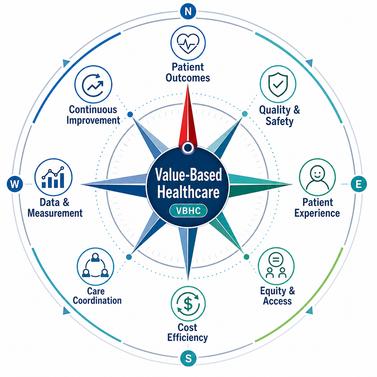
Canada's health system is admired for its universality, yet faces mounting pressure from aging demographics, chronic disease burden, post-pandemic backlogs, and constrained provincial budgets. VBHC offers a powerful organizing framework — one that aligns outcomes that matter to patients with the full cost of delivering them. In this issue, we explore why that matters across every sector of the system.
I also want to share some news from B Squared Group Inc.: I recently completed my Greenbelt certification in Value-Based Healthcare through the Decision Institute. This credential deepens our firm's capacity to guide healthcare institutions, patient advocacy organizations, and industry partners on embedding VBHC principles into real-world practice.
I hope you find this issue both informative and practical.
Cheryl Petruk
What Is Value-Based Healthcare?
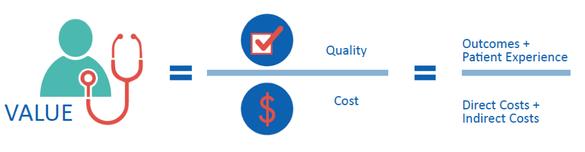
Value-Based Healthcare (VBHC) is a framework pioneered by Harvard Business School professors Michael Porter and Elizabeth Teisberg, built on a straightforward premise: the goal of healthcare should be to maximize patient health outcomes relative to the costs of delivering those outcomes. The defining equation is simple but profound:
Value = Patient Health Outcomes ÷ Cost of Delivering Those Outcomes
In Canada, VBHC resonates with efforts to move beyond volume-based funding (paying for each test, visit, or procedure) toward models that reward quality, efficiency, and the patient experience. It asks providers, payers, and policymakers to define what a good result actually looks like — from the patient's perspective — and then design systems that reliably produce it.
Key components of a VBHC system include:
•
•
•
• Measuring outcomes that patients care about (functional status, quality of life, return to work, symptom burden)
Tracking the full-cycle cost of care rather than siloed episode costs
Organizing care delivery around medical conditions rather than specialties or departments
Enabling integrated practice units (IPUs) that bring multidisciplinary teams together
Designing payment models that reward value rather than volume
Expanding geographic reach through technology and care networks •
Why VBHC Matters for Healthcare Institutions
For hospitals, long-term care facilities, and regional health authorities, VBHC is more than a philosophical shift — it is an operational imperative. Canadian healthcare institutions face a structural tension: demand is growing while funding remains constrained. The traditional response — doing more of the same, only faster — is no longer viable.
Strategic and Financial Sustainability
VBHC gives institutions a data-driven basis for resource allocation. By linking expenditure to measurable outcomes, administrators can identify high-value clinical pathways and divest from lowvalue care — treatments that consume resources without improving patient health. Studies estimate that 20–30% of healthcare spending in high-income countries goes toward care of marginal benefit. Redirecting even a portion of that spend has significant institutional and system implications.
Quality Improvement and Accreditation
Institutions that adopt VBHC frameworks systematically measure and report outcomes, creating robust feedback loops for clinical quality improvement. This aligns directly with Accreditation Canada standards and supports the shift toward patient-reported outcome measures (PROMs) and patient-reported experience measures (PREMs) as standard practice.
Workforce Alignment and Retention
Healthcare professionals entered their fields to help people recover and thrive. VBHC reconnects clinical teams to that mission by centering outcomes — not throughput — as the measure of success. Organizations that adopt VBHC principles report improved staff engagement and reduced burnout, as clinicians see the tangible impact of their work.
Estimated share of Canadian healthcare spending on care of limited clinical benefit (CIHI, 2023)
Canada's total health expenditure in 2023, underscoring the scale of efficiency opportunity (CIHI)
Why VBHC Matters for Healthcare Systems
At the system level — provincial ministries of health, regional health authorities, and federal policymakers — VBHC offers a coherent strategy for transforming how care is planned, funded, and evaluated.
Reimagining Payment Models
Canada's fee-for-service model creates incentives to maximize volume, not outcomes. Bundled payment models, activity-based funding reforms, and outcomes-linked contracts are VBHC-aligned alternatives that several provinces are actively piloting. Ontario's Health-Based Allocation Model
(HBAM)and British Columbia's surgical recovery initiatives both reflect elements of VBHC philosophy, even when not explicitly branded as such.
Data Infrastructure and Real-World Evidence
VBHC demands longitudinal outcome data — collected prospectively, linked across care settings, and reported back to clinicians and patients. Canada's investment in the Canadian Institute for Health Information (CIHI), electronic health record modernization, and pan-Canadian data trusts creates a foundation for VBHC measurement. Connecting these data assets with real-world evidence (RWE) strategies strengthen health technology assessment (HTA) and drug reimbursement decisions.
Equity and Access
A VBHC lens also demands that we ask: value for whom? Disaggregating outcomes data by geography, language, Indigenous status, income, and disability reveals disparities that aggregate system metrics obscure. Embedding equity into VBHC frameworks ensures the transformation does not deepen existing gaps.
Why VBHC Matters for Patients
Perhaps nowhere is the case for VBHC stronger than when viewed through the patient's lens. Traditional healthcare systems measure success by clinical endpoints — labs, scans, survival rates. Patients measure success by something richer: Can I return to work? Can I play with my grandchildren? Am I in less pain? Do I feel heard?
Putting Patient-Defined Outcomes at the Centre
VBHC frameworks require formal capture of what outcomes matter most to patients, using validated tools like PROMs and PREMs. In oncology, for example, patients routinely report that symptom burden, cognitive function, and sexual health matter enormously — yet these are rarely tracked in standard care. VBHC changes that.
Reducing the Burden of Fragmented Care
Patients with complex conditions — cancer, heart failure, diabetes, rare diseases — often navigate a maze of specialists, duplicate testing, and communication gaps. VBHC's integrated practice unit model organizes care around the patient's full condition, not individual specialties. This reduces duplication, improves care coordination, and decreases the patient burden that often goes unmeasured and unmourned.
Informed Shared Decision-Making
When patients have access to outcome benchmarks — what happens to people like me at this institution, with this treatment — they can make genuinely informed choices. VBHC supports the shift from paternalistic care to authentic partnerships between patients and providers.
"The goal is not to minimize cost. The goal is to maximize value — and value is defined by the patient." — Michael Porter, VBHC Framework
Why VBHC Matters for Patient Advocacy Organizations
Patient advocacy organizations (PAOs) occupy a unique and powerful position in the healthcare ecosystem. They hold thelived experience ofdisease communities,the trust of patients and caregivers, and increasingly, the ear of policymakers and payers. VBHC gives PAOs a rigorous and credible framework for advancing their missions.
Strengthening the Evidence Base for Advocacy
VBHC supports PAOs in moving beyond anecdote to systematic collection of patient-reported outcomes and real-world evidence. When advocacy is grounded in data — showing how patients' functional status, quality of life, or caregiver burden changes with different treatment pathways — it carries far greater weight in Health Technology Assessment (HTA) submissions, drug reimbursement negotiations, and policy consultations.
Influencing Reimbursement and Coverage Decisions
Canada's drug and device reimbursement landscape — through the Canadian Drug Agency (CDAAMC), provincial formulary committees, and pan-Canadian Pharmaceutical Alliance (pCPA) negotiations — increasingly values real-world evidence of patient benefit. PAOs that can produce VBHC-aligned outcome data become indispensable partners in those processes, not just voices at the table but evidence contributors.
Designing and Evaluating Advocacy Programs
VBHC principles help PAOs apply the same outcome-and-cost logic to their own programs. Which patient navigation services produce the greatest improvement in health literacy? Which peer support models reduce emergency department visits? Applying VBHC thinking internally makes organizations more effective, more fundable, and more accountable.
Building Strategic Industry Partnerships
Pharmaceutical, biotech, and medical device companies are increasingly required to demonstrate value beyond clinical trial efficacy. PAOs that speak the VBHC language — outcomes, burden of illness, unmet need, real-world evidence — become stronger strategic partners for industrysponsored research, co-designed patient engagement programs, and joint HTA initiatives.
Real-World VBHC in Action: Canadian and Global Case Examples
VBHCisnotmerely theoretical.Thefollowingcaseexamplesillustratewhatmeaningful transformation looks like in practice.
�� CASE 1: Ontario — Bundled Care for Hip and Knee Replacement (HQO)
Health QualityOntario (HQO), in partnership with Ontario Health, piloted a bundled payment model for elective hip and knee replacements at a number of Ontario hospitals. Rather than reimbursing each component of care separately, a single payment covered pre-operative assessment through 90 days post-discharge. Participating hospitals were required to track functional outcome measures (Oxford Hip/Knee Score) and patient experience data. Early results showed reduced lengths of stay, lower complication rates, and — critically — improved patient-reported function at 90 days. The pilot demonstrated that aligning financial incentives with outcome measurement creates compelling results even within Canada's public system.
CASE 2: BC Cancer — Integrated Lung Cancer Care and Real-World Evidence
BC Cancer implemented an integrated approachto lung cancer care that broughtmedical oncology, radiation oncology, respirology, and palliative care together in coordinated clinics. By systematically capturing PROMs (including symptom burden and quality of life scores) using the Edmonton Symptom Assessment System (ESAS), the program was able to demonstrate that proactive symptom management reduced emergency department visits, improved patientreported quality of life, and lowered overall system cost. The BC Cancer program has since informed national conversations on integrating patient-reported outcomes into routine oncology care in Canada.
CASE 3: Sweden — Karolinska University Hospital and VBHC Implementation
Karolinska University Hospital in Stockholmis one of the most cited examples of full-scale
VBHC implementation. Under leadership from Michael Porter and VBHC practitioners, Karolinska reorganized from traditional specialty-based departments into integrated practice units (IPUs) organized around patient conditions — including prostate cancer, hip/knee conditions, and severe obesity. The hospital introduced comprehensive PROM measurement, linked outcome data to cost accounting at the care-cycle level, and restructured reimbursement accordingly. Patient outcomes improved across virtually every condition tracked, while costs decreased. The Karolinska model is a blueprint that Canadian health authorities have actively studied.
�� CASE 4: Patient Advocacy — Cholangiocarcinoma Patient Advocacy & the VBHC Case for Rare Bile Duct Cancer in Canada
Cholangiocarcinoma (CCA) — cancer of the bile ducts — affects fewer than 1,500 Canadians annually, with a median survival under 12 months for advanced disease. Patient advocacy organizations in the CCA space have confronted a critical evidence gap: clinical trials measure tumour response and survival, but cannot capture the diagnostic odyssey averaging 12–18 months from symptom onset to confirmed diagnosis, the caregiver burden of late-stage presentation, income and employment loss during the diagnostic period, or the psychological toll of a rare and poorly understood diagnosis.
By deploying validated PROM instruments — including the FACT-Hep and EQ-5D — CCA advocates have built a real-world evidence base that quantifies what registries miss: the full human and economic cost of delayed diagnosis and fragmented care. This evidence has direct application in CDA-AMC submissions for emerging targeted therapies (IDH1 and FGFR2 inhibitors), where Canadian patient-reported data fills the evidentiary gap that small trial populations cannot.
The CCA model demonstrates a foundational VBHC principle for rare disease advocacy: when patient numbers are too small to power conventional clinical evidence, systematically collected patient-reported outcomes become the primary — and most compelling — evidence base for reimbursement, guideline development, and research prioritization.
B Squared Group Inc.: VBHC Consulting for the Advocacy Sector
B Squared Group Inc. is a Canadian-based organization/consulting firm with nearly 25 years of experience guiding organizations through complex people, strategy, and operational challenges
Under the leadership of Principal Cheryl Petruk, MBA, CHRP, B Mgt , DBA (Student), B Squared has expanded its advisory practice to include Value-Based Healthcare consulting with a particular focus on patient advocacy and the nonprofit health sector
"We believe that the organizations closest to patients advocacy groups, disease communities, and nonprofit health leaders deserve the same rigorous, evidence-based strategic frameworks as any major health system."
— Cheryl Petruk
VBHC Greenbelt Certification
Cheryl Petruk recently completed her Greenbelt Certification in Value-Based Healthcare through the Decision Institute an internationally recognized VBHC training and advisory organization. The VBHC Greenbelt certification equips practitioners with the frameworks, tools, and methodologies to apply VBHC principles in real organizational contexts, including:
Outcome measurement design and PROM/PREM integration
Cost-of-care analysis aligned with patient condition cycles
Integrated practice unit (IPU) design and organizational restructuring
Value-based contracting and partnership development
Applying VBHC to patient advocacy, RWE strategy, and HTA engagement
This certification positions B Squared Group and Cheryl personally as one of a small number of Canadian consultants with formal VBHC credentials serving the patient advocacy sector
What B Squared Group Offers: Advocacy VBHC Consulting
B Squared Group's advocacy consulting practice bridges the worlds of organizational strategy, human resources, and healthcare transformation Service offerings include:
Service Area
VBHC Readiness Assessment
Patient Advocacy Strategy
Outcome Measurement Design
Partnership Development
Board and Leadership Coaching
Grant and Proposal Writing
Description
Evaluateyourorganization'scurrentstateagainstVBHC
principlesanddevelopaprioritizedroadmapforembedding outcomemeasurementandvalue-basedpractices.
Designevidence-basedadvocacystrategiesthatleveragepatientreportedoutcomes,real-worldevidence,andVBHCframeworksfor HTA,reimbursement,andpolicyengagement.
Identify,select,andoperationalizevalidatedPROMandPREM instrumentsforpatientcommunities,clinicalpartnerships,and researchcollaborations.
DevelopVBHC-alignedpartnershipframeworkswith pharmaceutical,biotech,andhealthsystempartners—including contractdesignandnegotiationsupport.
Facilitatestrategicplanning,VBHCeducationsessions,andboard governancedevelopmentforpatientadvocacyorganizationsand nonprofits.
Developcompellingfundingapplicationsandbusinesscases groundedinVBHCevidenceandalignedwithfunderpriorities.
B Squared Group's VBHC Ecosystem
BSquared Group's VBHC advisory work is deeply connected to its broader ecosystem of healthcare and advocacy initiatives:
• HEAL Canada (CEO & Founder, Cheryl Petruk): A Canadian nonprofit advancing patient advocacy, health literacy, and real-world evidence — including the E3 Advocacy Magazine,
a trilingual digital publication reaching patient and advocacy communities across Canada, the US, and Europe.
•
•
CACHEducation (Co-Founder): A patient advocacy certification program aligned with EUPATI standards, preparing patients and advocates with the knowledge to engage meaningfully in clinical and regulatory processes.
My Blood My Health: A signature program within HEAL Canada focused on hematological issues applying VBHC-aligned patient engagement and HTA advocacy in the community.