0 7/ 2 6
INSIGHT ITI
THE MAGAZINE OF THE INSTITUTE OF TRANSLATION AND INTERPRETING
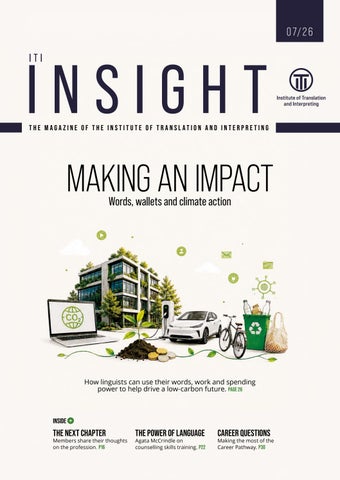
NEUROAFFIRMATIVE MAKING AN IMPACT SUPERVISION FOR LINGUISTS Words, wallets and climate action
How linguists can use their words, work and spending power to help drive a low-carbon future. PAGE 26
INSIDE
THE NEXT CHAPTER
Members share their thoughts on the profession. P16
THE POWER OF LANGUAGE
Agata McCrindle on counselling skills training. P22
CAREER QUESTIONS
Making the most of the Career Pathway. P30
EX:CHANGE 2026 Catch up on the conversations If you couldn’t join us in Milton Keynes, or if you’d like to revisit the discussions, we have uploaded a selection of materials for you to read on the event website.
You’ll find a summary of the sessions and links to the Padlet boards where wecaptured your ideas, plus a gallery of photos from the conference and some ofthe fringe events. Visit https://www.iti.org.uk/training/exchange-2026/outcomes.html to take a look.
We would like to thank Marco Baglioni and LanguageCheck.ai for being the Partner Sponsor for EX:CHANGE 2026. LanguageCheck.ai, a brand of Aqrate, has been created to help professionals improve language quality with practical and accessible AI support. Combining linguistic expertise, technology and user feedback, the platform supports translators, multilingual teams and organisations by helping make revision, terminology and communication workflows clearer, faster and more reliable. Their support for EX:CHANGE 2026 reflects a shared interest in exploring how technology and AI can support the sector in practical, ethical and genuinely useful ways. For Marco Baglioni, supporting EX:CHANGE 2026 was about much more than sponsorship — it was about engaging directly with the professionals at the heart of the language services sector. He explained: "LanguageCheck.ai sponsoring EX:CHANGE 2026 was to listen and learn from translators’ real experiences. Their insights help us understand the challenges, expectations and workflows shaping the profession today. By supporting this exchange, we hope to explore how tools like LanguageCheck.ai can become genuinely useful, practical and respectful companions to translators everywhere."
03
VIEW FROM THE CHAIR ITI Chair Fiona Gray, July 2026 ITI’s 40th anniversary year is in full swing! With excitement rising ahead of our celebratory dinner at EX:CHANGE 2026 in Milton Keynes, this important milestone continues to prompt insightful and inspiring conversations as we reflect on just how much our profession has changed over the past four decades.
F
orty years of the Institute of Translation and Interpreting means 40 years of our supportive community of professionals – and that calls for a proper celebration! If you caught my recent webinar, you’ll know just how much I believe in the power of finding your people and the positive impact meaningful human connection can have on your business, your wellbeing, your job satisfaction, your confidence and your resilience. (Catch up in the Knowledge Hub if you missed it!) For me, the strength of ITI has always been in its people. The beating heart of our community is our members – translators and interpreters doing the work they love all around the world, advocating for our profession in an ever-changing environment, and making ITI what it is by selflessly volunteering their time and energy in our networks, in our working groups and on our committees. With that in mind, I couldn’t think of a better way to mark the massive milestone than by talking to as many members as possible. If I could come up with a plan to make it happen, I’d speak to each and every one of you individually. Instead, I settled on setting aside a whole day – Wednesday 13 May – which I divided up into 40 slots of 15 minutes. Some quick maths will tell you that I planned to spend 10 solid hours on
www.iti.org.uk | July 2026 | ITI INSIGHT
Zoom without any breaks… What could possibly go wrong?! The set-up was simple. If you wanted to book one of the 15-minute slots, you just had to click on my Calendly link, pick a convenient time on the day and suggest a threeword topic. With so little time for each conversation, I wanted to make sure there was a narrow enough focus to make the most out of every minute. I was open to talking about the past, present and future. I was excited to explore big plans, happy highlights and professional challenges. And, of course, I was ready to listen to constructive feedback, suggestions and ideas. All along I’d hoped to reach a diverse selection of our membership, so I was delighted to catch up with people I’ve known for years but also meet some new faces for the first time. I chatted to members with decades of experience under their belt and newcomers who are just starting out in their career. What an honour to speak to so many translators and interpreters based across the UK – and beyond – and working in all different fields and language pairings. With some chopping and changing of the schedule on the day, I even ended up with some unexpected but much appreciated breaks for food and drink! No two conversations were the same. Far from it. And yet they all had something in common. As the
day unfolded, it became obvious to me that every single member I spoke to that day genuinely cares about our institute, our community and our profession. Whether they were providing feedback, sharing concerns or making suggestions. Reminiscing about the past and getting to grips with the changes to our professional world or reflecting on ways forward and planning future strategies. There’s no hiding from the fact that we’re up against unprecedented challenges. The landscape of translation and interpreting is shifting faster than ever, and the questions confronting our profession are real and complex. But my full day of quick-fire conversations on Zoom was a strong reminder that we’re not navigating any of it alone.
FIONA GRAY MITI Fiona Gray MITI is the ITI chair, having served on the ITI board of directors since 2022. She helps brands and businesses based in Germany, Austria, Switzerland and Luxembourg to find their voice in English through creative copy and compelling content that makes their German words travel. Fiona won the ITI Mentor of the Year Award in 2023 and was named Linguist of the Year at the ATC Language Industry Awards 2024.
In this issue: The magazine of the Institute of Translation and Interpreting ITI INSIGHT Design and print Headlines Communications Agency headlines.uk.com
NEWS 03 View from the Chair Fiona Gray celebrates our 40th anniversary. 05 ITI news A round-up of activity across ITI.
Special thanks to the ITI office staff for all their help © ITI 2026 BOARD 2026-2027 Company secretary Bridgehouse Company Secretaries Chief executive Sara Robertson BOARD MEMBERS Chair Fiona Gray MITI Vice-chairs Lloyd Bingham MITI, Anna Kerod MITI Board Laura Byrne MITI, Dean Evans MITI, Simona Manca MITI, JC Penet, Jonathan Downie AITI, Lena Marg and Lucio Bagnulo COMMITTEE CHAIRS Membership Dana Szabados MITI Fellowship Kim Sanderson FITI Professional Development Jo Durning MITI Professional Conduct Joanna Waller FITI Nominations Dean Evans MITI ITI OFFICE Suite 141, Milton Keynes Business Centre, Foxhunter Drive, Linford Wood, Milton Keynes, MK14 6GD, UK Telephone 01908 325250 Email info@iti.org.uk
ITI BULLETIN COPY DEADLINE The copy deadline for the October 2026 issue of ITI Insight is 20 August 2026. Please email editor@iti.org.uk with feature ideas; all copy is edited, and the editor’s decision is final.
COMMENT 08 N euroaffirmative supervision for linguists A look at reflective practice, psychological safety, and sustainable professional growth. 12 From punk rock to prompt engineering Celebrating 50 years of the ATC and 40 years of ITI. 14 A changing profession, a constant community Paul Appleyard shares his thoughts on ITI turning 40! 16 The next chapter Board members’ thoughts on the profession and how to navigate towards a sustainable future. 22 When language carries more than words Agata McCrindle on how training in counselling skills has strengthened her practice. 26 Driving positive change in the language sector Navigating the challenges and discovering the benefits of embracing a low-carbon future. 30 Making the most of the Career Pathway How ITI’s Career Pathway is helping language professionals. 32 A commitment to wellbeing and community How organisations are prioritising wellbeing, support and inclusion.
ITI INSIGHT 35 Network round-up Updates from the ITI networks.
40 S taying safe Find out more about fraud prevention.
38 Policy and advocacy A round-up of our recent outreach activities.
42 P rofessionalism Defining a professional practice, and why we need a framework for it.
Neither ITI nor the editor guarantees the accuracy of contributions or advertisements, nor do they accept any liability for statements expressed in Insight. Articles are considered for publication on the basis that they are the author’s original work. No part of this publication may be reproduced by any means without the prior written permission of ITI. All copy is edited by Insight staff. We welcome letters to Insight, but cannot guarantee to publish them all. Letters may be edited at the editor’s discretion.
NE W S
05
MEMBERSHIP UPDATE
OUR APPROACH TO AI TRAINING Some members have raised concerns that our recent promotion of various AI training courses signals that the Institute is uncritically in favour of AI adoption. The Board has discussed these concerns. We know that many members are experiencing real pressure on their income and working conditions due to the increasing use of AI by clients, and we do not underestimate how significant and worrying this is. We would like to reassure members that ITI’s position remains unchanged: we do not advocate for AI adoption, nor do we endorse any particular view on how members should approach AI. This decision is for each member, based on their own practice and values. We believe that members are best placed to articulate the irreplaceable value of
skilled human translation and protect their professional interests – whether they choose to engage with AI tools or not – when they understand how these tools work and what their limitations are. AI is one of several topics our professional development programme addresses, alongside business skills, specialisation and ethics. In the future, we will strive to clarify the distinction between equipping members with knowledge and advocating for a particular policy or approach. We recognise that recent communications may have blurred this distinction, and we apologise for any confusion caused. Having taken constructive feedback on board, we have also made changes to our Dates for Your Diary e-newsletter and our mailing lists to facilitate members opting in and out of different types of communication. We welcome further feedback on how we can continue to improve.
CORRECTION AND APOLOGY We would like to apologise for an error in the previous issue of the magazine, in which a small number of words were inadvertently omitted from some of the published articles during the production process. We are committed to maintaining the highest editorial standards and take great care to ensure accuracy in all published content. Thank you for your continued support and readership.
www.iti.org.uk | July 2026 | ITI INSIGHT
The past few months – our main membership renewal season – have been busy for the membership team. We are pleased to see strong growth in new individual memberships, along with several new Corporate applications, including a new international university and a new Corporate Affiliate member. We warmly welcome all new members to ITI and wish those who have chosen to leave the very best for the future. At the end of April 2026, the Membership Committee said farewell to Cate Avery FITI, who had chaired the Committee for 12 years. Cate brought consistency and stability to the Committee and led discussions that resulted in significant changes for ITI members. We are very grateful for her substantial contribution to our work. We are pleased to welcome Dana Szabados MITI as the new Chair of the Membership Committee. Dana brings over 30 years of experience as a freelance translator and chaired her first meeting at the end of May. We look forward to working with Dana and the rest of the Committee. Following requests from members, we have introduced a Pause Policy for membership. This new policy allows members to pause their membership for up to 12 months and is designed to support those taking a sabbatical, career break or requiring financial flexibility. The policy complements the existing maternity and paternity policy, with full details available in the Terms and Conditions section of our website. You can also contact the membership team at membership@iti.org.uk for more information or to request a pause.
06
NE W S
STAFF UPDATE In May 2026, the membership team saw some changes. We said goodbye to Emily Warren, who joined ITI in May 2025 to cover maternity leave, and welcomed back Katie Witton. Katie resumes her role as Membership Advisor, handling MITI and FITI applications and assessments, and supporting members through these processes. We are grateful for the energy and commitment Emily brought to ITI over the past year and wish her well as she moves on to her next role in the membership sector. Victoria Hill has also returned from maternity leave, taking up her new role as Professional Development Manager and leading the training team. We’d like to take this opportunity to thank Claire Wardell for stepping into the role on an interim basis from September 2025 and for bringing considerable experience from her work in professional development in other membership bodies.
New and upgraded members of ITI* Qualified (MITI) • Anastasiia Poturnak English – Ukrainian • Beatrice Schlegel English – German • Bernardo Mandichidja Sabão English – Portuguese • Carmen Bañuls Torres English – Spanish • Dr Christophe Fricker English – German • Ebaa Alwash English – Arabic • Hon Keung Yuen English – Chinese • Lucia Francesca Catania Italian – English • Luke James Japanese – English • Maria Stefanidou English – Greek • Mark Grainger German – English • Melina Rocha Portuguese (Brazilian) – English
• Rebeca Lupu English – Romanian •R oland Hall French – English • Sónia Costa English – Portuguese • V ioletta Paine Russian - English
Associate (AITI) • Carmen Stragand • Cristina Edwards • Emeline Jamoul • Federico Di Marino •G abrielle Moses •H amidullah Zamir • Lok Sang Ho • Manar Elkhonar Larbaoui •M onica Collinson • Dr Samira Bakeer
Junior Associate • Barbara Nava • Della Rainey • Ella Plaisted • Jack Durkan • L aura Domínguez de la Torre • L auren Warner-Treloar • Mara Semadeni • Dr Michaela Kuklová • Philip Litchmore • Shamima Khanom • Thomas Badal • V ictoria Sabio • V ivienne Cavagnoli
Affiliate • Alex Choysen • A zmol Hossain • Francesca Cross • Dr Hala Sharkas • Ian Winick • Juan Carlos Cabrera Rodriguez • Dr Kate Costello • Nair Jose
• Rebecca Danks • Regina Simmes • Sara Molinari • Won Jun Nam
Student • Alessia Cabiddu • Ariana Dubov • Arianna Cesaro • Dawid Angrecki • Dylan Glenton • Emma Foord-Divers • Erin Atherton • Fan He • Fred Smith • Georgina Remmer • Giulia De Luca • Jacob Bowers • K senija Pacovich • Michela Fedeli • Pablo Armijos • Trisha Ashwani Thug • Vaughan Lewis • Yuanqiang Li • Zijin Li
*Correct on 15 May 2026
ITI INSIGHT | July 2026 | www.iti.org.uk
07
We want to hear from you!
PROFESSIONAL DEVELOPMENT UPDATE Over the coming months, ITI will expand its CPD and training programme with opportunities designed to support language professionals at every career stage. Alongside business skills, we will place greater emphasis on human skills – adaptability, stress management, critical thinking and ethics – which underpin sustainable professional practice. We are also reintroducing sessions on specialisation,
helping members identify and develop a specialist focus, with training available across various subject fields. Our overarching aim is to meet the diverse needs of our membership, from new entrants to experienced practitioners, and to help members build the confidence and resilience to secure and retain clients. We welcome suggestions for future training sessions. You can share your ideas on the ITI Training Ideas Padlet or contact the Training team directly at training@iti.org.uk
HAVE YOUR SAY The Institute recently received a suggestion from a member to create more opportunities for discussion within the pages of the magazine. As a result, we are inviting members to submit comments, letters and responses to articles featured in
www.iti.org.uk | July 2026 | ITI INSIGHT
Our editorial mission remains to inform, educate and engage ITI members and subscribers through high-quality, relevant content that shares new research findings, supports professional development and promotes best practice in the field. We welcome articles that explore current trends and future developments in translation and interpreting, share practical tips for professional growth, highlight innovative approaches to the work, or demonstrate the value of our professions to wider society. You can read more in contributor guidelines on the website: https:// www.iti.org.uk/discover/iti-community/ iti-magazine/contributor-guidelines.html ITI Insight is an open platform for the range of voices in our community, and we are always keen to hear from new writers. If you have an idea, please submit it via our online form; we review all proposals and are happy to give advice on word length, tone and angle before you start writing. One page is approximately 650 words and a two-page article runs to around 1,200 words. We also accept longer features where the topic merits deeper exploration. Remember that the magazine is written for practising translation and interpreting professionals – it is not an academic journal – so we are looking for writing that is readable and engaging without talking down to our members. We edit and proofread all contributions, so if you are not fully confident in your own writing, please do not let that put you off. All contributors are asked to provide a short professional biography of no more than 50 words and a high-resolution headshot when they submit their idea proposal. The online form can be found at: https:// www.iti.org.uk/discover/iti-community/ iti-magazine/contributor-form.html We hope you enjoy this magazine and, as always, we welcome your feedback.
the magazine. Whether sharing an alternative perspective, additional insight or constructive feedback, member contributions are welcome and help to enrich the conversation across the profession. Please send comments and letters to editor@iti.org.uk Selected responses may be published in future editions of the magazine, subject to editing for length and clarity.
08
F E AT U R E
NEUROAFFIRMATIVE SUPERVISION FOR LINGUISTS Hiba Bayyat takes a look at reflective practice, psychological safety and sustainable professional growth.
ITI INSIGHT | July 2026 | www.iti.org.uk
09
L
anguage professionals are trained to manage complexity. An interpreting assignment or complex translation rarely involves language alone. There is the rapid ‘ping-pong’ of dialogue during a police interview or courtroom exchange. The pressure of maintaining accuracy while retrieving terminology in real time. The emotional weight of distressing or traumatic content. The constant monitoring of tone, register, body language, professional boundaries and ethics. The sensory demands of busy environments, overlapping voices, fluorescent lighting, background noise or long periods of sustained concentration. All of this often takes place while the practitioner maintains a calm, composed and professional exterior. For many interpreters and translators, particularly those who are neurodivergent, this creates a level of invisible cognitive and emotional load that is rarely acknowledged openly within the profession. Yet conversations around practitioner support still tend to focus primarily on technical competence, CPD and business development. What is discussed less openly is the human experience behind the work. How do linguists sustain themselves while working within cognitively and emotionally demanding environments? And how do neurodivergent practitioners experience a
profession that often rewards consistency, speed, organisation and sustained attention? These questions are becoming increasingly relevant as awareness of neurodiversity grows within professional spaces.
HIBA BAYYAT MITI Hiba Bayyat is a Chartered Linguist, NRPSI-registered public service interpreter, and ISO-qualified MITI translator working between English and Arabic. She specialises in legal, public service and marketing translation, with extensive experience in transcreation for global-facing brands, and is a former accredited immigration and asylum caseworker.
Defining the support landscape
Supervision is a structured reflective space that supports practitioners in exploring their professional practice, decision-making, wellbeing, boundaries and development. In helping professions, supervision has long been recognised as an important part of ethical and sustainable practice. However, within interpreting and translation, reflective support structures are still relatively limited. Supervision is not about policing performance or ‘checking up’ on practitioners. To understand where it fits, it helps to distinguish it from other forms of support (see table below). One way I often frame the distinction is: “Mentoring is about the mentor’s experience; coaching is about the client’s growth; supervision is about the practitioner’s practice.” While many linguists are familiar with mentoring (The Map) as they enter the profession, or coaching (The Compass) as they build their businesses, supervision (The Mirror) remains less explored. Yet, for those navigating highstakes environments, the ability to reflect on how we carry the
She is a certified ADHD and Advanced AuDHD coach, neuroaffirmative supervisor, qualified trainer and assessor and is currently studying towards an MSc in Applied Neuroscience. Her work focuses on neurodiversity, executive functioning, reflective practice and the experiences of neurodivergent professionals within cognitively demanding environments.
work is what ultimately ensures we can stay in the work.
The three functions of supervision
Supervision is often described as having three interconnected functions: formative, normative and restorative, which act as a professional safety net. Formative (Learning) Focuses on professional development, building selfawareness and refining your unique communication style.
Approach
Core Focus
The Guiding Question
Mentoring
Experience transfer (The Map)
“I’ve been where you are; here is how I approached it.”
Coaching
Future growth (The Compass)
“Where do you want to go, and what support will help you get there?”
Supervision
Reflective practice (The Mirror)
“What happened in that piece of work, and how are you carrying it?”
www.iti.org.uk | July 2026 | ITI INSIGHT
10
F E AT U R E
Normative (Ethics) Relates to accountability and standards. It provides a safe space to untangle ethical dilemmas or boundary tensions without fear of professional ‘policing’. Restorative (Wellbeing) Focuses on emotional support. Language work can involve high cognitive load and traumatic content. This function can act as a ‘pressure valve’, creating space to process stress, burnout and vicarious trauma rather than carrying them in isolation. Many linguists regularly work within emotionally demanding settings. These environments often require sustained emotional regulation alongside high cognitive performance. Feeling emotionally drained after a difficult assignment is not necessarily a sign of weakness. In some cases, it may reflect the cumulative impact of distress, ethical tension, sensory overload or prolonged cognitive demand. For many neurodivergent practitioners, this restorative element is vital, especially in professions where masking and overcompensation are common.
The neuroaffirmative shift
A neuroaffirmative approach recognises neurological differences such as ADHD, autism, dyslexia or dyspraxia as natural variations in human cognition rather than deficits to be corrected. Within supervision, this creates a paradigm shift in how we approach challenges. We move away from asking: “How do we make this person work more like everyone else?” Instead, we ask: “How do we support this person in working sustainably, authentically and effectively as they are?” This shift allows practitioners to reflect without pathologising themselves for struggling with focus, sensory overwhelm or time management. The aim is not to ‘fix’ the practitioner, but to better understand the interaction between the person and their environment. Crucially, we aim to explain rather than excuse. Understanding how time blindness or sensory overload impacts workflow is not an excuse for poor quality.
HELICOPTER VIEW Supervision provides the ‘helicopter view’ needed to rise above the immediate situation.
WHY PSYCHOLOGICAL SAFETY MATTERS Many neurodivergent professionals have spent years learning to hide difficulties in order to appear competent. This can lead to chronic self-monitoring and reluctance to ask for support. Neuroaffirmative supervision creates a psychologically safe space where linguists can reflect honestly without fear of shame. It acknowledges both struggles and strengths, such as pattern recognition, hyperfocus and innovative problem-solving, without romanticising either. Importantly, this is not about lowering professional standards. Understanding how neurodivergence, executive functioning differences or environmental factors affect practice allows practitioners to identify more effective ways of working, build supportive systems and develop healthier boundaries that reduce friction while protecting technical excellence.
ITI INSIGHT | July 2026 | www.iti.org.uk
11
STEPPING BACK ALLOWS PRACTITIONERS TO MOVE FROM SELFCRITICISM TOWARDS SELF-UNDERSTANDING, IDENTIFYING PATTERNS THAT MAY OTHERWISE REMAIN INVISIBLE. It is the data needed to build sustainable systems, such as buffer times, clearer structures or sensoryfriendly environments.
The ‘helicopter view’ of executive functioning Interpreting and translation involve a heavy hidden load: working memory, task switching and emotional regulation. For neurodivergent linguists, executive functioning (EF) is often a finite resource. When practitioners are deeply immersed in day-today work, they can become trapped in a kind of tunnel
vision where survival and immediate task completion become the primary focus. Supervision provides the ‘helicopter view’ needed to rise above the immediate situation. This broader perspective identifies the hidden drains on that finite resource: • Sensory Input: fluorescent lights, background noise or overlapping voices. • Cognitive Switching: the rapid dialogue of a courtroom or constant shifts between speakers. • Social Masking: the energy used to maintain a professional exterior while the brain is operating at high capacity. Stepping back allows practitioners to move from self-criticism towards selfunderstanding, identifying patterns that may otherwise remain invisible: • What keeps happening here? • What might be contributing to this challenge? • How is the environment affecting the practitioner? • What strengths are already present? • What boundaries need attention?
When might supervision be helpful?
HELICOPTER VIEW Supervision provides the “helicopter view” needed to rise above the immediate situation.
Signs that a reflective space may be helpful include: • finding yourself ruminating on specific assignments long after the workday has ended • s truggling with ethical ‘grey areas’ or boundary decisions in isolation • feeling exhausted by the constant effort of masking or self-monitoring • carrying the emotional weight of traumatic or distressing assignments • noticing that environmental demands are increasingly depleting your energy for core work.
Conclusion: the professional ceiling As conversations around www.iti.org.uk | July 2026 | ITI INSIGHT
inclusion continue to evolve, the language professions have an opportunity to expand how practitioner sustainability is understood. Technical excellence is the floor of our profession, but reflective practice is the ceiling. Without reflective support, many practitioners – especially those who are neurodivergent – reach a burnout ceiling where technical skill can no longer compensate for cumulative emotional and cognitive load. Supervision raises that ceiling. It reminds linguists that professionalism and humanity do not have to exist in opposition. Sometimes, the most valuable professional support is simply having a space where you no longer need to translate yourself first.
More information
Hiba notes that the supervision discussed within the article is specifically neuroaffirmative supervision, which differs somewhat from more traditional supervision approaches. She says: “I was part of the world’s first cohort to complete specialist Neuroaffirmative Supervisor training through ADHD Works. The programme was developed by Leanne Maskell and focuses on ethical, safe, evidence-informed and genuinely neuroaffirmative supervision practice that moves beyond purely deficit-based or performance-focused models. “ADHD Works has recently launched a Neuroaffirmative Supervisor Directory, for anyone interested learning more about this emerging area of practice: https://www.adhdworks. info/neuroaffirmativesupervisor-directory “I have also recently been discussing a related workshop proposal around neuroaffirmative supervision and reflective practice within the language professions, which is currently scheduled for 3 December 2026 as part of ITI’s CPD programme.”
12
F E AT U R E
FROM PUNK ROCK TO PROMPT ENGINEERING Raisa McNab, CEO of the Association of Translation Companies, celebrates 50 years of the ATC and 40 years of ITI.
F
ifty years ago, in 1976, the Association of Translation Companies (ATC) was founded in Britain sweating through its hottest summer in centuries. While Concorde was taking off from London, Rocky was punching his way into cinemas, punk was exploding into the mainstream with the Sex Pistols and three men called Steve Jobs, Steve Wozniak and Ronald Wayne were co-founding a little company called Apple, a group of UK translation company leaders quietly came together to build something much less glamorous, but
ultimately just as enduring: a professional association for a growing translation industry. Ten years later, in 1986, the ITI was founded in a world equally full of transformation. The Treaty of Canterbury to build the Channel Tunnel had just been signed, Top Gun was sending military aviation fans soaring and Diego Maradona’s ‘Hand of God’ goal had become one of the defining sporting moments of the decade. Amid all this, ITI emerged to champion the professionalisation of individual translators and interpreters at
a time when language services were becoming ever more international, specialised and commercially important. Neither association could have predicted just how dramatically the language services landscape and the wider world would change over the decades that followed. By 2019, when the ATC and ITI formally signed a Memorandum of Understanding (MoU), the world was arguing about Brexit, TikTok was exploding into mainstream culture, Game of Thrones dominated television conversations and climate ITI INSIGHT | July 2026 | www.iti.org.uk
13
AI IS RESHAPING WORKFLOWS AT EXTRAORDINARY SPEED. LANGUAGE SERVICE COMPANIES ARE DIVERSIFYING RAPIDLY.
activism was surging globally. The MoU itself was a modest document, but it marked an important shift in mindset. In an increasingly interconnected and fast-moving language services sector, collaboration between associations was no longer simply desirable. It had become necessary. That spirit of collaboration was put to the test almost immediately. In 2020, while the world learned phrases like ‘social distancing’, ‘doomscrolling’ and ‘you’re on mute’, and millions perfected sourdough recipes during lockdowns, the UK language services sector found itself simultaneously navigating both Covid and the practical realities of Brexit. In response, the ATC and ITI pooled expertise to produce joint Brexit guidance for language service providers, covering everything from VAT and immigration to business travel and data protection. At a moment of genuine uncertainty for freelancers and companies alike, the sector discovered the practical power of collective action. Then came 2023. The year www.iti.org.uk | July 2026 | ITI INSIGHT
of Taylor Swift’s Eras Tour, air fryers becoming unlikely cultural icons and generative AI suddenly entering mainstream public consciousness. As public conversations swirled around ChatGPT, prompt engineering and the future of work, the ATC, ITI and the Chartered Institute of Linguists came together to begin joint advocacy work on best practices and promoting the value of professional language services. Once again, collaboration strengthened the sector’s collective voice at a time of rapid technological and societal change. And now we arrive in 2026: the ATC’s 50th anniversary year and the ITI’s 40th. The anniversaries arrive at another moment of profound transformation for the language professions. AI is reshaping workflows at extraordinary speed. Language service companies are diversifying rapidly. Translators and interpreters face complicated choices: do they double-down on their subject specialism, add new services to their portfolio or maybe even position themselves as multilingual communication specialists, cultural consultants or data experts? It’s a tough world out there, and language services bear the brunt of the rapid proliferation of AI services, the continued legacy of Brexit and continued geopolitical disruption. Yet some things remain constant.
There is still a need for trust and a need for expertise. Professional standards are still important. And, perhaps most importantly, the need for collaboration across our ecosystem is more pronounced than ever. This year, the ITI celebrates its anniversary in Milton Keynes in early July, and the ATC’s anniversary conference takes place in Glasgow in late October. But, in many ways, these are shared celebrations: of a sector that has repeatedly adapted, modernised and reinvented itself while continuing to help people, businesses and institutions communicate across borders, cultures and languages. Not bad for two associations founded in the eras of punk rock, VHS tapes and shoulder pads.
RAISA MCNAB, CEO Raisa McNab is CEO at the UK’s Association of Translation Companies (ATC) and General Secretary at the EUATC, the European federation of national associations for language service companies. Raisa spans the boundaries between the language services industry, academia and the public sector, promoting collaboration and best practice. Raisa’s experience as a translator and a production, quality and development manager at a Nordic language service company have given her a deep insight into the translation industry and the challenges it faces in a changing global landscape. She is an expert in ISO standards for language services and oversees ATC Certification, the ATC’s ISO certification body. Raisa holds an MA in Translation and Interpreting from her native Finland.
14
4 0 T H A NNI V E R S A RY
A CHANGING PROFESSION, A CONSTANT COMMUNITY
Paul Appleyard shares his thoughts on ITI turning 40!
I
’ve been musing about the situation ITI finds itself in as it moves into its 40th year and so, with your permission, here are a few thoughts from the dusty void that is my mind. A very long time ago, at the first translation conference I went to (a large one in London that still exists in a different form today), there was a presentation about translation software solutions. At the time, I was using a thing called Alpnet Translation Support Software (Aplnet TSS) in the office. It was software which – while looking somewhat antiquated these days (green letters on a black screen) – would be recognisable inasmuch as it considered text blocks as segments and enabled translators to do their jiggery pokery using memories,
although in a much more limited way than the many possibilities now available. Following the presentation, there was a question from the floor asking not only whether computer-based solutions were a bad idea, but in fact suggesting that even electronic typewriters were the devil’s own machines. The person speaking insisted that a good translator could only work properly with a Dictaphone, sending their recorded translation down to the typing pool, from which a pristine copy of the draft translation would return, ready to be edited. And they were serious too, as well as supported by other people in the room. At about the same time, elsewhere in London, ITI was a
newcomer on the translation scene. Its members at that time would have included a range of talents, from folk who dictated through to those embracing the new solutions coming to market back then (and loving those noisy dot-matrix printers). It’s fair to say that a lot has changed since. Many of the people who were there at the start have hung up their dictionaries for the last time, and ITI’s membership has grown, reaching its peak in 2020/21 with around 3,225 members. Since then, numbers have consolidated, as some people left the profession after Covid, with the decline being more marked in the past year or two due to external pressures I’m not going to list here. ITI INSIGHT | July 2026 | www.iti.org.uk
15
Back when I joined ITI, most Members (and Fellows) were one- or two-trick ponies. People either translated or interpreted or – in some cases such as my own – did both. Life was good, the ponies were good at their tricks, with most of us getting a steady stream of work from a good variety of agencies and direct clients, both small and large, and many FITIs and MITIs were able to live the good life, without really needing to think outside the box.
BACK IN 2020, DURING ALL THE EXCITEMENT, WE CAME UP WITH ‘ITICOMMUNITY’, AS A HASHTAG, AND EVEN A MANTRA, THAT WE REPEATED WHENEVER WE COULD. Speaking as one of those people, the last few years can be described as somewhat challenging. The certainties of our professional life were upset by factors outside our control and ITI, as our member organisation, sought to adapt to the new reality in a way that didn’t always align with more senior members’ expectations. When ITI Insight launched, members were told it would be a magazine they could be proud of. For those of us who had valued the ITI Bulletin for years, that framing stung a little. But – and it’s a big ‘but’ – a member organisation isn’t just a club for people who are already members. ITI, along with any similar bodies, can only remain relevant if it continues to advocate for the profession in a way that reacts to, and aligns with, what
is happening in the outside world. While many longerestablished members worry that the job we know and love is withering on the language vine, ITI is continuing to seek out new members who are still translators and interpreters at heart, but have developed their skills in a multidisciplinary
PAUL APPLEYARD FITI Paul is a translator and interpreter and was once a member of the ITI Board. He has contributed to ITI in a number of ways over many years, including as past coordinator of the French Network, working with the Networks and Regional Groups and writing articles for the now-defunct ITI Bulletin.
way that means their talents are spread more widely. Whenever I’ve spoken to students at universities or communicated with folk in real life or on sites such as LinkedIn, I’ve been struck by their diverse skills, and their approach to tools which is similar to my embrace of software, at a time when some people didn’t even want to type their own work. Having said that, however, ITI isn’t just about its new members. We longer-standing members are still here too and I am heartened by the clear realisation that – in its rush to embrace the new – the old may have been overlooked briefly, and steps taken to address that. Back in 2020, during all the excitement, we came up with ‘ITICommunity’, as a hashtag, and even a mantra, that we repeated whenever we could. That ITICommunity still exists today. It’s not the same as it was, but it’s still there. In this 40th year I don’t think anybody is all that sure what the professional linguists’ landscape will look like in 10 years’ time, but I for one look forward to celebrating ITI’s 50th anniversary, along with current members, and everybody who signs up between now and then. See you there?
He is a Fellow of ITI and won the ITI Interpreting Assessment Award in 2019, as well as being a long-standing member of the American Translators Association, the La Société française des traducteurs (SFT) in France and the British Computer Society. Paul lives in Surrey, within easy reach of London, and well placed for escapes to the continent when circumstances permit.
16
4 0 T H A NNI V E R S A RY
THE NEXT CHAPTER As ITI marks its 40th anniversary, we reflect on how the profession continues to evolve. The rise of generative AI has sparked important conversations about the future of translation and interpreting, professional value and human expertise. In this issue, board members share their perspectives on the challenges and opportunities ahead, and how translators and interpreters can help shape a sustainable future.
ITI INSIGHT | July 2026 | www.iti.org.uk
17
ANNA KEROD MITI, CO-VICE CHAIR
W
e mark 40 years of our professional home this year - a milestone that invites not just celebration but reflection. In that time, our craft has been repeatedly, and sometimes uncomfortably, reshaped by technology. The Institute’s founders worked with the tools available to them early word processors, later personal computers, and increasingly sophisticated digital environments such as CAT. They adapted because they had to, and so must we. When I joined the Institute two decades ago, I was an in-house interpreter in a law firm. The role was, by most measures, enviable: intellectually demanding, well-remunerated, and punctuated by travel and encounters with influential figures. Yet, it was curiously insular. What I lacked was not challenge, but exchange – the vital friction of ideas that comes from engaging with peers who understand the peculiar demands of our profession.
www.iti.org.uk | July 2026 | ITI INSIGHT
The Institute provided that missing dimension. It offered not just affiliation but community: a space to test assumptions, share experiences, and refine practice. When I moved into freelance work in 2017, that sense of belonging became something more practical - a framework for navigating uncertainty. Through CPD, I found not only new skills but a renewed sense of direction. Today, as AI reshapes our landscape once again, the question is not whether change will come, but how we will respond to it. History offers a cautionary tale: King Canute’s command over the tide was no less futile for being resolute. Resistance, on its own, is not a strategy. If we are to remain relevant – indeed, indispensable – we must do what this profession has always done at its best: adapt intelligently, collectively and without illusion. The Institute’s role is not to shield us from change but to equip us to meet it. The opportunity is real. So is the risk. The choice, as ever, is ours.
Anna holds a master’s degree in biology but found her true calling in professional language services. She worked for 17 years as an in-house legal interpreter and translator in a boutique London law firm providing services for the oil and gas industry. In 2017, Anna established a company focusing on translations and interpreting in commercial litigation and international arbitration, working in the private market. In her free time, she enjoys outdoor pursuits, particularly skiing, and the occasional bout of cooking.
18
4 0 T H A NNI V E R S A RY
LLOYD BINGHAM MITI, CO-VICE CHAIR
DEAN EVANS MITI
From the typewriter to the PC. From floppy disk to USB. From MS Word to CAT tools. Translators have weathered it all. With AI, it feels a little different, though. This time, it’s not about embracing a technology that will make us more productive. It’s about repositioning ourselves in a world where, to the untrained eye, it looks like a machine can do what we can do faster and more cheaply. I see three things that we as practitioners need to do to future-proof our careers: firstly, whether we choose to use AI in our work or not, we need to at least learn about it and understand it – how it works, what it can do and especially what it cannot do. We need to be able to explain to clients that it does not translate – it makes a best guess based on statistical probability. That means a high likelihood of error and, in many cases, a level of unacceptable risk for our clients. Secondly, many of us need to reposition. Translators are
There’s no doubt that our profession has taken a serious hit. The last couple of years have been tough, but I firmly believe we are not out. As long as people wish to do business across borders, our expertise will be required. Language skills, cultural insight and deep subject-matter knowledge – the ability to write content that resonates – how many other professionals offer that combination as standard? The challenge we face is cutting through the hype. I’ve just invoiced a new client for a complete retranslation of their website. They had originally used AI for the English, German and Spanish versions, and the results fell very short of the mark. They simply didn’t understand the reputational and commercial risks involved, but I was able to explain the issues, and they concluded that human expertise was indeed necessary. We all have a part to play in clearly communicating the value we bring and building relationships with clients who understand the difference human expertise makes. Personally, I’ve found that consistently showing up, sharing knowledge and speaking directly to clients in the language of their business helps attract clients who understand when human expertise is non-negotiable. It’s not a universal answer, but it’s how I see the path forward.
much more than translators, and we need to communicate that. To my clients, I am their translator. But I’m also their copy editor, their proofreader, their localiser, their terminology advisor, their cultural consultant and their sounding board. You get the idea. It’s hard to fit all that on a business card, so I go by ‘content partner’. There are other options, of course, but it should be something that succinctly conveys the value that you bring that a machine can’t be relied upon to do. Finally, we need to stick together as a community. ITI is here to help us, providing training to help us develop our human expertise and skills, as well as our understanding of technologies. Our 43 networks provide a platform to share experiences, expertise and success stories. There is so much power in our association, in our networks, in us. With 40 years behind us and an uncharted era ahead of us, let’s never forget that.
Lloyd is a translator, editor and content writer, trading as Capital Content in Cardiff. He works from Dutch, German, French and Spanish into English. Lloyd is a Vice-Chair of ITI and on the committee of ITI Cymru Wales, where he is well known for belting out karaoke classics at the Cardiff Translators’ Christmas ‘do’, including his show-stopping rendition of ‘Gold’ by Spandau Ballet.
Dean is a freelance translator working from German, French and Spanish to English. A patents and IP specialist, he provides translation and editing services to IP firms, international patent organisations, and specialist translation agencies He is chair of the Nominations Committee and a committee member of the ITI French Network. He is also a keen traveller and a dedicated fan of Eurovision.
ITI INSIGHT | July 2026 | www.iti.org.uk
19
LUCIO BAGNULO For much of its history, translation and interpreting have been viewed as services that operate quietly in the background. Yet the changes of recent years have made something increasingly visible: language as infrastructure. Language shapes access to information, participation, trust, safety and decision-making across societies, institutions and global systems. That’s why the current moment is not simply about adapting to new technologies. It’s about repositioning our profession around the expertise it brings. AI may automate certain tasks, but it does not replace the human capacity to exercise judgement, navigate nuance, understand risk or make language choices that carry cultural, ethical or reputational consequences. Working internationally within a
Laura was a financial analyst for a decade before becoming an in-house financial translator in Frankfurt in 2011. In 2013, she returned to London and went freelance. Laura translates from German and Dutch to English, focusing on financial and legal translation. In her free time, she reads voraciously, attends book groups, paints, writes, gardens and questions everything. She became a translator during what now feels like the heyday of human translation.
www.iti.org.uk | July 2026 | ITI INSIGHT
large and complex organisation has shown me that we achieve better results when language professionals are involved, not just as providers, but as strategic partners who help us communicate responsibly and meaningfully across cultures and contexts. As ITI marks its 40th anniversary, what gives me confidence about the future is not the idea that every professional will respond to change in the same way, but that we do not have to navigate these shifts alone. ITI’s strength lies in its community and in our shared ability to evolve thoughtfully together: refining our practices, embracing new approaches with clarity and creativity and continuing to demonstrate the broader value of human expertise in an increasingly complex world.
Lucio is Deputy Programme Director, Head of Translation and Language Strategy at Amnesty International, and has over 15 years of experience directing large-scale translation operations and shaping multilingual strategies in international organisations. When not immersed in strategy, he recharges through weightlifting and exploring new cycling routes with his son. He’s also a foodie who enjoys experimenting with flavours, spices and new recipes in the kitchen.
LAURA BYRNE MITI Since the launch of DeepL in August 2017 and the arrival of ChatGPT in November 2022, AI and improvements in machine translation have hit the market hard. People are using machine translation for things they would never pay a human translator for. I communicate with Airbnb hosts and read product reviews in more languages than I speak. But the ability of AI and MT to get translations right, nearly right or laughably wrong – with humans postediting the problems away – has impacted the amount of work available to humans and the price clients are prepared to pay for it. The supply of translators now far exceeds demand, with
most translators receiving less work and many leaving the industry. Clients seem willing to sacrifice accuracy for price, and it’s unclear if this will ever change – despite ITI’s efforts to advocate for the importance of accuracy and nuance. Unless AI or MT becomes perfect at translation, humans will still be needed in the future, but it’s uncertain whether they will make a decent living. Strategies for survival include seeking direct clients, coping with falling real income, diversifying, specialising and switching careers. While we navigate these times, we’re better together, supporting each other and exploring what works best collaboratively.
20
4 0 T H A NNI V E R S A RY
DR JC PENET
SIMONA MANCA MITI This year marks ITI’s 40th anniversary, and I can’t help but think that when ITI was established, I was nine years old, but that is a story for another time. Since 1986, many things have changed in the job market and in the translation industry. Some changes have improved our working lives, while others, especially in recent years, are less welcome. The biggest change in the translation industry has been the emergence of AI. Dealing with it is possibly the biggest challenge translators (and other professionals) are facing. But how can we navigate towards a sustainable future? People have different
answers to this question, from embracing this new ‘addition’ to adapting to it or avoiding it at all costs. Personally, I’ve had to adapt and, while translation is still at the core of the services I offer, I now provide additional services. This is, of course, my way of dealing with this change, a way that allows me to feel ‘safe’ in unstable times. Other colleagues who do not want to deviate from translation have invested in specialisation and niche markets. Whatever path you’re taking, you don’t need to take it alone. That’s what membership of a professional body and being part of the ITI community is for.
Simona is an Italian translator who has lived in Scotland for over 20 years. She specialises in two areas: creative work (including video game localisation, children’s books and the arts) and technical support for businesses and individuals with bureaucracy, drawing on her experience working in events management for an Italian government institution. When she’s not working, she’s either running, devouring fantasy novels, binge-watching true crime documentaries or listening to podcasts.
As a translator educator, I wanted to mark ITI’s 40th anniversary by reflecting on the remarkable contribution ITI and its members have made to the discipline of translation and interpreting studies. Over the past four decades, translation and interpreting studies have evolved while holding fast to the linguistic, intercultural and critical foundations that define our field. This spirit of adaptation is part of our disciplinary DNA. ITI has helped shape and guide that evolution by fostering fruitful exchanges between the profession and academia, as well as supporting professional practice. Through constant dialogue, collaboration, and a shared commitment to the future of the language professions,ITI has strengthened the links between research, training, and practice in ways that have benefitted students, educators and practitioners alike. Generative AI calls on us to evolve more radically still; translator education must now place renewed emphasis on data literacy and, crucially, ethics. Current and future translating and interpreting professionals need to understand what the tools can do, and also where they may fall short, especially regarding the ethical questions they raise for users, translators and society. Ethical reflection can no longer sit at the margins of translator education; it must become part of its core. This is why initiatives such as the recently launched ITI Academy Connect programme feel so timely and so promising. By creating spaces for shared CPD, outreach, research collaboration and support for students and career changers, the initiative embodies the kind of partnership working that our profession now needs. Here’s to another 40 years of learning, adapting and thriving together!
JC is an academic at Newcastle University, where he researches how the automation of translation workflows affects the work and psychological wellbeing of freelance translators, and what this means for translator education. Alongside this, JC is also a qualified Personal and Executive Coach. Away from work, he is happiest swimming, walking or pottering around his allotment with his slightly chaotic Jackadoodle in tow.
ITI INSIGHT | July 2026 | www.iti.org.uk
21
LENA MARG Since late 2022, professional service providers impacted by the incredibly fast and furious breakthrough of AI have found themselves somewhere between FOMO (the fear of missing out) and FOBO (the fear of becoming obsolete). These two acronyms describe very different forms of anxiety caused by and born out of the ‘AI revolution’. Drowning in information, underinformed, overwhelmed, eager and anxious all at once. What lies ahead: utopia, dystopia or a new normal? Translators should be among the most prepared professions for this shift: technologies around terminology management, CAT tool automation and machine translation have shaped and transformed tasks, workflows, quality paradigms and payment models for longer than the ITI has existed. We have faced similar challenges before. We could share ‘lessons learned’, errors
not to repeat and how to own the narrative. However, translation isn’t a homogenous industry with a single voice. We serve different sectors; some work as part of a defined structure, while many work independently. As a new affiliate member of the ITI, I am certain that organisations like the ITI play a pivotal role in maintaining professional confidence and moving beyond places of anxiety by giving a community and a voice to this diverse profession and its rich expertise.
Lena has a degree in Translation and Conference Interpreting with German, English and French and has spent 20 years specialising in machine translation and post-editing for the localisation industry. Lena now provides freelance consulting and upskilling services to organisations seeking assistance with their translation AI strategy or looking to collaborate on applied research projects. In her spare time, Lena enjoys running, tap dance, cross-country skiing, learning new crafts (printmaking, darning), broadening her horizons by reading random books from the local library, cinema, pubs and board games.
DR JONATHAN DOWNIE AITI Jonathan is a French to English and English to French conference and church interpreter, researcher and consultant in multilingual church. He is also the author of three books. He co-hosts The Church Interpreting Podcast and runs two YouTube channels: Inside Interpreting and Multilingual Church.
www.iti.org.uk | July 2026 | ITI INSIGHT
For as long as there have been translation technologies, ‘influencers’ and ‘experts’ have told translators that if they want to be successful, they must adopt whichever tools are available. That view is no longer tenable and was always imbalanced. The industry owes translators and interpreters an apology for oversimplifying the issues. Individual translators are free to choose which technologies they use. That was never the question. What is more important is how we can best critically engage with new technologies and their consequences. The entire sector must face the economic and structural realities ushered in by the widespread adoption of
AI. AI translation technology is reducing agency profitability, translator income and the quality of the final product, while diminishing translator autonomy. If such changes continue, the quality and even existence of professional translation is at risk. Similar trends may eventually affect interpreting. Nostalgia is not a strategy, but neither is fatalism. Knowing what the tools do is important, but so is awareness of their risks. Accepting market realities is essential, but so is convincing people of the value of highquality, human translation and interpreting. If we don’t get this right, we could see the end of translation and interpreting as professions. The choice is ours.
22
F E AT U R E
WHEN LANGUAGE CARRIES MORE THAN WORDS Agata McCrindle explores how training in counselling skills has strengthened her practice as a translator and interpreter. From deeper listening and emotional boundaries to navigating power dynamics and professional pressure, she shows how a more reflective, human-centred approach can enhance accuracy, impartiality and long-term resilience in language work.
W
hen I signed up for a counselling skills course, I was not thinking about my work as a translator or interpreter at all. Like many colleagues in the language professions, I was interested in people and how they communicate. What I did not expect was how directly those counselling skills would feed back into my professional practice.
Translation and interpreting are often described in technical terms, with a strong emphasis on accuracy and impartiality. Those principles are essential and non-negotiable. Experience has shown me, however, that language work is also deeply human. Whether interpreting in court or immigration settings, working through disciplinary hearings or translating sensitive HR
or medico-legal material, we operate in environments where emotion and power are always present, even when they are not explicitly acknowledged.
Listening beyond words
One of the most immediate changes I noticed was in how I listen. Counselling training encouraged a more active form of listening than I had ITI INSIGHT | July 2026 | www.iti.org.uk
23
previously practised. This involves sustained attention and a deliberate effort to remain open, even when what is being said is difficult to hear. It also includes subtle but important signals that show the speaker they are being heard, without interrupting or directing the exchange. These may be as simple as tone or timing.
I PAY CLOSER ATTENTION TO HOW MEANING IS SHAPED WITHIN A TEXT, AND TO THE POSITION FROM WHICH IT IS WRITTEN. In interpreting assignments involving victims of crime or persecution, this approach matters. A non-judgemental presence, combined with visible attentiveness, can help speakers feel safer to continue. The aim is not to comfort or reassure, but to avoid adding pressure or evaluation at moments when someone is already exposed. When speakers sense that they are being listened to with care rather than assessed or managed, their speech often becomes steadier and more coherent. From an interpreting perspective, this creates
better conditions for accuracy. Allowing someone to speak without being hurried or implicitly judged gives the message time to take shape. What emerges is usually clearer, more complete and easier to render faithfully. As a translator, this way of listening has changed how I read. I pay closer attention to how meaning is shaped within a text, and to the position from which it is written. This has proved particularly valuable in areas such as HR and safeguarding, where language that is technically correct can still feel alienating or threatening if intent is mishandled.
Holding emotional content without taking it on
Both translators and interpreters can be exposed to emotionally demanding material. Trauma narratives, conflict, illness, professional failure and personal loss are part of the territory in many settings. Traditionally, our profession has spoken about resilience, often in abstract terms, without offering concrete tools for managing emotional load. Counselling introduced me to the idea of holding space. This does not mean absorbing someone else’s emotions, nor does it require emotional detachment.
AGATA MCCRINDLE FITI CL Agata has been a member of ITI since 2000. Drawing on her academic background in business, international trade and law, she initially specialised in legal and business-related translation and interpreting, later expanding her practice into medical and mental health fields. Agata is a recipient of the ITI Award for Best Performance on a Translation Assignment. She previously served on the ITI Board and remains actively involved in the ITI community through mentoring and participation in ITI networks.
www.iti.org.uk | July 2026 | ITI INSIGHT
AWARENESS OF POWER AND IMBALANCE Both counselling and language work take place within structures of unequal power. Courts, workplaces, police stations, hospitals and public institutions all involve hierarchies in which one party holds authority and another may feel exposed or vulnerable. Counselling training sharpened my sensitivity to these dynamics. I am more alert to the way questions are framed, and to how language can reinforce authority or distort meaning when someone feels under pressure. An interpreter must never advocate or intervene, but awareness of power imbalance still matters. This awareness affects how I pace interactions and how carefully I render uncertainty when it appears. In translation, it supports responsible localisation, particularly for documents aimed at staff or service users. I have seen guidance – which was intended to inform – read as accusatory in translation, simply because cautionary phrasing or legalistic structures were transferred too literally.
24
F E AT U R E
It means recognising emotional content and allowing it to be present, while staying grounded in the work. In interpreting, this has strengthened my boundaries. I am less likely to internalise distress or feel drawn into the emotional content of an encounter. That allows me to remain impartial and ethically grounded. Over time, this has reduced emotional fatigue and made my work feel more sustainable. For translation work, the benefit is less obvious, but just as significant. When working with distressing texts, I am more aware of my own
emotional responses and better able to prevent them from influencing tone or lexical choice. That awareness supports impartiality rather than undermining it.
Managing role pressure in contemporary language work
Another area where counselling skills have proved relevant is in managing expectations around my role. In many settings today, translators – but especially interpreters – are asked to do more than convey language. There can be an unspoken pull to explain,
to reassure or to absorb emotional reactions that arise in the course of an exchange. Counselling training has helped me recognise these moments more clearly and respond without slipping out of role. Rather than becoming defensive or overaccommodating, I am better able to hold the boundary of the task while remaining respectful. This has been particularly important in emotionally charged or high-stakes contexts, where pressure to ‘help’ can quietly extend beyond language. Being able to stay grounded in the role, without hardening or disengaging, has made ITI INSIGHT | July 2026 | www.iti.org.uk
25
professional interactions clearer and more sustainable. It has also reduced misunderstandings about responsibility, both for me and for those I work with.
Becoming comfortable with uncertainty During counselling training, I became aware of how quickly I tended to look for solutions. In my professional life, being decisive and efficient had always felt like part of doing the job well.
TRANSLATORS AND INTERPRETERS ARE REQUIRED TO PROCESS COMPLEX – AND OFTEN EMOTIONALLY CHARGED – MATERIAL WITH CARE AND PRECISION. In language work, I have found that slowing that instinct down is important. Ambiguity is inherent in language. Some policy texts rely on deliberate vagueness, and spoken discourse is frequently inconsistent or even contradictory. Counselling training helped me become more comfortable with not knowing, and with allowing complexity to remain where it genuinely exists. As a result, I am less inclined to over-
clarify or unconsciously tidy up language. When a speaker hesitates or leaves a point unresolved, rendering that uncertainty faithfully is more accurate than smoothing it out for the sake of fluency. Preserving ambiguity where it exists in the source text aligns closely with professional standards and reduces the risk of distortion.
Reflection and self-care as professional practice
One aspect of counselling training that has stayed with me is the emphasis on reflective practice and selfcare. In counselling, these are not framed as optional extras or personal preferences, but as necessary conditions for working responsibly with other people over time. That perspective translates easily into language work. Translators and interpreters are required to process complex – and often emotionally charged – material with care and precision. Without some form of reflection, it is easy to miss how certain assignments affect us, or how accumulated exposure can begin to influence judgement, tone or even concentration. Reflective practice creates a pause in which those effects can be noticed rather than carried forward unnoticed. Self-care, in this context, is not about comfort or retreat. It is about maintaining the capacity to do the work well. Learning to step back when
needed and to separate one assignment from the next helps preserve attention and consistency. Over time, this supports both ethical practice and professional longevity. Counselling training gave me a clearer framework for taking this seriously, not as something separate from my work, but as part of it. Seen this way, reflection and self-care are not indulgent concerns, but practical tools for sustaining quality and reliability in language work.
A complementary human skill set, not a career change
Linguistic competence remains at the centre of the work. Counselling training has not altered that, but it has influenced how I exercise linguistic judgement in practice, particularly in situations where meaning is shaped by emotion, power or uncertainty. Counselling skills are not a superficial or optional extra. They support the parts of the work that cannot be automated, where intent has to be judged carefully and meaning is still forming under pressure. These are precisely the areas where professional judgement matters most. As more routine language transfer is handled by technology, the value of human work lies increasingly in how language is handled in context. Counselling training has helped me approach that responsibility with greater awareness in situations where how something is said matters as much as what is said.
Lasting value
Counselling training has not changed what I do, but it has shaped how I do it. The work feels steadier now, particularly in situations where language carries more than words. For me, that has been its lasting value. www.iti.org.uk | July 2026 | ITI INSIGHT
26
F E AT U R E
The power of words and wallets:
DRIVING POSITIVE CHANGE IN THE LANGUAGE SECTOR Josephina Worrall and Kate Stansfield from Sea Change Together on how we can navigate the challenges and discover the benefits of embracing a low-carbon future. ITI INSIGHT | July 2026 | www.iti.org.uk
27
D
espite the political noise, the science is clear: human activity is driving unprecedented climate disruption. Since the Industrial Revolution, global average temperatures have risen by over one degree Celcius due to increased levels of carbon dioxide and other greenhouse gases in the atmosphere – gases released from burning fossil fuels, among other activities. The consequences – rising sea levels, more frequent and extreme storms, flooding, wildfires and droughts – are already here, affecting communities in Europe as well as far-flung regions. If we don’t drastically slash emissions, life on Earth will become increasingly difficult.
lives. Yet the figures suggest otherwise. A 2023 Nimdzi report valued the global language services market at $64.7 billion in 20221, with the UK sector alone estimated between £1.9 and £2.1 billion in 20252. With 650,000 freelancers and thousands of Language Service Companies worldwide3, each of us spending our income on products and services in addition to providing services to every sector of the economy, we actually generate staggering economic influence. While our individual power may feel limited in comparison with the big players in business, zooming out reveals a collective agency capable of driving real change.
From personal responsibility to collective change
The freelance linguist workforce spans over 170 countries and covers thousands of language combinations. Building linguistic and cultural bridges to facilitate collaboration is part and parcel of our daily work. The services we sell are used in every sector you could think of. We possess the unique skills to make vital climate responses accessible to everyone, “highlighting ecologically unhelpful language choices and translating the voices of those who have been marginalised so they can be taken into account in the development of new responses”4.We are arguably one of the professions best placed to lead by example when it comes to the climate.
Many of us have considered our personal carbon footprints: switching to electric, active or public transport, choosing green energy tariffs, recycling, and reducing meat and dairy consumption. But, for language professionals, the path to business sustainability often feels hard to navigate or blocked entirely. Sustainability reporting and net zero targets seem reserved for large companies with consultants (maybe we’ve even worked on reporting projects for our clients!), while tools for SMEs with premises and staff rarely apply to us. It can feel like we are too small to make a difference in our working
www.iti.org.uk | July 2026 | ITI INSIGHT
The role of language professionals
JOSEPHINA WORRALL Josephina is a highly experienced translator and GRI-certified sustainability report writer. She has recently launched Carbon Literacy for Language Professionals, a course designed specifically for linguists, with her business partner through Sea Change Together. She translates from French into English and specialises in sustainability.
KATE STANSFIELD Kate Stansfield has worked in the language sector for 19 years, initially as an in-house project manager before freelancing as a French and Spanish to English translator, copy-editor and proofreader for the last decade and a half. Her experience covers medical and pharmaceutical, marketing and corporate comms, international development and, most recently, sustainability. She now focuses on sharing her passion for the environment with others (including her two home-educated children!) and on supporting fellow freelancers as they explore their role in tackling the climate crisis.
28
F E AT U R E
WHERE CAN WE HAVE AN IMPACT?
Digital emissions
Workplaces
Travel
Finances
Consumption: stuff and diet
Wider impact
Money matters
For most of us, personal and business spending overlap, as we work from home for all or part of the time. Yet every tax-deductible expense is an opportunity for carbon reduction. Key areas include switching to green energy suppliers, improving home energy efficiency, adopting sustainable diets, and minimising travel emissions. Yet there are some less obvious considerations worthy of our attention. Our digital carbon footprint appears at the top of the list, since internet activities account for roughly 40% of the per capita carbon budget compatible with limiting global warming to 1.5 °C5, while our online work likely exceeds the average of 8.62kg CO2 related emissions per week6. Beyond actions such as
£4.4 TRILLION
Banks pumped over £4.4 trillion into the fossil fuel industry between 2015 and 2021.
decluttering our emails, photos and videos, or optimising our website, we must also be discerning in our choices when it comes to the digital services we use: from project management tools to design or bookkeeping software, every file we create, store and share adds to tech’s evergrowing environmental cost. Alongside the exponential growth of AI and other demands on power- and water-hungry datacentres, greener alternatives are emerging. Sustainable web design and cloud providers with impressive infrastructure to back up their environmental commitments are among the options we now have to divert our money away from Big Tech. What about where we keep our money? Banks pumped over £4.4 trillion into the fossil fuel industry between 2015 and 20217. Conversely, our business
accounts can help reduce the ability of these banks to lend to large oil, coal and gas producers, if we choose wisely. Using tools such as bank.green to switch can send a clear message to banks that a refusal to divest will lose them business. Our pensions also hold immense potential: greening pensions could invest £1 trillion in climate solutions by 2035– 50% of the money needed for the UK’s 2050 net zero goal. As the Make My Money Matter 2025 UK Pensions Climate Action Report notes, “Greening your pension is 21x more effective at reducing your carbon footprint than giving up flying, going veggie and switching energy provider combined”8.
Linguists as influencers
Our wider impact lies in how our actions influence others. ITI INSIGHT | July 2026 | www.iti.org.uk
29
OUR CLIENTS BENEFIT FROM OUR EXPERTISE, WHETHER THAT BE IN GREEN INVESTMENTS, LOWCARBON TECHNOLOGIES, OR SUSTAINABLE MARKETING PRACTICES. The better we understand our impact on the climate, the better placed we are to have a positive influence, regardless of our specialism. Our clients benefit from our expertise, whether that be in green investments, low-carbon technologies, or sustainable marketing practices. We can publish clear policies on where we will and won’t direct our services (and why), and we can actively, publicly champion initiatives such as Business Declares, the Better Business Act and the SME Climate Commitment. As colleagues, we can foster a culture where sustainable practices become standard. By sharing successes and challenges, we create a transparent environment based on the simple truth that “copying is human nature” 9. We can also draw inspiration
from groups like Creatives for Climate, a non-profit whose 7,000+ members around the world have signed a fiveprinciple commitment and pledged not to work with fossil fuel clients, and which earlier this year mobilised the advertising industry to support Amsterdam’s ban on fossil fuel advertising. As highly skilled communicators, we understand the power of the right words used in the right context, for the right purpose. If we apply this to the climate crisis – using our linguistic skills to communicate positive stories and low-carbon solutions, while directing our collective financial power towards alternatives that drive a just transition – we can create and inspire profound change. We may be small players individually, but collectively we are perfectly placed to make a big difference.
REFERENCES
2024 found at https://www.nature.com/ articles/s41467-024-47621-w 6 https://www.zerowastescotland.org. uk/resources/environmental-footprinteverything-we-do-online 7 https://www.bankingonclimatechaos. org/wp-content/uploads/2024/05/ BOCC_2024_vF1.pdf 8 https://makemymoneymatter.co.uk/ wp-content/uploads/2025/02/MMMMClimate-Action-Report-2025.pdf 9 https://carboncopy.eco/ * We also highly recommend reading the recent white paper and framework for language justice, published by Climate Cardinals, a US charity: https://www. climatecardinals.org/pressreleases/ climate-cardinals-releases-firstwhitepaper
1 https://www.nimdzi.com/how-manylanguage-service-providers/ 2 https://atc.org.uk/wp-content/uploads/ Dont-Hold-Your-Breath-Decisions-AwaitThe-UK-Language-Services-Marketin-2025.pdf 3 https://www.nimdzi.com/how-manylanguage-service-providers/ 4 ‘A Green Approach’ by Mariana Roccia, 2021, The Linguist, Vol/60, No/3- June-July. Available at https:// www.academia.edu/49157272/A_ Green_Approach 5 Istrate R. et al. ‘The environmental sustainability of digital content consumption’. Nature Communications
www.iti.org.uk | July 2026 | ITI INSIGHT
CARBON LITERACY FOR LANGUAGE PROFESSIONALS FROM SEA CHANGE TOGETHER Sea Change Together is a partnership founded to support linguists as they navigate the challenges and discover the benefits of embracing a low-carbon future. Sea Change Together has just launched a peerto-peer climate awareness and action course, tailored specifically to those working in the language professions. In it, Josephina and Kate guide participants through the science behind climate change, exploring why action is needed and what role language professionals can play. The course moves from learning to action planning, considering what carbon reduction looks like for each participant as they decide on two unique pledges. It also examines how communication skills can help language professionals have good climate conversations, inspiring those around them to act. The course is aimed at language professionals who need clarity on where and how to start taking climate action. It is also suitable for those who enjoy learning and want a recognised certification for the time and effort they invest. No prior knowledge of climate issues is required – participants are welcome to come as they are. Those who already have a good understanding of the topic but are seeking certification are equally welcome. All that is needed is a willingness to explore and engage. We are planning to offer carbon literacy training to ITI members. Check the events calendar for dates. Find out more and book your place, https:// seachangetogether. sprout.site/
30
F E AT U R E
YOUR CAREER, YOUR WAY: MAKING THE MOST OF THE CAREER PATHWAY For freelance translators and interpreters, career progression can often feel difficult to measure. Lydia Chapman, Marketing and Engagement Manager, explores how ITI’s Career Pathway provides structure, recognition and milestones to help language professionals develop their careers with confidence.
O
ne of the great freedoms of working as a selfemployed translator, interpreter or language professional is the autonomy it brings. You choose your hours, your clients, your specialisms and, increasingly, where in the world you work from. But that freedom comes with a trade-off that many freelancers know well: without a manager to recognise your progress, how do you demonstrate that your career is moving forward? How do you signal to clients that your skills have grown, justify a rate increase, or simply take stock of how far you have come? This is where ITI’s Career Pathway helps. ITI INSIGHT | July 2026 | www.iti.org.uk
READY TO PROGRESS?
31
If you are ready to upgrade your membership, or simply want to find out more about what each step involves, visit the ITI website or get in touch with the Membership team at membership@iti.org.uk
A framework built around you
The Career Pathway maps the stages of a professional translation or interpreting career, from those still in education through to highly skilled and knowledgeable practitioners with years of experience. It is not a test to pass or a hurdle to clear; it is a framework designed to give structure to your professional development and to provide a means to recognise and celebrate your achievements. There are five membership categories on the Career Pathway: 1 Student membership is open to anyone currently studying for an undergraduate or postgraduate degree in any subject. It is the starting point: a way of joining the ITI community, accessing its resources and events, and beginning to understand what a career in translation or interpreting looks like in practice. 2 Junior Associate membership is for those who have completed their studies and are in the early stages of their professional life, with less than one year of professional experience. At this stage, the focus is on building foundations: finding your first clients, developing your workflows and learning from the wider ITI community. www.iti.org.uk | July 2026 | ITI INSIGHT
WE WORK ON BEHALF OF THE PROFESSION TO RAISE STANDARDS, INFLUENCE POLICY AND IMPROVE RECOGNITION OF THE WORK OUR MEMBERS DO. 3 Associate (AITI) membership recognises those who have at least one year of professional experience. It is the point at which you begin to establish yourself – building a client base, refining your specialisms and starting to think about where your career is heading. 4 Qualified member (MITI) status is the milestone many ITI members work towards. Requiring at least five years of professional experience, and awarded following an assessment process, the MITI designation is a recognised mark of quality within the industry. Being listed on ITI’s public Directory as a Qualified Member signals that you have demonstrated your skills and professional clients to find you and access your services. 5 Fellow (FITI) is the highest level of the pathway, recognising those who have been continuous ITI members for at least 10 years, with
at least seven of those as a Qualified Member.
Why progression matters
In other professions, such as engineering or medicine, promotion brings a higher status title, a salary increase and a public acknowledgement that your employer has recognised your growth. When you are selfemployed, you have to create these moments for yourself. Moving up the Career Pathway is not just about the letters after your name, though those matter. It is about giving yourself a goal to work towards, a reason to invest in your professional development and a tangible way of communicating your expertise to your clients and colleagues.
More than membership
ITI’s support for members goes beyond the pathway. We work on behalf of the profession to raise standards, influence policy and improve recognition of the work our members do. We also support the 43 ITI Networks, where members connect with colleagues who share their language pairs, specialisms or regional locations. Through our training and events programme – including free webinars, discounted workshops, eLearning courses and the EX:CHANGE conference – members can keep their skills sharp, their knowledge current and their professional community close.
32
F E AT U R E
SILENT SOUNDS COMMUNICATIONS’ COMMITMENT TO WELLBEING AND COMMUNITY
ITI INSIGHT | July 2026 | www.iti.org.uk
33
Silent Sounds Communications explores how language service companies can prioritise wellbeing, inclusion and support for their employees and freelancers.
A
t Silent Sounds Communications, our success is driven by the dedication, skill and wellbeing of our staff, translators and interpreters. For over 25 years, we’ve been one of the UK’s leading Language Service Providers (LSPs), proudly delivering translations and interpreting services by people, for people. We work with skilled translators and interpreters who bring cultural understanding, empathy and accuracy that technology alone can never replicate. Our friendly,
responsive team builds strong relationships with clients, and our personal approach is something they truly value. We always welcome feedback and act on it, ensuring our service remains second to none and supports clients in delivering professional translations and interpreting for every assignment. This people-first ethos underpins everything we do, from the way we support our linguists and staff, to the trusted relationships we build with the communities and organisations we serve.
OUR FRIENDLY, RESPONSIVE TEAM BUILDS STRONG RELATIONSHIPS WITH CLIENTS, AND OUR PERSONAL APPROACH IS SOMETHING THEY TRULY VALUE.
WHAT WE OFFER OUR EMPLOYEES TO SUPPORT THEIR WELLBEING Mental health resources and wellness workshops We provide our team with an Employee Assistance Programme which encompasses mental health resources and wellness workshops designed to give staff practical tools to manage stress, build resilience and maintain balance in both their professional and personal lives. Supporting local charities at grass roots level We actively support local charities and community initiatives chosen by our team, giving staff the opportunity to contribute to causes that matter to them personally. Most recently, we organised a charity Zumbathon, raising £1,772.20 for the National Deaf Children’s Society, with the team putting their dancing and baking skills to the test for a great cause.
www.iti.org.uk | July 2026 | ITI INSIGHT
Our volunteering and fundraising efforts have also extended to One Can Trust, a local homeless charity in High Wycombe, where we’ve rolled up our sleeves to support grassroots initiatives and raise both funds and awareness. Step-up challenge Our Step-Up Challenge motivates our team to get outdoors, stay physically active and enjoy the fresh air, all of which support overall wellbeing. The challenge also encourages friendly competition across teams, reinforcing shared goals and a sense of collective achievement. Team-building events Our team-building events take place every quarter, strengthening trust, relationships and collaboration across the
business. Always fun, we have tried everything from crazy golf to escape rooms, with these shared experiences supporting a sense of belonging and inclusion, helping individuals feel valued as part of a supportive and unified team. Learning and development opportunities We are committed to supporting personal and professional growth at every stage of employment. Through ongoing learning opportunities, skills development and knowledge sharing, we empower employees to grow in confidence, capability and career progression. Investing in learning not only supports individual aspirations, but also strengthens engagement, motivation and long-term wellbeing.
34
F E AT U R E
Every member of the Silent Sounds team is encouraged to help shape the future of the business, contributing ideas that strengthen our processes, culture and ways of working. Many of our values-led initiatives are developed collaboratively in-house, ensuring our teams and interpreters feel genuinely valued, supported and invested in what we do.
A workplace built around people
We are proud to be an equal opportunities employer, welcoming and employing people from all backgrounds, including those who are deaf or disabled. Our open-door culture means everyone is encouraged to speak openly about stress, pressures or emotional challenges without judgement, helping to build trust, understanding and mutual support. We strive to create an environment where everyone feels respected, valued and able to do their best. Wellbeing is at the heart of our culture, and we put this into practice every day.
MANY OF OUR VALUES-LED INITIATIVES ARE DEVELOPED COLLABORATIVELY IN-HOUSE, ENSURING OUR TEAMS AND INTERPRETERS FEEL GENUINELY VALUED, SUPPORTED AND INVESTED IN WHAT WE DO. WHAT WE OFFER OUR INTERPRETERS AND TRANSLATORS TO SUPPORT THEIR WELLBEING Wellbeing calls following difficult or distressing assignments We offer optional wellbeing check-in calls for interpreters following particularly challenging or emotionally intense assignments. These confidential conversations provide a safe, supportive space to reflect, decompress and access reassurance or guidance when needed. By offering timely support, we help reduce the long-term impact of distressing work and reinforce the message that interpreters are not expected to manage these experiences alone. Tools and strategies for building wellbeing and resilience Acknowledging that interpreters and translators often work in emotionally demanding environments, including healthcare, social care and safeguarding settings, to support this,
we’ve collaborated with a Chartered Psychologist and BPS-qualified coach working within the NHS. Together, we delivered practical tools and strategies to help interpreters recognise and manage emotional contagion, internalisation and vicarious trauma. These sessions are tailored specifically to the challenges interpreters face and include cultural awareness workshops that acknowledge the additional emotional and ethical pressures of working across languages, cultures and sensitive subject matter. Free, accessible CPD opportunities We provide free-of-charge training to support interpreters and translators in developing their Continuing Professional Development (CPD). Our CPD opportunities are designed to strengthen professional confidence, enhance skills and support career progression, while
also addressing wellbeing, ethical practice and resilience. Removing financial barriers to learning ensures equal access to development opportunities for all. Support for trainees, newly qualified interpreters and translators To support those at the early stages of their careers, we offer cultural awareness training for trainees, newly qualified interpreters and translators, and resources for wellbeing. For translators, we provide bespoke project-specific guidelines and structured feedback to promote accuracy and uphold high standards. This supportive framework helps individuals build confidence, observe best practice and smoothly transition into professional work with ongoing guidance and encouragement.
ITI INSIGHT | July 2026 | www.iti.org.uk
NE T W O R K R O U ND - U P
NETWORK ROUND-UP Geographical, language, subject and support networks report on their recent activities.
SLAM DE CHANSONS TRANSLATION S FRANÇAIS-ANGLAISLA:M
ÉCRIRE DES PAROLES DANS DIFFÉRENTES Auriane Destrument, Chair of the ITI North East Network, tells us all about the success of this year’s Translation Slam.
B
uilding on last year’s success, the ITI North East Network returned to Newcastle University on Thursday, 19 March, for another Translation Slam, generously supported by Dr JC Penet, Reader in Translation Industry Studies in the School of Modern Languages. The event attracted a wonderfully diverse
www.iti.org.uk | July 2026 | ITI INSIGHT
crowd, including students, professional translators, academics, French-language enthusiasts, and even a few family members. Two experienced translators and long-standing members of the ITI North East Network, Jessica Rainey and Kim Sanderson, took on ‘Santé,’ a contemporary hit by Belgian singer-songwriter Stromae.
35
36
NE T W O R K R O U ND - U P
AURIANE DESTRUMENT MITI Auriane Destrument MITI is a medical and scientific translator with a keen interest in rare diseases. She works from English into French, drawing on the solid scientific foundation of her first career in biomedical research. She is a member of MTEC, a forward-thinking collaborative group of expert translators supporting contract research organisations. She currently chairs the ITI North East Network and is based in scenic Northumberland where she lives with her family.
This was a bold choice given his love of wordplay, double meanings and sharp, rhythmic lyrics. I had the pleasure of moderating the session and exploring the creative processes of our slammers. As Jessica and Kim unveiled their translations and the eclectic resources behind them, it quickly became clear that they had taken strikingly different paths, which often happens with song lyrics. Jessica aimed to stay close to the original whenever natural English phrasing
allowed, while Kim prioritised recreating the song’s impact and emotional effect, even if that meant departing from the exact scenarios in French. She also drew inspiration from one of Stromae’s official videos, which helped shape some of her choices. Song translation is a bit like a competitive obstacle course: you have to clear every hurdle, but you need to do it with style. Both translators rose to the challenge brilliantly, producing lively, singable versions that captured the tone, rhythm and musicality of the original.
PLAYING WITH LANGUAGE
THE VERY FIRST ‘CASSE-TÊTE’ IN THE LYRICS Source
Jessica
Kim
Source
Jessica
Kim
A ceux qui n’en ont pas A ceux qui n’en ont pas
To those who don’t have the chance To those who don’t have the chance
Whoever you are Wherever you are
Frotter, frotter Mieux vaut ne pas s’y Frotter, frotter Si tu n’me connais pas
Scrubber, scrubber Best not mess with me Scrubber, scrubber If you know me
Buff it, buff it, buff it all the time Buff it, buff it It’s not your time to shine
The song starts with this ambiguous lyric where the pronoun ‘en’, as we discover later, can refer to a glass being raised in a toast and/or to ease, opportunity, comfort (i.e. a reason to party)...
J chose to interpret the ‘en’ pronoun as referring to opportunity (chance), while maintaining the ambiguity present in the source (the chance to what?) and, thus, awakening the listener’s curiosity in the same way.
K’s version focuses on the ubiquity of the song’s object: indeed, Stromae sings about anyone, anywhere, who’s having a rough time: all those in low-paid jobs, the night shift workers, the sleepdeprived parents, the shunned lovers…
The French incorporates the verb ‘frotter’ (scrub), linking back to previous verses and their mentions of service workers, e.g. cleaners, AND the saying ‘Il vaut mieux ne pas s’y frotter’ meaning ‘better not mess with it/them’.
J loses the double meaning of ‘frotter’ but replaces with a contrast between the verbs ‘scrub’ and ‘mess’. The French sounds like a threat which she reproduces perfectly. Her solution of using ‘scrubber’ as a noun, referring to the person being threatened works very well here.
Instead of rendering the voice of the threatening person (customer, manager?), K choses the reverse position, that of the worker realising that they need to keep their head down. She introduces a clever reflective image with the verbs ‘buff’ and ‘shine’.
ITI INSIGHT | July 2026 | www.iti.org.uk
GET IN TOUCH
Send details of your events and activities to networks@iti.org.uk
37
NATASCHA JAEGER: SESSION ATTENDEE “The process of translation is usually private. Yes, you might discuss certain ideas with your client, editor, proof-reader or home office cat, but it is extremely rare to have to fully justify your approaches, choices and strategies in front of a live audience in one of Newcastle University’s grander lecture theatres. “Fortunately, French into English translators Kim Sanderson and Jessica Rainey were not afraid, otherwise they would never have picked the song ‘Santé’ by Belgian rapper Stromae to translate and then discuss in this most public of settings. The tone of the event was friendly, collegial and honest – more akin to a translation cuddle
Our discussion spotlighted several challenges, and the inventive solutions Kim and Jessica devised: • Names: Should they be translated? In French, names like Rosa, Albert, Céline and Arlette can sound old-fashioned, evoke a certain social background or hint at non-native choices. Kim and Jessica carefully considered Stromae’s intentions when selecting English alternatives such as Rose, Lilly, Anton and Abdul. • Job titles: Many roles in the song involve tough hours or thankless work (e.g. chauffeur de camion/lorry driver, infirmière/nurse). To preserve the same punch while keeping rhyme and rhythm, both www.iti.org.uk | July 2026 | ITI INSIGHT
translators weren’t afraid to swap roles, reorder them or even coin new terms – night shifters being a memorable example. • Wordplay and idioms: Stromae’s clever turns of phrase posed their own challenges, as perfectly illustrated in the following example. The session was warmly received, especially by the students who had already worked on the song with Dr Penet and were able to compare their interpretations with those of seasoned professionals. The ITI North East Network looks forward to continuing its collaboration with Newcastle University, creating more opportunities for both experienced translators and aspiring linguists to learn, experiment and connect.
than a translation slam. Kim and Jessica shared that they had contemplated adopting deliberately different approaches to add interest to the debate. In the end, they didn’t, but the results still couldn’t have been more different, as chair Auriane Destrument pointed out. “Jessica skilfully replicated the international, glamourous and slick tone of the source text while Kim domesticated the song so successfully that I started hearing the lyrics performed by ‘The Streets’ in my head. I was rather intrigued by the fact that, knowing both translators, I would have been able to tell which one was which without any difficulty.”
LRG London Spy Tour – Westminster and St James’ Date: 28/29 July 2026 Time: 5:30pm to 7:30pm with optional dinner afterwards Venue: Meet at the entrance to The Ritz hotel, on Arlington Street, just off Piccadilly, W1J 9BR Cost: LRG members: £10.00, Non-LRG members: £15.00 CPD: Two hours Join us for the LRG London Spy tour, guided by the fabulous and wonderfully entertaining David Harry. He will take us through the history of espionage, mostly factual but with a nod to some James Bond locations, and introduce us to real Tradecraft. We shall encounter the likes of Kim Philby, Anthony Blunt, Ian Fleming, The Berlin Spy Tunnel, MI6, GCHQ and much more. David is also a member of the Magic Circle and has promised to treat us to a couple of his truly astonishing tricks. The tour lasts approximately two hours and will be followed by a pub dinner (optional). As the number of participants for this event is strictly limited to 15, we have decided to run the same event on two consecutive days. Please sign up for your preferred date! Find out more from: Sabrina Toscani or Jasper Tilbury, Events Coordination Team, ITI-LRG, events.iti.lrg@gmail.com Eventbrite link: https://Spy_Tour.eventbrite.co.uk
38
IMPA C T
POLICY AND ADVOCACY We’ve been busy making connections and building partnerships to enhance language education and support our community. From exciting collaborations with universities to welcoming new leadership at NRPSI, there’s a lot happening that benefits all of us in the language profession. Sara Robertson, ITI Chief Executive, takes a look.
ITI INSIGHT | July 2026 | www.iti.org.uk
39
Languages as infrastructure
Our recent outreach work to universities is starting to bear fruit. The strategic case for languages in UK higher education, published in January in collaboration with the Association of Translation Companies (ATC) and the Chartered Institute of Linguists (CIOL), continues to open doors. Most recently, it led to a productive new relationship with colleagues in the higher education sector in Scotland, including contact with the Scottish Arts and Humanities Alliance (SAHA). This in turn led to Sara Robertson and Raisa McNab of the ATC coauthoring a blog making the case for multilingual capability as a form of national infrastructure. You can read the blog at https://saha.scot/ languages-as-infrastructurewhy-multilingual-capabilitiesmatter-by-raisa-mcnaband-sara-robertson/
A new face at NRPSI
ITI board member Dean Evans MITI recently represented the Institute at the retirement celebration for Mike Orlov, who stepped down after nearly seven years as Chief Executive and Registrar of the National Register of Public Service Interpreters. We thank Mike for his leadership and wish him well and we warmly welcome his successor, Jennifer Norton, to the role. We look forward to continuing our collaboration with NRPSI under its new leadership. NRPSI is the UK’s independent voluntary regulator for interpreters www.iti.org.uk | July 2026 | ITI INSIGHT
working in public services, maintaining a publicly searchable register of over 2,000 validated interpreters qualified in around 100 languages. ITI and NRPSI mainly collaborate through Professional Interpreters for Justice (PI4J), an umbrella group drawn from the leading professional interpreting and translation associations, learned societies and union representatives. PI4J is committed to a sustainable interpreting and translation service in the public services, not only the justice system.
APTIS 2026 conference
Founded in 2017, the Association of Programmes in Translation and Interpreting Studies (APTIS) is a registered charity that aims to advance translation and interpreting education for the public benefit, with a particular focus on improving the quality of learning, teaching and research on translation and interpreting programmes at higher education institutions. ITI became an affiliate member of APTIS at the start of 2026, reaffirming our well-established connections with the academic community and strengthening our commitment to supporting the next generation of language professionals. In May, Sara Robertson gave a presentation at the APTIS 2026 conference, hosted jointly by Cardiff University and Swansea University. The conference invited contributions exploring the evolving role of translation and interpreting practice, education and research in response to
technological disruption and current industry change. Sara’s presentation – Responding to technological disruption: how professional associations have made a difference – examined the range of ways in which professional bodies have responded to the challenges posed by AI and machine translation. She then went on to offer advice on how to advocate effectively, noting that impactful policy work demands clear and actionable asks, sustained relationships with the right stakeholders, and genuine dialogue rather than simply broadcasting a message. The presentation also made the case for members themselves as advocates, as professional translators and interpreters have direct relationships with clients, can speak from personal experience, and carry weight with their local MPs in a way that organisations cannot. Beyond the presentation itself, the conference offered valuable opportunities to connect with academics from ITI’s corporate member organisations, to meet in person colleagues with whom we have previously collaborated at a distance, and to forge new relationships that we hope will lead to further joint work. It was also great to catch up with a number of individual ITI members and to hear directly from them about their current experiences and their views on the state of the sector. These conversations are as important to us as any formal programme, and reinforce the value of our continuing engagement with the full breadth of the ITI community.
40
B U S INE S S B I T E S
STAYING SAFE: FRAUD PREVENTION TIPS
Chief Executive Sara Robertson explains what every translator and interpreter needs to know about fraud prevention.
F
raud is defined as the use of deception to gain a dishonest advantage, usually financial, over another person. Cybercrime covers any criminal act involving computers or networks. Both are on the rise, and the threat is evolving fast. Professional translators and interpreters make attractive targets for fraudsters. They routinely take on new clients that they have never
met, they work across borders and they handle sensitive information, all of which are characteristics that fraudsters know how to exploit.
A fast-changing threat landscape
AI is now being used to make scams harder to detect. Fraudsters can: generate convincing fake invoices, payslips and contracts; clone voices; and create deepfake video calls
to impersonate clients or agencies. According to ICAEW, AI-generated documents are now so realistic that they can be very difficult to distinguish from genuine ones. For translators and interpreters, who may receive briefs, contracts and payment instructions from unfamiliar sources, this raises the stakes significantly. Common scams targeting selfemployed people include fake new clients who commission urgent work and then disappear before paying; invoice fraud, where a known contact’s payment details have been changed by a third party intercepting emails; and phishing emails impersonating professional bodies, agencies or HMRC. Impersonation scams rose by 148% between April 2024 and ITI INSIGHT | July 2026 | www.iti.org.uk
FURTHER INFORMATION
https://www.reportfraud.police.uk/ https://www.ncsc.gov.uk/section/advice-guidance/self-employed-sole-traders https://cybertoolkit.service.ncsc.gov.uk/
March 2025, driven by AI tools that lower the cost and effort of running convincing deceptions.
Checking new clients
It is always worth taking time to verify any new client or agency before you begin work. Some practical steps: • Check their credentials on Companies House (free) or a credit reference service such as Experian https://www.experian.co.uk/ • Search for the business name alongside words like ‘scam’ or ‘reviews’ as other freelancers often share warnings online • A sk around in ITI’s networks and online communities, such as relevant LinkedIn and Facebook groups • Be cautious if a new client insists on unusually urgent turnarounds, offers above-market rates or asks you to work before any contract is in place
IF YOU THINK YOU HAVE BEEN TARGETED If you suspect you have been the victim of fraud, stop any work immediately and do not make any further payments. As an ITI member, you can contact the free legal helpline included in your membership benefits for immediate advice. You should also contact your bank as quickly as possible, particularly if you have shared account details or made a payment. Then report the incident to Report Fraud. It is available online at www.reportfraud.police.uk or by calling 0300 123 2040, at any time of day or night. If you are in Scotland, contact Police Scotland on 101. You will receive a crime reference number and updates on your report. Reporting fraud matters. The intelligence gathered by Report Fraud is used to disrupt criminal networks, close fraudulent websites and bank accounts and protect others from the same scams. Many victims do not report fraud because they feel embarrassed or assume nothing will be done, but low reporting rates make the problem harder to tackle.
www.iti.org.uk | July 2026 | ITI INSIGHT
• Verify payment details by phone on a number you find independently, not one given in the email, before making or accepting any bank transfers, especially with unfamiliar clients.
Protecting your business online
The National Cyber Security Centre (NCSC) provides free guidance and tools specifically designed for self-employed people and small businesses. Its Cyber Action Toolkit, cybertoolkit.service.ncsc.gov.uk launched in October 2025 is a good starting point: it gives personalised, step-by-step actions tailored to your situation, covering email security, passwords, software updates and device protection. It is free and designed to be accessible even if you have no IT background. The NCSC also has a dedicated section for self-employed and sole
41
traders, with guidance on phishing, secure email, password managers and backing up your data. There are also nine regional, policeled Cyber Resilience Centres https:// nationalcrcgroup.co.uk/regionalcentres/ across England and Wales that offer free and low-cost support to smaller organisations in their areas.
ITI resources on cybersecurity
ITI has published two practical resources that are worth bookmarking: • Cybersecurity: a practical introduction for translators and interpreters https://www.iti.org.uk/resource/ cybersecurity-a-practicalintroduction-for-translatorsand-interpreters.html • Staying safe from scammers https:// www.iti.org.uk/resource/stayingsafe-from-scammers.html
42
FURTHER INFORMATION
IMPA C T
The Professional Practice Framework is due to launch late summer 2026.
A new framework for professional practice ITI is developing a framework to define professional practice for translators, interpreters and allied language professionals. What is professional practice, and why do we need a framework for it? Dr Claire Wardell, Interim Professional Development Manager, explains.
W
e all think we know what it means to be professional. We think of someone who is skilled, dependable and assured. Someone who does their job well. If you are a member of a recognised profession, you will want to be able to demonstrate to yourself and others (clients, employers, colleagues, peers) that you meet the expectations and standards of that profession. It then becomes important to be able to define professional practice with a little more precision, identifying the practices that underpin excellence in the field. Professionalism is not just about competence, though of course we expect people to have the core skills and knowledge needed to do their job. Professional practice is about how you do that job in real-world environments: this might include reflecting on and developing your skills and knowledge, communicating and
building relationships with others and behaving ethically. Being a professional is not just about demonstrating expertise and skills but knowing how and when to apply that knowledge. What does professionalism look like for translators and interpreters? This question is particularly challenging in the current context of a rapidly changing and increasingly technology-centred environment. The ITI has been working to pin this down, with the help of our members and colleagues in academia and other professional bodies, via our March 2026 consultation.
Why does the ITI need a framework?
Many professions have a framework which they use to define the competencies and values expected of those working in that occupation. For regulated and licensed professions, such as medicine and law, frameworks are used for performance assessment, career progression and monitoring standards. More broadly, a professional framework can be an effective tool for guiding continuing professional development (CPD) and to promote a shared understanding of what ‘good’ looks like, both within and beyond the profession. Adhering to a professional framework can help individuals ensure they are making decisions that align with the values and standards of their profession. It can also foster a sense of community and shared identity among professionals,
which can enhance collaboration, innovation and the overall effectiveness of the profession. For the translation and interpreting professions, a framework can provide a structured way to articulate the value of human expertise and the service that practitioners can provide to clients and employers. Currently, there is no professional framework specifically for translation and interpreting. At ITI we believe we are well placed to develop one.
Using the framework
The ITI will use the new Professional Practice Framework to structure our CPD programme and design our CPD activities, and also as a reference point for our thought leadership and advocacy work. For individual professionals, the framework should be a beneficial tool to help them plan their CPD, supporting them to maintain their practice and to reflect on their learning and growth. It can also be used as a marketing tool for business owners and agencies to show their alignment with professional standards and commitment to quality. Understanding, supporting and promoting the professional practices that characterise excellence in translation and interpreting are central to ITI’s purpose. We are committed to enabling translators and interpreters to lead successful careers today and into the future. We believe that the framework we are developing will help us deliver this goal. ITI INSIGHT | July 2026 | www.iti.org.uk
I T I NE T W O R K C O N TA C T S
43
ITI NETWORK CONTACTS GEOGRAPHICAL NETWORKS East Anglia David Stockings committee@iti-eastanglia.org East Midlands Joanna Dare emrgcoordinator@gmail.com International Caroline Lakey iti.international. network@gmail.com Kent and Sussex Philippa Hammond philippa@hammond translations.com London Rebecca Hendry committee@iti-lrg.org.uk North East Auriane Destrument apm.destrument@gmail.com Northern Ireland Rebecca Killen itini.mail@gmail.com North West* Laurence Bisot chair@nwtn.org.uk Scotland Ramon Inglada convenor@itiscotland.org.uk South East Midlands Coordinator needed for this region. South West Claire Thompson claire@describelanguage services.com
Surrey Shirley Barrett sb@shirleybarrett.co.uk
Polish Alicja Tokarska itipolishnetwork@gmail.com
Wales Lloyd Bingham lloyd@capitalcontent.co.uk
Portuguese Graham Cross lavengro.graham@gmail.com
Wessex Suzie Withers suzie.withers@gmail.com Western Becca George coordinator@itiwrg.org.uk
Russian Karen George kgeorgetranslations@gmail.com Scandinavian Rae Walter rae@rwalter.co.uk
West Midlands Sarah Letza sarah@chetwyndtranslations.com
Spanish Francesca Matteoda coordinator@itispanish network.org.uk
Yorkshire Josie Worrall coordinator@yti.org.uk
Ukrainian Elena Edwards Iti.ukrainian.network@gmail.com
LANGUAGE NETWORKS
SUBJECT NETWORKS
Dutch Nicole Wittenboer nicole@wittenboer.co.uk
Beauty, Fashion and Luxury Laura Jones itibflnet@gmail.com
French Alanah Reynor coordinator@itifrenchnetwork.co.uk
Food and Drink Paula Dana Szabados and Ophélie Guenaud danasz@yahoo.com ophelieguenaud@hotmail.fr
German Andrew Godfrey-Collins coordinator@itigerman network.org.uk
Information Technology Pamela Mayorcas translation@mayorcas.eu
Italian Caroline Bennett contact.iti.italian@gmail.com
International Development and Cooperation Sara Horcas-Rufián sarahorcas@gmail.com
Japanese Frances Warburton coordinator@j-net.org.uk
Interpreters’ Development Trinidad Clares Flores membership.idn@gmail.com
Lift (Law, Insurance and Finance) Frances Clarke iti.lift@googlemail.com Marketing Bex Elder and Lucrezia Lodato itimarketingnetwork@gmail.com Media, Arts and Tourism Beth Fowler and Robert Calkin beth.fowler@live.com rob@calkin.me.uk Medical and Pharmaceutical Alison Hill Campbell networkcoordinator @itimedical.co.uk Shea (Sustainability, Horticulture, Environment and Agriculture) Cherry Shelton admin@ITI-SHEA.groups.io Sports Jae Marple and Sarah Bowyer itisportsnet@gmail.com STEP (Science, Technology, Engineering and Patents) Philip Willcox philwwillcox@gmail.com
SUPPORT NETWORKS Neurodiversity Network Carola Lange and Paul Ryan itineurodiversitynetwork @gmail.com Parent and Carer Network Sarah Naden itiparentandcarernetwork @gmail.com
*Non-ITI associations with which we maintain close links, and which welcome ITI members to their activities. If you are a network coordinator and have any questions, contact admin@iti.org.uk
For more information on the networks, including website addresses, phone numbers and details about mentoring, scan the QR code or visit: https://www.iti.org.uk/discover/iti-networks.html
www.iti.org.uk | July 2026 | ITI INSIGHT
dates for your diary: town hall meeting session 1 8 September 2026, 10am-11:30am
town hall meeting session 2 17 September 2026, 2pm-3:30pm The Town hall meetings are an open meeting where you can find out more about the motions members have proposed for the AGM, ask questions and share your views before the AGM takes place.
ITI AGM 23 october, 10am-11am For more information, please visit the EVents calendar on the iti website. Timings and registration link for the agm to be sent out shortly