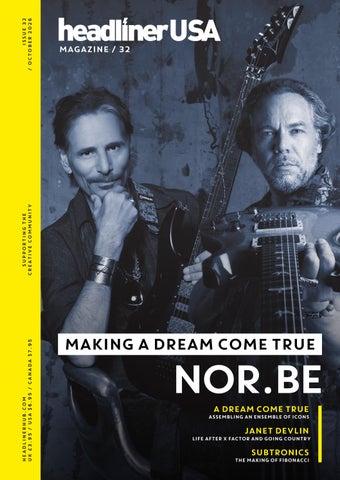
ISSUE 32 / OCTOBER 2026 HEADLINERHUB.COM UK £3.95 / USA $6.95 / CANADA $7.95
SUPPORTING THE CREATIVE COMMUNITY
MAGAZINE / 32
MAKING A DREAM COME TRUE
NOR.BE A DREAM COME TRUE
ASSEMBLING AN ENSEMBLE OF ICONS
JANET DEVLIN
LIFE AFTER X FACTOR AND GOING COUNTRY
SUBTRONICS
THE MAKING OF FIBONACCI
XDJ-AN
2-CHANNEL ALL-IN-ONE DJ SYSTEM
Access to streaming services
Works with mobile apps
Built-in SonicLink transmitter
Mix tracks from Apple Music, Beatport, Tidal
Play with rekordbox for iOS or djay for iOS, and
Pair your SonicLink headphones for
and more with music from other sources
use DJM-REC for live streaming / recording
ultra-low-latency wireless monitoring
Cloud-based playlist editing
Club-standard layout & media compatibility
High-quality sound & flexible connectivity
Directly manage your cloud-based music via a
Connect a laptop to use DJ software, or play
XLR and RCA outputs, plus Bluetooth
compatible rekordbox subscription
music from USB drives
input/output
A L P H AT H E TA . C O M
4
ISSUE 32
Welcome to Headliner USA
NO.32/ USA
Paul Watson CEO
Alice Gustafson Editor-in-Chief
Rae Gray Head of Design
Keith Watson Chairman
Zara Dosanjh Contrubuting Editor
Marc Henshall Head of Digital
Rian Zoll-Kahn COO
Rick Dickerson Reviews Editor
Grace Mcguigan Artist Relations Manager
HEADLINER USA
WELCOME
Welcome to the new issue of Headliner. This issue celebrates the creativity, ambition and collaboration driving music forward. On the cover, composer NOR.BE takes us inside A Dream Come True, an extraordinary debut album that brings together some of the biggest names in jazz, rock and classical music. With Steve Vai, Joe Satriani, Vinnie Colaiuta and an all-star cast on board, it’s a remarkable meeting of musical minds, driven by one artist’s determination to bring his vision to life. We also hear from the musicians and engineers who helped make it happen, offering a fascinating insight into the collective talent behind the ambitious record. That spirit of pushing creative boundaries runs through the issue. Janet Devlin opens up about life after the X Factor, getting sober and finding the confidence to write about love, honesty and emotional
freedom. Meanwhile, Subtronics reflects on his journey from rehab and halfway houses to festival headliner, and delves into how his latest album, FIBONACCI, takes his bass music in new directions. We also catch up with OJ from Soho Sonic, a studio which has grown from a home-built creative space into a hub for artists, producers and collaborators. Speaking to Headliner live from Headliner Group’s inaugural GearCon event as part of our In The Box podcast series, he talks about how the studio is surviving rising costs and studio closures, navigating AI and using Steinberg’s Cubase and Nuendo to keep creativity human. For our latest Next Up interview, Hannah Boleyn brings her refreshingly candid take on DJ culture, chart success and the art of anti-manifestation. She talks about fighting to get her name on her
5
biggest single, her worst ever set, the snobbery that can surround the DJ world and how AlphaTheta is making DJing accessible to all. And for our live sound feature, we go behind the scenes of Lorde’s ambitious Ultrasound tour, where FOH engineer Philip J Harvey explores the creative possibilities of L-Acoustics’ immersive L-ISA system. From dream collaborations and personal reinvention to the technology shaping studios, DJ booths and arena productions, this issue celebrates the people and the tech moving music forward. Enjoy the issue! Alice Gustafson Editor-in-Chief
HEADLINERHUB.COM
6
ISSUE 32
Welcome to Headliner USA
CONTENTS 08
Fancy Hagood on using country music to challenge stereotypes and champion queer artists
COVER STORY
NOR.BE: Making A Dream Come True
14
36
DJ
Subtronics: The making of FIBONACCI
By Alice Gustafson
22
ARTISTS A Dream Come True: Assembling an ensemble of icons
30
ARTIST Janet Devlin: Life after X Factor and going country
HEADLINER USA
By Alice Gustafson
42
Soho Sonic: Studio life in the age of AI
CONTENTS
7
THE BIG INTERVIEW
BBC, ITV & Shure: Shaping the future of immersive live music By Alice Gustafson
48 54
FIRST SET Miss. Behaviour: Finding freedom in sound
80
LAWO’S EDGE ONE Simplifying connectivity for modern workflows
60
NEXT UP Hannah Boleyn: A lesson in anti-manifestation
82
RIEDEL’S PRIVATE 5G TECHNOLOGY BRINGS NEW POSSIBILITIES TO DTM ONBOARD COVERAGE
66
ABBEY ROAD INSTITUTE AND GIK ACOUSTICS BRING PROFESSIONAL STUDIO ACOUSTICS TO STUDENTS
84
EYESPACE COMBINES STRIKING VISUALS AND IMMERSIVE CODA AUDIO TECHNOLOGY
68
PHILIP J HARVEY ON BRINGING SPATIAL AUDIO TO LORDE’S ULTRASOUND WORLD TOUR
86
THE RAVEN HAS LANDED Celestion turns up the tone
76
KEITH O’DEREK Capturing music history and authentic human stories with Lectrosonics
88
RICK RUBIN’S FESTIVAL OF THE SUN Sound Without Boundaries
GET IN TOUCH
COPYRIGHT
grace@headlinerhub.com headlinerhub.com
The content of this publication belongs to HEADLINER GROUP and to the authors & collaborators. Do not reproduce.
HEADLINERHUB.COM
8
FANCY HAGOOD
HEADLINER USA
Rewriting the rules of country
9
s bY Zara rd
REWRITING THE RULES OF COUNTRY
sanjh Do
Wo
Image Credit: Natalie Osborne
EMERGING HEADLINER
FANCY HAGOOD It’s been a little over a decade since a bright-eyed, 17-year-old Fancy Hagood landed in Nashville with big dreams of making it as an openly queer country star. Since then, the artist has undergone a complete metamorphosis, mapping out a world of his own choosing with art he hopes creates change.
HEADLINERHUB.COM
10
FANCY HAGOOD
Rewriting the rules of country
Hagood holds a vast reservoir of critically acclaimed country music, from his ballad-bound albums Southern Curiosity and American Spirit to his latest EP Baby Jake and bluegrass-tinged cover of Colors of the Wind. He recently shared the stage with the equally vibrant and soulful pop-country star CMAT as an opener on her Euro-Country tour, and performed at Nashville Pride this summer for the first time in over a decade. The country trailblazer also recently wrapped his UK headline tour, an experience he describes as “magical.” While Hagood has raked in wellearned praise from legends Brandie Carlile and Elton John, when he talks to Headliner, he is the image of a humble but self-assured artist who, in his own words, sees “every experience as a teacher.” Now the singer is utterly immersed in what it means to create meaningful art, while gearing up for a “new Fancy era.”
When Hagood took that feverish first step into the mainstream music industry, it was under the name Who Is Fancy?. Fancy was a fond nickname from Hagood’s old Forever 21 coworkers, and is fitting for someone vivaciously, unapologetically themselves. However, the Who Is Fancy? moniker wasn’t something he’d readily agreed to, as it was more thrust upon him from the instant he heard his soon-to-be hit single Goodbye on the radio. “I’ll never forget when I was in New York, and I asked, ‘Can we switch to Fancy Hagood?’” he begins. “I was told, ‘No, this is who you are now.’ Once I got out of my record deal, I was able to ground myself and get back to the artist that I was before. Going back to Fancy Hagood was the easiest decision I’ve ever made because it’s who I am. It took time for me to unfeel what I felt about that era of my life,” he reflects. “When I look back at that time, all I see is the success part. I can compete on the highest level – my art got me there, and my art will get me there again.” While Hagood was at odds with his prescribed industry image, L.A. was quick to prove it wasn’t quite the right fit either. “When I moved to L.A., I didn’t have anybody. I was out there on my own, and the industry was all I had,” he says earnestly. “In Nashville, I had such a strong community. It’s harder to have your own individual community in L.A. – it was harder for me, anyway.” But now, long settled in Nashville, the singer-songwriter has found himself in the embrace of resilient and likeminded individuals who provide a
constant source of inspiration. “When I came on the scene in 2012, there weren’t many other people to feel in arms with,” Hagood says. Today, however, groundbreaking artists like Denitia, Joy Oladokun, Katie Pruitt and She Returns From War dominate the scene, a fact that keeps Hagood’s head in the game. “It definitely takes a village, and knowing we’re doing it together, versus feeling isolated on your own, feels so empowering,” he smiles. Hagood’s journey into music, while not the smoothest, had to happen the way it did for him to evolve into the artist he is now. “Everything I’ve done, whether it be a mistake or not, has informed the person I am,” he reflects. “I’m grateful for the moments that didn’t happen, I’m grateful for the moments that have, and I’m grateful for what’s to come. I try to take it all in stride.” The country extraordinaire’s personal growth is entwined with his love for his community and takes shape in his latest projects, including his rendition of Colors of the Wind. “I was obsessed with Pocahontas in the ‘90s,” he confesses. “The lyric, ‘You think the only people who are people are the people who look and think like you,’ is still so relevant.” “Covering Colors of the Wind in a more traditional, bluegrass way sends the message being queer and being country folk are not mutually exclusive,” he adds thoughtfully. “There are a lot of queer people in the South who get the short end of the stick. I just want to use my voice to speak for the communities going through so much.” In his stripped-back EP Baby Jake, Hagood revisits an old sentiment: making music for the sake of it. The three-track lineup features two original songs: Love Me Back, a song steeped in the bittersweet hurt of longing, and To The Moon, a sweeter love song. Both songs have been stowed away in Hagood’s back catalogue for some time.
HEADLINER USA
EMERGING HEADLINER
11
HEADLINERHUB.COM
FANCY HAGOOD
Rewriting the rules of country Image Credit: Natalie Osborne
12
“When we recorded Baby Jake, it was the perfect time to give these songs life,” he says. “I realised when I had written about love, it had always been from a place of longing. To The Moon is a beautiful love song, but when I wrote it, I had never been in love. This project I’m working on now is all from a place of knowingness.” His cover of Say You’ll Be There by the Spice Girls is sandwiched between the longing of Love Me Back and the limerence of To The Moon on Baby Jake. “I’m obsessed with the Spice Girls – I always have been,” he admits. “I remember where I was when I first saw the Wannabe music video on TV. It just blew my mind. My love of the Spice Girls is an obsession, and so when I was thinking about covers, I knew I wanted to cover them,” he smiles. “The Spice Girls reposted my cover all over their socials, which was so cool to see.” Baby Jake came together from a selected tight-knit group focused on making music that felt true to Hagood as an artist. “I worked with my buddies Gabe and Gideon [Klein],” Hagood explains. “Gideon had worked on my last album, American Spirit, and he can play anything with strings – he’s just incredible. It felt really collaborative, fun and easy.” Having a big team with ideas swirling around a room en masse soon became an unfulfilling creative process for Hagood. “It started to feel stifling,” he reveals. “Stripping it down to the three of us means we were able to have a good time. It reignited my love of recording and creating, and doing it this way helped me get back to basics.” When he’s not crafting the perfect country ballad, Hagood hosts his radio show FANCY on Apple Country Music, a series of candid interviews with fellow country music stars. “My favourite thing about being a radio host is getting to hear everyone’s story,” he muses. “It’s so inspiring to me as an artist. I’ve never heard the same story ever – everyone’s process and journey is different. The industry does a wonderful job of making you think there’s a formula, but that’s just not the case. It’s so different for everyone.”
HEADLINER USA MAGAZINE
This summer, Hagood played Nashville Pride for the first time in 11 years. The last time he performed, it was the day after marriage equality was legalised across the States. “Now, we’re arguing whether trans people can use the bathroom in public or not,” he says pensively. “The show felt like a protest, and I was surrounded by artists I love: The Kentucky Gentleman, Joy Oladokun, SistaStrings. It was a beautiful evening of community coming together and saying, ‘We’re here, and we’re not going anywhere.’” “The fact that things are regressing is proof that artists like me, and communities like mine, need to speak up,” he continues. “When I was growing up and the world felt backwards, if I had artists to look up to that were speaking my language, it would have been life-changing. So no matter what stage I’m on, what crowd I’m in front of, I will always speak my truth and be myself.” Hagood recently embarked on a six-show headline tour in the UK. Witnessing the deep reverence crowds across the pond bear for art and music is one of the country star’s favourite things about performing live. “In the UK, y’all might be drinking, but you’re still so quiet,” he laughs. “There’s an exchange from artist to crowd here that I find really magical, and every time I come over, I leave so inspired and feel ready to take it all on when I go back to the States.” Beyond life on the road, Hagood is gearing up for a new era. He wears his name proudly, owns the bumps in the road, and is creating art for the love of it. “There’s a new Fancy in town,” he teases. “I’m writing with a lot of dear collaborators from past projects, but as far as the writing goes, I’m writing from a completely different perspective because I have fallen in love, and I’m high on life. I’m in love with these songs, and I’m excited to bring them to life and to make them feel as they do in my heart. That’s where it’s headed – listeners can expect full-blown Fancy in his lover boy era.” FANCYHAGOOD.COM
DRUM RE-SYNTHESIZER
A revolutionary way to design your own drums – Backbone is your new, innovative drum designer for single kicks, snares, hi-hats, percussion, rises, hits and more. Layer up to eight samples and shape them with classic subtractive synthesis, decompose samples into tonal and noise elements and re-synthesize samples to manipulate them in unheard ways.
steinberg.net/backbone All specifications are subject to change without notice. Copyright © 2020 Steinberg Media Technologies GmbH. All rights reserved.
14
NOR.BE
HEADLINER USA
COVER STORY
15
ds by or A W
N SO
GUST AF CE LI
A DREAM COMETRUE What happens when a guitar-led vision expands to encompass jazz greats, rock virtuosos and full orchestras? For boundary-pushing cinematic composer and guitarist NOR.BE, the answer is A Dream Come True, an album that brings together cinematic jazz, epic rock and classical orchestration. He tells Headliner how he turned a lifelong musical dream into reality.
If Steve Vai tells you to only work with the best in the business, you only work with the best in the business. For NOR.BE, that advice became the starting point for A Dream Come True, his hugely ambitious debut album bringing together some of the biggest names in music. The line-up includes NOR.BE’s family friend, Vai – who also happens to be a three-time Grammy-winning guitarist known for his work with Frank Zappa – alongside fellow
virtuoso Joe Satriani, renowned for his instrumental rock, and an exceptional rhythm section featuring drummer Vinnie Colaiuta, jazz bassist John Patitucci, bassist Mohini Dey and German drummer and multiinstrumentalist Marco Minnemann. The project also ushered in orchestras in Prague and Moscow and a choir in Sofia, before receiving its finishing touch from legendary mastering engineer Bernie Grundman in Hollywood, whose credits include HEADLINERHUB.COM
16
NOR.BE
A Dream Come True
Michael Jackson’s Thriller and Prince’s Purple Rain. But this was about more than assembling an all-star line-up. NOR.BE wanted his guitar and the orchestra to converse, creating 12 instrumental stories that move between intimate melodies, sweeping arrangements and explosive virtuosity. With each musician bringing their own voice to the compositions, A Dream Come True is the culmination of a global musical odyssey, driven by one artist’s determination to realise his vision on his own terms, push beyond convention and create the music he wants to hear – rulebook be damned. From the get-go, NOR.BE knew that mediocrity would not suffice for this lifelong body of work. “It’s a dream come true to get all those great musicians in the world involved,” NOR.BE begins, explaining the inspiration behind the album’s title. “It all started with the idea of how the guitar and music could sing with other instruments, an orchestra and a choir. Who would be the best musicians to take it to the next level?”
HEADLINER USA
NOR.BE met Vai in 2014, and counts the American guitarist, songwriter, and producer as a friend as well as someone whose talents he looks up to. “We spoke about music, guitars and life,” he recalls, eyes twinkling. “He’s been my mentor; my guru, if you like. It ended up with these focal moments of having some great musicians in their different domains contributing to this album. The idea wasn’t to show off or say, ‘I’ve got this name or that name.’ The idea was to put cohesive music out there that could stand on its own, with each song working as a standalone piece from beginning to end, telling a story. That was important to me, and everyone left their mark.” Vai’s advice to only use the best also reflected the freedom NOR.BE had given himself to follow his creative instincts, without worrying about playing by any rules. “He’s at that amazing point in his life where he can do whatever he wants,” Vai tells Headliner, with evident awe. “I said, ‘If you have the funds and you want to spend them, just hire the best musicians. They’ll do it.’ It’s a pristine approach because he’s not trying to
fit in, and he was in heaven! He will be an inspiration for others who need that push to surrender to their own creative impulses with no excuses.” “We had a lot of discussions about that,” nods NOR.BE on following his distinctive creative vision. “I went to him a few times with some ideas, and he’d listen and say, ‘Maybe you should do something with this.’ I was so inspired that within a couple of hours, I had a melody for the song called Dot To Dot, which connects those pieces together. I went back to him and asked, ‘Steve, who do you think can help me play on this?’ He said, ‘Look, you can do it this way, or you can do it that way, and if you want, I can make an introduction. But ultimately, those musicians need to like the music. If they do, then they can work with you. If they don’t, then they’ll pass.’ And I took a chance.” Happily for NOR.BE, he assembled his very own team of musical Avengers in industry heavyweights Vai, Colaiuta, Satriani, Patitucci, Dey, Minnemann, Grundman and mixer Walter Rohrbach, who collectively brought his cinematic jazz-rock fusion to life.
COVER STORY
17
HEADLINERHUB.COM
18
NOR.BE
A Dream Come True
With a reputation for technical mastery and a career spanning countless musical genres, Colaiuta is no stranger to working with the best himself. The Grammywinning drummer, inducted into both the Modern Drummer and Classic Drummer Halls of Fame, saw something particularly special in NOR.BE’s approach. “I believe strongly in accessing and expressing your own voice,” Colaiuta tells Headliner. “NOR.BE does that, hands down. The way that he hears things is in a genre-bending way. It’s really fresh-sounding. He’s not trying to abide by any particular bias; he’s just following the beat of his own drum,” he grins. “Vinne is someone whose sound I’ve always heard, and his subtle virtuosity is just so special,” NOR.BE enthuses. “He’s done so much with Frank Zappa and Sting – he’s played on 600 or 700 albums. He’s able to change styles, and he’s a great listener. He asked me for the orchestral score. Imagine that: he wanted to read the score for the orchestra before he recorded the drums!” he recalls appreciatively. Bringing NOR.BE’s vision to life meant building a musical partnership that reached far beyond a rhythm section. A Dream Come True boasts the inclusion of the Bohemian Symphony Orchestra in Prague, conducted by Martin Šanda, the Bow Tie Orchestra in Moscow under Vladimir Podgoretsky, and the Classic FM Radio Choir in Sofia, led by Professor Theodora Pavlovitch. Alongside NOR.BE’s acoustic and electric guitar work, Fawzi Chekili adds jazz guitar, while Bulgarian conductor, pianist and accordionist Stoyan Stoyanov worked closely with NOR.BE to shape the orchestral arrangements. The aim was not simply to layer classical instrumentation over rock or jazz, but to create a sound in which every element had a voice of its own. HEADLINER USA
“When you start walking, the road appears, as they say,” NOR.BE muses on the way in which the album took shape. “The beauty comes when great people get together, and the orchestra has been a very special part of that. I wanted the orchestra to not be classical, standard, or predictable, but something that came naturally from the beginning. There are many great songs in rock history that were first made by a band and then performed on stage with an orchestra, and they sound great. But from the beginning, my music was meant to be born as a piece for an orchestra and a rock or jazz band.” For NOR.BE, getting the orchestra to realise his vision meant going beyond the notes on the page.
Rather than relying solely on traditional musical instructions, he encouraged the musicians to engage their imaginations. “When I talked to the orchestras, I didn’t just say, ‘Okay, now you play fortissimo or crescendo,’” NOR.BE explains. “I also said, ‘Now close your eyes and think about a sea wave coming. Not only see it coming, but hear the noise, smell the salt. Can you see it? Can you feel it?’ They opened their eyes and said, ‘Wow, no other conductor or composer has told us anything like that.’ But then they would play it that way because they could imagine something that takes them out of their daily comfort zone of playing beautiful Beethoven and Vivaldi, which is obviously amazing stuff, and they give it another life.
COVER STORY
19
“BEAUTY COMES WHEN GREAT PEOPLE GET TOGETHER; EVERYONE LEFT THEIR MARK.”
Although NOR.BE had a clear vision for each composition, he was equally keen to leave room for his experienced collaborators to make the music their own. From Vai and Satriani shaping the album’s opening and closing tracks to the subtle details of Colaiuta’s drumming and the melodic surprises brought by Dey, each musician contributed something distinctive, and in most cases, pleasantly surprised NOR.BE. “Everybody surprised me in a positive way and took the songs to the next level. When I asked Steve about playing on How to Get There, which is the opening track, we discussed how to approach it,” NOR.BE reflects. “It’s quite a difficult song for the orchestra because there’s a bit of jazz in there, with 7/8 time and 5/4 time. Classical musicians are amazing, but those are quite unusual rhythms for them,” he points out. “I had a specific spot where I envisioned Steve playing, and he did some very special work there, and his guitar is just singing,” he beams, adding that Dey also brought something special to the track. “Mohini is a young, ambitious, amazing bass-playing prodigy,” he rhapsodises. “Her father was one of the greatest bass players in India. She can play virtually anything, from jazz
to rock to metal. After Steve’s solo, I bring a melody back as a reminder of what the song is about, and she comes in with this singing bass line. It’s such a beautiful melody that it almost made me cry. “Another example is Vinnie, who adds little accents on the cymbals or very subtle tones alongside the orchestra,” he continues. “They’re almost invisible, but they’re very present. Marco is a very technical player, quite different from Vinnie. He plays on the rockier songs, and he played exactly what needed to be there, but he surprised me with how technically perfect yet sensitive it was.” The album’s title track, A Dream Come True, features Colaiuta on drums and Dey on bass, alongside the Bohemian Symphony Orchestra Prague. The song paints a vivid picture of a dream blooming into reality. “There’s a passage towards the end of the song that’s quite heavy,” notes NOR.BE. “I told Vinnie and the orchestra that I could hear elephants walking, and that’s exactly what it’s like. John Patitucci provides such a strong bass line without showing off, keeping everything intact. He and Vinnie together hold it all so tightly.”
At the heart of A Dream Come True is Once, one of NOR.BE’s most personal compositions, built around a simple melody that captures a moment he wanted to preserve. Featuring a Bulgarian choir, Colaiuta on drums and Dey once again on bass, the initially jazzy, abstract track takes the audience on a ride – beginning as a contemplative reflection before gathering pace into something cinematic and epic, transforming the nostalgic act of remembering into something joyful. Moving from quiet introspection to an exhilarating groove and back again, Once invites listeners to find their own meaning in its story. “In the middle of the song, a slow story becomes fast because it’s about remembering,” NOR.BE explains of the track’s delightfully unpredictable structure. “The song moves into a fast groove in 7/8 time, starting at around 140 BPM and reaching about 185 BPM during the transition. Vinnie really surprised me with what he did in those transitions and how he held everything together. That act of remembering turns into the idea that history is there, but what really matters is now. The memory starts off contemplative, evolves and becomes bright and happy, and then settles down again.”good.”
HEADLINERHUB.COM
20
NOR.BE
A Dream Come True
With acoustic and electric guitars, jazz instrumentation, orchestra, choir and ambient electronics to balance, finding the right mixing engineer was crucial to A Dream Come True. NOR.BE found his ideal collaborator in Rohrbach, a Zurich-based engineer whose work impressed him with its precision and clarity. “Mixing all this together and getting it right is quite special,” NOR.BE emphasises. “It’s like food: if it’s good, you don’t need to work magic. You just need to preserve its character. It took me some time to find the right person. It’s not that there aren’t enough mixing engineers out there,” he clarifies. “It’s not easy to find someone who can do exactly what you described: take the 60-plus stems from the orchestra with different microphones, and then blend those with the jazz sections, my guitars, the choirs and everything else.” After hearing one of Rohrbach’s mixes, NOR.BE knew he had found someone with the musical sensitivity and technical understanding the project demanded. “Walter said, ‘Let me think about this. I don’t do these things very much,’ because he’s in his seventies. But he listened to the music and came back to me saying he’d love to do it, and it’s been a pleasure. We’ve become very close friends. Being in the studio with him in Zurich and watching him turn the knobs and work his magic was a great experience. Our running joke is, ‘2 dB up or down’. When you want something a bit louder or a bit quieter, it usually starts with 2 dB. He says it’s barely audible, but sometimes it makes you feel good that it’s been done,” NOR.BE laughs. With the album mixed and ready, NOR.BE turned to Vai for advice once more on the final mastering stage. Vai recommended Grundman, the legendary engineer behind records including Michael Jackson’s Thriller, Prince’s Purple Rain and Vai’s own Passion and Warfare. HEADLINER USA
“Steve said, ‘This music is a bit different, a bit crazy.’ He said, ‘If you want to finish it with the best, there’s only one guy in the industry today, and that’s Bernie.’ Bernie doesn’t usually take on new work because he’s around 83. He still works and loves what he does, but he tends to work with people he knows and picks and chooses his projects. I got an email which said Bernie loved my music and would master it for me. I decided to be there in person. We picked a date, and I went to his studio in Hollywood. We spent a beautiful day together in the same little room, with the same console he’d used for all those big records. Obviously, he doesn’t use a tape recorder now, but a computer,” he points out. “I was sitting on a little sofa in the corner, and I asked him what it was like working with Prince and Michael Jackson,” he recalls. “He said, ‘Prince was sitting in exactly the same spot you’re sitting in now.’ He told me, ‘I didn’t know he was so famous because he was just this little man sitting there, but he knew exactly what he wanted.’ Then Bernie saw Prince on TV and thought, ‘So that’s Prince! He was in my studio. Wow, this guy is huge!’” he laughs. “Sitting in that same spot and talking to Bernie, who was such a humble and highly professional man, was an incredible experience,” he continues warmly. “We went through the songs the oldfashioned way. He made handwritten sheets for each song, and suddenly, everything sounded so different. I’m really grateful for this because it feels like the completion of a journey. If this hadn’t been done, it wouldn’t have served the music. Bernie put his stamp on it, and I’m very grateful.” The album’s final stretch brings NOR.BE’s personal journey full circle, moving from the fulfilment of a longheld dream to the promise of reunion. The title track is about a dream becoming reality, while Till We Meet Again closes the record as a farewell,
although it hints at the possibility that a goodbye might not be the end. “The guitar I play is almost crying,” NOR.BE explains. “It’s a story about losing someone, whether physically, because a person is far away, a friend or family member, or because somebody passes away. But you feel that it’s not the end. We were thinking about which chord to finish with. I think that note makes the chord happy, but at the same time, it doesn’t fully resolve. Joe plays his last note, which then goes off into space. It’s not goodbye. It’s ‘til we meet again, because we will meet again. He ends on a beautiful note that opens things up, like the end of a Netflix series that leaves you desperate for the next one. It’s kind of finished, but it’s not quite finished, if you know what I mean.” For an album built on the foundation that music can transcend genres and bring people together, the real test now lies in how its stories make listeners feel. NOR.BE hopes that, once released into the world, A Dream Come True will create a connection that goes far beyond the notes themselves. “Joe Satriani said Till We Meet Again was ‘big and cinematic-sounding’ and that the mix was ‘shimmering’,” NOR.BE beams. “That’s the word he used, and I was very happy to hear that. It’s almost time to show it to the world, and hopefully, it will find its audience.” A Dream Come True will be released worldwide on 26 November 2026, including a vinyl edition. NORBEMUSIC.COM
22
A DREAM COME TRUE
HEADLINER USA
An ensemble of icons
23
ra Dosan Za
jh
ords by W
ARTISTS
AN ENSEMBLE OF ICONS
A DREAM COME TRUE Bringing together some of the most celebrated names in music, A Dream Come True is the ambitious debut album from musician, composer and producer NOR.BE. In this companion feature to Headliner’s cover story interview, the album’s all-star contributors reflect on their roles in bringing this unique vision to life.
The cinematic fusion of jazz, epic rock and classical orchestration features an extraordinary collective of talent, including three-time Grammy winner Steve Vai, instrumental rock legend Joe Satriani, renowned drummer Vinnie Colaiuta, four-time Grammy-winning bassist John Patitucci, bass virtuoso Mohini Dey, progressive drumming powerhouse Marco Minnemann,
mixer Walter Rohrbach and mastering engineer Bernie Grundman. Across 12 instrumental stories, each brings their own musical identity to NOR.BE’s long-held vision, uniting electric guitars, a dynamic rhythm section and symphony orchestras in a project that lives up to its name.
HEADLINERHUB.COM
24
A DREAM COME TRUE
An ensemble of icons
Steve VaI Tell us about how you met NOR.BE and the early days of A Dream Come True. NOR.BE is a guitar aficionado. I’ve met so many people who navigate their fantasy in a quiet room without anybody knowing, with interesting ideas and techniques that eclipse the conventional. I recognised that NOR.BE had all of these qualities, and I mentioned to him that there’s no mystery in making a record. You can do anything you want. His inner ear and the way that he composes melodies and chords wouldn’t have been as unique if he had tried to
fit in. He will be an inspiration for others who need that little push to surrender to their own creative impulses with no excuses. It’s actually much easier than most people think. NOR.BE had a deep desire for it, and sat on it for half a century. I’m happy that I was able to contribute to the record in a little way. You’ve spoken before about how difficult it can be to integrate electric guitar with an orchestra. What do you think makes NOR.BE’s approach successful? It is a field that I’m very aware of. I would go as far as to say I’m an
expert, because I started trying to mix electric guitar with orchestra when I was 16. It’s a heavy lift because an electric guitar is a completely different beast from the sonority of an orchestra: the way an orchestra moves and undulates, and the quality of the frequencies that fill the air from an orchestra versus an electric guitar. It’s a slippery slope to orchestrate and have it sound cohesive. I’ve learned a lot about how to do that and how to blend certain instruments. There’s not a lot of examples of electric guitar integrated beautifully and seamlessly with a symphony orchestra, and that’s another interesting quality about NOR.BE’s record. Where the melody of the guitar gets integrated into the orchestra has everything to do with the inner ear of an orchestrator, and how they arrange it. NOR.BE’s music is not dense. He has a lot of integrated little parts that leave space for the orchestra to speak and for the sonority of the orchestra to wrap around the guitar. How does A Dream Come True compare to the rest of your discography? It’s a totally different type of music. There’s no other music that I’ve worked on or I’ve contributed to that’s like NOR.BE’s. I would say when listening to this record, just allow an open mind, and it will reveal melodic and harmonic dimensions that you won’t find elsewhere. NOR.BE is scratching the surface – but his surface is already well exposed.
HEADLINER USA
ARTISTS
Vinnie Colaiuta You once said, “The music dictates what I play, and I only hope that I can do it justice.” Did this feeling resonate with you when it came to recording A Dream Come True? Absolutely! It’s sort of a default setting, and it definitely was in full effect here. It’s a feedback loop: if I’m fed good food, I will respond in kind. To me, that’s the best indication of sincerity in a performance. I’ve spent years as a studio musician, so I can put a sheen on things that I may not believe in just because of my skill set. There is a difference between that and a sincere, open response to what I’m given. If I just let it flow, that’s not being in the moment in the highest possible way. That’s low-level thinking. NOR.BE’s composing informs me, and that’s important. There’s no second-guessing. If I have to force it, or it’s going against my instincts, either you’re pushing me down the wrong path, or you’ve got the wrong guy.
You feature on the title track A Dream Come True with Mohini Dey on bass, alongside the Bohemian Symphony Orchestra Prague. What was the recording process like? I recorded it remotely, and I actually got a copy of the score. Normally, I would think, “Wait a minute, why are you giving me all this?” But with NOR.BE’s music, it’s different because it’s so integral. It wasn’t about me. It was very informative because I could hear, even without seeing the score, what was happening clearly. There’s a certain thing that happens when you see a composition visually, and I think that it’s important. Someone asked me recently, “How important is it to read music?” and I said, “Would we even be able to realise Bach or Beethoven if we didn’t have written music?” They didn’t have tape machines back then. Even though written language can have its limitations, when we read books,
25
our imagination comes into play. And when we see written music, it can create some “aha” moments. Reading the score and listening helped give me ideas that maybe I wouldn’t have realised in the same way. What’s one thing you hope people take away from A Dream Come True? Just dream and believe in it. Follow your dream. A lot of people may say, “That’s blind ambition. Don’t do that.” And my answer to that is: if you don’t do it, then you don’t want it bad enough, and you don’t believe it enough. There’s a huge difference between just dreaming it and believing it, and I think that NOR.BE is telling us that dreams can and do come true.
HEADLINERHUB.COM
26
A DREAM COME TRUE
An ensemble of icons
Credit: Larry-DiMarzio
Joe Satriani How did you balance playing the electric guitar against the orchestra when you recorded your solo on Till We Meet Again? I’ve always had a knee-jerk reaction when I hear a rock guitar player trying to shred with an orchestra behind them. It seems awkward to me, and kind of showy. So when I heard NOR.BE’s music, I thought that it was really different. I have never heard somebody compose music like this for an orchestra and try to get modern musicians integrated into it. On the track I play on, Vinnie Colaiuta and Mohini Dey – the most outstanding musicians in their field right now – bring a very modern take to the song. My task became, “How can I fit in like that? How can I not sound like a rock guitar player who just put on a tuxedo and stood in front of the orchestra?” I wanted to be on the same wavelength as Vinnie and Mohini, and of course NOR.BE and the whole orchestra. The hardest part was the chord progressions. Often, what happens is that composers or writers who depend on other musicians to play get beaten down by the musical community. When they bring a fresh HEADLINER USA
idea out, the musicians eventually say, “Well, no one really does that.” And before you know it, the vision gets clouded by the experience of the other musicians being invited to the session. When I was listening to the tracks NOR.BE sent, I thought, “Wow, this sounds like either nobody told him that he couldn’t do that, or he decided not to listen to anybody.” Guitar players never play over that stuff, but that’s exactly what got me excited about it. Till We Meet Again is the final track on A Dream Come True, so your guitar solo effectively closes the album. How did you feel about having such a big part in its ending? When I listen [back] to myself, I still feel a bit anxious, and I remember all the different things I tried and the decisions I finally made. I can’t help but think, “Did I make the right decision? Did I send him the right solo?” It’s very hard to listen to music as a normal person, especially if you’ve contributed to it. You just can’t help listening to it all at once. It’s a part of our musical DNA to dissect everything that we hear and make sure that it fits. I was honoured that I got to make one of the last statements on the album.
Mohini Dey The album brings together an extraordinary collective of musicians. What was it like stepping into a musical environment with so many players of that calibre? I was excited because the project felt very musical from the beginning. It wasn’t about putting musicians together just for the sake of having big names — there was a real vision behind the music. I’m always drawn to projects where I can bring my personality to the bass while still serving a bigger musical picture, and A Dream Come True gave me that space. It was inspiring. When you’re surrounded by musicians at that level, you don’t feel the need to prove anything – you listen more. Everybody has such a strong musical identity, so the most important thing is to find where your voice belongs within that environment. That kind of situation usually brings out a different side of me as a player. Once is described as one of NOR.BE’s most personal pieces. What did you hear in that composition that informed the way you played on it?
ARTISTS
What stood out to me was the emotion in the composition. With a personal piece like Once, I don’t want the bass to distract from what the song is trying to say. I wanted my playing to have personality, but also space, sensitivity and intention. Sometimes one note in the right place communicates much more than 10 notes. On A Dream Come True, your bass sits alongside Vinnie Colaiuta’s drums and the Bohemian Symphony Orchestra Prague. How do you approach playing bass within such a large cinematic arrangement without losing the instrument’s character?
27
MARCO MINNEMANN Dot to Dot is said to be inspired by Michelangelo’s Hand of God. How did you go about capturing such an iconic piece of art through music? As a musician, you’re automatically an audio painter. You trigger the imagination of people’s minds. If you can feel something or imagine something, then your job is done. How far did Hand of God get translated into the music? People will see that for themselves, but I hope I did the painting justice.
What’s one thing you hope people take away from A Dream Come True? I hope the album will succeed for NOR.BE because he put so much effort into making it and getting all these musicians on board. It’s a bit of a different production, but it’s tied together – an opulent feast. I say in the most positive sense that somebody investing in getting such a production together with all these players is quite rare. I hope that people appreciate that and enjoy it, and see the music with the eyes of the ‘70s and ‘80s.
For me, the bass doesn’t have to fight an orchestra in order to have an identity. Its character comes from the sound, articulation, phrasing and where you choose to sit rhythmically. With Vinnie on drums and the Bohemian Symphony Orchestra Prague around us, there is already so much information and movement. My job is to find the pocket inside that huge sound and make the bass feel like an essential part of the arrangement rather than something sitting on top of it.
HEADLINERHUB.COM
28
A DREAM COME TRUE
An ensemble of icons
WALTER ROHRBACH How do you approach mixing performances from musicians with such strong individual identities while still making the album feel cohesive? That was actually the easy part. You certainly don’t need to explain to such brilliant musicians what they need to do to ensure their part fits into the composition [smiles]. All I had to do was listen carefully and, here and there, use an equaliser or the room acoustics to nudge the instrument into the right position. How did you approach processing the guitars, particularly when you had to accommodate both the rock power of players such as Steve Vai and Joe Satriani and the more cinematic orchestral elements?
JOHN PATITUCCI
This applies particularly to heavyweights such as Steve Vai and Joe Satriani. They all recorded their parts to rough mixes and mock-ups of the orchestral arrangements. The audio tracks they then sent me fit the mix like a glove.
NOR.BE said he “wanted the guitar and the orchestra to genuinely converse, not just coexist.” Did you feel like you also had to get that balance right as a bassist?
What studio equipment, monitoring setup and mixing tools did you use in Zurich for the project, and were there any particular pieces of gear or software that became especially important to the sound?
In part, yes. However, the role of a bassist is rooted in foundational and compositional thinking. I enjoyed the feeling of playing in a rhythm section with a full orchestra. Every artist is unique and brings their own life experiences and ideas to the table.
Well-balanced acoustics and high-quality monitors were essential for the mixes. We were lucky enough to be able to use Guzauski-Swist studio monitors alongside the usual Auratones and Yamaha NS-10s for fine-tuning. I’m really impressed with this monitor setup. We mixed everything “in the box.” The main reasons for this were that the project had been developing over quite some time, so we were confident that we could easily go back to the existing mixes and make any necessary adjustments without too much effort.
Credit: Dave Stapleton
What’s your current go-to electric and upright bass? Did you switch it up for A Dream Come True? I used a Gagliano Double Bass from the 1860s. This bass was owned and played by the great Art Davis, who worked with John Coltrane and many other people. On electric, for this last project, I played a Fender Jazz Bass from late 1964. At times, I also used my Yamaha sixstring electric bass.
Bernie Grundman handled the mastering in Hollywood. How did you approach the final mixes with that next stage of the production process in mind?
NORBEMUSIC.COM VAI.COM VINNIECOLAIUTA.COM SATRIANI.COM
I tried to deliver the greatest possible dynamic range. I also stopped using EQ on the mix bus to give Mr Grundman plenty of scope. I’ve heard that he appreciated this approach and spoke positively about it.
HEADLINER USA
INSTA: @DEY_BASS MARCOMINNEMANN.COM JOHNPATITUCCI.COM WALTER-ROHRBACH.CH
A NEW HIGH IN THE LOW END Designed and built in the UK, Ten Squared (Ten2) is a range of premium, low frequency loudspeakers. Engineered without compromise, they deliver consistently superior levels of performance in the most demanding professional sound reinforcement applications. All the time. Every time. 18, 21 and 24-inch models available.
Discover Ten Key Features that add up to a new standard in LF driver performance
celestion.com
Saddling up for an Emotional Rodeo
Credit: Alex Waespi
30 JANET DEVLIN
HEADLINER USA
31
S BY ZAR A RD
SADDLING UP FOR AN EMOTIONAL RODEO
SANJH DO
WO
ARTIST
JANET DEVLIN It isn’t in Janet Devlin’s nature to shy away from the truth. Rather, the daring Irish singer-songwriter holds up a mirror to her inner world with her music, whether she’s laying it all bare on her iconic pop-folk record Confessional or channelling some classic ‘90s country-rock on her 2024 album Emotional Rodeo.
HEADLINERHUB.COM
Saddling up for an Emotional Rodeo
Credit: Alex Waespi
32 JANET DEVLIN
Gearing up for her next record, Devlin tries on a softer vulnerability: that tender state where love surrenders you, body and soul. With her latest singles Move A Muscle and How Do Cowboys Say Goodbye?, Devlin proves she’s no longer the shy 16-year-old who won the hearts of the nation on X Factor, but an artist whose sound reflects her own emotional enlightenment. Devlin brings an easy energy to her call with Headliner. She’s fresh off the move to a commuter town, still within reach of London, but rural enough to gently echo her scenic hometown Gortin. It doesn’t stop the odd wave of homesickness, though, and family is always on her mind. “I love my home; it’s the only home I’ve ever had,” she says. “I speak to my mum every day on FaceTime since moving. I’d love to get to the point where I’m successful enough to move back to Ireland.” Home is where Devlin’s love for country music began; she’s spent a lifetime steeped in the genre, with decades of influence written into the seams of her artistry. “Country music is the biggest genre back home by, pardon the pun, a country mile,” she laughs. “My parents met at a country dance, my grandparents met at a country dance – I have farmer friends that still go to dances and have met their wives there!”
HEADLINER USA
As a cornerstone of her family history and local culture, it’s no wonder country music speaks to Devlin more than any other genre. “You listen for things that resonate with you, because most of us are selfish music listeners,” she considers. “You want to hear things that reflect your life. And It’s the one genre that, no matter what age we all were, me and my brothers and my parents, we all agreed on.” According to Devlin, she was singing before she could talk, “to some old creepy version of Pinocchio.” But turning music from a pastime into a passion took a mix of tough love and unfaltering support. “When I told my mum I wanted to be a singer-songwriter, she said, ‘Good luck finding that in the job centre,’” she laughs. “She was being realistic, but that being said, she still took me to my singing lessons and musical theatre classes. She put all the little pieces together to make things happen.” Devlin was playing out her dream of being a star on homemade videos long before her days as an X Factor contestant. “My friend bought me a camera when I was 15, with the rule I’d have to upload covers to YouTube,” she says. Devlin was also a keen drummer, and entered a string of competitions that sprung up while the nation ran hot with X
Factor fever. “I never won – I only got second or third – but I would get a couple hundred pounds here and there, and I was able to buy drums!” Devlin’s idols have shaped not only the music she makes but the artist she’s become, including the late country legend Dolly Parton. “Dolly had a massive impact on me. When she passed away, my phone blew up with condolences. I didn’t know everybody knew that she was such an idol of mine,” she says, awe-stricken. “Her impact on country music, especially as a woman, has left an everlasting legacy. I cannot take that away from her. What I love about Dolly is her philanthropy,” Devlin continues. “There’s a line in one of her songs: ‘If I was a millionaire, I wouldn’t be one long.’ That’s really important to me, actually being a useful member of society when I can.” Devlin’s alt-country single, Diane, released in June, channels the best of Dolly’s sass and genius into a gritty track led by deep guitar riffs and inspired by a small-town scandal. “Diane is if Dolly Parton wasn’t such a sweet, kind lady. It’s a bit darker,” Devlin quips. On the surface, the singersongwriter’s journey into music might seem idyllic. With a quaint life in the Irish countryside, a hearty diet of country music, and a talent
ARTIST
33
“I’VE LIVED THROUGH ENOUGH PAIN TO LAST ME A LIFETIME OF ALBUMS. TO CREATE ART, YOU DON’T HAVE TO BE PERPETUALLY SAD.”
actually noticed and nurtured, to outsiders, Devlin’s success comes close to a fairytale. However, the singer-songwriter isn’t one to sugarcoat when it comes to her struggles beyond the limelight. “My life used to be chaos – a lot of it self-inflicted,” she admits. “But I always come back to, ‘A bad day sober is not a bad day drinking.’ Sometimes, if I feel the world is against me and things are going wrong, I have to realign with myself and say, ‘Look, you’re in bed, it’s 10:30 p.m., and you’re sober. So take the victory where you can get it.’” After seeking help, the chaos that momentarily seized Devlin’s life slowly began to dissolve. “I got diagnosed with bipolar type two and borderline personality disorder,” she says. “The borderline diagnosis finally answered a lot of questions I had about my past,
which is littered with so many awful things. I’m in remission, which they don’t even tell you is possible with borderline, because it’s such a small percentage of people who reach remission,” she continues. “Life is so much easier now. If failure were to happen, I could cope with it.”
If anything, Devlin has tapped into a new strand of creativity with this new era. She remains as vulnerable as ever but with a swift move from personal plight to sensuality in her new single Move A Muscle. “It’s a different level of vulnerability, to be sensual or in love,” she muses.
There’s one stereotype that Devlin wants to squash once and for all: medication and its supposed impact on creativity. “These things are so different for every single person. But what I noticed was a narrative of, ‘If I take my medication, I’m gonna lose my sparkle,’” she pauses.
“To be in love means you’re actually going to be seen by someone. In the wake of toxic exes, I never wrote anything close to a love song. I’m in my 30s, so I don’t know why writing something like that is so incredibly vulnerable! It’s just not an emotion I’m used to. Lyrically, it’s evocative, and for lack of a better term, I feel naked singing it,” she adds.
“I’ve lived through enough pain to last me a lifetime of albums. To create art, you don’t have to be perpetually sad. I can still tap into the pain, and I can still reach all my feelings, I’m just capable of doing it in a safe way.”
“But I’m not afraid of pushing myself; it’s healthy. So, this is me pushing myself in a way I’ve never done before.”
HEADLINERHUB.COM
Saddling up for an Emotional Rodeo
Credit: Alex Waespi
34 JANET DEVLIN
In Devlin’s eyes, there’s a power in telling the truth through music. “I don’t mind if people don’t like me. I was bullied a lot as a kid,” she says earnestly. “But for some reason, I find it such a necessary thing to be honest. Chances are somebody else has gone through something similar, and sometimes it’s nice to listen to music that isn’t what everyone’s writing about.” Devlin’s sophomore album, Confessional, released alongside her autobiography My Confessional, is a cathartic release from a lifetime of hiding beneath a veil of shame. “I felt so much freer as a person because I put all my demons into this project,” she says. “I realised I could finally show the other parts of my personality. Up until that point, my music was all dark, heavy ballads. I don’t have to write about that anymore – I can write about whatever I want.” “One thing that keeps me sober is laughter,” Devlin reflects. “If you laugh at your issues, it takes away their power. That’s something I loved as a kid, listening to silly but beautifully done country songs. It’s why I’ve waited so long to go into country, because I wanted to have lived a certain amount of life first.” Devlin’s latest single How Do Cowboys Say Goodbye? builds on her confessional worldbuilding and taps into the not-so-pretty side of her love life. “I was in a toxic relationship that I spent far too long in,” she reveals. “When I met this person, I was incredibly mentally ill, so I had to unravel myself from them, and it took a long time. How Do Cowboys Say Goodbye? is a realisation HEADLINER USA
of that. “The song is a progression of that relationship, and stepping back and thinking, ‘Did I ever love you?’ The question of ‘how to say goodbye’ isn’t resolved, because when I wrote it, I didn’t have the answers.” The longing, nostalgic sound of How Do Cowboys Say Goodbye? wouldn’t have been possible without the dynamic team behind it, including Nashville-based guitarist Rob McNelley. “Rob said, ‘What’s happened? These aren’t songs I’d imagine you’ve written!’” she laughs. “But I’m definitely more reflective now, and there are a lot of ties to home, with some gritty rockcountry. There’s more variety on this record, and a few different forms of vulnerability.” With Halloween having just passed, Devlin reflects on her love of the spooky season and why it remains such a highlight of the year. “I’m a big Halloween girl. I love dressing up, so I’ve picked the perfect job for that,” she grins. “Normally, when it comes to actual Halloween, I struggle to mix it with my work. But this year, I get to go to Ireland for a festival called Púca Festival. Ireland is the birthplace of Halloween, and I get to go to the middle of nowhere, so it’s going to be fun.” Devlin has one final parting word of advice, saved for her younger self: “Get help so you can make the art that enriches you,” she says resolutely. “Music is therapy – but I need a little bit of actual therapy as well.” JANETDEVLIN.COM
SUBTRONICS
Credit: @OhDagYo
36
HEADLINER USA
Calculated Chaos
DJ
37
ds by or A W
N SO
GUSTA CE F LI
CALCULATED CHAOS
SUBTRONICS Long before selling out six consecutive nights at the Shrine Auditorium, headlining Sphere Las Vegas and earning a place on the 2026 Coachella lineup, Jesse Kardon was living in a Connecticut halfway house, attending daily AA meetings and wondering what would become of his life. After getting his laptop and internet access back, he threw himself into learning music production, spending every spare moment making what he describes as “terrible songs” while slowly building an online community around his music.
More than a decade later, that leap of faith has transformed Subtronics into one of electronic music’s defining artists. His uncompromising approach to bass music has earned him a fiercely loyal global following, while his latest album, FIBONACCI, pushes his sound into new territory. Inspired by the mathematical sequence found throughout nature, the record serves as a representation of his artistic journey to date,
expanding beyond his signature sound through collaborations with Linney, Grabbitz, Lyrah, Royal & The Serpent and ILLENIUM. In this interview, Subtronics discusses the journey from rehab and halfway houses to festival headliner, the making of FIBONACCI, why mathematical concepts have become a recurring theme in his music, and pushing his sound into new territory.
HEADLINERHUB.COM
38
SUBTRONICS
Calculated Chaos
You grew up uploading tracks as a teen on SoundCloud. Can you remember the moment electronic music stopped being something you just loved and also became the thing you wanted to commit your life to? I can nail down the exact moment. It’s spooky. I spent a few years learning DAWs in high school, but didn’t have any sort of skill set yet. Not long after, I landed myself in rehab for smoking weed and taking mushrooms at my first dubstep show. When I was fresh out of inpatient at a halfway house in New Haven, CT, with daily AA meetings, the first viral Tomorrowland Aftermovie dropped, and I thought it was so mindblowingly sick. I remember moving from the phase one halfway house to the phase two halfway house, and when you get to phase two, they give you your laptop back and an internet connection. Outside of community service and AA meetings, I had nothing but time there, so I figured why not just absolutely dive headfirst into learning music production?
My life was kinda at an all-time low, and I had nothing going on. I remember so specifically sitting in a transport van about to leave for an AA meeting, just thinking to myself, ‘What if? What if I make this my whole life and it actually goes somewhere, somehow?’ After I left the halfway houses, for the next five to seven years, I spent any free time making terrible songs, learning what I could, connecting with people online, and building a community around it. I started releasing my first tracks on very small labels and had my own tiny online presence. When I finally moved back to Philadelphia, I landed local DJ gigs at the EDM venue in town, and the rest is history! What does dubstep mean to you? It proves itself time and time again to have some of the most passionate fans and, of course, artists making it. For me, it gives the most euphoric rush I’ve ever experienced. Zooming out a bit, music as a whole is just unbelievably fascinating, like some kind of magic. I really think there is a lot more going on with the entire concept of it that we don’t fully understand yet. It may be one of the most powerful forces on earth. Bass music electrifies my brain; it
just fits my tastes, experiences, and neurospicy quirks. I just know that thousands, probably millions, of other people have to also experience this because it’s such an unbelievable feeling. Experiencing music live, specifically bass music on gigantic speakers at a show or festival, gives me the most mind-exploding rush of dopamine and serotonin ever. Your latest album, FIBONACCI, uses the Fibonacci sequence as a central motif. How did that idea first land with you, and how literal did you get with it when writing and arranging the record? My music has always had a theme of mathematical and scientific concepts. Fibonacci as an album was a representation of my entire project thus far, all of everything collected into one unified body of work. As I understand it, the golden ratio is found everywhere in nature, like the code to life. The parallel to me is that my art has its own ratio that is unified, complete, and a total explanation and summaries of my entire world. There is the actual IRL world, and then my own personal world that I’ve built up and developed over the years that is my art. Were you one of those rare people who loved maths in school, or did these fascinations come to you later in life?
“MY LIFE WAS KINDA AT AN ALL-TIME LOW, SO I FIGURED: WHY NOT DIVE HEADFIRST INTO LEARNING MUSIC PRODUCTION?”
I have always been fascinated by concepts like string theory, higher dimensions, black holes, and whatnot, but I was never strong enough in math class to actually pursue anything that involves it. It’s always been a topic I’m super interested in, but my ADHD does not allow me to thrive in formal educational settings! This is the third in a run after FRACTALS and TESSERACT. Did you always have these albums in mind as a trilogy, or is that just how it all manifested? I’m very much a figure-it-out-as-I-go kind of artist, so it just happened to align and was not planned!
HEADLINER USA
39
Credit: @OhDagYo
DJ
You sold out six nights at the Shrine, headlined the Sphere, and now Coachella. Have you had one main pinch yourself moment in your career so far? It’s constant pinching, constant disbelief, truly astonished. I say all the time, I’m just waiting to wake up in a hospital bed and these past 10 entire years were all a coma dream. I’m so grateful every day.
You cut your long locks off before Coachella. Why did you decide to do that? Genuine impulse decision! I met a hairstylist who specialises in men’s hair for high-fashion and red-carpet celebrities (shoutout Christine Nelli).
would serve to cut. She was like, yes, let’s go, and I fully trusted her. I was a tiny bit paranoid that my creative reserves were stored in the side bun, but thankfully, we’re okay [laughs].
I had been on the fence about cutting it for so long, and thought, well, she’s the expert, so I asked if she thought it HEADLINERHUB.COM
SUBTRONICS
Calculated Chaos
Credit: @OhDagYo
40
On that note, you had some spectacular visuals at your Coachella set. Would you say that element was stepped up in particular for such a moment of your career, or was it the usual par for the course? It was a massive project for everyone involved and began almost a year out. My teams know me so well at this point that they can run with a concept from a moodboard I make and come back with the coolest things ever. I let them do their thing based on my creative feedback, then as Coachella got closer and we had to put the show together, we worked closely to refine it. When you design a festival set versus a club set, what’s the first thing that changes: track selection, transitions or energy curve? Shockingly, honestly, not much. I think it’s mostly because I’ve written so many songs that my sets will always be mostly my originals. I suppose for festivals, where the audience is a mix of potential new and old fans, I will try to pepper in more recognisable,
HEADLINER USA
fun moments for the more casual crowd. Either way, I take a huge amount of pride in playing 99% of all original music. For my headline events, I usually dig a bit deeper into my older tunes because I know a lot of longtime core fans want to hear them. I’ll play them out even if they sound like a wet napkin compared to my newer stuff. Do you like to sprinkle in much improvisation and surprise moments to your live sets? I definitely do, but it depends on where I am playing and what type of crowd will be there. For highpressure festival sets, I hyper-plan meticulously. Afterparties I fully freestyle, b2bs (back-to-backs) as well usually. When it’s my headline shows, I can play around a bit more and be spontaneous. Could you walk us through your live rig? What’s the hardware and software that makes the magic happen every time you step out? One 2 TB solid-state USB and eight backups that I obsessively resync over and over again, and that’s it!
In the studio, what DAW, synths and go-to plugins formed the backbone of FIBONACCI? For all my music, it’s Ableton, Serum 2, the entire kHs suite, a ton of Melda stuff, lots of Soothe2, tons of stock plugins as well. Honestly, it’s really just tons of tonal delay, saturation, and more recently, a bunch of spectral stuff. I’m really into fucking with audio and getting granular, too. I also love a bunch of different, less popular Kontakt libraries. People (myself included) love Omnisphere, but I also like Diva and Spire. I also use a ridiculous amount of Operator. SUBTRONICS.NET
MYTH OR TRUTH? The best sounding live console was originally designed for broadcast.
The mc Series 2
Hearing is believing – sign up and find out for yourself.
LAWO.COM
42
SOHO SONIC
HEADLINER USA
Studio life in the age of AI
43
BY ALICE DS
STUDIO LIFE IN THE AGE OF AI
STAFSON GU
WO R
STUDIO
SOHO SONIC From chart-topping artists to the next generation of talent, Ofer Shabi (better known as OJ) has built Soho Sonic around one belief: the best things happen when creative people come together. As studios face rising costs and AI reshapes music-making, OJ explains how Soho Sonic has survived by embracing versatility, putting people first and using technology to make every minute with A-list artists count.
OJ came to London wanting to make music, not just play it. After studying jazz piano in Paris, he realised that while he loved jazz, he actually wanted to be a producer. His solution? Turn a house full of musicians into a creative playground, complete with a studio in the garage, where people could make music, swap ideas and see what happened. That communityfirst spirit is still at the heart of Soho Sonic, the London-based hub he went on to build with business partner Yaniv Fridel.
Now, with a team of around 20 and a growing network of artists and industry insiders, OJ is still chasing that same feeling: bringing the right people together and seeing what they can create. “I made a deal with the owner: I’d take care of the house and find the people to live there, and he’d let me turn the garage into a studio,” OJ recalls of his musician house days, where he started his career as a composer and producer.
“I had no idea what I was doing, so I just did it for free,” he admits with a laugh, speaking to Headliner at GearCon 2026. “The vibe was always very much about community. Eventually, I had to leave the place and find somewhere else. I wanted to create an environment where I could replicate the fun part, which was getting to know people. I realised that if I didn’t create this club myself, I wouldn’t find opportunities.”
HEADLINERHUB.COM
44
SOHO SONIC
Studio life in the age of AI
It turned out to be a club worth joining. From chart-topping artists to the big and small screen, Soho Sonic has spent more than a decade helping bring creative ideas to life, specialising in recording, music production, mixing and mastering, alongside the Foley, sound design and immersive audio that give film and television their sonic identity. But Soho Sonic is about more than delivering polished productions: rooted in a collaborative ethos, its studios provide a creative hub where emerging talent can learn, experiment and work alongside a team of experienced producers and musicians. That sense of community has become all the more important as the industry has evolved. As iconic London recording studios have closed over the years and home-recording technology has made it easier than ever to create music independently, OJ has seen first-hand how the landscape has shifted since Soho Sonic first opened. But through it all, he keeps coming back to the same belief: a studio is about far more than the space or the equipment. “I just keep reminding myself why we started this whole thing, and it was never about the studio,” he reveals. “Rents have gone up. People want to pay less for studios because they have alternatives. You don’t need a physical studio or top-end gear to create beautiful music, but for us, having the studio just as a place is not what we’re about. We’re about the team. You need some people.” That community spirit has helped Soho Sonic evolve over the past 15 years, taking on everything from music production and film composition to ADR and Foley, rather than relying on studio bookings alone. For OJ, that willingness to do a bit of everything wasn’t always easy to explain, but it’s turned out to be one of the studio’s biggest strengths. “When we first started, HEADLINER USA
it was all about the saying, ‘Jack of all trades, master of none’. We were a bit of a jack-of-all-trades,” he admits. “People found it really hard [to grasp]. Today, the fact that we do so many different things, from music production and composition for film, video games and theatre to ADR and Foley, basically anything audio-related, has helped us survive these times. If we were only selling studio hours as a recording space, we wouldn’t survive.” A combination of creative freedom and personal connection are central to what OJ believes a studio can offer, particularly as AI begins to reshape the music industry. While the technology can automate aspects of production and threaten traditional session work, Soho Sonic’s value lies in what happens when people come together in a physical space, whether that means sharing ideas or offering a trusted ear. OJ believes the trick is knowing how to use AI without losing what makes music personal. “I think it’s inevitable: AI is going to be there,” he considers. “It’s taking over a lot of different areas in music, but it’s helpful. It’s just about how much you use it and how you make sure you don’t lose yourself. It can trigger ideas, and sometimes you get stuck, and you’re thinking of references or inspiration for production,” he says. “That’s why I’m optimistic about AI in music. Technology has always helped people create, distribute and promote music faster,” he shrugs. “Now the creation process is super fast, too.” OJ is also aware that the sheer volume of music being released makes that human element more important than ever. Around 60,000 new tracks are added to Spotify every day alone, and most streaming platforms are grappling with removing or tagging the deluge of AI slop tracks being uploaded. For OJ, the challenge isn’t simply making music, but making sure it resonates with a (human) audience in an
increasingly crowded landscape. “The next Let It Be could be out there, and you won’t even find it because it’s got lost! Human connection is what’s going to bring it to your attention. The new generation isn’t just looking for ear candy created by AI. They want to connect with people, and they want to see what I call the relatable aspect. That’s something AI won’t replace.” The studio’s everyday production relies on tools that have been part of OJ’s creative process for decades. His relationship with Steinberg began long before Soho Sonic opened its doors. As a selfconfessed computer geek in his teens, he connected his keyboards to an Atari ST and discovered he could record his own music using Cubase. Decades later, Cubase remains his go-to DAW, alongside Nuendo, with that early fascination evolving into a lasting professional relationship built on a shared commitment to helping creators work better. “Seeing how Steinberg and Cubase have progressed over all these years, and how they’ve listened to what musicians need to facilitate their work, made me fall in love with them,” OJ enthuses. “They were always ahead of the curve technologically, but they were also always listening to people’s needs. Everything they created was for the creators and producers.” OJ and the studio have evolved along with each iteration of the software; he’s currently using Cubase Pro 15, which introduced a range of new features, including AI-powered stem separation, a summing group channel for any folder track, and redesigned Expression Maps. “It’s just amazing software,” OJ nods. “I love the stem separation tool, which is great when you’re waiting for someone to send you the actual stems to keep that creative moment going. Or if you want to listen to tracks and understand what’s going on, like, what’s the bass doing
45
Credit: Hollin Jones
STUDIO
HEADLINERHUB.COM
SOHO SONIC
Studio life in the age of AI
Credit: Hollin Jones
46
there? You’re trying to learn, so stem separation is a really good tool. Summing is something we use quite a lot too,” he adds. “Obviously, in production, we create a lot of channels. Sometimes you use 32 channels just for vocals, and it becomes hard to see what you’re doing and how to edit the breaths across all those vocal tracks. It’s harder to see and harder to control, so being able to combine the grouping in the same way, super quickly, makes the workflow so much easier and better. Cubase responds to the key commands faster than any other DAW; everything is super visible and sharp. “The mapping is super useful too, as is the vocal alignment process. The fact that you can align vocals internally in Cubase makes things so much easier. You can also tune on the fly. Having everything in the box in Cubase makes it so easy to use.”
HEADLINER USA
OJ also makes extensive use of VariAudio for pitch correction and AudioWarp for timing adjustments. “For tuning, we use it a lot, especially when we’re recording and producing vocals for pop music,” he shares. “Sometimes the best takes aren’t necessarily in time or in the right pitch, but the performance is right. As producers, and going back to this AI thing, we’re not looking for the perfect take. We’re looking for something that captures emotion. With AudioWarp, it’s a similar idea. “A performance can have the right pitch and the right emotion, but the singer might hit a note a little too early and lose the pocket of the song,” OJ explains. “With AudioWarp, you can move the transient to where you want it without introducing too many artefacts from quantising, while keeping the essence of the voice.”
For film, television, game audio and post-production, the team switches to Nuendo 14, whose dedicated tools are designed to handle the precision and time pressures of working to picture. For OJ, that’s particularly valuable when recording ADR, where every minute counts and sessions can involve directors, producers and actors joining from different parts of the world. “ADR is all about timing and preparation,” he says. “You have to be very time-efficient because we’ve often had remote sessions with a director based in L.A., a producer in Vienna dialling into the session, and a Hollywood actor who happens to be in London, trying to get back into the zone of the scene. They might only have two hours, and if you miss a take, get the timing wrong or waste their time, it costs the producers a lot of money. If we screw up, it’s really inconvenient, to say the least. Nuendo has tools that help you prepare those sessions more efficiently. It just saves so much time.” As Soho Sonic continues to evolve, OJ’s ambitions extend beyond the services the studio can offer. In an industry where technology is constantly changing how audio is made, he sees the biggest opportunity in what technology alone cannot provide: the human connections that spark ideas, bring people together and open doors. “We always say we’re not a studio, we’re a hub,” OJ smiles. “We’re a place you come to record or produce, yes, but you’re coming to Soho Sonic Studios because you want to interact with other people, collaborate and create more opportunities. Of course, gear and technology are important, and we need the best, but it’s people who push things forward.” SOHOSONIC.COM STEINBERG.NET
PROBLEM(S) SOLVED. Does your micro transmitter have these features?
• IP57-rated watertight, all-metal enclosure • Removeable LiOn rechargeable pack • Drop-in charging with optional dock • High-Density RF mode for 24+ ch. in 6 MHz • Fixed audio latency of 1.4 ms • Lav mic presets for optimum audio quality • Full menu & control on the unit • Selectable RF Power up to 50mW The DSSM micro digital body pack has ALL these features and more, in one tiny package.
In Canada, call 877-753-2876 In Europe, call +33 (0) 78558-3735 www.lectrosonics.com or 1-800-821-1121
48
BBC, ITV & SHURE
Shaping the future of immersive live music
HEADLINER USA Credit: Shure
DS
SHAPING THE FUTURE OF IMMERSIVE LIVE MUSIC
49
BY ALICE STAFSON GU
WO R
THE BIG INTERVIEW
BBC, ITV & SHURE Bracing for Glastonbury BBC iPlayer FOMO already? Well, what if watching a festival livestream felt less like watching from afar and more like being part of the crowd? That’s the question at the heart of IFeL: Immersive Festival Live – Remote Presence at Scale, a new multi-industry project exploring how immersive technology could bring artists and audiences closer together. Combining broadcasters, technology companies, universities and creative partners, the initiative is investigating how spatial audio, XR, augmented reality and ultra-low-latency video could transform passive livestreams into shared experiences, allowing remote audiences to interact with artists and fellow fans in real time.
Part of the IBC Accelerator Media Innovation Programme, the initiative utilises spatial audio, extended reality (XR), and low-latency video to allow remote audiences to experience events from multiple perspectives within the venue. At the same time, fans and artists on-site can interact with virtual attendees in real time. The consortium brings together the BBC, ITV, Eurovision organiser the EBU, MIT Reality Hack, SMPTE, King’s College London, the University of Southampton, the University of Galway, and the multi-cultural music ensemble The Third Orchestra. Meanwhile, key supporting technology partners include Shure, virtual reality experts Surround Sync and startup RePro Stream.
The idea is to transform festival livestreams into two-way, interactive, shared experiences that immerse fans in the real audience via VR and immersive audio and let the real audience see the virtual fans via AR (augmented reality).
objective for this experience will be a live bidirectional feed over broadband infrastructure, allowing both mass audience virtual fans and the event audience to interact in real time, sharing the same moment across physical and virtual environments.
The project aims to deploy highquality, UHD VR viewpoints from the audience and backstage (via Steadicam cameras and the stage via robotic cameras), and virtual fans can experience immersive audio captured at the venue combined with the concert main feed. Meanwhile, fans and artists equipped with AR glasses will be able to see the virtual participants’ avatars in the crowd as if they were there. The backbone
To explore how close the industry is to making that vision a reality, Headliner spoke to experts from the BBC, ITV Studios, Surround Sync and Shure. Together, they discuss the technical and creative challenges of immersive festival streaming and why the future of live music experiences may be far more interactive than today’s traditional broadcasts.
HEADLINERHUB.COM
50
BBC, ITV & SHURE
Shaping the future of immersive live music
“THE IDEA THAT THE ARTIST SHOULD BE ON A RAISED STAGE IN FRONT OF A STATIC AUDIENCE IS RELATIVELY RECENT IN THE HISTORY OF MUSIC.”
The IFeL project is aiming to create genuinely shared experiences between physical and remote audiences. What makes this fundamentally different from a standard livestream or VR concert experience? Briege Whitehead, co-creator of Surround Sync: The key distinction is that this project is focused on shared presence rather than simply content delivery. Traditional livestreams allow audiences to watch an event remotely, while many VR experiences remain fundamentally solitary experiences. What makes immersive experiences truly powerful is their ability to create a sense of being somewhere together. That social connection is often just as important as the content itself. How important is spatial audio in making remote audiences feel emotionally and physically connected to a live event environment? Nick Kennedy, R&D engineer, BBC: It’s visceral – it’s the most intense emotion-producing sense, and it’s available to anyone with the most basic set of stereo headphones. You can take anybody and play them a binaural recording, and the expression on their face will tell you everything you need to know HEADLINER USA
about how important spatial audio is. And that’s just binaural. When you move from that to being able to rotate your head in the sound field, and from there to full six degrees of freedom, wonderful things happen. The BBC and partners have developed standards like the Audio Definition Model for encoding spatial audio, and increasingly the consumer technology that enables three or six degrees of freedom is becoming more mainstream. We want that experience to be available to as many people as possible, whatever technology they have. What it releases for artists is incredible – the idea that the artist should be on a raised stage in front of a static audience is a relatively recent idea in the history of music. The idea that you can be surrounded by music and sound – from all angles, above and below – releases so many creative opportunities. The idea of remote audiences appearing as holographic or ARstyle entities inside the venue feels particularly futuristic. How did that concept evolve, and what creative possibilities could it unlock for artists and festival organisers? Tim Guilder, head of production technology, ITV Studios: Beyond a gimmick, remote
capabilities, AR experiences and getting content delivered ‘straight to the consumer’ are areas that many businesses have been pivoting towards - and it is almost becoming an expectation. Executed correctly, this project could create a blueprint and unlock new commercial opportunities and revenue streams for artists and venues – beyond the limits and the capacity of the physical space in which the performance is taking place. Traditional festival livestreams often capture the performance itself, but not necessarily the emotional feeling of actually being there. Why has recreating that emotional connection remained such a challenge for broadcasters and event organisers? Muki Kulhan, innovation lead, IBC Accelerator Media Innovation Programme: Broadcasters and creative production teams are more aware than ever that there are very different emotions a fan can feel at a live event, and there are also very different emotions someone can feel in a remote setting. There is no ‘one solution fits all’ for attempting to recreate a live gig remotely, so it’s a tricky task – especially as audiences get pickier and more demanding. This team is addressing not only the technical challenges within a live stream and capture of spatial audio and 180/360 visuals, but also putting a dedicated focus on the emotive challenges of creating a memorable, engaging experience for fans, artists and the event organisers themselves, especially embracing the power of immersive audio.
C
THE BIG INTERVIEW
51
Credit: Shure
HEADLINERHUB.COM
BBC, ITV & SHURE
Shaping the future of immersive live music
The project explores multiple viewpoints from the crowd, backstage and the stage itself. How does giving audiences control over perspective change the storytelling potential of live music broadcasts? Nick Kennedy, R&D engineer, BBC: We are intensely social creatures. But we are all different, and we do like to have choice. Taking part in an event, some people want to be right in the thick of the mosh pit, while others want to step back to the gallery, taking an overview. People choose to move from one to the other through the evening, depending on how they feel. Giving the end user a choice doesn’t remove a director’s role, but it certainly may change it. In a conventional television broadcast, the camera operators choose a shot, and the director cuts between them. I don’t think that leanback option is going to go away. But to allow an audience member to dwell on a scene, to choose when to be in the melee, or when to rise above it – to fly above it (this is a virtual presence after all), that’s an exciting opportunity. From a technical perspective, what have been some of the biggest challenges in synchronising immersive audio, XR visuals and low-latency interaction in real time? Briege Whitehead, co-creator of Surround Sync: One of the biggest challenges is reliability at scale. It’s one thing to synchronise a handful of devices in a controlled environment, but it’s another entirely to create a system that delivers near-zero latency across hundreds of wireless devices, while remaining synchronised with theatrical surround sound, on-screen content and other venue infrastructure. Achieving that level of consistency required years of development, testing and refinement, resulting in a patented platform that has now been operating commercially across multiple venues and thousands of audience sessions over several years. Along the way, we had to HEADLINER USA
Credit: Charlie Blaine
52
solve challenges around hardware performance, battery life, heat management, network stability, multi-system operation and audience comfort. Equally important was ensuring the technology could be operated reliably by venue staff without requiring specialist technical expertise. For immersive experiences to scale commercially, they need to be as simple and dependable to run as any other venue attraction, with the complexity hidden behind the scenes. What role do broadcasters like the BBC and ITV play in helping immersive experiences move from niche technology demonstrations into mainstream audience experiences? Tim Guilder, head of production technology, ITV Studios: This is an opportunity to explore extending that in-person experience to that next level – as well as answering some of the accessibility questions that we have all wanted to
tackle as an industry for quite some time! Many audiences simply aren’t catered for currently. Perhaps they cannot physically get to a live music event, stadium or TV studio facility in order to experience being part of an audience. We should start using this new technology and high-speed connectivity in the home to bring the auditorium and that immersive experience straight to them. What role does high-quality microphone capture play in enabling believable immersive and spatial live-streamed festival experiences? Chad Wiggins, associate vice president of Innovation, Shure: High-quality microphone capture plays a pivotal role, as without it, rendering a faithful representation of the original acoustic environment is impossible. With high-quality mic capture that replicates human hearing, you’re able to recreate a true-to-life festival experience. A faithful, immersive spatial audio
53
Credit: Charlie Blaine
Credit: @gianspeaking
THE BIG INTERVIEW
experience relies on accurate localisation of the objects in the scene. The video elements will be in their right locations, but if the audio capture is poor, the audio may not seem to be originating from the same location on playback. Challenges include combining multiple microphones and maintaining phase coherence. That’s a challenge with any format, but especially one where localisation cues are critical. Shure’s contribution solves this with advanced array technology, letting the performance of the microphones do most of the heavy lifting prior to signal processing to get the optimal result.
If projects like IFeL succeed, how could they reshape the business and creative models behind live festivals? Nick Kennedy, R&D engineer, BBC: Within BBC R&D, techniques like volumetric capture and Gaussian splatting are letting us place virtual cameras in positions they could never physically be. Personally, I want to see where we go beyond capturing reality to truly extend it. Festivals have always been about both the social and the spectacular. It’s going to be incredibly exciting to see what happens when we get used to stepping beyond just replicating reality to developing new shared live experiences, bringing together people from across the world in blended physical and virtual environments that we’ve never experienced before.
HEADLINERHUB.COM
54
MISS. BEHAVIOUR
HEADLINER USA
Finding freedom in sound
FIRST SET: POWERED BY ALPHATHETA
55
S ORD BY Z W
JH
A DOSAN AR
FINDINGFREEDOM INSOUND
MISS. BEHAVIOUR Miss. Behaviour’s spellbinding sets break all the rules. She might be better thought of as a musical sorceress than a DJ, weaving together strands of ghetto-tech, baile funk, Latin club and electronic music with heavy, piercing basslines bound to take crowds on a journey of selfdiscovery and release.
Growing up in the Philippines and of Indian heritage, DJing was never something Miss. Behaviour imagined she’d be able to seriously pursue. “There would be a part of me in the past that would genuinely think I was going crazy!” she confesses to Headliner. Miss. Behaviour leaves the door open behind her as she embarks on this path, eager for other women from underrepresented backgrounds to enter the DJ sphere and let loose on the dancefloor.
The Voices Radio resident DJ brings all the energy from her usual latenight sets to her First Set, powered by AlphaTheta and broadcast live on TikTok. Headliner catches up with the up-and-coming DJ after her set to discuss the women she sees leading the scene, the kit emerging DJs can’t do without, and how she’s reaching a new plane through music.
HEADLINERHUB.COM
56
MISS. BEHAVIOUR
Finding freedom in sound
workshop or talk, and I put myself in that space. I did a DJ workshop with Voices Radio, and towards the end of 2023, I put out my first mix, and I won a competition. I was getting booked pretty often for someone quite new. I didn’t realise it at the time, but in hindsight, I had a lot of traction! At the end of last year, I wanted to do something different, more in line with who I’m growing to be. The Start From Scratch programme was great because it let me immerse myself in learning again. It gave me the chance to really think about my career and become the director of that. What was your first ever set like?
Where does your DJ name come from? It’s a play on words: a space for misbehaviour. I’m from a traditional Indian background, where music was never viewed as something that a respectable woman would do. Miss. Behaviour is hyper-feminine and hypersexual, but very much based in creating a safe space for women and queer people on the dance floor. I’m doing something a little bit naughty in society’s perception, and I encourage others to do the same and be free to be shameless. How long have you been DJing, and what made you want to start? DJing was my first love in life. I’ve gravitated towards electronic music since I was nine years old. I was fascinated by the Tomorrowland aftermovies, but it was mostly men DJing. It wasn’t something I saw many women doing at that point. It was a world I was fascinated with, but I never saw how I could fit in. Around 2020, music became a part of my life for its healing power, and raving became what it was for me as a teen – a space where I could just exist as myself. I signed up for every possible HEADLINER USA
It was really fun! It was a party called Pound Shop Edits, run by yourboykiran and Darama. They do it once a year, where the entire night is just about playing silly edits. It was really welcoming. I met some really talented people, and it was the first time I felt I was on the other side, versus being someone who has only attended these parties before. Are there any women DJs on the scene that you look up to? Jyoty inspires me a lot. She’s carved her own lane for her sound, and doesn’t classify herself under a set genre. Being the first woman to emcee on Boiler Room really inspired me, especially as an Indian woman. I’m also inspired by horsegiirL and the way she blends performance art with music. Women are really pushing innovation in the music space. How would you describe the sound you’re building? For Miss. Behaviour, her sound is rooted in heavy basslines. She takes you on this journey where you’re almost hypnotised by the music. There might be elements where there’s a buildup, and you’re hearing a lot of bleeps and bloops, and you feel like you’re in another dimension, or another space. That merges with heavy basslines because I wanted to encapsulate how much anger we feel as women. The number one cause of autoimmune disease in women is repressed anger.
So it’s really an expression of all of the emotions that we go through, allowing the crowd to let go. You’ve described your sets as ‘witchy’ and ‘untethering’. Would you say DJing is a spiritual experience for you? Music is the purest frequency that we can perceive. With music, you can communicate emotion without words; your body feels it in itself. Miss. Behaviour struggles to be corporeal. She doesn’t know how to fully exist as a human, and sound is where she feels most alive. It’s reminding people we have an existence beyond the corporeal, and we can connect to that through sound. For your First Set, you used the AlphaTheta XDJ-AN two-channel all-in-one DJ controller. How did it feel to get behind it? I’ve used the older model before, and there have been a lot of improvements to the loop control and BPM control. I think in smaller controllers, it can be a lot harder to get the exact BPM you want. This controller made it really seamless and easy to do that. The capabilities of the touchscreen mean that you don’t have bulkiness around the buttons. Everything is integrated into the screen. It’s also something you can do sets outside with, while it’s not that different from the club either. For someone looking for a portable kit, it’s a really good option. How did the XDJ-AN compare with the equipment you usually use? The kit I personally use is the XDJRX3. It’s also two-channel, but a much bigger unit. This one is more condensed, but it’s got a lot more functionality. It’s a good step up, and also very compact. Was there anything about the XDJAN that surprised you? The way that the loop buttons work. You don’t necessarily have to loop in and loop out. You just press one button, and then you’re free
FIRST SET: POWERED BY ALPHATHETA
57
HEADLINERHUB.COM
58
MISS. BEHAVIOUR
Finding freedom in sound
to scroll through. That’s really cool for someone like me who’s a bit neurodivergent – I get very focused on, “Has it been three bars? Has it been 16 bars?” Whereas with the XDJAN, as soon as you press the button, you’re in the safe zone, which makes it a lot easier. What makes kit like this good for DJs who are just starting out? Is having access to easy-to-use kit important to you? It has all of the essentials. Your effects panel isn’t too dense or confusing. You’ve still got a pretty good-sized screen. It’s something you can move around with, and it functions like a club deck, so you’re HEADLINER USA
not going to have a hard time moving from that to your CDJs at the club.
investment to make. As long as you put your hours in, it will pay off.
Do you think practising on a controller like the XDJ-AN can help make the transition from bedroom DJing to playing in clubs feel less daunting?
You also used the AlphaTheta HDJCUE1 headphones during your set – how did you find using those?
My career took a big turn when I got my own kit. I think of decks as like an instrument. You have your own relationship with the instrument and you develop your own kind of motor memory with it. The closer it is to what setups you’ll have at clubs, the more seamless your interaction would be. If you’re someone who wants to get out there and play in the club, it’s a good
I was really impressed by the sound insulation; I couldn’t hear the booth monitor at all, which is good when you’re in the club and it’s loud; you want to have a very crisp sound. They’re also not very big, so they don’t cover half my face! For women, it’s things like, “Does it get caught in my hair? Is it so big it covers my whole face?” All these different things I consider as well as the sound quality.
FIRST SET: POWERED BY ALPHATHETA
59
“WITH THE ALPHATHETA XDJ-AN, AS SOON AS YOU PRESS THE BUTTON, YOU’RE IN THE SAFE ZONE.”
What lessons have you learned from DJing so far?
How important are reliable headphones when you’re learning to beatmatch, cue tracks and develop your own mixing style? Your headphones are the one tool you really need to rely on because everything else can be taken away. You might have a screen malfunction, or not know what BPM you’re at. But if you develop an ear that is trained to notice, “Oh, that sounds a little bit off,” you can figure out what’s going on. You need every little detail of sound controlled in your headphones. How long have you been a resident on Voices Radio? I’ve been a resident since 2023. My show was first under my original alias – Vandana but spelt a little differently. My show was called Love Languages, and my first guest was Tusaiwe, who runs You Are Not Alone. It’s an organisation that houses women who have either been forced into child marriages or are victims of sexual assault. The show was trying to understand the world of
people who became change makers, and I would play music that was also in that realm of change and revolution. In spring this year, I started my Miss. Behaviour show on Voices. Every month there’s a different theme that we explore: connecting with nature, or finally seeing your vision come to life, trying to capture these different milestones in sound. I also produce for Voices: programming, curation, workshops, stuff like that. Your First Set was livestreamed on TikTok – do you think broadcasting sets on social media is important for emerging DJs? In order to build a sustainable career as a DJ, social media has to be part of your ecosystem. I always say that social media is something that will accompany your presence. What got me into music was my presence in different rooms, but what continues to connect me beyond word of mouth is social media. It serves as a reminder, like, “Hey, I exist! I’m still here!”
Throw your ego out the door – failure is part of the journey. I used to think if you make a mistake, people will notice. But I realised even the people I admired had moments like that. I took a break to figure out the sound of Miss. Behaviour, and that period taught me you have to have patience. Your ego will always want to do something, but you have to ask yourself, is this right for how you authentically feel about the craft? And then you have to fail. Failing is okay; it’s just the proof that you tried. What’s your ultimate goal as a DJ? What does making it look like to you? I’ve had a lot of debate with myself about this, because what does success mean? Do you really have to become this huge international act? Success is when you make a few people dance. Music is one of those things I can naturally excel in, and if I can use that to build an audience and make people care about something, then that would be my definition of success. @ MI55.BEHAVIOUR ALPHATHETA.COM HEADLINERHUB.COM
60
HANNAH BOLEYN
HEADLINER USA
A lesson in anti-manifestation
61
ICE GUSTA AL
ON Fs
ords by W
NEXT UP POWERED BY ALPHATHETA
A LESSON IN ANTIMANIFESTATION
HANNAH BOLEYN Hannah Boleyn is the queen of anti-manifestation. From moving to London from a tiny village in Leicester to finding herself behind the decks at some of dance music’s biggest clubs, she has a habit of doing exactly what she swore she wouldn’t. And with chart success, major collaborations and a DJ career gathering momentum, her story proves that sometimes the best things happen when you least expect them.
HEADLINERHUB.COM
62
HANNAH BOLEYN
A lesson in anti-manifestation
In this Next Up interview, powered by AlphaTheta, Boleyn talks worstever DJ sets, fighting to get her name on hit single, DNA (Loving You) and challenging DJ-world snobbery. We also discuss how accessible gear can open the decks to everyone, and why, for her, it all comes down to the music and good vibes. You moved to London from a tiny village in Leicester. What first made you want to pursue music, and then take that leap to move? It’s funny. People often talk about why they first got into music, and I feel like some people have really profound reasons. Mine was to annoy my brother, because I would walk into the room and sing at him, which he found deeply annoying. Then I realised that I actually quite liked it and got into writing my own songs. I really intended to be a songwriter and work in the background. I started writing these records, then ended up doing vocals on a few of them and pitching them out. The first one that I got cut, the DJs were like, “Well, we like your voice on it, so why don’t you just put your name on it?” Every time I said I wasn’t going to do something, I’d end up doing exactly that. I’d be like, “I’m not going to be an artist. I’m not going to perform live.” I ended up doing exactly the things I’d said I wasn’t going to do. The last one of those was, “I’m not going to be a
HEADLINER USA
DJ,” and here I am. So I need to stop saying I’m not going to do things, because then I just go and do them anyway. It’s anti-manifesting: if I say I’m not going to do something, then the universe brings it to me. Can you remember your first DJ set? I had a song that was doing really well that I’d featured on, and people started saying, “How can we see you live? Do you DJ?” And I was like, “I’m open to the idea of learning to DJ.” My manager at the time was like, “Good, because I’ve got you a gig in two weeks.” The gig was in Blackpool, and I’m very lucky that, through the work I already do, I have some great friends who are amazing DJs. So I called a couple of them and said, “Please can you teach me how to DJ? Because I have a gig and I’m terrified.” They very kindly spent quite a lot of time with me. I convinced one of my friends who’d helped teach me to come along. I said, “If I turn around and pull a face at you, it means it’s all gone wrong, and I need you to step in and save me.” Luckily, I got through the gig without him having to rescue me, and I really enjoyed it. I got the bug after that.
Every DJ has gigs that teach them something, even when things don’t go to plan. What’s been your most challenging early performance, and how did it shape the DJ you are today? I was up and down the UK, playing in clubs all over the place. I’m really aware that, even though I’ve been in music and dance music for a long time, I’m still relatively new to DJing, and I wanted to respect the craft and put the hours in. Sometimes you’d turn up, and the resident DJ would be really lovely and welcoming, chatting away to you. Other times, they just didn’t want you there. AlphaTheta is my preference, so that’s what’s on my rider. Most professional DJs are familiar with that kit, so I turned up at a gig, and they were like, “Yep, we’ve got the AlphaTheta, or Pioneer DJ as it was at the time, for you, but the resident DJ uses another set-up and refuses to use the Pioneer DJ kit.” It was a tiny DJ booth, and they were like, “He’s going to put a piece of foam over the top of the decks and put his decks on top of yours. Then he’s going to finish his set, take his decks off and take the foam off, and then you’re going to go on.” That doesn’t sound like standard practice… I hadn’t seen that before! So he did his set, and it came to my time to go on. He turned everything off, unplugged everything and walked off stage, leaving all the wires unplugged. I had a rough idea of what I was doing, but I wasn’t used to having to set the decks up, plug everything in and turn it all on myself, whilst a club full of people were now standing in a silent room because they hadn’t put any other music on while this was happening. He’d just pulled everything out and left me on stage to plug all the decks in and try to get something playing as quickly as possible. The DJ walked up to the club manager, who was like, “What’s happening? What’s gone wrong?” And he went, “Yeah,
NEXT UP POWERED BY ALPHATHETA
she just doesn’t know what she’s doing.” I was like, “You’ve completely stitched me up here! You’ve pulled all the plugs out of the equipment because you refused to use a very standard bit of kit that everyone can use and decided you had to use your own thing.” So that was not great. But once the first song was playing, I won everyone back over. I got a few songs into my set, calmed myself down and then it all went fine. What have been the biggest turning points in your journey so far, and when did you first feel that things were beginning to gather momentum? The thing that changed everything for me was a song called DNA (Loving You), which I did with a DJ called Billy Gillies. What a lot of people don’t know is that when the song got signed, I’d initially written it with another writer called Nathan Nicholson. The song got sent to the
label, and then Billy produced his own version of it. The label then messaged my management at the time, saying, “We don’t want to put Hannah’s name on it as an artist. We feel like it’ll be confusing for Billy’s fan base to have a second artist name on it.” I know for a fact that this had nothing to do with Billy, so I just want to point that out. He’s definitely not the bad guy here. That was coming from the label, and we fought it. I was really nervous because I knew the song felt really special, and I didn’t want to lose the opportunity to have it released into the world. But I also knew that I had to fight to have my name on that record. I look back on that so often and think, “I’m so pleased I did that,” because so much of what I have now is down to the success of that record and the fact that I’m on it as an artist.
63
What equipment did you first learn to DJ on, and how has your setup evolved as you’ve moved from your early sets to playing bigger clubs and festivals? I learnt to DJ at Pirate Studios. There are quite a few around London, and it’s great because it’s a very no-frills set-up. You can hire a room that’s just a box with some decks in it, and they’ve got the Pioneer DJ decks in there. They don’t have a touchscreen, but they’ve got the same kind of intuitive layout as these newer, sparkly versions. So, if you learn on those, it’s easy to adapt to the newer AlphaTheta models. I’d book myself a couple of hours at these studios and go up there with my USB and mess around. That’s how I learnt.
HEADLINERHUB.COM
64
HANNAH BOLEYN
A lesson in anti-manifestation
For your Headliner AlphaTheta Next Up set, you used the XDJ-AZ allin-one DJ system. What were your first impressions of the system, and what stood out when you started playing on it? I’d used it at least once before and really liked it. I like how simple it feels, which is funny because there’s actually more you can do with it, but it doesn’t feel like they’ve made it overly complicated for the sake of it. It all feels very user-friendly. Having learnt at Pirate Studios, it’s a great place, but it’s no-frills, and a lot of the time, you’re working with decks that have had beer spilt all over them and buttons that don’t work. So it was really nice to press the play button and have it actually play, rather than stick [laughs]. I noticed
HEADLINER USA
how smooth and easy everything was to use, and having everything in one unit, rather than having separate bits that I’ve got to plug into each other, is a big plus. Particularly when I think back to that gig where I got completely stitched up, and the DJ unplugged everything, leaving me on stage in silence, on my own, in front of 1,000 people. Having something with fewer wires going back and forth between different bits is definitely a positive! The XDJ-AZ gives you four channels and four-deck standalone capability. How useful is that flexibility in your sets, and does it change the way you approach layering tracks or building energy across a mix? I’m quite a simple DJ. You have people like James Hype who love
NEXT UP POWERED BY ALPHATHETA
using everything on the equipment for all sorts of effects. I’m much more about track selection and good vibes. As long as they’re easy to use and it’s easy for me to find the tracks I want to play, and search through my files or playlists, that’s what matters to me. I’m less about going in on the effects and more about keeping the good vibes going and selecting tracks that the crowd are going to love. The XDJ-AZ inherits the layout and feel of the CDJ-3000 and DJM-A9. For a DJ who’s still developing their skills and aiming for bigger gigs, why can learning on a system like the XDJ-AZ be valuable? Does getting comfortable with club-standard layouts help build confidence when stepping into a new venue and preparing for bigger clubs?
Yes – it’s a more compact, smaller piece of equipment. It’s something I’m certainly looking into getting. Rather than having to go to a studio all the time, hire a room and use the decks there, it feels more realistic that I could have something like that in my own house, rather than three big, heavy pieces of equipment. So I think the size and layout of it are super helpful. It’s very intuitive. There can be snobbery in the DJ world. There’s always debate about who’s a real DJ and who isn’t, and I love that what they’re doing with these decks is saying DJing should be for anyone who wants to give it a go, and they’re not going to make it super intimidating. They’re going to make it accessible. They’re not trying to overcomplicate things for the sake of it or intimidate you. They’re actually trying to make it easier and simpler to use, because it should be fun. DJing should be about people having a good time. That’s the most important thing about it. So it’s great that they’re not overcomplicating it and are actually saying, “Yeah, come and have a go with this.” That’s what I feel like I get from those decks. You also used the HDJ-F10-TX wireless headphones, which use AlphaTheta’s SonicLink technology for low-latency monitoring. How did you find performing without a headphone cable, and did the freedom to move make any difference to your session?
65
You’ve already played major clubs and festivals, had records reach the charts and worked with established names in dance music. What’s your ultimate anti-manifest goal? My dream festival has got to be Tomorrowland. I’m going to say I really don’t want to play the main stage at Tomorrowland ever. That’s going to be the anti-manifestation I’m going to do! Otherwise, I’d love to do more of my own gigs. I did one earlier this year in a really small venue in London, and I loved how intimate it was. I love having people standing all around me and getting involved. So I definitely plan to do more of that and build my own show. I just want to keep being able to release music, put out more of my own music, keep collaborating with other DJs and keep doing the job I love. When you think back to moving from that tiny village in Leicester and feeling nervous about what was ahead, what would you tell that version of yourself about the journey still to come? Strap in. It’s going to be harder than you ever thought it was, but so much more rewarding as well. INSTA: @LILYCD ALPHATHETA.COM
I loved them. I didn’t find there to be any latency, which is obviously vital because you need that when you’re listening back to the song you’re mixing in. As I said, I’m a DJ who’s all about the vibes, and I love to dance along and get involved with the crowd. So not being ball and chained to the decks and being able to move around is a huge positive for me. I loved not having the wire there. HEADLINERHUB.COM
ABBEY ROAD INSTITUTE
Sounding out the next generation
BY ALICE DS
SOUNDING OUT THE NEXT GENERATION
STAFSON GU
WO R
66
ABBEY ROAD INSTITUTE Abbey Road Institute London, a specialist music production school founded by Abbey Road Studios, has partnered with GIK Acoustics to install professional acoustic treatments across its learning environments, equipping emerging engineers and producers with real-world studio acoustics experience.
Based at Angel Recording Studios in Islington, London and with dedicated studio space at Abbey Road, the Institute offers a wealth of training, recording and production spaces for their audio students as well as a commercial studio space, which welcomes major artists and film and TV projects. The installation spans several production suites, two Tech Labs, and the dedicated student studio HEADLINER USA
Angel Two as well as the commercial studio Angel One, helping create acoustically balanced environments for recording, mixing, production and critical listening training. As the production suites and ARI’s larger Tech Labs are built in existing regular shaped rooms, the team needed to control reflections between parallel walls. GIK’s acoustic experts recommended treatments comprising more than 50
panels, including GIK FlexRange Bass Traps 90Hz and 70Hz, GIK Corner Bass Traps, and GIK Amplitude 80Hz diffusion front panels, which create a more randomised reflection pattern, resulting in a more controlled sound in the rooms. The partnership will also include a series of educational workshops delivered by GIK’s specialists, covering acoustic design for home and professional studios. The
STUDIO ACOUSTICS
sessions will help students better understand how to achieve accurate, consistent production environments across a range of studio spaces. “Acoustic accuracy is a fundamental pre-requisite for the development of confident and capable audio professionals,” explains Carlos Lellis, programme director, Abbey Road Institute. “When students work in accurate environments, they can trust what they hear and make informed decisions about recording and mixing. We’ve worked with GIK extensively across physical studio installation and acoustics workshops, because our students not only need
to understand how to use our critical listening spaces effectively, but these skills also form a fundamental element of their education, which will be applied across the vast array of disciplines and careers our alumni work in.” “Abbey Road Institute not only has an incredible heritage, but also a clear vision for how that expertise should shape and inspire the next generation of music production professionals,” adds Dave Shevyn, head of GIK Acoustics Europe. “That commitment is reflected in its teaching, artist collaborations, and its educational and recording
67
environments. We’re incredibly proud to have worked closely with the teaching staff across this installation, and to support students through hands-on workshops and masterclasses.” ABBEYROADINSTITUTE.COM GIKACOUSTICS.COM
HEADLINERHUB.COM
68
PHILIP J HARVEY
HEADLINER USA
Sculpting Lorde’s Ultrasound
69
ICE GUSTA AL
ON Fs
ords by W
LIVE SOUND
SCULPTING LORDE’S ULTRASOUND
PHILIP J HARVEY Intelligibility or attitude? That is the question. For front-of-house engineer Philip J. Harvey, it’s a decision he’s making at arena scale. On Lorde’s Ultrasound World Tour, that decision reverberates through a cutting-edge sonic landscape shaped by L-Acoustics’ L2 and L-ISA systems, where clarity and character are no longer opposing forces, but coordinates in a three-dimensional mix.
HEADLINERHUB.COM
70
PHILIP J HARVEY
Sculpting Lorde’s Ultrasound
With over 25 years on the road, Harvey has built a reputation for fidelity and restraint. That instinct is now being redefined in spatial audio, where the canvas is wider and the choices more complex. On the Ultrasound tour, which wrapped up in October this year, that meant working closely with Lorde herself, who brought a clear and considered perspective on how her music should exist in space, down to the movement of a single pulse sweeping across the system, allowing Harvey to translate the artist’s vision into an immersive experience that feels as intimate as it is immense. Headliner caught up with Harvey to talk about his journey – from DIY cassette recordings and Texas roadhouses to being at the forefront
of spatial arena mixing – and how, in a world of infinite sonic possibilities, he decides what matters most. You’ve been touring for over 25 years with some of the most sonically distinct artists around. What first drew you to live sound engineering, and what moment made you realise this would be your lifelong path? For as long as I can remember, I’ve always been fascinated with sound and its reproduction, from playing instruments to tinkering around with our family’s HiFi system as a kid. There was always a lot of music in our house. My mother was a pianist. My siblings and I played instruments in school orchestras and marching bands growing up in
the ‘80s. My father was a priest at an Episcopal Church in Austin, TX. When I was starting high school, he got a position at another church in Corpus Christi, TX, and so our family moved. I used to play with the microphones and public address systems at his church while my mother was rehearsing on the pipe organ. Once I hit my teens, I wanted to rock! I taught myself to play guitar by listening to and imitating my favourite records. As I grew older, I started writing songs and recording them by bouncing tracks back and forth via two cassette decks and a cheap four-channel Radio Shack mixer. I later played in different bands with my friends, and eventually, we started producing our own local shows, punk rock style. With ambitions of being a musician, in 1989, I moved to New York City, played in a couple of bands and quickly realised that I could barely survive financially when gigging, so I decided to return to Texas and focus on sound engineering. I discovered the Art Institute of Houston was starting its first year of an audio engineering/production course. The curriculum was still being established, and it was a bit of a mess, but from there, I was lucky enough to land a live sound engineer gig at Fitzgerald’s, a little Texas roadhouse which hosted regional and national touring acts. Around 1992, I was picked up by a rock/blues band called SoulHat from Austin to go on tour, and the rest is history, as they say… How did your early experiences on tour shape your approach to sound, especially when dealing with unpredictable rooms and venues? My approach has always been to stay true to the source. The most challenging aspect of live sound is producing a consistent mix from day to day and venue to venue, because there are lots of tough ones out there. Even though the
HEADLINER USA
LIVE SOUND
channel inputs may be identical from one show to the next, the venue’s acoustic space can be wildly different. The third touring band that I worked with was a jazz trio from NYC called Medeski Martin & Wood, and they were all master musicians, from New England Conservatory of Music, who really worked hard at crafting their soundscapes. This instilled in me the concept of staying true to the source and letting the band control the textures and dynamics of the music versus trying to overproduce it. I was lucky enough to have been provided with these building blocks early on. When you walk into a venue for soundcheck, what are the first things you listen for or adjust to align the sound with the artist’s identity? Usually, the tonal balance and relationship between sub and mid/ high frequencies of a sound system are considered. If the artist’s style is more pop or hip-hop and requires more sub, then I lean on the subwoofers harder and make those frequencies more prominent in a mix than I would for a rock band, for example. Has an unexpected problem at a show turned into an opportunity for creativity at the console? Nothing immediately comes to mind! Not to say that problems don’t happen, because they absolutely do – it is an inherent risk when working in live music production. But it is that risk that I really love about this medium. There is no rewind button like in the studio. There are two types of unexpected problems: the first is the one that needs to be attenuated or muted immediately, like a sound that misfires from a MIDI synth or a bad cable/connection ‘pops’, and the other problem needs leaning into, like if instruments go down and the song turns into an impromptu remix. Having toured with such a diverse range of acts, what have been the most rewarding and most challenging aspects of adapting to different artists’ workflows and personalities?
71
I’ve found, and think it’s quite interesting, that at the beginning of a project with a new artist, there is a need to heavily rely on intuition to guide moves and decisions. Intuition drives creativity, and once you get more acquainted with an artist and get to know their personality and preferences, a more cerebral approach can be adapted. Working with a musical director to faithfully reproduce an album with live instruments and production takes the same process. What lessons have you learned about communication, both with artists and with production teams, that have made you a better FOH engineer? Solid communication between artists and their production team is paramount. The entire framework would fall apart without it. As far as lessons that I’ve learned, it mainly gets back to trusting intuition and not second-guessing creative decisions. When you are in the creative flow with your artist and production team, these ultimately lead to the best results. You’ve worked across vastly different genres, from Lorde’s pop minimalism to My Bloody Valentine’s wall of sound. How have those contrasting gigs influenced your mixing philosophy? Mainly by prioritising impact. With both artists, it’s imperative to feel the sound wash over each audience member. With My Bloody Valentine, it’s a tidal wave of power and with Lorde, feeling the pulse so strong that you can’t help but move your body and dance. Your reputation for pure fidelity and fulfilling the artist’s vision is well known. How do you balance technical precision with artistic interpretation when mixing live shows? It can be a tricky balance, especially live, since there can be many lo-fi layers in a mix. An obvious example of this is distortion. Take vocal distortion;
you want the clearest reproduction of the lead vocal because it is the main focus. Intelligibility needs to be preserved so everyone can hear the lyrics, but if the song needs attitude, you may need to add distortion to the vocal, which will most likely decrease intelligibility. So, what is more important here, intelligibility or attitude? It all depends on the song, the lyrics and the production approach. Did Lorde give you specific direction about how she wants certain songs, vocals, or instruments to be positioned in the immersive field for her tour? When we had rehearsals to build Ultrasound from the album to live production, Ella [Lorde’s real name is Ella Marija Lani Yelich-O’Connor] and the album’s producer, Jim-E Stack, were integral in working with me in the control room to make sure each song had the impact that it needed. An example of this is the movement in the intro to Hammer at the top of the show. She really wanted the ‘Hammer Pulse’ to pan across all the speakers in the Frontal Zone.
HEADLINERHUB.COM
72
PHILIP J HARVEY
Sculpting Lorde’s Ultrasound
How do you maintain consistency in your mixes across different venues and continents, especially when touring equipment or acoustics vary widely? With my touring campaigns over the last three years, Keane and Lorde, our production team has been fortunate enough to tour our own audio control and stage package around the world. This is the main key for mix consistency: having the same gear everywhere we go, even if it is an A and a B rig. Also, with the latest technological advances in sound systems and prediction software from companies like L-Acoustics, we can achieve consistent results even in wildly different-sounding venues. My team and I rely heavily on their Soundvision software for sound system prediction, design and implementation in venues to keep consistency from show to show. The Ultrasound World Tour was Lorde’s most ambitious production yet. From your perspective at FOH, what was the vision for the sound design, and how did L-Acoustics’ L2 and L-ISA systems help achieve that? The main focus of the music design was to move almost all of the sounds from tracks to instruments and bring a live feel to the performance and with it a more human touch, even though all of the sounds are electronic. That very much influenced the sound design. Since Ultrasound is a raw and powerful yet vulnerable vision, we wanted the mix to hit hard yet be all-encompassing. So with the immersive features of L-ISA, we could really drive it home. L2 was the perfect, crystal-clear vehicle to convey that dynamic . You’re an L-ISA immersive audio mix trainer with L-Acoustics. How do you see immersive sound reshaping the relationship between artists, audiences, and engineers? I have been very fortunate to have first-hand experience mixing and HEADLINER USA
touring with L-ISA. It is an amazing evolution in audio technology, which expands the critical panoramic zone that only exists down the middle of the room with a stereo system configuration. L-ISA engulfs the entire audience on the floor with the feeling of bringing them into the mix. There is more of a direct connection that is sensed between the audience and the performers onstage. With L-ISA, sounds or sources can be placed in the panorama in such a way that it truly mimics the placement of the musicians on the stage. This not only works amazingly well for bands and ensembles, but is very powerful when applied to orchestras, really providing a 3D sense of placement with special positioning, depth and width. There are so many possibilities of layering and movement added to the mix palette for engineers with L-ISA; it’s quite mind-blowing. For a FOH engineer transitioning to immersive systems, what are the key mindset or workflow shifts they need to embrace? It’s a bit like relearning how to mix in a sense because it is a proper paradigm shift in perception and workflow. The most basic component of an L-ISA configuration is called the Frontal Zone, and it is the primary area consisting of a minimum of five speaker arrays. Compare this to a stereo consisting of two speaker arrays, left and right. The majority of sound sources are direct outputs from each console channel, but can also include bussed outputs and effects processing. Since there are many more speaker sources in L-ISA, you have more space to work with and can treat sounds much more openly, i.e. not having to use as much equalisation and compression to make space for other elements of a mix as you would when trying to cram many channels through two speakers. The approach to parallel processing is another huge difference because you are no longer working with stereo buses. This also applies to master bus compression and processing. I found myself having to go back and change many of my tried and true approaches to mixing because of this fundamental shift.
LIVE SOUND
Credit: @leafhopperproject
73
HEADLINERHUB.COM
74
PHILIP J HARVEY
Sculpting Lorde’s Ultrasound
How do you balance the technical complexity of immersive setups with the spontaneity that live performances demand?
Do you see spatial audio becoming the norm in arena touring, or will it remain more of a bespoke creative choice for certain artists?
The immersive environment can be very involved with many layers of processing and programming. Production on the L-ISA shows that I have done have been well planned and choreographed, so spontaneity is minimised. However, there are tools like the FX Engine that make sound source spatial movements and modulation very easy to use spontaneously. I do feel that, as the L-ISA Controller software has evolved, it is getting easier to freely reach for a movement or effect on the fly.
I believe that in the future, spatial audio will establish itself as the norm, but potentially farther down the road than I initially thought. A prime comparison is the line-array sound system, which L-Acoustics pioneered and released in 1992. It was a radical new approach that was initially frowned upon in plenty of pro audio circles, and a decade later, they are now used in practically every concert touring and festival sound system.
HEADLINER USA
It is just the slow path to adaptation from the status quo, which can be traced back to many other times in this field of technology, including the evolution of mono to stereo. But for now, it seems to be a bespoke choice for productions that want to give their audiences more sensory stimuli to make the connection with their live shows that much more special. L-ACOUSTICS.COM
THE WORLD’S BEST SOUNDING CONVERTERS
DREAM ADA-128
8 TO 128 CHANNELS OF ANALOGUE I/O FOUR CLOCK DOMAINS UNRIVALLED
NOTHING ELSE COMES CLOSE, NO MATTER WHAT YOUR APPLICATION
Contact us now for a demo Hear why the world’s best choose the world’s best
SALES@PRISMSOUND.COM WWW.PRISMSOUND.COM
PERFORMANCE FLEXIBLE MODULAR CONSTRUCTION
BACKGROUND PIC: WISSELOORD STUDIOS, NETHERLANDS | WISSELOORD ACOUSTIC DESIGN BY: JV-ACOUSTICS, AUDIO & ACOUSTIC CONSULTING, JOCHEN VEITH
| Dolby Atmos | Post Production | | Recording | Film | Live | Theatre |
76
KEITH O’DEREK
HEADLINER USA
Capturing the moments that matter
77
by Alic e ds
CAPTURING THE MOMENTS THAT MATTER
stafso n Gu
Wo r
PRODUCTION SOUND
KEITH O’DEREK For award-winning filmmaker and producer Keith O’Derek of Upfront Productions, capturing authentic, unscripted human stories is a lifelong mission. Headliner speaks to O’Derek about his career, capturing everything from intimate human stories to historic musical moments, and why he relies on Lectrosonics to deliver the audio quality and reliability his work demands.
“With Music and Medicine, we’re often miking multiple guests and managing live performance feeds simultaneously,” begins Garcia, who has mixed the television and web series for five years. Executive produced by O’Derek and Dr. Moshe Lewis, Music and Medicine explores the intersection of music, healing, and lifestyle. Currently airing on YouTube and Roku TV while working toward a PBS broadcast deal as well as other outlets, the show features interviews with notable musicians and performers like Patrice Rushen, Ray Parker Jr., MC Lyte, Kurtis Blow, Jeff Lorber, Will Downing, Arturo Sandoval, Tom Browne, Tim Reid, Najee, Dionne Warwick, and Vivica Fox. It also highlights inspiring everyday stories, such as Paul Jackson
Jr.’s niece, Alexis Wardlow – a poet, songwriter, and survivor of both sickle cell anemia and a liver transplant – who shares how music helped guide her recovery. For Music and Medicine, O’Derek relies on his go-to Lectrosonics wireless kit, featuring an SRc dualchannel slot-mount receiver and LT Digital Hybrid Wireless transmitters to capture pristine dialogue. To manage the series’ more complex, multiperson interviews and live musical performances, O’Derek enlists three-time Emmy-winning location sound mixer Sean Garcia of SRG Sound, who deploys an extensive Lectrosonics-based field setup. “Our primary setup is built around Lectrosonics LT transmitters and a SRc
dual-channel receiver paired with seven UCR411a compact receivers – five on block 21 and two on block 25,” he explains. “While the 411s take up real estate in the bag, their frontend tracking and RF reliability are unmatched. When we have a lot of moving parts on set, I don’t have to second-guess the signal, even when I can’t actively monitor a channel.” Most recently, O’Derek was inside the Hollywood Bowl capturing footage of the historic Miles Davis centennial celebration, Herbie Hancock Celebrates Miles Davis. The night featured a reunion of jazz heavyweights who didn’t just admire Davis’s work – several of them, including Hancock and bassist Ron Carter of the Second Great Quintet – helped create it. HEADLINERHUB.COM
78
KEITH O’DEREK
Capturing the moments that matter
“THE LAST THING WE WANT TO WORRY ABOUT IS FUSSING WITH THE AUDIO. THAT’S WHY I RELY ON LECTROSONICS, BECAUSE I’M CONFIDENT I’LL CAPTURE WHAT WE NEED.”
“Capturing these living legends performing iconic compositions like So What was incredibly powerful,” smiles O’Derek. “With a massive crowd and intense RF traffic, my compact Lectrosonics gear performed flawlessly, delivering the crisp, hit-free audio needed to preserve this piece of musical history.” This dedication to documenting real, powerful human moments has defined O’Derek’s storied career. His passion for videography began in childhood, playing with cameras and projectors brought home by his Navy veteran father. Determined to make his mark, O’Derek worked as a dancer on American Bandstand solely to meet Dick Clark. After securing Clark’s mentorship, he gained unprecedented backstage access to the American Music Awards, capturing rare, intimate interviews with Michael Jackson, Whitney Houston, Lionel Richie, and Smokey Robinson. HEADLINER USA
O’Derek’s quick instincts were further proven during the 1992 L.A uprising. He captured a raw, historic street interview with Ice-T that caught the attention of KNBC News. O’Derek negotiated the sale of his footage into a full-time union job, working as an NBC News cameraman for two years. Later, Fox gave him his own Emmynominated show, Straight from the Streets, where he documented positive community stories and interviewed icons like Johnny Cochran, Shaquille O’Neal, Kobe Bryant, Notorious BIG, Snoop Dogg, and Venus and Serena Williams, whose footage was later licensed for the Oscar-winning film King Richard. Throughout his career, O’Derek has relied on a unique, unintimidating interview technique. He holds a compact camera in the palm of his hand while keeping natural eye contact. “I’m talking and having a conversation with the subject rather than pointing a giant camera wall at
them,” he explains. “And the last thing we want to worry about is fussing with the audio. That’s why I rely on Lectrosonics, because I’m confident I’ll capture what we need. I find taking this approach makes people relax completely on camera. When you are capturing history, you need gear that is absolutely foolproof. “We’ve used Lectrosonics in every conceivable environment. The reliability is incredible, and the support from the company is unmatched. It is simply the best in the business,” he asserts. LECTROSONICS.COM
LAWO EDGE ONE
Connectivity where production happens
S D
BY ALICE
CONNECTIVITY WHERE PRODUCTION HAPPENS
STAFSON GU
WO R
80
LAWO EDGE ONE As broadcast, live production and AV workflows become increasingly IPbased, one fundamental reality remains unchanged: signals are generated at the edge of the network. Headliner discovers how Lawo’s Edge One brings audio, video and IP connectivity together in a single compact platform, simplifying signal transport wherever production happens.
Cameras, microphones, displays and operator positions are rarely located near a facility’s core infrastructure. The challenge facing engineers today is not simply adding connectivity, but delivering the right connectivity precisely where it is needed. Lawo’s HEADLINER USA
Edge One was developed with exactly this requirement in mind. Edge One is a compact, converged edge device that combines audio, video, signal processing and IP networking within a single platform. Designed for broadcast, live events
and professional AV applications, it brings together functions that traditionally required multiple standalone devices, thus creating a more streamlined approach to signal transport and infrastructure design.
BROADCAST
For decades, facilities have relied on separate audio stageboxes, video gateways, embedders, deembedders and format converters to connect production equipment. While effective, this approach often increases rack space requirements, cabling complexity and deployment time. Edge One addresses these challenges by consolidating multiple connectivity and processing tasks into a single device that can be installed wherever signals originate or terminate. The benefits are particularly evident in modern production environments where flexibility is essential. A convention centre may host a corporate event one day, a hybrid conference the next and a live entertainment show shortly afterwards. Broadcast facilities face similar demands as they adopt remote production and cloudenabled workflows. In each case, infrastructure must adapt quickly while remaining easy to deploy and manage.
Edge One supports a decentralised architecture by bringing connectivity closer to production endpoints. Instead of transporting every signal to a central equipment room, cameras, microphones, displays and loudspeakers can connect locally and become part of the wider IP network. The result is cleaner system design, reduced cabling, faster setup and greater operational flexibility. For broadcasters, this approach aligns closely with the realities of modern production. Sports coverage, news operations and remote productions routinely involve distributed signal sources spread across large venues or multiple locations. Commentary positions, interview areas and camera platforms often require dedicated connectivity at the edge of the network. By integrating audio and video functions within a single platform, Edge One simplifies deployment and streamlines connections between field equipment and the production infrastructure.
81
architectures. As broadcasters continue replacing traditional baseband systems with networked workflows, efficient methods of connecting physical devices to IP environments become increasingly valuable. Edge One provides that bridge, extending IP connectivity directly to where production happens. The platform supports bidirectional SDI, HDMI, MADI and USB-C audio connectivity, complemented by interchangeable audio I/O modules. Lawo’s FLEX licensing model adds further versatility, enabling users to activate features according to operational requirements rather than investing in fixed-function hardware. Ultimately, Edge One is less about individual specifications than system architecture. By combining audio, video and networking capabilities within a single edge platform, it closes the gap between centralised IP infrastructure and the real-world devices that drive every production. LAWO.COM
Equally important is its support for the industry’s ongoing transition to SMPTE ST 2110 and IP-based media HEADLINERHUB.COM
DTM
Putting private 5G in the fast lane
BY ALICE DS
PUTTING PRIVATE 5G IN THE FAST LANE
STAFSON GU
WO R
82
DTM Riedel Communications has announced the implementation of a groundbreaking private 5G infrastructure for the live production of onboard video in motorsports, developed in collaboration with the DTM and broadcast service provider TV Skyline. As the world’s first racing series, the DTM is permanently using Riedel’s Easy5G private 5G platform as its primary transmission system for onboard camera signals. Headliner discovers how it is opening up new possibilities for more immersive motorsports coverage. The new infrastructure enables the reliable transmission of highresolution video signals directly from the race cars, with robust data rates even at top speed. All 21 DTM cars are equipped with onboard cameras, and six of them also feature additional action cameras for spectacular perspectives. In the Porsche Sixt Carrera Cup Germany, 24 different camera angles are integrated into the production, offering viewers entirely new HEADLINER USA
perspectives on the racing action. The architecture was designed for scalability from the outset and provides the technological foundation for additional camera angles, higher data volumes, and future production requirements.
“With Easy5G, we’re bringing private 5G into live operations for an international racing series for the first time, and this is just the beginning,” explains Lutz Rathmann, CEO, managed technology, Riedel Communications.
Riedel’s DIVA+ infrastructure (Data, Intercom, Video, and Audio) forms the technical foundation for on-site production near the track.
“This isn’t just a one-off solution; it’s a future-proof platform for professional live productions.”
BROADCAST
The dedicated Private 5G network operates at a bandwidth of 100 MHz and achieves uplink data rates of up to 140 Mbit/s. Efficient spectrum utilisation enables high overall network capacity with comparatively low bandwidth and ensures reliable processing of growing data volumes. At the same time, the topographyoptimised network design requires only four to seven antenna locations, depending on the track’s characteristics, thereby reducing the infrastructure requirements along the racetrack. A key factor in the project’s success was the close collaboration between
the DTM, TV Skyline, and Riedel. Early on, the partners shared a vision not only to leverage the potential of private cellular networks under real racing conditions but also to develop a permanently efficient production solution based on this technology. “As the DTM’s TV production partner and technical service provider, we are constantly working to innovate and further develop our product,” adds Wolfgang Reeh, CEO of TV Skyline. “We have identified a limitation in the area of onboard cameras, which we plan to resolve in the future using private 5G technology.”
83
“With our continued development of Private 5G, we are laying the digital foundation for the next generation of DTM production: scalable, datadriven, flexible, and independent,” furthers Claudia Wagner, DTM managing director. “With this technology and the ability to show spectacular onboard footage of all participants in every race, the DTM is setting a new standard. This gives us the foundation for new content formats and innovative fan experiences, thereby creating opportunities for sustainable new business models in motorsports.” RIEDEL.NET
HEADLINERHUB.COM
EYESPACE
Making waves in SPACE
S D
BY ALICE
MAKING WAVES IN SPACE
STAFSON GU
WO R
84
EYESPACE How do you make an eyewear trade show stand out? For UK-based, multiaward-winning B Corp Eyespace, the answer lies in combining a decade of established design with cutting-edge AV technology. At this year’s SILMO Paris, the international optics and eyewear trade fair, the company unveiled a refreshed stand concept featuring SPACE by CODA, bringing a new dimension to its familiar structural design.
The event, which took place at the Paris Nord Villepinte Exhibition Centre, hosted more than 1,500 brands and attracted in excess of 30,000 visitors, comprising opticians, ophthalmologists, optometrists and manufacturers. At the heart of Eyespace’s SILMO stand were high-impact visuals from across its licensed and house brands. High-quality, high-energy footage was projected onto SPACE by HEADLINER USA
CODA’s acoustically transparent 4K projection surface, moving from Range Rover and Defender to Cocoa Mint and Aspinal of London, leading to ARHLO, as it prepared for its international brand launch. With the concealed audio units mounted on SPACE’s dedicated framework, the visitors’ attention remained focused entirely on the screen, as a playlist reflecting the influences behind ARHLO was brought to life with crisp, high-quality sound.
SPACE by CODA offers a way to incorporate high-quality sound via innovative modules positioned within art and projection screens (SPACE panels), removing the need for visually intrusive, bulky sound systems in environments where the visual aesthetic is of the utmost importance. Complementing the loudspeaker component of the SPACE panel are absorption and diffuser panels which fit between the loudspeaker modules on the frame
INSTALLATION
to optimise room acoustics, enabling designers to deliver powerful, clear sound without compromise. At just 70mm deep, each ultra-flat unit delivers the clear, full-range audio performance synonymous with CODA’s patented technologies. As a modular system, SPACE by CODA can be scaled up in 600mm increments to meet the requirements of any project, from cultural spaces to high-end retail, and exhibition halls to education settings. At SILMO, Eyespace deployed a 5.5m x 1.9m SPACE panel containing two SPACE by CODA compact, high-performance M1 modules supported by an SB12 (SPACE Bass)
compact subwoofer in the form of a display pedestal. The rest of the frame comprised absorber panels, ensuring that the stand enjoyed impressive acoustics. The content was provided from a generic media player, and the system was powered by a single CODA Audio LINUS6.4 amplifier. “As we prepared to unveil ARHLO on the international stage, we wanted to showcase the next chapter of innovation at Eyespace with a stand environment that would make a powerful statement,” comments Eyespace head of marketing, Josh Sellers. “SPACE by CODA was the perfect fit, combining a premium
85
aesthetic with the outstanding audio performance that CODA is known for. The ARHLO brand takes its influence from the music, fashion, and culture that have shaped British identity, and partnering with SPACE by CODA helped us create an environment that reflected the ambition of the brand and engaged visitors in a memorable way. “The whole package is exceptionally well conceived and delivers an immersive experience that perfectly complemented the products we were presenting.” SPACE.CODAAUDIO
HEADLINERHUB.COM
THE RAVEN HAS LANDED
Celestion turns up the tone
DS
CELESTION TURNS UP THE TONE
BY ALICE
STAFSON GU
WO R
86
THE RAVEN HAS LANDED Headliner discovers how Celestion’s new G12-100 Raven brings its powerful, modern guitar tone to both traditional speaker cabinets and digital setups, with a new Impulse Response (IR) collection opening up the sound to DAWs and amp modellers.
Engineered specifically for the modern heavy rock player, the 12-inch G12-100 is defined by its ability to deliver tons of tone, while remaining light as a feather. At the heart of the Raven’s design is a reimagined lightweight ceramic HEADLINER USA
magnet assembly. This innovative motor structure significantly lowers the overall weight of the driver to just 2.5 kg (5.5 lb.) without sacrificing the immense magnetic forces required to drive high-gain, high-output rigs.
Built for monumental power and versatility, the Raven boasts a 100W power rating, a 2-inch voice coil, and an impressive 100dB sensitivity. It handles extreme high-gain lead lines, low-tuned riff-work, and highheadroom cleans with authority.
STUDIO
Meanwhile, its tonal signature offers a detailed mid-range punch, brooding highs, and a firm, authoritative low end.
These comprise the 1x12 open-back, 1x12 closed-back, 2x12 open-back, 2x12 closed-back, and the 4x12 closed-back.
The treble is meticulously voiced to be articulate without ever becoming brittle or harsh. Consistent with Celestion’s core engineering philosophy, the Raven is built for performance longevity, ensuring its powerful low end and precise top-end remain stable across hundreds of hours of aggressive stage and studio use.
Accurately recorded at Celestion’s purpose-built studio facility using industry-standard microphones – including the Royer R-121 ribbon, Shure SM57, and Sennheiser MD421 – each cabinet IR offers multiple microphone placement positions and mixes. This delivers the true, threedimensional acoustic response of the Raven in any recording or live sound environment.
For guitarists working in digital environments, home studios, or performing with modern digital amp modellers, Celestion has captured the precise acoustic behaviour of the Raven across five quintessential speaker cabinet configurations.
The Raven IRs are available for download individually or as the complete Celestion Raven IR Collection, which includes all five cabinet configurations at a significant saving compared to purchasing individual files.
87
“By releasing the G12-100 Raven physical speaker alongside its official Impulse Responses, we are giving players complete freedom over how they integrate this tone into their setups,” explains Ken Weller, Celestion head of marketing. “Whether you are looking to lighten the weight of your physical tour cab without losing power, or dialing in devastating high-gain tracks in the studio, the Raven delivers an uncompromising performance from the very first note.” The G12-100 Raven speaker is now available through authorised Celestion dealers worldwide. The official Celestion Raven Impulse Responses can be auditioned and downloaded directly at: celestionplus.com. CELESTION.COM
HEADLINERHUB.COM
RICK RUBIN’S FESTIVAL OF THE SUN
Sound Without Boundaries
DS
SOUND WITHOUT BOUNDARIES
BY ALICE STAFSON GU
WO R
88
Credit: K-array
RICK RUBIN’S FESTIVAL OF THE SUN
HEADLINER USA
89
Credit: K-array
LIVE SOUND
Headliner discovers how a bespoke K-array audio system was deployed across five historic locations at producer Rick Rubin’s Festival of the Sun in Tuscany. Curated by Rubin, (co-founder of Def Jam Recordings, founder of American Recordings, and former co-president of Columbia Records),
Festival of the Sun does not confine itself to conventional norms. For its 2026 edition, the festival took place across four villages in Tuscany’s Val d’Elsa: Colle di Val d’Elsa, Casole d’Elsa, Monteriggioni and Mensano, turning the whole valley into a stage. Performances, conversations and artistic moments took place in settings ranging from open hillsides
and village piazzas to a cathedral crypt, with many details revealed only shortly before they happened. K-array served as technical sponsor for audio across the event, supplying bespoke audio systems for the main squares, gardens, an open-air theatre, a cathedral crypt and a private castle performance. HEADLINERHUB.COM
90
RICK RUBIN’S FESTIVAL OF THE SUN
Sound Without Boundaries
“RICK RUBIN DESCRIBED HEARING THE SYSTEM AT THE EASTER SUNDAY SERVICE AT COACHELLA IN 2019 AS PURE MAGIC.”
Simultaneously, the organisation provided on-site personnel to configure, tune and support the systems throughout the weekend. Rubin first heard K-array systems through Kanye West’s Sunday Service, where they had been selected for early private performances in Calabasas and went on to accompany the choir through several appearances. Rubin has described hearing the system at the Easter Sunday Service at Coachella in 2019 as “pure magic”, adding that it was “the best he had ever heard Kanye sound”. Rubin was so impressed, he subsequently chose K-array to provide sound for several spaces at his home in Tuscany. When Rubin created the first Festival of the Sun in Casole d’Elsa in 2024, he brought K-array in as technical sponsor, supplying audio for the main square and the church. That first collaboration also connected K-array directly with the production team behind the festival, including Fiammetta Cicogna of Sun San production and production coordinator Noemi Di Nunzio, alongside Woodworm, who manage key aspects of the festival’s technical production.
HEADLINER USA
Rubin tends to follow the energy he senses in artists, ideas and locations, so a performance may take shape, move or change format as the festival develops. Surprise is not treated as a complication to be designed around. Instead, it is one of the festival’s essential ingredients. K-array’s task therefore was less about designing one fixed system around a finalised program. Instead, it was about creating the technical conditions for that freedom to remain possible through a broad and versatile inventory that could be deployed or reconfigured quickly, wherever a performance was ultimately chosen to happen. The compact nature and flexibility of K-array’s systems proved essential here, with a relatively small technical footprint supporting everything from intimate talks and acoustic sets to high-energy concerts in large openair spaces. K-array treated each location as a distinct acoustic environment, while working from a common modular inventory that could be transported, installed and adapted rapidly as the program evolved. For talks and more intimate performances, the team used Pinnacle column systems in streamlined configurations,
deployed in the church gardens in Monteriggioni, beneath a tree in Mensano, in the open-air theatre in Casole d’Elsa, in the crypt of the cathedral in Colle di Val d’Elsa, and for a public talk by Jack Dorsey. In these settings, intelligibility, even coverage and a minimal physical presence mattered more than raw output. This was a critical consideration in villages where the historic fabric of the buildings could not be disrupted. The larger outdoor performances called for a different approach. In Monteriggioni’s main square, the system comprised two Dragon-KXT12 loudspeakers with two ThunderKS4 subwoofers, driven by the Kommander amplifier line, with KGEAR GT12 units handling stage monitoring for performances by Jovanotti and Joep Beving. In Piazza del Duomo in Colle di Val d’Elsa, the main PA used two KH7 elements vertically stacked on each side, with four KS7P subwoofers per side arranged in a cardioid configuration to control rearward energy and to limit low-frequency spill toward the stage and surrounding architecture. The system was driven by Kommander line power amps, with Mastiff-KM112P and KGEAR GT12 units used for stage monitoring. At the castle event, the deployment used one KXT18P and two KS3 subwoofers per side. Across every location, the same principle applied. Match the system to the room, not the room to the system. K-ARRAY.COM
BOOTH N1821
SEE IT. LOVE IT. REPLAY IT. RIMOTION REPLAY
REPLAY FOR EVERYBODY, EVERYWHERE. RiMotion is an easy-to-install replay solution that can be implemented almost instantly in broadcast environments of any scale. It streamlines traditional and modern workflows and provides real-time performance, even when working remotely.
• Intuitive touchscreen UI • Dedicated Remote Controller • Compact 1RU or 2RU server
Available in seven cost-effective bundles
RiMotion R6, R8, R10, R12 & R16 with 6 to 16 HD channels RiMotion R84 & R168 with up to 8 UHD SDR / 16 HD HDR channels
SUPER-SLOMO CAPABLE
riedel.net
The FIRST Compact , dual 12”, dual DDP, high output line array system
‘Innovation not imitation’ Still the lightest* Still the smallest Still the most powerful Still the best return on your investment
*40kg
356 mm
674 mm
555 mm
https://www.codaaudio.com/speakers/airay/
What makes the difference? Our patented DDP Technology