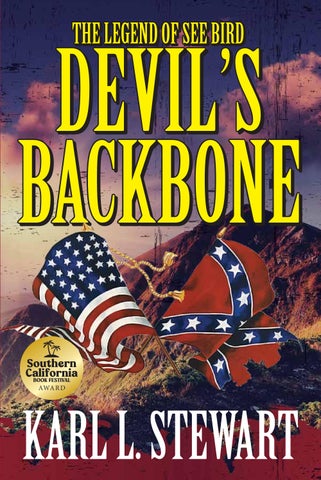
“Devil’s Backbone” Blends Historical Fact into Realistic Fiction
DEVIL’S BACKBONE
“Author Karl Stewart spins another good yarn in his latest book, Devil’s Backbone, the second novel in Stewart’s Legend of See Bird series. In real life, Stewart’s great-grandfather was a successful rodeo cowboy known as “Red” Carpenter. Red was a Native American, a Choctaw Indian whose real name was “See Bird.” In the first novel of the series, The Last Long See Bird Carpenter Drive, Stewart introduces See Bird—the Choctaw cowboy who rode into an adventure on the last long cattle drive before the railroads made such trail drives unnecessary. In this new novel, See Bird is a friend of ‘Devil Anse’ Hatfield who draws See Bird into the infamous feud between the Hatfields and the McCoys. The story is set in West Virginia, where the author was raised, so his expressive language, authentic mountain dialect and convincing sense of place come from the experience of someone who has actually lived there.” —John M. Silah, President of the Fond du Lac Area Writers, movie critic and playwright
KARL L. STEWART
Karl Stewart was raised in the hills and forests of West Virginia. Devil’s Backbone is a sequel to Stewart's first novel, The Legend of See Bird: The Last Long Drive. Inspired by the mystery of an old man he loved, Stewart now writes stories of the Old West centered on that legend—his great-grandfather, from his home high on a ridge in rural Wisconsin.
KARL L. STEWART
The Legend of See Bird –
Devil’s Backbone Karl L. Stewart
Publisher Page
an imprint of Headline Books, Inc.
Terra Alta, WV
The Legend of See Bird—Devil’s Backbone by Karl L. Stewart copyright ©2015 Karl L. Stewart copyright ©2025 Karl L. Stewart All rights reserved. This book is a work of fiction. Names, characters, places, and incidents, except where noted otherwise, are products of the author’s imagination, or are used fictitiously. Any other resemblance to actual people, places or events is entirely coincidental. The geographical places mentioned in this work are real with the exception of Jensenville. No part of this publication may be reproduced or transmitted in any other form or for any means, electronic or mechanical, including photocopy, recording or any information storage system, without written permission from Publisher Page. To order additional copies of this book or for book publishing information, or to contact the author: Headline Books, Inc. P.O. Box 52 Terra Alta, WV 26764 www.HeadlineBooks.com mybook@headlinebooks.com Publisher Page is an imprint of Headline Books ISBN 13: 9781882658282 Library of Congress Control Number: 2015942969
P R I N T E D I N T H E U N I T E D S TAT E S O F A M E R I C A
Dedicated to “Granny” Sally Carpenter, one of the most remarkable women I have ever known.
Prologue The cold, grey hand of November lay on the land, smothering the brown wooded ridges and valleys alike in a silent, misty drizzle. The occasional muffled echo of an axe striking wood was all that broke the afternoon silence. Captain Clayton Tibbetts of the 22nd Western Virginia Volunteers, CSA, stood at the make-shift entrance to his dugout, surveying the scene. Dugouts similar and wildly dissimilar to his own dotted the ridge on which his company was deployed. His men had settled in for the long haul, and perhaps that was what was troubling him more than anything. This was not how 1863 had started. Last spring had been filled with grand speeches and grander expectations. General Robert E. Lee was to lead his unbeaten army of Northern Virginia into combat on the enemy’s own ground, to strike hard and fast, to destroy that sluggard McClellan and all his forces, to capture Washington D.C. itself, that nest of vipers, and perhaps, just perhaps, end this war victoriously. Tibbetts’ company was to secure this western flank of Lee’s army, preparatory to wresting the western counties of Virginia back into the Confederate fold. But nothing, it seemed, had gone as planned. Captain Tibbetts’ chiseled jaw clenched behind his neatly trimmed handlebar moustache as he reflected: That gorilla Lincoln had sacked McClellan and replaced him with stolid George Meade, and at some worthless village up in Pennsylvania, Gettysburg 5
The Legend of See Bird – Devil’s Backbone
by name, the goggle-eyed Meade had absorbed and tossed back the best that Lee could throw at him in three days of ferocious fighting. Who would have expected those damned blue-bellies to stand and fight like that? Now, in the late fall of the year, the Confederate army was back where it was last year, several ridges to the east, only in a weaker, more defensive posture as Lee tried to nurse it back to health. And that wasn’t the worst of it. Stonewall Jackson himself was killed in May, and in July the impregnable Vicksburg had fallen to the drunkard Grant and maniac Sherman, slicing the South in two. Now it was impossible to squelch rumors that Grant, who had been placed in charge of the Union forces at Chattanooga, had defeated another Confederate army in what was being called ‘the battle above the clouds.’ Yes, Tibbetts thought, rumors were flying and it all had taken a terrible toll on his men. Rations were being cut again as the great herds of Texas and western beef were no longer available. Morale was sapped. So many of his men were sick-listed or had deserted that to be truthful his company was no more than a skeleton of itself. And this damnable weather – so cold and wet up in these mountains the men would scarcely drill in it without coercion. The captain pounded his fist on the door frame in frustration. But the war was not lost. Surely the cause could not fail. Come spring, he told himself with more conviction than he felt, the Confederacy would rally and drive every last Yankee from the South’s sacred soil. Peering into the grey gloom, the Captain was distracted by the approach up the hill of a five man squad. Yes, there could be no doubt about it – the squad was heading directly for him. There could also be no doubt about who was leading it. The tall, dark-haired young man with the long-legged gait was his lieutenant. Tibbetts appreciated his second-incommand more than he liked him. The man rode as though he were born in the saddle and seldom missed what he aimed his rifle at. He had shown both intelligence and a tenacious courage 6
Karl L. Stewart
in combat. As a reward, the men bestowed upon him a fearsome nickname and responded well to his leadership. Perhaps that was what bothered the Captain. The men seemed to respect the lieutenant more than they did their captain. Tibbetts had to admit his lieutenant cut an imposing figure, over six feet tall with a broad intelligent forehead. He himself stood barely 5’8”, but somehow, standing next to his second in command, he felt even shorter. He turned and retrieved his field hat so as better to meet the approaching squad, and which also added a couple inches to his height. “Squad, halt!” the tall man barked. He advanced alone to the Captain’s dugout. Tibbets met him at the door. “Yes, Lieutenant, what is it?” He returned the other’s salute. “Sir, these two men were discovered returning to camp. They have been missing for several months. They are Privates Hastings and McCoy.” The tall lieutenant seemed to relax just a bit. “Captain, sir, I was wondering what you wanted done with them, seeing as how they returned on their own.” “Yes, I see. I know of these two. Won’t you step inside, lieutenant.” Tibbetts turned and the lieutenant followed him, leaving the two prisoners and their guards outside. “Be at ease, lieutenant. Would you care for a smoke?” the captain asked. “No sir, but thank you for offering. Those men are soaked, and I’d as soon get them in out of the weather as I could. There’s enough sickness as it is.” “Of course, of course.” Tibbetts packed his briar and struck a spark. The small windowless room filled with the pleasant aroma of Virginia tobacco. “What to do with them,” he muttered through teeth clenched around the pipe stem. He glanced quickly out the door at the two prisoners now squatting between their guards. “Lieutenant, I know just what to do with those two scoundrels,” he snapped. “We are going to make examples of them for the rest of the company. There’s a war on, and they have deserted their posts. Heaven knows they are not the only ones, but we 7
The Legend of See Bird – Devil’s Backbone
are at a crucial point, and the rest of the men have to be made to see that such behavior will not be tolerated. Stonewall Jackson himself shot deserters. I am not quite as bloodthirsty as was our beloved late general, so the prisoners will be hung tomorrow at dawn with the entire company mustered to observe.” The lieutenant removed his hat and ran his fingers nervously through his straight black hair. “But sir, I beg you to reconsider. These are good men who only went home to harvest their crops when we had already taken winter positions up here on this ridge. McCoy’s got a young wife who’s in the family way, sir, with no one to help her. With all due respect, their families would starve, sir. And the men did come back on their own.” Captain Tibbetts drew in and exhaled a fragrant cloud of pipe smoke. “I appreciate your concern for them. I am sure you know their personal situations better than I. Nonetheless, desertion during time of war is not something to be tolerated. If the other men see military discipline applied, perhaps it will stiffen their spines a bit so when next spring comes around we might still have a company left with some fighting spirit.” “Maybe you’re right, sir, but we’re already so short of men that I don’t see how…” “That’s my job, lieutenant, to see how. Your job is to obey my orders.” Tibbetts’ voice rose. “Is that perfectly clear?” Seeing the futility of further argument, the lieutenant stiffened and saluted. “Yes, sir,” he said briskly. Captain Tibbetts, softening a bit said, “Look, lieutenant, I am neither heartless nor stupid. I know Private Hastings is your cousin, but I also know that McCoy’s brother, Harmon, currently serves in the Union army. And when this man deserts, suspicion of his commitment to the cause is warranted. As for your cousin, surely you can see that I cannot play favorites.” Seeing the unmoved face before him, the captain averted his gaze and said tersely, “We are on the brink of losing this company. I expect you and all the men under my command to follow lawful orders. I 8
Karl L. Stewart
also expect you to see to it that the prisoners are informed of my decision. Make arrangements with the parson if the condemned so wish, and prepare for those two deserters,” he jabbed his finger toward the door, “to be hung at dawn. That is all.” He saluted dismissal and turned his back to his subordinate. There was a stifled comment, a rustle at the door, and then silence. When Captain Tibbetts turned, he was alone again in his dugout. The five others had disappeared. The company stockade was another dugout, much like the captain’s. Two sides were dug into the side of the ridge. Two sides were composed of stout logs. The only window was a small one cut into the rough-cut door. The whole thing was covered with heavy timbers and coarse shingles. A crooked, rusty pipe served as a chimney, from which flowed a thin ribbon of smoke which lingered indecisively before crawling off toward the ridge line. Now late in the afternoon a single guard stood beside the door in the evening gloom. The thoroughly miserable lieutenant approached the guard, who when he recognized him, stood aside. “Good evening, lieutenant.” “That is certainly debatable, Private Jenkins. Jenkins it is, isn’t it? You hail from over by the Kanawha valley, don’t you?” “Yes, sir. All my kin are still there, ‘cept those who’re dead or gone to the hills, fighting the Yankees ranger style.” The lieutenant paused a moment, sizing up the guard. “Private Jenkins,” he spoke quietly, “why don’t you step inside with me while I talk to the prisoners. I have an idea I’d like to present to you and those two men.” “Of course, sir. If you don’t mind my saying so, most of the rest of the men think it’s a cryin’ shame those fellers gotta die for what they did. There ain’t a man amongst them what wouldn’t have done the same. ‘Cept most of them wouldn’t have come back.” He took a step backwards. “After you, sir.” Jenkins unbolted and opened the door, and the lieutenant ducked to step inside. Hastings and McCoy rose to their feet. 9
The Legend of See Bird – Devil’s Backbone
McCoy spoke first. “Is it true they’re gonna stretch our necks come dawn, Anderson?” “’Fraid so. That is the Captain’s intention. But before you boys throw in the towel, I’ve got me an idea that may just benefit the Confederacy without clipping our own ranks. You boys interested? If so hear me out. Jenkins, sit yourself down by the fire there and listen, too. You know those blue bellies have claimed the western half of Virginia and hold it by force. Hell, with most of the fighting men gone, who could stop them? Well, I’m proposing the four of us bug out tonight for parts west. We can keep an eye on our families and at the same time make it pretty hot for those Yankees. We can form up an informal unit, maybe join up with the border ranger outfit operating there. We’ll hit the Yankees hard and fast and then melt into the hills.” He struck a hand with a fist for emphasis. “We know that area like the back of our hands.” The men leaned forward, nodding their agreement. “They’ll never find us, and we can do a whole lot more for the South by fighting ranger style then by sitting here and rotting all winter. We’ve little time for long-winded debate. So I’m calling for a straight up vote. What do you say?” The only sound was the soft crackling of the fire. The men looked from face to face, gauging sentiment. McCoy spoke first. A handsome man, he stood, straightened his lithe frame and reached out his right hand. “Anderson, that’s the most decent thing any man has ever done for me and way more than I expected. All I really got in this world is my family. You’re giving me a chance to protect and fight for them. I ain’t never gonna forget it.” The lieutenant shook his hand and as he did so the others stood and shook his hand in turn. “We’ll have to move fast,” he said. “I’ve got us some horses ready for a night patrol just in case you boys saw it my way. Jenkins, you fetch them. Say the night patrol needs them. I’ll leave here first and we’ll all meet down by the stream in one hour. 10
Karl L. Stewart
We disappear tonight. I figure in this murk Tibbetts won’t be able to do a blamed thing about it. But we need to leave tonight.” He scanned the small group. “Ready, boys?” The tension was palpable. Private Hastings spoke, “What are we standing here for? We’re with you, Devil Anse.” The tall lieutenant smiled grimly and exited quickly. Several minutes later, into the twilight drizzle stepped the three mountaineers. Like specters, with not a sound, they melted into the shadows.
11
12
1 See Bird Carpenter strained against the weight of the large timber he, with the help of a horse, a rope and a pulley, was hoisting into place on the wall he was erecting. The timber, gently lowered into place three rows above the door, ran the length of the house. Slacking off the rope slightly, he jumped up on the wagon bed and gave the dove-tailed end a whack with a mallet, locking it into the row below. Then, unhitching the rope, he stood back to admire his work. With the placement of the final timber, the exterior walls of the house were completed. He stroked the broad neck of the horse in affection, and it whinnied gently in return, acknowledging his attention. When he sent for Kiamichi he really did not know what to expect. Left behind with his good friend and rancher Luke Strebow when See Bird came east, the big horse had been his constant companion for years as he made the rounds of the rodeos springing up everywhere west of the Mississippi. Would Kiamichi remember him? Would he forgive the man for leaving him behind? Would he be so upset with all the train travel he endured that he would be worthless or even dangerous with rage? See Bird need not have worried. When Kiamichi was unloaded at the C & O rail yard in Huntington, after a brief adjustment period he settled down wonderfully, and when See Bird clicked his tongue the way he had a thousand times before, the big horse flicked his ears in recognition and pranced over to the man who tamed him, 13
The Legend of See Bird – Devil’s Backbone
resting his muzzle on his shoulder. It was enough to bring tears to even the most stoic observer. Now that he had settled down to the life of a ‘farmer’ here in West Virginia, he intended to purchase several more horses as deals would make them available. But first for the roof and the long porch he was planning. He frowned as his critical eye detected a slight bow in one of the timbers on a side wall. But he decided he’d be hanged before he would disassemble the wall to replace or turn one timber. Besides, he thought, once the whole thing was properly caulked no one would notice one slightly less than perfect timber. He smiled to himself because he knew the lie even as he thought it – that bent log would bother him every time he saw it – for the rest of his life. Hopping down, the young Choctaw doffed the uncreased black slouch hat he nearly always wore and used it to broom the wood chips off his denims. Sweat ran in rivulets down his hard copper-colored body. Never a big man, he had learned to use his brains to make up for his lack of size. Even so, his 5’6” frame carried a rock solid 140 pounds. Many times over the years, larger men, underestimating him, had called him out and consequently paid the price. Years of working on western ranches had made See Bird an independent, self-sufficient man, perhaps not gifted with his tongue, but blessed with an unexplainable power that flowed through his hands. When he reflected on it, he could not make up his mind as to whether it was a gift or a curse. His abilities became apparent within a short time of his arrival in the bustling new city of Huntington, established as a railroad terminus by the railroad magnate Collis P. Huntington, and people sought him out from miles around for blacksmithing, leather and wood work. There was so much work coming his way, he discovered, that with his shop work and construction of the farm buildings he was left with precious little time to court the young widow Sally Osbourne. 14
Karl L. Stewart
He loved thinking about her with her flaxen hair, large brown eyes deep enough to swallow a man whole, and her in-your-face directness and honesty. As he settled down in the shade of a big cottonwood to eat the lunch she had packed, he realized he loved just about everything about her. He bought this farm with the stake he had earned rodeoing and working the west, and she decided to pitch her lot in with him as well. The result – he built a lean-to for his temporary accommodations, and lived on the land he owned when he wasn’t in town. Sally lived in Huntington on Monroe Avenue, a good day’s buggy ride from the farm, taking in laundry and sewing and tending to little Gertrude, her three year old daughter by her former husband, a sheriff who had been shot dead trying to serve a warrant on moonshiners. With See Bird’s help she had turned a new leaf and no longer worked down on Frog Island as a dolly. She did what she had because it was better than starving, but she was very proud of her status as a new-made woman. See Bird bit into a crisp apple and looked around. Yes, sir, this was a mighty fine land, even though it had more than its share of red clay, and was hillier than almost any place he’d ever been, even the old family homestead in south-east Oklahoma. Yet already it felt more like home. Sally spent the previous night with some kin down the road and this morning paid a surprise visit, bringing in his food. A dead-eyed shot with his Winchester, he really wasn’t lacking much with the woods full of game and berries ripening fast. Still, after a bit of showing her what he had accomplished and sharing a few tender minutes he sent her on her way again, telling her that she was not to come out here anymore until he was finished and the house ready for them to move into. She stood there, lips tight, hands on her narrow hips, and even squinted up her eyes like she was angry. But she held her tongue, and when he held her by the shoulders and kissed her forehead, they both burst out laughing, evaporating whatever tension she had been feeling. He had a few surprises planned for her and 15
The Legend of See Bird – Devil’s Backbone
didn’t want her to come waltzing in unexpectedly, spoiling his fun. As a matter of fact, he thought, now would be a good time to get busy on that indoor plumbing. It would take a couple days, but there was no reason it couldn’t be done. And she would really like it. His thoughts were interrupted as he heard a buggy rattling up the trail and hoped it wasn’t her again. He didn’t recognize the stranger, but there was no mistaking the 30.06 resting on the seat next to him. There was nothing about the man to indicate his visit was anything other than friendly, yet See Bird felt uneasy and glanced around. “Howdy, neighbor,” he said. “What can I do for you?” and took a step towards the stranger. The buggy driver carefully placed the reins down and leaned back on the wagon bench, tipping his derby hat to the back of his head, a smile plastered on his face - a very picture of studied informality. But See Bird also caught the coldness in the man’s eyes that belied the smile on his mouth. The stranger studied See Bird’s handiwork. What he did not seem to take notice of was the lack of an invitation to step down. See Bird knew well the rule of the West that no man would set foot on another’s property without being invited. He presumed it was the same here. “How do, friend,” the man in the buggy answered as he leaned over the side and spat a stream of tobacco into the grass. Seeing See Bird’s hesitation he pulled aside a corner of his soiled vest, revealing a tin star pinned to his shirt. “I’m the law from over in Pikeville.” He smiled again, but it never reached his ice-cold steel-grey eyes. See Bird cocked his head. “Excuse me for saying, but isn’t it a bit odd for a Kentucky lawman to be prowling the hills over here in West Virginia?” A complete silence descended on the clearing. “Might be so, but I’m here to take in a desperado named Tom Wallace for murder. You ain’t happened to have seen him now, have you?” “Might be I have. Folks have stopped by now and again. But the name don’t ring a bell.” He tossed his apple core toward the 16
Karl L. Stewart
edge of the silent woods and then looked directly at his visitor. “Mostly when folks come by they don’t hide in the trees. If you want to continue this little parley, call in your boys.” See Bird backed up a couple steps closer to the Winchester leaning against his wagon wheel. “Now don’t go getting’ antsy, mister.” The Kentucky lawman held up one hand. “It’s just that a man has to be careful. He never knows what he might be stepping into.” See Bird was silent, but stopped within reach of his rifle. The lawman in the buggy turned his body and called out, “It’s okay. Come on in, men.” From out of the shadows, three men carrying rifles stepped their horses forward to flank the wagon. “These are my deputies. I’m the Pike County sheriff, Coburn by name. We got off on the wrong foot, and I apologize for that.” The insinuating smile returned to his face. “Fact is, you got no law over here – least ways none that will do anything about the murdering outlaws that run and hide in these hills.” See Bird didn’t take the bait to introduce himself. Instead, he casually picked up his Winchester and cradled it in his arms. He figured the odds had now shifted into his favor. “First place, what you say is true. We did get off on the wrong foot. But men who sneak up on others in the woods and then flash a tin star from somewhere else got no rights I’m aware of to ask anyone anything. Might be this Wallace is a coward and murderer, like you say. Might be he ain’t. I don’t rightly care.” He raised his rifle, swinging it slightly forward, menacingly, but with his finger still off the trigger, his body loose. “Now I got a lot of work to do, and I ain’t going to waste one more minute of the day on the likes of you. So long now, and I don’t expect I’ll be seeing you boys again.” Two of the men on horseback slouched in their saddles, one wearing a wide, blank-faced grin displaying a number of missing or rotten teeth, the hawk-nosed man next to him sullen and still. See Bird felt if trouble came, it would be from the third man, 17