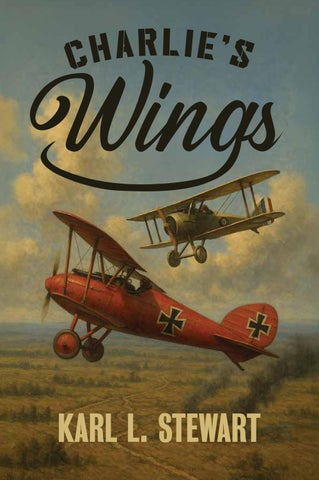
KARL L. STEWART
Award-winning author, KARL STEWART, was raised in the hills of post-WWII West Virginia and moved to Wisconsin in his teen years, attending a Catholic seminary. Upon leaving the seminary, he enlisted in the U.S. Army in 1966, serving as a communications sergeant in the elite Green Beret Special Forces until 1969. He enrolled in the University of Wisconsin, earning a double-major degree in political science and history. In 2005 Stewart retired from teaching high school Social Studies and English to devote himself to his two passions, family and writing He is the author of the award-winning Legend of See Bird series, loosely based on the life of Stewart’s great-grandfather, See Bird Carpenter, a Choctaw Indian. The Green Light continues the life of Stuart Carter (based on Stewart’s father) from WWII (The Seventh Cruise) to Vietnam (The Green Light). Up Harvey’s Creek and Fare Thee Well Harvey’s Creek is a spin-off based on the author's life, living with a parent with PTSD. He is also the author of Good Night Sweet Dreams, an award-winning children’s book. He and his wife live in rural Wisconsin on a pine-lined ridge with a stunning view to the south, echoing his West Virginia childhood playgrounds.
Charlie’s Wings
The year is 1918, and American troops are pouring into France, seeking to tip the balance of WWI in the Allies’ favor. Charlie Carter, soon-to-be son-in-law of Western legend and rodeo star See Bird, AKA Red Carpenter, is among them. But Carter is one of a new breed of warriors, those who fight from the skies aboard the new invention, the airplane. In these frail and flimsy crafts, Charlie, and other young men like him, seek to take the fight to the German invaders. When his initial excitement wears off, Charlie discovers that death is always his worst enemy. Based on a true person, this is the story of Charlie’s Wings.
KARL L. STEWART
A Story of W W I
Karl L. Stewart
Publisher Page
an imprint of Headline Books
Terra Alta, WV
Charlie’s Wings by Karl L. Stewart copyright ©2025 Karl L. Stewart All rights reserved. This book is a work of fiction. Names, characters, places and incidents, except where noted otherwise, are products of the author’s imagination or are used fictitiously. Any other resemblance to actual people, places or events is entirely coincidental. No part of this publication may be reproduced or transmitted in any other form or for any means, electronic or mechanical, including photocopy, recording or any information storage system, without written permission from Publisher Page. To order additional copies of this book or for book publishing information, or to contact the author: Headline Books P.O. Box 52 Terra Alta, WV 26764 www.HeadlineBooks.com Email: mybook@headlinebooks.com Publisher Page is an imprint of Headline Books ISBN 13: 9781958914809 Library of Congress Control Number:
P R I N T E D I N T H E U N I T E D S TAT E S O F A M E R I C A
There are so many people who have encouraged me to write this book. One person has never stopped. Thus, I dedicate this book to my best friend, who happens to be my wife.
Foreword
By the summer of 1918, the armies of Europe lay exhausted after three years of slaughter on a scale unimaginable only a few years earlier. Mere human flesh was no match for machine guns, powerful artillery, poison gas, airplanes, and the like. Advanced twentieth-century technology combined with primitive infantry tactics doomed the soldiers from every army. By that year, the French had lost 1.4 million men, Great Britain 885,000, and Italy 650,000. German losses, at 1.7 million, were surpassed only by Russia at 1.8 million. Germany still had hopes of winning, but Kaiser Wilhelm and his generals realized it would be a close thing. With Russia withdrawing from the war that year, the Germans were able to transfer all the armies on the Eastern Front to Western Europe. The German High Command was in a race against the clock. Every month, the United States poured fresh armies into the fight. Who would get there first, the Germans from the east, or the Americans from across the ocean? In the spring of the year, Germany gambled that a huge fourpronged attack might be enough to crush the French and British. After initial success, advancing so far they nearly broke the Allied lines, each prong ran out of steam and ground to a halt. In the summer of 1918, the Allies, bolstered by the Americans, prepared to counterattack. General Pershing believed the key to victory might well come in the Argonne-Meuse section, near a
small village Mihiel, or Saint Michael, a town captured by the Germans earlier that spring, barely thirty miles due east from the aerodrome at Rembercourt, rapidly filling up with young, enthusiastic, pilots from every corner of America. Charlie Carter, a young man from the hills of West Virginia, was one of them. This is his story.
1 “Knights of the air.” That’s what the newspaper article called him and his fellow pilots. He would have taken it out of the inside pocket of his shirt and read it again, but at that moment, he was in the cockpit of a Nieuport-17 chase plane flying somewhere over the northern French countryside. His mother sent the article in a small package along with notes and letters from home. To Sergeant Charles Carter, bundled against the cold in his open-seated Nieuport flying at 7,000 feet, it was a glorious morning. There seemed to be no one else in the world, and there was nowhere else in the world he would rather be. Grey-white wind-shredded strings of clouds scudded eastward across an enormous blue bowl of a sky. Far below, dark lines of trees and hedges snaked across and between deep brown and tan fields, casting their early morning shadows before them. A brighter yellow-green tree-lined road lazily meandered its way between and across those fields, leading to some yet unseen village, perhaps lying in a shallow valley beyond the grey-green ridge ahead. The absence of visible traffic on the road heightened his sense of solitude. Not even the roaring of the aircraft’s rotary engine just inches in front of his small windscreen could break the sense of exhilaration and solitude he felt. “This is the life for me!” he thought. What an incredible experience for a kid from the hills of West Virginia who had never even seen an “aeroplane” 1
Charlie’s Wings
in flight before joining the army. Charlie glanced around as if someone were watching. Then, filling his lungs, he let loose an exuberant rebel yell, drowned out instantly in the noisy propwash. Only an hour ago, with the help of Pierre and Louis, his two French mechanics, he had wheeled his bebe’, so-nicknamed because of the Nieuport’s small stature, out of the hangarwarehouse and onto the grass of the aerofield, still heavy with water from last night’s drenching. Together, the three men pointed the plane’s stubby nose into the west wind prior to takeoff. The cloud deck was still low but starting to break up. Dressed in sheepskin-lined coveralls from throat to ankle, and with his feet encased in shaggy knee-length fur boots, he may have looked strange, but his outfit was suited to the frigid temperatures above the clouds. With Pierre’s assistance, he cumbersomely stuffed himself into the tiny cockpit of the single-seater. Louis turned the prop over a few times with the ignition off in order to bring oil and gas into the cylinder. Charlie yelled, “Contact,” and flipped the switch. Louis yanked down hard on the prop one more time and promptly stepped away as the Nieuport erupted to life before settling into a smooth roar. The same west wind that swept in a driving rain off the English Channel during the night now chased retreating clouds across the grey predawn sky. The field was a mere eighteen miles from ‘the front,’ the Hindenberg Line, it was called, as it ran near the French village of Saint Mihiel. But ‘the front’ seemed a thousand miles away to the young pilot. He had dreamed of this moment, his first ‘chase libre,’ as the French called it, his first solo combat mission, a million times. Maybe this would be the day he would send some German, some Boche, some Hun, some enemy pilot trained by the Bloody Red Baron himself, down in flames. Oh, the glory of it all! He spent many restless nights worrying that this day might never come, that he would never see action before this Great 2
Karl L. Stewart
War ended. Charlie thought wryly about his night spent in the huge wooden hangar, lying on a mat beneath his aircraft, for he definitely thought of the Nieuport as his. An older, more experienced pilot had told him not to personalize the craft. “If you’re lucky,” he said, “you’ll live to fly a lot of these contraptions. If you’re not, well, it won’t matter anyway.” Still, he could not help himself. The plane was his bebe’. Charlie need not have slept in the hangar. Indeed, several of the more tested pilots teased him about it. Still, Charlie and his team, led by Pierre, his dapper mechanic from Gennevilliers, a Paris suburb, had assembled the craft and had seen it go from a fuselage in a crate, along with a pile of cables and wooden struts, to this beautiful model of modern ingenuity destined for a life above the earth. Charlie had not found it in his heart to let it out of his sight. During the night, horizontal sheets of rain pounded like a machine-gun assault, firing all at once against the sides and roof of the hangar. Wind off the English Channel pried, pushed, and tugged against the building, causing it to creak and moan in complaint, keeping the young pilot awake most of the night. If this early summer storm persisted, he feared, the airfield would once again become a soggy, spongy quagmire, impossible to fly off. He tempered his disappointment by reminding himself of the thousands of doughboys trying to gain any small measure of rest while they stood knee deep in muddy trenches only a few miles away as the Boche artillery pounded them relentlessly, lighting the distant horizon with its muffled thunder. What right had he to complain? But still, the anxiety he felt that all flight sorties might be cancelled once again due to the inclement weather was almost unbearable. Then, shortly before dawn, the hangar ceased creaking and rattling. Everything became peacefully quiet. The rain stopped. Even the distant artillery barrage stilled. The young airman smiled to himself and slept. 3
Charlie’s Wings
Charlie woke amazingly refreshed, considering how little he slept, but with no appetite, he was much too excited to stand in the mess hall line. Instead, he headed to the NCO club hut where he guzzled a couple cups of steaming spiced tea while going over with Pierre for the final time, the idiosyncrasies of flying the Nieuport. He felt fortunate to have Pierre. The man was a skilled mechanic who needed no instruction from Charlie. In fact, it was Pierre who did most of the teaching. And it was especially fortunate that the man spoke English – well, kind of. Louis, his other mechanic, while quite able with a wrench, knew as little English as Charlie knew French, which was little indeed. In the pilots’ ready room, Charlie received his flight orders, walked out to the field, and took a final look around. Before long, he found himself rolling down the bumpy airstrip and lifting smoothly into the air, aiming the nose of the craft up into the sky. In fact, he had flown it before. After assemblage, the two of them had fueled the bebe’, and Charlie had taken it up, flying it around the field. Unfamiliar with its handling, when he attempted his first flat turn, the aircraft responded uncertainly, wobbling and losing some altitude, much to the amusement of a group of pilots and mechanics watching from the field, before he leveled off. He brought it in and landed successfully, bouncing only a few times before pulling up to the group and spinning the Nieuport to face into the wind as if to prepare for another takeoff. He was grateful for the heavy mittens he wore over white silk gloves. They hid the uncontrollable shaking in his hands. Pierre noticed, but he noticed everything. He smiled knowingly at Charlie as the two walked away. Abruptly, Charlie snapped out of his pleasant daydream and scanned the terrain below. He knew in what direction he was flying. The rising sun did not lie. But how far had he flown? His orders were to fly along the trench line, being careful to remain on the Allied side. Should he encounter a German aircraft, he was to identify it, note its location, and immediately race for home. 4
Karl L. Stewart
While the Nieuport-17 had been a front-line chase airplane last year, rapid aircraft development had made it obsolete by 1918. With a top speed of less than 100 mph and with a single synchronized Lewis machine gun, this aircraft, so small it was nicknamed bebe’, would be no match for the new shark-shaped German Albatros monoplane. With a shake of his head, Charlie cleared his mind, worried. Where was he? Until now, he seemed to have the sky to himself. He did not believe he had strayed over enemy lines. Surely, he would have seen the churned-up brown smudge they called the ‘no man’s land’ lying between the two armies. Anxiously, he leaned first over one side of the fuselage, then over the other. Nothing looked familiar, and the engine was growing inexplicably louder. He recognized the ‘thunk,’ ‘thunk,’ ‘thunk’ sound of bullets striking the wooden fuselage and instinctively banked his plane hard to starboard. Diving out of the sun, a red-nosed warplane wearing a big black painted cross streaked down on him, spitting fire before flashing past, banking and climbing to get on his tail. Charlie felt like a toy duck in a carnival shooting game, and the thought nearly panicked him. His throat constricted, and he fought back a surge of bile with his fear. But now there was no time for thought. If he were going to survive the next few minutes, his reactions had to be correct, and decisions had to be made instantly. He yanked back on the stick and pointed the craft’s nose to the sky, climbing beneath his enemy, minimizing the Hun’s angle of attack. The Albatros roared past. The black cross on its side cut so close that Charlie worried for a moment that the German would clip his wing. Charlie’s maneuver bought him only a few precious seconds. The speedier Albatros banked again to get behind Charlie. The young West Virginian kept his plane in a nose-up position, trying for an over-the-top roll, an ‘Immelmann,’ it was called, hoping to reverse positions and get behind the German. 5
Charlie’s Wings
The Nieuport climbed for several more seconds, sputtered, and then fell silent, her engine starved for fuel. With no forward speed, the craft sat on its tail for a moment. Then, tipped over, nose down, the plane began the long, spinning, slow-motion descent to the earth, the French called it a vrille, a disastrous conclusion to Charlie’s first combat flight. Ironically, only then did Charlie recognize his surroundings. His aerodrome was only a mile or two away. The German predator must have been on the prowl, looking for an easy kill on the Allied side of ‘the front.’ “And hang it all,” Charlie thought, “I sure made it easy for him.” The thought somehow jogged Charlie’s mind to a more resolute state. “What can I do to survive this?” he wondered. There was little time left to formulate a plan. The German pilot, seeing him in a silent tailspin, wrote him off as a ‘kill’ and rapidly disappeared to the northeast. Drawing on everything his instructors had taught him and his prior experience as an amateur mechanic back home, Charlie decided he had nothing to lose. If this desperate idea did not work, his life would be over in a minute. Every muscle in his body called on him to yank up hard on the stick to flatten out the increasingly tight spin. Counterintuitively, Charlie pushed it forward, forcing the battered plane into an ever-steeper dive, forcing it beyond any speed the Nieuport was designed to survive. The earth rushed upward at alarming speed. But if the engine had been starved of fuel before, now it was getting the liquid forced down its throat. The wind began spinning the prop faster. He prayed his hare-brained idea would work. A silent prayer, and he flipped the switch. A sputter, but nothing. Then came a ripping, rending sound that chilled him to his bones. The fabric covering the lower right wing was tearing off. His plane was destroying itself. Desperately, he flipped the switch again. Despite the cold, he blinked his eyes to chase away the sweat. He heard a sputter, another, and then amazingly, the motor roared back to life. In 6
Karl L. Stewart
that second, Charlie pulled back on the stick with all his strength. Now, not only could he see the earth, but he also saw a farmer below him abandon his horse-drawn wagon and run away from what looked to be a certain crash. More fabric on the front of the right wing tore loose and flapped behind like ragged streamers. Charlie could count the wooden struts that shaped the wing. Straining with all his might, he drew back on the stick again, and this time the Nieuport responded, still diving toward the earth but at a shallower angle. He relaxed for a moment, then he pulled back again. His arms felt dead. But this time the little craft shuddered as if it had a case of the shivers, flattened out, and roared over the treetops, missing them by mere feet. But without the fabric on the right wing, it took all of Charlie’s strength to keep the Nieuport from cartwheeling. The battered aircraft was nearly shaking itself apart. Charlie’s strength nearly gone, he fought to hold the plane in the only attitude that had a chance of keeping it relatively level. Looming up just ahead, one more line of trees remained between him and the sprawling airfield. Then it was beneath him. He heard a crunch and felt his body thrust forward as the plane caught in the upper branches, losing momentum. Somehow, it skipped across the tree crown but left its wheels and a landing strut in the upper branches. Immediately beyond the trees, the ruined aircraft dropped and skidded on its belly to a stop as the wooden props shattered on contact with the ground. Almost one hundred meters from the hangar in which he had spent the previous night, dreaming of all the heroic acts he was certain to perform, Charlie opened his eyes, his hand wrapped around the joystick in a death-grip. At first, he could not believe his good fortune at living through this disaster and sat as if glued to the seat, stunned, exhausted, and shaking. But when he saw Pierre and several pilots running towards him, he regained his wits and took several deep breaths while uncurling his fingers from the joystick. Forcing himself 7
Charlie’s Wings
to stand, he pried himself out of the cockpit and jumped to the ground, much closer now due to the missing landing gear. He was shaking, but congratulated himself that at least he did not collapse. Leaning against the bullet-riddled remains of the fuselage, he struck what he hoped appeared to be a casual pose, prying off his mittens and silk gloves. Pierre arrived first, with Louis only a few steps behind. He reached out a hand to steady his pilot but was instead handed Charlie’s gloves. The novice pilot staggered a step forward, found his footing, and, wearing a grim smile, with a nod of his head, passed through the silent assemblage with Pierre and Louis on either side. They had all witnessed the dogfight and could scarcely believe Charlie was alive, much less walking casually away. Charlie rested a hand on Pierre’s shoulder. Pierre turned and stared incredulously at the wreckage behind them. All three stopped for a final look. “It looks like our bebe’ fell out of the cradle. We’ll have to see what we can salvage from the mess,” Charlie said. Spotting the NCO Club hut, he added, “I think I could use me a beer, maybe two.” Pierre turned and spoke for a moment to Louis, who then walked back to the wreck of an aircraft. Running a hand through his thick black hair, Pierre watched his pilot lumbering away, then turned back once more to see Louis approach the Nieuport. Shaking his head, “Sacre bleu,” was all he said.
8
2 The NCO Club itself would not have been out of place in any shantytown a person might find in the United States. When the first American volunteers arrived in France in 1916, before the USA had even entered the war, and wanted to fly combat missions, it put the French government in a quandary. Clearly, since the USA had not declared war and was officially neutral, these men could not form an American unit. Yet to reject their offer would have appeared arrogant and ungrateful. And many of these would-be pilots presented another problem. Some had first approached the British, only to be met with scathing rejection. The Brits wanted only “the best” to be their pilots, meaning college men with athletic training. These Americans, while their intentions may have been noble, completely lacked ‘the right stuff.’ While they might have some utility as mechanics, cooks, or laborers, these farm boys, stevedores, factory workers, prize fighters, and the like could never be awarded a British officer insignia. And only British officers could be pilots. As a result, these disgruntled Americans made their way to the French. The life span of a fighter pilot could be measured in weeks, and the French, at war for two years already, were running short of men. Yet the French were also designing and producing in large numbers some of the most advanced aircraft in the war. Planes 9
Charlie’s Wings
waiting for pilots – unacceptable. Therefore, while the idea of an NCO club composed of American pilots would have seemed ludicrous to the British, the French were willing to look the other way. Therefore, these young American volunteers were trained as pilots by their French hosts and then were awarded the rank of sergeants, becoming NCOs in the French army and assigned to a unit composed of fellow Americans under the French chain of command. Thus, Lafayette Escadrille was born and would so remain until America finally entered the war in the spring of 1917. Following America’s declaration of war, these flying units were absorbed and organized into the US Army under the leadership of Colonel Billy Mitchell. Most were redesignated as the 94th and 95th Army Air Corps. Thus, these wayward young aerial enthusiasts came under the American chain of command but with French logistical support. Consequently, the aerodromes they operated out of contained a mixture of French and American English that, although it led to some confusion, worked surprisingly well. But it would not have occurred to the French to build a ‘club’ for the undisciplined Americans. So, the new arrivals cobbled them together in a day or two from whatever scrap material could be found near at hand. When Pierre caught up with Charlie and entered the tarpaper shack that served as an American NCO club, he had no trouble spotting the man. Charlie was the only one standing at the bar, if that were the proper name for the wide board spanning the gap between two large wooden barrels. A third barrel, tapped, stood at one end of the bar on a few wooden slats that barely raised it above the uneven planks comprising the make-shift floor. At the other end of the bar was a large wooden crate containing a dozen or so unlabeled bottles of a murky red liquid, probably a local red wine “liberated” from a nearby ruined village. Perhaps, but not likely, it had been obtained legally. ‘Mister’ Conners would know, but he was not here to tell. Perhaps he was off somewhere today following up on a rumor of 10
Karl L. Stewart
a suspected hoard of liquor abandoned in some ruined village. Or perhaps he was chasing down some rumor about the location of a few panes of unbroken window glass. An Irishman carrying a deep-seated, heartfelt grievance against the British, when war broke out, he made his way directly to France, bypassing the British entirely. Every outfit needed someone like Conners, a man who innately understood how to locate and remove whatever was needed or requested, whether it be a barrel of beer, a crate of wine, or a roll of tarpaper. ‘Mister’ Conners was largely responsible for the construction and maintenance of the ‘Club.’ The American pilots were deeply grateful to this Irish civilian. The only other occupants of the club were two pilots sitting at a battered table, drinking silently, their eyes focused on the back of what appeared to be a large, pale, hairy beast standing at the bar. Charlie had removed his fur-lined leather headgear and goggles, setting them on the board beside him. As Pierre approached, the Frenchman smiled to himself and smoothed his pencil-thin moustache with the back of his hand. Charlie’s head of shiny black hair poking out of the cold weather suit appeared too small for his body, lending him an animal-like appearance. “Sergeant Carter,” Pierre said in his creative English as he sidled up to Charlie, “I do also think that perhaps a beer is not such a bad idea, even before I have broken my morning fast. Alas, I also believe your bebe’ will fly no more. You left too many of her pieces up in the trees.” He raised his eyebrows and waved his hand vaguely. Charlie smiled. He stepped around the bar to tap a refill for himself and then filled a clean tin cup for his mechanic. If Pierre said the aircraft could not be saved, well, then that was just the way it was. He would have to fly something else. “Pierre,” he said, “how many times have I asked you not to call me ‘sergeant’? To you, I’m just Charlie.” The mechanic raised his beer in salute before drinking and sat it down with a Gallic shrug. “Charles, I have been wondering 11
Charlie’s Wings
why you call this cold-weather suit of yours a ‘Teddy Bear.’ “It’s not a Teddy Bear. It is a teddy bear suit.” He glanced at a sleeve. “It was named after a President of ours, Teddy Roosevelt. Fella was a hunter, and once on a trip, some suck-ups with him drove a bear cub into camp so he could shoot it. They thought it would please him and look great in the papers. He refused, said it wasn’t sporting. News got out about it. A company back east trying to sell stuffed toy bears, got the bright idea of naming them Teddy Bears, and the rest, as we say back home, is history.” “Ooh, la la. That is much amusing. I will try to remember.” “But I’ve got more on my mind right now than TR.” Charlie paused for a moment and blew out a breath. Staring down into his beer, he spoke. “Pierre, this morning I made almost every mistake a tyro can make, but somehow, I lived to tell about it. I was so frightened up there when that Boche dived on me, I nearly soiled this marvelous teddy bear suit. I was scared out of my wits.” He slowly shook his head. “Oui. That may be very true, Charles. Indeed, you would be an imbecile to feel otherwise. But here you are drinking beer before you have even broken your fast. And the day is yet young. You will fly again, is that not true? My friend, I ask you, is that not true?” He peered at Charlie anxiously. The young pilot quaffed his beer and swiped his mouth with the back of his now steady hand. “I lost my bearings up there, didn’t even know where I was. That was mistake number one. I let my mind drift from my mission. Daydreaming nearly got me killed. That was another mistake. I was lucky. That’s all. And how many times can you count on luck to haul your tail out of the grinder? Another mistake was my altitude, or lack of it. I was flying too low because I didn’t want to get cold. How stupid! The Hun dropped on me like a rock out of the sun. I never even saw him coming.” He stared into his cup as though he were looking for answers and then continued. “But then my last and most damning mistake was to ask more from the Nieuport than it was 12
Karl L. Stewart
able to give me. That really almost killed me.” Pierre put a hand on his friend’s arm. “Mon ami, you are too hard on yourself. You did much that was right. You flew with courage. You acted decisively. So, if you are thinking of quitting, all I can say is do not do this thing. It would only compound those errors you are aware of with an even larger one. “ “Pierre, my good friend, please stop worrying. You mistook my meaning.” He reached over and placed a hand on his friend’s shoulder. “I survived a cascade of errors. This morning was easily the most frightening experience of my life.” He paused. “But it was also the most exciting, well, the second most exciting thing I’ve ever done. I’ve never felt so alive.” His voice became more intense. “I’ve never seen things so crystal clear.” He slapped the bar with the palm of his hand. “The fact is, I cannot wait to get back up there.” He turned his back to the bar and raised his tin cup. “I just need to find me another plane.” The smiling airplane mechanic raised his cup in turn. They clinked cups, and the men drained their beers. As they exited the shack called the NCO Club, Charlie asked, “And isn’t that Albatros the most beautiful flying machine you have ever seen? It looked like a shark, and I felt like a tuna. Why can’t we make airplanes like that?” Pierre laughed. “Just you wait, mon ami. I have heard about new aeroplanes being built, and you will love them.” Charlie had survived his first dogfight and learned from it a number of things. Most importantly, he learned that in a pinch, he would think quickly and react instinctively correctly. While his cockiness diminished, his hard-earned confidence had grown substantially. There was a good chance, he thought, that he might live to fight – and win – another day.
13
3 Stripped out of his teddy bear suit, Charlie flopped on his barracks cot, enjoying the soft caress of the warming air as it drifted across his bare chest on this summer day. When he told Pierre that the morning dogfight with the German was the second most exciting thing that ever happened in his life, he had not been lying. Proposing to his girlfriend, Gertie, back home in West Virginia, before he went off to war was, if not the most exciting, certainly the most terrifying thing he had ever done. Thinking about it, even today, gave him goosebumps. On that other fine spring day, not so long ago but far away, he steeled himself in anticipation that the girl he loved would reject his offer. After all, what kind of man would propose to a woman and then run off to war, maybe never to return? He lay awake the entire Saturday night before figuring out how he would do it and what he would say. He finally decided to pop the question immediately after church on Sunday morning, if he could just take her aside, and if his courage and determination held up. And when the little Baptist congregation sang the final notes of “Shall We Gather by The River”, Charlie took Gertie by the hand and hurried her around to the back side of the church where no one else would witness what he feared would be his impending humiliation. There, in the presence of this striking dark-eyed girl, he promptly forgot every word he planned to 14
Karl L. Stewart
say and stood there with his mouth open. But she was patient. Gertrude pushed a strand of black curls behind an ear and waited. Seeing him struggle, she suggested, “Charlie, maybe we should walk a bit,” then said no more. Charlie sighed in relief, and they began to stroll down the lane along the split rail fence that led to her family farm. Somewhere along the way, she reached out and held his hand. He took her silence and her hand in his as encouragement. Summoning up all his courage, and feeling dizzy with fear and excitement, almost sick to his stomach, Charlie stammered out his desire that this young woman with the coal-black, sad eyes would be his wife. When Gertrude realized what Charlie was saying, she stopped and, still holding his hand, turned to face him. She seemed to take forever, looking long and deep into his eyes, as though searching out his soul. Her intense gaze was nearly unbearable, but he met and held it. Then, as though reaching some life-determining decision, she released his hand and touched his cheek with her fingertips, her gaze softening. At her touch, he closed his eyes but could still hear her voice. “Charlie, ever since that time when you stepped in for me on the playground at school when we were back in fifth grade, and you forced that bully Virgil Dobbs to back down and leave me alone, I marked you out as the one I wanted to spend the rest of my life with. “Since that day, I’ve watched and waited. I hear how people talk, and I know the word is out that you plan to go off to this war over across the ocean. I don’t rightly know if that is the best thing or not, but if that’s what you feel you gotta do, I’m telling you here and now that I will wait for you to come home. “I will not marry you now, if that is what you are trying to ask. You go do what you need to do. You got needs I can’t pretend to understand, but I’m telling you now that I love you too and will for the rest of my days. So, when you’re done, hurry home. Then I’ll marry you all proper.” She paused in thought. “But you 15
Charlie’s Wings
know you’d better come on out to the farm before you head off so’s you can talk to Ma and Pa about us.” He loved hearing her use the word “us.” He felt a swell of love and a pride he’d never known as he realized she now thought of them as one thing. He drew her to his chest in an embrace that neither of them wanted to break. Finally, Charlie stepped back a pace and holding Gertie at arm’s length said, “Holy cow. I almost forgot.” He fumbled in his pants pocket for a moment, searching, then smiled. “I know it ain’t much, but I’ve been working extra hours in Pa’s grocery store to earn enough to buy this ring for you.” He held out his hand, presenting her with a small burgundy box. Opening it he said, “I bought it down in Huntington when Pa and me went for supplies. It’s from Steinberg’s Jewelry. They said if you don’t want it, they’ll take it back. But please,” he pressed it into her hands, “don’t ever take it back, not ever.” There, nestled in the red silk inside the box, lay a small pearl set on a simple gold band. Her eyes misted, Gertrude carefully, almost reverently lifted it out, admired it for a few moments, and slipped it on her finger. “Charlie, this is the most beautiful ring I’ve ever seen. I’ll wear it from this day on ‘til you return. And then I swear I’ll wear a different one for you. I surely do love you, Charles Carter. Now kiss me. And he did.
16
4 He awoke a few hours after he had flopped on his barracks cot to a rumbling in the air as well as in his stomach. He sat up and swung his legs to the floor. The noise in his stomach subsided, but the rumbling in the air continued and grew in intensity. Berton Perry, a young, curly red-haired pilot from eastern Kentucky, who almost always could be found chewing a blade of grass, was already standing in the doorway staring at the western sky.“ ’Pears we got us some visitors. Wonder what that’s all about.” He grinned a gap-toothed smile. “Could be the war is over, and the Germans is surrendered. Whadda you think?” Charlie fixed his eyes on the sky and spied in the distance what appeared to be a flock of large birds approaching, flying in formation. “I sure haven’t a clue, but I’ll bet that office boy running this way from HQ wants to tell us something.” Both men watched with interest as a young headquarters orderly raced in their direction across the field, firmly holding his campaign hat in place with one hand, waving frantically with the other. “Orders for everybody to assemble at Hangar 9, on the double,” he shouted as he ran by on his way to the next barracks. “What’s the big rush?” Perry hollered. The orderly halted a moment to catch his breath. “Mitchell, Colonel Billy Mitchell hisself, is flying in. Get your butts in gear pronto over to number 9.” Then he took off again. 17