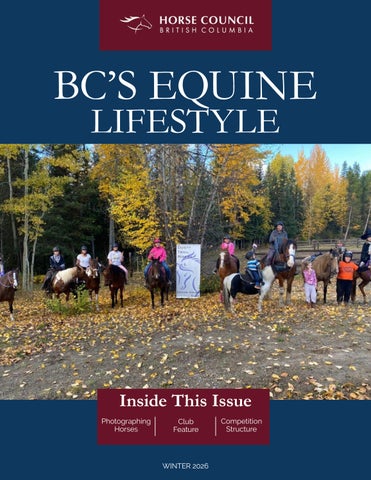
BC’S EQUINE LIFESTYLE
Inside This Issue Photographing Horses
Club Feature
WINTER 2026
Competition Structure
Insurance for horses (and their people).
We are Canada’s most trusted insurance broker for horse enthusiasts and have been for decades. Ask us about coverage for: • • • • • •
Horse Mortality Coverage Commercial Equine Liability Coachs/Officials Clubs Horse Shows Equine & Livestock Trailers
Learn more, or apply today!
capricmw.ca/equine 1.800.670.1877
BC’S Equine Lifestyle WINTER 2026 Published quarterly by Horse Council BC 27336 Fraser Hwy, Aldergrove BC, V4W 3N5 T: 604-856-4304 F: 604-856-4302 Toll Free: 1-800-345-8055 www.hcbc.ca
News 2. Chair’s Message 3. Membership 4. Acera Inc. 5. HCBC Funding 2026 6. Coaching News
Competition On the cover: Dusty Trail Riders
14. Understanding EC and HCBC Competition Structure
Horse Council BC is a membershipdriven not-for-profit association representing the interests of the equine industry in all sectors throughout British Columbia. Horse Council BC represents the equine industry in agriculture, industry, sport, and recreation through education, grant funding, club support, government advocating, liability insurance, and participant programs.
Horse Council BC gratefully acknowledges the financial support of the Province of British Columbia through the Ministry of Tourism, Arts, Culture and Sport
Interest 8. Mikulas Trenciansky Tribute 9. Pony Tails Kids Club 10. Tips for Photographing Horses 12. Dusty Trail Riders
Industry 17. Helping Ensure Smooth Sailing for Horses and Livestock Along the Coast
HCBC Board Chair’s Message By Lynda Atkinson| HCBC Board Chair
Welcome to the beginning of 2026. We are pleased to share that Horse Council BC continues to bring value to our members and the broader equestrian community through educational programming, event support, advocacy, and resource development. Our staff remains focused on advancing horse welfare, education, community engagement, and sport across British Columbia. Thank you for renewing your Horse Council BC membership for 2026. Your membership helps ensure continued insurance coverage and provides access to the many benefits available to our members. We are looking forward to the year ahead and are excited to offer a wide range of new educational opportunities. This year, we are launching Momentum, a new platform designed to deliver HCBC educational programming, along with an expanded webinar schedule. In February, we will introduce the Field Knowledge Webinar Series, featuring experts in areas such as farrier work and horseshoeing, infectious disease, dentistry, low-stress veterinary visits, and the importance of sleep for horses. We encourage you to stay connected and take advantage of these learning opportunities throughout the year. HCBC also continues to offer members a 15% discount on Equine Guelph short courses. These courses provide valuable learning opportunities for both adults and youth and are a great way to deepen your knowledge and support the health and well-being of your horses. We hope you enjoy this issue of BC Equine Lifestyle Magazine. We also encourage members to explore the various grant opportunities available, from education initiatives to trail-building projects. Joining a local affiliate or horse club can provide access to many of these funding opportunities and help strengthen our equestrian community. Sincerly,
Lynda Atkinson Chair, Horse Council BC
2
HORSE COUNCIL BRITISH COLUMBIA | WINTER 2026
WHAT TO DO IN THE EVENT OF A CLAIM We all do our best to stay safe around our horses. However, horses are horses, and accidents can happen. Below is a quick reference to guide you if you need to make a claim under any of the insurance policies included with your Horse Council BC membership. Step 1: Contact Acera Insurance Services Call 1-800-670-1877 and ask for Claims Assistance.
Claims service is a priority at Acera. If you have any questions or concerns at any point during the claims process, we strongly encourage you to contact an Acera Insurance Equine Department Representative for assistance. For more information about the automatic or optional insurance coverages available through a Horse Council BC membership, please visit www.hcbc.ca or contact Acera Insurance Services at 1-800-670-1877 and ask for the Equine Department.
Step 2: Be prepared to provide the following information: • The nature of the claim (e.g., Liability, Tack & Equipment, MNP, or AD&D coverage) • Your name and contact information • Your policy number and HCBC membership number • The date and location of the loss • A brief description of the circumstances leading to the loss What happens next? Once this information is received, your Acera Claims Service Representative will send you, by mail or email, any paperwork or forms required to process your claim. After all required documents are submitted, your claim will be forwarded to the appropriate insurance provider for assessment. Your Acera Claims Service Representative will continue to follow up with the insurer to ensure that: 1. Your file remains a priority 2. The full extent of available coverage is applied 3. Payment is processed as quickly as possible HORSE COUNCIL BRITISH COLUMBIA | WINTER 2026
3
Acera Insurance Services
Why Upgrading to Full Mortality Coverage Is a Smart Move for PTSO Members Peace of Mind for Every Scenario Horses are unpredictable by nature. Whether it’s a sudden colic episode, a pasture accident, or an unforeseen illness, Full Mortality coverage gives you peace of mind knowing that your investment is protected. It’s not just about financial reimbursement—it’s about having the confidence that you’ve done everything possible to safeguard your horse’s welfare. Tailored for Responsible Owners Upgrading to Full Mortality coverage reflects responsible ownership. It shows that you value your horse not just emotionally, but practically. This coverage is especially important for those who compete, breed, or rely on their horses for professional or recreational purposes. It ensures continuity and support in the face of adversity. Affordable and Accessible
As a valued member of the PTSO, your commitment to protecting your equine partners is commendable. While Members Named Perils coverage offers a foundational level of protection, upgrading to Full Mortality coverage provides a more comprehensive safety net—one that reflects the true value and importance of your horse. Understanding the Difference Members Named Perils coverage is limited to specific, listed causes of death such as fire, lightning, or transportation accidents. While these are important, they represent only a fraction of the risks horses face daily. Full Mortality coverage, on the other hand, protects against death from any cause, including illness, injury, or natural causes—unless specifically excluded. This broader scope ensures that you’re not left vulnerable to unexpected and costly losses. Upgrading also gives you access to valuable endorsements like Medical and Surgical coverage to offset unexpected veterinary care.
Many members are surprised to learn that Full Mortality coverage is more affordable than they expect. With flexible options tailored to your horse’s age, use, and value, upgrading is a smart financial decision. Plus, as a PTSO member, you are automatically eligible for preferred rates and streamlined underwriting. Make the Move Today Your horse is more than just an asset—they’re a partner, a companion, and a source of joy. Don’t let limited coverage leave you exposed. Upgrading to Full Mortality coverage is easy, and our team is here to guide you through the process. To learn more or request a quote, visit acera.ca/equine If you have questions, contact your Acera equine insurance advisor today at 1-800-670-1877
Have questions about insurance? Call Acera Insurance at 1-800-670-1877 4
HORSE COUNCIL BRITISH COLUMBIA | WINTER 2026
NOW ACCEPTING 2026 GRANT APPLICATIONS Horse Council BC Grants are open and accepting applications, read below for a summary of those available at this time. For more information and to apply visit: https://hcbc.ca/ membership/hcbc-members-funding/
Education Grant The Education Grant supports Affiliates, Clubs, and Branches in offering equine educational opportunities to their local communities. The grant can be used for classroom, demonstration, or mounted education, and is open to everyone in the community, not just HCBC members. The grant covers up to 50% of the expenses, with a maximum of $500. To apply, the organization must be a current HCBC Affiliate, Club, or Branch member for at least one year. Only one application per year per organization is allowed for this funding. BC Equestrian Trails Fund The BC Equestrian Trails Fund (BCETF) supports HCBC member clubs and affiliates in constructing or maintaining equestrian trails, trailheads, or horse camping sites in British Columbia for public use. In 2024, the fund totaled over $25,000 and is annually increased by donations. The fund serves as “seed funding” to help secure additional grants. Applications must be submitted by April 30th, with a possible second intake by June 30th if funds remain. Eligible applicants are HCBC member clubs or affiliates in good standing for at least two years, or HCBC committees with qualifying projects.
Infrastructure and Equipment Grants The HCBC (Horse Council BC) Infrastructure and Equipment Grants support clubs, branches, and affiliates in purchasing equipment or completing projects that improve facilities and promote growth in the equestrian community. The grant aims to help clubs initiate projects, but they should seek additional funding to complete them. Eligible projects include equipment purchases (e.g., jump equipment) and facility upgrades (e.g., arena improvements). The grant covers up to 75% of the project cost, with a maximum of $5,000, and clubs must contribute at least 25% of the cost.
Eligible projects include new trail construction, upgrades, bridge construction, signage, trail rehabilitation, and horse camp facilities. The grant covers up to 75% of project costs, with a maximum of $5,000, and all funds must be used by December 31st, 2026.
Eligible applicants are HCBC members in good standing for at least two years, with priority given to those who haven’t received funding in the previous year. Each organization can apply once per year, and ineligible projects include trail development and educational events. Application Deadline April 30th
HORSE COUNCIL BRITISH COLUMBIA | WINTER 2026
5
Coaching
How to Get Certified as an Equestrian Coach Becoming a certified equestrian coach is an exciting and meaningful step for riders and drivers who want to share their knowledge, support athlete development, and strengthen the equestrian community. Equestrian Canada (EC), in partnership with the National Coaching Certification Program (NCCP) has established a clear pathway to help aspiring coaches gain the credentials, training, and experience needed to coach safely and effectively. This article outlines the steps needed before you can be evaluated to become a certified instructor or coach. 1. Start With the Required Memberships Purchase a Bronze EC Sport License Your EC Sport License provides access to recognized programs, evaluations, and sport governance. The Bronze level is the minimum required for beginning the coaching pathway. Purchase Your HCBC Membership A current Horse Council BC membership ensures provincial recognition, liability coverage options, and access to provincial resources that support your coaching journey. 2. Complete the Learn to Ride/ Drive Program Your riding or driving proficiency must be validated through EC Rider/ driver level evaluations. Requirements vary depending on the coaching stream you pursue: • English o Instructor – Rider Level 6 o Competition Coach – Rider Level 8 • Western: o Instructor – Rider Level 4 o Competition Coach – Intermediate Basic Training • Drive o Instructor – Drive Level 12 3. Complete the Make Ethical Decisions (MED)
as a single online module in the Locker (your NCCP account). This training assesses your understanding of ethical decision making in coaching scenarios and is a mandatory component of all EC coaching pathways. 4. Obtain Registered Coach Status from EC Next, you must purchase Registered Coach Status, which indicates that you’ve met EC’s baseline expectations for professionalism and safe sport practices. To apply you will need to acquire the following documentations and certifications: • Standard First Aid Certificate A 16 hour, in person First Aid training course is required to ensure you are prepared to respond to emergencies in the barn or arena. • EPIC Search Online Enhanced Police Information Check (similar to a criminal record check) • Proof of Insurance You must carry a minimum of: $2,000,000 Commercial General Liability $100,000 Professional Liability Insurance • Reference Letter Two professional references who can speak to your character, experience, and suitability as a coach is required. • Signed Screening Form This document affirms your compliance with EC’s screening and safe sport standards. • EC Concussion Training Completed on the EC E-campus when obtaining your sport license. Valid for three years. • EC Fostering Healthy Equestrian Environments TrainingCompleted on the EC E-campus when obtaining your sport license. Valid for three years.
As of April 1, 2026, MED training and evaluation will be delivered 6
HORSE COUNCIL BRITISH COLUMBIA | WINTER 2026
Lesson Plans Choose from predetermined lesson plan topics depending on your certification level and discipline. The amount of lesson plans you will be required to write depends on your certification level. You will provide structured lesson plans demonstrating your ability to create safe, progressive, goal oriented sessions. Emergency Action Plan (EAP) Your EAP should be specific to the facility you are most familiar with and outline emergency procedures, evacuation routes, contact information, and roles. Learn how to create lesson plans and an emergency action plan by taking the EC NCCP module Plan an Equestrian Practice. Application and Payment Your evaluation will be scheduled once your application and payment is submitted.
6. Prepare for Your Evaluation Once all prerequisites are complete, you may apply for your EC evaluation. The evaluation process requires you to submit the following materials:
HORSE COUNCIL BRITISH COLUMBIA | WINTER 2026
Get in touch with coaching@hcbc.ca with your questions and to be added to our coach candidate list.
7
A Tribute to Mikulas Trenciansky
Pictured: Mikulas and Final Pool in Competition Horse Council of BC is saddened to relay the passing of member Mikulas Trenciansky, who died on August 27th, 2025, at the age of 85 after several years battling Parkinson’s disease. In this article, we honor the life of this avid horseman and his lasting impact on the BC equestrian community. Mikulas first fell in love with horses during his youth in Slovakia. Growing up on his father’s farm, he spent nearly every day alongside these animals; sometimes even sleeping with them in the stables. Sadly, Mikulas was forced to step away from his passion during his 2-year service in the military and when escaping to Canada with his family during the 1969 communist regime. However, once he got on his feet, Mikulas was able to forge a successful career in real estate and resume his life with horses. In the 1980s, Mikulas purchased an 8-acre horse farm in Surrey, BC. This became his home base, and the location where he raised his beautiful family and trained countless horses for competition. Without any sponsor of benefactor, Mikulas self-funded his appearances at horse shows across North America, including Thunderbird, Spruce Meadows, and Desert International Horse Park.
countless ribbons and awards that littered the family home, it was the farm itself and one very special horse that he was most proud of. Nick recalls the countless mornings where his father had already returned from the barn before he had even left for school – a testament to his dad’s tireless passion, which shone through in his love of horses. One in particular – Final Pool – was his most prized. Known well throughout the local horse community, some of Mikulas’s most successful years were experienced aboard this brilliant stallion. In the words of his son, Mikulas was “tough, both mentally and physically. He was tough on himself and others, always told the truth (at times to a fault). [He was] never one to let a horse “win”; if he fell off, he always hopped back on, and the same lesson was taught to me. He carried this motto into his everyday life.” Mikulas continued riding until the age of 65, and only when his worsening health made it impossible did he stop. Mikulas will be remembered by those around him fondly as a stubborn, honest businessman, a dedicated equestrian, - and, above all - a “doer”. Horse Council BC is proud of his contributions to the equestrian community and is grateful for the legacy he has left behind in our sport.
As spoken by Mikulas’s son Nick, there was no singular achievement that defined his father’s career. Despite the
8
HORSE COUNCIL BRITISH COLUMBIA | WINTER 2026
DIGITAL MAGAZINE Help Kira tack up Alice! The pair are running late for their riding lesson and need your help. Can you put steps 1 through 10 for tacking up Alice in the correct order? Place the saddle pad on Alice’s back.
Hiya, Alice the Pony here! Are you a horse-crazy kid? Do you like stories, colouring pages, games, and more? Subscribe to my monthly digital magazine (it’s FREE, whether you’re an HCBC member or not), and you can join in on all the fun! Please email ponytails.alice@hcbc.ca to be added to the mailing list.
Answers (in descending order): 5,3,2,9,4,6,8,1,7,10. HORSE COUNCIL BRITISH COLUMBIA | WINTER 2026
Attach the crossties to Alice’s halter so she can’t run away. Walk Alice over to the tack-up stall. Put on Alice’s bridle. Get to work brushing Alice (curry comb, hard brush, soft brush, and hoof pick. Don’t forget to brush out her mane and tail too!). Place the saddle on Alice’s back. Put the reins over Alice’s head and remover her halter. Go get Alice from her paddock. Attach and do up Alice’s girth. All done! You can now lead Alice into the arena. Don’t forget to check your girth and stirrups before you get on! 9
Getting the Shot
Tips for Photographing Horses From quiet moments in the barn to action in the ring, photographing horses comes with its own set of challenges. We asked experienced photographers from our membership to share what works for them. Here’s what they had to say.
5. If all else fails and even throwing an inflatable pool won’t get the bombproof horse to have its ears forward, cue horse whiney noises on the helpers cell phone. This will be sure to get the horses direct attention and some glorious ears forward. Careful not to overdo it if the horse gets stressed by this.
Names: Bayley and Holly Business Name: With Love Photography About Bayley and Holly: We’re two besties located on Vancouver island who specialize in equine portrait photography. We are both equestrians ( so yes- we truly “ get it”) who work together to create magic for you. Their Best Tips: 1. Have a helper. Someone who can get ears forward, make sure no legs are resting or standing funny and who can wipe away mouth slobber with a rag. 2. Find out what interests the horse. Some are treat motivated, some are grain bucket motivated, some need noises/ sights and some need a mirror to admire how gorgeous they look! 3. Give time to work with the horse and their needs, not against. Horses usually have the attention span of a toddler and expire after about 45 mins. If the horse gets antsy and wants to move, let them. Pivot the client to best suit the horses needs. 4. Encourage the client to always love on their horse during the session, even if their horse is driving them bonkers! That way when the ears do go forward the client is loving on their horse and the magic clicks happen! 10
HORSE COUNCIL BRITISH COLUMBIA | WINTER 2026
Name: Cassidy Nunn Business Name: Nunn Other Photography About Cassidy: I’m a farm/country girl at heart, a wife, mama to two beautiful daughters, an animal lover and passionate photographer based in Victoria, BC, Canada. I specialize in Equine photography and love to photograph horses of all types, in all different disciplines, from sales ads to horse shows to the bond between horses and their riders/owners. 1. The number one thing I notice in horse portraits is the position of the horse’s ears! Be aware of the mood you’re trying to convey with your photo—is it a portrait with the owner and horse both looking attentively at the camera? Then having the horse’s ears pricked forward with an engaged expression will stand out much more than a horse with ears splayed to the side looking like the horse is half asleep!
2. Action shots—I’ve found overshooting--taking a lot of photos--is key with action shots, especially when learning. Use a fast shutter speed (minimum 1/500 second to freeze action for slower scenes and 1/1000 of a second for faster action such as jumping) if you’re shooting in Manual mode or Shutter Speed priority mode (where you can set the shutter speed the camera’s auto settings will take care of the rest). If you’re just starting out, some cameras will also have an auto action mode that you can use in these scenarios.
3. Practice, practice, and practice some more! I bring my camera everywhere with me and make it a goal to take at least one photo a day. Practice at all times of the day so you can start to create an awareness of lighting and how that affects your overall image. The more you practice, the more confidence you’ll gain. HORSE COUNCIL BRITISH COLUMBIA | WINTER 2026
11
Club Feature
Dusty Trail Riders Where Community, Horses, and History Ride On
defines DTR.
More than fifty years ago, a group of families west of Prince George had a simple idea. They wanted a safe place where their children could ride ponies, play freely, and learn independence and responsibility. That idea became Dusty Trail Riders, a community-based riding club in the Beaverly area that continues to thrive more than five decades later.
New in 2026, the club has also introduced “Get Togethers for the Littles,” hosted by a Junior Board member. The initiative is designed to help young teen members develop leadership skills while sharing their knowledge and enthusiasm with younger riders. The first session was a big success, with teens teaching the littlest members how to make healthy horse treats. The club hopes to offer one of these activities each month, creating meaningful opportunities for mentorship and connection.
The club began in the late 1970s on private land belonging to one of its founding families. Soon after, land across the road was leased from the Crown, where the club still operates today. Now in its 51st year, Dusty Trail Riders is home to multiple generations of riders, including grandchildren and greatgrandchildren of the original members. One longtime clinician and judge even recalls riding at DTR as a child and now returns to teach and support the next generation. Dusty Trail Riders stands out as a truly inclusive, communityfocused club. Riders from a wide range of disciplines share the space, including English, Western, Dressage, Jumping, Working Equitation, Ranch Riding, Gymkhana, Endurance, Liberty, Cowboy Challenge, and back-country riding. Fees remain reasonable, members contribute through work parties, and there is a shared respect for the land, the facilities, and one another. That sense of belonging continues year-round, even through the long Prince George winters. When riding time is limited, the club stays connected through virtual events and challenges, educational sessions on saddle fitting and stretching, and first aid courses. These off-season offerings help members continue learning while maintaining the strong sense of community that 12
Education remains a key focus as well. Planned evenings dedicated to Working Equitation rule book learning will help members feel more confident and prepared for upcoming clinics and shows. These sessions reflect the club’s commitment not only to riding, but to thoughtful horsemanship and continual growth. That welcoming, supportive atmosphere is one of the club’s defining strengths. Members regularly lend equipment, support one another during lessons, and create space when horses or riders need time. Some riders travel more than an hour to reach DTR, despite having closer facilities, because of the culture of respect and encouragement. Even during competitions and shows, the focus remains on inclusion. In a sport that can sometimes feel exclusive, Dusty Trail Riders offers a refreshing alternative. The heart of the club was especially evident during a major facility upgrade completed in 2025 with support from the Horse Council BC Infrastructure and Equipment Grant.
HORSE COUNCIL BRITISH COLUMBIA | WINTER 2026
labour without charge. What stands out most is that the project was completed without injuries, conflict, or strained relationships. Clear communication, shared leadership, daily safety planning, and mutual respect ensured a positive experience for everyone involved. The result was not only improved facilities, but a stronger and more connected club.
Building for the Future With grant support, Dusty Trail Riders undertook a significant project that included removing old fencing, clearing trees, levelling land, protecting community trailheads, working around a creek and riparian zone, relocating an old outhouse, and constructing a new dressage arena. The goal was to create safe, functional riding spaces in time for the summer season and to begin rebuilding the aging main arena. The project also included replacing gates, building holding paddocks and hitching rails, and improving the overall layout of the facility. These upgrades were essential for a multi-discipline club with a small volunteer base, particularly during events when members needed a safe place to manage their horses while supporting participants.
At Dusty Trail Riders, the people and the horses remain at the centre of everything they do. The term “DTR Family” reflects genuine care, shared responsibility, and a commitment to inclusion. Whether through meetings, work parties, winter programming, or time spent in the saddle, that spirit continues to guide the club forward.
Most project goals were achieved within the year, with final fencing work scheduled for completion in the spring. The improvements have had an immediate impact. The club can now host clinics and open riding at the same time, expand lesson programming, and accommodate larger events. Membership grew to a record 79 riders, and the second annual Working Equitation show was well attended and widely praised.
More than five decades after its founding, Dusty Trail Riders remains a place where riders learn independence, develop leadership skills, and build lasting connections. With renewed facilities and a clear vision for the future, the club is well positioned to serve the equestrian community for generations to come.
Equally important was the way the project brought the community together. Powered by Volunteers and Community Support Aside from one paid contractor, the entire project was completed by volunteers. Members attended work parties, helped dismantle old fencing, and repurposed materials. One member even built a picnic table from reclaimed boards and branded it with the Dusty Trail Riders logo. Volunteers were fed, fuel costs were covered, and every contribution was appreciated. Local businesses and community members also played a key role. Coffee, hot chocolate, discounted materials, donated gates, and equipment support all helped make the project possible. Contractors and suppliers contributed far more than expected, while family members provided machinery and HORSE COUNCIL BRITISH COLUMBIA | WINTER 2026
13
Competition
Apples to Oranges: Understanding EC vs HCBC Competition Structure 1. Governing Authority & Scope Equestrian Canada (EC) • National governing body for equestrian sport in Canada. • EC sanctioning is recognized across the country and follows national rules and standards. • Shows sanctioned by EC are typically part of a national competitive structure (Bronze, Silver, Gold, Platinum, etc.) Horse Council BC (HCBC) • Provincial/Territorial Sport Organization (PTSO) representing equestrian sport within British Columbia. • HCBC shows are primarily provincial or grassroots level, designed to support local competition and participation. In short: EC is national; HCBC is provincial (BC only). 2. Rules, Standards & Competition Levels Equestrian Canada Shows • Governed by EC rule book • Require a strict standard of rule compliance, safety protocols, and equine welfare. • EC sanctioned shows have multiple levels (Bronze to Platinum), allowing progression and national rankings/points at the Gold and higher levels • Prize money is restricted to various levels. HCBC Shows • Governed by the HCBC Rule Book — tailored to BC competitions. • Focused more on entry level / grassroots competition but still with stringent safety and horse welfare compliance • May include local or dual sanctioned events where external discipline rules (e.g., breed association)may supersede HCBC rules. Bottom line: EC competitions typically go to a higher level of competitive structure. HCBC shows are local, more affordable, accessible and more of a grass roots level 3. Officials & Personnel Requirements EC Shows • Restricted to the use of EC licensed officials, judges, stewards
14
and technical delegates appropriate for the discipline and level. • Officials and rules are standardized nationally. HCBC Shows • Use HCBC provincial officials, Provincial Rules Officials or guest carded individuals with documented experience and expertise. Example: previously certified officials who have let their certification lapse. Or other uncertified, qualified and experienced individuals. Guest carded officials must familiarize themselves with the current HCBC Rule book may judge at HCBC competitions with the understanding they are judging/ course designing as a BC official under the current HCBC rule book only. 4. Membership & Licensing Requirements EC Sanctioned Events • Competitors (riders, owners, coaches) must have current EC Sport Licenses appropriate for the level of competition. • Horses require EC horse ID for certain levels or disciplines. HCBC Shows • Participants need HCBC membership, • Horse ID is not required So: EC shows require national licenses; HCBC shows require provincial membership. 5. Costs & Insurance EC Shows • Organizers must submit insurance documents and meet EC coverage requirements. • EC also collects levies and fees (e.g., drug testing fees, test user fees for dressage). HCBC Shows • Lower cost to sanction (~$42 provincial fee). • Organizers must submit insurance documents and meet coverage requirements. • HCBC sanctioned Dressage competitions are provided the opportunity to use the same USDF dressage tests as EC but at no cost • No restriction on prize money or awards offered Overview: EC shows involve more financial and administrative obligations compared to HCBC shows. HORSE COUNCIL BRITISH COLUMBIA | WINTER 2026
6. Competitive Recognition & Outcomes EC Shows • Results may count toward national rankings, awards, and qualifications. • Could be a pathway toward higher level competition (national championships or FEI). HCBC Shows • Primarily local recognition and provincial results • Ideal for riders developing experience or just wanting affordable welcoming competition • Pathway to national competition
Key Difference Summary
• Confirm date doesn’t clash with major local events • Emergency & biosecurity plans documented • Create Prize List (include the HCBC competition diclaimer) Sanctioning & Paperwork • Apply for HCBC sanctioning through the online sanctioning system • Pay HCBC sanctioning fee (lower cost than EC) Officials & Staffing • HCBC approved Officials • HCBC membership required for person responsible (competition Manager) • Emergency & biosecurity plans documented • Medical Personal Competitor & Horse Requirements • Competitors must hold current HCBC membership Entries & Show Office • Approved Prizelist following HCBC provincial rules
Which to Host? • HCBC is great for local or entry/provincial level competitions with simpler requirements, less restrictions and costs. • EC is ideal if you want nationally recognized competition with national standards and are accumulating national points.
During the Show • Provincial Rules Official in attendance if requested • Compliance of HCBC rule book After the Show • Submit comp id form and any accident forms within 14 days of the closing of your show • Admin Fees due to HCBC after an HCBC competition: Zero, there is none, you did the work, you keep the money!
HCBC SHOW — HOSTING CHECKLIST (Grassroots / provincial / lower admin load) Before You Apply • Decide discipline(s) and level (schooling, entry-level, provincial) • Confirm venue availability + footing standards • Line up HCBC-approved judge(s)/officials HORSE COUNCIL BRITISH COLUMBIA | WINTER 2026
15
Understanding EC vs HCBC Competition Structure cont. EC SHOW — HOSTING CHECKLIST Make sure the organizing body is eligible • The organizer (individual or organization) must have: o Current EC Sport Licence o Current Provincial/Territorial Sport Organization (PTSO) membership
In BC, that’s HCBC • If you’re a new organizer, get these first — sanctioning can’t proceed without them. Confirm your competition dates and level You should already know: • Exact competition dates • EC discipline(s) (Hunter/Jumper, Dressage, Eventing, etc.) • Competition level(s) (Bronze, Silver, Gold, etc.) EC will not “hold” dates while details are vague. Secure a venue that meets EC standards Understand coach & competitor eligibility As organizer, you’re responsible for enforcing EC rules: • Coaches at the show must have EC Licensed Coach Status • Riders/owners must have EC Sport Licences • Horses must meet EC recording requirements (if applicable) Sanctioning & Approval • Apply for EC competition sanctioning • Pay EC sanctioning fees + levies • Provide EC-approved insurance documentation • Use EC rule book + discipline annexes Officials & Staffing • EC-licensed judge(s) • EC-licensed steward • Technical Delegate (depending on discipline/level) • Emergency & biosecurity plans documented
These are the big ones. • Owed to Equestrian Canada • Calculated based on: o Number of entries / horses / starts (discipline-specific) • Usually reported through the EC competition reporting system • Discipline levies • Drug fees Deadline: typically, within 10–14 days post-competition Late submissions = late fees or penalties • Submit official results to EC • Submit steward/TD reports • Final financial reconciliation • Results count toward national rankings/qualifications QUICK DECISION GUIDE Ask yourself these questions: Host HCBC if: • Most riders are local, entry or provincial level • You want lower cost & streamlined administration • Focus is education, experience, and affordability • You want fewer licensing considerations Host EC if: • Riders want national points, rankings, qualifications (Gold shows and higher) • You’re attracting competitors nationally • You can support higher fees & paperwork To sanction Equestrian Canada level competitions Bronze, Silver, Gold, Platinum) please contact EC: competitions@ equestrian.ca To sanction your competition provincially please contact HCBC: sandy.underwood@hcbc.ca
Competitor & Horse Requirements • Riders, owners, trainers: EC Sport Licence • Horses: EC Horse Recording / Passport (level-dependent) • Drug & medication rules apply • Drug testing fee Entries & Show Office • More formal prize list • EC-compliant entry forms & waivers • Accurate results tracking (national database compatible During the Show • Strict rule enforcement • Steward & TD reports • Official placings toward EC points After the Show Admin Fees due to EC after an EC competition 1. EC Per-Entry (or Per-Horse/Per-Start) Fees 16
HORSE COUNCIL BRITISH COLUMBIA | WINTER 2026
Helping Ensure Smooth Sailing for Horses and Livestock Along the Coast For many in British Columbia’s agricultural and equine communities, BC Ferries is more than a transportation provider – it’s a vital link that connects farms, ranches, and training facilities and keeps animals and products moving between coastal regions. Transporting livestock requires careful planning, and BC Ferries has measures in place to make the process as smooth and reliable as possible. To help ensure the safe and timely movement of animals, BC Ferries encourages customers traveling with livestock to book in advance on routes where reservations are available. There is no reservation fee for livestock vehicles, and this advance planning helps ferry crews prepare for load requirements and reduces wait times for customers. For vehicles carrying livestock that arrive without a reservation on a reservable route – or who are on a non-reservable route – travel is not guaranteed, however BC Ferries will make every effort to accommodate them as soon as possible, with no more than one sailing wait. On non-reservable routes, customers are asked to arrive at the terminal at least 30 minutes in advance of their preferred sailing. This helps staff plan vehicle loading and ensures that livestock are transported safely and with minimal delay. While livestock vehicles are treated as a priority, access to the next sailing cannot be guaranteed in every situation. Factors such as when the vehicle arrives at the terminal, available terminal space, earlier operational disruptions and the presence of other emergency or priority vehicles already in queue all influence loading decisions. As a result, livestock haulers who arrive without a reservation or without prior coordination may occasionally need to wait for a subsequent sailing. “BC Ferries understands the unique challenges that come with transporting animals, particularly on high-volume routes and during peak travel season,” says Karen Tindall, BC Ferries’ Director of Customer Care. “By working closely with our customers, we aim to ensure these essential trips happen safely, efficiently, and with as little stress to the animals and their owners as possible.”
of time whenever possible so staff can prepare and make the necessary arrangements. Customers just need to show verification from a qualified veterinarian confirming the nature of the emergency. What counts as “livestock?” For ferry travel purposes, “livestock” includes large animals such as horses, cattle, sheep, swine, goats, mules, asses, game animals, llamas, and alpacas. It also covers large quantities of live fish, shellfish, poultry, and rabbits. Household pets such as cats, dogs, and birds are not considered livestock under this definition. * Supporting safe and compassionate transport BC Ferries’ procedures for transporting livestock are designed to help terminal staff and vessel crews plan manage space efficiently, minimizing delays for passengers transporting live animals. By booking ahead where possible and communicating travel plans early, customers can help ensure a safe and efficient trip for both animals and handlers. “We have also reviewed our internal procedures to make sure our teams have clear, consistent guidance when handling livestock transport,” said Tindall. “This consistency across all routes and terminals reinforces our commitment to customer service and animal welfare, while maintaining the reliability our coastal communities depend on. We look forward to welcoming you and your animals aboard.” More information is available on the BC Ferries website: www.
bcferries.com/travel-boarding/livestock-transport
*Please note that due to the closed car decks on some of our lengthier northern routes, such as between Port Hardy-Bella Coola-Prince Rupert, livestock transport is not available.
Responding to livestock medical emergencies Animal health and safety are top priorities. If sick or injured livestock require urgent veterinary care that requires ferry transport, BC Ferries will provide priority loading on the next available sailing, even without a reservation. Customers are asked to contact the Customer Service Centre ahead HORSE COUNCIL BRITISH COLUMBIA | WINTER 2026
17
It’s Me, Alice! Hey kids - I’m Alice the Pony, author of the Pony Tails Kids Club Monthly Digital Magazine!
Each Issue Features: A signed letter from Alice Horse/pony breed of the month A short story featuring Alice & friends A horse and pony themed activity Educational horse facts of the month A horsey colouring page The opportunity to reach out to Alice and tell her what you’d like to see in the next issue! The best part... (it’s FREE, whether you’re an HCBC member or not)!
To let Alice know that you would like to subscribe (or for general inquiries) please reach out to her via e-mail:
18
ponytails.alice@hcbc.ca HORSE COUNCIL BRITISH COLUMBIA | WINTER 2026