November, 2026 l The NAIL 1
2 The NAIL l November, 2026
November, 2026 l The NAIL 3
THE
NAIL The official magazine of Home Builders Association of Middle Tennessee President Eli Routh Vice President Danny Clawson Secretary/Treasurer Sam Gray Executive Vice President John Sheley Editor and Designer Jim Argo Staff Connie Nicley Kim Grayson
THE NAIL is published monthly by the Home Builders Association of Middle Tennessee, a non-profit trade association dedicated to promoting the American dream of homeownership to all residents of Middle Tennessee. SUBMISSIONS: THE NAIL welcomes manuscripts and photos related to the Middle Tennessee housing industry for publication. Editor reserves the right to edit due to content and space limitations. POSTMASTER: Please send address changes to: HBAMT, 9007 Overlook Boulevard, Brentwood, TN 37027. Phone: (615) 377-1055.
4 The NAIL l November, 2026
FEATURES 9 The 2026 HBAMT Showcase House project
The association's 2026 Showcase House project is now underway. Contribute now to help us raise funds to promote the local housing industry.
13 The Broad Benefits of Homeownership
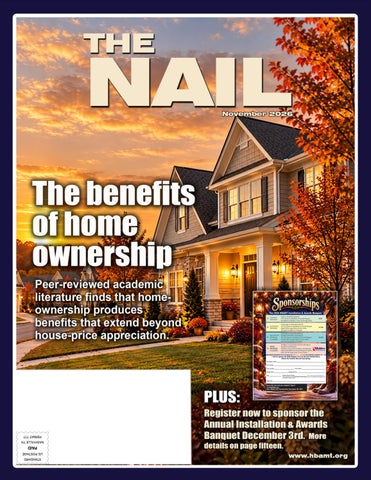
Peer-reviewed academic literature finds that homeownership produces benefits that extend beyond house-price appreciation.
15 Sponsor the 2026 Installation Banquet next month! Register now to sponsor the annual Installation and Awards Banquet, scheduled for next month at the Fraklin Marriott Cool Springs, Thursday, December 3rd.
DEPARTMENTS 6 News & Information 16 SPIKE Club Report 17 November Calendar 17 Chapters and Councils
ON THE COVER: The many benefits of homeownership were outlined in a detailed academic report recently. See page 13 (thirteen) for more details. November, 2026 l The NAIL 5
NEWS&INFO
Affordability challenges push new home sales lower
H
igh mortgage rates and economic uncertainty continued to keep potential home buyers on the sidelines and constrain new home sales in September. Sales of newly built single-family homes decreased 0.6% in September to a seasonally adjusted annual rate of 676,000, following a downwardly revised August estimate, according to newly released data from the U.S. Department of Housing and Urban Development and the U.S. Census Bureau. The pace of new home sales was 5.3% lower than a year earlier. “Affordability remains a significant hurdle for prospective home buyers,” said Bill Owens, chairman of the National Association of Home Builders (NAHB) and a home builder and remodeler from Worthington, Ohio. “Builders continue to offer incentives and adjust pricing to attract buyers, but elevated mortgage rates and high home prices are limiting the number of households that can afford to purchase a home.”
Builders continue to offer incentives and adjust pricing to attract buyers, but elevated mortgage rates and high home prices are limiting purchases. 6 The NAIL l November, 2026
“The decline in new home sales is consistent with softer builder sentiment and highlights the continued sensitivity of housing demand to financing costs,” said Danushka Nanayakkara-Skillington, NAHB assistant vice president for forecasting and analysis. “Sustained improvements in mortgage rates and housing affordability would help maintain demand.” A new home sale occurs when a sales contract is signed, or a deposit is accepted. The home can be in any stage of construction: not yet started, under construction or completed. In addition to adjusting for seasonal effects, the September reading of 676,000 units is the number of homes that would sell if this pace continued for the next 12 months. New single-family home inventory in September fell to 476,000 units, down 1% from August, and down 2.3% compared to a year ago. This represents an elevated 8.4 months’ supply at the current building pace. Completed, ready-to-occupy inventory consisted of 111,000 homes in September. The median new home sales price in September increased 3.9% from August to $400,400 but was down 3.9% from a year ago. Regionally, on a year-to-date basis, new home sales were down 0.5% in the Midwest, 1.3% in the South and 9.2% in the West. New home sales were up 2.3% in the Northeast. n
Advertise in
THE
NAIL For advertising rates and information, or to secure your ad, please email jargo@hbamt.org with your questions and requests.
Single family starts down on affordability challenges
S
ingle-family housing starts declined in September as builders faced higher financing and building material costs and ongoing labor shortages. Overall housing starts decreased 5.2% in September to a seasonally adjusted annual rate of 1.22 million units, according to a report from the U.S. Department of Housing and Urban Development and the U.S. Census Bureau. The September reading of 1.22 million starts is the number of housing units builders would begin if development kept this pace for the next 12 months. Within this overall number, single-family starts decreased 4.6% to an 859,000 seasonally adjusted annual rate and are up 2.6% compared to September 2025. The multifamily sector, which includes apartment buildings and condos, decreased 6.7% to an annualized 362,000 pace and are down 24.9% compared to September 2025. “Housing starts declined in September
as high mortgage rates, persistent affordability challenges and rising construction costs held back home building,” said Bill Owens, NAHB chairman. “High land, labor and construction costs are eroding builder confidence. A sustained increase in home building is key to long-term affordability, but near-term construction depends on mortgage rates, financing conditions and efforts to ease regulatory barriers.” “Declining housing starts reflect the high borrowing costs and affordability challenges builders face, consistent with our recent
Builder sentiment falls on higher interest rates and costs
R
ising mortgage rates, energy and material costs, and worsening labor and lot conditions have pushed builder sentiment to a 14-year low. Builder confidence in the market for newly built single-family homes fell three points to 29 in October, according to the NAHB/Wells Fargo Housing Market Index (HMI) released recently. The reading was the lowest since June 2012. “Mortgage rates have climbed well above 7% in recent weeks, and higher gas prices and inflation have further weakened buyer traffic across much of the country,” said NAHB Chairman Bill Owens. “Though builders are also contending with higher costs for construction loans, building materials and diesel, the Trump administration’s efforts to advance regulatory reform are helping to ease some of the cost pressures they face. Nationwide, more than one-third of builders reported immigration enforcement activity in their market areas during the past month, causing construction delays and discouraging legal workers from
reporting to work.” “Housing remains squeezed by supply-side constraints and significant affordability challenges,” said NAHB Chief Economist Robert Dietz. “Demand persists, but higher mortgage rates, elevated construction costs and weaker consumer confidence are keeping more buyers on the sidelines. As a result, buyer traffic has fallen to its lowest level since April 2012, excluding the pandemic’s onset in April 2020.” The latest HMI survey found that 43% of builders cut prices in October, the highest share during the 2020-2026 period. The average price cut remained at 6% for the seventh consecutive month. Meanwhile, 65% of build-
builder surveys,” said Danushka Nanayakkara-Skillington, NAHB’s assistant vice president for forecasting and analysis. “September’s single-family starts data align with our forecast of lower production in 2026, with further declines expected in 2027 as rates stay elevated and material costs rise.” On a regional and year-to-date basis, combined single-family and multifamily starts were 8.3% higher in the Northeast, 2% lower in the Midwest, 0.3% lower in the South and 6.3% lower in the West. Overall permits decreased 0.2% to a 1.40-million-unit annualized rate in September. Single-family permits decreased 4% to an 845,000-unit rate and are down 4.8% compared to September 2025. Multifamily permits increased 6.1% to an annualized 555,000 pace and are down 0.2% compared to September 2025. Looking at regional permit data on a yearto-date basis, permits were 10.6% higher in the Northeast, 2.2% higher in the Midwest and 3.2% lower in the South. The West saw no change. n
ers reported using sales incentives in October, the 19th straight month at least 60% of builders have done so. Derived from a monthly survey that NAHB has been conducting for more than 40 years, the NAHB/Wells Fargo HMI gauges builder perceptions of current single-family home sales and sales expectations for the next six months as “good,” “fair” or “poor.” The survey also asks builders to rate traffic of prospective buyers as “high to very high,” “average” or “low to very low.” Scores for each component are then used to calculate a seasonally adjusted index where any number over 50 indicates that more builders view conditions as good than poor. All three of the major HMI indices posted losses in October. The index measuring current sales conditions fell two points to 33, the index gauging future sales expectations dropped five points to 32 and the index charting prospective buyer traffic fell five points to 18. Looking at the three-month moving averages for regional HMI scores, the Northeast dropped one point to 38, the Midwest fell three points to 40, the South fell one point to 30 and the West posted a two-point decline to 26. The Midwest is a relatively bright spot for single-family home building, with permits up 2.9%. n
November, 2026 l The NAIL 7
8 The NAIL l November, 2026
HBAMT FUNDRAISER
HBAMT SHOWCASE HOUSE sponsored by members of the HBAMT
Calling all Members!
Help us raise funds to promote the Home Building Industry by donating needed materials and labor for the construction of the HBAMT Showcase House at the Preserve at June Lake! THE 2026 SHOWCASE HOUSE at the Preserve at June Lake in Spring Hill is an effort to generate funds to help promote the local Home Building Industry and defend its builders against unjust legislative activity. The project will require the
materials and labor needed for the construction of a new, custom designed home. You can help with the Showcase House project by donating needed materials and labor. See inside for a list of those items that are in need of your contributions.
Material and labor donations now being accepted! SEE INSIDE FOR A COMPLETE LIST OF MATERIALS AND LABOR NEEDED FOR THE PROJECT. To donate materials, or for specific details regarding materials please contact Jim at jargo@hbamt.org or 615-498-6671
November, 2026 l The NAIL 9
Materials & Labor needed! Donate materials and/or labor today to the HBAMT Showcase House at the Preserve at June Lake! A complete list of needed materials/jobs is listed below. To donate materials, or for details regarding materials, contact - Jim at jargo@hbamt.org or 615-498-6671.
PRESERVE AT JUNE LAKE Spring Hill, TN
Showcase House: Lot to be determined Directions From Nashville, TN: Take I-65 South toward Huntsville to exit 55. Take Buckner Road to the right and urn left onto Buckner Lane. Community will be on your right.
SCOPE
DESCRIPTION
Interior/Exterior Design
Design Boards/selections
Concrete
Footings, Garage & Porches, Sidewalks
Foundation Walls - Block
Concrete block
Gravel
Construction drive, garage & porch slabs, driveways, sidewalks, and crawl space
Driveways, porches, walks
Broom finish
Framing - lumber package
Stick frame w/ floor and roof truss. 2x6 Exterior walls
Cornice/Siding
Maintenance-free composite wood soffit & fascia
Roofing - 30yr Shingle
* GAF Timberline or similar w/ standing seam metal
Roofing labor
Labor w/ NAHB standard warranty
Exterior Window & Doors
"Windows - Fiberglass or Aluminum Clad/Wood (must be approved by ARC) Casement Doors - Wood or Clad Front Doors, Fiberglass pedestrian doors"
Mirrors
Plate glass mirrors w/ applied bevel in all baths (96” height from floor)
Shower Doors
Frameless
Bath Hardware
Kohler Purist or similar towel bars, rings, paper holders throughout
Door Hardware
Schlage Transitional or similar
Garage Doors
Insulated - Steel or simulated wood (ARC approval needed) w/ chain drive motor (wifi capable)
Masonry Brick
Queen size brick (minimum brick to grade) quantity based on design approved by ARC
Masonry Brick Labor
Labor w/ NAHB standard warranty (to include brick/masonry cleaning)
Plumbing
*Kohler Purest or similar fixtures colors will
Plumbing Continued
"depend on design selections 1 kitchen faucet 1 laundry faucet 1/3 HP disposal Water connection for refrigerator 2 lav sinks w/ widespread faucets 3 lav sinks w/ center set faucets 1 Pedestal Sink (possible freestanding vanity depending on design in ½ bath) 1 freestanding oversized tub in Master bath w/ tub filler (location and type dependent on design) 2 enameled steel tubs w/ tub-shower combos 4 elongated toilets 3 hose bibs Water & Sewer install"
Plumbing Misc. Fixtures
Tankless Natural gas water heater 10 GPM for indoor installation
Electrical
"Rocker style light switches throughout. Wiring for 1 front and 2 rear exterior light fixtures (front fixture to be gas lantern with electrical start) 6 ceiling fan locations including back patio 60 recessed cans Electrical service install"
10 The NAIL l November, 2026
Electrical Lighting/Accessories
Per selections
Insulation
Sprayfoam Per code
HVAC
"Gas heat/electric air 1 gas fireplace (two possible plan depending) Gas water heater Gas cooktop Possible added gas line at patio"
Fireplace face & hearth
Selections/style to follow: Stucco surround and hearth
Fireplace
Depending on location - Ventless where direct-vent not possible
Handrails
Black Iron Rail where required
Sheetrock
Square corner bead
Porch Ceiling and columns
"Pine tongue & groove porch ceilings Columns are dependent on ARC approval (paint grade composite or stain grade cedar)"
Shutters
Must be "operable” w/ hinges and shutter dogs type of shutter per ARC approval
Trim Carpentry Millwork
"*styles and type dependent on design Solid or semi-solid core doors throughout 7-¼ “ baseboard 3-½ “ casing at windows, cased openings, & doors White oak stair treads, railing, and mud bench Decorative/Accent walls or ceiling treatments TBD All closets & built-ins to be site built MDF material"
Interior/Exterior Paint
Per Design
Tile
ALL Bath floors, shower walls & floors, tub surrounds, laundry floor, and kitchen & bar backsplash
Hardwood flooring
⅜” x 5” engineered hardwood (sliced face)
Carpet
Locations and style TBD w/ 6lb pad
Cabinets
"Kitchen/Bar/Pantry - shaker style, wood construction, simulated or full overlay to ceiling w/ crown, hidden pantry access, soft close throughout, coordinating island with cabinets under bar top for added width and storage Baths etc - shaker style wood construction, w/ soft close throughout"
Countertops
Quartz throughout (4” splash throughout less kitchen)
Gutters/Downspouts
6” half-round precolored aluminum
Appliances
Frigidaire pro series or equivalent: gas range or cooktop (depending on design), microwave, dishwasher, hoodliner, dbl oven if cooktop is used, refrigerator
Irrigation/Lighting
Full yard irrigation w/ front yard lighting (partial side yard if corner lot)
Landscaping
Per ARC approved landscape plan
Sod/Hardscape
Full yard, Some hardscape may be required depending on lot conditions
Yard Fence
ARC Approved Design
Misc Labor & Construction Clean Up
Site clean up throughout construction, rough clean, window clean, final clean, re-cleans as needed
Sod
Full yard
Yard Fencing (if applicable)
5' black aluminum fencing
Misc Labor & Building Clean Up
Brick, rough, finish, & window cleaning
To donate materials, or for details regarding materials, contact: Jim at jargo@hbamt.org or 615-498-6671.
November, 2026 l The NAIL 11
12 The NAIL l November, 2026
The Broad Benefits of Homeownership
A
rich, peer-reviewed academic literature finds that homeownership produces benefits that extend well beyond house-price appreciation. As detailed in a 2003 Journal of Urban Economics literature review, research across economics, political science, sociology, medical research, and related fields identifies homeownership as both a wealth-building mechanism and a source of broader household and community stability. Homeownership encourages saving through down payment accumulation and mortgage amortization, creates housing equity that can support retirement or buffer financial shocks, and protects households from rising rents. The literature also links homeownership with stronger employment outcomes, improved physical and mental health, greater family stability, and better educational outcomes for children. The benefits of homeownership also extend beyond individual households. Because homeowners have a financial stake in their properties and tend to have
longer-term ties to their neighborhoods, homeownership is associated with greater property maintenance, higher participation in civic and volunteer organizations, and lower exposure to crime. The literature further finds that neighborhood homeownership rates can generate spillover benefits, strengthening local organizations and supporting surrounding property values. Taken together, this research suggests that policies promoting sustainable homeownership can improve both household opportunity and community well-being. Housing is unique among major household purchases because it combines the consumption of shelter with ownership of a long-lived asset. Moreover, homeownership matters for most American households. Prior NAHB research using the National Longitudinal Study of Youth estimated a lifetime homeownership rate (the share of adults who have a period of homeownership during their lifetime) of 90.5% for households observed from 1980 through 2016. Among households that became
homeowners after 1992, 88% remained owners eight years later. Research identifying the benefits of homeownership continues. Recent peer-reviewed studies have highlighted the impact of homeownership on wealth, child outcomes, seniors’ status, and community participation. Homeownership and wealth Recent academic work continues to identify homeownership as a primary mechanism for middle-class wealth accumulation. For example, Goodman and Mayer (2018) found favorable returns to ownership across multiple locations, even after accounting for the Great Recession. Ownership also provides a form of housing-cost protection: a mortgage-free home in retirement hedges against increases in the cost of housing services. Home equity can further serve as a financial buffer, particularly later in life. The 2025 Survey of Consumer Finances confirms the basic thesis. The wealth of the median homeowner in (continued on next page) November, 2026 l The NAIL 13
(continued) 2025 was $458,900, up from
$433,600 in 2022. The wealth of the median renter in 2025 was $10,600, down from $11,400 in 2022. The magnitude of the difference, a factor or more than 43, is striking and reflects both impacts and opportunities with respect to homeownership. Homeownership benefits for children A substantial literature links parental homeownership with stronger educational and economic outcomes for children. Cooper and Luengo-Prado (2015) found that a 1% increase in home prices when a child was age 17 was associated with 0.9% higher annual income for the children of homeowners. Research also reports higher rates of post-secondary enrollment and attendance. Other work suggests that residential stability, household resources, and neighborhood conditions are important channels, and that results should be interpreted carefully because family characteristics also influence both tenure choice and child outcomes. Housing equity and retirement security Studies generally associate homeownership with lower stress and better social, mental, and physical health. Loibl et al. (2021) found that each $10,000 of borrowing capacity against home equity was associated with a 2.2 percentage-point reduction in food insecurity among older adults. Rah-
14 The NAIL l November, 2026
man (2026) reported lower odds of several chronic conditions among homeowners, along with improved access to care and greater use of preventive services, after accounting for socioeconomic characteristics. These findings point to housing stability and equity as potential resources during periods of financial or health stress. Community participation is one of the most consistent social findings Homeowners tend to participate more in civic and social organizations than renters, generating potential benefits for the communities in which they live. Reviews by Dietz and Haurin (2003) and Haurin (2012) identify higher participation in voting, volunteer organizations, and neighborhood activities. The strongest and most consistent effect is voting. McCabe (2013) emphasized that residential stability is an important mechanism: long-term renters exhibit similar patterns of engagement, indicating that stability, rather than ownership alone, explains part of the relationship. Labor-market evidence does not support a simple mobility impact Earlier research raised concerns that homeownership could increase unemployment by making workers less geographically mobile. More recent microeconomic evidence is less supportive of that claim. Green and
Wang (2015) found no statistically significant adverse effect of tenure status on employment growth, unemployment risk, or jobless duration. Their results instead associated homeownership with higher wage growth, longer employment duration, and a greater likelihood of interstate moves. Reuschke (2016) also found that mortgage-free ownership was associated with home-based self-employment, suggesting a potential role for housing in small-business formation. Conclusion The expanding research literature supports a broad view of homeownership. The value of homeownership is not limited to houseprice appreciation. Ownership can combine forced saving, equity accumulation, residential stability, and a durable stake in a neighborhood. These channels are associated with improved outcomes for households and communities. At the same time, many studies identify correlations more readily than causal effects, with affordability, mortgage sustainability, housing quality, and neighborhood conditions helping to determine the benefits of homeownership. Policies that expand sustainable access to homeownership, increase housing supply, and preserve responsible financing can therefore support both household opportunity and community well-being. n
November, 2026 l The NAIL 15
SPIKE REPORT Sonny Shackelford 219 Joe Dalton 212 Randall Smith 211 Jim Hysen 189 Tonya Esquibel 178
Eighteen SPIKES (in bold) increased their recruitment numbers last month. What is a SPIKE? SPIKES recruit new members and help the association retain members. Here is the latest SPIKE report as of September 30, 2026. Top 20 Big Spikes Mitzi Spann 819 Jimmy Franks 659 Trey Lewis 600 James Carbine 597 Terry Cobb 570 Brandon Rickman 480 Jennifer Earnest 416 David Crane 376 Nick Wisniewski 308 Kevin Hale 306 David Hughes 279 Steve Shalibo 275 Reese Smith III 261 Davis Lamb 241 Jordan Clark 223
16 The NAIL l November, 2026
Life Spikes Jim McLean 166 Steve Cates 148 Ryan Meade 148 Harry Johnson 146 Danny Clawson 145 Michael Dillon 144 David McGowan 144 C.W. Bartlett 139 Duane Vanhook 133 Eli Routh 125 Edsel Charles 121 Wiggs Thompson 121 Kelly Beasley 119 Steve Hewlett 119 Lisa Underwood 119 John Zelenak 118 Sam Henley 112 Margaret Tolbert 100 Jody Derrick 93 Ron Schroeder 88 Jeff Zeitlin 87 Christina James 86 Rachel Holloway 85 Andrew Neuman 84
Keith Porterfield 84 Erin Richardson 77 Nelson Bordeau 71 John Beyer 60 Frank Jones 57 Bryan Sebring 56 John Broderick 55 John Ganschow 53 Ricky Scott 46 Samuel Gray 44 Kelvey Benward 36 Tammy Chambers 35 Elliot Parry 34 Randy Arnold 31 Don Mahone 31 Perry Pratt 31 Spikes Kevin Sturgill 21 Rob Pease 17 Matt Spann 16 Nicole Bird 15 Derek Budde 14 Kimberly Goodwin 12 Robert Goodall 11 Peder Jensen 10 Kimberly Greenwell 8 McClain Franks 6 Laura Henley 6 Chris Smith 6 Troy Towe 6
NOVEMBER CALENDAR Sunday
1
Monday
2
Tuesday
3
Wednesday
4
Thursday
Friday
5
Saturday
6
7
13
14
SMC Event Builders & Bluegrass!
8
9
10
11
12
Chili Cook-off and 2027 General Elections
Wilson County Chapter meeting
15
16
17
18
19
20
21
22
23
24
25
26
27
28
Thanksgiving Day
29
30
1
2
3
4
5
6
7
8
9
10
11
12
CHAPTERS & COUNCILS CHAPTERS CHEATHAM COUNTY CHAPTER Chapter President - Roy Miles Cheatham County Chapter details are being planned. Next meeting: to be announced. RSVP to: cnicley@hbamt.org. DICKSON COUNTY CHAPTER Chapter President - Matt Spann Dickson County Chapter meetings are typically held on the third Thursday of the month. Next meeting: to be announced. Topic: to be announced. Free w/RSVP to: cnicley@hbamt.org. MAURY COUNTY CHAPTER Chapter President - Sam Gray Maury County Chapter meetings are typically held on the third Tuesday of the month. Next meeting: to be announced. Topic: to be announced. FREE w/RSVP pending sponsorship; $20 w/o RSVP PLEASE RSVP to cnicley@hbamt.org METRO/NASHVILLE CHAPTER Chapter President - Lisa Underwood Metro/Nashville Chapter details are typically held on the fourth Thursday of the month. Next meeting: to be announced. Topic: to be announced. Free w/RSVP pending sponsorhsip. $20 w/o RSVP PLEASE RSVP to: cnicley@hbamt.org
ROBERTSON COUNTY CHAPTER Robertson County Chapter details are currently being planned. Next meeting: to be announced. RSVP to: cnicley@hbamt.org. SUMNER COUNTY CHAPTER Chapter President - Joe Dalton The Sumner County Chapter typically meets on the third Tuesday of the month. Next meeting: to be announced. RSVP to: cnicley@hbamt.org. WILLIAMSON COUNTY CHAPTER Chapter President - Rachel Holloway Williamson County Chapter meetings are typically held on the third Tuesday of the month. Next meeting: to be announced. Topic: to be announced. FREE w/RSVP pending sponsorship; $20 w/o RSVP RSVP to: cnicley@hbamt.org. WILSON COUNTY CHAPTER Chapter President - Margaret Tolbert Wilson County Chapter meetings are typically held on the second Thursday of the month. Next meeting: Thursday, November 12th, Thursday, 11:30 a.m. to 1:00 p.m. at the East Nashville Beer Works in Lebanon - 1688 Callis Rd, Lebanon, TN 37090 Topic: Honoring Veterans through Housing & Investment. FREE with RSVP thanks to Buddy Allen Floors. RSVP to: cnicley@hbamt.org.
COUNCILS HBAMT REMODELERS COUNCIL The HBAMT Remodelers Council meets at varying locations throughout the year. Next meeting: to be announced. RSVP to RMC meetings and events to: cnicley@hbamt.org. INFILL BUILDERS COUNCIL Infill Builders Council meetings are typically held on the last Wednesday of the month. Next meeting: to be announced. Topic: to be announced. Free w/RSVP pending sponsorhsip; $20 w/o RSVP PLEASE RSVP to: cnicley@hbamt.org MIDDLE TENN SALES & MARKETING COUNCIL Council President - Kristen Carbine The SMC typically meets on the first Thursday of the month. Next meeting: Builders & Bluegrass! Thursday, November 5th - 4-5 p.m. at Tennessee Valley Homes – 127 SE Pkwy. Ct. Franklin, TN 37064 Featuring a panel discussion, "BUILDING NOW: An honest conversation with elite builders about the challenges, wins, losses, what's working, and where we're seeing opportunities in today's market." FREE with RSVP thanks to United Communications and WesBanco! RSVP REQUIRED to: cnicley@hbamt.org.
November, 2026 l The NAIL 17
18 The NAIL l November, 2026