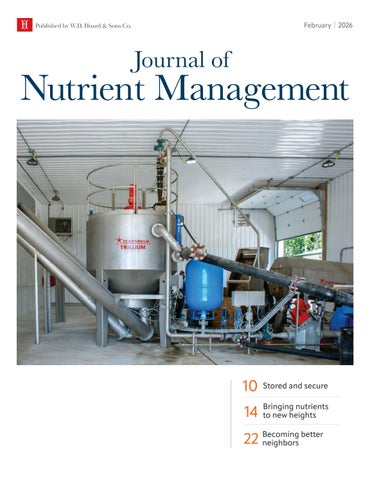
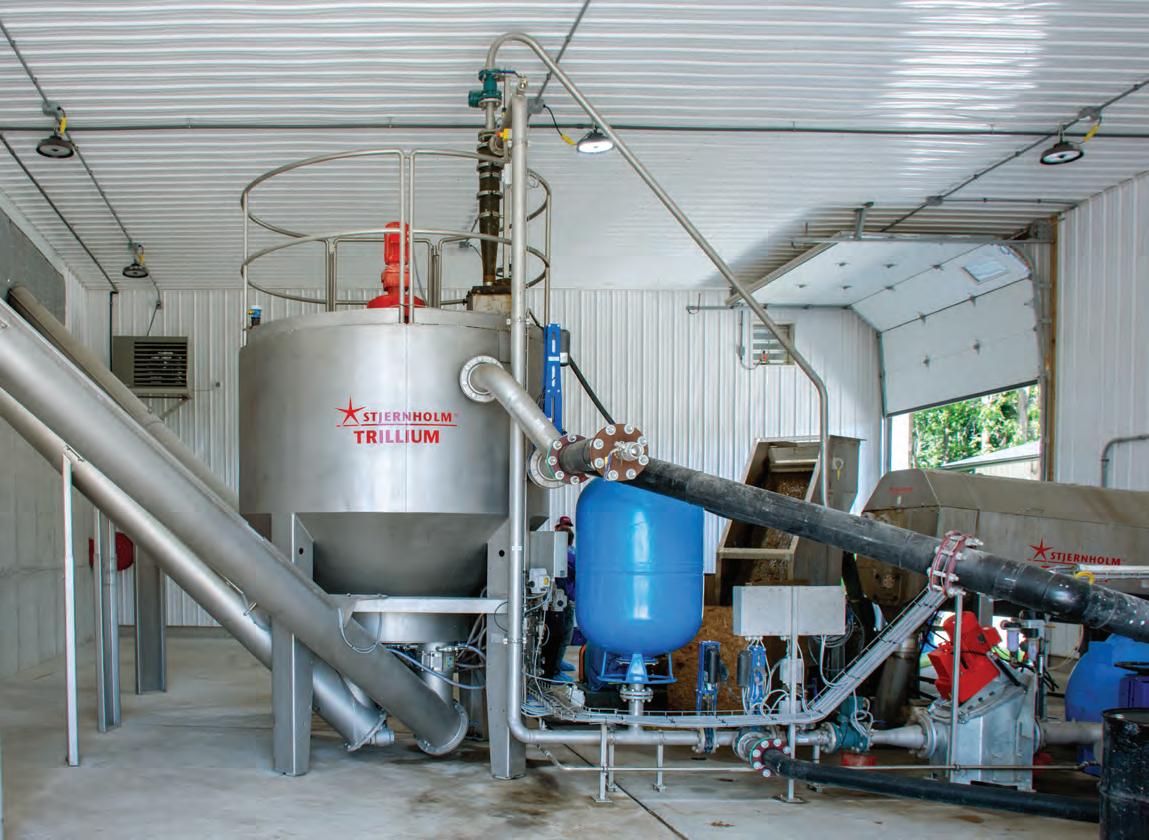
GET THE SAND OUT OF MANURE
EFFECTIVELY MANAGE SAND-LADEN DAIRY MANURE WHETHER YOU HAVE AN ANAEROBIC DIGESTER OR NOT
Why sand?
“Sand is the gold-standard bedding choice because of its cow health and milk production benefits,” says Renee Schrift, Business Line Director – Agricultural Systems at McLanahan Corporation. “It has so many advantages because it’s a forgiving, drier, comfortable surface for cows, and it’s inorganic, so the stall bacteria load is usually extremely low.”
According to researchers at the University of Wisconsin and USDA, the use of sand bedding compared to manure solids and mattresses results in higher milk production, lower mastitis treatment rates and lower somatic cell count.
Using sand bedding isn’t necessarily difficult, it is simply different to manage than using organic bedding.
Sand bedding is ideal for dairy cows, but it doesn’t always mix well with manure management systems. This is especially true with anaerobic digesters.
However, well-designed, robust sand-manure separation systems are proven to help recycle sand bedding efficiently and economically, enabling users to recoup and recycle the vast majority of sand. Plus, these sand separation systems can also increase anaerobic digestion utilization by virtually eliminating sand from the digester-feeding manure stream.
Here’s how you can create a favorable manure management environment with sand bedding on your dairy farm, even if you don’t have a digester yet.
Physics at work
How do you optimize the benefits of sand bedding while reducing challenges for manure handling systems? Separate and recycle it, of course.
“Success begins with capitalizing on physics, gravity and engineering know-how,” explains Schrift.
Keep in mind:
• Sand is abrasive, so choose equipment designed and proven to withstand the harshness of sand. This means equipment that operates at low speeds and is constructed using wear-resistant materials like abrasion-resistant steel plate or rubber. Components in high-wear situations must either be harder than sand grains or resilient enough to deflect without deforming.
• Secondly, sand is more than twice as dense as manure and therefore settles, making sand separation a realistic proposition.
“In fact, our systems can capture 95% of sand for recycling while removing an additional 3% of fines from manure,” Schrift adds.
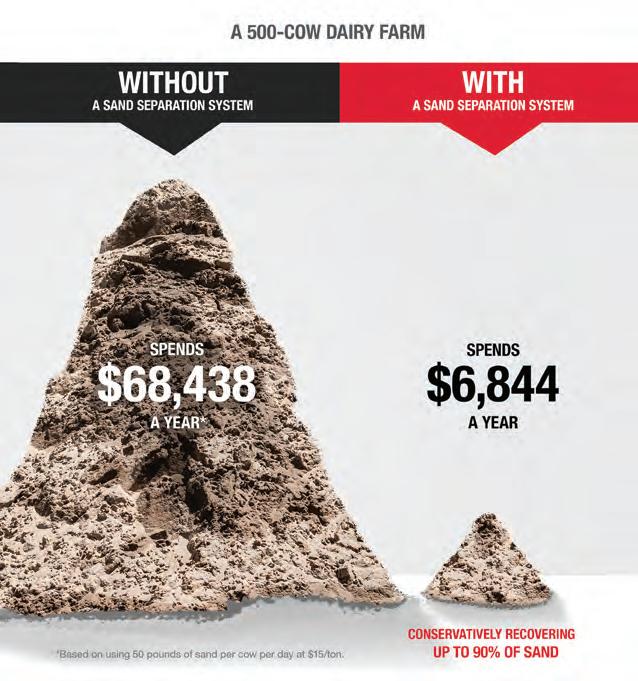
As a result, dairies that recycle sand can cut their bedding cost significantly. For example, a 500-cow dairy using 50 pounds of sand per cow per day at $15 a ton spends $68,438 a year on sand. With a sand separation system that conservatively recovers up to 90% of sand for reuse, the dairy can save $61,594 a year by recycling their sand bedding.
These figures demonstrate that with a well-designed sand-manure separation system, high sand recovery is possible and economically beneficial for herds of all sizes.
What about digesters?
Since sand separation technology can virtually remove most sand from manure, these systems go hand-in-hand with anaerobic digesters.
Without separation beforehand, sand bedding is incompatible with anaerobic digestion systems.
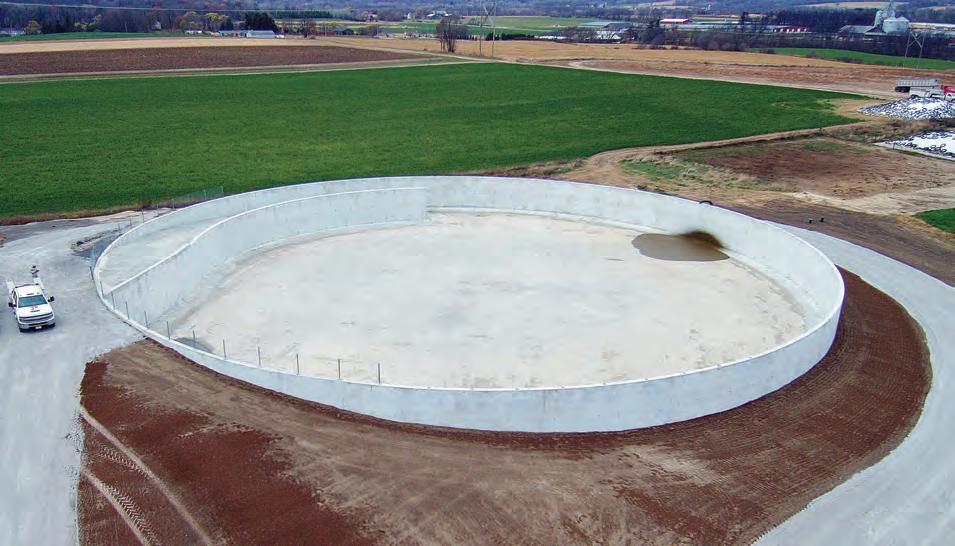
With sand-manure separation, sand can be recycled for reuse as freestall bedding, and the manure effluent can be anaerobically digested for optimal digester efficiency and gas production.
The key is to collaborate with your partners to design the best system to fit your needs. Also, every farm is managed differently, so it’s important to determine the total solids in manure effluent, knowing there may be seasonal fluctuations.
“Be sure to choose an anaerobic digester partner who can design and build a digester to suit the way you manage your dairy, taking into consideration first and foremost what is best for the cows,” suggests Schrift.
Ultimately, effective sand recycling helps improve a dairy’s bottom line, whether you invest in a digester for your system or not.
Managing Editor
Abby Bauer
Art Director
Todd Garrett
Editorial Coordinator
Jennifer Yurs
Director of Marketing
John Mansavage
Digital Marketing
Sam Rasmussen
Sidney Hebbe
Advertising Sales
Beth Gierke bgierke@nutrientmgmt.com
Advertising Coordinator Patti Kressin pkressin@hoards.com
Publisher W.D. Hoard & Sons Co. Brian V. Knox, President
CONTACT INFORMATION
Editorial Office PO Box 801 28 Milwaukee Ave. West Fort Atkinson, WI 53538
Website: www.jofnm.com Email: info@jofnm.com Phone: 920-563-5551
Journal of Nutrient Management (ISSN# 2690-2516) is published four times annually in February, May, August, and November by W.D. Hoard & Sons Company, 28 Milwaukee Ave. West, Fort Atkinson, Wisconsin 53538 Tel: 920-563-5551. Email: info@jofnm.com Website: www.jofnm.com. Postmaster: Send address corrections to: Journal of Nutrient Management, PO Box 801, Fort Atkinson, Wisconsin 53538-0801. Tel: 920-563-5551. Email: info@jofnm.com. Subscription Rates: Free and controlled circulation to qualified subscribers. For Subscriber Services contact: Journal of Nutrient Management, PO Box 801, Fort Atkinson, Wisconsin 53538, call 920-5635551, Email: info@jofnm.com.
Copyright © 2026 W.D. Hoard & Sons Company. ALL RIGHTS RESERVED. Content may not be reproduced or used for any commercial activity without express written consent from W. D. Hoard & Sons Company.

Abby Bauer Managing Editor
Making space
like to save things. Souvenirs from trips. Notes from family and friends. Items that may be useful someday. I find it hard to part with objects that have sentimental value.
I also love taking and saving photographs. Now that most of us have a phone camera in our pocket nearly all the time, it’s easy to snap a picture whenever the opportunity arises. But with this habit of taking and collecting photos, I eventually found myself at maximum phone storage capacity.
I knew there were solutions to this problem, but instead, I limped along for quite a while, deleting a few apps here or a group of photos there. I was generally able to make room for the things I needed to, but it was not an efficient way to manage space.
When it came time to upgrade my phone, I got one with more storage capacity. I also finally took the time to connect to an online storage system to help hold onto these photo memories. Suddenly, I wasn’t scrambling to make room little by little. It was freeing to no longer be functioning at near capacity!
At a recent nutrient management conference, a dairy producer shared that one of the best moves their farm ever made was to build almost a year’s worth of manure storage. It gives them the flexibility to apply nutrients when they want to and not when they have to. He admitted that it was difficult to make an investment in something so expensive that doesn’t directly generate income, but it was necessary for them to achieve their nutrient application goals.
While many farms probably wish for ample manure storage, it is not always feasible. So, they must pursue other options, be it more frequent emptying or adding features like water collection or sand separation to reduce the volume going into the storage structure. It’s also important to have a plan in place for what can be done if storage nears full capacity.
This makes me think of basements or attics that tend to get filled with boxes and totes from each chapter of life. When that space gets close to overflowing, there are two options. A person can
chip away at the project, pulling out a few boxes at a time to make room for new items, or they can do a major overhaul by sorting, cleaning, and rearranging the space. I guess a third option is to rent a storage unit – but that is an additional expense and likely just pushes the need to organize down the road.
This issue of the magazine has a bit of a manure storage theme to it, but there are plenty of areas on our farms and in our homes that can get too full. Maybe even harder to manage are the less tactical pieces of life. How often have you wished there were more than 24 hours in a day to get things done? When you are pulled in multiple directions, how do you decide what to do first? I like the philosophy of farmer Josh Waddell, whose manure system is featured on page 18. He looks for ways to improve the daily tasks on his farm to save time, and he encourages others to do the same. Time saved in one area of the farm can be delegated to another area, or maybe even better, could provide a few minutes for personal tasks or rest.
As I write about storage and capacity, I even think about the space in our brains. It can be difficult at times to clear enough space in our minds to focus on the task in front of us or make a big decision. But when our minds are jumbled and full of thoughts, even little projects seem more daunting. Much like we would manage a full barn or manure storage, we must find ways to organize our thoughts, make room for the important stuff, and let go of the things we don’t need or can’t change. It’s not easy, but if we don’t make room, eventually we’re dealing with an overflow situation.
Thank you for making time to read this issue of the Journal of Nutrient Management. I hope 2026 brings the space you need in your mind, your day, your home, and your manure storage.
Until next time,
Abby

Let us know your thoughts. Write Managing Editor Abby Bauer, 28 Milwaukee Ave. West, P.O. Box 801, Fort Atkinson, WI 53538; call: 920-563-5551; or email: info@jofnm.com.
POLICY WATCH
UNITED STATES
A coalition of 34 organizations filed a petition asking that anaerobic digesters be ineligible for grants and loans under the Rural Energy for America Program (REAP), which is designed to help farmers and rural small businesses boost energy independence, reduce energy costs, and provide environmental benefits. The coalition claims that digesters are “a harmful and inefficient use of taxpayer dollars.”
The Renewable Natural Gas Coalition said in a statement that the petition is without merit and unlikely to succeed because digesters create revenue and fertilizer for farmers.
SOUTH DAKOTA
The South Dakota Senate passed legislation that would raise fees on concentrated animal feeding operations (CAFO) for the second time in two years. Fees would jump from 17.2 cents to 43 cents for dairy cows; from 12 cents to 30 cents for other cattle; from 4.8 cents to 12 cents for hogs; and from 11 cents to 27 cents per chicken.
The state’s CAFO program ran for 28 years under the original pay structure of $250 for operations with 2,000 or more animal units; $175 for 1,000 to 1,999 animal units; and $100 for less than 1,000 animal units. Then, in 2025, the state’s Department of Agriculture and Natural Resources sought legislation that led to a series of three fee increases over three years.
The new fees proposed this year are more than what was originally established for the second year of the plan but less than what the third year of increases would have been. As of late January, the measure had moved onto the House of Representatives for consideration.
MICHIGAN
Michigan Farm Bureau, several agricultural organizations, and 163 livestock farms filed an appeal to the Ingham County Circuit Court against more stringent CAFO regulations. The appeal contests a Department of Environment, Great Lakes, and Energy (EGLE) ruling that reversed an administrative law judge’s opinion and reinstated many permit conditions that had been struck down.
The stricter regulations include costly buffer requirements, lower phosphorus application limits for point-source discharges, and winter manure transfer and application restrictions. This situation has been brewing since 2020 when EGLE issued a new CAFO permit that was more complex and burdensome for livestock operators.
UNITED STATES
USDA’s APHIS will make up to $100 million available as part the New World Screwworm Grand Challenge to support projects that enhance sterile New World screwworm fly production, strengthen response strategies, and safeguard U.S. agriculture, animal health, and trade. Applications are due Feb. 23.


Nonagricultural land: A SINK OR A SOURCE?
Conservation planning goes beyond farmland, and edge-of-field data shows which areas lose nutrients and which ones absorb them.
by Sheri Schwert
To evaluate how land use and agricultural management affect water quality, Discovery Farms — a farmer-led research collaborative within the University of Wisconsin-Madison Division of Extension — performed research on varying management systems in two western Wisconsin watersheds. Soil and nutrient runoff was measured via monitoring at field edges — the physical, complex interfaces between agricultural lands and surface waters.
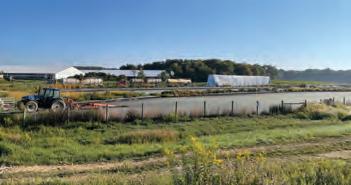
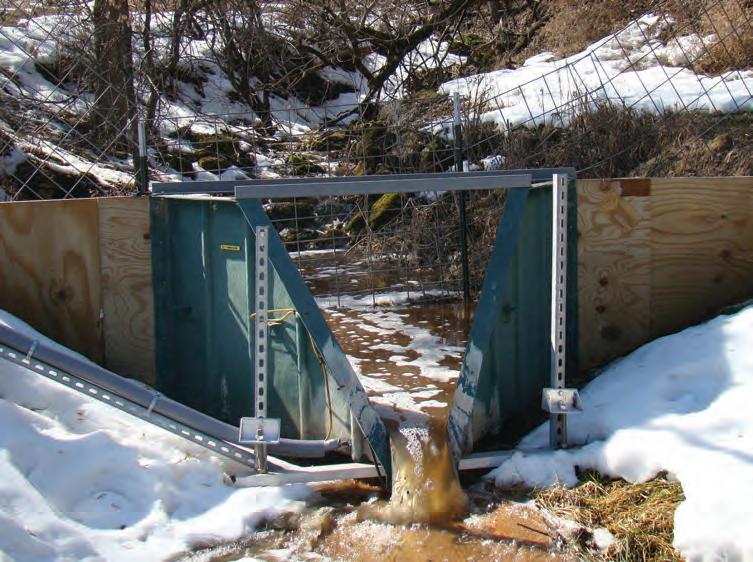
Our main goal was to better understand how agricultural land management decisions affect soil and nutrient runoff. We were also interested in how the runoff from agricultural land broadly compares to runoff from other land uses, like a wooded ravine and a Conservation Reserve Program (CRP) field, so we included edge of field monitoring stations at sites JV3 and DR3, as shown in the photos.
Two different areas
The steep, wooded ravine or gully included in our monitoring (JV3) received its runoff from a permanent pasture (JV2) in the Jersey Valley watershed in southwestern Wisconsin, which was also monitored as part of the project. Here, cattle are grazed on the fields from the end of June until September.
We wondered whether this part of the landscape is a source of nutrients, meaning that it produces more than it absorbs, or a sink of nutrients that absorbs more than it produces. We determined whether the gully was a source or sink by calculating the dif-
ference in the nutrients, runoff, and soil loss between the site at the top of the ravine, JV2, and the bottom of the ravine, JV3.
The grass field (DR3) has been enrolled in CRP for more than 10 years, and it lies in the dry run watershed in northwestern Wisconsin. The soil test phosphorus at the site was over 35 ppm.
What we found
Some of the most interesting observations we made are shown in the figures. Keep in mind that these observations
only reflect single sites. Therefore, we can’t draw scientifically significant conclusions from them.
More total phosphorus, dissolved phosphorus, total nitrogen, and runoff entered the top of the gully (Site JV2) than left the bottom during six of seven years. This particular gully area is usually a form of water quality protection for the stream below. However, during a large storm in July 2017, the gully became a source of total phosphorus and nitrogen, dissolved phosphorus, and runoff. During the July 2017 storm,
Runoff from a permanent pasture flows to this steep, wooded ravine. Areas like these are often overlooked when farms are surveyed for water quality risks.
Annual measured parameters from the bottom of the ravine (JV3), with the annual amounts from the JV2 site subtracted. Years where the bar is toward the left (representing a negative amount) are years where the gully took in runoff, soil, and nutrients from the pasture and absorbed them.
22,000 pounds of soil washed out of the gully, which equates to 75% of the soil loss measured at JV3 during the entire seven-year study period.
Wooded ravines like JV3 dot the landscape of southwest Wisconsin. They are often overlooked when surveying a farm for water quality risks or areas for improvement. By practicing reduced tillage, year-round cover, and careful manure timing, you can manage both a field or pasture, like JV2, and a wooded ravine by taking a proactive approach to reduce the nutrients, soil, and runoff that enter the ravine. This lowers the chances that the soils in the ravine will build up nutrients over time and then release them when heavy rain causes an erosion event.
Losses were not zero
At the CRP field (DR3), a site that has had constant grass cover and no nutrient applications for over 10 years, losses were low but not zero. Low runoff and low- to mid-nutrient concentrations resulted in low annual nutrient losses. The site experienced less runoff than other Discovery Farms edge-of-field sites. Nitrogen and soil concentrations were also lower than at other surface
continued on following page >>>
THE INNOVATIVE BIOSELECT FOR EFFICIENT MANURE SEPARATION.
FEATURES:
+ Low Life-Cycle Costs
+ Turnkey from a Single Source: Separator Pump(s)
Control Unit
Stationary or Mobile Skids
+ Large Capacities
+ Patented Profile Auger with Counter Bearing for No Auger Screen Contact
+ Continuously Variable Dry Matter Content
844-647-7867 | www.boerger.com

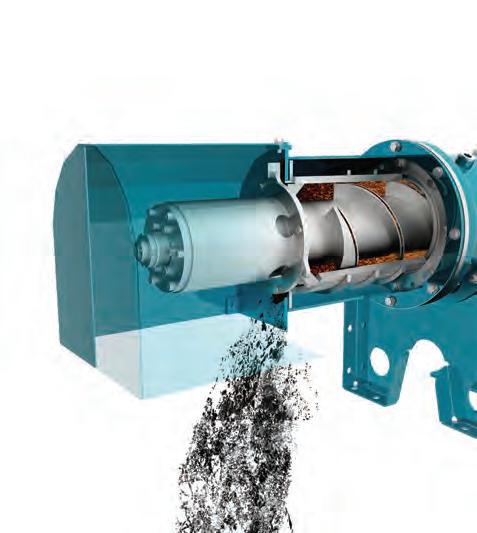
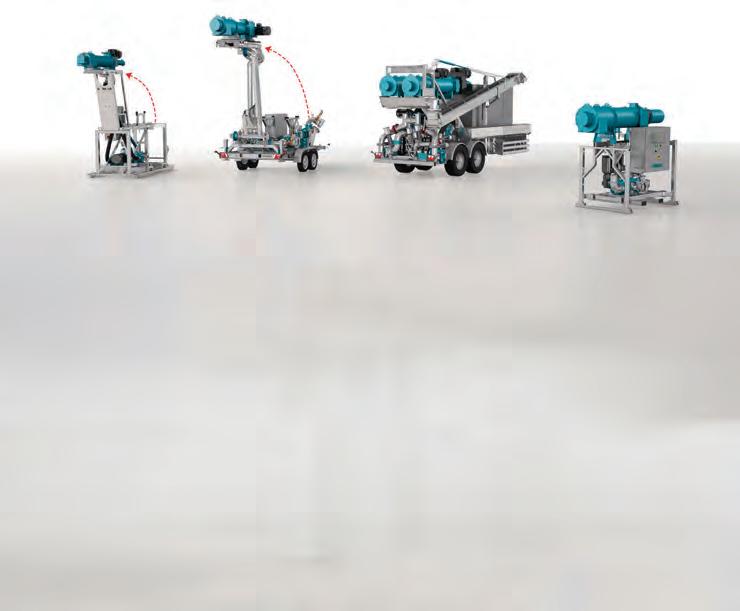
Figure 1. Gully transport assessment: annual sink or source
sites. While phosphorus concentrations in the runoff were similar to agricultural sites, the low runoff volume means that the annual cumulative phosphorus losses were lower than agricultural sites.
Expand conservation planning
Both of these nonagriculture sites produced runoff and were sources of soil and nutrients; losses were not zero. In the case of the ravine, we know that runoff containing soil and nutrients entered the ravine from a pasture uphill. The field in CRP received no inputs but has high phosphorus levels. The CRP field illustrates that even a field without crops, nutrient application, or agriculture activity of any kind can still have runoff and nutrient losses, though they are lower than agriculture sites. Phosphorus in particular remains high in the field and can be lost through runoff, suggesting that a goal of zero phosphorus loss for any system is likely impossible.
However, both sites also acted as water quality protection in one way or another. The CRP land produced fewer nutrients and soil than the ag land sites in the watershed, and the ravine took in more nutrients than it released for most of the years. This supports advocacy for adding or improving non-ag lands as part of a conservation program on a farm to improve water quality protection.
Where cropland and non-cropland meet is the last line of defense to protect against soil loss. At the top of a wooded ravine like JV3, erosion can create a gully head and begin to erode fields. Areas that transition to or from wooded ravines often need large, well-defined waterways or grade stabilization structures to slow water and capture soil.
Soil loss risks should be evaluated for all land, not just cropland. Including these areas when doing a field walkover, such as described in the Discovery Farms Field Walkover Guide at bit.ly/conservationtool, provides a more accurate picture of nutrient loss risks and helps prioritize the next steps in nutrient management.

The
Figure 2. Annual nutrient losses at the CRP site compared to other sites
Figure 3. Annual surface runoff at the CRP site compared to other sites
WILL CONSUMERS BUY LOW-METHANE BEEF?
Feed additives that lower enteric methane production in cattle have been identified as one method for reducing methane emissions from livestock operations. If these feed additives become more readily available in the U.S., their use may be more widespread. And if consumers would pay a premium for beef produced by cattle fed these additives, dairy and livestock producers may be able to recoup some of their costs. However, will shoppers pick such a product off the shelf?
That question led Kelly Davidson, an assistant professor of applied economics at the University of Delaware, and her collaborators to study consumers’ beef buying habits. She shared results from their study during the University of California, Davis’ State of the Science Summit.
The study included four beef options:
1. Beef from cattle fed a supplement produced from freeze-dried seaweed.
2. Beef from cattle fed a supplement containing the compound 3-nitroxyypropanol (3-NOP).
3. Beef from cattle fed an essential oil supplement produced from a blend of garlic with citrus extracts.
4. Beef from conventionally fed cattle.
The researchers wanted to see which type of beef the consumers gravitated to and if purchasing behavior changed when they had more information on hand. They wondered if ground beef shoppers could be influenced by “nudges,” or subtle cues that influence behavior. An example of a nudge is placing recycling bins by trash bins to encourage people to recycle more.
The randomized experiment included more than 3,000 participants in eight treatment groups. The control group received no information prior to the study. Some groups received information about climate change and agriculture’s role in greenhouse gas emissions.

Some groups also saw point-of-purchase labeling. These labels highlighted what additive was fed and its methane-reducing potential.
The researchers were also curious about price sensitivity and if shoppers would be willing to pay more for certain products. To accomplish this, pricing varied for the different groups.
There was a clear winner among shoppers who were not given background information about methane emissions. “Conventional ground beef was very much preferred when information was not at play,” Davidson noted. Without prepurchase information, 62% of shoppers chose the conventional beef.
When consumers had more information prior to making their purchases, seaweed was the additive of choice. Davidson said it made sense that shoppers would lean toward the product that had the most methane-reducing potential listed on the label. With prepurchase information and pointof-purchase labeling, 30% of shoppers
chose conventional beef while seaweed-fed beef gained market share potential. Davidson noted that in either case, there was little demand for the essential oil and 3-NOP beef.
What could the beef industry do with this information?
Davidson suggested that the livestock industry support commercial seaweed production, as supply chain issues are one barrier the product faces. Her other recommendation focused on marketing.
“Communication is key, and information is key,” Davidson said. She sees potential in a marketing campaign centered around methane emissions and reduction methods that don’t paint beef in a bad light.
Davidson grew up on a cattle ranch, so she understands agriculture and also knows the benefits meat brings to a healthy diet. “We have to get away from the message that not eating beef is the answer. There are other solutions out there,” she concluded.
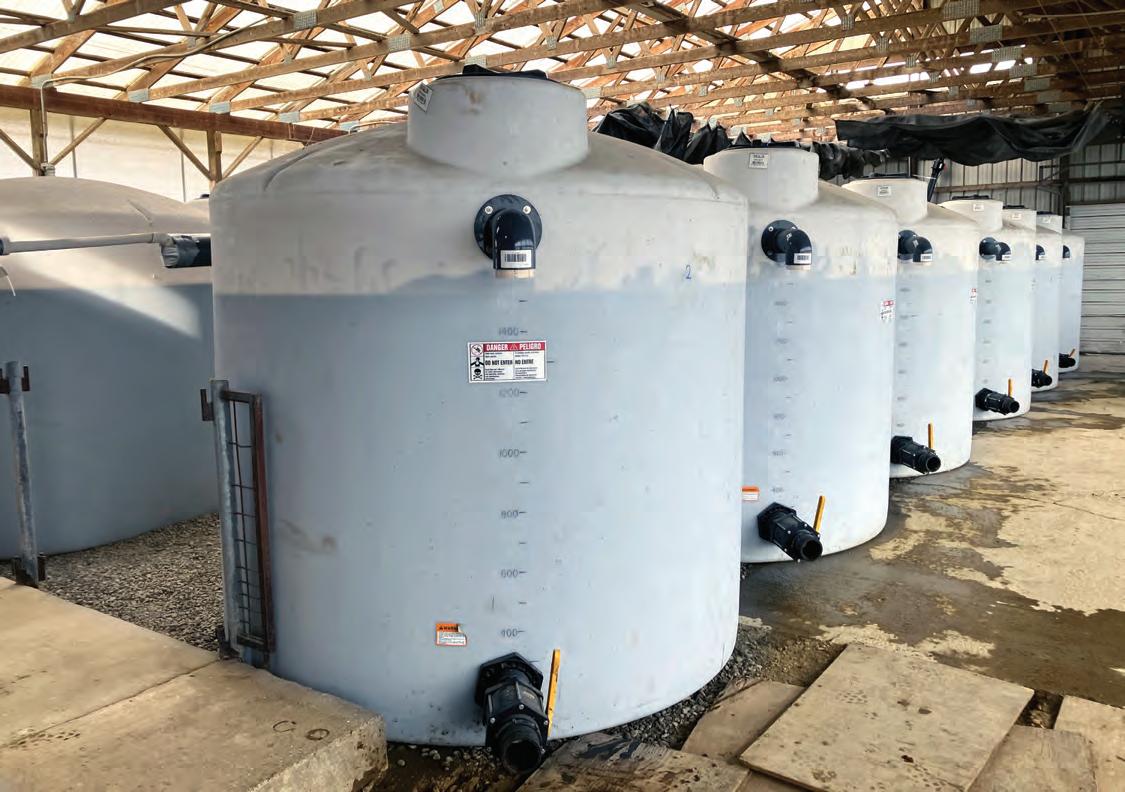
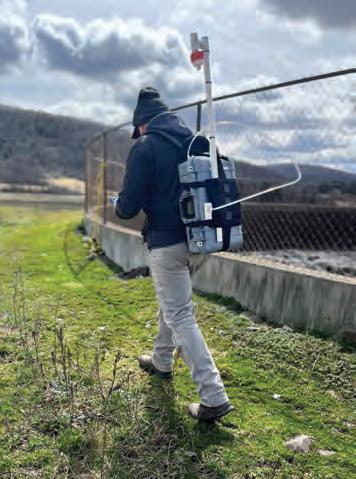
These manure mesocosms are 2,000-gallon pilot-scale manure storages with controlled ventilation and continuous emissions monitoring.
Stored and secure
With innovative solutions, we can ensure that on-farm manure storages protect water quality and minimize air quality impacts.
by Jason Oliver
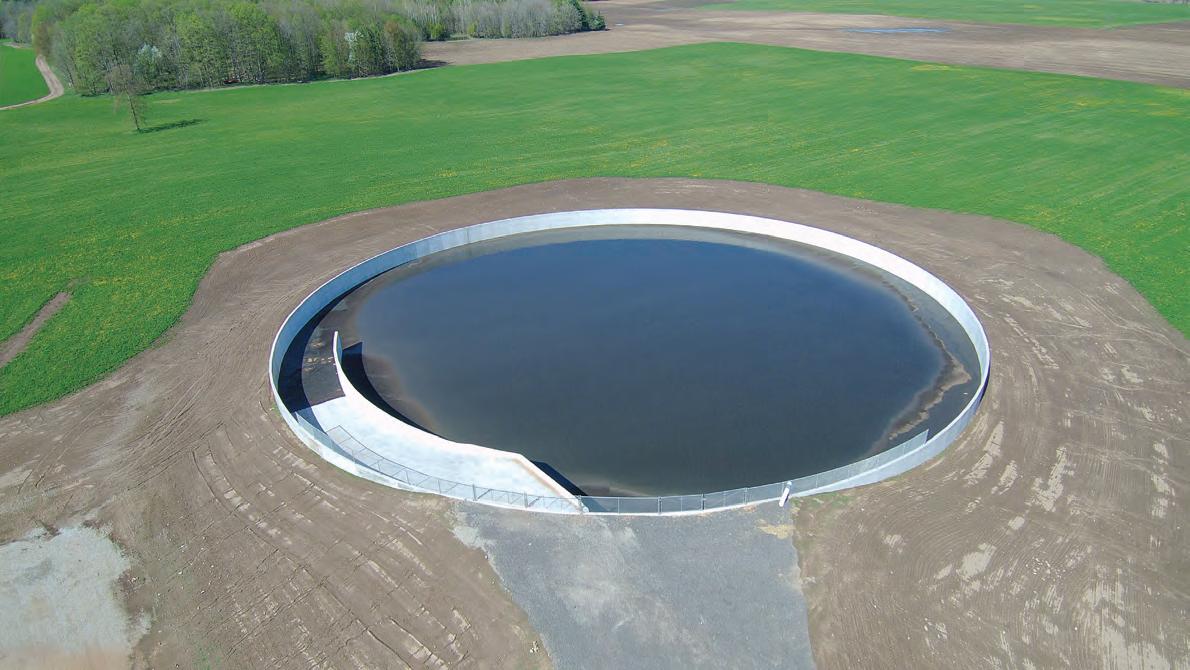
Manure storages are a livestock farm’s best option for protecting water quality. This allows manure to be safely stored during the nongrowing season and when soil conditions are not suitable for manure application.
Storing manure slurry under anaerobic (no oxygen) conditions, however, has resulted in unintended emissions that impact the environment. Inventories estimate that manure storages may emit over 30% of all dairy farm methane emissions. Methane is an important greenhouse gas that the dairy industry
and global milk buyers are committed to reducing.
Dairy manure is also a substantial source of ammonia emissions, with dairy production representing roughly 22% of all U.S. agricultural ammonia emissions. Ammonia, a reactive form of nitrogen, is a respiratory irritant that
impacts animal health and productivity and can directly lead to the creation of particulate matter and smog. It can also be deposited regionally on land and in waterways, causing nutrient pollution and eutrophication. It may even indirectly lead to the formation of the potent greenhouse gas nitrous oxide.
Local numbers are needed
To meet the agriculture industry’s commitment to lower these emissions, regionally specific farm-level measure -
Photo credit: Jason Oliver
ments that represent modern production practices are needed. These data are required to both improve emissions inventories and quantify the ability of manure treatment technologies to reduce these emissions. They will then help target efforts and programs to incentivize the adoption of practices that effectively reduce emissions.
For the past 30 months, the Cornell PRO-DAIRY Dairy Environmental Sys tems team has been monitoring emis sions at more than a dozen dairy farms in New York that utilize a range of manure treatments. This has been accomplished with a mobile measurement approach that integrates data from backpack gas analyzers, on-site wind data, and GPS to estimate emissions flux.
So far, we can report that measured emissions do generally track modeled emissions with similar magnitudes, although methane models may be over estimating emissions during the grow ing season and underestimating them during the winter months (see figure). While emissions patterns are generally similar across farms, some individual measurements can substantially devi ate from predicted emissions. We are also intrigued by measurements that show some manure management prac tices and treatments clearly impact manure storage emission levels.
Improvements after processing
Our study includes farms operating solid and liquid separation systems with and without anaerobic digesters. Both technologies are capable of sub stantial methane emission reductions, and our data is corroborating this. A screw press that can separate 45% of volatile solids (organic matter) from a manure slurry produces lower total sol ids manure with a near-proportional reduction in methane emissions.
Similarly for anaerobic digestion, where volatile solids are intentionally converted to methane in-vessel, the post-digested manure has less meth ane generation potential as it sits in storage. Unlike methane, whether ammonia emissions are impacted by these manure treatments has not been thoroughly studied.
Our preliminary data suggest many
treatments may raise manure storage ammonia emissions. With separation, the capturing of solids reduces manure storage crust formation, which may allow more ammonia to escape into the atmosphere. And during the anaerobic digestion process, organic nitrogen in manure is converted to ammonium-N,
which may then be readily converted to ammonia and lost to the atmosphere.
Added benefits at a lower cost
At one of our study farms, we observed substantial reductions in methane and ammonia storage emissions (both when modeled and compared with other

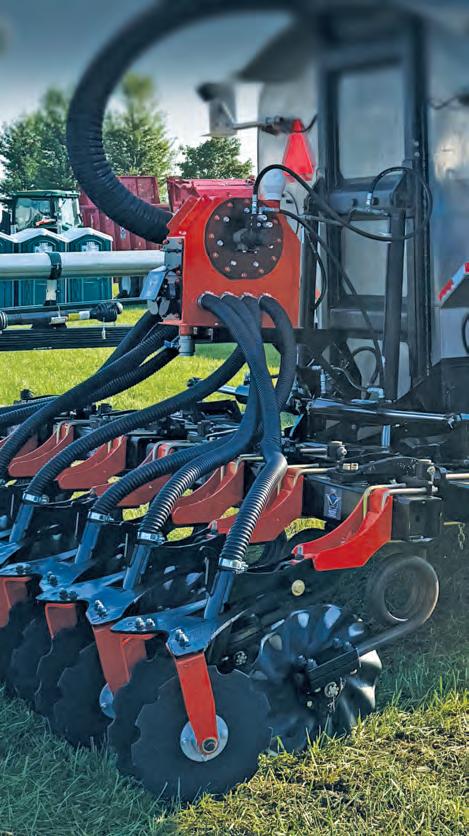
The Original Vertical Till Injection System
WE CATER TO ALL FARMING PRACTICES.
Custom Toolbar Configurations for Tanks and Dragline Systems. Low Volume to 10k+ GPA.


study farms) that we believe may be attributed to their use of manure storage additives. Manure storage additives are products that can be directly added to a manure storage structure and thus offer a potential low-tech, scalable solution for dairy farms seeking to reduce manure emissions.
To investigate the relationship between manure additives and emissions, we have developed standard approaches to test these products, including a manure mesocosm system. Manure mesocosms are 2,000-gallon pilot-scale manure storages with controlled ventilation and continuous emissions monitoring with replication and controls built into the study system.
While few additives have undergone rigorous third-party testing, both data from our early manure mesocosm trials and those that are published in scientific literature suggest some additives can reduce methane and ammonia by upward of 90%. The most promising results seem to be for sulfur-based or acidifying additives that have the clear ability to manipulate the manure storage microbial community structure.
Sulfur-based additives seem to enhance the growth of sulfur-reducing bacteria that directly compete with methanogens (methane generating bacteria). In doing so, they reduce methane emissions. Acidifying manure to a pH
Source: Lauren Ray, Cornell PRO-DAIRY
of 6 or lower both directly inhibits the growth of methanogens and reduces the conversion of ammonium-N to ammonia, retaining the plant available nitrogen in the manure.
Other additives utilize proprietary plant extracts or microbial inoculants. These may also be capable of manipulating manure storage microbial communities in a predictable way to reduce emissions.
We are excited by the prospect of additives as they do not require the costly infrastructure of technologies like separation and digestion. Therefore, they could be deployed on farms of all sizes. However, additional university research is needed to validate the performance of these additives across more manure types and confirm industry performance claims.
Such studies can also reveal any unintended impacts, such as elevated generation of hydrogen sulfide emissions (which are toxic and deadly to animals and humans) or impacts on crop production and yield when these manures are applied post-storage. In doing so, this public research can help identify additives that perform reliably and are economically feasible.
Less to lose
We must also highlight the simplest strategy to minimize manure storage emissions: storing less manure in the
summer. Our data clearly shows that when manure storage volumes are kept low in the summer, methane and ammonia emissions — which are driven by warmer air and manure temperatures — are substantially reduced. Many farms can do this today through careful manure allocation. The development of innovative in-season manure application equipment is making this even easier and allows farms to optimally apply manure nutrients to growing crops that can best utilize them. And, by keeping summer manure inventories low, manure storage capacity is retained for the nongrowing season when it’s needed most.
Expanding options
The broader goal of our research efforts is to find manure treatment solutions that are economically viable and provide multiple benefits to the farm. We believe in the critical importance of manure storage as a way to manage nutrients. Through new innovations, we can simultaneously protect water quality while minimizing the unintended impacts of manure storage on air quality. ■

Monitoring emissions at a concrete manure storage tank.
Photo credit: Angela George
CHECK FOR STRUCTURE STRENGTH
Winter weather can be tough on farmers and the equipment they rely on daily. This includes manure storage structures and pumping equipment that can be affected by snow, melting ice and snow, and freezing temperatures.
“Farmers need to monitor the condition of manure structures as well as all transfer pipes, pumps, and valves to ensure they are performing as expected under unexpected and severe weather conditions,” wrote Sarah Zeiler in a Michigan State University Extension article.
The environmental management educator recommended a regular inspection schedule to check each component of the manure structure and pumping equip-
ment. Frequency of inspection depends on the complexity of the manure management system. Permitted farms are mandated to evaluate manure storage structures and transfer equipment weekly, Zeiler noted, but extreme cold may dictate more frequent inspections. Other farms should still develop a checklist of areas to inspect and set a schedule for regular evaluations.
Snow makes it challenging to evaluate the integrity of earthen or concrete structures. This underscores the importance of year-round inspections so any concerns can be addressed before the winter months. Walk the perimeter of a storage structure regularly to look for weaknesses or ruts in earthen walls where manure could seep out.

Snowmelt or heavy rainfall can tax manure storages. Zeiler encouraged farms to confirm there is enough freeboard space in liquid or slurry structures to handle an influx of precipitation in late winter or early spring.
Do regular maintenance on pumps, agitators, piping, valves, and other mechanical equipment. Equipment in good working order is less at risk for spills and leaks, Zeiler noted. Still, failures can arise. Zeiler advised farms to create an emergency plan in case of an overflow, breach, or leak.
Winter has a way of making everything more difficult. With regular inspections and an emergency plan in place, your farm can be ready to handle those unexpected challenges.



BRINGING NUTRIENTS TO NEW HEIGHTS
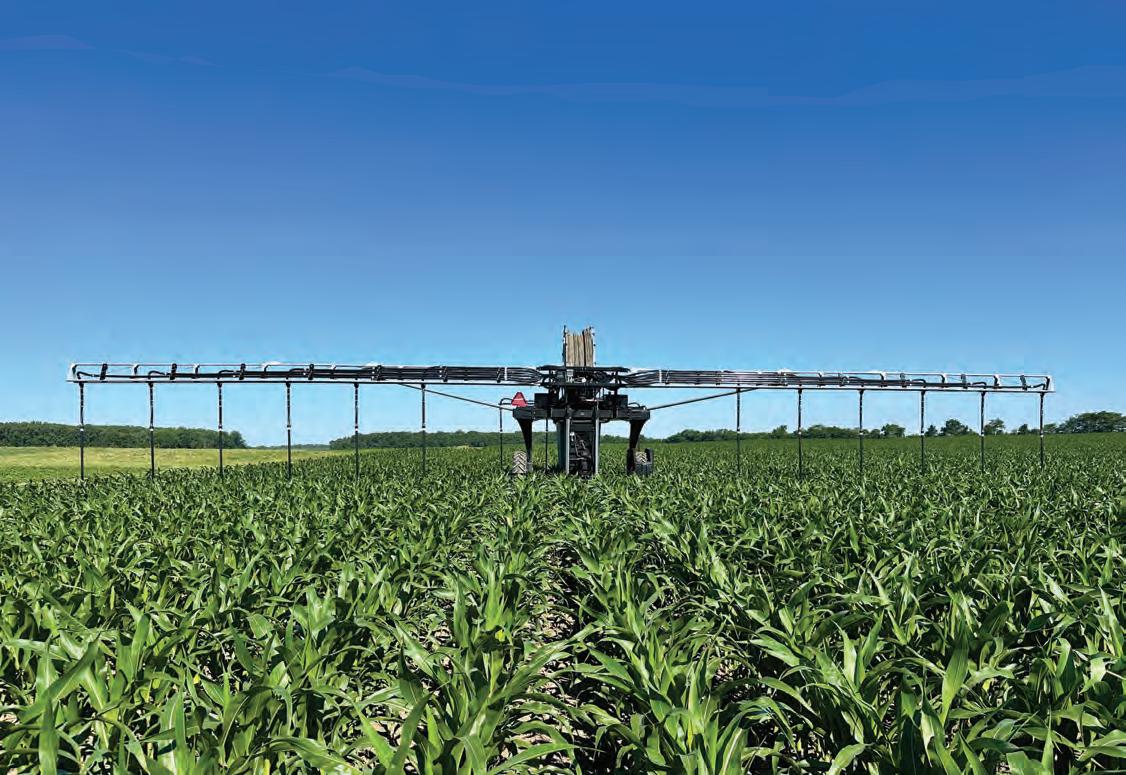
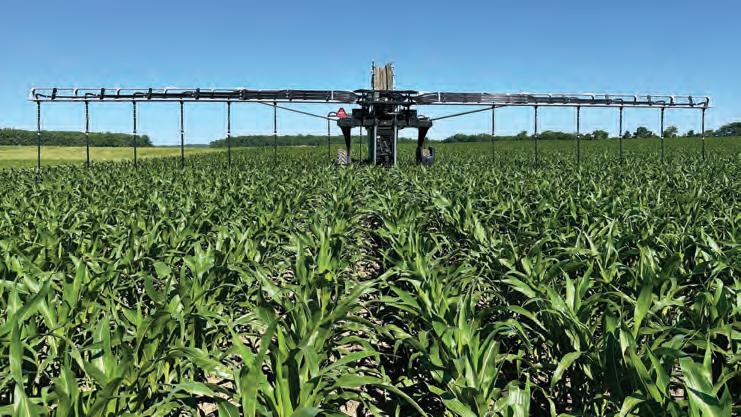
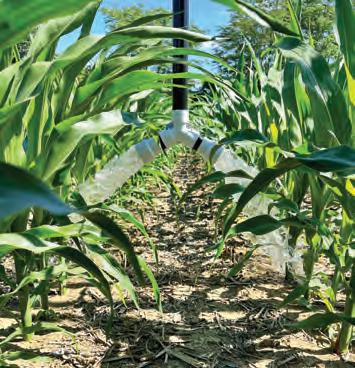
The 360 RAIN Unit, a high‑clearance robotic irrigation system, can apply water and nutrients at any growth stage.
High-clearance robotic irrigation shows potential in improving corn and soybean yields and nutrient use efficiency.
by Andrew Klopfenstein, John Fulton, Elizabeth Hawkins, and Scott Shearer
multi‑year, multi‑state research collaboration is beginning to shed new light on autonomous, high‑clearance robotic irriga tion (HCRI). This could transform nutri ent management, water efficiency, and crop performance for U.S. row crops.
The project was led by The Ohio State University, Iowa State University, and the 360 Yield Center. It details emerg ing findings from field‑scale demon strations using high clearance robotic irrigation designed to time nutrient and water delivery to the base of plants with high precision.
At the heart of the research is the high clearance robotic irrigation system, also known by the trade name 360 RAIN. This is an autonomous machine capable of traveling over standing corn and soy beans, applying water and liquid‑phase nutrients at any growth stage. The proj ect team is evaluating how well in‑season fertilizer delivery, coordinated with crop nutrient uptake curves, reduces nutrient
loss to the environment while improv ing yield and profitability. The study also examines whether strategic irriga tion during critical growth windows can counter climate‑driven water stress.
A new approach
Traditional nutrient application meth ods that apply nutrients to the soil sur face, such as fall or spring broadcast, can leave commercial and animal fer tilizer vulnerable to loss through runoff or leaching. This is even more of a con cern given the increasing intensity and duration of rainfall events common in the Midwest.
The project’s central question was this: What if nutrients were supplied in time to meet plant uptake?
Using replicated strip trials in Ohio and Iowa, researchers compared con ventional fertilizer programs, in‑sea son nutrient delivery, and reduced‑rate programs administered in season. The latter two were accomplished with
high clearance robotic irrigation. These studies also evaluated manure based nutrient leaching in Iowa and phospho rus runoff and tile loss in Ohio.
The project included two major demon stration sites in Ohio. Site 1 is located and conducted in conjunction with Beck’s Hybrids facility located near London, Ohio, which enables water quality and nutrient movement monitoring under contrasting fertilizer strategies. Site 2 is located at the Molly Caren Agricultural Center (MCAC) and is near Site 1.
At Site 2, multiple nitrogen and phos phorus strategies were evaluated in corn and soybean systems. We per formed extensive soil and plant tissue sample collection and analysis sup ported by remote sensing imagery and yield monitoring. Details about each site can be found on page 17.
Results from the first year
At Site 1, Field West 1A was planted to corn for the 2023 cropping season.
There was an 8 bushel per acre difference between irrigated and nonirrigated treatments. Nitrogen was injected into the water stream and applied in-season via high-clearance robotic irrigation. Unfortunately, delivery of the HCRI unit was delayed until July. Therefore, the results from this location from 2023 should be taken lightly as full implementation did not occur until August. Results are presented in Table 2.
In 2023, Field 7 at Site 2 (MCAC) was planted to soybeans. Unfortunately, no high-clearance robotic irrigation work was conducted at this site given planting dates and soybean maturity in August.
Field 8A at MCAC was in corn for the 2023 cropping season. Irrigation had a statistically significant effect on yield over all treatments. Nitrogen had statistical significance from 120 versus 170 and 220 units on nitrogen treatments. The 170 units of nitrogen were the optimal amount of nitrogen for all treatments. Not having the irrigator installed in early June caused there to be less yield in irrigated treatments.
The results of this location from 2023 should also be taken lightly as complete implementation was not done until August. Results can be found in Table 3.
One year later
Site 2 (MCAC Field 7) was planted to corn for the 2024 cropping season. Irrigation had a statistically significant effect on yield over all treatments. There was a 48-bushel-per-acre difference between corn irrigated with twothirds nutrient application versus rainfed (nonirrigated) corn and 44 bushels per acre between irrigated and rain-fed corn for 2024.
In all, 773 gallons of diesel fuel were
used to run the HCRI unit for this trial across 71 acres. A total of 25,700 kWh of electricity was utilized to power the well pump and injection skid, which included the base station for the season. These data will be used to support evaluation of high-clearance robotic irrigation driven nutrient application and irrigation versus traditional crop production and management practices to meet project objectives. See Table 5 for results.
Site 2’s Field 8A was planted to soybeans in 2024. High-clearance robotic irrigation water management had a statistically significant effect on yield over rain-fed. A total of 211 gallons of diesel fuel was used to run the HCRI unit for

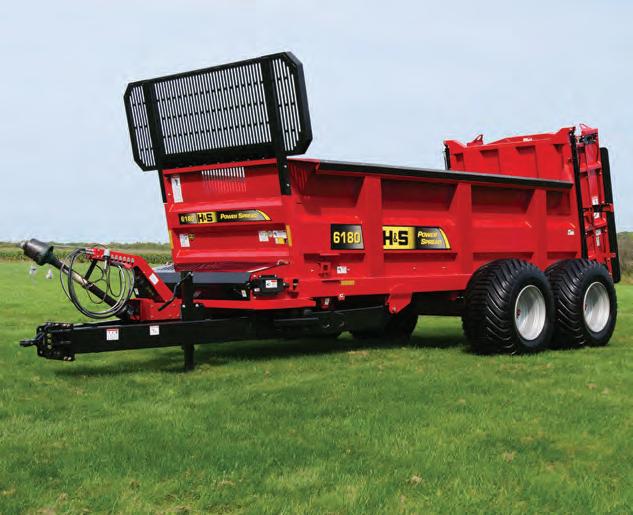

Table 1. Growing season weather summary for 2023
this 2024 trial across 11 acres. Overall, 3,500 kWh of electricity was utilized to power the well pump and injection skid, which included the base station for the season. Details are summarized in Figure 6. Aerial photos of the field clearly showed the strip trial experiment design with the dark green strips resulting from irrigation.
What’s next?
Over the next several months, the study’s investigators will summarize the 2025 results and plan for the 2026 cropping season. The project investigators will expand this study to consider the management of all macro-nutrients along with critical micro-nutrients in both liquid and granular forms. Also noteworthy is the potential that exists for managing animal nutrient sources as is the case for work being conducted by Iowa State University.
High-clearance robotic irrigation, when combined with precision nutrient delivery, has the potential to significantly enhance nutrient use efficiency, reduce nitrogen and phosphorus losses to the environment, improve drought resilience, and boost overall production. This could be a transformative path forward for U.S. cropping systems. ■




Table 2. Yield results for Site 1 for the 2023 cropping season
Table 3. Yield results for Site 2 (Field 8A) location for the 2023 cropping season
Table 4. Growing season weather summary
Treatment means with the same letter are not significantly different according to Fisher’s
Table 6. Yield results for Site 2 (Field 8A) for the 2024 cropping season
Acknowledgments
The work reported in this article was funded through the Natural Resources Conservation Service under the Conservation Innovation Grant program as project NR223A750013G037; and with additional funding from the Ohio Department of Agriculture and H2Ohio Program grant. In addition, the investigators would like to recognize 360 Yield Center, Beck’s Hybrids, Molly Caren Agricultural Center, Rooted Agri Services, Iowa State University, and The Ohio State University for their multi-faceted support of this project.
The authors are with The Ohio State University.
High-clearance robotic irrigation delivers nutrients to the base of the plant.
Table 5. Yield results for Site 2 (Field 7) for the 2024 cropping season
STUDY INFORMATION
Planting date: 5/26/2023
Harvest date: 11/14/2023
Variety: Beck’s 5647Q
Population: 3 4,000 seeds per acre
Acres: 77
Treatments: 2
Reps: 1
Treatment width: Split field
Tillage: Minimum
Management: Fer tilizer, herbicide, insecticide
Previous crop: Soybeans
Row spacing: 3 0 inches
Soil type: Crosby-Lewisburg silt loams, 39% Kokomo silty clay loam, 15% Miamian-Eldean silt loams, 14%
STUDY INFORMATION
Planting date: 5/24/2023
Harvest date: 11/6/2023
Variety: Brevant 13A10AM
Population: 3 4,000 seeds per acre
Acres: 112
Treatments: 6
Reps: 8
Treatment width: 80 feet
Tillage: Strip-till
Management: Fertilizer, fungicide, herbicide, insecticide
Previous crop: Soybeans
Row spacing: 30 inches
Soil type: Crosby-Lewisburg silt loams, 65% Kokomo silty clay loam, 35%
MENSCH ManufacturinG
STUDY INFORMATION
Planting date: 5/2/2024
Harvest dates: 10/21/2024 to 10/23/2024
Hybrid: USA1093GT
Population: 3 5,000 seeds per acre
Acres: 140
Treatments: 3
Reps: 8
Treatment width: 160-foot strips
Tillage: Strip-till Management: Fertilizer, fungicide, herbicide
Previous crop: Soybeans
Row spacing: 30 inches
Soil type: Crosby-Lewisburg silt loams, 63% Kokomo silty clay loam, 37%
STUDY INFORMATION
Planting date: 5/1/2024
Harvest date: 10/8/2024
Variety: Croplan CP3550XF
Population: 135,000 seeds per acre
Acres: 25
Treatments: 2
Reps: 7
Treatment width: 80 feet
Tillage: Vertical Management: Fer tilizer, fungicide, herbicide
Previous crop: Corn
Row spacing: 30 inches
Soil type: Crosby-Lewisburg silt loams, 64% Kokomo silty clay loam, 36%


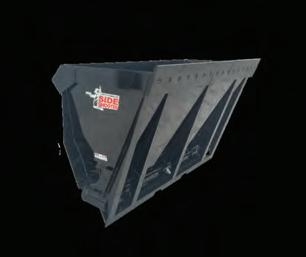
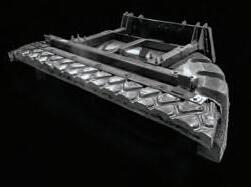
SIDE-SHOOTER BUCKET
Spreads sand or sawdust into freestalls. FLUFFER
Keeps feed close to the cows. Rubber blade outlasts steel blades. Less vibration.
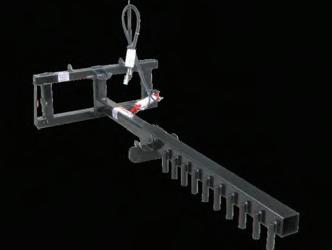
Aerates and levels bedding for maximum cow comfort and safety. FEED ALLEY SCRAPER
EXPANDABLE SCRAPER
Adjusts to the full alley width, reducing the number of passes needed to clean the alley. TIRE SCRAPER
Cleans like a squeegee in just one pass. These rubber tire scrapers are built to last!




Seeking a simpler manure solution
This Pennsylvania dairy farm found a manure handling system that best fit the needs of their operation.
by Abby Bauer, Managing Editor
It’s human nature to be drawn to bright, shiny things, like the newest combine, the biggest baler, or the most up-to-date manure spreader. While those purchases can have tremendous value in getting certain tasks done, the biggest gains on the farm will often come from equipment and practices that influence everyday work.
“It’s those daily tasks, and what you can do to automate them or simplify them, that’s where it’s at,” according to Josh Waddell, who farms with his family in Townville, Penn. “I think that gets forgotten on a lot of dairies.”
He said big investments like machinery may be useful for a few weeks out of the year, but there are jobs on the farm that need to be done all 365 days, and it might not take a lot of money to make them better.
“That’s what I focus on – looking at the simple tasks and trying to make them even more simple,” Waddell said. That doesn’t mean that Waddell shies away from technology. At Apple Shamrock Dairy Farms, an animal monitoring system tracks daily milk weights, detects heats, and identifies sick cows sooner. Feed software is used to make timely adjustments to the rations. Precision technology is used out in the fields for planting and harvesting.
But when it comes to manure management, Waddell and his family were seeking a solution that was less automated and lower maintenance.
When Waddell returned to the dairy after college, his parents, Rob and
Christine, were milking a few hundred cows. With Waddell and his brother, Joe, joining the family business, they continued to grow the Holstein herd to reach its current size of 1,200 head.
Along the way, they added their first sand-bedded freestsall barn. The herd’s cull rate went down immediately, and the Waddells were hooked.
Recognizing the benefits sand brought to their dairy herd, a major requirement of an updated manure handling system was that it must handle sand. But Waddell knew this would create some challenges.
Must handle sand
“Sand makes your manure a nightmare,” Waddell noted during an episode of the Center for Dairy Excellence’s “Cowside Conversations” podcast. So, they had to find a way to remove sand from the manure. The Waddells researched various mechanical systems but determined they didn’t want to deal with a lot of maintenance problems. In
the end, they settled for a simpler system using a sand lane.
First, manure is scraped from the barn alleys three times a day and pushed into a holding pit. Then, sand-laden manure is transferred under the barns using an electric pump and a pipeline.
Perfecting this pipeline took some time, though. “I definitely didn’t get it right the first time,” Waddell admitted. But after some trial and error, they figured it out and can now pump 1,300 gallons of sand-laden manure per minute 1,500 feet to the sand lane.
The underground pipeline replaces the need to truck manure to the sand lane, saving time and labor. Waddell said the pumping system also helps them make better recycled sand, as they have a more consistent flow of manure coming to the sand settling lane.
Tweaking the system
The Waddells were happy with the sand lane and its ability to reclaim sand, but as the herd continued to grow,
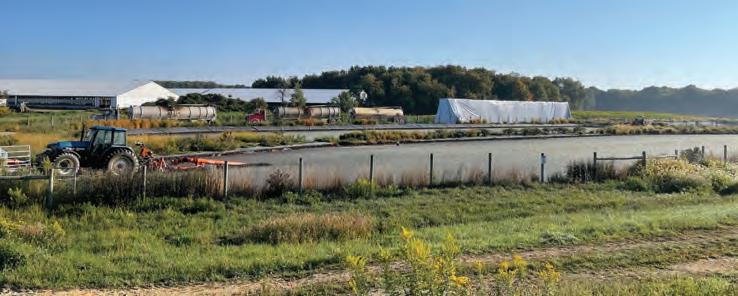
Manure management at Apple Shamrock Dairy Farms includes a sand lane and three-cell pit.
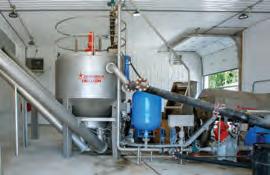
they were not able to move sand and get it ready for the barns fast enough. That led to the installation of a system designed to clean and dewater sand recovered from the sand lane. This includes an inclined auger and a shaker screen, which removes excess moisture and then discharges sand that is ready for stacking on their concrete pad.
With this system, Waddell said they can reclaim a little more sand and stack it in higher piles, saving space and preventing them from needing to expand their pad. The sand is also cleaner and ready to go into the barn faster. This is key to maintaining cow comfort and milk quality. He also praised the system’s durability and ease to use.
From the sand settling lane, manure moves through a three-cell manure pit. The first two cells act as big settling ponds, and by the third cell, most of the remaining sand is removed.
“There’s a lot of functionality to those pits and the way they work,” he said. “It allows us to use sand but not have the nightmare.”
From barn to field
The Waddells do their own manure application. Waddell said the sand lane really extends the life of their manure spreaders, as they are not hauling that heavy, sand-laden manure. “It’s been a game changer to pull out the sand,” he emphasized.
Today, most of the manure produced at Apple Shamrock Farms is injected into the ground, which is their pre ferred method of application. “We find an agronomic advantage to that,” Wad dell said. “It’s a huge fertilizer savings.” He said the practice also helps with public perception. Waddell believes that injecting the manure reduces odor during application by 70%.
“We wouldn’t go back to top spreading any more than we have to,” he said.
The right fit
In the parlor, Waddell emphasizes the need to milk the “right” cows. “Just because your facility is full, it does not mean you have the right cows,” he shared. But with the technology they have in place to monitor the dairy herd, Waddell believes they can really watch their cows,
find the animals that fit their system best, and create replacements accordingly.
On the manure side, it took a few years to build the system, but Waddell feels they have also found the right method for managing that part of the business. “Now that it’s all running, it’s pretty slick,” he said. The system
accomplishes the goal of being modern but not too mechanical, and it works with sand, their bedding of choice. Manure must be handled year-round, and this is one example of how Waddell and Apple Shamrock Dairy Farms found the right solution to simplifying some of those everyday tasks. ■
WE BUILD TANKS
MANURE TIMING MATTERS, ESPECIALLY THIS SEASON
Applying manure in winter can considerably increase phosphorus loss through tile drainage if best management practices are not followed.
by Ehsan Ghane and Sarah Zeiler
Manure is an excellent source of crop nutrients. Applying it at the wrong time, though — especially during winter when tile drainage is more active — can greatly increase phosphorus loss. This poses risks to water quality.
In a six-year Michigan study (2019 to 2024), manure applied in December and January lost 1.1 pounds per acre of total phosphorus, compared to only 0.13 pounds per acre when applied in October and November. Dissolved phosphorus losses were 0.71 pounds per acre in winter versus 0.12 pounds per acre in fall. These losses represent phosphorus from recent manure applications only and do not include legacy phosphorus already present in the soil. This distinction shows the direct impact of winter manure spreading.
There are a few reasons why phosphorus losses are much higher in December and January than in October and November.
1. More tile flow in winter: After dry fall months, winter precipitation restores flow, bypasses dormant vegetation, and carries phosphorus into drains.
2. Freeze-thaw cycles: The southeast Michigan field experienced seven to 10 freeze-thaw cycles per season, often combined with rain-on-snow events, which historically are only three to five cycles. Even when manure was applied on unfrozen, bare ground in winter, the next snowfall froze it in place. During subsequent thawing, snowmelt and rain create tile flow that flushes phosphorus previously locked in frozen soil. Similar observations have been made in Wisconsin.
3. Higher winter application rates: Winter applications averaged 124 pounds per acre of phosphorus, compared to 81 pounds per acre in fall. Even with only 50% more manure applied, winter losses were six to eight times higher because additional drainage flow is the dominant driver of phosphorus loss. There are management practices that can reduce this risk. Spreading manure soon after harvest, when soils are dry, gives phosphorus time to bond with the soil and reduces the risk of leaching. Installation of controlled drainage — structures with weirs or gates — slows down tile flow after manure application, reducing phosphorus loss during the first big flow event. Michigan research shows this practice is more effective at reducing phosphorus loss than conventional free drainage.
As for application, if injection isn’t available, incorporate manure with low-disturbance tillage after surface broadcasting. This mixes manure into the soil, boosting contact with soil and reducing phosphorus loss.
Plan ahead for storage
Manure storage gives farmers flexibility to apply manure at the right time for crop growth, rather than when weather or field conditions are unfavorable. Without adequate storage, farmers may be forced to apply manure during highrisk periods, such as rain or snowmelt, increasing environmental loss. Proper storage improves timing and placement, helping protect water quality. Planning ahead can prevent these risks. Keep in mind that winter weather can affect the integrity of storage structures. Read more on page 13.
Know your requirements
Livestock producers should follow their state and local regulations and best management practices for manure management and utilization. Key winter application practices to consider include:
• Avoid spreading on frozen or snow-covered soils whenever possible. If necessary, apply solid manure on fields with slopes less than or equal to 6% and liquid manure on fields with slopes less than or equal to 3%.
• Use controlled drainage to reduce phosphorus loss.
• Incorporate manure when possible.
• Use conservation practices such as vegetative buffer strips to reduce runoff and erosion.
• Maintain a 150-foot buffer from surface water inlets and concentrated flow areas.
Assess fields using the Manure
Application Risk Index (MARI), which rates sites based on 12 factors, including slope, soil type, phosphorus levels, setbacks, buffer width, and application method. Fields rated Very Low (less than 19) or Low (19 to 37) are best for winter spreading.
Concentrated Animal Feeding Operations (CAFO) must comply with National Pollutant Discharge Elimination System (NPDES) permit rules, including having storage for six months of manure, which generally allows them to avoid winter spreading. For local rules, contact your Natural Resources Conservation Service (NRCS) conservation technician or soil and water conservation district. ■
The authors are a drainage extension specialist and environmental management educator, respectively, with Michigan State University Extension.


PROGRAMS IN ACTION BECOMING BETTER NEIGHBORS
Oklahoma’s poultry industry tried a collaborative approach to address natural resource concerns in expanding production areas.
by Jeri Fleming
To some, the smell of a poultry farm signifies economic opportunity; to others, it represents a lower quality of life. As poultry feeding operations expanded in northeast Oklahoma, many landowners experienced more odor, dust, and visual impacts associated with nearby facilities. These concerns, combined with additional processing capacity in neighboring regions, amplified tensions between growers and their surrounding communities.
Recognizing the need for proactive engagement and practical solutions, the Oklahoma Conservation Commission sought support to help both growers and neighbors address emerging natural resource issues collaboratively.
Seeking solutions
In 2021, the commission received a Resource Conservation Partnership Program (RCPP) grant from the Natural Resources Conservation Service (NRCS) to launch “Neighbors Helping Neighbors: Addressing Challenges Through Voluntary Programs.” The initiative was designed to provide technical and financial assistance to both poultry growers and adjacent landowners to mitigate environmental concerns. The program focuses on implementing practices that address odor, dust, and other natural resource concerns on either the grower’s property or the neighbor’s.
The program’s manager conducted virtual outreach sessions and attended
poultry grower continuing education events to promote available practices and technical support. The commission also sent materials to immediate neighbors of poultry operations in eastern Oklahoma. The team encountered several challenges reaching landowners due to COVID-19 restrictions and avian influenza outbreaks but was eventually able to connect with several landowners and begin implementing solutions.
Making a difference
One program participant, a poultry grower in LeFlore County operating eight poultry houses on 40 acres, faced composting facility limitations and strained neighbor relationships.
He began enhancing the portion of his property along the county road by allowing natural vegetation to grow taller and planted wildflowers to create a landscape buffer. To mitigate dust and odor from exhaust fans, the Oklahoma Department of Forestry developed a tree-planting plan funded by NRCS to improve air movement and reduce impacts on nearby residents.
The grower’s composting area faced additional challenges, including limited space and scavenger attraction. After researching alternatives, he identified thermal dehydration technology used in the southeastern U.S. poultry industry. With support from the program, he worked with the
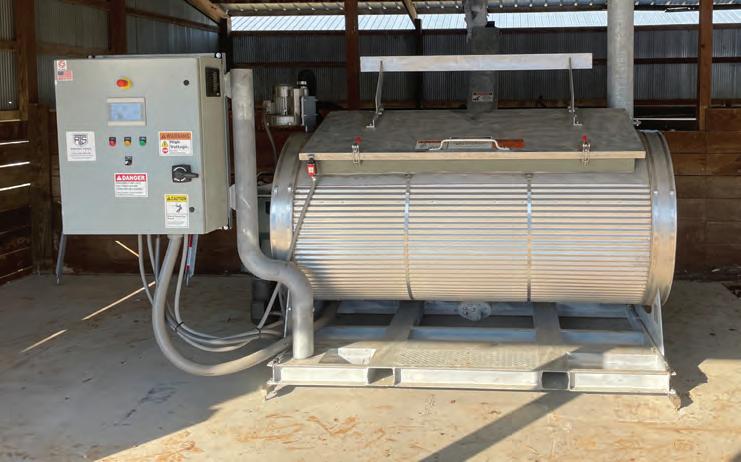
This thermal dehydrator can be used by poultry growers to manage deceased birds.
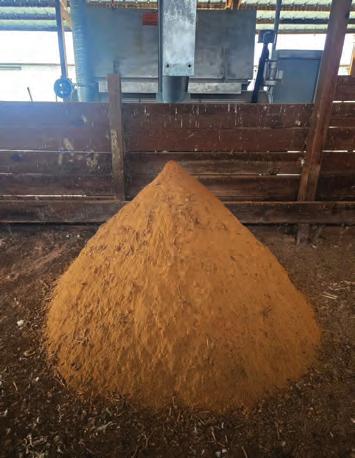
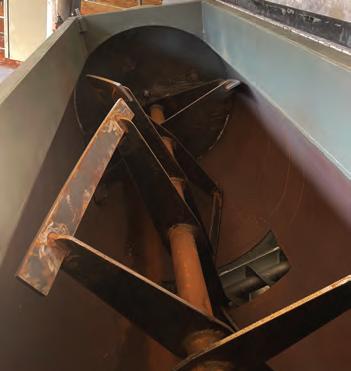
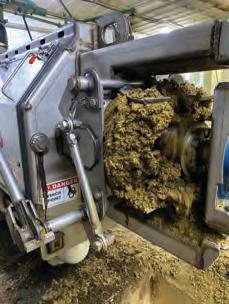
Oklahoma Department of Agriculture, Food and Forestry to obtain a waiver for use. The thermal dehydrator grinds and heats the deceased birds until dehydrated, producing only steam and a sterile, meal-like by-prod-
uct that can be mixed with litter for land application.
The "Neighbors Helping Neighbors" program provided funding for the thermal dehydrator through the local conservation district, and the producer upgraded his composting barn and installed the necessary electrical line to run the equipment. This was the first thermal dehydrator approved for poultry mortality management in Oklahoma, with two additional units now installed in the region. The program demonstrates the effectiveness of voluntary cooperation and innovative practices in addressing natural resource concerns across agricultural communities.

Waste Storage Experts!

After dehydration, the end result is a meallike by-product that can be mixed with litter and applied to fields.
The author is with the Grand River Dam Authority.
The dehydrator also grinds the carcasses.
Covering the uncomfortable
Transition planning includes much more than dividing duties and responsibilities; there are many important topics about the business that must be discussed.
by Megan Dresbach
s my family works to transition the business from one generation to the next, we like to talk with others who are trying to do the same. In my previous column, I discussed how my dad recognized his children’s interest in the business, encouraged our involvement, and gave my siblings and I the option to return to the operation — but it was not a requirement. That was the emotional side of the transition.
The next important steps are the legalities that come with business transition. These are crucial in protecting your family and the business at various stages of the transition process or upon death.
Decisions in writing
If you have assets and/or are married, you need to have a will and life insurance. Do you want to make decisions about your assets and the future for your spouse and family? Or do you want the courts to do it?
If those questions scare you because you haven’t had these legal documents prepared, it should. Please finish reading this article and call an attorney as soon as possible. If you don’t know which lawyer to call, contact your local extension office or local bar association as they may be able to provide a list of agricultural attorneys. Making the initial call can be the hardest step.
These are not fun topics, but they are critical and must be addressed to protect your family and your assets in the ways you want. Pieces of the plan may look different depending on the age of your successors and how far along you
are in the transition process. Documents will need to be updated regularly and accordingly.
If successors are young or not prepared to take the reins, a will may include specifications to sell the business and assets. If successors are in Zone 3 — which means they are adult children who have had the opportunity to have some responsibility in busi-

ness operations — the will may contain information on how the business can be transferred to interested children. I say interested children because fair is not always equal.
The owner or older generation should ensure that someone has the ability to make legal decisions about the assets if that person becomes incapacitated. All parties (older and younger generations) should discuss who has decision making abilities in case of an emergency.
Prepare for the worst
In my previous article, I mentioned how our family is in Zone 3. My father is actively working on transitioning himself out of his job, starting with the official transfer of ownership. My brother, David, and I work on sales. I
do the billing, know the finances in and out, and prepare loan documents as needed. My brother oversees all maintenance and modifications of equipment in the shop. We all work together in the field, and our dad double checks things as needed.
Because the business has evolved, it is going to take both David and me to eventually replace our dad. It would not be pretty, but I am confident David and I can take care of things if he was suddenly no longer here. That’s not something any family wants to think about, but I share this because I believe in our abilities and am proud of how our dad has trained us over the years.
Communication is key
Communication is undoubtedly a foundational piece of a succession plan. Communication is a two-way street with each generation stating their desires and also listening to other perspectives. I admit that sometimes discussions among our family members has been loud, but we talk through all things, and our business keeps moving forward because of it.
Our transition is still a work in progress. We need each other’s skills, experience, and knowledge. And there are still many things we need to learn from each other. For instance, who knows the passwords and where they are kept . . . ?

The author is the vice president of W.D. Farms LLC in Circleville, Ohio, and blogs as the Ohio Manure Gal.
AGRICULTURAL CONCRETE
JP Tank
317 Kohlman Rd. Fond du Lac, WI 54937 920-948-2286
jptankconcrete@gmail.com jptank.com
Pipping Concrete N6106 County Rd. C Rosendale, WI 54974 920-948-9661
dennis@pippingconcrete.com pippingconcrete.com
ANAEROBIC DIGESTER SERVICES
Agricultural Digesters LLC
88 Holland Ln. #302 Williston, VT 05495 802-876-7877
info@AgriculturalDigesters.com AgriculturalDigesters.com
APPAREL
Udder Tech Inc.
2520 151st Ct. W Rosemount, MN 55068 952-461-2894
dana@uddertechinc.com uddertechinc.com
BEDDING SEPARATION
McLanahan 200 Wall Street Hollidaysburg, PA 16648 814-695-9807 sales@mclanahan.com mclanahan.com/solutions/dairy
COATINGS
Industrial Solutions USA 5115 S. Rolling Green Ave. Ste. 211
PROFESSIONAL DIRECTORY
Sioux Falls, SD 57108
605-254-6059
isusananoclear.com
ENVIRONMENTAL SOLUTIONS
Future Enviroassets LLC Cincinnati, OH 45215 513-349-3844
LF@futureenviroassets.com futureenviroassets.com
Hall Associates 23 Evergreen Dr. Georgetown, DE 19947-9484
302-855-0723
hallassociates@mediacombb.net
Tomorrow Water 1225 N. Patt St. Anaheim, CA 92801 714-578-0676 info@bkt21.com tomorrowwater.com
Trident Processes Inc. 10800 Lyndale Ave. S. Bloomington, MN 55420 1-800-799-3740
frank.engel@tridentprocesses.com tridentprocesses.com
FEED ADDITIVES
AB Vista 151 Peters Rd, Ste 2001 Plantation, FL 33324 816-225-0874
Bruce.Hageman@ABVista.com ABVista.com
Natural Biologics P.O. Box 221 Newfield, NY 14867

844-628-2465
celrod@naturalbiologics.com naturalbiologics.com
MANURE SEPARATION Boerger LLC 2860 Water Tower Place Chanhassen, MN 55317 844-647-7867 boerger.com
AL-INS Enterprises LLC 695 Sullivan Drive Fond du Lac, WI 54935 920-238-5460 aaron.kuhls@al-ins.com www.al-ins.com
FAN Separator, a Bauer Group Company 107 Eastwood Rd. Michigan City, IN 46360 1-800-922-8375 bnasales@bauer-at.com bauer-at.com
Saveco North America 1570 St. Paul Ave. Gurnee, IL 60031 815-636-8306 ecsales@ savecowaterna.com savecowaterna.com
MANURE STORAGE
Pit-King®/Agri-King® Inc. 18246 Waller Rd. Fulton, IL 61252 1-800-435-9560 agriking.com/pit-king

PROFESSIONAL DIRECTORY
MANURE TREATMENT
Ag Odor Control LLC
609 8th St. Fort Madison, IA 52627 319-470-5727 WayneMarple@gmail.com www.agodorcontrol.com
WASTE HANDLING EQUIPMENT
Cornell Pump Co. 16261 SE 130th Ave. Clackamas, OR 97015 503-653-0330 cornellpump.com
Doda USA
255 16th St. S. St. James, MN 56081 507-375-5577 dodausa.com
Fort Equipment 3216 Wabash Rd Fort Recovery, OH 45846 567-644-5927 fortequip.com
GEA Farm Technologies Inc.
1 385 N. Weber Road Romeo ville, IL 60446 1-800-563-4685 contact.geadairyfarming.na@gea.com
Mensch Manufacturing LLC
2333 S. M-37 Highway Hastings, MI 49058 269-945-5300 info@menschmfg.com menschmfg.com
Pacific Pumping 8941 Jasmine Lane Lynden, WA 98264 360-815-2171 pacific_pumping@yahoo.com
Puck 1110 100th St. Manning, IA 51455 712-655-9200 jlarson@puck.com puck.com
R Braun Inc.
209 N. 4th Ave. St. Nazianz, WI 54232 920-773-2143 RBrauninc.com
Vertical Till Injector, LLC (VTI) 201 Airport Rd Washington, IA 52353 319-461-5685 info@vtillc.com vtillc.com
WASTE HANDLING SPREADERS
Kuhn North America P.O. Box 167 Brodhead, WI 53520 Kuhn-usa.com
H&S
2608 S Hume Ave. Marshfield, WI 54449 715-387-3414 geninfo@hsmfgco.com hsmfgco.com
New Leader 1330 76th Ave. SW Cedar Rapids, IA 52404 1-800-363-1771 newleader.com
Oxbo International
100 Bean St. Clear Lake, WI 54005 1-800-628-6196 oxbo.com
WATER TECHNOLOGY
Press Technology & Mfg. Inc. 1401 Fotler Street Springfield, OH 45504 937-327-0755
Don’t see your company listed? Send your company information to marketing@jofnm.com with Professional Directory in the subject line.
dberner@presstechnology.com

PLACES TO BE
Minnesota Pork Congress
February 10 and 11, 2026
Mankato, Minn.
Details: mnporkcongress.com
World Ag Expo
February 10 to 12, 2026
Tulare, Calif.
Details: worldagexpo.com
National Farm Machinery Show
February 11 to 14, 2026
Louisville, Ky.
Details: farmmachineryshow.org
Midwest Forage Association/ Wisconsin Custom Operators Symposium
February 16 to 18, 2026
Wisconsin Dells, Wis.
Details: midwestforage.org
Professional Dairy Producers Business Conference
March 4 and 5, 2026
Madison, Wis.
Details: pdpw.org
Conservation Tillage and Technology Conference
March 10 and 11, 2026
Ada, Ohio
Details: fabe.osu.edu/CTCon
World Agri-Tech
Innovation Summit
March 17 and 18, 2026
San Francisco, Calif.
Details: worldagritechusa.com
Central Plains Dairy Expo
March 17 to 19, 2026
Sioux Falls, S.D.
Details: centralplainsdairy.com
California Dairy
Sustainability Summit
March 24, 2026
Visalia, Calif.
Details: cadairysummit.com
Midwest Poultry Federation’s PEAK 2026
April 14 to 16, 2026
Minneapolis, Minn.
Details: midwestpoultry.com
Biogas Americas 2026
May 18 to 21, 2026
Detroit, Mich.
Details: biogasamericas.com
World Pork Expo
June 3 and 4, 2026
Des Moines, Iowa
Details: worldpork.org
If you would like your event included on our list, please send details to info@jofnm.com.

ROFITABILITY:
XPERIENCE:
DVANCEMENT:
NOWLEDGE: