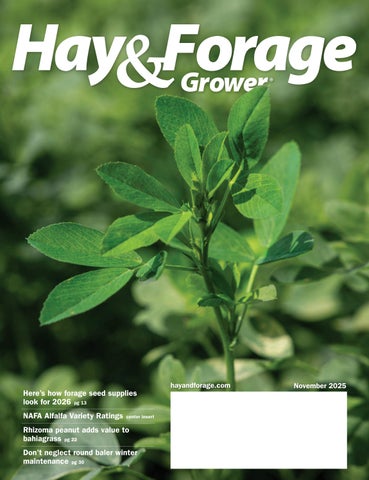
Here’s how forage seed supplies look for 2026 pg 13
hayandforage.com
November 2025
NAFA Alfalfa Variety Ratings center insert Rhizoma peanut adds value to bahiagrass pg 22 Don’t neglect round baler winter maintenance pg 30
F1 1 Nov 2025 Cover.indd 1
10/23/25 9:20 AM
MM 952 & 1092 MERGE MAXX® | Twin Mergers 24' & 30' working widths • center-delivery models
INTRODUCING OUR LATEST MERGER!
TAKE YOUR FORAGE TO THE MAXX! Maximize your hay harvesting efficiency with KUHN’s trailed MM 952 and 1092 Merge Maxx® hay mergers—engineered to meet the demands of high-performance forage operations. With up to 36 feet of working width and flexible center-, side-, or split-delivery options, these machines create uniform windrows that reduce drying time and preserve forage quality. Built for durability and ease of use, they feature hydropneumatic suspension, ISOBUS-compatible controls and enhanced pickup components to ensure smooth crop flow and operator comfort. Whether you're managing a large farm or custom operation, KUHN’s Merge Maxx mergers deliver consistent, high-quality results with every pass. Invest in Quality ® www.kuhn.com
Untitled-1 1
ISOBUS controls enable quick, in-cab adjustments
Center-delivery design offers multiple windrow configurations
Cam-style pickup maximizes forage collection with adjustable speed
Adustable windguard ensures consistent crop flow
Visit our website to locate a Dealer near you!
10/13/25 11:04 AM
Amber M. Friedrichsen
November 2025 · VOL. 40 · No. 6
Published by W.D. Hoard & Sons Co. MANAGING EDITOR Amber M. Friedrichsen SENIOR EDITOR Michael C. Rankin ART DIRECTOR Todd Garrett EDITORIAL COORDINATOR Jennifer L. Yurs DIRECTOR OF MARKETING John R. Mansavage DIGITAL MARKETING
Sam Rasmussen Sidney Hebbe
ADVERTISING SALES
Kim E. Zilverberg kzilverberg@hayandforage.com Jenna Zilverberg jzilverberg@hayandforage.com
6
ADVERTISING COORDINATOR
Patti J. Kressin pkressin@hayandforage.com
His goal: Make hay for the fun of it Chad Gargas thoroughly enjoys making hay in northwest Ohio. The fifth-generation farmer learned the ropes of production and marketing and has long-term goals for the family business.
W.D. HOARD & SONS
PRESIDENT Brian V. Knox
EDITORIAL OFFICE
28 Milwaukee Ave., West, Fort Atkinson, WI, 53538 WEBSITE www.hayandforage.com EMAIL info@hayandforage.com PHONE 920-563-5551
DEPARTMENTS 4 First Cut 10 Beef Feedbunk 12 Dairy Feedbunk
16
28
Grass seed and girl power
Grazing heifers grow slowly but surely
These teenagers already have years of experience in the forage industry under their belts.
14 Alfalfa Checkoff 19 Sunrise On Soil
Greater pasture utilization on dairy farms could be a solution for lower feed costs.
20 The Pasture Walk 26 Feed Analysis 30 Forage Gearhead 34 Forage IQ 34 Hay Market Update
4
TINY SEEDS
19
ARE YOU IN NEED OF K?
10
DON’T MISS PROTEIN AND MINERAL DEFICIENCIES
20
NEXT-GENERATION RANCHERS
12
WHAT’S NEW IN SILAGE RESEARCH?
22
RHIZOMA PEANUT ADDS VALUE TO BAHIAGRASS
13
HERE’S HOW FORAGE SEED SUPPLIES LOOK FOR 2026
26
ARTIFICIAL INTELLIGENCE HAS A FUTURE IN FORAGE HARVESTING
14
ALFALFA WATER USE BENCHMARKS SET
30
DON’T NEGLECT ROUND BALER WINTER MAINTENANCE
ON THE COVER
Profitable alfalfa production begins during the establishment phase. This new seeding field in Missouri was one to be proud of. The photo was taken during the last week of May, and the stand had already achieved full canopy cover. Photo by Mike Rankin
HAY & FORAGE GROWER (ISSN 0891-5946) copyright © 2025 W. D. Hoard & Sons Company. All rights reserved. Published six times annually in January, February, March, April/May, August/September and November by W. D. Hoard & Sons Co., 28 Milwaukee Ave., W., Fort Atkinson, Wisconsin 53538 USA. Tel: 920-563-5551. Fax: 920-563-7298. Email: info@hayandforage.com. Website: www.hayandforage.com. Periodicals Postage paid at Fort Atkinson, Wis., and additional mail offices. SUBSCRIPTION RATES: Free and controlled circulation to qualified subscribers. Non-qualified subscribers may subscribe at: USA: 1 year $20 U.S.; Outside USA: Canada & Mexico, 1 year $80 U.S.; All other countries, 1 year $120 U.S. For Subscriber Services contact: Hay & Forage Grower, PO Box 801, Fort Atkinson, WI 53538 USA; call: 920-563-5551, email: info@hayandforage.com or visit: www.hayandforage.com. POSTMASTER: Send address changes to HAY & FORAGE GROWER, 28 Milwaukee Ave., W., Fort Atkinson, Wisconsin 53538 USA. Subscribers who have provided a valid email address may receive the Hay & Forage Grower email newsletter eHay Weekly.
November 2025 | hayandforage.com | 3
F2 3 Nov 2025 TOC.indd 1
10/23/25 8:52 AM
FIRST CUT
Tiny seeds O Amber Friedrichsen Managing Editor
UT of the percentage of our population that pursues higher education, only a small fraction of those students choose to study agriculture. Smaller yet is the number of people interested in crop and soil science who sign up for an agronomy lecture. And not even all of them will take a seed science class, enroll in a plant breeding lab, or participate in seed and crop judging. Even before the collegiate level, though, some high school FFA chapters have the opportunity to get involved in forage judging, possibly competing at the national scale. At this year’s Central Forage Management Cup at World Dairy Expo in Madison, Wis., I had the chance to speak with FFA members from several states before the contest began. Through a bit of small talk, I gathered a mix of enthusiasm, nerves, confusion, and typical teenage angst, especially from those who had already logged a few early morning hours in a school Suburban to make it to the registration table on time. For the most part, the students said they had studied the material, practiced with their classmates and advisors, and many of them cited their own farming backgrounds and work experience as sources of confidence in the fourpart competition. Those parts included forage crop judging, a production management quiz, a lab practical, and seed and plant identification, which seemed to be the most tedious and painstaking section, if you ask me. Committing the shape, size, and color of individual forage seed species to memory by examining samples and flipping through flashcards were proven strategies used to cram for that leg of the competition. However, I believe the promise students made to themselves and their teammates to prepare for and participate in seed and plant identification — as well as the rest of the contest — will benefit them for years to come. For those who go on to grow forage, make hay, graze pastures, and raise livestock of their own, this competition may be their basis of understanding for seeding rate, forage growth curves, pest management, and best harvest practices. Other real-life, hands-on experiences provided through FFA, 4-H, breed associations, and similar youth organizations will also plant seeds of knowledge, decision-making, and problem-solving in the minds of tomorrow’s farmers. And not
only do these opportunities expose the next generation to agricultural learning, but they also foster important leadership, public speaking, and interpersonal skills, which are assets for young people entering adulthood from any angle. You may notice a relatively high amount of seed-related content in the subsequent pages. This includes an update on next year’s forage seed supplies, the National Alfalfa and Forage Alliance’s alfalfa variety ratings, and a feature story about two young women who trade their summer vacations for full-time grass seed harvesting jobs. When you think about it, the other articles about forage characteristics, pasture fertility, and livestock nutrition can all trace their origins back to seeds, too, just like the students at the Central Forage Management Cup will be able to refer back to the life lessons that were instilled in them by getting involved at an early age. As today’s farmers, you can credit your perennial hayfields, mixed-species pastures, corn silage acres, and annual forage stands to the germination and emergence of tiny seeds. You can also consider the choices made, risks taken, and even mistakes endured early in your careers as the seeds that have grown into the business that you operate today. Even though planting seasons come and go, crop rotations continue on, and seeds never really stop being sown. So, whether you have just established a late-summer seeding of alfalfa, want to fill in sparse pasture by frost-seeding clovers later this winter, will select improved grasses to plant next spring, or are a forage seed breeder, grower, or marketing specialist, you have skin in the forage seed game. More importantly, you understand that seeds are just a metaphor for humble beginnings, which is how most production systems, forage research, and farmer stories get their start. The way you sow and steward seeds creates ripple effects on your farm and in your life. Just like a forage stand’s full potential can only be realized with careful planting and seedling management, so, too, will minding the little things ensure that your bigger picture is rewarding and resilient. •
Write Managing Editor Amber Friedrichsen, 28 Milwaukee Ave., P.O. Box 801, Fort Atkinson, WI 53538 call: 920-563-5551 or email: amberf@hayandforage.com
4 | Hay & Forage Grower | November 2025
F2 4 Nov 2025 First Cut-AF1.indd 1
10/23/25 8:53 AM
PAID ADVERTORIAL
A Custom Harvester’s First Season in the JAGUAR 1200
Custom harvesting usually comes with long hours in the cab, battling changing field conditions, racing rain and making sure customers get the feed quality they rely on. Chad Brenner of Hopkins, Michigan, knows those challenges well. After running with custom crews across Kansas, Oklahoma and Texas, and now closer to home in Michigan, he’s spent six
“ When it comes to who’s the leader of the forage industry right now, it’s for sure the JAGUAR 1200.”
years learning the ins and outs of custom work. Until
But high volumes only matter if feed quality holds up,
recently, it never involved a CLAAS.
and that’s where the kernel processor impressed him most. “Everybody has different standards. Some want
That changed this season when Brenner got behind
more shred, others want kernels obliterated. After
the wheel of the new CLAAS JAGUAR 1200. The
80,000 tons of corn, it’s more than able to meet
machine not only exceeded the demands of harvest,
those demands,” Brenner explained.
but made the job easier. Operator experience was another standout. After six “We cranked out 3,000 tons of hay in one day on first
weeks of 14-hour days, fatigue can take a toll. “By the
cutting. You don’t usually get those numbers that quick
end of the day in other machines, I’d have to swallow
with a new machine, so we were kind of taken aback,”
a lot of Tylenol to get rid of the headache. These are
Brenner said. Compared with the other choppers in
significantly smoother and quieter,” Brenner says.
his fleet, he quickly saw a performance gap. “From an
“Running this 1200 has made a very tiresome time of
efficiency standpoint, it’ll blow the rest of them out of
the year more tolerable.”
the water.” For Brenner, the JAGUAR 1200 has proven itself After some quick math, he figured the JAGUAR
in its first season. So much so, that his crew has
1200 machine has been putting out 25-30% more
pre-ordered three JAGUAR 1200s for next season,
throughput than competitive machines.
confident they can replace four competitive machines with three new ones. Efficiency, feed quality and comfort all matter more than ever, especially for custom crews trying to take on more acres. “When it comes to who’s the leader of the forage industry right now, it’s for sure the JAGUAR 1200,” he said.
Scan QR code to learn more.
HIS GOAL:
MAKE HAY FOR THE FUN OF IT
Gargas Farms is a commercial hay operation serving the equine market.
6 | Hay & Forage Grower | November 2025
F2 6-9 Nov 2025 His Goal.indd 1
10/23/25 2:42 PM
by Mike Rankin, Senior Editor
C
HAD Gargas said he hasn’t worked a day in his life, and you get the impression that he really means it. “I have good days and bad days, but I just love what we get to do every day,” said the fifth-generation Ohio hay and grain farmer who has long-term aspirations beyond just improving hay yield, quality, and soil health, although those things still consume his thoughts. The affable 38-year-old puts people he talks to at immediate ease with his soft-spoken cadence. When Gargas speaks, you want to listen, and he wants to listen to you. Quickly, you’ll find he takes a great deal of pride in his family’s and farm’s history, of which he now finds himself a big part. Gargas’s great-great grandfather, who lived to be 99 years old, came over from Germany around 1885 and bought the farm’s original 40 acres for $80 per acre in 1892. “That’s about what the property taxes are now,” the haymaker quipped during my visit to the operation last summer. Gargas’s grandfather passed away in 2012, and Gargas got thrust from a farm worker to a co-ownership and management role at the age of 26 along with his father, Rich. “I probably wasn’t ready for that transition,” Gargas said honestly. “It helps that my dad and I share ownership of the farm. We each have our areas that we manage.” On the most recent version of Gargas Farms, about 600 acres of hay is harvested each summer. “Ever since I can remember, we’ve had some hay on the farm, and it’s always been sold since we didn’t have livestock,” Gargas explained. “From 1963 to 1997, my grandfather was heavy into tomato production. When that market got terminated, we upped the hay acreage to several hundred. Since 2019, our hay acres, equipment, and storage space have doubled.” In addition to the hay acres, the Gargases grow another 1,300 acres of corn, soybeans, and wheat. They also bale about 300 acres of wheat straw. With nearly 1,500 acres of rented land, Gargas said they create a newsletter every year and send it to all their landlords so they can put a face to a name and see what we’re doing on their land. “When you live in grain country, you’d be surprised how many landowners prefer to have a forage crop growing on their land, so that’s often an angle we’ll take when trying to acquire rented land.”
Chad Gargas
Taken to timothy About 380 acres of the Gargas’s hay acres are seeded to a three-way mixture of alfalfa, orchardgrass, and timothy. They like that mixture because the species seem to balance each other out in maturity and “look nice in a bale.” When establishing the three-way fields, Gargas seeds 12 pounds of timothy, 8 pounds of alfalfa, and 5 pounds of a late-maturing orchardgrass per acre. The remaining 220 hay acres are seeded to straight timothy at a rate of 20 pounds per acre.
“Timothy has become really popular in the equine market for those horses that don’t need a high-protein hay,” Gargas noted. “We get one big cutting off those fields in June, which is about 4 tons per acre, and if we get rain, then we can take a second timothy cutting at the end of August.” In the past, Gargas said they seeded new forage stands in the late summer after harvesting wheat. “We have a real problem with volunteer wheat coming back in the hay crop the next spring. Because we seed a mixed stand, herbicide control isn’t an option once the new seeding emerges.” Currently, Gargas is in the process of changing his seeding approach. “We are going to seed a cover crop after the wheat, then go in and seed an early maturing soybean the next spring,” he explained. “After the beans are harvested, we will no-till the forage seed into the stubble in early September.” Gargas has also moved away from using a 12-foot Brillion seeder to using their 40-foot John Deere air seeder, which can monitor seeding rate and be adjusted as necessary. The drill is set to seed at a 1/4-inch depth with a firm, but not excessive, down pressure. The alfalfa-grass mixed stands are kept for four — or sometimes five — years. Gargas said that they Chad Gargas has often take one cutting doubled his hay acres in the spring and then terand storage capacity minate the stand, which during the past six years. is planted to soybeans. Fertilizer is applied to hayfields based on a yield removal of 5 to 5.5 tons per acre on mixed stands. They also spray for armyworms, alfalfa weevils, and potato leafhoppers as needed. The northwest Ohio haymaker starts cutting in the spring when the alfalfa starts to flower and the timothy is fully headed. The goal is to have all the first cutting done by the end of June. Timothy is cut soon after heading — prior to cutting the mixed stands — and before leaf diseases limit forage quality and appearance. “Timothy fields are our highest priority from a harvest scheduling standpoint,” Gargas noted. As for the alfalfa-grass mixed stands, the cutting schedule ranges from two to four cuttings per year, depending on the weather. Gargas typically puts the mower in the shed around Oct. 1. November 2025 | hayandforage.com | 7
F2 6-9 Nov 2025 His Goal.indd 2
10/23/25 8:55 AM
Gargas’s hay is cut with a 16-foot self-propelled New Holland mowerconditioner and dropped in an 8-foot swath. For a heavier first cutting, Field Master Teddy Bear hay fluffers with 144 teeth are run over the swaths either once or twice. Two Miller Pro rotary rakes on a bridge hitch are used ahead of the balers, baling just a single windrow. Subsequent cuttings are raked two or three times with an H&S V-rake, always moving the hay onto dry ground. “We don’t run a tedder at all unless the hay gets rained on,” Gargas said.
Bale and bundle All of Gargas’s hay production is small-square baled using four New Holland balers. Propionic acid is used when hay moisture runs marginally high. This is automatically controlled by the baler. “My target moisture is 14% to 15%,” Gargas explained. “Over 15%, we’ll start to apply acid at a low rate, then increase it if it gets higher.” The bales are picked up out of the field with three New Holland stack wagons. The farm currently has enough inside storage to accommodate 120,000 bales. Bales are brought to the farm and allowed to “sweat” for one to two weeks, depending on humidity. After a month, some of the hay is bundled with a stationary hay bundler, which was purchased last year and is housed at the farm. How much hay gets bundled
is based on customer preference and demand. “I wanted to give more options to more buyers, and the only way I saw that happening was to offer bundled hay, but we did not want to bundle in the field,” Gargas asserted. “I feel like I can better maintain quality control by being able to decide which bales get bundled. If there’s a bad bale or two, I can just pull those out.” The work seems to get done with a rather lean labor force. “My dad and I are the only full-time workers on the farm,” Gargas said. “My brother, Ryan, is a full-time firefighter, but he works on the farm on his off days, so we factor that in when we’re planning to cut hay or spray. We have another employee who we hired during his high school days who farms on his own but comes to help us when he’s not busy at home. Other than that, we have a list of about 17 people who are available on an as-needed basis to help harvest hay. We like to keep a uniform set of tractors and balers so any employee can run any unit,” he added.
Improved marketing There’s little point in making hay if you can’t sell it or feed it. Gargas, with a little help, has upped his marketing game by leaps and bounds during the past several years. He explained, “Going back to my grandfather’s days, we sold all our hay to one broker. We didn’t always agree on price, and he
Mike Rankin
From the platform of his stationary bale bundler, Gargas trains his baler operators as to the importance of maintaining the correct bale length for the bundler to operate properly.
Mike Rankin
Hay is routinely checked to ensure it reaches the proper baling moisture. "My target is 14% to 15% moisture," Gargas said. His balers automatically apply acid preservative if hay moisture is over 15%. didn’t always pay on time or show up on time. Still, we were afraid to let him go because that’s all we had ever known. Joining the National Hay Association (NHA) changed the game for us. It allowed us to meet other reputable buyers and now we deal with 15 different brokers who all operate at high standards. Our previous buyer figured out we didn’t need him anymore if he wasn’t going to play by the rules.” Like most commercial small square bale producers, Gargas caters to the equine market — but not exclusively. “Ninety percent of what we sell goes through a broker or dealer and then resells to their clients, which might include retail stores or zoos. We generally don’t know where our hay ends up.” For any hay that gets rained on and is poor quality, Gargas has several beef cattle farmers that will buy it. Typically, that hay is custom baled with a large-square baler. Gargas’s brokers work in states like Kentucky, Florida, and Montana. “Because my grandpa only worked with one hay buyer his whole life, I didn’t realize how big the hay world really is until I got exposed to NHA,” Gargas said. “We don’t do any of the trucking, which is lined up by the hay buyers. We just don’t want to start trucking. Someone once told me to ‘stay in your lane’ and do what you’re good at. Let someone else do what they’re good at.”
8 | Hay & Forage Grower | November 2025
F2 6-9 Nov 2025 His Goal.indd 3
10/23/25 8:55 AM
The hay harvest crew at Gargas Farms includes (from left to right) Chad Gargas, James Rymers, Barney Reif, Ryan Gargas, Dale Coy, and Rich Gargas. Once at the farm, trucks are filled with hay using a homemade mobile loading dock. “It can be moved from shed to shed,” Gargas explained. “From a flatbed trailer, we push the hay into the vans using a tractor. It takes 30 to 40 minutes to fill a van.”
Playing the long game Looking ahead, Gargas doesn’t really plan to expand his haymaking enterprise. “Six hundred acres seems to be our sweet spot based on available resources and the weather. Any more than that, and our quality starts to suffer, which I can’t afford to happen.” So, what lofty goals does this Buckeye State haymaker have? His answer comes without hesitation. “My ultimate goal is to be a debt-free farmer,” Gargas said with conviction. “My wife, Lyndsy, and I teach Dave
Mike Rankin
Ramsey’s financial peace class and adhere to its principles at home. I inherited a lot of debt when my grandfather died, and there was no transition plan. I had to try and clean up that mess, but I don’t want to go back there again. I’m 38 years old, so I think the runway
is long enough that it’s possible. I told my dad that one day I wanted to make hay just for the fun of it and not have to make hay to make money to pay the loan needed for the equipment used to make the hay. I hate being the rat in the wheel,” he concluded with emphasis. •
TRUSTED TO DELIVER THE
HIGHEST QUALITY FORAGE
LEARN MORE AT
OXBO.COM
Oxbo 2340
Oxbo 2228
POWERMERGE Put PowerMerge technology to work for you.
November 2025 | hayandforage.com | 9
F2 6-9 Nov 2025 His Goal.indd 4
10/23/25 2:46 PM
BEEF FEEDBUNK
by Ashley Wright
Don’t miss protein and mineral deficiencies
F
OR many cow–calf operations, especially in regions where rangeland is the primary feed source, native forages supply much of the herd’s diet. In other areas, pastures containing fescue, bermudagrass, or smooth bromegrass serve a similar role. In both systems, forage is usually the most economical feed available. But whether cattle are grazing native range or improved pastures, forage quality is far from consistent. Nutrient levels shift with the season, rainfall, and soil type, and those changes directly affect cattle performance. Across the country, ranchers know the frustrations of thin cows, delayed rebreeding, or weak calves. Often, the underlying cause isn’t forage quantity, but forage quality, and protein and mineral deficiencies are some of the most limiting factors in grazing systems.
Balance, not Band-Aids Cattle turn poor-quality forage into usable energy thanks to the microbes in the rumen, and those microbes require a minimum level of dietary protein to do their job. Research shows that once forage crude protein drops below about 6.25%, microbial activity in the rumen slows dramatically. When that happens, cows digest less of the forage they consume, and they eat less forage. Then, body condition slips, reproduction suffers, and milk production declines. Protein deficiencies are most common in late spring and during the winter when mature, weathered grasses dominate pastures. This is true on both native ranges in the West and established pastures in the East and Midwest. Offering cattle a protein supplement containing at least 22% crude protein can make a difference. It doesn’t just add nutrients — it jump-starts the rumen microbes, allowing cows to get more out of every bite of forage. Protein may be the first limiting nutrient, but minerals are close behind. Even in areas with plenty of grass, forage is often lacking in essential macro-
and microminerals. Deficiencies may not cause dramatic symptoms at first, but they chip away at reproduction, immunity, and calf performance. Some of the most common mineral challenges include: • Calcium and phosphorus: Both are critical for bone development and energy metabolism. Forages are frequently low in calcium and phosphorus, and the balance between them is often off kilter. Ideally, the calcium-to-phosphorus ratio should be about 2-to-1. • Magnesium: Low levels, especially in lush spring forage, can contribute to grass tetany. • Potassium and sulfur: Deficiencies are variable, but both are needed for muscle function and protein synthesis. • Copper and zinc: Often deficient in grazing systems nationwide, these minerals support immunity, reproduction, and hoof and skin health. • Selenium: Some regions have toxic levels, while others — especially the West and parts of the Southeast — have virtually none. Selenium deficiency raises the risk of white muscle disease in calves, retained placentas, and poor reproductive performance. One complicating factor is that minerals interact. High iron, sulfur, or molybdenum can tie up copper absorption. Excess potassium can worsen magnesium deficiency. That’s why supplementation isn’t as simple as adding one missing nutrient — it requires balance. Rainfall patterns also influence nutrient content. Protein can spike after timely moisture, but in drought years, it may remain depressed. Minerals fluctuate as well — copper, for example, often varies with rainfall. Soil type also plays a role, with sandy soils tending to be lower in certain nutrients than clay soils.
Another reason to test These patterns are not unique to Western rangelands. Even in managed pastures, nutrient levels vary with weather, soil fertility, and plant maturity. This variability highlights the
value of forage testing. Even occasional samples can reveal trends and help guide supplement decisions. While the science of nutrition can be quite complex, the practical steps are straightforward: • Test when you can. Forage testing isn’t necessary every season, but periodic samples give a clearer picture of what your herd is consuming. • Plan for seasonal lows. Expect protein dips in late spring and winter. Have a protein supplement on hand during those times to keep cows on track. • Read the mineral tag. Don’t assume all mineral mixes are alike. Make sure products are formulated for your region, and look closely for selenium content — especially if your forages are deficient. • Work with a nutritionist or extension professional. They can help you identify the most likely deficiencies in your area and recommend cost-effective supplement strategies. • Be consistent. Supplementation doesn’t need to be perfect to be effective. Providing steady access to a well-balanced mineral product covers the gaps most of the time. Whether cattle are grazing native range or established pastures, forage has limits. Protein levels often dip below the threshold needed for rumen function, and many minerals — copper, zinc, phosphorus, selenium, and more — are often deficient. Ignoring these gaps has real costs for reproduction, calf vigor, and overall herd performance. Fortunately, filling them doesn’t require perfect precision. A targeted protein supplement and a well-formulated mineral mix, chosen with regional needs in mind, are usually enough to keep cattle thriving. •
ASHLEY WRIGHT The author is an area associate livestock agent with the University of Arizona based in Pima County.
10 | Hay & Forage Grower | November 2025
F2 10 Nov 2025 Beef Feedbunk.indd 1
10/23/25 8:58 AM
Now Approved For Alfalfa For Dormant and In-Between Cuttings
CROP PROT EC T ION, UNCOMPROMISED YIEL DS
Call: 800 525-2803 tessenderlokerley.com
BROAD SPEC T RUM AC T IVI T Y
Find Out More
Always read and follow label instructions ©2025 Tessenderlo Kerley, Inc. All rights reserved. Tessenderlo Kerley® and Linex® are registered trademarks of Tessenderlo Kerley, Inc
Untitled-1 1
10/21/25 11:55 AM
DAIRY FEEDBUNK
by Luiz Ferraretto
What’s new in silage research?
E
ARLIER this year, our research team had the opportunity to attend the International Silage Conference in Gainesville, Fla. This conference has provided an amazing forum for networking and exchanging breakthrough research among silage researchers worldwide since 1970 and is held in a different country every three years. This column’s objective is to discuss some of the novel silage research presented at this year’s International Silage Conference. These studies were hand-picked to represent different areas within silage research and represent a small portion of the many research trials presented.
An eye in the sky The adoption of modern technologies has always fueled the advancement of silage production. In recent years, drones have become part of the dairy farmer’s and consultant’s toolbox for safer and more efficient silage inventory via aerial surveillance. With the continuous expansion of artificial intelligence (AI) in agriculture, this technology may offer even more opportunities. A study from Canada showcased how a drone-based system could not only determine silage inventory more precisely but also detect anomalies like spalling, cracks, and improper sealing of different silo structures. The most fascinating aspect of the study was the detection of spoilage. This technology is still in the early stages, but it could provide more detailed information to farmers, optimize silage storage, and reduce losses. Another potential drone application is determining optimal harvest time. A study from the Czech Republic evaluated the measurement of dry matter concentration with a drone equipped with a multispectral camera in comparison with portable near-infrared spectroscopy (NIRS) and laboratory oven analysis. Even though the precision was not as good as a laboratory oven, the drone performed comparably or better than portable NIRS and showed potential to provide valuable
data for harvest planning. As this technology continues to evolve, drones may guide improved decision-making as they can efficiently collect more data from multiple sites within and across fields.
Refrigerate inoculants Many studies evaluated the use of bacterial inoculants for multiple crops and conditions, but one of the main plenary speakers was asked to discuss the future of bacterial silage inoculant formulations. Among the many opportunities highlighted, the need to formulate products capable of improving silage fermentation under extreme environmental conditions — heat and cold — is much needed since keeping inoculants refrigerated during harvest may be challenging. This is also true for the epiphytic (natural) bacterial population. Our laboratory presented a meta-analysis evaluating the impact of temperature on silage fermentation across multiple silage crops. The most suitable fermentation occurs between 70ºF and 86ºF, but fermentation is impaired when temperatures are below 50ºF or above 104ºF. Environmental temperature influences lactic acid bacteria activity, and if not under optimal conditions, the total acid production is reduced, driving pH higher than desired. A field study from Mexico evaluated the temperature progression inside inoculant tanks during the summer harvest. It was observed that the lowest temperature (70ºF to 75°F) occurred when tanks were filled. Then, the temperature gradually rose, reaching above 104°F for most tanks. Refilling the tank in the middle of the day helped cool down the water temperature. So, why should we care about the inoculant tank temperature? Because bacteria strains may have reduced viability or weakened performance under high temperatures. We conducted a study to evaluate a bacterial inoculant by storing silage at room temperature (72°F) or in a warm room (above 104°F) after sealing.
Under room temperature conditions, the inoculant thrived and modulated fermentation as expected, but when the silage was placed in the warm room, the inoculant could not successfully alter fermentation. Overall, inoculants with better viability under extreme conditions, and with greater tolerance to heat and cold in liquid applicator tanks, will have a major impact on silage production. Perhaps other technologies may surface to aid with this scenario.
Cows don’t lie Another key discussion during the conference was how unstable silage is less palatable and may limit feed consumption by cattle. A study from New York evaluated the palatability of corn silage treated with or without an inoculant and defaced immediately prior to feeding or the previous day. Heifers had a greater intake and demonstrated preference for the freshly defaced silage. This response is related to aerobic instability and the proliferation of yeasts and molds. The inoculant helped minimize this scenario but could not overcome poor silage management. A study from Germany also discussed the different indicators of aerobic instability, including sensory evaluation, heating, and pH value. When aerobic instability is detected, these researchers suggested that the following measures should be taken: seal any unintended openings of the silo, discard visibly deteriorated silage, speed up removal rate, prepare a fresh ration more frequently, and apply stabilizers if needed. This is also the time of year to recap the silage season, identify what went wrong, and plan accordingly to avoid these issues the next year. •
LUIZ FERRARETTO The author is an associate professor and ruminant nutrition extension specialist with the University of Wisconsin-Madison.
12 | Hay & Forage Grower | November 2025
F3 12 Nov 2025 Dairy Feedbunk-AF2.indd 1
10/23/25 9:17 AM
Here’s how forage seed supplies look for 2026 AVERAGE SUPPLY Annual ryegrass Red clover (C) Festulolium Forage sorghum Meadow fescue Hay millets Forage peas Perennial ryegrass (tetraploid)
Mike Rankin
Italian ryegrass Sorghum-sudangrass Sudangrass Tall fescue Tall fescue (novel endophyte) Teffgrass
by Patrick Reed FTER a year of somewhat tighter availability of certain key alfalfa varieties, 2026 will offer a better overall supply of alfalfa. In essence, the production is now in a favorable position to meet demand. Seed prices are expected to be slightly higher, as the cost of production continues to rise. As always, it is recommended to plan early and ensure desired alfalfa varieties are available. Clover availability will be a mixed bag in 2026. Common-type red clover should be in good supply, but as harvest takes place, we will have a more accurate assessment. Elite, three-year red clover varieties will continue to have limited availability. The white clovers (ladino, intermediate, and Dutch white) endured challenging production conditions in 2025. Supplies will be tight, and seed will come at a higher price. Other popular clovers such as alsike and yellow blossom sweetclover will remain on the extremely tight list for 2026. Summer annual seed supplies, including forage sorghum, sorghum-sudangrass, and pearl millet, will have average availability in 2026, although there is still time for the weather to negatively affect seed production in the western
Texas production areas. Overall, the supply of forage grasses looks to be in good shape. Species such as tall fescue, perennial ryegrass, meadow fescue, Italian ryegrass, and festulolium should have sufficient supply. We expect orchardgrass, smooth bromegrass, and timothy to be higher in price, and it’s recommended to make needed seed purchases early. The table at right outlines the supply picture for most popular forage species. Common (C) and improved (I) varieties are noted in parentheses, and maturities are separated if there are differences in the outlook for the species. If there is no designation, the supply rating applies to both common and improved options as well as maturities for the species. The “extremely tight” designation indicates that the species will likely sell out at some point in the season. As always, please check with your local supplier for specific variety availability. •
TIGHT SUPPLY Alfalfa Bromegrass Meadow bromegrass Smooth bromegrass Berseem clover Ladino clover (C) White clover Yellow blossom clover Pearl millet Orchardgrass (early) Orchardgrass (mid) Orchardgrass (late) Perennial ryegrass (diploid) Timothy (C) EXTREMELY TIGHT SUPPLY Alsike clover Ladino clover (I) Red clover (I)
PATRICK REED The author is the vice president of distribution in North America for DLF seeds.
Need Photo
Reed canarygrass Timothy (I) Trefoil
November 2025 | hayandforage.com | 13
F3 13 Nov 2025 Seed.indd 1
10/23/25 2:49 PM
YOUR CHECKOFF DOLLARS AT WORK
Alfalfa water use benchmarks set Hay & Forage Grower is featuring results of research projects funded through the Alfalfa Checkoff, officially named the U.S. Alfalfa Farmer Initiative, administered by National Alfalfa & Forage Alliance (NAFA). The checkoff program facilitates farmer-funded research.
W
HEN Kansas State University Extension wheat and forages specialist Romulo Lollato set out to evaluate alfalfa water use efficiency and nitrogen (N) requirements under high-yielding conditions, his motivation was clear. “We wanted to establish a benchmark for how much dry matter alfalfa can produce for every inch of water it uses,” Lollato explained. “We also ROMULO wanted to determine LOLLAT0 whether biological N Funding: $50,000 fixation is sufficient to sustain high-yielding alfalfa without supplemental fertilizer.” Water availability and nutrient balance remain challenges for alfalfa farmers. By better defining alfalfa’s
maximum water use efficiency, farmers can compare their on-farm performance with the crop’s potential. This type of benchmarking helps determine whether yield gaps can be closed through improved management. Additionally, some have questioned whether legumes like alfalfa can fully meet their N needs in high-yielding environments. “Recent studies in soybean suggested nitrogen limitations under high production, and we wanted to verify if that applied to alfalfa as well,” Lollato said. Research began with a systematic literature review to quantify maximum alfalfa water use efficiency per cut under high-yielding conditions. Lollato only included data from high-quality field experiments where alfalfa dry matter yield and associated evapotranspiration were reported for each indi-
vidual cut. Next, the team performed field trials to measure N limitation across a wide range of yields, varieties, and fertility programs. The multi-year, high-intensity effort generated more than 5,300 individual data points from both main and subsampled cuts.
Benchmarks established Analysis showed alfalfa’s water use efficiency varies by cutting: First cut was up to 960 pounds of dry matter per acre per inch of water evapotranspired, while second and third cuts ranged from 740 to 860 pounds, and fourth cut averaged 530 pounds. “These values give farmers a clear benchmark on water use efficiency,” Lollato said. “Farmers can use these numbers to estimate how far fields actually are from their potential, guiding management adjustments accordingly.”
4,460 y = 0.07 + 0.96x r2 = 0.91 d.f. = 635 p < 0.0001
3,568 2,676 1,784 892 0 0
892
1,784
2,676
3,568
4,460
Alfalfa DM yield at 200 lb. N/a (lbs./a)
Alfalfa DM yield at 200 lb. N/a (lbs./a)
Alfalfa dry matter (DM) yield under 200 or 400 pounds of N per acre as a function of unfertilized alfalfa yield 4,460 y = 0.07 + 0.96x r2 = 0.93 d.f. = 635 p < 0.0001
3,568 2,676 1,784 892
Alfalfa DM yield at zero N control (lbs./a)
0 0
892
1,784
2,676
3,568
4,460
Alfalfa DM yield at zero N control (lbs./a)
Nutrient application occurred two times per year, totaling 400 and 800 pounds of N per acre, respectively. The solid black line shows the linear regression and the solid red line shows a 1-to-1 relationship.
PROJECT RESULTS • Maximum water use efficiency benchmarks were established for each cutting. • Nitrogen fertilizer resulted in no yield response, confirming no additional N is needed to meet alfalfa nutrient requirements in a cut-specific yield range of about 50 to 4,000 pounds of dry matter per acre. • Phosphorus fertilization boosted yields by 8% to 20%.
14 | Hay & Forage Grower | November 2025
F3 14-15 Nov 2025 Alfalfa Checkoff.indd 1
10/23/25 2:51 PM
On the N side, across 13 main cuts and numerous subsamples, yields showed no response to N fertilizer (see graph). “Farmers can rest assured that no additional nitrogen fertilizer is needed to meet alfalfa nutrient requirements, at least for the yield levels we evaluated,” Lollato said. “While
this is usually well-known for alfalfa, we wanted to reconfirm since recent evidence for other legumes suggested there might be nitrogen limitations in high-yielding conditions.” The one fertility factor that did influence yield was phosphorus (P), with broadcast P boosting production
by 8% to 20%, depending on year and cut. “From this research, farmers can be confident that investing in nitrogen for alfalfa won’t pay off,” Lollato said. “Instead, focus should be on optimizing water use and phosphorus fertility.” A full copy of the final report can be found at alfalfa.org. •
SUPPORT THE ALFALFA CHECKOFF! Buy your seed from these facilitating marketers: Alforex Seeds by DLF America’s Alfalfa CROPLAN Forage First by DLF Innvictis Seed Solutions Latham Hi-Tech Seeds Legacy Seeds NEXGROW W-L Alfalfas DON’T SEE YOUR FAVORITE BRAND ON THE LIST? Contact NAFA for information on becoming a participation brand
INVEST IN IRRIGATION FOR YOUR FARM Today’s strong beef prices are creating an ideal opportunity, particularly from an end-of-year tax management situation, for cattlemen to protect and increase feed grain and grass production by investing in irrigation for their farms. T-L’s hydrostatically powered center pivots, featuring continuous movement and the latest technology for control, convenience, and performance, can help cattlemen better protect yields, boost efficiency, and maximize return on investment. In fact, for hay and grassland, a T-L Irrigation system, Like No Other, can quickly pay for itself through enhanced production and, ultimately, efficient cattle weight gains. T-L Irrigation dealers are ready to work with cattlemen this fall to help them line up the right irrigation systems for their farms, from cow/calf operations, to backgrounding and feedlots. For more information, contact your local T-L dealer or visit tlirr.com.
T-L ... LIKE NO OTHER.
The alfalfa checkoff benefits you and the entire industry. Scan the QR code to learn more.
151 East Hwy 6 & AB Road P.O. Box 1047 Hastings, Nebraska 68902-1047 USA sales@tlirr.com · www.tlirr.com
TL-549.indd 1
F3 14-15 Nov 2025 Alfalfa Checkoff.indd 2
Phone: 1-800-330-4264 Fax: 1-800-330-4268 Phone: (402) 462-4128 Fax: (402) 462-4617
9/25/25 1:39 PM
November 2025 | hayandforage.com |15
10/23/25 2:51 PM
All photos: Amber Friedrichsen
For the fifth summer in a row, Jessica Perez logged long combine hours during grass seed harvest at C & L Farms in Monroe, Ore.
16 | Hay & Forage Grower | November 2025
F3 16-18 Nov 2025 Girl Power.indd 1
10/23/25 9:28 AM
GRASS SEED AND
GIRL POWER Teenagers Jessica Perez and Maddie Hull balance busy lives with full-time jobs as forage grass seed harvesters. by Amber Friedrichsen, Managing Editor
I
T’S tough being a teenage girl. Take it from me — I used to be one. It’s also tough harvesting grass seed all day when the heat spikes and dust clouds hover during the hottest stretch of the summer. But these teenage girls make both look easy as employees at two major grass seed farms in Oregon’s Willamette Valley.
Jessica Perez was driving combine at C&L Farms in Monroe, Ore., before she could legally drive a car. “I started doing this when I was 15, so my dad would have to drive me around to each field and drop me off,” said the 19-yearold college sophomore. Her dad also started working at C&L Farms when he was a teenager. This summer marked Perez’s fifth grass seed harvest, earning her the unofficial title of veteran operator. In the time it takes to drive over a few windrows of cut tall fescue that C&L Farms grows for the forage and turfgrass industries, she could teach you a few things about seed harvest in the Beaver State. “This is the header, and they call those little things on top of it disappearing fingers,” she said from the combine cab as she finished up a 40-acre tall fescue field in early July. “The main purpose of the feeder house is to take everything that’s been collected and separate the rocks from seed and straw. Then, all of the seed and straw gets threshed and separated. That’s when
seed drops into the grain bin and straw shoots out the back.” C&L Farms typically cuts tall fescue in mid- to late June when stands are still a little green. “If the grass isn’t a little bit wet when we cut it, the seed will fly everywhere,” Perez explained. “Then, we wait about five to 10 days before we start combining it so it gets all dried out. If it’s wet when we combine it, the seed won’t fall out,” she added. Rained-on windrows are seldom an issue since the valley receives little to no rain in the summer; it gets most of its annual precipitation between November and April. Looking past her right shoulder at the yield monitor, Perez watched the number of pounds per acre jump around as the corresponding yield map colored itself green, yellow, and red for high, medium, and low yields, respectively. “It shows you the hot spots (green) versus where we are getting less seed (red),” Perez said. Over the years, she’s come to learn average yields for individual fields based on stand characteristics. She explained that rockier soils
produce a lighter crop, while flatter fields offer better harvests. First-year seedings and older stands tend to have relatively lower yields as well. Workdays during harvest season typically begin around 10 a.m. and end when the sun drops below the horizon. But before the harvest crew gets into their groove, they make a few test runs and check grass stems to determine if they should adjust their drum speed. “If it’s spinning too fast, it might miss some seed; if it’s going too slow, it might collect a bunch of straw, and then the seed gets super dirty,” Perez said about the combine drum. She admitted that driving in circles can be tedious, but it’s equally satisfying. And communication over the cab radio with the rest of the C&L Farms crew keeps everyone engaged. Sharing a few laughs and poking fun at the bankout wagon driver helps pass the time, too. “My favorite part about working with the combine crew is that they get really creative with their jokes and never fail to make you laugh and keep you entertained,” Perez said. “There is never a dull moment.”
Lessons in safety Radio conversations, music playlists, and crime podcasts also power Maddie Hull through long days during November 2025 | hayandforage.com | 17
F3 16-18 Nov 2025 Girl Power.indd 2
10/23/25 2:55 PM
the grass seed harvest season. The 17-year-old high school senior combines forage seed for family friends Orin and Mandy Nusbaum in nearby Bellfountain, Ore. Hull accepted the job offer last year, giving up a babysitting gig and completing a tractor safety course before harvest started in the middle of summer. She worked full time through ryegrass, tall fescue, and clover seed harvests, only taking a few days off toward the end of the season to show pigs at the county fair. Riding in the buddy seat with Hull behind the wheel, you’d think she’s a natural. And that’s true in the field — but driving the combine on winding mountain roads was more of a learning curve. “I used to have my dad come ride with me,” Hull laughed. “Even though you’re only going 20 miles per hour, it feels like you’re flying — especially on the road where there is no shoulder and you’re taking up both lanes.” These routes are unavoidable to get to some of the Nusbaums’ fields, so they drive pilot cars ahead of and behind their combine fleet to protect their team members and other motorists. In addition to operating skills, Hull has also developed some crop skills, learning the differences between tall fescue and ryegrass production and observing how growing conditions affect average yields. She has also developed an eye for threshed versus unthreshed forage, which can be difficult to discern. “We’ve all skipped a row every now and then — especially at nighttime when it gets dusty and the sun is setting and there is a glare,”
This year, Maddie Hull completed her second summer combining forage seed for Nusbaum Farms in Bellfountain, Ore.
Hull said. Shortly after that, though, the crew heads back to home base. The windrows get too wet to harvest once it gets dark and dew starts to form. Hull had a more jarring experience when her combine caught on fire in a white clover field last summer. She was on her own while the rest of the team was in another field 15 minutes down the road. When she turned a corner, the combine exhaust smelled hot, so she jumped out of the cab and saw smoke rolling out of the back. “I thought, ‘Uh-oh, it’s not supposed to be doing that,’” Hull said. She called 911 and then notified the Nusbaums that her combine was smoking. The water wagon was clear across the field, so she grabbed for one of the two extinguishers that were attached to the combine — a silver one filled with water and a red one filled with foam. “I could not for the life of me remember which fire extinguisher to use. I grabbed
the red one and started spraying it, but the wind was blowing so strong that it all just blew back in my face,” she laughed in hindsight. But it was scary in the moment. Luckily, the fire department arrived before any serious damage occurred, and the Nusbaums got to the scene shortly after. “She did everything right,” Orin said. “She called 911 first and then she called us, which is what we tell them to do in case of an emergency.” The accident didn’t faze Hull — she was ready to get back in the combine this summer. Although the Nusbaums prioritize a safe working environment above all else, they also want their harvest crew to enjoy what they do. Sometimes, employee appreciation looks like a midmorning coffee run or an afternoon ice cream sandwich delivery. So, what does the next chapter hold for Perez and Hull? Despite their status as grass seed harvesters, neither girl plans to work in agriculture. Perez is studying human development with an emphasis on social work, and Hull is taking dual-credit college classes that will give her a head start at dental assistant school, which she will apply to next spring. It’s tough being a teenage girl, balancing school, extra-curriculars, and a social life with a full-time job. It can be even tougher when that job comes with the time commitment and responsibility of a combine operator. But Perez and Hull have accepted and met the challenge. These summer jobs will undoubtedly provide valuable life lessons and a work ethic that can be applied to all their future endeavors. •
18 | Hay & Forage Grower | November 2025
F3 16-18 Nov 2025 Girl Power.indd 3
10/23/25 9:29 AM
SUNRISE ON SOIL
by Alan Franzluebbers
Are you in need of K?
On-farm findings Mehlich-3 extraction of soil nutrients is commonly used in many soil testing labs. When roughly 300 pastures were recently sampled across North Carolina, the average soil-test potassium was more than adequate for pasture produc-
Figure 1. Potassium levels throughout the soil profile Soil depth (inches)
BALANCED uptake of nutrients allows plants to thrive. Potassium (K) is one of the three primary nutrients, along with nitrogen and phosphorus, that is often applied in the greatest quantities. But how much potassium fertilizer you apply should depend on how much potassium is already in your soil. Potassium is a cation that regulates metabolic functions inside the plant. It is associated with the movement of water, nutrients, and carbohydrates in plants, and it helps control enzymes that build protein and energy through photosynthesis. Therefore, potassium-deficient plants may be stunted, and potassium-deficient crops such as alfalfa may not persist over winter. Adequate potassium, on the other hand, will improve root growth and drought resistance. It is an element needed to maintain the quality of plants and their products by enhancing sugar and protein content, deterring diseases, and improving fiber integrity in crops like cotton. The mineral composition of soil has a lot to do with whether potassium is present in sufficient quantity. The U.S. Geological Survey recently sampled soil across the conterminous U.S. and found that, in general, the northern half of the eastern U.S. is relatively high in potassium-bearing minerals and the southern half is relatively low. That’s all fine and good, but how much potassium is in the soil on my farm? This question can only be answered by collecting soil samples and submitting them to a state or commercial lab for analysis. Not all labs extract potassium in the same way, so it will be important to know the method. When resampling soil over time, having analysis from the same extraction method is especially important to know if your management has effectively changed soil potassium content.
0 -8 -16
Coarse-textured soils Medium-textured soils Fine-textured soils
-18 -24
0
50
100
150
200
250
Soil-test potassium (ppm)
tion in the Blue Ridge and Piedmont regions of the state, but it was at the brink of sufficiency in the Coastal Plain region. But the average condition only tells part of the story. When digging deeper into the data, 41% of samples were below sufficiency in coarse-textured soils, 29% were below sufficiency in medium-textured soils, and 20% were below sufficiency in fine-textured soils. This meant that 60% to 80% of samples were considered adequate in potassium to meet plant requirements. Soil testing helps determine if fertilizer inputs are needed and at what rate to alleviate deficiency. If potassium is sufficient, then supplying the soil with more potassium may not be so good for the pocketbook. Hay production removes potassium from the field. For example, a ton of hay will typically contain 50 pounds of potassium. However, feeding hay on your farm means that you are supplying potassium to livestock that will excrete most of this potassium back to the soil. Livestock grazing on pastures will redistribute potassium within the pasture wherever they urinate. Potassium is a soluble element that can leach from soil with excess precipitation. However, potassium is also a common cation that is attracted to clay minerals, so it can be bound or fixed into the soil mineral matrix. This fixation and subsequent release are reasons why soil minerals provide plant-available potassium over time. It is also a reason why soil extraction of potassium with soil testing
is not always directly correlated with plant uptake and nutrient cycling.
Soil texture differences Researchers investigated the distribution of soil-test potassium in a survey of 56 farms across North Carolina and Virginia, totaling 614 soil profiles. The figure indicates the median potassium levels when soils were sorted by soil textural group: fine-, medium-, and coarse-textured. In general, soil-test potassium was greatest in the top 4 inches and declined at depths of 4 to 12 inches and 12 to 24 inches. The finer the soil texture, the greater the concentration of soil-test potassium. The sufficiency level for soil-test potassium is considered to be within 50 to 100 parts per million (ppm), so deeper soil may provide good supply of potassium as well. In summary, optimal forage production requires potassium fertilization when soil-test values are below sufficiency, but there is little economic gain from added potassium when soil-test values are at sufficiency or greater. If you haven’t tested your soil recently, you might consider it, especially if your routine fertilization strategy is becoming more expensive. •
ALAN FRANZLUEBBERS The author is a soil scientist with the USDA Agricultural Research Service in Raleigh, N.C.
November 2025 | hayandforage.com | 19
F3 19 Nov 2025 Sunrise Soil-AF1.indd 1
10/23/25 9:30 AM
THE PASTURE WALK
by Kacie and Zach Scherler-Abney
NEXT-GENERATION
All photos Kacie Scherler-Abney
RANCHERS W
HEN people ask what we do, we usually give the simple answer: We’re ranchers. The truth — like most work in agriculture — is more layered. At the heart of our work is partnering with nature to produce goods that benefit our family, our community, the land, and our animals in southwest Oklahoma. That shows up in different ways, whether through no-till farming, adaptive grazing, or selling our beef directly to consumers and through our retail stores. Whatever the outlet, our goal is to create value in ways that leave everything stronger than we found it. Across our home ranch, leased ground, and management partnerships, we steward about 4,500 acres. Our enterprises are diverse, but we’re primarily a cow-calf operation and raise crops for grazing, as well as for harvesting when conditions are favorable. Zach manages our farm and ranch while also leading Frontier Ranch Management, a consulting and management company that helps landowners and
investors steward ranch assets responsibly. I, Kacie, run Re:Farm and Re:Supply, the direct-to-consumer and retail sides of our business, marketing beef,
Our generation has access to novel grazing tools and technology, like virtual fencing.
pork, and grains directly to families, as well as operating a zero-waste refill shop that reduces single-use plastics while strengthening local supply chains. Together, we also serve as educators
with the Noble Research Institute, where we help producers improve their decision making around finances and grazing. What connects all of these efforts is our belief that forage — and how it’s managed — sits at the core of ranch profitability, ecological resilience, and community well-being. Neither of us grew up with a clear blueprint for what regenerative agriculture looks like in practice. I am a fifth-generation rancher from Walters, Okla., with deep family roots in farming and ranching. I left home to study international development, then returned with a new perspective on how agriculture shapes both people and land. Zach grew up in Uganda, and later moved to Portland, Ore. While not a native rancher, he has grown to love cattle and has a knack for seeing enterprises as systems, along with a stubborn drive to rethink old assumptions. It’s one thing to talk about principles from the comfort of an office chair but another to live them out in the middle of a drought, when hay prices have
20 | Hay & Forage Grower | November 2025
F3 20-21 Nov 2025 Pasture Walk-AF1.indd 1
10/23/25 2:58 PM
All photos Kacie Scherler-Abney
doubled, calves aren’t bringing what you’d hoped, or when it would simply be easier to put off moving that polywire. We’ve been there, staring at spreadsheets, watching ponds dry up, moving more polywire in a day than we’d like to admit, and asking ourselves what we overlooked, or whether it’s even worth it. What we’ve learned is that for our business to be resilient, we have to be adaptive and flexible — which is easier said than done in an industry not known for being nimble. Cash flow is king, but understanding the forage we can grow on our ranch and dialing in on how we can best utilize it is what gives us the opportunity to make smart financial decisions. The ability to measure, monitor, and match stocking rate to carrying capacity is what keeps both the grass and the balance in our bank accounts in check. Every producer we meet has their own version of the same challenge: How do we turn sunshine, soil, and moisture into money? The crazy thing about ranching is that every location will have a different answer to that question. That’s what makes this industry so diverse and exciting — not to mention dang near impossible to navigate.
Using our resources We’re part of a generation starting off with unique opportunities and challenges. Land and cattle prices are higher than ever; input costs can swing wildly, but are currently high; and the weather seems to be less and less predictable. At the same time, we have tools and resources previous generations couldn’t imagine: virtual fence collars, recordkeeping systems, and ag-based apps, plus an endless stream of articles, classes, podcasts, and videos. No farmer or rancher in history has had access to this much information. We look forward to exploring these ideas, sharing both our wins and our failures in hopes that you can borrow what works for us and sidestep a few of the expensive mistakes we’ve made. As tempting as it is to chase every new tool or technology, there’s often wisdom in what has been done before. What excites us most is finding ways to honor past knowledge while adapting to today’s realities and encouraging others to think critically about how to make decisions that serve both profit and principle. If there’s one lesson we keep circling back to, it’s that ranching isn’t about control, it’s about partnership — partnership with the land, the weather, the markets, and the people around us. We don’t always get it right, but we’ve learned that transparency, curiosity, and a willingness to adjust go a long way in keeping things moving forward. Our goal is to explain not only what’s happening on our ranch, but also the frameworks and decision-making tools that help us navigate a complex business. Whether it’s crunching the numbers on economic opportunities, testing annual forage mixes, or experimenting with grazing approaches, we want to be part of your journey and hopefully add a few useful ideas for you to explore along the way. •
KACIE AND ZACH SCHERLER-ABNEY The authors are cow-calf ranchers from southwest Oklahoma.
November 2025 | hayandforage.com | 21
F3 20-21 Nov 2025 Pasture Walk-AF1.indd 2
10/23/25 9:35 AM
All photos Luana Queiroz
RHIZOMA PEANUT ADDS VALUE TO BAHIAGRASS by Jose Dubeux and K. Roger Trumpp
I
NTEGRATING legume species into grass monoculture grazing systems provides farmers with greater flexibility to maintain production levels while reducing off-farm inputs, avoiding escalating nitrogen (N) fertilizer costs, and conserving resources. In the southeastern United States, a legume that has been gaining popularity is rhizoma peanut, which is a warm-season perennial legume that grows in tropical and subtropical regions. Overall, this legume provides an array of ecosystem services, including enhancement of herbage responses and animal performance, promoting biological N fixation, supporting nutrient cycling,
providing habitat for pollinators and wildlife, and enhancing the storage of soil organic carbon. Rhizoma peanut is usually planted as a hay crop, but it grows well in mixtures with warm-season perennial grasses, including bahiagrass. A 10-year study was conducted at the University of Florida’s North Florida Research and Education Center (NFREC) in Marianna, Fla., assessing the inclusion of legume species in both cool and warm seasons and comparing it to a grass-only system with a high N fertilization rate of 200 pounds of N per acre per year. In the cool season, the grass-legume system has a mix of ryegrass, oats, and a blend of clovers, including crimson, red, and ball clovers, with 30 pounds
of N per acre to help establish these cool-season species. During the warm season, the system is composed of a bahiagrass-rhizoma peanut mixture with no additional N application. The bahiagrass-rhizoma peanut mixture was established in 2014 using strip-planting methodology, and it has never been replanted (see graph).
Changes over time At the beginning of the experiment, the rhizoma peanut and bahiagrass strips were well defined; however, after 10 years of grazing management, the species have spread laterally, transforming the system into a uniform grass-legume mixture. The grass-only system in the cool season is overseeded with oats and ryegrass (or rye), and it
22 | Hay & Forage Grower | November 2025
F3 22-24A Nov 2025 Peanut.indd 1
10/23/25 9:37 AM
remained a bahiagrass monoculture in the warm season. The annual 200 pounds of N per acre was split equally in both seasons. Integrating legumes enhanced herbage responses since the system benefits from the complementary growth distribution of each species, extending the length of the grazing season throughout the year. Greater biodiversity improved resilience to weather conditions, and this was observed in the long-term evaluation, which resulted in a more stable grazing system demonstrated by animal performance. Furthermore, the inclusion of forage legumes improved the overall nutritive value in the animals’ diet, potentially boosting cattle gains. Animals fed with grass-legume mixtures usually had greater performance compared to grass monocultures. Adding legume species resulted in similar animal performance while reducing external N fertilizer use by 85%. The total animal liveweight gain (cool plus warm season) did not differ among treatments, averaging 560 pounds per
peanut, and the averaged selection index for the warm season was 1.5.
An efficient utilization
A rhizoma peanut and bahiagrass pasture offers many benefits to southeastern U.S. beef cattle grazing systems.
acre for the grass-legume mixture and 544 pounds per acre for the grass-only stand (see table). Fecal analysis from animals fed grass-legume mixtures in grazing conditions indicated a preference by animals toward the rhizoma
Biological N fixation is considered one of the most important ecosystem services provided by a leguminous species. It is a symbiosis between plant roots and soil microorganisms that results in the fixation of atmospheric N2 into the plant-soil-animal interface. Nitrogen is a key element to help build proteins for plant and animal growth, and this process not only helps introduce it to the system but also reduces the need for N fertilizers and lowers system losses. Our results showed that using a variety of forage legumes throughout the year contributed a total biological N fixation of 124 pounds per acre per year, with approximately 50% of this total being fixed in each season. The cool-season biological N fixation contributed 59 pounds of N per acre, while warm-season fixation contributed 65 pounds of N per acre. The N utilized by plants provided by biological N fixation
THERE FOR YOU Wherever and whenever you need us, we provide the rodenticide products and services you desire — and then some. We roll up our sleeves, we seek first to understand the issue, and we put in the hours — as many as it takes — to provide farmers and producers with peace of mind.
WE HAVE YOUR BACKS, BARNS AND BOTTOM LINES. Rozol ® Pocket Gopher Bait Burrow Builder Formula, Ground Squirrel Bait, Prairie Dog Bait, Vole Bait and BorderLine® are Restricted Use Pesticides.
LIPHATECHAG.COM • 800.351.1476
November 2025 | hayandforage.com | 23
F3 22-24A Nov 2025 Peanut.indd 2
10/23/25 9:37 AM
remained a bahiagrass monoculture in the warm season. The annual 200 pounds of N per acre was split equally in both seasons. Integrating legumes enhanced herbage responses since the system benefits from the complementary growth distribution of each species, extending the length of the grazing season throughout the year. Greater biodiversity improved resilience to weather conditions, and this was observed in the long-term evaluation, which resulted in a more stable grazing system demonstrated by animal performance. Furthermore, the inclusion of forage legumes improved the overall nutritive value in the animals’ diet, potentially boosting cattle gains. Animals fed with grass-legume mixtures usually had greater performance compared to grass monocultures. Adding legume species resulted in similar animal performance while reducing external N fertilizer use by 85%. The total animal liveweight gain (cool plus warm season) did not differ among treatments, averaging 560 pounds per
peanut, and the averaged selection index for the warm season was 1.5.
An efficient utilization Biological N fixation is considered one of the most important ecosystem services provided by a leguminous species. It is a symbiosis between plant roots and soil microorganisms that results in the fixation of atmospheric N2 into the plant-soil-animal interface. Nitrogen is a key element to help build proteins for plant and animal growth, and this process not only helps introduce it to the system but also reduces the need for N fertilizers and lowers system losses. Our results showed that using a variety of forage legumes throughout the year contributed a total biological N fixation of 124 pounds per acre per year, with approximately 50% of this total being fixed in each season. The cool-season biological N fixation contributed 59 pounds of N per acre, while warm-season fixation contributed 65 pounds of N per acre. The N utilized by plants provided by biological N fixation
Sponsorship Prospectus A rhizoma peanut and bahiagrass pasture offers many benefits to southeastern U.S. beef cattle grazing systems.
acre for the grass-legume mixture and 544 pounds per acre for the grass-only stand (see table). Fecal analysis from animals fed grass-legume mixtures in grazing conditions indicated a preference by animals toward the rhizoma
2026
AFGC Annual Conference
Register at afgc.org
Our annual conference brings together industry, education/extension, and producers to share insights, research, best practices, and more.
WWW.AFGC.ORG F3 22-24B Nov 2025 Peanut.indd 2
November 2025 | hayandforage.com | 23
10/23/25 9:39 AM
leaching losses. All these losses have a great impact on farmers’ income and the environment. Other ecosystem services provided by this system include more complex nutrient cycling within the soil-plant-animal-atmosphere nexus, which continuously releases nutrients back into the system. As a result, the grass-legume mixture can remain productive if external N fertilizers are removed because N fixation continues. On the other hand, if external N fertilizers are cut from the grass-only system, this system will
is a more efficient nutrient utilization because the N is already in the plant, and it is not free to be lost, unlike external N fertilizers. N2-fixing legumes help regulate N losses through gases and leaching compared to the use of off-farm inputs. After the N fertilizer application, gaseous losses, via ammonia volatilization and nitrous oxide, represent about 50% to 60% of the total N applied. Moreover, the indiscriminate use of N fertilizers combined with the natural characteristics of sandy soils raises the odds of
Figure 1. Width measurements of Ecoturf rhizoma peanut strips in grass-legume mixture pasture (2015 to 2022)
Width of rhizoma peanut strips (m)
5 4 3 2 y = 01713x - 342.81 R2 = 0.8469
1 0 2014
2016
2018
2020
2022
2024
Years
A 10-year evaluation of average daily gain (ADG), gain per area (GPA), and stocking rate (SR) in the grass-legume mixture and the grass-only pastures during the cool season, warm season, and the cool + warm seasons Item
Treatment Grass – legume
SEM1
P-value2
Grass only Cool season
ADG, lbs./head/ day
2.0
2.2
0.18
0.70
GPA, lbs./acre
265
322
38.9
0.23
SR, AU /acre
1.1
1.3
0.11
0.05
3
Warm season ADG, lbs./head/ day
1.0a
0.68b
0.07
< 0.01
GPA, lbs./acre
279
238
29.4
0.08
SR, AU3/acre
1.6b
1.9a
0.07
< 0.01
Cool + warm seasons
ADG, lbs./head/ 1.45 day
1.32
GPA, lbs./acre
544
560
71.2
0.26
SR, AU /acre
1.4
1.7
0.12
< 0.01
3
b
a
Standard error of treatment means. P-value of treatment effects. AU, animal unit (1 AU is equivalent to 312 lbs. LW). a, b Means differ according to the Tukey test, P < 0.05. Cool season SR: 112 calendar days. Warm season SR: 168 calendar days. 1
0.13
0.33
eventually collapse due to a lack of an additional N source.
Fewer inputs needed The grass-legume mixture is more stable, as demonstrated by the previously presented results. Furthermore, greater system flexibility and reduced dependence on external off-farm inputs enhance and highlight the system’s sustainability. Other ecosystem services include habitats for pollinators and wildlife, help in soil carbon storage, and the regulation of greenhouse gases, either through enteric methane emissions or emissions from excreta and the soil. Despite the numerous benefits of incorporating legumes, this practice still faces some obstacles in widespread agricultural use. Scaling up the use of these species requires overcoming the costs of initial propagation material and other management challenges. Some of the challenges include the need for a specific herbicide to keep grass-legume mixtures free of weeds, the need for careful grazing management to prevent overgrazing the legume component, and the need to find new legume species and varieties for different soil and climate conditions. Further research is necessary to explore different options for addressing these issues and promoting greater adoption. The multifunctionality of N2-fixing legumes enhances farm profitability. Adding legumes into grass pastures reduces dependence on N fertilizers without compromising cattle performance, thereby potentially improving economic returns. Grass-legume mixtures resulted in similar animal performance to a grass-only system with a high N fertilization rate, yet the grass-legume mixture achieved this with fewer animals and an 85% reduction in fertilizer inputs. Finally, enhancing the system’s biodiversity, especially by adding legumes, produces a more efficient utilization of N, improving the system’s stability. • JOSE DUBEUX Dubeux (pictured) and Trumpp are a forage specialist and a Ph.D. graduate research assistant, respectively, based at the North Florida Research and Education Center, Marianna, Fla.
Need Photo
2 3
The authors wish to acknowledge L. Garcia, D.M. Jaramillo, J.D. Pereira Neto, L.M.D. Queiroz, E.R.S. Santos, and M. Ruiz-Moreno for their contributions to this research.
24 | Hay & Forage Grower | November 2025
F3 22-24A Nov 2025 Peanut.indd 3
10/23/25 3:01 PM
Untitled-2 1
10/16/25 4:25 PM
FEED ANALYSIS
by John Goeser
Artificial intelligence has a future in forage harvesting
S
ELF-propelled forage harvesters can adjust on the go, corresponding with data being collected as the crop is harvested. Many of these powerful machines are equipped with moisture sensors. With constant moisture measurements coming in as we chop corn, the forage chop length can be adjusted automatically to match the rate of crop drying with greater maturity. From a nutrition perspective, more mature corn silage typically carries less digestible fiber. Less digestible fiber leads to lower dry matter intake potential in dairy or beef cattle, though this negative can be partly offset by chopping the fiber shorter. Hence, the moisture-driven automated chop length function is valuable. The automation is straightforward, and the engineering advancement was driven by a simple correlation rooted in two data sources and human intelligence. It’s relatively simple to understand how these adjustments can be made based upon an “if this, then that” model. Keep this simple model approach in mind as we take a step off the diving board into the deep learning-model ocean with relation to forage production and quality.
Paving the way Stepping beyond human insights and into the artificial intelligence (AI) space, AI has infiltrated many aspects of our lives. There is an AI assistant nested within many different day-to-day applications. It’s taken me several years to somewhat grasp how this works. But now I hopefully carry enough experience with AI empowered projects to offer you my insights and project how we’ll be using AI-driven models in the months and years to come. Forage yield and quality are often inversely related — but sometimes they’re not. We know that heat units, moisture amount and timing, soil type, fertility, seed genetics, crop protection,
crop rotation, and many other factors affect yield and quality. In nearly 20 years out of graduate school, my experience-driven human intelligence has advanced to the point that I understand how a few of these factors may influence yield or quality each year. However, like a weatherman projecting the forecast, I’m still often wrong. Therefore, I predict that the path toward concretely projecting annual yield and quality outcomes, or making better harvest decisions relative to all the factors described above, will be paved by deep learning models and driven by big data.
Building models Comparing and contrasting my human experience with AI, observations drive the learning. A forward-thinking dairy owner recently showed me some harvest mapping where we not only saw corn silage moisture and yield, but we also got weather, corn hybrid, and some basic nutritional information in the database. Reflecting on the “if this, then that” type of model described above for corn silage chop length, there’s no way humans can build a simple linear regression model with these five different data sources for all farms. However, deep machine learning models can, and will. We’re not there yet, but we’re getting closer. Think of advancing AI like a child learning from day-to-day experiences. Machine learning models have a thirst for data to drive their user experience. There are numerous big data tables on farms today. The information is there; however, it’s not yet connected. The first step forward in any AI-driven modeling is aggregating and structuring the data such that the machine learning can be unleashed. This is a huge step, involving big investments in software engineering and database management. There is still a sizable canyon to cross here,
despite millions of data points existing now on any given farm. But the data isn’t connected like it needs to be. Following data integration, deep machine learning modeling can interpret relationships between data sources such as weather, crop protection, and soil fertility that humans can’t uncover. This is how models are built. These models then serve to generate outcomes humans couldn’t have predicted, and management can be refined.
Real-life applications Think of the AI model forecasts and alerts like a check engine light, letting you know something is wrong and needs to be addressed before a catastrophe happens. This is similar to the way smartphones interpret your daily usage and suggest different apps for you to open at various times of day. Now, imagine a growing season where AI-driven models can determine exactly which field needs to be chopped first, without even checking moisture or maturity. We could avoid jumping from field to field after opening up or chopping through the middle of fields to check moisture. This would alleviate a major pain point and is just one example of what we are chasing after in the future of AI. We’ve been automating decision making such as chop length for years. The complexity and automation will rapidly advance in months and years to come, improving as we advance in database management. Until then, ask your farm advisers how they’re using AI in their work, and explore different AI-backed solutions for your operation. •
JOHN GOESER The author is a dairy nutrition and management consultant with Progressive Dairy Solutions Inc., and an adjunct professor at the University of Wisconsin-Madison.
26 | Hay & Forage Grower | November 2025
F3 26 Nov 2025 Feed Analysis-AF1.indd 1
10/23/25 9:41 AM
When pests can’t eat,
they can’t destroy. With no pollinator restrictions, Sefina® insecticide starves pests while being gentle on pollinators. Sefina insecticide has no pollinator restrictions and is not a restricted-use pesticide. Always read and follow label directions. Inscalis and Sefina are registered trademarks of BASF. ©2025 BASF Agricultural Solutions US LLC. All Rights Reserved.
Take the “Protecting Pollinators” course for free at AgCEUOnline.com
Untitled-2 1
10/16/25 10:25 AM
GRAZING HEIFERS GROW SLOWLY BUT SURELY Control treatment
Grazing treatment
Nutrient (% DM)
Fescue
TMR
Fescue
Sudangrass mix
Triticale mix
DM
24.3
42.8
24.9
18.7
18.8
NDF
49.6
40.9
50.2
49.6
42.6
CP
20.4
14.1
19.1
22.3
22.3
TDN
65.7
65.4
66.5
68.8
71.6
Starch
2.1
15.1
2.0
3.3
2.9
Sugar
9.7
4.8
10.0
6.7
13.2
Figure 1. Initial and final body condition score (BCS) (A) and hip height (HH) (B) for heifers in the control and grazing treatment groups P > 0.05
4.5 4.0 3.5 3.0 2.5 2.0 1.5 1.0 0.5 0.0
B
P > 0.05
160 150
Hip height (cm)
A Body condition score
Initial BCS
Final BCS
Grazing
Control
140 130 120 110 100
Initial HH
Final HH
Grazing
Control
Figure 2. Initial and final body weight (BW) (A) and average daily gain (B) for heifers in the control and grazing treatment groups A
P = 0.09
*
1,600 1,400 1,200 1,000 800 600 400 200 0
Initial BW
Final BW
Grazing
Control
B Average daily gain (lb./d)
O
VER the past several years, researchers conducted a study at the Central Maryland Research and Education Center-Clarksville dairy farm to investigate the effects of improved grazing management on pregnant dairy heifer performance. The objectives were to determine the effect of improved grazing management on heifer growth characteristics and its economic feasibility relative to a conventional system. Researchers also followed heifers through their first lactation to investigate potential carry-over effects. From 2021 to 2023, 166 pregnant Holstein dairy heifers from the University of Maryland dairy were enrolled in the study on a rolling basis, with heifers added following pregnancy confirmation and removed approximately three weeks prior to calving. Upon enrollment, heifers were randomly assigned to one of two treatments groups: control (CON) or grazing (ROT). Heifer groups varied in size, ranging from 15 to 22 head per group, but were kept consistent between treatments. Heifers in the CON group received a total mixed ration (TMR) once per day and had access to one continuously managed 6-acre perennial pasture consisting of mostly tall fescue. Heifers in the ROT group were rotationally grazed across 21 acres of both perennial and annual pastures subdivided into approximately 0.6-acre paddocks; heifers were rotated to a new paddock every one to three days, depending on forage availability. Perennial pastures within the rotational grazing system also consisted of mostly tall fescue. Annual pastures within the rotational grazing system were established on a seasonal basis using a cool-season mix of triticale, oat, annual ryegrass, and crimson clover followed by a warm-season sudangrass-cowpea mix. Heifers in the ROT group also received a daily ground corn/mineral mix at a rate of 1 pound per head per day. The study ran annually from the
able 1. Nutrient profile of forages and TMR for control and grazing T treatment groups
Body weight (lb.)
by Amanda Grev and Jeff Semler
P = 0.09
3.0 2.5
*
2.0 1.5 1.0 0.5 0.0 Grazing
Control
28 | Hay & Forage Grower | November 2025
F2 28-29 Nov 2025 Grazing Heifers-AF1.indd 1
10/23/25 9:05 AM
beginning of April through the end of December. Throughout the growing season, heifers in the ROT group alternated between annual and perennial pastures, depending on forage availability and growth. Actual dates spent grazing the different forage types varied from year to year. Throughout the study, both groups of heifers were measured every two weeks to determine body weight, body condition score, hip height, and average daily gains. Forage samples were collected every two weeks to determine forage yield and nutritive value. For each treatment group, samples were collected from the paddock immediately prior to grazing.
Slower growth on grass A full analysis of the results for this study is in progress, but some preliminary findings are included here. On average, heifers were enrolled in the study for 144 days, and there was no difference between treatment groups. The average nutrient composition of the TMR fed to the CON heifers and the pastures grazed by both CON and ROT heifers is shown in Table 1. Initial body weight, body condition score, and hip height were similar between treatment groups, with heifers averaging 1,161 pounds and 3.7 body condition score when they started grazing. Final body condition score and hip height were not statistically different between the two treatment groups (Figure 1). However, average daily gain and final body weight tended to be lower for the ROT heifers compared to the CON heifers (Figure 2). Final body weight and average daily gain for the ROT heifers were 1,359 pounds and 1.3 pounds of gain per day, respectively, whereas final body weight and average daily gain for the CON heifers were 1,499 pounds and 1.9 pounds of gain per day, respectively. Although these results indicate a slightly slower growth rate for ROT heifers, heifer body condition was still good and was comparable to their CON counterparts. Final body weights for the ROT heifers were acceptable and they achieved or exceeded 85% of mature body weight at first calving. Performance of heifers from both treatment groups were tracked as heifers went through their first lactation; additional data analysis moving forward will explore possible carry-over effects of these management systems on first lactation milk production, health, and reproductive performance. Interestingly, heifers in both groups initially lost weight following their enrollment in the study, suggesting that both groups required an adaptation period to adjust to their new environment. Prior to study enrollment, all heifers were group-housed in a barn and fed a TMR once daily. Following study enrollment, CON heifers required an average of 23 days to regain their starting body weight, while ROT heifers required an average of 35 days. The longer adaptation period for the ROT heifers is not surprising given that they experienced a more dramatic change in housing and diet compared to the CON heifers. This highlights the importance of adaptation when making housing or feeding changes for heifers. Heifer average daily gains varied considerably across weigh periods. The variability was likely due to a number of factors, including heifer adaptation; heifers entering or leaving the study; changes in forage type and forage quality over time, especially for the ROT group; and varying weather conditions throughout the grazing season. The ROT heifers appeared to perform substantially better while grazing the warm-season annual mixture of sudangrass and cowpeas during the heat of the summer, which might be expected given the nutrient
profile of this pasture shown in Table 1. A detailed economic analysis comparing expenses between these systems is forthcoming. Overall, these results demonstrate that bred heifers managed in an improved grazing system can achieve satisfactory growth relative to TMR-fed counterparts. Because the replacement heifer program is typically the second- or third-greatest expense on the dairy, and feed often exceeds 50% of those costs, expanding pasture utilization may be an economical choice for some producers to reduce costs without compromising animal performance. Producers looking to improve grazing systems on their farm should explore simple changes like implementing rotational grazing, ensuring proper soil fertility, and boosting forage diversity. The incorporation of annual forages into the grazing system will help improve animal performance by offsetting the summer slump in perennial pastures and mitigating palatability and forage intake issues associated with endophyte-infected tall fescue during the summer. Future studies will continue to explore how improvements in pasture management affect heifer performance and the economic viability of the heifer program. •
AMANDA GREV Grev (pictured) and Semler are a forage extension specialist and an agriculture extension educator with the University of Maryland, respectively.
Need Photo
DESIGNED. ENGINEERED. REMARKABLE VALUE.
NEED HELP HANDLING LARGE ROUND BALES? WORKSAVER HAS THE ANSWER! DBH-6000, 3-pt. Bale Spear Worksaver’s DBH-6000 is the right attachment for transporting two round bales at once. Its rugged 76” wide square frame design with four bolt-in spears allows the transport of two 6-ft. round bales, reducing trips across the field. Compatible with Cat. II/III Quick Hitches for easy hook-up. Worksaver, Inc. Litchfield, IL • Phone: 217.324.5973 VISIT WORKSAVER.COM TO LEARN MORE
November 2025 | hayandforage.com | 29
F2 28-29 Nov 2025 Grazing Heifers-AF1.indd 2
10/23/25 9:05 AM
FORAGE GEARHEAD
by Adam Verner
Don’t neglect round baler winter maintenance S WE look ahead to winter, plan to get your equipment in the shop and give each haymaking tool a good maintenance makeover. Some manufacturers have winter inspection programs for larger equipment, including round balers. I encourage you to take advantage of these inspections. You can do all the work changing parts yourself, but having a trained eye look over your equipment can be priceless come next summer’s hay season. I want to cover all the items you should look at if you wish to do your own baler inspections this winter. First, be sure you start with a clean baler. Take time to blow off the dirt and chaff and give the outside a wash, if you choose. Just be sure to protect all electrical computers from the water! Once it’s clean, service the unit with the recommended grease and oil and then spray worn areas with diesel.
Have a process Come up with your own checklist to follow or go online and find a previously constructed one. I always start at the front and work down the left side, around the back, and then back up the right side. Be sure to check your clevis hitch and drawbar pin. We once had a customer who experienced the top of his drawbar pin breaking while driving down the road. If you can, remove the power takeoff (PTO) shielding to get a good look at the constant velocity (CV) joint and PTO tubing. Sometimes, the tube can bind up and bend slightly, causing a wobble that you can’t see with the cover on. Check the gear oil in the main gearbox. Next, inspect the pickup assembly for broken teeth and bent stripper bands. Check the pickup drive chain if it’s located on the left side. Moving on to the main drive chain, which is located on the left of most balers, remove it from the sprockets. See if you can find the proper length it’s supposed to be, and if your chain is 2% longer, it’s time to replace it. If the chain makes a cres-
cent shape when bent to the side, that’s another indication it needs replaced. Be sure to release all the tension on the belts in the chamber. This will make it easier for you to remove chains and to test each roller. With the chains off, you can spin each roller by hand and listen for any grinding and feel for any roughness or movement when prying with a bar. These are all signs of wear or “play” in a bearing and the need to change it before it causes major damage. While the chains are off, check the sprockets. If there is any “hook” to the teeth on a sprocket or excessive wear to the bottom of the tooth, they need replacing. If possible, soak your chains in a lubricant while you have them off the baler. Moving on to the belts, check their lacing and replace the pins if the baler has them. Inspect the roller scrapers, belt tracking guides, and rollers for flat spots. You can also measure belt length at this time. The net-wrap system causes the most headaches during the season, so make sure you inspect the mechanical features and test the electrical ones as well. Clean the sensors and make sure they do not have any damage to the surface. You can also test the bale shape sensors to make sure they are working properly. This is the best time to check wiring harnesses for any damage or compromised areas.
comes out looking great next spring. Something that gets overlooked are the wheel bearings and lugs. If you can find the torque specifications, it’s a good practice to recheck the lug torques, especially on newer balers. Winter is typically the best time to stock up on your parts. It’s also a good time to preorder net wrap and plastic, as this time of year offers the best deals, and you may be able to delay payments. •
ADAM VERNER The author is a managing partner in Elite Ag LLC, Leesburg, Ga. He also is active in the family farm in Rutledge.
MADE WITH AN
EXTRA TOUGH COATING!
Relieve the tension Make sure all your hydraulic cylinders look good and are not leaking. This is especially important on the bale density system because it is a more involved process to recharge. I recommend leaving the tension off your belts while in storage over winter. This ensures you do not have pressure on your rollers and bearings. We also leave the rear door propped open to relieve pressure on the rear door cylinders. I recommend spraying the inside walls and pickup with fluid film, light oil, or diesel fuel to help prevent rust and corrosion during the winter. This will ensure your first bale
UPGRADE YOUR MIXER WAGON WITH
Kooima Knives HIGHPERFORMANCE
STANDARD EDGE
SERRATED EDGE
Contact us at 800-522-8874 or visit KooimaAg.com
30 | Hay & Forage Grower | November 2025
F2 30 Nov 2025 Gearhead.indd 1
10/23/25 9:07 AM
BUYERS MART
More. Better. Safer.® ®
Sealpro
® SILAGE
BARRIER
FILMS
BY CONNOR AGRISCIENCE
GOPH
ER GE
N
SAVE TIME SAVE MONEY
GOPHER
GOPHER GENERAL Makes bales consistent in weight, length, & density,
Hassle-free baling, better bales!
baleskiis.com 866-889-3846
SLOW-RELEASE FUMIGANT Remains effective for days! BUILT HEAVY FOR TROUBLE-FREE operation in all conditions! SEALS with pneumatic packer wheels! STAY IN THE TRACTOR Gopher General does the work for you! NO PLUGGING!
L
GENERA
Field-proven gopher control since 2010!
Patented system blows slow-release fumigant tablets into the artificial tunnel. The gopher succumbs to the fumigant which spreads down the tunnel and through the soil.
Cover 20 acres/hour with a fumigant cost of $12/acre!
Machines operating in 15 states and CANADA.
306-745-2412 • gophergeneral.com • gophergeneral@gmail.com November 2025 | hayandforage.com | 31
November_BuyersMart_2025.indd 1
10/22/25 2:04 PM
BUYERS MART
Our plastic baler twine is available in a variety of strengths for big square, small square and round balers. (800) 552-3295 prettygoodtwine.com
NETWRAP MADE IN THE USA
( 800 ) 552-3295 prettygoodtwine.com
countsHay Preservative Grain/Silage Bags Winter Dilisable! now ava
Net Wrap ♦ Baler Twine ♦ Hay Tarps ♦ Silage Film ♦
Net Wrap saves money by repelling moisture to maintain hay quality throughout the feeding season. SYNTHETIC RESOURCES, INC. • info@syntheticresources.com
Check out the Hay & Forage Grower website for up-to-date field news, latest industry information, original features, and industry insight at
www.hayandforage.com
25 SAVING 25YEARS YEARS OF OF SAVING RANCHERS MILLIONS RANCHERS 25 YEARS OFMILLIONS SAVING RANCHERS MILLIONS
FEATURES:
• Adds one hydraulic remote outlet • 15GPM per outlet 3000PSI • Works on any tractor, open or closed center • Easy to mount, versatile • Convenient, one handed operation • Aluminum body construction • Commercial grade sealed switches • Inexpensive
Call for more information:
800-648-6507 www.vandminc.com Missing back issues? Visit: hayandforage.com/issues to view previous issues online.
1 1Man Operation Man~~11Machine Machine ~ 11 Operation
1Just Man ~and 1 Machine ~ 1 Operation loadand go -- feed feed infinite • • Just load go infinitedifferent different blends without reloading and remixing without reloading anddifferent remixing •blends Just load and go - feed infinite
blends without reloading and remixing The patented ability to blend • • The patented ability to blendroughages, roughages,
•grains, The patented ability to blend roughages, grains, silages in any any desired ratio &&silages in desired ratio
grains, & silages in any desired ratio Pricing,Models Models& & Options, Options, Ration • • Pricing, RationCalculator, Calculator,
• Used Pricing, Models & Options, Ration Calculator, Units Available, and lots more info at:
Used Units andlots lotsmore more info Used UnitsAvailable, Available, and info at: at: www.ezration.com www.ezration.com www.ezration.com
FARM EQUIPMENT FOR SALE Askyour yourneighbor neighbor that Ask thathas hasan anEZEZRation Ration Processor how much Cheaper, how much Better, Cheaper, AskProcessor your neighbor thatBetter, has an EZ Ration andQuicker Quicker he he is his cows. and is feeding feeding hisCheaper, cows. Processor how much Better,
and Quicker he is feeding his cows.
25 Years of Best in Class 25 Years of Best in Classratios Blending roughage in varying Feeding Cows better &roughage cheaper in1man-1machine-1operation Blending varying ratios
BALEWAGONS: New Holland self-propelled & pull-type models/parts/tires/manuals. Can finance/deliver. 208-880-2889, www.balewagon.com
Feeding Cows better & cheaper 1man-1machine-1operation 25 Years of Best in Class www.ezration.com 800.242.9599
Blending roughage in varying800.242.9599 ratios www.ezration.com Feeding Cows better & cheaper 1man-1machine-1operation
32 | Hay & Forage Grower | November 2025
www.ezration.com
November_BuyersMart_2025.indd 2
800.242.9599
10/22/25 2:04 PM
BUYERS MART U.S. Postal Service STATEMENT OF OWNERSHIP, MANAGEMENT AND CIRCULATION 1. Publication Title: Hay & Forage Grower 2. Publication No.: 021-713 3. Filing Date: September 16, 2025 4. Issue Frequency: January, February, March, April/May, August/September and November 5. No. of Issues Published Annually: 6 6. Annual Subscription Price: $0 7. Complete Mailing Address of Known Office of Publication: 28 Milwaukee Avenue West, PO Box 801, Fort Atkinson, Jefferson County, WI 53538-0801. Contact Person: Brian Knox, Telephone: 920-563-5551. 8. Complete Mailing Address of Headquarters or General Business Office of Publisher: 28 Milwaukee Avenue West, PO Box 801, Fort Atkinson, Jefferson County, WI 53538-0801. 9. Full Names and Complete Mailing Addresses of Publisher, Editor, and Managing Editor: Publisher: W. D. Hoard & Sons Company, Brian V. Knox, 28 Milwaukee Avenue West, PO Box 801, Fort Atkinson, WI 53538-0801. Editor: Managing Editor: Amber Friedrichsen, 28 Milwaukee Avenue West, P.O. Box 801, Fort Atkinson, WI 53538-0801 10. Owner: Hay & Forage LLC, 28 Milwaukee Ave. W, Fort Atkinson, WI 53538; Paris M Knox 1990 Educational Trust, 28 Milwaukee Ave., W, Fort Atkinson, WI 53538; Gillian V. Knox 1990 Educational Trust, 28 Milwaukee Ave., W, Fort Atkinson, WI 53538; Brian V. Knox II 1992 Educational Trust, 28 Milwaukee Ave., W, Fort Atkinson, WI 53538; Gregory J. Mode, 28 Milwaukee Ave., W, Fort Atkinson, WI 53538; Gina L. Mode, 28 Milwaukee Ave., W, Fort Atkinson, WI 53538 11. Known Bondholders, Mortgagees, and Other Security Holders Owning or Holding 1 Percent or More of Total Amount of Bonds, Mortgages or Other Securities: None 12. Tax Status (for completion by non-profit organizations authorized to mail at non-profit rates: N/A 13. Publication Title: Hay & Forage Grower 14. Issue Date for Circulation Data Below: August/September 2025 15. Extent and Nature of Circulation: Average No. Copies Each Issue During Preceding 12 Months: a. Total Number of Copies (Net Press Run): 46,226 b. Legitimate Paid and/or Requested Distribution (By mail and outside the mail): 1. Outside County Paid/Requested Mail Subscriptions stated on PS Form 3541. (Include direct written request from recipient, telemarketing, and Internet requests from recipient, paid subscriptions including nominal rate subscriptions, employer requests, advertiser’s proof copies, and exchange copies.): 26,064 2. In-County Paid/Requested Mail Subscriptions stated on PS From 3541.(Include direct written request from recipient, telemarketing, and Internet requests from recipient, paid subscriptions including nominal rate subscriptions, employer requests, advertiser’s proof copies, and exchange copies.): 0 3. Sales Through Dealers and Carriers, Street Vendors, Counter Sales and Other Paid or Requested Distribution Outside USPS®: 0 4. Requested Copies Distributed by Other Mail Classes Through the USPS (e.g. First-Class Mail®): 0 c. Total Paid and/or Requested Circulation (Sum of 15b (1), (2), (3) and (4)): 26,064 d. Non-requested Distribution (By mail and outside the mail) 1. Outside County Nonrequested Copies Stated on PS Form 3541 (Include sample copies, requests over 3 years old, requests induced by a premium, builk sales and requests including association requests, names obtained from business directories, lists, and other sources): 19,436 2. In-County Nonrequested Copies Stated on PS Form 3541 (Include sample copies, requests over 3 years old, requests induced by a premium, bulk sales and requests including association requests, names obtained from business directories, lists, and other sources): 0 3. Nonrequested Copies Distributed Through the USPS by Other Classes of Mail (e.g. First-Class Mail, nonrequestor copies mailed in excess of 10% limit mailed at Standard Mail® or Package Services rates): 0 4. Nonrequested Copies Distributed Outside the Mail (Include pickup stands, trade shows, showrooms, and other sources): 352 e. Total Nonrequested Distribution (Sum of 15d (1), (2), (3) and (4)): 19,788 f. Total Distribution (Sum of 15c and e): 45,852 g. Copies not Distributed (See Instructions to Publishers #4 (page #3): 375 h. Total (Sum of 15f and g): 46,227 i. Percent Paid and/or Requested Circulation (15c divided by 15f times 100): 56.84% 15. Extent and Nature of Circulation: No. Copies of Single Issue Published Nearest to Filing Date: a. Total Number of Copies (Net Press Run): 43,077 b. Legitimate Paid and/or Requested Distribution (By mail and outside the mail): 1. Outside County Paid/Requested Mail Subscriptions stated on PS Form 3541. (Include direct written request from recipient, telemarketing, and Internet requests from recipient, paid subscriptions including nominal rate subscriptions, employer requests, advertiser’s proof copies, and exchange copies.): 28,914 2. In-County Paid/Requested Mail Subscriptions stated on PS From 3541.(Include direct written request from recipient, telemarketing, and Internet requests from recipient, paid subscriptions including nominal rate subscriptions, employer requests, advertiser’s proof copies, and exchange copies.): 0 3. Sales Through Dealers and Carriers, Street Vendors, Counter Sales and Other Paid or Requested Distribution Outside USPS®: 0 4. Requested Copies Distributed by Other Mail Classes Through the USPS (e.g. First-Class Mail®): 0 c.Total Paid and/or Requested Circulation (Sum of 15b (1), (2), (3) and (4)): 28,914 d. Non-requested Distribution (By mail and outside the mail) 1. Outside County Nonrequested Copies Stated on PS Form 3541 (Include sample copies, requests over 3 years old, requests induced by a premium, bulk sales and requests including association requests, names obtained from business directories, lists, and other sources): 13,333 2. In-County Nonrequested Copies Stated on PS Form 3541 (Include sample copies, requests over 3 years old, requests induced by a premium, bulk sales and requests including association requests, names obtained from business directories, lists, and other sources): 0 3. Nonrequested Copies Distributed Through the USPS by Other Classes of Mail (e.g. First-Class Mail, nonrequestor copies mailed in excess of 10% limit mailed at Standard Mail® or Package Services rates): 0 4. Nonrequested Copies Distributed Outside the Mail (Include pickup stands, trade shows, showrooms, and other sources): 180 e. Total Nonrequested Distribution (Sum of 15d (1), (2), (3) and (4)): 13,513 f. Total Distribution (Sum of 15c and e): 42,427 g. Copies not Distributed (See Instructions to Publishers #4 (page #3): 650 h. Total (Sum of 15f and g): 43,077 i. Percent Paid and/or Requested Circulation (15c divided by 15f times 100): 68.15% 16. Electronic Copy Circulation: Hay & Forage Grower. Average No. Copies Each Issue During Previous 12 Months: a. Requested and Paid Electronic Copies: 0 b. Total Requested and Paid Print Copies (Line 15C) + Requested/Paid Electronic Copies (Line 16a): 26,064 c. Total Requested Copy Distribution (Line 15f) + Requested/Paid Electronic Copies (Line 16a): 45,852 d. Percent Paid and/or Requested Circulation (Both Print & Electronic Copies) (16b divided by 16c X 100): 56.84%. 16. Electronic Copy Circulation Hay & Forage Grower. No. Copies of Single Issue Published Nearest to Filing Date: a. Requested and Paid Electronic Copies: 0 b. Total Requested and Paid Print Copies (Line 15C) + Requested/Paid Electronic Copies (Line 16a): 28,914 c. Total Requested Copy Distribution (Line 15f) + Requested/Paid Electronic Copies (Line 16a): 42,427 d. Percent Paid and/or Requested Circulation (Both Print & Electronic Copies) (16b divided by 16c X 100): 68.15%. I certify that 50% of all my distributed copies (electronic & print) are legitimate requests or paid copies. 17. Publication of Statement of Ownership for a Requester Publication is required and will be printed in the November 2025 issue of this publication. 18. Signature and Title of Editor, Publisher, Business Manager, or Owner I certify that all information furnished on this form is true and complete. I understand that anyone who furnishes false or misleading information on this form or who omits material or information requested on the form may be subject to criminal sanctions (including fines and imprisonment) and/or civil sanctions (including civil penalties). Brian V. Knox, Publisher September 12, 2025
LOW
PROFILE DESIGN Nitro LS Series
Find us on
www.tubeline.ca
@TubelineMFG
1.888.856.6613 November 2025 | hayandforage.com | 33
November_BuyersMart_2025.indd 3
10/22/25 2:04 PM
FORAGE IQ Penn State Dairy Cattle Nutrition Conference Nov. 12 and 13, Lancaster, Pa. Details: bit.ly/HFG-DCNW American Forage & Grassland Council Annual Conference Jan. 12 to 15, Asheville, N.C. Details: afgc.org Northwest Hay Expo Jan. 21 and 22, Kennewick, Wash. Details: wa-hay.org Driftless Region Beef Conference Jan. 22 and 23, Dubuque, Iowa Details: bit.ly/HFG-DRBC Southwest Hay & Forage Conference Jan. 22 and 23, Ruidoso, N.M. Details: nmhay.com GrassWorks Grazing Conference Jan. 22 to 24, La Crosse, Wis. Details: grassworks.org Western Alfalfa Seed Growers Assn. Winter Seed Conference Jan. 25 to 27, Savannah, Ga. Details: wasga.org U.S. Custom Harvesters Annual Convention Jan. 29 to 31, Des Moines, Iowa Details: uschi.com/annualconvention Cattle Industry Convention and NCBA Trade Show Feb. 3 to 5, Nashville, Tenn. Details: convention.ncba.org World Ag Expo Feb. 10 to 12, Tulare, Calif. Details: worldagexpo.com Midwest Forage Association/ Wisconsin Custom Operators Symposium Feb. 16 to 18, Wisconsin Dells, Wis. Details: midwestforage.org
HAY MARKET UPDATE
Hayfields on hiatus By now, hay production has likely ceased across a large swath of the U.S. For most of those regions, the harvest season was defined by delayed cuttings during a wet spring that evolved into a dry late summer and fall. Poor weather during the final cutting
of some Western hay has reportedly weighed on forage quality, resulting in even weaker export demand. The prices below are primarily from USDA hay market reports as of early to mid-October. Prices are FOB barn/stack unless otherwise noted.
For weekly updated hay prices, go to “USDA Hay Prices” at hayandforage.com Supreme-quality alfalfa Arizona-ssb California (north SJV) Colorado (San Luis Valley) Iowa Kansas (northeast) Kansas (south central) Minnesota (Sauk Centre) Missouri New Mexico (northwest)-ssb New Mexico (southwest) Oklahoma (northwest) Oregon (eastern) South Dakota Texas (Panhandle) Utah (southern) Washington Premium-quality alfalfa Arizona California (north SJV) Colorado (southeast) Iowa (Rock Valley) Kansas (northeast) Missouri Nebraska (eastern)-lrb Nebraska (western) New Mexico (southern) Oregon (Lake County) Pennsylvania (southeast) South Dakota Wisconsin (Lancaster) Wyoming (eastern) Wyoming (western)-ssb Good-quality alfalfa Arizona-ssb California (north SJV) California (southeast) Idaho (eastern) Idaho (southeast) Iowa (Rock Valley)-lrb Kansas (north central) Kansas (southeast) Minnesota (Sauk Centre) Missouri-lrb Nebraska (central)-lrb Nebraska (Platte Valley)-lrb New Mexico (northwest)-ssb New Mexico (southwest) Oklahoma (central) Oklahoma (northeast)-lrb Oklahoma (northwest) Pennsylvania (southeast)-ssb South Dakota South Dakota (Corsica)-lrb
Price $/ton Texas (Panhandle) 255-280 Utah (southern) 255 (d) Wisconsin (Lancaster) 280 (o) Wyoming (eastern) 270 (d) Wyoming (western) 200-220 Fair-quality hay 230 California (north SJV) 265 California (southeast) 250-300 Idaho (eastern) 250 Iowa (Rock Valley) 230 Kansas (north central) 175 Kansas (northwest) 210 Minnesota (Pipestone)-lrb 300 Minnesota (Sauk Centre) 280(d)(o) Missouri-lrb 200 Nebraska (central)-lrb 170-180 Nebraska (western) Price $/ton New Mexico (northwest) 220 Oklahoma (northwest)-lrb 150 Oregon (eastern) 220 South Dakota-lrb 145-150 South Dakota (Corsica)-lrb 200 (d) Wyoming (western) 175-225 Bermudagrass hay 100 Alabama (southeast)-Prem lrb 170-180 Alabama (southeast)-Good lrb 130 Arizona-Prem ssb 150 California (southeast)-Fair 345-390 Oklahoma (northeast)-Prem lrb 170-250 Texas (Panhandle)-Prem lrb 185 Texas (Panhandle)-Good lrb 175 Texas (southern)-Fair lrb 240-260 Bromegrass hay Price $/ton Kansas (northeast)-Prem ssb 195-210 Kansas (northeast)-Good lrb 115 Kansas (southeast)-Prem ssb 150-160 Orchardgrass hay 150-180 Oregon (Wasco County)-Prem ssb 140 Pennsylvania (southeast)-Prem 155-130 Pennsylvania (southeast)-Good 165 (d) Timothy hay 125 Idaho (eastern)-Prem 260 Pennsylvania (southeast)-Good 150-175 Pennsylvania (southeast)-Fair 80 Washington-Good 90 Prairie/meadow grass hay 230 Nebraska (central)-Prem lrb 170 Oklahoma (northwest)-Good 150-160 Wheat straw 215 (d) Iowa-ssb 150 Iowa (Rock Valley) 270 Kansas (northeast) 200 South Dakota 85-145 Pennsylvania (southeast)
230 (d) 170-175 110-160 135-140 150 Price $/ton 140-145 100 140 75-100 100-120 (d) 200 (d) 60-75 125 125-150 70 100-120 220 130 (d) 135 90-100 75 125 Price $/ton 160-200 100-120 265 65 150 (d) 230 (d) 200-225 (d) 65-80 Price $/ton 75 130 (d) 200 Price $/ton 300 305-310 190-260 Price $/ton 180 230-255 120 225 Price $/ton 100 60 Price $/ton 200-220 (d) 125-140 90 120 (d) 190-240
Abbreviations: d=delivered, lrb=large round bales, ssb=small square bales, o=organic
34 | Hay & Forage Grower | November 2025
F2 34 Nov 2025 IQ-Markets.indd 1
10/23/25 9:07 AM
25-FGI-1083 PgAd_HayForageGrower_PageAd_102125_VF_HiRes_Bleeds.pdf
1
10/21/25
8:45 AM
HARVXTRA.COM
REALIZED THE VALUE OF “ WE HARVXTRA WHEN WE STARTED ®
FEEDING THE HAYLAGE.
THE INCREASED QUALITY OFFSET OUR INITIAL EXTRA SEED COSTS WITH THE BENEFITS IT BROUGHT TO THE DIET.
”
DAN SCHEPS D A I R Y FA R M E R A N D A L FA L FA P R O D U C E R ALMENA, WISCONSIN
LIFE ON THE CUTTING EDGE
Get an extra edge when it comes to forage quality.
Get in contact with an alfalfa dealer you can rely on. Call 800-406-7662 for more information.
© 2025 Forage Genetics International, LLC. HarvXtra® is registered trademark of Forage Genetics International, LLC. All other trademarks are property of their respective owners. HarvXtra® with Roundup Ready® Technology and Roundup Ready® Alfalfa are subject to planting and use restrictions. Visit ForageGenetics.com/legal for the full legal, stewardship and trademark statements for these products.
CUT THE CROP. NO MATTER WHAT. For the farmer looking to bale hay sooner and get more done in a day, we present the Hesston by Massey Ferguson® WR Series self-propelled windrower. Cut through anything your crop throws your way.
Learn more at www.masseyferguson.us or visit your dealer today. ©2025 AGCO Corporation. Massey Ferguson is a worldwide brand of AGCO Corporation. Hesston is a brand of AGCO. AGCO, Massey Ferguson and Hesston are trademarks of AGCO. All rights reserved. |
MF25PRI002FC