hayandforage.com
November 2026 CELEBRATING 40 YEARS IN 2026
Managing mold in hay bales pg 6 Why are my cows losing condition pg 14 AI is coming to the hayfield pg 15 Grazing as a robotic dairy pg 20 Published by W.D. Hoard & Sons Co.
F1 1 Nov 2026 Cover.indd 1
10/23/26 7:29 AM
26-FGI-1845_HVX_Print_Progressive_Dairy_HayForageGrower_Nov_101326_FINAL.indd 1
10/13/26 10:23 AM
Amber M. Friedrichsen
November 2026 · VOL. 41 · No. 6
Published by W.D. Hoard & Sons Co. MANAGING EDITOR Jenna L. Byrne SENIOR EDITOR Michael C. Rankin ART DIRECTOR Todd Garrett EDITORIAL COORDINATOR Jennifer L. Yurs DIRECTOR OF MARKETING John R. Mansavage DIGITAL MARKETING
Sam Rasmussen Sidney Hebbe
ADVERTISING SALES
Kim E. Zilverberg kzilverberg@hayandforage.com Jenna Zilverberg jzilverberg@hayandforage.com
8
ADVERTISING COORDINATOR
Patti J. Kressin pkressin@hayandforage.com W.D. HOARD & SONS
Built to adapt
PRESIDENT Brian V. Knox
At Heidel Hollow Farms in Pennsylvania, the Fink family has found ways to adapt their hay business through specialized drying equipment, unique forage products, and diversification while carrying on nearly 275 years of family farming.
EDITORIAL OFFICE
28 Milwaukee Ave., West, Fort Atkinson, Wis., 53538 WEBSITE www.hayandforage.com EMAIL info@hayandforage.com PHONE 920-563-5551
DEPARTMENTS 4 First Cut 6 Dairy Feedbunk 12 Quality Coach
12
18
Digest your feed analysis
They target yield, not quality
A forage analysis can reveal a lot about feed quality, but some key measurements can help producers better understand what the data really means.
14 Beef Feedbunk 15 Forage Gearhead
At Jensen Farms in South Dakota, three generations work together to make hay for a single feedlot customer while focusing on maximizing yield rather than forage quality.
4
6
14
15
20
21
26
26
UNWRITTEN STORIES
GRAZING AS A ROBOTIC DAIRY
MANAGING MOLD IN HAY BALES
WHAT CAN YOUR SOIL SUPPLY?
WHY ARE MY COWS LOSING CONDITION?
FORAGE IQ
AI IS COMING TO THE HAYFIELD
HAY MARKET UPDATE
16
NEW LIFE FOR OLD PASTURES
16 Alfalfa Checkoff 20 Pasture Walk 21 Sunrise On Soil 26 Forage IQ 26 Hay Market Update ON THE COVER
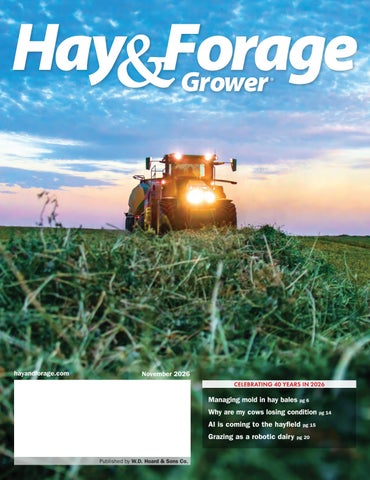
Morning Star Farms in Greensburg, Kan., produces roughly 3,500 acres of irrigated alfalfa. From baling and steaming hay to marketing forage nationwide, the operation has found ways to make the most of its hay business. Photo by Amber Friedrichsen
HAY & FORAGE GROWER (ISSN 0891-5946) copyright © 2026 W. D. Hoard & Sons Company. All rights reserved. Published six times annually in January, February, March, April/May, August/September and November by W. D. Hoard & Sons Co., 28 Milwaukee Ave., W., Fort Atkinson, Wisconsin 53538 USA. Tel: 920-563-5551. Fax: 920-563-7298. Email: info@hayandforage.com. Website: www.hayandforage.com. Periodicals Postage paid at Fort Atkinson, Wis., and additional mail offices. SUBSCRIPTION RATES: Free and controlled circulation to qualified subscribers. Non-qualified subscribers may subscribe at: USA: 1 year $20 U.S.; Outside USA: Canada & Mexico, 1 year $80 U.S.; All other countries, 1 year $120 U.S. For Subscriber Services contact: Hay & Forage Grower, PO Box 801, Fort Atkinson, WI 53538 USA; call: 920-563-5551, email: info@hayandforage.com or visit: www.hayandforage.com. POSTMASTER: Send address changes to HAY & FORAGE GROWER, 28 Milwaukee Ave., W., Fort Atkinson, Wisconsin 53538 USA. Subscribers who have provided a valid email address may receive the Hay & Forage Grower email newsletter eHay Weekly. For 141 years, we have centered our editorial standards around human-written content. As part of our commitment to maintain those editorial standards and continue to disseminate accurate, clear, and fair information, we have developed guidelines for our staff and contributors. This includes staff and contributors’ use of artificial intelligence, in which they represent and warrant that they are the final creator of their content. Our editors promise, as they always have, to be diligent gatekeepers and maintain the highest journalistic standard in their service to you, our readers.
November 2026 | hayandforage.com | 3
F2 3 Nov 2026 TOC.indd 1
10/22/26 9:10 AM
FIRST CUT
Unwritten stories
I
Jenna Byrne Managing Editor
SPEND a lot of my days writing things down. As an editor, I write about forage quality, weather conditions, input costs, equipment, research, and the decisions farmers make to keep their operations moving forward. Agriculture is full of numbers and records. We measure rainfall. We test forage. We track yields. We keep receipts, field records, breeding records, and everything in between. But some of the most valuable things on a farm never get written down. They are the stories that only come up when everyone is sitting around the kitchen table a little longer than usual. They are the memories that start with, “Do you remember when . . .” and somehow turn into a story you have heard a hundred times but still listen to anyway. They are the things your dad knows because his dad taught him. The reason a certain field has a nickname that makes absolutely no sense to anyone outside the family. The story behind the dent in an old tractor. The year it wouldn’t stop raining, or maybe the year it didn’t rain at all. The neighbor who showed up when something broke down at the worst possible time. Growing up on a dairy farm, there are things I remember that would never mean much to anyone else. I remember riding in the tractor and sitting in places that definitely weren’t designed to be seats. I remember meals that had to wait because something needed to get done first. I remember conversations happening over the sound of machinery and plans changing because the weather changed. I remember the stories my family told about years that happened long before I was around. At the time, it was just life. When you are young, you assume everything will always be there. The barn will always look the same. The same people will always do the same chores. Dad will always know what to do when something breaks. Grandpa will always be around to offer his two cents on what to do when times get tough. Until one day, that’s not the case anymore. The farm gets sold. A barn comes down. Someone retires. Kids decide to move away. A piece of equipment that has been around longer than you have gets traded in or sold. Someone who knew every story is no longer sitting at the table to tell them. And suddenly, you wish you had asked more questions. We are pretty good at keeping records in agri-
culture. Somewhere, there is probably a receipt for a tractor bought decades ago. But the receipt doesn’t tell you how nervous someone was when they signed their name at the bottom of it. A farm record might tell you when another 40 acres were purchased, but it doesn’t tell you how long someone saved up that money to buy that piece of land. A photograph can show you your grandparents standing next to a piece of equipment, but unless someone asks, you might never know why they were so proud of it. Those are the parts we lose. When you are a kid, you don’t think to ask your parents what they were like before they were your parents. You don’t ask Grandpa what he worried about when he was your age, or Grandma what those busy years raising a family on a farm were really like. You assume there will always be another Thanksgiving, Christmas, or Sunday dinner. Another chance to ask. But there isn’t always another chance. Someday, there will be an empty chair at the table that used to belong to the person who knew how the story went. So, this year, ask questions. Ask Dad about the worst crop he ever put up. Ask Mom what life on the farm was like when the kids were little. Ask Grandpa what farming looked like when he started. Ask Grandma about the year everything went wrong — and somehow they made it through anyway. Ask about the old barn. The first tractor. The field with the strange nickname you’ve always wondered about. The neighbor whose name you have heard your entire life but whose story you never actually knew. And when someone starts telling that story you’ve already heard a hundred times, maybe don’t be so quick to say, “We already know.” Let them tell it again. Because someday, you might find yourself sitting at that same table wishing you could hear it one more time. We spend our lives in agriculture recording what we don’t want to lose. Maybe we ought to do the same with the stories of the people who came before us. Someday, although they might not be the most valuable records you have, they will be the most precious. •
Email: Managing Editor Jenna Byrne at jbyrne@hayandforage.com
4 | Hay & Forage Grower | November 2026
F2 4 Nov 2026 First Cut.indd 1
10/23/26 7:31 AM
Untitled-2 1
10/14/26 3:42 PM
DAIRY FEEDBUNK
by Luiz Ferraretto
Managing mold in hay bales
Recipe for disaster Moisture content is the most important factor impacting hay storage. The preservation process begins immediately after harvest, and microbial activity occurs until moisture levels are low enough to inhibit microbial growth. Rapid field drying is key, but achieving adequate drying can be challenging, particularly during periods of high humidity, intermittent rainfall, or unpredictable weather conditions. Plant species, swath width, forage density, soil moisture, temperature, wind speed, and solar radiation all influence drying rates. Bales are more likely to spoil when hay is baled above certain moisture thresholds. When hay is stored at less than 15% moisture, storage losses are generally minimal because molds and other aerobic microorganisms are inactive. As moisture rises above recommended levels, microbial activity occurs and losses grow rapidly. Small bales (about 100 pounds [lbs.]) have a suggested threshold of 20% moisture, whereas large bales (about 1,000 lbs.) would ideally be baled with less than
Ryan Ebert
F
OR many dairy and beef operations, hay and silage represent a substantial investment in land, seed, fertilizer, fuel, labor, and storage infrastructure. Maximizing the value of that investment requires more than achieving high yields. Producers must also preserve forage quality from harvest through feeding. But dry matter (DM) and nutrient losses can occur at every stage of hay production. Weather delays, improper moisture at baling, inadequate storage conditions, and poor handling practices all contribute to reduced nutritional value and economic returns. Poorly managed hay may reach up to 30% loss through respiration, microbial activity, weathering, and spoilage. Beyond economic losses, spoiled hay may contribute to more greenhouse gas emissions, reduced feed efficiency, and health risks for both animals and workers. Understanding the factors that drive hay spoilage is essential for developing management.
16% to 18% moisture. Baling hay at an excessive moisture can lead to spontaneous heating caused by aerobic microorganisms that consume sugars and proteins in the forage. As heat builds, chemical reactions begin to alter the hay’s nutritional value. One important reaction is the Maillard reaction, which binds proteins to sugars and results in hay with a sweet, caramel-like smell and a rich tobacco-brown color. Although this hay may appear more palatable to animals, its nutritional quality is reduced because a greater portion of the protein becomes heat-damaged, and is less digestible and available to animals. Excessive heating can also create fire hazards in extreme cases. Monitoring temperatures in newly stored, high-moisture hay is therefore an important safety practice. If hay is rained on before storage, similar issues may occur. Under cool and wet conditions, even well-baled hay can absorb moisture. Storing hay in a dry, well-ventilated shed minimizes the risk of mold. More ventilation in the storage area, leaving space between bales for air flow, stacking bales in alternate directions, and reducing the size of stacks may improve drying conditions during storage.
Lots to lose While wetter hay raises the risk of storage spoilage, excessively dry forage
can also result in field losses during raking, tedding, and baling. Leaf loss is particularly problematic in alfalfa and other legumes because leaves contain a large proportion of the forage’s protein and digestible nutrients. As forage becomes drier, leaves become more fragile and can be easily detached from stems during mechanical handling. Even modest jumps in leaf loss can significantly reduce forage quality. A 5% rise in leaf loss can lower protein by 1.2 percentage units while raising neutral detergent fiber (NDF) by 2.2 percentage units in alfalfa samples. For this reason, producers should aim for a moisture content that minimizes both storage spoilage and harvest-related losses rather than focusing exclusively on achieving the driest possible hay.
Preservative preference Organic acid-based preservatives are commonly used to reduce spoilage in high-moisture hay. These preservatives limit growth of bacteria and fungi but are often considered inconsistent. A study conducted by researchers from Maine and Virginia looked at the effects of various additives on hay preservation. This study reviewed 62 articles and evaluated propionic acid, buffered organic acids, other types of organic acids, urea, anhydrous ammonia, and microbial inoculants. Propionic acid, buffered organic
6 | Hay & Forage Grower | November 2026
F2 6-7 Nov 2026 Dairy Feedbunk.indd 1
10/22/26 9:15 AM
acids, and other types of organic acids reduced DM losses, moldiness, maximum temperature, and insoluble protein concentration. But these preservatives were less effective in legume and mixed hay than grass hay. Legume hay required about four times the application rate than grass hay to maintain a similar maximum temperature. This is similar to the issues with buffering capacity when ensiling legumes. But different than in silage, which often has a positive response to microbial inoculants, microbial preservatives did not improve hay preservation. Greater doses of organic-acid based preservatives were also required when baling hay with higher moisture levels. Variation in moisture, storage conditions, and the crop baled explains the varying inconsistencies observed when it comes to preservatives. A good preservative does not serve as a band-aid, cannot replace proper management, and does not work in every condition,
making each situation fairly unique to each producer.
Risks remain Spoilage affects more than just the nutritional value of hay. Damaged or moldy hay can generate dust containing deteriorated forage particles, mold fragments, fungal spores, and other airborne contaminants that pose health risks to both animals and humans. Exposure to these materials can irritate the respiratory system, making it important for farm workers to wear appropriate respiratory protection when handling dusty or moldy bales. Animals consuming spoiled hay may experience reduced feed intake, lower milk production, reduced weight gain, digestive problems, and overall declines in performance. In addition, some molds produce mycotoxins that can negatively affect animal health when consumed in sufficient quantities. Hay that is visibly
moldy, excessively heated, or suspected of containing harmful levels of mycotoxins should be carefully evaluated and discarded as needed.
Summary Producing high-quality hay requires attention to detail. Moisture management remains the basis of successful preservation, influencing microbial activity, heating, nutrient retention, and storage losses. By targeting proper baling moisture, minimizing rain exposure, improving storage ventilation, and monitoring for heating and mold development, producers can protect forage quality and improve productivity. • LUIZ FERRARETTO The author is an associate professor and ruminant nutrition extension specialist with the University of Wisconsin-Madison Department of Animal and Dairy Sciences.
LEGENDARY
SINCE 1971 ROZOL POCKET GOPHER BAIT
NEW BAG!
Build your legacy with the legendary Rozol® Pocket Gopher Bait Burrow Builder Formula. Brought to you by Liphatech Ag, your Most Valuable Partner for effective rodent control.
WE HAVE YOUR BACKS, BARNS AND BOTTOM LINES.
Rozol Pocket Gopher Bait Burrow Builder Formula is a restricted use pesticide.
November 2026 | hayandforage.com | 7
F2 6-7A Nov 2026 Dairy Feedbunk.indd 2
10/22/26 9:18 AM
All photos: Jenna Byrne
The two Chinook hay dryers have been an asset to the farm's business.
build ANDadapt They
At Heidel Hollow Farms, creative approaches to hay production and processing help sustain a family operation that dates back to 1752. by Jenna Byrne, Managing Editor
8 | Hay & Forage Grower | November 2026
F3 8-11 Nov 2026 Build and Adapt.indd 1
10/22/26 9:29 AM
t
F
All photos: Jenna Byrne
OR nearly 275 years, agriculture has remained a constant at Heidel Hollow Farms in Pennsylvania. What has been produced on the farm, though, has not. The farm dates back to 1752, before the country was founded, with current owner Dave Fink representing the 10th generation of his family to farm the land. His sons and grandchildren add two more. Over time, the farm has raised everything from potatoes and laying hens to hogs, vegetables, pumpkins, and hay. Buildings have been built, expanded, and repurposed as enterprises have changed. Today, that same willingness to adapt is evident in the Finks’ forage business, where hay dryers, specialized processing equipment, and a unique compressed-hay product help them serve customers well beyond their Pennsylvania farm. “You know, over the years, it was a little of everything,” said Sonia, Dave’s wife. Dave’s father focused heavily on potatoes, while his mother managed the poultry side of the farm. At one time, the family had two large chicken houses and produced eggs. The potato side of the business included storage, packing, and retail packages ranging from 5 to 50 pounds. By about 2000, the family faced a decision. The poultry facilities needed significant upgrades, Dave’s parents were retiring, and his interest became increasingly focused on hay. It was then that the decision was made that the chickens would leave, and the hay would stay.
Making hay work Today, Heidel Hollow Farms handles and processes roughly 5,000 tons of hay in a typical year. Dave said that number could climb closer to 7,000 tons this year, depending on demand and available supplies. However, producing high-quality hay in Pennsylvania’s climate has pushed him to find ways around one of the crop’s biggest variables: weather. During my late-summer visit, that challenge was on full display. Earlier drought had made it difficult to harvest a good-quality hay crop, but by the time I arrived, moisture was creating the opposite problem. Hay was down in the field, and drying conditions were less than ideal. “This year, because of the weather conditions and the drought, hay inventory is not so great,” Sonia said. But much to their advantage, that makes the farm’s two Chinook hay
dryers especially valuable. Dave generally prefers to bale hay at about 18% to 22% moisture to retain more leaves. Under normal conditions, bales may spend about 12 minutes in the dryer to bring moisture into a range more suitable for storage. Wetter hay requires more time. The system forces heated air through the bales to remove moisture. Four bales can be dried at once, and he designed the loading and unloading setup so one person can exchange the bales in less than a minute. Two 300-horsepower power units help move air through the system, and Dave stated that friction adds roughly 30°F to 40°F of heat. Electric heaters provide additional heat when needed. “There’s
no flame, so there’s no worry about burning,” he said. After drying, hay can be moved to an ambient-air system to cool. Dave noted that cooling is an important part of the process because hot plant material can continue releasing moisture. The drying system gives the Finks more control over harvest timing, but it doesn’t eliminate the need to make good hay in the field when the timing is right. Rather, it provides another tool when conditions refuse to cooperate.
More value in every bale The Finks’ detailed approach to hay goes beyond drying. Forage is separated into different lots, and testing allows the farm to match hay to customer needs. Each lot can be traced back to its original forage analysis. That gives customers an opportunity to request hay similar to a previous purchase and gives the farm a record of exactly what was sold. Much of the farm’s hay ends up in
EVERY
FORAGE EVERY SEASON
Alfalfa & AlfaGrass Broadleaves & Legumes Perennial & Annual Forages Cereal Grains
millbornseeds.com | 605.627.1901
November 2026 | hayandforage.com | 9
F3 8-11 Nov 2026 Build and Adapt.indd 2
10/23/26 7:38 AM
the equine market, including brokers, training operations, and other horse customers. That market places a premium on consistency and quality, but it has also opened the door for one of Fink’s most unusual ventures. In a former chicken house sits equipment that turns chopped hay into dense forage bricks. The product, called Hydration Hay, was developed after he came across information about compressed horse rations used during World War I. Transporting loose hay for military horses took up valuable space that could otherwise be used for equipment and ammunition. Compressing forage provided a way to carry considerably more feed in a smaller package. “I read something and thought, ‘Why not bring this back?’” he recalled. However, turning the century-old idea into a modern product took considerably more work. Dave spent years researching and refining the process, including working with another feed company in the process. Hay is finely chopped, blended, and compressed under tremendous pressure. The process requires no binder to hold the finished brick together. “Basically, all it is is hay,” Dave said. “There’s no binder, just the pressure alone.” Once submerged in water, the brick breaks apart and rehydrates. Medication or supplements can also be added to the water, which can help mask flavors that horses might otherwise avoid eating. The dense bricks offer another advantage: transportation. Dave explained that compressed hay can reach roughly four times the density of conventional hay, reducing the amount of space required to move forage. The product remains a niche enterprise of Heidel Hollow Farms, but that is partly the point. “It’s not a big part of the business, but it supplements,” Sonia said. “It’s simply diversification.”
No wasted space It was plain to see that diversification is visible almost everywhere on the farm. A former potato cellar has become a cooler for sweet corn. Another potato packing area is now used to wash pumpkins and gourds. Old chicken facilities have found new lives housing hay and processing equipment. Even the hay barn can change jobs depend-
Hay is neatly stacked in one of Fink's many hay sheds by type.
ing on the season. During pumpkin harvest, bins of orange, white, and specialty pumpkins fill space that is otherwise normally devoted to hay. The family raises about 170 acres of pumpkins and also handles sweet corn and other produce. Sweet corn is hydrocooled shortly after harvest, moved into cold storage, and iced for customers that require it before shipment. The farm also continues to finish nearly 6,000 hogs under contract. Each enterprise might appear separate, but together they spread risk across the business and make use of labor, buildings, and infrastructure throughout the year. That diversity proved particularly useful during a drought year when homegrown hay production was limited.
Dave supplements his own production with purchased hay, sourcing forage from other regions when necessary. This year, however, finding additional supply has proved to be a bit of a challenge. Pennsylvania’s drought reduced production in some areas, while excessive weather made harvest more complicated farther west. Dave said New York had strong growing conditions in some areas, but wet weather made harvest difficult. He also looks toward Ohio and Michigan for additional forage when local supplies tighten. “It’s going to be a challenge,” he said.
Another generation Despite all the diversification and innovation on Heidel Hollow Farms, longevity may be its most notable feature.
10 | Hay & Forage Grower | November 2026
F3 8-11 Nov 2026 Build and Adapt.indd 3
10/22/26 9:30 AM
One farm building tells the story particularly well. Dave’s grandfather constructed one section, his father added another, and Dave built the newest addition. “It’s a three-generational building,” he said. The same progression is occurring with the people who make the farm run like a well-oiled machine. Dave and Sonia’s youngest son manages the vegetable enterprise, which can employ about 30 people during busy periods. A granddaughter who is studying large animal science at Delaware Valley University has also become a capable hand in the hayfield. “She was my right-hand baler operator,” Dave said. “She actually baled more hay this year than I did.” Between other jobs, she could spend the morning tedding hay and the afternoon running the baler. That willingness to bring the next generation into the operation is important on a farm where change has been a prerequisite for survival. Heidel Hollow Farms no longer looks like the potato
Each stack is clearly labeled with information about the product in case customers have a question.
and poultry operation Dave grew up on, just as that farm differed from what previous generations before himself used to manage. The enterprises may change again. Buildings will likely find new purposes, and another idea may send the Finks
searching for a way to make it work. After nearly 275 years, that may be the Finks’ most enduring tradition: not doing things exactly as those before them did but instead, finding a way to make the farm work for the generation that comes next. •
nordenmfg.com | 877-296-5851
AT110TH
(PTO & AT108 Available)
ALFATED
SCAN TO LEARN MORE
Equipment Developed From Real Customer Feedback Purpose-driven equipment producers trust season after season. With a product line shaped by real customer feedback, proven U.S.A. made quality, and dependable customer support, Norden Mfg delivers equipment that helps operations of every size work smarter and accomplish more.
Visit nordenmfg.com or call 877-296-5851 for more information and to find a dealer near you.
U.S.A. MADE November 2026 | hayandforage.com | 11
F3 8-11 Nov 2026 Build and Adapt.indd 4
10/23/26 9:15 AM
QUALITY COACH
by John Goeser
Digest your feed analysis
W
ITH corn silage harvest season behind us, we’re turning the page to considering seed corn options for 2027. Many farms have already opted for one brand or another, as early order discount windows and the biggest discounts tend to overlap with late season harvest. Even if locked in with a specific brand, many are still asking questions about how to best evaluate silage potential. The current dairy and beef farming economics are further driving this discussion point, as the right seed choice for silage will continue to have an outsized impact on feed costs per hundredweight (cwt.). Over the past 15 years, I’ve written countless articles about feed quality and digestibility. Now we’re coming in with another article to continue building up our knowledge base. Think of this approach like teaching your kids how to throw a baseball or make a tackle — learning takes constant reinforcement. So with a reinforcement mindset, we’ll revisit where the calories come from in forages. Reading a forage analysis and projecting quality can be broken down into three basic sections. Let’s start
by interpreting the nutrient section, looking at carbohydrate digestibility. We will also address contamination and fermentation issues.
Break it down There are many nutrients reported by feed analysis laboratories; however, just a few deserve your prompt attention. Starch, sugar, and fiber all contain roughly four calories per gram of energy potential but only half the fiber is digested relative to starch or sugar by dairy and beef cattle. Hence, I tend to focus on the fiber content in forages first as a limiting nutrient for high-performing cattle. The greater the fiber content, the lighter the calorie density and quality. For alfalfa or corn silage crops, I like to see the fiber (aNDF) content well below 40% on a dry matter (DM) basis. With grass, this benchmark creeps up to 45% due to less protein in grass relative to alfalfa and high-quality grass offering excellent fiber digestibility. Beyond fiber, look to protein or starch nutrient levels next. For alfalfa- or clover-rich forages, we strive for high protein forage, with our goal being to exceed 20% or 18%
protein, respectively. With corn silage, the starch content is greater grain yield and a starch focus. At 65% moisture, the benchmark for starch content is 35% to 38% starch or more. I reference the moisture content because drier and more mature silage often yields more grain and starch. However, fiber and starch digestibility suffers as the crop matures, limiting energy potential and opening the door for packing and fermentation issues. Ash content also warrants a look in the nutrients section. Ash dilutes out valuable nutrients and brings contamination; however, interpreting the ash depends upon your growing environment and management philosophy. For a starting point, trust that standing alfalfa or grass contains up to 7% or 8% ash as minerals, with standing corn less than half that at about 3% on a DM basis.
Benchmark digestability Building on the corn crop maturity and nutrient digestibility point from earlier, the next step in your forage quality training is diving into the nutrient digestibility section. Interpreting
12 | Hay & Forage Grower | November 2026
F3 12-13 Nov 2026 Quality Coach.indd 1
10/22/26 9:31 AM
nutrient digestibility can be challenging, especially since fiber and starch digestion are not linear. Think of this dynamic like you do with your truck’s distance to empty. The miles to empty projection depends upon how much fuel is in the tank and your fuel conversion efficiency, which is also dependent upon how hard you’re driving. Fiber and starch digestion in high-performing cattle are similar and complex processes. Thankfully, the 7-hour rumen starch digestibility and the University of Wisconsin’s total tract NDF digestibility (TTNDFD) measures on feed analysis reports offer us a means to benchmark forages. Rumen starch digestibility indications differ between forage analysis laboratories, so benchmark only using results from your specific lab. In my opinion, we like to see 90% to 95% rumen starch digestibility with high-performing corn silage. When hitting these levels, we know that the corn silage has adequately fermented with soft starch readily digested.
For fiber digestion, the TTNDFD metric integrates fiber digestion rate and digestible fiber pool size, much like the distance to empty projection on your dashboard. The TTNDFD is also directly comparable between different forage species, with high-quality forages offering 45% to 50% TTNDFD. In some extremely high-quality forage cases, we see TTNDFD above 50%, and the cattle perform exceptionally well. There are many different factors that influence starch and fiber digestibility, which we’ll revisit in this column in future issues.
Bad acids The fermentation compounds section is the last to spend a minute with before setting down your forage analysis. Elevated acetic or butyric acid levels in fermented crops, often coupled with elevated ash content with hay and haylage crops, signals that the energy potential in the forage might not be realized. Undesirable fermentations
can yield rumen health issues or drive cattle away from feed due to odorous compounds, which hinder dry matter intake. Substandard fermentation results also can indicate mold or yeast contamination and feed deterioration, further eroding the feed’s energy potential. This is also an area that we’ll continue to explore and learn about in future columns. Wrapping this forage quality review up, break your feed analysis down into a few basic chunks. Hopefully you’ve come away from this article realizing that no more than four to six measures on your report gives us nearly everything we need to project energy and feeding potential. •
JOHN GOESER The author is a dairy nutrition and management consultant with Progressive Dairy Solutions Inc., and an adjunct professor at the University of Wisconsin-Madison.
MY27 FEATURE ALERT - ISOBUS TECHNOLOGY ON 2334 AND 2340 TRIPLE MERGERS
OXBO.COM
OPTIMIZE YOUR MERGING EXPERIENCE WITH ADVANCED CONTROL
November 2026 | hayandforage.com | 13
F3 12-13 Nov 2026 Quality Coach.indd 2
10/22/26 9:31 AM
by Ashley Wright
BEEF FEEDBUNK
by Ashley Wright
Why are my cows losing condition?
I
N A perfect world, our cows would maintain an ideal body condition score (BCS) of 5 or 6 year-round. All of the forage they consume would meet 100% of their nutritional requirements at all times, and any problems would become apparent before the cow started looking thin. Unfortunately, we don’t live in that perfect world, and there are a lot of things that can cause cows to drop in performance. Often, the first sign is a thin cow, and it’s up to us to investigate why.
Putting the pieces together A cow losing body condition is telling us that something isn’t adding up for her. For some reason, she isn’t consuming enough nutrients to meet her requirements. Figuring out why that is happening can be surprisingly complicated. Maybe it’s as simple as the forage isn’t nutritionally good enough, or there isn’t enough of it. Maybe she just can’t or won’t eat enough of it. Perhaps the forage isn’t the problem at all. Like most livestock problems, finding the answer requires a little bit of detective work. When cattle are losing condition, start with these questions: 1. Which cattle are affected? 2. Is enough forage actually available to them? 3. Does that forage meet their specific nutritional requirements? 4. A re they capable of consuming enough of it? 5. Have their requirements recently changed based on life stage? 6. Could health, environment, or management be contributing? First, look at which cows look thin. Is it the majority of the herd? That’s when you should be paying attention to forage quantity and quality. Are only the younger 2- to 3-year-old animals affected? Perhaps their needs to continue growing to mature cow size plus the demands of pregnancy and lactation are more than the forage can support. Younger cows may also be less competitive at feeders or supplement sites when housed with mature cows. If it’s primarily older animals, check
for issues with their teeth and mouth. Watch for lameness, especially if cattle need to travel significant distances for grazing or to find water. If you see random groups of animals that are looking poorly, with little or no correlation to age or stage of production, start looking for health issues. Check for ticks, especially Asian longhorned ticks, which can infest animals so heavily that blood loss can lead to severe anemia. They can also transmit blood-borne parasites that cause anemia. Internal parasites, mange, mites, and disease should also be on your list of suspects.
Is enough enough? The next two considerations are related: Is there enough forage to go around and is it meeting their nutritional needs, especially in terms of total digestible nutrients (TDN) and crude protein (CP)? Enough to go around is easy to assess if you are walking your pastures regularly to look at forage conditions. If you are feeding hay, 2% to 2.5% of body weight per head per day is a good starting point. This amount may need adjusted based on the stage of production and the quality of the hay. Don’t forget to account for hay waste when determining how much to offer and pay attention to the animals’ behavior. If cows aggressively clean up every bit of hay, crowd the feeder, or spend time searching for more, the amount offered may not be meeting their needs. Cows that consistently leave large amounts of hay behind may be telling you about poor palatability or quality, which leads to the next question. Are they able to consume enough forage? Poor quality, low protein, and mature forages can limit intake through rumen fill and slow passage. As plants mature, fiber and lignin levels heighten while digestibility and protein decline. Less digestible forage remains in the rumen longer, physically limiting how much more the cow can consume. In these situations, having plenty of standing forage or hay in the feeder doesn’t necessarily mean cattle
can consume enough nutrients to meet their requirements. A forage test can help determine whether quality, rather than quantity, is limiting intake.
Find the outlier If you don’t find anything obvious with forage quantity, quality, or any immediate health concerns, ask yourself, “What has changed recently?” Did you move them to a new pasture or start feeding a different batch of hay? Did you change or remove a supplement? Did temperatures suddenly drop? Did cows begin calving and are now reaching peak lactation? A dry cow may have been just fine on a particular forage, but after calving, it no longer meets her requirements. Even changes in water source, feeding location, or how feed is delivered can affect intake. Especially in large pastures, if cows must travel further between water and grazing areas, they may spend less time grazing while simultaneously expending more energy. When cattle that were maintaining condition begin to lose it, figuring out what changed on either the intake or requirement side of the equation can help narrow down the list of suspects. Sometimes, the answer isn’t always nutrition. We’ve already discussed parasites, disease, or other chronic health problems. However, plants or water toxicities could also cause cows to lose condition. Don’t just throw more feed at cows that are losing condition despite receiving apparently adequate nutrition. If you are certain that forage quality and quantity are there, it’s time to get your veterinarian involved. The faster you notice and figure out the cause, the sooner you can take steps to head off any further loss of condition and limit any reproductive or performance issues. •
ASHLEY WRIGHT The author is an area associate livestock agent with the University of Arizona based in Pima County.
14 | Hay & Forage Grower | November 2026
F3 14 Nov 2026 Beef Feedbunk.indd 1
10/23/26 7:40 AM
FORAGE GEARHEAD
by Randy Clark
AI is coming to the hayfield
I
’M SURE you have probably heard enough about artificial intelligence (AI), and many in this industry are probably to the point of passing it by as another “fad” or “bubble” and playing the waiting game on doing anything with it. The truth is that this is a new technology that is here to stay. For hay and forage producers, it’s a technology that may not be obvious now, but it will soon affect everything. Technology, in general, can be slow to take shape in agriculture. We resist unknowns because we know the price to be paid if that technology fails. At the same time, resisting change can be just as costly. But, as the old adage goes: “The first mouse tests the trap, the second mouse gets the cheese.” I’ve always been a firm believer in adopting technology as it best suits you while keeping within your risk tolerance. This is the equivalent of trying to “get the cheese” but also “getting there before the cheese is gone.”
Different living quarters To this end, one approach is to view AI as a technology to grow a business without adding significant overhead. There are two types of AI in this field: Digital AI lives in the office while physical AI lives on the machine. Today’s digital AI tools can make business management much more efficient so that more time can be spent in other areas of the business. Financial and other business systems are integrating AI to help do the day-to-day operations faster and easier. Data services from larger equipment manufacturers are rolling out AI agents that can help you solve problems with your data and machines faster and on your own. Some can even take simple commands and do processing with data to save you time and money compared to hiring out such services. Digital AI is working its way into everything from the plant to the invoice. On the machinery side, the tidal wave of physical AI is coming. It’s being shown at farm shows, but it’s out there a few years yet from being all-encompassing on the farm. You have probably noticed some new features on hay and
forage equipment that might not make sense to you today. Examples include new hitches on balers for ease of creating uniform bales and improved vision and control systems for filling forage boxes and transferring data on each load. New connectivity packages and camera systems may seem like overkill for making conventional bales or silage, but in time, and coupled with AI and automation, will be standard equipment. Technology is evolving so fast that anyone can literally go online and buy the tech to automate most equipment today. The missing link is the software and communication layer that ties it all together . . . and physical AI is the key part of that missing link. It can watch cameras, radar, and lidar, all while reading other sensors on your equipment to make informed decisions on how to best operate that machine. And it gets better the more it runs. A simple Starlink connection combined with the data centers being built will let fleets of machines around the world become smarter over time, combining digital AI with physical AI and allowing machines to learn from other machines.
Opportunities to learn I am a firm believer in providing tools to make operators more efficient and helping producers grow their businesses. The phase we are currently in is just that — it’s making things so efficient that a less-experienced operator can make consistent, quality crops, allowing the managers to put more of their time into the most important tasks. And you’ll find a community of farmers who are already implementing both physical AI and digital AI on their farms; it’s being done on their own. But how can anyone possibly wrap their head around all of this to even begin to adopt AI into their business? For starters, follow people who know digital AI and are willing to teach others. Be careful, however, as this space changes so fast that anyone claiming to be an AI expert may very well be an “AI dinosaur” in a matter of weeks. Some people that I have learned from include Nick Horob (@NickHorob) on X and
Kevin Hutson (@Kevin_AI) on YouTube. Horob has training for farmers to develop their AI skills and ideas called “AI on Your Farm” (aionyourfarm.com). If you are not into following online experts, try an AI tool. The great thing about AI is that it can teach you how to use it. My favorites are Grok and Claude. I use Grok, as it has a useful CarPlay app that allows me to have a conversation with it while traveling. I can ask anything, and it will teach me. There are many tips and tricks to this, but if using any of these tools, just be sure to use the 3 Cs: command, context, and constraints. For example, “Hey Grok, act as a practical, tech-savvy accountant who specializes in small service businesses. I run a custom hay baling operation, and I need to simplify my QuickBooks billing process. I need to be able to create and send invoices from the field on my phone, and I want to keep my out-ofpocket costs as low as possible by using built-in tools or free and cheap options. Assume nothing about my current setup, processes, or technical skill level. Before you give any recommendations, ask me any questions you have so your advice is accurate and relevant.” And if you are worried about your data and security, learn about the models and pick one, starting with a small subscription. Usually, on the paid models, you at least have the option in settings to opt out of having your data used for training. The free models sometimes come with terms that allow them to train models on your data . . . so be careful. While many may believe there is no place for AI in the hayfield, there is an undeniable opportunity to improve your business through careful and proper implementation of this technology. The question remaining is who will choose to do so before the cheese is gone. •
RANDY CLARK The author is a mechanical engineer and the owner of RCI Engineering and Ag-Bag in Mayville, Wis.
November 2026 | hayandforage.com | 15
F3 15 Nov 2026 Gearhead.indd 1
10/22/26 9:37 AM
YOUR CHECKOFF DOLLARS AT WORK
New life for old pastures In addition to its Alfalfa Checkoff program, NAFA also tracks and publicizes research funded through USDA-NIFA’s Alfalfa Seed and Alfalfa Forage Systems Research Program (ASAFS). This issue highlights one of those projects.
widely grown in the region: tall fescue and orchardgrass. The team evaluated six distinct pasture management and restoration strategies: • An untreated control pasture • Synthetic nitrogen fertilization (applied at 60 pounds per acre) • Fall-seeded alfalfa • Spring-seeded alfalfa • Fall-seeded alfalfa combined with crabgrass • Spring-seeded alfalfa combined with crabgrass One of the most critical outcomes of the study was that interseeding success relied heavily on the identity and competitiveness of the existing grass species. Alfalfa successfully established and became a productive component in orchardgrass pastures. In contrast, alfalfa failed to establish in the dense, highly competitive tall fescue stands. “Interseeding alfalfa is not a universal fix for every degraded cool-season pasture,” La Guardia Nave noted. “The aggressive competition of an existing turf — especially a tight tall fescue sward — can prevent incoming alfalfa seedlings from taking hold. A thorough pasture assessment of stand density and
species composition must come first.” In terms of forage mass, synthetic nitrogen fertilization consistently provided the most rapid and substantial immediate boost in forage production across trials, reaching 2,132 to 2,413 pounds of dry matter (DM) per acre. However, the legume-based restoration strategies also demonstrated clear production benefits over untreated pastures. In the 2021 to 2022 orchardgrass study, untreated control pastures averaged 1,719 pounds of DM per acre, whereas the alfalfa and alfalfa-plus-crabgrass treatments produced an average forage mass of 1,926 pounds of DM per acre. Integrating crabgrass into the orchardgrass-alfalfa mixture offered a distinct seasonal advantage. Crabgrass is a productive warm-season annual grass that can fill the growth gap during the mid-summer period when cool-season perennial grasses typically experience reduced growth and yield. Combining a cool-season perennial grass, a perennial legume, and a warm-season annual grass successfully distributed forage production across multiple seasons while increasing overall plant diversity. Furthermore, economic
Interseeding alfalfa into noncompetitive grass pastures or hayfields can be successful.
Mike Rankin
P
ERENNIAL cool-season grass pastures are an important component of forage-livestock systems in the southeastern United States. However, productivity and persistence of these pastures can decline because of inadequate fertility, grazing and harvest management, environmental stress, and stand deterioration over time. Conventional pasture renovation generally involves substantial soil disturbance, complete tillage, reseeding, and a prolonged period of reduced or lost forage availability. These traditional practices can be costly and may negatively affect soil structure and existing soil organic resources. To address these challenges, Renata La Guardia Nave and her research team at the University of Tennessee evaluated low-disturbance strategies for restoring Renata La Guardia Nave existing cool-season grass Funding: pastures with funding $249,597 from the USDA National Institute of Food and Agriculture’s Alfalfa Seed and Alfalfa Forage Systems Research Program. The project focused on interseeding alfalfa, either alone or in combination with crabgrass, as an alternative or complement to conventional synthetic nitrogen (N) fertilization practices. “Our primary goal was to determine whether low-disturbance interseeding could improve pasture productivity and forage species diversity without the high costs and soil disruption of complete pasture renovation,” La Guardia Nave explained. “We wanted to provide Southeastern livestock producers with a practical biological alternative that introduces fixed nitrogen and improves the critical summer forage balance.” The research project was conducted at the Middle Tennessee Research and Education Center located in Spring Hill. The trials were established across existing stands of two primary cool-season perennial grasses that are
PROJECT RESULTS • Interseeding alfalfa succeeded in orchardgrass swards but was limited by intense sward competition in tall fescue stands. •A lfalfa and alfalfa-plus-crabgrass treatments raised orchardgrass production to an average of 1,926 pounds of DM per acre compared to 1,719 pounds of DM per acre for untreated controls. • Low-disturbance restoration methods successfully preserved soil organic carbon and total nitrogen levels over two years.
16 | Hay & Forage Grower | November 2026
F3 16-17 Nov 2026 Alfalfa Checkoff.indd 1
10/22/26 9:38 AM
evaluations reinforced that establishing alfalfa requires upfront investment, making successful establishment key to achieving long-term economic gains above those of synthetic inputs. The soil component of the study evaluated whether low-disturbance restoration could enhance production without depleting belowground
resources. Soil carbon and nitrogen concentrations remained stable across all treatments throughout the two-year evaluation period, demonstrating that low-disturbance interseeding avoids the soil nutrient losses often triggered by intensive tillage. While root biomass declined over time across all treatments, this trend was unrelated to the
CONTINUOUS MOVEMENT LIKE NO OTHER.
SUPPORT THE ALFALFA CHECKOFF! Buy your seed from these participating marketers: Alforex Seeds by DLF America’s Alfalfa CROPLAN Forage First by DLF Innvictis Seed Solutions Latham Hi-Tech Seeds NEXGROW W-L Alfalfas Zinma Seeds DON’T SEE YOUR FAVORITE BRAND ON THE LIST? Contact NAFA for information on becoming a participating brand
specific restoration strategy used. “For farmers looking to build longterm pasture sustainability, interseeded alfalfa offers intermediate yield boosts, biological nitrogen fixation, and seasonal forage balance without degrading soil carbon,” La Guardia Nave said. A full copy of the final report can be found at alfalfa.org. •
ELECTRIC PIVOT APPLICATION PATTERN: › Not Uniform › Starts/Stops 2,880 times a day
T-L CONTINUOUS MOVEMENT APPLICATION:
HYDROSTATIC DRIVEN
› Smooth and continuous at any speed › Precise rotation at any temperature
A PICTURE CAN BE WORTH THOU$ANDS. T-L ... LIKE NO OTHER. Phone: 1-800-330-4264
Hastings, Nebraska 68902-1047 USA
Fax: 1-800-330-4268
TL-544F.indd 1
F3 16-17 Nov 2026 Alfalfa Checkoff.indd 2
TIF ER IE
ISO 9001
U A LI T
Q
sales@tlirr.com · www.tlirr.com
Fax: (402) 462-4617
D
Phone: (402) 462-4128
The alfalfa checkoff benefits you and the entire industry. Scan the QR code to learn more.
Y
151 East Hwy 6 & AB Road · P.O. Box 1047
C
www.tlirr.com
7/21/26 4:05 PM
November 2026 | hayandforage.com |17
10/22/26 9:38 AM
THEY SEEK YIELD, NOT QUALITY
H
by Mike Rankin, Senior Editor AY farming is big business in the lower southeast reaches of South Dakota. It’s so much the case that the small rural community of Meckling proclaims itself the “Hay Capital of the Universe,” and one of the hay farms that helps add to such a lofty declaration is owned and operated by the Jensen family.
Kyle Jensen farms with the help of his 85-year-old father, Ernie, and fresh-out-ofcollege son, Jake. Together, they harvest 300 acres of alfalfa hay, 30 acres of native grass, and about 2,200 acres of row crops. “In this area, hay almost always makes more money than the row crops,” Jensen attested during a visit to the farm this past summer. The Jensen family has been working some of the same ground for nearly 80 years. Hay has always been a part of that history. Jensen’s grandfather bought the current home farm when Ernie was 7 years old. For many years, Ernie put up small square bales using a stack wagon, but he was one of the first in the area to convert to large square bales with the purchase of a Hesston 4x4 baler. In 1993, Kyle returned to the farm following two years of college at South Dakota State
University. It was then that Ernie started a hay grinding business to help bolster the farm’s bottom line. As with most operations, things have changed over the years. They no longer do hay grinding, and the acreage has expanded, especially for row crops.
A customer base of one On most commercial hay farms, there is a lot of agonizing to produce a hay crop that is packed with nutritional benefits. A visually appealing product with high crude protein and exceptional fiber digestibility is often the ultimate target. That’s not necessarily the case for Jensen. “We only have one customer, and he takes all our first three cuttings of hay. He operates a beef feedlot about 60 miles away in Iowa,” the haymaker explained. “They want it for roughage, and
we supply them with 2,000 tons per year. We aren’t trying to make dairy hay or cut on a specific schedule; we’re just trying to get as much yield as we can.” With forage quality being less of a concern, Jensen is better able to avoid the risk of rain and bale only when there’s a good weather window. Sometimes, that may mean having to delay a week, which isn’t cause for losing sleep. “Every cutting is in the flower stage, except for maybe fourth cutting,” Jensen said. “If we put up some good fourth cutting, then we’ll sell that to a dairy customer looking for better quality or take it to the auction in Dyersville, Iowa, where there are a lot of buyers looking for that kind of hay.” The Jensens do all their own trucking.
18 | Hay & Forage Grower | November 2026
F3 18-19 Nov 2026 Target Yield.indd 1
10/22/26 9:50 AM
For the hay production that goes to the feedlot, the price is set in late summer based on the Rock Valley Hay Auction market in Iowa. Both parties sit down and negotiate an agreeable price. Having only one customer who isn’t as concerned about quality offers Jensen some unique advantages. He only needs to build trust with one client, and the hay can be made when the weather is favorable. Although the marketing plan is unique, alfalfa is produced in much of the same way other farmers accomplish the task. Jensen seeds alfalfa in the spring following a previous year’s soybean crop. Fields are tilled, rolled, and planted with a drill at about 18 pounds of seed per acre. Only one hayfield is irrigated. The Jensens cut with a 16-foot MasseyFerguson mower equipped with a double conditioner. They use either a Fair wheel rake or a Claas rotary rake to manipulate the wide swaths. The crop is baled using two 3x4 balers; one is a New Holland and the other a Massey-Ferguson. Each is equipped with a Phiber three-bale accumulator. Bales are then picked up and loaded onto a semitrailer in the field. With the later cuttings, Jensen said that plant lodging can sometimes be a problem. Alfalfa weevils are also an occasional pest that will invade fields. When they do, he
Three generations work to make hay on Jensen Farms. From left to right are Jake, Ernie, and Kyle Jensen.
In his 85th year, Ernie is still active on the farm. Here, he loads out bales destined for an Iowa feedlot.
said that would be a situation where fields might get cut earlier than planned, and the regrowth will be monitored and sprayed as needed. Potato leafhoppers are another pest that occasionally needs to be controlled.
female basketball players to come out of South Dakota and starred for Creighton University. She currently works as the director of the Student-Athlete Success Center at the University of South Dakota. The Jensens’ daughter, Brooke, currently plays college basketball for Northern State University, and their youngest son, Luke, is in high school and will soon play basketball at Dakota Wesleyan University. Looking to the future, and now that Jake is back on the farm, Jensen said that they would like to add more hay acres. For now, he just feels blessed to have three generations working together on the farm and filling hay barns. •
Courts and crops Although his dad still climbs in the tractor on a regular basis, Jensen is pleased that his son decided to return to the farm following college. Jake received a business degree at Mount Marty in Yankton, S.D., but he also played basketball during his collegiate years. Jensen said that his hoops acumen was totally due to his mother, Becky, who was one of the best
The Jensens have been baling hay on the same land near Meckling, S.D., for nearly 80 years. There is no sign of that stopping anytime soon.
November 2026 | hayandforage.com | 19
F3 18-19 Nov 2026 Target Yield.indd 2
10/22/26 9:50 AM
THE PASTURE WALK
by Dave Mageean
Grazing as a robotic dairy
W
HEN we first took over the farm in southeast Michigan from my in-laws in January 2017, it was a 50-cow conventional, enclosed Holstein herd. We had a pretty clear picture of where we were going to take the farm and knew grazing was going to be a major part of the system. Like most farmers, we had a lot to learn, plenty of decisions to make, and a lot of days when we simply figured things out as we went. But converting to a grazing robot herd was our 5-year plan. I went to work building fence and had the herd grazing by May of 2017. We built the robot barn in 2020 and moved in by August of that year. Today, after many changes and adjustments, we milk a 100% A2A2 organic grass-fed herd of 80 crossbred cows.
amount of alfalfa. The beginning of the season brought phenomenal pasture growth, but that did not last. The moisture shut off by the beginning of June, and conditions turned dry and warm. Moisture didn’t return until late August. The heat made the cows less interested in grazing during the day, so
An early start to grazing This year, our grazing season started a little earlier than in previous years because of favorable weather. We turned the cows out onto pasture on April 28. With excellent early-season growth, the milk cows completed their first rotation in just 17 days. We actually had more pasture growth than the cows could utilize, so we took approximately 30 acres out of the grazing rotation and chopped it along with our first cutting. We kept the dry cows and breeding stock inside until the milk cows had completed their first rotation, the goal being to stagger the growth stages of the paddocks to have a more variable grazing wedge. This makes pasture management easier throughout the season, with the other three groups helping manage and utilize the additional growth.
Managing A-B grazing Because we operate a robotic dairy using an A-B grazing system, we essentially manage two separate grazing blocks on the farm. The milk cows receive a fresh pasture allocation every 12 hours, so maintaining steady regrowth is critical. Our pastures are primarily a mixture of perennial grasses and clovers, with a small
I started buffer feeding them greenchopped forage during the daytime. The robot barn allows us to feed in a covered area that’s shaded and a little cooler than the pasture. The herd still took advantage of the cooler temperatures in the evening and continued to graze at night. Managing the herd this way allowed us to keep cows comfortable while still making use of the pasture that was available.
Protecting milk production Our milk volume initially took a hit after we finished the first rotation. Once we began buffer feeding, however, production came back up fairly quickly. In the robots, we feed organic molasses along with an organic alfalfa pellet with mineral. The combination of grazing, green-chopped forage, and what we provide through the robots gives us some flexibility when pasture growth slows or weather conditions make daytime grazing less attractive to the cows.
A challenging harvest season We took our first cutting of silage off on May 13 and chopped a total of 130 acres. I also applied liquid manure to 60 acres that had been reseeded in the
fall of 2025. I felt those acres needed a little boost of nutrients to help keep them productive throughout the season. Second cutting was taken off on June 22. It was a pleasant surprise to see how much forage we ended up with once it was in the bunk. Third cutting was a different story. Because of the lack of moisture, yields were pretty poor. We baled and wrapped the third cutting, but only harvested 60 acres because we were greenchopping additional forage for the milk cows. Fourth cutting was also disappointing from a quantity standpoint, although the forage tested high for quality. We are hoping to start fifth cutting around the middle of October. If the weather cooperates, that should hopefully finish our forage harvest for the year and carry us through until the 2027 growing season.
Take what you’re given Grazing as a robotic dairy requires us to constantly balance pasture growth, cow comfort, milk production, and forage inventories. Some years give us more grass than the cows can use, while other years force us to supplement the pasture much more heavily with stored forages or purchased forage. This year has been a good example of both extremes. We started with excellent spring growth, followed by a hot and dry summer that required us to change our approach. For us, the key is being flexible and letting the conditions on the farm dictate what we do. The cows are still grazing, the robots allow them to come and go on their own schedule, and our different groups of cattle give us additional flexibility in managing pasture growth. Every year teaches us something new, and this season has been no different. •
DAVE MAGEEAN The author is a dairy producer from Ann Arbor, Mich.
20 | Hay & Forage Grower | November 2026
F3 20 Nov 2026 Pasture Walk.indd 1
10/22/26 9:51 AM
SUNRISE ON SOIL
by Alan Franzluebbers
What can your soil supply?
Start with mineralization All soils have some inherent capacity to supply nitrogen from organic matter. The process of converting organic
Effects of soil-test biological activity and organic matter on nitrogen mineralization
Net nitrogen mineralization (lb./acre in 24 days)
N
ITROGEN is abundant in healthy soil. Yet, most agronomists and soil fertility specialists will tell you that you need to apply additional nitrogen to your pasture or hay field to get high yield and quality. The rub here is getting to know how much nitrogen in soil is actually available for plant uptake during a growing season. Light green and yellowing forages are clear indications of a nitrogen deficiency. This occurs when available nitrogen in soil is simply not sufficient to meet the demands of the growing forage. When applying an inorganic fertilizer such as urea or ammonium sulfate, nitrogen-deficient grass often quickly turns dark green. This is an indication that the fertilizer nitrogen was taken up by forage and converted into protein to enhance chlorophyll content. Forage roots are dense and abundant in the surface 6 inches of soil. This means they have a high ability to capture available nitrogen in surface soil. Ammonium and nitrate nitrogen are the two inorganic forms of nitrogen that forages acquire through root uptake. The much larger portion of nitrogen contained in soil bound to organic matter is not immediately available for plant uptake. Testing soil for inorganic nitrogen often reveals a relatively low level of inorganic nitrogen in many fields independent of the capacity of soil to supply nitrogen. Again, the low level of inorganic nitrogen is because forage roots rapidly acquire this inorganic nitrogen whether total nitrogen supply is high or low. Testing soil for inorganic nitrogen, therefore, is not particularly revealing as to which soils have high or low capacity to supply nitrogen to a forage crop. Inorganic nitrogen typically represents only about 1% of the total nitrogen contained in soil. Therefore, soil organic matter becomes an important part of knowing how much nitrogen a soil could supply without requiring additional fertilizer input.
300
300
200
200
100
100
0
0 0
3
6
9
12
0
200
400
600
800
Soil organic matter
Soil-test biological activity
(%) 0 to 4-inch depth
(mg/kg/3d) 0 to 4-inch depth
matter to inorganic nitrogen is called mineralization. Mineralization requires soil microorganisms to feed on soil organic matter to help decompose it into mineral (or inorganic) components, thereby releasing inorganic nitrogen to the soil solution for rapid root uptake. Mineralization of nitrogen from soil organic matter is a biological process. Soil microorganisms require adequate temperature and moisture to be most active. Soil microbial activity is greatest in the spring and summer when temperature is high and soil moisture is adequate. Periods of drought and winter cold can hinder mineralization. However, the immediate demands of a growing plant receiving direct sunlight following a nighttime shower may need to wait a few days for soil microorganisms to respond quickly enough. The soil warms slowly deeper than the immediate surface and rainfall may not always be adequate to reach all soil layers where roots might be. When it comes to nature, patience is paramount.
Measuring nitrogen potential Can soil be tested to determine potential soil nitrogen mineralization? Yes; but it requires a sample collected from the field to be incubated at optimum temperature and moisture for a few weeks. These are analytical steps that require time. A test could also be con-
ducted in the field, but it will take time and additional labor to get a reasonable estimate. Cost of analysis can become a limitation for routine soil testing. An alternative soil testing procedure that costs little and requires far less time than traditional approaches is soiltest biological activity (STBA). Soil-test biological activity is strongly associated with soil nitrogen mineralization. It measures the respiratory activity of soil microorganisms during a 3-day period following rewetting of dried soil. Soil nitrogen mineralization requires microbial activity, and therefore STBA is a logical indicator of the capacity of soil to provide available nitrogen. A mature pasture with good grazing management in which livestock return excrement relatively uniformly to the pasture can become a self-sustaining ecosystem with minimal requirements. Consider how effective your grazing management has become at recycling nitrogen in your pastures. Some alternative soil testing could indeed help you evaluate this effectiveness. • ALAN FRANZLUEBBERS The author is a soil scientist with the USDA Agricultural Research Service in Raleigh, N.C., and past president of the American Forage and Grassland Council.
November 2026 | hayandforage.com | 21
F3 21 Nov 2026 Sunrise Soil.indd 1
10/22/26 9:51 AM
BUYERS MART | TOP D ENOVACAT S I G N E D. E N G I N E E RE D. RE MA RK A B L E VA LU E .
NOVACAT | TOP
HIT
BALE SPIN-OFF
HIT
Efficient hay management tool for moving and feeding round bales. • Eliminate wasted hay by only unrolling what cattle will clean up in an hour. • Easy operation from the cab of the tractor or skid steer. • Hydraulically driven for better operator control. • Rotates in both directions for easy feeding. • Forged tapered spear for easier bale penetration.
For more information on our product line contact us at 1-888-943-3009.
Worksaver, Inc. Litchfield, IL • Phone: 217.324.5973 VISIT WORKSAVER.COMFor TOmore LEARN MORE on our product line information
contact us at 1-888-943-3009 I www.poettinger.us
For more information on our product line contact us at 1-888-943-3009 I www.poettinger.us
FEATURES:
• Adds one hydraulic remote outlet • 15GPM per outlet 3000PSI • Works on any tractor, open or closed center • Easy to mount, versatile • Convenient, one handed operation • Aluminum body construction • Commercial grade sealed switches • Inexpensive
Call for more information:
800-648-6507 www.vandminc.com 22 | Hay & Forage Grower | November 2026
BM_Nov_2026.indd 2
10/20/26 2:55 PM
BUYERS MART
Make “Reel” Hay
uniformly dry green color retained leaves retained marketable Unique fluffing action gently lifts the hay up off the ground to dramatically reduce drydown time!
SAVE TIME SAVE MONEY • 7'-48' working width • up to 50 acres/ hour
CALL TODAY!
Proven results show less alfalfa leaf loss, more green color retention plus a more consistent uniform drydown occurs when using a Field Master Hay Fluffer.
FIELD MASTER
®
Professional Hay
Makes bales consistent in weight, length, & density,
Hassle-free baling, better bales!
Manufactured by:
Tri-Sha Equipment Ltd.
519-321-8555
baleskiis.com 866-889-3846
Get control of your fields.
MIKE B. —
Walla Walla ,
WA
Proven Lasting Gopher Control Patented slow-release fumigation works underground for days.
Cover More Ground Treat up to 15 acres/hour without leaving the tractor.
Lower Your Cost Per Acre Effective control for less than $15 per acre.
Hear from real farmers using the Gopher General in their fields:
GOPHERGENERAL.COM S I L A G E®
BARRIER
FILMS
CALL (306) 705-7576 TO STOP FEEDING THE GOPHERS.
BY CONNOR AGRISCIENCE
November 2026 | hayandforage.com | 23
BM_Nov_2026.indd 3
10/20/26 2:55 PM
BUYERS MART
BALE-IT Baler Applied Product
A New Way to Stabilize High-Moisture Hay!
Untreated
• Non-corrosive • No smell • Handles broadest range of moisture levels
Treated w/ BALE-IT
out our Innovative Forage Solutions CutterCheck Applied Product: 763-244-5972 email: eddietoms@innovativeforage.com
InnovativeForageSolutions.net
High-quality hay products to help increase your productivity! Check out the Hay & Forage Grower website for up-to-date field news, latest industry information, original features, and industry insight at
www.hayandforage.com
CUT-IT
FEED
FARM EQUIPMENT FOR SALE BALEWAGONS: New Holland self-propelled & pull-type models/parts/tires/manuals. Can finance/deliver. 208-880-2889, www.balewagon.com
Made In USA
Feeding Guide 4th Edition
for your bottom line
Feeding Guide by Mike Hutjens 4th Edition • 103 pages
hoard’s.com/bookstore or 920-563-5551
Webinars
A feed and forage outlook for 2027 Presented by Mike Hutjens, Univ. of Illinois, and Jenna Byrne, Hay & Forage Grower
Farmers faced myriad challenges this growing season that affected forage quality and quantity. This webinar summarizes forage quality results from testing labs and other factors, including fertilizer, yield, and seed.
FREE WEBINAR December 14, 2026 The AFGC annual conference brings together industry, education/extension, and producers to share insights, research, best practices, and more. Learn more and register at afgc.org/annual-conference/ or scan the QR code.
(Noon–1 p.m. Central)
REGISTER HERE Or learn more at the Upcoming Webinars section of hoards.com
24 | Hay & Forage Grower | November 2026
BM_Nov_2026.indd 4
10/20/26 2:55 PM
BUYERS MART U.S. Postal Service STATEMENT OF OWNERSHIP, MANAGEMENT AND CIRCULATION 1. Publication Title: Hay & Forage Grower 2. Publication No.: 021-713 3. Filing Date: September 21, 2026 4. Issue Frequency: January, February, March, April/May, August/September and November 5. No. of Issues Published Annually: 6 6. Annual Subscription Price: $0 7. Complete Mailing Address of Known Office of Publication: 28 Milwaukee Avenue West, PO Box 801, Fort Atkinson, Jefferson County, WI 53538-0801. Contact Person: Brian V. Knox, Telephone: 920-563-5551. 8. Complete Mailing Address of Headquarters or General Business Office of Publisher: 28 Milwaukee Avenue West, PO Box 801, Fort Atkinson, Jefferson County, WI 53538-0801. 9. Full Names and Complete Mailing Addresses of Publisher, Editor, and Managing Editor: Publisher: W. D. Hoard & Sons Company, Brian V. Knox, 28 Milwaukee Avenue West, PO Box 801, Fort Atkinson, WI 53538-0801. Editor: Managing Editor: Amber Friedrichson, 28 Milwaukee Avenue West, P.O. Box 801, Fort Atkinson, WI 53538-0801 10. Owner: Hay & Forage LLC, 28 Milwaukee Ave. W, Fort Atkinson, WI 53538; Paris M Knox 1990 Educational Trust, 28 Milwaukee Ave., W, Fort Atkinson, WI 53538; Gillian V. Knox 1990 Educational Trust, 28 Milwaukee Ave., W, Fort Atkinson, WI 53538; Brian V. Knox II 1992 Educational Trust, 28 Milwaukee Ave., W, Fort Atkinson, WI 53538; Gregory J. Mode, 28 Milwaukee Ave., W, Fort Atkinson, WI 53538; Gina L. Mode, 28 Milwaukee Ave., W, Fort Atkinson, WI 53538 11. Known Bondholders, Mortgagees, and Other Security Holders Owning or Holding 1 Percent or More of Total Amount of Bonds, Mortgages or Other Securities: None 12. Tax Status (for completion by non-profit organizations authorized to mail at non-profit rates: N/A 13. Publication Title: Hay & Forage Grower 14. Issue Date for Circulation Data Below: August/September 2026 15. Extent and Nature of Circulation: Average No. Copies Each Issue During Preceding 12 Months: a. Total Number of Copies (Net Press Run): 41,299 b. Legitimate Paid and/or Requested Distribution (By mail and outside the mail): 1. Outside County Paid/Requested Mail Subscriptions stated on PS Form 3541. (Include direct written request from recipient, telemarketing, and Internet requests from recipient, paid subscriptions including nominal rate subscriptions, employer requests, advertiser’s proof copies, and exchange copies.): 22,359 2. In-County Paid/Requested Mail Subscriptions stated on PS From 3541.(Include direct written request from recipient, telemarketing, and Internet requests from recipient, paid subscriptions including nominal rate subscriptions, employer requests, advertiser’s proof copies, and exchange copies.): 0 3. Sales Through Dealers and Carriers, Street Vendors, Counter Sales and Other Paid or Requested Distribution Outside USPS®: 0 4. Requested Copies Distributed by Other Mail Classes Through the USPS (e.g. First-Class Mail®): 0 c. Total Paid and/or Requested Circulation (Sum of 15b (1), (2), (3) and (4)): 22,359 d. Non-requested Distribution (By mail and outside the mail) 1. Outside County Nonrequested Copies Stated on PS Form 3541 (Include sample copies, requests over 3 years old, requests induced by a premium, builk sales and requests including association requests, names obtained from business directories, lists, and other sources): 18,454 2. In-County Nonrequested Copies Stated on PS Form 3541 (Include sample copies, requests over 3 years old, requests induced by a premium, bulk sales and requests including association requests, names obtained from business directories, lists, and other sources): 0 3. Nonrequested Copies Distributed Through the USPS by Other Classes of Mail (e.g. First-Class Mail, nonrequestor copies mailed in excess of 10% limit mailed at Standard Mail® or Package Services rates): 0 4. Nonrequested Copies Distributed Outside the Mail (Include pickup stands, trade shows, showrooms, and other sources): 164 e. Total Nonrequested Distribution (Sum of 15d (1), (2), (3) and (4)): 18,618 f. Total Distribution (Sum of 15c and e): 40,977 g. Copies not Distributed (See Instructions to Publishers #4 (page #3): 323 h. Total (Sum of 15f and g): 41,300 i. Percent Paid and/or Requested Circulation (15c divided by 15f times 100): 54.14% 15. Extent and Nature of Circulation: No. Copies of Single Issue Published Nearest to Filing Date: a. Total Number of Copies (Net Press Run): 40,627 b. Legitimate Paid and/or Requested Distribution (By mail and outside the mail): 1. Outside County Paid/Requested Mail Subscriptions stated on PS Form 3541. (Include direct written request from recipient, telemarketing, and Internet requests from recipient, paid subscriptions including nominal rate subscriptions, employer requests, advertiser’s proof copies, and exchange copies.): 23,380 2. In-County Paid/Requested Mail Subscriptions stated on PS From 3541.(Include direct written request from recipient, telemarketing, and Internet requests from recipient, paid subscriptions including nominal rate subscriptions, employer requests, advertiser’s proof copies, and exchange copies.): 0 3. Sales Through Dealers and Carriers, Street Vendors, Counter Sales and Other Paid or Requested Distribution Outside USPS®: 0 4. Requested Copies Distributed by Other Mail Classes Through the USPS (e.g. First-Class Mail®): 0 c.Total Paid and/or Requested Circulation (Sum of 15b (1), (2), (3) and (4)): 23,380 d. Non-requested Distribution (By mail and outside the mail) 1. Outside County Nonrequested Copies Stated on PS Form 3541 (Include sample copies, requests over 3 years old, requests induced by a premium, bulk sales and requests including association requests, names obtained from business directories, lists, and other sources): 16,307 2. In-County Nonrequested Copies Stated on PS Form 3541 (Include sample copies, requests over 3 years old, requests induced by a premium, bulk sales and requests including association requests, names obtained from business directories, lists, and other sources): 0 3. Nonrequested Copies Distributed Through the USPS by Other Classes of Mail (e.g. First-Class Mail, nonrequestor copies mailed in excess of 10% limit mailed at Standard Mail® or Package Services rates): 0 4. Nonrequested Copies Distributed Outside the Mail (Include pickup stands, trade shows, showrooms, and other sources): 70 e. Total Nonrequested Distribution (Sum of 15d (1), (2), (3) and (4)): 16,377 f. Total Distribution (Sum of 15c and e): 39,757 g. Copies not Distributed (See Instructions to Publishers #4 (page #3): 870 h. Total (Sum of 15f and g): 40,627 i. Percent Paid and/or Requested Circulation (15c divided by 15f times 100): 57.55% 16. Electronic Copy Circulation: Hay & Forage Grower. Average No. Copies Each Issue During Previous 12 Months: a. Requested and Paid Electronic Copies: 0 b. Total Requested and Paid Print Copies (Line 15C) + Requested/Paid Electronic Copies (Line 16a): 22,359 c. Total Requested Copy Distribution (Line 15f) + Requested/Paid Electronic Copies (Line 16a): 40,977 d. Percent Paid and/or Requested Circulation (Both Print & Electronic Copies) (16b divided by 16c X 100): 54.56%. 16. Electronic Copy Circulation Hay & Forage Grower. No. Copies of Single Issue Published Nearest to Filing Date: a. Requested and Paid Electronic Copies: 0 b. Total Requested and Paid Print Copies (Line 15C) + Requested/Paid Electronic Copies (Line 16a): 23,380 c. Total Requested Copy Distribution (Line 15f) + Requested/Paid Electronic Copies (Line 16a): 39,757 d. Percent Paid and/or Requested Circulation (Both Print & Electronic Copies) (16b divided by 16c X 100): 59.40%. I certify that 50% of all my distributed copies (electronic & print) are legitimate requests or paid copies. 17. Publication of Statement of Ownership for a Requester Publication is required and will be printed in the November 2026 issue of this publication. 18. I certify that all information furnished on this form is true and complete. I understand that anyone who furnishes false or misleading information on this form or who omits material or information requested on the form may be subject to criminal sanctions (including fines and imprisonment) and/or civil sanctions (including civil penalties).
Our plastic baler twine is available in a variety of strengths for big square, small square and round balers. (800) 552-3295 prettygoodtwine.com ( 800 ) 552-3295 prettygoodtwine.com
countsHay Preservative Grain/Silage Bags is D r e t in W ble! now availa
Net Wrap ♦ Baler Twine ♦ Hay Tarps ♦ Silage Film ♦
Net Wrap saves money by repelling moisture to maintain hay quality throughout the feeding season. SYNTHETIC RESOURCES, INC. • info@syntheticresources.com
eHay WEEKLY • Headline News and Field Reports • Market Insight and Crop Updates • Original Features • Event Coverage • Direct to your inbox every Tuesday morning
Sign-up is FREE, fast and easy at: hayandforage.com
Brian V. Knox, Publisher September 21, 2026
November 2026 | hayandforage.com | 25
BM_Nov_2026.indd 5
10/20/26 2:55 PM
FORAGE IQ Penn State Dairy Nutrition Workshop November 18 and 19, State College, Pa. Details: extension.psu.edu American Forage and Grassland Council Annual Conference January 11 to 14, Knoxville, Tenn. Details: afgc.org Northwest Hay Expo January 20 and 21, Kennewick, Wash. Details: wa-hay.org GrassWorks Grazing Conference January 21 to 23, La Crosse, Wis. Details: grassworks.org Western Alfalfa Seed Growers Assn. Winter Seed Conference January 25 to 27, Savannah, Ga. Details: wasga.org Southwest Hay and Forage Conference and Trade Show January 28 and 29, Ruidoso, N.M. Details: nmhay.com U.S. Custom Harvesters Convention January 28 to 30, Omaha, Neb. Details: uschi.com/convention Cattle Industry Convention and NCBA Trade Show February 2 to 4, Nashville, Tenn. Details: convention.ncba.org World Ag Expo February 9 to 11, Tulare, Calif. Details: worldagexpo.com National Farm Machinery Show February 10 to 13, Louisville, Ky. Details: farmmachineryshow.org Midwest Forage Association/ Wisconsin Custom Operators Symposium February 15 to 17, Wisconsin Dells, Wis. Details: midwestforage.org
HAY MARKET UPDATE
Seasonal demand sets the tone With much of the year’s hay harvest complete, producers and buyers are shifting their attention toward winter feeding needs and available inventories. Looking ahead, winter weather and remaining hay inventories will help shape future market activity, with producers and buyers continuing to monitor supply and prices as the industry transitions into the winter-feeding season. The prices below are primarily from USDA hay market reports as of the beginning of October. Prices are FOB barn/ stack unless otherwise noted.• For weekly updated hay prices, go to “USDA Hay Prices” at hayandforage.com Supreme-quality alfalfa Arizona (central)-ssb California (north intermountains) California (central SJV) California (north SJV) California (southeast)-ssb Idaho (eastern) Kansas (north central) Kansas (northeast) Missouri Nebraska (eastern) Nebraska (western) Nevada (central)-ssb Nevada (eastern) New Mexico (northwest)-ssb New Mexico (southern)-ssb Oklahoma (northwest)-lrb Oregon (northeast) Texas (Panhandle)-ssb Utah (southern) Premium-quality alfalfa California (southeast)-ssb Arizona California (north intermountains) Idaho (eastern) Idaho (southern) Idaho (southeast) Kansas (south central) Missouri Nebraska (western) Nevada (central) Nevada (eastern) New Mexico (northwest)-ssb New Mexico (southern) Oklahoma (northwest) Utah (southern) Good-quality alfalfa California (north SJV) California (southeast)-ssb South Dakota (Corsica)-lrb Idaho (southeast) Kansas (north central)-lrb Kansas (south central)-lrb Kansas (south central) Kansas (southeast) Missouri-lrb Nebraska (eastern) New Mexico (northwest) New Mexico (southern) Oklahoma (central) Oklahoma (northwest) Oregon Pennsylvania (New Holland)
Price $/ton 220 240 270-253 265-240 240-300 250 225 210 275-350 275 320 350 210 255 275 240 245 375 263-265 Price $/ton 240-300 280 240-260 220-230 225 250 230-300 200-275 250-300 235-250 230 245 350 210 250 Price $/ton 250 235-265 200-240 220 145-180 245-250 190-245 125-200 150-200 200 230 300 225 170 270 200
d
d
d
d
d d d
Pennsylvania (Leola) Wisconsin (Lancaster)-lrb Wisconsin (Lancaster) Fair-quality alfalfa California (southeast) Colorado (northeast) Kansas (north central) Kansas (south central)-lrb Kansas (south central) Missouri-lrb Oregon New Mexico (northwest)-ssb Nebraska California (southeast) Wisconsin (Lancaster) Texas (southern)-lrb Arizona (central) Bermudagrass hay California (southeast)-premium ssb Texas (southern)-fair lrb Alabama (southeast)-premium lrb Alabama (southeast)-premium ssb Bromegrass hay Kansas (north central)-good Kansas (northeast)-good lrb Kansas (northeast)-good Nebraska (eastern)-good lrb Orchardgrass hay Pennsylvania (New Holland)-good Pennsylvania (New Holland)-premium Pennsylvania (Leola)-good Pennsylvania (Leola)-premium Washington-premium ssb Timothy hay Pennsylvania (Leola)-good Pennsylvania (New Holland)-good Washington-premium Washington-fair Prairie /meadow grass hay Kansas (north central)-good lrb Kansas (north central)-good Kansas (northeast)-good Nebraska (central)-premium lrb Wheat straw Iowa Iowa-ssb Kansas (northeast) Kansas (southeast) Pennsylvania (Leola) Pennsylvania (New Holland) Minnesota (Sauke Centre) Nebraska (western) Wisconsin (Lancaster)
230-265 130 270 Price $/ton 160-220 250 170-250 d 150-240 170-255 d 125-150 230 o 235 180 160-200 120 60-75 100 Price $/ton 270-275 60-75 160-200 280-440 Price $/ton 200 150 85-190 220 Price $/ton 320 220-285 290-250 240-280 300 Price $/ton 400 270 250 140 Price $/ton 95 120 55 180-200 Price $/ton 200 230 90-155 100 300 180-195 150-195 150-160 140
Abbreviations: d=delivered, lrb=large round bales, ssb=small square bales, o=organic
26 | Hay & Forage Grower | November 2026
F2 26 Nov 2026 IQ-Markets.indd 1
10/23/26 7:45 AM
MAXIMUM PRODUCTIVITY AND PERFORMANCE Wrap up this year’s hay season with confidence!
SAVE ON NEW INLINE WRAPPERS TODAY! UP TO $6,000 OFF SELECT MODELS Offer Ends: November 30, 2026
Invest in Quality ® www.kuhn.com
Untitled-1 1
Visit our website to locate a Dealer near you!
10/5/26 1:38 PM
MORE ACRES. FEWER PASSES.
WHEN YOUR FORAGE IS READY, EVERY HOUR COUNTS The Massey Ferguson® Triple Mower cuts up to 33’2” in a single pass, helping you cover more acres in less time while the RazorEdge™ cutter bar delivers the clean, consistent cut quality your forage deserves.
ACHIEVE BETTER FORAGE QUALITY SCAN TO LEARN MORE
©2026 AGCO Corporation. Massey Ferguson is a worldwide brand of AGCO Corporation. AGCO and Massey Ferguson are trademarks of AGCO. All rights reserved. | HS26PRI001FC