hayandforage.com
August/September 2026 CELEBRATING 40 YEARS IN 2026
Forage quality from a cow’s perspective pg 13 The baling business he built at 15 pg 22
Published by W.D. Hoard & Sons Co.
F1 1AB Aug_Sep 2026 Cover.indd 1
Strategies to eliminate fertilizer use on cattle farms pg 26 Does my pasture meet sufficient nitrogen requirements? pg 28
7/30/26 1:19 PM
MM 1102 & 1302 MERGE MAXX® | Triple Mergers 36' & 42' continuous pickup widths
aulic re hydr ior o m % er 26 for sup power s in heavy w windro ages for
PERFORMANCE YOU CAN SEE IN EVERY WINDROW The KUHN Merge Maxx® 1102 and 1302 triple mergers are high‑capacity, commercial‑grade machines built to deliver clean, uniform windrows and exceptional forage quality in demanding, high‑volume conditions. With 36' and 42' pickup widths, heavy‑duty 42" conveyors, and a redesigned floating windguard with crop netting, they move dense crops smoothly while minimizing leaf loss. Their IntelliMerge® ISOBUS controls simplify adjustments and diagnostics, and the Constant Float ® suspension ensures consistent ground following without complex hydraulics. A short wheelbase improves hillside stability, transport width tightens to 12'9", and operators can merge left, right, center, or run a single wing for maximum field flexibility. Durability‑focused features —like the AutoLube system, anti‑wrap discs, wear sleeves, and floating skid shoes—reduce maintenance time and extend component life, making these mergers a strong fit for large producers seeking efficiency and premium forage.
Invest in Quality ® www.kuhn.com
Untitled-2 1
Solid floating windguard ensures smooth crop transfer
42'' wide belt & high‑capacity hydraulics for steady crop flow in high-volume crops
OptiSense™ belt stall helps to optimize machine performance
Dependable performace with commerical pickups, split bearing & anti‑wrap discs
Visit our website to locate a Dealer near you!
7/21/26 1:39 PM
DER R O Y L R A E 26! 0 2 S L A E D
EARLY ORDER PROGRAM SAVINGS! OFFERS VALID UNTIL NOV. 30th, 2026
*FINANCE RATES AND TERMS SUBJECT TO AVAILABILITY AND UPON APPROVED CREDIT. PROGRAMS SUBJECT TO CHANGE.
W1-26.Booklet.final.indd 1
7/21/2026 3:48:24 PM
BiG Pack 1290 HDP II The latest in large baler innovations NEW!
% 2.49 FOR
S! ONT30H 60 M , 2026 xpire Nov.
Offers e
A baler in a class of its own - The BiG Pack 1290 HDP II. The all-new BiG Pack HDP II 1290 (VC) sets a new standard in large square baling with greater throughput, delivering exceptional bale density and maximum productivity. Up to 100 tons/hour! Key features
KRONE VFS - the heart of the BiG Pack
• Advanced VFS system: maximum reliability
Create High Density Press (HDP) bales with the powerfully strong and updated Variable Filling System for lower operating costs, greater bale density, increased operator comfort and an increased service life.
• PowerClean fan: keeps knotters clean • Hydraulic crop roll: adjustments from the cab • New twine box: holds up to 48 rolls • Choice of knives: 51 or 26 knives • Liebherr gearbox: heavy-duty for longer wear • Inoculant tank: fully integrated
Common to all KRONE BiG Packs • • • • •
Camless pickup with closely set tines to effectively pickup all the crop, run quieter and require less maintenance over other brands Direct driveline transmits power down the drive shafts, gearboxes and overload protection clutches - NO shear Pins to replace! VFS fills the packer from the bottom to the top for more dense bales V-Knotter standard on Gen 5 & 6 models, no scrap ends! More features available depending on model DIRECT DRIVELINE Easily clear blockages without shutting down. Simply idle throttle down and let the baler unplug itself. Keep on baling without getting out of the cab!
W1-26.Booklet.final.indd 2
7/21/2026 3:48:27 PM
BiG Pack Range
A size for all operations
% 2.49 FOR
S! ONT3H 60 M 026 2 , 0 xpire Nov.
Offers e
KRONE BiG Pack - the widest range of balers in the market. Whatever your baling needs, KRONE offers the right large square baler for your operation. With a comprehensive lineup of BiG Pack balers, you can choose the model that best matches your requirements. Every model delivers exceptional throughput and features a camless pickup for improved crop flow and reduced maintenance, a direct driveline for clearing blockages without shutting down, and a pre-chamber that fills from the bottom up for maximum bale density. BiG Pack Models
Bale Size
Knotters
(if applicable)
#Knives
BiG Pack 890 HS, 890 XC
3’x3’
4
16
Gen 4 1290 HS, 1290 HS XC
3’x4’
6
26
Gen 5 1290, 1290 VC, 1290 HDP, 1290 HPD VC
3’x4’
6
26/51
BiG Pack 1290 HDP II VC
3’x4’
8
26/51
BiG Pack 4X4 HS, 4x4 XC
4’x4’
6
26
NEW!
V-Knotter system • Advanced system: equipped with eight revolutionary V-knotters • Snippet-free: leaves no scrap ends in the field • Stay clean design: works with powerful fan to keep debris off knotters • Greater strength: the unique tying mechanism offers greater knot strength
Gen 4 Run-out special 1.9% for 60 months or 8% cash in lieu.
W1-26.Booklet.final.indd 3
BiG Pack 1290 HDP HS (Gen 4)
3’x4’
6
NA
BiG Pack 1290 HDP II (Gen 4)
3’x4’
8
NA
7/21/2026 3:48:30 PM
BiG X
Self-propelled forage harvester % 2.49 FOR
S! ONT30H 60 M , 2026 xpire Nov.
Offers e
The world’s largest chopper with legendary performance! The KRONE BiG X combines powerful performance, intelligent technology and exceptional operator comfort to deliver maximum efficiency and outstanding forage quality. What’s New?
NEW!
For those demanding more, now you can equip your Big X directly through KRONE with a Scherer Kernel Processor! Or, use the KRONE excellent OptiMax 305 or 250 mm rolls. Either way, achieve maximum performance, efficiency, and reliability in the field.
Scherer 330 mm (13”) OEM KP Special ordered through KRONE! All 980 & 1180 BiG X’s can be optionally equipped with a Scherer KP. Larger rolls ideal for more capacity. Equipped with automatic oiler for greater longevity. All Scherer replacement rolls exclusively stocked through KRONE Parts. OptiMax 305 mm (12”) Standard on all large 680-1180’s. Optimal processing for consistent material conditioning. ALL KRONE KP’s can be moved in and out of the BiG X in minutes via a drive chain system, remote control operated or via electric drill.
W1-26.Booklet.final.indd 4
Why a BiG X forage harvester? • World-leading throughput: consistent chop quality due to perfectly matched 800 mm crop flow • Industry-leading kernel processing: Even with gap set less than 1 mm • 2,200 cycle grinding stone: no reset required! • Massive feed cabinet: removes in 5 mins. without tools • 6 feed rolls: significantly better chop quality • Direct power transfer: transversely mounted Liebherr engine delivers power straight to drum for full HP • Superior operator comfort: deep drum placement and rear suspension provides optimal machine balance • Industry exclusive lift cab: greater visibility for safety • Full-range HP: small frame and large frame models from the BiG X 480 (490 HP) to the BiG X 1180 (1,156 HP), get the HP you need for your operation.
VariStream - Constant pressure keeps chop quality perfect while you harvest the heaviest crops. Spring loaded belly and accelerator plate allows for massive throughput
7/21/2026 3:48:32 PM
BiG X Heads
Harvesting heads for all conditions % 2.49 FOR
S! ONT3H 60 M 026 2 , 0 xpire Nov.
Offers e
KRONE heads designed for a full-range of crops. Specialized Heads. Maximum Results. • NEW XDisc 710: 20% more capacity with 20% lower fuel consumption, featuring a 2-piece cutter bar, 900 mm auger, and optional integrated transport chassis. • NEW XCollect (10 & 12 row): Superior performance in weedy conditions through separate cutting and feeding systems for cleaner intake and consistent throughput. • EasyCollect: Proven corn head with low power requirements, excellent crop recovery, strong performance in down corn, and configurations from 8 to 14 rows. • EasyFlow: Camless pickup head designed for heavy windrows, offering smooth operation, durability, and low maintenance costs.
NEW! & NH
for JD available
XDisc - Whole crop silage with optional integrated transport chassis for safe road transportation.
XCollect - Large sickle cutting disc allows for greater longevity and quick replacement. Ideal for grassy conditions.
NEW!
W1-26.Booklet.final.indd 5
EasyCollect - Available for BiG X and competitive choppers. Get legendary performance & higher throughput with KRONE’s proven EasyCollect corn head. EasyFlow Plus - delivers higher throughput, reduced wear, and greater operator comfort. New features such as the optimized pickup rotor, double-flight auger, automatic chain lubrication, and movable swath guide plate ensure consistent crop flow and deliver maximum efficiency.
7/21/2026 3:48:36 PM
BiG M
Celebrating 30-years of mowing simplicity
% 2.49 FOR
S! ONT30H 60 M , 2026 xpire Nov.
Offers e
KRONE celebrates 30 years of the BiG M! 30 Years Krone Big M - For 30 years, the KRONE BiG M has been shaping professional forage harvesting. When KRONE introduced the world’s largest self-propelled mower conditioner in 1996, the company created an entirely new machine category. Today, the BiG M is recognized worldwide for its high field performance, outstanding forage quality with higher energy content, and maximum efficiency. Why a BiG M mower conditioner? • High field performance: up to 45 acres/hr with maximum output in every pass • Outstanding forage quality: clean cut and gentle crop flow • Maximum efficiency: powerful, economical, reliable, replaces two windrowers • Operator comfort: ergonomic cab, dual suspension and easy operation • Built to last: proven KRONE quality and durability • Fuel-efficient: 6-cylinder Liebherr engine with 450 HP offers great fuel efficiency • 3 conditioning options: V-tines, poly or steel M-Rolls with double-crimping action
What’s New?
NEW!
BiG news for those demanding faster drydown. With gentle crop handling and less leaf loss, the doublecrimping M-Rolls by KRONE give superior drydown time.
• The first crimp: crop is gently pre-compressed and glides between the rolls • The second crimp: the counter-rotating roll crimps the crop a second time for maximum conditioning • The result: dual crimping while easy on the crop, limiting leaf loss and maximizing drydown
W1-26.Booklet.final.indd 6
7/21/2026 3:48:40 PM
Triple Mowers
EasyCut Front & Butterfly Combinations
1.9% FOR
S! ONT3H 60 M 2 0, 026 xpire Nov.
Offers e
KRONE Triple Mowers - maximum output and perfect cutting. KRONE Triple Mowers deliver working widths of up to 41 ft and cover more than 30 acres per hour. Multiple conditioning and merger options provide the productivity, efficiency, and reliability demanded by today’s professional hay producers.
Front Mowers Model
Working Width
Conditioning Options
Number of discs
EC F 320
10’4”
Non-Conditioner, M-Rolls, Poly-Rolls, V-tines
7
EC F 360
11’10”
Non-Conditioner, M-Rolls, Poly-Rolls, V-tines
8
EC F 400 Fold
13’3”
No conditioner, V-tines
9
EC F 400 Rigid
13’3”
Non-Conditioner, M-Rolls, Poly-Rolls, V-tines
9
Rear Mowers Model
Working Width
Conditioning & Merging Options
Number of discs
EC B 880
28’7”
M-Rolls, Poly-Rolls, V-tines, Collect
14
EC B 950
31”
No conditioning, Collect
16
EC B 1000
30’6” - 33’
No conditioning, M-Rolls, Poly-Rolls, Collect
16
EC B 1050
30’6” - 34’3”
V-tines, auger or belt collects
16
EC B 1250 Fold
41’
No conditioning, V-tine with collect
16
Three Conditioning Variations Available for all KRONE Mowers* vary with models SUPER! Conditioning M-RollsDouble crimping is ideal for heavy crops without damaging leaves.
W1-26.Booklet.final.indd 7
V-Tine Conditioners Adjust conditioning intensity while spreading across entire width.
Polyurethane Rolls Uniform conditioning and gentle treatment in leafy crops like alfalfa.
7/21/2026 3:48:43 PM
Trailed Mowers
The largest number of options available
TRAILED MOWERS EasyCutTM Trailed Side & Trailed Center
1.9% FOR
S! ONT3H 60 M 2 , 0 026 xpire Nov.
Offers e
KRONE trailed mowers - premium forage starts here. EasyCut mowers are designed for high-acreage producers who demand durability and versatility. Models are available with no conditioning, or multiple conditioning options. The larger models, EC TC 400 and 500 feature your choice of optional end-wise transport for easy, compact road travel or the collect option to merge while you mow. For those needing more flexibility in crop delivery, the EasyCut 320 and 360 models are available in both trailed side, (TS) and trailed center (TC) versions with multiple conditioning and merging configurations. Trailed Mowers Model
Working Width
Conditioning Options
Number of discs
Collect or End-wiseMerging Options
EC TS 320
10’4”
Non-Conditioner, M-Rolls, Poly-Rolls, V-tines
7
Collect
EC TC 320
10’4”
M-Rolls, Poly-Rolls, V-tines
7
EC TS 360
11’9”
M-Rolls, Poly-Rolls, V-tines
8
Collect
EC TC 400
13’
No conditioner, M-Rolls, Poly-rolls, V-tines
8
Collect or End-wise
EC TC 500
16’3”
No conditioner, M-Rolls, Poly-Rolls, V-tines
10
Collect or End-wise
Merger Option - mow and merge at same time, save field passes.
W1-26.Booklet.final.indd 8
Endwise Transport - Easily go from field to road in minutes.
7/21/2026 3:48:45 PM
3-Point Mowers
AMR and EasyCut R
1.9% FOR
S! ONT3H 60 M 026 2 , 0 xpire Nov.
Offers e
KRONE 3 Point Mowers - compact power, outstanding results. Solid design, multiple options For operators looking to maximize efficiency with a 3-point rear-mounted mower, KRONE offers the EasyCut R lineup and the tried-and-tested ActiveMow Rear (AM R) series for a simple, durable design. These rear-mounted models combine KRONE’s signature durability with a compact design tighter field conditions. NEW! EC R 360 with a collect auger!
Why a KRONE mower? • Working widths: from 6’9” up to 14’7” • Low PTO HP requirements: starts at only 45 HP • Outstanding KRONE features: standard for every size, every model • Choice of conditioning options: chose no conditioning, V-tines, polyurethane rolls or M-Rolls • Built to last: minimal maintenance, sealed bearings, solid, fully welded cutterbar construction, more rigid and less oil leaks! • Contour following: center of gravity float system follows ground contour • Optimal crop flow: no inner shoes to block crop flow allows you to spread the crop wide Each disc is individually protected by a roll pin that shears on impact, allowing the disc to lift out of the way without damaging the neighboring hubs. SafeCutTM Hubs
W1-26.Booklet.final.indd 9
Lower Transport height - Stable for transport thanks to unique design.
Flip or replace bladesquickly using a single QuickChange tool that comes with your mower. QuickChange BladesTM Right-angled gearbox is positioned behind inner hat to give optimal crop flow and better overlap for cleaner cuts. No inner shoe
Sealed bearings, fully-welded cutterbar in life-time oil bath means less debris on critical components.
7/21/2026 3:48:49 PM
Tedders
The largest range of sizes in the industry
1.9% FOR
S! ONT3H 60 M 2 , 0 026 xpire Nov.
Offers e
KRONE tedders - North America’s #1 tedder for a reason! KRONE tedders are tailored for every acre. Combining innovative technology with modern design for today’s producers.Known for gentle crop handling and ease of operation. You asked and KRONE delivered! Now with even more drawbar and higher capacity models. Why a new KRONE Vendro tedder? • Improved performance over our most popular size with the previous KWT 552: The Vendro 560 has improved, consistent crop spreading due to the OptiTurn tines, no clumping in drier crops. • New design: Gentle crop flow. Simplified design is built tough for longevity and easy operation. • Improved design: Rotor wheels moved forward, closer to the tines cleaner pickup. • Widest range of sizes and hitches: Complete line-up from 15’5” up to 64’4”, 2-point, 3-point, and drawbar models.
3D OptiTurn Tines - Two bends lift the crop up on the tine and provide through spreading.
W1-26.Booklet.final.indd 10
Close Set wheel rotors - Makes for optimal contouring and less contamination.
Hydraulic Tilt & Fold - makes switching to road transport quick and easy.
Convenient draw bar - available for most sizes of Vendro tedders.
OctoLinkTM - Maintenance free power transmission system on all models.
Hydraulic tilt & fold - Standard on all KRONE tedders for convenience.
7/21/2026 3:48:54 PM
Wagons
Forage and Multi-purpose
1.9% FOR
S! ONT3H 60 M 026 2 , 0 xpire Nov.
Offers e
KRONE Forage Wagons - load more, harvest more. Flexible and durable KRONE wagons have left an impression on the North American market. KRONE wagons have been the market leader in EU for nearly a decade. Some models with ground drive rollers. Muti-Purpose - wagons for all purposes and functions. Some models equipped with harvesting heads.
Model
Capacity
TX 460
60.17 cu. yards
TX 560
73.25 cu. yards
RX 400
37 cu. yards
ZX 560
56 cu. yards
EasyWrap
3-point & trailed wrappers
NEW!
Reliable unload - direct PTO to mechanically driven chain powers the unload times - under 50 seconds!
Rugged, durable frame is fully welded and sits on heavy axles for years of use in extreme conditions.
Why a KRONE wrapper? • Protection: individual bales keep forage fresh longer • Improve forage quality: freshness is sealed-in for higher quality feed. • Two different models: choose either the trailed 165 or the world’s fastest single arm 150, operating at 36 rpm’s • Multiple options: ISOBUS ready for convenient and straight forward operation
W1-26.Booklet.final.indd 11
EasyWrap 150 - 3-point
EasyWrap 165 T
Use your telehandler or skidster to move and wrap bales on the fly. Quick change system to swap film rolls easy.
7/21/2026 3:48:58 PM
Swadro Rakes
Trailed Side and Trailed Center models
1.9% FOR
S! ONT3H 60 M 2 , 0 026 xpire Nov.
Offers e
KRONE Swadro – perfect windrows, every time Swadro rakes are engineered to deliver side or center rear delivery depending on the model. Working widths from 20’ to over 62’ in each pass for greater efficiency letting you bale faster! Swadro TC Models
Swadro TS Models
North America’s most popular dual rotor center delivery rake just got better! In addtion to the standard models, KNA is now offering Plus versions of the TC 760 & TC 880 with single rotor lift out and rotor height adjustment directly from the cab.
Designed to move the crop to the side, allowing operators to form a single large windrow or combine multiple passes into one. The KRONE Swadro side-delivery concept provides excellent flexibility for varying crop conditions.
Swadro Models Model
Working Width
Delivery
S 380 - 460
12’6” - 15”
Side
TC 680 - 1000
20’4” - 32’9”
Center
TC 1250 - 1570
32’2” - 51’6”
Center
TC 2000
32’9” - 62’4”
Center
TS 620-760
20’4” - 24’11”
Side
TS 970
31’10”
Side
W1-26.Booklet.final.indd 12
NEW!
KRONE Electronic Control Unit The KRONE Electronic Control Unit is the basis of the new Swadro TC 760 Plus and TC 880 Plus NEW for 2027. The unit allows for single rotor lift and height adjustment for the left and right rotors on the fly and from the cab.
7/22/2026 9:06:18 AM
Swadro BaleTrain
Rake and bale in one step
1.9% FOR
S! ONT3H 60 M 026 2 , 0 xpire Nov.
Offers e
KRONE BaleTrain - combine swathing and baling like never before. For the first time, KRONE is combining a rake and round baler to provide a single person the maximum in automation and efficiency. This combination is based on the modified Swadro TC 880 twin-rotor rake, which is combined a KRONE round baler to form a highly efficient unit.
Swadro 880 BaleTrain Strengths • One operator: only one person required to rake and bale, reducing labor requirements. • Combined operation: raking and baling are now in one operation to minimize field compaction and protects the crop. • Reduced fuel consumption: less machine hours and labor costs improves overall efficiency. • Reduce operator workload: automated lifting, steering and baling functions reduce fatigue. • Automatic steering: ensures even chamber filling and uniform, high-quality bales. • High-quality KRONE windrows: boxy, well-shaped swadro windrows, same as a solo rake. • Versatile: Baler can be used independently by putting the rake in neutral position. • Compatible: use with other brand round balers* (see individual manufacturer dealer for verification and requirements).
The Swadro BaleTrain TC 880 Pro is operated as standard via ISOBUS and Load Sensing
W1-26.Booklet.final.indd 13
Transfer gearbox allows rake and baler to operate at different rotor speeds. Adjust to your harvesting conditions.
7/21/2026 3:49:06 PM
VariPack Round Baler Standard and Pro belted balers
1.9% FOR
S! ONT3H 60 M 2 , 0 026 xpire Nov.
4 FREE 11,800’ net rolls with round baler purchase*
Offers e
excludes Bellima
VariPack V190 XC
KRONE VariPack - the fastest growing round baler in North America! Why a KRONE VariPack?
VariPack Plus is NOW the Pro Model!
• High throughput: 4-5 sec tailgate open & close, camless pickup, fast belt speed, 3 non-slip, durable belts for greater longevity. • Best bale shape in the industry: perfect chamber and netwrap design make the perfect wettest silage, hay and straw bales. • Most simple & robust baler: utilizes three drive chains for whole balers, no debris collection. • Net system: easiest front loading in seconds, optional netwrap loading system (standard for Pro models).
Model
Bale Size
# of knives
165 & 165 XC
4’ x 31.5 - 65”
17
190 & 190 XC
4’ x 31.5 - 75”
17
165 & 165 XC Plus/Pro
4’ x 31.5 - 65”
26
190 & 190 XC Plus/Pro
4’ x 31.5 - 75”
26
(if applicable)
VariPack Pro Standard features: • Net loading system makes swapping rolls easy. • Reliable, dual belt drive standard for extreme silage use (optional on standard models).
W1-26.Booklet.final.indd 14
• • • •
The highest bale density in the world! Auto-greasing for continous lubrication. Automatic knife in and out from the cab. 600/50 -22.5 tires.
7/21/2026 3:49:08 PM
Round Balers
Comprima, Fortima and Bellima
1.9% FOR
S! ONT3H 60 M 0, 2026 xpire Nov.
Offers e 4 FREE 11,800’ net rolls with round baler purchase* excludes Bellima
KRONE Fixed and Variable Chamber round balers. Comprima & Comprima Combi Pack - For excellent
silage bales, choose either the Comprima or save time with the “wrap-as-you-bale” Comprima Combi Pack. Tandem axles are available on all models and standard on Combi-Packs. Both offer bale density settings from the cab and feature the KRONE camless pickup for greater reliability. Comprimas utilize the NovoGrip slat conveyor and easily bale the wettest silage, hay or straw. An extra wide, 2.15m working width on the pickup helps the Comprima bale efficiently with consistent crop flow while clearing the roughest fields. Models are standard with cutters and cut lengths is adjustable with 17 or 26 blades.
Bellima - The “baby” baler of the KRONE round baler line-up. Don’t let the tiny size fool you! This rugged little baler has the lowest HP requirement in its class, yet provides consistent bale density and shape in hay, silage, straw or almost anything you can think to bale! The proven design of the Bellima reliably uses a chain and slat elevator with a fixed 4x4 chamber. The Bellima is designed for those who prefer a simple no-frills baler and requires no electronics for operation.
W1-26.Booklet.final.indd 15
Fortima - KRONE North America offers 2 models of the Fortima - two fixed chamber, F1250 and F1600. The simple design of the Fortima makes them a popular choice for smaller operations needing low HP requirements. Featuring a chain and slat elevator, camless pickup, and your choice of cutter or non-cutter. Simple operation, reliable performance.
7/21/2026 3:49:11 PM
CombiPack Balers Fixed and variable chambers
1.9% FOR
S! ONT3H 60 M 0, 2026 xpire Nov.
Up to 90 4x4.5 bales wrapped an hour! The fastest baler-wrapper combination in the world!
Offers e
KRONE Combi Pack - one machine, one pass for total efficiency. CombiPack HDP CV 165 XC
ComPack Pro
• HDP technology in a round baler. Speed and density never seen before! Up to 90, 4x5 wrapped bales/hr. • Dual binding with flexibility to load both net and film and switch between while baling. • Triple drive rollers, a single belt and mini-augers that remove wet silage, preventing build-up on roller. • 41 knives, adjustable chop length to 27 mm. • No chains! Powered by robust gearboxes and low maintenance drive system with central lubrication.
• The new and updated Comprima baler is now the ComPack Pro! Reinforced components for longevity. • Bale and wrap in one pass across your field to reduce compaction and fuel consumption. • Made to handle heavy crops and wrap with ease. • Simple, intuitive controls reduce operator fatigue. • Reinforced NovoGrip slat and conveyor belt creates perfect bale density and size. • Heavy-duty with central lubrication system.
Shop for KRONE GEAR Discover KRONE apparel and accessories for everyone connected to the agricultural lifestyle:
KRONE North America 12121 Forest Park Drive Olive Branch, MS 38654
662-913-7171 support@krone-na.com
©2025 KRONE® is a registered trademark of Maschinenfabrik Bernard Krone GmBH.
W1-26.Booklet.final.indd 16
7/21/2026 3:49:15 PM
CELEBRATING EXCELLENCE AT WORLD DAIRY EXPO 2026
Join us on Wednesday, September 30, at 11:30 a.m. at the Alliant Energy Center for the World Forage Superbowl Luncheon, where we will officially announce the 2026 winners. You can also view the award-winning forage samples in the Trade Center during Trade Show hours, September 29 – October 2. Thank you to title sponsor Lallemand and all of the other generous sponsors who make this event possible. Plan now to submit your own samples for next year’s contest for a chance to win a share of $29,000 in cash prizes.
AWARD-WINNING FORAGE TIPS
Wednesday, September 30 10:00 a.m.
Use of Cover Crops in Dairy Cattle Nutrition
Ken Kalscheur, Ph.D., Research Animal Scientist, USDA-ARS, US Dairy Forage Research Center, Madison, Wis. Approved for: 1 Crop Management CEU
1:00 p.m.
How the Challenges of First-Generation Dairy Farming Pushed the Need for Quality Forages
Seth Huizenga, Dairy Farmer, Huizenga Family Dairy, Brandon, Wis. Approved for: 1 Crop Management CEU
Thursday, October 1 10:00 a.m.
Opportunities in Short Stature Corn for improved silage yield and quality
Harkirat Kaur, Assistant Professor and Extension Specialist, Corn Agronomy, UW-Madison, Plant and Agroecosystem Sciences, Madison, Wis. Approved for: 1 Crop Management CEU
1:30 p.m.
What is New on Corn Silage Harvest Technology?
Brian Luck, Associate Professor and Extension Specialist, UW-Madison, Biological Systems Engineering, Madison, Wis. Approved for: 1 Crop Management CEU
Friday, October 2 10:00 a.m.
Green fields, blue waters: Phosphorus loss reduction from Wisconsin forage systems
Steven Hall, Ph.D., Associate Professor and Extension Specialist, UW-Madison Plant and Agroecosystem Sciences, Madison, Wis. Approved for: 1 Nutrient Management CEU
1:30 p.m.
Harvesting the Benefits of Dairy Manure Application
Eric Young, Ph.D., Research Soil Scientist, US Dairy Forage Research Center, Marshfield, Wis. Approved for: 1 Nutrient Management CEU
World Forage Analysis Superbowl organizing partners: Dairyland Laboratories, Inc., Hay & Forage Grower, University of Wisconsin-Extension, U.S. Dairy Forage Research Center, World Dairy Expo
Untitled-1 1
7/30/26 10:00 AM
Amber M. Friedrichsen
August/September 2026 · VOL. 41 · No. 5
Published by W.D. Hoard & Sons Co. MANAGING EDITOR Jenna L. Byrne SENIOR EDITOR Michael C. Rankin ART DIRECTOR Todd Garrett EDITORIAL COORDINATOR Jennifer L. Yurs DIRECTOR OF MARKETING John R. Mansavage DIGITAL MARKETING
Sam Rasmussen Sidney Hebbe
ADVERTISING SALES
Kim E. Zilverberg kzilverberg@hayandforage.com Jenna Zilverberg jzilverberg@hayandforage.com
6
ADVERTISING COORDINATOR
Patti J. Kressin pkressin@hayandforage.com W.D. HOARD & SONS
Contract grazing fits this Hoosier
PRESIDENT Brian V. Knox
EDITORIAL OFFICE
Contract grazing, one-day rotations, and a commitment to soil health have helped Ronnie Boehm maximize every acre of pasture.
28 Milwaukee Ave., West, Fort Atkinson, WI, 53538 WEBSITE www.hayandforage.com EMAIL info@hayandforage.com PHONE 920-563-5551
DEPARTMENTS 5 First Cut 10 Beef Feedbunk 12 Dairy Feedbunk
13
22
Forage quality from a cow’s perspective
The baling business he built at 15
Feeding the right forage to the right cows can improve milk production while maximizing the value of your forage inventory.
Six years later, Isaac Jakobi continues to build his custom baling business that began with only a few customers.
16 The Pasture Walk 18 Quality Coach 19 Forage Gearhead 20 Alfalfa Checkoff 28 Sunrise On Soil 34 Forage IQ 34 Hay Market Update ON THE COVER
5
10
12
16
18
19
25
26
28
30
FARM LESSONS
DON’T LET BACKORDERS SET YOU BACK
GET CONTROL OF WINTER ANNUAL WEEDS IN ALFALFA
DOWNLOAD THE INTERNATIONAL GRASSLAND CONGRESS HISTORY
LESSONS WE LEARNED FROM OUR ALFALFA RESEARCH PROJECT
STRATEGIES TO ELIMINATE FERTILIZER USE ON CATTLE FARMS
NO SURPRISES HERE
DOES MY PASTURE MEET SUFFICIENT NITROGEN REQUIREMENTS?
HIGH-OLEIC SOYBEANS HAVE FORAGE IMPLICATIONS
WEATHERPROOFING PASTURES: FINDING THE RIGHT MIX
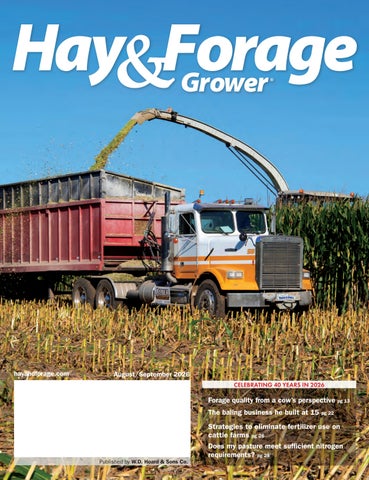
Corn silage was chopped on a beautiful fall day last year at Golden Oaks Farm near Wauconda, Ill. The farm contracts with Schultz Brothers Forage Service LLC to have their harvesting done. Charlie and Dave Schultz’s custom harvesting business was featured in the April/May issue of Hay & Forage Grower and can be found at bit.ly/HFG-brothers. Photo by Mike Rankin
HAY & FORAGE GROWER (ISSN 0891-5946) copyright © 2026 W. D. Hoard & Sons Company. All rights reserved. Published six times annually in January, February, March, April/May, August/September, and November by W. D. Hoard & Sons Co., 28 Milwaukee Ave., W., Fort Atkinson, Wisconsin 53538 USA. Tel: 920-563-5551. Fax: 920-563-7298. Email: info@hayandforage.com. Website: www.hayandforage.com. Periodicals Postage paid at Fort Atkinson, Wis., and additional mail offices. SUBSCRIPTION RATES: Free and controlled circulation to qualified subscribers. Non-qualified subscribers may subscribe at: USA: 1 year $20 U.S.; Outside USA: Canada & Mexico, 1 year $80 U.S.; All other countries, 1 year $120 U.S. For Subscriber Services contact: Hay & Forage Grower, PO Box 801, Fort Atkinson, WI 53538 USA; call: 920-563-5551, email: info@hayandforage.com or visit: www.hayandforage.com. POSTMASTER: Send address changes to HAY & FORAGE GROWER, 28 Milwaukee Ave., W., Fort Atkinson, Wisconsin 53538 USA. Subscribers who have provided a valid email address may receive the Hay & Forage Grower email newsletter eHay Weekly.
4 | Hay & Forage Grower | August/September 2026
F2 4AB Aug_Sep 2026 TOC.indd 1
7/31/26 10:17 AM
FIRST CUT
Farm lessons
Jenna Byrne Managing Editor
S I sit down to write my first “First Cut” as managing editor of Hay & Forage Grower, I can’t help but think back to a conversation I had many years ago. When I was in high school, a friend once told me I would never graduate from college because I was a farm kid. I guess, in her mind, farm kids didn’t go to college. At the time, the comment stung. Looking back, though, I realize it said far more about misconceptions surrounding agriculture than it did about me. Growing up on my family’s dairy farm in central Wisconsin, I was fortunate enough to learn lessons that no classroom could fully teach. Early mornings, late nights, missed events, and understanding that some things can’t wait until tomorrow become second nature on the farm. I didn’t realize it then, but those experiences would shape who I became and prepared me for opportunities I could have never imagined. If there is one thing my family taught me, it is that hard work opens doors. My parents never put limits on what my siblings and I could accomplish. Instead, they encouraged us to dream big, work hard, and remember where we came from. They taught me that showing up, keeping my word, helping others, and giving my best effort mattered far more than taking the easy route. Looking back, I realize every opportunity I have today is because of the values they instilled in me. I owe them more than I could ever express for believing in me long before I even believed in myself. While I always knew I wanted a career in agriculture, I never envisioned that path leading me here. After graduating from college with a degree in agricultural business and communications from the University of Wisconsin–Platteville, I joined the staff at Hoard’s Dairyman as an associate editor, where I spent the past two and a half years telling the stories of dairy producers and meeting the people who support them. Along the way, I traveled across the country, met incredible farm families, and learned firsthand that every successful operation shares many of the same qualities. The journey, however, has not always been as straightforward as it may appear. Like many people early on in their careers, I’ve experienced moments of uncertainty, setbacks, and opportunities that didn’t unfold the way I expected. There have been times when I questioned
whether I was capable or on the right path. Yet those moments often became the ones that shaped me the most. Agriculture has a way of reminding us that growth takes patience, persistence, and the willingness to keep moving forward, even when what lies ahead isn’t clear. Today, I’m honored to begin a new chapter as managing editor of Hay & Forage Grower. I come into this role with equal parts excitement and humility. As I switch gears from dairy to the forage side of agriculture, I am certainly no stranger to the people who make it possible. Farmers, researchers, agronomists, nutritionists, and industry professionals all share a passion for continuous improvement. I have much to learn, and I look forward to doing so alongside you while helping tell the stories that move this industry forward. One of the things I have always loved most about agricultural journalism is that no two days are ever the same. There is always another question to ask, a different farm to visit, and another opportunity to learn. In many ways, that mindset reminds me of life on the farm. We are always adapting, always improving, and always preparing for the next season. My goal here is simple: to provide information that is practical, trustworthy, and worth your time. More importantly, I hope to highlight the people behind the practices. While technology may evolve, the heart of this industry has always been its people. To the readers who have welcomed Hay & Forage Grower into their homes, offices, and tractor cabs for the past 40 years, thank you for allowing me to be part of that tradition. It is a privilege I do not take lightly. I look forward to meeting many of you — hearing your stories, learning from your experiences, and helping share the work you do every day. Looking back, I’m grateful for that conversation all those years ago. It gave me one more reason to work harder, chase opportunities I never imagined, and prove that the values I learned growing up on a dairy farm could take me farther than anyone expected. •
Email: Managing Editor Jenna Byrne at jbyrne@hayandforage.com
August/September 2026 | hayandforage.com | 5
F2 5 Aug_Sep 2026 First Cut.indd 1
7/29/26 8:17 AM
CONTRACT GRAZING FITS THIS HOOSIER by Mike Rankin, Senior Editor
T
HE Weather Channel’s radar map showed nothing but a giant blob of green, yellow, and red; it looked like something that might grace the walls of a modern art museum. On this end-of-May day, the windshield wiper motor was emitting smoke as we pulled into the southern Indiana farm owned and operated by Ronnie Boehm and his wife, Sharon. These were not ideal conditions to photograph green pastures and grazing cattle, but we hoped to catch a break. It didn’t happen. Boehm greeted our editorial trio with a smile from the shelter of his front porch. As we settled in the rocking chairs and listened to the serenade of raindrops hitting the porch roof, the lifelong Hoosier lamented about the multiple inches of rain that had plagued the area during the past week. After proper sympathies were expressed, we got down to our business of learning how he got into his business of contract grazing cow-calf pairs. Boehm’s grandparents started farm-
ing at this location near St. Meinrad, Ind., in 1912. His father, who stayed on the farm, was one of nine siblings. The farm’s rolling topography always suited some livestock, but row crops were also a stable enterprise. Boehm farmed with his dad until the latter passed away in 2020. These days, the 142-acre farm consists of 42 acres of pasture, 20 acres of woods, and 80 acres of row crops. About 20 acres of the row crop land that abuts his pasture is marked for conversion to
forage. However, those acres are flood prone, so he’s thinking about establishing switchgrass or just planting an annual forage crop mixture that he would reseed every year. Either option may allow him to extend his grazing season. The remainder of the current row-crop acres are not contiguous with the home farm, and he continues to evaluate long-term plans for those acres. “Grain margins are pretty thin, and I’m not sure I want to replace my older row-crop equipment, so my wife and I have chosen to move to a more grass-based operation.” Forty-two acres of pasture may not sound particularly impressive, but what is noteworthy is how those acres are being managed. Speaking to its productivity, it supports 40 cow-calf pairs from around Easter to early
6 | Hay & Forage Grower | August/September 2026
F2 6-9 Aug_Sep 2026 Contract Grazing.indd 1
7/29/26 8:19 AM
farm from his parents. Boehm started grazing stocker cattle with paddock moves every three days. To put more weight gain per day on the animals, he eventually started to move fence more often and adopted a one-day rotation. “I was getting about 1.7 pounds per head per day gain, which I didn’t think was too bad for these old fescue hills, but I was still at the mercy of the market.”
sugars from photosynthesizing all day. “It might be hot on some days, but we have shade in every paddock if they need it,” the contract grazier attested. “My next thought is to start moving cattle twice per day but to use a BattLatch automatic gate opener for one of the moves. I’m also keeping a close eye
A productive assortment of grasses and legumes greets cows and calves with each daily move to a new paddock on the Boehm farm. Mike Rankin
December, but it hasn’t always been that way. As is the case on most farms, the journey has been comprised of failures and successes. While helping his dad with the farm, Boehm also worked as a soil conservationist for the Indiana Department of Natural Resources. He consulted with farmers on an assortment of soil conservation practices, including forage establishment and managed grazing. “I decided that what I was recommending to other farmers in terms of grazing management should be implemented on our own farm,” Boehm said. “I started getting serious about a little over 10 years ago after attending numerous grazing conferences, grazing schools, and field days.” It was also about 10 years ago that he and Sharon purchased part of the
At a soil health conference six years ago, Boehm met Dave Fischer. Fischer and his family operate a large directto-market sustainable beef operation in St. Anthony, Ind., and he was looking for farmers willing to custom graze cow-calf pairs. It was then that Boehm started a successful business relationship with Fischer that still exists today. The two men are like-minded regarding sustainability, soil health, and animal husbandry. Fischer’s pregnant cows arrive at Boehm’s farm in April and calve throughout the summer. Boehm stated that this arrangement was more profitable than running stockers, and he doesn’t have to invest in cattle because Fischer retains ownership. “He provides the mineral, and we provide the water, forage, and management,” Boehm explained. “We get paid on a per-head, per-day basis. One of the advantages of the arrangement is that I don’t have to own hay equipment. Right now, we have 40 animal units on 42 acres, so about one animal unit per acre. All those acres are productive because we don’t need a winter sacrifice area,” he added.
One-day moves “With our 40 cow-calf pairs, right now they get a little more than an acre every 24 hours,” Boehm said. As the summer heat arrives, he reduces paddock sizing to correspond with lower forage intake. “We have permanent fence set up around the outside perimeter, but everything else is divided with polywire. To determine how big of an area to fence for the next moves, I evaluate the forage growth, weather forecast, soil conditions, and use an app on my phone to determine what I think the appropriate size of the paddock should be.” Boehm likes to move cattle around 3 or 4 o’clock in the afternoon because that’s when the plants are highest in
Jimmy Henning
A random meet
Ronnie Boehm wants every square foot of pasture to be dense and productive.
on virtual fence technology,” he added. As for clipping pastures, Boehm is not a fan. With his system, he prefers to trample the old stems the next time through the paddock. He doesn’t like to mechanically clip the stems because they become a deterrent to grazing during the next grazing cycle. Boehm also believes that clipping removes photosynthetic plant tissue and causes roots to slough off. “If you can get to small enough paddocks, it might not be perfectly uniform when they leave, but there aren’t that many remaining plants that weren’t eaten to the preferred height or trampled.” In the event of a serious drought, Boehm said he must simply weigh the options. If it’s not too serious, he can graze a little closer than he usually does to allow longer time periods for paddocks that are in the rest and recovery stage, but that only works temporarily. He can purchase hay, but that adds some additional time and expense, which might eliminate any profit margin. Finally, he could just send the cattle back to Fischer and live to fight another day. These days, Boehm works off the farm with the Indiana Department of Environmental Management as a storm water specialist, so he always tries to August/September 2026 | hayandforage.com | 7
F2 6-9 Aug_Sep 2026 Contract Grazing.indd 2
7/30/26 3:25 PM
fence at least one paddock ahead. If he’s gone on a work assignment, Sharon, who works at Fischer’s meat packing facility, can go out and open the fence to move cattle. A mobile mineral feeder follows the cattle and has a curtain treated with an insecticide to keep flies off the cattle’s faces. Garlic is mixed in with the mineral and performs well to repel flies from the cattle. Boehm doesn’t feed an insecticide for fly control because he doesn’t want to impede a pasture’s dung beetle population.
Likes his legumes Legumes play a large role in Boehm’s overall grazing system. “Our rest and recovery on pastures are about 40 to 45 days, so with one-day moves, I’ve noticed the legumes seem to persist a lot longer,” he noted. “We’ve been able to keep alfalfa, clovers, and birdsfoot trefoil in our pastures because of the longer recovery time. We have a high enough density of legumes in all our pastures that I haven’t had to purchase commercial nitrogen for the past seven years.” Boehm said he will broadcast seed nearly every month that the cattle are grazing. “If they hit a particular area
Mike Rankin
A portable mineral feeder is used to follow cattle through a grazing cycle. The custom mineral mix is provided by Fischer Farms.
hard — around a mineral feeder or shade tree — or it’s wet, I’ll hand crank oats, turnip, radish, ryegrass, birdsfoot treefoil, and clovers onto those areas as the cows are moved,” he said. “If I don’t put something there, Mother Nature will, and I may not like her choice. Maybe that’s micromanaging, but I want every square foot to be dense and productive with a desirable forage.” The southern Indiana native is also a proponent of frost seeding. He prefers to do it earlier rather than later. With a target of being done seeding before Valentine’s Day, he typically uses his utility task vehicle (UTV) to broadcast red clover, some white clover, birdsfoot trefoil, and annual lespedeza. “I’ve become a big fan of lespedeza because it does so well in the dry summers,” Boehm attested. “A lot of people call it the poor man’s alfalfa, but it can really provide a boost for midsummer forage production.” Being in the heart of the Fescue Belt, most of Boehm’s farm has been in Kentucky 31 tall fescue for decades. Although he relies heavily on legumes to provide a dilution solution for toxic fescue, he has also sought other solu-
tions. “We were awarded an EQIP contract from the Natural Resources Conservation Service to build a pond, run water lines, and convert some row-crop ground into pasture forages,” Boehm commented. “So, in September 2024, we seeded Estancia novel endophyte tall fescue, orchardgrass, red clover, and birdsfoot trefoil, and we got a great stand. It wasn’t grazed hard last year, but this year it has been extremely productive. We also obtained grant funding to have a drone fly winter cover crop seed on some lower corn ground, which we grazed last fall immediately after corn harvest and again this spring.” With 42 acres of productive pastures and another 20 soon to come into production with a comparable number of cows, Boehm is content with the system he has put in place. He likes his arrangement with Fischer Farms, and Fischer likes the job that Boehm does with his cattle and pastures. “When the animals we’ve had go back, Dave tells me that the calves are already used to humans, and that aligns well with his sustainable beef program,” Boehm said of their mutual relationship that currently shows no signs of weakening. •
8 | Hay & Forage Grower | August/September 2026
8_AugSept_HFG.indd 3
7/29/26 8:20 AM
Keep your hay clean
From the first cut to the last straw. Winter annual weeds compromise hay quality. Now is the time to stop them. A late-summer application of Rezilon® herbicide gives you long-lasting preemergence protection that other products can’t match, helping you control winter annuals before germination. If weeds have already emerged, you’re covered with the postemergence power of Cimarron® Plus and Pastora® herbicides. Using these products ensures your hay stays a cut above. All season long.
Discover a smarter, season-long approach to weed control. ALWAYS READ AND FOLLOW LABEL INSTRUCTIONS. Environmental Science U.S. LLC, 5000 CentreGreen Way, Suite 400, Cary, NC 27513. For additional product information, call toll-free 1-800331-2867. Envu Global . Not all products are registered in all states. Envu®, the Envu logo, Cimarron®, Pastora® and Rezilon® are trademarks owned by Environmental Science U.S. LLC or one of its affiliates. ©2026 Environmental Science U.S. LLC. RP-U-Ha-Re-050726-A-15
BEEF FEEDBUNK
by Shelby Gruss and Beth Reynolds
Get control of winter annual weeds in alfalfa
E
VERY spring, the calls start coming in. A producer notices their alfalfa field is thick with annual winter weeds. They want to know how much is too much and how to get rid of them. It’s a fair question, but when those weeds are visible and blooming, the best window for effective control has already closed.
Understand the enemy Winter annual weeds like wild mustard, field pennycress, downy brome, cheatgrass, and shepherd’s purse follow a growth pattern similar to cereal rye. They germinate in the fall, establish as a low-growing rosette, and spend the winter going through a vernalization period, a required cold exposure that triggers them to bolt and flower in the spring. That’s exactly why we don’t notice them in the fall. They’re small, flat to the ground, and easy to miss among the alfalfa canopy. But come early spring, they take off quickly, bolt, and are suddenly flowering or already setting seed. At that point, herbicide options become limited, and effectiveness drops significantly. Winter annual weeds can lower alfalfa
yields, reduce forage quality, reduce palatability, and slow hay dry down. Some are even toxic to livestock when present in high concentrations. For producers targeting high-quality hay, all are significant concerns. For others, a light flush of winter annuals may not cause serious economic damage, and that distinction matters when deciding whether herbicide costs are justified. Because these are winter annuals, they complete their life cycle and die before the second cutting. However, if the stand has gaps or thin areas, expect to see summer annual grasses like foxtail move in to fill that space. Winter annuals in spring are often a signal that something bigger needs attention.
What to do this fall Take a walk through your alfalfa fields before a hard freeze. Get down low and look for the small, flat rosettes of winter annuals tucked in among the alfalfa plants. If there was a problem last spring, there’s a good chance germinating seedlings can be seen this fall. Knowing what weeds are present — and their density — helps you plan and select the most effective control option.
A thick, vigorous alfalfa stand is one of the best weed suppression tools available, and fall is an ideal time to do a stem count to assess stand health. As a general guide: • Greater than 55 stems per square foot: healthy, productive stand with good competitive ability. • 40 to 55 stems per square foot: stand is thinning; consider management options. • Less than 40 stems per square foot: declining stand; seriously evaluate rotating out. If your stand is below healthy thresholds, controlling weeds alone won’t solve the underlying problem.
Consider your options If the stand is in serious decline, it may be time to rotate out. Continuing to fight weeds in a failing stand is an expensive, uphill battle. A rotational crop will help to clean up the weed seed bank and start fresh. If the stand is productive but thinning, interseeding in the fall may help thicken the canopy to improve its ability to compete with weeds going forward. If the stand is healthy, fall scouting
Figure 1. When to apply herbicides Most effective herbicide application windows to control winter annuals
Winter annual lifecycle, Iowa Dormancy
Dormancy Cut
Cut
Cut
Example hay schedule, Iowa Dormancy Jan
Feb
Dormancy Mar
Apr
May
Jun
July
Aug
Sept
Oct
Nov
Dec
10 | Hay & Forage Grower | August/September 2026
F2 10-11 Aug_Sep 2026 Beef Feedbunk-AF1.indd 1
7/30/26 3:30 PM
combined with a timely fall or early winter herbicide application — targeting weeds at the rosette stage — gives you the best chance of a clean first cutting. If an herbicide application is warranted, applying when alfalfa is dormant but winter annuals are not is the most effective approach. Once alfalfa enters dormancy after a killing frost, injury risk is minimized, creating a window where herbicides can target winter annual weeds with little consequence to the crop. Applications made too late in the season risk reduced efficacy, as cooling temperatures slow weed metabolism and herbicide uptake. Young rosettes are far more susceptible to herbicides than bolted, flowering plants. Herbicides must be applied before alfalfa shoots green up in the spring. Alfalfa growth stage is the critical cutoff; once new shoots emerge, the risk of crop injury grows substantially, and most labels no longer permit application. The spring transition from
Be sure to apply herbicides at the correct time.
dormancy to active growth can happen quickly, and the application window can close within a matter of days with a few warm spring days. If alfalfa has already turned green before you can get into the field in the spring, switch to a product like Pursuit or Raptor. These herbicides cause less injury to actively growing alfalfa than the dormant-application herbicide options, but need to be applied when
the alfalfa is less than 3 inches tall. If you’re growing a Roundup Ready alfalfa variety, there is some added flexibility in timing. However, don’t wait too long. If weeds exceed about 3 inches tall or alfalfa begins forming a canopy, control effectiveness drops. Before applying any herbicide, read the label carefully. Labels specify not only the correct rate and timing for effective weed control, but also critical restrictions around cutting intervals, such as how long you must wait between application and harvest. Some products have preharvest intervals that could affect your first cutting timing or limit your options depending on how close you are to green up. •
SHELBY GRUSS AND BETH REYNOLDS The authors are an extension forage specialist and an extension beef specialist with Iowa State University.
PROJECT: 29547_LAN_Magniva_Hay_PrintAd PUBLICATION: Hay & Forage NON-BLEED SIZE: 7.5” x 4.875”
Partnering in microbial solutions for a changing world. Using sound science, proven results and knowledge from experience, Lallemand Animal Nutrition helps our customers and industry partners be more successful – and animals lead healthier lives. Lallemand Animal Nutrition provides a full range of specific, natural microbial products, services and solutions that improve animal welfare and performance while respecting animals, people and the environment.
August/September 2026 | hayandforage.com | 11
F2 10-11 Aug_Sep 2026 Beef Feedbunk-AF1.indd 2
7/31/26 10:18 AM
DAIRY FEEDBUNK
by Gonzalo Ferreira
Lessons we learned from our alfalfa research project
I
N THE spring of 2025, we initiated our alfalfa research project funded by the USDA Alfalfa and Forage Research Program. This project is a collaboration between Virginia Tech and Penn State University. Throughout the first year, we had a productive period with substantial progress, and we present the main highlights below.
Plot study In April 2025, our collaborator Guojie Wang, an assistant professor from Penn State University, and his team visited Virginia Tech to seed 48 alfalfa plots. In this study, we are evaluating the effects of alfalfa dormancy, cutting frequency, and reduced-lignin genotype on forage yield, quality, and in situ ruminal neutral detergent fiber (NDF) digestibility. Throughout 2025, we performed four cuts for a total of 192 samples. Preliminary data suggest that cutting (or season) has a greater impact on forage quality than dormancy or genotype. This appears to be true for biomass yield, crude protein and NDF concentrations, and ruminal NDF digestibility. This year marks the second year of production. Hopefully, in the coming months, we will provide another update on our progress. Results from this plot study have been presented at the TriState Dairy Nutrition Conference and at the national meeting of the American Dairy Science Association (ADSA). We thank Forage Genetics International for donating the seed.
Alfalfa versus corn silage In April 2025, we also seeded a 25-acre field at a seeding rate of 20 pounds per acre and a depth of half an inch or less. We controlled weeds approximately 20 days before planting, which allowed us to no-till seed the alfalfa with adequate soil moisture and minimal cover. Within a couple of weeks, not only could we observe a good stand of vigorous plants, but we could also find active nodules in the roots of the alfalfa.
In August 2025, we started a feeding trial comparing how diets containing corn or alfalfa silage affect production performance, the rate of passage of undegradable NDF (uNDF), and the utilization of digestible energy. In this study, we ensiled the first cut from the alfalfa field mentioned above and then formulated one diet in which most of the forage was corn silage and another in which most of the forage was alfalfa silage. To our surprise, the production performance of dairy cows did not differ greatly. More surprisingly, the rate of passage of uNDF appeared to be similar for both diets. We are still analyzing the data to better explain these results, but under the conditions of this study, both the “queen of forages” and corn silage performed similarly, which was unexpected. Results from this animal study have been presented at the American Forage and Grassland Council Conference (AFGC) and at ADSA. We thank Lallemand for donating the inoculant for ensiling the alfalfa.
Pigweed problem From previous experiences, I have learned that weed infestation can be particularly challenging in springseeded alfalfa stands, and in this case, the scenario was no different. After the first cut during the first year, a heavy infestation of pigweed (Amaranthus sp.) became evident, and unfortunately, the pigweed appeared to be resistant to glyphosate. This situation put us in a challenging position, as the continuity of our project depended on controlling this weed. Michael Flessner, a weed management extension specialist at Virginia Tech, recommended spraying flumioxazin and paraquat within two days after the first cut of the second year. While scouting the field two weeks after the second cut, not only could we not find any pigweed emerging, but we also did not find any weeds at all. Overall, this proved to be an excellent weed control strategy.
Most of my experience growing alfalfa has been in Argentina, where alfalfa is a key component of grazing dairy systems. The Pampas of Argentina are known for their flat and open landscapes with limited woodland. Given this landscape, the presence of deer in the Argentine Pampas is limited. In contrast, in the Appalachian area of Virginia (as in many other places in the U.S.), deer are abundant, and a productive and healthy stand of alfalfa can become a feast for a herd of deer. In this project, we have counted as many as 27 deer in a 25-acre field at a given time. Deer can cause at least two types of damage to alfalfa. First, there is grazing of the upper and tender parts of the plants, to the point of flower inhibition. The other damage is the lodging of the plants due to deer lying down. Unfortunately, we have not found a solution to this issue, and we are coexisting with the problem. One clear lesson is not to wait for plant height or flowering to decide on harvest timing. Following a set schedule may be the most suitable option for determining when to harvest. In summary, we have been, and continue to be, engaged in a very intense and productive alfalfa research program in the dairy forage research laboratory at Virginia Tech, with more work ongoing and more to come. We are learning from both in-depth plot and animal studies as well as practical field experiences. I would like to thank my colleagues and collaborators, my graduate students, Alyssa Neef and Yuma Glenny, all of the undergraduate students, and the crop and dairy personnel who helped generate this information. •
GONZALO FERREIRA The author is a professor and extension dairy specialist at Virginia Tech.
12 | Hay & Forage Grower | August/September 2026
F3 12 Aug_Sep 2026 Dairy Feedbunk.indd 1
7/29/26 8:50 AM
FORAGE QUALITY FROM A COW’S PERSPECTIVE by Rick Grant
Digestibility yields dividends We’ve long known that cows consuming highly digestible forage fiber produce more milk components, have fewer metabolic disorders, and greater longevity. Cornell University research reported 30% higher income over feed cost for these herds. We also understand the relationship between neutral detergent fiber (NDF) digestibility and production first published over 20 years ago by Michigan State University dairy
Mike Rankin
W
HEN selecting forages for your farm, focus on the essentials that allow your herd to respond its best to forage quality. From the cow’s perspective, two major factors include targeting the right forage to the right cows and deciding on the optimal blend of forages specific for your farm and your herd. An ideal blend of forages supplies the correct balance of nutrients to the various groups of cows and, when harvested properly, optimizes eating and resting rumination, which is fundamental to cow health and productivity. Dairy producers need to stay abreast of the latest forage research, or risk falling behind the industry. But the latest innovations and forage genetics work best when plugged into a fundamentally sound forage program. Some years ago, Penn State University dairy researchers found that the highest profit herds, first and foremost, had the ability to consistently manage forage quality and inventory. Regardless of weather, they had appropriate equipment to harvest their crops at the optimal maturity. These highest profit farms had plans — and back-up plans — to ensure timely harvest and were adaptable to whatever Mother Nature threw at them. Importantly, these herds averaged about 10% less in total feed costs and were consistently the most profitable year over year.
To achieve maximum return from fed forages, feeding decisions need to be made with the cow’s point of view in mind.
scientists: Every 1 percentage-unit rise in NDF digestibility translates to 0.40 pounds per day more dry matter intake and 0.55 pounds per day greater 4% fat-corrected milk. Don’t underestimate how quickly forage fiber and its digestibility change in the field. University of Wisconsin research demonstrated that alfalfa NDF increases by 0.43 percentage units per day while NDF digestibility drops by the same amount. Cornell work found that the NDF digestibility of grasses declines by up to 1 percentage unit per day or even faster. If you want to satisfy the cow, timeliness of harvest is paramount. In fact, maturity at harvest has a far greater impact on NDF digestibility than whether the crop is a legume or a grass. That’s food for thought the next time you are poring over a seed catalog, as important as forage selection is. Thirty-hour NDF digestibility is a commonly used metric of forage-fiber
quality. For high feed intake and milk production, legumes should have greater than 50% NDF digestibility (percent of NDF on a dry matter basis), grasses more than 60%, corn silage more than 55%, brown midrib corn silage more than 65%, and winter cereals more than 65%. Recent research suggests that, for winter cereals, harvesting at flag leaf stage is ideal for lactating dairy cows.
Match quality to cows The relationship between rumen NDF digestibility and milk yield is critical, but the cow demands that we dig deeper to understand that her biology requires forage segregation by NDF and starch content and digestibility. Allocation of forage inventory by milk production level or stage of lactation yields more milk from your forages. Research we conducted when I was at the University of Nebraska illustrated the critical need to target forage August/September 2026 | hayandforage.com | 13
F3 13-14 Aug_Sep 2026 Forage Quality.indd 1
7/29/26 8:50 AM
xxxxxx xxxxx xx x xx xxxx xxx xx xxxx
use to the correct groups of cows. In a total mixed ration, we fed lower and higher NDF digestibility corn silage (58% versus 67% 48-hour NDF digestibility) to dairy cows ranging in milk production from about 40 to more than 80 pounds per day. Overall, cows fed the higher digestibility corn silage consumed about 1 pound per day more dry matter and produced 2 pounds per day more milk. Based on the usual relationship between NDF digestibility and milk yield, we would have expected closer to 5 pounds per day more milk when cows were fed the higher NDF digestibility silage. That was puzzling to us, but when we dug deeper into the data, we found that the highest producing cows responded very positively to the higher NDF digestibility. In contrast, the lower producing cows either did not respond at all in energy-corrected milk production, or they even dropped in milk. The negative response likely is related to both NDF and starch when feeding corn silage. Think about that: By feeding the higher quality corn silage to our low cows, not only did we squander its nutritive value on cows that were not biologically programmed to respond, but we actually drove their production down. Economically, that is a double whammy to avoid. Subsequent work at Miner Institute showed similar outcomes for brown midrib corn silage and high-quality grass silage. The bottom line is that we must target the right forage to the right cows whenever feed storage and feeding facilities allow it.
Best forage combos Corn silage and haycrop silage often provide the dietary forage foundation, but rations often include winter cereals, sorghum-sudangrass, and other forage crops such as oats and peas. Corn silage and alfalfa are complementary forages in many ways, and recent work from the Miner Institute suggests an optimal ratio of about 30:70 alfalfa-to-corn silage (DM basis) to boost milk protein production and efficiency of dietary nitrogen use. Their respective fiber characteristics, protein content, rumen protein degradability, and starch differences combine to enhance rumen microbial protein production, which in turn, boosts production of milk protein and fat.
Research in the past decade has allowed us to precisely characterize forages based on their fiber characteristics. These days, many nutritionists and dairy producers assess forages based on their content of undegradable NDF and potentially degradable NDF. The degradable NDF may be further characterized as fast- or slow-digesting, and nutrition models respond to the amount and rate of digestible NDF degradation in the rumen. For instance, brown midrib corn silage has less undegradable NDF than conventional corn silage and contains more fast-digesting NDF with a substantially greater rate of rumen digestion. Grasses usually have less undegradable NDF than legumes, but the rate of NDF digestion for legumes is typically much higher than for grasses. Alfalfa breaks down when chewed differently and more rapidly than grass, and so it usually has a faster rumen turnover and is less filling than grasses. Diving into details of rumen fiber digestion is beyond the scope of this article. My main point is that forage laboratories have methodology to measure these fiber fractions and their rumen digestibility, and many nutritionists use ration formulation models that are responsive to these fiber inputs. The bottom line is that we now have the measures and the models to mix and match forages that complement each other to optimize cow response at various stages of lactation. From the cow’s perspective, we need to focus on fiber digestibility and the forage’s ability to maintain target dry matter intake, especially in earlier stages of lactation with higher milk yield goals. Harvest at the proper stage of maturity, and remember that for grasses, the goal is to harvest early in an attempt to capture higher NDF digestion rates closer to the fast rates typically seen for legumes such as alfalfa. Factors other than response to diet will ultimately determine the optimal amounts of corn, alfalfa, grasses, and alternative forages grown or purchased and fed for any farm. These factors include cost of forage production, agronomic considerations, crop yields, water needed to raise the crop, and variability in crop nutrient profile across cuttings. Models just coming into play in the dairy industry, notably the Ruminant
Farm System (RuFaS) model, will allow producers and consultants to optimize forage mixes from a nutritional, agronomic, and economic perspective simultaneously. The RuFaS model is being incorporated into the Famers Assuring Responsible Management (FARM) program so it will become widely available.
Unlock nutritional value
Getting the most from the forages fed on your farm requires a dedicated adherence to basic feeding concepts designed from the cow’s perspective. Cows require forage mixes that contain the right nutritive value targeted to the right cow groups. Current laboratory analytical methods allow us to blend forages into rations to tailor fiber amount and degradability for cows of varying dry matter intake and milk production levels. One final, fundamental question to ponder: Will your cows “see” all the nutritive value measured and reported on the forage analysis? Consider that laboratory analysis measures the potential degradability of a forage. For example, NDF digestibility is typically measured in an in vitro system buffered at pH of 6.8 under ideal conditions for fiber fermentation by rumen microbes. However, the only rumen digestion system that really matters on your farm is the one residing inside each cow in the herd. What is their rumen pH? Poor ration formulation and feedbunk management compromise rumen pH and will lower the potential feeding value of the forage. This is especially true under competitive feeding situations that encourage slug feeding, sorting, and less resting rumination — such as overstocked pens. The cow’s perspective necessarily includes her rumen and the potential for forage fermentation based on her management environment. Don’t let poor management dampen your forage’s feeding potential . . . something to ruminate on as you seek to optimize forage use from the cow’s perspective! •
RICK GRANT The author is a trustee of the William H. Miner Agricultural Research Institute in Chazy, N.Y.
14 | Hay & Forage Grower | August/September 2026
F3 13-14 Aug_Sep 2026 Forage Quality.indd 2
7/31/26 10:22 AM
WE HEART YOU
It takes a farmer to understand a farmer. And here at Liphatech Ag, we have the farming and ranching backgrounds to know what you’re up against every day. Your dedication, grit and selflessness doesn’t go unnoticed. Our team is here to support you in every way we can.
Rozol® Pocket Gopher Bait Burrow Builder Formula, Ground Squirrel Bait, Vole Bait and BorderLine® are Restricted Use Pesticides. Metarex® is a Restricted Use Pesticide in New York.
LIPHATECHAG.COM • 800.351.1476
Untitled-1 1
7/27/26 10:00 AM
THE PASTURE WALK
Ryan Ebert
by Kacie and Zach Scherler-Abney
No surprises here
I
F YOU’RE anything like me, when it comes time to bring cattle back into the corrals and pens to work, ship, or sort them, then you know my favorite group pastime: guessing weights. Whether it’s a group of stockers or a single cow, few things on the ranch bring me as much joy as seeing that little red number pop up on the scale screen right where I thought it would. In 1906, a kindred spirit of mine named Francis Galton ran an experiment to see if a crowd of nearly 800 people in Plymouth, England, could do something interesting. He hauled an ox to town and wanted the group to guess its weight — my kind of guy, my kind of party. When I first read the story, I assumed the outcome would be funny. A bunch of people without agricultural backgrounds getting together to guess an animal’s weight is about as subjective of a measurement as you can get. If you parked a big steer downtown in a major city today and asked random passersby to guess its weight, there’s no telling
the crazy answers you’d get. But in Galton’s experiment, much to my surprise, the crowd’s guess landed within 1% of the actual weight. The ox weighed 1,198 pounds, and the crowd’s average guess was 1,197. They should have asked for a little shrink.
Make no assumptions So, what’s the takeaway for us modern-day graziers? Most of my mistakes with cattle have happened when I imposed what I thought would work instead of taking stock of what was actually happening on the ground. Whether you’re just starting, changing grazing practices, or experimenting, it’s hard to separate truth from fiction, and it’s even harder to separate what we want to be happening from what’s actually happening. It’s easy to assume that the crowd is the point of Galton’s story, but in reality, the scale is what determined that the crowd was right that day, not the other way around. It’s always easier to assume something is working rather than doing what it
takes to know it’s working. My encouragement aligns with what we learned from Galton: Build your own “crowd” out in the pasture, then invest in a way to check it against what’s actually happening. By that, I mean pick a handful of simple, measurable, observable data points you know are driving your specific business and use them to shorten your feedback loop. This gives you more frequent feedback on whether something is working. Now, I can already hear Kit Pharo’s voice in the back of my head telling me not to follow a crowd — and he’d be absolutely right. This isn’t about letting other people decide what’s best for you. It’s also not about listening blindly to an app, spreadsheet, or the latest industry trend. What I’m suggesting is to build a “crowd” of data points and observations that correlate with your own goals, not someone else’s.
Track the trackables Here is the catch: Your “crowd” should require minimal effort to track. Stan-
16 | Hay & Forage Grower | August/September 2026
F3 16-17 Aug_Sep Aug_Sep 2026 Pasture Walk.indd 1
7/29/26 8:52 AM
ford psychologist BJ Fogg proved that human action is dictated by an “action line.” Every task requires a balance of motivation and ability, and time is the factor that decides whether you’ll actually want to do it. The moment a daily task requires more time or energy than your brain wants to devote to it, that task dips below the action line. Your brain instantly categorizes it as “too hard” or “takes too long,” and you have to really work to stick with it. You may have the fanciest new AI tool, app, or measurement system in the world, but if it’s even a little bit difficult to open or figure out, the likelihood of you using it consistently will decline. For our operations, it’s important to build a system that allows us to be good managers where it counts, instead of burning our precious daylight wrestling with data entry. Perfect is the enemy of good, here.
cuts that are already sitting right in front of you should be enjoyable. Figure out a few simple, easy-to-check observations that can drive your grazing profitability. Then, start measuring them as often as you can. If we shorten the feedback loop by raising our number of observations, then we start stacking the odds in our favor. That way,
when it comes to sale time, those red numbers aren’t as big of a surprise. • KACIE AND ZACH SCHERLER-ABNEY The authors are cow-calf ranchers from southwest Oklahoma.
Three things On our place, keeping it functional and easy means our “crowd” consists of just three things every single day: cattle behavior (ranked 1 to 5), manure score (1 to 5), and gut fill (ranked 1 to 5). Any time someone checks on the cattle, those three questions must be answered. They can be taught and explained easily, measured effortlessly, observed while multitasking, and confirmed with a quick video or picture. This way, observations can be shared with anyone else on the team who might need to see or use it. Here is why those three together matter to me: If I just checked cattle behavior, I might think that they are calm, while perhaps missing the fact that they have no energy left in their feed. If I just checked manure, I might not notice that they’re pacing back and forth on the fenceline, which indicates stress or hunger. If I just checked gut fill, I might miss identifying that the forage quality is terrible. On its own, each metric is just a subjective guess. But when observed together in context, our crowd quickly gives us a holistic, objective answer that allows us to make better management decisions at a faster pace. There are all kinds of ways we can shorten these feedback loops for ourselves without over-complicating things or waiting on a scale at the end of the season. Looking for low-friction shortAugust/September 2026 | hayandforage.com | 17
F3 16-17 Aug_Sep Aug_Sep 2026 Pasture Walk.indd 2
7/29/26 8:52 AM
QUALITY COACH
by John Goeser
High-oleic soybeans have forage implications
W
HILE soybeans and grain don’t classically get much coverage within Hay & Forage Grower, this topic is being thrust into many forage discussions. Let’s delve into how growing high-oleic soybeans (HOSB) can fit into a forage crop rotation and walk through what implications this protein feed craze has upon our forage program. I’ll start with a disclaimer. With a bachelor’s degree in agronomy and master’s degree in plant breeding and genetics, I find myself in agronomic discussions more frequently than the average nutritionist. Though, in full transparency, I am not a practicing agronomist. Seek out experienced agronomy guidance from your consultant regarding the following.
age, roasting, and grinding between the dairy and crop farmer. However, larger economic returns lie in figuring out how to grow HOSB on the dairy farm and capturing that additional margin, which a grain farmer or feed mill would otherwise net. Here, I’d like to expand the HOSB economic considerations to the farm growing soybeans along with forage.
Capturing additional margin For a 500-cow dairy, feeding a typical dairy ration with 22 pounds of dry matter (DM) corn silage, 8 pounds of DM haylage and then adding in 6 pounds as-fed roasted soybeans, we need roughly 840 acres to feed the herd for 365 days. Corn silage yielding 7 tons of DM per acre requires roughly 325 acres, haylage yielding 5 tons of DM per acre requires roughly 165 acres, and soybeans yielding 55 bushels per acre will account for the remaining 350 acres. On a per-cow basis, this amounts to roughly 0.65 acres for corn, 0.33 acres for alfalfa, and 0.7 acres for soybeans. Note that the acres needed to grow soybeans exceed both the corn for silage and hay acres. For farms that grow corn for grain or cash cropping, HOSB acres could replace grain acres. Though for farms that are tight on land, the discussion pivots toward cutting back on alfalfa acres and renting additional ground to grow soybeans or contracting with local grain farmers to grow the highvalue soybeans. This latter option can often work well, paying a premium to the grain farmer and managing stor-
There are various strategies that can work, such as replacing grain corn acres with soybeans, replacing some alfalfa acres and renting ground for soybeans, or simply renting additional ground. Growing soybeans presents a few attractive value propositions in a crop rotation for dairy farms growing corn for silage and grain. Being a nitrogen-fixing crop, just like alfalfa, soybeans offer nitrogen credits the following year and help offset crop input expenses. Adding a third crop to your forage rotation can also help break plant disease or insect life cycles, which becomes increasingly important as we recognize how disease affects plant health, forage quality, and dairy production.
above. Now let’s consider the three different scenarios also discussed above: replacing corn grain acres with soybeans, partially replacing alfalfa acres with soybeans and renting ground, or renting additional ground to grow HOSB. Taking corn grain acres out of production doesn’t add more rent costs to the balance sheet; however, this approach can present a hidden cost in that more corn grain needs to be bought for the ration. Similarly, if alfalfa acres are ripped up, then this forage and functional fiber more than likely need to be replaced with hay or more corn silage. Further, we have a net loss in nitrogen credits with alfalfa relative to soybeans, given that alfalfa offers roughly 120 pounds of nitrogen credit to corn the following year versus soybeans’ 40 pounds of nitrogen credit. In both situations, replacing corn or alfalfa acres, the net return in each case is less than renting additional ground to plant soybeans. The economic modeling favors renting additional ground. In fact, in this 500cow model scenario and enterprise budget, we can pay up to $430 per acre in rent and still have a better net return over replacing alfalfa or corn grain acres with HOSB. While soybeans aren’t forage, they’re being forced into dairy enterprise and forage management discussions. Many farms contemplate taking forage or grain acres out of production, but this might not be the best path toward optimal economic returns for a dairy farm. In my opinion, let’s keep growing highquality forage and consider contracting or renting land to take further control of feed costs on the farm. •
Weigh your options There are endless scenarios that should be considered when growing HOSB along with forage. To drive this discussion forward on your farm, let’s work with the 500-cow dairy model, dairy ration, and acreage described
JOHN GOESER The author is a dairy nutrition and management consultant with Progressive Dairy Solutions Inc., and an adjunct professor at the University of Wisconsin-Madison.
18 | Hay & Forage Grower | August/September 2026
F3 18 Aug_Sep 2026 Quality Coach.indd 1
7/30/26 3:56 PM
FORAGE GEARHEAD
by Gregg Zurliene
Don’t let backorders set you back
A chopper can’t stop As we get into corn-chopping season, self-propelled and pull-type forage harvesters are built to perform at a high level, so having spare parts on hand is necessary to keep choppers moving. As
Mike Rankin
I
’M WRITING today in mid-summer after a slow, soaking rain shower here in Missouri and wondering about what will need to be done to get ready for this fall. The first thing that comes to mind is chopping corn silage. To complement Randy Clark’s article in the April/May issue on maintenance, I’m going to focus on the possibility of breakdowns and the “I should’ve had that part on hand” regret when an equipment fix is needed. Looking over machinery ahead of when it’s needed and noticing what’s going on pays large dividends. I usually try to clean off all our machines with an air compressor and look for oil soakage on plant material. When found, I start looking into what the cause might be. It could be an O-ring that split and is just barely seeping, but over time, it’s going to cause a problem if nobody checks the hydraulic oil. At the same time of the air cleaning, I also look at machine welds to identify any stress cracks that may be cause for concern or repair. Over the past decade, there have been many changes within the equipment industry from an inventory production, logistics, and stock units perspective. One thing that has changed significantly is supplier components. More individual original components are being outsourced and supplied by outside-the-company manufacturers. I don’t know of many, if any, equipment companies that make every single part for a machine. For example, most rims and tires are outsourced. I know of a recent case when a silage truck was down for two weeks — not because of the rims — but because the flotation tires on the front were on backorder. That’s not a good situation to be in when there’s grass to chop. It’s not just tires and rims but other components such as U-joints that are often outsourced. It’s components such as these that farmers need to have on hand.
mentioned previously, having a spare rim in the shop is probably a good idea. I would also ensure that I had a full set of filters, a spare main drive belt, and some other key components that have a history of wearing. This will reduce significant downtime if those parts are easily accessed. I’m not recommending having one of everything in your shed or toolbox for a particular machine, but I would definitely be in conversation with your local dealer to find out which parts are readily accessible and which ones are not. Any frequently replaced parts that are often backordered should be in your shop at the time of harvest. These days, most dealerships don’t stock a full line of parts for everything they sell. We live in a different world than was the case 20 or 30 years ago. It costs a lot to stock parts. There was a time when half the farms in a county had a pulltype chopper, and the dealer was able keep a full line of parts in stock based on demand. Now, there may be one producer in a five-county area that’s got a large, self-propelled chopper, and he does everybody’s work for them. Stocking parts for only one or two customers is a cost most dealers aren’t willing to shoulder. Another key component in the silage-chopping operation that I often
feel gets overlooked is the pack tractor. In fact, the pack tractor is a critical cog to the making of high-quality corn silage. Not any tractor will do, and they all deserve the same maintenance attention as the chopper, trucks, and wagons. This means routinely blowing it off with an air compressor and giving it a good inspection. Check the dozer blade mounting and fluid levels in the tires. Also ensure that the fluid levels in the hydraulic and engine systems are where they need to be. An equipment breakdown is never welcomed, but it’s especially frustrating and costly when corn needs to be cut and chopped and extra employees have been hired to get the job done quickly and efficiently. Although they can’t be totally prevented, heading off potential breakdowns by cleaning and inspecting equipment can certainly help. Having key parts available will help limit the time machines are down, especially if that part is on back order. •
GREGG ZURLIENE The author is a forage and livestock products specialist in Missouri.
August/September 2026 | hayandforage.com | 19
F3 19 Aug_Sep 2026 Gearhead.indd 1
7/31/26 10:32 AM
YOUR CHECKOFF DOLLARS AT WORK
Alfalfa resources for the South Hay & Forage Grower features results of farmer-funded research projects through the Alfalfa Checkoff, officially named the U.S. Alfalfa Farmer Initiative, and administered by National Alfalfa & Forage Alliance (NAFA).
“These have been valuable resources to share directly with extension agents and farmers who are interested in alfalfa production in the region,” Tucker said. The materials continue to be distributed at educational events, agent training sessions, field days, and on-farm visits with farmers considering alfalfa as part of their operation. According to Lisa Baxter, University of Georgia Extension forage specialist, the materials have become a practical starting point for many conversations. “I hear about these resources most from county extension agents,” Baxter said. “They have found it valuable to share the resource guide with farmers who call when thinking about alfalfa.”
Multiple formats The guide and video have also been shared through social media, work-
shops, conferences, and industry trainings. Feedback has come from multiple Southern states, demonstrating that the need for region-specific alfalfa information extends well beyond Georgia. Having both print and video methods to deliver the information has been well received. “This is the first resource of this scale we have released in multiple formats. Many learn better from audio or video, and I think the metrics show that,” Baxter said. One of the themes emphasized throughout the project is setting realistic expectations. “Alfalfa is not always pretty,” Tucker noted. While photos often highlight ideal production conditions, successful alfalfa management requires understanding the challenges that can occur throughout the season. Both Tucker and Baxter wanted
Lisa Baxter
E
VEN today, Jennifer Tucker hears a common misconception when talking with farmers across the Southeast: “Alfalfa doesn’t grow in the South.” As an extension beef specialist with the University of Georgia, Tucker knows otherwise. Interest in alfalfa production has grown across the region in recent years, driven by demand for high-quality forage and improvements in varieties and management practices. Yet many farmers remain unfamiliar with growing alfalfa and often struggle to find information tailored to Southern growing conditions. To address that need, Tucker led a project to develop practical educational resources focused specifically on alfalfa production in the southern United States. JENNIFER The effort resulted TUCKER in a comprehensive production guide and video designed to help farmers, extension agents, and industry professionals better understand the opporLISA BAXTER tunities and challenges Funding: $14,000 associated with growing alfalfa in the region. The project began after surveys and conversations with farmers and extension agents identified a need for accessible, region-specific information. Existing publications had valuable information, but farmers wanted resources that were easier to access and practical to use in the field. The resulting “Alfalfa Forage Production Guide” covers the entire production cycle, including variety selection, establishment, fertility, pest management, harvest management, grazing considerations, and forage quality. A video was also developed to provide the same information in a format viewable on demand.
Alfalfa-bermudagrass research plot at Tifton, Ga.
PROJECT RESULTS • Created a comprehensive production guide covering establishment, fertility, pest management, harvest management, and forage quality. The guide has experienced widespread use. • Developed companion video resources to provide information in multiple learning formats. • Resources continue to be used through extension programs, agent trainings, field days, farmer meetings, and on farm consultations.
20 | Hay & Forage Grower | August/September 2026
F3 20-21 Aug 2026 Alfalfa Checkoff.indd 1
7/30/26 4:02 PM
farmers to see a complete picture of alfalfa production rather than only the successes. “I want farmers to see the entire alfalfa story, including the good and the bad, from beginning to end,” Baxter said. “Alfalfa is not something to plant without sufficient planning and is not the best fit for every situation in
CONTINUOUS MOVEMENT LIKE NO OTHER.
SUPPORT THE ALFALFA CHECKOFF! Buy your seed from these participating marketers: Alforex Seeds by DLF America’s Alfalfa CROPLAN Forage First by DLF Innvictis Seed Solutions Latham Hi-Tech Seeds NEXGROW W-L Alfalfas Zinma Seeds DON’T SEE YOUR FAVORITE BRAND ON THE LIST? Contact NAFA for information on becoming a participating brand
while extension personnel continue using the materials as a trusted reference. “I hope these resources have prevented planting challenges and reduced stand failures by helping farmers be more informed before putting seed in the ground,” Baxter said. A full copy of the guide, video, and project report can be found at alfalfa.org. •
our region.” By addressing common questions before establishment, the resources help farmers make more informed decisions about whether alfalfa fits their operation and what management practices are needed for success. Farmers still have access to information developed through the project,
ELECTRIC PIVOT APPLICATION PATTERN: › Not Uniform › Starts/Stops 2,880 times a day
T-L CONTINUOUS MOVEMENT APPLICATION:
HYDROSTATIC DRIVEN
› Smooth and continuous at any speed › Precise rotation at any temperature
A PICTURE CAN BE WORTH THOU$ANDS. T-L ... LIKE NO OTHER. Phone: 1-800-330-4264
Hastings, Nebraska 68902-1047 USA
Fax: 1-800-330-4268
TL-544F.indd 1
F3 20-21 Aug 2026 Alfalfa Checkoff.indd 2
TIF ER IE
ISO 9001
U A LI T
Q
sales@tlirr.com · www.tlirr.com
Fax: (402) 462-4617
D
Phone: (402) 462-4128
The alfalfa checkoff benefits you and the entire industry. Scan the QR code to learn more.
Y
151 East Hwy 6 & AB Road · P.O. Box 1047
C
www.tlirr.com
7/21/26 4:05 PM
August/September 2026 | hayandforage.com |21
7/29/26 9:00 AM
THE BALING BUSINESS HE BUILT AT 15
Starting young meant earning every customer the hard way, but six hay seasons later, Isaac Jakobi has become known around the county.
All photos: Jenna Byrne
by Jenna Byrne, Managing Editor
22 | Hay & Forage Grower | August/September 2026
F3 22-24 Aug_Sep 2026 He Built.indd 1
7/29/26 9:11 AM
B
Y THE time Isaac Jakobi’s phone starts ringing, he already knows what kind of day lies ahead. The forecast has finally cooperated after several days of scattered showers, hay is drying quickly, and nearly every customer is chomping at the bit, calling to ask for the same thing: to bale and wrap their crop before the next chance of rain. It doesn’t matter that another farm is only a few miles away or that someone else called first. To each producer, their field is the priority. For Jakobi, that’s where the balancing act begins. “The first caller gets the most priority,” he said. “But you’ve also got to plan a route that makes sense.” It’s a challenge every custom operator knows all too well. Hay waits for no one, and when the weather finally breaks, nearly everyone is ready at once. There are fields to prioritize, miles to cover, and only so many hours in a day. Some days, the schedule works perfectly. More often than not, Mother Nature tends to have other plans and a much tighter schedule. “About 75% of the time it never goes as I planned,” Jakobi admitted with a laugh.
All photos: Jenna Byrne
Building a book of business At just 21 years old, Jakobi has already learned that custom harvesting is built more on earning and keeping customers’ trust than it is on running equipment. That trust has helped him build a customer base of roughly 60 farms across central Wisconsin, producing an average of 5,500 to 6,000 individually wrapped bales each year. While the numbers are impressive for someone his age, they didn’t happen overnight. Ironically, the business began because Jakobi wanted to take a different path. His older brother had already established himself in custom baling dry hay, but he saw an opportunity in wrapped baleage. At the time, very few operators in the area were offering combination baling and wrapping services, and he believed there was room to carve out a niche of his own. When he was just 15 years old, with the help of his father, Denny, he purchased a used McHale Fusion Vario combination baler-wrapper. It had quite a few bales under its belt at the time, but it was enough to get started. Finding customers wasn’t complicated. A few flyers posted around local businesses helped spread the word, but in small-town USA, word of mouth travels much faster. “My dad pretty much knows everybody,” Jakobi said. “Once he started telling people, it didn’t take long.”
After that, one customer turned into several. Several became dozens. Before long, the original baler couldn’t keep up. After just one season, Jakobi upgraded to a newer McHale Fusion Vario carryover model — the second Fusion Vario he’s owned and the same machine he continues to rely on today. Although the first baler served its purpose, upgrading gave him the reliability he needed as his customer list continued to grow. Today, that machine has nearly 30,000 bales behind it. Hooked to the front is a Case IH Magnum 260 that he purchased from his dad, the only tractor that’s ever pulled his current baler. Together, the combination allows him to move efficiently from farm to farm while producing individually wrapped baleage in a single pass.
A league of his own However, owning good equipment is only part of the equation. Keeping things running is another story. In between breaks in the haymaking season, Jakobi greases the baler and gives it a thorough inspection. Chains,
bearings, hydraulic hoses, and wear points are checked regularly, and several times throughout the season, larger maintenance jobs become part of the routine. Fortunately, turning wrenches is something he genuinely enjoys. “I’ve got no problem fixing it myself,” he said. That willingness has allowed him to keep costs down while extending the life of his equipment. For operators who depend entirely on dealership service, keeping a baler that has pushed nearly 30,000 bales through it could become an expensive proposition. Jakobi sees repairs simply as just another part of the job. His work ethic hasn’t gone unnoticed. Many of the customers who called him for his baling services when he was 15 years old are still calling six years later. Every season brings a handful of new customers and a few who move on, but the core of the business has remained consistent. When asked why he thinks producers continue to call year after year, his answer is simple. “Just do a good job,” he explained. There isn’t a lengthy business philosophy, marketing strategy, or customer retention plan behind those five words. In the custom harvesting business, trust is built through reliability. Farmers remember who answers the phone, and they remember who treats their crop like it’s their own. But perhaps most importantly, they remember who shows up when they say they will.
Arriving at his next baling customer's place, Jakobi likes to give his machinery a quick glance over before he starts his next job.
August/September 2026 | hayandforage.com | 23
F3 22-24 Aug_Sep 2026 He Built.indd 2
7/30/26 4:05 PM
That’s a reputation Jakobi has spent the last six years building.
A business model of his own Like most custom operators, Jakobi knows every season brings a new set of challenges. While breakdowns are always a possibility, the biggest obstacles usually aren’t mechanical at all. Instead, they’re the things he can’t control. This year, fuel prices continued to climb, raising the cost of every mile traveled between farms. Plastic wrap, another necessity of the business, has also become a significant expense in recent years. By the end of an average season, Jakobi will have gone through about 15 pallets of wrap, or roughly 360 rolls. Each roll costs around $92, making plastic one of the largest operating expenses alongside diesel fuel. “It’s all by the bale,” Jakobi said of how he charges customers. “If I’ve got to run quite a ways and it doesn’t turn out to be very many bales, then I’ll put a trip charge on just to cover fuel and tire wear.” On the rare occasion that he is on vacation or working on something else, he often relies on his friend Tony Lindner to get the job done. It’s a reality many custom operators can relate to. While customers often focus on the cost per bale, every job represents much more than the few hours spent in the field. There’s time spent traveling, servicing equipment, loading wrap, fueling the tractor, and planning the next stop before the current one is even finished. Those behind-the-scenes hours are what keep the operation moving. For Jakobi, it’s simply the way he’s always done business.
His service area stretches roughly a 50-mile radius, but how far he’ll travel often depends on the size of the job. “I’m not going to drive all that way for 10 acres,” he said with a laugh. “But if I’m already over there or it’s a bigger job, then it makes sense.” Even with careful planning, not everyone can be first in line. Occasionally, someone has to wait a little longer than they’d like, and that’s one of the hardest parts of custom work. Jakobi remembers one season when a customer’s hay was rained on before he could get there. “I got cussed and swore at quite a bit,” he recalled. No custom operator wants to see quality forage damaged by weather, but there are only so many hours in a day. During peak harvest windows, the work often starts before sunrise and stretches well into the night. Sometimes, this leaves little to no time to stop for a meal or to go get more bale wrap. Jakobi said he is grateful for his girlfriend, Aspen Hagen, brother, Brandon, and grandparents Ken and Rita Jakobi, and Karleen Schmidt, for being there to lend an extra helping hand when needed. When everyone is racing against the same forecast, impossible decisions become part of the job. Fortunately, Jakobi says most of his customers understand. “They’re farmers,” he said. “They know how it goes.”
More irons in the fire While wrapped baleage remains the backbone of his operation, it isn’t the only job that’s keeping him busy. Last season, Jakobi purchased an older Hagie sprayer with plans to cover his
family’s acres and perhaps a few neighboring farms. Like the baling business before it, demand quickly grew beyond what he expected. What started as a side project has expanded to roughly 2,300 to 2,500 acres of custom y-dropping this season. He also performs mechanical work for neighbors when time allows and assists with tiling operations throughout the year. Still, when asked where he hopes to be five years from now, Jakobi doesn’t immediately talk about buying another baler. Instead, he talks about cattle. Today, he runs about 30 head of beef cattle, but his long-term goal is to grow that herd. “I’d like to get closer to 100,” he said. He’s also interested in becoming more involved in the tiling business as opportunities arise, giving him another avenue for growth outside of custom harvesting. That doesn’t mean custom baling is disappearing anytime soon, but the future does come with questions. When Jakobi purchased his current McHale Fusion Vario six years ago, the machine cost about $120,000. Today, replacing it with a comparable model would require an investment of more than $170,000. Those numbers are enough to make anyone think twice. “I don’t know,” he admitted when asked if another new baler is in his future. “This one might be the last one.” Instead, he has considered wearing this machine out, keeping it to bale his own forage and his family’s crop while shifting more of his focus toward cattle and other enterprises. For now, though, those decisions can wait. There’s hay to bale. •
24 | Hay & Forage Grower | August/September 2026
F3 22-24 Aug_Sep 2026 He Built.indd 3
7/29/26 9:12 AM
Download the International Grassland Congress history by Ray Smith
W
E ARE pleased to announce the publication of the “Annex to the History of the International Grassland Congress - from 2021 Forward.” This significant addition documents the most recent International Grassland Congresses (IGC) held in Kenya in 2021 and Kentucky in 2023. Building on the original IGC History, this annex captures the recent global collaborations and scientific advancements that have shaped the grassland community. It highlights the continued commitment of researchers, practitioners, and poli-
cymakers to advance sustainable grassland management in an era of rapid environmental and societal change. The publication provides insights into emerging research themes, global challenges, and innovative solutions. It also profiles key contributors and international partnerships that continue to strengthen the IGC Organization. The IGC will celebrate its 100th year anniversary with meetings in Leipzig,
Germany in June of 2027. This gathering of scientists from more than 80 countries has had a significant impact on grassland science and management since 1927. You can purchase a copy of the IGC History Annex or download a pdf file at the IGC’s website: www.internationalgrasslands.org. A download link for the original IGC history from 1927 to 2020 is also available. •
RAY SMITH The author is an extension forage specialist with the University of Kentucky.
EFFICIENT.
THE TOOLS TO GET THE JOB DONE.
PROUDLY BUILT IN MARSHFIELD, WI
HSMFGCO.COM August/September 2026 | hayandforage.com | 25
F3 25 Aug_Sep 2026 IGC Download.indd 1
7/29/26 9:13 AM
STRATEGIES TO ELIMINATE FERTILIZER USE ON CATTLE FARMS Editor’s note: This is the first article in a four-part series. by Greg Halich
Greg Halich
I
’M ALWAYS amazed — and a bit disheartened — when I meet cattle farmers who are heavily reliant on commercial fertilizer. I’ve been cattle farming for almost 20 years. During that time, I’ve never applied any commercial fertilizer other than lime, and yields keep getting better on average over time. For about a decade during this time, I also row-cropped a nearby rental farm where I had to apply embarrassingly high quantities of commercial fertilizer (and herbicides). I found that an annual cropping system, especially when managed conventionally, is an unnatural system that requires considerable outside intervention. In contrast, a well-managed perennial cattle system is largely in sync with nature and can be managed with natural processes and biological farming techniques. I know dozens of other cattle farms that do not use any commercial fertilizer and get as good or better yields compared to nearby farms that are reliant on fertilizer. This is not to say commercial fertilizer doesn’t work on some cattle farms. It can be effective in the right situation, but there are both short-term direct costs such as buying the fertilizer and longterm indirect costs that include a potential reduction or stagnation in soil health and a continued reliance on fertilizer. I am often reminded by a friend and colleague in the Piedmont Region of Virginia and North Carolina where it is hard to get good yields on sandy soils with a low cation exchange capacity without using commercial fertilizer. Since I have never farmed on these soils, I can’t necessarily argue with him. There are situations and regions that are more challenging; however, I’m also not entirely convinced that even in these situations, we could not
With time and intentional planning, the nutrient supplying capacity of a pasture can change dramatically over time.
rely on biological fertility for most if not all our fertility needs.
A costly input Moreover, as an agricultural economist who has evaluated this in detail, I simply do not understand how cattle farms can afford to be reliant on commercial fertilizer and be profitable. As an example, consider a 50-cow farm with the following assumptions for fertilizer use: Hay: 60 units of nitrogen (N), 30 units of phosphorus (P; as P2O5), and 100 units of potassium (K; as K 2O) per acre; 0.7 acres per cow. Pasture: 60 units of N, 10 units of P (as P2O5), and 30 units of K (as K 2O) per acre; 2 acres per cow. This would work out at roughly $190 per cow and $9,500 total for the farm at 2025 prices, or $250 per cow and $12,500 total for the farm with the price hikes seen in early 2026. Either scenario is not good. In a normal part of the cattle cycle, this could easily be the difference between breaking even or having an acceptable profit. This doesn’t mean a farm can simply stop using commercial fertilizer and expect good yields. In most cases, farms that are heavily reliant on commercial fertilizer will have to make major changes to their operation for
it to work. Biological fertility is only starting to be partially understood and our knowledge related to it grows each year. Thus, I won’t claim to know the best system of biological practices that can move a farm away from using commercial fertilizer. I can only share what I have seen work for me and others over the last two decades, and the following is a summary of those biological farming techniques. 1. Use legumes to get the nitrogen cycle functioning. 2. Bale graze to add nutrients and stimulate biological activity. 3. Clip pastures and use weeds to cycle nutrients. 4. Avoid overgrazing. 5. Build organic matter. This article is the first in a four-part series that details these five collective biological processes. The overall objective of the series is to help cattle farmers reduce or eliminate commercial fertilizer use. The remainder of this article will give context to the first two strategies: using legumes and bale grazing.
Use legumes The importance of legumes and methods for incorporating them into forage systems has been well covered both in this publication and elsewhere, and is something that I do not need to repeat.
26 | Hay & Forage Grower | August/September 2026
F3 26-27 Aug_Sep 2026 Weather Proofing.indd 1
7/30/26 4:11 PM
Instead, I will focus on the context of how legumes fit into an overall biological system. First and foremost, we need to use legumes in the early stages of fertility development to get the nitrogen cycle functioning — bringing biological nitrogen into our system without having to purchase it. In the early stages of forage stand improvement, organic matter and/or soil health is low, and legumes are relatively easy to establish and compete extremely well with the grasses and forbs, assuming you have adequate levels of other key nutrients, particularly calcium and phosphorus. This is because at low organic matter and/or soil health levels there are comparatively low levels of soil biological activity and nitrogen mineralization, and legumes outcompete the grasses that have a hard time getting nitrogen in this depleted soil. Over time, soil organic matter and soil health builds up and the corresponding soil nitrogen level improves. It is at this stage that the grasses become more competitive with legumes, and for a period, there seems to be an ideal balance between legumes and grasses. However, as soil organic matter continues to build and soil biological activity rises, grasses eventually get the upper hand on the legumes, and it becomes progressively harder to keep a good legume component in our stands. Many farms never reach this stage. The vigorous grass sod, fueled by heavy nitrogen mineralization, chokes out establishing legume seedlings. Without intensive management, it is hard to keep a good legume component in the stand. This is not necessarily a problem. Once we have a healthy nitrogen cycle, we just need to maintain it, and we don’t need to continue to add large amounts of nitrogen through legumes into the system. We still want legumes for other reasons, particularly for improving forage quality, but for nitrogen cycling it is not nearly as important as in the early stages of forage stand development.
Bale graze to add nutrients The benefits of bale grazing and how to execute a well-managed bale grazing system have also been extensively covered in this magazine. As with legumes, I will focus on the context of how bale grazing fits into an effective overall biological system. For previously written articles and videos, visit the
following site that has a section devoted to bale grazing: bit.ly/HFG-halich. While legumes can add significant amounts of nitrogen into our forage systems, they won’t do anything to improve other nutrient levels. They also won’t provide organic matter wastes that can feed the soil biology. This is where bale grazing fits into our system. By feeding on pasture in a dispersed but controlled fashion, you are slowly building up the other nutrients needed for forage growth as well as feeding the soil biology. I sometimes hear criticisms that you are just redistributing nutrients with bale grazing. That general statement is correct in that you are not “creating” new nutrients. But if the bulk of those nutrients would otherwise be lost while being fed in a sacrifice lot or even a concrete feeding pad, then you are in fact gaining nutrients from a comparative standpoint. Once your pastures have been built up, the most efficient place to continue bale grazing is right where the hay is being cut, as this is where you are removing nutrients. By feeding the hay back onto this same ground, you are closing the nutrient cycle on the farm, not just redistributing nutrients. Most farms won’t have to worry about this for 10 to 20 years as it takes time to build up pastures. Ed Rayburn, a retired extension forage specialist at West Virginia University, has been bale grazing exclusively on his hayfields for more than two decades, and has maintained soil test levels during this time without applying any commercial fertilizer. He targets approximately 20% to 25% of his hayfields each winter on a planned rotation. Most years he will only have to do a light renovation in the spring, and his hayfields have become more resilient over time. Before transitioning bale grazing to where hay is being cut, many farms may need to at least purchase potash to use on their hayfields. In situations where hayfields are in remote locations or that they don’t have fencing and other infrastructure, potash fertilizer may be needed for the long term. But even on these farms we can significantly reduce our reliance on commercial fertilizer. With bale grazing, you are also getting added organic matter, both from the waste hay and the deposited manure. The importance of this cannot be overstated. This organic matter feeds soil biology directly, such as earthworms and fungi with the hay and dung beetles
with the manure. This indirectly feeds a plethora of other soil biology after these wastes start breaking down. The stimulation of this soil biology may be as valuable, or more valuable than the raw chemical nutrients deposited by bale grazing. “Priming” the soil biology is particularly important in situations with poor soil health. In theory, you should get the same nutrient and organic matter benefits from unrolling hay or other dispersed-feeding methods. With bale grazing, however, hay is set out in a few large batches when conditions are ideal, and pasture access is controlled with temporary electric fencing. Cattle are not aimlessly wandering around the pastures causing damage and overgrazing winter pastures, which is often seen with unrolling and other dispersed hay-feeding methods. With well-managed bale grazing there is almost no compaction or damage due to equipment and less compaction and overgrazing from the cattle compared to these other hay-feeding techniques. There is also no other hay-feeding method that can come remotely close to reducing labor and machinery costs. Thus, this is my preferred method for feeding hay back onto pasture and hay ground.
Foundational building blocks With these first two biological techniques, we are getting all the primary chemical nutrients that we would normally purchase through commercial fertilizer. In addition, we are getting other secondary and micro-nutrients from bale grazing that are typically neglected and that can become deficient in forage systems. Plus, you are also getting organic matter that feeds and stimulates the soil biology. It’s a wonderful system, and why I consider these first two techniques to be the foundational building blocks for eliminating the need for commercial fertilizer on cattle farms. • GREG HALICH The author is an extension agricultural economist with the University of Kentucky and a grass-finishing cattle farmer in central Kentucky.
ELIMINATE FERTILIZER SERIES Aug./Sept.: Add legumes and bale graze Nov.: Clip pastures and use weeds Jan.: Avoid overgrazing Feb.: Build organic matter
August/September 2026 | hayandforage.com | 27
F3 26-27 Aug_Sep 2026 Weather Proofing.indd 2
7/29/26 8:30 AM
SUNRISE ON SOIL
by Alan Franzluebbers
Does my pasture meet sufficient nitrogen requirements? Figure 1: Distributions of surface residue nitrogen Soil texture Course Medium Fine
Cumulative frequency
VH H
Woodland
Grassland M L
Cropland
VL 0
50
100
150
200
Surface residue nitrogen (lb. acre-1) 1,470 samples collected on 390 farms in the southeastern United States (mostly North Carolina and Virginia). The vertical bars help delineate the data into 20% batches.
Figure 2: Percent soil organic matter in a 6-inch depth Soil texture Course Medium Fine
VH Cumulative frequency
W
HEN thinking of nitrogen for your farm, you might be considering your farm supplier, what is available, and how much it might cost. Nitrogen fertilization of pastures is commonplace and sometimes appropriate. But could your pasture have enough nitrogen to sustain high productivity without fertilization? The answer lies in the soil beneath our feet. Peering into the soil through soil testing is our first step on this journey to know if enough nitrogen is present. Most state-sponsored and commercial labs don’t routinely measure how much total nitrogen is present in a soil sample. However, we can make some calculations analogous to knowing at the crack of a batter’s bat if the fly ball will be caught by an infielder; by a sprinting outfielder waving off the infielder for the catch; by the outfielder backing to the warning track before grabbing the ball; or watching the ball leave the yard. In soil testing, we often use similar metrics of very low, low, medium, high, and very high to assess the status of nutrients. Most nitrogen in your pasture will be in a relatively stable organic fraction contained within soil organic matter. About 5% of organic matter is composed of nitrogen. It might not seem like a lot when only 5% of less than 10% of the soil as organic matter contains nitrogen. However, a soil with 5% soil organic matter sampled at 0-to-4 inch depth will contain about 3,300 pounds of total nitrogen per acre. If you took the soil sample at a 0-to-6 inch depth and the soil test value was still 5% soil organic matter, then the soil would contain 50% more nitrogen, or about 5,000 pounds of nitrogen per acre. That amount of nitrogen should grow some serious grass; however, most of this nitrogen won’t be available to the plant because it is bound within the complex biochemical nature of soil organic matter.
H
Woodland
Grassland M L
Cropland
VL 0
1
2
3
4
5
6
7
8
Soil organic matter (%) 0 to 6-inch depth 1,470 samples collected on 390 farms in the southeastern United States (mostly North Carolina and Virginia). The vertical bars help delineate the data into 20% batches.
Soil microorganisms are necessary to decompose soil organic matter to release organically bound nitrogen to inorganic nitrogen. This process is called mineralization and leads to the release of ammonium and nitrate for plant uptake. Decomposing organisms are bacteria and fungi that live in soil.
They need optimum temperature and adequate moisture to be most active. Therefore, they will be most active in the spring, summer, and autumn following rainfall events. Although it may be wet in winter, the low temperature limits microbial activity. Another source of organic nitrogen in
28 | Hay & Forage Grower | August/September 2026
F2 28-29 Aug_Sep 2026 Sunrise Soil .indd 1
7/30/26 3:34 PM
your pasture is the dead plant material at the surface of soil. This is called surface residue. It also can contain a considerable amount of nitrogen. As shown in Figure 1, pastures will typically contain about 75 pounds of nitrogen per acre in the surface residue layer. This layer mainly serves to protect the soil from erosion, but it also is a food source for soil microorganisms. Although surface residue is a significant pool of nitrogen (particularly in woodlands that rely on it to slowly decompose and nourish tree roots), it is the nitrogen in soil organic matter that likely has a much larger impact on pasture fertility. Soil organic matter from 0% to 8% in Figure 2 is your guide to know how much nitrogen is being stored as organic nitrogen. The pounds of nitrogen per acre contained in the top foot of soil will be approximately 1,000 times the percent soil organic matter in the top 6 inches of soil. Therefore, a typical pasture on coarse-textured soil might have 3.7% organic matter that contains 3,700 pounds of nitrogen per acre. A typical pasture on fine-textured soil having 5.2% organic matter will contain 5,200 pounds of nitrogen per acre. Whether you need fertilizer nitrogen on your pasture should be based on some calculations of what is present in your soil. One farm or field may be different in soil organic matter and surface residue nitrogen than another field. Consider also whether you will be cutting forage for hay to feed on your farm or selling it off of the farm. At least 1% of nitrogen is removed per pound of hay harvested so a 7,000pound harvest per acre will remove at least 70 pounds of nitrogen. If grazing only, then consider that harvesting an average of 1,000 pound equivalence of
live-weight gain per acre per year only removes about 10 pounds of nitrogen in the animal body. Knowing if your pasture has enough nitrogen is somewhat complicated, but starting with a soil analysis will be a good first step. Testing soil for microbial activity can give you an even clearer sense of soil nitrogen availability. Soil test biological activity reveals more directly how much of the total
nitrogen in soil will be potentially available for plant uptake. Look for more on this topic in the next issue. •
ALAN FRANZLUEBBERS The author is a soil scientist with the USDA Agricultural Research Service in Raleigh, North Carolina.
August/September 2026 | hayandforage.com | 29
F2 28-29 Aug_Sep 2026 Sunrise Soil .indd 2
7/29/26 8:33 AM
Weather-proofing pastures: finding the right mix by Yoana Newman
W
EATHER patterns across the Upper Midwest are becoming less predictable. We are experiencing more frequent periods of summer heat, longer dry spells, and increasing variability in rainfall. These conditions can create challenges for livestock operations that depend on cool-season pastures. Traditional forage species such as orchardgrass, smooth bromegrass, and Kentucky bluegrass have long formed the foundation of grazing systems throughout the Upper Midwest. These grasses provide excellent forage during spring and early summer but often struggle to compete when temperatures climb and soil moisture becomes more limited during the summer months. As a result, many producers often face a “summer slump” when it comes
to maintaining forage production as temperatures continue to climb.
Consider summer annuals Summer annuals are fast-growing forage crops that can produce large amounts of biomass in a relatively short period. Unlike cool-season grasses, which perform best under moderate temperatures, warm-season annuals flourish when temperatures reach 80°F or higher. This allows them to remain productive during dry months when traditional pasture species struggle. In addition to providing forage during summer slumps, many summer annuals are highly drought tolerant. Their extensive root systems help them access soil moisture more effectively than many cool-season species, making them particularly valuable on sandy soils and in regions
prone to dry weather. The rising occurrence of drought and heat stress has led many producers to explore summer annuals as both an emergency forage source and a planned component of their grazing system.
Popular options Several summer annual species are well adapted to current Upper Midwest growing conditions. Sorghum species are among the most productive warm-season annuals available. Sorghum-sudangrass hybrids combine the high yield potential of forage sorghum with the regrowth capacity of sudangrass, producing impressive amounts of forage throughout the season. These hybrids are particularly well suited for rotational grazing and silage production. When harvested for green chop or haylage, sorghum-sudangrass hybrids often outperform pure sudangrass in total yield. Their rapid growth allows producers to
30 | Hay & Forage Grower | August/September 2026
F2 30-31 Aug_Sep 2026 Weather Proofing.indd 1
7/29/26 8:34 AM
establish forage quickly after planting and obtain multiple grazing cycles under favorable conditions. Sudangrass is known for its fine stems, rapid establishment, and strong regrowth following harvest or grazing. It generally produces slightly lower yields than sorghum-sudangrass hybrids but often offers greater flexibility for grazing management. Pearl millet has gained popularity because of its excellent drought tolerance and grazing suitability. Unlike sorghum species, pearl millet does not produce prussic acid, making it a safer option under certain conditions. It is also the preferred summer annual forage for horse grazing, as sorghum-family species are generally not recommended for horses due to potential health concerns. Pearl millet performs particularly well on lighter, sandier soils and can provide high-quality forage throughout the summer months. Teff is a fine-stemmed warm-season annual grass originally from Ethiopia that has become more common in forage systems. It establishes quickly, produces high-quality forage, and is suitable for grazing or hay production. While total yields may be lower than those of sorghum-sudangrass hybrids, its excellent quality and flexibility make it an attractive option for many producers and horse owners.
Passed the eye test Recent observations in Wisconsin have highlighted the potential role of summer annuals for addressing forage shortages. The growing season of 2023 provided an excellent test of these species. Much of the Upper Midwest experienced warm temperatures and limited rainfall. Under these circumstances, drought-tolerant summer annuals provided valuable forage when traditional cool-season pasture species slowed dramatically. These observations reinforced the value of incorporating warm-season annuals into forage systems as a risk-management strategy. Producers who have summer annuals available are often better positioned to maintain grazing pressure and reduce dependence on stored feeds during dry periods.
Mix and match Many livestock producers have become interested in mixing summer annual
grasses with brassicas such as turnips. The idea is attractive: turnips provide highly digestible forage, extend grazing later into the fall, and can potentially improve forage quality However, preliminary observations suggest that management and environmental conditions play a major role in determining the yield of these mixtures. We evaluated summer annual grass stands overseeded with turnips during the 2024 growing season. The first harvest, taken on August 8, that year, showed that summer annual grasses planted alone produced substantially greater dry matter yields than comparable mixtures containing turnips. Among all treatments, sudangrass, when planted alone, produced the highest first-harvest yield, exceeding 3,400 pounds of dry matter per acre. The results were surprising. The summer of 2024 was considerably cooler than normal, and definitely cooler than 2023. Under these conditions, turnips competed aggressively with the warm-season grasses. First-harvest yields declined substantially when turnips were included in the mixture. The yield reductions approached 50% in several species, including grain sorghum, pearl millet, sudangrass, and sorghum-sudangrass hybrids. Yield losses were likely associated with the unusually cool summer temperatures Wisconsin experienced during much of the 2024 season. Under these conditions, the brassicas, which thrive with cooler temperatures, competed more aggressively with the warm-season grasses, limiting their growth and reducing overall forage production during the first harvest period.
The gap disappeared Interestingly, this effect appeared to be temporary. When plots were harvested again in October, forage yields were remarkably similar between monocultures and mixtures. Second-harvest yields did not appear to be affected by overseeding with turnips. This suggests that although early-season competition may reduce initial forage production, the impact may diminish later in the growing season. These findings highlight one of the potential advantages of forage diversity: Species mixtures can behave very differently depending on weather con-
ditions. Rather than viewing grasses and brassicas as competitors, producers may benefit from thinking of them as partners that perform under different weather scenarios. In a hot, dry summer, warm-season grasses such as sorghum-sudangrass, sudangrass, and pearl millet are likely to dominate production. Their heat tolerance and drought resilience allow them to continue growing when cool-season species slow down. In a cooler-than-normal summer, brassicas may become more competitive and contribute a larger share of the total forage production. Although this competition may reduce early-season grass yields, the brassicas help maintain overall productivity and can provide high-quality forage later in the grazing season. The result is a system that may be more stable from year to year.
Diversity as insurance As climate variability rises, forage diversity may become one of the most valuable management tools available to livestock producers. No one can predict the next growing season. Planting mixtures that include species with different growth habits and environmental preferences spreads risk across multiple forage types. In many ways, diverse forage mixtures function like an insurance policy. During years that strongly favor one species, that species carries the system. During years when conditions shift, other species can help fill the gap. Mixtures may not always maximize first-harvest yields; They may help stabilize forage production. The question may not be “Which species produces the highest yield?” but instead “Which combination of species provides the most reliable forage under tough weather conditions?” In some years, the grasses will further drive production, while in others the brassicas may contribute more to production. Either way, diversity allows for nature to help manage forage uncertainty. •
YOANA NEWMAN The author is a retired forage specialist at University of Wisconsin-River Falls.
August/September 2026 | hayandforage.com | 31
F2 30-31 Aug_Sep 2026 Weather Proofing.indd 2
7/29/26 8:35 AM
BUYERS MART
FEATURES:
• Adds one hydraulic remote outlet • 15GPM per outlet 3000PSI • Works on any tractor, open or closed center • Easy to mount, versatile • Convenient, one handed operation • Aluminum body construction • Commercial grade sealed switches • Inexpensive
Call for more information:
800-648-6507 www.vandminc.com 1,600 ft/2 70% shade 7,000# Precast concrete base 2 piece tarp
SAVE TIME SAVE MONEY
• Improve average daily gain • Reduces heat stress
SILAGE FACER easyrakefacer.com
Makes bales consistent in weight, length, & density,
Hassle-free baling, better bales!
• Reduce shrink • Safety • 7 sizes for any loader
baleskiis.com 866-889-3846
PATENTS #7,588,203, #8,011,608, #8,336,795
(320) 664-4171 HANSONSILO.COM S I L A G E®
BARRIER
FILMS
BY CONNOR AGRISCIENCE
32 | Hay & Forage Grower | August/September 2026
BM_AugSept_2026.indd 2
7/29/26 2:06 PM
BUYERS MART
WHY LEAVE 5% BEHIND? Dry Matter Loss is Real. Don’t Ignore it.
LIKE NOTHING ELSE
YOUR KEY TO KNOWLEDGE, INSPIRATION & RESOURCES
SILO-KING
®
SEPT 29–OCT 2, 2026 ALLIANT ENERGY CENTER MADISON, WI, USA
Find us in the Exhibition Hall Booth #3024
Forage & Grain Treatment
BALE-IT Baler Applied Product
A New Way to Stabilize High-Moisture Hay!
Untreated
Treated w/ BALE-IT
• Non-corrosive • No smell • Handles broadest range of moisture levels
out our Innovative Forage Solutions CutterCheck Applied Product: 763-244-5972 email: eddietoms@innovativeforage.com
InnovativeForageSolutions.net
CUT-IT
FARM EQUIPMENT FOR SALE BALEWAGONS: New Holland self-propelled & pull-type models/parts/tires/manuals. Can finance/deliver. 208-880-2889, www.balewagon.com
Made In USA
(800) 552-3295
www.prettygoodtwine.com
High-quality hay products to help increase your productivity! August/September 2026 | hayandforage.com | 33
BM_AugSept_2026.indd 3
7/29/26 2:06 PM
FORAGE IQ Farm Progress Show September 1 to 3, 2026, Boone, Iowa Details: farmprogressshow.com Husker Harvest Days September 15 to 17, 2026, Grand Island, Neb. Details: huskerharvestdays.com National Hay Association Annual Convention September 16 to 20, 2026, Pasco, Wash. Details: nationalhay.org World Dairy Expo / World Forage Analysis Superbowl September 29 to October 2, 2026, Madison, Wis. Details: worlddairyexpo.com Sunbelt Ag Expo Southeastern Hay Contest October 20 to 22, Moultrie, Ga. Hay contest entries due Sept. 1. Details: sunbeltexpo.com Cornell Nutrition Conference October 20 to 22, East Syracuse, N.Y. Details: cals.cornell.edu Penn State Dairy Nutrition Workshop November 18 and 19, State College, Pa. Details: extension.psu.edu American Forage and Grassland Council Annual Conference January 11 to 14, Knoxville, Tenn. Details: afgc.org GrassWorks Grazing Conference January 21 to 23, La Crosse, Wis. Details: grassworks.org Cattle Industry Convention and NCBA Trade Show February 2 to 4, Nashville, Tenn. Details: convention.ncba.org World Ag Expo February 9 to 11, Tulare, Calif. Details: worldagexpo.com
HAY MARKET UPDATE
Final Push Across many regions, the next several weeks will help determine whether hay supplies are sufficient heading into winter or if buyers will need to source forage from outside their local area. As harvest begins to wrap up, both yield and quality from these final cuttings will influence hay availability and upcoming market activity well into the fall and winter months. The prices below are primarily from USDA hay market reports as of the beginning of June. Prices are FOB barn/stack unless otherwise noted. •
For weekly updated hay prices, go to “USDA Hay Prices” at hayandforage.com Supreme-quality alfalfa Price $/ton Arizona-ssb 250 Arizona (central)-ssb 310 California (north intermountains) 200 California (central SJV) 350 (d) California (north SJV) 235-240 Colorado (northeast) 250 Idaho (southern) 240 Idaho (southeast) 250 Kansas (north central) 210-275 Kansas (northeast) 240 Kansas (northwest) 225 (d) Kansas (south central) 320 Missouri 250-300 Oklahoma (central) 200 Oklahoma (northwest)-lrb 200 Oregon (eastern) 225 Oregon (Klamath Basin) 240 Iowa (Rock Valley) 190-215 South Dakota 220 Utah (southern) 270 Wyoming (western) 260 Premium-quality alfalfa Price $/ton California (southeast)-ssb 220 California (north intermountains) 190-195 California (northern intermountains)-ssb 215 California (north SJV) 230-250 Kansas (north central) 210 Kansas (northeast) 200 Kansas (south central) 225-245 Missouri 175-225 Montana 300 Nebraska (central) 210 Nebraska (western) 300 Oklahoma (central) 190 Oregon (Klamath Basin) 210-220 Iowa (Rock Valley) 180 South Dakota 200 Texas (Panhandle)-lrb 175 Good-quality alfalfa Price $/ton California (central SJV) 205 California (north intermountains) 175 California (north SJV) 200 California (Sacramento Valley) 170 Colorado (San Luis Valley) 130 South Dakota (Corsica)-lrb 170-180 South Dakota (Corsica) 170 Idaho (eastern) 215 Idaho (southeast) 230 Kansas (north central)-lrb 190 Kansas (south central) 180-200 Missouri-lrb 150-175 Nebraska (central)-lrb 135-140
Nebraska (eastern)-lrb Nebraska (western) Oregon (Lake county) Minnesota (Pipestone)-lrb Iowa (Rock Valley) Wisconsin (Lancaster) Fair-quality alfalfa California (north intermountains) California (north SJV) Colorado (northeast) Idaho (eastern) Kansas (north central)-lrb Kansas (northwest) Kansas (south central) Missouri-lrb Montana Nebraska (central)-lrb Minnesota (Pipestone)-lrb Bermudagrass hay Alabama-Premium lrb California (southeast)-good California (southeast)-fair Texas (southern)-good lrb Texas (southern)-fair lrb Bromegrass hay Kansas (northeast)-good lrb Kansas (southeast)-premium ssb Kansas (northeast)-good Nebraska (eastern)-good lrb Orchardgrass hay California (north intermountains)-good Colorado (northeast)-premium Oregon-premium ssb Pennsylvania (Leola)-good Timothy hay Oregon-premium ssb Pennsylvania (New Holland) -good Prairie/meadow grass hay California (north intermountains)-good Kansas (Northeast)-fair lrb Kansas (southeast)-premium ssb Kansas (southeast)-Good lrb Nebraska (central)-good lrb Wheat Straw California (Sacramento Valley) California (north SJV)-good South Dakota (Corsica) Iowa-lrb Kansas (northeast) Kansas (southeast) South Dakota Alabama-ssb Pennsylvania (Leola)
130-140 265 180 145-210 157.5 175 Price $/ton 170 170 190 210 150-200 190 (d) 175 (d) 125-150 140-225 87.50-100 100-135 Price $/ton 200 150 100 60-75 50 Price $/ton 100-180 200-400 170-200 110 Price $/ton 175 300 350 270 Price $/ton 240 270 Price $/ton 160 120 145-195 55-95 140 Price $/ton 70 100-105 90-155 135 120 70 15-160 300 100-170
Abbreviations: d=delivered, lrb=large round bales, ssb=small square bales, o=organic
34 | Hay & Forage Grower | August/September 2026
F2 34 Aug_Sep 2026 IQ-Markets.indd 1
7/29/26 8:35 AM
We travel from state-to-state and meet with farmers face-to-face to share authentic stories in every Hay & Forage Grower magazine.
Montana
Oregon
Norm Bennett Tillamook, Ore.
Jason Noyes Toston, Mont.
Iowa
Minnesota
Dan Funke Josh Wentworth Larchwood, Iowa Cambridge, Minn.
Michigan
Indiana
Dave Fischer Birdseye, Ind.
Dave Mageean Ann Arbor, Mich.
New York
Bruce Dimock Peru, N.Y.
New Hampshire Chris Gowdy Walpole, N.H.
Ohio
Washington
Bill Stevens Soap Lake, Wash.
Idaho
Wade Simons Princeton, Idaho
South Dakota Miles Lacey Brandon, S.D.
Illinois
Bryan Henrichs Breese, Ill.
Wisconsin Daryl Woldt Brillion, Wis.
Travis and Marissa Hake Edon, Ohio
Vermont
Pennsylvania Kim Summers Chambersburg, Penn.
John Kleptz Milton, Vt.
Virginia
Keith Tuck Moneta, Va.
South Carolina
California
Brandon Fawaz Scott Valley, Calif.
Nevada
Emily Fulstone Smith Valley, Nev.
Wyoming
David Hinman Wheatland, Wyo.
Mississippi
Arkansas
Nick Taylor Havana, Ark.
Cooper and Katie Hurst Woodville, Miss.
Arizona
Trevor Bales Buckeye, Ariz.
False Cover Back Jan 2026.indd 1
Utah
Steve Hanberg Randlett, Utah
Nebraska
Brian Mumm Geneva, Neb.
Kansas
John Waechter Emporia, Kan.
Missouri
Bruce Lackman St. Thomas, Mo.
North Carolina
Jim McClain Kim and Orangeburg, Chad Woods S.C. Hurdle Mills, N.C.
Kentucky
Ellis Deweese LaCenter, Ky.
Georgia
Richard Watson Waynesboro, Ga.
12/8/25 8:45 AM
GET MORE FROM EVERY CUT The Hesston by Massey Ferguson® WR Series self-propelled windrower is built to help you make the most of every cutting opportunity. With the power to handle demanding conditions and the comfort to keep operators productive, you can cut more acres when timing matters most. Because better forage quality starts the moment you hit the field. SCAN TO READ THE LATEST ©2026 AGCO Corporation. Massey Ferguson is a worldwide brand of AGCO Corporation. Hesston is a brand of AGCO. AGCO, Massey Ferguson and Hesston are trademarks of AGCO. All rights reserved. | HS26PRI001FC
HAY LOFT NEWSLETTER