Hundreds of members of the Philadelphia community gathered at Chinatown’s Friendship Gate at 10th and Arch streets Feb. 2 to celebrate the recent decision by the 76ers to abandon the construction of a new arena directly next to the neighborhood.
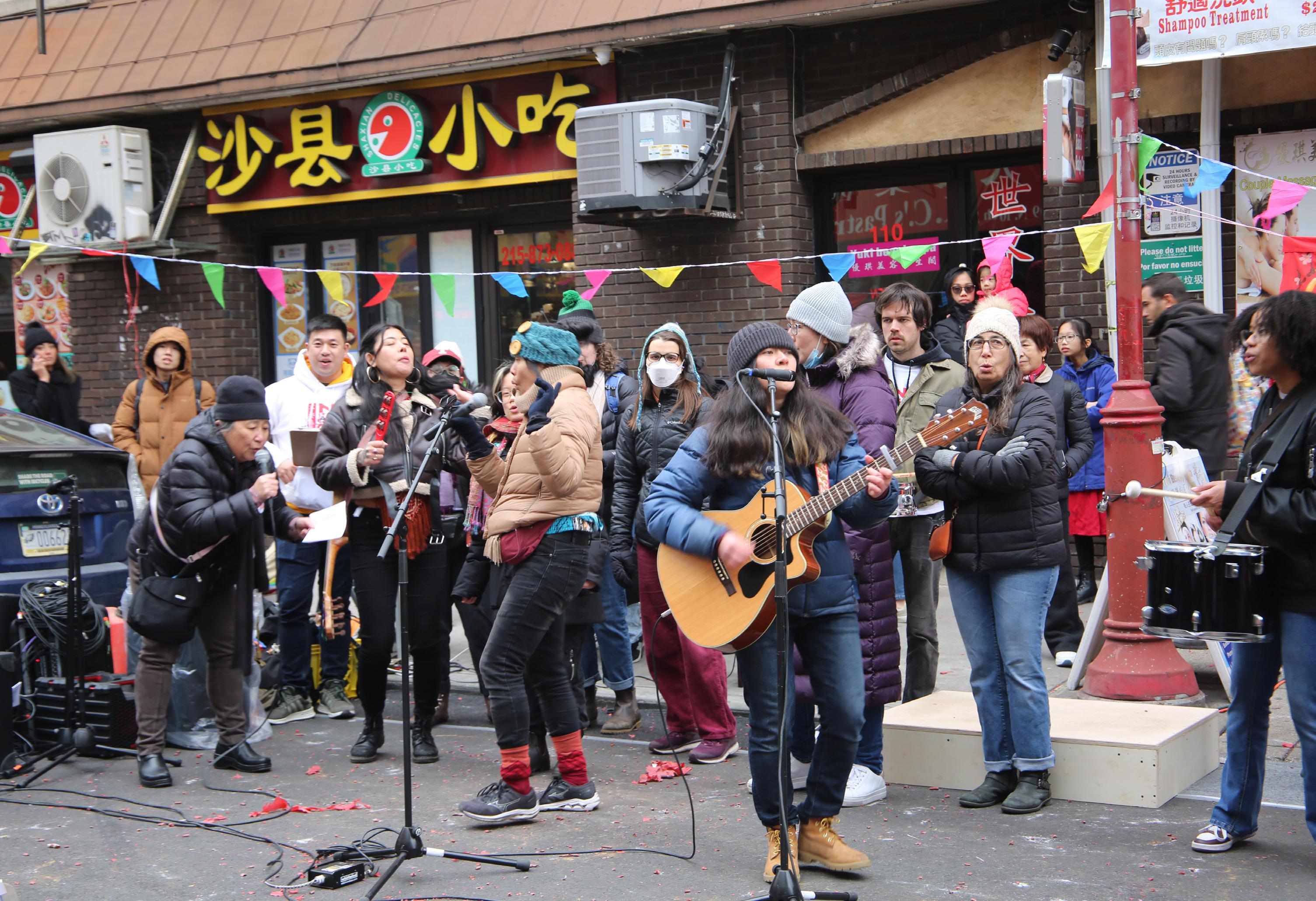
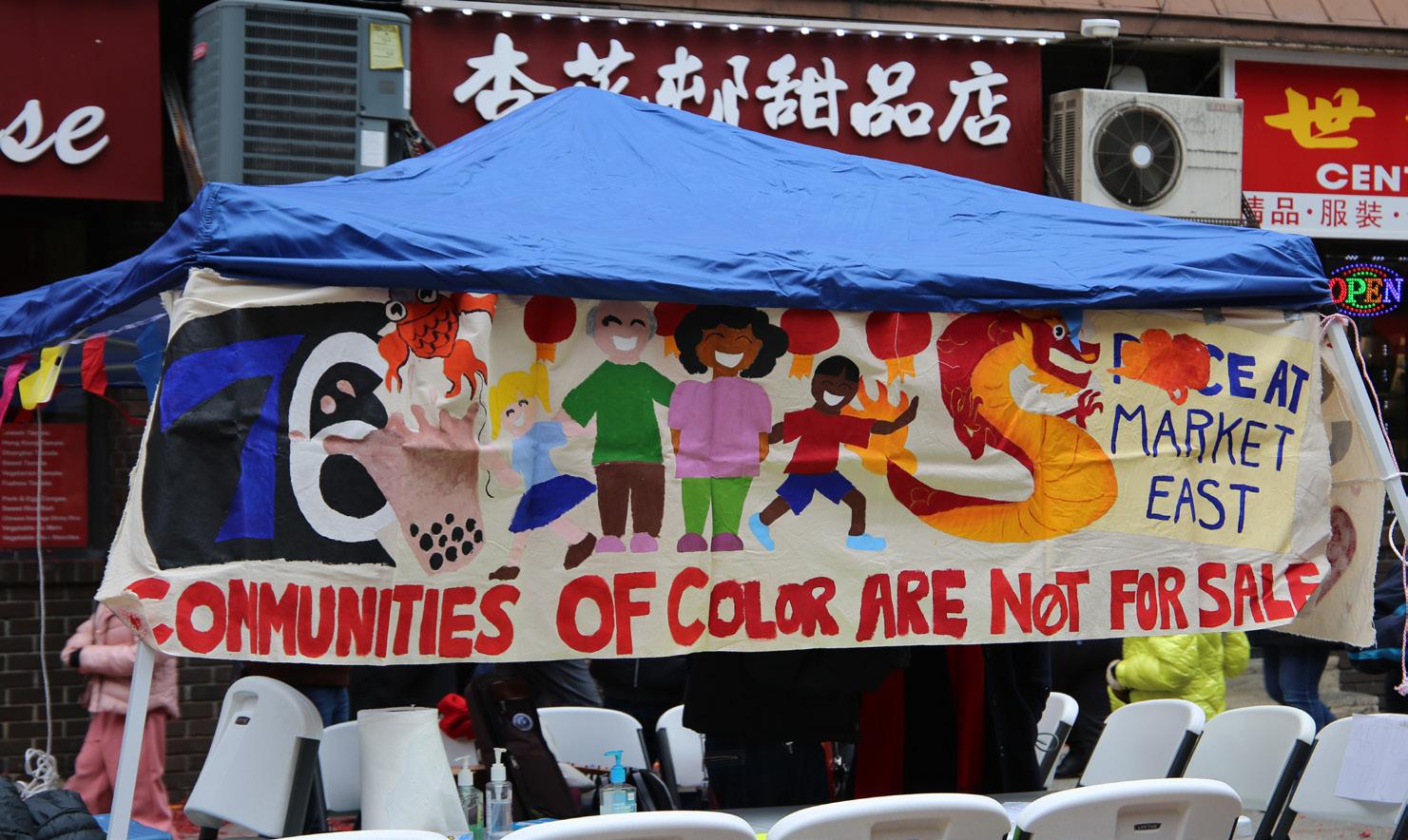
The Sunday afternoon block party featured musical performances, dances, chants and speeches. Community members handed out piping hot tea and candy from under tents, many of which were decorated with colorful painted banners. The text on the banners featured slogans like “Communities of color are not for sale,” “Solidarity for the multiracial working class” and “We won’t be displaced.”
The victory celebration, organized by local activists, is the culmination of over two years of protest and advocacy against building an arena in the Center City neighborhood. Chinatown residents feared the $1.3 billion dollar project would negatively impact the community. A community impact study commissioned by the City of Philadelphia found that about half of Chinatown’s small businesses would suffer financially. Other concerns raised by community members included indirect housing displacement and increased gentrification.
On Dec. 19, 2024, the Philadelphia City Council voted in favor of the arena’s construction, a decision supported by Mayor Cherelle Parker, who said the project would bring increased economic opportunity to Philly. However, this outcome changed Jan. 22, when news broke
that the 76ers made a deal with Comcast Spectacor to stay in their South Philly sports complex.
Standing next to Chinatown’s iconic multicolored archway, Tegan Schultz, a student at Temple University, said she attended the block party because she was against the arena’s construction and was worried about the homes and businesses that would have been negatively affected by an arena.
“People over profit, always,” Schultz said.
A historical victory
Philly’s Chinatown, located in the heart of the city, has a rich and complex history. In 1871, Chinatown was founded by Chinese Americans fleeing anti-Asian violence on the west coast. Mohan Seshadri, executive director of the Asian Pacific Islander Political Alliance (API PA), an Asian American Pacific Islander (AAPI) civil rights nonprofit that helped organize the event, said that 150 years later, Chinatown remains a community hub.
“It’s always been this place of sanctuary and safety for so many generations of the Asian American community,” Seshadri said.
Fights against construction projects also aren’t new, Seshadri said.
“Some of the folks who founded us back in the day were leaders here in Chinatown who would spend decades in the fight to protect Chinatown from predatory developers, from destruction by previous plant projects, like the stadium in 2000 and casino back in 2010, respectively,” Seshadri said.
“And so, it’s always been in our DNA to fight to protect Asian American communities,
Asian American neighborhoods, the places where our communities come to feel safe.”
Chinatown fought a proposed Phillies stadium in 2000, and another multi-year fight led by activists stopped the construction of a large casino in 2008.
Seshadri said Chinatown is a place for community members to utilize services they wouldn’t otherwise have access to, like language-accessible government services.
“It provides such a holistic array of support and grounding and a solid foundation for so many members of my community, myself included,” Seshadri said.
Solidarity and support
Another block party organizer was AAPI nonprofit Asian Americans United (AAU), which worked with API PA to
form the Save Chinatown Coalition. Wei Chen, AAU’s civic engagement director, who enthusiastically greeted and hugged community members at the event, has a long history with both Chinatown and AAPI activism.
“I always spend more time in Chinatown than my home,” Chen said. Chen, who immigrated to the U.S. from China when he was 16, said he got involved with community activism when he organized a boycott to protest attacks against Asian students at his high school.
Chinatown’s victory, Chen said, tells younger generations that even when they feel small, they have the power to make a difference.
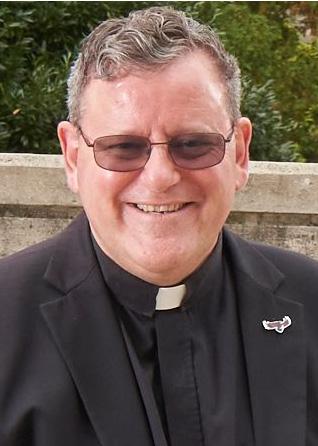
Bianca Talarico ’27 discusses the importance of diversity,
Activists perform celebratory songs next to Chinatown’s Friendship Gate in response to the canceled plans to build the 76ers arena, Feb. 2.
Ph.D.
HANNAH PAJTIS ’26
painted banner
’26/THE
Eagles star Saquon Barkley used to babysit Maisey Hartman ’27. Now, he’s playing in the Super Bowl.
‘It’s giving the people of color community a chance to resist’
“It can also give a lot of energy to the younger generation about the resistance, the culture of our resistance,” Chen said. “This is the most important. It’s beyond the Chinese community or Asian community. It’s giving the people of color community a chance to resist.”
St. Joe’s and beyond
Located approximately 20 minutes from St. Joe’s Hawk Hill campus and 15 minutes from the University City campus, Chinatown is also special to St. Joe’s students. Sal Rupisan ’27, a South Philly native, grew up visiting Chinatown with his parents and got his first job there.
Rupisan said despite being called Chinatown, the neighborhood serves more as a multicultural hub, with many Asian cultures being “housed” there. Rupisan, whose father is Filipino and mother is Italian, said despite not being of Chinese descent, he still finds a sense of identity in Chinatown.
“I grew up more understanding and being around the more Italian side of my family,” Rupisan said. “For me, being in Chinatown was a chance for me to embrace the Filipino side of me. It made me feel more comfortable, being around there.”
Serena Liao ’25, president of St. Joe’s International Society, a multicultural organization based on the UCity campus, grew up in New York visiting Manhattan’s Chinatown but holds Philly’s Chinatown similarly close to her heart. One part of Philly’s Chinatown Liao especially loves is its wide array of Chinese bakeries
and restaurants.
“I’ve grown up having that food,” Liao said. “It doesn’t matter where it is, it’s just always the same, and it’s made with the same love.”
Liao said the no arena decision is significant because Chinatown is a safe space for both Philly residents and visitors alike. Liao said that “now more than ever,” it’s vital that people hold their communities close.
“We live in a very ever-changing society and government and world, now, that it’s definitely very good to keep the parts of you that you can — culturally, ethnically, just as a person,” Liao said.
The greater movement continues Pins and magnets handed out free of
charge at the block party, featuring text reading “No stadium casino in Chinatown” with the word “arena” stamped over “stadium casino,” highlight the Chinatown community’s history of resisting corporate encroachment. Seshadri said the threats the arena presented to Chinatown expand beyond the neighborhood, applying broadly to other areas of Philly.
“Neighborhoods all across the city are being hit so hard by gentrification and displacement, in so many cases driven by many of the same private equity forces and real estate development lobby forces that came into play with this anti-arena campaign,” Seshadri said. “Neighborhoods all across the city need our elected officials to step up and craft a solution to that.”
Seshadri hopes the energy that emerged from the no-arena-in-Chinatown campaign will carry over to other local movements that fight against gentrification.
“It’s also important now that the attention that was brought to Chinatown, was brought to this fight, doesn’t just dissipate but instead focuses on uplifting and protecting and defending other neighborhoods that are dealing with very similar situations,” Seshadri said.
University receives designation for efforts to combat food insecurity
ALLY ENGELBERT ’25 Editor-in-Chief
St. Joe’s has received a Pennsylvania Hunger-Free Campus + designation, acknowledging the university’s work to address hunger and food insecurity among its students.
Nearly 23% of undergraduate students experience low or very low food security, according to a 2019-2020 report from the U.S. Department of Education’s National Center for Education Statistics. The Pennsylvania Hunger-Free Campus Initiative seeks to encourage Pennsylvania colleges and universities to combat food insecurity on their campuses and acknowledge those already doing so.
The designation, awarded by Pennsylvania Governor Josh Shapiro’s administration, officially recognizes the work of initiatives like HawkHUB, St. Joe’s food and basic needs resource center, which first opened in September 2020.
Kim Allen-Stuck, Ph.D., assistant vice president of student success and educational support, helped lead the efforts to apply for the designation, which the university learned it had received Jan. 29. She said she was surprised the university didn’t already have it, since groups at St. Joe’s have been committed to addressing hunger and basic needs for years.
“It’s nice to be included on the list. I’m happy about that,” Allen-Stuck said. “It also gives us an opportunity to apply for more external grants to support the work that we were not eligible [for] before we had the designation.”
Madalina Veres, Ph.D., executive director of corporate and foundation relations, who was also involved with the designation application process, said in
addition to the new funding opportunities, the recognition is encouraging for those who have been addressing basic needs insecurity on campus.
“It’s an additional validation for all the work that HawkHUB and other folks on campus have been doing already,” Veres said. “It’s not, ‘Okay, now that we’ve got the designation we can do the work.’ It’s more like, ‘Yay. The state recognizes that St. Joe’s is doing a great effort in this space, and we should acknowledge this.’”
A university must meet four requirements to receive the PA Hunger-Free Campus designation: a method of connecting students to food options, such as an on-campus food pantry; a plan to “increase awareness of the Supplemental Nutritional Assistance Program (SNAP) eligibility rules for students”; a task force that focuses on addressing basic needs on campus; and a process for collecting and sharing data on student hunger.
HawkHUB’s recent Meal Swipe Exchange program (which allows students to donate their extra meal swipes to students in need) helped boost the university to a PA Hunger-Free Campus + designation, Allen-Stuck said.
The task force requirement also prompted the creation of the Supporting Students In Need Task Force, which unites students and faculty leaders from a multitude of basic needs initiatives at St. Joe’s, including the Meal Swipe Exchange, HawkHUB’s Operation Tampon and Career Closet, textbook scholarships and more, Allen-Stuck said.
These initiatives are crucial to getting students the help they need, especially because it can feel difficult to ask for help, said Aidan Murray ’26, co-president of HawkHUB alongside Liv Fisher ’25.
“There’s certainly a stigma against asking for help or admitting that there’s a need that needs to be addressed,” Murray said. “Organizations like HawkHUB around the United States and HawkHUB itself can address this by normalizing there being spaces on campus where people can come and look after themselves.”
Murray said the designation will help HawkHUB better serve students across all three St. Joe’s campuses, including a new HawkHUB location in Lancaster, opening Feb. 5.
For Allen-Stuck, HawkHUB and basic needs support at St. Joe’s have come far, starting with nothing but “goodwill and good people” and growing to earn this designation.
“We were meant to be a part of this,” Allen-Stuck said.
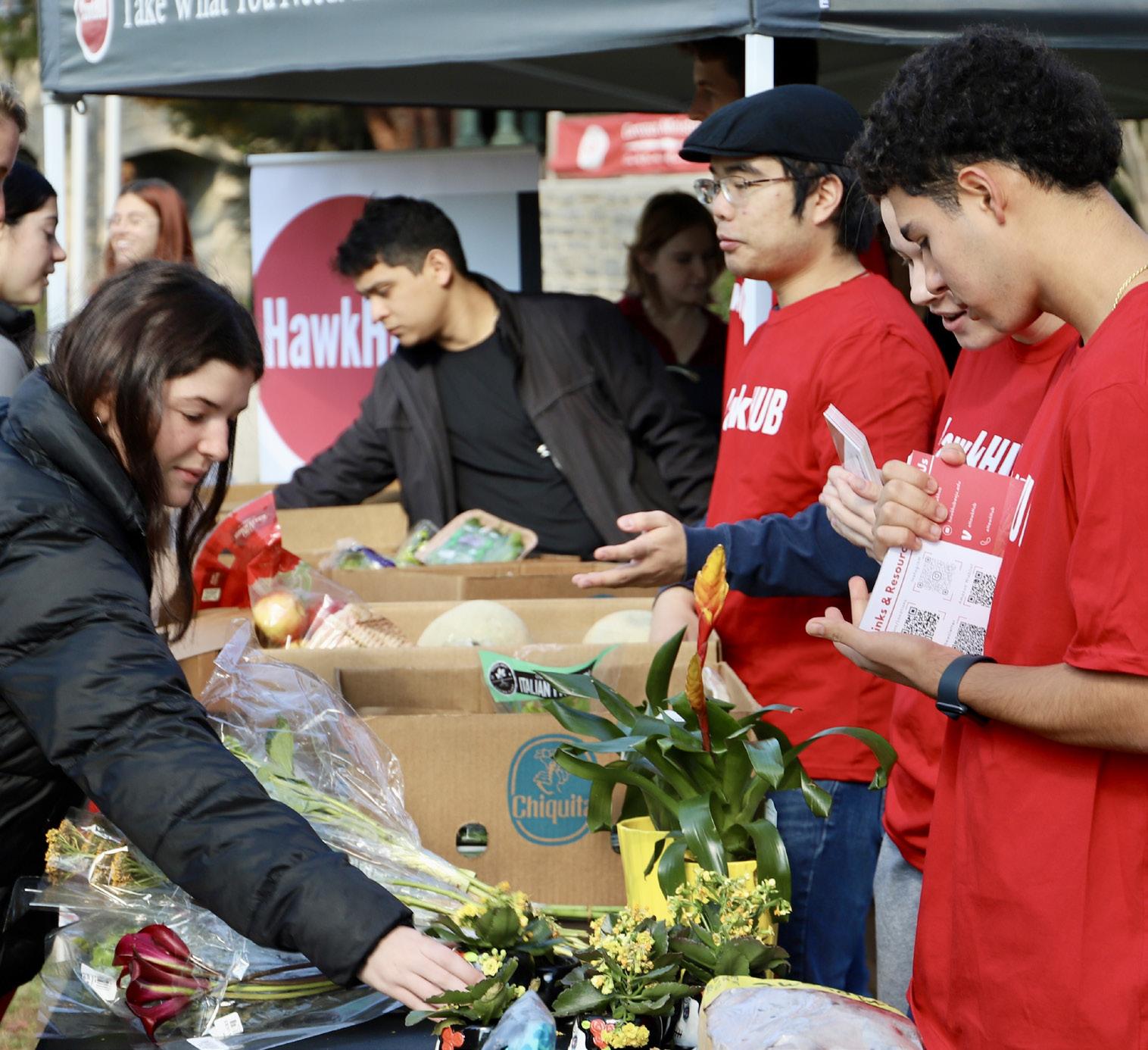
Students pick out produce at a free Trader Joe’s pop-up sponsored by HawkHUB, Nov. 11, 2023. PHOTO: ALLIE MILLER ’24/THE HAWK
A banner celebrating the 76ers’ decision not to build an arena in Center City.
PHOTO: ZACH PODOLNICK ’26/THE HAWK
Physics department engineers new major
’25
The College of Arts and Sciences will be offering a new engineering physics major starting in the fall 2025 semester that will focus on applying physics to modern engineering, science and technology.
The program will have three concentrations — quantum, electrical and biomedical engineering — to prepare students for a wide selection of careers. Students will have the opportunity to participate in research with faculty members, where they will design experiments, analyze data and draw original conclusions.
Elia Eschenazi, Ph.D., professor and chair of the physics department, said the field has become more interdisciplinary in recent decades, which is not always reflected in a university’s physics department.
“There are students whose interest is physics, but they’re also interested in engineering,” Eschenazi said. “This combines the two interests, and it gives an extremely strong preparation to the student in the foundations of physics and engineering.”
Eschenazi said the program will prepare students to apply the concepts in a practical field.
“There is kind of a misconception in the public that if you go into physics, you end up teaching physics. That’s not true,” Eschenazi said. “A national average of 67% of physics graduates actually work in the private sector on a private or public research development facility.”
James Carter, Ph.D., dean of the College of Arts and Sciences, wrote in an email to The Hawk that the program used existing resources to create the major.
“There is a demonstrated demand for programs like this, based on regional and national career trends, and the program does not require additional resources to staff or support,” Carter wrote. “In addition, it makes effective use of the new faculty who joined the university as part of the [University of the Sciences] merger to support our undergraduate curriculum.”
Roberto Ramos, Ph.D., professor of physics, said the program is particularly relevant now, as the United Nations Educational, Scientific and Cultural Organization declared 2025 the International Year of Quantum Science and Technology.
“It’s very important for our students to be part of that, to be literate in that, and engineering physics as a program will be
Q&A with Rachel Becker
Rachel Becker, J.D., assumed the role of interim director of Title IX and Equity Compliance Jan. 27 after having previously served as St. Joe’s Title IX & Equity investigator. Prior to arriving at St. Joe’s in 2022, Becker worked as a pro bono lawyer for Laurel House, a domestic violence center in Montgomery County, and served as an assistant district attorney in Montgomery County. The Hawk spoke with Becker to learn more about her life and her time at St. Joe’s.
What drew you to work in Title IX?
I have always had professional goals of aiding the communities I am a part of and using my academic and personal skills to do that. I believe that Title IX & Equity requires ensuring that there is a positive environment on campus in relation to discrimination and harassment, and in that vein, I find that it is a natural progression [in] my professional path.
As the new interim director, what do you plan to bring to this role?
I plan to bring an open mind and understanding to this role. When you are speaking with members of the SJU community regarding sensitive and personal matters, it is imperative that everyone feels heard and that the proper processes are being followed to address an incident. I
Department
Jan. 25
Public Safety notified of a theft at the Merion Gardens Apartments. Lower Merion Police Department responded and took a report. Incident under investigation.
Jan. 26 No incidents to report.
Jan. 27
Public Safety notified of a vandalism act at Mandeville Hall parking lot. Incident under investigation.
a very good tool for our students and our faculty,” Ramos said.
Jack Schiavo ’27, president of St. Joe’s chapter of the Society of Physics Students, said engineering and physics were a natural pair.
“The basics of physics lays the groundwork for engineering,” Schiavo said. “All of the classical mechanics of physics is what the engineers will need. They’re cousins in that sense.”
Eschenazi said engineering was an area needed to boost the physics program.
“We needed to have a different program [with] the focus 50% on engineering,” Eschenazi said. “Just taking a course here and there will not do the job. That’s why getting into this program is compelling.”
hope that anyone I meet with, regardless of whether they choose to initiate a formal resolution process with our office, feels they are receiving the support they need.
What would you say to students who aren’t aware of your office and its purposes?
I would say come by and don’t be afraid to ask. I truly am open to meeting with anyone who is curious or has a question about our office. While we must follow policies and procedures, our office often provides supportive resources to students, faculty and staff affected by prohibited conduct.
What is your favorite thing about St. Joe’s?
The community is so welcoming. I found that almost immediately, even in the summer time when I started, no one was afraid to come up and introduce themselves. I truly believe everyone here wants to help make St. Joe’s a positive place for anyone who sets foot on campus.
What’s one thing people might not know about you?
I want to write a novel, but haven’t started it officially yet.
If you were stuck on an island, what three things would you absolutely not be able to live without?
If I’m on an island obviously sunglasses (and multiple pairs if that isn’t breaking
Safety
Jan. 28 No incidents to report.
Jan. 29 No incidents to report.
Jan. 30
Public Safety notified of a theft at Sourin Residence Center. Incident under investigation.
the rules of this question), some very long books (I’m envisioning Anna Karenina even though it’s not really a beach read) and my family. I think my three kids could keep me busy until help arrived.
Who are you rooting for this Super Bowl? No brainer, raised in Montgomery County it has to be the Eagles. Go Birds!
PHOTO COURTESY OF RACHEL BECKER, J.D.
GRAPHIC: CARA HALLIGAN ’25/THE HAWK
SOPHIA GALANTE ’26 News Reporter ALEX ANDAHAZY
News Reporter
Editorial: End of 76ers’ arena plan a reprieve for Chinatown
After years of opposition from the residents and advocates of Philadelphia’s Chinatown, the Philadelphia 76ers’ proposal to construct a new stadium in the Fashion District was shelved in favor of a negotiated deal at their current location. This represents a well-deserved victory for the tireless efforts of those who protested and mobilized to stop the plan. All those involved, regardless of whether they live in or have ties to Chinatown, should be satisfied with this outcome.
The “76 Place at Market East” proposal relied on the inherent assumption that economic revitalization is better achieved through new commercial ventures, rather than by supporting existing ones. This is, simply put, a flawed perspective. There was an undeniable economic benefit to the proposal: The arena could have been
a hub of lively commercial activity whenever the Sixers were in town. But the downside — overwhelming levels of traffic and rising property values that would strike at the heart of Chinatown — wastoogreattojustifycontinuingwiththe newarena.
Advocatesoftheproposalarguedthat the influx of jobs, waves of visitors and commitment by the 76ers to engage with the local community would provide an economic boost that the neighborhood desperately needs. It’s an admirable and necessary goal, but the arena was the wrong approach. Supporting the people and businesses already there, through both public and private investment, is a better solution. Tax incentives for residential development, a robust public transportation infrastructure and patronagefromlocalconsumers—among
many other possibilities — can be the basis for a more sustainable and equitable future for Chinatown.
Urban planners may have differing views on how to better approach the problem, but any solution should be rooted in honoring the distinct identity and existence of Chinatown.
Correction: In the Jan. 29 issue of The Hawk, the story “Q & A with Kelly Bersett” incorrectly stated Bersett was promoted to the role of associate director of Residence Life. Bersett was previously associate director and was promoted to director of Residence Life Jan. 6.
The dynamic, diverse mission of St. Joe’s
Jesuit education is offered by many, for all
DAN JOYCE, S.J. Guest Columnist
In preparing for St. Joe’s upcoming Mission Week, Feb. 14-23, I realized 10 of the 40 courses I’d needed to graduate from St. Joe’s were taught by Jes uit professors. Now, to be honest, this fact was no assurance I got a genuine “Jesuit education.” I would argue I learned as much, if not more, about Jesuit education from some of my professors who were not members of the Society of Jesus (a.k.a. the Jesuits). I learned the mission of Jesuit education from faculty of every sort: student life administrators, academic support professionals, administrative staff and campus ministers, among others.
This was not accidental. Jesuit education is the world’s oldest and largest educational network. Over 477 years, 3,629 Jesuit schools have sprung up to educate over 2 million students per year. This extraordinary educational phenomenon only occurs
because people of all religious, cultural and social backgrounds across five continents and 80 countries embrace the mission of Jesuit education.
A tradition this old and vast has produced a varied list of educational values inspired by the life and spirituality of St. Ignatius of Loyola, the founder of the Jesuits. A battle wound ended Loyola’s military career, and he became a spiritual seeker, a student of the world’s cultures, and passionate about justice for the most vulnerable. The first Jesuits were a multicultural group with an insatiable intellectual curiosity who wanted to learn about every religion, identity and social condition.
Over the centuries, the Jesuit educational network has welcomed a diverse group of people from all backgrounds who live this shared mission in a wonderful variety of ways. Some people think inclusion, equity, diversity and belonging are relatively new concepts. But 40 years ago, when I became a student at this Jesuit university, I learned that these things are part of the “DNA” of the Jesuit
educational mission at St. Joe’s.
In preparing our annual Mission Week, many wonderful people from our three campuses have created 40 events to engage our university mission. My 40 St. Joe’s courses 40 years ago were just the beginning of my learning the mission.
The Rev. Daniel R.J. Joyce ’88, S.J., is the vice president of mission and ministry at St. Joe’s.
Pollutant-pulling appliance: ‘Mammoth’ in Iceland
NICOLE BOWEN ’26 Guest Columnist
Last year, in Hellisheiði, Iceland, the Swiss company Climeworks opened the biggest direct air capture plant in the world, calling it “Mammoth.” The plant is a large vacuum contraption that draws in air and extracts the carbon dioxide from it. The carbon dioxide is “concentrated and purified.” The compounds are then dissolved into water and transferred to rock formations underground. Mammoth is said to pull 36,000 tons of carbon dioxide from the air per year when operating at full capacity and is able to do so through geothermal energy, Iceland’s gifted energy source.
On paper, this huge machine seems like a perfect solution to the rising atmospheric carbon dioxide levels
that contribute to global warming. However, some experts have pointed out the “uncertainties and ecological risks” tied to carbon capture technology, including potential ramifications on oceans involving the process of injecting carbonated water into the underground rock formations. Iceland has become a target site for underground carbon dioxide storage due to basalt rocks that are extremely porous — allowing for carbon storage. It is said that carbon dioxide forms solid carbonate minerals with the basaltic rock formations, thus making it safe after injection. However, since the beginning of Climeworks’ operations in May 2024, there have been few updates to the public about the establishment’s progress.
Although Mammoth may be assisting in the removal of carbon dioxide from the atmosphere, it does nothing to halt
initial emissions, which is the culprit of global warming. Companies should focus on cutting greenhouse gas emissions by switching to clean energy sources
and cutting back on oil extraction and combustion, a practice fraught with social and ecological ramifications.
Why DEI is key to our nation’s unity
BIANCA TALARICO ’27
Columnist
In recent years, the conversation surrounding diversity, equity and inclusion (DEI) has become increasingly important, especially in the context of our nation’s workforce. DEI refers to the intentional effort to create environments where individuals, regardless of race, gender, sexual orientation or background, are treated fairly with equal opportunities to succeed. However, the concept of DEI is more than diversity in numbers; it’s about fostering an inclusive culture where everyone feels
valued and empowered.
Within the few days President Donald Trump has been in office for his second term, his administration signed three executive orders that eliminate DEI policies dating back to former President Lyndon Johnson’s administration. The Trump administration stripped away policies many relied on to make the workforce an equal playing field. Removing any DEI requirements halts the progress that has been made toward creating more equitable and inclusive environments.
The question we must ask ourselves now is: How does this impact the unity of our country?
In a nation as diverse as the United States, unity does not mean uniformity.
Why dupes are better
Unity means understanding, respecting and valuing the differences that make us stronger as a collective whole. DEI initiatives are vital in addressing systemic inequalities that persist in education, employment and healthcare. They also open doors to new perspectives, which helps foster innovation and productivity in industries across the board.
When we actively work as a society to ensure that everyone has a seat at the table, we create an environment that values each individual’s contributions. In contrast, removing and downplaying DEI sends a dangerous message that some voices are not worth hearing. It implies that some experiences are not valid and not everyone is deserving of
equal opportunities. As we look ahead, it’s clear that embracing DEI is not just a social imperative; it is key to the cohesion and strength of our nation. We must continue to fight for inclusive policies that help bridge divides, foster unity and build a future where every American has an equal chance to succeed.
Dupes vs. designer: Rethinking fashion’s price tag
JASON VO ’25
Guest Columnist
Luxury items like Louis Vuitton and Gucci carry a certain allure, but their sky-high price tags make them unattainable for most people. As someone who’s admired these pieces for years but can’t afford them, I’ve turned to dupes — and never looked back.
Over the past few years, I’ve proudly built a collection of dupes, which are off-brand, nearly identical duplicates of popular fashion items, often sold at lower prices. One of my favorites is a Bottega Veneta bag dupe I purchased for $200. The retail price? Around $3,000. I even went to a Bottega store to compare, and it was practically identical. Friends, family and even luxury retail workers have complimented my bags without realizing they weren’t authentic. These moments bring me so much joy and reinforce the idea that fashion is about self-expression, not price tags.
Society places immense importance
on luxury because of the price tags themselves. In a world where resources equal status, owning something expensive signals wealth. Social media has amplified this culture, exposing luxury to wider audiences and driving demand.
Unfortunately, there’s still a stigma around dupes. They’re often associated with lower-income individuals, and some believe owning a fake lowers your status or makes you inauthentic. Society perpetuates the idea that if you can’t afford the real thing, you shouldn’t have it. But this notion is flawed and elitist. Why should fashion be reserved for the wealthy?
Ethically, buying dupes can feel like a better choice. While some counterfeit markets are linked to criminal organizations, large luxury brands also have questionable practices — sweatshops, tax evasion and exploiting exclusivity for profit. The more ethical alternative to both is to support smaller businesses and craftspeople who create high-quality dupes and original work alike.
Dupes democratize fashion. They
allow everyday people to experiment with styles they couldn’t otherwise afford and help challenge luxury brands by driving away some of their profit.
While some argue the dupe market is
unethical, luxury brands are no saints. At the end of the day, fashion is about creativity, not exclusivity — and dupes help more people express themselves without breaking the bank.
GRAPHIC: CARA HALLIGAN ’25/THE HAWK
GRAPHIC: STEPHANIE SAVELA ’25/THE HAWK
The United States Armed Forces are often looked to as pillars of strength and sacrifice, as our nation’s heroes and protectors. Those who serve should be celebrated for their bravery and dedication, but debate over whether or not transgender individuals should be able to serve undermines the American values of equality and freedom that our military defends.
President Donald Trump has made
his stance on the matter abundantly clear, promising to “restore the Trump ban on transgender in the military.” In prioritizing transphobic beliefs over the merit and hard work of transgender soldiers, Trump’s decision will weaken the military rather than strengthen it.
In a 2017 tweet made during his first term in office, Trump announced that “the United States Government will not accept or allow … Transgender individuals to serve in any capacity in the U.S. Military.”
The 2019 ban that followed caused many to face the choice between their identity and their career, reversing a 2016 Obama administration policy that allowed
Transgender military ban imminent as 2021 inclusion policy is overturned
transgender individuals to openly serve in the U.S. Armed Forces.
In 2021, former President Joe Biden signed an executive order undoing the Trump administration’s ban, stating in a White House news release that “America is stronger, at home and around the world, when it is inclusive.” The same day Trump was sworn into office for his second term, the reversal of Biden’s executive order was one of his priorities. Although this reversal does not immediately restore the 2019 ban, it creates the possibility for a new ban to take its place, threatening between 9,000 to 14,000 transgender troops.
Trump’s actions demonstrate a
Political pragmatism or genuine disloyalty?
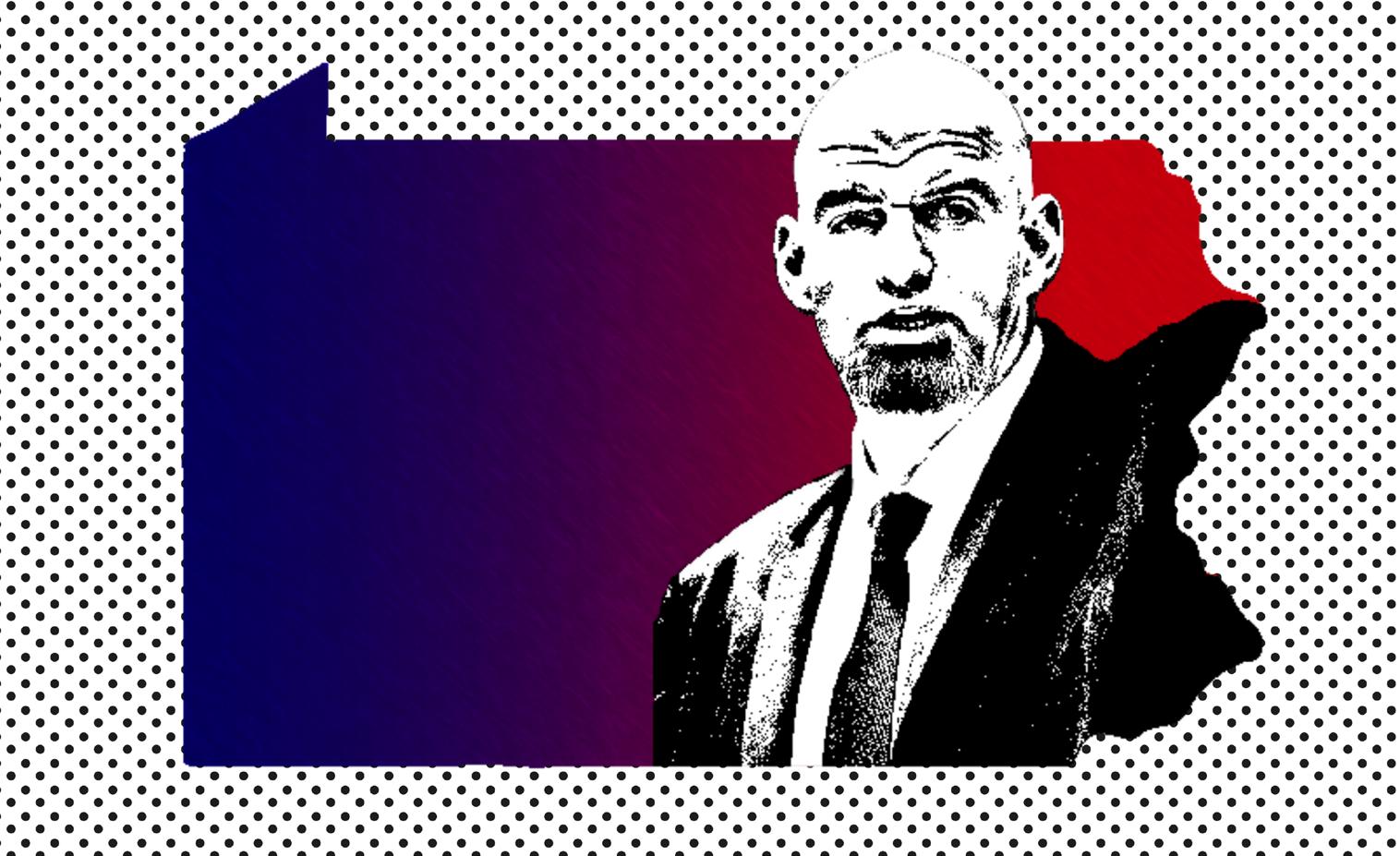
Examining Pennsylvania’s John Fetterman
In recent years, we have seen a pattern of politicians, notably from the Democratic side, calling their political associations into question.
Among the Democrats who changed their party affiliation are Sen. Kyrsten Sinema of Arizona, Dallas Mayor Eric Johnson and Tricia Cotham, a member of North Carolina’s House of Representatives. Now, Sen. John Fetterman, the Western Pennsylvanian populist known for his unconventional attire and controversial political stances, faces similar scrutiny. Although he denies interest in switching parties, his actions have raised concerns among many Democrats — especially after the Republican Party’s sweeping victories in Pennsylvania’s 2024 elections, leaving supporters and previous voters wondering: What’s going on?
Many events have provoked controversy
around Fetterman’s questionable political loyalty; however, none have stirred up Democrats more than his pre-inaugural visit with President Donald Trump. As one of the first bipartisan meetings since Trump’s return to office, the event reinforced suspicions that Fetterman may be drifting from the Democratic Party and on the verge of changing political affiliation. Fetterman has since lambasted the party’s claims, believing his actions are a necessity to accommodate Pennsylvania’s evolving political landscape. As a candidate and senator, Fetterman gained traction by defying Democratic norms, insisting on maintaining his personal politics by acknowledging and adapting to cater to the state’s new dynamic political environment. While there have been examples of this behavior throughout Fetterman’s career pointing to his shifting political exercises, the sheer magnitude of Republican victories throughout Pennsylvania’s 2024 statewide elections has caused Democrats to fear losing a key battleground seat in the Senate. While Democrats’ fears seem
reasonable, it’s important to reiterate that politicians should be allowed a certain amount of independence to represent the full range of their constituents’ political beliefs, even if elected under the constraints of the bureaucratically partisan American political system. Some may perceive
continued hostility toward transgender individuals and contradict the core American values of freedom and equality. The discrimination against service members based on their gender identification is of no benefit to anyone and does nothing more than deprive brave individuals of their ability to defend our country. Rather than implementing policies rooted in hate and the fear of change, Trump should focus on fostering unity within the military and valuing service members for their abilities, regardless of their gender.
Fetterman as situationally disloyal, which is fair. But restricting a politician of a politically diverse state so much that they can’t act in the best interest of their own constituents appears ostensibly undemocratic, or at least patently over-partisan. This is why we need more Fettermans on both sides of the aisle.
The state of the American Dream
Broken, not dead
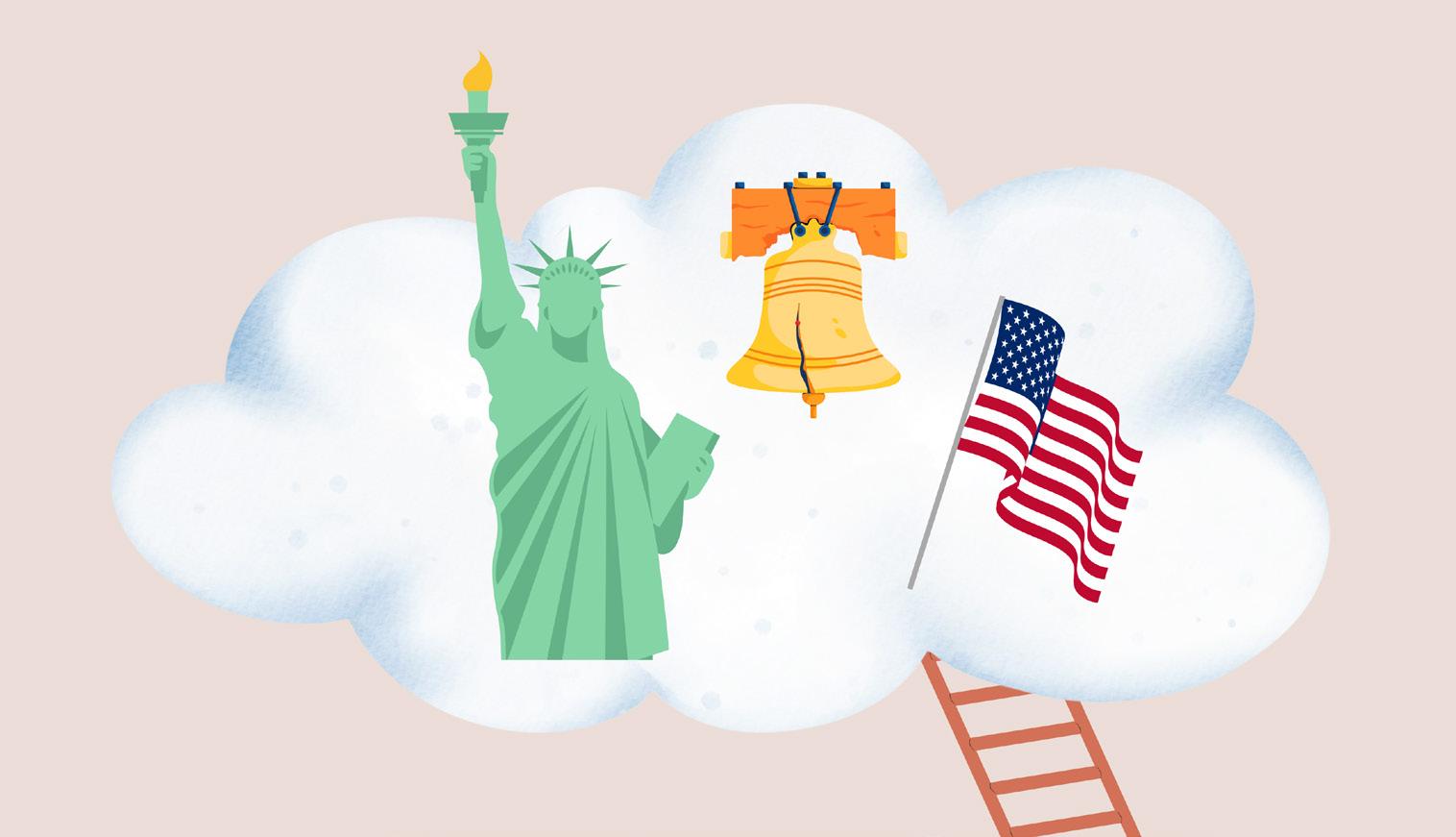
America has stood as the land of opportunity where hard work and dedication are the keys to the promise of social mobility. This is what the American Dream has come to represent over the years. Yet, it seems there has been a disillusionment for Americans over whether the dream is still alive. Forty-one percent of respondents from a Pew Research Center study said that the American Dream was once possible for people to achieve but is no longer attainable. This cynicism from Americans may derive from a slew of economic challenges: rising costs of living, inflation, steep real-estate prices. These are all things creating that feeling of disillusionment in the eyes of many.
This cynicism is further added to once
you consider the pessimism surrounding higher education. As the traditional pipeline to a better life, the accessibility of a college education correlates to the accessibility of the American Dream. However, factors such as high tuition and subsequent student loans have contributed to the growing inaccessibility and dreary mindset surrounding college education. We see it largely as a monetary investment, a pipeline to upward social mobility, and yes, this can be true. But I hold that the college experience can be a transformative one for youth, one that stands as a personal and intellectual investment for the you of tomorrow.
The American Dream seems to be coughing and gasping for air with the current economic hardships, inequalities and view of higher education. But, I wonder if a part of this death stems from a changed view of one of its principles. Because of the necessity of financial security, I think our society
has focused too much on materialism and overconsumption, which has led to a fixation on wealth and, consequently, dissatisfaction in people’s hearts. Certainly, a mentality of lesser consumption will not magically create
roads of gold and prosperity for this nation’s people, but perhaps there are other ways to look at this dream rather than strictly through the lens of economic prosperity.
JARED NACHIMSON ’27
SAHR KARIMU ’26 Columnist Hawk Columnist
GRAPHIC: STEPHANIE SAVELA ’25/THE HAWK
GRAPHIC: CARA HALLIGAN ’25/THE HAWK
CAROLINE TRIMBLE ’26 Hawk Columnist
GRAPHIC: STEPHANIE SAVELA ’25/THE HAWK
A sounding board for students
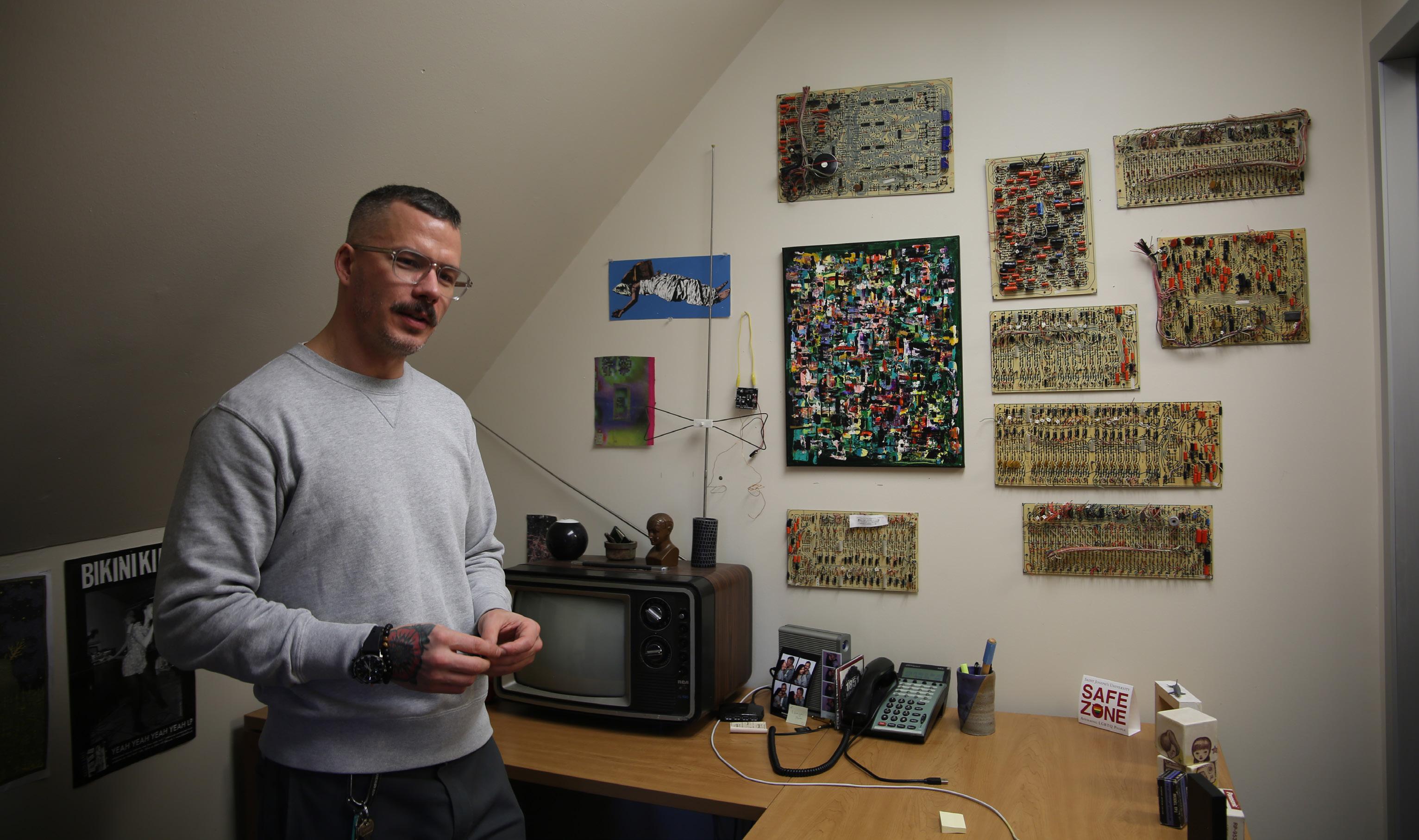
Steven Hammer’s office in Bronstein Hall is indicative of his eclectic academic journey and his love for techno-sonic experimentation.
Located on the third floor of Bronstein Hall, one of the historical houses on Lapsley Lane, Hammer’s office is a playground for creative minds, filled with unexpected treasures like circuit-bent instruments, jars of dirt and old technology given a second life.
Hammer, Ph.D., associate professor of communication and media studies with a doctorate in rhetoric, writing and culture, is particularly attached to an old reel-toreel tape recorder, which holds a 1978 recording of a kid outside Detroit. With a deep fascination for forgotten memories, Hammer calls his collection of answering machine tapes from the ’90s his “favorite thing in the whole world.”
Hammer’s office also contains fragments of his own past. On a shelf sit books from his student days, reminders of a time when his path was still unfolding.
Hammer said his own journey as a student got off to a rough start.
“I wasn’t very good at school,” said Hammer, reflecting on his challenges in high school and community college in his home state of North Dakota.
Hammer eventually landed in a
program at North Dakota State University, earning a bachelor of university studies degree in a phase of his life he jokingly calls “pre-bartending.”
“It’s the most made-up shit ever,” Hammer laughed, recalling how he crafted a major from various interests in gender studies, communication and media studies.
After graduating from college, Hammer struggled to find a fulfilling job and worked as a bartender. But his story took a turn when two of his former professors walked into the bar one day.
“‘With respect, what are you doing here?’” Hammer recalled one of them asking.
That moment marked a turning point.
One professor encouraged Hammer to pursue graduate school, helping him enter a master’s program at North Dakota State University despite his unconventional academic background. He eventually earned his doctorate, also from North Dakota State University.
Even now, as a college professor himself, Hammer continues on the unconventional path. He commutes to St. Joe’s from his home in Fargo, North Dakota, traveling home every weekend to be present for his high need child, who is 13. Every Monday, he gets up at 3 a.m., takes a plane from Fargo to Philadelphia and spends the week working and teaching. Thursday, he’s back on a plane to Fargo, arriving around 1 a.m. the next day.
And yet, Hammer finds time to mentor students like Parker Hayden ’25, guiding them through the academic challenges and encouraging them to embrace their potential.
Hayden said Hammer has reshaped his approach to creativity and audio work.
“He’s always trying to push others, including myself, in a direction where not only are you putting out a product that other people can enjoy, but something that we endeavor to make our own and push the boundaries of what’s already there,” Hayden said.
Through their collaboration on Hayden’s project for the Summer Scholars Program, “Investigating The Practical Use of Soundscapes Via Metro Rails,” Hayden learned to take risks.
“He pushed me to be more creative and to think outside the box,” Hayden said.
Teaching, creating and even living outside the box is part of who Hammer is. For example, his work as an artist pushes the boundaries of how people perceive sound.
“I’m always interested in creating sound-based work that is strange,” Hammer said. “New ways of hearing things and new ways of hearing the world.”
It all began with an electronics kit his parents gave him in middle school. Self-taught in a small town, Hammer quickly began crafting his own instruments and experimenting with sound.
This mindset has shaped his recent projects. On the subway, in a series titled “Electromagnetic Sound Library: Metro Trains and Stations,” Hammer uses a microphone that picks up on electromagnetic energy, capturing the hidden sound most of us never notice.
“Usually, you think about, ‘What does a subway sound like?’ You think about the people, and you think about the train engine sound, but what happens if you walk around and you only listen to electricity?” Hammer said. “I think the world sounds different, and that strangeness is the point of art.”
Mike Lyons, Ph.D., associate professor and chair of the communication and media studies department, said Hammer’s creativity and commitment make him a valuable member of the team.
“He frames himself first as an artist and secondly as an academic, which is
refreshing,” Lyons said. “[It] brings to our department this artist sensibility and this creative sensibility that helps reinforce this idea that we are a department that equally emphasizes the creative as well as the traditionally academic or critical.”
Lyons said Hammer’s brand of authenticity does not change, no matter the audience.
“He stays exactly the same,” Lyons said. “That’s why he’s so liked by students. He’s just a genuine person.”
For Hayden, Hammer’s consistency has had a lasting influence on his academic journey as he hopes to become a producer after he graduates.
“He’s someone I can trust,” Hayden said, highlighting the bond they share.
Lenora Thomas ’23 felt similarly about Hammer, who served as her adviser, professor and Summer Scholars mentor on a project about how covid-19 impacted members of her community. Thomas said it was Hammer’s unwavering support that provided her with one of the most important lessons.
“He took his role as my adviser seriously in the most supportive way possible and pushed me to ask for help, no matter how small the problem seemed to me,” Thomas said. “Whether you’re coding your capstone website, figuring out the best color palette for your graphic design, or trying to understand [Jürgen] Habermas, ask for help. … Asking questions and making mistakes is how you learn and improve.”
As for personal projects, Hammer is working on an album that explores recording the elusive nature of wind.
“You can’t hear wind itself,” Hammer explained. “But you can hear what wind touches.”
The project will involve sounds like wind against tall grass or blowing through an open doorway, in spite of the fact that “usually to a sound recordist, wind is the enemy,” Hammer said. In many ways, this perspective mirrors the advice he would give to his younger self, back when he was unsure of his future.
“Just do the things you enjoy doing and follow the paths that seem to open for you with the least resistance,” Hammer said. “Don’t chase what you think you should do, or what other people say you should do.”
CLARE JOHNSON ’25
Special to the Hawk
Steven Hammer, Ph.D., associate professor of communication and media studies, explains his wall of circuit boards he has collected over the years. Professor creates techno sonic sounds
Collectors keep physical media alive amid age of streaming
CHRISTINA MOLINARI ’25 Special to the Hawk
Like any aficionado, film lovers are constantly striving to curate the perfect experience to consume the content they enjoy, whether it be in a movie theater, on a DVD or some other medium.
Even as streaming platforms such as Netflix, Hulu and Amazon Prime Video have risen in popularity, many film lovers still seek out DVDs in order to have direct access to what they want and love on their own terms.
This has helped fuel a market for physical media. The April 2024 Consumer Price Index showed a price increase of nearly 29% for DVDs in the previous 12 months. Further, there has been a 6.8% increase in the average prices of DVDs and CDs from 2023 to 2024, with a 20% increase compared with 2021, according to Consumer Affairs.
Ben Vanelli ’25, president of SJU Film Club, has many DVDs in his collection, of which he isn’t even sure of the exact number. He prefers to own DVDs because of the quality and the extras. His favorite is the 2002 film “Punch-Drunk Love,” starring Adam Sandler.
“Usually, it looks better. The quality is better, and sometimes, they come with bonus features that add to the movie, like director commentary or scenes they didn’t put in the movie,” Vanelli said.
Gabrielle Miller, assistant professor of practice in the department of music, theatre and film, began collecting DVDs before streaming services started to occupy the market.
“I grew up with DVDs,” Miller said. “I was around before there was the ability to stream on devices, and so DVDs are a part of
my childhood. There’s a nostalgia to it.”
Miller also said she likes the idea of holding a physical representation of all the work that goes into a film.
“The idea of film having a finished end product, I like that about film,” Miller said. “I like that you [as a filmmaker] have to make these choices and have something that you are pleased with to go out for mass consumption. I understand that there’s so many different hands. It’s such a collaborative effort.”
Prices of DVDs and Blu-rays have rapidly increased as physical media has become rarer and less readily available.
Joe Trusello owns Goodies Disc Exchange, a West Chester retailer offering new and used LPs, CDs, DVDs and cassette tapes. Goodies has been operating since 1994. Two other locations in Aston and Drexel Hill have since closed.
Trusello said DVDs, which sell for anywhere from $2 to $9.99, are popular at Goodies.
“They really are coming back, and people are buying large amounts, too,” Trusello said.
Trusello said action-adventure is their most popular genre, especially if they have been filmed in Philadelphia and surrounding areas.
DVDs with the most appeal at Goodies tend to be those which are both local and nuanced, like the film “Bazaar of all Nations,” Trusello said.
“[‘Bazaar of all Nations’] was made for a short time, and when we get one of those in, it goes for around $35-40 because there’s not many out there,” Trusello said. “It’s all about supply and demand, like anything else.”
Trusello said his customers
purchase DVDs as an alternative to streaming platforms.
“People come in and constantly they’re telling me, ‘I’m sick of streaming’ and ‘I want to own something, and I want to have it in my hands. Something I can enjoy anytime I want, commercial-free,’” Trusello said. “There is a real value to that.”
But Miller said that, at some point, space becomes an issue for collectors, and that may impact how much they are willing to buy. Another factor collectors may consider is the rising costs of the physical media itself.
“It’s not going to last,” Miller said. “It is
not going to be an efficient use of your space in your home. It’s getting more expensive on the whole because of inflation. I think that the people that will be collecting DVDs are the people that collect vinyl. It’s a niche group.”
For now, Vanelli is not too concerned with space and said he sees hope that the trend of buying DVDs will last.
“People like having this physical aspect to their art because it makes them more personal in a way,” Vanelli said. “I can just go and buy it, and now it’s in my house.”
Ben Vanelli’s ’25 DVD collection, featuring the films “Cool Hand Luke,” “12 Angry Men” and “Silence of the Lambs.” PHOTO: BEN VANELLI ’25/THE HAWK
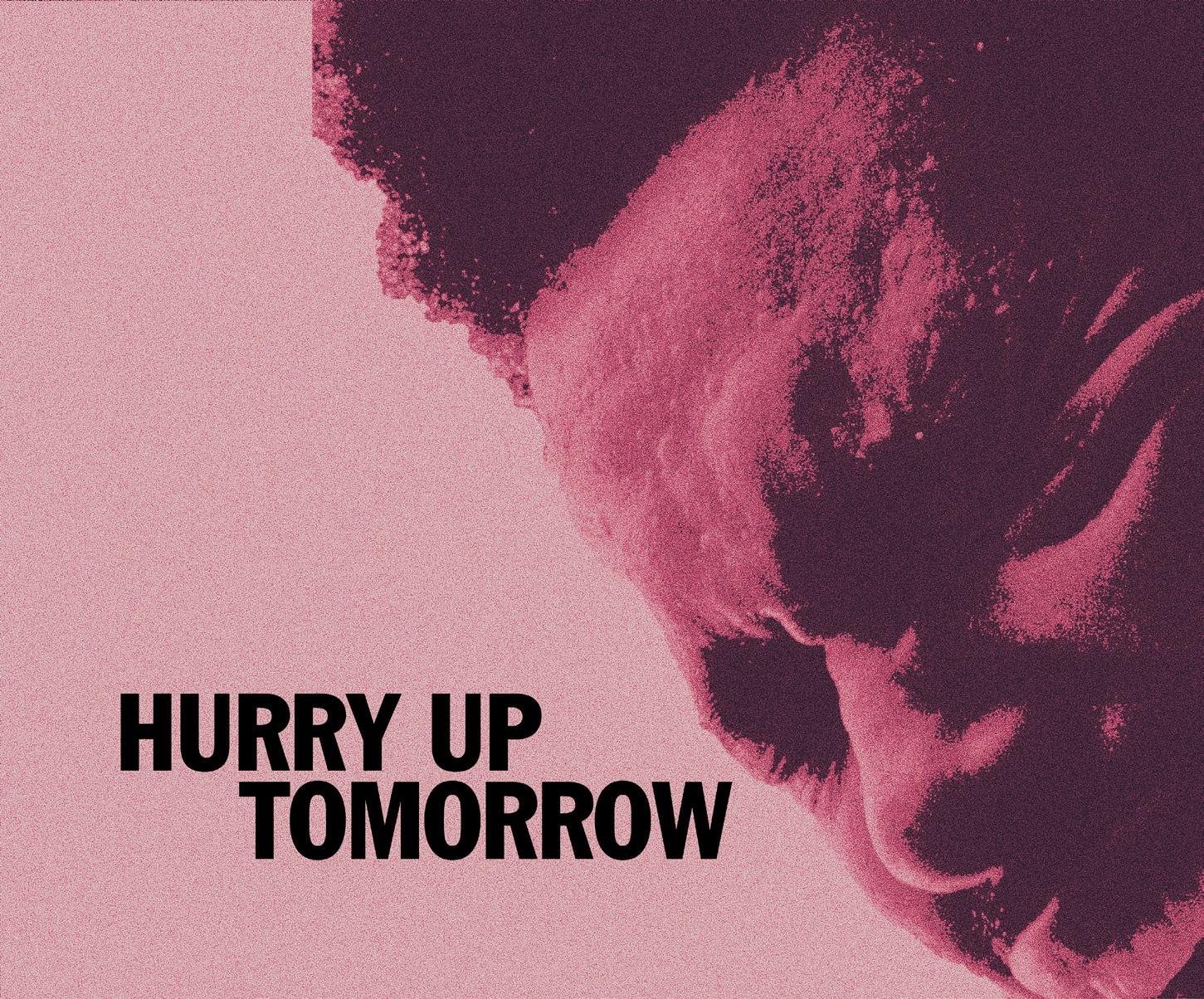
On the Beat: ‘Hurry Up Tomorrow’
After a career spanning over a decade, Abel Tesfaye — better known as The Weeknd — has released the final album under his pseudonym. “Hurry Up Tomorrow” is not only the sixth and final album by The Weeknd, but it is also the last album in a trilogy also including “After Hours” (2020) and “Dawn FM” (2022). These three albums have seen the death and rebirth of The Weeknd’s persona. The question is: How does “Hurry Up Tomorrow” stack up against the trilogy it’s implanted in and as the final album of an artist whose commercial success has brought a whole world of ears together for one last go?
I’m happy to report that, in many ways, “Hurry Up Tomorrow” is an excellent artistic example of what a final album should be, although there are moments that drag it down from being a perfect record. One highlight of the album is “Cry For Me,” a synth masterclass produced by hip-hop veterans Mike Dean and Metro Boomin. In this song, The Weeknd cries out to the person he loves after he abandoned them in a prior life. Another standout track is “Take Me Back To LA,” a song that puts the 80s influences The Weeknd has been using for his trilogy on full blast.
The album’s title track, which is the final song, sees The Weeknd come to a revelation: Despite all his faults, he wants to see heaven as he passes on. The song doubles as the metaphorical death of The Weeknd as a character while also being
a literal farewell to his fans listening to the album. For all my film fans, the song interpolates “In Heaven (Lady in the Radiator Song)” by David Lynch and Alan Splet from the movie “Eraserhead.” This sample feels especially powerful now, as Lynch’s recent passing has left many feeling emptier in this world. Perhaps the sample, coupled with the themes of heaven, can bring fans to a place of solace. There are some lowlights on the album, though. While songs like “São Paulo” and “Timeless” sound better mixed in the album’s context, I believe they fall
flat as songs worth keeping. “Timeless,” in particular, caused controversy after its release, with some critics and internet-goers believing AI was used for Playboi Carti’s feature rather than a live vocal track, though this has not been proven.
Beyond those critiques, “Hurry Up Tomorrow” stands as The Weeknd’s final statement, showing his artistic potential peaking in several ways. It is a shining example of how to end a legacy, even when you’re at the height of your career.
CROSSWORD: Black History Month
Across
2.A holiday that commemorates the emancipation of over 250,000 Black Americans. On this day in 1865 — over two years after Abraham Lincoln’s Emancipation Proclamation legally declared slaves in Confederate states free and two months after the official end of the Civil War — Union soldiers arrived in Galveston Bay, Texas, to inform the people there of their legal freedom from slavery.
5.Social reformer and abolitionist who was a leader of the African American civil rights movement in the 1800s.
6.______ v. Board of Education, the 1954 landmark Supreme Court case ending racial segregation in public schools.
7.Civil Rights activist known for sparking the Montgomery Bus Boycott when refusing to give up her bus seat for a white passenger.
8.The 1964 legislation outlawing discrimination and segregation on the basis of race, color, religion, sex and national origin.
9.The federal agency established by Congress to aid formerly enslaved individuals after the Civil War.
Down
1.The first Black woman elected to Congress (1968) and the first Black woman to run for president (1972) with the slogan, “Unbought and unbossed.”
3.A network of routes toward freedom for enslaved people that ran between the northern and southern U.S., famously used by Harriet Tubman to lead multiple groups of enslaved people to freedom.
4.The name of the 1963 rally “for Jobs and Freedom” where Martin Luther King Jr. gave his famous “I Have a Dream” speech to hundreds of thousands of demonstrators.
Fly, Eagles, fly
TESS MARGIS ’26 Features Reporter
The city of Philadelphia is currently in a state of celebration and anticipation as we gear up to watch the Philadelphia Eagles in the 2025 Super Bowl. Enjoy these tracks in the hope that our Birds bring the Lombardi Trophy back to Broad Street!
“Dreams and Nightmares” – Meek Mill Starting off with a classic, Philly’s unofficial anthem was inescapable during the 2018 Super Bowl run and has held up through the years. Since then, it’s solidified its place as the go-to Eagles hype song and a party favorite among Philadelphians. This song was echoing down Broad Street after the NFC championship game and hopefully will be playing again on Sunday night.
“The Boys Are Back In Town” – Thin Lizzy The Eagles met the Kansas City Chiefs in the 2023 Super Bowl, but the outcome wasn’t what we wanted. The defense failed to rise to the occasion, with Jalen Hurts fumbling at a crucial time and a controversial holding call on James Bradberry setting up Patrick Mahomes and the Chiefs to win. This year, the Birds are back in the Bowl, and a refreshed roster may be what it takes to stop the formidable Chiefs from a three-peat. Philly stopped a dynasty in its tracks in 2018 and is tasked with doing so once again.
“Who Let The Dogs Out” – Baha Men Break out the dog masks. The Eagles are once again headed into the Super Bowl underdogs to the Chiefs, who are -1.5-point favorites to win the game. The Chiefs may be back-to-back Super Bowl Champions, but after a dominant win over the Washington Commanders, the Eagles have shown that they’re a force to be reckoned with. Keep doubting them — they use it as fuel.
“We Are The Champions” – Queen NFC champions today, Super Bowl champions tomorrow? The Eagles have upgraded their running game with Saquon Barkley, have established their secondary with Quinyon Mitchell, Cooper DeJean, C.J. Gardner-Johnson and Reed Blankenship, have a nasty offensive line and have a solid defensive coordinator in Vic Fangio. Not to mention Jalen Hurts, who has been playing out of his mind and had the highest Pro Football Focus grade of any player over championship weekend. This isn’t the same team as 2022. Hungry dogs run faster, and these guys will keep on running ’till they are “the champions.”
“The Eagles’ Victory Song” – Charles Borrelli and Roger Courtland Also referred to as the “Fly, Eagles, Fly” song, true Eagles fans know this iconic song from the moment they’re born (I think “Eagles” was the first word I could spell). Played in the stadium and sung all around the Philadelphia area after a touchdown, this 38-second song unites fans everywhere. Don’t be surprised if you’re caught in the middle of a crowd that decides to burst out singing it — the infectious tune can be found everywhere, especially in times of celebration.
GRAPHIC: STEPHANIE SAVELA ’25/THE HAWK
GRAPHIC: CARA HALLIGAN ’25/THE HAWK
KILEY O’BRIEN ’25 Assistant Features Editor
PARKER HAYDEN ’25 Hawk Staff
Eagles hunt for second Super Bowl title in rematch
CHRIS SLETVOLD ’26 Columnist
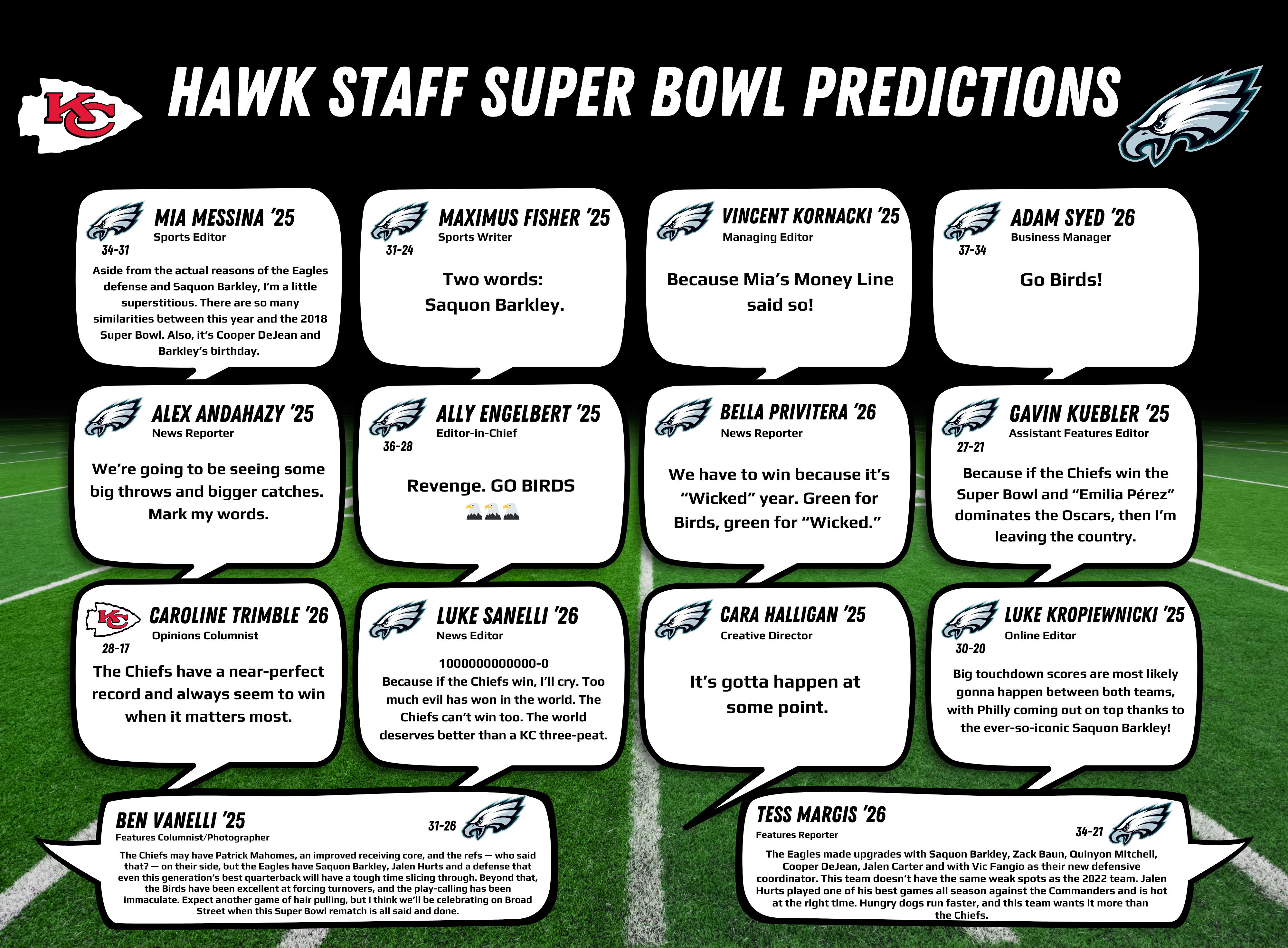
After their 55-23 victory over the Washington Commanders, the Philadelphia Eagles are NFC champions for the second time in three years. They will play in the 2025 Super Bowl in New Orleans against the Kansas City Chiefs, who defeated the Eagles 38-35 two years ago in the 2023 Super Bowl.
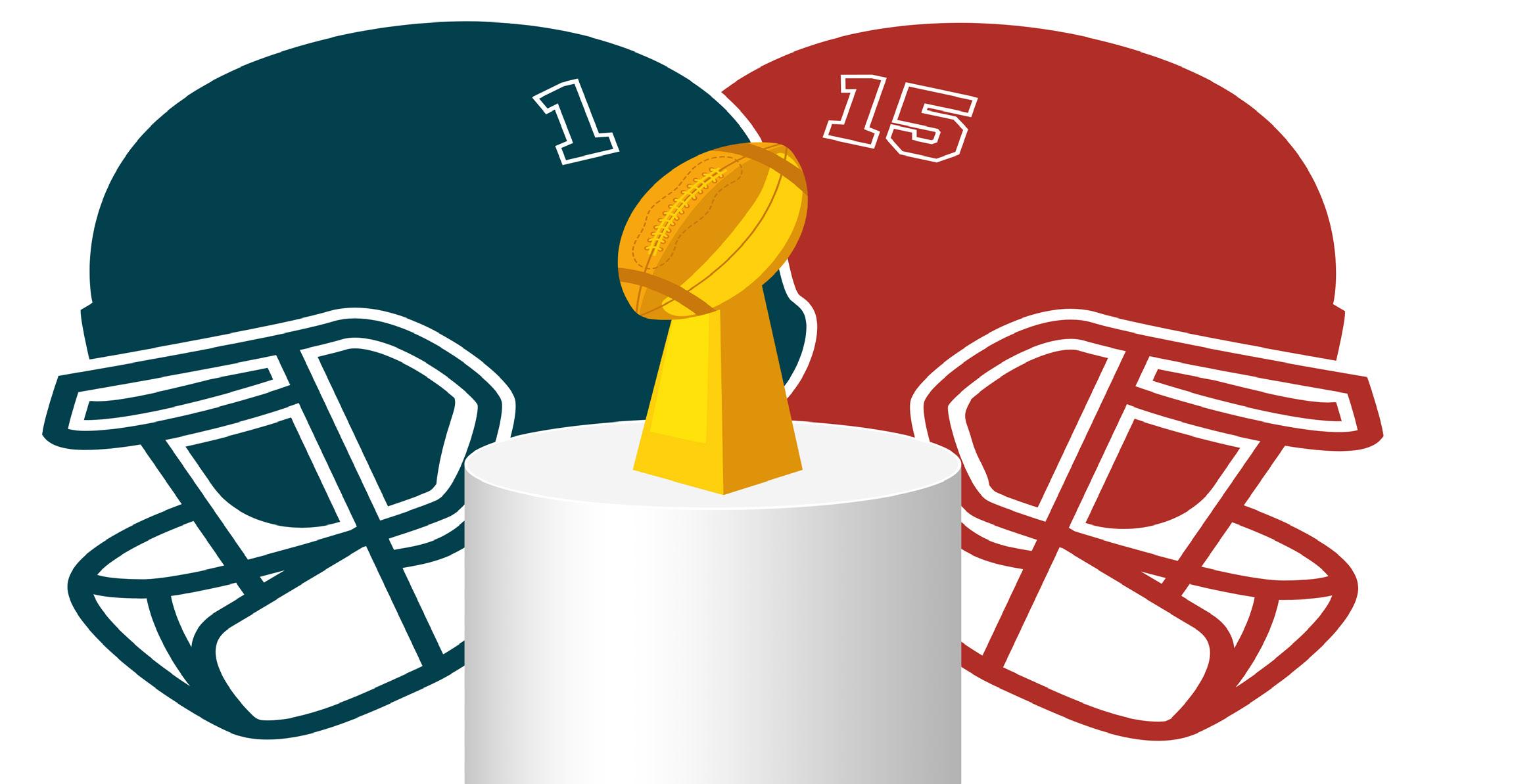
The Eagles enter the grudge match after a bounce-back season. After going 11-6 and crashing out in the Wild Card round last year, the Eagles won 14 games and the NFC East division title this time around. The Chiefs, meanwhile, continued their dominance. The back-to-back reigning champions went 15-2 in the regular season, with one loss coming in the final week when all their starters rested. This is their fifth Super Bowl appearance in six years.
The Chiefs offense was not at their best this year, but they still found success. Quarterback Patrick Mahomes is the best passer of this era and always pulls through in clutch moments. His ability to scramble and extend passing plays makes him a nightmare for opposing defenses. Do not expect Eagles defensive coordinator Vic Fangio to bring extra pressure, however. Fangio does not call many blitzes, instead relying on the defensive line to get to the quarterback. Defensive tackles Jalen Carter and Jordan Davis have their hands full. Chasing Mahomes could wear them out quickly and tip the game in favor of the Chiefs.
The advantage for the Eagles lies in their secondary and run game. Veteran defensive backs Darius Slay and C.J. Gardner-Johnson, as well as rookies Cooper DeJean and
Quinyon Mitchell, shut down opposing receivers all year. Kansas City lacks an elite wideout, making this a big advantage for the Eagles. They can put First-Team All-Pro linebacker Zack Baun on tight end Travis Kelce, who is less effective than he was two years ago. However, the Chiefs always find a way to score, meaning Eagles quarterback Jalen Hurts will need to take care of the ball for the Eagles to keep pace. He was excellent against Washington, throwing for 246 yards and zero turnovers. Avoiding costly turnovers, like his lost fumble that the Chiefs returned for a touchdown two years ago, will be key to success for the Eagles.
The Eagles have the biggest game-breaker in this matchup: running back Saquon Barkley.
He ran for 118 yards and three scores against Washington, including a 60-yard touchdown on the Eagles’ first offensive play. Kansas City has a much tougher run defense than Washington. Defensive tackle Chris Jones is a wrecking ball in the middle. However, the Eagles offensive line is excellent and found success blocking for Barkley on the outside against Washington. Expect offensive coordinator Kellen Moore to call running plays for Barkley to get going downhill toward the sideline and away from Jones.
The 2025 Super Bowl is set to be a tightly contested matchup. These are two teams that both possess elite defenses and transcendent offensive talents. Stylistically, they are very
different from one another, however. The Chiefs run their offense through Mahomes and the passing game, while the Eagles look to establish their run game through Barkley, who can rip a big run at any moment. Both teams are hungry for a win. The Chiefs want to be the first team to win three consecutive Super Bowls. The Eagles want revenge. The Chiefs are slight favorites, but do not count the Eagles out in this one.
Q&A with St. Joe’s student once babysat by Eagles star
Maisey Hartman ’27 is an elementary education major at St. Joe’s. Originally from White Hall, Pennsylvania, Hartman was in elementary school when Eagles running back Saquon Barkley babysat her and her brother. The Hawk spoke to Hartman about her experience with Barkley ahead of his Super Bowl appearance.
How did Barkely become your babysitter?
He went to the same school district that my dad was the athletic director at, White Hall [Coplay] School District. I went there. So did my brother, and my dad was athletic director there, still is currently. And Saquon went there. He played football there, and him and my dad were super close. One night, my parents wanted a date night or just wanted to go out, and my dad asked Saquon, ‘Hey, want to babysit the kids for a night?’ and Saquon was more than interested in doing it.
How long was he your babysitter for?
On and off for about a year. It was around the time when he was a junior or senior in high school.
What was he like during that time?
He was super nice, energetic, a great friend to be around. He wasn’t one of those strict babysitters that made us be in bed at a certain time. Me and my brother grew
Who
up with a lot of girl babysitters, so a lot of the time my brother was the odd one out, so it was different this time having a boy babysitter. They played Madden, but Saquon always made sure I was included. We had a lot of fun together. We would play games, talk about random things, watch movies, just do things together. He was like a friend to us, and we had a lot of fun together.
Do you have a favorite memory with him?
When he was at Penn State, he invited me, my dad and my brother to a game, and we went through the locker room and backstage, and we saw him. I was nervous to say hi to him because I thought he forgot about us and wouldn’t remember who we were, because he was becoming big time famous. He yelled to me, ‘Hey Maisey, you’re not gonna say hi to your babysitter?’ and that just showed the kind of person he was, and that he’ll never forget me or my family.
How does the Barkley you know compare to the one you watch with the Eagles?
When people watch the games, he’s always cheering on his teammates when they get a touchdown over him. He’s very selfless, down to earth, I think that’s exactly how I would describe the way he was when he was at Whitehall or babysitting me. The way I know him personally, that’s the exact person he is, and I think that’s the way he shows himself on screen. And if people can’t see that, I hope my words will show that that’s just the way he is. You just have to
look closely to see that he’s just a very good person, and I think you can easily tell.
How do you feel watching him play in the Super Bowl now?
It’s so exciting. I can’t believe this is happening. I remember when I was younger, I couldn’t even wrap my head around the fact that he was even a football player in my house in the first place. I just thought
he was a random kid babysitting me It’s just insane to see. I’m really extremely proudof him, and it’s exciting to see him coming from a small town like Whitehall to the big screen and making his way being the best running back in the league and doing amazingthings.
are non-Eagles fans at St. Joe’s rooting for in the Super Bowl?
Connor Peterson ’25
I’ll be rooting for the Eagles, somewhat reluctantly. They took our running back, but I’d rather see them win than the Chiefs because I don’t like the Chiefs very much. They win too much, and it’d be nice to see my friends win something. It’d be cool to be in the city for the parade and the celebrations.
Sophia Petrini ’26
Daniel Ros ’25
James Kemp ’27
I’m rooting for the Eagles in the Super Bowl, just because, for one, I really can’t see myself rooting for the Chiefs again. And also, since I’m in Philly, it’s more fun to see them win the Super Bowl while I’m in the city. Most of my friends are all Eagles fans, so I think it’d be more fun to see them happy watching the Eagles win than everyone sad watching the Chiefs win.
Andrew Skakal ’25
I’m rooting for the Eagles because all my friends are, all my roommates are, and for some reason, I can’t stand the Chiefs. I don’t want them to win again. When they got a lot of popularity these last two games and they were all over the news, and because Travis Kelce is dating Taylor Swift, whom I love, they feel more of a celebrity football team than a sports team. I’m rooting for the Eagles, but at the end of the day, doesn’t really matter to me.
Definitely the Eagles for two reasons. One is I’m not a fan of the Chiefs. And two is, since I’ve got to school and never really was an Eagles fan before, watching games with my friends who are Eagles fans, I call them my NFC team now. I think the Bills’ mafia and Eagles fans are very similar and they’re both really passionate and out-there fan bases.
I will be rooting for the Eagles because I think it would be cool if they won. Living in the city and seeing that celebration will be interesting. I’ve heard in the past how it gets pretty crazy, so that’d be fun to see.
Katie Schmidt ’26
Gotta be honest, I’m rooting for the Eagles because I hate the Chiefs. They just annoy me.
’26/THE HAWK AND MIA MESSINA ’25/THE HAWK
PHOTOS: MONICA SOWINSKI ’26/THE HAWK, MIA MESSINA ’25/THE HAWK AND PHOTOS COURTESY OF CONNOR
Howell, N.J. New York Giants fan
Clifton, N.J. Detroit Lions fan
Baltimore, Md. Baltimore Ravens fan
Annapolis, Md. Baltimore Ravens fan
Buffalo, N.J. Buffalo Bills fan
Doylestown, Pa. New York Giants fan
MONICA SOWINSKI ’26
Sports Reporter
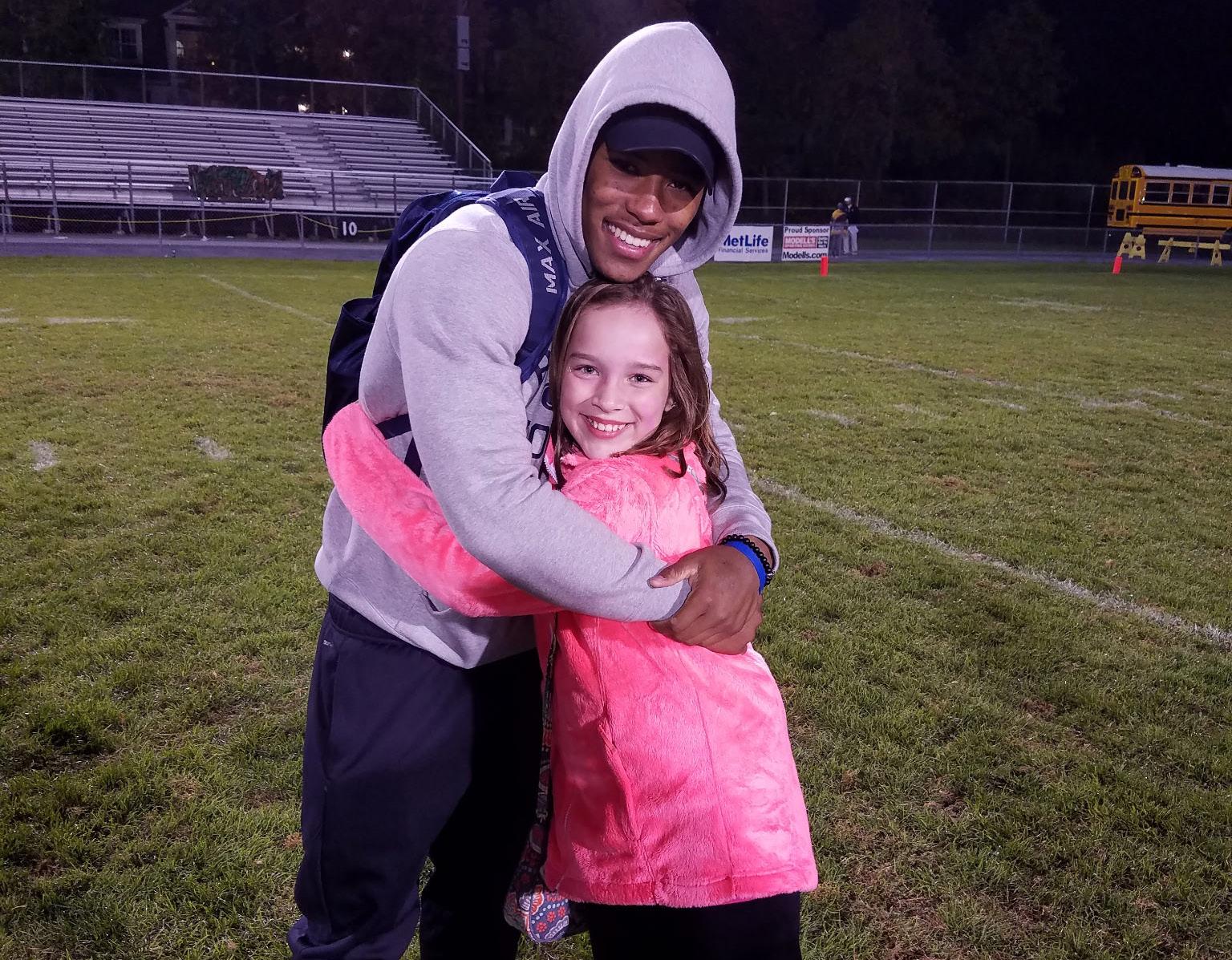
Maisey Hartman ’27 and Eagles running back Saquon Barkley afer a Whitehall High School football game, 2016. PHOTO COURTESY OF MAISEY HARTMAN ’27
Sports betting on the rise among college-aged bettors
AIDAN POWERS ’26
Special to The Hawk
Like many college students who engage in sports betting, Colin Simpson ’26 is just looking to make an extra buck.
“If you’re lucky enough, you can get a little extra spending cash,” Simpson said.
Since the Supreme Court legalized sports betting in 2018, it has been growing consistently every year, fueled by online betting through apps like FanDuel, DraftKings and ESPN BET, known as sportsbooks.
In 2023, Americans gambled over $120 billion on legalized sportsbooks, up from $93 billion in 2022, according to the American Gaming Association.
Sports betting is also growing among college students. Of people ages 18 to 22, 58% have engaged in a sports betting activity, according to a 2023 NCAA survey. Of respondents living on a college campus while pursuing a bachelor’s degree, 67% have engaged in betting activities.
The legal age to place a sports bet is 21 in the majority of states, including Pennsylvania. However, it is not hard to work around the legal age.
Brendan Duffy ’26, who is 21, said students are able to find ways to bet even while being underage.
“What I did was use an app that classifies itself as a sweepstakes app,” Duffy said. “It’s classified as a sweepstakes app even though you are actually sports betting, so it’s a loophole.”
Duffy said some students will go as far as using older siblings’ or parents’ information to log on to the apps and place bets.
“Through friends or family that
are 21, you can use their identity in sportsbooks,” Duffy said.
While mainstream sports betting sites require you to take a photo of your driver’s license or other official identification when signing up, there are other workarounds for that, too, Duffy said.
“There’s not really a way for you to fake your identity to those sportsbooks, but there are black market bookies,” Duffy said.
Some college students are the “black market bookies,” running sportsbooks through off-the-grid websites. Essentially, the “bookies” are the sportsbooks, and when an individual loses a bet, they have to pay the bookie. When they win, the bookie pays them.
With so many workarounds for sports betting, it is almost impossible for underage students to not find a way to bet on sports.
Stephanie Tryce, J.D., assistant professor of sports marketing, said many college students don’t understand the legal implications of sports betting.
“You got identity issues, you’ve got fraud and forgery, and depending upon the state you’re in, it has different legal implications,” Tryce said.
Tryce said she is concerned with the habits some students are forming.
“The other thing that concerns me about young folks is, ‘Oh, I only bet 15 cents. I’m not concerned about that right now,’” Tryce said. “I’m concerned about the habit that you’re building, because now when you get a job, now you’re going to bet more.”
Duffy isn’t concerned about that.
“It is something that I really enjoy doing, but it is something that I’ve gone periods
without doing as well, so I know that for me, personally, I don’t think that it would ever become an addiction,” Duffy said.
In the same NCAA study, 70% of respondents classified as risky gamblers believed consistent sports betting would earn them a lot of money. Risky gamblers are students who either bet a few times a week or daily, bet $50 or more in a typical wager and/or lose more than $500 from betting in a single day.
Cayden Swatchick ’26, who only occasionally places a sports bet, said while sports betting is problematic for some, most of the people he knows are okay.
“A lot of people that keep themselves in check, I don’t think it’s going to be an issue for them,” Swatchick said. “... As long as you keep yourself [to] a limit that you’re betting per month or per week, you’ll be fine.”
Swatchick said the key is to know when to quit.
“When you keep losing, continuing to try and pull yourself out of that loss, sometimes you just have to accept that you’ve lost that money,” Swatchick said.
Members of the St. Joe’s community seeking support are encouraged to contact the following resources:
Counseling and Psychological Services (CAPS), 610-660-1090
Campus Ministry, 610-660-1030
The Office of Student Outreach & Support, 610-660-1149
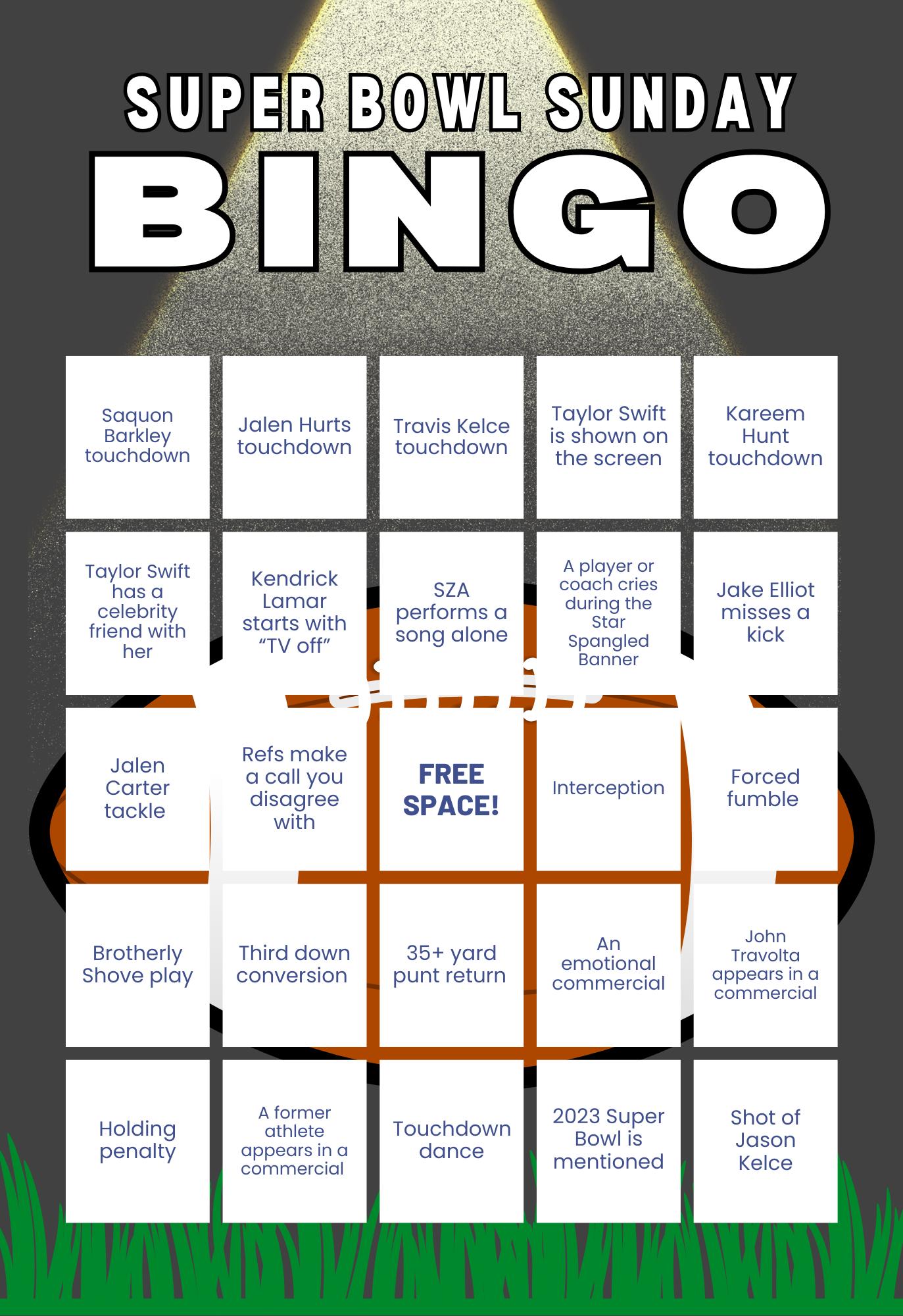
From wager-less bets about the length of the national anthem or the color of the Gatorade bath to organized block pools, Super Bowl Sunday is a big day for betting. For sportsbooks, it’s the biggest day of the year. So, if you’re 21 or older and looking to make some responsible bets (and have read St. Joe’s Sports Wagering Policy), here are my picks for the biggest game of the year.
Eagles money line (+106)
The Kansas City Chiefs are currently favorited by a point and a half. They have a few advantages over the Philadelphia Eagles. There’s no use trying to deny that they are more well-coached and have the better quarterback. But the Eagles fare well in every other area. With a roster stacked with talent from top to bottom and the top defense in the league, I believe the Eagles have a slight edge.
Saquon Barkley any time TD scorer (-180) Jalen Hurts any time TD scorer (-115) Two-leg parlay (+212)
Eagles running back Saquon Barkley and quarterback Jalen Hurts are the two players on the field with the best odds to score a touchdown. In the NFC championship, they each rushed for three touchdowns against the Washington Commanders. While you might not get a huge return on betting either of them separately, if you combine the picks for a two-leg parlay, you’ll certainly be earning more if it hits.
DeVonta Smith over 60 receiving yards (+134)
With the Chiefs top cornerbacks targeting wide receiver A.J. Brown, DeVonta
Smith will be open for some big plays for the Eagles. Last time in the Super Bowl, he had seven receptions with 100 receiving yards. Expect him to come up big for the Birds again.
George Karlaftis under 3.5 total tackles + assists (-130)
The Chiefs defensive end recorded four total tackles against the Buffalo Bills and five against the Houston Texans in the postseason. Throughout the rest of the season, he only had two games where he had more than 3.5 tackles. Don’t expect this game to be the third. The Eagles are big on explosive plays, which lends little opportunity for Karlaftis to tally up his tackle total.
Travis Kelce under 6.5 receptions (-168)
For my fellow Swifties, if you’re only watching the game for Taylor Swift but still want to get in on some of the betting, this one is for you. Chiefs tight end Travis
Kelce has had only eight games with more than six receptions this season, including the postseason. But in every single one of his Super Bowl appearances, Kelce has recorded six or more. The last time he played the Eagles in the Super Bowl, Kelce was held to six. With a stronger Birds defense this time around, expect Kelce to be held to that number or lower, and bet the under.
Additional Predictions
Gatorade color: Blue Orange is the most used color and was already used for an Andy Reid bath, as was purple. Yellow was used in the NFC championship for the Eagles. Blue just feels right.
Coin toss results: Heads I’m anti-“tails never fails” philosophy.
National Anthem: Over 120.5 seconds Jon Batiste is singing the Star Spangled Banner, a song that takes roughly 115 seconds, on average. With the eyes of the nation on him in his big moment, Batiste is sure to take the opportunity to riff, belt and do a little extra that will get him over the 120.5-second mark.
Halftime show opening song: “HUMBLE.” “Not Like Us” is the obvious choice. It will be either a middle or ending song, but “HUMBLE.” is recognizable and has the perfect beat to serve as an opening moment for Kendrick Lamar’s halftime show featuring SZA.
Taylor Swift cam: Shown over 2.5 times Leave my girl alone. It’s not her fault the NFL keeps showing her. Add in the fact that she grew up in Pennsylvania as an Eagles fan and that will definitely account for wa little extra screen time.