Welcome to Hawaiʻi Preparatory Academy’s Upper School Course Catalog for the 2026-2027 school year.
This catalog is designed to help students and families plan thoughtfully. It outlines graduation requirements, course levels, academic policies, and the learning opportunities available across departments. Advisors and teachers will support students throughout the process so that course choices reflect both long-term goals and a healthy balance.
Mahalo for being part of the HPA ʻohana. We look forward to supporting each student’s growth as a Confident Navigator.
With the warmest aloha,
Mark Noetzel, Assistant Head of School for Upper School
HOW TO USE THIS COURSE CATALOG
This course catalog is designed to support thoughtful, informed academic planning. Whether you are a student choosing courses for the first time or a family planning for the long term, this guide is meant to be read as both a reference and a planning tool.
► Start with the Big Picture
Before jumping into individual courses, we encourage you to begin with the opening sections of the catalog. These pages outline HPA’s mission, values, teaching philosophy, and Portrait of an HPA Graduate. Together, they provide important context for how learning is designed at HPA and what we hope students will gain from their experience beyond individual classes.
► Understand How the Upper School Works
Next, review the sections on the school day schedule, course load, and graduation requirements. These pages explain how the Upper School schedule
is structured, what is required for graduation, and how students typically build balanced academic programs over four years.
► Explore Course Levels and Expectations
Before selecting specific classes, take time to read the descriptions of College Preparatory (CP), Honors (H), and Advanced Placement (AP) courses. These sections explain the differences in pace, depth, and time commitment and can help students and families choose courses that align with readiness, interests, and overall well-being.
► Review Department Offerings
Department sections are organized by subject area and include course descriptions, credit values, grade levels, and prerequisites. As you explore these offerings, consider both required courses and electives that support curiosity, creativity, and personal growth.
► Plan with Support
Course planning is a collaborative process. Students should review options with their advisors, families, and, when appropriate, college counselors. Advisors are available to help students consider graduation progress, balance, and longterm goals. No student is expected to navigate this process alone.
► Use the Catalog as a Reference
In addition to course descriptions, this catalog includes important information about grading, registration timelines, add/drop policies, academic
support services, and school expectations. We encourage students and families to return to these sections as questions arise throughout the year.
Above all, this catalog reflects HPA’s belief that meaningful learning happens when challenge and support are thoughtfully balanced. We hope it helps students make choices that foster confidence, curiosity, resilience, and a sense of purpose as they continue their journey to become Confident Navigators. ■
WHO WE ARE AND HOW WE LEARN
HPA Mission
To provide exceptional learning opportunities in a diverse community, honoring the traditions of Hawa iʻ i.
HPA Vision
Hawai iʻ i Preparatory Academy will be the premier educational community committed to living and learning sustainably.
HPA Core Values
Integrity: Living honestly and with moral courage
Respect: Serving with kindness and responsibility Pursuit of Excellence: Striving for the highest and best result
Wonder: Being curious, appreciative, and content
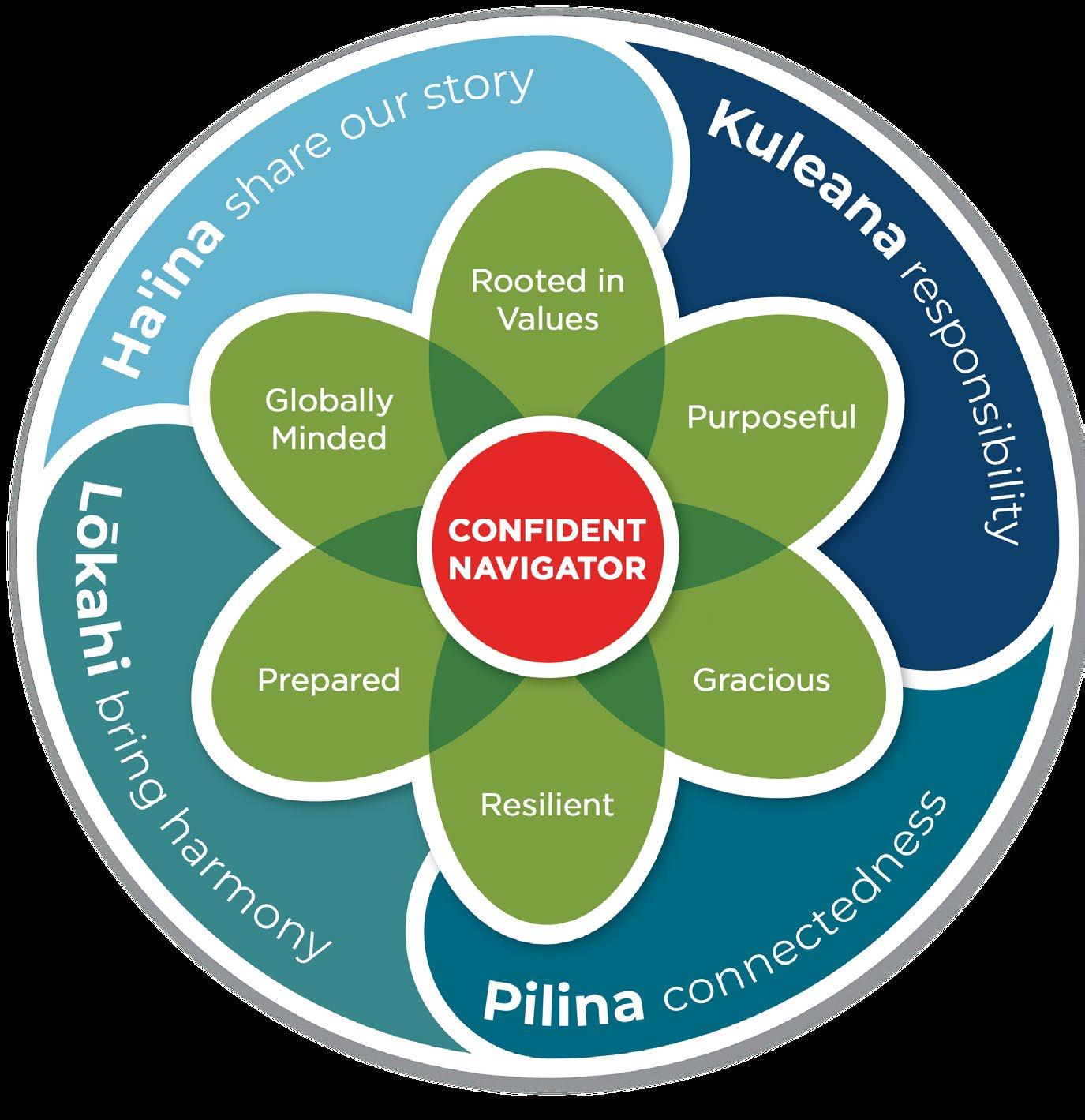
Portrait of an HPA Graduate HPA Graduates are Confident Navigators who are…
Rooted in Values: They ground themselves in HPA’s Core Values, and in the values instilled by their ʻ ohana, honoring both as they care for our community of spirit, land, and people.
Purposeful: They make choices with intention, seeking paths that bring meaning to their lives while strengthening their communities.
Gracious: They live with aloha–practicing empathy, humility, gratitude, and curiosity–building relationships that uplift, connect, and inspire.
Resilient: They meet challenges with determination and adaptability, growing through shared effort, reflection, and mutual support.
Prepared: They draw from broad foundations of knowledge, skills, and experiences, ready to collaborate, lead, and contribute to the success and well-being of the groups and places they serve.
Globally Minded : They understand their role in our interconnected world, weaving bonds of unity through connection, responsibility, and story.
HPA Teaching Philosophy
At HPA, teaching and learning are guided by Mālama Kaiāulu , a framework that calls us to care for our community of spirit, land, and people. This shared philosophy supports students in meeting the complexities of today’s world with clarity, empathy, and purpose.
Mālama Kaiāulu is expressed through four essential practices:
• Kuleana (responsibility)
• Pilina (relationship)
• Lōkahi (harmony)
• Ha‘ina (storytelling)
Together, these practices form a shared language through which we pursue regenerative sustainability academically, environmentally, and interpersonally.
In the Upper School, this framework comes to life through three interconnected approaches: projectbased learning, inquiry-based learning, and place-based education.
• Project-based learning supports students as they explore real problems over time, design solutions, and share outcomes with authentic audiences. Students develop the skills we value most: creativity, critical thinking, collaboration, and communication.
• Inquiry-based learning strengthens curiosity and ownership. Students learn to ask strong questions, conduct research, evaluate sources, and develop evidence-based claims, skills that support college readiness and preparation for the Senior Capstone.
• Place-based learning grounds learning in Hawai‘i. Students connect the natural and cultural landscapes of our island home to academic study, building understanding that is both local and globally relevant.
HPA offers a challenging college preparatory program, including College Preparatory (CP), Honors (H), and Advanced Placement (AP) coursework. Academic excellence at HPA is not only an outcome but
also a responsibility. We aim to prepare students for lives of intellectual, ethical, and emotional depth through learning that balances challenge with support, inquiry with structure, and skill development with human connection. ■
HOW THE UPPER SCHOOL WORKS
School Day Schedule
Upper School classes meet on alternating days, known as ʻ Ula and Mamo. ʻ Ula days consist of A, B, C, and D class blocks, while Mamo days include E, F, and G blocks. Each class block is 70 minutes long, with a 15-minute passing time between periods. Academic classes run from 8:30 a.m. to 3:00 p.m., followed by co-curricular activities and team sports.
Our ʻ Ula and Mamo schedule was named with intention. The lehua ʻ ula and lehua mamo are two prominent flower varieties of the ʻ Ōhi ʻ a tree, the foundation of Hawai ʻ i’s forests. ʻ Ula (red) and Mamo (yellow) are colors associated with high esteem and dignity. The lehua was chosen as a symbol of HPA’s pursuit of excellence and serves as an emblem for our alternating schedule days.
In addition to academic courses, students participate in assemblies, class meetings, advisory sessions, and office hours. These community events play a vital role in fostering pilina— connection and belonging—across grade levels, which we deeply value at HPA. A detailed Block Schedule and a Key Dates Calendar are available in the Appendix.
Course Load
All Upper School students must be enrolled in the required number of courses each semester to maintain full-time status. There are a total of seven blocks over two days (four on ʻ Ula and three on Mamo).
Freshmen and Sophomores: Must enroll in at least six courses each semester
Juniors and Seniors: Must enroll in at least five courses each semester
While students may choose to take more than the minimum number of courses, enrolling in seven courses is generally not recommended. HPA encourages students to build a balanced schedule that supports both academic growth and overall well-being. Leaving space in a student’s schedule provides flexibility during illness, unexpected absences, athletics, increased academic demands, or personal challenges.
Advisors work closely with students and families to help determine an appropriate course load that reflects each student’s goals, interests, and capacity. Thoughtful course selection supports not only academic success, but also engagement in co-curricular activities, athletics, rest, and personal development. At HPA, we believe a balanced schedule helps students thrive as learners and as whole individuals.
Course Availability
All courses listed in this catalog depend on sufficient student enrollment to be offered in a given year. If there is not enough interest in a particular course, it may not run during the upcoming school year. The number of course sections is determined each April based on student requests and staffing. If a course cannot be offered or a section is full, the registrar or a student’s advisor will contact them to select an alternate course. ■
PLANNING AN ACADEMIC PATH
Course Selection
Course selection is a thoughtful, collaborative process that supports both academic progress and personal growth. Each year, students work closely with their advisor to select courses for the following academic year that align with graduation requirements, interests, readiness, and long-term goals.
Students are encouraged to engage families, teachers, and, when appropriate, college counselors in these conversations. Together, this team helps students build a balanced program that reflects challenge, curiosity, and well-being.
Annual Course Planning
Course selection takes place each spring. During this process:
• Students review graduation requirements and department offerings.
• Advisors help students consider course progression, workload, and balance across academic, co-curricular, and athletic commitments.
• Planning worksheets are provided to support reflection and discussion.
For incoming freshmen, course placements are determined through teacher recommendations, grade reports, and placement assessments as appropriate. These placements are designed to support a strong transition into Upper School coursework.
The Master Schedule
HPA’s master schedule is built each spring based on student course requests. Because course offerings and the number of sections depend on student interest and staffing, not all requests can be guaranteed. Once the master schedule is finalized, changes may be limited due to availability and scheduling constraints.
Students and families are encouraged to approach course selection with flexibility, understanding that some adjustments may be necessary to ensure a balanced and sustainable academic program for all students.
Long-Term Planning
Course selection is not a one-time decision. Students are encouraged to reflect on their academic journey across all four years, revisiting and refining their plans as interests, strengths, and goals evolve. Advisors and college counselors support students in mapping pathways that prepare them for college, career, and life beyond HPA.
A Graduation Planning Worksheet is available in the Appendix and may be used throughout a student’s Upper School experience to track progress and explore options.
At HPA, thoughtful course selection is about more than meeting requirements. It is an opportunity for students to take ownership of their learning, challenge themselves appropriately, and build a program that supports who they are becoming as Confident Navigators.
Graduation Planner
The graduation planner is designed to help students map out their four-year academic journey and ensure steady progress toward graduation. While it serves as a planning tool, students are encouraged to take full advantage of the diverse educational opportunities offered at HPA. Course offerings may vary from year to year based on student interest, staffing, and scheduling. While every effort is made to accommodate student preferences, enrollment in specific courses cannot be guaranteed.
Students should begin discussing their fouryear course plan with their advisor and college counselor early in high school. Each year, students are encouraged to review their plans with their parents or guardians before selecting courses, thereby refining and achieving long-term goals. Plans may be updated at any point as interests and goals evolve. A Planning Worksheet can be found in the Appendix of this course catalog.
Graduation Requirements
HPA’s graduation requirements are designed to provide both a strong academic foundation and the flexibility to pursue a student’s unique interests. By completing these requirements, students will be well-prepared for college, career, and life beyond HPA. To graduate, students must earn a minimum of 22.0 credits
HPA GRADUATION REQUIREMENTS
English Graduation Requirement
All students must be enrolled in an English course every semester and year they attend HPA.
Mathematics Graduation Requirement
Students must be enrolled in mathematics through their Junior year, including successful completion of Algebra II.
World Language Graduation Requirement
Students must complete three consecutive levels of the same language through at least the end of their Sophomore year. Students who reach Level III by their Sophomore year and earn full credit for the course will meet the graduation requirement.
Science Graduation Requirement
Students must include two years of laboratory science (Biology, Chemistry, or Conceptual Physics), plus one additional science credit of their choice.
Social Studies Graduation Requirement
Students must earn a minimum of three credits in Social Studies, including a global studies credit (Modern World History or AP Human Geography) and one US History credit. Students who enroll at HPA as freshmen are required to complete a year of Hawaiian Studies.
Arts Graduation Requirement
Students are required to earn two credits in the Arts, which may include courses in the visual arts, music, theater, or related disciplines. Students who enroll at HPA as freshmen are required to complete a semester of Arts 9 Fundamentals.
Capstone Graduation Requirement
All students enrolled at HPA are required to complete a year-long Capstone course during their 12th-grade year as part of the graduation requirements.
Health Graduation Requirement
Students are required to take one semester of Health Education for graduation in their Freshman year.
Elective Graduation Requirement
Students may take additional courses from any department beyond the required credits to explore personal interests and broaden their learning experience. ■
COURSE LEVELS AND ACADEMIC EXPECTATIONS
Course Levels
College Preparatory (CP) Courses
College Prep (CP) courses form the foundation of HPA’s academic program and are designed to support deep learning, steady growth, and balance. These courses emphasize skill development, critical thinking, communication, and meaningful engagement with content. Students are encouraged to ask questions, collaborate with peers, and apply their learning in thoughtful and reflective ways.
CP courses are intentionally structured to be appropriately challenging while allowing students the time and flexibility to participate fully in cocurricular activities, athletics, creative pursuits, and personal commitments. These classes support students in building strong academic habits, confidence, and independence, and they prepare them well for future Honors or AP coursework when they are ready.
Choosing a College Prep course is not about limiting opportunity; it is about selecting a level that supports learning, well-being, and long-term success. Advisors work closely with students and families to ensure that CP courses provide the right balance of challenge, growth, and support at each stage of a student’s academic journey.
Honors (H) Courses
Honors (H) courses build upon the foundation of College Prep courses by moving at a faster pace and exploring content in greater depth. Students are expected to work more independently, manage their time effectively, and engage in higher-level analysis, problem-solving, and discussion. Coursework often includes more complex texts, sustained projects, and extended assessments.
Honors courses are best suited for students who demonstrate strong foundational skills, intellectual curiosity, and readiness for increased academic challenge. Advisors and teachers support students in determining whether an Honors course is an appropriate fit, with careful attention to balance, workload, and overall well-being. Honors courses receive a +0.25 GPA weight in recognition of their increased academic rigor.
Advanced Placement (AP) Courses
Advanced Placement (AP) courses offer students the opportunity to engage in college-level study while still in high school. These courses follow a nationally standardized curriculum developed by the College Board and emphasize critical thinking, sustained inquiry, advanced reading and writing, and complex problem-solving.
AP courses reflect HPA’s commitment to the Pursuit of Excellence and are designed for students who are motivated, academically prepared, and ready for a significant time commitment both in and out of class.
Students enrolled in AP courses are required to take the national AP exam in May. Depending on exam performance and college policies, students may earn college credit or advanced placement. AP courses receive a +0.50 GPA weight in recognition of their increased academic rigor. Enrollment requires meeting prerequisites, a teacher recommendation, and instructor approval, ensuring that students are supported and prepared to meet the course’s expectations.
AP Exam & Registration Details
• All AP students are required to take the AP exam in May.
• Students must create a College Board account to register for exams and access AP Classroom resources.
• The exam fee will be billed to the student’s Ka Makani Cash account after the first semester’s Add/Drop period ends.
• Dropping a course after this deadline does not remove the exam fee from your account. All AP exam fees are non-refundable.
• A $40 late registration fee will apply if registering after the College Board’s fall deadline.
For more information about AP exams, including exam dates and fees, please visit College Board or contact the Academic Office at upperschool@hpa. edu.
Taking AP Exams Without the Course
Students may take AP exams for subjects not offered as AP courses at HPA (e.g., Japanese V Honors). These students must register as “Exam Only” participants. To request this, email registrar@hpa.edu. ■
GRADING AND ACADEMIC FEEDBACK
At Hawaiʻi Preparatory Academy, grading is designed to support learning, reflection, and growth. Our grading practices aim to provide students, families, and teachers with a clear and accurate picture of a student’s progress toward mastering course skills and standards.
Grades reflect a student’s performance across coursework, assessments, and demonstrations of learning throughout the semester. While grades serve as an important measure of academic achievement, they are also a tool for communication—helping students understand their strengths, identify areas for growth, and take responsibility for their learning.
Assessments and Learning Progress
Each course includes a variety of assessments, such as projects, presentations, essays, problem sets, labs, discussions, and exams. These assessments are designed to measure both content understanding and the skills essential to college readiness, including critical thinking, communication, collaboration, and problem-solving.
Assessments provide feedback on which skills and standards a student has demonstrated proficiency in and which may need further development. Final exams account for 20% of the semester grade. Course-specific grading practices and expectations are outlined in each teacher’s syllabus.
Students are encouraged to engage actively in their learning by asking questions, attending office hours, seeking feedback, and communicating with teachers when challenges arise.
Assignments and Feedback
All assignments, grades, and feedback are posted in myHPA. Teachers provide written comments periodically throughout the semester to support student reflection and improvement.
Students are expected to monitor their progress regularly by checking myHPA and reviewing teacher feedback. Most assignments and assessments are returned within two weeks of submission unless otherwise communicated by the teacher. Families are encouraged to partner with students by reviewing progress together and supporting healthy communication with teachers when questions or
concerns arise.
Grade Point Average (GPA)
HPA uses a letter-grade system to reflect academic achievement and recognize the rigor of coursework. Students enrolled in courses formally designated as Honors (H) or Advanced Placement (AP) receive additional GPA weighting to acknowledge the increased expectations of these classes.
• Honors (H) courses receive a +0.25 GPA weight
•Advanced Placement (AP) courses receive a +0.50 GPA weight
GPA weighting is intended to recognize academic rigor while encouraging thoughtful course selection that supports balance, well-being, and long-term success.
Grading Scale
The grading scale below outlines numeric score ranges and corresponding GPA values. Additional GPA weighting applies only to courses formally designated as Honors (H) or Advanced Placement (AP).
GRADING SCALE
Important Notes
• GPA weighting applies only to H and AP courses
• GPA weighting does not apply to grades of D or F
• Students are encouraged to work with advisors and families to select courses that reflect readiness and sustainable challenge
•At HPA, grading is one part of a broader conversation about learning. Through ongoing feedback, reflection, and support, we aim to help students grow into confident, capable learners who take ownership of their academic journey. ■
REGISTRATION AND SCHEDULE CHANGES
Course registration is an important step in shaping each student’s academic experience at HPA. The process is designed to be thoughtful, collaborative, and supportive, ensuring that students remain on track for graduation while selecting courses that align with their interests, readiness, and future goals.
Registration Timeline
Students register for courses each spring, after spring break, for the following academic year. The Course Catalog is available in advance to support careful planning and informed decision-making.
Students work closely with their advisors and families—and, when appropriate, college counselors—to review graduation requirements, course progression, and overall balance. Course selections are considered tentative until the Add/ Drop period at the start of each semester concludes.
As a reminder, course load requirements are:
• Grades 9–10: At least six courses each semester
• Grades 11–12: At least five courses each semester
Students may enroll in additional courses when appropriate. Advisors support students in selecting a schedule that reflects academic readiness, balance, and overall well-being.
Honors and Advanced Placement (AP) Course Enrollment
Because of the rigor and pace of Advanced Placement courses, enrollment includes additional requirements. To enroll in a Honors or AP course, students must:
• Meet the listed prerequisites
• Receive a teacher recommendation
• Obtain instructor approval during registration
Students who do not receive a recommendation may submit a petition for enrollment, which will be reviewed by the Academic Office. Questions regarding enrollment may be directed to upperschool@hpa.edu.
Add/Drop Period
HPA recognizes that students may wish to adjust their schedules as they settle into the school year.
The Add/Drop period provides an opportunity to make thoughtful changes with guidance from advisors, teachers, and the Academic Office.
Add/Drop periods occur during the first two weeks of each semester. Specific dates are published annually on myHPA. The Add/Drop form can be found in the Appendix under the Course Change Request Form.
Schedule changes after the Add/Drop period are considered only under exceptional circumstances and require approval from the Academic Office.
Requesting a Schedule Change
During the Add/Drop period, students who wish to add or drop a course must:
• Consult with their advisor (and college counselor, if applicable) to discuss the impact on graduation progress and workload
• Obtain required approvals from relevant teachers and advisors
• Submit a completed Add/Drop Form to the Registrar
Students are expected to communicate proactively with teachers and remain current on assignments during any schedule transition. Make-up work in a newly added course is completed at the discretion of the teacher.
Level Changes
Occasionally, a student may need to move to a different course level to ensure the best academic fit. Level changes are considered carefully and focus on long-term learning, confidence, and success. To request a level change, students must:
• Speak with their current teacher to discuss concerns and explore available supports
• Demonstrate consistent engagement, including completion of assignments and use of support resources
• The teacher, student, and advisor should complete a Course Change Request Form (located in the
Once the teacher has communicated with the student’s family, the request is reviewed by the Academic Office for final approval. Students must remain in their current course until a level change is formally approved.
Adding or Dropping a Course
Students may add a course in place of a free block within the Add/Drop period if space is available. For yearlong courses, students may drop a course only within the first five days of the second semester.
After the Add/Drop period, schedule changes are permitted only under exceptional circumstances.
Courses dropped after this period may result in a “W” (Withdrawal) designation on the transcript, which does not affect GPA but indicates that the course was not completed for credit.
Support and Questions
Students and families are encouraged to reach out to advisors or the Upper School Academic Office with questions throughout the registration and scheduling process. Our goal is to ensure that every student feels supported, informed, and confident in the choices they make.
For assistance, contact upperschool@hpa.edu. ■
SUPPORT SYSTEMS AND SPECIAL OPTIONS
HPA is committed to supporting the academic, social, and personal growth of every student. We recognize that students learn in different ways, move at different paces, and may benefit from different types of support or flexibility at various points in their Upper School experience. The options below are designed to ensure that students have access to the resources they need to thrive as confident, capable learners.
The Learning Center
The Learning Center (LC) on HPA’s Upper Campus provides dedicated academic support for students with documented learning differences who have approved accommodations. These students receive individualized assistance in a structured, supportive environment that allows them to access accommodations such as extended time, testing support, or coaching on executive functioning skills.
Peer Tutoring
The Learning Center serves as a welcoming hub for general academic support and peer tutoring. Any student, regardless of whether they have formal accommodations, may seek support with:
• Organization and time management
• Understanding assignments and expectations
• Study strategies and test preparation
• Building confidence as independent learners
Students may be referred by a teacher or advisor or may choose to seek support on their own. HPA believes that learning differently is a strength, and the Learning Center is designed to support growth, independence, and self-advocacy.
For more information about Learning Center services, please contact learningspecialistsgroup@hpa.edu.
Independent Study
The Independent Study option allows Juniors and Seniors with a strong interest in a particular subject to pursue advanced, self-directed learning beyond existing course offerings. Independent Studies foster intellectual curiosity, creativity, and academic initiative while providing structure and
guidance through a supervising teacher. Independent Studies may be taken as:
• A semester course (0.5 credit), or
• A yearlong course (1.0 credit)
To propose an Independent Study, students must:
• Develop a proposal that includes a course title, objectives, timeline, and assessment plan. Please make a copy of the US Independent Study Planning Worksheet and fill it out accordingly. Directions are included in the first tab.
• Secure a supervising teacher.
• Obtain approval from a parent/guardian, department chair, college counselor, and the Academic Office.
• Submit the completed Independent Study Form and US Independent Study Planning Worksheet before the Semester begins. Remember the US Independent Study Planning Worksheet should be submitted and attached to your Independent Study Form.
• Students will be notified if their Independent Study has been approved, or whether revisions are necessary.
If approved, students will meet regularly with the supervising teacher for feedback and progress check-ins. Independent Studies are graded using a letter-grade scale, count toward GPA, and may not be taken on a pass/fail basis.
If you have any additional questions, please check in with your Advisor and the Academic Office for support.
External Credits
HPA recognizes that students may wish to extend their learning through coursework offered by other accredited institutions. To maintain the integrity of the HPA diploma, all external coursework is reviewed carefully.
External credit policies include:
• All external coursework must receive prior approval from the Academic Office
• Courses must be taken through accredited
institutions
• Courses offered at HPA may not be taken elsewhere for HPA credit
• External credits do not factor into the HPA GPA
• No credit is granted for coursework completed before high school
• Up to 1.0 external credit may be applied toward elective requirements only
External credits may be used only to meet elective requirements within HPA’s 22.0 credit graduation requirement. ■
ATHLETICS/ CO-CURRICULAR OPPORTUNITIES
At Hawaiʻi Preparatory Academy, academics, athletics, and co-curricular involvement work together to support the development of the whole student. Participation in sports, clubs, and activities is an integral part of student life at HPA and reflects shared expectations for responsibility, integrity, balance, and commitment.
Athletics and co-curricular programs provide meaningful opportunities for students to build teamwork, leadership, perseverance, and connection— key elements of HPA’s Portrait of a Graduate. Whether on the field, on stage, in the studio, or serving the community, students are encouraged to engage in experiences that complement their academic growth and personal well-being.
Athletics & Co-Curricular Programs
HPA’s athletics and co-curricular program is organized into three seasonal terms each school year: Fall, Winter, and Spring. Students typically participate in one varsity sport or one co-curricular activity per term.
Offerings vary by season and year and are determined by student interest, staffing, and facility availability. The lists that follow highlight typical offerings by term but are not exhaustive. Prior to each season, students will receive detailed sign-up information through myHPA, including final offerings, schedules, expectations, and any associated fees.
Varsity
Athletics
Varsity athletics emphasize teamwork, discipline, commitment, and competitive excellence. Practices generally take place Monday through Friday after school, with some competitions scheduled on Saturdays. Team selection is determined through tryouts when applicable.
Fall Sports (August–October)
• Football
• Girls Volleyball
• Boys & Girls Cross Country
• Cheer
Winter Sports (November–February)
• Boys Basketball
• Girls Basketball
• Boys Soccer
• Girls Soccer
• Boys & Girls Swimming
• Boys & Girls Wrestling
• Boys & Girls Paddling
• Boys & Girls Springboard Diving
• Winter Cheer
Spring Sports (February–May)
• Baseball
• Boys Volleyball (JV & Varsity)
• Girls Water Polo
• Girls Flag Football
• Boys & Girls Golf
• Boys & Girls Tennis
• Boys & Girls Track & Field
Varsity athletics follow HHSAA/BIIF eligibility rules, and students are expected to balance athletic commitments with academic responsibilities. Students interested in participating in varsity sports should review eligibility requirements carefully and communicate early with advisors and coaches.
Co-Curricular Activities
Co-curricular activities provide students with opportunities to explore interests, develop new skills, stay active, and connect with peers in non-competitive or developmental settings. These offerings support wellness, creativity, service, and personal growth. Co-curriculars typically meet two to four afternoons per week during the after-school block. Some activities may include fees, limited enrollment, or specific attendance expectations, which will be communicated prior to registration.
Examples of co-curricular offerings include:
• Visual and Performing Arts (Art, Dance, Theater, Musical Productions, Ceramics)
• Fitness and Wellness (Yoga, CrossFit, Fitness Center, Tai Chi, Mindful Movement)
• Skill Development and Recreation (Tennis, Soccer Conditioning, Swim Conditioning, Weight Room)
• Service and Leadership (Māhele Community Service Program, Village Campus Teaching)
• Special Programs (Robotics, Driver Education, Equestrian Program, Literary Arts Collective)
This list represents a sample of typical offerings and is not exhaustive. Co-curricular options may vary by term and year based on student interest, staffing, and facilities.
Registration and Participation
Before the start of each term, students will receive co-curricular and athletic sign-up information through myHPA, including:
• Final offerings for the season
• Meeting days and times
• Participation expectations
• Fees (if applicable)
Students who do not make a varsity team or whose co-curricular ends before the conclusion of a term will work with the Student Life Office to select an alternate option.
HPA encourages students to choose activities thoughtfully, keeping in mind academic workload, personal well-being, and outside commitments. Advisors, coaches, and Student Life staff are available to help students build a balanced and meaningful Upper School experience.
Athletic Eligibility
HPA follows the Hawaiʻi High School Athletic Association (HHSAA) / Big Island Interscholastic Federation (BIIF) 2.0 Rule for athletic eligibility. Academic eligibility is reviewed at the end of each academic quarter to determine participation eligibility
To remain eligible to participate in interscholastic athletics, student-athletes must:
• Pass all classes with a minimum grade of 60% or higher
• Maintain an overall GPA of 2.0 or higher (≥ 70%)
Eligibility applies to all interscholastic sports and is based on quarter grades, not semester grades. Students who fall below these requirements will be ineligible to compete during the following quarter but may regain eligibility once academic performance improves.
Student-athletes are encouraged to work closely with their advisor, teachers, coaches, and the Athletic Office to ensure they remain in good academic standing and are supported in balancing academic and athletic commitments.
NCAA Eligibility (For Students Considering College Athletics)
Students who plan to compete in Division I or Division II collegiate athletics must also meet the academic eligibility requirements set by the National Collegiate Athletic Association (NCAA).
HPA’s NCAA High School Code: 120150
• Students and families are encouraged to review NCAA eligibility requirements early in high school.
• Additional information is available on the NCAA website
Advisors, college counselors, and the Athletic Office are available to support students in understanding and
ACADEMIC INTEGRITY POLICIES
Academic Integrity & Honor Code
At HPA, academic integrity is not simply a rule—it is a reflection of our core values and the trust that binds our community. Integrity, respect, wonder, and the pursuit of excellence guide how we learn, collaborate, and hold ourselves accountable.
Our Commitment to Honor
All HPA students are expected to conduct themselves with honesty and integrity in all academic work and in their interactions with others. We believe that meaningful learning depends on trust—trust in oneself, trust in peers, and trust between students and teachers.
The Honor Code
HPA’s Honor Code applies to all areas of school life, not only academics:
“To promote trust, honor, and, therefore, community, I will not lie, steal, or cheat and will not support such behavior in other HPA students.”
The Honor Pledge
For major assignments and examinations, students affirm their commitment to academic honesty by including the following pledge:
“I have neither given nor received any unauthorized aid on this assignment/exam.”
Why Honor Matters
Living with honor means:
• Taking responsibility for one’s own work
• Treating others with fairness and respect
• Upholding ethical standards even when no one is watching
Violations of the Honor Code are taken seriously and may result in academic and disciplinary consequences in accordance with school policy. The goal of the Honor System is not punishment, but growth—helping students learn from mistakes and understand the importance of integrity in both academic and personal contexts.
At HPA, the Honor Code supports the development of Confident Navigators who act with honesty, accountability, and care for their community—values that extend far beyond the classroom. ■
RECOGNITION & COMMUNICATION
Clear communication and meaningful recognition are essential parts of a strong learning community. At Hawaiʻi Preparatory Academy, we value transparency, timely feedback, and celebrating student growth and achievement. The systems outlined below are designed to keep students and families informed, supported, and connected throughout the school year.
Student Progress & Grade Reports
Students and families may monitor academic progress at any time through myHPA, which provides up-todate information on assignments, grades, and teacher feedback.
How to View Grades in myHPA:
• Log in to myHPA
• Click the student’s name in the upper left corner
• Select the Progress tab
• Click See Grade Detail to view assignment-level information
In addition to ongoing access through myHPA, formal progress reports and report cards are issued
at designated points during the year. These reports provide a summary of academic performance, learning habits, and overall growth.
If a student or family has questions about a grade or progress in a course, they are encouraged to contact the teacher first. If additional support is needed, the department chair or advisor may be contacted.
Dean’s List
The Dean’s List recognizes students who demonstrate consistent academic excellence and strong citizenship within the HPA community.
To be eligible for the Dean’s List, students must meet the following criteria:
• Semester GPA of 3.67 or higher
• No grade lower than a B-
• No Honor Code violations or disciplinary probation
• Passing citizenship grade
• No administrative hearings during the semester
Being named to the Dean’s List reflects a commitment to HPA’s Core Values of Integrity, Respect, Pursuit of Excellence, and Wonder. We celebrate students who earn this distinction and recognize the effort, discipline, and balance it represents.
Final Exams
Final exams are held at the end of each semester and account for 20% of the semester grade. These assessments are an important opportunity for students to demonstrate cumulative understanding and skill development.
Students are expected to take exams at their scheduled times. Travel plans are not considered a valid reason for rescheduling exams. Families should plan travel after students have completed their final academic commitments each semester.
In cases of medical emergencies or significant personal circumstances, families must contact the Upper School Academic Office at upperschool@hpa.edu in advance. A doctor’s note or documentation may be required.
Standardized Testing
HPA supports student learning and college planning through a combination of school-day assessments and nationally recognized standardized tests. These assessments are used to inform instruction, monitor growth, and help students reflect on their academic progress over time.
School-Day Testing
HPA provides several school-day testing opportunities on campus to reduce stress and ensure equitable access for all students.
NWEA MAP Growth Assessment
Students in the Upper School participate in the NWEA MAP Growth assessment twice each year, in the fall and spring. MAP Growth is a computer-adaptive assessment that measures student learning over time rather than performance on a single day.
MAP Growth assessments are administered in:
• English
• Mathematics
• Science
• English Language Learner (ELL) courses
Because the assessment adapts to each student’s responses, it provides a personalized measure of academic growth and readiness. Results help teachers understand student progress, identify areas of strength and growth, and make informed instructional decisions. MAP Growth data is not used for grading or course placement decisions; instead, it serves as one of several tools to support student learning and reflection.
College Readiness Testing
• PSAT: Administered to all freshmen, sophomores, and juniors each fall
• SAT and ACT: Offered during the school day in the spring for juniors
HPA covers the cost of these school-day exams.
In addition, HPA serves as a National Test Center for both the SAT and ACT, allowing students to take exams on campus during designated national testing dates.
For questions about standardized testing, please contact the Testing Coordinator at testing@hpa.edu.
Staying Connected
Strong communication between students, families, and school staff is essential to student success. Advisors serve as a primary point of contact and support, helping students navigate academics, balance commitments, and reflect on progress.
Families are encouraged to reach out with questions or concerns and to partner with HPA in supporting each student’s learning journey. Together, we create a community that values clarity, care, and shared responsibility. ■
COLLEGE COUNSELING
At Hawaiʻi Preparatory Academy, the college search is more than a checklist—it is a journey of self-discovery. Our College Counseling team partners with students and families to help identify colleges and universities that align with a student’s interests, values, strengths, and aspirations.
From the first year of Upper School through graduation, students receive thoughtful, developmentally appropriate guidance designed to support both the application process and the transition beyond HPA. Our goal is to help each student craft a college pathway—and an application story—that is authentic, well-informed, and future-focused.
What to Expect: Year by Year
Grades 9–10: Exploring
During the first two years of Upper School, the focus is on exploration and self-awareness. Students:
• Participate in workshops and activities that help identify interests, strengths, and emerging goals
• Learn how to make the most of their high school experience, both academically and personally
• Begin developing habits that support balance, curiosity, and growth
Grade
11: Dive Deeper
Junior year marks the transition to more individualized college planning. Students:
• Begin one-on-one meetings with their college counselor
• Attend skill-building workshops (such as résumé development and standardized testing preparation)
• Explore college options and build a balanced, realistic college list
• Attend HPA College Counseling presentations and college representative visits
• Take school-day SAT and ACT exams on campus during the spring semester
Grade
12: Apply and Decide
Senior year focuses on application completion and transition planning. Students:
• Finalize their college list with counselor support
• Draft, revise, and refine college essays
• Complete and submit applications
• Research scholarships and financial aid opportunities
• Prepare for the academic, social, and personal transition to college life
Questions are always welcome. Families and students are encouraged to reach out to the College Counseling team at college@hpa.edu.
College Counseling Guide: Planning Your High School Coursework
When selecting courses each year, students should consider both HPA’s graduation requirements and their post-secondary goals. While all students must meet HPA’s graduation requirements, some colleges— particularly more selective institutions—may expect students to pursue additional rigor and depth in their coursework.
An Important Perspective
College admissions decisions are made through a holistic review of each student’s application. There is no single formula that guarantees admission to any college or university. Colleges evaluate students in the context of their school environment, the courses offered, and the opportunities available to them.
At HPA, we encourage students to pursue academic rigor with success, curiosity, and balance. The most advanced courses are meaningful only when students are prepared, supported, and able to thrive. Advisors and college counselors work closely with students to determine the level of challenge that best supports both their goals and well-being.
General Coursework Guidance by College Selectivity
The table below provides general guidance on how coursework may align with varying levels of college selectivity. These are guidelines, not requirements, and individual colleges may have different expectations—particularly depending on intended major.
Somewhat Selective (65–98% admit rate)
(45-64%)
Years
3 years (with Algebra II or Precalculus) 3 years (2 lab sciences)
years (with Precalculus or above)
years, same language
Very Selective (30-44%) 4 years (Honors or AP) 3-4 years (with Precalculus or above) 3-4 years (2 lab sciences) 3 years, same language
Highly Selective (15-29%)
4 years (AP level when appropriate)
4 years (Honors Calculus or above)
Most Selective (< 15%)
College Tip
4 years (AP level when appropriate)
4 years (3 lab sciences, AP level when offered)
4 years (AP Calculus, AP Statistics, or Multivariable Calculus) 4 years (3 lab sciences, AP level when offered)
4 years, same language (Honors or AP level when offered)
4 years, same language (Honors or AP level when offered)
Always review the specific requirements of the colleges you are applying to. Expectations may vary based on institution and intended field of study.
A Closer Look at College Selectivity
► Somewhat Selective Colleges and Universities
Students applying to somewhat selective colleges typically meet HPA’s graduation requirements. Because expectations can vary, especially in mathematics, students should carefully review their college requirements.
► Selective Colleges and Universities
Students aiming for selective institutions are encouraged to consider academic rigor alongside strong performance. Admitted students often demonstrate consistency, engagement, and success in a mix of College Prep, Honors, and AP coursework.
► Very Selective Colleges and Universities
Very selective colleges often expect students to have pursued advanced coursework when appropriate and available. Admitted students typically show strong academic performance and sustained engagement across core subjects.
► Highly Selective Colleges and Universities
Students admitted to highly selective colleges generally present a rigorous academic program, strong grades, and evidence of intellectual curiosity. Balance, depth of interest, and meaningful involvement beyond the classroom are also important.
► Most Selective Colleges and Universities
The most selective institutions often expect students to have challenged themselves with the highest level of coursework offered at their school, when appropriate. HPA students admitted to these colleges typically demonstrate academic excellence, thoughtful course selection, and strong preparation in core disciplines.
Frequently Asked Questions
Is it essential to take AP courses if I want to attend a very selective college?
In many cases, successfully completing AP-level coursework demonstrates readiness for rigorous college study. Students are encouraged to challenge themselves appropriately while maintaining strong grades and overall well-being.
Is it better to earn A’s in College Prep or Honors courses, or B’s in AP courses?
Generally, colleges value success in rigorous coursework. In many cases, B’s in AP courses may be viewed more favorably than A’s in less rigorous sections. However, if a student anticipates earning grades below a B, a different course level may be a better fit.
Should advanced coursework be spread across all subjects?
Colleges often like to see rigor across disciplines, but
many students have strong outcomes by focusing more deeply in areas of strength and interest. Advisors and counselors help students find the right balance.
What is the highest level of math I should complete?
Algebra II is the minimum. Many colleges expect Precalculus, and for students interested in engineering, computer science, or related fields, calculus or higher is often recommended or required.
Should I take AP Calculus or AP Statistics?
Students interested in engineering or biological sciences typically benefit from AP Calculus. Students interested in the social sciences, data analysis, or related fields may find AP Statistics a strong fit.
Should I continue to a fourth-year or AP-level world language?
Most colleges require two years of a world language and prefer three. Highly selective colleges often prefer four years in the same language, including AP when available. ■
ACADEMIC PROGRAM OVERVIEW
Dr. Amanda Aragon, Curriculum and Instruction Coordinator aaragon@hpa.edu
The following sections of the course catalog outline the academic programs and courses offered at Hawaiʻi Preparatory Academy. Organized by department, courses are intentionally structured to build skills over time while allowing flexibility for exploration, challenge, and individual growth.
Grounded in HPA’s Vision 2049 and the values of Mālama Kaiāulu—care for people, place, and community— HPA’s academic program emphasizes purposeful learning, reflection, and responsibility. Through core courses, electives, world languages, experiential learning, and the senior capstone, students develop the knowledge, skills, and habits needed to grow as Confident Navigators: learners who think critically, communicate effectively, collaborate with others, and apply their learning beyond the classroom. As students move through the catalog, they are encouraged to work closely with advisors, teachers, and families to plan an academic program that aligns with graduation requirements, personal interests, and future goals.
Note: Course offerings are subject to change. Please reach out to upperschool@hpa.edu if you have specific questions about a course offered.
COURSE MATERIALS AND BOOK ORDERING
HPA students are expected to arrive prepared with the materials below. Some supplies are required for all students, while others are specific to certain subject areas. Teachers will communicate any additional course-specific needs at the start of the semester. Core school supplies will be also available for pre-ordering and at the HPA Student Store on campus.
Required for All Students
• Laptop computer or tablet with an external keyboard
• Charging cord (students are expected to bring devices fully charged each day)
• Bring Your Own Device Guidelines
Core School Supplies
These materials are used across most classes
• Backpack
• College-ruled paper
• Black and Blue Pens, pencils, highlighters, erasers
• Student Planner: Physical or digital (student choice)
• Pencil case
• Three-ring binder(s) with dividers or subject sections
• Composition notebooks or spiral notebooks
• Reusable water bottle
Additional Notes
Some courses may require specialized materials. Course-specific supply expectations are outlined within individual department sections of this catalog and in teacher syllabi at the start of the semester. Students are encouraged to maintain an organized system that supports their learning across subjects.
If students or families have questions about supplies, they are encouraged to contact the course teacher or the Upper School Academic Office for guidance.
Book Orders
To simplify access to course materials, Hawaiʻi Preparatory Academy partners with eCampus
All-Access through our HPA Student Store. This centralized system ensures students receive the required textbooks and digital resources automatically, without families having to search for or order materials independently.
The all-inclusive textbook fee is billed through tuition management and paid to HPA in June.
How the Program Works
• After course registration, HPA sends student schedules directly to eCampus.
• Required physical textbooks are shipped to HPA and will be available for pickup at the Student Store during orientation and the first week of school.
• Required digital materials are delivered directly to student devices.
• If a student changes a course during the Add/ Drop period, updated materials will be provided at no additional cost.
What Families Need to Do
No separate textbook ordering is required; HPA manages the process on your behalf. Families are responsible for purchasing any summer reading materials independently.
This system reduces stress, prevents delays, and helps ensure that students are prepared to learn from the first day of school.
For questions about textbooks or materials, please contact the Bookstore Manager at bookstore@hpa. edu.
ART DEPARTMENT
Mario Flores, Department Chair
mflores@hpa.edu
The Art Department invites students to explore creativity across visual arts, music, theater, performance, and digital media. Through hands-on studio work, performance, and production experiences, students build skills, develop their artistic voice, and gain confidence as creators. Courses offer opportunities to work with a wide range of materials and formats, from drawing, painting, and mixed media to art history, digital media, film, music, theater, and dance. Students learn through practice, reflection, and feedback, gaining experience with long-term projects, collaboration, and performance—skills that support both personal growth and future academic pathways.
DEPARTMENT OFFERINGS
College Preparatory Courses
Arts 9
Acrylic Painting
Acrylic Painting: Color Theory
Advanced Drama
Art History I / II
Digital Storytelling
Drawing: Dry Media
Drawing: Wet Media
Ensemble: Orchestra / Jazz I–VI
Mixed Media Collage
Mixed Media Printmaking
Movement for Actors I / II
Music Production and Recording
Musicianship I / II
Social Media and Marketing Creation
Songwriting and Lyricism
Stagecraft and Scenic Woodworking
Technical Theater & Costuming I / II
The Art of Acting & Improv I / II
The Art of Public Speaking & Improv
Yearbook I / II / III
AP Courses
AP Art History
COURSE DESCRIPTIONS
Arts 9 Fundamentals (Visual Arts, Music, or Theater) - College Prep
Credit: 0.5 | Fall or Spring
Length: Semester
Grade: 9
Prerequisites: None
This required semester-long course introduces all ninth-grade students to one of three artistic disciplines at HPA: Visual Arts, Music, or Theater. Students explore foundational skills, materials, spaces, and creative processes within their selected discipline while building confidence and curiosity. Emphasis is placed on experimentation, reflection, and creative risk-taking. Arts 9 provides a strong foundation for students interested in pursuing advanced coursework in the Arts Department.
Acrylic Painting - College Prep
Credit: 0.5 | Fall
Length: Semester
Grade: 10–12
Prerequisites: None
This course introduces students to the fundamentals of acrylic painting, including brush techniques, layering, texture, composition, and abstraction. Students progress from guided exercises to more independent projects such as still lifes, portraits, and abstract compositions. Emphasis is placed on developing visual problem-solving skills, personal style, and an understanding of value and contrast. Students conclude the course with a portfolio and the opportunity to exhibit work in the semiannual Art Show.
Acrylic Painting: Color Theory - College Prep
Credit: 0.5 | Spring
Length: Semester
Grade: 10–12
Prerequisites: None
Acrylic Painting: Color Theory deepens students’ understanding of color through focused study and hands-on experimentation. Students investigate hue, value, temperature, and intensity while learning how color relationships create depth, mood, and form. Techniques include impasto, underpainting, blending, and layered brushwork applied to still lifes and portraits. The course emphasizes thoughtful observation, intentional color choices, and artistic confidence.
Advanced Drama - College Prep
Credit: 0.5 | Fall or Spring
Length: Semester
Grade: 10–12
Prerequisites: Prior acting coursework or teacher recommendation
Advanced Drama is designed for experienced performers seeking to refine their craft through deeper character work and performance analysis. Students engage in advanced scene study, monologues, ensemble performance, and scripted and devised theater. Emphasis is placed on collaboration, critical feedback, and artistic risk-taking. This course supports students preparing for auditions, advanced performance opportunities, or further study in theater.
AP Art History
Credit: 1.0 | NCAA Approved
Length: Year
Grade: 10, 11, 12
Prerequisites: None
AP Art History explores global art and architecture from prehistory to the present. Students examine works within their historical and cultural contexts while developing skills in visual analysis, comparison, and written interpretation. The course emphasizes understanding how art reflects human values, beliefs, and experiences across time and place and prepares students for the AP Art History exam in May.
Art History I - College Prep
Credit: 0.5 | NCAA Approved | Fall
Length: Semester
Grade: 10, 11, 12
Prerequisites: None
Art History I introduces students to major works of global art and architecture, emphasizing visual analysis, historical context, and cultural interpretation. Students explore how art reflects the values and beliefs of societies across time. May be taken for Art or Social Studies credit.
Art History II - College Prep
Credit: 0.5 | NCAA Approved | Spring
Length: Semester
Grade: 10, 11, 12
Prerequisites: Art History I
Building on Art History I, this course focuses on art and architecture from the Renaissance to contemporary global works. Students continue developing analytical and interpretive skills through discussion, projects, and written analysis. May be taken for Art or Social Studies credit.
Digital Storytelling – College Prep
Credit: 0.5 | Fall or Spring
Length: Semester
Grade: 10–12
Prerequisites: None
Digital Storytelling combines photography, writing, and design to create compelling visual narratives. Students develop photojournalism skills using professional cameras and Adobe Creative Cloud tools. Projects are produced on a structured timeline and published on digital platforms. Emphasis is placed on narrative clarity, visual composition, and audience engagement.
Drawing: Dry Media - College Prep
Credit: 0.5 | Fall
Length: Semester
Grade: 10–12
Prerequisites: None
Students explore drawing techniques using charcoal, graphite, pastels, conte, and colored pencils. Coursework emphasizes observation, composition, value, and line through studies of still life, portraiture, and figure drawing. Students engage in critiques and reflective journaling to strengthen artistic growth. The course concludes with a portfolio and exhibition opportunities.
Drawing: Wet Media - College Prep
Credit: 0.5 | Spring
Length: Semester
Grade: 10–12
Prerequisites: None
Drawing: Wet Media focuses on expressive mark-making using ink, watercolor, gouache, and liquid media. Students develop control, rhythm, and layering techniques while exploring both representational and experimental approaches. Emphasis is placed on composition, contrast, and personal expression. Projects culminate in a curated portfolio.
Ensemble: Orchestra / Jazz I–VI - College Prep
Credit: 0.5 | Fall or Spring
Length: Semester
Grade: 10–12
Prerequisites: Teacher permission
Students develop ensemble performance skills through rehearsal and public performance in orchestral or jazz settings. Coursework emphasizes technique, collaboration, music theory, and sight-reading. Students perform music from a variety of genres and cultures and participate in school events. This course supports musical growth and ensemble responsibility.
Mixed Media Collage - College Prep
Credit: 0.5 | Fall or Spring
Length: Semester
Grade: 10–12
Prerequisites: None
Mixed Media Collage explores layered image-making through painting, drawing, collage, and transfer processes. Students study historical and contemporary collage practices while developing their own visual language. Emphasis is placed on experimentation, craftsmanship, and conceptual thinking. Projects result in a portfolio and exhibition opportunities.
Mixed Media Printmaking - College Prep
Credit: 0.5 | Fall or Spring
Length: Semester
Grade: 10–12
Prerequisites: None
Students explore a range of printmaking techniques, including relief, monoprint, screen printing, and collagraph. Emphasis is placed on texture, repetition, color, and composition. Students produce both standalone prints and mixed-media works. The course encourages experimentation and thoughtful documentation of the process.
Movement for Actors I / II – College Prep
Credit: 0.5 | Fall or Spring
Length: Semester
Grade: 10–12
Prerequisites: None
This course emphasizes the physical foundations of performance through movement, choreography, yoga, and character-based motion. Students explore how posture, gesture, and spatial awareness enhance storytelling on stage. No dance experience is required. The course builds performers’ confidence, flexibility, and expressive range.
Musicianship I / II – College Prep
Credit: 0.5 | Fall or Spring Length: Semester
Grade: 10–12
Prerequisites: None
Musicianship allows students to pursue an individualized musical focus such as performance, songwriting, theory, or production. Students design projects aligned with their interests while building foundational theory and historical understanding. Emphasis is placed on goal-setting, reflection, and skill development. This course supports both independent and collaborative musical growth.
Social Media and Marketing – College Prep
Credit: 1.0
Length: Year
Grade: 10–12
Prerequisites: None
This course explores the intersection of creativity, communication, and community engagement through digital storytelling and marketing. Students learn how to conceptualize, plan, produce, and publish multimedia content designed for real audiences and authentic purposes. Core areas of study include storytelling as an art form, brand identity, audience engagement, and data-informed creative strategy. Students develop practical skills in digital production, branding, content analysis, collaboration, and professional communication. Throughout the course, students apply their learning by creating content that supports HPA’s storytelling and community outreach efforts, gaining real-world experience in media creation, marketing, and ethical digital communication.
Stagecraft and Scenic Woodworking – College Prep
Credit: 0.5 | Fall or Spring
Length: Semester
Grade: 10–12
Prerequisites: None
Stagecraft & Scenic Woodworking investigates the intersection of technical woodworking discipline and the creative demands of theatrical production. Students examine the “builder’s process” through the lens of carpentry, mechanical drafting, and scenic painting while developing essential skills in critical thinking and shop safety. The course emphasizes the practical application of foundational woodworking techniques toward the technical realization of live school productions. Evaluation is based on workshop participation, technical vocabulary mastery, and the maintenance of a digital photo journal documenting the visual progress of the production buildout.
Songwriting and Lyricism – College Prep
Credit: 0.5 | Fall
Length: Semester
Grade: 10–12
Prerequisites: None
Students explore the creative process of songwriting through lyric writing, melody, harmony, rhythm, and structure. Emphasis is placed on original composition, revision, and collaboration. Students analyze songwriting across genres and styles while developing their own voice. Projects culminate in recorded demos or performances.
Technical Theater & Costuming I / II – College Prep
Credit: 0.5 | Fall or Spring
Length: Semester Grade: 10–12
Prerequisites: None
Students gain hands-on experience in the technical aspects of theater production, including lighting, sound, set construction, props, stage management, and costume design. Coursework emphasizes collaboration, problem-solving, and real-world production workflows. Students contribute to live performances in the Gates Performing Arts Center. Assessment is based on participation and portfolio work.
The Art of Acting & Improv I / II – College Prep
Credit: 0.5 | Fall or Spring
Length: Semester Grade: 10–12
Prerequisites: None
This course introduces students to acting techniques through scene work, improvisation, and play analysis. Students develop character, voice, and ensemble skills in a supportive and collaborative environment. Emphasis is placed on creative risk-taking, reflection, and performance confidence. No prior acting experience is required.
The Art of Public Speaking & Improv – College Prep
Credit: 0.5 | Fall or Spring
Length: Semester Grade: 10–12
Prerequisites: None
Students build confidence and clarity as communicators through speechwriting, improvisation, storytelling, and performance techniques. Emphasis is placed on vocal delivery, body language, audience awareness, and persuasive communication. Students analyze historical and contemporary speeches while developing realworld presentation skills. This course supports leadership and effective expression across disciplines.
Yearbook I / II / III - College Prep
Credit: 1.0
Length: Year Grade: 10–12
Prerequisites: Teacher permission
Yearbook is a student-led course focused on the creation of HPA’s annual Ka Makani yearbook. Students serve as writers, photographers, designers, and editors while meeting professional deadlines and publishing standards. Emphasis is placed on accountability, collaboration, and real-world media production. Enrollment is competitive and requires advisor approval. ■
CAPSTONE PROGRAM
Pualani Lincoln Maielua, Capstone Coordinator
plincolnmaielua@hpa.edu
The Capstone Program is the culminating academic experience for HPA seniors, offering students the opportunity to design and complete a meaningful, yearlong project rooted in their interests and passions. Through sustained inquiry and interdisciplinary learning, students explore real-world questions and challenges while applying skills they have developed across their academic journey. Each capstone follows a structured process that includes ideation, research, project planning, product development, and presentation, supporting students as they manage long-term work with purpose, reflection, and independence.
College Preparatory Courses
Senior Capstone
COURSE DESCRIPTIONS
Senior Capstone
Credit: 1.0
Length: Year
Grades: 12
The HPA Senior Capstone represents the culminating academic experience of a student’s Upper School journey. This year-long, interdisciplinary project is built around sustained inquiry and real-world application, inviting students to bring together learning from across disciplines in a meaningful and authentic way. Capstones are student-driven by design, allowing students to pursue topics rooted in personal interest while working within a structured framework that supports research, reflection, and growth. Throughout the process, students strengthen HPA’s core academic skills—critical thinking, creativity, communication, and collaboration—while developing independence, perseverance, and a sense of responsibility. With guidance from faculty advisors, students engage deeply with their work and share their learning in ways that reflect both academic rigor and community impact. ■
ENGLISH DEPARTMENT
Sierra Sanchez-Trautwein, Department Chair
ssanchez-trautwein@hpa.edu
The English Department invites students to explore language, literature, and storytelling as tools for understanding themselves and the world around them. Through the study of diverse texts, research, writing, and thoughtful discussion, students strengthen their ability to read closely, ask meaningful questions, and write with purpose and clarity. Courses emphasize analytical, argumentative, and creative writing alongside research skills, helping students locate credible sources, synthesize ideas, and support their thinking with evidence while developing a strong personal voice.
DEPARTMENT OFFERINGS
College Preparatory Courses
English 9: The Hero’s Journey
English 10: The Individual & Community
English 11: The Individual & Social Justice in America
English 12: The Art of Storytelling
English 12: Creative Writing
English 12: Memoir: Stories That Shape Us
English 12: Human Resilience
Subject-Specific Supplies
• One (1) college-ruled composition notebook
• Printed copies of assigned reading texts
Honors Courses
English 9 Honors: The Hero’s Journey
AP Courses
English 10: AP Seminar
English 11: AP Language and Composition
English 12: AP Literature and Composition
ENGLISH COURSE PATHWAYS
COURSE DESCRIPTIONS
English 9: The Hero’s Journey - College Prep
Credit: 1.0 | NCAA Approved
Length: Year
Grade: 9
Prerequisites: None
English 9 introduces students to high school English through the theme of the Hero’s Journey and personal transformation. Students develop foundational skills in close reading, academic writing, discussion, and presentation while learning how narratives shape meaning and identity. Emphasis is placed on building strong habits of annotation, evidence-based writing, and reflective thinking. The course supports students as they grow confidence as readers, writers, and communicators.
English 9: The Hero’s Journey - Honors
Credit: 1.0 | NCAA Approved
Length: Year
Grade: 9
Prerequisites: A teacher recommendation
English 9 Honors addresses the same core skills and themes as English 9, but at a faster pace and with greater depth and independence. Students engage in more advanced analysis, sustained writing, and self-directed learning. The course emphasizes abstract thinking, analytical writing, and formal speaking, preparing students for the increased rigor of honors and advanced coursework. Placement is based on demonstrated fluency, resilience, and readiness for challenge.
English 10: The Individual and Community - College Prep
Credit: 1.0 | NCAA Approved
Length: Year
Grade: 10
Prerequisites: One year of English Credit
English 10 builds on foundational skills as students examine the relationship between the individual and the communities to which they belong. Students strengthen literary analysis, thesis development, argumentation, and synthesis across reading, writing, speaking, and listening. The course emphasizes structured, analytical, and argumentative writing, collaborative discussion, and purposeful reflection, supporting students as they deepen their academic voice and critical thinking skills.
AP Seminar English 10
Credit: 1.0 | NCAA Approved
Length: Year
Grade: 10
Prerequisites: One year of English Credit and a teacher recommendation
AP Seminar is a foundational, college-level course that develops students’ research, critical thinking, collaboration, and communication skills. Students investigate complex, real-world issues by analyzing diverse sources, evaluating evidence, and constructing well-reasoned arguments in both written and oral forms. Emphasis is placed on inquiry, idea synthesis, and effective presentation. Through individual and team projects, students learn to ask meaningful questions, engage in academic discourse, and reflect on their learning process. AP Seminar prepares students for advanced academic work and serves as the first course in the AP Capstone pathway.
English 11: The Individual and Social Justice in America - College Prep
Credit: 1.0 | NCAA Approved
Length: Year
Grade: 11
Prerequisites: Two years of English Credit
English 11 explores how narratives shape identity, power, and responsibility in the American context. Students strengthen close reading, research, and argumentative writing skills while examining how language reflects cultural and historical change. The course emphasizes evidence-centered writing, discussion, and presentation, helping students articulate complex ideas and prepare for the inquiry, research, and communication demands of senior-year coursework and Capstone.
English 11: AP Language and Composition
Credit: 1.0 | NCAA Approved
Length: Year
Grade: 11
Prerequisites: Two years of English Credit, placement essay, and a teacher recommendation
AP English Language and Composition focuses on developing students as skilled readers and writers of nonfiction texts. Students analyze how writers use rhetorical strategies to shape meaning, purpose, and audience across a wide range of texts, including essays, speeches, journalism, visual media, and historical documents. Through frequent writing, revision, and discussion, students learn to craft clear, evidence-based arguments and develop a mature writing style. The course emphasizes critical reading, rhetorical analysis, and purposeful communication, preparing students for college-level writing and the AP exam.
English 12: The Art of Storytelling - College Prep
Credit: 1.0 | NCAA Approved
Length: Year
Grade: 12
Prerequisites: Three years of English Credit
This course invites students to explore storytelling as a way to understand self, others, and the world. Students develop advanced skills in reading, writing, discussion, and reflection as they examine how stories convey meaning and shape perspective. Emphasis is placed on analytical and reflective writing, collaborative dialogue, and revision. Students complete a portfolio that highlights growth, voice, and thoughtful engagement with narrative.
English 12: Creative Writing - College Prep
Credit: 1.0 | NCAA Approved
Length: Year
Grade: 12
Prerequisites: Three years of English credit
Creative Writing focuses on the development of original poetry and fiction. Students explore elements of craft, such as voice, structure, imagery, and revision, while participating in workshops and peer critique. The course emphasizes experimentation, reflection, and revision, culminating in a portfolio of polished work. Students strengthen creative risk-taking and self-expression while refining their writing process.
English 12: Memoir: Stories That Shape Us - College Prep
Credit: 1.0 | NCAA Approved
Length: Year
Grade: 12
Prerequisites: Three years of English Credit
In this senior English course, students explore the power of personal storytelling through the genre of memoir. By reading a range of memoirs and choosing books that reflect their own interests, students will examine how authors craft voice, perspective, and meaning from real-life experiences. Along the way, students will develop their own memoir writing, learning how to shape memories into compelling narratives
through reflection, revision, and storytelling techniques. The course emphasizes analyzing complex texts, evaluating how authors develop ideas and structure narratives, and producing clear, purposeful writing. By the end of the course, students will not only study powerful life stories but also write meaningful pieces of their own that capture moments that matter.
English 12: Human Resilience - College Prep
Credit: 1.0 | NCAA Approved
Length: Year
Grade: 12
Prerequisites: Three years of English Credit
Human Resilience explores how individuals respond to adversity across diverse contexts. Students engage in advanced literary analysis, discussion, and reflective writing as they examine themes of perseverance, empathy, and growth. The course emphasizes evidence-based writing, thoughtful discussion, and personal reflection, helping students deepen analytical skills while considering the human capacity to adapt and endure.
English 12: AP Literature and Composition
Credit: 1.0 | NCAA Approved
Length: Year
Grade: 12
Prerequisites: Three years of English Credit and a teacher recommendation
AP English Literature and Composition focuses on the close reading and analysis of imaginative literature. Students examine how authors use language, structure, and literary techniques to create meaning and impact. The course emphasizes analytical writing, interpretation, and independent thought, preparing students for the AP examination and for advanced literary study at the college level. ■
ENGLISH LANGUAGE LEARNERS DEPARTMENT
Robyn Scarth, Department Chair
rscarth@hpa.edu
The English Languages Learner (ELL) Department supports students as they develop academic English skills while honoring their home languages, cultures, and identities. Through targeted instruction and individualized support, students build confidence in reading, writing, speaking, and listening across content areas. The program is designed to help students fully participate in their academic classes while developing the language skills they need to communicate effectively, advocate for themselves, and succeed in school.
DEPARTMENT OFFERINGS
College Preparatory Courses
Intermediate ELL Composition
Intermediate ELL Listening and Speaking
Intermediate ELL Reading
Hawaiian and American History International
Advanced ELL Composition
Advanced ELL Reading and Speaking
Advanced ELL World Cultures and Geography
Content Bridge
English International
ELL COURSE PATHWAYS
INTERNATIONAL ELL COMPOSITION
College Prep
INTERNATIONAL ELL READING
College Prep
ADVANCED ELL COMPOSITION
College Prep
ADVANCED ELL READING AND SPEAKING
College Prep
INTERNATIONAL ELL LISTENING AND SPEAKING
College Prep
HAWAIIAN AND AMERICAN HISTORY
College Prep
ADVANCED ELL WORLD CULTURES AND GEOGRAPHY
College Prep
CONTENT BRIDGE ENGLISH INTERNATIONAL
College Prep
College Prep
COURSE DESCRIPTIONS
Intermediate Composition - College Prep
Credit: 1.0 | NCAA Approved
Length: Year
Grade Levels: 9 - 10
Prerequisites: None
Intermediate Composition focuses on developing clear, accurate writing through sentence and paragraph construction. Students strengthen grammar, vocabulary, and organization as they engage in daily writing based on personal experiences, images, videos, and readings. As the year progresses, students begin composing longer pieces and are introduced to essay structure to prepare them for advanced composition and mainstream English coursework. Emphasis is placed on clarity, confidence, and growth as writers.
Intermediate Listening and Speaking - College Prep
Credit: 1.0 | NCAA Approved
Length: Year
Grade Levels: 9 - 10
Prerequisites: None
This course emphasizes communication skills with a focus on listening comprehension, vocabulary development, pronunciation, and speaking fluency. Students work to expand their vocabulary while strengthening their ability to understand spoken English and express ideas clearly. Presentation skills are a key component of the course, helping students grow into confident, coherent speakers who can engage an audience. Activities include structured conversations, listening exercises, and guided presentations.
Intermediate Reading - College Prep
Credit: 1.0 | NCAA Approved
Length: Year
Grade Levels: 9 - 10
Prerequisites: None
Intermediate Reading introduces students to English literature through accessible yet engaging texts that build vocabulary, comprehension, and reading stamina. Students explore a variety of literary styles while developing observation and interpretation skills. Through guided reading, discussion, and reflection, the course supports both language development and a growing appreciation for reading. The primary goal is to help students become confident, independent readers who can engage thoughtfully with texts.
Hawaiian and American History International - College Prep
Credit: 1.0 | NCAA Approved
Length: Year
Grade Levels: 9 - 11
Prerequisites: Intermediate ELL
This course serves as a social studies elective designed for ELL students, with language scaffolding built into historical inquiry. Students explore Hawaiian and American history through readings, discussions, presentations, and field trips. Emphasis is placed on building academic vocabulary, note-taking skills, and historical understanding while strengthening English proficiency. The course supports students as they engage with content-area learning in preparation for mainstream social studies classes.
Advanced Composition - College Prep
Credit: 1.0 | NCAA Approved
Length: Year
Grade Levels: 9 - 11
Prerequisites: Intermediate ELL
Advanced Composition expands writing skills from paragraph development to full-essay composition, using a range of academic writing modes. Students strengthen grammar, sentence variety, and organization while practicing the full writing process, from planning and drafting to revision and reflection. The course prepares students for the expectations of mainstream English classes by emphasizing clarity, coherence, and evidence-based writing.
Advanced Reading and Speaking - College Prep
Credit: 1.0 | NCAA Approved
Length: Year
Grade Levels: 9 - 11
Prerequisites: Intermediate ELL
This course focuses on advanced language development through critical reading, discussion, and oral communication. Students expand their vocabulary, build their understanding of literacy elements, and strengthen their listening comprehension as they engage with complex texts, including short stories, essays, plays, poetry, and novels. Lessons include interviews, podcast creation, presentations, and reflective writing. The course is designed to support a successful transition into mainstream English and content-area classes.
Advanced World Cultures - College Prep
Credit: 1.0 | NCAA Approved
Length: Year
Grade Levels: 9 - 11
Prerequisites: Intermediate ELL
Advanced World Cultures is a social studies elective for advanced ELL students that explores global regions through physical and cultural geography. Students examine how environment, culture, and history shape societies while building academic language skills. The course emphasizes engagement, discussion, and inquiry, helping students develop a broader understanding of the world while strengthening reading, writing, and presentation skills.
ELL Content Bridge - College Prep
Credit: 1.0 | NCAA Approved
Length: Year
Grade Levels: 9 - 11
Prerequisites: Advanced ELL
ELL Content Bridge is designed for highly advanced English language learners who are transitioning into, or already enrolled in, mainstream English classes. This course serves as both a language refinement class and a support hub, helping students strengthen grammar, vocabulary, essay writing, critical reading, and speaking fluency. Emphasis is placed on abstract thinking, academic discourse, and independence. The course supports students as they navigate the demands of full participation in native-English coursework.
English International - College Prep
Credit: 1.0 | NCAA Approved
Length: Year
Grade: 10 - 12
Prerequisites: Advanced ELL
English International introduces students to literature from a range of cultures, time periods, and perspectives. Students engage in reading, discussion, and writing that build analytical thinking and composition skills at a developing high school pace. The course supports students as they strengthen academic English proficiency while preparing for the expectations of mainstream English classes. ■
MATHEMATICS DEPARTMENT
Dr. Mark Ravaglia, Department Chair
mravaglia@hpa.edu
The Mathematics Department supports students in developing strong problem-solving skills, logical reasoning, and confidence as mathematical thinkers. Through a thoughtfully sequenced program, students build understanding from foundational concepts through advanced coursework, learning to make sense of patterns, data, and relationships. Classes emphasize multiple approaches to problem-solving, clear explanation of thinking, and the application of mathematics to real-world contexts, helping students see math as a meaningful tool rather than a set of procedures.
DEPARTMENT OFFERINGS
College Preparatory Courses
Algebra I
Geometry
Geometry Honors
Algebra II
Algebra II Trigonometry Honors
Precalculus
Calculus
Multivariate Calculus
Subject-Specific Supplies
• Graph paper
• Ti-83 or Ti-84+ Calculator
• Algebra: Straight-edge ruler
• Geometry: Compass and protractor
Honors Courses
Geometry Honors
Algebra II Trigonometry Honors
AP Courses
AP Precalculus
AP Business and Personal Finance
AP Statistics
AP Calculus AB
AP Calculus BC
MATH DEPARTMENT PATHWAYS
COURSE DESCRIPTIONS
Algebra I - College Prep
Credit: 1.0 | NCAA Approved
Length: Year
Grade Levels: 9 - 10
Prerequisites: Pre-Algebra
Algebra I develops students’ foundational algebraic reasoning and problem-solving skills. Students learn to represent relationships using equations, graphs, tables, and verbal descriptions, and to move flexibly between these forms. Emphasis is placed on clear mathematical communication, pattern recognition, and modeling real-world situations. This course builds confidence and prepares students for the progression of high school mathematics.
Geometry - College Prep
Credit: 1.0 | NCAA Approved
Length: Year
Grade Levels: 9 - 10
Prerequisites: Algebra I
Geometry develops students’ spatial reasoning and logical thinking by studying shapes, relationships, and proofs. Students explore congruence, similarity, transformations, area, volume, and introductory trigonometry while learning to construct and justify mathematical arguments. The course emphasizes visual models, collaboration, and precise communication. Geometry strengthens reasoning skills essential for advanced mathematics and real-world problem solving.
Geometry - Honors
Credit: 1.0 | NCAA Approved
Length: Year
Grade Levels: 9 - 10
Prerequisites: Algebra I and teacher recommendation
Geometry Honors offers an accelerated and more rigorous exploration of geometric concepts. Students engage deeply in deductive reasoning, proof, and problem-solving as they work with two- and threedimensional figures. The course emphasizes precision, logical structure, and mathematical justification. Designed for students ready for greater challenge, this course prepares learners for honors- and advancedlevel mathematics coursework.
Algebra II - College Prep
Credit: 1.0 | NCAA Approved
Length: Year
Grade Levels: 9 - 12
Prerequisites: Geometry
Algebra II expands students’ understanding of functions and algebraic structures. Students work with linear, quadratic, exponential, logarithmic, rational, and radical functions, exploring how these relationships can model real-world and theoretical situations. Emphasis is placed on interpreting multiple representations, recognizing patterns, and communicating reasoning clearly. This course prepares students for Precalculus and advanced quantitative study.
Algebra II/ Trigonometry - Honors
Credit: 1.0 | NCAA Approved
Length: Year
Grade Levels: 9 - 12
Prerequisites: Geometry and a teacher recommendation
This honors-level course deepens students’ understanding of algebraic and trigonometric concepts through advanced problem-solving and modeling. Students analyze complex functions, explore transformations, and strengthen symbolic reasoning and mathematical communication. Collaboration and critical thinking are emphasized as students apply mathematics to increasingly sophisticated contexts. The course prepares students for Precalculus, AP Precalculus, and advanced STEM pathways.
Precalculus - College Prep
Credit: 1.0 | NCAA Approved
Length: Year
Grade Levels: 11-12
Prerequisites: Algebra II
Precalculus strengthens students’ understanding of algebraic, geometric, and trigonometric relationships while preparing them for calculus and other advanced mathematics courses. Students analyze functions across multiple representations and explore concepts such as probability, introductory statistics, and rates of change. Emphasis is placed on reasoning, modeling, and communication. The course serves as a bridge between algebra and higher-level mathematics.
AP Precalculus
Credit: 1.0 | NCAA Approved
Length: Year
Grade Levels: 9 - 10
Prerequisites: Algebra II/ Trigonometry Honors and a teacher recommendation
AP Precalculus is a college-level mathematics course that deepens students’ understanding of functions and mathematical modeling. Students explore polynomial, rational, exponential, logarithmic, and trigonometric functions, focusing on how these relationships are represented symbolically, graphically, numerically, and verbally. Emphasis is placed on reasoning, communication, and the use of mathematics to model real-world phenomena such as growth, change, and periodic behavior. The course prepares students for calculus and other advanced mathematics by strengthening conceptual understanding, problem-solving skills, and mathematical fluency.
AP Business and Personal Finance
Credit: 1.0 | NCAA Approved
Length: Year
Grade Levels: 11-12
Prerequisites: Algebra II, can be taken concurrently with Algebra II
AP Business and Personal Finance develops financial literacy and analytical decision-making skills. Students examine budgeting, investing, risk management, entrepreneurship, and financial data while considering ethical and social implications of financial choices. The course emphasizes real-world application, quantitative reasoning, collaboration, and clear communication. Students gain tools to navigate personal finances and understand broader economic systems with responsibility and integrity.
AP Statistics
Credit: 1.0 | NCAA Approved
Length: Year
Grade Levels: 11 - 12
Prerequisites: Precalculus and a teacher recommendation
AP Statistics is a college-level course that introduces students to the major concepts and tools for collecting, analyzing, and interpreting data. Students explore data patterns, design surveys and experiments, model random phenomena using probability, and draw conclusions through statistical inference. Emphasis is placed on reasoning with data, interpreting results in context, and communicating findings clearly through writing and discussion. The course prepares students to think critically about data encountered in everyday life and supports future study in social sciences, natural sciences, business, and data-driven fields.
Calculus - College Prep
Credit: 1.0 | NCAA Approved
Length: Year
Grade Levels: 11 - 12
Prerequisites: Precalculus
Calculus introduces students to limits, derivatives, and integrals as tools for analyzing change. Students develop a conceptual understanding of calculus while strengthening problem-solving and reasoning skills. The course emphasizes interpretation, application, and clear explanation of mathematical ideas. Designed as preparation for introductory college calculus, this course supports students pursuing STEM-related pathways.
AP Calculus AB
Credit: 1.0 | NCAA Approved
Length: Year
Grade Levels: 11 - 12
Prerequisites: Precalculus and a teacher recommendation
AP Calculus AB is equivalent to a first-semester college calculus course and focuses on limits, derivatives, and integrals, along with their applications. Students study rates of change, accumulation of change, and the behavior of functions through graphical, numerical, analytical, and verbal representations. Key topics include differentiation techniques, applications of derivatives, definite integrals, the Fundamental Theorem of Calculus, and introductory differential equations. The course emphasizes conceptual understanding, mathematical reasoning, and clear communication while preparing students for the AP exam and further study in mathematics, science, engineering, or economics.
AP Calculus BC
Credit: 1.0 | NCAA Approved
Length: Year
Grade Levels: 11 - 12
Prerequisites: Precalculus and a teacher recommendation
AP Calculus BC is equivalent to a two-semester college calculus sequence and includes all topics from AP Calculus AB, along with additional and more advanced material. Students extend their study to include parametric, polar, and vector-valued functions, advanced integration techniques, and infinite sequences and series. The course moves at an accelerated pace and requires a high level of mathematical maturity, persistence, and independence. Through rigorous problem-solving and multiple representations, students develop a deep understanding of calculus concepts and prepare for advanced study in STEM-related fields.
Multivariate Calculus - College Prep
Credit: 1.0 | NCAA Approved
Length: Year
Grade Levels: 11 - 12
Prerequisites: AP Calculus AB with a score of 4 or higher, or AP Calculus BC with a score of 3 or higher
Multivariable Calculus extends the concepts of calculus to functions of multiple variables. Students study vectors, partial derivatives, multiple integrals, and three-dimensional geometry, with applications to physics, engineering, and modeling. The course emphasizes seminar-style discussion, collaborative problem-solving, and independent investigation. Students develop advanced analytical skills and explore how mathematics can be used to analyze complex systems. ■
ELECTIVES PROGRAM
The Electives Program gives students the opportunity to explore interests, develop new skills, and discover passions beyond the core academic program. Elective courses are designed to be engaging, hands-on, and student-centered, allowing learners to take risks, try something new, and make connections across disciplines. Through a wide range of offerings, students deepen their understanding of themselves as learners while building skills that support both academic growth and personal development.
DEPARTMENT OFFERINGS
College Preparatory Courses
Community-Based Food and Farming
Freshmen Health
Social Media and Marketing Creation
Learning Center
COURSE DESCRIPTIONS
Freshmen Health - College Prep
Credit: 0.5 | NCAA Approved
Length: Semester
Grade: 9
Prerequisites: None
Freshmen Health supports students in building knowledge and habits that strengthen overall health and wellness. The course explores the connection between physical health, mental health, and social well-being, helping students develop practical strategies managing stress, relationships, and daily routines. Students build self-awareness and learn how to make informed, values-based choices that support their wellbeing. Emphasis is placed on healthy habits that contribute to both personal growth and a strong school community.
Community-Based Food and Farming Internship - College Prep
Credit: 0.5 | NCAA Approved
Length: Semester
Grade: 10-12
Prerequisites: Application
This internship offers students an opportunity to learn through hands-on work at Ulu Mālama Terrace Farm while exploring sustainability, agriculture, and community food systems. Students engage in regenerative farming practices, examine soil and ecosystem health, and consider how culture, place, and food are deeply connected in Hawaiʻi. The course also introduces key issues such as food justice, food security, and climate resilience through discussion, reflection, and real-world experience. Students develop collaboration, leadership, and project management skills while contributing to the HPA and Waimea communities. Students earn approximately 35 hours of service.
Social Media and Marketing - College Prep
Credit: 1.0
Length: Year
Grade: 10-12
Prerequisites: None
This course explores the intersection of creativity, communication, and community engagement through digital storytelling and marketing. Students learn how to conceptualize, plan, produce, and publish multimedia content designed for real audiences and authentic purposes. Core areas of study include storytelling as an art form, brand identity, audience engagement, and data-informed creative strategy. Students develop practical skills in digital production, branding, content analysis, collaboration, and professional communication. Throughout the course, students apply their learning by creating content that supports HPA’s storytelling and community outreach efforts, gaining real-world experience in media creation, marketing, and ethical digital communication.
Learning Center - College Prep
Credit: 0.0
Length: Semester
Grade: 9-12
Prerequisites: Placement or recommendation from the Learning Center
Learning Center Strategies is designed to help students strengthen the skills that support learning across all courses. Students build effective routines for organization, time management, planning, and task completion while developing strategies for reading comprehension, note-taking, studying, and test preparation. The course also supports students in developing self-advocacy, goal-setting, and reflection so they can better understand how they learn and what helps them succeed. Students leave with practical tools they can apply immediately in their classes, along with increased confidence and independence as learners. ■
SCIENCE DEPARTMENT
Tani Wright Cordova, Department Chair
tcordova@hpa.edu
The Science Department invites students to explore the natural world through curiosity, observation, and investigation. Through hands-on labs, inquiry-based learning, and real-world applications, students build a strong foundation in scientific concepts while learning how science shapes our understanding of the environment and enables informed decision-making. Courses emphasize asking meaningful questions, collecting and analyzing data, and applying scientific thinking to topics that connect to everyday life, Hawaiʻi, and the wider world.
DEPARTMENT OFFERINGS
College Preparatory Courses
Biology
Chemistry
Conceptual Physics
Marine Biology I
Marine Biology II
Anatomy and Physiology I
Anatomy and Physiology II
Forensic Science
Oceanography
Island Science
Subject-Specific Supplies
Astronomy
Fundamentals of Science
Research: Genome Science
Independent Science Research (ISR)
Computer Engineering Engineering I
Enginneering II
Honors Courses
Biology Honors
Chemistry Honors
• One (1) college-ruled composition or spiral notebook
AP Courses
AP Biology
AP Chemistry
AP Physics I
AP Physics I
AP Physics II
AP Cyber Security
AP Environmental Science
AP Seminar: Science
AP Psychology
COURSE DESCRIPTIONS
Biology – College Prep
Credit: 1.0 | NCAA Approved
Length: Year
Grades: 9, 10, 11, 12
Prerequisites: None
Biology introduces students to the study of living systems, from cells and genetics to ecosystems and human physiology. Students develop skills in scientific inquiry by designing experiments, analyzing data, and drawing evidence-based conclusions. Emphasis is placed on building strong scientific reading, writing, and note-taking habits, with regular practice using the Claim–Evidence–Reasoning (CER) framework. Learning experiences include hands-on laboratory investigations, simulations, and field-based studies such as water quality testing, photosynthesis, cellular respiration, and blood typing. This course serves as a foundational lab science and prepares students for advanced coursework in biology and related fields.
Biology – Honors
Credit: 1.0 | NCAA Approved
Length: Year
Grades: 9, 10, 11, 12
Prerequisites: Teacher recommendation
Biology Honors explores core biological concepts at an accelerated pace and greater depth. Topics include cell biology, genetics, physiology, evolution, and astrobiology. Students engage in advanced laboratory investigations, independent reading, and analytical writing. This course prepares students for AP Biology and other advanced science pathways.
AP Biology
Credit: 1.0 | NCAA Approved
Length: Year
Grades: 11, 12
Prerequisites: Biology, Chemistry, and a teacher recommendation
AP Biology is a college-level course aligned with the College Board AP Biology framework. Students explore core biological concepts, including cellular processes, gene expression, evolution, energy transfer, and systems interactions. Emphasis is placed on scientific practices such as data analysis, experimental design, and evidence-based reasoning through inquiry-driven laboratory investigations. The course mirrors the depth and pace of an introductory university biology course and prepares students for the AP Biology Exam in May.
Chemistry – College Prep
Credit: 1.0 | NCAA Approved
Length: Year
Grades: 10, 11, 12
Prerequisites: Geometry
Chemistry explores the composition, structure, and behavior of matter through laboratory-based inquiry and problem-solving. Students study atomic theory, chemical reactions, stoichiometry, gas laws, and basic thermodynamics while developing proper laboratory techniques and collaborative skills. The course emphasizes observation, data collection, and scientific communication through lab notebooks and group investigations.
Chemistry – Honors
Credit: 1.0 | NCAA Approved
Length: Year
Grades: 10, 11, 12
Prerequisites: Geometry and a teacher recommendation
Chemistry Honors emphasizes quantitative reasoning, laboratory precision, and conceptual mastery. Students study atomic structure, stoichiometry, thermodynamics, gas laws, and chemical reactions with increased mathematical rigor. Strong problem-solving skills and independent learning habits are essential for success.
AP
Chemistry
Credit: 1.0 | NCAA Approved
Length: Year
Grades: 11, 12
Prerequisites: Chemistry, Algebra II, and a teacher recommendation
AP Chemistry follows the College Board AP Chemistry curriculum, equivalent to a first-year college general chemistry course. Students investigate atomic structure, chemical reactions, kinetics, thermodynamics, equilibrium, and acid-base chemistry. Laboratory work is central to the course and emphasizes data collection, analysis, and scientific communication. Strong algebraic skills and independent study habits are essential. Students are expected to take the AP Chemistry Exam in May.
Conceptual Physics – College Prep
Credit: 1.0 | NCAA Approved
Length: Year
Grades: 10, 11, 12
Prerequisites: Algebra I
Conceptual Physics focuses on understanding the fundamental ideas of physics through real-world applications, demonstrations, and inquiry-based activities rather than intensive mathematical computation. Students explore motion, forces, energy, waves, electricity, magnetism, and modern physics concepts while developing higher-level reasoning and problem-solving skills. Hands-on investigations and discussion-based learning help students connect physical principles to everyday experiences. This course is ideal for students seeking a strong conceptual foundation in physics and serves as preparation for further scientific study.
AP Physics I
Credit: 1.0 | NCAA Approved
Length: Year
Grades: 10, 11, 12
Prerequisites: Algebra II, Pre-Calculus (concurrent enrollment), and teacher recommendation
AP Physics 1 is an algebra-based, introductory college-level physics course aligned with the College Board AP Physics I framework. Students explore Newtonian mechanics, energy, momentum, rotational motion, and waves. The course emphasizes inquiry-based laboratory investigations and conceptual reasoning rather than formula memorization. Students develop skills in experimental design, data analysis, and model-building, and are required to take the AP Physics 1 Exam in May.
AP Physics II
Credit: 1.0 | NCAA Approved
Length: Year
Grades: 11, 12
Prerequisites: AP Physics I or equivalent physics course, Pre-Calculus, Calculus (concurrent enrollment), and teacher recommendation
AP Physics 2 is aligned with the College Board AP Physics 2 framework and is equivalent to a secondsemester college physics course. Topics include fluids, thermodynamics, electricity and magnetism, optics, and modern physics. Students continue to develop advanced inquiry skills through laboratory investigations and analytical problem-solving. Enrollment requires a strong foundation in algebra-based physics. Students are expected to take the AP Physics 2 Exam in May.
Marine Biology I – College Prep
Credit: 0.5 | NCAA Approved | Fall Semester
Length: Semester
Grades: 10, 11, 12
Prerequisites: Biology
Marine Biology I introduces students to invertebrate zoology and coral reef ecology, with a focus on form, function, and adaptation in marine organisms. Students investigate endemic and native Hawaiian species through hands-on labs, field studies, and group projects. A significant portion of the course examines coral reef ecosystems, their interdependence, and their responses to environmental change. Field experiences, including snorkeling-based observations, are integral to the curriculum. Students must be comfortable in the ocean and provide their own snorkel gear.
Marine Biology II – College Prep
Credit: 0.5 | NCAA Approved | Spring Semester
Length: Semester
Grades: 10, 11, 12
Prerequisites: Biology
Marine Biology II focuses on vertebrate zoology and human impacts on marine ecosystems. Students study marine fishes, reptiles, birds, and mammals, with particular attention to Hawaiian species and biodiversity.
The course also examines anthropogenic influences, including overfishing, pollution, and climate change. Field investigations and applied research form the core of the learning experience. While Marine Biology I is not required, students should be prepared for ocean-based fieldwork and independent scientific inquiry.
Anatomy & Physiology I – College Prep
Credit: 0.5 | NCAA Approved | Fall Semester
Length: Semester
Grades: 10, 11, 12
Prerequisites: Biology
Anatomy and Physiology I examines the structure and function of the human body, focusing on the integumentary, skeletal, muscular, nervous, and sensory systems. Students explore how body systems interact to maintain balance and regulation. Instruction includes laboratory investigations, applied case studies, guest speakers, and site-based learning experiences. This course is well-suited for students interested in health sciences, athletics, or medical fields.
Anatomy & Physiology II – College Prep
Credit: 0.5 | NCAA Approved | Spring Semester
Length: Semester
Grades: 10, 11, 12
Prerequisites: Biology
Anatomy and Physiology II builds on foundational knowledge by examining the endocrine, cardiovascular, reproductive, respiratory, digestive, and urinary systems. Students investigate how these systems work together to regulate internal balance and respond to external stressors. Laboratory work and applied analysis continue to play a central role. Anatomy & Physiology I is recommended but not required.
Forensic Science – College Prep
Credit: 0.5 | NCAA Approved | Fall Semester
Length: Semester
Grades: 10, 11, 12
Prerequisites: None
This course introduces students to forensic science while developing core biotechnology laboratory skills through hands-on investigations and case studies. Students learn how crime scenes are documented and how evidence such as fingerprints, blood, fibers, firearms evidence, documents, and human remains are analyzed, while also exploring the roles of forensic psychology and anthropology in criminal investigations. Biological concepts, including DNA structure, genes, and inheritance, are included through laboratory techniques such as pipetting and gel electrophoresis. Overall, the course emphasizes scientific reasoning, careful observation, and evidence-based analysis to help students understand how science is applied in realworld criminal investigations.
Oceanography – College Prep
Credit: 0.5 | NCAA Approved | Spring Semester
Length: Semester
Grades: 10, 11, 12
Prerequisites: None
Oceanography explores the physical, chemical, geological, and biological systems of the world’s oceans. Students examine ocean circulation, waves, tides, marine ecosystems, and interactions with climate, with a focus on human impacts such as pollution, conservation, and resource use. Learning includes laboratory investigations and field-based experiences that highlight Hawaiʻi’s unique marine environment.
Island Science – College Prep
Credit: 0.5 | NCAA Approved | Fall Semester
Length: Semester
Grades: 10, 11, 12
Prerequisites: None
Island Science leverages Hawaiʻi Island as a living laboratory to explore Earth systems science. Students study volcanology, oceanography, atmospheric science, astronomy, and Polynesian navigation through direct engagement with research institutions such as the Mauna Loa Observatory, the Hawaiʻi Volcano Observatory, and the Mauna Kea Observatories. This hands-on course emphasizes interdisciplinary thinking, real-world data collection, and scientific problem-solving.
Astronomy – College Prep
Credit: 0.5 | NCAA Approved | Fall and Spring
Length: Semester
Grades: 10, 11, 12
Prerequisites: None
Astronomy introduces students to the study of the universe, including stars, galaxies, planetary systems, and cosmology. Students explore observational astronomy, space science, and the cultural significance of astronomy, particularly through Polynesian navigation and Hawaiʻi’s role in global astronomical research. The course blends conceptual understanding with applied observation.
Fundamentals of Science Research: Genome Science I/II – College Prep
Credit: 1.0 | NCAA Approved
Length: Semester
Grades: 10, 11, 12
Prerequisites: Genome Science I: Biology or Biology-Honors
Genome Science II: Completion of Genome Science I
Genome Science I and II are semester-long courses designed to develop the foundational skills of scientific research. Students learn to generate meaningful research questions, design and conduct investigations, analyze and interpret data, and examine the ethical dimensions of scientific inquiry.
Genome Science I introduces the research process. Students design either an independent research project or complete an in-depth scientific literature review. This includes identifying a topic and research question of personal interest, conducting a formal review of scientific sources, and concluding with a reflective analysis of their work and learning.
Genome Science II builds on the skills developed in Genome Science I. Students complete an independent, inquiry-based research project or an extensive literature review grounded in prior coursework. The course emphasizes project planning, independent execution, data analysis and interpretation, and the development of professional presentation skills. Students present their findings at a science fair or another venue that includes an audience beyond the classroom, such as experts in the field.
Independent Science Research (ISR) – College Prep
Credit: 0.5 | NCAA Approved | Fall and Spring Length: Semester
Grades: 10, 11, 12
Prerequisites: Project proposal approval and instructor interview
Independent Science Research allows students to pursue self-directed scientific investigations in areas of personal interest. Students design, document, and refine projects while maintaining research logs, progress reports, and presentations. Projects may include neuroscience, artificial intelligence, environmental monitoring, drone mapping, or engineering applications. This advanced course emphasizes independence, responsibility, and real-world problem-solving.
Computer Engineering – College Prep
Credit: 0.5 | NCAA Approved | Spring Semester
Length: Semester
Grades: 10, 11, 12
Prerequisites: None
Computer Engineering introduces students to hardware systems, networking, cybersecurity, ethical hacking, machine learning, and artificial intelligence. Beginning with computer assembly, students progress to software tools and emerging technologies shaping modern engineering. No prior programming experience is required. The course emphasizes applied learning and prepares students for future study in engineering, computer science, and technology fields.
Engineering I
Credit: 0.5 | NCAA Approved | Fall Length: Semester
Grades: 10, 11, 12
Prerequisites: None
Engineering I introduces students to the principles of engineering through a sustainability lens, using Hawai‘i Preparatory Academy’s campus as a living laboratory. Students explore real-world systems, including buildings, infrastructure, and automation, while developing foundational skills in design thinking, prototyping, data analysis, and basic electronics. Through hands-on projects and collaborative problemsolving, students learn how engineers define problems, work within constraints, and design solutions that balance environmental, social, and economic considerations. This course prepares students for future engineering work, robotics, and capstone projects.
Engineering II
Credit: 0.5 | NCAA Approved | Spring Length: Semester
Grades: 10, 11, 12
Prerequisites: Engineering I
Engineering 2 is a project-based course in which students apply engineering principles to real-world challenges at Hawai‘i Preparatory Academy. Working in teams, students design, prototype, and evaluate solutions related to campus sustainability systems such as resource management, wellness, campus grounds, buildings, and infrastructure.
Students engage with real data, stakeholders, and constraints while developing technical, analytical, and project management skills. The course emphasizes innovation, feasibility, and impact, and serves as a bridge to future capstone work, robotics, and other STEM pathways.
AP Environmental Science
Credit: 1.0 | NCAA Approved
Length: Year
Grades: 11, 12
Prerequisites: Biology, Geometry, and teacher recommendation
AP Environmental Science is a college-level, interdisciplinary course aligned with the College Board AP Environmental Science framework. Students study ecological systems, energy flow, population dynamics, natural resources, and sustainability. The course emphasizes scientific analysis, data interpretation, and realworld problem-solving. At HPA, students engage with place-based learning through sustainability initiatives and the Energy Lab. Students are expected to take the AP Environmental Science Exam in May.
AP Cybersecurity
Credit: 1.0 | NCAA Approved
Length: Year
Grades: 10, 11, 12
Prerequisites: Teacher recommendation
AP Cybersecurity introduces students to the principals and practices used to protect digital systems, networks, and data in an increasingly connected world. Students examine how cyber threats emerge, how vulnerabilities are identified, and how organizations assess risk and implement layered security strategies to prevent, detect, and respond to attacks. Through scenario-based investigations and performance tasks, students analyze data, evaluate security controls, and recommend mitigation strategies grounded in realworld challenges and emerging technologies. This course aligns with the National Initiative for Cybersecurity Education (NICE) Workforce Framework and culminates in the AP Cybersecurity Exam in May.
AP Seminar: Science
Credit: 1.0 | NCAA Approved
Length: Year
Grades: 10, 11, 12
Prerequisites: Teacher recommendation
AP Seminar is an interdisciplinary course aligned with the College Board AP Seminar framework and earns a science elective credit. Students investigate real-world issues through a scientific lens, analyze multiple perspectives, and develop research, collaboration, and communication skills. The course includes team and individual research projects, presentations, and a written AP exam. Students are expected to complete all College Board performance tasks and assessments.
AP Psychology
Credit: 1.0/ NCAA Approved
Length: Year
Grade: 11,12
Prerequisites: For a science credit, successful completion of two lab sciences and a recommendation from a science teacher. For a social studies credit, successful completion or concurrent enrollment in AP US History, US History, or US History International, and a recommendation from a social studies teacher.
AP Psychology introduces students to the scientific study of behavior and mental processes. Aligned with the College Board curriculum, the course explores major topics including research methods, biological bases of behavior, learning and cognition, human development, personality, and psychological disorders. Students analyze data, evaluate research studies, and apply psychological concepts to real-world situations, building strong analytical and critical thinking skills. The course prepares students for the AP Psychology Exam in May and may fulfill either a Social Studies or Science graduation requirement, depending on prerequisites. ■
SOCIAL STUDIES DEPARTMENT
Kiera Horgan, Department Chair
khorgan@hpa.edu
The Social Studies Department helps students understand the world by exploring geography, history, cultures, governments, and economic systems across time and place. Through inquiry, discussion, and research, students examine multiple perspectives, analyze primary and secondary sources, and connect past events to present-day issues. Courses emphasize thoughtful dialogue, critical reading, and evidence-based reasoning, supporting students as they develop informed viewpoints and a deeper understanding of their role in society.
DEPARTMENT OFFERINGS
College Preparatory Courses
Hawaiian Studies: Ke Aloha ʻĀina
Modern World History: From the Enlightenment to Globalization
United States History International
United States History
Supreme Court Decisions and the Constitution
World History Through Film
Art History I/II
Contempory Issues I/II
Honors Courses
Hawaiian Studies: Ke Aloha ʻĀina Honors
Economics Honors
AP Courses
AP Human Geography
AP United States History
AP Psychology
AP Art History
SOCIAL STUDIES COURSE PATHWAYS
HAWAIIAN STUDIES: KE ALOHA ʻAINA
HAWAIIAN STUDIES: KE ALOHA ʻAINA
COURSE DESCRIPTIONS
Hawaiian Studies: Ke Aloha ʻ Āina - College Prep
Credit: 1.0 | NCAA Approved
Length: Year
Grade: 9
Prerequisites: None
This foundational ninth-grade course centers on the guiding question, “Ke aloha ʻāina, he aha ia?” as students explore Hawaiian history, culture, and identity through the lens of aloha ʻāina—love, care, and responsibility for land, people, and place. Students examine cosmogonies, migration, ʻike Hawaiʻi, oral histories, and primary sources such as Hawaiian language newspapers to better understand Hawaiʻi’s natural and spiritual geographies. The course traces key moments in Hawaiian history, including pre- and post-contact Hawaiʻi, the monarchy era, and the impacts of overthrow and annexation. Emphasis is placed on sense of place, cultural understanding, and the role of individuals in sustaining ʻike and kuleana today.
Hawaiian Studies: Ke Aloha ʻ Āina Honors
Credit: 1.0 | NCAA Approved
Length: Year
Grade: 9
Prerequisites: Teacher recommendation
This honors-level course deepens the study of aloha ʻāina through research-driven, project-based, and experiential learning. Students critically engage with moʻolelo, oral histories, Hawaiian language newspapers, historical maps, and field-based experiences to examine how aloha ʻāina has shaped political movements, environmental stewardship, and cultural identity over time. Instruction emphasizes analysis, reflection, and discourse, with higher expectations for independent research and synthesis. Students are challenged not only to study aloha ʻāina, but to practice it through meaningful engagement with Hawaiʻi’s land, history, and communities.
Modern World History: From the Enlightenment to Globalization
Credit: 1.0 | NCAA Approved
Length: Year
Grade: 10, 11, 12
Prerequisites: None
This course examines the major ideas, movements, and events that have shaped the modern world from the Enlightenment to the present. Students explore themes such as democracy, revolution, industrialization, imperialism, nationalism, global conflict, and globalization. Through historical case studies, primary sources, discussion, and writing, students develop skills in critical analysis and argumentation. Emphasis is placed on understanding global interconnections and how past events continue to influence contemporary political, economic, and social systems.
AP Human Geography
Credit: 1.0 | NCAA Approved
Length: Year
Grade Level: 10,11, 12
Prerequisites: Teacher recommendation
AP Human Geography examines the relationships between human populations and the physical world. Students investigate topics such as population growth and migration, cultural patterns, political organization, agriculture, urban development, and economic systems. The course emphasizes spatial thinking, data analysis, and real-world application, encouraging students to connect geographic concepts to current global issues such as sustainability, inequality, and globalization. Students prepare for and are required to take the AP Human Geography exam in May.
United States History International - College Prep
Credit: 1.0 | NCAA Approved
Length: Year
Grade: 9-11
Prerequisites: Advanced ELL
This course is designed for students with limited prior exposure to U.S. history and provides additional academic and language scaffolding. Students explore major events, people, and themes in American history while developing research, reading, writing, and discussion skills. Emphasis is placed on working with primary sources, building historical vocabulary, and making connections between past events and current issues. This course may fulfill the U.S. History graduation requirement.
United States History - College Prep
Credit: 1.0 | NCAA Approved
Length: Year
Grade: 11, 12
Prerequisites: AP Human Geography or Modern World History
This survey course explores United States history from its foundations to the present, focusing on political, social, and economic developments. Students analyze key events and movements, evaluate historical significance, and strengthen skills in discussion and analytical writing. Through projects, readings, and class dialogue, students examine how historical patterns continue to shape contemporary American society.
AP United States History
Credit: 1.0 | NCAA Approved
Length: Year
Grade: 11, 12
Prerequisites: Teacher recommendation
AP United States History is a rigorous, college-level course that examines the development of the United States from pre-Columbian societies to the modern era. Students analyze primary and secondary sources, construct historical arguments, and explore themes such as identity, power, reform, culture, and global influence. The course emphasizes historical thinking skills and prepares students for the AP U.S. History exam in May.
Economics - Honors
Credit: 1.0 | NCAA Approved
Length: Year
Grade: 11, 12
Prerequisites: Teacher recommendation and the successful completion of AP Human Geography, Modern World History, or Modern World History Honors
Economics Honors explores how individuals, institutions, and societies make decisions in a world of limited resources. Students study both microeconomics and macroeconomics while examining real-world issues such as markets, government policy, inequality, sustainability, and global trade. A key focus of the course is behavioral economics, which looks at why people do not always act rationally and how psychology influences economic choices. Through discussions, simulations, case studies, and project-based learning, students apply economic theory to contemporary social justice issues and everyday decision-making. In this honors-level course, students are expected to engage deeply with concepts, analyze data, and communicate their thinking clearly while developing skills that are highly relevant for college and life beyond HPA.
AP Psychology
Credit: 1.0 | NCAA Approved
Length: Year
Grade: 11,12
Prerequisites: For a science credit, successful completion of two lab sciences and a recommendation from a science teacher. For a social studies credit, successful completion or concurrent enrollment in AP US History, US History, or US History International, and a recommendation from a social studies teacher.
AP Psychology introduces students to the scientific study of behavior and mental processes. Aligned with the College Board curriculum, the course explores major topics including research methods, biological bases of behavior, learning and cognition, human development, personality, motivation, emotion, and mental and physical health. Students analyze data, evaluate research studies, and apply psychological concepts to real-world situations, building strong analytical and critical thinking skills. The course prepares students for the AP Psychology Exam in May and may fulfill either a Social Studies or Science graduation requirement, depending on prerequisites.
AP Art History
Credit: 1.0 | NCAA Approved
Length: Year
Grade: 10, 11, 12
Prerequisites: None
AP Art History explores global art and architecture from prehistory to the present. Students examine works within their historical and cultural contexts while developing skills in visual analysis, comparison, and written interpretation. The course emphasizes understanding how art reflects human values, beliefs, and experiences across time and place and prepares students for the AP Art History exam in May.
Art History I - College Prep
Credit: 0.5 | NCAA Approved | Fall Length: Semester
Grade: 10, 11, 12
Prerequisites: None
Art History I introduces students to major works of global art and architecture, emphasizing visual analysis, historical context, and cultural interpretation. Students explore how art reflects the values and beliefs of societies across time. May be taken for Art or Social Studies credit.
Art History II - College Prep
Credit: 0.5 | NCAA Approved | Spring
Length: Semester
Grade: 10, 11, 12
Prerequisites: Art History I
Building on Art History I, this course focuses on art and architecture from the Renaissance to contemporary global works. Students continue developing analytical and interpretive skills through discussion, projects, and written analysis. May be taken for Art or Social Studies credit.
Supreme Court Decisions and the Constitution - College Prep
Credit: 0.5 | NCAA Approved | Fall
Length: Semester
Grade: 11, 12
Prerequisites: None
This course examines the role of the U.S. Supreme Court in shaping American law and society. Students study landmark constitutional cases related to civil rights, due process, freedom of speech, and equal protection while developing skills in legal reasoning, civic analysis, and oral presentation. Emphasis is placed on understanding how Supreme Court decisions affect everyday life.
World History Through Film - College Prep
Credit: 0.5 | NCAA Approved | Spring Length: Semester
Grade: 11, 12
Prerequisites: None
Using film as a historical lens, students analyze how history is represented, interpreted, and sometimes distorted through cinema. The course emphasizes critical viewing, historical accuracy, bias, and narrative choice. Students examine films alongside historical sources.
Contemporary Issues I/ II - College Prep
Credit: 0.5 | Fall & Spring Length: Semester
Grade: 10, 11, 12
Prerequisites: None
This course explores current global issues by examining today’s headlines and investigating the historical, political, and social forces that shape them. Students study topics such as climate change, global migration, digital life, and energy, building an understanding of how past decisions continue to influence the present. Through analysis of diverse sources, including news media, social media, podcasts, and other digital platforms, students develop media literacy skills by evaluating credibility, identifying bias, and navigating complex information. Emphasis is placed on critical thinking, inquiry, and informed perspective-taking so students move beyond knowing what is happening to understanding why it is happening. This course may be taken as a one-semester elective or as a full-year sequence. ■
WORLD LANGUAGES DEPARTMENT
Sheldon Ormsby, Department Chair
sormsby@hpa.edu
The World Languages Department empowers students to communicate across cultures and build meaningful connections through language. Through the study of Hawaiian, Japanese, and Spanish, students develop proficiency in listening, speaking, reading, and writing while gaining insight into the cultures, histories, and traditions connected to each language. Courses emphasize real-world communication, helping students use language in authentic contexts and grow in confidence as they express ideas, ask questions, and engage in conversation.
DEPARTMENT OFFERINGS
College Preparatory Courses
Hawaiian I/II/III
Japanese I/II/III
Spanish I/II/III
Subject-Specific Supplies
• Headphones
Honors
Hawaiian IV/V Honors
Japanese IV/V Honors
Spanish IV Honors
Language and Culture
WORLD LANGUAGES COURSE PATHWAYS
HAWAIIAN
HAWAIIAN
JAPANESE
HAWAIIAN
HAWAIIAN
JAPANESE
SPANISH
JAPANESE
SPANISH
HAWAIIAN
COURSE DESCRIPTIONS
Hawaiian I - College Prep
Credit: 1.0 | NCAA Approved
Length: Year
Grade: 9, 10, 11, 12
Prerequisites: None
This course teaches basic communication and vocabulary for reading, writing, and conversational speaking. Emphasis for learning is placed on conversational language use in contexts that involve introducing oneself and others, the weather, basic use of verbs and locations, and foods. Coursework will be assigned periodically and will involve written practice, speaking activities, and the application of context driven vocabulary. Student progress will be based on the performance of a variety of coursework and semester exams. The grading approach will encourage students to learn in a collaborative manner with peers, with multiple opportunities to pursue excellence and grow from mistakes.
Hawaiian II - College Prep
Credit: 1.0 | NCAA Approved
Length: Year
Grade: 9, 10, 11, 12
Prerequisites: Hawaiian I
This course will expand on the language skills and cultural knowledge students bring to the class. Students enrolled in this class have taken Hawaiian I or hold a level of Hawaiian language competency that is deemed sufficient. Coursework will be assigned regularly and will involve the review, written exercises, reading/ listening activities, and vocabulary practice. Student progress will be assessed through coursework and continual formative assessment and growth. Proficiency activities will also be used to determine how well the student can communicate using the vocabulary and language structures practiced throughout the class.
Hawaiian III - College Prep
Credit: 1.0 | NCAA Approved
Length: Year
Grade: 9, 10, 11, 12
Prerequisites: Hawaiian II
This course will expand further on language skills and cultural knowledge. Students enrolled in this class have taken Hawaiian II or hold a level of Hawaiian language competency that is deemed sufficient. The emphasis for learning is placed on a more rigorous use of the language in the form of presentations, dialogue, and the study of literature. Coursework will be assigned regularly and will involve the review, written exercises, reading/listening activities, and vocabulary practice. Student progress will be assessed through coursework and continual formative assessment and growth. Proficiency activities will also be used to determine competency using the vocabulary and language structures practiced throughout the class.
Hawaiian IV - Honors
Credit: 1.0 | NCAA Approved
Length: Year
Grade: 9, 10, 11, 12
Prerequisites: Hawaiian III and teacher recommendation
This course will further develop a higher-level usage of the Hawaiian language. Students enrolled in this class have taken Hawaiian III or hold a level of Hawaiian language competency that is deemed sufficient. More clarity will be placed on the difference between written and spoken language, and language use in formal and informal settings. Student progress will be assessed through coursework and continual formative assessment and growth. Proficiency activities will also be used to determine student competency by assessing communication fluency using the vocabulary and language structures practiced throughout the class.
Hawaiian V - Honors
Credit: 1.0 | NCAA Approved
Length: Year
Grade: 9, 10, 11, 12
Prerequisites: Hawaiian IV Honors and teacher recommendation
Hawaiian V Honors emphasizes advanced language use and cultural fluency, with instruction conducted primarily in ʻōlelo Hawaiʻi. Students strengthen prior knowledge while expanding vocabulary and refining grammatical nuance through discussion, reading, writing, and presentations. The course prioritizes authentic communication and sustained engagement with Hawaiian language and culture. Assessment focuses on students’ ability to communicate with increasing confidence, accuracy, and cultural awareness across all language skills.
Japanese I - College Prep
Credit: 1.0 | NCAA Approved
Length: Year
Grade: 9, 10, 11, 12
Prerequisites: None
Japanese I introduces students to basic sentence structures and vocabulary for listening, speaking, reading, and writing about familiar topics. Students learn the Hiragana and Katakana writing systems and are introduced to foundational aspects of Japanese culture. Instruction emphasizes interactive practice, grammar development, and communication activities. Progress is assessed through quizzes, tests, and speaking tasks that measure students’ developing proficiency.
Japanese II - College Prep
Credit: 1.0 | NCAA Approved
Length: Year
Grade: 9, 10, 11, 12
Prerequisites: Japanese I
Japanese II expands students’ grammatical knowledge and vocabulary while strengthening fluency across all four language skills. Students learn additional verb tenses and negative forms and are introduced to approximately 60 Kanji characters. Cultural study deepens alongside language development. Assessment includes quizzes, tests, and speaking activities designed to measure communicative competence.
Japanese III - College Prep
Credit: 1.0 | NCAA Approved
Length: Year
Grade: 9, 10, 11, 12
Prerequisites: Japanese II
Japanese III emphasizes effective communication through expanded vocabulary, advanced sentence structures, and increased fluency in listening, speaking, reading, and writing. Students learn approximately 100 additional Kanji characters and explore both traditional and modern aspects of Japanese culture. Assessments evaluate students’ ability to integrate language skills and communicate with growing confidence.
Japanese IV - Honors
Credit: 1.0 | NCAA Approved
Length: Year
Grade: 9, 10, 11, 12
Prerequisites: Japanese III and teacher recommendation
Japanese IV Honors focuses on mastery of complex grammar and vocabulary while developing advanced proficiency in all language skills. Students learn approximately 110 additional Kanji characters and engage in deeper cultural analysis and comparison. Most instruction is conducted in Japanese. Assessment emphasizes sustained communication, comprehension, and accuracy.
Japanese V - Honors
Credit: 1.0 | NCAA Approved
Length: Year
Grade: 9, 10, 11, 12
Prerequisites: Japanese IV Honors and teacher recommendation
Japanese V Honors consolidates and extends students’ cumulative language knowledge while preparing them for advanced study and the AP Japanese Language and Culture Exam. Instruction is conducted primarily in Japanese and emphasizes fluent communication through presentations, discussions, and written work. Students master approximately 140 additional Kanji characters and practice all exam skill areas. Students are encouraged to take the AP exam in May.
Spanish I - College Prep
Credit: 1.0 | NCAA Approved
Length: Year
Grade: 9, 10, 11, 12
Prerequisites: None
Spanish I introduces students to basic sentence structures and vocabulary for listening, speaking, reading, and writing about familiar topics. Instruction focuses on present-tense usage, foundational grammar, and cultural exploration of the Spanish-speaking world. Emphasis is placed on active practice and communication.
Spanish II - College Prep
Credit: 1.0 | NCAA Approved
Length: Year
Grade: 9, 10, 11, 12
Prerequisites: Spanish I
Spanish II builds on foundational skills by expanding vocabulary and grammatical structures, including past tenses, while reinforcing present-tense usage. Students strengthen communication skills across all modes and deepen cultural understanding through comparison and exploration of Hispanic countries.
Spanish III - College Prep
Credit: 1.0 | NCAA Approved
Length: Year
Grade: 9, 10, 11, 12
Prerequisites: Spanish II
Spanish III emphasizes more complex communication through expanded vocabulary, varied verb tenses, and increasingly original expression. Students engage with themes such as communities, cultural identity, social issues, and Hispanic art while strengthening comprehension and fluency across all language skills.
Spanish IV - Honors
Credit: 1.0 | NCAA Approved
Length: Year
Grade: 9, 10, 11, 12
Prerequisites: Spanish III and teacher recommendation
Spanish IV Honors begins with a comprehensive grammar review and progresses into the study of Hispanic literature, music, and culture. Students develop advanced speaking and writing skills through presentations, discussions, and analytical and creative writing. Instruction is conducted entirely in Spanish and emphasizes cultural comparison and critical thinking.
AP Spanish Language and Culture
Credit: 1.0 | NCAA Approved
Length: Year
Grade: 9, 10, 11, 12
Prerequisites: Spanish IV Honors and teacher recommendation
AP Spanish Language and Culture is an advanced course equivalent to an upper-intermediate college Spanish class. Students develop proficiency in interpersonal, interpretive, and presentational communication while exploring Hispanic cultures in both contemporary and historical contexts. Instruction is conducted entirely in Spanish and emphasizes fluency, accuracy, cultural awareness, and authentic language use. The course culminates in the required AP Spanish Language and Culture Exam in May. ■
APPENDIX
UPPER SCHOOL BLOCK SCHEDULE
ULA WEEK
UPPER SCHOOL BLOCK SCHEDULE MAMO WEEK
UPPER SCHOOL BLOCK SCHEDULE ALL
CLASS DAY SCHEDULE
2026
2027
KEY DATES
2026
Residential Student Prefects Arrive Aug. 3
New Boarders Arrive, New Day & Boarding Student Orientation Aug. 7
Back-to-School Bash Aug. 9
LS/MS Intake Conferences Aug. 10-11
US First Day of Semester 1 Classes Aug. 11
LS/MS First Day of Semester 1 Classes Aug. 12
Labor Day (No Classes, Grades K-12) Sept. 7
Faculty Work Day (No Classes, Grades K-12) Sept. 18
Village Campus (LS/MS) ‘Ohana Day: Experience HPA Sept. 23
US ʻOhana Days Oct. 1-3
US Faculty Work Day (No Classes, Grades 9-12) Oct. 5
MS Theme Week Oct. 5-8
LS/MS Faculty Work Day (No Classes, Grades K-8) Oct. 9
LS/MS Parent-Teacher Conferences (No Classes, Grades K-8) Oct. 22-23
Thanksgiving Break (No Classes, Grades K-12) Nov. 25-27
Last Day of Semester 1 classes, Grades K-12 Dec. 11
Winter Break (No Classes, Grades K-12) Dec. 14 to Jan. 4
Please be
Grades K-12 Start/End of Semester Grades K-12, No Classes All-School Breaks & Holidays Grades 9-12, No Classes Upper School Breaks
2027
Residential Students Return
Grades K-8, No Classes Lower, Middle School Breaks
Jan. 3
LS, MS & US Faculty Workday, (No Classes, Grades K-12) Jan. 4
Mid-Year Orientation
First Day of Semester 2 Classes
Jan. 4
Jan. 5
Martin Luther King Jr. Day (No Classes, Grades K-12) Jan. 18
K-12 Faculty Work Day (No Classes, Grades K-12) Feb. 15
LS/MS Student-Led Conferences (No Classes, K-8)
Spring Break (No Classes, Grades K-12)
Classes Resume
Prince Kūhiō Day (No Classes, Grades K-12)
March 4-5
March 6-21
March 22
March 26
LS/MS Faculty Work Day (No Classes, Grades K-8) May 3
Last Day of Semester 2, Grades K-12
May 19
8th Grade Transition Ceremony May 19
US Baccalaureate Service, Senior Awards & Slideshow May 20
Class of 2027 Commencement Exercises May 21
Updated: February 2026
COURSE CHANGE REQUEST FORM
Student Name:
Email:
Course Change Guidelines:
Grade:
Date:
• A course change will likely change your schedule, including your teachers.
• Filling out this form DOES NOT guarantee a schedule change.
• You must follow your current schedule until a change is made.
• You must check your schedule in myHPA to confirm the change.
I understand the above guidelines and submit my request for a course change