CONTENTS Introduction
1
1. Site Overview 1.1 Havering 1.2 Strategic Framework 1.3 Site Description 1.4 History 1.5 Location and Transport Links
2 3 3 3 5
2. A Welcoming Place 2.1 Entrance Points 2.2 Entrance Signs 2.3 Accessibility
8 9 10
3. Heathy, Safe and Secure 3.1 Health and Safety Systems 3.2 Daytime Tactical Enforcement Service 3.3 Parks Locking 3.4 Infrastructure 3.5 Parks Monitoring
11 13 14 14 15
4. Maintenance of Equipment, Buildings and Landscape 4.1 Grounds Maintenance 4.2 Tree Management 4.3 Vehicles and Plant Maintenance 4.4 Parks Furniture 4.5 Play and Recreation 4.6 Parks Buildings
17 21 22 22 23 26
5. Litter, Cleanliness and Vandalism 5.1 Litter Management 5.2 Sweeping 5.3 Graffiti 5.4 Flytipping 5.5 Reporting 5.6 Dog Fouling
28 28 28 29 29 29
6. Environmental Sustainability 6.1 Energy Sustainability 6.2 Peat Use 6.3 Waste Minimisation 6.4 Pesticide Use
30 31 31 33
7. Conservation and Heritage 7.1 Conservation of natural features, wild fauna and flora 7.2 Biodiversity 7.3 Conservation of buildings and structures 7.4 Natural Ambition
35 37 41 41
7.5 Council Vision
41
8. Community Involvement 8.1 Council Surveys 8.2 User Groups
44 45
9. Marketing and Promotions 9.1 Parks Brochure 9.2 Social Media 9.3 Website 9.4 Interpretation Boards 9.5 Events
51 51 51 51 52
10. Management 10.1 Management structure 10.2 Financial Management 10.3 Accreditation 10.4 Action Plan 10.5 Parks Contact Details
53 55 55 56 63
Appendices 1. Policy Context 2. History 3. Pesticide Reduction Strategy 4. Risk Assessments 5. Pleasure Ground Byelaws 6. Parks Fitter’s Instruction Form 7. Parks Monitoring Form 8. Grounds Maintenance Specification Contents 9. Vehicle Check Form 10. Play Area Visual Inspection Form 11. Play Area Operational Inspection Form 12. Peat Use Policy 13. Tree Strategy 14. Parks Strategy Survey 15. Marketing 16. Event Application Form 17. SWOT Analysis 18. Improvement Plan 19. Conservation Survey
Introduction The Haynes Park Management Plan has been prepared by the London Borough of Havering Public Realm (Parks and Open Spaces) department and represents a five year plan for the Park. The plan was completed at the start of 2023 and will be revised annually until a full update in 2028. It was recognised that the park given its importance locally required improvements to facilities and standards. As part of this process the plan was produced to reflect these improvements and how the park is managed. The format of this plan follows the Green Flag Award criteria as this is recognised as the nationally accepted standard of excellence for parks and open spaces. The criteria also reflect a comprehensive and logical breakdown on the complements of how a park is managed. The plan also includes an action plan which is achievable within the remit of current budgets. The plan has been produced to give the reader a ‘virtual’ tour of the park and a practical management guide. The key information is in the main body of the plan with more detailed information including policies and examples in the appendix. It is intended for a broad audience interested in the development of the park namely: • Environment staff - Parks and Open Spaces Officers, Grounds Maintenance • Other services and departments within the London Borough of Havering • Elected members, ward councillors and portfolio holders • The community and its representative organisations
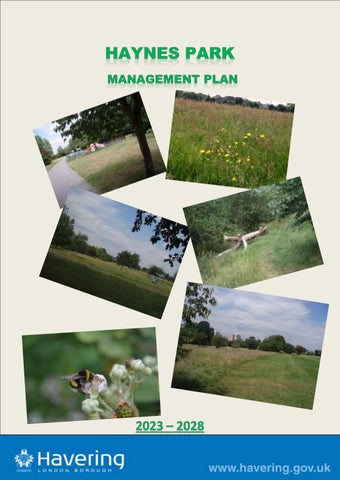
Birdsfoot Trefoil in Haynes Park Conservation Area 1
1. Site Overview 1.1 Havering The London Borough of Havering is London’s third largest borough. The north and east boundaries border the rolling Essex countryside and the south covers three miles of River Thames frontage. To the west Havering is bordered by the boroughs of Redbridge and Barking and Dagenham. The name ‘Havering’ originates from the Royal Liberty of Havering, to which Edward IV granted a charter in 1465. The area’s history stretches back to Roman times with early settlements at Rainham and Collier Row. The London Borough of Havering was created in 1965 by the merger of Romford and Hornchurch Urban District Councils. The name of Havering was finally agreed as a combination of the town names was not allowed. The idea of blending the two names was never a serious consideration.Armorial bearings were granted at the time of the formation. The motto ‘liberty’ represents the present free and democratic way of life but is inspired by the fact that Havering was mostly a part of the royal liberty of Havering – Atte – Bower from 1465 – 1892.
London Borough of Havering Location Plan
Many of Havering’s open spaces and public parks have a long and rich history. Some are former private estates with historical and heritage importance including Bedford’s Park, Clockhouse Gardens, Parklands Park and Langton’s Gardens. Well known landscape architects such as Humphrey Repton designed some open spaces within Havering e.g. Langton’s Gardens and many parks were developed in the twentieth century e.g. Upminster, Rise and Lawns Parks.
2
There is a large amount of countryside, especially in the north of the borough, with a good Public Rights of Way network and 4 country parks. There are also a wide variety of urban spaces from ornamental gardens to large municipal parks. 1.2 The Strategic Framework Information how this Management Plan sits within the national, regional and local context for parks and open spaces can be found in Appendix 1. 1.3 Site Description Haynes Park is a Medium Park of 11 hectares that serves the local community and is situated within a residential area of Hornchurch. There are three access points to the site. There is a vehicle entrance and car park leading from Slewins Lane, a pedestrian entrance leading from Haynes Road and another vehicle entrance and car park leading from Northumberland Avenue. A public right of way running west to east and leading from Slewins Lane to Haynes Road splits the park in half. The northern half of the park contains a play area, tennis courts, outdoor gym, callisthenics equipment and a multiuse games area for informal recreation. For more formal sports it also contains two formal football pitches. The site has a mixture of landscape features with amenity grassland, large conservation area and small woodland. The western boundary of this part of the park has the River Ravensbourne running alongside it. This half of the Park is also fenced and is closed from dusk until dawn. The southern half of the Park is unfenced and contains amenity grassland a small conservation area and a small area of trees. This side is also home to Haynes Park Bowls club that sits in a within a tall hedge bounded area. 1.4 History The first mention of the word Haynes in the area is in 1492 in a document in New College, Oxford, however little is known of the site after that apart from its use as farmland.
Extract from Chapman and Andre 1777map. This spelling was probably very rare and more likely a mis-transcription of the local pronunciation by the mapmaker than the more widely written Hains or Haines. Havering Libraries-Local Studies
3
In June 1935 attempts were made by Hornchurch UDC to buy the farmland in the area to create a Recreation Ground. Terms could not be agreed and land was compulsorily purchased in 1936. Over the next couple of year’s improvements were made such as boundary fencing, entrance gates, public shelter and a bridge over the Ravensbourne from Northumberland Road. In 1940 around nine acres of the Park was turned over to food production with wheat and barley sown. With an additional three acres ploughed in 1941.
Haynes Park golf course and playground 1949 Havering Libraries-Local Studies
After the war in 1946 additional improvements were carried out including the creation of a 20ft square paddling pool and sandpit surrounds, tennis courts and miniature golf course. Between 1948 and 1950 the construction of the Bowling Green and pavilion took place which was the first in Hornchurch with Haynes Park bowls club, who is the current club on site, starting in 1956. In 1963 a further 2.96 acres were added to the park, formerly part of Haynes Park Farm and containing fine elm and willow trees and giving the Park its final size and shape. Since then Haynes Park has seen many changes such as the removal of the miniature golf course in the early 1990’s and the moving of the play area to its present location so as to be more visible from and nearer to the main car park. To reflect modern usage one tennis court was changed into a multi-use games area in 2009. Another significant change happened in 2012 when the decision was made to improve biodiversity within parks and the old miniature golf course area was turned into a conservation area. A more detailed history can be found in Appendix 2.
Bowling Green and pavilion at Haynes Park circa late 1950’s Havering Libraries-Local Studies 4
1.5 Location and Transport Links
Location Map
Aerial Image of the park (2016) 5
Site Map 6
1.5.1 Address Haynes Park Slewins Lane Hornchurch Essex RM11 2BU 1.5.2 Bus The 165 route southbound from The Brewery, Romford alighting Brooklands Gardens or northbound from Abbey Wood Lane, Rainham alighting at Kinfauns Avenue The 370 route southbound from Mercury Gardens, Romford alighting at Brooklands Gardens or northbound from Lakeside Bus station alighting at Kinfauns Avenue. 1.5.3 Car Slewins Lane Car Park Slewins Lane Hornchurch RM11 2BU Or Northumberland Avenue Car Park Northumberland Road Hornchurch RM11 2HU 1.5.4 Train 0.6 miles from Emerson Park Station on the Romford to Upminster Line. 0,6 miles from Gidea Park station on the TFL line from Liverpool Street to Shenfield. 1.5.5 Cycle There are cycle stands located at the play area and opposite the tennis courts.
Cycle Racks Haynes Park
7
2. A Welcoming Place The entrances into the park must be inviting to attract users. Therefore they are kept open, well maintained, have entrance signage displaying key information, have suitable landscaping to create a good first impression of the park and be accessible to all users. 2.1 Entrance points 2.1.1 Slewins Lane Vehicle entrance that leads down to a car park with separate path also leading through some of the park to a car park. The vehicle entrance is gated at the Slewins Lane end. The pedestrian entrance is open 24 hours and forms part of the right of way through the site.
Slewins Lane entrance
2.1.2 Haynes Road A pedestrian only path between houses that lead to the Slewins Lane car park. This forms part of the right of way through the park and is open 24 hours. The path is lit as far as the car park where the area is more open. 2.1.3 Northumberland Avenue A shared vehicle and pedestrian entrance that leads directly into a surfaced car park. Entry into the park from the car park is over a small hard surface bridge. This entrance is gated and fenced.
8
Northumberland Avenue entrance
2.2. Entrance Signs There are information boards at the Slewins Lane entrance, Slewins Lane Car Park and Northumberland Road Car Park. These signs have contact information, a brief history of the site, ecology information, a map of the site and notice board.
9
2.3 Accessibility Haynes Park is serviced by a number of equal access paths. These paths interlink and serve the Slewins Lane, Haynes Road and Northumberland Avenue entrances. The play area is fully accessible from the path and a small tarmac path leads to the tennis courts and Multi use games area.
Path from Slewings Lane Car Park to play area and onwards to tennis courts and Northumberland Road
10
3. Healthy, Safe and Secure 3.1 Health and Safety Systems Health and Safety is paramount to Havering Parks and Open Spaces Service. Health and Safety is instilled in all of the working practices and complies with Havering’s Health and Safety Policy, Havering’s Parks and Open Spaces safe working practice and relevant safety legislation. 3.1.1 Training All staff to receive training to enable them to carry out all tasks asked of them. This ranges from on-site instruction to a training course or qualification, as determined through appraisals and one to ones. Course can be provided externally for job specific training, e.g. operating hazardous tools and equipment, or corporately provided for generic subjects, e.g. first aid. 3.1.2. Communication There are many avenues for communication of Health and Safety issues, to report incidents and raise concerns. These include Health and Safety Working Groups that include representatives from each department, e.g. Public Realm, team briefings/meetings, health and safety notice boards, Departmental Health and Safety Committee (union representative) meetings, staff appraisals and verbal briefings. 3.1.2. Co-operation All staff are required to comply with health and safety measures and managers are encouraged to promote a positive safety culture. 3.1.2. Monitoring Accident and Incident Reporting (AIR) provides a means of reactive monitoring and a good way of introducing preventative measures. Reporting is presented at CRM and the Health and Safety Working Groups. Annual surveys are carried out by the departments corporate Health and Safety Advisor. These include a desktop assessment for the section, e.g. Parks and Open Spaces, and then site surveys (mainly in depots) if necessary. 3.1.3 Personal Protective Equipment (PPE) There is a minimum standard of equipment required for park maintenance staff. All other PPE required is supplied and must be worn when completing tasks. All PPE is correctly stored. Damaged, worn or out of date PPE is replaced. 3.1.4 Vehicle, Machinery and Tools All equipment must be regularly serviced and repaired and all staff are given training on equipment that they are required to use. In some cases certificates of competence are 11
required before equipment can be used. Only operatives with the correct certification are permitted to use the corresponding equipment. 3.1.5 Chemicals The Parks and Open Spaces Section comply with the Control of Substances Hazardous to Health Regulations 1994. The Food and Environment Protection Act (Pesticide Regulations) 1984 and has a policy for the Pesticide Reduction. Full Pesticide Reduction Policy can be found at Appendix 3. 3.1.6 Welfare All workplaces comply with the Workplace Health, Safety and Welfare Regulations 1992. 3.1.7 First Aid Each office and depot has at least one trained in first aid and has a fully stocked first aid kit as to all vehicles. It is the responsibility of the service manager to ensure that the first aid kit is fully stocked at all times. 3.1.8. Fire All managers must ensure that they are familiar with fire prevention and understand the use of various types of extinguishers. Fire extinguishers in depots and vehicles are checked annually by a specialist contractor under the Council’s Corporate Landlord Agreement. 3.1.9 Risk Assessments Parks are not risk assessed individually but risk assessments are carried out on the features of parks, the operations that occur within them, e.g. grounds maintenance, and any events or activities that take place. Operational risk assessments, e.g. grass cutting, are filed and kept in the relevant depots and park features, e.g. waterbodies, are kept in the parks management office, and communicated to all staff. Risk assessments are produced by management staff but are checked by the Corporate Health and Safety Advisor as part of the annual survey. They will also assist in the production of risk assessments for new issues or operations, e.g. conservation areas. Examples can be found in the Appendix 4. In additional to the operational tasks, the following risk assessments apply to Haynes Park: Conservation/meadow areas Woodland Shrubberies and hedgerows Water bodies Bowling Greens and surrounds Sports Pitches Parks Buildings and structures Parks Furniture Gates and fences and bollards 12
Car Parks Hard surfaces Play areas Sports and recreation areas 3.2 Daytime Tactical Enforcement Service In 2020 as part of an overarching Enforcement restructure the Parks Protection service were assimilated into the newly formed Tactical Enforcement Team. Now working under the job title of Day Time Tactical Enforcement Officers the teams remit has grown to not only include parks but also areas that have high levels of footfall such as the boroughs town centres. The attested constables continue to hold their attested constable status with additional council enforcement powers which can be used outside of parks.
The Tactical Enforcement Team as a whole are a proactive borough wide resource dealing with a huge variety of issues ranging from traveller incursions in parks and open spaces, drugs distribution, disrupting gang activity, supporting rough sleepers to get them into accommodation, hi visibility patrols, community engagement, fly tips and anti-social behaviour. Supporting the team are a Night Time Tactical Team, Havering Joint Task Force and a Team of Park Gate Lockers. The Night Time Tactical Enforcement teams work a rota of Monday to Saturday responding to reports of asb of an evening and patrolling those areas which have a large night time economy such as Romford Town centre. Havering Joint Task Force are the Council Funded Police Team made up of 1 Sergeant and 5 Police Officers. The Team are an additional resource to the borough’s current policing levels and focus on police priorities and to also lead on locally identified problems.
13
The Day Time Tactical team work a 7-day rota. Shift patterns are intelligence led and seasonally driven. The team remains flexible with shifts to enable them to respond to demand. The team are based centrally in the borough so they are best placed to respond to incidents when necessary. The primary purpose of the Day Time Tactical Enforcement Team is to maintain the borough's parks and open spaces as safe and pleasant places for people to visit. This involves regular targeted policing patrols, enforcing byelaws and other relevant legislation and enactments, meanwhile liaising closely with the community. A full copy of the borough’s Pleasure Ground Byelaws is in Appendix 5. 3.3 Parks Locking Within the bylaws certain parks within the schedule (this includes Haynes Park) are closed at night. The gate locking arrangements are currently under review with the Council considering outsourcing this function along with other areas of enforcement within 2023. Haynes Park is split by a right of way into two halves, northern and southern. The northern half of the park is surrounded by houses or a palisade fence with entrance gates at the Slewins Lane and Northumberland Ave car parks. 3.4 Infrastructure Repairs needed to the pathways, fencing, gates, signs and other items are carried out either by the in-house Parks Maintenance Operative in the first instance or if a more specialist repair or replacement is required a contractor is arranged through the Parks Development Team. The work undertaken by the Parks Maintenance operative is either proactive as part of the regular checks carried out by the operative themselves or as a result of something being picked up by a either a Parks Development Officer direct or Grounds Maintenance operative and reported via there supervisor. These are communicated via WhatsApp if urgent and then backed up with job sheets emailed over and an example can be found in Appendix 6 14
Emergency– same day High – within one week Medium – one month Low – as soon as possible (these are usually carried out when the team are next in that area and have the time to complete the work) The team’s workload is then managed by having quarterly meetings with the Parks Development team to assess the outstanding job sheets and help further prioritise them. In most cases it will be ranking the medium and low priority jobs.
Parks Maintenance operative removing damaged fencing
3.5 Parks Monitoring There is a parks monitoring system that is carried out by Parks Development Officers and covers both the grounds maintenance standards and condition of infrastructure. This includes regularly checking paths, furniture, fencing and gates. Items or work are assessed on an A to D score, with the following actions: A B C
(Good Standard) (Satisfactory standard) (Unsatisfactory Standard - minor concerns) D (Poor standard - major concerns)
Low risk Medium Risk High Risk
No action Monitor Appropriate action within available resources and individual site assessment Immediate action to bring to a satisfactory standard and/or make the area safe
Standards are assessed using a manual which has photos and descriptions for each area. This was produced using examples from within the borough and the London Parks Benchmarking Group’s ‘Quality Manual’. It is a ‘live’ document and will be updated with new photos when necessary. Any required actions are recorded and either dealt with by the Parks Officer or reported to the relevant officer or contractor.
15
The frequency of monitoring is dictated by a hierarchy of Parks. This list saw Parks and Open Spaces categorised according to use, facilities and location. The frequencies were agreed by the Council’s Insurance and Health and Safety departments and are listed below. Top 20 Parks – Monitored monthly. Top 25 open spaces monitored a minimum of six monthly. Others monitored a minimum of once a year. Haynes Park is categorised as a top 20 park and has a full inspection monthly. A copy of a parks monitoring form can be found in the Appendix 7.
Grass path cut through Conservation Area
16
4. Maintenance of equipment, buildings and landscape 4.1 Grounds maintenance Except specialist weed treatment and arboriculture all operations in parks are carried out by an in house Grounds Maintenance team within the Public Ream department. Work is carried out to a specification, found on the Parks W drive under W:\data03\PARKS\James\GM Spec and is available on request. The index page showing the items in the specification is in the Appendix 8. This was produced using best practice from the London Parks Benchmarking Group’s Specification, whilst ensuring it suited Havering’s requirements and budget. Although the items in the specification form the basis of all operations and standards of work, there is considerable flexibility in the fact that the teams are managed in house as both the Parks Development team and the Grounds maintenance manager work closely together and report to the same group manager. The various landscape features, e.g. sports pitches, grassland, play areas, buildings, are illustrated on a plan of the park using different colours, e.g. brown for woodland, dark green for conservation area, pink for play area, etc This is used predominately by operational staff as a guide. This is especially useful for the maintenance of conservation areas for the tractor drivers who carry out gang-mowing. The only features not shown on the plan are individual or small groups of trees as arboriculture is managed separately. The Grounds Maintenance team are split into 3 zones, North, Central and South, each with their own depot. The depot in the North is also the base for the Tractor Services unit. Each zone has a Supervisor and Charge-hands. The Grounds Maintenance Manager is based in the Public Realm Office and works alongside the Parks Development team. The Central team (based at Gidea Park) look after Haynes Park and 2 members of staff carry out the majority of works all year round.
Butterfly in Conservation Area
17
GM map 4.1.1 Amenity Grass Amenity grass is those areas used for general recreation and formal and informal sports and can include wide open spaces or those areas planted with trees and shrubs. The height of this grass is cut to 25mm throughout the year. The grass clippings are allowed and not 18
collected. The grass is cut with tractor mounted gang mowers and ride on triples. Areas where the mowers cannot access and grass around obstacles are cut using strimmers.
Haynes Park Bowls Green
Amenity grass at Haynes Park
4.1.2 Fine Turf Fine turf is maintained on the bowling green. The green is cut three times weekly in the summer to a height of 3mm. The green is swished and brushed daily and watered when required. A high nitrogen fertilizer is applied from spring until late summer. In the autumn fertilizer high in Potassium is used. The two greens are cut using a 10-bladed box-on pedestrian cylinder mower. All arisings are removed from the site. The green is cut corner to corner during the playing season 90o to the last cut. During the autumn the green is cut parallel to the square of the green. Major repair works to the greens will be carried out in the autumn, with some areas being levelled and re-seeded. In autumn the greens are scarified in two directions and hollow tined. Sharp sand is brushed across the surface as a top dressing to improve the drainage. The grass on the greens is allowed to grow to 20mm during the winter period. The green is assessed annually a turf expert who supplies the Council with recommendations for fertilizer requirements for the following 24 months. Current maintenance arrangements are being reviewed as part of the lease renewal process. 4.1.3 Sports Grass Sports grass is maintained on the winter pitches (football). This is maintained using the same mowing frequency and height of cut as amenity grass, however due to the amount of use on these areas the pitches are solid tined to allow water to drain and a drag mat is taken across the pitches monthly to keep the surface flat. Pitches are marked out fortnightly and during particularly wet periods the pitches are checked at the end of each week for playability and if necessary matches have to be postponed. Major repair works to the sports pitches will be carried out in late spring, with some areas (particularly goalmouths) being levelled and reseeded.
19
Haynes Park Football Pitches 4.1.4 Shrub beds Shrub beds need to be managed to maintain healthy stocks of plants, pruning as necessary and as appropriate for the plant species to remove dead and damaged branches and to retain a natural shape. A count of dead plants will be carried out each autumn and replacement plants will be planted between Novembers to March each year in order to maintain the character of the bed. Replacement planting will use species with a form and flowering habit which is appropriate for the plant’s position in the bed (lower growing at the front, taller in the middle) both to improve the appearance of the feature and minimise the need for pruning to restrain unwanted growth.
Shrub bed at Slewings Lane Entrance 4.1.5 Hedges Hedges are split into formal and informal. Formal hedges are cut and faced over each winter with mixture offhand held power tools and tractor services tractor mounted finger mower. During the summer only essential cutting back work is carried out so as not to disturb nesting birds. 20
Informal hedges are cut with the use tractor based implements during winter months when necessary to ensure an optimum height and spread is kept.
Formal hedges at Slewings Lane Entrance
4.2 Tree management Trees in parks are managed by an Arboriculture Officer based within the Environment department. Parks officers carry out basic visual inspections of trees as part of general park inspections and then any issues are reported to the Arboriculture Officer. They will then carry out a more detailed inspection and if necessary raise a works order with the borough’s external contractor using schedules of rates. They will also deal with all contact from the public who have concerns about trees either in the parks they visit or close to their property. The existing trees in the park have been assessed and any necessary work to improve their appearance and health, e.g. crown thinning, reducing and dead-wooding. New trees have been planted in to add variety to the landscape.
Trees in the conservation area 21
Currently a new tree strategy is being worked on, but this has been delayed by both the pandemic and also staffing issues, but when complete there will be an overall Borough wide tree strategy encompassing Parks, Streets and Housing sites. It will also tie in with the London Environment Strategy 2018, which sets out the Mayor of London’s vision for a greener capital. The Council’s current Tree Strategy was produced by the previous Tree Team, who and at the time the management of parks was not as formal. There is no specific mention of parks in the strategy but this used as the basis for the management of Parks Trees. When the strategy is updated the management of parks trees will be included. A copy can be found in Appendix 13. The tree team has been arranging for a borough wide tree 3 / 5 year survey of parks trees, depending on location. This is currently on going but the top 25 Parks have been surveyed. This will then inform the future proactive management of the tree stock. 4.3 Vehicles and plant maintenance The Grounds Maintenance team have a fleet of tractors which power gang-mowers, flails, batwing topper, hedge cutters and a collector mower. They also use triple and out-front mowers for smaller areas within the park. All fleet vehicles are checked prior to use every day and a corporate vehicle check sheet filled out, an example is at Appendix 9. All vehicles are also fitted with a tracker for security purposes. All the GM Fleet vehicles and ride on machines are maintained owned by the council and repaired by our in-house transport department. The tractor fleet is on a 5 year contract hire arrangement with the supplying dealer, repairs and maintenance are carried out as part of a service contract with the Transport Services department. Small items of plant (strimmers, hedgetrimmers etc.) are maintained by a specialist external contractor who visits depots at Gidea Park on a regular basis. 4.4 Parks Furniture All Parks Furniture is inspected as part of the Parks monitoring system and graded A to D as appropriate. Repairs or removal and replacements are actioned as appropriate. Park benches have been selected as metal frame and slats that better withstand vandalism and are easier for the Parks Fitter to repair. Parks furniture is also of the same colour, RAL 6005, therefore making it easier to repaint.
22
Standard park bench
The Parks and Open Spaces Service are also changing its standard bin to one that is larger and more robust as previous bins suffered badly with corrosion. This is on a rolling program and Hayne Park’s bins are changing over to this new type. The larger capacity means they can hold dog waste. In parks where the new bins are being installed the old dog bins are being removed. People are encouraged to use the new dual-use bins by signage on the bins, around the park, on social media, and when necessary through contact with the Enforcement Teams
Dual-use bin
4.5 Play and Recreation 4.5.1 Multiuse games area In 2008/2009 work was carried out in converting one tennis court to a multi-use games area, set up for football and basketball and enclosed with fencing with access at either goal end.
Haynes Park MUGA 23
4.5.2 Tennis courts There are three hard surface tennis courts at Haynes Park. These were refurbished in 2008/09 with new surfacing and fencing installed. At the same time a small hard surface path was installed up to the entrances.
Haynes Park Tennis Courts
4.5.2 Play area The play area is situated just inside the entrance from the Slewins Lane Car Park to the northern area of the park. It is a fenced area containing a mixture of play equipment towards the younger age. The area is mostly laid to hard surface allowing good access between equipment.
Haynes Park Play Area 24
4.5.3 Outdoor Gym In 2021 an outdoor Gym was installed within the Park, following feedback from Park users about equipment aimed at an older or more amateur user. The gym is of a basic type to suit most users and arrange to also be a social hub whilst using.
4.5.4 Calisthenics equipment In 2017 a calisthenics work out station was installed to the rear of the MUGA. This location was chosen as this type of station suited the teenagers and young adult that already frequented this area.
Play areas and exercise areas are subject to three types of inspection. Basic visual inspection This is carried out by RoSPA trained Grounds Maintenance operatives at specific frequencies throughout the week. Each inspection is logged on a visual inspection sheet, an example of which is in Appendix 10. These sheets are then fed back to the Parks Development Officers to be actioned as appropriate, e.g. repair, take out of action or monitor. The frequency of these checks varies as it is decided on a usage and fault finding 25
basis. The large majority of repairs are carried out by the Parks Maintenance team (Supervisor and Assistant). If necessary a specialist play area manufacturer will be used. Operational Inspection This is a more in depth inspection and is carried out by the RoSPA trained Parks Maintenance Supervisor. They will check bearings, chains. Links nuts and bolts etc and have the equipment to carry out many repairs. These checks are recorded, example in Appendix 11, and any faults that cannot be rectified reported to the Parks team and if necessary the item taken out of use until repaired. The fitter carried out these inspections on a quarterly basis. Independent annual check This is carried out by a reputable organisation such as RoSPA on an annual basis. The outcomes of their report are used to set a work program in for the Parks Maintenance team and feeds into budget planning of the Parks Development Team. It is very rare that high risk items are found in our parks and none have been identified in Haynes Park. Therefore mainly the medium risk items are prioritised for the year. These are found on the W drive under Parks Inspections. As well as the above there is are also ad hoc inspections by the Parks Development Officers that back up the formal inspections and also ensure a quality check on the visual inspections. 4.6 Parks Buildings Park buildings come under two headings. Leased buildings where there is minimal council involvement and most maintenance is the responsibility of the lessee under a full repairing lease, or buildings where all maintenance is carried out by the Council under its Corporate Landlord Agreement managed by the Asset Management department. Haynes Park’s only building is that of the Haynes Park Bowls Club Pavilion. This comes under the lease category with the Council only responsible for major structural defects.
Haynes Park Bowls Club Pavilion 26
Haynes Park updates 2024/25 4. Maintenance of equipment, buildings and landscape 4.1.2 Fine Turf As part of the process of renewing their leases, all bowls clubs have taken over the maintenance of greens and surrounds. 4.5 Play and Recreation 4.5.2 Tennis courts In 2023/24 several sites were renovated as part of the LTA Parks Tennis Improvement Project. All courts at Haynes Park were resurfaced and painted in 2024. This has led to the introduction of all sites using the Clubspark booking system and modest charges based on benchmarking data. In 2025 the Council will be procuring coaching services to deliver ongoing programmes and community sessions.
27
5. Litter, Cleanliness and Vandalism 5.1 Litter Management The Park is litter picked and bins emptied twice a week at most times during the year. During busy periods, e.g. summer months, the frequency is increased. This is carried out by the Grounds Maintenance team in the central zone. The park now has bigger dual-use bins for both litter and dog waste so there is no longer a need for dedicated dog waste bins. All waste is transported to the East London Waste Authority site at Frog Island in Rainham for sorting. The Parks Protection Service can issue Fixed Penalty Notices for littering but have not had to do so in Haynes Park. 5.2 Sweeping Sweeping hard surfaces in parks is carried by the Street Cleansing team. This means that Parks have access to a greater choice of machines and time to carry out sweeping operations as this service operates seven days a week and into the evenings. Haynes Park is swept on a weekly basis. 5.3 Graffiti Graffiti removal is undertaken by the Street Cleansing Graffiti team. However Parks Officers and the Enforcement Service also have small graffiti removal kits to deal with small scale material when practicable. Offensive graffiti is removed within 24 hours and if it is reported to the Parks team, officers will usually deal with this. Non-offensive is removed with 28 days and is usually dealt with by the Graffiti team
Park Rangers and Enforcement Officer remove graffiti using wipes
28
5.4 Fly tipping Fly tipping is removed by the Grounds Maintenance litter picking teams, with larger items removed by the grab lorry. The exception is where there is suspected asbestos when the Council’s Asbestos unit will arrange the removal. Where possible prior to removal the Enforcement Service will inspect fly tipping in an effort to collate evidence for prosecution. Hotspots in parks are usually in car parks and to prevent this barriers are in place to close areas at night in line with the locking procedures. In particularly vulnerable areas height barriers are also in place to stop large vehicles entering. 5.5 Reporting Apart from Council staff there are a number of options for public reporting of vandalism, litter, fly tipping and graffiti. The council has recently adopted an online system of reporting through the website, www.havering.gov.uk . However Park notice boards also contain a dedicated phone number for the Parks Team and an out of hour’s number. The Enforcement Team also have their own dedicated mobile number and have advertised this frequently on social media sites and have giving out numerous contact cards. 5.6 Dog fouling The Parks Development team make efforts to educate dog owners to be responsible, particularly close to areas where people are liable to be eating or children playing. Signs are clearly displayed to inform dog owners that: • They should not allow their dogs to foul the area; • If their dogs do foul the surfaces, dog owners should clean up after them and deposit the faeces in one of the dog waste bins on the site. The Enforcement Service is able to issue Fixed Penalty Notices (FPN’s) for dog fouling, where the owner fails to pick up, but have not done so in Haynes Park to date.
Woodland path 29
6. Environmental Sustainability 6.1 Energy Sustainability Havering Council has recently started on a streetlight initiative and is replacing all sodium bulbs with LED’s that means less energy use and longer bulb life. This is rolling out across the borough and will eventually include the streetlights in Haynes Park. In section B of the Climate Change Action Plan (Fleet, Transport & Machinery), the Grounds Maintenance team have been examining their use of vehicles. One result of this is the purchase of a number of electric ‘Gator’ utility vehicles for use in Parks operations. This vehicle is plugged into a socket in the depot and one overnight charge can last for one week. These are particularly useful in urban parks that are relatively flat. Although these do not negate the need for diesel vehicles but it has helped to cut down in use and reduce emissions. Haynes Park has lent itself to this type of vehicle which is sometimes used by the staff working within the park.
Electric Gator utility vehicle
The Grounds Maintenance team are replacing approx 90% of its fleet with electric/ hybrid vans in 2023. This is being arranged corporately through the Transport Services department, as well as several charging points across the borough. Another operational factor is the number times the Grounds Maintenance vehicles visit the Waste and Recycling Centre. Central collection areas in some park depots have now been dedicated for collection of loose and bagged waste from the rounds carried out by the litter picking teams. This is then collected by the Street Cleansing lorries as part of their rounds. This reduces the number of vehicles and fuel used to transport waste to the WRC. This complies with sections B (Fleet, Transport & Machinery) and L (Waste and Recycling) of the Climate Change Action Plan. This is currently only being run in parks in the North and central parts of the borough as the WRC is in the South of the borough, hence the need to reduce the time vehicles spend travelling from one end of the borough to the other.
30
Havering Council’s Cabinet have formally laid out how the Council will tackle climate change and become carbon neutral by 2040 or sooner. The Havering Climate Change Action Plan (HCCAP) sets out how it will do this through nine priority areas, with Transport and Domestic Gas use identified as being the most responsible for carbon emissions. The HCCAP will help the Council deliver on a number of outcomes – these include: -
improving air quality, through cycling, walking and electric vehicles better health and well-being helped with active travel, access to green spaces and sustainable diets reducing poverty and inequality - supported through delivering energy efficient fuel poverty-proof homes job opportunities and financial growth by developing new green skills for local people
More information can be found at https://www.havering.gov.uk/climatechange Service specific objectives and the way parks, including St Andrews will contribute to this will be included in future updates of this plan. 6.2 Peat use. The Parks and Open Spaces Service have a no peat use policy; as such no peat based products are bought or used. See Appendix 12. 6.3 Waste Minimisation 6.3.1 Litter and recycling Waste in Havering is dealt with by the East London Waste Authority (ELWA) and litter collected in Parks is transported to their Frog Island site in Rainham. The ELWA was established on 1 January 1986 as a Statutory Waste Disposal Authority (WDA), responsible for the disposal of waste from the London Boroughs of Barking and Dagenham, Havering, Newham and Redbridge. In 1996, ELWA developed the Integrated Waste Management Strategy (IWMS), aimed at dramatically increasing recycling and composting and reducing the amount of waste sent to landfill and this was reviewed in 2006. The strategy was designed to strike the best possible balance between costs and environmental impact. In 2002, ELWA signed a 25 year contract with Shanks PLC, a leading waste management company, to deliver the IWMS. Over the course of the contract Shanks will invest over £100 million in new and improved facilities to treat and manage waste and recycling. A new Joint Strategy for East London’s Resources and Waste has been prepared as a partnership between ELWA and the London Boroughs of Barking & Dagenham, Havering, Newham and Redbridge. The Joint Strategy covers the period 2027 to 2057. A public consultation on the Joint Strategy was carried out for eight weeks between 26 July and 20 September 2021. The feedback from this consultation was compiled and analysed to help with preparing a final draft of the Joint Strategy. This was formally adopted by the Partner Authorities in early 2022. https://eastlondonwaste.gov.uk/jointstrategy/
31
The plant at Frog Island handles household waste and recyclable materials from mainly Barking & Dagenham and Havering. This also applies to parks waste. Recyclables are sent to a Materials Recycling Facility for processing. Residual waste undergoes Mechanical Biological Treatment. The treatment separates materials for recycling and produces a Solid Recovered Fuel (SRF) that can be used to replace fossil fuels in the generation of energy. This reduces waste to landfill by up to 80%.
Frog Island Waste Management Facility
The current figures from the facility for general waste (Parks, street cleansing ect) are; Recycled (metals, glass, recovered organic fines) 12.7%, Moisture loss 30%, Refuse Derived Fuel (RDF) / Solid Recovered Fuel (SRF) outputs 57.3% Land Fill 0% 6.3.2. Mini Recycling Centres Havering offers a doorstep collection for most recycling but some Parks sites have mini recycling centres that allow residents to recycle glass, cans, plastic bottles and paper. Haynes Park is one site where the addition of one is currently being considered and the potential management being reviewed by the Waste team. Updates of this and further details will be includes in future versions of this Management Plan. 6.3.3 Composting In 2015 Grounds maintenance purchased a composter allowing the service to become selfsufficient for compost.
Composter in action
Compost bays in the dedicated yard
This is sited at our Bedfords Park Depot. Green waste is collected at strategic points across the borough, to reduce journey times by Grounds Maintenance vehicles, and transported up to the depot for processing. The waste is processed into compost and stored in bays that allow the staff to monitor the compost and use in order as it is ready. 32
The in-house composting reduces the amount of waste that is taken to the WMF and also vehicle journeys and usage. This also complies with sections B and L of the Climate Change Action Plan. Green waste is collected at strategic points across the borough, to reduce journey times by Grounds Maintenance vehicles, and transported up to the depot for processing. Further work has been done towards the composting of suitable green waste and the Harrow Lodge Park depot area has become a hub for the collection of green waste. Harrow Lodge being closer to Haynes Park than the depot they would have taken the waste back too. This is then collected by grab lorry and conveyed in bulk to the composting area at Bedford’s Park. Each pile will be regularly turned to assist with the aerobic composting. This raises the temperature of the material which reaches 50 – 60 degrees at which point weeds and pathogens are eliminated and the decomposition accelerated. Staff use a specialise probe to test the compost piles and once it has levelled out at constant temperature it is ready to use. Since this operation started approximately 250 tons has been diverted from Frog Island and to our own compost operations. Material is used when improving soil in park shrub beds. It is also used in our housing & highways shrub beds. 6.4 Pesticide use Havering’s Parks team has developed a pesticide (reduction) strategy aimed at minimising the use of pesticides and the risks which pesticides can present. This can be found in Appendix 3. Where possible non-chemical alternative methods of control are used which included Toleration Mulching Hoeing Strimming Manual Weeding Burning Planting Densities These are not listed in any form of order as each area will have its own peculiarities that dictate the method used.
33
Haynes Park updates 2024/25 6. Environmental Sustainability 6.1 Energy Sustainability Work is progressing in new fleet but has been delayed through financial pressures. However charging points in the depots are being installed this financial year and work continues in replacing the fleet. 6.3.1 Litter and recycling The new Joint Strategy for East London’s Resources and Waste has been prepared as a partnership between ELWA and the London Boroughs of Barking & Dagenham, Havering, Newham and Redbridge. The Joint Strategy covers the period 2027 to 2057 and can be found here https://eastlondonwaste.gov.uk/files/_uploads/Joint%20Strategy%20for%20East%20Londo n%20Resources%20and%20Waste%20(2027-57).pdf 6.3.2. Mini Recycling Centres Following the change of contractor and new waste contract at Havering which means a larger number of items are now part of the kerbside recycling scheme mini recycling centres are not so required and as such Haynes Park will not be a site for one.
34
7. Conservation and Heritage 7.1 Conservation of natural features, wild fauna, flora 7.1.1 Grassland Grass with naturalised bulbs is not cut until after the bulbs have set, some 6 to 8 weeks after the cessation of flowering. The first cut is usually fairly high; to cut and remove the long grass and bulb leaves, with a subsequent cut to bring the grass down to the amenity grass level. Conservation areas are area similar to wildflower meadows but topped, if necessary, at appropriate times (outside of nesting season) thought-out the growing season. They are then flailed at the end of the year. This still allows a richer biodiversity than amenity grass but does not require the resources and time of a cut and collect at the end of the year. The management also means that they are not just abandoned areas and are not allowed to scrub up. Some areas have rides cut through throughout the year.
Conservation Area
There is a large conservation area at Haynes Park on the North Western boundary on what was the old pitch and putt course. There is a good mix of conservation areas and amenity grassland to give the park both a natural and formal environment. The areas chosen took into account the more wooded area of the Parks to maximise wildlife benefit. The areas have seen an improvement in wildlife value and a walk through the areas in summer will show a noticeable increase in crickets and grasshoppers, bees and butterflies. This in turn has led to an increase in bird species, such as Thrushes, and encourages mammals, such as Hedgehogs and also helps encourage bats like the Pipistrelle who come to feed on them on the increased insect life. In 2019 an Ecological consultant undertook spring and summer surveys of the conservation areas. This provided data on the species observed within the park and also species
35
recorded within 1km. It also listed the value of the Parks habitat areas and recommendations for improvements. The report is too large to include within the update but can be made available on request. A preview of the plan is included at Appendix 19. 7.1.2 Watercourses The Ravensbourne rises in Gidea Park flows through mainly urban areas and eventually through Haynes Park before continuing on via Harrow Lodge Park and into the Rom The river is classed as a main River and is managed mainly by the Environment Agency with input from the Councils Flood and Rivers Management Officer and the Parks Service. Although it has its problems with urban run-off it is still a haven for wildlife and there are regular sightings of Little Egrets along the stretch through the Park. The banks are semi natural as work has been carried out on them at some time during the 60/70’s and there is still evidence of this along the stretch.
River Ravensbourne through Haynes Park
7.1.3 Trees and Woodlands As many insects make their home in dead wood which in turn attracts birds, such as woodpeckers, which search out these insects as a tasty meal, the Parks Service only removes fallen and felled trees where it has to for safety reasons. As there is more life in a dead tree than a live one if it is safe and appropriate to do so fallen trees will be left in situ. If this is not possible then habitat piles are considered. This also has the benefit of assisting 36
Britain’s largest Beetle, the Stag Beetle, is which is very fond of dead wood as it lays its eggs near rotting wood. The larvae then feed on the decaying wood from anywhere between three to seven years before cocooning themselves in the soil over winter and emerging as adults in May. Apart from the food source the thicker vegetation and trees also give cover to a number of birds such as Blackbirds, Robins and Jays as they fly from cover to cover looking for food. Informal paths are maintained through woodland areas by the Grounds Maintenance staff.
Fallen tree left in situ in Haynes Park Woodland
7.2 Biodiversity Biodiversity is the variety of life on earth, and includes all species of plants and animals and the natural systems that support them. Havering is an important Borough for Biodiversity in the London context with a substantial area of green belt, three Sites of Special Scientific Interest, 82 Sites Importance for Nature Conservation, and over one hundred parks and open spaces providing habitats supporting protected and Biodiversity Action Plan species such as the great crested newt, adders and water voles. As such, conservation of Biodiversity is one of the core components of the management of all Havering’s parks and open spaces. Conserving biodiversity includes restoring and enhancing species populations and habitats, as well as protecting them. Conservation of biodiversity is vital to the successful use and development of parks and open spaces in Havering, after all biodiversity is one of the contributing factors that makes a place so special to visit as well as delivering other key ecosystem services such as flood management, pollination and the provision of clean air and water. Through the management of its parks and open spaces, the Council has a key role to play in conserving biodiversity. Currently the site is being managed and developed in
37
such a way that it enhances the native species in line with Havering’s Biodiversity Action Plan Source
Key issue
PPS 9
Statutorily protected species, protection of BAP habitats and species
NERC Act
Local Authority duty to conserve biodiversity
Wildlife & Countryside Act
UK protected species
Habitats Regulations
European protected species
London Plan
London’s strategic planning document
UK Biodiversity Action Plan
UK priority species and habitats
London Biodiversity Action Plan
London priority species and habitats
Havering Biodiversity Action Plan
Havering priority species and habitats
England’s Biodiversity Strategy
Government priorities for conservation of Biodiversity
Mayor’s Biodiversity Strategy
London’s statutory regional biodiversity strategy
Tracking UK biodiversity progress
International targets for Biodiversity
Summary of relevant policy & legislation
Current Local Biodiversity Action Plan In 2003, led by the Havering Wildlife Partnership, the Havering Biodiversity Action Plan (BAP) was adopted. The purpose of the Action Plan, which prioritises 6 habitats and 16 species specific to Havering, is to contribute towards targets to conserve biodiversity set at a Regional and National Level. As the BAP process has evolved it has become increasingly important to set achievable targets for nature conservation. Where Biodiversity Action Plan species and habitats occur within parks and open spaces in the Borough this will help to inform management to ensure a more targeted approach.
38
Conservation meadow in Haynes Park
However we are aware this plan needs updating and this is currently being worked on within a Council Project team with the aim of creating a much more up to date and relevant plan. This will then be in line with national, regional and local plans, e.g. the GLA’s Local Nature Recovery Strategy, when produced. As such the Council continues to host the Havering Wildlife Partnership who meet quarterly. The Partnership is made up of dedicated local naturalists, members of Friends of Groups, representatives from the Essex Wildlife Trust, RSPB, Environment Agency, Natural England and London Biodiversity Partnership together with the Council’s Park and Open Teams. The focus of the partnership is essentially on biodiversity within Havering. The group are able to provide advice on the management of Havering’s parks and open spaces. This update will look at the overarching aims and objectives and form new action plans. The current plan has 16 species Action Plans and 6 habitat Action Plans follow a common format with the following aims:
Promote awareness and knowledge of the species/habitat and in the Borough
Protect, maintain and enhance current populations of the species/ biodiversity of the habitat within Havering
Increase the monitoring and knowledge of the species/habitat within Havering
A full version of the plan can be found at: Item 7c - Action Plan (havering.gov.uk)
The current Biodiversity Action Plan targets sixteen key species to promote through improvement of habitats within Havering, these species being:
39
Havering’s Biodiversity Action Plan
NERC Act (Biodiversity Duty) The Council has a statutory responsibility under Section 40 of the Natural Environment and Rural Communities Act (NERC) Act 2006 to have regard to the conservation of biodiversity in exercising all of its functions. Effective conservation of biodiversity requires its integration into all activities across the Council and in particular the management of its parks and open spaces. This is a key theme of the England Biodiversity Strategy. The Council ultimately plays a key role in making decisions about the management of its parks and open spaces that affects protected and BAP habitats and species. The management of these sites can have a positive impact on biodiversity, both indirectly providing habitats for wildlife, and in generating environmental impacts on other wildlife sites. Through the identification and implementation of measures to integrate biodiversity into the management of parks and open spaces and ensuring that biodiversity is protected and enhanced in line with current statutory obligations the Council is demonstrating its commitment to the NERC Act. To take this forward and achieve greater benefits, future measures may include raising awareness of staff, managers and elected members with regard to biodiversity issues using available guidance; integrating biodiversity into staff training, using in-house ecological expertise or seeking advice from external bodies and, where necessary, providing specific training. The Council is also committed to contributing to key local biodiversity initiatives, such as the Havering Local Biodiversity Action Plan, the
40
Local Records Centre (Greenspace Information for Greater London) and Local Site systems and demonstrate progress against biodiversity indicators and targets. Site specific actions Haynes Park has seen a number of biodiversity improvements over the years. One of the biggest is the creation of a large meadow area in the northern part of the site. Within the whole site, where possible and safe to do so, dead wood is left on site. Also additional planting was done to both enhance looks but also encourage pollinators and we also created a new hedge row in the Northumberland Road car park to improve an otherwise fairly benign area. 7.3. Conservation of buildings and structures The London Borough of Havering has rich history and there are a number of buildings and features across the borough that reflects this and many of these are the responsibility of The Parks Service Some of the boroughs Parkland was designed by the eighteenth century landscape designer Humphrey Repton and other buildings and features are grade II listed. There are also several wartime features across the borough. Haynes Park has no features of historical interest. 7.4 Natural Ambition Havering council has created and published Natural Ambition, a guide to Havering’s natural environment. The purpose of the booklet was to raise awareness of the natural environment and biodiversity within the borough. It gives an overview of biodiversity in the Borough and the work being done to maintain and enhance it by all organisations. The booklet was widely distributed around Library’s, Schools and other public buildings. It can also be found on line at https://www.havering.gov.uk/downloads/download/808/natural_ambition 7.5 Council Vision In November 2022 the Council set out a new Vision and Corporate Plan showing how the Council will deliver services to residents with clear targets. Supporting this, the new Target Operating Model will move different services into three directorates – People, Place and Resources - so that there is a clearer focus and better working between departments. As part of Place them on outcome is “Havering is a clean and Green Borough”. This will include key action such as increasing recycling, better air quality and EV charging points. More can be found at https://www.havering.gov.uk/info/20007/council_and_democracy/654/the_havering_vision
41
42
Haynes Park updates 2024/25 7. Conservation and Heritage 7.1.2 Watercourses In November 2024 Havering Green Streets volunteer group started a River Clean-up campaign and there first volunteer day was along the Ravensbourne at Haynes Park
43
8. Community involvement The Parks Development team encourages community involvement as much as possible. It also works to foster good relations with the stake holders of its Parks. 8.1 Community surveys 8.1.1 Parks Strategy Survey The Parks Survey ran a consultation between September and November 2022 with the aim to set out Havering’s priorities for its parks and open spaces over the next 10 years in order to meet the objectives set out in national, regional and corporate plans and policies. The information gathered through this public engagement is to be incorporated into a draft strategy to be presented to the Council’s Cabinet in 2023. It is still be analysed but some details can be found in Appendix 14 and will be updated in further amendments to this plan. One question asked which parks are visited most frequently and Haynes Park was one of the most popular, within the top 10 (out of 100). 8.1.2 Resident’s survey 2018 In 2018 the Communications team commissioned Ipsos MORI to carry out a resident’s survey which covered all services. The results were very favourable for Parks. The service received the highest satisfaction rating out of all Council services at 91%.
Parks were also rated as the Council’s 3rd most important service The Parks team are working with Communications to arrange a more up to date survey.
44
8.2 User Groups Some of the Boroughs parks have Friends Group formed and they take the form of two types. A standard Friends group will have varying involvement in the management of their park and hold meetings as they require. Parks Officers will attend as necessary and when possible. Groups can apply to achieve ‘Official Friends Group’ status. These groups then have an agreement with the Parks Service to meet certain criteria, e.g. carry out public consultation, carry out projects/activities in the park, have a youth representative on the committee, hold at least one event during the year, have regular minuted meetings and adopt a constitution. In return these groups are guaranteed officer attendance at their meetings, admin support, e.g. printing, laminating, and the payment of their Public Liability Insurance . These groups can also apply for a £1000 grant towards a capital project within their Park. Haynes Park does not currently have a Friends Group however public involvement within the park takes other forms. 8.2.1 Haynes Park Bowls Club Haynes Park Bowls Club was founded in 1956 and the green and clubhouse is situated within a hedged boundary on the southern half of the Park just of Slewins Lane Car Park
Haynes Park Bowls Club with Pavilion in the background
The club take an active management in their green and surrounding area. Although the majority of horticultural works are carried out by the Grounds Maintenance team the club have regular working parties. They have created garden areas outside the pavilion, maintain the plants and carry out minor repairs on the paving around the green. They have also successfully secured external funding for the conservatory on the pavilion. As their members are frequently in the park they provide ‘eyes and ears’ presence. Feedback on the standards of the green and any other issues are managed through regular contact with the Parks Development Officer, formal green inspections and bi-annual meetings with the Council chaired by the Lead Member for Parks and Open Spaces.
45
8.2.2 Havering Royals Youth Team Football Club Havering Royals is the resident club at Haynes Park and uses a pitch in the northern half of the Park. They play in the third division BCFA Youth League.
8.2.4 Ward Councillors Haynes Park falls within Squirrels Heath ward and has three councillors elected to that ward. These are;
Councillor Keith Prince
Councillor Christine Vickery
Councillor Michael White
There is also a Councillor within the Cabinet who is lead member for Parks
Councillor Paul Middleton (Cabinet Member for Parks)
The Councillors are a good link between the public and the Council officers and the Parks Service tries to foster a good relationship between staff and the local ward Councillors and keeps them informed of information in regard to its Parks as needed. Councillor involvement was instrumental in ensuring the improvement plan for Haynes Park was agreed and capital investment secured. They are very supportive of the Green Flag Award and proud to have several parks in the borough that are flying the flag. It was an aspiration of the Council to secure additional Green Flags and the current administration has written Green Flag into their vison for the Council
46
Extract from Havering’s Vison document
The full vision document can be found at The Havering Vision | The London Borough Of Havering 8.2.5 User Survey During the summer of 2019 the Parks officer spent time in the park to obtain feedback from users and some of the results from this have actioned within the Park, such as the installation of an outdoor Gym and where grass paths are cut through the conservation areas. The Corona Virus pandemic postponed further surveys like this but it is being picked up again during spring / summer 2023.
47
48
Haynes Park updates 2024/25 8. Community involvement 8.1 Community surveys Parks Strategy Survey Havering Council carried out a consultation activity from September 2022 to November 2022 seeking residents’ views on our parks and open spaces. These include Havering’s traditional parks, small open spaces, formal gardens, playing fields, country parks and allotments, which deliver a whole range of benefits for local communities; providing places to relax, exercise, hold events and to learn and to play. Residents and park users were asked to help us set out Havering’s priorities for its parks and open spaces over the next 10 years in order to meet the objectives set out in national, regional and corporate plans and policies. 1488 responses were received to the consultation. The top three priorities were: 85% of respondents use them for health reasons, 80% would like to us to create more conservation areas to encourage more biodiversity and 79% would like us to provide play areas for children. 90% said they felt very safe or safe in Havering’s Parks and Open Spaces. The top three facilities respondents usually use when they visit are: benches and seating areas (56%), cafes and mobile catering (43%) and toilets (36%). The top three reasons that respondents use our parks and open spaces are: to go for a walk (69%), to enjoy plants and trees (39%) and for peace and quiet (35%). The survey results have been reviewed and recorded and they will be included in a draft report to inform our new 10 years Parks Strategy which is due to be complete for 2025. 8.2 User Groups Over the last few years Havering Green Streets have become more involved within the Park. In the winter of 22/23 they worked with local residents and groups to plant a community orchard in Haynes Park. This has been adopted by local users who help water the trees during the long hot summer of 2023 and one local user even replaced a tree when one died. We are working with them to plant another orchard area in the park during this winter with funding via Thames Chase Community Forest.
49
Children from a local Nursery helping plant the trees 8.2.4 Ward Councillors Ward Councillors remain the same but there is a new lead member for Environment
Councillor Barry Mugglestone (Cabinet Member for Environment)
50
9. Marketing and Promotions There are a range of methods of promoting the park to the public. Some of these are in conjunction with Havering Council’s corporate communications team and other are Parks Service dedicated. 9.1 Parks Brochure The Parks Section has produced a booklet “A Guide to Havering’s Parks and Open Spaces”, covering all council run parks in the borough. This booklet includes a description of each site, a list of facilities available at each park as well as a section on park services. These are distributed through libraries, council receptions, appropriate events and activities. The brochure can also be found on line at Havering Parks Brochure by Havering Council - Issuu The guide was first published in 2005 and was updated and republished in 2013. An example can be found in Appendix 15. 9.2 Social Media The Park service has a dedicated Facebook page and uses this to advertise events, activities and items of interest within the Parks. See appendix 15 for an example of a page This can be found at the link https://www.facebook.com/LBH.Parks/?notif_t=page_fan¬if_id=1478507226590276 The Council also had a Twitter account and the public can communicate regarding parks issues using this form of media. Havering Council (@LBofHavering) / Twitter 9.3 Website The Parks Service has a page on the Havering Council website. From this page you bring up a list and descriptions of Parks in Havering and details on the facilities and services provided, e.g. play areas, outdoor gyms, Parks Protection Service, memorial bench and tree donations, and event applications. See appendix 15 for an example of a page. This can be found at the link https://www.havering.gov.uk/info/20037/parks 9.4 Interpretation boards New boards were installed in 2016 providing information and photos of the conservation areas and woodland. It is important to explain to park users how these areas are managed as this both informative and educational. Many people are not aware of the benefits of these areas and their importance for the biodiversity.
51
Example of interpretation board
Interpretation board in place
9.5 Parks Events The Parks Service receives a number of enquiries about holding events in Parks and has developed a process for this. There is an application form (both on line or paper copy) and guide available. There is also an event plan document that can be used for those that are new to the process. Non council events are subject to a charge depending on the organisation and type of activity. Events of a hazardous or unusual nature or those expecting a turnout of over 200 people are also subject to authorisation from the Safety Advisory Group which is made up of representatives from the Council and emergency services. See Appendix 16 for an example of the event application form. During the summer of 2022 the Council Sports Development Team uses the Tennis Courts at Haynes Park as part of their Havering Active program.
52
10. Management 10.1 Management structure Parks and Open Spaces are within the Public Realm department within the Environment service area and Neighbourhoods directorate.
Council management structure
The Environment department is made up of Parks and Open Spaces, Grounds Maintenance, Street Cleansing and Waste and Recycling. The Parks and Open Spaces section is headed up by the Parks Development Manager. This role line manages two 53
Parks Development Officers (North and South of the borough), Parks Maintenance operative and the Langton’s Gardens Activities Officer, The parks officers then line manage the Park Rangers and Apprentices. The Parks Service has two Rangers and one Apprentices based at Hornchurch County Park and Havering Country Park. Although primary based at these Parks they are also tasked to work on other sites where necessary and offers the Parks Service a useful tool for dealing with unexpected issues. As they have a range of equipment, including chainsaws, chippers and an Avant multifunctional loader, this allows a large element of flexibility.
Imran Kazalbash Assistant Director of Public Realm
Rita Crudgington Grounds Maintenance Manager
James Rose Parks Development Manager
Taylor Smyth-Richards Parks Development Officer - North Park Ranger
Park Ranger Apprentice
Richard Cottam Parks Development Officer - South Mick Greenslade Park Ranger
Street Cleansing Manager
Waste & External Contracts Mgr
Parks Maintenance Supervisor
James Keeble Parks Maintenance
Tree Officers
Daniel Weston Park Ranger
Grounds Maintenance DSO
Public Realm management structure (relating to Parks)
The Parks Development Officer for the South of the borough manages Haynes Park with input from the Parks Development Manager.
54
10.2 Financial management The Parks and Open Spaces revenue budget is just over £2m. There is not a specific budget assigned to individual parks but there is a budget of £1.7m set for grounds maintenance which is transferred to the DSO. The remainder is used for fixed costs, e.g. vehicle management, utility bills, staff salaries, and reactive works, e.g. repairs and additional grounds maintenance. There are separate budgets for arboriculture and the building management (Corporate Landlord) which are held by the responsible departments. Any income generated within parks, e.g. events, car parking charges (in some parks), sports pitches and buildings fees and goes towards the budget stated above. There has been a parks capital programme in recent years in which a large amount of infrastructure work results from. This financial years (23-24) is still to be confirmed. The Parks team has also been successful in obtaining external funder over the years from organisations such as Veolia Landfill Trust and Marathon Trust. 10.3 Accreditation 10.3.1 Green Flag The Council recognises the importance of achieving this award and since 2007 has been applying for key parks throughout the borough. In 2022 16 parks now have Green Flag Award. Both officers and Councillors value the prestige of being able to fly the flag in the parks and utilise the status and associated high standards for marketing and promotions. It is also a useful management tool for all parks when looking to make improvements. The criteria for achieving the award set good benchmarks for standards that should be aspired to. As part of the improvement plan for Haynes Park it was agreed that a first application would be made in 2017 when the works will be completed. The standards in the park will then be maintained and further improvements carried out to ensure that the criteria can be met in future years.
55
10.4 Action Plan 10.4.1 SWOT Analysis A SWOT analysis was carried out by Parks officers to list the strengths, weaknesses, opportunities and threats for Haynes Park. The analysis determined which areas of the park should be improved and the priority for improvement. It was carried out by first listing all of the issues and then attaching a score to each item. Many of the issues listed were highlighted during the regular park inspections carried out by officers. There were two scores. The first being importance of the item, the second being how much the Parks and Open Spaces Service can change things. The SWOT analysis table can be found in Appendix 17. 10.4.2 Improvement Plan From the SWOT analysis a number of themes emerged and they were ranked in score priority. These were prioritised into the Improvement Plan and this can be found in Appendix 18. The Improvement Plan are the items of importance that are either a Weakness, Opportunity or Threat that are within the scope of the Parks and Open Spaces Service to action change. The items from the Improvement Plan were then used to create the park’s Action Plan (below) which determines what areas of work is to be done, who is doing it and how it will be funded. 56
10.4.3 Action Plan The final Action Plan was drafted to improve/correct all of the prioritised weakness and threats as listed in the SWOT. In addition the Action Plan looks to deliver as many of the listed opportunities that were stated during the SWOT exercise. The Action Plan sets out agreed targets, budgets and responsibilities for the improvement of the site. Where there is no cost the task requires no additional funding and is completed using Council staff.
57
Task
Improved use of social media
Training for DSO
Update website information
R O U T I N E
Target start date
March Annually
Feb 23
January Annually
Completion Measurement/ Date monitoring
Officer Responsibility
Cost
Budget
£
March Annually
Review methods of social media used to ensure relevant
James Rose
None
N/A
Ongoing
Skills gaps identified and relevant training completed
GM Manager
1k
Revenue
January Annually
Up to date, relevant information available on LBH website
Richard Cottam / Comms
None
N/A
On going
Regular good news stories and information sent to comms
Richard Cottam
None
N/A
Parks Team
None
N/A
Press releases
On going
Events programme
January Annually
On going
Internal and external events managed
Parks Monitoring inspections
Jan 23
Monthly
Check done Monthly
Richard Cottam
None
NA
October
January
Annual revision until 2028 then full update
Richard Cottam
None
NA
Jan 23
31st January
Management Plans and application form completed
James Rose
319
Revenue
Revise Management Plan Apply for Green Flag
58
Parks furniture check
Ensure fire breaks are cut around conservation area
Monthly
Ongoing
All furniture inspected, defects repaired and if required replacements programmed
Richard Cottam
300
Revenue
Fire breaks maintained at a satisfactory standard throughout the year
GM Manager
none
NA
April
October
Annually
Annually
Annually review new tree planting opportunities
Sep Annually
Feb Annually
Suitable areas and species identified for planting
Richard Cottam / Tree Officer
500
capital
Cut conservation and wildflower areas
Sep Annually
December Annually
Areas cut and collected (where necessary)
GM Manager / Rangers
None
NA
Visual inspection of play area
Min of byweekly
On going
Visual inspection sheets
GM Manager / Area supervisors
None
N/A
Operational inspection of play area
Quarterly
ongoing
Parks fitter reports
Parks Fitter
None
N/A
Independent play area inspections
Yearly
Aug Annually
RoSPA Report
James Rose
Litter picking and bin emptying
Min 3 times a week
Ongoing
Area litter free
Grounds Maintenance
None
N/A
Work with GM gap up planting
Sep 24
Feb 25
Gapping up complete
Richard Cottam / GM
None
£400
59
Revenue
Renew bowls club lease
Complete Parks Strategy
N
Update parks brochure
January 2025
December 2025
Jan - 23
September 25
Oct-26
Cabinet to agree draft strategy
James Rose / Property Services
NA
NA
James Rose
None
NA
Apr-27
Regular review of progress liaising with Comms team part of their marketing strategy
James Rose
£5k
Capital / External funding
Richard Cottam
TBC
Capital
O Use of water harvesting on building
Nov-26
Dec-27
Regular review of progress liaising with Energy Strategy Projects Officer
Re-line MUGA
April 25
Sept 25
MUGA re lined
Richard Cottam
8000
Capital
Install additional seating
Jun 27
Sept 28
Additional seating installed
Richard Cottam
4000
Capital
Update Tree Strategy to include parks
Sep-25
Dec-26
Draft to be produced by 2026
Tree Officer
NA
NA
Mar -26
New items identified, costed and funding bid submitted by March 26
Richard Cottam
TBC
Capital/ External
Sept 27
Identify and area and create a layout design
Richard Cottam
TBC
Capital/ External
Mar 28
Re-design car park perimeter to be more attractive
Richard Cottam
N
R
Assist Property Services who are leading on this and consult with club
O U T I N E
Review play area and replace some equipment Create conservation area labyrinth Re landscape Slewings lane car Park
60
Jan -25
Mar 27
Oct 27
Capital/ External
Haynes Park updates 2024/25 10. Management 10.1 Management structure In 2023 the Council started to adopt a new structure called the Target Operating Model (TOM) to realign and consolidate the Council’s organisational structure, reducing the number of separate and distinct Departments, aligning complementary services with clear synergies, to enable effective delivery of the Council’s key priorities. Current directives are People, Place and Resources. Parks and Open Spaces sits within Environment which is within Place.
New leadership model
Place leadership model
61
Parks and open Spaces with Environment
62
10.6 Parks Contact Details Parks and Open Spaces Raphael Park Lodge 43 Main Road, Romford, Essex RM2 5EB Parks general enquires – 01708434743 / parks@havering.gov.uk Parks Development Manager – 01708 433868 / james.rose@havering.gov.uk Parks Development Officer – 01708433853 / richard.cottam@havering.gov.uk Enforcement – 07904805872 / TacticalEnforcement@Havering.gov.uk www.facebook.com/LBH.Parks Parks | The London Borough Of Havering
63
APPENDIX 1 - Policy Context National Planning Policy Framework The NPPF was published at the end of March 2012 and sets out the Government’s planning policies for England. It replaces 44 Planning Policy Statements (PPS), Planning Policy Guidance (PPG), Circulars and Letters with a concise framework of around 50 pages. The protection for open space and playing fields is reinforced in the new NPPF, stating that such land should not be built on unless an assessment shows that: i) the land is surplus to requirements, ii) the loss would be replaced by equivalent or better provision in a suitable location, or iii) the development is for alternative sports and recreational provision, the needs for which clearly outweigh the loss. The NPPF includes provisions for the designation of Local Green Spaces by communities. Where open spaces which are “important to local communities” (which may include playing fields) are designated as Local Green Space in the development plan, they will be protected as strongly as Green Belt.
The Government continues to attach great importance to the Green Belt concept saying that boundaries should only be altered in exceptional circumstances. The NPPF also recognises the 'the intrinsic character and beauty of the countryside' as a core planning principle which applies whether that countryside is specifically designated or not. Biodiversity 2020: A strategy for England’s wildlife and ecosystem services This ambitious biodiversity strategy for England builds on the Natural Environment White Paper and provides a comprehensive picture of how we are implementing our international and EU commitments. It sets out the strategic direction for biodiversity policy for the next decade, building on the successful work that has gone before, but also seeking to deliver a real step change. The Strategy aims to deliver outcomes in four areas: a more integrated large-scale approach to conservation on land and at sea putting people at the heart of biodiversity policy reducing environmental pressures improving our knowledge 1.4.2 Regional Policy Context The London Plan, 2011 The Mayor has published the replacement of the spatial development strategy for London – known as the London Plan. The London Plan is the overall strategic plan for London, and it sets out a fully integrated economic, environmental, transport and social framework for the development of the capital to 2031. It forms part of the development plan for Greater London. London boroughs’ local plans need to be in general conformity
64
with the London Plan, and its policies guide decisions on planning applications by councils and the Mayor. London’s public spaces should be secure, accessible, inclusive, connected, easy to understand and maintain, relate to local context, and incorporate the highest quality design, landscaping, planting, street furniture and surfaces. London’s heritage assets and historic environment, including registered historic parks and gardens and other natural and historic landscapes, should be identified, so that the desirability of sustaining and enhancing their significance and of utilising their positive role in place shaping can be taken into account. London’s landscape heritage provides a depth of character that has immeasurable benefit to the city’s economy, culture and quality of life. Natural landscapes can help to provide a unique sense of place. Policy 7.16 : Green Belt The Mayor strongly supports the current extent of London’s Green Belt, its extension in appropriate circumstances and its protection from inappropriate development. The strongest protection should be given to London’s Green Belt, in accordance with national guidance. Inappropriate development should be refused, except in very special circumstances. Development will be supported if it is appropriate and helps secure the objectives of improving the Green Belt as set out in national guidance. Policy 7.18 : Protecting local open space and addressing local deficiency The Mayor supports the creation of new open space in London to ensure satisfactory levels of local provision to address areas of deficiency. The loss of local protected open spaces must be resisted unless equivalent or better quality provision is made within the local catchment area. Replacement of one type of open space with another is unacceptable unless an up to date needs assessment shows that this would be appropriate. When assessing local open space needs, LDFs should: a) include appropriate designations and policies for the protection of local open space b) identify areas of public open space deficiency, using the open space categorisation set out in Table 7.2 as a benchmark for all the different types of open space identified therein c) ensure that future open space needs are planned for in areas with the potential for substantial change such as opportunity areas, regeneration areas, intensification areas and other local areas d) ensure that open space needs are planned in accordance with green infrastructure strategies to deliver multiple benefits. All London Green Grid SPG (2012) The All London Green Grid takes the principles of the East London Green Grid and applies them across London. The concept of a “green grid” – an integrated network of green and open spaces together with the Blue Ribbon Network of rivers and waterways – is at the centre of the London Plan’s approach to the provision, enhancement and management of green infrastructure (Policy 2.18). This network of spaces functions best when designed and managed as an interdependent ‘grid’.
65
The ALGG SPG aims to promote the concept of green infrastructure, and increase its delivery by boroughs, developers, and communities, by describing and advocating an approach to the design and management of green and open spaces to deliver hitherto unrealised benefits. These benefits include sustainable travel, flood management, healthy living, and creating distinctive destinations; and the economic and social uplift these support. 1.4.3 Local Policy Context The following diagram represents how the Management Plan fits within the overall strategic framework for Parks and Open Spaces within Havering: Local Development Framework Culture Strategy
Sustainable Community Strategy Corporate Plan Area Regeneration Strategies And other relevant corporate and service strategies, for e.g. play strategy
Parks and Open Space Strategy Biodiversity Action Plan
Service Plans
Haynes Park Management Plan
Tree Strategy
Local policy framework diagram Havering Local Development Framework Havering’s existing Local Development Framework has a number of conditions and policies aimed at improving and enhancing the green environment. Key to these is the following: DC18 – Protection of Public Open Space, sports and leisure facilities The Council will seek the retention and enhancement of all public open space and recreation, sports and leisure facilities that are in private and public ownership. Where it is shown that public open space or other land /building is surplus to requirements because other facilities exist in the locality to meet the standards set out in Policy DC20 alternative uses will be allowed.
66
Priority will be given to other recreation/leisure uses such as allotments or sports pitches where there is an identified need for such a use. Where no such needs exists then other uses may be approved provided that there is no conflict with other Core and Development Control policies and there is no unacceptable impact on the local environment or amenities of local residents.
Any loss of open space to a non-recreation/leisure use must be accompanied by an improvement to the quality of open space in the vicinity or to remedying qualitative and quantitative deficiencies in open space elsewhere in the Borough.
DC20 – Access to recreation and leisure including open space The Council will seek to ensure that there is adequate provision of a varied range of accessible leisure and recreation facilities throughout the borough.
The Council will have regard to the following walking distances in order to improve the distribution of public open space: • Regional Park (400 ha) 3.2 to 8 km • Metropolitan Park (60 ha) 3.2km • District Park (20ha) 1.2km • Local Park (2ha) 800m
The Council will also seek to achieve the following standard of provision: • Children's Play Space - 0.8 hectares per 1,000 population with access to formal/informal play provision within 400 m of home • Allotments - 0.18 hectares per 1,000 population with access within 800 m of home • Sports pitches - 0.75 hectares per 1,000 population with access within 1200m of home
To make the best use of facilities, the Council will promote the dual use of education sports and recreation facilities by the public.
Culture Strategy and Parks & Open Spaces Strategy The London Borough of Havering recognises the value of its parks and open spaces, and all cultural assets. In both the Culture Strategy and the Parks and Open Spaces Strategy it outlines how parks and open space have both an intrinsic and instrumental value. The Parks & Open Spaces Strategy states: “green open spaces are a beautiful and precious resource that should be protected, enjoyed and celebrated, simply for what they are”. It also lists 15 instrumental benefits of parks, including “promoting positive physical, mental and emotional wellbeing” and “acting as a focal point for communities”. The Action Plan within the Parks & Open Spaces Strategy is focussed on three overarching objectives which reflect the role and value of these spaces: 1) Health & Wellbeing; 2) Learning & Personal Development; 3) Towns & Communities. Sustainable Communities Strategy / ‘Living Ambition’ 67
The Sustainable Community Strategy was formed by the Havering Strategic Partnership and acts as an over-arching plan, setting the direction and priorities for other key plans and strategies in Havering, and ensuring effective coordination and targeting of services. The Strategy sets out five priorities: 1) Environment, 2) Learning, 3) Towns & Communities, 4) Individuals, 5) Value. The table below describes, in broad terms, how Parks and Open Spaces contribute to these priorities.
Environment
Learning
Towns and Communities
Individuals
Value
68
Providing beautiful and safe green spaces that local people will take pride in, that will help provide cleaner air for all, will provide pleasure, relaxation and recreation for adults, will secure places for children to play, and will contribute to the greening, attractiveness and biodiversity of the borough. Providing opportunities for learning, through discovery of nature and heritage, through allotments food growing and horticulture, and through the sports and physical activity undertaken in our parks. Contributing to the physical, social and economic regeneration of the borough through the provision and maintenance of high quality open spaces and by ensuring culture is at the heart of our towns and communities. Contributing to the quality of life of local people, improving health and wellbeing and reducing health inequalities, by providing opportunities for participation in culture within our open spaces; parks, allotments and countryside. Providing activities for everyone, including children, young people and families, older people and disabled people, in a way that is fully inclusive and where people feel welcome and safe. Continuing to deliver an efficient, innovative and highquality service, whilst working in partnership with internal and external agencies and through engagement with residents and groups such as Friends of Parks.
Appendix 2 History The first mention of the word Haynes in the area is in 1492 in a document in New College, Oxford. A conveyance of 1664 identifies a “messuage called Haynes” for the first time and the “farmhouse called Haynes is recorded in 1694”. The Chapman and Andre map of 1777 calls the area Gains, though it was more frequently written Hains or Haines before the twentieth century, and shows it by occupied by a Mr. John Miles.
The Plan of the Parish of Hornchurch with part of the Parish of Romford in the County of Essex 1812 shows Haynes Park as part of Thomas Jackson’s land of Bollands which he owned along with Hare Lodge and Clark’s Farm. A sale of crops in 1832 identifies the premises by name as Haines Park Farm. The Map of a District Comprising Hornchurch Parish and that part of Romford which lies south of the Turnpike Road from London to Brentwood Essex 1849 shows little obvious change to the landscape and Haines Park Farm is still not identified by name. Censuses from the period show the following 1861 Census “Farm House” Henry Bodger ” Cattle Dealer and farmer of 60 acres employer of 2 men and a boy”. 1871 Census “Farmer of 60 acres employing 2 men and two boys”. 1881 Census. Farmer of 60 acres. 1878 Kelly’s Directory of Essex Henry Bodger Cattle Dealer Haines Farm. 1881 Census Henry Bodger “Farmer of 60 acres employing 2 men and two boys”. On the 11th June 1881 Henry Howell Bodger died at Haines Farm aged 64. The 1891 Census then shows Haws Farm (probably Haynes Farm) with Henry Harris Agricultural Labourer present.
69
The farm and its occupants are not readily identifiable in the censuses of 1851, 1901 or 1911. However, by 1897 the property was owned by Mr Henry Arnold and farmed by Richard Banyard a dairy farmer of Nelmes Farm, Ardleigh Green.
Map of Haynes Park location 1870-1871 (The boundary of Haynes Park marked with a green border)
70
Richard Banyard float at the Hornchurch Carnival c. 1900 In 1904 there was a fire on the farm when at 3.30pm when two stacks were destroyed. The damage was estimated at £270. The fire brigade of the time had their work cut out in putting out the fire. The Hornchurch Parish Rate Book of October 29th 1914 shows Walter Castellan residing at Haynes Park
1922 The Kelly’s Directory of Essex lists “Arthur Swinbourne Wilkin, farmer, Haynes Park, Hornchurch “and this remained the case in future editions of the Kelly’s Directory up to 1937 when the last director for the county of Essex was published. Mr A S Wilkin was an early director of the Tiptree Jam & Britannia Fruit Preserving Co, now the famous Wilkin and Sons Ltd of Tiptree. From time to time fruit was supplied from the farm to Tiptree.
71
Extract from The Making of Emerson Park by Barbara Mannox.
By the mid-1920s, part of the Haynes Park Farm was developed for housing and the neighbouring Slewins Farm followed suit in 1928. However the development at Slewins Farm was not without difficulty with the Chelmsford Chronicle 07 April 1933 reporting the bankrupt Bertie Bratchell’s difficulties
72
At a meeting of the Pleasure Grounds, Allotments and Fire Brigade Committee of Hornchurch UDC on the 24th June 1935 only one item was raised. Land in Slewins Lane. The Clerk reported that a portion of the above land has just been sold and that the remainder of the land is on the market. The Clerk reported that he had learned at a conference with the owner of the land that the price thereof was not unreasonable and he suggested that the time seemed opportune to acquire this land for a Recreation Ground. It was RESOLVED that the Clerk be instructed to commence negotiations for the acquisition of the whole of the land coloured pink on the plans submitted together with the frontage land in Slewins Lane, having a total area of almost 14 acres Negotiations were still ongoing at the beginning of 1936 as the extract from the Pleasure Grounds, Allotments and Fire Brigade Committee of Hornchurch UDC minutes show.
However on the 5th February 1936 it seems that an impasse had been hit as “The Clerk reported that he had not been able to agree terms with the valuers acting for Messrs Hillsons and suggested that the land be acquired compulsorily”. It was RESOLVED that a compulsory order under the Public Works Facilities Act 1930 be drafted by the Clerk for submission to the Council at the next Special meeting
73
On the 10th March 1936 the Clerk confirmed to the Pleasure Grounds, Allotments and Fire Brigade Committee of Hornchurch UDC that “the Minister of Health had now confirmed the Compulsory Purchase Order in respect of land owned by A. Hillson and Co. Ltd. And that the necessary steps would now be taken to bring the Order into operation, following which notice to treat would be served”. However on the 5th May 1936 it was reported that the Ministry of Health would be holding a Local Inquiry into the Compulsory Purchase Order for land at Slewins Lane. On the 11th August 1936 The Clerk reported that the Ministry of Health had now confirmed the Compulsory Purchase Order in respect of land owned by A, Hillson and Co. Ltd. Over the next couple of year’s improvement were made such as entrance gates, public shelter and a bridge over the Ravensbourne from Northumberland Road. This also included wrought iron fencing required for Haynes Park estimated at £1755 to do 2,600 yards, 550 yards to be along the bank of the Ravensbourne Brook.
Map of Haynes Park location 1938-1951
74
In November of 1938 it was agreed that Salisbury Road School could use a field at Haynes Park for “unorganised games”. At this meeting it was also agreed that a nominal sum of 10/- would be required from Hornchurch Wanders’ for the hire of the pitch at Haynes Park. More fencing was agreed for Haynes Park and it was agreed to instruct the Surveyor to provide a “suitable wooden bridge not less than 10 ft. wide over the River Ravensbourne to form the entrance to Haynes Park from Northumberland Avenue”.
View into Path from Northumberland Ave with the bridge in the foreground In 1940 A piece of land consisting of such part of Haynes Park as is situate between the children’s playground and the Northern boundary of the park and having an approximate area of 9 acres be cultivated for food production by the Council – wheat and barley were sown. An additional 3 acres were also ploughed in 1941. In May of 1941 a letter was received from Mr W.E. Johnson, a Warden, applying for permission for the Wardens of Group “A” Group, Hornchurch to practice cricket in Haynes Park on Monday to Friday evenings inclusive between 7pm and 10pm. The Committee recommended that a reply be sent stating that the Park may be used by the Wardens of this group in the same manner that it is used by the public. In 1942 the Holiday at Home Committee recommended that 100 park chairs should be moved to Haynes Park from the 2000 stored at Harrow Lodge Park to provide a break from the rigours of war for children in the neighbourhood. The Pleasure Grounds, Entertainments and Fire Brigade Committee of Hornchurch UDC ordered that a 20ft square paddling pool and sandpit surrounds be installed. This was in place by 1946 when other improvements were made including tennis courts and a miniature golf course.
75
Toward the end of 1942 it was agreed to recommend that an application to use the proposed entrance to Haynes Park from Northumberland Avenue for allotments should be granted. This area now makes up the Northumberland Road Car Park. On the 7th August 1946 the Open Spaces and Amenities Sub-Committee recommended that a. That a roadway having a width of 12 feet be constructed from the entrance in Slewins Lane to the entrance in Northumberland Avenue and a tarmacadam footpath constructed from the entrance in Slewins Lane to the entrance in Haynes Road. b. That an ornamental flower garden be provided in the narrow strip of land connecting the two main fields. c. That three football pitches be constructed to the north of the land recently released from cultivation d. That four hard tennis courts be constructed to the south of the football pitches. e. That a miniature golf course be constructed in the valley to the west of the football pitches f. That a paddling pool and sand pit be constructed to the west of the existing children’s playground (this is assumed to be the one originally recommended in 1942). g. That the field adjoin Slewins Lane should eventually be used only for the purpose of public recreation and the football pitch at present provided thereon removed and an ornamental flower border be provided on the slope fronting Slewins Lane. The Pleasure Grounds Entertainments and Fire Brigade Committee on the 22 nd July 1947 approved the preliminary layout of Haynes Park, as submitted by the Hornchurch Surveyor, “subject to provision being made for a bowling green in the garden section thereof”. On October 1948 Tenders for the work of providing a bowling green at Haynes Park to be invited, the Surveyor was requested to submit a “modified scheme” at Haynes Park for the provision of a pavilion. With this in mind in November Authorisation was given for the purchase of eighteen sets of woods for use on the proposed Bowling Green. (An order was later placed with Thomas Taylor of Glasgow). The green was constructed between 1948 and 1950 and was the first bowling green and pavilion in Hornchurch. Haynes Park bowls club, still the club on site, began in 1956 and made further improvements. Unfortunately the original wooden club house was burnt down in 1991 and a brick replacement built in 1993 with the club operating out of a couple of steel containers in the interim.
76
Map of Haynes Park location 1963-1989 More improvements were made to the Park over the 50’s as shown in the extract from the 1961 Parks Brochure
77
In 1963 a further 2.96 acres were added to the park, formerly part of Haynes Park Farm owned by Mrs Wilkin, containing fine elm and willow trees and giving the Park its final size and shape.
78
A further list, report and map compiled by the London Borough of Havering (having been formed in 1965 from Hornchurch UDC and Romford Borough Council) is show below
79
In the late eighties priorities changed and the miniature golf course was closed down and the area turned into general amenity grassland. 80
June 1991 the Bowls club house was burnt down and for some time after that the bowls clubhouse was a couple of steel containers , it was rebuilt in brick about 1993 and the club fundraised and had a conservatory added to it in 2013. The football/tennis pavilion unfortunately suffered an arson attack in the early part of the millennium and had to be demolished. The play area was refurbished and relocated to its current position so as to be more visible from and nearer to the main car park in 2005. To reflect modern usage one tennis court was changed into a multi-use games area in 2009 and the tennis courts complexly refurbished with new surface and fencing. Another significant change happened in 2012 when the decision was made to improve biodiversity within parks. Haynes Park was one of the Parks Chosen and the area of the old miniature golf course area was turned into a conservation area. Haynes Park once again has since seen capital investment during 2015/16 and has seen improvements including new signage and Parks furniture, a new path allowing separation from cars and pedestrians along the Slewins Lane entrance and landscaping. In 2021 an outdoor Gym was installed in the Park near the tennis courts.
Haynes Park, Hornchurch 1949
81
Havering local studies Libraries
APPENDIX 3 Pesticide Reduction Policy Introduction It has been widely recognised that indiscriminate use of pesticides in the past has led to significant environmental damage and damage to human health. In addition, the use of pesticides without full knowledge of the environmental and health implications is now no longer acceptable, and due caution in their use is enshrined in legislation and regulation both at European and National level. Havering’s Parks Service has developed a pesticide (reduction) strategy aimed at minimising the use of pesticides and the risks which pesticides can present. The pesticide (reduction) strategy is considered to be a useful contribution to the development of Local Agenda 21 in Havering. The strategy recognises that the use of pesticides is not always necessary and that more environmentally friendly alternatives are available. The strategy recognises that when it is absolutely essential to use pesticides, their use is strictly controlled and limited to specific tasks. In the context of Local Agenda 21 development in Havering, the pesticides (reduction) strategy is considered a step towards a more sustainable use of resources in grounds maintenance operations. The pesticide (reduction) strategy covers all aspects of pesticide use in the Borough of Havering. The Parks Service’s grounds maintenance specification has been written with the minimum requirement for the programmed use of pesticides. No Pesticides are used at Central Park. What are Pesticides? A pesticide is any organic or inorganic preparation, substance or organism approved under the Control of Pesticide Regulations (COPR) 1986 (1993). The term pesticide includes: (a) Herbicides (b) Insecticides (c) Fungicides (d) Ovicides (e) Growth regulators (f) Soil Sterilants (g) Animal repellents (h) Wood preservatives Pesticides have different types of modes of actions these being: (a) Contact (b) Translocated (c) Residual (d) Residual – absorbed by roots (e) Systemic
82
Protection of Wildlife and Wild Plants In making plans for pesticide use, consideration should be given to the importance of habitats for wildlife and wild plants, especially where there are hedges, ditches, grassland, scrub, shrubs and areas of water. Contamination of habitats by insecticides, herbicides or fungicides, either by direct application or from drift, should be prevented to avoid harmful effects on beneficial invertebrates and other wildlife. Unnecessary pesticide use in amenity areas, i.e. areas not used for agriculture, commercial horticulture, forestry or domestic gardens, may involve risks to the health of human beings, creatures, plants and the environment, the development of resistance, and the destruction of beneficial invertebrates. The Food and Environmental Protection Act1985 states the need to safeguard the environment as well as human health when choosing and applying pesticides. Consideration must be given to the proximity of water features, free Draining areas and drains and to particular sites which may be sensitive to pesticides. Identifying the “Pest” Problem For the Parks Service, a “pest” is defined as: (a) Undesirable weeds: (i) Which disrupt and raise tarmac, concrete and paved areas, creating a hazard (ii) Which harbour vermin (iii) Disrupt the playing surfaces for fine turf sports (b) Fungal diseases: (i) Which can damage the health of fine turf grasses (ii) Control of fungal diseases on fine turf (c) Harmful insects: (i) Control of Brown Tail Moth in spring/summer Before selecting a pesticide the following questions should be considered by the Parks Officer. (a) Is there really a “pest” problem? (b) Why is there a problem? (c) Can the problem be solved by changing the environmental conditions, and if so what alternatives are available? (d) Can the “pest” problem be controlled/prevented without the use of pesticides? (e) Is it absolutely necessary to be free from the “pests”? (f) Can the problem be allowed to resolve itself? The decisions whether to apply a pesticide or not should be made only after: (a) Correctly identifying the pest, and the probably degree of infestation or infection and whether it is a problem. (b) Considering alternative pest control measures, e.g. any biological or mechanical methods which will control or prevent the reoccurrence of the problem. (c) Considering any previous experience of the problem and control methods. (d) Determining whether it is the correct time to apply a pesticide. (e) Considering the suitability of weather conditions. 83
Applying Pesticides All pesticides will be applied in accordance with methods as set out in the Pesticide Regulations All operatives using pesticides will hold the relevant NPTC training certificate. All precautions must be followed to ensure the safety of the public and the environment whilst spraying is in operation. Avoid spraying near people and animals. Warning signs should be positioned around the spray area. Training The Control of Pesticides Regulations 1986 impose a general obligation on all those who use pesticides in the course of their work to ensure that they have received adequate instruction and guidance in the safe, efficient and humane use of pesticides and are competent for the duties which they are called upon to perform. Contract Inspectors shall receive training on pesticides to the basic standard of the National Proficiency Tests Council’s Pesticide Application (PA) modules – PA1 and PA6. Request to Spray Pesticides Pro-Forma
84
Non-Chemical Alternative Methods of Control Toleration The main reason for the control of weeds on hardstanding and shrub beds is aesthetic (it looks neat and tidy). In certain circumstances weeds will damage hard surfaces and complete with plants for light moisture and nutrients, but these are not usual unless the weeds have been permitted to grow to a size when damage/competition can occur. The usual process is to remove them long before this can occur. In managing the hardstanding and shrub beds the question of toleration needs to be looked at in each site. Do we need this path/shrub bed to be 100% weed free? If yes a further question should them be asked - What method of weed control should be used? (See alternative methods of weed control). If it is agreed that certain paths/shrub beds do not need to be 100% weed free then tolerance levels need to be agreed and set. Following this the method of control needs to be specified.
85
Mulching The amount of residual herbicides used can be greatly reduced by using mulch across the top of the shrub/rose beds. There is a range of products that can be used for mulching
Bark Spent mushroom compost Well-rotted FYM Organic compost Leaf litter Mypex Plastic sheeting Black woven plastic Microperforated polyethylene fabric Non-woven wool Non-woven fleece Carpet Cardboard Compressed peat paper Newspaper Compost Well-rotted manure Leaf mould Forest bark Sawdust Shredded pruning’s/wood chips Gravel/shingle
Each one of these products has different qualities and need to be applied at sufficient depth to work correctly. Organic mulches require regular topping up but have the advantage of improving the soil and adding nutrients. All mulches should be applied to a weed free surface. A well applied mulch will not only look attractive it will also ensure a virtually weed free surface. Mulches should be applied in October while the heat is still in the ground. The mulch then as an insulating layer, trapping the heat in and protecting the plants. If the mulch is applied in March the reverse happens and the soil takes a longer period of time to warm up. Hoeing The garden hoe is one of the main weapons used to control weeds. There are two basic types of hoe. The Dutch Hoe The Swan Neck Hoe It is important when using the hoe to ensure that it is sharp as it makes working easier.
86
Hoeing is mainly used to remove individual weeds and is a very good method of control for annual weeds; it is not such a good control of perennials, as the cut stem will grow again from the rootstock. Hoeing on a regular basis also has a residual control as it creates a “dust mulch” on the surface of the beds by breaking the water capillaries just under the surface. The dust mulch helps reduce the ability of weed seeds to germinate. The dust mulch will be broken during irrigation or rainfall. Strimming Nylon corded strimmers can be used to remove weeds from hard standing, they should not be used for weeding beds as they catch stones and throw them considerable distances. Strimmers are particularly effective on annual weeds or in areas where the weeds can be tolerated to a height limit. They are very effective and quick in skilled hands. However they are noisy and there use in public places needs to be carefully considered. With brush-cutting heads fitted strimmers are able to cut down dense non-woody vegetation. Manual Weeding Manual weeding is still the only effective way of removing plants from certain situations without causing any collateral damage. It is expensive because it is very labour intensive. It can be hazardous in areas where sharps are found. It is a good method of removing perennial weeds. Protective gloves must be worn at all times. Burning There are a number of devices on the market that can be used to control weeds by burning. Most of these use a combustible liquid (e,g, paraffin) under pressure and ignited at the nozzle. The jet of flame then burns the target. Flame control should only be used for control of weeds on hard surfaces. The use of flame control can cause macadam surfaces to break up. Therefore the use of flame control is very limited by opportunity. These devices have been quite dangerous and a number of industrial accidents have been caused to operatives. In addition they should not be used in periods of drought as they could easily burn off more than the intended target. Full risk assessments would need to be carried out before using any method of flame control device. Planting Densities Weeds germinate and grow best when they have opportunity to do so and there is little competition or where the weed is able to suppress the competition. 87
When designing and planting new shrub borders the usual method of design is to aim for a closed canopy within three years. (A closed canopy is where the plants that were planted a set distance apart have eventually grown to the point where they meet and appear as one large group). In the period before the closure of the canopy weeds have an opportunity to establish in the gaps between the newly planted shrubs. The planting distance between the shrubs determines how quickly the canopy closes. By reducing the gap the canopy can be closed within 18 months or even within the next growing season to when the shrubs were planted. This increases the competition on any weeds that have germinated and also acts as a suppressant to further weeds, reducing the possibility of them germinating. Weed Control: Hard Surface areas Sweeping Waipanua Hot water treatment system, Hoaf Weedmaster Heat treatment system Weed Control: Fine Turf Scarifying Raking Brushing Switching Aeration Organic Substances, i.e. liquid iron, Liquid fertilisers Biological, i.e. Inhibiter (trade name) contains natural plant Solutes. Legislation Legislation governing the use of pesticides includes: (a) The Food and Environment Protection Act 1985 (b) The Control of Pesticides Regulations 1986 (c) The Control of Substances Hazardous to Health Regulations 1988 (d) The Water Act 1989 (e) The Environmental Protection Act 1990 (f) Control of Pollution Act 1974 (g) Health and Safety at Work Act 1974 There are also a number of Codes of Practice which are aimed at Users of pesticides in public areas, which give practical guidance, including methods of meeting the requirements of COSHH. Any pesticide must be used in accordance with the “General Consents” issued under the Control of Pesticides Regulations 1986. Consent C (a), paragraph 2, states that users of pesticides shall take all reasonable precautions to protect the health of human beings, animals and plants, to safeguard the environment and in particular to avoid pollution of water. Only Glyphosate is on the list of approved products for use in Havering’s Parks and Open Spaces 88
APPENDIX 4 – Example of Risk Assessment
- 89 -
- 90 -
- 91 -
- 92 -
APPENDIX 5 – Pleasure Ground Byelaws 1. In these byelaws "the Council" means the Council of the London Borough of Havering and "the pleasure ground" means each of the pleasure grounds named in the First Schedule hereto. 2. An act necessary to the proper execution of his duty by an officer of the Council, or any act which is necessary to the proper execution of any contract with the Council, shall not be an offence under these byelaws. 3. Each of the pleasure grounds mentioned in the Second Schedule to these byelaws except the pleasure ground known as Lawns Park shall be opened at 8am, on each day throughout the year and shall be closed a half an hour after sunset on each day throughout the year, except that in the months of June and July they shall be closed at 9.30pm on each day. The pleasure ground known as Lawns Park shall be opened at 7.30am, on each day throughout the year and shall be closed at 8pm, or half an hour after sunset, whichever shall be the earlier on each day throughout the year. Provided always that this byelaw shall not be deemed to require the pleasure ground to be opened and closed at the hours hereinbefore prescribed on any day when, in pursuance of any statutory provision in that behalf, the Council close the pleasure ground to the public. 4. On any day on which the pleasure ground is open to the public a person shall not enter it before the time or enter or remain in it after the time appointed in the foregoing byelaw. 5. A person shall not in the pleasure ground without reasonable excuse: (i) climb any wall or fence in or enclosing the pleasure ground, or any tree, or any barrier, railing, post, or other erection; (ii) Remove or displace any barrier, railing, post, or seat, or any part of any erection or ornament, or any implement provided for use in the laying out or maintenance of the pleasure ground. 6. A person shall not in the pleasure ground light any fire or place, throw or let fall a lighted match or any other thing so as to be likely to cause a fire. 7. A person shall not, except in pursuance of a lawful agreement with the Council, or otherwise in the exercise of any lawful right or privilege, bring or cause to be brought into the pleasure ground any cattle, sheep, goats or pigs, or any beast of draught or burden. 8. A person shall not, except along the bridleways in the pleasure ground known as Bedfords Park or in the exercise of any lawful right or privilege, ride a horse in the pleasure ground.
- 93 -
9. (i) A person shall not, except in the exercise of any lawful right or privilege, bring or cause to be brought into the pleasure ground any barrow, truck, machine or vehicle other than: (a) a wheeled bicycle or other similar machine; (b) a wheelchair, perambulator or chaise drawn or propelled by hand and used solely for the conveyance of a child or children or an invalid. Provided that where the Council set apart a space in the pleasure ground for the use of any class of vehicle this byelaw shall not be deemed to prohibit the driving in or to that space by a direct route from the entrance to the pleasure ground of any vehicle of the class for which it is set apart. (ii) A person shall not except in the exercise of any lawful right or privilege ride any bicycle or other similar machine in any part of the pleasure ground. 10. A person who brings a vehicle into the pleasure ground shall not wheel or station it over or upon:(i) any flower bed, shrub or plant, or any ground in course of preparation as a flower bed, or for the growth of any tree, shrub or plant; (ii) any part of the pleasure ground where the Council by a notice board affixed or set up in some conspicuous position in the pleasure ground prohibits its being wheeled or stationed. 11. A person shall not in the pleasure ground, walk, run, stand, sit or lie upon:(i) any grass, turf, or other place where adequate notice to keep off such grass, turf, or other place is exhibited; provided that such notice shall not apply to more than one-fifth of the area of the pleasure ground; (ii) any flower bed, shrub, or plant or any ground in course of preparation as a flower bed, or for the growth of any tree, shrub, or plant. 12. No person shall in the pleasure ground remove or displace any soil or plant. 13. A person shall not, to the danger or annoyance of any other person in the ground, throw or discharge any missile. 14. A person shall not in the pleasure ground:(i) bathe, wade, or wash in any ornamental lake, pond, stream or other water; (ii) without reasonable excuse foul or pollute any such water; Provided that the foregoing byelaw shall not be deemed to prohibit wading in a children's paddling pool. 15. No person shall without lawful excuse or authority in the pleasure ground kill, molest or disturb any animal or fish or engage in hunting, shooting or fishing or the setting of traps or nets or the laying of snares;
- 94 -
Provided that this byelaw shall not be deemed to prohibit any fishing which may be authorised by the Council. 16. A person shall not, except in the exercise of any lawful right or privilege, have in his possession while he is on the ground any firearm unless it is so cover with a security fastened gun cover that it cannot be fired. In this byelaw, firearm means any lethal barrelled weapon of any description from which any shot, bullet or other thing can be discharged. This byelaw shall apply to all parts of the land except any part thereof which is a public right of way. 17. No person shall by operating or causing or suffering to be operated any wireless set, gramophone, amplifier or similar instrument or any musical instrument make, cause or suffer to be made any noise which is so loud and so continuous or repeated as to give reasonable cause for annoyance to other persons on the land. Provided that this byelaw shall not apply to any person holding or taking part in a band show or any other entertainment held in the ground in pursuance of an agreement with the Council. 18. Where the Council set apart any such part of the pleasure ground as may be fixed by the Council, and described in a notice board affixed or set up in some conspicuous position in the pleasure ground, for the purpose of any game specified in the notice board, which, by reason of the rules or manner of playing, or for the prevention of damage, danger, or time discomfort to any person in the pleasure ground may necessitate at any time during the continuance of the game., the exclusive use by the player or players of any space in such part of the pleasure ground - a person shall not in any space elsewhere in the pleasure ground play or take part in any game so specified in such a manner as to exclude persons not playing or taking part in the game from use of such a space. 19. A person resorting to the pleasure ground and playing or taking part in any game for which the exclusive use of any space in the pleasure ground has been set apart shall:(i) not play on the space any game other than the game for which it is set apart; (ii) in preparing for playing and in playing, use reasonable care to prevent undue interference with the proper use of the pleasure ground by other persons; (iii) when the space is already occupied by other players not begin to play thereon without their permission; (iv) where the exclusive use of the space has been granted by the Council for the playing of a match, not play on that space later than a quarter of an hour before the time fixed for the beginning of the match unless he is taking part therein. 20. A person shall not in the pleasure ground drive chip or pitch a hard golf ball except on land set aside by the Council as a golf course, golf driving range or putting course. - 95 -
21. A person shall not in any part of the pleasure ground which may have been set apart by the Council for any game play or take part in any game when the state of the ground or other cause makes it unfit for use and a notice is set up in some conspicuous position prohibiting play in that part of the pleasure ground. 22. A person shall not in the pleasure ground: (i) except as hereinafter provided, erect any post, rail, fence, pole, tent, booth, stand, building, or other structure; provided that this prohibition shall not apply where upon an application to the Council they grant permission to erect any post, rail, fence, pole, tent, booth, stand, building, or other structure upon such occasion and for such purpose as are specified in the application; (ii) sell, or offer or expose for sale, or let to hire, or offer to expose for letting to hire, any commodity or article, unless in pursuance of an agreement, with the Council, or otherwise in the exercise of any lawful right or privilege, he is authorised to sell or let to hire in the pleasure ground such commodity or article. 23. (i) No person shall cause any power driven model aircraft to take off or land in the pleasure ground; provided that this byelaw shall not apply to the pleasure ground known as Bedfords Park.. (ii) Where an area within part of the pleasure ground so set apart for the flying of power-driven model aircraft is designated by the Council as an area from which aircraft may be launched and is described in a notice affixed or set up in some conspicuous position on the ground, a person shall not release such an aircraft for flight, or cause such an aircraft to take off, in any part of the ground other than that area. (iii) No person shall (a) in the ground release any power-driven model aircraft for flight or control the flight of such an aircraft; or (b) cause such an aircraft to take off or land in the ground, unless it is attached to a control line and is kept under effective control. (iv) In this byelaw the expression "power driven model aircraft" means any model aircraft driven by the combustion of petrol vapour or other combustible substances. 24. A person shall not in the pleasure ground: (a) intentionally obstruct any officer of the Council in the proper execution of his duties; (b) intentionally obstruct any person carrying out an act which is necessary to the proper execution of any contract with the Council; or (c) intentionally obstruct any other person in the proper use of the ground, or behave so as to give reasonable grounds for annoyance to other persons in the ground.
- 96 -
25. A person shall not take part in any public show or performance in the pleasure ground provided that this byelaw shall not apply to any person taking part in a band, show or any other function held in the pleasure ground in pursuance of an agreement with the Council. 26. Every person who shall offend against these byelaws shall be liable on summary conviction to a fine not exceeding level 2 on the Standard Scale. 27. Any person who shall offend against these byelaws may be removed from the ground by any officer of the Council, or any constable. 28. The byelaws relating to pleasure grounds which were made by the Mayor Aldermen and Burgesses of the London Borough of Havering acting by the Council on the seventeenth day of July 1968 and were confirmed by the Minister of Health on the twenty-ninth day of November 1968 are hereby repealed. 29. The byelaw relating to pleasure grounds which was made by the Mayor Aldermen and Burgesses of the London Borough of Havering acting by the Council on the first day of November 1977 and was confirmed by the Secretary and State on the eleventh day of July 1978 is hereby repealed. 30. The byelaws relating to pleasure grounds which were made by the Mayor and Burgesses of the London Borough of Havering acting by the Council on the twentysixth day of February 1980 and were confirmed by the Secretary of State on the seventeenth day of July 1980 are hereby repealed.
The first schedule hereinbefore mentioned. Pleasure Grounds to which byelaws are made under Section 164 of the Public Health Act 1875.
Bedale Road Playground, Harold Hill Bedfords Park, Romford Berwick Pond Open Space, Hornchurch Brittons Playing Fields, Hornchurch Central Park, Harold Hill Clockhouse Gardens, Upminster Cottons Park, Romford Cranham Playing Fields Dagnam Park, Harold Hill Fielder's Sports Ground, Hornchurch Gaynes Parkway, Upminster Gidea Park Sports Ground Glen The, Rainham
- 97 -
Grenfell Park, Hornchurch Hacton Parkway, Upminster Halesworth Road Playground, Harold Hill Hall Lane Miniature Golf Course, Upminster Harold Wood Park Harrow Lodge Park, Hornchurch Havering Playing Field Haynes Park, Hornchurch Hornchurch Stadium Hylands Park, Hornchurch Jutsums Park, Romford King George's Field, Romford Langtons Gardens, Hornchurch Lawns Park, Romford Lodge Farm Park, Romford Land, New Road, Rainham Noak Hill Sports Ground North Hill Recreation Ground, Harold Hill Oldchurch Park, Romford Parklands, Upminster Park Lane Recreation Ground, Hornchurch Painsbrook (Land), Harold Wood Raphael Park, Romford Rainham Recreation Ground Rise Park, Romford Rush Green Play Space, Romford Suttons Parkway, Upminster Spring Farm Park, Rainham St Andrews Park, Hornchurch St Neots Land, Harold Hill Upminster Park Upminster Hall Playing Fields Warley Hall Woods, Cranham
Open Spaces to which byelaws are made under Sections 12 and 15 of the Open Spaces Act 1906
Coronation Gardens, Romford Elliott Playing Fields, Hornchurch Havering Well Gardens, Hornchurch Lucas Playground, Hornchurch
The second schedule hereinbefore mentioned. Central Park, Harold Hill - 98 -
Clockhouse Gardens, Upminster Collier Row Recreation Ground Coronation Gardens, Romford Cottons Park, Romford Gidea Park Sports Ground Hall Lane Miniature Golf Course, Upminster Harold Wood Park Hylands Park, Hornchurch Hornchurch Stadium Jutsums Park, Romford King George's Field, Romford Langtons Gardens, Hornchurch Lawns Park, Romford Lodge Farm Park, Romford Noak Hill Sports Ground North Hill Recreation Ground, Harold Hill Park Lane Recreation Ground, Hornchurch Raphael Park, Romford Rainham Recreation Ground Rise Park, Romford Rush Green Play Space, Romford Spring Farm Park, Rainham St Andrews Park, Hornchurch
- 99 -
APPENDIX 6 – Example of a Parks Fitter’s Instruction Form
- 100 -
APPENDIX 7 - Example of a Parks Monitoring Form
- 101 -
APPENDIX 8 – Grounds Maintenance Specification Contents LONDON BOROUGH OF HAVERING SPECIFICATION FOR GROUNDS MAINTENANCE TO PARKS & OPEN SPACES,
Contents
SECTION 1 1.1 1.2 1.3 1.4 1.5 1.6 1.7 1.8 1.9 1.10 1.11 1.12 1.13 1.14 1.15 1.16 1.17 1.18 1.19 1.20 1.21 1.22 1.23 1.24 1.25 1.26 1.27 1.28 1.29 1.30 1.31
Preamble
Preamble Extent of Works List of Sites Opening and Closing Security Schedule Hours of Work Co-operation with Council Staff/other Contractors Location of Sites Contractor to Visit Sites Supervision Access Locks Services Water Protective Works Identification Fires Equipment Events Use of Chemicals Protection of Existing Features Site Measurements Alternative Methods of Operation Communications Accident Reporting Procedures Parks and Open Spaces Byelaws Public Relations Financial Control of Contract Completion of Works Daily Return of Works Health and Safety : Legal Requirements
- 102 -
SECTION 2 Job Descriptions Amenity Grass Cutting Boxed Grass Cutting Rough Grass Cutting Meadow Grass Cutting Grass Cutting – Football Pitches Grass Cutting – Rugby Pitches Grass Cutting – Hockey Pitches Grass Cutting – Cricket Pitches Outfield Shrub Bed Pruning Shrub Bed Cultivation Shrub Bed Weeding Spring Rose Pruning Autumn Rose Pruning Rose Bed Maintenance Herbaceous Bed Maintenance Supply & Plant Spring Bedding/Bulbs Supply & Plant Summer Bedding/Bulbs Annual Bedding Maintenance Formal Hedge cutting (Top & Sides) Semi-formal Hedge cutting (Top & Sides) Informal Hedge cutting (Top & Sides) Tree Maintenance Young Tree Maintenance Winter Sports Pitch Maintenance Cricket Maintenance Bowling Green Maintenance Mini Golf Green Maintenance Leaf Fall & Tree Debris other than on Hard Standing Water Features Tennis Courts Maintenance Litter Collection Litter Bin Maintenance Dog Waste Bin Maintenance Hard Surfaces Maintenance Daily Play Area Maintenance Monthly Play Area Maintenance Opening Site Reporting Defects
- 103 -
SECTION 3 Quality Assurance 3.1 3.2 3.3 3.3.1 3.3.2 3.3.3 3.3.4 3.3.5 3.3.6 3.3.7 3.4 3.5 3.6 3.7 3.8 3.9 3.10 3.11
Quality Preamble Quality Documentation at Tendering Quality Procedures and Techniques during the term of the Contract Responsibility Quality System Document Control Quality Records Internal Quality System Audits and Reviews Competence Corrective Action Purchasing and Sub-contracting Purchaser Supplied Product Product and Service Identification and Traceability Process Control In-Process Inspection and Testing Final Inspection and Testing Inspection, Measuring and Test Equipment Statistical Techniques
SECTION 4 4.1 4.2 4.3 4.4 4.5 4.6 4.7
Complaints Procedure
Complaints Preamble Definition of a Complaint Informal Complaints Formal Complaints Complaints Register Designated Complaints Officer Council Lead Complaint Investigations
SECTION 5
Special Events
SECTION 6
Methods and Resources
- 104 -
APPENDIX 9 – Vehicle Check Sheet
- 105 -
APPENDIX 10 - Example of a Play area Visual inspection sheet
- 106 -
APENDIX 11- Example of a Play area Operational inspection sheet
- 107 -
APPENDIX 12- Parks Peat Use Policy Background The London Borough of Havering manages over a hundred parks and open spaces, 2 country parks and twenty five allotment sites. Grounds maintenance of the parks and open spaces are managed by a Direct Services Organisation working to a grounds maintenance specification. As part of the method of maintaining the parks and open spaces the specification requires the most efficient, environmentally friendly and restrictive use of peat. The key priorities of this policy are to: 1. To minimise the amount of peat used in Havering’s Parks and Open Spaces 2. Define methods of plant husbandry that permit the minimum use of peat based products. 3. Include peat minimalisation and methodology on all site management plans 4. To continue to research for viable alternatives to peat based products. Traditional uses for horticultural peat Peat has been used for the following horticultural functions 1. Acidification of soil 2. Main additive in potting compost 3. As a mulch 4. As organic matter to improve heavy clay soils 5. To retain water in the soil 6. As a cutting mix with sand Methods used to minimise the use of peat 1. We will not use peat to change the pH of the soil. 2. We will not use species that require soil pH to be altered. 3. We will not use peat as mulch. 4. We will not use peat as organic matter to improve soils 5. We will make every effort to ensure that the compost used for bedding plants is from a peat free source, providing it gives uniformity of growth 6. We will reduce the amount of bedding plants used. 7. Trees and shrubs will be supplied in loam based compost
- 108 -
APPENDIX 13 – Tree Strategy
LONDON BOROUGH OF HAVERING Environmental Maintenance
Tree Strategy 2009 - 2019
- 109 -
Contents Page No. Introduction ...................................................................................................... 3 1 The amenity and environmental value of trees in the urban context. ........ 4 1.2 Biological ........................................................................................... 4 1.3 Non-biological .................................................................................... 4 2 Need for a Strategy .................................................................................. 5 3 Strategic Aim ........................................................................................... 5 3.1 Objectives .......................................................................................... 5 4 Street Trees .............................................................................................. 6 5 Street Trees and Highway Management .................................................. 6 6 Cyclical Maintenance Programme ............................................................ 7 7 Contract Management .............................................................................. 8 8 Tree Removal ........................................................................................... 8 9 Vehicle Crossovers ................................................................................. 9 10 Phased replacement of inappropriate street trees ............................... 10 11 Tree planting, Species Selection and Sponsorship ............................. 10 12 Tree Problems ..................................................................................... 11 13 Trees and Subsidence ........................................................................ 12 14 Privately owned trees .......................................................................... 13 14.1 Tree Preservation Orders and Trees in Conservation Areas ......... 13 14.2 Trees and Development .................................................................. 14 14.3 Resurvey and Updating of Existing Tree Preservation Orders ....... 15 14.4 The Making of New Tree Preservation Orders ................................ 15 14.5 Enforcement of Unauthorised Tree Works....................................... 15 15 Climate Change .................................................................................. 16 16 Community Engagement .....................................................................16 17 Tree Planting and Replacement Programme ………………………………17 Appendix 1 - Cyclical pruning schedule .....................................................18 Appendix 2 - Tree Strategy Policies ......................................................... 20 Appendix 3 – Tree Subscription Species ……………………………………22 Appendix 4 - Equality Impact Assessment ………………………………...25
- 110 -
Introduction Trees are a significant feature of Havering, a unique component of the urban landscape and as living organisms are vulnerable to pest and disease, vandalism, accidents and development. Many trees are long lived, offering enjoyment and diversity of benefits to residents today and for future generations. To ensure their continuing contribution to the urban landscape it is essential that their needs and requirements are understood and planned for. In June 1992 the world’s largest gathering of world leaders was held in Rio de Janeiro, Brazil. That meeting signalled the fact that environmental concerns have moved up the international political agenda. The central message of the summit is summed up in Article Four of the Rio declaration: “In order to achieve sustainable development, environmental protection shall constitute an integral part of the development process and cannot be considered in isolation from it.” This means that international, national and local policy makers have to start reappraising their policies and practices to ensure that they are sustainable. Natural resource strategies rarely stand in isolation. For this reason, Havering Council is meeting this challenge by developing a range of strategies and goals in the Living Ambition – a new vision for Havering, including the goal for Environment ,To ensure a clean, safe and green borough and how natural resource assets such as highway trees are managed in the long term. This Tree Strategy will provide a framework for the maintenance and enhancement of the highway trees in the Borough and define the management approach for the safe and useful life expectancy for Council owned tree stock. It presents the public with a clear strategic aim and reasons why decisions and actions are taken through the policies as laid down in this strategy. Furthermore, it provides a vision for the enhancement of the tree stock that ensures the Borough will maintain a healthy highway tree stock within the considerations of Living Ambition – Aiming for the highest quality of life in London
- 111 -
1. The amenity and environmental value of trees in the urban context. 1.1 The value of trees in the urban context falls into two categories, biological and non-biological.
1.2 Biological 1.2.1. All plants „fix‟ carbon in producing carbohydrates. Trees create shade from the leaves which cools the heat absorbing highway surfaces. The leaves can filter some airborne pollution and particulates. Trees provide important habitat for urban wildlife such as birds, invertebrates and some mammals. 1.2.2. A tree lined street signifies the changing seasons in an often otherwise season-less environment.
1.3 Non-biological 1.3.1 The presence of trees makes the harsh “concrete jungle” of the urban environment more acceptable. They create green corridors along the highway and provide a more aesthetically pleasing environment. 1.3.2. Trees are integral and historic component of the urban landscape. They contribute to the local character and define a sense of place. The sum of all these benefits defines the amenity value of trees.
- 112 -
2. Need for a Strategy 2.1. The Council owns an estimated 20,000 street trees . Setting out how the Council will manage its highway tree stock is both a practical and helpful guide to residents as well as an aid to good service management by the Council. This strategy is also a response to guidance from the Department of Communities and Local Government, Trees in Towns (II) 2007, which promotes good practice for local government. 2.2. There are responsibilities associated with ownership of trees. Some of these are legal duties as in the case of Tree Preservation Orders which are generally for trees within private ownership, others are in the interests of good husbandry and Health and Safety. 2.3. The Council has a duty of care on the trees that it owns and hence seeks to be a responsible manger and maintain trees reasonably within the wide range of pressures and demands it faces. 2.4. A tree strategy will ensure that the management of trees within Havering Borough will be dealt with in a co-ordinated, accountable manner. The overall standard of tree care will improve resulting in a healthier, more sustainable tree stock. The plans and policies laid down in the strategy will increase environmental, economic and social benefits and encourage community involvement in tree management.
3. Strategic Aim 3.1. To preserve, improve and secure no „net loss‟ of the Councils highway trees for the current and future generations.
3.1 Objectives 3.1.1. To manage the tree stock in accordance with good arboriculture practice. 3.1.2. To maintain the street trees on a regular cyclical basis using current best practice to reduce the amount of responsive works required. 3.1.3. To increase the stock of trees in aesthetically necessary and sustainable locations by taking advantage of different funding methods to include, specifically, private sponsorship.
- 113 -
3.1.4. To reduce the number of inappropriately planted trees by their phased replacement. 3.1.5. To maintain a general presumption against the removal of trees, allowing felling only in accordance with good arboriculture and streetscape practice. 3.1.6. To inform and educate residents and businesses about the value of trees, and explore ways for greater involvement, consultation and protection from residents and businesses. 3.1.7. To promote and secure high quality tree planting and landscaping within new developments in order to maintain and enhance the Borough’s local landscapes.
4. Street Trees 4.1. The Council is considered in law to be the owner of street trees that grow within the adopted highway and in consequence is responsible for them. It is empowered by the Highways Act 1980 to plant and maintain street trees. 4.2. Trees that are planted along the highways are an integral and historic component of the urban landscape and its architecture. They contribute to the local character and define a sense of place. They add aesthetic value by improving the overall appearance of the street scene trees, help filter traffic pollution, provide shade for car parking and habitat for urban wildlife.
5. Street Trees and Highway Management 5.1. There can be a very real conflict between the need to manage the Council’s highway infrastructure and the need to manage the Council’s trees. From time to time maintenance works undertaken by statutory undertakers (gas, electricity, water etc) or pavement repair by one of the Councils partner contractors is necessary. This construction work is symptomatic of progress, both economical and social and therefore accepted. 5.2 . When works are planned the Tree Officers will provide advice and information on the best way to minimise damage to street trees and to work in co-operation with those involved in construction. Where the needs of the street trees are patently disregarded the council will undertake to take appropriate action to ensure their protection.
- 114 -
6. Cyclical Maintenance Programme 6.1. The existing tree population is a valuable and desirable resource. Tree management encompasses the co-ordination of all maintenance operations to existing trees as well as new tree planting. The Council must balance the need to take a long term view of the future management of the tree stock, as well as addressing short term issues. 6.2. Street trees are inspected annually and pruned on either a three or five year cyclical programme, dependant on size and species. All inspections are carried out by a qualified Tree Officer employed by the Council. During inspections information such as species, size, condition and suitable works are programmed into a tree inventory data base. The information contained in the database is used to keep management and topic records for each individual tree. This information can be used to plot the history of the tree for ongoing management, complaint, insurance queries Asset Management and Whole Life Costing exercises. 6.3. Tree pruning will be undertaken by qualified tree surgeons on a programmed ward-by-ward basis . Proactive, rotational management gives a fair and equitable approach as well as enabling ward members and residents advanced information of tree maintenance works. 6.4 Trees will not be pruned outside of the cyclical pruning programme unless there is a real risk of a health and safety issues or threat of legal action. This ensures a sound approach to management both financially and contractually. 6.5 . In the case of newly planted trees, the maintenance and management of the tree continues for 1 year after planting. This includes regular watering during the summer months and regular inspection of the stakes and ties. These inspections are undertaken outside of the cyclical maintenance survey. Once the initial year has passed the tree is passed to the inspection regime.
Policy 1 : To ensure street trees are inspected by a suitably qualified person on a yearly basis and maintenance works commissioned as necessary.
- 115 -
7. Contract Management 7.1. The Council maintains its trees through the use of a contracted firm of arborists. The tree management contract was let to City Suburban Tree Surgeons Ltd for 5 years, commencing April 1st 2009, with an option to extend for a further 2 years and is the sole contractor for all highway tree work. 7.2. This strategy will underpin the Tree Service with our partners City Suburban Tree Surgeons Ltd. The Tree Officer will be responsible for the day to day running of the contract and will ensure current best practice is being followed in partnership with City Suburban Tree Surgeons Ltd. .
8. Tree Removal 8.1 The Council receives a great many requests to remove trees. For example: installation of vehicle cross-overs, road traffic improvements, subsidence claims and specific removal of some species which are considered a nuisance. However, often it is only once a tree is removed that its value becomes apparent. Even after replanting the amenity lost can rarely be replaced. 8.2 . The highway environment is a finite space for which there is intense competition from other services gas, water, electric etc. Planting opportunities after a tree is removed are becoming increasingly difficult as a new tree pit not only has to contend with the underground pipes and cables but also has to the aerial competition from street lamps, traffic signs, vehicle sightlines etc. 8.3 There will be a resistance to the removal of trees unless there is sound arboriculture or risk related reason to do so. This may be dead, dying, diseased or structural damage. Or when a tree is deemed inappropriate for the location and there are resources available to replant with a more suitable species. Trees in a hazardous condition will be considered as an emergency and removed without notification to safeguard the public and property.
Policy 2 : Requests for tree removal will be refused unless the tree is deemed to be in a hazardous condition or causing significant damage to the highway infrastructure, proven major structural damage to property , or is causing a significant nuisance such as excessive fruit fall, subject to inspection by a qualified Tree Officer.
- 116 -
9. Vehicle Crossovers 9.1 . It is now usual for households to have one or more cars, and with this an expectation for the cars to be parked near to the house. For this reason, requests for a vehicle cross-over are commonplace. In some instances installation of the cross-over is impossible given the presence of a street tree therefore the Council is requested to remove the tree. 9.2 . In line with Policy 2 trees will not normally be removed to accommodate new vehicular access unless there is good arboriculture reason to do so, or the resident requires easier access due to disability. In any case where cross over works are approved by the Council and which approve removal and replacement of street trees, the full cost of all such tree works will be borne by the applicant. 9.3 The existing vehicle crossover policy used by the Area Liaison Officers when dealing with an application that is affected by a highway tree states; First check if there is an alternative possible means of access to the property. For example, the property may already have another crossover and the application is requesting a second for “in” and “out” purposes. Or, access to the property from the rear (eg. A service alley) may be possible. This may not be the applicants preferred option, but it does save the tree and so the application is refused and the applicant advised of the alternatives. An alternative is that a sub-standard width crossing be considered. The standard width for a crossing is currently 2.7m (9’ ). However, in order to save the tree, a reduced width of 2.4m (8’) can be considered, or even 2.1m (7’) in cases of particularly exceptional need, ideally combined as a double crossing with a neighbour.
9.3 . The size of the tree removed will dictate the number of new trees required. i.e. Young = 1 tree, medium = 3 trees, large = 5 trees. The current replacement and 1 year maintenance cost is approximately £150.00 per tree (this figure will be subject to an annual inflation increase). All trees being replanted will be of extra heavy stock size wherever possible.
Policy 3 : On application for a vehicle cross-over the Tree Officer will be consulted for their view on amenity. If the tree is of high amenity value the application will normally be refused. However, if the applicant has access difficulties due to proven disability, the request will usually be granted.
- 117 -
10. Phased replacement of inappropriate street trees 10.1 . In some situations maintenance and associated problems of a tree are so great that removal and replacement can not only improve the environment for residents, but avoid substantial financial liabilities for the Council. 10.2 . Thoughtful planned removal of trees reaching the end of their safe useful life expectancy and replanting with appropriate replacements will promote a tree population age structure that is sustainable. This long term approach to street tree management will produce long term improvements to the environment, reduce maintenance costs and release resources to improve the street tree resource as a whole. 10.3 . Short and long term benefits to the local community and the Council can be gained through phased removal. Sometimes it will be appropriate to replace over mature street trees requiring frequent expensive maintenance and replace with either younger trees of the same spices or more suitable species. 10.4 Identification of trees for phased removal and replacement will be carried out with due consideration to all factors, including proximity to buildings, species choice for replanting and the amenity value trees provide. The phased removal and replanting process will be evaluated objectively. 10.5 In conjunction with the phased removal of trees to as part of the longer term strategy there may be a need to phase the actual removal of the larger trees over two years to reduce the possibility of heave, or a straight fell and removal depending on local circumstances. The phasing of the actual works will result in the crown being removed on the first year and the trunk and stump being ground out to an acceptable level below the surface in the second year.
11. Tree planting, Species Selection and Sponsorship 11.1 There are cases where a tree has been planted which are out of keeping with the main species on the rest of the street. If the opportunity arises the tree may be removed and replaced with the principle species. Replacement of forest type trees with small ornamental species reduces future maintenance costs and nuisance complaints, but there must be a consideration to the contribution that large trees make to the character of the environment. 11.2 . Nurseries are developing specialised trees for planting with the street scene. As a result the list of species available for planting in urban areas is growing. The variety of foliage, colour, form and flower is far more extensive than it has ever been. Havering Council is committed to increasing the number of street trees implementing imaginative species and planting projects.
- 118 -
11.3 There is a general presumption by the public that when the Council removes a tree it will replant with a new tree soon afterwards. However, in order to preserve and improve the existing tree stock, the annual revenue budget will be utilised in maintaining the remaining tree stock. Any planting that is carried out in the street is paid for by one of three methods: Private sponsorship, Capital funded programmes, or Section 106 payments through the planning system. However, long-term future planning should consider this budgetary implication to ensure the percentage of tree cover within Havering is not only maintained but increased and meets the goals for the Environment contained within the Living Ambition – a new vision for Havering and is noted in section 17.
Policy 4 : Priority will be placed on the replacement of over mature tree stock, planting more appropriate species where possible in a more suitable location, while promoting public awareness of tree management and maintenance.
12. Tree Problems 12.1 . People often live in close proximity to trees, particularly in urban areas. Trees can cause inconvenience to residents when they grow near dwellings. A dilemma often occurs when the tree makes an important contribution to the local environment but also causes inconvenience to those living nearby. 12.2 . With any population of trees there are a number of common sources of complaint including overhanging branches, shade, leaf/fruit fall, obstruction and physical damage etc. Many of these problems can be dealt with through the Councils cyclical pruning programme. 12.3 Tree roots disrupting the footway to a small degree is a common problem associated within the urban environment. Many trees are removed each year for various reasons including drought and pollution stress. It is for this reason that the Council is reluctant to remove healthy trees due to minor footway disturbance. StreetCare Area Liaison Officers who inspect the footway can action repair of damage as necessary and may wish to resurface disturbed areas. However, where the disturbance to the footway is significant and deemed dangerous, the final course of action will be removal of the tree.
- 119 -
Policy 5 There will be a presumption against the removal or pruning of trees which are healthy but subject to complaint (e.g. branch and root trespass, loss of TV/satellite signals, alleviation of bird mess, seed fall, honey dew, leaf or fruit fall, loss of light etc) unless the basis of the complaint is an overriding justification and no alternative management practice can be implemented.
13. Trees and Subsidence 13.1 A common concern for homeowners is potential structural damage by tree roots. This type of damage mostly occurs in areas where the soil type is heavy, shrinkable clay, which is prone to fluctuations in volume caused by changing soil moisture levels. There has been a lot of concern about tree roots and structural damage in recent years. Much of this is unsubstantiated and the incidence of proven tree root related claims against the Council remains low despite the level of tree cover and much of the area having clay soils. 13.2 . Nevertheless, subsidence is a concern to householders and will remain at the forefront in the light of unpredictable and erratic weather patterns as a result of climate change. It presents a potential liability to the Council with high financial consequences. 13.3 . In order to reduce this risk the cyclical pruning schedule will take into consideration the management regime which may result in selective removal of street tree stock, in areas predisposed to building movement, where appropriate. 13.4 . Alleged cases and claims of tree root damage are dealt and co-ordinated by the Councils insurance department. The insurance department will seek advice from the Councils Tree Officer. This will usually involve a site inspection by the Tree Officer taking note of supporting documentation. A short report is passed back to the insurance department who will deal with any further communication between the agents. Any structural reports which are outside the expertise of the Tree Officer will be scrutinised by a Council Structural Engineer for comment to the Council’s insurance department who will co-ordinate the Council’s response on these matters. 13.5 Unwarranted claims based on poorly investigated or inaccurate evidence will be challenged.
- 120 -
13.6 . Vegetation control is usually the first practical step that can be taken to alleviate homeowners concerns and there is increasing pressure to do so. The demands from insurance claims come from closing the gap between retaining the tree, denying liability and having to remove the tree to reduce the Councils liability and costs 13.7 The Council will refer to the London Tree Officers “ Risk Limitation Strategy for Tree Root Claims‟ – 3rd Edition May 2007 (and subsequent versions when produced) for authoritative advice when dealing with claims.
Policy 6: Respond to investigations for insurance claims within 4 working weeks and to take appropriate action to mitigate risk posed by a street tree as a result of subsidence
14. Privately owned trees 14.1 . A majority of the Boroughs tree stock is located within privately owned property, gardens and communal grounds. These trees form a critical part of the Borough’s local landscape and make a significant contribution to visual public amenity. This Tree Strategy is not primarily concerned with privately owned trees. The Council’s policies on these trees are part of its planning and development control policies. This section is included for completeness and gives an overview of how the Council supports the management of these trees.
14.1 Tree Preservation Orders and Trees in Conservation Areas 14.1.1 Havering is fortunate in not only having a large number of woodlands but also a large number of trees or small groups of trees interspersed within the built environment. This is particularly so in Harold Hill, Gidea Park and Emerson Park. Woodlands and trees make an important contribution to visual amenity, biodiversity and in some cases, provide recreation opportunities. Many copses in particular ancient woodland and secondary woodland are protected as either sites of Specific Scientific Interest or of Metropolitan or Local Importance. Tree preservation orders may be made on individual trees, group of trees, areas of trees, hedges or woodlands which contribute to the character of the area and are of public amenity value. 14.1.2 The Council has a statutory duty to protect trees, which make a significant contribution to visual public amenity, and has powers under the Town and Country Planning Act 1990 to regulate works to trees and prevent unnecessary felling or inappropriate pruning through the introduction of Tree Preservation Orders (TPO), the processing of tree works applications for TPO trees, and tree works
- 121 -
notifications for trees situated within a Conservation Area (TCA). The Council aims to deal with all applications for consent to carry out tree works within the statutory deadlines, 8 week for trees the subject of a tree preservation orders and 6 weeks for trees situated within a conservation area.
14.2 Trees and Development 14.2.1 . The Council seeks to achieve successful and satisfactory retention of trees within new development in the Borough. Trees can occupy a significant part of a development site and can have a major influence on the design and layout of a new development. Poorly designed schemes in relation to trees may be resented by future occupiers and will place pressure for trees to be pruned or removed. The Council aims therefore to promote the use of good practice and place trees at the front of the design process. 14.2.2 The Council has powers to impose conditions upon the grant of planning permission for development, to ensure that existing trees worthy of retention are protected and not damaged during and/or after construction. The revision of British Standard BS: 5837 2005 A Guide for Trees In Relation to Construction has improved the processes for protecting trees on development sites. 14.2.3 From 1 October 2008 the permitted development rights that allow householders to pave their front garden for hardstanding without planning permission have changed. Planning permission is now required to lay traditional impermeable driveways that allow uncontrolled runoff of rainwater from front gardens onto roads, because this can contribute to flooding and pollution of watercourses, all of which can affect trees If a new driveway or parking area is constructed using permeable surfaces such as permeable concrete block paving, porous asphalt or gravel, or if the water is otherwise able to soak into the ground planning permission will not be needed. The new rules will also apply where existing hardstandings are being replaced. The new rules apply to hard surfaces exceeding 5 square metres in area.
14.2.4 If, due to development work, there are no alternative options other than to remove trees, the amenity value of the tree will be taken into account when deciding the replacement ratio and cost (as shown in 9.3)
- 122 -
14.3 Resurvey and Updating of Existing Tree Preservation Orders (TPO’s) 14.3.1 . Local Planning Authorities are advised by Central Government to keep their TPO's under review by making full use of its variation and revocation powers in order to ensure their TPO's are up to date. The reasons why it may become important to vary or revoke a TPO are for example if an order was made before the implementation of later changes to the model order. Some TPO's were made in the 1940's and 1950's with many trees either missing or no longer merit protection. Central Government have also recommended that Local Planning Authorities put in place a programme for reviewing its old area orders. The Council will aim to assess and compile a list of all its area Tree Preservation Orders to help establish a framework and timescale, in view of putting into place a resurvey strategy.
14.4 The Making of New Tree Preservation Orders 14.4.1 . The Council aims to make full use of its powers to introduce new tree preservation orders. The majority of new TPO's are made as a result of planning applications for new development. The Council also receives a number of requests each year from local residents to protect individual or groups of trees which are considered important to the borough. Trees nominated for Tree Preservation Orders will be assessed carefully and consistently using systems to determine their suitability and visual public amenity value, and will be prioritised in order of expediency.
14.5 Enforcement of Unauthorised Tree Works on the Public Highway 18.5.1. It is an offence to prune, remove, or wilfully allow or cause damage to a protected tree, or a tree on the public highway.. The Council will use its relevant statutory powers to enforce and where appropriate prosecute the unauthorised pruning or removal of protected or highway trees.
- 123 -
15. Climate Change 15.1 There is a general consensus amongst experts that temperatures will increase, there will be more dramatic variations in weather events such as floods, storms, warmer drier summers and warmer, wetter winters. Estimates suggest that by 2050 temperatures across the British Isles will have increased by >1.5 degree centigrade. There will be changes in the hydrological regime leading to a greater risk of flood from sea, rivers and surface water drainage. 15.2 Urban areas will warm more than rural ones because buildings absorb heat. The concentration of buildings and urban areas leads to the formation of “urban heat islands‟. This is where the night time temperature are higher there is a restriction in winds which disperse pollutants and increased run-off from roads, pavement, and hard stand for cars. 15.3 Trees in urban situations play a significant role in the adaptation of climatic change. They can counter poor air quality by effectively „locking up‟ pollutants in the biomass. Trees can be used to shade and cool buildings, and absorb excess rain water. 15.4 . When changes in soil moisture occur below the foundation level of buildings it can lead to subsidence. Tree roots are often blamed for subsidence and therefore removed. A clearer understanding of the mechanism of damage and how it can be prevented is needed particularly if trees are to be sited close to buildings in order to benefit from their shading and cooling functions. 15.5 Many of our most notable tree-lined streets have tree populations that are mature to over-mature. Such trees are vulnerable to climatic variations such as drought, disease and damage. An over-mature population of street trees tends to erode gradually over a number of years as individual trees decline and have to be removed. New trees should be introduced wherever possible between the mature trees to ensure that there will be continuous tree cover in future years.
16. Community Engagement 16.1 . It is important to communicate to the local community why changes and decisions are made, and to provide an opportunity for those to have involvement if they wish to do so. This may be by sponsoring or adopting a tree in their street. 16.2 The Council gets many requests for either a new tree to be planted or to replace a dead specimen. The Subscription Tree Scheme is a positive initiative to
- 124 -
enable the expansion of tree stock within the financial constraint of the need to utilise existing revenue budgets to maintain the remaining tree stock. This situation is unlikely to change in the foreseeable future. 16.3 However, there are practical and statutory reasons why residents cannot plant trees of their own accord along the highway. The Subscription Tree Scheme offers the resident the opportunity to request a tree is planted at an appropriate location, which may or may not be outside their property. The resident will pay for a tree (from a species list supplied by the Tree Officer – Annexe 3) to be sourced, planted and cared for, for the required 1 year maintenance period by the Council. 16.4 The cost of The Subscription Tree Scheme is not fixed and will respond to any changing circumstances. The current costs and processes will be published each year in the Living magazine 16.5 . Interest groups are able to access external funding for specific projects.
Policy 7 : Every effort will be made to encourage initiatives such as the Subscription Tree Scheme
17. Tree Planting and Replacement Programme 17.1 There has been a gradual decline in the highway tree stock over a number of years , with the limited budget provision being fully utilised in maintaining the remaining trees. However, it would be prudent to seek additional funding to implement a replacement planting programme that would enable tree numbers to increase, and help to meet the Councils Living Ambition –Aiming for the highest quality of life in London, of which the Environment, Cleaner Greener and Safer initiative is an integral element.
Policy 8 : To actively seek a dedicated tree replacement and planting budget
- 125 -
Appendix 1 - Cyclical pruning schedule
The table shows the first 9 months of the year and the number of trees that will be inspected and pruning requirements ascertained, depending on condition, diseases, damage and budget demands. Detailed information regarding each road in the Wards are maintained by the Tree Team
3 & 5 Year Pruning Programme 2009 - 2010 WARD
3 YR Programme
5YR Programme
Total No.Trees
Nth Romford
Havering Park
63
87
150
Nth Romford
Mawneys
39
100
139
Gidea Park
Pettits
50
CAC AREA
APRIL ‘09
50
Totals 152
187 TOTAL APRIL
339 339
MAY ‘09 Harold Hill
Gooshays
242
130
372
Harold Hill
Heaton
66
88
154
Emerson Park & Harold Wood
Harold Wood
45
45
Totals 353
218
571
TOTAL MAY
571
- 126 -
JUNE ‘09 Elm Pk & Hylands
Elm Park
41
103
144
Elm Pk & Hylands
Hylands
78
146
224
Hornchurch
St. Andrews
28
28
Totals 147
249
396
TOTAL JUNE
396
JULY ‘09 Hornchurch
Hacton
71
123
194
Hornchurch
St. Andrews
42
258
300
Elm Pk & Hylands
Elm Park
37
37
418
531
TOTAL JULY
531
262
410
139
139
401
549
Totals 113
AUGUST ‘09 Emerson Park & Harold Wood
Emerson Park
Emerson Park & Harold Wood
Harold Wood
148
Totals 148
TOTAL AUGUST
SEPTEMBER ‘09
- 127 -
549
Gidea Park
Pettits
59
213
272
Gidea Park
Squirrels Heath
54
180
234
Totals 113
393
506
TOTAL SEPTEMBER
506
OCTOBER ‘09 Upminster
Cranham
89
310
399
Upminster
Upminster
80
326
406
Totals 169
636
805
TOTAL
OCTOBER
805
NOVEMBER ‘09 South Hornchurch & Rainham
Rainham & Wennington
53
90
143
South Hornchurch & Rainham
South Hornchurch
74
90
164
Elm Park & Hylands
Elm Park
80
Totals 207
80
180
387
TOTAL
NOVEMBER
387
DECEMBER ‘09 Romford
Brooklands
151
91
242
Romford
Romford Town
228
105
333
Totals 379
196
575
- 128 -
TOTAL
- 129 -
DECEMBER
575
Appendix 2 - Tree Strategy Policies
Policy 1 To ensure street trees are inspected by a suitably qualified person on a yearly basis and maintenance works commissioned as necessary Policy 2 Requests for tree removal will be refused unless the tree is deemed to be in a hazardous condition or causing significant damage to the highway infrastructure, proven major structural damage to property , or is causing a significant nuisance such as excessive fruit fall, subject to inspection by a qualified Tree Officer. Policy 3 On application for a vehicle cross-over the Tree Officer will be consulted for their view on amenity. If the tree is of high amenity value the application will normally be refused. However, if the applicant has access difficulties due to disability, the request will usually be granted. Policy 4 Priority will be placed on the replacement of over mature tree stock, planting more appropriate species where possible in a more suitable location, while promoting public awareness of tree management and maintenance.
Policy 5 There will be a presumption against the removal or pruning of trees which are healthy but subject to complaint (e.g. branch and root trespass, loss of TV/satellite signals, alleviation of bird -1-
mess, seed fall, honey dew, leaf or fruit fall, loss of light etc) unless the basis of the complaint is an overriding justification and no alternative management practice can be implemented.
Policy 6 Respond to investigations for insurance claims within 4 working weeks and to take appropriate action to mitigate risk posed by a street tree as a result of subsidence
Policy 7 Every effort will be made to encourage initiatives such as The Subscription Tree Scheme
Policy 8 To actively seek a dedicated tree replacement and planting budget
Appendix 3 - Subscription Tree Species
Acer ginnala ‘Amur Maple’
Its common name derives from the Amur River, which divides China and Russia. One of the very best trees for autumn colour, when its foliage turns a stunning red, it is also very early into leaf in spring and produces yellow-white fragrant flowers in May. This is a small to medium tree with a rounded habit.
-2-
Mature height: 5 – 10m
Alnus glutinosa ‘Common Alder’
Medium tree with a conical habit producing yellow catkins in March. Its natural habitat is boggy land and river banks. Very good for urban plantings. It thrives in all soils and tolerates air pollution. Being a native tree, it is a wonderful host to a wide range of wildlife. Mature height: 15 – 20m
Alnus incana Aurea ‘Alder’
Unlike the species, this is a slow grower. The young shoots and leaves are yellow, while the catkins have a distinctive red tinge. The bark turns orange during the winter. Good as a street tree and for parks and gardens. It does best in moist soil and semi shaded areas. Mature height: 10 – 15m
Betula pendula ‘Silver Birch’
The Silver Birch is known as the “Lady of the Woods” – so called because of its slender and graceful appearance. A medium tree with a conical, but semi weeping habit, the bark is white with horizontal lines and large, diamond shaped cracks as the tree matures. It grows well on most soils. Mature height: 15 – 20m
Betula albosinesis Fascination ‘Silver Birch’
The dark green leaves, which are large for a birch, appear in April, along with a showy display of yellow catkins. It has an outstanding stem colour – orange peeling to pink and cream. This is a medium to large tree, becoming oval as it matures. It grows well on most soils. Mature height: 10 – 15m
Corylus colurna ‘Turkish Hazel’
A splendid and truly beautiful tree from south east Europe and west Asia. A large an imposing tree, rather columnar when young before broadening to a symmetrical pyramid on maturity. Notable for its textured, corky bark, it produces long yellow catkins in early spring and clusters of fringed nuts in autumn. It thrives in all soils. ONLY SUITABLE FOR WIDE VERGES – Mature height: 20m+
Crataegus laevigata Paul’s Scarlet ‘Hawthorn’
It becomes smothered in double, red flowers in May. A good choice for urban planting and tolerant of air pollution. It does well in most soils, including very dry and wet soils.
-3-
Mature height: 10m
Crataegus monogyna Stricta ‘Hawthorn’
A tough Hawthorn, ideal for exposed situations. Very different from other Hawthorns in that it has a columnar habit with ascending branches, making it a very good street tree and ideal for restricted areas. A good choice for urban planting and tolerant of air pollution. It does well in most soils, including very dry and wet soils. Mature height: 10m
Crataegus x prunifolia Spledens ‘Hawthorn’
A Hawthorn that looks particularly good in its autumn foliage. Red and gold autumn foliage is a striking feature of this small tree with a pyramidal habit. It also has characteristic white flowers and shiny, leathery, oval leaves. Tolerant of air pollution and it does well in most soils, including very dry and wet soils. Mature height: 10m
Prunus dulcis ‘Common Almond’
The Almond is one of the finest spring flowering trees. Well worth growing for its pink single and double flowers, which can reach up to 5cm across. A lovely subject for parks and gardens. Mature height: 5 – 10m
Prunus x hillieri Spire ‘ Ornamental Cherry’
An outstanding columnar cultivar. This ranks as one of the finest of small street trees and it is also excellent in gardens and parks. With its tight, upright habit and profusion of pink flowers, it is ideal for most sites where space is limited. Rather slow growing. Mature height: 5 – 10m
Prunus Pandora ‘Ornamental Cherry’
A splendid Flowering Cherry – very free flowering! Pandora makes only one small tree, but its ascending branches, which give its broadly columnar habit, become smothered by pale pink blossom in March and early April. The bronze red leaves become even more attractive in autumn. Very good for streets and gardens. Mature height: 5 – 10m
Prunus Royal Burgundy ‘Ornamental Cherry’
A really wonderful small tree of rounded form, which is delightful in parks and gardens. Its double shell pink flowers are set against beautiful, wine red foliage to create and eye-catching effect. Lovely in any landscape. Mature height: 5 – 10m
-4-
Prunus x schmittii ‘Ornamental Cherry’
This Cherry requires virtually no pruning. Remarkable for its polished, red-brown bark, this fast growing and conical tree is medium to large. It shows fine autumn colour. Mature height: 10 – 15m
Sorbus aria Lutescens ‘Whitebeam’
This Whitebeam is outstandingly attractive in spring. The young leaves emerge silvery-white from purple shoots in spring, before hardening to grey-green in summer. This is a small, compact, rounded tree, producing white flowers in April and May, and, in good years, orange-red cherry fruits in autumn. Very good for streets, gardens and parks. Mature height: 10m
Sorbus x arnoldia Schouten ‘Rowan’
A reliable, low maintenance Rowan. This is a great choice for streets and urban plantings. It is a small tree with a dense oval crown. It has most attractive, green, feathery foliage and golden yellow berries from August onwards. Mature height: 10m
Sorbus commixta Embley ‘Rowan’
One of the finest of all Rowans. This small, columnar tree has foliage which colours later in autumn and lasts longer than other Rowans. This is complimented by glistening, orange-red berries, which are large. Very good for streets, avenues and urban plantings. Mature height: 10m
Sorbus intermedia ‘Swedish Whitebeam’
This tree is widely planted as a street tree in northern Europe. A medium size tree with well formed, rounded crown, its single dark green leaves have silvery-grey undersides. White flowers in May give way to orange-red fruits, produced in small bunches. It is wind resistant and tolerant of calcareous soils and air pollution, making this s really tough tree. It is recommended for streets and avenues. Mature height: 10 – 15m
Tilia x euchlora ‘Caucasian Lime’
-5-
This is a medium to large tree, and as aphids are not attracted to its dark green foliage, the associated ‘stickiness’ is not a problem. At its best when juvenile when it keeps a broadly pyramidal habit. At maturity it becomes densely twiggy and looses its shape. Suitable for urban planting. ONLY SUITABLE FOR WIDE VERGES – Mature height: 15 – 20m
Ulmus carpinifolia Wredei Aurea ‘Elm’
Rather slow growing Elm. A tree of medium size and oval habit, it tolerates air pollution and saltladen coastal winds. Its luminescent yellow foliage is particularly striking if planted in a semi shaded area or against a dark backdrop. Mature height: 5 – 10m
Appendix 4 – Equality Impact Assessment EQUALITY IMPACT ASSESSMENT TEMPLATE
Part ‘B’ This section should be used to formally record the findings and results of your assessment. This section will normally be made available to the public.
Title of Policy/ Function
Tree Strategy – StreetCare Environmental Maintenance
Name of Author
John Gross
Date of creation/review
12 / 01 / 2009
Version No.
1
PLEASE OUTLINE THE RESULTS OF YOUR IMPACT ASSESSMENT BELOW B1
What are the aims and proposed outcomes of your policy/function?
-6-
To manage and maintain a healthy highway tree stock B2
What research has been undertaken?
None
B3 (a)
What consultation has taken place? (who has been consulted, and by what method?) Internally within the Authority
StreetCare Arboricultural Team and Area Liaison Officers
(b)
B4
Externally
What feedback was received?
None
B5
What amendments, if any, have been incorporated into the policy/function to reflect that feedback?
None
B6
If changes were recommended but not incorporated, what justification is there for this?
N/A
-7-
What monitoring arrangements are to be put in place (or already exist) to monitor the actual impact of this policy/function? What data is to be collected?
B7
Please consider the six diversity strands in answering the following questions: B8
Does your analysis show different outcomes for different groups. If yes, indicate which groups and which aspects of the policy/function contribute to inequality
NONE
B9
Are these differences justified (e.g. are there legislative or other constraints)? If they are, explain in what way
N/A
What actions need to be taken as a result of this Equality Impact Assessment to address any detrimental impacts or
B10 meet previously unidentified need? Include dates by which action will be taken. Attach an action plan if necessary
NONE
B11
When will you evaluate the impact of the action taken? Give review dates
N/A
AUTHOR SIGN OFF
-8-
NAME POSITION DATE
JOHN GROSS STREETCARE GROUP MANAGER 12 / 01 / 2009
HEAD OF SERVICE SIGN OFF NAME POSITION DATE
BOB WENMAN HEAD OF STREETCARE
-9-
APPENDIX 14 - Parks Strategy Survey
We are really proud of the great parks and open spaces we have in Havering. They are one of the reasons people love to live in the borough. To help us make sure they continue to be the best they can be, we want to hear the views of our residents, community and other groups to make sure they continue to meet your needs for now and in the future. We know that our parks and open spaces, which include traditional parks, small open spaces, formal gardens, playing fields, country parks and allotments can deliver a whole range of benefits for local communities. They provide places to relax, to exercise, to hold events, to learn and to play. Parks play a significant role in improving an area, increasing the value of both local businesses and homes; have a significant positive effect on the health and well-being of its residents; and have a positive impact on wider impacts of health, such as employment and our local communities. Parks and green spaces also make a vital contribution to reducing climate change through the natural cooling effects of trees and vegetation and reducing carbon emissions. Our aim is to set out Havering’s priorities for its parks and open spaces over the next 10 years in order to meet the objectives set out in national, regional and corporate plans and policies. By putting a Parks Strategy in place, the council will ensure that these key assets are made even better and continue to make Havering a great place to live and work. We will include the information gathered through this public engagement into a draft strategy to be presented to the Council’s Cabinet. Your views and opinions are important to us and will help the Council to make the right decisions. We really value your input in this review, even if you do not currently use Havering’s Parks and Open spaces, we still want your views. Please take the time to complete this survey. It should take around fifteen minutes of your time.
- 10 -
Responses Received
1488
Postcode Analysis of Havering Residents who submitted their full post code (Q21) Responses in terms of residency were received from a high sample of Havering residents. It should be noted that respondents were only asked for the first 3 letters of their postcode so only 1288 responses were able to be analysed.
798 Respondents live less than a 5 min walk away 133 Respondents live a 10 - 15 min walk away 45 Respondents live a 15 - 20 min walk away 453 Respondents live a 5 - 10 min walk away 55 Respondents live more than a 20 min walk away 4 Respondents did not answer
- 11 -
Q9 - Why do you usually visit Havering's Parks and Open Spaces? Please select the three main reasons To go for a walk
Reason
For peace and quiet To walk the dog To visit the playground For children’s play (not in a playground) For a shortcut to another location
136 119 54
Other 0
322 305 242 233
200
937
585 543 501 462 462
400
600
Number of Responses
- 12 -
800
1000
- 13 -
Appendix 15 - Marketing
- 14 -
- 15 -
- 16 -
- 17 -
- 18 -
APPENDIX 16 - Parks Event Application Form PARKS AND OPEN SPACES – EVENT APPLICATION Please answer ALL questions, read the completed form and sign Name of your Organisation Name and telephone number of the person authorised to represent organisation to take overall responsibility for the event Company / Charity Registration Number (state which) Registered Address Postcode
Telephone Number
Fax Number
Email Address
Website
Address of the above individual, if different from the registered address Venue / Location requested Proposed dates of events Opening times proposed ( to include preparation)
From
To
Title of Event Approximate area required
Please specify the type of event you proposed to hold: Musical
Fun Fair
Circus
Community Event
Sports
Fayre
If other, please specify nature of event Will the event include amplified music? (as this may require a licence)
Yes
- 19 -
No
Will alcohol be provided? (as this may require a licence)
Yes
No
Who is the event aimed at? ie young people, families etc Approximate number of people attending?
Plan enclosed
Yes
No
How will the event be advertised? Radio Posters If other, please give details
TV Flyers
Press Other
Will you be providing additional toilets
Yes
No
Will the event be fenced
Yes
No
Will you be providing lighting
Yes
No
If yes to any of the above, please give details
Signed
Date
- 20 -
INFORMATION FOR HIRING A PUBLIC PARK OR OPEN SPACE Before staging any event the Council will require the following:
A copy of your emergency plan: To include details of what you will do if an emergency occurs whilst you are responsible for the site (this must include, though not restricted to, details regarding first aid cover, line of management, evacuation process, process and identified access and aggress points for emergency vehicles).
A risk assessment: Identifying current potential hazards and risks at the site and detailing what precautions you will have in place for these potential risks and hazards.
Event Programme: Detailing the various activities and times supporting this event. The programme must also detail the method of setting the event up / breaking it down and taking off the site.
A copy of public liability / all risks insurance cover for the entire period of occupation
Site plan to include the general location of each individual activity
The completed application form with attachments should be returned to: Parks and Open Spaces London Borough of Havering The Stableblock Langtons House Billet Lane Hornchurch RM11 1XJ or Email: parks@havering.gov.uk Telephone: 01708 434743
- 21 -
APPENDIX 17 – SWOT Analysis SWOT
Importance
Changeability control
Score
1. A Welcoming Place Strength
Good access
9
9
81
Strength
Car Parks
8
8
64
Strength
Trees and shrubs
8
10
80
Weakness
Views into the park
10
7
70
Weakness
Surfaces
10
9
90
Weakness
Barriers
7
5
35
Strength
pedestrian entrance
8
10
80
Opportunity
Improve the planting
8
10
80
Strength
Signage
9
10
90
Strength
Well used
9
7
63
Strength
Walk through
10
8
80
Strength
Sports facilities
10
8
80
threat
park locking
8
5
40
Strength
Several access points
10
9
90
Strength
Overlooked by surrounding houses
8
3
24
opportunity
Regular patrols
9
5
45
Strength
walkthrough path lit
8
10
80
Strength
recreation equipment
7
10
70
Opportunity
Measured walks
7
7
49
7
5
35
9
6
54
2. Healthy, Safe, and Secure
Threat Weakness
ASB due to open section of park Enforcement restructuring
3. Clean and Well Maintained
0
Threat
grounds maintenance restructure
10
5
50
Strength
User groups
9
8
72
Weakness
Shrub bed maintenance
9
6
54
- 22 -
Strength
Tree maintenance
9
8
72
threat
Graffiti
10
7
70
Opportunity
Quality and number of bins
9
10
90
Weakness
Number of benches
8
10
80
Opportunity
Training for GM staff
8
10
80
Opportunity
New equipment and management techniques
8
10
80
Opportunity
Improve quality of design/materials used
9
10
90
Threat
Budget
10
7
70
Strength
Good tree coverage
10
7
70
Strength
No use of pesticides
9
10
90
Strength
Composting of green waste
10
7
70
Strength
Variable mowing regimes
10
10
100
Strength
Use of dead wood
8
10
80
Strength
Mulching
9
10
90
Opportunity
Recycling bins
8
6
48
Opportunity
Native species hedging
9
9
81
Threat
Aging tree population
8
9
72
Strength
School groups using the site
8
9
72
Opportunity
Bird/bat boxes
7
10
70
Opportunity
Water conservation planting
10
10
100
Opportunity
Increase Interpretation
8
7
56
4. Sustainability
5. Conservation and Heritage
6. Community Involvement
0
Strength
Strategically important within ward
7
3
21
Strength
Walk through
9
8
72
Strength
Sports clubs on site
8
6
48
Strength
School use
8
7
56
- 23 -
Weakness
No 'friends group'
6
5
30
Opportunity
Improve volunteering
9
7
63
Opportunity
Environmental education programme
7
9
63
Threat
Club members loose interest
8
4
32
7. Marketing
0
Strength
Website information
9
8
72
Strength
Signage
10
10
100
Weakness
Events programme
8
9
72
Opportunity
Public information
10
10
100
Opportunity
Press releases
8
7
56
Opportunity
Local Radio
7
3
21
Opportunity
Using user groups and clubs
8
9
72
8. Management
0
Strength
Stable management structure
8
5
40
Threat
Capital investment levels
10
7
70
Threat
Political will
10
7
70
Strength
Strategic Framework
10
10
100
Strength
Management Plan
10
10
100
Opportunity
Increased partnership arrangements
7
8
56
Opportunity
Improve skillsfor staff
9
10
90
Threat
Change of Political Administration
5
1
5
Threat
Management restructure
8
6
48
Threat
Budget Pressures
10
7
70
- 24 -
APPENDIX 18 - Improvement Plan Changeability control
Score
10
7
70
Surfaces
10
9
90
Opportunity
Improve the planting
8
10
80
Weakness
Enforcement restructuring
9
6
54
threat
Graffiti
10
7
70
Opportunity
Quality and number of bins
9
10
90
Threat
grounds maintenance restructure
10
5
50
Weakness
Shrub bed maintenance
9
6
54
Weakness
Number of benches
8
10
80
Opportunity
Training for GM staff
8
10
80
Opportunity
New equipment and management techniques
8
10
80
Opportunity
Improve quality of design/materials used
9
10
90
Threat
Budget
10
7
70
Opportunity
Native species hedging
9
9
81
Threat
Aging tree population
8
9
72
Opportunity
Bird/bat boxes
7
10
70
Opportunity
Water conservation planting
10
10
100
Opportunity
Increase Interpretation
8
7
56
Opportunity
Improve volunteering
9
7
63
Weakness
Events programme
8
9
72
SWOT
Item
Weakness
Views into the park
Weakness
Importance
- 25 -
Opportunity
Public information
10
10
100
Opportunity
Press releases
8
7
56
Opportunity
Using user groups and clubs
8
9
72
Opportunity
Management Plan
10
10
100
Opportunity
Increased partnership arrangements
7
8
56
Opportunity
Improve skillsfor staff
9
10
90
Threat
Budget Pressures
10
7
70
- 26 -
APPENDIX 19 - Conservation Survey 3.2 SITE INFORMATION AND SURVEY CONDITIONS Park Name HAYNES PARK, Slewins Close, Hornchurch RM11 2BU Grid reference Area 1 = TQ 53656 88510; Area 2 = TQ 53544 89039 Area (ha) Area 1: 0.669ha; Area 2: 3.423ha Date of survey 13 May 2019 3 September 2019 Weather conditions Temperature: 18 C; Rain: None; Cloud cover: 5%; Wind (Beaufont): 2 Temperature: 16 C; Rain: None: Cloud cover: 70%; Wind: (Beaufort): 2 There are two conservation areas at the site. Both conservation areas were characterized as semi-improved neutral grassland. Area 1 has HIGH ecological value. Area 2 has MEDIUM ecological value. ▪ Seventy-three plant species were noted from Area 1 including Red listed plant species: bluebell Hyacinthoides non-scripta. Sixty-four plant species were reported from Area 2 including Local Biodiversity Action Plan (LBAP) species mistletoe Viscum album. Five invasive species were recorded. ▪ Twenty common bird species including three red listed species were reported. ▪ The site is used by fox Vulpes vulpes, rabbit Oryctolagus cuniculus and deer and offers suitable breeding/resting and foraging habitat for BAP species: Bats, hedgehog Erinaceus europaeus, and small mammals. ▪ The site was of high suitability to reptiles and amphibians supporting high value breeding/resting and foraging habitat. ▪ Four common butterfly species were recorded ▪ Several other invertebrates were noted including bees Hymenoptera, ladybirds Coccinellidae and hoverflies Syrphidae. 3.3 DESCRIPTION OF THE CONSERVATION AREA 3.3.1 A habitat map and table of target notes (TN) is provided in Appendix 1. A full list of species recorded during the survey is presented in Appendix 2. Photographs to support the descriptive text are shown in Appendix 3, and are referenced within the text below.
- 27 -
APPENDIX 1 – HABITAT MAP & TARGET NOTES Map A1: Habitat map of the conservation areas at Haynes Park. The location of target notes (TN) is shown in the habitat map. A description of target notes is provided within the main text and summarised in the table below.
- 28 -
Table A1: List of target notes with a brief description and details of grid reference Target Note TN1 TN2 TN3 TN4 TN5 TN6 TN7 TN8 TN9 TN10 TN11
Description Conservation Area 1 Boundary hedgerow (Area 1) Woodland copse (Area 1) Treeline Decay wood Conservation Area 2a Conservation Area 2b Field margin alongside woodland (Area 2) Field margin alongside River Ravensbourne (Area 2) Patch of acid grassland (Area 2a) Wet area
Grid reference TQ5365388516 TQ5363288566 TQ5369088445 TQ5355088492 TQ5362088452 TQ5353288898 TQ5354389197 TQ5356588726 TQ5349889021 TQ5356188969 TQ5352189239
APPENDIX 2 – PLANT SPECIES LIST Abbreviations: Relative abundance (DAFOR): D:Dominant; A:Abundant; F: Frequent; O: Occasional; R:Rare Qualifiers: T=Mature tree; Y=Young Tree; S=Seedling or sapling; M = Mature shrubs; W=Wet area or hollows; C=Clumped; P=Planted; E=Edge; F=Footpath, I = Invasive species
- 29 -
- 30 -
3.7 M AMMALS 3.7.1 The meadow margins, especially where they are adjacent to mature hedgerows, woodland and the River Ravensbourne offer suitable nest sites for small mammals. The meadow grasses and herbs are good potential food sources, together with fruiting trees and shrubs. 3.7.2 Mammal paths that were indicative of fox, deer and rabbit were identified between the grassland and hedgerows, woodland and river bank (Photograph 22). 3.7.3 Mature high hedgerows, the woodland edges and the river offer suitable flight-lines and foraging habitat for bats. Potential bat roosts may be associated with mature trees within the woodland and along the banks of the River Ravensbourne as well as the adjacent housing. 3.7.4 Large areas of grassland are suitable feeding habitat for hedgehog and the adjacent wide hedgerows and woodland edge with shrubs, tall herbs and grasses are suitable summer and winter nest sites. 3.8 REPTILES AMPHIBIANS 3.8.1 The meadow margins that bordered wide hedgerows, woodland and the River Ravensbourne offered suitable refugia for amphibians and reptiles. Suitable habitat was enhanced for species such as common toad
- 31 -
Bufo bufo, slow worm Anguis fragilis and grass snake Natrix helvetica where there was lying decay wood and/or water habitats and south facing meadow margins offered suitable reptile basking site. 3.9 BUTTERFLIES DRAGONFLIES 3.9.1 No dragonflies seen during the survey. Butterfly species noted are listed in Table 3.8.1 below.
3.10 OTHER INVERTEBRATES 3.10.1 Hoverflies Syrphidae were noted both over the meadow and along the boundary hedgerows. 3.10.2 Several ladybirds Coccinellidae were recorded including 24-spot ladybird. 3.10.3 Bumble bee Bombus sp. and honey bee Apis sp. were observed feeding on flowering herbs. 3.10.4 Wasp spider Argiope bruennichi was seen in Area 1. 3.10.5 Decay wood habitat associated with the adjacent woodland habitats offer suitable refugia for species such as stag beetle Lucanus cervus.
- 32 -