FALL 2026
T H E S TO R I E S A N D C E L E B R AT I O N O F F O O D A N D D R I N K
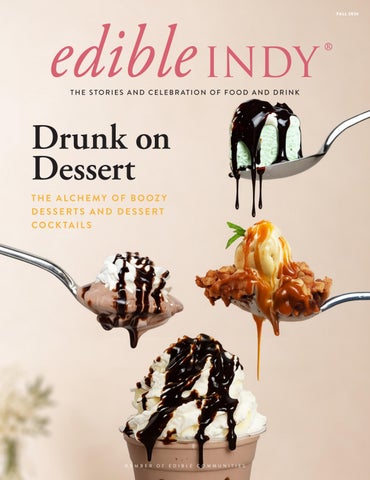
Drunk on Dessert THE ALCHEMY OF BOOZ Y DESSERTS AND DESSERT CO C K TA I L S
M E M B E R
O F
E D I B L E
C O M M U N I T I E S
LET TER FROM THE EDITOR
There is something about fall that invites us to slow down. The air turns crisp enough to reach PUBLISHER Adam Grubb
for a sweater. Windows open just long enough to let the scent of
EDITORIAL MANAGING EDITOR Stephanie Decker SENIOR EDITOR Bailey Shelton
ART | PRODUCTION DIRECTOR OF BRANDS Erik Anderson DESIGN Molly Tippner
ADVERTISING | BUSINESS CHIEF OPERATING OFFICER Jennifer Cisternino CHIEF CREATIVE OFFICER Camila Schaefer Advertising queries: sales@adamgrubbmedia.com
cinnamon, apples, and woodsmoke drift through the house. The dinner table lingers a little longer. We gather on porches, around fire pits, inside neighborhood restaurants, and at family tables that seem to grow a little louder this time of year. Food has always been more than something we eat. It marks celebrations, comforts us through change, and has an incredible way of turning ordinary moments into memories we carry with us long after the plates have been cleared. In this issue, we invite you to indulge a little. You’ll discover the chemistry behind boozy desserts and dessert-y booze, meet one of Indiana’s most celebrated pastry chefs, revisit the surprisingly rich
CONTRIBUTORS
history of pumpkin spice, explore Oktoberfest through the voices of
WRITERS Adam Grubb, Carie McMichael, Ruby Olston, Kylee Scales, Bailey Shelton, Claire Trost
Hoosiers who know it best, and find sweet destinations worth the drive.
PHOTOGRAPHERS Adam Grubb Media, Stephanie Decker, Sophie Dwyer, Courtney Guggenberger, Torrie Hudson, Ruby Olston, Dave Pluimer, Claire Trost
Along the way, you’ll uncover recipes, hidden gems, and stories that celebrate the people behind Indiana’s remarkable food scene. My hope is that these pages inspire you to try something new, revisit an old favorite, gather friends around the table, or simply save room for dessert. Because sometimes the sweetest part of a meal isn’t what
COVER PHOTO Adam Grubb Media
arrives on the plate at the end. It’s the conversation that continues after
is a member of Edible Communities and is licensed and published by Adam Grubb Media. Published four times yearly in February, May, August and November. No part of this publication may be used without written permission of the publisher. © 2026 All Rights Reserved.
Thank you for inviting us into your kitchen, onto your coffee table, and
everyone says they’re full.
into your traditions each season. We hope this issue encourages you to savor every bite, raise a glass, and embrace all the warmth that fall has to offer. Happy reading, Stephanie Decker, Managing Editor, Edible Indy®
AdamGrubbMedia.com FALL 2026 •
3
C E L E B R AT I N G 4 0 Y E A R S O F E X C E P T I O N A L F O O D
R E S TA U R A N T S | B R E W E R Y | C AT E R I N G | B A N Q U E T S | C O F F E E C A K E
sahms.com
CONTENTS
Drunk on Desserts The Alchemy of Boozy Desserts and Dessert Cocktails / 22
03
LETTER FROM THE EDITOR
06
COMMUNITY CALENDAR
09
WE THINK YOU’LL LIKE THIS Staff Picks for Favorite Foods and Drinks
10
FORKLORE The Basic History of Pumpkin Spice
12
OKTOBERFEST Stories from Hoosiers Who Know It Best
16
THE INTERVIEW A Conversation with Cindy Hawkins
20
FEAST YOUR EYES
27
KITCHEN SCIENCE The Sweet Science of Ice Cream
28
THE FOUR TOP Sweet Stops in Southern Indiana Worth the Drive
32
SHUEE’S APPLIANCE Luxury Appliances for Distinctive Homes
34
FLAVORS OF FALL Cozy Bakes for the Cool, Crisp Autumn Days Ahead
38
RESTAURANT SPOTLIGHT Kopper Kettle
40 RARE AND WELL DONE Mo’s A Place for Steaks Takes Private Dining to a Whole New Level
Cinnamon Sugar 35 Donut Bread
42
Classic Apple Pie 35
WHAT THE GRUBB? Dessert Doesn’t Sell Itself
RECIPES
Caramel Cheesecake 36 Pumpkin Bread 37
FALL 2026 •
5
E VENTS
Indiana State Fair IMAGE COURTESY OF THE INDIANA STATE FAIR
EVENTS
Community Calendar AUGUST 2026 INDIANA STATE FAIR August 7-23 Indiana State Fair Grounds indianastatefair.com CELLAR SESSIONS: POST ALONE August 21 7–9p.m. Taxman Brewing, Bargersville 13 S. Baldwin St., Bargersville SWEETCORN FESTIVAL August 22 Beasley’s Orchard 2304 E. Main St., Danville NOW SERVING: RESTAURANT WEEK BY EPICUREAN INDY August 24-September 6 Various locations epicureanindy.com
6
• FALL 2026
DEVOUR INDY SUMMERFEST August 24-September 6 Various locations devourindy.com ROOFTOP COCKTAIL DINNER August 25 6:30–9p.m. The Prewitt Restaurant & Lounge 121 W. Main St., Plainfield prewittdining.com TORCHFIRE FILM FESTIVAL August 27 7–10p.m. The Historic Artcraft Theatre 57 N. Main St., Franklin brentoncreative.com/ torchfirefilmfestival
GIRLS NIGHT OUT August 28 5–8p.m. Black Dog Brewery 11230 Indiana 67, Mooresville visitmorgancountyin.com
SEPTEMBER 2026 BUTTER: FINE ART FAIR September 3-6 The Stutz butterartfair.com INDIANAPOLIS OKTOBERFEST September 4-6 German Park 8600 S. Meridian St., Indianapolis
HONEY HARVEST FESTIVAL September 19 10a.m.–4p.m. Hunter’s Honey Farm 6501 W. Honey Lane, Martinsville huntershoneyfarm.com
North Salem Old Fashion Days IMAGE COURTESY OF NORTH SALEM OLD FASHION DAYS
NORTH SALEM OLD FASHION DAYS September 5-6 Pearl St. and State Road 75, North Salem northsalemoldfashiondays.com METAMORA MUSIC FESTIVAL September 5-6 Metamora metamorampa.org SUNSET SIP & SNIP September 11 6:30–8:30p.m. Broken Maple Farm 3717 W. 525 S., Trafalgar JUPITER FLIGHTS BALLOON FESTIVAL September 11-13 Conner Prairie Noblesville ZIONSVILLE FALL FESTIVAL September 11-13 Downtown Zionsville discoverboonecounty.com HOPS & VINES FESTIVAL September 12 4–10p.m. Franklin Ampitheatre discoverdowntownfranklin.com PAX VERUM WAY OUT FESTIVAL September 19 2:30–6:30p.m. 908 Main St., Lapel
PUMPKIN FESTIVAL September 30-October 4 Downtown French Lick timelessfrenchlick.com
HEARTLAND FILM FESTIVAL October 8-18 Various locations heartlandfilm.org PARKE COUNTY COVERED BRIDGE FESTIVAL October 9-18 Rockville coveredbridges.com
OCTOBER 2026 RILEY FESTIVAL October 1-4 Downtown Greenfield rileyfestival.com OKTOBERFEST October 2 6–10p.m. Carmel City Center carmel.in.gov GHOSTWALK October 2-3 Sullivan Munce Cultural Center Zionsville sullivanmunce.org GERMANFEST AT THE ATHENAEUM October 3 401 E. Michigan St., Indianapolis athenaeumindy.org POTTER’S BRIDGE FESTIVAL October 3 19401 N. Allisonville Rd., Noblesville visithamiltoncounty.com
Parke County Covered Bridge Festival IMAGE COURTESY OF PARKE COUNTY CONVENTION & VISTORS COMMISSION
HARVEST HAYRIDES FESTIVAL October 10 4–8p.m. Avon Town Hall Park avonindiana.gov INDIANAPOLIS PIZZA FESTIVAL October 17 Indiana State Fair Grounds indianastatefair.com WORLD FOOD CHAMPIONSHIPS October 15-18 Indiana State Fair Grounds worldfoodchampionships.com
PORCHTOBER October 3, 10, 17, 24 5–9p.m. Franklin discoverdowntownfranklin.com MORGAN COUNTY FALL FOLIAGE FESTIVAL October 8-11 Martinsville morgancountyfallfoliagefestival.com
World Food Championships IMAGE COURTESY OF WORLD FOOD CHAMPIONSHIPS
FALL 2026 •
7
A O T E M Y R E WELCO V E RE E H W E D E T P L AC A R B E L E C S I E SENS on — or inclusi w. tf lo love, buil ow and g r m g o o r t f l l n a r r Bo e space fo f a s y r o s a sen
Get ready to for backschool! WELCOMING SPACE TO EXPLORE & LEARN THOUGHTFULLY CURATED PRODUCTS
99 E. Carmel Drive, Carmel, IN | 317.564.4048
ENGAGING EVENTS
New location now OPEN in Noblesville!
BIRTHDAY PARTIES
sensoryshoppecarmel.com
WE THINK YOU’LL LIKE THIS
we think you’ll like this Edible Indy® staff share the food and drinks that they are loving this fall. Check out their picks and try them for yourself.
ADAM GRUBB
CAMILA SCHAEFER
KARLY ELBRECHT
RUBY OLSTON
PUBLISHER
CHIEF CRE ATIVE OFFICER
MEDIA S ALES E XECUTIVE
CONTRIBUTING WRITER & EDIBLE INDY® INTERN
STEAK CARPACCIO
VEGETARIAN BREAKFAST SANDWICH
TIPSY MERMAID CONCH HOUSE & COCKTAILS
COAT CHECK COFFEE
PHOTO BY TORRIE HUDSON
135 S. Main St., Zionsville
SEAFOOD RISOTTO TIBURON COASTAL CUISINE 8701 E. 116th St., Ste. 160, Fishers
tiburoncoastal.com Every once in a while, a dish catches you completely off guard. The seafood risotto at Tiburon Coastal Cuisine was that dish for me. I’m not usually the guy ordering risotto, but one bite in and I knew this was something special. Rich, balanced, loaded with perfectly prepared seafood, the kind of meal that makes you slow down and actually enjoy every bite. I’ve had a lot of great meals, and this one immediately landed on my short list.
tipsymermaid.com
401 E. Michigan St., Indianapolis
Carpaccio is not that common around here, and even less often done in a way that feels intentional. This one does. Thinly sliced rare steak layered with Parmesan, Romano, and Asiago, finished with arugula and a horseradish crème that gives it just enough bite. The capers are fried, which completely changes them. They are crisp, almost airy, adding a salty crunch that makes the whole dish more interesting.
Not entirely exclusive to the plant-based foodies of Indy, Coat Check Coffee’s vegetarian breakfast sandwich—made vegan when ordered on their house-crafted focaccia–is tried-n-true combination of plant-based sausage, egg, and cheese served on a housemade biscuit, but the tasteful twist is the delightfully sticky jalapeño jelly that leaves a zip of spice on your tongue.
coatcheckcoffee.com
CINNAMON ROLL DEBBIE’S DAUGHTERS BAKERY & CAFE 1236 Conner St., Ste. 100 Noblesville
debbiesdaughters.com Debbie’s Daughters cinnamon rolls have become one of those favorite little traditions for us. My 6-yearold lights up every time I say we’re headed there. There’s just something special about a place that makes everything from scratch and feels like home the second you walk through the door. If you haven’t tried their cinnamon rolls yet, let this be your sign.
FALL 2026 •
9
FORKLORE
FORKLORE
THE BASIC HISTORY OF
n i k p Pum e c i p S
After the success of the Peppermint Mocha in 2002, Starbucks introduced the Pumpkin Spice Latte in limited markets the following year before rolling it out nationwide in 2004. Ironically, the original drink did not actually contain pumpkin until 2015—just cinnamon, nutmeg, clove, and ginger.
Written by Claire Trost
HOW A BLE ND OF CINNA MON , NUTMEG , C L O V E S , A N D G I N G E R T R AV E L E D V I A ANCIENT TRADE ROUTES TO BECOME O U R F AV O R I T E F A L L R I T U A L
Long before they flavored lattes or candles, pumpkin spice’s signature spices—cinnamon, nutmeg, cloves, and ginger—were prized across global food cultures. On Pulau Ay in Indonesia’s Banda Islands, archaeologists have found nutmeg residue on pottery dating back 3,500 years, proving just how long humans have been drawn to these warm, aromatic flavors. By the 16th and 17th centuries, recipes resembling modern “pumpkin spice” appeared in British and Scottish cookbooks. In the Americas, Indigenous communities introduced settlers to pumpkin, a squash native to North America. As more European settlers arrived, they brought their prized spices with them. It wouldn’t be until the late 1790s, long after the “First Thanksgiving,” when Amelia Simmons included two spiced “pompkin” pie recipes in American Cookery that would help cement the flavor in early American identity. The modern era streamlined things. In the 1930s, companies like McCormick & Co. introduced pre-mixed “pumpkin pie spice.” Then came the early 2000s.
10
• FALL 2026
Still, the drink became a cultural phenomenon, fueled in part by the rise of early social media platforms like Twitter and Instagram. To this day, the Pumpkin Spice Latte remains Starbucks’ top seasonal seller and has sparked an avalanche of pumpkin spice products ranging from cereal and candy to candles and household cleaners. The flavor has earned a reputation as “basic,” but some local coffee shops are taking it somewhere new. “We like to pay homage to what’s happening around us while also taking customers somewhere they may not have gone before,” said Mitchell Tellstrom, at Indy’s Rabble Coffee. That philosophy inspired the Persimmon Spice Latte, a seasonal drink that echoes the warming notes of a PSL while highlighting seasonal, local persimmons. “It’s not just the makeup of a seasonal drink,” Tellstrom said, noting that the flavor was inspired by his grandmother’s persimmon pudding. For him, and for many customers, it is a taste tied to memory and place. “It’s also about watching things pass, appreciating where you are, and recognizing that fall is a time for remembering.” Long before hashtags and latte art, what is now pumpkin spice blend was a part of harvests and gatherings and represented warmth and comfort. Every fall, when these flavors return, we aren’t participating in a trend, but in a tradition that is really quite, well… basic.
GOLF. RACING. DARTS. BAR. ttttttt
OPEN TO ALL
3 Golf Bays · 2000+ Courses 4 Racing Sims · 170+ Tracks 2 Social Dart Boards 4560 Ocean Street· Indianapolis, IN
(463) 282-6812
StickAndHack.com
OC TOBERFEST
t s e f r e b o t k O STORIES FROM HOOSIERS WHO KNOW IT BEST Written by Claire Trost Photos by Claire Trost and Courtney Guggenberger
Guggman Haus Brewing Co.’s Oktoberfest 12
• FALL 2026
Every fall, Hoosiers raise beer steins, bite into sausages slathered with mustard and sauerkraut, and gather at long communal tables all across the state. For many, Oktoberfest is a beloved excuse to celebrate cooler weather, traditional food, seasonal beers, and good company. A tradition that began more than 200 years ago as a royal wedding in Bavaria ties more deeply to Indiana than most people realize. To separate fact from folklore, we spoke with historians, brewers, butchers, and bakers—all longtime stewards of Indiana’s German heritage—about what Oktoberfest really is, why it has endured for generations, and how Hoosiers continue to make it their own. OKTOBERFEST: A BRIEF HISTORY The world’s most famous folk festival began on October 12, 1810, when Crown Prince Ludwig of Bavaria married Princess Therese of Saxe-Hildburghausen. The citizens of Munich were invited to join the festivities and the celebration was such a success that it returned the following year. A tradition was born. “It is the perfect archetype for a festival,” said Giles R. Hoyt, PhD, professor emeritus and director emeritus of the Max Kade German-American Research and Resource Center at Indiana University Indianapolis. “It has all the accoutrements: fashion, polka music, dancing, food, drink, games, and community. It’s simply a lot of fun.”
different regions and spoke different dialects, they shared a desire to gather, celebrate, and preserve cultural traditions. Those gatherings eventually evolved into social clubs, street festivals, and community organizations—many of which still exist today. Perhaps no building better tells the story of Germany’s impact on Indiana than Indianapolis’ Athenaeum. Built in the late 1890s as the center of German-American life in the city, the landmark remains a hub for arts organizations, events, recreation, and one of Indianapolis’ most beloved German restaurants, The Rathskeller. HOOSIER CELEBRATIONS While over six million visitors travel to Munich each year to join in the original Oktoberfest, Hoosiers have plenty of opportunities to celebrate closer to home. Among the state’s largest celebrations is Oktoberfest at German Park on Indianapolis’ south side, hosted by the German American Klub of Indianapolis. Visitors gather beneath sprawling tents for traditional music, German fare, beer, dancing, and the ceremonial keg tapping that officially opens the festivities. This year, the event will run from September 10 to 12.
One of the biggest misconceptions, however, is right in its name: Modern Oktoberfest begins in September. Festival organizers gradually shifted the celebration earlier to take advantage of Bavaria’s warmer weather and longer daylight hours, allowing more people to gather outdoors before autumn’s chill settles in. INDIANA’S GERMAN ROOTS RUN DEEP Long before Indianapolis hosted Oktoberfest celebrations, German immigrants were helping to shape Indiana itself. “For a time, German immigrants represented the largest immigrant group in Indiana,” said Hoyt. Arriving throughout the 19th century from Germanspeaking regions across Europe, they left an enduring mark on the state’s architecture, businesses, food traditions, and civic organizations. Though German immigrants came from
Courtney Guggenberger and her husband, Derek, enjoy the original Oktoberfest in Munich, Germany. Guggenberger co-owns Guggman Haus Brewing Co. with her twin sister, Abby.
FALL 2026 •
13
Downtown, the Indiana German Heritage Society hosts GermanFest at the Athenaeum. This year’s festival, scheduled for October 3, will feature food and drinks, music, games, folk traditions, and even dachshund races! Local restaurants and breweries have embraced the tradition as well. At Guggman Haus Brewing Co., Oktoberfest has become the biggest celebration of the year. Inspired by a 2012 trip Courtney Guggenberger and her husband, Derek, took to Munich for Oktoberfest while living in Germany, the brewery’s annual celebration blends tradition with local character. “We take what’s traditional and do it the Guggman way,” said Courtney Guggenberger, co-founder and director of marketing. The result includes live German bands, family-friendly activities, specialty beer releases, and even lively beer stein holding competitions!
BEER WITH RULES (THAT ARE MEANT TO BE BROKEN) Only six Munich breweries are permitted to serve beer at the original festival, and every beer must meet strict brewing standards based on Germany’s centuries-old purity laws, which limit ingredients to water, barley, hops, and yeast. Far from the strict rules in Munich, the Guggman Haus Oktoberfest lineup of seasonal releases pay homage to those rules, while adding the occasional twist. “We brew traditional German beers based on what we drank when we attended Oktoberfest in Munich,” said Guggenberger. Alongside classic German-style beers and a “Festbier” lager, the brewery also serves a Radler—a refreshing blend of hefeweizen and lemonade—as well as Hoppenheim NEIPA, a hazy IPA named for the German town where the couple once lived.
“It has all the accoutrements: fashion, polka music, dancing, food, drink, games, and community. It’s simply a lot of fun.” — GILES R. HOYT, PhD, professor and director emeritus of the Max Kade German-American Research and Resource Center at Indiana University Indianapolis
GermanFest at the Athenaeum IMAGE COURTESY OF THE ATHENAEUM
14
• FALL 2026
IMAGE COURTESY OF CLAUS’ GERMAN SAUSAGE & MEATS
Left to right: Sausages from Claus’ German Sausage & Meat; Guggman Haus Brewing Co.’s Festbier lager; giant Bavarian pretzel from Guggman Haus Brewing Co.
“It’s a hazy IPA brewed with all German hops—which is pretty rare for this style of beer,” said Guggenberger. TIMELESS FOOD TRADITIONS While large, overflowing steins may be one of Oktoberfest’s most recognizable symbols, the festival is also just as defined by the foods served alongside them: sausages, pretzels, sauerkraut, mustards, and curry ketchup—a festival street food staple often served over sausages and french fries. However, well before Oktoberfest became a global celebration, German food culture was built around neighborhood storefronts: the butcher, the baker, and so on. Located just steps from home, these family-run businesses supplied the ingredients that made up everyday meals as well as celebratory festivals. Many stores were passed from one generation to the next, preserving recipes and techniques that changed little over time. That tradition lives on in Indianapolis at Claus’ German Sausage & Meats, where methods have been maintained since 1913. Current owner Claus Muth, the great-nephew of the original proprietor, grew up in Frankfurt, Germany and entered the trade as an apprentice at his neighborhood butcher shop when he was just 17, before earning his master’s certification in the German meat trade. The certification required hours of study, hands-on training, and countless tests. After completing the program, Muth had the opportunity to visit the family business in Indiana throughout the early 1990s. What he found felt familiar. From loyal customers to the recipes, production methods, and storefront operations, the shop reminded him of the corner butcher stores he had known in Germany.
There is an old saying that “laws are like sausages; it is better not to see them being made.” Muth takes offense to the comparison. “I know what’s going into my sausage,” he said. “We make everything here. It’s all meat and spices.” As small butcher shops disappear both in the United States and Germany, Claus’ offers Indiana something incredibly unique thanks to the commitment to quality ingredients and craftsmanship. Much like Oktoberfest itself, Claus’ serves as a reminder that tradition is worth preserving. “The food is meant to be shared and brings people together,” said Muth. And, perhaps that is the heart of Oktoberfest. Crown Prince Ludwig invited the common citizen to celebrate his wedding, setting the framework for the every person to come together, sit at long tables, join in conversation, to sing and to dance. Even the festival’s iconic giant pretzel served a practical purpose: its oversized shape made it easy to tear apart and pass around a crowded table full of family, friends, and strangers. “People need reasons to celebrate,” said Guggenberger. “They need something to look forward to and a chance to step away from everyday. We like giving people a reason to be happy.” So while many details differ between Bavaria and Indiana, past and present, the spirit remains unchanged: We are still eager to gather together with good food and drinks, proving that the best parties never really end.
FALL 2026 •
15
THE INTERVIEW
THE INTERVIEW
A Conversation with Cindy Hawkins CIRCLE CIT Y SWEETS Interview by Adam Grubb / Edited by Bailey Shelton / Photos courtesy of Cindy Hawkins and World Food Championships Cindy Hawkins, owner of Circle City Sweets, is a champion baker and staple of the Indy dessert scene. For over 20 years, she’s been making croissants and confections for the city, from their original location in City Market to the AMP at 16 Tech. Her work is featured among the offerings of restaurants and cafes around the city, and she leads Team Indiana at the World Food Championships each year. This interview has been edited for clarity and space. Find the full interview on edibleindy.com
EDIBLE INDY: For those that are not familiar with your story, tell us a little bit about not just your career, but what you’re doing today. CINDY HAWKINS: Yeah, so I own Circle City Sweets. It’s my pastry shop. I’ve been in business for about 20 years now. I don’t say it was on a whim because it wasn’t on a whim, but it all kind of happened accidentally. We, thank God, were very fortunate and successful and opened up a retail shop originally in City Market. We were there for just short of 11 years, moved to the AMP a little over five years ago. And
I started competing [in the World Food Championships] in 2015 and didn’t really think a lot of it. And then this year took the crown. EI: Let’s talk about your actual food itself and the pastries and the desserts and how you differentiate yourself. You said you’re a more logical person than a creative one. How do you create that without being creative? CH: Well, you know, that’s why I like baking so much, because baking really is a science. My original career goal as a youth, I wanted to be a pharmacist. I made a career change quickly in college, but I love math and science, and baking is
Cindy Hawkins 16
• FALL 2026
all math and science. Cooking is very different. That’s why my husband’s an amazing chef; he can taste and edit as you go. Baking’s not like that. If you mess up your baking powder, you’ve made a horrible mistake. But it’s math and science. And the quality of the ingredient that you use is paramount. The reason my croissant is so good is because of the butter that I use and the process that we take to make that product. When I was a kid, a poor college student, butter was on sale at Walmart, you went and bought it, and it was a buck-fourteen a pound ($1.14/lb). But I also remember when you would cut it, it would kind of shard apart in pieces. It’s because it was all water. There was so much water in that butter. And we use a butter called Plugrá now. It’s from Dairy Farmers of America. It’s an American butter, but it’s a European-style butter. It’s 82% butterfat. I can cut a cold pound block of that butter, and my bench scraper just goes right through it. It’s so creamy, so beautiful, so perfect, because it’s butterfat. EI: There’s typically a big difference between art and science. But in cooking, I’m learning, they aren’t as far apart as you might think. Have you ever stumbled upon a recipe that shouldn’t make sense on paper but comes together against all the odds? CH: Oh gosh, I mean, things happen by accident. We have a great-selling croissant that happened by accident. I can’t take credit for it. It was actually my head baker, Nicole. Our delivery driver was bringing back our ham from Smoking Goose. Nicole had some jalapeños in a container pickling in the refrigerator for a sourdough she was playing around with. And he knocked over those pickling jalapeños onto a bowl of croissant dough before we had started the process. She pulled this whole ball of dough out, and she just had this look of horror on her face. There’s just this pool of liquid on top of the plastic wrap. And I said, “Well, you’re making a jalapeño croissant this week.” So she just came up with a jalapeño popper filling. It’s cream cheese and cheddar cheese, a little bit of red pepper flakes, and pickled jalapeños. And it sells like mad now. I wouldn’t have come up with it. And if she had said to me, “Hey, I’d like to do a jalapeño popper croissant,” I probably would have said that sounded horrible. And I would have totally shut it down. You know, so things like that happen by mistake.
Chocolate Orange Hazelnut Travel Cakes
EI: So walk me through the World Food Championships, what that process is like. This is the third year that it’s going to be here in Indianapolis. And this is not just the Super Bowl. This is the World Food Championships. There are so many categories, so many days, so much incredible, incredible talent. That had to have been a thrill of a lifetime to win that. CH: Gosh, yeah. Yeah, it was crazy. So this was my eighth time competing. I started in 2015, and Craig Baker, myself, and Matt Stumm were the three chefs from around here who... EI: Those are famous names! CH: Yeah, [Craig Baker]’s been in it every year except for the very first. Well, this past year he didn’t compete. He worked for World Foods doing all of the dishes of all previous winners for a big taste of the World Foods. So he kind of took a year of competing off this past year, but he’s back. He’ll be back competing this coming year.
FALL 2026 •
17
You basically have to get qualified to get in. You can’t just decide, “Oh, I’m going to sign up and do a World Food Championship.” You have to get qualified somehow. The first time I got qualified was an online recipe contest. So you submit a recipe, you submit photos of your work, and then it’s evaluated by whatever the organizing group is doing that competition. EI: The aftermath of winning that and feeling not just vindicated of your life’s work, but the love of judges. To have judges choose your dish over all the rest, that has to be satisfying for you. CH: It was really exciting. We had the third-highest score of all dishes turned in of every category. To know that you had the third-best evaluated dish of every single category combined... It was pretty exciting. When the judges started talking, I knew we won. I always try to be the first one turned in because they taste it in the order that you turn in and depending on what you have, if it’s sitting up there for 15 minutes it could really affect your score. I wanted to get it right when it’s ready to go and not sitting around. You see people’s dishes kind of dying sometimes up there while they’re waiting. EI: Walk me through the Indy dessert scene. Indianapolis is known for a lot of different things: hosting big sports events, racing. We’ve got a pretty safe, clean, fun downtown vibe. Would you consider Indy to be a dessert city? CH: You know, I do and I think it’s too bad. You know, when I started 20 years ago, there really weren’t a lot of bakeries
around. Crawford’s had just closed. They were a staple, you know, they were right across the street from Methodist Hospital downtown and I was probably about three years from opening up my shop. I went to their auction. I met Mr. Crawford, it was just so exciting to me. And then Renee’s Bakery was really the only bakery around. Albert had opened a couple years before I did and that was really it. We were really the first ones doing macarons in town. There was a time in this city where if you were a chef at one restaurant, you didn’t eat at your competitors’ restaurants. You weren’t friends with other chefs. You didn’t hang out with other chefs. You didn’t talk well about other restaurants. And now we’re all friends. We all hang out. And it’s funny because on the pastry side, I think people don’t get that we are all friends or a lot of us are friends. Pete Schmutte owns Leviathan; I worked for him at Wolfgang Puck’s. He’s actually the one who referred me to the pastry school that I went to because that’s where he went. And then when he was between jobs, he would pick up shifts with me at City Market. I mean, we’re all friends. EI: So it’s a tight community. It’s a growing community. And this area specifically, you feel has some still legs when it comes to desserts, pastries, and the, I guess the other side of the dinner that most people say, “I’m good, none for me.” Losers. You’re out to change that with each time. CH: Yeah, well, I think the nice thing too is because I think those of us who are smart know what we’re good at and we know what our strengths aren’t. Like, I don’t make cupcakes, so when people call me in on cupcakes, I know who to refer them to. I can’t do chocolate work. I know how to do chocolate work, but I can’t control the heat and humidity of the city market, so if somebody wants chocolates, there’s a great shop in Greenfield, Jayne Hoadley, J. Evelyn Confections, Jayne’s a wonderful woman. She’s wicked talented. If someone ever wants chocolates, that’s who I’m going to send them to. EI: But you know who those people are who are really good at what they do. And so you want to give them that business. That’s not your shtick, if you’re booked…
Paris–Brest
18
• FALL 2026
CH: If we’re booked solid for something and I can’t get you in, I’m going to send you to the best person I know who might be able to get you in for that job.
Fall for Bloomington Flavors
FE AST YOUR E YES
FEAST YOUR EYES
PEANUT PARFAIT Chocolate and peanut butter mousse, marshmallow fluff, and toasted peanuts. Photo by Sophie Dwyer @sofieats
TINKER STREET 402 E. 16th St., Indianapolis @tinkerstreetindy tinkerstreetrestaurant.com
20
• FALL 2026
STICK Y TOFFEE PUDDING Inspired by a trip to the Cayman Islands, Chef Ryan Nelson’s highly praised recipe features a dense, moist date cake drenched in a hot butter and brown sugar toffee sauce, topped with fresh whipped cream. Photo by Dave Pluimer @dave_pluimer
L ATE HARVEST KITCHEN 8605 River Crossing Blvd., Indianapolis @lateharvestkitchen lateharvestkitchen.com
FEAST YOUR EYES
RICOTTA DOUGHNUTS Bourbon maple glaze, candied bacon, maple cream, and sea salt caramel ice cream. VIDA 601 E. New York St., Indianapolis @vida.restaurant vida-restaurant.com
GOOEY BUTTER CAKE Gooey butter cake served à la mode with vanilla bean ice cream and a caramel drizzle. Photo by Stephanie Decker
SAVOR 211 W. Main St., Carmel @savorcarmel savorcarmel.com FALL 2026 •
21
COVER FE ATURE
k n u r D
ON DESSERTS
The Alchemy of Boozy Desserts and Dessert Cocktails Written by Carie McMichael
Woodford Reserve Bread Pudding from Harry & Izzy’s 22
• FALL 2026
PHOTO COURTESY OF HUSE CULINARY | BY DAVE PLUIMER
Dessert is the grand finale of any delicious meal, but with a splash of spirits, it finishes on a bombastic high note. From silky sponge cakes soaked in rum syrup to delicately whipped Italian zabaione, boozy desserts and dessert cocktails are a decadent interlude for any time of day. Rich, aromatic, and surprising, these spirited treats are proof alcohol has a place both in the shaker and in the oven.
In the 17th century, British colonists in the Caribbean first used rum to preserve their fruit puddings in the sweltering heat. Artisans further developed the relationship of alcohol and dessert to create popular staples like bananas foster, limoncello sorbet, and Kahlúa-infused brownies. Belly up to the bar, the 21+ crowd can sip on mudslides, grasshoppers, chocolate martinis, and Irish affogatos. Alcohol contains flavor compounds that boost the natural richness of common dessert ingredients like chocolate without upstaging the rest of the dish, and transformative properties that change a dessert’s structure. Soaking
cake sponges in spirits keeps them moist for long periods. Bourbon and brandy in particular soften gluten formation in baked goods, and lower a solution’s freezing point, making them ideal for infused ice creams. Jayne Hoadley, chocolatier and owner of J. Evelyn Confections, notes the compatibility of chocolate in particular with spirits due to its variety of complex flavors. The creamy mouthfeel of the chocolate dances in tandem with the cleansing high note of the alcohol for a pleasant finish. “My favorite is to use are spirits and beers,” Hoadley said, “because once reduced, the notes of the spirit or beer
The Fountain Room’s Grasshopper Pie PHOTO BY ADAM GRUBB MEDIA
FALL 2026 •
23
“Yes, the kids can have a regular milkshake, but Mom and Dad might like to take a bit of the edge off while enjoying the same treat as their children. It’s part nostalgia, part ‘I need a break.’” — ROSS McMICHAEL, Baby’s Diner
impart wonderful and interesting notes, like the wheat ale used in our Brew-N-Chew Caramel imparts a yeast-almostbaked bread flavor into the caramel.”
table, the first thing you say is ‘Wow.’ Just kind of the massive size of it…Then you pour the Woodford Reserve over the top of it and get that sizzle, that’s part of the show.”
The transmutation of cocktails-into-desserts and dessertsinto-cocktails is an ongoing trend charming both guests and service industry professionals looking to elevate dining adventures. The multi-faceted composition makes it a veritable triple threat of dining. It’s not just a dessert; it’s not just an indulgence; it’s an experience.
At Baby’s Diner on Talbott Street, patrons can enjoy a boozy milkshake when they add a 50 ml shooter to any one of their rotating flavors, transforming a nostalgic treat into an adult indulgence. Spirits soften a milkshake’s texture for a silky smooth pull on the straw, and Baby’s has a plethora of dessert-adjacent shooter flavors to pair with shakes— chocolate, strawberry, or peanut butter whiskey; berry and whipped cream vodka; banana and espresso liqueur, and so on.
Locals and tourists alike can have these singular experiences across the city, ranging from premium casual dining to mom-and-pop counter service. At The Fountain Room on Mass Ave, Executive Chef Ricky Martinez offers a fresh take on a classic New Orleans cocktail: The Grasshopper Pie is often characterized by diners as an “explosion of flavors,” from the white chocolate, cream, Oreo crumbles, and of course, crème de menthe. On the flip side, Sullivan’s Steakhouse has taken the same flavor profile from the NOLA classic for their drink menu, adding mint and Jameson Irish Whiskey, and dubbing it “The Retro Grasshopper.” Spirits bring theater to tableside in the culinary tradition of flambe: igniting spirits for a dramatic swell of flames that’s sure to draw a delighted gasp from diners. Combustion of the alcohol in the pan burns off its harsh bite, leaving behind the sweet notes of the spirit. One of the most tried-andtrue examples of this chemistry is bourbon whiskey, which once ignited leaves behind sweet notes of caramel and chocolate. Executive Chef Luke Landgrebe is serving blazing bites at Harry & Izzy’s in the form of their Woodford Reserve bread pudding, a sharable chocolate bread pudding topped with sea salt caramel ice cream and finished with Woodford Reserve bourbon before being ignited. Landgrebe says the dish is a prime example of patrons first eating with their eyes. “When a Woodford bread pudding shows up at your
24
• FALL 2026
Ross McMichael has been slinging boozy milkshakes from behind Baby’s counter for nearly five years. He says a treat typically associated with childhood and innocence has the potential to bring the generations together with a bit of tipple. “Yes, the kids can have a regular milkshake, but Mom and Dad might like to take a bit of the edge off while enjoying the same treat as their children. It’s part nostalgia, part ‘I need a break.’” The highly customizable nature of the boozy milkshake creates a branching system of flavor combinations. Some of the most popular flavor pairings include chocolate shake with various flavored whiskeys like salted caramel or strawberry. In the summer, adding vodka to the orange Dreamsicle flavor evokes a classic push-pop. “It’s a good opportunity for the consumer to try something new,” McMichael said. “People automatically assume that ‘Ew, I don’t want my dairy and liquor mixed.’ But more often than not, I have customers tell me ‘I did not think I would like that, and I really did.” The espresso martini is a recurring star on many drink and dessert cocktail menus. Kendall Lockwood Fields, operating partner of Ball & Biscuit, says their Espressotini is a departure from the classic that is equal parts inspiration
Chocolate Boozy Milkshake from Baby’s Diner PHOTO BY ADAM GRUBB MEDIA
FALL 2026 •
25
and innovation. During her travels in Europe, Lockwood Fields discovered espresso martinis there were less cloying and more coffee-forward, leading her to quest for a perfect harmony. “Drinks, like great food, are all about balance,” Lockwood Fields said. “Coffee naturally brings bitterness, but it also offers acidity and often notes of chocolate, nuts, caramel, or even fruit. When building a cocktail, it’s important to consider all of these characteristics as you choose both your base spirit and the sweetness level, ensuring you use the right proportions and the right modifying spirit.” Chefs and bartenders can still infuse their creations with spiritual flavor without the use of alcohol at all—just by using ingredients that play supporting roles. At Magdelena in Fountain Square, diners can indulge in chocolate creameaux made with orgeat almonds. Orgeat is a sweet syrup distilled from almonds, associated with its role in tropical and tiki cocktails like the famous Mai Tai.
Espresso Martini from Ball & Biscuit PHOTO COURTESY OF BALL & BISCUIT
Co-founder Nick Detrich says the possibilities of incorporating alcohol and cocktail flavors is only limited by the imagination and what sort of journey is desired for one’s patrons. “I think there’s a ton of opportunities to use technique in cocktails and pastry that are not as readily available or make sense in terms of more savory courses,” Detrich says. “There’s a lot you can do with textures and foams and other dessert techniques that leave the process open-ended. Inspiration could come from anywhere, and that path can have many forks.” Desserts and cocktails have always been about celebrating life’s sweeter moments, so the alchemy of their union just makes sense. Just remember to enjoy them responsibly, and savor every bite, every sip, and every new experience between the glass and the saucer.
Strawberry Boozy Milkshake from Baby’s Diner PHOTO BY ADAM GRUBB MEDIA
26
• FALL 2026
KITCHEN SCIENCE
KITCHEN SCIENCE
The Sweet Science of Ice Cream: H O W A FAV O R I T E T R E AT C O M E S T O G E T H E R Written by Bailey Shelton Some unwitting parents might’ve come up against a real stumper this summer as part of a classic childhood science experiment: making ice cream. It’s an easy enough process; sugar, heavy cream, a splash of vanilla or cocoa powder in one plastic bag, ice and salt in a second layer of plastic, then shake until you have ice cream. But why salt, when in a couple months we’ll be using the same material to melt ice from our sidewalks? Well, interestingly, the same process is at play. When salt is added to ice and water, it does two things. According to Ariel Fenster, PhD, who develops educational content for McGill, salt lowers the freezing point of water, meaning when making ice cream, the ice is able to be colder than 32 degrees and stay there. The insulated environment of an ice cream maker or even a ceramic bowl also keeps things colder for longer. Salt also creates a solvent with water, and the same process can happen even when water is frozen into ice. This creates the melt you commonly see on roadways, but you’ll also notice a bit of water in the ice-and-salt side when making ice cream. This melt happens because
the chemical reaction of salt and water bonding together releases heat, which melts the ice. The more salt you add, the more melting will occur—that’s why we use super salty chunks of crystallized salt on the road—but a bit of table salt works just fine for at-home ice cream making. For home ice cream sommeliers, heavy cream is the other key element to that silky, sweet ice cream texture. We actually whip the cream as we mix, meaning the thicker the cream, the easier it is for the ice cream to hold its shape. Classic whipped cream, too, involves a chemical change. At its core, heavy cream that you find on the shelf is essentially an emulsion of fat and water. When you whisk it, the mix of oil and water begins to trap air, forming that fluffy, light texture we love in our desserts. Most recipes will combine whole milk with heavy cream, so that the mixture will thicken but won’t form the same stiff peaks. Essentially, by thinning out the cream with milk, we slow down the mixing process so that the ice cream can churn without becoming too hard. So, there you have it! The delicious science behind your favorite frozen treat is a lot simpler than it looks.
FALL 2026 •
27
THE FOUR TOP
SWEET STOPS IN SOUTHERN INDIANA WORTH THE DRIVE E VERY ISSUE , THE FOUR TOP SHOWCASES FOUR TOP-NOTCH CULINARY FINDS R A N G I N G F R O M R E C I P E S TO R E S TAU R A N T S TO CO C K TA I L S … A N D M U C H M O R E . Written by Kylee Scales
The urge to head to southern Indiana is almost instinctual the moment there’s a little chill in the air. We chase the changing leaves down undulating country roads and seek dramatic vistas. But some of the best stops aren’t the overlooks or hiking trails—they’re the old-fashioned candy counters tucked inside historic downtowns. Whether you’re exploring Brown County, touring the caves and forests of southern Indiana, or driving the Ohio River scenic route, carve out time for these four legendary sweet shops.
28
• FALL 2026
2.
HOOVER’S CANDY SHOP
1815 28th St., Bedford, IN
hooverscandyshop.com
PHOTO COURTESY OF MARTINSVILLE CANDY KITCHEN | BY JUSTIN DRAKE
1.
MARTINSVILLE CANDY KITCHEN
46 N. Main St., Martinsville, IN
martinsvillecandykitchen.com
For anyone leaving Indianapolis on a pilgrimage toward the rolling hills of Bloomington or the dense canopy of Brown County State Park, Martinsville Candy Kitchen is a mandatory pit stop. The tiny downtown shop has been around for over 100 years. Stepping inside feels like stepping back in time, where glass candy cases, an old-school ice cream parlor, and a vintage soda fountain transport you to a bygone era.
Some of southern Indiana’s prettiest natural attractions are farther south around Bedford. Spring Mill State Park blends history and nature with miles of forested hiking trails alongside a historic pioneer village. Nearby Bluespring Caverns Park takes the adventure entirely underground, offering high-adventure guided kayak tours where visitors can paddle deep into the passages of the nation’s longest subterranean river. After an active morning, a sweet treat is only fitting. Hoover’s Candy Shop has been a beloved local staple since 1908. Step inside and you’ll find counters packed with classic confections like rich turtles, buttery toffee, and smooth caramels. But the real showstopper is a unique fan favorite—the cinnamon log. This bite-sized treat is best described as similar to fudge, and infused with warm cinnamon flavor. Before heading out with your haul, grab a handcrafted specialty coffee drink to fuel the next leg of your road trip.
Martinsville Candy Kitchen is one of the few places in the nation that still makes candy canes by hand. Visitors can watch the workers pull and shape the candy all year round. The free demonstrations are especially popular during the holiday season, with lines sometimes out the door. But that probably won’t be the only treat you leave with. Customers rave about their pillowy soft divinity, creamy peanut butter fudge, and decadent cherry cordial bark.
What is a Cinnamon Log? Hoover’s Cinnamon Log is a soft melt-in-your-mouth, fudgy, and nougaty sweet bite heavily rolled in rich cinnamon. PHOTOS COURTESY OF HOOVER’S CANDY SHOP
FALL 2026 •
29
DY
SH
OP
CHARLIE'S CARAMEL & CANDY SHOP C
AN
3.
EL
&
427 N. 2nd St., Vincennes, IN
charliescandy.com
Vincennes often gets overlooked in conversations about Indiana fall travel, but that’s part of its charm. As Indiana’s oldest city, it boasts gorgeous historic architecture, treelined streets, and waterfront views along the Wabash River. Visitors can spend the day exploring the towering stone columns of George Rogers Clark National Historical Park before wandering downtown for something sweet. Charlie's Caramel & Candy Shop sits just a few blocks from the Riverwalk Trail. As the name implies, Charlie’s has
30
• FALL 2026
PH O T O C O
URTE
SY O
FC
HA
IE RL
’S
C
AR
A
M
perfected the art of caramel corn, which is without a doubt the ultimate leaf-peeping, road trip snack. The rich, buttery scent greets you before you even walk in the door. And since you’re visiting in the fall, it would be a mistake to leave without one of their caramel apples. They’re a seasonal masterpiece, featuring crisp apples cloaked in thick, buttery caramel, and dipped in chocolate.
PHOTO COURTESY OF SCHIMPFF’S CONFECTIONERY
4.
SCHIMPFF’S CONFECTIONERY
347 Spring St., Jeffersonville, IN
Sitting right next to the Ohio River on the state’s southern border is the most iconic candy destination in the Midwest. Schimpff’s Confectionery has been operating since the late 1800s. The family-run confectionery combines a candy store, old-fashioned soda fountain, and candy museum under one roof. Get a glimpse of employees making Schimpff’s famous cinnamon red hots, which are absolutely perfect for a chilly fall day and worth the drive alone. Jeffersonville itself makes an excellent fall day trip. Visitors can take a scenic stroll along the Ohio River Greenway with views of Louisville’s skyline or venture farther into the serene hills near Mount Saint Francis for peaceful forest paths.
People often plan fall road trips around scenic drives and colorful trails, but the most unforgettable memories come from unexpected stops along the way. These four charming destinations fulfill more than just your sweet tooth. They offer a deep connection to our state’s rich history, beautifully wrapped in the incomparable splendor of an Indiana autumn.
PHOTOS COURTESY OF SCHIMPFF’S CONFECTIONERY
schimpffs.com
Ready for Red Hots? Schimpff’s famous cinnamon red hots are madefrom-scratch in store!
FALL 2026 •
31
SHUEE’S APPLIANCE
Unique
Luxury Appliances for Distinctive Homes SHUEE’S APPLIANCE Written by Ruby Olston / Photos by Adam Grubb Media
32
They say the kitchen is the heart and soul of a home, but when it comes to furnishing the place where unforgettable memories are made, the experience in the appliance store can be a little lackluster.
96th St. and Gray Rd. apart from every other appliance dealer in the Greater Indianapolis area, is the friendly, caredriven experience that exists to make you smile every time you step into your kitchen.
Shuee’s Appliance does things a little differently. Founded in Greencastle, Indiana, Shuee’s family-owned business has been supplying Central Indiana with home appliances since 1970. What truly sets their new flagship showroom on
“We’re a friendlier experience,” said Shuee’s General Manager Ron Randal. “We want them to be happy with their selections. We want them to feel good about it whenever they walk into that space.”
• FALL 2026
Friendly from the moment you step foot into the showroom, Shuee’s creates an experience based on trust, between customer and employee, where authenticity can bloom and kitchens can be created one relationship at a time. “It’s great to get someone that’s passionate about how their home looks and feels. It is rewarding to know that every time they walk into their kitchen, bathroom, bar, or outdoor living space, whatever area we helped with, they can see something that lights up their face and fills them with joy. We here at Shuee’s feel that is priceless,” Randall said. With six locations around Indiana, including sister stores Maruszczak’ Appliance, Stucky’s Appliance, and
Beeson’s Appliance, Shuee’s warm and welcoming atmosphere excels in an industry often defined by transactions. “Even though we may not be as big as the big-box stores, we are part of a 5,500-member appliance dealer buying group. Worried about getting the best appliance pricing? Don’t be. Our pricing is updated via electronic price tags every three hours to make sure no one in this market is lower. You should never pay more here.” With more than 50 years of business built on meaningful relationships and small-town values, Shuee’s continues to prove that the best part of the kitchen is the people who help make it feel like home.
“We take care of the people, we’ll take care of you.” — RON RANDALL, general manager, Shuee’s Appliance
Cafe
Thermador
JennAir
Viking
FALL 2026 •
33
RECIPES
Cinnamon Sugar Donut Bread
RECIPES
s r o v a l F l l a F COZ Y BAKES FOR THE COOL , CRISP A U T U M N D AY S A H E A D Written and photographed by Stephanie Decker
34
• FALL 2026
CINNAMON SUGAR DONUT BREAD
Combine dry ingredients in, mixing together
INGREDIENTS
Make the middle cinnamon mixture in a separate bowl, mixing together melted butter, light brown sugar, granulated sugar, and cinnamon.
¼ cup unsalted butter (softened) 1 cup granulated sugar 1½ teaspoons vanilla extract 2 large eggs (room temperature) ¼ vegetable oil ½ cup buttermilk 1 tablespoon light brown sugar 1½ cups all-purpose flour 1 teaspoon baking powder ½ teaspoon salt 1½ teaspoons cinnamon Middle Cinnamon Layer: ½ cup unsalted butter (melted) ¼ cup light brown sugar ¼ cup granulated sugar 1 teaspoon cinnamon Topping: 1 tablespoon melted butter 2 tablespoons sugar 1 teaspoon cinnamon
Add half of the main batter to the greased loaf pan, spoon some of the cinnamon mixture in the middle, and add the remaining batter on top. Swirl the mixture together with a knife. Bake for 50–60 minutes (recommend checking it at 50 minutes to see if toothpick comes out mostly clean. If it doesn’t, check every 2 minutes until it does). Cool for 10 minutes. Make your topping mixture of cinnamon and sugar (mixing together). Brush the top with melted butter and sprinkle with your cinnamon sugar mix.
CLASSIC APPLE PIE INGREDIENTS 10 cups apples (Red Delicious or Honeycrisp—you want to use an apple that won't get mushy when baking) ¾ cup sugar 2 tablespoons flour
INSTRUCTIONS
1 teaspoon cinnamon
Preheat oven to 350°. Grease your loaf pan.
¼ teaspoon nutmeg
Cream the softened butter, sugar, and light brown sugar until it is fluffy with a stand or handheld mixer. Use a spatula to scrap down the bottom and sides to ensure it is completely mixed. Add eggs, vegetable oil, and vanilla, mixing until smooth Pour in buttermilk and mix. In a separate bowl, mix dry ingredients (flour, baking powder, salt, cinnamon)
2 tablespoons butter
INSTRUCTIONS Preheat oven to 350°. Slice the apples very thin and put in a large bowl. Mix all dry ingredients together (sugar, flour, cinnamon, and nutmeg) in a separate bowl. Add dry ingredients to the apples and mix thoroughly. Cover the bottom of your pie pan with one of the crust layers (make sure you follow the box directions about letting it stand at room temperature) and form it to the pie pan. Add your apple mixture to the crust. Divide your butter into 4 pieces and place them on the top of the apple mixture. Place the second layer of crust over the top of the apples. Go along the edges and pinch the two crust edges together with your fingers or a fork. Slice 4 slits into the top of the pie (about an inch long). Put the pie pan on a baking sheet covered in parchment paper to catch any drippings. Bake for 1½ hours (uncovered). A few minutes before your pie is done, make your glaze mixture.
Classic Apple Pie
1 box of pie crust (if you’re feeling adventurous you can make your own pie crust) Crust Glaze: 2 tablespoons powdered sugar 2 tablespoons of milk Sugar
FALL 2026 •
35
After removing the pie from the oven, immediately add the glaze mixture to the top and sprinkle sugar on top. Once completely cooled, secure the top tightly with plastic wrap, and store in the refrigerator.
CARAMEL CHEESECAKE INGREDIENTS Cheesecake Ingredients: 5 packages softened cream cheese 2 tablespoons fresh lemon juice 2 teaspoons vanilla 1¾ cups sugar 3 tablespoons flour ¼ teaspoon salt 5 eggs and 2 egg yolks ¼ cup heavy whipping cream 1¼ cups graham crackers
Crush up graham crackers in a gallon plastic bag. You can use a rolling pin or cup to crush into fine crumbs. Put graham cracker crumbs and sugar into a bowl and mix together. Stir in melted butter, using a fork to mix it together well. Put the graham cracker mixture into the bottom of lightly greased cheesecake pan. Use a stand or handheld mixer to beat the cream cheese until it is smooth. In a separate bowl mix sugar, flour, and salt with a fork. Once the cream cheese is smooth, add in your fresh lemon juice and vanilla. As you mix in ingredients, scrape the sides and bottom of your bowl to ensure there are no lumps of cream cheese. Add the heavy whipping cream, mixing until it is fluffy. Add your eggs and yolks in next, mixing until it is combined. Lastly, slowly add in your sugar, flour, and salt
¼ cup sugar ¼ cups softened butter (unsalted) Caramel Ingredients: 1 cup sugar ⅓ cup water 6 tablespoons unsalted softened butter ½ cup heavy whipping cream (room temperature) 1 teaspoon vanilla INSTRUCTIONS For Cheesecake: Preheat oven to 500°F. Make the graham cracker crust. Put softened butter into microwave and melt completely. I recommend cutting it into pieces, so it melts faster/ easier. 36
• FALL 2026
Caramel Cheesecake
mixture, beating until it is smooth and fully combined. Scrape down the sides and bottom to ensure everything is mixed in and there are no lumps. Pour the mixture into your pan with your crust. Put the cheesecake pan on a baking sheet covered in parchment paper. It makes it easier to get in and out and catches any drippings. Bake for 12 minutes, uncovered, at 500°. Reduce heat to 300°, baking from 60–90 minutes, until a toothpick comes out clean. Once I hit my 60-minute mark, if the toothpick does not come out clean, I check it every 4–5 minutes so it doesn’t burn. If your cheesecake starts to get dark, you can cover it lightly with foil. To ensure the cheesecake doesn’t stick to the foil, I put a toothpick along the outer edges to keep it lifted but still covered.
Once you remove it from the oven, take a knife along the edges of the pan to prevent sticking. Once it is completely cooled, remove the spring part of the pan. Put the cheesecake in the refrigerator overnight before making and adding your caramel sauce. For Caramel Sauce: Add the sugar to the bottom of a saucepan, shaking the pan to ensure it is distributed evenly. Drizzle the water over the sugar letting it sit for a minute to fully absorb into the sugar. DO NOT STIR. Set over medium-low heat and without stirring let the sugar dissolve completely until clear, approximately 5 minutes. The mixture should be clear, and the sugar fully dissolved before it simmers. Without stirring, bring to a simmer and increase to medium heat. When the caramel starts to take on a little color, swirl the pan occasionally until it’s a light amber color. Approximately 5–8 minutes. Do not let it brown too much or it will have a bitter taste. As you swirl towards the end, any stray sugar crystals should dissolved. Reduce the heat to medium-low and carefully whisk in the butter (cut it into cubes). The mixture will bubble vigorously, which is normal. Keep whisking until the butter is fully incorporated. If it separates, remove it from the heat and whisk until it comes together. Slowly pour the warm heavy whipping cream while whisking constantly. It will bubble and steam, just keep whisking it until it’s smooth and remove from heat. Let the sauce cool in the pan until it reaches room temperature and is no longer hot/warm. You do not want
to pour hot/warm caramel onto your cheesecake because it will melt it. Depending on your sweet tooth, you can drizzle the caramel over the top of the cheesecake or cover the entire top of the cheesecake with caramel sauce. Once completely cooled, secure the top tightly with foil (plastic wrap will stick to the cheesecake), and store in the refrigerator.
PUMPKIN BREAD Recipe and photo by Bailey Shelton INGREDIENTS 1½ cups all-purpose flour ¾ teaspoon baking soda 1½ teaspoons baking powder 2 teaspoons ground cinnamon ¼ teaspoon ground cloves* 1 teaspoon ground ginger* ¾ teaspoon salt 2 large eggs ½ cup granulated sugar ¾ cup packed dark brown sugar 2 cups pumpkin purée (canned or fresh) ½ cup canola oil INSTRUCTIONS If you are using fresh pumpkin purée, cut your baking pumpkin in half. Scoop out the seeds and pumpkin guts. Bake your hollowed pumpkin at 350°F, checking every 30 minutes until the center is completely soft. Remove from the oven and allow to cool. With a large metal spoon, scoop out the meat of the pumpkin into a food processor. Pulse until it is the desired consistency. Strain the pumpkin purée through
Pumpkin Bread
a cheesecloth to remove excess moisture. The purée can be used right away or freeze it for up to a year— meaning last fall’s pumpkins can make this year’s first loaf of pumpkin bread. Preheat the oven to 350°F. In a large bowl, combine the eggs, pumpkin purée, and canola oil. Add the granulated sugar and dark brown sugar and stir until smooth. In a medium bowl, sift together the flour, baking soda, baking powder, salt, cinnamon, cloves, and ginger. Gradually mix your dry ingredients into the wet ingredients 1 cup at a time, continuously stirring until fully combined. Pour into a greased loaf pan, tent the top with foil, and bake in the preheated oven for 45 minutes. Check the middle periodically with a toothpick and bake for longer if necessary—it should come out cleanly with only one or two crumbs. Allow the pan to cool completely on a wire rack before removing the loaf. Slice and serve or store it in the refrigerator for up to five days.
FALL 2026 •
37
RESTAURANT SPOTLIGHT
RESTAURANT SPOTLIGHT
Kopper Kettle “ T H E P L A C E T O S E E , T H E P L A C E T O E AT , T H E P L A C E T O E N J O Y ” Written and photographed by Ruby Olston For over a century, Kopper Kettle has served family-style meals along the charming Main Street of Morristown. But their staple fare is not the only thing family-oriented about the antique homestead-turned-dining-room. Originally owned by the Vredenburg family, the Kettle changed hands to Leigh and Kristi Langkabel 28 years ago, but one thing that never changed was how the guests left with memories they’d never forget. 38
• FALL 2026
In true Kopper Kettle fashion, the family made very few additions or modifications to their long-standing menu and environment, and in turn, the Kettle became a sense of memory of flavor and atmosphere for a generation of regulars. From the eclectic decor in every nook of the home to the warm towel served after a round of perfectly crispy, steaming hot fried chicken, there’s no better place to see, eat, or enjoy than the Kopper Kettle.
“At lunchtime we’ve added the expansion of all different kinds of salads—western salad, grilled chicken salad, fried chicken salad—all that kind of stuff in the restaurant,” Langkabel said. “When we purchased the Kopper Kettle, they only had in the contract that they didn’t want me to change the antiques throughout the restaurant and the recipes.” Inside the dining room full of antiques and original furnishings, the unique tables and their respective settings all hold their own individual histories—some a little sillier than others. “Instead of a numbering system, these tables are named differently,” Langkabel said. “And when I came in, that was one of my lessons of learning—you don’t change it. We have a table called AC because there used to be a big air conditioning unit way back when, and then over there we have Lazy Susan and French Door.” Although they aren’t originally from Indiana, the Langkabel family was already familiar with the Kopper Kettle before purchasing it, thanks in part to its highly praised fried chicken. Word of Muriel Vredenburg’s famous recipe made it all the way to Langkabel in his former Michigan home. “I’ve learned to really be a part of the chicken, and our products here. We cook in lard, salt, and pepper seasoning, and it’s just a great product,” Langkabel said. From how the Langkabels brought up their own children to the kitchen and waiting staff operating as one big family, the core values of the Kopper Kettle are reflected in every bite you share with those around you.
“My children are a big part of the restaurant,” Langkabel said, “but when they were going through school, my goal was to make sure they knew they were not going to be solely dependent on the restaurant. And when I get in front of the team in our staff meetings, I try to be a little more energetic—talking about improvements, constantly winning the customers over—and just really finding out why the customers are here.” Outside of the many conjoining dining rooms, a wellmanicured garden along a scenic path is a labor of love for the Langkabel family that offers an entirely different atmosphere for the Kettle’s guests. The outdoor areas and indoor dining create a favorite destination for youth sports teams and library groups to come together over a community meal. Langkabel runs a championship program where school athletic groups can get a discount on chicken meals. Langkabel said, “In return, I get to, depending on the age, discuss where they are in life, the importance of what they’re doing by being a part of the sports team, and kind of touch base on the benefits of it.” More than just a restaurant, the Langkabels—and Vredenburgs before them—have formed an undeniable bond amongst their community, and although Morristown may be small, these family-ties are what make the whole process worthwhile.
FALL 2026 •
39
ADVERTORIAL
Rare and Well Done: MO’ S A PL ACE FOR S TE AKS TA K E S P R I VAT E D I N I N G T O A W H O L E N E W L E V E L Written by Bailey Shelton / Photos courtesy of Mo’s A Place for Steaks Now in its second year as Greenwood’s premier fine-dining destination, Mo’s A Place for Steaks is raising the bar for private dining. Known for its prime cuts, exceptional seafood, and impeccable service, the restaurant has already opened reservations for the holiday season—and dates are filling quickly. Whether you’re planning an intimate business dinner or a large holiday celebration, Mo’s offers private and semiprivate dining spaces that accommodate groups of 10 to 160 guests. “Our director of culinary, Miguel Garatachea, comes from a large wedding and event background, hosting groups of
40
• FALL 2026
more than 400 people. He has mastered the timing,” said Yarali Mujica, communications director for Mo’s. The restaurant’s most sought-after event space is the Smockton Room, an elegant private dining venue featuring soaring ceilings and abundant natural light from oversized windows. Designed to host up to 80 guests, the room is ideal for corporate gatherings, rehearsal dinners, holiday parties, and wedding receptions. In fact, Mo’s celebrated its first wedding reception in the space earlier this year. Private dining reservations include a curated set menu, with options ranging from $58 to $150 per person, allowing hosts to tailor the experience to their guests. Diners can enjoy Mo’s renowned selection of A5 Japanese Wagyu and Australian Wagyu, along with an impressive seafood menu featuring king crab, scallops, lobster, seabass, and other fresh selections.
Smockton Room
Mo’s’ commitment to bringing people together extends beyond private events. Its sister restaurant, Prime 47 Carmel, has hosted charitable fundraising events since opening in 2012, benefiting organizations such as DAD CAMP, Sweep Away Cancer, Carmel Clay Public Library, Allies Inc., and the Ascension St. Vincent Foundation. Signature events—including cocktail receptions, wine dinners, and welcome parties—have become a hallmark of the restaurant. That tradition has now expanded to Greenwood. Earlier this year, Mo’s hosted a four-course bourbon dinner benefiting the Greenwood Education Foundation, continuing its commitment to supporting the local community.
Holiday reservations are still available, but dates are booking quickly. To inquire about private dining or reserve your event, email Lillian@mosgreenwood.com.
FALL 2026 •
41
WHAT THE GRUBB?
A LOOK INTO THE BIZ ARRE AND WONDERFUL WORLD OF FOOD AND LIFE WHAT THE GRUBB?
Dessert Doesn’t Sell Itself By Adam Grubb, Publisher I’m kind of an on-the-fence dessert guy. I don’t walk into a restaurant thinking about dessert. I don’t scan the menu looking for cheesecake before I’ve even ordered dinner. Honestly, when the server asks if we’d like dessert, my first instinct is usually, “No, we’re good.” But… I’m also about a half second away from changing my mind. And that’s what got me thinking. I think 85% of dessert sales have very little to do with dessert itself. I think they have everything to do with who’s standing next to your table. Think about it. Most people don’t come into a restaurant craving the chocolate cake. We came for dinner. Dessert wasn’t even part of the plan. Then the right server comes over. Not the one who asks, “Anyone want dessert?” The one who says, “Before you say no, you have to try our warm butter cake. We make it fresh every day, and honestly, it’s what we’re known for.” Now you’ve got my attention. Or maybe it’s, “Our key lime pie is made from my grandmother’s recipe.” Or, “If you’re going to get one thing tonight, this is it.” That’s different. You’re not selling me dessert. You’re sharing something you’re excited about. You’re giving me a reason to stay another 15 minutes, have another conversation, split something around the table, and leave remembering the last bite just as much as the first. I’ve watched it happen more times than I can count.
42
• FALL 2026
“We’re too full.” Thirty seconds later, there are four forks on the table and someone’s saying, “I’m glad we got this.” The only thing I probably say “no” to quicker than dessert is the guy ringing my front door trying to sell me internet service. But unlike him, a great server actually has a chance. Because great hospitality isn’t about reading a script. It’s about reading the table. The best restaurants I’ve been to don’t just have great desserts. They have servers who know the story behind them, know which one people rave about, and aren’t afraid to recommend a favorite. That confidence is contagious. So maybe the lesson isn’t to build a bigger dessert menu. Maybe it’s to build a better conversation around it. Because if you’re anything like me, you weren’t planning on ordering dessert anyway. You were just waiting for someone to give you a good reason.
44
• FALL 2026
What happens in the fields shapes everything we do in our kitchens.
For Colorado-based Chef Daniel Asher, the phrase No Farms No Food® belonging to American Farmland Trust (AFT) isn’t just a slogan—it’s reality. As a chef and restaurant founder and owner, he knows that everything we eat begins with farmers and ranchers. “What happens in the fields—weather, soil, seasonality—shapes everything we do in our kitchens,” he says. “It’s a relationship built on trust, reverence, and deep interdependence.” That understanding led him to become a longtime member of American Farmland Trust. To Asher, AFT stands apart as a steady, credible voice for agriculture—deeply connected to what’s happening on the ground and willing to advocate for farmers at every level. AFT works to address complex challenges that America’s farmers and ranchers face today in the halls of Congress, at kitchen tables, and everywhere in between. Protecting farmland, Asher believes, is inseparable from protecting our collective health. “The wellness of our soil, water, and air is the foundation of human wellness,” he says. Membership in AFT is a way to stay connected—to land, to food, and to community—at a time when those connections matter more than ever. “Jump on in,” he says. “Eat delicious local food. Protect the land. And help keep agriculture—and community—alive.” Join Chef Daniel Asher—and thousands of others—who are keeping America’s farms growing strong.
American Farmland Trust member and chef, Daniel Asher, plates River and Woods appetizers at a farm-to-table community event in Denver, Colorado.
American Farmland Trust believes in thriving farms and ranches. AFT protects agricultural land, promotes environmentally sound farming practices, and keeps farmers on their land. It is the only national agricultural organization of its kind recognizing the connection between land, practices, and farmers. Because of AFT, millions of acres of farmland that otherwise would have been converted into house lots and shopping malls remain in farming, and tens of thousands of farmers and ranchers have adopted better farming practices.
Photo © Nikki A. Rae Photography 2025
Become a member at farmland.org/edible
Sealed with Excellence from Europe D.O. CAVA AND JAMÓN CONSORCIOSERRANO
Each piece of Jamón ConsorcioSerrano comes from 100% Spanish pigs and is produced using traditional methods. But what truly sets it apart is the rigorous manual selection process: master ham experts personally examine every single piece, checking its texture, aroma, and flavor by hand to ensure it meets the highest standards. This dedication to craftsmanship has resulted in over 20 million pieces certified to date, representing 30-35% of all high-quality Serrano ham from Europe exported worldwide. Both Cava and Jamón ConsorcioSerrano are perfect examples of how time-honored craftsmanship, underpinned by the European Union’s commitment to quality and tradition, creates products that are unmatched in their category. Their seals are more than marks on a label— they are promises of authenticity, excellence, and the patient dedication that only time can deliver. Whether enjoyed on a special occasion or as part of your daily life, Cava and Jamón ConsorcioSerrano bring the best of Europe to your table.
Look for the Seal
The D.O. Cava and Jamón ConsorcioSerrano seals are your guarantee of true Spanish excellence. Two seals, one promise: the finest taste of Spain.
Learn more on our website Funded by the European Union. Views and opinions expressed are however those of the author(s) only and do not necessarily reflect those of the European Union or the Ministry of Agriculture, Fisheries and Food of Spain. Neither the European Union nor the granting authority can be held responsible for them.
THE EUROPEAN UNION SUPPORTS CAMPAIGNS THAT PROMOTE HIGH QUALITY AGRICULTURAL PRODUCTS.
Enjoy wine in moderation. Min. 11º Max. 12,5º
In a world that often prioritizes speed over substance, there remains proof that good things, and excellent taste, take time. D.O. Cava and Jamón ConsorcioSerrano are two such treasures, each representing a unique blend of Spanish tradition and authenticity, guaranteed by seals that signify uncompromising quality. D.O. Cava is a prestigious Designation of Origin from Europe renowned for its exceptional quality and versatility, crafted using the traditional method, which involves a second fermentation in the bottle. To receive the green, silver or gold quality label, or “marchamo”, a Cava wine must be wine certified by the Cava Regulatory Council. The regulatory body ensures that strict standards are met to maintain the excellence and authenticity of Cava, allowing it to consistently rank among the best sparkling wines internationally. As of 2025, all Cava under the D.O. Cava designation is 100% organic, making it the first major sparkling wine appellation in the world to achieve this milestone. Similarly, the ConsorcioSerrano seal on Jamón Serrano is your assurance of exceptional quality. For 35 years, the Consorcio del Jamón Serrano Español has been dedicated to preserving the authenticity and excellence of this emblematic product. While European standards already require an impressive 30 weeks of curing, the Consorcio demands a minimum of 52 weeks— more than a year of patient perfection.
This is for anyone who eats. For television host and author Capri Cafaro, the phrase No Farms No Food® isn’t just a familiar bumper sticker—it’s a truth she knows personally. Having spent years working alongside dairy producers and grain growers, she came to understand that protecting farmland and supporting the people who steward it are inseparable parts of a healthy food system. For Cafaro, American Farmland Trust (AFT) is doing work she recognizes from the ground up. Not just protecting acres on a map but showing up for the farmers and ranchers behind them—in the fields and in the rooms where decisions get made. “Anyone who eats should recognize that farmland preservation and supporting the next generation of farmers is critical to our sustainability as a nation,” Cafaro reflects. As a storyteller and host of programs exploring America’s regional food cultures, Cafaro is especially passionate about amplifying the voices of those behind our food—from family farmers to the many women who farm or co-farm more than 40 percent of U.S. farmland. For her, conservation organizations like AFT are part of how we make sure the land and the communities that steward it can continue for generations to come. Join Capri and thousands of others in helping keep America’s farms and ranches thriving. Become a member of AFT today.
Capri Cafaro, television host, author and AFT member
Become a member at farmland.org/edible
American Farmland Trust believes in thriving farms and ranches. AFT protects agricultural land, promotes environmentally sound farming practices, and keeps farmers on their land. It is the only national agricultural organization of its kind recognizing the connection between land, practices, and farmers. Because of AFT, millions of acres of farmland that otherwise would have been converted into house lots and shopping malls remain in farming, and tens of thousands of farmers and ranchers have adopted better farming practices.
DINE. EARN. ENJOY. Huse Honors Loyalty Program makes every meal a little more rewarding. Join today to enjoy rewards, special access, and thoughtful extras reserved for members.