This issue created and edited by Halle Merrick and Charlotte Razzino Sonnet’s Young Writers’ Collection pieces edited by Amirah Walters and Will Alexander
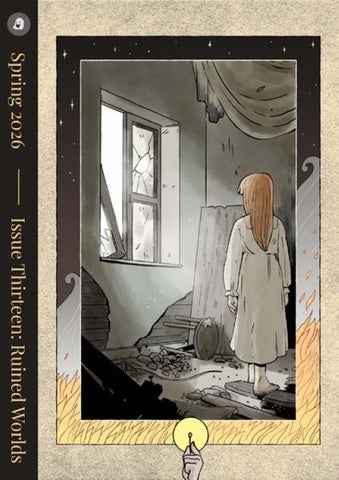
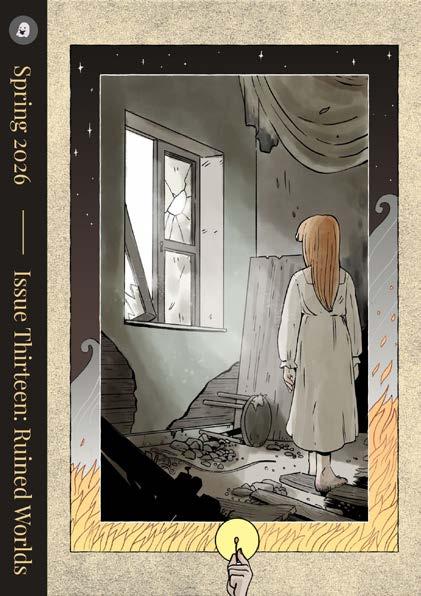
Cover artwork by Maggie G. Vicknair: Arsonist’s Daughter
This magazine is copyright Haunted Words Press
Copyright to all work is retained by the original contributor
Any resemblance to real events or persons contained in the fiction work herein is entirely coincidental. Views and opinions expressed do not necessarily reflect those of the editor.
Well, what an exciting issue this one is. We have twenty wonderful contributors sharing their talent on the page with you this time - from final girls in zombie hordes to found families to ghostly mysteries to a strange pink axolotl. Whatever ruined worlds you’re looking for, whatever this issue’s theme conjures in your mind, there’s something for everyone. We’ve got fantastic work for middle grade and young adult audiences, and we can’t wait for you to dive in.
Our first issue of 2026 marks a new phase of Haunted Words Press: not only do we have new ghosts and ghouls in the team, but Sonnet has joined the editorial world and started his very own Young Writers’ Collection, which means that this wonderful issue collects the writing of three talented young writers as well as the brilliance of the rest of our contributors.
We wish you a strange, magical, gothic welcome to Issue Thirteen: Ruined Worlds, and invite you now to gorge yourself on all the pieces nestled within this issue. We have no doubt you’ll adore them just as we do.
Yours,
Halle Merrick Editor in Chief
Lottie
J.S. Apsley
Middle Grade | Speculative | Grief
It was a Christmas Eve tradition for Rosie to go with her dad to visit Uncle Shug. Rosie’s dad had played in a band with his friend Shug many years ago, before she was even born. When Rosie came along, he quickly became Uncle Shug. But he was an elderly man now, with no family of his own to visit. So, on Christmas Eve, her dad would take her on a wee tour to buy him presents, and bring Shug some festive cheer.
Rosie could guess the presents her dad would buy. They’d always go to the cheese shop in Shawlands, then pop into the supermarket next door to get a bottle of malt whisky, some biscuits, and dark chocolates. Uncle Shug’s house (‘a one-up-one-down’ her dad called it) was a little weird, with all his model war planes and old music posters on the walls. But it was very well kept, and every year he would tell her about something strange which he had just materialised with a strange shimmer, left for Rosie. It was usually something crafty or artistic like a drawing book, replete with amazing pictures of fantastical animals.
Uncle Shug said that the mysterious gifts were from Lottie.
Rosie looked to her dad to get some sort of explanation, but he just shrugged. Uncle Shug said Lottie was the name of an invisible creature which sometimes came to visit him and keep him company. He explained that Lottie had stuck with him after his wife (Auntie El – whom Rosie had never met) had died. Lottie had been attached to Auntie El ever since she had been a small girl. When Auntie El had died, Lottie had been terribly upset, and disappeared for many years.
But then, after Rosie and her dad had started to visit Uncle Shug - well, she had come back. It was uncanny how Lottie always
seemed to know a gift that Rosie would really like.
‘But what is Lottie?’ Rosie asked that first year.
‘Well, she’s an incredibly special animal, and very clever. No’ long after I met your Auntie El, she was upset because her maw had passed away. That’s when El told me about Lottie for the first time, and well, I believed her. And I could’ve sworn I saw … somethin’. It was jist sitting there on the step of your Auntie El’s old hoose. It had this strange pink shimmer to its skin and four stubby wee legs, but it was sittin’ up on the step like you and I would. And then it was gone again. Jist gone.’
Rosie’s nose wrinkled as she tried to fathom the story. Was Uncle Shug making this up?
‘But what does she look like? Can she speak?’
‘Well, I guess I think she looks like … ach, it’s difficult tae tell. If my old haunds still worked I could maybe try tae draw her. But naw, Rosie hen, Lottie disnae speak. She’s never spoken tae me, at least. Your Auntie El … aw love, it’s a shame you never got tae meet your Auntie El, she would’ve been besotted wi’ you. She loved to paint and draw, jist like you. Your Auntie El told me Lottie had never spoke to her either, even though she’d known her for years.’
Rosie looked up to her dad to search his face for answers. Coaxed into a response, he said, ‘Sounds to me like you’re very lucky to have left these gifts from Lottie. She sounds like a magical and clever creature.’
‘Aye hen, your old man’s right. But d’ye know, I think the only reason she came back tae see me, wis for you. Knowing you’d be coming up to check in oan me. So, you must be a special girl.’
Rosie had played with her pencils and papers whilst her dad told Uncle Shug stories about his work, and Uncle Shug reminisced about the gigs he had played with her dad ‘back in the old days’.
At Christmas dinner the next day at her Gran and Grandpas House, she had told her Grandpa about Uncle Shug and Lottie.
Grandpa’s eyes glinted as he stroked his stubbly chin. He was about the same age as Uncle Shug, and remembered going to see the band many years ago. ‘Oh aye, I think I’ve heard about them. Those invisible creatures are particularly good at knowing where they’re needed the most. And they’re very artistic. Aye, I remember a wee lad at my school, Alec. His jotters were full of amazing pictures of wee sea
creatures. He said he had an invisible friend who helped him draw them.’
‘Was that in the old days, Grandpa?’
‘Aye hen, that’s right. In the old days.’
The next year, as Christmas approached, Rosie’s mum reminded her dad to make some time to visit Uncle Shug.
‘Dad, do you think Lottie will have left me another present?’ Rosie asked, excitedly.
‘Maybe so wee love, but remember we’re going to see Shug to cheer him up and give him some company, not to get presents from him, or from Lottie for that matter.’
‘I know dad, I’m just curious.’
‘Don’t I know it wee darling! That’s one of the bazillion reasons I love you,’ he said with a knowing smile to Rosie’s mum.
‘What is a bazillion dad?’
‘No one really knows. It’s all very strange,’ her dad said.
Thoroughly confused but excited to visit Uncle Shug, she barrelled out after her dad, leaving mum to have the house to herself to do the special things that mothers do around Christmas. As usual, they stopped at the cheese shop, and got his other presents too.
When they arrived, Uncle Shug was at the window upstairs, waving like a madman. He thrust open the window. ‘She’s been again! She’s been in to visit during the night! Wait till you see!’
Beside herself with excitement, Rosie bounced up the stairs, her dad at least four steps behind trying to keep up, with his hands full of small parcels of cheese and other accoutrements.
At the landing, there was Uncle Shug with his stick for balance, his door flung open with abandon. Rosie gave him a big hug. ‘Is it Lottie?’
‘Jist you wait and see hen! Go intae the front room and take a look.’
Shug limped after her, leaving the door open for Rosie’s dad. When he reached the front room a few minutes behind, he couldn’t believe his eyes. The wall next to Shug’s fireplace had been adorned with an amazing portrait – of Rosie. It was incredible. Rosie stood facing the image of herself, agog.
‘Couldnae believe it when I came through for ma cereal this mornin’. Yesterday, it wis a bare wall. Now look at it!’
‘It’s amazing Uncle Shug! Was it Lottie?’
‘Course it was, wee barra, your old Uncle Shug couldnae manage that. Even if ma haunds wurnae ripe with this blessed arthritis, I couldnae paint that!’
Rosie’s dad kneeled down to get a closer look. It was remarkable. ‘That really is amazing, Shug,’ he said, his face perplexed. The painting of Rosie was almost photo-realistic.
‘Is Lottie here?’ Rosie said, looking around with wide eyes.
‘Well, I don’t know for sure hen. But I jist reckon she might be. She’ll want tae get a look at your coupon, starin’ at this painting!’
Rosie gasped, and looked up and down and all around the room. ‘Lottie!’ she said. ‘If you’re here, don’t be afraid. Thank you for the painting of me. It’s lovely. I really love it. Perhaps if you show yourself … I can do a picture of you?’
They all, all three of them, stood in silence to see if Lottie would show herself. Suddenly, all Shug’s model warplanes fell off his sideboard, scattering to his carpet. All of them.
‘Lottie! Don’t run! I’m your friend!’ Rosie cried.
‘Well now, I’ve never seen anything like it. I just wish your Auntie El was here,’ Shug said.
‘And I wish you’d keep your windows closed Shug, it’s freezing outside.’ Rosie’s dad moved into the kitchen to close the window Shug had hollered at them through on the way in, and put the kettle on.
‘She’s beautiful,’ said Rosie quietly.
‘What’s that darlin’?’ Shug asked.
‘I … I saw her. When she knocked over your planes. I saw a flash of pink. She was all – shimmery. She looked like a big – I don’t know. Like a cross between a lizard and a fish. With little fronds down the side of her face. She’s so beautiful.’
‘Well now, that sounds like old Lottie alright. I tell you what, why don’t you draw her, whilst your old man and I have a blether and he gives me all this cheese.’
A little later, they said their goodbyes.
‘I’ve left a present for you, Uncle Shug, on your table,’ Rosie said, and she wished him a Merry Christmas.
‘Well now, aren’t you jist a wee darling.’
Shug gave Rosie’s dad a hug, and he saw them out. Toddling
back inside, the house was suddenly so empty again, so quiet. He ambled over to the window, rubbing his hip, and gave them a wave as he watched the car drive off.
‘Right, time to put the kettle on for another cuppa,’ he said to himself. On the table in the front room was Rosie’s little offering, her drawing. Shug lifted it up to get a good look. Rosie had drawn herself sitting on the couch next to her dad and Uncle Shug, everyone labelled, like a cartoon strip.
And there, right next to Shug, was Lottie. Shug’s eyes widened. ‘But that’s exactly right! That’s her! That’s Lottie!’ he said, clutching the drawing to his heart.
It was some months later when Rosie’s dad announced they were going to take a drive over to see Uncle Shug’s.
‘But it’s not Christmas Eve yet, dad,’ Rosie said.
‘I know love, but I can’t get hold of him. I’m worried he’s fell over with that gammy leg of his, and can’t reach the phone. Best we check in on him, and make sure he’s okay.’
‘Well, he won’t be alone. Lottie will be there.’
‘You’re right Rosie. I’m sure he’s fine. He’s probably just lost his phone down the side of the couch. But let’s go see him all the same.’
Outside Uncle Shug’s house, Rosie felt a sudden pang of worry. The curtains were drawn, and it was late afternoon. They should be open by now. Rosie’s dad tried the door and knocked several times. It was locked shut. He shouted up at the window. There was no response. He tried calling Shug’s phone again.
‘I’m going to take a look round the back,’ her dad said with a slight tremble, and disappeared.
Rosie stayed at the front. She didn’t like this. No, not one bit. And then, she heard a very audible click, and a thunk behind the door. She tried the handle … and it opened. But there was no one there. Uncle Shug was not at the top of the stairs. ‘Uncle Shug! Are you up there? It’s Rosie!’
There was no response at first, but then Rosie heard a clatter. She ventured up the stairs and into his hallway. ‘Dad, I’m in!’ she called back down.
The house was freezing and there was an odd musty smell. She walked along the hall and opened the door to the front room. Uncle
Shug was lying face up on the carpet, his legs spread out awkwardly. His mouth was open in a very unnatural way, and his eyes stared blankly at the ceiling.
Rosie was rooted to the spot, startled, as she tried to understand what she was seeing. She felt as if her head had been plunged into frozen waters, and if she opened her mouth to shout for her dad, she would drown. Uncle Shug was dead, and she was helpless.
Just then Rosie’s dad appeared in a fluster and put his arms around her. ‘Rosie! You should have waited for me!’ he bristled in shock, his eyes taking in the scene. Realisation dawned that his old friend had died, and his little daughter had discovered the body.
Rosie’s eyes were blurry with tears. Uncle Shug’s face was horrible and twisted and it frightened her deeply. It was him, but not him. She buried her face into her dad.
‘What’s happened to Uncle Shug,’ she cried.
‘I’m so sorry you had to see this Rosie. Your Uncle Shug has passed away. He’s dead, my love.’
He held her there for a time, then knelt to look more closely. Uncle Shug was holding a piece of paper. ‘This looks like one of your drawings,’ her dad said. He took it from the stiff hand of his friend and turned it around.
‘Is that …’
‘Yes, dad, that’s us with Lottie when we visited last Christmas Eve. She was the one who let us in. I heard her unlock the door.’
Her father stood and, taking her hand so she was not left alone with the body, checked the other rooms. The house was empty – filled with absence.
When they came back into the front room, Rosie’s dad walked over to all the model warplanes and lifted a Spitfire from the floor. Shug had clearly had a heart attack or stroke, and collapsed into the sideboard. His planes were knocked everywhere. His voice cracking, he said, ‘Your Uncle Shug really loved all these little planes, didn’t he.’
Rosie had never seen her dad upset like this, and it made her queasy. Her dad was always so strong, invulnerable. She made herself glance again at Uncle Shug, then looked back to her dad. She suddenly realised that someday she would lose her daddy. The thought of it overwhelmed her and she began to cry.
‘Oh, my love, it’s okay to be upset. We loved your Uncle Shug, didn’t we? We’re so sad he’s gone.’
‘But what if you go, daddy,’ she whispered.
Holding her, he raised his head to look at the ceiling so as not to let her see the pain on his face. He closed his eyes and stroked her head.
‘Now, now, Rosie. Your dad’s here. I’m here for you. I’m not going anywhere anytime soon, and I’ll always love you.’
As he opened his eyes he felt the oddest sensation, as if he had been gripped by something shimmery, held tight. Something was protecting him, shielding him … consoling him.
‘Can you go to the kitchen and get us some juice from the fridge? Make sure the glasses are clean. I need to call your mum, and call an ambulance.’
Rosie gave her dad a kiss and left him to his calls. Wiping some tears, she looked around the little kitchenette. Where did Uncle Shug keep his glasses?
Behind her, a cupboard door opened all by itself. She turned and without even thinking, collected the glasses and said, ‘Thanks Lottie. You must be so sad too. Don’t worry. You can come stay with me.’
In the front room, Rosie’s dad had put a cushion below his friend’s head, though there was no point. He then closed his friend’s eyes, though there was no reason to do so. He clasped Shug’s hands together, though there was no need. He picked up all the little planes and placed them back gently, though there was no one left to admire them.
Taking a step back to think of his old friend, he breathed deeply. There was, he realised, every need to do the little things he had just done. He was respecting his friend. He was caring for him and his things. It was what you did, for someone you loved.
Rubbing his eyes, he heard Rosie chatting in the kitchen.
‘And it grew back all by itself?’ she said.
‘What’s that Rosie?’
‘That’s so amazing, Lottie. You must be so magical.’
‘Rosie? Who are you talking to?’
His daughter came out. She was holding two glasses of orange juice and had a smile on her face.
‘I felt so sad, dad. But Lottie explained it to me.’
‘What do you mean, love?’
‘She told me about losing someone. It’s like losing a part of yourself. That’s why it feels so sad that Uncle Shug has died. And why it made me worry you might die.’
‘Now Rosie, you don’t need to …’
‘It’s okay dad. Lottie says it’ll get better. She says that part of you, that part we think we’ve lost when we lose someone – it’s still kinda there. Lottie says it can grow back. It can heal. She said she once lost her whole leg, but it grew back.’
‘Did she now,’ her dad replied, scratching the back of his head. He stood up, and walked into the kitchen. Rosie had left the fridge door open but he walked past it to peer into the little pantry at the back. There was no one here. But then, behind him, and out of the very corner of his eye, he thought he saw a flash of pink. It was so strange! And as he turned, the fridge door closed. It closed by itself.
There, on the fridge door, Uncle Shug had affixed a picture. It was a self-portrait of his wife, of Auntie El, but wrapped around her was a giant, pink –
Rosie was standing beside him looking at the picture on the fridge. ‘That’s her. That’s Lottie. She told me she belonged to Auntie El. When she died, she had been so sad, but so was Uncle Shug. So Lottie came back to keep an eye on him. But now he’s dead, too, and she’s worried about us.’
Rosie’s dad took the picture off the fridge. He retrieved Rosie’s picture and studied them side by side. Then, seeing the creature on both was identical, a smile broke out upon his face, and he gave his daughter a kiss. ‘Do you know, Rosie, I wonder if you should ask Lottie if she’d like to come home with you for a while. Perhaps she’d like to meet your mum.’
She took her father’s hand.
‘You’re so silly dad. Lottie didn’t stay for me. You’re the one who needs her the most. To help you feel less sad about Uncle Shug. She knows you can’t see her. But I can. So, she told me to tell you that everything would be okay. She said to tell you it was like losing a limb, that a part of you would feel … missing. But it will heal. You’ll heal up. She promises.’
Rosie’s dad kissed her on the head.
‘You are such a very clever girl, and I love you.’
They sat together at the kitchen table.
‘Let’s have our juice and wait for the paramedics. They’re on their way.’
‘Sure dad. Before she goes, Lottie would like to hear the story about you and Uncle Shug playing the gig in Dunoon. The one where he got locked in the hotel and stranded.’
His mind reeled. He had never told his daughter this particular tale. ‘How did you …?’
‘It’s not me, dad, it’s Lottie. She wants to hear the story. She says people will want to hear all the stories. The stories about you and Uncle Shug when you were in the band and got up to mischief. So, you can remember him, and laugh.’
‘This Lottie is very … aware of things, isn’t she.’
Rosie just smiled.
Her dad took a deep breath. ‘Just one thing. Does Lottie really look like a giant …’
‘Yes dad. She looks like herself. That’s how I knew how to draw her. Isn’t she beautiful? I do wonder where she came from, but I guess it’s not important.’
‘It’s not?’
‘No, silly. What’s important is that the reason we feel sad is because we loved Uncle Shug. Now drink your juice – you’ll be dehydrated.’
He looked at his daughter and burst out laughing. She reminded him more each day of her mother. He looked around the room to see if he could spot the mysterious, invisible creature which was teaching his daughter, and teaching him, about grief and loss.
‘Thank you, Lottie,’ he said aloud.
‘Thank you for keeping an eye on Shug all these years. And thank you for being a friend for Rosie too.’
Rosie smiled. ‘You’ve made her blush dad. Now. Tell me the story about Uncle Shug getting locked in the hotel.’
As Rosie’s dad told her the silly story, she watched as Lottie swished around, climbing the wall and opening the kitchen window behind him. Rosie laughed at her dad’s story, and nodded, as the giant, pink, frilly-faced invisible axolotl sloped out of the window.
After a final look back at Rosie and her dad, she vanished; her soft, shimmering trail gently fading. Rosie had her dad, and her dad had Rosie.
They would be just fine.
In Here
Sadie Leewood
Middle Grade | Horror | Trapped
Whenwe finally fell upon her, it was because of what Pokey said. We were skinny and thirsty and all the food was gone or trapped, but we remained wary of his idea. She was our Mother. She hunted Out There, bringing us the finest meats and treats—nothing like we had been able to catch even in our younger days Out There.
Her superior abilities meant we had grown fat and slow, so decadent were our lives. Only Pokey still practiced his tricks, stealing from cupboards left ajar or, if Mother didn’t close the front door quick enough, he darted Out There, disappearing for days, returning home by way of a plastic box, Mother admonishing him for his knavery. But he kept his skills up and could sometimes kill the tiny flying prey that dared intrude upon our palace. We asked how they tasted when he devoured their small flesh, but he just blinked and walked away.
His talents helped us thrive when Mother first fell. He used his cleverness to pull open the door guarding our food and knock the kibble bin over. We feasted on a mountain of plenty.
But that was sunsets ago.
He had tried to make water come from the shiny stalks, but he could not manipulate the round knobs like Mother had. Without her and her prehensile claws, we were trapped inside our dry palace. Why had we let ourselves become so content and helpless?
The small doors were closed, the ones we could see through, because it was the cold season. Pokey had escaped through them more than once, tearing holes in their scratchy fabric, but he could not open the hard, clear doors to Out There, even if they were small.
When Mother came down the stairs so fast and upside down, the youngest of us ran to her, pressing into her hands and face to wake her, scratching at her feet to engage. But as the rest of us approached, the scent of meat was already strong on her.
We resisted the urge to eat, because she was still Mother, still smelled of tender scritches and sweet trills. Even if she spoke only nonsense to us and sometimes caught our tails with her clumsy lumbering. She was not as graceful as us, but she was the hunter. She provided.
Without Mother to distribute the meals, we let Carl have the first of the kibble. He ate to his fill, but even so, he was slowing. His special food was inside hard capsules we could not open, not even with our teeth. He needed wet meat and water. His bones were sticking out and his blinking was stiff.
‘We’re running out of time,’ Pokey said.
‘Running out of time for what?’ we asked.
‘We’re becoming meat,’ he said.
Pokey led us to Mother at the bottom of the stairs. Her smell was only meat now. Her thin, changeable fur was wet and rotten. She tasted amazing.
That’s how they found us. Not in our deep, sad respect, spending days in hunger and resistance, but in what may have been our final act—if not for them. They shouted, then crashed through the door with a bang, and then screamed as we all ran Out There, licking our faces clean of sin, free of our palace at last.
Smog
Mario Senzale
Middle Grade | Mystery | Ghosts
Danny hit a home run off Merrel Brown and watched it go. The ball climbed over Ralph Johnson’s glove, over the Wilson’s fence, over the street, still going, and everyone was yelling and Danny was yelling and Jerome Williams yelled ‘smog!’ and everyone ran away.
Danny’s mother was in the doorway with the screen already pushed wide. He ran past her into the kitchen, diving into the living room couch. She came in after and he heard the windows, one room then the next, and then the curtains, the rings sliding, and the house went amber and close.
Grandma Ezella was at the rocking chair near the heater. She was always there. She smelled like tiger balm and she called the smog them. Danny asked her once what she meant. ‘Come here in the morning. Early, before your Momma’s up.’ He did. She took him to the front window and put one finger on the curtain.
‘Don’t.’ Momma Leslie stood in the doorway. Neither of them had heard her wake.
‘You was younger than him when you saw them.’
‘And look what it did to me. Make the boy some breakfast,’ Momma Leslie said.
The next afternoon, Danny was inside before they arrived and he sat on the kitchen floor with his cars while Momma Leslie closed the rooms in order. Kitchen first. Grandma Ezella was at the table. She winked at him and walked to her room. Danny followed her.
‘Look,’ Grandma Ezella said, parting the curtain slightly with two fingers. He got closer and saw. Smog.
‘There’s nothing there.’
‘Watch closely.’
A man stood on the sidewalk across from the Williams’ home. He was carrying a box. He took it to a car at the curb and put it in the trunk. Then, he went inside and came out with another box.
‘That’s Jerome’s—’ Grandma Ezella shushed him. ‘What’s he doing?’
‘He’s moving out.’
‘What do you mean? That’s not his home.’
‘Not anymore—he left.’
‘Left? Left where?’
‘Away.’
He didn’t understand and kept looking through the slit. A couple and their daughter were walking out of Merrel’s home, the dad carrying a suitcase.
‘Don’t scare the boy.’ Momma Leslie spoke. Grandma Ezella closed the slit. Danny ran to his mom and held her leg.
‘He’s old enough,’ Grandma Ezella said.
‘You don’t get to say that.’ Momma Leslie scooped Danny up and held him against her.
Poppa came home after dark. The curtains were open, smog long gone, the street ordinary in the blue-black night. For a moment he was just a shape. Dark, upright, his jacket caked heavy with grit. Danny heard the doorknob and ran to the door.
‘Danny boy!’ Poppa said, scooping him up.
‘Poppa, I saw them, I saw them.’
Poppa’s smile faded.
That night, they had asparagus and turkey casserole. Nobody talked about it until Danny asked.
‘Grandma Ezella, who were those people?’
Grandma Ezella looked at her plate. She moved a piece of asparagus to the side.
‘Are they ghosts?’
‘Daniel!’ Momma Leslie snapped. Danny ate. He watched Grandma Ezella from the side. She was chewing slowly, looking at the fork.
A few days later Grandma Ezella came to pick him up from
school. Danny saw her from the line—her coat, her slow walk, the way she planted her cane. He ran to her.
‘Grandma Ezella! Where’s Momma?’
‘Late shift.’ She took his backpack without asking and slung it over her arm. ‘Let’s go home.’
They took the long way. Danny knew she knew the short way so he didn’t say a thing. Half a block from the Williams’ house she slowed down.
‘Those people you saw, through the curtain—they already left. Long ago.’
‘Why did they leave?’
Grandma Ezella walked. Her cane made its sound on the sidewalk.
‘You’ll know when you’re older.’
He took her hand. She let him.
‘Are you gonna leave too?’
She squeezed his hand. ‘I’m still here, ain’t I?’
The next morning, Momma Leslie went outside with the bucket and the cloth. Danny watched from the kitchen. She moved the cloth in long strokes across the outside of the glass. Danny got his shoes on. He found his marbles in the coffee can under his bed, the blue one and the three clear ones and the big steely. He went to the door.
‘Back before dark.’
‘Yes ma’am.’
He went down the steps. Ralph was already in the street with his sister, a circle scratched in the dirt, both of them crouching down, arguing. Ralph’s sister had a red marble Danny had never seen before. ‘You ready?’ Ralph called.
Danny put his thumb behind the steely. ‘Let’s go.’
After the Castle Fell
Abraham Aondoana
Middle Grade | Literary | Rebirth
The stones remember height. They whisper of banners, of feasts, of laughter echoing in halls now open to sky.
I walk the courtyard where grass claims the gaps. A dandelion grows from what used to be a throne.
It does not ask permission. It simply rises.
Ruins are not endings. They are questions.
What will we build from what remains?
Tiny Robot
Luke Barron
Middle Grade | Sci-Fi | Robot
In the rubble of a building, in a city, on a planet, in a galaxy, in some far off universe, there was a Tiny Robot.
Tiny Bot (or TB as their friends called them) didn’t know how they got here, beneath the mish mash of concrete, steel and brick. What TB did know is that their little leg was stuck under a weighty steel pipe. They knew this because of three things: first, they could see the scarred cylindrical piece of metal laying on top of TB’s left leg. Second, they could not move their left leg, the short stub barely visible underneath, allowing TB to determine the pipe was the most likely cause of that. And third, there was a great deal of pressure felt along the length of the left leg, almost assuredly stemming from the pipe on top of it.
This led TB to another discovery: feeling. Feeling in the physical sense, of touch and connection. Of weight. The pipe had much of it, too much for TB’s little hands to move it off. The only evidence that TB had even laid their hands upon it was the itty bitty scuff mark along the left side of the pipe and the recollection of pressure and strain against plated limbs.
The scuff mark piqued TB, causing them to look down at their hand, registering the small layer of dirt that had imprinted onto the palm. They moved a finger or two down to smooth out the dirt, renewing the discovery. Feeling in the physical sense, of touch and connection. Of being weight. The prod of a finger tip creating pressure, distributing the surface of earth, creating pools and cavities where form once took shape, the ruptured remains quietly spilling out of TB’s hand, returning to where they came.
This discovery inspired new ones in its wake, the prodding of pebbles, the touch of a jutting spike, the caress of a mold of brick. Everything was just the slightest bit different from the rest, small indents differentiating two similar rectangles of brick, the crevices of individual pebbles. Everything was distinct. This was another thing TB had come to know.
But they all felt the same, in a way. Differences in size, weight, purpose, material. As TB picked up a pebble in one hand and a brick in the other and they knew, they knew, they were different. But they felt the same: simple pressure. No... texture. TB could not feel the differences in their texture. TB could not truly feel them. Slotting their hands together and squeezing with all the little strength in their body, it was still the same. Metal on metal. Pressure on pressure. Weight on weight. TB could not feel the world around him.
In the rubble of a building, in a city, on a planet, in a galaxy, in some far off universe, there was a Tiny Robot who could not feel. And that made the Tiny Robot awfully sad.
The Boy Beneath the Stairs
Kamea Kyon
Middle Grade | Fantasy | Mysterious
Bea knew little of the boy beneath the stairs, though she suspected he was beautiful.
‘Listen, Bea. Are you listening?’
Bea hadn’t been listening. It was their first full day in Paris: the city of love, the city of light, the city of adventure. How could he expect her to pay attention?
‘I’m sorry father, there are just so many things to see and do here! The doorman, just now, he was humming Clair de Lune!’ Bea began, recalling the jovial man in the doorway. ‘And the plum wallpaper, why it’s –’
‘Bea, what have I told you about your ramblings?’ he asked, impatient.
‘‘People don’t want to hear what kinds of things little girls find fascinating,’’ she said plainly.
‘Exactly right, my love,’ he petted her head. ‘Now, I’ll be gone during the day, but I want you to do what the hotel maids ask of you. I’m sure they will find ways to occupy you. I’ve let them know of our, situation, and they assure me you will be well tended,’ he stumbled over
‘situation’ as if she didn’t know just how strange it was that her mother was no longer around to care for her.
There were lots of things her father thought her too young to understand, too young to notice. He thought she was too young to notice how he drank too much and came in too late, how he never wrote to her grandparents anymore and filled his pockets with daisies. But she wasn’t too young to notice these things. She noticed.
And she noticed things about the Paris hotel too. Wonderful things that she longed to talk about. Yes, there was the doorman who hummed Clair de Lune, but there was also the painting of a noble girl and a dog that hung above her bed and the lounge downstairs that served hot tea from 8 till 10, the buttered sweet crêpes her father had brought for her this morning.
‘Anyways, I’m off,’ her father said, grabbing his typewriter and notebooks from off the wide desk, ‘Please be a good girl.’
And she was. All day, Bea did as the hotel maids told her, sitting with the women as they read and sewed and ate. There didn’t seem to be any other girls her age in the hotel, the youngest besides her was already wearing her hair up in an elaborate bun and spoke nothing but French.
Whenever the maids or guests forgot about her, this odd little American girl, Bea could be found sitting by the window, gazing out at the city, watching as workmen laid bricks and washed windows.
The rebuilding of the war-ravaged city fascinated her. And even though she was so near all of it, she couldn’t help but feel lifetimes away.
Bea was unable to sleep.
‘The time change, father. It’s not even 5 o’clock in New York. I’m sure a glass of warm milk will put me right to bed,’ she said.
‘Fine, but be quick about it,’ was his curt reply, his bedside lamp already turned out, pages of type lathered over the surface of the small side table. He had gotten in late that night, barely finishing his soup and crusted bread before retiring to their room.
Bea descended the stairs with a grin, pleased with her clever deception, for time change was not the real reason she longed to travel downstairs.
You see, Bea would have her adventure, one way or another. Even if it meant wandering off at night. When Bea wandered, she often found herself in places she shouldn’t be, places not unlike the back staircase leading down to the lobby of the hotel.
Bea hadn’t meant to make it all the way to the back staircase, but after she reached the lounge and after she drank her milk, she felt her mischievous feet begin to wander.
First, she only left the lounge and ventured into the lobby. The mustached man behind the counter had dozed and was snoring softly, breath tickling the brown hair above his lip. She walked nearer to him and waved a pale hand in front of his face, stifled a giggle when his nose twitched.
She was still antagonizing the man when she heard a soft voice.
Bea paused, walked down the hall in the direction of the sound, found it was coming from the back staircase leading up to the rooms. The closer she came to the spandrel, the clearer the voice was.
It was singing.
It wasn’t a particularly impressive voice, but it was joyful, unfaltering in its clarity. Bea thought it sounded like the voice of a boy, perhaps one not much older than she. The words sounded like French, but not quite, though she couldn’t be sure. (Bea had stopped taking French lessons promptly after her tenth birthday. She had a bad ear for language. Her father had grown tired of paying the tutor for what he declared to be, ‘Minimal progress.’)
When she reached the staircase, she realized the voice was coming from the spandrel beneath the staircase. She expected to see a small door in the wall, but there wasn’t one, only an uninterrupted length of plum wallpaper.
Confused, she sat down, back against the wall, listening to the voice. It continued on, unafraid and lovely. There was something so familiar in the melody, and she thought she could recall hearing it once, long ago. She considered speaking, but instead raised her small fist to knock once against the thin wall.
The voice faltered.
Then something knocked back.
When Bea got back to her room that night, she was careful not to wake her father. She had never been one for keeping secrets, but she found that she didn’t want her father to find out about the voice, the boy. Real or not, the boy beneath the stairs would remain her secret.
Bea carried on with her days just as her father had wished, sitting in the lounge with the women and watching as men played rounds of chess, joining the maids during their breaks. Nights though, nights she spent with the boy.
He only ever sang, and she only ever knocked but that didn’t seem to matter. There was something so familiar about his voice and the song he sang every night. It was almost as if she knew him. If she closed her eyes while he sang, she thought she could picture the outline of his face. She wondered if he pictured her too. If he pictured her hair yellow, or brown as it really was. If he could identify her blue eyes in a crowd. Once, she had tried knocking on the staircase spandrel at midday, sometime after lunch, but had received nothing but strange looks from passersby. It seemed the boy only ever appeared at night, and only ever to her.
Her father came in sometime around dinner every evening, his notebooks full of information for his next big article. He asked the hotel maids if Bea was in fact minding herself, and they responded that, ‘Yes, she had behaved perfectly well.’ All the while Bea sat, swimming her green beans through her pudding, humming a tune her father had never heard.
Eventually, the last night came.
Bea had never cared for last nights and this one felt particularly difficult. She stayed up until her father’s breathing became deep and patterned. Then, she put on her robe and snuck out the door, her body now used to this nightly ritual. She skipped the milk, not caring to mask her intentions on this final night.
The boy’s voice drifted sweetly into her ears, and she slumped against the spandrel wall, hot tears skimming down her face. She tried to dry them, embarrassed of her childishness.
She knew she had just met the boy, but he made her feel warmer than any heated glass of milk, a feeling she associated with gentle smiles and the smell of fresh picked daisies.
It wasn’t until she stopped crying that she realized the boy was no longer singing. Without thinking better of it, Bea apologized.
‘I’m sorry.’
Those two words seemed to break a spell. They were the only words either of them had spoken to each other, and she felt their weight. She didn’t know exactly what she expected to happen, but it wasn’t for a boy, her boy, to step through the spandrel wall and stand next to her. But that’s exactly what did happen.
Bea barely had time to finish wiping away her snot when he just, appeared. The boy walked through the wall as though he did it every day. And maybe he did. A foot, then a leg, another foot. And then he was there.
And oh, was he beautiful.
His skin and hair were dark, his small nose slightly crooked. There was a long scar on his cheek, and Bea longed to run her fingers along its edges. His mouth, the same one that sang that too familiar song, was wide and full, downturned in curiosity.
All these things were secondary to his eyes, though. Bea tried not to startle at the sight.
The boy had queer eyes, large as golf balls and just as round, the color of lily pads. They seemed to peer into her own with something more than curiosity, something closer to understanding. When he spoke, he didn’t stutter, voice as clear and light as his singing. He offered his hand to Bea. It held one, long-stemmed daisy.
‘Do you want to go on an adventure?’
Outnumbered
Emma Kraus
Young Adult | Horror | Survivor
The Mask
Liz Waldie
Young Adult | Post-Apocalyptic | Friendship
Jeremy Blake stood at the crumbling edge of what used to be the East Quarry and thought about cockroaches. It wasn’t so much their repulsive nature that permeated the center of his thoughts. Rather, their sheer and utter unimportance was the primary point of his puzzling. Quite frankly, he could’ve stood there all day trying to figure out one reason why those unimaginably dull creatures should exist, and still all he would have come up with was ‘because Bird likes them.’
Bird liked cockroaches, but she did not like the way the wind howled around the walls of the West Quarry. The East Quarry—or the eroded cliffside on which Jeremy now stood—albeit treacherous, was quieter for some reason. As he paced the precipice, he considered this. It was hard for him to understand how Bird could love something so disease-ridden, but hate something almost soothing. Despite his puzzling, he never questioned Bird herself. She had her ways and her quirks, but she was Bird, and Bird was good.
A coyote cackled in the distance, and Jeremy parted his chapped lips to cackle back, as if he were twelve again. He could have stood there all day, listening to the echoes of the coyotes. But Jeremy had no reason for standing on the edge of the dried-up quarry for longer than a half hour, so he settled on kicking one more sizable pebble into the dusty abyss, and then turned on his fraying canvas shoe heels to head home.
The sky was a sepia tone that day. He brought his wrist to his ear, listened closely to the ticks of his watch, and stared at the sky for a good twelve seconds, to make note of it in his memory. A few years
prior, he would’ve imagined it as a sign of an impending tornado. But today he simply regarded it as reality.
In the sixteen short years he’d been alive, he’d only really seen two cockroaches. And one of them, unless he was mistaken, had been dead. The other he’d seen four years ago in the toilet at his mother’s work. It had been ‘bring your kid to work day,’ and all he’d really learned about his mother’s job was that people got cranky when the phone rang, coffee was sticky when it dried, and cockroaches apparently enjoyed leisurely swims in the staff toilet.
‘Well don’t touch it, hon,’ Alice said, staring at a computer screen.
‘But it’s going to drown!’ Jeremy replied.
Alice sighed and turned in her office chair to face Jeremy. ‘Cockroaches are supposed to be able to survive the apocalypse. I don’t think a toilet is going to kill it.’
‘But—’
‘Listen, those things carry diseases, and I don’t want you getting sick. Not to mention, if it’s in the toilet, it probably worked really hard to get there. You don’t want to disrupt it.’
‘Why would anything want to be in the toilet?’ Jeremy asked.
‘Maybe it’s taking a bath.’
‘In the toilet?’
‘Like I said, they carry diseases...Want to learn how to make a spreadsheet?’
Now, as he walked across the dirt of the desert, Jeremy felt like a cockroach. He didn’t feel gross, or crawly, or like he was covered in human excretions. He simply felt...purposeless. Four years ago, he never would have considered the notion. He’d just been a silly twelve-year-old boy, slightly repulsed by the sight of that wriggling bug in the toilet, but mostly intrigued. He never would have thought to compare his own existence to that of what one might argue to be the most hated bug in the universe.
He stopped in his tracks and gazed thoughtfully at a cactus. An idea struck him. He’d never considered the possibility of there being bugs in the universe, other than those that existed on earth. It was possible. Maybe his purpose was to discover those new bugs. He looked around. In a world like this, it was highly unlikely that the meaning of his tiny life
was to do something so trivial as discover an alien bug. Four years ago, scientists would have praised him, maybe even given him a Nobel Prize for finding the first alien—even if it was just a cockroach of a bug.
But that was four years ago, before Things happened. Things with a capital ‘T,’ because there was really no other way to say the word. Jeremy and Bird had come up with it together, similarly to how Jeremy had given Bird her name. She’d moved like a bird, in short, quick gestures, and couldn’t seem to remember her name, so he’d christened her ‘Bird.’
Jeremy carefully stepped over the cracks in the earth, as he approached the Hills; giant mounds of dirt that were hardly even hills at all. As he stepped along the reddish-brown footprints he’d left on his walk to the quarry, Jeremy thought of his mother and furrowed his brow. Four years since he’d been in her office, and three years since he’d felt her warm arms, or seen her smile in the face of what was happening. He hadn’t cried when she left. Instead, he’d recognized it as an opportunity to prove his strength. His scrawny, twelve-year-old strength. And today, on his sixteenth birthday, he reached down into the powdery dirt of his footprints, scooped up a handful, and blew it off his fingertips. The flames on the candles.
He had lived three entire years without the help of an adult, and his mother would be proud. He looked up into the sky; the Winds were beginning their rounds. His mother was probably up there, past the swirling air, looking down at him, worrying about whether or not he’d survive another day. But Jeremy knew that under all her worries, she really would be proud. He wiped the residue of the dirt onto his pants and trekked on, remembering last year’s birthday.
On last year’s birthday, he’d met Bird. He smiled at the thought. This was back when he still wore the Mask his mother had given him. It was only when he and his mother hit Nevada that Things had gotten weirder. There’d been something like a London Fog about all of Vegas, but, in addition to the darkness, it had a tint to it. Like mucky creek water. His mother had said it was all the colors of a fresh bruise (blue, yellow, green), somehow separate, but also all at once. And it hit her like the blow a bruise would surface from, too.
Alice wheezed and coughed. She’d handed Jeremy the Mask nearly three days ago, and now he could almost see her bloodshot eyes
watering from across the tiny room.
‘Mom, I think you should take the Mask...’
‘No,’ she said with as much conviction as she could muster between gasps. ‘It’s yours. You need it more. Your lungs...smaller.’
He gulped the air through the filter of the mask and frowned. He could tell she was trying not to itch at her throat. Her fingers would twitch and jerk upwards, but then they’d slowly fall back down to her lap. The dirt caked under her nails was a muddy black color, and it made her skin look ghostly.
Jeremy tightened the straps of the mask and felt the warmness of tears threaten his eyes as his mother doubled over, shoulders shuddering with each rasp.
He wore that thing through ungodly hot weather, and didn’t take it off outside until his fifteenth birthday. He remembered the day so clearly. As Jeremy stood on the same cliff as today, a rumbling noise had echoed in the distance. He’d descended the cliff and hastened his pace toward the abandoned metal hut he’d been occupying. The ‘pitter-patsizzle’ of acid rain hitting the already burnt trees had forced his heart to speed up. Even today, he could still imagine his skin bubbling under the gloss of the liquid, and could remember how, just as the storm reached overhead, he’d slid inside the large door and slammed it shut, not a bubble or a burn on his body.
Once inside, Jeremy had taken off the Mask and breathed, hoping the air would be back to its normal thinness. Inside his shelter, the air was always dense with humidity, but it didn’t taste of soot and decaying skin, so it was fine. Baked beans for dinner was a delicacy, and Jeremy had felt it only appropriate that he crack the last can open on his birthday. He’d done so quietly, with a pocketknife he’d picked off the body of a dead truck driver, and ate the cold mess with his fingers.
That night, Jeremy had fallen asleep to the ticking of his watch. It was sometime late into the hours of sleep that he’d been awakened by a scraping, creaking sound. Naturally, he’d bolted upright, gripping both the Mask and a rusty fire poker. The door to the outside was open, wind ripping through the shelter, so Jeremy had snapped the Mask over his head and, fire poker in hand, ascended the short number of steps to the open door. He’d glanced outside, breathing deeply through his mask. Darkness greeted him, as it did most nights, apart from a faint, yet
ominous glowing green tint to the sky.
‘You don’t really need that mask, you know.’
Bird’s voice had come out so quietly, but Jeremy had whirled around to it, his heart racing in his chest, his sweaty palms rubbing off redness from the rust on his weapon. From within his own shelter, he’d caught a glimpse of two beady eyes peering at him. He remembered bracing himself, as the eyes scurried forward. But he’d ended up lowering the fire poker when he realized that what stood before him was not the menacing thing he’d expected.
That night, he’d hung the Mask on the wall beside his sleeping bag. It stayed there, and every now and then, he’d catch Bird trying it on. It matched her goggles perfectly. Rusty shades of brown, fraying leather. The Mask was designed to fit from the nose down, and when paired with the goggles, it looked like one piece.
Now, a year later, Jeremy hurried home for dinner with that same not-so-menacing person who liked trying on his mask. His watch ticked, and his feet hit the ground in time. A part of him wondered if she’d prepared him anything special for his birthday, but he tucked the thought away as he entered the little cave in the side of the Big Hill. About four feet in, he came to a wooden panel, and he knocked three times, quickly.
‘What’s the password!’ a voice squeaked.
Jeremy paused for a moment. He brushed a shaggy lock of dirtcolored hair out of his eyes and squinted as he tried to remember which page of the plant life dictionary he’d last seen open. Yesterday he’d caught a glimpse of an ‘F’ page, and remembered seeing ‘Forsythia,’ which would probably put him somewhere in the middle of the ‘G’ page today.
‘Goji berries!’ he finally stated.
Bird poked her beaklike nose out from behind the wooden panel and blinked up at him through her enormous aviator goggles. When Jeremy had first met her, he’d taken note of the goggles. She’d pushed lenses out of prescription glasses and shoved them into the massive leather frames, and the end result made her tiny black eyes look enormous.
‘How’d you know it was that?’
‘Lucky guess, I guess.’ Jeremy grinned. Bird gasped. ‘You looked at the book!’
‘Did not!’ He bent down to her height and looked directly into her eyes. ‘Cross my heart.’
She narrowed her eyes, then widened her lips into a smile and opened their makeshift door. The inside of their cave was spacious. Jeremy had found it by following the sound of a crying animal one day. Unfortunate circumstances, to find a new home by tracing the calls of a dying creature who had probably once called the place home, too. But it was a more than suitable replacement for the metal hut he’d lived in before, and the fox was dead by the time he’d reached it.
Modest, yet wide, the cave served as a cool place during hot days and a safe place during the night. As far as Jeremy could tell, Things had settled down about six months ago, but he liked to have a door, just in case he needed to shut Something out.
Bird owned four of her father’s turtleneck sweaters, which she’d managed to fit into her backpack a year ago, and cycled through them every few days. Her small-boned, seven-year-old body practically swam under the fabric of the sweaters. And the necks of them were big enough to cover her lips ninety percent of the time. She scampered over to the table they’d fashioned out of an angular boulder and peeked out from over the yellow neck of today’s sweater.
‘I got you something for your birthday!’
Jeremy beamed. ‘You didn’t need to do that!’ But he scooped her up into a bear hug anyway.
Bird giggled and squirmed, and when Jeremy lowered her feet down to the floor, she stood up tall and spread her arms. ‘Ta da!’
Jeremy raised an eyebrow, puzzled.
Bird nudged her head forward.
‘Is there something I’m supposed to be looking at?’
‘Right here!’ Bird waved her left hand at the table. Behind her sat a fishbowl the size of a bowling ball. Inside was a sliver of a moldy orange, a piece of shriveled carrot, and some twigs.
Jeremy smiled at the bowl, trying to discern what Bird had given him. An imaginary pet? An abstract dinner? A diorama of sorts? ‘Well you gotta get closer,’ Bird said, grabbing his cold fingers and pulling him towards the table. ‘See him in there?’
‘I’m not sure I know what...’ But before Jeremy could finish his sentence, the twigs in the bottom of the bowl shifted. He brought his face
closer, and just as his nose met the glass, a little bug scuttled out from the brush. He leapt backward. ‘What is that?!’
‘A roach.’ Bird grinned ear to ear.
‘Where did you get it? What is it doing here?’
‘It’s your birthday present.’
Jeremy sighed and turned to face her. She looked too innocent. Long and vibrantly red curls poured over her shoulders, and her spindly legs stuck out from the bottom of the turtleneck, bare feet twisting nervously into the dirt.
‘Do you like him? He’s a special kind of roach. A Dubia roach. He’s cute, in’t he?’ She wiggled her pointer finger in front of the glass, as if waving a tiny ‘hello.’
Jeremy approached the glass again. The little bug ran around the circumference of the globe a few times, then paused to nibble on the orange. And in an odd sort of way, Jeremy realized that Bird was right. The bug was kind of cute. Like a microscopic dinosaur. Like a shrunkdown dog. It looked like a trilobite, which Jeremy found pretty cool. ‘Sure, I like him.’
‘I thought you could name him, since it’s your birthday and all.’ Jeremy hiked up the waistline of his dirty, green cargo pants and thought. Dubia roach. D, d, d, what begins with d?
Finally, he said, ‘What about Darwin?’
‘Darwin the Dubia roach!’ Bird clapped. ‘I love it!’
Jeremy gave her a warm smile. So maybe roaches did have a purpose, after all. At least, this little guy’s purpose was to make him and Bird happy. To be a pet. And the more he watched the critter, the more he came to terms with the fact that they really weren’t so gross after all.
Naming the bug made him feel better, too. He liked naming things. It reminded him of his mother. She liked to call unknown things by what they were. Simple terms. When the Winds happened, she called them just that. When a fog rolled in, it was the Fog. Sometimes she used an alphabetical technique. She had a thing for alliteration, so sometimes they’d come across a Burnt Beech. The car they’d owned for the first year or so had been the Jam Jeep, because they liked listening to Pearl Jam, and jam from one of Jeremy’s sandwiches had stained the back seat.
He and Bird had developed a similar technique to naming things. There was already the Fog and the Winds and the Fire and the
Rain, but Bird and Jeremy decided that altogether they made up Things. Sometimes they’d find something that they’d never seen before, like a Shiny Thing, and that’s what they’d call it. Simple was always best for the pair of them, as it had been for Jeremy and his mother.
‘I love you, Jeremy. I love you too much to put you through this.’
The words came out unbearably slowly. Jeremy flinched at each shrill squeak as it echoed through the chasm that was their shelter.
‘You keep that mask on, and you don’t give it up for anything. You hear me? Anything. Unless you have children of your own to protect, you keep that mask sealed tight on your head.’
Alice’s eyes looked...different. Jeremy frowned. They were more watery than usual. Jeremy nodded in response to what she’d said, but she just stared back at him. The bloodshot veins seemed to branch out beyond her eyes and around her face, and it was in that moment that Jeremy realized he’d never be able to speak with his mother again.
Jeremy gave Bird another hug. ‘Thank you for the present.’ He paused for a moment, then said, ‘I have something for you, too.’
Bird’s eyes lit up. ‘Really?’
‘Yep! Close your eyes.’
She wriggled with anticipation.
Jeremy walked over to his side of the cave, bent down, and unzipped his backpack. From inside the bag, he pulled out the Mask. It hadn’t been touched for the past few months since they’d moved. He’d sort of selfishly stowed it away, hoping that Bird wouldn’t touch it. But now that all seemed insignificant. As he ran his fingers over the flaking leather, he remembered his mother giving him the Mask, a gruesome kind of birthday gift. But today it meant something different. He was sixteen years old now. It was time for him to really act like the adult his mother would have wanted him to be.
‘I want you to have this,’ he crouched in front of Bird, holding the Mask out. She reached for it blindly, in a childish fashion, and once her hands fell on the faded straps, she opened her eyes and immediately loosened her grip.
‘Jeremy!’
He nodded his head and nudged the thing closer to her. ‘I want you to have it, because I know how much you like it. Don’t wear it all the time, though, okay? The air gets stale in there.’
Bird nodded as Jeremy helped her pull the Mask over her head. His mother had done the same thing, showing him how to properly align the padding to his face.
‘It’s perfect,’ she breathed. But the muffled words that came out through the Mask sounded more like, ‘Ish burfek.’
After a second of admiring how it felt on her face, she carefully took the Mask off, set it on the table, and threw her arms around Jeremy’s waist. He stiffened at first, surprised by her reaction, but quickly softened his stance to welcome Bird’s hug and watched as Darwin dashed around the fishbowl behind her.
orphic
Evelyn Vozar
Young Adult | Horror | Ghosts
translucency cradles my rough hand having never seen what’s loved me but you’re there i know you are in the thread that quilts my blanket in tea bags that provide solace in these cracked sky times midnights: i watch candlelight bounce off the walls i talk to you then you flicker fast when i laugh and not much at all when i cry the softness of these nights when half the world has gone to sleep amidst it all and you come to me so kindly
Storm
R. Reed
Young Adult | Speculative | Personification
She walks the earth
Her grey skirts cover the world
Her tears drenched the land
Her feet kick over homes
Her hand strikes the land
Looking for something that can’t be found
She moves on
Deadwood
Andrew Searle
Young Adult | Literary | Nature
Humanity, self destructive in nature
Never learning the difference between tragedy and foreshadowing
The empty brick of this world
Half sunk boats, whale bones of timbre Fallen buildings given to the sea, Whole and anachronistic in the sand
An amphitheatre in ruins, lush with the blooming of weeds
Shakespeare’s remains in the rose’s thorns
Buildings of crumbling mortar slowly, being recolonised into forest
An enclosed land no more Fences crumble and mycelium grows rampant
Dampness in the air, mist clinging long past the first Moon of spring
Once reflected in double glaze now shines upon broken frames
The clouds, from on high, have obscured the blight built into our world,
The rain washes away the smog
Looking up there are infinite possibilities in more stars than ever visible before
The age of light pollution is over
But escape is not out there it is in the grit of the soil
the bleached coral forests in an acidised sea
We have decimated this world with the steady hammer blow cut to redwoods older than memory, Slowly but surely the mountain face turned bare and crumbled without its roots
Ruination in every breath
But Death in a forest is rebirth
A restoration in progress
Deadwood is nothing but fertile ground
A future to be found
What Remains
N.A. Kimber
Young Adult | Supernatural | Death
In what remained, those that stumbled upon her might think her a ghost. She was not quite a ghost, but not quite a woman either. Something in between, without name to her, but perhaps, somewhere, in someone’s mythology, there is a name for a creature such as she. What remains of what once was. Something that could neither be forgotten, or remade.
She wandered over what used to be her home. In the pale moonlight, she could see the shadows of the old houses. Of the path by which she used to flee to the forest. The one that was no longer there. But she could see it still sometimes, and when she would, she would foolishly run, hoping each time might be different. That it might finally be real. But just as she would reach it, it would turn. The thing, once mighty and ancient, now replaced by something new, and just as towering. Brighter than it had any right to be.
Gone was her home. The one of her mother and father had raised her in. Sometimes she swore she still felt its stone façade on her fingertips, and she would turn, and see only her reflection, nothing more than a wisp, staring back at her. She would look down at the ground, at the small little stones, and wondered if any of them were pieces of what she had once known. It mattered little. She could never grasp any of them in her hands.
Surrounded by people, she was all alone. For even if they saw her, they walked by her as though she was not there. She was a memory of what once was. A thing best left forgotten, because it had been destroyed for a reason – a hollow justification, but good enough for
most. She was all that remained, and soon enough, she imagined, even she too, must fade.
When it had all been burnt to ash, when it had been taken, and reclaimed by others who had never even known its name, she watched as they all began to fade. Her mother. Her father. Her brothers and sisters. The friends she had practically shared a crib with. The husband that had bound himself to her even in death. The babe that had never even gotten to see her first birthday.
She didn’t know when it began. When they became less of whatever it was they had become. Was it when the first grave was overturned? Or was it when she began to slowly forget their names?
The colour of their eyes? The way their hands had felt in her own? It was disappearing, as all simple things do, when there is no one left to remember them. She did not even know her own name now. But she could trace the paths of the place she had once called home. Could close her eyes and follow it, only to end up somewhere strange and new. But in her mind, it was still there, even if she could only see what had remained after it had been burned away. The outline left in stone and smoke, that she had longed to burn her hands on to prove that she was still there. But she had not felt physical pain in a long time. No...pain for her always sat as a wail in her chest that she refused to release. Because she was afraid if she let go out it, the last bits of what remained would go with it.
But there were moments where she did not dwell. Where she sat before what had now come. She had seen it change so many times, she knew it too would not remain. Even the tallest buildings could fall. Even the strongest could burn. Everything, ultimately, could decay. And so sometimes, she would stand in the middle of it all, a towering forest of sleek glass, and loud noise, and more people than she had ever known, who could see her, but refused to acknowledge her, and she would wonder what would remain, if anything at all. For she was all that was left of what had once been her world. And soon, as all she had loved had done before her, soon she would return to the same dust that had raised her. To the same ash that had felled her.
And she knew it was the nature of things, and she would weep for it, if it would not let that long awaited wail free. To know that all things must be forgotten, even if we wish to remember them. Some things have longer, whether by love or by force. But in the end, it all
fades. It must.
It must, but still, she waited. She remembered what little she could. And she would not weep. Would not let that cry escape her chest. Not until the last ruined memory of the life she had once lived slipped free.
Because she was all that remained. And so long as the busy crowds slipped past her, caught her from the corner of their eye, and shuddered with shame, she still had work to do. She could still make them remember, if not the act, at least the shame. And until the last memory slipped from her frame, that would be enough.
Bolero Blessing
Kim Piercy
Young Adult | Gothic | Dance
Pressing a drum beat of kisses to the bow of your head to heal the buried worries that whisper the tune of the ball in your thoughts.
You are a whirling ghost from a gutted house with bleating creaks to punctuate your poltergeist steps.
Give me your weathered hand and we can wipe the dust off the record shelf, and pop the needle on a disc.
Let us play a bolero that sweeps your spine of webs with the bounce of music, and the movement of a lively Spanish dance.
Celtic Spread
Hannah Dilday
Young Adult | Romance | Tarot
Strangers smiled at The Lovers in us, cheered as I drew the Two of Cups. You grabbed a bottle, and my hand the queen of your soul had come back to reign her claim. As I drank from your poisoned chalice, Wheels of Fortune warned me this love might be reversed! I scaled The Tower because you gave me The World, just to turn it upside down. Your touch cut the deck, drew out The Devil in me. Sharpen all your swords, but be careful because you might just burst into flames. I’ve missed playing with fire, and just one glimpse of my shadow threatened to ignite your heart. Maybe I’ll be your chariot, or maybe I’ll be your hearse. One thing is certain—
I’m your lover, reversed.
I am one rib
Madilyn Hazelton
Young Adult | Horror | Religious
I creak with each step their boots dig into my chest I am but one rib, formed and flattened to be an ever elevating stair. My wooden grain, once full of ridges sharp enough to bite, have been dociled by the burning sole. The gnarled tree where I came was axed down, as I am now, for bearing such fruit. The fruit that is now pried from my hands. My back bends again as my singular rib is ripped from me. Demanded gratitude leaves my mouth as a brittle wind, he uses my rib to pick the meat from his teeth. The other wooden steps arch in response to his reach. Mine is tossed aside into the large pile of bones.
Kelsey
Jensen Young
Young Adult | Dystopian | Apocalypse
My
second-oldest memory was in the Main Room, back when we still used all those baskets of ripped-up toys. Crystal had said she knew a new game we could play, that she remembered it from the outside. Richard had nodded along sagely as if he could read her mind— as the two oldest, they were always trying to prove they knew as much as the other, but I was starting to think their memories might have been just as full of holes as ours.
I asked what the game was, and Crystal stood there with her lips pursed and her eyes closed, waiting for someone else to ask. George did, and so she explained that it was something called ‘Duck, Duck, Goose.’ George asked what a goose was, and Crystal paused and then explained a goose was just an adult duck. Richard nodded and attested that it was true, he’d seen many when he was younger.
Crystal explained the rules with Richard butting in every few seconds, and then we all sat down in a circle with her standing above us. The first couple of rounds were fun, and we all laughed when Maria refused to get up and run in her new ‘heels’ (they were just sneakers with the old alphabet blocks strapped to the bottoms), so Peter broke open a new can of water and poured it down her back so she’d get up and chase him.
I knew I wouldn’t get picked, but I sat very still just in case, my muscles primed for jumping up and sprinting. I almost thought I’d imagined it when I felt John’s hand on my head and heard ‘Goose!’
I leapt to my feet and tore straight for him, laughing as he evaded my hand. I chased him around the circle, nearing my spot on the
rug, his back just inches from my fingers when there was a pain in my chest and I tasted rug fibers.
I opened my eyes and found myself on my stomach, splayed out on the carpet. I blinked, trying to reorient myself, and looked up to the circle with blood rushing to my cheeks. Crystal had her foot out, right in my path.
Everyone started laughing, so I laughed, too.
All the years I lived in the Rooms I kept a secret: I had an admirer. Someone liked me and felt bad for me and really wanted to be my friend, but couldn’t, because the group might have started treating them like an outcast, too. I knew because almost every night I’d come into my room and find a drawing of me on the floor, sometimes two. It felt really nice to think that someone was taking so much time to sketch and color a picture of me to make me feel better. I kept them in the drawer beside my bunk, organized by how much I liked each one.
Some were a lot better than others and captured the shades of blonde in my hair and had a pretty shade of pink instead of my coralcolored lips, and some looked like the person didn’t have a lot of time to finish the drawing. In these, my face shape was wonky, like a warped melon, and my eyes were just dots. I appreciated them all the same, though. Gifts were rare down there. It was hard not to like them.
Once, early on, I tried casually carrying one around the Rooms, inspecting it, seeing if I could get a reaction from anyone. I managed to cross George and Crystal off the list of potential friends, because George grabbed it and laughed at it and said I drew like the monkey in Battledrive, and Crystal waltzed over to me and handed me a book about art she knew I couldn’t read.
I didn’t let it get me down, though. It was a good experiment. Plus, I saw how John frowned at Crystal when she handed me the book.
We had more than books to entertain us. We had an entire sanctuary: the TV Room. It was our church. If you got heated with someone and you decided to fight, you could do it in the Main Room or the Meals Room, but not the TV Room, because you might have broken it or the shelves of movies. When the TV went on the fritz, it was all hands on deck, even mine. A few months into life in the Rooms we discovered a guide to the TV’s inner workings underneath it, and we appointed Crystal and Richard, who could both read, to be our assigned repairers. You weren’t allowed to fight Crystal or Richard.
Movie selection went by popular vote, and that was how we’d only worked through eight of the twenty shelves of movies in eleven years. The number of people who were willing to risk disappointment with a new one were far and few between compared to those who liked the classics.
My favorites were Battledrive 2 and A Night at the Theater, because those were the two most popular ones. Sometimes they didn’t count my vote if I went for something different, so I stuck to those two. If we watched more than one movie, sometimes they’d let me change out the disc.
After watching A Night at the Theater for the first time, we became obsessed with drive-in movies. A big part of it was seeing people from the outside doing what we did—gather around at the end of the day to watch movies. It made us feel legitimate. Seen. Like we were real people.
The air turned electric as we watched Mandy Hickerson and Brad Greer snuggle up together in their car in front of the big projector screen, and we paused the movie there with the Keithville Killer’s knife just barely in the frame to copy the scene exactly.
Maria and Crystal grabbed the chairs from the Meals Room and lined them up, two by two, all the way from right in front of the screen to the back of the room. John volunteered his bedsheet and I helped poke the holes in it, and then we tacked it up to the ceiling together.
‘John?’ I asked, standing perched on a chair in the corner opposite him.
‘Yeah?’
‘What do you think we’ll be doing in a year?’
‘What?’ He turned and looked at me like all my hair had just fallen out.
‘What do you, y’know, think we’ll be up to then?’ I bit my lip.
‘What do you mean?’
I didn’t really want to elaborate. I just wanted him to say anything other than watching movies and eating dried fruit. It was a debate I’d been having with myself every night since Richard went on his philosophy kick and declared we were all living in a simulation. His theory had given words to my fear—not the precise words I needed, but as close as I would get. A lot of the time I didn’t feel real, but what was ‘feeling real,’ anyway? I strongly suspected real people had pasts they could remember. They were on timelines. I felt like I had been cut from any timeline I’d once been part of—and maybe it was still going on without me. ‘I was just...I don’t know. I was thinking of all the stuff Richard said. About things not being real.’
‘Oh.’ His shoulders relaxed. ‘Don’t listen to anything Richard says. If he’s so smart, how come George beat him at arm wrestling?’
I shrugged. I wasn’t sure that could be answered.
‘Listen. We’re real, alright? If I wasn’t real, how could I have done that flip yesterday?’
I just nodded. I was getting sick of hearing about the flip.
I remember when we moved the trash into the food closet. We had been keeping the ratty books and the too-small clothes in a corner in the Main Room, but then the corner became a wall, and the wall became a tripping hazard and claimed George’s tooth.
Richard was the one to notice the space opening up in the food closet. He was always an organizer, and would take the empty crates and stack them, then push the full ones to the front. After George wouldn’t quit complaining about his mouth pain, Richard announced we’d be moving all of the trash into the food closet to conserve space in the Main Room.
I volunteered to move the garbage along with Crystal and Maria
after Crystal gave her a dirty look. Crystal appointed herself supervisor and Maria became assistant supervisor after the first layer of old clothes was dragged out. I didn’t mind the work, and I liked how people made way for me as I marched down the hall, arms full of shirts and ruined toys.
After a few trips I was impressed by how much the food closet could hold. I only had the briefest, faintest memory of what it looked like when we’d first arrived—crates and crates of food and water, stacked higher than Richard—but now the closet was half that. Richard and the others had claimed some of the empty crates for their rooms so they could pretend they had possessions to put in them, so half of the closet’s floor was visible. The concrete looked up at me with—I swear it—a scowl. There was something menacing about it, something evil, like it was the closet’s turn to be hungry.
I shut the door and told Crystal I wasn’t feeling well, then retreated to my room to try and smother the churning in my stomach.
There are happy memories, too. I remember Maria and Peter’s wedding day. It came the day after she told Peter to propose to her, and White Veil, White Lies was on everyone’s mind. It would be the biggest spectacle we’d ever had in the Rooms.
We grabbed all of our sheets off our beds and strung them down the hall, then used two draped over the light above the food closet to make an altar.
I volunteered to be the minister, and Peter tried to argue with me, but then I reminded him he was the groom, so he couldn’t also be the minister, and he let it go. I remember I was good at being the minister—I could hold a book and act like I was really reading out of it.
While I was marrying Maria and Peter I noticed John looking at me, and not like usual. He had a weird look in his eyes. My memories liked to slip away from me, but I knew no one had ever looked at me like that before.
During the reception in the Main Room he came up to me and told me I did a good job.
‘Thanks,’ I said. ‘I’ve always wanted to be a minister.’
He nodded. ‘Yeah, ministers are cool.’ He looked away and picked at a thread coming out of his sleeve. ‘Do you think you’ll ever get married?’
‘I’d like to. At least once.’
‘I never wanna be married.’
‘Ever? Like not even years from now?’
His eyebrows drew together and he looked out toward the wall, like that was where tomorrow lived. ‘Why would I feel any different then?’
I shrugged, feeling embarrassed. ‘I don’t know. I guess in the way you sometimes want canned apples for last meal and sometimes you want crackers.’
He looked at me. ‘I don’t like apples.’
‘Oh. Sorry.’
‘You’re a weird duck, you know that?’ He was quoting House Rules.
‘Well, then one day I’ll be a weirder goose.’
He scratched his head. ‘Sure. I’m gonna go dance, Kelsey.’
‘Oh, I’ll join–’ I shut my mouth once I saw he’d already locked eyes with Crystal, and they were smiling at each other.
I waited to make sure no one else needed a partner, then headed back into the hall to start cleaning up.
One time, the picture had been stuck in the seam between the ceiling and the wall. My heart caught in my throat the second I saw it—it was a good one. There was a rare, careful detail in the lines of the chin and the brows. I needed it. I needed to see it close up.
I climbed onto the top bunk—I always slept in the lower one, since when I was younger I liked to turn over in my sleep a lot—and stretched my arm out until I felt a strain in my bicep. The picture was caught about half a foot further from my fingertips.
I leaned forward and swatted at it, then hooked my left hand into the metal bed frame and leaned closer, my core straightening,
straining, until the pads of my fingers grazed the cardstock, and then Earth dropped out from underneath me and I gracelessly toppled over, my chest striking the small nightstand, denting its top to where the drawer stuck permanently out.
For ten seconds I couldn’t breathe, I could only go through the motion of sucking air into my mouth and no further, until my lungs loosened and I swallowed. My body was back under my control.
When I pushed myself up, moaning over the pain in my chest, my hand slipped and my arm flattened against the concrete. Underneath my fingertips was the drawing, smudged but still in one piece. I grabbed it and rested my back against the ruined nightstand.
It was beautiful—John had imagined me in a red sundress, standing in a field of flowers. If fields of flowers were real, I would have loved to stand in one with him.
I remember our first day in the Rooms, but only barely. I was little back then, little and not overly-concerned with my surroundings. I mainly remember the coat of the woman holding me, it was green suede and it felt like a peach against my cheek. She smelled good—like expensive flowers from the grocer and something else, sweat or tears. Something salty. I hadn’t worried about it at the time.
I remember the woman’s coat but not her face, and I only know it was a woman because she kept talking to me, going, ‘Shh, shh,’ even though I hadn’t said anything. I don’t remember my mother, so sometimes I like to think she had been my mother.
I was in her arms, just big enough to be unwieldy and have my feet awkwardly hanging out, and we were in a group of other adults holding kids. I peeked out and saw them, or the shapes of them—it seemed like a stampede of us, and I remember thinking I’d be scared if it were running toward me instead of me being part of it. We were outside and the air smelled like pennies, and somewhere, muffled to my ears by the woman’s coat, was a siren. She patted my head and told me not to worry about it, that I’d be just fine, so I tried to believe her. I was unimaginably sleepy.
The stampede of us rushed through a large doorway and I saw the top of it and then a ceiling made of stamped bronze diamonds, with large flickering lights every few feet. I turned my head once I felt us going downstairs, and I glimpsed a familiar fountain, but where it belonged I couldn’t quite place. My head was hurting tremendously, and my thoughts had felt like unruly cats wandering away from me.
The ceiling changed from bronze to concrete and the lights weren’t as pretty when we began our descent. I remember the air lost the penny smell, and I felt like I could breathe again. My brain quit trying to process the past hour and instead focused on the present, and it was a relief to have my mental faculties returned to me.
The adults finally stopped climbing down and traversed one last doorway. I turned my head and found we were in a large cement room with bookshelves and baskets of toys—the sort of toys that looked like they’d already been enjoyed for several years. The adults set us down, pointed at us, told us to wait, that no matter what we did, do not leave these rooms, that they would be right back, they were going to get more of our friends, and that they loved us and would see us soon. They left through the door, locked it from the outside, and never came back.
That was years and years ago.
We found the cache of dried food and canned water not long after they left, and gorged to our hearts’ content. We didn’t think about rationing, and it didn’t matter for a long time—given the beds and the books too advanced for even Richard to read, we figured we were a small percentage of what we were supposed to be.
Once, during last meal, George dropped his spoon on his plate, slid back in his chair, and yawned over how boring it was up above. Naturally, all conversation stopped and all eyes latched onto him.
‘What?’ Maria asked. ‘How would you know what it’s like up there?’
He shrugged. ‘‘Cause I went. Last night. I got bored in my room and decided to look around up there.’
‘You’re lying,’ she said. ‘No one’s ever been up there.’
‘We were up there, once,’ I said, but no one listened.
‘Well, I have. I went up there and explored. I can prove it.’
Crystal put her hands on her hips. ‘Do it then. Prove it.’
He made a show of reaching into his pocket and removing something that seemed awfully heavy, then dropped the handful of chalky white rocks on the table and waited for our admiration.
After a beat of silence, Maria asked, ‘What is that?’
‘They’re ground rocks. From above. I picked them out of the dirt myself.’
‘Are they poisonous?’ Patricia asked.
‘Most outdoor rocks are radioactive,’ Richard said knowingly. ‘That’s different from poison.’
‘How so?’ Crystal asked, lips drawn in a pout.
‘Radioactivity is a chemical, and poison isn’t.’
‘Oh.’
‘Wow, I had no idea,’ George said with a yawn, picking his spoon back up and scooping up some instant mashed potatoes. ‘I hope I don’t get superpowers. That would be a pain.’
Maria’s eyes went wide.
I leaned over to pick up one of the rocks and George scowled at me and reached out to swat my hand. ‘Don’t touch them. They’re fragile.’
‘Ground rocks aren’t fragile,’ I said. ‘Remember when Big Vance got hit with one on the head in Mob Rules? It didn’t break or anything.’
His nostrils flared and he pushed the rocks away from me.
‘Well, don’t touch them anyway. These are rare. We can’t risk you breaking them.’
‘What’s it like up there?’ Peter asked. ‘What does grass feel like?’
‘It’s hard and sharp, just like in Putting Greens.’ He shrugged. ‘It really looks the same as it does in the movies. It’s nice.’
It wasn’t until there was no more food that George finally admitted he’d lied.
I remember the day when Richard finally admitted we were running out of food. Sophia said we shouldn’t worry about it, that we
could just start rationing like on Survive, but I wasn’t sure how we could ration a half-crate of food among twenty-eight people. I didn’t say anything, though. They didn’t like it when I said negative things.
Richard said it instead, and everyone else saw his point. I nodded hard to show that I had thought of the same thing, and that we were on the same page. He ignored me and went on to hold up a bag of chips. Not a tin of them. A bag.
We gasped.
‘Where’d you get that?’ Maria asked. ‘It looks like it came straight from the TV.’ She reached out to touch it, and I half-expected Richard to yank it away, but he let her pet it. Of course he did. He was a very good leader.
It crinkled under her fingers and she laughed, and Patricia shoved forward. ‘Let me touch it!’
Pretty soon, everyone had gotten to touch the bag, and Richard cleared his throat. ‘I found this in the closet.’
‘The food closet?’ George asked. ‘I’ve never seen anything like that in there before.’
‘Exactly. I don’t think it originated in the closet.’
We all leaned forward. Things were serious when Richard started using big words like ‘originated.’
‘Then where did it come from?’ Sophia asked.
Richard pointed a steady finger up to the ceiling. We gasped again.
‘God?’ Patricia asked.
‘No. The ceiling. More specifically, a hole in the ceiling. Come look.’ He pushed the door to the closet open and we all gazed upwards at the darkness. The ceiling was very high up, and narrowed into a cement shaft just above the lightbulb. ‘I was doing some investigating, and I discovered this.’ He pulled a flashlight from the pack around his waist and shone it up through the shaft. If we squinted, we could just hardly see a jagged patch of darkness in the middle of the pale cement. ‘We may not be able to break down the door, but one of us can climb up there and find more food.’
‘Who?’ Maria asked. ‘I hope you’re not thinking of me.’ Maria was always hoping people were thinking of her.
‘I was thinking we could get a volunteer. This is dangerous, after
all. A fall from that high up would seriously hurt someone, so I suggest not myself or Crystal.’
We all nodded. They had to have their arms not broken to fix the TV, after all.
‘Who’s stupid enough to want to do that?’ George asked. Everyone’s eyes turned to me, which was not surprising. What was surprising is the fact my hand was raised.
‘Kelsey?’ Richard asked. ‘You want to do it?’ He sounded hesitant but hopeful.
‘Yes,’ I said without thinking.
‘Alright,’ Richard said quickly, clasping his hands together. ‘Kelsey will do it. Does anyone else want to volunteer?’ Peter opened his mouth and Richard flashed him a hard look.
‘I just wanted to say, how is Kelsey even supposed to get up there? I mean, she’s, like, tiny. And weak.’
I scrunched my brow as Richard waved him off. ‘We’ll find a way. Alright, it’s settled.
First thing tomorrow, Kelsey will head up, and we’ll restock our food.’
There was a short cheer and a warmth in my chest. They were celebrating me.
That night I lay in bed, a chill coming over me, my fingers tracing my favorite pictures.
I really thought John might try to talk me out of it. He didn’t. I guess he was hungry, too.
The next morning my group mates were in the Meals Room smiling at me, and I shivered at how odd it looked.
‘We fixed your plate,’ Richard said, pushing forward a bowl of dried apple chips and a packaged cookie. The cookie was a nice touch.
‘How are you feeling?’ Maria asked. ‘Scared? I’d be scared. I’d be terrified. Can I move your nightstand into my room if you don’t come back?’
‘Sure,’ I said, swallowing thickly.
‘Why are you asking?’ George said. ‘Just take it.’
‘‘Cause it’s polite, idiot. And respectful.’
My cheeks warmed as I chewed the apple chips. They were trying to respect me.
John slid into the seat next to mine and my heart skipped. My eyes flitted to his, but I didn’t dare make prolonged contact.
‘Hey, Kelsey?’
‘Yeah?’ I asked, my mouth full.
‘I wanted to give you this before you left.’
‘Oh. Okay.’ My heart pounded as he reached down beside him, until he pulled out a plastic knife. I blinked. ‘What?’
‘It’s to fight bears with. Remember Terror of the Woods? Bears everywhere. Here. I sharpened it against my bedpost.’
He’d worn down the serrated side into a thin line. ‘Oh. Thanks. I’ll keep an eye out for bears.’
‘Kill one if you can. I want to mount the head.’
‘I’ll do my best.’
‘We’ve got one more thing for you, Kelsey,’ Richard said, reaching into his pocket. He pulled out a long purple ribbon adorned with a jagged plastic circle.
I gasped. ‘You’re giving me the Purple Heart?’ Our highest honor—we’d taken the idea from Honor These Stripes. He settled it around my neck, and I felt its weight for the first time. It wasn’t much, but it felt like one hundred pounds.
After placing it, he straightened and pursed his lips. ‘Hurry up and eat. The rest of us aren’t, you know.’
‘Oh. Sorry. I’ll finish.’ I downed the remainder of the apple chips and gave the cookie to Crystal after she wouldn’t stop sighing at it and clutching her stomach.
They paraded me toward the food closet and Richard opened the door like I was the princess in Royal Ties. I’d never been treated like a princess before. I stood below the chute-like ceiling, staring up, wondering how I was even supposed to get into the narrow part, when George rushed in with a stack of chairs from the Meals Room. He extended his hand to me to help me up. I couldn’t recall when we’d planned all this.
At the bottom of the chute, I planted my hands on opposite
sides and tried forcing myself upwards, but my arms gave out and I had to double down, panting.
‘Here,’ George said, wrapping his arms around the bottom of the chair stack. ‘Richard, help me.’ The two lifted me high enough for just long enough to where I could get my back pressed into one wall, and my feet pressed into another. It was uncomfortable, but starving to death would have probably been more uncomfortable, so I didn’t bother complaining.
Scaling my way to the top was agonizing, and my legs were about to give out by the time I reached the crack in the ceiling. I was coated in spiderwebs, and the dust I churned up made it hard to breathe, so I acted as soon as my fingers could reach and I held my hands together like I was about to pray and pierced through the damp drywall. It crumbled onto my face and body and I coughed as the white powder infiltrated my lungs. A spasm in my leg startled me, so I groped around through the dust, searching for a steady ledge, and I finally found a cusp to grab onto. With the last of my strength, I pulled myself up through the hole, the wet part warping around me, slathering my shirt in blackness, and I emerged in a brand new world.
As my coughing fit subsided, I realized how much noise I was making while poised precariously in that silent, still place. The landscape was familiar only in a deep, blurry way. There was something spicy, a long time ago—cinnamon. I hadn’t thought about cinnamon in years.
I found myself on top of a once-white pillar, perched on its edge, not yet ready to stray far from home. The floor was tiled black and white with large pieces of the pattern missing, and rot in their place. All around me grand doorways like I’d never—right, never?—seen before rose, each adorned with a large sign that perhaps once was colorful.
Above the signs was a bronze ceiling rusting in place, swaths of it having already given in and collapsed. Above the carcass ceiling was a skeleton of metal bars and wires, and above that, darkness. It unnerved me—I’d never not been able to see and know the ceiling. It felt like there could be something looming up there, something with the advantage of seeing me in the dirty light trickling in from window panes crossing the bronze in an X.
I squinted up at the panes—had I ever seen sunlight before? Surely at some point. In the movies the skies were blue and cheerful—
this sky was gray, and a distant rumble like a dirge bass startled me. Thunder, I remembered. The sky came with thunder.
The entire building erupted in a white flash and I nearly fell back into the chute. I caught myself and tried to slow my breathing— now that I’d noticed it, I couldn’t ignore the silence and the holes I was tearing in it.
The thunder drummed again and two quick flashes illuminated the concourse, producing a glint of gold far down the way, past where the skylights ended and a dark abyss rose above the floor. I narrowed my eyes and waited for the next flash, and when it came, the two golden doors revealed themselves.
I had a sense of awe and of relief—there was a way out of this strange place if I had to make a break for it, and...wow. Solid gold doors. People in the movies were always talking about gold jewelry and how expensive that was, so imagine an entire set of doors. Whatever this place was must have been very important. That was probably why we were sealed up in it.
Slowly I stood, and once my left foot joined my right I found myself on the floor with a sharp pain in my forehead. I groaned and looked back, finding a small stack of plastic trays underneath where I’d tried to stand. I rolled over onto my back and put a hand to my forehead. It came away red. Already the world was furious with my presence. Well. I was used to it.
From my new vantage point I saw the doorway the pillar belonged to, and—no, not doorway. Arch. It was a large arch with grayed paint and mold slicks down it, and crowning it, a pale pink sign. Its logo sparked in my mind, but only partially—only enough for me to remember it was supposed to be red, not pink. Time must have faded it considerably.
The arch led to a small walkway lined with decayed tables and overturned chairs, and beyond it lay a counter abruptly slicing the space in half. A rusty silver wall sat behind it. I got back to my feet with more caution, conscious of the pink trays littering the space, and once I was standing I saw it.
Food.
Food!
Most of it had turned to black mush long ago, and the items
that didn’t became dust, but beyond the foul odor of rotting meat rose up the shiny glints of plastic bags and aluminum cans. With a shout of joy I dropped to my knees and began shoveling the surviving food down into the chute, my hands blackening with sludge as I sorted the packaged food from the rotting piles. I dropped sixteen bags of chips, twenty-nine packs of soup crackers, thirteen sleeves of cookies, and forty cans of soda gingerly wrapped in the jackets I found hanging off chair backs.
Far down below I heard first a shout of surprise and then of delight, and warmth spread through my chest, settling into my stomach and lingering on my arms, giving me goosebumps. I searched behind the counter for more food as the pleasure of knowing I’d return a hero made my head feel light.
After I’d shoved down all the food I could find, I stretched my arms and shouted that I was about to return, and Richard yelled to let them get the food out of the way first in case I fell. He said they’d leave the jackets down there though, and my skin prickled with the sensation of being loved.
Once I was sitting on the precipice, I heard Maria’s voice. ‘Wait! Don’t bring her back yet. She hasn’t looked around enough.’
I shivered, glancing at the darkness beyond the rotted skylights. Surely they wouldn’t ask me to risk my life? Well, maybe I was just being a baby. I wasn’t five anymore. I shouldn’t have been scared of the dark. But still…
‘Hey, Kelsey?’ It was Richard again. ‘We think maybe you should, uh, look around some more? Like maybe there’s hidden food stores somewhere.’
‘Oh,’ I said, then hesitated. ‘Are you sure? I mean, I can see a lot from right here, and I think this is probably the only place with food. Most of the other places have clothes.’
An excited shout from below, and then some murmurings.
‘Kelsey? You still there?’
‘Yes, Richard.’
‘Uh, Maria and the others want the clothes. You know, ours are getting pretty worn out.’
Some whispering, and a soft, ‘Okay.’
‘And pretty soon we’ll be naked. Y’know, without new clothes. So just see what you can find. We’ll let you have first pick,’ he offered.
‘Oh. Okay.’ I tried not to sound too disappointed, or scared. First pick did sound nice. I never got first pick.
‘You don’t have to go too far,’ he said. ‘Just get enough clothes as you can grab, and maybe look for some food.’
I’d agreed and teetered over the uneven floor toward the arch opposite me before I realized none of them had asked what it was like up here. Before coming up, I’d always figured...well, I wasn’t sure. I never really thought about what the outside world looked like. It would have been like wondering what the center of the planet was like. No point.
Inside the first little pocket of the building, old, ratty clothes hung on racks like wet bandages strung over medical trays like in Slaughter Asylum 5. I could sense they didn’t like being touched because they crumbled under my fingers to get away from me.
There was a large desk in the center of the room with a cash register—I recognized it from Clerk Diaries. Store. That’s what this place was! I whistled. I never thought I’d ever see a real store.
My next thought made me glance back to the pillar with a pang of guilt, but I stifled it easily when I saw a large feather-cuffed coat still mostly in one piece on a stand across from me.
Soon I was wearing it and I had black-tipped cream-colored heels on my feet that were only a little too big, and I was sporting a woven hat. I gathered up a crop of ragged clothes in my arms and swept over to the counter and placed them on top, twirling the Purple Heart between my fingers.
‘Just these today, please,’ I said to no one. ‘Huh? Cash or credit? Just put it on my tab,’ I said with a wave of my hand. I’d learned about tabs from Barhopper. ‘Yes, the weather is just lovely today. Very chilly.’ I’d always wanted to comment on the weather.
My long sleeve brushed over the register and it snapped open, startling me. I jumped back and as I was catching my breath, two small eyes and a fuzzy body rose up from the tray. My heart ached.
‘Oh! You’re one of those hamsters, aren’t you?’ I’d wanted a hamster ever since watching Daycare 2. I reached my hand out toward it. ‘Come here, little guy, I’ll find you something to eat. I’ll take you down and you’ll live with me, and then—OW!’ I yanked my finger away, two tiny puncture wounds on the tip. A flare of anger lit up my chest. What had I done to deserve this place’s fury?
It hissed at me and jumped out of the register, then scurried across the floor into a dark crevice. I shivered after losing sight of it, and for an instant, thought I found it again on my shoulder. I threw off the fur coat and took great lunging steps out of the store until I was back on the main concourse.
I felt good and ready to head back down at that point, but a flash of fire-hot red in the sea of moldy grays and peeling beiges caught my attention.
‘Kelsey!’ Richard shouted. ‘Where are you? Where are the clothes?’
The color was calling to me, but instead of starting toward it I tossed down a ballcap I’d found lying next to a trash can. The ballcap was cool, but it was not clothes. It was also too big for Peter’s head, but just right for George’s, but Peter had caught it, so it was his, but he couldn’t even wear it, but he could, you idiots, Maria said, because it adjusted in the back.
Five minutes later they decided they could share the hat if I was positive there were absolutely no more floating around up here.
I unstrapped and dropped the ratty pair of high heels next just to shut Maria up, and she squealed as soon as they struck the floor. Did they only come in white? Yes, that’s all there was. Was I sure? I was certain. She asked me to look again, and I threw down a stack of trays. There was a collective shout and plenty of swears up at me, and I knew I shouldn’t have been smiling, but I couldn’t help it.
‘What have we ever done to you?’ Maria yelled.
‘I’m sorry, they must have slipped. We’re running out of plates, anyway. And see how sturdy these are?’
‘Kelsey!’
‘Give me a second,’ I shouted back, teetering toward the color. It was in the shattered window of a store across and three down from the clothing store. It was...mesmerizing. Like the red John had colored my dress.
I floated toward it, coming to rest my hands on the sill. The red was paint—it was paint smeared over a white rectangle, with a black streak above it and a blue streak below. I couldn’t read the sign underneath, but I did recognize it had a lot of exclamation points and dollar signs.
I stepped through the rusted-in-place doors, stuck at a permanent half-welcome, and entered the shop. The decay was worse in there—a pipe had burst some years ago and ruined the ceiling, as well as the shop’s inventory, which was largely paper products.
Before setting foot in the store, I hadn’t known mold had a smell. It was like the dirt from George’s pet weed mixed with the body of Crystal’s pet hamster, if you stuck the two in a pillowcase and then decided to live in it.
I wished I’d thought to ask Richard to borrow his flashlight before coming up, because this store was tucked into the inside wall and had no windows. It somehow made the smell worse, like it had to amplify itself to make you aware of it if you couldn’t see it. The only light trickling in came from the two front display windows, and it had to peek around the cardboard backing of the paint displays.
The thin light shone on a central counter and I shuddered, feeling the bite marks on my finger, but there was no register on this one. Instead, the outline of a sink and—oh, wow!—a real, honest-to-God hairdryer!
I stepped over to it, cautious of the missing chunks of the floor, and picked it up. It was a pale blue and coated with flecks of every color of paint. Right on the handle was a big green handprint. I fitted my fingers over it.
I whistled. ‘A real beauty salon.’ When I’d been younger, when I still dreamed of becoming things, I’d dreamed of becoming a hairstylist like in Clips. I would’ve been lightning fast with scissors, and not get nearly as much hair dye on the dryers.
Behind the counter was a long table surrounded by plastic chairs, with a thin little—eraser? Weasel? Easel!—in front of each one, as well as tubes of dye. I whistled again.
This must have been a terrible hair salon.
In front of the table was a tall stool with an empty wooden bowl on top. I stepped over to it and peered inside, hoping for some sort of reward for my bravery, but all I got was a face full of the bugs that were living on the mush inside.
I swatted them away from me and ran to the opposite side of the store, where the lighting was even worse. After slapping myself across the face when a bug crawled into my mouth, I paused a minute to
breathe and collect myself.
Here the remaining white paper faintly glowed in a rack of trays, almost like an underwater pearl in Deep Dive. I reached out to touch one, but a large splotch of paint on it shifted and scurried over my hand, and I yelped and jumped back into the front counter. My hand struck a tray and a flurry of papers cascaded to the floor, bathing it in almost-glow.
Instinctively I rushed to gather them up, but several fluttered toward the seam between the wall and floor, where the rubber strip sealing them had rotted away. I set my fingers to the crease. There was a slight suction, like...like from an AC unit.
I realized we had AC in the Rooms. We had to, or else they would be as mucky as the rest of this place.
I took a breath and slipped a sheet through the seam, and it was sucked up. I turned over another sheet and gazed down at the drawing of a blonde girl with a large smile. I turned another sheet over, and the same girl, now with a chin, looked up at me.
I flipped through every sheet of paper on the floor and still in the tray, and it was all the same: same hair, same lips, same girl. The only difference was the skill.
My hands were shaking and refusing to keep hold on the counter as I tried to pull myself up, so for a long moment, I let myself stay down.
When I was able to get to my feet, I saw her picture on the counter next to where the tray sat. It was framed and sat on a little stand. She had my hair and skin tone, but that’s about where the similarities ended.
I was the stupidest person in the entire world.
Thirty minutes later I came back to the chute, and they were calling for me.
‘It’s time to come back down,’ Richard tried. ‘We wanna hear about what it’s like up there.’
‘Yeah, come on, Kelsey,’ Maria said. ‘What’re you doing up
there, anyway? You already said there wasn’t any more food. Also, could we please get, like, one sock? A shirt? Oh—and Crystal wants new books.’
I didn’t answer. I didn’t even move my feet, because I didn’t want them to hear the shifting of the loose tile.
Crystal cleared her throat—it was gruff, distinctive. Remnant of a cold she never actually got over. ‘You’re starting to waste time! Get back down here!’
Waste time? Whose time was I wasting? They already got what they wanted—the food. Of course, that food would eventually run out, and then someone would have to go get more…
There was pushing below and a surprised cry. ‘Me?’ John asked quietly. ‘Why?’ Then: ‘Oh.’
I strained to listen.
‘Uh, hey, Kelsey. You should come back down now. It’s probably not safe up there.’
Warmth pooled into my chest. He was the only one who’d mentioned my safety.
‘And, uh, I thought about it, and I wanna marry you. So I can’t do that unless you come down. Alright?’
‘We’ll let you be the bride and the minister,’ Maria said.
I didn’t make a sound. I just stood over the chute until it was reduced to uneasy whispers. ‘No, no, not me,’ a voice said, probably Richard’s. ‘The Rooms would fall apart if something happened to me.’
‘What about a lottery?’ Crystal asked.
‘Aren’t lotteries supposed to be good?’ John asked.
‘Well,’ she breathed deeply, ‘a vote, then. I nominate Maria.’
‘WHAT?’ Maria shouted. ‘Alright then, I nominate Crystal. And her boyfriend Richard.’
‘No,’ Richard said. ‘I already explained why it can’t be me.’
‘I second Maria,’ Patricia said. ‘Crystal should go.’
‘Then who’s going to fix the TV?’ John asked. ‘If anyone should go, it should be George.’
‘Why me?’ George asked.
‘You ate way more than your share.’
‘No I didn’t!’
I stepped over to the chute and slipped the Purple Heart over its
cusp. It struck the tile floor on its edge and produced a thunk.
Everything went quiet.
‘What is it?’ Crystal asked. It crinkled as someone picked it up. Then there was one of the exotic words from Crime Spree.
‘KELSEY!’ Richard yelled. ‘Come down here, right now! I order you! You hear? I order you!’
Crystal’s shrill voice came next. ‘Are you stupid or something? You’re way better off down here with us. We’re your family, idiot.’
‘Say something!’ Maria shouted. ‘Don’t make us come up there and grab you!’
I stiffened as if I could bore my feet into the ground. ‘Come up,’ I said.
A pause. ‘What?’
‘Come up here. If you want me so badly, come up. Grab me.’
I couldn’t make out the whispers.
‘John?’ I asked. ‘Will you come up to get me?’
There was shoving. ‘Ouch! Quit it!’
‘Say it!’ Maria hissed.
‘Get your fingers out of my mouth!’
It was at that point I turned away from the chute and faced the dark end of the concourse, the one most reeking of mold and dripping with black water. At the end stood the golden doors, light peeking through the surrounding glass wall. I took a step forward.
Sonnet’s Young Writers’ Collection
Memory of a Midnight Guardian
Rosie Kersley Williamson
Young Adult | Literary | Ghosts
A child painted gold, lying in a pool of flickering light. Only a black-stemmed candle to keep her company, Its fragile bloom glinting like feline eye-shine, But that stubborn flame will not keep the creatures out.
Sly claws skitter over the dark grain, Face pricked with shadow-horns, Sickly light drips over a sinuous body as one emerges. The candle shivers, Yet the tiny sun remains radiant.
Bedsheets groan under the midnight monster, It watches the child’s mouth twitch, a dream-smile brought into reality. The creature stretches its inky jaw wide in its own twisted grin, Young flesh tastes best when seasoned with joy. The rippling nightmare slowly leans in, Damp, rotting breath shifting the girl’s soft, pale, delicious hair–
Ting.
Dark head lifts, The room laid bare under its gaze: No bell glints in the candle light.
Ting.
Ragged ears stand alert, Obsidian spine coiled in anticipation. The candle burns bolder, Heat pressing against the beast’s body.
Enemy claws rake across the nightmare’s back, The creature twists, snarling, Searching for its assailant,
A cry as smoke slams into its crooked face, The monster reels, lunging blindly at the wisp of a tail, Mouth closing on stale air.
A final, triumphant blow lands on its gaping throat. Pitch blood dripping, The beast crawls back into the shadows.
A small cat settles on the bed, Ghostly fur slick like candle-wax.
As he pads across the duvet, the memory of a bell chimes on his collar. Tucking himself into the sleeping girl’s body, the fabric is unmoved by the spirit’s presence. Though no longer a source of warmth in the night, Purrs rumble through the cat’s resting form.
He always sleeps beside her, As he did when both their bodies had held heartbeats, And as he does now, even in death, His black candle painting the mahogany walls gold.
echoes
Abigail Chu
Young Adult | Elegy | Evanescence
once there was a time when i wrapped around your shoulders and laid my head down to rest on your lap.
we sat outside dreaming, planning, talking about all the things we wanted to achieve and the memories we wanted to create.
and yet, when i wake i realize you’re gone and i’m left here to wonder if you were really here at all or if it was all a fantasy.
The Scrivener
Sophia Helton
Young Adult | Fantasy | Creation
Iwrotethe world into existence. Then, I wrote it out of it.
I feel guilty about one of those.
Wandering through the halls, I tip my head upwards to watch the way the crystal of the chandeliers no longer sparkles, the burnished gold no longer shines. I leave a trail of footprints behind me in the dust. It is the only mark of living in the whole place—the only thing that tells me I’m real.
Out of the corridor, into the ballroom. I slip inside, instinctively hunching my shoulders, making myself smaller the second my bare feet touch the tiles. But… I don’t have to do that anymore, do I? Slowly, I straighten and take another few steps forward. There’s a certain echo to my footsteps, now. It sounds empty. Dead. Not real anymore…
It takes me a while to weave my way through the vast room. I don’t want to brush against the blurred shapes scattering in clusters around me, vague outlines of ball gowns and suits stretching on and out as they slowly lose their form. Every few moments I have to stop and tell myself to breathe. Breathing will remind me I’m not like them. Breathing might make me forget that I made them like that.
Clutched in one hand, I hold a crumpled piece of paper, ripped at the edges and thick with ink. My fingers tighten around it as I step in front of one of the gray shapes. This one is tall, towering, bigger than me and stronger than me and hating me—breathe. This one, like all the others, is not there anymore, and that’s… my fault. My wonderful, wonderful fault.
I stand before the Baron—or, rather, what was the Baron—for a
long moment. Only when the thing’s face has blurred enough that I can’t make out its details do I make myself leave.
The halls stretch and twine around each other like worms, and I get lost. I don’t care. I just walk through them, watching the gray seep through everything. Soon the oil lamps flicker out. It’s all darkness, save for the wan, bleached light sidling in through the arched windows. I wander under and past and through the light like a ghost.
Ghost.
Stopping to trace a finger through dust, revealing the ornate carvings etched into the stairway’s banister, I consider this thought. Ghost. Dead. Gray—all of it, gray. Words I repeat to myself until they’ve worn grooves in my mind. Gray, dead, gone…
Is this… what I wanted? Is this right? I don’t know, but… I do know I can’t be upset about it. I did it, after all.
I wrote the world into existence. Then, I wrote it out of it.
I feel guilty about one of those.
It’s the first one.
Long ago, I felt older. That… doesn’t make any sense, does it? Nothing much did, then. I had a dream for a world, and I poured it out in words, ink flowing from my veins and spilling and splotching and turning into wonderful, wonderful things. Alive things. Real things…
So many real, boundless things.
In the days, or years, or decades after I wrote everything into existence, I spent my time much as I had before—writing. I made new kingdoms, villages, settlements as easily as I breathed. I added little details that probably didn’t fit, but made me happy. I hardly knew what I was doing. Only that, one moment, there wasn’t a world, and the next, there was.
I liked knowing that there was another world that was my own. And it was my own, even if it didn’t know me. It shouldn’t have known me…
Bring me the Scrivener.
My world found me, one day. Took me. And I found it wasn’t wonderful. Just awful. Awful, awful, awful… It hated me.
I felt so, so young when I found out it hated me.
I wander a bit more because, as I’m now finding out, without a world to do things in, there’s… nothing much to do. Maybe because there’s nothing much at all. It’s all gone. All the bad things, and… Were there any good things? Are those gone, too? I think, maybe, once, there was something good about this world…
A floorboard creaks under my feet, and the familiar sound startles me out of my thoughts and into the empty, dusty passageway I’ve found myself in. It’s narrow and stone, unlike the broad, wooden halls up above. The servant’s quarters.
Through a doorway, there is a small, suffocatingly cubbyhole of a room. Its walls close enough together that I could stretch out my arms and lay a palm on each one. There’s a pile of blankets on the floor for sleeping, and then, far bigger than that, a writing desk well stocked with the finest quills and parchments—no ink though, because that came from me.
The contrast of the two things isn’t strange to me. It’s as painfully, achingly normal as life itself.
A grating voice chimes in my head.
If the Scrivener thinks he needs finer lodgings, then the Scrivener can do as I tell him for once, hmm?
No.
Shudders run through me until I’m on the floor, up against the wall, head buried in my hands until I can’t see anything. The paper in my fist is squeezed so tightly, I won’t be surprised if my skin is stained from the ink of my own blood when I let go. If I let go.
No. No, no, no.
In between everything, I find words to tell myself. Awful, evil, gray, gone, gone, gone…
There was nothing good about this world.
The Scrivener. That’s what they’d called me. I hadn’t known
they’d called me that until the Baron came and took me, but, according to him, to the people of my world, that’d always been my name. The Scrivener. It’d sounded so much… more than me.
I’d been in the mountains when they’d taken me. It’d been a sunny day. Really, that was all I could bear to remember of it. Horse hooves and yells and one man, that man… So this, then, is our creator. Seems... smaller than I expected.
I am small. I can feel it in every rattling breath that shakes me all the way through, every time the Baron’s words echo in my ears, again and again. Small, scared, gone… You’ve been awfully busy lately, haven’t you? New territories have sprung up like weeds beyond my borders. I’d thank you for them, Scrivener, if they weren’t so resistant to my rule.
If there was one thing the Baron had taught me, it was that, around him, resistance wasn’t tolerated. Wasn’t possible.
But if you can put them there, surely you can give them to me. Accompany me back to my hall, and we shall discuss plans.
I’d just stared at him—for the first time, I was really talking to one of my creations. It… it wasn’t meant to be like this, was it?
If you don’t agree, of course, I could always just take you. Inkblooded or not, you’re not quite powerful enough to resist my soldiers, hmm?
He was wrong about that. I wasn’t powerful at all.
At least, that was the conclusion I’d come to after being knocked over the head and thrown on a horse, waking up with a splitting headache in a dark room with my hands tied behind my back. Surely, if I really was this Scrivener they spoke of, I’d have been able to stop that? Or do anything other than cry silently in the darkness, fingers aching for a quill and my head throbbing, burning, bleeding with every breath?
No, I don’t think the Scrivener is a very fine name for me at all.
The world stretches out like a painting smeared by water, smudging and indistinct as it puddles out into infinite grayness. I stand with my feet shoved in between the wrought iron of the balcony railing and stare out at it. The world beyond the hall. I’ve almost forgotten it existed.
I have a vague memory of that world being everything for me— the sweeping hills, the scraping mountains, the vast, unfiltered sky, all of them my dreams and all of them real. But now they’re not real. Now they’re vague. After the hall, they were slowly constricted from my mind, shoved out along with the rest of everything.
My hair isn’t blown at all by wind as I stand on the balcony, which strikes me as odd. It seems that the wind is dead just like everything else.
Well. I brought it into being. I took it out of it. I… I could do that.
There are many other things that are gone, now slowly fading away before me. A valley, with a small village nestled in it. I don’t remember what it was supposed to be like, and perhaps it wouldn’t mean anything if I did anyway.
I’d made the world beautiful, wonderful, once. But those words are strange to me now—because they aren’t real, never were real, not here. I never saw them here. There are new words that describe my creation more accurately. Awful, evil…
All of it. From the halls to the valley.
All of it.
The Baron asked, at first. He asked his Scrivener—that was me, what he called me, all he ever called me—to write for him a story where he had control of all the territories around his. He asked me to write a story where all the people of the land bowed down to him. He asked me to write so many things that I never wanted to write.
I remember saying no. I remember telling him that I didn’t use my powers for anyone at all—only for me, only to grow my world, never to interfere with it. I remember the way the Baron’s gaze had narrowed as my voice faltered, my wrists sore from the ropes and my head still aching.
I… I don’t remember the first blows falling.
It’d felt like thunder sounded, loud enough to vibrate all the way through me and humming with some kind of primordial, ancient power. Pain striking me again, again, again, my breath forced out of my chest
as my heartbeat stuttered to try and regain its footing. Only, I’d written thunder. I hadn’t written this.
That was the thought the Baron had left me with, lying on the floor with my arms laced with black, ebbing blood, my mind reeling. I didn’t write this. I didn’t write this.
I didn’t...
But then, I’d written the Baron.
The memories of the hall weigh heavily on me, and I’m not quite sure how to escape them. Yes, the world is gone, slipping away and getting grayer each hour, but that doesn’t mean I am—because I am beyond the world. I am still left here to remember what it did to me. Every corridor, stairwell, and room holds something new…
I wander and wander and wander in meaningless circles, paper in one hand while I trail the other through the dust, forming lines that intersect with each other as the same walls pass again and again. Soon the floors are almost clean from the footsteps I’ve left. Soon the gray shapes will stop looking human enough to scare me—
I come around a corner, and my heart jerks at the sight of something that might’ve once been a butler, now more of an indistinct streak with a vaguely butler-ish shape. Though I’ve passed this one so many times now, I still have to take a second to remember who it is. The one the Baron always had bring my meals—on the days I’d been deemed worthy of those—and who always looked at me like I was some sort of hateful creature. Because I was. I must’ve been… right? If everyone hated me, hurt me…
Through the layers of emptiness and grayness and words that wrap around my head—that I wrapped around my head—sharp fear stabs through, burning behind my eyes and forcing my breathing faster, faster, until it’s all I can feel. All I’ve ever felt. All I’ll ever feel.
My fingernails dig through the paper in my hand and into my palm as I remember all the inky blood that dripped out of me in that small, dark room. All the things the Baron did to me.
It… it won’t stop, will it?
Not while I’m here. Not while I’m so close to him…
Though I’ve done it so many times now, it’s nearly as normal as walking or wandering or breathing, my legs fold underneath me, and I sink to the floor just as glistening tears form at the corners of my eyes.
After that, though, I do something not so normal. I draw one sleeve over my face. I stand.
For the first time, I start walking towards the doors leading outside.
The territories had been growing; the Baron was right about that. I just hadn’t realized it until I’d been brought a map of the world— my world—and shown just how big it’d gotten. For a moment, I’d been surprised that I’d really made that much when I hadn’t been thinking about it. For another moment, I’d been just a little bit proud.
Then the Baron had pointed with one ring-laden finger towards the thick swathe of land he wanted, and for another moment and for all the moments after that, I’d felt guilty. In my mind and all along my bruised, scabbed-over arms, I remembered how the Baron had beaten me, that first day and every day after that. He’d come into my small cubbyhole of a room, four walls that got smaller and smaller every time the Baron’s boots stepped into them, and lay out his demands, and then…
As the Baron kept on talking and pointing I’d rubbed at the most recent mark the Baron had given me, this one across my jaw and still burning. Now every time I see an oil lamp, I flinch. And that list only kept getting longer.
Awful. So, so awful.
I had written that world on the map. And it was a world that burned, that was bruised, that was hit and screamed at again and again and again—
I had written that world, and it was a world that hurt.
I walk along the smoothly paved walkway down to the hall’s gates and then stumble down the not-so-smooth dirt path leading down
from there to the village. Then, once I’ve made it about halfway, I turn on my heels and start walking back the other way. Then once I’ve made it to the gate, I turn again. Back and forth. Back and forth. Back and forth. This repeats enough times that, by the point that my feet are sore and my head is fuzzy, I’ve worn a groove in the dirt.
Going to the village. That’s the plan. Or, at the times when having a plan seems far too overwhelming, the intent. I’m… not sure why. I’m not sure what I’ll do when I get there. I just know I need to be out, out of the hall, anywhere but the hall, far, far away where even the graying shadow of the Baron won’t touch me. Even if he’s gone, dead, a ghost, I still feel him all around me, in shuddering pain and burning tears and memories of things I don’t want to remember, not now, not ever.
So… I’ll leave. I’ll try to leave. The world won’t be better outside—it can’t be—but…
I’ll leave.
Maybe then I won’t remember what he did to me.
But then… if I don’t remember what he did to me, will I remember that what I did was good, and right? Making everything gone, gone, gray and faded and gone… I had to… The Baron— I tip my head back, breathing heavily, staring at the sky—gray, like everything is. With each exhale, I try and repeat to myself four new words. He can’t hurt me. He can’t hurt me. He can’t hurt me. After a little while, I add onto them. He can’t hurt me now. He can’t hurt me anymore. He can’t hurt me after what I did… The paper in my hand crumples again.
I turn and walk towards the hall.
Then back towards the village.
Escape from the Baron had never been an option. Oh, there were guards, and walls, and cages, of course, but then more than all of that, there was… him. The man himself.
He shouldn’t have been that way. I’d never written him that way. But… things hadn’t always turned out the way I’d written them. They’d changed. They were awful, now.
I… I wrote things that were awful… That scared me more than most things.
During all the nights I spent alone in my small room, water dripping from a leak in the roof that I desperately wanted to write away but couldn’t, I did nothing but think about how scared I was.
Scared, scared, scared, one word going around and around in my head forever. Ideas for my world and the stories I could write into it didn’t come anymore—when they did, they twisted into darker, crueler things, things like the hall, things like the Baron.
So, instead, I just thought in circles, feeling the aching pain of my wounds and wondering what new ones there’d be for me the next day. And there always were new ones. Always.
I never would’ve dared to escape from the Baron. The man had made sure of that—he traced the thread of his fear through me and then pulled it taut until I couldn’t move, couldn’t breathe without flinching, because everything I did was something someone could hurt me for. Scared, scared, awful, evil…
The only escape was one I wouldn’t try for some time. There had been another word, faded and fading but still there, then, that stopped me. Hope. Flickering memories of something beautiful I’d made. Something I wasn’t ready to write out of existence. It was always not yet, not yet, I wasn’t so far gone that I would do that…
Until I was.
Until I did.
I step into the village, and wonder if it is disappointment dripping through my head, or something else entirely—was I expecting to find living people, an existing world? It… has to be something else, doesn’t it? I don’t want there to be a world. Not anymore.
The village is a smaller thing than the hall. Little buildings tucked against each other, thatched and tile roofs sloping into gentle peaks, wagons and carts lined up on the streets with their beds full of barrels and hay bales, people walking… The shape of people, anyway. What used to be people. Now, they are blurs. Ghosts.
That word is in my head so often. Ghosts, ghosts, ghosts…
It is painfully, glaringly obvious now that I am not a ghost. I am a living thing.
I am the only living thing in a sea of dead things.
I almost reach out to touch one, a finger barely an inch away from tracing the collar of a boy’s shirt. Then—no—I pull it back, tucked against my chest, held tightly with my other hand, waiting for the shudders to pass.
I… I made them dead things.
For a while longer I wander through the streets, far more open and far more unfamiliar than the hall. Here, I manage to lose myself faster than I had there. Better than that, my mind is numb enough from the long walk—the several long walks, back and forth again and again—that it’s only when I see a cluster of smaller ghosts sitting on the village well, little legs dangling off its edge, indistinct heads thrown back in laughter, that I stumble and fall. Then I’m lying on the ground and holding an arm over my eyes and feeling like—feeling like… dying. Why? I can’t reason why. Why would I feel like this? I made them dead things; I made them ghosts. I made them… I can’t feel bad, can’t feel anything, because I made them…
Still, when I rise minutes or hours or days later, I keep my eyes firmly away from the well.
Just a sliver of land here, penned into his possession with black, bleeding fingers. Another title there, added hastily in the margins, elegant handwriting looping into a broken scrawl as my hand shook. My hand always shook when I cried.
I’d hoped the small things would be enough, because they always had been, for me. Well. Maybe I didn’t hope. Hope was for better things than that. Maybe I just wished, begged, in the corners of my mind that weren’t busy with being scared. That word and that word only, repeated again and again.
It wasn’t enough. There was always more.
I felt myself drawing tauter and tauter every time he said there was more.
And once the world as it is now is mine, Scrivener, I don’t see why it wouldn’t stop growing as it always has, and I don’t see why you couldn’t make that mine, too.
Growing as it always had. Those words sounded wrong. There… there had been a time when my world grew, hadn’t there? Out and onwards and forever and ever. Because I loved it. Because I thought it was beautiful. I had dreams that grew, then, not just ones that withered away.
I didn’t dream, now. Didn’t hope.
Hope was very, very dangerous. Hope was light, and wonder, and dreams, and all the things I wanted to pour out of myself and into my world and all across the skies—
Hope had almost stopped me from killing my world.
It… didn’t stop me from ceasing to love it enough to grow it, though. Even if that was what the Baron wanted. The Baron didn’t understand that, for the world to grow, I’d have to have more to give it. And the Baron had taken everything from me.
One day, sitting at my desk with my legs wrapped around its legs so that, when the Baron came, the chair might not fall away under me as the blows started, I realized that really was true. Inside their respective cages, my hands and hearts tightened.
The world would never grow again.
I… didn’t have it in me to make it grow again.
My wandering in the village is a quieter kind of wandering. I can feel it in the way my chest uncoils, breathing evening out until, all of a sudden I don’t feel afraid anymore. A single look towards the hall, towering above the valley on its hill, brings the fear right back, but… now it fades in time.
Of course, with the fear gone, there’s room for other things.
I try not to think about other things.
And I never, never, never again wander towards the children at the well.
I somehow manage to keep myself upright as I go through the streets, not so much exploring as I’m remembering. There aren’t
any real memories here. Just made-up ones, from when I wrote this place. I remember the wind chimes hanging from the blacksmith’s shop, placed there with little other reason than because I liked wind chimes and thought the blacksmith’s shop would be a nice place for them. I remember the crescent patterns in the cobblestones. I remember the styles of the women’ s dresses, and though they’re all now gray, I know that they were once in so many shades of vibrant reds and blues and greens…
Usually, I have to stop remembering there. Remembering the place is one thing. Remembering the people is quite another. I know, now, that the people weren’t like how I wrote them. Not at all.
I draw my gaze away from where it’s been wandering dangerously close to a woman’s face and lay it steadily at the cobblestones under my feet. Those. It is only safe to remember those.
The Baron never seemed to care where I’d come from, or what I was, or why I was the way I was. After a little while in his hall, I think I’d started to forget those things. Who I was before I was the Scrivener. Why I wrote my vast, boundless world. Why I ever thought there was anything good about it.
The words my world had a different connotation now. They were… unfamiliar. I forgot what they meant. I forgot that they sprawled on past those four walls and the Baron, onto valleys and mountains and villages and children at wells. I forgot a lot of things.
Maybe that was a good thing.
Leaving the hall was a good idea.
I stop walking, eyes focusing on a ghost with its arms around another, both of them leaning into each other, and now, fading into each other. For a moment, I wonder if one was trying to hurt the other. Then, with an odd feeling in my chest, it occurs to me that maybe they were embracing. I’ve… forgotten that was a thing my people used to do. But now I remember that I wrote them doing it a lot. Then. Before hands
reaching out towards me was a terrible thing to see…
Maybe not such a good idea, actually.
I keep walking, quicker now, trying not to feel the slow, steady drip that is the melting feelings of the hall, thawing away like ice in the sun now that I’ve left the frozen corridors. The village passes by me in streaks and blurs, gray and gray and gray. I repeat that word to myself a few times until it doesn’t hurt. It’s gray. It’s all gray. And it’s good that it’s gray, because before it was gray, it was awful.
In the midst of my storming, circling thoughts, I nearly lose myself enough that I turn towards the street with the well. I realize it at the last moment—no—and break into a sideways, lopsided run in the opposite direction, as fast as my bare feet can take me.
Not the well. Not the children at the well… Gray children, ghost children, dead children. I feel my legs about to give out, and cling to the nearest thing. It is a ghost. Not a child, blessedly, but a tall ghost, standing aside a cart piled with fruit and with its face gleaming in the vague impression of a smile. In my arms, it doesn’t feel real. Its form and shape are slipping and blurring. Maybe one day it will be gone entirely. And that’s a… good thing, right?
I blink up at the ghost until my eyes are dry. This ghost looks strong, like the Baron. A farmer maybe. I… liked writing farmers. They were jovial and kind and… They were meant to be those things, anyway… I can’t think anymore.
Thinking is too much.
Instead, I hold onto to the ghost, feeling it blur and die in my hands. And at my hands. Because it was my hands that wrote the words, and my blood in the ink that formed them.
Sometimes, in that prison of a room, I thought about writing. Not the writing the Baron had me do, but real writing. I clenched and unclenched my fingers inside their cages and stared at the ceiling that was the sky and thought, vaguely, painfully, about writing.
There had been a certain feeling to writing. There hasn’t been for a long time, now, but…
It had felt like beginning.
It had felt like the ink in my veins was more than blood. It had felt like it was everything. Everything. Everything wonderful, beautiful. Gone. But before it was gone… Before it was gone, it was fearless.
The water started dripping again from the ceiling, and I startled, wondering if the echoing plunking of the droplets could possibly, maybe, be the thudding of the Baron’s boots.
Fearless. I didn’t know that then. That to create, to begin, was fearless. Reckless. Dangerous. All the words I didn’t tell myself, because then, I wasn’t afraid.
Once there was fear, there was no beginning. Only ending.
I squeezed my eyes closed at that word—ending—even though it didn’t matter, because it was just as dark beyond my eyelids as it was behind them. The wires of the cages dug under my fingernails when my hands formed into shaky fists.
After ending… There was still fear. So much fear. Numb. Then thawing. Then pouring out in oceans. Oceans that swept away, drowned. Drowned one person in particular…
The fearless, reckless boy who’d written the world in the first place. In fear, the Baron had drowned that boy alive until his blood clouded the waters black.
Thinking about writing always ended up leading back to that.
The village is a lie, and I know it. All of it—every quaint house, every pretty garden, every smiling ghost—is a lie. It is. It is. It… it has to be…
Those people—ghosts—standing there aren’t really smiling. Embracing. Laughing. Helping another one up from the ground, putting an arm around another’s shoulder, holding another’s hand. People are not like that.
People are like the Baron.
I stand at the threshold of the village, staring up at the path leading to the hall, wondering if my feet could possibly carry me all the way back up there. Maybe it would be better up there. The hall reminds me that the world is awful, the village… doesn’t.
What if the world isn’t awful?
I’m not supposed to ask that question. It hurts too much. It squeezes my insides, draws my breathing tight, makes every inhale and exhale tremble with the force of those words I wrote. The last words I wrote, still held in one fist, there whenever I need them to remind me what I’d done and why it was right, and good, and…
The parchment crinkles and smudges as I unfold it, almost falling apart between my hands. I can hardly read my own handwriting—I don’t even remember how much my hands were shaking when I wrote those words. They’re so much like all my other words, the ones that made things, but… not. These ones made nothing.
These ones killed everything.
I hold it for a long, long moment. Then I press it to my chest, forcing myself to breathe evenly. New words, true words, repeated over and over wander into my mind.
The world is awful. My world is awful. They are awful. Evil, awful, evil, awful, awful, awful…
After a while, I find that I’ve stepped backwards into the village, back pressed against a house, bare heels rubbing against the stones. Something heavy and sickening is settling on me. It takes a little while to encompass me in its entirety, and my heart beats faster and faster and faster.
The Baron hadn’t taken everything from me. Those words… Those words…
The Baron had given me those words. Awful. Evil.
…Those are his.
The words the Baron had given me had started small, in the back of my mind, and only grew as my fear did. It was only when the fear clawed around my heart so tightly that I wasn’t entirely sure I had a heart anymore that the words became real. As real as all the other words had been.
Burns, scars, bleeding, pain…
Awful.
Screaming, anger, tears, hatred… Evil.
I’d had more words than those. I know I’d had more words than those. I just… can’t remember them, not anymore. I’ve forgotten them. There were pages and pages, and now there’s just the one…
Sometimes, I wonder if those words were in my creation all along. Maybe that was all it was, from the very beginning. Well. Not just sometimes. It’s all the time now.
I can’t think anything else.
Would these people call me the Scrivener?
I stop in the middle of a crowded street in the village. Only, it’s not crowded. None of the people are people. Just shapes. Not even that anymore, really. Soon they will be gone entirely. Forever.
The Scrivener. Would they call me that? Think me powerful? Think to… use me? Use me, touch me, hurt me…
It seems strange, but I think I wish they would. I wish I could believe they would.
As I stumble towards the well, I notice the absence of the wind, gone, gone, gone…
The last day felt like all the days before that, only wrong. Deeply, intrinsically, all the way threaded through with wrong. I felt it when I sat down at my desk and the Baron tore the cages from my hands, frayed metal ends tracing lines of welling black blood all along my palms. It overcame me completely when the Baron spoke. I want something more today, Scrivener. He always wanted more. Today, I want you.
He’d… never wanted that.
The Baron had grabbed me by the wrist, then, tracing the stinging cuts on my hand with a fingernail.
This ink in your veins... it’s wasted on you. Pathetic scrap of a
boy, with all of creation in him but none of the guts to use it—do you know how that maddens me? Wasted. All of it is wasted…
I might’ve smelled the wine on his breath, then, thick and hot and heavy, if I hadn’t been scared enough that all sensations aside from the fear were so numb that I couldn’t feel them at all.
Give it to me. Your blood. All of it. Spill it out for me.
No. No, no, no…
The Baron’s hold only tightened as I tried to pull away. His voice was hissed when it next slithered into my ears.
I have guests upstairs, Scrivener. I’ve invited them here to show them something. They will be awfully disappointed if that turns out to be a lie…
Shoving me backwards, falling to the floor, heartbeat fluttering like a bird in my weak, pathetic chest, arms over my head as if not hearing the words would stop the Baron from saying them. He didn’t stop, though. Never did.
When I return, I’d like to find you dead. Do it yourself, else I’ll have someone do it for you I could make it slow. I could let all the power in you drip out slowly… Slowly.
That was the last word he left me with.
I pushed myself to my knees only after the Baron’s footsteps had been gone for twenty seconds—I counted. Then I got to my feet. For a while I was still.
The world around me was a small room and nothing else. For so long, the world had been shrunk to that room. Just a room. Just those four walls, that I’d stared at for hours, that I had been slammed against, held against. Four walls that had been filled with echoed screams, all of them reverberating deep into me and telling me that that was it, that that was mine, the way I wrote it…
All my world was awfulness, and pain, and four walls. All my world, gone…
My entire body shuddered at that thought. Gone.
I could make it gone. It’d be better gone. No one would hurt me if it was gone. No one would be alive if they were gone… Could I…?
My hands were free of their cages—I curled my fingers in and
out several times to make sure that was true. They were shaking, hard, but I could write past that. I could write. I wrote the world into existence, I could write it out of it. I could. I could.
Then it’d all be over… it’d all be gone…
Hope shimmered, flickered—everything I’d thought my world was, everything I’d thought my world could be, everything beautiful and wonderful and gone. I don’t know how long it was before I picked up a quill, dipped it in the blood already running down my arms, and started writing. I don’t know how long it took me to decide that the world shouldn’t be real anymore. I don’t know how long the Baron’s words etched through my brain until I was shuddering, shaking, crying so hard the quill lay broken in my fingers by the time I was done.
I just know, now, that it wasn’t long enough.
I wrote the world into existence. Then, I wrote it out of it.
I feel guilty about one of those.
It’s the first one.
It’s the first one.
The world was vast, once. Boundless, endless, sweeping and shimmering like sunlight through gossamer. The world was kind, once. Warm, gentle, delicate and precious like stained glass.
That was how I wrote it. That was how I wanted it. But then… It hadn’t been how I wanted.
So then I destroyed it.
Well, no. I hadn’t—not entirely. Now, I remember, that before the Baron, there were good, beautiful, wonderful things. Words, and dreams, and hope… But those died. Then the world died. Maybe now I will die. And what does it matter? What do I have left, anyway?
The Scrivener has nothing. All is gone.
I’d made it… gone.
I’d made it…
Gone…
The Baron had taken all the bright and beautiful things and turned them into fear. It had felt like that was all that was left in me. Fear. Trembling, shuddering, suffocating fear. Now, the fear is gone.
What is left?
Shapes. Lines. Ghosts. Impressions like my dreams once were, fragments like my hopes once were, lingering on the outskirts of my mind like the world once did before I’d written it. The dim flickers of what once was fearless…
Things that were. Things that could be again. If I let them be again.
Again.
There can be an again.
The thought hits me, standing at the well besides the little children, my fingers parted over my face because I can barely bring myself to look. I think the lull of my breathing, gently in and out, could feel like the wind once did. And could again.
Again.
That… is a new word.
It slips in between the cracks of my heart, trembling through my being like young green shoots, pulling back my broken parts. The parts the Baron broke. I can hardly reason where it’s come from. A few words, maybe. Guilty. Scared. Gray. Ghosts.
Gone.
Again.
Again, again, again.
I can… I can… I can try again… A world that was awful could happen again, better. A world that was hurt could happen again, healed. My world could be… mine, again? All the embracing villagers and blacksmith wind chimes and children at the well—
Those thoughts almost scare me. I wonder if I’m wrong about them, even as my heart starts to flutter with the breathless, reckless feeling of beginning that I thought I’d never feel after the Baron. Can the world ever be mine, or will it just be taken away? Every part of me that had ever burned or ached seems to hurt once more, telling me that all of
this, everything, everyone, is nothing more than awful. I wrote a world, once, and I wrote it awful, so awful. It hurt me. It ended at that.
Or…
My heart beats stronger, now. Fearless.
Again. I force myself to pull my hands away and look at the children at the well. They could be real. If I wrote them, they could hurt me, but… they could be real. Things that are real scare me, but then, things that are real can be beautiful too, can’t they?
Reckless, fearless, beginning…
They… they will be…
Again.
My hands don’t shake as I unfold the paper from my hand, slide a quill from behind my ear, and prick myself in the finger to draw my own inky, velvet dark blood. I only allow myself one deep breath before I start writing. Just a few words. Again. Again.
Again…
For me, the world had been over. I thought it’d always be over. I thought that after the Baron, there was nothing. I thought hope was… gone.
But, now, as the last words form— The world begins again.
Author & Artist Biographies
Maggie G. Vicknair
Maggie G. Vicknair is an artist and writer with a love of fairy tales, the gothic, and stories about messy women. She is based in Manhattan where she lives with her three-legged cat and drinks too much coffee. You can find her short stories and ongoing work at MaggieGVicknair.com, and on Bluesky and Instagram @MaggieDreadful.
J.S. Apsley
J.S. Apsley is the pen name of a mystery, thriller and noir author based in Glasgow, Scotland. You can find him at www.jsapsley.com.
Sadie Leewood
Sadie Leewood writes science fiction, fantasy, and horror. Some of her recent work can be found in LUNA STATION QUARTERLY, FLASH PHANTOMS, CORNER BAR MAGAZINE, MIDNIGHT INK: 2025, and ALTERED WORLDS: AN ALTERED REALITY ANTHOLOGY.
Mario Senzale
Mario Senzale is a South American writer and mathematician based in Indianapolis, Indiana. His stories have appeared in EXPAT PRESS, HOUSE OF ARCANUM, LAST GIRLS’ CLUB, RAW LIT, and NEON & SMOKE, among other publications that embrace the strange. He is currently working on his first short story collection, EVERYTHING COSTS AND NOBODY GOT. You can find him at mariosenzale.neocities.org.
Abraham Aondoana
Abraham Aondoana is a writer and poet. He is the author of SONGS FOR A BURNING CONTINENT. He is a recipient of IDEMBEKA CREATIVE WRITING WORKSHOP 2026. His poem was shortlisted for INTERWOVEN ANTHOLOGY 2025 (RENARD PRESS). His works have appeared in KALAHARI REVIEW, SAN PEDRO RIVER REVIEW, MAYARI LITERATURE, ZOETIC PRESS, TEMPLE IN A CITY JOURNAL, UNDERBELLY PRESS, FLOWERS-OF-THE-FIELD JOURNAL, GENREPUNK MAGAZINE, and others. You can find him on X @aondoanaabraham, and on Instagram @abraham_aondoana.
Luke Barron
Luke Barron is an Irish writer living in Dublin. They are a dual graduate of the American College of Dublin with degrees in Creative Writing and Liberal Arts. They write for a variety of genres, but mainly work in science fiction and fantasy. Their writing has also appeared in SLASH MAGAZINE.
Kamea Kyon
Kamea Kyon is a Creative Writing student from Michigan. She writes from her own experiences, both real and imagined. Her poetry has been featured in BRUISER. She can be found on Instagram @meareads.
Emma Kraus
Emma Kraus is an illustrator and professional fangirl currently residing in New York City. She received her Bachelor’s in Fine Arts from the University of Iowa, with a focus in cartooning and sequential art. After years of adventures in the art and hardcore scene in the great Midwest, Emma relocated to The Big Apple where she has shown her work at pop-culture and comic based shows like NEW YORK COMIC CON and FANX.
Liz Waldie
Liz Waldie is an artist and storyteller inspired by quiet childhood moments and the uncanny. Her work has been featured in LUNCH TICKET, THE BEST SHORT STORIES OF PHILADELPHIA anthology, and UNDERGROUND POOL. She holds an MFA in Creative Writing from Drexel University and a BFA in Photo + Film Media with a minor in Creative Writing from the University of the Arts. Liz resides just outside of Philadelphia in a magical home with her partner, cats, and ever-growing garden. You can find her on Instagram & Threads @wherethewaldiethingsare, and read more of her work at lizwaldie.com
Evelyn Vozar
Evelyn Vozar is a student at Baldwin Wallace University, working toward her degree in Early Childhood Education/Intervention. Evelyn enjoys writing in incense and candlelight, and adores anything odd or spooky - a self proclaimed ‘Halloween Hound’. She has received previous poetry publications from LONDEMERE LIT, MOSS PUPPY MAGAZINE, BALDWIN WALLACE’S THE MILL, HAUNTED WORDS PRESS, SWIM PRESS, THE ROTTEN POMEGRANATE, MORNING STAR LITERARY, DOG TEETH LIT, and FRAZZLED LIT MAGAZINE. You can find her on Instagram @evelynvozar and on X @overlookhot.
R. Reed
R. Reed is a writer by hobby who spends much of his free time working on stories and trying to find the time and inspiration to eventually complete a book. He is constantly thinking about what he wants to write and how to improve his ideas and storytelling. When he is not writing, he enjoys reading a wide variety of books to gain inspiration and learn new techniques. He also participates in plays at his local theater and enjoys performing on stage. You can reach him via email at Shadowrecker95@gmail.com
Andrew Searle
Andrew Searle is a poet and queer activist living and working in Penryn. He is a practicing witch and is incredibly inspired by the Cornish landscape, community and folklore. A published poet and the Second Place Penryn Poet Laureate 2025, he writes pieces that bring him closer to this beautiful place and its rich history. He is currently researching witchcraft history and practices and hopes to share this knowledge with the community. Follow him on Instagram @a_ndi.s.
N.A. Kimber
N.A. Kimber (she/her) is a writer from Caledon, Ontario. She was the co-founder of the online publication FORGET ME NOT PRESS which ran until 2024. She can usually be found with a cup of tea in hand, knitting, reading, or (obviously) writing. You can find her on Instagram @nahydekimber.
Kim Piercy
Kim Piercy is a poet and educator from California who is dedicated to exploring the intricacies of human relationships through modern poetry. She is a firm believer that poetry has the power to strengthen community. She uses her literary voice to inspire connection and highlight the simple joys of everyday life.
Hannah Dilday
Hannah Dilday (she/her) is an emerging American writer residing in the Netherlands since 2020. Prior to relocating abroad, Hannah earned her BS in Philosophy from the University of Oregon. Hannah’s poetry has appeared in ANTI-HEROIN CHIC, THE SHALLOT, and ONE ART, among others. Last autumn, Hannah joined the team at FOREVERMORE as an Editor.
Madilyn Hazelton
Madilyn Hazelton is a second year Writing and Literature student at the University of California, Santa Barbara. She finds her inspiration in waterfalls, bean dip, and kitchen table hypotheticals. Fiction is her genre of choice, but she occasionally branches out into poetry and creative nonfiction. She was born and raised in Fresno, California where she built up a resistance to 100+ degree weather but now spends her weekends enjoying the relaxed temperature of Santa Barbara’s beaches. You can find her on LinkedIn as Madilyn Hazelton.
Jensen Young
Jensen Young is a writer of speculative and realistic fiction, and a BEST OF THE NET nominee. Jensen’s work has been featured in MULBERRY LITERARY, BLOODLETTER MAGAZINE, and MANIA MAGAZINE, among others. Feel free to reach out at jensenyoungwriter@gmail.com.
Rosie Kersley Williamson
Rosie enjoys crafting pieces bursting with vivid imagery that intertwine her own emotions and experiences. Whenever she’s not indulging in one of her many creative hobbies, Rosie can be found curled up with a good book and her black cat, Mabel. Her poems have been published in two LIVE CANON CHILDREN’S ANTHOLOGIES.
Abigail Chu
Abigail Chu is currently a high school sophomore from the United States of America. Although she ultimately wants to pursue engineering, Abigail likes to explore music, poetry, and creative writing as forms of expression in her free time. When not tied up with extracurriculars and academics, you can find her hanging out with friends and family, watching Formula One, or baking an insane amount of cookies.
Sophia Helton
Sophia Helton is a high school sophomore who would much rather be a bookstore haunting ghost, but she takes what she can get. She loves to write, and is currently some 700 pages deep in her current ‘masterpiece’, though occasionally takes a break to write a weird little short story. When she’s not writing, she’s either wandering thrift stores looking for more teacups to add to her collection, hiding in her room with anything between a YA romance and a Russian classic (why, yes, she has read War and Peace, thanks for asking), or begrudgingly catching up on schoolwork.