INTERESTING NEWS Canada’s Oldest First Nations Newspaper - Serving Nuu-chah-nulth-aht since 1974 Canadian Publications Mail Product Vol. 53 - No. 21—November 5, 2026 haas^i>sa Sales Agreement No. 40047776
Next premier plans to axe DRIPA after landslide win Oct. 24 election brings B.C. Conservatives to power, casting the future of Indigenous relations into uncertainty By Eric Plummer Ha-Shilth-Sa Editor After leading the B.C. Conservatives in a landslide election victory on Oct. 24, the province’s next premier says he is “committed to working with First Nations” - while following through with a promise to reverse legislation that affirms Indigenous rights. In what is destined to become a historic political miscalculation, former premier David Eby called an early election this fall – just two years after the last vote. Eby and his NDP were looking to improve on a narrow majority in Victoria while the opposition Conservatives were in disarray under the unelected KerryLynn Findlay. But the party removed the controversial leader and regrouped under interim leader Lorne Doerkson, who is now set to be B.C.’s next premier after his party won 63 seats in the Oct. 24 election. The NDP nosedived to 28 seats, while the Green Party of B.C. earned two. Ironically, Oct. 24 was exactly seven years since the Declaration on the Rights of Indigenous Peoples Act was introduced in the B.C. legislature. The act tasks the province to align all B.C. laws with the United Nations Declaration on the Rights of Indigenous Peoples, an international call that includes the duty for a government to gain “free, prior and informed consent” from an Aboriginal community before developing or using their territory. Back in 2019 DRIPA passed in Victoria unanimously, but this fall the Conservatives campaigned under a promise to reverse it. “I am still committed to the repeal of DRIPA,” reiterated Doerkson during a press conference the day after his election victory. “We are in court all over British Columbia, with respect to docks in Pender Harbour, mining opportunities in the province, it hasn’t solved anything.” “If DRIPA had the opportunity to solve the problems in this province, we wouldn’t be in court,” he added. “It has not worked in this province and frankly I think it has caused more problems to date than potentially anything else.” “It’s going to be a difficult government to work with,” said Nuu-chah-nulth Tribal Council President Cloy-e-iis, Judith Sayers of the election result. “I thought it was a very, very sad day.” In the B.C. Conservative Party’s election platform, the call to repeal DRIPA falls under a section on protecting private property rights. This is an undeniable reference to the fallout from the Cowichan
Inside this issue...
Conservative Party of BC photo
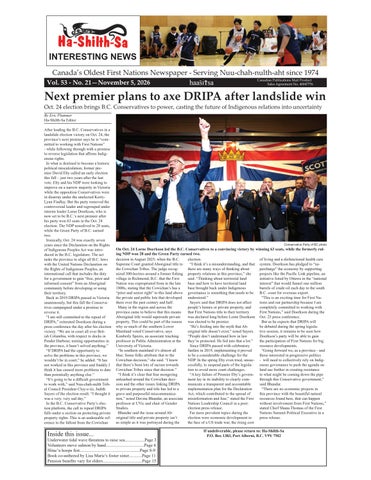
On Oct. 24 Lorne Doerkson led the B.C. Conservatives to a convincing victory by winning 63 seats, while the formerly ruling NDP won 28 and the Green Party earned two. decision in August 2025, when the B.C. election. of living and a disfunctional health care Supreme Court granted Aboriginal title to “I think it’s a misunderstanding, and that system. Doerkson has pledged to “suthe Cowichan Tribes. The judge recogthere are many ways of thinking about percharge” the economy by supporting nized 300-hectres around a former fishing property relations in this province,” she projects like the Pacific Link pipeline, an village in Richmond, B.C. that the First said. “Thinking about territorial land initiative listed by Ottawa in the “national Nation was expropriated from in the late base and how to have territorial land interest” that would funnel one million 1800s, stating that the Cowichan’s has a base brought back under Indigenous barrels of crude oil each day to the south “prior and senior right” to this land above governance is something that needs to be B.C. coast for overseas export. the private and public lots that developed understood.” “This is an exciting time for First Nathere over the past century and half. Sayers said that DRIPA does not affect tions and our partnership because I am Many in the region and across the people’s homes or private property, and completely committed to working with province came to believe that this means that First Nations title to their territory First Nations,” said Doerkson during the Aboriginal title would supersede private was declared long before Lorne Doerkson Oct. 25 press conference. property. This could be part of the reason was elected to be premier. But as he expects that DRIPA will why so much of the southern Lower “He’s feeding into the myth that Abbe debated during the spring legislaMainland voted Conservative, says original title doesn’t exist,” noted Sayers. tive session, it remains to be seen how Kimberly Speers, an associate teaching “People don’t understand how in law Doerkson’s party will be able to gain professor in Public Administration at the they’re protected. He fed into that a lot.” the participation of First Nations for big Since DRIPA passed with celebratory resource developments. University of Victoria. fanfare in 2019, implementing it proved “Going forward we, as a province - and “In southern mainland it’s almost all blue. Some folks attribute that to the to be a considerable challenge for the those interested in progressive politics Cowichan decision,” she said. “I know NDP. In the spring Eby even tried, unsuc- - will need to collectively rely on Indigthat there’s been lots of racism towards cessfully, to suspend parts of the legislaenous governance to push the agenda on Cowichan Tribes since that decision.” tion to avoid more court challenges. land use further in creating resistance “I think it’s clear that fear mongering “A key failure of Premier Eby’s govern- to what might be coming down the pipe ment lay in its inability to clearly comthrough this Conservative government,” unleashed around the Cowichan decimunicate a transparent and accountable said Bhandar. sion and the other issues linking DRIPA implementation plan for the Declaration “There are no economic projects in to private property and title has led to a Act, which contributed to the spread of this province with the beautiful natural grave and purposeful miscommunication,” noted Davina Bhandar, an associate misinformation and fear,” stated the First resources found here, that can happen Nations Leadership Council in a postwithout involvement from First Nations,” professor at UVic and chair of Gender election press release. stated Chief Shana Thomas of the First Studies. Far more prevalent topics during the Nations Summit Political Executive in a Bhandar said the issue around Abelection were economic development in press release. original title and private property isn’t the face of a US trade war, the rising cost as simple as it was portrayed during the
Underwater tidal wave threatens to raise sea..................Page 3 Volunteers move salmon by hand...................................Page 6 Hitac’u hoops fest.......................................................Page 8-9 Book co-authored by Lisa Marie’s foster sister............Page 11 Pension benefits vary for elders....................................Page 15
If undeliverable, please return to: Ha-Shilth-Sa P.O. Box 1383, Port Alberni, B.C. V9Y 7M2
Page 2— Ha-Shilth-Sa—November 5, 2026
Future for First Nations is electrification: Cole Sayers Hupacasath man recognized for advocacy in clean energy, as Canada looks to double power generation by 2050 By Denise Titian Ha-Shilth-Sa Reporter A seed was planted for Cole Sayers 25 years ago, when the Hupacasath First Nation embarked on the development of an innovative clean energy plant that could power thousands of homes. Under the leadership of his mother Judith Sayers, Hupacasath’s elected chief at the time, the First Nation opened the China Creek Micro Hydro Project in 2006. The China Creek Micro Hydro Project was constructed at a cost of $14 million. Majority owner Hupacasath First Nation sells energy to BC Hydro through an energy purchase agreement that amounts to about $1.6 million per annum. Since that time, other Nuu-chah-nulth First Nations have developed similar clean energy power plants, including Tlao-qui-aht and Hesquiaht. Cole Sayers has been working with First Nations to develop clean energy projects to help meet their electricity needs and to provide a revenue stream. He is the executive director of Clean Energy BC, as well as the Indigenous Power Coalition. “What I’ve been working on is First Nations and industry partnerships within the renewable energy sector and really trying to assist in building capacity within First Nations to have even stronger partnerships,” he said. British Columbia is growing and so is the need for electricity. There are homes, industry and electric vehicles that need electricity and the province is calling out for clean energy projects to meet the demand. “And that’s what I focus on at my role at Clean Energy BC,” said Sayers. The co-founder of the Indigenous Power Coalition, Kwatuuma Cole Sayers brings together First Nations and industry to develop clean energy solutions that benefit all. Looking back on how electrical power was developed in Canada, Sayers says a lot of First Nations were left out of the planning and development process. “Especially in B.C. and Manitoba… we know the impacts of flooding of our territories, transmission lines that come through our territories, and we don’t see any benefits. Or we didn’t have any say on how that was built,” he noted. The work of the Indigenous Power Coalition flips this script. “I don’t want developers or utilities or whomever to come to our nations with a project that’s already pretty much baked and they’re only coming with us with a small equity offer,” said Sayers. “First Nations want to be partners and they also want to have influence on how that project is going to be designed and built from the very beginning.” First Nations also want to be owners, so that they have a stake in how these projects are built. Since the first run-of-the-river micro hydro projects were built in Nuu-chah-
BC Rural Centre video still
The Hupacasath First Nation pioneered the development of a First Nation micro-hydro operation with the China Creek Micro-Hydro Power Plant, which has been in operation since 2006. China Creek produces approximately 24 gigawatts of power annually. ago and happens to be his mother, Dr. want to ensure that First Nations are not Judith Sayers, Cloy-e-iis, for her work in only leading the way but are going to advocating for clean energy projects for have meaningful decision making.” First Nations. Sayers also works with BC Hydro, Of Cole’s win, Cloy-e-iis said, “It’s designing the procurement for calls for pretty neat and I am so proud of him.” power in 2024 and 2025. He said he An ‘all-out assault’ of the problem brought in about 80 B.C. First Nations Founded by Delta Management Group, into Clean Energy BC to begin planning the Clean50 Award program launched in the procurement of clean electricity from 2011. renewables. This procurement secured “When we at Delta started the Clean50 8,500 gigawatts of new electricity, pushit was because we felt that the challenges ing Indigenous equity participation to facing Canada could not be resolved by around 50 per cent. anything less than a collaborative, all-out In past calls for power, Sayers found assault on every element of the problem,” that First Nations were not prepared to stated Delta. take on energy projects. The Clean50 was created not only to “We haven’t got that long-term roadmap recognize remarkable and inspiring leadyet, so the challenge with these past two calls for power was that they were rushed ers, but also to attempt to connect those Cole Sayers leaders in order to bridge gaps and build and many First Nations were then rushed nulth territories, other clean energy connections that might not otherwise to make a decision on these very large projects have followed on Vancouver occur. investments,” he said. “And we need a Island, including a small-scale wind farm procurement roadmap, that way First Part of being a Clean 50 honouree is the at Cape Scott, on the northern tip of Van- Nations and industries can plan over the gathering that allows those selected to couver Island. network and share ideas. next five to 10 years with the eye of the Sayers says wind farms can be built on “We all met on Oct. 15, all the honorees next 10 to 15 years of procurements.” a larger scale as a clean energy option, of this year and some past honorees, to For the past 10 years Sayers has asbut British Columbia’s rugged landscape sisted First Nations in their clean energy talk about the clean economy and the imposes challenges. pact of the clean economy, but also some projects. “There’s not many ports that can receive of the challenges that the clean economy “Kwatuuma (Cole Sayers) has worked these very large turbines,” he noted. is facing,” he said. to make sure Indigenous ownership isn’t Once you get on land, movers must Reflecting on Canada’s reliance on an afterthought in Canada’s clean energy consider roadway weight limits, tunnels, fossil fuel energy, Sayers believes that build-out. He has made it the starting sharp turns and grades, and all those fac“looking long term, electrification is gopoint,” Clean 50 stated on their website, tors cost money. ing to be our best bet.” after naming him one of the 2027 Clean “And ultimately, that’s going to result in 50 honourees in the Emerging Leaders “It’s going to help keep our economy the rate payer (customer), so we want to competitive and clean. And certainly, category. make sure that we can do it very quickly, clean electricity powered by renewables Clean 50 recognizes outstanding conbut also very responsibly,” said Sayers. and batteries and energy storage - techtributors to clean capitalism in Canada. As announced by Prime Minister Mark Cole Sayers is the second Nuu-chah-nulth nologies that are the most affordable out Carney in May, Canada is looking to and Hupacasath person to win the award. there - that’s where I believe we need to build out its power grid, doubling it’s The other winner took the award 10 years invest in.” capacity by 2050. “All that new infrastructure is going to be built on our lands,” said Sayers. “I
November 5, 2026—Ha-Shilth-Sa—Page 3
Massive underwater tidal wave threatens to raise sea Combined with a king tide, the current phenomenon could cause problems for low-lying coastal communities By Antonella Medina Arias Ha-Shilth-Sa Contributor A giant underwater wave known as a “Kelvin Wave” is reaching the West Coast, raising the sea level and potentially causing flooding and erosion in coastal communities. “The west coast of Vancouver Island would be on the front lines of the Kelvin wave as its most directly affected, but it will continue travelling up the coast as far as Alaska,” said Bill Merryfield, a research scientist with Environment and Climate Change Canada (ECCC) and adjunct professor in the School of Earth and Ocean Sciences at the University of Victoria. A Kelvin wave isn’t like a tsunami. It’s a giant underwater wave that slowly moves along the shore, like water sloshing against a bathtub or a pool during an earthquake. The wave isn’t visible to the naked eye and doesn’t cause an instantaneous change in sea level. It’s slow and shallow, extending 19 to 32 kilometres (12 to 20 miles), about 200 metres (656.16 feet) deep, and travelling at 10 kilometres (6 miles) per hour. Kelvin waves are a natural phenomenon during El Niño, a weather pattern involving warm ocean waters. Normally, trade winds blow east to west at the Equator in the Pacific Ocean, pushing water from South America toward Asia. However, when those trade winds weaken or reverse during El Niño, warm water moves toward South America, increasing the risk of flooding and higher water temperatures. Kelvin waves help El Niño spread its warming across the Pacific, and the stronger El Niño gets, the more it produces. It’s hard to predict the exact amount of sea-level rise in Vancouver Island, as Kelvin waves lose power as they move farther from the source. However, the sea level rose by 30 centimetres in January and February on the west coast of Vancouver Island because a Kelvin wave hit the Canadian coast. Currently, the Canadian Hydrographic Service (CHS), a sea-level monitoring data collector run by Fisheries and Oceans Canada (DFO), showed a slight rise in sea level in Port Alberni, Tofino and Vancouver in the past few days. “It is possible we may see a stronger effect this year,” said Merryfield. Kelvin waves alone aren’t a threat by
Raul Ling/Pexels photo
South California communities already experienced the result of this combination in early October, with sea levels already six to eight inches (15 to 20 centimetres) higher than normal because of the Kelvin wave. themselves. Yet, they create background rary sea-level elevations were recorded food source. conditions for naturally occurring weathon the West Coast. The next three were “With the influence of the Kelvin er phenomena to intensify in winter. consecutive in April, June, and July, a wave, it tends to shut off this upwelling “A 30-centimetre rise in sea level by pattern that happens when a large El Niño that brings the nutrients to the surface. itself doesn’t have much impact. But if starts reaching its maximum intensity. There’s less food on the table for the enyou add that on top of a king tide, which “If you look in the past at really strong tire coastal ecosystem,” said Merryfield. are unusually high tides, and storms at El Niño, this is probably the strongest of PreparedBC is advising people who live, the same time, it can spell trouble for them that we’re having right now,” said work or spend time in coastal communilow-lying communities along the coast,” Merryfield. “Along the coast of Vancouties like Greater Victoria to review their said Merryfield. ver Island and Tofino, during the winter emergency plans, prepare a grab-and-go South California communities already months, the sea level was elevated by 30 bag, identify local evacuation routes and experienced the result of this combination centimetres on average.” nearby areas of higher ground. in early October. With sea levels already El Niño is still building and won’t peak Residents are encouraged to tune in for six to eight inches (15 to 20 centimeuntil December, with a Kelvin wave local weather forecasts, tide conditions tres) higher than normal because of the slowly reaching Canada’s coast. and official updates on potential flooding Kelvin wave, neighbourhoods flooded The National Oceanic and Atmospheric caused by the Kelvin wave effect. and homes near the ocean were partially Administration (NOAA) researchers preThe role of climate change in intensifysubmerged when tropical storm Racher dict El Niño will remain strong through ing the El Niño effect is still debated in hit the coast. early 2027. the scientific community. Yet, El Niño “Once you start getting into the interior Kelvin waves also raise coastal water directly contributes to rising global temstraits of the Salish Sea and other regions temperatures, disrupting marine ecoperatures. of the eastern side of Vancouver Island, systems and causing mortality among El Niño tends to release heat stored in things get complicated,” said Merryfield. species. the ocean back into the atmosphere, caus“If you look at past events, when sea Dillon Amaya, an assistant professor of ing global temperatures to rise, especially level is higher in Tofino, it does tend to atmospheric sciences at North Carolina after the phenomenon passes its peak. be high also in Vancouver and Victoria, State University, stated they’ve reported Like a furnace, it’s warmest not when so we might [see] some of the same eftropical species outside their normal eco- the furnace comes on, but before it shuts fects in the more populated locations.” system, such as a whale shark spotted off down. Typically, El Niño is associated with the coast of San Diego. “The record for the global temperature five or six Kelvin waves; the last major Researchers also reported seabirds averaged over the whole year was set El Niño registered five Kelvin waves in (brown pelicans, loons and grebes) dying in 2024, right after the peak of a much 2015-2016. of starvation off the California coast in lesser El Niño event. We expect it to In 2026, the first one occurred in Janurecent months. Warm water pushed cold, break it, probably by a big margin next ary and had little influence, as a Kelvin nutrient-rich waters deeper, where krill, year, because of this very large El Niño wave normally takes three months to anchovies and sardines thrive. Without combined with its tendency to warm up reach the Canadian Coast. cold water making these smaller species the planet as a whole,” said Merryfield. The second was in March, when tempo- accessible, seabirds lose access to their
CYPRESS RESTAURANT & LOUNGE 250.724.7629 rimrockcasino.ca
Page 4— Ha-Shilth-Sa—November 5, 2026 Ha-Shilth-Sa newspaper is published by the Nuu-chah-nulth Tribal Council for distribution to the members of the contributing First Nations, as well as other interested groups and individuals. Information and original work contained in this newspaper is protected by copyright and may not be reproduced without written permission from: Nuu-chah-nulth Tribal Council P.O. Box 1383, Port Alberni, B.C. V9Y 7M2. Telephone: (250) 724-5757 Fax: (250) 723-0463 Web page: www.hashilthsa.com facebook: Hashilthsa Ntc
2026 Subscription rates: Non-Nuu-chah-nulth, Ahousaht, Ehattesaht,Toquaht and Ucluelet members are subject to a yearly subscription fee of $40 in Canada, $50 in the US and $60 for overseas. Payable to the Nuu-chah-nulth Tribal Council
Manager/Editor/Reporter Eric Plummer (Ext. 243) (250) 724-5757 Fax: (250) 723-0463 eric.plummer@nuuchahnulth.org Reporter Denise Titian (Ext. 240) (250) 724-5757 Fax: (250) 723-0463 denise.titian@nuuchahnulth.org Reporter Nora O’Malley (604) 353-8488 nora.omalley@nuuchahnulth.org Audio / Video Technician Mike Watts (Ext. 238) (250) 724-5757 Fax: (250) 723-0463 mike.watts@nuuchahnulth.org Editorial Assistant Holly Stocking (Ext. 302) (250) 724-5757 Fax: (250) 723-0463 holly.stocking@nuuchahnulth.org
DEADLINE: Please note that the deadline for submissions for our next issue is Nov 13, 2026 After that date, material submitted and judged appropriate cannot be guaranteed placement but, if material is still relevant, will be included in the following issue. In an ideal world, submissions would be typed rather than hand-written. Articles can be sent by e-mail to holly.stocking@nuuchahnulth.org (Windows PC). Submitted pictures must include a brief description of subject(s) and a return address. Pictures with no return address will remain on file. Allow two - four weeks for return. Photocopied or faxed photographs cannot be accepted.
LETTERS and KLECOS Ha-Shilth-Sa will include letters received from its readers. Letters MUST be signed by the writer and have the writer’s full name, address and phone number on them. Names can be withheld by request. Anonymous submissions will not be accepted. We reserve the right to edit submitted material for clarity, brevity, grammar and good taste. We will definitely not publish letters dealing with tribal or personal disputes or issues that are critical of Nuu-chah-nulth individuals or groups. All opinions expressed in letters to the editor are purely those of the writer and will not necessarily coincide with the views or policies of the Nuu-chah-nulth Tribal Council or its member First Nations. Ha-Shilth-Sa includes paid advertising, but this does not imply Ha-Shilth-Sa or Nuu-chah-nulth Tribal Council recommends or endorses the content of the ads.
Dry housing for men in PA is delayed The 10-bed Headwaters Therapeutic Recovery home awaits regulatory approvals By Denise Titian Ha-Shilth-Sa Reporter Port Alberni, BC – The new secondstage housing for men in recovery is not yet ready to take in residents, however, work continues behind the scenes to complete renovations and finish up programming plans. The former Hummingbird Guest House, located at 5769 River Road in Port Alberni, was purchased by the Headwaters Therapeutic Recovery Society last year. The society is affiliated with Arrowsmith Baptist Church and some of their male parishioners wanted to find a way to help fellow men struggling with addiction. In June 2026 retiree George Koning said he and a friend, Rod Grant, were talking about how people were still dying in the streets from addictions. “It was the fall of 2024 when Rod called me and said he can’t stand it anymore – something has got to be done,” Koning shared. The friends hatched a plan – a recovery house for men, something Port Alberni lacks. It would be a dry house, a place where men already sober can live up to two years with supports to maintain their sobriety. The new home will be called Headwaters. It is billed as a Christian non-profit organization dedicated to transforming lives through faith, compassion, and community. “Our mission is to provide a supportive and Christ-centered environment for men seeking recovery from addiction through our residential program,” states the initiative’s website. “We’re trying to get guys truly free, fully healed and out of the revolving door,” said Jonathan Neufeld, Headwaters Therapeutic Recovery Society’s secretary. For the past year renovations have transformed the former B&B-style property to a 10-bed second-stage home for men coming out of treatment centres. For men considering Headwaters as second stage housing, it is important to know that safety is of utmost importance. “At Headwaters, we operate a recovery home that offers a safe, structured, and nurturing space exclusively for men committed to their sobriety journey. These
Denise Titian photo
The former Hummingbird Guest House, located at 5769 River Road in Port Alberni, was purchased by the Headwaters Therapeutic Recovery Society last year. The society is affiliated with Arrowsmith Baptist Church and some of their male parishioners wanted to find a way to help fellow men struggling with addiction. men have already achieved at least three months of sobriety before entering this second-stage housing,” says the Headwaters website. They go on to say that residents receive personalized support, including access to counseling, Bible-based teachings, life skills training, and fellowship opportunities - all aimed at empowering them to rebuild their lives and sustain long-term recovery. “Please note that to ensure the safety and well-being of our community, we do not house registered sex offenders or arsonists. Also, strict behavioral policies are in place to ensure we remain good neighbors,” says the society. Before it can operate, the property needs to be rezoned by the municipal government, and the society must meet some requirements of the provincial government before residents can move in. The process has been slowed down by the municipal and provincial elections that occurred in October. Neufeld says Headwaters Therapeutic Recovery Society set up information tables at a couple of Port Alberni events over the summer that drew positive attention. People want to know when men can
Legal Information
COVERAGE: Although we would like to be able to cover all stories and events, we will only do so subject to: - Sufficient advance notice addressed specifically to Ha-Shilth-Sa. - Reporter availability at the time of the event. - Editorial space available in the paper. - Editorial deadlines being adhered to by contributors.
begin moving in. “We are encouraged (by the attention) and people want to help, but we have to be patient,” Neufeld said. The processes for rezoning and meeting funding requirements are slow. He hopes that things will pick up again once the new city council and provincial government representatives are settled in. In the meantime, the society is looking to put finishing touches on the property and to furnish the rooms. Program facilitators are busy planning and training for the first residents. When running, the facility will collect rent from its residents through British Columbia’s Community Care and Assisted Living Act, which regulates assisted living residences and community care facilities. It will also rely on donations to operate. The Headwaters Board of Directors invites people to learn more about their mission, programs, or how to get involved. Call 778-421-8023 or info@ headwatersalberni.ca for more information. “We would be honored to share more about our work and explore opportunities for collaboration,” they said.
Ha-Shilth-Sa belongs to every Nuu-chah-nulth person including those who have passed on, and those who are not yet born. A community newspaper cannot exist without community involvement. If you have any great pictures you’ve taken, stories or poems you’ve written, or artwork you have done, please let us know so we can include it in your newspaper. E-mail holly.stocking@nuuchahnulth.org. This year is Ha-Shilth-Sa’s 52nd year of serving the Nuu-chah-nulth First Nations. We look forward to your continued input and support. Kleco! Kleco!
The advertiser agrees that the publisher shall not be liable for damages arising out of errors in advertisements beyond the amount paid for space actually occupied by the portion of the advertisement in which the error is due to the negligence of the servants or otherwise, and there shall be no liability for non-insertion of any advertisement beyond the amount paid for such advertisements
November 5, 2026—Ha-Shilth-Sa—Page 5
Food Bank expands reach for more ‘working families’ Xmas hampers will be delivered throughout the west coast this year, with nearly half going to Nuu-chah-nulth “Is it cheaper to stay home and not work and not pay daycare?” Clark continued. In 2024, the living wage for a family of four in the Clayoquot Biosphere Region was $27.40, according to the Clayoquot Biosphere Trust. The living wage is based on expenses faced by two parents working 35 hours a week and two children under 10. It does not capture unique transportation expenses faced by families that rely on water taxis or personal boats for everyday activities. Food Bank on the Edge clients peaked in 2020 during the pandemic with 3,296 people served. In 2024, the non-profit served 2,257 people and spent about $40,800 on groceries. In 2025 it served 2,093 clients and spent just under $45,000 on groceries. So far, 2026 has seen 1,549 people visit the food bank, but with November and December being the busiest time for the west coast food bank, Davis says the numbers will likely look the same as last year.
By Nora O’Malley Local Journalism Initiative Reporter Ucluelet, BC – Budgets are stretched thin and food banks across Canada are seeing more people with full-time jobs accessing their services. Food Banks Canada’s annual HungerCount project tracks and reports on food bank visits and client demographics. This year, the non-profit said food bank usage has nearly doubled since March 2019, and nearly 18 per cent of food bank clients reported having a job, compared to 12 per cent in 2019. Food Bank on the Edge serves the west coast communities of Ucluelet, Tofino, Millstream, Port Albion, Hitac`u, Opitsaht, Ty-Histanis/Esowista, Ahousaht, Hesquiaht and Toquaht. It is accredited under Food Banks Canada’s Standards of Excellence program, which sets the benchmark for safety, dignity and operational excellence in food banking. Last September 2025, the non-profit moved into a new facility at 362 Forbes Road in Ucluelet, moving the region’s food security hub up from a musty, lowlying space at the Seaplane base parking lot to high ground. Over a cup of cinnamon spice tea, longstanding volunteer Cris Martin says it’s “shocking” how many more “working families” they are seeing come in. “But that’s the reality,” said Martin. “You don’t know what people are coming to you with; it could be debt or medical expenses… (The food bank) is not a shameful place to come. There was always that cloud, especially with men. It doesn’t have to be that way. We are here to help and support,” she offered. Rising costs have impacted the Food Bank on the Edge’s regular list of hamper items as well. The non-profit recently nixed coffee from their distribution list to save money. “We did the math and a portion of coffee, which is usually about one pound, cost almost as much as hamburger meat,” said Martin, adding they don’t buy cheese anymore either. Food Bank on the Edge is expanding operations to keep up with the “new normal”, according to Executive Director Carla Davis. She says Christmas hampers will be delivered throughout the west coast this year, and she put a call out to volunteers in the Tofino area. “It’s going to be a huge undertaking. We will need a volunteer base in Tofino,” said Davis, who started the part-time role in September. In the past, Christmas hampers were
Partnership with Tofino Ucluelet Culinary Guild
Nora O’Malley photo
Cris Martin, left, and Carla Davis say they are seeing more “working families” access Food Bank on the Edge. only given out to families living south of would love to establish a monthly delivthe Tofino-Ucluelet junction. ery contact with Tla-o-qui-aht, Ahousaht, Toquaht and Hesquiaht as well to streamServing remote communities line transportation costs. Unlike larger urban centres with several “It’s difficult for people to get here,” she grocery stores to lean on, Food Bank on said. the Edge only collects from one grocery Tla-o-qui-aht member Maria Clark is store, the Ucluelet Co-op. They also the Assistant General Manager at Tofino’s regularly deliver hampers directly to fam- Tin Wis Resort, a Tla-o-qui-aht First Nailies within their area of service through tions owned and operated accommodaa contract held by the Westcoast Commu- tion provider. nity Resources Society (WCRS). Clark shared that Tin Wis recently “We are servicing so many remote com- conducted a labour market research study munities and our outreach workers that to learn what barriers Tla-o-qui-aht comdo the deliveries need more funding,” munity members face when it comes to Davis said. participating in the workforce. Ucluelet First Nation sends a delegate “Being able to feed my family, today” each month to pick up hampers for their was listed as the main priority for many members living in Hitac`u, a role Davis respondents, according to Clark. said has helped with the “balancing act” “Realistically, what we are considerof taking care of so many remote coming living wages right now are still only munities. getting some people paycheque to payWith just under 50 per cent of Food cheque. It doesn’t include what the actual Bank on the Edge’s clients living in Nuu- cost of daycare can be if your child isn’t chah-nulth communities, Davis says she in the $10-a-day program,” said Clark.
Tofino Ucluelet Culinary Guild (TUCG) is helping with logistics, people power and sourcing products when it comes to collecting donations for the Christmas hamper expansion this year. TUCG is a collective that connects restauranteurs and community members to locally sourced ingredients. “We want to help them reach more people,” said TUCG Executive Director Rob Renna. He reflected on the rising cost of goods with a long sigh. From the price of diesel to packaging, he says everywhere they look, things are getting more expensive. “Affordability is certainly a growing challenge. As a non-profit, we work hard to keep our operating costs as low as possible, while also recognizing the pressures facing local farmers and producers who are dealing with rising costs of their own. We’re seeing people become more cautious with their spending. The reality is that the rising cost of living is making things increasingly difficult for everyone on the coast, from farmers and food producers to local families,” said Renna. “We are at the will of the world market that’s why, for us, we are really proud of supporting the small farmer on Vancouver Island and being able to get the products to chefs and individuals here,” he continued. Davis encouraged anyone to reach out if they need a hamper, to make a donation or to volunteer: 250-726-6909 or foodbankedge@gmail.com.
Page 6— Ha-Shilth-Sa—November 5, 2026
Volunteers move thousands of salmon by hand Citing ‘unsafe work conditions’, DFO leaves migration barrier instead of installing ladder during a critical time By Nora O’Malley Local Journalism Initiative Reporter Barkley Sound, BC – Thornton Creek Hatchery manager Dave Hurwitz is piping mad. This fall, Hurwitz witnessed a crew from the Department of Fisheries and Oceans Canada (DFO) shut down a salmon enhancement project at Salmon Creek in Barkley Sound during a critical time in the chum river-run. Instead of completing the job, he said DFO left a migratory barrier at the site – and a lot of unanswered questions. “How could they leave this stream to die on the operating table? What was the showstopper? I’d like to know,” Hurwitz cussed. A couple years ago on October 19, 2024, Hurwitz said a “catastrophic” rainfall event caused the fish ladder to fail at Salmon Creek, a spot in Yuułuʔiłʔatḥ territory known as Glukamukus Creek. Thornton Creek staff made urgent repairs to the ladder system that same week, and plans were initiated with DFO to replace the aging infrastructure. Summer 2025 came and went, and Hurwitz says DFO “couldn’t do anything” about Salmon Creek that year due to capacity limitations. Then summer 2026 arrived and DFO showed up with a crew at Salmon Creek to build a new fish ladder that would assist the fish in accessing a culvert that leads to their spawning grounds. “Before the road went in you didn’t need a culvert. The river just flowed. Once we built the road, we needed a culvert so the fish can get up. Once we build something we have to take care of it,” he said. On Sept. 11, Hurwitz said he went to check on the site and saw DFO shutting the project down. “I don’t know who stuck a fork in it,” said Hurwitz. “I don’t really know why they stopped. They still had a couple days in the fisheries window. There was no rain coming for a few days and they were right there. Like, why didn’t they get it done?” The site was left in such a state that the chum salmon would need to make a three- to four-foot jump to access the culvert. James Costello, Thornton Creek Hatchery operation manager, says there’s no way a chum can jump that high. “Chum are poor jumpers. Anything over about a foot or two they are not going to be able to get up. They are very strong, but they are terrible jumpers,” said
Nora O’Malley photo
Volunteers help chum salmon reach their spawning grounds on Oct. 26 by lifting them up into a pipe that flows through a culvert. Costello. Silver lining The silver lining to this story is the crew of volunteers that came together to move thousands of fish up into the culvert by hand. It’s been a team effort with folks from Toquaht Nation, Ucluelet First Nation, Redd Fish Restoration and other friends showing up to help, Hurwitz said. “It speaks to people working together to help make the world better,” said Hurwitz. “It’s been a ton of work, but it’s turned into a great community initiative. People have rallied around this. It’s been a great opportunity for us to show gentle fish handling.” Costello says it’s “unfortunate” that the timing of the abandoned ladder project lined up with a strong chum return; he says there’s been over 3,000 fish in the run this year. Without the assistance from volunteers, Costello says the chum would have only been able to use three quarters of the creek system, and the fish would have “timed out downstream”, dumping their eggs or dying with their eggs inside them. “We are so happy to have the assistance from the community. It’s a lot of manual labour. It’s a labour of love,” Costello notes. Ucluelet-based marine biologist Dane Stabel spent a couple days volunteering at Salmon Creek. Alongside 15 or so others, Stabel netted salmon and then dropped
TSESHAHT MARKET GATEWAY TO THE PACIFIC RIM
Hours of operation - 7:00 am - 10:00 pm Phone: 724-3944 E-mail: manager@tseshahtmarket.ca Find us on Facebook
them by hand into a pipe that flowed into the culvert. They also gathered a subset of brood stock for the Thornton Creek Hatchery’s spawning program. “It’s beautiful that there are so many people that care about fish and salmon. Sometimes the charismatic mammals get all the attention, but I find salmon are a good ambassador for fish,” said Stabel. “(Salmon) are very important to the ecosystem and the culture here. It pretty much feeds everything. They are incredibly interesting. It’s hard not to root for an animal that goes through such a crazy journey just to spawn. There are very few animals who work as hard as these guys to get the next generation going,” he said. DFO said that the installation of the concrete fish ladder, or rock weirs, could not be completed at the time “due to unsafe work conditions”. “The second and final phase of construc-
tion is scheduled for the late summer 2027 fisheries timing window, and the rock weirs will be installed,” said DFO in a written statement to the Ha-Shilth-Sa News. “Once completed, the rock weirs will improve fish passage and support salmon migration under natural watershed conditions, provided sufficient flow is available within the system,” they said. Hurwitz is shaking his head in disbelief. He hopes something like this never happens again. “When you’re dealing with live animals, you can’t make mistakes. You can’t screw it up. It’s not carpentry. If we screw something up, we are robbing Mother Nature,” he said. As of Nov. 2, Hurwitz says the volunteer team has moved 2,587 chum salmon through the culvert up to their spawning grounds.
November 5, 2026—Ha-Shilth-Sa—Page 7
Group navigates precarious waters to sustain salmon Since 2005, Area 23 Roundtable has balanced Aboriginal, commercial & recreational interests to manage fishing By Eric Plummer Ha-Shilth-Sa Editor Port Alberni, BC - In an era when Pacific salmon remains in a precarious state and some see their right to fish under threat, a Port Alberni-based fisheries table is promoting its model as an example of collaborative resource management. Each year over a million salmon migrate from the Pacific Ocean into Barkley Sound on the west coast of Vancouver Island, funneling their way down the Alberni Inlet, destined for their origin in the Somass and Stamp River watershed. It’s a time-honoured procession that has sustained the region’s Indigenous people for thousands of years, while feeding heavy-duty commercial boats and making the area a sought-after destination for recreational anglers. But there is only so much salmon, and by the mid 2000s years of fractured dealings with Fisheries and Oceans Canada (DFO) had created “significant conflict” among the different harvest groups in the region known as Area 23. “The conflict (political, social, legal) was exacerbated by First Nations and sectors each having separate bilateral conversations with DFO, creating a zerosum game environment,” stated West Coast Aquatic, a Vancouver Island-based natural resource management organization. “There were confrontations on the dock, there were confrontations on the water,” said Tawney Lem, who serves on West Coast Aquatic’s board or directors. “But there were some folks, First Nations, the commercial fishers, who have had enough and wanted to look at each other more as neighbours than adversaries.” In an effort to ensure that all sectors had enough opportunity to harvest sustainably, the Area 23 Roundtable was established in 2005. This was around the time when DFO released its Wild Salmon Policy, making Area 23 British Columbia’s first fishing region to host a formal group who meet regularly to plan harvest management. During the spring and summer fishing season the Area 23 Roundtable meets every week, with representation that includes the commercial seine and gillnet fleets, the Tseshaht and Hupacasath First Nations, the Maa-nulth treaty nations, DFO, the Barkley Salmon
Salmonberry Studios photo
Tseshaht members collectively catch salmon in a net from the Somass River. The Tseshaht and Hupacasath First Nations share a fishery on the river, which is represented on the Area 23 Roundtable. A film about the roundtable was released online Oct. 28. Manager James Laflamme about the pursustained declines over the past two Working Group and the Sports Fishing pose of the Roundtable. “Although we do decades,” noted the PSF’s State of the Advisory Board. represent our own user groups, it builds Salmon report. “The history of the fisheries has always As DFO undertakes a multi-year review a mutual respect between each other. It been adversarial. The seiners didn’t like humanizes us to each other.” of it’s Salmon Allocation Policy, some the gillnetters, the gillnetters didn’t like “The management that’s critical is in fear they will lose their share of a declinthe seiners,” reflected Larry Johnson, the sockeye fisheries,” said Murphy. ing resource. Over 1,4000 anglers filled chair of the Maa-nulth fisheries com“They’re not raised in a hatchery, so they a town hall in Duncan last January to mittee and a participant on the Area 23 require a lot more special attention, a litdiscuss the future of the sports fishery, Roundtable. tle bit more management than chinook.” responding to a campaign warning that Along with Lem, Johnson shared his Unlike the smaller sockeye, wild “extreme” policy changes could limit the thoughts in The Roundtable, a new film chinook salmon have not been able to public’s right to fish, according to mesabout the regional management group. saging from the B.C. Wildlife Federation sustain a fishery on their own. Nearly The seven-minute film was produced by all of the chinook caught originate from Salmonberry Studios and funded by West and the Sports Fishing Institute of B.C. the Robertson Creek hatchery, which Meanwhile, 1.2 million sockeye Coast Aquatic, which has facilitated the incubates millions of eggs each year and returned to Area 23 in 2026, with apArea 23 Roundtable for the past decade. proximately 140,000 chinook and smaller raises juvenile salmon for release into the Twenty-one years since DFO released Stamp and Somass River system. numbers of coho, chum and steelhead. its Wild Salmon Policy, the species con“For whatever reason, our fish that According to catch numbers reported by tinues to struggle. spawn in the gravel don’t survive,” comDFO, as of Oct. 8 nearly half a million “The state of salmon remains precarisockeye were caught in Area 23 this year, mented Murphy of the chinook’s strugous, with approximately half of regional gles. “We haven’t figured that out yet.” with another 93,169 chinook harvested. Pacific salmon populations in B.C. and Despite this reliance on the hatchery, The Somass First Nations of Tseshaht the Yukon below their long-term average and Hupacasath caught 26 per cent of this Laflamme remains optimistic. spawner abundances,” states a report re“Compared to globally, we’re killing sockeye and 39 per cent of the chinook, leased this year from the Pacific Salmon it,” he said. “It sucks that 90 per cent of while the Area D gillnet fleet claimed a Foundation. our spring (chinook) salmon is hatchery, quarter of the total sockeye harvest and Despite some impressive returns in but it is what we have, and the impacts of 23 per cent of chinook, and commercial 2025, there remains “a backdrop of that on our local economy are unbelievseine boats got 37 per cent of sockeye able.” and 16 per cent of chinook. Recreational Laflamme reflected on the success of fishers caught over 36,000 sockeye and this year’s catch for the Somass First 16,364 chinook, representing seven and Nations. 18 per cent of the total catches. “Seven dollars a pound dockside for David Murphy grew up fishing in the salmon this year equated to - just on Port Alberni area, and makes a living the First Nations fishery alone - 40,000 from the recreational industry. Although pieces…$5 million cash into the local a diversity of sectors are represented on economy that helps sustain businesses, the Area 23 Roundtable, they all share families and this community as a whole,” the desire for the species to survive year he said. “I cannot understate how huge after year. the salmon is for Alberni as whole.” “We all want lots of fish, we want more But the business is harder than it used fish,” said Murphy during a recent public to be, reflects Johnson. A fisher can no discussion on the new film at Char’s longer rely on a single species, needing Landing in Port Alberni. to diversify what’s being harvested to Although there aren’t many 50-pound sustain a livelihood. salmon anymore, Johnson has seen con“Now you have to be a businessman as sistency in the region that might not be evident elsewhere. well as a good harvester,” he said. “We seem to have a steady line,” he “My dad fished from Feb. 1 until the end said during the public discussion. “I think of November,” continued Johnson, who that’s attributed to our management of it, grew up in Huu-ay-aht territory around our stewardship of it, the people here that Bamfield. “Being a west coast troller, he care about it within our territory.” raised a family of seven, whereas now “When we talk about more fish, it you need to either be herring fishing, doesn’t just mean catching more fish. It halibut fishing, prawn fishing, salmon means making sure that there’s more fish fishing, and each of those have a very making its way, so that we have more short season now.” in the future,” added Tseshaht Fisheries
Page 8— Ha-Shilth-Sa—November 5, 2026
Hitac̓u Hoops Fest sets stage for 2027 Junior All-Native Total 22 teams played in youth basketball jamboree hosted by Ucluelet First Nation, with anticipation building for Ma By Nora O’Malley Local Journalism Initiative Reporter Hitac̓ u, BC – Teenagers swagger into the Cixʷatin gym for the late October basketball tournament, sporting scuff-free sneakers, last year’s merchandise and Cheshire grins. Itty Bitty Ballers player Michah Jack flies down the court and sinks a beauty shot from the sideline. The older boys in the bleachers watch the young Yuułuʔiłʔatḥ (Ucluelet First Nation) talent with pride, referring to him as “the Michael Jordan of U10”. Microphone in hand, prolific Yuułuʔiłʔatḥ coach and tournament host Tyson Touchie, sets the stage. “This is the beginning of the basketball season and the beginning of the road to Prince George. Let’s get this basketball season started!” Touchie cheers. For the third year running, the Hitac̓ u Hoops Fest Youth Jamboree has been the jump start for the Indigenous youth basketball season, which peaks March 21 to March 27 at the Junior All-Native Basketball Tournament, or JANT, in Prince George. The annual Hitac̓ u Hoops Fest, a threeday basketball extravaganza from October 23 to October 25, saw 22 teams play across five divisions, including: U10 mixed, U13 girls/boys and U17 girls/boys. Teams travelled from the Ahousaht First Nation community of Maaqtusiis on Flores Island, Tla-o-qui-aht in Tofino, Tseshaht and Hupačasath in the Alberni Valley, Snuneymuxw First Nation located around Nanaimo, Vancouver and across the bay in Ucluelet to play in the open tournament. Hitac̓ u (pronounced Hit-tat-soo) is Yuułuʔiłʔatḥ’s main community of about 200 residents, located on the east shore of Ucluelet Inlet on Vancouver Island. “We wanted to get them motivated and inspired because March feels so far away,” said tournament host Anita CharlesonTouchie. “They can get a sense on where they are at in terms of fitness and basketball skills. That’s the main thing too, wanting to get them going so that they can pick up some momentum and keep that momentum going into March. I can’t express enough the joy and heart warmth I had throughout the weekend just watching all the kids play,” she said. On finals day, Ahousaht coach Luke Swan Jr. watched his U17 Ahousaht Islanders boys fall 97-69 to West Coast Naani and his U13 Ahousaht Guardians defeated 54-38 by Tla-o-qui-aht Wolf Pack.
Louie Thomas of the Ahousaht Islanders U17 squad won Best Defensive Player at the tournament near Ucluelet. Hitacu Hoops Fes But coach Swan Jr. still left Hitac̓ u with a U13 Wolf Pack and U10 coach Karemare- nament. My boys always look forward warm smile and quiet confidence –because to it all year,” she said. na Frank left the gym with the big trophy now he knows what they have to work on. for Tla-o-qui-aht. Girls U17 coach Franklin Alexcee “Ahousaht has always given us a good “Most of them haven’t even missed a came over to Vancouver Island with a (competition),” said Naani team captain group of players from different nations practice. They have been working really Tony Curley, who plays school ball for hard for it. A lot of them play school ball all over Vancouver. He said most of the Alberni District Secondary. together so they get a lot of time together,” girls are going to JANT and will play “Even on May Long, we played them said Frank. either for the Van City Rain or the Vantwo years straight and lost to them. This couver Matriarchs. “We are planning on going to JANT with tournament we finally got to beat them, big goals. We are going to keep practicVancouver lost 61-36 in the final to but they had a really small bench. It was a ing and keep working on our defense and the Snuneymuxw Islanders U17 team, really good game though. I’m glad we won working together. This tournament was rean athletic squad powered by Taimoni finally,” he said. ally fun. I always love coming to this tourRobinson, who was named tournament MVP and Best Defensive Player. “We had a tough opening game against the Islanders. Then we made the adjustments, playing all the other teams coming through the back door. We played about three games yesterday and two today. The take away from the finals is just playing together as a team and the mental challenge of just being in your own head,” said Alexcee. “This is a really good tournament. We
Tla-o-qui-aht U13 boys Wolf Pack hoist the big trophy after beating the Ahousaht Guardians 54-38 on Oct. 25 in Hitac̓ u. Islanders player Taimoni Robinson (left) was named tournament MVP and Best Defensive Player. Anita Charleson-Touchie (right) hugs a Raven player during the awards on Oct. 25.
November 5, 2026—Ha-Shilth-Sa—Page 9
Tournament Toquaht Nation member hopes his hall arch event in Prince George of fame induction will inspire others Phil Mack has been chosen to be inducted into the Greater Victoria Sports Hall of Fame for his time as a rugby player and coach with the Indigenous program Thunder Rugby By Sam Laskaris Ha-Shilth-Sa Contributor
Nora O’Malley photos
st was held Oct. 23-25. are here for all the kids and the youth. The more tournaments is better for everybody. Get as many games in before Junior AllNative,” he continued. Former Ahousaht Maaqtusiis Suns U13 coach Robert Stanley led the Snuneymuxw Islanders U13 girls to a 43-34 victory over host team Yuułuʔiłʔatḥ Ravens. “We moved to Nanaimo to get a better education for my girl. She wants to pursue a higher education. It was a good, fun tournament,” said Stanley, adding that he will enter this Islanders team in the JANT U13 Gold division. Anita Charleson-Touchie said it is still undecided as to which division the Ravens will enter, but after this final’s game against the Islanders, she thinks they’ll be ready for Gold. Last year, they battled with Ahousaht in the JANT U13 Silver final, losing by a single point. “Since Tyson has started coaching them, their development has increased dramatically. One of our girls shared how coach has helped toughen her up. Before, if she’d get fouled, she stay on the ground and roll around, now she gets hit and pops right up. She was just raving about the confidence he’s given her,” said Charleson-Touchie. She estimated the cost to send a family to JANT 2027 will be roughly $4,500, which includes mileage, ferry, food and accommodations for five days. “Each child gets some athletic support from the nation, but each team doesn’t really have a sponsor. It’s not only about sending a child, it’s about intergenerational connection. Often times, families will travel with their child,” she explained. “We’re so grateful to Yuułuʔiłʔatḥ, specifically the health and social services department. They really came through with sponsoring awards and referees. That gave us big opportunity to do fundraising. Everything that was made at the concession and the gate was all fundraising,” Charleson-Touchie said.
Victoria, BC – Toquaht Nation member Phil Mack will be honoured this coming weekend for his distinguished rugby career. Mack is one of eight new inductees this year into the Greater Victoria Sports Hall of Fame. Induction ceremonies will be held on Saturday, Nov. 7 at a ceremony at the Delta Hotels by Marriott Victoria Ocean Pointe Resort. Mack was a member of the Canadian senior men’s rugby team between 2009 through 2020. He appeared in 59 international matches and represented the country at the World Cup in both 2015 and 2019. Mack also suited up for the national men’s sevens program, participating in 52 games. He helped Canada win gold medals at the 2011 and 2015 Pan American Games. As a pro, Mack served as a player/coach with the Seattle Seawolves, who captured back-to-back Major League Rugby championships in 2018 and ’19. Mack also coached with Thunder Rugby, an Indigenous program he helped launch in 2014. Plus, he had coaching positions with Pacific Pride, Rugby Canada’s development academy, as well as with the national men’s team. He’s being inducted into the hall of fame via both the player and coach categories. “It’s always kind of uncomfortable for me to receive these types of awards,” Mack admitted. “But I really want to stress the importance of Indigenous youth participating in sport. As uncomfortable as it is for me, I think it’s really important that the youth see that it is possible.” Mack said he knows “the athletic ability within our Indigenous communities is immense.” He added that at times Indigenous athletes simply try to convince themselves they are not capable of achieving sporting greatness, but he hopes his achievements can be an inspiration to others. “My reserve is Toquaht and we have about 250 members,” he said. “We’re tiny. And what’s stopping anyone? I was pretty stubborn. I went through a (lot) of injuries but just kept going, kept going, kept going. I think it’s important that there’s a reason for kids to say, ‘Why not me?’” Chris Graham, the chair of the induction nomination committee for the Victoria hall of fame, said Mack is indeed a worthy inductee. “Phil Mack is one of the most accomplished rugby players to emerge from Greater Victoria, having had an extraordinary career at the national and international levels,” Graham said. “Phil is very deserving of his induction to the Greater Victoria Sports Hall of Fame not only for his accomplishments as an athlete but also for his success as a coach and leadership roles with Rugby Canada and within the Indigenous community.” The Greater Victoria Sports Hall of Fame has been in existence since 1991. But it does not have its own building. Instead, hall displays are located inside the Save-on-Foods Memorial Centre, located on Blanshard Street in Victoria. Members of the public can visit the hall for free. Graham said the number of nominations the hall annually receives varies. “We track nominations and keep a running list of people we are aware of who would
Submitted photos
Toquaht Nation member Phil Mack, a former national team rugby player, will be inducted into the Greater Victoria Sports Hall of Fame. would require leaving Victoria and going elsewhere,” he said. “And that’s just not something I’m really willing to do.” As for his upcoming induction, Mack admits that despite his lengthy list of accomplishments in the sport, he said there were some “personal milestones” he did not meet. “You look back on your career and there’s like certain milestones that you always wanted to hit and certain goals you wanted to accomplish,” he said. “And maybe it’s like the perfectionist side of elite sport, but I just kind of wanted more from the career that I had. “And so, it’s hard for me to kind of like pat myself on the back knowing there’s a bunch of unaccomplished goals.” But now that he reminisces upon his time in the sport, Mack considers himself fortunate. “The further you get from the meet our eligibility requirements,” he said. career, you look back on it and there’s all A maximum of eight inductees are chosen these amazing memories and friendships each year. They can be inducted via the fol- and relationships that you build along the lowing categories: athlete, coach, official, way,” he said. teams, builder and media. Mack said his mother, sister, brother-inMack was nominated by his high school law and various childhood friends will be soccer coach Rich Fast, a man he met among those joining him for Saturday’s when he attended Oak Bay High School in induction ceremony. Victoria. The other athletes who will be inducted “He’s a super incredible coach, super this year are former National Hockey good guy,” Mack said of Fast. League goaltender Ron Grahame, diver Mack added he played multiple sports Riley McCormick, professional triathlete/ while growing up. mountain biker Melanie McQuaid and “I played almost everything,” he said, soccer’s Bruce Twamley, who like Mack is adding soccer was the main sport he comalso getting inducted as a coach as well. peted in. “And then when I went to Oak Meanwhile, Peter Vizsolyi is being inBay, that was my first introduction to rugby ducted via the coach and builder categories in about Grade 10.” for his efforts in swimming. The Royal VicMack, who is 41, has had some recent toria Yacht Club is being inducted through conversations regarding pro coaching posithe builder category. And Keith Newell is tions. entering the hall as an official and builder “Any full-time professional coaching role for his work in athletics (track and field).
Page 10— Ha-Shilth-Sa—November 5, 2026
B.C. Achievement honours Nuu-chah-nulth artist In her art Marika Swan explores themes of birth, ancestral knowledge, resilience, and the sacred role of women By Keith Durocher Ha-Shilth-Sa Contributor Vancouver, BC - The BC Achievement Foundation has announced that one of the recipients of this year’s Polygon Award in First Nations Art is Tofino’s own Marika Swan (ƛ̓upinup). Founded in 2003, the mission of the BC Achievement Foundation is to celebrate the spirit of excellence in the province. The foundation honours communitynominated individuals and businesses annually, through five different award programs. The Polygon Award in First Nations Art has special significance this year - it’s the 20th anniversary milestone of the category. “We are thrilled to honour this year’s fall recipients who represent the very best of our province from a diverse selection of communities, industries, and backgrounds,” says Rup Grewal, executive director of the BC Achievement Foundation. “At its heart, BC Achievement is about celebrating the remarkable people, artists, entrepreneurs, businesses, and organizations that British Columbians nominate from their own communities. Our goal is to use these award programs to amplify people, share their stories, and demonstrate the impact that individuals, businesses, and creative practices can have on communities throughout the province.” Marika Swan is a Tla-o-qui-aht artist, printmaker, mother and community organizer. Her work draws upon Nuu-chahnulth teachings, and explores identity, family, healing and transformation. Swan explores Nuu-chah-nulth worldviews through a contemporary feminist perspective with her art. Inspired by motherhood as a profound spiritual experience, she examines themes of birth, ancestral knowledge, resilience, and the sacred role of women, creating images that bridge the physical and spiritual worlds. Her distinctive style combines bold carved forms with hand painting and drawing, creating richly layered works that are both deeply personal and culturally grounded. Beyond her studio practice, Swan is deeply committed to community, repatriation and cultural revitalization. Since returning to her home territory in 2010, she has contributed to initiatives focused on language, youth advocacy, and history while helping lead the development of the Nuu-chah-nulth Living Archive. Through both her art and community leadership,
Submitted photos
Marika Swan is a Tla-o-qui-aht artist, printmaker, mother and community organizer. Her work draws upon Nuu-chahnulth teachings, and explores identity, family, healing and transformation. Swan strengthens connections between on Nov. 24 from 5:30 to 9 p.m. at The tion from the public, an established artist culture, land and future generations. Roundhouse Exhibition Hall (181 Roundof distinction is also selected by the BC As part of the award recognition, recipi- Achievement Foundation Board of Direc- house Mews) in Vancouver. The public ents are given a platform to share their reception will include First Nations tors for their extraordinary and sustained work and stories with audiences across artists, cultural and community leaders, accomplishments. The other artists rethe province, through professionally proceiving recognition this year are Gigaemi arts professionals, collectors, galleries, duced short films that are premiered at government representatives, sponsors, Kukwits (Capilano, Kwakwaka’wakw, their respective award ceremonies. All past recipients and their families, as well and Tlingit), Sheldon Pierre Louis (Syrecipients receive a commemorative ceras other attendees. Tickets are $150 per lix), and Lyle Wilson (Haisla). tificate as well as a medallion and lapel person and include seated dinner and The Polygon Award in First Nations Art pin, both designed by renowned Haida drinks for the ceremony. has been recognizing artistic excellence artist Robert Davidson. As one of the among First Nations artists in B.C. since honourees of this year’s Polygon Award 2007. The program honours First Nations in First Nations Art, Swan will also reartists’ role in preserving ceive a cash prize and her artwork will be traditional practices while embracing displayed at the Roundhouse Exhibition contemporary art, recognizing their conHall in Vancouver from November 17-24, tributions to both their communities and 2026. the province’s broader cultural landscape. The award program recognizes a total The program recognizes First of four artists each year. Two recipients Nations artists from B.C. working in diare established artists with advanced verse creative fields such as carving, photechnical skill and a record of mentoring tography, beading, weaving, jewellery, others in the community, while another painting, masks, sculpture, stonework, individual is recognized as an emerging printmaking, basketry, textiles and artist who demonstrates foundational media art. technique and is ready for the next step The 2026 Polygon Award in First Nain their career. Following a recommenda- tions Art recipients will be celebrated
Phrase of the week: %uuk#ii>%a+s p~ux#aašt Pronounced ‘oo kweethl utls po xwaasht’, it means, ‘I am wind-drying my halibut’ Supplied by ḥakaƛ.
Illustration by Rosemary Lucas
November 5, 2026—Ha-Shilth-Sa—Page 11
A new look at a generation-defining disappearance Book co-authored by Lisa Marie Young’s foster sister seeks to bring Vancouver Island story to a larger audience By Keith Durocher Ha-Shilth-Sa Contributor The disappearance of Lisa Marie Young in 2002 is as well known to Vancouver Island residents as it is tragic and unsolved. A new book, co-authored by Norah Caldwell and Carolann Bosma, seeks to shine more light on this mystery - a case that highlights the systemic failures of the RCMP and the justice system in Canada. Where Is Lisa Marie Young?: The Disappearance of an Indigenous Woman and Her Family’s Fight to Bring Her Home comes out on November 3rd. “Where is Lisa Marie Young? is a deep dive into the night Lisa disappeared, a testament to the decades-long effort by her community to find her, and a beautiful lament for the full person Lisa was before the final 12 hours of her life,” reads a publisher’s overview of the book. “A grief song and a call to action, Where is Lisa Marie Young? invites you to join the search and demand justice for Lisa.” The book became a reality via the Island Crime podcast. The host of that show, Laura Palmer, has had a particular interest in the Lisa Marie Young case for some time, and dedicated the first season of the podcast to Lisa’s story. It inspired her to ask her sister, Norah Caldwell, to write a book on it, and she agreed. “Norah then asked me to share about Lisa, [who] is my foster sister,” said co-author Carolann Bosma. “We were in foster care together as teenagers.” Caldwell, who resides on the east coast in Prince Edward Island, found a synergy in the long-distance writing arrangement. “[It] didn’t impact the way Carolann and I worked,” said Caldwell. “If anything, this quiet island and our view of gulls and eagles swooping above a tidal river helped me to finish the book. Perhaps the stunning west coast worked on Carolann the same way.” “Norah and I connected right away.” said Bosma. “We both really care
Eric Plummer photo
Lisa Marie Young has not been seen since June 30, 2002. No sign of her since has led police to treat the case as a homicide. Pictured is a walk for her held in Nanaimo in June 2021. about Lisa and we had that as a comand stand with their loved ones.” mon anchor. We felt like sharing Lisa’s Lisa’s mother Joanne Young of the disappearance was important in helping Tla-o-qui-aht First Nation spent all of bring closure and justice for her and her her remaining years working tirelessly to loved ones. I am of the belief that anyone find her daughter. She died in 2017, never can offer their support and assistance in having known what truly happened. This bringing light to Lisa. Everyone has a book is part of a larger family effort to gift they can bring to the table in helping keep the search for answers alive. advocate for Lisa.” “My best-case hope is that her loved The book is being released via the ones get closure and Lisa comes home,” said Bosma. “I don’t want her somewhere Touchwood imprint, a BC publishing house with a strong library of Canadianout there. I want her to come home. The interest titles. best-case hope is that we finally get jus“[Touchwood] really cared about Lisa tice for her and that whoever is responand understood this was something sible for her murder is held accountable.” important in advocating on her behalf,” “It was always our hope to bring said Bosma. “They were also really good Lisa’s story to a larger audience,” added at taking the lead on how to get the book Caldwell. “The more people who know published. They provided clear guidelines about her, the better. If it helps to bring and timelines and that helped with getting the book into readers hands.” her home, that would be optimal.” The ongoing case of Lisa Marie Young A book launch is planned for November 4th at the North Nanaimo Library, but due is a painful obstacle along the path to to space limitations it’s restricted to close reconciliation. Much like the Highway of Tears, Starlight Tours, the disregard for family and friends only. Future readRobert Pickton’s victims and so many ings and signings may be in the planning other MMIWG2S cases and issues, Lisa’s stages. “I would be interested in travelling Van- disappearance and the failures of the RCMP in handling her case prove that the couver Island,” said Bosma. “Starting at road ahead is lengthy. It also proves how Port Hardy and working my way around important it is to stay on it. the island. I want an opportunity to share Where Is Lisa Marie Young?: The Disabout my sister with people that may not know about her. I would also like to offer appearance of an Indigenous Woman and Her Family’s Fight to Bring Her Home the opportunity for other missing and murdered victims’ families to share about will be available from all digital storefronts and select physical booksellers on their loved ones. Vancouver Island is a November 3rd, including Moebius Books small island and I would never wish losing someone in a tragedy such as how we in Port Alberni and Windowseat Books in lost Lisa. I think it is important to remem- Nanaimo. Further information can also be ber the missing and murdered individuals found at whereislisa.ca.
Thank you to all First Nation, Inuit, and Metis veterans for your service. Lest we forget. Gord Johns MP for Courtenay-Alberni 1-844-620-9924 Gord.Johns@parl.gc.ca
Page 12— Ha-Shilth-Sa—November 5, 2026
President’s Message Hard to believe it is already November and Halloween has passed. It finally rained really hard for a couple days and it’s feeling more like fall. My condolences to all those families and communities who have had a loss in the last month. The biggest development last month of course was the provincial election. The NDP government was devastated and reduced to 28 seats. The Conservative government has a large majority with 63 seats. They will be able to pass any laws without a problem. When the Premier Elect Lorne Doerkson was campaigning, his top priority was to repeal the Declaration on the Rights of Indigenous Peoples Act (DRIPA). This is an act that has an action plan attached to it that sets out the work to be done by the province and First Nations. It is a tool or mechanism to help get things done. Over the past six years we have done a fair amount of work and there is a lot of work in progress. If the premier elect and his government repeals this act a lot of good things will be gone. DRIPA also requires B.C. to align their laws with UNDRIP. There are some laws that have been amended and I was working on amending the Heritage Conservation Act. It is quite likely the Conservatives will stop this work as it is based on DRIPA and UNDRIP. DRIPA also provides for joint or shared decision making by First Nations and around seven agreements are in place for this. Possibly the new B.C. government may end those agreements. Despite this, Doerkson says he wants to work with First Nations. He thinks he can still work with us even though he plans to destroy what is important to us. This premier elect is also putting economic development and fast-tracking projects as a high priority. He pledged to triple LNG in the next few years. This is a bad sign for the environment as LNG and other gas projects are greenhouse gas (GHG) emitters. That of course means more global warming when we are already in a time of extreme forest fires and rising temperatures. Doerkson’s agenda aligns with the Prime Minister in so called building Canada, that they will do environmental assessments quickly and probably not thoroughly in order to approve projects. It is likely that they will override First Nation rights on the land. We have to work with whatever government is in power but when there is no trust and there isn’t a good working relationship, it will be difficult to achieve a meeting of the minds. Working with government doesn’t mean agreeing with them. On some things we may never agree. It will take time to build relationships and there will have to be hard conversations, but we are up for the challenge. It is easy to make election promises, but finding out the law, the regulations and policies - and of course what things can be done legally - will be a wake up call for Doerkson. We have s. 35 of the Constitution Act that recognizes our rights and title. We have court cases like Haida and Tsilhqot’in that set out the requirement to consult and accommodate on our rights. And Tsilqot’in and Nuchatlaht cases that set out title. We have been at this point before; we will hold our own and stand on our rights and title and court cases. All parties of the legislature passed DRIPA even the Conservatives. If you remember in 2002 when Gordon Campbell won with all but two seats, he
was against treaties and self government. Within a couple years he put in place the New Relationship Vision. He found he could not do things without First Nations and he had a big turn around in positions. Maybe Doerkson will do the same. We can only wait and see how this government will operate. Also in late October, First Nations met with the Prime Minister and premiers of most provinces in a First Minister Meeting. It was a limited amount of time to meet and leaders were supposed to keep their times to three minutes. A lot of the meeting was focused on the Building Canada Act and the ability of the federal government to designate economic projects as of national interest. At one point the PM asked Premier Wab Kinew from Manitoba if he would like to say something. Kinew is a First Nations person. He said to abolish the Indian Act. Many of the First Nations leaders were angry with this as it derailed the meeting from what was to be achieved. No one likes the Indian Act and in B.C. First Nations are negotiating treaties or self government agreements to get out of it. Getting out of the Indian Act would be a huge process. You would need to convert reserves to something like First Nation title lands. First Nations would need to pass citizenship laws and self government laws. Any bylaws would have to be converted to First Nations laws. Money in trust handed over to the nations. The right of tax exemption would have to be guaranteed under s.35. Getting out of the Indian Act would require each nation to figure out how to operate outside the legislation. The end result is the meeting was basically that nothing had been agreed to. This was the first meeting like this in many years. More work needs to be done in this kind of forum. I attended the B.C. First Nations Justice forum for three days. The B.C. First Nations Justice Council has a strategy with 24 actions and the forum is to report on the work being done and to hear from the nations. Eleven of the Nations will be putting together a justice strategy. The first meeting will be November 9th at 1 p.m. at the Barclay hotel in Port Alberni and people are welcome to attend. Tla-o-qui-aht and Ahousaht and are doing their own justice work. I look forward to reporting to you next month. Cloy-e-iis Judith Sayers
25 Years Ago in Ha-Shilth-Sa Vol. 28 – No. 21
November 15, 2001
Hupacasath treasures found at Elsie Lake Flooded in the 1950s for a hydro-electric dam that still generates electricity today, Elsie Lake reservoir was drained slightly over the summer of 2001 so that crews could upgrade the dam, which in turn allowed Hupacasath archaeologists and researchers to examine the re-exposed lakeshore. Over a 100 years ago, “Elsie Lake was an important area for hunting, travel, and all kinds of other things,” said John Maxwell, an independent archaeologist who was contracted by the Hupacasath First Nation. “There is a lot of evidence showing this area was part of a transportation corridor that led up island, down island and across the island into Comox.” Maxwell, along with Hupacasath archaeological research assistant Steven Tatoosh, Forestry liaison Brandy Lauder, and field assistants Gordie Porter and Tony Tatoosh, explored Elsie Lake’s shoreline for 20 days, finding thousands of artifacts. Hupacasath researchers found a total
of 10 occupation sites littered with small tools and other items indicating the lake was heavily used as a temporary camp or rest stop along the ancient trading highway. “Elsie Lake has given us further physical evidence of the ancient footprints that traveled and traded goods throughout the Pacific Northwest, Alaska and the Prairies,” said Maxwell. “We know there are more of these sites around there. We just scratched the surface through this test.” The survey, funded by BC Hydro, was part of their archaeological assessment process which measured the impact of their projects on valuable historical sites. According to Maxwell, the impact of 50 years of erosion through wave action has severely damaged the archaeological integrity of the sites around Elsie Lake, but such issues were rarely considered well over a half-century ago when the dam was constructed. -original story by David Wiwchar, Southern Region Reporter.
Les Sam Construction Residential . Commercial & Architectural Structures Construction Management & Consulting Forming & Framing Ph/Txt: 250.720.7334
les sam@shaw.ca
November 5, 2026—Ha-Shilth-Sa—Page 13
Employment Opportunities Port Alberni Friendship Centre Volunteers Needed Need work experience? The Port Alberni Friendship Centre is looking for interested applicants for various positions. Call 250-723-8281
More jobs posted daily on hashilthsa.com
Page 14— Ha-Shilth-Sa—November 5, 2026
Health study continues with look at young families In development since 2017, study aims to give Nuu-chah-nulth nations a clear picture of their members’ health By Eric Plummer Ha-Shilth-Sa Editor Port Alberni, BC - More than 1,200 responses have been collected so far for a long-form survey, part of a larger, multiyear project aimed to give Nuu-chahnulth nations a clear picture of the health of their communities. The online survey for the Hishuk-ish tsawalk Healthy Children, Healthy Futures research project will be open until Dec. 10 for Nuu-chah-nulth people, as well as others who live on the First Nations’ reserves or treaty settlement lands. Launched by the Nuu-chah-nulth Tribal Council in December 2025, the survey takes 30 to 60 minutes to complete, covering a range of topics that include health conditions, physical activity, social connections, traditional food, income, housing, diet and approximately 50 different diseases. The survey is intended to measure the overall health of a community, identifying factors that support well-being and contribute to illness. Serene Kerpan is the NTC’s research associate lead for the project. She is hoping for 1,500 survey responses, and to gather more participants her team plans to host a table at the upcoming urban holiday gatherings in early December, as well as a session at Simon Fraser University in Vancouver. “We need a certain percentage of some of the questions answered, and a certain percentage of some of the most important questions answered,” said Kerpan. “The goal is to be finished by the holidays and have some data for the nations and for the tribal council in the new year.” The survey is part of a larger research project that began in its early stages in 2017. Funded by the Canadian Institutes of Health Research, the project has been guided by close consultations with Nuuchah-nulth-aht. Results of the survey will be provided to the 14 participating Nuuchah-nulth First Nations once the main findings are determined in 2027. “It gives us a chance for the nations to lead analysis, as well as receive findings right away,” said Kerpan. Consultations with Nuu-chah-nulth over the years have steered the project into questions around mental health, substance abuse and cardiovascular disease. But the study also aims to find out more about what could be supporting wellness in Nuu-chah-nulth communities by asking about the role of Indigenous culture and traditional food, like wild salmon, in people’s lives. “Asking about traditional food, asking about community and family networks, those are all really important links to health and I think they’re opportunities for us to see where things are going well,” noted Kerpan. In January the Healthy Children, Healthy Futures project launches an intensive study of young Nuu-chah-nulth families, starting with pregnancy and extending to a child’s age of two. “We’ll be inviting parents who are pregnant, the partner of someone who is pregnant, or anyone who has a child under the age of two years old,” said NTC researcher Sierra Boudreau during a presentation of the project at the HealthAbility Fair in Port Alberni on Oct. 28. “What happens in utero and in the first two years of life affects your health and well being for your entire trajectory.” “The information and support that parents and babies will receive as part of this project may help them in starting life in
Eric Plummer photos
NTC researcher Sierra Boudreau gives a presentation on the Hishuk-ish tsawalk Healthy Children, Healthy Futures research project at the Health-Ability Fair in Port Alberni on Oct. 28. a good way, leading to health across the lifespan for Nuu-chah-nulth children,” stated a description of the long-form study. The research project aims to look deeper than other health studies that have painted a grim picture of First Nations, such as a wide-ranging report released by the First Nations Health Authority and the Provincial Health Officer in 2024. This health update indicated a diabetes prevalence of 8.5 per 1,000 among status First Nations in B.C., compared to the 6.4 rate for others that was tracked in 2021. In the report avoidable hospitalizations – which are incidents that could otherwise have been prevented through adequate primary care – affected First Nations at a rate of 72.6 per 10,000 annually in 2022, compared to 20.3 for others in B.C. Serious injuries were also higher among First Nations in that year, with a rate of 3.1 per cent compared to 1.3 per cent for other B.C. residents. Healthy birth weights were also less common among First Nations at a rate of 72.1 per cent – 10 points lower than others tracked in 2019. Kerpan hopes that the upcoming family study can take a more positive approach. “One of the things we are hoping for is that communities and families see the value in this study and see something that is celebrating families and births in communities, and a way to understand what a good life is from the get-go,” she said. A critical part of the project is building trust with Nuu-chah-nulth families. Researchers are well aware of the lasting effects of the “bad blood” scandal, in which over 800 samples were taken from Nuu-chah-nulth-aht in the 1980s with the promise of finding a better treatment for rheumatoid arthritis. But it was later discovered that, without their knowledge or permission, these blood samples were taken to the United States and elsewhere to be used in genetic anthropology studies. “We know that this data is sacred, it’s sensitive, and there’s been a very recent history of poor, awful health research done with these communities,” said Boudreau. The Healthy Children, Healthy Futures project also involves Cree and Dene Na-
tions from northeastern Alberta, as well as the Cree Nations of Maskwacis. “We meet monthly with them,” said Kerpan. “We talk about what measurements we’re using, what engagement processes and strategies we’re using.” Besides the NTC researchers, other work on the project is being undertaken at SFU’s Faculty of Health Sciences and at the University of Alberta. In late 2022 the entire multi-province
project received a $16 million grant from the Canadian Institutes of Health Research. This is expected to last for four more years, at which point the NTC hopes to keep the study going with another round of funding. “We’re hopeful with the good work we’re doing in collaboration with communities that we’ll be re-funded and this will become a really significant long-term study for NTC,” said Kerpan.
Residential school survivors were recognized at the Alberni Athletic Hall on Sept. 16, 2022 for their contributions to the early stages of a longitudinal study on the determinants of health.
For several years Tseshaht elder Helen Dick has co-organized the Health Ability Fair, which this year included a presentation on a long-form study of Nuu-chahnulth people and families.
November 5, 2026—Ha-Shilth-Sa—Page 15
Canada Pension benefits vary for First Nation elders Health Ability Fair offers information for seniors on the complicated world of Canadian pensions and benefits By Denise Titian Ha-Shilth-Sa Reporter Port Alberni, BC – The NTC DAAC Health-ability Fair, held at the Alberni Athletic Hall on October 28 and 29, featured a wide array of health and support information for seniors and people facing extraordinary challenges. Besides health services information there were presenters sharing information specifically for seniors, including wills, powers of attorney and other legal and financial information important to seniors. One of the presenters was from the Port Alberni branch of Services Canada. Tzena Russell, a Citizen Services specialist with Service Canada, delivered helpful information about Canadian pensions and benefits, including information for First Nations persons living with disabilities. Starting with the Canada Pension Plan, Russell said that the amount of CPP a senior receives is based on information contained in employment and tax records. “Every person over the age of 18 working for an employer pays into CPP, however, this does not necessarily apply on reserve,” Russell shared. Prior to 1980, First Nations people working on reserve for the band were not allowed to pay into CPP. That law changed and some First Nations have opted in while others have not. This means that if you’re First Nations working on reserve and you don’t see deductions on your pay cheque for CPP, you are not contributing to the national pension program. Further complicating the picture, each band employer has the opportunity to participate in the CPP, but that could mean only administrative staff and not other employees if all band businesses were not included in the CPP opt-in. “For example, a band administration office may have opted in while their gas station business did not. That is one scenario,” Russell said. CPP is, for most Canadians, deducted from pay starting at the age of 18. Both
the employer and employee contribute to CPP. The contribution amount is based on a percentage of wages. If an employer does not opt in to the CPP, an individual can choose to do so. If you are self-employed or want to opt into the CPP as an individual, you must file your taxes and pay into the program at that time. Important to know is that CPP is taxable income, however, if you worked in a situation where your pay was not taxable, that makes a difference on how much tax can be deducted from your CPP payment. Russell explained it this way: “For example, if you worked at a non-taxable job for a decade and then 30 years paid income tax, you pay income tax on the portion of pension that was taxable, (this scenario amounts to) 75 per cent.” Canadians may start collecting monthly CPP as early as age 60, however, your payments will be lower than if you waited until the age of 65 or even 70. “The longer you wait, the higher the benefit,” Russell stated. CPP payments sometimes increase, which is based on the Consumer Price Index calculated in December, with a possible cheque increase coming the following January. “If you take your pension early, it will remain the same rate. It will not increase when you turn 65,” said Russell. You may take your pension early, anytime after age 60 and continue to work and contribute to the CPP. “If you take it early but continue to work and pay into it, it will increase,” Russell said. The increase comes from what is called the post-retirement benefit. After you file your taxes, calculations are made on the amount you paid into CPP that year and an increased payment will follow, likely in March or April. Another way to potentially increase your pension payment is called the ChildRearing Provision. The federal government recognizes that raising children is expensive and they may look back on
Tzena Russell your taxes from when your children were young to determine if recalculating your taxes can increase your CPP benefits. “We look at the years when your children were under age seven,” Russell said. “If you were low income, we may be able to recalculate your benefits. Only one parent can use this option.” There is a death benefit available at Service Canada that is a one-time, $2,500 payment to help cover funeral expenses. For single people that haven’t already collected a spouse’s death benefit, this could double to $5,000. The Survivors Benefit is available to the surviving spouse of someone that had paid into the CPP during their lifetime. The eligible survivor is defined as the person that was in the most current relationship of deceased spouse, and that includes a common-law partner. “It goes to the person with the most recent marital status,” said Russell. Old Age Pension is a Canadian benefit for seniors that starts at age 65. According to Russell, the OAP rate has risen from $742 to $751 per month. If you decide to leave Canada, your OAP can follow you to your new country if you have lived in Canada for at least 20 years. If not, your benefit will be cut off. “If you go to prison – no pension. If you
pass away or leave the country without 20 years of employment, your pension will stop,” Russell advised. The Guaranteed Income Supplement is another benefit that Canadian seniors may apply for. It supports low-income seniors struggling to make ends meet. Russell advises all seniors to apply for GIS, even if they know their income is too high to receive it. “If your income is too high, you won’t get a benefit, however, if your income goes down, you will automatically be paid the benefit, because you already applied for it,” she shared. For more information about federal seniors benefits, visit your local Services Canada Centre and speak to an agent. It is important to file your taxes every year so that you can apply for all the benefits you may be entitled to. Seniors may also call the Service Canada Support Centre with questions. “They have lots of general knowledge regarding programs and services,” said Russell, but sometimes you may be sent to other experts for more complicated questions. Service Canada has a website where information can be found along with other contact information. If you’re comfortable using a computer, you can open a My Services Canada account, which will allow you to access your benefits information. But if you’re not comfortable using a computer, it is probably not a good idea to use the My Services Canada option. “The site goes down once in a while and the log-in requirements change from time to time, but it is a good tool – if you’re comfortable with computers,” said Russell. Port Alberni’s Service Canada Centre, located at 4805 Mar Street, is open Tuesday to Friday from 8:30 to 4:00. The Service Canada website, at https:// www.canada.ca/en/employment-socialdevelopment/corporate/portfolio/servicecanada.html contains the most current information.
Maintaining connections to prevent social isolation By Chloe Wangler Ha-Shilth-Sa Assistant Port Alberni, BC - Once again, the community gathered for the annual DAAC Health Ability Fair, hosted by the Nuuchah-nulth Tribal Council at the Alberni Athletic Hall on October 28th and 29th. Speakers shared insights into many different issues and topics, with the discussion of social isolation and loneliness standing out. Presented by Linda Yauk of Seniors First BC, the topic brought forward the correlation between social isolation and a decreased well-being in our seniors. A survey held by the National Institute on Aging found that 43 per cent of Canadians over the age of 50 are at a high risk of social isolations; while 57 per cent report feeling lonely. This report highlighted that there has been no improvement in rates since 2022, and social isolation is a complex issue that arises from a variety of circumstances, such as the loss of a life partner or spouse, a close friend, or aging factors like limited mobility and dementia. Often these factors that increase social isolation can be addressed by individual action, while others require community-based solutions. As we age it is important to stay con-
nected, but often this is easier said than done. “Sometimes life keeps throwing awful curveballs, and not all factors are in our control,” expressed Yauk. Living on a fixed income, access to transportation can play a large role in the quality of life for seniors. As we and our loved ones age it is crucial to plan for these changes. Options to keep our seniors connected to the world around them could be looking into a volunteer driver service or setting up schedules of when family and friends can visit. Many elders do not want to feel like a burden or hassle to their busy family members, and isolation can happen unintentionally. Agnes Jack from Mowachaht/Muchalaht First Nation shared that when caring for her mother and aunty their first response to any activity was always a “no”. “Sometimes elders just need a little persuasion to get up and be active,” said Agnes. “They always ended up enjoying themselves once out.” “I don’t have magic answers” said Yauk, “but some ideas for you to start with are through our own self-care – how you take care of you.” This may be as simple as keeping a daily routine, which can add purpose and accountability. Waking up and enjoying
Holly Stocking photo
Linda Yauk is a Learning Events & Outreach coordinator with Seniors First BC. On Oct. 29 she gave a presentation on social isolation at the DAAC Health Ability Fair in Port Alberni. that hot coffee or shower before the day make sure you have some connection. begins, a simple act of completing a word Community groups often host senior-fogame, doing something for yourself that cused activities. Participation in different brings enjoyment. Remembering that activities can encourage a feeling of besmall actions can create big differences in longing, and a sense of community. The connection, “We don’t need to have 100 Port Alberni Friendship Center is a great friends or 100 activities, we need a few to place to start with their elders group. You have regular contact with,” noted Yauk. can reach them at 250-723-8281 or visit Waving to a neighbour, saying hi to the www.seniorsfirst.ca for more available mail carrier, setting a daily phone call or resources. “check-in chain” are all small ways to
Page 16— Ha-Shilth-Sa—November 5, 2026