INTERESTING NEWS Canada’s Oldest First Nations Newspaper - Serving Nuu-chah-nulth-aht since 1974 Canadian Publications Mail Product Vol. 53 - No. 15—August 13, 2026 haas^i>sa Sales Agreement No. 40047776
Eric Plummer photos
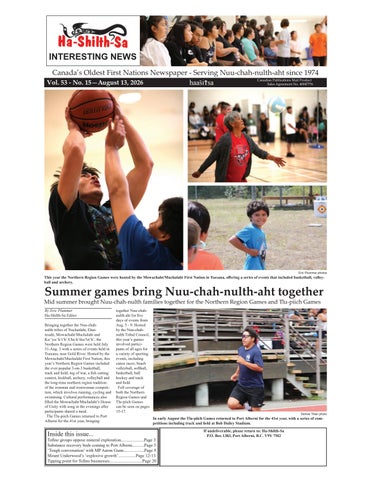
This year the Northern Region Games were hosted by the Mowachaht/Muchalaht First Nation in Tsaxana, offering a series of events that included basketball, volleyball and archery.
Summer games bring Nuu-chah-nulth-aht together Mid summer brought Nuu-chah-nulth families together for the Northern Region Games and Tlu-piich Games By Eric Plummer Ha-Shilth-Sa Editor Bringing together the Nuu-chahnulth tribes of Nuchatlaht, Ehattesaht, Mowachaht/Muchalaht and Ka:’yu:’k’t’h’/Che:k’tles7et’h’, the Northern Region Games were held July 31-Aug. 3 with a series of events held in Tsaxana, near Gold River. Hosted by the Mowachaht/Muchalaht First Nation, this year’s Northern Region Games included the ever popular 3-on-3 basketball, track and field, tug of war, a fish cutting contest, kickball, archery, volleyball and the long-time northern region tradition of the ironman and ironwoman competition, which involves running, cycling and swimming. Cultural performances also filled the Mowachaht/Muchalaht’s House of Unity with song in the evenings after participants shared a meal. The Tlu-piich Games returned to Port Alberni for the 41st year, bringing
Inside this issue...
together Nuu-chahnulth-aht for five days of events from Aug. 5 - 9. Hosted by the Nuu-chahnulth Tribal Council, this year’s games involved participants of all ages for a variety of sporting events, including canoe races, beach volleyball, softball, basketball, ball hockey and track and field. Full coverage of both the Northern Region Games and Tlu-piich Games can be seen on pages 15-17.
Denise Titian photo
In early August the Tlu-piich Games returned to Port Alberni for the 41st year, with a series of competitions including track and field at Bob Dailey Stadium.
Tofino groups oppose mineral exploration.....................Page 3 Substance recovery beds coming to Port Alberni...........Page 5 ‘Tough conversation’ with MP Aaron Gunn...................Page 9 Mount Underwood’s ‘explosive growth’................Page 12-13 Tipping point for Tofino businesses..............................Page 20
If undeliverable, please return to: Ha-Shilth-Sa P.O. Box 1383, Port Alberni, B.C. V9Y 7M2
Page 2— Ha-Shilth-Sa—August 13, 2026
Young man remembered as court hearing commences Lennox Williams died from a 2024 stabbing incident in Ahousaht, resulting in a second-degree murder charge By Eric Plummer Ha-Shilth-Sa Editor Port Alberni, BC - The preliminary hearing began on July 15 for a murder case in Port Alberni Law Courts, attracting dozens of family members who want justice for a 20-year-old man who lost his life nearly two years ago. Several loved ones travelled from Ahousaht to attend the court hearing, a case that is currently protected by a ban that prohibits the publication of the identity of the accused or any information that arises over the course of proceedings. Several framed pictures brought by family to the court bear the caption “Justice for Lennox”, referencing a stabbing incident on Aug. 31, 2024 that resulted in the death of 20-year-old Lennox Williams in Ahousaht. Police previously reported that Ahousaht RCMP responded to a call on Saturday, Aug. 31, 2024 at 6:29 p.m. to a residence in the Ahousaht village of Maaqtusiis. “When police arrived, they saw that BCEHS were on scene providing medical aid to an adult man. He was immediately transported to hospital where he was later pronounced deceased,” said Cpl. Madonna Saunderson in the media release. An arrest was soon made after the incident, resulting in a second-degree murder charge to an individual that the publication ban prohibits Ha-Shilth-Sa from disclosing. According to the Department of Justice Canada, a publication ban can be ordered by the court “to allow victims, witnesses and others to participate in the justice
Eric Plummer photo
A preliminary hearing was underway in a case concerning the death of a 20-year-old man in Ahousaht. A publication ban is deemed appropriate as well,” read a bulletin from Ahousaht in cases where it is necessary “to encour- chief and council during the state of age witnesses who are afraid to testify” as emergency in 2024. “We all walk lightly well as to “protect the privacy of justice and respectfully during these hard times. system participants,” states the federal Pull your loved ones close and check in justice department. on those that may need extra love during That Labour Day weekend in 2024 was this time.” a particularly traumatic period for the On July 15, the first day of the prelimiFirst Nation’s village on Flores Island, as nary hearing, staff from the Kuu-us Crisis another resident unexpectedly lost her life Line Society had a table set up in the shortly after Williams’ death. Ahousaht parking lot behind the Port Alberni Law declared a state of emergency, with a 9 Courts to provide any support to those in p.m. curfew. A heavy police presence attendance. was in the village of approximately 1,000 In British Columbia preliminary hearresidents in the days that followed the ings are held for the presentation of tragedies, with cultural and counselling evidence and witness testimony to be support being offered to residents. heard in court. This is intended to enable “Chief and council also recognizes that the judge to then determine if a case Lennox Williams the current losses of life are deeply imshould go to trial, or if the accused will system without suffering negative consepacting our youth and that added supports be discharged. quences.” are also required specifically for them
August 13, 2026—Ha-Shilth-Sa—Page 3
Tofino community fights against mineral exploration B.C. government issued permits to Imperial Metals for gold exploration in Tla-o-qui-aht Tranquil Tribal Park By Nora O’Malley Local Journalism Initiative Reporter Tofino, BC – Letters of support are stacking up for Tla-o-qui-aht First Nation and their fight to protect Clayoquot Sound from mineral exploration. Tourism Tofino’s board of directors, the District of Tofino Mayor and Council and the Tofino Chamber of Commerce have all filed written concerns to the B.C. Government calling for an immediate rescission of the mineral exploration permits granted in the traditional territory of the Tla-o-qui-aht and Ahousaht First Nations. “We are particularly troubled that these permits were used despite the clear and consistent opposition expressed by Tla-oqui-aht First Nation throughout a twoyear engagement process,” read the letter on behalf of the Tourism Tofino board of directors. “The Nation repeatedly stated mining is not a permissible activity within their territory. Proceeding with exploration approvals despite this clear opposition raised serious concerns regarding the province’s commitment to reconciliation and the implementation of Indigenous Rights and Title,” the Tourism Tofino letter continues. “Tofino would be exposed to all of the risks and none of the economic benefits of mining activities in a biosphere that is interlinked with Tofino’s business community,” said Tofino Chamber of Commerce president Myles Beeby. “Over the past decade, more than $5 million has been invested in habitat restoration within the watershed directly impacted by this exploration proposal.” Selkirk Minerals, a subsidiary of Imperial Metals Ltd., obtained an exploration permit in early February 2026 for the Fandora mine site at Tranquil Creek, located about 20 kilometres northeast of Tofino, within Tla-o-qui-aht’s Tranquil Tribal Park designation. Tla-o-qui-aht’s Tribal Parks designation are a “tool for the grandchildren to adapt and manage watersheds for the sustainability and interests of their grandchildren,” says the Tla-o-qui-aht Ha’wiih (hereditary chiefs). In 1984, Tla-o-qui-aht issued the Meares Island Tribal Park Declaration to prevent logging on the island near Tofino. The Ha’wiih expanded the Tribal Park Declaration in 2014 to include Haa’uukmin Tribal Park (Kennedy Lake and Clayoquot Lake watersheds), Tranquil Tribal Park (Tranquil and Tofino Watersheds), Wanachus/Hilthuu’is Tribal Park (Meares Island) and the Hiisawista Peninsula Tribal Park. Tla-o-qui-aht has been working with Redd Fish Restoration to rebuild salmon stocks in the Tranquil Creek watershed, an area decimated by poor forestry prac-
Nora O’Malley photos
Tla-o-qui-aht Tribal Parks guardian Gisele Martin, left, sings a Tla-o-qui-aht warrior song with Leah Morgan. tices that once supported Chinook, coho, chum, pink and sockeye salmon. Records as far back as 1947 show a yearly average of 750 returning Chinook, according to Redd Fish Restoration Society. In 2018, only 59 were observed. Tranquil Tribal Park overlaps with the Clayoquot Sound Biosphere Region, which was designated in 2000 by the United Nations Educational Scientific and Cultural Organization (UNESCO). Tla-o-qui-aht Tribal Park guardian Gisele Martin attended a letter writing workshop in Tofino on July 14. The workshop was hosted by Tla-o-qui-aht Tribal Parks, Tourism Tofino and Coastal Queer Alliance in support of Tla-o-quiaht First Nation opposition to mining in their territory. Martin re-iterated that a lot of work has been put into to growing the “biological capital” of the Tla-o-qui-aht ancestral gardens. “There has been a lot of effort in helping restore the river system after the effects of logging and landslide caused by deforestation. With that aside, it’s still an amazing habitat that is included for protection in the Tla-o-qui-aht land vision,” said Martin. Permits for the Imperial Metals project include trenching at six locations and up to 22 drill sites, several of which require helicopter access. “Helicopter traffic, sound pollution, whatever activity they are doing there,
Jody Kirk, Tourism Tofino’s director of destination stewardship, applies stamps to a stack of letters destined for Victoria. is not authorized by our nation,” said “However, we have worked to accomMartin. modate the Nation’s concerns throughout “Even a little bit of industrial minthe process, and those accommodations ing can cause such destruction,” Martin were made in this case as well,” said the continued. “It is not the kind of destrucministry, without further explanation of tion that, in some cases, can be reversed. what exactly the “accommodations” are. There are areas where there has been The Chief Gold Commissioner of Britcontamination from gold mining. The ish Columbia and Ehattesaht, a Nuucontamination is constantly going to need chah-nulth First Nation on the northwest to be managed, in perpetuity. The cost of coast of Vancouver Island, remain in that, thousands of years of people trying a years long legal dispute that tests to manage thousands of years of contami- the legal weight of the United Nations nation for a bit of gold, is ridiculous.” Declaration on the Rights of Indigenous The Ministry of Mining and Critical Peoples (UNDRIP) in how it applies to Minerals said they do not have the auB.C.’s mineral tenure system. thority to cancel a Mines Act permit. In December 2025 the B.C. Court of “In cases of ongoing, documented, non- Appeal ruled that the province’s current compliance, the Chief Inspector of Mines system of granting mineral tenures goes may cancel a permit,” said the ministry. against the constitutional rights of First “A Mines Act permit can be quashed Nations. The B.C. government brought as the resulting outcome of a judicial the case forward to the Supreme Court review,” the ministry continued. of Canada, after the province lost its They acknowledged that there is no con- argument in two lower courts. The case is sent agreement with Tla-o-qui-aht First expected to come before Canada’s highNation for mineral exploration in their est court in spring 2027. traditional territory.
Page 4— Ha-Shilth-Sa—August 13, 2026
West Coast General gradually reopens its ICU Ten nurses have been hired since the ICU closed in November, with another 10 set to begin work this summer By Eric Plummer Ha-Shilth-Sa Editor Port Alberni, BC - After being closed for half a year, the West Coast General’s ICU is now partially open, with hope to become fully operational once new staff assume their roles at the hospital over the coming months. On July 14 Health Minister Josie Osborne announced that the Port Alberni hospital’s Intensive Care Unit had permanently reopened one bed in mid May. The three-bed life support unit had been closed since Nov. 20 due to staffing shortages at West Coast General, with ICU patients being transported to other hospitals – in most cases Nanaimo Regional General – once they were stabilized. “Important improvements in staffing and service capacity, including critical care-trained nurses, physician coverage, respiratory therapy and diagnostic services, mean that a phased reopening of ICU beds has begun,” wrote Osborne, who is also the area’s local MLA for Pacific Rim, in a social media post. “Since November, WCGH has welcomed new emergency and ICU nurses – including some from the US – and has expanded its team of internal medicine physicians, with additional health-care professionals arriving in the coming months.” “Ten new nurses are now working at WCGH in the emergency department and ICU, with at least 10 additional nurses expected to begin working at the site through the summer and fall,” stated Island Health in an email to Ha-Shilth-Sa. “We have also added one full time and two part-time internal medicine physicians, who are supported by at least eight locums who regularly travel to work at WCGH.” Late last year West Coast General’s staffing shortage gained widespread attention, when physicians at the hospital decided that the ICU could no longer operate without compromising other care at the facility. At the time a joint statement from the Nuu-chah-nulth Tribal Council, Tseshaht and Hupacasath First Nations called for “emergency measures” to keep the ICU open. The issue brought another service disruption on Dec. 10, when admitting became limited to patients who have a family doctor who works in the hospital. Other patients were transported to be ad-
Chloe Wangler photo
One of the three beds at the West Coast General’s ICU is now open to patients needing life support services. mitted elsewhere, until normal admitting services resumed Dec. 24. The Port Alberni hospital plans to open its ICU back to the three-bed capacity in the coming months. “Island Health remains focused on fully and permanently reopening remaining beds, one at a time, as they strategically rebuild staffing levels and a sustainable, stable service model,” said Osborne. As of July 16 there were 52 jobs advertised for the Port Alberni hospital. Registered nurse positions are listed offering $41.42 – 59.52 an hour to work in the emergency department – the same rate that is currently advertised for RN jobs at hospitals in Victoria. There are no signing bonuses listed for nurses to sign up with Tseshaht First Nation photo the Port Alberni hospital, but the small city is part of the Provincial Rural Reten- During a particularly challenging Christmas season, Tseshaht members gathered in the West Coast General’s atrium on Dec. 18 to recognize health care workers tion Incentives Initiative, which gives health care professionals an annual bonus for their ongoing efforts. The First Nation sang and danced for the hospital staff. of up to $8,000 to work in a community clinic in 2028. As part of the Community a vast region of nearly 36,000 residents, that is deemed in need of medical staff. Oncology Network, chemotherapy and stretching from the Alberni Valley to More nurses, doctors and other profesother cancer treatment will be offered, Clayoquot Sound and Barkley Sound on sionals will undoubtably be needed at the with a designated space that incudes three Vancouver Island’s west coast. Almost 20 West Coast General in the coming years, patient chairs. per cent of this service area identifies as as the hospital prepares to open a cancer The West Coast General Hospital serves Indigenous.
CYPRESS RESTAURANT & LOUNGE 250.724.7629 rimrockcasino.ca
August 13, 2026—Ha-Shilth-Sa—Page 5
Substance-use recovery beds coming to Port Alberni New eight-bed facility will house clients for 30-90 days with support for a ‘transition back to community living’ By Eric Plummer Ha-Shilth-Sa Editor Port Alberni, BC - After years of lobbying, recovery support for those struggling with drug addiction is coming to Port Alberni. Standing in a courtyard at the back of the West Coast General Hospital, on July 31 Health Minister Josie Osborne announced that an eight-bed recovery and stabilization facility will be opening in the Alberni Valley later this summer. “Clients will typically stay between 30 and 90 days, receiving recovery-oriented care,” stated the B.C. Ministry of Health in a press release. “Activities focus on goal setting, recovery and wellness programming and coaching for daily living in preparation for transition back to community living.” Renovations on the Inlet Recovery Home are complete, and referrals are underway for its first clients, which Osborne expects can move to the facility in about a month. “These are beds that will offer a safe and supportive environment for people, where they can focus on recovery, they can build stability, and they can prepare for the next step of their healing journey,” said Osborne, who is also the local MLA for Mid Island-Pacific Rim. “This is about really creating new opportunities for healing, recovery and hope.” Through $1 million in annual operational funding from the province the facility will be staffed around the clock, run by Connective Vancouver Island, a nonprofit with over 35 years of experience. But the recovery facility is not for those who need medical detox, a stage that typically lasts a week to manage the acute withdrawals that come from substance addiction, says Amanda Lemon, Island Health’s clinical service delivery director for Addiction Medicine and Substance Use for Central and North Vancouver Island. The closest facility for this stage is the 12-bed Clearview Detox Centre in Nanaimo, but withdrawal management can also be possible in a hospital or through a physician prescribing opioid agonist therapy in the community. “Detox is more centralized, but regionally accessible,” said Lemon, noting that clients can be supported with transportation if needed. “We probably would move them to Clearview in Nanaimo as the place of choice.” The method of detox depends on the patient’s needs, she noted. “We have a virtual substance use prescribing team as well,” said Lemon. “The
Eric Plummer photo
On July 31 Health Minister Josie Osborne announced that an eight-bed recovery and stabilization facility will be opening in the Alberni Valley later this summer. hospital is not the place to go for detox, but some people end up in the hospital because of their acute withdrawal - because of other medical co-morbidities they may actually go through a detox process in the hospital.” The recovery facility announcement comes after years of calls for more support for substance users in the Alberni Valley. After countless overdose deaths affecting the region’s First Nation families, in April 2022 the Nuu-chah-nulth Tribal Council called for the government to support an around-the-clock “rapid access addiction clinic” and certified detox centre in Nuu-chah-nulth territory. In the following year the Alberni-Clayoquot health region had the third highest rate of fatal drug overdoses in British Columbia. Then in January 2024 the Tseshaht First Nation hosted days of meetings in Maht Mahs, resulting in a plan with the Alberni Valley Community Action Team and Kuu-us Crisis Line Society that stressed the critical need from a fully funded detox and recovery facility in the region. A state of emergency followed in September of that year from the Nuu-chahnulth Tribal Council for the ongoing drug overdose crisis. After years of pushing for more help, NTC President Judith Sayers says the eight recovery beds are welcome news. “It is a start to meeting the healing needs
Island Health photo
Clients will typically be able to stay in the facility for 30-90 days once their withdrawal symptoms are medically stabilized. other substances such as alcohol,” said of our people, but more is needed,” she Dr. Reka Gustafson, Island Health’s chief said. “The Nuu-chah-nulth several years medical health officer. “We also know ago put in place a strategy to combat the that substance use and addiction is more toxic drug and mental health crisis, but than a medical condition. It’s the result of was unable to get the fiscal resources needed to implement the strategy. We are a complex mix of trauma, social, economic, biological factors that people who still working on providing the kinds of are living with addiction didn’t choose.” culturally appropriate and trauma inAs someone who has experienced formed services that are needed within all substance addiction, Nina Kossenko is our territories.” intensely familiar with this reality. She Across B.C. First Nations people have currently works for Island Health in adbeen impacted by drug fatalities at a rate dictions support. six times that of the rest of the popula“I lived my life in this community, I also tion, according to the First Nations destroyed my life in this community,” Health Authority. At the beginning of the said Kossenko, who is also co-chair of July 31 recovery facility announcement the Port Alberni Community Action Tseshaht Chief Councillor Ken Watts Team. asked for a moment of silence to recog“Everybody is different. That’s what nize those who have been lost. makes addiction so challenging to over“There’s a lot of people that never had come,” she added. “It rips families apart, a chance to lay in a recovery bed and get it destroys people’s ability to feel safe in medical support,” he said. the community on the streets that they The toxic drug crisis has been a provinwalk in, and it also affects the businesses cial health emergency since April 2016, that people want to work in.” a period that has seen over 18,000 lives The beds at Inlet Recovery Home can lost due to substance poisoning. Osborne be accessed by calling Westcoast Mental admitted that it’s been a difficult probHealth and Substance Use at 250-726lem for the health system to manage, as 1282 or Port Alberni Mental Health and everyone’s addiction is unique. Substance Use at 250-731-1311. “We know that everybody’s path to For additional mental-health and subtreatment and recovery is different. We also know that this is not a journey that is stance-use supports, people in the Island Health region can call Access Central a straight line,” she said. “When people are ready, and they are ready to reach out at 1-888-885-8824. An interdisciplinary care team is available seven days a week, for help, they need access to care that is including addiction medicine physicians timely, that is appropriate for their needs who can provide assessment and care coand that is as close to home as possible.” ordination to people with substance-use “Port Alberni knows only too well the disorders. social and health effects of the unregulated toxic drug poisonings as well as
Page 6— Ha-Shilth-Sa—August 13, 2026 Ha-Shilth-Sa newspaper is published by the Nuu-chah-nulth Tribal Council for distribution to the members of the contributing First Nations, as well as other interested groups and individuals. Information and original work contained in this newspaper is protected by copyright and may not be reproduced without written permission from: Nuu-chah-nulth Tribal Council P.O. Box 1383, Port Alberni, B.C. V9Y 7M2. Telephone: (250) 724-5757 Fax: (250) 723-0463 Web page: www.hashilthsa.com facebook: Hashilthsa Ntc
2026 Subscription rates: Non-Nuu-chah-nulth, Ahousaht, Ehattesaht,Toquaht and Ucluelet members are subject to a yearly subscription fee of $40 in Canada, $50 in the US and $60 for overseas. Payable to the Nuu-chah-nulth Tribal Council
Manager/Editor/Reporter Eric Plummer (Ext. 243) (250) 724-5757 Fax: (250) 723-0463 eric.plummer@nuuchahnulth.org Reporter Denise Titian (Ext. 240) (250) 724-5757 Fax: (250) 723-0463 denise.titian@nuuchahnulth.org Reporter Nora O’Malley (604) 353-8488 nora.omalley@nuuchahnulth.org Audio / Video Technician Mike Watts (Ext. 238) (250) 724-5757 Fax: (250) 723-0463 mike.watts@nuuchahnulth.org Editorial Assistant Holly Stocking (Ext. 302) (250) 724-5757 Fax: (250) 723-0463 holly.stocking@nuuchahnulth.org
DEADLINE: Please note that the deadline for submissions for our next issue is August 21, 2026 After that date, material submitted and judged appropriate cannot be guaranteed placement but, if material is still relevant, will be included in the following issue. In an ideal world, submissions would be typed rather than hand-written. Articles can be sent by e-mail to holly.stocking@nuuchahnulth.org (Windows PC). Submitted pictures must include a brief description of subject(s) and a return address. Pictures with no return address will remain on file. Allow two - four weeks for return. Photocopied or faxed photographs cannot be accepted.
LETTERS and KLECOS Ha-Shilth-Sa will include letters received from its readers. Letters MUST be signed by the writer and have the writer’s full name, address and phone number on them. Names can be withheld by request. Anonymous submissions will not be accepted. We reserve the right to edit submitted material for clarity, brevity, grammar and good taste. We will definitely not publish letters dealing with tribal or personal disputes or issues that are critical of Nuu-chah-nulth individuals or groups. All opinions expressed in letters to the editor are purely those of the writer and will not necessarily coincide with the views or policies of the Nuu-chah-nulth Tribal Council or its member First Nations. Ha-Shilth-Sa includes paid advertising, but this does not imply Ha-Shilth-Sa or Nuu-chah-nulth Tribal Council recommends or endorses the content of the ads.
Concern Etsy fur ban will harm artisans Assembly of First Nations plan vote for online seller’s animal products prohibition By Karly Blats Ha-Shilth-Sa Contributor A First Nations chief in Newfoundland and Labrador is calling on the popular online marketplace Etsy to reverse a ban on the sale of natural fur products on its site. The ban, scheduled to come into effect on August 11, was first announced by Etsy in April, citing they wanted to create a sustainable future by protecting wildlife from extinction. Chief Jenny Brake of Qalipu First Nation in Newfoundland and Labrador is hoping there is still time for Etsy to reverse the upcoming ban. Due to time constraints, Brake’s resolution for Etsy to suspend the fur ban was not voted on during the latest Assembly of First Nations (AFN) Annual General Meeting last week in Ottawa, and was instead referred to the next meeting of the AFN Executive Committee with a date to be determined. Etsy’s statement regarding the ban says, “In addition to prohibiting products made from endangered and threatened species, Etsy prohibits products made from or containing natural animal fur, regardless of age or origin. This includes products like raw pelts, finished garments, accessories, and personal care items made with real fur from animals such as mink, fox, rabbit, badger, coyote, and raccoon dog.” This does not include taxidermy, byproduct materials, such as leather, sheepskin, shearling, cowhide, wool, or mohair, or fur products from sellers registered with the Indian Arts and Crafts Board. Brake’s resolution calls attention to the disproportionate impact the ban could have on First Nations communities and urges Etsy to reconsider its decision before the policy comes into effect. Doug Chiasson, executive director of the Fur Institute of Canada / Canadian Seal Products, agrees that platform bans like this can restrict the ability for First Nations artisans to be able to access a global market. “The great thing about a platform like Etsy, is it provides global reach for smallscale producers and if we lose access to those kinds of platforms it really kind of shrinks the world available to artisans,”
Qalipu First Nation photo
Chief Jenny Brake of Qalipu First Nation in Newfoundland and Labrador is hoping there is still time for Etsy to reverse the ban. Chiasson said. “There certainly are other avenues that folks can try and access, but what really kind of sets Etsy apart…is they do have that global reach.” Chiasson believes anti-fur groups are driving Etsy’s proposed ban. “Really, it’s been pressure and harassment from anti-fur groups. There’s been demonstrations at Etsy events…targeted harassment towards their executives by these anti-fur groups,” Chiasson said. “In some cases it gets to a point where the individual that has decision-making power on a platform says, ‘I’m tired of putting up with this, I’m tired of being painted as public enemy number one,’ and they take the easy way out which is to remove fur form their platform.” Chiasson said he doesn’t see any real explanation to ban fur in the name of biodiversity conservation. “We estimate that as many as half of Canada’s trappers are Indigenous and their experience on the land, their knowledge on the land, is irreplaceable and incredibly valuable in work on biodiver-
Legal Information
COVERAGE: Although we would like to be able to cover all stories and events, we will only do so subject to: - Sufficient advance notice addressed specifically to Ha-Shilth-Sa. - Reporter availability at the time of the event. - Editorial space available in the paper. - Editorial deadlines being adhered to by contributors.
sity conservation,” Chaisson said. “A sustainable and well managed fur harvest is incredibly important for not just cultural and heritage reasons but for biodiversity reasons.” Chiasson added that Etsy’s ban is targeted at animals killed primarily for their fur, but he questions who can determine how the rest of the animal in being used. “That’s one of the things that we’ve really tried to communicate to Etsy, is if they legitimately want to put in an ecosystem on their platform that supports biodiversity conservation, we’re more than happy to work with them to make sure they have stringent measures in place that the fur that’s traded on their platform is ethical, sustainable and humanely harvested… but they never made that attempt,” Chiasson said. Chiasson added that there’s been no indication that Etsy’s fur ban won’t go through in August. Etsy did not respond to Ha-Shilth-Sa’s request for an interview.
Ha-Shilth-Sa belongs to every Nuu-chah-nulth person including those who have passed on, and those who are not yet born. A community newspaper cannot exist without community involvement. If you have any great pictures you’ve taken, stories or poems you’ve written, or artwork you have done, please let us know so we can include it in your newspaper. E-mail holly.stocking@nuuchahnulth.org. This year is Ha-Shilth-Sa’s 52nd year of serving the Nuu-chah-nulth First Nations. We look forward to your continued input and support. Kleco! Kleco!
The advertiser agrees that the publisher shall not be liable for damages arising out of errors in advertisements beyond the amount paid for space actually occupied by the portion of the advertisement in which the error is due to the negligence of the servants or otherwise, and there shall be no liability for non-insertion of any advertisement beyond the amount paid for such advertisements
August 13, 2026—Ha-Shilth-Sa—Page 7
West Coast Trail hikers shelter at Nitinaht Crabshack On July 27 heavy rainfall made sections of the West Coast Trail impassable, forcing Parks Canada evacuations By Nora O’Malley Local Journalism Initiative Reporter Nitinaht Narrows, BC – Carl and Shelley Edgar operate Nitinat Wilderness Charters and Crabshack, located in the middle of the West Coast Trail (WCT) on the south side of Nitinaht Narrows in Ditidaht First Nations territory. They said the rain started Saturday evening, July 25. “I was out fishing in the morning. The ocean was all flat. It was like a lake out there. It was eerie, calm, not even a wave out there,” said Carl. Shelley thought the rain was going to be a passing cloud. Then all of a sudden, everyone wanted off the trail, “like right now”. “It just seems so surreal. It’s a freak for July. We’ve never experienced something like that. We’ve been through a storm in August and a storm in September and we know what to expect with those ones because they happen every single year. But this one is the first time in July,” said Shelley. “I think it’s the super El Niño coming,” said Carl. El Niño is characterized by a warming of ocean surface temperatures in the central and eastern Equatorial Pacific. According to the World Meteorological Organization (WMO), El Niño typically increases global temperatures and drives more extreme weather and rainfall patterns. Historically, El Niño typically occurs every two to seven years and lasts around nine to twelve months. The WMO says warm ocean waters are fueling the development of El Niño.
Submitted photo
The Crabshack crew waiting in heavy rain for hikers, from left: Shelley Edgar, Carl Edgar, Leon Edgar, Ryan Edgar, Krissy Edgar and Darci Edgar. the only place on the 75-kilometre WCT to the cold, wet conditions.” Following Saturday and Sunday’s freak The federal agency encouraged hikers downpour, the Edgar family evacuated 70 where hikers can get dry. “We’ve been up until 2 or 3 in the morn- with reservations through to Aug. 1 to hikers off Canada’s famous WCT. They ing with hikers helping them dry their delay or cancel their trip. They say hikers shuttled people on boats to Ditidaht’s gear,” said Shelley. “Most are grateful with reservations from July 27 to August main village where the hikers jumped on and happy to have made it here.” 1 could cancel for a full refund. the West Coast Trail Express or Nitinaht On July 27, Parks Canada said the heavy “Current trail conditions include exLake Express for road transportation out rainfall has made sections of the WCT tremely muddy and slippery sections, of the village. standing water, and variable river levels, “It was hectic,” said Carl. “We had a full impassable. “Creeks and rivers are running high, and resulting in slower travel times,” noted house on our tent deck and our cabins.” more rain is expected through WednesParks Canada. “Hikers must be prepared With campfires currently banned in the day, July 29. Parks Canada’s Visitor to wait several days for water levels to region, the Crabshack and cabins are Safety team is responding to a significant recede, or to self-evacuate through their number of evacuation requests,” read the starting point or Nitinaht Lake.” Pacific Rim National Park Reserve, Parks Carl and Shelley have since been hit Canada social media post. with a flurry of cancellations and reHikers who were on the trail during schedules, but Carl says it “balances itself this downpour either found their way to out”. safety or were evacuated. “We adapt and we absorb it,” he said. “The majority of evacuations during “It is too early to determine whether this period have been carried out by boat, flooding or infrastructure damage will allowing for full hiking parties to leave affect the trail beyond this week,” said with the injured or unhealthy individual, Parks Canada on July 30. “Parks Canada with a smaller number of evacuations will continue assessing trail conditions completed by helicopter,” wrote Parks and incoming weather and will provide Canada in an email to Ha-Shilth-Sa. “Of further updates as information becomes those hikers evacuated, a small number available.” experienced injuries, primarily resultThe WCT attracts over 7,500 hikers ing from slips, falls, or the aggravation a year from across Canada and around of pre-existing injuries. For most, the the world. The Edgar’s have been safely principal medical concern was the risk of shuttling trekkers across the Nitinaht Narhypothermia due to prolonged exposure rows since 1975.
Nitinaht narrows pictured from the air.
Page 8— Ha-Shilth-Sa—August 13, 2026
Stronger protections for domestic violence victims Changes include new offence of coercive control in intimate relationships, stricter bail laws to protect victims By Nora O’Malley Local Journalism Initiative Reporter Last month, significant changes to Canada’s Criminal Code were passed into law to strengthen protections for victims of gender-based violence, and to keep children safe from predators. The Protecting Victims Act (Bill C-16) received Royal Assent on June 18. Most of the changes came into force on July 18. “In general, all of the changes that are in this announcement are designed to provide more recognition of vulnerable victims and their experience of the criminal legal system and trying to mitigate that with support,” said Angela Marie MacDougall, executive director of the Vancouver-based Battered Women’s Support Services. The law gives the justice system stronger tools to intervene earlier to sexual violence, gender-based, and intimate partner violence before it turns fatal, according to the federal government. More specifically, the changes: • make femicide, which is the intentional killing of women and girls due to their gender, first degree murder, the most serious homicide offence • create a new offence of coercive control in intimate relationships, targeting patterns of threats, isolation, or manipulation before violence escalates • update criminal harassment provisions to make them easier to prove in court • make it a crime to threaten to distribute non-consensual intimate images, including sexual deepfakes • increase the maximum penalty for sexual assault on summary conviction, non-consensual distribution of intimate images, and voyeurism On July 17, the BC Prosecution Service (BCPS) updated the Crown Counsel Policy Manual to reflect the Criminal Code amendments. MacDougall said the updated language and new guidance around bail revocation is a “big one”. “It’s unfortunate that women had to die for this to be obvious, frankly,” said MacDougall, referencing the death of Kelowna mom Bailey McCourt. On July 4, 2025, McCourt was violently attacked in a parking lot by her estranged ex-husband James Plover – on the same day he was found guilty of assault by choking. Despite the guilty verdict, Plover was released by the Kelowna Court on bail, with a future date for sentencing. “In any functioning public safety system, that conviction would have triggered immediate and coordinated intervention. In British Columbia, it triggered his release,” stated the BWSS in response to McCourt’s death.
Submitted photos
Patricia Lattanzio, Parliamentary Secretary to the Minister of Justice and Attorney General of Canada, announces the overhaul of Canada’s Criminal Code to protect victims and keep kids safe from predators in December of 2025. “Despite the conviction, the charges violence,” she said. were stayed. The risk was not reassessed. The law changes follow recommendaHe walked free. tions from Dr. Kim Stanton’s review of And days later, Bailey was dead,” said the province’s treatment of victims and the BWSS. survivors of sexual and intimate partner The Bail and Sentencing Reform Act violence in the legal system. Stanton’s (Bill C-14) makes it harder for repeat or review found that 79 per cent of intimate violent offenders to get out on bail. partner violence homicide victims over One of the key changes regarding bail the last 15 years were women and girls. revocation enacts “reverse onus” in Sexual violence and intimate partner certain offences such as assault, sexual violence disproportionately impacts assault involving choking, human trafIndigenous women. The Stanton review ficking, and repeat violent offences, acshowed the rate of intimate partner viocording to BCPS. lence against women aged 15 and older “Reverse onus” in bail hearings means living in a remote area was over four the accused must prove their right to be times higher than the rate among women released rather than the Crown prosin accessible areas. ecution proving why they should stay From 2009 to 2021, 490 Indigenous Angela Marie MacDougall detained. Additionally, when an offender women and girls were victims of homionment, with parole ineligibility of 10 to is in a reverse onus situation, they must cide. In this time frame, the rate of ho25 years, when manslaughter is comclearly demonstrate that they have a micide of First Nations, Métis, and Inuit release plan that addresses the risk posed, mitted against an intimate partner in the women and girls was six times higher context of such a pattern said BCPS. than the rate among their non-Indigenous creating a new offence for violent, “I am especially encouraged by changes counterparts, according to the Stanton threatened, or attempted violence against to reverse-onus bail provisions, one of review. an intimate partner B.C.’s top priorities in our proposals Most survivors never access the legal extending the maximum period for to the federal government. Too many system – 94 per cent of sexual assaults detaining seized items families in British Columbia have experiare not reported to the police, notes the “This is huge. We’ve seen a man kill the Stanton review. enced devastating loss because of repeat mother of their children and get fi ve years violence. These changes will help better “There is reporting happening, but not and then have custody of the children a protect people before harm occurs,” said to police. The police are typically the year later,” said MacDougall. Niki Sharma, Deputy Premier and Attorproblem in terms of how they deal with “Overall, people are just tired of men ney General of B.C., in a media release. these crimes,” said MacDougall. “That’s killing women. This just sends a strong “Bailey’s Law”, or Bill C-225, works were it all breaks down, the evidentiary message. I think that’s important for in concert with the Protecting Victims part of it. We have a hard time getting Act, according to the federal government. our culture to say that there is going to them to conduct proper investigations be strong consequences for this kind of Named after Bailey McCourt, the new right now. These cases are complicated.” law enacts stronger criminal measures to address intimate partner violence by: treating murders that occur within a pattern of coercive or controlling behaviour GATEWAY TO THE PACIFIC RIM toward an intimate partner as murders in the first degree requiring courts to consider life impris-
TSESHAHT MARKET
Hours of operation - 7:00 am - 10:00 pm Phone: 724-3944 E-mail: manager@tseshahtmarket.ca Find us on Facebook
August 13, 2026—Ha-Shilth-Sa—Page 9
Kyuquot locals have ‘tough conversation’ with MP MP Aaron Gunn downplayed harm of residential schools in the past, wants to end land acknowledgements By Eric Plummer Ha-Shilth-Sa Editor Kyuquot, BC - Two Ka:’yu:’k’t’h’/ Che:k’tles7et’h’ members approached Aaron Gunn during the MP’s recent visit to Kyuquot to have a “tough conversation” with the MP about his past statements on sensitive First Nations issues. Gunn became the region’s representative in Ottawa after earning 38.7 per cent of votes for the North Island-Powell River riding during the national election in April 2025. For Kyuquot and northern Vancouver Island, the Conservative Member of Parliament took over from a long stint of NDP representation, riding a massive blue wave of Conservative victories across most of B.C. and Alberta during last year’s election. But Gunn entered the election with the controversy of comments he made online from 2019 to 2021 in which he downplayed the harm of residential schools. “Residential schools were asked for by Indigenous bands,” wrote Gunn in one entry to the Twitter platform, which is now called X. “There was no genocide. Stop lying to people and read a book,” wrote Gunn in another post. “The Holocaust was a genocide. Get off Twitter and learn more about the world.” Some First Nations leaders called for the party to drop Gunn, but Conservative Leader Pierre Polievre stood by his candidate, who during the weeks leading up to the final vote made an effort to distance himself from being a residential school denialist. “I have never wavered in condemning these institutions of abuse, where countless First Nations suffered at the hands of a patronizing federal government,” wrote Gunn in an X post from April 3, 2025. “We must acknowledge the terrible mistakes of our past and learn from our history while celebrating Canada as the greatest country on earth. I look forward to working with great candidates such as former Haisla Chief Ellis Ross, to repeal the Liberals’ radical anti-resource laws to quickly green-light good projects so First Nations and all Canadians bring home more powerful paycheques.” While he stressed the need to acknowledge past mistakes, Gunn doesn’t like the recognition of a First Nation’s traditional territory, which has become a common practice before a public event in Canada. In March of this year Gunn said that the federal government must stop these land acknowledgements if it “truly believes in the private property rights of Canadians,” according to a social media post he made. He also stated that the practice of land acknowledgements “reinforces the radical and dangerous legal concept that most Canadians live on ‘stolen land’,” he wrote. “This is Canada. One country for all Canadians.” On July 14 Gunn travelled to Kyuquot to meet with residents. He planned a stop to Walter’s Island, across the bay the Ka:’yu:’k’t’h’/Che:k’tles7et’h’ First Nations village of Houpsitas. “He did not reach out the KCFN directly,” said Legislative Chief Benjamin Gillette in an email to Ha-Shilth-Sa. “Our leadership do not see him as an advocate of ours, and I doubt we ever will. He met with fishing lodges in the area and very few local residents. If he wished to meet with us to engage in a meaningful way, the respectful thing to do would have been to reach out to our leadership directly.”
Eric Plummer photo
“If you’re really here to help us and speak for us, then you should be able to listen,” says Kevin Jules after his recent meeting with Aaron Gunn. Jules is pictured with his son Noah at the Kyuquot Elementary Secondary School. After an earlier version of this article was published, Aaron Gunn’s team clarified that they did contact employees of KCFN’s Tiicma Fisheries and the Walters Cove Resort, which is owned by the First Nation. Gunn’s team also informed HaShilth-Sa that they contacted the KCFN offices in Campbell River and Kyuquot about the July visit. Ka:’yu:’k’t’h’/Che:k’tles7et’h’ member Kevin Jules was determined to meet with the MP, and managed to find his whereabouts on Walters Island at the Government Dock. Jules quickly alerted his brother Brandon Smith, and they took the short ride from the small village of Houpsitas. “He grabbed his drum and we got in the boat and went over,” said Jules. “It was a good respectful conversation.” Jules admits that things were heated in the beginning, as they exchanged thoughts with Gunn about the legacy of residential schools. Jules mentioned a story shared by the late elder Hilda Hanson, who in the 1930s was taken from Aktis Island to live in a residential school. When young Hilda returned nine Aaron Gunn/X photo months later 24 big houses on the island’s On July 14 Member of Parliament Aaron Gunn visited Kyuquot, where he took shore had been destroyed after a governpart in an unscheduled conversation with two members of the Ka:’yu:’k’t’h’/ ment order was issued to enforce the Che:k’tles7et’h’ First Nations. Gunn is pictured during a recent visit to Zeballos. potlatch ban. digenous leaders from across Canada common ground with government. “That’s a huge culture shock for a child converged in Ottawa for the Assembly of “We have to have these tough converto come home to nothing,” said Jules. sations, because in order for us to keep “He didn’t believe it was a genocide type First Nations Annual General Assembly. Two emergency resolutions were passed building and growing we have to be able of situation. We had a good conversaat that meeting, including a call for the to work with government,” he said. “If tion about that, the effects it has had on federal government to criminalize resiyou’re really here to help us and speak us personally growing up with parents, dential school denialism. for us, then you should be able to listen.” grandparents who went to residential “[T]housands of children were forcibly Jules previously served for 12 years school.” taken from their families, subjected to on his First Nation’s elected leadership Jules noted that the Member of Parliaabuse, and many never returned home,” during the early years of the Maa-nulth ment wasn’t aware that the First Nation states the AFN resolution, which “calls treaty implementation. He’s not sure if is the result of the amalgamation of upon the Government of Canada to his brother and him were really heard Ka:’yu:’k’t’h’ and its northern neighexplicitly criminalize the public condonduring their conversation with Gunn, but bour Che:k’tles7et’h’ in 1962. Gunn ing, denial, justification, or minimization believes that “more teachable experialso didn’t know that Ka:’yu:’k’t’h’/ of the Indian Residential School system, ences” will be necessary when the MP Che:k’tles7et’h’ is part of the Maa-nulth classifying such rhetoric as hate speech travels to the remote communities he was treaty, which came into effect in 2011. against First Nations.” elected to represent. “It was definitely a big teaching experiConservative Leader Pierre Polievre “Our days of being at the table and ence for him,” reflected Jules. “He didn’t has rejected the call to make such statepounding our fists and making demands understand that we are a treaty nation. ments part of the Criminal Code, citing are over,” said Jules. “We’re not above He doesn’t really know anything about the concern of censorship of free speech. you, and you’re not above us. We’re seetreaty compared to being an [Indian and But looking forward, Jules feels that First ing eye to eye and we’re working things Northern Affairs Canada] nation.” Nations will need to find ways to find a out.” While Gunn was in Kyuquot, In-
Page 10— Ha-Shilth-Sa—August 13, 2026
Mowachaht/Muchalaht continue with Yuquot festival First Nation continues with annual camp out and celebration at ancestral village site on south Nootka Island By Eric Plummer Ha-Shilth-Sa Editor Yuquot, BC - While hundreds gathered in the Mowachaht/Muchalaht’s community of Tsaxana for the Northern Region Games, a smaller group of a few dozen came together to continue an annual tradition in the First Nation’s ancestral home. The Yuquot Spirit Summerfest gathering took place Aug. 1 in the village site on the southern shore of Nootka Island, where archaeological evidence shows signs of uninterrupted human habitation for at least 4,300 years. As a summer rain overcame the settlement outside, Tyee Ha’wilth Mike Maquinna shared a meal with some of his muschim and guests in Yuquot’s church. Originally built by the First Nation in 1956, the church is one of the few remaining structures from when the remote village served as Mowachaht/ Muchalaht’s main reserve community before they relocated to the Gold River area in the 1960s. Before eating, four men filled the church with song, prompting Maquinna to reflect on how he recalls seeing them as small children singing with their parents as they learned the traditions of Nootka Sound’s Indigenous culture. “Yuquot brings that out of us,” said Maquinna. The Summerfest gathering has been held since 1992, when Ambrose Maquinna, Mike Maquinna’s late father, decided to introduce new generations to Yuquot through camping and celebration at the site during the summer. Yuquot once served as a central economic settlement for tribes in the Nootka Sound region, as certain Mowachaht members hunted whales passing by the coastal location to provide sustenance for their community. More than 50 years after the First Nation was moved to the Gold River area, the Williams family are the only household to remain at Yuquot, besides pairs of lighthouse keepers that take turns manag-
Eric Plummer photos
The Yuquot Spirit Summerfest gathering took place Aug. 1 in the village site on the southern shore of Nootka Island. Before eating, four men filled the church with song. ing the Canadian Coast Guard complex on the shore. But each July and August clusters of tents appear by the old church, as members of the First Nation seek to reconnect with where their ancestors came from. This summer transportation to the site was further challenged by the unavailability of the MV Uchuck III, a converted World War Two-era minesweeper that normally makes regularly scheduled trips through Nootka Sound. The Uchuck is currently undergoing repairs. “A times like this we have to improvise for transportation without the Uchuck being here,” said Maquinna. “The iconic Uchuck has always been here to help over the years and we hope that it gets back in the water again.” Around the time that the Summerfest tradition began the Land of Maquinna Cultural Society was established. During
Margaretta James speaks while others stand to recognize the late historian Robin Inglis. the gathering on Aug. 1 among those acficially deconsecrated in the 1990s when the Catholic church withdrew its authorknowledged was Robin Inglis, a teacher and historian who contributed his experity from the structure. The church now tise to the society over the years. Inglis houses large, colourfully painted totem died on June 19, 2024 at the age of 82. poles and carvings made by Mowchaht/ “He was quiet, but strong,” said MargaMuchalaht artists, which are replicas of retta James, president of the society. “We sacred carvings by the Maquinna and learned from each other.” Jack families. In his career Inglis wrote about Euro“Robin was a giant in his field,” said pean exploration of the Northwest Coast, Richard Inglis, an anthropologist who has and was considered an expert in the specialized in Yuquot for decades, during Spanish presence in the North Pacific. In the gathering on Aug. 1. “He was a facilihis later years he worked with the Land tator. He was not in it for himself; he was of Maquinna Cultural Society, helping to in it for giving back.” restore Yuquot’s church, which was of-
August 13, 2026—Ha-Shilth-Sa—Page 11
Building energy self-sufficiency at Yuquot In August construction begins on a remote microgrid that will generate electricity from waves and solar power By Eric Plummer Ha-Shilth-Sa Editor Yuquot, BC - Construction begins this month on a microgrid designed to bring energy self-sufficiency back to one of Canada’s oldest village sites. Located on the southern shore of Nootka Island, Yuquot is the ancestral home of the Mowachaht/Muchalaht First Nation, a historic place whose name carries the meaning “where the wind blows in many directions”. The site’s exposure to the elements is a critical dynamic that is expected to drastically reduce Yuquot’s reliance on diesel for power – and fulfill the First Nation’s long held aspiration of having more members once again live year-round at the village. Expected to cost a total of $12 million, the microgrid entails a floating turbine that will be set up one and a half kilometres from Yuquot’s shore, generating up to 200 kilowatts of power by harnessing wave energy. The project is being comanaged by the University of Victoria’s Pacific Regional Institute for Marine Energy Discovery, which in recent years has been studying the potential of wave power being harnessed at Yuquot, which sees more than its fair share of coastal storms. The other major source of power for the microgrid are solar panels to be installed on the roof of a community gathering structure the First Nation plans to build on the land between Yuquot’s church and the welcome figure that overlooks the beach. This brings up to 50 kilowatts of power at a time. This energy will be stored in 400 kilowatts worth of battery banks set up behind the church, where a protection and controls panel for the microgrid will also be housed. As a contingency, seven per cent of the microgrid’s power is expected to come from diesel gasoline. Providing approximately 10 temporary jobs, construction of the microgrid is expected to last until the end of 2027, with plans for power to be generated in the following summer. After that, the project is expected to sustain two full-time jobs, plus two seasonal positions. Since 1992 Mowachaht/Muchalaht members have returned to Yuquot each summer for camp gatherings, sometimes converging in the structure that once served as a Catholic church when the village was the First Nation’s main reserve settlement. In the late 1960s the Mowachaht/Muchahlaht were relocated to Ahaminaquus, a reserve south of Gold River where it was believed they would
Eric Plummer photos
Sugar and Darrell Williams live in Yuquot year round, managing cabins and other facilities at the remote village site. be less isolated. But a nearby pulp mill when British Capt. James Cook landed at created health problems for the commuthe settlement in 1778, a relationship that nity, which was moved again in the early led to the West Coast fur trade. Archaeo1990s to the current reserve north of Gold logical excavations have found evidence River at Tsaxana. of over 4,300 years of continual habitaThe history of the First Nation’s ties tion at the site – something that has long th to Yuquot go far deeper than these 20 been affirmed by Mowachaht oral history. century relocations. The Nootka Island “Yuquot is the heart of our nation and village long served as a summer home for a place of deep cultural, historical and the Mowachaht people, who amalgamspiritual importance,” said Tyee Ha’wilth ated with the Muchalaht in the 1950s. Yu- Yahtloah, Mike Maquinna. “This project quot was the site of the Nuu-chah-nulth is about creating the infrastructure needed people’s first contact with Europeans to support our vision for Yuquot as a
place where our citizens can gather, our culture can be shared, and visitors can experience the significance of this place in a way that is sustainable and grounded in our values.” The project is part of a larger goal of gaining long-term sustainability at Yuquot. Since the First Nation’s relocation to the Gold River area more than 50 years ago the Williams family have been the only household to remain at the village site, but more will be settling there if Mowachaht/Muchalaht’s tourism aspirations proceed. Four of the six cabins at Yuquot have been fully renovated for visitors, and the First Nation is planning to build another nine cabins, plus employee housing and an interpretive centre. Azar Kamran, Mowachaht/Muchalaht’s band administrator and CEO, foresees selling packages for overnight stays at Yuquot – part of a larger tourism strategy that builds on the First Nation’s purchase of a hotel in Gold River, converting it into a Baymont by Wyndham. This could lead to more homes at Yuquot. “In order to do that, in our strategy we have to create an economy over there so that people can meaningfully engage in employment,” said Kamran. Over 60 per cent of the project’s $12 million cost has been committed, with a list of provincial and federal government sources that includes the Island Coast Economic Trust and the University of Victoria. “The funds are flowing as we do this project,” said Kamran. “As people see things getting accomplished more opportunities open, and that’s what has been going on.”
Two cabins at Yuquot are now fully renovated and available for rent from the Mowachaht/Muchalaht First Nation.
Page 12— Ha-Shilth-Sa—August 13, 2026
Did too much slash fuel Mount Underwood’s ‘explosi One year after the forest fire, logging debris left drying on the forest floor is part of a complaint being reviewed by the By Eric Plummer Ha-Shilth-Sa Editor Port Alberni, BC - It’s been almost a year since Mount Underwood erupted south of Port Alberni, quickly spreading across a bone-dry slope to become the largest wildfire the area has seen in over a century. While this forest fire season has been relatively mild by comparison, some residents are questioning if slash left over from past logging fueled the rapid growth of the blaze in August 2025. Despite concerns in May that prompted the earliest campfire ban ever in the Coastal Fire Centre, halfway through the summer this wildfire season has been uncharacteristically moderate on Vancouver Island. As of the end of July the top two thirds of the Island were under a “very low” fire danger rating, while the B.C. Wildfire Service had no fires of note or any out-of-control blazes on Vancouver Island. But last year the summer unfolded in an altogether different manner. July brought hardly any rain, leading to extremely dry forest conditions in August. The days were hot as well, and by 1 p.m. on Aug. 11, 2025 the mercury at an Alberni Valley weather station had already reached 34 Celsius, following several days of temperatures in the mid 30s. Since late July the Wesley Ridge wildfire had been burning the slope over Cameron Lake. “We were also at the tail end of an outflow event, which is a drying event where we see a warm air mass coming in from the mainland,” said Brandi Burns of the BC Wildfire Service during an event hosted by the Alberni Valley Transition Towns Society on May 20. Later in the afternoon of Aug. 11, 2025 a fire started on the slope over the China Creek Marina and Campground, quickly spreading up Mount Underwood to send a mushroom cloud into the sky over nearby Port Alberni. By 7 p.m. that evening the wildfire was believed to be 50 hectares, growing to 100 an hour later, 150 at 9 p.m., then 630 hectares at 10 p.m., said Burns. By the following morning Mount Underwood had grown to 1,447 hectares. “It was underpredicted. We were seeing very unexpected and difficult to predict fire behaviour,” she said. “It was a combination of extreme drought conditions, dry weather systems, steep slopes and fuel loading in the form of slash that kind of added up to what we saw.” During those early hours the BC Wildfire
A firefighter with the BC Wildfire Service works to extinguish a blaze on Mount Underwood in August 2025. The rapid spread of t extreme drought conditions, dry weather systems, steep slopes and fuel loading in the form of slash,” according to the BC Wildfire Service conducted modelling to predict that came on Aug. 14, slowing down Mount gests it was caused by human activity.” Mount Underwood would grow at a rate of “There were no active forestry opUnderwood and giving wildfire person14 metres per minute. This considered “the nel a better chance to suppress the fire erations in the area at the time the fire dominant fuel type” in the area, which is and establish perimeter guards. Months of started,” stated Mosaic. cedar, fir and hemlock trees, said Burns. Through its own investigation, the monitoring followed, and the wildfire was But fires spread even faster in slash, Evergreen Alliance says that clearcuts officially declared out on Dec. 8, 2025. At which is the woody debris left on the forest 3,518 hectares, it’s the biggest wildfire ever and young plantations comprise 68 per floor from logging. This has become an recorded in the Alberni Clayoquot Regional cent of Mount Underwood’s footprint, issue for the Evergreen Alliance, a group District, the next largest in the region being which is now a sprawling expanse of of B.C. citizens concerned about forestry’s a 1,035 forest fire in 1926. Mount Undercharred earth that spreads on either side impact on the environment. They filed a of the road running south from Port wood spread through a vast combination complaint to the Forest Practices Board Alberni to Bamfield. The alliance has of Crown land that falls within Tree Farm about cutblock conditions that may have Licence 44 and private land being managed also identified a 20-year-old plantation fueled the Mount Underwood wildfire. just uphill from where Mount Underby Mosaic Forest Management. “BC Wildfire Service described that bewood is believed to have started, a block With an investigation still underway, the haviour as ‘explosive’,” stated the alliance. BC Wildfire Service has not disclosed what of private land that was harvested by “We are concerned that the fire’s behaviour Island Timberlands and now falls under caused Mount Underwood. But Mosaic and size were the direct and foreseeable the management of Mosaic. A collection believes that “preliminary information sugresult of fuel hazard conditions created by rapid logging and establishment of conifer plantations on the private property that was involved in the fire.” ‘It was caused by human activity’ After three days of rapid growth, rain
Holly Stocking photo
Helicopters try to control the Mount Underwood forest fire during the early days of blaze.
Mount Underwood erupted in the afternoon of Aug. 11, 2025. By the next morning it h ally spread to 3,518 hectres, an area nearly nine times the size of Stanley Park.
August 13, 2026—Ha-Shilth-Sa—Page 13
ive’ growth? e Forest Practices Board
Mosaic Forest Management photo
BC Wildfire Service photo
the fire was caused by “a combination of e Service. of satellite images compiled by the alliance dating back to 1998 shows a patchwork of clearcuts in the area where Mount Underwood saw its rapid spread. Mosaic has disclosed that 2,400 of its land burned, comprising 68 per cent of the total spread of the wildfire. Mount Underwood’s 3,518-hectare footprint is nearly nine times the size of Vancouver’s Stanley Park. “We have every reason to invest in protecting these forests from fire, insects and other threats,” stated Mosaic. “Ensuring the long-term health and value of these forests is fundamental to our business.” Lack of regulations for private forest Some of the many images and videos
Youth from Port Alberni plant trees in the aftermath of the Mount Underwood forest fire. A community planting event was held on April 16, which brought together volunteering Mosaic staff, students from the Alberni Valley Land Based Learning class, members of the Port Alberni Scouts, and their teachers and caregivers to plant seedlings in the footprint of the 2025 Mount Underwood wildfire. taken by the BC Wildfire Service during Kaitlin Murphy is the FireSmart project tion that the regional district “work with the forest fire show collections burned coordinator for the Alberni-Clayoquot private property owners to ensure they logging debris in the affected area, leadRegional District. During the Transition understand the importance and principles ing some to wonder if an excess of slash Towns event on May 20 she addressed this of FireSmart” regarding the removal of served as matchsticks to help ignite Mount issue, saying that the regional district’s aphazardous fuel types. But so far the new Underwood. proach is “to engage whenever we can and version of this plan and its maps don’t have On Crown land the provincial governto try and get a dialogue going with those input from Mosaic. ment enforces a “take-or-pay” approach, private managed forest lands.” “That map is not likely to show privately requiring tenure holders to submit a waste “Because most of us up here are not managed forest lands unless there is an management assessment after logging that responsible for managing private managed agreement in place for us to be able to is subject to auditing to verify compliance. forest lands, we don’t have a mechanism show those publicly,” said Murphy. “Once an assessment has been accepted, at this time for controlling and essentially “Mosaic has not been asked to contribute a waste invoice is issued for waste timber enforcing certain practices,” she said. “It’s to the Alberni-Clayoquot Regional Disleft on site that is subject to billing,” wrote really difficult for us to say, ‘You have to trict’s Community Wildfire Resiliency Plan the B.C Ministry of Forests in an email to do this’, because we don’t have authority update,” responded the company. “Mosaic Ha-Shilth-Sa. “A limited amount of waste on those types of land ownership. We only remains available to discuss how we may may be left on site without incurring waste have authority over publicly owned land.” support the process.” charges. This allowable volume is referred As it manages 550,000 hectares of forest The forestry company has clearly been to as the benchmark, and benchmark levels across Vancouver Island and the Sunshine impacted by the toll of the 2025 wildfire vary based on factors such as ecosystem Coast, Mosaic says it’s only in the compaseason, and this year has announced meatype and harvesting methods.” ny’s best interests to mitigate such hazards. sures to better mitigate hazards. In 2026 “Industrial activities must not increase the “Mosaic manages its private forest lands Mosaic started a pilot detection system in risk of a fire starting or increase expected with a long-term focus on forest health, the Nanaimo Lakes region, using cameras, fire behaviour compared to conditions beproductivity and resilience, including wildground-level sensors and low-orbit satellite fore the activity began,” added the ministry. fire prevention, preparedness and recovmonitoring to spot ignitions. Under B.C.’s Wildfire Act, anyone ery,” said Steve Mjaaland, the company’s “Mosaic is focusing on high-utilization conducting industrial activity is required director of Forest Protection. harvesting to minimize residual woody to assess and reduce any fire hazards that debris,” noted the company. “Post-harvest Satellite monitoring to spot ignitions result from their practices. But the province treatment – chipping, grinding, prescribed This year the ACRD is updating its Comdoesn’t currently keep an inventory of any burning and salvage efforts – further reduce munity Wildfire Protection Plan. The last hazardous debris being left on private forrisks.” plan from 2019 included a recommendaest land.
BC Wildfire Service photo
had grown to 1,447 hectares. It eventu-
Machines work to establish a guard to control the perimeter of the Mount Underwood wildfire in August 2025. These images taken by the BC Wildfire Service have sparked questions about the volume of slash in the area of the blaze.
Page 14— Ha-Shilth-Sa—August 13, 2026
Study underway for new wood processing facility Three locations are being explored by a group of First Nations to process second-growth balsam and hemlock By Karly Blats Ha-Shilth-Sa Contributor A coastal First Nations consortium is advancing a study that will look at the feasibility of building a state-of-the-art wood processing facility on the B.C. Coast. Iskum Investments, a business partnership of more than 20 First Nations from Vancouver Island and the B.C. coast, is conducting a comparative analysis of three coastal locations for the proposed facility. No site has been selected, and the study will inform a future investment decision by Iskum’s partners. According to a press release, the study aligns with the federal and provincial direction for the forest sector: create more value from B.C. fibre, support greater sector stability and expand access to global wood products markets. Iskum’s goal is to invest in the coastal forest sector to create lasting prosperity for First Nations, workers and communities. “The purpose of the study is to carefully assess the technical, commercial and financial considerations associated with each location before Iskum’s partners make any investment decision,” said John Jack, chief councillor of Huu-ay-aht First Nations and founding partner of Iskum Investments. “As that work progresses and we are in a position to share more about the potential locations, we will do so.” A facility of this kind would be designed to strengthen the entire coastal economy, including supporting pulp and paper operations that are struggling to secure a reliable, economic supply of fibre. “The challenges facing coastal forestry are exactly why we believe this work is important. The coast needs modern manufacturing capacity designed for the forests we have today and into the future,” Jack said. “The facility being studied would be purpose-built to efficiently process second-growth logs, principally hemlock and balsam, which together make up roughly half of the coastal forest. Today, much of that fibre either goes unharvested or is sold into log export markets rather than being manufactured locally.” Wood processing facilities of this kind are the standard in the world’s most competitive lumber regions, Jack said. “The opportunity we are studying is
Iskum Investments photo
On Aug. 4 Iskum Investments announced that it is advancing the study of a new wood processing facility on the British Columbia coast. Representatives from Iskum, including Sayaač̓atḥ John Jack, chief councillor of Huu-ay-aht First Nations, Hupacasath First Nation Chief Councillor Brandy Lauder, Lyackson First Nation Laxele’wuts’aat Chief Shana Thomas, ‘Namgis First Nation Chief Don Svanvik, Rick Doman, board chair, and Dr. Michelle Corfield, board director, were joined by Parliamentary Secretary to the Minister of Environment and Climate Change and Member of Parliament Wade Grant and Member of Parliament Taleeb Noormohamed. whether that kind of modern, globally “We have established a highly skilled companies, suppliers and trades. Nationcompetitive processing capacity can be team and board and a lot of work has owned businesses are well positioned constructed and operated competitively already occurred; that work looks posifor that opportunity, as are the coastal on the B.C. coast,” Jack said. “There are tive,” Jack said. “We are now undertakcompanies and workers who have carried also advantages to bringing fibre and ing additional technical, commercial and this industry through difficult years,” manufacturing together. Participating financial work required before a final said Robert Dennis Sr., chair of Iskum First Nations hold coastal forest tenure investment decision is made.” Investments’ chiefs committee, in a press and would contribute fibre to the facility, Jack said there has already been a release. “The aim is to help keep that while the facility could provide a longsubstantial amount of work completed, work here. When First Nations busiterm domestic market for that fibre.” including preliminary facility design nesses grow, it strengthens surrounding First Nations on the coast hold more developed with experienced equipment communities, British Columbia and all of than 200 forest tenures, equating to apsuppliers. Canada.” proximately 4.6 million cubic metres of “The study is about doing the work Ravi Parmar, B.C.’s Minister of Forests, allowable annual harvest. carefully and diligently to give Iskum’s said the province is working to restore The B.C. coast also has the advantage of partners the information they need confidence in the coastal forest sector. tidewater and deep-sea shipping access, to make a well-informed investment “These communities have been the allowing a facility to serve both Canadian decision,” Jack said. “No site has been pillars of forestry – they’ve also felt the and international customers, Jack added. selected and no final investment decision impacts of the immense challenges we’re The Government of Canada is contribut- has been made.” facing,” stated Parmar in a press release. ing $1.275 million to the study through A modern wood processing facil“This announcement brings hope to the Natural Resources Canada’s Indigenous ity would provide a steady, long-term region, with the potential of hundreds Forestry Initiative. source of the chips and residuals they of jobs, greater fibre flow and a stronger At full capacity, the facility should need, while also creating a dependable local forest economy. We will continue to support more than 700 ongoing jobs domestic market for underutilized coastal work alongside the federal government to across the coastal economy, including in species. support B.C. forestry workers.” operations, management, harvesting and “A facility of this kind has the potential logistics. to create work for contractors, trucking
Phrase of the week: hu%ac^inkši+niš+a%a> %umc^a~a@as +~up~ic^h=%a+qu Pronounced ‘hu a chink shitl nish tla ulth oom chaa us tloo peech atl qoo’, it means, ‘We come back together again to play sports in the summer.’ Supplied by ḥakaƛ.
Illustration by Joslyn Charlie
August 13, 2026—Ha-Shilth-Sa—Page 15
Northern Region Games brings hundreds to Tsaxana Hosted by Mowachaht/Muchalaht, event retains a strong family focus, as young and old play over four days By Eric Plummer Ha-Shilth-Sa Editor Tsaxana, BC - Hundreds converged in the Mowachaht/Muchalaht community of Tsaxana over the August long weekend to celebrate a quarter century of the Nuuchah-nulth Northern Region Games. The on-reserve community just north of Gold River more than doubled in occupants for the community games, which each year brings together members of the Mowachaht/Muchalaht, Ehattesaht, Nuchatlaht and Ka:’yu:’k’t’h’/ Che:k’tles7et’h’ First Nations. This year’s Northern Region Games were held July 31 – Aug. 3. “I’m running around like crazy right now, but I think this is a very good success. Lots of people showed,” said organizer Francine Savey during the games’ opening ceremonies at the House of Unity on July 31. “There were 275 registered. I’m pretty sure there’s way more than that.” Most visitors camped over the weekend, with tents set up on the field behind Tsaxana’s gymnasium. “We also have people with private lots that were offering their yards for campers,” said Savey, who worked on planning the games with a committee since late February. “We had to plan around meals and consider allergies and food sensitivities. We had to consider the safety aspects of all areas we would be utilizing.” In 2001 the first Northern Region Games were hosted by Ehattesaht on their reserve by Zeballos, offering a closer-to-home alternative for the northern Nuu-chah-nulth nations than the Tlupiich Games that are held each summer in Port Alberni. This year the list of events included track and field, tug of war, a fish cutting contest, kickball, archery, volleyball and the long-time northern region tradition of the ironman and ironwoman competition, which involves running, cycling and swimming. Twenty people signed up for this demanding event, but the obvious favourite was 3-on-3 basketball, which involved over a dozen teams of children and adults that took over the Mowachaht/Muchalaht gym for most of a day. The games benefitted from recent facility upgrades on the Tsaxana reserve.
Eric Plummer photos
As 3-on-3 basketball dominated the Mowachaht/Muchalaht gym (bottom), archery was held in the field behind on Aug. 2. “The gym floor is just finished, they were raised by two inches, I think,” said Savey. “The bleachers were renovated, the dugouts were renovated, our community garden has a larger gate around it.” Despite the intensity of the 3-on-3 games, organizers still aim to ensure the games retain a family focus. Savey recalls playing in the Northern Region Games in her youth, and sees the event as a means for “bringing the children together to show them that there are fun things to do together as community.” Announcements were regularly made that the games are drug and alcohol free. “We are making sure that our emcee is reminding everybody of the rules and to make sure that the kids are safe,” said Savey, adding that members from the local RCMP detachment would be showing up “just to interact so they’re not viewed in a negative light, to build that relationship in our community as well.” As is the case each year, the games also bring a strong cultural component, with
As is the case each year, the games also bring a strong cultural component, with hours of Nuu-chah-nulth singing and dancing to open and close the annual event. hours of Nuu-chah-nulth singing and and hospitable,” said Mowachaht/Muchadancing to open and close the annual laht Tyee Ha’wilth Mike Maquinna to event. attendees during the opening ceremonies. “I hope that your stay here is memorable
Page 16— Ha-Shilth-Sa—August 13, 2026
Camaraderie shines at 2026 Tlu-piich Games The Resistance softball team played the Tlu-piich tournament with a uniform that reclaims Indigenous roots By Nora O’Malley Local Journalism Initiative Reporter Port Alberni, BC – Watching from the third baseline of the Tlu-piich Games ball pitch at Echo Park in Port Alberni, Lonnie Erickson chuckled and says he’s too old to batter up. But the grandad, who is 31 years sober, feels proud to simply spend the day cheering for his family as they take to the field. His team ‘The Resistance’, or Hushbuk as they called themselves for 2026 Tlupiich Games softball tournament, is all about camaraderie rather than winning. (With that said, the team dominated the competition, rounding base after base to score a glorious tournament title.) “I raised all my daughters playing ball and now I’m raising my grandsons. This is where I love being, at softball,” said Erickson. “Our resistance is our existence,” he said. “For life, for rights, that’s what it stands for.” His daughter Kerry, 37, designed the black and white Resistance team logo, which features a feathered headdress and a gas mask. “Our team is mostly Nuu-chah-nulth. Everyone is related. It’s mostly Hesquiaht and Tseshahts,” said Kerry. “Our dad is Métis-Ojibway, so I like to draw the headdress. I just love the look of it. It’s my logo for a couple of years,” she shared. Kim Erickson, 41, played the demanding role of shortstop during the August 6 and 7 Nuu-chah-nulth Nations softball tournament. Kim, a therapist at Kackaamin Family Development Centre, used to play collegiate softball at Mid-Continent in Kentucky, U.S.A. “I think (the logo) is reclaiming who we are as Indigenous. It’s strength in the resistance,” Kim adds. Over the past decade, several professional sports teams have rebranded, dropping offensive names. The Washington Redskins NFL team are now the Washington Commanders; the Cleveland Indians MLB franchise changed their name to the Guardians; and in 2021 the
Nora O’Malley photos
Lonnie Erickson with his daughters Kim and Kerry and his grandson Wyatt, as their team played at the Tlu-piich Games. Edmonton Eskimos CFL team became the Edmonton Elks. Kerry said she drew the gas mask on the Resistance logo to symbolize colonization. “It’s another level of resistance. They do whatever they could to get rid of us and we are still here. We are still proud. The gas mask is another tool for survival,” Kim said. While the sisters joked that the tournament started well behind schedule and that they had to screw down the bases themselves, they said that “Native ball serves a different level of respect.” “When we were kids, the Tlu-piich Games were always really big. It was always really fun and something to look forward to. Now that we are older and we have our own kids, it’s just fun to get out here with our families. These are all the people we grew up with,” said Kerry.
Resistance player Lloyd Watts calls a play.
Kim Erickson chases down the ball during their tournament opener again Huuay-aht.
Thomas Dick cracks the ball.
August 13, 2026—Ha-Shilth-Sa—Page 17
Tlu-piich Games wrap up with family-focused event Annual Nuu-chah-nulth games held for the 40th year, with heavy contributions from volunteers over five days By Denise Titian Ha-Shilth-Sa Reporter Port Alberni, BC – The light clouds scattered across Alberni Valley skies gave some respite from the blazing summer heat as family groups ran laps around the Bob Daily Stadium track vying for coveted trophies. But it was more about family fun as relay teams were made up of people of all ages, from grandparents down to young children. The small crowd in the bleachers cheered all runners, from the fastest to the little ones that never gave up and proudly crossed the finish line. When it was over, Nuu-chah-nulth Tribal Council Vice-President Les Doiron said he was happy to see Nuu-chah-nulth youth, elders and children put on such a great display of kindness, happiness and athleticism. “Our ancestors would be proud,” he told the crowd. Doiron went on to acknowledge families struggling with addiction and also those on the B.C. Mainland coping with destructive wildfires. A moment of silence was observed before elder Cliff Atleo Sr. said the closing prayer. “Thank you to host nations Tseshaht and Hupacasath for allowing us to work and play in your territory this weekend,” said Doiron. It was the 40th year of the NTC’s Tlupiich Games and they would not be a success without the generosity of the volunteers, as well as Brevin Charleson, this year’s Tlu-piich Games Coordinator. On behalf of Tseshaht, Martin Watts thanked everyone that made the games a success. He said the games are so important for the well-being of the children and he thanked all for coming to the events. “Thank you all for participating, for the fun and laughter,” said Watts.
Daley Forbes and Amber Nookemus.
Denise Titian photos
The Tlu-piich Games concluded at Port Alberni’s Bob Dailey Stadium on Aug. 9, with family groups running laps around the track vying for coveted trophies.
Tlu-piich coordinator Brevin Charleson.
Mike Watts
Ezra Young and Daley Forbes.
Page 18— Ha-Shilth-Sa—August 13, 2026
President’s Message Hello everyone! Hoping you are having a good summer and you are getting enough fish to put away for the winter. Our Hawiih’s hahoulthee are rich in resources. The Tlu-piich Games got off to a great start in Port Alberni on Aug. 5. Canoe races began the day and everyone had a lot of fun watching and cheering the teams on. A great barbeque lunch was available as were bouncy castles for the children. The opening ceremonies began with the parade of athletes and their enthusiasm in the 27-degree heat was contagious. The games have been going for over 40 years and are an integral part of NTC and the Nations’ commitment to physical activity. The northern games are put on by the northern region and we know that a lot of effort goes into planning those games and Nations coming together to celebrate physical activity. We thank Brevin Charleson for organizing the games and his team. We also thank our volunteers who make the games run smoothly. Couldn’t do it without the team, the volunteers and participants and their coaches. The work with B.C. continues in trying to resolve the provincial government issues with the Declaration on the Rights of Indigenous Peoples Act (DRIPA). Smaller working groups are tackling the issues to bring back to the bigger table to First Nations and the B.C. government. A lot of thought is going into this as First Nations want DRIPA to remain as is without amendments unless it enhances what is in the act. I am at the table with several other Nuu-chah-nulth Nations. The NTC on behalf of 11 of our Nations applied for funding from the BC First Nations Justice Council and have now hired a justice planner. The 11 Nations include Ditidaht, Huu-ay-aht, Hupacasath, Tseshaht, Hesquiaht, Toquaht, Yuułuʔiłʔatḥ, Ehattesaht, Ka:’yu:’k’t’h’/ Che:k’tles7et’h’, Mowachaht/Muchalaht, and Nuchatlaht. The other three Nations chose to do something on their own. NTC hired Roland Ginger as the Strategic Justice planner and he will be working with the 11 Nations to put in place a justice strategy. Amongst other things our justice planner will be bringing Nuu-chah-nulth communities from all regions together for strategic planning on justice issues. He will also work with the Nations on the development of a Nationwide justice plan that includes strategies for rural, remote and urban areas. Roland will be working to find out what issues each First Nation has with justice to work toward Nuu-chah-nulth-led strategies. He will be doing engagement with the communities. He is planning a forum for September 29, 2026 for people coming to Port Alberni for the NTC AGM. Watch for information on this forum. B.C. and many places within Canada and the world are experiencing wildfires that are devastating homes and infrastructures as well as their forests. Sadly, Okanagan Indian band had 230 homes burn to the ground and other infrastructure. There are more than 110 wildfires burning across B.C. and 50 of them are out of control. The warmer than average temperatures, lack of rainfall and drought creates fuel for the fires. Climate change is playing a key role in starting and continuing these fires. Provincial and federal governments’ need to make money from the oil, gas and LNG industries is creating more greenhouse gases and contributing greatly to these fires. A recent example is BC Hydro buying Island Generation in Campbell River to create electricity from LNG instead of promot-
Community&Beyond NCN Mental Health Counselling
Tuesdays and Thursdays 8:30am – 4:30pm 4841 Redford Street, Port Alberni NCN Mental Health Services – DropIn Counselling with Margaret Bird, Registered Clinical Counsellor and Play Therapist. For on and off reserve members of all ages of the Nuu-chahnulth Tribal Council. Call (250) 724-3939 to book your appointment. Samuel Richard Johnson jr. mit. Memorial Potlatch ing clean energy. They should have been developing more clean energy years ago instead of burying their heads in the sand and saying Site C electricity was all they needed. Now they are making foolish decisions in order to create more electricity to meet demand. People need to be more vocal against government and industry increasing greenhouse gases contributing to fires. BC Hydro should have talked to Nuu-chah-nulth about taking over Island Generation and creating GHG which affects us. The elders conference will be at the Vancouver Convention Centre on August 25-26th is sold out. The grand entry of elders starts the conference off in a big way highlighting the number of Nations at the conference. The conference has a mixture of some political speeches, entertainment, culture, services and much more. Hope to see a good group of our elders there enjoying everything the conference has to offer. Our NTC AGM has been set for September 29th, 2026 at the Barclay. Hoping for good representation from all 14 Nations. On October 26th, 2026, the chiefs will meet all the premiers and Prime Minister on a First Ministers meeting for the first time in over 30 years. First Nations from across the country are working on narrowing down the agenda to three of the highest priority items as time does not allow for more. Also, there will be appointed speakers to present the topics so that the issues can be put on the table and addressed by the premiers and Prime Minister. Work is being done to prepare for this meeting. The issue of the second generation cut off for registration as an “Indian” continues to be debated and has not allowed registration of these individuals as proposed by the senate in Bill S-2. That bill has not passed in the federal Parliament. I attended a meeting about this, where a motion was passed and a letter sent to the Prime Minister. The proposed cut off of registration means that some of our people will be excluded. The government does not want to provide more money to First Nations based on our populations. We have told the Prime Minister that their denying registration is against self determination, the right to be free of assimilation and the right to a nationality. For too long we have fought to define our own citizens. The federal government bases its funding on the number of registered Indians for each Nation. The federal government is continuing its engagements on this issue. Cloy-e-iis, Judith Sayers
November 7th, 2026 Starting with lunch at 12:00pm Wahmeesh gym, tsaxana reserve. All welcome.
I would like to take this time to congratulate my son Michael Tom. We descend from Hesquiaht, Mowachaht/Muchalaht, Ahousaht, Cheklesaht, and his dads side Burnslake (Cheslatta) Nation. Michael was chosen to be 1of 14 First Nations youth to go the the 2026 BC Summer Games in Kelowna BC. Out of all the various games and teams and youth, their team in the sport Ultimate were the first Team to ever consist of only Indigenous Youth. They didn’t place but they all represented their Nations well, and I am super proud of him and their team. Sincerely, Erica Tom
25 Years Ago in Ha-Shilth-Sa Vol. 28 – No. 15
August 2, 2001
Hesquiaht opens new health clinic The community of Hot Springs Cove was bustling with activity in the last week of July, 2001 for the grand opening celebration of the Health Clinic. Hesquiaht hereditary chiefs, council and community members were on hand along with Federal Health Minister Allan Rock for the official opening of the
new Health Clinic at Hot Springs Cove. Several boat and planeloads of guests arrived with the welcome of Hesquiaht Beach Keeper, Lawrence Paul. JC Lucas performed a prayer chant for the many guests prior to Chief Matlahoa cutting the cedar bark ribbon, officially opening the new facility.
August 13, 2026—Ha-Shilth-Sa—Page 19
Employment Opportunities Port Alberni Friendship Centre Volunteers Needed Need work experience? The Port Alberni Friendship Centre is looking for interested applicants for various positions. Call 250-723-8281
Page 20— Ha-Shilth-Sa—August 13, 2026
Have Tofino’s businesses reached a tipping point? Local proprietor hit with 32 per cent tax increase after latest assessment says the consequences are far-reaching By Nora O’Malley Local Journalism Initiative Reporter Tofino, B.C. – Established Tofino business owner Karen Brodie has proudly operated a day spa and wellness facility at The Shore building on Main Street for over a decade. But after absorbing a 32 per cent increase in taxes this year due to BC Assessment’s property value for the 2026 tax year, Brodie is concerned the assessment increases will have “far-reaching consequences for local businesses and employment.” She said her business took the financial hit – instead of passing the tax increase on to customers – because they didn’t want to risk pricing themselves out of the market. Plus, she says they strive to keep their prices accessible and affordable for locals and visitors. “That said, there is only so much financial pressure a small business can absorb before it reaches a tipping point,” said Brodie. “Rising costs—from property taxes to wages, utilities, insurance, and supplies— continue to erode already thin margins. While we’ve chosen to absorb these increases to remain accessible to our community, this simply isn’t sustainable indefinitely,” she said. Her small business is one of several located at The Shore building on 368 Main Street within the District of Tofino and Tla-o-qui-aht First Nation traditional territory. The Tofino spa occupies two of the strata units under a triple-net lease. A triple-net lease means the tenant is responsible for paying property taxes, maintenance fees and building insurance, on top of their base rent. This year BC Assessment values Brodie’s leased property at 316-368 Main Street to be $761,000 (Strata Lot 25). The previous year, the same property was valued at $576,000. In early June, Brodie sent a letter to Tofino Mayor Dan Law and council, outlining her fears. She asked the district to advocate on the behalf of affected businesses. “While large corporations may be able to absorb sudden increases in operating costs, many independent businesses cannot. Every significant increase must either be passed on to customers through higher prices or absorbed by the business itself. There is a limit to both. At some point, businesses become unsustainable,” wrote Brodie. Developer Tom Olsen built The Shore in 2009. He owns three of the commercial strata lots, including the two leased by Brodie. Olsen said he worked with an appraiser and went before the Property Assessment Review Board to challenge the 2026 assessment for one of his units but was unsuccessful. Local realtor Tia Traviss says commercial properties can be tough to evaluate, due to the lack of past sales in the area to
Nora O’Malley photos
The mid-summer lunch line at Tofino’s latest chain restaurant on the corner of Campbell and Fourth Street. refer to. Ahous Adventures declined to offer a paying these rates with the additional “When I evaluate properties, I use past comment for this article. municipal tax increases that were caused sale prices as a guide, and I rarely look at Jason Yochim is the Chief Executive Of- by the client overpaying for the two comsales outside of Tofino because they are ficer for the Vancouver Island Real Estate parable units purchased in January 2023,” not a fair representation of what someBoard and a director on the Nanaimo said Olsen. thing will sell for in Tofino. Ucluelet past Chamber of Commerce. The developer added that independent sales can be helpful, but you must add “We always like to think in real estate businesses in Tofino are struggling, with value to the Ucluelet past sales, because that the market determines true value,” mounting challenges from the repositionTofino properties generally sell for higher said Yochim. “Often, the assessed value ing of capital in the local marketplace values than Ucluelet properties,” said is lower than market, but not always.” and other issues that come with the resort Traviss. He says when it comes to Indigenous town being an international tourist desti“Assessment values are not consistent,” businesses purchasing property, they also nation. she continued. “They are sometimes high, want to pay fair market value. “Tofino is reaching a breaking point for sometimes low, and sometimes right in “My experience in the Indigenous busithe people who live and work there,” said line with past sale prices. Lack of sales ness community is they are very astute Olsen. can also cause assessments to take big businesspeople. They are making a very Yochim thinks the concern about high jumps. If no comparable properties sell big impact, especially in Nanaimo here property assessments impacting small for a long period of time, the assessment with Snuneymuxw First Nation and business sustainability is valid. may stay the same. When a neighbouring Petroglyph Development,” said Yochim. “There needs to be more of a focus on or comparable property finally sells, if the A quick online search of Tofino combusiness development and that takes all market has increased exponentially from mercial real estate listings shows a levels of government. The economies of the last sale, it can cause a drastic jump in neighbouring retail property on Tofino’s scale for a larger organization are often assessed value.” Main Street is listed for $3.9 million. The better because they are spreading their property also includes waterfront zonrisk instead of the small business owner What is the fair market value? ing, which allows for a hotel, restaurant, who has one location,” said Yochim. In 2023, the Ahousaht Ha’wiih (herediretail, marina or mixed-use development. He thinks the issue is rooted to housing tary chiefs) purchased assets from the Olsen has decided to sell all three of affordability. former adventure tour company Ocean his commercial strata units at The Shore “How do you bring in workforce housOutfitters to launch the Indigenous-led that were subject to the 32 per cent ing to be able to build infrastructure if eco and culture adventure tour company assessment increase. The sale price is they can’t afford to live here? We can’t Ahous Adventures. $1,635,000 for the three units, which is build a sustainable economy on people The acquisition included a fleet of five below the assessed value, according to coming here to retire. That’s an impor12-passenger boats, a mechanic shop, the listing. tant part of our economy, but if that’s all staff accommodations and two units at “I do not see that I will continue to find we’re leaning on, I think this is a probThe Shore on Main Street. Ahousaht tenants that will be successful in retail lem,” he said. Ha’wiih made the transaction through the Maaqutusiis Hahoulthee Enterprises Inc. (MHEI) and Maaqutusiis Hahoulthee Stewardship Society (MHSS). While the private sale was not disclosed, Brodie speculated in her letter to council that it seemed the properties sold “significantly above market value.” BC Assessment also increased the value of Ahous Adventure’s storefront units by 33 per cent for the 2026 tax year.
Mobile Hair Stylist 27 years as a licensed hair stylist. Able to go to elders/handicapped homes to cut, perm or color hair. Would also do in own home.
Doreen Ryan Little
250-723-4776
August 13, 2026—Ha-Shilth-Sa—Page 21
Scientists look to rebuild Pacific sea star population The reason for sea star wasting disease, a 90 per cent global die off, was classified as a mystery until recently By Antonella Medina Arias Ha-Shilth-Sa Contributor Now that the cause of the global destruction of sea stars has been discovered, researchers hope to rebuild the species to attain great ecological balance in Pacific waters. “The team has identified the causative agent of sea star wasting disease, which is an epidemic that’s been ongoing for more than a decade now and has really impacted populations of sea stars in more than two dozen species,” said Melanie Prentice, a research scientist from the Hakai Institute and part of the research team. “So, we’re absolutely thrilled to be able to have an answer to this question.” The microbial culprit responsible is a strain of the bacterium Vibrio pectenicida, from the same bacterial family that causes cholera in humans. Once infected, sea stars twist their limbs to clean off white lesions that appear on their bodies and bore holes in their epidermis and muscles. Then, they lose their internal pressure and deflate. Unable to move or diffuse oxygen across their surfaces, the sea stars’ arms fall off, and ultimately they melt into a white, goolike paste. SSWS came to attention in June 2013 in the first wave of mass mortalities along the Washington coast. The die-off trend continued in British Columbia, California, Mexico and Oregon. The sunflower sea star, the most affected by SSWS, lost 90 per cent of its global population, with 5.75 billion specimens dead. Since December 2020, the sunflower sea star has been listed as critically endangered by the International Union for Conservation of Nature. A four-year international collaboration with the University of British Columbia, the University of Washington, the Hakai Institute and the Nature Conservancy was established to investigate the cause of the disease. The research paper was published in the journal Nature Ecology and Evolution. Nailing the specifics that were causing the stars to “melt” was a challenge, as sea stars can respond to other stress factors like temperature changes, which present the same symptoms of twisted limbs or losing arms. “Warmer weather temperatures have been related to disease outbreaks since 2013,” said Alyssa Gehman, a marine disease ecologist at the Hakai Institute research team, and professor in the UBC Institute of Oceans and Fisheries. “We see a lot of evidence that temperature matters . . . [with] bigger outbreaks in warmer years all up and down the coast; when we have sort of these higher temperatures, we see more disease.” Most scientists agree that climate change, primarily changes in ocean temperatures, leads to more frequent and intense marine disease outbreaks. The connection between SSWS and warming ocean temperatures is a key focus for research, as both the disease and related Vibrio species are known to proliferate in warmer waters. Another particular challenge faced by the research team was that the wasting disease is transmissible in water. During sample collection for experimentation, they assumed the sea stars could have been exposed to the pathogen at any time. So, researchers had to carefully design a methodology to control potential infection in the collected samples. “We started with this idea of [thinking]
Bennett Whitnell/Hakai Institute photo
Melanie Prentice, a research scientist at the Hakai Institute, is part of a team that has spent years investigating the cause of the sea star wasting disease. broadly. It could be any pathogen at all. Let’s start at the beginning and let’s do these really careful experiments to see if we could figure out which one it is, and I think that was a big element of our success,” said Gehman. The team took healthy sea stars into the lab and exposed them to the infected ones through contaminated water, infected tissue or coelomic fluid (sea star “blood”). The process was repeated over several years to try and isolate the cause. The disease was successfully transmitted to the healthy stars through the three methods, with more than 90 per cent of healthy sea stars dying within a week of showing symptoms. “The results completely blew me away. Not at all what we thought was actually going to end up being the causative agent,” said Gehman. The “why” the epidemic happened remains unknown, but researchers had a couple of plausible explanations. It could be an introduction of the Vibrio species to the coastline around 2013 when the epidemic started. Alternatively, it would be something that has been around longer, and a change of circumstances like warmer ocean temperaturas could have led to the outbreak. “Certainly, either of those options is possible, and the great thing now is that we have this understanding of the pathogen, so we can start to collect data to answer that question, and we’re excited to do that in the next couple of years,” said Prentice. The nosedive in sunflower sea star populations had serious ramifications for the marine ecosystem. Sea stars are a keystone species, an organism that helps define an entire ecosystem; in their absence, the environment would be drastically changed. They maintain balance in the ecosystem by keeping marine grazers in check. “Sea stars look innocent, but particularly sunflower stars are actually these voracious predators. They eat all sorts of things on the bottom of the ocean, but they particularly eat urchins,” said Gehman. The abysmal loss of sunflower sea stars led to an explosion of sea urchin numbers, with the population going up 60 times their usual numbersin some areas. Without a healthy sunflower sea star population to help keep urchins in check,
Grant Callegari/Hakai Institute photo
A wasting sunflower sea star off Calvert Island in B.C.
Bennett Whitnell/Hakai Institute
Alyssa Gehman dives in the Burke Channel, one of the fiords along B.C.’s Central Coast, to track sea stars. kelp forests are disappearing, harmlar pathogen,” said Gehman. ing every specimen that depends on it, “I definitely think we can do a lot now including humans. to help the sea stars that we haven’t been “We knew they ate urchins; we didn’t able to do in the past. Now that we know know how much [sea stars] mattered until what the pathogen is, we can design tests they all died,” said Gehman. [to] screen individual animals . . . and Restoring sea stars to the environment screen environmental samples. That will means kelp forests might regrow, improv- make us more informed in how we’re ing marine life, sheltering coastlines from managing the species as we try to bring storms, and increasing ocean productivit them back to the landscape,” said ity. Prentice. “One of the things that we can do now The Redd Fish Restoration Society en. . . is start to try and recover the species. courages anyone to learn more about the That involves spawning animals and trywasting syndrome, participate in sea star ing to breed for resistance to this particu- surveys and volunteer for research.
Page 22— Ha-Shilth-Sa—August 13, 2026
Cheers to 100 years: Tofino Legion marks a century It wasn’t until 1951 that an Indigenous veteran could share a toast honouring his lost comrades in a legion hall By Nora O’Malley Local Journalism Initiative Reporter Tofino, BC – The Royal Canadian Legion Branch No. 65 in Tofino, B.C. marked its 100th anniversary with a pancake breakfast and cake-cutting on July 17. The organization that is now the Royal Canadian Legion was started by the veterans of the First World War to support those who served in the conflict, advocate for their rights and preserve memories. It was formally incorporated by a Special Act of Parliament on July 17, 1926. Tofino’s branch actually pre-dates the Legion’s official birthday and is one of the earliest established veterans’ hubs in Canada. Warren “Whitey” Bernard, past-president of the Tofino branch and a lifetime member of the Royal Canadian Legion, gave a heart-warming toast to the organization. The 91-year-old was the famous little boy reaching for his father’s hand, Sergeant Jack Bernard, in the iconic 1940 “Wait for me, Daddy” photo by Claude P. Dettloff. “This legion was built when this little village was only connected to the outside by steamship. Before the road, Tofino had its legion,” said Bernard. “When I came to this town, flat broke by the way in a turmoil, the first place I arrived was of course the Maquinna Hotel for one night. But then we found the Legion, and that was a gem. We met the real people of Tofino. That’s where you came when you wanted to behave yourself, when you wanted to meet the backbone of this community,” he said. In 2019, the Tofino Legion fell under hardships and closed its doors. It didn’t reopen until October 2023. “We damn near lost it,” said Bernard. But he said the younger generation like his grandson Riley Banks, 24, have stepped-up to bring the Tofino Legion back to the community hub it once was. “We want to try make things as good as we can for the community at large,” said Banks, Tofino Legion vice-president. “We are here to support the entire West Coast.” “We are always looking for volunteers and anyone who has ideas on how to best support the community,” Banks continued. Tofino Mayor Dan Law attended the Tofino Legion 100th birthday celebration. Law shared that his late dad Bruce Law was in the Canadian Navy and received the Meritorious Service Medal. He said his grandfather was also in the British Merchant Navy and all his great grandfathers were in the First World War. “The war generation is dying. There are only a handful of veterans left. Hopefully we don’t have another war, but it’s right at our doorstep, we are one step away; Article 5 would draw us in,” said Law. Article 5 of the North Atlantic Treaty (NATO) states that an armed attack against one NATO member shall be considered an attack against them all. Over the next decade, the Government of Canada plans to invest half a trillion dollars on defence – from submarines and aircraft to drones, sensors, and radar systems, according to an announcement released March 26 by Prime Minister Mark Carney. According to Veterans Affairs Canada, over 12,000 of the country’s Indigenous people served in the 20th century’s conflicts, with at least 500 losing their lives. Over 20 Nuu-chah-nulth-aht have
Nora O’Malley photos
Warren “Whitey” Bernard, Tofino Legion Vice-President Riley Banks and Tofino Legion President Mike White celebrate the Legion’s centenary. fought for Canada and the United States in wars, according to a list compiled by Ha-Shilth-Sa. But historically, Indigenous soldiers who served in the Canadian military were often treated unfairly compared to other veterans when they returned home from war. Most First Nations veterans were unable to receive full supports, grants and benefits due to their legal status under the Indian Act. It wasn’t until 1951, when the Indian Act was amended, that an Indigenous veteran could share a toast honouring lost comrades in a Royal Canadian Legion hall. Gary Peters sits on the Legion BC/ Yukon Command Executive. He said the Legion had to live by government law at the time to remain open. “The Legion was one of the “leading voices” calling for reform of the Indian Act so Indigenous veterans could enjoy the same rights as other veterans. They served, they sacrificed, and they died equally, but when they came home they Nuu-chah-nulth Tribal Council (NTC) community-based researchers Maddie couldn’t even have beer anymore,” said Haynes, left, and Skye McEwan pop in for a piece of Legion birthday cake. The Peters in a written statement to the Haresearch team was conducting surveys in the Legion basement for the Hishuk-ish Shilth-Sa. Tsawalk: Healthy Children, Healthy Futures project. “Men who fought together should be able to gather together was the legion mantra at the time,” he continued. Between 1946 and 1948, a Special Joint Committee of the Senate and House of Commons was tasked to review the Indian Act. The Legion made representations to this committee. “Their recommendations were that Indigenous veterans receive the same treatment and rights as all other veterans, that included equal access to veterans’ benefits, removal of legal barriers preventing participation in Legion services, and elimination of discriminatory provisions affecting returned servicemen,” said Peters. “It is my earnest hope in the next 100 years we are all able to live and gather together while enjoying all the same rights and freedoms that all of our veterans fought and many died for,” he said.
August 13, 2026—Ha-Shilth-Sa—Page 23
Tribal Park Allies celebrated at TFN Days festivities The Tla-o-qui-aht allies, who comprise one quarter of Tofino’s businesses, were wrapped in blankets on Aug. 10 By Nora O’Malley Local Journalism Initiative Reporter Tofino, BC – After one awesome Monday morning Tla-o-qui-aht Days parade through n̓ ačiqs (Tofino), Tla-o-qui-aht First Nation (TFN) held a heart-warming blanket ceremony at the Village Green to uplift their Tribal Park Allies. Certified Tribal Park Allies are local businesses that commit to respecting Tlao-qui-aht laws and protocols, showing up and participating in cultural events, learning about TFN culture and history, and educating visitors about respectful travel in the lands and waters cared for by Nuu-chah-nulth-aht. These Allies also collect a “responsible visitor fee” from their guests and clients, enabling the Tla-o-qui-aht Tribal Parks Guardians to protect Tofino’s drinking water and rebuild salmon stocks, according TFN. Between 2019 and 2025, Allies have collectively raised $2 million for TFN stewardship and helped protect 76,000 hectares of territory in Clayoquot Sound. “We are putting a blanket around you to show appreciation and to uphold you and ask you for your continued support of that endeavour of being a Tribal Park Ally,” said Tla-o-qui-aht elected Chief Elmer Frank. “Being a Tribal Park Ally is really significant to acknowledging whose territory you are operating in,” said Frank. “I want to say Klecko to you all. We greatly appreciate it.” Saya Masso is Tla-o-qui-aht’s natural resources manager. He said the theme of TFN Days this year is ‘Celebrating working together’. “These businesses are sticking their neck out and standing with Tla-o-qui-aht and protecting Tofino’s drinking water. Everything that cost our nation money to protect that drinking water in 1984 and our goal of having a longhouse and an athletic hall, the cost of rebuilding these rivers, the cost of annually doing clean ups and Kennedy Flats clean ups and restoring rivers cost millions of dollars. These businesses are part of that. They are part of helping and stewarding our territories and rivers and oceans,” said
Nora O’Malley photo
Owner of Tofino’s Common Loaf Bake Shop Maureen Fraser, one of the original Tribal Park Allies, is blanketed by Saya Masso on Aug. 10 at Tofino’s Village Green. Masso. McKeon. “It’s an honour, an absolute honour to “Directly contributing to the on-going lift these people up” he continued. “They environmental stewardship and continuare seen, they are felt and we honoured to ing to learn is something we will always walk every day with them in the Ha-ooth- prioritize,” he said. lee (traditional territory) of Tla-o-qui-aht According to the Tofino Chamber of Ha’wiih (Hereditary Chiefs).” Commerce, over 700 business licenses Masso walked the parade route holdare issued annually to a full-time populaing a blue ‘Water is Sacred’ banner with tion of roughly 2,650 people. Currently, Maureen Fraser, owner of Common Loaf 167 local Tofino businesses participate in Bake Shop. The Common Loaf is one of the Tribal Park Allies program, said TFN the original Tribal Park Allies. Chief Frank. Tofino Resort + Marina (TRM) is a New business owner Ali Rousseau Tribal Park Ally and was among those opened Ali’s Surf School last summer. local businesses to be honoured on Aug. He says it was important for him to join 10 at Tofino’s Village Green. Tribal Parks Allies because of all the ben“We contribute one per cent from TRM efits his business receives from nature. revenue as well as $5 per guest from Rousseau’s business model includes Harbour Air,” said TRM general manager charging guests a one-per-cent Tribal Jon McKeon. Park Allies environmental use fee and he “It’s certainly something we are proud also donates one per cent of his yearly Rousseau, who also coaches Tla-o-quito be a part of and genuinely feels like the gross income to the cause. aht’s mułaa (Rising Tide) surf squad. right thing to do. We have a tremendous “So together, we give back to a proTFN Days carries on this week with amount of appreciation for being able to gram that works towards preserving the beach races and a naming ceremony in operate here and the work of the Tla-oOpitsaht, a talent contest at the Tin Wis precious environment we get to surf and qui-aht Tribal Parks Guardians,” said Amphitheatre and a clam gardening day. play in during our surf lessons,” said
Thunderbird turns heads during TFN Days parade By Nora O’Malley Local Journalism Initiative Reporter Tofino, BC – A giant Thunderbird with lightning snakes along the side stole the show and wowed watchers on Aug. 10 as Tla-o-qui-aht members and allies made their way through the streets of Tofino for the annual TFN Days parade. Tla-o-qui-aht artist Hjalmer Wenstob created the Thunderbird with the help of his family to commemorate the first anniversary of the First Nation’s business Highway 4 Hydro. Highway 4 Hydro manages Tla-o-qui-aht’s three hydro projects: Canoe Creek Hydro, Haa-ak-suuk Creek Hydro and Winchie Creek Hydro. “This is the first year we’ve joined the parade and we wanted to do something epic. The Thunderbird comes from the mountains where we are working and brings thunder and lightning. We wanted to bring some thunder and lightning; bring some power,” said Wenstob. He shared that the wings of the Thunderbird are hinged and can open and close.
“It’s just under the legal limit of powerline height, a 13-foot one. It was a lot of fun. The whole family got together and made it and painted it and cut it all out,” he said. With recent losses in the community, Tlao-qui-aht leadership cancelled the usual songs and dances portion of the day out of respect for the grieving families. Elected Chief Elmer Frank said they went ahead with the TFN Days Parade, community lunch and the bouncy castles on the Village Green for the kids. “Today is about the children. It’s all about the children today,” Nora O’Malley photo said Frank. The Thunderbird turns the corner at Tofino’s Anchor Park during TFN Days parade on Aug. 10.
Page 24— Ha-Shilth-Sa—August 13, 2026